Queer Old Stone
p. 12 · Read in the full issue
Artifacts
Found in Papua and New Guinea
OTONE artifacts which are being found in different parts of New Guinea — and especially of late in Papua—should receive the attention of scientists. They seem to have little, if any, connection with the present races of primitive abori gines, and suggest a connection with an extinct and higher culture.
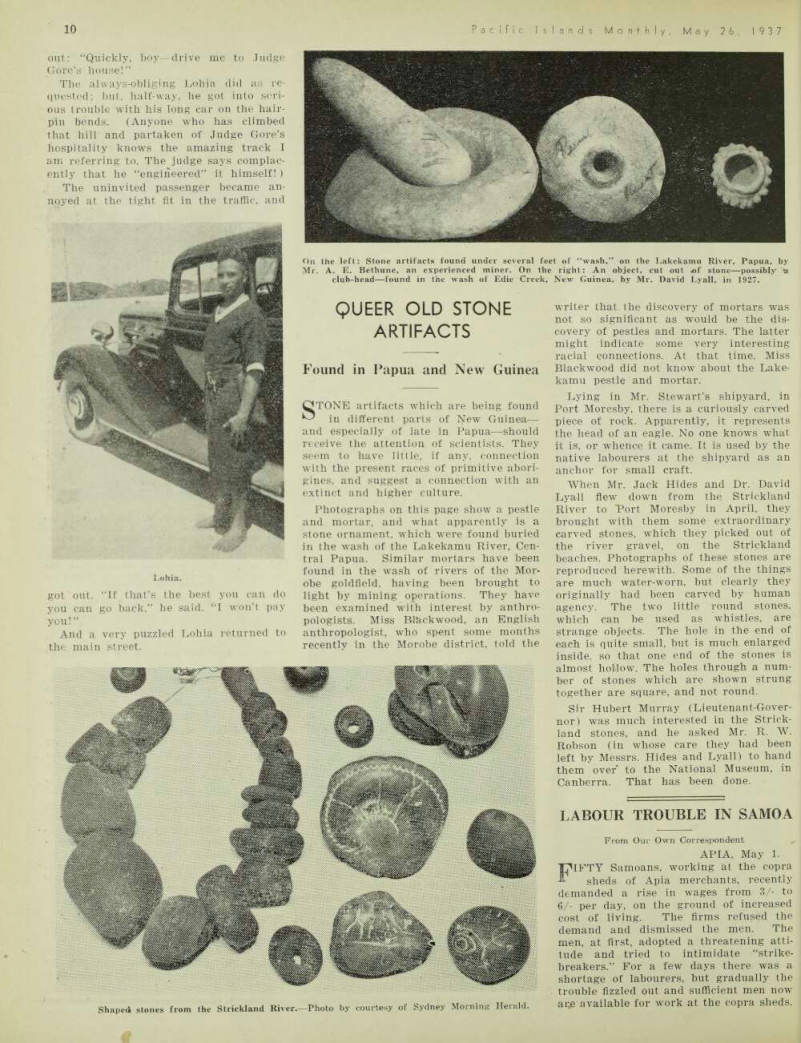
Photographs on this page show a pestle and mortar, and what apparently is a stone ornament, which were found buried in the wash of the Lakekamu River, Cen tral Papua. Similar mortars have been found in the wash of rivers of the Mor obe goldfield, having been brought to light by mining operations. They have been examined with interest by anthro pologists. Miss Blackwood, an English anthropologist, who sprnit some months recently in the Morobe district, told the
writer that- the discovery of mortars was not so significant as would be the dis covery of pestles and mortars. The latter might indicate some very interesting racial connections. At that time, Miss Blackwood did not know about the Lake kamu pestle and mortar.
Lying in Mr. Stewart’s shipyard, in Port Moresby, there is a curiously carved piece of rock. Apparently, it represents the head of an eagle. No one knows what it is, or whence it came. It is used by the native labourers at the shipyard as an anchor for small craft.
When Mr. Jack Hides and Dr. David Lyall flew down from the Strickland River to "Port Moresby in April, they brought with them some extraordinary carved stones, which they picked out of the river gravel, on the Strickland beaches. Photographs of these stones are reproduced herewith. Some of the things are much water-worn, but clearly they originally had been carved by human agency. The two little round stones, which can be used as whistles, are strange objects. The hole in the end of each is quite small, but is much enlarged inside, so that one end of the stones is almost hollow. The holes through a num ber of stones which are shown strung together are square, and not round.
Sir Hubert Murray (Lieutenant-Gover nor) was much interested in the Strick land stones, and he asked Mr. R. W.
Robson (in whose care they had been left by Messrs. Hides and Lyall) to hand them over to the National Museum, in Canberra. That has been done.