Port Moresby
pp. 11-12 · Read in the full issue
From Notes Made In
By R. W. Robson
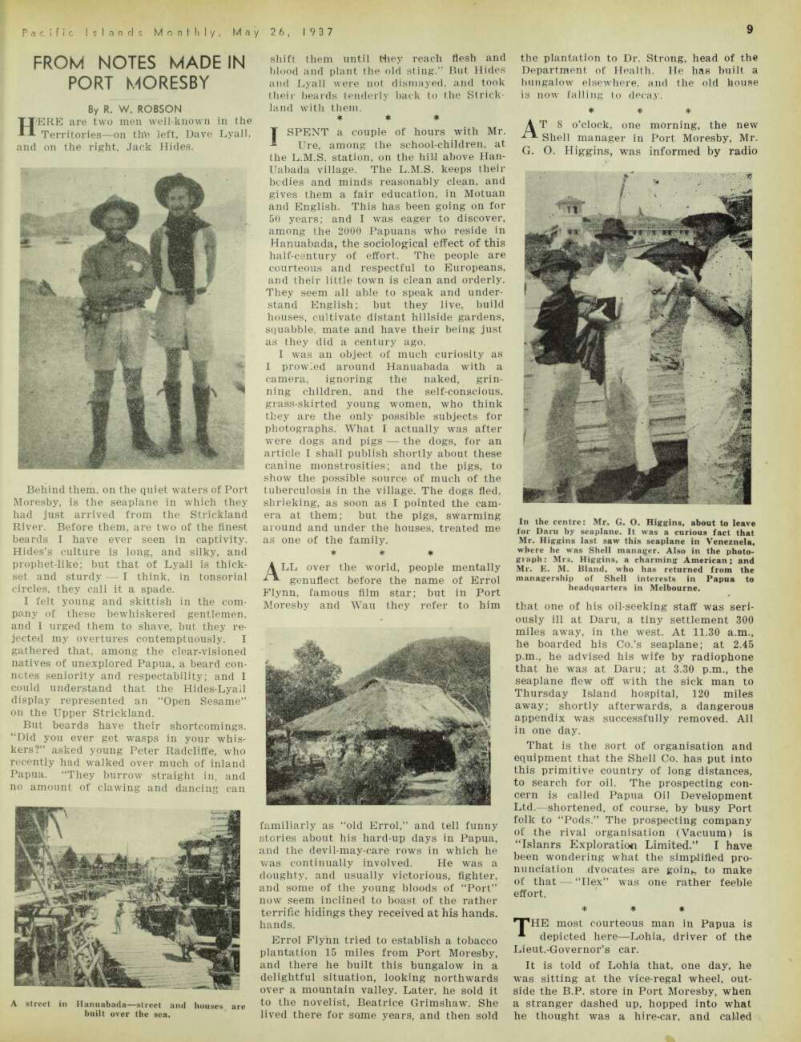
HERE are two men well-known in the Territories—on th'e left, Dave Lyall, and on the right, Jack Hides.
Behind them, on the quiet waters of Port Moresby, is the seaplane in which they had just arrived from the Strickland River. Before them, are two of the finest beards I have ever seen in captivity.
Hides’s culture is long, and silky, and prophet-like; but that of Lyall is thick set and sturdy I think, in tonsorial circles, they call it a spade.
I felt young and skittish in the com pany of these bewhiskered gentlemen, and I urged them to shave, but they re jected my overtures contemptuously. I gathered that, among the clear-visioned natives of unexplored Papua, a beard con notes seniority and respectability; and I could understand that the Hides-Lyall display represented an “Open Sesame” on the Upper Strickland.
But beards have their shortcomings.
“Did you ever get wasps in your whis kers?” asked young Peter Radcliffe, who recently had walked over much of inland Papua. “They burrow straight in, and no amount of clawing and dancing can
shift them until they reach flesh and blood and plant the old sting.” But Hides and Lyall were not dismayed, and took their beards tenderly back to the Strick land with them. ♦ * * I SPENT a couple of hours with Mr.
Ure, among the school-children, at the L.M.S. station, on the hill above Han- Uabada village. The L.M.S. keeps their bodies and minds reasonably clean, and gives them a fair education, in Motuan and English. This has been going on for 50 years; and I was eager to discover, among the 2000 Papuans who reside in Hanuabada, the sociological effect of this half-century of effort. The people are courteous and respectful to Europeans, and their little town is clean and orderly.
They seem all able to speak and under stand English; but they live, build houses, cultivate distant hillside gardens, squabble, mate and have their being just as they did a century ago.
I was an object of much curiosity as I prowled around Hanuabada with a camera, ignoring the naked, grin ning children, and the self-conscious, grass-skirted young women, who think they are the only possible subjects for photographs. What I actually was after were dogs and pigs the dogs, for an article I shall publish shortly about these canine monstrosities; and the pigs, to show the possible source of much of the tuberculosis in the village. The dogs fled, shrieking, as soon as I pointed the cam era at them; but the pigs, swarming around and under the houses, treated me as one of the family. ♦ ♦ ♦ \ LL over the world, people mentally 1 genuflect before the name of Errol Flynn, famous film star; but in Port Moresby and Wau they refer to him
familiarly as “old Errol,” and tell funny stories about his hard-up days in Papua, and the devil-may-care rows in which he was continually involved. He was a doughty, and usually victorious, fighter, and some of the young bloods of “Port” now seem inclined to boast of the rather terrific hidings they received at his hands, hands.
Errol Flynn tried to establish a tobacco plantation 15 miles from Port Moresby, and there he built this bungalow in a delightful situation, looking northwards over a mountain valley. Later, he sold it to the novelist, Beatrice Grimshaw. She lived there for some years, and then sold
the plantation to Dr. Strong, head of the Department of Health. He has built a bungalow elsewhere, and the old house is now falling to decay. ♦ * * AT 8 o’clock, one morning, the new Shell manager in Port Moresby, Mr.
G. O. Higgins, was informed by radio
that one of his oil-seeking staff was seri ously ill at Daru, a tiny settlement 300 miles away, in the west. At 11,30 a.m., he boarded his Co.’s seaplane; at 2.45 p.m., he advised his wife by radiophone that he was at Daru; at 3.30 p.m., the seaplane flew off with the sick man to Thursday Island hospital, 120 miles away; shortly afterwards, a dangerous appendix was successfully removed. All in one day.
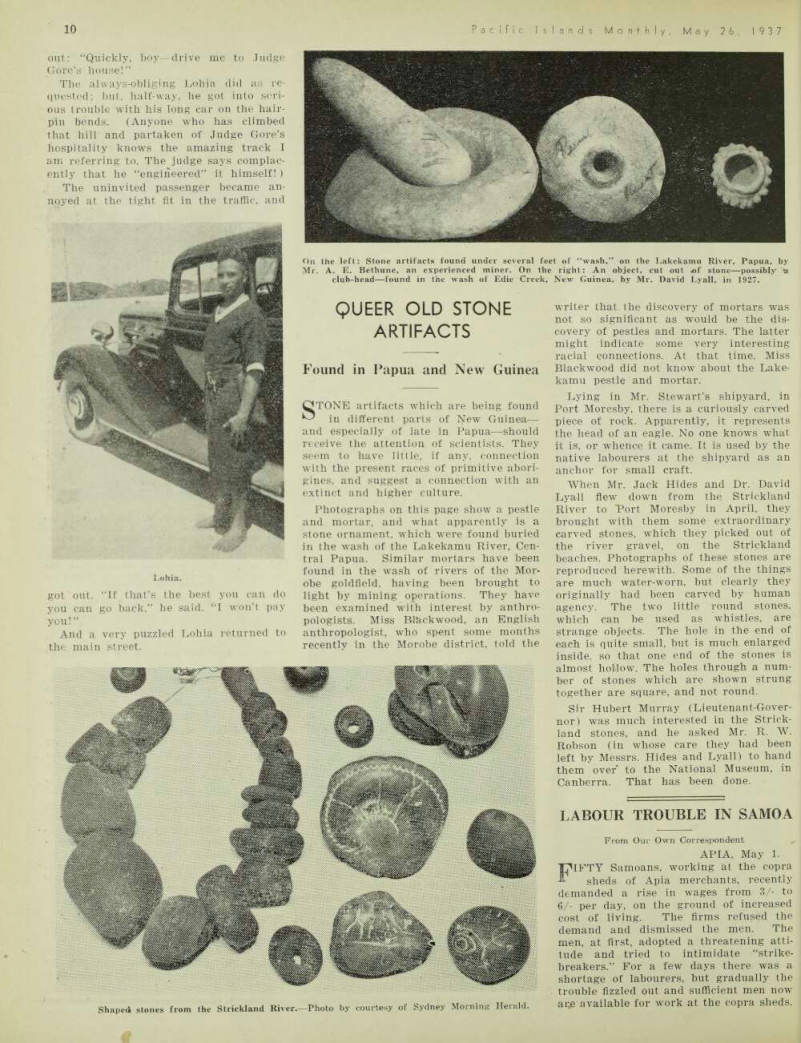
That is the sort of organisation and equipment that the Shell Co. has put into this primitive country of long distances, to search for oil. The prospecting con cern is called Papua Oil Development Ltd. —shortened, of course, by busy Port folk to “Pods.” The prospecting company of the rival organisation (Vacuum) is “Islanrs Exploration Limited.” I have been wondering what the simplified pro nunciation dvocates are goin*, to make of that “Ilex” was one rather feeble effort. * ♦ ♦ THE most courteous man in Papua is * depicted here —Lohia, driver of the Lieut.-Governor’s car.
It is told of Lohia that, one day, he was sitting at the vice-regal wheel, out side the B.P. store in Port Moresby, when a stranger dashed up, hopped into what he thought was a hire-car, and called
A street in Hanuabada —street and houses are built over the sea.
In the centre: Mr. G. O, Higgins, about to leave for Daru by seaplane. It was a curious fact that Mr. Higgins last saw this seaplane in Veneznela, where he was Shell manager. Also in the photo graph: Mrs. Higgins, a charming American; and Mr. E. M. Bland, who has returned from the managership of Shell interests in Papua to headquarters in Melbourne.
out: “Quickly, boy—drive me to Judge Gore’s house!”
The always-obliging Lohia did as re quested; but, half-way, he got into seri ous trouble with his long car on the hair pin bends. (Anyone who has climbed that hill and partaken of Judge Gore’s hospitality knows the amazing track I am referring to. The judge says complac ently that he “engineered” it himself!) The uninvited passenger became an noyed at the tight fit in the traffic, and
Lohia. got out. “If that’s the best you can do you can go back,” he said. “I won’t pay you!”
And a very puzzled Lohia returned to the main street.
Shaped stones from the Strickland River. —Photo by courtesy of Sydney Morning Herald.
On the left: Stone artifacts found under several feet of “wash,” on the Lakekamu River, Papua, by Mr. A. E. Bethune, an experienced miner. On the right: An object, cut out .of stone—possibly a club-head—found in the wash of Edie Creek, New Guinea, by Mr. David Lyall, in 1927.