Census of Samoan-Europeans: Interesting Facts Disclosed by Census
pp. 73-74 · Read in the full issue
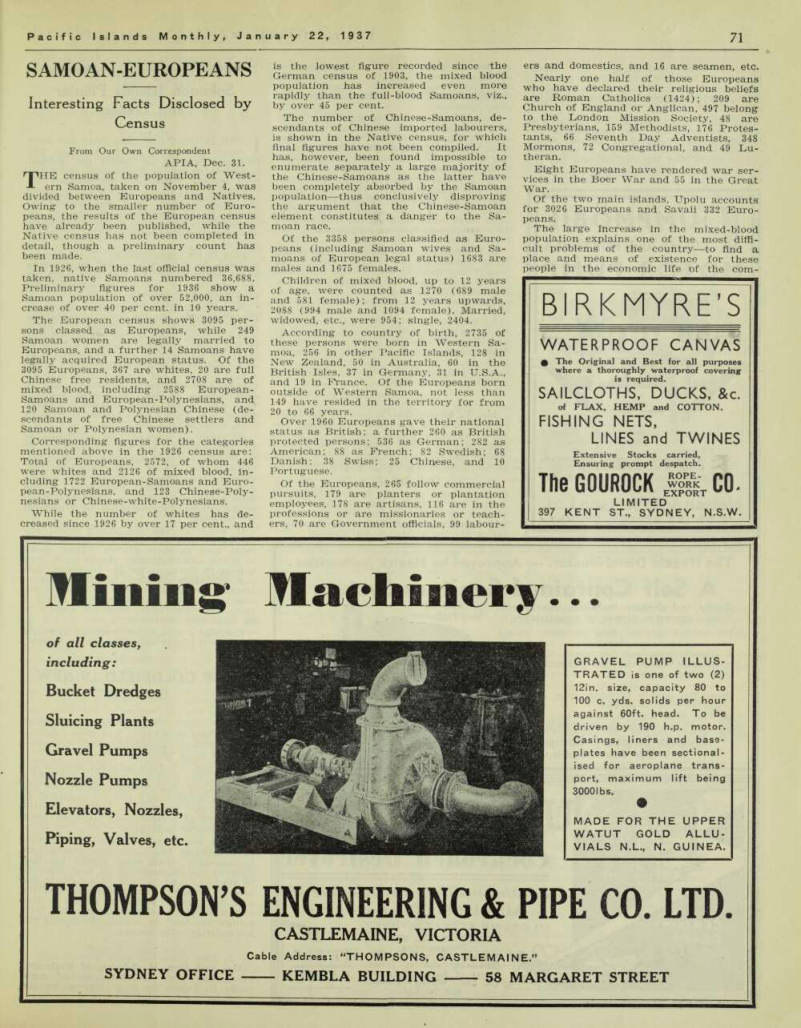
Cable Address; “THOMPSONS, CASTLEMAINE.”
SYDNEY OFFICE KEMBLA BUILDING 58 MARGARET STREET
Samoan-Europeans
Interesting Facts Disclosed by Census From Our Own Correspondent APIA, Dec. 31.
THE census of the population of Western Samoa, taken on November 4, was divided between Europeans and Natives.
Owing to the smaller number of Europeans, the results of the European census have already been published, while the Native census has not been completed in detail, though a preliminary count has been made.
In 1926, when the last official census was taken, native Samoans numbered 36,688.
Preliminary figures for 1936 show a Samoan population of over 52,000, an increase of over 40 per cent, in 10 years.
The European census shows 3095 persons classed as Europeans, while 249 Samoan women are legally married to Europeans, and a further 14 Samoans have legally acquired European status. Of the 3095 Europeans, 367 are whites, 20 are full Chinese free residents, and 2708 are of mixed blood, including 2588 European- Samoans and European-Polynesians, and 120 Samoan and Polynesian Chinese (descendants of free Chinese settlers and Samoan or Polynesian women).
Corresponding figures for the categories mentioned above in the 1926 census are: Total of Europeans, 2572, of whom 446 were whites and 2126 of mixed blood, including 1722 European-Samoans and European-Polynesians, and 123 Chinese-Polynesians or Chinese-white-Polynesians, While the number of whites has decreased since 1926 by over 17 per cent., and is the lowest figure recorded since the German census of 1903, the mixed blood population has increased even more rapidly than the full-blood Samoans, viz., by over 45 per cent.
The number of Chinese-Samoans, descendants of Chinese imported labourers, is shown in the Native census, for which final figures have not been compiled. It has, however, been found impossible to enumerate separately a large majority of the Chinese-Samoans as the latter have been completely absorbed by the Samoan population—thus conclusively disproving the argument that the Chinese-Samoan element constitutes a danger to the Samoan race.
Of the 3358 persons classified as Europeans (including Samoan wives and Samoans of European legal status) 1683 are males and 1675 females.
Children of mixed blood, up to 12 years of age, were counted as 1270 (689 male and 581 female); from 12 years upwards, 2088 (994 male and 1094 female). Married, widowed, etc., were 954; single, 2404.
According to country of birth, 2735 of these persons were born in Western Samoa, 256 in other Pacific Islands, 128 in New Zealand, 50 in Australia, 60 in the British Isles, 37 in Germany, 31 in U.S.A., and 19 in France. Of the Europeans born outside of Western Samoa, not less than 149 have resided in the territory for from 20 to 66 years.
Over 1960 Europeans gave their national status as British; a further 260 as British protected persons; 536 as German; 282 as American: 88 as French; 82 Swedish; 68 Danish; 38 Swiss; 25 Chinese, and 10 Portuguese.
Of the Europeans, 265 follow commercial pursuits, 179 are planters or plantation employees, 178 are artisans, 116 are in the professions or are missionaries or teachers, 70 are Government officials, 99 labourers and domestics, and 16 are seamen, etc.
Nearly one half of those Europeans who have declared their religious beliefs are Roman Catholics (1424); 209 are Church of England or Anglican, 497 belong to the London Mission Society, 48 are Presbyterians, 159 Methodists, 176 Protestants, 66 Seventh Day Adventists, 348 Mormons, 72 Congregational, and 49 Lutheran.
Eight Europeans have rendered war services in the Boer War and 55 in the Great War.
Of the two main islands, Upolu accounts for 3026 Europeans and Savaii 332 Europeans.
The large increase in the mixed-blood population explains one of the most difficult problems of the country—to find a place and means of existence for these people in the economic life of the com- 71 Pacific Islands Monthly, January 22, 1937 IP M UMPMOBIL LIGHT and PORTABLE
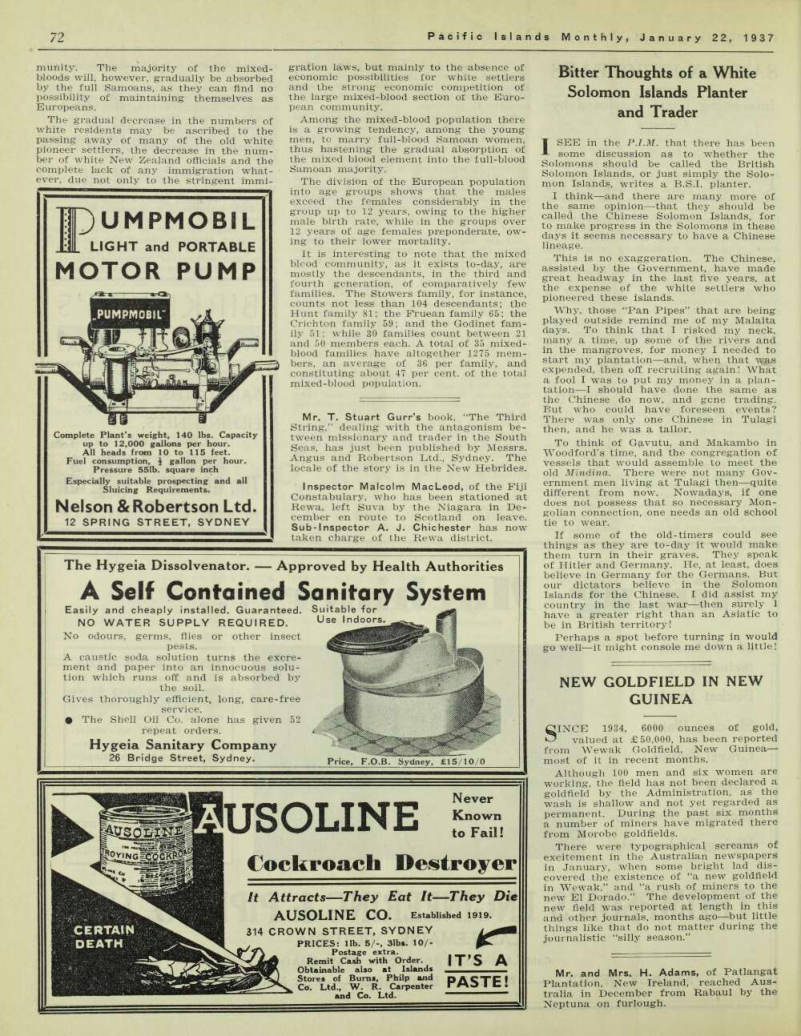
Motor Pump
PUMPMOBIL Complete Plant’s weight, 140 lbs. Capacity up to 12,000 gallons per hour.
All heads from 10 to 115 feet.
Fuel consumption, £ gallon per hour.
Pressure 551 b. square inch Especially suitable prospecting and all Sluicing Requirements.
Nelson & Robertson Ltd.
12 Spring Street, Sydney
The Hygeia Dissolvenator. Approved by Health Authorities A Self Contained Sanitary System Easily and cheaply installed. Guaranteed. Su :± ~ LI r
No Water Supply Required. U
A caustic soda solution turns the excrement and paper into an innocuous solution which runs off and is absorbed by the soil.
Gives thoroughly efficient, long, care-free service. • The Shell Oil Co. alone has given 52 No odours, germs, flies or other insect pests.
Hygeia Sanitary Company 26 Bridge Street, Sydney. repeat orders.
Price, F.Q.B. Sydney, £l5/10/0 ► °r*NGieQ V3&£ USOLINE Never Known to Fail!
Cockroach Destroyer It Attracts—They Eat It—They Die AUSOLINE CO. 314 CROWN STREET, SYDNEY Established 1919.
PRICES: 11b. 5/-, 3lb*. 10/- Postage extra.
Remit Cash with Order.
Obtainable also at Islands Stores of Burns, Philp and Co. Ltd., W. R. Carpenter and Co. Ltd.
IT’S A PASTE! munity. The majority of the mixedbloods will, however, gradually be absorbed by the full Samoans, as they can find no possibility of maintaining themselves as Europeans.
The gradual decrease in the numbers of white residents may be ascribed to the passing away of many of the old white pioneer settlers, the decrease in the number of white New Zealand officials and the complete lack of any immigration whatever, due not only to the stringent immigration laws, but mainly to the absence of economic possibilities for white settlers and the strong economic competition of the large mixed-blood section of the European community.
Among the mixed-blood population there is a growing tendency, among the young men, to marry full-blood Samoan women, thus hastening the gradual absorption of the mixed blood element into the full-blood Samoan majority.
The division of the European population into age groups shows that the males exceed the females considerably in the group up to 12 years, owing to the higher male birth rate, while in the groups over 12 years of age females preponderate, owing to their lower mortality.
It is interesting to note that the mixed blood community, as it exists to-day, are mostly the descendants, in the third and fourth generation, of comparatively few families. The Stowers family, for instance, counts not less than 104 descendants; the Hunt family 81; the Fruean family 65; the Crichton family 59; and the Godinet family 51; while 30 families count between 21 and 50 members each. A total of 35 mixedblood families have altogether 1275 mem-