A New Church in Samoa: How It Was Built
p. 69 · Read in the full issue
* ** oize d o
A New Church In Samoa
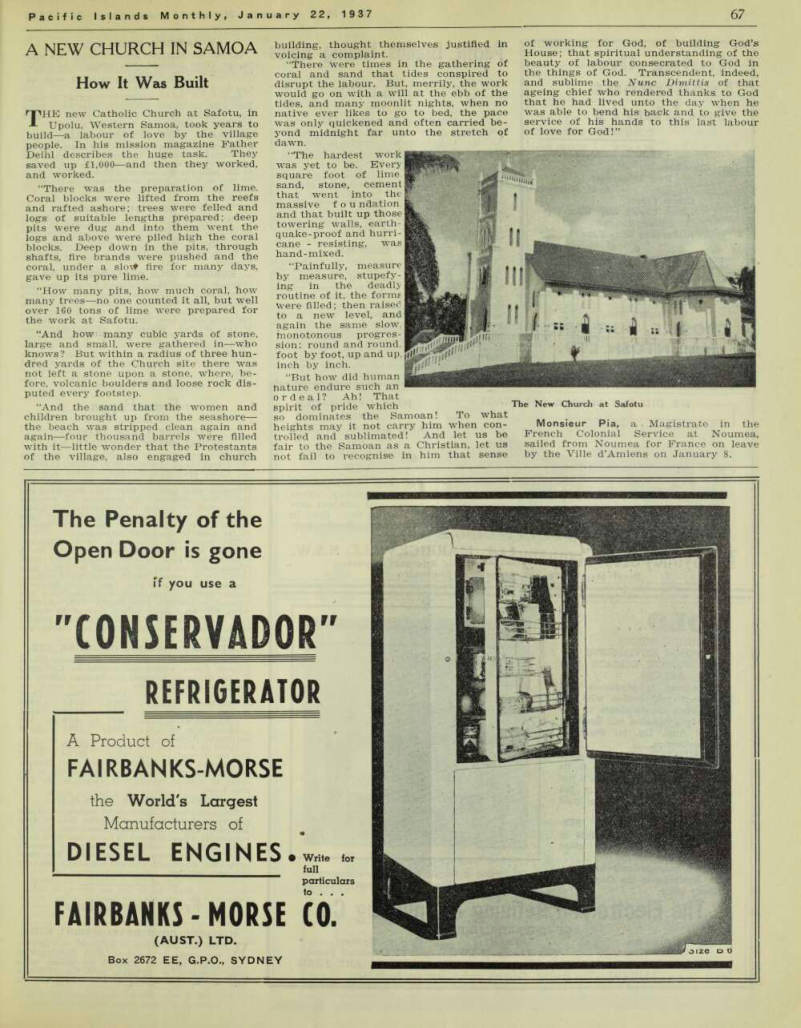
How It Was Built THE new Catholic Church at Safotu, in Upolu, Western Samoa, took years to build —a labour of love by the village people. In his mission magazine Father Deihl describes the huge task. They saved up £l,OO0 —and then they worked, and worked.
“There was the preparation of lime.
Coral blocks were lifted from the reefs and rafted ashore; trees were felled and logs of suitable lengths prepared; deep pits were dug and into them went the logs and above were piled high the coral blocks. Deep down in the pits, through shafts, fire brands were pushed and the coral, under a slo\f fire for many days, gave up its pure lime.
“How many pits, how much coral, how many trees —no one counted it all, but well over 160 tons of lime were prepared for the work at Safotu.
“And how many cubic yards of stone, large and small, were gathered in—who knows? But within a radius of three hundred yards of the Church site there was not left a stone upon a stone, where, before, volcanic boulders and loose rock disputed every footstep.
“And the sand that the women and children brought up from the seashore — the beach was stripped clean again and again—four thousand barrels were filled with it —little wonder that the Protestants of the village, also engaged in church building, thought themselves justified in voicing a complaint.
“There were times in the gathering of coral and sand that tides conspired to disrupt the labour. But, merrily, the work would go on with a will at the ebb of the tides, and many moonlit nights, when no native ever likes to go to bed, the pace was only quickened and often carried beyond midnight far unto the stretch of dawn.
“The hardest work was yet to be. Every square foot of lime sand, stone, cement that went into the massive fo u ndation and that built up those towering walls, earthquake-proof and hurricane - resisting, was hand-mixed.
“Painfully, measure by measure, stupefying in the deadly routine of it, the forms Were filled; then raised to a new level, and again the same slow, monotonous progression: round and round, foot by foot, up and up, inch by inch.
“But how did human nature endure such an ordeal? Ah! That spirit of pride which so dominates the Samoan! To what heights may it not carry him when controlled and sublimated! And let us be fair to the Samoan as a Christian, let us not fail to recognise in him that sense of working for God, of building God’s House; that spiritual understanding of the beauty of labour consecrated to God in the things of God. Transcendent, indeed, and sublime the Nunc Dimittis of that ageing chief who rendered thanks to God that he had lived unto the day when he