25,000 Tons
pp. 17-18 · Read in the full issue
Two New Ships Of
Suggested for Sydney-N.Z.- Suva-Vancouver Run
AFTER discussions and arguments ex tending over five weary years, the Governments of Australia and New Zea land (and, presumably, Fiji) are at grips at last with a plan for meeting American competition in sea-borne transport in the Pacific.
The Union line, between Sydney and ’Frisco, via Wellington and Tahiti, has been discontinued, but it is proposed to use very modern liners on the other run (Sydney- Auckland- Suva- Honolulu-Van couver) to compete with the Matson liners Monterey and Mariposa.
The Imperial Shipping Committee’s re port, which was made available in Decem ber, suggests the building of two fast modern liners, of 25,000 tons, with accom modation for 750 or more passengers, and costing about £1,250,000 each.
While the committee does not make any specific recommendation regarding subsi dies, it reports exhaustively on the matter of costs and the probable repercussions of steps that might be taken to establish a modern British shipping service in the Pacific.
The Commonwealth Government will “carefully consider” the report of the committee, and there will be consultations between the Governments regarding the policy to be determined. The committee was asked to report as a result of discus sions between the Empire Governments concerned after the Canadian-Australasian Line had applied for financial assistance to enable it to continue the Trans-Pacific service with modern vessels.
The committee reported that the two fast luxury liners Mariposa and Monterey, with which the Matson Line replaced its older vessels in 1932, were built with the assistance of the United States Govern ment. Mail payments to the Matson Line had averaged more than 1,000,000 dollars annually during the three years 1932 to 1935, compared with only 135,000 which would have been payable on the poundage rate. For construction purposes, the Oceanic Steamship Company, which owns the Matson Line, was advanced approxi mately three-quarters of the cost. The advances were 5,850,000 dollars for the Mariposa, at two per cent, interest, and 5,827,000 dollars for the Monterey, at less than 1 per cent, interest.
Lines affected by the Matson competi tion, stated the report, were the Canadian- Australasian Line (Sydney to Vancouver, via New Zealand), with the Aorangi (17,500 tons, launched in 1924) and the Niagara (13,500 tons, launched in 1913), and the Union Royal Mail Service (Syd ney to San Francisco, via New Zealand).
This line, owned by the Union Steamship Co. of New Zealand Ltd., had the Maknra (8,000 tons, launched in 1908) and the Maunganui (7,500 tons), launched in 1911).
In estimating the possibilities of future passenger traffic, the committee assumed that the Union Royal Mail Line would be discontinued and that the Canadian- Australasian Line would be equipped with two vessels equal in speed and amenity to the two Matson ships. The two pro posed new ships would be built to carry approximately 350 to 375 first-class pas sengers, 250 cabin class, and 150 to 175 third-class. They would have a minimum deadweight cargo capacity of 4,000 tons with a cubic capacity of 7,000 tons, at 50 cubic feet to the ton, including 1,500 tons of refrigerated space, which would be cap
able of extension to 2,000 tons. The ships would be comparable with the existing Matson Line vessels, and the total cost would be about £2,500,000 or more. Each ship would sail once a month on a schedule based somewhat on the follow ing: From Vancouver and Victoria to San Francisco, Honolulu, Suva, Auckland, Sydney, and Melbourne, returning via the same ports, excluding San Francisco.
“An increase in the passenger traffic necessary to occupy the four vessels to the extent to which the Matson liners were occupied in 1935 is not unlikely,’’ states the committee. “In arriving at this conclusion the committee has not over looked the development of air transport.’’
The committee anticipates that the re covery in the cargo quantity and revenue
of the Canadian-Australasian Line of the past few years will continue in harmony with the growth of Empire trade. There should be no difficulty in securing a rea sonable amount of cargo southward, but on the northward voyage there is expected to be a deficiency for a long time.
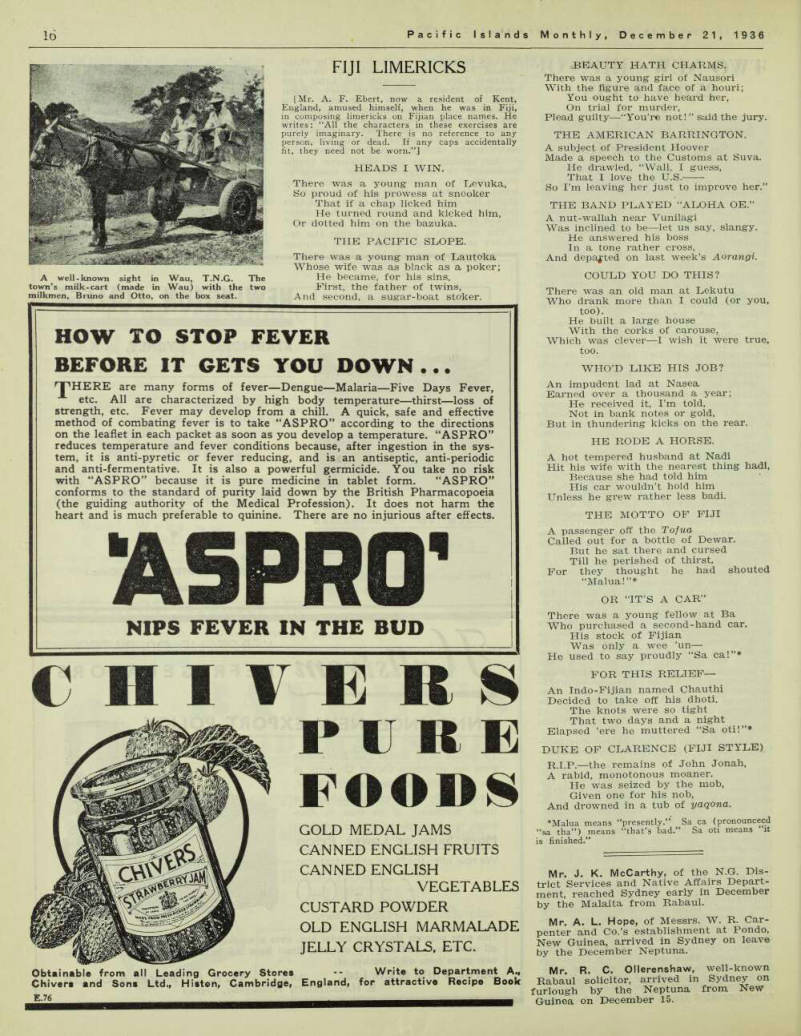
A well-known sight in Wau, T.N.G. The town’s milk-cart (made in Wau) with the two milkmen, Bruno and Otto, on the box seat.