Fiji Discloses Another Surplus
pp. 45-46 · Read in the full issue
Summary of Conditions in Britain’s Most Prosperous Colony
AN interesting summary of recent progress and present conditions in the Colony of Fiji was made by the Gover nor, Sir Murchison Fletcher, when he ad dressed the Legislative Council of Fiji at its opening session on October 12.
FINANCE.—The Council budgeted in October, 1933, for a deficit of £23,783.
During the year, however, revenue re ceived a transfer of £28,000 from the Immigration Fund; an apparently unex pected surplus in currency funds of £146,690; and an increase in petrol tax of approximately £4,000; so that al though the original estimate of expendi ture was increased considerably, the year is likely to end with a surplus of £17,718, making a total accumulated estimated surplus on 31st December next of £318,932. The Governor estimates that the 1935 budget will be balanced, in spite of the fact that some of the windfalls of 1934 are not likely to be repeated in 1935. He expects that the sugar indus try will show increased production; that there may be some recovery in copra; that there is some likelihood that gold mining will become a major industry: that the tourist traffic will improve; and that as stocks of merchandise are low, customs revenue will benefit from in creased importations.
PUBLIC WORKS.—New Government offices are to be built and a road and bridge programme carried out. The new offices will be financed from surplus bal
ances; and the Government intends to borrow £182,500 sterling for the Rewa Bridge, the Suva-Sigatoka Road, and the North-West Coast Road. The annual cost of the latter loan would be approxi
mately £11,000 per annum. It was proposed to provide for this by an increased tax of 3d. per gallon on petrol imports. (The Legislative Council subsequently agreed to this and the petrol tax is now in operation.) It is proposed to spend £25,000 from surplus Government funds on the new Government offices in 1935; and also from the same source £2,000 on an Indian school in Suva; £3,000 for a vessel for the Lau District Commissioner; and £2,200 for extending the Samabula water supply.
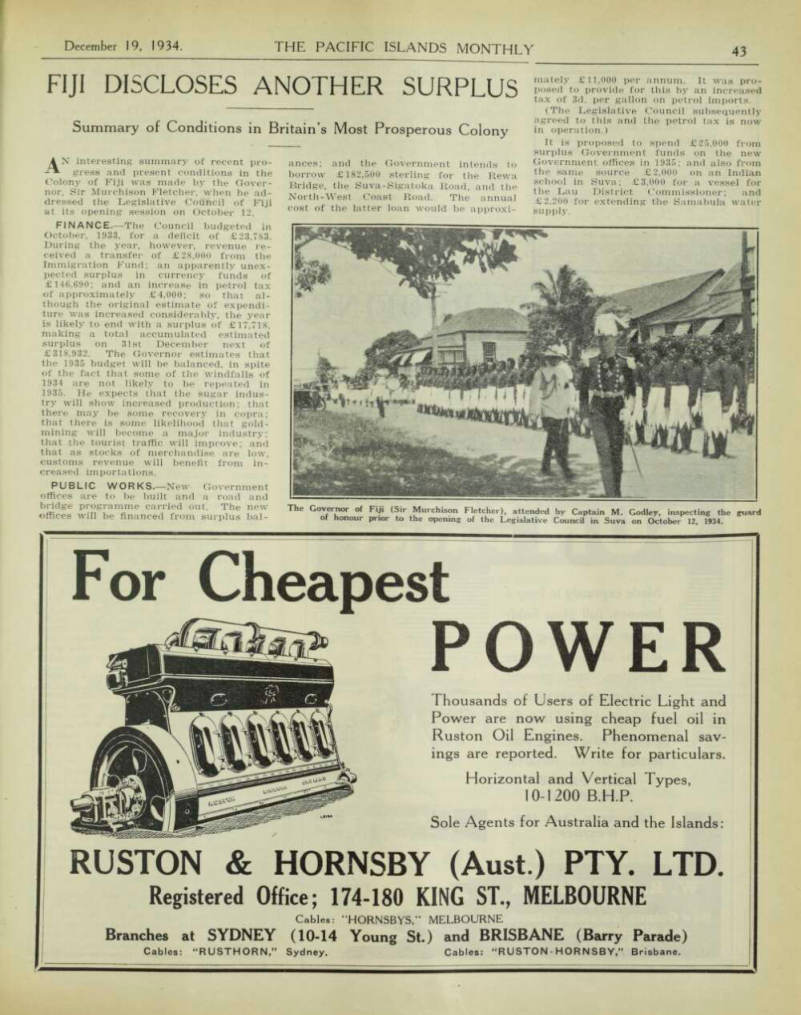
The Governor of Fiji (Sir Murchison Fletcher), attended by Captain M. Godley, inspecting the guard of honour prior to the opening of the Legislative Council in Suva on October 12, 1934.
BANANA TRADE. —It is reported that the New Zealand Government, in order to assist Samoa, proposes to increase the quota of bananas allowed to enter the Dominion from Samoa, and correspond ingly reduce the Fiji-Tonga quota. The Government hopes that this loss of trade may be partly compensated by the es tablishment of a new banana trade with Vancouver.
PORT OF LEVUKA.— Diminishing trade has made it necessary to reduce port costs. The District Commissioner will now act as Collector of Customs and have charge of the harbour; the sep arate posts of Harbour Master, Customs Officer, and Postmaster will be abolished; the Police Inspector will act as Customs Officer and Postmaster; and there will be adjustments in the junior staff; the
total saving being about £19,000 per an num. Pilotage will no longer be com pulsory.
CONTROL OF PESTS- —Considerable success is being obtained in noxious weed control. The thrips, which was intro duced by Mr. H. W. Simmonds, Govern ment Entomologist, from Trinidad, is producing excellent results in areas affec ted by Clidemia hirta, commonly known as the Curse, and these areas are going steadily back to useful grass land. Mark ed success has been achieved with the biological control of the coconut leaf miner, and four parasites of the spathe moth have been established in large num bers. Rat damage in certain coconut lands is considerable, but with present copra prices any organised Control would pro bably be uneconomic.
COTTON. —The Government will re sume its cotton enterprise, which is de signed to provide useful employment for Fijians and Indians. A new strain has been evolved and a crop estimated to give 200 bales is about to be planted. It is anticipated that the total cost of promot ing this industry will be fully covered by sales in 1936.
RICE. —The Government mill in the year ended 30th June last, produced 769 tons of rice, 315 tons of bran, and 18 tons of chick feed. There are now in operation in various parts of Fiji 38 mechanically-driven rice mills.
OIL STORAGE. —Good progress is be ing made by the Shell and Vacuum Oil Companies in the establishment of bulk storage for diesel and heavy fuel oils.
There are in course of erection one tank of 2,500 tons capacity and two tanks of 2,000 tons capacity.
INDIAN AFFAIRS.— “The Indian com munity,” said the Governor, “appear to be generally prosperous and contented, and they are showing a sensible restraint in matters of religious and political con troversy. Evidence that they are satisfied with their lot may be adduced from the fact that the number of repatriates to In dia has been steadily decreasing. Two hundred and twenty went back in 1933 and 117 in 1934, the latter figure being the lowest on record. Immigration from India remains closely restricted, and among those who are admitted the proportion of women has largely increased.
“Questions of leases and land tenure continue to exercise the mind of the community; and the matter is still under careful investigation. There are many conflicting interests, and it is not easy to arrive at a policy which will be ac ceptable to all parties. It is not possible to make any pronouncement at present.
“Apart from their successful sugar sea son the Indians are finding a remunera tive market for rice and for minor crops such as yaqona, dhall, bean, maize, and tobacco. Local supplies of dhall are far short of the demand.
“Indian youths are taking an increasing interest in sport, and the cricket and football, which have become a regular feature in the more thickly populated areas, must have a salutary effect upon their general physique. ‘‘The addition of an Indian platoon to the Defence Force is giving effect to a long cherished wish on the part of the Indian population that they should take their part in the defence of the Colony.
Twenty-nine members have been enrolled and the Commandant informs me that they promise well.”