Advertisements & other items, pp. 1-2 (2 items)
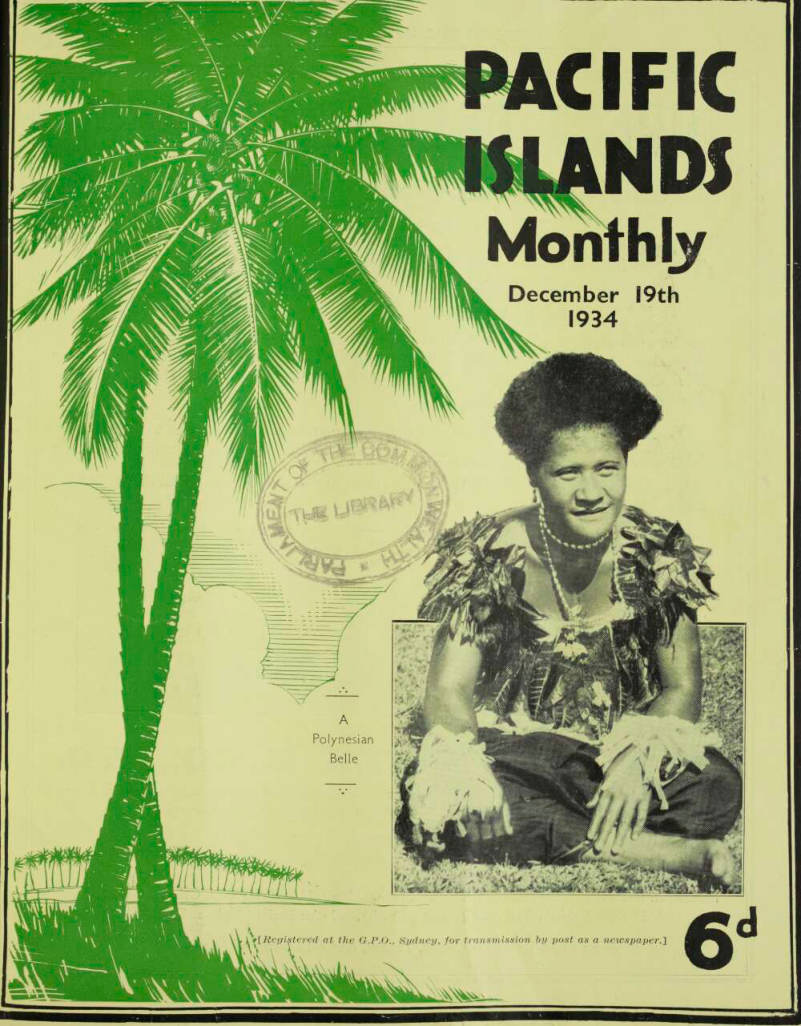
Pacific
ISLANDS
Monthly
December 19th 1934
[Registered at the G.P.O., Sydney, for transmission by post as a newspaper.]
6d
A
Polynesian
Belle
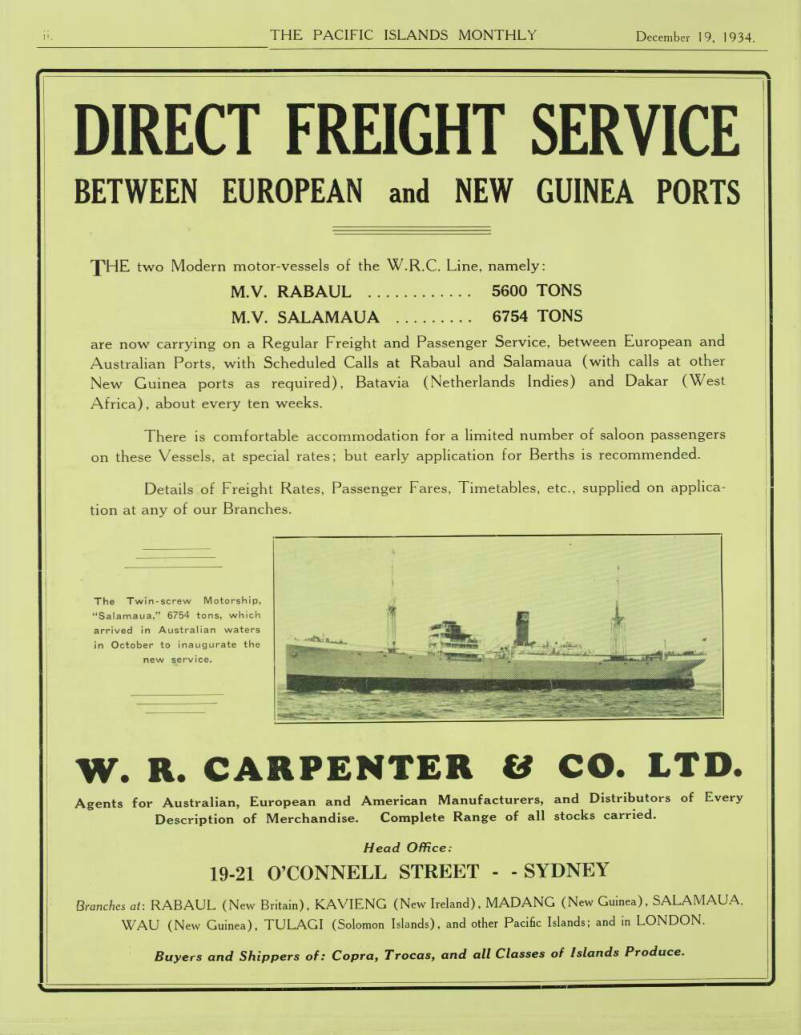
Direct Freight Service
BETWEEN EUROPEAN and NEW GUINEA PORTS
are now carrying on a Regular Freight and Passenger Service, between European and
W. R. CARPENTER & CO. LTD.
Agents for Australian, European and American Manufacturers, and Distributors of Every Description of Merchandise. Complete Range of all stocks carried.
Head Office:
19-21 O’CONNELL STREET - - SYDNEY
Branches at: RABAUL (New Britain), KAVIENG (New Ireland), MADANG (New Guinea), SALAMAUA, WAU (New Guinea), TULAGI (Solomon Islands), and other Pacific Islands; and in LONDON.
Buyers and Shippers of: Copra, Trocas, and all Classes of Islands Produce.
THE two Modern motor-vessels of the W.R.C. Line, namely:
M.V. RABAUL
M.V. SALAMAUA
5600 TONS
6754 TONS
Australian Ports, with Scheduled Calls at Rabaul and Salamaua (with calls at other New Guinea ports as required), Batavia (Netherlands Indies) and Dakar (West Africa), about every ten weeks.
There is comfortable accommodation for a limited number of saloon passengers on these Vessels, at special rates; but early application for Berths is recommended.
Details of Freight Rates, Passenger Fares, Timetables, etc., supplied on application at any of our Branches.
The Twin-screw Motorship, “Salamaua,” 6754 tons, which arrived in Australian waters in October to inaugurate the new service.
Pacific Islands Travellers
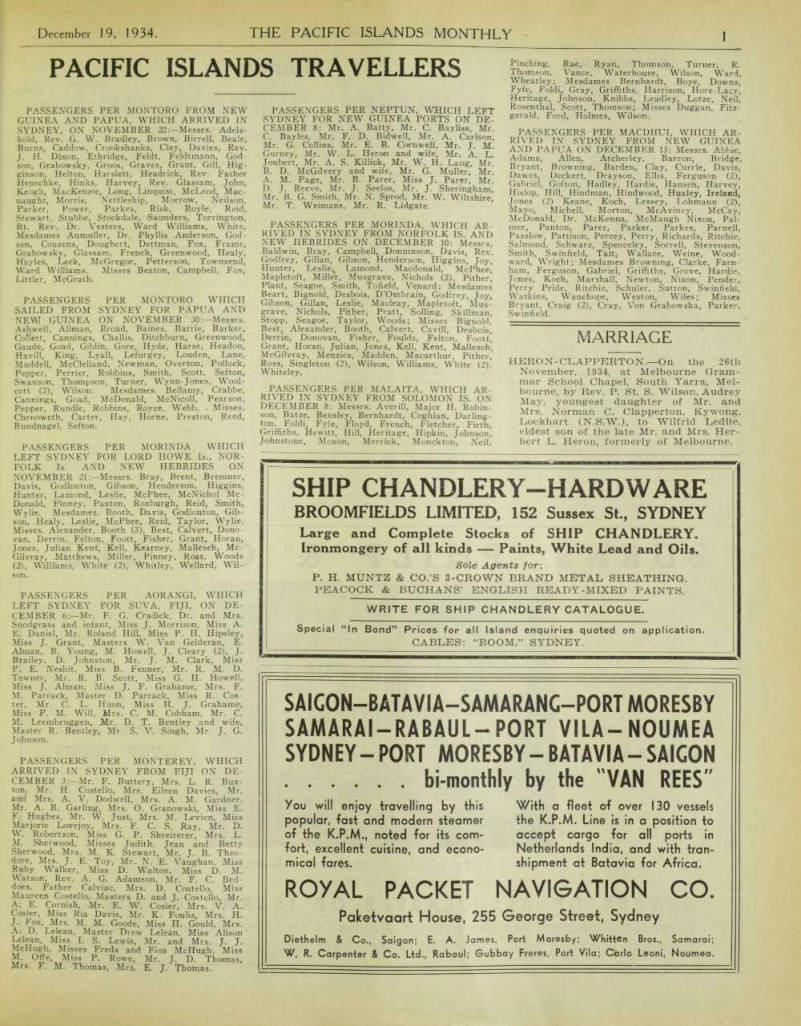
Passengers Per Montoro From New
Guinea And Papua, Which Arrived In
SYDNEY, ON NOVEMBER 22:—Messrs. Adels kold, Rev. G. W. Bradley, Brown, Birrell, Beale, Burns, Caddow, Crookshanks, Clay, Davies, Rev.
J. H. Dixon, Ethridge, Feldt, Feldtmann, God son, Grabowsky, Groos, Graves, Grant, Gill, Hig ginson, Helton, Harslett, Headrick, Rev. Father Henschke, Hinks, Harvey, Rev. Glassam, John, Keogh, MacKenzie, Long, Linquist, McLeod, Mac naught, Morris, Nettleship, Morrow, Neilson, Parker, Power, Parkes, Risk, Royle, Reid, Stewart, Stubbe, Stockdale, 'Saunders, Torrington, Rt. Rev. Dr. Vesters, Ward Williams, White, Mesdames Aumuller, Dr. Phyllis Anderson, God son, Couzens, Doughert, Dettman, Fox, Frame, Grabowsky, Glassam, French, Greenwood, Healy, Hayles, Leek, McGregor, Petterson, Townsend, Ward Williams. Misses Beaton, Campbell, Fox, Littler, McGrath.
Passengers Per Montoro Which
Sailed From Sydney For Papua And
New Guinea On November 30:—Messrs.
Ashwell, Allman, Broad, Baines, Barrie, Barker, Collett, Cannings, Challis, Ditchburn, Greenwood, Gaude, Goad, Giblin, Gore, Hyde, Harse, Headon, Havill, King, Lyall, Lefurgey, Louden, Lane, Muddell, McClelland, Newman, Overton, Pollock, Pepper, Perrier, Robbins, Smith, Scott, Sefton, Swanson, Thompson, Turner, Wynn-Jones, Wool cott (2), Wilson. Mesdames. Bellamy, Crabbe, Cannings, Goad, McDonald, McNicoll, Pearson, Pepper, Bundle, Robbins, Royce, Webb. . Misses.
Chenoweth, Carter, Hay, Horne, Preston, Reed, Rundnagel, Sefton.
Passengers Per Morinda Which
LEFT SYDNEY FOR LORD HOWE Is., NOR
Folk Is. And New Hebrides On
NOVEMBER 21:—Messrs. Bray, Brent, Bremner, Davis, Godlonton, Gibson, Henderson, Higgins, Hunter, Lamond, Leslie, McPhee, McNichol Mc- Donald, Pinney, Paxton, Roxburgh, Reid, Smith, Wylie. Mesdames. Booth, Davis, Godlonton, Gib son, Healy, Leslie, McPhee, Reid, Taylor, Wylie, Misses. Alexander, Booth (3), Best, Calvert, Dono van, Derrin, Felton, Foott, Fisher, Grant, Horan, Jones, Julian Kent, Kell, Kearney, Mallesch, Mc- Gilvray, Matthews, Miller, Pinney, Ross, Woods (2), Williams, White (2), Whitley, Wellard, Wil son.
Passengers Per Aorangi, Which
LEFT SYDNEY FOR SUVA, FIJI, ON DE CEMBER 6: —Mr. F. G. Cradick, Dr. and Mrs.
Snodgrass and infant, Miss J. Morrison, Miss A.
E. Daniel, Mr. Roland Hill, Miss P. H. Hipsley, Miss J. Grant, Masters W. Van Gelderan, E.
Alman, B. Young, M. Howell, J. Cleary (2), J.
Brailey, D. Johnston, Mr. J. M. Clark, Miss P. E. Nesbit, Miss B. Fenner, Mr. R. M. D.
Towner, Mr. R. B. Scott, Miss G. H. Howell, Miss J. Alman, Miss J. F. Grahame, Mrs. F.
M. Parrack, Master D. Parrack, Miss R. Cos ter, Mr. C. L. Huon, Miss H. J. Grahame, Miss F. M. Will, Mrs. C. M. Cobham, Mr. C.
M. Leembruggen, Mr. D. T. Bentley and wife, Master R. Bentley, Mr. S. V. Singh, Mr. J. G.
Johnson.
Passengers Per Monterey, Which
ARRIVED IN SYDNEY FROM FIJI ON DE CEMBER 3: —Mr, F. Buttery, Mrs. L. R. Bux ton, Mr. H. Costello, Mrs. Eileen Davies, Mr. and Mrs. A. V. Dodwell, Mrs. A. M. Gardner, Mr. A. R. Garling, Mrs. O. Granowski, Miss E.
F. Hughes, Mr. W. Just, Mrs. M. Levien, Miss Marjorie Lovejoy, Mrs. F. C. S. Ray, Mr. D.
W. Robertson, Miss G. P. Shreiterer, Mrs. L.
M. Sherwood, Misses Judith, Jean and Betty Sherwood, Mrs. M. K. Stewart, Mr. J. B. Theo dore, Mrs. J. E. Toy, Mr. N. E. Vaughan, Miss Ruby Walker, Miss D. Walton, Miss D. M.
Watson, Rev. A. G. Adamson, Mr. F. C. Bed does. Father Calviac, Mrs. D. Costello, Miss Maureen Costello, Masters D. and J. Costello, Mr.
A. E. Cornish, Mr. E. W. Cosier, Mrs. V. A.
Cosier, Miss Ria Davis, Mr. K. Foulis, Mrs. H.
J. Fox, Mrs. M. M. Goode, Miss H. Gould, Mrs.
A. D. Lelean, Master Drew Lelean, Miss Alison Lelean, Miss I. S. Lewis, Mr. and Mrs. J. J.
McHugh, Misses Freda and Fioa McHugh, Miss M. Offe, Miss P. Rowe, Mr. J. D. Thomas, Mrs. F. M. Thomas, Mrs. E. J. Thomas.
Passengers Per Neptun, Which Left
SYDNEY FOR NEW GUINEA PORTS ON DE CEMBER 8: Mr. A. Batty, Mr. C. Bayliss, Mr.
C. Bayles, Mr. F. D. Bidwell, Mr. A. Carlson, Mr. G. Collins, Mr. E. B. Cornwell, Mr. J. M.
Gurney, Mr. W. L. Heron and wife, Mr. A. L.
Joubert, Mr. A. S. Killiok, Mr. W. H. Lang, Mr.
B. D. McGilvery and wife, Mr. G. Muller, Mr.
A. M. Page, Mr. B. Parer, Miss J. Parer, Mr.
D. J. Reeve, Mr. J. Seelos, Mr. J. Sheringham, Mr. B. G. Smith, Mr. N. Sprod, Mr. W. Wiltshire, Mr. T. Weimans, Mr. R. Lidgate.
Passengers Per Morinda, Which Ar
RIVED IN SYDNEY FROM NORFOLK IS. AND
New Hebrides On December 10: Messrs.
Baldwin, Bray, Campbell, Donninson, Davis, Rev.
Godfrey, Gillan, Gibson, Henderson, Higgins, Joy, Hunter, Leslie, Lamond, Macdonald, McPhee, Mapletoft, Miller, Musgrave, Nichols (2), Pither, Plant, Seagoe, Smith, Tofield, Venard; Mesdames Beart, Bignold, Desbois, D’Ombrain, Godfrey, Joy, Gibson, Gillan, Leslie, Macleay, Mapletoft, Mus grave, Nichols, Pither, Pratt, Soiling, Skillman, Stopp, Seagoe, Taylor, Woods; Misses Bignold, Best, Alexander, Booth, Calvert, Cavill, Desbois, Derrin, Donovan, Fisher, Foulds, Felton, Foott, Grant, Horan, Julian, Jones, Kell, Kent, Mallesch, McGilvray, Menzies, Madden, Macarthur, Pither, Ross, Singleton (2), Wilson, Williams, White (2), Whiteley.
Passengers Per Malaita, Which Ar
RIVED IN SYDNEY FROM SOLOMON IS. ON DECEMBER 8: Messrs. Averill, Major H. Robin son, Batze, Bensley, Bernhardt, Coghlan, Darling ton, Foldi, Fyfe, Floyd, French, Fletcher, Firth, Griffiths, Hewitt, Hill, Heritage, Hipkin, Johnson, Johnstone, Moxon, Merrick, Monckton, Neil,
Pinching, Rae, Ryan, Thomson, Turner, R.
Thomson, Vance, Waterhouse, Wilson, Ward, Wheatley; Mesdames Bernhardt, Boye, Downs, Fyfe, Foldi, Gray, Griffiths, Harrison, Hore-Lacy, Heritage, Johnson, Knibbs, Leadley, Lotze, Neil, Rosenthal, Scott, Thomson; Misses Duggan, Fitz gerald, Ford, Holmes, Wilson.
Passengers Per Macdhui, Which Ar
Rived In Sydney From New Guinea
AND PAPUA ON DECEMBER 13; Messrs. Abbie, Adams, Allen, Atcherley, Barron, Bridge, Bryant, Browning, Barden, Clay, Currie, Davis, Dawes, Deckert, Drayson, Ellis, Ferguson (2), Gabriel, Gofton, Hadley, Hardie, Hansen, Harvey, Hislop, Hill, Hindman, Hindwood, Huxley, Ireland, Jones (2) Keane, Koch, Lessey, Lohmann (2), Mayo, Michell, Morton, McAviney, McCay, McDonald, Dr. McKenna, McMaugh Nixon, Pal mer, Panton, Parer, Parker, Parkes, Parnell, Passlow, Pattison, Percey, Perry, Richards, Ritchie, Salmond, Schwarz, Spenceley, Sorrell, Stevenson, Smith, Swinfield, Tait, Wallace, Weinc, Wood ward, Wright; Mesdames Browning, Clarke, Farn ham, Ferguson, Gabriel, Griffiths, Grove, Hardie, Jones, Koch, Marshall, Newton, Nixon, Pender, Perry Pride, Ritchie, Schuler, Sutton, Swinfield, Watkins, Wauchope, Weston, Wiles; Misses Bryant, Craig (2), Cray, Von Grabowska, Parker, Swinfield.
Marriage
Heron-Clapperton.—On The 26Th
November, 1934, at Melbourne Gram mar School Chapel, South Yarra, Mel bourne, by Rev. P. St. S. Wilson, Audrey May, youngest daughter of Mr. and Mrs. Norman C. Clapperton, Kywong, Lockhart (N.S.W.), to Wilfrid Ledlie, eldest son of the late Mr. and Mrs. Her bert L. Heron, formerly of Melbourne.
Advertisements & other items, p. 3 (1 item)
Ship Chandlery-Hardware
BROOMFIELDS LIMITED, 152 Sussex St. SYDNEY
Large and Complete Stocks of SHIP CHANDLERY.
Ironmongery of all kinds Paints, White Lead and Oils.
Sole Agents for: P. H. MUNTZ & CO.’S 3-CROWN BRAND METAL SHEATHING.
PEACOCK & BUCHANS’ ENGLISH READY-MIXED PAINTS.
WRITE FOR SHIP CHANDLERY CATALOGUE.
Special “In Bond” Prices for all Island enquiries quoted on application.
CABLES: “BOOM,” SYDNEY.
SAICON-BATAVIA-SAMARANC-PORT MORESBY
SAMARAI-RABAUL-PORT VILA-NOUMEA
SYDNEY - PORT MORESBY - BATAVIA - SAIGON
bi-monthly by the "VAN REES"
You will enjoy travelling by this popular, fast and modern steamer of the K.P.M., noted for its comfort, excellent cuisine, and economical fares.
With a fleet of over 130 vessels the K.P.M. Line is in a position to accept cargo for all ports in Netherlands India, and with transhipment at Batavia for Africa.
ROYAL PACKET NAVIGATION CO.
Palcetvaarl House, 255 George Street, Sydney
Diethelm & Co., Saigon; E. A. James, Port Moresby; Whitten Bros., Samarai; W. R. Carpenter & Co. Ltd., Rabaul; Gubbay Freres, Port Vila; Carlo Leoni, Noumea.
Contents
Advertisers
Page Adams, Wm. 56 Angus & Coote .. 17 Antinea Drug. Co. 30 Arnott’s Biscuits .. 29 Ashton, Mrs. J. 38 Aspro 57 Ausoline Co. 15 A. W. A. Ltd. 22 Bank of N.S.W. .. 21 Bailey, W. D. ..66 Bains’ 65 Barnes, Jas. 61 Bender, E. H. 29 Berger’s Paints .. 59 Better Brooms 57 Blau, Julius 54 Breckwoldt & Co... 52 Bridge Bird Shop.. 65 Brit. A/sian. Petrol 46 Broomfields, Ltd. .. 1 Bruce, Robert 60 Brunton’s Flour 53 Budge, James.. 45 Bullivants 53 Burns, Philp & Co. 2
B.P. (S.S. Co.) 45
B.P. Magazine 19 Burnside .. 21 Burton, F. W. 12 Buzacott, Ltd. 26 Capell, J. 37 Carpenter, W. R. ii.
Chapman & Sherack 47 Chapman Eng.17 Christies, Ltd. 60 Close, W. J. 27 Coleman Quicklite 23 Coral Starch .. 34 Cowles & Dunn 37 Dawson & Row 70 Delicia Food Co. 32 Diamond, R. R. 46 Doans 59 Dye & Co., A. W... 13 Eaton, Ltd., J. W. 21 Electrolytic R. & S.
Co 66 Erg Batteries .. . 60 Excel Battery Co. 66 Exceltron 68
Page Fairbanks Morse .. 51 Fairfax & Roberts.. 12 Fletcher & Sons .. 14 Flexible Belt Co. .. 65 Flexibo Lighting .. 68 Flynn, Mrs. W. ..17 Ford, W. M. 68 Forsyth, A. 62 Fostars Shoes .. 39 Foster & Sons, Geo. 66 Fryer, A. C. 13 Garrett & Davidson 37 Gillespie’s Flour .. 34 Glebe Eng’g 33 Gleniffer Engines . • 33 Goshen P. Hospital 68 Grahame, C. 68 Great Southern Hotel 12 Gregory, A. 36 Griffin, B. 68 Guinea Airways .. iii.
Hallstrom, E. 52 Halvorsen, L. 69 Hardie, Jas. & Co. 32 Harkness & Hillier 19 Harper, M. 68 Hcnly’s 44 Holbrooks, Ltd. 41 Holden’s Air T. 72 Holmes 32 Hordern Bros. 55 Hotel Mansions .. 34
I.C.I.A.N.Z 65
Interstate Teachers 39 Jones, A. 62 Kelvin Engines .. 6 Kerr Bros. 16 Kilrust 63 Kodak 62 Kookaburra Prod... 47 Kopsen & Co.70 Krump Harness .. 31 Lane and Girvan .. 61 Leddicott 46 Leston Mtg. Co. . 68 Littlewood 31 Lloyd’s Teas .. 17 Lone Hand Soap .. 25 Mcllrath’s Ltd. 15 McKay 63
Page McHugh 22 Mangrovite Belting 63 Martins D.Y.S. .. 67 Maxwell, Porter .. 44 Moran & Cato, Ltd. 27 Mortein 28 Mungo Scott, Ltd... 41
N.D.L 71
Nelson & Robertson 40 New Brit. Express 70 New Cambridge .. 18 Newington .. .. 30 Newton Rapid.. .. 16 Nock & Kirby’s .. 64 Nolan, Spencer .. 25 Norco 33 Northey, W. 22 Noyes Bros. 33 Ozo Salt Co. 28 Pacific Hotels .. 50
Page Paine & Co. 23 Pike Bros. 49 Plezall 54 Prescott, Ltd. .. 57 Ransomes, Ltd. .. 31 Rasmussen .. .. 38 Reid, W. M. 23 Reilingh, W. 53 Reliance School .. 19 Robinson, J. 20 Rohu, Sil 48 Rolls Razor .. .. 14 Rosebery Eng. 24 Royal Packet N. Co. 1 Royale Soap .. .. 65 Russell, S. 36 Ruston & Hornsby 43 Salvage Stores . 16 Scott & Sons .. 65 Selby. H. B. 48
Page Sellers, Ltd. 36 Shell 35 S.K.F. Ball Bearings 20 Sloman 67 Smith & Gluyas .. 67 Smith, Geo. F. .. 54 Smyth. J.H. Ltd. .. 13 Spar Trading .. .. 54 Springwood L. Col 68 Squilltox 42 Standard Drug .. 63 Steamships T. Co... 70 Sterling Varnish Co. 11 Stott’s College .. 14 Swallow & Ariell .. 49 “Talkeries” .. 45, 65 Taubman’s Paints .. 44 Thornthwaite, H. G. 23 Tillock & Co. Ltd. 52 Tilly, J. E. 28
Page Titon 64 Tooth & Co. iv.
Tudor Hotel .. .. 15 Trufood 12
T.W.H. 67
Tyrrell’s Museum .. 56 Uka Ant Co. 64 Victor Chemical .. 68 Vincent’s A.P.C. .. 20 Wallaringa Mansions 69 Wallis, J. B. 25 Ward, L. A. 47 Wearnes 46 Wesley College .. 13 West, H. 67 Weymark & Son .. 63 Williams, W. H. .. 48 Wills, W. D. & H. O. 38 Wunderlich, Ltd. .. 56
Page
Pacific Islands Travellers 1 Outlook for Copra 3 Beer! —Why the Montoro Waited .. 5 Chinese in New Hebrides 5 Burns, Philp Buy New N.D.L. Liners 6 Peculiar Features of Harvey Case (New Hebrides) 8 Japanese Poachers in Eastern Papua 10 Tropicalities 11 About Islands People 12 New Tahiti Handbook 14 Ceylon Driers in N. Guinea 15 Vanua Lava’s Attractions 16 South Seas Banana Trade 17 Papua and N.G. Air-Mails 20 Sir A. Ngata—A Personal Sketch . . 21 Oil Piped from Iraq to Haifa . . . . 24 Is Australia Making Criminals in New Guinea? 29 Absence of Jury System in N.G. 30 Mau Collections for O. F. Nelson’s Appeal 32
Page What is Wrong—or Right—on Norfolk Island? 33 A Samoan Poetess 37 Chinese in the Solomons 38 The Pre-historic Pacific 40 Budget Session of Fiji Council . . . . 43 New Guinea News 45 Papua’s Strange Story 46 Missionaries and the Wahgis . . . . 49 N.G. Goldfields News 53 Fashions for Islands Women . . . . 54 Exploration of Papua and N. Guinea 56 Samoan Affairs 61 Fiji’s Public Works 63 B.S.I. Council Meeting 64 Pacific Mining Notes 66 Thursday Is. News 68 Market Quotations . . . . 69 Exchange Rates 70 Shipping Services in the Pacific . . 71
Advertisements & other items, p. 4 (1 item)
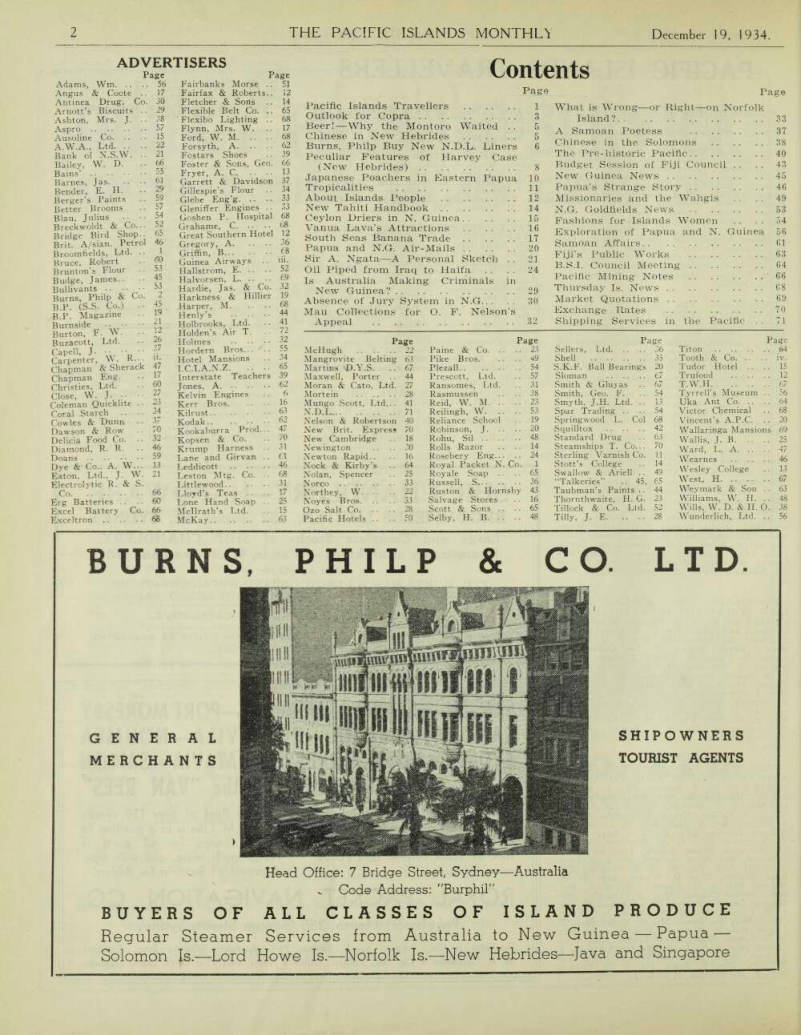
Burns, Philp & Co. Ltd.
GENERAL
MERCHANTS
Head Office: 7 Bridge Street, Sydney—Australia Code Address: "Burphil"
BUYERS OF ALL CLASSES OF ISLAND
SHIPOWNERS
TOURIST AGENTS
PRODUCE
Regular Steamer Services from Australia to New Guinea Papua Solomon Is.—Lord Howe Is.—Norfolk Is. —New Hebrides —Java and Singapore
The Pacific Islands Monthly
The Newspaper-Magazine Of The South Seas
[Registered at G.P.O., Sydney, for transmission by post as a newspaper.] Published Once Each Month and Circulated in Australia and New Zealand and in the following Pacific Territories and Islands Groups;
Crown Colony of Fiji.
Australian Territory of Papua.
Mandated Territory (Australia) of New Guinea, Bismarck Archipelago, and Northern Solomon Islands.
Mandated Territory (Japan) of Marshall, Caroline and Mariana Islands.
French Territory of New Caledonia.
British and French Condominium of New Hebrides.
American Territory of Eastern Samoa.
American Territory of Guam.
Mandated Territory of Nauru.
British Crown Colony of Gilbert and Ellice Islands.
Mandated Territory (New Zealand) of Samoa.
British Solomon Islands Protectorate.
British Protectorate of Tongan Islands.
New Zealand Territory of Cook Islands.
Australian Territory of Norfolk Island.
French Colony of Oceania (Tahiti, etc.).
American Territory of Hawaiian Islands.
Owned and Produced by Pacific Publications Ltd., Union House, 247 George Street, Sydney.
Telephone Bw 5037
P.O. Box 3408R
Contributions Articles, Stories, and Photographs dealing with Pacific Islands Subjects are invited, and will be paid for on publication at usual rates.
Subscription Rates
Per Annum, within British Empire, Prepaid Post Free 6/- Per Annum, elsewhere, prepaid, Post Free .. 8/- Single Copies 6d.
Editor and Publisher:
R. W. Robson.
Advertisements Advertising rates furnished on application.
Colours, etc. — — by Arrangement.
Process Blocks made at Advertiser's expense when required. Screen, 100.
Changes of Advertising Copy should reach this Office by 8th of each month, otherwise previous advertisement may be repeated.
Registered Address for Radiograms and Cables: “PACPUB” Sydney Agents The following are authorised to receive subscrip tions for “The Pacific Islands Monthly”— Islands Branches of Burns, PhiI P & Cos., Ltd., and Burns, Phil P (South Seas) Cos., Ltd, Islands Branches of W. R. Car P enter & Cos., Ltd.
All Branches of Morris, Hedstrom & Cos., Ltd G. Thomas & Cos., Rabaul.
Whitten Bros., Ltd., Samarai.
P. Costello, Suva, Fiji.
All Branches and Re P resentatives of W. H. Grove and Sons. Ltd., Auckland.
S. Russell, Pa P eete, Tahiti.
Cook Islands Trading Cos., Rarotonga.
Vol. V., No. 3.
Sydney, December 19, 1 934.
6d - Per Copy Price Prepaid: 6/- p.a.
The Copra Outlook
After swinging about, in indeterminate fashion, for several months, the copra market has moved, rather defi nitely, towards a better figure. The London c.i.f. quotation on December 7 was £8/15/- for South Seas sun-dried, and £9/12/6 for Rabaul hot-air dried.
Reference to the table on Page 69 will show that these are the best rates paid since November, 1933.
The Sydney market, of course, is cautiously awaiting further advices from oversea; but it can be said that, at the moment, the feeling is better than at any time for over a year. It is be lieved that the tendency is upward. No one expects prices to rise beyond £10 to £11; but that rate is of interest to South Seas planters—particularly those within the Australian and New Zealand zones, who enjoy an exchange premium of 25 per cent. £10 per ton, c.i.f. London, is equal to £12/10/- in Australian or N,Z. currency; and, if shipping and agency costs are reasonable, the planter can live on those rates, and carry on.
We cannot see any better rates being paid, while international trade remains in its present condition of stagnation.
There can be no return to the commodity prices on which the world’s present economic structure was erected, until some event or condition develops which will shake down the existing trade barriers. Nations are desperately eager to trade with each other. But no nation wants to buy, while all are eager to sell.
Australia, for example, had convulsions when Fiji said she would not buy any more Australian flour, unless Australia bought Fiji bananas. When Australia, said, reluctantly, that she would buy some Fiji bananas, Australian banana growers began to assail their Parlia mentary representatives, and the row is still going on. That is typical of what is happening throughout the world.
Germany, for several decades, was one of the world’s largest consumers of copra. To-day, Germany virtually is out of the market. The recent wave of economic nationalism has closed most of
the world’s markets against German goods. Germany, as a result, cannot es tablish oversea credits wherewith to buy raw materials, including copra, from other nations: She can buy only by pledging her credit —running more deeply into debt. Hitler, whose perfectly justifiable policy is to force the world to open its doors to German products will not allow the Germans to import goods unless the credits are there to pay for them. Early in 1934 Hitler placed a drastic limitation on imports of oil-seeds until the end of the year —a thing which had a very depressing effect on the copra market. In October, this decree was extended until the end of March, 1935 —“the deficiency of oils and fats," it was announced, “will have to be made up by a greater use of domestically pro duced oils and fats.” Reports show that Germany gladly would take far more copra; but she cannot pay for it.
That, in one form or another, is the position all over the world. Italy, devel oping a fear of being driven off the gold standard, suddenly has rationed foreign credit —which simply means that Italian imports are going to be even more dras tically curtailed. America still is plac ing a limitation on her imports of vege
table oil seeds, and thereby is driving huge quantities of Philippines copra onto the world market. France is still imposing a tax upon all imports of foreign copra, as a means of paying a bonus to French growers.
All those nations —Germany, Italy, France, U.S.A. —have been consumers of enormous quantities of copra. Each, for domestic reasons of its own, has cut down its copra purchases. The only free markets leffi of any importance, are those of Britain, Holland and Scan dinavia. Obviously, there can be no marked recovery of copra prices while that position endures.
This is not a condition peculiar to the copra trade. It affects all com modities in general use. Looking out over this chaotic world, noting the barriers that have been raised every where in recent times against inter national trade, one can but wonder, not that commodity prices have recovered so much during the past two years, but that they have recovered at all.
But, as pointed out repeatedly in this journal, there do exist certain depressing influences peculiar to the copra indus try. Newly-discovered processes permit the use of whale oil and some coarse, cheap vegetable oils in fields of manu facturing in which coconut oil formerly was unchallenged; and, at the same time, there has been vast over-production of those low-grade oils. Furthermore, the Unilever Combine is now completely astride of the European market, and able to fix its own prices, supreme and un challenged. It gained control just in time to take fullest advantage of gene ral depression, vast over-production, and the discovery of effective substitutes for coconut oil; and there is no chance of its removing its stranglehold from the copra industry while present conditions con tinue.
Other factors count, also. Shrinkage of world trade has meant over-produc tion of butter; butter prices have fallen
greatly, and people who formerly ate
margarine (of which coconut oil has been an important constituent) now eat butter. Consider this official table:—
If international trade barriers could be broken down, and world consumption could come within measurable distance of world production, Unilever and a score of other monopolistic and ruthless combines might be defied, and producers given a fairer share of commodity prices.
The muddle-headed governments of the world have not yet seen that the more they interfere with the free play of in ternational trade, the more certainly they create conditions favourable for the operations of trusts and combines.
Generally, the copra outlook is better, for which we may thank prim arily the staunchness and steadiness of the British Empire. But there is in sight no other world condition which en courages a hope of prices in excess of £10 per ton, c.i.f. London —except certain war-clouds. No person of this generation wants war. But if conflict is inevitable, we can at least say that, in an economic aspect, the lunacy of war is preferable by far to some of the lunacies of peace.
Major H. S. N. Robinson, secretary of the Melanesian Mission, returned to Sydney by the Malaita on December 7, after a hurried visit to his Society’s mis sion stations in the British Solomon Is lands.
1924 1934 Consumption of butter and margarine, per head in United Kingdom 27.11lb. 33.93lb.
This total divided between — Margarine 12.35 „ 8.10„ Butter 14.76 „ 25.83 „
’Planes and Forts
America May Fortify Eastern Samoa
From Our Own Correspondent.
Apia, Nov. 15.
THE report that “Uncle Sam” intends to fortify the American Samoan Islands, making them impregnable, and to station bombing and pursuit airplane squadrons at Pago Pago, only 80 miles distant from Apia, Western Samoa, has aroused considerable interest.
If true, the plans would involve the arrival of several hundred American offi cers and sailors, the building of work shops, oil tanks, and generally speaking great activity in our neighbouring islands.
To some extent Western Samoa should also benefit by opportunities for work and sale of agricultural produce to residents there.
Suspicious Wife of Coconut Planter: “Now, what was all that talk behind my back of getting rid of Fatty Acid?” [Free fatty acid is the bugbear of South Sea Islands copra-producers.]
Advertisements & other items, p. 6 (1 item)
To all our Readers, and to Numerous Friends throughout
Numerous Friends throughout the Pacific Islands, who have so kindly sent us special goodwill messages, we tender our best wishes for
A MERRY CHRISTMAS
and
A HAPPY NEW YEAR
Another Pitcairner
Passes
Death of Mrs. Edwards In Nukualofa
THE passing of Mrs. Edwards, whose death occurred in Tonga on October 13, and who was buried the following day, severs another of those ties which link the present with the time when “George the Third was King,” and with that pic turesque incident of the South Seas, the mutiny of the “Bounty.”
The deceased lady, whose maiden name was Maria Young, was born at Pitcairn, 73 years ago, and was a direct descendant of Edward Young, one of the mutineers, and a midshipman on that ill-fated vessel.
A cousin of the departed lady was Rosa lind Amelia Young (Rosa), who wrote “The Story of Pitcairn Island” which, published in 1894, is still the most concise
and truthful history of the mutiny and its tragic aftermath, yet written. Rosa was gifted intellectually, and for years was school-mistress on the Island.
The subject of this brief memoir came to Tonga near the close of 1895, on the S.D.A. Mission schooner “Pitcairn,” with Pastor and Mrs. Butz, who founded the Adventist Mission in Tonga, and remained a member of their household until her marriage—some 30 years ago—to Mr.
Edwards (Ned), a trader at Folaha. Mr.
Edwards died some 12 years since, and for the past 15 years Mrs. Edwards had resided in Nukualofa. Pastor Butz and his wife were both expert at nursing, having qualified at the Battle Creek Sanitorium, and under their joint tuition Maria at tained a proficiency in that calling which has rarely been excelled, and which has been of inestimable benefit to Nukualofa.
A simple, impressive service was con ducted at the graveside by Mr. Hadfield, who is at present in charge of the Adven tist Mission, the favourite hymns of the deceased lady being exquisitely rendered by the Mission choir.
And so passed one whose skill and ser vice, whose help and assistance, has been given without stint, and to both Tongan and European, from the Queen in her palace to the humb lest inhabitant. She has been a veritable “Ministering Angel.”
A movement is be ing promoted to pro vide a headstone for her grave, whereon may be suitably in scribed her inestim able service to the community, and thus mark the last resting place of one of whom it may be truly writ ten, “In that she lived for others, she lived for God.”—A.C.
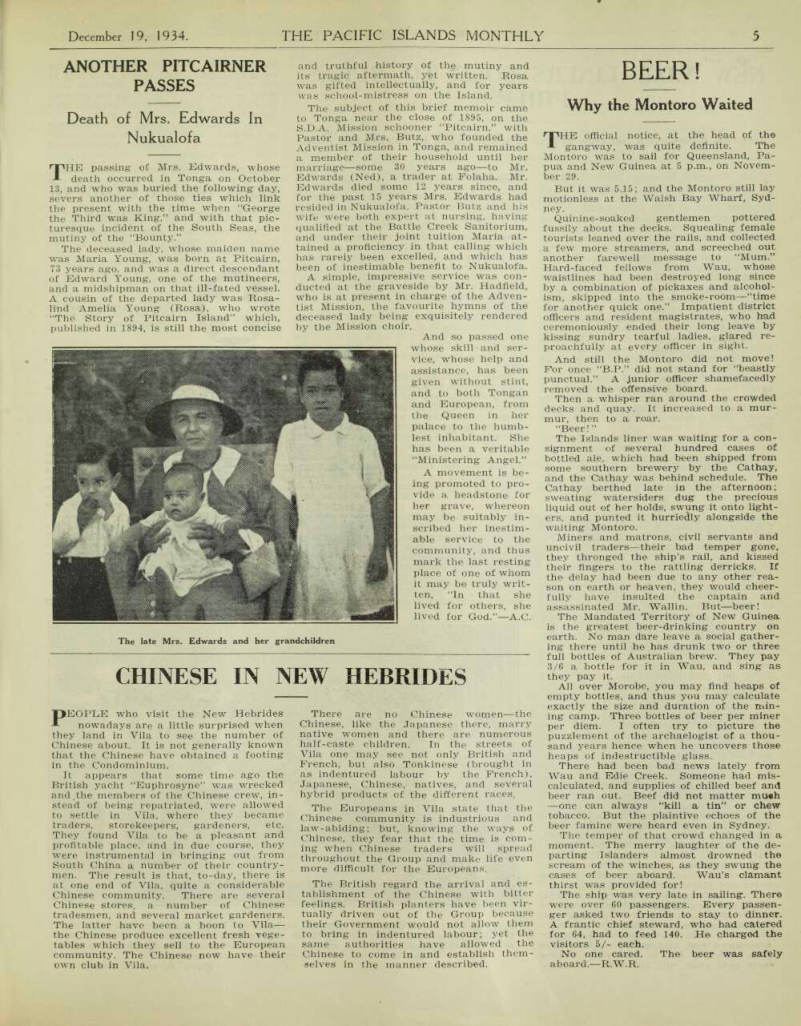
The late Mrs. Edwards and her grandchildren
Chinese In New Hebrides
PEOPLE who visit the New Hebrides nowadays are a little surprised when they land in Vila to see the number of Chinese about. It is not generally known that the Chinese have obtained a footing in the Condominium.
It appears that some time ago the British yacht “Euphrosyne” was wrecked and .the members of the Chinese crew, instead of being repatriated, were allowed to settle in Vila, where they became traders storekeepers, gardeners, etc They found Vila to be a pleasant and profitable place, and in due course, they were instrumental in bringing out from South China a number of their countrymen. The result is that, to-day, there is at one end of Vila, quite a considerable Chinese community. There are several Chinese stores, a number of Chinese tradesmen, and several market gardeners.
The latter have been a boon to Vila — the Chinese produce excellent fresh vegetables which they sell to the European community. The Chinese now have their own club in Vila.
There are no Chinese women—the Chinese, like the Japanese there, marry native women and there are numerous half-caste children. In the streets of Vila one may see not only British and French, but also Tonkinese (brought in as indentured labour by the French), Japanese, Chinese, natives, and several hybrid products of the different races, The Europeans in Vila state that the Chinese community is industrious and law-abiding; but, knowing the ways of Chinese, they fear that the time is corn ing when Chinese traders will spread throughout the Group and make life even more difficult for the Europeans, The British regard the arrival and es tablishment of the Chinese with bitter feelings. British planters have been vir tually driven out of the Group because their Government would not allow them to bring in indentured labour; yet the same authorities have allowed the Chinese to come in and establish them selves in the manner described.
Beer!
Why the Montoro Waited
THE official notice, at the head of the gangway, was quite definite. The Montoro was to sail for Queensland, Pa pua and New Guinea at 5 p.m., on Novem ber 29.
But it was 5.15; and the Montoro still lay motionless at the Walsh Bay Wharf, Syd ney.
Quinine-soaked gentlemen pottered fussily about the decks. Squealing female tourists leaned over the rails, and collected a few more streamers, and screeched out another farewell message to “Mum.”
Hard-faced fellows from Wau, whose waistlines had been destroyed long since by a combination of pickaxes and alcohol ism, skipped into the smoke-room—“time for another quick one.” Impatient district officers and resident magistrates, who had ceremoniously ended their long leave by kissing sundry tearful ladies, glared re proachfully at every officer in sight.
And still the Montoro did not move!
For once “B.P.” did not stand for “beastly punctual.” A junior officer shamefacedly removed the offensive board.
Then a whisper ran around the crowded decks and quay. It increased to a mur mur, then to a roar.
“Beer! ”
The Islands liner was waiting for a con signment of several hundred cases of bottled ale, which had been shipped from some southern brewery by the Cathay, and the Cathay was behind schedule. The Cathay berthed late in the afternoon: sweating watersiders dug the precious liquid out of her holds, swung it onto light ers, and punted it hurriedly alongside the waiting Montoro.
Miners and matrons, civil servants and uncivil traders—their bad temper gone, they thronged the ship’s rail, and kissed their fingers to the rattling derricks. If the delay had been due to any other rea son on earth or heaven, they would cheer fully have insulted the captain and assassinated Mr. Wallin. But—beer!
The Mandated Territory of New Guinea is the greatest beer-drinking country on earth. No man dare leave a social gather ing there until he has drunk two or three full bottles of Australian brew. They pay 3/6 a bottle for it in Wau, and sing as they pay it.
All over Morobe, you may find heaps of empty bottles, and thus you may calculate exactly the size and duration of the min ing camp. Three bottles of beer per miner per diem. I often try to picture the puzzlement of the archaelogist of a thou sand years hence when he uncovers those heaps of indestructible glass.
There had been bad news lately from Wau and Edie Creek. Someone had mis calculated, and supplies of chilled beef and beer ran out. Beef did not matter mueh —one can always “kill a tin” or chew tobacco. But the plaintive echoes of the beer famine were heard even in Sydney.
The temper of that crowd changed in a moment. The merry laughter of the de parting Islanders almost drowned the scream of the winches, as they swung the cases of beer aboard. Wau’s clamant thirst was provided for!
The ship was very late in sailing. There were over 60 passengers. Every passen ger asked two friends to stay to dinner.
A frantic chief steward, who had catered for 64, had to feed 140. He charged the visitors 5/- each.
No one cared. The beer was safely
aboard.-
R.W.R.
New N.D.L. Liners Sold To Burns
Philp
Neptun Continues Service While Merkur Goes to Singapore Run
THE struggle between Messrs. Burns, Philp & Co., Ltd., and the Nord Deutcher Lloyd interests for the growing shipping trade of New Guinea had an un pected and dramatic finish. Messrs. Burns Philp have purchased (subject to certain safeguards regarding the condition of the ships) the two motor vessels, Neptun and Merkur, with which the N.D.L. Co. had proposed to establish a new service be tween Manila, New Guinea, and Australia.
The Neptun, under the command of Cap tain Hans Reinhardt, arrived in Sydney from Germany on December 6, via Mel bourne, and left for Salamaua on December 8 with passengers and general cargo.
The white-hulled Neptun is of 5944 tons gross, and has attractive passenger ac commodation for 85 first-class and 20 cabin-class passengers.
Built in 1924, the vessel had for some years been running between Bremen and Mexico, under the name of Rio Panuco.
Her master. Captain Reinhardt, was for merly chief officer of the Atlantic liner Europa.
While the Neptun was in Sydney Har bour there were quick-fire negotiations between Burns Philp and the N.D.L. in terests. This was not a new thing—nego tiations for the sale of these ships actually started a year ago—but apparently the arrival of the very good looking Neptun in Australian waters, and the attractive pas senger and freight rates offered, brought matters to a head. A few hours after the Neptun had sailed for Salamaua, with many passengers and considerable cargo, it was announced that the two vessels had been bought by the old South Seas firm.
The announcement of the sale probably will put an end to a political situation that was threatening to cause a good deal of strong feeling. The fierce competition of the proposed new German line, running between British ports in the Far East and Australia, had been strongly resented by the existing unsubsidised British lines; and the latter had made a very insistent appeal to the Commonwealth Govern ment for protection from this kind of competition. As certain Imperial con siderations of importance were involved, the Commonwealth Government referred the matter to the Imperial Government, and it seemed as if the issue would have international significance. The sale of the two motor vessels, and the subsequent withdrawal of the N.D.L. from this field, puts an end to an embarrassing situation.
It was thought at first that this settle ment might include the withdrawal of the Bremerhaven and Friderun, the two small N.D.L. steamers whose activities in New Guinea have caused so much irritation to the Australian shipping and trading firms. But, so far as can be ascertained, the position of the Friderun and Bremer haven is not affected —they will continue their operations in New Guinea and, it is expected, will run between New Guinea ports and Hongkong, as in the past.
It is understood that Messrs. Burns, Philp and Co., Ltd., intend to permit one of the vessels —probably the Neptun—to continue on the Australian-New Guinea- Hongkong run, in the schedule already announced and arranged: but the other ship, which is due in Australian waters early next year, will not enter the Aus
tralian-Hongkong service, and, instead, will be placed on the Sydney-Darwin- Java-Singapore run, which she will carry on in conjunction with the Marella. It will be remembered that the new B.P. motor-ship, Malabar, which had just en tered the Singapore service, was wrecked near Sydney some three years ago, and that she was not replaced in the service, but that instead the cargo steamer Man gola was used to carry on the schedule.
It is now' understood that the Mangola will be withdrawn and the Merkur sub stituted.
It is likely that the names of the two newly-purchased motor vessels (Neptun and Merkur) will be altered, so that they may be added to the list of Burns, Philp “M” ships, so w r ell-known in the tropical seas.
Messrs. Burns, Philp & Co., Ltd., are very anxious to give a better service to the goldfields end of New Guinea, and they recently compiled new time-tables, under which there was to be a direct steamer service between Sydney and Salamaua. These were published in this journal in October. The re-arranged time-tables, however, had to be sub mitted to the Commonwealth Govern ment for its approval: with the result that the proposed schedules are still in Canberra, and still the subject of intense argument between the Commonwealth Government, the shipping firm, and half a-dozen small administrations and insti tutions. It appears that every one of the latter had some objection to offer to the new schedules, and could see the general situation from only its own point of view.
The nett result is that Messrs. Burns,
Philp & Co., Ltd., are simply carrying on their Islands time-tables according to the old schedules, while admitting that more satisfactory time-tables are possible if only the various Governments con cerned could be induced to agree.
The Neptun, however, by continuing on her present run, will give quick service from Sydney to Salamaua, direct, about every two months.
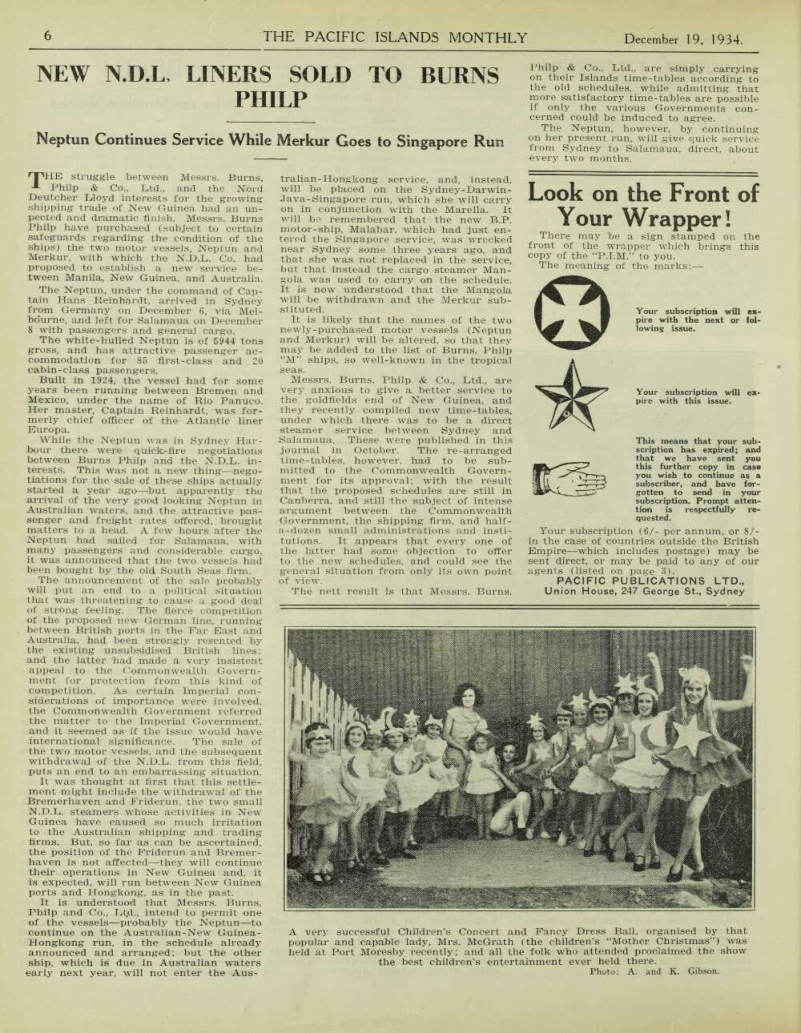
A very successful Children’s Concert and Fancy Dress Ball, organised by that popular and capable lady, Mrs. McGrath (the children’s “Mother Christmas”) was held at Port Moresby recently; and all the folk who attended proclaimed the show the best children’s entertainment ever held there.
Photo: A. and K. Gibson.
Advertisements & other items, p. 8 (1 item)
Your Wrapper!
Look on the Front of
There may be a sign stamped on the front of the wrapper which brings this copy of the “P.I.M.” to you.
The meaning of the marks: Your subscription will expire with the next or following issue.
Your subscription will expire with this issue.
This means that your subscription has expired; and that we have sent you this further copy in case you wish to continue as a subscriber, and have forgotten to send in your subscription. Prompt attention is respectfully requested.
Your subscription (6/- per annum, or 87in the case of countries outside the British Empire—which includes postage) may be sent direct, or may be paid to any of our agents (listed on page 3).
PACIFIC PUBLICATIONS LTD.,
Union House, 247 George St., Sydney
Quinine Poisoning
Letter to the Editor.
IN your November issue reference is made to the effect of the excessive use of quinine.
The principal effect of quinine upon the eyes of those whose toleration for the drug is not good consists in a concentric contraction of the visual field of vision, without as a rule any marked diminution of colour values, save in some cases a tendency to xanthopsia, or seeing an ex cess of yellow. Other effects of quinine poisoning (or cinchonism, as it is called) are tinnitus (singing in the ear), vertigo (dizziness), etc. Quinine amblyopia (dimness of vision) is due to the reduced action of the heart and lowered arterial tension, which the drug causes. Cessa tion of its use and general tonic treatment usually produces a speedy improvement.
Large doses of quinine are dangerous to sight, and have been known to cause ab solute blindness if persisted in. In order to avoid any possibility of harm the ad vice of a medical practitioner should be obtained.
I am, etc.,
L. L. Bell
Optometrist and Optician.
Sydney, 28/11/34.
Murderers in Koiari, Papua
Insignia Of The Heera
How Jack Hides Caught Four Murderers in Koiari, Papua
Pt. Moresby, Nov. 24.
SEVERAL months ago the disappear ance of five Saroa natives in the Cen tral Division near Rigo, on their way from loma in the Northern Division to Port Moresby to collect their pay (they liad completed a labour contract) caused some concern. A patrol under Mr. Jack Hides was sent overland to inquire into their disappearance.
The Koiari people, through whose coun try they passed, reported that the natives had perished from hunger. Mr. C. Cow ley, from loma, and Mr. Hides, however, found the insignia of the Heera (homi cide) at Manari village and the murder was out. Proud of their trophy, these hill people were unable to conceal it.
It appears that the five Saroa men lulled a pig belonging to a native of Manari. The latter gave chase, with three other natives, caught them up, and •speared and' strangled them and threw their bodies into a stream, where they were eventually discovered.
The four Manari men were brought to Port Moresby by Mr. Jack Hides and on November 6 were charged with wilful murder in the Court of Petty Sessions, and were subsequently sentenced to five years’ hard labour.
The Koiari people possess a very elaborate system of Heera (insignia of manslaughter). The beak of the horn bill, bird-of-paradise feathers, cockatoo feathers, sea-shells, and cassowary feathers, cuscus skin and nose sticks — ail these are worn separately or collec tively by all who have been concerned in a. murder.
The tradition of the Heera dies hard with the Koiari. They have been punished on many occasions for murders commit ted to secure this token, but being little influenced by civilisation they are con tinually striving to achieve the right to possess the coveted insignia.
Fiji Municipal Councils
To Be Replaced By Nominated Bodies
From Our Own Correspondent.
Suva, Nov. 26.
IT was announced in Suva on November 12 that the Secretary of State for the Colonies had approved of the proposals whereby the present elected municipal councils of Suva and Levuka are to disappear. In their place are to be set up boards nominated by the Governor.
In the case of Levuka the entire board will be nominated entirely at the discretion of the Governor. In Suva, however, the board will consist of thirteen memhers—seven official and six non-official.
The latter are to consist of two representatives each from the European, Fijian, and Indian residents of Suva. The change over to the new system will probably take place at the end of 1935, although, it is understood, the Governor favours the middle of the year.
This development is of more than usual interest, as it reflects the trend of polical affairs in Fiji. It has been influenced by considerations of Fiji as a whole, rather than the narrower view of Suva.
The writer hopes in a subsequent article to give fuller consideration to the reasons for what at first sight appears almost a retrograde step.
Increased!
N.Z. Enlarges Quota for Samoan Bananas
From Our Own the Legislative Council of Samoa on November 16, the Administrator (Brigadier-General Hart) dealt with the banana industry. The Administration, he said, after negotiations with the New Zealand Government, had been successful in securing an increase in the quota of Samoan bananas allowed to enter the Dominion. The increase, he stated, will amount to about 50 per cent, over the exports of the current year, It has been arranged, he continued, to have one of the Union Company’s cargo steamers call at Apia on her way back from Vancouver, to lift an additional 4000 cases of bananas during the months January to April, and 3000 cases from May to September, increasing to 4000 cases again in October to December. This fruit will be delivered to the Auckland market. The new schedule will start with the arrival of the Waikawa on January 19 Banana production by native and Euro pean growers has steadily expanded, so that hitherto fruit has been offered largely in excess of the limited freight facilities offered by the Maui Pomare. It is anticipated that there will be no diffi culty in obtaining supplies of bananas to meet the new requirements.
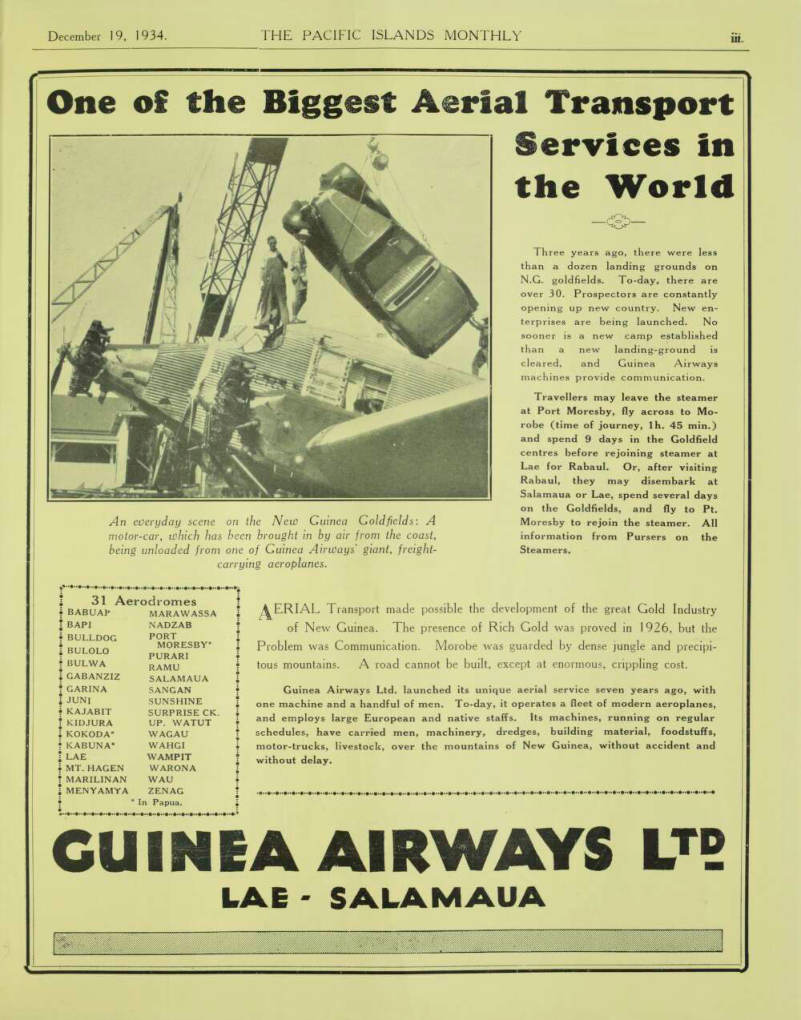
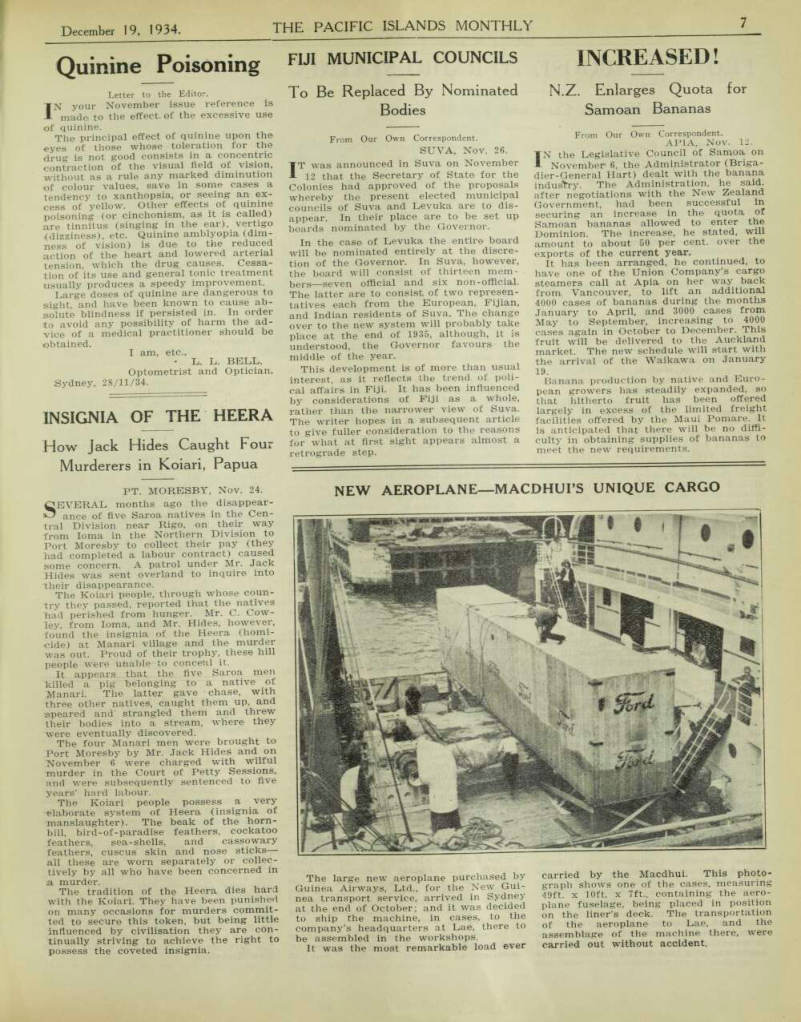
New Aeroplane—Macdhui’S Unique Cargo
The large new aeroplane purchased by Guinea Airways, Ltd., for the New Gui nea transport service, arrived in Sydney at the end of October; and it was decided to ship the machine, in cases, to the company’s headquarters at Lae, there to be assembled in the workshops.
It was the most remarkable load ever
carried by the Macdhui. This photo graph shows one of the cases, measuring 49ft. x 10ft. x 7ft., containing the aeroplane fuselage, being placed in position on the liner’s deck. The transportation of the aeroplane to Lae, and the assemblage of the machine there, were carried out without accident.
From Calaboose To Radio Station
New Hebrides Case with Peculiar Features
A SECTION of the British residents in Condominium of the New Hebrides appear to be dissatisfied with the charac ter of their Government. We have re ceived in recent months a dozen letters from different people in which the writers state their opinions, with various degrees of emphasis, that the British Administra tion is dominated by French influence; that it is “tired and lackadaisical”; that it is indifferent to the needs of the Bri tish planters; and that “there is far too much petticoat government.”
Every Pacific Islands Administration has its critics. Every Pacific Islands planter has his grievances. Anyone who knows anything about the conditions of life in the Pacific Islands does not regard attacks on Pacific Islands Administrators very seriously. But there are so many complaints from the New Hebrides about affairs at Vila that it probably will be necessary to deal with this subject at length in an early issue.
Meanwhile, pending further inquiries, we should like to refer to the case of Mr. Harvey.
Harvey has been a resident of the New Hebrides for some years. He is a quali fied surveyor and a radio operator. He has been a planter and trader. He has made money, and spent it freely. He has always paid his debts, and he has helped many lame dogs over sundry difficult stiles, Harvey occasionally drinks more than he should. That in itself is not a crime.
But when alcohol is in Harvey, an ag gressive temper comes out; and he then is a difficult person to cross.
Harvey on more than one occasion has been in conflict with French officialdom.
The French do not like Harvey. Harvey emphatically does not love the French.
For some time recently, owing to the depression driving him from his usual occupation, Harvey has occupied a posi tion as radio operator at the Vila wire less station. The writer met him in Vila in September, and found him to be an alert and intelligent type of Britisher.
His manner was that of a quiet and sober citizen.
One day, at the end of October, Harvey drank to the point when good judgment and good manners left him. He was on his way to a dinner at the Hotel Reid, and, on his way, he passed the house of a Frenchman with whom he had had some difference. As he passed he made an offensive remark, in a loud voice, about the Frenchman.
The Frenchman rang up the French Commandant of Constabulary and made a complaint.
The French Commandant rang up the British Police Commandant. The Bri tisher was at the Club.
The French Commandant, accom panied by the complainant, went to the Club and asked that the British Police Officer go to the hotel and arrest Harvey, who was in a drunken condition.
The British Commandant went to the hotel and approached Harvey, who was dining. Harvey assaulted the policeman.
It was not a very serious assault; but assistance was called, and Harvey—quite
properly—was marched off to the cala boose, and locked up. He had “asked for it.”
Harvey was brought before the Court next morning. It was expected that it would be regarded as a “drunk and dis orderly” case—which it undoubtedly was —and that a fine would meet the situa tion. Harvey had neither time nor oppor tunity to gather his wits and secure an advocate. A charge was made of drunk and disorderly, and assaulting the police.
When the case was heard a rather ex traordinary procedure was permitted.
The French Commandant of Constabulary was allowed to appear before the Court and make a long speech about Harvey’s residence in the Group, his clash with French officialdom, and particularly in regard to some offence for which Harvey had previously paid the penalty of a fine.
Judge de Jersey Carey (British), hav ing heard the statement of the French official, sentenced Harvey to one month’s imprisonment for being drunk and dis orderly, and three months’ for the assault on the British Police Commandant.
This sentence had much greater sig nificance there than in Australia, for in stance. Harvey, an educated white man of good status, was to undergo three months’ hard labour in a native gaol, in charge of native warders, under the gloating eye of French officialdom. It is several years since a white man has been placed in a gaol in the New Hebrides in such circumstances.
Furthermore, the circumstances of the trial appear to have been unusual. Har vey had no advocate. The British Police Commandant simply laid the charge and submitted formal evidence. The case against Harvey is said to have been pressed by French officials, who have been at loggerheads with Harvey for a long time and who have made no secret of their wish to see him leave the Con dominium. Harvey, an aggressive person, has never concealed his dislike of French men. Much evidence was heard by the Judge. A good deal was made of the fact that when Harvey was arrested a knuckle-duster was found in his pocket.
He had made no attempt to use the knuckle-duster.
Harvey, then, was sent to the cala boose, under native warders, to do three months’ hard labour. For three nights he was tortured by mosquitoes. He was not allowed even a mosquito net. He had delivered to him, there, a, letter from the British Resident Commissioner, dis charging him from his post as radio operator in the Condominium service.
The letter was dated a day previous to his arrest.
A couple of days later Harvey was taken out of the calaboose and ordered to go back to his work at the wireless station. This course is stated to have been taken at the instigation of the French Resident Commissioner, as the French radio operator (there is one of each nationality at the station) could not carry on alone.
Harvey appealed against his sentence and was formally liberated from gaol on sureties of himself in £50, and of
another person in £20. The appeal must be dealt with by the High Commissioner for the Western Pacific at Suva. One of the conditions of Harvey’s release from gaol is that he reports to police head quarters at Vila once a week. Mean while, he is solving the British Resident Commissioner’s difficulty concerning the wireless station by continuing to act as radio operator there. If it were not for the obligation to report once a week to the police in Vila, Harvey could return to his plantation in Epi, and there await the outcome of his appeal.
If this were merely a case of a man having been punished for being drunk and disorderly, it would not be worth the attention of this journal. But the case has some unusual features which, considered in conjunction with the cir cumstances surrounding the operation of the “Pandemonium Government,” appear to call for the serious consideration of those whose minds are not influenced by the very peculiar conditions of life in the New Hebrides.
Old Samarai
I’VE seen the time in Samarai When twenty men or more Would with each other keenly vie For payment of the score.
When gold is being freely won There’s always cash about— Each miner reckons it good fun For all the crowd to shout.
The divers in the China Strait Were doing fairly well They paid their way, at any rate.
With pearl and trochus shell.
And in the pubs at eve or morn.
Though fortunes were not made You’d see from dusk, till day was born.
The game of banker played.
Each man was then the other’s friend— There were no rich or poor.
Each one his gold would freely spend— Then go in search of more.
The tough old traders from the coast.
When drinking with the crowd, Of their old tubs would loudly boast.
Each of his schooner proud.
Men from all corners of the earth Met on that tiny isle; They’d left the places of their birth, Each seeking fortune’s smile.
It took so very long to get— They spent it as it came.
They lost no time in vain regret— Life was a happy game.
Nicholas, tough sailorman, Before he passed away.
Left money with each publican A final shout to pay.
This little pirate, hard and brown, Craved smiling faces there, And merry men to lay him down To rest on old Logeia.
So many of the good old school From here have had to go— Inman, Steele and Liverpool, Finnegan, Elliot, Crowe.
All old-timers tough and game Friends of an early day— Old Samarai is not the same Now they have passed away.
Frank Pryke
Memorial To Rev. Dr. Lawes
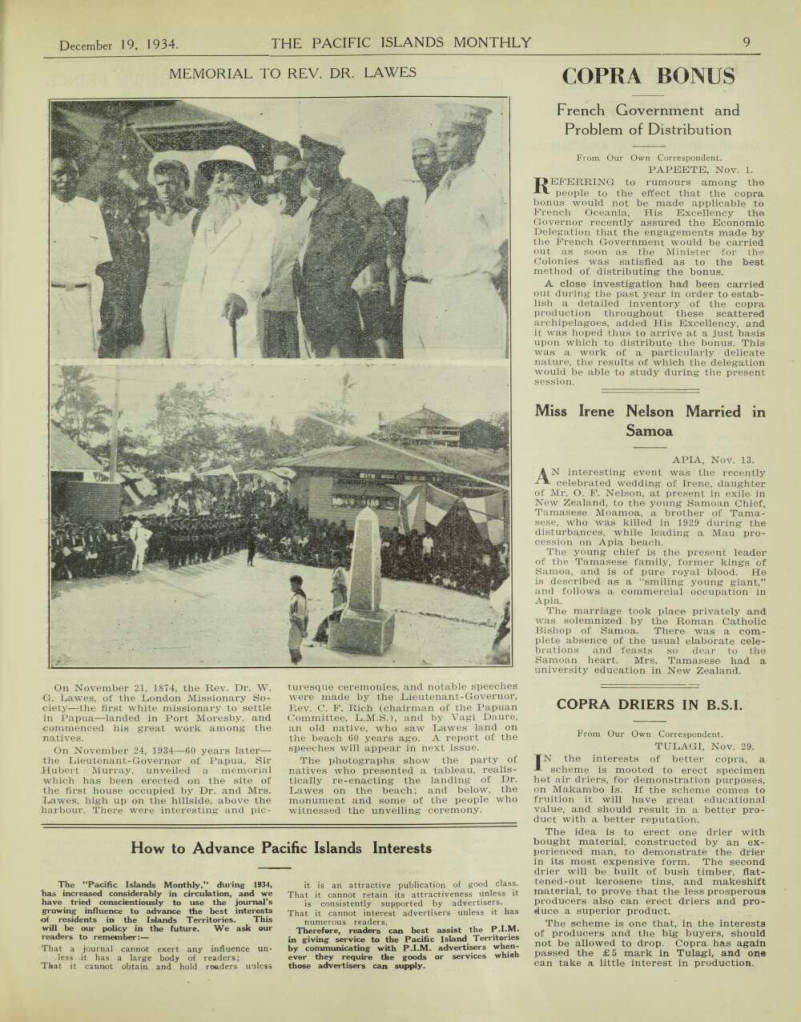
On November 21, 1874, the Rev. Dr. W.
G. Dawes, of the London Missionary Society—the first white missionary to settle in Papua—landed in Port Moresby, and commenced his great work among the natives.
On November 24, 1934—60 years later — the Lieutenant-Governor of Papua, Sir Hubert Murray, unveiled a memorial which has been erected on the site of the first house occupied by Dr. and Mrs.
Lawes, high up on the hillside, above the harbour. There were interesting and pic-
turesque ceremonies, and notable speeches were made by the Lieutenant-Governor, Rev, C. F. Rich (chairman of the Papuan Committee, L.M.S.), and by Vagi Daure, an old native, who saw Lawes land on the beach 60 years ago. A report of the speeches will appear in next issue, The photographs show the party of natives who presented a tableau, realis tically re-enacting the landing of Dr.
Lawes on the beach; and below, the monument and some of the people who witnessed the unveiling ceremony.
How to Advance Pacific Islands Interests
The “Pacific Islands Monthly,” during 1934, has increased considerably in circulation, and we have tried conscientiously to use the joumars growing influence to advance the best interests of residents in the Islands Territories. This will be our policy in the future. We ask our readers to remember:— That a journal cannot exert any influence un less .it has a large body of readers; That it cannot obtain and hold readers unless
it is an attractive publication of good class.
That it cannot retain its attractiveness unless it is consistently supported by advertisers.
That it cannot interest advertisers unless it has numerous readers.
Therefore, readers can best assist the P.I.M. in giving service to the Pacific Island Territories by communicating with P.I.M. advertisers when ever they require the goods or services whi«h those advertisers can supply.
Copra Bonus
French Government and Problem of Distribution
From Our Own Correspondent.
Papeete, Nov. 1.
REFERRING to rumours among the people to the effect that the copra bonus would not be made applicable to French Oceania, His Excellency the Governor recently assured the Economic Delegation that the engagements made by the French Government would be carried out as soon as the Minister for the Colonies was satisfied as to the best method of distributing the bonus.
A close investigation had been carried out during the past year in order to estab lish a detailed inventory of the copra production throughout these scattered archipelagoes, added His Excellency, and it was hoped thus to arrive at a just basis upon which to distribute the bonus. This was a work of a particularly delicate nature, the results of which the delegation would be able to study during the present session.
Miss Irene Nelson Married in
Samoa
Apia, Nov. 13.
AN interesting event was the recently celebrated wedding of Irene, daughter of Mr. O. F. Nelson, at present in exile in New Zealand, to the young Samoan Chief, Tamasese Moamoa, a brother of Tama sese, who was killed in 1929 during the disturbances, while leading a Mau pro cession on Apia beach.
The young chief is the present leader of the Tamasese family, former kings of Samoa, and is of pure royal blood. He is described as a “smiling young giant,” and follows a commercial occupation in Apia.
The marriage took place privately and was solemnized by the Roman Catholic Bishop of Samoa. There was a com plete absence of the usual elaborate cele brations and feasts so dear to the Samoan heart. Mrs. Tamasese had a university education in New Zealand,
Copra Driers In B.S.I.
From Our Own Correspondent.
Tulagi, Nov. 29.
IN the interests of better copra, a scheme is mooted to erect specimen hot air driers, for demonstration purposes, on Makambo Is. If the scheme comes to fruition it will have great educational value, and should result in a better pro duct with a better reputation.
The idea is to erect one drier with bought material, constructed by an ex perienced man, to demonstrate the drier in its most expensive form. The second drier will be built of bush timber, flat tened-out kerosene tins, and makeshift material, to prove that the less prosperous producers also can erect driers and pro duce a superior product.
The scheme is one that, in the interests of producers and the big buyers, should not be allowed to drop. Copra has again passed the £5 mark in Tulagi, and one can take a little interest in production.
Prince
To Greet The
Arrangements in Fiji and Samoa
From Our Own Correspondent.
SUVA, November 26.
THE Fiji Governor has announced that the Duke of Gloucester has approved of the programme submitted covering his stay in Fiji. The Duke is expected at Suva about 2 p.m. on Friday, February 1.
On landing he will be received by a guard of honour of the Fiji Defence Force when Fijian, European, and Indian troops will be on parade. The khaki uniforms of the Europeans and Indians will pro vide an excellent contrast to the scarlet and white of the Fijians’, and the blue and white of the constabulary. Then there will be a civic welcome by the Mayor (Hon. T. W. A. Barker) at the Town Hall, followed by a picturesque ceremonial welcome by Fijians at Albert Park.
The following day the Duke will pro ceed to the ancient white capital, Bau.
The Hon. Ratu Popi Cakobau, descendant of that Cakobau who handed his war-club to the Duke’s great-grandmother, will welcome his guest with ancient mekes (native ceremonial dances), whilst the Fijians of Lau, who contended in olden days with Bau for the supremacy, are coming specially to Bau to perform a meke of welcome.
Sunday will probably be spent in Suva, whilst Monday is to be devoted to a visit to the Island of Beqa, where live the Fire-walkers. In its natural seating the rite of walking on red-hot stones prac tised by this tribe alone is a spectacle of singular attraction.
Samoa Prepares
From Our Own Correspondent.
Apia, Nov. 19.
OFFICIAL advice has been received by the Administration that the Duke of Gloucester will arrive in Apia at the be ginning of February. The date of arrival has not been definitely fixed so far, but it is known that he will arrive in the morn ing of one day and depart on the evening of the following day, thus spending two full days in Samoa.
Arrangements are afoot to give the Duke a rousing welcome, both by the European residents and the native Samoans. Displays of native ceremonial dancing and singing will be witnessed, and, it is understood, a programme has been arranged allowing the Royal visitor to see the famous sights around Apia and something of the natural beauty of our inland districts.
Mr. G. A. Joy, British Resident Com missioner of the Condominium of the New Hebrides, arrived in Sydney on fur lough from Vila by the Morinda on De cember 10. He is accompanied by his wife.
Mr. G. M. Pike arrived in Sydney from Fiji by the Aorangi on December 1. For merly chief clerk of the Union S.S. Co. at Suva, he has now taken charge of the passenger department of the Sydney office.
Tongan Crown Prince
Presented to Duke of Gloucester
Mr. L. H. Summers, who was chief engineer on the Tongan Government motor vessel Hifofua, arrived in Sydney in November from Nukualofa, Owing to economic conditions the Tongan Govern ment has placed the Hifofua entirely out of commission, and has terminated the engagements of both the captain and chief engineer.
WHEN Prince Henry, Duke of Glou cester, visited Manly, N.S.W., in November, to witness a surf carnival there, the Crown Prince of Tonga, Prince Taufa, was presented to him, by Rev.
A. M. Sanders, of Manly, who is the Prince’s guardian.
During the presentation of addresses prior to the carnival, Prince Taufa was given a place on the dais at the right hand of the Duke, and before the pre sentation, the Duke chatted with him, making inquiries about Queen Salote,, and the little island kingdom of Tonga.
Prince Taufa is a student at Newing ton College, and is 16 years of age, 6ft in height, and weighs nearly 15 stone. He is a good student and a keen athlete.
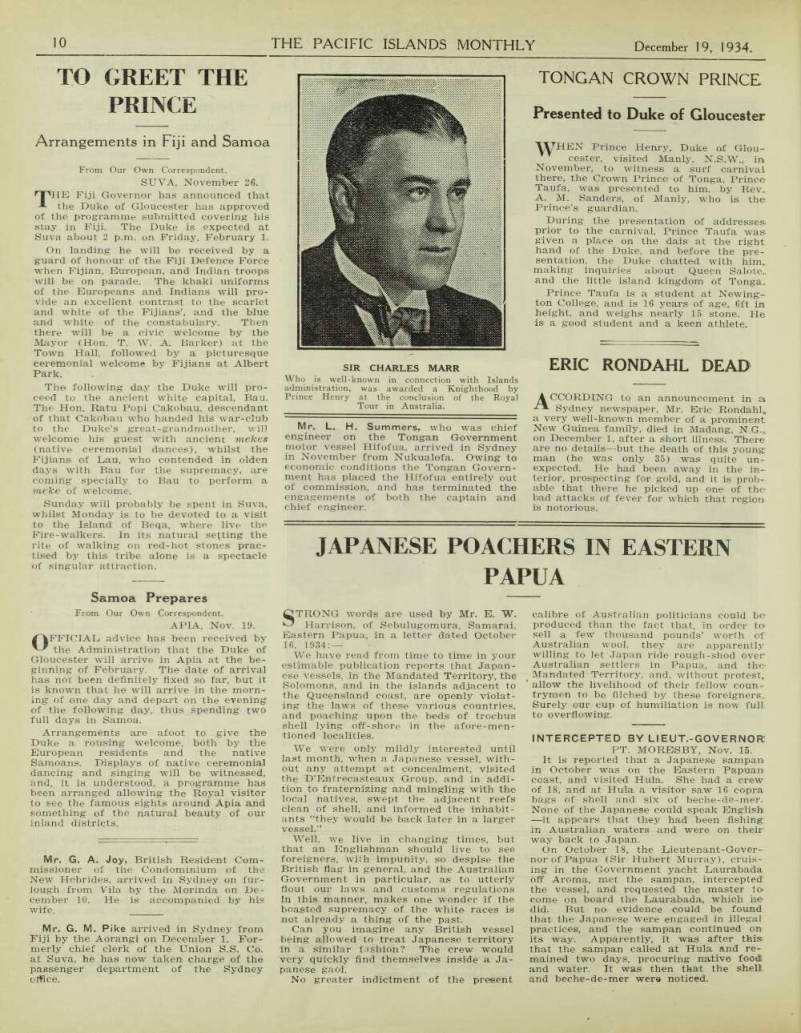
Sir Charles Marr
Who is well-known in connection with Islands administration, was awarded a Knighthood by Prince Henry at the conclusion of the Royal Tour in Australia.
Eric Rondahl Dead
ACCORDING to an announcement in a Sydney newspaper, Mr. Eric Rondahl, a very well-known member of a prominent New Guinea family, died in Madang, N.G., on December 1, after a short illness. There are no details—but the death of this young man (he was only 35) was quite un expected. He had been away in the in terior, prospecting for gold, and it is prob able that there he picked up one of the bad attacks of fever for which that region is notorious.
Japanese Poachers In Eastern
Papua
STRONG words are used by Mr. E. W.
Harrison, of Sebulugomura, Samarai, Eastern Papua, in a letter dated October 16, 1934: We have read from time to time in your estimable publication reports that Japan ese vessels, in the Mandated Territory, the Solomons, and in the islands adjacent to the Queensland coast, are openly violat ing the laws of these various countries, and poaching upon the beds of trochus shell lying off-shore in the afore-men tioned localities.
We were only mildly interested until last month, when a Japanese vessel, with out any attempt at concealment, visited the D’Entrecasteaux Group, and in addi tion to fraternizing and mingling with the local natives, swept the adjacent reefs clean of shell, and informed the inhabit ants “they would be back later in a larger vessel.”
Well, we live in changing times, but that an Englishman should live to see foreigners, with impunity, so despise the British flag in general, and the Australian Government in particular, as to utterly flout our laws and customs regulations In this manner, makes one wonder if the boasted supremacy of the white races is not already a thing of the past.
Can you imagine any British vessel being allowed to treat Japanese territory in a similar fashion? The crew would very quickly find themselves inside a Ja panese gaol.
No greater indictment of the present
calibre of Australian politicians could be produced than the fact that, in order to sell a few thousand pounds’ worth of Australian wool, they are apparently willing to let Japan ride rough-shod over Australian settlers in Papua, and the Mandated Territory, and, without protest, allow the livelihood of their fellow countrymen to be filched by these foreigners..
Surely our cup of humiliation is now full, to overflowing.
Intercepted By Lieut.-Governor:
Pt. Moresby, Nov. 15.
It is reported that a Japanese sampan in October was on the Eastern Papuan coast, and visited Hula. She had a crew of 18, and at Hula a visitor saw 16 copra bags of shell and six of beche-de-mer.
None of the Japanese could speak English —it appears that they had been fishing in Australian waters and were on their way back to Japan.
On October 18, the Lieutenant-Gover nor of Papua (Sir Hubert Murray), cruis ing in the Government yacht Laurabada off Aroma, met the sampan, intercepted the vessel, and requested the master to come on board the Laurabada, which he did. But no evidence could be found that the Japanese were engaged in illegal practices, and the sampan continued on its way. Apparently, it was after this that the sampan called at Hula and re mained two days, procuring native food and water. It was then that the shell and beche-de-mer were noticed.
Tropicalities
PEOPLE who live in the Pacific should paste this in their hats. It is a para graph from a news despatch from Tokio, dated November 16: “Vice-Admiral Sankichi Takahashi, who yesterday succeeded Admiral Suetsugu as commander of the combined battle fleet, which has been reorganised and now in cludes new and powerful aircraft and de stroyer divisions, declared there was not the slightest question of Japan giving up her mandated interests (Marshall and Caroline Islands) regardless of whether she left the League of Nations. If the League or anybody else tried to recover an island they would find the Imperial navy fully prepared for every eventuality.” * * * THE following is from the Melbourne Herald of November 28: “Mr. C. W. C.
Marr, Minister in Charge of Royal Tour, and recently the Minister in Charge of Australian Pacific Territories, has been offered a directorship on the Australian board of a mining company now being floated in England. Mr. Marr, it was stated to-day, refused recently the post of Administrator of New Guinea.”
It was announced, on December 10, that Prince Henry, before sailing for N.Z., has conferred a Knighthood on Major Marr, who had been in charge of the Australian programme for the Royal visit. * * * THE 20th of August is remembered in England and Scotland as “Mosquito Day”—the anniversary of which the late Sir Ronald Ross (a poet as well as a medical scientist) celebrated privately for many years in a spirit of thankfulness.
It recalled to him that on August 20th, 1897, laborious years of research in India were rewarded by his discovery under the microscope of malaria parasites in the stomach tissues of a mosquito.
This discovery, subsequently confirmed and elaborated, solved the mystery of the transmission of malaria, yellow fever, and other deadly tropical diseases. Mos quito control measures resulting from this knowledge have transformed rich tropical lands and saved millions of lives; but the future possibilities of tropi cal hygiene are enormous, thanks mainly to the knowledge of what Ross called the “million-murdering” cause.
In his last years this “Mosquito Day” developed into a semi-official, quite cere monial, luncheon party at the Ross In stitute at Putney, and eminent admirers of his genius, such as the late Sir Wil liam Simpson, Sir Arthur Keith, Sir Aldo Castellani, Mr. John Masefield, and others delivered eulogies. It was the Prince of Wales who opened the Institute as a na tional memorial to this great benefactor, and last August Mr. John Masefield spoke eloquently in St. Martin’s Church, Tra falgar Square, on Ross’s life and work, his address being broadcast by the B.B.C.
—H.J.B.
. * * * WE unwittingly did the Lutheran Mission of New Guinea an injustice when we stated, in November, that “three separate influences supported the German shipping line—the Lutheran (German) Mission Stations, etc.” It is pointed out that the Lutheran Mission Stations belong to two different and separate societies, one German (Finschhafen) and the other American (Madang). These stations try to divide their copra shipments fairly be-
tween the N.D.L, and the other shipping lines. Roman Catholic missions (at Ko kopo and at Sek), whose copra output is many times that of the Lutherans, also use the N.D.L. ships for a substantial portion of their product. * * * THE danger of poisoning by bush ticks, which kill large numbers of dogs in Australia, is being mitigated by dusting the coats of the dogs with powdered derris root, which comes from Malaya. Dr.
Clunies Ross, director of the McMaster Animal Health Laboratory, University of Sydney, said that plants containing the same active principle as derris have been received from New Guinea. Although they were less effective, for the reason that they do not grind up so finely, it might be possible to improve the method of using them, and so establish a small trade for New Guinea. * * * A CORRESPONDENT in the Solomon Islands writes to correct a wrong im pression that might be given by a para graph in the October issue of the P.I.M.- It was stated that native wages in B.S.I. had been reduced to 10/- per month for general labour and 5/- per month for light labour, and that this reduction brought B.S.I. rates into line with New Guinea and Papua, From this it might appear that wage rates had been fixed at the figures quoted for the period com mencing December 1. This is not the case. The rates stated are minimum rates —employers may pay any higher rates that they wish. Our correspondent urges us to appeal to B.S.I. employers to co-operate and, by working together, to establish wage standards that will be equal to the standards in the adjoining territories and which will not be much in excess of the amount provided under the new regulations. This matter is regarded as one of considerable importance, as the
British Solomon Islands in the past have been under a severe handicap in that the wage rates fixed there have been exces sive.
“With Intent To Insult”
From Our Own Correspondent.
Rabaul, Dec. 1.
SEVERAL cases of natives being con victed of “intent to insult female in mates’’ in houses were remanded for sen tence to Rabaul from Salamaua and Wau, and came before Judge Phillips, in the Supreme Court. As these mining towns become more civilised, it would appear that crimes of this nature are on the increase.
One native was sentenced to two years’ gaol for indecent assault on a European woman at Salamaua, and to one year for being in a dwelling with intent. Two natives received sentences of one year and two whippings each for similar of fences. Kabib received sentence of three years, with two whippings, for an offence committed at Wau on a European child.
Kornelius received one year and two whippings for being in a dwelling with intent to insult.
Wau Hotel
RECENT visitors to Sydney include Mr. and Mrs. James Stewart, who estab lished the Hotel Bulolo at Wau, New Guinea, in the early days of the goldfield, and have made it one of the best known hostelries in the South Seas. They have been enjoying a well-earned holiday in Victoria and Tasmania.
It was reported, in September, that Mrs.
Stewart had sold the hotel to Mr. James Fraser, of Queensland; but that was not quite correct. Mr. Fraser, who contem plates the transfer of some of his sub stantial interests to New Guinea, has pur chased a share in the hotel, but it will be conducted, as heretofore, by Mrs. Stewart.
The Waipahi left Suva on Nov. 9, with a cargo of Fijian fruit for the N.Z. market.
Advertisements & other items, pp. 13-14 (1 item)
Sterling
COVERS
MORE
COSTS
LESS
GUAR-
ANTEED
WITH-
STANDS
TROPICAL
SUN AND
SALT-LADEN
AIR
MAKES ALL THE
DIFFERENCE
Made by STERLING VARNISH CO., SYDNEY, N.S.W.
Get your
COPY
of the
NEW TRUFOOD
RECIPE BOOK
69 specially tested recipes—all kinds of new ideas for attractive things to cook cakes, pastry, puddings, custards, desserts, savour'es, sauces, etc.
Recipe Department ' c/- Box 3922TT G.P.O.
Sydney.
Please send me POST FREE, a copy of The Trufood Book of 69 Tempting Recipes Name
(BLOCK LETTERS)
Address
For Well Bred
FOXIES, CATTLE KELPIES,
POMERANIANS or Any Other (Both Sexes) Established 5 Years.
57 Goulburn St., Sydney
(A Feeding Chart with Every Animal.) Satisfaction Guaranteed
ISLAND PATRONS RECEIVE SPECIAL ATTENTION.
A SPECIAL WATCH
for hot, tropical climates
IN RUSTLESS STEEL CASE
Attractive and modern in appearance and definitely a good, sound timekeeper, this watch has compensated balance and is fully jewelled.
The illustration is actual size and the watch is complete with wide leather band and chromium plated metal buckle.
Guaranteed for 1 5 years and kept in order, free of charge (breakages excepted) for twelve months.
PRICE £5/5/-.
Fairfax Roberts Ltd.
“The Oldest Jewellery House in Sydney”
23-25 HUNTER STREET.
About Islands People
Captain A. S. Fitch, managing director of Steamships Trading Co., Ltd., of Papua, arrived in Australia in October, and has spent two months’ furlough in Victoria and New South Wales. He will return to Port Moresby by this month’s Macdhui.
Mr. Charles B. Nordhoff, well-known American author, who arrived in Sydney from Tahiti in November, has spent some very busy weeks in the Mitchell Library, Sydney, where he has been gathering material for a new book which will deal with incidents in the early colonisation of Australia. Mr. Nordhoff intends to leave Sydney on his return to Tahiti by the Maunganui on December 20, Ratu D. I. Waqanivavalagi, the late Roko Tui Kadavu, Fiji, died at Kadavu on November 8, at the age of 52. Joining the Fiji Government Service in 1910, this old Fijian High Chief held various posts in the service, and in April, 1917, was ap pointed Native Assistant Commissioner at Kadavu. At the end of 1925 he was given the position of Acting Roko Tui Kadavu, which office he held until he retired last year owing to ill-health.
Mr. E. G. Seagoe, district officer and British police commandant at Vila, New Hebrides, arrived in Sydney on holidays from the Condominium by the Morinda on December 10,
Miss Amy Richardson, an Australian nursing sister in charge of the infant welfare and maternity centre at Buka Passage, New Guinea, arrived in Victoria recently to be present at the Eucharistic Congress. On the completion of the Con gress, she left Melbourne on a lecture tour throughout Australia.
Mr. D. A. Butler arrived in Samoa by the steamer Indien on November 22. He has taken over the managership of the Union S.S. Company’s office at Apia. Mr.
Coster, who formerly was manager, left Apia in November by the Maui Pomare for Wellington, New Zealand, en route to Tahiti, where he will take up the posi tion of Union S.S. Co. agent at Papeete.
Mr. W. Macnaught, managing director of Messrs. Macnaught Shoe Stores Ltd., who left Sydney for Rabaul by the Sala maua on October 12, returned to Aus tralia by the Montoro on November 23, after a combined business and pleasure tour of the Mandated Territory.
Captain Post, who for many years was well known and highly esteemed in the Central and South Pacific as the master of the New Zealand Government steamer Tutanekai, died recently in Melbourne at an advanced age. He retired from the sea some years ago and interested himself latterly in civic work, Mr. George Frederick Sidery, well known Islands traveller for Mr. W. M.
Reid, of Sydney, died at Cairns in No vember, at the age of 28. Contracting malarial fever in New Guinea, he left Rabaul with Mr. Reid by the Montoro early in November to seek medical treat ment in Sydney. On the voyage to Aus tralia his condition became very serious, and on reaching Cairns he was rushed from the ship to hospital, where he passed away on November 22.
Fraulein Vandlandt, of Berlin, Ger many, arrived in Sydney in December on her way to New Guinea. Before leaving the Territory for Singapore she intends to fly over to the goldfields.
Chief Judge J. H. Luxford, formerly of Samoa, who is now S.M. of Thames dis trict, New Zealand, will visit Apia, Samoa, on High Court circuit, by the Maui Pomare on February 7.
Major F. Hewitt sat as a member of the Solomon Islands Advisory Council for the last time, at its session in Octo ber, as he has been appointed to the Sydney headquarters staff of his company (Lever’s Pacific Plantations Pty., Ltd.).
Tributes to the excellent service rendered and the public spirit displayed by Major Hewitt during his association with the Council were paid by the Resident Com missioner and by the various members of the Council.
When You Visit Sydney
Nowhere can you be more highly re commended to stay than at the Great Southern Hotel, 717-723 George Street, Sydney (facing Central Railway Station, opposite Rawson Place). Bed and break fast 7/6, luncheon 2/-, dinner 2/6.
About Islands People
Mr. A. A. Hargrave, metallurgist and mining engineer, left Sydney recently for Misima Island, Papua, to inspect and re port upon four mining leases held under option by Misima Central Gold N.L.
Rev. L. A. McArthur, B.A., Principal of the George Brown Training College at Vunairima, New Britain, accompanied by his wife and small son Malcolm, left Sydney for Rabaul early in December.
Mr. G. W. F. Zimmer, Resident Magis trate at Kerema in the Gulf Division, Papua, who has served 20 years with the Papuan Administration, is retiring shortly on long leave. Upon his retirement, Mr.
Zimmer will join Guinea Gold N.L. Com pany’s expedition under Mr. J. Nason Jones, which is prospecting and exploring in the vicinity of the Aivavi and Bubuau Rivers, in the northern section of the Central Division, Papua.
Right Rev. Gerard John Vesters, D.D., Vicar Apostolic of Rabaul, arrived in Sydney from the Mandated Territory by the Montoro on November 23. He is a native of Holland and has been in Rabaul for 11 years.
Mr. Richard W. Robinson and Mr. Cyril G. King were elected Municipal Council lors of Levuka, Fiji, at the annual elec tions held on November 7.
Rev. G. O. Henschke, of the Roman Catholic Mission of the Sacred Heart of Jesus at Kambaira, New Britain, arrived in Sydney in the November Montoro.
After attending the Catholic Congress at Melbourne, he will spend his furlough— the first in 16 years—in South Australia.
Mr. Enoch Perkins, who was in charge of American mining interests in New Caledonia for some years, and who was later transferred to U.S.A., is at present re-visiting the French Colony. He will remain in New Caledonia until January.
Mrs. Perkins left Noumea to join her children in America by the Van Rees on November 9.
Mr. Clement Coppenrath, assistant manager for Messrs. Etablissements Don ald, Tahiti, returned to Papeete on the Makura recently, after a visit of several months duration to Europe. Mr. Coppen rath, whose trip was taken chiefly for the purpose of buying goods for the firm, was accompanied by his wife and family.
Rev. E. C. Yarrington, who for seven years has been attached to the New Guinea Mission at Sangara, Papua, is on furlough in Sydney. Acting on medical advice he intends to remain permanently in Australia.
Mr. P. Ferrari, mining engineer, of Noumea, New Caledonia, arrived in Sydney by the Cathay after a holiday in France on November 30. He was accom panied by Mrs. Ferrari and their child.
Mrs. W. R. McNicoll, wife of Brigadier- General Walter Ramsay McNicoll, Ad ministrator of New Guinea, left Sydney on November 30 by the Montoro for the Mandated Territory, where she joined her husband. She has now taken up resi dence at Government House, Namanula, Rabaul.
Mr. Ernest Martin, accompanied by his daughter Pantelle, returned to Noumea by the Ville de Verdun recently from a trip abroad. For many years he was in the services of the New Caledonian Government.
Mr. Francis G. Walters, who recently arrived in Papua from England to join Mr. J. Nason Jones’s surveying party at Lakekamu, was struck by lightning dur ing a violent storm, while standing at the entrance of his tent at Bulldog aero drome, early in November. His death was instantaneous.
Mr. H. B. Cowles, who for some years has been general manager of the N.S.W, branch of the Vacuum Oil Co., has re signed. Mr. G. S. Gordon, who has been in the company’s service for 30 years, has been appointed acting general manager.
Advertisements & other items, pp. 15-16 (1 item)
Wesley College
A. W. DYE
and Company
ASSAYERS, ANALYSTS,
METALLURGISTS
Buyers of Gold, Silver, Platinum, etc.
T. & G. BUILDING,
ELIZABETH STREET,
SYDNEY, N.S.W.
Established 1914.
Bankers: Commercial Bank of Australia, Ltd.
HUON PINE BOAT PLANKS
AND
SPOTTED GUM TIMBERS
The World’s Best and the Cobra Does Not Like Huon Pine.
A. C. FRYER, 110 Miller Street, Pyrmont, Sydney.
Will Gladly Give Full Quotations for Any Sizes.
WESLEY COLLEGE
ST. KILDA ROAD, MELBOURNE, VIC.
ONE OF THE SIX ASSOCIATED PUBLIC SCHOOLS OF VICTORIA THE NEW BUILDINGS incorporate the latest ideas and conveniences both in the Classrooms and in the Boarding House. Special Classes in
WOOLCLASSING and AGRICULTURAL
SCIENCE and in ACCOUNTANCY, in addi-
tion to a THOROUGH GENERAL EDUCA-
TION.
PREPARATORY SCHOOL BOYS, from 6 to
13, have separate School and Boarding Establishment.
Term Dates for 1935: February 12, June 4, September 17 All details may be obtained from: H. STEWART, M.A., Headmaster
PACIFIC ISLANDS STAMPS
BOUGHT AND SOLD
Stamps sent on approval on receipt cl reference. Send for free lists and specimen copy “Australian Stamp Journal.”
J. H. SMYTH LTD.
CO. LTD.
121a Castlereagh St., Sydney
CERTAIN - TO - SELL
SHORT STORIES
A Vic. weekly paid £7/18/- for one story.
Numerous other students have also obtained good prices. Read: “ ‘Nocturne,’ printed by ‘Smith’s,’ recently, brought me between £5 and £6.”
“I have had nine stories published since I started your course.”
“The first story I sent to America has been accepted.”
“I received more for my stories while studying with you than I paid in fees.”
“I received £6/2/6 for two stories in the ‘Australian Journal’.”
“ ‘The Bulletin’ headlined my story ‘Justice.’ I received £4/18/6 for it.”
“I have just received a cheque for £6/13/6 from ‘The Bulletin’ for my story ‘Old George’.”
“I received £5 from the ‘Sydney Mail’ for my first story, ‘Twin Ships’.”
Stott’s Correspondence
College
100 Russell St., Melb.; 70 Pitt St., Sydney; 290 Adelaide St., Brisbane; 49 Flinders St., Adelaide; 359 Murray St., Perth.
CUT HERE
You, too, can win success as a writer by taking STOTT’S Postal Course. Send Coupon for Free Literary Prospectus.
NAME
ADDRESS
P.I.M.434
BRITAIN’S PRICELESS CONTRIBUTION TO MAN’S
COMFORT AND HAPPINESS
ROLLS-RAZOR
The Aristocrat of all Safety Razors SOLE AGENTS for Australia and the Islands of the Pacific.
THE ROLLS RAZOR CO. OF AUSTRALIA LTD.
Mendes Chambers, 8a Castlereagh Street, Sydney.
SERVICE.—We have a complete equipment for Repairs in case of accident to your Razor. Blades can be Reset and adjustments made by return mail.
THE LARGEST STOVE . . .
in the Pacific Islands is installed at the Bulolo Hotel, Wau —and it is a Younger YOUNGER Stoves and Ranges are widely used throughout the Pacific Islands, for they embody in their construction everything calling for Efficiency in Working, Economy in fuel consumption and Durability.
Special Stoves for Island requirements with cast-iron ovens.
Write for quotations and catalogue of single and double oven stoves.
G. FLETCHER & SON
50 OXFORD STREET. SYDNEY
Autogyro for N. Guinea
Proposed Flight From England
MR. C. GATENBY, a former pilot of Pacific Aerial Transport Ltd., of Wau, New Guinea, and Mr. H. A. de Kantzow, also of Wau, arrived in Sydney by the Mataram in October, en route to England to obtain an autogyro for use on the New Guinea goldfields.
“My experience in New Guinea,” said Mr. Gatehby, “convinced me that the autogyro is the most adaptable type of aircraft for the small aerodromes in the inland of the Territory. After discussing the question with Mr. Kantzow, we placed an order in London for a new autogyro.
“We intend to fly the machine from England to Australia,” he continued, “and then make a flight to New Guinea; that is, of course, if the machine can be equipped with a greater fuel range than it has at present.”
The machine ordered is the latest type “Cierva” direct-control autogyro, with accommodation for a pilot and two pas sengers. It can land without a forward run, and can take off in a few feet.
It is intended to employ the plane in carrying supplies to miners and pros pectors on outlying fields, and also for keeping in contact with survey parties working in areas inaccessible to other air craft.
Tahiti
Life To-Day In
Useful and Fascinating Book By Samuel Russell
THE “Handbook of Tahiti and French Oceania,” written by Mr. S. Russell, of Tahiti, was published by Pacific Publica tions Ltd., Sydney, on December 18. It is a well-printed, copiously illustrated, care fully indexed book of over 200 pages.
Mr. Russell’s compilation is by far the best book on French Oceania that has yet been produced. Tahiti, Moorea, Huahine, the Leeward Islands, the Marquesas, the Tuamotus, Rapa and Tubuai, Mangareva— these famous isles and groups comprise the most colourful, charming and romantic section of Polynesia.
Mr. Russell’s book contains the fascinat ing history of these lands, and an even more fascinating account of life as it is lived there to-day. Large numbers of Europeans have settled in Tahiti, amid tropical beauty and a happy contented people, far away from a mad and feverish world. Every man who reads Mr. Rus sell's book will want to join that notable community. It is a “handbook” as well as a “travel book”: that is, it contains all available classified information about French Oceania.
Copies of the book may be obtained from Mr. Russell, in Papeete, Tahiti; or from Pacific Publications Ltd., 247 George St., Sydney; or from any of the chief Sydney bookstores. Price (posted); Bound in cloth, 6/3; in paper, 5/-.
Tiveri Gold Dredging Co.
Increase Capital
From Our Own Correspondent.
Pt. Moresby, Oct. 14.
Tiveri Gold Dredging Co. Ltd. recently increased their nominal capital to £50,000 by the creation of 140,000 shares of 5/each. The original 15,000 shares of £1 each have been converted into shares of 5/- each.
Guinea Gold N.L. was registered under the Papuan Companies Ordinance in Port Moresby in September as a foreign com pany having a nominal capital of 50,000 shares of £1 each. Mr. W. M. Dupain is Public Officer and the registered office is at the office of Burns, Philp and Co, Ltd., Port Moresby.
Phosphate Ship In A
Gale
During a terrific gale which swept the south-eastern sea-board of Victoria at the end of November, the motor ship Triona dragged her anchors and almost drifted ashore at South Melbourne. The Triona, owned by the British Phosphate Commission of Melbourne, is engaged in the phosphate trade between Nauru — Ocean Island and Australia—New Zea land. Her master is Captain A. Rhodes.
All day and night on November 30, the vessel battled against the storm’s fury, and was in constant danger of going ashore. Late in the night, she drifted into shallow water and was bumping heavily.
The following morning the vessel, res cued by tugs, was towed to safety. She was later taken to Williamstown Dock, for examination.
Ceylon Copra Driers in
New Guinea Inception Due to Dept, of Agriculture
From Our Own Correspondent.
Rabaul, Nov. 13.
EVERY planter appreciates —more or less—the merits of the Ceylon copra drier, and on several estates in the Ter ritory this type of drier is being intro duced: but in all fairness to the Depart ment of Agriculture here, all the credit should not be given to Burns, Philp for the idea of the introduction of the Ceylon drier. The following is quoted from the Rabaul Times, of August 10; Considerable interest is being shown in the “Ceylon” type of copra drier and the following letter, received from Mr. E. V.
O’Brien, of Madang, to the Planters’ As sociation of New Guinea, is therefore of interest. Inter alia, he writes: “I would like to say that it was due to the courtesy and encouragement given to me by the present Director of Agriculture (Mr. George H. Murray) that success at tended my efforts in producing what is Iknown as ‘Ceylon Cured’ copra in this Territory. I began this method of curing copra in the Madang district over two years ago, and my kilns were inspected twelve months and more ago by inspectors of the two main firms operating in the Territory, as well as by numerous plan ters interested. Quite a number of these kilns are now in operation in this district.
On March 21 last, the Director of Agri culture wrote to one of my managers thanking him for particulars of these types of kilns, supplied by Mr. Guthrie, Copra Inspector.
“Copra cured by Ceylon methods which I have had analysed contained less than 5 per cent, moisture and 64.79 per cent, oil of an almost transparent colour. As a result, an offer has been made to pay me a premium of 5/- to 7/6 per ton for this quality of copra, above Rabaul Plan tations Hot Air quotations in the Sydney Morning Herald. It is hoped to secure a much higher price when the quality be comes known and shipments are up to sample.
“The above facts are mentioned with a view to encouraging members of our Association to endeavour to produce this quality of copra throughout the Territory, so as to secure highest prices for their product. Also, let you know of the valuable assistance I received from the Director of Agriculture in producing this quality of copra.”
Mr. O’Brien’s driers cure 9½ and 5 tons per week, and the average number of units employed is 17 per ton.
Married On A Yacht
A novel and unusual setting was chosen by Miss Betty Bunting, daughter of Mr. and Mrs. Arthur Bunting, of Samarai, Papua, for her marriage to Mr. Reginald Prevost, of Sydney, on November 20. The ceremony was performed by Rev. V. W.
Thompson, on board the bridegroom’s yacht Tanda, in Sydney Harbour. Con forming to a time-honoured nautical
custom, a floral garland and white satin pennant were flown at the yacht’s mast head.
Mr. L. V. Waterhouse, well-known in New Guinea, gave the bride away, and Mr. Ron Mackellar was best man. After the ceremony the newly married couple entertained over 300 guests, including a number of prominent Islands people, at Kirribilli.
Advertisements & other items, p. 17 (1 item)
Mcilrath’S
TUDOR HOTEL
Room and Breakfast from 7/S per day. All meals a la carte. Accommodation for 100 guests. Two minutes from G.P.O.
127 PHILLIP ST. Tel.: BW 2788
One door from the New Martin Place,
SYDNEY
Never Known to Fail!
AUSOLINE
COCKROACH DESTROYER
It Attracts — They Eat It — They Die
AUSOLINE CO.
314 CROWN STREET, SYDNEY
Established 1919 PRICES: 1lb. 5/-, 3lbs. 10/-. Postage Extra.
Remit Cash with Order.
It’s a Paste
IT'S JUST LIKE "GOING SHOPPING”
to send a Mail Order to
McILRATH’S
“AUSTRALIA’S LEADING FOOD DISTRIBUTORS”
Finest Roller Flour, 50lb 4/9 bag, 7/9 tin Australian I.A. Sugar, 70lb. bags bag Australian I.A. Sugar, 70lb bags (3 bag lots) 13/9 bag Libby’s Evaporated Milk, 6oz. tins (8 doz.) 19/4 case Capital Powdered Skim Milk, 1lb. tins 9½d. tin, 9/3 doz.
Ration Tea, 58lb. chests Best Fine Salt, 1cwt. bags 7/6 bag Pyramid Fine Salt, 1cwt. bags 5/6 bag Best Coarse Salt, 186lb. sacks 9/- sack Mixed Crown Soap, wrapped, 56’s and 72 s 24/6 case Mixed Crown Soap, unwrapped, 56’s and 72’s .. . 23/6 case Mosque Mosquito Spirals (boxes of 12) ... 7½d. box, 7/-doz.
Australian Edam Cheese, 4lb. balls Vincente de Vega Aromatic Bitters, 2oz. bots. (non-spirituous) 2/6 bot.
Rex Pye, ½lb tins 6½d. tin, 6/3 doz.
Rex Pork Sausages, 1lb. tins 1/1 tin, 12/6 doz.
PRICES F.O.B. SYDNEY
Export Price Lists available on application.
McILRATH’S LTD.
La Foa Race Meeting,
N. Caledonia
From Our Own Correspondent.
Bouloupari, Nov. 2.
A very enjoyable country race meeting was held at La Foa on October 7, and the new grandstand which has lately been completed by the energetic president, M.
Banuelos, was crowded to overflowing.
The entreis were surprisingly good, several horses having ravelled from Noumea, notably Pallikolo, who won the La Poa Grand Prix of 2000 francs, and little Boncoute, who ran second to him.
The programme was a mixed one of trained horses and amateurs; and there were two races on the programme for the natives, the Oua Tom tribe carrying off the biggest prize of 400 francs.
A great deal of amusement was afforded in the sixth race “amateurs deguises, ” when all riders were attired in fancy dress with masks.
Vanua Lava
French Company’s Efforts to Work Sulphur Deposits Forty Years Ago
ABOUT 100 miles north-east of Espiritu Santo, the main island in the New Hebrides, lies Vanua Lava (Torres Group), noted for two natural wonders — large deposits of sulphur and a beautiful harbour.
For over 50 years it has been known that sulphur exists on the island in large quantities, and much time and money have been expended in seeking to exploit the deposits on a commercial scale. Only a few weeks ago a party of Australians returned to Sydney from Vanua Lava after prospecting the deposits at Nal glatac, for the Pacific Mineral Develop ment Company, It is now almost 40 years since the first attempt to work the deposits was made by a French company, which abandoned operations after spending over £45,000.
The Europeans engaged by this concern were mostly liheres or ticket-of-leave convicts from the penal settlement in New Caledonia, and, according to accounts given by old natives, they were a wild and unruly crowd. Drink and debauchery, combined with frequent knife duels and fracas, took their toll of the convicts, and the cemetery where 40 of them were
buried can still be seen.
The company exhausted much capital in building concrete barracks near the beach and in constructing a large ter minal on the reef in Nalglatac Bay. The latter was for an aerial ropeway, which was brought out from France, but was never used. Eventually it was installed at the chrome mines at Paagoumene, on the west coast of New Caledonia, where it is still in use. Lines of concrete blocks, in groups of four, for pylons, were built running from Nalglatac beach back into the hills. So solidly were they construc ted that even to-day they are standing,, and seem in good condition.
Though an enormous sum of money was. used for plant and working expenses only one shipment, carried down the hillside by 200 native boys, was exported,
Ft. Patteson Harbour
Vanua Lava’s other claim to fame, the majestic and spacious harbour of Port Patteson, is situated in the south-eastern corner of the island. It received its name from Bishop Selwyn, who discovered the harbour and named it after Bishop Pat teson, the first Bishop of Melanesia. In frequent steamer communication is the only barrier preventing this large, well watered and well-wooded island, with its lovely harbour and many other marvellous attractions from becoming an established holiday resort.
The interior, though difficult and broken to traverse, abounds in natural scenic wonders. A well-travelled observer, who was recently in Vanua Lava,, states that the most magnificent sight he has seen in this part of the world is at the junction of two rivers on the island. Due to coursing over beds of red ochre, the water of one river is a distinct reddish colour, while the other is coloured pale blue from the action of sulphur deposits and lava mud.
“The spectacle of the streams joining; and cascading over the brink of the falls; in a wavy ribbon of red and blue into a pool 200 ft. below,” he said, “was ample recompense for the trouble experienced! in reaching the spot.”
German Missionaries For
N. Guinea
On the new German motor vessel, Nep tun, which reached Sydney on Decem ber 6, en route to New Guinea, were seven German missionaries, all tall and bearded, members of the Fathers of the Sacred Heart Order. They were accom panied by five mission sisters.
All members of the party are natives of Rhineland, and will serve at various German mission stations in the Terri tory.
A.W.A.’s Annual Report
Amalgamated Wireless (Australasia) Ltd., who are responsible for the efficient wireless communi cation between Australia and a large section of the Pacific Islands (particularly New Guinea, Papua, and Fiji) disclosed a profit of £137,933/16/5 for the year, at the 26th ordinary general meeting held on October 22. This huge company during the year distributed in wages to its Australian employees over £300,000, and was responsible for more than £160,000 of revenue to various Govern ments in Australia and the Islands. Mr. E. T.
Fisk, chairman of directors, made reference to the rapid advance of wireless communication, and ad vised shareholders to maintain large reserves in order to cope with possible future developments in radio.
Advertisements & other items, p. 18 (1 item)
Kerr Brothers Limited
SHORTHAND TYPEWRITING With us you
BOOKKEEPING can qualify for a position in FOUR MONTHS. A good demand exists for competent girls. Enrol now and be placed early in the New Year. Day, evening, and Postal.
Easy payments. Tele., M 3253.
NEWTON COLLEGE, over Fay’s Liverpool Street, Sydney.
8/6
GALL.
Plus postage.
PAINT NOW—!
“I have used your paint and found it equal to the best.” (Signed, L. J Bankstown.) Here is an opportunity to buy first-grade Paint at half the usual price. We have purchased the entire output of this paint, which usually sells for 17/- per gallon, and will sell it at 8/6 per gallon. Obtainable in Browns, Stones, Greens, Blues, Greys, Cream, White, Reds, etc. Packed Free.
Obtainable only at
THE SALVAGE STORES (Reg.)
36 York Street, Sydney
Established N.H. 1894
Kerr Brothers Limited
For BUYING and SELLING all classes of GOODS and
PRODUCE at best prices for Clients
Copra, Cacao, Coffee, Castor Seed, Trocas, Snail Shell, and other Island Produce shipped to best markets. Advance of 80 per cent, of value, if desired, at time of shipment.
Agents for: Gordon (London) Cacao and Coffee Dryers and Machinery,. Duchscher Castor Seed Machinery, Australian Agricultural Implements, Transport Vehicles, Paints, etc.; also leading Insurance Companies: Fire, Earthquake, Marine. We advise Cacao and Coffee growers to get the uniformity of Gordon Dried Beans.
“CARE SYDNEY”
G.P.O. Box 3838T
Cable Address:
ISLAND MERCHANTS & AGENTS
139 Clarence Street
SYDNEY
The Superfluous Banana
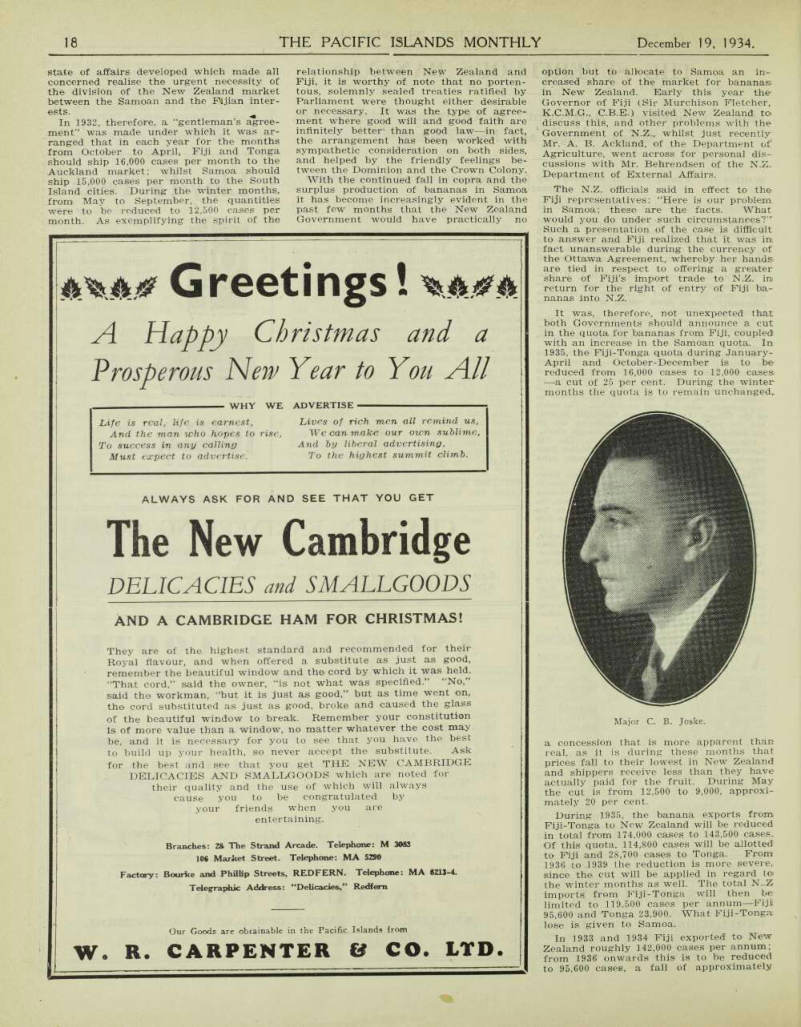
How “Gentleman’s Agreement” is Operating Between Fiji, Samoa, Tonga, and New Zealand Written for “Pacific Islands Monthly" by C. B. Joske, president of the Fiji Banana Association.
ONCE Australia bought large quantities of most excellent bananas from Fiji, and sold Fiji large quantities of flour. Then Australia began to grow her own bananas, and gradually she shut out the Fijian product. But she continued to sell flour to Fiji.
The Ottawa Agreement provided that, if Aus tralian products were to enter Fiji, some Fiji pro ducts must be admitted to Australia. Australia reluctantly allowed 40,000 centals of Fiji bananas to come in, per annum.
Australian consumers gladly paid, for the luscious Fiji fruit, from 20 to 50 per cent, more than they paid for the flavourless, uninteresting Australian banana.
The Fiji quota was only 2 per cent, of Australian production; but Australian banana-growers raised a clamour, and various “underground engineers” got to work. The bureaucrats “threw everything at the Fiji trade except the kitchen stove.” The Fiji imports escaped import duties, but were forced to pay primage, sales tax and income tax. The spirit of the Ottawa Agreement was flagrantly broken; but the politicians, with one calculating eye on the banana-growers’ votes, were cunningly silent.
Fiji refused to be a mere catspaw. The Fiji Government proposed to place, on Australian flour entering Fiji, an impost equal to primage, sales tax, and income tax.
That started something. The Australian flour millers made a strong protest. Australian wheat growers are vastly more important than Australian banana-growers. The Australian Government, in mid-November, decided that Fiji bananas, to tha extent of 40,000 centals per annum, should be free from primage and sales tax.
The Fiji-Australian banana trade will start again, presently. Meanwhile (Nov-Dec.) the Australian banana-growing interests are very busily promot ing a savage agitation against the removed of the primage and sales tax.
Major Clive B. Joske, of Suva, whose ceaseless representations have been responsible for Aus tralia’s belated recognition of her obligations under the Ottawa Agreement, describes, in the following article, the position of the banana-growing indus try in the South Seas.
AS recently as twenty years ago, in that halcyon period which the modern generation call rather pityingly “Pre-war,” there used to be a flourishing industry in Fiji—the export of bananas. Countless thousands of bunches were shipped to Australia and New Zealand and first-class fruit was sold in Sydney, Auckland, and other cities at sixpence a dozen.
In the language of Hollywood, Came the War. Australia became obsessed with the idea of nationhood and national self sufficiency. New Zealand sipped of the same heady wine and acquired a mandate over Samoa. These are the underlying causes of the decline in the banana industry of Fiji and the results have been the closing of the Australian market for years entirely to Fiji-grown bananas, coupled with the gradual restriction of the New
Zealand market in order to make room for bananas grown in Samoa.
The developments in Australia conse quent upon the Ottawa Agreement are well-known. It is sufficient to comment upon the extraordinary situation in which the Australian Prime Minister must find himself in negotiating with the British Government. Britain has an agricultural problem of her own and, in the interests of her own producers, seeks to limit the amount of Dominion produce entering her markets. Australia appears to deny Brit ain the right of regulation but to claim for herself such a right in respect of Colo nial produce imported into Australia.
In New Zealand, the situation is more logical. The Administration of Samoa has become increasingly a financial problem to N.Z., owing to the calamitous falls in copra and cocoa. Years ago, Samoa pro duced bananas in limited quantities and, naturally, in recent years attention has been directed to supplying New Zealand with Samoan bananas. The local Admin istration has fostered the industry and built it up by controlled marketing. It has been a costly business and even en tailed the building of a special ship, the
“Maui Pomare," to deliver the fruit in good order by means of insulated space, etc.
In 1932, banana production in Fiji and in Samoa had increased to the point where it had exceeded the demand from New Zealand. Shippers received from the sales of their bananas hardly sufficient to cover the cost of freight to New Zealand. A
state of affairs developed which made all concerned realise the urgent necessity of th© division of the New Zealand market between the Samoan and the Fijian interests.
In 1932, therefore, a “gentleman’s agreement” was made under which it was arranged that in each year for the months from October to April, Fiji and Tonga should ship 16,000 cases per month to the Auckland market; whilst Samoa should ship 15,000 cases per month to the South Island cities. During the winter months, from May to September, the quantities were to be reduced to 12,500 cases per month. As exemplifying the spirit of the
relationship between New Zealand and Fiji, it is worthy of note that no porten tous, solemnly sealed treaties ratified by Parliament were thought either desirable or necessary. It was the type of agree ment where good will and good faith are infinitely better than good law-in fact, the arrangement has been worked with sympathetic consideration on both sides, and helped by the friendly feelings be tween the Dominion and the Crown Colony, With the continued fall in copra and the surplus production of bananas in Samoa it has become increasingly evident in the past few months that the New Zealand Government would have practically no
option but to allocate to Samoa an in creased share of the market for bananas; in New Zealand. Early this year the Governor of Fiji (Sir Murchison Fletcher, K.C.M.G., C.B.E.) visited New Zealand to discuss this, and other problems with the Government of N.Z., whilst just recently Mr. A. B. Ackland, of the Department of Agriculture, went across for personal dis cussions with Mr. Behrendsen of the N.Z.
Department of External Affairs.
The N.Z. officials said in effect to the Fiji representatives: “Here is our problem in Samoa; these are the facts. What would you do under such circumstances'?’’’
Such a presentation of the case is difficult to answer and Fiji realized that it was in fact unanswerable during the currency of the Ottawa Agreement, whereby her hands, are tied in respect to offering a greater share of Fiji’s import trade to N.Z. in return for the right of entry of Fiji ba nanas into N.Z.
It was, therefore, not unexpected that both Governments should announce a cut in the quota for bananas from Fiji, coupled with an increase in the Samoan quota. In 1935, the Fiji-Tonga quota during January- April and October-December is to be 1 reduced from 16,000 cases to 12,000 cases —a cut of 25 per cent. During the winter months the quota is to remain unchanged.
a concession that is more apparent than real, as it is during these months that prices fall to their lowest in New Zealand and shippers receive less than they have actually paid for the fruit. During May the cut is from 12,500 to 9,000, approxi mately 20 per cent.
During 1935, the banana exports from Fiji-Tonga to New Zealand will be reduced in total from 174,000 cases to 143,500 cases.
Of this quota, 114,800 cases will be allotted to Fiji and 28,700 cases to Tonga. From 1936 to 1939 the reduction is more severe, since the cut will be applied in regard to the winter months as well. The total N..Z imports from Fiji-Tonga will then be limited to 119,500 cases per annum—Fiji 95,600 and Tonga 23,900. What Fiji-Tonga lose is given to Samoa.
In 1933 and 1934 Fiji exported to New Zealand roughly 142,000 cases per annum; from 1936 onwards this is to be reduced to 95,600 cases, a fall of approximately
Major C. B. Joske..
33 1-3 per cent. On the basis of the values ruling at present, the Colony’s income will be reduced by approximately £20,000 per annum.
What will be the effects? In Fiji itself, the Government is faced with the awk ward problem of allocating the reduced quota amongst the various areas producing bananas within marketable reach of Suva.
It is obvious that the potential earning capacity of the Fijians in those districts must be revised and their taxation low ered, with a corresponding reduction in social and other services rendered. Gov ernment policy has been to give to the Fijians 75 per cent, of the export quota and to the other races 25 per cent. In practice this has meant that over 20 per cent, of the export quotas have been given to Chinese growers. Here is another tick lish problem—if the Fijians are unable to sell all the fruit they can grow should the other races be given any vested interest in what is really a basic industry to the Fijian? If and when the Australian mar ket recovers, it seems probable that the Chinese growers will be able to secure a larger proportion of the Fiji quota—they have an inherent advantage by reason of their fruit being grown in plantations and therefore subject to better supervision as regards the uniformity of packing and grading, a point of disadvantage for Fijian grown fruit.
It is likely that the number of Euro pean shippers will decrease and eventually the export quotas will perhaps be concen trated in very few, but responsible, hands.
Since the Fiji Government decides the prices to be paid to the Fijians, the Euro pean shipper has in recent years become merely the collector of the fruit and the distributor of the proceeds, the Govern ment for all practical purposes fixing his salary. The Union S.S. Co. will find the loss of some thousands of pounds in an nual freight earnings, a serious considera tion in the case of the Waipahi and some rearrangement of their Island services seerAS inevitable.
So the once flourishing industry of Fiji has faded and withered. But the banana is an annual crop—or practically so. Ac cordingly, each year brings a change in the industry, and it is quite conceivable that twelve months hence the banana industry in Fiji may be sprouting vigorously from some fresh “eye.”
The October-December number of the Australian Museum Magazine contains many articles of interest to nature-lovers. Of interest to Pacific Islands people is an article on the “Tattooing of the Motu Tribe, Papua,” by Mr. Roland V. Old ham, of Yule Is., dealing with the patterns, implements used, and traditions surrounding this dis appearing art.
Advertisements & other items, pp. 19-20 (1 item)
Lloyd's Teas
Tea drinkers expect more than a mere drink.
That easy, relaxed feeling, that sense of contentment and glow of real satisfaction must be there . . . not once in a while, but with every cup.
Try Lloyds for purity. Try the consistent goodness of quality tea. Try the delicious aroma that is such a feature of Lloyd’s tea blending.
Obtainable at all good island stores.
CHAPMAN ENGINEERING CO.
General Engineers and Iron Founders Manufacturers of Cast Iron Pulleys, Saw Spindles, Special and General Machinery; also Repairs ADOLPHUS SI., BALMAIN, SYDNEY. Any quotation on request
ANGUS and COOTE
Manufacturers of Jewellery and Silverplate , ARE AT YOUR SERVICE WITH THEIR COMPLETE EQUIPMENT Send any shabby table silver or plate, and have it renovated. It will come back to you by the first boat, with newness restored. You’ll be surprised!
Old scraps of jewellery renovated and remade reasonably, or allowed for at highest old gold rates.
Watches expertly repaired—and all work guaranteed.
JEWELLERS, WATCHMAKERS, OPTICIANS AND SILVERSMITHS,
Illustrated catalogue of beautiful goods gladly sent post free to any address.
Home Testers, which enable you to buy spectacles satisfactorily, are loaned without obligation.
Pure Platinum, richly carved and set with diamonds £45 500 George Street
Sydney
Mrs. N. WALKER - FLYNN,
Late 35 POWELL STREET, COOGEE
COSTUMIER E,
MALAGUNA ROAD. RABAUL
HEMSTITCHING and PICOT EDGING.
Copies of Mab’s Fashions; Roma’s Pictorial Fashions and Home Fashions available. —P.O. Box 116. Tel.: 141.
Greetings!
A Happy Christmas and a
Prosperous New Year to You All
ALWAYS ASK FOR AND SEE THAT YOU GET
The New Cambridge
DELICACIES and
AND A CAMBRIDGE HAM FOR CHRISTMAS!
They are of the highest standard and recommended for their Royal flavour, and when offered a substitute as just as good, remember the beautiful window and the cord by which it was held.
“That cord,” said the owner, “is not what was specified.” “No,” said the workman, “but it is just as good,” but as time went on, the cord substituted as just as good, broke and caused the glass of the beautiful window to break. Remember your constitution is of more value than a window, no matter whatever the cost may be, and it is necessary for you to see that you have the best to build up your health, so never accept the substitute. Ask for the best and see that you get THE NEW CAMBRIDGE DELICACIES AND SMALLGOODS which are noted for their quality and the use of which will always cause you to be congratulated by your friends when you are entertaining.
Branches: 28. The Strand Arcade. Telephone: M 3083 106 Market Street. Telephone: MA 5290 Factory: Bourke and Phillip Streets, REDFERN. Telephone: MA 6213-4.
Telegraphic Address: “Delicacies,” Redfern
WHY WE ADVERTISE
Life is real, life is earnest, And the man who hopes to rise.
To success in any calling Must expect to advertise.
Lives of rich men all remind us.
We can mahe our own sublime.
And by liberal advertising.
To the highest summit climb.
Our Goods are obtainable in the Pacific Islands from
W. R. CARPENTER & CO. LTD
Fiji Missionary’S Wife
Lost From Liner
Mrs. A. G. Adamson, wife of Rev.
Adamson, principal of the Methodist Col lege at Davuilevu, Fiji, disappeared from the liner Monterey, on November 28, while the vessel was en route from Suva to New Zealand. A search was made, without result.
It is presumed that Mrs. Adamson, who recently had been in poor health, was lost overboard. Some months ago she re ceived medical attention in Fiji and, fail ing to make a complete recovery, was or dered to seek treatment in Australia.
Informative Catalogue
An attractive two-coloured booklet, profusely illustrated, has been prepared for their clients by Messrs. Noyes Bros. Ltd., of Sydney. The bro chure gives interesting particulars of the many agencies held by the company. This versatile firm handles many national lines, including Pax man oil engines, Parkinson electric motors, Rok roofing and paint, Rodger’s cutlery, and Super X ammunition. Noyes Bros. Ltd., also holds agencies for tools and hardware, sporting requisites, lamps, gold-mining machinery, etc., all of which are dealt with in their informa-
tive little booklet. Copies of the folder may be obtained by writing to Messrs. Noyes Bros. (Syd ney), Ltd.. 115 Clarence St., Sydney.
Sister Mackenzie returned ot her work at the Melanesian Mission Hospital, North Mala, Solomon Islands, early in Novem ber.
Advertisements & other items, pp. 21-22 (1 item)
Dependable Power Plants
A HAPPY HOLIDAY WITH
A CAR
To Island Residents who spend their holidays visiting Australia, we extend our Service.
If you- cannot drive, let us teach you. We give expert individual tuition on standard geared cars, day or night. We also specialize in Running Repairs. Fees from £2/10/.
If you buy a car to use during your holidays, you want to be sure that will be able to dispose of it when the holidays are over, at an attractive price. This is a matter of vital importance to most Island Residents. Here again we can help you.
As we are in constant touch with the majority of Motor Houses and the most reliable second-hand Showrooms, and have facilities at our disposal which enable us to follow the trend of the second-hand market, we are in an unique position to advise you; therefore, you could not do better than seek our advice before purchasing, A letter or ’phone call to us on your arrival in Sydney, and one of our representatives will call on you immediately to ascertain your requirements and put our expert services at your disposal.
THE RELIANCE SCHOOL OF
MOTORING
306 Rawson Chambers (opp. Central Station) MA 4027
ON SALE AT ALL NEWSAGENTS AND BOOKSELLERS
READ THE
B.P. MAGAZINE
SUMMER NUMBER
Now on Sale Short Stories — Pictures Travel Articles — Pages for the Children. — Stage.
Latest Fashions — Screen One Shilling per Copy
DEPENDABLE POWER PLANTS
WE HAVE AVAILABLE WOOD BURNING, SUCTION GAS, SEMI-DIESEL, or DIESEL from 40 h.p. to 350 h.p., condition guaranteed. Demonstration on full load arranged if required and tuition given to drivers.
CYLINDER GRINDING
ENGINE RECONDITIONING
WE HAVE THE LARGEST CYLINDER GRINDING MACHINE in the Southern Hemisphere to RECONDITION YOUR PRESENT PLANT, to grind Cylinders inch to 20 inches in diameter.
HARKNESS & HILLIER LTD.
MOTOR
MANUFACTURING ENGINEERS
Sydney, Australia Cable Address: “NESSHILL,” Sydney
GENERAL
AERONAUTICAL
STOP
Tired nerves are the cause of Headache, Neuritis, Neuralgia, Rheumatism, Lumbago, Sciatica. Get instant relief from all nerve pains with Genuine VINCENT’S A.P.C. as recommended by Doctors, Dentists, Chemists, and Nurses. 12 for 1/6, 24 for 2/6.
All Chemists and Stores, or direct from Vincent Chemical Company, Market St.,
Sydney, Australia
Nerve
Pains
FOR SAFETY’S SAKE, SAY “VINCENTS"
NOTHING BUT THE BEST
will satisfy the exacting requirements necessary for the Islands. That is why so many Island boats are built by
J. ROBINSON
(Late Aus. Flying Corps)
BOATBUILDER & DESIGNER
Engines installed and repaired. Experts in all classes of marine work.
Island work of any description a speciality. W 1123.
8 SCHOOL ST., BALMAIN, SYDNEY, N.S.W.
Ball and
Roller
Bearings
FOR ALL INDUSTRIAL PURPOSES
Plummer Blocks Couplings Hangers Pulleys Replacement Bearings for all Cars, Trucks and Tractors SKF Engineering Service available free of charge Write for Catalogue and Price List Telegrams: “Bearings’
THE HKF BALL BEARING CO. LTD., 352 Kent Street
SYDNEY
Air-Mails for Papua
and New Guinea
Letter to the Editor.
I BEG space in your esteemed journal to bring to the attention of your readers in Papua and New Guinea a suggestion for the improvement of communications between this country and the mainland of Australia.
Briefly, it is that the mails should be entirely conveyed by a weekly aerial ser vice by way of Thursday Island and Nor manton, Q., and conveyed at the usual rates of postage. The centres in New Guinea for the air mail would be Port Moresby, Samarai, Salamaua, Rabaul.
In December of this year the England- Australia air mail will be inaugurated, and large air-liners will thenceforward be flying weekly to and from Sydney and Darwin, via Brisbane and Cloncurry.
Quantas Ltd. in Queensland maintain, under Commonwealth subsidy, a service between Cloncurry and Normanton. Thus a Commonwealth-subsidized service would be available between Sydney and Nor manton.
The establishment of a seaplane service, carrying mails only, between Normanton and Rabaul, via Port Moresby, Samarai, Salamaua, and Rabaul, would complete the direct aerial route from Sydney. A seaplane service, carrying mails only, could quite regularly maintain, in con
junction with the mainland services, a weekly service from Sydney to Thursday Island and Port Moresby in three days; Samarai and Salamaua in four days (Samarai being served by a feeder line); Rabaul in five days.
Such a service would be commercially feasible if the greater part of the present mail subsidy paid to the steamship line were transferred to the aerial service. The steamship services are quite capable of operating under a reduced mail subsidy, by reason of passenger and freight busi ness, which should not decrease, but rather increase, with improvement in communication service.
The carriage of mail matter entirely by air, at ordinary rates, is certain to become general within a few years. Already, it is being done abroad. For instance, the Egyptian mail goes by Imperial Airways to Europe; the Swedish mail to the Con tinent and the British Isles is carried by air.
The air freight and transport activities of this country are outstanding in the world, and there is no reason why it should not lead, certainly within the British Empire, in the carriage of mails by the fastest means available, and at reasonable cost.
I commend the suggestion to those in terested in the advancement of New Guinea.
I am, etc.,
Geoffrey J. Davey.
Samarai, Papua,
T.I. Pearl-Shell Industry
Thursday Is., Nov. 17.
Our pearl-shelling industry has a gloomy outlook at present as it has been unable to find a good market upon the completion of its contract with a New York buyer. He has purchased practi cally all the local M.O.P. shell for several years, but now refuses to continue.
Drastic alterations will probably be made in the marine industry. One ef fect is the closing down of the Port Ken nedy Engineering and Shipyards Co.’s works. This is a tremendous pity, as European labour has been used by the “P.K.,” whereas this class of work was, for years, in alien hands. It is hoped that brighter prospects will cause the works to re-open.
Ngata In Political Storm
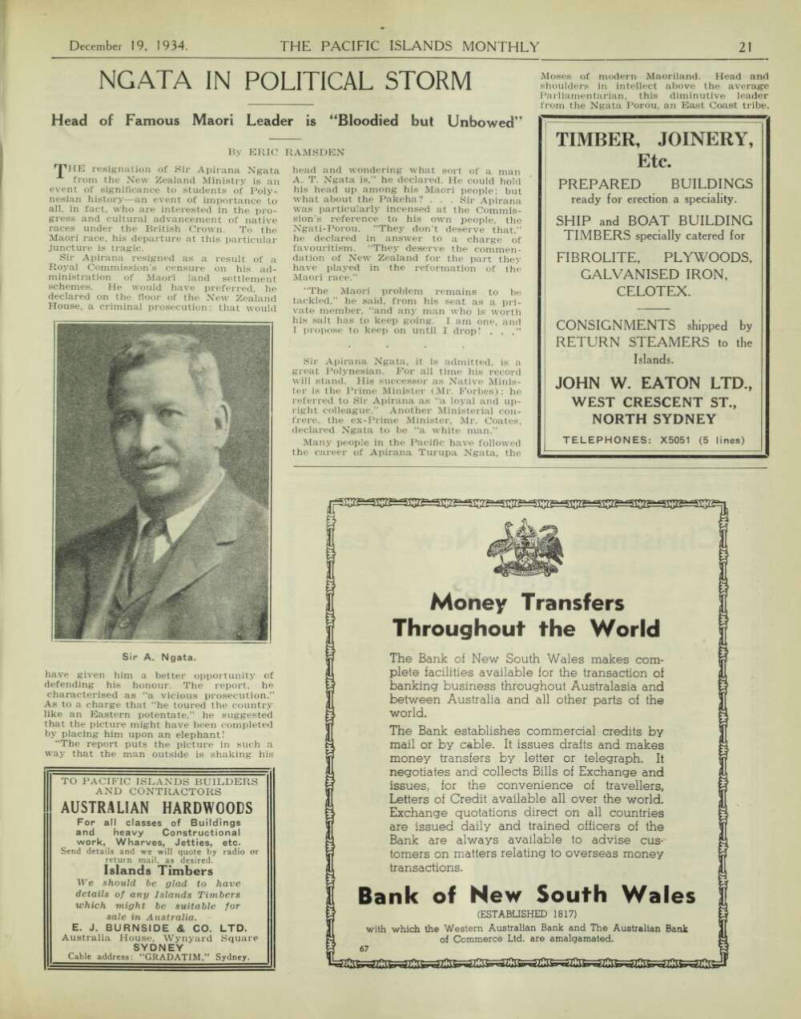
Head of Famous Maori Leader is “Bloodied but Unbowed”
By Eric Ramsden
THE resignation of Sir Apirana Ngata from the New Zealand Ministry is an event of significance to students of Poly nesian history—an event of importance to all, in fact, who are interested in the pro gress and cultural advancement of native races under the British Crown. To the Maori race, his departure at this particular juncture is tragic.
Sir Apirana resigned as a result of a Royal Commission's censure on his ad ministration of Maori land settlement schemes. He would have preferred, he declared on the floor of the New Zealand House, a criminal prosecution: that would
have given him a better opportunity of defending his honour. The report, he characterised as ‘‘a vicious prosecution.”
As to a charge that “he toured the country like an Eastern potentate,” he suggested that the picture might have been completed by placing him upon an elephant!
“The report puts the picture in such a way that the man outside is shaking his
head and wondering what sort of a man A. T. Ngata is,” he declared. He could hold his head up among his Maori people; but what about the Pakeha? . . . Sir Apirana was particularly incensed at the Commis sion’s reference to his own people, the Ngati-Porou. ‘‘They don’t deserve that,” he declared in answer to a charge of favouritism. “They deserve the commen dation of New Zealand for the part they have played in the reformation of the Maori race.”
“The Maori problem remains to be tackled,” he said, from his seat as a pri vate member, “and any man who is worth his salt has to keep going. I am one, and I propose to keep on until I drop! . . .”
Sir Apirana Ngata, it is admitted, is a great Polynesian. For all time his record will stand. His successor as Native Minis ter is the Prime Minister (Mr. Forbes): he referred to Sir Apirana as “a loyal and up right colleague.” Another Ministerial con frere, the ex-Prime Minister, Mr. Coates, declared Ngata to be “a white man.”
Many people in the Pacific have followed the career of Apirana Turupa Ngata, the
Moses of modern Maoriland. Head and shoulders in intellect above the average Parliamentarian, this diminutive leader from the Ngata Porou, an East Coast tribe,
Sir A. Ngata.
has devoted his whole life to the regenera tion of his people, Ngata was the secretary of the Young Maori Party, an influential body that had its genesis at Te Aute College, and pro duced several brilliant men of mixed Maori and European blood. The late Sir Maui Pomare consecrated his life to the physical well-being of his race. Ngata concentrated upon Maori economics. Early in life he realised that if his people were to be saved from extinction as an entity, the only pos sible hope was to persuade them, originally an agricultural race, to return to the land.
Te Rangi-Hiroa (Dr. Peter Buck), another member of that Te Aute group, has since won world renown as an anthropologist and ethnologist. His recent appointment to the directorship of the Bishop Museum at Honolulu is evidence of the scientific achievement of this half-caste Maori.
Maori Butter Factories
But, Ngata was not like the majority of enthusiasts. He knew that Rome had not been built in a day. First, he set to work among his own tribe.
Owing to their more or less isolated geographical position, the Ngati-Porou had not parted with their lands for a song. The country was ideal for sheep and cattle. As leases fell due, Ngata encouraged his tribespeople to farm their own lands.
Groups were formed for that purpose. But ter factories were established. In the course of years, Ngata found himself managing-director of a freezing works. In days gone by, the tribes nearer the centres of population had referred to the Ngati- Porou as “Nati,” or country bumpkins.
But the country cousins showed the path to progress, and soon their butter was commanding good prices on the London market. Among his own people Apirana Ngata was adored; his prestige, or as the Maoris say mana, was unchallenged.
The Maori leader did not confine his activities to the material welfare of his race.
An outstanding scholastic career at Te Aute College and Canterbury College, was followed by his admittance to the bar, and eventual entry into Parliament. Sir Apirana has sat in the House continu ously since 1905; he is now the “Father” of the House of Representatives. Though his life’s work has been the consolidation of native land titles, preparatory to launch ing the communal farming schemes throughout the different tribes, he has also won renown as a poet of distinction and a writer of more than ordinary merit. Folk tales and ancient sagas have been assidu ously collected. Ngata has done every thing possible to preserve the arts and crafts of his gifted race. The school of carving at Rotorua is a tribute to his in terest in that phase of Maori art. Author of many monographs of scientific import ance, he has even written a pamphlet on the evolution of the poi dance, and col lected the songs popular among the Maori soldiers in the Great War.
Incidentally, his services as a recruiter were of the utmost importance during that war. Certain tribes, notably Waikato and Taranaki, refused to enlist until political grievances were settled: the young men preferred, like their fathers of old, to go to prison. At that time the patriotic example of leaders like Ngata and Pomare, and the late Sir James Carroll (Timi Kara) was invaluable.
Ngata The Peacemaker
Ngata has also been a peacemaker.
Not so long ago he brought an ancient weapon down from the north, the tribal domains of the Ngapuhi, and placed it on the marae, or village meeting place at Ohinemutu, Rotorua. It was a friendly gesture on the part of Ngapuhi to the Arawa tribes. The latter had never for given the thrashing inflicted upon them more than a century, ago by Hongi, the great Ngapuhi leader, with Sydney-pur chased guns.
Ngata was at his greatest at Waitangi, last year.
Clad in a piu-piu mat, a flax band around his massive brow, to which was attached the chieftainly feather, he stood and wel comed the representatives of the tribes.
In his right hand was a mere of green stone, a prized tribal heirloom. When Koroki, the young Waikato king arrived, knowing full well that he should have ac cepted a prior invitation from Ngata to visit the East Coast rather than go to Ratana, the so-called “prophet,” the Minister bridged a difficult situation by treating the lad as his son. Though he spoke plainly, even forcefully, Ngata, in effect, turned the other cheek. . . .
At night, the scene was different.
In his shirt-sleeves, piles of correspond ence massed before him, the Minister worked in an improvised office with his secretaries. No longer was he the ariki, the over-lord, the leader of ceremony, a stickler for tradition; here was a capable man of affairs, the business head of a great organisation, one of His Majesty’s responsible Ministers.
Still, though a truce had been called for the Waitangi celebrations, there was every evidence that the storm, when it broke, would be severe. Certain sections of Maori opinion were undoubtedly jealous of Ngata’s power. Some of the Ngapuhi leaders resented the fact that he stood on their marae to welcome the guests: such a privilege, they contended, was by tradition their own, as hosts.
Throughout New Zealand there was a general call among the European popula tion for Ngata’s scalp. One found it in un expected quarters. A man who never courted popular favour, and at times was unnecessarily brusque (particularly to press representatives!) the Minister’s enemies became legion. Forgotten were his great services of the past. Certain New Zealanders no longer took pride in the fact that Ngata, like Carroll, had held office as acting-Prime Minister. Expendi ture on his native lands settlement scheme had assumed colossal proportions: there were charges of extravagance and im efficiency in administration. The Maori, it was said, could advance to a certain stage, but beyond that he could not go. Ngata, it was contended, was anti-European.
Therefore, he thought only of his own.
Perhaps some of the criticism was just.
A great deal of it was most unjust.
If Ngata was anti-European, we must remember that he had good cause to be.
Thousands of acres of good Maori land had been alienated by confiscation. Ngata had seen the machinery of Parliament utilised to its fullest extent to deprive his race of ancestral acres. Much of it was legalised robbery. Ngata, astute and able, the in tellectual equal of any European, con tended for his people. Who can blame liim?
Whatever his defects, whatever his faults, the Maori race has lost its greatest leader. A mighty totara of the forest has fallen, the prow of the canoe is broken.
But, Sir Apirana Ngata is sufficiently great to survive the blast of the tempest, and not to be embittered by the political storm that has overtaken him. Years of useful service are still ahead of this father of his people.
And into retirement he will take with him the grateful thanks of thousands of Maoris throughout New Zealand, the people of the Cook Islands, and the inhabi tants of other groups in the Pacific, to whom indeed he has been a trusted friend and an able administrator.
Advertisements & other items, pp. 23-24 (1 item)
Money Transfers
TIMBER, JOINERY,
Etc.
PREPARED BUILDINGS
ready for erection a speciality.
SHIP and BOAT BUILDING
TIMBERS specially catered for
FIBROLITE, PLYWOODS.
GALVANISED IRON.
CELOTEX.
CONSIGNMENTS shipped by
RETURN STEAMERS to the
Islands.
JOHN W. EATON LTD.,
WEST CRESCENT ST.,
NORTH SYDNEY
TELEPHONES: X 5051 (5 lines)
Money Transfers
Throughout the World
The Bank of New South Wales makes complete facilities available for the transaction of banking business throughout Australasia and between Australia and all other parts of the world.
The Bank establishes commercial credits by mail or by cable. It issues drafts and makes money transfers by letter or telegraph. It negotiates and collects Bills of Exchange and issues, for the convenience of travellers, Letters of Credit available all over the world.
Exchange quotations direct on all countries are issued daily and trained officers of the Bank are always available to advise customers on matters relating to overseas money transactions.
Bank of New South Wales
(ESTABLISHED 1817)
with which the Western Australian Bank and The Australian Bank of Commerce Ltd. are amalgamated.
TO PACIFIC ISLANDS BUILDERS
AND CONTRACTORS
AUSTRALIAN HARDWOODS
For all classes of Buildings and heavy Constructional work, Wharves, Jetties, etc.
Send details and we will quote by radio or return mail, as desired.
Islands Timbers
We should he glad to have details of any Islands Timbers which might be suitable for sale in Australia.
E. J. BURNSIDE & CO. LTD.
Australia House, Wynyard Square
SYDNEY
Cable address; “GRADATIM,” Sydney.
SKIN DISEASES
By the application of his Secret Formula in the treatment of all Skin Diseases, Mr. John J. McHugh, Consulting Chemist, 124 Liverpool St,, Sydney, is able to assure sufferers of a complete and speedy recovery.
Letters of gratitude from all parts of the world may be inspected at his rooms. Skin complaints successfully treated include: Tinea, Eczema, Psoriasis, Acne, Germ Under the Nail, Varicose Veins and Ulcers, Ringworm, Pruritis, Dandruff, Rosacea, Infantile Eczema, etc.
Readers are invited to call or write to Mr. McHugh, and he will advise them without obligation.
Consulting Hours: Monday, Wednesday, Thursday, 10 a.m. to 5 p.m.; Tuesday and Friday, 10 a.m. to 9 p.m.; Saturday, 9 a.m. to 12 noon.
JOHN J. McHUGH, Ph.C.
(Member of the Pharmaceutical Society, N.S.W.) Consulting & Pharmaceutical Chemist
Ist FLOOR, 124 LIVERPOOL ST.
(opp. Snow’s), SYDNEY ’Phone MA 5028
Christmas and New Year
Greetings
Send a Greeting Message to your Friends Abroad
during the Festive Season
Special Greeting Rates available via “BEAM
WIRELESS" from 14th December to 6th
January inclusive
Australia to United Kingdom 10 words 4/- Special cheap services also available for greeting messages between Australia and Pacific Islands; and from Australia and Pacific Islands to European countries; North and South America; Canada, and other places.
For particulars of cheap rates for greeting messages, enquire at any Post Office or Radio Telegraph Station or at City Offices of Amalgamated Wireless (A’sia) Limited.
Route Your Greeting Messages via “BEAM”
Inquiries for all classes of Sails, Canvas, and General Boat Equipment invited
W. NORTHEY
CANVAS GOODS MANUFACTURER
Quotations Free.
Island Trade specially catered for Established over 40 years.
Taylors Wharf, Pyrmont
SYDNEY
Gold In Western Papua
Letter to the Editor.
YOUR reference to this in your widely circulated periodical encourages me to remind your public, which represents prob ably the most active and enterprising unit of the Australian community, that the first gold found in New Guinea in historic times was near the Observatory Bend, on the Strickland River, in 1885 —nearly fifty years ago, when the R.G.S. of A. sent an exploring party, each member of which represented one of the then colonies that had approached the Imperial Government to back up Sir Thomas Mcllwraith’s splen did action regarding what is now Papua.
There are only two surviving members of that party: W. W. Froggatt, the well known naturalist (whose son holds a scien tific position in New Guinea to-day) and tlfe writer (representing N.Z.) who placed the gold-specimens (in blue quartz) in the Auckland Museum in Mr. Cheeseman’s time.
I am, etc.,
Pokeno.
Pymble, Sydney, 23/10/’34.
An Improved Salt Container
The new patent package of Ozo free running salt which is now being marketed throughout the Pacific Islands is a revelation in design. The package itself is a heavy sulphide board impreg nated with paraffin wax, which is absolutely taste less, odourless,' and harmless. The package is sealed at the top with an expanding metal clip, operated by a lever on the side. The clip can be removed and the desired amount of salt emptied and then resealed as airtight as ever. When undergoing tests in Sydney, it was found that a full package of Ozo salt left totally submerged in a bowl of water for a fortnight was in perfect condition when opened.
Advertisements & other items, p. 25 (1 item)
Malt & Hops
W. M. REID
C/o Robert Reid & Co., Ltd.
32-34 YORK STREET, SYDNEY
Wholesale Exporter of Goods of all Classes from Australia
Malt & Hops
(SOLID BEER)
MADE FROM THE
FINEST ENGLISH
MALT & HOPS
STOCKED BY:
Burns, Philp & Co., Ltd.,
RABAUL
MAKERS:
Paine & Co., Ltd.,
St. Neots, Hunts., England.
TWO IN ONE
Coleman Duo-Lite Lamp Lantern
It is a BEAUTIFUL LAMP when set up on a Fluted or Ornamental Stand, and fitted with a Parchment Shade.
With this Shade off, and lifted out of stand, the COLEMAN NO. 242 LANTERN is a splendid all-purpose unit.
GALE AND INSECT PROOF
INSTANT LIGHTING—BuiIt-in Pump, and Long-life Generator, Sold by All Branches of
W. R. CARPENTER & CO., LTD.
Or, Write for Coloured Catalogue t« Coleman Quick-Lite Co., 500 Kent Street, Sydney.
DIESEL ENGINES
INSTAL THE DIESEL THAT HAS BEEN GOING STRONG SINCE 1929, AND HAS PROVED ITSELF IMMUNE FROM ALL DIESEL WEAKNESS.
DC Series, 45 to 160 b.h.p., in 3,4, 6, and 8 cylinder sizes at 700 to 900 r.p.m.
D*.B. Series, 24 to 96 b.h.p., in 2,3, 4,6, and 8 cylinder sizes, at 1000 r.p.m.
Australian Agents:
H. G. THORNTHWAITE & CO.
KEMBLA BUILDING.
MARGARET STREET, SYDNEY, N.S.W.
TELEGRAMS: “ORTHORN,” SYDNEY. TELEPHONE: B 5240
Oil Piped From Iraq To Haifa
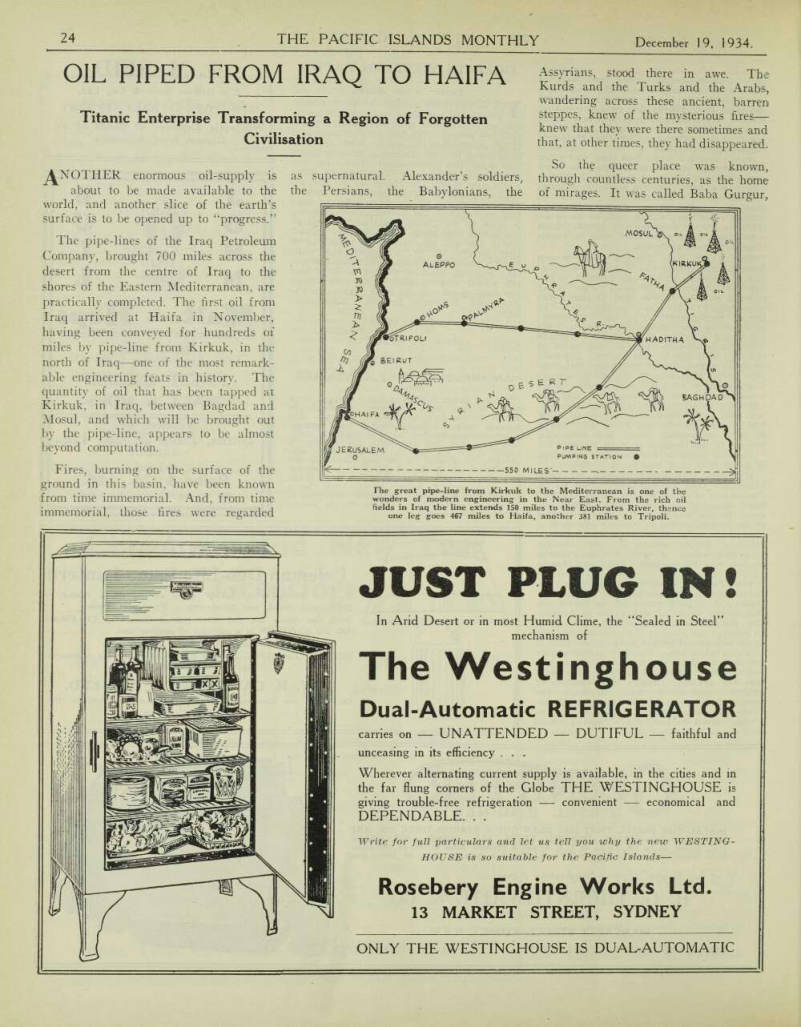
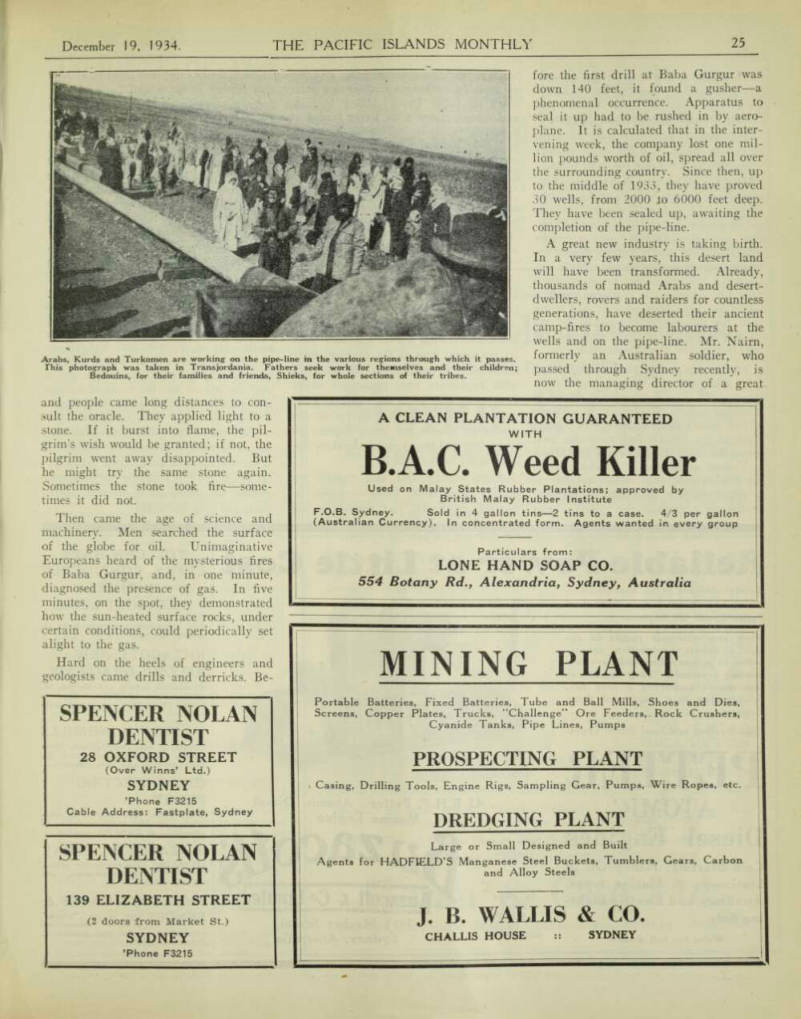
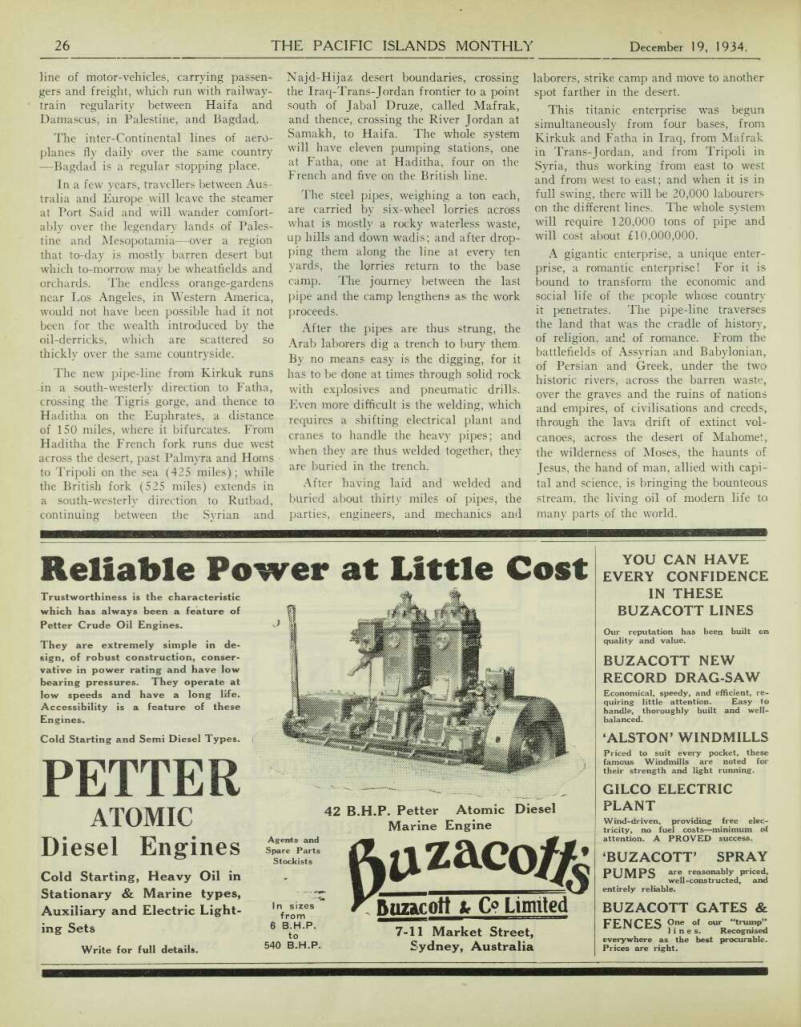
Titanic Enterprise Transforming a Region of Forgotten Civilisation
Another enormous oil-supply is about to be made available to the world, and another slice of the earth’s surface is to be opened up to “progress.”
The pipe-lines of the Iraq Petroleum Company, brought 700 miles across the desert from the centre of Iraq to the shores of the Eastern Mediterranean, are practically completed. The first oil from Iraq arrived at Haifa in November, having been conveyed for hundreds of miles by pipe-line from Kirkuk, in the north of Iraq—one of the most remark able engineering feats in history. The quantity of oil that has been tapped at Kirkuk, in Iraq, between Bagdad and Mosul, and which will be brought out by the pipe-line, appears to be almost
beyond computation.
Fires, burning on the surface of the ground in this basin, have been known from time immemorial. And, from time immemorial, those fires were regarded
as supernatural. Alexander’s soldiers, the Persians, the Babylonians, the
Assyrians, stood there in awe. The Kurds and the Turks and the Arabs, wandering across these ancient, barren steppes, knew of the mysterious fires— knew that they were there sometimes and that, at other times, they had disappeared.
So the queer place was known, through countless centuries, as the home of mirages. It was called Baba Gurgur,
The great pipe-line from Kirkuk to the Mediterranean is one of the wonders of modern engineering in the Near East. From the rich oil fields in Iraq the line extends 150 miles to the Euphrates River, thence one leg goes 467 miles to Haifa, another 381 miles to Tripoli.
and people came long distances to con sult the oracle. They applied light to a stone. If it burst into flame, the pil grim’s wish would be granted; if not, the pilgrim went away disappointed. But he might try the same stone again.
Sometimes the stone took fire—some times it did not.
Then came the age of science and machinery. Men searched the surface of the globe for oil. Unimaginative Europeans heard of the mysterious fires of Baba Gurgur, and, in one minute, diagnosed the presence of gas. In five minutes, on the spot, they demonstrated how the sun-heated surface rocks, under certain conditions, could periodically set alight to the gas.
Hard on the heels of engineers and geologists came drills and derricks. Be
fore the first drill at Baba Gurgur was down 140 feet, it found a gusher—a phenomenal occurrence. Apparatus to seal it up had to be rushed in by aero plane. It is calculated that in the inter vening week, the company lost one mil lion pounds worth of oil, spread all over the surrounding country. Since then, up to the middle of 1933, they have proved 30 wells, from 2000 to 6000 feet deep.
They have been sealed up, awaiting the completion of the pipe-line.
A great new industry is taking birth.
In a very few years, this desert land will have been transformed. Already, thousands of nomad Arabs and desert dwellers, rovers and raiders for countless generations, have deserted their ancient camp-fires to become labourers at the wells and on the pipe-line. Mr. Nairn, formerly an Australian soldier, who passed through Sydney recently, is now the managing director of a great
Arabs, Kurds and Turkomen are working on the pipe-line in the various regions through which it passes.
This photograph was taken in Transjordania. Fathers seek work for themselves and their children; Bedouins, for their families and friends, Shieks, for whole sections of their tribes.
line of motor-vehicles, carrying passen gers and freight, which run with railway train regularity between Haifa and Damascus, in Palestine, and Bagdad.
The inter-Continental lines of aero planes fly daily over the same country
—Bagdad is a regular stopping place.
In a few years, travellers between Aus tralia and Europe will leave the steamer at Port Said and will wander comfort ably over the legendary lands of Pales tine and Mesopotamia —over a region that to-day is mostly barren desert but which to-morrow may be wheatfields and orchards. The endless orange-gardens near Los Angeles, in Western America, would not have been possible had it not been for the wealth introduced by the oil-derricks, which are scattered so thickly over the same countryside.
The new pipe-line from Kirkuk runs in a south-westerly direction to Fatha, crossing the Tigris gorge, and thence to Haditha on the Euphrates, a distance of 150 miles, where it bifurcates. From Haditha the French fork runs due west across the desert, past Palmyra and Homs to Tripoli on the sea (425 miles); while the British fork (525 miles) extends in a south-westerly direction to Rutbad, continuing between the Syrian and
Najd-Hijaz desert boundaries, crossing the Iraq-Trans-Jordan frontier to a point south of Jabal Druze, called Mafrak, and thence, crossing the River Jordan at Samakh, to Ftaifa. The whole system will have eleven pumping stations, one at Fatha, one at Haditha, four on the French and five on the British line.
The steel pipes, weighing a ton each, are carried by six-wheel lorries across what is mostly a rocky waterless waste, up hills and down wadis; and after drop ping them along the line at every ten yards, the lorries return to the base camp. The journey between the last pipe and the camp lengthens as the work proceeds.
After the pipes are thus strung, the Arab laborers dig a trench to bury them.
By no means easy is the digging, for it has to be done at times through solid rock with explosives and pneumatic drills.
Even more difficult is the welding, which requires a shifting electrical plant and cranes to handle the heavy pipes; and when they are thus welded together, they are buried in the trench.
After having laid and welded and buried about thirty miles of pipes, the parties, engineers, and mechanics and
laborers, strike camp and move to another spot farther in the desert.
This titanic enterprise was begun simultaneously from four bases, from Kirkuk and Fatha in Iraq, from Mafrak in Trans-Jordan, and from Tripoli in Syria, thus working from east to west and from west to east; and when it is in full swing, there will be 20,000 labourers on the different lines. The whole system will require 120,000 tons of pipe and will cost about £10,000,000.
A gigantic enterprise, a unique enter prise, a romantic enterprise! For it is bound to transform the economic and social life of the people whose country it penetrates. The pipe-line traverses the land that was the cradle of history, of religion, and of romance. From the battlefields of Assyrian and Babylonian, of Persian and Greek, under the two historic rivers, across the barren waste, over the graves and the ruins of nations and empires, of civilisations and creeds, through the lava drift of extinct vol canoes, across the desert of Mahomet, the wilderness of Moses, the haunts of Jesus, the hand of man, allied with capi tal and science, is bringing the bounteous stream, the living oil of modern life to many parts of the world.
Advertisements & other items, pp. 26-28 (1 item)
The Westinghouse
JUST PLUG IN!
In Arid Desert or in most Humid Clime, the “Sealed in Steel” mechanism of
Dual-Automatic REFRIGERATOR
carries on UNATTENDED DUTIFUL faithful and unceasing in its efficiency . . .
Wherever alternating current supply is available, in the cities and in the far flung corners of the Globe THE WESTINGHOUSE is giving trouble-free refrigeration convenient economical and
DEPENDABLE. . .
Write for full particulars and let us tell you why the new WESTING- HOUSE is so suitable for the Pacific Islands —
Rosebery Engine Works Ltd.
13 MARKET STREET, SYDNEY
ONLY THE WESTINGHOUSE IS DUAL-AUTOMATIC
A CLEAN PLANTATION GUARANTEED
WITH
B.A.C. Weed Killer
Used on Malay States Rubber Plantations; approved by British Malay Rubber Institute F.O.B. Sydney. Sold in 4 gallon tins—2 tins to a case. 4/3 per gallon (Australian Currency). In concentrated form. Agents wanted in every group Particulars from:
LONE HAND SOAP CO.
554 Botany Rd., Alexandria, Sydney, Australia
MINING PLANT
Portable Batteries, Fixed Batteries, Tube and Ball Mills, Shoes and Dies, Screens, Copper Plates, Trucks, “Challenge” Ore Feeders,. Rock Crushers, Cyanide Tanks, Pipe Lines, Pumps
PROSPECTING PLANT
Casing, Drilling Tools, Engine Rigs, Sampling Gear, Pumps, Wire Ropes, etc.
DREDGING PLANT
Large or Small Designed and Built Agents for HADFIELD’S Manganese Steel Buckets, Tumblers, Gears, Carbon and Alloy Steels
J. B. WALLIS & CO.
CHALLIS HOUSE :: SYDNEY
SPENCER NOLAN
DENTIST
28 OXFORD STREET
(Over Winns’ Ltd.)
SYDNEY
’Phone F 3215 Cable Address: Fastplate, Sydney
SPENCER NOLAN
DENTIST
139 ELIZABETH STREET
(2 doors from Market St.)
SYDNEY
’Phone F 3215
Reliable Power at Little Cost
Trustworthiness is the characteristic which has always been a feature of Petter Crude Oil Engines.
They are extremely simple in design, of robust construction, conservative in power rating and have low bearing pressures. They operate at low speeds and have a long life.
Accessibility is a feature of these Engines.
Cold Starting and Semi Diesel Types.
PETTER
ATOMIC
Diesel Engines
Cold Starting, Heavy Oil in
Stationary & Marine types,
Auxiliary and Electric Light-
ing Sets
Write for full details.
In sizes from
6 B.H.P.
to
540 B.H.P.
42 B.H.P. Petter Atomic Diesel
Marine Engine
7-11 Market Street,
Sydney, Australia
YOU CAN HAVE
EVERY CONFIDENCE
IN THESE
BUZACOTT LINES
Our reputation has been built on quality and value.
BUZACOTT NEW
RECORD DRAG-SAW
Economical, speedy, and efficient, requiring little attention. Easy to handle, thoroughly built and wellbalanced.
‘ALSTON’ WINDMILLS
Priced to suit every pocket, these famous Windmills are noted for their strength and light running.
GILCO ELECTRIC
PLANT
Wind-driven, providing free electricity, no fuel costs —minimum of attention. A PROVED success.
‘BUZACOTT’ SPRAY
PUMPS are reasonably priced, well-constructed, and entirely reliable.
BUZACOTT GATES &
FENCES one of our “trump” lines. Recognised everywhere as the best procurable.
Prices are right.
Incident Of 1914
Detzner and Papuan Officials
(Contributed).
THE story of the capture of “Australia’s First Military Prisoners of War,” given you by Mr. Cridland, and published in your September issue, does not fit in with Cap tain Detzner’s own account of the incident, published in his book “Four Years Among Savages.” Your account says it was Captain Muskett who made contact with Detzner; the latter says it was Mr. Chis holm.
Captain Detzner was surveying near the Papuan-German border. He was ahead of his main party, and encamped near Mount Joseph. Behind him were two depots, F and G; at G Depot were two native sol diers; at F Depot were other native sol diers, in charge of a German, Sergeant Konradt.
Sergeant Konradt arrived at G Depot on November 2, 1914. The two native soldiers had disappeared. There were tracks of a large party, evidently in charge of a Euro pean, which had gone off in a southerly direction.
Konradt found a letter at the camp, in English, and he sent it on to Detzner. The latter read this: — “To the Officer in charge of the German Forces — “I have to inform you that war has been declared between Great Britain and Ger many on August 4, '14. In order to avoid unnecessary loss of lives I advise you to come in as soon as possible to the Nepal Camp, at the Lakekamu Goldfield, which you will reach after five days’ march, and to surrender there with all your men. You will be treated as an officer and gentleman.
Two native policemen and carriers I took along as prisoners of war.
Chisholm,
Officer in Charge of the British Force.”
Captain Detzner proceeded immediately to G Depot and joined Konradt. He sent Konradt back to Morobe, and he himself went on alone after Chisholm, eager to get news of the war. After two days, he lost Chisholm’s tracks, and returned; and on November 11 he left for the coast at Mo robe, which he reached in December, 1914.
In January, he was at a Lutheran station, inland from Finschafen; and it was from that point that he struck inland across the centre of the great island, in his famous attempt to reach Dutch New Guinea.
Cocos Treasure
Use of Modern Equipment
WITH the object of recovering valuable treasures which in the past have been hidden in various parts of the world, an English company has been formed to carry out a search over a period of two years, employing the latest modern scien tific equipment. The immediate aim of the company is the recovery of gold and jewels from the Island of Cocos, about 600 miles west of Panama City, where one of the richest treasure-troves in the history of mankind awaits the finder.
The Company will be known as Treasure Recovery Ltd., and a seaplane is to be used for communication with the mainland at
Panama, and to carry supplies and goods which would normally be despatched by boat. A motor yacht will also be taken out, and the Shell Company has received the order to supply aviation spirit, lubricating oil and diesel oil to the expedition.
References to the treasure buried by pirates on Cocos Island are made in the official handbooks issued by the Historical Section of the Foreign Office, which state: “The existence of treasure concealed in the island is well established. ... A vast treasure obtained by rifling certain churches in Peru ... gold bars and specie, worth $11,000,000 and about $12,000,- 000 worth of stolen gold coin, jewels and silver ingots .. . The main stores of treasure are still hidden, in spite of various excavations and blasting operations which have been undertaken from time to time.”
Advertisements & other items, pp. 29-30 (1 item)
Moran & Cato’s
W. J. CLOSE
ENGINEER AND MACHINERY
MERCHANT
Erecting and Adjusting Diesel Engines.
Agent for Ailsa Craig (no trouble) Diesel Marine Oil Engine Specialist in British Diesel Engines, Harland and Wolff Ltd., Belfast; Barford and Perkins, Blounte Two Stroke; Diesel Engines and Motors; Mining Plants; Oil and Petrol Engines and all complements; Air Compressors; Jack Hammers; Water Piping in all sizes. 24-26 Taylor St., off Flinders St.,
SYDNEY.
For All You Require In
Dependable Groceries
You CANNOT Do Better Than At
Moran & Cato’s
Australia’s Largest Grocery Organisation
The fact that Moran & Cato Ltd. has 180 branches throughout the Commonwealth of Australia is sufficient indication of their vast buying power, and is the reason why—when quality is taken into consideration—their
PRICES ARE UNBEATABLE.
SPECIAL OFFERS TO OVERSEAS RESIDENTS ARE:—
Trefavenne Sardines, ¼lb. tins 8d, 7/9 doz.
Norwegian ½lb,. tins 7½d, 7/3 doz.
Morton’s Herrings in Sauce, 14oz. tins 9d, 8/9 doz.
“Congress” Chum Salmon, 1lb. tins 8½d, 8/3 doz.
“Parachute” Fancy Pink Salmon, 1lb. tins 9½d, 9/3 doz.
“Eveready” Red Salmon, 1lb. tins 1/3, 14/6 doz.
Fruit Salad, “Summerland,” 1lb. tins 7½d, 7/3 doz.
Strawberry Conserve, Q.P., 1lb. tins 9½d, 9/3 doz.
Sweet Corn, Gartsides, 10oz. tins 6½d, 6/3 doz.
Prunes in Syrup, “Summagold,” 1lb. tins 6d, 5/9 doz.
Dessert Prunes, 7lb. tins 3/6 per tin Eta Peanut Butter, 12oz. tins 1/4½, 16/- doz.
Dripping, 1lb. pats 6d, 5/6 doz.
“Riverstone” Sheep Tongues, 12oz. tins 10½d, 10/3 doz.
Asparagus Soup Cuts (and for sandwiches) 30oz. tins 1/- ea.
Essences, Full Strength, “Summagold 2oz. bots, 1/- ea.
Morton’s Assorted Fish Pastes, 6 kinds, 1½oz. tins . . . 2/3 per doz.
“Rosella” Products, Arnott’s Biscuits, Holbrook’s Goods, and all other Australian and Imported Products at Lowest Possible Prices.
We Pack and Deliver Free to Boat Sydney, Cash against Documents.
WRITE FOR OUR COMPLETE GROCERY CATALOGUE.
Moran & Cato Ltd.
122-128 Cleveland Street Chippendale, Sydney, Australia.
NON POISONOUS
WILL NOT STAIN
MADE IN
AUSTRALIA
NOW DOUBLE STRENGTH
BETTER THAN EVER
Obtainable through all Island Merchants, or write Samuel Taylor, Box 9, Surry Hills Sydney.
Neptune’s Greatest Gift to Man—
OZO SALT
The word “OZO” means the Sea. OZO SALT is made from Sterilized Sea Water of the Pacific Ocean and dried in vacuum.
“NOTHING PURER ON EARTH.”
Ask for it in the new Patent Package. Specially designed (for the Island and Eastern Trade) to resist Moisture, Humidity and Water. CAN BE OPENED AND RESEALED WITH THE GREATEST OF EASE. ORDER A PACKET TO-DAY.
Other “OZO” Specialities are: AT CAI T Ozo Health Salt Ozo Celery Salt “Sea-King” Gravy Salt. SYUINtY
3 h.p. TILLY Marine Engine
2 7/8 bore, 2¾ stroke. Balanced crankshaft, 1 1/8 dia., float, feed carburettor, Robert Bosch magneto. Equipment: Silencer, Propeller, Shaft, Stuffing Box, and Free Clutch.
PRICE £31/-/- F.O.B.
J. E. TILLY
25 RENWICK STREET, REDFERN
’Phone: MA 3430.
And the Office-man’s View-
Those D Returns!
And the Office-man’s View- Point
NO doubt there are times when the plantation manager questions the necessity of the multifarious returns he compiles and forwards to the office of his company. Na turally he must obey instructions—his not to reason why—but, perhaps, it may be of a little interest if it is shown just why these are required. It may also help him to bear with toleration the insatiable demands of his office for statistical information which, after all, is not for the sake of keeping the staff busy.
The management of native labour, prac tical knowledge and economical running of a plantation are excellent attributes, but the furnishing of accurately compiled re turns is also of great importance, for it is only from these that the profitableness or otherwise of an undertaking can be ascer tained.
In the books of the plantation company all expenditure must be allocated to some account. Just at this point one may men tion that, for accountancy purposes, expen diture falls into two headings, that of capi tal and revenue. Capital expenditure is that incurred for the purpose of increasing the earning capacity of the business. Reve nue expenditure is that incurred for the purpose of carrying on the business and maintaining the fixed assets in a state of working efficiency.
Prom the returns compiled by the plan tation the allocation is made and, conse quently, the importance of their accuracy will be recognised, otherwise the books of
the company may reveal an entirely false position.
On a plantation, after a time, trees are found in different stages of development.
At this point the initial accounts reclassify themselves, so that revenue expenditure, on a bearing area, must be distinguished from capital expenditure, on the immature por tion of the plantation.
It follows that the cost of all units em ployed in actual developmental work is regarded as capital expenditure, while that incurred in the harvesting operations, and general working of bearing areas, is classed as revenue expenditure.
In what may be termed the general costs, such as transport, repairs, maintenance, rations, etc., it may be found difficult to apportion equally between the two areas.
The following suggestion may prove help ful. From the Distribution of Labour Book figures can be obtained showing the number of units employed on bearing and non-bearing areas. The general expenses can then be distributed between the num ber of units employed in each, in propor tion to the total number employed.
Consequently, it will be seen that hap hazard allocation of labour and expenses on the returns renders difficult the clear presentation of the position at the end of a working period.
Of no less importance is the accurate compilation of other returns of a sundry nature —health, livestock, rainfall, etc.
Space does not permit of giving these the attention they deserve. However, one would like to see far more importance placed upon rainfall records which, if taken over a period of years, might reveal some startling facts upon the bearing— periodical heavy fall, or apparent slacken ing. It is indeed doubted if on many plan tations these rainfall returns stretch over a period of years sufficiently long to justify a warrantable comparison of rainfall and nutfall. Again, if the comparison was made, the authenticity of the figures sup plied could reasonably be questioned.
Very often, the office man has to make a wild guess from the returns of what is intended by certain allocations or statistics.
Any local knowledge he possesses may put him right—and, then, it may not. Should a difficulty confront the “man on the land,” the custom appears to be to leave it to the office. Considerable time elapses and very much correspondence is exhanged ere the matter is adjusted—rarely quite satisfac torily, and never without causing incon venience.—G.M.R.
Among dividends declared during the month were W. R. Carpenter and Co. (Solomon Islands) Ltd.: Half-yearly pre ference at 8 per cent, per annum, less 22½ per cent, statutory deduction, payable December 1.
Is Australia Making Criminals
In New Guinea?
Outspoken Comment by Territory Resident
Letter to the Editor.
IN recent years, ten white men have been charged with killing natives; at least ten corpses of natives were dis covered and produced. Countless other whites have been imprisoned and fined for assaults on natives.
The great majority of whites charged are Australians and a large number of these are returned soldiers, with exem plary records, both civil and military.
The Mandates Commission of the League of Nations demanded to know the reason for the high criminality amongst whites in New Guinea. Well may the man in the street ask “Why?” Germany is asking, also.
The civilian, the planter, and the gold miner of New Guinea know the reason, and can remedy the trouble immediately, but are not allowed to. Not until dozens more of the finest pioneer types of Aus tralians are rotting in gaol will any remedy be attempted, and even not then if officialdom of N.G. can prevent it. This long and high record of criminality (words of the League of Nations) will go hard against us should the Mandate come up for review—and it should.
The whole system of governance of the natives is wrong and utterly unworkable, hence the high criminality. Our system has been tried for fourteen years and has failed miserably. Let us revert to the German method, even for one year, as a trial, if only to save our Australian pioneers from the soul-destroying experi ence of imprisonment.
To give just one instance, I have worked and lived near a big plantation.
For three years a refined, educated German managed this estate, employing 200 natives. The work was well done, the boys were smart and contented and in the whole three years the German used the cane once only. Since he left, five equally educated and really fine types of Australians have managed this estate.
One was punished for killing a native and four others were all fined for assaulting natives. And the said natives now are an arrogant, dirty and dangerous mob.
Not one of the five Australians —quiet, decent-living men, an asset to any coun try—was to blame. It is the impossible and inhuman system they were, and are, working under. It is inhuman in that the poor kanaka has eventually to pay and pay dearly, because a few canings withheld now will cause us to shoot them down in droves at a not far distant date.
Thus will our much advertised “sacred trust” be fulfilled.
I have no hesitation in stating that boys are receiving far more punishment now than in the German time, because then they knew if they deserved it the cane was there. Now, repeated and flag rant wrong-doing is their normal mode of life, encouraged and pampered by our weak and dangerous system—dangerous in the extreme to both black and white.
The Germans show an infinitely cleaner and more humane record than ours. Not one half of the number of natives were
killed unlawfully (I am not including bush fighting in new areas) and illegal as saults were unknown.
In further support of my contentions, in different districts here the German Go vernment had a qualified doctor, who attended sick employed boys and kept them in the Govt.’s hospital for sixpence (6d.) per day. To-day, several sub districts have no qualified doctor, but we pay two shillings (2/-) per day for our boys, who are attended and often ope rated on by medical orderlies with no recognised qualifications whatsoever.
Were a referendum to be taken as to
whether we retain the Mandate or Ger many be given it, the number of Aus tralian returned soldiers who would vote for Fritz would shock Canberra out of its stupid complacency, but probably would not surprise Geneva.
Understand, please, we do not want the Germans back here because they are Germans: but we want their system, which enables white men, not to be treat ed, and in some cases hounded down, as potential criminals.
Should this appear far-fetched, I will quote the senior member of the Legis lative Council, who complains of the legis lation for “a pack of hooligans and criminals.” (February 13th. Legislative Council, Rabaul. page 103 of Debates, No. 2 Session). General Griffiths, an able leader with wide knowledge of Colonial Administration, (a tragedy he did not carry on here from 1920) must have realised the seriousness of the situation and no doubt did his utmost to combat the dangerous drift. His recommendations to Canberra would make exceptionally in teresting reading and should be made public for the benefit of New Guinea generally. Presuming such recommenda tions were made, is Canberra sufficiently courageous to act on same?
It is a well known fact that District Officers on patrol escorted by armed police boys and with all the majesty of the Government behind them have to have
recourse to the cane in order to get their work done. No one censures them for so doing; but why hide the fact. And if they find the cane essential, what of the isolated pioneer, miles distant from his next neighbour, with not an ounce of Govt, support—much the reverse unfor tunately! Of course District Officers do no actually do the correcting themselves and probably will deny this, for obvious reasons; but the fact remains.
Our -whole system is fundamentally and criminally wrong—that is proved to the hilt by the fact that savage sentences inflicted do not, nay cannot, act as a deterrent. Why not come out in the open, renounce our proverbial British hypocrisy and govern this country as it should be governed? France, Italy, Belgium and Japan, all of whom are mandatories, re fuse to be overawed by their “sacred trusts,” and also refuse to sacrifice their nationals to an obviously insincere and spurious sense of humanitarianism. Are we a lesser breed than these?
And, bear in mind, the martyrs of this vicious, unsound and utterly inhuman sytem, are educated, splendid types of Australians, on whom the country relies in time of war, now manufactured, goaded and legislated into criminals.
I am, etc..
Veri.
New Ireland, 14/11/34.
Advertisements & other items, pp. 31-32 (1 item)
Arnott’S
PRUNE-SEN
SYRUP OF
PRUNES
With
SENNA & CASCARA
For Constipation, Purifying the Blood, and all complaints of the Stomach, Liver and Bowels.
Price - - 1/6
Prune-Sen Manufacturing Co., Sydney
R. H. BENDER, M.P.C.
689 ANZAC PARADE, MAROUBRA,
SYDNEY
Agents now being arranged
Delicious Biscuits
in sealed moisture-proof wrappers . . . ideal for afternoon tea, lunch, or supper.
ARNOTT’S
famous
Shredded Wheatmeal Biscuits
a valuable appetising health food;
Popso Cracker Biscuits
the perfect base for savouries;
Spicy Fruit Roll Biscuits
put in the oven for one minute and served with cream or milk make a most delicious sweet.
“TOE ROT”
Spreads Rapidly . . .
temporary remedies
are of little use
Such relief as so-called “simple” remedies may afford can at best be only temporary; they are powerless to check the spread of the trouble.
That is why doctors wholeheartedly approve and recommend Antinea Lotion as the remedy for “Toe Rot” and allied Tropic Skin Infections.
Antinea Lotion is a combination of extremely powerful germicidal oils— many times stronger than carbolic.
The very first application of Antinea arrests the development of the germs and prevents the disease from spreading; further applications night and morning will soon destroy the germs completely and eradicate every trace of infection.
Antinea Lotion is obtainable at all branches of Burns, Philp & Co. Ltd., Morris, Hedstrom & Co. Ltd. (Suva), A. J. Swann and Co.
Ltd. (Suva), Brown and Joske (Suva), Michelmore & Co. (Suva), and W. R. Carpenter & Co. Ltd.
ANTINEA
ANTISEPTIC LOTION
Small Size
2/6
Triple
Quantity
5/6
COMMONWEALTH & DOMINION
AGENCIES LTD.
168 Day Street, Sydney, N.S.W.
Absence of Jury System in N. G.
Letter to the Editor.
PUBLIC opinion in New Guinea is uneasy owing to the scant attention paid by Canberra to our many grievances; and also owing to the failure to provide us with the jury system.
Many men are tried here for capital of fences, by one judge. This is not con sistent with the generally accepted idea of British justice.
Reply may be made that we have our Legislative Council to make representation to the proper quarter, but at the last ses sion of the Council, a non-official member
said, “I take it that your answer is that this Legislative Council, apart from being an avenue for public opinion, is a farce.*’
The answer referred to was made by the Crown Law Officer, who should be con sidered capable of answering correctly.
Another non-official member stated in Council, in the same session: “I have neither the time nor the intention to take further part in a thing which is purely futile.” With the official members in the majority—all heads of Government depart ments, and wielding a vote en bloc—it is
not only futile, but extremely costly to the taxpayers.
If it is the policy of the Administration here to oppose the granting of the jury system to New Guinea, it is sheer folly to expect a vote in favour of same from the Legislative Council. The support of pub lic opinion in Australia is needed to assist us to win this redress. With such a large white population as there is in and around Rabaul, why should we be without a jury?
The other angle, of course, is repre sented in the ridiculous sentences imposed on natives, convicted of attacks on white men. Let me give chapter and verse.
A native entered the bedroom of a white man (a returned Australian soldier) in the night and brutally bashed and battered his head in, whilst he was asleep, killing him instantly. The native was sentenced to five years, but every boy in the Islands —and news of this description travels apace—was confident he would not serve more than eighteen months, which I be lieve was the actual period of imprison ment. Compare the punishment for this cold-blooded premeditated murder and Larkin’s ten years for a flogging adminis tered in the heat of the moment. In the “Rabaul Times” report of the Larkin case, it states that the judge said: “One case of this description is worse than ten such cases reversed,” or words to that effect.
This is interpreted as meaning that it is worse for a white man to kill one native than for a native to kill ten white men.
Luckily for the white community few of the natives can read.
A one-armed, defenceless white man was killed by an armed native. The native’s first blow struck off the white man’s only arm and then, utterly incapable of putting up any defence, the white was literally hacked to pieces by the native. He had more than a dozen wounds, any one of which would have proved fatal. The native was sentenced to five years, and was soon at liberty, thanks to generous remissions of sentence, and returned a hero to his village, which is situated close to the scene of his brutal murder of a defenceless crippled white man.
In another case an ex-District Officer was given his morning tea impregnated with a most deadly and extremely painful poison. A native admitted his guilt. His “provocation” was that, instead of being allowed to go in a boat, he was told by his employer, the ex-D.O., to stay and help in the house. This native served ten months in a rest house, miscalled gaol, and also returned home a hero.
To equalise all this “justice,” cultured white men, holding responsible positions satisfactorily for years, are given savage sentences on purely native evidence not withstanding the fact that the New Guinea Crown Law Officer caused a letter to be written stating that he fully realised that native evidence was worthless and un reliable. Yet in the same letter he (the C.L.O.) refused to proceed against a native for perjury—evidently to back his asser tion that the natives “know not what they say.”
Yet white men are convicted almost daily on native evidence; and Larkin is serving ten years and many other good Australians serving almost as long sen tences in Australian gaols. If a Royal Commission were appointed to investigate the legal position in New Guinea, I quite fail to see how the Commission would fail to quash a considerable number of the con victions of white men, and heavily increase the punishment doled out to natives.
I am, etc.,
Duk Duk.
Rabaul. 30/10/34.
Advertisements & other items, p. 32 (1 item)
Newington
College
STANMORE, SYDNEY
Day and Boarding School for Boys
Offers all the advantages of a Great Public School, with unrivalled facilities for Boarders, of any age.
Splendidly situated, with a fine health record.
Magnificent playing fields, of 20 acres (3 ovals), tennis courts, swimming pool, gymnasium.
New Term commences February 5, 1935.
Write for Prospectus and all particulars as to Bursaries, Scholarships and other matters to — P. R. Le Couteur, M.A. (Melb. and Oxon.), Headmaster.
That “Knuckleduster"
MR. J. M. CLIFT, of the Solomon Islands, writes as follows from Conda mine, Central Queensland: The Solomon Islands “Knuckleduster” illustrated in your issue of October is really a breast-pendant, made from clam shell and probably from fossil clam shell, or clam shell found in the forest. It was, in all probability, found by the native la bourer (who is said to have used it as a knuckle-duster) at the site of an old native grave. Your correspondent was looking for trouble in confiscating it. It is not, in any sense, a weapon.
The Director of the Queensland Museum, writing to Mr. Clift, says: “In Edge Partington’s Ethnographical Album of the Pacific at least five types of pendant ornaments from the Solomon Islands are figured, but no one of these is identical with the con tours and cuttings of your specimen.
Obviously they are of the same type, in the broad sense, however. We have a few clam shell specimens from the Solomons in our collections, but no pendants. Evi dently the qjam shell, which is easily ob tainable, was regularly used for adzes, ornaments, etc. We have no native names available for any of these.”
Advertisements & other items, pp. 33-34 (1 item)
“Service”
ENGLISH HUNTING SADDLES
A “Krump” Master Made Product Guaranteed Quality The most Comfortable Saddle made As illustrated with super, qual. Mountings £8/10/-. No. 2 Quality, £6, £7, Mounted All Saddles and Leather Goods Freight Free We also manufacture Plantation Collars, Harness and all class of Leather Goods
39 ALBERT ST„ AUCKLAND, C.I., N.Z.
The Krump Collar and Harness
Mfg, Coy.
39 ALBERT ST., AUCKLAND, C.I., N.Z.
Estab. 1916.
“SERVICE”
LEATHER BELTING
The secret of the success of “Service” Brand Belting is in the long tanning process.
Laminated Belting and Mechanical Leathers “Service” Brand is Unequalled for all classes of Drives.
W. H. LITTLEWOOD
38 EWART ST.. MARRICKVILLE, N.S.W. Tel. 552 Pet.
Tannery: ULLADULLA, N.S.W.
Catalogue on Application. Applications received for Agency.
LIGHT STEEL
WALKING
CULTIVATORS
Designed for use with one bullock or horse in sugar cane, cotton, maize, and other crops The tines are adjustable for pitch and the points are reversible.
Sizes:—“Midget”—fixed, 5-tines, width covered 24ins. BTSL—Single-lever, 5-tines, width adjustable from 14ins. to 24ins. BTDL 2 levers, 5 or 7 tines, width also adjustable from 14ins. to 24ins.
A variety of points can be supplied.
Write for illustrated catalogues of ploughs and implements for animal and tractor draught.
AGENTS FOR FIJI, SAMOA AND TONGA;
MORRIS, HEDSTROM LTD., Suva, Lautoka, and Ba
Sutton’s
Canned Vegetables
GREEN PEAS
in 1lb. and 2lb. tins.
FRENCH BEANS
(sliced), in ½lb. and 1lb. tins.
Delicia Food Products
Co.
DANK STREET, WATERLOO,
N.S.W.
W. HOLMES
YACHT AND BOATBUILDER
All Classes of Islands Vessels a Speciality .
Sole Agent “R.N.” DIESEL MARINE ENGINES.
SEND FOR PARTICULARS.
McMAHON’S POINT SYDNEY
Cable Address: “HOLMAC,” Sydney.
BUILD WITH
Fibrolite
ASBESTOS CEMENT SHEETS
By using this Economical, Fire Retardant and White Ant Proof building material for External and Internal Walls and Ceilings, you can build a comfortable and durable Bungalow Home — AT LOW COST.! Supplied in big, sturdy building sheets in 44 handy stock sizes, "FIBROLITE'’ is easily and quickly erected. No waste. Less labour. No painting.
For full information, write for illustrated “Fibrolite” Booklet F. 6— FREE AND POST FREE!
JAMES HARDIE & COY. LTD.
ASBESTOS HOUSE, YORK ST., SYDNEY, N.S.W.
(Box 3935 V., G.P.O., Sydney)
French Globe-Trotter Camps
at Noumea
From Our Own Correspondent.
Noumea, Nov. 17.
M. Louis Bouvier, a Frenchman who is travelling round the world, arrived from the East by the last Laperouse.
He has been travelling since 1929, pass ing through Uentral and West Africa, and many of the South and Central American states. This globe-trotting explorer has also visited Spain, China, Japan, Siam and many other countries too numerous to mention. Prior to journeying to the Pacific Islands he completed a tour through the East Indies.
M. Bouvier always lives in a tent, this being the main portion of his outfit. In Noumea he placed his tent, with its little tricolor flag, on a bit of vacant land near Government House, and has received many callers there. He has given several lectures with lantern slides, and will later go in the country districts to exhibit his pictures.
Mau Money
Collections for Mr. O. F.
Nelson’s Appeal
Letter to the Editor.
IN the copy of your magazine for Sep tember, which has just reached me, I note that the Western Samoan Mau is still practising self-denial in order to collect money to send to “Taisi,” that he may appeal to the Privy Council in respect of his deportation sentence.
This is very unfortunate indeed. With out re-opening the discussion of the merits of the Nelson judgment, there is not a chance in a hundred of the Privy Council reversing it, even if it is taken to that body.
Any such action by the British tribunal of last resort, as the Samoans have been deluded into hoping for, would have re percussions of a very serious sort in many directions. It would, in effect, constitute a breach of the whole Mandates system and weaken the position of every Mandate holder. I am the last person to maintain that the system has been a success or should be continued, but it is certain that no High Court would take the responsi bility of, action that would amount to a setting aside of the authority of the Man datory.
It distresses me to see that the Samoans for whom I have the same high regard and affection that I have for all the Poly nesian peoples, are still being misguided in this fashion. By no possible chance can they achieve anything, and by far their best move now is to abandon the whole Mau movement and “get together” with the New Zealand Administration. The latter is ready to meet them half way and more, and the future happiness and well being of everyone in Western Samoa would be greatly enhanced by an end once and for all to this long-sustained bickering.
Whatever may have happened in the past, there is no longer anything in the attitude of the Mandatory Administration which the Samoans are justified in oppos ing by a continuance of their “passive re sistance” policy. Such a continuance means only an indefinite prolongation of ill-feeling and discontent, and in days like these men everywhere, of whatever race,, colour or creed, should make every effort to live in harmony and should not shrink from mutual concessions to that end.
I urge the Samoans to remind them selves of this and to remember, too, that as a Christian people the obligation lies upon them to guide their acts and thoughts alike in accord with Christian precepts. No doubt they have a great deal to forgive. But so, for the matter of that, have all their race, a race which, consider ing its deserts, has suffered more from injustice, exploitation and selfishness at the hands of the lordly white man than has any other in history. Nevertheless, there is absolutely nothing to be gained by dwelling upon these things now or by attempting to execute their own methods of rectifying them. Most deplorable of all is the fact that in times like these the Samoans are being deluded into yielding what little money they have to a per fectly hopeless cause.
I am, etc.,
Marc T. Greene.
New York, November 2, 1934.
Norfolk Island?
WHAT IS WRONG — OR RIGHT — ON
Contributed
"DISLOYAL . . . Seething with Discontent” . . , etc.
The writer once knew N.I.—knew it, as he thinks, very well; and of recent weeks he has refused, and still refuses, to allow such headlines as the above to spoil his breakfast, even when the head lines are inspired by a “descendant of the founder of our wool industry.”
If there is one thing more than any thing else upon which the Norfolk Islan der prides himself, it is a profound loyalty to the Crown, and, as a natural corollary, to the King’s representative, the Adminis trator.
Of course, when one thinks about it, it is quite incredible that anyone in authority should be such a congenital idiot as to “deport” a person without good and suffi cient reason to cite to higher authority; more particularly so when the deportee has a name which in Australia is sure to get him all the publicity he could desire in which to ventilate injustice. But equally, it may be said, surely Mr. Mac arthur-Onslow is not a congenital idiot either, that he should make such definite statements without reason; rather, one would suppose, he would be inclined to shun publicity, for his own sake and that of his family.
The writer has neither the desire nor knowledge of the facts (nor, be it said, the cash with which to defend libel) to enter into the pros and cons of this affair.
But he can claim some knowledge of the Island, and a great affection for it.
To understand the present atmosphere on Norfolk, it is certainly necessary to view it in the light of its recent history under Commonwealth aegis. It has made a lot of noise and got its way on more than one occasion (once it obtained a Royal Commission). It may have had bad —it certainly has had some good and wise—Administrators. But, unfortunately, there has been no continuity. General Sellheim and Judge Herbert both died there, after about twelve months in office.
No one man has remained in office long enough to learn and to apply that learning to the profit of the Territory, in the form of sadly-needed legislation.
To one onlooker, at least, it appears that the present Administrator has been wise and firm; and, with the present operation of new Ordinances which pre sumably he has recommended, he is, as is to be expected after all the years of “laissez faire,” coming in for a deal of hostile criticism. The incidence of the new Customs and Companies Ordinances, mentioned (inter alia) by Mr. Onslow, is a good example of this. No visitor to Norfolk can have failed to note the skill of the boatmen between ship and landing places in any and all weather, and I yield to none in my admiration of them. But —oh! the dividends the Boat ing Company paid (if any!); and oh! the hours they kept—these care-free indepen dents. Ask the ships’ masters who love lazing in an open roadstead, waiting for cargo to be lightered!
Still, to have this sacred Boating Com pany forced to register must have hurt.
One understands. And when, at the time this law is promulgated, the same wicked Administration deports someone, I can well understand that someone’s prompt apotheosis; from the Cable Station to
Bucks Point, from Headstone to Cascade.
Again, properly to understand the pre sent situation, one must know the place and people. There are now, I see, 1230 inhabitants in the little Territory; no more than in a small country town in N.S.W.
Of these, probably more than half the adult population is by this time “Main lander.” It is a commonplace that the islands of the Pacific are a happy hunting ground for lotus-eaters who, for this or that reason, cannot make “a do” of life in a more competitive environment. Norfolk is no exception and has its share of these, who are sure to be the loudest-voiced anti- Government spokesmen in any crisis.
But Norfolk has also a large proportion of good-type settlers who, to their sorrow, bought freehold and long-term Crown Leases during the banana boom; as also a number of settlers from all parts of the Empire with small extra-Territorial in comes, such as retired officers from the Services. I cannot believe that these last
sections, any more than the majority of the Islanders, have any truck with the pre sent agitation.
But another side of life in this tiny spot has, so it always seems to me, escaped most observers—at least, in one of its more im portant aspects. Everybody, practically every resident, at any rate, is known to everyone else; in sport, at dances and card games—what you will—they mix and know each other’s foibles. The relatively few Government officials are no exception to this rule, which at first sight might appear to make for harmony. But when the fel low enforcing the law is a personal friend or acquaintance, he has a hard row to hoe.
When we grumble at some fresh bit of red tape in Sydney or Melbourne, we don’t blame the junior carrying out his orders; on Norfolk Island it is always the one man.
He knows us, for good or evil, and we him.
If he were popular, then, as I see it, he could not be doing his job.
Advertisements & other items, pp. 35-36 (1 item)
Grabs
GLEBE
Engineering Works
Cook Street
GLEBE, SYDNEY
Telephone: MW1903 General and structural engineers, blacksmiths, boilermakers, oxy and electric welders.
Specializing in mining machinery, trucks, kipples, conveyors and elevators, water pipes.
Estimates Free of Charge Construction and machines made to any design.
NORCO CO-OP.
LIMITED
SUSSEX STREET,
SYDNEY
AUSTRALIA’S LEADING MANUFACTURERS AND DISTRIBUTORS OF CHOICEST
BUTTER, BACON, HAMS AND TINNED GOODS
NORCO LUNCH
BRAWN
PORK SAUSAGES
1lb. and ½lb. Tins.
PIGS’ TONGUES
PIGS’ TROTTERS
1lb. Tins Only.
HAM PATE
3oz. and 1½oz. Tins.
IDEAL
FOR LUNCHES AND PICNICS
Priestman
Grabs
For all types of excavating work, may be attached to any existing crane, for the removal of mud, river gravel, etc.
Send for particulars of the PRIESTMAN “CUB” EXCAVATOR, ¼ cub. yard capacity, weight 6½ tons, operated by petrol-paraffin, or crude oil engine. This “Universal” type of Excavator may be used as a Shovel, Dragline, Trencher or Skimmer.
NOYES BROS. (Sydney) LTD.
115 Clarence Street, Sydney. ’Phone B 7581 (10 lines) 11 Watt Street, Newcastle; 197 Elizabeth St., Brisbane. Lismore: A. W. Mackinnon.
GILLESPIE'S
“ANCHOR”
FLOUR
TRADE
MARK
The Standard of Quality.
PURE RICE STARCH
ALWAYS ASK FOR
“CORAL BRAND”
100% PURE
Noted for its
QUALITY and WHITENESS
Goes FARTHEST and gives
LASTING FINISH
Will not stick to iron.
CORAL BRAND
may be obtained from Leading Island Stores Manufactured by
CORAL STARCH LTD.
Sydney, N.S.W.
TARIFF:
Single Room and Breakfast from 8/-
HOTEL MANSIONS
SYDNEY’S IDEALLY SITUATED PALATIAL HOTEL
INCLUSIVE
TARIFF:
Single Room from 12/per diem. per night. Renowned for Exquisite Cuisine, Perfect Service and Luxurious Appointments.
WEEKLY Make the Mansions your home whilst in Sydney and enjoy Unsurpassed Comfort from £2/2/- at Moderate Cost.
INDIVIDUAL, DOUBLE ROOMS AND FAMILY SUITES
WIRES: “Mansions,” Sydney. ADDRESS: Bayswater
WEEKLY
from £3/10/- Rd., King’s Cross.
Norfolk Island’s Kicking-strap!
Letter to the Editor.
YOUR truly British love of fair-play is delightfully exhibited in your “Mac- Arthur Onslow Again” article —where you quote the opinions of the Norfolk Island Association, which are so diametrically opposed to your own clear statement of facts made in the previous issue.
I cannot but recall what a certain famous man, once resident in that “Island of the Blessed and Cursed,” told me. He
pointed out that life was so unutterably dull and uneventful in N.I. that any dis turbance was received as a blessing; and one understood, after a few months, what the Irishman meant when he spoke regret fully of the good old days of fighting, and Fenianism.
I remember, when my, grandfather was teaching me the rudiments of horseman ship, that he initiated me into the secret of distracting the attention of a difficult or kicking horse with an arrangement called the kicking-strap, by which the fore-lock is attached, unnaturally, to the horse’s ear, and causes the irritable animal to forget about the tyrant in the trap be hind. Balzac, I think, tells of the grand mother who, after a busy housewife’s career, had to have fights with her really beloved son-and-wife, until they supplied her with a slovenly, and stupid hand-maid, whom she could scold with impunity, and relief of mind.
May the beautiful, but deadly dull island have many “Onslow incidents” for its health’s sake is my sincere prayer!
I am, etc.,
Arthur J. Vogan.
Sydney. 10./11/34.
Praised by Captain Detzner
Australia’S Fine Work
In N. Guinea.
THE Mandates Commission of the League of Nations accepted Australia’s, report on the administration of New Guinea, and the discussion which followed its presentation was particularly favour able, said Mr. E. W. P. Chinnery on his arrival in Sydney from England recently.
Mr. Chinnery is Director of District Ser vices and Native Affairs in the Mandated Territory and was Australia’s representa tive at Geneva.
Captain Hermann Detzner, the German anthropologist and explorer, who was doing a geographical survey of German New Guinea at the outbreak of the war, and who eluded capture by fleeing into the wild and broken region near the border of Dutch New Guinea until the war was over, warmly praised the exploration work that has been done by Australian District Officers in the Territory. Rev. Father Kirschbaum, a Roman Catholic German missionary, who was in New Guinea for 30 years, was also loud in his praise of the fine work accomplished by the Adminis tration.
After the sitting of the Commission, Mr.
Chinnery went to London as an Australian delegate to the International Anthropolo gical Conference, which was attended by 11,000 delegates, including some of the world’s greatest anthropologists. Mr. F.
E. Williams, Government Anthropologist of Papua, was present, and he and Mr.
Chinnery each read three papers.
At this conference, also, Australia’s achievements in New Guinea were praised.
Advertisements & other items, pp. 37-38 (1 item)
Surely, Then,
Europe's
Crack Racing Drivers Use Shell Motor (Lubricating) Oil.
ACHILLE VARZI (Italy)
1st Italian 1000 Miles Race 1st Sordino Circuit 1st Tripoli Grand Prix 1st Targa Florio Race 1st Barcelona Grand Prix 1st Nice Grand Prix 1st Coppa Ciano
HANS VON STUCK
(Germany) 1st German Grand Prix 1st Swiss Grand Prix 1st Kesselberg Hill Climb 1st Mont Ventoux Hill Climb GUY MOLL (France) 1st Monaco Grand Prix
TADINI (Italy)
1st Stevlio Hill Climb
LOUIS CHIRON (France)
1st French Grand Prix 1st Grand Prix de la Marne 1st Casablanca Grand Prix
GIANFRANCO
COMOTTI (Italy)
1st Coppa Mille Miglia 1st Comminges Grand Prix
Hon. BRIAN LEWIS
(England) 1st Mannin Moar Race (Isle of Man) ALL OF THE ABOVE ARE 1934 SUCCESSES ONLY CONSULT THE SHELL LUBRICATION CHART AT ANY GARAGE
SURELY, THEN,
IT MUST BE /
GOOD ENOUGH
FOR YOU!
SINGLE SHELL (Light Body)
DOUBLE SHELL (Medium Body) TRIPLE SHELL (Hvy. Medium Body)
GOLDEN SHELL (Heavy Body)
SAMUEL RUSSELL
ESTATE AND GENERAL AGENT.
P.O. Box 64, Papeete, Tahiti
Real Estate. Investments. Estate Management and Administration. Valuations and Reports. Houses and Lands for Lease or Sale.
Sole Proprietor: TAHITI PERFUMES Cables: Russell, Tahiti (Bentley’s Code)
ALBERT GREGORY
107 York Street, Sydney.
Saddlery,
Saddler’s Ironmongery
Leather and Paint Merchant.
LEATHERS —Art Work, Sole, Harness, Roans, Suedes, Bag, Kangaroo, Bridles, Belts, Spurs, Stirrups, Breastplates. SADDLES Race, Exercising, Park and Stock.
Leather Belting and Pump Cups.
Paint Merchant.
For House and Roofs, ready mixed 13/6 gallon Special Value House Paint 10/6 gallon Brushes, Kalsomine, White Lead and Oil.
Samples of Leathers on Application.
“FOR MODERN KITCHENS!”
STRONG-LITE
ALUMINIUM
Bright - Strong - Hygienic
Made from Purest Aluminium and Sturdily Constructed to give Years of Service.
EVERY ARTICLE GUARANTEED!
Write for Catalogue, to
SELLERS LTD.
Olivia Lane, Surry Hills
SYDNEY
W.R.C. Ship
“Salamaua” Arrives in New Guinea
From Our Own Correspondent.
Rabaul, Nov. 13.
THE m.v. “Salamaua” arrived from Europe on October 26, via Australian and African ports. This is the first of the W. R. Carpenter liners which are now on a regular schedule from Europe to New Guinea.
Mr. J. E. Savage, who travelled out on the vessel from England, stated that the “Salamaua” is a very fine type of vessel to travel on, and proved her seaworthi ness during the days when heavy seas were encountered coming over from Africa to Australia.
After loading copra for European ports the motor vessel left on November 12.
She experienced some difficulty in leav ing the copra wharf at Toboi, where it was thought at one time that she might be delayed owing to suspected damage to her propeller. After examination, how ever, it was found that all was well, and the ship sailed on her homeward journey.
Mr. Orton Townsend, the Territory’s Treasurer, left as a passenger for Europe and was accompanied by his wife, who is one of Rabaul’s most popular hostesses, and is president of the Agnes Wisdom Book Club.
Attack On White
Woman
N.G. Native Gets Ten Years’
Imprisonment
From Our Own Correspondent.
Rabaul, Nov. 1.
THE wife of a well-known Administration official was suddenly attacked by a native, about seven o’clock one even ing recently, whilst walking along one of the main thoroughfares of the town.
Clutching the unfortunate woman about the neck, the native endeavoured to throw her upon the ground. Fortunately, she was able to scream out for assistance, which alarmed the native, who made off.
The attack took place in the vicinity of a bungalow occupied by police warrant officers who, hearing the screams, were immediately on the spot and a search was instituted for the native. Later that night, a Bougainville native named Lapin, was arrested, and charged with the crime. He stoutly denied any knowledge of the affair. Further investigations, however, brought out such evidence that the native eventually admitted the attack and confessed that he had criminal in tentions.
On October 4, the case came before the Supreme Court, on committal from the District Court, and His Honor, Judge Phillips, found the native guilty and sen tenced him to ten years’ imprisonment, with hard labour.
Judge’S Warning
In his summing-up His Honour made reference to the fortunate rarity of such cases in Rabaul. He also remarked on the fact that sometimes it is forgotten that natives are not automatons, and des pite their submission to white dominance, they still retain human impulses and ap petites. His Honor said that in some na tive tribes the standard of morality was high—stricter than our own in some cases; and that natives understand that interference with women is prohibited.
The duty of the court, His Honour added, was to see that any such attempt was punished so rigorously that there would be no repetition.
Continuing, Judge Phillips said: “I should like to add that, in my opinion, it is very desirable that White people living or coming to this Territory should realise the position to which I have adverted, and remember that in a native country, non-natives have to be more circumspect in many ways than is necessary in a White country, if they wish to avoid put ting temptation in a native’s way. Modes of behaviour, dress, etc., that involved no untoward consequences in a White coun try may have very different reactions if adopted in a native country.
“But I wish to emphasise that, in this case, there was nothing whatever in the conduct of the lady who was attacked by the accused (fortunately without suc cess) that could in any way have con duced to that attack. The attack was absolutely unprovoked and gratuitous.”
One important fact, that did come out in trial, was that the offender had on one or two occasions, made trips to Sydney, where he had been allowed to roam about at will. This is a strong argument against allowing natives to visit Sydney.
A Samoan Poetess
MISS CALMAR NELSON, the youngest daughter of Mr. O. F. Nelson, of “Tuaefu,” Samoa, shows signs of budding poetical power and genius. She is only 15 years old, but her ability in poetic ex pression is marked.
Writing under her Samoan name of “Taufau,” her first attempt to express herself was this charming little verse:
Forgiveness
Is there one who can love and not forgive?
Is there one who can breathe and yet not live?
Forgive us our trespass as we forgive those Who sin against us, be they friends or our foes.
This is a prayer we say every day, But who of us feel and do as we pray ?
How can our Father forgive us our sins.
If we don’t forgive enemies, don’t forgive kins?
When we bear grievance deep down in our heart, We must forgive, and the ache will depart, To glide away from us, and not to return.
This is a lesson we all should learn, To remember this motto, so true and so fine: To err is so human, to forgive so divine.
Although the metre is not perfect, the ideas, and the poetical expression of them, are quite remarkable in so young a per sonality.
“Taufau” next wrote this pathetic re cognition of that everlasting personal con flict which the soul has to endure in its ceaseless efforts to overcome the forces of evil:
The Picture Of Life.
God has given to me the power To paint my life from hour to hour.
He has given me of every hue To paint the evil and the good I do.
Rich and beautiful colours I own.
Soft pastel shades in every tone, These are the colours of love and kindness.
Thoughtfulness, unselfishness, and fineness.
But, alas! When I look with critical eyes, To see if my conscience satisfies; I find that my picture is dappled with black, Which stands for the love and the kindness I lack; The harshness and sins I always commit, The sweetness of speech I so often omit.
How gloomy! How ugly! this picture appears.
It looks like a portrait all covered with tears.
To think that those beautiful colours were mine, That I might have painted a picture divine.
In the following poetical prayer, “Tau fau” expresses beautifully, and with deli cacy of Christian sentiment, that unfor tunate conflict which rages throughout the world —the conflict between the fair skinned peoples and those of a darker hue. It is, indeed, a conflict of super ficiality forced upon the sun-kissed peoples of the earth by those who have arrogantly assumed to themselves an un merited superiority:
A Negro Child’S Prayer.
Dear Jesus, ’cos you paints me black, Do dat mean a soul I lack?
Do dat mean you lubs me less, Dan dem white kids with curls and dress ? ’Cos every Sunday after Church I takes me Bible and I search To see if it is really true, Dat you don’t lubs my people, too.
But I can’t find it anywhere, Den I know dat you do care.
Y r et when I goes along de street All dem white kids that I meet, I ask dem if I might please play, Dey shout “You, nigger, run away.”
Dey nebber calls me by me name; At school it’s always just de same.
It’s “Nigger” dis, and “Nigger” dat, Dey even calls me “You black rat.”
Dear Jesus, please send dem a letter, And ask dem please to treat me better.
Tell dem just because dey’re white It don’t give dem any right To treat me as dey always do; I'se a heart and feelings, too.
And now I thinks I’ll say Amen, I thank you dat I ain’t like dem.
Finally, “Taufau” paints, with coura geous strokes, the picture of her father, held in the grip of injustice; and of her natural reaction after she, and her elder sister, Sina, were first allowed to visit their father (High Chief Taisi, of Samoa) in Vaimea prison at Apia, Samoa:
A Daughter’S Grief
As the bolt shot back with a clamorous clang And the heavy door swiftly backward swang, A picture was carved deep into my heart, I can see every detail, see every part.
Not one atom can I forget, Those cold, drear walls I clearly see yet: The two large windows with four iron bars.
Through which I could see the sky and the stars; The four old mats that covered the floor, Two by the windows, and two by the door.
At the end of the cell a small table stood Made from the crudest and roughest of wood.
There stood on the table a sulky dull light, Yet it clearly revealed this memorable sight.
My dearest, my love, my father sat there— The flame from the lamp showed the grey in his hair, And the love in his eyes as he turned round to see If the callers his own little ones might be.
At that moment was born the feeling to slay Can you blame any daughter for feeling that way?
Think of a father, so true and so fine; How would you feel were he treated like mine?
The reading of these four stanzas may suggest to anyone of discernment that “Taufau” passed her early years with people who cannot exactly be described as incompetent to look after their own affairs, or those of the rising generation.
She will go on with her studies; and pre
sently she should have something really notable to contribute to the literary world.
P. B. Fitzherbert.
Advertisements & other items, pp. 39-40 (1 item)
Jack Capell,
Expert Engineers, Designers and Builders of All Classes Islands Boats and Pleasure Craft Good Fleet of Boats on Hand.
Estimates Given Freely.
Buyers/Sellers write:
Jack Capell,
Elite Boat Shed
RUSHCUTTER BAY,
SYDNEY
AUSTRALIA’S CLEARING HOUSE FOR THE PRECIOUS METALS.
BUYERS OF
GOLD
OSMIRIDIUM, PLATINUM, SILVER, &c.
GARRETT & DAVIDSON, LTD.
ASSAYERS, BULLION MERCHANTS, METALLURGISTS,
Bank of N.S.W. Buildings, Regent Street, Sydney
THE NEW WINCH “SPEED KING’
.22 CAL. AUTOMATIC RIFLE MODEL 63
10 SHOTS
Price, £9/5/-
FREIGHT EXTRA
This new WINCHESTER AUTOMATIC RIFLE is the improved successor of the famous Model 03, chambered for the NEW .22 LONG RIFLE SUPER SPEED RIM FIRE CART- LOPING 35% HIGHER SPEED, 58% GREATER POWER, LONGER RANGE AND GREATER ACCURACY ar Less Cost for Ammunition.
THE NEW WINCHESTER SUPER SPEED RIM FIRE
CARTRIDGES
MORE SPEED
GREATER POWER
LONGER RANGE
Short Long Long Rifle Freight extra. 2/5 100 3/5 „ 3/10 „
COWLES & DUNN
Gunsmiths and Fishing Tackle Specialists 71 KING STREET SYDNEY Cable Address: CODUN, SYDNEY. Write for Fishing Tackle Catalogue, Post Free
Rothesay Educational Home
for Children
66 WARREN RD., MARRICKVILLE
Children given a refined home, and sent (the little ones under escort) to a good State School. Homework supervised. Tennis, Physical Culture. Excellent food.
Rothesay is situated in a refined high, healthy district. Special holiday arrangements for children from a long distance.
References exchanged.
Fees: £1/1/- per week, plus entrance fee of £3/3/-.
MRS. J. ASHTON
Teachers’ Training College
Tel.; Pet. 2694
CAPSTAN
CIGARETTES
CORK-TIPPED
OR PLAIN
CAPSTAN
NAVY CUT TOBACCO
CAPSTAN
Weak Men Made Strong!
MEN who have LOST YOUTHFUL POWERS; whose brains are dulled; whose energy and VITALITY is weakened; whose memory is bad
SEND FOR
Alfaline Vitality Pills Bottles 6/-
(Send for Circular on Pills and Lost Vitality Treatment) BLOOD, SKIN, NERVE, BLADDER, KIDNEY, AND LIVER COMPLAINTS,
RHEUMATISM, NEURITIS, ASTHMA, SUCCESSFULLY TREATED BY
POST. (MEDICINES POSTED UNDER PLAIN COVER.)
ALL TOILET AND RUBBER GOODS STOCKED
(Send for Price List).
HERR RASMUSSEN (Danish Herbalist)
541 GEORGE ST.. SYDNEY. N.S.W.
Fodder Grass In N. Guinea
Inquiry was made recently in New Guinea by the “Pacific Islands Monthly” as to whether any experiments with Blue Panic Grass (Panicum Antidotle), which has proved so successful as fodder grass in Queensland, had been carried out. We have now received from the Director of the New Guinea Department of Agri culture (Mr. G. Murray) the following in formation: — “Blue Panic Grass has not been grown in this Territory so far as is known to me, but I doubt if we will get anything to surpass Kikuyu as a fodder grass. This grass was introduced to the Territory a few years ago and grows luxuriantly.
However, should the opportunity arise, Blue Panic Grass will be given a trial.”
Solomons

Chinese In The
Tragic Position of British Traders
Letter to the Editor.
IN view of its far-reaching and destructive effects, the public is entitled to know the facts upon which the High Commissioner for the Western Pacific bases his policy of unrestricted Chinese competition in the trade of the British Solomon Islands.
To date two reasons have been given for this policy: 1. That the white British traders were exploiting the natives, and Chinese com petition was a definite check on this. 2. That the encouragement of Chinese traders has resulted in lowering the cost of living among the natives.
Both of these “reasons” are the baldest assertions and have been unaccompanied by any supporting evidence. Surely it is just that the High Commissioner should state the facts responsible for his policy.
The British traders deny the official al legations in toto, and challenge the Go vernment to prove its case. They invite the fullest investigation of their trading methods and policies.
The British traders contend that His Excellency’s conclusions have been found ed on ex parte evidence. If the High Commissioner has relied upon native re presentations transmitted through official channels, he has built upon the most un reliable and flimsiest of foundations. It would seem but elementary justice to have given the traders an opportunity of re butting the charges made against them.
Answering the first of the above “rea sons” it must be strongly stated that there has been always such keen and adequate competition among British tra ders that native interests have been thoroughly safeguarded and fair-treat ment assured, so that there was no call to encourage Chinese competition to pro tect the natives from a non-existent ex ploitation.
The second “reason” will bear even less examination than the first.
The Administration, in its usual ill informed, half-baked way where business matters are concerned, has given to Chinese traders credit for the fall in the prices of goods which is but the local manifestation of a world-wide movement.
That fall would have been reflected here had there not been a single Chinese trader in the Solomons.
The use of the term “cost of living,” where Solomon Islands natives are con cerned, shows a lamentable ignorance of the economy of the native people.
In the sense that Europeans understand the term, there is no such thing as “cost of living” among these primitives.
As the employer is obliged to feed, clothe, house, and provide medical atten tion for all his workers, in addition to paying their wages and taxes, the term is meaningless if applied to the large sec tion of the native population employed in commerce and industry.
The remainder of the native popula tion are provided with all the necessities of life by their lands, gardens, and the sea. With trifling exceptions, what they purchase from the traders therefore might
truly be called “luxuries.” The traders are only too acutely aware of how utterly independent the natives are of their wares.
This is evidenced by the fact that they have ceased to produce copra on account of the low price ruling since the beginning of this year. Yet they have lived quite comfortably. Throughout the lowest period of the depression the natives of this district have been offered a price for their copra which left absolutely no profit to the traders. By the acceptance of this offer, a native working copra could have earned from ten to fifteen shillings a week But they were so independent that they could afford not to work, and so practic ally no native copra was produced throughout the district. Meanwhile, the natives had no hesitation in complaining to the Government of the small price offered by the traders; making that an excuse for the non-payment of their taxes.
Notwithstanding that the Government has seen hundreds of tons of native copra go to rot in the groves this year, it seems to see nothing inconsistent in prattling about the natives’ “cost of living!” How much consideration would a community of whites receive who elected to remain idle in similar circumstances?
The principal concern of the Govern ment, however, is not with the “cost of living” of the native at all, but with the collection of native taxes. And because it has been misled into the belief that the British traders were robbing the na tives, thereby making it difficult for them to pay their taxes, the Government has arisen in its warmth and proceeded re vengefully to smite the unfortunate white traders over the head with the bludgeon of unrestricted Chinese competition.
The Government praises the Chinese traders for assisting the native commun ity to weather these hard times. But the fact remains that during this year, while the British traders have offered to pur chase the copra of the natives, the Chin ese traders have refused to buy it at all.
So much for the much-vaunted service of these Celestial businessmen.
The white traders stick to their native clients through thick and thin. When copra entered the doldrums the Chinese promptly stopped dealing in it, and con centrated on the more profitable trocas shell. If the Government were in more intimate touch with conditions in the Group it would know this, but as it is not it is desirable that the fact be brought to its notice. —I am, etc.,
Only A Trader.
Gizo, B.S.I., 8/10/1934.
New Norfolk Is. Map
From the Prime Minister’s Department, Canberra, New South Wales, we have received a copy of a recently published new map of Norfolk Island. Copies of this map are for sale to the public at 2/3d., which includes postage, and may be obtained from the Prime Minister’s Dept.
Advertisements & other items, p. 41 (1 item)
Store
TWL7O.
White Calf Derby Tie.
Black or Brown Silk Calf Trims.
Medium round toe.
Sports Cuban heels. pump soles . . . 10/6
STORE
Fosters guarantee to
save you money ... to deliver all footwear
safely... and satisfy you
perfectly.
Fostars new Catalogue is the most complete Shoe Catalogue ever issued in Australia. Every possible type in footwear is to be found in it. Ladies Genuine Pumps from 7/11 to 39/6.
Mens Genuine Welts from 9/9 to 37/6.
Childrens and Sports Shoes Slippers Heavy Duty Work Boots —etc., etc.— all at Factory prices which save up to 15/- per pair, as Fostars are manufacturers selling direct to you.
TWT 16.
White Glace Calf.
Sandal T Strap.
Medium round toe.
Junior spike heels.
Genuine pump soles, 12/9
CTO 116.
Tan or Dark Tan or Black Willow Calf or Black Patent.
Neatly stitched.
Genuine welted soles 12/- Buying your shoes by mail is simplicity itself when you buy from Fostars COMPLETE Shoe Catalogue.
Write For FPEE Catalogue to "ISLANDS" Department, Fostars Shoes Ltd. Box 3959v. G.P.O. Sydney, Aust.
Storekeepers, traders etc. write For special terms.
"SATISFIED - CUSTOMERS HAVE BUILT OUR BUSINESS’
Teachers of all grades, Governesses, Tutors, Book-keepers, Matrons, etc.
Interstate Teachers’ Agency
27 Swanston Street, Melbourne Established 21 years Has supplied members of the teaching staff to nearly all the leading church and private colleges throughout Australasia. Lists of teachers on application.
Exploring The Pacific
French Yacht at Tahiti
From Our Own Correspondent.
Papeete, Oct. 1.
AFTER an interesting voyage of nearly six months’ duration, the French yacht La Korrigane dropped anchor in Papeete Bay on September 15—the first occasion upon which this spot has been favoured with a visit by a French yacht of any considerable size.
Leaving Marseilles on March 28, the yacht cruised along the coast of Spain, crossed the Strait to Tangier, and from thence proceeded to the Panama Canal by way of the Canary Islands and the French West Indies. In the Panama Canal she encountered the tiny American sailing yacht Cimba, which is now lying in Papeete Harbour. On her way to Tahiti from Panama, La Korrigane touched at the Galapagos and Marquesas Islands.
The yacht is owned by Compte. E. de Ganay, retired naval officer, who is charged with a special mission from the Geographical Society of France, and the object of the voyage, which will cover two years, is the exploration of the lesser known islands of the Pacific.
Compte de Ganay has for assistants aboard the yacht Messrs. M. C. van den Broek d’ Obrenan and M. J. Ratisbonne, who will collect specimens of fish and corals, and also ethnological material, for the Trocadero Museum in Paris.
Rev. G. W. Bradley, Anglican Chaplain of the New Guinea goldfields area, arrived in Sydney from the Territory on Novem ber 23.
Pacific
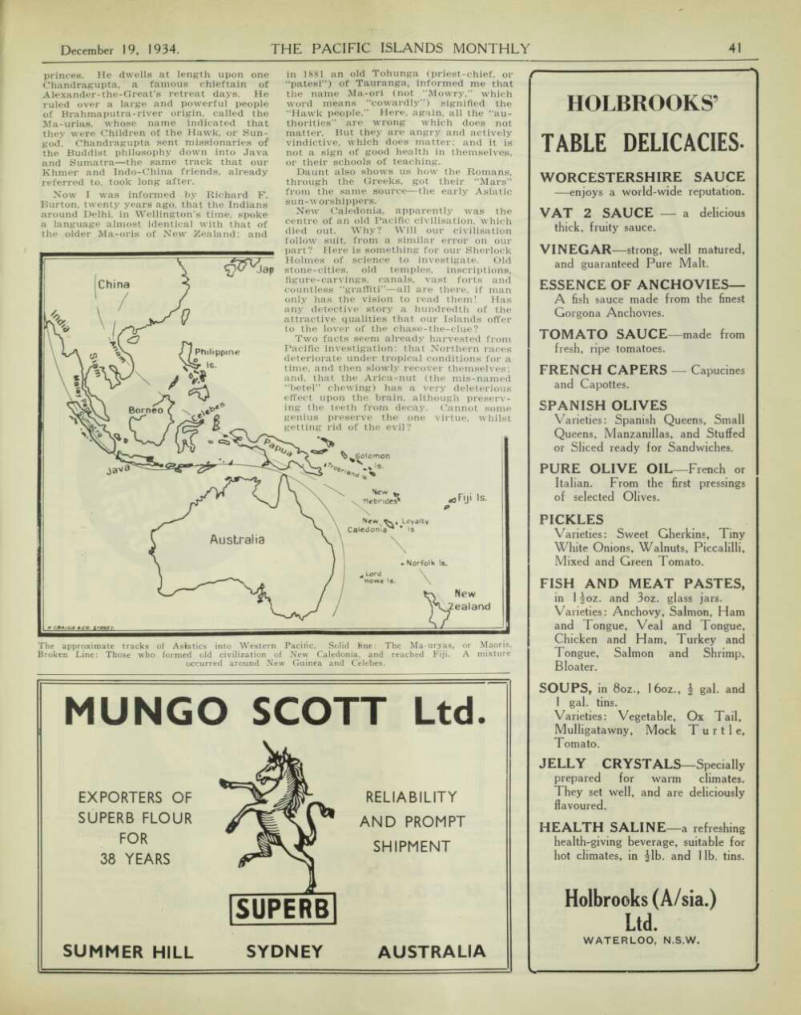
The Pre Historic
By Arthur J. Vogan, F.R.G.S.
Etc.
Detective stories have a curious attraction. Who does not enjoy a well constructed one, by a master-writer like Conan Doyle, or Barry Pain? To follow the patient, painstaking piecing-together of puzzling, and disjointed evidence, by the Sherlock of the story, until the final denouement with its concomitant of achievement and surprise, appeals to our inborn long-latent hunting instincts, somehow!
And yet, here, we have lying at our doors that vast volume of hidden romance, mystery and important teach ing, the past history of the old Pacific civilisation, still unopened and neglected!
About five thousand years ago, a race of Aryan folk —from whom probably came both the Hindu race and that great Baltic breed, which has ruled the world until recently—descended upon what we now, very correctly, call Indo-China, then under the Cham tribes. Much later, there arrived the Annamese, a mountain race (as their large big-toes indicate) from Tibet, also Aryan; but long subjected to Chinese influence through the Yao, Shun, and Huang-Ti periods. Their cave temples in the “Marble Mountains” of Tourane contain very early Chinese script.
Many causes besides the desiccation of the Shamo desert of Mongolia, and the usual fecundity of the early human races, drove folk from Asia into Europe, America and down across those stepping-stones.
the Sunda Islands and East Indies, into the Pacific.
So, when I discovered a similar cave temple in Yasawa-i-lau, Fiji, in 1930, with similar ‘“Chinese” inscriptions, I was not altogether astonished. But professors of New Zealand, and Sydney wrote articles and showed their disapproval, saying that the Chinese were never so far south. One of them, on being shown the “graffiti,” declared “they are merely natural mark ings of the rock!” But Cambridge Uni versity and other museums don’t think so; and have accepted casts —made from my original ones by Grounds, of New town.
The great L. A. Waddell, L.L.D., C.I.E., C.B. and etc., the authority upon the Phoenicians, writing to me anent this curious animosity to later knowledge, says:—“I am not altogether surprised, as it is notorious that the ‘learned’ societies are mainly run by narrow-minded cliques, secretaries or chief members of Council, who are too often wedded to narrow and outworn views of ‘established authority,’ and suppress any new discoveries that may upset the theories they have been taught to believe.”
H. D. Daunt, another great author, and late archaeologist to the Indian Govern ment, was also unkind enough to disturb the slumbers of the plump professors in their dusty studies, with a flood of new light which he threw upon Indian and Islands matters. His “Centre of Civili zation,” was the first book to show that the Pacific was voyaged over by Arabs and Chinese, long centuries before Euro peans began creeping round the storm haunted capes of Hope and Horn. He show ed that incidents related in Bible-history were mostly enacted in the Bay of Bengal, and neighbourhood; and that Jerusalem had failed to produce any tablet or trace of Solomon or David, who were Indian
princes. He dwells at length upon one Chandragupta, a famous chieftain of Alexander-the-Great’s retreat days. He ruled over a large and powerful people of Brahmaputra-river origin, called the Ma-urias, whose name indicated that they were Children of the Hawk, or Sun god. Chandragupta sent missionaries of the Buddist philosophy down into Java and Sumatra —the same track that our Khmer and Indo-China friends, already referred to, took long after.
Now I was informed by Richard F.
Burton, twenty years ago, that the Indians around Delhi, in Wellington’s time, spoke a language almost identical with that of the older Ma-oris of New Zealand; and
in 1881 an old Tohunga (priest-chief, or “patesi”) of Tauranga, informed me that the name Ma-ori (not “Mowry,” which word means “cowardly”) signified the “Hawk people.” Here, again, all the “au thorities” are wrong which does not matter. But they are angry and actively vindictive, which does matter: and it is not a sign of good health in themselves, or their schools of teaching.
Daunt also shows us how the Homans, through the Greeks, got their “Mars” from the same source —the early Asiatic sun-worshippers.
New Caledonia, apparently was the centre of an old Pacific civilisation, which died out. Why? Will our civilisation follow suit, from a similar error on our part? Here is something for our Sherlock Holmes of science to investigate. Old stone-cities, old temples, inscriptions, figure-carvings, canals, vast forts and countless “graffiti”—all are there, if man only has the vision to read them! Has any detective story a hundredth of the attractive qualities that our Islands offer to the lover of the chase-the-clue?
Two facts seem already harvested from Pacific investigation: that Northern races deteriorate under tropical conditions for a time, and then slowly recover themselves; and, that the Arica-nut (the mis-named “betel” chewing) has a very deleterious effect upon the brain, although preserv ing the teeth from decay. Cannot some genius preserve the one virtue, whilst getting rid of the evil?
The approximate tracks of Asiatics into Western Pacific. Solid line: The Ma-uryas, or Maoris.
Broken Line: Those who formed old civilization of New Caledonia, and reached Fiji. A mixture occurred around New Guinea and Celebes.
Advertisements & other items, pp. 42-44 (1 item)
Nelson And Robertson
ISLAND MERCHANTS. (Established, 1895.)
Copra, Cocoa, Trocas Shell and other Island produce sold on commission. All classes of Merchandise purchased and original invoices supplied.
Agents for SKANDIA CRUDE OIL ENGINES, Marine and Stationary, powers from 3-h.p. up.
PENTA MARINE ENGINES, Outboard and Inboard types.
PUMPMOBIL, the only portable pumping plant manufactured, light in weight and reliable. Suitable for mining work.
UPSON WALL BOARD, in both Plain and Tile pattern, strong and light. Nonconductor of heat and cold. British manufacture.
Also New Guinea, Papuan and Samoan representatives for the famous CHALLENGER
KEROSENE BATH HEATER.
Communicate with
NELSON and ROBERTSON
12 SPRING STREET SYDNEY, AUSTRALIA
Telegraphic Address: “IVAN SYDNEY.”
HOLBROOKS’
TABLE DELICACIES.
WORCESTERSHIRE SAUCE
—enjoys a world-wide reputation.
VAT 2 SAUCE a delicious thick, fruity sauce.
VINEGAR —strong, well matured, and guaranteed Pure Malt.
ESSENCE OF ANCHOVIES—
A fish sauce made from the finest Gorgona Anchovies.
TOMATO SAUCE— made from fresh, ripe tomatoes.
FRENCH CAPERS Capucines and Capottes.
SPANISH OLIVES
Varieties: Spanish Queens, Small Queens, Manzanillas, and Stuffed or Sliced ready for Sandwiches.
PURE OLIVE OlL— French or Italian. From the first pressings of selected Olives.
PICKLES
Varieties: Sweet Gherkins, Tiny White Onions, Walnuts, Piccalilli, Mixed and Green Tomato.
FISH AND MEAT PASTES,
in 1 and 3oz. glass jars.
Varieties: Anchovy, Salmon, Ham and Tongue, Veal and Tongue, Chicken and Ham, Turkey and Tongue, Salmon and Shrimp, Bloater.
SOUPS, in 8oz., 16oz., ½ gal. and 1 gal. tins.
Varieties: Vegetable, Ox Tail, Mulligatawny, Mock Turt1e.
Tomato.
JELLY CRYSTALS— Specially prepared for warm climates.
They set well, and are deliciously flavoured.
HEALTH SALINE— a refreshing health-giving beverage, suitable for hot climates, in and 1lb. tins.
Holbrooks (A/sia.)
Ltd.
WATERLOO, N.S.W.
MUNGO SCOTT Ltd.
EXPORTERS OF
SUPERB FLOUR
FOR
38 YEARS
SUMMER HILL
SUPERB
SYDNEY
RELIABILITY
AND PROMPT
SHIPMENT
AUSTRALIA
"Yes Sir!!! Rats! Rats and Mice ONLY
“Squilltox”
is harmless to ALL ELSE!
Harmless to Humans, also to Poultry, Dogs, and all Live Stock.
NO MORE POISON DANGERS
USED UNDER CONTRACT.
NO CURE—NO PAY
(FOR PAST FOUR YEARS)
by the largest Firm of Pest Destroyers in the Commonwealth Houghton & Byrne —on a guarantee basis.
150 Balts from 1-oz.!
Mixes readily with a wide variety of foods Fish, Meal, Cereals, Meat, etc.
C.S.R. CO. LTD., after practical tests, orders over 300 lbs. of “Squilltox” (sufficient for 720,000 baits) for plantation usage. 1 oz. tins 5 oz. tins 1lb. tins KF.
KILLS
on FLEAS
Dogs, Cats, also kills Lice and Red Mites on Cage Birds and Poultry. Non-poisonous (and non-sickening). With “KF” at hand your Birds, Dogs and Cats are freed from irritation and your home too will be kept flea-free. 2 oz. tins 1 lb. tins
15 YEARS
OF
TESTING
in
White Ant and
Borer Eradication
“Timbertox” has been used in all classes of outdoor and exposed timbers in bridges, fences, etc., as well as indoors in dwellings, etc., in all States of Australia for upwards of 1 5 years.
Endorsed by leading Architects and Builders, and used by Government Departments.
with
Having its active poison base in COMPLETE SOLUTION with Oil “Timbertox” is unaffected by rain, dampness, or heat—nothing can bleach it out. Simple to apply by either brush or spray.
Does not affect workmen’s hands. It kills the Borers and White Ants and prevents further attack.
Timbertox
“The Poison in Oil”
1 gal. tins Flyzol Liquid Spray The new death-dealer to Flies and all insect pests. Combines a quick “KNOCK- DOWN” action with a “keep-on-killing” effect.
Non-poisonous stainless. Guaranteed effective. ½ pint, 1 pint and 1 gal. tins These products are solely manufactured by Messrs. Houghton and Byrne, of Sydney, and all Australian States the largest contracting firm of Pest Destroyers in Australia. Contractors to over 34 Steamship Coy’s and Government Departments throughout the Commonwealth.
Every product is unique in its class in that it has been developed out of 20 years actual service in Pest Destroying on a “No Cure-No Pay’’ basis. 5 gal. drums 48 gal. drums
Coupon
Wholesale Distributors in Pacific Islands:
BURNS PHILP & CO. LTD.
PORT MORESBY
(Papua)
RABAUL
(New Guinea) SAMARAI (Papua) APIA (Samoa)
ISLAND BRANCHES:
BA (Fiji) SUVA (Fiji)
SALAMAUA
(New Guinea)
VILA
(New Hebrides)
MADANG
(New Guinea)
LAUTOKA (Fiji)
MAKAMBO
(Solomon Islands)
NORFOLK ISL’D.
Name Burns, Philp & Co., Ltd., (Address nearest branch) Please forward me booklets and full particulars of
SQUILLTOX
FLYZOL
KF (strike out those TIMBERTOX not wanted) Address
P.I.M.
Fiji Discloses Another Surplus
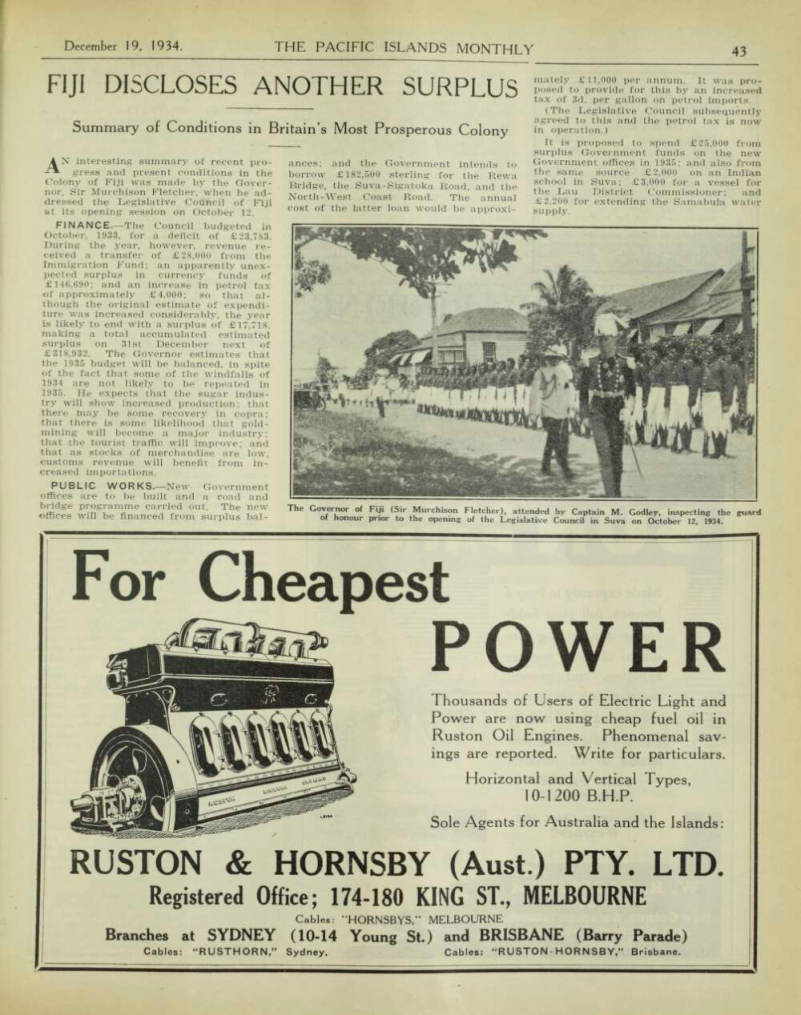
Summary of Conditions in Britain’s Most Prosperous Colony
AN interesting summary of recent progress and present conditions in the Colony of Fiji was made by the Gover nor, Sir Murchison Fletcher, when he ad dressed the Legislative Council of Fiji at its opening session on October 12.
FINANCE.—The Council budgeted in October, 1933, for a deficit of £23,783.
During the year, however, revenue re ceived a transfer of £28,000 from the Immigration Fund; an apparently unex pected surplus in currency funds of £146,690; and an increase in petrol tax of approximately £4,000; so that al though the original estimate of expendi ture was increased considerably, the year is likely to end with a surplus of £17,718, making a total accumulated estimated surplus on 31st December next of £318,932. The Governor estimates that the 1935 budget will be balanced, in spite of the fact that some of the windfalls of 1934 are not likely to be repeated in 1935. He expects that the sugar indus try will show increased production; that there may be some recovery in copra; that there is some likelihood that gold mining will become a major industry: that the tourist traffic will improve; and that as stocks of merchandise are low, customs revenue will benefit from in creased importations.
PUBLIC WORKS.—New Government offices are to be built and a road and bridge programme carried out. The new offices will be financed from surplus bal
ances; and the Government intends to borrow £182,500 sterling for the Rewa Bridge, the Suva-Sigatoka Road, and the North-West Coast Road. The annual cost of the latter loan would be approxi
mately £11,000 per annum. It was proposed to provide for this by an increased tax of 3d. per gallon on petrol imports. (The Legislative Council subsequently agreed to this and the petrol tax is now in operation.) It is proposed to spend £25,000 from surplus Government funds on the new Government offices in 1935; and also from the same source £2,000 on an Indian school in Suva; £3,000 for a vessel for the Lau District Commissioner; and £2,200 for extending the Samabula water supply.
The Governor of Fiji (Sir Murchison Fletcher), attended by Captain M. Godley, inspecting the guard of honour prior to the opening of the Legislative Council in Suva on October 12, 1934.
BANANA TRADE. —It is reported that the New Zealand Government, in order to assist Samoa, proposes to increase the quota of bananas allowed to enter the Dominion from Samoa, and correspond ingly reduce the Fiji-Tonga quota. The Government hopes that this loss of trade may be partly compensated by the es tablishment of a new banana trade with Vancouver.
PORT OF LEVUKA.— Diminishing trade has made it necessary to reduce port costs. The District Commissioner will now act as Collector of Customs and have charge of the harbour; the sep arate posts of Harbour Master, Customs Officer, and Postmaster will be abolished; the Police Inspector will act as Customs Officer and Postmaster; and there will be adjustments in the junior staff; the
total saving being about £19,000 per an num. Pilotage will no longer be com pulsory.
CONTROL OF PESTS- —Considerable success is being obtained in noxious weed control. The thrips, which was intro duced by Mr. H. W. Simmonds, Govern ment Entomologist, from Trinidad, is producing excellent results in areas affec ted by Clidemia hirta, commonly known as the Curse, and these areas are going steadily back to useful grass land. Mark ed success has been achieved with the biological control of the coconut leaf miner, and four parasites of the spathe moth have been established in large num bers. Rat damage in certain coconut lands is considerable, but with present copra prices any organised Control would pro bably be uneconomic.
COTTON. —The Government will re sume its cotton enterprise, which is de signed to provide useful employment for Fijians and Indians. A new strain has been evolved and a crop estimated to give 200 bales is about to be planted. It is anticipated that the total cost of promot ing this industry will be fully covered by sales in 1936.
RICE. —The Government mill in the year ended 30th June last, produced 769 tons of rice, 315 tons of bran, and 18 tons of chick feed. There are now in operation in various parts of Fiji 38 mechanically-driven rice mills.
OIL STORAGE. —Good progress is be ing made by the Shell and Vacuum Oil Companies in the establishment of bulk storage for diesel and heavy fuel oils.
There are in course of erection one tank of 2,500 tons capacity and two tanks of 2,000 tons capacity.
INDIAN AFFAIRS.— “The Indian com munity,” said the Governor, “appear to be generally prosperous and contented, and they are showing a sensible restraint in matters of religious and political con troversy. Evidence that they are satisfied with their lot may be adduced from the fact that the number of repatriates to In dia has been steadily decreasing. Two hundred and twenty went back in 1933 and 117 in 1934, the latter figure being the lowest on record. Immigration from India remains closely restricted, and among those who are admitted the proportion of women has largely increased.
“Questions of leases and land tenure continue to exercise the mind of the community; and the matter is still under careful investigation. There are many conflicting interests, and it is not easy to arrive at a policy which will be ac ceptable to all parties. It is not possible to make any pronouncement at present.
“Apart from their successful sugar sea son the Indians are finding a remunera tive market for rice and for minor crops such as yaqona, dhall, bean, maize, and tobacco. Local supplies of dhall are far short of the demand.
“Indian youths are taking an increasing interest in sport, and the cricket and football, which have become a regular feature in the more thickly populated areas, must have a salutary effect upon their general physique. ‘‘The addition of an Indian platoon to the Defence Force is giving effect to a long cherished wish on the part of the Indian population that they should take their part in the defence of the Colony.
Twenty-nine members have been enrolled and the Commandant informs me that they promise well.”
Advertisements & other items, pp. 45-46 (1 item)
For Cheapest
POWER
Thousands of Users of Electric Light and Power are now using cheap fuel oil in Ruston Oil Engines. Phenomenal savings are reported. Write for particulars.
Horizontal and Vertical Types,
10-1200 B.H.P.
Sole Agents for Australia and the Islands:
RUSTON & HORNSBY (Aust.) PTY. LTD.
Registered Office; 174-180 KING ST., MELBOURNE
Cables: “HORNSBYS,” MELBOURNE
Branches at SYDNEY (10-14 Young St.) and BRISBANE (Barry Parade) Cables: “RUSTHORN,” Sydney. Cables: “RUSTON - HORNSBY,” Brisbane.
’Phone FL 1266. ’Phone FL 1266.
Henly's
DRIVE YOURSELF
SERVICE
197 William Street :: Sydney Cars Hired without Drivers on a Mileage Basis as under: — OPEN CARS—By the Day. 3d. per Mile.
Minimum, 30 Miles Week Days. 60 Miles Sundays.
SEDANS —By the Day. 4d. per Mile.
Minimum, 30 Miles Week Days. 60 Miles Sundays.
Special quotations for holidays.
Payment, plus 2/6 per day or 7/6 per week for insurance. A deposit must be left on car, which is refunded when car is returned.
Our Fleet of Cars includes 1934 Plymouths, Hired at a Slight Increase.
BITUMENOID ROOFING
MADE IN AUSTRALIA
Bitumenoid Roofings, Dampcourses and Insulating Felts are made from the world’s best raw materials. Warranted to stand the most rigid tests.
BITUMENOID THE BEST
Roofing, 1,2, 3-ply; Flooring, Waterproof Materials; Saturated Felt; Resilient Road Jointing; Natural Asphalt Dampcourse; 2 and 3-ply Dampcourse; 1-2lb. Lead-core Dampcourse; Roofing Cement; Asphalt Paints; Roofing Compound.
SAMPLES AND PRICE LISTS ON APPLICATION.
MAXWELL PORTER & SON LTD.
ESTABLISHED 1888. BUILDERS’ SUPPLIES
107 REDFERN ST., REDFERN, SYDNEY, N.S.W. ’Phone M 3157 Cables: Bitumenoid
DOCKERS
Made expressly to keep a lustrous, full gloss finish
against the varying con-
ditions of moist weather exposure, and prevent the decaying ravages of rain and extreme heat by
giving a long lasting pro-
tection to all surfaces.
SUN PROOF
W. R. CARPENTER
& CO. LTD.
New Guinea, Solomon Islands, and all other South Sea Islands.
New Guinea Notes
From Our Own Correspondent.
Rabaul, Nov. 13.
The old-time Ah Ghee’s Hotel is once again open to the public. Mr. E. C.
Monck, previously in Western Australia and later at Wau, has taken over the license, and the hotel resounds once again to song and laughter. Its new name is the Cosmopolitan.
Mr. Gilbert Renton departed by the Van Rees on September 30, for a short holiday, and to inspect his interests in the Gosford (N.S.W.) district. He expects to return after the festival time in Sydney.
Other passengers by the Van Rees in cluded Mr. Steed, manager of the Com monwealth Bank, and Mrs. Steed. Mr.
Steed’s position as bank manager has been filled by Mr. V. C. S. King, formerly of Ipswich, Qld. Mr. and Mrs. Goyne- Stevens were also South-bound passen gers, together with Mr. and Mrs. C. Nor moyle and Mr. and Miss Hill-Griffiths.
Mr. J. Worssam, of the Vaccum Oil Co. also joined the ship after spending some time in the Morobe goldfields.
Oil Prospectors
Six members of the oil prospecting party under Mr. G. A. V. Stanley, of Oil Search Ltd., passed through Rabaul re cently en route to the Aitape district, where, it is understood, boring operations will be commenced at almost any time now. Mr. J. N. Montgomery was also in the party, after an absence from the Ter ritory for some 13 years, having spent several years in England and Persia.
Mr. J. C. Mullaly, M.L.C., who is in terested in mining matters in the Aitape district, left for that part of the Territory by the last Montoro. A mining expert from the Placer Co. accompanied Mr.
Mullaly with a view to testing out some of the areas along the Mingin River.
Mr. Colin Marr, of the Department of Agriculture, has been on patrol work in New Britain. He has been absent for the past five months, having finished a com plete circuit of the island on foot, visit ing all plantations and native coconut groves. He will leave shortly for the New Ireland district.
Amateur Dramatic Society
A meeting was held on November 12, at the Palms Restaurant, for the purpose of forming a Dramatic and Musical So ciety. Mr. Berkley Ayris is the prime mover in this interest, and he must be
complimented on having aroused so much interest among Rabaul residents as to induce over 40 to attend a formation meeting.
His Honour, Judge Wanliss, was in the chair, and the following officers were elected: Patron, His Honour the Admini strator; President, Mr. J. E. Savage; Vice-presidents, Archdeacon de Voil and Mr. V. C. S. King; Secretary, Miss Joyce Carter: Treasurer, Mr. R. Ollerenshaw; Committee, Mrs. Jenner. Mr. Ayris was appointed Dramatic Director and will se lect cast and productions. It was de cided that the subscription to the society would be one guinea per annum, and that efforts would be made to secure a suitable building for their productions.
After the meeting a musical programme was rendered by several new members.
The New Guinea Club held a race meeting on November 3 at Lakunai. Al though there was not a large attendance some very good racing was witnessed Exile, ridden by Mr. Jack Allen, won the 1¼ mile race from Queen Malka; it was a close race, Exile winning by a neck.
Snipe, with Mr. Roy Smith up came third.
Mr. Tom Goss, who for some time was in hospital at Namanula. has departed by the Van Rees for a holiday in Sydney.
Mr. and Mrs. S. A. Lonergan were South-bound passengers on the last Nel lore. Mr. Lonergan is Chief Clerk of the Central Administration.
Advertisements & other items, pp. 47-50 (1 item)
Refrigeration
Records Posted Free
SEND FOR LISTS
Australia’s finest Record Shop, specialising in Mail Orders.
Any Records procured and sent same day.
Dozens of clients in the Pacific Islands.
We pay Freight.
THE TALKERIES
QUEEN VICTORIA BUILDINGS
SYDNEY, AUSTRALIA
BURNS PHILP
(South Sea) Co. Ltd.
Island Traders & Shipowners Registered Office: Suva, Fiji.
Also Branches at Fiji : Levuka, Lautoka, Labasa, Ba, Sigatoka, Rotuma.
Tonga: Nukualofa, Haapai, Vavau.
Samoa: Apia, Pago Pago (America Samoa).
Solomons: Makambo, Gizo, Faisi.
New Hebrides: Vila.
Gilberts: Tarawa.
Norfolk Is. Nauru. Niue. Wallis Is. Futuna Is.
Code Address: “Burnsouth.”
REFRIGERATION
“BUDGE” automatic or manually controlled refrigeration and ice making plants, using ammonia in the large and sulphur dioxide in the small units, as illustrated.
Electric or Crude oil engine driven —Supplied to Commonwealth and Island Governments, C.S.R. Coy. and numerous Island clients,
JAMES BUDGE LIMITED
Refrigeration Engineers McEvoy and Harley Streets Alexandria
SYDNEY
ESTABLISHED 1890
NEW SKIN DISEASE TREATMENT
REMARKABLE RESULTS
With astounding results, an amazingly successful treatment for all skin diseases discovered by Mr. R. Richard Diamond, Ph.C. the Bondi Consulting Chemist and Skin Specialist, has brought hundreds of letters of endorsement from the whole Commonwealth.
Typical cases are those of a police detective who suffered for years with an apparently incurable septic toe, a well-known wrestler who had wasted pounds in unsuccessfully treating an infected leg rash, and a young surfer whose body rash (dematitis) was treated successfully within a few days after years of other treatments. Mr.
Diamond’s formula acts almost magically in drawing out poisonous matter in all irritating skin diseases, including Eczema, Psoriasis, Boils, Pimples, Varicose Veins, Surfer’s Foot (Tinea), Pruritis, Germ under nail, Ringworm, etc. Hundreds of patients, many long-suffering, have been treated by post.
Details of treatment are available to readers, who should write mentioning their complaint, or call at
MR. R. RICHARD DIAMOND,
Ph.C., M.P.S., M.I.O.
Consulting Chemist and Skin Specialist
97 HALL STREET, SIX WAYS
BONDI BEACH, N.S.W.
“WYRNWAY” BRAND
SHIRTS, PYJAMAS
UNDERWEAR AND TIES
ARE QUALITY PRODUCTS
WEARNES LIMITED
MANUFACTURERS 17 PARKER ST., SYDNEY
B.A.P. -
Super Heavy Duty
BATTERIES
Are Guaranteed for 18 Months Built by experts by the latest known scientific methods from the highest grade materials.
Port. Oxford Cedar Separaters, Dunlop Hard Rubber Cases.
The B.A.P. Battery is manufactured for long life and dependability by the British Australasian Petroleum Company, Limited
169 LIVERPOOL STREET, SYDNEY.
A HOME FOR SCHOOLBOYS
“LEDDICOTT”
School House offers a solution of the problem of education by providing a home for boys attending school in Sydney.
Prospectus on application to
E. F. WHITFELD, B.A..
McMahon’s Point :: :: Sydney
TENNIS
TROPICAL RESTRINGS AND GUT
CONSULT
L. A. WARD
WEST END SPORTS DEPOT,
8 GEORGE ST. WEST SYDNEY
for all the needs of Industry
Kookaburra
Welding Rods,
Fluxes and
Accessories
together with
ANTIFRICTION
WHITE METALS, ETC.
are increasing the turnover of Distributors.
The range definitely offers distinct possibilities and fills a long-felt need.
Descriptive Price List of complete range on request.
Kookaburra Products
61-65 Lander Street, Redfern,
SYDNEY, N.S.W.
THE CHAPMAN DIESEL MARINE ENGINE
Slow Speed, Heavy Duty Type shewing high propeller efficiency. Patented Starting System. No compressed air, no wicks or cartridge*- no blowlamp, no cranking handle, no valves. 15 h.p. Runs on Black Crude Oil costing sixpence a gallon at Sydney; consumes six gallons in 10 hours. Price of engine complete £325 ex factory.
CHAPMAN & SHERACK, Clara Street, Erskineville, N.S.W., Manufacturers and Patentees
MINING AND ASSAY
MATERIAL
BALANCES, CRUSHERS, FURNACES,
CRUCIBLES, FLUXES, ETC.
LABORATORY AND SCHOOL
REQUISITES
Chemicals, Glassware, and all other Equipment
HOSPITAL AND SURGICAL
REQUIREMENTS
Incubators, Sterilizers, Centrifuges, Microscopes, Microtomes, etc.
Measures, Dispensing Scales, Enamel Ware, Bandages, Cotton Wool, and all Dispensing Material.
Write direct to
H. B. SELBY & CO., LTD.,
BULLETIN PLACE :: SYDNEY
Box 175D, G.P.O.
Repairs. — Our Hands Make Good Arms.”
FIREARMS
Sent C.O.D.
The New Model 60 Winchester Single Shot 2 2 Cal. Rifle Bolt action, with 27in. taper barrel, gold bead sight, and elevating rear sight. Large-sized walnut stock. Price, 45/-, Postage extra.
Another New Winchester Rifle, Model 68, same as above, but fitted with aperture sieht Price, 55/-. Postage extra.
Other quality Single Shot Rifles:—Alfa, 28/6; Special Alfa, 39/6; Savage Model, 3B 42/6* Remington, Model 33, 45/-; Browning, 50/- (Postage extra).
Sil. Rohu (Late A.I.F.) Gunsmith and Importer of High-Grade Firearms and Fishing Tackle Specialist 143 ELIZABETH STREET (near Market Street), SYDNEY.
“FISHING TACKLE TO TACKLE FISHING.”
The Genuine KEMP
Safer for Horse ahd Rider Improved Design This super quality masterpiece contains all that is wise and new in modern craftsmanship. The KEMP is specially designed for Island use, being built on a rustless, heavily bar-plated tree, oiled kip leather throughout, and handsewn. Extra long flaps. Pads 3” or 4” high, dip in seat.
Fitted with Bevelled Leathers, Folded Girth, 4-bar Stirrups & Surcingle £7/7/-
FREIGHT FREE
Not until you ride in the Kemp can you appreciate its superb riding comfort.
Write for new Catalogue P., 1934.
Registered Office and Factory:
Sydney’s High-class Saddler
NEWMARKET SADDLERY
W. H. Williams for “Safer” Saddles.
18-20 WILSON STREET, NEWTOWN, N.S.W.
Papua’S Strange Story
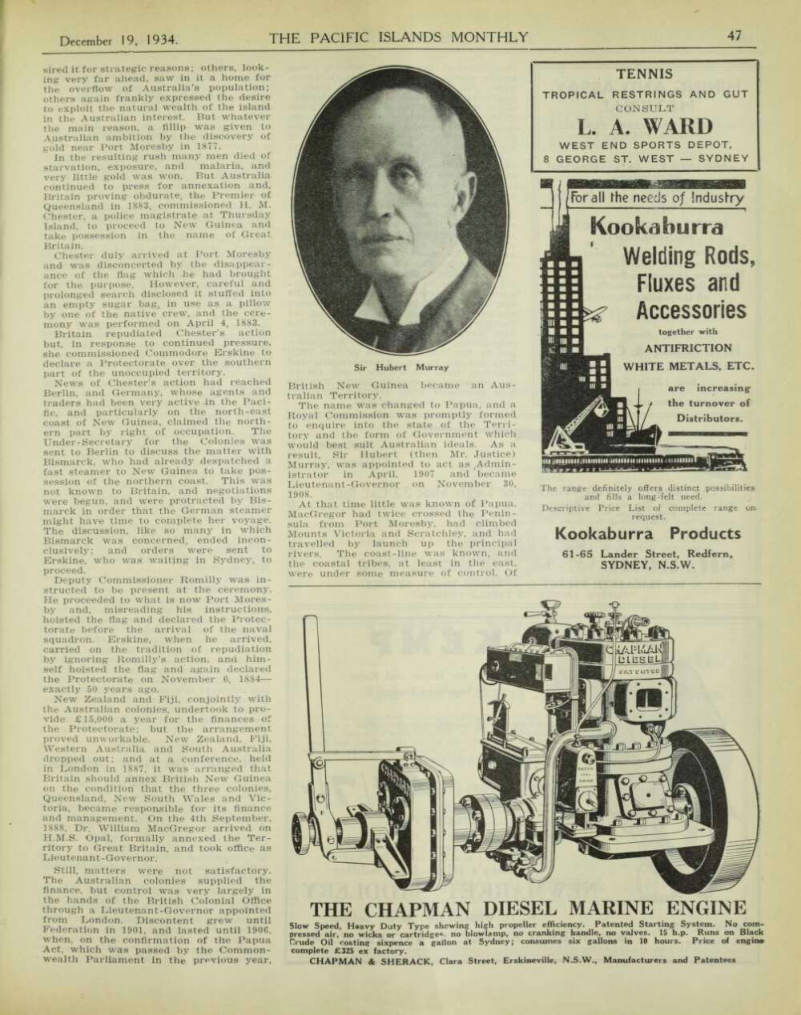
How and Why it Became British Fifty Years Ago
By Mollie Lett
IN the much greater stir of Melbourne’s Centenary celebrations, it is feared that the fiftieth anniversary of the es tablishment of British rule in Papua has been overlooked. Yet the history of Aus tralia’s connection with the Territory is full of interest.
There is evidence that Chinese, Mala yan, and Indian traders visited New Guinea from very early times. But the first sight of its coasts so far as Euro pean nations are concerned, was obtained in 1511, when Antonio d’Abreu, a Portu guese navigator, saw the north-western shores. He was followed by Don Jorge de Meneses for Portugal, and by Saave dra and Grijalva for Spain. And the first attempt at annexation was made by Ynigo de Retes in 1545, when he hoisted the Spanish flag on the north-west coast of the island. Spain failed to confirm
his action; and a number of other navi gators sailed along the northern shore, reported ecstatically on the richness and beauty of the country, and sailed away.
But the south coast remained undis covered until Luis Vaes de Torres, after a troublesome voyage from Peru, found the extreme south-east point of New Guinea in 1606, and coasted west and north, passing through the Torres Straits: and on to Manila. Torres claimed the island for Spain; but the knowledge of his discoveries was concealed by the Spanish Ministry on the grounds that men could not be spared from Spain to settle the country, and that the state of the exchequer would not permit the heavy expenditure necessary to “conquer”’ the great island.
Torres was the last of the Spanish mariners to visit New Guinea, and the- Dutch took over the Moluccas from Spain. For many years the forts and warships of the Dutch East India Com pany jealously guarded the approach to New Guinea from the north and west; but in 1700 Dampier, coming from the south and east, landed on the island and was grieved by the lack of hospitality shown by the natives who, as he reported indignantly, were so fiercely hostile that they had no scruples about retaliating when fired upon.
After his visit British navigators were engaged in examination of the great Aus tralian continent and the islands near it in the temperate zone; and the next visit was made by Captain Cook in 1770.
He, too, found the natives hostile, as did also Lieutenant Yule, who hoisted the flag at Cape Possession in 1846, while engaged on a survey of the coast.
His action was ignored, as was also that of Captain Moresby in 1874 when, after adding detail to the surveys of his predecessors on the coast, he claimed the eastern end of the island for Britain.
But at about this time a few white traders began to compete with the Chinese for the pearls and beche-de-mer for which the island was already famous.
In 1872 the London Missionary Society landed half-a-dozen Cook Islands teachers and their wives near what is now Port Moresby. They were well treated by the natives, though sickness took heavy toll of them, and two years later the survivors were joined by the first white missionary and his wife.
Moresby’s discoveries opened the eyes of Australian statesmen to the desirabil ity of New Guinea, and they began to urge upon Great Britain the need for an nexing that part of the island which was not occupied by the Dutch. Some de
sired it for strategic reasons; others, look ing very far ahead, saw in it a home for the overflow of Australia’s population; others again frankly expressed the desire to exploit the natural wealth of the island in the Australian interest. But whatever the main reason, a fillip was given to Australian ambition by the discovery of gold near Port Moresby in 1877.
In the resulting rush many men died of starvation, exposure, and malaria, and very little gold was won. But Australia continued to press for annexation and, Britain proving obdurate, the Premier of Queensland in 1883, commissioned H. M.
Chester, a police magistrate at Thursday Island, to proceed to New Guinea and take possession in the name of Great Britain.
Chester duly arrived at Port Moresby and was disconcerted by the disappear ance of the flag which he had brought for the purpose. However, careful and prolonged search disclosed it stuffed into an empty sugar bag, in use as a pillow by one of the native crew, and the cere mony was performed on April 4, 1883.
Britain repudiated Chester’s action but, in response to continued pressure, she commissioned Commodore Erskine to declare a Protectorate over the southern part of the unoccupied territory.
News of Chester’s action had reached Berlin, and Germany, whose agents and traders had been very active -in the Paci fic, and particularly on the north-east coast of New Guinea, claimed the north ern part by right of occupation. The Under-Secretary for the Colonies was sent to Berlin to discuss the matter with Bismarck, who had already despatched a fast steamer to New Guinea to take pos session of the northern coast. This was not known to Britain, and negotiations were begun, and were protracted by Bis marck in order that the German steamer might have time to complete her voyage.
The discussion, like so many in which Bismarck was concerned, ended incon clusively; and orders were sent to Erskine, who was waiting in Sydney, to proceed.
Deputy Commissioner Romilly was in structed to be present at the ceremony.
He proceeded to what is now Port Mores by and, misreading his instructions, hoisted the flag and declared the Protec torate before the arrival of the naval squadron. Erskine, when he arrived, carried on the tradition of repudiation by ignoring Romilly’s action, and him self hoisted the flag and again declared the Protectorate on November 6, 1884— exactly 50 years ago.
New Zealand and Fiji, conjointly with the Australian colonies, undertook to pro vide £15,000 a year for the finances of the Protectorate: but the arrangement proved unworkable. New Zealand, Fiji, Western Australia and South Australia dropped out; and at a conference, held in London in 1887, it was arranged that Britain should annex British New Guinea on the condition that the three colonies, Queensland, New South Wales and Vic toria, became responsible for its finance and management. On the 4th September, 1888, Dr. William MacGregor arrived on H.M.S. Opal, formally annexed the Ter ritory to Great Britain, and took office as Lieutenant-Governor.
Still, matters were not satisfactory.
The Australian colonies supplied the finance, but control was very largely in the hands of the British Colonial Office through a Lieutenant-Governor appointed from London. Discontent grew until Federation in 1901, and lasted until 1906, when, on the confirmation of the Papua Act, which was passed by the Common wealth Parliament in the previous year,
British New Guinea became an Aus tralian Territory.
The name was changed to Papua, and a Royal Commission was promptly formed to enquire into the state of the Terri tory and the form of Government which would best suit Australian ideals. As a result, Sir Hubert (then Mr. Justice) Murray, was appointed to act as Admin istrator in April, 1907 and became Lieutenant-Governor on November 30, 1908.
At that time little was known of Papua.
MacGregor had twice crossed the Penin sula from Port Moresby, had climbed Mounts Victoria and Scratchley, and had travelled by launch up the principal rivers. The coast-line was known, and the coastal tribes, at least in the east, were under some measure of control. Of
Sir Hubert Murray
the interior practically nothing was known except on the Yodda Goldfield, where the influx of miners had made a magisterial station necessary. Magis trates had to a great extent a free hand in the management and patrolling of their divisions, and their patrols were governed more by the apparent needs of the moment than by any settled policy.
Agriculture was practically non-exis tent at that time, raiding and cainnibalism were practised by almost all of the many tribes, and white men travelled always with their lives in their hands.
The commercial history of Papua, since that time, has not been in any way re markable for its success, though the Ter ritory prospered well from 1910 to 1914, when the value of copra was rising, and Australia, Germany and Holland were competing for the shipping trade.
The outbreak of war in 1914 struck a heavy blow to enterprise and develop ment. Investment ceased, and the world’s shortage of shipping affected transport and communication. And hardly had the Territory found its feet again after the war, when it was faced witn economic ruin by the imposition of the Navigation Act by the Commonwealth in June 1921.
This Act cut Papua off permanently and definitely from the world’s trade; for by the operation of the Navigation Act she was prevented from trading with any other country than Australia.
After repeated applications for the re moval of the Act, Papua was relieved from its operation in September, 1925; but not before its evil influence had re sulted in damage which seems likely to be permanent.
The year 1925-26 was a memorable one in the history of Papua in that the value of exports and imports exceeded the mif lion. This improvement did not result from the removal of the Navigation Act, but was due to increased exports of rub ber, copra and copper, and to a big ad vance in the price of rubber.
From 1926 to 1928 reasonable hopes were entertained for the prosperity of the Territory, even though the New Guinea Copper Mines, the biggest concern in the country, closed down in 1926 owing to adverse working conditions and the ex haustion of capital before full production was attained. But when, in 1928-29, the market prices of copra and rubber, the only products of the Territory, dropped, and continued to drop dismally, the long established settlers realised that they could not hope for any reward for their consistent, hard, and honest efforts in the face of misfortunes so promiscuous and continuous, and so completely beyond their own control or that of their Govern ment.
Since 1928, with low prices for her products, and with a falling revenue still further depressed by a drastic reduction in the Commonwealth Grant, Papua has been struggling grimly. The rubber planting industry has been saved by a generous bounty from the Common wealth; but copra, the only other con siderable product of Papua, can only be rescued from complete collapse by a very early rise in the market price.
There are some signs, to-day, that in terest is not entirely lacking in the fur ther development of Papua; and the prospect of investment in those products subject to bounties and preferential tariff gives rise to the hope that the not very distant future may see a measure of com mercial recovery.
Native Administration shows very much happier results.
The achievements and reputation of Sir Hubert Murray are too well-known to need comment here. From the state of savagery and bloodshed in which the Territory was wrapped up till 1907 she has now reached a condition of almost complete pacification. Progress has been steady and continuous; and the last two areas will be brought under control dur ing the next few months by a searching patrol of the unknown district between the Kikori and Strickland rivers, and by the establishment of a police camp in the heart of the turbulent Goilala valley.
’Plane For New Guinea
Mission
The Australian Board of Missions, of Sydney, under whose direction and finance the work of the New Guinea Mission is carried out, has under consideration a plan to purchase an aeroplane to assist in evangelical, medical and educational service in and about the Morobe Goldfield district, New Guinea.
The Board is also examining a sug gestion that a party of Anglican mis sionaries should be despatched into the Benna-Benna Wahgi region, Central New Guinea. Presumably, if it is decided to send a party into this recently discovered area, the new machine will be used to convey them into the interior.
Wahgis
Missionaries and the Wahgis A Reply from the Field
Gentle sarcasm, at the expense of the rival missionary expeditions which were hurrying into the newly discovered Purari country, Central New Guinea, was indulged in several months ago by our Salamaua correspondent. The following amusing reply was written, during July, by one of the Catholic missionaries who had gone down into the new country from Sek (Alexishafen, Madang).
Letter to the Editor.
THE poor old New Guinea Government take another one on the chin. They should have known better than to permit those dumb, old whiskered guys from Sek to cast curious eyes on the sacred “sikin” of the Sultan of the Wahgi—with, by the way, his 10 wives.
The missionaries are not to blame.
They are dumb, anyway. They just na turally figured that if the jolly old Gov ernment thought it worth while to spend hundreds and hundreds of pounds inves tigating the Wahgi-Mt. Hagen area, then they might have a look-see, too. Especi ally by request.
Your correspondent at Salamaua sees red and waxes eloquent. Let said corre spondent look at this red rag—and take a stiff one and a chaser.
The New Guinea Goldfields exploring party, headed by Mr. “Mick” Leahy, dis covered the Wahgi Valley in February, 1933. From a low divide, 7600 feet above sea level, at the foot of Mt. Erigvanna, Mick, his brother Dan, and Charles Mar shall, licensed surveyor for N.G.G. Ltd., gazed for the first time upon the hitherto unsighted Wahgi Valley.
Long before that historic find, Sek (Madang) missionaries in the Bismarcks already knew a dozen roads over the range into the valley. At Bundi, the missionary discovered hundreds of women who had been taken from the Wahgi Val ley. Every third one at Bundi and Guyebi spoke Arava, the Middle Wahgi language.
Repeatedly, these people asked the mis sionaries to go over the range to the old homes of their women.
From Bundi to Koru, in the Wahgi Valley, seemed a long trek, and Bismarck conditions were still unsettled. However, on November 11, 1933, three Sek mission aries crossed the range at 10,000 feet, dropped down into the head of the Chimbu river, reached the Chimbu- Wahgi junction and went on up the valley.
It was not different to being “at home.”
Everywhere a welcome; everywhere friends met —and a great old time was had by all.
This was actually the first missionary expedition up the Wahgi Valley, a quite natural development of the Bismarck work among people with the same cus toms, some gardens, same houses, and almost the same language.
But the Government ought to have known better than to allow poachers on their private reserves; for at this time Mr. Taylor, A.D.O., who had accompanied the N.G.G. exploring party, had been in the Mt. Hagen district six months, and had just left for the coast on long leave.
There has been no fighting here be tween rival missionary parties. The banks of the muddy Wahgi are no suit able place to hurl hymn books. They might get dirty that way. So, for the
information of your Salamaua correspon dent, we report that all parties in or out of the area are still unwounded.
Who’s to blame for the “deplorable race?” Let’s all pass the buck. We say again that Salamaua’s eloquent “imagin itis,” translated into the P.I.M. June issue, is just another case of the Government taking it on the chin.
Yours for “humanity and common sense.”
“Hagen.”
Wahgi district,
T.N.G., 15/8/’34.
Norfolk Island Trade
Trade with New Zealand, for the period under review, was nil.
Month.
Imports From Aust.
October, 1933 . . . . £1390 October, 1934 .. .. .. £2488 Exports October, 1933 .. .. £1414 October, 1934 . . . . £328
Advertisements & other items, pp. 51-52 (1 item)
Canterbury Cakes
OWN A
ROLLS
RAZOR
Every planter should own a Rolls razor, the world-renowned, hollowground safety which strops and hones itself. Removes stubble without trouble and will give you a lifetime of perfect shaves.
Complete in nickel plated case 50/- Silver plated case 60/- Write to-day to Desk P.I.M.
Pike Brothers Ltd.
in Queen Street, BRISBANE.
Ladies' Afternoon Tea Biscuits Queen’s Own Mixed Biscuits Scotch Fingers (In Special Tins) Canterbury Cakes Plum Puddings
MADE BY
SWALLOW & ARIELL LIMITED
PORT MELBOURNE : : : : AUSTRALIA 1854 - 1934
WHERE TO STAY IN PORT MORESBY
FIRST-CLASS ACCOMMODATION
PARTIES ARRANGED.
Licensee: Papua Hotel, Ltd.
THE
PAPUA HOTEL
Catering specially for Tourists & Travellers Situated on high ground overlooking both coasts, its Spacious Lounges are always Cool & Comfortable Tariff: Per day 16/-; per week £.5/5/-; per month £14; bed and breakfast 10/-; bedroom only 7/6.
Cars meet all steamers.
SPECIAL DINNER
HOTEL MORESBY
NEAR THE
WHARF
COMFORTABLE
ACCOMMODATION
ONLY THE BEST
BRANDS OF
WINES, SPIRITS
AND BEERS
IN STOCK
LICENSEE:
Hotel Moresby
Ltd.
COSMOPOLITAN
HOTEL
Samarai
First-class Accommodation for Tourists and Travellers Ball-room; Electric Light; Billiards; Freezing-works; Cold Store. Best brands of Wines, Spirits, Ales,
MODERATE TARIFF
Fishing Trips and Launch Excursions arranged Licensee: R. LEWIS.
AT THE GATEWAY
of the
N.G. GOLDFIELDS
HOTEL SALAMAUA
Within seven years. Salamaua has become the Busiest Port in New Guinea. In the same period, the Hotel Salamaua has become one of the best-known hotels in the South Seas. Its kitchens are famous— Large, Cold Stores and Extensive Gardens Provide Abundance of Fresh Food for Residents and Travellers.
The Hotel has been enlarged from time to time, and now has accommodation for 80 guests.
Proprietress and Licensee:
MRS. ALAN INNES.
HOTEL BULOLO
WAU, T.N.G.
Picturesquely situated, overlooking the Wau Aerodrome, at the Business centre of the Morobe Goldfields.
FIRST-CLASS CUISINE—30 com-
fortable Bed-rooms —Hot and Cold Showers —Fresh Fruit, Vegetables, and Dairy Produce from the Hotel Gardens.
The Hotel Bulolo is famous for its wide, cool verandah-lounge.
Only the Best Brands of Wines, Spirits, and Beers in stock.
SAMARAI HOTEL
The Rendezvous of the Miners of Eastern Papua.
Comfortable Accommodation for Tourists, Travellers and Residents. Best Brands of Spirits and Wines —Victorian Lager Beers.
FISHING EXCURSIONS ARRANGED
Licensee: Mrs. L. M. SKELLY.
Bound and Indexed Files of
Pacific Islands Monthly
We have for sale seven bound files of Volume IV. of “Pacific Islands Monthly” (Aug., 1933, to July, 1934, inclusive).
Price of Volume IV., strongly bound and indexed, and posted to any address £2/2/-
PACIFIC PUBLICATIONS Ltd.
UNION HOUSE, 247 GEORGE ST., SYDNEY
COOL AND SPACIOUS LOUNGES - COMFORTABLE
Hotel Rabaul ROOMS - DINNER PARTIES SPECIALLY ARRANGED Excellent Dance Floor and Music.
Under the Personal Management of Mrs. H. Luxmoore
Happens
As It Sometimes
AT a far-away Pacific atoll, hundreds of miles from nowhere, reigned a Go vernment Official—a native. His 400 or so native subjects included one solitary white man, who for no other reason than that he was once regarded as a white man, possessed a small degree of Mana — "better known as “bluff.”
It came about that the white man gave a party at his hut, to which he invited several natives, but not the official head of the island. Here, of course, was a snub.
Now note what happened. Next morning, all those who were guests at the party were hauled up before the Court and charged with “consuming liquor,” or something of that sort. One after the other offenders were fined.
But when it came to the turn of the white man to stand his trial, he indulged in some verbal detonations and then fell back on the good old islands stratagem of threatening to report the official for something to do with his sleeping habits.
The case suddenly collapsed and the Court was adjourned.
Later on, the Bench and the defendant were noticed talking amicably together; after which they moved off to the white man’s habitation. There they remained for some hours until, eventually, the offi cial reappeared in a helpless but jubilant mood.
No more was heard about the partly finished case.
Rev. S. R. M. Gill, of the New Guinea Mission station at Mamba, Papua, is at present on furlough at Assam, India.
B. N. G. Development Co.
Reports Smaller Loss for 1933-1934
From Our Own Correspondent.
Port Moresby, Nov. 10.
THE twelfth annual report of the British New Guinea Development Co. Ltd., which was presented to the shareholders in London in July, shows the loss for the year ended January, 1934, as £765/15/9.
Together with debenture interest (£8390/ 7/6) and loss brought forward from pre vious years (£3678/10/-), this brings the total debit at profit and loss account to £12,834/13/3.
The report states that the output of copra for the year was 2164 tons, as com pared with 1926 tons for the previous year.
Copra production, however, resulted in a loss of £1/15/6 per ton, as compared with a loss of 14/3 per ton in 1932-33. The average sale price was £2/17/4 per ton less than the year before, while the cost of production was reduced still further (£1/16/1 per ton less).
The total amount of rubber produced in 1933-34 was 787,769lb, as compared with 785,328lb for the previous year. Average net sale price was 6.19 d per lb, f.o.b., compared with 5.8ld per lb for 1932-33.
The cost of production was reduced from 4.55 d to 4.25 d per lb (Australian currency).
The report adds that the present year 1934-35 is likely to show greatly increased production in both copra and rubber.
Barbaric Dance
Dr. Hogbin’s Experience at Wogeo
DR. IAN HOGBIN, of the University of Sydney, who has been carrying out a special investigation at Wogeo on behalf of the Australian National Research Council, hopes to complete his work at that remote spot by the end of the year.
He is the only European on the island, which is in the Schouten group, not far from the mouth of the Sepik River, New Guinea.
In a recent letter, he said: “I was pre sent at a most thrilling affair yesterday, and my spine is still tingling. A festival was to conclude. At 4 o’clock in the after noon, with yells of hilarity, two files of men emerged from the entrance to the men’s club-house. Each man was joined to his neighbour by a rope made of wild ginger leaves. They entered the village, and took up positions in the street facing each other —150 of them.
“Then out came half a dozen drummers, beating hour-glass shaped drums with a lizard skin tympanum. These fellows provided the rhythm for a sort of jog trot dance and song by the men, but the drummers, replaced from time to time, ran around gyrating madly.
“Soon the women joined in, and the fes tival proceeded for about two hours. Then, with unearthly yells the men again emerged from their club-house, some with spears and others with smoking flares.
Spears were hurled over the dancers, and flares swished all over the place.
“I have never been present at anything quite so barbaric,” declared Dr. Hogbin, who, unfortunately failed, owing to the
departing light, to take some photographs of the wild scene.
“Then, wilder yells yet,” he added, “and two figures with hideous wooden masks and bodies covered with coloured fringes, ran from the club to a platform specially
prepared for them. As they reached this, and climbed up, there was a long drawn moan from the people, and with one con sent the men all fell forward on their faces, and the women fled to their houses.
For a minute the figures stood with arms
outstretched, and, marvel of marvels, the setting sun chose that moment to illu minate them with its last beams! Rein hardt himself could not have done the thing better! It was really an experience worth coming to Wogeo for!”
Anthropologists
New Guinea is likely to receive addi tional anthropological attention soon, as Dr. Reo Fortune (who was there last year with his wife, Dr. Margaret Mead), is re turning from London, via Sydney, for that purpose. Dr. Mead, who is a noted author, has resumed her work at the American Museum of Natural History in New York, after lecturing in different parts of the United States.
Miss Camilla Wedgwood, who has been, lecturing at the University of Sydney since Dr. Hogbin’s departure for Wogeo, will leave for Nauru early in the new year to carry out research work among the
natives there.-
E.R.
Advertisements & other items, pp. 53-54 (1 item)
Announcing the Model 36 DIESEL
MARINE
4 Cycle Solid Injection
ENGINE
In sizes from 10 to 60 Horsepower Hand or Electric Starting
FAIRBANKS MORSE CO. (Aust.) LTD
29-33 CLARENCE STREET, SYDNEY
Wilhelm Kreckwoldt A Co.
9, Lange Muehren, South Sea Bldgs.
HAMBURG, GERMANY
(Exporters and Importers) We Export: Trade Goods of any description, Cutlery, Hardware, Miners’
Requisites, etc., etc.
We Import: Any kind of Island Produce.
CORRESPONDENCE INVITED
HALLSTROM’S
NON-ELECTRIC
REFRIGERATORS
KEROSENE OPERATED
ENJOY the comfort of having cool drinks, cold meats and salads, delicious savouries and sweets, and nice firm butter on the hottest days.
THE NEW SEMI-AUTOMATIC MODEL
gives wonderfully efficient refrigeration without trouble, and at a trifling cost.
It has no moving parts to wear out, or get out of order, and is so simple to operate that a CHILD CAN DO IT. All there is to do is to fill the lamp once a day and light it —that’s all.
Price, £.49/10/-, f.o.b., Sydney. Write for descriptive illustrated Folder.
Other types of Chemical Non-Electric Refrigerators from £20.
Manufactured and guaranteed by E. HALLSTROM
462 WILLOUGHBY RD., WILLOUGHBY, SYDNEY
AUNT
MARY'S
PURE FOOD
PRODUCTS
For more than thirty years these quality food products have been supplied to the people of the Islands.
Specially manufactured and packed to meet Island conditions they can be relied on to give positive satisfaction.
DEFIANCE
Brand
Canned Goods
These high-grade canned goods are prepared and packed by the proprietors of Aunt Mary’s Pure Food Products. Hermetically sealed to withstand tropical heat, they are sure of consumer appreciation.
The Proprietors of these branded foods keep faith with their clients and consumers by packing only the finest quality goods. packed only by Prepared and
TILLOCK & CO. LTD.
Pure Food iM
KENT and LIVERPOOL STREETS, SYDNEY, N.S.W.
Government Farm
Stud Cattle For Tahiti
From Our Own Correspondent.
Papeete, Nov. 1.
Monsieur Bariac, Government veterin ary surgeon at Papeete, returned from Australia on the Maunganui in October, bringing with him several stud animals for the Government farm at Mamao, where their services will be available to stock-owners.
The new acquisitions, which were pur chased in Australia and New Zealand, include 1 Clydesdale stallion, 1 riding stallion, 2 Berkshire boars, 1 Hereford bull, 1 Friesian bull, and a stud ram. All these animals, including some Plymouth Rock fowls and a number of turkeys bought for private owners, arrived with out mishap and will no doubt prove of benefit to the Colony.
M. Bariac, as part of his mission, was also charged with the delivery of a col lection of plants, indigenous to French Oceania, to the Horticultural Exhibition at Melbourne.
Japanese Fisheries Boat at Rabaul
Rabaul
From Our Own Correspondent.
Rabaul, Nov. 13.
THE “Hakuyo Maru,” which was due to arrive here on November 12, ar rived unexpectedly from Ponape (Caroline Islands) on the afternoon of November 9.
The vessel, under direction of the Ja panese Imperial Fisheries Institute, is used by that organisation for final-year students taking the four-year course in Fishery at the government institute.
During the winter months the vessel cruises amongst the South Sea islands, where the students obtain first-hand knowledge of deep-sea fishing, particu larly tunny, of which there is reported to be an abundance off the coast of New Ireland, according to Captain Nakakawa, master of the “Hakuyo Maru.” During the summer months the vessel proceeds to the North and East of Japan, touching Alaskan waters and fishing in the Bering Straits.
There are 31 students on board, and discipline seems to be good. Whilst ashore the cadets paid visits to the Bo tanic Gardens and were entertained by the local Japanese residents. The ship left on November 12, for Madang, from whence it will journey to Manila and then to Japan.
Township
N.G. Goldfields News
Growth of Edie Creek Township
From Our Own Correspondent
Edie Ck., Nov. 3.
CREEK is gradually becoming a township apart from Wau. Its Pro gress Association and Sports Club are comparatively old standing institutions.
The present commodious Edie Store, with its four Europeans, dates from a year ago, but the Edie Creek Hotel was opened only a month ago—on September 22.
The Hotel is certainly a credit to the proprietor, (Mr. R. Franklin) and, in the opinion of the writer, excels most of the hotels in the Islands. Log fires and comfortable lounges do not seem fitting as part of Islands life, but they give to the Edie Hotel a homeliness appreciated by the mining men, When the new road from Wau is opened early next year this hotel should attract a goodly week-end and holiday trade from Wau and the coast. About 120 residents were the guests of the licensee on the opening night, the cold weather allowing dancing to be enjoyed to the full.
The weather at Edie Creek has been what holiday-makers would call “foul”— in fact we have only had 17 days in which rain has not fallen in the last five months.
The miners on the small tributaries do not growl, their water shortage problems are solved whilst this weather lasts, but the tracks are reduced to quagmires.
On September 30, another institution was added to Edie Creek’s activities: a Sub-branch of the R.S.S.I.L.A. was formed —the first on the Mandated New Guinea mainland. Within a fortnight all the Returned Sailors and Soldiers in the Edie Creek area were members, beside a number from other centres, making a total membership of 85. When our new Ad ministrator visited Edie Creek on Octo ber 9, we found him a League enthusiast, and he gladly agreed to be the first Patron.
Officers elected for the ensuing year were: President, A. H. Cresswell; Vice- Presidents, A. G. Villiers, S. Fitzgerald, F.
James; Secretary, B. Rossi; Treasurer- Publicity Officer, H. D. McGilvery; Com mittee, R. V. Wild, G. R. Courtney. W.
Davis, T. P. Skifflngton, and R. F. C.
Struben.
At the first general meeting the Larkin Case was discussed and a fund was im mediately opened to assist in the re opening of this case.
Mrs, Bowring, the popular hostess at the Kiandi guest house, met with a painful accident on her way up from Wau, when the truck on which she was a passenger crashed below Blue Point, and Mrs. Bowring was thrown 200 ft. down the cliff.
She was taken to the Wau Hospital, and had several stitches inserted in wounds received. Mr.
Jack Bannigan, who was driving, and Mr. Jack Spence, a passenger, escaped unharmed.
Christmas time at the Creek will be full of jollification; there is to be a dinner with a ball following on the 'Saturday preceding Christmas and a huge Xmas tree for the kiddies on Xmas Eve.
Mr. and Mrs. McGilvery (the former was for merly a pilot for General Airways), have gone South, with their two small daughters. Mr. McGil very recently purchased the Edie Creek store, and intends enlarging it on his return.
Popular Don McDonald, of Edie Creek, who has been for many years in this part of the globe, has gone South by the Macdhui for a well-earned rest.
Quite the prettiest and best bungalow in New Guinea is the beautifully appointed Wau home of Mr. Normie Neal, M.L.C., and director of Day Dawn. Recently extensive additions were added, and the genial host did his bit and wielded the hammer very effectively, especially with the huge bay window. By the way, the garden around this house is unique; glorious roses, gladioli, carnations, and last but not least many vegetables flourish on what was once the meeting ground of Kukuku kus.
The god of luck was certainly with Ernie and Chips Hodley, who drew first and second prize in the local sweep on the Melbourne Cup.
Owing to the Montoro being a week late at Salamaua last trip, we were without meat —and beer—for some days.
Mr. Brian Lane, of Edie Creek, is looking: for ward to the arrival of his brother, Mr. Niall Lane, by the Montoro on December 20. His other brother, Dermott, intends coming up in January.
Advertisements & other items, pp. 55-56 (1 item)
Flour
W. REILINGH
ZUIDLAREN (HOLLAND)
Former Consul of the Netherlands
SALES-MANAGER TO
MESSRS. BOTJE ENSING & CO.
SHIPBUILDERS, ENGINEERS
BOILERMAKERS
LIGHTCRAFT
Before deciding on any Motor or Steamlaunch, Lighter, Barge, Sailing or Tankship, request us to submit plans and prices.
No Costs—No obligations
PRODUCING UNIFORM GOOD RESULTS SINCE 1868
Flour
ALWAYS ASK FOR IT
BULLIVANTS wire ropes
“THE WORLD’S STANDARD’’
LARGEST STOCKS IN AUSTRALASIA ... FOR ALL PURPOSES Also Blocks, Hooks, Shackles, Thimbles, Strand, Seizing, Aircraft Cord, etc.
Letters: BULLIVANTS’ Australian Co. Ltd. Telegrams:
Box 1298 J, G.P.O. 331-333 KENT STREET, SYDNEY Prompt Attention! Efficient Service!! Complete Satisfaction!!!
Genuine
Eau de
Cologne
JULIUS BLAU
Factory Representative for Australia.
Australia House, Carrington Street, Sydney.
The
fragrant
refresher invigorates and revives.
FOR
Pedigreed Terriers, Kelpies, Spaniels,
Greyhounds, Bull Terriers, etc.
Write
GEO. F. SMITH
(Judge for Many N.S.W. Dog Societies) Dealer in All Kinds of Live Animals. Zoos Supplied.
777 GEORGE STREET, SYDNEY.
Plezall . .. (Please-All) This extraordinary Ready Made Scone Mixture will Delight You Surprise You Amaze You.
Nothing to do No other ingredient to add simply mix with water and bake.
Delicious Milk or Wholemeal Scones in Ten Minutes.
PLEZALL
is specially manufactured and packed to suit the island conditions. The mixture will keep indefinitely.
PLEZALL
may be obtained from all Island Stores.
PLEZALL FOOD PRODUCTS
NEWTOWN, SYDNEY, N.S.W.
So Good ... So Nice Worth Double the Price
Fashion Hints for Islands Women
By Therese
SURELY the modern woman has touched the knees of the gods, since all the world seems in league to shower her with gifts that charm. There is no stereotyped style for her to follow, for there are silhouettes innumerable from which to choose. Slim as a reed, bouffant as her Victorian ancestors, Grecian as a goddess, sophisticated as a Medici, what ever she will, success is her portion.
Her choice of colours, too, is as varied as an artist’s palette, and with the magic of her supreme artistry she blends them, till the result is glamorous beyond dreams.
Day-time silhouettes are in the main straighter and slimmer than of yore, and to vary this the basque is used to good effect in giving that hour-glass line so much used by the Couturier in the new season’s clothes. Smart simplicity is the keynote of the hour. Morning clothes are trim and tailored, but with never a hint of masculinity in their well cut line.
Both day and evening skirts are slit to give necessary width, or they go gaily aflutter with soft draperies.
The tunic keeps its well-earned popu larity and is always charming, giving as it does such scope for individuality and clever combination of colours.
Capes appear with tremendous success; for festive hours and the newest type sports a softly draped cowl collar, or the hood of the religieux, while some fasten at the back with softly falling bows. De lightfully feminine with their soft appeal,, bows are used to advantage on all sorts and conditions of clothes.
The high neckline is fast disappearing, for which many breathe a sigh of relief, since it is becoming to only a favoured few. The low and infinitely more becom ing square neck is well in the vogue.
Indeed, so very attractive is it that many gowns sport it back and front.
The V decolletage, reaching to the waist, loses its terrifying moments when with it is worn a brassiere of gold or silver lame.
The effect is ravishing in the extreme, and simply shrieks sophistication.
Flowers add charm to both afternoon; and evening gowns. Trails of forget-me nots and daffodils cascade softly down the draped bodice of a blue chiffon, which clings lovingly to the knees and foams into frivolous flounces —one, two, three.
Detachable sleeves are a marvellous in novation, and be they long or short are equally desirable. Little short sleeves are banded with exquisite flowers, which hold, them cunningly into position. A touch of flattery is given to the classically moulded evening gown by a delicious, little ruffle at the square neck, held erect by a spray of half-blown roses.
Cellophane trims are delightful, and a huge bow on a bouffant chiffon gown is entrancing in its fairy-like effect.
Fascinating and intriguing are the scarves that metamorphose into the most delightful wraps. They are heaven-sent for the ingenious woman, who regards them as a medium for perfect selt expression and drapes them in ways in numerable. Evolved in lame, chiffon, dew sprinkled with diamante or heavily sequinned, tulle ruffled and gathered, there is about them an indefinable charm that is irresistible.
Wing effects are still sought. A sewn across the back neck-line extending the full length of the half sleeve is caught at either side of the square neck with the new clips of crystal—that glass with the deliciously dull sheen.
Tucks sound the only note of trimming on many of th© smart models. Diagonal tuckings meeting on the raglan shoulders and at the sides of the bodice form a fish bone effect that is distinctly novel. Row on row of gold stitching gives an expen sive air to the plainest of frocks and adds an air of distinction.
Attractive double tiered collars of lace with cuffs of the same variety spell charm to the frock whose narrow well cut skirt is given dash by a side slash.
In obedience to fashion’s decree that we must sparkle at night the new materials woven with silver or gold thread glitter delightfully. They are designed specially for the cleverly cut gown that moulds the
figure so seductively. A lame tunic is a dream-like possession that justifies itself for formal and informal occasions alike.
The new lames are deliciously soft and supple and lend themselves to clever drapery. They are used to trim our afternoon gowns with results that are particularly pleasing.
An evening cape of tremendous chic is evolved from two squares of lame, the two corners of each square being joined at the back with a large silver button or brilliant clip. The front is held in place by a large loop and bow slotted through buttonholes on either square.
Taffetas and moires still rustle their effective way through the cavalcade of fashion. Coats, afternoon and evening gowns, seek perfection through this de lightful medium. With the addition of a wide sash of taffeta, floral mesh voiles make the most charming in-between frocks for informal dances, bridge parties and what nots. In fact, there is scarcely an occasion that this type of material would not serve in the tropics.
Lingerie lines retain bias with that sleek and slinky fit which is more- than ever necessary with the straight lines that one’s clothes follow.
Stockings are an all-important sub ject with us, n’est-ce pas? Paris decrees stockings of black silk. Ye Gods! We hold our breaths, determined to com promise, and choose off-black-gunmetal shades with the tiniest tinge of brown to lift them from Stygian gloom, and of a filminess so unbelievably sheer that one can scarcely believe them to be the pro duct of human agency.
From the days when to go stocking less was the mode, we have turned with seemly haste, and to the well dressed woman stockings are now de rigueur.
There are so many fascinating shades from which to choose that their come back is scarcely surprising.
Knee-high stockings are delightful and reduce the risk of ladders to a minimum.
In fact they are an absolute necessity to the slim-fitting gown which has the un happy knack of making only too obvious the careless disregard of essentials.
Accessories never lose their importance, and so much of the success of one’s toilette depends on them that they should receive their full measure of considera tion, and not be allowed to take their place along with what we are, alas, too apt to consider the less important details.
Pigskin bags and belts are ideal for the tropics, as are those inexpensive Toya types. The cost of these latter is so negligible that it is possible to possess a wide range of colour schemes to your in tense satisfaction.
Advertisements & other items, pp. 56-57 (1 item)
Permanently Wave
YOUR OWN HAIR
With a “RAYWAVE” Curling Set (Pat. 16608/34). Waves last 6 to 9 months guaranteed. Anyone can use. NO ELEC- TRICITY. Simple instructions. 15/per set. Postage 3/- extra.
Spar Trading Co., 10 Rawson Place, Sydney
HORDERNBROTHERS
PITT & GEORGE STS., SYDNEY WE PAY CARRIAGE
11½d PRINTED HAIRCORD
A.— This excellent wearing cotton is fadeless and 28 inches wide. It is in effective neat stripes as illustrated in shades patterns in popular colorings on white grounds. Usually 11½d. Sale Price, yard
1/11½d LINGERIE LAWN
B.— 36 inch Ferguson's Fadeless Lingerie Lawn — standard quality, obtainable in various popular floral patterns; one is illustrated above. In pastel shades of nil, lemon, helio, pink and white. Usual Price, yard 1/1½. Sale Price, yard
2/6 PTD. CHIFFON VOILES
C.— 36 inch Fadeless Printed Chiffon Voiles, showing in an attractive leaf design on coloured effect background.
In bright shades of green, pink, lemon, blue, and helio.
This Chiffon Voile washes and wears splendidly. Usual Price, yard 2/6. Sale Price, yard
2/11 “LEEN-O-WISP”
D.—36 inches wide. A very dainty summer weave with drawn thread effect featuring a small novelty floral pattern.
Obtainable in shades of blue, helio, green and pink on white grounds. Usual Price, yard 2/11. Sale price, yard
WE PAY CARRIAGE ON DRESS MATERIALS
SPECIAL OFFER! We will send you three different Dress Lengths in good quality Cambric, Zephyr and Voile for the amazing low price of 10/-
“BAINOL”
WHITE ANT PREVENTIVE
BORER EXTERMINATOR
WOOD PRESERVATIVE
The most scientific preparation on the market for the above purposes “BAINOL” is packed in containers to suit any size job, and is sold in quarts, halfgallon, one-gallon and four-gallon tins, and in 45-gallon drums at a reduced rate.
Prices: Quarts 2/11, Gallons 7/11, 4-Gallons £1/6/3, 45 Gallons £13/4/2, Australian Currency, F.O.B., Sydney Sole Manufacturers:
Bains’ White Ant Exterminator
BW 6462 CO. LTD. LM1025
Established 40 Years.
Scottish House, 17-19 Bridge St., Sydney Inquiries Regarding Agency Invited.
Papua
Exploration Of New Guinea And
Rapid Penetration of Hitherto Unknown Areas
By R. W. Robson.
AN American explorer, Commander Dyatt, who is best known for his expedition in search of Colonel P. W. Fawcett (British explorer, who disappeared in the jungles of Brazil in 1925) has announced that he is seeking the permission of the Australian Government to carry out a year’s exploration work in New Guinea. He says he proposes to cover an area of 10,000 square miles, and will be accompanied by a geologist and a surveyor. He would make some study of minerals, but his chief work would be anthropological and geographical.
If Commander Dyatt does not make haste in carrying out his plan of explora-
tion in New Guinea, he will find very little country left to explore.
The Australians have done a creditable job of work. Two or three years ago there was a very large area in Central New Guinea and Papua, eastward of the Upper Fly and south-westward of the Sepik, which had never been penetrated by white men, and which is still shown on most maps as a complete blank. But during the past two years a good deal of this territory has been opened up, mainly as a result of the enterprise of gold pros pectors who are constantly pushing west ward from the Morobe goldfield.
It is almost two years since a combined
expedition led by Assistant District Officer J. L. Taylor, representing the Adminis tration, and Messrs. Mick and Dan Leahy, representing gold-seeking interests, got through to Mount Hagen from the upper reaches of the Ramu River. They tra versed a magnificent park-like valley or plateau, lying between mountain ranges, over 100 miles long by 50 or 60 miles across. The plateau lies at a consider able height—averaging, I understand, at least 3000 feet—and it carries a thick population of natives who had never hitherto been in contact with white men.
These are a particularly fine type of people, who engage in intense agriculture and have a remarkable system of irriga tion. The valley or plateau is very well watered by two river systems, which ap pear to combine to form the headwaters of the Purari River. These streams dis appear in a southerly direction, into the unexplored central range between Papua and New Guinea; but there is little doubt that they are part of the mysterious Purari, which flows into the Gulf of Papua on the southern coast of the great island.
The announcement of the discovery of this beautiful land and attractive people has aroused great interest all over the world. It was stated only a few days ago that an American expedition is hurrying to what is called the Mount Hagen area to make films and gather anthropological data.
There is some reason to believe that this region was penetrated by Captain Detzner, the German officer who escaped from the Australians into the interior in 1914 and who wandered there for years in an attempt to get across the unknown central region into Dutch New Guinea.
Detzner’s book in which he apparently described this Mount Hagen area was discredited; but since we have obtained details of the region, during the past two years, there is a tendency to believe that Captain Detzner’s claims were un justly treated.
When Messrs. Taylor and Leahy Brothers reached Mount Hagen, with the assistance of aeroplanes, early in 1933, they secured, from the aeroplanes and from the slopes of the high mountain (over 13,000 feet), a glimpse of the coun try to the westward —an absolutely un known territory, 100 miles wide, which lies westward and south-westward of Mount Hagen. They described it as even more attractive in appearance than the Ramu-Mt. Hagen region, and said also that it appeared to be densely populated.
At this very moment, an expedition equipped by one of the gold companies and led by Messrs. Mick and Dan Leahy is away out in this country westward of Mount Hagen; and when the Leahy Brothers return we may expect that some very interesting material will be pub lished. The Leahy Brothers are some
thing more than prospectors—they are keen observers, possess considerable scientific knowledge, and they are expert photographers.
The Papuan Expedition.
Meanwhile, another expedition has set off. The Lieutenant-Governor of Papua (Sir Hubert Murray) has selected one of the ablest of his young officers. Assistant Resident Magistrate Jack Hides, to lead an expedition up the Fly River to its junction with the Strickland, thence to ascend the Strickland River for at least 100 miles; and then to branch off in a north-easterly direction, in an attempt to penetrate the unknown region that lies on the border of Papua and New Guinea, between the upper waters of the Strick land and Mount Hagen. Mr. Hides was to leave about November 20 on the small vessel “Vailala,” which has been specially prepared for the expedition and which will take them up the Strickland as far as she can. Mr. Hides is accompanied by 14 specially selected native police and 25 native convicts from the Port Moresby gaol—the latter being all hillmen from the north-eastern division of the Territory who are under long sentences, and who have learned something of discipline.
Such convict-carriers have proved very useful and reliable in expeditions in the past. It is estimated that the Hides expedition will be absent for five or six months, and it is hoped that it will tra verse about 300 miles of hitherto unknown Papua and will come out somewhere in the vicinity of Mount Hagen in the cen tral portion of the Mandated Territory.
An expedition led by Mr. G. Massy Baker several years ago discovered a great tributary coming into the Strick land River about 70 miles above its junc tion with the Fly. This river has never been explored—but it is assumed, appar ently with some reason, that it drains some portion of the large unknown region south-westward of Mount Hagen. Mr.
Massey Baker’s report laid emphasis on the fact that this river apparently comes through markedly auriferous country—he found in it impressive traces of gold. It is understood that a part of Mr. Hides’s task is to take a look at this river and if practicable to secure some indication of where it comes from. It is quite possible that the course of this river, if north eastward, will be generally the track that Mr. Hides will follow Mr. Hides already has carried out some notable exploratory patrols through prac tically unknown territory in Central Papua and he has almost ready for pub lication a book describing some of his more interesting experiences, for which Sir Hubert Murray has written a special preface.
Dutch Activity Just westward of the Dutch New Guinea- Mandated Territory border is another un known region and at the present moment extensive plans are afoot for the investi gation of this country by a Dutch expedi tion. The “official investigation,” as it is called, is under the direction of that in fluential body of Dutch citizens formed last year in The Hague and called the New Guinea Committee. Its representa tive in Australia is Colonel J. G. Koop man. The Dutch Government, with the assistance of the New Guinea Committee, is now giving very active attention to a survey of the mineral and oil resources of Dutch New Guinea; and the expedition that is now going inland, into the north east section of Dutch New Guinea, near the Mandated Territory border, is part of a general plan which embraces the use of aeroplanes.
It is interesting to note in this connec tion that Colonel Koopman is seeking to
co-operate with the Australian authorities and with such institutions as Guinea Air ways Ltd., which has provided the gold fields section of New Guinea with an extraordinarily efficient transport system, and whose aeroplanes co-operating with the various expeditions, have assisted so much in the rapid contraction of the area hitherto described as “unknown New Guinea.”
Papuan Customs revenue is still falling.
For the first quarter of the financial year to September 30, receipts were down £942.
Post office receipts were £439, and Gov ernment plantations revenue decreased by £716. Altogether there is a total decline of £2688. The public debt stood at £65,621, all due to the Commonwealth- Government.
Advertisements & other items, pp. 58-59 (1 item)
Wunderlich
ART METAL
CEILINGS
Wunderlich Art Metal is the ideal ceiling and walling for Island Homes.
Suitable for every purpose; transports cheaply; easy to erect and decorate; fire-resisting; vermin-proof, and lasts a lifetime. Write for illustrated literature and prices. WUNDER-
LICH. LTD., Box 474 AA, G.P.O.,
SYDNEY.
THE
Ever Increasing
Demand
for
FERRODOR PAINT
is ample proof that despite the innumerable “Cheap” (so called) paints on the market, property owners are becoming fully reconciled to the fact that
GOOD PAINT COSTS NOTHING
whereas inferior paint is the best possible illustration of false economy.
Ferrodor Paint saves its cost by the enhanced life of the things it protects.
Inferior paints, in addition to bad appearance, involve property owners in the constantly recurring cost of application and do not give efficient protection.
It pays you to specify and use "FERRODOR.”
Obtainable from all Leading Paint Stores, in Paste or Ready-for-use Form.
Further particulars from Sole Agents:
WILLIAM ADAMS & COMPANY LIMITED
175 CLARENCE STREET, SYDNEY
OLD ISLANDS
PHOTOGRAPHS
We have a unique collection of several thousands of original photographs of Natives and Scenes in New Guinea, Solomons, Tonga, Fiji, Samoa, New Hebrides, etc., taken during the years 1875 to 1895.
These supply invaluable records of fastdisappearing races.
Full-plate prints, 1/- each, or 12 for 10/-.
Details on application
TYRRELL’S MUSEUM,
281 GEORGE ST., SYDNEY
PRESCOTT
are sole wholesale agents for
PINEAPPLE BACON & HAMS
DAISY BRAND BUTTER
FRESCO BRAND BUTTER
LEA & PERRINS’ SAUCE
BETTER BROOMS
FOR
‘‘BETTER BROOMS”
Manufacturers Regal Special Vice-Regal Windsor Sovereign National and the No. 4 Special Millet Brooms.
Agents Wanted Throughout the Islands. Price List on Application BETTER BROOMS, 12 James Street, Redfern, Sydney
HOW TO STOP FEVER
BEFORE IT GETS YOU DOWN
THERE are many forms of fever—Dengue—Malaria—Five Days Fever, etc. All are characterized by high body temperature—thirst—loss of strength, etc. Fever may develop from a chill. A quick, safe and effective method of combating fever F to take “ASPRO” according to the directions on the leaflet in each packet as soon as you develop a temperature. “ASPRO” reduces temperature and fever conditions because, after ingestion in the system, it is anti-pyretic or fever reducing, and is an antiseptic, anti-periodic and anti-fermentative. It is also a powerful germicide. You take no risk with “ASPRO” because it is pure medicine in tablet form. “ASPRO” conforms to the standard of purity laid down by the British Pharmacopoeia (the guiding authority of the Medical Profession). It does not harm the heart and is much preferable to quinine. There are no injurious after-effects.
'ASPRO'
NIPS FEVER IN THE BUD
Hagen Area
To Explore Mt.
American Expedition En Route To N. Guinea
FIVE young scientists sailed from New York at the end of November in the 65ft. schooner Director for New Guinea, where they will seek to penetrate the newly opened Wahgi-Mount Hagen region in the interior of the N.G. mainland. If successful, they will be the first wholly scientific expedition to explore the new area.
The members of the party are Adam Bruce Fahnestock, entomologist and leader of the expedition; Hugh S. Davis, director of the Tulsa Zoo, U.S.A., still and moving picture photographer; Dennis Puleston, an English ornithologist, who will navigate the schooner; John Sheri dan Fahnestock, skipper of the vessel and an ichthyologist: and another American, who will act as radio operator and botanist. They will spend six months mn the plateau, studying and photograph ing the native people and collecting speci mens of animal life.
The specimens and data gathered by the expedition will be divided equally among the Tulsa Zoo, the American Museum of Natural History, and the Brown University, U.S.A.
The schooner’s itinerary to New Guinea lis via the Galapagos Islands, Marquesas, Samoa, Tonga, Fiji, New Hebrides, and ;Solomon Islands. After completing their work in the Mandated Territory, the party will continue on around the world.
S.S. Laperouse to be Replaced
From Our Own Correspondent.
Noumea, Nov. 17.
Messageries Maritime Company has announced that the Laperouse, which maintains a monthly service between Sydney, New Caledonia, and New Heb rides, is to be replaced early next year by the twin-screw vessel Pierre Loti (3,012 tons).
The Pierre Loti (ex Emporer Nicholas, 1st.) was built in Great Britain in 1912, She is 115 metres long, and 16 metres wide; and her engines are capable of generating 5,480 horsepower.
Fiji Ketch Ashore
The wooden auxiliary ketch, Helena (Burns, Philp S.S. Co., Ltd.) ran on Mumbulau reef, north of Naselai, Fiji, while en route to Suva from Levuka early on November 6. The vessel was not seriously damaged, and with the aid of assist ance from Suva was refloated three days later. Subsequently she reached Suva under her own power.
Built in 1923, the Helena is of 86 tons gross, and 76 feet in length. She had been wrecked previously in December, 1929, during a severe hurricane, but was recommissioned by Mr. W. H. Terry, of Suva.
New Administrator
Busy
General McNicoll on Tour In New Guinea
THE new Administrator of New Guinea, A Brigadier-General W. Ramsay Mc- Nicoll, certainly has lost no time in mak ing the acquaintance of his extensive Territory and its numerous problems.
Soon after his arrival, after a period of intensive office work, he visited the goldfields area and made official calls at Salamaua, Wau, Bulolo, Edie Creek, Otibanda, Bulwa, Ramu, Mount Hagen, Lae, and thus back to Rabaul. The Ad ministrator did not spare himself. He walked most of the distance from Wau to Edie Creek and back —the track being blocked by fallen trees —and he travelled on horseback over the rough bush road from Wau to Bulolo. He used the aero planes of all four companies while he was in the district. Mr. “Bob” Gurney, in a single-engined Junkers, took the Adminis trator from the Morobe goldfield right across the Ramu-Purari region to Mount Hagen. The aeroplane, when returning, became bogged on the Mt. Hagen landing ground, but the following day, after a run-way of bamboo was laid down, the party got safely away. The Administra tor had interviews with scores of gold fields people, on a wide variety of sub jects.
The Administrator left by the Adminis tration schooner Thetis, early in Novem ber, on a visit to the Sepik area. He landed at Wewak, and visited Aitape, Vanimo, and the hinterland. Then he pro ceeded up the Sepik River to Marienberg, Angoram, Ambunti, and beyond. His itinerary thereafter included the Manus district, Kavieng, and back to Rabaul.
Samoan Cocoa
Growers Want Bonus from N. Zealand
From Our Own Correspondent.
Apia, Nov. 15.
THE markets for copra and cocoa in England and America show no im provement, and, in spite of the approach ing Xmas season, the local cocoa market has not been relieved of any noticeable quantities.
Suggestions have been made that New Zealand, which has quite a large cocoa and chocolate manufacturing industry, should step in and give some kind of pre ference to Samoan cocoa beans, in the same way as, for instance, the Austra lian Government is doing in regard to cocoa beans and rubber from the Man dated Territory of New Guinea and Papua. In those Territories a subsidy in the form of a bonus is paid to the produ cers for all produce imported into Aus tralia.
New Zealand should feel some moral obligation to help the threatened primary producers of Samoa —the territory under its mandate. It could take a considerable portion, if not most, of the Samoan cocoa crop, which this year up to date already amounts to about 1200 tons and should, by the end of the current year, reach the record figure of over 1300 tons.
Marriage Of Suva
Mayor’S Daughter
THE only daughter of the Hon. Alport Barker (Mayor of Suva), Muriel Agnes (Molly), was married recently to Mr.
Frank Ryan of Suva, formerly of Timaru, N.Z., in the Suva Holy Trinity pro-Cathe dral. The wedding created much interest locally, and 250 guests were entertained at the Town Hall after the ceremony, which was conducted by Rev. H. Harris. Miss Valmai McKenzie, daughter of the mana ger of Messrs. Burns Philp (S.S.) Co.’s Suva office, was bridesmaid, and Mr. W. E.
Hancock was best man.
Among the guests were: The Governor of Fiji (Sir Murchison Fletcher), the Chief Justice, the Colonial Secretary, Sir Henry and Lady Marks, Sir Henry Scott, Mr. and Mrs. R. Crumpton, Mr. D. B. Costello, and Mr. A. H. Witherow.
Interesting Pacific History
Jonas M. Coe
Letter to the Editor.
THE paragraph in your August issue, containing an implication of beach combing, is resented by the members of the Coe family resident in New Guinea.
Jonas M. Coe was a University man, American Consul in Samoa, and for long years held a very high and responsible position with the biggest German firm in Apia, and was an accomplished linguist.
His brilliant daughter, afterwards “Queen Emma,” owned the most extensive plantations in N.G., and also steamers and auxiliary schooners to carry produce from her plantations. She and other daughters and sons of Jonas M. Coe pion eered this Territory when natives were dangerous, necessitating an armed guard around their homesteads every night, and some days, too.
William Coe, son of Jonas, was for years Governor of Guam, and was decor ated by the then President of the United States for bravery and gallant conduct during the disastrous hurricane, when six warships were wrecked at Apia. He (William Coe) died recently in the Philip pines, leaving a large estate. His three daughters, well respected ladies, each manages her own plantation in N.G. —no easy task for anyone these days.
I am, etc.,
Pago Pago.
New Guinea, 20 Oct., 1934. [EDITORIAL NOTE.—The article to which our correspondent refers was a report of a law case in Samoa, affecting the estate of the late Jonas M.
Coe. The writer remarked that some of the evidence recalled “the good old beach-combing days.” No one who knows anything of Pacific history would associate Jonas M. Coe with beach combing.]
An Effective Rat Destroyer
Recent advices indicate that the poison known as “Squilltox” is meeting with success in destroy ing rats. In the past, rodents have caused great damage to crops and goods in storage in the Islands, but planters who have been using this preparation report that they are rapidly eradicat ing their plantations of parasitic rats. “Squilltox” is used in the form of baits and is harmless to human beings, poultry, dogs, live stock, etc., but is certain death to rats. The preparation, made by Messrs. Houghton and Byrne, of Sydney, is distributed throughout the Pacific Islands by Burns Philp & Co. Ltd., and is obtainable at all their Islands stores.**
Native Arts
Interesting Display at Rabaul
From Our Own Correspondent.
Rabaul, Nov. 13.
Some months ago it was decided to hold an exhibition of native arts and crafts in Rabaul for the purpose of fostering native craftsmanship and to stimulate an interest in the work which the natives do in their own homes.
As a result, the exhibition was opened on November 8, by the Deputy Admini strator (His Honour Judge Wanliss), and the hall of the Times’ building was crowd ed with interested spectators.
Articles of native workmanship were exhibited from Manus, Morobe, and the New Britain districts. Among articles of primitive manufacture were the very ex cellently finished spears from the Mount Hagen area. The New Britain display, arranged by Mr. J. H. L. Waterhouse, F.R.A.I., was intensely interesting and well catalogued with explanatory cards, showing the use of each article and de scribing its manufacture.
There were also displays from the Vunapope Technical School arid the Go vernment school at Malaguna; these consisted chiefly of well-finished carpen try and cabinet work and showed what could be done by natives, when given proper supervision.
Mr. H. A. Gregory, A.D.O., in Rabaul, was in charge of arrangements and much credit is due to his organising ability, which provided such a successful exhi bition. Credit is due also to Messrs.
Schmidt and Burch, of the Malaguna School and to the Sisters of the Sacred Heart Mission who worked so inde fatigably in preparing the displays.
Staff Alterations in N.G. Public
Service
At the end of October the following alterations affecting the staff of the N.G. Public Service were published by the Central Administration in Bulle tin No. 32:
Permanent Staff
Appointments N. H. Fisher, Geologist, Dept. of Lands.
J. R. Hyde, Clerk, Dept. of District Services.
S. H. Filan, Clerk, Dept. of District Services.
E. W. Mantle, Acting District Officer.
H. L. R. Niall, Acting Assistant District Officer.
J. Hepburn, Acting Patrol Officer.
Transfers E. T. Fulton, Patrol Officer, Rabaul to Kokopo.
H. L. R. Niall, Acting A.D.O., Rabaul to Kokopo.
J. A. Costelloe, Patrol Officer, Rabaul to Buka Passage.
S. H. Christian, Medical Assistant, Rabaul to Aitape.
Temporary Staff
Appointments W. M. Cochran, Roadmaster, Public Works Dept.
J. R. Thomas, Clerk, Customs Dept.
A. I. Anderson, Typiste, District Services Dept.
R. Nicholl, Chainman, Lands Dept.
H. J. Streeter, Carpenter, Public Works Dept., transferred from Manus to Salamaua (en route Wau).
N.G. Police Force
E. E. Walker appointed Warrant Officer, 2nd class.
A. E. Halley, Warrant Officer, 2nd class, trans ferred from Rabaul to Salamaua (en route Edie Creek).
S. Reilly, Warrant Officer, 2nd class, transferred from Salamaua to Rabaul.
How Does One Cook
Yams?
Letter to the Editor.
I REMEMBER a “Punch” joke of my far-off youth, when pineapples were as little known a luxury as Alligator-pears are to-day, where a suddenly wealthy ignoramus says to the fruiterer;—“Yer can keep the change if yer tell us ’ow ter cook ’un!”
This little parable rises always in my mind when I get my numerous inquiries regarding the subject indicated at head of this letter. Owing to the publicity given to my introduction of Trobriand yams to Australia (assisted by the “P.I.M.,” the “Sydney Mail” and the “C.P.
Gazette”) Mr. A. H. Joubert, of the Tweed, has now distributed yams to over seventy growers in Queensland and N.S.
Wales. They can readily be grown; but, as old Randolph put it, “God sent us meat; but the Devil cooks!” Our wiser ancestors steamed food that they did not roast; and the gentle “savage” of the Islands still understands how to cook fish and vegetables—an art that we have lost.
It still remains legal amongst us to boil such Heaven-sent provender! The yam is excellent food—but I fear it may be spoiled in the kitchen.
Will any experts do the yam-movement the service of enlightening us, through these columns, as to the best ways of cooking yams in our poor modern appli ances? “And your petitioners will ever pray!”
I am, etc..
Arthur J. Vogan.
Sydney. 6/12/1934.
Smaller Loss For Papuan
Rubber Co.
Koitaki Para Rubber Estates, Ltd., with a gross profit of £1020, discloses a net loss of £91 for the year ended June 30 last, as against a loss of £1767 the previous year. The com pany’s plantations are in Papua.
The debit at profit and loss is increased to £6605. Average selling price of rubber for the year was /6.72, against /6.31 per lb. the previous year. Since the close of the financial year, the price has remained fairly steady at approximately /7 per lb.
Capital is £75,218, of which £211 is preference.
Plantations, less amortisation and depreciation, are valued at £69,119, and there are shares in other companies valued at £2005.
Advertisements & other items, pp. 61-62 (1 item)
Doan’S
When Rest Is
Broken
m "Every Picture tells a Story."
Act Promptly When Bladder Irregularities Disturb
Sleep
Are you bothered with bladder irregularities; burning, scanty or too frequent passage and getting up at night? Heed promptly these symptoms.
They may warn of some disordered kidney or bladder condition. You cannot get a better remedy for kidney and bladder trouble than Doan’s Backache Kidney Pills. A trial will convince anyone. Users everywhere recommend them.
DOAN’S
BACKACHE KIDNEY PILLS.
All-Chemists and Stores.
[PREPARED,]
Guaranteed by the manufacturers to go further, last longer and uniformly give better results than any other paint made. —“B.P.”
“KEEP ON KEEPING ON!”
Agents throughout the Islands.
While You Sleep the Remedy
Heals
A WELL-PROVEN
REMEDY FOR PILES
This preparation has been on the marlA for several months, and it has effected a Cure in every case in which it has been tried. Cases of Long Standing often Cured within One Month, with one bottle only.
For External Use only—Stainless, Painless and Odourless.
PRICE: 3/6 PER BOTTLE. Posted securely packed for 5/- per bottle. Copies of Testimonials forwarded on request.
Read the Report of an Eminent Analytical Chemist:
THE LABORATORY,
20 and 22 Napoleon Street, Sydney, March 14th, 1933.
ROBERT BRUCE, Esq.
Dear Sir,—The formula of your pile cure submitted to me could have no effect other than beneficial. I gave your sample to a Client who had suffered many years, and before he had used half the bottle he reported himself completely cured.
Faithfully yours,
GROVE JOHNSON, F.C.S. (Lend.),
“Honours,” City and Guilds of London Institute.
Analytical and Consulting Chemist.
Supplies Obtainable from—
ROBERT BRUCE
Room 7, 2nd Floor,
15 Hunter Street, Sydney
and also at
14 UPPER BAYVIEW ST., NORTH SYDNEY.
CHRISTIES’
FOR ALL KINDS OF
UMBRELLA UMBRELLAS
REPAIRS CHRISTIES, LTD., 568 George St., Sydney
A LASTING PROPOSITION
EFFICIENT
RELIABLE
GUARANTEED
Manufacturers of Quality Batteries
ERG BATTERIES LTD.
156 GOULBURN ST., SYDNEY, N.S.W.
Battery Manufacturers and Auto Electrical Engineers
Rarotonga
Cook Is. Notes
Mild Outbreak of ’Flu at Rarotonga
From Our Own Correspondent.
Rarotonga, Nov. 13.
IN the early part of October, days of blazing hot sun were experienced and residents concluded that the good old hurricane weather had arrived. But to wards the end of the month, old man southerly put in an appearance, and the inevitable happened—’flu swept through the villages.
Several schools on the island were closed down for some days and numerous Europeans were obliged to fight out the epidemic at home with Aspros and hot water bottles. Apparently the outbreak was of a mild form, as no serious cases resulted.
Old Residents Leave
Mr. and Mrs. Kingsbury, who have been resident at Rarotonga for some 12 years, were farewelled at the Bowling Club grounds on October 31, together with their daughter Miss D. Kingsbury. His Honor, Justice Ayson, presented them with a cheque, on behalf of the community.
Miss Kingsbury was an official of the Administration for 8 years and high tri bute was paid by the Resident Commis sioner to her work and popularity.
New P.O. Assistant
Mr. W. D. Thompson, of the New Zea land post office department, arrived re cently, to take over the position of assistant in the local post office.
Rockefeller Work Completed
The Rockefeller sanitation scheme for the Cook Islands has been completed and the overseer returned to New Zealand by the R.M.S. Maunganui on November 5.
The work was commenced two years ago and covered five islands of the Group.
Fruit Season Over
What is termed the “fruit season” at these islands is finished for this year.
The last of the oranges went forward in August and a cargo boat has taken the re mainder of the tomatoes. Bananas will be the only item of export until next May. November to May are the lean months of the year for the Cook Islands.
Death Of Mrs. Macknight
The serious illness of Mrs. Macknight, wife of Dr. Macknight, who was stationed temporarily at the Cook Islands as re lieving Chief Medical Officer, culminated in her death on October 8. The departure of Dr. Macknight to New Zealand under circumstances so tragic made a deep im pression on the feelings of local residents, who quietly gathered at the jetty at night fall to pay silent farewell to a broken hearted man.
The late Mrs. Macknight was taken to New Zealand for burial.
Noumea
New Sea-Baths At
From Our Own Correspondent.
Noumea, Dec. 4.
New modern baths were opened at Anse Vata, Noumea, on December 1. The baths are constructed on the most up to-date lines with 50 bunks and fresh water showers. A large tea-room is at tached, which can be used as a banquet ing hall or ball-room.
Bathing heretofore has always been in the open from the beach, and though no case has ever been reported of sharks, one feels the monsters must be lurking in this area.
Trade in Cook Is.
Rarotonga, Nov. 7.
TRADE and business at present are not good, but people are not altogether denuded of funds.
Imports flow steadily into the Group— not in so great a volume as formerly, but in fair quantity. The preference seems to be for the low-priced article rather than quality, with little interest in. the source of manufacture.
The fruit trade maintains a demand for plantation implements and motor ve hicles. There is also a growing activity in sport in the Group with a correspond ing demand for sports goods from tennis racquets to sails for canoes; from musi cal instruments to rubber shoes, and light, out-of-door, sporting garments.
The days when Islands people spent their money on luxuries, holiday jaunts, and private entertaining have been left behind.
Samoan Affairs
Estimates Tobacco Industry New Medical Service Govt.’s Agriculture Policy
From Our Own Correspondent.
Apia, Nov. 15.
AFTER a lengthy interval a meeting of the Legislative Council of Samoa was held on November 6, at which several matters of importance were discussed.
The meeting, the first for the current year, was marked by the first appearance of four new official members, Dr. Monaghan (Chief Medical Officer), Messrs.
Crowther (Treasury), McKay (Native Affairs), and Norrie (Crown Solicitor), who welcomed to the Council by the Administrator, General H. E. Hart.
The Administrator gave a retrospective review of the Administration activities.
While the last financial year showed a small Budget surplus, the estimates for the current year 1934/35 provide for a deficit of £2,581, owing to rebates of cocoa and copra export duties, granted to producers in consequence of the fall in market prices.
The Administrator referred to a new organisation of the medical service in the outer districts of Savaii and Upolu. New districts are created, each in charge of a native medical practitioner, who tours his district regularly and examines and treats school children free of charge for the common diseases of yaws, hookworm, eye trouble, and other ailments.
Reference was also made by His Excellency to the visit to Samoa of Mr. H. W.
Simmonds, Government Entomologist, of Fiji, and his valuable work and assistance in the fight against plant disease and insect pests. Several parasites and natural enemies have been introduced to Samoa as a result of Mr. Simmonds’s reports and suggestions.
Several questions on matters of importance to the European residents were referred to the Council by the Hon. A. R.
Cobcroft. He pointed out the need for better Government inspection of dairies and killing cattle, owing to tfie prevalence of tuberculosis. Mr. Cobcroft also requested the Administration to make representations to the N.Z. Government to
grant Samoan residents the same reduced round trip fares on the Maui Pomare as is allowed New Zealand tourists.
Questions were also asked regarding European children attending Government schools; and the high one-way rate of exchange between New Zealand and Samoa. In regard to the latter question it was suggested that exemption from exchange should be arranged in cases of bona fide business transactions in which suspicion of speculation could be eliminated.
Tobacco cultivation was the next subject. Assistance of tobacco growers by subsidy and exemption of export duty were considered. Expert advice was asked for to find out the possibilities for this new industry in Samoa. The Secretary (Mr. Turnbull) pointed out that at present it was very doubtful whether the commercial results of tobacco growing would justify a Government subsidy.
Next the prevalence of unemployment among European residents was discussed and the Administration was asked for relief work or some adequate measure of assistance. Closely connected with the unemployment question is the development of agricultural resources, and a question was asked by the Hon. A. R.
Cobcroft calling for a straightforward statement in regard to this by the Administrator. Was it the Administration policy to encourage agricultural development or were they rather inclined to discourage an extension of agricultural activities by European settlers?
To this the Secretary replied that it
was not the policy of the Administration to discourage any agricultural develop ment of the territory. Alienation of native land, however, was prohibited by the Berlin Treaty of 1889, and native land
could not be made available to European planters for sale or subdivision. Land is available, however, for selection from the New Zealand Reparation Estates, in sections suitable for local residents.
A bill titled the “Samoan Status Ordinance” was then introduced by the Hon.
I. H. Carruthers. This bill is designed to define the status of Europeans of part Samoan blood, who are at present unable to inherit land from their mother’s Samoan family, take seats and votes in Samoan village councils, and such like, owing to their being considered under the law as Europeans. The new measure will enable these people to declare themselves native Samoans and so enjoy the privileges which they are now debarred from.
The bill was passed without amendment.
Various other bills of minor importance were passed in due course, and the Council was then adjourned until November 27.
Advertisements & other items, pp. 63-64 (1 item)
Globex
(GLOBE BEEF EXTRACT)
GLOBEX
FOR GOOD BEEF TEA
GLOBEX
FOR SOUPS & GRAVIES
GLOBEX
DELICIOUS SPREAD THINLY ON BREAD
Obtainable from All Island Traders
The
“Caledonia Dover”
A COOKING STOVE guaranteed to give complete satisfaction and now recognised as THE BEST on the market. Suitable for coal, coke or wood fuel.
Illustrated Catalogue on request.
LANE & GIRVAN, LTD.,
BONNY BRIDGE, SCOTLAND.
Kelvin Diesel Engines—Kelvin Elcardo
Are built by men who have pride in their work and the reputation of the engine they build. The machine work at each stage of manufacture is equal to that on the highest class automobile engines and every part is hand-finished.
KELVIN engineers know that often in stress of weather the safety of a boat and her crew rests on the dependability of the engine. That is why they take such great care to make each part a perfect component of a perfect engine.
The success of the hard working KELVIN-DIESEL is reflected in the fact that during the past 18 months over 5000 h.p. of these engines have been installed in fishing and commercial craft in England alone. And in every case these engines have withstood the severe tests of this hard school. Besides possessing the strength and reliability called for in the fishing boat service these KELVIN-DIESEL are engines of extreme refinement, sweet running and beautifully made, and therefore perfectly suitable for installation, in yachts and cabin cruisers.
Prices: £350 to £1450. Free on Board Sydney. In Bond.
I have a first-class workshop and can undertake all kinds of engine repairs or the supply of all kinds of machinery. Send along your enquiries, giving full particulars of your requirements, and you will receive full details by return post. Estimates given for all kinds of craft.
Sole Australian and South Sea Island Representative
GEORGE RUTHERFORD
Endeavour House :: 46 Pitt Street, SYDNEY
For Tents, Tarpaulins, Horse Rugs, Birkmyre Coats, Sails & Riggings, Rope all sizes stocked write
ALBERT JONES
MAKER.
173 CLARENCE STREET, SYDNEY
Pacific Island Business Catered for
“KOOKOOBURRA”
RELIANCE
Sash Cords, Halters, Plow Reins, Jute and Hemp Seaming Twines The largest Rope and Cordage Manufacturers in Australia Head Office:
A. Forsyth & Co. Ltd.
and SPECIAL
TRADE
Twines Cordage shop twines Rope
339 KENT STREET, SYDNEY
’Phone B 3302
There are Kodak Dealers
throughout the Islands
Cine-Kodak Eight offers you the opportunity of recording, complete with life and action, all the events and incidents around you. And to-morrow, or ten years hence, you tan re-live them with breath-taking realism.
Throughout the Islands
and the world
Cine-Kodak Eight has
won instant fame and
popularity
A real movie camera, at a price everyone can afford! Makes “pictures” of the highest quality, yet its operation is as easy as a Box Brownie. With this sturdy, efficient movie camera you’ll soon be making movies as easily as you have made snapshots in the past. All you nesd do is wind it up, point it, press the exposure button.
The new “Eight” principle considerably reduces cost—making 25 feet of film go as far as 100 did previously.
Cine-Kodak Eight models are priced from £13/-/-.
Let us post you our new catalogue of both 8mm and 16mm cine equipment.
KODAK (Australasia) PTY., LTD.,
379 George Street, Sydney, & all States
Samoan News
Scientist for Puka Puka Is.
From Our Own Correspondent.
Apia, Nov. 17.
MR. BEAGLEHOLE, a young New Zealand-born scientist, who arrived in Apia from Pago Pago, has left on a voyage to remote Puka Puka Island (one of the Cook Islands) which is visited from time to time by the Makoa from Apia. Dr. Beaglehole, who has studied at Yale University, U.S.A., for several years, intends to devote himself to research studies on the Island for six months. He is an anthro-
pologist and ethnologist, and his special purpose is to find new material regarding the origin of the Polynesian race. The Puka Puka people have definite racial peculiarities.
Samoan Reprieved
The death sentence of the native Samoan murderer Siaosi of Tuanai, has been commuted to imprisonment for life.
Store Destroyed By Fire
The first serious fire for years in Apia broke out on October 29, when the store of Mr. Theodore Brunt, at Tanugamanono, was completely destroyed. The fire, the origin of which is unknown, broke out shortly after midnight, and spread so fast that Mr. Brunt’s son narrowly escaped being suffocated.
Death Of Mr. Himphill
Mr. J. Himphill, an American naval pensioner, who a few years ago had acquired property near Apia, and settled down to live there, died suddenly on October 24, at the age of 50. By his genial manner he had made many friends during the short time of his residence, and his sudden demise was generally regretted.
Samoan Coffee Praised
That Samoan coffee, which has been produced in small quantities up to the present, is of splendid quality and would fetch a good price in the New Zealand market, was stated in a letter written recently to Mr. F. M. Jahnke, pioneer Samoan planter, by Mr. Berendsen, Secretary of External Affairs in the New Zealand Cabinet. Mr. Jahnke was the first to import seeds of Hobusta coffee from Ceylon to Samoa, and he also grows; Arabian and Liberian coffee on his plantation.
Fiji’S Public
Works
How Government Will Spend £182,500
From Our Own Correspondent,
Suva, Nov. 26.
AT the Budget Session of the Legisla tive Council held during October, the Governor announced that the Secretary of State for the Colonies had approved of a further loan being raised by Fiji for certain major public works, the comple tion and improvement of the main road around Viti Levu and the construction of new Government offices at Suva.
The expediture on roads will be made partly on reconstructing a section of about 100 miles on the north-western coast of the main island. This road was made by the local Road Boards at low cost years ago, but lacks the necessary foundation to carry the present volume of traffic. Nowadays something like 2000 passengers a month travel between Lau toka and Suva, mainly in 18-passenger lorry-buses.
The construction of a new road be tween Sigatoka and Suva will absorb part of the new loan. This means a new stretch of about 85 miles along the south ern coast, through the pastoral district of Navua. Thus the circuit of Viti Levu will be completed, and it will be possible to drive 320 miles from Suva round the main island, through the prosperous sugar growing centres of Penang, Ba, and Lautoka and back to Suva.
Sigatoka, three hours’ drive from Suva, will become the week-end resort of the harassed civil servants and the care-free merchants of Suva. It possesses a really good natural golf course, whilst the beach at Cuvu (close by) is a perfect gem and typically tropical.
There is a very real need for new gov ernment buildings in Suva. The present offices are of the old-fashioned type, wood and iron, half a century old. Rickety and decayed, a strong gale would scatter their remains like autumn leaves over all Suva.
One hears that a somewhat insalubrious section of the town is to be compulsorily resumed and that the total cost is to be in the neighbourhood of £125,000.
To provide for the above works, re course will be had to the surplus funds of the Colony, augmented by a loan raised in London. Cable advices received by the Fiji Government report that this loan has been issued in London—£182,soo (sterling), redeemable in 1960-1970, with sinking fund of 1 per cent, per annum.
The striking feature is that this loan has been issued at £99, bearing the very low rate of interest of 3 per cent. Once again, fortunate Fiji!
New Guinea Personal
Notes
Rabaul, Dec. 3.
Two deaths are reported from the goldfields.
Mr. Frank O Connell, who crashed in the Can berra plane and was badly burnt, succumbed in the Cottage Hospital at Salamaua; and Mr. E.
Roach, one of the old-time miners, has passed away, after a lingering illness.
Mr. Frank Pryke, who has been an inmate of the Namanula Hospital in Rabaul for some time, is now making a good recovery.
Mr. S. R. Young, the licensee of the Kokopo Hotel, has proceeded to the goldfields, for a change.
Dr. Atcherley, who has been making investi gations for suitable mining areas for the Equa torial Gold N.L., is reported to have struck good dirt in the Ramu area. He is leaving for South for the purpose of obtaining machinery for de velopmental work.
Mr. J. H. L. Waterhouse, F.R.A.I., who has been in charge of the Government school at Nodup, left on m.v. Malaita for a well-earned holiday.
He expects to be away for about three months, Mr. and Mrs. J. H. Jones, of Kavieng, are proceedings on furlough by the “Macdhui.” Mr.
Jones has been acting as District Officer at Kavieng.
Miss Maud Howsen, previously of Sydney, has opened a dress-making establishment in Rabaul.
Mrs. H. H. Page, wife of the Government Secretary, is expected to arrive from South by the Neptun. She will spend the Christmas holi days here and then return to Sydney.
Advertisements & other items, pp. 65-66 (2 items)
PAfltf
STANDARD DRUG CO.
FOR ALL YOUR
CHEMICAL AND TOILET
REQUIREMENTS
Island Representative:
W. M. REID, YORK STREET, SYDNEY
Head Office:
26 HUTCHISON STREET, SYDNEY
MANGROVITE
BELTING
LEATHER
MANGROVITE BELTING LTD.
Charles Ludowici, Managing Director
49 YORK STREET, WYNYARD SQUARE
SYDNEY, AUSTRALIA.
Post Office Box 1564E. G.P.O. Sydney, Australia.
Wireless and Cable Address: “Mangrovite,”
Specialise in:— Leather and Rawhide Power Transmission Belting, Belt Laces, Pump and Hydraulic Leathers, Belt Fasteners, Tools of Trade, Sole Leather, Harness Leather, Scrap Leather, etc.
Write for illustrated catalogues. District Agents wanted.
Sydney.
WE ARE SPECIALISTS!
Let us have your confidence, sixty years is our record of supplying the Leading Houses throughout the World in—
FRESH FRUIT VEGETABLES PRODUCE
WEYMARK & SON LTD.,
Fruit and Produce Merchants
14-18 STEAMMILL STREET, SYDNEY
Phone: MA 3612 Cable Address: Codes—Bentleys. (4 lines) "Weymarkson*" Private.
Is RUST Destroying Your Property ?
Of all the theories advanced as to why incipient rust grows and ultimately destroys paint, as well as the underlying metal, the Electrolytical theory is; the most logical.
KILLRUST Metal Paints contain active constituents which definitely kill the growth of rust by neutralising the electrolytic action. It is, therefore, impossible for rust to grow under a properly applied coating of KILLRUST.
1. KILLRUST METAL
PAINT Elastic Finish (Black) is a penetrating and quick drying paint for protecting surfaces which come in contact with water and for general inside work. It is also used for descaling badly rusted iron. (See instructions.)
2. KILLRUST ROOF
PAINT (Red). For rusted iron roofs and general structural painting.
KILLRUST Resists Salts, Alkalies, Acids Factory Distributors:
PAfltf
3. KILLRUST METAL
FLUID is a colourless solution for neutralising the growth of rust when ordinary coloured paints or lacquers are to be applied.
It is used extensively on motor bodies, petrol storage tanks, etc.
4. KILLRUST SUPER
COAT (Black) is a powerful heavily-bodied paint, which can be used on surfaces exposed to the hottest tropical sun, and will also stand up to constant immersion in water.
Write for Descriptive Leaflets
METAL PRESERVATION CO. of N.S.W.
68 MARGARET STREET, SYDNEY, N.S.W. G.P.O. BOX 571 FF
Introduced in the Pacific Islands only a few months ago, the reports already received on the new Hormone Preparation TITON show quite conclusively its great efficacy in tropical countries. Following a few extracts from reports: . . . feeling better in every way. . . . not nearly so irritable as I used to be. . . . noticed a remarkable difference
in myself generally.
. . . seems much easier now to pick up after fever attacks. ... no one living in the tropics should be without it. . . . and what’s more it gives new
brain activity.
. . . tried one bottle so far and found it very good in my case. . . . wonder what I will feel like after the “full” treatment. . . . feel lots clearer in the head as
regards mental ability.
. . . ordering two more treatments for “run down” friends of mine, . . . am so grateful that I am telling everybody about it. . . . tried lots of things but nothing
equal in efficacy.
When living under awkward climatic conditions and desirous of maintaining health and to keep fit, mentally and physically, it is advisable to build up your system and body by means of this new and remarkable tonic and restorative that provides the proper nourishment in the form of hormones, the latest scientific discovery.
Absolutely harmless to take, yet wonderfully effective and will make a remarkable difference to your future health and comfort.
Titon Hormone Preparation No. 24 for men and No. 20 for women at 30/- per full treatment of three bottles. Send cheque or postal notes direct to Titon Laboratories, Box 1304J, G.P.O., Sydney, or to the Island agent, Alfred Stoffer, 16-20 Bridge Street, Sydney, N.S.W., and a treatment will be forwarded by return mail, post free and under plain wrapper, together with interesting literature on this latest scientific discovery.
Books, Magazines & Newspapers
TO ANY PART OF THE ISLANDS
BARGAIN OFFER.—We will send halfa-dozen assorted Magazines for 4/- (post free).
We specialise in selecting reading matter for those unable to choose personally. We specialise in Mail Orders. Parcels posted by every boat. Send for our price list and full particulars of this unusual service for Island residents. You will find your instructions carried out promptly, carefully, and with intelligence.
McKAY’S BOOKSTALL
ROYAL ARCADE, SYDNEY
B.S.I. Council
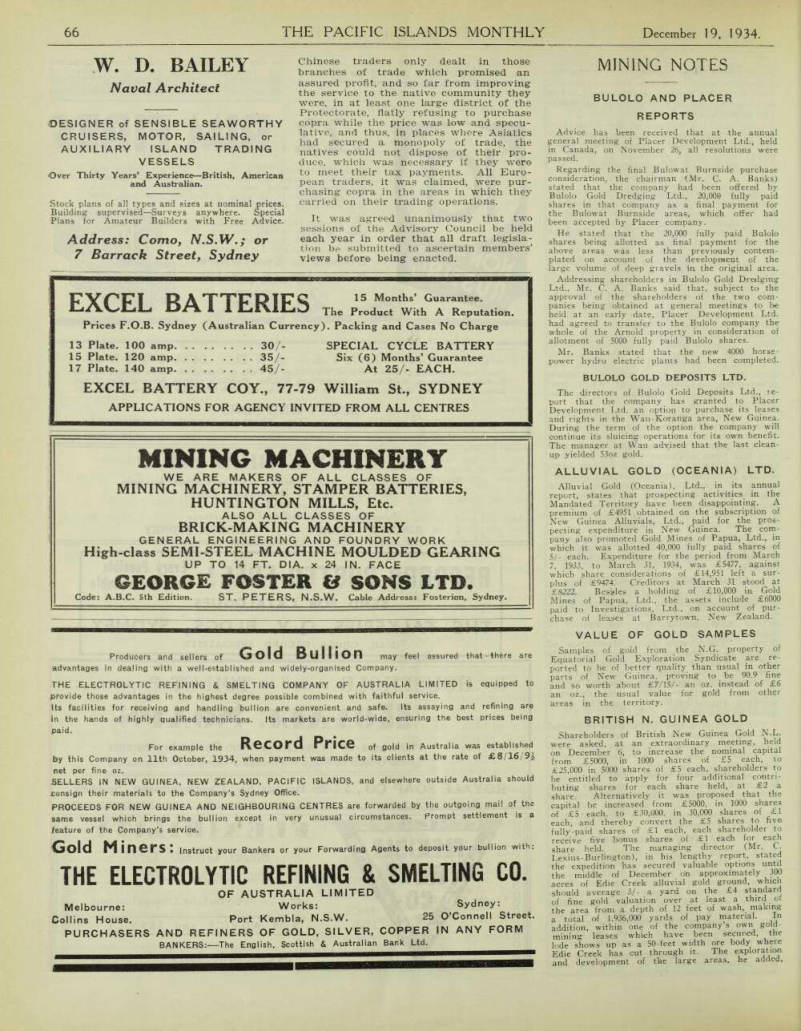
Some Important Reforms
THE annual session of the Advisory Council of the British Solomon Islands Protectorate opened at Tulagi on October 23. Members present were— Official: His Honour the Resident Commissioner (Mr. F. N. Ashley) President; Secretary to the Government (Capt. N. S. B. Kid son); Treasurer (Mr. F. E. Johnson, I.S.O.); Commissioner of Lands (Mr. S.
G. C. Knibbs). Non-official: Mr. D. Mac- Kinnon, Mr. G. E. Clift, Major F. R.
Hewitt, M.C. The fourth member, the Bishop of Melanesia, was absent on a visit to New Guinea The President read a telegram re ceived from the High Commissioner for the Western Pacific in which his Excel lency expressed of his interest in the Protectorate, and in the recommendations of the Advisory Council.
His Honour, before entering upon a de tailed survey of the administrative work carried on during the past year, made a statement of the action taken on matters discussed at the previous meeting.
On that occasion the non-official mem bers submitted strong recommendations that the Courts should be empowered to order flogging as part of the sentences passed upon natives convicted of com mitting offence against women. In re sponse, the High Commissioner had ap proved a King’s Regulation which pro vides for a flogging for any person con victed of indecent assault upon a female.
The Native Passes Regulation, which was adversely criticised, has been re pealed, except on Rennell and Bellona Islands.
The recommendation that fees for store licences be reduced was not accepted, but his Excellency is prepared to give favour able consideration to abolishing these licences altogether when conditions im prove, and revenue loss is of less vital importance.
The recommendation that the minimum rate of wages to labourers be reduced from £1 to 10/- per month was approved, and the amended scale comes into opera tion on 1st December. The rate of wages is to be re-investigated towards the end of 1936, or earlier.
The recommendation that employers should be relieved of the obligation to pay the tax of natives in their employ (the tax is collected from the natives when not under indenture, but from their employer when they enter into a contract of indenture) was not agreed to, but his Excellency approved a flat rate of 57being imposed in place of present rates which vary from 5/- to £1 per annum.
Decreasing Population.
On the problem of decreasing native population, His Honour said that an in vestigation was proceeding to ascertain
how far faulty nourishment and conse quent diminished virility might be re sponsible; and thus far reports showed that, with the possible exception of a few small areas, there was at least no short age of good local foods.
Last year the natives of the Protector ate, with only few exceptions, paid their tax: but this year, it was forecast, they might have some difficulty in doing so owing to the low price of copra.
Copra Industry.
Referring to conflicting reports and opinions on the future of the copra indus try, His Honour said it was difficult to arrive at any definite conclusion. It was fully realised that the plight of the smaller companies and individual planters was desperate, and many schemes to ren der assistance had been and were being considered, without, so far, a practical and equitable method having materialised.
It was forecast that revenue from im ports will realise the amount budgeted for, but the export tax on copra will be much less. Rigid economy in all depart ments of the public service is being exer cised. Officials who have been recently retired or transferred to other colonies will not, for the present, be replaced. The granting of fares to wives of officials proceeding on leave, except when tra velling with their husbands, will be dis continued.
The two entomological officers con tinued unremittingly their investigation of diseases and pests which afflict the coconut palm, and much useful informa tion has been acquired without, however, enabling them 1 , to arrive at a definite con clusion regarding the cause of “nutfall” and poor crops on many estates. The officers are now engaged in carrying out manurial experiments on randomised, re plicated plots, from which important in formation should be obtained.
Business on the agenda was then pro ceeded with. The following is an out line of the most important matters dis cussed:
Assistance To Planters
It was submitted that the most useful and permanent benefit would accrue from the erection on plantations of hot-air drying mills; giving improved quality of copra, and better prices than smoke dried. There was some divergence of opinion as to whether the cost of materials and the erection of mills should take the form of a free grant to planters, or be advanced as a loan with nominal or no interest. Further action was deferred pending investigations as to the most suitable type of mill.
The draft of a new Regulation to amend and consolidate existing labour regula tions was examined at length and, with recommendations for certain amendments, agreed to.
A proposed new ration scale for native labourers was discussed, and the scale proposed by the acting senior medical officer (Dr. Crichlow) who has had long experience of conditions in the Protector ate, was recommended.
Trading Conditions
An application by the South Sea Evan gelical Mission for permission to sell school requisites without taking out a store licence was opposed by non-official members on the ground that so long as traders, who kept a store, were compelled to take out a licence at a cost of £10 per annum, no exemption should be granted.
Government members voted in favour, and non-official members against.
A non-official member moved that cer tain obligations should attach to the issue
of trading licences. He pointed out that the Administration, apparently holding the view that European traders were not giving adequate services to the natives
of the Protectorate, had recently removed all restrictions as to the number of licences that might be issued to Chinese.
Experience now showed, he alleged, that
Chinese traders only dealt in those branches of trade which promised an assured profit, and so far from improving the service to the native community they were, in at least one large district of the Protectorate, flatly refusing to purchase copra while the price was low and specu lative, and thus, in places where Asiatics had secured a monopoly of trade, the natives could not dispose of their pro duce, which was necessary if they were to meet their tax payments. All Euro pean traders, it was claimed, were pur chasing copra in the areas in which they carried on their trading operations.
It was agreed unanimously that two sessions of the Advisory Council be held each year in order that all draft legisla tion bp submitted to ascertain members’ views before being enacted.
Advertisements & other items, pp. 66-68 (1 item)
Nock &
Kirby's
CATALOGUES
Kitchenware, Crockery and Glassware, Builders’ Material, Ship Chandlery, Paint, or Garden catalogues posted free on request
NOCK &
KIRBY’S
Postal Address: Desk PM
Box 68CC, G.P.O., SYDNEY
Agents Wanted
Owing to increased demand for Titon Hormone
Preparations
in the Pacific Islands, we wish to appoint Sub-Agents to facilitate distribution.
Correspondence Invited.
A. STOPFER
16-20 Bridge Street, Sydney,
N.S.W.
Uka Ant Euchres Ants, so
WHY SHARE YOUR FOOD WITH
ANTS
Success since 1923 Get a Set and you’re Set Obtainable at B.P. W.R.C. or other Island Stores Manufactured by Uka Ant Co. 11 Gelding Street, Dulwich Hill, Sydney This little device, placed under safe or table legs, will positively keep ants out
WITHOUT
WATER OR AT-
TENTION
.22 RIM FIRES
Both “I.C.I.” and “I.C.I. Express” .22’s are loaded with Smokeless Powder combined with a new and powerful non-corrosive priming mixture that assures rapid ignition and the residues from which protect the rifle bore from rust and make cleaning unnecessary.
The powder used in “I.C.I. Express” is of an entirely new progressive-burning type that gives higher velocities with low pressure.
Obtainable Everywhere
In Short, Long, and Long Rifle, Solid and Hollow Point.
SHORT
COPRA MATS AND MATTING
Send your enquiries to us for Woven Wire Mesh in Rolls or framed for Copra drying, and all Screening purposes. Bird Cages, Sieves and Riddles, Builder’s Gravel Screens, Rat Traps, Door Mats, Garden Arches, Chain Wire Mesh, Crimped Wire Mesh for Window Guards, etc.
SCOTT AND SONS
WIREWORKS: RAILWAY PARADE AND MURRAY STREET, MARRICKVILLE
THE BRIDGE BIRD SHOP
For Well-bred Birds, Dogs, Persian Cats and other Animals All Pedigreed at Reasonable Prices We Buy as Well as Sell Islanders are Invited to Communicate
6 JUNCTION STREET NORTH SYDNEY
RECORDS POSTED FREE! Record Available
SEND FOR CATALOGUES
THE TALKERIES, Q. V. BLDGS., SYDNEY
(MAIL ORDER RECORD SPECIALISTS)
for HOUSEHOLD as well as TOILET Purposes...
ItoYALE Soaps
Manufactured in Australia from Purest Ingredients Special Quotes to Island Storekeepers—Samples on Application ROYALE SOAP CO., 24-26 Briggs St., Camperdown, Sydney
PRICE
LIST
ON
APPLICATION
FLEXIBILITY
means Greater Grip
and Longer Life!
Let us solve your belting problems
FOR ADVICE and SERVICE
34 Clisdell St., Surry Hills, Sydney
W. D. BAILEY
Naval Architect
DESIGNER of SENSIBLE SEAWORTHY
CRUISERS, MOTOR, SAILING, or
AUXILIARY ISLAND TRADING
VESSELS
Over Thirty Years’ Experience—British, American and Australian.
Stock plans of all types and sizes at nominal prices.
Building supervised—Surveys anywhere. Special Plans for Amateur Builders with Free Advice.
Address: Como, N.S.W.; or
7 Barrack Street, Sydney
EXCEL BATTERIES
15 Months’ Guarantee.
The Product With A Reputation.
Prices F.O.B. Sydney (Australian Currency). Packing and Cases No Charge 13 Plate. 100 amp 30/- SPECIAL CYCLE BATTERY 15 Plate. 120 amp 35/- Six (6) Months’ Guarantee 17 Plate. 140 amp 45/- At 25/- EACH.
EXCEL BATTERY COY., 77-79 William St., SYDNEY APPLICATIONS FOR AGENCY INVITED FROM ALL CENTRES
MINING MACHINERY
WE ARE MAKERS OF ALL CLASSES OF
MINING MACHINERY, STAMPER BATTERIES,
HUNTINGTON MILLS, Etc.
ALSO ALL CLASSES OF
BRICK-MAKING MACHINERY
GENERAL ENGINEERING AND FOUNDRY WORK
High-class SEMI-STEEL MACHINE MOULDED GEARING
UP TO 14 FT. DIA. x 24 IN. FACE
GEORGE FOSTER & SONS LTD.
Code; A.B.C. 5th Edition. ST. PETERS, N.S.W. Cable Address; Fosterion, Sydney.
Producers and sellers of Gold Bullion may feel assured that there are advantages in dealing with a well-established and widely-organised Company.
THE ELECTROLYTIC REFINING & SMELTING COMPANY OF AUSTRALIA LIMITED is equipped to provide those advantages in the highest degree possible combined with faithful service.
Its facilities for receiving and handling bullion are convenient and safe. Its assaying and refining are in the hands of highly qualified technicians. Its markets are world-wide, ensuring the best prices being paid.
Record Price
For example the Record Price of gold in Australia was established by this Company on 11th October, 1934, when payment was made to its clients at the rate of £B/16/9J. net per fine oz.
SELLERS IN NEW GUINEA, NEW ZEALAND, PACIFIC ISLANDS, and elsewhere outside Australia should consign their materials to the Company’s Sydney Office.
PROCEEDS FOR NEW GUINEA AND NEIGHBOURING CENTRES are forwarded by the outgoing mail of the same vessel which brings the bullion except in very unusual circumstances. Prompt settlement is a feature of the Company’s service.
Gold Miners: Instruct your Bankers or your Forwarding Agents to deposit ydur bullion with:
THE ELECTROLYTIC REFINING & SMELTING CO.
OF AUSTRALIA LIMITED
Melbourne: Works: Sydney: Collins House. Port Kembla, N.S.W. 25 O’Connell Street.
PURCHASERS AND REFINERS OF GOLD, SILVER, COPPER IN ANY FORM BANKERS: —The English, Scottish & Australian Bank Ltd.
Mining Notes
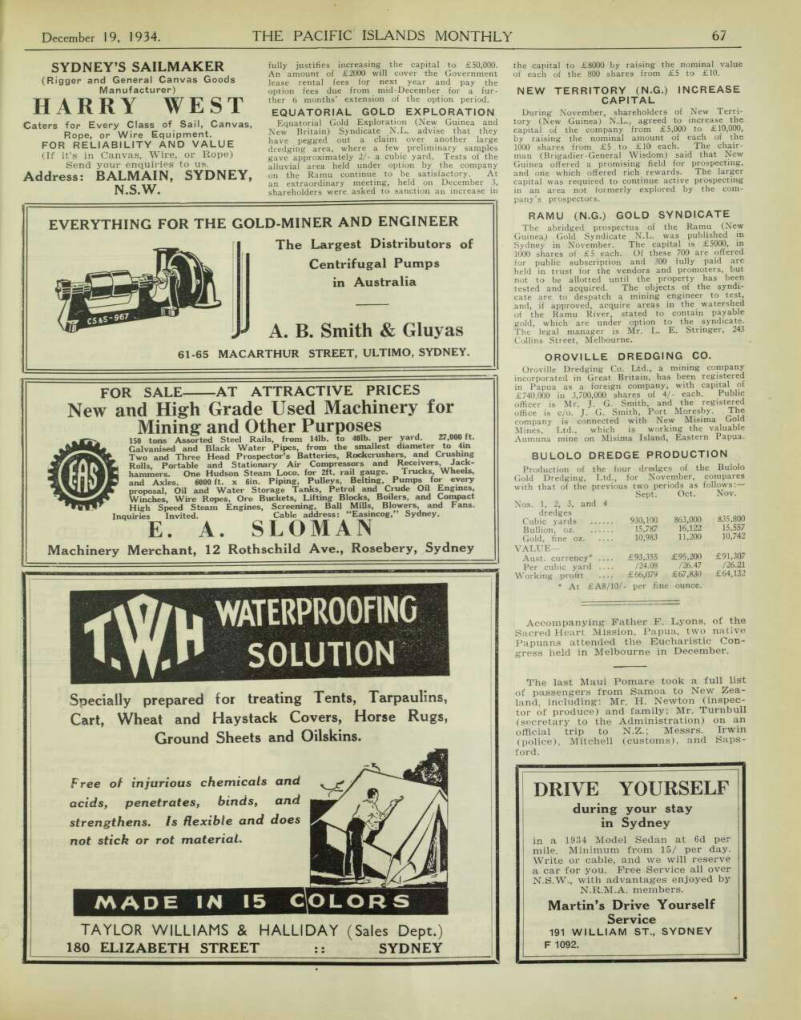
Bulolo And Placer
Reports
Advice has been received that at the annual general meeting of Placer Development Ltd., held in Canada, on November 26, all resolutions were passed.
Regarding the final Bulowat Burnside purchase consideration, the chairman (Mr. C. A. Banks) stated that the company had been offered by Bulolo Gold Dredging Ltd., 20,009 fully paid shares in that company as a final payment for the Bulowat Burnside areas, which offer had been accepted by Placer company.
He stated that the 20,000 fully paid Bulolo shares being allotted as final payment for the above areas was less than previously contem plated on account of the development of the large volume of deep gravels in the original area.
Addressing shareholders in Bulolo Gold Dredging Ltd., Mr. C. A. Banks said that, subject to the approval of the shareholders of the two com panies being obtained at general meetings to be held at an early date, Placer Development Ltd. had agreed to transfer to the Bulolo company the whole of the Arnold property in consideration of allotment of 5000 fully paid Bulolo shares.
Mr. Banks stated that the new 4000 horse power hydro electric plants had been completed.
Bulolo Gold Deposits Ltd.
The directors of Bulolo Gold Deposits Ltd., re port that the company has granted to Placer Development Ltd. an option to purchase its leases and rights in the Wau-Koranga area, New Guinea.
During the term of the option the company will continue its sluicing operations for its own benefit.
The manager at Wau advised that the last clean up yielded 53oz gold.
Alluvial Gold (Oceania) Ltd.
Alluvial Gold (Oceania), Ltd., in its annual report, states that prospecting activities in the Mandated Territory have been disappointing. A premium of £4951 obtained on the subscription of New Guinea Alluvials, Ltd., paid for the pros pecting expenditure in New Guinea. The com pany also promoted Gold Mines of Papua, Ltd., in which it was allotted 40,000 fully paid shares of 5/- each. Expenditure for the period from March 7, 1933, to March 31, 1934, was £5477, against which share considerations of £14,951 left a sur plus of £9474. Creditors at March 31 stood at £8222. Besides a holding of £10,000 in Gold Mines of Papua, Ltd., the assets include £6000 paid to Investigations, Ltd., on account of pur chase of leases at Barrytown, New Zealand.
Value Of Gold Samples
Samples of gold from the N.G. property of Equatorial Gold Exploration Syndicate are re ported to be of better quality than usual in other parts of New Guinea, proving to be 90.9 fine and so worth about £7/15/- an oz. instead of £6 an oz., the usual value for gold from other areas in the territory.
British N. Guinea Gold
Shareholders of British New Guinea Gold N.L. were asked, at an extraordinary meeting, held on December 6, to increase the nominal capital from £5000, in 1000 shares of £5 each, to £25,000 in 5000 shares of £5 each, shareholders to be entitled to apply for four additional contri buting shares for each share held, at £2 a share. Alternatively it was proposed that the capital be increased from £5000, in 1000 shares of £5 each, to £30,000, in 30,000 shares of £1 each, and thereby convert the £5 shares to five fully-paid shares of £1 each, each shareholder to receive five bonus shares of £1 each for each share held. The managing director (Mr. C.
Lexius-Burlington), in his lengthy report, stated the expedition has secured valuable options until the middle of December bn approximately 300 acres of Edie Creek alluvial gold ground, whicn should average 3/- a yard on the £4 standard of fine gold valuation over at least a third ot the area from a depth of 12 feet of wash, making a total of 1,936,000 yards of pay material. In addition, within one of the company’s own gold mining leases which have been secuned, the lode shows up as a 50-feet width ore body where Edie Creek has cut through it. The exploration and development of the large areas, he added,
fully justifies increasing the capital to £50,000.
An amount of £2000 will cover the Government lease rental fees for next year and pay the option fees due from mid-December for a fur ther 6 months’ extension of the option period.
Equatorial Gold Exploration
Equatorial Gold Exploration (New Guinea and New Britain) Syndicate N.L. advise that they have pegged out a claim over another large dredging area, where a few preliminary samples gave approximately 2/- a cubic yard. Tests of the alluvial area held under option by the company on the Ramu continue to be satisfactory. At an extraordinary meeting, held on December 3, shareholders were asked to sanction an increase in
the capital to £8000 by raising the nominal value of each of the 800 shares from £5 to £10.
New Territory (N.G.) Increase
Capital
During November, shareholders of New Terri tory (New Guinea) N.L., agreed to increase the capital of the company from £5,000 to £10,000, by raising the nominal amount of each of the 1000 shares from £5 to £10 each. The chairman (Brigadier-General Wisdom) said that New Guinea offered a promising field for prospecting, and one which offered rich rewards. The larger capital was required to continue active prospecting in an area not formerly explored by the com pany’s prospectors.
Ramu (N.G.) Gold Syndicate
The abridged prospectus of the Ramu (New Guinea) Gold Syndicate N.L. was published in Sydney in November. The capital is £5000, in 1000 shares of £5 each. Of these 700 are offered for public subscription and 300 fully paid are held in trust for the vendors and promoters, but not to be allotted until the property has been tested and acquired. The objects of the syndi cate are to despatch a mining engineer to test, and, if approved, acquire areas in the watershed of the Ramu River, stated to contain payable gold, which are under option to the syndicate.
The legal manager is Mr. L. E. Stringer, 243 Collins Street, Melbourne.
Oroville Dredging Co.
Oroville Dredging Co. Ltd., a mining company incorporated in Great Britain, has been registered in Papua as a foreign company, with capital of £740,000 in 3,700,000 shares of 4/- each. Public officer is Mr. J. G. Smith, and the registered office is c/o. J. G. Smith, Port Moresby. The company is connected with New Misima Gold Mines, Ltd., which is working the valuable Aumuna mine on Misima Island, Eastern Papua.
Bulolo Dredge Production
Production of the four dredges of the Bulolo Gold Dredging, Ltd., for November, compares with that of the previous two periods as follows: — Sept. Oct. Nov.
Nos. 1,2, 3, and 4 dredges Cubic yards 930,100 863,000 835,800 Bullion, oz 15,787 16,122 15,557 Gold, fine oz 10,983 11,200 10,742
Value-
Aust. currency* ... £93,355 £95,200 £91,307 Per cubic yard ... /24.08 /26.47 /26.21 Working profit ... £66,079 £67,830 £64,132 * At £A8/10/- per fine ounce.
Accompanying Father F. Lyons, of the Sacred Heart Mission, Papua, two native Papuans attended the Eucharistic Con gress held in Melbourne in December.
The last Maui Pomare took a full list of passengers from Samoa to New Zea land, including: Mr. H. Newton (inspec tor of produce) and family; Mr. Turnbull (secretary to the Administration) on an official trip to N.Z.; Messrs. Irwin (police), Mitchell (customs), and Saps ford.
Advertisements & other items, p. 69 (1 item)
Waterproofing
SYDNEYS SAILMAKER
(Rigger and General Canvas Goods Manufacturer)
HARRY WEST
Caters for Every Class of Sail, Canvas, Rope, or Wire Equipment.
FOR RELIABILITY AND VALUE
(If it’s in Canvas, Wire, or Rope) Send your enquiries to us.
Address: BALMAIN, SYDNEY,
N.S.W.
EVERYTHING FOR THE GOLD-MINER AND ENGINEER
The Largest Distributors of Centrifugal Pumps in Australia
A. B. Smith & Gluyas
61-65 MACARTHUR STREET, ULTIMO, SYDNEY.
FOR SALE-
AT ATTRACTIVE PRICES
New and High Grade Used Machinery for
Mining and Other Purposes
150 tons Assorted Steel Rails, from 14lb. to 40lb. per yard. 27,000 ft.
Galvanised and Black Water Pipes, from the smallest diameter to 4in Two and Three Head Prospector’s Batteries, Rockcrushere, and Crushing Rolls, Portable and Stationary Air Compressors and Receivers Jackhammers. One Hudson Steam Loco, for 2ft, rail gauge. Trucks, Wheels, and Axles. 6000 ft. x 6in. Piping, Pulleys, Belting, Pumps for every proposal, Oil and Water Storage Tanks, Petrol and Crude Oil Engines, Winches, Wire Ropes, Ore Buckets, Lifting Blocks, Boilers, and Compact High Speed Steam Engines, Screening, Ball Mills, Blowers, and Fans.
Inquiries Invited. Cable address: “Easincog,” Sydney.
E. A. SLOMAN
Machinery Merchant, 12 Rothschild Ave., Rosebery, Sydney
WATERPROOFING
SOLUTION
Specially prepared for treating Tents, Tarpaulins, Cart, Wheat and Haystack Covers, Horse Rugs, Ground Sheets and Oilskins.
Free of injurious chemicals and acids , penetrates , binds , and strengthens. Is flexible and does not stick or rot material.
MADE IN 15 COLORS
TAYLOR WILLIAMS & HALLIDAY (Sales Dept.)
180 ELIZABETH STREET :: SYDNEY
DRIVE YOURSELF
during your stay
in Sydney
in a 1934 Model Sedan at 6d per mile. Minimum from 15/ per day.
Write or cable, and we will reserve a car for you. Free Service all over N.S.W., with advantages enjoyed by N.R.M.A. members.
Martin’s Drive Yourself
Service
191 WILLIAM ST., SYDNEY
F 1092.
Pologists
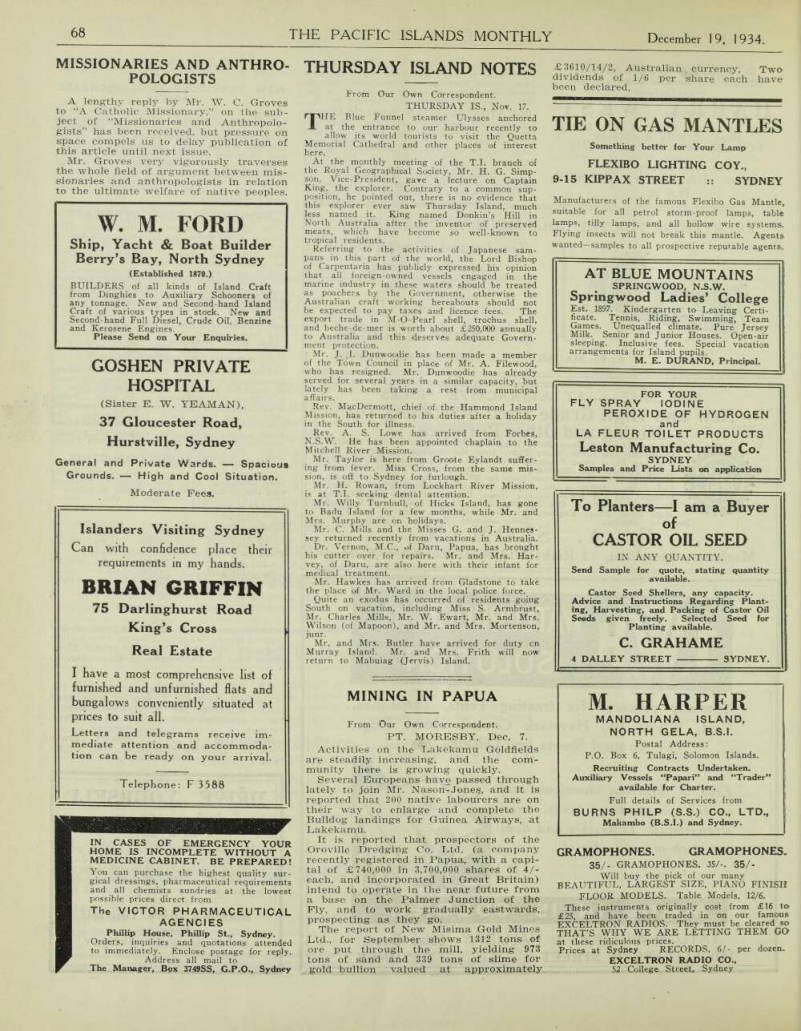
Missionaries And Anthro
A lengthy reply by Mr. W. C. Groves to “A Catholic Missionary,” on the sub ject of ‘‘Missionaries and Anthropolo gists” has been received, but pressure on space compels us to delay publication of this article until next issue.
Mr. Groves very vigorously traverses the whole field of argument between mis sionaries and anthropologists in relation to the ultimate welfare of native peoples.
Thursday Island Notes
From Our Own Correspondent.
Thursday Is., Not. 17.
THE Blue Funnel steamer Ulysses anchored at the entrance to our harbour recently to allow its world tourists to visit the Quetta Memorial Cathedral and other places of interest here.
At the monthly meeting of the T.I. branch of the Royal Geographical Society, Mr. H. G. Simp son, Vice-President, gave a lecture on Captain King, the explorer. Contrary to a common sup position, he pointed out, there is no evidence that this explorer ever saw Thursday Island, much less named it. King named Donkin’s Hill in North Australia after the inventor of preserved meats, which have become so well-known to tropical residents.
Referring to the activities of Japanese sam pans in this part of the world, the Lord Bishop of Carpentaria has publicly expressed his opinion that all foreign-owned vessels engaged in the marine industry in these waters should be treated as poachers by the Government, otherwise the Australian craft working hereabouts should not be expected to pay taxes and licence fees. The export trade in M-O-Pearl shell, trochus shell, and beche-de-mer is worth about £250,000 annually to Australia and this deserves adequate Govern ment protection.
Mr. J. I. Dunwoodie has been made a member of the Town Council in place of Mr. A. Filewood, who has resigned. Mr. Dunwoodie has already served for several years in a similar capacity, but lately has been taking a rest from municipal affairs.
Rev. MacDermott, chief of the Hammond Island Mission, has returned to his duties after a holiday in the South for illness.
Rev. A. S. Lowe has arrived from Forbes, N.S.W. He has been appointed chaplain to the Mitchell River Mission.
Mr. Taylor is here from Groote Eylandt suffer ing from fever. Miss Cross, from the same mis sion, is off to Sydney for furlough.
Mr. H. Rowan, from Lockhart River Mission, is at T.I. seeking dental attention.
Mr. Willy Turnbull, of Hicks Island, has gone to Badu Island for a few months, while Mr. and Mrs. Murphy are on holidays.
Mr. C. Mills and the Misses G. and J. Hennes sey returned recently from vacations in Australia.
Dr. Vernon, M.C., of Daru, Papua, has brought his cutter over for repairs. Mr. and Mrs. Har vey, of Daru, are also here with their infant for medical treatment.
Mr. Hawkes has arrived from Gladstone to take the place of Mr. Ward in the local police force.
Quite an exodus has occurred of residents going South on vacation, including Miss S. Armbrust, Mr. Charles Mills, Mr. W. Ewart, Mr. and Mrs.
Wilson (of Mapoon), and Mr. and Mrs. Mortenson, junr.
Mr. and Mrs. Butler have arrived for duty cn Murray Island. Mr. and Mrs. Frith will now return to Mabuiag (Jervis) Island.
Mining In Papua
From Our Own Correspondent.
Pt. Moresby, Dec. 7.
Activities on the Lakekamu Goldfields are steadily increasing, and the com munity there is growing quickly.
Several Europeans have passed through lately to join Mr. Nason-Jones, and it is reported that 200 native labourers are on their way to enlarge and complete the Bulldog landings for Guinea Airways, at Lakekamu.
It is reported that prospectors of the Oroville Dredging Co. Ltd. (a company recently registered in Papua, with a capi tal of £740,000 in 3,700,000 shares of 4/each, and incorporated in Great Britain) intend to operate in the near future from a base on the Palmer Junction of the Fly, and to work gradually eastwards, prospecting as they go.
The report of New Misima Gold Mines Ltd., for September shows 1312 tons of ore put through the mill, yielding 973 tons of sand and 339 tons of slime for gold bullion valued at approximately
£3610/14/2, Australian currency. Two dividends of 1/6 per share each have been declared.
Advertisements & other items, p. 70 (2 items)
M. Harper
TIE ON GAS MANTLES
Something better for Your Lamp
FLEXIBO LIGHTING COY..
9-15 KIPPAX STREET :: SYDNEY
Manufacturers of the famous Flexibo Gas Mantle, suitable for all petrol storm-proof lamps, table lamps, tilly lamps, and all hollow wire systems.
Flying insects will not break this mantle. Agents wanted —samples to all prospective reputable agents.
AT BLUE MOUNTAINS
SPRINGWOOD, N.S.W.
Springwood Ladies’ College
Est. 1897. Kindergarten to Leaving Certificate. Tennis, Riding, Swimming, Team Games. Unequalled climate. Pure Jersey Milk. Senior and Junior Houses. Open-air sleeping. Inclusive fees. Special vacation arrangements for Island pupils.
M. E. DURAND, Principal.
FOR YOUR
FLY SPRAY lODINE
PEROXIDE OF HYDROGEN
and
LA FLEUR TOILET PRODUCTS
Leston Manufacturing Co.
SYDNEY
Samples and Price Lists on application
To Planters—I am a Buyer
of
CASTOR OIL SEED
IN ANY QUANTITY.
Send Sample for quote, stating quantity available.
Castor Seed Shellers, any capacity.
Advice and Instructions Regarding Planting, Harvesting, and Packing of Castor Oil Seeds given freely. Selected Seed for Planting available.
C. GRAHAME
4 DALLEY STREET SYDNEY.
M. HARPER
MAN DOLI AN A ISLAND,
NORTH GELA, B.S.I.
Postal Address: P.O. Box 6, Tulagi, Solomon Islands.
Recruiting Contracts Undertaken.
Auxiliary Vessels “Papari” and “Trader” available for Charter.
Full details of Services from
BURNS PHILP (S.S.) CO., LTD.,
Makambo (B.S.I.) and Sydney.
GRAMOPHONES. GRAMOPHONES.
35/. GRAMOPHONES, 35/-. 357-
Will buy the pick of our many
BEAUTIFUL, LARGEST SIZE, PIANO FINISH
FLOOR MODELS. Table Models, 12/6.
These instruments originally cost from £l6 to £25, and have been traded in on our famous EXCELTRON RADIOS. They must be cleared so THAT’S WHY WE ARE LETTING THEM GO at these ridiculous prices.
Prices at Sydney RECORDS, 6/- per dozen.
EXCELTRON RADIO CO.,
52 College Street, Sydney
W. M. Ford
Ship, Yacht & Boat Builder
Berry’s Bay, North Sydney
(Established 1570.) BUILDERS of all kinds of Island Craft from Dinghies to Auxiliary Schooners of any tonnage. New and Second-hand Island Craft of various types in stock. New and Second-hand Full Diesel, Crude Oil, Benzine and Kerosene Engines.
Please Send on Your Enquiries.
GOSHEN PRIVATE
HOSPITAL
(Sister E. W. TEAMAN), 37 Gloucester Road, Hurstville, Sydney General and Private Wards. Spacious Grounds. High and Cool Situation.
Moderate Fees.
Islanders Visiting Sydney Can with confidence place their requirements in my hands.
BRIAN GRIFFIN
75 Darlinghurst Road King’s Cross Real Estate I have a most comprehensive list of furnished and unfurnished flats and bungalows conveniently situated at prices to suit all.
Letters and telegrams receive immediate attention and accommodation can be ready on your arrival.
Telephone: F 3588
IN CASES OF EMERGENCY YOUR
HOME IS INCOMPLETE WITHOUT A
MEDICINE CABINET. BE PREPARED!
You can purchase the highest quality surgical dressings, pharmaceutical requirements and all chemists sundries at the lowest possible prices direct from
The VICTOR PHARMACEUTICAL
AGENCIES
Phillip House, Phillip St., Sydney.
Orders, inquiries and quotations attended to immediately. Enclose postage for reply.
Address all mail to The Manager, Box 374955, G.P.O., Sydney
Market Quotations
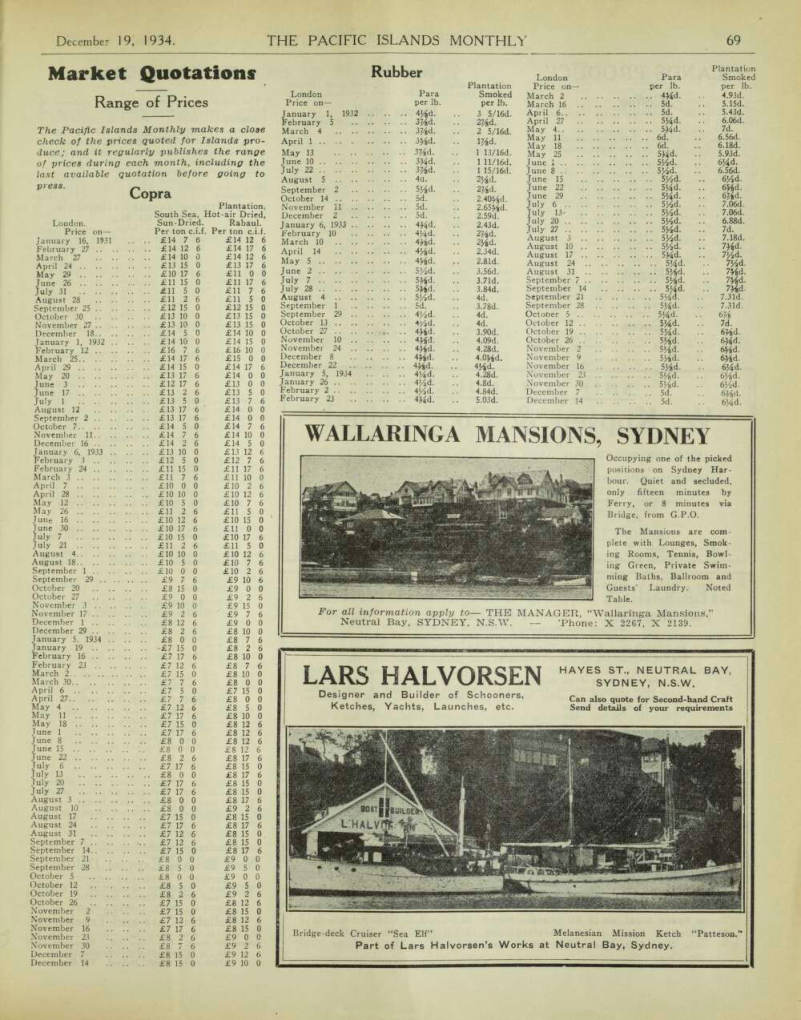
Range of Prices
The Pacific Islands Monthly makes a close check of the prices quoted for Islands pro duce; and it regularly publishes the range of prices during each month, including the last available quotation before going to
press.
London Price on — Para per lb.
Plantation Smoked per lb.
March 2 W- 4.93d.
March 16 5d. 5.15d.
April 6 5.43d.
April 27 .. .. 5J4d. 6.06d.
May 4 .. .. SV 4 d. 7d.
May 11 .. .. 6d. 6.56d.
May 18 6.18d.
May 25 .. .. .. .. 5j4d. 5.93d.
June 1 6'Ad.
June 8 .. .. S'Ad. 6.56d.
June 15 S'Ad. 6^d.
June 22 S'Ad. 6Ad.
J une 29 .. .. sy 4 d. 67Ad.
July 6 S'Ad. 7.06d.
July 13 S'Ad. 7.06d.
July 20 syd. 6.88d.
July 27 S'Ad. 7d.
August 3 S'Ad. 7.18d.
August 10 5/4d. 7Hd.
August 17 S^d. 7'Ad.
August 24 S'Ad. 7'Ad.
August 31 S'Ad. 7Ad.
September 7 S'Ad. 7Ad.
September 14 S'Ad. 7Hd- September 21 .. .. 5'Ad. 7.31d.
September 28 .. .. sy 4 d. 7.31d.
October 5 .. .. sy 4 d. 67i October 12 .. .. sy 4 d. 7d.
October 19 .. .. 5j4d. 6Hd.
October 26 .. .. S'Ad. 6Hd.
November 2 .. .. S'Ad. 6Hd.
November 9 .. .. S'Ad. 6Hd.
November 16 S'Ad. 6'Ad.
November 23 .. .. S'Ad. 6'Ad.
November 30 .. .. S'Ad. 6'Ad.
December 7 .. .. Sd. 6Hd.
December 14 5d. 6'Ad.
London Price on —
Rubber
Para per lb.
Plantation Smoked per lb.
January 1, 1932 February 5 3 S/16d. 3ftd. 2Jid- March 4 md. 2 S/16d.
April 1 Md.
IHd.
May 13 VAd. 1 13/16d.
June 10 Wd. 1 ll/16d.
July 22 3Hd. 1 15/16d.
August 5 2'Ad.
September 2 S'Ad. 27Ad.
October 14 5d. 2.40^d.
November 11 5d. 2.65^d.
December 2 Sd. 2.59d.
January 6, 1933 4**d. 2.43d.
February 10 4^d. 2Hd.
March 10 4Hd. 2%d.
April 14 4tfd. 2.34d.
May 5 4**d. 2.81d.
June 2 sy 2 d. 3.56d.
July 7 SJid. 3.7ld.
July 28 5*d. 3.84d.
August 4 5'Ad. 4d.
September 1 5d. 3.78d.
September 29 4J/ 2 d. 4d.
October 13 */ad. 4d.
October 27 4Hd. 3.90d.
November 10 4J*d. 4.09d.
November 24 *Hd. 4.28d.
December 8 4*d. 4.0Hd.
December 22 4#d. w.
January 5, 1934 4%d. 4\28d.
January 26 4J/ a d. 4.8d.
February 2 4/ a d. 4.84d.
February 23 4Hd. 5.03d.
press.
Copra
Plantation, Hot-air Dried, Rabaul. Per ton c.i.f.
South Sea, Sun-Dried. Per ton c.i.f.
London. Price on — January 16, 1931 .. .. £14 7 6 £14 12 6 February 27 6 £14 17 6 March 27 .. .. £14 10 0 £14 12 6 April 24 .. .. £13 15 0 £13 17 6 May 29 .. .. £10 17 6 £11 0 0 June 26 .. .. £11 15 0 £11 17 6
July 31
.. .. £11 5 0 £11 7 6 August 28 .. .. £11 2 6 £11 5 0 September 25 .. .. £12 15 0 £12 15 0 October 30 .. .. £13 10 0 £13 15 0 November 27 .. .. £13 10 0 £13 15 0 December 18 .. .. £14 5 0 £14 10 0 January I, 1932 .. .. £14 10 0 £14 15 0 February 12 .. .. £16 7 6 £16 10 0 March 25 .. .. £14 17 6 £15 0 0 April 29 .. .. £14 15 0 £14 17 6 May 20 .. .. £13 17 6 £14 0 0 June 3 .. .. £12 17 6 £13 0 0 June 17 .. .. £13 2 6 £13 5 0 July 1 .. .. £13 5 0 £13 7 6 August 12 .. .. £13 17 6 £14 0 0 September 2 .. .. £13 17 6 £14 0 0 October 7 .. .. £14 5 0 £14 7 6 November 11 .. .. £14 7 6 £14 10 0 December 16 .. .. £14 2 6 £14 5 0 January 6, 1933 .. .. £13 10 0 £13 12 6 February 3 .. .. £12 5 0 £12 7 6 February 24 .. .. £11 15 0 £11 17 6 March 3 .. .. £11 7 6 £11 10 0 April 7 ... £10 0 0 £10 2 6 April 28 .. .. £10 10 0 £10 12 6 May 12 .. .. £10 5 0 £10 7 6 May 26 .. .. £11 2 6 £11 5 0 Jun e 16 .. .. £10 12 6 £10 15 0
June 30
.. .. £10 17 6 £11 0 0 July 7 .. .. £10 15 0 £10 17 6 July 21 .. .. £11 2 6 £11 5 0 August 4 .. .. £10 10 0 £10 12 6 August 18 .. .. £10 5 0 £10 7 6 September 1 .. .. £10 0 0 £10 2 6 September 29 .. .. £9 7 6 £9 10 6 October 20 ... £8 15 0 £9 0 0 October 27 .. .. £9 0 0 £9 2 6 November 3 ... £9 10 0 £9 15 0 November 17 .. .. £9 2 6 £9 7 6 December 1 .. .. £8 12 6 £9 0 0 December 29 .. .. £8 2 6 £8 10 0 January 5. 1934 .. .. £8 0 0 £8 7 6
January 19
.. .. £7 15 0 £8 2 6 February 16 .. .. £7 17 6 £8 10 0 February 23 ... £7 12 6 £8 7 6 March 2 ... £7 15 0 £8 10 0 March 30 .. .. £7 7 6 £8 0 0 April 6 .. .. £7 5 0 £7 15 0 April 27 .. .. £7 7 6 £8 0 0 May 4 ... £7 12 6 £8 5 0
May 11
... £7 17 6 £8 10 0 May 18 ... £7 15 0 £8 12 6 June 1 6 £8 12 6
June 8
.. .. £8 0 0 £8 12 6 June 15 .. .. £8 0 0 £8 12 6
June 22
.. .. £8 2 6 £8 17 6 July 6 6 £8 15 0 July 13 .. .. £8 0 0 £8 17 6 July 20 .. .. £7 17 6 £8 15 0 July 27 .. .. £7 17 6 £8 15 0 August 3 .. .. £8 0 0 £8 17 6 August 10 .. .. £8 0 0 £9 2 6 August 17 .. .. £7 15 0 £8 15 0 August 24 .. .. £7 17 6 £8 17 6 August 31 ... £7 12 6 £8 15 0 September 7 ... £7 12 6 £8 15 0 September 14 .. .. £7 15 0 £8 17 6 September 21 .. .. £8 0 0 £9 0 0 September 28 .. .. £8 5 0 £9 5 0 October 5 .. .. £8 0 0 £9 0 0 October 12 .. .. £8 5 0 £9 5 0 October 19 .. .. £8 2 6 £9 2 6 October 26 .. .. £7 15 0 £8 12 6 November 2 .. .. £7 15 0 £8 15 0 November 9 .. .. £7 12 6 £8 12 6 November 16 .. .. £7 17 6 £8 15 0 November 23 .. .. £8 2 6 £9 0 0 November 30 .. .. £8 7 6 £9 2 6 December 7 .. .. £8 15 0 £9 12 6 December 14 .. .. £8 15 0 £9 10 0
Advertisements & other items, p. 71 (1 item)
Lars Halvorsen
WALLARINGA MANSIONS, SYDNEY
Occupying one of the picked positions on Sydney Harbour. Quiet and secluded, only fifteen minutes by Ferry, or 8 minutes via Bridge, from G.P.O.
The Mansions are complete with Lounges, Smoking Rooms, Tennis, Bowling Green, Private Swimming Baths, Ballroom and Guests' Laundry. Noted Table.
For all information apply to— THE MANAGER, “Wallaringa Mansions,”
Neutral Bay, SYDNEY. N.S.W. ’Phone: X 2267, X 2139.
LARS HALVORSEN
Designer and Builder of Schooners, Ketches, Yachts, Launches, etc.
HAYES ST., NEUTRAL BAY,
SYDNEY, N.S.W.
Can also quote for Second-hand Craft Send details of your requirements Bridge-deck Cruiser “Sea Elf” Melanesian Mission Ketch “Patteson."
Part of Lars Halvorsen’s Works at Neutral Bay, Sydney.
Islands Produce
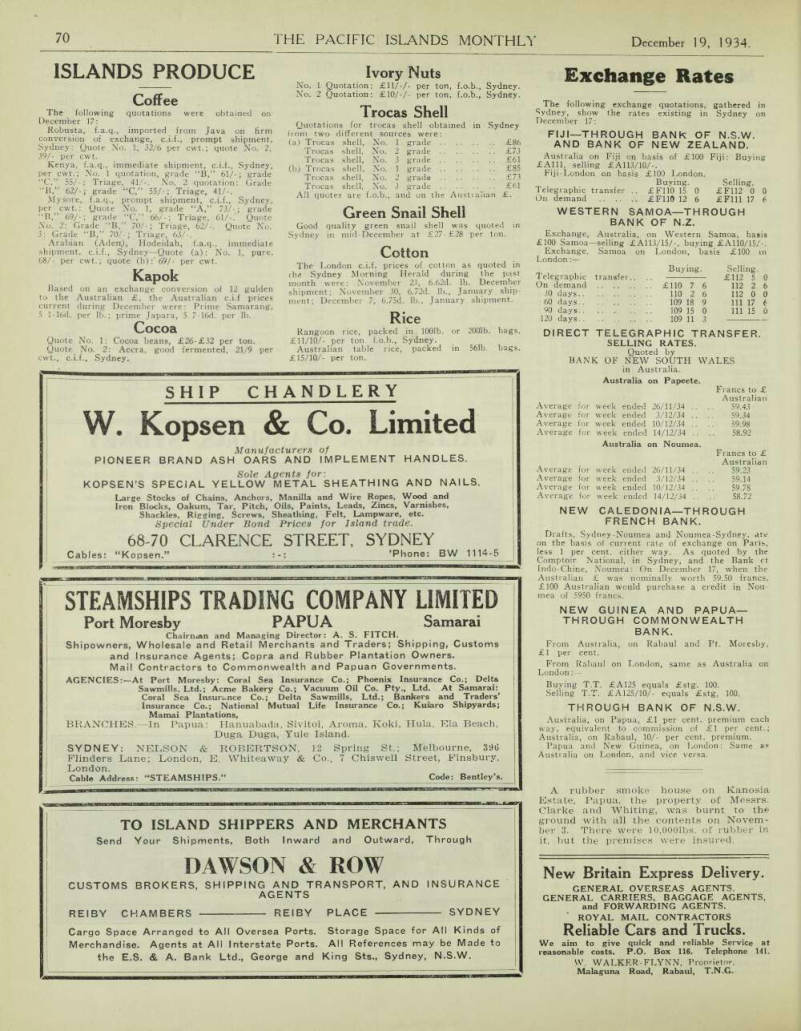
Coffee
The following quotations were obtained on December 17: Robusta, f.a.q., imported from Java on firm conversion of exchange, c.i.f., prompt shipment, Sydney: Quote No. 1, 32/6 per cwt.; quote No. 2, 39/- per cwt.
Kenya, f.a.q., immediate shipment, c.i.f., Sydney, per cwt.; No. 1 quotation, grade “B,” 61/-; grade “C,” 55/-; Triage, 41/-. No. 2 quotation: Grade “B,” 62/-; grade “C,” 55/-; Triage, 41/-.
Mysore, f.a.q., prompt shipment, c.i.f., Sydney, per cwt.: Quote No. 1, grade “A,” 73/-; grade “B,” 69/-; grade “C,” 66/-; Triage, 61/-. Quote No. 2: Grade “B,” 70/-; Triage, 62/-. Quote No. 3: Grade “B,” 70/-; Triage, 63/-.
Arabian (Aden), Hodeidah, f.a.q., immediate shipment, c.i.f., Sydney—Quote (a): No. 1, pure, 68/- per cwt.; quote (b): 69/- per cwt.
Kapok
Based on an exchange conversion of 12 gulden to the Australian £, the Australian c.i.f prices current during December were: Prime Samarang, 5 1-16d. per lb.; prime Japara, 5 7-16 d. per lb.
Cocoa
Quote No. 1: Cocoa beans, £26-£32 per ton.
Quote No. 2: Accra, good fermented, 21/9 per cwt., c.i.f., Sydney.
Ivory Nuts
No. 1 Quotation: £11/-/- per ton, f.o.b., Sydney.
No. 2 Quotation; £10/-/- per ton, f.o.b., Sydney.
Trocas Shell
Quotations for trocas shell obtained in Sydney from two different sources were: (a) Trocas shell, No. 1 grade £86 Trocas shell, No. 2 grade £73 Trocas shell, No. 3 grade £61 (b) Trocas shell, No. 1 grade £85 Trocas shell, No. 2 grade £73 Trocas shell, No. 3 grade £61 All quotes are f.o.b., and on the Australian £.
Green Snail Shell
Good quality green snail shell was quoted in Sydney in mid-December at £27-£28 per ton.
Cotton
The London c.i.f. prices of cotton as quoted in the Sydney Morning Herald during the past month were: November 23, 6.62 d. lb. December shipment; November 30, 6.72 d. lb., January ship ment; December 7,6.75 d. lb., January shipment.
Rice
Rangoon rice, packed in 100lb. or 200lb. bags, £11/10/- per ton f.o.b., Sydney.
Australian table rice, packed in 56lb. bags. £15/10/- per ton.
Exchange Rates
The following exchange quotations, gathered in Sydney, show the rates existing in Sydney on December 17:
Fiji—Through Bank Of N.S.W.
And Bank Of New Zealand.
Australia on Fiji on basis of £100 Fiji: Buying £A111, selling £A113/10/-.
Fiji-London on basis £100 London.
Buying. Selling.
Telegraphic transfer .. £F110 15 0 £F112 0 0 On demand £F110 12 6 £F111 17 6
Western Samoa—Through
Bank Of N.Z.
Exchange, Australia, on Western Samoa, basis £100 Samoa—selling £A113/15/-, buying £A110/15/-.
Exchange, Samoa on London, basis £100 in London:—
Direct Telegraphic Transfer.
Selling Rates.
Quoted by
Bank Of New South Wales
in Australia.
New Caledonia—Through
French Bank.
Drafts, Sydney-Noumea and Noumea-Sydney, arc on the basis of current rate of exchange on Paris, less 1 per cent, either way. As quoted by the Comptoir National, in Sydney, and the Bank of Indo-Chine, Noumea: On December 17, when the Australian £ was nominally worth 59.50 francs, £100 Australian would purchase a credit in Noumea of 5950 francs.
New Guinea And Papua
Through Commonwealth
Bank.
From Australia, on Rabaul and Pt. Moresby, £1 per cent.
From Rabaul on London, same as Australia on London Buying T.T. £A12S equals £stg. 100.
Selling T.T. £ A125/10/- equals £stg s 100.
Through Bank Of N.S.W.
Australia, on Papua, £1 per cent, premium each way, equivalent to commission of £1 per cent.; Australia, on Rabaul, 10/- per cent, premium.
Papua and New Guinea, on London: Same a?
Australia on London, and vice versa.
A rubber smoke house on Kanosia Estate, Papua, the property of Messrs.
Clarke and Whiting, was burnt to the ground with all the contents on Novem ber 3. There were 10,0001bs. of rubber in it, but the premises were insured.
Buying. Selling.
Telegraphic transfer.. .. £112 5 0 On demand £110 7 6 112 2 6 30 days 110 2 6 112 0 0 60 days 109 18 9 111 17 6 90 days 109 15 0 111 15 0 120 days 109 11 3
Australia on Papeete.
Francs to £ Australian Average for week ended 26/11/34 .. 59.43 Average for week ended 3/12/34 .. 59.34 Average for week ended 10/12/34 .. 59.98 Average for week ended 14/12/34 .. 58.92 Australia on Noumea.
Francs to £ Australian Average for week ended 26/11/34 .. 59.23 Average for week ended 3/12/34 .. 59.14 Average for week ended 10/12/34 .. 59.78 Average for week ended 14/12/34 .. 58.72
Advertisements & other items, p. 72 (2 items)
W. Kopsen & Co. Limited
SHIP CHANDLERY
Manufacturers of PIONEER BRAND ASH OARS AND IMPLEMENT HANDLES.
Sole Agents for : KOPSEN’S SPECIAL YELLOW METAL SHEATHING AND NAILS.
Large Stocks of Chains, Anchors, Manilla and Wire Ropes, Wood and Iron Blocks, Oakum, Tar, Pitch, Oils, Paints, Leads, Zincs, Varnishes, Shackles, Rigging, Screws, Sheathing, Felt, Lampware, etc.
Special Under Bond Prices for Island trade.
68-70 CLARENCE STREET, SYDNEY
Cables: "Kopsen.” ’Phone; BW 1114-6
STEAMSHIPS TRADING COMPANY LIMITED
Port Moresby PAPUA Samarai
Chairman and Managing Director: A. S. FITCH.
Shipowners, Wholesale and Retail Merchants and Traders; Shipping, Customs and Insurance Agents; Copra and Rubber Plantation Owners.
Mail Contractors to Commonwealth and Papuan Governments.
AGENCIES:—At Port Moresby: Coral Sea Insurance Co.; Phoenix Insurance Co.; Delta Sawmills. Ltd.; Acme Bakery Co.; Vacuum Oil Co. Pty., Ltd. At Samarai: Coral Sea Insurance Co.; Delta Sawmills, Ltd.; Bankers and Traders’
Insurance Co.; National Mutual Life Insurance Co.; Kuiaro Shipyards; Mamai Plantations, BRANCHES.—In Papua: Hanuabada, Sivitoi, Aroma, Koki, Hula, Ela Beach, Duga Duga, Yule Island.
SYDNEY: NELSON & ROBERTSON, 12 Spring St.; Melbourne, 39G Flinders Lane; London, E. Whiteaway & Co.. 7 Chiswell Street, Finsbury, London.
Cable Address: “STEAMSHIPS.” Code: Bentley’s
TO ISLAND SHIPPERS AND MERCHANTS
Send Your Shipments, Both Inward and Outward, Through
DAWSON & ROW
CUSTOMS BROKERS, SHIPPING AND TRANSPORT, AND INSURANCE
AGENTS
REI BY CHAMBERS REIBY PLACE SYDNEY
Cargo Space Arranged to All Oversea Ports. Storage Space for All Kinds of Merchandise. Agents at All Interstate Ports. All References may be Made to the E.S. & A. Bank Ltd., George and King Sts., Sydney, N.S.W.
New Britain Express Delivery.
GENERAL OVERSEAS AGENTS.
GENERAL CARRIERS. BAGGAGE AGENTS,
and FORWARDING AGENTS.
ROYAL MAIL CONTRACTORS
Reliable Cars and Trucks.
We aim to give quick and reliable Service at reasonable costs. P.O. Box 116. Telephone 141.
W. WALKER-FLYNN, Proprietor.
Malaguna Road, Rabaul, T.N.G.
Shipping Services in the Pacific
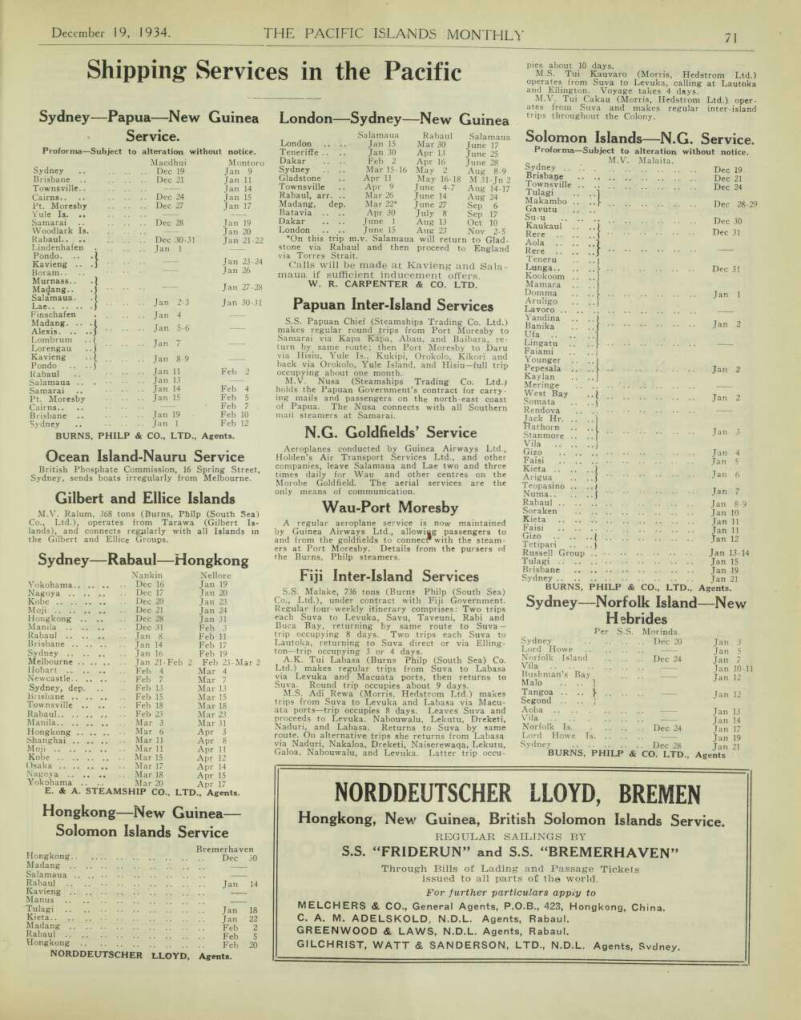
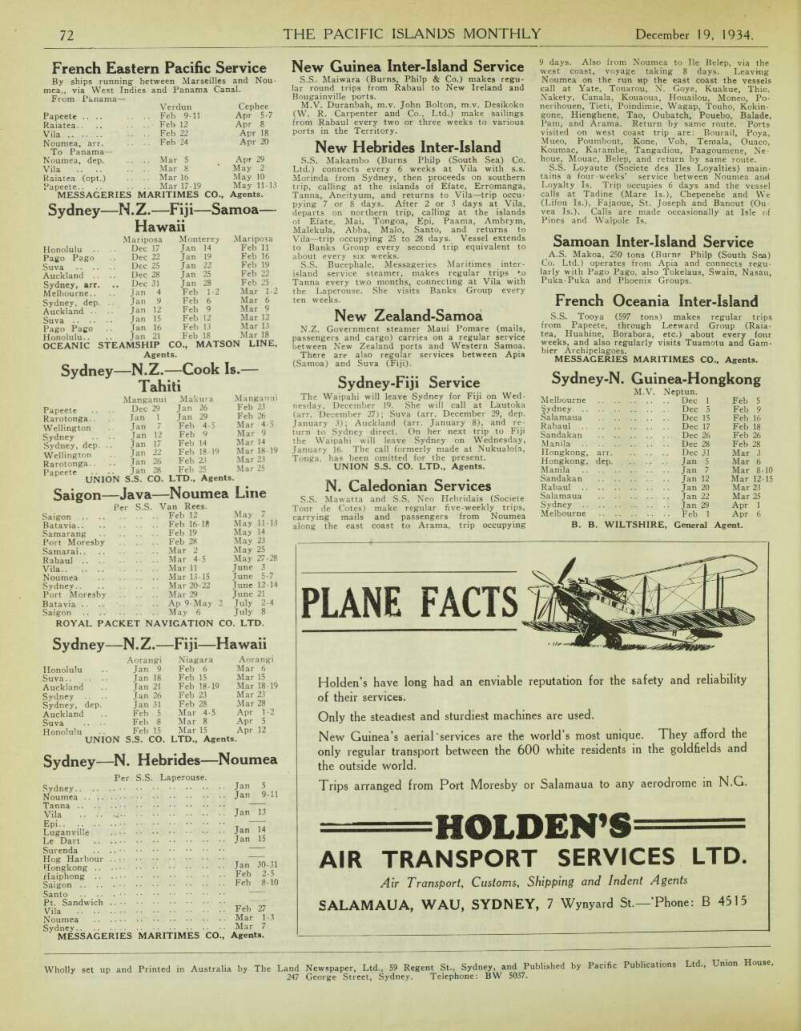
Sydney—Papua—New Guinea Service.
Proforma—Subject to alteration without notice.
Ocean Island-Nauru Service
British Phosphate Commission, 16 Spring Street, Sydney, sends boats irregularly from Melbourne.
Gilbert and Ellice Islands
M.V. Ralum, 368 tons (Burns, Philp (South Sea) Co., Ltd.), operates from Tarawa (Gilbert Is lands), and connects regularly with all Islands in the Gilbert and Ellice Groups.
Sydney—Rabaul—Hongkong
Hongkong—New Guinea — Solomon Islands Service
London—Sydney—New Guinea
Papuan Inter-Island Services
S.S. Papuan Chief (Steamships Trading Cos. Ltd.) makes regular round trips from Port Moresby to Samarai via Kapa Kapa, Abau, and Baibara, re turn by same route; then Port Moresby to Daru via Hisiu, Yule Is., Kukipi, Orokolo, Kikori and back via Orokolo, Yule Island, and Hisiu—full trip occupying about one month.
M.V. Nusa (Steamships Trading Cos. Ltd.) holds the Papuan Government’s contract for carry ing mails and passengers on the north-east coast of Papua. The Nusa connects with all Southern mail steamers at Samarai.
N.G. Goldfields’ Service
Aeroplanes conducted by Guinea Airways Ltd., Holden’s Air Transport Services Ltd., and other companies, leave Salamaua and Lae two and three times daily for Wau and other centres on the Morobe Goldfield. The aerial services arc the only means of communication.
Wau-Port Moresby
A regular aeroplane service is now maintained by Guinea Airways Ltd., allowing passengers to and from the goldfields to connecrwith the steam ers at Port Moresby. Details from the pursers of the Burns, Philp steamers.
Fiji Inter-Island Services
S.S. Malake, 736 tons (Burns Philp (South Sea) Cos., Ltd.), under contract with Fiji Government.
Regular four-weekly itinerary comprises: Two trips each Suva to Levuka, Savu, Taveuni, Rabi and Buca Bay, returning by same route to Suva trip occupying 8 days. Two trips each Suva to Lautoka, returning to Suva direct or via Elling ton —trip occupying 3 or 4 days.
A.K. Tui Labasa (Burns Philp (South Sea) Cos.
Ltd.) makes regular trips from Suva to Labasa via Levuka and Macuata ports, then returns to Suva. Round trip occupies about 9 days.
M.S. Adi Rewa (Morris. Hedstrom Ltd.) makes trips from Suva to Levuka and Labasa via Macu ata ports—trip occupies 8 days. Leaves Suva and proceeds to Levuka, Nabouwalu, Lekutu, Dreketi, Naduri, and Labasa. Returns to Suva by same route. On alternative trips she returns from Labasa via Naduri, Nakaloa, Dreketi, Naiserewaqa, Lekutu, Galoa, Nabouwalu, and Levuka. Latter trip occu
pies about 10 days, M.S. Tui Kauvaro (Morris, Hedstrom Ltd.) operates from Suva to Levuka, calling at Lautoka and Ellington. Voyage takes 4 days.
M.V. Tui Cakau (Morris, Hedstrom Ltd.) oper ates from Suva and makes regular inter-island trips throughout the Colony.
Solomon Islands—N.G. Service.
Proforma—Subject to alteration without notice.
Sydney—Norfolk Island —New Hebrides
Macdhui Montoro Sydney Dec 19 Jan 9 Brisbane Dec 21 Jan 11 Townsville — Jan 14 Cairns Dec 24 Jan 15 Pt. Moresby Dec 27 Jan 17 Yule Is. — Samarai Dec 28 Jan 19 Woodlark Is.
Jan 20 Rabaul Dec 30-31 Jan 21-22 Lindenhafen Jan 1 Pondo.
Jan 23-24 Kavieng Boram Murnass Jan 26 Madang Salamaua Jan 27-28 Lae Jan 2-3 Jan 30-31 Finschafen Madang Jan 4 — Alexis.
Jan 5-6 — Lombrum Jan 7 Lorengau Kavieng Pondo Jan 8-9 Feb 2 Rabaul Jan 11 Salamaua Jan 13 — Samarai Feb 4 Pt. Moresby Feb 5 Cairns Feb 7 Brisbane Jan 19 Feb 10 Sydney Feb 12
Burns, Philp & Co., Ltd., Agents.
Salamaua Rabaul Salamaua London Jan 15 Mar 30 June 17 Teneriffe Jan 30 Apr 13 June 25 Dakar Feb 2 Apr 16 June 28 Sydney Mar 15-16 May 2 Aug 8-9 Gladstone Apr 11 May 16-18 M 31-Jn 2 Townsville Apr 9 June 4-7 Aug 14-17 Rabaul, arr.
Mar 26 June 14 Aug 24 Madang dep.
Mar 22* June 27 Sep 6 Batavia Apr 30 July 8 Sep 17 Dakar June 1 Aug 13 Oct 10 London June 15 Aug 23 Nov 2-5 *On this trip m.v. Salamaua will return to Gladstone via Rabau1 and then proceed to England via Torres Strait.
Calls will be made at Kavieng and Salamaua if sufficient inducement offers.
W. R. Carpenter & Co. Ltd.
Sydney Brisbane M.V. Malaita.
Townsville Tulagi Makambo Gavutu Su-u Kaukaul Rere Aola Teneru Lunea Kookoom Mamara Domma Aruligo Lavoro Vandina Banika Ufa Lingatu Faiami Younger Pepesala Kaylan Meringe West Bay Somata Rendova Jack Hr.
Hathorn Stanmore Vila Gizo Faisi Kieta Arigua Teopasino Numa Rabaul Soraken Kieta Faisi Gizo Tetipari Russell Group Tulagi Brisbane Sydney
Burns, Philp & Co., Ltd., Agents.
Per S.S. Morinda.
Sydney Dec 20 Jan 3 Lord Howe Jan 5 Norfolk Island Dec 24 Jan 7 Vila Bushman’s Bay Male Jan 10-11 Jan 12 Tangoa Jan 12 Segond Aoba Jan 13 Vila Jan 14 Norfolk Is Dec 24 Jan 17 Jan 19 Lord Howe Is.
Jan Jan Sydney Dec 28 21
Burns, Philp & Co. Ltd., Agents
Nankin Nellore Yokohama Jan 19 Nagoya Jan 20 Kobe Dec 20 Jan 23 Moji Jan 24 Hongkong Dec 28 Jan 31 Manila Feb 3 Rabaul Feb 11 Brisbane Feb 17 Sydney Feb 19 Melbourne Feb 2 Feb 23-Mar 2 Hobart Mar 4 Newcastle Mar 7 Sydney, dep.
Feb 13 Mar 13 Brisbane .. .. .. Feb 15 Mar 15 Townsville Feb 18 Mar 18 Rabaul Mar 23 Manila Mar 31 Hongkong Apr 3 Shanghai Apr 8 Moji Apr 11 Kobe Mar 15 Apr 12 Osaka Apr 14 Nagoya Apr 15 Yokohama Mar 20 Apr 17 E. & A. STEAMSHIP CO. LTD., Agents.
Hongkong Madang Bremerhaven Dec 30 Rabaul Kavieng Manus Tulagi Kieta Madang Rabaul Feb 5 Hongkong
Norddeutscher Lloyd, Agents.
French Eastern Pacific Service
By ships running between Marseilles and Nou mea,, via West Indies and Panama Canal.
From Panama —
Sydney—N.Z.—Fiji—Samoa— Hawaii
Sydney—N.Z.—Cook Is. — Tahiti
Saigon—Java—Noumea Line
Sydney—N.Z.—Fiji—Hawaii
Sydney—N. Hebrides—Noumea
New Guinea Inter-Island Service
S.S. Maiwara (Burns, Philp & Cos.) makes regular round trips from Rabaul to New Ireland and Bougainville ports.
M. Duranbah, m.v. John Bolton, m.v. Desikoko (W. R. Carpenter and Cos., Ltd.) make sailings from Rabaul every two or three weeks to various ports in the Territory.
New Hebrides Inter-Island
S.S. Makambo (Burns Philp (South Sea) Cos.
Ltd.) connects every 6 weeks at Vila with s.s.
Morinda from Sydney, then proceeds on southern trip, calling at the islands of Efate, Erromanga, Tanna, Aneityum, and returns to Vila —trip occu pying 7 or 8 days. After 2 or 3 days at Vila, departs on northern trip, calling at the islands of Efate, Mai, Tongoa, Epi, Paama, Ambrym, Malekula, Abba, Malo, Santo, and returns to Vila—trip occupying 25 to 28 days. Vessel extends to Banks Group every second trip equivalent to about every six weeks.
S.S. Bucephale, Messageries Maritimes interisland service steamer, makes regular trips to Tanna every two months, connecting at Vila with the Laperouse. She visits Banks Group every ten weeks.
New Zealand-Samoa
N. Government steamer Maui Pomare (mails, passengers and cargo) carries on a regular service between New Zealand ports and Western Samoa.
There are also regular services between Apia (Samoa) and Suva (Fiji).
Sydney-Fiji Service
The Waipahi will leave Sydney for Fiji on Wed nesday, December 19. She will call at Lautoka (arr. December 27); Suva (arr. December 29, dep.
January 3); Auckland (arr. January 8), and re turn to Sydney direct. On her next trip to Fiji the Waipahi will leave Sydney on Wednesday, January 16. The call formerly made at Nukualofa, Tonga, has been omitted for the present.
Union S.S. Co. Ltd., Agents.
N. Caledonian Services
S.S. Mawatta and S.S. Neo Hebridais (Societe Tour de Cotes) make regular five-weekly trips, carrying mails and passengers from Noumea along the east coast to Arama, trip occupying
9 days. Also from Noumea to He Belep, via the west coast, voyage taking 8 days. Leaving Noumea on the run up the east coast the vessels call at Yate, Touarou, N. Goye, Kuakue, Thio.
Nakety, Canala, Kouaoua, Houailou, Moneo, Po nerihouen, Tieti, Poindimie, Wagap, Touho, Kokin gone, Hienghene, Tao, Oubatch, Pouebo, Balade, Pam, and Arama. Return by same route. Ports visited on west coast trip are: Bourail, Poya, Mueo, Poumbout, Kone, Voh, Temala, Ouaco, Koumac, Karambe, Tangadiou, Paagoumene, Ne houe, Mouac, Belep, and return by same route.
S.S. Loyaute (Societe des lies Loyalties) maintains a four-weeks’ service between Noumea and Loyalty Is. Trip occupies 6 days and the vessel calls at Tadine (Mare Is.), Chepenehe and We (Lifou Is.), Fajaoue, St. Joseph and Banout (Ou vea Is.). Calls are made occasionally at Isle of Pines and Walpole Is.
Samoan Inter-Island Service
A.S. Makoa, 250 tons (Burns Philp (South Sea) Co. Ltd.) operates from Apia and connects regu larly with Pago Pago, also Tokelaus, Swain, Nasau, Puka-Puka and Phoenix Groups.
French Oceania Inter-Island
S.S. Tooya (597 tons) makes regular trips from Papeete, through Leeward Group (Raia tea, Huahine, Borabora, etc.) about every four weeks, and also regularly visits Tuamotu and Gam bier Archipelagoes.
Messageries Maritimes Co.. Agents.
Sydney-N. Guinea-Hongkong
Verdun Cephee Papeete .. Feb 9-11 Apr 5-7 Raiatea .. Feb 12 Apr 8 Vila .. Feb 22 Apr 18 Noumea, arr.
To Panama — .. Feb 24 Apr 20 Noumea, dep. .. Mar 5 Apr 29 Vila .. Mar 8 May 2 Raiatea (opt.) .. Mar 16 May 10 Papeete .. Mar 17-19 May 11-13
Messageries Maritimes Co., Agents.
Mariposa Monterey Mariposa Honolulu Dec 17 Jan 14 Feb 11 Pago Pago Dec 22 Jan 19 Feb 16 Suva .. Dec 25 Jan 22 Feb 19 Auckland Dec 28 Jan 25 Feb 22 Sydney, arr .. Dec 31 Jan 28 Feb 25 Melbourne Jan 4 Feb 1-2 Mar 1-2 Sydney, dep . .. Jan 9 Feb 6 Mar 6 Auckland Jan 12 Feb 9 Mar 9 Suva Feb 12 Mar 12 Pago Pago Jan 16 Feb 13 Mar 13 Honolulu Jan 21 Feb 18 Mar 18
Oceanic Steamship Co., Matson Line,
Agents.
Manganui Makura Mangatmi Papeete ... Dec 29 Jan 26 Feb 23 Rarotonga.. Tan 1 Jan 29 Feb 26 Wellington Jan 7 Feb 4-5 Mar 4-5 Svdnev Jan 12 Feb 9 Mar 9 Sydney dep. .. Jan 17 Feb 14 Mar 14 Jan 22 Feb 18-19 Mar 18-19 Rarotonga. .. Jan 26 Feb 23 Mar 23 Papeete ... Jan 28 Feb 25 Mar
Union S.S. Co. Ltd., Agents.
Melbourne M.V. Neptun.
Feb 5 Sydney Feb 9 Salamaua Feb 16 Rabaul Feb 18 Sandakan Dec 26 Feb 26 Manila Feb 28 Hongkong, arr.
Mar 3 Hongkong, dep.
Jan 5 Mar 6 Manila Jan 7 Mar 8-10 Sandakan Mar 12-15 Rabaul Jan 20 Mar 23 Salamaua Jan 22 Mar 25 Sydney Jan 29 Apr 1 Melbourne Feb 1 Apr 6 B. B. WILTSHIRE, General Agent.
Per S. S. Van Rees.
Saigon Batavia .. Feb 12 May 7 .. Feb 16-18 May 11-13 Samarang .. Feb 19 May 14 Port Moresby .. Feb 28 May 23 Samarai May 25 Rabaul May 27-28 Vila .. Mar 11 June 3 Noumea .. Mar 13-15 June 5-7 Sydney .. Mar 20-22 June 12-14 Port Moresby .. Mar 29 June 21 Batavia 2 July 2-4 Saigon .. May 6 July 8
Royal Packet Navigation Co. Ltd.
Aorangi Niagara Aorangi Honolulu Jan 9 Feb 6 Mar 6 Suva Jan 18 Feb 15 Mar 15 Auckland .. Jan 21 Feb 18-19 Mar 18-19 Sydney Jan 26 Feb 23 Mar 23 Sydney, dep. Tan 31 Feb 28 Mar 28 Auckland Feb 5 Mar 4-5 Apr 1-2 Suva Feb 8 Mar 8 Apr 5 Honolulu Feb 15 Mar 15 Apr 12
Union S.S. Co. Ltd., Agents.
Per S.S. Laperouse.
Jan 5 Jan 9-11 Vila Jan 13 Jan 14 Jan 15 Jan 30-31 Surenda Hog Harbour Feb 2-5 Saigon Feb 8-10 Vila Feb 27 Mar 1-3 Sydney
Messageries Maritimes Co., Agents.
Mar 7
Advertisements & other items, pp. 73-76 (2 items)
Norddeutscher Lloyd, Bremen
Hongkong, New Guinea, British Solomon Islands Service.
REGULAR SAILINGS BY
S.S. “FRIDERUN” and S.S. “BREMERHAVEN”
Through Bills of Lading and Passage Tickets issued to all parts o£ the world.
For further particulars apply to MELCHERS & CO., General Agents, P.O.B., 423, Hongkong, China.
C. A. M. ADELSKOLD. N.D.L. Agents, Rabaul.
GREENWOOD & LAWS, N.D.L. Agents, Rabaul.
GILCHRIST, WATT & SANDERSON, LTD., N.D.L. Agents, Svdney.
PLANE FACTS
Holden’s have long had an enviable reputation for the safety and reliability of their services.
Only the steadiest and sturdiest machines are used.
New Guinea’s aerial'services are the world’s most unique. They afford the only regular transport between the 600 white residents in the goldfields and the outside world.
Trips arranged from Port Moresby or Salamaua to any aerodrome in N.G.
HOLDEN’S
AIR TRANSPORT SERVICES LTD.
Air Transport, Customs, Shipping and Indent Agents SALAMAUA, WAU, SYDNEY, 7 Wynyard St.—’Phone: B 4515
One of the Biggest Aerial Transport
Services in
the World
Three years ago, there were less than a dozen landing grounds on N.G. goldfields. To-day, there are over 30. Prospectors are constantly opening up new country. New enterprises are being launched. No sooner is a new camp established than a new landing-ground is cleared, and Guinea Airways machines provide communication.
An everyday scene on the New Guinea Goldfields: A motor-car , which has been brought in by air from the coast , being unloaded from one of Guinea Airways' giant , freight-
carrying aeroplanes.
Travellers may leave the steamer at Port Moresby, fly across to Morobe (time of journey, 1h. 45 min.) and spend 9 days in the Goldfield centres before rejoining steamer at Lae for Rabaul. Or, after visiting Rabaul, they may disembark at Salamaua or Lae, spend several days on the Goldfields, and fly to Pt.
Moresby to rejoin the steamer. All information from Pursers on the Steamers.
BABUAP
BAPI
31 Aerodromes
MARAWASSA
NADZAB
PORT
MORESBY*
PURARI
RAMU
SALAMAUA
SANGAN
SUNSHINE
SURPRISE CK.
UP. WATUT
WAGAU
WAHGI
WAMPIT
WARONA
WAU
ZENAG
BULLDOG
BULOLO
BULWA
GABANZIZ
GARINA
JUNI
KAJABIT
KIDJURA
KOKODA*
KABUNA*
LAE
MT. HAGEN
MARILINAN
MENYAMYA
Transport made possible the development of the great Gold Industry of New Guinea. The presence of Rich Gold was proved in 1 926, but the Problem was Communication. Morobe was guarded by dense jungle and precipitous mountains. A road cannot be built, except at enormous, crippling cost.
Guinea Airways Ltd. launched its unique aerial service seven years ago, with one machine and a handful of men. To-day, it operates a fleet of modern aeroplanes, and employs large European and native staffs. Its machines, running on regular schedules, have carried men, machinery, dredges, building material, foodstuffs, motor-trucks, livestock, over the mountains of New Guinea, without accident and without delay. * In Papua.
GUINEA AIRWAYS Ltd
LAE - SALAMAUA
The most important
feature of
RESCH’S PILSENER
is the “SPOT” crown seal Resch’s Pilsener is protected against tropical heat by this specially designed “Spot” Crown Seal.
It ensures perfect freshness in all climates.
RESCH'S
LONG BOTTLE
PILSEN ER
P. 38-27
72
December 19, 1934.
THE PACIFIC ISLANDS MONTHLY
Wholly set up and Printed in Australia by The Land Newspaper, Ltd., 59 Regent St., Sydney, and Published by Pacific Publications Ltd., Union House, 247 George Street, Sydney. Telephone: BW 5037.