Pacific
pp. 42-43 · Read in the full issue
The Pre Historic
By Arthur J. Vogan, F.R.G.S.
Etc.
Detective stories have a curious attraction. Who does not enjoy a well constructed one, by a master-writer like Conan Doyle, or Barry Pain? To follow the patient, painstaking piecing-together of puzzling, and disjointed evidence, by the Sherlock of the story, until the final denouement with its concomitant of achievement and surprise, appeals to our inborn long-latent hunting instincts, somehow!
And yet, here, we have lying at our doors that vast volume of hidden romance, mystery and important teach ing, the past history of the old Pacific civilisation, still unopened and neglected!
About five thousand years ago, a race of Aryan folk —from whom probably came both the Hindu race and that great Baltic breed, which has ruled the world until recently—descended upon what we now, very correctly, call Indo-China, then under the Cham tribes. Much later, there arrived the Annamese, a mountain race (as their large big-toes indicate) from Tibet, also Aryan; but long subjected to Chinese influence through the Yao, Shun, and Huang-Ti periods. Their cave temples in the “Marble Mountains” of Tourane contain very early Chinese script.
Many causes besides the desiccation of the Shamo desert of Mongolia, and the usual fecundity of the early human races, drove folk from Asia into Europe, America and down across those stepping-stones.
the Sunda Islands and East Indies, into the Pacific.
So, when I discovered a similar cave temple in Yasawa-i-lau, Fiji, in 1930, with similar ‘“Chinese” inscriptions, I was not altogether astonished. But professors of New Zealand, and Sydney wrote articles and showed their disapproval, saying that the Chinese were never so far south. One of them, on being shown the “graffiti,” declared “they are merely natural mark ings of the rock!” But Cambridge Uni versity and other museums don’t think so; and have accepted casts —made from my original ones by Grounds, of New town.
The great L. A. Waddell, L.L.D., C.I.E., C.B. and etc., the authority upon the Phoenicians, writing to me anent this curious animosity to later knowledge, says:—“I am not altogether surprised, as it is notorious that the ‘learned’ societies are mainly run by narrow-minded cliques, secretaries or chief members of Council, who are too often wedded to narrow and outworn views of ‘established authority,’ and suppress any new discoveries that may upset the theories they have been taught to believe.”
H. D. Daunt, another great author, and late archaeologist to the Indian Govern ment, was also unkind enough to disturb the slumbers of the plump professors in their dusty studies, with a flood of new light which he threw upon Indian and Islands matters. His “Centre of Civili zation,” was the first book to show that the Pacific was voyaged over by Arabs and Chinese, long centuries before Euro peans began creeping round the storm haunted capes of Hope and Horn. He show ed that incidents related in Bible-history were mostly enacted in the Bay of Bengal, and neighbourhood; and that Jerusalem had failed to produce any tablet or trace of Solomon or David, who were Indian
princes. He dwells at length upon one Chandragupta, a famous chieftain of Alexander-the-Great’s retreat days. He ruled over a large and powerful people of Brahmaputra-river origin, called the Ma-urias, whose name indicated that they were Children of the Hawk, or Sun god. Chandragupta sent missionaries of the Buddist philosophy down into Java and Sumatra —the same track that our Khmer and Indo-China friends, already referred to, took long after.
Now I was informed by Richard F.
Burton, twenty years ago, that the Indians around Delhi, in Wellington’s time, spoke a language almost identical with that of the older Ma-oris of New Zealand; and
in 1881 an old Tohunga (priest-chief, or “patesi”) of Tauranga, informed me that the name Ma-ori (not “Mowry,” which word means “cowardly”) signified the “Hawk people.” Here, again, all the “au thorities” are wrong which does not matter. But they are angry and actively vindictive, which does matter: and it is not a sign of good health in themselves, or their schools of teaching.
Daunt also shows us how the Homans, through the Greeks, got their “Mars” from the same source —the early Asiatic sun-worshippers.
New Caledonia, apparently was the centre of an old Pacific civilisation, which died out. Why? Will our civilisation follow suit, from a similar error on our part? Here is something for our Sherlock Holmes of science to investigate. Old stone-cities, old temples, inscriptions, figure-carvings, canals, vast forts and countless “graffiti”—all are there, if man only has the vision to read them! Has any detective story a hundredth of the attractive qualities that our Islands offer to the lover of the chase-the-clue?
Two facts seem already harvested from Pacific investigation: that Northern races deteriorate under tropical conditions for a time, and then slowly recover themselves; and, that the Arica-nut (the mis-named “betel” chewing) has a very deleterious effect upon the brain, although preserv ing the teeth from decay. Cannot some genius preserve the one virtue, whilst getting rid of the evil?
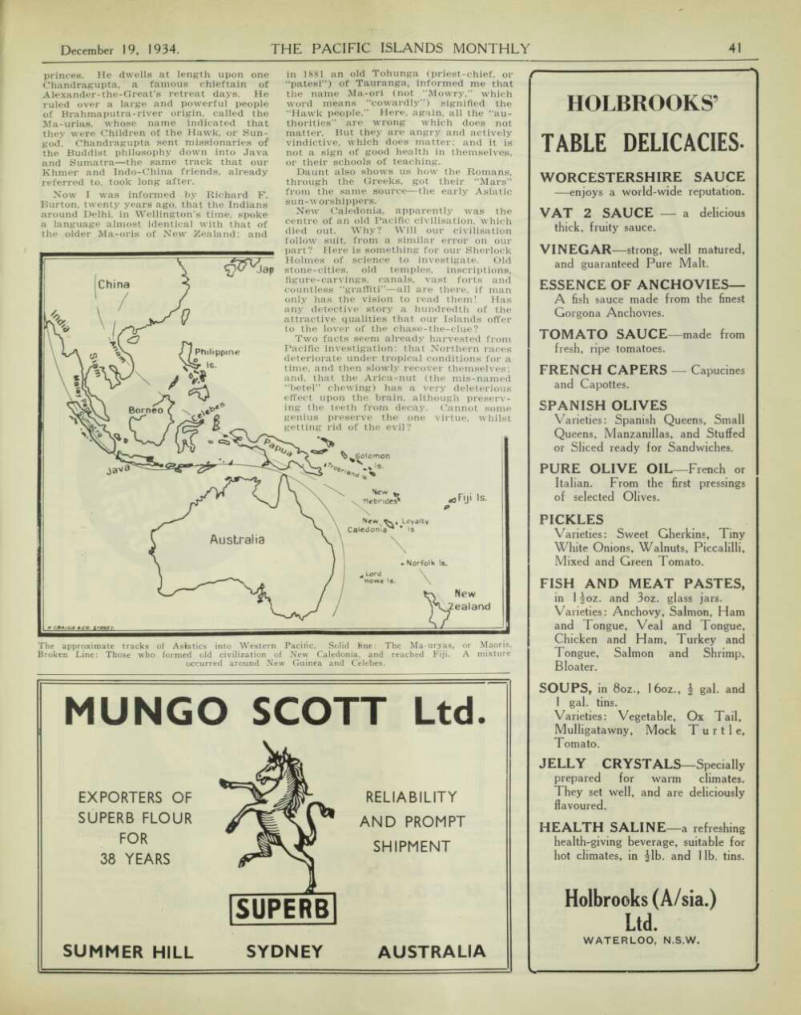
The approximate tracks of Asiatics into Western Pacific. Solid line: The Ma-uryas, or Maoris.
Broken Line: Those who formed old civilization of New Caledonia, and reached Fiji. A mixture occurred around New Guinea and Celebes.