Adventuring With Death And Deckert
pp. 10-16 · Read in the full issue
Piquant Moments on the New Guinea Goldfields
(By the Editor of the P.I.M.)
THIS life is a vale of tears; but, some how, I am in no hurry to leave it.
This fact has been borne in upon me heavily since I visited the goldfields of New Guinea and flirted with Death in the com pany respectively of Orme Denny, famous pilot of aeroplanes; Fred Deckert, com mander of a weird, cliff-climbing motorlorry; and Harold Taylour, Mining Warden, who is the owner of a devil disguised as a pony. If anyone wants real thrills, let him follow the tracks hereinafter described.
“BUT I haven’t much time.” I said. “And there is much goldfield to see.”
“Tut, tut,” said Jim Stewart, waving Jiis hand airily. “You haven’t seen the goldfield until you have seen Edie Creek.”
“And you haven't seen Edie Creek until you have ridden with Deckert,” chimed in his aider and abettor. “Start early. You can do it in a few hours.”
I am not to be blamed because I suc cumbed to the voice of the tempter. How was I to know that riding to Edie with Deckert is nothing more nor less than pulling the nose of Mister Nick! My only consolation is that I persuaded the Stewart to come with me.
Let me introduce Fred Deckert. He is a good-looking young Australian, with an irresistible grin and a genius for motor engineering. Edie Creek is only four miles, direct line, from Wau; but by the tortuous mule-track, which crawls up frightful gorges, and creeps along the faces of terrifying precipices, the distance is 14 miles. Human ingenuity, which has performed miracles on this goldfield, could not construct an aerodrome at Edie Creek, so all freighting was by native carriers and prehensile-toed mules —until Fred Deckert arrived.
Fred obtained a Pontiac engine, a Cala thumpian chassis, and odds and ends of gear, and constructed a narrow-gauge lorry to travel on that precipitous, twist ed, ungraded, rain-soaked mule-track.
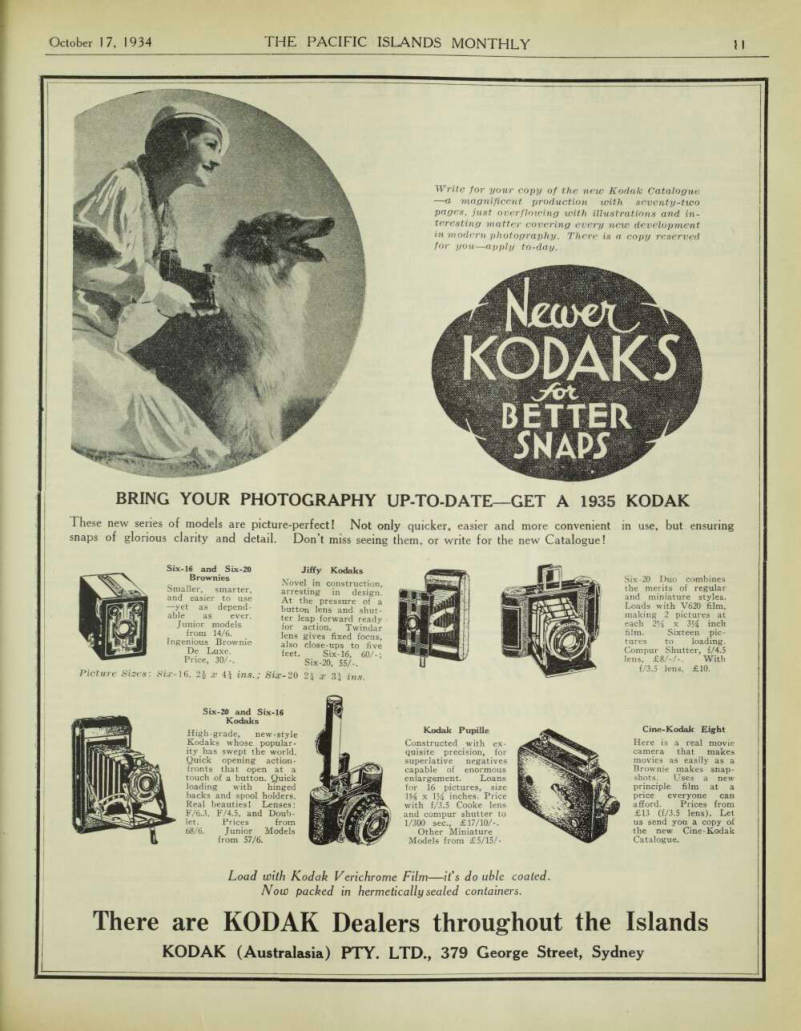
Half of Wau cheered; the other half jeered; all were unanimous that the thing could not be done. Deckert did it —God alone knows how. He took out some pick and-shovel natives and patched the track, and did it scores of times. He got fabu lous rates for carrying in chunks of mining machinery that neither “donk” nor “coon” could handle. Then he bought a narrow-gauge Morris truck, and it was on this notable machine that I, in a mis begotten moment, took passage.
The first truck, the famous “Bitza,” has been bought by Mr. McGilvery, the Edie Creek storekeeper. When I saw it, it looked sleek and well, but idle. Mc Gilvery, not long ago, was a daring pilot of Guinea Airways: but I think that not even he is game to drive the “Bitza” over that frightful road.
So, with mining machinery, mailbags, a case of whisky, rice and six passengers, we started for Edie. O tempora, O mores!
Within five minutes, I knew that I had made the miscalculation of a lifetime. It was not danger so much as sheer, hellish discomfort. The Morris pointed its blunt nose up at an angle of about 45 degrees, and I wrapped arms and legs around a bit of pump, hoping that thus I should not
slide over the rear end of the lorry. When I saw that most of the journey would be spent with that end of Morris poked out over precipices 300 and 400 feet deep, while she twisted around sharp corners, I used my teeth, as well as arms and legs, in getting a grip on that pump.
It rains in about 23 out of every 24 hours in those mountains, and the combined ef fect of showers and traffic is seen in ap palling ruts and mud holes. Deckert gets through by rushing them. Consequently, his interested passen gers spend most of their conscious hours in the air. They say the people on the goldfields are “air minded.” I think Dec kert is as much re sponsible for that as are the aeroplanes.
Because the stern of me was clear of the hard deck, I rather enjoyed the bouncing, except on the frequent occasions when I met the lorry coming up on the second bounce, just when I was de scending from the first. Those were the times when I put a careful hand on the top of my head to see if my backbone had been driven through.
The track, for the most part, is just wide enough to let the lorry pass. On one side, a sheer wall of rock or clay; on the other, a long, straight drop in to eternity. More of ten than not there was not more than four inches to spare.
The road was wet, and slippy. Again and again, I felt the tail end of the lorry, be neath me, sliding gently away towards the precipice; but al ways the chained wheels got a grip again, just in the last split second before disaster, and on we went. At first, I
mouthed wild sentences and clawed fran tically; but, after a while, I put faith in the chains and a merciful Providence.
Then, after one brilliant skid, I looked at the wheel. There was no chain there, and I let out a screech which brought Deckert up, all standing.
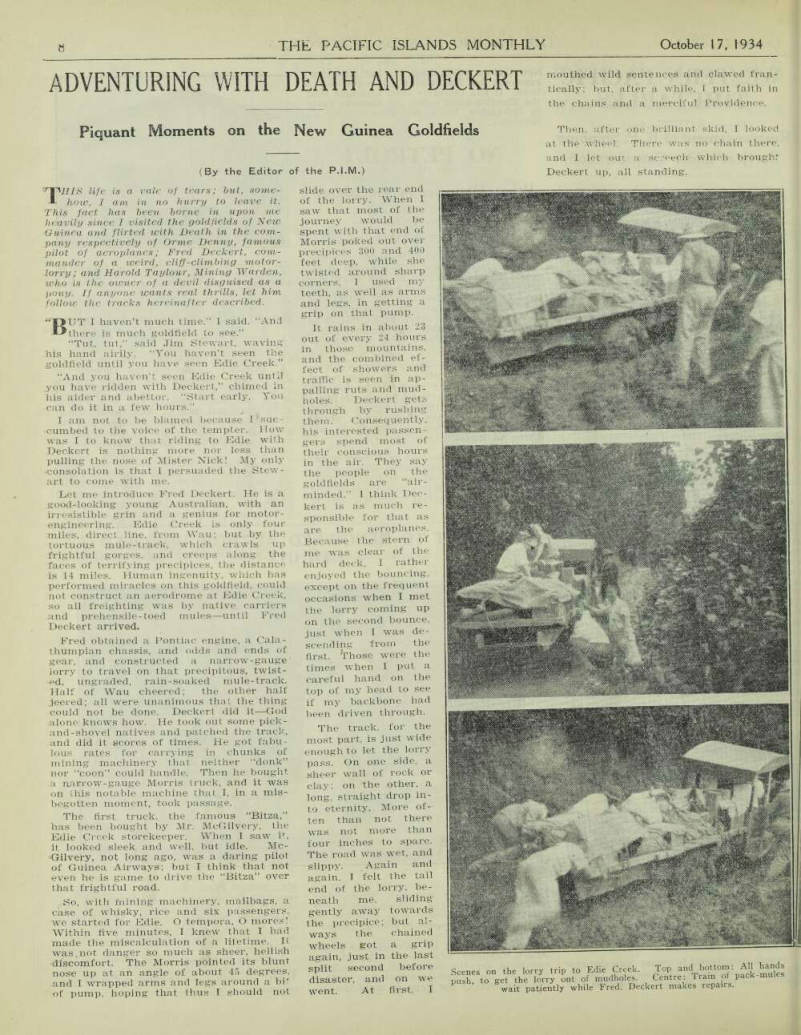
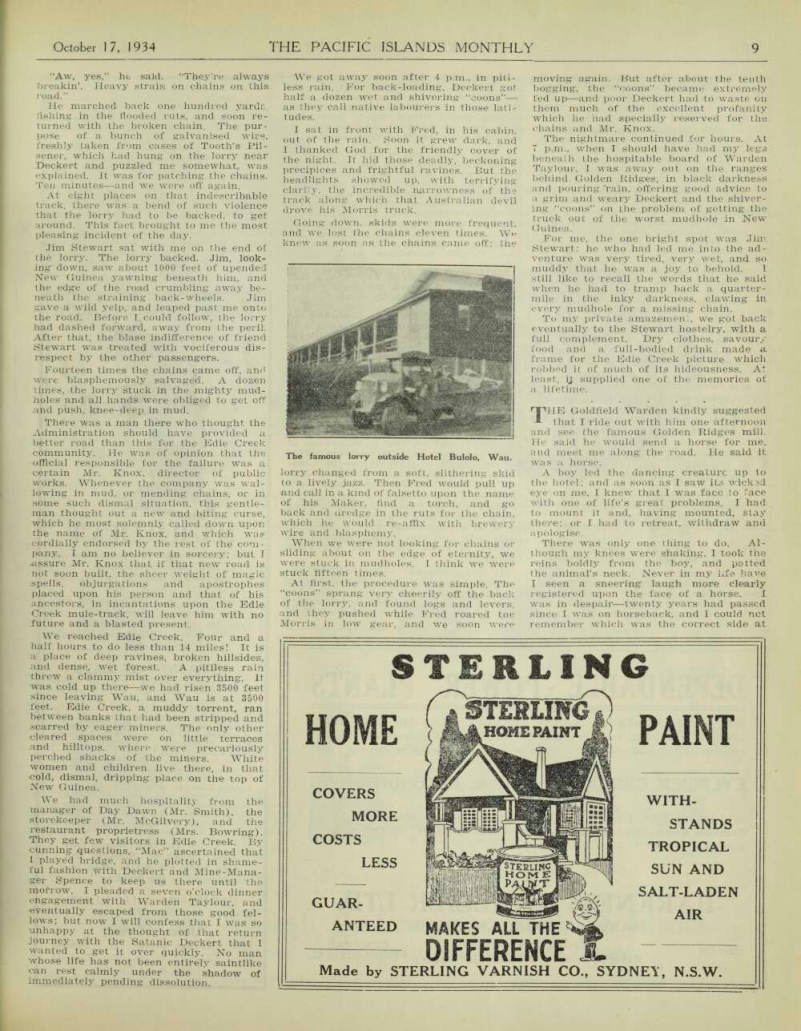
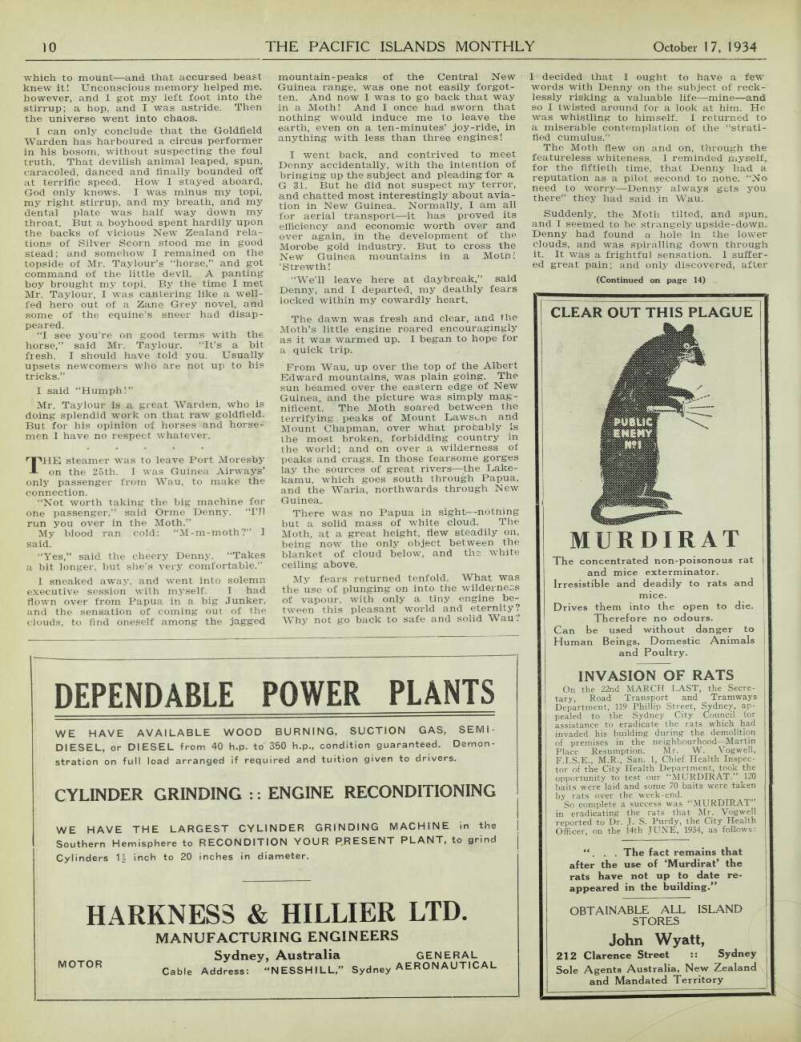
Scenes on the lorry trip to Edie Creek. Top and bottom: All hands push, to get the lorry out of mudholes. Centre: Train of pack-mules wait patiently while Fred. Deckert makes repairs.
“Aw, yes,” he said. “They’re always breakin’. Heavy strain on chains on this road.”
He marched back one hundred yardc. fishing in the flooded ruts, and soon re turned with the broken chain. The pur pose of a bunch of galvanised wire, freshly taken from cases of Tooth’s Pil sener, which had hung on the lorry near Deckert and puzzled me somewhat, was explained. It was for patching the chains.
Ten minutes —and we were off again.
At eight places on that indescribable track, there was a bend of such violence that the lorry had to be backed, to get around. This fact brought to me the most pleasing incident of the day.
Jim Stewart sat with me on the end of the lorry. The lorry backed. Jim, look ing down, saw about 1000 feet of upended New Guinea yawning beneath him, and the edge of the road crumbling away be neath the straining back-wheels. Jim gave a wild yelp, and leaped past me onto the road. Before I could follow, the lorry had dashed forward, away from the peril.
After that, the blase indifference of friend Stewart was treated with vociferous dis respect by the other passengers.
Fourteen times the chains came off, and were blasphemously salvaged. A dozen times, the lorry stuck in the mighty mud holes and all hands were obliged to get off and push, knee-deep in mud.
There was a man there who thought the Administration should have provided a better road than this for the Edie Creek community. He was of opinion that the official responsible for the failure was a certain Mr. Knox, director of public works. Whenever the company was wal lowing in mud, or mending chains, or in some such dismal situation, this gentle man thought out a new and biting curse, which he most solemnly called down upon the name of Mr. Knox, and which was cordially endorsed by the rest of the com pany. I am no believer in sorcery; but I assure Mr. Knox that if that new road is not soon built, the sheer weight of magic spells. objurgations and apostrophes placed upon his person and that of his ancestors, in incantations upon the Edie Creek mule-track, will leave him with no future and a blasted present.
We reached Edie Creek. Four and a half hours to do less than 14 miles! It is a place of deep ravines, broken hillsides, and dense, wet forest. A pitiless rain threw a clammy mist over everything. It was cold up there —we had risen 3500 feet since leaving Wau, and Wau is at 3500 feet. Edie Creek, a muddy torrent, ran between banks that had been stripped and scarred by eager miners. The only other cleared spaces were on little terraces and hilltops, where were precariously perched shacks of the miners. White women and children live there, in that cold, dismal, dripping place on the top of New Guinea.
We had much hospitality from the manager of Day Dawn (Mr. Smith), the storekeeper (Mr. McGilvery), and the restaurant proprietress (Mrs. Bowring).
They get few visitors in Edie Creek. By cunning questions, “Mac” ascertained that I played bridge, and he plotted in shame ful fashion with Deckert and Mine-Mana ger Spence to keep us there until the morrow. I pleaded a seven o’clock dinner engagement with Warden Taylour, and eventually escaped from those good fel lows; but now I will confess that I was so unhappy at the thought of that return journey with the Satanic Deckert that I wanted to get it over quickly. No man whose life has not been entirely saintlike can rest calmly under the shadow of Immediately pending dissolution.
We got away soon after 4 p.m., in piti less rain, back-loading, Deckert got half a dozen wet and shivering “coons” — as they call native labourers in those lati tudes.
I sat in front with Fred, in his cabin, out of the rain. Soon it grew dark, and I thanked God for the friendly cover of the night. It hid those deadly, beckoning precipices and frightful ravines. But the headlights showed up, with terrifying clarity, the incredible narrowness of the track along which that Australian devil drove his Morris truck.
Going down, skids were more frequent, and we lost the chains eleven times. We knew as soon as the chains came off: the
lorry changed from a soft, slithering skid to a lively jazz. Then Fred would pull up and call in a kind of falsetto upon the name of his Maker, find a torch, and go back and dredge in the ruts for the chain, which he would re-affix with brewery wire and blasphemy.
When we were not looking for chains or sliding about on the edge of eternity, we were stuck in mudholes. I think we were stuck fifteen times.
At first, the procedure was simple. The “coons” sprang very cheerily off the back of the lorry, and found logs and levers, and they pushed while Fred roared the Morris in low gear, and we soon were
moving again. But after about the tenth bogging, the “coons” became extremely fed up—and poor Deckert had to waste on them much of the excellent profanity which he had specially reserved for the chains and Mr. Knox.
The nightmare continued for hours. At 7 p.m., when I should have had my legs beneath the hospitable board of Warden Taylour, I was away out on the ranges behind Golden Ridges, in black darkness and pouring 'rain, offering good advice to a grim and weary Deckert and the shiver ing “coons” on the problem of getting the truck out of the worst mudhole in New Guinea.
For me, the one bright spot was Jim Stewart: he who had led me into the ad venture was very tired, very wet, and so muddy that he was a joy to behold. I still like to recall the words that he said when he had to tramp back a quarter mile in the inky darkness, clawing in every mudhole for a missing chain.
To my private amazement, we got back eventually to the Stewart hostelry, with a full complement. Dry clothes, savoury food and a full-bodied drink made a frame for the Edie Creek picture which robbed it of much of its hideousness. At least, it supplied one of the memories of a lifetime.
THE Goldfield Warden kindly suggested that I ride out with him one afternoon and see the famous Golden Ridges mill.
He said he would send a horse for me, and meet me along the road. He said it was a horse.
A boy led the dancing creature up to the hotel; and as soon as I saw its wicked eye on me, I knew that I was face to face with one of life’s great problems. I had to mount it and, having mounted, stay there; or I had to retreat, withdraw and apologise.
There was only one thing to do. Al though my knees were shaking, I took the reins boldly from the boy, and patted the animal’s neck. Never in my life have I seen a sneering laugh more clearly registered upon the face of a horse. I was in despair—twenty years had passed since I was on horseback, and I could not remember which was the correct side at
The famous lorry outside Hotel Bulolo, Wau.
which to mount —and that accursed beast knew it! Unconscious memory helped me, however, and I got my left foot into the stirrup; a hop, and I was astride. Then the universe went into chaos.
I can only conclude that the Goldfield Warden has harboured a circus performer in his bosom, without suspecting the foul truth. That devilish animal leaped, spun, caracoled, danced and finally bounded off at terrific speed. How I stayed aboard, God only knows. I was minus my topi, my right stirrup, and my breath, and my dental plate was half way down my throat. But a boyhood spent hardily upon the backs of vicious New Zealand rela tions of Silver Scorn stood me in good stead; and somehow I remained on the topside of Mr. Taylour’s “horse,” and got command of the little devil, A panting boy brought my topi. By the time I met Mr. Taylour, I was cantering like a well fed hero out of a Zane Grey novel, and some of the equine’s sneer had disap peared.
“I see you’re on good terms with the horse,” said Mr. Taylour. “It’s a bit fresh. I should have told you. Usually upsets newcomers who are not up to his tricks.”
I said “Humph!”
Mr. Taylour is a great Warden, who is doing splendid work on that raw goldfield.
But for his opinion of horses and horse men I have no respect whatever.
THE steamer was to leave Port Moresby on the 25th. I was Guinea Airways’ only passenger from Wau, to make the connection.
“Not worth taking the big machine for one passenger,” said Orme Denny. “I’ll run you over in the Moth.”
My blood ran cold: “M-m-moth?” 1 said.
“Yes,” said the cheery Denny. “Takes a bit longer, but she’s very comfortable.”
I sneaked away, and went into solemn executive session with myself. I had flown over from Papua in a big Junker, and the sensation of coming out of the clouds, to find oneself among the jagged
mountain-peaks of the Central New Guinea range, was one not easily forgot ten. And now I was to go back that way in a Moth! And I once had sworn that nothing would induce me to leave the earth, even on a ten-minutes’ joy-ride, in anything with less than three engines!
I went back, and contrived to meet Denny accidentally, with the intention of bringing up the subject and pleading for a G 31. But he did not suspect my terror, and chatted most interestingly about avia tion in New Guinea. Normally, I am all for aerial transport—it has proved its efficiency and economic worth over and over again, in the development of the Morobe gold industry. But to cross the New Guinea mountains in a Moth! ’Strewth!
“We’ll leave here at daybreak,” said Denny, and I departed, my deathly fears locked within my cowardly heart.
The dawn was fresh and clear, and the Moth’s little engine roared encouragingly as it was warmed up. I began to hope for a quick trip.
From Wau, up over the top of the Albert Edward mountains, was plain going. The sun beamed over the eastern edge of New Guinea, and the picture was simply mag nificent. The Moth soared between the terrifying peaks of Mount Lawson and Mount Chapman, over what probably is the most broken, forbidding country in the world; and on over a wilderness of peaks and crags. In those fearsome gorges lay the sources of great rivers—the Lake kamu, which goes south through Papua, and the Waria, northwards through New Guinea.
There was no Papua in sight—nothing but a solid mass of white cloud. The Moth, at a great height, flew steadily on, being now the only object between the blanket of cloud below, and the white ceiling above.
My fears returned tenfold. What was the use of plunging on into the wilderness of vapour, with only a tiny engine be tween this pleasant world and eternity?
Why not go back to safe and solid Wau?
I decided that I ought to have a few words with Denny on the subject of reck lessly risking a valuable life —mine—and so I twisted around for a look at him. He was whistling to himself. I returned to a miserable contemplation of the “strati fied cumulus.”
The Moth flew on and on, through the featureless whiteness. I reminded myself,, for the fiftieth time, that Denny had a reputation as a pilot second to none. “No need to worry—Denny always gets you there” they had said in Wau.
Suddenly, the Moth tilted, and spun, and I seemed to be strangely upside-down.
Denny had found a hole in the lower clouds, and was spiralling down through it. It was a frightful sensation. I suffer ed great pain; and only discovered, after
(Continued on page 14)
(Continued from page 10)
some time, that I was standing on my own thumb!
The Moth straightened out. “Yule Island” called a voice, behind me. I looked down. We were through the clouds, and the dark coast of Papua, edged with the
emerald and white of reef and lagoon, was beneath us, and Yule Island, with its mission settlement and cultivation, lay plain to the westward. Denny, flying blind all the way from the Central Range, had calculated his position exactly, and dived down onto the coast. We buzzed along the 80 miles of coast to the Port Moresby aerodrome, following white coral beach and azure lagoon—a picture of marvellous beauty, seen from the air.
“One of my worst trips,” remarked the pilot, as we walked across the aerodrome.
I raised my voice in a hymn of thank fulness that the few thousands of miles of Pacific travelling still ahead of me did not include one Moth aeroplane.