Advertisements & other items, pp. 1-2 (2 items)
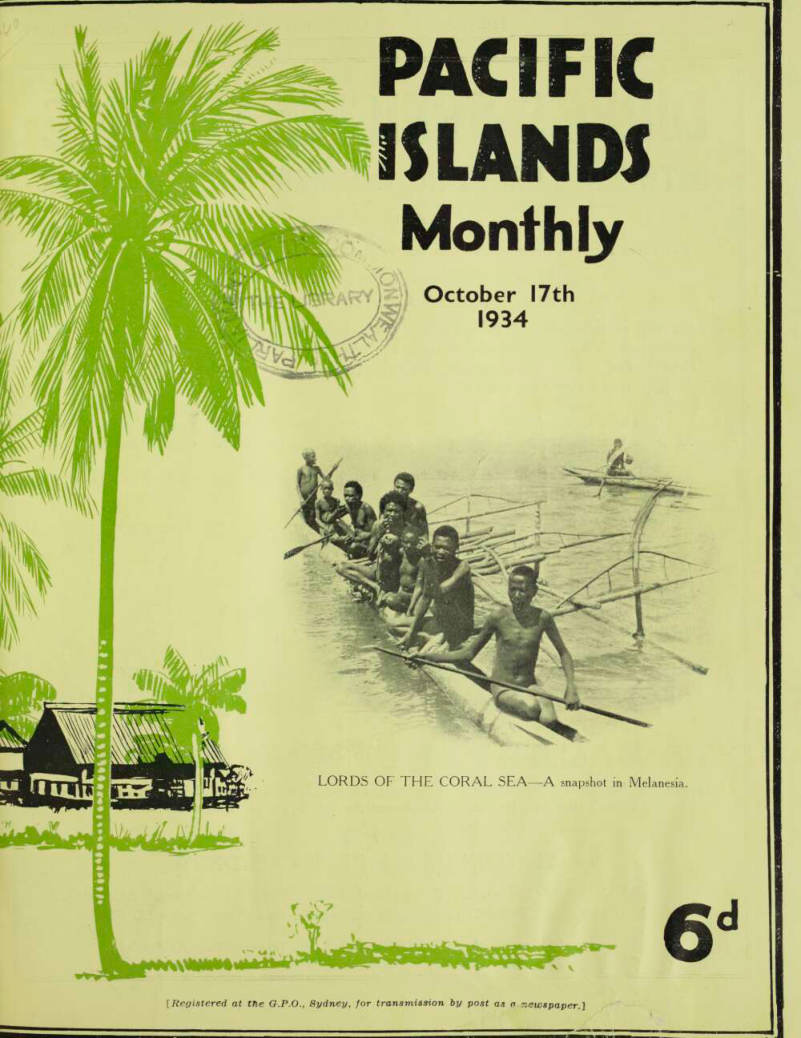
Pacific
ISLANDS
Monthly
October 17th 1934
6 d
[Registered at the G.P.O., Sydney, for transmission by post as a newspaper.]
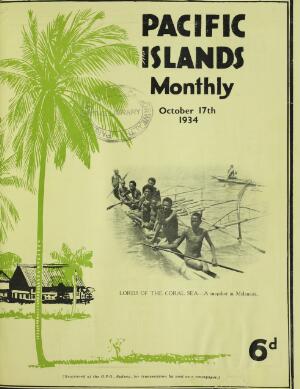
LORDS OF THE CORAL SEA—A snapshot in Melanesia.
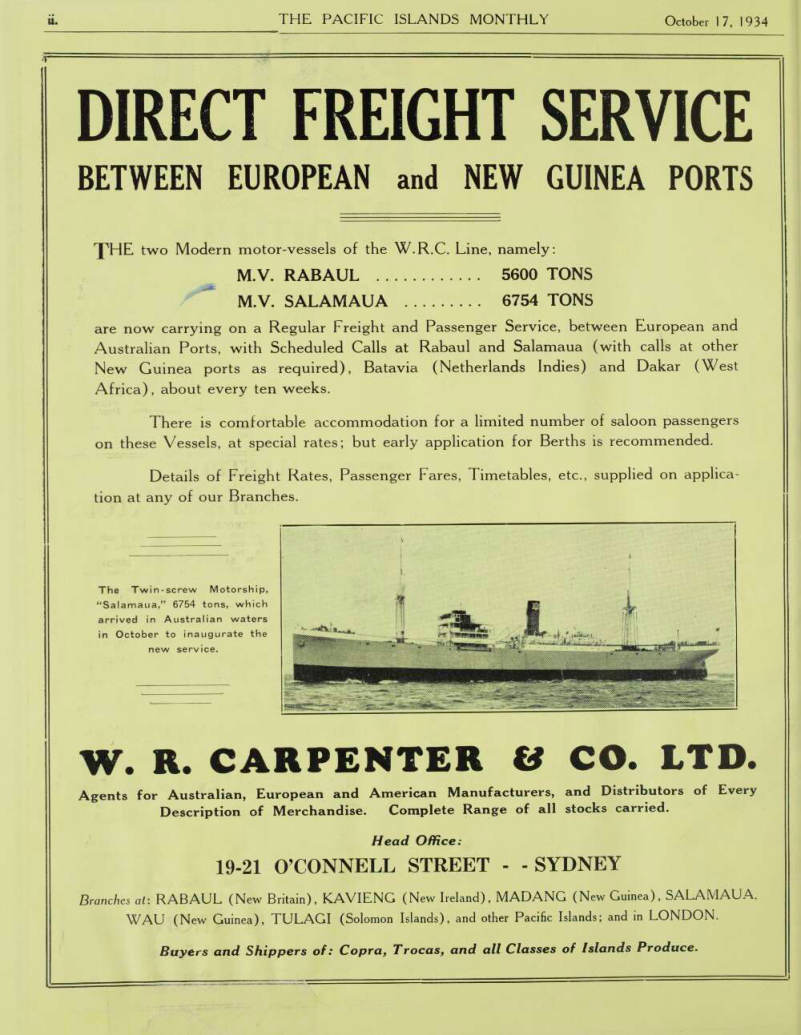
Direct Freight Service
BETWEEN EUROPEAN and NEW GUINEA PORTS
two Modern motor-vessels of the W.R.C. Line, namely:
M.V. RABAUL 5600 TONS
M.V. SALAMAUA 6754 TONS
are now carrying on a Regular Freight and Passenger Service, between European and Australian Ports, with Scheduled Calls at Rabaul and Salamaua (with calls at other New Guinea ports as required), Batavia (Netherlands Indies) and Dakar (West Africa), about every ten weeks.
There is comfortable accommodation for a limited number of saloon passengers on these Vessels, at special rates; but early application for Berths is recommended.
Details of Freight Rates, Passenger Fares, Timetables, etc., supplied on application at any of our Branches.
The Twin-screw Motorship, “Salamaua,” 6754 tons, which arrived in Australian waters in October to inaugurate the new service.
W. R. CARPENTER & CO. LTD.
Agents for Australian, European and American Manufacturers, and Distributors of Every Description of Merchandise. Complete Range of all stocks carried.
Head Office:
19-21 O’CONNELL STREET - - SYDNEY
Branches at: RABAUL (New Britain), KAVIENG (New Ireland), MADANG (New Guinea), SALAMAUA, (New Guinea), TULAGI (Solomon Islands), and other Pacific Islands; and in LONDON.
Buyers and Shippers of: Copra, Trocas, and all Classes of Islands Produce.
Pacific Travellers
Passengers Per Malatta, Which
Sailed From Sydney For British
Solomon Islands On September 22:
Mr. L. Grant, Mr. A. E. Palmer, Miss Jamieson, Mr. and Mrs. H. S. Sim, Mr. J. F. Isley, Mr. and Mrs. A. J. Gibson, Mrs. R. A. Williams and infant, Mrs. G. W. Barnes and infant, Mr.
L. A. Borgas, Mr. W. Rixon, Mr. W. H. Driver, Mr. H. D. Harricks, Mr. H. M. Hill, Mr. and Mrs. J. N. Kennedy, Rev. H. Sherwin, Mr. K. P.
Fitzgerald, Miss D. B. Read, Miss E. L. Semple, Mr. and Mrs. P. College, Miss V. F. Everitt, Mrs. B. P. Rosenthal, Miss F. Binskin, Miss Fitz gerald, Miss Holmes, Mr. A. Mackenzie,
Passengers Per Malaita, Which
Arrived In Sydney From The Solomon
Islands On September 16:—Messrs. Ah
Nam, Balfour (2), Challis, Daidson, Fulton, Hitch cock, Harrison, Hall, Hobbs, Kennedy, Jacobsen, Long, Mason, Mitchell, Macartney, Mason, Mac- Kenzie, Marshall, Peacock, Quintal, Reid, Riley, Smith, Symes, Smyth, Timms, Terry, Watsford, Worthington, Rev. P. C. Williams, Rev. Dr.
Micklem, Capt. Middenway, Capt. J. Scott, Prof.
Thurnwald, Mesdames Duly, Daidson, Deck, Hart, Hobbs. Kennedy, Jacobsen, Long, Mathe son, Mason, Malcolm, MacMifan, Thurnwald, Reid, Symes, Balfour, Hall, Misses Brooker, Broadhurst, Cleaver, Gillett, Hewit, Mullen, Mc- Donald, Stringer, Sister Wilson, Miss Matheson.
Passengers Per Macdhui, Which
Arrived In Sydney From Papua And
New Guinea On September 13:—Messrs.
Adams, Chapman, Cannings, Dodd, Dickson, Dwyer, Downs, Evensen, Griffin, Granter, Headland, Har graves, Hume, Hart, Holdsworth, Izod, Kelleck, Kirkham, Kirkpatrick, Leake, Mirrow, Malcolm, Mackie, Macdonald (2), McCarthy, McAdam, Mil len (2), Mason, Moore, Nelson, Orton, Pater son, Rutherford, Ritchie, Reid, Rawnsley, Rea son, Surman, Smith, Stone, Scott, Trim, Taylor, Wyatt, Waterhouse, Wyatt, Walker, Drs. Watch, Clements, Captain Mustar, Mesdames Baker, Burrows, Corkin, Corke, Coote, Findlay, Gurney, Heaslip, Headland, Holdsworth, Ives, Marshall, Miller, Moir, Moore, Smith, Skelly, Strang, Tay lor, Walker, Misses Adams, Bunting, Brown (2), Brooke, Chipman, Drennen, Gillies, Hore, Ives, Yates, Sister Imelda.
Passengers Per Macdhui, Which
Sailed From Sydney For Papua And
New Guinea On September 20:—Messrs.
Pratt, Butler, Anderson, Turner, Button, Chin nery, Campbell, Storey, Gordon, Higgins, Long, Buterworth, Hope, Niall, McLean, Grant, Captain Phillips, Farrell, Stevenson, Cuthbert, Lake, Wil liams, Collyer, Munglison, Captain Doyle, Rev.
Badger, Hyde, Pickering, Rev. Taylor, Overton, Wilkin, Pearce, Davies, Fraser (2), Jarrett, For rester, Street, Cranston, Jones. Gandry, Skitch, Monfries, Boles, Clout, Crowe (2), Jerrome, Mac- Kenzie, Filan, Bowen-Jones. Mesdames Button (2), Campbell, Hope, Streeton, Grant, Lewis, Nor ton, Sparks, Cameron, Doyle, Taylor, Dunston, Bowen-Jones, Laughter and infant, Ray and two children, Misses Browning, Lawrie, Streeter, Anderson, Pollard, Sparkes, Cooper, Walker, Adams, Hughes, Anderson, Simons, Rev. Sister Assumpta, Wilson.
Passengers Per Morinda, Which
Arrived In Sydney From New Heb
Rides And Norfolk Island On Septem
BER 20:—Messrs. Donellan, McLeod, Rutty, Simpson, Booth, Lindsay Brooke, Craddock, Kerr Marshall, Morey, Wallace, Watson, Weils, Cramer, Davidson, Dewey, Harper, Johnstone, Jones, Murdock, Nancarrow, Poland, Sanders, Scarrott, Steam, Mesdames Rutty, Archer, Clarke, Crane, Harper, Healy, Martin, Murdock, Sanders, Waite, Misses McMahon, Rogers, Silver, Pope Christian, Hanan, Palmer, Ross, Simons, Sharland-Taylor.
Mataram Passengers Who Arrived
FROM PAPUA AND N.G. ON OCTOBER 5- Messrs. Atkinson, Burlington, Badger, Bell, Black, yme Carroll, Condon, Coote, de Kantzow, Dono iran, Dredge, Elkington, Elder, Fraser, Gallet, Gordon, Groom, Haag, Hall, Morris, Mackay, Muller, O'Malley, Ryan, Sandes, Sargeant, Smith, Mower, Turnbull, Williamson, Sanders, Dr. Strong, Dr. Pockley, Mesdames Byrne, Clifford, Elder, Groom, Hides, Mackay, Orr, Sargeant, Misses Cater, Crossing, Litchfield, Thomas, Younger.
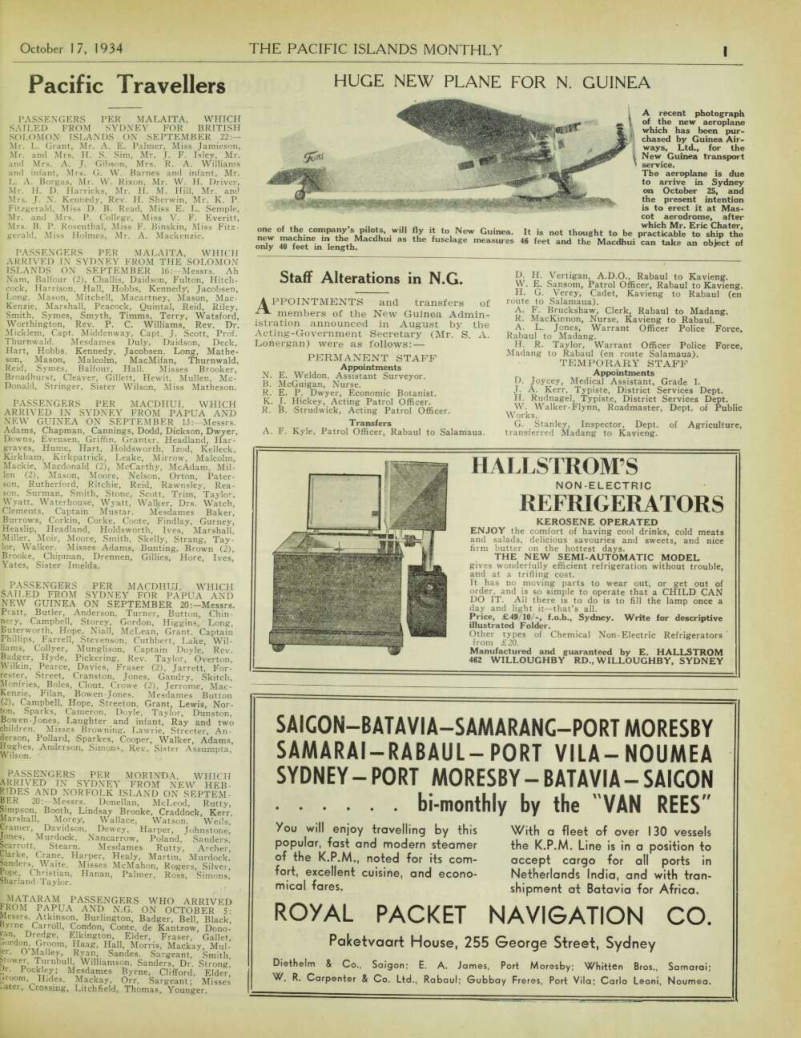
Huge New Plane For N. Guinea
A recent photograph of the new aeroplane which has been pur chased by Guinea Air ways, Ltd., for the New Guinea transport service.
The aeroplane is due to arrive in Sydney on October 25, and the present intention is to erect it at Mas cot aerodrome, after which Mr. Eric Chater,
one the company's pilots, will fly it to New Guinea. It is not thought to be practicble to ship the new machine in the Macdhui as the fuselage measures 46 feet and the Macdhui can take an object of only 40 feet in length.
Staff Alterations in N.G.
APPOINTMENTS and transfers of members of the New Guinea Admin istration announced in August by the Acting-Government Secretary (Mr. S. A.
Lonergan) were as follows:
Permanent Staff
Appointments N. E. Weldon, Assistant Surveyor.
B. McGuigan, Nurse.
R. E. P. Dwyer, Economic Botanist.
K. J. Hickey, Acting Patrol Officer.
R. B. Strudwick, Acting Patrol Officer.
T ransfers A. F. Kyle, Patrol Officer, Rabaul to Salamaua.
D. H. Vertigan, A.D.O., Rabaul to Kavieng.
W. E . Sansom, Patrol Officer, Rabaul to Kavieng.
H. G. Verey, Cadet, Kavieng to Rabaul (en route to Salamaua).
A. F. Bruckshaw, Clerk, Rabaul to Madang.
A. L. Jones, Warrant Officer Police Force, Rabaul to Madang.
H. R. Taylor, Warrant Officer Police Force, Madang to Rabaul (en route Salamaua).
Temporary Staff
Appointments D. Joycey, Medical Assistant Grade 1.
J. A. Kerr, Typiste, District Services Dept.
H. Rudnagel, Typiste, District Services Dept.
W. Walker-Flynn, Roadmaster, Dept. of Public Works.
G. Stanley, Inspector, Dept, of Agriculture, transferred Madang to Kavieng.
Advertisements & other items, p. 3 (1 item)
Saicon-Batavia-Samarang-Port Moresby
HALLSTROM’S
NONELECTRIC
REFRIGERATORS
KEROSENE OPERATED
ENJOY the comfort of having cool drinks, cold meats and salads, delicious savouries and sweets, and nice firm butter on the hottest days.
THE NEW SEMI-AUTOMATIC MODEL
gives wonderfully efficient refrigeration without trouble, and at a trifling cost.
It has no moving parts to wear out, or get out of order, and is so simple to operate that a CHILD CAN DO IT. All there is to do is to fill the lamp once a day and light it —that’s all.
Price, £49/10/-, f.o.b., Sydney. Write for descriptive illustrated Folder.
Other types of Chemical Non-Electric Refrigerators from £20.
Manufactured and guaranteed by E. HALLSTROM
462 WILLOUGHBY RD„ WILLOUGHBY, SYDNEY
SAICON-BATAVIA-SAMARANG-PORT MORESBY
SAMARAI-RABAUL- PORT VILA-NOUMEA
SYDNEY - PORT MORESBY - BATAVIA - SAIGON
bi-monthly by the "VAN REES"
Vou will enjoy travelling by this popular, fast and modern steamer of the K.P.M., noted for its comfort, excellent cuisine, and economical fares.
With a fleet of over 130 vessels the K.P.M. Line is in a position to accept cargo for all ports in Netherlands India, and with transhipment at Batavia for Africa.
ROYAL PACKET NAVIGATION CO.
Paketvaart House, 255 George Street, Sydney
Diethelm & Co., Saigon; E. A. James, Port Moresby: Whitten Bros., Samarai; W. R. Carpenter & Co. Ltd., Rabaul; Gubbay Freres, Port Vila; Carlo Leoni, Noumea.
Advertisers
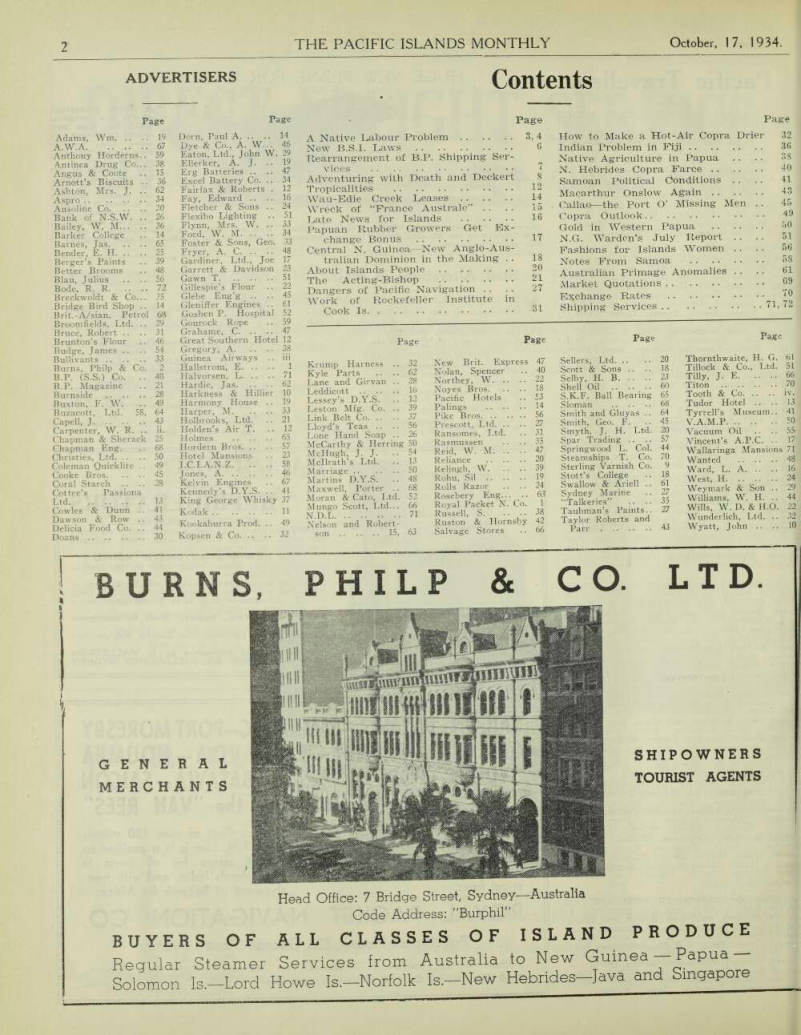
Page Adams, Wm 19
A.W.A 67
Anthony Horderns.. 59 A. Drug Co... 38 Angus & Coote .. 15 Arnott’s Biscuits .. 36 Ashton, Mrs. J. .. 62 Aspro 34 Ausoline Co. .. .. 20 Bank of N.S.W. .. 26 Bailey, W. M. 36 Barker College .. 14 Barnes, Jas. 65 Bender, E. H. 25 Berger’s Paints .. 39 Better Brooms .. 48 Blau, Julius .. .. 56 Bode, R. R. 72 Breckwoldt & Co... 35 Bridge Bird Shop .. 14 Brit.-A/sian. Petrol 68 Broomfields, Ltd. .. 29 Bruce, Robert .. .. 31 Brunton’s Flour .. 46 Budge, James .. .. 54 Bullivants 33 Burns, Philp & Co. 2
B. (S.S.) Co. .. 40
B.P. Magazine .. 21 Burnside 28 Buxton, F. W. .. 49 Buzacott, Ltd. 58, 64 Capell, J. 43 Carpenter, W. R. .. ii.
Chapman & Sherack 25 Chapman Eng. .. 68 Christies, Ltd. 50 Coleman Quicklite .. 49 Cooke Bros. 45 Coral Starch .. .. 28 Cottee’s Passiona Ltd 13 Cowles & Dunn .. 41 Dawson & Row .. 43 Delicia Food Co. .. 44 Doans 30
Page Dorn, Paul A. 14 Dye & Co., A. W... 46 Eaton, Ltd., John W. 29 Ellerker, A. J. .. 19 Erg Batteries .. .. 47 Excel Battery Co. .. 34 Fairfax & Roberts . 12 Fay, Edward .. .. 16 Fletcher & Sons .. 24 Flexibo Lighting .. 51 Flynn, Mrs. W. .. 33 Ford, W. M. 34 Foster & Sons, Geo. 33 Fryer, A. C. 48 Gardiner, Ltd., Joe 17 Garrett & Davidson 23 Gawn T. 51 Gillespie’s Flour .. 22 Glebe Eng’g .. .. 45 Gleniffer Engines .. 61 Goshen P. Hospital 52 Gourock Rope .. 59 Grahame, C. 47 Great Southern Hotel 12 Gregory, A. 38 Guinea Airways .. iii Hallstrom, E. 1 Halvorsen, L. 71 Hardie, Jas. 62 Harkness & Hillier 10 Harmony House .. 19 Harper, M. 33 Holbrooks, Ltd. .. 21 Holden’s Air T. .. 12 Holmes 65 Hordern Bros 57 Hotel Mansions .. 23
I.C.La.N.Z. 58
Jones, A. 46 Kelvin Engines .. 67 Kennedy’s D.Y.S. .. 41 King George Whisky 37 Kodak 11 Kookaburra Prod. .. 49 Kopsen & Co. 32
Page Krump Harness .. 32 Kyle Parts .. .. 62 Lane and Girvan .. 28 Leddicott 16 Lessey’s D.Y.S. .. 12 Leston Mfg. Co. .. 39 Link Belt Co. 37 Lloyd’s Teas .. .. 56 Lone Hand Soap .. 26 McCarthy & Herring 50 McHugh, J. J. 54 Mcllrath’s Ltd. .. 13 Marriage 50 Martins D.Y.S. .. 48 Maxwell, Porter .. 68 Moran & Cato, Ltd. 52 Mungo Scott, Ltd... 66
N.D.L. 71
Nelson and Robert son .. .. .. 15, 63
Page New Brit. Express 47 Nolan, Spencer .. 40 Northey, W. 22 Noyes Bros. 18 Pacific Hotels .. 53 Palings 14 Pike Bros. 56 Prescott, Ltd. 27 Ransomes, Ltd. .. 31 Rasmussen .. .. 35 Reid, W. M. 47 Reliance 20 Relingh, W. 39 Rohu, Sil 19 Rolls Razor .. .. 24 Rosebery Eng. 63 Royal Packet N. Co. 1 Russell, S. 38 Ruston & Hornsby 42 Salvage Stores .. 66
Page Sellers, Ltd 20 Scott & Sons .. .. 18 Selby, H. B. 23 Shell Oil 60 S.K.F. Ball Bearing 65 Sloman 68 Smith and Gluyas .. 64 Smith, Geo. F. .. 45 Smyth, J. H. Ltd. 20 Spar Trading .. .. 57 Springwood L. Col. 44 Steamships T. Co. 70 Sterling Varnish Co. 9 Stott’s College .. 18 Swallow & Ariell .. 61 Sydney Marine .. 27 “Talkeries” .. 35 Taubman’s Paints.. 27 Taylor Roberts and Parr 43
Page Thornthwaite, H. G. 61 Tillock & Co., Ltd. 51 Tilly, J. E. 66 Titon 70 Tooth & Co. iv.
Tudor Hotel .. .. 13 Tyrrell’s Museum.. 41
V.A.M.P. 50
Vacuum Oil .. .. 55 Vincent’s A.P.C. .. 17 Wallaringa Mansions 71 Wanted 48 Ward, L. A. 16 West, H. 24 Weymark & Son .. 29 Williams, W. H. .. 44 Wills, W. D. & H.O. 22 Wunderlich, Ltd. .. 32 Wyatt, John .. .. 10
Contents
Page A Native Labour Problem 3, 4 New B.S.I. Laws 6 Rearrangement of B.P. Shipping Ser vices 7 Adventuring with Death and Deckert 8 Tropicalities 12 Wau-Bdie Creek Leases 14 Wreck of “France Australe” . . . . 15 Late News for Islands 16 Papuan Rubber Growers Get Ex change Bonus 17 Central N. Guinea —New Anglo-Aus tralian Dominion in the Making .. 18 About Islands People 20 The Acting-Bishop . . 21 Dangers of Pacific Navigation . . . . 27 Work of Rockefeller Institute in Cook Is 31
Page How to Make a Hot-Air Copra Drier 32 Indian Problem in Fiji 36 Native Agriculture in Papua .. . . 38 N. Hebrides Copra Farce 40 Samoan Political Conditions .. .. 41 Macarthur Onslow Again 43 Callao—the Port O’ Missing Men .. 45 Copra Outlook Gold in Western Papua 50 N.G. Warden’s July Report .. .. 51 Fashions for Islands Women .. .. 66 Notes From Samoa 58 Australian Primage Anomalies .. .. 61 Market Quotations 69 Exchange Rates 70 Shipping Services 71, 72
Advertisements & other items, p. 4 (1 item)
Burns, Philp & Co. Ltd.
GENERAL
MERCHANTS
SHIPOWNERS
TOURIST AGENTS
Head Office: 7 Bridge Street, Sydney— Australia Code Address: "Burphil"
BUYERS OF ALL CLASSES OF ISLAND PRODUCE Regular Steamer Services from Australia to New Guinea — Papua Solomon Is.—Lord Howe Is.—Norfolk Is.—New Hebrides—Java and Singapore
The Pacific Islands Monthly
The Newspaper-Magazine Of The South Seas
[Registered at G.P.O., Sydney, for transmission by post as a newspaper.]
Published Once Each Month and Circulated in Australia and New Zealand and in the following Pacific Territories and Islands Groups:
Crown Colony of Fiji.
Australian Territory of Papua.
Mandated Territory (Australia) of New Guinea, Bismarck Archipelago, and Northern Solomon Islands.
Mandated Territory (Japan) of Marshall, Caroline and Mariana Islands.
French Territory of New Caledonia.
British and French Condominium of New Hebrides.
American Territory of Eastern Samoa.
American Territory of Guam.
Mandated Territory of Nauru.
British Crown Colony of Gilbert and Ellice Islands.
Mandated Territory (New Zealand) of Samoa.
British Solomon Islands Protectorate.
British Protectorate of Tongan Islands.
New Zealand Territory of Cook Islands.
Australian Territory of Norfolk Island.
French Colony of Oceania (Tahiti, etc.).
American Territory of Hawaiian Islands.
Owned and Produced by Pacific Publications Ltd., Union House, 247 George Street, Sydney.
Telephone Bw 5037
P.O. Box 3408 R
Editor and Publisher:
R. W. Robson.
Registered Address for Radiograms and Cables: “PACPUB” Sydney
Contributions Articles, Stories, and Photographs dealing with Pacific Islands Subjects are invited, and will be oaid for on publication at usual rates.
Subscription Rates Per Annum, within British Empire, Prepaid Post Free 6/- Per Annum, elsewhere, prepaid, Post Free .. 8/- Single Copies 6d.
Advertisements Advertising rates furnished on application.
Colours, etc. by Arrangement.
Process Blocks made at Advertiser’s expense when required. Screen, 100.
Changes of Advertising Copy should reach this Office by 8th of each month, otherwise previous advertisement may be repeated.
Agents The following are authorised to receive subscriptions for “The Pacific Islands Monthly”— Islands Branches of Burns, Philp & Co., Ltd,, and Burns, Philp (South Seas) Co., Ltd.
Islands Branches of W. R. Carpenter & Co., Ltd.
All Branches of Morris. Hedstrom & Co., Ltd.
G. Thomas & Co., Rabaul.
Whitten Bros., Ltd., Samarai.
P. Costello, Suva, Fiji.
All Branches and Representatives of W. H. Grove and Sons. Ltd., Auckland.
S. Russell, Papeete, Tahiti.
Cook Islands Trading Co., Rarotonga.
Vol. V., No. 3.
Sydney, October 17, 1934
Price 6d, Per Copy Prepaid: 6/- p.a.
A Native Labour Problem
THERE is a native labour problem in the Western Pacific Territories—but it has two dimensions. The attitude of indentured native labourers towards Europeans has received, and is receiving, much attention; but it is almost as important that consideration be given to the relationship between European employers and their native labourers.
The situation is seen clearly on the New Guinea goldfields. The standard of treatment of the several thousand natives employed there is set by the big companies (Bulolo, N.G. Goldfields, Guinea Airways, Day Dawn, etc.) and the standard is good. There is quite definite human kindliness, as well as formal sympathy and justice, in the way in which the natives are controlled, fed, housed and medically treated in the big labour camps; and the natives seem well and contented. With exceptions, the smaller employers generally follow suit — but the exceptions ought to have official attention.
There are two classes of Europeans who never should be allowed to engage native labour. One is the man who seems to have an anti-native complex, and who permits his hatred of the black skin to show out constantly. His standard of intelligence is so low that he judges these stone-age aborigines according to Euro pean standards, and usually describes them as “fools” and “swine.” There is no hope for this class of white—he should be forbidden any business re lationship with natives. The other type of white man is he who has never before found himself in command of labour, and who has no idea of how to treat servants.
He is harsh, heckling, domineering and brutal. Generally speaking, the types of New Guinea natives who are recruited as labourers are tractable and trusting and easily controlled by understanding and experienced men. At first, they regard all white men as demi-gods; but they are by no means unintelligent, and they soon develop a remarkably sound discrimina tion between the European who is a good
boss, and the snarling, belligerent, low class white who imagines that the only way to maintain an efficient labour line is to treat the natives as if they were dangerous animals, and give them blows, limited food and poor shelter. In every labour line there is a proportion of “flash bucks” and cunning rascals who require special attention; but the wise employer can deal with these cases, while main taining contentment and discipline among his men.
In the beginning of the Australian administration, there were difficulties in maintaining good order and discipline in the labour lines. Employers were not allowed to administer chastisement; and when “Guv’ment” assumed that responsi bility, and put offenders in gaol, the thing was regarded as a joke. The native naturally sees no punishment in a month’s “calaboose,” where he is well fed and sheltered. Thus, there arose a sharp agitation in favour of whipping, and a demand that District Officers be given authority to order corporal punish ment. When General Griffiths took
charge, he inaugurated “sand and rock drill” in the prisons; and that seems to have ended all argument and agitation.
This writer recently watched a squad of very weary prisoners doing interminable “sand-drill” (lifting and lowering heavy bags of sand), under the direction of sharp-voiced, snappy native police; and he is satisfied that “calaboose” now really means something to native labourers, and is definitely a deterrent to malingering, insolence and crime. He could not help contrasting this with a picture in his memory of three years ago, when he saw two fat, cheeky-looking natives leisurely cutting grass outside an official’s house in one New Guinea centre and was as sured that these were “native criminals undergoing punishment.” Furthermore, there now is a fine class of D.O. and A.D.O. throughout New Guinea, and these officials seem to have been given wider powers in dealing with native labour affairs. Whatever the reasons, there is now a much better understanding between the employers and the Adminis tration.
So far, so good. The employers are quiet; but the obligation is upon the Administration, in an even greater de gree, to guard the native labourers against abuse and cruelty. The contented, healthy appearance of the great majority of native labourers speaks for itself; but there are certain individual employers— few in numbers, fortunately—who should be constantly watched and, when found guilty of bad treatment of natives, they should be severely punished; and, where considered necessary, their right to em ploy natives should be withdrawn.
There is one aspect of indentured native labour in the islands of Melanesia which most urgently demands attention.
It is a fault of the system, and not of individuals. Large numbers of recruited natives are brought from their villages to their places of employment and kept for long periods, running into years, in native labour barracks. They are not permitted to bring their womenfolk with them — these little communities are wholly male.
As a result of such living conditions, cer tain grave evils develop —inevitably. It is a well-known fact that these evils appear wherever the native labourers are herded together in barracks.
The position is particularly bad on the N.G. goldfields, where thousands of native labourers have been brought to gether; and, perhaps, the authorities will try, on the goldfield, to find a solution of the difficulty—possibly in co-operation
with the big employers, the solution, probably, will be found in the establish ment of villages for the native labourers, where they may live under more natural conditions —villages to which they may bring their womenfolk and where they may grow some portion of their own food.
The Bulolo Valley, being a pleasant,
healthy, fertile place, seems eminently
suitable for such an experiment. The life of this goldfield is at least 25 years, and it is most undesirable that the labour forces there should be kept there in definitely under such conditions, Australia and New Guinea are ex tremely lucky in being able to draw upon such an unlimited supply of local labour for the development of the mining in dustry. Only a little way off, in New Caledonia and New Hebrides, the French have had to undertake the costly business of bringing labour from Java and Cochin China, in order to carry on their main industries. Australia, already, has a good record as a protector of native in terests in Papua and New Guinea; but
that is no reason why there should be any slackening of effort. The continu ance of the native labour barracks system is not desirable, if it can be avoided.
20 Mails P.A.
Improved Service for Tahiti
From Our Own Correspondent.
PAPEETE, September 6.
IT is officially announced by the Chief of the Post and Telegraph Department that by arrangement with the postal authorities of the United States a supple mentary mail service has been established via Colon (Canal Zone) by means of the Messageries; Maritimes steamers, seven of which call at Tahiti during the year en route from France to New Caledonia and vice versa.
The colony of French Oceania will now have 20 incoming and outgoing mails per annum instead of the 13 provided for merly by the vessels of the Union Steam ship Co.
The first batch of mail to arrive at Tahiti under this new arrangement came by the Ville de Verdun on September 1 days ahead of the S.S. Maunganui.
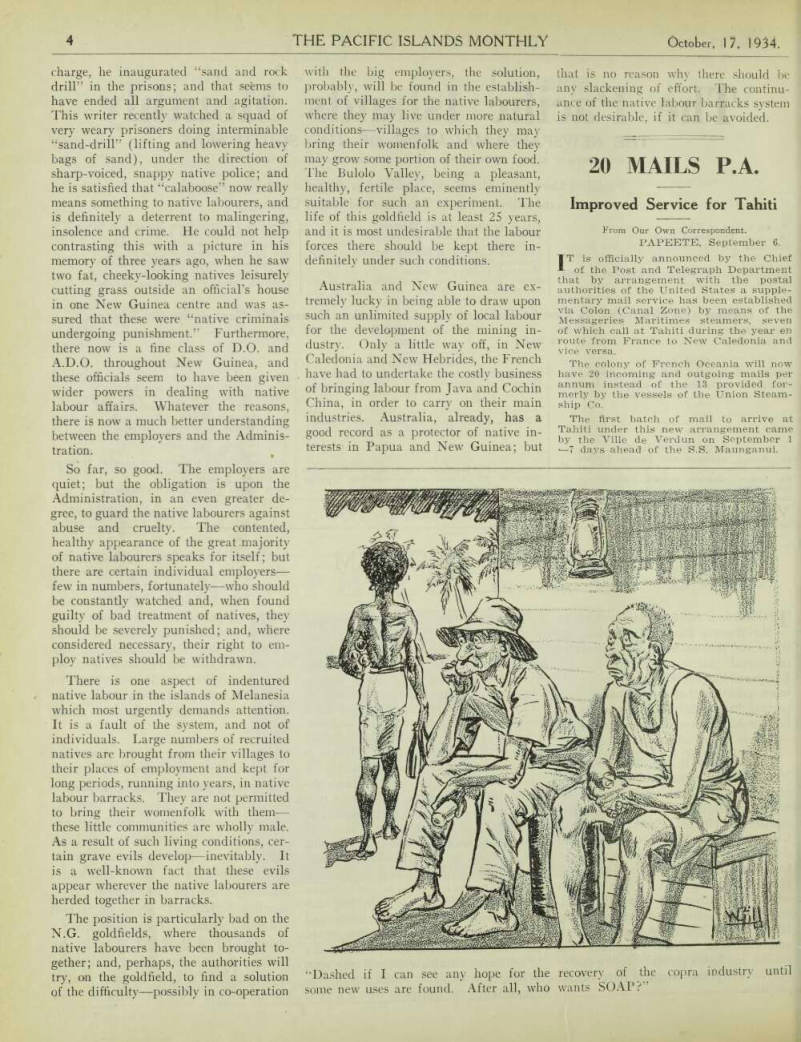
“Dashed if I can see any hope for the recovery of the copra industry until some new uses are found. After all, who wants SOAP ?
Fiji’S Trade
Australia Still Principal Supplier
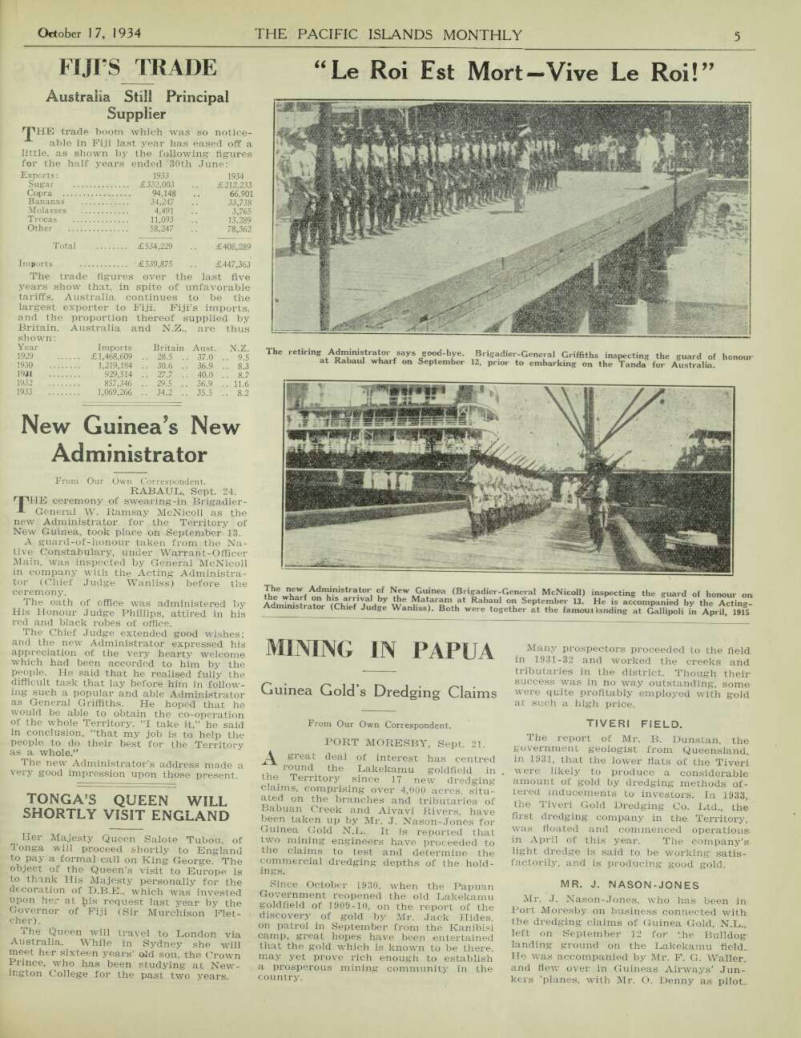
THE trade boom which was so noticeable in Fiji last year has eased off a little, as shown by the following figures for the half years ended 30th June:
The trade figures over the last five years show that, in spite of unfavorable tariffs, Australia continues to be the largest exporter to Fiji. Fiji’s imports, and the proportion thereof supplied by Britain, Australia and N.Z., are thus shown:
Exports: 1933 1934 Sugar £332,003 £212,233 Copra 94,148 66,901 Bananas 34,247 33,738 Molasses 4,491 3,765 Trocas 11,093 13,289 Other 58,247 78,362 Total £534,229 £408,289 Imports £539,875 £447,363
Year Imports Britain Aust. N.Z. 1929 £1,468,609 .. 28.5 .. 37.0 .. 9.5 1930 1,219,184 .. 30.6 .. 36.9 .. 8.3 1931 929,514 .. 27.7 .. 40.0 .. 8.7 1932 857,346 .. 29.5 .. 36.9 .. 11.6 1933 1,069,266 .. 34.2 .. 35.5 .. 8.2
New Guinea’s New
Administrator
From Our Own Correspondent.
Rabaul, Sept. 24.
THE ceremony of swearing-in Brigadier- General W. Ramsay McNicoll as the new Administrator for the Territory of New Guinea, took place on September 13.
A guard-of-honour taken from the Na tive Constabulary, under Warrant-Officer Main, was inspected by General McNicoll in company with the Acting Administra tor (Chief Judge Wanliss) before the ceremony.
The oath of office was administered by His Honour Judge Phillips, attired in his red and black robes of office.
The Chief Judge extended good wishes; and the new Administrator expressed his appreciation of the very hearty welcome which had been accorded to him by the people. He said that he realised fully the difficult task that lay before him in follow ing such a popular and able Administrator as General Griffiths. He hoped that he would be able to obtain the co-operation of the whole Territory. “I take it,” he said in conclusion, “that my job is to help the people to do their best for the Territory as a whole.”
The new Administrator’s address made a very good impression upon those present.
Tonga’S Queen Will
Shortly Visit England
Her Majesty Queen Salote Tubou, of Tonga will proceed shortly to England to pay a formal call on King George. The object of the Queen’s visit to Europe is to thank His Majesty personally for the decoration of D.B.E., which was invested upon her at his request last year by the Governor of Fiji (Sir Murchison Flet cher), The Queen will travel to London via Australia. While in Sydney she will meet her sixteen years’ old son, the Crown Prince, who has been studying at New ington College for the past two years.
“Le Roi Est Mort—Vive Le Roi!”
The retiring says good-bye. Brigadier-General Griffiths inspecting the guard of honour at Rabaul wharf on September 12, prior to embarking on the Tanda for Australia.
The new Administrator of New Guinea (Brigadier-General McNicoll) inspecting the guard of honour on the wharf on his arrival by the Mataram at Rabaul on September 13. He is by th e Acting- Administrator (Chief Judge Wanliss). Both were together at the famous landing at Gallipoli in April, 1915
Mining In Papua
Guinea Gold’s Dredging Claims
From Our Own Correspondent.
Port Moresby, Sept. 21.
A great deal of interest has centred round the Lakekamu goldfield in the Territory since 17 new dredging claims, comprising over 4,000 acres, situ ated on the branches and tributaries of Babuan Creek and Aivavi Rivers, have been taken up by Mr. J. Nason-Jones for Guinea Gold N.L. It is reported that two mining engineers have proceeded to the claims to test and determine the commercial dredging depths of the hold ings.
Since October 1930, when the Papuan Government reopened the old Lakekamu goldfield of 1909-10, on the report of the discovery of gold by Mr. Jack Hides, on patrol in September from the Kanibisi camp, great hopes have been entertained that the gold which is known to be there, may yet prove rich enough to establish a prosperous mining community in the country.
Many prospectors proceeded to the field in 1931-32 and worked the creeks and tributaries in the district. Though their success was in no way outstanding, some were quite profitably employed with gold at such a high price.
Tiveri Field.
The report of Mr. B. Dunstan, the government geologist from Queensland, in 1931, that the lower flats of the Tiveri were likely to produce a considerable amount of gold by dredging methods ot tered inducements to investors. In 1933, the Tiveri Gold Dredging Co. Ltd., the first dredging company in the Territory, was floated and commenced operations in April of this year. The company’s light dredge is said to be working satis factorily, and is producing good gold.
Mr. J. Nason-Jones
Mr. J. Nason-Jones, who has been in Port Moresby on business connected with the dredging claims of Guinea Gold, N.L., left on September 12 for the Bulldog landing ground on the Lakekamu field.
He was accompanied by Mr. P. G. Waller, and flew over in Guineas Airways’ Jun kers ’planes, with Mr. O. Denny as pilot..
More Papuan Medical Trainees
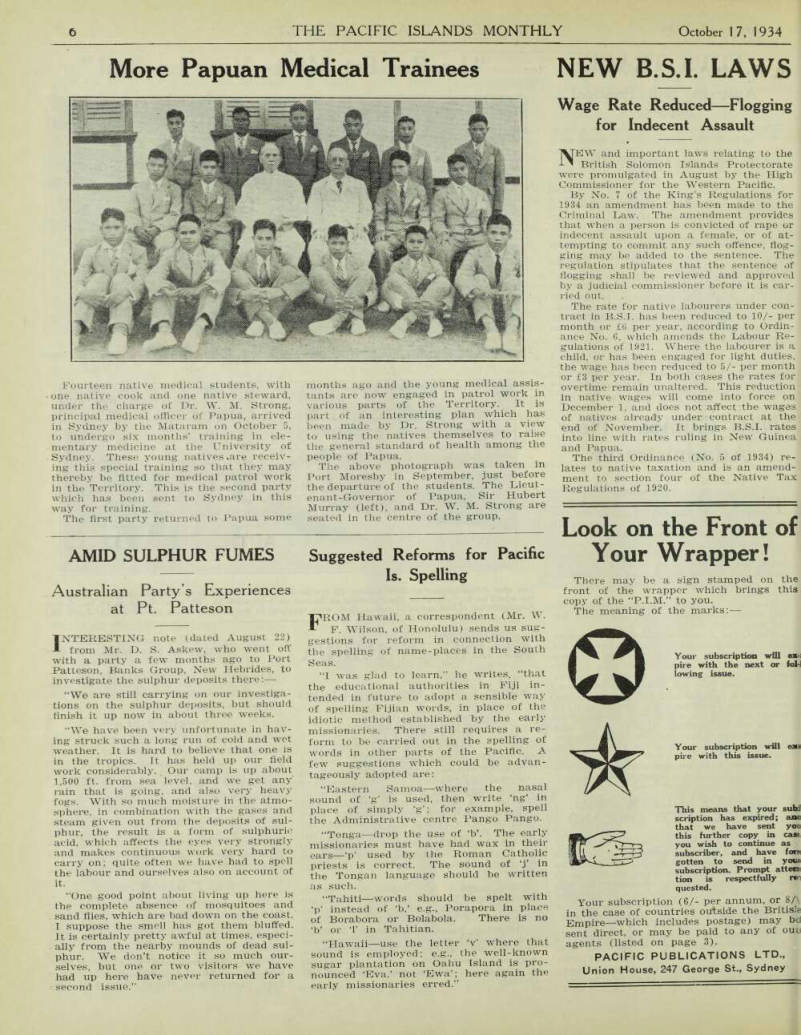
Fourteen native medical students, with one native cook and one native steward, under the charge of Dr. W. M. Strong, principal medical officer of Papua, arrived in Sydney by the Mataram on October 5, to undergo six months’ training in ele mentary medicine at the University of Sydney. These young natives are receiving this special training so that they may thereby be fitted for medical patrol work in the Territory. This is the second party which has been sent to Sydney in this way for training.
The first party returned to Papua some
months ago and the young medical assis tants are now engaged in patrol work in various parts of the Territory. It is part of an interesting plan which has been made by Dr. Strong with a view to using the natives themselves to raise the general standard of health among the people of Papua.
The above photograph was taken in Port Moresby in September, just before the departure of the students. The Lieut enant-Governor of Papua, Sir Hubert Murray (left), and Dr. W. M. Strong are seated in the centre of the group.
Australian Party’s Experiences
Amid Sulphur Fumes
Australian Party’s Experiences at Pt. Patteson
INTERESTING note (dated August 22) from Mr. D. S. Askew, who went off with a party a few months ago to Port Patteson, Banks Group, New Hebrides, to investigate the sulphur deposits there: — “We are still carrying on our investiga tions on the sulphur deposits, but should finish it up now in about three weeks.
“We have been very unfortunate in hav ing struck such a long run of cold and wet weather. It is hard to believe that one is in the tropics. It has held up our field work considerably. Our camp is up about 1,500 ft. from sea level, and we get any rain that is going, and also very heavy fogs. With so much moisture in the atmo sphere, in combination with the gases and steam given out from the deposits of sul phur, the result is a form of sulphuric acid, which affects the eyes very strongly and makes continuous work very hard to carry on; quite often we have had to spell the labour and ourselves also on account of it.
“One good point about living up here is the complete absence of mosquitoes and sand flies, which are bad down on the coast.
I suppose the smell has got them bluffed.
It is certainly pretty awful at times, especi ally from the nearby mounds of dead sul phur. We don’t notice it so much our selves, but one or two visitors we have had up here have never returned for a second issue.”
Is. Spelling
Suggested Reforms for Pacific Is. Spelling
FROM Hawaii, a correspondent (Mr. W.
F. Wilson, of Honolulu) sends us sug gestions for reform in connection with the spelling of name-places in the South Seas.
“I was glad to learn,” he writes, “that the educational authorities in Fiji in tended in future to adopt a sensible way of spelling Fijian words, in place of the idiotic method established by the early missionaries. There still requires a re form to be carried out in the spelling of words in other parts of the Pacific. A few suggestions which could be advan tageously adopted are: “Eastern Samoa —where the nasal sound of ‘g’ is used, then write ‘ng’ in place of simply ‘g’; for example, spell the Administrative centre Pango Pango.
“Tonga—drop the use of ‘b’. The early missionaries must have had wax in their ears—‘p’ used by the Roman Catholic priests is correct. The sound of ‘j’ in the Tongan language should be written as such.
“Tahiti —words should be spelt with ‘p’ instead of ‘b,’ e.g., Porapora in place of Borabora or Bolabola. There is no ‘b’ or T in Tahitian.
“Hawaii —use the letter V where that sound is employed; e.g., the well-known sugar plantation on Oahu Island is pro nounced ‘Eva,’ not ‘Ewa’; here again the early missionaries erred.”
New B.S.I. Laws
Wage Rate Reduced —Flogging for Indecent Assault
NEW and important laws relating to the British Solomon Islands Protectorate were promulgated in August by the High Commissioner for the Western Pacific.
By No. 7 of the King’s Regulations for 1934 an amendment has been made to the Criminal Law. The amendment provides that when a person is convicted of rape or indecent assault upon a female, or of at tempting to commit any such offence, flog ging may be added to the sentence. The regulation stipulates that the sentence of flogging shall be reviewed and approved by a judicial commissioner before it is car ried out.
The rate for native labourers under con tract in B.S.I. has been reduced to 10/- per month or £6 per year, according to Ordin ance No. 6, which amends the Labour Re gulations of 1921. Where the labourer is a child, or has been engaged for light duties, the wage has been reduced to 5/- per month or £3 per year. In both cases the rates for overtime remain unaltered. This reduction in native wages will come into force on December 1, and does not affect the wages of natives already under contract at the end of November. It brings B.S.I. rates into line with rates ruling in New Guinea and Papua.
The third Ordinance (No. 5 of 1934) re lates to native taxation and is an amend ment to section four of the Native Tax Regulations of 1920.
Advertisements & other items, p. 8 (1 item)
Your Wrapper!
Look on the Front of
There may be a sign stamped on the front of the wrapper which brings this copy of the “P.I.M.” to you.
The meaning of the marks: Your subscription will ex-; pire with the next or following issue.
Your subscription will expire with this issue.
This means that your subscription has expired; and that we have sent you this further copy in case you wish to continue as subscriber, and have forgotten to send in your subscription. Prompt attention is respectfully requested.
Your subscription (6/- per annum, or 8/ in the case of countries outside the British Empire—which includes postage) may be sent direct, or may be paid to any of our agents (listed on page 3).
PACIFIC PUBLICATIONS LTD.,
Union House, 247 George St., Sydney
Western Pacific
Timetables
Rearrangement of B.-P. Shipping Services under Consideration
AS a consequence of the development of three new factors in the shipping and I trading position among the Islands Groups of the Western Pacific, a somewhat exten sive rearrangement of the timetables of Messrs. Burns Philp and Co. Ltd. is under consideration. It is being discussed by the shipping company, the Commonwealth Government, the various Administrations concerned, and certain important Islands interests; and it is not likely that finality will be reached until November.
The three factors which have made the rearrangement desirable are: The rapid development of the gold in dustry in New Guinea and Papua; The shrinkage in trade in those groups which are wholly dependent upon copra; The threatened competition in the New Guinea trade by the subsidised Nord deutscher Lloyd line, which has announced that it will run steamers between Australia and Hongkong, with regular calls at Rabaul and Salamaua.
Details of the new timetables drawn up by Messrs. Burns Philp and Co. Ltd. are under discussion in various directions and are not available for publication. It may be said, however, in a general way, that it is proposed to withdraw the new liner Malaita from the Sydney-Brisbane-Solomon Islands run and put her on the Sydney- Brisbane-North Queensland - Papua - New Guinea run, to alternate with the Montoro; and that it is proposed that the Macdhui shall remain on the New Guinea service, but that instead of calling at all the Islands outposts she shall run direct from Sydney to Salamaua, thence to Rabaul, thence to Tulagi (possibly working in the Bougain ville ports), thence back to Salamaua and to Sydney. This would give a very quick service between Sydney and the New Guinea goldfields, which is much in de mand, and it would also maintain connec tion with the Solomons. While the Mac dhui would be making this very quick trip (she would reach Salamaua in five days from Sydney) the Malaita and the Montoro would be carrying on the usual Papua and New Guinea service.
The foregoing arrangements, however, would leave the Solomon Islands without a direct Australian connection. Therefore it is proposed to rearrange the Norfolk Island-New Hebrides service so that the Morinda’s run may be extended from Vila (New Hebrides) up to Tulagi, in the Solo mon Islands. In these circumstances it would be necessary for the Morinda to cut out the run around the New Hebrides, leaving that to be undertaken by the Makambo, which is now stationed at Vila.
In a general way, Messrs. Burns Philp & Co. Ltd. have worked out an attractive plan for coping with new conditions (one of which is a considerably reduced Common wealth subsidy) but it can be understood that every one of the half-dozen Adminis trations concerned, in addition to numerous other interests, has special representations which it wishes to place before the com pany at this time.
It had been hoped to inaugurate the new timetables after the departure of the re paired and refitted Montoro for Papua and
New Guinea on October 17; but it is now apparent that discussions will require more time. It has therefore been arranged that the Macdhui shall follow the Montoro early in November, along the lines of the old timetable.
No Petrol!
What Happens in the Islands
From Our Own Correspondent.
Rarotonga, Sept. 7.
THE dislocation of business on the American sea-board, as a result of the recent prolonged strike at San Francisco and other ports along the American coast, has caused a shortage of petrol on the island. Fortunately, distances at Rarotonga are not very great but it is strangely remarkable the inconvenience caused even an island by a shortage of motor spirit.
The number of useable motor vehicles at Rarotonga is about 150. But petrol is put to so many uses at the islands, particularly where there is no electrical power available, that it affects almost everyone. There are petrol lamps, petrol irons, stationary engines, stoves, in ad dition to motor cars and lorries.
Rusty looking bicycles have been drag ged from their hiding places, superannua ted horse-drawn buggies and other simi lar contraptions have come to light and good old pedestrianism itself has had to be revived.
The new store built at Wau, New Guinea, for Messrs. Burns, Philp and Co. Ltd. The com pany entered into occupation of the new building on September 1.
Board to Study Native Education
in T.N.G.
RABAUL, September 1, A BOARD comprising the Director of District Services and Native Affairs (Chairman), Rev. F. J. Lewis, Chairman of the Methodist Mission, and Rev. Father J. G. Madigan, M.S.C.. has been formed by the Administration to consider and re port upon a scheme for the education of native and Chinese children in the Terri tory.
The education scheme has already been drawn up and the Board will submit any amendments desirable or proposed addi tions to the Administrator. The completed plans will be tabled before the Legisla tive Council at an early date.
Monument To Renowned Author Unveiled At
Tahiti
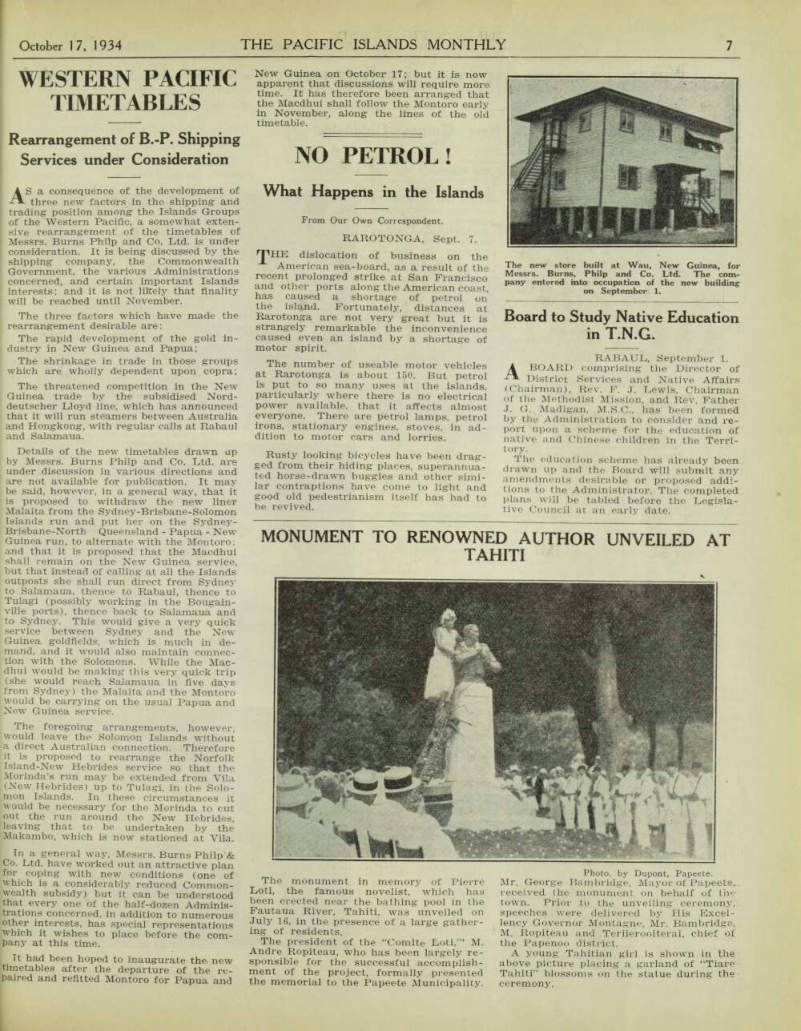
The monument in memory of Pierre Loti, the famous novelist, which has been erected near the bathing pool in the Fautaua River, Tahiti, was unveiled on July 16, in the presence of a large gathering of residents.
The president of the “Comite Loti,’” M.
Andre Ropiteau, who has been largely responsible for the successful accomplishment of the project, formally presented the memorial to the Papeete Municipality.
Mr. George Bambridge, Mayor of Papeete, received the monument on behalf of the town. Prior to the unveiling ceremony, speeches were delivered by His Excel lency Governor Montagne, Mr. Bambridge, M. Ropiteau and Teriierooiterai, chief of the Papenoo district.
A young Tahitian girl is shown in the above picture placing a garland of “Tiaro Tahiti” blossoms on the statue during the ceremony.
Photo, by Dupont, Papeete.
Adventuring With Death And Deckert

Piquant Moments on the New Guinea Goldfields
(By the Editor of the P.I.M.)
THIS life is a vale of tears; but, some how, I am in no hurry to leave it.
This fact has been borne in upon me heavily since I visited the goldfields of New Guinea and flirted with Death in the com pany respectively of Orme Denny, famous pilot of aeroplanes; Fred Deckert, com mander of a weird, cliff-climbing motorlorry; and Harold Taylour, Mining Warden, who is the owner of a devil disguised as a pony. If anyone wants real thrills, let him follow the tracks hereinafter described.
“BUT I haven’t much time.” I said. “And there is much goldfield to see.”
“Tut, tut,” said Jim Stewart, waving Jiis hand airily. “You haven’t seen the goldfield until you have seen Edie Creek.”
“And you haven't seen Edie Creek until you have ridden with Deckert,” chimed in his aider and abettor. “Start early. You can do it in a few hours.”
I am not to be blamed because I suc cumbed to the voice of the tempter. How was I to know that riding to Edie with Deckert is nothing more nor less than pulling the nose of Mister Nick! My only consolation is that I persuaded the Stewart to come with me.
Let me introduce Fred Deckert. He is a good-looking young Australian, with an irresistible grin and a genius for motor engineering. Edie Creek is only four miles, direct line, from Wau; but by the tortuous mule-track, which crawls up frightful gorges, and creeps along the faces of terrifying precipices, the distance is 14 miles. Human ingenuity, which has performed miracles on this goldfield, could not construct an aerodrome at Edie Creek, so all freighting was by native carriers and prehensile-toed mules —until Fred Deckert arrived.
Fred obtained a Pontiac engine, a Cala thumpian chassis, and odds and ends of gear, and constructed a narrow-gauge lorry to travel on that precipitous, twist ed, ungraded, rain-soaked mule-track.
Half of Wau cheered; the other half jeered; all were unanimous that the thing could not be done. Deckert did it —God alone knows how. He took out some pick and-shovel natives and patched the track, and did it scores of times. He got fabu lous rates for carrying in chunks of mining machinery that neither “donk” nor “coon” could handle. Then he bought a narrow-gauge Morris truck, and it was on this notable machine that I, in a mis begotten moment, took passage.
The first truck, the famous “Bitza,” has been bought by Mr. McGilvery, the Edie Creek storekeeper. When I saw it, it looked sleek and well, but idle. Mc Gilvery, not long ago, was a daring pilot of Guinea Airways: but I think that not even he is game to drive the “Bitza” over that frightful road.
So, with mining machinery, mailbags, a case of whisky, rice and six passengers, we started for Edie. O tempora, O mores!
Within five minutes, I knew that I had made the miscalculation of a lifetime. It was not danger so much as sheer, hellish discomfort. The Morris pointed its blunt nose up at an angle of about 45 degrees, and I wrapped arms and legs around a bit of pump, hoping that thus I should not
slide over the rear end of the lorry. When I saw that most of the journey would be spent with that end of Morris poked out over precipices 300 and 400 feet deep, while she twisted around sharp corners, I used my teeth, as well as arms and legs, in getting a grip on that pump.
It rains in about 23 out of every 24 hours in those mountains, and the combined ef fect of showers and traffic is seen in ap palling ruts and mud holes. Deckert gets through by rushing them. Consequently, his interested passen gers spend most of their conscious hours in the air. They say the people on the goldfields are “air minded.” I think Dec kert is as much re sponsible for that as are the aeroplanes.
Because the stern of me was clear of the hard deck, I rather enjoyed the bouncing, except on the frequent occasions when I met the lorry coming up on the second bounce, just when I was de scending from the first. Those were the times when I put a careful hand on the top of my head to see if my backbone had been driven through.
The track, for the most part, is just wide enough to let the lorry pass. On one side, a sheer wall of rock or clay; on the other, a long, straight drop in to eternity. More of ten than not there was not more than four inches to spare.
The road was wet, and slippy. Again and again, I felt the tail end of the lorry, be neath me, sliding gently away towards the precipice; but al ways the chained wheels got a grip again, just in the last split second before disaster, and on we went. At first, I
mouthed wild sentences and clawed fran tically; but, after a while, I put faith in the chains and a merciful Providence.
Then, after one brilliant skid, I looked at the wheel. There was no chain there, and I let out a screech which brought Deckert up, all standing.
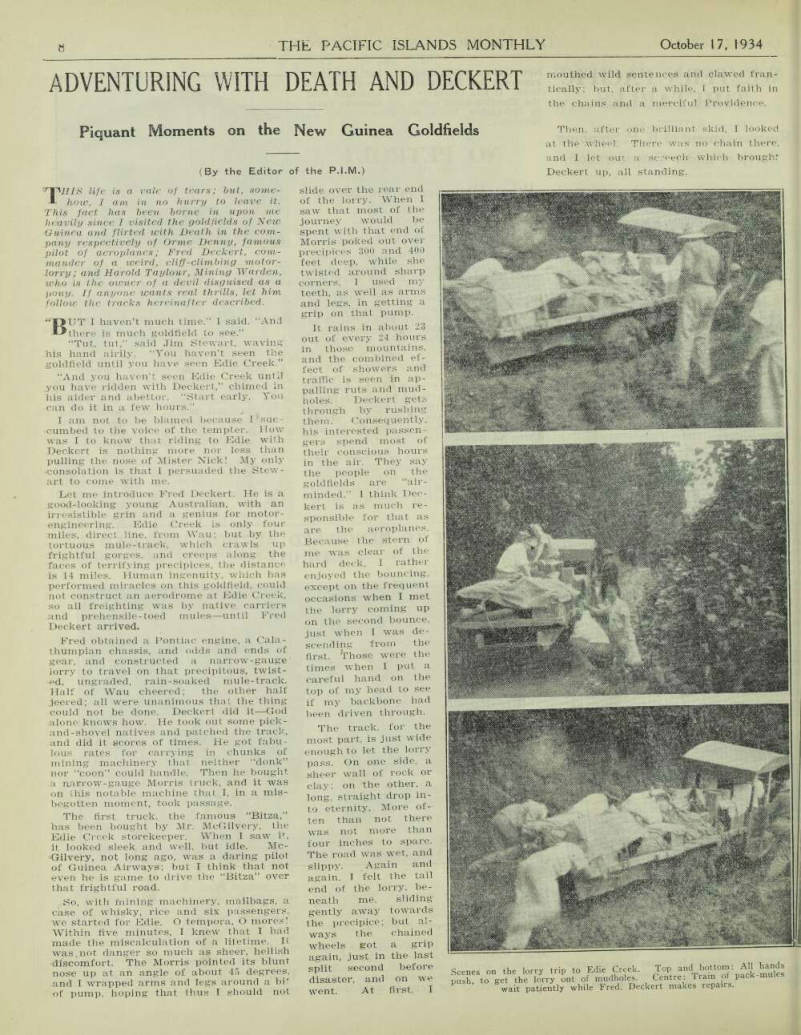
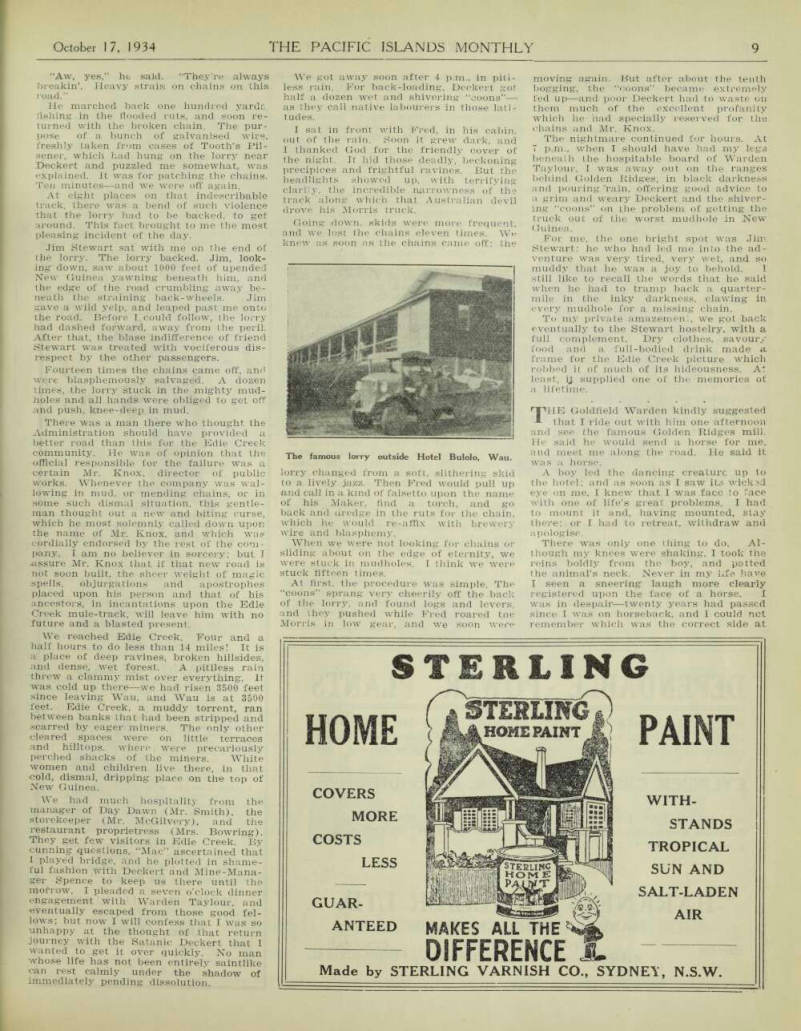
Scenes on the lorry trip to Edie Creek. Top and bottom: All hands push, to get the lorry out of mudholes. Centre: Train of pack-mules wait patiently while Fred. Deckert makes repairs.
“Aw, yes,” he said. “They’re always breakin’. Heavy strain on chains on this road.”
He marched back one hundred yardc. fishing in the flooded ruts, and soon re turned with the broken chain. The pur pose of a bunch of galvanised wire, freshly taken from cases of Tooth’s Pil sener, which had hung on the lorry near Deckert and puzzled me somewhat, was explained. It was for patching the chains.
Ten minutes —and we were off again.
At eight places on that indescribable track, there was a bend of such violence that the lorry had to be backed, to get around. This fact brought to me the most pleasing incident of the day.
Jim Stewart sat with me on the end of the lorry. The lorry backed. Jim, look ing down, saw about 1000 feet of upended New Guinea yawning beneath him, and the edge of the road crumbling away be neath the straining back-wheels. Jim gave a wild yelp, and leaped past me onto the road. Before I could follow, the lorry had dashed forward, away from the peril.
After that, the blase indifference of friend Stewart was treated with vociferous dis respect by the other passengers.
Fourteen times the chains came off, and were blasphemously salvaged. A dozen times, the lorry stuck in the mighty mud holes and all hands were obliged to get off and push, knee-deep in mud.
There was a man there who thought the Administration should have provided a better road than this for the Edie Creek community. He was of opinion that the official responsible for the failure was a certain Mr. Knox, director of public works. Whenever the company was wal lowing in mud, or mending chains, or in some such dismal situation, this gentle man thought out a new and biting curse, which he most solemnly called down upon the name of Mr. Knox, and which was cordially endorsed by the rest of the com pany. I am no believer in sorcery; but I assure Mr. Knox that if that new road is not soon built, the sheer weight of magic spells. objurgations and apostrophes placed upon his person and that of his ancestors, in incantations upon the Edie Creek mule-track, will leave him with no future and a blasted present.
We reached Edie Creek. Four and a half hours to do less than 14 miles! It is a place of deep ravines, broken hillsides, and dense, wet forest. A pitiless rain threw a clammy mist over everything. It was cold up there —we had risen 3500 feet since leaving Wau, and Wau is at 3500 feet. Edie Creek, a muddy torrent, ran between banks that had been stripped and scarred by eager miners. The only other cleared spaces were on little terraces and hilltops, where were precariously perched shacks of the miners. White women and children live there, in that cold, dismal, dripping place on the top of New Guinea.
We had much hospitality from the manager of Day Dawn (Mr. Smith), the storekeeper (Mr. McGilvery), and the restaurant proprietress (Mrs. Bowring).
They get few visitors in Edie Creek. By cunning questions, “Mac” ascertained that I played bridge, and he plotted in shame ful fashion with Deckert and Mine-Mana ger Spence to keep us there until the morrow. I pleaded a seven o’clock dinner engagement with Warden Taylour, and eventually escaped from those good fel lows; but now I will confess that I was so unhappy at the thought of that return journey with the Satanic Deckert that I wanted to get it over quickly. No man whose life has not been entirely saintlike can rest calmly under the shadow of Immediately pending dissolution.
We got away soon after 4 p.m., in piti less rain, back-loading, Deckert got half a dozen wet and shivering “coons” — as they call native labourers in those lati tudes.
I sat in front with Fred, in his cabin, out of the rain. Soon it grew dark, and I thanked God for the friendly cover of the night. It hid those deadly, beckoning precipices and frightful ravines. But the headlights showed up, with terrifying clarity, the incredible narrowness of the track along which that Australian devil drove his Morris truck.
Going down, skids were more frequent, and we lost the chains eleven times. We knew as soon as the chains came off: the
lorry changed from a soft, slithering skid to a lively jazz. Then Fred would pull up and call in a kind of falsetto upon the name of his Maker, find a torch, and go back and dredge in the ruts for the chain, which he would re-affix with brewery wire and blasphemy.
When we were not looking for chains or sliding about on the edge of eternity, we were stuck in mudholes. I think we were stuck fifteen times.
At first, the procedure was simple. The “coons” sprang very cheerily off the back of the lorry, and found logs and levers, and they pushed while Fred roared the Morris in low gear, and we soon were
moving again. But after about the tenth bogging, the “coons” became extremely fed up—and poor Deckert had to waste on them much of the excellent profanity which he had specially reserved for the chains and Mr. Knox.
The nightmare continued for hours. At 7 p.m., when I should have had my legs beneath the hospitable board of Warden Taylour, I was away out on the ranges behind Golden Ridges, in black darkness and pouring 'rain, offering good advice to a grim and weary Deckert and the shiver ing “coons” on the problem of getting the truck out of the worst mudhole in New Guinea.
For me, the one bright spot was Jim Stewart: he who had led me into the ad venture was very tired, very wet, and so muddy that he was a joy to behold. I still like to recall the words that he said when he had to tramp back a quarter mile in the inky darkness, clawing in every mudhole for a missing chain.
To my private amazement, we got back eventually to the Stewart hostelry, with a full complement. Dry clothes, savoury food and a full-bodied drink made a frame for the Edie Creek picture which robbed it of much of its hideousness. At least, it supplied one of the memories of a lifetime.
THE Goldfield Warden kindly suggested that I ride out with him one afternoon and see the famous Golden Ridges mill.
He said he would send a horse for me, and meet me along the road. He said it was a horse.
A boy led the dancing creature up to the hotel; and as soon as I saw its wicked eye on me, I knew that I was face to face with one of life’s great problems. I had to mount it and, having mounted, stay there; or I had to retreat, withdraw and apologise.
There was only one thing to do. Al though my knees were shaking, I took the reins boldly from the boy, and patted the animal’s neck. Never in my life have I seen a sneering laugh more clearly registered upon the face of a horse. I was in despair—twenty years had passed since I was on horseback, and I could not remember which was the correct side at
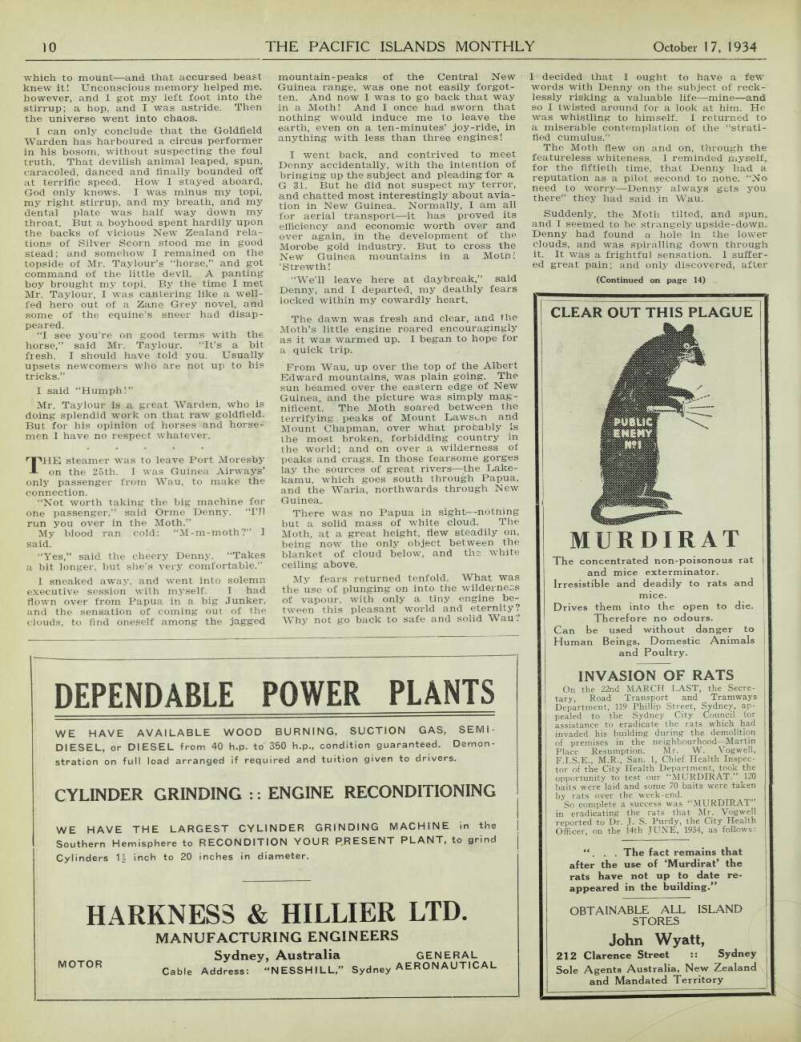
The famous lorry outside Hotel Bulolo, Wau.
which to mount —and that accursed beast knew it! Unconscious memory helped me, however, and I got my left foot into the stirrup; a hop, and I was astride. Then the universe went into chaos.
I can only conclude that the Goldfield Warden has harboured a circus performer in his bosom, without suspecting the foul truth. That devilish animal leaped, spun, caracoled, danced and finally bounded off at terrific speed. How I stayed aboard, God only knows. I was minus my topi, my right stirrup, and my breath, and my dental plate was half way down my throat. But a boyhood spent hardily upon the backs of vicious New Zealand rela tions of Silver Scorn stood me in good stead; and somehow I remained on the topside of Mr. Taylour’s “horse,” and got command of the little devil, A panting boy brought my topi. By the time I met Mr. Taylour, I was cantering like a well fed hero out of a Zane Grey novel, and some of the equine’s sneer had disap peared.
“I see you’re on good terms with the horse,” said Mr. Taylour. “It’s a bit fresh. I should have told you. Usually upsets newcomers who are not up to his tricks.”
I said “Humph!”
Mr. Taylour is a great Warden, who is doing splendid work on that raw goldfield.
But for his opinion of horses and horse men I have no respect whatever.
THE steamer was to leave Port Moresby on the 25th. I was Guinea Airways’ only passenger from Wau, to make the connection.
“Not worth taking the big machine for one passenger,” said Orme Denny. “I’ll run you over in the Moth.”
My blood ran cold: “M-m-moth?” 1 said.
“Yes,” said the cheery Denny. “Takes a bit longer, but she’s very comfortable.”
I sneaked away, and went into solemn executive session with myself. I had flown over from Papua in a big Junker, and the sensation of coming out of the clouds, to find oneself among the jagged
mountain-peaks of the Central New Guinea range, was one not easily forgot ten. And now I was to go back that way in a Moth! And I once had sworn that nothing would induce me to leave the earth, even on a ten-minutes’ joy-ride, in anything with less than three engines!
I went back, and contrived to meet Denny accidentally, with the intention of bringing up the subject and pleading for a G 31. But he did not suspect my terror, and chatted most interestingly about avia tion in New Guinea. Normally, I am all for aerial transport—it has proved its efficiency and economic worth over and over again, in the development of the Morobe gold industry. But to cross the New Guinea mountains in a Moth! ’Strewth!
“We’ll leave here at daybreak,” said Denny, and I departed, my deathly fears locked within my cowardly heart.
The dawn was fresh and clear, and the Moth’s little engine roared encouragingly as it was warmed up. I began to hope for a quick trip.
From Wau, up over the top of the Albert Edward mountains, was plain going. The sun beamed over the eastern edge of New Guinea, and the picture was simply mag nificent. The Moth soared between the terrifying peaks of Mount Lawson and Mount Chapman, over what probably is the most broken, forbidding country in the world; and on over a wilderness of peaks and crags. In those fearsome gorges lay the sources of great rivers—the Lake kamu, which goes south through Papua, and the Waria, northwards through New Guinea.
There was no Papua in sight—nothing but a solid mass of white cloud. The Moth, at a great height, flew steadily on, being now the only object between the blanket of cloud below, and the white ceiling above.
My fears returned tenfold. What was the use of plunging on into the wilderness of vapour, with only a tiny engine be tween this pleasant world and eternity?
Why not go back to safe and solid Wau?
I decided that I ought to have a few words with Denny on the subject of reck lessly risking a valuable life —mine—and so I twisted around for a look at him. He was whistling to himself. I returned to a miserable contemplation of the “strati fied cumulus.”
The Moth flew on and on, through the featureless whiteness. I reminded myself,, for the fiftieth time, that Denny had a reputation as a pilot second to none. “No need to worry—Denny always gets you there” they had said in Wau.
Suddenly, the Moth tilted, and spun, and I seemed to be strangely upside-down.
Denny had found a hole in the lower clouds, and was spiralling down through it. It was a frightful sensation. I suffer ed great pain; and only discovered, after
(Continued on page 14)
(Continued from page 10)
some time, that I was standing on my own thumb!
The Moth straightened out. “Yule Island” called a voice, behind me. I looked down. We were through the clouds, and the dark coast of Papua, edged with the
emerald and white of reef and lagoon, was beneath us, and Yule Island, with its mission settlement and cultivation, lay plain to the westward. Denny, flying blind all the way from the Central Range, had calculated his position exactly, and dived down onto the coast. We buzzed along the 80 miles of coast to the Port Moresby aerodrome, following white coral beach and azure lagoon—a picture of marvellous beauty, seen from the air.
“One of my worst trips,” remarked the pilot, as we walked across the aerodrome.
I raised my voice in a hymn of thank fulness that the few thousands of miles of Pacific travelling still ahead of me did not include one Moth aeroplane.
R.W.R.
Advertisements & other items, pp. 11-13 (1 item)
Home
STERLING
COVERS
MORE
COSTS
LESS
GUAR-
ANTEED
STERLING
HOME PAINT
MAKES ALL THE
DIFFERENCE
PAINT
WITH-
STANDS
TROPICAL
SUN AND
SALT-LADEN
AIR
Made by STERLING VARNISH CO., SYDNEY, N.S.W.
CLEAR OUT THIS PLAGUE
MURDIRAT
The concentrated non-poisonous rat and mice exterminator.
Irresistible and deadily to rats and mice.
Drives them into the open to die.
Therefore no odours.
Can be used without danger to Human Beings, Domestic Animals
and Poultry.
INVASION OF RATS
On the 22nd MARCH LAST, the Secretary, Road Transport and Tramways Department, 119 Phillip Street, Sydney, appealed to the Sydney City Council for assistance to eradicate the rats which had invaded his building during the demolition of premises in the neighbourhood—Martin Place Resumption. Mr. W. Vogwell, F.I.S.E., M.R., San. 1, Chief Health Inspector of the City Health Department, took the opportunity to test our “MURDIRAT.” 120 baits were laid and some 70 baits were taken by rats over the week-end.
So complete a success was “MURDIRAT” in eradicating the rats that Mr. Vogwell reported to Dr. J. S. Purdy, the City Health Officer, on the 14th JUNE, 1934, as follows; “. . . The fact remains that after the use of ‘Murdirat’ the rats have not up to date re-
appeared in the building."
OBTAINABLE ALL ISLAND
STORES
John Wyatt,
212 Clarence Street :: Sydney Sole Agents Australia, New Zealand and Mandated Territory
DEPENDABLE POWER PLANTS
WE HAVE AVAILABLE WOOD BURNING, SUCTION GAS, SEMI- DIESEL, or DIESEL from 40 h.p. to 350 h.p., condition guaranteed. Demonstration on full load arranged if required and tuition given to drivers.
CYLINDER GRINDING :: ENGINE RECONDITIONING
WE HAVE THE LARGEST CYLINDER GRINDING MACHINE in the Southern Hemisphere to RECONDITION YOUR PRESENT PLANT, to grind Cylinders V z inch to 20 inches in diameter.
BARENESS & HILLIER LTD.
MANUFACTURING ENGINEERS
Sydney, Australia
MOTOR Cable Address: “NESSHILL,” Sydney GENERAL AERONAUTICAL
Write for your copy of the new Kodak Catalogue —a magnificent production vyith seventy-two pages, just overflowing vyith illustrations and interesting matter covering every new development in modern photography. There is a copy reserved for you—apply to-day.
BRING YOUR PHOTOGRAPHY UP-TO-DATE—GET A 1935 KODAK These new series of models are picture-perfect! Not only quicker, easier and more convenient in use, but ensuring snaps of glorious clarity and detail. Don’t miss seeing them, or write for the new Catalogue!
Picture Sizes.
Six-16 and Six-20 Brownies Smaller, smarter, and easier to use —yet as dependable as ever.
Junior models from 14/6.
Ingenious Brownie De Luxe.
Price, 30/-.
Six- 16, x ins.; Jiffy Kodaks Novel in construction, arresting in design.
At the pressure of a button lens and shutter leap forward ready for action. Twindar lens gives fixed focus, also close-ups to five feet. Six-16, 60/-; Six -20, 55/-. ix-20 2| x n ins.
Six-20 Duo combines the merits of regular and miniature styles.
Loads with V 620 film, making 2 pictures at each 2J4 x 3)4 inch film. Sixteen pictures to loading.
Compur Shutter, f/4.5 lens, £8/-/-. With f/3.5 lens, £10.
Six-20 and Six-16 Kodaks High-grade, new-style Kodaks whose popularity has swept the world.
Quick opening actionfronts that open at a touch of a button. Quick loading with hinged backs and spool holders.
Real beauties! Lenses: F/6.3, F/4.5, and Doublet. Prices from 68/6. Junior Models from 57/6.
Kodak Pupille Constructed with exquisite precision, for superlative negatives capable of enormous enlargement. Loans for 16 pictures, size Is 4 x 1¼ inches. Price with f/3.5 Cooke lens and compur shutter to 1/300 sec., £17/10/-.
Other Miniature Models from £5/15/- Cine-Kodak Eight Here is a real movie camera that makes movies as easily as a Brownie makes snapshots. Uses a new principle film at a price everyone can afford. Prices from £13 (f/3.5 lens). Let us send you a copy of the new Cine-Kodak Catalogue.
Load with Kodak Verichrome Film — it's do able coaled.
Now packed in hermetically sealed containers.
There are KODAK Dealers throughout the Islands KODAK (Australasia) PTY. LTD., 379 George Street, Sydney
Troficalities
SOME time ago we made enquiries as to what had happened to Mortelmans, who was decribed in an article in this journal some three years ago as “the last of the Pacific pirates.” We have now been informed by an old resident of the Gilbert Islands that Mortelmans was released from a N.S.Wales gaol in 1927, and was de ported to his native country—Belgium.
THE reunion dinner of 60 returned sailors and soldiers, held at Kokopo, New Guinea, on August 4, was a com plete social success, and probably will be made an annual affair. The following is a copy of the menu card:
Rations
(Any complaints, roar up the Quartermaster)
Hors D’Oeuvres
Whitstable natives specially brought from Blighty as Souvenirs Oyster Cocktail SOUP—None All Quiet on the Western Front.
Filet Fish
Flounders in Shell Holes Shredded Potatoes
Iced Asparagus
(Scrounged from the Officers’ Mess)
Roast Turkey, Chicken And Ham
(Strewth! Wangled from G.H.Q.)
Salads
Dessert
(Not Tel-el-Kebir) Wine Trifle Fruit Salad and Cream Coffee, Woodbines, etc.
Napoo—Fini!
It was an ingenious compilation and created just the right atmosphere for the dinner.
OUR old friend “Sulphonol” sends us from the Solomon Islands an interest ing cutting from an American news paper, announcing that a new use for coconut oil has been discovered, in that it is a major ingredient in a new sham poo that has been produced to remove fleas from dogs and cats.
Our friend writes bitterly: “This will gladden the hearts of some of our poor planters. I am sure that the new inven tion will have a great vogue and that the consumption of coconut oil will be in creased amazingly. They will be com forted to know that it is only necessary to add to the preparation a small percen tage of orthophenylpheneil . . . all that remains now is for each Islands Govern ment to pass a law compelling natives to
deflea their dogs—and the coconut indus try will boom as never before. We might also provide that certain native labourers should use the solution on themselves.
We should then get more work done — they usually waste 75 per cent, of their time in scratching themselves.”
HOW many complacent Britons in Rabaul are aware that the tail of the British lion has been nipped by the in domitable German eagle? If anyone is interested he is invited to cruise in the middle of Rabaul harbour and train a pair of strong glasses upon the Matupi crater. There, right on the lip of the cra ter, close under the slowly rising smoke and steam, he will see the letters “KOLN” outlined in white on the black lava. Evi dently, when the cheery young officers of the German war-ship Koln were in Ra baul not long ago, they undertook the formidable task of climbing right up to the edge of the crater and, while there, they left this memento of their visit and of their spirit. The inscription is not easily located but, once it is seen, it is quite clearly followed.
A new definition of Samarai: “A small island surrounded by small houses.”
THE rapacity and savagery of the revenue collecting departments of Australia already are a by-word in this part of the world; but appeals for mercy to the Australian officials appear to have as much result as appeals to common sense. A typical example of what people who are anxious to trade with Australia have to endure, has come under our notice recently.
A man in Rabaul broke his typewriter and had to send it to Sydney for repairs.
When the machine arrived in Sydney it was pounced upon by the Customs officials —probably with screams of fiendish glee— and they would not release it until the unfortunate owner had deposited £11. Then the machine was sent to be repaired; and when the job was done and paid for, a gentleman from the Customs Department proceeded to earn the large salary paid to him by a grateful Commonwealth by carefully accompanying the typewriter from the repair shop to the steamer, and seeing that it was properly placed on board. The typewriter’s unhappy owner had to pay the Customs gentleman 6/for this service, in addition to paying sundry sums to other enterprising taxation officials. The Commonwealth of Australia eventually, and with obvious reluctance, returned to him his £11 —less 21/- repre senting taxation fees and impositions of various kinds.
The Rabaul man says that when his typewriter breaks again he will repair it with an axe—although he would much prefer to use the axe on certain gentlemen ‘‘down South.”
A TRADER in New Guinea, who car ries a very large stomach upon a gigantic frame, became severely ill; and his mate sent for the “liklik” doctor.
The specialist made a quick examina tion, and then shrugged his shoulders.
“Only a stomach-ache,” he said, reas suringly.
“Only a stomach-ache!” commented the other man. “But, my God, what an ache it must be!’' * * * Disgruntled and discouraged gentleman, sitting in hotel in the chief town of the Solomons: “Tulagi is the true centre of the world!”
Astonished friend: “Good heavens— how do you make that out?”
D. and d. Gent.; “Because there is absholutely no movement here.” * * * A FRIEND in the Islands sends us this extract from a letter which he has just received from a man in Dalmatia; “. . . and, finally, the Pacific Islands Monthly, which I received to-day with surprise and delight. . . . nothing could have been more acceptable.”
It may interest readers to know that, al though it is only a little over four years since the “Pacific Islands Monthly” was established, there are now few countries in the world where there are not regular subscribers to the magazine. There is one important institution in The Hague which pays 6/4 per month to have each issue of the magazine sent by air mail to Europe, so that it may have the earliest possible intimation of Pacific Islands development. * * * Something in the nature of a record for a roundabout way of receiving news was established when the m.v. Inverbank was recently refloated from Nasasi reef, near the mouth of Ba River, Fiji. Though the vessel was only a few miles around the coast from Suva, the first intimation that she was off the reef was received from London! The Inverbank was re floated at 1.30 a.m. on August 21, and the captain immediately attempted to get in
to touch with Suva by radio. Suva sta tion, however, was at that time closed down. The master thereupon wirelessed Sydney, and Sydney communicated by cable with the owners in London; they in turn, cabled the information to Messrs.
Brown and Joske, their Suva agents.
Such an occurrence supplies a cogent argument for the agitation in favour of keeping a permanent watch at Suva radio station.
When You Visit Sydney
Nowhere can you be more highly re commended to stay than at the Great Southern Hotel, 717-723 George Street, Sydney (facing Central Railway Station, opposite Rawson Place). Bed and break fast 7/6, luncheon 2/-, dinner 2/6.
Advertisements & other items, pp. 14-16 (2 items)
of Exceptional Value
When Visiting Sydney
Send a Wire to
LESSEY’S
Drive Yourself
Box 8, Post Office,
PADDINGTON,
and an up-to-date car will meet you at the boat, which you can hire on very reasonable terms to
DRIVE YOURSELF.
Head Office and Service Station at
RUSHCUTTER’S BAY
(Near Stadium). Tel.: F 3196.
Radio Address: “Lessey’s,” Paddington, Sydney.
Ladies CjoldWrist Watches
of Exceptional Value
These wrist watches are of dainty design and thoroughly reliable quality, having good sound movements, jewelled in 15 holes, with compensated balances. The cases are heavy solid gold, fitted with moire ribbon band and solid gold catch.
Illustrations are exact size and in either design the price is ... 90/- These watches are guaranteed for 1 0 years and kept in order free of charge, breakages excepted, for 1 2 months.
FAIRFAX & ROBERTS LTD.
“The Oldest Jewellery House in Sydney”
23-25 HUNTER STREET, SYDNEY
advt
TUDOR HOTEL
Room and Breakfast from 7/6 per day. All meals a la carte. Accommodation for 100 guests. Two minutes from G.P.O.
127 PHILLIP ST. Tel.: BW 2788
One door from the New Martin Place,
SYDNEY
McILRATH’S FOOD STORES
are “full to bursting” of choice foods
suited to the celebration of Christmas
Send your order to McIlrath’s
and ensure a Happy Xmas
“York Castle” Seed Hams 1/8 lb.
“Pineapple” Seed Hams 1/9 lb.
Mcllrath’s Xmas Cakes, 3lb. boxes 3/3 each, 37/6 doz.
Arnott’s Xmas Cakes, 3lb. tins 3/10 each, 44/- doz.
Arnott’s Plum Pudding, 1lb. tins 1/7 tin, 18/6 doz.
Arnott’s Plum Pudding, 2lb. tins 3/- tin, 35/- doz.
S. and A. Plum Pudding, 2lb. tins 3/3 tin, 37/6 doz.
Finest Jordan Almonds 2/10 lb., 33/- doz.
Soft Shell Almonds 1/1½lb., 13/- doz.
Californian Walnuts 1/3 lb., 14/6 doz.
Chinese Walnuts 9d. lb., 8/6 doz.
Queensland Roasted Peanuts 11ld. lb., 10/9 doz.
Barcelona Nuts 11½d. lb., 11/- doz.
Brazil Nuts 11½d. lb., 11/- doz.
Milne Gibson Muscatels, 1lb. pkts 1/8 pkt., 19/- doz.
Best Sunraysed Sultanas 5½d. lb., 5/- doz.
Best Sunraysed Currants 5½d. lb., 5/- doz.
Best Sunraysed Raisins 5d. lb., 4/6 doz.
New Season’s Khadrewi Dates 4½d. lb., 4/- doz.
Turkish Pressed Figs, Soz. boxes 8d. box, 7/6 doz.
Turkish Pressed Figs, 12oz. boxes 1/- box, 11/- doz.
S. & A. Fruit Mincemeat, 12oz. jars ... 1/5½ jar, 17/- doz.
Crystallised Ginger 8½d. lb., 8/3 doz.
Rosa Jelly Crystals, pint pkts 4½d. pkt., 4/- doz.
Rosa Peaches in Syrup, 30oz. tins 8½d. tin, 8/3 doz.
Rosa Pears in Syrup, 30oz. tins 9d. tin, 8/9 doz.
I.X.L. Fruit Salad, 16oz. tins 9d. tin, 8/9 doz.
Nestles Pure Cream, 4oz. tins 4d. tin, 3/9 doz.
Passiona (Passionfruit Cordial), 26oz. hots., 2/3 bot., 26/- doz.
Schweppes Paiarino (Orange Cordial) 26oz. bots 1/5 bot., 16/6 doz.
Mcllrath’s Royal Reserve Claret, 26oz bots. 2/6 bot., 29/6 doz.
Mcllrath’s Royal Reserve Port, 26oz. bots., 3/6 bot., 41/- doz.
Mcllrath’s R.R. Dry Sherry, 26oz. bots. . 3/6 bot., 41/- doz.
All Prices F.O.B. Sydney Export Price Lists Available on Application
McILRATH’S LTD.
Export Department, 202 Pitt Street, Sydney, Australia.
advt
GRAMOPHONES
PORTABLES,
RECORDS
Send direct to Paling’s, Sydney, for your requirements. Records carefully packed and dispatched to any part of the world (no packing charge). Prices from 2/6.
Write for complete Catalogues. Regular Monthly Record Lists Post Free—Have your name put on our list.
Australian Records of Special Interest.
“The Kookaburra” 2/6 “Lyre Birds” 4/-
PORTABLE GRAMOPHONES
£11/11/-, £12/12/-, £7/7/-.
“Columbia” £7/10/-, £5/10/- “Improved Victor” £5/-/- Others from 50/-.
Write for Yours to-day.
PLAYER ROLLS — thousands of Rolls, all the best Classical Music and Masterpieces of famous artists.
Send for Lists Thousands of others.
338 GEORGE ST., SYDNEY, N.S.W.
THE BRIDGE BIRD SHOP
For Well-bred Birds, Dogs, Persian Cats and other Animals All Pedigreed at Reasonable Prices We Buy as Well as Sell Islanders are Invited to Communicate
6 JUNCTION STREET NORTH SYDNEY
BARKER COLLEGE
HORNSBY
(Established 1890) Chairman of Council . . . Mr. Justice Boyce
DAY AND BOARDING SCHOOL FOR BOYS
Healthy dry atmosphere: 620 ft. above sea level; 15 miles from G.P.O., Sydney. Own cows, poultry and vegetables. War Memorial Oval: 20 acres of ground. Hygienic filtered swimming pool. Classrooms centrally heated in winter. All subjects (Classical and Modern) to Leaving Certificate Standard; also Wool Classing. Illustrated Prospectus on application to W. S. LESLIE, M.A. :: :: Headmaster .
Rats—Mankind’S Greatest Foes
Thousands of pounds are spent annually all over the world to exterminate man’s most intelli gent parasitic enemy —rats. From the earliest times rats have been responsible for deadly plagues and pestilences and have caused damage equivalent to millions of pounds per annum. Many prepara tions—powders and liquids—have been marketed, claiming to be able to destroy efficiently all rodents. Most of these rat poisons, however, have proved ineffectual. Recently, a new liquid prepara tion, called “Murdirat,” has achieved considerable success. This solution is easily prepared, and, it is claimed, although harmless to human beings, birds, and domestic animals, is certain death for rats. Supplies of this new mixture may be ob tained from Mr. John Wyatt, 212 Clarence St., Sydney, who is sole distributing agent for “Murdi rat.”
Wau-Edie Creek
Another New Development Promised
AS a result of exploration activities by British and New Guinea Gold, N.L., an interesting development is possible on the New Guinea goldfield, not far from Wau.
British and New Guinea Gold N.L. was formed in Melbourne last year with a capital of £5,000 —£4,000 subscribed in cash and £1,000 allotted in shares for exploration and administration. Mr. Charles Lexius Burlington, as managing director, proceeded to New Guinea with a view to securing suitable properties.
The syndicate’s original intention was to take over the mining areas that were be ing worked in the Upper Ramu region by Captain Bernard McGrath when he was murdered by natives, Mr. Burlington, however, when he got there found that the new regulations imposed by the Adminis tration for the protection of prospecting companies were so drastic that it was not possible to carry on operations profitably and he abandoned his plan, so far as it related to Mr. McGrath’s leases. He then investigated the possibilities of the new field recently opened on the Lakekamu River, Central Papua, and as a result his company applied for certain leases there, close to the leases which have been ap plied for by Guinea Gold N.L.
Mr. Burlington returned to Morobe and made investigations in the Wau-Edie Creek area, with the result that he has secured rights over six leases which lie along Edie Creek, a short distance above the New Guinea Goldfields Ltd. leases, on which the famous Golden Ridges mill is operating,, three miles westward of Wau. The leases referred to are those held by Messrs. A.
Newton and Ernie Dover, who have the alluvial right. Mr. Burlington’s company has secured the mining or deep level rights, and also has an option over Messrs. Newton and Dover’s alluvial rights. British and New Guinea Gold N.L. has also secured options over 12 leases adjoining the six referred to—these 12 comprising mostly the block held by Mr.
J. C. Williamson; and it also has options over two other adjoining leases held by Messrs. Wilde and Stower.
Preliminary investigations on the six leases along Edie Creek (those held by Newton and Dover) indicate the presence of a rich lode —in fact, there appears to be valuable gold, both alluvial and at depth, all through this locality.
Mr. Burlington returned from New Guinea to Melbourne early in and it is probable that a prospecting company will be formed by British and New Guinea Gold N.L. to deal with these properties.
Advertisements & other items, p. 16 (1 item)
Wanted To Buy
POSTAGE STAMPS
Papua, New Guinea, Pacific Islands Used or Unused Any Quantity Books, Pamphlets, Govt. Reports, Photos, etc., British New Guinea and Papua.
PAUL A. DORN
Collector of New Guineana Box 343, Redlands, California, U.S.A.
Offers Solicited Correspondence Invited Reference: R. W. ROBSON, 247 George St.
Sydney.
“France Australe”
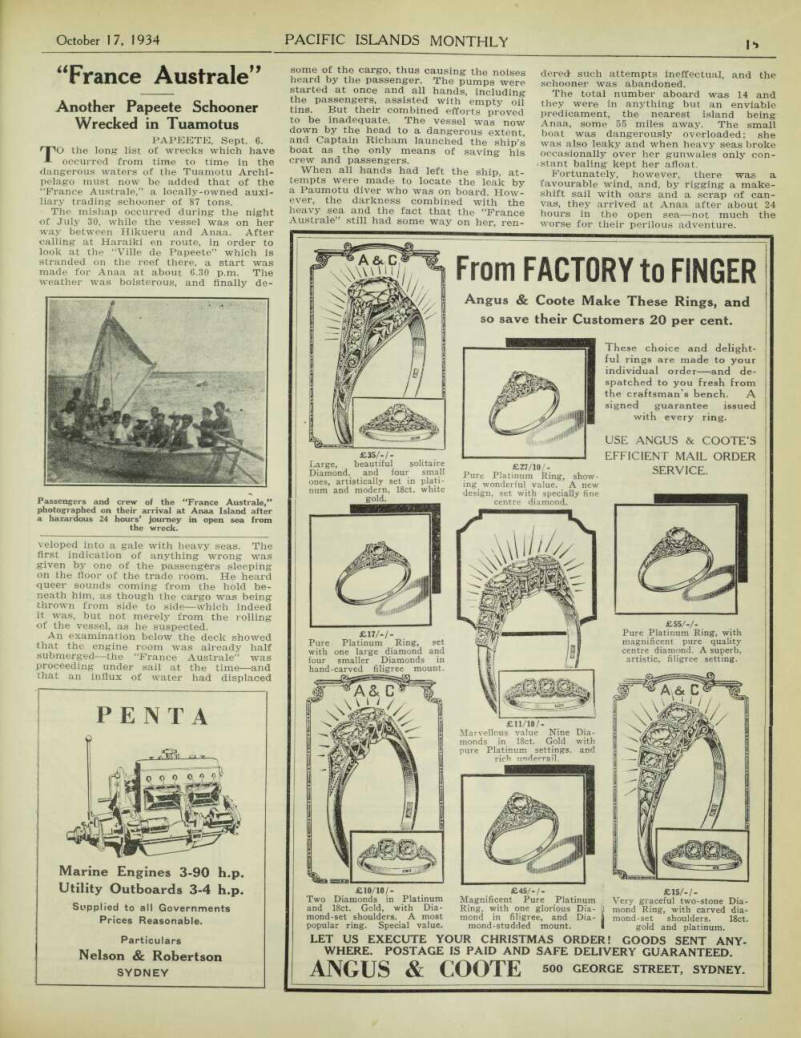
Another Papeete Schooner Wrecked in Tuamotus
Papeete, Sept. 6.
TO the long list of wrecks which have occurred from time to time in the dangerous waters of the Tuamotu Archi pelago must now be added that of the “Prance Australe,” a locally-owned auxi liary trading schooner of 87 tons.
The mishap occurred during the night of July 30, while the vessel was on her way between Hikueru and Anaa. After calling at Haraiki en route, in order to look at the “Ville de Papeete” which is stranded on the reef there, a start was made for Anaa at about 6.30 p.m. The weather was boisterous, and finally de-
veloped into a gale with heavy seas. The first indication of anything wrong was given by one of the passengers sleeping on the floor of the trade room. He heard queer sounds coming from the hold be neath him, as though the cargo was being thrown from side to side—which indeed it was, but not merely from the rolling of the vessel, as he suspected.
An examination below the deck showed that the engine room was already half submerged—the “France Australe” was proceeding under sail at the time —and that an influx of water had displaced
some of the cargo, thus causing the noises heard by the passenger. The pumps were started at once and all hands, including the passengers, assisted with empty oil tins. But their combined efforts proved to be inadequate The vessel was now down by the head to a dangerous extent, and Captain Richam launched the ship’s boat as the only means of saving his and Passengers.
When all hands had left the ship, attempts were made to locate the leak by a Paumotu diver who was on board. However, the darkness combined with the heavy sea and the fact that the “France Australe still had some way on her, ren-
dered* such attempts ineffectual, and the schooner was abandoned, The total number aboard was 14 and they were in anything but an enviable predicament, the nearest island being Anaa, some 55 miles away. The small boat was dangerously overloaded; she was also leaky and when heavy seas broke occasionally over her gunwales only con stant baling kept her afloat.
Fortunately, however, there was a favourable wind, and, by rigging a make shift sail with oars and a scrap of can vas, they arrived at Anaa after about 24 hours in the open sea—not much the worse for their perilous adventure.
Passengers and crew of the “France Australe,” photographed on their arrived at Anna Island after a hazardous 24 hours’ journey in open sea from the wreck.
Advertisements & other items, p. 17 (1 item)
From Factory To Finger
£35/-/- Large, beautiful solitaire Diamond, and four small ones, artistically set in platinum and modern, 18ct. white gold. £17/-/- Pure Platinum Ring, set with one large diamond and four smaller Diamonds in hand-carved filigree mount.
Angus & Coote Make These Rings, and so save their Customers 20 per cent. £27/10/- Pure Platinum Ring, showing wonderful value. A new design, set with specially fine centre diamond.
These choice and delightful rings are made to your individual order and despatched to you fresh from the craftsman s bench. A signed guarantee issued with every ring.
USE ANGUS & COOTE’S
EFFICIENT MAIL ORDER
SERVICE.
£55/-/- Pure Platinum Ring, with magnificent pure quality centre diamond. A superb, artistic, filigree setting. £11/10/- Marvellous value Nine Diamonds in 18ct. Gold with pure Platinum settings, and rich tinder rail. £10/10/- £45/-/- £15/-/- Two Diamonds in Platinum Magnificent Pure Platinum Very graceful two-stone Diaand 18ct. Gold, with Dia- Ring, with one glorious Diamond Ring, with carved diamond-set shoulders. A most mond in filigree, and Diamond-set shoulders. 18ct. popular ring. Special value. mond-studded mount. I gold and platinum.
LET US EXECUTE YOUR CHRISTMAS ORDER! GOODS SENT ANY- WHERE. POSTAGE IS PAID AND SAFE DELIVERY GUARANTEED.
ANGUS & COOTE 500 GEORGE STREET, SYDNEY.
PENTA
Marine Engines 3-90 h.p.
Utility Outboards 3-4 h.p.
Supplied to all Governments Prices Reasonable.
Particulars Nelson & Robertson
SYDNEY
Late News for Islands
To Explore Unknown Papua
IT is reported that Mr. Jack Hides, A.R.M. at Misima, Papua, has been brought to Port Moresby on special duty. He is now assembling a party of police and carriers and it is understood that he is to proceed immediately to the Strickland River, a tributary of the Fly River, in Western Papua. He then will enter a practically unknown tributary of the Strickland, which joins the Strickland above Lake Murray, and disappears into absolutely unexplored country to the north-east. It is believed that this large, unknown river may enter the Territory of New Guinea south-west ward of Mount Hagen and, possibly, it may drain the great plateaux which are believed to lie westward of the Mount Hagen region, and southward of the Sepik.
Mr. Hides already has a fine reputation as a leader of patrols which have success fully penetrated and explored the hitherto unknown country in the centre of the great island. This, however, is the biggest job he has yet undertaken. Reference is made to this country and its probable gold bearing character in an article on page 50.
Aviators To Fly Pacific
Kingsford-Smith, having been prevented by a series of accidents from participating in the Centenary Air Race, has decided to use his superspeed ’plane in an attempt to fly the Pacific from Australia to America in three hops. He will leave Brisbane on October 20 for the aerodrome near Suva, Fiji: thence he will fly in one hop from Suva to Honolulu —over 3,000 miles; and his third hop will be from Honolulu to San Francisco.
His old associate, C. T. P. Ulm, is plan ning a trans-Pacific flight about the same time from Vancouver to Sydney, his hops being Vancouver-Honolulu, Honolulu-Fan ning Island, Fanning Island-Suva, Suva- Auckland, Auckland-Sydney.
Mission Rivalry
We have some interesting communica tions regarding rivalry of mission enter prises (in the newly discovered country in Central New Guinea) including a letter from Rev. Father Ross. These will be pub lished in the November issue.
The W.R.C. Service
The m.v. Salamaua, which inaugurates the new W.R.C. service (W. R. Carpenter and Co., Ltd.) between Australia, N. Guinea
and European ports, arrived in Sydney on October 12, having travelled via West Africa and South Australian ports. She is a vessel of attractive appearance; and, as cheap passages to Europe are available in her, New Guinea residents will be in terested to know that her passenger accom modation is excellent. Details of this new service will be found in our advertising columns.
Japanese Again
During the month there have been sharp complaints in Australian newspapers about raids by wandering Japanese vessels in and around Torres Straits. One sampan ap pears to have landed on Haggerstein Island, about 125 miles from Thursday Island, and there the visitors broke into a house and carried off a quantity of goods.
The Australian Government is still being urged to inaugurate adequate patrol services.
A Christmas Box Suggestion
A suitable Christmas Box for friends in Australia, Europe, etc., is a 12 months’ sub scription to the “Pacific Islands Monthly.”
On receipt of 6/- (or 8/- in the case of non- British countries) we will send the “P.I.M.” to any address you give us; and, with the first number so sent, we shall despatch also a nicely-printed card, advising the person named that you have requested us to con vey to him your best Christmas greetings, and that you have arranged to send the “P.I.M.” for 12 months.
Tallow Market Rising
An interesting development in Australia in the oil and fat trade, which appears to have a bearing on the copra situation, is the fact that the tallow market is rising.
Considerable and increasing quantities of tallow are now being shipped from Aus tralia to Europe and America. Dropping from the vicinity of £100 per ton, in 1918, the tallow price fell to around £l5 per ton, and has remained there for the past year or so. Lately, however, the price has risen and is now £23/10/- per ton.
Mr. O. F. Nelson
From Our Own Correspondent.
Apia, Sep. 27.
ACCORDING to letters received in Apia, Mr. O. F. Nelson, well-known leader of the Mau movement of Samoa, now liv ing in exile in New Zealand, intends to open a business of his own in the wine and spirit trade in New Zealand, and will sever his connections with his old Company (Messrs. O. F. Nelson & Co., Ltd., of Apia).
25 Japanese
Arrested In New Guinea
A VERY important development has occurred in connection with Japanese poaching in the New Guinea Territory which has been going on for three years.
The District Officer in Manus district (Admiralty Islands) discovered a large sampan poaching shell; and in some way not yet disclosed he was able to seize the vessel. It already was loaded with six tons of trocus and green-snail shell. It apparent ly had come direct from Formosa, but it had no ship’s papers or bills of health. The District Officer arrested the captain and crew of 24, as prohibited immigrants.
General McNicoll instructed the D.O. to bring the Japanese to Rabaul for investi gation. They are charged with being pro hibited immigrants, and violating the Fisheries and Quarantine Ordinances. The D.O. accordingly dismantled the engine of the vessel and brought the Japanese to Rabaul aboard the Macdhui, arriving at Rabaul on October 12.
LATER DETAILS show that D.O. Oakley was visiting Maron plantation (in the isolated Hermits) with Dr. Cooper. (medical officer), on September 15, when the Japanese came into view and com menced fishing. The D.O. gave chase in the Government schooner Eros, captured three canoes which were fishing for shell, and then “persuaded” the Japanese captain to bring his aux. schooner (Yocikune Maru, 39 tons) to Maron. He swore in Mr. Brewster, plantation manager, as a special constable, and took the Japanese to Lorengau to await the Macdhui.
Advertisements & other items, p. 18 (1 item)
Fays
TENNIS
TROPICAL RESTRINGS AND GUT
CONSULT
L. A. WARD
WEST END SPORTS DEPOT,
8 GEORGE ST. WEST SYDNEY
A HOME FOR SCHOOLBOYS
“LEDDICOTT”
School House offers a solution of the problem of education by providing a home for boys attending school in Sydney.
Prospectus on application to
E. F. WHITFELD, B.A.,
McMahon’s Point :: :: Sydney
7/11
FAYS
COOL COMFORT
for SUMMER DAYS
P 52. TOYO
WOVEN
SANDALS, in Black and White, Brown and White, or Blue and White. Sports heels. Half sizes 2 to 7. Price 7/11. Postage extra Write for your copy of FAY’S Shoe
Catalogue now.
It’s full of Wonderful Values.
Ecrivez maintenant pour recevoir le catalogue des Chaussures de la Maison Edward Fay Ltd. Il abonde en excellentes occasions.
Special Concessions to Traders. Write for
particulars.
P 53. WHITE
CALF Tongue and Buckle Shoe, punched trim, pump soles, sports heels. Half sizes, 2 to 7. Price 12/6. Postage extra
EDWARD FAY LTD.
Pitt and Liverpool Streets, Sydney, N.S.W., Australia
Growers
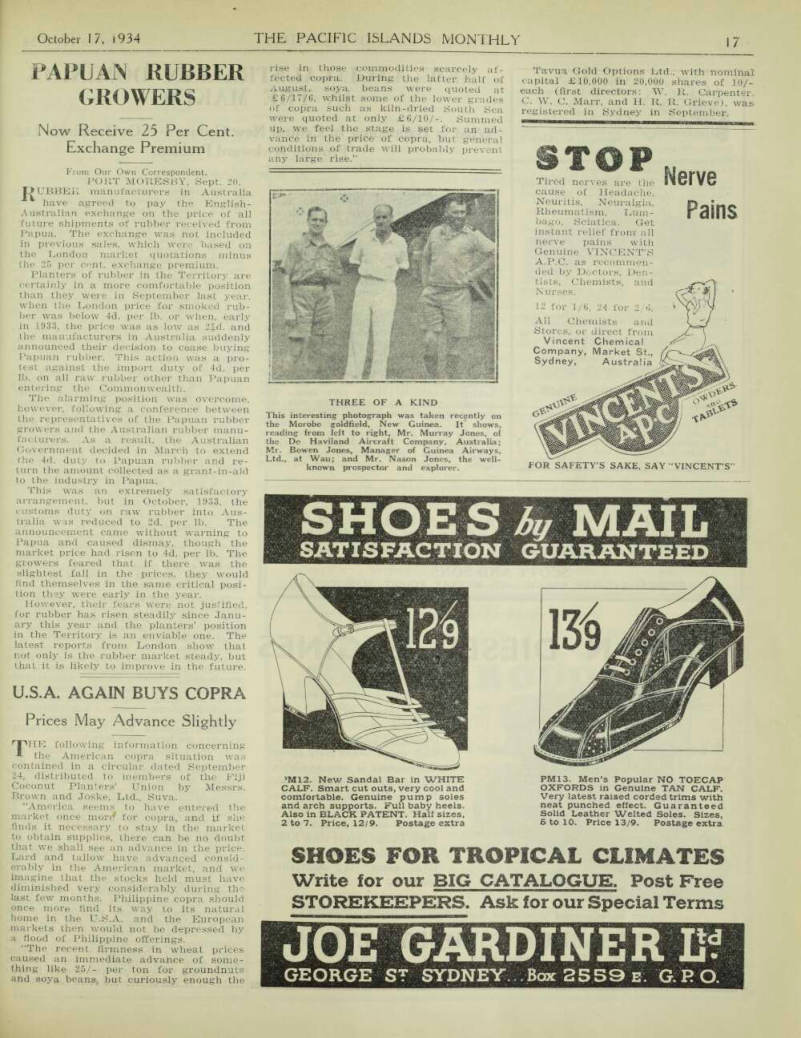
Papuan Rubber
Now Receive 25 Per Cent.
Exchange Premium
From Our Own Correspondent.
Port Moresby, Sept. 20.
RUBBER manufacturers in Australia have agreed to pay the English- Australian exchange on the price of all future shipments of rubber received from Papua. The exchange was not included in previous sales, which were based on the London market quotations minus the 25 per cent, exchange premium.
Planters of rubber in the Territory are certainly in a more comfortable position than they were in September last year, when the London price for smoked rub ber was below 4d. per lb. or when, early in 1933, the price was as low as 2 7/8d. and the manufacturers in Australia suddenly announced their decision to cease buying Papuan rubber. This action was a pro test against the import duty of 4d. per lb. on all raw rubber other than Papuan entering the Commonwealth.
The alarming position was Overcome, however, following a conference between the representatives of the Papuan rubber growers and the Australian rubber manu facturers. As a result, the Australian Government decided in March to extend the 4d. duty to Papuan rubber and re turn the amount collected as a grant-in-aid to the industry in Papua.
This was an extremely satisfactory arrangement, but in October, 1933, the customs duty on raw rubber into Aus tralia was reduced to 2d. per lb. The announcement came without warning to Papua and caused dismay, though the market price had risen to 4d. per lb. The growers feared that if there was the slightest fall in the prices, they would find themselves in the same critical posi tion they were early in the year.
However, their fears were not justified, for rubber has risen steadily since Janu ary this year and the planters’ position in the Territory is an enviable one. The latest reports from London show that not only is the rubber market steady, but that it is likely to improve in the future.
Prices May Advance Slightly
U.S.A. Again Buys Copra
'THE following information concerning the American copra situation was contained in a circular dated September 24, distributed to members of the Fiji Coconut Planters’ Union by Messrs.
Brown and Joske, Ltd., Suva.
“America seems to have entered the market once for copra, and if she finds it necessary to stay in the market to obtain supplies, there can be no doubt that we shall see an advance in the price.
Lard and tallow have advanced consid erably in the American market, and we imagine that the stocks held must have diminished very considerably during the last few months. Philippine copra should once more find its way to its natural home in the U.S.A. and the European markets then would not be depressed by a flood of Philippine offerings.
“The recent firmness in wheat prices caused an immediate advance of some thing like 25/- per ton for groundnuts and soya beans, but curiously enough the
rise in those commodities scarcely af fected copra. During the latter half of August, soya beans were quoted at €6/17/6, whilst some of the lower grades of copra such as kiln-dried South Sea were quoted at only £6/10/-. Summed up, we feel the stage is set for an ad vance in the price of copra, but general conditions of trade will probably prevent any large rise.”
Tavua Gold Options Ltd., with nominal capital £10,000 in 20,000 shares of 10/each (first directors: W. R. Carpenter.
C. W. C. Marr, and H. R. R. Grieve), was registered in Sydney in September.
Three Of A Kind
This interesting photograph was taken recently on the Morobe goldfield, New Guinea. It shows, reading from left to right, Mr. Murray Jones, of the De Haviland Aircraft Company, Australia; Mr. Bowen Jones, Manager of Guinea Airways, Ltd., at Wau; and Mr. Nason Jones, the well known prospector and explorer.
Advertisements & other items, pp. 19-20 (1 item)
Stop
Tired nerves are the cause of Headache, Neuritis, Neuralgia, Rheumatism, Lumbago, Sciatica. Get instant relief from' all nerve pains with Genuine VINCENT’S A.P.C. as recommended by Doctors, Dentists, Chemists, and Nurses. 12 for 1/6, 24 for 2/6.
All Chemists and Stores, or direct from Vincent Chemical Company, Market St., Sydney, Australij
Nerve
Pains
FOR SAFETY’S SAKE, SAY VINCENT’S’
’M12. New Sandal Bar in WHITE CALF. Smart cut outs, very cool and comfortable. Genuine pump soles and arch supports. Full baby heels.
Also in BLACK PATENT. Half sizes, 2 to 7. Price, 12/9. Postage extra PMI3. Men’s Popular NO TOECAP OXFORDS in Genuine TAN CALF.
Very latest raised corded trims with neat punched effect. Guaranteed Solid Leather Welted Soles. Sizes, 6to 10. Price 13/9. Postage extra
SHOES FOR TROPICAL CLIMATES
Write for our BIG CATALOGUE. Post Free
STOREKEEPERS. Ask for our Special Terms
Don’t Let Your Vision be Bounded by the confines of your present position.
Saturate yourself with a Four-Figure Ambition. A STOTT Course will get you started.
All Australian Exams. Literary Courses Accountancy Exams. Mathematics Architectural Courses Memory Training Advertisement writing Mechanical Engin ring Arithmetic; Algebra Municipal Engineering Agricultural Courses Motor Engineering Bookkeeping (Farm. Nurses’ Educational Mercantile, Station) Pharmacy Bankers’ Institute Builders’ Courses Boiler Attendants Commercial Art Chemistry Civil Engineering Police Entrance Exam.
Quantity Surveying Secretaries’ Exams.
Shorthand; Typing Salesmanship Story Writing Concrete Engineering Showcard; Tick. Wtg.
Dynamo Attendants Shire Clerks’ Exams.
Dairy Supervisors Expressive English Stammerers Surveying Electrical Engineering Structural Engin’ring, Electrical Wiremen’s Steam Engineering Engine Drivers General Education Gas and Oil Engines Handwriting Sanitary Engineering Teachers’ Exams.
Touch Typewriting University Exams.
Hydraulic Engineering Window Dressing Journalism (Freelance) Wireless Engineering
STOTT’S CORRESPONDENCE
COLLEGE,
100 Russell St., Melb.; 70 Pitt St.. Sydney; 290 Adelaide St., Brisbane; 49 Flinders St., Adelaide: I am interested in My name Address P.I.M., 234.
COPRA MATS AND MATTING
Send your enquiries to us (or Woven Wire Mesh in Rolls or framed for Copra drying, and all Screening purposes. Bird Cages, Sieves and Riddles, Builder’s Gravel Screens, Rat Traps, Door Mats, Garden Arches, Chain Wire Mesh, Crimped Wire Mesh for Window Guards, etc.
SCOTT AND SONS
WIREWORKS: RAILWAY PARADE AND MURRAY STREET, MARRICKVILLE
PAXMAN DIESEL ENGINES
In addition to the Davey Paxman range of slow and medium speed heavy duty Diesel Oil Engines, a series of high speed heavy duty Diesel Oil Engines is now available.
On sheer performance the Paxman Diesel Engine has become recognised as an important factor in the power field. To-day, more than 7,000 Paxman horse power are cutting costs in Australian Industry.
Paxman Engines can be supplied in Land and Marine Types, ranging in size from 6 h.p. to 1,200 h.p.
NOYES BROS. (SYDNEY) LTD.
SYDNEY NEWCASTLE BRISBANE
A. W. Mackinnon LISMORE
New Anglo-Australian Dominion
In The Making
What Is Happening In Central New Guinea —N.G. Goldfields Ltd.
Provide Awkward Problem
By R. W. Robson
Port Moresby, August 23.
LOOKING back on the Bulolo Valley from the little ’plane in which air wizard Orme Denny flipped me over the mountains to Port Moresby, my dominant feeling was one of irritation against Aus tralian newspapers and Australian poli ticians.
Here is one of the richest undeveloped countries on earth controlled by Australia and simply crying aloud for the white man’s energy and brain; yet the news papers appear usually to describe it as a series of primitive mining camps estab lished in miasmic jungle, while the poli ticians know no more of it than is indi cated by the silly, footling questions they ask in the Federal Parliament.
Wau is a pretty little town built around a large aerodrome, in one of the most beautiful valleys I have ever seen. The gloomy, jungle-clad mountains rise dis tantly to forbidding heights on either side; but 'in this broad, undulating valley, several miles across, there are wide, green pastures, broken in all directions by clear, rushing, tree-fringed streams. Here and there one sees the more intense emeralds
of cultivation, where grow coffee, rice, English oats, maize and, most astonishing of all, lucerne and magnificent English potatoes. This country is only seven de gress from the Equator; but the Bulolo Valley is 3,500 feet above sea-level, the soil is incredibly rich, and the rainfall abundant. The combination is unique, and the result is seen in richly-scented roses growing vigorously under pawpaw trees, in rosy-cheeked European children, and in a cool, invigorating, equable climate that is less suggestive of the tropics than is northern New South Wales.
I came looking for a primitive mining camp, and I found something that may yet be described as an agricultural and pastoral paradise.
From the air, over Wau, the only sign of mining is the muddied Bulolo, flowing through the middle of the verdant valley, and a cluster of buildings up in a moun tain gulch—the Golden Ridges Mill. (The great Bulolo dredges are 15 miles away down the valley.) But up in the gorges, in almost every direction —and especially up among the mass of broken peaks that is called Edie Creek —there are all sorts of “shows,” big and little, which are pouring out a golden stream for the development of this great fertile Territory, and the en richment of Australia.
For that, in my opinion, is how this new, astonishing industry must be regarded— not as something of permanent value, al though probably the field will have 20 or 30 years’ life —but as a means of estab lishing a new and prosperous European population in New Guinea, as a Pacific bulwark for Australia.
It should be made known, wherever the English language is spoken, that this new land is neither tropical isle nor miasmic jungle. Those forbidding mountains of Central New Guinea cease, once they have given form to the Bulolo River, and the upper valley where Wau is; and there stretch away from Wau, northwards and north-west, a series of low ranges, well watered valleys and richly-grassed up lands averaging over 3,000 feet of height, which could carry easily a large European population, and which Queensland pas toralists describe as “the finest cattle country we have ever seen.”
In the Lower Bulolo, Watut, Ramu and Purari (Benna Benna-Mount Hagen) dis tricts there are thousands of square miles thickly covered with a pasture like Mit chell grass, shaded by many trees and watered by innumerable mountain streams, and there is not an animal to be seen on it. There is a large native population in the Ramu-Mt. Hagen section, but from the Upper Bulolo right through to the Lower Watut and beyond, there is scarcely a sign of indigenous human or animal life in all this rich, temperate region.
I am the last man to advocate the dis turbance of an established, happy, in digenous community—l am most heartily in sympathy with those who urge that the newly-discovered Benna-Bennas and Wah gis be left alone, free from trading, and education, and missionaries, and all the other curses of “civilisation.” But, having once seen this country, I know that it never can be kept for the native inhabi tants —it is altogether too rich, too beauti
ful, and too eminently occupiable. While it was unknown, it was safe from invasion, guarded by its fever-ridden coastal belts.
But gold has torn aside the veil which hid its enormous pastoral and agricultural value —just as gold did in Africa, Aus tralia, New Zealand and America —and the result is as certain as the sunrise.
If we British and Australians do not “colonise” the temperate plateau of Cen tral New Guinea, some other nation will.
It is not a question of whether Central New Guinea ought to be developed as a pastoral and agricultural country. It is too late for argument—Central New Guinea already is being developed. The process has started. Big-visioned men from Australia already are here, looking over the plateau’s pastoral possibilities.
Prom the hill above Bulwa I was shown a valley of dream-like beauty, a place of rolling green meadows, tree-embowered river and wooded uplands, where an Aus tralian, Mr. Leslie Simpson, has just selected 12,000 acres, as a cattle-station.
Another man, Mr. Frank Fraser, well known in North Queensland as a land owner, pastoralist and business executive, was there in Wau during my visit, and he was going over those magnificent table lands with Scottish thoroughness, before deciding whether to withdraw his interests from tax-ridden, politician-cursed Aus tralia, to this land where every inducement is held out to initiative, enterprise and courage. I have not learned Mr. Fraser’s decision, but I have no doubt of what it will be. And I think his faith will be justified.
Already, gold is coming out of New Guinea at a rate of over £1,350,000 an nually, and the rate is increasing. But other wealth is awaiting European enter prise and genius. These far-sighted cattle men are no fools. Neither are the men who now are there experimenting with coffee, rice, corn, and a host of other crops.
“But where is the market for these things?”—I heard the question asked many times. Personally, I am not worry ing about it, although it may appear to be a most important matter. I put against that difficulty these fundamental facts — (a) It is a country that is practically free from taxation. (b) It is a country of extraordinary fer tility, with an unlimited supply of good timber. (c) It is a well-watered country with a copious, regular rainfall. (d) It is a country with an almost un limited supply of very cheap, good and tractable labour. (e) It is a country (I am discussing, of course, the central portion of the mainland) with a cool, pleasant, eauable climate, that does not vary more than a few degrees all the year round.
Given the impetus and the energy—and gold is supplying one, and Australian man hood the other —the market difficulty will
solve itself. The market difficulty really resolves itself into a question of transport.
The Transport Problem
Transport is not an easy problem. The rich, fertile central portion of this new country is fenced off hy, first, a swampy coastal strip, and then by chains of high, incredibly broken mountains, which gener
ally form the seaward wall of the central plateaux. Up on the plateaux themselves,, road-making is comparatively easy; but the building of worth-while highways through those natural ramparts, to con nect with the sea-coast, is an undertaking of great magnitude.
(Continued on page 64)
(Continued from page 19)
The gold companies solved the problem by using aeroplanes—they carried in everything required by these new, bustling, growing Morobe towns, from 5000-tons dredges to needles; from motor-lorries to medicines. This phase of aviation is a romantic story in itself. It is an extra ordinarily efficient and quick form of transport. The engine and dynamo that are discharged from the ship at Salamaua or Lae to-day are running at Wau or Bulwa, 100 miles away, to-morrow.
But it is expensive transport—or it has been; and only a very rich goldfield could have stood the strain of it. The powerful interests which are now plumping for pas toral and agricultural development demand cheaper freight and are clamouring for a road, from the goldfield—which is the be ginning of the fertile plateaux—out to the coast. But a trafficable road out to the coast cannot be built cheaply—there is much argument about it, but I do not be lieve the cost could be less than £250,000, with heavy annual maintenance.
it is calculated that the Administration, to build the road, would have to put an other 2½ per cent, onto the existing gold royalty of 5 per cent., and that, when everything is balanced one against the other, the freight cost from the coast to the goldfield, under a road system, would not be less than 2d per pound. I am of opinion that, before long, the average freight charged by the well-established aviation companies will not be much more than that.
It is a thorny problem, and it is impos sible to deal with it adequately in this short review. Anyone who wants to see these rich uplands developed pastorally and agriculturally will sympathise with the demand for roads.
Have I made it clear that there is no reading problem on the Morobe table land itself? There are excellent and in creasing roads there now, regularly tra versed by a growing number of cars, trucks and carts of all descriptions. The problem is the connection between the great interior tableland and the coast.
After a brief glance at the country, and
considering all the circumstances, I am inclined to think that the real solution lies in the construction of a road from the coast along the southern bank of the Mark ham, leading directly over to the magnifi cent Ramu and Purari tablelands: and a branch road might be brought up the Wampit or Watut valleys to connect at Bulwa with the well-graded, excellent highways which are now being built to connect Bulwa with Wau, and Wau with Edie Creek. This would give facilities for the movement of slow, heavy cheap freight, both in and out: while quick freight, mails and passengers could be taken care of by the aeroplanes, which have demonstrated to the world the efficiency, dependableness and conveni ence of this new form of transport.
The Wau people do not like this idea — they want a direct road straight over the hopeless, useless ranges to Salamaua; but if a road to the coast is to be built, it can be justified only as a means of developing the country’s agricultural and pastoral possibilities, and that should be done via the Markham and Ramu. The agricultural possibilities of the Wau district are not of themselves sufficient to justify the road — this Bulolo Valley is only the beginning of the rich uplands, and it extends away to the north-west, to join with the Markham.
Ramu and Purari districts.
N.G. Goldfields’ Leases
A subject which agitates Wau much more than the road, at present, is that of the alluvial lands held by “the Company” (New Guinea Goldfields Ltd.).
Practically the whole of the worth-while gold-bearing leases, for miles around Wau, are held by the Co. Very many of those leases would richly repay working. If every lease capable of returning a profit were being worked, there would be em
ployment in and about the Upper Bulolo Valley for thousands of men, the gold pro duction would increase for the general betterment of the Territory, and Wau would prosper exceedingly. But the Co. has held those leases for years—since about 1928 —and, except for the reluctant admis sion to them of a few tributers, it has done nothing with them. I met a score of men in Wau and Edie Creek, hungry for gold bearing land, who always “spit blood” at the name of the Co. They do not question the Co.’s right to own leases; but they do increasingly question the Company’s right to indefinitely do nothing with the land that it holds.
The Co. now has a highly profitable crushing mill and cyaniding plant in oper ation at Golden Ridges, three miles from Wau, and it has several alluvial “shows” at work, and a great deal of deep-level tunnelling going on in the Edie Creek dis
trict; but one is bound to admit that the extent and profit of its activities justify neither the amount of its extraordinary issued capital (over £5,000,000) nor the extent and value of its holdings. There seems to have been a lamentable lack of vision in its early planning, and some very expensive muddling in its early manage ment, which have crippled and retarded its later operations.
The present management has straight ened things up in a remarkable manner; and there are grounds now for a report that the Co.’s operations in the immediate future will be in accordance with a new policy and plan which will vastly increase production.
It is to be hoped so. If there is not an improvement soon, the Co. may have to employ special police to keep the land hungry miners off the rich leases it is squatting on.
Advertisements & other items, pp. 21-22 (1 item)
Auxiliary Ketch
Repairs.
"OUR HANDS MAKE GOOD ARMS.”
High-grade Second-hand
ENGLISH SHOTGUNS
These were specially selected by me whilst in England recently.
From some hundreds of guns offered, only those suited to Australian conditions were purchased.
Makers: Purdey, Jeffery Lang, Greener, Boswell, Powell, Evans, Westley Richards, Scott.
Write for special list, also for my new Fishing Catalogue, which is now ready.
Cashmore,
SIL ROHU
(late A.I.F.),
GUNSMITH
IMPORTERS OF HIGH-GRADE FIREARMS AND FISHING TACKLE SPECIALIST 143 Elizabeth Street, SYDNEY. (Near Market Street).
“FISHING TACKLE TO TACKLE FISHING.”
AUXILIARY KETCH
FOR SALE
70ft. x 18ft. x 7ft. 80 H.P.
Age, about 5 years, but has not done six months' work. Large Cabin, useful as traderoom, etc., hold, power winch, separate engine room and ship is well found and equipped. The whole in good, sound, seaworthy condition. Owing exceptional circumstances, obtainable bargain price. We also have in hand STEAMERS, KETCHES, CUTTERS and all classes and size ships, suitable for Island trading. Several Diesel Engines available, also cheap Launches.
A. J. ELLERKER
63 PITT ST., SYDNEY. Ship and Yacht Broker. Cables, “Hipex.”
The SUN and RAIN
may do their worst, but your buildings whether of Iron, Steel, or Wood, will have perfect protection if painted with
FERRODOR
(ANTI-
CORROSIVE)
PAINT
The Ideal Protective 29 NATURAL STEEL GREY Paint is ...
Because it is made with FERRODOR ORE, a pigment which is absolutely unaffected by heat, cold, water, acids, or other chemicals, and is impervious to the ultra violet rays of the sun, which have such a disruptive action on many pigments.
But paint must often do more than protect the surface to which it is applied, it must please the eye. So that after the foundation for a good painting job is laid by using as a priming coat
No. 29 NATURAL STEEL GREY
it may be followed up by using any of the twenty-five other colours that are available in both paste and ready for use form.
Full particulars and colour card will be mailed on request.
FERRODOR PAINT is stocked by all leading colour merchants, or can be obtained from the Sole Agents:
WILLIAM ADAMS & COMPANY LIMITED,
175 CLARENCE STREET, SYDNEY
Also at: 521-23 Collins St., Melbourne 157 Waymouth St., Adelaide 432-36 Murray St., Perth
BIG BARGAINS
Full size Gramophones 35/-
Brand New Portables 42/well worth double
HARMONY HOUSE
For Everything Musical 177 George Street SYDNEY (Near Circular Quay) “Pick” of the Best Records always in Stock.
Latest “Hits” in Sheet Music.
FREIGHT FREE.
PACIFIC ISLANDS STAMPS
BOUGHT AND SOLD.
Stamps sent on approval on receipt of reference.
Send for free lists and specimen copy, “Australian Stamp Journal.”
J. H. SMYTH LTD.
121a Castlereagh Street, Sydney
A HAPPY HOLIDAY WITH
A CAR
To Island Residents who spend their holidays visiting Australia, we extend our Service.
If you cannot drive, let us teach you. We give expert individual tuition on standard geared cars, day or night. We also specialize in Running Repairs. Fees from £2/10/.
If you buy a car to use during your holidays, you want to be sure that will be able to dispose of it when the holidays are over, at an attractive price. This is a matter of vital importance to most Island Residents. Here again we can help you.
As we are in constant touch with the majority of Motor Houses and the most reliable second-hand Showrooms, and have facilities at our disposal which enable us to follow the trend of the second-hand market, we are in an unique position to advise you; therefore, you could not do better than seek our advice before purchasing.
A letter or ’phone call to us on your arrival in Sydney, and one of our representatives will call on you immediately to ascertain your requirements and put our expert services at your disposal.
THE RELIANCE SCHOOL OF
MOTORING
306 Rawson Chambers (opp. Central Station) MA 4027
“FOR MODERN KITCHENS!"
Bright - Strong - Hygienic
Made from Purest Aluminium and Sturdily Constructed to give Years of Service.
EVERY ARTICLE GUARANTEED!
Write for Catalogue, to
SELLERS LTD.
Olivia Lane, Surry Hills
SYDNEY
About Islands People
Captain E. A. Mustar has resigned his position as general manager of Guinea Airways Ltd., New Guinea, and has re turned to Australia, where he will con tinue to serve the company in an advisory capacity. The position has been filled by the appointment of Mr. I. H. Grabowsky, who has acted as manager on previous occasions.
Rev. Phillip C. Williams left Sydney by the “Morinda” on October 11 to resume mission work for the Melanesian Mission in New Hebrides. He is the son of Canon H. Williams, of Christchurch, N. Zea land. Commencing mission work in the Condominium in November last, he was ordained by the Bishop of Melanesia last August at the Maravovo mission station, British Solomon Islands.
Professor G. C. Henderson, Emeritus Professor of History of the Adelaide University, arrived in Sydney from Suva, Fiji, on October 5. Since May last, he has been collecting historical information relating to the Colony.
Nurse Muriel Ward, of the Methodist Stewart Hospital, New Britain, is at present at Gladstone, Queensland, on fur lough on account of illness. She will spend two months with her brother at Gladstone before returning to Rabaul.
Mr. Thos. D. Harris, General Manager of Bulolo Gold Dredging Ltd., will arrive in Sydney from New Guinea on Novem ber 20, on his way to America on fur lough.
Mr. Nicholas Hagen, a leading resident of Noumea, spent a week in Sydney at the beginning of October. He brought his company’s handy little steamer, the Ma watta, to Sydney for overhaul, and he returned in her to New Caledonia, leav ing Sydney on October 7.
Mr. Leon L. Williams, group manager of the Kimadar estates, New Ireland, T.N.G., left by the Strathnaver in Sep tember on six months’ furlough, which will be spent mostly at his home in South Devon, England.
Mr. Marc T. Greene, the American journalist, whose articles about Samoa caused some stir last year, has now settled down happily in Boston, U.S.A., and his writings are receiving a good deal of prominence in American newspapers.
Mr. James Norman Hall, well-known American writer, was in the eastern states of America in July, attending to matters in connection with the publication of his books; but his friends complained that his thoughts were constantly in Tahiti, and that he was counting the days to his return to his home there.
Mr. Willy H. Grube, a well-known plan ter of Bowe plantation, Ambrym, New Hebrides, was married in January last to Miss Chrissie Whitford, daughter of the late Capt. Frank Whitford, who was one of the pioneers in the Banks Group, New Hebrides. Mr. Grube was born in Ger many and has been a resident of the New Hebrides for 22 years.
Mr. J. L. Robertson, representative in Fiji for the Queensland Insurance Co., has been transferred to the Vancouver office of the company. He left Suva by the August Waipahi for Sydney, and will pass through Suva again on his way to take up his new appointment.
Dr. H. W. Jack, M.B.E., D.Sc., B.A., newly appointed Director of Agriculture in Fiji in succession to Mr A. C. Barnes, who was transferred to Jamaica last year, arrived in Suva by the Rotorua on Sep tember 9. Dr. Jack was formerly econo mic botanist to the Department of Agri culture in Malaya.
Mr. A. H. Phillips, Assistant Director of Education in Fiji, who was recently awarded a Rockefeller scholarship, left Suva for the United States by the Mon terey on August 28.
Dr. Peter H. Buck arrived in Tahiti from Honolulu on the Makura in August and proceeded almost immediately to the Tuamotu Archipelago on the schooner Moana. Dr. Buck joined other members of the Bishop Museum Mangareva Expe dition at Takoto Island, and is now en gaged in -making an ethnological survey of several islands of the Tuamotus, the Gambier Group, and the Austral Group.
He is the author of several important ethnological works on the Cook Islands.
Dr. Buck is expected back in Tahiti to wards the end of the year, and probably will visit Rarotonga before returning to his headquarters in Hawaii.
The Acting-Bishop
By COMMANDER C. H. ROLLESTON, R.N. (Retired).
In certain circumstances a Naval Officer may be granted what is called “Acting Rank,” corresponding roughly to “Brevet Rank” in the Army. A Brevet- Lieutenant-Colonel, for example, is realty a Major who has been given the higher rank for the time being, on account of a shortage of Lieutenant-Colonels.
Similarly, if the Captain of a battleship were to die while on service abroad, and if no other Captain were available locally to take his place, the Commander, nor mally second-in-command of a big ship, might be made an “Acting Captain” temporarily. This is merely by way of introduction and in order not to inter rupt this little story with an explanatory digression later on.
BEFORE the days of universal wireless, before the days of auction
bridge —but after bridge had superseded
whist —a small British cruiser was mak ing a long voyage in the South Seas.
She was not many weeks out from Eng land; and her Captain, a rather pom pous individual with no illusions as to the dignity and importance of the skip per of a British man-of-war, was thoroughly enjoying his first taste of unfettered power in this, his first, com mand.
One evening, after dinner, H.M.S.
Bandbox was sliding smoothlv over
Kipling’s “planet-powdered floor." The
day s work was over, the night was glori
ous, and everybody was happy—every body, that is, except one man, Able- Seaman Smithers, who had had a nasty accident while the ship was last in har bour, and was lying in the Sick Bay, exceedingly ill.
Captain Plantaganet, Royal Navy—
to give the skipper of the Bandbox a name which somehow seems to suggest his character —had descended from on high, and condescended to indulge in the new game of bridge in the Ward Room, with some of the less exalted officers, to wit, the First Lieutenant, the Paymaster, and the Chaplain. He played very badly.
The Captain of a man-of-war, of course, has his own quarters and is re quired, as the Admiralty Regulations put it, to “keep a separate table”; in other words, to live and eat by himself.
He may ask other officers to dine or lunch or, if he likes, to breakfast with him as his guests, but his normal position is one of splendid isolation. It goes without saying that he is always made an honor ary member of the ward room officers’ mess, which in a small cruiser such as the Bandbox is the habitat , when off duty, of the other commissioned officers, from the First Lieutenant, to the newest and most junior sub-lieutenant. Some
skippers are very welcome when they use their honorary membership and visit the ward room; others are not. Captain Plantaganet was in the in-between class.
The paymaster was the Captain’s part ner, and the padre had just dealt.
“I leave it to you, Number One,” said the chaplain to his partner, the First Lieutenant.
“Thank you partner," replied Number One. “I make it hearts.”
“Your lead, sir"—this to the Skipper.
The game progressed normally till near the end of the rubber, when Captain Plantaganet glaringly revoked. He had refused the last round of trumps and then produced the three of hearts to take the chaplain’s ace of spades.
“You've revoked, sir,” said the padre, who was fresh from Oxford, and had not acquired that respect for a Post-
Captain in the Royal Navy which
purely naval officers absorb with their first brass buttons.
“Me! Revoke! Never did such a thing in my life! Impossible, padre,
impossible!”
“But you did, sir," persisted the chap lain, in spite of a hack on the shins from the First Lieutenant, as a hint not to pursue the subject.
The chaplain had turned up the in criminating tricks and proved his point.
Fortunately, it was the last hand and the game had finished. The party broke up and the Skipper and the P’irst Lieutenant had the mess to themselves.
“Never did like chaplains, First Lieutenant; never did like them,” said
the Captain. “The impertinence of the fellow. I didn’t revoke, did I?”
“I don’t think so, sir!” said Number One, tactfully but with no regard for the truth. He hoped for his promotion at the end of the commission and had no intention of incurring the Skipper’s wrath by repeating the padre’s mistake.
He remembered the old naval slogan which says that there is one thing worse than getting to leeward of the Owner, and that is getting to windward of him.
Just then the door opened. A worried looking doctor entered the mess, rang the bell, and ordered a whisky and soda.
“Good evening, P.M.O.,” greeted
Captain Plantaganet. A warship’s
surgeon is always called the “Principal Medical Officer” even though he may be, as in this case, the only doctor on board.
“Good evening, sir. I’m afraid poor Smithers is in a very bad way, sir.”
“Dear me, dear me; I am sorry. Poor
chap.”
“Unless he takes a decided turn for the better soon, I don’t think he can last out to-morrow, sir.”
“That’s very sad, P.M.O., very sad.
And I don’t like funerals at sea; they’re much too depressing. That splash as the body goes over the side, you know— it’s nerve-wracking, P.M.O., nervewracking.”
“Oh, well, he’s not dead yet, sir,” said Number One, trying to make the conversation a little more cheerful.
“No, no, of course not, First Lieuten ant, but it’s always well to be prepared.
Boy Scouts’ motto, you know. Always think ahead and be ready for eventual ities. Well, good-night. Let me know how Smithers is first thing in the morn ing—Sunday to-morrow. If that padre preaches at me for revoking or anything like that . . . bumptious young man. . .
Good-night.”
Number One and the doctor smiled at each other.
“The Reverend Tudor accused the Old Man of revoking at bridge,” said the former, “and the Skipper didn’t like it.”
“Did he revoke?”
“Of course he did! I kicked the padre under the table when he drew at tention to it, but it was no use; he would go on.”
“Silly ass! The Skipper won’t forget it; he’ll get even somehow.”
“I expect so; but that’s the padre’s funeral. By the way, talking of fune rals, is Smithers really bad or are you just making it up in order to effect a
miraculous cure and gain much profes sional kudos?”
“No; he’s a sick man. I don’t think there’s any hope.”
“Poor devil; wife and family, too—
at Pompey.”
* * * After evening quarters next day—that is, soon after four p.m. —the doctor knocked at the captain’s door.
“Come in!” said the occupant, “Ah, P.M.O. Yes, what is it? Smithers ?”
“Yes, sir. He died ten minutes ago.
He never had a chance.”
“Everything possible was done, I sup pose, P.M.O. ?”
“Oh, yes, sir, everything. When will the funeral be, sir?”
“I don’t know yet, P.M.O. I’ll see the First Lieutenant and let you know.”
When the P.M.O. had gone Captain Plantaganet rang for his sentry.
“Tell the navigating officer I’d like to see him, and tell him to bring the chart.”
“Aye, aye, sir.”
“Did you send for me, sir?” asked the navigator, a minute or two later.
“I did, Mr. —er —er —Navigator. How far is the nearest land?”
The pilot spread out the chart and the two leaned over it.
“We’ve just passed this island here, sir; it’s about sixty miles astern now.
This other one is about a hundred miles ahead, and thirty or forty miles off our course.”
“We could call there then for an hour or so without losing any time if we went on another knot or two afterwards?”
“Oh, yes, easily, sir.”
“Know anything about the place, navigator?”
“I happened to look it up in the Sail ing Directions this morning, sir; it’s just a coral atoll —uninhabited.”
“Desert island, eh? Well, that will do all right. When can we get there at our present speed?”
The pilot measured off the distance with his dividers. “About ten o’clock to-morrow morning, sir, and the course would be —” . . . here the parallel ml
ers were requisitioned . . . “the course would be North 63 East, sir.”
“Thank you.” The Captain unhooked a telephone which hung on his cabin bulkhead. When the answering light
appeared he spoke:
“Officer of the watch? Alter course to North 63 East.”
“North 63 East, sir. Aye, aye, sir,” replied the O.O.W. The helm rattled over and steadied again.
“Thank you, navigator. Please tell the First Lieutenant we’ll hold the funeral ashore to-morrow. And would you mind telling the sentry to send the
chaplain here?”
“Aye, aye, sir.”
“And leave the chart with me; I’ll send it back to the bridge.”
A few minutes later the padre knocked and came in.
“Ah, padre; you know poor Smithers has died?”
“Yes, sir; I was with him when he passed away; it was rather merciful —"
“No doubt, no doubt, Mr. Tudor,” said the Skipper. He didn’t want to discuss the ethics of dying with a man he disliked. “Now, I don’t care for funerals at sea; they’re too gloomy, and they upset people. So I’ve had the course altered for this island here” —he pointed to the chart. “We’ll anchor at about 10 a.m.; you will leave the ship at 10.30 with a working-party, and select a spot for the grave; it should be dug by noon, when you will return on board for lunch,
and the funeral will leave the ship at 1.30. Have everything ready by then, please.”
“What sort of an island is it, sir? I shall want a little time to make arrange ments with the shore authorities.”
“Shore authorities? What do you mean? It’s a desert island,” snapped the Skipper; he didn't like being inter rogated. “There may be some monkeys, or land-crabs, if you want to consult them.”
“In that case I'm afraid we can’t have a funeral there, sir. I can only officiate at a funeral in consecrated ground.” The padre was secretly delighted to be able to tell Captain Plantaganet he couldn't do something he had evidently set his heart on doing.
The Skipper was correspondingly dis pleased. Also, he remembered that this young man from Oxford had bowled him out for revoking at bridge.
“That’s easily overcome, padre — easily overcome.” He had a habit of repeating his more momentous pro nouncements. “You shall take your cleri cal attire ashore with you and conse
crate some ground first of all. The grave digging party can be witnesses if such are required.”
“I’m afraid that’s impossible too, sir.
No one but a Bishop can conduct a con secration ceremony.” The padre was now enjoying himself immensely.
The discomfited Skipper was obliged to give in for the moment; he said he would send for the chaplain again later.
In the ward-room, the padre retailed the conversation with relish.
“I would nae be too cock-a-hoop, your reverence,” said the Chief Engineer, "Yon Captain Plantaganet is a man o' resoorce; I fancy he’ll hae the last woord.”
“Never fear,*’ said the padre. “I've got him cold. You'll hear the helm go ing over soon, and we’ll be back on our course.”
But the helm did not go over. Half an hour later, the Captain’s Sentry came to the chaplain, and said; “The Captain wants to see you, sir.”
“Oh, all right.”
“Mr. Tudor," said the Captain, “I’m determined that our late shipmate shall have a decent burial. A funeral at sea, though it may be quite in order, seems to me a horrible, cold-blooded, almost pagan ceremony, I know you won’t agree with me, but my mind is made up.
Now, I have consulted the K.R. and A.I. —King's Regulations and Admiralty Instructions in case you don’t know — and I have decided to make you an
Acting-Bishop"— the padre looked
startled —" .. an Acting-Bishop, so that there need be no further hitch in the arrangements I have made.”
This astounding decision left the padre breathless. He knew the Captain of any ship, and particularly of a Brit ish man-of-war, had wide powers when out of touch with the world in which men live their ordered lives; but he did not think there was any authority to make such a startling promotion as was involved in conferring even a temporary bishopric on a young and very junior “Clerk in Holy Orders.” However, he was not prepared with chapter and verse with which to argue the point. Also, having a quick wit, he scented possibil ities. " He accepted the situation with every appearance of disappointment at having lost the contest of wills. He had no gaiters, of course, but he reflected that after all they were merely an outward sign and that Able-Seaman Smithers, at any rate, would not worry if the Acting- Bishop’s legs were encased in mundane trousers.
Having made himself acquainted with the consecration ceremony that would — or would not —convert a few square yards of desert island into a Church of Eng land cemetery, the now Acting-Right Reverend John Tudor did some thinking on other and less ecclesiastical lines.
Victory certainly lay with Captain Plan taganet up to that point.
Suddenly; “Eureka!” he cried, and made a dash for the ward-room in search of the Chief Engineer.
“Chief!” he said, “I'm not a betting man, of course, but do you remember saying the Owner would have the last word?”
“Aye, I do. Ye’ll hae to get up airly in the morning to get to windward o yon naval gentleman.”
“Very well; if I let him get away with that revoke without squaring the account I’ll shout you a glass of port—or is it gin and angostura you prefer?”
“Padre, a glass o' port costs saxpence; a gin and bitters costs ain penny. Til hae sax gins and bitters.”
“Oh, all right; and, if I win, I look to your Scottish generosity for a suitable recognition of the fact.”
“A’ right, your reverence, but ah’m no worrying.”
That evening the padre was compelled to stand the mess a second glass of port all round in honour of his new status as
an Acting-Bishop.
Next day the Captain’s arrangements were carried out to the letter and by two o’clock the remains of Able-Seaman Smithers were under six feet of good mother earth.
The Skipper attended the funeral and then went for a walk along the palm shaded beach, while the funeral and firing parties and the Acting-Bishop re turned to the Bandbox.
Half an hour later the boatswain’s whistle announced that Captain Plan taganet was on board. Having told the first lieutenant to shorten in cable, he went to his cabin. Judge of his horror, when he found the Acting-Right Rever end John Tudor comfortably seated in the Captain’s armchair, smoking one of the Captain’s own cigars, reading the Captain’s Times , and with his feet, if not actually, at least metaphorically, on the Captain’s table.
“What the dev dickens does this mean, sir?” he exploded.
“Mean, Plantaganet, mean? I don’t understand,” said the padre, coolly.
“What the blazes are you doing in my cabin —and don't call me Plan taganet . . . Captain Plantaganet, if you please . . . Stand up, sir, and ex plain yourself!”
"I should hardly have thought any explanation was necessary,” said the reverend gentleman, sweetly. “You for get I am now an Acting-Bishop, un doubtedly senior in rank to yourself, and no longer a mere chaplain. I assumed, of course, you would have taken these things into consideration when you so kindly promoted me. Surely you realise that a Bishop could not be expected to mess with the more junior officers in the
ward-room; why, I might overhear some
bad language; it would not be becoming.
I presume your sense of the fitness of things will allow me to be your guest for the remainder of the cruise. Why, I may even be entitled to a seat in the House of Lords, you know.”
“So,” thundered Captain Plantaganet,
‘‘this is my reward for taking steps to
ensure that our late shipmate shall be decently buried. Gross discourtesy, I call it, gross discourtesy. Look here, young man, last night I created you an Acting-Bishop for a special and most commendable reason. The purpose lias been achieved. So now, sir, I disrate you once more to the position of chaplain.
Get out of my cabin!”
But the padre had another shot in his locker.
“This is very distressing,” he said, “but I must point out that only the Arch bishop of Canterbury or, in this case, a Naval Ecclesiastical Court, can inter fere with the status of a minister of the Church. I was doubtful of your author ity to make me a temporary bishop, but I am quite certain that, having done so, an acting-bishop I must remain. I can not even surrender my status voluntar ily.”
“And do you mean to tell me that I must put up with your society till we get back to England?” cried the outraged
Captain.
“Oh, no, not at all, Tajjy.” The Skipper winced —“Tajjy,” indeed! “In the circumstances, as you seem to take it so badly, I now propose to remove my self to the ward-room again, where the atmosphere is more congenial, not to say more Christian . .
From the door, the padre delivered his final broadside—
“And you know you did revoke, Tajjy.”
“Get out!” roared the Skipper.
A few minutes later, the Acting-Right Reverend John Tudor was describing the interview in the ward room, while the fuming Captain Plantaganet pon dered the situation. He reflected that he was probably wrong in the beginning; also, that the United Services Club would revel in the tale, if matters were left where they were. Besides, he was at heart quite a good chap; a latent sense
of humour began to assert itself. He decided on a certain course.
Just before dinner, the Chief Engineer entered the ward-room. The padre claimed his reward from the reluctant son of Scotland. But he was interrupted by the Captain’s sentry, who approached him and said: “The Captain’s compliments, sir, and would you dine with him to-night, and play bridge afterwards?”
“What? Me?” gasped the padre.
“Yes, sir.”
“Well, I’m damned!”
“Padre! Padre! But I tell it ye Cap-
tain Plantaganet would hae the last word. . . Waiter, bring me a gin and bitters, and put it doon to the chaplain.”
Advertisements & other items, pp. 23-28 (1 item)
Holbrooks (A/sia.)
HOLBROOKS’
TABLE DELICACIES.
WORCESTERSHIRE SAUCE
—enjoys a world-wide reputation.
VAT 2 SAUCE a delicious thick, fruity sauce.
VINEGAR —strong, well matured, and guaranteed Pure Malt.
ESSENCE OF ANCHOVIES—
A fish sauce made from the finest Gorgona Anchovies.
TOMATO SAUCE-made from fresh, ripe tomatoes.
FRENCH CAPERS Capucines and Capottes.
SPANISH OLIVES
Varieties: Spanish Queens, Small Queens, Manzanillas, and Stuffed or Sliced ready for Sandwiches.
PURE OLIVE OlL —French or Italian. From the first pressings of selected Olives.
PICKLES
Varieties: Sweet Gherkins, Tiny White Onions, Walnuts, Piccalilli, Mixed and Green Tomato.
FISH AND MEAT PASTES,
in 1 and 3oz. glass jars.
Varieties: Anchovy, Salmon, Ham and Tongue, Veal and Tongue, Chicken and Ham, Turkey and Tongue, Salmon and Shrimp, Bloater.
SOUPS, in 8oz., 16oz., ½ gal. and 1 gal. tins.
Varieties: Vegetable, Ox Tail, Mulligatawny, Mock Turtle.
Tomato.
JELLY CRYSTALS —Specially prepared for warm climates.
They set well, and are deliciously flavoured.
HEALTH SALINE —a refreshing health-giving beverage, suitable for hot climates, in and 1lb. tins.
Holbrooks (A/sia.)
Ltd.
WATERLOO, N.S.W.
READ THE
B. P. MAGAZINE
SPRING NUMBER
NOW ON SALE
Short Stories Pictures Travel Articles Music Melbourne Centenary Latest Fashions Screen One Shilling per Copy On Sale at all NEWSAGENTS AND BOOKSELLERS
Inquiries for all classes of Sails, Canvas, and General Boat Equipment invited
W. NORTHEY
CANVAS GOODS MANUFACTURER
Quotations Free.
Island Trade specially catered for Established over 40 years.
Taylors Wharf, Pyrmont
SYDNEY
GILLESPIE’S
“ANCHOR”
FLOUR
TRADE MARK
The Standard of Quality.
CAPSTAN
CIGARETTES
CORK-TIPPED
OR PLAIN
CAPSTAN
NAVY CUT TOBACCO
MINING AND ASSAY
MATERIAL
BALANCES, CRUSHERS, FURNACES,
CRUCIBLES. FLUXES, ETC.
LABORATORY AND SCHOOL
REQUISITES
Chemicals, Glassware, and all other Equipment
HOSPITAL AND SURGICAL
REQUIREMENTS
Incubators, Sterilizers, Centrifuges, Microscopes, Microtomes, etc.
Measures, Dispensing Scales, Enamel Ware, Bandages, Cotton Wool, and all Dispensing Material.
Write direct to
H. B. SELBY & CO., LTD.,
BULLETIN PLACE :: SYDNEY
Box 173D, G.P.O.
AUSTRALIA’S CLEARING HOUSE FOR THE PRECIOUS METALS.
BUYERS OF
GOLD
OSMIRIDIUM, PLATINUM, SILVER, &c.
GARRETT & DAVIDSON, LTD.
ASSAYERS, BULLION MERCHANTS, METALLURGISTS,
Bank of N.S.W. Buildings, Regent Street, Sydney
TARIFF:
Single Room and Breakfast from 8/-
HOTEL MANSIONS
SYDNEY’S IDEALLY SITUATED PALATIAL HOTEL
INCLUSIVE
TARIFF:
Single Room from 12/per diem. per night. Renowned for Exquisite Cuisine, Perfect Service and Luxurious Appointments.
WEEKLY Make the Mansions your home whilst in Sydney and enjoy Unsurpassed Comfort WEEKLY from £2/2/- at Moderate Cost. from £3/10/-
INDIVIDUAL, DOUBLE ROOMS AND FAMILY SUITES
WIRES; “Mansions,” Sydney. ADDRESS: Bayswater Rd., King’s Cross.
SYDNEY’S SAILMAKER
(Rigger and General Canvas Goods Manufacturer)
HARRY WEST
Caters for Every Class of Sail, Canvas, Rope, or Wire Equipment.
FOR RELIABILITY AND VALUE
(If it’s in Canvas, Wire, or Rope) Send your enquiries to us.
Address: BALMAIN, SYDNEY,
N.S.W.
BRITAIN’S PRICELESS CONTRIBUTION TO MAN’S
COMFORT AND HAPPINESS
ROLLS-RAZOR
The Aristocrat of all Safety Razors
SOLE AGENTS for Australia and the Islands of the Pacific.
THE ROLLS RAZOR CO. OF AUSTRALIA LTD.
Mendes Chambers, 8a Castlereagh Street, Sydney.
SERVICE. —We have a complete equipment for Repairs in case of accident to your Razor. Blades can be Reset and adjustments made by return mail.
Do You Know that the Famous
“YOUNGER”
STOVES AND
RANGES
made with extended Firebox specially for long Wood fuel, are Self-Setting and, provided sufficient Flue Piping is attached, can be used in almost any position?
The No 7W. “Younger” Range can now be supplied fitted with Legs, as per illustration.
Sk for quotation for this also Illustrated Catalogue and Price List for both Single and Double Oven Stoves.
Younger Stoves are Widely Used Throughout the Pacific Islands.
G. FLETCHER & SON 50 Oxford Street, Sydney
PRUNE-SEN
SYRUP OF
PRUNES
With
SENNA & CASCARA
For Constipation, Purifying the Blood, and all complaints of the Stomach, Liver and Bowels.
Price - - 1/6 Prune-Sen Manufacturing Co., Sydney
R. H. BENDER, M.P.C.
689 ANZAC PARADE, MAROUBRA,
SYDNEY
Agents now being arranged
THE CHAPMAN DIESEL MARINE ENGINE
Slow Speed, Heavy Duty Type shewing high propeller efficiency. Patented Starting System. No compressed air, no wicks or cartridges, no blowlamp, no cranking handle, no valves. 15 h.p. Runs on Black Crude Oil costing sixpence a gallon at Sydney; consumes six gallons in 10 hours. Price of engine complete £325 ex factory.
CHAPMAN & SHERACK, Clara Street, Erskineville, N.S.W., Manufacturers and Patentees
A CLEAN PLANTATION GUARANTEED
WITH
B.A.C. Weed Killer
Used on Malay States Rubber Plantations; approved by British Malay Rubber Institute F.O.B. Sydney. Sold in 4 gallon tins—2 tins to a case. 4/3 per gallon (Australian Currency). In concentrated form. Agents wanted in every group Particulars from:
LONE HAND SOAP CO.
554 Botany Rd., Alexandria, Sydney, Australia
THROUGHOUT THE SOUTH SEAS
Australia has a substantial and steadily growing trade with the Pacific Islands and it was in order to foster and stimulate this trade that the Bank of New South Wales established its branches in Fiji, Papua and in the Mandated Territory of New Guinea.
These branches, in addition to providing banking facilities essential for the development of the territories in which they are established, furnish the credits and make the financial arrangements necessary for the shipment of Australian-made goods to the islands and of island produce to Australia.
These island branches are in direct communication with the other 720 branches of the Bank.
Bank of New South Wales
(ESTABLISHED 1817)
with which the Western Australian Bank and The Australian Bank of Commerce Ltd. are amalgamated
Duke of Gloucester’s Empire
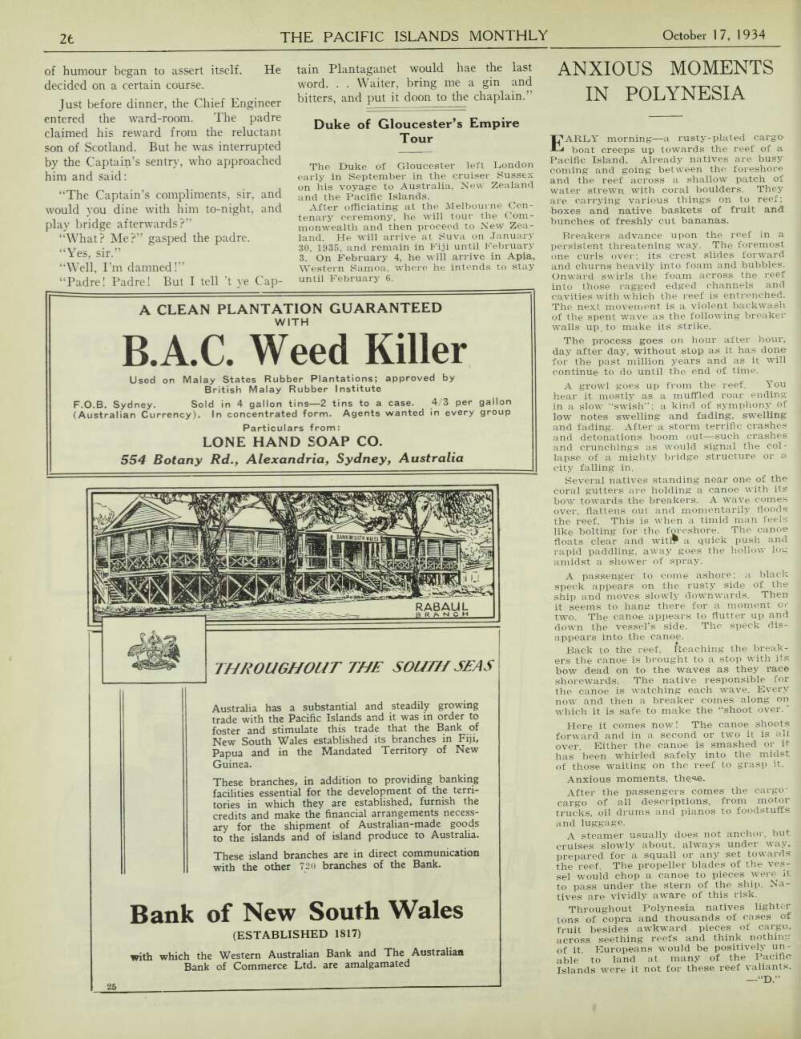
Tour
The Duke of Gloucester left London early in September in the cruiser Sussex on his voyage to Australia, New Zealand and the Pacific Islands.
After officiating at the Melbourne Cen tenary ceremony, he will tour the Com monwealth and then proceed to New Zea land. He will arrive at Suva on January 30, 1935, and remain in Fiji until February 3, On February 4, he will arrive in Apia, Western Samoa, where he intends to stay until February 6.
Anxious Moments
In Polynesia
EARLY morning—a rusty-plated cargo boat creeps up towards the reef of a Pacific Island. Already natives are busy coming and going between the foreshore and the reef across a shallow patch of water strewn with coral boulders. They are carrying various things on to reef; boxes and native baskets of fruit and bunches of freshly cut bananas.
Breakers advance upon the reef in a persistent threatening way. The foremost one curls over; its crest slides forward and churns heavily into foam and bubbles.
Onward swirls the foam across the reef into those ragged edged channels and cavities with which the reef is entrenched.
The next movement is a violent backwash of the spent wave as the following breaker walls up to make its strike.
The process goes on hour after hour, day after day, without stop as it has done for the past million years and as it will continue to do until the end of time.
A growl goes up from the reef. You hear it mostly as a muffled roar ending in a slow “swish”; a kind of symphony of low notes swelling and fading, swelling and fading. After a storm terrific crashes and detonations boom out—such crashes and crunchings as would signal the col lapse of a mighty bridge structure or a city falling in.
Several natives standing near one of the coral gutters are holding a canoe with its bow towards the breakers. A wave comes over, flattens out and momentarily floods the reef. This is when a timid man feels like bolting for the foreshore. The canoe floats clear and witlf a quick push and rapid paddling, away goes the hollow log amidst a shower of spray.
A passenger to come ashore; a black speck appears on the rusty side of the ship and moves slowly downwards. Then it seems to hang there for a moment or two. The canoe appears to flutter up and down the vessel’s side. The speck dis appears into the canoe.
Back to the reef. Reaching the break ers the canoe is brought to a stop with its bow dead on to the waves as they race shorewards. The native responsible for the canoe is watching each wave. Every now and then a breaker comes along on which it is safe to make the “shoot over."
Here it comes now! The canoe shoots forward and in a second or two it is all over. Either the canoe is smashed or it has been whirled safely into the midst of those waiting on the reef to grasp it.
Anxious moments, these.
After the passengers comes the cargo cargo of all descriptions, from motor trucks, oil drums and pianos to foodstuffs and luggage.
A steamer usually does not anchor, but cruises slowly about, always under way, prepared for a squall or any set towards the reef. The propeller blades of the ves sel would chop a canoe to pieces were it to pass under the stern of the ship. Na tives are vividly aware of this risk.
Throughout Polynesia natives lighter tons of copra and thousands of cases of fruit besides awkward pieces of cargo, across seething reefs and think nothing of it. Europeans would be positively un able to land at many of the Pacific Islands were it not for these reef valiants.
—“D.”
Captain Detzner’S
Explorations
MISS SHEILA LANE, in her article (P.I.M., July), gives Captain Hermann Detzner credit for greater powers than are usually allotted to man.
To describe an unknown district in Central New Guinea vividly and accur ately, merely by hearsay, eighteen years before its discovery, must be an unparall eled performance, even for New Guinea.
But it is hard to see what bearing any translation of Captain Detzner’s four years’ wanderings in New Guinea, from 1914 to 1918, has on the merits of Jack Hides, as compared with Taylor and the Leahys; or of Papuan exploration as compared with that of New Guinea; or what support it gives to the so-called “jealousy that exists between the Man dated Territory and Papua,” which Miss Lane emphasises so strongly.
It seems ridiculous to urge that any real jealousy exists between the two Ter ritories, Certainly. Papua holds none for the other side; and there appears no ob vious reason why the opulent New Guinea should be at all envious of her poorer neighbour.
Mollie Lett.
American and New Zealand
Vessels at Suva
From Our Own Correspondent SUVA, August 16.
CUVA has had two more tourist ships in port recently.
The City of Los Angeles, which paid her first visit earlier in the year, arrived on the evening of July 24 from Los Amgeles via Nukahiva, Tahiti, Rarotonga, Nukualofa, and Noumea, with 221 pas sengers on board.
The ship sailed on the afternoon of the following day for Apia, Pago Pago, Hono lulu, and America.
On Saturday mprning, August 11, the Marama arrived with 240 passengers from Auckland and Sydney, most of them being from New Zealand. This is the first tourist ship to visit here from New Zea land, and the innovation was a popular one.
Rain marred the ship’s arrival, but dur ing the day the weather cleared somewhat, and passengers were taken for the usual drives.
On Sunday, August 12, a launch picnic was held on Nukulau Island, and in the evening a concert was given on the ship by the Defence Force Band. The ship sailed for Levuka, Tonga, Samoa, and Auckland on the Monday morning.
Voyage
Tui Cakau Leaves Fiji on Maiden Voyage
From Our Own Correspondent.
SUVA, Sept. 12.
THE new steel motor vessel, Tui Cakau, recently assembled here for Messrs.
Morris Hedstrom, has been completed, and underwent successful trials on Sep tember 8, attaining a speed of 8¼ knots.
She sailed for Lakeba, Lau Group, on her maiden voyage in the interinsular trade on September 10. The vessel is a valuable addition to the fleet of small boats engaged in the trade of the Colony.
Fiji
Indian Smuggler Sentenced at Fiji
From Our Own Correspondent.
SUVA, Sept. 1.
On the night before the steamer Ganges sailed from Suva for Calcutta at the end of August, Rasulla, an Indian mem ber of the crew, was caught by a customs officer attempting to smuggle “Indian hemp” (gunja) ashore. The “hemp” was found in the toe of Rasulla’s shoe.
At the Police Court the next day, he was fined £50 or 12 months in gaol, by the Acting Magistrate, Mr. W. Burrows.
Advertisements & other items, p. 29 (2 items)
Prescott Ltd
are sole wholesale agents for
PINEAPPLE BACON & HAMS
DAISY BRAND BUTTER
FRESCO BRAND BUTTER
LEA & PERRINS’ SAUCE
DOCKERS
Made expressly to keep a lustrous, full gloss finish
against the varying con-
ditions of moist weather exposure, and prevent the decaying ravages of rain and extreme heat by
giving a long lasting pro-
tection to all surfaces.
SUN PROOF
RAIN PROOF
"Stronger than the Weather ”
W. R. CARPENTER
& CO. LTD.
New Guinea, Solomon Islands, and all other South Sea Islands.
Sydney Marine Agency
Brokers for the Sale or Purchase or Construction of Luggers, Schooners, Ketches, Cruisers, Yachts, Launches, Speed Boats, Engines, Equipment, etc.
Prices range from £100 to £1000.
Send for our Price List.
Sydney Marine Agency
72 PITT STREET, SYDNEY.
Works: Lavender Bay.
Progress At Salamaua
As further evidence of the rapid pro gress that is being made in the New Guinea goldfields towns it is noted that substantial additions are being made to the Hotel Salamaua, which is conducted at the goldfields port by Mr. and Mrs.
Allen Innes. A building of two storeys is being erected in the garden opposite the main dining bungalow. This well known hotel accommodated 60 guests during the exciting week when the Mon toro ran ashore, near Huon Gulf.
Dangers Of Pacific Navigation
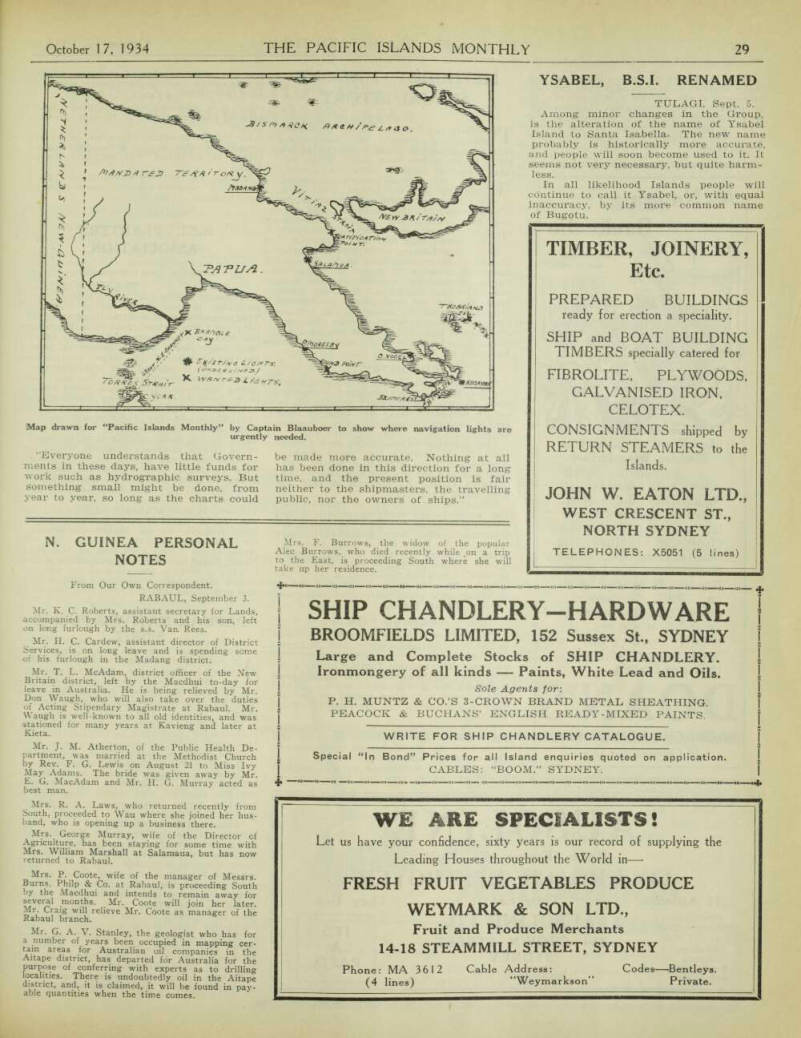
Dutch Shipmaster’s Appeal for New Surveys
A N appeal for further hydrographic surveys of the waters in and about the Pacific Territories controlled by Aus tralia was made by Captain J. Blaauboer, master of the K. P. M. steamer “Van Rees,” which arrived in Sydney on Sep tember 11. The “Van Rees” runs on a regular schedule between the East Indies, Papua, New Guinea, New Hebrides, New Caledonia and Sydney, and navigation in those waters is full of dangers.
“Shipmasters can make no complaint if they have adequate charts,” said Captain Blaauboer. “Navigation in good or bad waters is part of their job. But naviga tion around the coasts of Papua and New Guinea is full of risks, even if the greatest care is exercised, because of the almost complete absence of lighthouses, the incomplete charts and the treacherous currents. The course one must follow between Port Moresby, Samarai and Rabaul is most tortuous, there are reefs and islands in all directions and, in thick weather, such as we have had for the last month or two, nagivation is—well, very difficult.
“Shipmasters cannot understand why Australia gives so little attention to the subject of making navigation safer in these waters. You have in New Guinea one of the most efficient and successful aeroplane services in the world; and yet, in the same place, you have one of the worst navigation systems. That there have been so few shipwrecks is a great tribute to the shipmasters who fre quently navigate these seas—particular ly the captains of Burns Philip steamers.
The fact that the “Montoro,” in charge of one of the Company’s best-known cap tains, struck a reef, shows that there is danger in those waters in spite of the greatest care and skill, and the Aus tralian Government should take steps to minimise that danger.
“More lights are most urgently needed.
At present, there are lights only at the entrance to Port Moresby; on Kegawan Island, in China Straits; at Cape Vogel, at Salamaua, Madang, and at Rabaul.
As an absolute minimum, there should be lights also at Bramble Cay, at the eastern entrance of Torres Straits (Great North east Channel); at Round Point, on the southern shore of Papua; at or near the Brumer Islands, to show the south-west entrance to the China Straits; at or near the Trobriand Islands, to show the nor thern entrance to the China Straits; and there certainly should be a light some where in Vitiaz Strait, between the New Guinea Mainland and New Britain, where the “Montoro” ran ashore re cently.
“There is now much traffic in these waters, in the vicinity of the China Straits and, without lights and with poor charts, too much responsibility can be thrown upon shipmasters when they are asked to maintain their schedules in thick, rainy weather.
“Most of the charts covering the waters of Papua and New Guinea are antiquated and inadequate—some are almost ludi crous. I have just been using Admiralty Charts Nos. 2422, 2121, 2122, 2123 and 2764, which are the charts to which we must work when navigating the Great North east Channel of Torres Straits and the South and South-east coasts of Papua.
These charts appear to be the result of surveys made in 1843-1850, with some small sectional examinations made since.
Here are some of the annotations on the charts: “‘Several reefs seen in this direction.’ ‘Caution; Owing to the imperfect nature of the survey in the vicinity of Round Point, vessels should proceed with cau tion when navigating here.’ (Yet Round Point is one of the most important points on the South Coast of Papua—vessels proceeding east or west have to alter course here). ‘Position and extent of these islands uncertain.’ ‘Reefs seen by D’Entrecasteaux’ —over 140 years ago.' ‘Reefs seen by Mr. Ashmore in the ship Hibernia, 1811 (not surveyed).’ ‘Reef, Nellie (1889) —position approximate.’ ‘No survey of these waters.’ ‘Limit of reefs uncertain to the southwest.’
“And so on. There are very many of these vague indications of dangerous water, but they provide shipmasters with material only for guesswork.
“Everyone understands that Govern ments in these days, have little funds for work such as hydrographic surveys. But something small might be done, from year to year, so long as the charts could
be made more accurate. Nothing at all has been done in this direction for a long time, and the present position is fair neither to the shipmasters, the travelling public, nor the owners of ships.”
Map drawn for “Pacific Islands Monthly” by Captain Blaauboer to show where navigation lights are urgently needed.
Advertisements & other items, p. 30 (1 item)
Pure Rice Starch
TO PACIFIC ISLANDS BUILDERS
AND CONTRACTORS
AUSTRALIAN HARDWOODS
For all classes of Buildings and heavy Constructional work, Wharves, Jetties, etc.
Send details and we will quote by radio or return mail, as desired.
Islands Timbers
We should be glad to have details of any Islands Timbers which might be suitable for sale in Australia.
E. J. BURNSIDE & CO. LTD.
Australia House, Wynyard Square
SYDNEY
Cable address; “GRADATIM,” Sydney.
The
“Caledonia Dover”
A COOKING STOVE guaranteed to give complete satisfaction and now recognised as THE BEST on the market. Suitable for coal, coke or wood fuel.
Illustrated Catalogue on request.
LANE & GIRVAN, LTD.,
BONNY BRIDGE, SCOTLAND.
PURE RICE STARCH
ALWAYS ASK FOR
“CORAL BRAND”
100% PURE
Noted for its
QUALITY and WHITENESS
Goes FARTHEST and gives
LASTING FINISH
Will not stick to iron.
CORAL BRAND
may be obtained from Leading Island Stores Manufactured by
CORAL STARCH LTD.
Sydney, N.S.W.
N. Guinea Personal
Notes
From Our Own Correspondent.
RABAUL, September 3.
Mr. K. C. Roberts, assistant secretary for Lands, accompanied by Mrs. Roberts and his son, left on long furlough by the s.s. Van Rees.
Mr. H. C. Cardew, assistant director of District Services, is on long leave and is spending some of his furlough in the Madang district.
Mr. T. L. McAdam, district officer of the New Britain district, left by the Macdhui to-day for leave in Australia. He is being relieved by Mr.
Don Waugh, who will also take over the duties of Acting Stipendary Magistrate at Rabaul. Mr.
Waugh is well-known to all old identities, and was stationed for many years at Kavieng and later at Kieta.
Mr. J. M. Atherton, of the Public Health De partment, was married at the Methodist Church by Rev. F. G. Lewis on August 21 to Miss Ivy May Adams. The bride was given away by Mr.
E. G. Mac Adam and Mr. H. G. Murray acted as best man.
Mrs. R. A. Laws, who returned recently from South, proceeded to Wau where she joined her hus band, who is opening up a business there.
Mrs. George Murray, wife of the Director of Agriculture, has been staying for some time with Mrs. William Marshall at Salamaua, but has now returned to Rabaul.
Mrs. P. Coote, wife of the manager of Messrs.
Burns, Philp & Co. at Rabaul, is proceeding South by the Macdhui and intends to remain away for several months. Mr. Coote will join her later.
Mr. Craig will relieve Mr. Coote as manager of the Rabaul branch.
Mr. G. A. V. Stanley, the geologist who has for a number of years been occupied in mapping cer tain areas for Australian oil companies in the Aitape district, has departed fdr Australia for the purpose of conferring with experts as to drilling localities. There is undoubtedly oil in the Aitape district, and, it is claimed, it will be found in pay able quantities when the time comes.
Mrs. F. Burrows, the widow of the popular Alec Burrows, who died recently while on a trip to the East, is proceeding South where she will take up her residence.
Ysabel, B.S.I. Renamed
Tulagi, Sept, 5.
Among minor changes in the Group, is the alteration of the name of Ysabel Island to Santa Isabella. The new name probably is historically more accurate, and people will soon become used to it. It seems not very necessary, but quite harm less.
In all likelihood Islands people will continue to call it Ysabel, or, with equal inaccuracy, by its more common name of Bugotu.
Mrs. H. Luxmoor took charge of the Hotel Rabaul, T.N.G., in May last, and has much energy and ingenuity in and renovating that popular establishment. Rabaul is responding in a very satisfactory manner to the social attractions of the hotel under the new management.
Advertisements & other items, pp. 31-32 (1 item)
Ship Chandlery-Hardware
TIMBER, JOINERY,
Etc.
PREPARED BUILDINGS
ready for erection a speciality.
SHIP and BOAT BUILDING
TIMBERS specially catered for
FIBROLITE, PLYWOODS,
GALVANISED IRON,
CELOTEX.
CONSIGNMENTS shipped by
RETURN STEAMERS to the
Islands.
JOHN W. EATON LTD.,
WEST CRESCENT ST.,
NORTH SYDNEY
TELEPHONES: X 5051 (5 lines)
SHIP CHANDLERY-HARDWARE
BROOMFIELDS LIMITED, 152 Sussex St- SYDNEY
Large and Complete Stocks of SHIP CHANDLERY.
Ironmongery of all kinds Paints, White Lead and Oils.
Sole Agents for: P. H. MUNTZ & CO.’S 3-CROWN BRAND METAL SHEATHING.
PEACOCK & BUCHANS’ ENGLISH READY-MIXED PAINTS.
WRITE FOR SHIP CHANDLERY CATALOGUE.
Special “In Bond” Prices for all Island enquiries quoted on application.
CABLES: “BOOM.” SYDNEY.
WE ARE SPECIALISTS!
Let us have your confidence, sixty years is our record of supplying the Leading Houses throughout the World in—
FRESH FRUIT VEGETABLES PRODUCE
WEYMARK & SON LTD.,
Fruit and Produce Merchants
14-18 STEAMMILL STREET, SYDNEY
Phone: MA 3612 Cable Address: Codes Bentleys. (4 lines) “Weymarkson” Private.
A Nagging
Backache
"Every Picture tells a Story"
May Warn of Kidney or Bladder Irregularities A persistent backache, with bladder irregularities and a tired, nervous, depressed feeling may warn of some disordered kidney or bladder condition. Users everywhere rely on Doan’s Backache Kidney Pills. Praised for more than 30 years by grateful users the country over. Buy a bottle to-day, but be sure they are Doan’s.
DOAN’S
BACKACHE KIDNEY PILLS.
All Chemists and Stores
advt
Methodist Mission’S
Annual Report
THOUGH the finances of the Methodist Missionary Society of Australasia showed a deficit for 1933 of over £4,000, great progress has been made in the So ciety’s Islands mission activities, accord ing to the 79th Annual Report just issued.
During the year the Board, determined to fill all vacant stations, increased the European staff in the Pacific Islands mis sion field. Altogether ten new mission aries—six men and four women —were sent to Papua, Fiji and New Guinea.
Rev. C. O. Lelean, of Fiji, retired after 32 years’ service and Rev. M. K. Gilmour also retired after 33 years of work in Papua. Four other mission workers have also retired on account of ill-health, while Miss H. Stevens and Miss D. Secomb retired in order to marry. New Britain lost one of her greatest pioneer mission aries when Rev. W. H. Cox retired early this year; later he died in hospital in Australia on April 28.
Fiji District.
The work of the Fiji District was much handicapped through reduced subscrip tions, though the voluntary writing off by native ministers of 75 per cent, of their year’s salary improved the position slightly.
The superintendent of the Bau Circuit (Rev.. T. N. Deller) has been working strenuously in an effort to raise ten thou sand guineas for the Fiji Centenary Cele brations Fund. At the end of 1933, the fund stood at £1,300.
Education has advanced considerably.
Ten students are studying at the Davui levu Theological College; 128 pupils are attending the well- equipped primary school in the same district and there are many scholars at the technical school where carpentry cabinet-making, book keeping, electrical engineering, etc., are taught. The Navuso Agricultural School is doing very good work in turning out pfficient Fijian farmers.
New Britain.
The Methodist Society has 375 churches in the New Britain district and 23 Euro pean missionaries at work among the natives. The notable feature of the mis sion work in this district during the year has been the evangelistic work. Many new villages have been opened up and the mission’s influence has extended in all di rections.
The General Secretary (Rev. J. W. Bur ton) visited the Territory recently and with Rev. L. A. McArthur re-organized the mission’s educational system.
The task of attending to the medical needs of the natives has been arduous.
But the large number of patients treated is testimony to the able work done in this direction. PAPUA Rev. J. R. Andrews was appointed Chair man on the retirement of Rev. M. K. Gil mour.
In Papua, mission education is in its primitive stages, though schools are main tained at Kiriwina, Salamo, and Bwai doga.
During the year the missions continued to render needful medical assistance to* the Papuans.
B.S.I. Planters’
Association
From Our Own Correspondent.
Tulagi, Sept. 6.
It seems a pity that the Planters’ As sociation is now moribund or defunct..
The Association, if a little interest could have been maintained, particularly among: the smaller companies and private plan ters, might have done a power of good.
Representatives of the larger companies cannot be accused of indifference; they made every effort to get the lesser interests to show the same keen ness. Possibly a little quite unwarranted suspicion of the bigger firms may have contributed to the indifference of the lesser folk. This suspicion was not justified, as the more smaller men, the more votes (when interests clashed) would be against the large firms. At the present time certainly—and one would imagine, always—interests should be identical, and it is a great pity the Association is not revived.
There is now a chance of publicity in. the “P.I.M.,” and it is to be remembered how helpful, in an earlier depression, the “Planters’ Gazette” was to the old Association. The members of the edi torial board of that publication bore the burden of editing, and most of the writing and a large part of the cost of printing and publishing, but they did much good.
Papuan Native’S Public
Spirit
AN interesting report received in Can berra in September on the erection of an isolation hospital in the native village of Hanuabada, Papua, shows that the Papuan native Is not lacking in public spirit.
The report, which was made by the Government Secretary to the Lieutenant- Governor, is as follows: “The Resident Magistrate let a contract to a native named Sisia Vaike to build an isolation hospital in Hanuabada for those affected with tuberculosis. The money for the hospital was found from native taxation funds. Sisia made a fine job of it.
“Sisia had been working for some time with a private employer as a carpenter at £5 a month and gave up the job to take the hospital contract. I asked the Resi dent Magistrate to find out, if he could, whether Sisia had made any money at the job. He discovered that there was a loss, and, on pointing this out, Sisia said some thing to this effect, ‘Very likely; but I was not looking for profit. I wanted to build this hospital for my village.’ ”
“I think,” wrote Sir Hubert Murray, when sending the report to the Minister in Charge of Islands Territories (Sir H.
Lawson), “that such public spirit and in difference to personal interest is not very common, even in the higher culture.”
Mysterious Mangaia
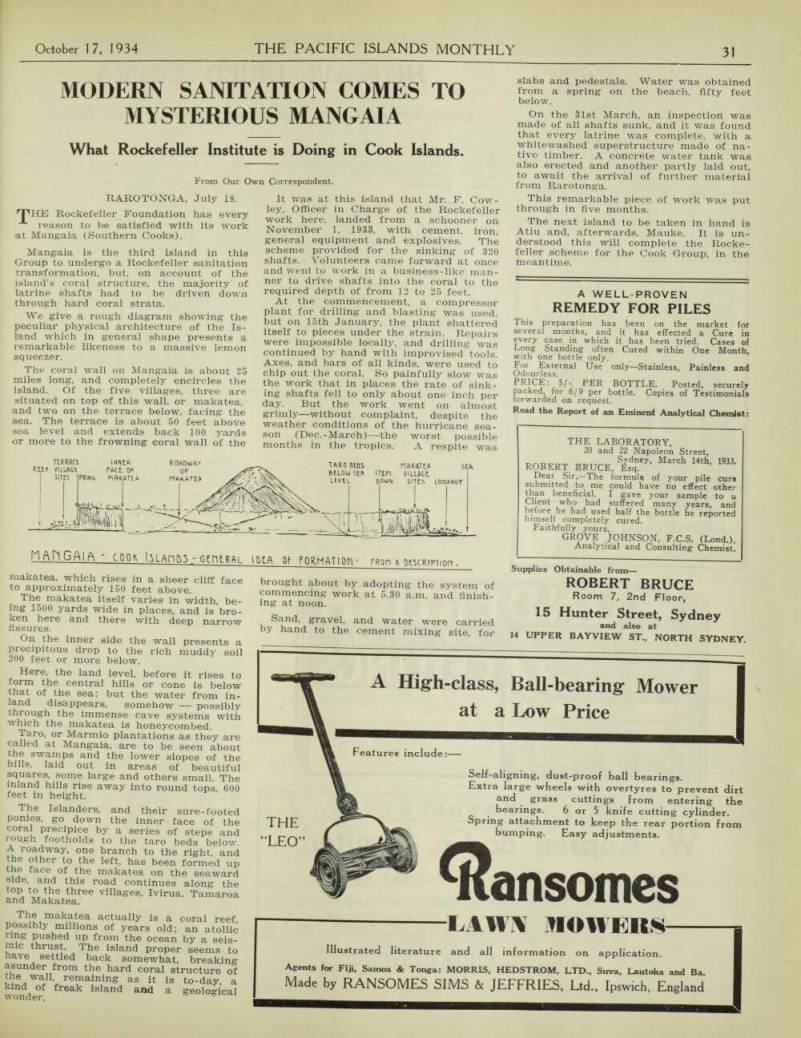
Modern Sanitation Comes To
What Rockefeller Institute is Doing in Cook Islands.
From Our Own Correspondent.
Rarotonga, July 18.
THE Rockefeller Foundation has every reason to be satisfied with its work at Mangaia (Southern Cooks).
Mangaia is the third island in this Group to undergo a Rockefeller sanitation transformation, but, on account of the island’s coral structure, the majority of latrine shafts had to be driven down through hard coral strata.
We give a rough diagram showing the peculiar physical architecture of the Is land which in general shape presents a remarkable likeness to a massive lemon squeezer.
The coral wall on Mangaia is about 25 miles long, and completely encircles the island. Of the five villages, three are situated on top of this wall, or makatea, and two on the terrace below, facing the sea. The terrace is about 50 feet above sea level and extends back 100 yards or more to the frowning coral wall of the
makatea. which rises in a sheer cliff face to approximately 150 feet above.
The makatea itself varies in width, be ing 1500 yards wide in places, and is bro ken here and there with deep narrow fissures.
On the inner side the wall presents a precipitous drop to the rich muddy soil 200 feet or more below.
Here, the land level, before it rises to form the central hills or cone is below that of the sea; but the water from in land disappears, somehow possibly through the immense cave systems with which the makatea is honeycombed.
Taro, or Marmio plantations as they are called at Mangaia, are to be seen about the swamps and the lower slopes of the hills, laid out in areas of beautiful squares, some large and others small. The inland hills rise away into round tops, 600 feet in height.
The Islanders, and their sure-footed ponies, go down the inner face of the coral precipice by a series of steps and lough footholds to the taro beds below.
A roadway, one branch to the right, and the other to the left, has been formed up the face of the makatea on the seaward side, and this road continues along the to P the three villages, Ivirua, Tamaroa and Makatea.
The makatea actually is a coral reef possibly millions of years old; an atollic ring pushed up from the ocean by a seis mic thrust. The island proper seems to have settled back somewhat, breaking asunder from the hard coral structure of the wall, remaining as it is to-day, a kind of freak island and a geological wonder.
It was at this island that Mr. F. Cow ley, Officer in Charge of the Rockefeller work here, landed from a schooner on November 1, 1933, with cement, iron, general equipment and explosives. The scheme provided for the sinking of 320 shafts. Volunteers came forward at once and went to work in a business-like man ner to drive shafts into the coral to the required depth of from 12 to 25 feet.
At the commencement, a compressor plant for drilling and blasting was used, but on 15th January, the plant shattered itself to pieces under the strain. Repairs were impossible locally, and drilling was continued by hand with improvised tools.
Axes, and bars of all kinds, were used to chip out the coral. So painfully slow was the work that in places the rate of sink ing shafts fell to only about one inch per day. But the work went on almost grimly—without complaint, despite the weather conditions of the hurricane sea son (Dec.-March) —the worst possible months in the tropics. A respite was
brought about by adopting the system of commencing work at 5.30 a.m. and finish ing at noon.
Sand, gravel, and water were carried by hand to the cement mixing site, for
slabs and pedestals. Water was obtained from a spring on the beach, fifty feet below.
On the 31st March, an inspection was made of all shafts sunk, and it was found that every latrine was complete, with a whitewashed superstructure made of na tive timber. A concrete water tank was also erected and another partly laid out, to await the arrival of further material from Rarotonga.
This remarkable piece of work was put through in five months.
The next island to be taken in hand is Atiu and, afterwards, Mauke. It is un derstood this will complete the Rocke feller scheme for the Cook Group, in the meantime.
Advertisements & other items, p. 33 (1 item)
ansomes
A WELL-PROVEN
REMEDY FOR PILES
This preparation has been on the market for several months, and it has effected a Cure in every case in which it has been tried. Cases of Long Standing often Cured within One Month, with one bottle only.
For External Use only—Stainless, Painless and Odourless.
PRICE: 5/- PER BOTTLE. Posted, securely packed, for 6/9 per bottle. Copies of Testimonials forwarded on request.
Read the Report of an Eminent Analytical Chemist:
THE LABORATORY,
20 and 22 Napoleon Street, March 14th, 1933.
ROBERT BRUCE, Esq.
Dear Sir,—The formula of your pile cure submitted to me could have no effect other than beneficial. I gave your sample to a Client who had suffered many years, and before he had used half the bottle he reported himself completely cured.
Faithfully yours,
GROVE JOHNSON, F.C.S. (Lond.),
Analytical and Consulting Chemist.
Supplies Obtainable from—
ROBERT BRUCE
Room 7, 2nd Floor,
15 Hunter Street, Sydney
and also at
14 UPPER BAYVIEW ST.. NORTH SYDNEY.
A High-class, Ball-bearing Mower
at a Low Price
Features include;
THE
“LEO”
Self-aligning, dust-proof ball bearings.
Extra large wheels with overtyres to prevent dirt and grass cuttings from entering the bearings. 6 or 5 knife cutting cylinder.
Spring attachment to keep the rear portion from bumping. Easy adjustments.
ansomes
LAWN MOWERS
Illustrated literature and all information on application.
Agents for Fiji, Samoa & Tonga: MORRIS, HEDSTROM, LTD., Suva, Lautoka and Ba.
Made by RANSOMES SIMS & JEFFRIES, Ltd., Ipswich, England
Revival In Solomons
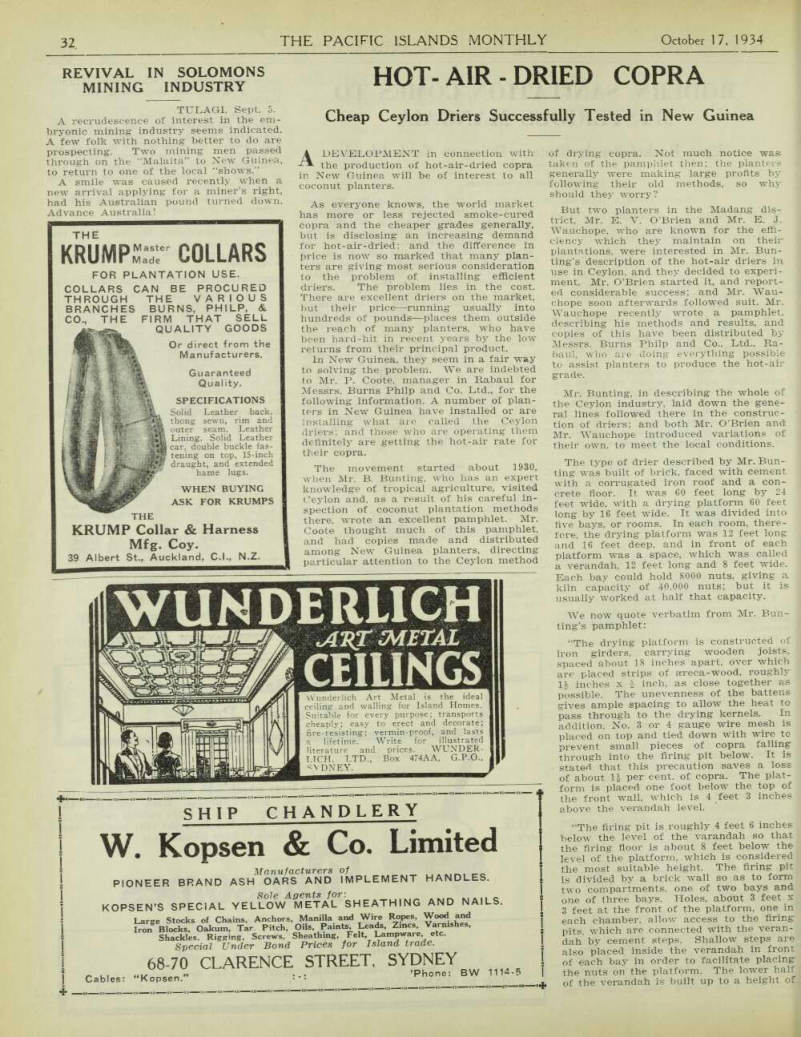
Mining Industry
Tulagi, Sept. 5.
A recrudescence of interest in the em bryonic mining industry seems indicated.
A few folk with nothing better to do are prospecting. Two mining men passed through on the “Malaita” to New Guinea, to return to one of the local “shows.’’
A smile was caused recently when a new arrival applying for a miner’s right, had his Australian pound turned down.
Advance Australia!
Hot-Air - Dried Copra
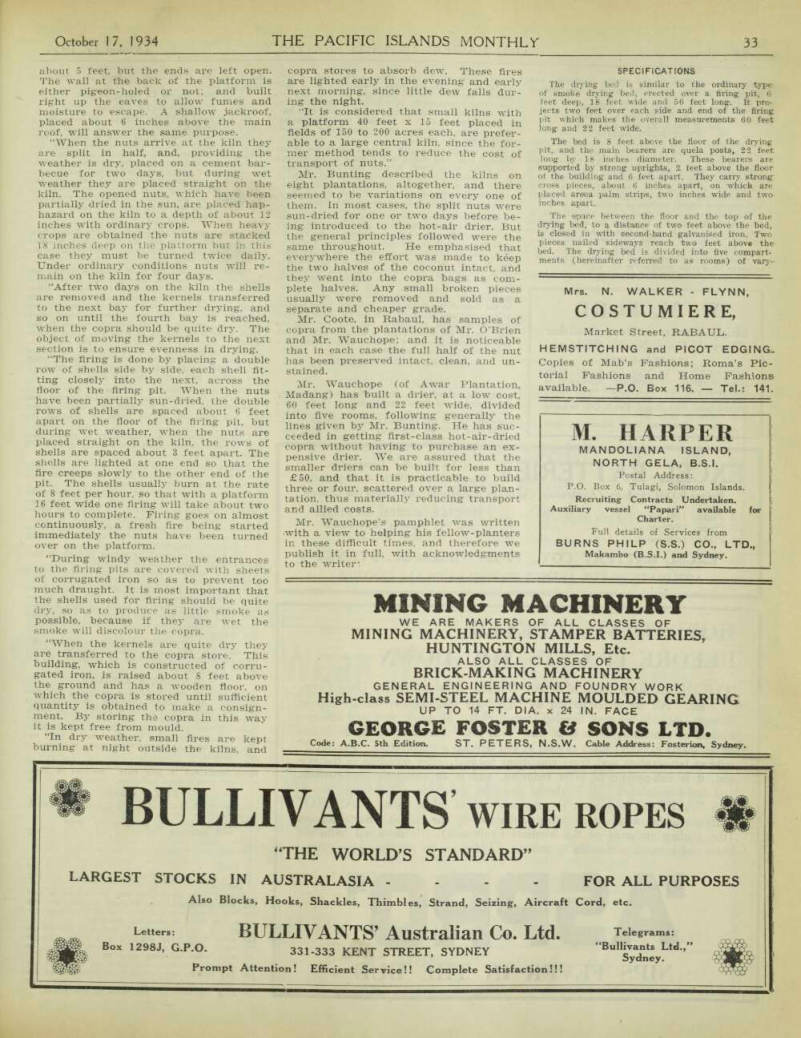
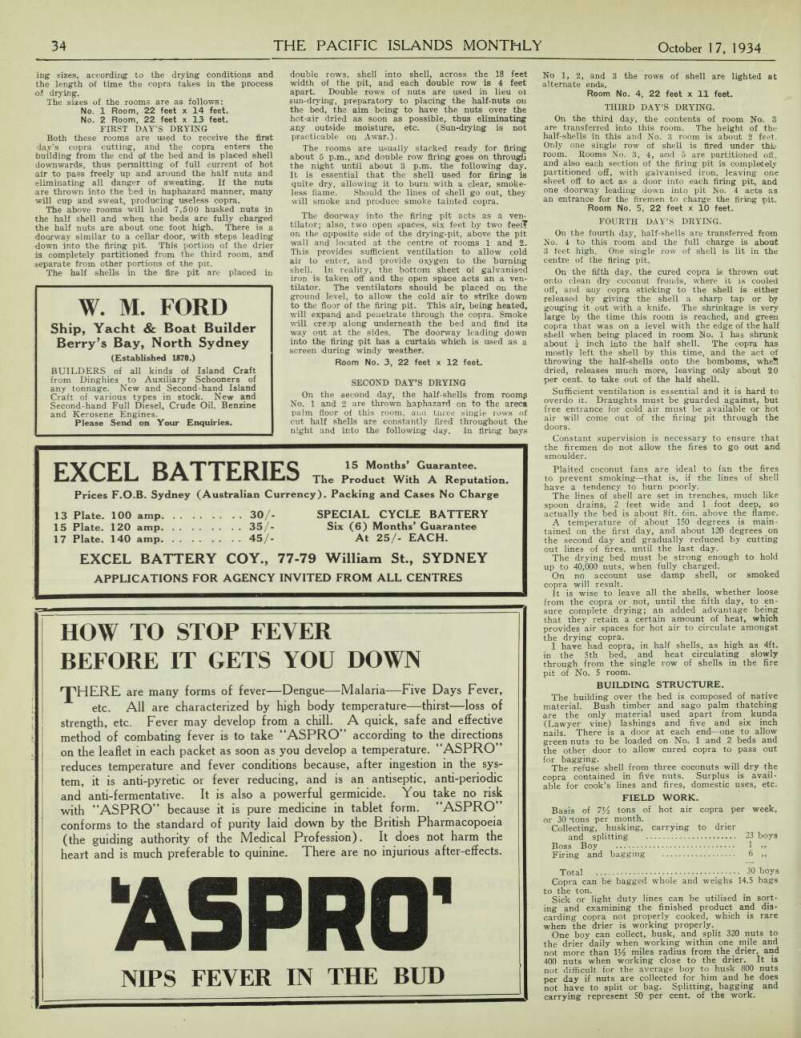
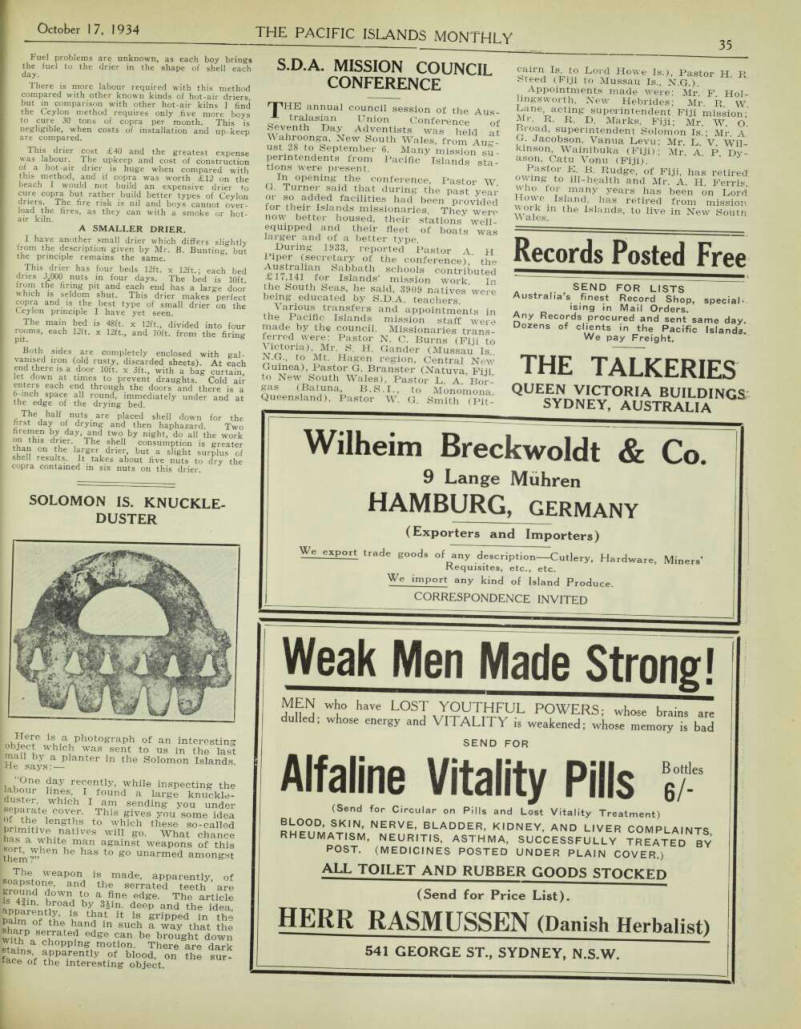
Cheap Ceylon Driers Successfully Tested in New Guinea
A DEVELOPMENT in connection with the production of hot-air-dried copra in New Guinea will be of interest to all coconut planters.
As everyone knows, the world market has more or less rejected smoke-cured copra and the cheaper grades generally, but is disclosing an increasing demand for hot-air-dried: and the difference in price is now so marked that many plan ters are giving most serious consideration to the problem of installing efficient driers. The problem lies in the cost.
There are excellent driers on the market, but their price—running usually into hundreds of pounds—places them outside the reach of many planters, who have been hard-hit in recent years by the low returns from their principal product.
In New Guinea, they seem in a fair way to solving the problem. We are indebted to Mr. P. Coote, manager in Rabaul for Messrs. Burns Philp and Cos. Ltd., for the following information. A number of plan ters in New Guinea have installed or are installing what are called the Ceylon driers: and those who are operating them definitely are getting the hot-air rate for their copra.
The movement started about 1930, when Mr. B. Bunting, who has an expert knowledge of tropical agriculture, visited Ceylon and, as a result of his careful in spection of coconut plantation methods there, wrote an excellent pamphlet. Mr.
Coote thought much of this pamphlet, and had copies made and distributed among New Guinea planters, directing particular attention to the Ceylon method
of drying copra. Not much notice was taken of the pamphlet then; the planters generally were making large profits by following their old methods, so why should they worry?
But two planters in the Madang dis trict, Mr. E. V. O’Brien and Mr. E. J.
Wauchope, who are known for the effi ciency which they maintain on their plantations, were interested in Mr. Bun ting’s description of the hot-air driers in. use in Ceylon, and they decided to experi ment. Mr. O’Brien started it, and report ed considerable success; and Mr. Wau chope soon afterwards followed suit. Mr.
Wauchope recently wrote a pamphlet, describing his methods and results, and copies of this have been distributed by Messrs. Burns Philp and Cos., Ltd., Ra baul, who are doing everything possible to assist planters to produce the hot-air grade.
Mr. Bunting, in describing the whole of the Ceylon industry, laid down the gene ral lines followed there in the construc tion of driers; and both Mr. O’Brien and Mr. Wauchope introduced variations of their own, to meet the local conditions.
The type of drier described by Mr, Bun ting was built of brick, faced with cement with a corrugated iron roof and a con crete floor. It was 60 feet long by 24 feet wide, with a drying platform 60 feet long by 16 feet wide. It was divided into five bays, or rooms. In each room, there fore, the drying platform was 12 feet long and 16 feet deep, and in front of each platform was a space, which was called a verandah, 12 feet long and 8 feet wide.
Each bay could hold 8000 nuts, giving a kiln capacity of 40,000 nuts; but it is usually worked at half that capacity.
We now quote verbatim from Mr. Bun ting’s pamphlet; “The drying platform is constructed of iron girders, carrying wooden joists, spaced about 18 inches apart, over which are placed strips of areca-wood, roughly 1½ inches x ½ inch, as close together as possible. The unevenness of the battens gives ample spacing to allow the heat to pass through to the drying kernels. In addition, No. 3 or 4 gauge wire mesh is placed on top and tied down with wire to prevent small pieces of copra falling through into the firing pit below. It is stated that this precaution saves a loss of about 1 h per cent, of copra. The plat form is placed one foot below the top of the front wall, which is 4 feet 3 inches above the verandah level.
“The firing pit is roughly 4 feet 6 inches below the level of the varandah so that the firing floor is about 8 feet below the level of the platform, which is considered the most suitable height. The firing pit is divided by a brick wall so as to form two compartments, one of two bays and one of three bays. Holes, about 3 feet x 3 feet at the front of the platform, one in each chamber, allow access to the firing pits, which are connected with the veran dah by cement steps. Shallow steps are also placed inside the verandah in front of each bay in order to facilitate placing the nuts on the platform. The lower half of the verandah is built up to a height of
about 5 feet, but the ends are left open.
The wall at the back of the platform is either pigeon-holed or not; and built right up the eaves to allow fumes and moisture to escape. A shallow jackroof, placed about 6 inches above the main roof, will answer the same purpose.
“When the nuts arrive at the kiln they are split in half, and, providing the weather is dry, placed on a cement bar becue for two days, but during wet weather they are placed straight on the kiln. The opened nuts, which have been partially dried in the sun, are placed hap hazard on the kiln to a depth of about 12 inches with ordinary crops. When heavy crops are obtained the nuts are stacked 18 inches deep on the plattorm but in this case they must be turned twice daily.
Under ordinary conditions nuts will re main on the kiln for four days.
“After two days on the kiln the shells are removed and the kernels transferred to the next bay for further drying, and so on until the fourth bay is reached, when the copra should be quite dry. The object of moving the kernels to the next section is to ensure evenness in drying.
“The firing is done by placing a double row of shells side by side, each shell fit ting closely into the next, across the floor of the firing pit. When the nuts have been partially sun-dried, the double rows of shells are spaced about 6 feet apart on the floor of the firing pit, but during wet weather, when the nuts are placed straight on the kiln, the rows of shells are spaced about 3 feet apart. The shells are lighted at one end so that the fire creeps slowly to the other end of the pit. The shells usually burn at the rate of 8 feet per hour, so that with a platform 16 feet wide one firing will take about two hours to complete. Firing goes on almost continuously, a fresh fire being started immediately the nuts have been turned over on the platform.
“During windy weather the entrances to the firing pits are covered with sheets of corrugated iron so as to prevent too much draught. It is most important that the shells used for firing should be quite dry, so as to produce as little smoke as possible, because if they are wet the smoke will discolour the copra.
“When the kernels are quite dry they are transferred to the copra store. This building, which is constructed of corru gated iron, is raised about 8 feet above the ground and has a wooden floor, on which the copra is stored until sufficient quantity is obtained to make a consign ment. By storing the copra in this wav it is kept free from mould.
“In dry weather, small fires are kept burning at night outside the kilns, and
copra stores to absorb dew. These fires are lighted early in the evening and early next mornipg, since little dew falls dur ing the night.
“It is considered that small kilns with a platform 40 feet x 15 feet placed in fields of 150 to 200 acres each, are prefer able to a large central kiln, since the for mer method tends to reduce the cost of transport of nuts.”
Mr. Bunting described the kilns on eight plantations, altogether, and there seemed to be variations on every one of them. In most cases, the split nuts were sun-dried for one or two days before be ing introduced to the hot-air drier. But the general principles followed were the same throughout. He emphasised that everywhere the effort was made to keep the two halves of the coconut intact, and they went into the copra bags as com plete halves. Any small broken pieces usually were removed and sold as a separate and cheaper grade.
Mr. Coote, in Rabaul, has samples of copra from the plantations of Mr. O’Brien and Mr. Wauchope; and it is noticeable that in each case the full half of the nut has been preserved intact, clean, and un stained.
Mr. Wauchope (of Awar Plantation, Madang) has built a drier, at a low cost, 60 feet long and 22 feet wide, divided into five rooms, following generally the lines given by Mr. Bunting. He has suc ceeded in getting first-class hot-air-dried copra without having to purchase an ex pensive drier. We are assured that the smaller driers can be built for less than £SO. and that it is practicable to build three or four, scattered over a large plan tation. thus materially reducing transport and allied costs.
Mr. Wauchope’s pamphlet was written with a view to helping his fellow-planters in these difficult times, and therefore we publish it in full, with acknowledgments to the writer:
Specifications
The drying bed is similar to the ordinary type of smoke drying bed, erected over a firing pit, 6 feet deep, 18 feet wide and 56 feet long. It pro jects two feet over each side and end of the firing pit which makes the overall measurements 60 feet long and 22 feet wide.
The bed is 8 feet above the floor of the drying pit, and the main bearers are quela posts, 2 2 feet long by 18 inches diameter. These bearers are supported by strong uprights, 2 feet above the floor of the building and 6 feet apart. They carry strong cross pieces, about 6 inches apart, on which are placed areca palm strips, two inches wide and two inches apart.
The space between the floor and the top of the drying bed, to a distance of two feet above the bed, is closed in with second-hand galvanised iron. Two pieces nailed sideways reach two feet above the bed. The drying bed is divided into five compart ments (hereinafter referred to as rooms) of vary
ing sizes, according to the drying conditions and the length of time the copra takes in the process of drying, The sizes of the rooms are as follows: No. 1 Room, 22 feet x 14 feet.
No. 2 Room, 22 feet x 13 feet.
First Day’S Drying
Both these rooms are used to receive the first day’s copra cutting, and the copra enters the building from the end of the bed and is placed shell downwards, thus permitting of full current of hot air to pass freely up and around the half nuts and eliminating all danger of sweating. If the nuts are thrown into the bed in haphazard manner, many will cup and sweat, producing useless copra.
The above rooms will hold 7,500 husked nuts in the half shell and when the beds are fully charged the half nuts are about one foot high. There is a doorway similar to a cellar door, with steps leading down into the firing pit. This portion of the drier is completely partitioned from the third room, and separate from other portions of the pit.
The half shells in the fire pit are placed in
double rows, shell into shell, across the 18 feet width of the pit, and each double row is 4 feet apart. Double rows of nuts are used in lieu oi sun-drying, preparatory to placing the half-nuts on the bed, the aim being to have the nuts over the hot-air dried as soon as possible, thus eliminating any outside moisture, etc. (Sun-drying is not practicable on Awar.).
The rooms are usually stacked ready for firing about 5 p.m., and double row firing goes on through the night until about 3 p.m. the following day.
It is essential that the shell used for firing is quite dry, allowing it to bum with a clear, smoke less flame. Should the lines of shell go out, they will smoke and produce smoke tainted copra.
The doorway into the firing pit acts as a ven tilator; also, two open spaces, six feet by two feet on the opposite side of the drying-pit, above the pit wall and located at the centre of rooms 1 and 2.
This provides sufficient ventilation to allow cold air to enter, and provide oxygen to the burning shell. In reality, the bottom sheet of galvanised iron is taken off and the open space acts an a ven tilator. The ventilators should be placed on the ground level, to allow the cold air to strike down to the floor of the firing pit. This air, being heated, will expand and penetrate through the copra. Smoke will creep along underneath the bed and find its way out at the sides. The doorway leading down into the firing pit has a curtain which is used as a screen during windy weather.
Room No. 3, 22 feet x 12 feet.
Second Day’S Drying
On the second day, the half-shells from roomg No. 1 and 2 are thrown haphazard on to the areca palm floor of this room, ana tnree single rows of cut half shells are constantly fired throughout the night and into the following day. In firing bays
No 1,2, and 3 the rows of shell are lighted at alternate ends.
Room No. 4, 22 feet x 11 feet.
Third Day’S Drying.
On the third day, the contents of room No. 3 are transferred into this room. The height of the half-shells in this and No. 3 room is about 2 feet.
Only one single row of shell is fired under thi.room. Rooms No. 3,4, aind 5 are partitioned ofi, and also each section of the firing pit is completely partitioned off, with galvanised iron, leaving one sheet off to act as a door into each firing pit, and one doorway leading down into pit No. 4 acts as an entrance for the firemen to charge the firing pit.
Room No. 5, 22 feet x 10 feet.
Fourth Day’S Drying.
On the fourth day, half-shells are transferred from No. 4 to this room and the full charge is about 3 feet high. One single row of shell is lit in the centre of the firing pit.
On the fifth day, the cured copra is thrown out onto clean dry coconut fronds, where it is cooled off, and any copra sticking to the shell is either released by giving the shell a sharp tap or by gouging it out with a knife. The shrinkage is very large by the time this room is reached, and green copra that was on a level with the edge of the half shell when being placed in room No. 1 has shrunk about i inch into the half shell. The copra has mostly left the shell by this time, and the act of throwing the half-shells onto the bomboms, whe?s dried, releases much more, leaving only about 20 per cent, to take out of the half shell.
Sufficient ventilation is essential and it is hard to overdo it. Draughts must be guarded against, but free entrance for cold air must be available or hot air will come out of the firing pit through the doors.
Constant supervision is necessary to ensure that the firemen do not allow the fires to go out and smoulder.
Plaited coconut fans are ideal to fan the fires to prevent smoking—that is, if the lines of shell have a tendency to burn poorly.
The lines of shell are set in trenches, much like spoon drains, 2 feet wide and 1 foot deep, so actually the bed is about 8ft. 6in. above the flame.
A temperature of about 150 degrees is main tained on the first day, and about 120 degrees on the second day and gradually reduced by cutting out lines of fires, until the last day.
The drying bed must be strong enough to hold up to 40,000 nuts, when fully charged.
On no account use damp shell, or smoked copra will result.
It is wise to leave all the shells, whether loose from the copra or not, until the fifth day, to en sure complete drying; an added advantage being that they retain a certain amount of heat, which provides air spaces for hot air to circulate amongst the drying copra.
I have had copra, in half shells, as high as 4ft. in the sth bed, and heat circulating slowly through from the single row of shells in the fire pit of No. 5 room.
Building Structure.
The building over the bed is composed of native material. Bush timber and sago palm thatching are the only material used apart from kunda (Lawyer vine) lashings and five and six inch nails. There is a door at each end —one to allow green nuts to be loaded on No. 1 and 2 beds and the other door to allow cured copra to pass out
for bagging.
The refuse shell from three coconuts will dry the copra contained in five nuts. Surplus is avail able for cook’s lines and fires, domestic uses, etc.
Field Work.
Basis of 7½ tons of hot air copra per week, or 30 tons per month.
Collecting, husking, carrying to drier and splitting 23 boys Boss Boy 1 Firing and bagging 6 „ Total 30 boys Copra can be bagged whole and weighs 14.5 bags to the ton.
Sick or light duty lines can be utilised in sort ing and examining the finished product and dis carding copra not properly cooked, which is rare when the drier is working properly.
One boy can collect, husk, and split 320 nuts to the drier daily when working within one mile and not more than V/ 2 miles radius from the drier, and 400 nuts when working close to the drier. It is not difficult for the average boy to husk 800 nuts per day if nuts are collected for him and he does not have to split or bag. Splitting, bagging and carrying represent 50 per cent, of the work.
Fuel problems are unknown, as each boy brings the fuel to the drier in the shape of shell each day.
There is more labour required with this method compared with other known kinds of hot-air driers, but in comparison with other hot-air kilns I find the Ceylon method requires only five more boys to cure 30 tons of copra per month. This is negligible, when costs of installation and up-keep are compared.
This drier cost £40 and the greatest expense was labour. The upkeep and cost of construction of a hot-air drier is huge when compared with this method, and if copra was worth £12 on the beach I would not build an expensive drier to cure copra but rather build better types of Ceylon driers. The fire risk is nil and boys cannot over load the fires, as they can with a smoke or hotair kiln.
A Smaller Drier.
I have another small drier which differs slightly from the description given by Mr. B. Bunting but the principle remains the same.
This drier has four beds 12ft. x 12ft.; each bed dries 4000 nuts in four days. The bed is 10ft from the bring pit and each end has a large door which is seldom shut. This drier makes perfect copra and is the best type of small drier on the Leylon principle I have yet seen.
The main bed is 48ft. x 12ft., divided into four rooms, each 12ft. x 12ft., and 10ft. from the firing Both sides are completely enclosed with gal vanised iron (old rusty, discarded sheets). At each end there is a door 10ft. x 3ft., with a bag curtain, let down at times to prevent draughts. Cold air enters each end through the doors and there is a 6-inch space all round, immediately under and at the edge of the drying bed.
The half nuts are placed shell down for the hrst day of drying and then haphazard. Two firemen by day, and two by night, do all the work on this drier. The shell consumption is greater than on the larger drier, but a slight surplus of shell results. It takes about five nuts to dry the copra contamed in six nuts on this drier.
Advertisements & other items, pp. 34-36 (2 items)
W. Kopsen & Co. Limited
THE
KRUMP Master Made COLLARS
FOR PLANTATION USE.
COLLARS CAN BE PROCURED
THROUGH THE VARIOUS
BRANCHES BURNS, PHILP, &
CO., THE FIRM THAT SELL
QUALITY GOODS
Or direct from the Manufacturers.
Guaranteed Quality.
SPECIFICATIONS
Solid Leather back, thong sewn, rim and outer seam. Leather Lining. Solid Leather car, double buckle fastening on top, 15-inch draught, and extended hame lugs.
WHEN BUYING
ASK FOR KRUMPS
THE
KRUMP Collar & Harness
Mfg. Coy.
39 Albert St., Auckland, C.I., N.Z.
Wunderlich Art Metal is the ideal ceiling and walling for Island Homes.
Suitable for every purpose; transports cheaply; easy to erect and decorate; fire-resisting; vermin-proof, and lasts a lifetime. Write for illustrated literature and prices. WUNDER-
LICH. LTD., Box 474 AA. G.P.O.,
SYDNEY.
SHIP CHANDLERY
W. Kopsen & Co. Limited
Manufacturers of PIONEER BRAND ASH OARS AND IMPLEMENT HANDLES.
KOPSEN’S SPECIAL YELLOW METAL SHEATHING AND NAILS.
Large Stocks of Chains, Anchors, Manilla and Wire Ropes, Wood and Iron Blocks, Oakum. Tar. Pitch, Oils, Paints, Leads, Zincs, Varnishes, Shackles. Rigging. Screws, Sheathing, Felt, Lampware, etc.
Special Under Bond Prices for Island trade.
68-70 CLARENCE STREET, SYDNEY
Cables: “Kopsen,”
Phone: BW 1114-5
BULLIVANTS wire ropes
Mrs. N. WALKER-FLYNN,
COSTUMIERE,
Market Street, RABAUL.
HEMSTITCHING and PICOT EDGING,.
Copies of Mab’s Fashions; Roma’s Pictorial Fashions and Home Fashions available. — P.O. Box 116. Tel.: 141.
M. HARPER
MANDOLIANA ISLAND,
NORTH GELA, B.S.I.
Postal Address: P.O. Box 6, Tulagi, Solomon Islands.
Recruiting Contracts Undertaken.
Auxiliary vessel “Papari” available for Charter.
Full details of Services from
BURNS PHILP (S.S.) CO., LTD.,
Makambo (B.S.I.) and Sydney.
MINING MACHINERY
WE ARE MAKERS OF ALL CLASSES OF
MINING MACHINERY, STAMPER BATTERIES,
HUNTINGTON MILLS, Etc.
ALSO ALL CLASSES OF
BRICK-MAKING MACHINERY
GENERAL ENGINEERING AND FOUNDRY WORK
High-class SEMI-STEEL MACHINE MOULDED GEARING
UP TO 14 FT. DIA. x 24 IN. FACE
GEORGE FOSTER & SONS LTD.
Code: A.B.C. 5th Edition. ST. PETERS, N.S.W. Cable Address: Fosterion, Sydney.
BULLIVANTS wire ropes
“THE WORLD’S STANDARD”
LARGEST STOCKS IN AUSTRALASIA ... FOR ALL PURPOSES Also Blocks, Hooks, Shackles, Thimbles, Strand, Seizing, Aircraft Cord, etc.
Letters:
Box 1298 J, G.P.O.
BULLIVANTS’ Australian Co. Ltd.
331-333 KENT STREET, SYDNEY
Prompt Attention! Efficient Service!! Complete Satisfaction!!!
Telegrams: Bullivants Ltd.
Sydney.
W. M. FORD
Ship, Yacht & Boat Builder
Berry’s Bay, North Sydney
(Established 1870.) BUILDERS of all kinds of Island Craft from Dinghies to Auxiliary Schooners of any tonnage. New and Second-hand Island Craft of various types in stock. New and Second-hand Full Diesel, Crude Oil, Benzine and Kerosene Engines.
Please Send on Your Enquiries.
15 Months’ Guarantee.
The Product With A Reputation Prices F.O.B. Sydney (Australian Currency). Packing and Cases No Charge
EXCEL BATTERIES
13 Plate. 100 amp 30/- 15 Plate. 120 amp 35/- 17 Plate. 140 amp 457-
SPECIAL CYCLE BATTERY
Six (6) Months’ Guarantee
At 25/- EACH.
EXCEL BATTERY COY., 77-79 William St., SYDNEY APPLICATIONS FOR AGENCY INVITED FROM ALL CENTRES
HOW TO STOP FEVER
BEFORE IT GETS YOU DOWN
THERE are many forms of fever—Dengue—Malaria—Five Days Fever, etc. All are characterized by high body temperature—thirst—loss of strength, etc. Fever may develop from a chill. A quick, safe and effective method of combating fever is to take “ASPRO” according to the directions on the leaflet in each packet as soon as you develop a temperature. “ASPRO” reduces temperature and fever conditions because, after ingestion in the system, it is anti-pyretic or fever reducing, and is an antiseptic, anti-periodic and anti-fermentative. It is also a powerful germicide. You take no risk with “ASPRO” because it is pure medicine in tablet form. “ASPRO” conforms to the standard of purity laid down by the British Pharmacopoeia (the guiding authority of the Medical Profession). It does not harm the heart and is much preferable to quinine. There are no injurious after-effects.
ASPRO
NIPS FEVER IN THE BUD
Solomon Is. Knuckle.
Duster
Here is a photograph of an interesting object which was sent to us in the last mail by a planter in the Solomon Island.
He says:— "One day recently, while inspecting the labour lines, I found a large knuckle duster, which I am sending you under separate cover. This gives you some idea of the lengths to which these so-called primitive natives will go. What chance has a white man against weapons of this sort, when he has to go unarmed amongst them?"
The weapon is made, apparently, of soapstone, and the serrated teeth are ground down to a fine edge. The article is 4¾in. broad by 3½in. deep and the idea, apparently, is that it is gripped in the palm of the hand in such a way that the sharp serrated edge can be brought down with a chopping motion. There are dark stains, apparently of blood, on the surface of the interesting object.
Conference
S.D.A. Mission Council
THE annual council session of the Australasian Union Conference of Seventh Day Adventists was held at Wahroonga, New South Wales, from Aug ust 28 to September 6. Many mission su perintendents from Pacific Islands sta tions were present.
In opening the conference, Pastor W.
G. Turner said that during the past year or so added facilities had been provided for their Islands missionaries. They were now better housed, their stations well equipped and their fleet of boats was larger and of a better type.
During 1933, reported Pastor A. H.
Piper (secretary of the conference) the Australian Sabbath schools contributed £17,141 for Islands’ mission work. In the South Seas, he said, 3909 natives were being educated by S.D.A. teachers.
Various transfers and appointments in the Pacific Islands mission staff were made by the council. Missionaries trans ferred were; Pastor N. C. Burns (Fiji to Victoria) Mr S. H. Gander (Mussau Is.
N.G., to Mt. Hagen region, Central New Guinea), Pastor G. Branster (Natuva Fiji to New South Wales), Pastor L. A. Boreas (Batuna, B.S.I., to Monomona, Queensland), Pastor W. G. Smith (Pit
cairn Is. to Lord Howe Is.), Pastor H. R.
Steed (Fiji to Mussau Is., N.G.).
Appointments made were: Mr. F. Hol lingsworth, New Hebrides; Mr R. W.
Lane, acting superintendent Fiji mission; Mr. R. R. D. Marks, Fiji; Mr. W. O.
Broad, superintendent Solomon Is.; Mr. A.
G. Jacobson, Vanua Levu; Mr. L. V. Wilkinson, Wainibuka (Fiji); Mr. A. P. Dyason, Catu Vonu (Fiji).
Pastor E. B. Rudge, of Fiji, has retired owing to ill-health and Mr. A. H. Ferris, who for many years has been on Lord Howe Island, has retired from mission in the Islands, to live in New South Wales.
Advertisements & other items, p. 37 (1 item)
Alfaline Vitality Pills
Records Posted Free
SEND FOR LISTS
Australia’s finest Record Shop, specialising in Mail Orders.
Any Records procured and sent same day.
Dozens of clients in the Pacific Islands.
We pay Freight.
THE TALKERIES
QUEEN VICTORIA BUILDINGS
SYDNEY, AUSTRALIA
Wilheim Breckwoldt &
9 Lange Muhren
HAMBURG, GERMANY
(Exporters and Importers) We export trade goods of any description Cutlery, Hardwar Requisites, etc., etc.
We import any kind of Island Produce.
CORRESPONDENCE INVITED
Co.
Miners’
Weak Men Made Strong!
MEN who have LOST YOUTHFUL POWERS; whose brains are dulled: whose energy and VITALITY is weakened; whose memory is bad
SEND FOR
Bottles 6/-
Alfaline Vitality Pills
(Send for Circular on Pills and Lost Vitality Treatment) BLOOD, SKIN, NERVE, BLADDER, KIDNEY, AND LIVER COMPLAINTS
RHEUMATISM, NEURITIS, ASTHMA, SUCCESSFULLY TREATED BY
POST. (MEDICINES POSTED UNDER PLAIN COVER.)
ALL TOILET AND RUBBER GOODS STOCKED
(Send for Price List).
HERR RASMUSSEN (Danish Herbalist)
541 GEORGE ST., SYDNEY, N.S.W.
Dredging Ltd.
Report By Bulolo Gold
The gross production from Bulolo (N.G.) Dredges Nos. 1, 2 and 3 in August amounted to 14,462 ounces of bullion, con taining 10,001 ounces of fine gold, from 653,500 cubic yards. Estimated working profit, 7,506 ounces of fine gold. The above production is equivalent to £85,008/10/-, and working profit to £63,801 on the basis of £8/10/- (Aust-) per fine ounce of gold.
Dredge No. 4 reached bedrock at the end of August.
Indian Problem In Fiji
Claim for “Freedom and Privileges Conferred by Union Jack”
Letter to the Editor.
I WAS interested in reading the article under the above heading in your June number. I encroach upon your kind indul gence for a space to express my views on the question.
Now-a-days much trash is passed off under the pretence of protecting native interests, so called. As there appears to be a lot of misunderstanding on this ques tion, I take the liberty of quoting the Native Chief. Ratu J. L. V, Sukuna, Native Nominated Member of the Fiji Legislative Council. Speaking in the Council on the 27th October, 1933, he said, inter alia: — “I should like to say publicly that, so far as Fijians are concerned, we think we are very well treated, and for the next two or three or four generations we look to Euro
pean leadership and expect the Europeans to lead' us, until such times as we are able to guide ourselves.” This, coming from one of the High Chiefs, ought to serve as an eye-opener to those who say that the natives are not properly treated and that the Government has betrayed their in terests.
The Fiji Government protects native rights in every way and does its utmost to improve their well-being in every man ner possible. Yet some fanatical cranks continue to misrepresent matters.
You are evidently under a misappre hension when you say that “The crime was committed when permanent Indian settlement was permitted in Fiji.” For the late Lord Salisbury, the then Secretary of State for India, in a despatch dated 24th March, 1875, made it quite clear that the object he contemplated was permanent colonisation, and added that “above all things the Colonial laws and their ad ministration will be such that the Indian settlers will be, in all respects, free men with privileges no whit inferior to those of any other class of His Majesty’s subjects resident in the Colonies.”
Now, Mr. Editor, what more is required to prove that the Indians were brought out to this Colony with a view to per manently colonising Fiji and thus have their permanent place in the Colony.
It is no doubt now a crime to humiliate the Indians in Fiji, who (declared Ratu Sukuna in the Legislative Council the other day) “have shown us the way and are great assets to the Colony.”
We Indians agree that the interests of the natives are paramount and that they must be maintained. We have no desire to push out the indigenous Fijians. We do not wish to deprive them of their rights and liberties, or any other race, but when such arguments to raise false alarm are advanced, we have to point out their absur dity. Where, in the history of any Colony, have the Indians pushed out either the indigehous population or the European im migrant? In West Indies and South American Colonies, Indians were taken over for the development of those coun tries long before they were brought out to Fiji. Have the Indians in any one of those colonies, being more in number than they are in Fiji, taken administrative possession or pushed out natives or Euro
peans?
As regards our demand for equality of political treatment with the Europeans, I may say that our demand is consistent with the declared policy of H.M. Govern ment, as contained in the White Paper of June, 1930. Moreover, in 1920 a deputation representing the Fiji Government and the European planters went to India to beg more Indians to come to Fiji and that the Fiji Government, after full discussion with the European elected members of the Fiji Legislative Council and the Council of the European Planters, expressed their wil lingness to guarantee that the position of the Indians in Fiji would, in all respects, be equal to all other subjects of His Majesty resident in Fiji. Then, by virtue of our being British subjects, we are fully entitled to the freedom and privileges that the Union Jack confers.
Let me quote here what I wrote in my letters that appeared in your May number.
I wrote inter alia:— “The European and Indian subjects of His Majesty King George in Fiji live in mutual concord and harmony, maintaining, not merely the material glory of an Em pire more glorious than history has ever recorded, but sustaining its moral and spiritual basis in the interests of the great Britannic Commonwealth of Nations.”
Believe me, Mr. Editor, when I say that there is no friction between the European
and Indian in Fiji. The majority of Euro pean men and women are nice liberty-lov ing people, full of the milk of human kind ness for their fellow Indian subjects. But, alas! there are at the same time some fanatical cranks who write to the papers abroad to discredit us.
I am, etc..
J. A. Kirpal.
Suva, Fiji. 5/7/’34.
Advertisements & other items, p. 38 (1 item)
Arnott’S
W. D. BAILEY
Naval Architect
DESIGNER of SENSIBLE SEAWORTHY
CRUISERS, MOTOR, SAILING, or
AUXILIARY ISLAND TRADING
VESSELS
Over Thirty Years’ Experience—British, American and Australian.
Stock plans of all types and sizes at nominal prices.
Building supervised—Surveys anywhere. Special Plans for Amateur Builders with Free Advice.
Address: Como , N.S.W.; or
7 Barrack Street, Sydney
Delicious Biscuits
in sealed moisture-proof wrappers . . ideal for afternoon tea, lunch, or supper.
ARNOTT’S
famous
Shredded Wheatmeal Biscuits
a valuable appetising health food;
Popso Cracker Biscuits
the perfect base for savouries;
Spicy Fruit Roll Biscuits
put in the oven for one minute and served with cream or milk make a most delicious sweet.
Plea for European Settlement
Letter to the Editor
article entitled “Indian Problem in Fiji” is most interesting and will he endorsed by most European residents.
It is, as you say, useless and foolish of correspondents to indulge in vituperative and coarse language. All they may desire to say could be expressed in moderate terms, and would be more likely to attract consideration.
The majority of your readers will agree that unless some means are devised to arrest Indian invasion, the Colony will eventually be wholly “Indian.” In this connection it may be pointed out that the British Government, at the time Fiji was conceded to them, gave a solemn pledge to protect the Fijians in every way, and it was this pledge that mostly influenced the Fijians to agree to the concession.
In view of this and present conditions, it is held by many that the present attitude of allowing the Indians not only to settle in the Colony, but to assist them in doing so, is in a great measure repudiating the pledge given and is also betraying the Fijians.
In the writer’s opinion, although late in the day, it is not altogether too late to remedy matters to a considerable extent, and the quickest and most practicable way would be to amend drastically the existing land policy, making it attractive enough to induce an influx of European settlers.
In a recent address to the members of the Legislative Council, the Governor pointed out that at present all our eggs were in one basket—viz., sugar—and that it was most desirable and. in fact, neces sary that something should be done to pro mote other industries. This statement the Europeans will readily endorse. However, like abusive language, words will get us nowhere. It should be pointed out that no steps are being taken by the authorities in this direction.
The present land policy could be amended in more than one way to bring about the desired result, and at the same time preserve the rights of the Fijians.
In fact, it is thought they would be in a much better position than at present, both financially and otherwise.
Some 12 or more years since, the late Mr. P. W. Faddy, when a member of the Legislative Council, brought this matter prominently to the notice of the Govern ment in a very able speech, but he was treated in a most cavalier fashion by the nominated section of the Council and, of course, no heed was given to his proposi tion. It is a common complaint that our Government is autocratic and intolerant and turns down any suggestion made by an outsider, no matter how commonsense and practical it may be. But, should it emanate from within the charmed circle of public officials, it is welcomed. The writer could quote more than one instance m which suggestions were made through the columns of the local press. At the
time, no notice whatsoever was taken of them by the authorities. Years later these very suggestions were acted upon and credit given to some public official and he usually was commended for his perspi cacity.
The road at present being constructed around the Island of Viti Levu is an in stance of this. The road was first sug gested many years ago, and consistently and persistently advocated through the columns of the local newspaper. Now, at long last, it is being built; but Instead of following the route suggested the authori ties, in their wisdom, started the other way round and have only just discovered their error. Now the route originally recom mended is to be followed. Had this action been taken in the first instance a large amount of money would have been saved, as the distance is much shorter, with very much less engineering difficulties, besides which it would have served exactly the same purpose.
Several other instances could be quoted.
W e are in hopes that our gold mining industry may prove sufficiently attractive to induce a good many Europeans to come here. But it is noticed that the Govern ment already has put an obstacle in the way by making the export duty on any gold won 7/6 per oz. It would seem the policy is to keep Europeans from settling in the country.
It is generally conceded Fiji will have to rely mainly on primary industries for any future progress. We certainly have a Department and Director of Agriculture; but, so far as one can see, outside of sugar (with which the Department has nothing whatsoever to do, nor would its inter vention be tolerated) there is not a vestige of any agriculture worthy of the name to be seen. It is these dud Departments which absorb so much of our revenue.
It is generally recognised that our Ad ministrator has to follow instructions issued from Downing Street. Neverthe
less, it surely is open to him to represent vigorously the condition of the Colony and to call attention to the danger of Indian domination. Should this not prove effec tive, then it would be well for the Euro pean residents to send a deputation to headquarters to discuss the matter openly.
I am, etc..
Richard B. Howard.
Navua, Fiji. 12/7/34.
Advertisements & other items, pp. 39-40 (1 item)
Link-Belt Co. Ltd.
THE WHISKY THEY
ASK FOR AGAIN
17 GOULBURN STREET, SYDNEY
Centrifugal
Discharge
Bucket Elevator Modern Machinery Equipment for Elevating, Conveying and Mechanical Handling of Material.
Sole Agents in Australia for Ewart Chain Belting in Malleable or Steel.
Specialists in Power Transmission Machinery.
Large Stocks always kept of Steel Shafting, Cast Iron, Steel, or Wood Split Pulleys.
Plummer Blocks, Collars, Couplings, Leather Belting, Hangar Bearings.
Lubricators, Engineers’ Wrenches.
MANUFACTURING ENGINEERS
SAMUEL RUSSELL
ESTATE AND GENERAL AGENT.
P.O. Box 64, Papeete, Tahiti
Real Estate. Investments. Estate Management and Administration. Valuations and Reports. Houses and Lands for Lease or Sale.
Sole Proprietor: TAHITI PERFUMES Cables: Russell, Tahiti (Bentley’s Code)
ALBERT GREGORY
107 York Street, Sydney.
Saddlery,
Saddler’s Ironmongery
Leather and Paint Merchant.
LEATHERS— Art Work. Sole, Harness, Roans, Suedes, Bag, Kangaroo, Bridles, Belts, Spurs. Stirrups.
Breastplates. SADDLES Race, Exercising, Park and Stock.
Leather Belting and Pump Cups.
Paint Merchant.
For House and Roofs, ready mixed Special Value House Paint 13/6 gallon 10/6 gallon Brushes, Kalsomine, White Lead and Oil.
Samples of Leathers on Application.
The Most Effective Treatment for
Dhobie Itch “Toe Rot”
Inflamed Nails Ringworm, etc.
Tropic Skin Complaints are not amenable to treatment with so-called “simple” remedies. Scientific treatment is always necessary to eradicate the trouble completely. The positive remedy for these infections Antiseptic Lotion. Antinea is a combination of extremely powerful germicadal oils, many times stronger than carbolic. The first application destroys surface germs: subsequent applications swiftly destroy the germs beneath the skin which are the root of the trouble. Duration of treatment, of course, depends on the severity of the infection, and in all cases it is important to continue using Antinea until the skin heals completely.
Antinea Lotion is obtainable at all branches of Burns, Philp & Co., Ltd., Morris, Hedstrom & Co., Ltd. (Suva), A. J. Swann and Co., Ltd. (Suva), Brown and Joske (Suva), Michelmore and Co. (Suva), W. R. Carpenter and Co., Ltd.
Small Size 2/6, Triple Quantity 5/6
ANTINEA
COMMONWEALTH AND DOMINION AGENCIES LTD.,
168 Day Street, Sydney, N.S.W.
Native Agriculture In Papua
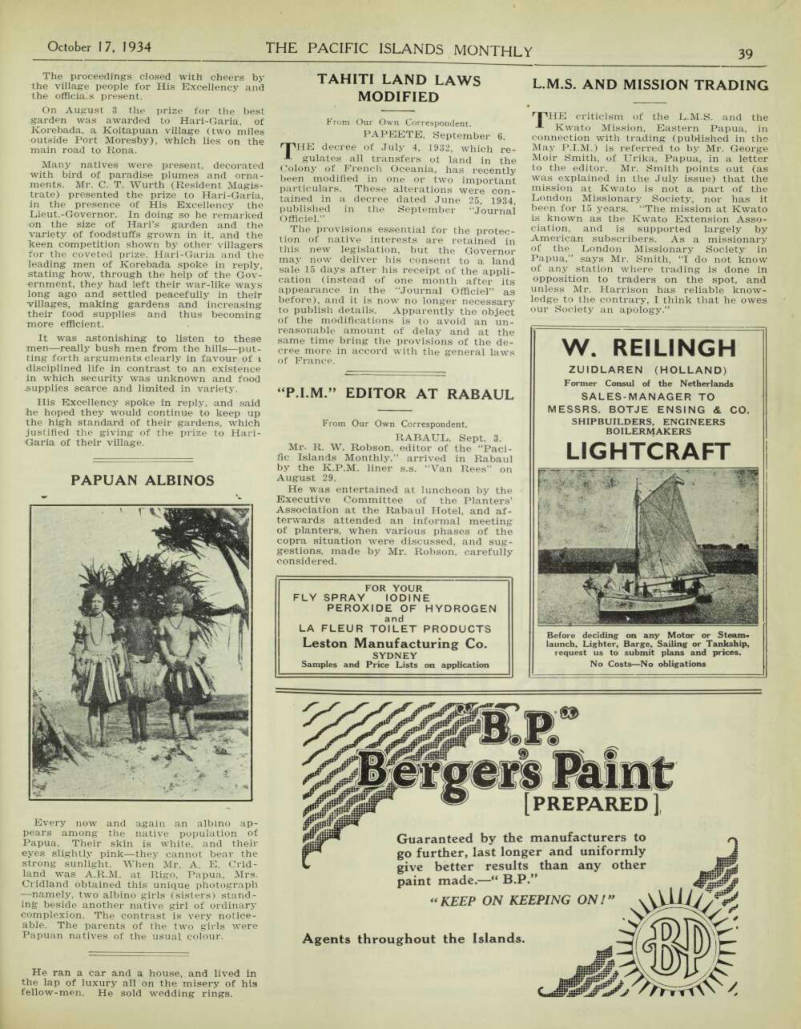
Remarkable Results of Administration’s Policy of Encouragement
From Our Own Correspondent.
Pt. Moresby, Aug. 9.
TO raise the standard of native agriculture and to promote enterprise and industry among the more settled districts of the Territory, the Administration of Papua awards each year a prize of £5 for the best garden, the best plantation and the best village in a district. These prizes are paid out of the Native Taxation Fund.
On the whole, the results of this scheme have been extremely satisfactory. The gardens have increased in size and number, as have also the variety of crops.
One hears of rich harvests of the Motuan people on the Laloki River and of the coastal tribes to the east and west of Port Moresby, where formerly there was a shortage of food during the south-east seasons.
These crops are said to contain yams, bananas, sweet potatoes, peanuts and melons, besides taro, sugar cane and paw paws, and often oranges, tomatoes, French beans, eschalots, and corn. This shows that the introduction of new foodstuffs to the Territory has prospered and is strik ing evidence of the beneficial effect on the natives of the pacification and settlement of the country in increasing their food supply.
There is keen competition over the prizes and the fertile valleys behind the hills of the coast lands are dotted with gardens vieing with each other in variety and splendour for the Government’s judg ment. The most valued prize of all is for the best village. On the day of the prize giving there is much ceremony and jubila tion; leading men make speeches and there is dancing and feasting.
Some time back, it was the intention of the Government to establish agricultural schools, and educate natives in the more
intensive cultivation of the soil and its re quirements. But the depression came and the scheme had to be abandoned, so in the meantime the competition for the prizes is the best incentive the Government can give.
On Wednesday, August 1, in the pres ence of His Excellency the Lieutenant- Governor and the Hons. H. W. Champion,.
C.B.E. and Leonard Murray, the Resident Magistrate of the Central Division (Mr. C.
T. Wurth), presented the prize of £5 to the village of Tanobada for the best kept vil lage in the district this year. The village was gaily decorated from end to end and was spotlessly clean. There was a large gathering of village people with their councillors.
In making the presentation, the Resident Magistrate said that Tanobada had well earned the prize. From the point of view of cleanliness, good repair of houses, care of platforms, and planting of ornamental palms, they had good grounds for being: proud of their village. His Excellency supported his remarks, and said that he and the officers present had been so long in Papua that they looked on it as their own country, and were proud to see a vil lage kept so well as Tanobada.
Councillors Lohia-Kamea, Ahuia-Ova, Rakatani-Keke spoke in reply, the first two expressing their pleasure and pride in winning the prize and their gratification at the attendance of the Governor and other officers.
Rakatani-Keke’s speech was surprising, and particularly gratifying to the Gover nor and officers present. It was delivered in English with ease and fluency. He stated that he spoke for the village people.
When native taxation was introduced, he said, thev had many misgivings about it.
It was something new to them. They had never been taxed before. Why should each man now have to pay £1 a year? They feared that they would get nothing out of it But these misgivings had completely gone. They all understood now that their taxation money was kept in a special fund which was spent for the benefit of the natives. They understood well the differ ence between the General Revenue and the Taxation Fund. The Revenue they knew came from customs duties, rents, licence fees and so on, and was used generally for the good of the country. The Taxation Fund came only from the natives’ taxes, and was used only for the natives’ benefit.
As far as Tanobada itself was concerned, he continued, they had received a water supply in the village which saved their women carrying water long distances from springs; they had schools for their child ren- a hospital and medicines; their women shared in the baby bonus; and they now had this prize of fo. All these things came to them from the Native Taxation money. They knew that they were get ting many good things from the taxation money, and they were well content to pay their tax.
It was a remarkable speech. It must be remembered that it was made by a Papuan native in a foreign tongue, on a compli cated subject of which he showed good understanding.
The proceedings closed with cheers by the village people for His Excellency and the officials present.
On August 3 the prize for the best garden was awarded to Hari-Garia, of Korebada, a Koitapuan village (two miles outside Port Moresby), which lies on the main road to Rona.
Many natives were present, decorated with bird of paradise plumes and orna ments. Mr. C. T. Wurth (Resident Magis trate) presented the prize to Hari-Garia, in the presence of His Excellency the Lieut.-Governor. In doing so he remarked on the size of Hari’s garden and the variety of foodstuffs grown in it, and the Leen competition shown by other villagers for the coveted prize. Hari-Garia and the leading men of Korebada spoke in reply, stating how, through the help of the Gov ernment, they had left their war-like ways long ago and settled peacefully in their villages, making gardens and increasing their food supplies and thus becoming more efficient.
It was astonishing to listen to these men—really bush men from the hills —putting forth arguments clearly in favour of a disciplined life in contrast to an existence in which security was unknown and food supplies scarce and limited in variety.
His Excellency spoke in reply, and said he hoped they would continue to keep up the high standard of their gardens, which justified the giving of the prize to Hari- Garia of their village.
Papuan Albinos
Every now and again an albino ap pears among the native population of Papua. Their skin is white, and their eyes slightly pink—they cannot bear the strong sunlight. When Mr. A. E. Crid land was A.R.M. at Rigo, Papua, Mrs.
Cridland obtained this unique photograph —namely, two albino girls (sisters) stand ing beside another native girl of ordinary complexion. The contrast is very notice able. The parents of the two girls were Papuan natives of the usual colour.
He ran a car and a house, and lived in the lap of luxury all on the misery of his fellow-men. He sold wedding rings.
Modified
Tahiti Land Laws
From Our Own Correspondent.
PAPEETE, September 6.
THE decree of July 4, 1932, which re gulates all transfers of land in the Colony of French Oceania, has recently been modified in one or two important particulars. These alterations were con tained in a decree dated June 25, 1934, published in the September “Journal Officiel.”
The provisions essential for the protec tion of native interests are retained in this new legislation, but the Governor may now deliver his consent to a land sale 15 days after his receipt of the appli cation (instead of one month after its appearance in the “Journal Officiel” as before), and it is now no longer necessary to publish details. Apparently the object of the modifications is to avoid an un reasonable amount of delay and at the same time bring the provisions of the de cree more in accord with the general laws of France.
“P.I.M.” Editor At Rabaul
From Our Own Correspondent.
Rabaul, Sept. 3.
Mr. R, W. Robson, editor of the “Paci fic Islands Monthly,” arrived in Rabaul by the K.P.M. liner s.s. “Van Rees” on August 29.
He was entertained at luncheon by the Executive Committee of the Planters’
Association at the Rabaul Hotel, and af terwards attended an informal meeting of planters, when various phases of the copra situation were discussed, and sug gestions, made by Mr. Robson, carefully considered.
L.M.S. And Mission Trading
THE criticism of the L.M.S. and the Kwato Mission, Eastern Papua, in connection with trading (published in the May P.I.M.) is referred to by Mr. George Moir Smith, of Urika, Papua, in a letter to the editor. Mr. Smith points out (as was explained in the July issue) that the mission at Kwato is not a part of the London Missionary Society, nor has it been for 15 years. “The mission at Kwato is known as the Kwato Extension Asso ciation, and is supported largely by American subscribers. As a missionary of the London Missionary Society in Papua,” says Mr. Smith, “I do not know of any station where trading is done in opposition to traders on the spot, and unless Mr. Harrison has reliable know ledge to the contrary, I think that he owes our Society an apology.”
Advertisements & other items, p. 41 (2 items)
[Prepared]
W. REILINGH
ZUIDLAREN (HOLLAND)
Former Consul of the Netherlands
SALES-MANAGER TO
MESSRS. BOTJE ENSING & CO.
SHIPBUILDERS, ENGINEERS
BOILERMAKERS
LIGHTCRAFT
Before deciding on any Motor or Steamlaunch. Lighter, Barge, Sailing or Tankship, request us to submit plans and prices.
No Costs—No obligations
[PREPARED]
Guaranteed by the manufacturers to go further, last longer and uniformly give better results than any other paint made. —“B.P.”
"KEEP ON KEEPING ON!"
Agents throughout the Islands.
Leston Manufacturing Co.
FOR YOUR
FLY SPRAY IODINE
PEROXIDE OF HYDROGEN
LA FLEUR TOILET PRODUCTS
Leston Manufacturing Co.
SYDNEY
Samples and Price Lists on application
New French Judge In
New Hebrides
From Our Own Correspondent.
VILA, September 15.
Another change in the Joint Court is announced.
Monsieur G. Sachon, who has been French Judge of the Joint Court for the past 11 years, and who more recently has acted as President of the Tribunal Fran cais, has retired, and will leave on his return to France in October.
Judge Sammascelli, who was a passenger on the liner Ville de Verdun from France to Noumea —where he was to take up an appointment in New Caledonia — left the steamer at Vila this week and will remain here for the present in order to take over the duties of Monsieur Sachon. It is understood that this is only a temporary arrangement.
Handy Book for Medical
Assistants
AN exceedingly handy little book, “Emergency Notes for Medical Assist ants,” has been compiled by Dr. W. M.
Strong, Chief Medical Officer in Papua.
The system of sending selected Papuan natives to the School of Public Health and Tropical Medicine at Sydney Univer sity, for special training, is part of Dr.
Strong’s plan for providing the native population of the Territory, eventually, with a simple, efficient service of sanita tion and public health. This booklet is part of the scheme. Clearly printed, in simple, easy English, it will provide a valuable reference for the native medical assistant, working by himself out in the bush. It deals with fractures, disloca tions. haemorrhages, and common injuries, and shows how to treat the bodily ailments most frequently met with among natives. The book, which was printed in Port Moresby, will be useful to a great many people other than native medical assistants.
High Standard For
Bananas
Because they “did pack one case of bananas, same found to contain immature fruit concealed in the centre of case,” four natives of Rarotonga were haled be fore the High Court and fined sums rang ing from £2/10/- to £1.
The Cook Islands Government evidently is determined to maintain a high grade for the bananas which it exports to New Zealand. There were so many complaints from New Zealand con cerning damaged bananas and slack packs that the authorities have intro duced a much more severe inspection.
This is a little rough on the native growers, because a very large proportion of the Rarotongan bananas are grown in almost inaccessible places far up in the interior valleys, and the transport of the fruit from the mountains to the port is a heavy and arduous task.
More Farce!
French and British Copra in New Hebrides
THE existing copra position, in its differ ent application to British and French production, has provided the already far cical Condominium with the final reduction ad absurdum.
In the September issue, we gave some instances of the extraordinary manner in which the Condominium operates. The following is worth an article to itself. As is well known, French-produced copra en ters France duty-free. Copra that is not French in origin pays an import duty; and, from the funds thus provided, a bonus is paid to French copra-growers to compen sate them for the existing low prices.
The following is taken from a letter to the Editor, written by a planter in the New Hebrides.
WE get no help from the British section of the Condominium Government — the British officials seem to be quite help less. It has now come to the stage that it is almost a crime to be under the British. flag in this group, and the British planters and traders are a laughing stock for the majority of the French residents, in that they have to try to compete for a meagre living under very unfair conditions.
“The following is a case in point, and happened quite recently. B.P.’s steamer came in, offering £2/10/- per ton for copra, which one planter refused. The following day an employee of his French neighbour (a new ‘mushroom’ buyer) came, and offered him £5/15/- per ton, stating that that was the price he was paying to natives for their copra. The British planter accepted that price for three tons! Later the French man came along to take delivery, but said the employee had made a mistake, and that the best price he could pay was consider ably under £5/15/-. When the British planter demurred, and pointed out that natives could sell inferior copra at £5/15/-, it was pointed out to him that his copra, being of British origin and grown, was only worth £2/10/- locally, and it was only by ‘special favour’ that he could sell it at all!
“Of course, the Britisher had to shut up quickly and accept the inevitable and try to look pleased about it and conditions in general.
“The French steamers have a printed list of prices to be paid in the group, viz.— Copra (French), £5/3/-; Copra (English), £2/11/-. In my opinion, this is a direct reflection on the British portion of the Con dominium and a good hint that we should either get out, or at least do something more than sit on our tail-bones in Vila, trying to look official, and important links of the Empire! Great Britain's record in this group as colonizers has been lament able, helpless and tragic, and we poor beg gars of planters, who are in and can’t get. out, have to bear the brunt of the tragic administration!
“The funniest part of the whole thing is that if a Frenchman buys copra from a native, it is classed as French copra and sold as such at about £5 per ton. But if an Englishman buys that same copra, it immediately becomes English, and that means that the price is half of £5.
“Trade is trade, the world over, so it is not necessary for me to tell you what is; o-oing on. ‘Dummying’ is rampant. Who can blame the unfortunate planters!”
Advertisements & other items, p. 42 (2 items)
40
October 17, 1934
THE PACIFIC ISLANDS (MONTHLY
Burns Philp
SPENCER NOLAN
DENTIST
28 OXFORD STREET
(Over Winns’ Ltd.)
SYDNEY
’Phone F 3215 Cable Address: Fastplate, Sydney
SPENCER NOLAN
DENTIST
139 ELIZABETH STREET
(2 doors from Market St.)
SYDNEY
'Phone F 3215
BURNS PHILP
(South Sea) Co. Ltd.
Island Traders & Shipowners
Registered Office: Suva, Fiji.
Also Branches at Fiji: Levuka. Lautoka, Labasa, Ba, Sigatoka, Rotuma.
Tonga: Nukualofa, Haapai, Vavau.
Samoa: Apia, Pago Pago (America Samoa).
Solomons: Makambo, Gizo, Faisi.
New Hebrides: Vila.
Gilberts: Tarawa.
Norfolk Is. Nauru. Niue. Wallis Is. Futuna Is.
Code Address: “Burnsouth.”
Political Conditions In Samoa
From Two Points of View
Letter to the Editor
THE Annual Report of the Mandatory Power, New Zealand, to the League of Nations, dealing with the Western Samoa affairs, for the year ended March 31, 1934, was presented to the New Zealand Parliament in September. It has been sent to Geneva for discussion by the Permanent Mandates Commission in October-November.
The political situation in Samoa is re ferred to in the report, as follows: “The political situation at the commencement of the period under review was perfectly quiet.
Since May, 1932, there had not been any Court proceedings or convictions for offences arising out of the political agitation. Mr. O. F. Nelson, who, pursuant to an Order made in December, 1927, was deported for a term of five years, returned in May, 1933; immediately thereafter political agitation revived. It grew in strength until early Novem ber, when two parties of Samoans undertook a tour of the Territory to appoint Mau officials, collect Mau taxes, and, in fact, to set up a new form of Government.
“Acting under a warrant issued by the Court, a search was carried out at the residence of O.
F. Nelson. A large quantity of incriminating documents were found there, including a “Bud get” for the Mau and a document styled “The First Proclamation of the Mau,” the latter providing for a constitution, the appointment of officials and their duties, also instructions for the two parties then setting out to put these plans into operation. Fourteen members of the two parties were arrested, tried, found guilty, and sentenced to terms of imprisonment, varying from three weeks to one year. O. F. Nelson was also arrested, and, after a trial lasting thirty-two days, was found guilty and sentenced to eight months’ imprisonment and ten years’ exile. On the Bth day of March, he was sent to New Zealand to serve his sentence, and there was no further trouble.
“Throughout the year the Administration functioned normally and smoothly, though this would not have continued if action against Mr. Nelson had not been taken. (The sentence of eight months’ imprisonment subsequently was quashed, on appeal.) At Mr. Nelson’s trial referred to, he conducted his own case, and of the 32 days of the trial, 21 were taken up in the defendant’s cross-examining of Inspector A. L. Braisby, Chief Police Officer of the Mandated Territory, who was the Informant, and principal witness for the prosecution. Among other things, Inspector Braisby, in his answers to the questions put to him by the defendant, in effect, stated: 1. That the Defendant (Mr. Nelson) was a man of great business ability, with the highest commercial reputation in Samoa and abroad, and of excellent private character, who has always taken an active part in promoting the social and political interests of the people of Samoa, and since 1922, after a trip to Europe, has made that his life’s work. 2. That the Defendant’s policy has always been peaceful, and that the leaders of the Mau strictly followed that policy throughout, by his influence; that the Defendant was the senior elected member of the Legislative Council for the second term, at the time of his first deportation. 3. That though the Mau seemed quiescent after the tragedy of December, 1927, and the promulgation of the “Samoa Seditious Organisations Regulations, 1930,” and though convictions for political offences and the non-payment of the old poll-tax were reduced from some 1800 in 1928 to nil in 1932, the Mau held big fonos (meetings) for Mau purposes during the whole of the period the defendant was in exile, and in one of the said fonos in August, 1932, the Mau collected £90 for Mau purposes. 4. That with the exception of the malaga party from Savaii to hold fono with the representatives of Upolu as to whether the Mau should
meet the Administrator, for which a police permit was issued, the whole of those Mau fonos were breaches of the “Samoa Seditious Organisations Regulations, 1930,” and the Police could easily have kept the convictions for Mau offences at 1800 per annum and higher, if the Police had taken action. 5. That the strength of the white police was in creased to 52 in April, 1930, and thereafter gradually reduced to 20 in January, 1933, and to 17 in April, 1933, the month before the defendant’s return to Samoa, and to 12 during Defendant’s stay in Samoa, till the day he was sent away to serve his term of imprisonment and exile in New Zealand in March, 1934.
The recent announcement that Chief Judge Luxford, who is returning to New Zealand, is not to be replaced by a resident Judge, but by an itinerant Judge, to visit Samoa two or three times a year, concludes with the suggestion that this “is also evidence of the quieter conditions prevailing there.” There are, of course, a few Commissioners of the High Court resident in Samoa with judicial powers about equal to those of a magistrate in New Zealand, so the High Court will not necessarily close down.
Authoritative reports disclose that the Mau continued to remain strongly in evidence in their headquarters in Vaimoso, holding fonos, as usual, after Mr. Nelson was sent away, and at a special fono towards the end of August, 1934, the Mau delegates were commissioned to return to their homes; to inspect the agencies and committees of the Mau in the villages and
districts; to convey to them, personally, and to the people as a whole, the latest resolutions of the Mau Executive; to collect Man funds; and to report again at Vaimoso before the end of September, 1934. where they shall remain, to await the pleasure of the Administrator for a fono, and to hold fonos for the maintenance of the organic system of the Samoans, so that the proud position ad mitted in the annual report that “poverty cannot exist” shall continue.
It is further reported that one of the principal items of the commission to the Mau delegates, while in their homes, is to consolidate that very work for which the malaga parties were arrested in November, 1833.
It is also stated that the Mau are ever ready to discuss with the Administrator their enumerated complaints, and to continue the fono held before the Administrator left for New Zealand in April, 1934; that the Mau will continue their work for
the Samoans until an amicable settle ment with the Government is arrived at, and will unresistingly submit to police action, and avoid a clash at any price; and that the Samoans deplore the fact that the Police prefer to wait for Mr. Nel son’s return to Samoa to make arrests, so as to lay on him the blame for the con tinued unrest, but that “this method only tends to increase the respect and regard of the Samoans for their most revered High Chief Taisi, Mr. O. F. Nelson, who is again paying the penalty for the per sistence of the Samoans for a proper hearing and redress of their grievances.”
P. B. Fitzherbert,
(Barrister and Solicitor of the Supreme Court of New Zealand).
Wellington, N.Z., September 20, 1934.
Advertisements & other items, p. 43 (1 item)
Winchester
OLD ISLANDS
PHOTOGRAPHS
We have a unique collection of several thousands of original photographs of Natives and Scenes in New Guinea, Solomons, Tonga, Fiji, Samoa, New Hebrides, etc., taken during the years 1875 to 1895.
These supply invaluable records of fastdisappearing races.
Full-plate prints, 1/- each, or 12 for 10/-.
Details on application
TYRRELL’S MUSEUM,
281 GEORGE ST., SYDNEY
TO ISLANDERS VISITING SYDNEY—HIRE A CAR AND DRIVE YOURSELF 25 High-grade Models to choose from, including 1934 V8 Sedans Rates from 3j4d per mile; minimum from 12/6 per day.
KENNEDYS DRIVE YOURSELF SERVICE
Free Service throughout New South Wales. Write or cable when leaving and a car will be waiting on arrival.
Head Office: Oxford and Victoria Sts., Darlinghurst. ’Phone F 2424; after hours, Drummoyne 379
THE NEW
WINCHESTER
“SPEED KING”
.22 CAL. AUTOMATIC RIFLE MODEL 63
10 SHOTS
Price, £9/5/-
FREIGHT EXTRA
This NEW WINCHESTER AUTOMATIC RIFLE is the improved successor of the famous Model 03, chambered for the NEW .22 LONG RIFLE SUPER SPEED RIM FIRE CART- RIDGE DEVELOPING 35% HIGHER SPEED, 58% GREATER POWER. LONGER RANGE AND GREATER ACCURACY ar Less Cost for Ammunition.
THE NEW WINCHESTER SUPER SPEED RIM FIRE
CARTRIDGES
MORE SPEED Short 2/5 100
GREATER POWER
LONGER RANGE Freight extra.
COWLES & DUNN
Gunsmiths and Fishing Tackle Specialists 71 KING STREET SYDNEY Cable Address; CODUN, SYDNEY. Write for Fishing Tackle Catalogue, Post Free,
Blue Panic Grass
Widespread interest in this grass is manifested by dairymen, who are inspecting this and the Green Panic Grass, and noting its growth at a time of the year when most grasses are dor mant. A party of leading dairymen inspected that on the holding of Mr. A. A. Petrie, Madoora, Gayndah, Queensland, in mid-August. Surprise was expressed at the already forward state of the grasses, on which a mob of bullocks were fattening. The relish with which they were munching the Blue Panic, and their sleek and healthy condition, impressed the visitors. Their seemingly indiscriminate feeding off old stools, that had not been fed off or cut for over 12 months (as the old stems throw off numerous new shoots) was commented upon. The Panic’s hardi hood in drought and extreme heat should make it of interest to Pacific Islands planters. An advertisement in this issue gives particulars.
French Islands
Australian Trade With
A SIDELIGHT on some of the difficulties which are encountered by exporters of Australian products is provided by an incident which has occurred in connec tion with the sale of Australian canned fruit, jams, etc., in Tahiti.
The French authorities in Tahiti passed a law requiring the country of origin to be embossed on all tins containing pre served fruits. This shut out Australian products from a market that, while not very large, is regarded as valuable. It appeared that the cost of embossing the tins in the manner demanded was larger than was justified by the volume of trade.
A merchant interested made a protest to the Trade Commissioner for France (M. Georges Bader, of Sydney), and asked if it would be possible to vary the regula tion in favour of Australian goods.
M. Bader replied that the moment was not at all opportune for making the application. “The actual policy of the French Government is to buy from coun tries which in turn buy from France,” said M. Bader in a letter dated August 9, “and this is not the case with Australia.
Therefore, until the Government of Aus tralia. is ready to grant to France, who has been one of her best clients for many years past, concessions which will enable her to sell her manufactured goods on the Australian market, France and her colonies have no desire to buy from Aus tralia.”
The matter, subsequently, was brought formally under the notice of the Islands Trade section of the Sydney Chamber of Commerce, by Mr. R. W. Robson.
Matson Subsidy
Australasian Governments to Discuss Problem
IT is understood that the question of imposing some restriction on the Mat son liners, which now run between North American ports via Suva and Auckland to Sydney, will be discussed between New Zealand and Australian ministers at a conference which will take place shortly at Canberra. The matter has been the subject of communications for some time, but the Lyons Government post poned the discussion until after the gen eral elections.
It is some years now since the agitation was started in favour of giving the British-owned shipping companies some protection against the heavily subsidised American line; but the thing involves very delicate international considerations, and the three Governments most con cerned —Australia, New Zealand, and Fiji —have shown much reluctance in hand ling it. Public opinion, however, has forced action upon the Governments; but there is some indication that develop ments in America will determine the em barrassing situation.
It is said that U.S.A. public finances are in that condition now that it is not possible to continue the huge subsidies to shipping companies, and that the Matson line in future may have to de pend upon its own resources. In that event it is possible that the action to be taken by the three British Governments against the Matson line will be less dras tic than might otherwise have been the case.
Advertisements & other items, p. 44 (1 item)
Machinery
Excavating & Dredging
The Range includes: Alluvial Mining Dredges; Suction, Dipper and Placer Dredges; Gravel Pumps; Tower Excavators; Draglines; Shovels; Dragshovels; Skimmers; Cranes; Grabs; Oil Locomotives, &c., &c.
“AN EXCAVATOR FOR EVERY EXCAVATING JOB ”
Sole Distributors for Australia and the Islands:
RUSTON & HORNSBY
(AUSTRALIA) PTY. LTD.
Registered Office: 174-180 KING ST., MELBOURNE
Cables: “HORNSBYS,” MELBOURNE
Branches at SYDNEY 642 Jones St. (off Broadway) and BRISBANE (Barry Parade)
Cables: “RUSTHORNSYDNEY
Cables: “RUSTON HORNSBY,” BRISBANE
Macarthur Onslow Again
Section of Norfolk Islanders Defend the Deportee
THE Norfolk Island Association has sent us a lengthy statement of its atti tude towards the Macarthur Onslow affair. The Association claims to repre sent “the large majority of the residents there, Norfolk Island born and settlers, and including on its committee all the elected members of the Island’s Executive Council.”
Captain Macarthur Onslow was a tem porary resident of the island. It was al leged (according to a Parliamentary re port) that he was instrumental in causing disaffection on the island, and made a nuisance of himself in various ways, and finally the Administrator (Captain Pin ney) exercised certain powers that he has, and deported the gentleman. Captain Onslow thereupon visited sundry news paper offices in Sydney and succeeded in stirring up a great amount of feeling against Captain Pinney.
Finally, when the agitation became too outrageous, the Prime Minister made in Parliament the statement concerning Captain Macarthur Onslow which we published in August. There has been nothing more about N.I. in the Australian newspapers: but the people of N.I. appar ently are determined that the agitation shall not die. The following is a sum mary of the claims made by the N.I.
Association: There is not, and has not been, any disaffection on the island. On the other hand, there is most serious discontent with the present system of Administra tion. In this connection, a petition signed by half the residents of the island and fully representative of all interests, has been submitted to the Governor-General, praying for an inquiry into the present state of Norfolk Island affairs.
The activities of the Returned Soldiers on the island have been completely mis represented.
The statement that Captain Macarthur Onslow arrived here a recognised dipso maniac, that he was under medical and police surveillance constantly, and that he was encouraging disaffection here, is strangely at variance with what is locally known of Captain Macarthur Onslow and his activities during his residence here.
As far as is known to residents of the island, he may have suffered from an in temperance in the use of liquor. He was certainly not a dipsomaniac.
It has been emphasised in Parliament that he brewed “moonshine” (that is, hop beer). The Association feels that this point is pressed inadvisedly by the Ad ministration. In a full public meeting here it has been stated on completely competent authority that brewing “moon shine” was a habit of a gentleman who was recently a prominent official.
All visitors to the island deposit the return half of their ticket with the ship ping company, in accordance with regu lations for their entry here.
There is no evidence that Captain Mac arthur Onslow ever committed a disturb ance in the Church of England. On Christmas night, 1933, with the full con sent of the vicar, he sang a carol in church, and took advantage of the oppor
timaty to express his thanks to the con gregation for the hospitality accorded him. This may have been unconvention al, but the statement that it constitutes a “disturbance” has surprised nobody more than the congregation. Captain Macarthur Onslow took communion at the church as quietly and reverently as anyone else there.
The “assault case” referred to by Mr.
Scullin was a trifling breach of the peace, the verdict on which was received by this community with mixed feelings.
That he “was a nuisance everywhere he went” is quite at variance with facts.
He and his family were on close social terms with many of the most highly re spected residents -here, and the Associa tion wishes to emphasise that of the 404 residents who voiced a most energetic protest to the Government against the treatment meted out to him, many had until that occasion neither seen him nor known him, and certainly were not likely to be influenced by his social position or his family comnections. The statement made on that occasion by him has since been shown to be a restrained and fully accurate statement of true facts, and statements since made by him, in the Australian jsress and elsewhere, have the cordial approval of the large majority of residents here.
Nothing that has transpired in Parlia mentary discussion alters the opinion of residents here that Captain Macarthur Onslow has been made the victim of a gross miscarriage of justice.
The present situation is not an isolated instance of discontent. It is the outcome of a long period of increasing dissatisfac tion with the present system of Administration, during which numerous complaints have gone forward to Can berra. and are apparently still under investigation there.
Plantation For Sale
We are informed by a planter in one of the nearer Pacific groups that, for family reasons, he is prepared to sell his plantation; 340 acres, coconuts, in full bearing. 60 „ coconuts and cotton, 3 years. 10 coconuts, 1 year old. 7½ coconuts, corn, native foods, etc. 50 head of cattle; but would carry 300. Numer ous pigs, fowls, etc. Four good young horses, carts, etc. Generous facilities allowed for in spection.
This is an exceptional property, on a good island, with a splendid anchorage. There are 574 acres, with good native land available on three sides.
Price, about £4,000.
Address from Pacific Publications, Ltd., 247 George-street, Sydney.
Advertisements & other items, p. 45 (1 item)
Jack Capell,
Expert Engineers, Designers and Builders of All Classes Islands Boats and Pleasure Craft Good Fleet of Boats on Hand.
Estimates Given Freely.
Buyers/Sellers write:
Jack Capell,
Elite Boat Shed
RUSHCUTTER BAY,
SYDNEY
When in Sydney call in and consult TAYLOR and ROBERTS and H. G. PARR concerning your eyes. Glasses prescribed only when necessary.
L. A. ROBINSON, M.I.O.
Optometrist and Optician Note new address: SYDNEY MORNING HERALD BUILDING,
’Phone: 84673 66 PITT STREET, SYDNEY
TO ISLAND SHIPPERS AND MERCHANTS
Send Your Shipments, Both Inward and Outward, Through
DAWSON & ROW
CUSTOMS BROKERS, TRANSPORT, AND INSURANCE
REIBY CHAMBERS REIBY PLACE SYDNEY
Cargo Space Arranged to All Oversea Ports. Storage Space for All Kinds of Merchandise. Agents at All Interstate Ports. All References may be Made to the E.S. & A. Bank Ltd., George and King Sts., Sydney, N.S.W.
Non-Spending Tourists
“Business people generally were disap pointed in the Oronsay’s visit to Tulagi,” writes a correspondent. “Very little money was spent by the visitors, and I am afraid that the two caterers we have here have lost heavily. They made ample preparations for anyone wanting to eat ashore: and all those who did brought their lunch in a paper bag.”
Missions And Traders
THIS is taken from a personal letter from a man who has made —and is still making—a success of trading with the natives on one of the larger islands of Melanesia: “The secret of success —if there is any secret —is to gain the confidence of the native. By this, I don’t mean to make a brother of him. Far from that —no na tive is allowed to hang about my veran dah after his business is done.
“But help them in every way that you can. If a mother dies, see that the baby is supplied with a bottle and milk, and see that the bottle is clean —the beggars will let a bottle go sour. Help half-castes in making their returns; bank tax money in your safe for them —and so on. Soon, if they are in any trouble they will say: ‘Let us go and see the father.’
“I have never bothered about mission trading. The missionaries’ methods are such that any storekeeper who knows his business need not worry about the very small difference the missionary makes to his turnover.
“Yet the whole matter of mission tra ding is infernally difficult. The head of the big mission station near here is one of the best chaps in the world: yet the fact remains that he takes work out of the hands of local traders, boatbuilders, at this most difficult time. The head of this mission is a man who does a good turn for every soul needing a helping hand, whatever the colour of the skin; and I would do nothing to hurt him.”
Anzac Fellowship Of
Women
In the August issue the day of the Territories Group’s monthly meeting was given as the third Thursday, This should read the third Monday.
The club rooms at Scot Chambers, Hosking Place (off 86 Pitt Street), Sydney, are open every morn ing and members are always pleased to welcome visitors from the Islands or the Northern Territory.
On Monday, September 17, the Group entertained Mrs. McNicoll at afternoon tea prior to her de parture for Rabaul, where her husband is now Administrator.
New N.G. Administrator
Farewelled
THERE was a very friendly little gather ing present at the Federal Members’
Rooms, Commonwealth Bank, Sydney, on August 28, to bid farewell to Brigadier- General McNicoll, prior to his sailing for New Guinea to assume the Administration ship of the Territory.
The party had been convoked by Major C. W. C. Marr to enable the General to meet various men with business interests in the Pacific Islands —particularly New Guinea. Among those present were Major Marr, Mr. W. R. Carpenter, Mr. J.
A. Carpenter, Mr. C. C. Bown (represent ing Mr. Frank Hambridge, New Guinea Goldfields, Ltd.), Mr. James Burns, Mr. J.
Debert (representing Mr. R. W. Robson “Pacific Islands Monthly”), and Mr. E. G.
Murray.
A Policy Of Silence
WRITING from Rotuma, Fiji, Mr. W. J.
Hawthorne expresses gratification that Pacific Islands residents, through the “Pacific Islands Monthly,” have a medium for discussing their affairs. But he offers an urgent warning against irresponsible and purely destructive criticism. “Let them not seek the tearing down of any institution or constitution, unless they have something of greater value to put in its place.”
Freedom of speech and criticism, he argues, are essential to any real progress: but there is an unwritten law in the Pacific which prevents members of the staffs of the Administrations, or of the staffs of big firms (Burns, Philp & Co., Ltd., W. R.
Carpenter & Co., Morris Hedstrom Ltd., are particularly mentioned) from publicly ex pressing any opinions.
“Many of these men have acquired a fund of varied experience and knowledge in all corners and out-of-the-way places in the Pacific-men who could write volumes of interesting books, good and bad, and quite a lot of which would appear incred ible to the average man—yet we do not hear any suggestions, comments or criti cisms from them. Why? The majority are afraid of losing their positions through this short-sighted policy of officialdom.”
Fined Half A Horse!
SOME years ago a missionary living in the Torres Strait owned a pony which, when he had no further use for the ani mal, he gave away to two natives —each to have a half-share. One of the natives was an Island Councillor, and he be thought himself of a cute plan to possess the whole of the pony. When his brother was brought before the Native Court for some infraction of the regulations, the Councillor, acting as judge, pronounced the following judgment with solemn dig nity: “The prisoner will be fined half a horse." The wise cadi then became the happy owner of the whole of the animal and peace reigned supreme over the island.
The same Councillor was a bit too clever on another occasion. He was about to fine his own wife the sum of five pounds, but suddenly remembering from whose pocket the fine would be paid, promptly revised the amount to a mere half-a crown.
Advertisements & other items, p. 46 (1 item)
Canned Vegetables
AT BLUE MOUNTAINS
SPRINGWOOD. N.S.W.
Springwood Ladies’ College
Est. 1897. Kindergarten to Leaving Certificate. Tennis, Riding, Swimming, Team Games. Unequalled climate. Pure Jersey Milk. Senior and Junior Houses. Open-air sleeping. Inclusive fees. Special vacation arrangements for Island pupils.
M. E. DURAND, Principal.
Sutton’s
Canned Vegetables
GREEN PEAS
in ½lb., 1lb. and 2lb. tins.
FRENCH BEANS
(sliced), in ½lb. and 1lb. tins.
Delicia Food Products
Co.
DANK STREET, WATERLOO,
N.S.W.
The Genuine KEMP
Improved Design Safer for Horse and Rider This super quality masterpiece contains all that is wise and new in modern craftsmanship. The KEMP is specially designed for Island use, being built on a rustless, heavily bar-plated tree, oiled kip leather throughout, and handsewn. Extra long flaps. Pads 3” or 4” high, dip in seat.
Fitted with Bevelled Leathers, Folded Girth, 4-bar Stirrups & Surcingle Registered Office and Factory:
FREIGHT FREE
Not until you ride in the Kemp can you appreciate its superb riding comfort.
Write for new Catalogue P., 1934.
Sydney’s High-class Saddler
NEWMARKET SADDLERY
W. H. Williams for “Safer” Saddles.
18-20 WILSON STREET, NEWTOWN, N.S.W.
The Port o’ Missing Men
Adapted from an article by LEWIS R. FREEMAN.
LIMA tempted; but the call of Callao, an earlier love, was the more insis tent and would not be denied. This morning should be for the world's first and most famous “Port o’ Missing Men.”
“Plaza-Puerto,” these were the only words necessary for the driver of the new Yankee taxi. Twenty minutes through the light early morning traffic on the paved eight-cars-wide Avenida Progreso turned the trick. I was back where I had landed twenty-seven years before from a German coaster.
At first it was the changes that im pressed me —new docks, modern banks and office buildings, asphalt in place of cobbles. Then a grinning limpiahotas slid up his box and, murmuring “ Lustre , Senor?” began to caress my toes; a mule trotted by with a load of cackling chic kens; an impish-eye muchacha pushed a tray of orange-colored sweets toward me and lisped “Dulce?” A Cockney tar called a leering street-tout a “bloddy, bloomin’ blighter!” shoved him into the fountain and ducked for the docks as the hue and cry concentrated.
It was this final homely touch that dropped the curtain of the years and landed me back in a Callao that had really only changed its clothes but not its spirit—adopted a new cut of coat, so to speak, while retaining the old baggy pants. It had always been more of a pants town than a coat town, anyhow.
In the old days Callao was famous for men who were “wanted” elsewhere, and there were times in the ’eighties when the accumulated rewards for the British fugitives alone within its sacred precincts would have footed up into the hundreds of thousands of pounds. One of the most lucrative side-lines of the speedy old clippers of these times was the smug gling of ex-bank cashiers, get-rich-quick sters and others of their ilk away from New York and London and the transporting of them and their loot to the snug Peruvian refuge “below the line.’’
Phis traffic was carried on so extensively and, moreover, so openly, that the por tions of the cargo not appearing upon the bills of lading, and the passengers whose names were not on the purser’s list, came to be looked upon quite as a matter of course.
Evidence of this is to be found in some of the old chanteys, some of which were sung in the wind-jammers still making the West Coast ports at the time of my first visit.
I recall especially an old Welsh tar (“First shipped out o’ Cardiff, matey”) who used to doze through the siesta hour in this same sun-soaked plaza. For a swig from a cana bottle he would knock the ashes out of his stubby pipe and tell in mingled song and recitative how the sailors used to walk around the capstan and bring up the anchor out of the Thames mud to “Extradishun does not go To the port of Cal-ya-o;” or whiled away dog-watches in the wind less Sargasso with “Oh, he won’t come back any more, He’s salted down shekels galore And he’s off for his ease For the tropical seas, Where the breakers of Cal-ya-o roar.”
In no other neck of the Seven Seas did I ever come upon anything compar able to the West Coast for sailors’ songs that were exclusively, uniquely its own.
And because Callao was frequently a port of call for outward-bound nitrate ships when there was cargo instead of ballast, and because its rippling syllables
dropped more readily into both rhyme and rhythm than did those of Iquique, Pisagua and Antofagasta, the name of Pizarro's old haven of refuge appears in almost every one of them.
With the reek of Callao’s water-front caressing my nostrils again, familiar chords of memory began to vibrate. There was that multum in parvo paean about Peruvian drinks, and their prolific fount; “Aguar-denty, kanyya, pisco— Cal-yo port’s as hot as Frisco.”
Anacraeon himself could not have com
pressed more into two lines than that, though a purist might point out that a proper pronunciation of that delectable brandy yclept pisco would demand that our California Barbary Coast suburb should be called “Freesco.” But of course purism would have meant no more than futurism to the hatchet-faced Aus tralian (called by his mates “The Tas manian Devil”) whom I first heard roar ing out that inspiring couplet in “El Jesus del Gran Poder" posada.
And then there was that one in some what qualified commendation of the muchachas del puerto: “Cal-yo gals are dark an’ vishus, But their lovin’ is delishus.”
Or those lines of admonition in the event there was some doubt about the ardency of response to tar-pawed caresses: “If you want ’em calienty, Fill ’em up wi’ aguar-denty.”
The fiery auguardiente still enjoys no mean reputation as a stimulator of the
languid pulse.
Other chaste classics come crowding, but Propriety frowns and lays a muting hand on throbbing memory-chords. I’m sorry, especially about not being able to include that limerick about — “ . . . the old Inca Cacique, Who married a maid from Iquique,’’ which fairly zizzed with verve and color.
In his incomparable poem to “The Broken Men” Kipling broadcast to the world the picture of early Callao very much as he had done that of its Brazilian vis-a-vis in “Roll Me Down to Rio.’’ It is one of those picturesque ambuscados of pre-extradition days who declares: “We took no tearful leaving.
We bade no long good-byes; Men talked of crime and thieving, Men wrote of fraud and lies.
To save our injured feelings ’Twas time and time to go— Behind was dock and Dartmoor, Ahead lay Callao.”
With the march of time and progress, extradition came to Peru, and Callao ceased to sequester picturesque fugitives from justice and became just a rich and prosperous puerto. All of the “broken men’’ of the good old days have either gone up or down, and no fresh faces or fortunes have come to take their place.
Those who failed in their new environ ment one rarely meets; those who have risen have become highly sensitive about their pasts and steer clear of any allu sions to them.
But if Callao has ceased to be of im portance as a haven for our most success ful defaulters, it still has the distinction of presenting the most interesting phases of street life, and the most varied types of street characters, of any city of the Western Hemisphere. The way the clouds of the Pacific have of banking against the Peruvian Andes without precipitat ing any of their moisture gives a climate which, for coolness accompanied by dry ness, is quite without parallel in similar latitudes on other coasts. The conditions for out-door life are as near the ideal as in any place in the world, and as a result of this probably nine-tenths of Callao’s buying and selling is done on the streets.
The city has few large shops, and even the arcades so common in most Latin- American cities are rare. On the other hand, itinerant street vendors and huck sters are legion, carrying on a large part of the retail trade of the town.
Few carts are used in trade; most of the vendors carrying their wares on their heads, or on horse or mule-back. Promi nent among those using the latter system of distribution is the panadero, or baker.
Quite frequently his bread is baked in a large outdoor oven during the early hours of the morning and delivered dur ing the day. His outfit consists of two big skin-covered baskets thrown on either side of a horse, between which he perches himself —usually with both feet on one side as though mounted on a side saddle —and hands out his bread to cus tomers as they respond to his lusty hail at their doors. The bread loaves consist of long slender sticks of glazed gluten, with crusts so hard as almost to scratch glass when fresh, and which, stale, will resist a knife blade like a piece of hippo hide. Loaves of five or six feet in length are baked for certain feast days.
Delivery of goods from certain small shops is frequently made in two big bags of untanned cow hide, with the hair out side. The mount is usually a mule.
When his bags are full on the out trip, the delivery boy rides on the neck of his mule. Returning empty, he either rides with one foot in each bag, or else climbs in one unit, invites a friend to clamber into the other to make a balanced load, and so has company for the home trip.
One of the funniest things I ever saw in Peru was a stand-up give-and-take slugging match between two muchachos —one in either bag of a delivery outfit — who had evidently come to a serious dis agreement over something and were hav ing it out then and there, while the good old mula, unmoved by the diversion which was furnishing unlimited amuse ment for everyone along three or four blocks of one of Callao’s principal streets, neither batted an eye nor ear nor deviated an iota from the sober measure of his even, plodding tread.
The lechero, or milkman, has a light frame of untanned cowhide fitted to his horse, and in this rests his cans. At the bottom of each can is a little faucet for drawing off the milk. As the cream and richer milk rises to the tops of the cans, it is a common trick of the lecheros to leave the last four or five inches in the bottom for their own use or that of some favorite customer. Of course food carried thus on horseback comes in for a good deal of jolting, and a canny house keeper is able to tell how long her pur chases have been on the way by the amount of chafing her loaf has received or the quantity of butter which floats on her milk.
Perhaps the strangest of all the mounted merchants of Callao is the pollero, or poultryman. His stock is carried in two huge cages, one on either side of his horse, and in compartments of these one is fairly sure of finding doves, ducks and chickens, and sometimes even geese and turkeys. He buys fowls as well as sells them, and is always ready to enter into any kind of an exchange.
Callao Bay teems with fish, and, its waters being several degrees cooler than those of places of similar latitude in Africa, Asia, or Australia, the flesh of these is much firmer and more appetising than that of tropical fish caught else where. Fishing is carried on at night — much of it with hook-and-line—and at dawn the boats come in and turn their catches over to the pescaderos, or fish
mongers. The latter set out on their rounds carrying long bamboo poles, to one end of which, the large fish are sus pended by a thong of hide through their gills, while on the other is hung a wic ker basket full of small fry.
The Peruvians of the coastal ports and Lima, largely because of the expensive ness of beef and mutton, are great fish eaters. A pescadero will often stagger up to the malecon from the beach or the dock with a load of close to a hundred and fifty pounds. The fish are all known
by names unfamiliar to foreigners, but the principal ones seen in the mercado bear close resemblance to the bonito, smelt, mackerel, mullet and barracuda of the Pacific waters of North America. One flashy specimen appears closely akin to the toothsome red schnapper of the New Zealand bays and sounds.
We receive many letters from readers in the Pacific Territories, ex pressing appreciation of the “Pacific Islands Monthly”; and we are grate ful.
We would ask readers to remember that the publication of this journal is made possible mainly by the sup port of advertisers; and advertisers like to know that their announce ments have been seen and noted.
Therefore, readers can help the “P.I.M.” very much by writing to advertisers about the services they offer, and using goods advertised in this journal.
Advertisements & other items, pp. 47-49 (1 item)
Musical Instruments and Accessories
GLEBE
Engineering Works
Cook Street
GLEBE, SYDNEY
Telephone: MW1903 General and structural engineers, blacksmiths, boilermakers, oxy and electric welders.
Specializing in mining machinery, trucks, kipples, conveyors and elevators, water pipes.
Estimates Free of Charge Construction and machines made to any design.
FOR
Pedigreed Terriers, Kelpies, Spaniels,
Greyhounds, Bull Terriers, etc.
Write
GEO. F. SMITH
(Judge for Many N.S.W. Dog Societies) Dealer in All Kinds of Live Animals. Zoos Supplied.
777 GEORGE STREET, SYDNEY.
Musical Instruments and Accessories
Accordeons, Concertinas, Mouth-Organs, Guitars, Ukuleles, Banjos, Mandolines, Violins, Bows, Cases and all Accessories. Black Diamond and Bell Steel Strings for all instruments.
Latest Types Portable Phonographs, also Phonograph Springs.
Wholesale Distributors, also Radio and Electrical Accessories
COOKE BROS. LTD.
477-483 KENT STREET, SYDNEY
CABLES: "OCTAGO,” SYDNEY.
A. W. DYE
and Company
ASSAYERS, ANALYSTS,
METALLURGISTS
Buyers of Gold, Silver, Platinum , etc.
T. & G. BUILDING,
ELIZABETH STREET,
SYDNEY, N.S.W.
Established 1914, Bankers: Commercial Bank of Australia, Ltd.
PRODUCING UNIFORM GOOD RESULTS SINCE 1868
Flour
ALWAYS ASK FOR IT
For Tents, Tarpaulins, Horse Rugs, Birkmyre Coats, Sails & Riggings, Rope all sizes stocked write
ALBERT JONES
MAKER.
173 CLARENCE STREET. SYDNEY
Pacific Island Business Catered for
New Britain Express Delivery.
GENERAL OVERSEAS AGENTS.
GENERAL CARRIERS, BAGGAGE AGENTS,
and FORWARDING AGENTS.
Reliable Cars and Trucks.
We aim to give quick and reliable Service at reasonable costs. P.O. Box 116. Telephone 141.
W. WALKER-FLYNN, Proprietor, Market Street, Rabaul. T.N.G.
B.S.I. Council To Meet
Shortly
From Our Own Correspondent.
Tulagi, Sept. 5.
A meeting of the Advisory Council will take place within a few weeks- The members of the Council are doubt less struggling to get reforms into order for submission to an Administration that calls the Council to meeting, and then appears to ignore or to defy every help ful suggestion, and every pitiful plea made by the members. It must be very discouraging to these public-spirited and capable gentlemen to find that so much careful thought and preparation, so much spirited debate and considered oratory, so much strong opposition and valuable criticism, achieve so very little.
Surely, before long, their valuable help will result in more than the few sops of helpful administration that have so far resulted from their efforts for the public weal.
Advertisements & other items, pp. 49-50 (1 item)
Erg Batteries Ltd.
W. M. REID
C/o Robert Reid & Co., Ltd.
32-34 YORK STREET, SYDNEY
Wholesale Exporter of Goods of all Classes from Australia
To Planters—I am a Buyer
of
CASTOR OIL SEED
IN ANY QUANTITY.
Send Sample for quote, stating quantity available.
Castor Seed Shellers, any capacity.
Advice and Instructions Regarding Planting, Harvesting, and Packing of Castor Oil Seeds given freely. Selected Seed for Planting available.
C. GRAHAME
4 DALLEY STREET SYDNEY.
A LASTING PROPOSITION
EFFICIENT
RELIABLE
GUARANTEED
Manufacturers of Quality Batteries
ERG BATTERIES LTD.
156 GOULBURN ST., SYDNEY, N.S.W.
Battery Manufacturers and Auto Electrical Engineers
WANTED
Boiler and dryer of beche-de- MER. Must be a thoroughly practical man of good experience, competent to prepare Beche-de-mer for the market.
Write, giving particulars of experience, to Z. WRIGHT. Box 1435, G.P.O., Wellington, N.Z.
DRIVE YOURSELF
during your stay
in Sydney
in a 1934 Model Sedan at 6d per mile. Minimum from 15/ per day Write or cable, and we will reserve a car for you. Free Service all over N.S.W., with advantages enjoyed by N.R.M.A. members.
Martin’s Drive Yourself
Service
191 WILLIAM ST., SYDNEY
F 1092.
Better Brooms
FOR
“BETTER BROOMS”
Manufacturers Regal Special Vice-Regal Windsor Sovereign National and the No. 4 Special Millet Brooms.
Agents Wanted Throughout the Islands. Price List on Application BETTER BROOMS, 12 James Street, Redfern, Sydney
HUON PINE BOAT PLANKS
AND
SPOTTED GUM TIMBERS
The World’s Best and the Cobra Does Not Like Huon Pine.
A. C. FRYER, 110 Miller Street, Pyrmont, Sydney.
Will Gladly Give Full Quotations for Any Sizes.
Seek Markets!
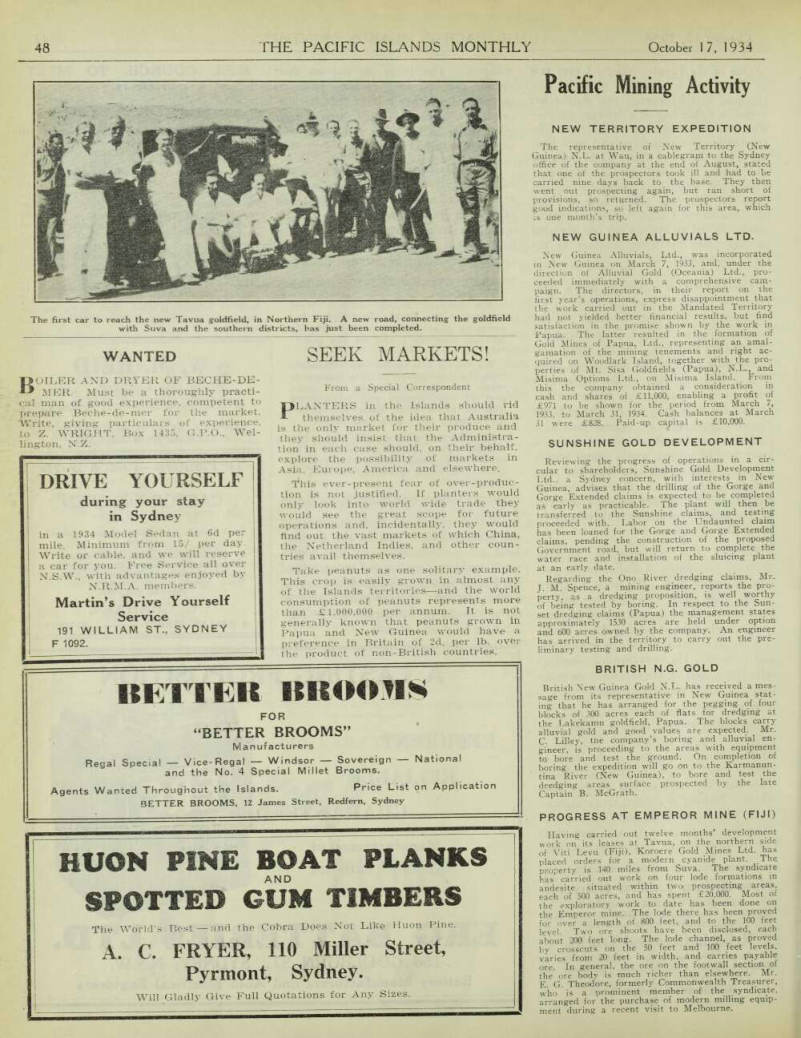
From a Special Correspondent PLANTERS in the Islands should rid themselves of the idea that Australia is the only market for their produce and they should insist that the Administra tion in each case should, on their behalf, explore the possibility of markets in Asia, Europe, America and elsewhere.
This ever-present fear of over-produc tion is not justified. If planters would only look into world wide trade they would see the great scope for future operations and, incidentally, they would find out the vast markets of which China, the Netherland Indies, and other coun tries avail themselves.
Take peanuts as one solitary example.
This crop is easily grown in almost any of the Islands territories —and the world consumption of peanuts represents more than £1,000,000 per annum. It is not generally known that peanuts grown in Papua and New Guinea would have a preference in Britain of 2d. per lb. over the product of non-British countries.
The first car to reach the new Tavua goldfield, in Northern Fiji. A new road, connecting the goldfield with Suva and the southern districts, has just been completed.
Pacific Mining Activity
New Territory Expedition
The representative of New Territory (New Guinea) N.L. at Wau, in a cablegram to the Sydney office of the company at the end of August, stated that one of the prospectors took ill and had to be carried nine days back to the base. They then went out prospecting again, but ran short of provisions, so returned. The prospectors report good indications, so left again for this area, which is one month’s trip.
New Guinea Alluvials Ltd.
New Guinea Alluvials, Ltd., was incorporated in New Guinea on March 7, 1933, and, under the direction of Alluvial Gold (Oceania) Ltd., pro ceeded immediately with a comprehensive cam paign. The directors, in their report on the first year’s operations, express disappointment that the work carried out in the Mandated Territory had not yielded better financial results, but find satisfaction in the promise shown by the work in Papua. The latter resulted in the formation of Gold Mines of Papua, Ltd., representing an amal gamation of the mining tenements and right ac quired on Woodlark Island, together with the pro perties of Mt. Sisa Goldfields (Papua), N.L., and Misima Options Ltd., on Misima Island. From this the company obtained a consideration in cash and shares of £11,000, enabling a profit of £971 to be shown for the period from March 7, 1933, to March 31, 1934. Cash balances at March 31 were £828. Paid-up capital is £10,000.
Sunshine Gold Development
Reviewing the progress of operations in a cir cular to shareholders, Sunshine Gold Development Ltd., a Sydney concern, with interests in New Guinea, advises that the drilling of the Gorge and Gorge Extended claims is expected to be completed as early as practicable. The plant will then be transferred to the Sunshine claims, and testing proceeded with. Labor on the Undaunted claim has been loaned for the Gorge and Gorge Extended claims, pending the construction of the proposed Government road, but will return to complete the water race and installation of the sluicing plant at an early date.
Regarding the Ono River dredging claims, Mr.
J. M. Spence, a mining engineer, reports the pro perty. as a dredging proposition, is well worthy of being tested by boring. In respect to the Sun set dredging claims (Papua) the management states approximately 1530 acres are held under option and 600 acres owned by the company. An engineer has arrived in the territory to carry out the pre liminary testing and drilling.
British N.G. Gold
British New Guinea Gold N.L. has received a mes sage from its representative in New Guinea stat ing that he has arranged for the pegging of four blocks of 300 acres each of flats for dredging at the Lakekamu goldfield, Papua. The blocks carry alluvial gold and good values are expected. Mr.
C. Lilley, the company’s boring and alluvial en gineer, is proceeding to the areas with equipment to bore and test the ground. On completion of boring, the expedition will go on to the Karmanun tina River (New Guinea), to bore and test the dredging areas surface prospected by the late Captain B. McGrath.
Progress At Emperor Mine (Fiji)
Having carried out twelve months’ development work on its leases at Tavua, on the northern side of Viti Levu (Fiji), Koroere Gold Mines Ltd. has placed orders for a modern cyanide plant. The property is 140 miles from Suva. The syndicate has carried out work on four lode formations in andesite situated within two prospecting areas, each of 500 acres, and has spent £20,000. Most of the exploratory work to date has been done on the Emperor mine. The lode there has been proved for over a length of 800 feet, and to the 100 feet level. Two ore shoots have been disclosed, each about 200 feet long. The lode channel, as proved bv crosscuts on the 50 feet and 100 feet levels, varies from 20 feet in width, and carries payable ore. In general, the ore on the footwall section of the ore bodv is much richer than elsewhere. Mr.
E. G. Theodore, formerly Commonwealth Treasurer, who is a prominent member of the syndicate, arranged for the purchase of modern milling equip ment during a recent visit to Melbourne.
Copra Outlook
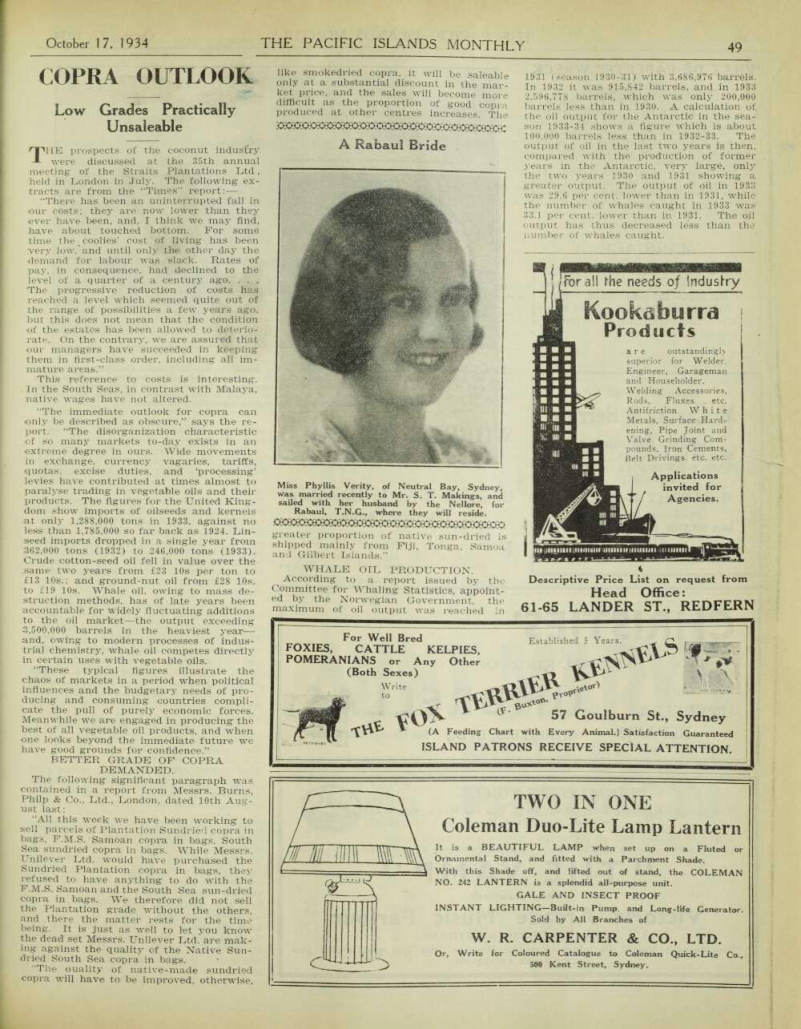
Low Grades Practically Unsaleable
THE prospects of the coconut industry were discussed at the 35th annual meeting of the Straits Plantations Ltd., held in London in July. The following ex tracts are from the “Times” report: “There has been an uninterrupted fall in our costs; they are now lower than they ever have been, and, I think we may find, have about touched bottom. For some time the coolies’ cost of living has been very low. and until only the other day the demand for labour was slack. Rates of pay, in consequence, had declined to the level of a quarter of a century ago. . . .
The progressive reduction of costs has reached a level which seemed quite out of the range of possibilities a few years ago, but this does not mean that the condition of the estates has been allowed to deterio rate. On the contrary, we are assured that our managers have succeeded in keeping them in first-class order, including all im mature areas.”
This reference to costs is interesting.
In the South Seas, in contrast with Malaya, native wages have not altered.
“The immediate outlook for copra can only be described as obscure,” says the re port. “The disorganization characteristic of so many markets to-day exists in an extreme degree in ours. Wide movements in exchange, currency vagaries, tariffs, quotas, excise duties, and ‘processing’ levies have contributed at times almost to paralyse trading in vegetable oils and their products. The figures for the United King dom show imports of oilseeds and kernels at only 1,288,000 tons in 1933, against no less than 1,785,000 so far back as 1924. Lin seed imports dropped in a single year from 362,000 tons (1932) to 246,000 tons (1933).
Crude cotton-seed oil fell in value over the same two years from £23 10s per ton to £13 10s.; and ground-nut oil from £28 10s. to £19 10s. Whale oil, owing to mass destruction methods, has of late years been accountable for widely fluctuating additions to the oil market —the output exceeding 3,500,000 barrels in the heaviest year— and, owing to modern processes of indus trial chemistry, whale oil competes directly in certain uses with vegetable oils.
“These typical figures illustrate the chaos of markets in a period when political influences and the budgetary needs of pro ducing and consuming countries compli cate the pull of purely economic forces.
Meanwhile we are engaged in producing the best of all vegetable oil products, and when one looks beyond the immediate future we have good grounds for confidence.”
Better Grade Of Copra
Demanded.
The following significant paragraph was contained in a report from Messrs. Burns, Philp & Co., Ltd., London, dated 10th Aug ust last: “All this week we have been working to sell parcels of Plantation Sundried copra in bags, F.M.S. Samoan copra in bags, South Sea sundried copra in bags. While Messrs.
Unilever Ltd. would have purchased the Sundried Plantation copra in bags, they refused to have anything to do with the F.M.S. Samoan and the South Sea sun-dried copra in bags. We therefore did not sell the Plantation grade without the others, and there the matter rests for the time being. It is just as well to let you know the dead set Messrs. Unilever Ltd. are mak ing against the quality of the Native Sun dried South Sea copra in bags.
The Quality of native-made sundried copra will have to be improved, otherwise,
like smokedried copra, it will be saleable only at a substantial discount in the mar ket price, and the sales will become more difficult as the proportion of good copra produced at other centres increases. The
greater proportion of native sun-dried is shipped mainly from Fiji, Tonga, Samoa and Gilbert Islands.”
Whale Oil Production.
According to a report issued by the Committee for Whaling Statistics, appoint ed by the Norwegian Government, the maximum of oil output was reached in
1931 (season 1930-31) with 3,686,976 barrels.
In 1932 it was 915,842 barrels, and in 1933 2,596.778 barrels, which was only 200,000 barrels less than in 1930. A calculation of the oil output for the Antarctic in the sea son 1933-34 shows a figure which is about 100,000 barrels less than in 1932-33. The output of oil in the last two years is then, compared with the production of former years in the Antarctic, very large, only the two years 1930 and 1931 showing a greater output. The output of oil in 1933 was 29.6 per cent, lower than in 1931, while the number of whales caught in 1933 was 33.1 per cent, lower than in 1931. The oil output has thus decreased less than the number of whales caught.
A Rabaul Bride
Miss Phyllis Verity, of Neutral Bay, Sydney, was married recently to Mr. S. T. Makings, and sailed with her husband by the Nellore, for Rabaul, T.N.G., where they will reside.
Advertisements & other items, p. 51 (1 item)
HEM iwn
'For all the needs of Industry
Kookaburra
Products
are outstandingly superior for Welder, Engineer, Garageman and Householder.
Welding Accessories, Rods, Fluxes. etc.
Antifriction White Metals, Surface Hardening, Pipe Joint and Valve Grinding Compounds. Iron Cements, Belt Drivings, etc. etc.
Applications invited for Agencies.
Descriptive Price List on request from
Head Office:
61-65 LANDER ST., REDFERN
For Well Bred
FOXIES, CATTLE KELPIES,
POMERANIANS or Any Other (Both Sexes) Established 5 Years.
Write
57 Goulburn St., Sydney
(A Feeding Chart with Every Animal.) Satisfaction Guaranteed
ISLAND PATRONS RECEIVE SPECIAL ATTENTION.
HEM iwn
TWO IN ONE
Coleman Duo-Lite Lamp Lantern
It is a BEAUTIFUL LAMP when set up on a Fluted or Ornamental Stand, and fitted with a Parchment Shade.
With this Shade off, and lifted out of stand, the COLEMAN NO. 242 LANTERN is a splendid all-purpose unit.
GALE AND INSECT PROOF
INSTANT LIGHTING—BuiIt-in Pump, and Long-life Generator.
Sold by All Branches of
W. R. CARPENTER & CO., LTD.
Or, Write for Coloured Catalogue to Coleman Quick-Lite Co., 500 Kent Street, Sydney.
“Ville De Papeete” Wreck
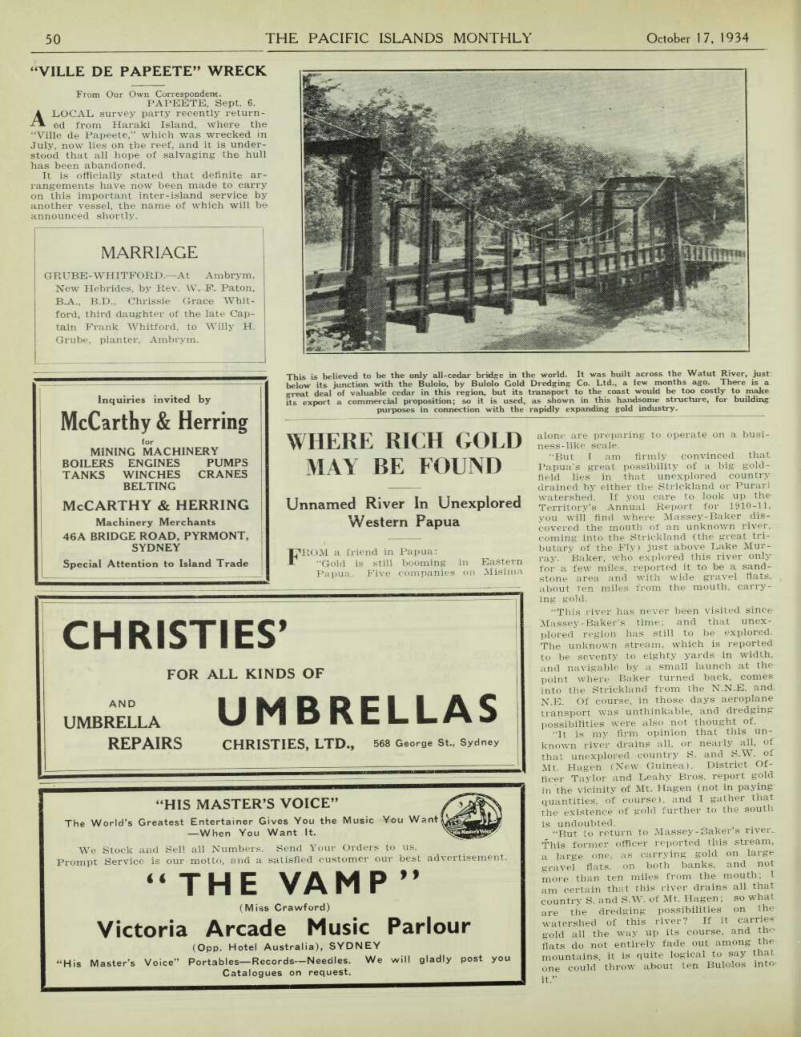
From Our Own Correspondent.
Papeete, Sept. 6.
A LOCAL survey party recently return ed from Haraki Island, where the “Ville de Papeete,” which was wrecked in July, now lies on the reef, and it is under stood that all hope of salvaging the hull has been abandoned.
It is officially stated that definite ar rangements have now been made to carry on this important inter-island service by another vessel, the name of which will be announced shortly.
Advertisements & other items, p. 52 (1 item)
Marriage
GRUBE-WHITFORD.—At Ambrym,
New Hebrides, by Rev. W. F. Paton, B.A., B.D., Chrissie Grace Whitford, third daughter of the late Cap tain Frank Whitford, to Willy H.
Grube, planter, Ambrym.
Where Rich Gold
May Be Found
Unnamed River In Unexplored Western Papua
FROM a friend in Papua: “Gold is still booming in Eastern Papua. Five companies on Misima
alone are preparing to operate on a busi ness-like scale.
“But I am firmly convinced that Papua’s great possibility of a big gold field lies in that unexplored country drained by either the Strickland or Purari watershed. If you care to look up the Territory’s Annual Report for 1910-11, you will find where Massey-Baker dis covered the mouth of an unknown river, coming into the Strickland (the great tri butary of the Fly) just above Lake Mur ray. Baker, who explored this river only for a few miles, reported it to be a sand stone area and with wide gravel flats, about ten miles from the mouth, carry ing gold.
"This river has never been visited since Massey-Baker’s time; and that unex plored region has still to be explored.
The unknown stream, which is reported to be seventy to eighty yards in width, and navigable by a small launch at the point where Baker turned back, comes into the Strickland from the N.N.E. and.
N.E. Of course, in those days aeroplane transport was unthinkable, and dredging possibilities were also not thought of.
“It is my firm opinion that this un known river drains all. or nearly all, of that unexplored country S. and S.W. of Mt. Hagen (New Guinea). District Of ficer Taylor and Leahy Bros, report gold in the vicinity of Mt. Hagen (not in paying quantities, of course), and I gather that the existence of gold further to the south is undoubted.
“But to return to Massey-Saker’s river.
This former officer reported this stream, a large one, as carrying gold on large gravel flats, on both banks, and not more than ten miles from the mouth; I am certain that this river drains all that country S. and S.W. of Mt. Hagen; so what are the dredging possibilities on the watershed of this river ? If it carrier gold all the way up its course, and the flats do not entirely fade out among the mountains, it is quite logical to say that one could throw about ten Bulolos into it.”
This is believed to be the only all-cedar bridge in the world. It was built across the Watut River, just below its junction with the Bulolo, by Bulolo Gold Dredging Co. Ltd., a few months ago. There is a great deal of valuable cedar in this region, but its transport to the coast would be too costly to make its export a commercial proposition; so it is used, as shown in this handsome structure, for building purposes in connection with the rapidly expanding gold industry.
Advertisements & other items, p. 52 (1 item)
Umbrellas
Inquiries invited by
McCarthy & Herring
for
MINING MACHINERY
BOILERS ENGINES PUMPS
TANKS WINCHES CRANES
BELTING
McCarthy & herring
Machinery Merchants
46A BRIDGE ROAD, PYRMONT,
SYDNEY
Special Attention to Island Trade
CHRISTIES’
FOR ALL KINDS OF
AND
UMBRELLAS
REPAIRS CHRISTIES, LTD., 568 George St., Sydney
UMBRELLA
“HIS MASTER’S VOICE”
The World’s Greatest Entertainer Gives You the Music —When You Want It.
You W We Stock and Sell all Numbers. Send Your Orders to us.
Prompt Service is our motto, and a satisfied customer our best advertisement.
“THE VAMP”
(Miss Crawford)
Victoria Arcade Music Parlour
(Opp. Hotel Australia), SYDNEY “His Master’s Voice” Portables —Records—Needles. We will gladly post you Catalogues on request.
N. Guinea Gold
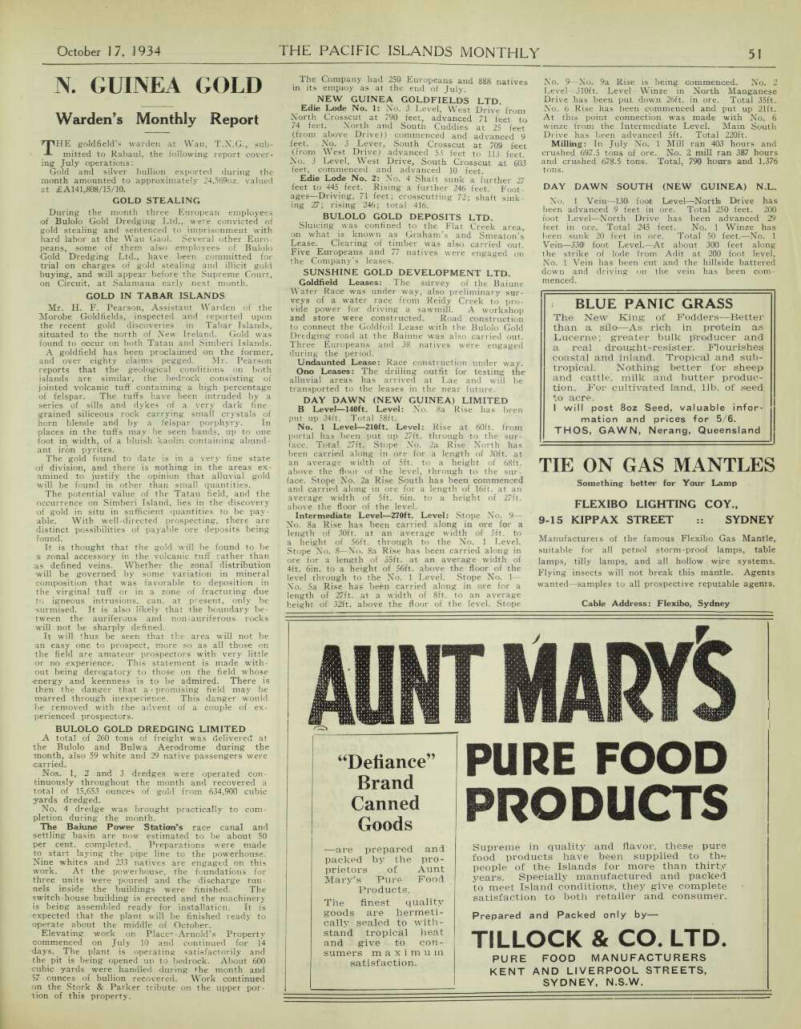
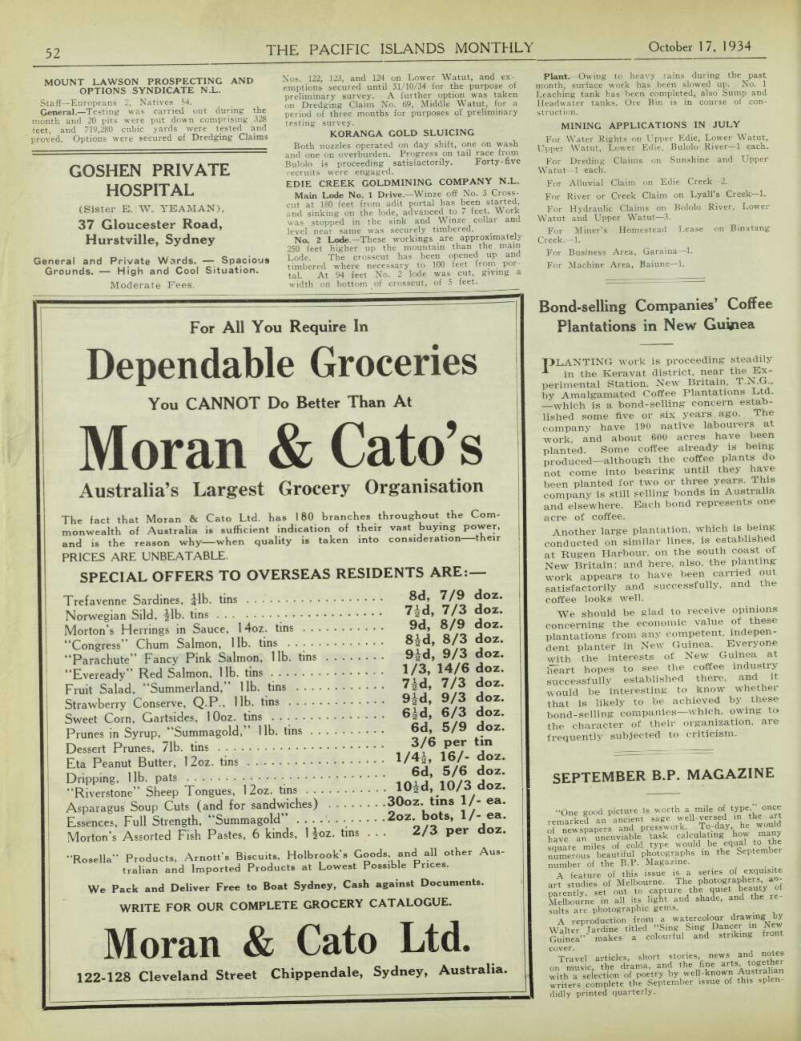
Warden’s Monthly Report
THE goldfield’s warden at Wau, T.N.G., sub mitted to Rabaul, the following report cover ing July operations; Gold and silver bullion exported during the month amounted to approximately 24,569oz. valued at £A141,808/15/10.
Gold Stealing
During the month three European employees of Bulolo Gold Dredging Ltd., were convicted of gold stealing and sentenced to imprisonment with hard labor at the Wau Gaol. Several other Euro peans, some of them also employees of Bulolo Gold Dredging Ltd., have been committed for trial on charges of gold stealing and illicit gold buying, and will appear before the Supreme Court, on Circuit, at Salamaua early next month.
Gold In Tabar Islands
Mr. H. F. Pearson, Assistant Warden of the Morobe Goldfields, inspected and reported upon the recent gold discoveries in Tabar Islands, situated to the north of New Ireland. Gold was found to occur on both Tatau and Simberi Islands.
A goldfield has been proclaimed on the former, and over eighty claims pegged. Mr. Pearson reports that the geological conditions on both islands are similar, the bedrock consisting of jointed volcanic tuff containing a high percentage of felspar. The tuffs have been intruded by a series of sills and dykes of a very dark fine grained siliceous rock carrying small crystals of horn blende and by a felspar porphyry. In places in the tuffs may be seen bands, up to one foot in width, of a bluish kaolin containing abund ant iron pyrites.
The gold found to date is in a very fine state of division, and there is nothing in the areas examined to justify the opinion that alluvial gold will be found in other than small quantities.
The potential value of the Tatau field, and the occurrence on Simberi Island, lies in the discovery of gold in situ in sufficient quantities to be pay able. With well-directed prospecting, there are distinct possibilities of payable ore deposits being found.
It is thought that the gold will be found to be a zonal accessory in the volcanic tuff rather than as defined veins. Whether the zonal distribution will be governed by some variation in mineral composition that was favorable to deposition in the virginal tuff or in a zone of fracturing due to igneous intrusions, can. at present, only be surmised. It is also likely that the boundary be tween the auriferous and non-auriferous rocks will not be sharply defined.
It will thus be seen that the area will not be an easy one to prospect, more so as all those on the field are amateur prospectors with very little or no experience. This statement is made with out being derogatory to those on the field whose energy and keenness is to be admired. There is then the danger that a promising field may be marred through inexperience. This danger would be removed with the advent of a couple of ex perienced prospectors.
Bulolo Gold Dredging Limited
A total of 260 tons of freight was delivered at the Bulolo and Bulwa Aerodrome during the month, also 59 white and 29 native passengers were carried.
Nos. 1, 2 and 3 dredges were operated con tinuously throughout the month and recovered a total of 15,653 ounces of gold from 634,900 cubic yards dredged.
No. 4 dredge was brought practically to com pletion during the month.
The Baiune Power Station’s race canal and settling basin are now estimated to be about 50 per cent, completed. Preparations were made to start laying the pipe line to the powerhouse.
Nine whites and 233 natives are engaged on this work. At the powerhouse, the foundations for three units were poured and the discharge tun nels inside the buildings were finished. The switch-house building is erected and the machinery is being assembled ready for installation. It is expected that the plant will be finished ready to operate about the middle of October.
Elevating work on Placer Arnold’s Property commenced on July 10 and continued for 14 days. The plant is operating satisfactorily and the pit is being opened up to bedrock. About 600 cubic yards were handled during the month and 57 ounces of bullion recovered. Work continued on the Stork & Parker tribute on the upper por tion of this property.
The Company had 250 Europeans and 888 natives in its employ as at the end of July.
New Guinea Goldfields Ltd.
Edie Lode No. 1: No. 3 Level, West Drive from North Crosscut at 790 feet, advanced 71 feet to 74 feet. North and South Cuddies at 25 feet (from above Drive)) commenced and advanced 9 feet. No. 3 Lever, South Crosscut at 709 feet (from West Drive) advanced 53 feet to 113 feet.
No. 3 Level, West Drive, South Crosscut at 603 feet, commenced and advanced 10 feet.
Edie Lode No. 2: No. 4 Shaft sunk a further 27 feet to 445 feet. Rising a further 246 feet. Foot ages—Driving, 71 feet; crosscutting 72; shaft sink ing 27; rising 246; total 416.
Bulolo Gold Deposits Ltd.
Sluicing was confined to the Flat Creek area, on what is known as Graham’s and Smeaton's Lease. Clearing of timber was also carried out.
Five Europeans and 77 natives were engaged on the Company’s leases.
Sunshine Gold Development Ltd.
Goldfield Leases: The survey of the Baiune Water Race was under way, also preliminary sur veys of a water race from Reidy Creek to pro vide power for driving a sawmill. A workshop and store were constructed. Road construction to connect the Goldfoil Lease with the Bulolo Gold Dredging road at the Baiune was also carried out.
Three Europeans and 38 natives were engaged during the period.
Undaunted Lease: Race construction under way.
Ono Leases: The drilling outfit for testing the alluvial areas has arrived at Lae and will be transported to the leases in the near future.
Day Dawn (New Guinea) Limited
B Level — 140ft. Level: No. 8a Rise has been put up 24ft. Total 58ft.
No. 1 Level—210ft. Level: Rise at 60ft. from portal has been put up 27ft. through to the sur face. Total 27ft. Stope No. 2a Rise North has been carried along in ore for a length of 30ft. at an average width of sft. to a height of 68ft. above the floor of the level, through to the sur face. Stope No. 2a Rise South has been commenced and carried along in ore for a length of 16ft. at an average width of sft. 6in. to a height of 27ft. above the floor of the level.
Intermediate Level—270ft. Level: Stope No. 9 No. 8a Rise has been carried along in ore for a length of 30ft. at an average width of sft. to a height of 56ft. through to the No. 1 Level.
Stope No. 8—No.8 —No. 8a Rise has been carried along in ore for a length of 35ft. at an average width of 4ft. 6in. to a height of 56ft. above the floor of the level through to the No. 1 Level. Stope No. 1 — No. 5a Rise has been carried along in ore for a length of 27ft. at a width of 8ft. to an average height of 32ft. above the floor of the level. Stope
No. 9 —No. 9a Rise is being commenced. No. 2 Level—310ft. Level—Winze in North. Manganese Drive has been put down 26ft. in ore. Total 35ft.
No. 6 Rise has been commenced and put up 21ft.
At this point connection was made with No. 6 winze from the Intermediate Level. Main South Drive has been advanced sft. Total 220 ft.
Milling: In July No. 1 Mill ran 403 hours and crushed 697.5 tons of ore. No. 2 mill ran 387 hours and crushed 678.5 tons. Total, 790 hours and 1,376 tons.
Day Dawn South (New Guinea) N.L.
No. 1 Vein—130 foot Level—North Drive has been advanced 9 feet in ore. Total 250 feet. 200 foot Level —North Drive has been advanced 29 feet in ore. Total 245 feet. No. 1 Winze has been sunk 20 feet in ore. Total 50 feet.—No. 1 Vein—330 foot Level —At about 300 feet along the strike of lode from Adit at 200 foot level, No. 1 Vein has been cut and the hillside battered down and driving on the vein has been com menced.
Mount Lawson Prospecting And
Options Syndicate N.L.
Staff—Europeans 2, Natives 54.
General— Testing was carried out during the month and 20 pits were put down comprising 328 feet, and 719,280 cubic yards were tested and proved. Options were secured of Dredging Claims
Nos. 122, 123, and 124 on Lower Watut, and exemptions secured until 31/10/34 for the purpose of preliminary survey. A further option was taken on Dredging Claim No. 69, Middle Watut, for a period of three months for purposes of preliminary testing survey.
Koranga Gold Sluicing
Both nozzles operated on day shift, one on wash and one on overburden. Progression tail race from Bulolo is proceeding satisfactorily. Forty-five recruits were engaged.
Edie Creek Goldmining Company N.L.
Main Lode No. 1 Drive.— Winze off No. 3 Cross cut at 180 feet from adit portal has been started, and sinking on the lode, advanced to 7 feet. Work was stopped in the sink and Winze collar and level near same was securely timbered.
No. 2 Lode— These workings are approximately 250 feet higher up the mountain than the main Lode. The crosscut has been opened up and timbered where necessary to 100 feet from portal. At 94 feet No. 2 lode was cut, giving a width on bottom of crosscut, of 5 feet.
Plant.— Owing to heavy rains during the past month, surface work has been slowed up. No. 1 Leaching tank has been completed, also Sump and Headwater tanks. Ore Bin is in course of construction.
Mining Applications In July
For Water Rights on Upper Edie, Lower Watut, Upper Watut, Lower Edie, Bulolo River —1 each.
For Dreding Claims on Sunshine and Upper Watut—1 each.
For Alluvial Claim on Edie Creek—2.
For River or Creek Claim on Lyall’s Creek—1.
For Hydraulic Claims on Bololo River, Lower Watut and Upper Watut—3.
For Miner’s Homestead Lease on Binatang Creek. —1.
For Business Area, Garaina —1.
For Machine Area, Baiune —1.
Advertisements & other items, pp. 53-54 (1 item)
Products
BLUE PANIC GRASS
The New King of Fodders —Better than a silo —As rich in protein as Lucerne: greater bulk producer and a real drought-resister. Flourishes coastal and inland. Tropical and subtropical. Nothing better for sheep and cattle; milk and butter production, For cultivated land, 1lb. of seed to acre.
I will post 8oz Seed, valuable information and prices for 5/6.
THOS, GAWN, Nerang, Queensland
TIE ON GAS MANTLES
Something better for Your Lamp
FLEXIBO LIGHTING COY.,
9-15 KIPPAX STREET :: SYDNEY
Manufacturers of the famous Flexibo Gas Mantle, suitable for all petnol storm-proof lamps, table lamps, tilly lamps, and all hollow wire systems.
Flying insects will not break this mantle. Agents wanted- —samples to all prospective reputable agents.
Cable Address: Flexibo, Sydney
“Defiance”
Brand
Canned
Goods
PURE FOOD
PRODUCTS
—are prepared and packed by the proprietors of Aunt Mary’s Pure Food Products.
The finest quality goods are hermetically sealed to withstand tropical heat and give to consumers maximum satisfaction.
Supreme in quality and flavor, these pure food products have been supplied to the people of the Islands for more than thirty years. Specially manufactured and packed to meet Island conditions, they give complete satisfaction to both retailer and consumer.
Prepared and Packed only by—
TILLOCK & CO. LTD.
PURE FOOD MANUFACTURERS
KENT AND LIVERPOOL STREETS,
SYDNEY, N.S.W.
GOSHEN PRIVATE
HOSPITAL
(Sister E. W. TEAMAN), 37 Gloucester Road, Hurstville, Sydney General and Private Wards. Spacious Grounds. High and Cool Situation.
Moderate Fees.
For All You Require In
Dependable Groceries
You CANNOT Do Better Than At
Moran & Cato’s
Australia’s Largest Grocery Organisation
The fact that Moran & Cato Ltd. has 180 branches throughout the Commonwealth of Australia is sufficient indication of their vast buying power, and is the reason why—when quality is taken into consideration their
PRICES ARE UNBEATABLE.
SPECIAL OFFERS TO OVERSEAS RESIDENTS ARE:—
Trefavenne Sardines, ¼lb. tins Norwegian Sild, ½lb. tins Morton’s Herrings in Sauce, 14oz. tins “Congress” Chum Salmon, 1lb. tins “Parachute” Fancy Pink Salmon, 1lb. tins “Eveready Red Salmon, 1lb. tins Fruit Salad, “Summerland,” 1lb. tins Strawberry Conserve, Q.P., 1lb. tins Sweet Corn, Gartsides, 10oz. tins Prunes in Syrup, “Summagold,” 1lb. tins Dessert Prunes, 7lb. tins Eta Peanut Butter, 12oz. tins .
Dripping, 1lb. pats “Riverstone” Sheep Tongues, 12oz. tins Asparagus Soup Cuts (and for sandwiches) Essences, Full Strength, “Summagold”
Morton’s Assorted Fish Pastes, 6 kinds, 1½oz. tins . . . 8d, 7/9 doz. 7½d, 7/3 doz. 9d, 8/9 doz. 8½d, 8/3 doz. 9½d, 9/3 doz. 1/3, 14/6 doz. 7½d, 7/3 doz. 9½d, 9/3 doz. 6½d, 6/3 doz. 6d, 5/9 doz. 3/6 per tin 1/4½, 16/- doz. 6d, 5/6 doz. 10½d, 10/3 doz. 30oz. tins 1/- ea. 2oz. bots, 1/- ea. 2/3 per doz. ‘Rosella” Products, Arnott’s Biscuits. Holbrook’s Goods, and all other Australian and Imported Products at Lowest Possible Prices.
We Pack and Deliver Free to Boat Sydney, Cash against Documents.
WRITE FOR OUR COMPLETE GROCERY CATALOGUE.
Moran & Cato Ltd.
122-128 Cleveland Street Chippendale, Sydney, Australia.
Bond-selling Companies’ Coffee
Plantations in New Guinea
PLANTING work is proceeding steadily in the Keravat district, near the Experimental Station, New Britain, T.N.G., by Amalgamated Coffee Plantations Ltd. —which is a bond-selling concern established some five or six years ago. The company have 190 native labourers at work, and about 600 acres have been planted. Some coffee already is being produced— although the coffee plants do not come into bearing until they have been planted for two or three years. This company is still selling bonds in Australia and elsewhere. Each bond represents one acre of coffee.
Another large plantation, which is being conducted on similar lines, is established at Rugen Harbour, on the south coast of New Britain; and here, also, the planting work appears to have been carried out satisfactorily and successfully, and the coffee looks well.
We should be glad to receive opinions concerning the economic value of these plantations from any competent, independent planter in New Guinea. Everyone with the interests of New Guinea at heart hopes to see the coffee industry successfully established there, and it would be interesting to know whether that is likely to be achieved by these bond- selling companies—which, owing to the character of their organization, are frequently subjected to criticism.
September B.P. Magazine
“One good picture is worth a mile of type,” once remarked an ancient sage well-versed in the art of newspapers and presswork. To-day, he would have an unenviable task calculating how many square miles of cold type would be equal to the numerous beautiful photographs in the September number of the B.P. Magazine.
A feature of this issue is a series of exquisite art studies of Melbourne. The photographers, anon, to capture the quiet beauty of Melbourne in all its light and shade, and the results are photographic gems.
A reproduction from a watercolour drawing by Walter Jardine titled “Sing Sing Dancer in New Guinea’’ makes a colourful and striking front cover.
Travel articles, short stories, news and notes on music the drama, and the fine arts, together with a selection of poetry by well-known Australian writers complete the -September issue of this splen-
didly printed quarterly.
New Store For
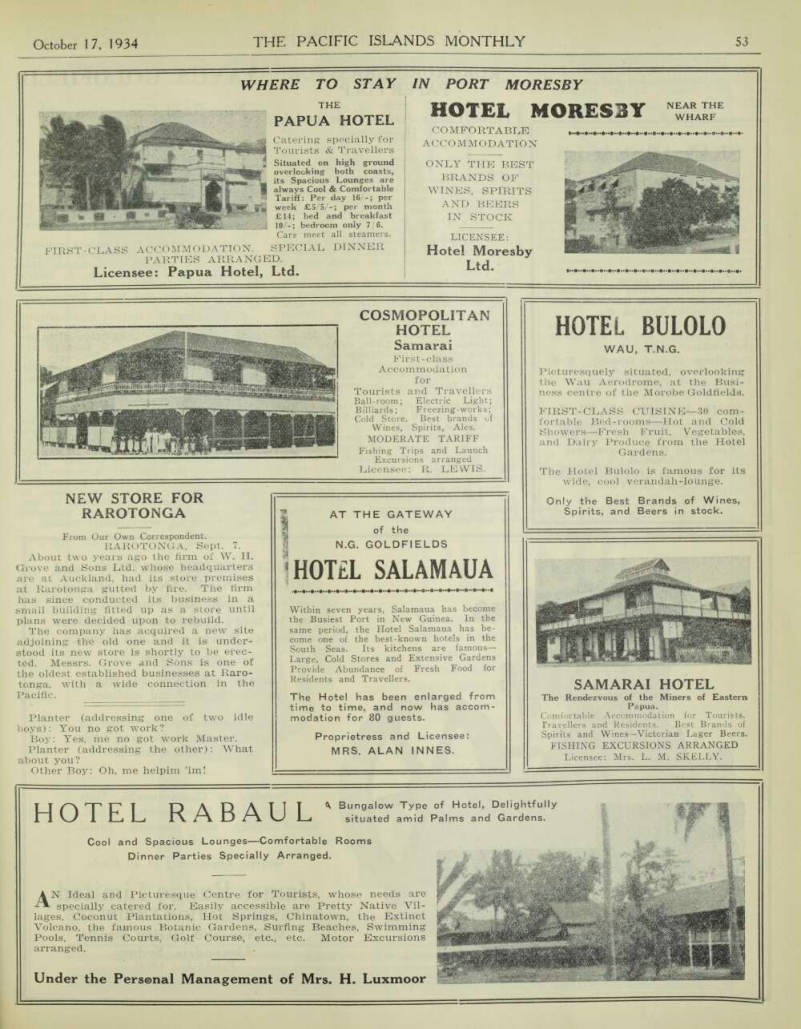
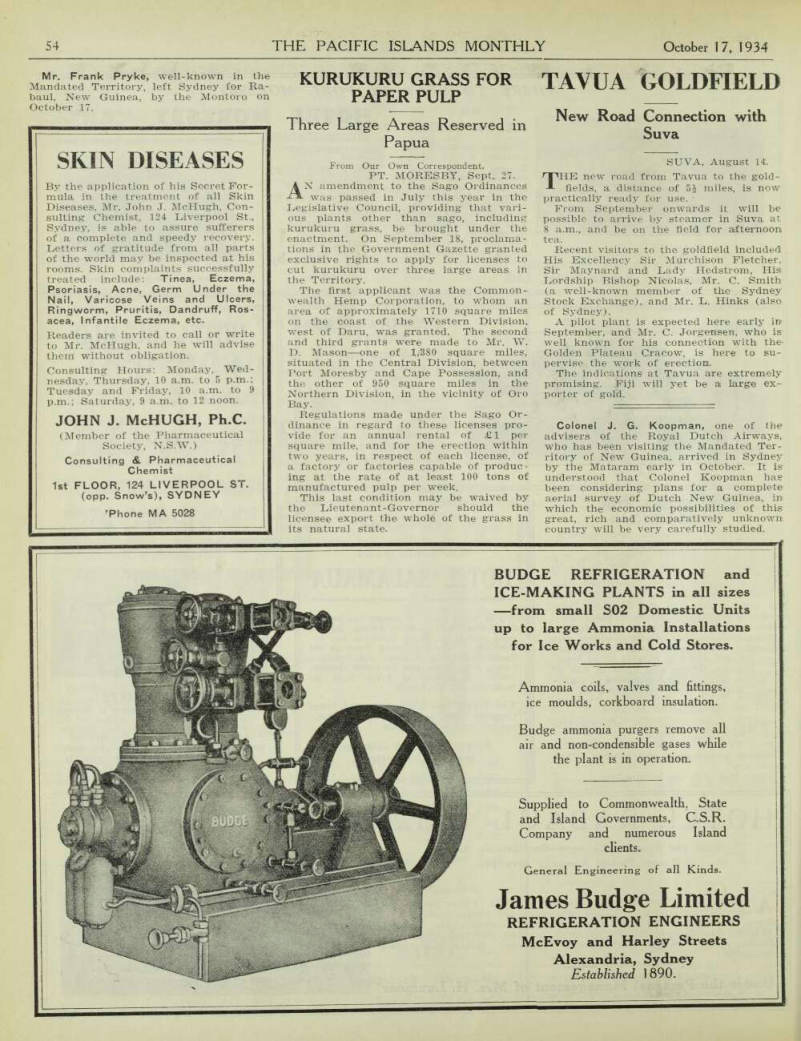
Rarotonga
From Our Own Correspondent.
Rarotonga, Sept. 7.
About two years ago the firm of W. H.
Grove and Sons Ltd. whose headquarters are at Auckland, had its store premises at Rarotonga gutted by fire. The firm has since conducted its business in a small building fitted up as a store until plans were decided upon to rebuild.
The company has acquired a new site adjoining the old one and it is under stood its new store is shortly to be erec ted. Messrs. Grove and Sons is one of the oldest established businesses at Raro tonga, with a wide connection in the Pacific.
Planter (addressing one of two idle boys): You no got work?
Boy: Yes, me no got work Master.
Planter (addressing the other); What about you?
Other Boy: Oh, me helpim ’im!
Mr. Frank Pryke, well-known in the Mandated Territory, left Sydney for Ra baul, New Guinea, by the Montoro on October 17.
Advertisements & other items, pp. 55-56 (2 items)
Hotel Moresby
WHERE TO STAY IN PORT MORESBY
FIRST-CLASS
THE
PAPUA HOTEL
Catering specially for Tourists & Travellers Situated on high ground overlooking both coasts, its Spacious Lounges are always Cool & Comfortable Tariff: Per day 16/-; per week £5/5/-; per month £14; bed and breakfast 10/-; bedroom only 7/6.
Cars meet all steamers.
ACCOMMODATION. SPECIAL DINNER
PARTIES ARRANGED.
Licensee: Papua Hotel, Ltd.
HOTEL MORESBY
NEAR THE
WHARF
COMFORTABLE
ACCOMMODATION
ONLY THE BEST
BRANDS OF
WINES, SPIRITS
AND BEERS
IN STOCK
LICENSEE:
Hotel Moresby
Ltd.
COSMOPOLITAN
HOTEL
Samarai
First-class Accommodation for Tourists and Travellers Ball-room; Electric Light; Billiards; Freezing-works; Cold Store. Best brands of Wines, Spirits, Ales.
MODERATE TARIFF
Fishing Trips and Launch Excursions arranged Licensee: R. LEWIS.
Hotel Salamaua
HOTEL BULOLO
WAU, T.N.G.
Picturesquely situated, overlooking the Wau Aerodrome, at the Business centre of the Morobe Goldfields.
FIRST-CLASS CUISINE—30 com-
fortable Bed-rooms —Hot and Cold Showers —Fresh Fruit, Vegetables, and Dairy Produce from the Hotel Gardens.
The Hotel Bulolo is famous for its wide, cool verandah-lounge.
Only the Best Brands of Wines, Spirits, and Beers in stock.
AT THE GATEWAY
of the
N.G. GOLDFIELDS
HOTEL SALAMAUA
Within seven years, Salamaua has become the Busiest Port in New Guinea. In the same period, the Hotel Salamaua has become one of the best-known hotels in the South Seas. Its kitchens are famous— Large, Cold Stores and Extensive Gardens Provide Abundance of Fresh Food for Residents and Travellers.
The Hotel has been enlarged from time to time, and now has accommodation for 80 guests.
Proprietress and Licensee:
MRS. ALAN INNES.
SAMARAI HOTEL
The Rendezvous of the Miners of Eastern Papua.
Comfortable Accommodation for Tourists, Travellers and Residents. Best Brands of Spirits and Wines —Victorian Lager Beers.
FISHING EXCURSIONS ARRANGED
Licensee: Mrs. L. M. SKELLY.
HOTEL RABAUL
Bungalow Type of Hotel, Delightfully situated amid Palms and Gardens.
Cool and Spacious Lounges—Comfortable Rooms Dinner Parties Specially Arranged.
AN Ideal and Picturesque Centre for Tourists, whose needs are specially catered for. Easily accessible are Pretty Native Villages, Coconut Plantations, Hot Springs, Chinatown, the Extinct Volcano, the famous Botanic Gardens, Surfing Beaches, Swimming Pools, Tennis Courts, Golf Course, etc,, etc. Motor Excursions arranged.
Under the Personal Management of Mrs. H. Luxmoor
SKIN DISEASES
By the application of his Secret Formula in the treatment of all Skin Diseases, Mr, John J. McHugh, Consulting Chemist, 124 Liverpool St., Sydney, is able to assure sufferers of a complete and speedy recovery.
Letters of gratitude from all parts of the world may be inspected at his rooms. Skin complaints successfully treated include: Tinea, Eczema, Psoriasis, Acne, Germ Under the Nail, Varicose Veins and Ulcers, Ringworm, Pruritis, Dandruff, Rosacea, Infantile Eczema, etc.
Readers are invited to call or write to Mr. McHugh, and he will advise them without obligation.
Consulting Hours: Monday, Wednesday, Thursday, 10 a.m. to 5 p.m.; Tuesday and Friday, 10 a.m. to 9 p.m.; Saturday, 9 a.m. to 12 noon.
JOHN J. McHUGH, Ph.C.
(Member of the Pharmaceutical Society, N.S.W.) Consulting & Pharmaceutical Chemist
1st FLOOR, 124 LIVERPOOL ST.
(opp. Snow’s), SYDNEY ’Phone MA 5028
BUDGE REFRIGERATION and
ICE-MAKING PLANTS in all sizes —from small S02 Domestic Units up to large Ammonia Installations for Ice Works and Cold Stores.
Ammonia coils, valves and fittings, ice moulds, corkboard insulation.
Budge ammonia purgers remove all air and non-condensible gases while the plant is in operation.
Supplied to Commonwealth, State and Island Governments, C.S.R.
Company and numerous Island clients.
General Engineering of all Kinds.
James Budge Limited
REFRIGERATION ENGINEERS
McEvoy and Harley Streets Alexandria, Sydney Established 1890.
Papua
Kurukuru Grass For
Paper Pulp
Three Large Areas Reserved in Papua
From Our Own Correspondent.
Pt. Moresby, Sept. 27.
AN amendment to the Sago Ordinances was passed in July this year in the Legislative Council, providing that vari ous plants other than sago, including kurukuru grass, be brought under the enactment. On September 18, proclama tions in the Government Gazette granted exclusive rights to apply for licenses to cut kurukuru over three large areas in the Territory.
The first applicant was the Common wealth Hemp Corporation, to whom an area of approximately 1710 square miles on the coast of the Western Division, west of Daru, was granted. The second and third grants were made to Mr. W.
D. Mason —one of 1,-380 square miles, situated in the Central Division, between Port Moresby and Cape Possession, and the other of 950 square miles in the Northern Division, in the vicinity of Oro Bay.
Regulations made under the Sago Or dinance in regard to these licenses pro vide for an annual rental of £1 per square mile, and for the erection within two years, in respect of each license, of a factory or factories capable of producing at the rate of at least 100 tons of manufactured pulp per week.
This last condition may be waived by the Lieutenant-Governor should the licensee export the whole of the grass in its natural state.
Tayua Goldfield
New Road Connection with Suva
SUVA, August 14.
THE new road from Tavua to the goldfields, a distance of 5½ miles, is now practically ready for use.
From September onwards it will be possible to arrive by steamer in Suva at 8 a.m., and be on the field for afternoon tea.
Recent visitors to the goldfield included His Excellency Sir Murchison Sir Maynard and Lady Hedstrom, His Lordship Bishop Nicolas, Mr. C, Smith (a well-known member of the Sydney Stock Exchange), and Mr. L. Hinks (also of Sydney).
A pilot plant is expected here early in September, and Mr. C. Jorgensen, who is well known for his connection with the- Golden Plateau Cracow, is here to su pervise the work of erection.
The indications at Tavua are extremely promising. Fiji will yet be a large ex porter of gold.
Colonel J. G. Koopman, one of the advisers of the Royal Dutch Airways, who has been visiting the Mandated Territory of New Guinea, arrived in Sydney by the Mataram early in October. It is understood that Colonel Koopman has been considering plans for a complete aerial survey of Dutch New Guinea, in which the economic possibilities of this great, rich and comparatively unknown country will be very carefully studied.
Advertisements & other items, pp. 57-58 (1 item)
Plume’
Hills?
says Major Plume "Why, you’ll take ’em 'at the double'
with your tank full of
PLUME’
Unsurpassed anti-knock quality, giving steady, knock-proof, power-full combustion . . . that’s the open secret of Plume’s hill-climbing power. If it be mere habit that keeps you to that fuel you use to-day —try ONE tankfull of Plume. You’ll sense the increased power at the first steep hill —and the full driving satisfaction that only PLUME can give.
The Islands’ Highest Quality Motor Spirit
HAND
KANGAROO
SKIN BELT.
With new ring fastener
PRICE- 14/6
Pike Brothers Ltd in Queen St. Brisbane
Lloyd's Teas
Tea drinkers expect more than a mere drink.
That easy, relaxed feeling, that sense of contentment and glow of real satisfaction must be there . . . not once in a while, but with every cup.
Try Lloyds for purity. Try the consistent goodness of quality tea. Try the delicious aroma that is such a feature of Lloyd's tea blending.
Obtainable at all good island stores.
Just
a few drops inhaled from the handkerchief will alleviate headache and banish fatigue. Fragrant and refreshing in bath and handbasin too.
Blue & Gold Label
FACTORY REPRESENTATIVE FOR AUSTRALIA,
NEW ZEALAND AND PACIFIC ISLANDS:
JULIUS BLAU
AUSTRALIA HOUSE,
CARRINGTON STREET, SYDNEY
Alluring Clothes Of To-Day
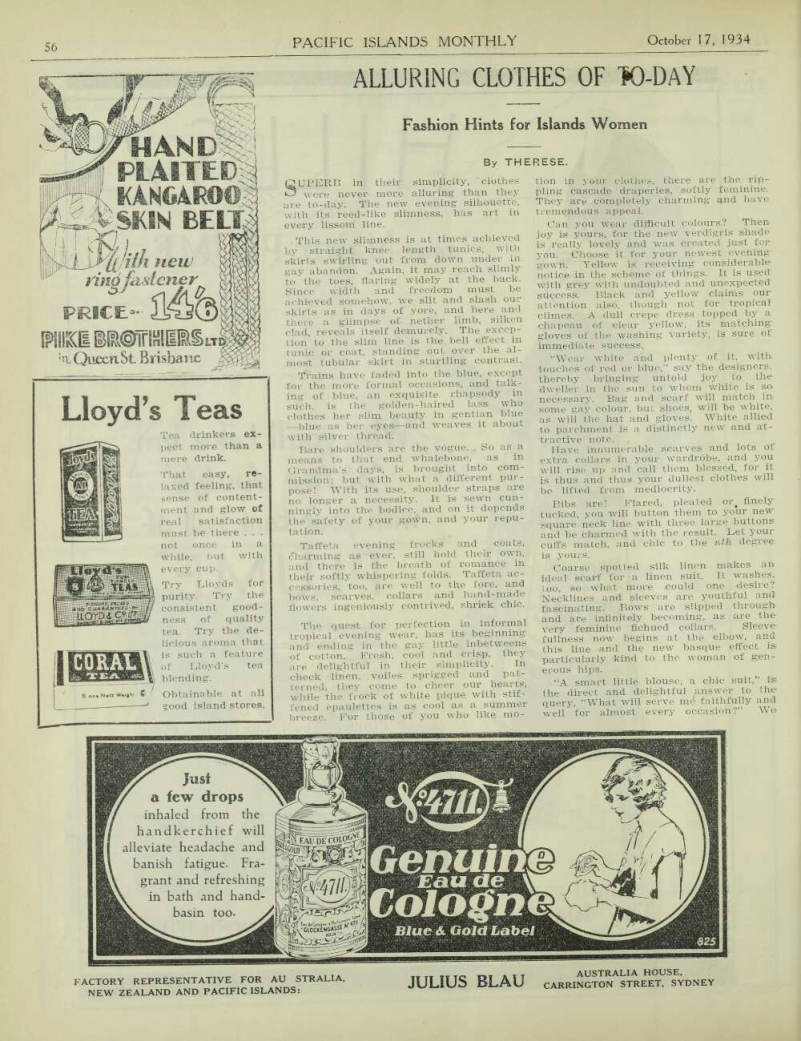
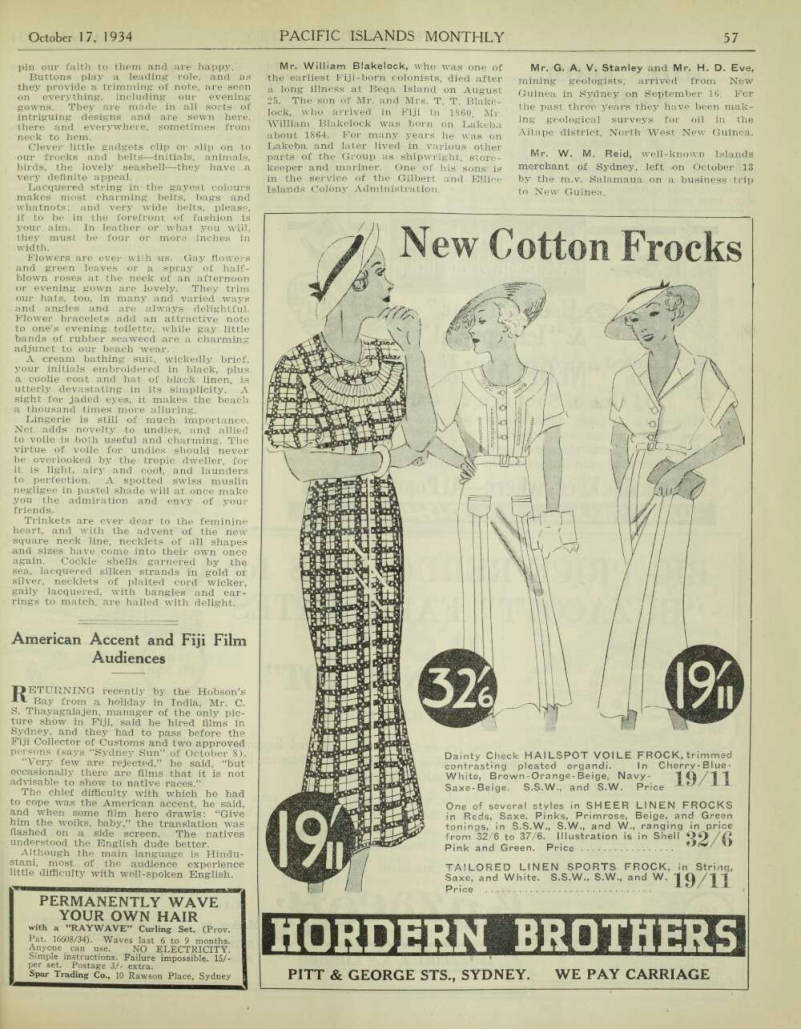
Fashion Hints for Islands Women
By Therese.
SUPHRB in their simplicity, clothes were never more alluring than they are to-day. The new evening silhouette, with its reed-like slimness, has art in every lissom line.
This new slimness is at times achieved by straight knee length tunics, with skirts swirling out from down under in gay abandon. Again, it may reach slimly to the toes, flaring widely at the back.
Since width and freedom must be achieved somehow, we slit and slash our skirts as in days of yore, and here and there a glimpse of nether limb, silken clad, reveals itself demurely. The excep tion to the slim line is the bell effect in tunic or coat, standing out over the al most tubular skirt in startling contrast.
Trains have faded into the blue, except for the more formal occasions, and talk ing of blue, an exquisite rhapsody in such, is the golden-haired lass who clothes her slim beauty in gentian blue blue as her eyes—and weaves it about with silver thread.
Bare shoulders are the vogue. So as a means to that end whalebone, as in Grandma's days, is brought into com mission; but with what a different pur pose! With its use, shoulder straps are no longer a necessity. It is sewn cun ningly into the bodice, and on it depends the safety of your gown, and your repu tation.
Taffeta evening frocks and coats, charming as ever, still hold their own, and there is the breath of romance in their softly whispering folds. Taffeta ac cessories, too, are well to the fore, and bows, scarves, collars and hand-made flowers ingeniously contrived, shriek chic.
The quest for perfection in informal tropical evening wear, has its beginning and ending in the gay little inbetweens of cotton. Fresh, cool and crisp, they are delightful in their simplicity. In check linen, voiles sprigged and pat terned, they come to cheer our hearts, while the frock of white pique with stif fened epaulettes is as cool as a summer breeze. For those of you who like mo
tion in your clothes, there are the rip pling cascade draperies, softly feminine.
They are completely charming and have tremendous appeal.
Can you wear difficult colours? Then joy is yours, for the new verdigris shade is really lovely and was created just for you. Choose it for your newest evening gown. Yellow is receiving considerable notice in the scheme of things. It is used! with grey with undoubted and unexpected success. Black and yellow claims our attention also, though not for tropical climes. A dull crepe dress topped by a chapeau of clear yellow, its matching: gloves of the washing variety, is sure of immediate success.
“Wear white and plenty of it, with touches of red or blue,” say the designers, thereby bringing untold joy to the dweller in the sun to whom white is so necessary. Bag and scarf will match in some gay colour, but shoes, will be white, as will the hat and gloves. White allied to parchment is a distinctly new and at tractive note.
Have innumerable scarves and lots of extra collars in your wardrobe, and you will rise up and call them blessed, for it is thus and thus your dullest clothes will be lifted from mediocrity.
Bibs are! Flared, pleated or finely tucked, you will button them to your new square neck line with three large buttons and be charmed with the result. Let your cuffs match, and chic to the nth degree is yours.
Coarse spotted silk linen makes an ideal scarf for a linen suit. It washes, too, so what more could one desire?
Necklines and sleeves are youthful and fascinating. Bows are slipped through and are infinitely becoming, as are the very feminine fichued collars. Sleeve fullness now begins at the elbow, and this line and the new basque effect is particularly kind to the woman of gen erous hips.
“A smart little blouse, a chic suit,” is the direct and delightful answer to the query, “What will serve me faithfully and well for almost every occasion?” We
pin our faith to them and are happy.
Buttons play a leading role, and as they provide a trimming of note, are seen on everything, including our evening gowns. They are made in all sorts of intriguing designs and are sewn here, there and everywhere, sometimes from neck to hem.
Clever little gadgets clip or slip on to our frocks and belts —initials, animals, birds, the lovely seashell—they have a very definite appeal.
Lacquered string in the gayest colours makes most charming belts, bags and whatnots: and very wide belts, please, if to be in the forefront of fashion is your aim. In leather or what you will, they must be four or more inches in width.
Flowers are ever with us. Gay flowers and green leaves or a spray of half blown roses at the neck of an afternoon or evening gown are lovely. They trim our hats, too, in many and varied ways and angles and are always delightful.
Flower bracelets add an attractive note to one’s evening toilette, while gay little bands of rubber seaweed are a charming adjunct to our beach wear.
A cream bathing suit, wickedly brief, your initials embroidered in black, plus a coolie coat and hat of black linen, is utterly devastating in its simplicity. A sight for jaded eyes, it makes the beach a thousand times more alluring.
Lingerie is still of much importance.
Net adds novelty to undies, and allied to voile is both useful and charming. The virtue of voile for undies should never be overlooked by the tropic dweller, for it is light, airy and coo!, and launders to perfection. A spotted swiss muslin negligee in pastel shade will at once make you the admiration and envy of your friends.
Trinkets are ever dear to the feminine heart, and with the advent of the new square neck line, necklets of all shapes and sizes have come into their own once again. Cockle shells garnered by the sea, lacquered silken strands in gold or silver, necklets of plaited cord wicker, gaily lacquered, with bangles and ear rings to match, are hailed with delight.
American Accent and Fiji Film
Audiences
RETURNING recently by the Hobson’s Bay from a holiday in India, Mr. C.
S. Thayagaiajen, manager of the only pic ture show in Fiji, said he hired films in Sydney, and they had to pass before the Fiji Collector of Customs and two approved persons (says “Sydney Sun” of October 8).
“Very few are rejected,” he said, “but occasionally there are films that it is not advisable to show to native races.”
The chief difficulty with which he had to cope was the American accent, he said, and when some film hero drawls; “Give him the woiks, baby,” the translation was flashed on a side screen. The natives understood the English dude better.
Although the main language is Hindu stani, most of the audience experience little difficulty with well-spoken English.
Mr. William Blakelock, who was one of the earliest Fiji-born colonists, died after a long illness at Beqa Island on August 25. The son of Mr. and Mrs. T. T. Blakelock, who arrived in Fiji in 1860 Mr William Blakelock was born on Lakeba about 1864. For many years he was on Lakeba and later lived in various other parts of the Group as shipwright, storekeeper and mariner. One of his sons is in the service of the Gilbert and Ellice Islands Colony Administration.
Mr. G. A. V. Stanley and Mr. H. D. Eve, mining geologists, arrived from New Guinea in Sydney on September 16. For the past three years they have been mak ing geological surveys for oil in the Aitape district, North West New Guinea.
Mr. W. M. Reid, well-known Islands merchant of Sydney, left on October 13 by the m.v. Salamaua on a business trip to New Guinea.
Advertisements & other items, p. 59 (1 item)
New Cotton Frocks
Dainty Check HAILSPOT VOILE FROCK, trimmed contrasting pleated organdi. In Cherry-Blue- White, Brown-Orange-Beige, Navy- 10/11 Saxe-Beige. S.S.W., and S.W. Price 19/11 One of several styles in SHEER LINEN FROCKS in Reds, Saxe, Pinks, Primrose, Beige, and Green tonings, in S.S.W., S.W., and W., ranging in price from 32/6 to 37/6. Illustration is in Shell Pink and Green. Price 32/6
TAILORED LINEN SPORTS FROCK, in String,
Saxe, and White. S.S.W., S.W., and W.
PITT & GEORGE STS., SYDNEY. WE PAY CARRIAGE
PERMANENTLY WAVE
YOUR OWN HAIR
with a “RAYWAVE” Curling Set. (Prov.
Pat. 16608/34). Waves last 6 to 9 months.
Anyone can use. NO ELECTRICITY.
Simple instructions. Failure impossible. 15/per set. Postage 3/- extra.
Spar Trading Co., 10 Rawson Place, Sydney
Notes From
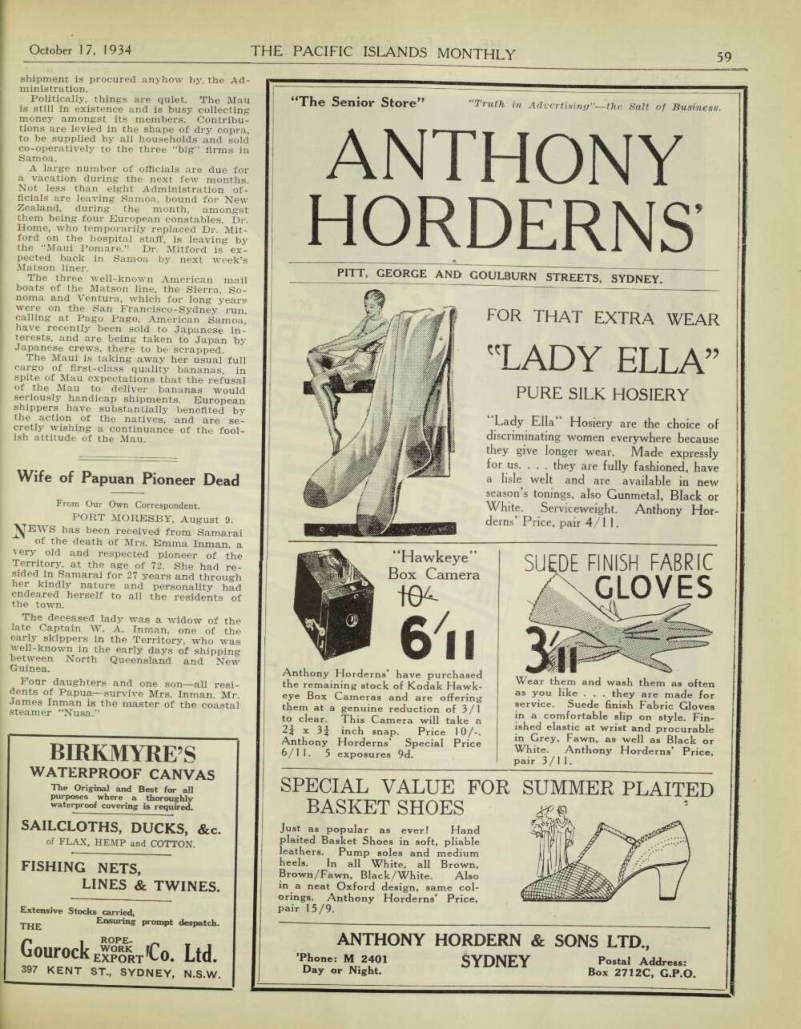
Samoa
From Our Own Correspondent.
APIA, Sept. 27.
THE influenza epidemic, which spread through Apia and outside districts during recent weeks, is now practically over—its end probably hastened when the long spell of dry weather was broken
by torrential showers during the last week.
The plantations needed rain badly. The exceptionally dry weather had caused several fires on private and Government plantations, which luckily were detected in time and confined to small areas.
The well known Casino Hotel will be under new management as from October 1. Miss Ross is leaving, after the expira tion of her lease, and Mrs. Glover, senr., with her son, Mr. Glover, are taking over.
Judge J. H. Luxford, and Mrs. Luxford, who left by the last “Maui Pomare’’ for
New Zealand, were the guests of honour at numerous farewell parties —evidence of their well-deserved popularity. A large crowd assembled at Apia wharf on steamer day to wish them God-speed and good luck. Among those assembled were almost the whole of the Administration staff, many prominent residents, and high Samoan chiefs. Judge Luxford proceeds to Hamilton, N.Z.. to take up his new appointment as S.M. there.
According to an announcement of the Prime Minister of New Zealand, the po sition of Chief Judge of the High Court of Samoa is not to be filled in future. A magistrate from New Zealand will visit Apia on circuit two or three times a year.
Mr. and Mrs. S. Coster returned from holiday by the “Hauraki.” Mr. Coster has been transferred to the Tahiti office of the Union S.S. Co., and Mr. Butler has replaced Mr. Coster at Apia.
Lately, some large parcels of Samoan cocoa beans have been disposed of on the London market, and, though the price is not high, the fact that sales have been effected at a fair price, shows that the demand is increasing again, and, with Christmas trade buying near, the stocks should soon be cleared and prices im proving.
The banana export industry is handi capped by the limited New Zealand mar ket and the paucity of shipping space available in the Government banana steamer “Maui Pomare.” The ban on banana shipments ordered by the leaders of the native Samoan Mau movement continues in force and has been consid erably extended, so that now none of the Mau adhereifts are allowed to deliver bananas to the Administration under threat of severe punishment. This, of course, mainly benefits European ship pers and. loyal Samoans, whilst a full
shipment is procured anyhow by the Administration.
Politically, things are quiet. The Mau is still in existence and is busy collecting money amongst its members. Contribu tions are levied in the shape of dry copra, to be supplied by all households and sold co-operatively to the three “big” firms in Samoa.
A large number of officials are due for a vacation during the next few months.
Not less than eight Administration of ficials are leaving Samoa, bound for New Zealand, during the month, amongst them being four European constables. Dr.
Home, who temporarily replaced Dr. Mit ford on the hospital staff, is leaving by the “Maui Pomare.” Dr. Mitford is ex pected back in Samoa by next week’s Matson liner.
The three well-known American mail boats of the Matson line, the Sierra, So noma and Ventura, which for long years were on the San Francisco-Sydney run, calling at Pago Pago, American Samoa, have recently been sold to Japanese in terests, and are being taken to Japan by Japanese crews, there to be scrapped.
The Maui is taking away her usual full cargo of first-class quality bananas, in spite of Mau expectations that the refusal of the Mau to deliver bananas would seriously handicap shipments. European shippers have substantially benefited by the action of the natives, and are se cretly wishing a continuance of the fool ish attitude of the Mau.
Advertisements & other items, p. 60 (1 item)
“Ringknot”
“Duxbac”
&“ Icil Special”
Loaded The New and Better Powder
NEOFLAK
1¼ Ozs. of Shot in a 2½" Cartridge There are no “lost” birds when “Duxbac” or “Icil Special” are used and no water-spoiled cartridges, for both these brands are effectively waterproofed, making them impervious to moisture or even immersion in water itself.
Obtainable Everywhere—At Popular Prices
BIG PRICE REDUCTIONS for
“BUZACOTT” FARM GATES
and
“RINGKNOT”
FIELD FENCES
Following an increased demand and improving times, production costs for these well-known lines have been considerably reduced.
Whilst the whole of these lowered costs is passed on in the form of reduced prices, the high standard of quality and workmanship are in no way affected. Buzacott quality is constant.
Write for particulars. 7-11 Market St.
SYDNEY
Australia
ALL PRICES QUOTED
F.O.R. SYDNEY
Also Agents for
FETTER
ATOMIC DIESEL
ENGINES.
Cold-starting, heavy oil.
Stationary and Marine.
Wife of Papuan Pioneer Dead
From Our Own Correspondent.
Port Moresby, August 9.
has been received from Samarai of the death of Mrs. Emma Inman, a very old and respected pioneer of the Territory, at the age of 72. She had re sided in Samarai for 27 years and through her kindly nature and personality had endeared herself to all the residents of the town.
The deceased lady was a widow of the late Captain W. A. Inman, one of the early skippers in the Territory, who was well-known in the early days of shipping between North Queensland and New Guinea.
Four daughters and one son—all resi dents of Papua—survive Mrs. Inman. Mr.
James Inman is the master of the coastal steamer “Nusa.”
Advertisements & other items, pp. 61-62 (1 item)
Anthony
The Senior Store” “Truth in Advertising”—the Salt of Business.
HORDERNS’
PITT, GEORGE AND
GOULBURN STREETS, SYDNEY.
FOR THAT EXTRA WEAR
"LADY ELLA”
PURE SILK HOSIERY
"Lady Ella” Hosiery are the choice of discriminating women everywhere because they give longer wear. Made expressly for us. . . . they are fully fashioned, have a lisle welt and are available in new season’s tonings, also Gunmetal, Black or White. Serviceweight. Anthony Horderns’ Price, pair 4/11.
“Hawkeye”
Box Camera 6/11 Anthony Horderns’ have purchased the remaining stock of Kodak Hawkeye Box Cameras and are offering them at a genuine reduction of 3/1 to clear. This Camera will take a 2¼ x 3¼ inch snap. Price 10/-.
Anthony Horderns’ Special Price 6/11. 5 exposures 9d.
SPECIAL VALUE FOR
BASKET SHOES
Just as popular as ever! Hand plaited Basket Shoes in soft, pliable leathers. Pump soles and medium heels. In all White, all Brown, Brown/Fawn, Black/White. Also in a neat Oxford design, same colorings. Anthony Horderns’ Price, pair 15/9.
SUEDE FINISH FABRIC
GLOVES
3/11 Wear them and wash them as often as you like . . . they are made for service. Suede finish Fabric Gloves in a comfortable slip on style. Finished elastic at wrist and procurable in Grey, Fawn, as well as Black or White. Anthony Horderns’ Price, pair 3/11.
SUMMER PLAITED
ANTHONY HORDERN & SONS LTD.,
’Phone: M 2401 SYDNEY Postal Address: Day or Night. Box 2712C, G.P.O.
Birkmyre's
WATERPROOF CANVAS
The Original and Best for all purposes where a thoroughly waterproof covering is required.
SAILCLOTHS, DUCKS, &c.
of FLAX, HEMP and COTTON.
fishing nets,
LINES & TWINES.
Extensive Stocks carried.
Ensuring prompt despatch.
Gourock Rope-Work Export Co. Ltd.
397 KENT ST., SYDNEY, N.S.W.
Europe's Crack Racing Drivers Use Shell Motor (Lubricating) Oil.
ACHILLE VARZI (Italy)
1st Italian 1000 Miles Race 1st Bordino Circuit 1st Tripoli Grand Prix 1st Targa Florio Race 1st Barcelona Grand Prix 1st Nice Grand Prix 1st Coppa Ciano
HANS VON STUCK
(Germany)
1st German Grand Prix 1st Swiss Grand Prix 1st Kesselberg Hill Climb 1st Mont Ventoux Hill Climb GUY MOLL (France) 1st Monaco Grand Prix TADINI (Italy) 1st Stevlio Hill Climb
LOUIS CHIRON (France)
1st French Grand Prix 1st Grand Prix de la Marne 1st Casablanca Grand Prix
GIANFRANCO
COMOTTI (Italy)
1st Coppa Mille Miglia 1st Comminges Grand Prix
Hon. BRIAN LEWIS
(England) 1st Mannin Moar Race (Isle of Man)
SURELY, THEN,
IT MUST BE
GOOD ENOUGH
FOR YOU!
ALL OF THE ABOVE ARE 1934 SUCCESSES ONLY
CONSULT THE SHELL LUBRICATION
SINGLE SHELL (Light Body) DOUBLE SHELL (Medium Body) TRIPLE SHELL (Hvy. Medium Body) GOLDEN SHELL (Heavy Body)
CHART AT ANY GARAGE
Another
Primage
Anomaly
Papuan Gum, 10%; Egyptian Pays 5%
ONE of the ridiculous anomalies under which the Islands trade suffers was thus described in the Sydney Morning Herald in September by Mr. P. F. Parkes, of Messrs. W. S. Tait and Co., Ltd.: On July 25 reductions in primage were announced specifying alterations in rates from 10 per cent, to 5 per cent, when ad missible under “British preferential tariff.”
Among items listed are: 254 A. Shellac, sandarac, and other dry gums, n.e.i. 254 C. Gums such as copal, damar, gutta percha, etc.
None of these items are produced in the United Kingdom, but most of them are produced in British colonies. One gum in particular is produced in the Territory of Papua, but under Customs classifica tion Papua is not considered as eligible for British preference, and the gum is charged primage at the higher rate of 10 per cent.
One asks why are these items included in the schedule if the goods cannot be allowed to enter when shipped direct from the country of production to Australia, especially in the case of Papua, which is practically Australian territory, but which for preference purpose is treated as a foreign country.
Mr. R. W. Robson referred to this mat ter at the meeting of the Islands Trade section of the Sydney Chamber of Com merce on September 28, and reminded the section that he had brought up this sub ject of primage on Papuan products a year ago, when a resultless appeal was made to the Federal Government to put Papua on the same basis at least as Norfolk Island.
Mr. Parkes said that gum shipped to Australia from Egypt was charged pri mage of 5 per cent.; but the same article, shipped to Australia from Papua, had to pay 10 per cent.
Other members were of opinion that to approach the Federal Government was only waste of time. Bureaucracy had complete charge of these things, and Ministers usually did what they were told.
It was decided to direct the attention of the authorities to the matter.
Mishap
Pilot Blamed for Inverbank Mishap
From Our Own Correspondent.
SUVA, Sept. 12.
THE finding of the Marine Court of Investigation in connection with the
stranding of the M.V. Inverbank on Nas asi reef near the mouth of the Ba River on August 14, absolved the master, Cap tain W. Forsyth, and officer of the watch, Mr. E. Smith, but held the pilot, Captain Gosling, responsible for the mishap.
Fortunately no damage was done to the vessel, and after being refloated she was able to proceed on her voyage.
Advertisements & other items, p. 63 (1 item)
Swallow & Ariell
SCOTCH FINGERS
(In Special Tins)
SHORTBREAD
(In Round Tins)
VARIETY WAFERS
CANTERBURY CAKES
PLUM PUDDINGS
Made by
SWALLOW & ARIELL
LIMITED
Port Melbourne, Australia (Estd. 1854)
INSTAL THE DIESEL THAT HAS BEEN GOING STRONG SINCE 1929, AND HAS PROVED ITSELF IMMUNE FROM ALL DIESEL WEAKNESS.
D.C. Series, 45 to 160 b.h.p., in 3,4, 6, and 8 cylinder sizes at 700 to 900 r.p.m.
D.B. Series, 24 to 96 b.h.p., in 2,3, 4,6, and 8 cylinder sizes, at 1000 r.p.m.
Australian Agents:
H. G. THORNTHWAITE & CO.
KEMBLA BUILDING.
MARGARET STREET, SYDNEY, N.S.W.
TELEGRAMS: “ORTHORN.” SYDNEY. TELEPHONE: B 5240
New Wealth in Dutch N.G.
The great peninsula at the north-west end of Dutch New Guinea. Vogelkop Scheirieland, has just been leased by the Netherlands Indies Government, for 75 years, to the Standard Oil Company of New York, the Shell Company, and the New Jersey Company. The three com panies, who hold respectively 40 per cent., 40 per cent., and 20 per cent, interest in the enterprise, will commence an inten sive scientific oil search immediately.
The Government will receive substantial benefits from any oil developments.
Promise of similar concessions has been given to the Billiton Tin Company and Erdman S. Sielcken (whose engineer is Mr. Jansen) if they can find in the large area of Western Dutch New Guinea they are now exploring. This area lies just across the border between Dutch New Guinea and the Mandated Territory of New Guinea. It is proposed to use aeroplanes freely in the explora tory work connected with both enter prises.
From N.I.
A Few More Words
Letter to the Editor.
YOUR article on Pacific Islands Admin istrators in the P.I. Monthly of August is so amazing that ’twould be an act of lethargic cowardice were we to refrain from replying.
On what grounds was Capt. Pinney chosen for us? Presumably, on relation ship by marriage to Sir Hubert Murray, of Papua; and, belonging to this school, pos sibly trained in the government of Stone Age men.
Your judgment of our Administrator and your reference to the obligation of silence in referring to Administrators appears to us to be other than angelic inspiration.
If Norfolk Island has been well-governed, let those who think so permit us access to a properly constituted court, which at present we are denied.
Small wonder it is that Norfolk Island leads in the category of malignant admin istratorship, when one considers the mis government displayed by Australia's mediocre office-seekers.
Who is responsible for the co-ordinated plan from which they must not be de flected? We are conversant with Privy Council directions and correspondence of 1856 and 1857, supplied to us in faith and honour, and we would like to know “who’s was the hidden hand?”
Is this the little difference Mr. Lyons referred to? Mr. Lyons spoke with his tongue in his cheek, for he was aware of grave dissatisfaction. Mr. Scullin was also aware of administrative malevolence, yet he talks of “duty”!
Could you define an officer in a demo cratic system who accepts a statement of accounts showing revenue of £10,000 annually on the people’s behalf, without audit ?
We are not blacks, neither are we sor cerers, headhunters, or cannibals.
I am, etc., E. L. M. EDWARDS.
Secretary, Norfolk Island League.
October 3, 1934.
EDITORIAL NOTE: Our correspondent seems to be irritated about something; but we do not quite understand the source of his annoyance.
Presumably, his letter is sent to show that there actually is some discontent on N.I. The splenetic references to Captain Pinney and Sir Hubert Mur ray—if they really do convey the sentiments of the N.I. League—suggest that Mr. Macarthur Onslow had some excellent material to work upon, once he had decided to challence the authority of the Ad ministrator.
No Publicity!
Marshall Flies to Wau via Cape York
PILOTING his Westland Widgeon mono plane, Mr. Sydney Marshall, ground engineer of Guinea Airways Ltd., left Mas cot aerodrome, Sydney, for New Guinea on October 1.
Before making the flight from the main land he landed at Cape York, where a special landing ground had been prepared.
Later, he hopped across the strip of sea between Australia and Papua, landing safely at Port Moresby. From Moresby aerodrome he flew on to Wau and thence to Lae, arriving after an uneventful and unadvertised, but very successful, flight.
Incidentally, it might be advantageous to New Guinea airmen to contribute some thing towards the cost of maintaining the new landing ground at Cape York, as it saves 100 miles in the across-the-ocean flight between Australia and the Mandated Territory. The preparation of this Cape York landing ground was due wholly to Mr. Marshall, who had the ground cleared at his own expense—at a cost of about £70.
Advertisements & other items, p. 64 (2 items)
Kyle Parts Company
Specialists in Motor Replacement Parts and Accessories VA x 5/32 V/ 2 x 5/32 iy 2 x 3/16 1y 4 X 5/32 m x 3/16 2 x 5/32 . 2 x 3/16 .
Each Battery Fillers . 1/- Battery Terminals 6d Taillight Bulbs . . 6d Headlight Bulbs . 10d Double Fil. Bulbs 1/- Fuses . . . 9d tin Friction Tape . 6d ea.
Cork, 1/16 x 12, 9d sh.
Cotter Pins (assorted) . . 1/- tin Gasket Cement (bottled) . • 1/ ea.
Hand Pumps . 4/- ea.
Magneto Files . 9d ea.
Spark Plugs . 4/- ea.
Valve Insides . 1/- tin Piston Rings, com. 1/- Piston Rings, Oil, 2/- Windscreen Wiper Blades ... 1/- ea. 5 Min. Vul. Patches, 2/- doz.
Prices F.O.B., Sydney, Australian Currency. SERVICE and QUALITY GUARANTEED.
Spare Parts For All Popular Cars
ACCURATE, DEPENDABLE PARTS ALWAYS
WRITE FOR QUOTATIONS. OUR PRICES ARE RIGHT.
11 REGENT STREET, SYDNEY
By using this Economical. Fire Retardant and White Ant Proof building material tor External and Internal Walls and Ceilings, you can build a comfortable and durable Bungalow Home —AT LOW COST! "FIBROLITE" is easily and quickly erected. No waste. Less labour. No painting. For full information, write for illustrated "Fibrolite" Booklet F.6 —FREE AND POST FREE.
JAMES HARDIE & COY. LTD.
ASBESTOS HOUSE. YORK STREET. SYDNEY. N.S.W
(Box 3935 V., G.P.O., Sydney)
Mrs. J. Ashton
Rothesay Educational Home
for Children
66 WARREN RD., MARRICKVILLE
Children given a refined home, and sent (the little ones under escort) to a good State School. Homework supervised, iennis, Physical Culture. Excellent food.
Rothesay is situated in a refined high, healthy district. Special holiday arrangements for children from a long distance.
References exchanged.
Fees £1/1/- per week, plus entrance fee of £3/3/-.
MRS. J. ASHTON
Teachers’ Training College
Tel.: Pet. 2694
Papuan Architect
Retires
Mr. G. M. Turnbull’s 20 Years of Service
From Our Own Correspondent.
Pt. Moresby, Sept. 27.
Mr. Gilbert Munro Turnbull,
architect to the Papuan Government, retired from the Public Service this month after 20 years of service.
Mr. Turnbull first arrived in Papua in 1913, and for a time was engaged in planting, trading, and recruiting in the Eastern Division. He joined the Public Service in July, 1914, and for a short period was attached to the Lands De partment, under the late Mr. Gustave Sabine. Later he was appointed as ar chitect to the Public Works Department.
When Mr. Benstead (the Director of Public Works) retired a short time ago, Mr. Turnbull was appointed Acting Di rector for a term.
Many prominent buildings in the Ter ritory, both in Port Moresby and Sam arai, owe their origin to Mr. Turnbull, the most outstanding being those of the Treasury, the Roman Catholic Presby tery, the European Hospital in Port Moresby, and the War Memorial Hall in Samarai. In Port Moresby, the European Hospital is a beautiful reinforced con crete building with wide spacious rooms and balconies.
Mr. Turnbull is a well-known author of Islands fiction: his recent books, “Dis enchantment,” and “Paradise Plumes,” published in England and Australia, have had good sales.
Samoan Sentenced To
Death
From Our Own Correspondent.
Apia, Sep. 27.
AFTER a short trial before Chief Judge Luxford and three European and one Samoan assessors, the Samoan native Sia osi, of Tuana’i, on the West Coast of Upolu, was found guilty of the murder of a neigh bour, Sifaga, of the same village, on July 13, and sentenced to death.
Trouble between accused and the mur dered man originated in a dispute over a
very small plot of land on the boundary of both men’s taro patches. Without serious provocation, Siaosi, after a previous ex change of words, approached the deceased, who was working on his land, and struck him several times over the head with a crowbar. Sifaga died in Apia Hospital two days later.
The defence was that the accused had been provoked by Sifaga and his family laughing and making fun of him.
The sentence has to be confirmed by the Governor-General of New Zealand.
Crimes of violence are on the increase in Samoa.
Advertisements & other items, pp. 65-66 (1 item)
Westinghouse
Skandia FULL DIESEL Engines
MARINE and STATIONARY
Instantaneous starting from cold—no hot bulb—low fuel and oil consumption.
MANUFACTURED IN SLOW AND HIGH SPEED TYPES Full Particulars from the Sole Agents:
NELSON & ROBERTSON
12 Spring Street, Sydney.
Cables: Ivan, Sydney.
AVAILABLE AT
LAST!
. . THE . . MASTER SERIES
Westinghouse
Dual Automatic Refrigerator
will give trouble free refrigeration wherever alternating current supply is procurable!
Hermetically sealed mechanism! All steel cabinet! Just plug in!
Let us tell you all about this latest triumph of the world-famous Westinghouse Engineers! Send for particulars.
Rosebery Engine Works, Ltd., 13 Market St., Sydney
ONLY THE WESTINGHOUSE IS DUAL AUTOMATIC
EVERYTHING FOR THE GOLD-MINER AND ENGINEER
The Largest Distributors of Centrifugal Pumps in Australia
A. B. Smith & Gluyas
61-65 MACARTHUR STREET, ULTIMO, SYDNEY.
FETTER ATOMIC DIESEL
Co!d-Starting Heavy-Oil Engines, Stationary and Marine.
Marine Auxiliaries.
Electric Lighting Sets.
BUILT IN SIZES
UP TO 540 B.H.P.
The illustration shows the 42 B.H.P. Atomic Diesel Marine Oil Engine.
Atomic Diesel Engines, due to their absence of vibration and silent operation. combined with absolute reliability and low operating costs, are ideal for all power purposes. Their simple design, strong construction, and moderate speeds ensure main- 7-11 Market Street
SYDNEY
AUSTRALIA
FETTERS LTD., ENGLAND Spare parts stocked tained efficiency over long life. Of enclosed design, compact yet accessible, they are built for hard gruelling work.
The marked ascendency of the twostroke-cycle is demonstrated in the increasing demand for Atomic Diesel Engines.
BIG
PRICE
REDUCTIONS
for the well-known
‘Buzacott’
FARM GATES
and
“RINGKNOT”
Field Fences
Following an increased demand, the entire benefit of the lowered production costs is passed on to you in the form of substantially reduced prices.
The high standards of quality and work mans hi p which have always characterised these products are in no way affected and their value is now greater than ever.
Write for the Illustrated Catalogue.
Goldfields Ltd.
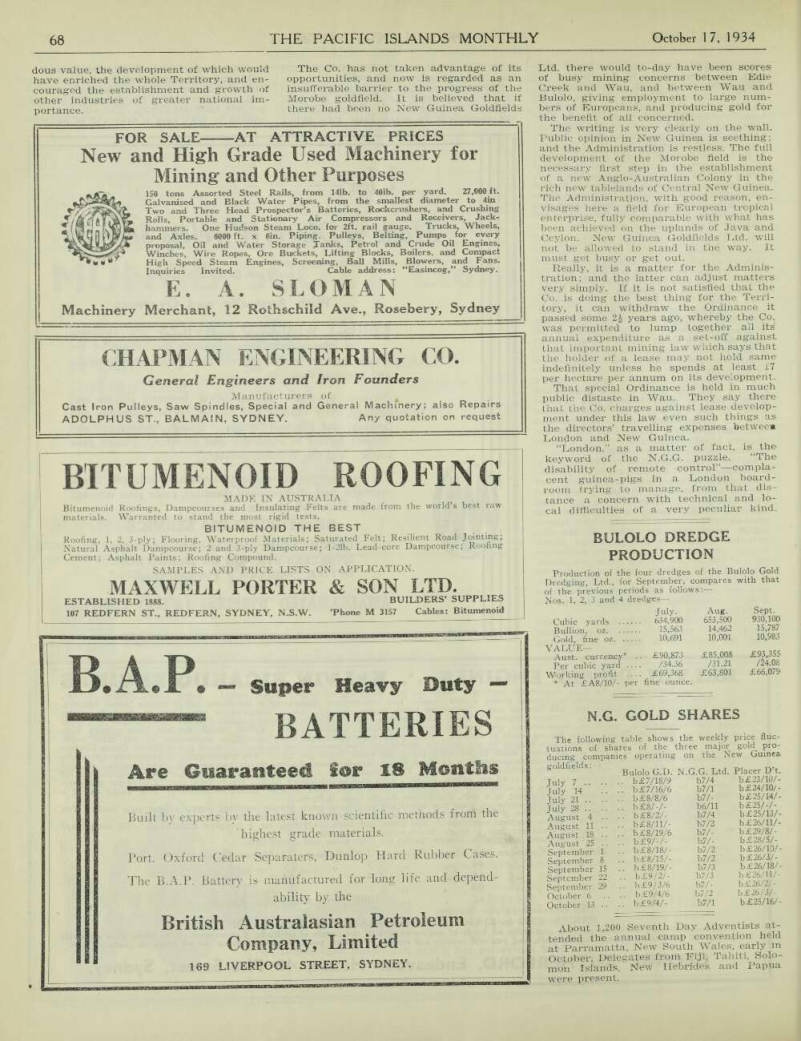
Baffling Problem of New Guinea Goldfields Ltd.
THE most serious public problem in New Guinea, as a matter of fact, is not the road, nor the future of copra, nor the Ger man steamers—but the problem of what should be done with New Guinea Goldfields Ltd. so as to compel that bloated concern either to make use of its leases, or get out of the way, so that the development of this rich new country may proceed.
The history of N.G.G. is well known. A powerful London group entered the field in the early stages and induced scores of the original leaseholders to come into one big company, receiving—for the most part—the Co.’s shares in return for their titles. The process continued over years; and the Co. naturally became, on paper, a gigantic concern, with an issued capital of over £5,000,000.
The general plan had merits, and the in dividual leaseholders were justified in sub scribing to it. Much more could be done, from their point of view, by co-operative effort, in securing large-scale operations and production. If the original plan had been carried out N.G.G. to-day would be producing huge quantities of gold, and would be enjoying the present gold boom and paying worth-while dividends. In
stead, to-day’s production and prospects are on so miserable a scale that the current market quotation for N.G.G. £1 shares is around 7/-.
But there came a period of appalling muddle —so characteristic of London con trol —bad planning, footling, uncertain
operations by stiff-necked unteachable men. Things have changed now; but hard-bitten engineers there still entertain each other with stories of the fatheaded things the Co. did in the beginning.
A volume could be written about Golden Ridges, for instance. The plant was designed and constructed in England, on tests made in England and America; and the whole job had to be rearranged, at enormous cost. If Australian mining practice had been followed, a pilot plant would have been operated at Golden Ridges, under competent metallurgists, and on the data thus gained the correct outfit would have
been installed. As it is there is a mass of costly machinery at Golden Ridges that is practically useless, except on two or three days a month. At Golden Ridges they use vats of iron or mild steel plates, brought in by air at frightful cost, for the storage of ore: practical men declare that exactly the same thing could have been achieved with corrugated iron.
An outstanding example of fatuousness is the steam plant which was installed at Golden Ridges for the generation of electricity. This is a wood-burning concern, and it consumes 20 cords of wood per week, at a cost of 35/- per cord. Month by month the wood supply has been receding and the
cost of transporting the fuel becoming higher. Yet in that region every valley carries a permanent stream of rushing water —it is the very home of hydro-electric possibilities. To-day a transmission line is being built to Golden Ridges, bringing power from the Bulolo hydro-electric station, and the steam power-plant is about to be abandoned.
The other centre of N.G.G. activity is at Edie Creek, where 30 Europeans and an army of native labourers are engaged in deep tunnelling, exploring the vein system.
There is no doubt about the richness of these lodes. The Co. has an electricity supply from the steam-mill for the winches and pumps; and, over a period of about four years, it has dug out huge quantities of gold-bearing ore. This has been simply dumped—when I saw it, in August, no one had the least idea of what was to be done with it. I hate to think of how many dividends are locked up there.
Mining men were savagely critical of N.G.G. shaft-sinking operations at Edie.
A three-compartment shaft, 350 feet deep, timbered from the surface down, known as Edie Creek No. 3, caved in, and had to be abandoned; and a new shaft was started nearby. The sinking of No. 1 shaft was delayed repeatedly by flooding—inefficient, yet very expensive pumps were used, with a miserable little power-plant, unworthy of a concern like N.G.G.
“There was fumbling and footling on a horrible scale,” said one engineer, to the writer. “Mining companies at Broken Hill, or Mt. Lyell, or in W.A., would not have tolerated such conditions for five minutes.
The development of the vein system has proceeded in a slow and primitive fashion, quite unworthy of a big company like this.
However, they have got sufficient ground opened up along the lodes now to justify metallurgical treatment: but there is no sign of anything of the kind.”
This Company holds very large areas of proved valuable alluvial country along the Bulolo Valley, northwards of Wau —country rich enough, according to one competent observer, “to keep hundreds of miners busy, three shifts a day.” Wau should be the centre of a large, busy, and expanding alluvial industry. Instead, except for a few men on tribute, nothing is being done with those leases.
The Company seems to have attacked everything from the wrong end. It should have installed a hydro-electric power station somewhere near Wau, at the very beginning, and gone after the rich, access ible alluvial gold on the Bulolo Valley and slopes; then the Golden Ridges enterprise might have followed —though on a less wasteful basis; and, finally, with solid
revenues and sound organisation in sup port, the development of the Bonanza at Edie Creek might have been undertaken.
We find, instead, that the Co. has wasted its energy and its capital on large-scale, non-revenue-producing operations at Edie Creek, at the end of one of the most ex pensive transport lines in the world. Every thing needed there has had to be brought in by aeroplane to Wau, and thence carried in by natives or mules, or on a special lorry, over 14 miles of incredible track. A new road is now being built, which should greatly reduce those costs; but, meanwhile, the Co. has frittered away huge sums and untold energy, which might have been far more profitably employed elsewhere.
It is to be conceded that the Co., in the beginning, was confronted by a stupendous pioneering job, in an absolutely raw coun try. But an Edie Creek old-timer put the answer in a nutshell; “What about Kal goorlie? There they had a similar trans port problem; but they had no wood, no water, no local labour —nothing but desert.
And they brought Kalgoorlie into profit without one quarter of this mucking about.
Here they have water, timber, cheap labour, a fairly good climate —everything except transport—and Bulolo solved the transport problem for them.”
From one end of Morobe to the other, I did not find one man with a good word to say for the early history and present policy of the Co. Some of them concede that the management now is efficient and vigorous: but they argue that the whole concern is still running around in a circle, chasing its apparently hopeless tail.
In the beginning, much of this probably was the result of muddling and incompet ence. But, as the years have passed, and the Co. has continued to show so pitifully little return to shareholders, and has squatted so stubbornly and uselessly on good alluvial country, there has been specu lation concerning the policy of the Co.
Whether rightly or wrongly, very many people now believe that it is the deliberate plan of the Co. to refrain from large-scale developmental activity until such time as financial reconstruction becomes possible, and the capital of the Co. can be written down to something approaching the public valuation of its shares.
“The big fellows are trying to squeeze out the little fellows!” say the quidnunes.
And, the more often that it is said, the
more determined are the little fellows that they will not be squeezed out.
The N.G.G. may quite fairly reply to all this by requesting- us to mind our own business, and reminding us that directors are competent to make their own policy
and are responsible only to shareholders. i n ordinary circumstances, that is true.
But, in this special case, national considera tions far outweigh the interests of any private financial group. The Co. was per mitted to take over a property of stupen
dous value, the development of which would have enriched the whole Territory, and encouraged the establishment and growth of other industries of greater national importance.
The Co. has not taken advantage of its opportunities, and now is regarded as an insufferable barrier to the progress of the Morobe goldfield. It is believed that if there had been no New Guinea Goldfields
Ltd. there would to-day have been scores of busy mining concerns between Edie Creek and Wau, and between Wau and Bulolo, giving employment to large num bers of Europeans, and producing gold for the benefit of all concerned.
The writing is very clearly on the wall.
Public opinion in New Guinea is seething: and the Administration is restless. The full development of the Morobe field is the necessary first step in the establishment of a new Anglo-Australian Colony in the rich new tablelands of Central New Guinea.
The Administration, with good reason, en visages here a field for European tropical enterprise, fully comparable with what has been achieved on the uplands of Java and Ceylon. New Guinea Goldfields Ltd. will not be allowed to stand in the way. It must get busy or get out.
Really, it is a matter for the Adminis tration; and the latter can adjust matters very simply. If it is not satisfied that the Co. is doing the best thing for the Terri tory, it can withdraw the Ordinance it passed some 2½ years ago, whereby the Co. was permitted to lump together all its annual expenditure as a set-off against that important mining law which says that the holder of a lease may not hold same indefinitely unless he spends at least 17 per hectare per annum on its development.
That special Ordinance is held in much public distaste in Wau. They say there that the Co. charges against lease develop ment under this law even such things as the directors’ travelling expenses between London and New Guinea.
“London,” as a matter of fact, is the keyword of the N.G.G. puzzle. “The disability of remote control” —complacent guinea-pigs in a London board room trying to manage, from that dis tance a concern with technical and lo cal difficulties of a very peculiar kind.
Advertisements & other items, pp. 67-70 (1 item)
Globex
(GLOBE BEEF EXTRACT)
GLOBEX
FOR GOOD BEEF TEA
GLOBEX
FOR SOUPS & GRAVIES
GLOBEX
DELICIOUS SPREAD THINLY ON BREAD
Obtainable on 2oz jars caret in 4 and 8oz. CONTAINERS Obtainable from All Island Traders
W. HOLMES
YACHT AND BOATBUILDER
All Classes of Islands Vessels a Speciality.
Sole Agent “ R.N.” DIESEL MARINE ENGINES.
SEND FOR PARTICULARS.
McMAHON’S POINT SYDNEY
Cable Address: “HOLMAC,” Sydney.
BALL AND
ROLLEr
BEARINGS
for all Industrial purposes.
Plummer Blocks Couplings Hangers Pulleys Replacement Bearings for all Cars, Trucks and Tractors SKF Engineering Service available free of charge Write for Catalogue and Price List
THE SKF BALL BEARING CO. LTD.
352 Kent Street Sydney Telegrams: “Bearings”
advt
8/6
GALL.
Plus postage.
PAINT NOW!
“I have used your paint and found it equal to the best. (Signed, L. J. . . . . . (Bankstown.) Here is an opportunity to buy first-grade Paint at half the usual price. We have purchased the entire output of this paint, which usually sells for 17/- per gallon, and will sell it at 8/6 per gallon. Obtainable in Browns, Stones, Greens, Blues, Greys, Cream, White, Reds, etc. Packed Free.
Obtainable only at
THE SALVAGE STORES (Reg.)
36 York Street. Sydney
3 h.p.
TILLY Marine Engine
2 7/8 bore, 2¾ stroke. Balanced crankshaft, 1 1/8 dia., float, feed carburettor, Robert Bosch magneto. Equipment: Silencer, Propeller, Shaft, Stuffing Box, and Free Clutch.
PRICE £31/-/- F.O.B.
J. E. TILLY
25 RENWICK STREET, REDFERN
’Phone: MA 3430.
Use—
Modern Direct Wireless Services
for Vour Communications With Australia and Overseas.
DIRECT WIRELESS SERVICES are available for inter-communication between the Islands of the Pacific and for traffic between the Islands and Australia and overseas countries.
Services are now in operation between Papua and Sydney, New Guinea and Sydney, New Caledonia and Sydney, and Fiji and Sydney. Speedy, economical and efficient service to Australia and overseas. Route your traffic “Via the Wireless Service.”
For overseas traffic to Great Britain, North and South America, and all European countries, route your message via the Direct Australian
BEAM WIRELESS SERVICE
LODGE YOUR MESSAGES AT ANY
WIRELESS STATION OR ISLAND POST
OFFICE ROUTED “VIA WIRELESS."
AMALGAMATED WIRELESS (A SIA) LIMITED
KELVIN DIESEL ENGINES KELVIN RICARDO ENGINES
Your business calls for more economical working. What are you doing regarding your power units? Every Island Planter, Trader, or person whose business requires mechanical power should enquire into and procure particulars of the latest list of Kelvin Diesel Engines.
These are some of the points that will interest you. Regarding horse power, quality, robust construction you have no need to worry regarding Kelvin Diesel Engines. Every engine is tested and certificate is supplied with every engine. What concerns you is capital cost, fuel consumption, simplicity, compactness, and freedom from unnecessary auxilary gear. Kelvin Diesel Engines have always been regarded as the Rolls Royce of the Marine world of engines. Their price with equal equipment cannot be approached by any other make of equal quality. The following are facts backed by the maker’s guarantee. Fuel consumption for every 22-horse power Kelvin Diesel Engines consume 1.08 Gallons of Crude oil per hour, equal to .41 pints per brake horse power per hour. The consumption of lubricating oil is one gallon every 80 hours running. Put into simple language, a 22-Horse Power Kelvin Diesel Engine would consume 108 gallons of fuel oil and V/i gallons of lubricating every 100 hours running at full speed. The present price of fuel oil is less than 6d. per gallon, lubricating oil 6/- per gallon therefore 108 gallons of fuel oil at 6d per gallon, £2/14/-; 1.1/4 gallons lubricating oil 6/-. 7/6. Total cost, £3/1/6 per 100 hours running. In the average boat this engine would be used in a speed of about seven miles an hour should be attained. This works out at total running cost of Id. per mile, half the cost of a ride, one section on the tram in Sydney.
KELVIN DIESELS are compact, therefore you have the advantage of a very much greater carrying capacity from your craft. You have the maker s guarantee and the certificate of Lloyds that your actual engine was tested and complies with these details.
When you buy a Kelvin you buy a complete equipment. You know you have everything for a complete installation. No compressed air to worry about and no vigorous cranking; just a simple arrangement for starting.
These engines can also be produced fitted with electric generator, bilge pump and search light.
Sizes. 1 Cylinder, 22 Horse Power. 2 Cylinders, 22 Horse Power 2 .. 44 „ 3 „ 33 .. 3 66 „ 4 44 4 88 6 .. 132 750 Revolutions per Minute.
PRICES: £350 to £1450. FREE ON BOARD SYDNEY. IN BOND.
I have a first-class workshop and can undertake all kinds of engine repairs or the supply of all kinds of machinery. Send along your enquiries giving full particulars of your requirements, and you will receive full details by return post. Estimates given for all kinds of craft.
Sole Australian and South Sea Island Representative.
GEORGE RUTHERFORD, Endeavour House, 46 Pitt Street, Sydney. 1000 Revolutions per Minute.
FOR SALE AT ATTRACTIVE PRICES
New and High Grade Used Machinery for
Mining and Other Purposes
150 tons Assorted Steel Rails, from 14lb. to 40lb. per yard. 27,000 ft.
Galvanised and Black Water Pipes, from the smallest diameter to 4in Two and Three Head Prospector’s Batteries, Rockcrushers, and Crushing Rolls, Portable and Stationary Air Compressors and Receivers, Jackhammers. One Hudson Steam Loco, for 2ft, rail gauge. Trucks, Wheels, and Axles. 6000 ft. x 6in. Piping, Pulleys, Belting, Pumps for every proposal, Oil and Water Storage Tanks, Petrol and Crude Oil Engines, Winches, Wire Ropes, Ore Buckets, Lifting Blocks, Boilers, and Compact High Speed Steam Engines, Screening, Ball Mills, Blowers, and Fans.
Inquiries Invited. Cable address: “Easincog,” Sydney.
E. A. SLOMAN
Machinery Merchant, 12 Rothschild Ave., Rosebery, Sydney
CHAPMAN ENGINEERING CO.
General Engineers and Iron Founders Manufacturers of Cast Iron Pulleys, Saw Spindles, Special and General Machinery; also Repairs ADOLPHUS ST., BALMAIN, SYDNEY. Any quotation on request
BITUMENOID ROOFING
MADE IN AUSTRALIA
Bitumenoid Roofings, Dampcourses and Insulating Felts are made from the world s best raw materials. Warranted to stand the most rigid tests.
BITUMENOID THE BEST
Roofing, 1,2, 3-ply; Flooring, Waterproof Materials; Saturated Felt; Resilient Road Jointing; Natural Asphalt Dampcourse; 2 and 3-ply Dampcourse; 1-2lb. Lead-core Dampcourse; Roofing Cement; Asphalt Paints; Roofing Compound.
SAMPLES AND PRICE LISTS ON APPLICATION.
MAXWELL PORTER & SON LTD.
ESTABLISHED 1888. BUILDERS’ SUPPLIES
107 REDFERN ST., REDFERN, SYDNEY, N.S.W. ’Phone M 3157 Cables: Bitumenoid
B.A.P. Super Heavy Duty
BATTERIES
Are Guaranteed for 18 Months Built by experts by the latest known scientific methods from the highest grade materials Port. Oxford Cedar Separaters, Dunlop Hard Rubber Cases.
The B.A.P. Battery is manufactured for long life and dependability by the British Australasian Petroleum
Company, Limited
169 LIVERPOOL STREET, SYDNEY.
Production
Bulolo Dredge
Production of the four dredges of the Bulolo Gold Dredging, Ltd., for September, compares with that of the previous periods as follows; — Nos. 1,2, 3 and 4 dredges—
July.
Aug.
Sept.
Cubic yards 634,900 653,500 930,100 Bullion, oz 15,563 14,462 15,787 Gold, fine oz
Value—
10,691 10,001 10,983 Aust. currency* . £90,873 £85,008 £93,355 Per cubic yard /34.36 /31.21 /24.08 Working profit * At £A8/10/- per fine ounce. £69,368 £63,801 £66,079
N.G. Gold Shares
The following table shows the weekly price fluc tuations of shares of the three major gold pro ducing companies operating on the INew Guinea goldfields: —
About 1,200 Seventh Day Adventists at tended the annual camp convention held at Parramatta, New South Wales, early in October. Delegates from Fiji, Tahiti, Solo mon Islands, New Hebrides and Papua were present.
goldfields:— Bulolo G.D.
N.G.G. Ltd.
Placer D’t.
July 7 .. b £7/18/9 b7/4 b £23/10/- July 14 b £7/16/6 b7/l b £24/10/ - July 21 .. b £8/8/6 b7/b £25/14/ - July 28 .. .. b£8/7b6/11 b£25 /-/- August 4 .. b£8/2/b7/4 b £25/13/- August 11 .. b£8/11/b7/2 b £26/11/- .. b £8/19/6 b7/b£29/8/- August 25 .. b£9/-/b7/b£28/S/- September 1 .. b£8/18/b7/2 b £26/10/- September 8 .. b£8/15/b7/2 b£26/3/- September 15 .. b£8/19/b7/3 b £26/18/- September 22 .. b£9/2/b7/3 b £26/11/- September 29 .. b £9/3/6 b7/b£26/2/- October 6 .. b £9/4/6 b7/2 b£26/3/- October 13 .. b£9/4/b7/1 b £25/16/-
Market Quotations
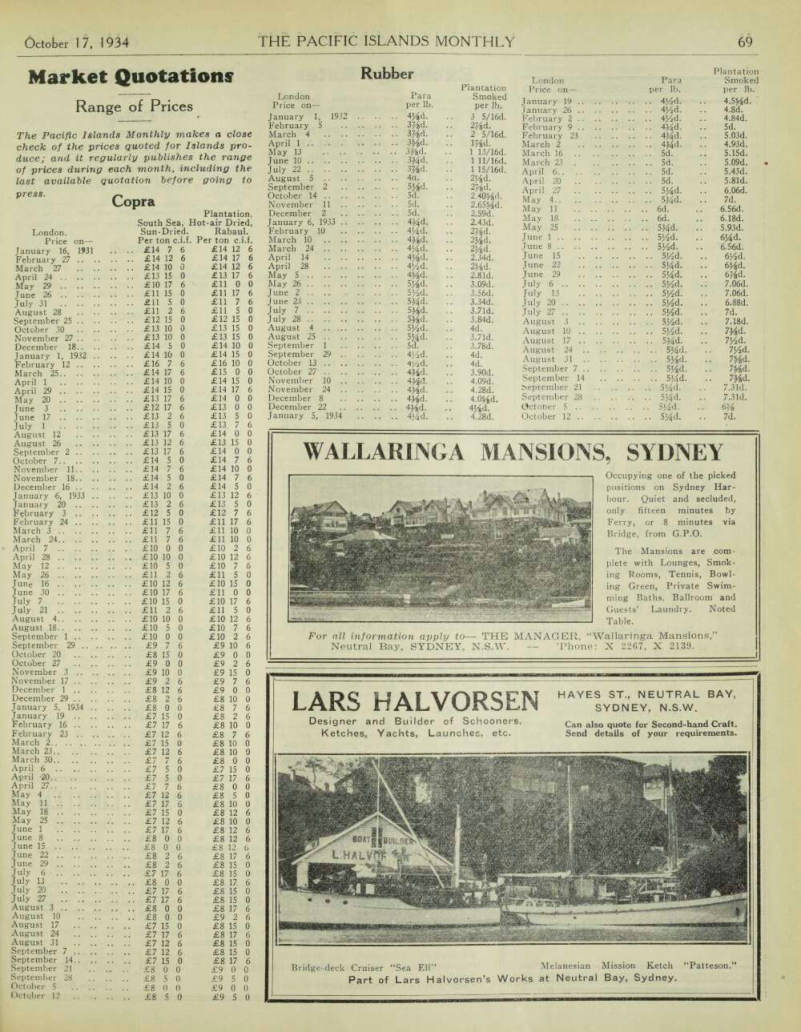
Range of Prices
The Pacific Islands Monthly makes a close check of the prices quoted for Islands pro duce; and it regularly publishes the range of prices during each month, including the last available quotation before going to
London
Rubber
Para Plantation Smoked Price on— per lb. per lb.
January 1, 1932 4J*d. 3 5/16d.
February 5 3Hd. 2Hd.
March 4 3&d. 2 5/16d.
April 1 3^d.
IHd.
May 13 .. .. 1 13/16d.
June 10 3^d. 1 ll/16d.
July 22 3H d. 1 15/16(1.
August 5 .. 2/gd.
September 2 5j*d. 2Hd.
October 14 .. 5d. 2.40Hd.
November 11 .. 5d. 2.6S^d.
December 2 5d. 2.59d.
January 6, 1933 .. 4*<d. 2.43d.
February 10 4'Ad. 2H d.
March 10 .. .. 4^d. 2%d.
March 24 .. .. 4$4d. 2% d.
April 14 .. .. 2.34d.
April 28 4'/ 3 d. 2^d.
May 5 45/ 8 d. 2.81d.
May 26 5'Ad. 3.09d.
June 2 S/ 2 d. 3.56d.
June 23 5^d. 3.34d.
July 7 S^d. 3.7ld.
July 28 5Hd. 3.84d.
August 4 5/ a d. 4d.
August 25 3.71d.
September 1 S3. 3.78d.
September 29 4j4d. 4d.
October 13 4d.
October 27 4Hd. 3.90d.
November 10 4*fd. 4.09d.
November 24 4Xd. 4.28d.
December 8 4|d. 4.0^d.
December 22 4^d. 4J*d.
January 5, 1934 4«4d. 4.28d.
London Para Plantation Smoked Price on— per lb. per lb.
January 19 .. .. 4*/ 2 d. 4.5^d.
January 26 .. .. 4}4d. 4.8d.
February 2 .. .. 4J/ 2 d. 4.84d.
February 9 .. .. 4Hd. 5d.
February 23 .. .. 4Md. 5.03d.
March 2 .. .. 4**d. 4.93d.
March 16 .. .. Sd. 5.15d.
March 23 .. .. 5d. 5.09d.
April 6 .. .. 5d. 5.43d.
April 20 .. .. 5d.
S.81d.
April 27 .. .. sy 4 d. 6.06d.
May 4 .. .. sy 4 d. 7d.
May 11 .. .. 6d. 6.56d.
May 18 .. .. 6d. 6.18d.
May 25 .. .. sy 4 d. 5.93d.
June 1 .. .. S'/ 2 d. 6Ad.
June 8 .. .. SAd. 6.56d.
June 15 S'Ad. 6Ad.
June 22 5¼ d. 6Hd.
June 29 SAd. 6^d.
July 6 5'Ad. 7.06d.
July 13 5'Ad. 7.06d.
July 20 SAd. 6.88d.
July 27 SAd. 7d.
August 3 SAd. 7.18d.
August 10 SAd. 7Ad.
August 17 sy 4 d. 7Ad.
August 24 7Ad.
August 31 SAd. 7Ad.
September 7 SAd. 7Ad.
September 14 SAd. 7Ad.
September 21 .. .. SAd. 7. 31d.
September 28 .. .. sy 4 d. 7.31d.
October 5 .. .. SAd. 6A October 12 5¼d. 7d.
press.
Copra
South Sea, Plantation, Hot-air Dried, London.
Sun-Dried.
Rabaul.
Price on— Per ton c.i.f. Per ton c.i.f.
January 16, 1931 .. .. £14 7 6 £14 12 6 February 27 .. .. .. .. £14 12 6 £14 17 6 March 27 .. .. .. .. £14 10 0 £14 12 6 April 24 .. .. £13 15 0 £13 17 6 May 29 .. .. £10 17 6 £11 0 0 J une 26 .. .. £11 15 0 £11 17 6
July 31
.. .. £11 5 0 £11 7 6 August 28 .. .. .. £11 2 6 £11 5 0 September 25 .. .. .. .. £12 15 0 £12 15 0 October 30 .. .. £13 10 0 £13 15 0 November 27 .. .. .. .. £13 10 0 £13 15 0 December 18.. .. .. £14 5 0 £14 10 0 January 1, 1932 .. .. .. £14 10 0 £14 15 0 February 12 .. .. .. .. £16 7 6 £16 10 0 March 25 .. .. £14 17 6 £15 0 0 April 1 April 29 .. .. £14 10 0 £14 15 0 .. .. £14 15 0 £14 17 6 May 20 .. .. £13 17 6 £14 0 0 June 3 .. .. £12 17 6 £13 0 0 June 17 .. .. £13 2 6 £13 5 0 July 1 .. .. £13 5 0 £13 7 6 August 12 .. .. .. .. £13 17 6 £14 0 0 August 26 .. .. .. .. £13 12 6 £13 15 0 September 2 .. .. .. .. £13 17 6 £14 0 0 October 7 .. .. £14 5 0 £14 7 6 November 11.. .. .. .. £14 7 6 £14 10 0 November 18.. .. .. .. £14 5 0 £14 7 6 December 16 .. .. .. £14 2 6 £14 5 0 January 6, 1933 .. .. .. £13 10 0 £13 12 6 January 20 .. .. .. £13 2 6 £13 5 0 February 3 .. .. .. .. £12 5 0 £12 7 6 February 24 .. .. .. .. £11 15 0 £11 17 6 March 3 .. .. £11 7 6 £11 10 0 March 24 .. .. £11 7 6 £11 10 0 April 7 .. . £10 0 0 £10 2 6 April 28 .. .. £10 10 0 £10 12 6 May 12 .. .. £10 5 0 £10 7 6 May 26 .. .. £11 2 6 £11 5 0 Jun e 16 .. .. £10 12 6 £10 15 0 June 30 .. .. £10 17 6 £11 0 0 July 7 .. .. £10 15 0 £10 17 6 July 21 .. .. £11 2 6 £11 5 0 August 4 .. .. £10 10 0 £10 12 6 August 18 .. .. £10 5 0 £10 7 6 September 1 .. .. .. .. £10 0 0 £10 2 6 September 29 .. .. ... £9 7 6 £9 10 6 October 20 .. .. ... £8 15 0 £9 0 0 October 27 .. .. £9 0 0 £9 2 6 November 3 .. .. ... £9 10 0 £9 15 0 November 17 .. .. .. .. £9 2 6 £9 7 6 December 1 .. .. .. .. £8 12 6 £9 0 0 December 29 .. .. 6 £8 10 0 January 5, 1934 .. .. .. £8 0 0 £8 7 6 January 19 .. .. .. .. £7 15 0 £8 2 6
February 16 .. ..
.. .. £7 17 6 £8 10 0 February 23 .. .. ... £7 12 6 £8 7 6 March 2 0 £8 10 0 March 23 .. .. £7 12 6 £8 10 0 March 30 .. .. £7 7 6 £8 0 0 April 6 0 £7 15 0 April 20 .. .. £7 5 0 £7 17 6 April 27 6 £8 0 0 May 4 6 £8 5 0 May 11 .. .. £7 17 6 £8 10 0 May 18 .. .. £7 15 0 £8 12 6 May 25 .. .. £7 12 6 £8 10 0 June 1 6 £8 12 6 June 8 .. .. £8 0 0 £8 12 6 June 15 0 £8 12 6 June 22 .. .. £8 2 6 £8 17 6 June 29 .. .. £8 2 6 £8 15 0 July 6 6 £8 15 0 July 13 0 £8 17 6 July 20 .. .. £7 17 6 £8 15 0 July 27 6 £8 15 0 August 3 0 £8 17 6 August 10 .. .. 0 £9 2 6 August 17 .. .. 0 £8 15 0 August 24 .. .. 6 £8 17 6 August 31 ... .. .. £7 12 6 £8 15 0
September 7 ., ..
.. .. £7 12 6 £8 15 0 September 14.. .. 0 £8 17 6
September 21
.. £8 0 0 £9 0 0 September 28 .. .. £8 5 0 £9 5 0 October 5 .. .. .. .. £8 0 0 £9 0 0 Octqber 12 .. .. .. .. £8 5 0 £9 5 0
Advertisements & other items, pp. 71-72 (1 item)
advt
LARS HALVORSEN
Designer and Builder of Schooners, Ketches, Yachts, Launches, etc.
HAYES ST., NEUTRAL BAY,
SYDNEY, N.S.W.
Can also quote for Second-hand Craft.
Send details of your requirements.
Bridge-deck Cruiser “Sea Elf” Melanesian Mission Ketch “Patteson.”
Part of Lars Halvorsen’s Works at Neutral Bay, Sydney.
Introduced in the Pacific Islands only a few months ago, the reports already received on the new Hormone Preparation TITON show quite conclusively its great efficacy in tropical countries. Following a few extracts from reports: . . . feeling better in every way. . . . not nearly so irritable as I used to be. . . . noticed a remarkable difference
in myself generally.
. . . seems much easier now to pick up after fever attacks. ... no one living in the tropics should be without it. . . . and what’s more it gives new
brain activity.
. . . tried one bottle so far and found it very good in my case. . . . wonder what I will feel like after the “full” treatment. . . . feel lots clearer in the head as
regards mental ability.
. . . ordering two more treatments for “run down” friends of mine. . . . am so grateful that I am telling everybody about it. . . . tried lots of things but nothing
equal in efficacy.
When living under awkward climatic conditions and desirous of maintaining health and to keep fit, mentally and physically, it is advisable to build up your system and body by means of this new and remarkable tonic and restorative that provides the proper nourishment in the form of hormones, the latest scientific discovery.
Absolutely harmless to take, yet wonderfully effective and will make a remarkable difference to your future health and comfort.
Titon Hormone Preparation No. 24 for men and No. 20 for women at 30/- per full treatment of three bottles. Send cheque or postal notes direct to Titon Laboratories, Box 1304J, G.P.O., Sydney, or to the Island agent, Alfred Stoffer, 16-20 Bridge Street, Sydney, N.S.W., and a treatment will be forwarded by return mail, post free and under plain wrapper, together with interesting literature on this latest scientific discovery.
Exchange Rates
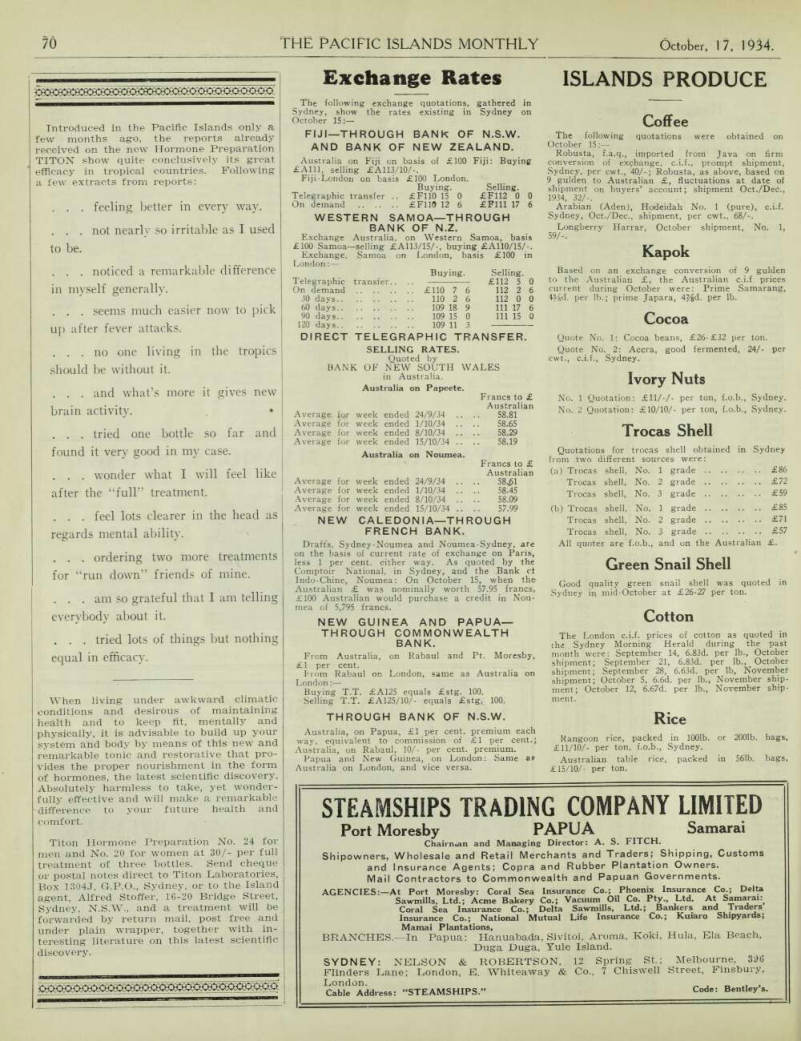
The following exchange quotations, gathered in Sydney, show the rates existing in Sydney on October 15:—
Fiji—Through Bank Of N.S.W.
And Bank Of New Zealand.
Australia on Fiji on basis of £100 Fiji: Buying £A111, selling £A113/10/-.
Fiji-London on basis £100 London.
Western Samoa—Through
Bank Of N.Z.
Exchange Australia, on Western Samoa, basis £100 Samoa —selling £A113/15/-, buying £A110/15/-.
Exchange, Samoa on London, basis £100 in London: —
Direct Telegraphic Transfer.
Selling Rates.
Quoted by
Bank Of New South Wales
in Australia.
New Caledonia—Through
French Bank.
Drafts, Sydney-Noumea and Noumea-Sydney, are on the basis of current rate of exchange on Paris, less 1 per cent, either way. As quoted by the Comptoir National, in Sydney, and the Bank ct Indo-Chine, Noumea: On October 15, when the Australian £ was nominally worth 57.95 francs, £100 Australian would purchase a credit in Noumea of 5,795 francs.
New Guinea And Papua
Through Commonwealth
Bank.
From Australia, on Rabaul and Pt. Moresby, £1 per cent. from Rabaul on London, same as Australia on London: — Buying T.T. £A12S equals £stg. 100.
Selling T.T. £A12S/10/- equals 100
Through Bank Of N.S.W.
Australia, on Papua, £1 per cent, premium each way, equivalent to commission of £1 per cent.; Australia, on Rabaul, 10/- per cent, premium.
Papua and New Guinea, on London: Same a s Australia on London, and vice versa.
Buying. Selling.
Telegraphic transfer .. £F110 15 0 £F112 0 0 On demand £F110 12 6 £F111 17 6
Buying. Selling.
Telegraphic transfer.. .. £112 5 0 On demand £110 7 6 112 2 6 30 days 110 2 6 112 0 0 60 days 109 18 9 111 17 6 90 days 109 15 0 111 15 0 120 days 109 11 3
Average for week ended 24/9/34 .. 58.81 Australia on Papeete.
Francs to £ Australian Average for week ended 1/10/34 .. 58.65 Average for week ended 8/10/34 .. 58.29 Average for week ended 15/10/34 .. 58.19 Average for week ended 24/9/34 .. 58.61 Australia on Noumea.
Francs to £ Australian Average for week ended 1/10/34 .. 58.45 Average for week ended 8/10/34 .. 58.09 Average for week ended 15/10/34 .. 57.99
Islands Produce
Coffee
The following quotations were obtained on October 15 Robusta, f.a.q., imported from Java on firm conversion of exchange, c.i.f., prompt shipment, Sydney, per cwt., 40/-; Robusta, as above, based on 9 gulden to Australian £, fluctuations at date of shipment on buyers’ account; shipment Oct./Dec., 1934, 32/-.
Arabian (Aden), Hodeidah No. 1 (pure), c.i.f.
Sydney, Oct./Dec., shipment, per cwt., 68/-.
Longberry Harrar, October shipment, No. 1, 59/-.
Kapok
Based on an exchange conversion of 9 gulden to the Australian £, the Australian c.i.f prices current during October were: Prime Samarang, 4 3/8d. per lb.; prime Japara, per lb.
Cocoa
Quote No. 1: Cocoa beans, £26-£32 per ton.
Quote No. 2: Accra, good fermented, 24/- per cwt., c.i.f., Sydney.
Ivory Nuts
No. 1 Quotation: £11/-/- per ton, f.o.b., Sydney.
No. 2 Quotation: £10/10/- per ton, f.o.b., Sydney.
Trocas Shell
Quotations for trocas shell obtained in Sydney from two different sources were: (a) Trocas shell, No. 1 grade £86 Trocas shell, No. 2 grade £72 Trocas shell, No. 3 grade £59 (b) Trocas shell, No. 1 grade £85 Trocas shell, No. 2 grade £71 Trocas shell, No. 3 grade £57 All quotes are f.o.b., and on the Australian £.
Green Snail Shell
Good quality green snail shell was quoted in Sydney in mid-October at £26-27 per ton.
Cotton
The London c.i.f. prices of cotton as quoted in che Sydney Morning Herald during the past month were: September 14, 6.83d. per lb., October shipment; September 21, 6.83d. per lb., October shipment; September 28, 6.63d. per lb, November shipment; October 5, 6.6d. per lb., November ship ment; October 12, 6.67d. per lb., November ship ment.
Rice
Rangoon rice, packed in 100lb. or 200lb. bags, £11/10/- per ton, f.o.b., Sydney.
Australian table rice, packed in 56lb. bags, £15/10/- per ton.
Advertisements & other items, p. 72 (1 item)
Steamships Trading Company Limited
Port Moresby PAPUA Samarai
Chairnian and Managing Director: A. S. FITCH.
Shipowners, Wholesale and Retail Merchants and Traders; Shipping, Customs and Insurance Agents; Copra and Rubber Plantation Owners.
Mail Contractors to Commonwealth and Papuan Governments.
AGENCIES:—At Port Moresby: Coral Sea Insurance Co.; Phoenix Insurance Co.; Delta Sawmills, Ltd.; Acme Bakery Co.; Vacuum Oil Co. Pty., Ltd. At Coral Sea Insurance Co.; Delta Sawmills, Ltd.; Bankers and Traders Insurance Co.; National Mutual Life Insurance Co.; Kuiaro Shipyards; Mamai Plantations, BRANCHES.—In Papua: Hanuabada, Sivitoi, Aroma, Koki, Hula, Ela Beach, Duga Duga, Yule Island.
SYDNEY; NELSON & ROBERTSON, 12 Spring St.; Melbourne, 390 Flinders Lane; London, E. Whiteaway & Co., 7 Chiswell Street, Finsbury, London.
Cable Address: “STEAMSHIPS.” Code: Bentleys.
Shipping Services in the Pacific
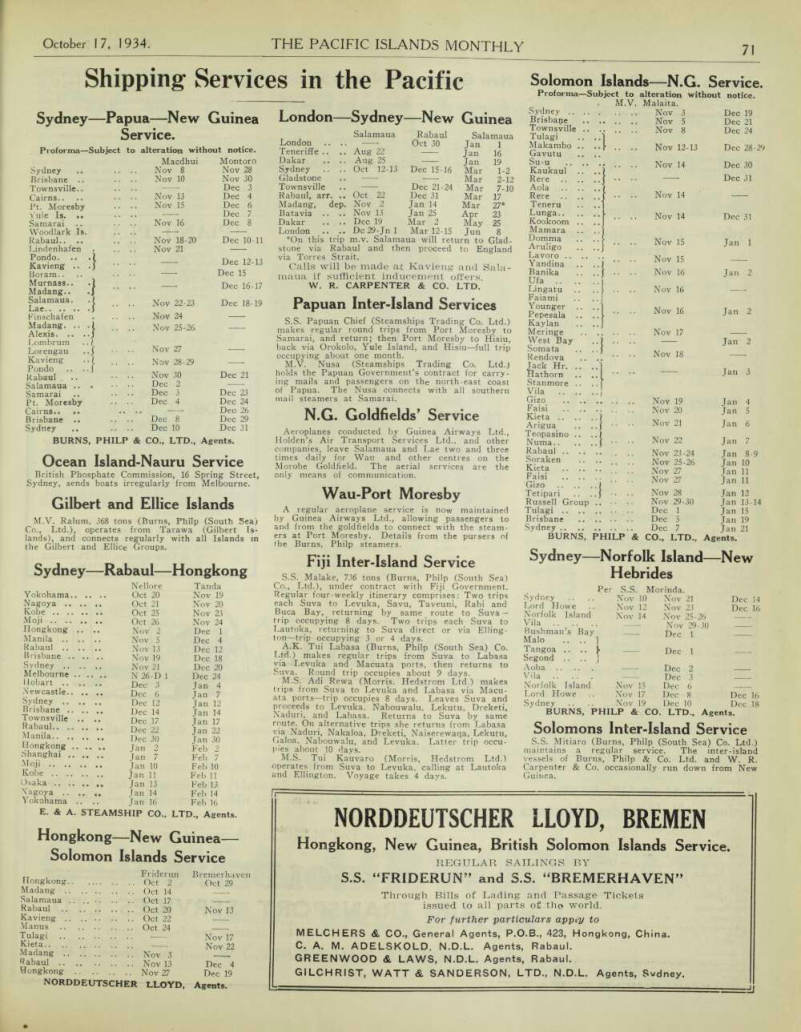
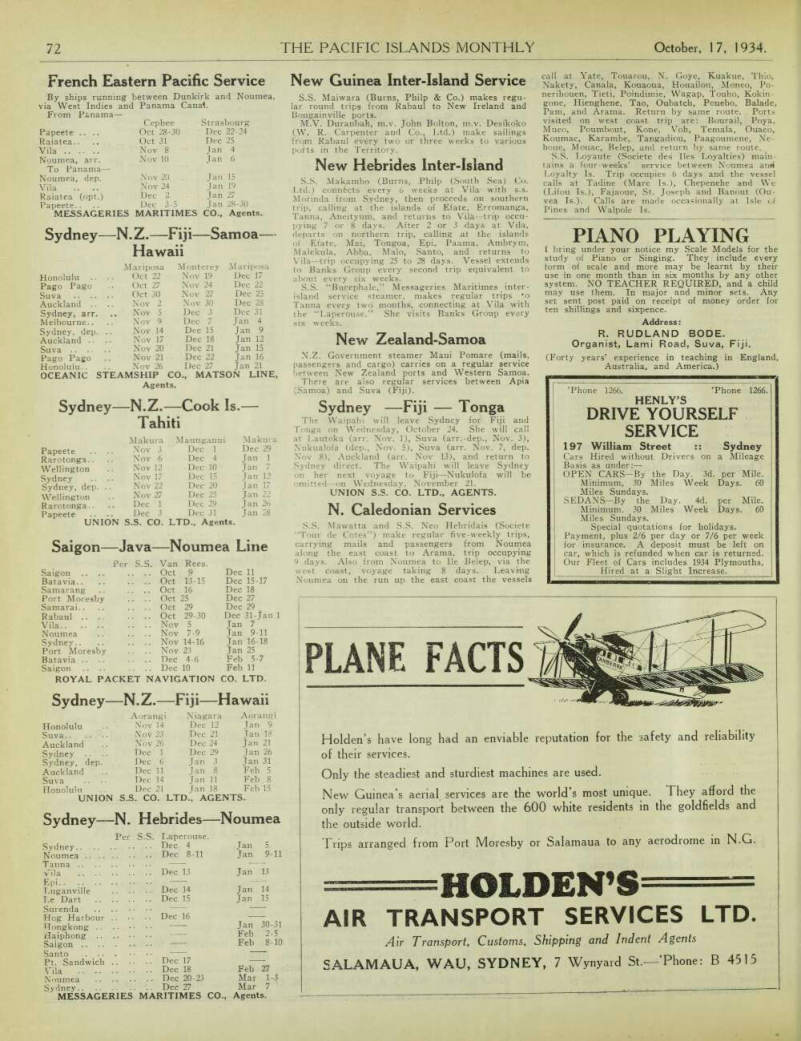
Sydney—Papua—New Guinea Service.
Ocean Island-Nauru Service
British Phosphate Commission, 16 Spring Street, Sydney, sends boats irregularly from Melbourne.
Gilbert and Ellice Islands
M.V. Ralum, 368 tons (Burns, Philp (South Sea) Co., Ltd.), operates from Tarawa (Gilbert Is lands), and connects regularly with all Islands in the Gilbert and Ellice Groups.
Sydney—Rabaul—Hongkong
Hongkong—New Guinea— Solomon Islands Service
London—Sydney—New Guinea
*On this trip m.v. Salamaua will return to Glad stone via Rabaul and then proceed to England via Torres Strait.
Calls will be made at Kavieng and Sala maua if sufficient inducement offers.
W. R. Carpenter & Co. Ltd.
Papuan Inter-Island Services
S.S. Papuan Chief (Steamships Trading Cos. Ltd.) makes regular round trips from Port Moresby to Samarai, and return; then Port Moresby to Hisiu, back via Orokolo, Yule Island, and Hisiu—full trip occupying about one month.
M.V. Nusa (Steamships Trading Cos. Ltd.) holds the Papuan Government’s contract for carry ing mails and passengers on the north-east coast of Papua. The Nusa connects with all southern mail steamers at Samarai.
N.G. Goldfields’ Service
Aeroplanes conducted by Guinea Airways Ltd., Holden’s Air Transport Services Ltd., and other companies, leave Salamaua and Lae two and three times daily for Wau and other centres on the Morobe Goldfield. The aerial services are the only means of communication.
Wau-Port Moresby
A regular aeroplane service is now maintained by Guinea Airways Ltd., allowing passengers to and from the goldfields to connect with the steam ers at Port Moresby. Details from the pursers of the Burns, Philp steamers.
Fiji Inter-Island Service
S.S. Malake, 736 tons (Burns, Philp (South Sea) Cos., Ltd.), under contract with Fiji Government.
Regular four-weekly itinerary comprises: Two trips each Suva to Levuka, Savu, Taveuni, Rabi and Buca Bay, returning by same route to Suva— trip occupying 8 days. Two trips each Suva to Lautoka, returning to Suva direct or via Elling ton —trip occupying 3 or 4 days.
A.K. Tui Labasa (Burns, Philp (South Sea) Cos.
Ltd.) makes regular trips from Suva to Labasa via Levuka and Macuata ports, then returns to Suva. Round trip occupies about 9 days.
M.S. Adi Rewa (Morris. Hedstrom Ltd.) makes trips from Suva to Levuka and Labasa via Macu ata ports—trip occupies 8 days. Leaves Suva and proceeds to Levuka, Nabouwalu, Lekutu, Dreketi, Naduri, and Labasa. Returns to Suva by same route. On alternative trips she returns from Labasa via Naduri, Nakaloa, Dreketi, Naiserewaqa, Lekutu, Galoa, Nabouwalu, and Levuka. Latter trip occu pies about 10 days.
M.S. Tui Kauvaro (Morris, Hedstrom Ltd.) operates from Suva to Levuka, calling at Lautoka and Ellington. Voyage takes 4 days.
Solomon Islands—N.G. Service.
Sydney—Norfolk Island —New Hebrides
Solomons Inter-Island Service
S.S. Mitiaro (Burns, Philp (South Sea) Cos. Ltd.) maintains a regular service. The mter-island vessels of Burns, Philp & Cos. Ltd. and W. R.
Carpenter & Cos. occasionally run down from New Guinea.
Proforma—Subject to alteration without notice.
Macdhui Montoro Sydney .. .. Nov 8 Nov 28 Brisbane .. .. Nov 10 Nov 30 Townsville Dec 3 Cairns .. .. Nov 13 Dec 4 Pt. Moresby .. .. Nov 15 Dec 6 Yule Is.
Dec 7 Samarai .. .. Nov 16 Dec 8 Woodlark Is. — — Rabaul . . . . Nov 18-20 Dec 10-11 Lindenhafen .. .. Nov 21 Pondo Kavieng Dec 12-13 Boram Dec 15 Murnass — Dec 16-17 Madang Salamaua Lae Nov 22-23 Dec 18-19 Finschafen Nov 24 — Madang Nov 25-26 Alexis.
Lombrum Nov 27 Lorengau — Kavieng Nov 28-29 Pondo Dec 21 Rabaul Nov 30 Salamaua Dec 2 — Samarai Dec 3 Dec 23 Pt. Moresby Dec 4 Dec 24 Cairns Dec 26 Brisbane Dec 8 Dec 29 Sydney Dec 10 Dec 31
Burns, Philp & Co., Ltd., Agents.
Salamaua Rabaul Salamaua London .. .. Oct 30 Jan 1 Teneriffe .. .. Aug 22 Jan 16 Dakar .. .. Aug 25 Jan 19 Sydney .. .. Oct 12-13 Dec 15-16 Mar 1-2 Gladstone .. Mar 2-12 Townsville .. Dec 21-24 Mar 7-10 Rabaul, arr. .. Oct 22 Dec 31 Mar 17 Madang, dep. Nov 2 Jan 14 Mar 27* Batavia .. .. Nov 13 Jan 25 Apr 23 Dakar .. .. Dec 19 Mar 2 May 25 London .. .. Dc29-Jnl Mar 12-15 Jun 8
Proforma—Subject to alteration without notice.
M.V. Malaita.
Sydney Nov 3 Dec 19 Brisbane Dec 21 Townsville Nov 8 Dec 24 Tulagi Makambo Gavutu Dec 28-29 Su-u .. ..
Dec 30 Kaukaul Rere Dec 31 Aola — Teneru Lunga Kookoom ..
Nov 14 Dec 31 Mamara Domma Aruligo Nov 15 Jan 1 Lavoro Yandina Nov 15 — Banika Jan 2 Ufa Lingatn Faiami Younger Pepesala Nov 16 Jan 2 Kaylan Meringe West Bay Jan 2 Somata Nov 18 Rendova — Jack Hr.
Jan 3 Hathorn Stanmore Vila Gizo Jan 4 Faisi Jan 5 Kieta Arigua Nov 21 Jan 6 Teopasino Nov 22 Jan 7 Numa Rabaul Jan 8-9 Soraken Jan 10 Kieta Faisi Nov 27 Jan 11 Jan 11 Nov 27 Gizo Tetipari Jan 12 Russell Group Nov 29-30 Jan 13-14 Tulagi Jan 15 Brisbane Jan 19 Jan 21 Sydney
Burns, Philp & Co., Ltd., Agents.
Per S.S. Morinda.
Sydney Nov 10 Nov 21 Dec 14 Lord Howe Nov 12 Nov 23 Dec 16 Norfolk Island Nov 14 Nov 25-26 Vila Nov 29-30 Bushman’s Bay Malo — Dec 1 — Tangoa Segond — Dec 1 — Aoba — Dec 2 Vila — Dec 3 Norfolk Island Nov 15 Dec 6 — Lord Howe Nov 17 Dec 8 Dec 16 Sydney Nov 19 Dec 10 Dec 18
Burns, Philp & Co. Ltd., Agents.
Nellore Tanda Yokohama Oct 20 Nov 19 Nagoya Nov 20 Kobe Oct 25 Nov 23 Moji Nov 24 Hongkong Nov 2 Dec 1 Manila Nov 5 Dec 4 Rabaul Dec 12 Dec 18 Brisbane Svdney Dec 20 Melbourne Dec 24 Jan 4 Hobart Newcastle Jan 7 Sydney Jan 12 Brisbane Jan 14 Townsville Rabaul Dec 17 Jan 17 Jan 22 Jan 30 Feb 2 Manila Hongkong Shanghai Jan 7 Feb 7 Moji Feb 10 Feb 11 Kobe Osaka Feb 13 Feb 14 Nagoya Yokohama Jan 16 Feb 16 E. & A. STEAMSHIP CO., LTD., Agents.
Hongkong Friderun Breinerhavcn Oct 2 Oct 29 Madang Oct 14 Salamaua Oct 17 Rabaul Oct 20 Nov 13 Kavieng Oct 22 Manus Oct 24 Tulagi Nov 17 Kieta Madang Nov 3 Nov 13 Nov 22 Rabaul Dec 4 Hongkong Nov 27 Dec 19
Norddeutscher Lloyd, Agents.
French Eastern Pacific Service
By ships running between Dunkirk and Noumea, via West Indies and Panama Canal.
From Panama—
Sydney—N.Z.—Fiji—Samoa— Hawaii
Sydney—N.Z.—Cook Is. — Tahiti
Saigon—Java—Noumea Line
Sydney—N.Z.—Fiji—Hawaii
Sydney—N. Hebrides —Noumea
New Guinea Inter-Island Service
S.S. Maiwara (Burns, Philp & Co.) makes regular round trips from Rabaul to New Ireland and Bougainville ports.
M. Duranbah, m.v. John Bolton, m.v. Desikoko (W. R. Carpenter and Co., Ltd.) make sailings from Rabaul every two or three weeks to various ports in the Territory.
New Hebrides Inter-Island
S.S. Makambo (Burns, Philp (South Sea) Co.
Ltd.) connects every 6 weeks at Vila with s.s.
Mofinda from Sydney, then proceeds on southern trip, calling at the islands of Efate, Erromanga, Tanna, Aneityum, and returns to Vila—trip occu pying 7 or 8 days. After 2 or 3 days at Vila, departs on northern trip, calling at the islands of Efate, Mai, Tongoa, Epi, Paama, Ambrym, Malekula, Abba, Malo, Santo, and returns to Vila—trip occupying 25 to 28 days. Vessel extends to Banks Group every second trip equivalent to about every six weeks.
S.S. “Bucephale,” Messageries Maritimes interisland service steamer, makes regular trips to Tanna every two months, connecting at Vila with the “Laperouse.” She visits Banks Group every six weeks.
New Zealand-Samoa
N. Government steamer Maui Pomare (mails, passengers and cargo) carries on a regular service between New Zealand ports and Western Samoa.
There are also regular services between Apia (Samoa) and Suva (Fiji).
Sydney —Fiji Tonga
The Waipahi will leave Sydney for Fiji and Tonga on Wednesday, October 24. She will call at Lautoka (arr. Nov. 1), Suva (arr.-dep., Nov. 3), Nukualofa (dep., Nov. 5), Suva (arr. Nov. 7, dep.
Nov 8), Auckland (arr. Nov 13), and return to Sydney direct. The Waipahi will leave Sydney on her next voyage to Fiji—Nukulofa will be omitted —on Wednesday, November 21.
Union S.S. Co. Ltd., Agents.
N. Caledonian Services
S.S. Mawatta and S.S. Neo Hebridais (Societe "Tour de Cotes”) make regular five-weekly trips, carrying mails and passengers from Noumea along the east coast to Arama, trip occupying 9 days. Also from Noumea to He Belep, via the west coast, voyage taking 8 days. Leaving Noumea on the run up the east coast the vessels
call at Yate, Touarou, N. Goye, Kuakue, Thio, Nakety, Canala, Kouaoua, Houailou, Moneo, Po nerihouen, Tieti, Poindimie, Wagap, Touho, Kokin gone, Hienghene, Tao, Oubatch, Pouebo, Balade, Pam, and Arama. Return by same route. Ports visited on west coast trip are: Bourail, Poya, Mueo, Poumbout, Kone, Yob, Temala, Ouaco, Koumac, Karambe, Tangadiou, Paagoumene, Ne houe, Mouac, Belep, and return by same route.
S.S. Loyaute (Societe des lies Loyalties) maintains a four-weeks’ service between Noumea and Loyalty Is. Trip occupies 6 days and the vessel calls at Tadine (Mare Is.), Chepenehe and We (Lifou Is.), Fajaoue, St. Joseph and Banout (Ou vea Is.). Calls are made occasionally at Isle of Pines and Walpole Is.
Cephee Strasbourg Papeete Oct 28-30 Dec 22-24 Raiatea Oct 31 Dec 25 Vila Nov 8 Jan 4 Noumea, arr.
Nov 10 Jan 6 To Panama — Noumea, dep.
Nov 20 Jan 15 Vila Nov 24 Jan 19 Raiatea (opt.) Dec 2 Jan 27 Papeete Dec 3-5 Jan 28-30
Messageries Maritimes Co., Agents.
Mariposa Monterey Mariposa Honolulu Oct 22 Nov 19 Dec 17 Pago Pago Oct 27 Nov 24 Dec 22 Suva Oct 30 Nov 27 Dec 25 Auckland Nov 2 Nov 30 Dec 28 Sydney, arr Nov 5 Dec 3 Dec 31 Melbourne Nov 9 Dec 7 Jan 4 Sydney, dep Nov 14 Dec 15 Jan 9 Auckland Nov 17 Dec 18 Jan 12 Suva Nov 20 Dec 21 Jan 15 Pago Pago Nov 21 Dec 22 Jan 16 Honolulu Nov 26 Dec 27 Jan 21
Oceanic Steamship Co., Matson Line,
Agents.
Makura Maunganui Makura Papeete . Nov 3 Dec 1 Dec 29 Rarotonga.. .. Nov 6 Dec 4 Jan 1 Wellington .. Nov 12 Dec 10 Jan 7 Sydney .. .. Nov 17 Dec 15 Jan 12 Sydney, dep. .. Nov 22 Dec 20 Jan 1/ Wellington .. Nov 27 Dec 25 Jan 22 Rarotonga.. .. Dec 1 Dec 29 Jan 2n Papeete ..Dec 3 Dec 31 Jan 28
Union S.S. Co. Ltd., Agents.
Per S.S. Van Rees.
Saigon Oct 9 Dec 11 Batavia Oct 13-15 Dec 15-17 Samarang Oct 16 Dec 18 Port Moresby Oct 25 Dec 27 Samarai Oct 29 Dec 29 Rabaul Oct 29-30 Dec 31-Jan 1 Vila Nov 5 Jan 7 Noumea Nov 7-9 Jan 9-11 Sydney Nov 14-16 Jan 16-18 Port Moresby Nov 23 Jan 25 Batavia Dec 4-6 Feb 5-7 Saigon Dec 10 Feb 11
Royal Packet Navigation Co. Ltd.
Aorangi Niagara Aorangi Honolulu Nov 14 Dec 12 Jan 9 Suva Nov 23 Dec 21 Tan 18 Auckland .. Nov 26 Dec 24 Jan 21 Sydney .. .. Dec 1 Dec 29 Jan 26 Sydney, dep. Dec 6 Jan 3 Jan 31 Auckland .. Dec 11 Jan 8 Feb 5 Suva ... Dec 14 Jan 11 Feb 8 Honolulu Dec 21 Jan 18 Feb 15
Union S.S. Co. Ltd., Agents.
Per Sydney S.S. Laperouse.
Dec 4 Jan S Noumea Dec 8-11 Jan 9-11 Tanna — — Vila Dec 13 Jan 13 Epi — — Luganville Jan 14 Le Dart Dec 15 Jan 15 Surenda — Hog Harbour Dec 16 — Hongkong Jan 30-31 Haiphong Feb 2-5 Saigon — Feb 8-10 Santo — — Pt. Sandwich — Vila Dec 18 Feb 27 Noumea Dec 20-23 Mar 1-3 Sydney .. Dec 27 Mar 7
Messageries Maritimes Co., Agents.
Advertisements & other items, pp. 73-76 (1 item)
Norddeutscher Lloyd, Bremen
Hongkong, New Guinea, British Solomon Islands Service.
REGULAR SAILINGS BY
S.S. “FRIDERUN” and S.S. “BREMERHAVEN”
Through Bills of Lading and Passage Tickets issued to all parts of the world.
For further particulars appty to MELCHERS & CO., General Agents, P.O.B., 423, Hongkong, China.
C. A. M. ADELSKOLD, N.D.L. Agents, Rabaul.
GREENWOOD & LAWS, N.D.L. Agents, Rabaul.
GILCHRIST, WATT & SANDERSON, LTD., N.D.L. Agents, Sydney.
PIANO PLAYING
I bring under your notice my Scale Models for the study of Piano or Singing. They include every form of scale and more may be learnt by their use in one month than in six months by any other system. NO TEACHER REQUIRED, and a child may use them. In major and minor sets. Any set sent post paid on receipt of money order for ten shillings and sixpence.
Address:
R. RUDLAND BODE.
Organist, Lami Road, Suva, Fiji.
(Forty years’ experience in teaching in England, Australia, and America.)
’Phone 1266. ’Phone 1266.
HENLY’S
DRIVE YOURSELF
SERVICE
197 William Street :: Sydney Cars Hired without Drivers on a Mileage Basis as under:— OPEN CARS —By the Day. 3d. per Mile.
Minimum, 30 Miles Week Days. 60 Miles Sundays.
SEDANS —By the Day. 4d. per Mile.
Minimum, 30 Miles Week Days. 60 Miles Sundays.
Special quotations for holidays.
Payment, plus 2/6 per day or 7/6 per week for insurance. A deposit must be left on car, which is refunded when car is returned.
Our Fleet of Cars includes 1934 Plymouths, Hired at a Slight Increase.
PLANE FACTS
Holden’s have long had an enviable reputation for the safety and reliability of their services.
Only the steadiest and sturdiest machines are used.
New Guinea’s aerial services are the world’s most unique. They afford the only regular transport between the 600 white residents in the goldfields and the outside world.
Trips arranged from Port Moresby or Salamaua to any aeiodrome in N.G.
HOLDEN’S
AIR TRANSPORT SERVICES LTD.
Air Transport , Customs , Shipping and Indent Agents SALAMAUA, WAU, SYDNEY, 7 Wynyard St.—’Phone: B 4515
One of the Biggest Aerial Transport
Services in
An everyday scene on the New Guinea Goldfields: A motor-car, which has been brought in by air from the coast, being unloaded from one of Guinea Airways' giant, freight-
carrying aeroplanes.
the World
Three years ago, there were less than a dozen landing grounds on N.G. goldfields. To-day, there are over 30. Prospectors are constantly opening up new country. New enterprises are being launched. No sooner is a new camp established than a new landing-ground is cleared, and Guinea Airways machines provide communication.
Travellers may leave the steamer at Port Moresby, fly across to Morobe (time of journey, 1h. 45 min.) and spend 9 days in the Goldfield centres before rejoining steamer at Lae for Rabaul. Or, after visiting Rabaul, they may disembark at Salamaua or Lae, spend several days on the Goldfields, and fly to Pt.
Moresby to rejoin the steamer. All information from Pursers on the Steamers.
BABUAP
BAPI
BULLDOG
BULOLO
BULWA
GABANZIZ
GARINA
JUNI
KAJABIT
KIDJURA
KOKODA*
KABUNA*
LAE
MT. HAGEN
MARILINAN
MENYAMYA
Transport made possible the development of the great Gold Industry of New Guinea. The presence of Rich Gold was proved in 1926, but the Problem was Communication. Morobe was guarded by dense jungle and precipitous mountains. A road cannot be built, except at enormous, crippling cost.
Guinea Airways Ltd. launched its unique aerial service seven years ago, with one machine and a handful of men. To-day, it operates a fleet of modern aeroplanes, and employs large European and native staffs. Its machines, running on regular schedules, have carried men, machinery, dredges, building material, foodstuffs, motor-trucks, livestock, over the mountains of New Guinea, without accident and without delay.
GUINEA AIRWAYS LTD
LAE - SALAMAUA
To quench a tropic thirst!
Tooth's KB a true LAGER.
Clean in flavoursharp to the tastethere’s no drink in the tropics to equal Tooth’s KB a true Lager.