Ancient Chinese Characters On
pp. 10-11 · Read in the full issue
Walls Of Fijian Cave
Were Asiatics There 2000 Years Ago?
WE are indebted to Mr. A. J. Vogan for the material and photographs used in the following article.
Independent inquiry has satisfied us that Mr. Vogan’s discovery is seriously regarded.
Judgment is suspended, so far as the “group figure” is concerned—it may be an accidental arrangement of rocks —but there seems to be no explanation of the carvings in the cave, except that they were placed there by Chinese very many centuries before the Spaniards came into the Pacific.
There is much speculation about the very early history of the Pacific. No one yet has explained the mysterious ruins in the Central Pacific, which jjrove the presence there once of a people of great power and definite culture. Perhaps Mr. Vogan’s dis covery will provide a key to the puzzle.
ABOUT four years ago Mr. A. J. Vogan, P.R.G.S., was in Suva and there he accidentally met an Islands skipper, Cap tain Giblin. Captain Giblin told him that in a remote cave on the Island of Yasawa (the most northerly of the Yasawa Group) there were some strange and apparently ancient inscriptions cut into the rocks.
Mr. Vogan immediately became inter ested and, piloted by Captain Giblin, he visited the Yasawas. He found the cave to be most difficult of access; the ap proaches to it were incredibly rough and broken, and the cave itself was half full of water, the depth of which in places was 30 feet.
Mr. Vogan, however, did succeed in get ting into the cave, where he found some apparently ancient inscriptions cut into the limestone walls, and in a strange text.
He could see that the cave had been of cathedral-like proportions and that the walls in one place were almost covered with inscriptions, many of which were partly obliterated. Though up to his neck in water he succeeded in getting a photo graph of one isolated inscription—suffi cient light coming in from above to allow the picture to be taken. On his return to Australia he submitted copies of this photograph to certain experts in America, London and Manchester, who agreed that it did resemble Chinese script of over 2000 years ago.
Early in 1934, Mr. Vogan, at his own ex pense, returned to Fiji, chartered a boat in Suva and proceeded to the Yasawas, carry ing with him all equipment necessary for making casts in plaster of the mysterious inscriptions.
In order to be assured of a maximum of light in the gloomy caverns, Mr. Vogan went to the Island in mid-summer. He certainly secured light, but he also made contact with the hurricane season, and as a result of heavy storms he suffered great hardships during his expedition. He found the cave again; and with extraordinary labour, assisted by a gang of Fijians, he succeeded in getting a number of planks and rails into the cave and built a scaf folding which allowed him to reach the isolated and most important inscriptions.
This was work of great difficulty. Some of the Fijians, climbing like cats, had to ascend the walls for a distance of 30 feet in order to fasten the ropes which carried the scaffolding.
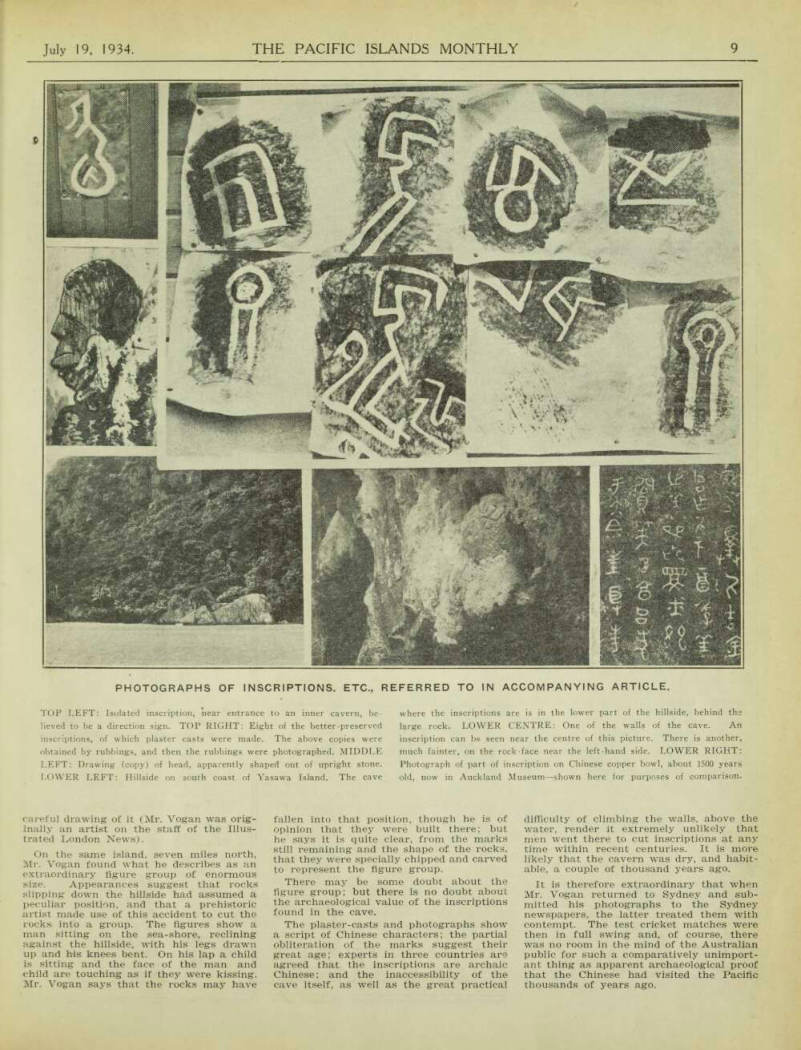
With remarkable patience and industry, Mr. Vogan succeeeded in obtaining a num ber of plaster casts and conveying them from the cave to his boat. He made “rub bings” of the inscriptions; and he also traced some of them with white paint and made photographs of them.
Mr. Vogan injured himself in the course of his work, and also contracted a Revere illness, which necessitated urgent medical attention in Suva. However, he did ac complish his purpose and he duly arrived in Sydney, at the end of June, with the plaster casts and photographs, which he immediately placed in the custody of the Nicholson Museum, University of Sydney.
Mr. Vogan found a good friend in Auck land in the person of Mr. G. Archey, cura tor of the famous Auckland Museum, and Mr. Archey gave him most valuable as sistance. Among other things Mr. Archey was able to supply Mr. Vogan with a photograph of an inscription in ancient Chinese script on the bottom of a copper vessel which is known to be 1500 years old. The vessel was looted from a collec tion in China during the Boxer rebellion 30 years ago. This inspection was of great value for purposes of comparison with the script found in Mr. Vogan’s cave.
The new photograph of the inscriptions in the Fijian cave have been submitted to experts in Australia and they appear to be unanimous in their view that the script undoubtedly is ancient Chinese. One well known Sydney savant, a retired medical man, who is noted for his knowledge of ancient and modern Chinese, is of opinion that the script is undoubtedly Chinese, of a period of at least 2000 years ago, and quite possibly dates back to the Hsiu dynasty (2600 B.C.).
Mr. Vogan’s discovery is likely to arouse much interest among people who have
made a study of Pacific prehistoric immi gration. The age and locality of the in scriptions clearly suggest that the Pacific.
Ocean was traversed by Chinese naviga tors before the dawn of the Christian era.
Mr. Vogan says that owing to the extra ordinary difficulties he had in reaching the inscriptions he could get photographs of only a comparatively few of them. But there are many scores of others in other caves—many perfect, but most of them more or less obliterated.
Within the cave also Mr. Vogan found a rock which was carved into the semb lance of a man’s head and in which the ancient sculptor had displayed skill and artistry. It was impossible, owing to the position, to photograph it, but he made a
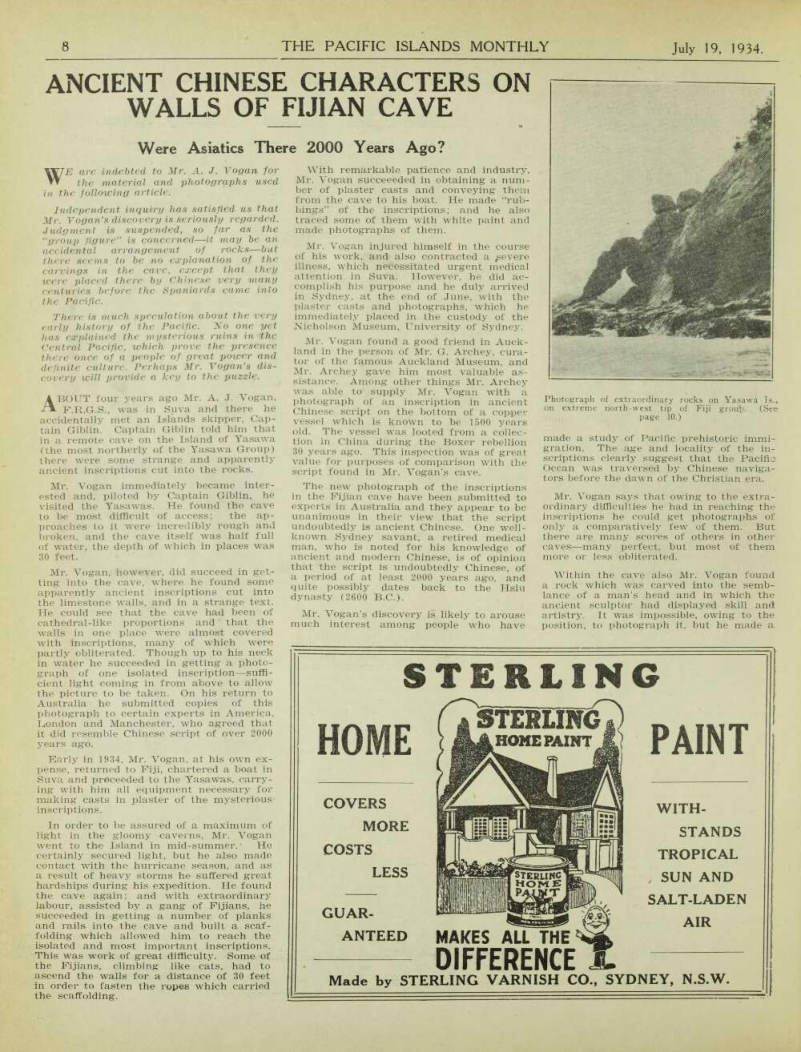
Photograph of extraordinary rocks on Yasawa Is., on extreme north-west tip of Fiji group. (See page 10.)
careful drawing of it (Mr. Vogan was orig inally an artist on the staff of the Illus trated London News).
On the same island, seven miles north, Mr. Vogan found what he describes as an extraordinary figure group of enormous size. Appearances suggest that rocks slipping down the hillside had assumed a peculiar position, and that a prehistoric artist made use of this accident to cut the rocks into a group. The figures show a man sitting on the sea-shore, reclining against the hillside, with his legs drawn up and his knees bent. On his lap a child is sitting and the face of the man and child are touching as if they were kissing.
Mr. Vogan says that the rocks may have
fallen into that position, though he is of opinion that they were built there; but he says it is quite clear, from the marks still remaining and the shape of the rocks, that they were specially chipped and carved to represent the figure group.
There may be some doubt about the figure group; but there is no doubt about the archaeological value of the inscriptions found in the cave.
The plaster-casts and photographs show a script of Chinese characters; the partial obliteration of the marks suggest their great age; experts in three countries are agreed that the inscriptions are archaic Chinese; and the inaccessibility of the cave itself, as well as the great practical
difficulty of climbing the walls, above the water, render it extremely unlikely that men went there to cut inscriptions at any time within recent centuries. It is more likely that the cavern was dry, and habit able, a couple of thousand years ago.
It is therefore extraordinary that when Mr. Vogan returned to Sydney and sub mitted his photographs to the Sydney newspapers, the latter treated them with contempt. The test cricket matches were then in full swing and, of course, there was no room in the mind of the Australian public for such a comparatively unimport ant thing as apparent archaeological proof that the Chinese had visited the Pacific thousands of years ago.
PHOTOGRAPHS OF INSCRIPTIONS. ETC., REFERRED TO IN ACCOMPANYING ARTICLE.
TOP LEFT; Isolated inscription, near entrance to an inner cavern, be lieved to be a direction sign. TOP RIGHT: Eight of the better-preserved inscriptions, of which plaster casts were made. The above copies were obtained by rubbings, and then the rubbings were photographed. MIDDLE LEFT; Drawing (copy) of head, apparently shaped out of upright stone.
LOWER LEFT: Hillside on south coast of Yasawa Island. The cave
where the inscriptions are is in the lower part of the hillside, behind the large rock. LOWER CENTRE: One of the walls of the cave. An inscription can be seen near the centre of this picture. There is another, much fainter, on the rock-face near the left-hand side. LOWER RIGHT: Photograph of part of inscription on Chinese copper bowl, about 1500 years old, now in Auckland Museum —shown here for purposes of comparison.