Administratorship Of New Guinea
Brigadier-General McNicoll Confidently Named
THE report that Brigadier-General Mc- Nicoll is to be appointed Administrator of the Mandated Territory of New Guinea in succession to General Griffiths is persistent in the Australian newspapers.
The latest statement, which has a semi official flavour, is that General McNicoil will be appointed Acting Administrator immediately to carry on during the re mainder of General Griffiths’s term and that he then will be appointed officially to the position.
In these circumstances, some details of the career of General McNicoll may be interesting. He is a Bachelor of Arts of Melbourne University and holds the notable decorations of Commander of the Order of the Bath, Commander of the Order of St.
Michael and St. George, the Distinguished Service Order, and the Victorian Decora tion —the three major decorations being awarded for outstanding war service.
Walter Ramsay McNicoll was born in Melbourne on May 27, 1877, and after graduating at the Melbourne University he became a junior teacher in the Vic torian Department of Education in 1892.
He went to the Teachers’ Training College, Melbourne, as a student in 1900; and, sud sequently, in 1905 was appointed a senior master at the Melbourne High School. He secured the important appointment of headmaster of the Geelong High School in 1911. Mr. McNicoll took a keen interest in military training and secured a commis sion; and immediately the war broke out he resigned his position and enlisted in the 7th Battalion, where as Major he was second in command. Shortly afterwards he was promoted Lieutenant-Colonel, and given the 6th Battalion, which he com manded during the famous landing at Anzac Cove on April 25, 1915. For his work as a battalion commander in 1915 he was awarded the D.S.O. He returned to Australia in 1915 and in February, 1916. was given command of the 10th Infantry Brigade as Brigadier-General; and in that capacity he took part in the battles at Messines, Zonnebeke, Passchendaele, and the Hindenburg Line. He was severely wounded at the Battle of Krithia (1915), and as a result of his war injuries he walks with a slight limp.
After the Armistice this distinguished soldier was appointed Director of Educa tion for the A.I.F., and he fulfilled very important duties in that capacity while the Australian troops were awaiting repatria tion. He originated and carried out, with credit and distinction, the Non-Military Employment Scheme, which required of him an enormous amount of detail work.
Back in Australia, Brigadier-General McNicoll returned to his profession and in February, 1921, he inaugurated the Pres byterian Ladies’ College at Goulburn, of which he remained principal until he en tered the Commonwealth Parliament as a country member representing Werriwa electorate in 1931. For 10 years he was a highly respected figure in Goulburn, and took a keen personal interest in public affairs, in music and in Freemasonry.
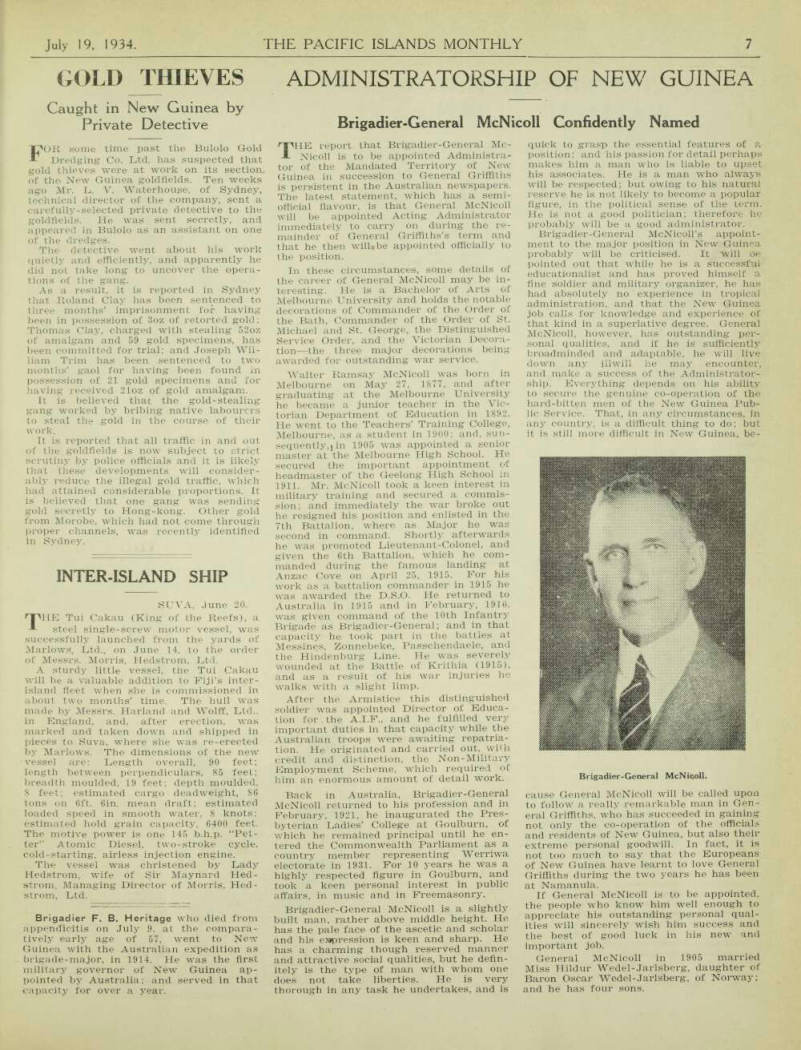
Brigadier-General McNicoll is a slightly built man, rather above middle height. He has the pale face of the ascetic and scholar and his expression is keen and sharp. He has a charming though reserved manner and attractive social qualities, but he defin itely is the type of man with whom one does not take liberties. He is very thorough in any task he undertakes, and is
quick to grasp the essential features of a position; and his passion for detail perhaps makes him a man who is liable to upset his associates. He is a man who always will be respected; but owing to his natural reserve he is not likely to become a popular figure, in the political sense of the term, He is not a good politician; therefore he probably will be a good administrator, Brigadier-General McNicoll’s appoint ment to the major position in New Guinea probably will be criticised. It will be pointed out that while he is a successful educationalist and has proved himself a fine soldier and military organizer, he has had absolutely no experience in tropical administration, and that the New Guinea job calls for knowledge and experience of that kind in a superlative degree. General McNicoll, however, has outstanding per sonal qualities, and if he is sufficiently broadminded and adaptable, he will live down any illwill he may encounter, and make a success of the Administrator ship. Everything depends on his ability to secure the genuine co-operation of the hard-bitten men of the New Guinea Pub lic Service. That, in any circumstances, in any country, is a difficult thing to do; but it is still more difficult in New Guinea, be-
cause General McNicoll will be called upon to follow a really remarkable man in Gen eral Griffiths, who has succeeded in gaining not only the co-operation of the officials and residents of New Guinea, but also their extreme personal goodwill. In fact, it is not too much to say that the Europeans of New Guinea have learnt to love General Griffiths during the two years he has been a t Namanula.
If General McNicoll is to be appointed, the people who know him well enough to appreciate his outstanding personal qualities will sincerely wish him success and the best of good luck in his new and important job.
General McNicoll in 1905 married Miss Hildur Wedel-Jarlsberg, daughter of Baron Oscar Wedel-Jarlsberg, of Norway; and he has four sons.
Brigadier-General McNicoil.