How Aeroplanes and Dredges Were Introduced
pp. 25-26 · Read in the full issue
Romance Of Bulolo Figures
THE fascinating story of the part taken in the development of the Morobe goldfield, New Guinea, by Bulolo Gold Dredging Ltd., and Guinea Airways, Ltd., was told by Mr. L. V. Waterhouse on November 22 in an illustrated lecture before the Institute of Engineers of Australia. Mr. Waterhouse is a director of both of the companies mentioned.
Some of the data provided by Mr.
Waterhouse has considerable historical value and should be placed on permanent record. The following is a summary of some of the principal facts which he placed before his keenly interested audience. 1908. —Presence of gold in New Guinea brought under the notice of the German Government. 1909. —Party of Australian miners granted a concession in the Huon Gulf. 1910-1913. —Various parties operating on the Waria River and gold finds reported on Markham and Ramu Rivers. 1921. —Gold discovered by W. Park on Koranga Creek, a tributary of the Bulolo. 1923. —About twenty miners working on and about Koranga Creek. 1926. —Messrs. Royal and Glasson discovered phenomenally rich gold at the head of Edie Creek, at elevation of 7,500 feet. 1926.—Guinea Gold, N.L., of Adelaide, formed on C. J. Levien’s instrumentality, to work Park’s leases on Koranga and test about 12 miles of the Bulolo River. 1928 (April).—Placer Development Ltd., took option from Guinea Gold N.L., and commenced drilling. 1929 (July).—Placer proved a dredging area of 1,100 acres, comprising 40 million cubic yards of payable ground. Construction of road or light railway to coast advocated —estimated cost £250,000. 1926-1927. —Native carriers sole means of transport—single journey from coast occupied six to eight days. 1926 (July).—Levien suggested to Guinea Gold directors that aeroplane was only solution of transport problem. 1927 (January).—Lt. Mustar and A. W.
Mullins, on behalf of Guinea Gold took D.H.37 from Sydney. “Nobby” Clarke visited goldfield and selected Lae and Wau aerodrome sites. 1927 (February).—Mustar and Mullins at Rabaul with D.H.37. They constructed temporary aerodrome at Matupi. Mustar visited Lae, where clearing of aerodrome commenced.
March 30, 1927.—Mustar flew D.H.37 from Rabaul to Lae, 540 miles, in 5 hours 20 minutes.
April 18, 1927. —Mustar flew from Lae to Wau aerodrome.
May, 1927. —Ray Parer arrived and commenced flying operations. 1927. —In its first six months, D.H.37 carried 80,0001b. of freight and 150 passengers.
December 1, 1927. —Guinea Airways.
Ltd., acquired air service from Guinea Gold N.L. 1928. —Guinea Airways purchased two W. 34 Junkers, the first of which was landed in Rabaul in March and flown to Lae.
April 18, 1928. —Mustar made first flight to Wau in W. 34 Junker. 1928. —Second W. 34 Junker flown from Melbourne to Lae, 3300 miles in six days. 1928. —Guinea Airways, Ltd., in nine months carried 367,0001b. of freight and 498 passengers. Carriage of this freight under old methods would have necessitated continuous employment and maintenance of 500 natives.
December 1, 1927, to October 30, 1933.
Freight carried by Guinea Airways, Ltd., 7000 tons: pasengers carried, including natives, 12,000; flights made, 9000; miles flown, 1,100,000. Before Guinea Airways, Ltd., was formed, the passenger rate from Lae to Wau was £33/6/8. Guinea Airways commenced with a rate of £25 in, £l5 out. Rates gradually reduced until fares are now £5 in, 30/- out; cargo rate, once 1/6 per lb., is now 4d per lb.
To-day there are 30 aerodromes and landing grounds in use by the New Guinea aerial services—four of them in Papua. Aeroplanes are assisting the administration patrols in penetrating the great areas of unexplored country which lie to the westward of the Morobe field.
Guinea Airways’ present fleet consists of one G. 31 Junker, pay load 58001b.; three W. 34 Junkers, pay load 18001b.; one F. 13 Junker, passenger machine; two Moths and one Fox Moth.
In addition, Guinea Airways operate two G. 31 Junker tri-motored machines, owned by Bulolo Gold Dredging Co., Ltd., for freight purposes. The first of these machines was placed in commission on March 31, 1931, and the second on May 4, 1931. They have carried, up to October 31, 1933, a total of over 14,000,0001b. of freight, have carried out 2607 flights, and flown 300,000 air miles. These aeroplanes have already carried in three dredges, each weighing 1200 tons, all of which are now in operation, and a fourth dredge is now being carried in.
No. 1 dredge commenced operation on March 21, 1932; No. 2 dredge on October 15, 1932; No. 3 dredge, November 7, 1933.
These dredges, up to November 15, 1933, had between them dug 7,700,000 yards of gravel and recovered 172,000 ounces of
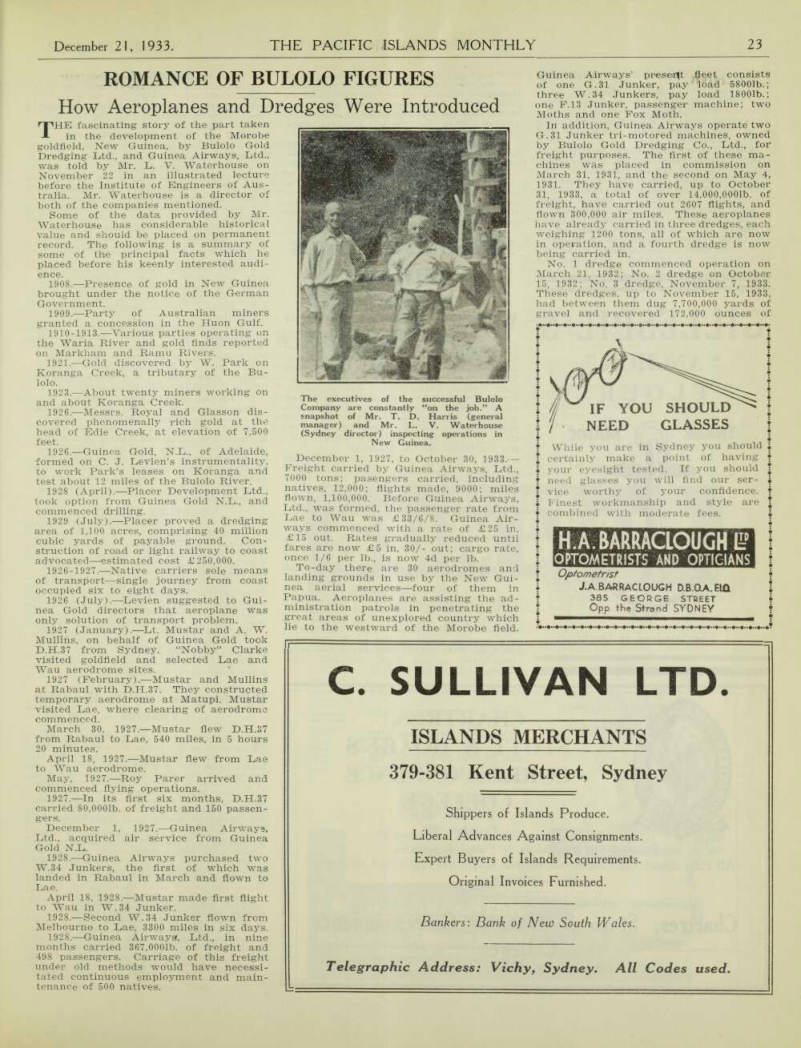
The executives of the successful Bulolo Company are constantly “on the job.” A snapshot of Mr. T. D. Harris (general manager) and Mr. L. V. Waterhouse (Sydney director) inspecting operations in New Guinea.
bullion, worth about £900,000, Australian currency.
The staff of Bulolo Gold Dredging Ltd. on October 31, 1933, included 220 Euro peans. Guinea Airways’ staff on the same date comprised 55 Europeans, including seven pilots and twenty mechanics and ground engineers.
During the last six years the two com panies represented by Mr. Waterhouse have established aerodromes at Lae, Bu lolo and various other places; have in troduced and operated a large fleet of large aeroplanes: have built at Lae a wharf, railway, loading cranes, etc.; have trans ported to Bulolo and erected three large dredges and constructed innumerable buildings, roads, bridges, etc., in connec tion therewith; have installed a hydroelectric plant of 3000 h.p.; have cut and
transported a million feet of timber for fluming, etc.; and have established minor transport services on the goldfield and at Lae, operated in connection with the aerial services. This has all been accom plished without any serious accident, mis hap, or delay.
Associated with Mr. Waterhouse during his lecture was Mr. H. G. Carter, con sulting electrical engineer, who superin tended the erection of the hydro-electric power plant at Bulolo. Mr. Carter, in a supplementary lecture, gave very inter esting particulars of the special prob lems met with in carrying out this work and how they were surmounted.