Romance Of The Crude
p. 24 · Read in the full issue
Oil Diesel Engine
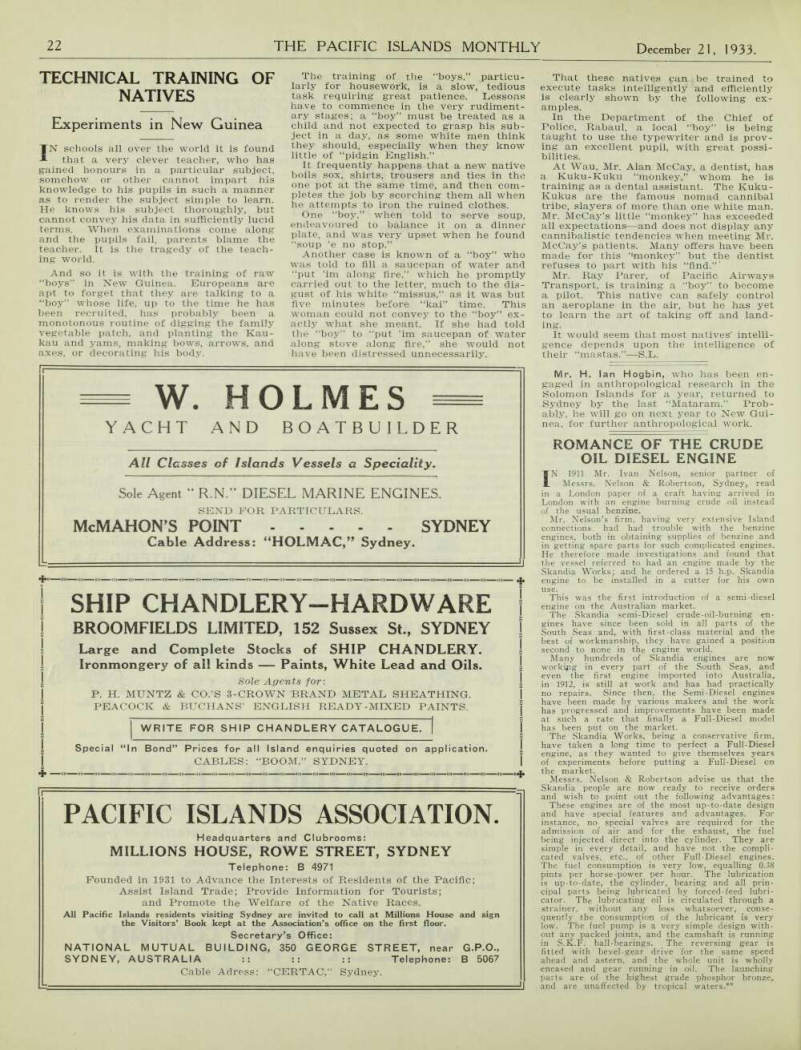
IN 1911 Mr. Ivan Nelson, senior partner of Messrs. Nelson & Robertson, Sydney, read in a London paper of a craft having arrived in London with an engine burning crude oil instead of the usual benzine.
Mr. Nelson’s firm, having very extensive Island connections, had had trouble with the benzine engines, both in obtaining supplies of benzine and in getting spare parts for such complicated engines.
He therefore made investigations and found that the vessel referred to had an engine made by the Skandia Works; and he ordered a 15 h.p. Skandia engine to be installed in a cutter for his own use.
This was the first introduction of a semi-diesel engine on the Australian market.
The Skandia semi-Diesel crude-oil-burning en gines have since been sold in all parts of the South Seas and, with first-class material and the best of workmanship, they have gained a position second to none in the engine world.
Many hundreds of Skandia engines are now working in every part of the South Seas, and even the first engine imported into Australia, in 1912, is still at work and has had practically no repairs. Since then, the Semi-Diesel engines have been made by various makers and the work has progressed and improvements have been made at such a rate that finally a Full-Diesel model has been put on the market.
The Skandia Works, being a conservative firm, have taken a long time to perfect a Full-Diesel engine, as they wanted to give themselves years of experiments before putting a Full-Diesel on the market.
Messrs. Nelson & Robertson advise us that the Skandia people are now ready to receive orders and wish to point out the following advantages: These engines are of the most up-to-date design and have special features and advantages. For instance, no special valves are required for the admission of air and for the exhaust, the fuel being injected direct into the cylinder. They are simple in every detail, and have not the compli cated valves, etc., of other Full-Diesel engines.
The fuel consumption is very low, equalling 0.38 pints per horse-power per hour. The lubrication is up-to-date, the cylinder, bearing and all prin cipal parts being lubricated by forced-feed lubri cator. The lubricating oil is circulated through a strainer, without any loss whatsoever, conse quently the consumption of the lubricant is very low. The fuel pump is a very simple design with out any packed joints, and the camshaft is running in S.K.F. ball-bearings. The reversing gear is fitted with bevel-gear drive for the same speed ahead and astern, and the whole unit is wholly encased and gear running in oil. The launching parts are of the highest grade phosphor bronze, and are unaffected by tropical waters.**