White Savages In The South Seas.
pp. 15-17 · Read in the full issue
Well-known Clergyman Discusses Larkin Case and Matters Relating Thereto.
The following article by Rev. Wm. H. MacFarlane, of Torres Strait Mission, Thursday Island, is a valuable contribution to this discussion of a thorny subject— the Larkin case, of New Guinea. James Larkin is undergoing ten years' penal servitude for murder because a recalcitrant native, whom he flogged brutally, died from his injuries. We have argued that Larkin should have been punished for manslaughter, not murder. Mr. MacFarlane, in reasoned, moderate language, presents another point of view.
THE writer of the letter “Civilisation Versus Savagery,” in your November issue, may have missed the point of your own previous article, as you say; but those of us whose lot has been cast among native people for many years and who know something of the working of the native mind can, I think, get Mr.
Vogan’s viewpoint, which itself is ad mittedly the result of trained observa tion and experience. He points out that it is the clash of the brown and the white “savage” that causes so much trouble; and this is true.
One has seen Europeans who in a white community behave with some de gree of restraint, but let themselves go when they get into a black man’s coun try, acting on the principle that they can do absolutely as they please with both the native’s family and his posses sions.
This is usually the “put-the-boot-into him” type of man who refers disdain fully to any coloured person whatsoever as a “nigger” (generally with adjectival emphasis!), irrespective of whether he may be a cultured Chinese gentleman or a well-bred member of some other col oured race; and who imagines that loud talk and an expression of contemptuous superiority is the only way to uphold the “prestige of the white man”. Lack ing the disciplined mind of the gentle man, as Mr. Vogan says, lightly-shackled savagery springs forth at the slightest provocation.
And the native—even the so-called “nigger” of New Guinea or the Islands — is quick to detect the difference be tween what he calls “proper white man” and “no-good white man”. He may lis ten with some show of outward respect to the latter, because the native himself is usually endowed with politeness, but the thoughts of his mind would be a re velation often could they be expressed to the “superior” one; and I have often smiled when I have (later) heard native opinion on some arrogant white who thought that he had “put it over” them by adopting an attitude of mingled bul lying, blustering, and patronising con tempt. And when there is added to this the lack of self-control which results in the man of superior race displaying himself (or herself, too, for that mat ter!), before the native or coloured people with his sense befuddled, and in other ways acting more degradingly than the savage himself, it makes one ashamed for his own kind, even although he has to make excuse for the good name of his fellow-countryman.
I recollect the ridicule and contempt shown on one occasion by a group of Japanese to whom a person of responsible position had given displays of unfitting behaviour. I take it that Mr. Vogan has known many cases of this kind also, and that he is indicating that in some way or other there comes a reaction on the part of the native, especially when there is physical violence. Human tol eration has its limits.
Of the Larkin case, I know nothing other than what I have read in “Han sard”, and in the “P.I.M.”, together with some observations made the other day by a New Guinea plantation owner of considerable experience, with a reputa tion for handling native labour well, who, discussing the case with me, thor oughly agreed with the sentence of the Court. Personally, however, I think that this is another instance where treatment by a mental specialist is indicated.
It takes very little to throw the mind temporarily off its balance; and a man
(especially if he happens to be of highly strung temperament) who comes to the tropics and encounters all those little, petty irritations that occur when deal ing with a primitive people whose ways are not ours, unless he possesses the “disciplined mind’’ and exercises the vir tue of self-restraint, finds himself in a condition when impulse is very easily stirred in the wrong direction. If he has infrequent contact with other Euro peans, lacks white companionship, and neglects to maintain a broad outlook upon the outer world by wide and judi cious reading, self-centredness develops into a spirit of blatant despotism, which may manifest itself even in relationship with fellow-whites; and the natives with whom he comes into daily contact and who are under his authority (whether he be an official, or a business man trying to wrest a living out of the coun try, or anyone else) become to him something less than human beings.
Obsessed with all sorts of weird ideas, and influenced also possibly by mental depression which malarial attacks do not help to dissipate, his mind concen trates upon minor grievances and imag inary slights, and he is ready to fly off
at the smallest provocation, so that an unfortunate native who happens to cross him may suddenly become the object of an abhorrent and fierce hatred upon whom he vents his suppressed passion.
One has known men display an almost murderous mood where, under other conditions, they would have simply laughed at the cause of their irritabil ity; and one has known cases where tragedy has developed apparently with out warning, due to what is usually termed “mental derangement”, although frequently it would be found that a fur tive cunning has foreshadowed some act of excessive cruelty.
There are some natures which find ex ceeding gratification in watching the sufferings of others, as witness cases of animal —and child —torture, even in civil ised communities; excessive flogging of a child in school arises from this where it is not purely the action of an un tempered mind carried away by blind passion.
In the case which has given rise to discussion, it would seem that (accord ing to evidence), while the accused man had been convicted on previous occa sions for ill-treating natives there had not before been the display of callous brutality which brought about the na tive’s death, after hours of flogging; on those occasions he had no doubt served out what he considered suitable physi cal punishment. But now, brooding upon his own ruffled dignity and loss of pres tige, after his temper has, to a certain extent subsided, he forces his mind into a state of cold, calculating determina tion, which is upon the same plane as that of a man planning a murder or other crime in which human life is in volved. Whether the right treatment for such cases is penal servitude, or con finement in an institution under the care of a medical mind-analyst, seems yet to be determined. But it is well known that after the war it was found necessary to set up special bodies of men trained in assisting to alleviate the mental and physical disorders of other humans, for the special purpose of deal ing with those distressing cases where men (often the most affectionate and domestic family men when normal) had developed a state of mind which might produce an awful tragedy, due to vari ous causes.
This is perhaps hardly the place to enter upon the religious or spiritual re lationship to mind-sickness and its treat ment, or to suggest that “demoniacal possession” is not so mediaeval as it sounds! But medical science, as af firmed only recently in the English press, inclines strongly in the direction of treatment for crime in special men tal hospitals instead of gaoling the people concerned, preferring to treat the thing as a disease to be diagnosed and
remedied, rather than as something only to be dealt with by a felon’s cell.
Again, just how finely and exactly one may discriminate between murder and manslaughter seems a difficult thing.
Deliberate torture, ultimately resulting in the death of the victim, would surely seem to constitute murder. In Christian ethics it is so considered, if the ele ments of hatred and revenge are there, and the Judge would seem to have acted rightly in not placing the present case in the category of manslaughter. And, of course, it is naturally expected that consideration would be given to the higher apprehension of the moral code which a civilised man should have.
In the earlier days of Torres Strait for instance, when life was less re strained, the official records narrate in stances of European ship’s officers “en couraging” their coloured swim-divers by firing at them in the water with re volvers, or killing a boy off-hand for some trivial offence; or “potting” inof fensive natives who were reluctant to hand over their womenfolk; and so on.
But, although the white participants considered this merely “good sport”, the
official mind thought otherwise, and one result was the sending of H.M.S. “Basil isk” to suppress such excesses.
That there should be corporal punish ment for certain offences by natives one agrees. But the question of who is to be allowed to administer it is another matter. It has been one’s happiness, over a good many years of life amongst na tive peoples, to have intimate contact in terms of fullest friendship with many extremely high-principled and fair minded men —gentlemen of disciplined mind —both amongst official and busi ness classes; but, unfortunately, there have also been those (certainly not a great number) whose mental and moral calibre made them unfitted to possess authority over even a mongrel dog.
One man complained bitterly on one occasion because he was not allowed to flog natives indiscriminately; and further, declared that “when he was living in South Africa a bullet was the thing to put the fear of God into a nigger’s heart, and that was what he would do here,” etc. It is this kind of man, animal minded and of the gun and whisky bottle type, that I fancy Mr. Vogan has in mind; and it is hardly correct to say that he no longer exists. To allow such men to exercise the triple functions of accuser, judge, and executioner would bring about that undesirable state of things generally vaguely defined as “native unrest”.
Even in our own European schools, the administering of corporal punish ment is usually reserved to the head master; and experience shows that with the native people it is essentially neces sary that powers of correction should be carefully delegated. Fair treatment, the native appreciates; just punishment, properly administered, he also under stands; but unfair handling by irrespon
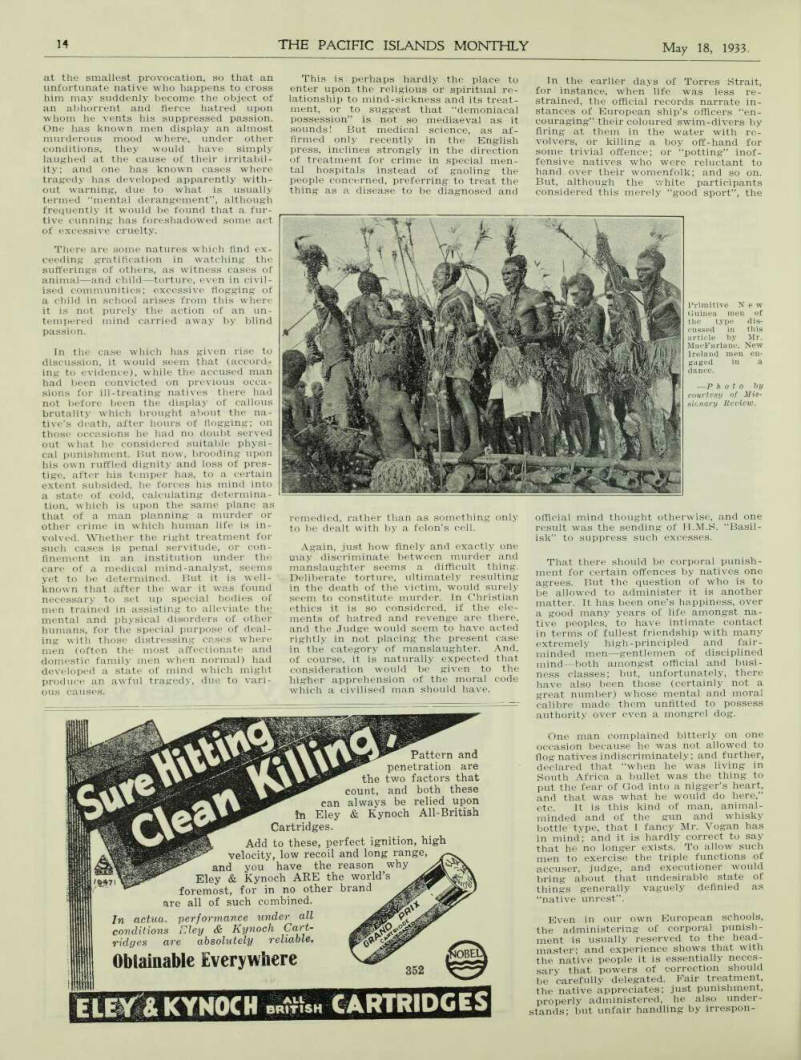
Primitive New Guinea men of the type dis cussed in this article by Mr.
MacFarlane. New Ireland men en gaged in a dance. —Photo by courtesy of Mis sionary Review.
sible men and the notion that he is an other man’s chattel, to be treated with less consideration than a dog, arouses in him fires of bitter resentment.
This is one of the reasons why not only officials but everyone else who goes to a black man’s country to live should make a point of informing him self of the other man’s outlook on life and his customs (and lest I be accused of bias, may I say that this applies to missionaries as well as others!). It helps to correct that attitude of arrogant superiority, conscious or otherwise, that is often responsible for so much trouble, and which does anything but raise the white man’s prestige.
And, of course, it is hardly necessary to add that the old saw about not leav ing one’s own best manners at home also applies, not only to permanent and temporary residents but also to visiting tourists as well!