Food Culture In Torres Strait.
p. 14 · Read in the full issue
Written for “The Pacific Islands Monthly” by “C. Coral.”
THERE are a number of islands in the Torres Strait group, of which about twenty are inhabited: but they vary considerably in fertility.
Some are mere sandbanks, others covered with granite boulders, and, others again, in the Eastern group, are hilly and of volcanic origin. It is the latter which are the most fertile, al though the islands immediately adja cent to New Guinea also stand well in food production.
It is interesting to notice, however, the distribution of native foods and their origin. The mythical culture hero of the Strait is Soida, who in legend is described as having come from New Guinea; but there are also others, such as Abob and Kos, who came from somewhere to the eastward bringing with them new culture, arts, and language. To some of the islands Soida brought the first coconuts.
Most of the islands had their tobacco gardens. Where the weed came from is a mystery, as the first European visitors found it being cultivated in carefully-protected gardens, and it figures in legend and song as an in digenous product.
Bananas grow well in the Eastern and Western islands, but only poorly in the central group, which is of the sandbank type. Soida brought certain species of these, but in more modern days the finer flavored Cavendish banana (called also the China banana), which grows on a hardy plant, found its way to Torres Strait per medium of the L.M.S. missionaries from Samoa, who in turn received it (only one plant being preserved) from Eng land. It was also the same mission aries who brought plants of the best varieties of kumalla, or sweet potato; and on one island at least the reward
for Sunday Church attendance on the part of the inhabitants was a meal of the newly-introduced vegetable!
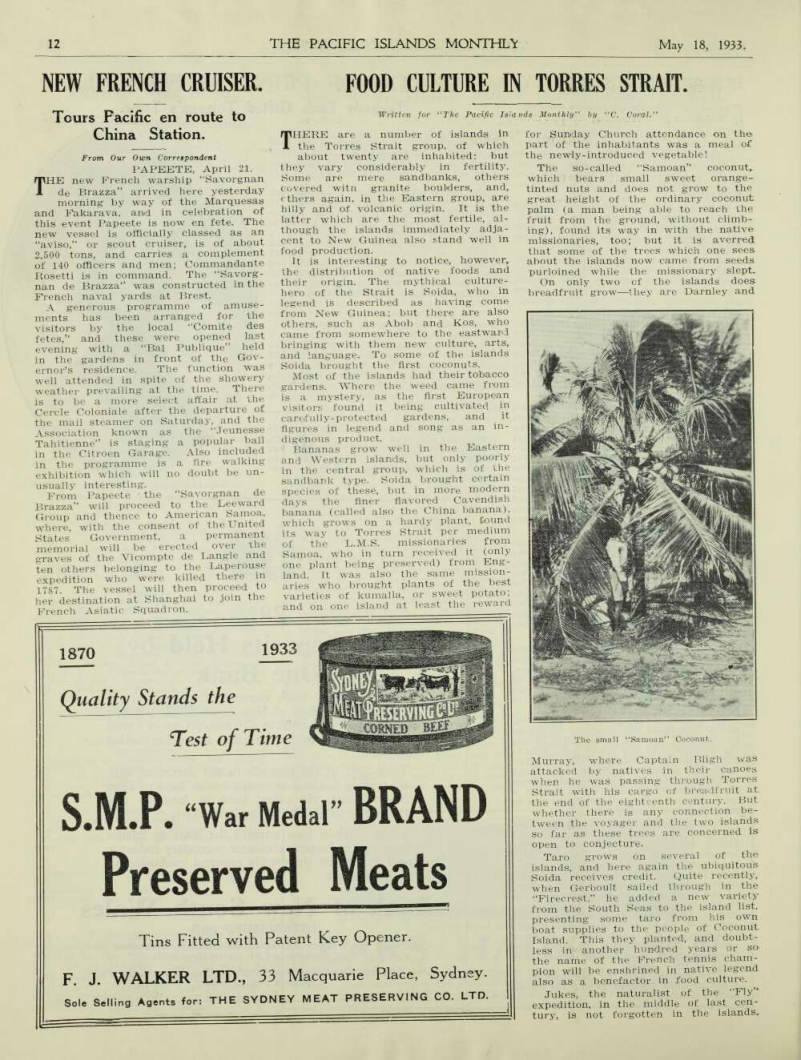
The so-called “Samoan” coconut, which bears small sweet orange tinted nuts and does not grow to the great height of the ordinary coconut palm (a man being able to reach the fruit from the ground, without climb ing), found its way in with the native missionaries, too; but it is averred that some of the trees which one sees about the islands now came from seeds purloined while the missionary slept.
On only two of the islands does breadfruit grow—they are Darnley and
Murray, where Captain Bligh was attacked by natives in their canoes when he was passing through Torres Strait with his cargo of breadfruit at the end of the eighteenth century. But whether there is any connection be tween the voyager and the two islands so far as these trees are concerned is open to conjecture.
Taro grows on several of the islands, and here again the ubiquitous Soida receives credit. Quite recently, when Gerboult sailed through in the “Firecrest,” he added a new variety from the South Seas to the island list, presenting some taro from his own boat supplies to the people of Coconut Island. This they planted, and doubt less in another hundred years or so the name of the French tennis cham pion will be enshrined in native legend also as a benefactor in food culture.
Jukes, the naturalist of the “Fly" expedition, in the middle of last cen tury, is not forgotten in the islands.
The small “Samoan” Coconut.