Anzac Day On A Torres Strait Island.
pp. 7-8 · Read in the full issue
(From a Special Correspondent.)
THE Native Priest announced that the Anzac Day Service would be held immediately after breakfast.
Hurriedly, we cooked; our morning meal and broke our fast, washed up the gear, tidied our bachelor quarters, and changed into our Scout uniform.
As my friend stated, “It would never do to keep the natives waiting. As Europeans, we should always set them a good example, even in punctuality.”
It was 9.30 a.m. before we were ready and hastily set out for the church. Not a soul was in sight—we were too late, the church was empty. We found a
boy, and enquired how long the proces sion had gone and wondered if we could catch up with it.
Great was our relief when the boy calmly stated, “People he no bin come yet; he breakfast now.”
We decided to return to our humpy and yarn and smoke for a while. At 10.30 a.m. we made another journey to the church. Not a sign of life about the place. Had the service and pro gramme for the day been abandoned?
“What is that red thing under the tree?” I enquired.
“Why, it is the Head Councillor!” exclaimed my friend.
And, sure enough, it was. Curled up like a ’possum was the Head Coun cillor, calmly snoring the morning hours away, his nose well hidden in the folds of his red jersey.
A prod with the toe soon animated the comatose heap.
“Where are the people, Noah?”
“People he breakfast now,” was the calm reply as he settled himself for another snooze.
We decided to go for a walk and returned at 11.45 a.m.
The people had arrived. Vivid coloured calicos and dresses flashed in the sun. The place was a blaze of colour. The natives were just marching into church, pre sumably singing that famous hymn— “Bring your Harps and Odours with You.”
Noting the large crowd and being fresh-air enthusiasts, we thought that the “Odours” of the crowd of natives
might be too strong for our constitu tions. We therefore decided to smoke and rest in the shade until the conclu sion of the somewhat lengthy service.
The programme for the day read: “Anzac Day Service; procession to the cemetery; dance to follow.”
Immediately after the service the pro cession formed up outside the church.
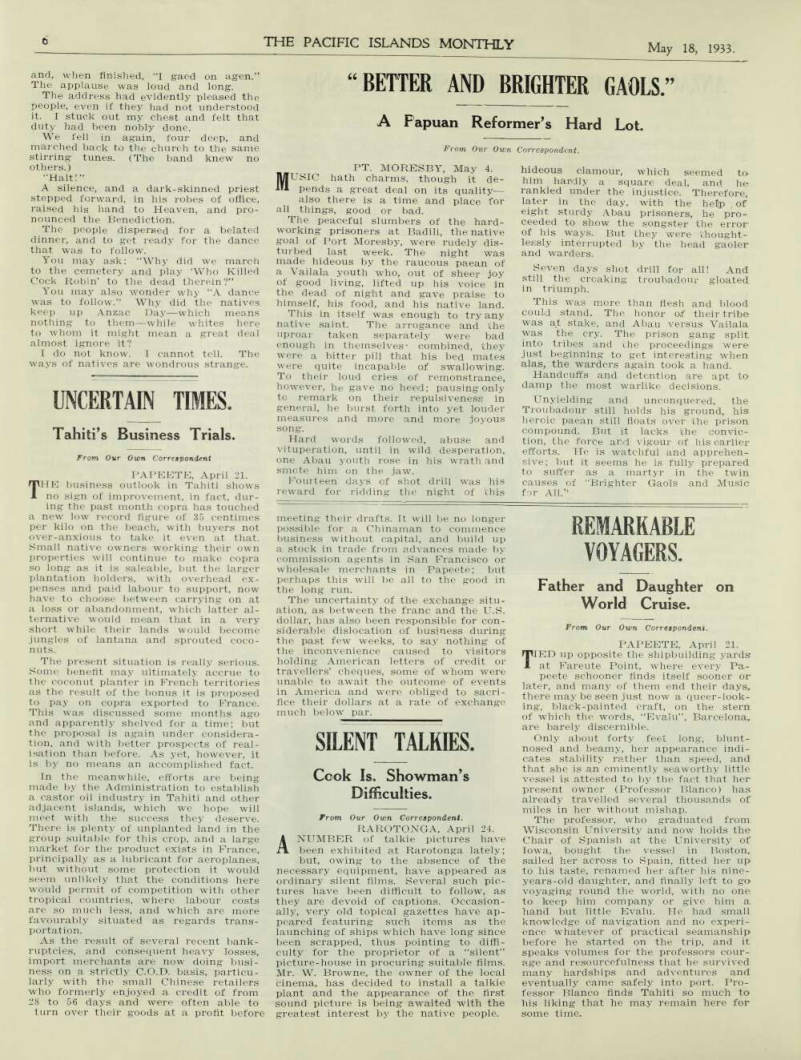
Union Jacks to the fore, borne by sturdy native police, dressed in orthodox khaki, with cocked hats. They were closely followed by the councillors in red jer seys, white pants and wide-brimmed sun hats. Then came the Darnley Island
Drum and Fife Band, 60 Scouts and 30 Girl Guides. Native priests and church officials, crucifixes, crosses and fleur-de lys. The whole civilian population, and a tribe of piccaninnies and dogs brought up the rear.
It was an imposing sight. Black faces shining in the sun, hair glistening with liberal applications of coconut oil, rain
bow colours blending into a joyous whole.
A blast on a whistle, a roll of drums and we were off, stepping out smartly to the tune of “Michael Finnegan.”
While the band regained their wind, the people marched singing “Onward Christian Soldiers,” followed by the band with “Who Killed Cock Robin?’’
“Should Auld Acquaintance be Forgot?” and “Keep the Home Fires Burning.”
Whenever the band ceased playing, more “Christian Soldiers” came from the enthusiastic followers. Thus joy ously we marched to our destination.
On arrival at the cemetery, the band was instructed by the native priest to take up a position in the centre and keep playing. As the band struck up with renewed energy the cortege divided off in files of two deep, each file march ing round the boundaries of the ceme tery, meeting on the opposite side in the middle and marching to the centre m fours.
It was great! Drums rolled and crashed. Fifes wailed and shrieked.
The dead turned over in their graves and spooks grew frisky when they heard the noble strains of "Who Killed Cock Robin?” and “Keep the Home Fires Burning."
I wonder what some of the old dead and buried savages would have said it they could have been gifted with speech? It was the first time a band had been on Murray Island. They were doing their best, but had only learned a few tunes, and none that were ap propriate for playing in a cemetery.
A hymn was sung and the priest granted me the honour of making the Anzac Day Speech. What should I say?
What should I do? These natives knew nothing of war—of Anzac. They would not know the difference between a bomb and a pontoon. None of their race had enlisted, and many of them could not understand English. They might think that Dardanelles was the name of a General and that a Turk was a species of fowl!
I was flabbergasted at the possibili ties that flashed through my mind and completely forgot the points of the speech I had intended to make. I did my best to make amends, like the old Scots Minister, “I gaed on and gaed on,”
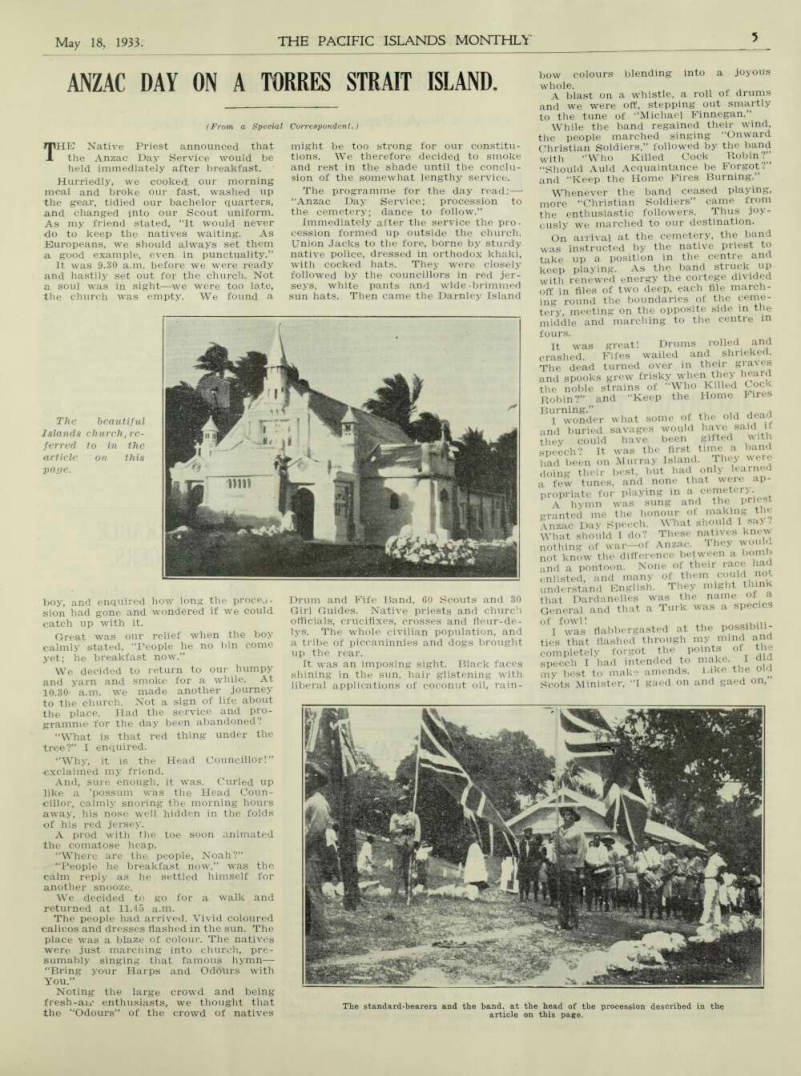
The beautiful Islands church, re ferred to in the article on this page.
The standard-bearers and the band, at the head of the procession described in the article on this page.
and, when finished, “I gaed on agen.”
The applause was loud and long.
The address had evidently pleased the people, even if they had not understood it. I stuck out my chest and felt that duty had been nobly done.
We fell in again, four deep, and marched back to the church to the same stirring tunes. (The band knew no others.) “Halt!”
A silence, and a dark-skinned priest stepped forward, in his robes of office, raised his hand to Heaven, and pro nounced the Benediction.
The people dispersed for a belated dinner, and to get ready for the dance that was to follow.
You may ask; “Why did we march to the cemetery and play "Who Killed Cock Robin" to the dead therein?”
You may also wonder why “A dance was to follow.” Why did the natives keep up Anzac Day—which means nothing to them—while whites here to whom it might mean a great deal almost ignore it?
I do not know. I cannot tell. The ways of natives are wondrous strange.