Celebrates Its Golden Jubilee.
pp. 14-16 · Read in the full issue
Rabaul Catholic Mission
ON September 29, 1932, there will be celebrated the Golden Jubilee of the landing of the first Mission aries of the Sacred Heart at Matupit, New Guinea, in the year 1882.
The Society of Missionaries of the Sacred Heart —a term which specifies, in English-speaking Catholic circles, an organised body of men who freely devote their lives to missionary work —has its own special organisation within the Catholic Church.
In the Mandated Territory of New Guinea, we find three distinct units working as Catholic Missions: The Marist Mission in the Solomon Islands, the Divine Word Society on the main land, and the Missionaries of the Sacred Heart. This last named mis sion has for its field of labour New Britain, New Ireland, the Admiralty Group, and numerous other adjacent islands. This field is designated as the Vicariate of Rabaul.
The headquarters of the Missionaries of the Sacred Heart, in the Vicariate of Rabaul, are at Vunapope, near Kokopo, in New Britain. The head of this particular mission, whose Golden Jubilee falls this year, is the Right Reverend Dr. Vesters, whose official residence is in Vunapope. He has for his helpers a large staff of highly trained and devoted priests, brothers and sisters, comprising 12 nationalities in all, and he is able to speak to each member of this body in his or her own national language—which means that His Lordship speaks all the im portant West-European languages.
One will always find well-meaning men who cannot see the good of mis sions amongst uncivilised races. His Excellency Sir Hubert Murray, a man whose intellectual training runs on high classical lines, and who has had wide-reaching experience as Lieuten ant-Governor of Papua, sets the matter in a light which could not be improved upon. Says His Excellency: “The civilising influence which the mere pre sence of a missionary has upon the native popu lation, and the fact that all the native schools in Papua are conducted by missionaries, to gether with the devoted assistance which the missions have given in combating the epidemics with which the territory has been visited, con stitute, in my opinion, a sufficient answer to the contention that the missionaries have done no good.
“But, upon broader grounds, I think not only that the missions do good, but that they are absolutely necessary to the development of backward races. An uncivilised people who come into contact with Europeans will inevit ably be led sooner or later, to abandon their old customs and beliefs, many of which are admirable, and which have served as a guide for generations of men and women in the past, and when these are gone the ‘native’ (as we call him) is lost, unless some one is there to put some form of religious teaching in their place.
“The Government obviously cannot do this, and it is not likely that the majority of set tlers will, and, unless the missionary is there to help him, the native is left like a ship without a rudder, and will run a great risk of being wrecked in the sea of an alien civil isation.
“This is one reason why I think that mis sions' are necessary. Another is that Chris tiaflity is an integral part of our civilisation, and when we are imposing that civilisation upon a people who would perhaps much sooner be without it, we should at least impose it in its entirety, and not leave out what many per sons would consider the best part. This again cannot be done without missionary teaching.” ( “British New Guinea,” by J. H. P. Murray, Lieut.-Gov., 1912, P 8-9.) The foundation of the Catholic Mis sion, as it is to-day constituted in the Vicariate of Rabaul, was due to the projected new colony of “Nouvelle France” by the Marquis de Ray. This adventurer set out to found a colony in New Ireland, and asked for some Catholic priests as chaplains. The first three missionaries who left France for this object, when they ar rived at Manila, heard that de Ray’s “white elephant” had expired, and that the projected new colony was abandoned. The missionaries, how ever, decided to continue their journey and devote their lives to mission work amongst the cannibals of the country.
They landed at Matupit on September 29, 1882, after thirteen months spent on the way from Europe.
The mission work for the first seven or eight years was not crowned with much success. It was not until the late Archbishop Couppe sailed from Europe, after his consecration as Bishop, that the mission began to cast off its swaddling clothes and advance towards its present prosperity.
Not, however, without affliction and tribulation was the advance made. In 1904, ten of the devoted missionaries— two priests, three brothers, and five sisters —were massacred in the Raining
district. This cruel event, so disas trous seemingly, helped to fire ardent young hearts in various countries of Europe with a burning zeal to replace those who were killed, and to continue the work.
In the year 1889, the late Archbishop Couppe was transferred from Papua to New Britain, to take charge of the mission. After one year, he was ap pointed Bishop, and he returned to Europe for his consecration. When he came back to New Britain, he brought with him some of the missionaries who are still labouring in the Vicariate — for instance, Father Bley, who is well known and highly esteemed in the Territory.
Of the late Archbishop Couppe, who retired towards the end of his life, and died in Australia in 1926, it may be interesting to quote what the former Military Administrator, Brigadier-Gen eral Johnston, said to him one day (the quotation is from memory): “Your Lordship, I must say you are a won derful man. I cannot understand whatever led you to join the Church, for you are a man of great organising ability. If you had entered any civil profession instead, you would have risen to the top of it. There is no profession that I know of which you would not have mastered and become a leader in it.”
There are at present 37,000 Catholics in the Vicariate. The mission staff consists of 165 members priests, brothers and sisters the Bishop, of course, directing all. The Mission has built hundreds of churches and schools, one college for native cate chists, 10 orphanages for girls, two schools for training girls in domestic affairs, and one industrial school. Be sides the white staff, there are 393 native catechists and 52 native sisters. No payment is received by the members of the white mission staff; the work is done freely and generously, with no hope of monetary reward in this life.
All idealists, perhaps, but none the less happy ones. And what more than happiness can life give any man!
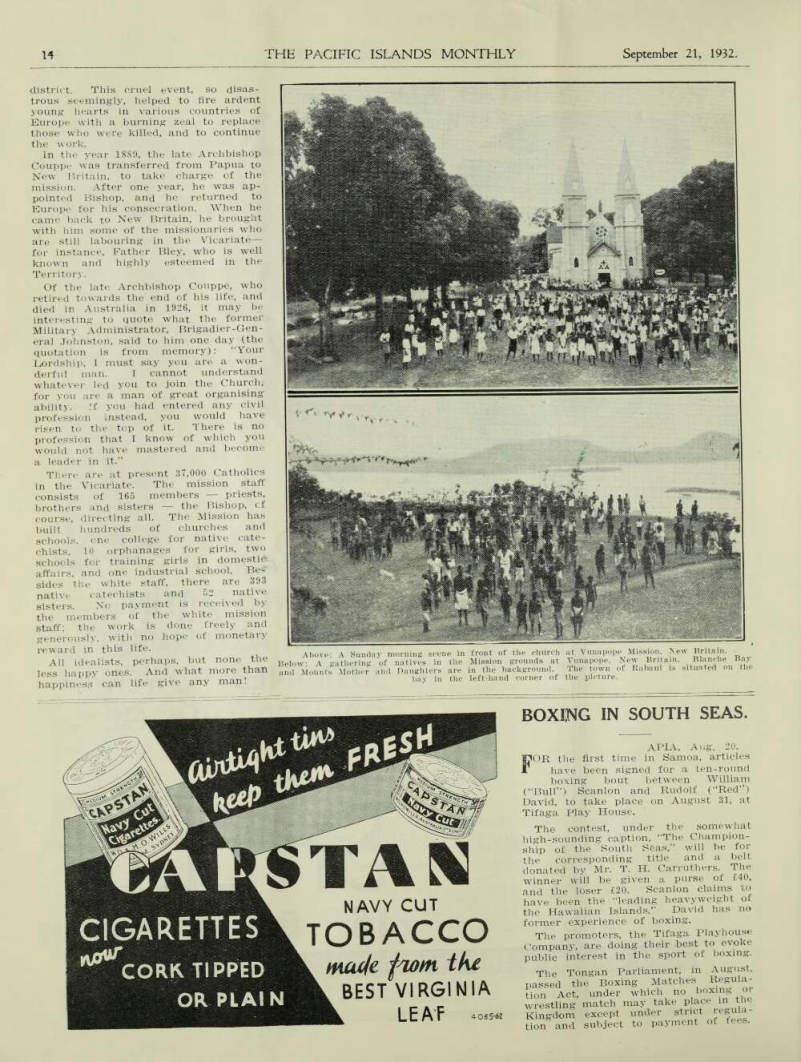
Above: A Sunday morning scene in front of the church at Vunapope Mission, New Britain.
Below: A gathering of natives in the Mission grounds at Vunapope, New Britain. Blanche Bay and Mounts Mother and Daughters are in the background. The town of Rabaul is situated on the bay in the left-hand corner of the picture.