The Rival Claims Of Salamaua And Lae
pp. 11-14 · Read in the full issue
To Be Port Of N.G. Goldfields.
By R. W. Robson.
A CLOSE personal examination of the position of the port of Salamaua in relation to the Goldfields trans port system, and the question of erosion along the sand spit on which Salamaua is built, has convinced me that, if a shelter is necessary, there is no alternative to Salamaua; and that one of the three available routes —the Markham Valley, the Buangs, and Sheldon’s track —must be even tually used in order to build a road from the coast to the Goldfields.
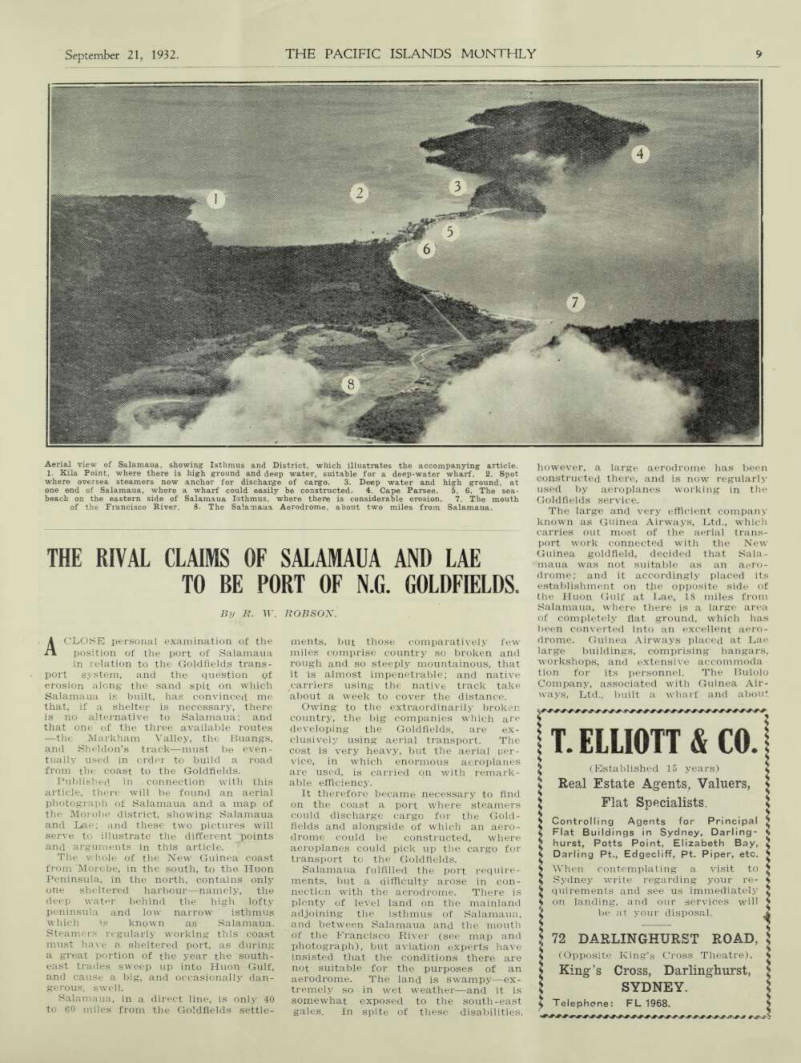
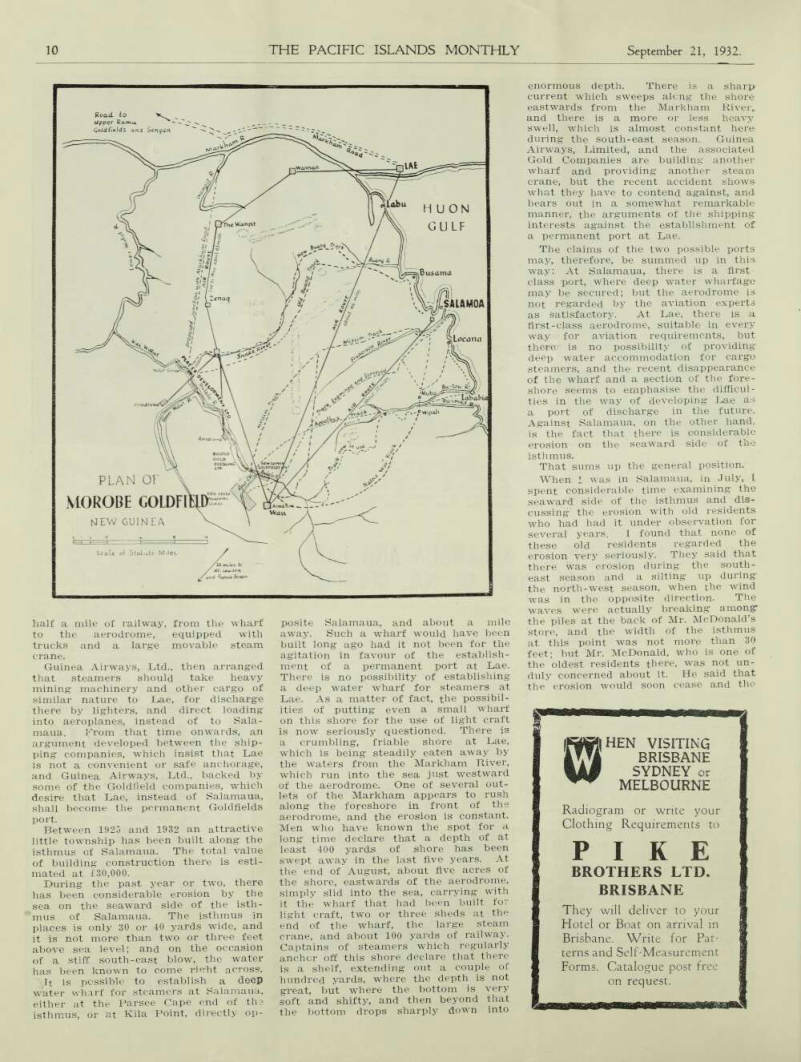
Published in connection with this article, there will be found an aerial photograph of Salamaua and a map of the Morobe district, showing Salamaua and Lae; and these two pictures will serve to illustrate the different points and arguments in this article.
The whole of the New Guinea coast from Morobe, in the south, to the Huon Peninsula, in the north, contains only one sheltered harbour —namely, the deep water behind the high lofty peninsula and low narrow isthmus which is known as Salamaua.
Steamers regularly working this coast must have a sheltered port, as during a great portion of the year the south east trades sweep up into Huon Gulf, and cause a big, and occasionally dan gerous, swell.
Salamaua, in a direct line, is only 40 to 60 miles from the Goldfields settle
merits, but those comparatively few miles comprise country so broken and rough and so steeply mountainous, that it is almost impenetrable; and native carriers using the native track take about a week to cover the distance.
Owing to the extraordinarily broken country, the big companies which are developing the Goldfields, are ex clusively using aerial transport. The cost is very heavy, but the aerial ser vice, in which enormous aeroplanes are used, is carried on with remark able efficiency.
It therefore became necessary to find on the coast a port where steamers could discharge cargo for the Gold fields and alongside of which an aero drome could be constructed, where aeroplanes could pick up the cargo for transport to the Goldfields.
Salamaua fulfilled the port require ments, but a difficulty arose in con nection with the aerodrome. There is plenty of level land on the mainland adjoining the isthmus of Salamaua, and between Salamaua and the mouth of the Francisco River (see map and photograph), but aviation experts have insisted that the conditions there are not suitable for the purposes of an aerodrome. The land is swampy—ex tremely so in wet weather —and it is somewhat exposed to the south-east gales. In spite of these disabilities,
however, a large aerodrome has been constructed there, and is now regularly used by aeroplanes working in the Goldfields service.
The large and very efficient company known as Guinea Airways, Ltd., which carries out most of the aerial trans port work connected with the New Guinea goldfield, decided that Sala maua was not suitable as an aero drome; and it accordingly placed its establishment on the opposite side of the Huon Gulf at Lae, 18 miles from Salamaua, where there is a large area of completely flat ground, which has been converted into an excellent aero drome. Guinea Airways placed at Lae large buildings, comprising hangars, workshops, and extensive accommoda tion for its personnel. The Bulolo Company, associated with Guinea Air ways, Ltd., built a wharf and about
Aerial view of Salamaua, showing Isthmus and District, which illustrates the accompanying article. 1. Kila Point, where there is high ground and deep water, suitable for a deep-water wharf. 2. Spot where oversea steamers now anchor for discharge of cargo. 3. Deep water and high ground, at one end of Salamaua, where a wharf could easily be constructed. 4. Cape Parsee. 5, 6. The sea beach on the eastern side of Salamaua Isthmus, where there is considerable erosion, 7. The mouth of the Francisco River. 8. The Salamaua Aerodrome, about two miles from Salamaua.
half a mile of railway, from the wharf to the aerodrome, equipped with trucks and a large movable steam crane.
Guinea Airways, Ltd., then arranged that steamers should take heavy mining machinery and other cargo of similar nature to Lae, for discharge there by lighters, and direct loading into aeroplanes, instead of to Sala maua. From that time onwards, an argument developed between the ship ping companies, which insist that Lae is not a convenient or safe anchorage, and Guinea Airways, Ltd., backed by some of the Goldfield companies, which desire that Lae, instead of Salamaua, shall become the permanent Goldfields port.
Between 1925 and 1932 an attractive little township has been built along the isthmus of Salamaua. The total value of building construction there is esti mated at £30,000.
During the past year or two, there has been considerable erosion by the sea on the seaward side of the isth mus of Salamaua. The isthmus in places is only 30 or 40 yards wide, and it is not more than two or three feet above sea level; and on the occasion of a stiff south-east blow, the water has been known to come right across.
It is possible to establish a deep water wharf for steamers at Salamaua, either at the Parsee Cape end of the isthmus, or at Kila Point, directly op
posite Salamaua, and about a mile away. Such a wharf would have been built long ago had it not been for the agitation in favour of the establish ment of a permanent port at Lae.
There is no possibility of establishing a deep water wharf for steamers at Lae. As a matter of fact, the possibil ities of putting even a small wharf on this shore for the use of light craft is now seriously questioned. There is a crumbling, friable shore at Lae, which is being steadily eaten away by the waters from the Markham River, which run into the sea just westward of the aerodrome. One of several out lets of the Markham appears to rush along the foreshore in front of the aerodrome, and the erosion is constant.
Men who have known the spot for a long time declare that a depth of at least 400 yards of shore has been swept away in the last five years. At the end of August, about five acres of the shore, eastwards of the aerodrome, simply slid into the sea, carrying with it the wharf that had been built for light craft, two or three sheds at the end of the wharf, the large steam crane, and about 100 yards of railway.
Captains of steamers which regularly anchor off this shore declare that there is a shelf, extending out a couple of hundred yards, where the depth is not great, but where the bottom is very soft and shifty, and then beyond that the bottom drops sharply down into
enormous depth. There is a sharp current which sweeps along- the shore eastwards from the Markham River,, and there is a more or less heavy swell, which is almost constant here during the south-east season. Guinea Airways, Limited, and the associated Gold Companies are building another wharf and providing another steam crane, but the recent accident shows what they have to contend against, and bears out in a somewhat remarkable manner, the arguments of the shipping interests against the establishment Of a permanent port at Lae.
The claims of the two possible ports may, therefore, be summed up in this way; At Salamaua, there is a first class port, where deep water wharfage may be secured; but the aerodrome is not regarded by the aviation experts as satisfactory. At Lae, there is a first-class aerodrome, suitable in every way for aviation requirements, but there is no possibility of providing deep water accommodation for cargo steamers, and the recent disappearance of the wharf and a section of the fore shore seems to emphasise the difficul ties in the way of developing Lae as a port of discharge in the future.
Against Salamaua, on the other hand, is the fact that there is considerable erosion on the seaward side of the isthmus.
That sums up the general position.
When I was in Salamaua, in July, I spent considerable time examining the seaward side of the isthmus and dis cussing the erosion with old residents who had had it under observation for several years. I found that none of these old residents regarded the erosion very seriously. They said that there was erosion during the south east season and a silting up during the north-west season, when the wind was in the opposite direction. The waves were actually breaking among the piles at the back of Mr. McDonald’s store, and the width of the isthmus at this point was not more than 30 feet; but Mr, McDonald, who is one of the oldest residents there, was not un duly concerned about it. He said that the erosion would soon cease and the
sea go back to its original line on the beach.
From various signs along the water front, it was clear to me that the sea had come in at least 20 feet from its customary line, and the erosion had reached the backyard of the Salamaua Hotel and the buildings on either side of it. Old residents declared that if there was abnormal erosion, it was due to the fact that foolish people, who arrived at the beginning of the settle ment, had cut away the overhanging kaliphylum trees, whose branches had served to break the wash of the waves.
At the northern end of the beach, a Mr. Powell, employed by the New Guinea Department of Public Works, with a few score native labourers, was putting in a series of wooden piles along the beach at the present high w-ater mark, and filling the intervening spaces with rubbish, and it was be lieved that this would serve to break the higher waves and stop the erosion.
Coming southwards, between the scene of Mr. Powell’s work and the hotel, I found the best evidence avail able that the erosion is not serious and can be controlled. It is 50 or 60 feet of concrete wall, erected by the pro gressive firm of W. R. Carpenter & Co., Ltd., whose land it guards. This wall rises from below low-water mark to a height well above high-water mark. It is about seven or eight inches thick, and it is solidly stayed on the landward side. The waves, on have not destroyed its solidity, and when I saw it there was a consider able accumulation of sand on its seaward side, protecting it from the water. The general opinion there abouts seemed to be that if such a wall were built along that foreshore, set deeply below low water level and thoroughly stayed on the landward side, there would be no further trouble from erosion. None of those people appear to recognise any danger—and the majority of them ridicule the idea that it will be necessary to abandon a port like Salamaua because of the comparatively slight amount of erosion that has taken place there.
I also got the clear impression that the Administration has simply fooled about with the whole problem of slop ping the erosion. Apparently, until Mr.
Powell and his small team of labourers began to drive in a few piles at the back of the radio station, nothing worthy of mention had been done by the Administration, although the erosion was noticed some two years ago. This probably is because the late Administrator, General Wisdom, was impressed by the establishment of Guinea Airways aerodrome at Lae, and was inclined to regard the Markham valley route as the ultimate route for the Goldfields road. That, of course, would have involved the establishment of a seaport at Lae.
The simplest solution of the whole problem, obviously, is to spend a few hundred pounds in stopping the erosion at Salamaua and leaving the whole position much as it is at present.
The Guinea Airways people say that the Salamaua aerodrome is unsuitable; but the other aerial transport concerns regularly use the Salamaua aero drome, and declare that with a little improvement and enlargement, it will become suitable for all purposes. In recent times, the aeroplanes of Guinea Airways, Limited, have regularly made use of the Salamaua aerodrome, for passengers and light cargo. All heavy cargo, of course, is handled at Lae.
It would be a comparatively simple and inexpensive matter to construct a deep water wharf at Salamaua —either at the Cape Parsee end, or round the bay, at Kila. From that wharf, it would be possible, and quite a simple matter, to construct a line of light railway to the aerodrome. It would then be open to the shipping com panies to do whatever they felt was most convenient —that is, they could discharge their cargo and passengers at either Salamaua or Lae, according to requirements. The ship could berth at Salamaua and cut out the cost and inconvenience of lightering. Lightering will always be necessary at Lae.
Another question to be settled in re lation to these two ports is that of
the Goldfields road. The route which ends at Lae is the Markham Valley route, and this road, while twice as long as any other route, would open up a considerable area of good agri cultural country. The route which ends at Salamaua follows the ranges between the Francisco and Butoi rivers, and is known as Sheldon’s route. It has a practicable grade, and is easily the shortest track between Wau and the coast. The third route, known as the Buangs, reaches the coast about half-way between Sala maua and Lae. It is believed to be the best graded track of the lot, and is reasonably short. It would have to run along the coast to Salamaua, how ever, as it could only reach Lae by crossing the Markham River, and the expense of such a bridge would be enormous.
One of these roads will bo built, sooner or later, and along it will be carried much of the heavy and bulky material whose transport by aeroplane is not economic. That will mean the discharge of much heavy cargo at whichever port—Salamaua or Lae—the road starts from.
The first big shipment of 7,200 cases of Fiji bananas to be sent to New Zea land under the new quota system, left Suva by the “Waiphai” on August 25.
Fiji’s quota is now 9,000 cases.
The steamer “Antonio” arrived in Port Moresby on September 3, after loading copra at Samarai and Tulagi, B.S.I.; and later departed for European ports via Torres Straits.
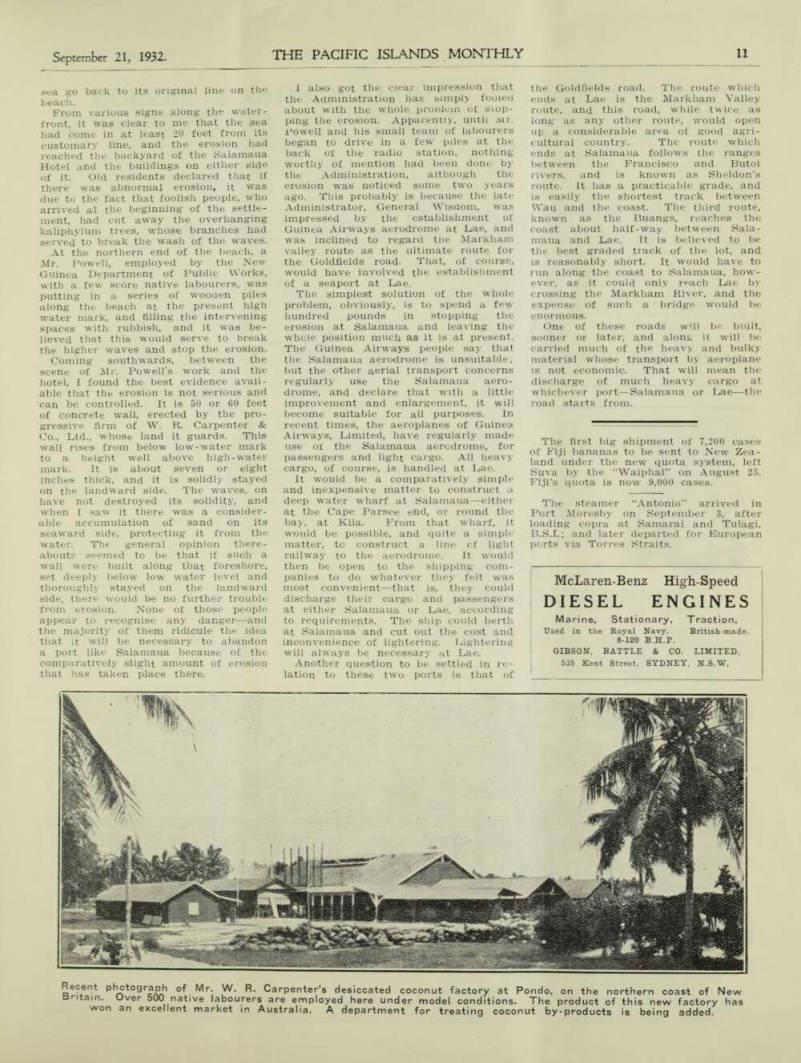
Recent photograph of Mr. W. R. Carpenter’s desiccated coconut factory at Rondo, on the northern coast of New Britain. Over 500 native labourers are employed here under model conditions. The product of this new factory has won an excellent market in Australia. A department for treating coconut by-products is being added.
To mark the sixth anniversary of the establishment of the Assembly of God Mission in Fiji, a service was held at the Rodwell Road Mission Hall on August 26. A large number of the ad herents of the church attended and were addressed by Mrs. A. Heetebry, the first missionary.