Members.
pp. 22-23 · Read in the full issue
Position As Seen By Elected Members.
From a Special Correspondent.
AN article appearing in “The Pacific Islands Monthly” of June 23, under the heading of “Legislative Coun cil,” and a sub-heading entitled, “Is Fiji Council Picking a Fight with the Governor?” evidently written without full knowledge of the facts, obviously calls for some reply.
Obviously, because of the fact that the protest raised by the Elected Mem bers of the Fiji Legislative Council upon a vital principle of constitutional procedure has since been upheld by the Secretary of State for the Colonies, and also by reason of the fact that a maga zine such as “The Pacific Islands Monthly” must, in accordance with its very laudable policy and intentions, lend a serious ear to what is undoubt edly a genuine complaint upon the part of a very substantial majority of the unofficial residents of the Fiji Group.
In view of the space that would be involved in setting out the details of the position regarding the office of Sec retary of Native Affairs, in connection with which it has been shown that the Governor committed a breach of consti tutional procedure, this article must necessarily be confined to a brief sum mary of the position which should be sufficient to show that at no stage of the proceedings has there been any evi dence of what has been termed ‘Pick ing a fight”, but merely a reasonably worded protest against an infringement
of the few rights now possessed by the non-official section of the community, and which they must endeavour to maintain.
It is perhaps sufficient to mention the simple facts of the matter at issue. In June, 1931, the Governor set up an Economy Committee, which included the then Secretary for Native Affairs and the gentleman who was subse quently appointed to that position on the former’s retirement. One of the re sults of its investigations, which were warmly commended by the Governor, was to recommend the reduction of the salary of the Secretary of Native Af fairs upon the new appointment being made from £1,000 to £800, with increases of £25 to £1,000. This was approved by the Governor, who specially mentioned that the reductions “should result in no loss of efficiency and no prejudice to future development.” The recommenda tions were approved by Council and were embodied in the Estimates for the ensuing year.
It was not until approximately seven months later, when a question was asked in Council, that the information was given that the old salary of £1,000 had been reverted to. In explanation, it was stated that since the recom mendations of the Economy Committee and the passing of the Estimates the Governor had discovered that he had made a mistake in agreeing to the vari ation in the salary of the post, and that upon referring the matter to the Sec retary of State he had been instructed to revert to the original salary. In his reply to the Elected Members, the Governor apologised for omitting to in form them, stating that the matter had entirely escaped his memory.
In their protest the Elected Members respectfully drew the attention of the Secretary to communications from the then Secretary of State in 1922 and 1923 when pledges were given that in regard to financial matters no action would be taken in future without the Legislative Council being consulted.
They also pointed out that Regulations 281, 282 and 283 laid down definitely that the authority of the Legislative Council should be first obtained.
In his reply the Secretary of State upheld this principle, stating that the authority of the Legislative Council, in addition to the authority of the Secre tary of State, is required for all expen diture, and it is very desirable that this should be interpreted in the sense that the authority of the Legislative Coun cil shall, as a general rule, "be obtained in advance of all expenditure.”
It is impossible to read into this protest anything else than the reason able protest of reasonable and represen tative men against what they consider to be an infringement of the rights of the people whom they represent, and which under Crown Colony Government are indeed few enough. That their pro test was reasonable appears to have been recognised by the Secretary of State if not by the Governor and the nominated members who comprise the “mechanical official majority."
This “mechanical majority" was also used to vote out a Previous motion last year by the Elected Members for a re duction in civil service salaries. This fact is mentioned here because it is of interest to note that in his reply to the Elected Members in their consti tutional protest the Secretary of State, without any fresh request being made to him, and entirely unsolicited so to speak states that he will be prepared to consider an emergency cut in civil
service salaries “such as has been ap plied in other Crown colonies.” A re quest which the Secretary of State must evidently consider reasonable, although not the “official members” who, under the Crown Colony system, have the strange privilege of determining whether or not they should make any sacrifice for the Colony which is now
£40,000 down on customs revenue for the first six months of the year.
The above facts are important, show ing plainly that at no stage or in any particular does their request to the Secretary of State savour of unreason ableness or of any intention, to use that very objectionable phrase, of “picking a fight”. Feeling over this and other matters has run high in Fiji, and members have been Ppenly counselled to withdraw from the Council. Fortun ately, the Elected Members have viewed the matter from a sounder angle, and throughout their attitude has been marked with commendable restraint.
In this matter the Elected Members undoubtedly have the support of the unofficial community, almost to a man.
There are, indeed, one or two notable exceptions and if these gentlemen could only see fit to contest the forthcoming election, if one is founds to be necessary, with a pro-Government policy, a very fine indication of public opinion would immediately be forthcoming.
To clear up any misunderstanding which may be created by the article in your widely-read journal, it is only necessary to add that at the conclusion of the session, His Excellency informed the Elected Members that he appreci ated their co-operation, and that at no time had he regarded the protest as a personal one. Sir Maynard Hedstrom, senior Elected Member, who had moved the motion, assured His- Excellency of their support which, he said, would al ways be forthcoming. He added, how ever, that they would be spineless if they did not voice their opposition when they thought that such was neces sary.
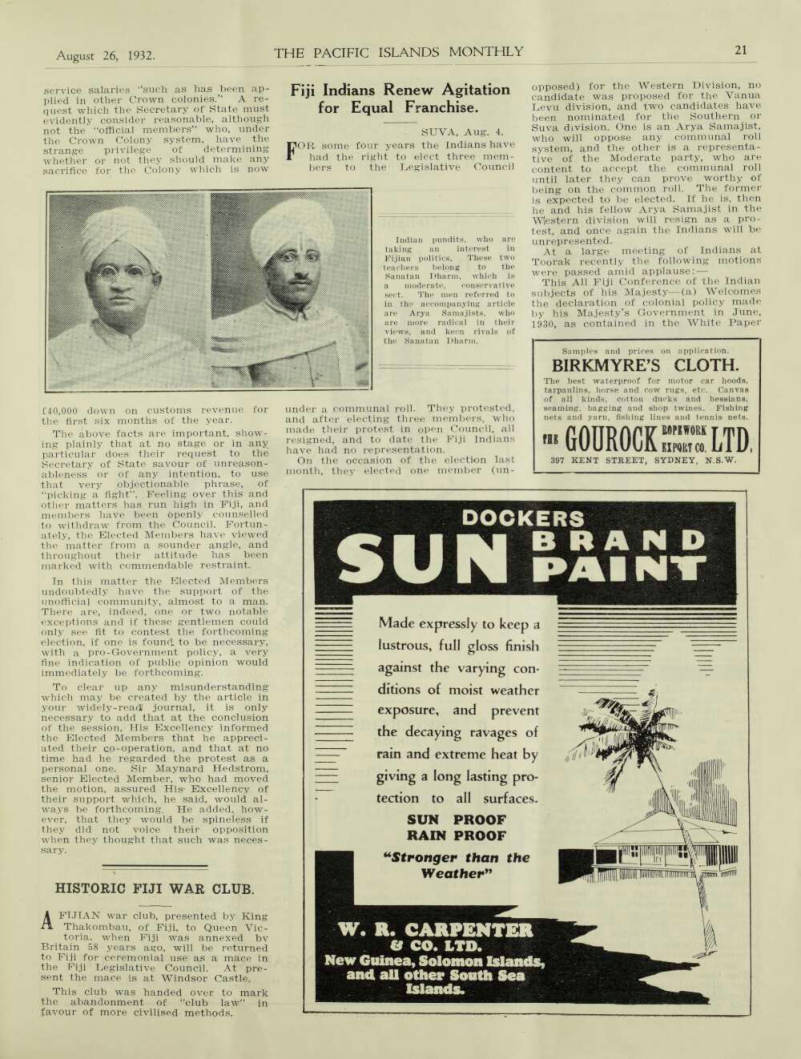
Indian pundits, who are taking an interest in Fijian politics. These two teachers belong to the Sanatan Dharm, which is a moderate, conservative sect. The men referred to in the accompanying article are Arya Samajists, who are more radical in their views, and keen rivals of the Sanatan Dharm.