Crisis.”
pp. 21-22 · Read in the full issue
Fiji S “Constitutional
Public Service Salaries Under Fierce Review.
From Our Own Correspondent.
SUVA, July 15.
THE Constitutional Crisis —pianissimo —in the Legislative Council of Fiji appears to have received its full measure of publicity.
Local representatives of papers as far apart as “The Sydney Morning Herald” and the Taranaki correspondent of the New Zealand “Herald” have dipped their pens in blood and written accounts which doubtless thrilled their readers with enchanting visions of another “Bos ton Tea-party.”
Actually, the anticipated fireworks proved to be somewhat damp squibs, and it is rather questionable whether the matches lit with assiduity by the elected members did not, in fact, rather burn their Honourable fingers. One thing emerges—years of experience in the Civil Service of many Colonies de velops in Colonial Governors a skill in tactics beside which the Honourable Colonists’ attempts appear like those of Eve!
The c.c. (see above, but no capitals, any more, please Mr. Editor) was fol lowed by a further attempt on the part of the Elected Members to persuade the Governor to accept an all-round reduc tion in the scale of salaries paid to civil servants.
The Secretary of State for the Colo nies added a paragraph to his tele graphic reply to the representations of the Elected Members in re the said c.c., that he would consider any fair pro posals for reductions of salaries to meet the present emergency—if one existed!
To suggest such a thing to the Elected Members was like offering candy to a child, so they seized it, tooth and nail.
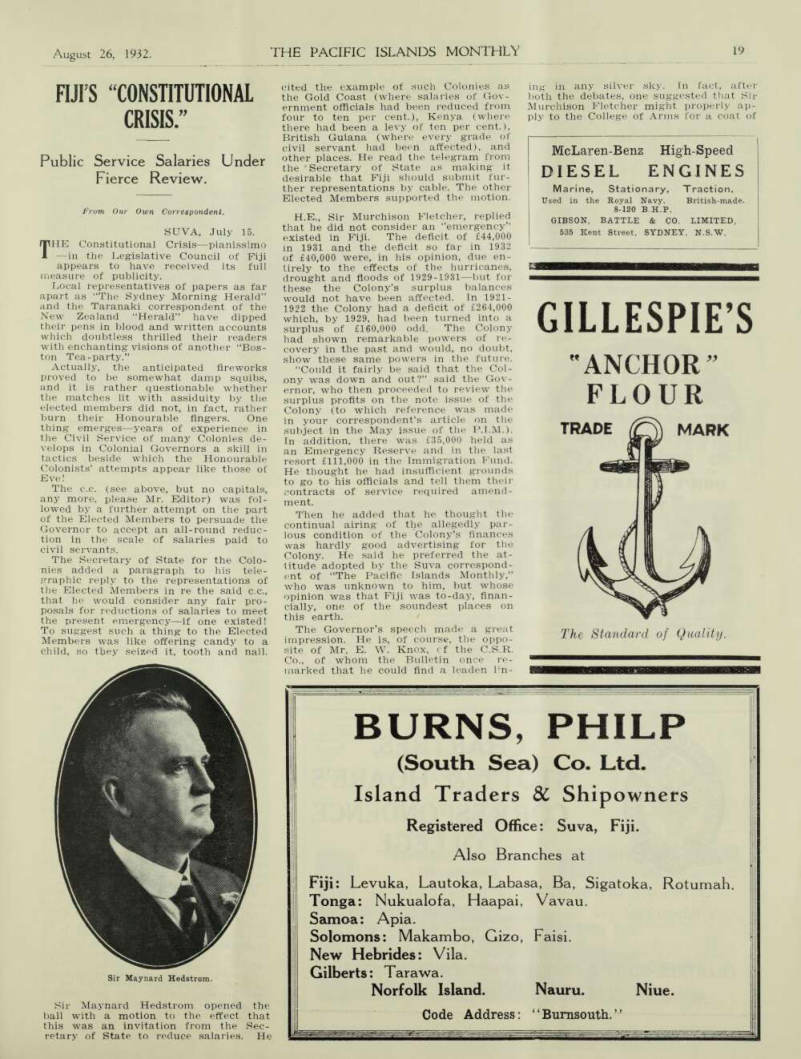
Sir Maynard Hedstrom opened the ball with a motion to the effect that this was an invitation from the Sec retary of State to reduce salaries. He
cited the example of such Colonies as the Gold Coast (where salaries of Gov ernment officials had been reduced from four to ten per cent.), Kenya (where there had been a levy of ten per cent.), British Guiana (where every grade of civil servant had been affected), and other places. He read the telegram from the Secretary of State as making it desirable that Fiji should submit fur ther representations by cable. The other Elected Members supported the motion.
H.E., Sir Murchison Fletcher, replied that he did not consider an “emergency” existed in Fiji. The deficit of £44,000 in 1931 and the deficit so far in 1932 of £40,000 were, in his opinion, due en tirely to the effects of the hurricanes, drought and floods of 1929-1931 —but for these the Colony’s surplus balances would not have been affected. In 1921- 1922 the Colony had a deficit of £264,000 which, by 1929, had been turned into a surplus of £160,000 odd. The Colony had shown remarkable powers of re covery in the past and would, no doubt, show these same powers in the future.
“Could it fairly be said that the Col ony was down and out?” said the Gov ernor, who then proceeded to review the surplus profits on the note issue of the Colony (to which reference was made in your correspondent’s article on the subject in the May issue of the P.I.M.).
In addition, there was £35,000 held as an Emergency Reserve and in the last resort £111,000 in the Immigration Fund.
He thought he had insufficient grounds to go to his officials and tell them their contracts of service required amend ment.
Then he added that he thought the continual airing of the allegedly par lous condition of the Colony’s finances was hardly good advertising for the Colony. He said he preferred the at titude adopted by the Suva correspond ent of “The Pacific Islands Monthly,” who was unknown to him, but whose opinion was that Fiji was to-day, finan cially, one of the soundest places on this earth.
The Governor’s speech made a great impression. He is, of course, the oppo site of Mr. E. W. Knox, cf the C.S.R.
Co., of whom the Bulletin once re marked that he could find a leaden lin
ing in any silver sky. In fact, after both the debates, one suggested that Sir Murchison Fletcher might properly ap ply to the College of Arms for a coat of
Sir Maynard Hedstrom.
arms as follows —Crest; A dove bearing in its beak a rapier; Arms: An inverted cornucopia spilling golden beans upon a field azure!
The debate terminated without a division. The Governor said he had forwarded a full despatch to the Sec retary of State, which would be due in London on July 28, so that he saw no necessity for cabling a precis. He pro mised to submit a summary of the views of the Elected Members to the Secretary of State.
To the outsider it seems that the better course would be for the Elected Members rigidly to scrutinise the civil establishment of the Colony. There are many posts which are redundant in these days, some of which need to be
abolished, and others to be pruned. The posts at the top of the tree are poorly paid, if we are to attract to the Colony the able administrators for whom we yearn. The Governor compared the higher posts in Fiji with those in the other colonies cited by Sir Maynard Hedstrom, vastly to the disadvantage of the financial allurement offered by Fiji. It is, alas, true that all commer cial folk have suffered a cut in salaries, whilst the poor coconut planter has had not merely a cut, but a complete dis appearance!