Fiji Indians Renew Agitation
pp. 23-24 · Read in the full issue
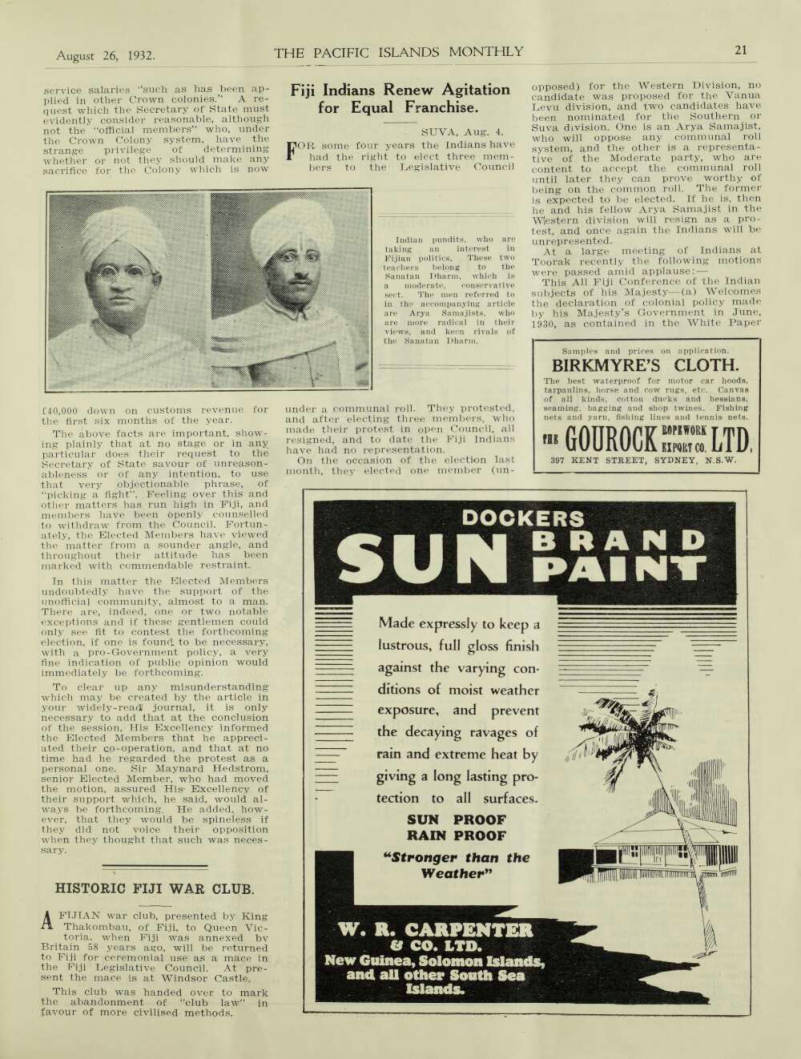
for Equal Franchise.
Suva, Aug. 4.
FOR some four years the Indians have had the right to elect three mem bers to the Legislative Council
under a communal roll. They protested, and after electing three members, who made their protest in open Council, all resigned, and to date the Fiji Indians have had no representation.
On the occasion of the election last month, they elected one member (un
opposed) for the Western Division, no candidate was proposed for the Vanua Levu division, and two candidates have been nominated for the Southern or Suva division. One is an Arya Samajist, who will oppose any communal roll system, and the other is a representa tive of the Moderate party, who are content to accept the communal roll until later they can prove worthy of being on the common roll. The former is expected to be elected. If he is, then he and his fellow Arya Samajist in the Western division will resign as a pro test, and once again the Indians will be unrepresented.
At a large meeting of Indians at Toorak recently the following motions were passed amid applause;— This All Fiji Conference of the Indian subjects of his Majesty—(a) Welcomes the declaration of colonial policy made by his Majesty’s Government in June, 1930, as contained in the White Paper
No. 3574, that the establishment of a common electoral roll is the object to be aimed at and attained, with an equal franchise open to all races in colonies where there is a mixed population; (b) requests his Majesty’s Government to arrange consistent with this policy, for an early introduction of the system of common electoral roll in the Constitu tion of this colony; (c) reiterates the demand of the Indian community in Fiji for common and equal rights of citizen ship with other subjects of his Majesty resident in Fiji; and (d) adheres to the policy of non-participation in the Legis lative Council on communal basis.
There has been a good deal of feeling created by disappointed agitators who found they could not get all they wanted, and it is clear that while the Indian population at present is abso lutely unfit for inclusion on a common roll, they are determined to support those who clamour for this right.
It is only a few years ago that those asking for “equal rights” were coolies, working for a small wage, and even to day the literate are only a handful. —