How Hartmann Climbed Owen Stanley Range
pp. 16-17 · Read in the full issue
In Papua.
A MOST interesting old letter has been placed at our disposal by Mr.
Arthur J. Vogan, F.R.G.S., in which the late Mr. Carl H. Hartmann reports
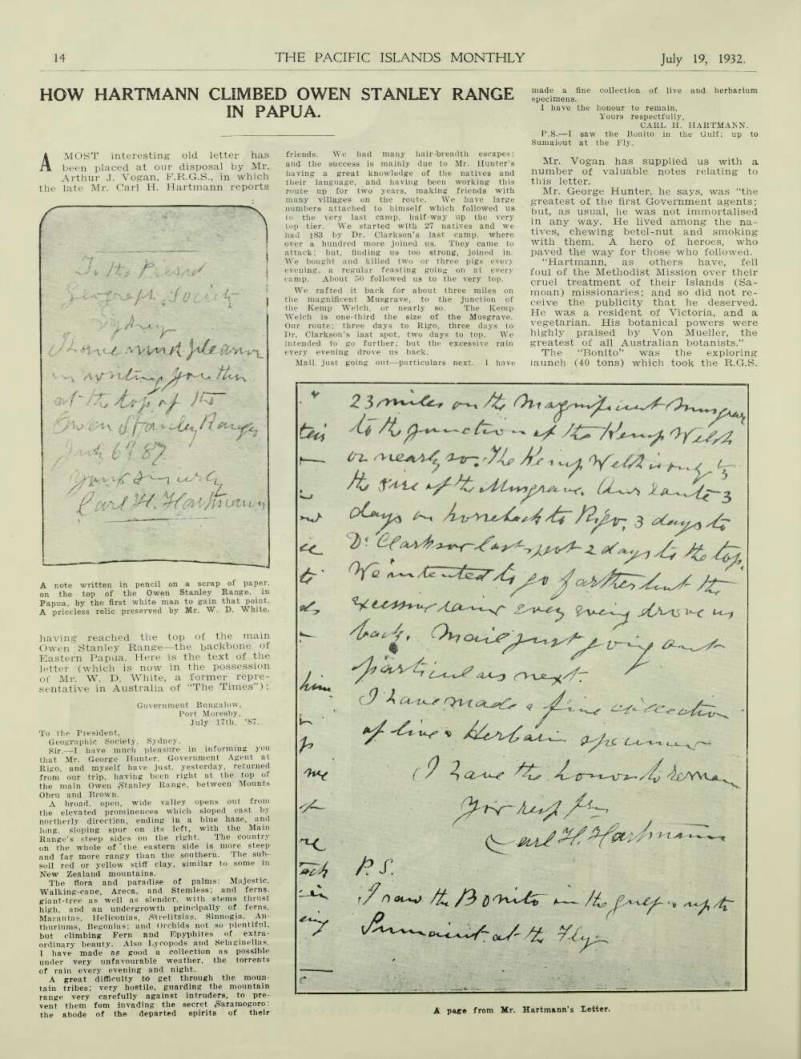
A note written in pencil on a scrap of paper, on the top of the Owen Stanley Range, in Papua, by the first white man to gain that point.
A priceless relic preserved by Mr. W. D. White. having reached the top of the main Owen Stanley Range—the backbone of Eastern Papua. Here is the text of the letter (which is now in the possession of Mr. W. D. White, a former repre sentative in Australia of “The Times”): Government Bungalow, Port Moresby, July 17th, ’87.
To the President, Geographic Society, Sydney.
Sir,—l have much pleasure in informing you that Mr. George Hunter, Government Agent at Rigo, and myself have just, yesterday, returned from our trip, having been right at the top of the main Owen Stanley Range, between Mounts Obru and Brown.
A broad, open, wide valley opens out from the elevated prominences which sloped east by northerly direction, ending in a blue haze, and long, sloping spur on its left, with the Main Range’s steep sides on the right. The country on the whole of’the eastern side is more steep and far more rangy than the southern. The sub soil red or yellow stiff clay, similar to some in New Zealand mountains.
The flora and paradise of palms; Majestic, Walking-cane, Areca, and Stemless; and ferns, giant-tree as well as slender, with stems thrust high, and an undergrowth principally of ferns, Marantas, Heliconias, Strelitzias, Sinnogia, An thuriums, Begonias; and Orchids not so plentiful, but climbing Fern and Elpyphites of extra ordinary beauty. Also Lycopods and Selaginellas.
I have made as good a collection as possible under very unfavourable weather, the torrents of rain every evening and night.
A great difficulty to get through the moun tain tribes: very hostile, guarding the mountain range very carefully against intruders, to pre vent them from invading the secret, Saramogoro; the abode of the departed spirits of their
friends. We had many hair-breadth escapes; and the success, is mainly due to Mr. Hunter’s having a great knowledge of the natives and their language, and having been working this route up for two years, making friends with many villages on the route. We have large numbers attached to himself which followed us to the very last camp, half-way up the very top tier. We started with 27 natives and we had 183 by Dr. Clarkson’s last camp, where over a hundred more joined us. They came to attack; but, finding us too strong, joined in.
We bought and killed two or three pigs every evening, a regular feasting going on at every camp. About 50 followed us to the very top.
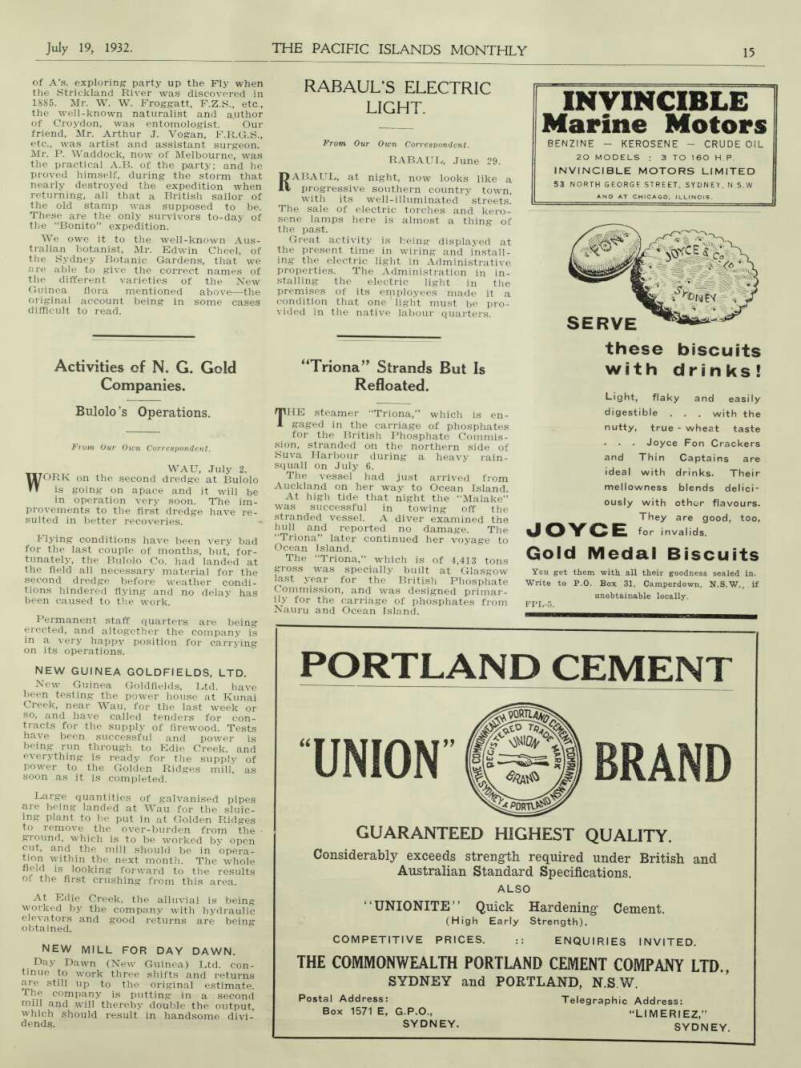
We rafted it back for about three miles on the magnificent Musgrave, to the junction of the Kemp Welch, or nearly so. The Kemp Welch is one-third the size of the Musgrave.
Our route; three days to Rigo, three days to Dr. Clarkson’s last spot, two days to top. We intended to go further; but the excessive rain every evening drove us back.
Mail just going out—particulars next. I have
made a fine collection of live and herbarium specimens.
I have the honour to remain, Yours respectfully,
Carl H. Hartmann.
P.S. —I saw the Bonito in the Gulf; up to Sumaiout at the Fly.
Mr. Vogan has supplied us with a number of valuable notes relating to this letter.
Mr. George Hunter, he says, was “the greatest of the first Government agents; but, as usual, he was not immortalised in any way. He lived among the na tives, chewing betel-nut and smoking with them. A hero of heroes, who paved the way for those who followed.
“Hartmann, as others have, fell foul of the Methodist Mission over their cruel treatment of their Islands (Sa moan) missionaries; and so did not re ceive the publicity that he deserved.
He was a resident of Victoria, and a vegetarian. His botanical powers were highly praised by Von Mueller, the greatest of all Australian botanists.”
The “Bonito” was the exploring launch (40 tons) which took the R.G.S.
A page from Mr. Hartmann’s Letter.
of A’s. exploring party up the Fly when the Strickland River was discovered in 1885. Mr. W. W. Froggatt, F.Z.S., etc., the well-known naturalist and author of Croydon, was entomologist. Our friend, Mr. Arthur J. Vogan, F.R.G.S., etc., was artist and assistant surgeon.
Mr. P. Waddock, now of Melbourne, was the practical A.B. of the party; and he proved himself, during the storm that nearly destroyed the expedition when returning, all that a British sailor of the old stamp was supposed to be.
These are the only survivors to-day of the “Bonito” expedition.
We owe it to the well-known Aus tralian botanist, Mr. Edwin Cheel, of the Sydney Botanic Gardens, that we are able to give the correct names of the different varieties of the New Guinea flora mentioned above —the original account being in some cases difficult to read.