The Charm of Port Moresby
p. 14 · Read in the full issue
From Our Own Correspondent.
Pt. Moresby, June 10.
THE “Malolo” and “Mariposa,” both large Matson liners, and the “Stella Pollaris,” a luxury cruiser, carrying between them over 500 tourists, have recently visited Port Moresby.
There seems to be a general desire by the American tourists, that Port
Moresby should be included in their pleasure cruises.
They recognise the unique beauty of the harbour and the hills; the colour and charm of the surrounding country; and the vivid contrasts of the sea, the land and the foliage.
The native life and the villages at tract them also, and they find the Pa puan an interesting people.
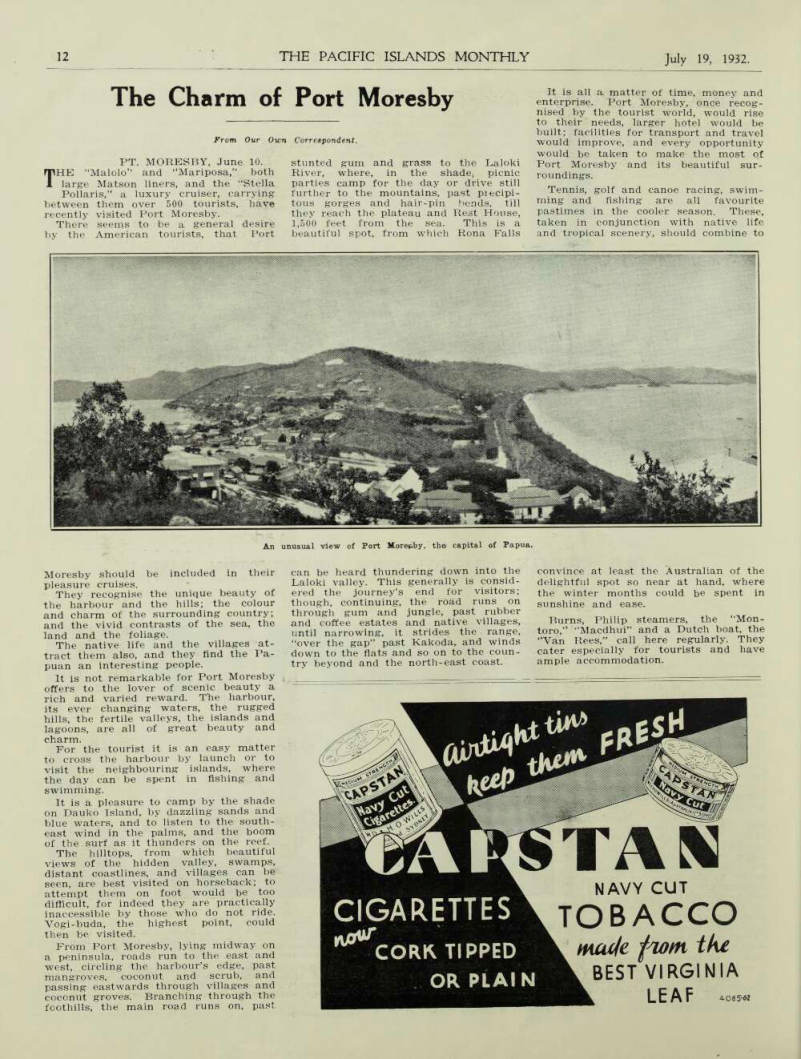
It is not remarkable for Port Moresby offers to the lover of scenic beauty a rich and varied reward. The harbour, its ever changing waters, the rugged hills, the fertile valleys, the islands and lagoons, are all of great beauty and charm.
For the tourist it is an easy matter to cross the harbour by launch or to visit the neighbouring islands, where the day can be spent in fishing and swimming.
It is a pleasure to camp by the shade on Dauko Island, by dazzling sands and blue waters, and to listen to the south east wind in the palms, and the boom of the surf as it thunders on the reef.
The hilltops, from which beautiful views of the hidden valley, swamps, distant coastlines, and villages can be seen, are best visited on horseback; to attempt them on foot would be too difficult, for indeed they are practically inaccessible by those who do not ride.
Vogi-buda, the highest point, could then be visited.
From Port Moresby, lying midway on a peninsula, roads run to the east and west, circling the harbour’s edge, past mangroves, coconut and scrub, and passing eastwards through villages and coconut groves. Branching through the foothills, the main road runs on, past
stunted gum and grass to the Laloki River, where, in the shade, picnic parties camp for the day or drive still further to the mountains, past precipi tous gorges and hair-pin bends, till they reach the plateau and Rest House, 1,500 feet from the sea. This is a beautiful spot, from which Rona Falls
can be heard thundering down into the Laloki valley. This generally is consid ered the journey’s end for visitors; though, continuing, the road runs on through gum and jungle, past rubber and coffee estates and native villages, until narrowing, it strides the range, “over the gap” past Kakoda, and winds down to the flats and so on to the coun try beyond and the north-east coast.
It is all a matter of time, money and enterprise. Port Moresby, once recog nised by the tourist world, would rise to their needs, larger hotel would be built; facilities for transport and travel would improve, and every opportunity would be taken to make the most of Port Moresby and its beautiful sur roundings.
Tennis, golf and canoe racing, swim ming and fishing are all favourite pastimes in the cooler season. These, taken in conjunction with native life and tropical scenery, should combine to
convince at least the Australian of the delightful spot so near at hand, where the winter months could be spent in sunshine and ease.
Burns, Philip steamers, the "Mon toro," "Macdhui" and a Dutch boat, the “Van Rees,” call here regularly. They cater especially for tourists and have ample accommodation.
An unusual view of Port Moresby, the capital of Papua.