Pacific

Islands
Monthly
July 19
1932
6 d
[Registered at G.P.O., Sydney, for transmission by post as a newspaper.]
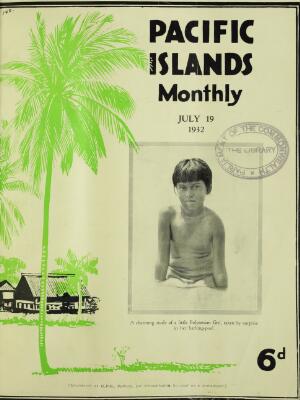
A charming study of a little Polynesian Girl, taken by surprise in her bathing-pool.
Advertisements & other items, p. 2 (1 item)
Vacuum famous for
Highest Quality Petroleum Products
29 years stand behind
VACUUM Service in the South Pacific
Vacuum Products Set the Standard.
PLUME Motor Spirit VOCO Power Kerosene LAUREL Kerosene
MOBILOIL
Mobilgrease Mobilubricant Gargoyle Lubricating and D.T.E. Oils High-Grade Diesel Fuel Oils There is a Vacuum Grade for every type of service.
VACUUM OIL COMPANY PTY LTD
Pacific Islands Travellers
Passengers Per S.S. “Mataram ,”
Which Sailed From Sydney On June
29 FOR SOLOMON ISLANDS: Mrs. A. Hill and two children, Mrs. I. Macleod and child, Miss George, Mrs. F. E. Crane, Mr. L. A. Borgas, Mrs. Borgas, two children and infant, Mrs. A.
Sim, child and infant; Miss M. Higgins, Miss J. Radeski, Mr. G. Thompson, Mrs. Thompson, Miss B. Thompson, Mr. J. W. Bury, Mrs. Bury, Mr. H. L. Thomson, Mr. C. H. G. White, Cap tain A. W. Musgrave, Mr. C. A. Simpson, Mr.
C. J. Moxen, Mr. W. C Rixon, Mr. C. C.
Graham, Miss W. Scott, Miss A. Wilson, Miss B. Buring, Mr. T. G. Brunton, Mr. A. P. Pen man, Mr. A. B. Briggs, Mr. W. Oates, Mrs.
Williams, Mrs. E. Tucker, Mr. T. Moreton, Mrs. T. Moreton.
Passengers Per M.V. “Macdhui,”
WHICH ARRIVED IN SYDNEY ON JUNE 21, FROM PAPUA AND NEW GUINEA: Mr. J.
Dykes, Miss M. J. Mclntyre, Mr. H. J. Preston, Mr. and Mrs. B. Taylor, Mr. F. J. Vickery, Mrs.
P. Rouse, Miss M. I. Blair, Miss C. M. Darker, Mr. T. W. Hammond, Mr. W. T. Korn, Miss L, E. Job, Mr. J. Lord, Mr. H. H. Rowe, Mr. W. Sansom, Mr. D. F. Stewart, Mr. A. G.
Stewart, Mrs. J. Tullock, Mr. W. Upton, Miss R Waldon, Mr. C. R. Williams, Mr. E. J. C.
Brandis, General E. A. Wisdom, Miss L. E.
Willoughby, Miss D. Downing, Mrs. M. Austin, Miss P. M. Jones, Mr. W. Halfnights, Capt. J.
Houldsworth, Miss H. Humphries, Mr. V. Park inson, Miss G. Sherlock, Mr. H. M. Smith, Mr. W. Walker, Miss M. J. Yates, Mr. H. W.
Holden,
Passengers Per M.V. "Macdhui "
WHICH SAILED FROM SYDNEY ON JUNE 30
For Papua, New Guinea And Bougain
VILLE PORTS: Mr. J. H. L. Waterhouse, Dr.
C. C. Simson, Mr. E. O. Brown, Mr. A. S.
Gerber, Mr. A. E. C. Kerr, Mrs. J. W. Wil liams, Miss L. Byron Moore, Miss N. Dumolo, Miss G. Bedggood, Mrs. E. J. Jones, Mrs. K.
Mitchell, Mr. G. Hogan, Mrs. Hogan, Mr. P.
Coote, Mrs. Coote and infant, Master Coote, Miss Lievering, Mrs. M. A. Woodward, Mr. F.
W. R. Godden, Mr. W. H. Webb, Miss U.
Gettens, Miss D. M. Carson, Miss A. E.. Fair bairn, Mr. A. W. Ardlie, Mrs. Ardlie, Miss R.
Waldon, Mrs. L. M. Whitehouse and child, Miss Eiseman, Mr. J. R. Bedggood, Mr. E. F. Bish ton, Mr. C. K. Norris, Mr. A. L. Hope, Mr.
J. R. Wotherspoon, Mrs. Wotherspoon, Miss A.
Anderson, Mr. N. Nelson, Mrs. Nelson, Mr. T.
Griffiths, Mr. W. Bassett, Mr. R. L. Massie, Mr. C. Irvine, Mr. J. G. Boileau, Mr. D. Bedg good, Mrs. Bedggood, Mr. R. W. Robson, Mr.
W. B. Rosser, Mrs. N. I. Parer, Miss G. Dawnie, Miss H. Wyatt, Mrs. L. H. Ainsworth, Miss I.
A. Waddy, Dr. L. J. Clendinnen, Mrs. Clendin nen, Miss E. Luxton, Miss L. Appleton, Mrs.
Weston and child, Mrs. M. E. Baker, Mrs. H.
M. Armstrong, Mrs. D. M. Roper, Mr. J. P.
Hammond, Mrs. Hammond, Mr. D. Watkins, M.H.R., Mrs. Watkins, Mrs. R. Hyde, Mrs. K.
Hubner, Mr. C. D. Brophy, Mr. W. F. Smith, Mr. A. Gray, Mr. R. Parer, Mr. R. L. Smith, Mr. J. A. Parer, Mr. E. J. Omer, Mr. H. C.
Rockett. Mr. C. F. Marsh, Mr. M. V. Gibson, Mr. H. Eagle. Mr. P. H. Rash, Mr. J. C. K.
Melville, Mr. E. Fahey, Mr. H. McGilvery, Mr.
J. T. Williams, Mr. P. Anscombe, Mr. A. Scott, Rev. J. W. Dixon, Mrs. Dixon and infant, Mr.
T. N. Maxwell, Mr. R. R. Huxley, Miss U. M.
Cavill, Mr. T. Thomson, Mr. C. H. Thew, Mr.
T. D. Anderson, Mr. E. A. Avery, Mr. T.
Fairey, Mr. F. P. Hegarty, Mr. W. Toner, Mrs.
G. Wilson, Mrs. W. Korn, Mrs. W. Green and infant, Miss Darker. Miss Blair, Mr. J. Brenan, Miss G. Brenan, Mrs. I. B. McDonald, Capt.
B. W. Cruickshank, Mr. R. Anderson, Mrs.
Anderson, Mr. W. Korn, Mr. A. Doig. Mr. E.
Hilder.
Passengers Who Arrived In Syd
NEY ON JULY 6 FROM NEW HEBRIDES
And Norfolk Island Per S.S. "Mor
INDA" : —Miss G. M. Campbell, Mr. B. Hoskins, Mr. P. H. Mayer, Mr. R. McClure. Mrs. McClure, Mr. N. S. Sickle, Mr. H. F. Cleave, Miss E.
R. Cox, Mr. C. P. Bartholomew, Mrs. R. Bunt ing, Mr. A. Compton. Mrs. H. Gray. Mr. W.
H. Lucas, Mr. E. Messer, Mrs. Messer, Mrs.
M. Nichols, Mr. C. H. Pearson, Mrs. C. Rod gers, Mr. J. Schwert, Miss P. Shaffron, Miss J. Astley, Mr. A. Atteridge, Miss I. Boot, Mr. A. Fry, Mrs. P. Hickey, Mr. G. M. Kirby Mrs. Kirby, Mr. T. Rougher, Mr. and Mrs. E.
McMahon, Mr. L. Lyons, Mr. R. Morris, Miss L. Nichols, Mr. W. Pearcey, Miss F. Styles, Mr. P. Thompson, Mr. J. Whitworth, Mrs. Whit worth.
Passengers Who Arrived In Syd
EY ON JULY 6 FROM NEW CALEDONIA AND NEW HEBRIDES, PER S.S. “ LAPER OUSE": Mr. C. J. Sullivan, M. Guyon, Miss A. Guyon, Miss C. Guyon, Miss G. Valin, Miss J. Villierme, Miss J. Behal, Mrs. M. Perkins, Miss J. Perkins, Miss L. Vignaud, Mrs. S.
Brown and daughter, Miss Y. Tessier, Mr. E.
Oughton, Mrs. O. Jourdain and two daughters, Mr. Hayashi Kinzo, Mr. Fukushi Genzio, Mr.
R. Tarrere, Mr. D. Wagner. Mr. Th. Domp martin, Mr. Ch. Leytens, Mr. A. Pauwaert.
Passengers Who Arrived In Sydney
ON JULY 13 FROM NEW GUINEA AND
Papuan Ports Per S.S. “ Montoro
Mr. W. F. Hill, Miss L. King, Miss P. Long, Mr. A. Simpson, Mr. G. W. Anslow, Mr. H. R.
(Continued on page 38.)
Gale, Mr. F. W. Griffin, Mrs. L. H. Holden, Mr. J. Lough, Mr. A. E. Mustar, Mr. 11. Hotz, Mr. C. G. Frauds and two children, Mr. A. S.
Atkins, Mr. H. C. Beaver, Mr. O. P. Blanden, Mrs. Blanden, Mr. B. Calcutt, Mr. J. H. Collins, Mrs. M. Leach, Mr. W. F. Martin, Mr. G. D.
H. Riley, Mr. G, Kirwin, Mr. A. Pym, Mrs.
J. Turner, Mrs. A. de Groen, Mr. T. O’Dea Mr. H. Colcough.
Passengers Per S.S. “Morinda,’’
WHICH SAILED FROM SYDNEY ON JULY 14
For Norfolk Island And New Heb
RIDES : —Captain C. R. Pinney Mrs. Pinney and two children, Mr. R. J. Thomas, Dr. S. C.
Jamieson, Mr. H. A. Middleton, Mrs. Middleton, Mrs. M. J. Garrison, Miss P. Middleton, Mr. B.
A. Timms, Mrs. Timms and infant, Mr. R.
Luff, Mr. P. C. Ranken, Mrs. McKerlie, Miss A. Mclnnes, Mrs. M. R. Smith, Mr G F Davies, Mr. S. O. Martin, Miss M. Gray, Mrs.
H. Maddison, Miss K. E. Stuart, Miss M.
O’Keefe, Mrs. M. Fenton, Mrs. Gower Wilson, Mr. G. Lumley, Mrs. Lumley, Miss B. R. U.
Curtis, Miss E. Millett, Miss H. Millett, Miss A. Williams, Miss E. Thew, Mrs. C. G. Adam and infant, Mr. E. Nicholls, Mr. J. Rothwell, Mr. J. Scott Robertson, Mr. Morey, Mr. A.
Atteridge, Mr. J. H. Caunter, Mrs. Gaunter.
Advertisements & other items, p. 3 (1 item)
REGULAR BI-MONTHLY Freight and Passenger Service
NOW ON SALE!
Pacific Islands
Year Book for
1932 Complete description of all Pacific Islands and Territories, including Details of Adminis trations. Trading Activities, Land Laws, Latest Statistical Information, Opportunities for New Settlers, &c., &c.
WITH MAPS AND A
COMPLETE INDEX.
8/6 at all Islands Stores, at all leading Australian and New Zealand Booksellers, or from—
UNION HOUSE,
247 GEORGE ST., SYDNEY.
Vitality and Health are the
Main Factors in Every-day Life.
Put yourself in the hands of Specialists who have made an intelligent study of your requirements; it is vital to your health. We are known everywhere as the Suppliers of the Right Goods and which put the VITAL into VITALITY. Thirty-five years is our record of supplying Fresh Fruit, Vegetables and Produce to the leading Houses throughout the world.
GET FULLY ACQUAINTED WITH US,
Tel.: MA 4799; FX 4350 Private.. Cable Address: Pigs, Sydney. Code: Bentley’s.
C. G. PIGGOTT
WHOLESALE FRUIT AND PRODUCE MERCHANTS
DIRECT IMPORTERS AND EXPORTERS SYDNEY.
Office: Bulk Stores and Packing House: Fruit Exchange, Sydney.
Sales Dept.: Fruit Exchange and City Markets, Sydney. Bank of N.S.W. Bankers.
REGULAR BI-MONTHLY Freight and Passenger Service
by the fast and modern K.P.M. Steamer VAN REES as under: Saloon and Intermediate class passengers carried in comfortable and airy cabins.
Cargo for Africa accepted for transhipment at Batavia.
SAIGON
BATAVIA
SAMARANG
PORT MORESBY
SAMARAI
RABAUL
PORT VILA
NOUMEA
ROYAL PACKET Sydney
PORT MORESBY
NAVIGATION CO., Batavia
255 GEORGE STREET. SYDNEY,
SAIGON
The B.N.G. Trading Coy., Ltd., Port Moresby; Steamship Trading Co., Samarai; W. R- Carpenter & Co., Ltd., Rabaul; Gubbay Freres, Port Vila; Carlo Leoni, Noumea; Diethelm & Co., Saigon.
McLaren-Benz High - Speed
DIESEL ENGINES,
Marine, Stationary, Traction, Used in the Royal Navy. British Made.
8-120 B.H.P.
GIBSON, BATTLE & CO., LIMITED,
535 Kent Street, Sydney.
Cables: Gibsbattle, Sydney,
Advertisers.
Page.
Adams, Wm., Ltd... 46 Amal. Wireless ... 47 Antinea Drug Co. .. 23 Armstrong, R. H., & Co 17 Arnott’s Biscuits . . 33 Barnes, James. Ltd. 34 Beaumont, W. N., & Co 34 Brandts. Ltd 33 Brunton’s Flour ... 29 Burns, Philp & Co. 2 Burns, Philp (S.S.) Co 21 B.P. Magazine ... 39 Cameron, .Stuart ... 37 Campe, A. C 16 Carpenter, W. R.
Cover iii.
Com. P’land. Cement 15 Crowle House 47 Dangar, Gedye & Co. 19 Delicia Food Co. ... 42 Docker’s Paints ... 25 Elliott, T.. & Co. . . 9 Eucrasy Co 43 Excelsior Supply Co. 20 Exide Batteries ... 38 Fiji for the Winter. 30 Fletcher & Sons ... 40 Gibson, Battle & Co. 1 Gillespie’s Flour ..27 Gourock Co 20 Gregory, Albert ... 18 Guinea Airways ... 31 Hale, Alex.. Ltd. . . 25 Hall Bros., Ltd. .. . 4l Halvorsen. L 24 Harringtons Ltd. . . 37 Hog’s Bristles Wanted 27
Page.
Holbrooks, Ltd 29 Imperial Hotel ... 8 Invincible Motors, Ltd 15 Java Rice Powder . . 17 Joyce Biscuits ... 15 Kopsen & Co 28 Lesseys D.Y. Service 23 Lysaght, John, Ltd. 26 Morrissey, M 23 Mcllrath’s, Ltd. ... 42 McKinlay & Cum mins 35 McLeod, Bolton & Co 32 Nelson & Robertson 35, 36, 40. 43 Newbold Silica ... 31 Nolan. Spencer ... 22 Pearson’s Soap Co.. 22 Piggott, C. G 1 Pike Bros 30 Piasmoquine 39 Rohu. Sil 44 Royal Packet N. Co. 1 Russell, S 29 Satyrin 44 Saxton & Sons ... 36 Shell Oil Co 13 Smith, Sons & Rees 40 Stoffer, A 36, 46 Tillock & Co.. Ltd. 45 Pisdall, W. H., Ltd. 27 Tooth & Co. Cover iv.
Towns & Co., Ltd.. 39 Vacuum Oil Co.
Cover ii.
Vincent Chem. C 0... 48 Walker. F. J.. Ltd.. 43 Wills. W.D. & H.O. 12 Wunderlich. Ltd. . . 16
Contents.
Page Pacific Islands Travellers 1 Tobacco Growing in New Guinea 3,4, 41, 42 ''Woman’s Brave Action 5 Governor Jore’s Appointment .. .. 5 Town Barber of Apia 6 Winter on Norfolk Island 6 Reg. Hockings, O.B.E 7 Tropicalities 8 Salamaua Doomed 9 Control of Whaling Industry .. .. 9 About Islands People 10 En Route to Papua and New Guinea 10 "Sick Papua” 11 Old Trading Firm of Western Samoa 11 Charm of Port Moresby 12 How Hartmann Climbed Owen Stan ley Range 14, 15 Rabaul’s Electric Light 15 “N.G. Lottery” 16 N.G. Goldfields News 16 Another White Woman in Papua Bush 17 Search for Papuan El Dorado .. 18 Religious Disturbance in Southern Gilberts 19 The Trochus 20 Proposed Anglo-Indian Migration 21, 22
Page Fiji Legislative Council 22 Early Papua 23 Wireless Communication for Torres Straits 24 The Law in Tonga 25 “Bellatrix” Sails 26 Samoa’s Banana Shipments .. . . 27 Day on Fulakora River 28 Samoan News 29 Why Goaribari Is No Longer a Cannibal 30 Suva Welcomes Cricketers .. .. 31 How White Man “Goes Native” .. 32 W. R. Carpenter & Co.’s Annual Report 33 Papuan Exploration 34 Norfolk Island News 35 Samoan Reparation Estates .. . . 36 Fiji Legislative War 37 Pacific Islands’ Association . . . . 38 Pt. Moresby Social Notes . . . . 39 Marine Industries in Torres Straits 40 Profit from Sharks . . 43 N.G. and Papuan Gold Sharemarket 44 Market Quotations 45 Exchange Quotations 46 Thursday Is. Notes 46 Shipping Services 47, 48
Advertisements & other items, p. 4 (1 item)
Burns, Philp 8C Co. Ltd.
General Merchants
Shipowners,
Tourist Agents, Etc.
Buyers of all Classes
of Island Produce
Head Office - 7 Bridge Street, Sydney - Australia Code Address : “BURPHIL”
Regular Steamer Services From Australia to New Guinea, Papua, Solomons, Lord Howe, Norfolk Islands, New Hebrides, Java and Singapore
The Pacific Islands Monthly
THE NEWSPAPER - MAGAZINE OF THE SOUTH SEAS [Registered at G.P.O., Sydney, for transmission by post as a newspaper .]
Published about 15th of Each Month and Circulated in Australia and New Zealand and in the following Pacific Territories and Island Groups:
Crown Colony of Fiji.
Australian Territory of Papua.
Mandated Territory (Australia) of New Guinea, Bismarck Archipelago, and Northern Solo mon Islands.
Mandated Territory (Japan) of Marshall, Caro line and Mariana Islands.
American Territory of Guam.
Mandated Territory of Nauru.
British Crown Colony of Gilbert and Ellice Islands.
French Territory of New Caledonia.
British and French Condominium of New Hebrides.
American Territory of Eastern Samoa.
Mandated Territory (New Zealand) of Samoa.
British Solomon Islands Protectorate.
British Protectorate of Tongan Islands.
New Zealand Territory of Cook Islands.
Australian Territory of Norfolk Island.
French Colony of Oceania (Tahiti, etc.) American Territory of Hawaiian Islands.
Owned and Produced by ‘Pacific Publications Ltd., Union House, 247 George Street, Sydney
Telephone Bw 5037
P.O. Box 3408 R
Contributions
Articles, Stories and Photographs dealing with Pacific Islands Subjects are invited, and will be paid for on publication at usual rates.
Subscription Rates
Per Annum, within Postal Convention Territories, Prepaid, Post Free 6/- Per Annum elsewhere, Prepaid, Post Free 8/- Single Copies 6 d
Editor and Publisher:
R. W. Robson.
Advertisements
Casual Advertising: £10 per page; £5/5/- per half page; £2/15/- per quarter page; £1/7/6 per eighth page; Casual Advertisements: 8/per inch. Contract rates by arrangement.
Colours, etc. — — — — by Arrangement Process Blocks made at Advertise:’s expense when required. Screen, 100.
Changes of Advertising Copy should reach this Office by 8th of each month, otherwise previous advertisement may be repeated.
Registered Address for Telegrams and Cables: “PACPUB” Sydney
Agents
The following are authorised to receive sub scriptions for The Pacific Islands Monthly — Islands Branches of Burns, Philp & Co.. Ltd., and Burns, Philp (Sbuth Seas) Co., Ltd.
Islands Branches of W. R. Carpenter & Co., Ltd.
All Branches of M orris, Iledstrom & Co., Ltd.
Greenwood & Laws (Rabaul).
Whitten Bros., Ltd., Port Moresby & Samarai.
All Branches and Representatives of W. H.
Grove & Sons, Ltd., Auckland. 9. Russell. Papeete. Tahiti.
Cook Islands Trading Co., Rarotonga.
Mrs. M. Campbell, Cascades, Norfolk Island.
Vol. II.—No. 12.
Sydney, July 19, 1932.
Price 6d. Per Copy.
Prepaid: 6/- p.a.
Tobacco-Growing In The Territory Of New Guinea.
(Specially written for “The Pacific Islands Monthly” by F. Robartson, Rabaul.)
SINCE 1930, when the low and fluc tuating price of copra caused so much concern, our planters seem to have at last realised the folly of “putting all their eggs in the one basket.”
Mainly in consequence of the low price obtainable for copra, their thoughts have turned to other crops as possible revenue producers, and tobacco-growing has received consider able thought and inquiry.
This idea has also been considerably strengthened of late, owing to the sharp advance in price of “native issue” stick tobacco, caused by the ad verse exchange on importations from America.
At this stage, I think it might be advisable to state as briefly as possible the history of the attempts at tobacco culture in this Territory, as far as I have been able to ascertain it from careful inquiry. Mr. Geo. Murray (Director of Agriculture) has given me able and valuable assistance.
The idea of tobacco growing here originated in 1900 or 1901, when the German authorities sent samples to Germany, the report upon which was most satisfactory. In the first and
second years in which shipments were made to Germany, a most satisfactory leaf was produced, which was used as a “cigar wrapper,” as the quality was considered to be quite equal to that of the fine Borneo and Sumatra tobacco.
High and remunerative prices were paid for these early shipments; but, for some reason, subsequent shipments showed a great falling off in quality, and the whole enterprise was dropped.
There have been long periods of apathy. Interest has been revived inter mittently since. Meanwhile, a little tobacco has been grown.
Early in 1908, six samples of soil were forwarded from the Jomba River area, in the Madang district, and also from Madang, to the Agricultural Research Department, Bremen.
In reporting on same, Drs. Woiss and Laband set out the necessary soil conditions and, in comment, stated that in the samples of soil received, the necessary conditions were fulfilled, in all samples, in both general structure and humus content. The humus in the samples varied from 6.18 per cent, minimum, to 12.05 per cent, maximum, which, it was stated, showed a percentage of humus rarely met with.
As a comparison, mention was made of the famous tobacco soil of Deli (Sumatra), which, according to Van Bebb, excelled in a large quantity of humus (four per cent); nitrogen 0.2
—0.3 per cent.; phosphoric acid 0.1—0.15 per cent.; and, in addition, other very favourable qualities.
Again referring to the six samples received from Madang and Jomba, it was stated that tiie power to retain moisture was very high, and, generally, they gave extraordinarily good results, the quality of the nitrogen varying be tween 0.333 per cent, and 0.769 per cent, and was consequently, superior to the tobacco soil of Sumatra. The quantity of “chalk” in these samples was sufficient, and the quantity of "Magneisium” was well balanced and in fav ourable proportion to that of the “chalk.” The Alkali Re-action found in the samples was a favourable sign, indicating sufficient airing of the soil. The Absorption Co-efficient according to Knop” was from 125.8 to 171 degrees, which was a most favourable percentage, being in the estimation of the quality and fertility of the soil, of considerable value. Potassium, of great importance in tobacco culture, Avas also found in sufficient quantities in all of the samples.
Shortly after this period, samples of soil from Bougainville district were also forwarded for analysis, and, upon exam
ination, they were reported as being
unsuitable for tobacco culture.
There appears to have been then a period of inactivity regarding tobacco culture, until 1911, when parcels of tobacco grown at Madang, Jomba and Mannam Island were shipped to
Germany.
The report, in this instance, was not altogether satisfactory, but never theless encouraging. The main objec tion appeared to be a too heavy leaf, and gross carelessness in the prepar ation.
In an extract from the German re port on the 1911 shipments, it is stated that the tobacco suffered through being "native grown,” and also in the treatment, fermentation, etc. It had not received anything like the care and attention which would be necessary to obtain a satisfactory European market.
In concluding this report, the experts stated that the whole character of the tobacco led them to earnestly recom mend renewed attempts, especially if the tobacco could be grown, treated, and packed in a manner similar to that of the shipments of some ten years earlier. In view of the great demand existing for the Sumatra leaf, it was considered highly desirable that the New Guinea product should be brought to a state of perfection which would enable it to be placed on the European market.
Again, in 1912, shipments were made of second-season tobacco, upon which it was reported that the sample was much better than the 1911 shipments, and realised double the price of same.
The shipment from Mannam Island was very superior, and came up to the standard of the fine Sumatra leaf.
German interest in tobacco culture appears to have ceased at this point.
Then came the war of 1914.
This matter again came into prom inence in 1917, during the military oc cupation, when a planter in the Madang district forwarded to Rabaul samples of unfermented and fermented tobacco of the "cigar-leaf type”.
The late Major H. O. Newport, who was at that time Director of Agricul ture, became greatly interested, and made every endeavour to find a market in Australia, but was unsuc cessful. He personally took these Madang samples to Australia for examination and report, and the planter subsequently received a report on his samples.
It was stated that the samples, in appearance, texture, and burning quali ties were similar to Borneo leaf, and to some extent similar to that of Sumatra.
The flavour and aroma were, at that time, distinct from anything then known on the Australian market. It was not objectionable, and could be safely used for blending, provided the percentage used was not excessive.
The fermented leaf, as submitted, was superior to the unfermented, and showed great promise.
The possibility of the cultivation of a heavier type of leaf for the manu facture of ‘‘trade twist tobacco” was looked into, but I am not now aware of the result.
If my memory serves me correctly, somewhere about that time, the ques tion of tobacco prices, manufacture, etc., came up for investigation by the Interstate Commission in Australia, and, in evidence, it was stated that manufacturers were bound by their agreements to use a very high per centage of American-grown leaf, which would only leave a small percentage to be filled with Australian-grown tobacco. The manufacturers were
then giving a price much below the intrinsic value, and, therefore, the prospects of a leaf, however good, grown in these Possessions, were con sidered remote for obtaining a market in Australia at a reasonable price.
During 1917, several planters had under consideration the question of tobacco culture, and this prompted the Department of Agriculture to endeavour to obtain seed from Aus traha. They were unsuccessful; but, I understand, eventually obtained small quantities of seed from Borneo or Sumatra.
Towards the end of 1921, a personal friend of mine, who was then District Officer of the Morobe district, advised the Administration that considerable quantities of leaf tobacco were grown in that district. This was being used extensively by planters and mis sionaries in the weekly issue to their indentured labourers, in lieu of the usual issue of the "twist stick tobacco.” This leaf was grown in small patches by the native villagers inland. It was "smoke” or "sun” dried packed into portable bundles, and then transported to the coast, where it was sold at about 6d. per lb.
Local and inland natives preferred this leaf to the imported American "stick tobacco,” but natives foreign to the district, who had not previously known the local articles, complained, and asked for the stick tobacco.
The officer mentioned that a mission schooner had brought in some 250 kilogrammes of the leaf tobacco, which had been sold to the Expropri ation Board, all of which would be used as a substitute for the “duty paid” stick tobacco. He made a sug gestion that an "excise” duty should be imposed on this leaf tobacco. This suggestion, however, was not favour ably received by the authorities in Rabaul at that time.
By 1922, great activity was shown in preliminary inquiries, but nothing eventuated.
Samples of three different varieties of tobacco leaf, as grown on the slopes of the Cromwell Ranges, were sent into Rabaul from the Morobe district,
by the officer of whom I have made mention. In his opinion, and from his inquiries, he was not in accord with the theory of the missions having in troduced the tobacco plant into the Territory, and, as far as he could trace, the plant was indigenous to New Guinea.
From observation, the tobacco seemed to thrive on inland plateaux, and yielded about 1 ton per hectare (2½ acres). The method employed in curing was very crude, different tribes employing different methods. One method was to cut off the entire plant near the ground and then hang it up in the shade of the house until a cer tain degree of dryness had been ob tained. Another method was to take the leaves, string them on a native rope, and then hang them in the shade to dry. As soon as sufficiently dried, the leaves were evenly packed into bundles of from 1 to 6 lbs, wrapped in green leaves from the bush and tied securely; these bundles were then hung over a fire for some days for further curing.
Shortly after the arrival of the Cromwell Range samples, some further samples of leaf reached Rabaul, this time from Marienberg, of samples grown in districts up the Sepik River.
It was stated that the planting of the Sepik River tobacco took place in May or June of each year.
Following on this, towards the end of 1922, samples of leaf arrived from Kavieng, grown on the Lalet Plateau.
Kieta then joined in with samples grown in that district. The District Officer from Morobe was very in terested in the question of tobacco cul ture, as on another occasion, whilst stationed at Gasmatta, he also sent in samples of leaf which he had secured from a village about 14 miles up the Pulie River. I think, as a result of the numerous inquiries that were being made, and the samples of leaf which had been sent in from almost every district in the Territory, a represen tative of one of the Australian tobacco manufacturers made a trip to the Ter
(Continued On Page 41.)
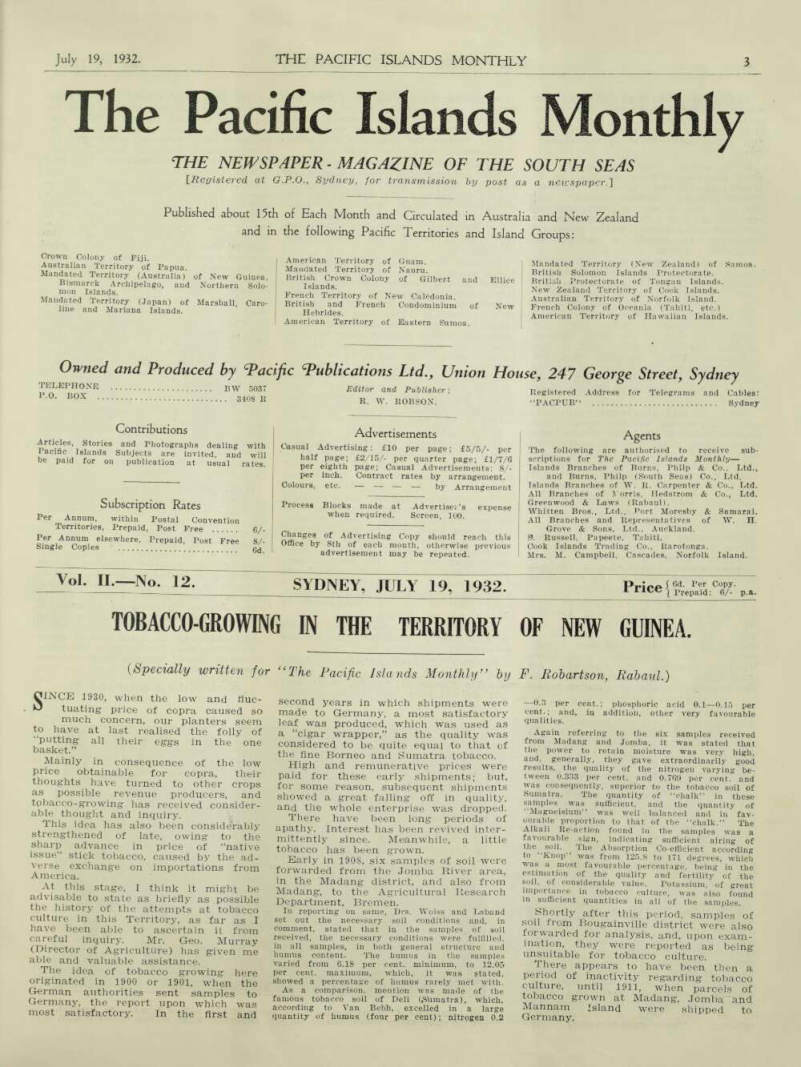
An Aerial View of Typical Country in the Morobe District of New Guinea. As described in the accompanying article, tobacco has been successfully grown on land in this locality.
ritory, with a view of investigating the possibilities. Quite a lot of informa tion was gathered on the subject, and numerous samples were taken to Aus tralia. The result of this visit was not known until March or April, 1923, and same was both unsatisfactory and most disappointing.
Although it was stated, in a letter from the manufacturers, that the samples were submitted to an expert, no information was given as to the result of his examination. The letter merely mentioned the fact that a more suitable type of leaf could be pur chased, at that time, at 9d. per lb., and that unless some preference in the matter of duty could be obtained, there was no prospect of a market being found in Australia for New Guinea grown leaf.
Throughout 1923, endeavour was made to secure special samples of seed from the Federated Malay States, Borneo, Sumatra, Java, etc., and even tually a small sample was received from an experimental station in East Java.
During 1923 and 1924, there were constant inquiries from planters in different parts of the Territory for in formation regarding tobacco culture, and a general correlation of local data was carried out by the Department of Agriculture in Rabaul.
The Department sent representative leaf samples of tobacco grown by natives in the hills behind Finschafen to The Imperial Institute, London, in March, 1925. This leaf tobacco was grown from Australian seed, imported by the Lutheran Mission, and the curing was done by the crude methods which I mentioned earlier. The report on the examination of this sample, which was received towards the end of 1925, was, on the whole, most en couraging.
The tobacco, after the removal of the mid ribs, gave the undermentioned results upon analysis:—Moisture, 14 per cent.; Nicotine, 4.10 per cent.; Nitrogen, 4.56 per cent.; Ash, 13.3 per cent. This result showed somewhat high proportions of nitrogen and nicotine.
Upon smoking in cigar form, the tobacco held fire reasonably well, but showed poor combus tion and yielded a black, charred ash. The flavour and aroma were found to be coarse and somewhat pungent. In the form of cigarettes, although the tobacco burned well, the same re marks applied as to coarseness and pungency, and, consequently, it was indicated that the leaf would be unsuitable for cigarette manufacture.
It showed somewhat similar properties when smoked as a pipe tobacco and was, therefore, considered suitable only for use in heavy shag and dark mixtures.
Manufacturers in London, to whom this leaf was submitted, were very favourably impressed by the appearance and character, and it was regarded as a very promising type.
One firm was prepared to receive trial bales of the tobacco, if of equal quality to the samples submitted, which it stated would be suitable for its requirements as a pipe to bacco. It considered that the leaves were of good shape, the butts well covered, and the midribs not too large. For its purpose, the veins were too wiry and the colour of the leaves too red to allow the tobacco to be used as a “cigar wrapper.”
Although the sample submitted was, therefore, unsuitable for cigars, its ap pearance indicated the possibility of growing satisfactory cigar leaf in New
Guinea, and steps might therefore be taken to improve the curing methods.
During the whole of 1926 and 1927, there was a considerable amount of correspondence between the Depart ment of Agriculture in this Territory, The Imperial Institute, the High Com missioner’s Office, and English firms of repute. This culminated in the despatch to England of a case of re presentative leaf samples, as grown in the various districts of this Territory.
One English firm made offers of pur chase, and indicated its price. How ever, as the only available supplies would have to be secured from natives, it was not considered advisable to go ahead, with the project, as no reliance could be placed on the native to carry out any promise of delivery.
Taking the whole of the facts into consideration, so far, it is noticeable that only “native grown” tobacco has been submitted or considered.
In view of the encouraging reports received, with proper, cultivation under European methods of planting and supervision, indications point to great possibilities ahead of us in this Territory, even if we only concerned ourselves with the production of the cheap tobacco which would be used in the manufacture of “stick tobacco” as issued to the indentured native labourer.
As far as I have been able to ascer tain, with one exception until recently, no real effort has ever been made by planters of this Territory to go into the question of tobacco culture as an in dustry.
The exception was in the case of the New Guinea Company during the period when they had this Territory under charter. They had a properly laid out tobacco plantation somewhere in the Madang district, which was staffed by and under the control of Malays and Chinese.
These people interfered with the na tives and, in the resultant reprisals, were massacred and killed off. For this and other reasons, the scheme was not a success and the New Guinea Com pany appears to have dropped tobacco culture as a business.
At the present time a certain local market exists for leaf tobacco, which is either obtained from native villages, or grown in small quantities on planta tions. Many of the plantations issue their labour line with half the weekly ration in leaf form and half in the form of the imported “stick.”
If, however, some sudden demand were to arise, either by a more general use of leaf, or from some outside de mand, available supplies would be quickly absorbed and we should have to plant up additional areas and wait for the crop to grow and mature. In these circumstances, there could be no continuity of supply until a consider able period had elapsed.
If it is not intended or desired at pre sent to consider the cultivation of special quality tobacco for cigar mak ing, etc., there is no doubt that the quality of the leaf which has already been grown, should be suitable for the manufacture of the “native stick to bacco,”
This form of a new industry has much to commend it, as the issue of tobacco in “leaf form” will never re place the “stick,” which has attained large dimensions as a form of “cur rency” between natives themselves and natives and Chinese traders. The de mand already exists for the “stick” to bacco, as our importations during tfie financial year ended the 30th June, 1931, amounted to 218,193 lbs., the value of which on invoice price at port of ship ment was £27,787.
There is consequently, in this form of manufacture, no necessity to endeavour to obtain an outlet through outside markets for our production for some considerable time. Local planters would greatly benefit by obtaining a cheaper tobacco and the £27,787 which now goes to America would remain in circulation in this Territory.
In subsequent consideration of out side markets, those of Europe would appear to offer the best scope, but the whole question would be one of im
proved quality, whereby an article could be produced which would be suit able for European requirements. Asso ciated with this, of course, would be the question of the price which could be obtained.
Another fact worthy of notice is the apparent difference between the expert reports received from Europe and those obtained from Australia. In the latter case, however, in reading- between the lines, I was forced to the conclusion that these reports savour of politics and policy.
Valuable facts are contained in an “Industrial and Commercial Geography,” by J. Russel Smith (Constable, Lon don) in which there are some graphs dealing with tobacco culture and manu facture. Even with the great quantities of tobacco grown in the various parts of the continent of Europe, the demand has always greatly exceeded the supply.
Russia, with a pre-war crop of 233 million pounds, was the leading tobacco growing country of Europe and with this production had practically no sur plus for export. Germany, which is now the largest European grower, with a production of 65 million pounds per annum, imports three times the quan tity it produces. Italy and France each grow 50 million pounds and import much more than this quantity. France leads the way in production as with careful fertilisation and cultivation they obtain about 1,500 lbs. to the acre.
The amount of duty collected in this Territory on 218,193 lbs. of native to bacco imported in 1931, calculated at 2/6 per lb., amounts to £27,274/2/6, and if we are able, in time, to manufacture our own requirements, and “excise duty” or some other form of compensa tion taxation must be considered.
Whilst collecting data for this article, I have met with opposition from more than one planter, who has asked me not to mention anything about recently grown local tobacco, in case the Ad ministration “wake up” in respect to the imposition of a form of duty.
I have not noticed any somnambu listic tendencies among Departmental Heads in this Territory—much the re verse.
Apart from experiments at the Gov ernment Experimental Station at the Keravat River, other private experi ments are being carried out. I recently saw a small box of locally-grown and manufactured “native stick twist to bacco.” In appearance, the local pro duct was quite equal to the best im ported American article. It was very uniform in both quality and the size of the sticks. I was informed that this tobacco which I had inspected could be sold profitably at 1/9 per lb. (of course, without the imposition of any form of duty). This was a remarkable figure, when compared with the present price of 5/2 per lb., in caddy lots, and 5/6 per lb. retail.
I do not wish in any way, to dampen the enthusiasm of those who have been experimenting in tobacco culture and the manufacture of stick tobacco, but I cannot stress too strongly some re marks which were made to me by the Director of Agriculture. He told me that tobacco culture, and especially the curing, was a highly specialised busi ness which required considerable prac tical experience which was not obtain able from books.
From the facts gathered, the venture would appear to be one well worth most serious consideration, and in the event of capital being obtained to
finance a project of this nature, the very best expert knowledge should be secured from some tropical country which has already made a success of the business.
It looks as though, after about three decades of half-hearted and abortive attempts at tobacco culture in this Ter ritory, present economic circumstances may force the issue, so that at least we may have in sight a sufficiency of locally-grown tobacco to fill our re quirements.
In conclusion, and to further stress the necessity of obtaining expert know ledge, I will mention the fact that at some time prior to 1922, a company in Papua imported an elaborate tobacco and cigar making plant from which they turned out large quantities of “twist stick tobacco” and cigars. The native tobacco was not a success, and was found to be dry and brittle, break ing into pieces when untwisted; it was tasteless and lacked the “tang” of the imported American tobacco which reeks so much of rum and molasses.
Eventually, the whole of this expensive plant was scrapped.
Papuan Stamps.
Subjects For New
From Our Own Correspondent.
Pt. Moresby, June 14.
GREAT interest will be taken by phil atelists throughout the world in the new Papuan postage stamps, which are to be issued shortly.
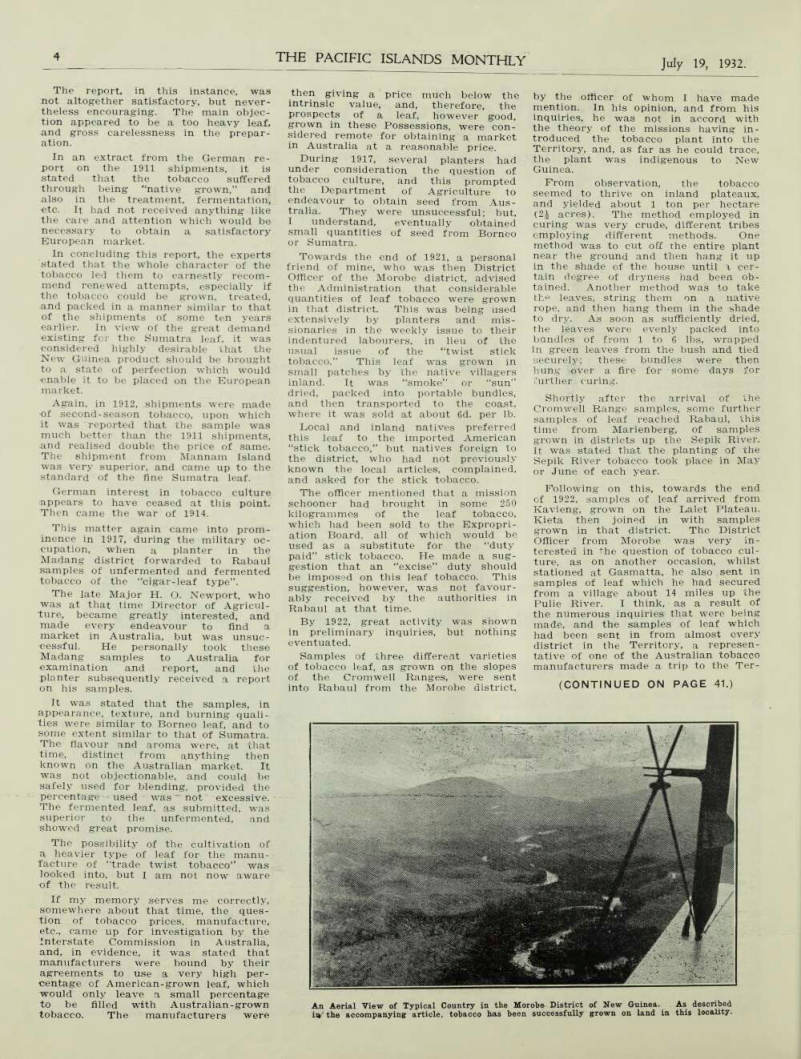
Below are shown two of the subjects of the new stamps. The design for the
5/- issue will be taken from a photo graph of Sergt.-Major Simoi, who is the only native in Papua to reach the rank of Warrant Officer in the local Armed Constabulary. He joined the force in 1899 and has, by his courage, loyalty and endurance, set an example to all Papuans in the police force. In the early days he made many long and dangerous patrols under white officials, and always he was commended for his bravery, fearlessness and valour. He is a native of Kiwai Island, in the Western Division of Papua.
The new 3d. stamp will depict a Koi tapuan native of the district of Port Moresby, dressed in gala array. With bird of paradise plumes and cockatoo feathers, cuscus bandeau and dogs’ teeth, he presents a spectacular figure.
His pierced nose is ornamented, as are his arms and his legs.
Left: Sergt.-Major Simoi, of the Papuan police force. Right: A Port Moresby native.
Photos by A. Gibson
Morinda Itinerary Altered.
From Our Own Correspondent.
Norfolk Is., July 2.
ON her next trip and thenceforward until further notice, the “Morinda” will reverse her usual order of run ning and proceed to Auckland, before continuing her voyage to the New Hebrides.
This will suit us much better, as giving us two markets per month and should not make any difference to the New Hebrides, except on the initial trip. The utmost satisfaction is ex pressed locally at the change.
The new itinerary of the “Morinda” will be found in our shipping columns.
Woman’S Brave
Action.
From Our Own Correspondent.
Rabaul, June 27.
RECENTLY, Mrs. T. W. Bayliss, of Bulolo, the wife of the Native Labour Superintendent for the Bu lolo Gold Dredging Co., Ltd., was walk ing along the bank of the Bulolo River, accompanied by a native servant, when the native was bitten on the foot by a death adder.
The native was badly bitten and, in pulling the snake off his foot, broke a fang, which remained in the wound.
Without hesitation, Mrs. Bayliss, who had neither knife nor snake-bite outfit with her, tied a ligature on the boy’s leg and sucked the poison out of the wound.
The treatment was successful and the native has now completely re covered.
Great credit is due to Mrs. Bayliss for her prompt action, as most people would have hestitated before scarifying the snake-bite wound on the foot of a native, thereby probably running undue risks of disease, in addition to the usual risk under such circumstances.
Gold Find on Upper Wau.
From Our Own Correspondent.
WAU, July 2.
MR. W. G. ROYAL, one of the original “Big 6,” the finders of this gold field, has struck a good patch on the Upper Wau, about two miles above Wau township.
The find consists of quite a large patch of alluvial, which is said to be carrying good gold. He is opening up what appears to be a fairly rich reef.
Bishopric Of Melanesia.
THE Rev. Walter Hubert Baddeley, vicar of Southbank, York diocese, who has been appointed Bishop of Melanesia, sails from England in Oc tober.
Bishop Baddeley rendered conspicuous war service, being awarded the Military Cross with Bar and the D.S.O.
Governor Jore
Appointment to New Caledonia.
From Our Own Correspondent.
Papeete, June 16.
His Excellency Governor
JORE, who has been in charge of this colony for the past two years, is leaving Tahiti by the s.s. “Maunga nui” on June 18, en route to Noumea, where he will enter upon his new ap pointment as Governor of New Cale donia and Dependencies, General Com missioner of the French Republic in the Pacific, and High Commissioner for France in the New Hebrides.
Governor Jore entered upon his term of office here after the downward slant in copra values had got well under way, and the population was already begin ning to dip into its capital and savings, in order to meet current expenses. Dur ing the whole of his regime, scarcely a gleam of light showed above the finan cial horizon. On the contrary, the copra situation grew steadily worse, the market for vanilla and pearl shell, two other important Island products, collapsed, and Governor Jore’s adminis tration was faced with a problem of ever-increasing difficulty: that of pay ing the staff and providing essential public services from a constantly de clining revenue.
That he has been able to do this and leave the colony with the goodwill of the community behind him, shows an unusual amount of tact and ability. We sincerely hope that the same success will attend him in his new sphere.
One important measure brought into effect by Governor Jore was the abro gation of the tax on automobiles and its substitution by an import duty on gasolene. This, undoubtedly, brought more money into the governmental cof fers, but, at the same time, caused the burden to be more equitably dis tributed. Those who travel most and own the largest cars now pay the most, which is as it should be.
Monsieur Bouchet, who has acted as Secretary General for some time past, is named as the new Governor of these French establishments.
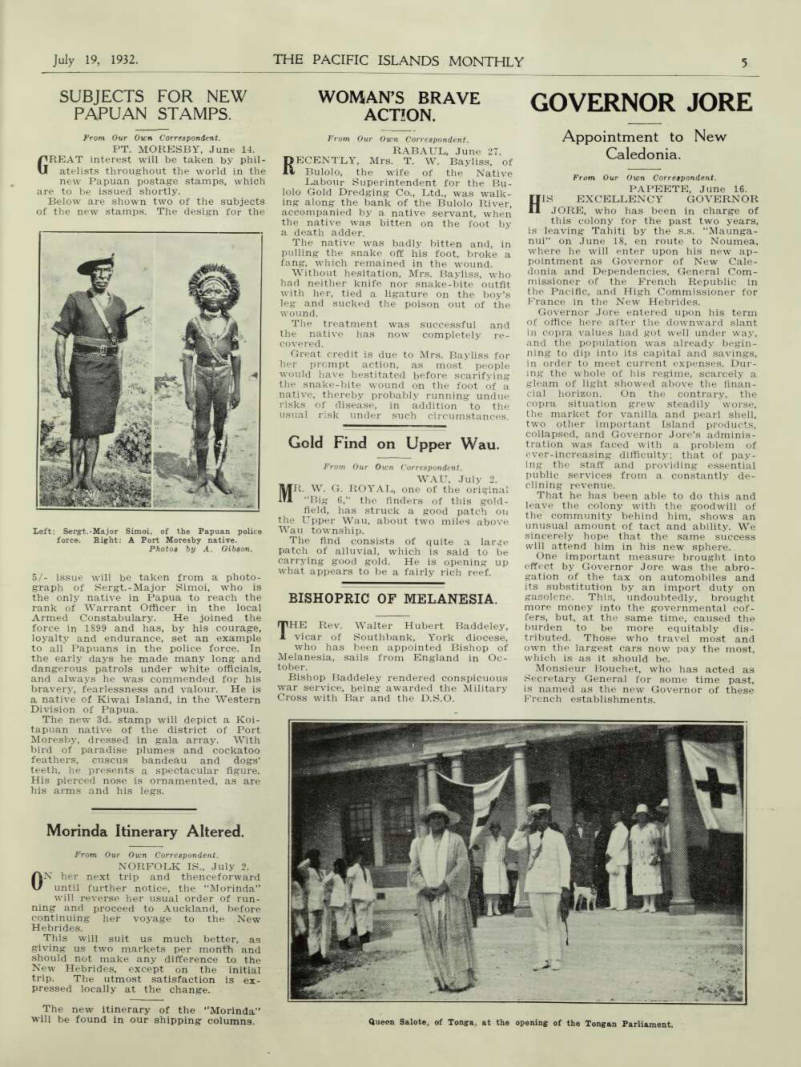
Queen Salote, of Tonga, at the opening of the Tongan Parliament.
The Town Barber Of
Apia.
IN the old pre-war days, when Samoa was under the German flag, one of the originals of the Apia life was an old German barber named Stopfkinchen.
As there was only one barber in town, all Europeans had, by necessity, to patronise his shop, though he was not exactly famed for cleanliness or court esy. Quite a few amusing anecdotes are told about the treatment customers had to suffer at times at his hands, especially after a prolonged sitting of Stopfkinchen at the bar of the hotel situated on the beach road of Apia— opposite the barber shop.
Once, a customer entered his shop to have his hair cut. Stopfkinchen started work, and when he was half through, the victim of his operations observed that the clipper was very dirty and rusty and asked him to clean it.
Indignantly, Stopfkinchen refuted the charge, stating (he was very short sighted) that he could not see a trace of dirt, and, at the same time, refusing to finish his hair-cutting.
There was nothing left to his client but to leave the shop, showing one side of his head short cut, while the other half was showing a lion’s mane, to the huge amusement of a number of on lookers.
Old Stopfkinchen, like many German barbers, was a trained medical assist ant and nurse, and, owing to there being no dentist available in Samoa at the time, he used to extract teeth with more or less skill. It sometimes hap pened that, after several fruitless at tempts at extracting a tooth, when he had pulled his victim out of the chair but not succeeded in getting the tooth out, Stopfkinchen, exhausted by his ex ertions, felt the need for some refresh ment and, arm-in-arm with his latest
victim, walked across the road to the bar. After having- imbibed quite a num ber of whiskies and sodas, in unison with his victim —to whom he prescribed same as medical treatment for his den tal troubles —both would return to the shop to recommence work on the stub born tooth. Often he succeeded in breaking the tooth off, leaving the roots in.
When asked to get the root out, he said, “How can I? I cannot even see where it is! I shall give you some cocaine, then you will not feel any more pains.” And that was the last of it!
Stopfkinchen, later, went to Savaii, where he opened a trading station. In addition, he treated the natives for dis ease, gaining quite a good reputation on the island.
He died, during the War, at an ad vanced age.
Goldfields.
End of Freight War on N. G.
From Our Own Correspondent.
WAU, July 2.
AFTER the recent freight war, the aerial transport companies are ap parently agreed that there is a liv ing for all, and it does not pay even for the big companies to try to smother the small man, with the result that freights have again settled down at 5d. per lb.
Before the arguments on freights, the price was 6d. per lb. As usual, 1d. re bate is given for cash.
The mail contract was recently ob tained by Pacific Aerial Transport, and this company has now been successful in obtaining the Administration con tract for freighting goods from the coast. The company has a Fokker, a Junker, and a Moth at present in opera tion, and a D.H. machine will be in the air within the next week. The D.H. has just been rebuilt and has a Siddeley “Puma” water-cooled engine.
Winter On Norfolk
Island.
From Our Own Correspondent.
Norfolk Is., July 2.
THESE last few weeks have been like a wild April at Home; slashing, silver rain . . . screaming winds . . . bright sunshine and blue skies quickly overcast . . . the joyful fluting of fat thrushes and sleek blackbirds in the swaying treetops.
In between the showers, we are out in our gardens planting out the tender seedlings that in a few short weeks will fill the island from end to end with scent and colour. The violets are out already, wet and sweet; jonquils and narcissus are bursting from their buds; there are a few drenched roses, and giant begonia hang heavy heads of pink and scarlet; but that is nothing to what we shall see by-and-by.
Winter anywhere is worth enduring for the sake of spring.
Dysentery at Edie Creek.
From Our Own Correspondent.
WAU, July 2.
THE dysentery outbreak which com menced at Edie Creek some three or four months ago, has not yet been wiped out, although cases are now very few.
By the foresight of the Administra tion medical authorities in isolating the Edie Creek area, the outbreak has been confined to that section of the field, and no great hardship has been imposed on any of the miners in the district.
Europeans can still travel between Edie Creek and the various parts of the field, but natives are confined to a small area at Edie Creek. There is now no danger of the outbreak spreading.
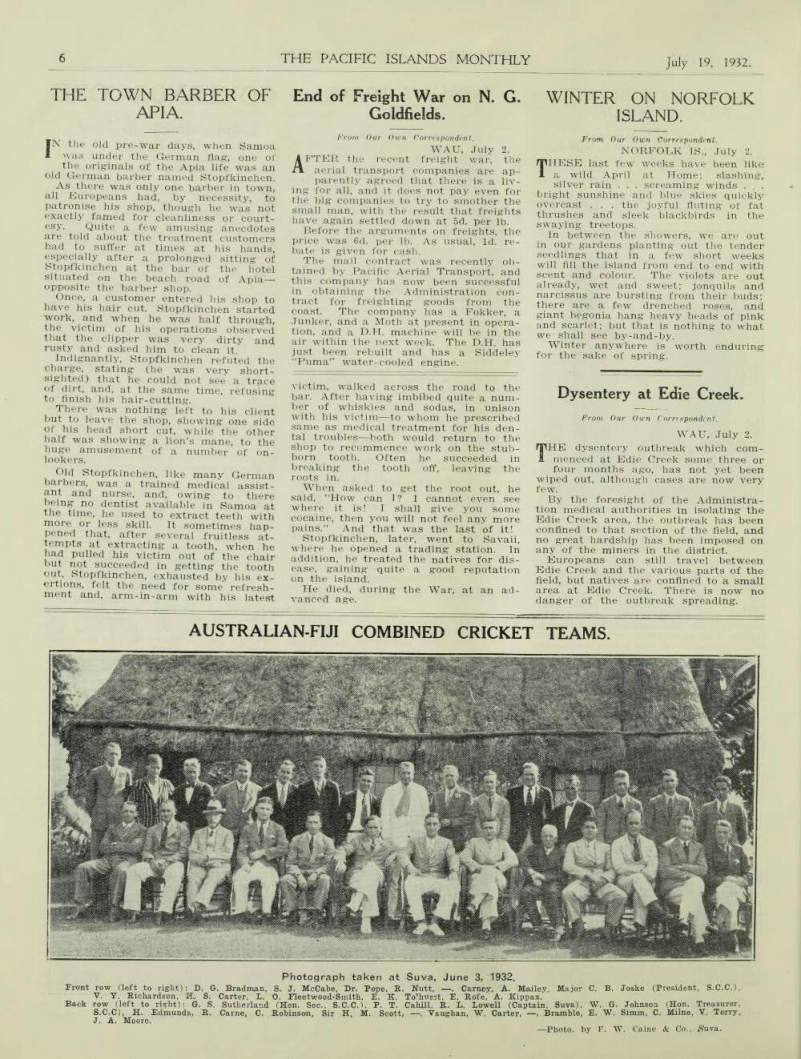
Australian-Fiji Combined Cricket Teams.
Photograph taken at Suva, June 3, 1932.
Front row (left to right): D. G. Bradman, S. J. McCabe, Dr. Pope, R. Nutt, —. Carney, A. Mailey, Major C. B. Joske (President, S.C.C.), V. Y. Richardson, H. S. Carter, L. O. Fleetwood-Smith, E. K. To’hunst, E. Rofe, A. Kippax.
Back row (left to right): G. S. Sutherland (Hon. Sec., S.C.C.). P. T. Cahill, R. L. Lowell (Captain, Suva), W. G. Johnson (Hon. Treasurer, S.C.C), H. Edmunds, R. Carne, C. Robinson, Sir H t M. Scott, —. Vaughan, W. Carter, —. Bramble, E. W. Simm, C. Milne, V. Terry.
J. A. Moore. —Photo, by F. W. Caine & Co., Suva.
Merchant.
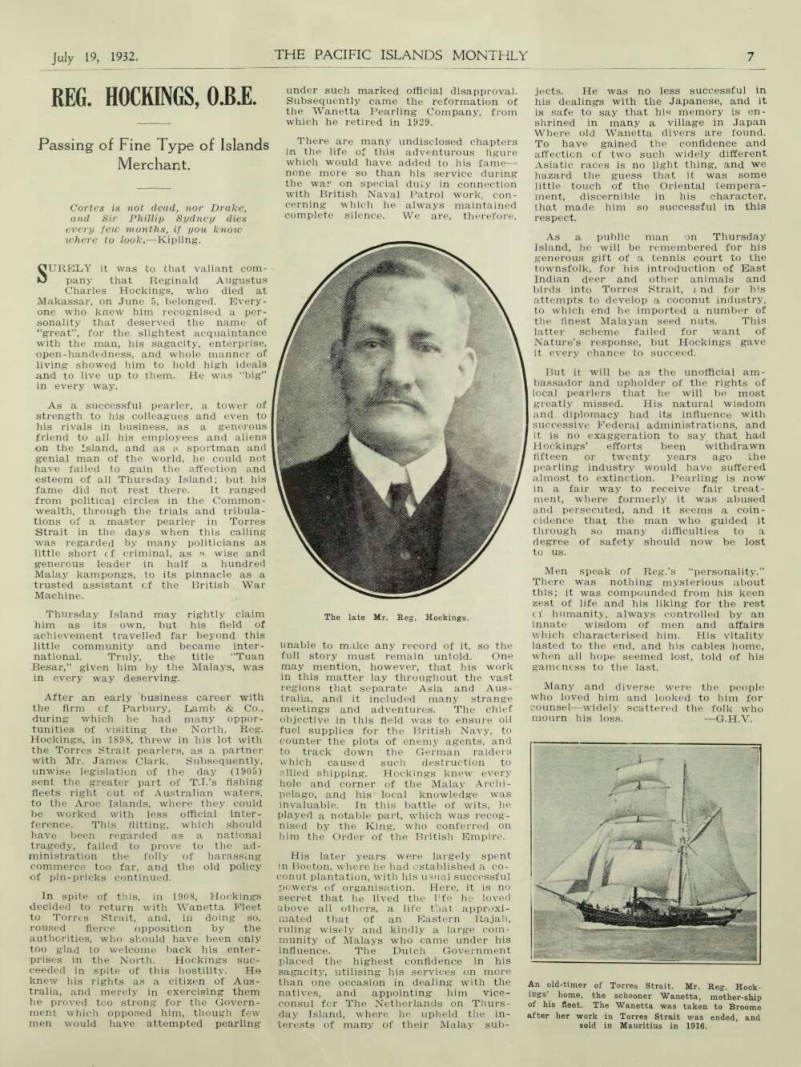
Reg. Hockings, O.B.E.
Passing of Fine Type of Inlands Merchant.
Cortes is not dead, nor Drake, and Sir Phillip Sydney dies every few months, if you know where to look. —Kipling.
SURELY it was to that valiant com pany that Reginald Augustus Charles Hockings, who died at Makassar, on June 5, belonged. Every one who knew him recognised a per sonality that deserved the name of “great”, for the slightest acquaintance with the man, his sagacity, enterprise, open-handedness, and whole manner of living showed him to hold high ideals and to live up to them. He was “big” in every way.
As a successful pearler, a tower of strength to his colleagues and even to his rivals in business, as a generous friend to all his employees and aliens on the Island, and as a sportman and genial man of the world, he could not have failed to gain the affection and esteem of all Thursday Island; but his fame did not rest there. It ranged from political circles in the Common wealth, through the trials and tribula tions of a master pearler in Torres Strait in the days when this calling was regarded by many politicians as little short of criminal, as a wise and generous leader in half a hundred Malay kampongs, to its pinnacle as a trusted assistant cf the British War Machine.
Thursday Island may rightly claim him as its own, but his field of achievement travelled far beyond this little community and became inter national. Truly, the title “Tuan Besar,” given him by the Malays, was in every way deserving.
After an early business career with the firm of Parbury, Lamb & Co., during which he had many oppor tunities of visiting the North, Reg.
Hockings, in 1898, threw in his lot with the Torres Strait pearlers, as a partner with Mr. James Clark. Subsequently, unwise legislation of the day (1905) sent the greater part of T.I.’s fishing fleets right out of Australian waters, to the Aroe Islands, where they could be worked with less official inter ference. This flitting, which should have been regarded as a national tragedy, failed to prove to the ad ministration the folly of harassing commerce too far, and the old policy of pin-pricks continued.
In spite of this, in 1908, Hockings decided to return with Wanetta Fleet to Torres Strait, and, in doing so, roused fierce opposition by the authorities, who should have been only too glad to welcome back his enter prises in the North. Hockings suc ceeded in spite of this hostility. He knew his rights as a citizen of Aus tralia, and merely in exercising them he proved too strong for the Govern ment which opposed him, though few men would have attempted pearling
under such marked official disapproval.
Subsequently came the reformation of the Wanetta Pearling Company, from which he retired in 1929.
There are many undisclosed chapters in the life of this adventurous figure which would have added to his fame — none more so than his service during the war on special duly in connection with British Naval Patrol work, con cerning which he always maintained complete silence. We are, therefore,
unable to make any record of it, so the full story must remain untold. One may mention, however, that his work in this matter lay throughout the vast regions that separate Asia and Aus tralia, and it included many strange meetings and adventures. The chief objective in this field was to ensure oil fuel supplies for the British Navy, to counter the plots of enemy agents, and to track down the German raiders which caused such destruction to allied shipping. Hockings knew every hole and corner of the Malay Archi pelago, and his local knowledge was invaluable. In this battle of wits, he played a notable part, which was recog nised by the King, who conferred on him the Order of the British Empire.
His later years were largely spent in Boeton, where he had established a co conut plantation, with his usual successful powers of organisation. Here, it is no secret that he lived the life he loved above all others, a life that approxi mated that of an Eastern Rajah, ruling wisely and kindly a large com munity of Malays who came under his influence. The Dutch Government placed the highest confidence in his sagacity, utilising his services on more than one occasion in dealing with the natives, and appointing him vice consul for The Netherlands on Thurs day Island, where he upheld the in terests of many of their Malay sub
jects. He was no less successful in his dealings with the Japanese, and it is safe to say that his memory is en shrined in many a village in Japan Where old Wanetta divers are found.
To have gained the confidence and affection of two such widely different Asiatic races is no light thing, and we hazard the guess that it was some little touch of the Oriental tempera ment, discernible in his character, that made him so successful in this respect.
As a public man on Thursday Island, he will be remembered for his generous gift of a tennis court to the townsfolk, for his introduction of East Indian deer and other animals and birds into Torres Strait, and for his attempts to develop a coconut industry, to which end he imported a number of the finest Malayan seed nuts. This latter scheme failed for want of Nature’s response, but Hockings gave it every chance to succeed.
But it will be as the unofficial am bassador and upholder of the rights of local pearlers that he will be most greatly missed. His natural wisdom and diplomacy had its influence with successive Federal administrations, and it is no exaggeration to say that had Hockings’ efforts been withdrawn fifteen or twenty years ago the pearling industry would have suffered almost to extinction. Pearling is now in a fair way to receive fair treat ment, where formerly it was abused and persecuted, and it seems a coin cidence that the man who guided it through so many difficulties to a degree of safety should now be lost to us.
Men speak of Reg.’s “personality.”
There was nothing mysterious about this; it was compounded from his keen zest of life and his liking for the rest of humanity, always controlled by an innate wisdom of men and affairs which characterised him. His vitality lasted to the end, and his cables home, when all hope seemed lost, told of his gameness to the last.
Many and diverse were the people who loved him and looked to him for counsel—widely scattered the folk who
mourn his loss.
G.H.V.
The late Mr. Reg. Hockings.
An old-timer of Torres Strait. Mr. Reg. Hook ings’ home, the schooner Wanetta, mother-ship of his fleet, The Wanetta was taken to Broome after her work in Torres Strait was ended, and sold in Mauritius in 1916.
Tropicalties
ONE ardent believer in the value of the aeroplane as a factor in Islands communications and development is Mr. G. H. Murray, Director of Agricul ture in New Guinea. He spent long leave recently in an extensive tour of the West Indies, investigating tropical agricultural conditions there, which may in future interest New Guinea, and he travelled nearly everywhere by ’plane.
The aerial services of Pan-Pacific Air ways—a powerful American company— cover most of the West Indies, and they are fast, cheap and wonderfully ef ficient. Mr. Murray went right across the Archipelago, from Panama and Porto Rico to Haiti and Cuba, by a network of air service: and now he believes that, as population grows and industries are developed, similar aerial services will become an important fac tor in future life in the South Pacific. * * * THERE is something about the happy isles of Tonga which seems to de velop a writer’s itch, and a happy capacity for the right phrase. We have had from Tonga more letters, and let ters more aptly written —dealing with administrative subjects—than from any other Pacific Territory. There seems to be two schools of thought—one which is friendly towards the Government, and its hopes and expectations (even unto the banana venture!) and another which is ready, with bell, book and candle, to curse the kingdom and its administration, and all its works. We have several lengthy letters on hand from Tongan controversialists, which will be published as soon as possible.
They ought to be thrown out, owing to their excessive length; but they are so well-written, and are so brightly argu mentative, that we have not the heart for the slaughter. * * * THE other day, I heard two Islands administration officials squabbling over a Territory budget. They were getting ready to “cut” estimates, and they were casting calculating eyes over the lists of salaries.
“Too many of these scientific John nies,” said one. “We’ve got half a dozen on the strength now.”
“Yes,” agreed the second official.
“They’re all right in prosperous days, when there’s plenty of money about.
But, in these times, they should go overboard with other luxuries.”
Ten minutes later, back in my office, I opened a letter from a friend in the Cook Islands, who told me of how an entomologist, by introducing a species of Chalcid fly to Aitutaki, had suc
ceeded in wiping out a citrus scale which was threatening to destroy all the orange groves in that fertile island.
I remembered, also, the remarkable story of how the introduction of a parasite from the East Indies destroyed the pest that, for 40 years., had made copra production impracticable in Viti Levu, Fiji. There is scarcely an Ad ministrator’s report published nowa days which does not bear testimony to the good work being done in these tropical countries by “the scientific Johnnies” —agricultural, medical, ento mological, etc. Science is the eyes of industry and progressive development.
Better retrench a dozen clerks, than one research man. • • • OUR Thursday Island correspondent sends these Torres Strait pilot stories: —One of the pilots was going about with a black band round his arm; he had just had bad news from Hongkong, he said —“Tom” was dead.
“Tom” had made his appearance some weeks previously on the vessel he was piloting up the Barrier Reef, and at once became a general favourite on board. He was not a stowaway, as he jumped quite openly on the deck, and, on being taken into the chart room, put up a pair of long, lean hands, bowed his head and offered up a prayer of thanksgiving. “Tom” was a praying mantis, and no one on the ship knew what to feed him on, until cockroaches were suggested and found favour. A letter from China contained the sad news that he had over eaten himself and passed away. One of the other pilots seemed disappointed on hearing the tale and capped it by another. One of his ships took on a mantis as pas senger long ago, he said —it must have been a very long time ago and almost suggests the days of Noah —and had laid an egg on the skipper’s bunk. A young mantis duly appeared, and the mother then took up the business in earnest. More eggs and more young mantises came along, till the supply of cockroaches ran out and the entire family perished from starvation. * * * IN view of the series of questions which Mr. Roland Green asked re cently in the House of Representa tives, in connection with matters in New Guinea, our Rabaul correspondent states he understands that Mr. Green, who is at present visiting the Terri tory, has been almost inundated with requests for interviews from persons with grievances or “an axe to grind.”
Good Gold Returns from Koranga-
Bulolo Junction.
From Our Own Correspondent.
WAU, July 2.
AT the end of last year, Messrs. Marsh, Pollard and Fahey (forming the Marwil Syndicate) had got on to some very rich wash on the Koranga-
Bulolo Junction, and there was a mild rush to peg hydraulic claims along the boundaries of the Kylie lease.
This ground, however, consists of very high terraces above the Bulolo, and it was found impossible to work most of the claims, owing to lack of water. The Syndicate, however, put in a water race from the Koranga and is obtaining very good returns, but the greater number of the other claims have been abandoned.
In Praise Of Capt.
Pinney.
A RESIDENT of Port Moresby gives honour where honour is due: The Commonwealth Government can be complimented upon its selection of Capt. Pinney, M.C., Commissioner of Lands and Agriculture for the Papuan Government, as Administrator of Nor folk Island.
Capt. Pinney’s long experience in ad ministrative and executive work in Papua excellently qualifies him for the position, Capt. Pinney joined the Papuan ser vice in 1906 as Chief Draftsman. When the War broke out, he immediately vol unteered and was offered a commission.
He declined this, however, owing to in experience in military service. By gal lantry in the field, he won a commis sion and later an M.C., and retired with the rank of Captain.
After the War, he resumed his old position in the Papuan Lands Depart ment, but by sheer merit rose to the position of Commissioner of Lands and Agriculture, and was nominated to both the Executive and Legislative Councils.
He was considered one of the most able officials in the Service. His un failing courtesy and sympathy, more especially with outside planters and settlers, made him extremly popular.
He will be much missed by the Public Service and the residents.
Capt. Pinney takes away the good wishes of all for his future success.
Bowling enthusiasts in Rabaul are seriously considering forming a bowling club. An area of land has been pro vided by the Trustees of the Recreation Reserve for the purpose of a green.
Advertisements & other items, p. 10 (1 item)
Hotel Imperial
Darlinghurst Road, KING’S CROSS.
Sydney's Acknowledged Leading Private Hotel.
TARIFF:
Inclusive, 10/- daily; 55/- to 63/- weekly. Room and Breakfast, 7/6 daily; 37/6 to 42/- weekly.
Running Hot and Cold Water in every Bedroom.
Electric Elevator. Garages adjacent. Nous parlons Francais. Address Correspondence to
MANAGER.
Telephone: FL 3051 (3 Lines).
Telegrams: Imperial-King’s Cross, Sydney.
Salamaua Doomed.
New Port Sought For Morobe Goldfield.
NO official announcement has yet been made concerning a report recently completed by Mr. Thornton, a Fed eral Public Works engineer, who inves tigated conditions at Salamaua, the port of the New Guinea goldfields.
Salamaua is built on a narrow spit of land, behind which large steamers may find shelter. It is not an ideal port, but it was the nearest point to the Morobe goldfield, 50 miles up in the interior, the exploitation of which was commenced some seven years ago.
There is now a substantial township there, but there has been a doubt for some time about the permanence of the place, owing to the constant sea-erosion that has been going on. A large sec tion of the sand spit has been washed away.
Salamaua is merely the terminal of the bush-tracks, which go over the pre cipitous mountains to Wau. Eight miles north there is another township, Lae, which is near the mouth of the Mark ham River. Lae is the headquarters of the Guinea Airways Service, which is responsible for most of the transport between the coast of New Guinea and the goldfield, and a large proportion of the goldfields cargo is now unloaded at Lae instead of Salamaua. It is a poor port, however. There is no shelter worth mentioning, and cargo is lightered ashore.
Mr. Thornton went to New Guinea last year to inspect Salamaua and, if conditions there did not warrant its continued use as a port, to suggest al ternative sites for a port. We under stand that he has reported that Sala maua is so subject to erosion that its further use is not recommended. We have, as yet, no indication as to what he recommends as an alternative.
It is likely that some sharply con flicting views will be submitted. It is known that General Wisdom, late Ad ministrator, favoured the building of a port at Lae, with a road up the Mark ham Valley and the Markham’s south ern tributaries, to the goldfield.
Others believe that Lae is hopeless, and urge instead the selection of Mad ang, with the building of a new road, or railway, across the, head waters of the Ramu and Markham to the goldfields.
This would represent a much greater distance between the goldfields and the goldfields port, but such a road would open up a large area of rich, agricul tural country.
On the other hand, if there is no necessity for a road or railway—that is, if future transport can be handled by aeroplanes, as in the past—the pre sent landing facilities at Lae, with a possible alternative as required at Salamaua, may meet the situation.
The Salamaua situation probably will receive the consideration of the new Director of Public Works (Mr. Potts), who has just been appointed.
A falling off in the production of copra is reported from the Madang dis trict of New Guinea. Dry seasons dur ing the past two years are responsible for this.
Our Second Birthday.
With this issue, “The Pacific Islands Monthly” completes two years of life ; and I am glad to take this opportunity of thanking sincerely my many friends throughout the Pacific Territories, and in Australia and New Zealand, for their kindly interest, goodwill and active sup port—without which it would not have been possible to make the progress that has been recorded.
The P.I.M. was launched just as the Great Depression settled down on the world; and it went out among the Pa cific Islands residents as a stranger.
Within two years it has found thousands of readers, in the Islands, and in almost every country in the world; and in spite of the far-reaching, necessary curtail ment of advertising allocations, it has been most generously supported by ad vertisers. Encouraging, friendly letters come to us literally in such numbers that we cannot acknowledge all of them; but they are much appreciated.
This support enables us, in spite of the prevailing bad times, to carry on vigorously with the job of providing the long-neglected Pacific communities with a newspaper that may be of some use to them. The most useful development of the two years has been the growing friendship and support of the various Administrations, and of the Departments in Canberra and Wellington responsible for Islands affairs. The officials have learned that “The Pacific Islands Monthly ” is anxious to help, and will not become an irresponsibe journalistic nuisance ; so that nowadays doors which once were closed are now officially open to us, and we are able to go straight to headquarters with genuine Islands grievances. It is a privilege that we value, and will not abuse.
We are very grateful to our corre spondents and agents in the various Is lands centres, whose co-operation and interest have assisted materially in building up the P.I.M. to its present standard.
R. W. Robson.
Filming “Bounty” Scenes.
Movie-Man on Pitcairn.
ACCORDING to a report from Auck land, Mr. Charles Chauvel, with his wife, recently reached there after spending two months on Pitcairn Is land, where a film of the mutiny of the “Bounty” was made.
The islanders gave Mr. Chauvel great assistance. The party had a narrow escape from drowning when landing on the island in a whaleboat during a gale.
A severe earthquake, which badly shook the island, was experienced on June 5.
Great landslides resulted, but there was no damage to the houses. It was the same day as that on which the earth quake occurred in Mexico.
Mr. Chauvel had many thrilling ex periences when taking films from whaleboats in heavy seas. One whale boat was wrecked on the rocks, but the occupants were uninjured. Mr. Chauvel said that the islanders were magnifi cent seamen. He is proceeding to Ta hiti to take further films.
Zoologist.
Whaling Industry.
Control Advocated by Zoologist.
THE possibility that the wholesale slaughter of whales, sea elephants, and seals in the Antarctic regions would ruin the industry, was empha sised by Mr. H. O. Fletcher, formerly zoologist of the British Australian, and New Zealand Antarctic Expedition, in a lecture at the Australian Museum, on July 7.
He said that unless steps were taken to check commercial exploitation, the numbers of whales and seals in the southern seas would be seriously de pleted.
The best method of control would be to appoint an inspector to each vessel operating in these waters, in order to see that the restrictions imposed by the various Governments controlling the area were observed.
Between 1910 and 1920, continued Mr.
Fletcher, 40,000 whales were killed in Antarctic seas. The value of the oil obtained from them was about £15,000,000. During the war the British Government had insisted that oil de rived in these regions should be sold on the British market, and had thus assured a supply of oils containing glycerine for use in the manufacture of explosives. About 50,000,000 gallons of oil was so marketed.
Copra Season.
Tonga Expects Good
From Our Own Correspondent
Nukualofa, June 21.
COPRA is beginning to come in more freely and, by August, the traders should have as much as they can handle.
This year’s crop promises to be an excellent one and planters are hopeful that the price, which still remains low, may increase somewhat. Even a small advance would stimulate trade tremen dously, particularly among the natives.
Advertisements & other items, p. 11 (1 item)
T. Elliott & Co.
(Established 15 years)
Real Estate Agents, Valuers,
Flat Specialists.
Controlling Agents for Principal Flat Buildings in Sydney, Darling hurst, Potts Point, Elizabeth Bay, Darling Pt., Edgecliff, Pt. Piper, etc.
When contemplating a visit to Sydney write regarding your re quirements and see us immediately on landing, and our services will be at your disposal.
72 DARLINGHURST ROAD,
(Opposite King’s Cross Theatre),
King’s Cross, Darlinghurst,
SYDNEY.
Telephone: FL 1968.
About Islands People.
Judge Ayson, Resident Commissioner for the Cook Islands, last month suf fered from a mild attack of rheumatic fever. His health is now reported to have improved.
Mr. Charles W. Marshall, chief sur veyor of New Guinea Goldfields, Ltd., is at present in Sydney on furlough.
Mr. Norman Nelson, honorary Consul for Uruguay in Sydney, and Mrs. Nel son, left by the “Macdhui” on June 30 for Rabaul, on a holiday trip.
Rev. J. W. and Mrs. Dixon, of the Methodist Missionary Society, left for Salamo, Papua, by the “Macdhui” on June 30.
Rev. T. N. Deller, after spending fur lough in Queensland, returned to Fiji by the “Aorangi” on June 23.
Rev. R, H. Green left Melbourne by the “Monterey” at the end of June to return to Fiji. Mr. Green represented his district at the recent annual meet ing of the Methodist Board of Missions.
Dr. C. S. James, who has been ap pointed to the Stewart Hospital in New Britain, will sail by the “Montoro” on July 21. He will be accompanied by Mrs. James and their youngest son.
Nurse E. Field, who, for the past three years, has been serving in Fiji as a Child Welfare Worker, returned to Sydney by the ‘‘Aorangi” last month.
Miss A. S. Williamson, who has been appointed matron of the Stewart Hos pital, in New Britain, sails from Syd ney by the “Montoro” on July 21.
Rev. E. A. Clarke, of the Methodist Missionary Society, returned to Papua last month, after spending his furlough in South Australia.
Miss Ruby Darcey, late of Samarai and Port Moresby Hospitals, Papua, is now Matron of the Government Hospi tal at Nauru.
Dr. J. Bevington, Chief Quarantine Officer at Thursday Island, and Mrs.
Bevington, arrived in Sydney by the “Changte” on July 10, M. Guyon, whose term as Governor of New Caledonia has just expired, was a passenger to Sydney by the “Laper ouse,” which arrived here on July 6.
Mr. P. C. Hubbard, chief magistrate of the Solomon Islands, arrived in Syd ney by the Orsova on July 7, after a visit to England. Mr. Hubbard was for two years acting British judge in the New Hebrides.
En Route To Papua
And New Guinea.
Townsville, July 4.
THE “Macdhui,” on her present voy age to Papua and New Guinea, is a full ship, and carries many passen gers whose arrival will be of interest to the Territories.
Aboard is Brig.-General T. Griffiths, who has just been appointed Acting- Administrator of the Mandated Terri tory.
The announcement that, for a time at least, the General will reign at Ra baul has been received in all quarters with a degree of satisfaction that is a tribute to his excellent record as a military administrator in New Guinea prior to 1921, and to his subsequent work at Nauru and as a Commissioner in the New Hebrides.
The New Guinea officials regard the General with respect, an a little fear.
He has a most disconcerting habit of appearing in unexpected places and disclosing an unexpected knowledge of embarrassing things.
His manner is quiet and genial—a most approachable man. “My door is wide open to everyone,” he says. ‘‘Of ficial, or native, or planter—if they have anything to discuss with me, I shall be glad to see them.” He is a shrewd, very thorough, hard-working man, with a wider vision in regard to the future of the Territory and the need of encouraging enterprise in its develop ment, than is usually found in a man
who has spent many years in ‘‘the sheltered services.”
There are aboard several well known officials returning from leave. Mr. G.
Hogan, law officer at Rabaul, and Mrs.
Hogan; Mr. W. E. Rosser, of the Papuan service, just back from Eng land; Mr. M. C. Crocker, copra inspec tor at Kavieng; Mr. J. C. Boileau and Mr. H. S. Russell, of the Papuan ser vice; and several others.
Sir Keith Smith, notable airman, and a member of the Vickers firm, is prob ably on his way to Bulolo to find out why the aeroplanes used in the famous aerial transport service, are nearly all non-British. Mr. Ray Parer, of Pacific Aerial Transport; and Mr. McGilvray, a leading executive of Guinea Airways, Ltd., are also aboard —good friends, but they do not sit at the same table.
Other interesting travellers are Mr.
P. Coote, the B.P. manager at Rabaul; Mr. Godden, a leading engineer of the Bulolo Company; Mr. J. H. L. Water house, returning to his botanical re search work in Bougainville; Mrs.
Champion, daughter-in-law) of the Papuan Government Secretary, going to join her husband at Misima; Captain W. Hamilton, one of the best known men in the Solomons, en route to Bou gainville; Mr. N. Nelson, son of Mr.
Ivan Nelson (Nelson and Robertson), owner of the Rabaul Hotel; Mr. E Bishton, of the A.W.A. service, and pioneer of the Bulolo wireless station; Mr. H. V. Jaques, ex-M.L.A., and Mr.
D. Watkins, M.P.; Mrs. F. E. Eekhoff, returning to Lae from a visit south; Dr. C. C. Simson, on a short visit to Port Moresby.
Advertisements & other items, p. 12 (1 item)
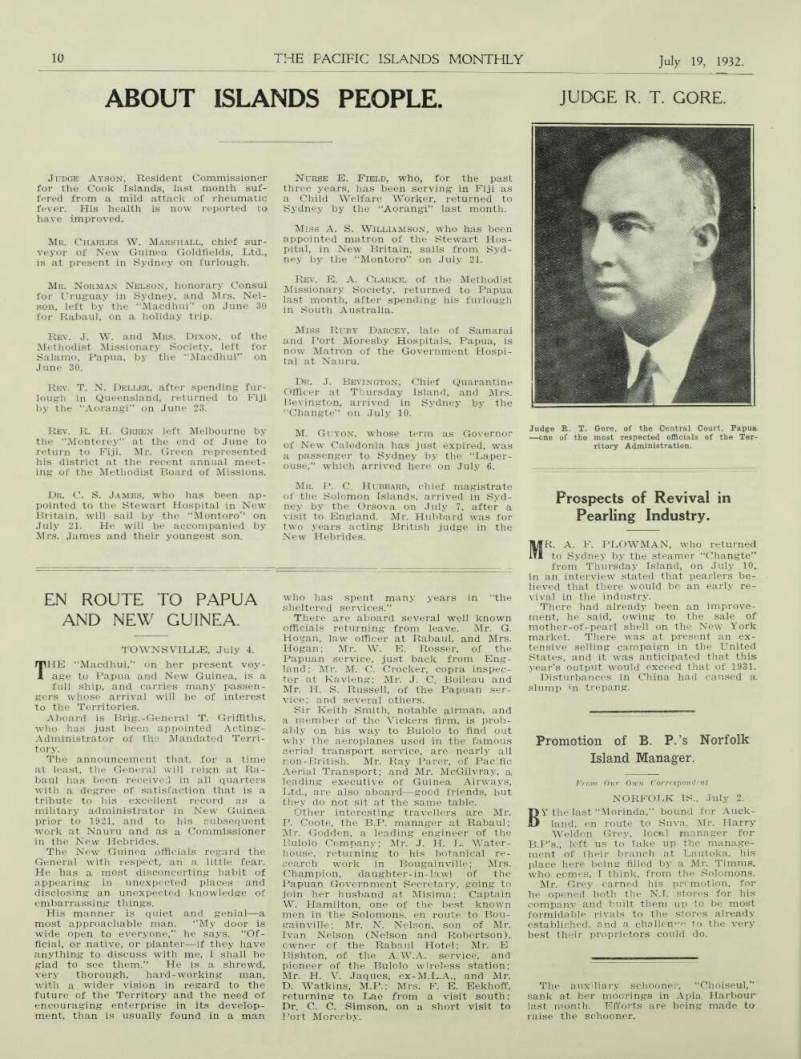
Judge R. T. Gore.
Judge R, T. Gore, of the Central Court, Papua. —one of the most respected officials of the Ter ritory Administration.
Pearling Industry.
Prospects of Revival in Pearling Industry.
MR. A. F. PLOWMAN, who returned to Sydney by the steamer “Changte” from Thursday Island, on July 10, in an interview stated that pearlers be lieved that there would be an early re vival in the industry.
There had already been an improve ment, he said, owing to the sale of mother-of-pearl shell on the New York market. There was at present an ex tensive selling campaign in the United States, and it was anticipated that this year’s output would exceed that of 1931.
Disturbances in China had caused a slump in trepang.
Island Manager,
Promotion of B. P.’s Norfolk Island Manager,
From Our Own Correspondent
Norfolk Is., July 2.
BY thelast “Morinda,” bound for Auck land. en route to Suva, Mr. Harry Weldon Grey, local manager for B.P’s., left us to take up the manage ment of their branch at Lautoka, his place here being: filled by a Mr. Timms, who comes, I think, from the Solomons.
Mr. Grey earned his promotion, for he opened both the N.I. stores for his company and built them up to be most formidable rivals to the stores already established, and a challenge to the very best their proprietors could do.
The auxiliary schooner, “Choiseul,” sank at her moorings in Apia Harbour last month. Efforts are being made to raise the schooner.
"Sick Papua.”
N. G. Officials Do Not Like Idea of Amalgamation.
THE suggestion that the administra tive personnel of Papua and New Guinea shall be brought together in a new “Australian tropical service corps” is being discussed with anima tion, and a certain amount of bitter ness, by representatives of both ser vices aboard the “Macdhui,” en route to the north.
The Papuans are indifferent. So long as their present liberal superannuation rights and other similar privileges are preserved, they do not care whether they are thrown in with New Guinea or not. They like the idea of a wider field of promotion.
But New Guinea appears actively hostile. The officials are inclined to think that the New Guinea service is keener, bigger and better, and possesses more “pep” than the Papuan service.
New Guinea, they say, is being actively organised and developed, and pays its way, while Papua is languishing, and making little developmental progress, and costs Australia £50,000 per annum.
New Guinea men are frankly sus picious of the tropical service idea.
They argue that it is a first step towards amalgamation, and is only part of a policy of “bringing Papua in out of the wet,” to share in the good times
which New Guinea hopes to enjoy shortly, as the result of receiving £20,000 or £30,000 per annum, from the five per cent, gold royalties. “We do not want sick Papua clinging to our coat tails,” says New Guinea. “Papua is Australia’s responsibility—not ours.”
One can appreciate New Guinea’s point of view. But one can also see the point of view of the Australian government. Why, asks the latter, should Papua not receive some of the developmental stimulus from the Bu lolo goldfield? New Britain and New Ireland are no more entitled to enjoy these gold royalties than is Papua—it was just their luck that they should have been in the same administrative area.
It is going to be an interesting con troversy—if it comes to that. So far, we have only the proposal for the formation of a tropical service corps— and only discussion and argument will show whether it is practicable.
Many of the officials say emphatically that it is not—that the laws and regu lations and general administrative con ditions in New Guinea and Papua are so widely different that it would be im possible to transfer trained officials freely from one to the other. In other words, they argue that there cannot be a merging of the personnel of the two Territories without amalgamation of the Territories, so that they are under the same laws.
The question affects the whole basis of the training of the officials—a mat ter of fundamental importance to the future of these Territories.—R.W.R.
More Publicity For T. I.
From Our Own Correspondent.
Thursday Is., June 30.
THURSDAY ISLAND is going to re ceive a good advertisement at a forthcoming exhibition of Queensland products to be held in Brisbane shortly, as a number of photographs, some natural products, and descriptions of the district’s attractions are being pre pared and will be staged by John Burke and Co.
We hope it will bring more tourists, but, until some enterprising man with faith in the future comes along to pro vide amusements and side trips, there are few means for tourists to thoroughly explore the charms of Torres Strait.
As a proof of what can be done in this respect, we chronicle a very suc cessful island tour held under the auspices of the Royal Geographical So ciety, which not only proved enjoyable to the participants but profitable to the promoters. If no local man comes for ward to supply the wants of tourists shortly, it is certain that some one else will seize the opportunity. It is a busi ness that will grow, though admittedly the promoter will have to be prepared to wait for a year or so till his efforts to provide southerners with an unusual holiday become better known.
Mrs. L, H. Holden, wife of Captain Holden, who conducts an air service on the New Guinea goldfields, returned to Sydney by the “Montoro” on July 13.
The Old German Trading Firm Of Western Samoa.
WE are indebted to Hon. O. F.
Nelson, of Auckland and Samoa, for permission to reproduce this very interesting photograph of the famous Ger man trading firm. It was com monly known in old South Sea days as “the long handle firm,” on account of its sesquipedal name.
It was officially called the “D.
H. and P. G.,” which are the in itials of the full title, namely: “Deutschen Handels und Plan tagen Gesellschaft der Siidsee Inseln zu Hamburg” (German Commercial and Plantation Company of the South Sea Is lands, of Hamburg).
The head office in Hamburg was known under the above style. The head operating branch was in Apia, Samoa, which was distinguished from the head office by the additional prefix to the above of “Haupt Agentur der” (Head Agency of); and as the other Island branches of the same firm were sub branches of Apia, the designa tion for Tonga Branch was "Tongatabu Agentur der Haupt Agentur der” (Tongatabu Agency of the Head Agency of) —and then followed the rest of it. The Mioko (New Britain) branch had a special title of “Zweigniederlassung der” (Spe cial Branch of).
Staff of the “Big Firm" at Apia. (1898), Sitting (left to right): G. Kaumann (Office Manager), Dr. B. Funk (Medical Adviser), A. Krueger (Manager Mulifanua Plantation), O. Riedel (General Manager). K. Burchardt (Visiting Hamburg Director), Captain H. Hufnagel (Manager, Vailele Plantation), C. Tiedemann (Manager Vaitele Plantation), A.
Haidlen (Company’s Land Surveyor), C. Koenig (Manager. Merch. Department).
Standing: A. Zimmermann, G. Lober (Assistant Merch. Manager), M. de Silva (Asst Yard Foreman), P. Schuster (later Manager at Rabaul), H. Milford (Chief Shipwright). A. Schultz (Cashier), A.
Willis (Architect and Chief Builder), P. Ravittza, P. Rasmussen (Chief Yard Foreman), E. Duesterdick (Plantation Inspector), G. Nuszhaer (Mechanical Engineer), F. Stange, A. Anton (Ledgerkeeper), G.
Knudsen.
Lying: O. F. Nelson (office boy), H. Hunkin (apprentice).
The Charm of Port Moresby
From Our Own Correspondent.
Pt. Moresby, June 10.
THE “Malolo” and “Mariposa,” both large Matson liners, and the “Stella Pollaris,” a luxury cruiser, carrying between them over 500 tourists, have recently visited Port Moresby.
There seems to be a general desire by the American tourists, that Port
Moresby should be included in their pleasure cruises.
They recognise the unique beauty of the harbour and the hills; the colour and charm of the surrounding country; and the vivid contrasts of the sea, the land and the foliage.
The native life and the villages at tract them also, and they find the Pa puan an interesting people.
It is not remarkable for Port Moresby offers to the lover of scenic beauty a rich and varied reward. The harbour, its ever changing waters, the rugged hills, the fertile valleys, the islands and lagoons, are all of great beauty and charm.
For the tourist it is an easy matter to cross the harbour by launch or to visit the neighbouring islands, where the day can be spent in fishing and swimming.
It is a pleasure to camp by the shade on Dauko Island, by dazzling sands and blue waters, and to listen to the south east wind in the palms, and the boom of the surf as it thunders on the reef.
The hilltops, from which beautiful views of the hidden valley, swamps, distant coastlines, and villages can be seen, are best visited on horseback; to attempt them on foot would be too difficult, for indeed they are practically inaccessible by those who do not ride.
Vogi-buda, the highest point, could then be visited.
From Port Moresby, lying midway on a peninsula, roads run to the east and west, circling the harbour’s edge, past mangroves, coconut and scrub, and passing eastwards through villages and coconut groves. Branching through the foothills, the main road runs on, past
stunted gum and grass to the Laloki River, where, in the shade, picnic parties camp for the day or drive still further to the mountains, past precipi tous gorges and hair-pin bends, till they reach the plateau and Rest House, 1,500 feet from the sea. This is a beautiful spot, from which Rona Falls
can be heard thundering down into the Laloki valley. This generally is consid ered the journey’s end for visitors; though, continuing, the road runs on through gum and jungle, past rubber and coffee estates and native villages, until narrowing, it strides the range, “over the gap” past Kakoda, and winds down to the flats and so on to the coun try beyond and the north-east coast.
It is all a matter of time, money and enterprise. Port Moresby, once recog nised by the tourist world, would rise to their needs, larger hotel would be built; facilities for transport and travel would improve, and every opportunity would be taken to make the most of Port Moresby and its beautiful sur roundings.
Tennis, golf and canoe racing, swim ming and fishing are all favourite pastimes in the cooler season. These, taken in conjunction with native life and tropical scenery, should combine to
convince at least the Australian of the delightful spot so near at hand, where the winter months could be spent in sunshine and ease.
Burns, Philip steamers, the "Mon toro," "Macdhui" and a Dutch boat, the “Van Rees,” call here regularly. They cater especially for tourists and have ample accommodation.
An unusual view of Port Moresby, the capital of Papua.
Advertisements & other items, pp. 14-15 (1 item)
Tobacco
CAPSTAN
CIGARETTES
now CORK TIPPED
OR PLAIN
NAVY CUT
TOBACCO
made from the
BEST VIRGINIA
LEAF 408 5-62
For an added pleasure in your reading hours have your lamp filled with Pennant.
No Smoke No Smell just a clean, clear, rest ful light—with Pennant.
How Hartmann Climbed Owen Stanley Range
In Papua.
A MOST interesting old letter has been placed at our disposal by Mr.
Arthur J. Vogan, F.R.G.S., in which the late Mr. Carl H. Hartmann reports
A note written in pencil on a scrap of paper, on the top of the Owen Stanley Range, in Papua, by the first white man to gain that point.
A priceless relic preserved by Mr. W. D. White. having reached the top of the main Owen Stanley Range—the backbone of Eastern Papua. Here is the text of the letter (which is now in the possession of Mr. W. D. White, a former repre sentative in Australia of “The Times”): Government Bungalow, Port Moresby, July 17th, ’87.
To the President, Geographic Society, Sydney.
Sir,—l have much pleasure in informing you that Mr. George Hunter, Government Agent at Rigo, and myself have just, yesterday, returned from our trip, having been right at the top of the main Owen Stanley Range, between Mounts Obru and Brown.
A broad, open, wide valley opens out from the elevated prominences which sloped east by northerly direction, ending in a blue haze, and long, sloping spur on its left, with the Main Range’s steep sides on the right. The country on the whole of’the eastern side is more steep and far more rangy than the southern. The sub soil red or yellow stiff clay, similar to some in New Zealand mountains.
The flora and paradise of palms; Majestic, Walking-cane, Areca, and Stemless; and ferns, giant-tree as well as slender, with stems thrust high, and an undergrowth principally of ferns, Marantas, Heliconias, Strelitzias, Sinnogia, An thuriums, Begonias; and Orchids not so plentiful, but climbing Fern and Elpyphites of extra ordinary beauty. Also Lycopods and Selaginellas.
I have made as good a collection as possible under very unfavourable weather, the torrents of rain every evening and night.
A great difficulty to get through the moun tain tribes: very hostile, guarding the mountain range very carefully against intruders, to pre vent them from invading the secret, Saramogoro; the abode of the departed spirits of their
friends. We had many hair-breadth escapes; and the success, is mainly due to Mr. Hunter’s having a great knowledge of the natives and their language, and having been working this route up for two years, making friends with many villages on the route. We have large numbers attached to himself which followed us to the very last camp, half-way up the very top tier. We started with 27 natives and we had 183 by Dr. Clarkson’s last camp, where over a hundred more joined us. They came to attack; but, finding us too strong, joined in.
We bought and killed two or three pigs every evening, a regular feasting going on at every camp. About 50 followed us to the very top.
We rafted it back for about three miles on the magnificent Musgrave, to the junction of the Kemp Welch, or nearly so. The Kemp Welch is one-third the size of the Musgrave.
Our route; three days to Rigo, three days to Dr. Clarkson’s last spot, two days to top. We intended to go further; but the excessive rain every evening drove us back.
Mail just going out—particulars next. I have
made a fine collection of live and herbarium specimens.
I have the honour to remain, Yours respectfully,
Carl H. Hartmann.
P.S. —I saw the Bonito in the Gulf; up to Sumaiout at the Fly.
Mr. Vogan has supplied us with a number of valuable notes relating to this letter.
Mr. George Hunter, he says, was “the greatest of the first Government agents; but, as usual, he was not immortalised in any way. He lived among the na tives, chewing betel-nut and smoking with them. A hero of heroes, who paved the way for those who followed.
“Hartmann, as others have, fell foul of the Methodist Mission over their cruel treatment of their Islands (Sa moan) missionaries; and so did not re ceive the publicity that he deserved.
He was a resident of Victoria, and a vegetarian. His botanical powers were highly praised by Von Mueller, the greatest of all Australian botanists.”
The “Bonito” was the exploring launch (40 tons) which took the R.G.S.
A page from Mr. Hartmann’s Letter.
of A’s. exploring party up the Fly when the Strickland River was discovered in 1885. Mr. W. W. Froggatt, F.Z.S., etc., the well-known naturalist and author of Croydon, was entomologist. Our friend, Mr. Arthur J. Vogan, F.R.G.S., etc., was artist and assistant surgeon.
Mr. P. Waddock, now of Melbourne, was the practical A.B. of the party; and he proved himself, during the storm that nearly destroyed the expedition when returning, all that a British sailor of the old stamp was supposed to be.
These are the only survivors to-day of the “Bonito” expedition.
We owe it to the well-known Aus tralian botanist, Mr. Edwin Cheel, of the Sydney Botanic Gardens, that we are able to give the correct names of the different varieties of the New Guinea flora mentioned above —the original account being in some cases difficult to read.
Companies.
Activities of N. G. Gold Companies.
Bulolo’s Operations.
From Our Own Correspondent.
WAU, July 2.
WORK on the second dredge at Bulolo is going on apace and it will be in operation very soon. The im provements to the first dredge have re sulted in better recoveries.
Flying conditions have been very bad for the last couple of months, but, for tunately, the Bulolo Co. had landed at the field all necessary material for the second dredge before weather condi tions hindered flying and no delay has been caused to the work.
Permanent staff quarters are being erected, and altogether the company is in a very happy position for carrying on its operations,
New Guinea Goldfields, Ltd.
New Guinea Goldfields, Ltd. have been testing the power house at Kunai Creek, near Wau, for the last week or so, and have called tenders for con tracts for the supply of firewood. Tests have been successful and power is being run through to Edie Creek, and everything is ready for the supply of power to the Golden Ridges mill, as soon as it is completed.
Large quantities of galvanised pipes are being landed at Wau for the sluic ing plant to be put in at Golden Ridges to remove the over-burden from the ground, which is to be worked by open cut, and the mill should be in opera tion within the next month. The whole field is looking forward to the results of the first crushing from this area.
At Edie Creek, the alluvial is being worked by the company with hydraulic elevators and good returns are being obtained.
New Mill For Day Dawn.
Day Dawn (New Guinea) Ltd. con tinue to work three shifts and returns are still up to the original estimate.
The company is putting in a second mill and will thereby double the output, which should result in handsome divi dends.
Rabaul’S Electric
Light.
From Our Own Correspondent.
Rabaul, June 29.
RABAUL, at night, now looks like a progressive southern country town, with its well-illuminated streets.
The sale of electric torches and kero sene lamps here is almost a thing of the past.
Great activity is being displayed at the present time in wiring and install ing the electric light in Administrative properties. The Administration in in stalling the electric light in the premises of its employees made it a condition that one light must be pro vided in the native labour quarters.
“Triona” Strands But Is
Refloated.
THE steamer “Triona,” which is en gaged in the carriage of phosphates for the British Phosphate Commis sion, stranded on the northern side of Suva Harbour during a heavy rain squall on July 6.
The vessel had just arrived from Auckland on her way to Ocean Island.
At high tide that night the “Malake” was successful in towing off the stranded vessel. A diver examined the hull and reported no damage. The “Triona” later continued her voyage to Ocean Island.
The “Triona,” which is of 4,413 tons gross was specially built at Glasgow last year for the British Phosphate Commission, and was designed primar ily for the carriage of phosphates from Nauru and Ocean Island.
Advertisements & other items, p. 17 (1 item)
Brand
INVINCIBLE
Marine Motors
BENZINE - KEROSENE - CRUDE OIL
20 MODELS : 3 TO 160 H P.
INVINCIBLE MOTORS LIMITED
53 NORTH GEORGE STREET. SYDNEY. N.S.W
SERVE
these biscuits
with drinks!
Light, flaky and easily digestible . . . with the nutty, true - wheat taste . . . Joyce Fon Crackers and Thin Captains are ideal with drinks. Their mellowness blends delici ously with other flavours.
They are good, too, JOYCE for invalids.
Gold Medal Biscuits
You get them with all their goodness sealed in.
Write to P.O. Box 31. Camperdown, N.S.W.. if unobtainable locally.
FPL-5.
PORTLAND CEMENT
"UNION"
BRAND
GUARANTEED HIGHEST QUALITY.
Considerably exceeds strength required under British and Australian Standard Specifications.
ALSO
“UNIONITE” Quick Hardening Cement. (High Early Strength).
COMPETITIVE PRICES. ENQUIRIES INVITED.
THE COMMONWEALTH PORTLAND CEMENT COMPANY LTD.,
SYDNEY and PORTLAND, N.S W.
Postal Address:
Box 1571 E, G.P.O.,
SYDNEY.
Telegraphic Address:
“LIMERIEZ,”
SYDNEY.
"The N. G. Lottery.”
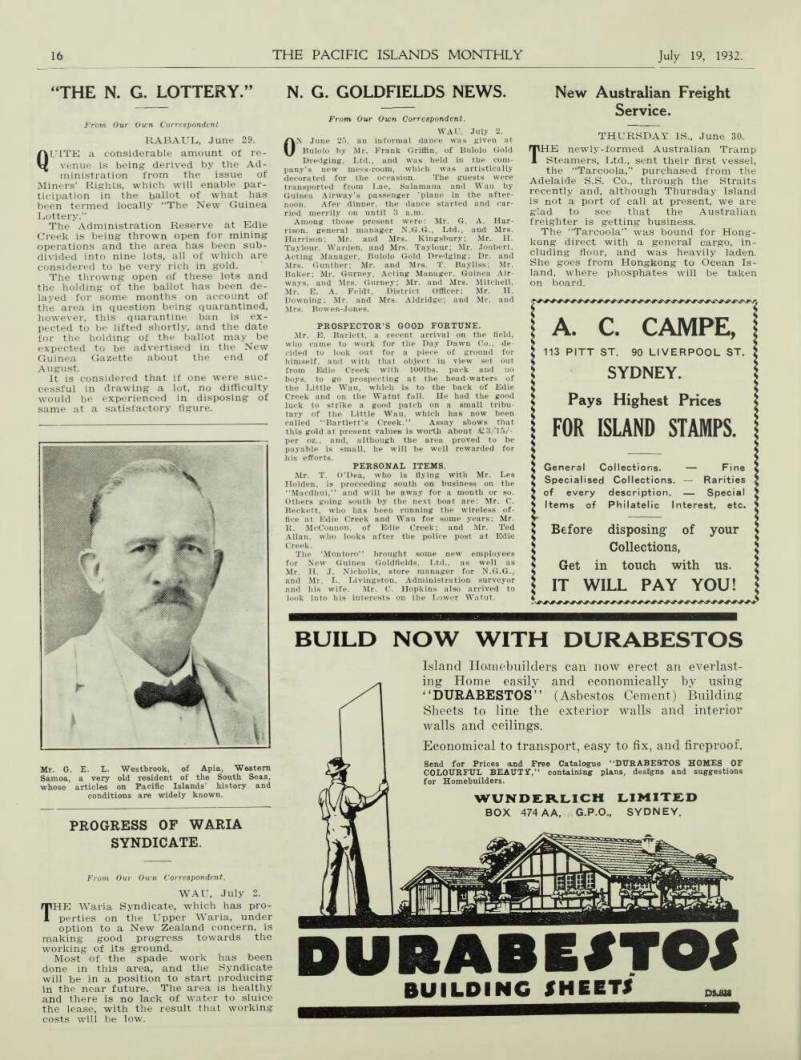
From Our Own Correspondent
Rabaul, June 29.
QUITE a considerable amount of re venue is being derived by the Ad ministration from the issue of Miners’ Rights, which will enable par ticipation in the ballot of what has been termed locally “The New Guinea Lottery.”
The Administration Reserve at Edie Creek is being thrown open for mining operations and the area has been sub divided into nine lots, all of which are considered to be very rich in gold.
The throwing open of these lots and the holding of the ballot has been de layed for some months on account of the area in question being quarantined, however, this quarantine ban is ex pected to be lifted shortly, and the date for the holding of the ballot may be expected to be advertised in the New Guinea Gazette about the end of August.
It is considered that if one were suc cessful in drawing a lot, no difficulty would be experienced in disposing of same at a satisfactory figure.
Mr. G. E. L. Westbrook, of Apia, Western Samoa, a very old resident of the South Seas, whose articles on Pacific Islands’ history and conditions are widely known.
Progress Of Waria
Syndicate.
From Our Own Correspondent.
WAU, July 2.
THE Waria Syndicate, which has pro perties on the Upper Waria, under option to a New Zealand concern, is making good progress towards the working of its ground.
Most of the spade work has been done in this area, and the Syndicate will be in a position to start producing in the near future. The area is healthy and there is no lack of water to sluice the lease, with the result that working costs will be low.
N. G. Goldfields News.
From Our Own Correspondent.
WAU, July 2.
ON June 25, an informal dance was given at Bulolo by Mr. Frank Griffin, of Bulolo Gold Dredging. Ltd., and was held in the com pany’s new mess-room, which was artistically decorated for the occasion. The guests were transported from Lae, Salamaua and Wau by Guinea Airway’s passenger ’plane in the after noon. After dinner, the dance started and car ried merrily on until 3 a.m.
Among those present were: Mr. G. A. Har rison, general manager N.G.G., Ltd., and Mrs.
Harrison: Mr. and Mrs. Kingsbury; Mr. H.
Taylour. Warden, and Mrs. Taylour; Mr. Joubert, Acting Manager, Bulolo Gold Dredging: Dr. and Mrs. Gunther; Mr. and Mrs. T. Bayliss; Mr.
Baker; Mr. Gurney, Acting Manager, Guinea Air ways, and Mrs. Gurney; Mr. and Mrs. Mitchell, Mr. E. A. Feldt, District Officer; Mr. H.
Downing; Mr. and Mrs. Aldridge; and Mr. and Mrs. Bowen-Jones.
Prospector’S Good Fortune.
Mr. B. Barlett, a recent arrival on the field, who came to work for the Day Dawn Co., de cided to look out for a piece of ground for himself, and with that object in view set out from Edie Creek with l00lbs. pack and no boys, to go prospecting at the head-waters of the Little Wau, which is to the back of Edie Creek and on the Watut fall. He had the good luck to strike a good patch on a small tribu tary of the Little Wau, which has now been called ‘‘Bartlett’s Creek.” Assay shows that this gold at present values is worth about £3/15/per oz., and, although the area proved to be payable is small, he will be well rewarded for his efforts.
Personal Items.
Mr. T. O’Dea, who is flying with Mr. Les Holden, is proceeding south on business on the “Macdhui,” and will be away for a month or so.
Others going south by the next boat are; Mr. C.
Beckett, who has been running the wireless of fice at Edie Creek and Wau for some years; Mr.
R. McConnon, of Edie Creek; and Mr. Ted Allan, who looks after the police post at Edie Creek.
The ‘Montoro” brought some new employees for New Guinea Goldfields, Ltd., as well as Mr. H. J. Nicholls, store manager for N.G.G., and Mr. L. Livingston, Administration surveyor and his wife. Mr. C. Hopkins also arrived to look into his interests on the Lower Watut.
New Australian Freight
Service.
Thursday Is., June 30.
THE newly-formed Australian Tramp Steamers, Ltd., sent their first vessel, the “Tarcoola,” purchased from the Adelaide S.S. Co., through the Straits recently and, although Thursday Island is not a port of call at present, we are glad to see that the Australian freighter is getting business.
The “Tarcoola” was bound for Hong kong direct with a general cargo, in cluding flour, and was heavily laden.
She goes from Hongkong to Ocean Is land, where phosphates will be taken on board.
Advertisements & other items, p. 18 (1 item)
Durabestos
A. C. CAMPE,
113 PITT ST. 90 LIVERPOOL ST.
SYDNEY.
Pays Highest Prices
FOR ISLAND STAMPS.
General Collections. Fine Specialised Collections. Rarities of every description. Special Items of Philatelic Interest, etc.
Before disposing- of your Collections, Get in touch with us.
IT WILL PAY YOU!
BUILD NOW WITH DURABESTOS
Island Homebuilders can now erect an everlast ing Home easily and economically by using “DURABESTOS” (Asbestos Cement) Building Sheets to line the exterior walls and interior walls and ceilings.
Economical to transport, easy to fix, and fireproof.
Send for Prices and Free Catalogue “DURABESTOS HOMES OF COLOURFUL BEAUT V,” containing plans, designs and suggestions for Homebuilders.
WUNDERLICH LIMITED
BOX 474 AA, G.P.O., SYDNEY.
DURABESTOS
BUILDING SHEETS
Another White Woman In The Papuan Bush.
(Written for The Pacific Islands Monthly, By “Momokeni”.)
I DO not think that “The Diary of a White Woman in the Papuan Bush” (P.I.M. of February) and other art icles by the same writer, quite correctly represents household conditions as they are in Papua. Everything depends on the way in which one runs one’s home.
It was refreshing to read the re marks made by Mrs. Innes when inter viewed by your representative, and they can be applied to Papua as well as to the Mandated Territory.
If one is accustomed to handling na tives and sees to their welfare, the ser vant problem is not serious. Seeing to their welfare does not end with their weekly issue of rations and a dose of quinine or salts occasionally. The woman who desires to have her home well run must actually take a personal interest in her staff, be it of one or more Papuans; there are many ways of doing this without in any way lower ing the prestige which it is so essen tial to maintain. My own daily routine is not at all interesting to anyone liv ing in Papua, but I am sure that it is a great deal happier than that of the writer I refer to.
My staff consists of two big boys and one little boy, who assists at the table.
At 6 a.m.. No. 1 boy lights the Primus, while No. 2 boy attends to the “Icy ball.” 6.15, tea arrives.
By this time the stove has been cleaned and the fire lit by No. 1 boy. 7 a.m. baths are ready, after which I go outside and see what flowers I can gather from my garden. In Papua one can at least grow coloured-leaved shrubs, such as acalapha, crotons, etc.
By this time the small boy has set the table and everything is ready for me to give final instructions for breakfast.
It is really not hard to teach a native to cook if he has a liking for it, pro viding you teach him one thing at a time. I find the best way to do this is to take a chair to the kitchen, quietly telling him what to do while you sit and watch, correcting any mistakes he might make; and even if you are lucky enough to teach a boy to be quite a good cook, you ask for disaster in your kitchen unless during the preparing or cooking of meals you make an inspec tion now and then.
Breakfast over, the boys sweep and polish the house, the small boy help ing me arrange the flowers. The house quite in order, they depart to the boy house for their own breakfast. I spend the rest of the morning sewing, reading or writing. 1 p.m., lunch. After 2 p.m. I rest for an hour. At 4 p.m. tea is served. The boys are then free to play football, cricket, or anything they like till 6 p.m.
As I, like others, live mostly on tinned food, the preparation of dinner is not a lengthy one. However, with a little thought, one can even make tinned food presentable. Our dinner table is always set as daintily as pos sible; it is surprising how charming the table can be made with a few bush flowers or leaves.
As I also live in that part of the Territory where “Gubas” (sudden rain squalls) arrive unexpectedly during the night, I make a point of collecting my pretty cushions and see that my mats on the N.W. side of the house are pulled back out of the way of the driv ing rain accompanying the “Guba.”
I have only been in Papua a few years, but it was from such people as Mrs. Bunting, and Mrs. Dr. Giblin (who, by the way, has a really marvel lous understanding of natives) I learned that if I wanted a well-run happy home I would have to under stand the right and the wrong way to manage my servants, and I can assure you it is not by shouting, “Boy! Do this” or “Do that!” It is by tact, firm ness and kindness —mingled with a keen sense of humour, without which you are lost.
However, I would like to add that one has only to see the delightful and well-run home of Mrs. Arthur Bunting, of Samarai, to understand what is meant by Mrs. Innes’ remarks; “If one is accustomed to handling natives, and sees to their welfare, the servant prob lem is not serious.”
Advertisements & other items, p. 19 (1 item)
Steelo
ECONOMICAL &
LABOUR SAVING
With less rubb ing, and more quickly than ever, Steelo cleans pots and pans, baths, basins and sinks.
One carton con tains a month’s supply.
Steelo is a fine steel wool, made up into convenient pads, which scour the surface bright and smooth without scratching. If unobtain able locally, write for free sample to the manufacturers, R. H. ARM- STRONG & CO., 44 King Street, St. Peters, N.S.W., stating your grocer's name.
STEELO
Recommended by all Skin Specialists throughout the World.
Recommended by all Skin Specialists throughout the World.
There is no satisfactory
substitute for the genuine
(BOURJOIS)
JAVA RICE
FACE POWDER
The only genuine JAVA RICE Face Powder is made in Paris by expert French Perfumers. Bourjois JAVA RICE Face Powder has been used by women of all Nations for several generations. It has always given entire satisfaction and has increased in popularity, year by year, as evidenced by its ever extending sales.
LADIES! Keep to the Face Powder whose qualities you know.
It is of the finest consistency. It it composed of the purest ingredients. There is nothing to harm the tenderest skin.
Obtainable in all shades.
All Chemists and Stores throughout the World.
A. BOURJOIS ET CIE (Aust.) LTD.
177-179 Clarence Street and 47-49 King Street, Sydney.
Search For El Dorado In Papua Goes On.
Hundred Years of Successes and Disappointments.
From Our Papua Correspondent.
IT is now well over 100 years since gold in Papua first attracted the at tention of the outside world; and, within that time the search for its hid den wealth has been undiminished, in spite of the formidable obstacles that a new and hostile country must have offered to the earlier prospectors.
Though, since 1910 (when the Lake kamu field was abandoned) there has been no appreciable fields in the recent sporadic outbursts of prospecting, there are still hopes that there are other “Mombare’’ and “Yodda” fields, for the finding; and prospecting goes steadily on.
Isla del Oro, or Islands of Gold, was one of the first names bestowed upon New Guinea as a whole, in 1528, when Alvaro de Saavedro, a relation of the great Cortez, visited the Island, and since then, at different times, gold has been reported by various people. In 1852, the H.M.S. Rattlesnake reported gold found in pottery from Red Sea Bay. Also in 1875 the Rev. MacFarlane claimed to have found traces and a nugget on the Mai-Kussa. It was not until 1887 that the first systematic at tempts were made of prospecting, and then only near Port Moresby, on the Goldie and Brown Rivers, tributaries of the Laloki. The interest soon died, the prospects were of little account.
It was really not till 1888, when David Whyte (pearl sheller) reported gold on Joannet Island (Louisiade group) that the first serious efforts at mining took place. A party of miners joined Whyte and left Cooktown in the cutter Joanita, found and provisioned by Commissioner Douglas (Special Commissioner to British New Guinea).
Joannet Islands proved disappointing, and they proceeded to Sud Est (an is land of the same group), where they were more successful. Altogether 150 ounces were found in 12 months, and there followed a rush from Queensland, but in 12 months the field petered out and the miners became restless and dissatisfied.
Sir William MacGregor, then Admin istrator, fearing that “the miners would disperse all over the Possession with out authority or supervision” decided in October, 1888, to accompany a party of picked men from Sud Est to Rossel Island and to St. Aignan (Misima), to examine its possibilities, under Govern ment control. Colours of gold were found on Rossel Island at several places, but not sufficient to induce any of them to remain there. At Misima, it was more promising, gold being found in several gullies. As a result, miners flooded the island, 700 to 800 came over, but with very little success. Much sickness and many deaths, occurred, also the output steadily declined, and new fields were eagerly sought.
The mainland was the next objective, and in 1894 a party from Queensland landed in Bartle Bay, near Samarai (Eastern Division). There a few ounces were found. The natives, however, proved hostile and the leader of the
party (Hurley) was killed. The party disbanded, disheartened and worn out with fever and dysentery.
Still determined, 15 more miners in 1895, under Clarke, arrived. They tried Bartle Bay and failed. A few of the more adventurous stayed on and, with Clark, attempted the Mombare River.
Treachery and disaster met them.
Their party was attacked, Clark was killed, and all their supplies and pro visions stolen. Returning to the coast, they fell in with the Ivanhoe party, which had just arrived. They turned back with them and again tried their luck. This time 48 ozs. of gold were found in the creek beds and gullies, and later in the year a further 200 ozs.
The natives proved treacherous, five miners were murdered, also a Govern ment agent named Green. The days were full of stirring adventure. Matt Crow, Bob Elliott and the Pryke brothers were names that stood out in the history of those turbulent days, when dissatisfaction stirred the camps and the miners became rebellious. Mur der, dysentery and fever attended their efforts and followed in their wake.
In 1897, more gold was discovered on the Gira. Still more miners poured into the country and did well; at Murua (Woodlark Island) the prospects also proved favourable, and 400 miners landed in a few months from Cooktown.
Early in the same year (1897), the old Laloki interest revived and actually 400 miners landed in Port Moresby to try their luck, but met with little suc cess and many deaths.
In the meantime, from the Gira the prospecting extended to the Yodda in 1900. Some 90 men had established themselves there in the valleys and creeks and in 1901 the field was pro claimed.
Gold mining in Papua now reached its peak. Further gold was found on the Keveri, behind Cloudy Bay, in 1902, and three crushing mills were estab lished at Kulumadau (Woodlark). With the Mombare, Gira and Yodda fields added to these, it must have been a period in the history of Papua, which may never again be equalled.
In 1909 Matt Crow and the Pryke brothers left the Yodda. They sought newer fields and they discovered gold on the Lakekamu, west of Port Moresby in the Gulf Division. In no time, 228 miners were on the field, but it was all over by 1910; though the prospects were good and several miners were suc cessful. Dysentery and malaria played havoc, apart from the hostility of the natives and the heavy expenditure of transport. Recruiting was later for bidden and the field was killed.
The Tauri and Tiveri, the fields of to-day, are in the district of the old Lakekamu. It was re-opened in 1930 on the report of gold by Patrol Officer Hides, who, when on patrol, found traces in creeks of that district. The report re-awakened the interest in min ing in the territory, and parties left immediately. There were wild rumours and, though the anticipations so far have not been realised, the prospectors hold out every hope of success, and parties are still at work on the head waters of both rivers in the district.
Approximately £2,000,000 worth of gold has been won in Papua up to the present time, but it represents the re sult of 50 years of work and has cost a deplorable number of lives.
Death of Apia Business Man.
From Our Own Correspondent.
APIA, June 20.
MR. WALTER VOIGT, an old resident of Samoa and a well-known mem ber of the business community, died recently at Apia Hospital. He was 60 years of age.
Mr. Voigt, who came to Samoa about 35 years ago, as secretary to the Ger man millionaire, G. Kunst, settled in Apia in partnership with Mr. Zuck schwerdt, now in Nukualofa (Tonga).
Later on, however, he gave up his store and entered the firm of Nelson and Son (now O. F. Nelson and Co., Ltd.) as accountant.
At the beginning of the war, Mr.
Voigt, as a German subject, was in terned in New Zealand, from where he returned in 1920, joining the firm of P.
C. Fabricius as accountant, later be coming secretary, which position he held until his death.
Mr. Voigt was highly respected for his efficiency as an accountant and his sound knowledge of local trade con ditions. He took much interest in horse racing and had, of late years, taken up cocoa planting. His funeral at Magi agi cemetery was widely attended by a representative gathering of citizens.
Advertisements & other items, p. 20 (1 item)
Albert Gregory
107 YORK STREET, SYDNEY.
SADDLERS’ IRONMONGERY, SADDLES, HARNESS,
SPURS, STIRRUPS, and WHIPS, &c.
EVERYTHING CONNECTED WITH THE TRADE.
Leather for Art Work, Basils, Roans, Suedes. Boot and Harness Leathers.
GREGOLIN E — Raw, Pure and Pearl White. Nothing so good for the Home, Stable, and Dairy and a great rust preventive.
Distributing Agents for;
DOCKER’S AND BORTHWICK’S PAINTS.
CORRESPONDENCE SOLICITED.
Amazing Religious Disturbance
In Southern Gilberts.
Resident Commissioner for the Gilbert and Ellice Islands Colony, in his report for 1929-’30, describes an amazing outburst of religious hysteria which occurred among the natives on Onotoa Island, in the Southern Gilberts.
THE trouble began in April, 1930, with a dispute about some copra, which the natives of two villages desired to give to the London Missionary Society.
The Native Magistrate warned these people that their Government copra tax fell due in June, and advised them, consequently, not to exhaust their whole crop, during May, in the pro posed gift to the Mission.
The Native Magistrate was a mem ber of the Roman Catholic persuasion, against which, on Onotoa, the sec tarian feeling of an overwhelming Protestant majority has always run bitterly high. The magistrate’s warning was construed by the Protestants as a deliberate attack upon their religion; the villagers were incited by their native pastors to persist in their gift, and to welcome, “for the glory of God," any form of “martyrdom” which might be visited upon them in consequence.
The gift was handed over to the pastors in May. The villagers were called to the Native Court and warned again that their failure to pay the copra tax in June would not be con doned; they were then dismissed.
This dismissal seems to have been a heavy disappointment to the natives, who had been led by their pastors to hope for immediate martyrdom. Some thing in the nature of an indignation meeting was held, at the instigation of a senior pastor named Barane. Wild threats and accusations were made against the Magistrate, the Catholic Church and the Government. An extra ordinary series of spiritualistic seances, for the interpretation of dreams and visions was instituted. Barane was the interpreter. In the course of the next few weeks a huge encampment grew up around the chapel, in which the seances were held. The villages were left empty, save for the few Catholics, who refused to attend the meetings; over 1,200 people were gathered together day and night to hear Barane expound their dreams.
Gradually, the interpretation of the visions assumed an apocalyptic char acter. It was prophesied that the end of the world was coming; that the Government and the Catholic Church would be utterly destroyed; that God would visit Onotoa in person. Barane was proclaimed to be the Prophet of God. Later, his title was changed to “Father of God," and his son (a worth less character) assumed the appellation of “God Almighty." Two loose women came forward with the claim that they were “Christ the Sufferer” and “Christ the Forgiver”: they were accepted as such.
A body of women, called the “Sheep” or “Shakers”, was organised, whose
function it was to attend the Prophet and shudder strongly whenever he spoke. The alleged vision of a flaming sword on the wall of the Prophet’s chapel brought into being a band of youths who called themselves the Soldiers and Swords of Gabriel, and marched about in scarlet loincloths in timidating all those who were un willing to join the movement.
Native Magistrate’S Courage.
The Native Magistrate, a man of great moderation and courage, tried in vain to prevent these disorders. He was deserted by all but two or three of his official colleagues; but in spite of continual threats from the mad en campment, he continued to set his face against the movement.
The climax of emotion was reached when God did not visit Onotoa on the day predicted. The woman who called herself “Christ the Forgiver” an nounced that the fault lay at the door of the Catholics, whose continued presence on the island was an offence to the Almighty. It was then deter mined that a force of about 80 “Swords" and “Sheep,” led by Barane, should pro ceed to the Government Station, with the object of “bringing down God’s wrath upon the Magistrate.” The force went unarmed, but yelling threats and contorting their bodies in an insane kind of dance. The Magistrate had 14 men and women with him on the Station; these he ordered to conceal themselves in a house, while he went to face the fanatics. Having prepared a sleeping mat, in native fashion, to receive his dead body, he stood near the confines of the station, alone awaiting the mob.
He was almost immediately struck down by one of the “Swords of Gabriel”. His fall started a riot, in which every member of the Govern ment party was more or less seriously wounded. A hunt for Catholics suc ceeded. Two unfortunates were caught and murdered with crowbars and glass bottles. That night, forty Catholics took to their canoes and fled overseas, 40 miles, to the island of Tabiteuea.
An edict went out the same evening that if, by noon of the next day but cne, the remaining Catholics did not present themselves for conversion to creed of Barane, they would be slaughtered.
Providentially, the District Officer with a European missionary arrived at the island on the intervening day of grace, and further bloodshed was avoided. The Native Magistrate, though grievously wounded about the head, recovered. Peace has now been restored to the island, and all guilty persons have been duly punished.
Advertisements & other items, p. 21 (1 item)
Petrol Engines
Lighting Plants
The reliable LISTERLITE, the “powerhouse” of thousands of homesteads. Unfailingly de livers electric current on the most economical basis. Plants in stock to suit every possible requirement, with or without storage batteries. Ask us to quote for your installation.
Diesel (crude oil)
Engines
Famous British Lister-Diesel crude oil engines start per fectly from dead cold, on regular crude oil fuel. From 5 b.h.p. upwards. Shortly available in marine type also.
Petrol Engines
The most reliable petrol en gines in the world. British built for sheer reliability and economy. Thousands of owners have proved that Lister main tenance costs are hardly worth regarding. In all sizes from to 14 b.h.p. Petrol and kerosene types available.
Auto Trucks
Here is a neat little labour saving vehicle for haulage on road or rails, especially on long jetties. Equipped with air cooled engine; carries one ton or hauls three tons. Simple to operate, and available in varying body types for dif ferent classes of work. The most economical motor trans port vehicle yet produced.
Pumps
of all kinds. If you have water to move you will find exactly the kind of pump in the “Nevertire” line. From the simple well pump to the powerful self-oiling “Bull dozer” we have the right type of pump at the right price, for every job.
Windmills
Put the wind to work for you. We have proved makes of mills available in all regu lar sizes, with or without towers. Tell us your water problem, and we can recom mend the proper mill to do the work.
Enquiries for any of these our careful attention. Prices will be quoted free of Australian Customs’ Duty, in original cases.
Agents Wanted
We shall be glad to hear from respon sible Island parties willing to undertake the sale and representation of these lines. Write us.
Danger, Gedye & Co.
LIMITED
10-14 Young Street, Sydney
The Trochus.
A Peep Into Its Private Life.
From Our Own Correspondent.
Thursday Is., June 15.
NOTES on Trochus Niloticus” is the title of a short monograph written by Mr. F. W. Moorhouse, B.Sc., marine biologist to the Government of Queensland, dealing with an article ex ported from several parts of the Pacific.
A pamphlet confined to the subject of “a primitive gastropod belonging to the Rhipidoglossa” does not promise much interest to a non-scientific reader, but, as a matter of fact, one becomes absorbed at once in reading of the habits of the fish, and, considering its economic value and the very useful in formation that Mr. Moorhouse supplies, we feel it should be in the hands of everyone who is connected with the trochus industry.
The pamphlet is published by the British Museum at 1/-, and, in all pro bability, copies could be obtained from the Department of Marine Biology, Brisbane. Mr. Moorhouse’s work on the trochus is an example of the effective way in which science assists in busi ness development. The salient points of his investigations are herewith given.
The trochus was given the specific name of Niloticus in error. The first specimen brought to England undoubt edly came from the South Seas, but, by some mistake, it was supposed to in habit the waters of the Nile, and was named accordingly.
The trochus is, however, only found in the Western Pacific and Eastern Malayan region, such as the Arafura and Coral Seas, Barrier Reef channels and along the coasts of New Guinea, Solomons, Fiji and New Caledonia. It is not found in the Eastern Pacific.
It prefers the windward (south-east) side of the reef, avoiding sandy, muddy or grassy localities. An important fact, as stated by Mr. Moorhouse, is its confinement to shallow water, not greater than 3 feet in depth at lowest springs, which was proved by the author at Low Island, where the sub ject was especially studied. This avoidance of deeper waters is not, how ever, in accordance with the experience of the trochus fishers of Torres Strait, who are accustomed to retrieve shell from four to six fathoms.
At Low Island, many specimens were found in water that dried off between tides, when it creeps under boulders, and the fish can exist for long periods out of water altogether—revival having taken place after two days ashore.
Small specimens are found at the level of high water neaps, and they increase in size to a depth of half a fathom at low water springs. Wherever their usual food (a seaweed growing along the fringes of the coral reefs) is found, the trochus congregates in great numbers.
That the fish is given to wandering is a well-known fact among divers; at Low Island a marked specimen was found to have moved over 50 yards In one night.
Of more practical importance is the "age-size” ratio as worked out by Mr.
Moorhouse, which is measured by the diameter of the base of the shell. Ani mals of one inch are considered to be about one year old, and they increase
by one inch approximately for each year of life. The official limit of inches therefore represents at least two-year-old fish.
The sexes are separate, and repro duction takes place during the second year of life. The eggs are freed in the water a few at a time during the lay ing season, which is a long one, last ing certainly from March to July and probably much longer.
During the winter months, there is a slackening off in the amount of shell deposited by the animal, and the trochus passes through a period of true hibernation, feeding but little and re maining under the rocks or crevices in the coral. This explains the assertion sometimes made that the fish “migrate" in the winter.
Trochus Farms Possible.
It has been stated several times by scientists, who have worked at trochus investigations on the Barrier, and who ought to know the economics of the matter, that there is a living to be made in the culture of this shell —in short, a trochus farm. So far, no one has been enterprising enough to go
into the business, but it seems quite feasible, given good feeding grounds, plenty of clear moving water, and shallow basins for preventing straying.
It takes about 4,000 fish to make a ton of shell, which is usually worth £50, and the collection from stock would not cost a tithe of the present method of fishing and diving in open seas.
No doubt, excellent advice on the best methods of breeding up are avail able from those who studied this sub ject at Low Island, of whom Mr. Moor house is one. Perhaps, it will be a recognised industry of the future, and Barrier Reef allotments will be as high In value as banana land.
Advertisements & other items, p. 22 (1 item)
Excelsior Supply Co. Ltd.
Samples and prices on application.
BIRKMYRE’S CLOTH.
The best waterproof for motor car hoods, tarpaulins, horse and cow rugs, etc. Canvas of all kinds, cotton ducks and hessians, seaming, bagging and shop twines. Fishing nets and yarn, fishing lines and tennis nets.
THE GODROCK ROPEWORK EXPORT CO LTD,
397 KENT STREET, SYDNEY, N.S.W,
EXCELSIOR SUPPLY CO. LTD.
The most extensive Manufacturers in the British Empire of
RUBBER STAMPS,
INKS, STENCILS,
Marking Devices.
ACME STAMP PADS
We have a big range of Special
FRUIT CASE MARKING SETS
We also Manufacture or Supply a complete line of
Spraying Machines
for all purposes.
Let us know your requirements and we will quote you by return. Ask for our Big Catalogue.
Sole Australasian Distributors of the World Famous SHEAFFER FOUNTAIN
PENS and PENCILS.
EXCELSIOR SUPPLY CO. LTD.
Head Office :--160 GEORGE STREET WEST,
SYDNEY. N.S.W.
Proposed Anglo-Indian Migration
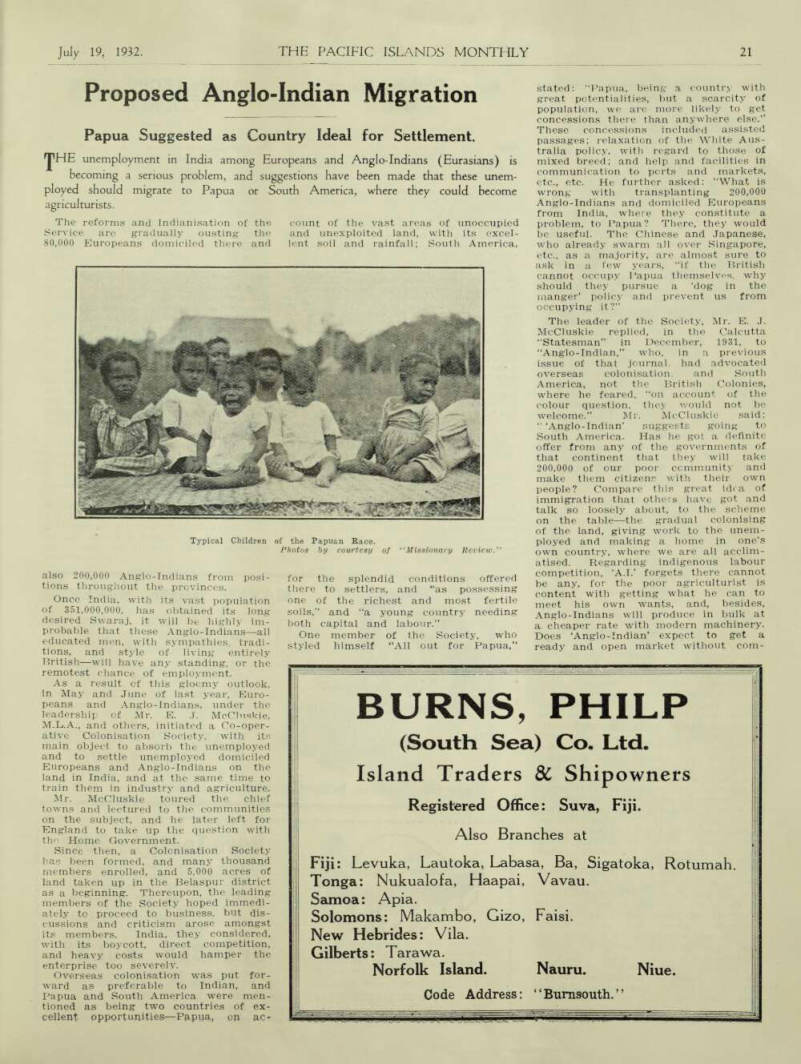
Papua Suggested as Country Ideal for Settlement.
THE unemployment in India among Europeans and Anglo-Indians (Eurasians) is becoming a serious problem, and suggestions have been made that these unem ployed should migrate to Papua or South America, where they could become agriculturists.
The reforms and Indianisation of the Service are gradually ousting the 80,000 Europeans domiciled there and
also 200,000 Anglo-Indians from posi tions throughout the provinces.
Once India, with its vast population of 351,000,000, has obtained its long desired Swaraj, it will be highly im probable that these Anglo-Indians—all educated men, with sympathies, tradi tions, and style of living entirely British—will have any standing, or the remotest chance of employment.
As a result of this gloomy outlook, in May and June of last year, Euro peans and Anglo-Indians, under the leadership of Mr. E. J. McCluskie, M.L.A., and others, initiated a Co-oper ative Colonisation Society, with its main object to absorb the unemployed and to settle unemployed domiciled Europeans and Anglo-Indians on the land in India, and at the same time to train them in industry and agriculture.
Mr. McCluskie toured the chief towns and lectured to the communities on the subject, and he later left for England to take up the question with the Home Government.
Since then, a Colonisation Society has been formed, and many thousand members enrolled, and 5,000 acres of land taken up in the Belaspur district as a beginning. Thereupon, the leading members of the Society hoped immedi ately to proceed to business, but dis cussions and criticism arose amongst its members. India, they considered, with its boycott, direct competition, and heavy costs would hamper the enterprise too severely.
Overseas colonisation was put for ward as preferable to Indian, and Papua and South America were men tioned as being two countries of ex cellent opportunities —Papua, on ac
count of the vast areas of unoccupied and unexploited land, with its excel lent soil and rainfall; South America,
for the splendid conditions offered there to settlers, and “as possessing one of the richest and most fertile soils,” and “a young country needing both capital and labour.”
One member of the Society, who styled himself “All out for Papua,”
stated: “Papua, being a country with great potentialities, but a scarcity of population, we are more likely to get concessions there than anywhere else.”
These concessions included assisted passages; relaxation of the White Aus tralia policy, with regard to those of mixed breed; and help and facilities in communication to ports and markets, etc., etc. He further asked; “What is wrong with transplanting 200,000 Anglo-Indians and domiciled Europeans from India, where they constitute a problem, to Papua? There, they would be useful. The Chinese and Japanese, who already swarm all over Singapore, etc., as a majority, are almost sure to ask in a few years, “if the British cannot occupy Papua themselves, why should they pursue a ‘dog in the manger’ policy and prevent us from occupying it?”
The leader of the Society, Mr. E. J.
McCluskie replied, in the Calcutta “Statesman” in December, 1931, to “Anglo-Indian,” who, in a previous issue of that journal, had advocated overseas colonisation, and South America, not the British Colonies, where he feared, “on account of the colour question, they would not be welcome.” Mr. McCluskie said: “ ‘Anglo-Indian’ suggests going to South America. Has he got a definite offer from any of the governments of that continent that they will take 200,000 of our poor community and make them citizens with their own people? Compare this great idea of immigration that others have got and talk so loosely about, to the scheme on the table —the gradual colonising of the land, giving work to the unem ployed and making a home in one’s own country, where we are all acclim atised. Regarding indigenous labour competition, ‘A.I.’ forgets there cannot be any, for the poor agriculturist is content with getting what he can to meet his own wants, and, besides, Anglo-Indians will produce in bulk at a cheaper rate with modern machinery.
Does ‘Anglo-Indian’ expect to get a ready and open market without com
Typical Children of the Papuan Race.
Photos by courtesy of "Missionary Review.”
petition in South America or other countries, say Papua?”
As regards Papua, the members who favoured immigration there put for ward the proposition (if permission should be granted them), that:— Firstly, men should be sent out for preliminaries and to select sites; secondly, that another batch should follow, to erect huts and clear and fence; and, thirdly, areas for cows, poultry and for planting foodstuffs should be chosen; and “generally they should make things comfortable.”
Later, vessels lying idle would be char tered, ensuring cheap passages to colonists, who would be brought over in batches.
The members having little capital, their idea would be to work on com munistic lines; at all events, in the initial stages. The class of Anglo- Indian, which desires immigration, though not agriculturists, are all educated men, who hold or have held positions in Government offices.
Critics are not wanting in India, says one member who thinks that the community will never make colonists.
“The fact is we have never been called upon to try; we are not wanting in pluck, which was shown plainly in our fighting in Mespot.”
Coffee, cinchona, orchards, cattle, horse and mule breeding, besides agriculture, were the projects sug gested as the most likely means of livelihood in Papua.
Is Papuan Settlement
Desirable?
If, by any chance, the Imperial— Australian—Papuan Governments would entertain an influx of immigrants into the unoccupied areas in the hinter lands of Papua, either by Lake Murray or elsewhere in the West, it is questionable whether such an influx of new settlement would be altogether desirable either for the Papuan, or the immigrants themselves, who, un trained and inexperienced, would suffer great hardships and privations in so primitive a country as this.
Apart from the natives, who would undoubtedly be hostile, malaria would cripple their efforts to a great extent.
The hardships in Papua can be hardly realised by those who have not encountered them —only those ex perienced in its ways can understand the obstacles that would have to be overcome. The difficulties of transport are great, far greater than is usually supposed by those who do not know the conditions. “For it is easier,” said D’Albertis, the explorer, “to ascend the highest peaks of the European Alps with an alpenstock than to cross an ordinary hill in New Guinea,”
What was said then by D’Albertis, in 1875, could and would be said to-day by the newcomer, traversing remote and untouched, areas.
Transport by river also presents difficulties and is impractical, with the exception of the Fly River, which is navigable by launch for 600 miles.
However, all these set-backs could be overcome, given the time, money, energy, and courage, and if permission were granted for such a colossal venture.
There are vast areas of unoccupied lands in Western Papua, up the Fly River, the Purari, and other big rivers, where an influx of settlement might become a well organised community, where food, shelter, and clothing
Advertisements & other items, p. 23 (1 item)
Burns, Philp
(South Sea) Co. Ltd.
Island Traders 8C Shipowners Registered Office; Suva, Fiji.
Also Branches at Fiji: Levuka, Lautoka, Labasa, Ba, Sigatoka, Rotumah.
Tonga: Nukualofa, Haapai, Vavau.
Samoa: Apia.
Solomons: Makambo, Gizo, Faisi.
New Hebrides: Vila.
Gilberts : Tarawa.
Norfolk Island. Nauru. Niue.
Code Address: "Burnsouth."
King’s Birthday Sports at Apia
Apia.
From Our Own Correspondent.
APIA, June 20.
THE King’s Birthday sports this year were favoured by ideal weather and attracted a large crowds of natives. The station ship from American Samoa had come over for the occasion.
The aquatic sports suffered from lack of com petition, but, nevertheless, some interesting events were witnessed.
The race meeting of the Apia Turf Club was held in the afternoon. Though the attendance of Europeans left much to be desired, a large crowd of natives had gathered and followed events with lively interest. Of the nine events, the Birthday Handicap for the trophy donated by our former Administrator, Colonel S. S.
Allen, was outstanding, being won by Mr. R.
M. Sheldon’s “Wywurry.” The Administrator, who attended the meeting, accompanied by the Governor of American Samoa, Captain H. S.
Lincoln and his staff, presented the cup to the winner.
An “Uncle Sam’s Race” for sailors and visi tors from Pago-Pago and won by Mr. C. Reid, concluded an attractive and successful day for the Apia Turf Club.
The ball at Vailima Government House was on a considerably smaller scale than in previous years. The number of invitations issued to the public was only limited, probably due to need ful economy. would be theirs in exchange for un
employment, boycott, and starvation,
which the Europeans and Anglo- Indians fear will be their lot shortly in India, where they “constitute a
problem.”
There is no doubt that Papua is one of the most desirable countries in the Pacific: with its vast unexploited areas of fertile lands and its potential wealth. But it is still waiting for the opportunity and for the more adven turous to prove and make of “a golden
dream a glorious reality.”
M.L.
Fijian Legislative
Council.
AN optimistic note was sounded in the address of the Governor of Fiji, Sir Murchison Fletcher, to the Fiji Legislative Council, when it opened its new session on Thursday, June 2.
His Excellency declared that in the main centres of the Colony’s principal industry—namely, sugar—the spirit of optimism is in marked contrast to the pessimism one encounters in Suva.
The pressure that has been brought upon the Governor to further reduce the salaries of the Fiji public servants was referred to by his Excellency, who made it quite clear that he does not agree with the course suggested.
His view, apparently, is that, as there is a distinct possibility that the Colony’s economic conditions will improve, it is not fair at this stage to impose further burdens upon the civil servants.
It was announced that, owing to the world depression having caused a great shrinkage in the market for canned pineapples, the Hawaiian Pineapple Co., which had formulated plans for im portant operations in Fiji, has termin ated its plantation experiments there for the present.
It was announced that the Indian population has considerably increased its cultivation of rice, with the result that it is estimated that the need for further importation of this commodity will disappear during the coming year.
This is an important development, as there has been in the past a consider able market in Fiji for rice grown in Burma and Java, and in recent months a considerable quantity of Australian grown rice has found purchasers there.
Advertisements & other items, p. 24 (1 item)
Spencer Nolan
MAKES HOME SAFER
Where there are romping, heedless kid dies, Pearson’s Carbolic Sand Soap per forms a double household duty. It cleanses thoroughly with a minimum of effort. And its disinfectant lather helps to banish germs and vermin.
PEARSON’S CARBOLIC
SAND SOAP.
by Pearson Soap Co. Ltd. Rozelle N.S.W.
Have Teeth by Post
Let me send you free full particulars of my well-known and successful method of
“SELF-TAKEN IMPRESSIONS”
by which I can make you teeth by post.
All details by return mail.
Natural gum, unbreakable sets, comfortable and long lasting.
Teeth in one day for visitors to my surgeries. Painless extractions, reli able fillings, gold crowns and Bridge work. Old Plates remodelled. 28 OXFORD ST., over Winns;
SPENCER NOLAN
DENTIST,
177 OXFORD ST., opposite McIlraths. 139 ELIZABETH STREET, two doors from Market Street, Sydney.
Beam Wireless, Telegraphic and Cable Address: “Fastplate,” Sydney. P.I.M.
Early Papua.
[To the Editor.] Sir,—Your contributor’s witty men tion of the R.G.S. of A’s, “Bonito” ex pedition of 1885, which discovered the Strickland River, and the first gold found in historic times, in Eastern New Guinea, has unhappily permitted the effacement of the more prosaic facts.
Our exploring party of scientific ex perts and others, having discovered that the leader appointed by the typic ally town-tinctured committee of the Society was a curiously ignorant, loquacious creature, utterly incapable of commanding men or taking observa tions, the matter was laid before the famous Hon. John Douglas, R.M., Thursday Island, who represented the R.G.S.A. He appointed our second in command, Captain Hemsworth, as leader—replacing Everill, whose shock ing death in Melbourne later seemed to justify our action! There was no fric tion, quarrel, and want of discipline— which latter is the unforgivable sin upon exploratory parties, ships, or in armies.
I never found Everill other than a gentle, lovable man, whose most dan gerous fault was his rashness, which several times imperilled our lives. Yet to-day his name is immortalised at the junction of the river we discovered with the Fly, whilst the place-names given by, and to, others who made the expedition a success, have been re moved in favour of those of friends of officials, and much later voyagers. Such is life! W. W. Froggatt, Dr. Haacke, Senior, and others, as well as our in trepid leader, Geoffrey Hemsworth, surely deserved to have their names re tained.
But what I want to emphasise is, there is no want of discipline. Every thing was done without friction; and, under the famous magistrate’s direction, when our leader was superseded.
I am, sir,
Arthur J. Vogan.
Sydney, June 25, 1932.
EDITORIAL NOTE. —We regret that our brief reference to the 1885 expedition to the Upper Fly River (Papua) gave a wrong impression.
However, it was not entirely useless, because it brought out this interesting historical item from Mr. Vegan.
Little Enquiry For
Tongan Bananas.
From Our Own Correspondent.
Nukualofa, Jupe 16.
AT time of writing, 3,000 cases of ban anas are packed for shipment to Auckland at an f.o.b. price of 5/-.
As this small parcel ordered by the New Zealand buyers is about one-third of our present monthly marketable quantity, local growers are wondering whether a “ring” exists in New Zea land to exclude our fruit, or whether New Zealanders have lost their taste.
The Chief Medical Officer in Western Samoa has stated that the yaws cam paign at Savaii is making good pro gress, there having been a ready re sponse on the part of the Samoans for treatment.
Rarotonga.
Fire Destroys Store at Rarotonga.
From Our Own Correspondent.
Rarotonga, June 15.
Messrs, Grove & Sons’ store at Rarotonga was gutted by fire on June 2.
Every article in the main store was destroyed, including the contents of two safes. The safes proved to be non fire resisting, so that all paper money, books of accounts, and records were totally reduced to ashes.
The outbreak was discovered by Mr.
E. J. Mathews, manager for Messrs.
Jagger Harvey, at about 9.50 p.m. By that time the flames had a complete hold.
This fire appears to be the first in the history of the island.
It is reported that the police are in possession of evidence that the store was deliberately set alight by a sub normal native, who gained entrance to the building during the night through one of the front windows.
The matter will shortly come before the Court.
Islands.
Orange Prices In Cook
From Our Own Correspondent
Rarotonga, June 16.
THE following prices are being paid for oranges for shipment by the R.M.S. “Maunganui,” on June 20: In the packing sheds, 1/6 per case On the wharf 2/- per case These figures speak for themselves, and portend a very black outlook for island interests.
Advertisements & other items, p. 25 (1 item)
Drive
WHEN VISITING SYDNEY
HIRE A CAR
AND
DRIVE
YOURSELF
from Head Office and Service Station: NEILD AVENUE (nr. Stadium),
PADDINGTON
(Opposite Grammar School Cricket Ground.) Telephone; F 3196 (2 lines).
MILEAGE RATE ONLY, FROM 4d.
PER MILE,
Wire from Brisbane and a Car will Meet you at the Boat in Sydney.
EXCHANGE!!!
COLLECTOR desires to Correspond with persons willing: to exchange Used PACIFIC ISLANDS STAMPS for Australian or other Stamps. If you do not want stamps in exchange, I am willing to forward anything else you require. Reply to—
M. MORRISSEY,
88 Grey Street, Carlton, N.S.W.
Tropic
Ringworm
REDNESS
ITCHING
INFLAMMATION
EXAMINE
YOUR
TOES
WHITE
THICK
SKIN
Perhaps you have in flammation, redness, or skin cracks between the toes, tiny itching blisters, white thick skin, which is always moist, or dry skirt. which becomes scaly, accom panied by an unpleasant and characteristic odour. These are all definite symptoms of
“TINEA” or TROPIC
RINGWORM.
Or direct from
DRY SKIN
WHICH
BECOMES
SCALY
ANTINEA DRUG CO.
Highly Contagious
TINEA is highly contagious and may spread to other parts of the body—scalp, ears, arms, hands, legs, etc.—if immediate steps are not taken to check same. “ANTINEA” is the only specific preparation that will cure Tinea and Tropic Ringworm.
For Dhobie Itch
Use “Antinea”
The penetrative power of “ANTINEA” rapidly destroys the “Tinea” fungi, relieves discomfort, restores skin wholeness, and ensures normal con dition. “ANTINEA” also relieves “DHOBIE ITCH," Ringworm, Perionychia, Ringworm of the Nails and other similar skin troubles.
ANTINEA will not harm the living tissues.
THE CURE.
Obtainable from all branches of Burns, Philp & Co. Ltd., W. R. Carpenter & Co. Ltd., and A. J, Swann & Co. Ltd. (Suva).
WINCELLO HOUSE,
ANGEL PLACE. SYDNEY
Postage, 3d. extra.
Cation.
Wireless Communi
Government interested in T. I.
Scheme.
FOLLOWING an article some months ago in “The Pacific Islands Monthly” regarding wireless for Torres Straits Islands, it is interesting to know that the matter of endeavouring to provide some means of communication for the islands of Torres Strait has not been allowed to drop.
For some time past, the project has been engaging the minds of various members of the Missions, who have in terests in the region; and through them it was brought to the notice of the Aboriginal Department and the Home Secretary, with the idea of promoting better facilities, both for the isolated European government officials and for the native communities, with whom it is desirable to establish rapid communi cation, especially in time of sickness.
Lack of funds has held the Govern ment’s hand so far: although probably the equipment all told for the Islands would not run into much more than £1,000. Still, in these days that repre sents a good deal. On the other hand, quite possibly a large proportion of that amount might be returned.
As an instance of how the installa tion of wireless would have saved a considerable expenditure in time and money, there was the case of the man who absconded from Cairns last year with another person’s launch (and who has just been sentenced to a term of imprisonment). Making up through Torres Strait in an effort to evade jus tice, he called at an island about 50 miles from T.I., for food, etc. The sus picions of the Government official there were aroused, but, there being no com munication with T.I, he could do noth ing. The arrival of a mission boat a couple of days later brought news of the deed, but, although the runaway was just then within sight and could have been captured by the police party had it been sent out from Thursday Is land, lack of communication allowed him to get right away to Dutch New Guinea, from where he was recently brought back by the Queensland authorities at considerable cost.
It is in case of serious illness that the installation of a scheme would prove a great boon, however. On one island recently, where the official and his family are 120 odd miles from the nearest medical assistance at T.I., the infant child became sick. The island fishing boats were all away at work — they go away often for two or three months at a time —and there was no available communication with the outer world. This is but one instance.
More than once the kindly offices of Japanese on a passing fishing lugger have been sought and given, for the conveyance of sick to Thursday Island, but officials quite rightly feel that they ought not to be under obligation in this way; and quite apart from this, it is hardly to be expected that a boat will be always found passing along at the very moment when she may be of service.
The proposals, so far discussed, have centred round the possible installation of “Baby Wireless” sets, on the lines of those used by the Australian Inland Mission in connection with their “Flying Doctor” scheme: or, alternatively, small transmitting and receiving sets of the type which the A.W.A. supply. It is considered that facilities would be readily given for the use of the wire less station at Thursday Island as a “Mother Station,” though, of course, there would require to be a definite ar rangement between the various persons or bodies responsible for the working of the sets. It would certainly be ad vantageous if the whole system could be worked by and under control of one organisation.
As is well-known, the “Baby Wire less” sets which have already so well demonstrated their value in the outback portions of Australia are the invention of a young man named Alfred Traegar, of Adelaide.
Now this genius is (according to Ion Idriess in his recent book, “Flynn of the Inland”) working on a new inven tion, a wireless set that will be as simple and as efficient as a telephone.
It will be light and portable, so that a child can carry it; there will be no difficulty in installing it; it will do away with all necessity for training in operation: and is to be quite cheap. It will send out a written message like a typewriter, and send out Morse auto matically, and its receiver is as reliable as the most efficient telephone service.
The inventor has registered the key board with the Postmaster-General.
Possibly this, if Mr. Traegar is suc cessful in his quest, will prove to be the machine that will suit requirements, and it is to be hoped that some arrange ment will be made with the inventor, and those responsible with him for the production of the wonder-machine, for its use to be extended to these parts.
Such a machine should also be adapt able to small steamers and other craft, which do not at present carry wireless, and could be installed on lighthouse stations, such as Booby Island, which are isolated.
Booby Island, 30 miles west of T. I., uses the helio, as its means of com munication, but in thick weather this is useless, and some while back, when a serious accident occurred to a member of one of the families on the station, unsuccessful efforts were made to “flash” Thursday Island, news being eventually received through a passing steamer, which the lightkeeper man aged to signal.
The development of Mr. Traegar’s latest idea will be watched with pro found interest. —W.H.M.
Race Of Pygmies.
Papuans with Queer Language.
INTERESTING details of a race of pygmies living among the little known mountains north of the Albert Range in the Gulf division of Papua are given by Patrol Officer Hides, of the Papuan Police Force.
The information is contained in the annual report of the Lieutenant- Governor (Sir Hubert Murray).
Mr. Hides was engaged on one of several patrols to establish, if possible, friendly relations with natives to afford protection to the miners on the Lakekamu goldfield.
Mr. Hides describes the natives he met as very small men—two, whom he measured, were only 4ft. 6in. in height —but their strength, he says, is “simply marvellous.” Their dress was a kind of sporran, like that worn by some of the tribes known as Kuku kuku, but their language appeared to be quite different. Sergeant Gegera, the linguist of the party, describes it as being akin to that of cockatoos.
“They have good gardens,” he says, “bearing the usual native food; but there is not so much game in their country, and they pursue such small animals as bandicoots and cuscus and even mice, which they catch in an elaborate trap made out of a length of bamboo. In fact, ‘the people’,” Mr.
Hides added, “will catch and eat prac tically anything that creeps and crawls. Frogs, prawns, and beetles seem to be a favourite food; but they also seek cassowaries and birds of paradise. Hunting boxes were seen.”
"White Shadow” at Tahiti.
From Our Own Correspondent.
Papeete, June 16.
THE yacht “White Shadow,” of the Danish Royal Yacht Club, and owned by Mr. Wessels, arrived in Tahiti a few days ago from Europe, by way of the Marquesas Islands.
Mr. Wessels, who is accompanied by his wife and daughter, plans to remain about a month in these waters, after which he will continue his voyage around the world to Denmark, and ulti mately return to Tahiti to take up per manent residence. The navigating of ficer aboard the “White Shadow” is Lt.-Commander Hunter, late of the British Navy.
Advertisements & other items, p. 26 (1 item)
Lars Halvorsen
Auxiliary Ketch huilt for Solomon Islands.
Designer and Builder of SCHOONERS, KETCHES, YACHTS, LAUNCHES, etc. Can also quote for Second-hand Craft. Send particulars of your requirements HAYES STREET, NEUTRAL BAY, SYDNEY, N.S.W.
The Law In Tonga.
Need for Complete Enforcement.
From Our Own Correspondent,
Nukualofa, June 21.
THE Kingdom of Tonga has a surplus of laws, but the necessary enforce ment of these laws is somewhat lacking.
It is but four years ago that the re vised edition of the Law of Tonga was published, and in that short time this edition has become obsolete. Since its publication, each session of Parliament has seen a crop of new laws and amendments and, during the interven ing period between sessions, the shower of Orders in Council and Regulations is like an autumn leaf fall.
On the other hand, enforcement of the law is lamentably weak and it is no exaggeration to say that this weak ness, combined with the flood of legal restrictions upon the people, tends to bring the Law into contempt among the natives.
Whether it is that the police system is at fault, or that the personnel of the force is incapable of coping with the situation I cannot say, but it would appear from the character of the legis lation now being introduced, that an endeavour is being made to overcome the inadequacy of the Police Depart ment by passing absurdly severe re strictions.
For example, take the Bill to be pre sented at the next meeting of the Leg islative Assembly. This bill provides for a licence fee of £60 per annum to sell hop beer. Undoubtedly, the object of the bill is to prevent home-brewers from supplying natives with an intoxi cating liquor. However, as there is al ready a law in force prohibiting the sale of liquor to natives of a greater strength than 2 per cent, proof spirit, the object of this ridiculous fee can be only to prohibit the sale of hop beer entirely.
Is the Department so ineffectual that it cannot prevent the sale of excessively alcoholic beverages to the natives, ex cept by depriving the whole population of the ubiquitously popular hop beer?
If so, it is high time that the Depart ment was re-organised on a more ef ficient basis.
What is required in a small country like this is some degree of balance.
Either legislation should be restricted to an extent the Department is able to contend with or the Department be in creased in strength and ability to such a standard as to be able to enforce the law. Otherwise the people will lose the respect for government so essential for the maintenance of order.
There have been lately far too many cases of breaking and entering lonely country trading stations, where the perpetrators have not been brought to book. The community is entitled to protection of property, and, if the police cannot provide it, it is the duty of the Government to put this Department upon a sound footing. Laws alone will not do it.
The tourist vessel, “Corinthia,” will call at Apia, Western Samoa, on Feb ruary 10, 1933. She will remain at that port for seven hours.
"The Men On The Hill.”
T.I. to Retain its Garrison.
From Our Own Correspondent
Thursday Is., May 20.
THE electric light is being installed at the artillery barracks, which appears to upset the local rumour that the garrison is shortly to be removed en tirely to Darwin.
That it will be transferred eventually may be taken for granted, as it is part of the Imperial defence scheme based on the naval force at Singapore, which will require a military nucleus in the Northern Territory.
In the meantime, T.I. is gratified at retaining the “men on the hill.” They are a well-behaved and sporting lot of young fellows, who do much towards keeping the island alive, and who take a full share in public social events.
Bulolo’s Gold Yield.
THE secretary of Bulolo Gold Dredg ing, Ltd. reports that the yield for the 28-day period ended June 19 amounted to 3,873 ounces of bullion from 192,500 cubic yards, of an approxi mate value of 52,285 gold dollars.
Advertisements & other items, p. 27 (1 item)
Brand
Eye Comfort
Assured
The Best of Optical Work. The treatment for Eye Comfort by glasses; and our Prices are most Moderate. All Optical Repairs & Replacements done by return post.
New Shell Frame as low as 10/6.
Alex hale Ltd Optometrists, Opticians,
113 PITT STREET, SYDNEY.
Five other large Branches.
Estd. over 30 years.
SUN
DOCKERS
BRAND
Made expressly to keep a lustrous, full gloss finish
against the varying con
ditions of moist weather exposure, and prevent the decaying ravages of rain and extreme heat by
giving a long lasting pro
tection to all surfaces.
SUN PROOF
RAIN PROOF
W. R. CARPENTER
& CO. LTD.
New Guinea, Solomon Islands, and all other South Sea Islands.
The “Bellatrix” Sails
From Papeete.
From Our Own Correspondent.
Papeete, June 16.
A LARGE gathering of people wit nessed the departure of the gunboat “Bellatrix” for Noumea on May 21.
During the vessel’s long stay on this station, its officers and men made themselves extremely popular ashore, and it was with real regret that our community saw the ship steaming out of the pass, on what is stated to be her last voyage.
Some of the gunboat’s company, who leave wives and children behind them, will doubtless return to Tahiti again, when the conditions of their service permit them to do so.
The “Bellatrix” is a British-built ves sel, and a sister ship to the “Veronica,” belonging to New Zealand. She was handed over to France at the end of the War, together with the “Cassiope,” another vessel of the same type.
The “Bellatrix” has had boiler trouble for some time past, and it is understood here that, after a short stay in New Caledonia, she will proceed to France to be scrapped.
In the meantime, the policing of the French possessions in this part of the Pacific is being carried on by the “Zee lee,” a specially fitted auxiliary power schooner with a complement of French officers and local sailors.
Guinea Gold N.L.
THE twelfth half-yearly meeting of Guinea Gold N.L. was held at Adelaide on May 31.
The balance sheet presented to the meeting showed a profit of £92, after writing off the cost of several prospecting expeditions.
The Chairman (Mr. C. V. T. Wells) reported that, owing to increased activity in Australia and elsewhere in the search for gold-bearing properties, the Company had had a consider able number of propositions brought before it.
Referring to the activities of Bulolo Gold Dredging, Ltd., in which company Guinea Gold has interests, Mr. Wells stated that Bulolo had successfully inaugurated alluvial mining opera tions in March, as had been forecasted two years ago. The main block of shares due to Guinea Gold in Bulolo Gold Dredging (namely 59,500 net) would be available in March, 1933. i.e., 12 months after the commencement of dredging, as provided by contract of sale. Pay ment of the balance of cash consideration (£20,000), due next September (six months after the commencement of dredging), might be post poned at the request of the optionee company, for a further six months to March, 1933, but it was not certain that this temporary accom modation would be needed, in which case the sum would be paid on the original due date.
The Chairman’s report also stated that, owing to the absorption by Bulolo of further large tracts of proved dredgeable ground, known as the Bulowat area, Guinea Gold was to receive a further share consideration in due course.
The company’s balance sheet as at February 29, 1932, showed the following:— Liabilities —Share capital, authorised and is sued, £50,000; general reserve, £129,304; profit and loss account, £5,251; sundry creditors, £187.
Assets—Shares in other companies, at market value, £158,758; sundry debtors, Bulolo Gold Dredging, Ltd., £20,144; open accounts, £30; Bulolo leases, net balance of share consideration at par receivable for the sale of Guinea Gold northern leases, £5,040; cash at bank and in hand, £670; test boring plant, at cost, less de preciation, £100; contingent asset—balance of additional share consideration for sale of Guinea Gold north leases.
As the outcome of a meeting of sport ing men in Suva recently, a Coursing Club has been formed there.
Tongan Royal Commissions
Conclude.
From Our Own Correspondent.
Nukualofa, June 16.
IT is reported that the several Com missions, which were appointed by Her Majesty, the Queen of Tonga, to inquire into the conditions of the pre
sent establishment of the Civil Ser vice, the matter of undeveloped lands, and the educational system, have finished their sittings.
Their findings doubtless will be brought before the House during the coming session. It is freely stated that the reports are of such a drastic nature that a long and wordy session is in dicated.
Advertisements & other items, p. 28 (1 item)
Lysaght
The Famous Brands of
Galvanized Iron
ARE NOW MADE IN AUSTRALIA
At Newcastle, N S.W The first cost of these brands is so very little more than that of inferior Qualities that to buy
“ORB” or “QUEEN'S HEAD” is a
proved sound investment.
The 15th edition of “The Referee,” a handbook of useful information, containing a ready-reckoner of much value to all engaged in building operations, may be obtained post free on application to John Lysaght (Aust.) Ltd., c/o. Box 196 D, G.P.O., Sydney.
CORRUGATED
PLAIN
Guaranteed
Attracting Tourists to Tahiti.
From Our Own Correspondent
Papeete, June 16.
THE Tourist Association of Tahiti (Syndicate d'Initiative de la Colonie de Tahiti), of whose activities some notice has been already given in “The Pacific Islands Monthly” appears to be gaining rapidly in its influence over local affairs, owing to important addi tions to its list of members, and the promulgation of an ambitious and com prehensive programme for the develop ment of Tahiti’s tourist resources.
According to the latest issue of the “Tahiti Tourist Guide,” the Inspector of French Colonies, M. Cazaux, who is now in Tahiti, is in complete accord with the Association’s opinion that the tour ist traffic, if properly catered for and intelligently developed, will prove to be our greatest asset.
Under the auspices of this organisa tion, of which M. Pere Rougier is the very active and able President, two Commissions have recently been brought into existence. The first of these, the “Commission de Reception” has for its objects the organisation of the Hotel resources of the Colony, so as to give the best service to our visitors, the pro motion of a central hotel for a high class clientele, and the provision throughout the island of small, inex pensive bungalows for the accommoda tion of tourists of more modest means.
This is a practical programme which, with the compelling impetus of self in terest behind it, should not prove im possible of realisation within a reason able period.
The “Commission des Etrangers,” selected from among the foreign mem bers of the Syndicate d'Initiative, is to assist that body in its object of popu larising Tahiti as a holiday resort by means of propaganda abroad. It will also actively occupy itself, under proper safeguards, in the introduction of flora and fauna, which could be of benefit to the colony, and add to its attractions as a recreative and sporting centre; and generally promote the interests of the tourist and the yachtsman within the colony.
Commissions of foreigners, charged with similar functions, operate in many of the important French resorts, with highly beneficial results to the tourist business. We shall, therefore, watch with great interest the progress of events in Tahiti.
Tongan Parliament To
Meet.
From Our Own Correspondent.
Nukualofa, June 16.
PARLIAMENT is to meet again within the next few weeks, and the “beach” is, as is usual before every meeting of the Assembly, full of rumours.
The Ministers of the Crown have rig idly prepared the estimates in the secret precincts of their Council Cham ber, and everybody naturally feels hurt because, once outside that Cham ber, those Ministers will talk about any thing but the estimates.
The death occurred recently of Pilato Ariki, the aged King of Pukapuka, one of the Northern Cook Islands. He suc ceeded to the kingship over 75 years ago.
Samoa’S Banana
Shipments.
From Our Own Correspondent.
APIA, June 20.
THE last “Maui Pomare” took only about 4,300 cases of bananas, though 7,000 cases were offered for ship ment.
This small shipment is reported to be due to a shortage of boxes available, owing to lack of organisation.
The Administration announces that a new contract has been concluded, which ensures the continuance of regular monthly banana shipments by the “Maui Pomare” till the end of the current year. It is assumed that the present rate of 2/- per case will be paid to producers under the new contract.
Mr. Alex, Barron.
Death at Rarotonga.
From Our Own Correspondent.
Rarotonga, June 15.
MR. ALEX BARRON, the proprietor of Hotel Rarotonga, passed away on May 21, after a short illness.
Mr. Barron had a charming personal ity and his likeable nature made for him numerous friends.
In the realm of sport he figured prom inently at cricket, but more recently devoted his entire leisure time to bowls and to the care of the club’s green and grounds.
To the bowling club he rendered conspicuous service, inasmuch as he worked with a singleness of purpose towards making its green the finest in the Pacific Islands.
The esteem in which Mr. Barron was held was shown by the large number of Europeans and natives who attended the funeral.
Advertisements & other items, p. 29 (1 item)
Gillespie’S
HOG’S BRISTLES.
Large Importers of Bristles for Brushmaking purposes at present drawing supplies from China, Russia and India, would be interested to learn of any new sources of supply of Bristles in the raw state, and are prepared to develop business to mutual advantage; also interested in
VEGETABLE FIBRES
suitable for Brushmaking not at present exploited for this purpose. Write Box 2088, T. B.
BROWNE LTD., 163 Queen Victoria Street, LONDON. E.C.4, England.
GILLESPIE’S
"ANCHOR”
FLOUR
TRADE
MARK
The Standard of Quality.
TISDALLS CAN SUPPLY
SOUTH SEAS FISHING TACKLE
and Equipment.
We Sell only the Best Quality of Fishing Tackle, and we stock a very wide range of
RODS, LINES, REELS, CASTS,
ARTIFICIAL BAITS, NETS, GAFFS, etc.
Every kind of Sporting Equipment in Stock, at Favourable Prices, such as Outboard Motors, Guns and Ammunition, Golf, Hockey, Football, Bad minton , Beck Tennis, and all Summer Sports Equipment.
Fishing Lines of Linen, Silk, Flax and Gut, specially manufac tured and Tested for the South Seas. Our Rods will Stand up to
Tropical Conditions Anywhere.
FOR FULL DETAILS and PRICES, SEND for OUR FREE ILLUSTRATED CATALOGUE.
W. H. TISDALL, LTD, NEW ZEALAND
AUCKLAND WELLINGTON CHRISTCHURCH HAMILTON.
Mail Orders have special individual attention. Write to us fully about your fishing-tackle requirements.
A Day On The Fulakora River, B.S.I.
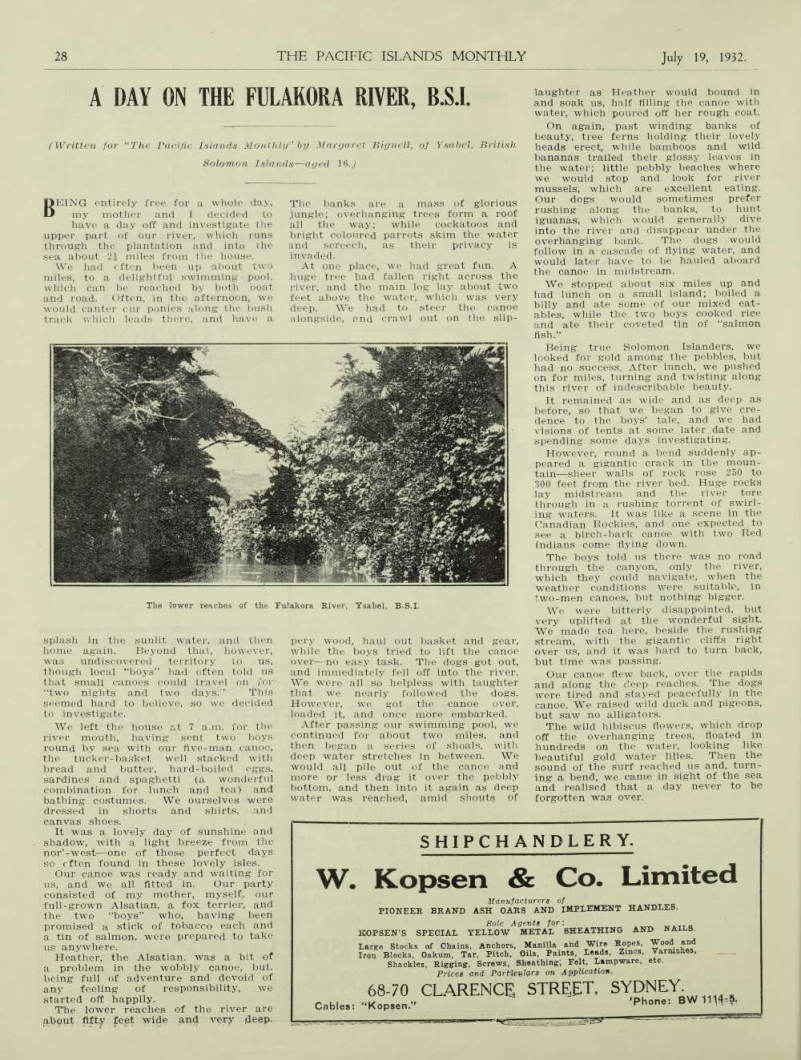
(Written for “The Pacific Islands Monthly ” by Margaret Bignell, of Ysabel, British Solomon Islands —aged 16 .)
BEING entirely free for a whole day, my mother and I decided to have a day off and investigate the upper part of our river, which runs through the plantation and into the sea about 2½ miles from the house.
We had often been up about two miles, to a delightful swimming pool, which can be reached by both boat and road. Often, in the afternoon, we would canter our ponies along the bush track which leads there, and have a
splash in the sunlit water, and then home again. Beyond that, however, was undiscovered territory to us, though local "boys” had often told us that small canoes could travel on for “two nights and two days.” This seemed hard to believe, so we decided to investigate.
We left the house at 7 a.m. for the river mouth, having sent two boys round by sea with our five-man canoe, the tucker-basket well stacked with bread and butter, hard-boiled eggs, sardines and spaghetti (a wonderful combination for lunch and tea) and bathing costumes. We ourselves were dressed in shorts and shirts, and canvas shoes.
It was a lovely day of sunshine and shadow, with a light breeze from the nor’-west —one of those perfect days so often found in these lovely isles.
Our canoe was ready and waiting for us, and we all fitted in. Our party consisted of my mother, myself, our full-grown Alsatian, a fox terrier, and the two “boys” who, having been promised a stick of tobacco each and a tin of salmon, were prepared to take us anywhere.
Heather, the Alsatian, was a bit of a problem in the wobbly canoe, but, being full of adventure and devoid of any feeling of responsibility, we started off happily.
The lower reaches of the river are about fifty feet wide and very deep.
The banks are a mass of glorious jungle; overhanging trees form a roof all the way; while cockatoos and bright coloured parrots skim the water and screech, as their privacy is invaded.
At one place, we had great fun. A huge tree had fallen right across the river, and the main log lay about two feet above the water, which was very deep. We had to steer the canoe alongside, end crawl out on the slip
pery wood, haul out basket and gear, while the boys tried to lift the canoe over—no easy task. The dogs got out, and immediately fell off into the river, We were all so helpless with laughter that we nearly followed the dogs, However, we got the canoe over, loaded it, and once more embarked.
After passing our swimming pool, we continued for about two miles, and then began a series of shoals, with deep water stretches in between. We would all pile out of the canoe and more or less drag it over the pebbly bottom, and then into it again as deep water was reached, amid shouts of
laughter as Heather would bound in and soak us, half filling the canoe with water, which poured off her rough coat.
On again, past winding banks of beauty, tree ferns holding their lovely heads erect, while bamboos and wild bananas trailed their glossy leaves in the water; little pebbly beaches where we would stop and look for river mussels, which are excellent eating.
Our dogs would sometimes prefer rushing along the banks, to hunt iguanas, which would generally dive into the river and disappear under the overhanging bank. The dogs would follow in a cascade of flying water, and would later have to be hauled aboard the canoe in midstream.
We stopped about six miles up and had lunch on a small island; boiled a billy and ate some of our mixed eat ables, while the two boys cooked rice and ate their coveted tin of “salmon fish.”
Being true Solomon Islanders, we looked for gold among the pebbles, but had no success. After lunch, we pushed on for miles, turning and twisting along this river of indescribable beauty.
It remained as wide and as deep as before, so that we began to give cre dence to the boys’ tale, and we had visions of tents at some later date and spending some days investigating.
However, round a bend suddenly ap peared a gigantic crack in the moun tain —sheer walls of rock rose 250 to 300 feet from the river bed. Huge rocks lay midstream and the river tore through in a rushing torrent of swirl ing waters. It was like a scene in the Canadian Rockies, and one expected to see a birch-bark canoe with two Red Indians come flying down.
The boys told us there was no road through the canyon, only the river, which they could navigate, when the weather conditions were suitably, in two-men canoes, but nothing bigger.
We were bitterly disappointed, but very uplifted at the wonderful sight.
We made tea here, beside the rushing stream, with the gigantic cliffs right over us, and it was hard to turn back, but time was passing.
Our canoe flew back, over the rapids and along the deep reaches. The dogs were tired and stayed peacefully in the canoe. We raised wild duck and pigeons, but saw no alligators.
The wild hibiscus flowers, which drop off the overhanging trees, floated in hundreds on the water, looking like beautiful gold water lilies. Then the sound of the surf reached us and, turn ing a bend, we came in sight of the sea and realised that a day never to be forgotten was over.
The lower reaches of the Fulakora River, Ysabel, B.S.I.
Advertisements & other items, p. 30 (1 item)
W. Kopsen & Co. Limited
SHIPCHANDLERY.
Manufacturers of PIONEER BRAND ASH OARS AND IMPLEMENT HANDLES.
Sole Agents for: KOPSEN’S SPECIAL YELLOW METAL SHEATHING AND NAILS.
Large Stocks of Chains, Anchors, Manilla and Wire Ropes, Wood and Irgi) Blocks, Oakum, Tar, Pitch, Oils, Paints, Leads. Zincs, yarmshes.
Shackles, Rigging, Screws. Sheathing, Felt, Lampware, etc.
Prices and Parrticulars on Application.
68-70 CLARENCE STREET, SYDNEY
Cables: "Kopsen.” ’Phone: BW 1114-5
Japanese and French Warships
Visit Suva.
From Our Own Correspondent.
SUVA, June 15.
A MAJOR event during the month has been the visit of the Japanese cruisers, "Iwate’’ and "Asama,” together with the French sloop, “Bellatrix.’’ All these ships took on coal at Suva.
The Japanese ships had both taken part in the Russo-Japanese War and are now obsolete.
They had on board a contingent of Japanese naval cadets, who were doing a Pacific tour.
The sight of these old vessels steaming in through Suva Harbour made one realise how completely powerless was Suva to resist any attack, even from the most obsolete of vessels.
In England, the Royal Navy is talked of as “Under God, our sure shield.” Never was a saying truer than in the case of Suva.
It is something to note that our Legislative Council has appreciated this to the extent of voluntarily voting at the last session £5,000 towards the cost of upkeep of the Royal Navy.
There were various festivities and, at an At Home given by the Japanese Vice-Admiral, the guests were shown a most interesting display of Japanese single-stick, ju-jitsu and wrestling.
The French sloop, “Bellatrix,” belongs to the Flower class. She was built and engined in Glasgow in 1918 and is now on Colonial patrol duties in much the same way as British sloops are used. This week the “Laburnum,” a sister ship in class to the “Bellatrix,” arrives from New Zealand for her annual visit, so that life just at present in Suva seems to be a series of naval occasions.
Making A Plantation Pay.
[To the Editor.]
Sir, —“Does a well-managed N.G. plantation pay with copra at £10 per ton Rabaul?” (P.I.M., March 15). I say “No,” in a large majority of cases; “Yes,” in a few exceptional cases.
Your “gentleman interested in copra production in N.G.” evidently knows the ideal plantation, well stocked with cattle, goats, pigs, etc., where pigeons flock and vegetables thrive, where grasshoppers or promecotheca fear to tread, where the minimum of labour produces the maximum of copra. In fact, the ideal place for a “verandah boss” to drink his half-dozen bottles a day. If only all plantations were like this, there would be no argument, but, as you say, no two men will agree about costs because no two plantations are the same.
My cost of production is about £9/10/-. The price received for copra during last twelve months averages £6/15/-. I have kept myself solvent by chasing the elusive Trocas and by trading and out of capital.
Is it not time that the idea of veran dah bosses and boosers running, or ruining, plantations was dropped—there are few such nowadays. There have been some of this type in years past, but they did not last long. Another idea prevalent—and among people who should know better —is that all planters made a lot of money in the days of high copra prices, and squandered it recklessly on motor cars, trips south, and in leading a gay life generally. This might apply to one or two purchasers in the first group. The big majority of planters have no cars—or roads for them—and they are their own builders, carpenters, engineers, and jacks-of-all trades and work damned hard. Nor do they live in the suburbs of Rabaul, handy to pub or club.
I am. etc..
One Of The Majority.
Manus, N.G.
Samoan News.
Further Slump in Copra and Cocoa Prices.
From Our Own Correspondent.
APIA, June 15.
ANOTHER drop in the local price for copra is announced, owing to a fall in the London rate. Unfortunately, this coincides with a further drop in the cocoa price, which now fol lows the tendency of other tropical products.
As bananas are also at a low ebb, the three staple products of Samoan plantations are all suffering. The cocoa crop is, fortunately, har vested, and we are in our off-season till Oc tober, so that the drop in the cocoa price does not affect us very much. It is hoped that when Christmas buying starts in October, prices will come back to normal again.
Administrator’S Tour.
His Excellency the Administrator, General Hart, left on June 8 for a malaga round the island of Savaii.
He is accompanied by the Secretary of Native Affairs, the A.D.C., and the Chief Medical Of ficer. He will return on June 16 and leave again on June 25 by the H.M.S. “Laburnum" on an official visit to the Tokelau Islands, returning on June 30.
Chinese And Samoan Women.
The Administration is giving evidence of its laudable intention to enforce the recently enacted ordinance prohibiting cohabitation between Chinese coolies and Samoan women. A Chinese coolie came before the court last week, accused of having entered a Samoan fale with a Samoan girl. He was convicted and sentenced to one month’s gaol. This will, doubtless, act as an efficient deterrent to similar offenders in future.
Personal Items.
Chief Judge J. H. Luxford, of the Apia High Court, has been suddenly called to Wellington, and left by the last “Maui Pomare.’’ The reason for this sudden call has not been an nounced. During his absence, Judge A. M.
Carthy will occupy the Bench.
Mr. H. Gow, who has been acting manager of Burns, Philp (S.S.) Co., Ltd., at Apia, for the past few months, has left for Pago Pago to return via Suva to Vavau. Mr. R. H. Brown, the local manager, will return from his holi day on June 15. Mr. Gow was farewelled before his departure by the business community of Apia.
No matter what happens, there is always someone who knew it would.
Advertisements & other items, p. 31 (1 item)
Holbrooks’
SAMUEL RUSSELL,
ESTATE AND GENERAL AGENT,
P.O. Box 64, Papeete, Tahiti.
Real Estate. Investments. Estate management and administration. Valuations and Reports Houses and Lands for Lease or Sale.
Sole Proprietor; TAHITI PERFUMES.
Cables: Russell. Tahiti (Bentley’s Code).
HOLBROOKS’
DELICIOUS SOUPS
In 8oz. and 16oz. Tins Ready to Serve.
TOMATO, VEGETABLE,
MULLIGATAWNY, OX TAIL,
AND MOCK TURTLE.
Holbrooks’ Spaghetti
IN TOMATO SAUCE
In 4oz. and 8oz. Tins.
Holbrooks’ Baked Beans
WITH PORK
In 4oz. and 8oz. Tins.
Holbrooks (A/sia) Ltd.
WATERLOO, N.S.W.
ESTABLISHED 1888.
Why Goaribari Is No Longer A Cannibal.
From Our Own Correspondent.
Port Moresby, May 5.
ALTHOUGH not all Papuans are, or ever have been, cannibals, canni balism was, until recent years, very widely practised.
Some tribes ate their enemies after a successful raid, more as a form of triumphant celebration than anything else; others believed that by eating the flesh of their dead foes they absorbed into themselves whatever good and manly qualities the deceased might have possessed.
Among the Purari Delta people cer tain tribal ceremonies called for the eating of a human body, and raids were organised for the sole purpose of pro viding a victim. But there are tribes who ate human flesh because they liked it, and found in it a pleasant change from a monotonous diet.
There is a very virile tribe in the re mote Sambarigi valley. The journey from the nearest government station occupies ten days of very strenuous travel; but, as a result of several visits, the Government have placed them selves on excellent terms with these war-like people.
On one such visit, a member of the Armed Native Constabulary died, and was buried by his companions. On the following morning, the patrol officer noticed several Sambarigi men re-open ing the grave, and at once protested against the desecration. The chief promptly stopped the proceedings and apologised. He explained that his
people had not eaten meat for some weeks and that he had not thought that the white man had any further interest in the dead native.
Needless to say, the Government have set their faces sternly against the practice, and, though there can be no doubt that cannibalism still exists, even among natives who have been remotely under Government influence, it is not nearly so general as formerly, and is indulged in only surreptitiously.
A Government official was patrolling the Goaribari district, where Chalmers, the missionary, was eaten some thirty years ago, and talked to one of the old men in the village of Dopima.
“Did you ever eat man?” he asked.
The old reprobate was hurt, and re plied indignantly that he had, of course, eaten man many times; obviously re senting the implication that he was such a weakling, or of so little import ance as to have been excluded from the delectable feasts, “But you don’t eat man now?” sug gested the official, hoping for a testi monial to the efficiency of Governmental methods.
“No,” replied the old man, “for a long time I have not eaten man.”
This sounded promising, and the of ficial probed a little deeper.
“Why is it that you do not eat men’s flesh now?” he asked, hopefully.
“I can’t,” replied the ancient, sadly. ‘Tve got no teeth!”
Papuan Administrator.
[To the Editor.]
Sir, —Although a little belated —I did not see the February issue until yes terday—l would like to remark that the references in the article on Judge Gore, of Papua, are most unfair to other members of the Papuan Service.
There are at least three members of that Service who would be given a preference over Judge Gore by most of those competent to express an opinion.
These men possess infinitely greater qualifications—long training in admin istrative positions, lengthy service, men tal alertness, and balanced tempera ment. They are not “popular” in the cheap sense known in Papua, neither are they soldiers, nor are they noted for size, but what they lack in these regards they make up in solid experi ence of the right kind and sound judg ment —accomplishments certainly more in keeping with the duties involved.
Judge Gore is relatively a newcomer to Papua and cannot have acquired sufficient experience to justify selection as successor to Sir Hubert Murray—quite apart from what he may lack in other directions. Also, he is barred from selection by the unmistakable intention of the Papua Act —that the office of Lieutenant-Governor shall be held by an official having executive experience, which Judge Gore has not; and, while he remains a Judge of the Central
Court, he is not likely to have an op portunity of acquiring such experience.
I am, etc.,
J. T. Bensted,
Late Director of Public Works and an ex-Member of the Executive and Leg islative Councils of Papua.
Sydney, 25/6/1932.
EDITORIAL NOTE.— The article to which Mr.
Bensted refers was published without the con sent or knowledge of Judge Gore, and we regret that fact, as it now appears that it may cause Judge Gore some justifiable annoyance.
Anyone who knows Judge Gore will know that he is the last man to take any step—whether through a newspaper or otherwise—to influence any administrative rearrangement.
N.Z. Olympic Team at Rarotonga.
From Our Oxen Correspondent
Rarotonga, June 16.
THE New Zealand team, on its way to the 1932 Olympiad, at Los An geles, came ashore during the stay of the mail boat at Rarotonga, and were the guests for the day of the various sporting bodies.
Many special functions were ar ranged for the entertainment of the visitors.
Apia Observatory reported five slight earthquake shocks on May 26. In two instances, the tremors were calculated to have originated about 898 miles from Apia,
Morris Hedstrom Ltd.
Annual Meeting at Suva.
THE annual meeting of Messrs. Morris Hedstrom, Ltd. was held at Suva on June 24.
Dealing with the accounts of the company, Sir Maynard Hedstrom, Chairman of Directors, told the meet ing that during the year under review the cash position of the company im proved by nearly £80,000, and for the first time in the history of the company cash in hand and at the bank, plus Government securities, exceeded the total liabilities.
He went on to say that during the last ten years the company had paid off more than £250,000, and, in addition, had paid dividends averaging 5 per cent. per annum.
Substantial economies were effected during the past two years, the chair man said, but these were not fully re flected in the accounts, as provision for sundry losses is included with trade ex penses, salaries, etc., in the profit and loss account. In actual fact, the year’s working expenses were about £13,000 less than for the year ended March 31, 1930. A reduction in insurance reserve of about £8,000, Sir Maynard explained, was caused by the fact that an amount of over £12,000 was paid to Morris, Hedstrom (Lautoka), Ltd., for hurri cane and flood losses.
In making up the accounts for the year, the board was faced with the fact that, although the accounts were kept in Fiji currency, trade was being done in English and Australian currencies also. Cash was held in both Australia and London on the day of balancing.
It was necessary to put entries through the suspense account, and adjust these and similar items by converting all items to the level of the Fiji pound.
Fiji For The Winter.
Private family would receive two paying guests. Unique opportunity of enjoying Islands life—golf, tennis, bowls; cruising, fishing, shoot ing. Inclusive terms, £10/10/- monthly. Par ticulars from Pacific Publications, Ltd., Union House, 247 George Street, Sydney.
Advertisements & other items, p. 32 (1 item)
Pike
WHEN VISITING
MELBOURNE
BRISBANE
SYDNEY or
Radiogram or write your Clothing Requirements to
PIKE
BROTHERS LTD.
BRISBANE
They will deliver to your Hotel or Boat on arrival in Brisbane. Write for Pat terns and Self-Measurement Forms. Catalogue post free on request.
Tralian Cricketers.
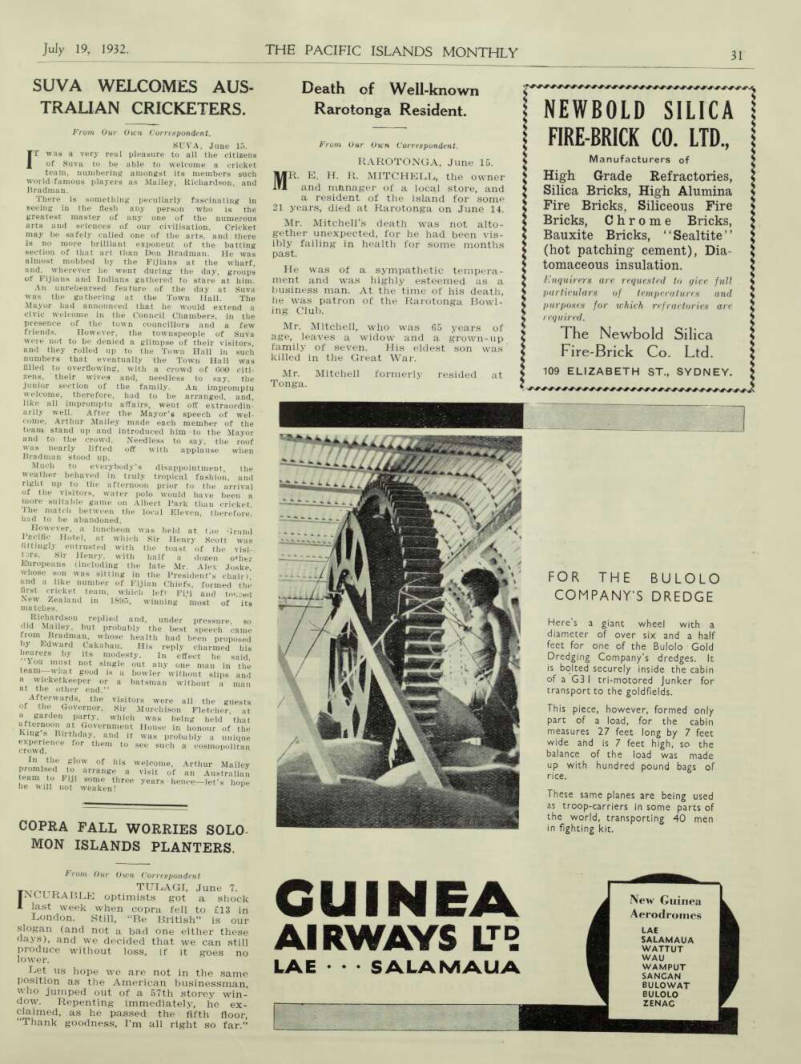
Suva Welcomes Aus
From Our Own Correspondent.
SUVA, June 15.
IT was a very real pleasure to all the citizens of Suva to be able to welcome a cricket team, numbering amongst its members such world-famous players as Mailey, Richardson, and Bradman.
There is something peculiarly fascinating in seeing in the flesh any person who is the greatest master of any one of the numerous arts and sciences of our civilisation. Cricket may be safely called one of the arts, and there is no more brilliant exponent of the batting section of that art than Don Bradman. He was almost mobbed by the Fijians at the wharf, and, wherever he went during the day, groups of Fijians and Indians gathered to stare at him.
An unrehearsed feature of the day at Suva was the gathering at the Town Hall. The Mayor had announced that he would extend a civic welcome in the Council Chambers, in the presence of the town councillors and a few friends. However, the townspeople of Suva were not to be denied a glimpse of their visitors, and they rolled up to the Town Hall in such numbers that eventually the Town Hall was filled to overflowing, with a crowd of 600 citi zens, their wives and, needless to say, the junior section of the family. An impromptu welcome, therefore, had to be arranged, and, like all impromptu affairs, went off extraordin arily well. After the Mayor’s speech of wel come, Arthur Mailey made each member of the team stand up and introduced him to the Mayor and to the crowd. Needless to say, the roof was nearly lifted off with applause when Bradman stood up.
Much to everybody’s disappointment, the weather behaved in truly tropical fashion, and right up to the afternoon prior to the arrival of the visitors, water polo would have been a more suitable game on Albert Park than cricket.
The match between the local Eleven, therefore, had to be abandoned.
However, a luncheon was held at the Grand Pacific Hotel, at which Sir Henry Scott was fittingly entrusted with the toast of the visi tors. Sir Henry, with half a dozen other Europeans (including the late Mr. Alex Joske whose son was sitting in the President’s chair), and a like number of Fijian Chiefs, formed the first cricket team, which left Fiji and toured New Zealand in 1895, winning most of its matches.
Richardson replied and, under pressure, so did Mailey, but probably the best speech came from Bradman, whose health had been proposed by Edward Cakabau. His reply charmed his hearers by its modesty. In effect he said, "You must not single out any one man in the team—what good is a bowler without slips and a wicketkeeper or a batsman without a man at the other end.”
Afterwards, the visitors were all the guests of the Governor, Sir Murchison Fletcher at a garden party, which was being held that afternoon at Government House in honour of the King's Birthday, and it was probably a unique experience for them to see such a cosmopolitan crowd.
In the glow of his welcome, Arthur Mailey promised to arrange a visit of an Australian team to Fiji some three years hence —let's hope he will not weaken!
Copra Fall Worries Solo
Mon Islands Planters.
From Our Own Correspondent
Tulagi, June 7,
INCURABLE optimists got a shock last week when copra fell to £13 in London. Still, “Be British” is our slogan (and not a bad one either these days), and we decided that we can still produce without loss, if it goes no lower.
Let us hope we are not in the same position as the American businessman, who jumped out of a 57th storey win dow. Repenting immediately, he ex claimed, as he passed the fifth floor, “Thank goodness, I’m all right so far.”
Rarotonga Resident.
Death of Well-known Rarotonga Resident.
From Our Own Correspondent.
Rarotonga, June 15.
MR. E. H. R. MITCHELL, the owner and manager of a local store, and a resident of the island for some 21 years, died at Rarotonga on June 14.
Mr. Mitchell’s death was not alto gether unexpected, for he had been vis ibly failing in health for some months past.
He was of a sympathetic tempera ment and was highly esteemed as a business man. At the time of his death, he was patron of the Rarotonga Bowl ing Club.
Mr. Mitchell, who was 65 years of age, leaves a widow and a grown-up family of seven. His eldest son was killed in the Great War.
Mr. Mitchell formerly resided at Tonga.
Advertisements & other items, p. 33 (1 item)
Guinea
NEWBOLD SILICA
FIRE-BRICK CO. LTD.,
Manufacturers of High Grade Refractories, Silica Bricks, High Alumina Fire Bricks, Siliceous Fire Bricks, Chrome Bricks, Bauxite Bricks, "Sealtite" (hot patching cement), Dia tomaceous insulation.
Enquirers are requested to give full particulars of temperatures and purposes for which refractories are required.
The Newbold Silica Fire-Brick Co. Ltd.
109 ELIZABETH ST., SYDNEY.
FOR THE BULOLO
COMPANY’S DREDGE
Here’s a giant wheel with a diameter of over six and a half feet for one of the Bulolo Gold
Dredging Company’s dredges. It
is bolted securely inside the cabin of a G31 tri-motored Junker for transport to the goldfields.
This piece, however, formed only part of a load, for the cabin measures 27 feet long by 7 feet wide and is 7 feet high, so the balance of the load was made up with hundred pound bags of rice.
These same planes are being used as troop-carriers in some parts of the world, transporting 40 men in fighting kit.
GUINEA
AIRWAYS LTD.
LAE
SALAMAUA
New Guinea
Aerodromes
LAE
SALAMAUA
WATTUT
WAU
WAMPUT
SANGAN
BULOWAT
BULOLO
ZENAG
How The White Man “Goes Native ”
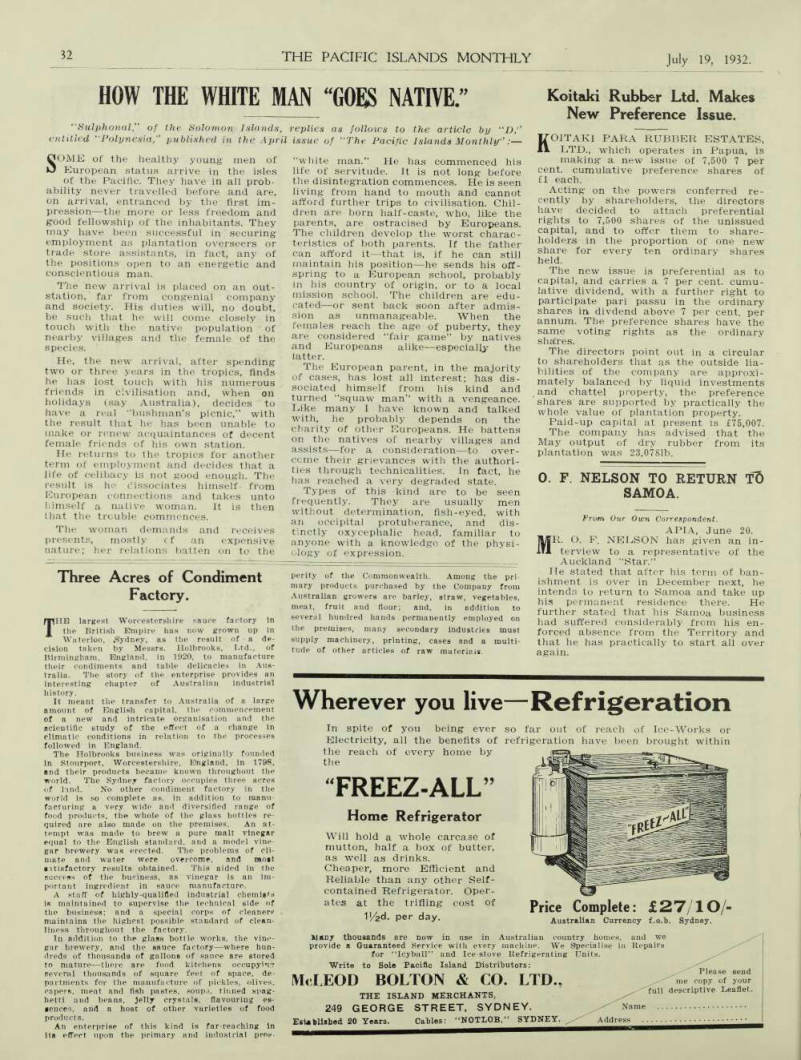
“Sulphonal” of the Solomon Islands, replies as follows to the article by "B," entitled "Polynesia," published in the April issue of “The Pacific Islands Monthly" :—
SOME of the healthy young men of European status arrive in the isles of the Pacific. They have in all prob ability never travelled before and are, on arrival, entranced by the first im pression—the more or less freedom and good fellowship of the inhabitants. They may have been successful in securing employment as plantation overseers or trade store assistants, in fact, any of the positions open to an energetic and conscientious man.
The new arrival is placed on an out station, far from congenial company and society. His duties will, no doubt, be such that he will come closely in touch with the native population of nearby villages and the female of the species.
He, the new arrival, after spending two or three years in the tropics, finds he has lost touch with his numerous friends in civilisation and, when on holidays (say Australia), decides to have a real “bushman’s picnic,” with the result that he has been unable to make or renew acquaintances of decent female friends of his own station.
He returns to the tropics for another term of employment and decides that a life of celibacy is not good enough. The result is he dissociates himself from European connections and takes unto himself a native woman. It is then that the trouble commences.
The woman demands and receives presents, mostly of an expensive nature; her relations batten on to the
“white man.” He has commenced his life of servitude. It is not long before the disintegration commences. He is seen living from hand to mouth and cannot afford further trips to civilisation. Chil dren are born half-caste, who, like the parents, are ostracised by Europeans.
The children develop the worst charac teristics of both parents. If the father can afford it —that is, if he can still maintain his position—he sends his off spring to a European school, probably in his country of origin, or to a local mission school. The children are edu cated —or sent back soon after admis sion as unmanageable. When the females reach the age of puberty, they are considered “fair game” by natives and Europeans alike—especially the latter.
The European parent, in the majority of cases, has lost all interest; has dis sociated himself from his kind and turned “squaw man’’ with a vengeance.
Like many I have known and talked with, he probably depends on the charity of other Europeans. He battens on the natives of nearby villages and assists—for a consideration —to over come their grievances with the authori ties through technicalities. In fact, he has reached a very degraded state.
Types of this kind are to be seen frequently. They are usually men without determination, fish-eyed, with an occipital protuberance, and dis tinctly oxycephalic head, familiar to anyone with a knowledge of the physi ology of expression.
Factory.
Three Acres of Condiment Factory.
THE largest Worcestershire sauce factory in the British Empire has now grown up in Waterloo, Sydney, as the result of a de cision taken by Messrs. Holbrooks, Ltd., of Birmingham, England, in 1920, to manufacture their condiments and table delicacies in Aus tralia. The story of the enterprise provides an interesting chapter of Australian industrial history.
It meant the transfer to Australia of a large amount of English capital, the commencement of a new and intricate organisation and the scientific study of the effect of a change in climatic conditions in relation to the processes followed in England.
The Holbrooks business was originally founded In Stourport, Worcestershire, England, in 1798, and their products became known throughout the world. The Sydney factory occupies three acres of land. No other condiment factory in the world is so complete as, in addition to manu facturing a very wide and diversified range of food products, the whole of the glass bottles re quired are also made on the premises. An at tempt was made to brew a pure malt vinegar equal to the English standard, and a model vine gar brewery was erected. The problems of cli mate and water were overcome, and most satisfactory results obtained. This aided in the success of the business, as vinegar is an im portant ingredient in sauce manufacture.
A staff of highly-qualified industrial chemists is maintained to supervise the technical side of the business: and a special corps of cleaners maintains the highest possible standard of clean liness throughout the factory.
In addition to the glass bottle works, the vine gar brewery, and the sauce factory—where hun dreds of thousands of gallons of sauce are stored to mature—there are food kitchens occupying several thousands of square feet of space, de partments for the manufacture of pickles, olives, capers, meat and fish pastes, soups, tinned spag hetti and beans, jelly crystals, flavouring es sences, and a host of other varieties of food products.
An enterprise of this kind is far-reaching in its effect upon the primary and industrial pros
perity of the Commonwealth. Among the pri mary products purchased by the Company from Australian growers are barley, straw, vegetables, meat, fruit and flour; and, in addition to several hundred hands permanently employed on the premises, many secondary industries must supply machinery, printing, cases and a multi tude of other articles of raw materials.
Koitaki Rubber Ltd. Makes
New Preference Issue.
Koitaki Para Rubber Estates,
LTD., which operates in Papua, is making a new issue of 7,500 7 per cent, cumulative preference shares of £1 each.
Acting on the powers conferred re cently by shareholders, the directors have decided to attach preferential rights to 7,500 shares of the unissued capital, and to offer them to share holders in the proportion of one new share for every ten ordinary shares held.
The new issue is preferential as to capital, and carries a 7 per cent, cumu lative dividend, with a further right to participate pari passu in the ordinary shares in divdend above 7 per cent, per annum. The preference shares have the same voting rights as the ordinary shares.
The directors point out in a circular to shareholders that as the outside lia bilities of the company are approxi mately balanced by liquid investments and chattel property, the preference shares are supported by practically the whole value of plantation property.
Paid-up capital at present is £75,007.
The company has advised that the May output of dry rubber from its plantation was 23,078lb.
Samoa.
O.F. Nelson To Return To
From Our Own Correspondent.
APIA, June 20.
MR. O. F. NELSON has given an in terview to a representative of the Auckland “Star.”
He stated that after his term of ban ishment is over in December next, he intends to return to Samoa and take up his permanent residence there. He further stated that his Samoa business had suffered considerably from his en forced absence from the Territory and that he has practically to start all over again.
Advertisements & other items, p. 34 (1 item)
Freez-All
Wherever you live — Refrigeration
In spite of you being ever so far out of reach of Ice-Works or Electricity, all the benefits of refrigeration have been brought within the reach of every home by the
Home Refrigerator
Will hold a whole carcase of mutton, half a box of butter, as well as drinks.
Cheaper, more Efficient and Reliable than any other Selfcontained Refrigerator. Oper ates at the trifling cost of 1½d. per day.
Price Complete: £27/10/-
Australian Currency f.o.b. Sydney.
Many thousands are now in use in Australian country homes, and we provide a Guaranteed Service with every machine. We Specialise in Repairs for “Icyball” and Ice-stove Refrigerating Units.
Write to Solo Pacific Island Distributors: Please send me copy of your full descriptive Leaflet.
McLEOD BOLTON & CO. LTD.,
THE ISLAND MERCHANTS,
249 GEORGE STREET, SYDNEY.
Established 20 Years. Cables: “NOTLOB,” SYDNEY.
Name Address
W. R. Carpenter & Co.
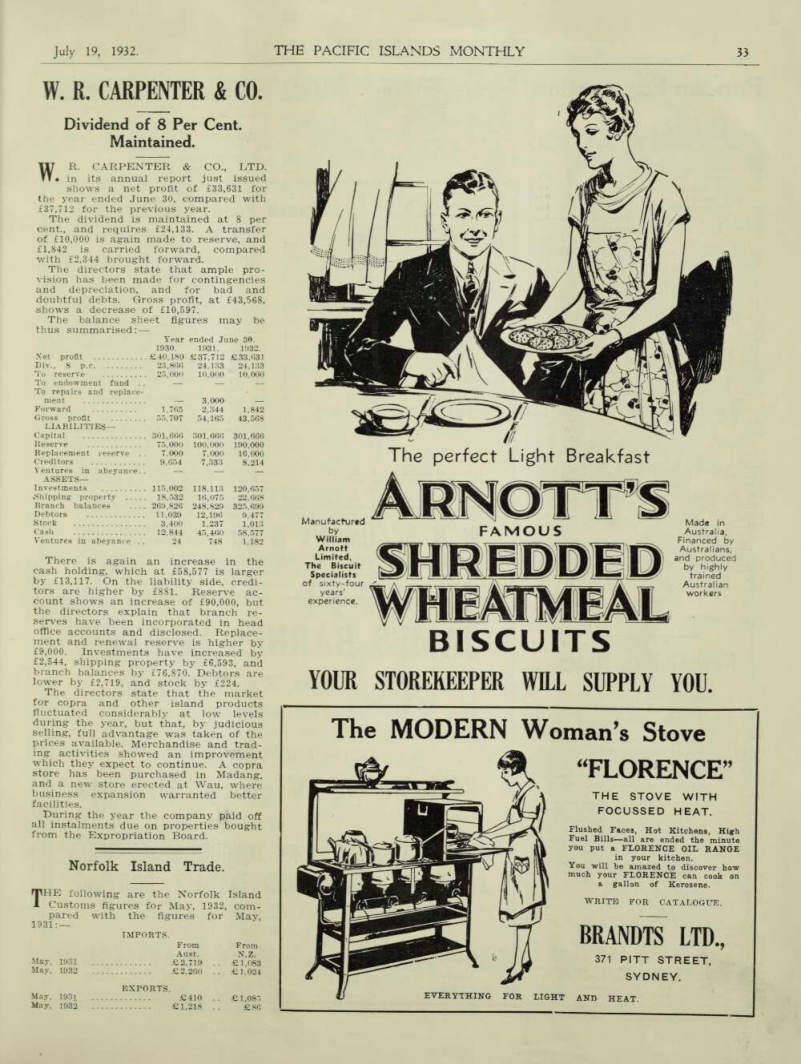
Dividend of 8 PerCent.
Maintained.
W.R. Carpenter & Co., Ltd.
in its annual report just issued shows a net profit of £33,631 for the year ended June 30, compared with £37,712 for the previous year.
The dividend is maintained at 8 per cent., and requires £24,133. A transfer of £10,000 is again made to reserve, and £1,842 is carried forward, compared with £2,344 brought forward.
The directors state that ample pro vision has been made for contingencies and depreciation, and for bad and doubtful debts. Gross profit, at £43,568, shows a decrease of £10,597.
The balance sheet figures may be thus summarised:
There is again an increase in the cash holding, which at £58,577 is larger by £13,117. On the liability side, credi tors are higher by £881. Reserve ac count shows an increase of £90,000, but the directors explain that branch re serves have been incorporated in head office accounts and disclosed. Replace ment and renewal reserve is higher by £9,000. Investments have increased by £2,544, shipping property by £6,593, and branch balances by £76,870. Debtors are lower by £2,719, and stock by £224.
The directors state that the market for copra and other island products fluctuated considerably at low levels during the year, but that, by judicious selling, full advantage was taken of the prices available. Merchandise and trad ing activities showed an improvement which they expect to continue. A copra store has been purchased in Madang, and a new store erected at Wau, where business expansion warranted better facilities.
During the year the company paid off all instalments due on properties bought from the Expropriation Board.
Year ended June 30. 1930. 1931. 1932.
Net profit £40.180 £37,712 £33,631 Div., 8 p.c 23,866 24,133 24,133 To reserve 23,000 10.000 10,000 To endowment fund . . — To repairs and replace ment 3,000 Forward 1,765 2,344 1,842 Gross profit 55,707 54,165 43,568
Liabilities—
Capital 301,666 301,666 301,666 Reserve 75,000 100,000 190,000 Replacement reserve 7,000 7,000 16,000 Creditors 9,654 7,333 8,214 Ventures in abeyance.. — —.
Assets —
Investments 115,002 118,113 120,657 property ... 18,532 16,075 22,668 Branch balances 269,826 248,829 325,699 Debtors 11,039 12,196 9,477 Stock 3,400 1,237 1,013 Cash 12,844 45,460 58,577 Ventures in abeyance . . 24 748 1,182
Norfolk Island Trade.
THE following- are the Norfolk Island Customs figures for May, 1932, com pared with the figures for May, 1931:
Imports.
From From Aust.
N.Z.
May. 1031 £2,719 . £1,083 £1.024 May, 1932 £2,260
Exports.
Mar, 1931 £410 £1,085 £80 May. 1932 £1,218 .
Advertisements & other items, p. 35 (1 item)
Biscuits
Manufactured by William Arnott Limited, The Biscuit Specialists of sixty-four years’ experience.
The perfect Light Breakfast
FAMOUS
Made in Australia, Financed by Australians, and produced by highly trained Australian workers
BISCUITS
YOUR STOREKEEPER WILL SUPPLY YOU.
The MODERN Woman’s Stove
“FLORENCE”
THE STOVE WITH
FOCUSSED HEAT.
Flushed Faces, Hot Kitchens, High Fuel Bills—all are ended the minute you put a FLORENCE OIL RANGE in your kitchen.
You will be amazed to discover how much your FLORENCE can cook on a gallon of Kerosene.
WRITE FOR CATALOGUE.
BRANDTS LTD.
371 PITT STREET,
SYDNEY.
EVERYTHING FOR LIGHT AND HEAT.
Papuan Exploration
[To the Editor.] Sir,—In the article “Head Hunting as a Custom” (P.I.M., 19/5/32) your cor respondent is not quite correct in his statement that between 1890 and 1928 Macgregor’s feat of reaching a 600-mile point on the Upper Fly was not beaten.
As a matter of fact, Macgregor’s 610 mile point was on the Palmer River, the Fly River above Palmer Junction not being traversed until 1924.
During 1914, the Prykes, who were prospecting with Sir Rupert Clarke, reached a point above Macgregor’s 610 mile. This I know is correct for they have photographs which prove it.
In 1922, I was exploring the north west district between the Dutch bound ary and the Fly and eventually returned from a point on the Alice River, some 630 miles above the mouth of the Fly.
In 1924, when Mr. Thompson and my self were exploring the Tully district of the Upper Fly, Mr. Thompson tra versed the Tully River while I went on and discovered its source and then reached the main Fly 604 miles above its mouth, and traversed this back for the first time as far as Palmer Junc tion, Though Macgregor doubted the fact that D’Albertis ever reached Macrossan Island, I have tried to show in my paper, “D’Albertis’ Exploration of the Upper Fly River” (R.A.H.S. Journal, Pt. V., 1925) that D’Albertis actually passed Palmer and Thompson Junc tions and must have reached a point 580 miles above the mouth of the Fly on the Palmer River.
Considering that Macgregor “had all appliances and means to boot” and D'Albertis but few, I think the latter’s feat stands out alone until the Karius- Champion expedition.
I am, etc.,
Leo Austen.
Trobriand Islands, Papua, June 18, 1932.
New Guinea Notes
From Our Own Correspondent.
Rabaul, June 29.
HIS Honour, the Administrator, Brig.-Gen. E.
A. Wisdom, prior to his departure from the Territory, was tendered a series of farewell functions by the various sections of the community.
All Government Departments allowed most of their staffs to attend the departure of the “Macdhui” and a large crowd was present to bid him farewell.
Mr. Roland Green, M.H.R., accompanied by Mrs. Green, arrived by the June “Montoro,” and have gone on the round trip to outports. Upon the return to Rabaul of the “Montoro,” they will stay with Mr. and Mrs. Clive Green for a few weeks, and return to Australia by the next “Macdhui.”
Mr. J. L. Froggatt, Government Entomologist, who acted as Director of Agriculture during the absence of long leave of Mr. Murray, the Director, proceeded to Australia on leave by the s.s. “Tanda” on June 15.
Bachelors’ Ball.
Towards the end of last month, some of our bachelors again showed their appreciation of the hospitality which they had received during the year from the married folk in Rabaul, by again giving a ball in the Regent Theatre. A novel feature this year was the hanging on the walls of boards representing tombstones with suitable epitaphs for three members of the previous function, who had since joined the ranks of the benedicts. This function, which
is always considered one of the events of the year, was the usual success.
“Tons Of Money”
Once more the Amateur Players of Rabaul have given residents much pleasure in present ing the farce “Tons of Money,” which is the ninth show produced during the past couple of years. “Tons of Money” was presented at the Regent Theatre in aid of the Rabaul Baseball
Association on June 9 and 10, and it is con sidered will realise quite a tidy sum for the popular Baseball Association. This presentation was quite up to the high standard of its pre decessors.
The death is reported from Apia Of the Hon. A. W. Johnston MLC at the age of 63 years.
Advertisements & other items, p. 36 (1 item)
James Barnes Limited
Fresh Food! Cool Drinks!
The Beaumont Refrigerator operates on
KEROSENE or BENZINE.
Special Features: 1. Costs about 1d. per day to run. 2. Has no movable parts to get out of order. 3. One heating a day gives refrigera tion for 24 hours. 4. Freezing unit weighs about 321bs. 5. Every freezing unit guaranteed 3 years. 6. No installation costs. 7. Can be operated by a child. 8. Specially made for tropical condi tions. 9. Keeps food fresh indefinitely, 10. Operates efficiently under all wea ther conditions.
The Beaumont Refrigerator brings effi cient refrigeration to Homes that have no Gas or Electricity. All that has to be done is to heat the Chemical Con tainer for a short while each day over a Primus or similar stove. The inside measurements of Model “A” are: 18 inches high, inches wide, and 22½ inches deep, with a capacity of 5 cubic feet. White seamless porcelain enamel interior, stainless steel fittings, nothing to wear out, nothing to be renewed. Refrigerating unit manufactured in accordance with the latest specifications recently imposed by the Queensland Government. Absolutely ideal for isolated homes.
Write for full particulars, prices and copies of testimonials. 3 YEARS’ GUARANTEE.
W. N. BEAUMONT & CO. PADDINGTON 00 SYDNEY Distributors for Mandated Territory of New Guinea and Solomon Islands: W. R.
CARPENTER & CO., LTD. For Papua: B. N. G. TRADING CO., LTD., Port Moresby. For New South Wales and Queensland: WESTCOTT, HAZELL & CO., LTD.
JAMES BARNES LIMITED
2 Botany Street, Waterloo, Sydney
(ESTABLISHED 1881)
MANUFACTURERS OF
"Globe” & “Victory” Brands
OF
SHEEPS TONGUES OX TONGUES SAUSAGES
PRESERVED MEATS BEEF EXTRACT DRIPPING
Also “Castle” Brand, which is specially packed for use by the White Population.
Globe Beef Extract is invaluable to Young and Old.
Tested Recipes on the packet 4oz. and Boz. sizes.
Norfolk Is. Eagerly Awaits Capt. Pinney.
From Our Own Correspondent.
Norfolk Is., July 2.
COLONEL BENNETT duly departed
by the last steamer out to Sydney and the time is drawing near when we shall welcome his successor, Capt.
C. R. Pinney, to the island..
He is due to arrive on the “Morinda,” reaching here about the middle of July, and the greatest excitement prevails among those whose social life revolves around “Government House,” as “The Residency” is erroneously known.
We will all be satisfied to discover a keen, capable man of affairs with the necessary qualifications for his post, and an upright figure on the Bench, where he sits alone in judgment. And we shall be anxious to know if we may expect to find him every day in the office in the heart of Kingston, where all administrators, prior to Colonel Bennett, might be found —or, if not the administrator himself, under stress of other business, then his secretary and deputy.
For the last three years, anyone with business to transact has been required to cross the reserve, pass up through the G.H. ground, around to the side of the building and mount the steps to the private secretary’s private office, where pleas would be heard.
Satisfactory Shipments Of
Fruit.
Our last shipments of fruit to Aus tralia have realised quite satisfactory
prices and certainly we have estab lished ourselves as a banana producing island on the map of the Pacific, for, by every inward mail, we receive let ters from new merchants on the other side asking for local agents to buy and ship for them. We are, admit tedly, at the extreme edge of the ban ana belt, so to classify it, but, for the first four months of the year, our ban anas compare favourably with those grown anywhere between here and the Equator.
But, of course, our real future lies in tourist traffic and the establishing of homes here by retired business men with small, settled incomes and a pas sion for open-air games all the year round. And invalids and convalescents, also, will undoubtedly flock here in years to come; sent here by their medical men or lured of their own commonsense on realising our magnifi cent, health-giving climate and the charm of our solitude and beauty. We shall build a sanatorium some day on the slopes of Mount Pitt —warm in win ter, cool in summer, sheltered by the bush-clad shoulders of the mountain from the ruder onslaughts of the brac ing sea breezes, and facing always the blue, eternal ocean.
The Pacific Aerial Transport Co., one of the transport companies on the New Guinea goldfields, has now three ’planes in commission and hopes soon to have a fourth.
Advertisements & other items, pp. 37-38 (1 item)
Iona
Skandia (Established 1890.)
LARGEST EUROPEAN WORKS.
FIRST CRUDE OIL ENGINE
ON MARKET.
DIESEL & SEMI-DIESEL,
LATEST TYPES.
ALL POWERS.
Spares in Stock.
Swedish Manufacture Guaran tees Workmanship & Material.
Write for particulars.
NELSON & KOBERTSON,
12 SPRING STREET, SYDNEY.
Australasian Distributors.
S0.7873.
Nigger Brown Calf, with reproduced seal-skin insertion. Neatly designed to carry 13-8 covered heel. Genuine Goodyear welted sole. 135 last.
V.7.
Two-colour Sandle, Veldtschoen sole. 5-8 leather heel. This shoe can be had in any shades on the Gloria last.
IONA
BOOTS
and
SHOES
The Recognised Quality of Australia.
Ladies’ & Gent’s Goodyear Welted Footwear.
Ladies
and Children’s Veldtschoen Footwear.
If these brands are not already stocked by you, kindly send to us
for illustrated catalogue.
WS.7812.
Pat. Tan, Nigger, Black Calf, Genuine Lizard trim, Four-hole Derby Tie Shoe, 11-8 covered heel.
Genuine Goodyear light, closeedged welted sole. Mac’s last.
CW.10.
Patent Tan Havana and Black Box Calf Derby Shoe. Creased vamps.
Genuine Goodyear welted soles.
Quality Five Toes last.
McKINLAY & GUMMING Ltd.
GEORGE STREET — — ERSKINEVILLE — — SYDNEY.
9,000 GRAMOPHONE,
RECORDS— "IMPERIAL."
(Engl.) 7in. new and perfect condition. Gross lots at 25/per gross f.o.b. Sydney. (Subject to sales).
ALFRED STOPPER,
16 Bridge Street, SYDNEY,
N.S.W.
BUILDING
SUPPLIES
Complete Stocks of Seasoned Timber of all descriptions on hand for immediate shipment.
Galvanised Iron, Fibro- Cement, Glass, and Builders’ Ironmongery.
SEND FOE OUR CATALOGUE
OF READY-CUT HOMES AND
ISLAND BUNGALOWS.
A. C. SAXTON & SONS
LTD.,
Box 5, PYRMONT, SYDNEY.
ADVT
Leasing of Samoan Reparation Estates
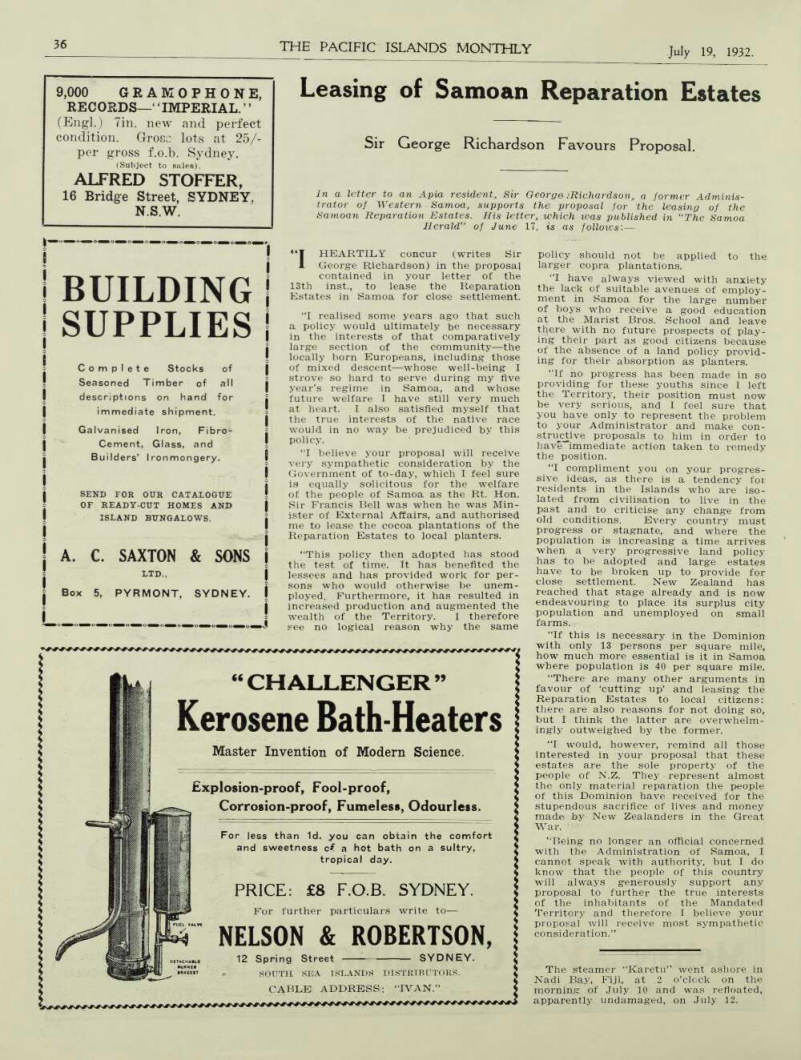
Sir George Richardson Favours Proposal.
In a letter to an Apia resident, Sir George .Richardson, a former Adminis trator of Western Samoa, supports the proposal for the leasing of the Samoan Reparation Estates. His letter, which was published in “The Samoa Herald” of June 17, is as follows:
“I HEARTILY concur (writes Sir George Richardson) in the proposal contained in your letter of the 13th inst., to lease the Reparation Estates in Samoa for close settlement.
“I realised some years ago that such a policy would ultimately be necessary in the interests of that comparatively large section of the community—the locally born Europeans, including those of mixed descent —whose well-being I strove so hard to serve during my five year’s regime in Samoa, and whose future welfare I have still very much at heart. I also satisfied myself that the true interests of the native race would in no way be prejudiced by this policy.
“I believe your proposal will receive very sympathetic consideration by the Government of to-day, which I feel sure is equally solicitous for the welfare of the people of Samoa as the Rt. Hon.
Sir Francis Bell was when he was Min ister of External Affairs, and authorised me to lease the cocoa plantations of the Reparation Estates to local planters.
“This policy then adopted has stood the test of time. It has benefited the lessees and has provided work for per sons who would otherwise be unem ployed. Furthermore, it has resulted in increased production and augmented the wealth of the Territory. I therefore see no logical reason why the same
policy should not be applied to the larger copra plantations.
“I have always viewed with anxiety the lack of suitable avenues of employ ment in Samoa for the large number of boys who receive a good education at the Marist Bros. School and leave there with no future prospects of play ing their part as good citizens because of the absence of a land policy provid ing for their absorption as planters.
“If no progress has been made in so providing for these youths since I left the Territory, their position must now be very serious, and I feel sure that you have only to represent the problem to your Administrator and make con structive proposals to him in order to have immediate action taken to remedy the position.
“I compliment you on your progres sive ideas, as there is a tendency for residents in the Islands who are iso lated from civilisation to live in the past and to criticise any change from old conditions. Every country must progress or stagnate, and where the population is increasing a time arrives when a very progressive land policy has to be adopted and large estates have to be broken up to provide for close settlement. New Zealand has reached that stage already and is now endeavouring to place its surplus city population and unemployed on small farms.
“If this is necessary in the Dominion with only 13 persons per square mile, how much more essential is it in Samoa where population is 40 per square mile.
“There are many other arguments in favour of ‘cutting up’ and leasing the Reparation Estates to local citizens: there are also reasons for not doing so, but I think the latter are overwhelm ingly outweighed by the former.
“I would, however, remind all those interested in your proposal that these estates are the sole property of the people of N.Z. They represent almost the only material reparation the people of this Dominion have received for the stupendous sacrifice of lives and money made by New Zealanders in the Great War.
“Being no longer an official concerned with the Administration of Samoa, I cannot speak with authority, but I do know that the people of this country will always generously support any proposal to further the true interests of the inhabitants of the Mandated Territory and therefore I believe your proposal will receive most sympathetic consideration.”
The steamer “Karetu” went ashore in Nadi Bay, Fiji, at 2 o’clock on the morning of July 10 and was refloated, apparently undamaged, on July 12.
Fiji Legislative War.
Secretary of State’s Reply to Elected Members.
From Our Own Correspondent.
SUVA. June 30.
WHEN the last session of the present Legislative Council met, an attack was launched by the two unofficial members of the Executive Council, Sir Maynard Hedstrom and Sir Henry Scott, upon the Government of Fiji.
The point at issue was a constitu tional one, and our Elected Members accused the Government of deliberately flouting their privileges.
The point was that the Economy Committee reduced the salary of the Secretary for Native Affairs from £1,000 flat to £800 or £1,000 by annual rises of £50, as they understood that the raising of the salary in 1925 to £1,000 per an num had been done specially to attract from the Tongan service the Hon. Islay McOwan, C.M.G., who retired in April on reaching the age limit.
It was subsequently represented to the Governor that the salary was not fixed at £1,000, specially for Mr.
McOwan, but that it was fixed as the substantive salary of the post.
The Government thereupon communi cated with the Secretary of State for the Colonies and asked whether the salary of the post should be fixed at £1,000 or be from £800 —£1,000. The re ply of the Secretary of State was to the effect that the salary was to be £1,000.
The Elected Members claimed that the Secretary of State had no right to give this ruling without the matter having first been submitted to the Legislative Council for its sanction. A deadlock was reached, and the Elected Members succeeded in obtaining an adjournment of the House, whilst their case was submitted by cable to the Secretary of State for the Colonies.
When the session of the Council re opened on June 28, the principal busi ness was the discussion of the reply from the Secretary of State to the rep resentations addressed to him by the Elected Members.
The Secretary of State’s cabled reply was: The system of financial control laid down in Colonial Regulations provides that authority of the Legislative Council in addition to authority of the Secretary of State is required for all expenditure, and it is very desirable that this should be interpreted in the sense that authority of Legislative Council shall, as a general rule, be obtained in advance of expenditure, though I appreciate that instances will occur from time to time where expenditure beyond that previ ously sanctioned or even new expenditure may reasonably be incurred in anticipation of authority of Legislative Council. In the present case I understand that Governor recognises that Legislative Council should have been acquainted in advance of proposed departure from estimates and that he has explained very frankly that it was by oversight that this was not done. To that explanation I would desire to add that my assent to proposal to retain salary of post of Secretary for Native Affairs at £1,000 was given with the knowledge that the post was specially re-established as recently as 1926 to meet the wishes of Fijians, and for this reason alone, on information then before me, I should have discouraged any lowering of its status in relation to other posts.
Especial consideration was not given by me in connection with 1932 Estimates to proposal to reduce emoluments of post of Secretary of Native Affairs as separate correspondence was proceeding concerning that post, and in a tele gram of 14th January I was invited to await
a further report which was being sent by mail.
In that despatch, Governor explained that his support for proposal to reduce salary of post had been due to a misunderstanding and that on reconsideration in the light of additional in formation then before him he recommended sal ary should be retained at figure of £1,000.
I am sympathetic to any fair proposal for economy and I should certainly be ready to con sider a proposal for an emergency cut in salaries such as many other Colonies have applied. But such a scheme should be of general application carefully adjusted to ensure that it is fair to all concerned.
(Sgd.) Cunliffe-Lister,
Secretary of State.
Both sides claim the victory and the Secretary for Native Affairs still draws his salary of £1,000 per annum, so
everybody is happy!
Advertisements & other items, p. 39 (1 item)
Raycophone
OIL-of-SALT
AMAZING HEALANT FOR TINEA.
Scientists hail OIL-of-SALT as one of the most remarkable discoveries of the day. This surprising antiseptic not only destroys bacteria and infection but it promotes amazingly quick healing as well. Non-poisonous and non-irritat ing—gentle and soothing. Can be applied to the most sensitive tissues of any part of the body without discomfort, no matter how badly injured or infected. The relief that speedily follows is little short of miraculous!
Because of its remarkable combination of germicidal and healing powers,
OIL-of-SALT
has a surprisingly wide range of effectiveness.
It destroys infection wherever applied—skin (eczema), gums (pyorrhoea) or throat (tonsilitis), Its ability to stop pain makes it simply priceless for treating burns, cuts, bruises, and injuries of all kinds. Rubbed on the skin, it gives remark able, penetrating relief in cases of foot-soreness, sunburn, muscle strain, etc.
Send two Stamps for FREE TRIAL Sample, to
CAMERON STUART,
63 Pitt St., Sydney. Prices: 2/6, 4/6, 7/6
YOU WILL NEVER REGRET IT.
RAYCOPHONE
Outshines—
Out-performs—Out-lasts—
Every Rival—
And, as well, gives you the Famous Lifelike Raycophone Tone which alone guarantees you perfect entertainment and satisfaction throughout the years. Tone is the most signi ficant thing in Radio to-daytone is the secret of Rayco phone’s triumphant advance to leadership in Radio.
In four, five or six valves—
From £24/10/-. Easy Terms.
BATTERY SIX £35/10/-
For details Post the Coupon to Harringtons Ltd., Sydney.
NAME
Association.
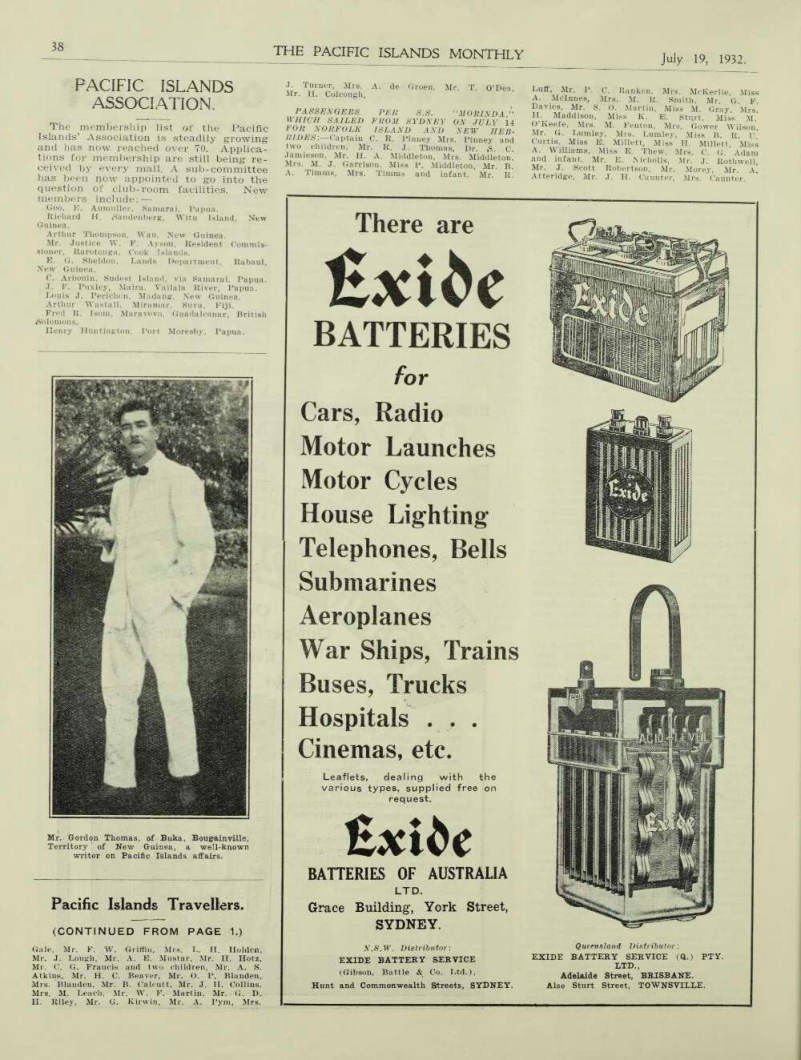
Pacific Islands
The membership list of the Pacific Islands’ Association is steadily growing and has now reached over 70. Applica tions for membership are still being re ceived by every mail. A sub-committee has been now appointed to go into the question of club-room facilities. New members include: Geo. E. Aumuller, Samarai, Papua.
Richard H. Sandenberg, Witu Island, New Guinea.
Arthur Thompson, Wau, New Guinea.
Mr. Justice W. F. Ayson, Resident Commis sioner, Rarotonga, Cook Islands.
E. G. Sheldon, Lands Department, Rabaul, New Guinea.
C. Arbouin, Sudest Island, via Samarai, Papua.
J. F. Puxley, Maira, Vailala River, Papua.
Louis J. Perichon, Madang, New Guinea.
Arthur Wastall, Miramar, Suva, Fiji.
Fred R. Isom, Maravovo, Guadalcanal, British Solomons.
Henry Huntington, Port Moresby, Papua.
Mr. Gordon Thomas, of Buka, Bougainville, Territory of New Guinea, a well-known writer on Pacific Islands affairs.
Advertisements & other items, p. 40 (2 items)
38
July 19, 1932.
THE PACIFIC ISLANDS MONTHLY
Pacific Islands Travellers.
(CONTINUED FROM PAGE 1.)
Exide
There are
BATTERIES
for Cars, Radio Motor Launches Motor Cycles House Lighting Telephones, Bells Submarines Aeroplanes War Ships, Trains Buses, Trucks Hospitals . . .
Cinemas, etc.
Leaflets, dealing with the various types, supplied free on request.
BATTERIES OF AUSTRALIA
LTD.
Grace Building, York Street,
SYDNEY.
N.S.W. Distributor: Queensland Distributor: EXIDE BATTERY SERVICE EXIDE BATTERY SERVICE (Q,.) PTY.
LTD.,
(Gibson, Battle & Go. Ltd.), Adelaide Street, BRISBANE.
Hunt and Commonwealth Streets, SYDNEY. Also Sturt Street, TOWNSVILLE.
Social Notes from Pt. Moresby.
From Our Own Correspondent.
Pt. Moresby, June 16.
Miss Beatrice Grimshaw, The
famous novelist of the South Seas, gave an “At Home” on June 1 at her residence on Port Road, Port Moresby. The lounge, which is furn ished in old English style, was decorated with tropical flowers and was also set off by beautiful tapestries from the Is lands and unique pottery and curios from her many excursions. The guests included Lady Murray, Mesdames Gore, Lyons, Jewell, James, Brossey, and others.
Lady Murray has presented a cup to the Golf Club of Port Moresby to be played for by the ladies of the Club.
In consequence, there has been renewed interest in the game, associates can be seen on the links mornings and after noons playing and practising their shots, now the weather has become cooler.
Lady Murray leaves for Samarai by the “Montoro” to-day to meet His Ex cellency, Sir Hubert Murray, who has left by the “Laurabada” to try cases in that district. Sir Hubert is accom panied by the Hon. H. L. Murray, Of ficial Secretary.
Matron’S Ball.
The matrons of Port Moresby held a ball on June 3 in the Institute Hall, some 200 guests being present. The hall, stage and stairway were decorated with cherry trees in blossom and bam boos, and resembled a Japanese garden.
His Excellency, the Lieut.-Governor, Sir Hubert Murray, and Lady Murray were present. The ball was considered to be the most successful one held in Port Moresby for years.
British Phosphate Commission.
THE report and accounts for the eleventh year, ended June 30, of the Nauru-Ocean Island phosphate busi ness, under the control of the Board of Commissioners, show that adverse weather conditions hindered shipments from Nauru and Ocean Island for several months in the earlier part of the year, and the demand for phosphate in Australia and New Zealand fell off considerably in the latter part of the year, owing to depressed trade condi tions.
Shipments for the year were: To Australia, 267,937 tons—68.19 per cent; and to New Zealand, 125,002 tons —31.81 per cent., making a total of 392,939 tons.
In addition, the Commissioners dis tributed in Australia 124,607 tons, and in New Zealand 22,935 tons of phos phate purchased from other sources.
The f.o.b. cost, as shown by the ac counts, includes a sum of £224,053, being interest at 6 per cent, upon the pur chase price paid for the business by the Governments, and contribution to a sinking fund for the redemption of the capital sum in 50 years, in accordance with Article 11 of the Agreement of July 2, 1919.
Conditions In Yasawa
Group.
CAPTAIN F. T. GIBLIN, who recently arrived in Levuka from the outlying Yasawa Group, reported that the is lands in the northern portion of that Group were recovering from the effects of the last hurricane, and there was now a better condition prevailing. It would take a few months more before copra in any quantity would be coming in, but there were already signs of some production here and there.
Advertisements & other items, pp. 41-42 (1 item)
R. Towns & Co.
GUARD AGAINST
MALARIA
and its Attendant Ills.
The New Drug
PLASMOQUINE
is a Preventive of Malaria that has been Tested and Proved by the Medical Profession.
If you are in doubt, ask your Medical Adviser about Plasmoquine.
FROM ALL STORES.
Wholesale Supplies from
FASSETT & JOHNSON LTD
36 Chalmers Street, Sydney.
We are informed by a corres pondent that “many copies of the Pacific Islands Monthly are stolen in transit in up-country post offices in Papua, and do not reach addresses." This may account for several complaints from subscribers about nonreceipt of papers. We shall be glad if subscribers will let us know promptly when no paper is received, so that we may make inquiries.
R. TOWNS & CO.
Established 1842.
31 REIBY PLACE - SYDNEY.
“LORD BEACONSFIELD” 26’s Island Twist Tobacco.
EDGEWORTH” Extra High Grade Smoking Tobacco, in 2oz. vacuum airtight Tins, and 1lb. Glass Jars.
“CUTICURA” Soap, Ointment and Talcum Powder.
SAIL WITH
The B.P. MAGAZINE
GET YOUR COPY NOW.
ANNUAL SUBSCRIPTION:
Within the Commonwealth of Australia, Mandated Territory and New Guinea 4/- poet free Within the British Empire 5/4 post -free U.S.A. and Foreign 6/8 post free From all Bookstalls or direct from the Publishers: Burns, Philp & Co. Ltd.
KLG
PLUGS
Too good
to miss!
Obtainable from
Smith, Sons & Rees
LIMITED.
30-32 Wentworth Avenue,
SYDNEY.
Cable Address: “SPEEDOMET,” Sydney.
PENTA
Famous Swedish Utility
OUTBOARD ENGINE,
Double Cylinder.
Strong and Reliable. Silent.
Write for particulars.
NELSON & ROBERTSON,
12 SPRING STREET, SYDNEY.
Australasian Distributors.
"Perfection in Cooking”
BY USING
YOUNGER
COOKING
STOVES AND
RANGES
made with extended Firebox specially for Long Wood fuel.
These Stoves and Ranges are Self-Setting, therefore do not require to be built in brickwork.
The No. 7W. “Younger” Range can now be supplied fitted with Legs, as per illustration.
Send for a copy of our Illustrated Catalogue and Quotations for Single and Double Oven Ranges.
Younger Stoves are Widely Used Throughout the Pacific Islands.
G. FLETCHER & SON 50 Oxford Street, SYDNEY.
Marine Industries In Torres Straits.
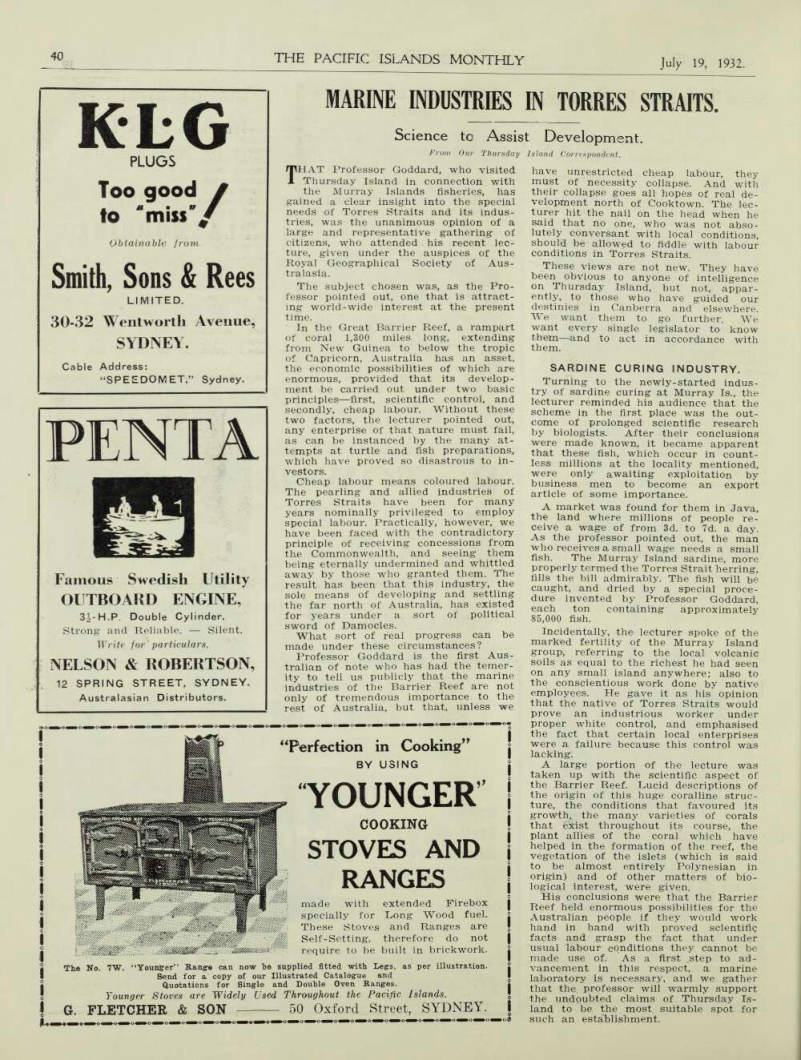
Science to Assist Development.
From Our Thursday Island Correspondent.
THAT Professor Goddard, who visited Thursday Island in connection with the Murray Islands fisheries, has grained a clear insight into the special needs of Torres Straits and its indus tries, was the unanimous opinion of a large and representative gathering of citizens, who attended his recent lec ture, given under the auspices of the Royal Geographical Society of Aus tralasia.
The subject chosen was, as the Pro fessor pointed out, one that is attract ing world-wide interest at the present time.
In the Great Barrier Reef, a rampart of coral 1,300 miles long, extending from New Guinea to below the tropic of Capricorn, Australia has an asset, the economic possibilities of which are enormous, provided that its develop ment be carried out under two basic principles—first, scientific control, and secondly, cheap labour. Without these two factors, the lecturer pointed out, any enterprise of that nature must fail, as can be instanced by the many at tempts at turtle and fish preparations, which have proved so disastrous to in vestors.
Cheap labour means coloured labour.
The pearling and allied industries of Torres Straits have been for many years nominally privileged to employ special labour. Practically, however, we have been faced with the contradictory principle of receiving concessions from the Commonwealth, and seeing them being eternally undermined and whittled away by those who granted them. The result has been that this industry, the sole means of developing and settling the far north of Australia, has existed for years under a sort of political sword of Damocles.
What sort of real progress can be made under these circumstances?
Professor Goddard is the first Aus tralian of note who has had the temer ity to tell us publicly that the marine industries of the Barrier Reef are not only of tremendous importance to the rest of Australia, but that, unless we
have unrestricted cheap labour, they must of necessity collapse. And with their collapse goes all hopes of real de velopment north of Cooktown. The lec turer hit the nail on the head when he said that no one, who was not abso lutely conversant with local conditions, should be allowed to fiddle with labour conditions in Torres Straits.
These views are not new. They have been obvious to anyone of intelligence on Thursday Island, but not, appar ently, to those who have guided our destinies in Canberra and elsewhere.
We want them to go further. We want every single legislator to know them—and to act in accordance with them.
Sardine Curing Industry.
Turning to the newly-started indus try of sardine curing at Murray Is., the lecturer reminded his audience that the scheme in the first place was the out come of prolonged scientific research by biologists. After their conclusions were made known, it became apparent that these fish, which occur in count less millions at the locality mentioned, were only awaiting exploitation by business men to become an export article of some importance.
A market was found for them in Java, the land where millions of people re ceive a wage of from 3d. to 7d. a day.
As the professor pointed out, the man who receives a small wage needs a small fish. The Murray Island sardine, more properly termed the Torres Strait herring, fills the bill admirably. The fish will be caught, and dried by a special proce dure invented by Professor Goddard, each ton containing approximately 85,000 fish.
Incidentally, the lecturer spoke of the marked fertility of the Murray Island group, referring to the local volcanic soils as equal to the richest he had seen on any small island anywhere; also to the conscientious work done by native employees. He gave it as his opinion that the native of Torres Straits would prove an industrious worker under proper white control, and emphasised the fact that certain local enterprises were a failure because this control was lacking.
A large portion of the lecture was taken up with the scientific aspect of the Barrier Reef, Lucid descriptions of the origin of this huge coralline struc ture, the conditions that favoured its growth, the many varieties of corals that exist throughout its course, the plant allies of the coral which have helped in the formation of the reef, the vegetation of the islets (which is said to be almost entirely Polynesian in origin) and of other matters of bio logical interest, were given.
His conclusions were that the Barrier Reef held enormous possibilities for the Australian people if they would work hand in hand with proved scientific facts and grasp the fact that under usual labour conditions they cannot be made use of. As a first to ad vancement in this respect, a marine laboratory is necessary, and we gather that the professor will warmly support the undoubted claims of Thursday Is land to be the most suitable spot for such an establishment.
Advertisements & other items, pp. 43-44 (2 items)
Tobacco Growing in New Guinea
41
THE PACIFIC ISLANDS MONTHLY
(CONTINUED FROM PAGE 4.)
July 19, 1932.
Marine Engines
UNIVERSAL
6-H.P, to 115-H.P. One to Eight Cylinders. Real 100% Marine Engines NOT converted car jobs.
Large stocks in Sydney at Prices, to meet the times.
Other lines stocked in Sydney — Kermath Marine Engines Cady Marine Engines Mietz Crude Oil Marine Engines “H.B.” Marine Engines Caille Outboard Engines Perfect Outboard Engines List Marine Free Engine Clutches Lauson Stationary Engines Lauson Farm Tractors Lauson Pump Jacks Propellers, Reverse Gears, Shafting, etc.
We are the SOLE Distributors for the above Engines.
HALL BROS. LTD.
(Established 41 years).
The Engine House,
CAREENING COVE,
MILSON’S POINT, NORTH SYDNEY,
N.S.W. AUSTRALIA.
Cables: "Halbros,” Sydney.
Sutton’s
Canned Vegetables
Green Peas, In 1lb. and 2lb. Tins.
French Beans (Sliced) in 1lb. Tins.
Carrots, In 1lb. Tins.
Beetroot (Sliced) in 1lb. Tins.
Packed by
Delicia Food Products Co.
WATERLOO, N.S.W.
MAKE YOUR MONEY GO FURTHER BUY
YOUR GROCERIES FROM
McIJLRATH’S
OF SYDNEY
Castle Assorted Fancy Meats, 16oz. tins (4 doz.) 10/6 doz., 38/- case St. George Assorted Fancy Meats, 14oz. tins (4 doz.) 16/6 doz., 60/- case Globe Pure Beef Dripping, 351 b. tins .. 16/- tin, 30/- case Ideal Unsweetened Milk, 6oz. tins (8 doz.) 4/9 doz., 25/- case Californian Asparagus Tips, 9y 2 oz. tins . . 1/6 tin, 17/- doz.
Holbrook’s Capers, 4oz. bots 1/- bot., 11/6 doz.
Osprey Sockeye Salmon, y 2 lb. tins . . . . 1/1 y 2 tin, ’ 12/6 doz.
“Rosa” or I.X.L. Preserved Peaches, 30oz. tins 1/- tin, 11/6 doz.
I.X.L. Fruit Salad, 16oz. tins lid. tin, 10/6 doz.
Australian Dutch Cheese, 41b. balls . . 1/4 lb.
Krownall Mango and Paw Paw Chutney, 12oz. bots 1/3 bot., 14/6 doz.
“Rosa” Worcestershire Sauce, 250 z, bots. bot., 10/- doz.
“Rosa” Jelly Crystals, pint pkts pkt., 4/3 doz.
Nestle’s Cream, 4oz. tins 6d. tin, 5/6 doz.
Tooth’s Pure Lime Juice, 260 z. bots. .. 2/3 bot., 26/6 doz.
“Rosa” Pure Coffee, 11b, tins 2/6 tin, 29/- doz.
Lusco Dripak Dessert Prunes, 71b. tins. . 5/9 tin “Rosa” Golden Tips Tea, best Ceylon, 51b. tins . . 2/2 lb.
Capital Lino. Wax, 16oz. tins lid. tin, 10/6 doz.
All Prices F.O.B. Sydney,
WRITE FOR PRICE LISTS AND QUOTATIONS.
McILRATH’S Ltd.
Export Dept.
202 PITT ST.,
SYDNEY (Aust.)
Profit From Sharks.
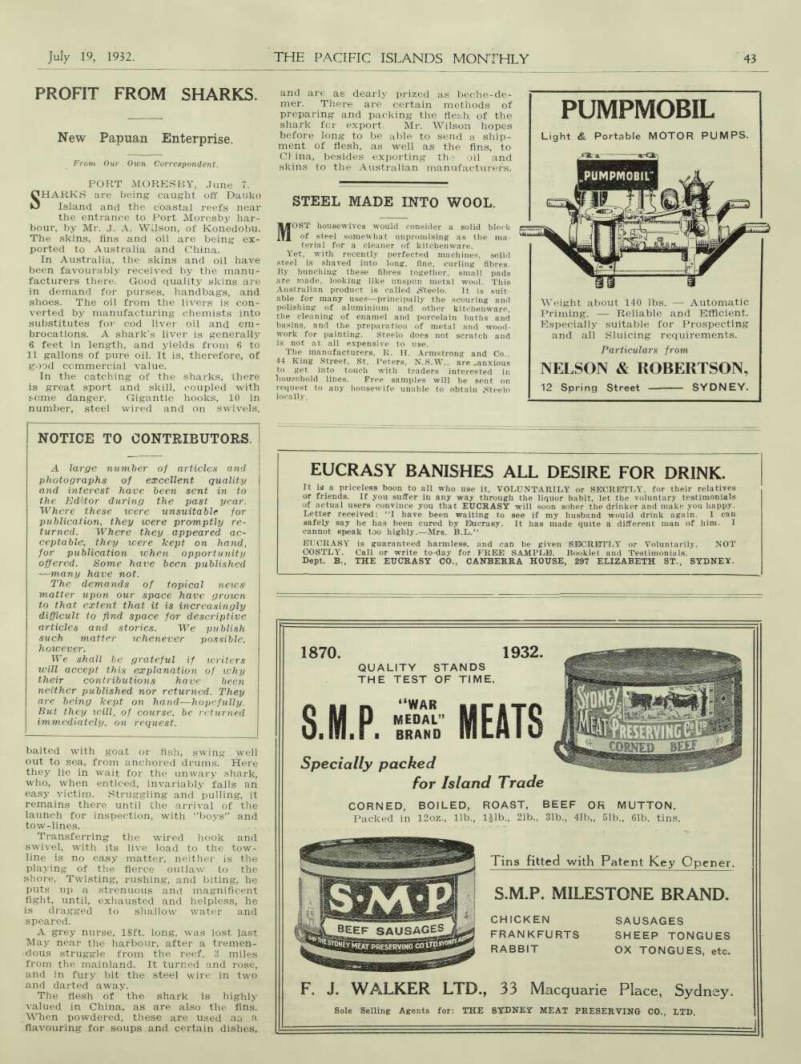
New Papuan Enterprise.
From Our Own Correspondent.
Port Moresby, June 7.
SHARKS are being caught off Dauko Island and the coastal reefs near the entrance to Port Moresby har bour, by Mr. J. A. Wilson, of Konedobu.
The skins, fins and oil are being ex ported to Australia and China.
In Australia, the skins and oil have been favourably received by the manu facturers there. Good quality skins are in demand for purses, handbags, and shoes. The oil from the livers is con verted by manufacturing chemists into substitutes for cod liver oil and em brocations. A shark's liver is generally 6 feet in length, and yields from 6 to 11 gallons of pure oil. It is, therefore, of good commercial value.
In the catching of the sharks, there is great sport and skill, coupled with some danger. Gigantic hooks, 10 in number, steel wired and on swivels,
baited with goat or fish, swing well out to sea, from anchored drums. Here they lie in wait for the unwary shark, who, when enticed, invariably falls an easy victim. Struggling and pulling, it remains there until the arrival of the launch for inspection, with “boys” and tow-lines.
Transferring the wired hook and swivel, with its live load to the tow line is no easy matter, neither is the playing of the fierce outlaw to the shore. Twisting, rushing, and biting, he puts up a strenuous and magnificent fight, until, exhausted and helpless, he is dragged to shallow water and speared.
A grey nurse, 18ft. long, was lost last May near the harbour, after a tremen dous struggle from the reef, 3 miles from the mainland. It turned and rose, and in fury bit the steel wire in two and darted away.
The flesh of the shark is highly valued in China, as are also the fins.
When powdered, these are used as a flavouring for soups and certain dishes,
and are as dearly prized as beche-de mer. There are certain methods of preparing and packing the flesh of the shark for export, Mr. Wilson hopes before long to be able to send a ship ment of flesh, as well as the fins, to China, besides exporting the oil and skins to the Australian manufacturers.
Steel Made Into Wool.
MOST housewives would consider a solid block of steel somewhat unpromising as the ma terial for a cleaner of kitchenware.
Yet, with recently perfected machines, solid steel is shaved into long, fine, curling fibres.
By bunching these fibres together, small pads are made, looking like unspun metal wool. This Australian product is called Steelo. It is suit able for many uses —principally the scouring and polishing of aluminium and other kitchenware, the cleaning of enamel and porcelain baths and basins, and the preparation of metal and wood work for painting. Steelo does not scratch and is not at all expensive to use.
The manufacturers, R. H. Armstrong and Co.. 44 King Street. St. Peters, N.S.W., are anxious to get into touch with traders interested in household lines. Free samples will be sent on request to any housewife unable to obtain Steelo locally.
Advertisements & other items, p. 45 (2 items)
Pumpmobil
Light & Portable MOTOR PUMPS.
Weight about 140 lbs. Automatic Priming. Reliable and Efficient.
Especially suitable for Prospecting and all Sluicing requirements.
Particulars from
NELSON & ROBERTSON,
12 Spring Street SYDNEY.
EUCRASY BANISHES ALL DESIRE FOR DRINK.
It is a priceless boon to all who use it, VOLUNTARILY or SECRETLY, for their relatives or friends. If you suffer in any way through the liquor habit, let the voluntary testimonials of actual users convince you that EUCRASY will soon sober the drinker and make you happy.
Letter received: “I have been waiting to see if my husband would drink again. I can safely say he has been cured by Eucrasy. It has made quite a different man of him. I cannot speak too highly.—Mrs. B.L.”
EUCRASY is guaranteed harmless, and can be given SECRETLY or Voluntarily. NOT COSTLY. Call or write to-day for FREE SAMPLE. Booklet and Testimonials/ Dept. 8., THE EUCRASY CO., CANBERRA HOUSE, 297 ELIZABETH ST,, SYDNEY.
1870. 1932.
QUALITY STANDS
THE TEST OF TIME.
S.M.P. "War Medal Brand" MEATS
Specially packed
for Island Trade
CORNED, BOILED, ROAST, BEEF OR MUTTON.
Packed in 12oz., 1lb., 1½lb., 2lb., 3lb., 4lb„ 5lb., 6lb. tins.
SAUSAGES
beef Tins fitted with Patent Key Opener.
S.M.P. MILESTONE BRAND.
CHICKEN
FRANKFURTS
RABBIT
SAUSAGES
SHEEP TONGUES
OX TONGUES, etc.
F. J. WALKER LTD., 33 Macquarie Place, Sydney.
Sole Selling Agents for: THE SYDNEY MEAT PRESERVING CO., LTD.
Notice To Contributors.
A large number of articles and photographs of excellent quality and interest have been sent in to the Editor during the past year.
Where these were unsuitable for publication, they were promptly re turned. Where they appeared ac ceptable, they were kept on hand, for publication when opportunity offered. Some have been published —many have not.
The demands of topical news' matter upon our space have grown to that extent that it is increasingly difficult to find space for descriptive articles and stories. We publish such matter whenever possible, however.
We shall be grateful if writers will accept this explanation of why their contributions have been neither published nor returned. They are being kept on hand — hopefully.
But they will, of course, be returned immediately, on request.
New Guinea And Papuan Gold
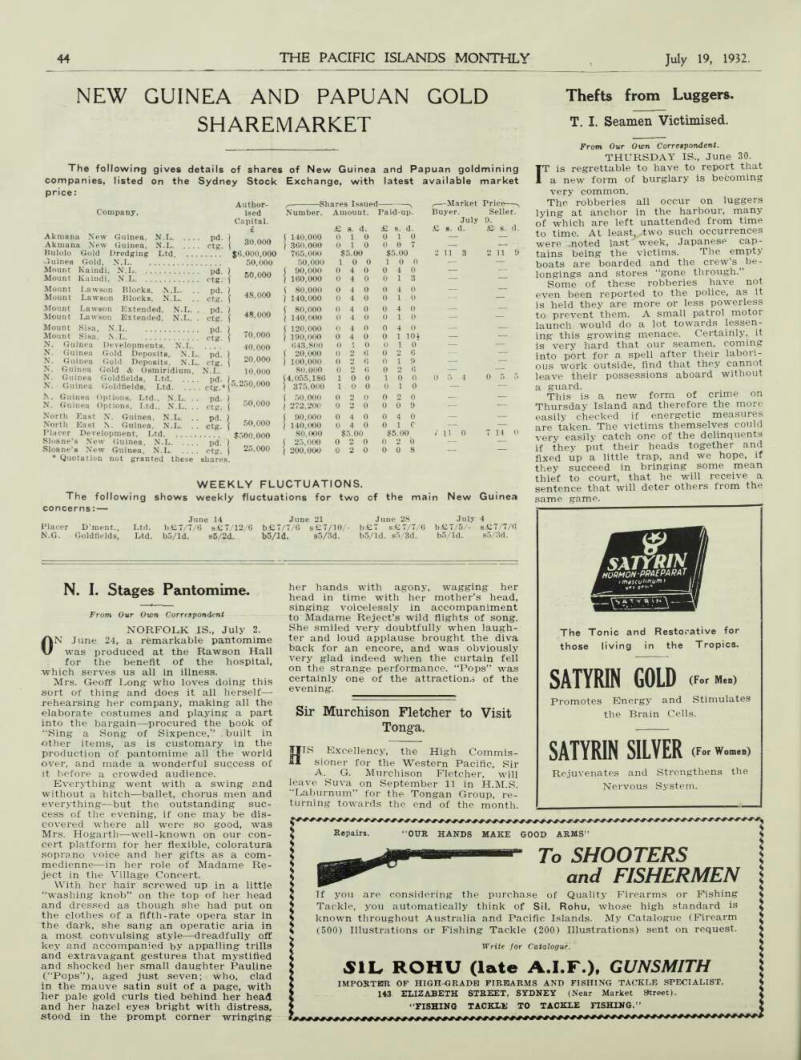
Sharemarket
The following gives details of shares of New Guinea and Papuan goldmining companies, listed on the Sydney Stock Exchange, with latest available market price:
Weekly Fluctuations.
The following shows weekly fluctuations for two of the main New Guinea concerns:
Authorised Capital Shares Issued Market Price Company.
Number.
Amount.
Paid-up.
Buyer.
Seller.
July 9 £ £ s. d. £ s. d. £ s. d. £ s. d.
Akmana New Guinea, N.L pd. 140,000 0 1 0 0 1 0 — — Akmana New Guinea, N.L ctg. £ 30,000 360,000 0 1 0 0 0 7 — — Bulolo Gold Dredging Ltd $6,000,000 765,000 $5.00 $5.00 2 11 3 2 11 9 Guinea Gold, N.L 50,000 50,000 1 0 0 1 0 0 — — Mount Kaindi, N.L pd. 50,000 90,000 0 4 0 0 4 0 — — Mount Kaindi, N.L ctg. 160,000 0 4 0 0 1 3 — — Mount Lawson Blocks, N.L. pd. 80,000 0 4 0 0 4 0 — — Mount Lawson Blocks. N.L. . . ctg. 48,000 140,000 0 4 0 0 1 0 — — Mount Lawson Extended. N.L. . pd. 80,000 0 4 0 0 4 0 — — Mount Lawson Extended, N.L. . ctg. 48,000 140,000 0 4 0 0 1 0 — — Mount Sisa. N.L pd 120,000 0 4 0 0 4 0 — — Mount Sisa. N.L ctg 70,000 190,000 0 4 0 0 1 10½ — — N, Guinea Developments, N.L 40,000 643,800 0 1 0 0 1 0 — — N. Guinea Gold Deposits, N.L. pd. 20,000 0 2 6 0 2 6 — — N. Guinea Gold Deposits, N.L. ctg. 20,000 100,000 0 2 6 0 1 9 — — N. Guinea Gold & Osmiridium, N.L. 10,000 80,000 0 2 6 0 2 6 — — N. Guinea Goldfields, Ltd pd. 5,250,000 4,055,180 1 0 0 1 0 0 0 5 4 0 5 5 N. Guinea Goldfields, Ltd ctg.* 375,000 1 0 0 0 1 0 — — N. Guinea Options, Ltd., N.L. .. pd. ] 50,000 0 2 0 0 2 0 — — N. Guinea Options, Ltd., N.L. . . ctg. 50,000 272,200 0 2 0 0 0 9 — — North East N. Guinea, N.L. .. pd. 90,000 0 4 0 0 4 0 — — North East N. Guinea, N.L. . . ctg. 50,000 140,000 0 4 0 0 1 0 — — Placer Development, Ltd $500,000 80,000 $5.00 $5.00 I 11 0 7 14 0 Sloane’s New Guinea, N.L pd. 25,000 0 2 0 0 2 0 — — Sloane's New Guinea, N.L ctg. 25,000 200,000 0 2 0 0 0 8 — — * Quotation not granted these shares.
June 14 June 21 June 28 July 4 Placer Dment., Ltd. b£7/7/6 s£7/12/6 b£7/7/G sG7/10/- b£7 s£7/7/6 b£7/5/- s£7/7/6 N.G. Goldfields, Ltd. b5/ld. e5/2d. b5/ld. s5/3d. b5/ld. s5/3d. b5/ld. s5/3d.
N. I. Stages Pantomime.
From Our Own Correspondent
Norfolk Is., July 2.
ON June 24, a remarkable pantomime was produced at the Rawson Hall for the benefit of the hospital, which serves us all in illness, Mrs. Geoff Long who loves doing this sort of thing and does it all herself — rehearsing her company, making all the elaborate costumes and playing a part into the bargain—procured the book of “Sing a Song of Sixpence,” built in other items, as is customary in the production of pantomime all the world over, and made a wonderful success of it before a crowded audience.
Everything went with a swing and without a hitch —ballet, chorus men and everything—but the outstanding suc cess of the evening, if one may be dis covered where all were so good, was Mrs. Hogarth—well-known on our con cert platform for her flexible, coloratura soprano voice and her gifts as a com medienne —in her role of Madame Re ject in the Village Concert.
With her hair screwed up in a little “washing knob” on the top of her head and dressed as though she had put on the clothes of a fifth-rate opera star in the dark, she sang an operatic aria in a most convulsing style—dreadfully off key and accompanied by appalling trills and extravagant gestures that mystified and shocked her small daughter Pauline (“Pops”), aged just seven; who, clad in the mauve satin suit of a page, with her pale gold curls tied behind her head and her hazel eyes bright with distress, stood in the prompt corner wringing
her hands with agony, wagging her head in time with her mother’s head, singing voicelessly in accompaniment to Madame Reject’s wild flights of song.
She smiled very doubtfully when laugh ter and loud applause brought the diva back for an encore, and was obviously very glad indeed when the curtain fell on the strange performance. “Pops” was certainly one of the attractions of the evening.
Tonga.
Sir Murchison Fletcher to Visit Tonga.
HIS Excellency, the High Commis sioner for the Western Pacific, Sir A. G. Murchison Fletcher, will leave Suva on September 11 in H.M.S.
“Laburnum” for the Tongan Group, re turning towards the end of the month.
Thefts from Luggers.
T. I. Seamen Victimised.
From Our Oxen Correspondent.
Thursday Is., June 30.
IT is regrettable to have to report that a new form of burglary is becoming very common.
The robberies all occur on luggers lying at anchor in the harbour, many of which are left unattended from time to time. At least, two such occurrences were noted last week, Japanese cap tains being the victims. The empty boats are boarded and the crew’s be longings and stores “gone through.”
Some of these robberies have not even been reported to the police, as it is held they are more or less powerless to prevent them. A small patrol motor launch would do a lot towards lessen ing this growing menace. Certainly, it is very hard that our seamen, coming into port for a spell after their labori ous work outside, find that they cannot leave their possessions aboard without a guard.
This is a new form of crime on Thursday Island and therefore the more easily checked if energetic measures are taken. The victims themselves could very easily catch one of the delinquents if they put their heads together and fixed up a little trap, and we hope, if they succeed in bringing some mean thief to court, that he will receive a sentence that will deter others from the same game.
Advertisements & other items, p. 46 (1 item)
Satyrin Gold
The Tonic and Restorative for those living in the Tropics.
(For Men) Promotes Energy and Stimulates the Brain Cells.
SATYRIN SILVER (For Women)
Rejuvenates and Strengthens the Nervous System.
Repairs. “OUR HANDS MAKE GOOD ARMS"
To SHOOTERS
and FISHERMEN
If you are considering the purchase of Quality Firearms or Fishing Tackle, you automatically think of Sil. Rohu, whose high standard is known throughout Australia and Pacific Islands. My Catalogue (Firearm (500) Illustrations or Fishing Tackle (200) Illustrations) sent on request.
Write for Catalogue.
SIL, ROHU (late A.I.F.), GUNSMITH
IMPOSTER OF HIGH-GRADE FIREARMS AND FISHING TACKLE SPECIALIST, 143 ELIZABETH STREET, SYDNEY (Near Market Street).
“FISHING TACKLE TO TACKLE FISHING.”
Market Quotations
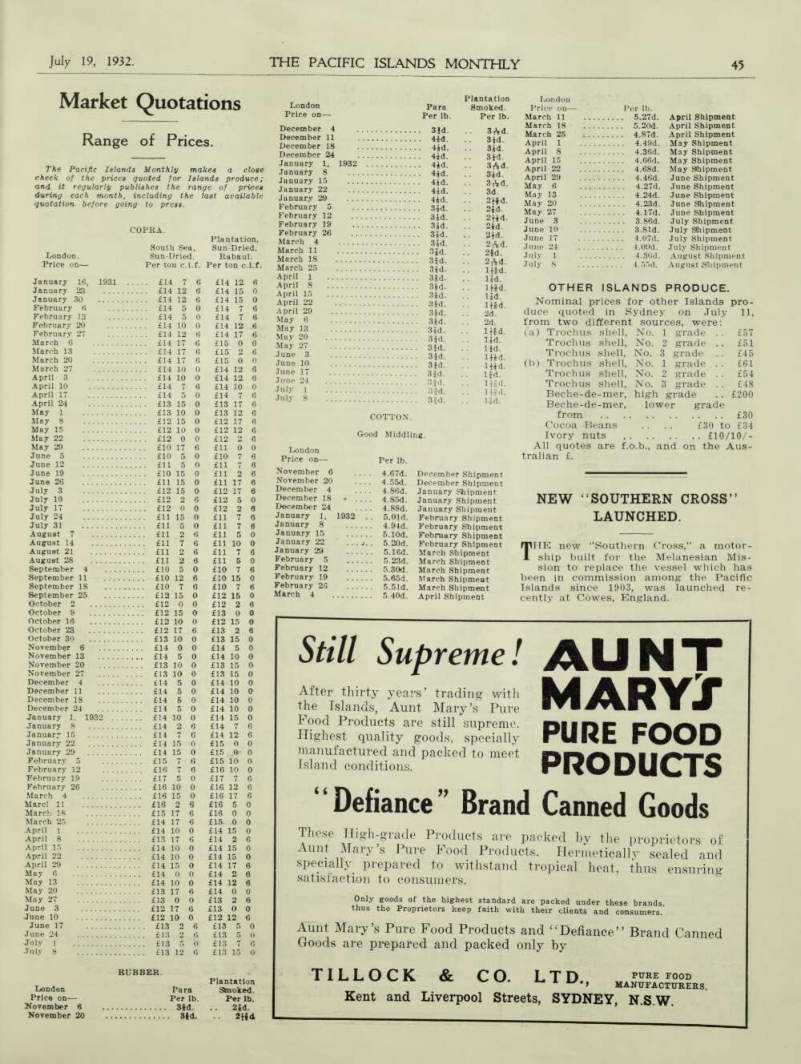
Range of Prices.
The Pacific Islands Monthly makes a close check of the prices quoted for Islands produce; and it regularly publishes the range of prices during each month, including the last available quotation before going to press.
Other Islands Produce.
Nominal prices for other Islands pro duce quoted in Sydney on July 11, from two different sources, were: (a) Trochus shell, No. 1 grade .. £57 Trochus shell, No. 2 grade .. £51 Trochus shell, No. 3 grade . . £45 (b) Trochus shell, No. 1 grade . . £61 Trochus shell, No. 2 grade . . £54 Trochus shell, No. 3 grade . . £48 Beche-de-mer, high grade .. £200 Beche-de-mer, lower grade from £30 Cocoa Beans . , . . £30 to £34 Ivory nuts £10/10/- All quotes are f.o.b., and on the Aus tralian £.
London Price on— Per lb.
March 11 ... 5.27d.
April Shipment March 18 ...
April Shipment March 25 ...
April Shipment April 1 4.49d.
May Shipment April 8 4.36d.
May Shipment April 15 4.66d.
May Shipment April 22 4.68d.
May Shipment April 29 4.46d.
June Shipment May 6 4.27d.
June Shipment May 13 4.24d.
June Shipment May 20 4.23d.
June Shipment May 27 4.17d.
June Shipment June 3 3.86d.
July Shipment June 10 3.81d.
July Shipment June 17 4.07d.
July Shipment June 24 4.09d.
July Shipment July 1 4.36d.
August Shipment July 8 4.55d.
August Shipment
Plantation London Para Smoked.
Price on— Per lb.
Per lb.
December 4 3*d.
December 11 ... 3½d.
December 18 ... 3½d.
December 24 ... 3½d.
January 1, 1932 . . 3*d.
January 8 3½d.
January 15 3*d.
January 22 3d.
January 29 2Hd.
February 5 3Jd. 2Jd.
February 12 2Hd.
February 19 2|d.
February 26 2*d.
March 4 2*d.
March 11 2|d.
March 18 2*d.
March 25 3|d. .. USd.
April 1 lid.
April 8 IHd.
April 15 38d. lid.
April 22 l*|d.
April 29 3|d. 2d.
May 6 2d.
May 13 IHd.
May 20 lid.
May 27 l}d.
June 3 Ifid.
June 10 IHd.
June IT lid.
June 24 3 id. 1 tfd.
July i -m IHd.
July 8 lid.
Cotton.
Good Middling.
London Price on— Per lb.
November 6 ... 4.67d. December Shipment November 20 ... 4.55d. December Shipment December 4 ... 4.86d. January Shipment December 18 • ... 4.85d. January Shipment December 24 ... 4.88d. January Shipment January 1, 1032 5.Old. February Shipment January 8 4.94d. February Shipment January 15 5.10d. February Shipment January 22 ...j.. 5.20d. February Shipment January 29 5.16d. March Shipment February 5 5.23d. March Shipment February 12 5.30d. March Shipment February 19 5.65d. March Shipment February 26 ... 5.51d. March Shipment March 4 5.40d. April Shipment
London.
Price on—
Copra.
South Sea, Stan-Dried.
Per ton c.i.f.
Plantation, Sun-Dried, Rabaul.
Per ton c.i.f.
January 16, 1931 January 23 ... £14 7 6 £14 12 6 £14 12 6 £14 15 0 January 30 ... £14 12 6 £14 15 0 £14 7 6 February 6 £14 5 0 February 13 £14 5 0 £14 7 6 February 20 £14 10 0 £14 12 6 February 27 £14 12 6 £14 17 6 March 6 £14 17 6 £15 0 0 March 13 £14 17 6 £15 2 6 March 20 £14 17 6 £15 0 0 March 27 £14 10 0 £14 12 6 April 3 £14 10 0 £14 12 6 April 10 £14 7 6 £14 10 0 April 17 £14 5 0 £14 7 6 April 24 £13 15 0 £13 17 6 May 1 £13 10 0 £13 12 6 £12 17 6 £12 12 6 May 8 £12 15 0 May 15 £12 10 0 May 22 £12 0 0 £12 2 6 May 29 ... £10 17 6 £11 0 0 June 5 £10 5 0 £10 7 6 June 12 £11 5 0 £11 7 6 June 19 £10 15 0 £11 2 6 June 26 £11 15 0 £11 17 6 July 3 £12 15 0 £12 17 6 July 10 July 17 £12 2 6 £12 0 0 £12 5 0 £12 2 6 July 24 £11 15 0 £11 7 6 July 31 £11 5 0 £11 7 6 £11 5 0 August 7 £11 2 6 August 14 £11 7 6 £11 10 0 £11 7 6 August 21 £11 2 6 August 28 £11 2 6 £11 5 0 September 4 . . . £10 5 0 £10 7 6 September 11 ... £10 12 6 £10 15 0 September 18 .. . £10 7 6 £10 7 6 September 25 .. . £12 15 0 £12 15 0 October 2 £12 0 0 £12 2 6 October 9 £12 15 0 £13 0 0 October 16 £12 10 0 £12 15 0 October 23 £12 17 6 £13 2 6 October 30 £13 10 0 £13 15 0 November 6 ... £14 0 0 £14 5 0 November 13 ... £14 5 0 £14 10 0 November 20 ... £13 10 0 £13 15 0 November 27 ... £13 10 0 £13 15 0 December 4 ... £14 5 0 £14 10 0 December 11 ... £14 5 0 £14 10 0 December 18 ... £14 5 0 £14 10 0 December 24 . . . . £14 5 0 £14 10 0 January 1, 1932 £14 10 0 £14 15 0 January 8 £14 2 6 £14 7 6 January 15 £14 7 6 £14 12 6 January 22 £14 15 0 £15 0 0 January 29 £14 15 0 £15 0 0 February 5 ..., £15 7 6 £15 10 0 February 12 ... £16 7 6 £16 10 0 February 19 ... £17 5 0 £17 7 6 February 26 ... £16 10 0 £16 12 6 March 4 £16 15 0 £16 17 6 Marcl 11 £16 2 6 £16 5 0 March 18 £15 17 6 £16 0 0 March 25 £14 17 6 £15 0 0 April 1 £14 10 0 £14 15 0 April 8 . £13 17 6 £14 2 6 April 15 £14 10 0 £14 15 0 April 22 £14 10 0 £14 15 0 April 29 £14 15 0 £14 17 6 May 6 £14 0 0 £14 2 6 May 13 £14 10 0 £14 12 8 May 20 £13 17 6 £14 0 0 May 27 £13 0 0 £13 2 6 June 3 £12 17 6 £13 0 0 June 10 £12 10 0 £12 12 6 June 17 £13 2 6 £13 5 0 June 24 £13 2 6 £13 5 0 July 1 £13 5 0 £13 7 6 July 8 £13 12 6 £ 13 15 0 London Price on — November 6 ...
Rubber.
Para Per lb.
Sfd Plantation Stocked.
Per lb, 2|d. 2Hd November 20 3|d.
New “Southern Cross’’
Launched.
THE new “Southern Cross,” a motor ship built for the Melanesian Mis sion to replace the vessel which has been in commission among the Pacific Islands since 1903, was launched re cently at Cowes, England.
Advertisements & other items, p. 47 (1 item)
Still Supreme!
After thirty years’ trading with the Islands, Aunt Mary’s Pure Food Products are still supreme.
Highest quality goods, specially manufactured and packed to meet Island conditions.
AUNT
MARY'S
PURE FOOD
PRODUCTS
“Defiance” Brand Canned Goods
These High-grade Products are packed by the proprietors of Aunt Mary's Pure Food Products. Hermetically sealed and specially prepared to withstand tropical heat, thus ensuring satisfaction to consumers.
Only goods of the highest standard are packed under these brands, thus the Proprietors keep faith with their clients and consumers.
Aunt Mary’s Pure Food Products and “Defiance” Brand Canned Goods are prepared and packed only by
TILLOCK & CO. LTD. food
manufacturers, Kent and Liverpool Streets, SYDNEY, N.S.W.
Exchange Quotations
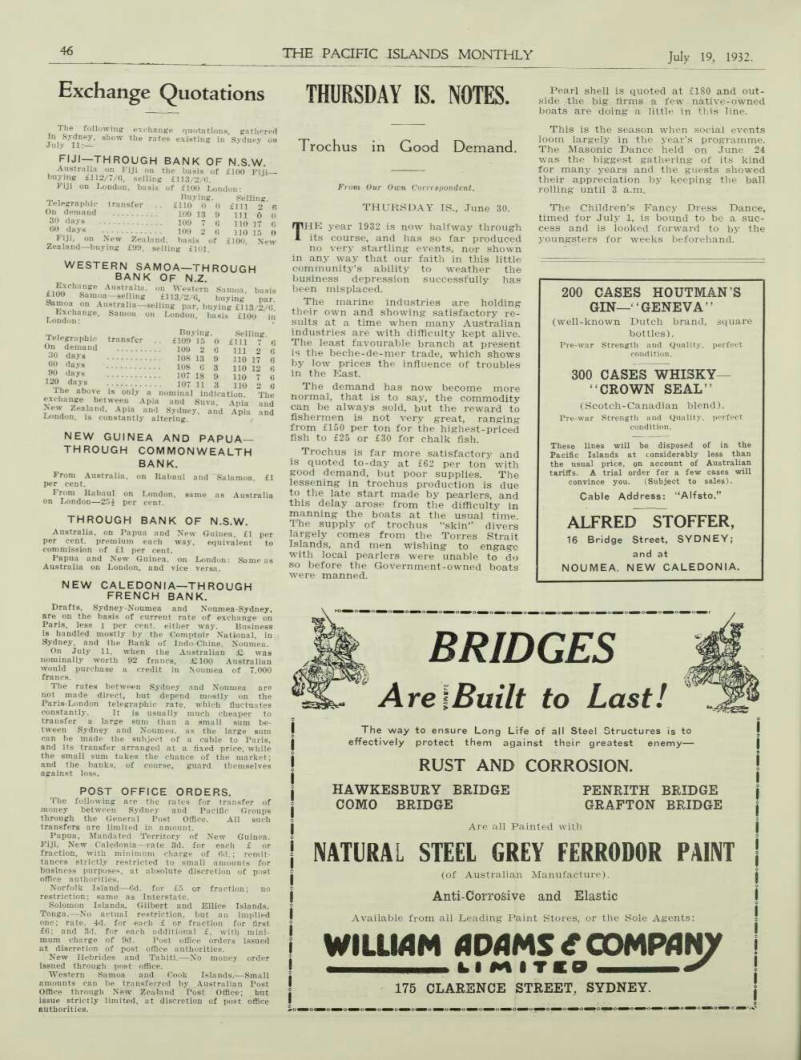
The following exchange quotations, gathered in Sydney, show the rates existing in Sydney on July 11:
Fiji—Through Bank Of N.S.W.
Australia on Fiji on the basis of £100 Fiji— buying £112/7/6, selling £113/2/6.
Fiji on London, basis of £100 London:
Western Samoa—Through
Bank Of N.Z.
Exchange Australia, on Western Samoa, basis Samoa—selling £113/2/6. buying par.
Samoa on Australia—selling par, buying £113/2/6.
Exchange, Samoa on London, basis £100 in London: ,
New Guinea And Papua
Through Commonwealth
Bank.
From Australia, on Rabaul and Salamoa. £1 per cent.
From Rabaul on London, same as Australia on London—25½ per cent.
Through Bank Of N.S.W.
Australia, on Papua and New Guinea, £1 per per cent, premium each way, equivalent to commission of £1 per cent.
Papua and New Guinea, on London: Same as Australia on London, and vice versa.
New Caledonia—Through
French Bank.
Drafts, Sydney-Noumea and Noumea-Sydney, are on the basis of current rate of exchange on Paris, less 1 per cent, either way. Business is handled mostly by the Comptoir National, in Sydney, and the Bank of Indo-Chine, Noumea.
On July 11, when the Australian £ was nominally worth 92 francs, £100 Australian would purchase a credit in Noumea of 7,000 francs.
The rates between Sydney and Noumea are not made direct, but depend mostly on the Paris-London telegraphic rate, which fluctuates constantly. It is usually much cheaper to transfer a large sum than a small sum be tween Sydney and Noumea, as the large sum can be made the subject of a cable to Paris, and its transfer arranged at a fixed price, while the small sum takes the chance of the market; and the banks, of course, guard themselves against loss.
Post Office Orders.
The following are the rates for transfer of money between Sydney and Pacific Groups through the General Post Office. All such transfers are limited in amount.
Papua, Mandated Territory of New Guinea, Fiji, New Caledonia —rate 3d. for each £ or fraction, with minimum charge of 6d.; remit tances strictly restricted to small amounts for business purposes, at absolute discretion of post office authorities.
Norfolk Island —6d. for £5 or fraction; no restriction; same as Interstate.
Solomon Islands, Gilbert and Ellice Islands, Tonga.—No actual restriction, but an implied one; rate, 4d. for each £ or fraction for first £6; and 3d. for each additional £, with mini mum charge of 9d. Post office orders issued at discretion of post office authorities.
New Hebrides and Tahiti.—No money order issued through post office.
Western Samoa and Cook Islands. —Small amounts can be transferred by Australian Post Office through New Zealand Post Office; but issue strictly limited, at discretion of post office authorities.
Buying. Selling.
Telegraphic transfer . . £110 0 0 £111 2 6 On demand 109 13 9 111 0 0 30 Days 109 7 6 no 17 6 60 days 109 2 6 110 15 0 Fiji, on New Zealand, basis of £100 Xew Zealand—buying £99, selling £101.
Telegraphic transfer . .
On demand Buying. £109 15 0 109 2 6 108 13 9 108 G 3 107 18 9 107 11 3 lominal indica and Suva.
Sydney, and ering.
Selling. £111 7 6 111 2 6 30 days ... 111 2 6 110 17 6 110 12 6 110 7 6 110 2 6 60 davs 90 days 120 days The above is only a nominal indication. the exchange between Apia and Suva, apia and New Zealand, Apia and Sydney, and Apia London, is constantly altering. 110 2 6
Thursday Is. Notes.
Trochus in Good Demand.
From Our Own Correspondent.
Thursday Is., June 30.
THE year 1932 is now halfway through its course, and has so far produced no very startling events, nor shown in any way that our faith in this little community’s ability to weather the business depression successfully has been misplaced.
The marine industries are holding their own and showing satisfactory re sults at a time when many Australian industries are with difficulty kept alive.
The least favourable branch at present is the beche-de-mer trade, which shows by low prices the influence of troubles in the East, The demand has now become more normal, that is to say, the commodity can be always sold, but the reward to fishermen is not very great, ranging from £150 per ton for the highest-priced fish to £25 or £30 for chalk fish.
Trochus is far more satisfactory and is quoted to-day at £62 per ton with good demand, but poor supplies. The lessening in trochus production is due to the late start made by piearlers, and this delay arose from the difficulty in manning the boats at the usual time.
The supply of trochus “skin” divers largely comes from the Torres Strait Islands, and men wishing to engage with local pearlers were unable to do so before the Government-owned boats were manned.
Pearl shell is quoted at £180 and out side the big firms a few native-owned boats are doing a little in this line.
This is the season when social events loom largely in the year’s programme.
The Masonic Dance held on June 24 was the biggest gathering of its kind for many years and tho guests showed their appreciation by keeping the ball rolling until 3 a.m.
The Children’s Fancy Dress Dance, timed for July 1, is bound to be a suc cess and is looked forward to by the youngsters for weeks beforehand.
Advertisements & other items, p. 48 (1 item)
Bridges
200 CASES HOUTMAN’S
GIN—‘GENEVA”
(well-known Dutch brand, square bottles).
Pre-war Strength and Quality, perfect condition.
300 CASES WHISKY—
‘‘CROWN SEAL”
(Scotch-Canadian blend).
Pre-war Strength and Quality, perfect condition.
These lines will be disposed of in the Pacific Islands at considerably less than the usual price, on account of Australian tariffs. A trial order for a few cases will convince you. (Subject to sales).
Cable Address: “Alfsto.”
ALFRED STOPPER,
16 Bridge Street, SYDNEY; and at
NOUMEA. NEW CALEDONIA.
BRIDGES
Are Built to Last!
The way to ensure Long Life of all Steel Structures is to effectively protect them against their greatest enemy—
RUST AND CORROSION.
HAWKESBURY BRIDGE
COMO BRIDGE
PENRITH BRIDGE
GRAFTON BRIDGE
Are all Painted with
NATURAL STEEL GREY FERRODOR PAINT
(of Australian Manufacture).
Anti-Corrosive and Elastic Available from all Leading Paint Stores, or the Sole Agents:
WILLIAM ADAMS & COMPANY
LIMITED
175 CLARENCE STREET, SYDNEY.
Shipping Services in the Pacific
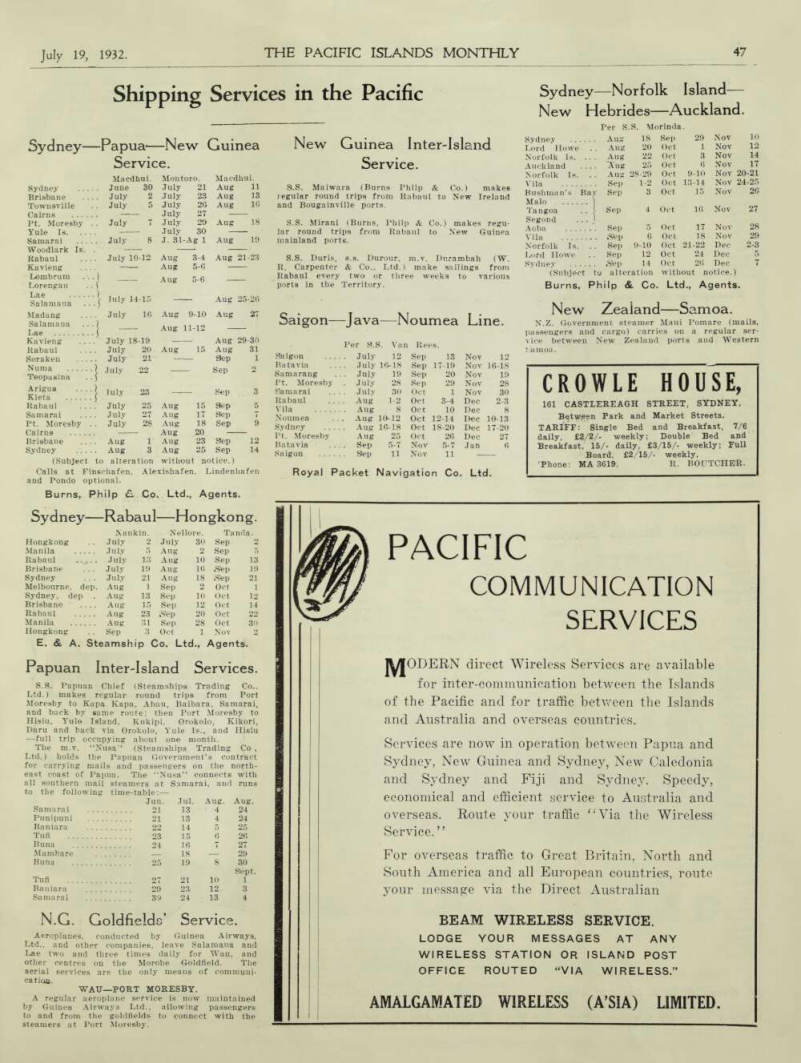
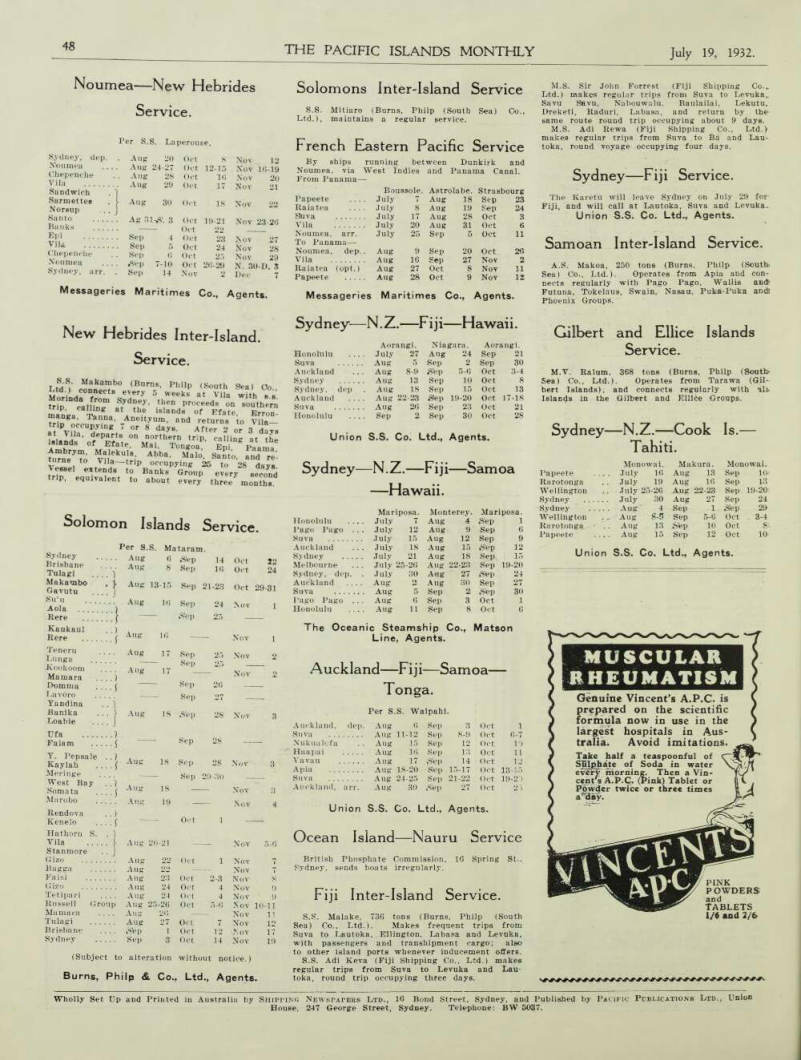
Sydney—Papua —New Guinea Service.
Sydney—Rabaul—Hongkong.
Papuan Inter-Island Services.
S.S. Papuan Chief (Steamships Trading Co..
Ltd.) makes regular round trips from Port Moresby to Kapa Kapa, Abau, Baibara, Samarai, and back by same route; then Port Moresby to Hisiu, Yule Island. Kukipi. Orokolo, Kikori, Daru and back via Orokolo, Yule Is., and Hisiu —full trip occupying about one month.
The m.v. “Nusa’’ (Steamships Trading Co , Ltd.) holds the Papuan Government’s contract for carrying mails and passengers on the north east coast of Papua. The “Nusa” connects with all southern mail steamers at Samarai, and runs to the following time-table:—
N.G. Goldfields’ Service.
Aeroplanes, conducted by Guinea Airways, Ltd., and other companies, leave Salamaua and Lae two and three times daily for Wau, and other centres on the Morobe Goldfield. The aerial services are the only means of communi catioa.
Wau—Port Moresby.
A regular aeroplane service is now maintained by Guinea Airways Ltd., allowing passengers to and from the goldfields to connect with the steamers at Port Moresby.
New Guinea Inter-Island
Service.
S.S. Maiwara (Burns Philp & Co.) makes regular round trips from Rabaul to New Ireland and Bougainville ports.
S.S. Mirani (Burns, Philp & Co.) makes regu lar round trips from Rabaul to New Guinea mainland ports.
S.S. Duris, s.s. Durour, m.v. Durambah (W.
R. Carpenter & Co., Ltd.) make sailings from Rabaul every two or three weeks to various ports in the Territory.
Saigon—Java—Noumea Line.
New Zealand —Samoa.
N.Z. Government steamer Maui Pomare (mails, passengers and cargo) carries on a regular ser vice between New Zealand ports and Western Samoa.
Macdhui.
June 30 Montoro.
July 21 Macdhui.
Aug 11 Brisbane Townsville July 2 July 5 July 23 July 26 July 27 July 29 July 30 Aug 13 Aug 16 Pt. Moresby July 7 Aug 18 July 8 J. 31-Ag 1 Aug 19 Woodlark If Rabaul Kavieng Lombrum Lorengau July 10-12 Aug 3-4 Aug 5-6 Aug 5-6 Aug 21-23 Salamaua July 14-15 — Aug 25-26 Madang Salamaua July 16 Aug 9-10 Aug 11-12 Aug 27 Kavieng Rabaul Soraken July 18-19 July 20 July 21 Aug 15 Aug 29-30 Aug 31 Sep 1 Numa ... .
July 22 Sep 2 Teopasina Arigus Kieta . ...
July 23 Sep 3 Rabaul Samarai Pt. Moresby July 25 July 27 July 28 Aug 15 Aug 17 Aug 18 Aug 20 Sep 5 Sep 7 Sep 9 Brisbane Sydney Aug 1 Aug 3 Aug 23 Aug 25 (Subject to alteration without notice.) Sep 12 Sep 14 Calls at Finschafen, Alexishafen, Lindenhafen and Pondo optional.
Burns, Philp & Co. Ltd., Agents.
Nankin.
Nellore.
Tanda.
Hongkong July 2 July 30 Sep 2 Manila July 5 Aug 2 Sep 5 Rabaul July 13 Aug 10 Sep 13 Brisbane ... July 19 Aug 16 Sep 19 Sydney ... July 21 Aug 18 Sep 21 Melbourne, dep. Aug 1 Sep 2 Oct 1 Sydney, dep . Aug 13 Sep 10 Oct 12 Brisbane ... Aug 15 Sep 12 Oct 14 Rabaul Aug 23 Sep 20 Oct 22 Manila Aug 31 Sep 28 Oct 30 Hongkong Sep 3 Oct 1 Nov 2 E. & A Steamship Co. Ltd., Agents.
Jun. Jul. Aug. Aug.
Samarai 21 13 4 24 Punipuni 21 13 4 24 Baniara 22 14 5 25 Tufi 23 15 6 26 Buna 24 16 7 27 Mambare — 18 — 29 Buna 25 19 8 30 Sept.
Tufi 27 21 10 1 Baniara 29 23 12 3 Samarai 39 24 13 4
Per S.S. Van Rees.
Saigon July 12 Sep 13 Nov 12 Batavia July 16-18 Sep 17-19 Nov 16-18 Samarang ... July 19 Sep 20 Nov 19 Pt. Moresby . July 28 Sep 29 Nov 28 Samarai July 30 Oct 1 Nov 30 Rabaul . . Aug 1-2 Oct 3-4 Dec 2-3 Vila ... Aug 8 Oct 10 Dec 8 Noumea . . . Aug 10-12 Oct 12-14 Dec 10-13 Sydney .. . Aug 16-18 Oct 18-20 Dec 17 -20 Pt. Moresby Aug 25 Oct 26 Dec 27 Batavia Sep 5-7 Nov 5-7 Jan 6 Saigon 11 Nov 11 — Royal Packet Navigation Co. Ltd.
Sydney- Norfolk Island — New Hebrides —Auckland.
Per S.S. Morinda.
Sydney Aug 18 Sep 29 Nov 10 Lord Howe Aug 20 Oct 1 Nov 12 Norfolk Is. ...
Aug 22 Oct 3 Nov 14 Auckland ...
Aug 25 Oct 6 Nov 17 Norfolk Is.
Aug 28 -29 Oct 9-10 Nov 20-21 Vila Sep 1-2 Oct 13-14 Nov 24-25 Bushman’s Bay Sep 3 Oct 15 Nov 26 Malo Tangoa Sep 4 Oct 10 Nov 27 Segond Aoba Sep 5 Oct 17 Nov 28 Vila Sep 6 Oct 18 Nov 29 Norfolk Is.
Sep 9-10 Oct 21-22 Dec 2-3 Lord Howe Sep 12 Oct 24 Dec 5 Sydney Sep 14 Oct 26 Dec 7 (Subject to alteration without notice.) Burns, Philp & Co. , Ltd., Agents.
Noumea—New Hebrides Service.
New Hebrides Inter-Island.
Service.
S.S. Makambo (Burns, Philp (South Sea) Co., Ltd.) connects every 5 weeks at Vila with s.s.
Sydney, then proceeds on southern trip, calling at the islands of Efate, Erron manga, Tnna, Aneityum, and returns to Vila— trip occupying 7 or 8 days. After 2 or 3 days at Vila, departs on northern trip, calling at the islands of Efate, Mai, Tongoa, Epi, Paama, Ambrym Malekula, Abba, Malo, Santo, and re turns to Vila—trip occupying 25 to 28 days.
Vessel extends to Banks Group every second trip, equivalent to about every three months.
Solomon Islands Service.
Solomons Inter-Island Service
S.S. Mitiaro (Burns, Philp (South Sea) Co., Ltd.), maintains a regular service.
Sydney—N.Z.—Fiji—Hawaii.
Sydney—N. Z. — Fiji—Samoa —Hawaii.
Auckland—Fiji—Samoa— Tonga.
Union S.S. Cos. Ltd., Agents.
Ocean Island—Nauru Service
British Phosphate Commission, 16 Spring St., Sydney, sends boats irregularly.
Fiji Inter-Island Service.
S.S. Malake, 736 tons (Burns, Philp (South Sea) Cos., Ltd.). Makes frequent trips from Suva to Lautoka, Ellington, Labasa and Levuka, with passengers and transhipment cargo; also to other island ports whenever inducement offers.
S.S. Adi Keva (Fiji Shipping Cos., Ltd.) makes regular trips from Suva to Levuka and Lau toka, round trip occupying three days.
M.S. Sir John Forrest (Fiji Shipping Co.,.
Ltd.) makes regular trips from Suva to Levuka,.
Savu Savu, Nabouwalu, Baulailai, Lekutu, Dreketi, Raduri, Labasa, and return by the same route round trip occupying about 9 days.
M.S. Adi Rewa (Fiji Shipping Co., Ltd.) makes regular trips from Suva to Ba and Lau toka, round voyage occupying four days.
Sydney—Fiji Service.
The Karetu will leave Sydney on July 29 for Fiji, and will call at Lautoka, Suva and Levuka.
Union S.S. Co. Ltd., Agents.
Samoan Inter-Island Service.
A.S. Makoa, 250 tons (Burns, Philp (South Sea) Co., Ltd.). Operates from Apia and con nects regularly with Pago Pago, Wallis and Futuna, Tokelaus, Swain, Nasau, Puka-Puka and Phoenix Groups.
Gilbert and Ellice Islands
Service.
M.V. Ralum, 368 tons (Burns, Philp (South Sea) Co., Ltd.). Operates from Tarawa (Gil bert Islands), and connects regularly with all Islands in the Gilbert and Ellice Groups.
Sydney—N.Z.—Cook Is.—
Tahiti.
Per S.S. Laperouse.
Sydney, dep.
Aug 20 Oct 8 Nov 12 Noumea . Aug 24 -27 Oct 12-15 Nov 16-19 Chepenche • Aug 28 Oct 16 Nov 20 Nov 21 Vila 29 Oct 17 Sandwich 1 Sarmettea Norsup Aug 30 Oct 18 Nov 22 Santo ...
Banks • Ag 31tS 3 Oct Oct / 1,.* 19-21 90 Nov 23-26 Epi 4 •-Z 09 Nov 27 Vila Ul I Jo Nov 28 Chepenche Ul I 24 Sep 0 Oct 25 Nov 29 Noumea . »S'ep 7- 10 Oct 26-29 N. 30-D. 3 Sydney, arr. . Sep 14 Nov 2 Dec 7
Messageries Maritimes Co., Agents.
Per S.S. Mataram.
Sydney Aug Aug 6 8 »S!ep Sep 14 16 Oct Oct Brisbane Tulagi ’l 22 24 Makambo Gavutu Aug 13-15 Sep 21-23 Oct 29-31 Su’u Aug Sep .Nov Aola . . . 1 24 1 Here — S'ep 25 Kaukaul Aug 10 Here ... — Nov 1 Teneru Lunga Aug 17 1 ’ 0 ’ 3 25 Nov 2 Kookoom Mamara Aug 17 Nov 2 Domma — Sep 26 — Lavoro Sep 27 Yandina Banika Aug 18 •S'ep 28 Nov 3 Uoabie Ufa Faiam — Sep 28 Y. Pepsale Aug 18 Kaylah Sep 28 Nov 3 Meringe — Sep 29-30 West Bay Aug 18 Somata — Nov 3 Marobo Aug 19 — Nov 4 Rendova Oct Kenelo — 1 — Hathorn S.
Vila Aug 20 _2i 5-6 Stanmore ov Gizo Aug Aug Aug Aug Aug 02 Oct 1 Nov Nov Nov Nov Nov - Bagga 90 Faisi .. .. 23 Oct 5 Oct Oct T-3 1 £ Gizo 24 4 Tetipari 24 4 9 Russell Group ip Aug 25 -26 Oct i 5-6 Nov 10-11 Mamara Aug 26 — Nov 11 Tulagi Aug 3'ep 27 Oct Oct 7 Nov •Nov 12 17 Brisbane 1 12 Sydney Sep 3 Oct 14 Nov 1 o I.i (Subject to alteration without notice.) Burns, Philp & Co., Ltd., Agents.
French Eastern Pacific Service
By ships running between Dunkirk and Noumea, via West Indies and Panama Canal.
From Panama- Boussole.
Astrolabe.
Strasbourg Papeete . July 7 Aug 18 Sep 23 Raiatea . July 8 Aug 19 Sep 24 Suva July 17 Aug 28 Oct 3 Vila . July 20 Aug 31 Oct 6 Noumea, arr.
July 25 Sep 5 Oct 11 To Panama— Noumea, dep.
Aug 9 Sep 20 Oct. 26 Vila Aug 16 Sep 27 Nov 2 Raiatea (opt.) Aug 27 Oct 8 Nov 11 Papeete . . . .
Aug 28 Oct 9 Nov 12 Messageries maritimes Co., Agents.
Aorangi. Niagara. Aorangi.
Honolulu ... July 27 Aug 24 Sep 21 Suva Aug 5 Sep 2 Sep 30 Auckland ... Aug 8-9 S'ep 5-6 Oct 3-4 Sydney Aug 13 Sep 10 Oct 8 Sydney, dep . Aug 18 Sep 15 Oct 13 Auckland Aug 22-23 A’ep 19-20 Oct 17-18 Suva Aug 26 Sep 23 Oct 21 Honolulu Sep 2 Sep 30 Oct 28 Union S.S. Co. Ltd., Agents.
Mariposa.
Monterey.
Mariposa.
Honolulu ...
July 7 Aug 4 Sep 1 Pago Pago .. .
July 12 Aug 9 Sep 6 Suva July 15 Aug 12 Sep 9 Auckland July 18 Aug 15 Sep 12 Sydney July 21 Aug 18 Sep 15 Melbourne July 25-26 Aug 22-23 Sep 19-20 Sydney, dep. .
July 30 Aug 27 Sep 24 Auckland ...
Aug 2 Aug 30 Sep 27 Suva Aug 5 Sep 2 Sep 30 Pago Pago ...
Aug 6 Sep 3 Oct 1 Honolulu ...
Aug 11 Sep 8 Oct 6 The Oceanic Steamship Co., Matson
Line, Agents.
Per S.S. Walpahl Auckland, dep.
Aug 6 Sep 3 Oct 1 Suva Aug 11-12 Sep 8-9 Oct 6-7 Nukualofa Aug 15 Sep 12 Oct V) Haapai Aug 16 Sep 13 Oct 11 Vavau Aug 17 »S!ep 14 Oct 12 Apia Aug 18-20 Sep 15-17 Oct 13-15 Suva Aug 24-25 Sep 21-22 Oct 19-2 i Auckland, arr.
Aug 30 ,8'ep 27 Oct 2 >
Monowai.
Makura.
Monowai.
Papeete ... .
July 16 Aug 13 Sep 10- Rarotonga July 19 Aug 16 Sep 13 Wellington July 25-26 Aug 22-23 Sep 19-20 Sydney July 30 Aug 27 Sep 24 Sydney Aug 4 Sep 1 3ep 29 Wellington Aug 8-9 Sep 5-6 Oct 3-4 Rarotonga Aug 13 3'ep 10 Oct 8’.
Papeete ...
Aug 15 Sep 12 Oct 10 Union S.S. Co. Ltd., Agents.
Advertisements & other items, pp. 49-52 (2 items)
Pacific
CROWLE HOUSE,
161 CASTLEREAGH STREET, SYDNEY,
Between Park and Market Streets.
TARIFF: Single Bed and Breakfast, 7/6 daily, £2/2/- weekly; Double Bed and Breakfast, 15/- daily, £3/15/- weekly; Full Board, £2/15/- weekly.
Phone: MA 3619. R. BOUTCHER.
PACIFIC
COMMUNICATION
SERVICES
MODERN direct Wireless Services are available for inter-communication between the Islands of the Pacific and for traffic between the Islands and Australia and overseas countries.
Services are now in operation between Papua and Sydney, New Guinea and Sydney, New Caledonia and Sydney and Fiji and Sydney. Speedy, economical and efficient service to Australia and overseas. Route your traffic “Via the Wireless Service. ”
For overseas traffic to Great Britain, North and South America and all European countries, route your message via the Direct Australian
BEAM WIRELESS SERVICE.
LODGE YOUR MESSAGES AT ANY
WIRELESS STATION OR ISLAND POST
OFFICE ROUTED “VIA WIRELESS.”
AMALGAMATED WIRELESS (A'SIA) LIMITED.
MUSCULAR
RHEUMATISM
Genuine Vincent’s A.P.C. is prepared on the scientific formula now in use in the
largest hospitals in Aus
tralia. Avoid imitations.
Take half a teaspoonful of Sulphate of Soda in water every morning. Then a Vin cent s A.P.C. (Pink) Tablet or Powder twice or three times aday.
PINK
POWDERS
and
TABLETS
1/6 and 2/6
An Islands Wharf under Reconstruction by W. R. Carpenter and Co. Ltd.
W. R. CARPENTER & CO. LTD.
Specialise in Supplying the Requirements
of Islands Residents, Planters, and Traders
Buyers and Shippers of:
Copra, Trocas, and all classes of Islands Produce Agents for Australian, European and American Manufacturers, and Distributors of Every Description of Merchandise. Full and complete range of all stocks carried.
Agents for : Ford Cars, Trucks and Fordson Tractors, Dodge Brothers Cars, Graham Dodge Trucks, Bolinder Marine and Stationary Engines, Coates’ Plymouth Gin, McCallums’ Perfection Whisky, Rimmel’s Perfumes, Houbigant’s Per fumes and Powders, Carlton V.B.
Beer, Goodyear Tyres.
Engineering and Garage Depts., W. R. Carpenter and Co. Ltd., Rabaul.
W. R. CARPENTER & CO. LTD.
Head Office :
19-21 O’CONNELL STREET
SYDNEY
Branches at : LONDON, RABAUL (New Britain), KAVIENG (New Ireland), MADANG (New Guinea), SALAMOA (New Guinea), TULAGI (Solomon Islands), and other Pacific Islands.
The coolest spot in the Pacific Cool ... crisp ... amber-clear ... a good drink ... a long drink ... the best drink of all ...
TOOTH'S KB a true LAGER
EK/3
48
July 19, 1932.
THE PACIFIC ISLANDS MONTHLY
Wholly Set Up and Printed in Australia by Shipping Newspapers Ltd., 16 Bond Street, Sydney, and Published by Pacific Publications Ltd., Union House, 247 George Street, Sydney. Telephone: BW 5037.