Tree Labour” In The Pacific.
pp. 31-32 · Read in the full issue
Why the Indenture System is Necessary in Melanesian Territories.
(By Gordon Thomas.)
THE short extract from Sir Hubert Murray’s paper on “The Scientific Method as Applied to Native Labour Problems in Papua,” which appeared in the January P.1.M., should be cut out and stuck in the hat of every agitator for “free” labour in Papua and its neighbour—the Mandated Territory.
It is only ignorance of local condi tions that prompts these dear, well
meaning souls to lift up their hands in horror at the very mention of “inden tured labourers.” To many of them, the words bring memories of slavery in the Congo; “Blackbirding” for the Queens land canefields; or the more recent labour scandals in Liberia.
The indenture system in New Guinea has as much resemblance to slavery, blackbirding or the Liberian methods as a penny whistle has to a bass-drum.
The system as carried out in New Guinea is one of the finest agents for civilising a primitive race of native it is possible to institute. And here, let it not be forgotten, the New Guinea natives, who are becoming indentured each year, are amongst the most primi tive natives in the world.
The physical improvement which is apparent in a native after six to nine months’ indenture is little short of marvellous. ill-nourished, and suffering often from skin diseases when signed on, they readily respond to a regular diet of nourishing food and careful medical attention, until often it is dif ficult to recognise the youth of six months before.
That the system is popular amongst the labourers themselves is proved by the number of “finish-timers” re-sign
ing. According to 1929-30 records there were 12,578 indentured labourers paid off, of whom 5,936 renewed their con tracts, or almost 50 per cent. That is an indication of the labourers’ attitude towards indenture.
The primitiveness of the New Guinea native is the main reason why “free” labour is at present impossible. As Sir Hubert Murray says: “I do not think
that this (free labour) will come about until the native has developed a sense of responsibility. . . .” The natives’ own economic system is such that the urge or necessity for continual work is
unknown. Nature provides the maxi mum amount of sustenancce for the minimum amount of exertion. Only in extreme cases, such as exceptional droughts, have the natives been known to suffer any inconvenience regarding food supplies. Even at such times, when taro, sago and sweet-potatoes have failed, there is always the ubi quitous coconut to fall back upon.
The “responsibility’' of fulfilling a “free” contract with a white employer depends upon two main factors —i.e., material requirements and mental ap preciation of the value of a moral ob ligation.
The former, at this present stage of the New Guinea native’s evolution, does not exist. His material require ments are so well catered for by a pro vident Nature that not until he reaches that state of civilisation when his material requirements have to be purchased with money and his appe tites have been increased to demand better living conditions, imported food (such as biscuits, tea, sugar, rice, etc.), and luxuries to include electric torches, lamps, bicycles, iron houses, gramo phones, and the like, will he feel the urge or necessity to carry out under takings of work on a “free” contract.
This absolute freedom from economic worries, and the absence of the neces sity for working, in order to receive re muneration, is difficult of realisation by the average civilised person, who is beset by butchers’ and bakers’ bills, time-payments on cars, radios and fur niture, with school fees looming in the near distance. The civilised individual must work in order to exist, and to provide for the hundred and one lux uries which have become modern neces sities. The axe of economy is forever a bugbear to the average wage-earner, whose nightmares consist of debt collectors, writs, poverty and old-age.
These monstrosities hold no terror for
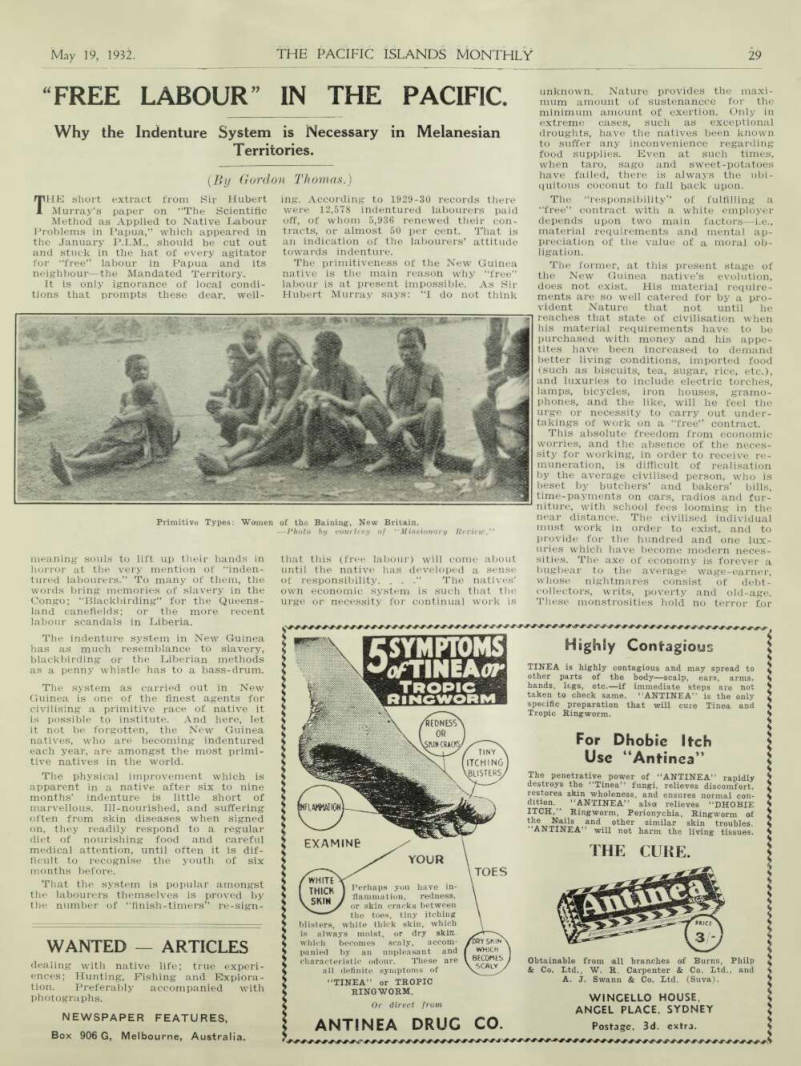
Primitive Types: Women of the Baining, New Britain, Photo by courtesy of “Missionary Review."
the primitive native, whose material requirements are comparatively neg ligible.
Colonel Ainsworth, who made a re port on the Mandated Territory in 1924, expressed a truism when he said: “Get the natives to spend money and you will increase their desire to earn it,”
As for the mental appreciation of a moral obligation, this is a state farther from realisation than that of greater material requirements. The native is essentially material (where contact with the white is concerned); such ab stract qualities as Acts of Conscience, Gratitude, or Moral Responsibility to wards a white have, generally speak ing, no place in their scheme of things.
There is always an unconscious pro viso where a native makes an agree ment, and it is the provision to enable him to alter his mind, or change his plans to suit himself in the event of the unexpected happening. Any loss or inconvenience to the other party of the agreement is of no moment. His mind has not been sufficiently trained in the ethics of the white-man’s code to ap preciate the seriousness of any under taking of a purely moral nature. [Apparentlv Mr. Thomas has not heard of Mr. Lang, Premier for the moment of New South Wales! —Ed.,
P.I.M.]
The inculcation of moral rectitude and probity, and the responsibility of carrying out a mutual agreement should rest mainly with the missions, whose task it is to educate the nativfe along spiritual lines. That church members of comparatively long-stand ing are amongst the greatest offenders, where the observance of moral respon sibility is concerned, only shows that something is lacking somewhere in the systems of spiritual education which have been adopted by the missions.
It will be seen, therefore, that there are two distinct objects to be attained ere the New Guinea native is physic ally and morally fit to be placed in the same category as the more civilised natives of the Pacific, who can be de pended upon to serve as “free” labourers.
The desire for the material neces saries of life is a characteristic to be cultivated in the native by the com mercial community; while that of an appreciation of a moral obligation by the native should be developed by the Missions through their spiritual teach ing. There is no necessity for over lapping in developing: these evolution ary traits. The line of demarcation between the physical and the moral are distinct. All that is required is har monious team-work, and when that has been carried out then can we consider the introduction of “free” labour in New Guinea.