Head -Hunting As A Custom.
p. 30 · Read in the full issue
What Papuan Government Has to Contend With.
From Our Own Correspondent.
Pt. Moresby, Jan. 31.
THE recent Suki raid on the Weriadai people of the Fly river in Western Papua, 400 miles from Port Moresby, brings to mind the conditions of the Territory 25 and 30 years ago, when tribal warfare, bloodshed, and misery were the order of the day.
The fact that a single raid has called forth so much comment and imagin ative description in the Australian Press emphasises the progress that has been made since the days when such raids were a daily occurrence all over Papua, and all the tribes of the interim indulged whole-heartedly in the joys of head-hunting and cannibalism.
It is inevitable that the inland tribes should resort, from time to time, to their old customs, in defiance, as the Government influence creeps gradually into the interior. They feel the curb of the invasion and they resent it sul lenly; and, in their lack of under standing and ignorance, they rebel.
They realise only that they are being subdued and suppressed, and the oc casional outbreaks of slaughter are, in many cases, a mere gesture a challenge.
It is rather a pathetic picture, for the Papuan savage is no coward.
Rather is he a fine fellow, though treacherous, cunning, and bloodthirsty as he may appear. We are the alien to him; he feels his existence and customs are in jeopardy, and it is not easy for him to see what lies beyond.
For generations, the more savage native has regarded all strangers as his mortal enemy, and it will take many years for him to grasp the fact that the Government is not there solely for its own ends.
Further, murder and raiding to these outside tribes are not crime at all.
It is, in some cases, a duty, a necessary part of their social system, also a sport and again, at times a passionate need. In a great number of cases, head-hunting has been a solemn act of revenge.
There have been, naturally, cases, but a smaller number, in which natives have indulged undoubtedly in killing for pleasure, and inoffensive strangers were caught and killed for this purpose. These cases are now so rare as to be almost negligible.
Most murders, therefore, are found to have been committed either to pay back, or to revenge some death by “puri puri” (witchcraft), or simply to secure the social distinction of the homicide, a mark of prowess, without which, amongst the savage tribes, a man is of no account in his village.
So it must appear that if every murder must be revenged, incessant fighting must continue, for once the paying back system is in full swing, the merry game goes on, until either side is exterminated.
Here, the Government of to-day steps in. On the report of an outrage, the scene is visited by magistrate or patrol officers and native constabulary, in
vestigations made, and, in time, the murderers are brought to justice—as we know it. It is easy to understand that these inland tribes do not take kindly at first to our methods, or com prehend them for some time, and though it is dangerous to generalise about Papua and Papuans, for customs vary from tribe to tribe all over the country, and what is true of the East is often quite untrue of the Gulf and the West —yet it appears that the Gov ernment has been successfull in win ning the confidence of even the most truculent savage and they become eventually a law-abiding people under its influence.
To summarise, ritual and ceremony impermeate the whole existence of the Papuan life and these remote tribes perpetuate these raids with definite sig nificance to pay back or to acquire the insignia of the homicide, or for the pas sionate need of killing.
Until all the hinterland has been brought under the control of the Gov ernment, it is only to be expected that sporadic raids such as this last Suki outbreak will continue.
The Fly River, the largest river in Papua in the western division, has al ways gripped the imagination of people outside the Territory, on ac count of its size and the romance of its early explorations and the wild tales told of its hidden secrets and horrors.
As far back as 1842, Capt. Blackwood gave its name, when in H.M.S. Fly, he examined the estuary. Later, the famous explorer D’Albertis ventured three times up its source in 1875-6-7, and steamed as far as the Alice River, 500 miles from the sea. He was followed by Capt. Everill in 1885 and by Sir William MacGregor in 1890, who actu ally explored the higher reaches above the D’Albertis junction to a “six hun dred mile camp,” 45 miles from the Victor Emmanuel Range, lying between German New Guinea, as it was then known, and Papua-—an amazing feat 40 years back in this hostile country, which was only beaten some four years ago, when Karius and Champion made their famous patrol up the Ply, crossed the main range, and travelled down to the coast by the Sepik River on the other side of the immense island of New Guinea.
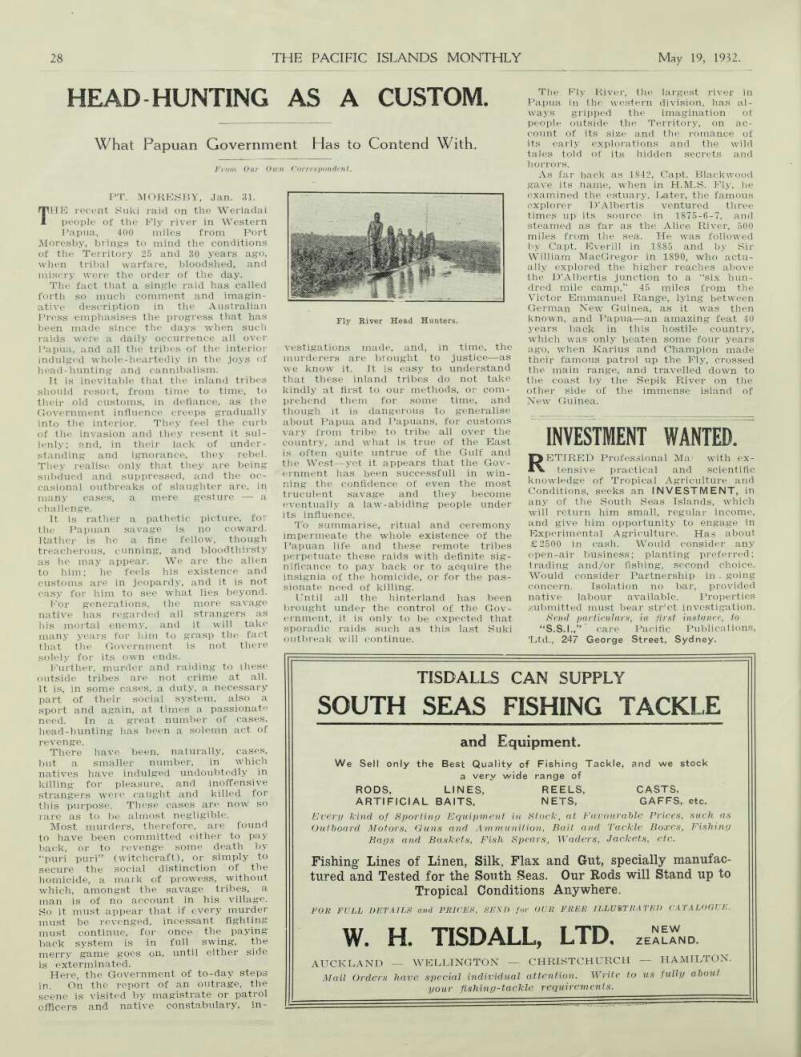
Fly River Head Hunters.