By Gordon Thomas.
p. 14 · Read in the full issue
Copra Prices In New
Guinea.
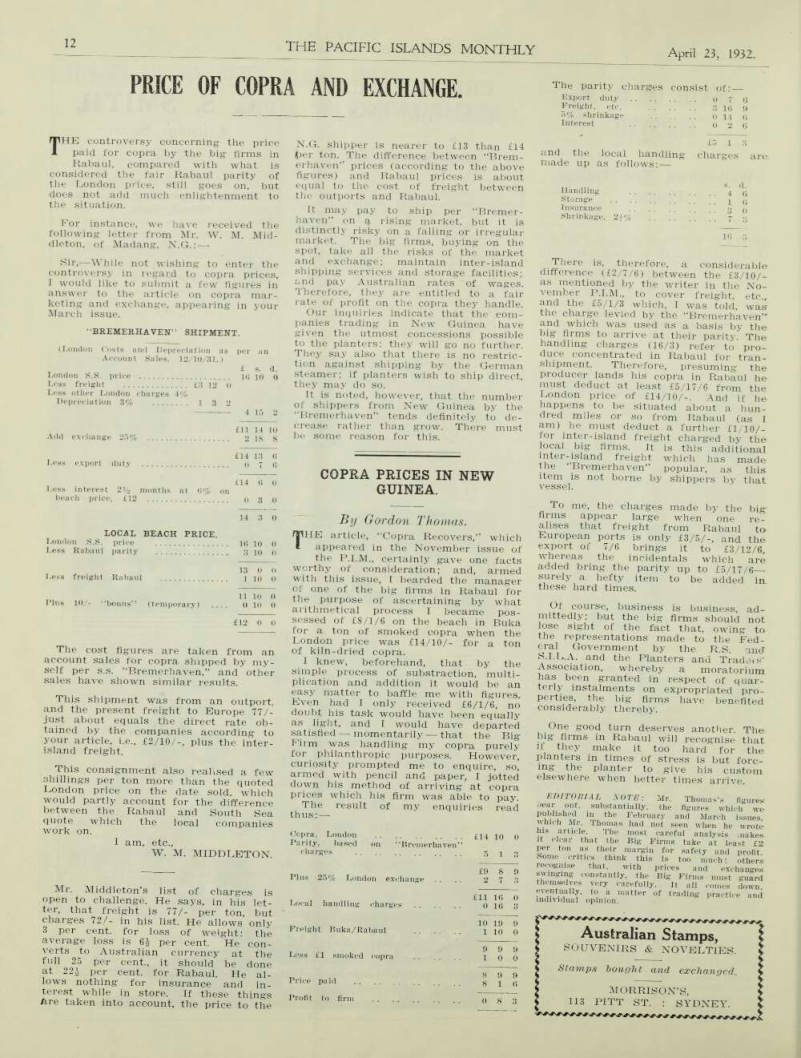
THE article, “Copra Recovers,” which appeared in the November issue of the P.I.M., certainly gave one facts worthy of consideration; and, armed with this issue, I bearded the manager of one of the big firms in Rabaul for the purpose of ascertaining by what arithmetical process I became pos sessed of £8/1/6 on the beach in Buka for a ton of smoked copra when the London price was £l4/10/- for a ton of kiln-dried copra.
I knew, beforehand, that by the simple process of substraction, multi plication and addition it would be an easy matter to baffle me with figures.
Even had I only received £6/1/6, no doubt his task would have been equally as light, and I would have departed satisfied momentarily that the Big Firm was handling my copra purely for philanthropic purposes. However, curiosity prompted me to enquire, so, armed with pencil and I jotted down his method of arriving at copra prices which his firm was able to pay.
The result of my enquiries read thus:
and the local handling charges are made up as follows:
There is, therefore, a considerable difference (£2/7/6) between the £3/10/as mentioned by the writer in the No vember P.I.M., to cover freight, etc., and the £5/1/3 which, I was told, was the charge levied by the “Bremerhaven’' and which was used as a basis by the big firms to arrive at their parity. The handling charges (16/3) refer to pro duce concentrated in Rabaul for tran shipment. Therefore, presuming the producer lands his copra in Rabaul he must deduct at least £5/17/6 from the London price of £14/10/-. And if he happens to be situated about a hun dred miles or so from Rabaul (as I am) he must deduct a further £1/10/for inter-island freight charged by the local big firms. It is this additional inter-island freight which has made the ‘Bremerhaven” popular, as this item is not borne by shippers by that vessel.
To me, the charges made by the big firms appear large when one re alises that freight from Rabaul to European ports is only £3/5/-, and the export of 7/6 brings it to £3/12/6, whereas the incidentals which are added bring the parity up to £5/17/6 — surely a hefty item to be added in these hard times.
Of course, business is business, ad mittedly; but the big firms should not lose sight of the fact that, owing to the representations made to the Fed eral Government by the R.S. and S.I.L.A. and the Planters and Traders' Association, whereby a moratorium has been granted in respect of quar terly instalments on expropriated pro perties, the big firms have benefited considerably thereby.
One good turn deserves another. The big firms in Rabaul will recognise that if they make it too hard for the planters in times of stress is but forc ing the planter to give his custom elsewhere when better times arrive.
EDITORIAL NOTE : Mr. Thomas’s figures bear out, substantially, the figures which we published in the February and March issues, which Mr. Thomas had not seen when he wrote his article. The most careful analysis makes it clear that the Big Firms take at least £2 per ton as their margin for safety and profit.
Some critics think this is too much: others recognise that, with prices and exchanges swinging constantly, the Big Firms must guard themselves very carefully. It all comes down, eventually, to a matter of trading practice and individual opinion.
Copra, London Parity, based on “Bremerhaven” £14 10 0 charges 5 1 3 Pins 25% London exchange £9 8 9 2 7 Local handling charges £11 16 0 0 16 3
Freight Buka/Rabaul
10 19 9 1 10 0 9 9 9 Less £1 smoked copra 1 0 0 8 9 9 Price paid 8 1 6 Profit to firm 0 8 3
The parity charges consist of: — Export duty 0 7 6 Freight, etc. 3 16 9 5% shrinkage 0 1-16 Interest 0 2 6 £5 1 3
s - d- Handling 4 Storage 16 Insurance ... 30 Shrinkage, 21% . . 70 16 3