Price Of Copra And Exchange.
p. 14 · Read in the full issue
THE controversy concerning the price paid for copra by the big firms in Rabaul, compared with what is considered the fair Rabaul parity of the London price, still goes on, but does not add much enlightenment to the situation.
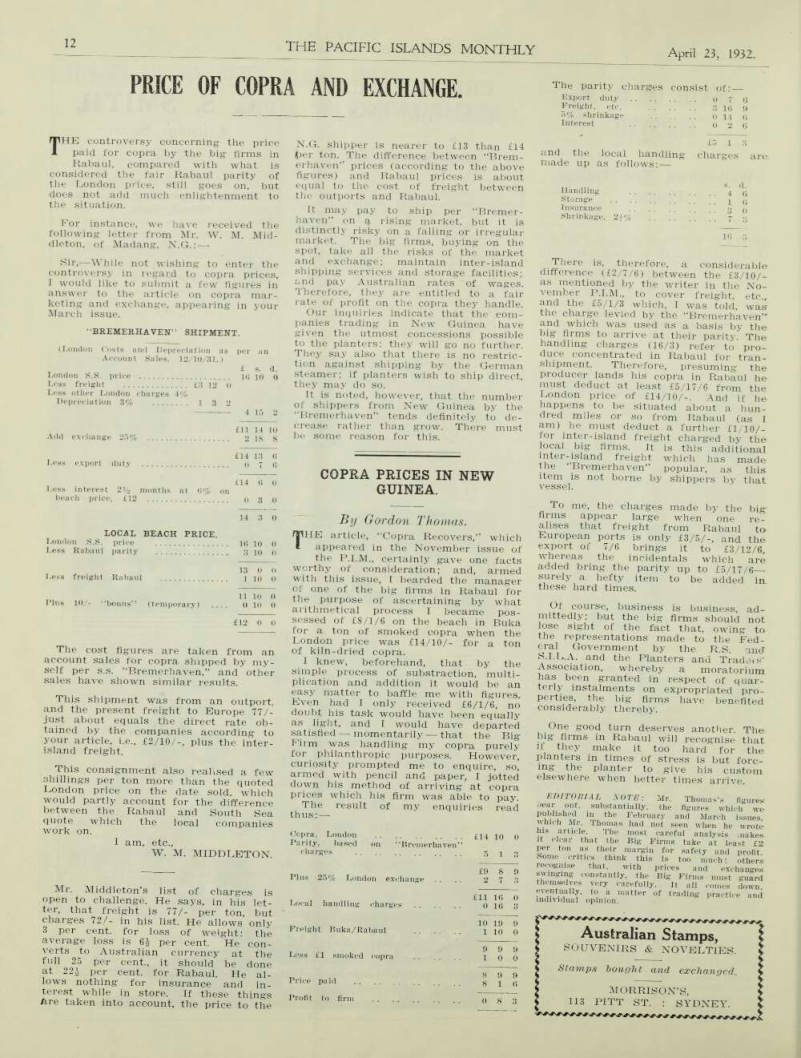
For instance, we have received the following letter from Mr. W. M. Mid dleton, of Madang, N.G.;— Sir, —While not wishing to enter the controversy in regard to copra prices, I would like to submit a few figures in answer to the article on copra mar keting and exchange, appearing in your March issue.
“Bremerhaven" Shipment.
(London Costs and Depreciation as per an Account Sales, 12/10/31.)
The cost figures are taken from an account sales for copra shipped by my self per s.s. “Bremerhaven,” and other sales have shown similar results.
This shipment was from an outport, and the present freight to Europe 77/just about equals the direct rate ob tained by the companies according to your article, i.e., £2/10/-, plus the inter island freight.
This consignment also realised a few shillings per ton more than the quoted London price on the date sold, which would partly account for the difference between the Rabaul and South Sea quote which the local companies work on.
I am, etc.,
W. M. Middleton.
Mr. Middleton’s list of charges is open to challenge. He says, in his let ter, that freight is 77/- per ton, but charges 72/- in his list. He allows only 3 per cent, for loss of weight: the average loss is 6i per cent. He con verts to Australian currency at the full 25 per cent, it should be done at 22½ per cent, for Rabaul. He al lows nothing for insurance and in terest while in store. If these things tire taken into account, the price to the
N.G. shipper is nearer to £13 than £14 per ton. The difference between “Brem erhaven” prices (according to the above figures) and Rabaul prices is about equal to the cost of freight between the outports and Rabaul.
It may pay to ship per “Bremer haven” on % rising market, but it is distinctly risky on a falling or irregular market. The big firms, buying on the spot, take all the risks of the market and exchange; maintain inter-island shipping services and storage facilities; and pay Australian rates of wages.
Therefore, they are entitled to a fair rate of profit on the copra they handle.
Our inquiries indicate that the com panies trading in New Guinea have given the utmost concessions possible to the planters: they will go no further.
They say also that there is no restric tion against shipping by the German steamer; if planters wish to ship direct, they may do so.
It is noted, however, that the number of shippers from New Guinea by the “Bremerhaven” tends definitely to de crease rather than grow. There must be some reason for this.
£ s. d.
London S.S. price 10 0 Less freight . . . . 0 Less other London charges 4% Depreciation 3% 1 3 2 — 4 15 2 £11 14 10 Add exchange 25% 9 18 8 £14 13 6 Less export duty 7 0 £14 6 0 Less interest 2 1 /, months at 6% on beach price, £12 3 0 14 3 0
Local
Beach Price.
London S.S. price 10 0 Less Rabaul parity 10 0 13 0 0 Less freight Rabaul 10 0 11 10 0 Pins 10/- “bonus” (temporary) 0 10 0 £12 0 0