The "Dog” Incident
Why Sir Hubert Murray Attended Papuan Sorcery Demonstration
From Our Own Correspondent
Port Moresby, Nov. 10.
A TEARING south-east wind and a prolonged dry spell have caused havoc along the coast of the Central Division of Papua, and the inland districts for miles. Not for many years have Port Moresby and its surroundings looked so barren and dismal.
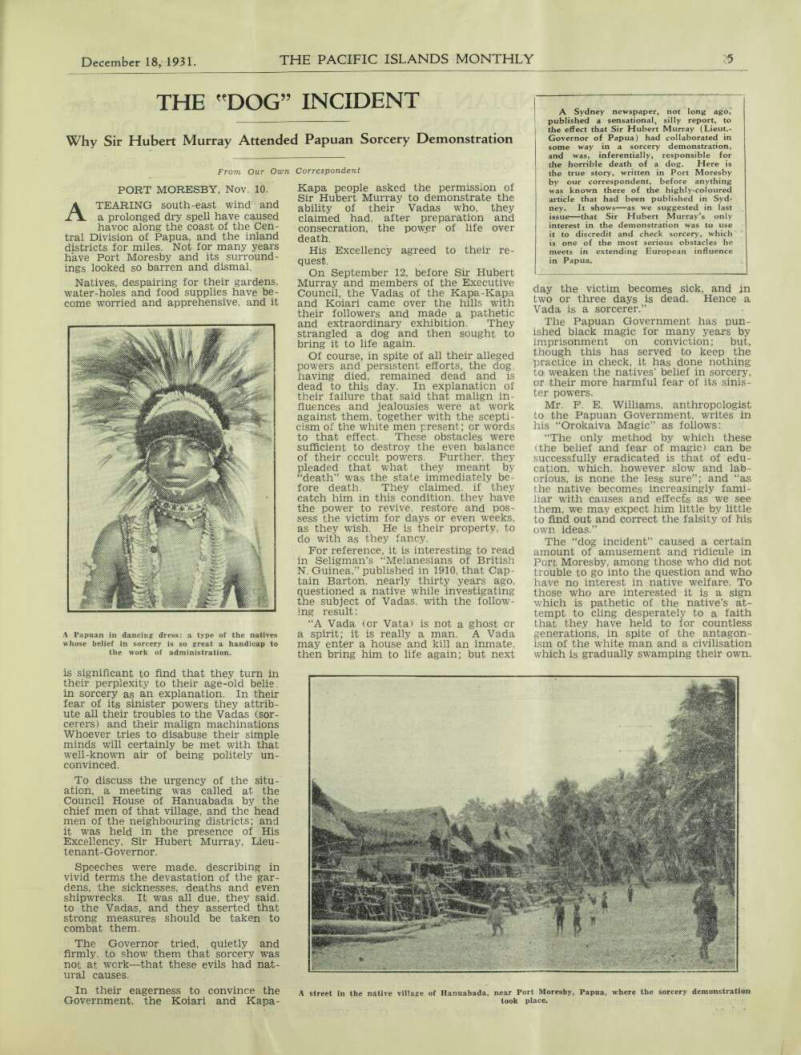
Natives, despairing for their gardens, water-holes and food supplies have become worried and apprehensive, and it A Papuan in dancing: dress: a type of the natives whose belief in sorcery is so great a handicap to the work of administration.
is significant to find that they turn in their perplexity to their age-old belief in sorcery as an explanation. In their fear of its sinister powers they attribute all their troubles to the Vadas (sorcerers) and their malign machinations Whoever tries to disabuse their simple minds will certainly be met with that well-known air of being politely unconvinced.
To discuss the urgency of the situation, a meeting was called at the Council House of Hanuabada by the chief men of that village, and the head men of the neighbouring districts; and it was held in the presence of His Excellency, Sir Hubert Murray, Lieutenant-Governor.
Speeches were made, describing in vivid terms the devastation of the gardens, the sicknesses, deaths and even shipwrecks. It was all due, they said, to the Vadas, and they asserted that strong measures should be taken to combat them.
The Governor tried, quietly and firmly, to show them that sorcery was not at work —that these evils had natural causes.
In their eagerness to convince the Government, the Koiari and Kapa-
Kapa people asked the permission of Sir Hubert Murray to demonstrate the ability of their Vadas who, they claimed had, after preparation and consecration, the power of life over death.
His Excellency agreed to their request.
On September 12, before Sir Hubert Murray and members of the Executive Council, the Vadas of the Kapa-Kapa and Koiari came over the hills with their followers and made a pathetic and extraordinary exhibition. They strangled a dog and then sought to bring it to life again.
Of course, in spite of all their alleged powers and persistent efforts, the dog, having died, remained dead and is dead to this day. In explanation of their failure that said that malign influences and jealousies were at work against them, together with the scepticism of the white men present; or words to that effect. These obstacles were sufficient to destroy the even balance of their occult powers. Further, they pleaded that what they meant by “death” was the state immediately before death. They claimed, if they catch him in this condition, they have the power to revive, restore and possess the victim for days or even weeks, as they wish. He is their property, to do with as they fancy.
For reference, it is interesting to read in Seligman’s “Melanesians of British N. Guinea,” published in 1910, that Captain Barton, nearly thirty years ago, questioned a native while investigating the subject of Vadas, with the following result: “A Vada (or Vata) is not a ghost or a spirit; it is really a man. A Vada may enter a house and kill an inmate, then bring him to life again; but next A street in the native village of Hanuabada, near Port Moresby, Papua, where the sorcery demonstration took place. ---
A Sydney newspaper, not long ago, published a sensational, silly report, to the effect that Sir Hubert Murray (Lieut.- Governor of Papua) had collaborated in some way in a sorcery demonstration, and was, inferentially, responsible for the horrible death of a dog. Here is the true story, written in Port Moresby by our correspondent, before anything was known there of the highly-coloured article that had been published in Sydney. It shows —as we suggested in last issue—that Sir Hubert Murray’s only interest in the demonstration was to use it to discredit and check sorcery, which is one of the most serious obstacles he meets in extending European influence in Papua. ---
two or three days is dead. Hence a Vada is a sorcerer.”
The Papuan Government has punished black magic for many years by imprisonment on conviction; but, though this has served to keep the practice in check, it has done nothing to weaken the natives’ belief in sorcery, or their more harmful fear of its sinister powers.
Mr. F. E. Williams, anthropologist to the Papuan Government, writes in his “Orokaiva Magic” as follows: “The only method by which these (the belief and fear of magic) can be successfully eradicated is that of education, which, however slow and laborious, is none the less sure”; and “as the native becomes increasingly familiar with causes and effects as we see them, we may expect him little by little to find out and correct the falsity of his own ideas.”
The “dog incident” caused a certain amount of amusement and ridicule in Port Moresby, among those who did not trouble to go into the question and who have no interest in native welfare. To those who are interested it is a sign which is pathetic of the native’s attempt to cling desperately to a faith that they have held to for countless generations, in spite of the antagonism of the white man and a civilisation which is gradually swamping their own.