Producing No Gold
pp. 5-21 · Read in the full issue
Why New Guinea Goldfields Are
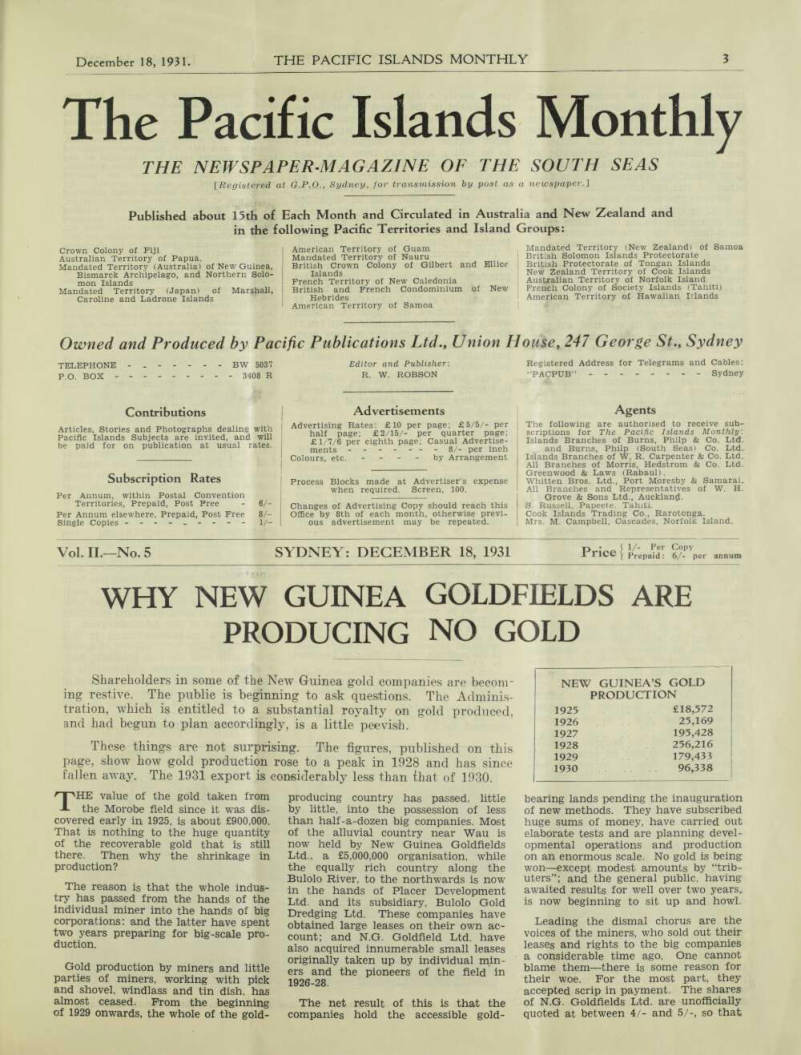
Shareholders in some of the New Guinea gold companies are becoming restive. The public is beginning to ask questions. The Administration, which is entitled to a substantial royalty on gold produced, and had begun to plan accordingly, is a little peevish.
These things are not surprising. The figures, published on this page, show how gold production rose to a peak in 1928 and has since fallen away. The 1931 export is considerably less than that of 1930.
New Guinea’S Gold
Production
1925 £18,572 1926 25,169 1927 195,428 1928 256,216 1929 179,433 1930 96,338
THE value of the gold taken from the Morobe field since it was discovered early in 1925, is about £900,000.
That is nothing to the huge quantity of the recoverable gold that is still there. Then why the shrinkage in production?
The reason is that the whole industry has passed from the hands of the individual miner into the hands of big corporations: and the latter have spent two years preparing for big-scale production.
Gold production by miners and little parties of miners, working with pick and shovel, windlass and tin dish, has almost ceased. From the beginning of 1929 onwards, the whole of the gold
producing country has passed, little by little, into the possession of less than half-a-dozen big companies. Most of the alluvial country near Wau is now held by New Guinea Goldfields Ltd., a £5,000,000 organisation, while the equally rich country along the Bulolo River, to the northwards is now in the hands of Placer Development Ltd. and its subsidiary, Bulolo Gold Dredging Ltd. These companies have obtained large leases on their own account; and N.G. Goldfield Ltd. have also acquired innumerable small leases originally taken up by individual miners and the pioneers of the field in 1926-28.
The net result of this is that the companies hold the accessible gold
bearing lands pending the inauguration of new methods. They have subscribed huge sums of money, have carried out elaborate tests and are planning developmental operations and production on an enormous scale. No gold is being won—except modest amounts by “tributers”; and the general public, having awaited results for well over two years, is now beginning to sit up and howl, Leading the dismal chorus are the voices of the miners who sold out their leases and rights to the big companies a considerable time ago. One cannot blame them—there is some reason for their woe. For the most part, they accepted scrip in payment. The shares of N.G. Goldfields Ltd. are unofficially quoted at between 4/- and 5/-, so that ———
there is nothing to be gained by selling the scrip. The big companies during this period of testing and development are winning no gold and paying no dividends. Meanwhile, the miner is not permitted to mine—practically all land known to hold profitable gold has been taken up, preparatory to exploit ation by the big corporations.
All that the miners still on the field can do is either to work some of the big companies’ leases on tribute or go back further into the wild country of the interior and seek new prospects.
Some are doing that—but the country is almost inaccessible, its penetration requires equipment and funds and there is no money on the goldfields just now for enterprises of that character.
Another factor operating against individual enterprise in opening up new goldfields country, or in anything else, is the tremendous cost of transport.
There is no road between the coast and the goldfield, and transport by air adds 6d. to every pound of food and equipment that is carried in. It must be a very rich lode indeed if it is to pay for the cost of finding and working it.
If the cost of transporting everything necessary from the coast to Wau were not so high, and if the unknown country inland from Wau were not so difficult to explore, the incursion of the big companies would not have paralysed gold production, because the individual miners, having been displaced by the companies, would soon have opened up new propositions further inland. The gold is there and private enterprise eventually will get it; but, at present, private enterprise is killed through lack of funds. All the available money is being used for the establishment of the companies.
It is a most unfortunate position.
According to our information, there are scores of men—excellent bushmen, keen prospectors and skilled miners— wandering about New Guinea to-day, looking for any kind of a job, who ought to be out in the ranges behind Wau and Bulolo, locating the further goldfields that are believed to exist there.
Meanwhile, on the Morobe goldfield, it is all spending and no earning; and interested observers are becoming restive and critical. However, the position is not at all bad.
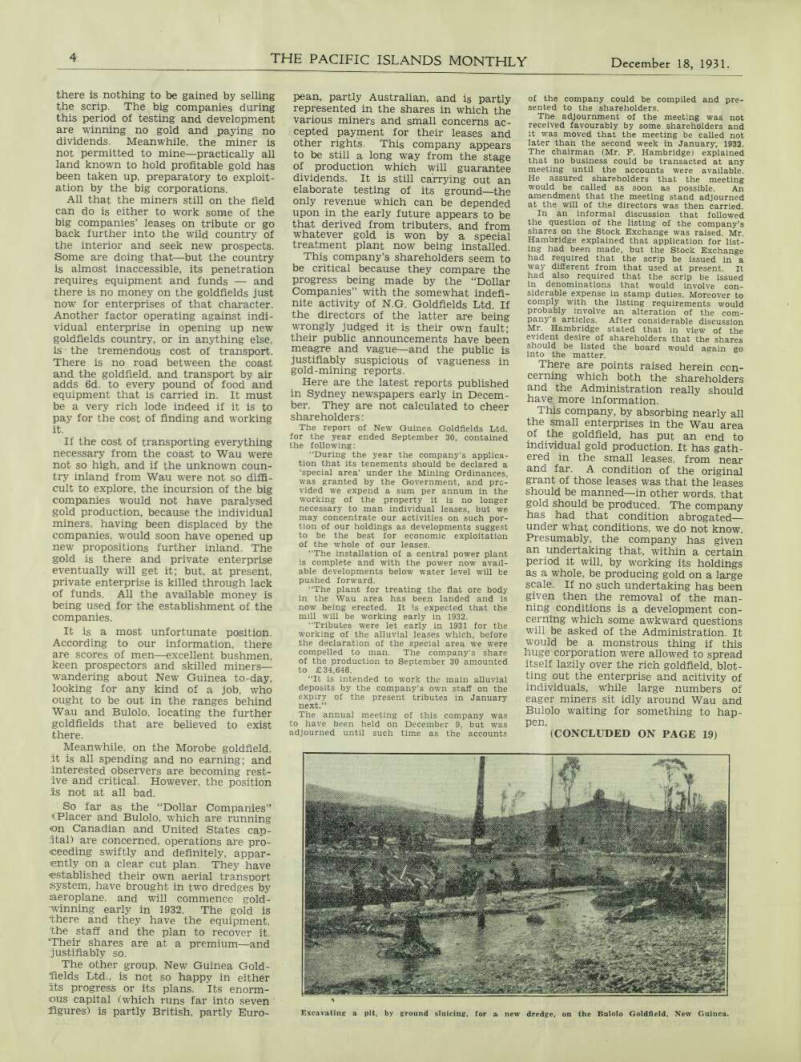
So far as the “Dollar Companies” (Placer and Bulolo, which are running on Canadian and United States capital) are concerned, operations are proceeding swiftly and definitely, apparently on a clear cut plan. They have established their own aerial transport system, have brought in two dredges by aeroplane, and will commence gold -winning early in 1932. The gold is there and they have the equipment, the staff and the plan to recover it.
Their shares are at a premium—and justifiably so.
The other group, New Guinea Gold fields Ltd., is not so happy in either its progress or its plans. Its enormous capital (which runs far into seven figures) is partly British, partly Euro-
pean, partly Australian, and is partly represented in the shares in which the various miners and small concerns accepted payment for their leases and other rights. This company appears to be still a long way from the stage of production which will guarantee dividends. It is still carrying out an elaborate testing of its ground—the only revenue which can be depended upon in the early future appears to be that derived from tributers, and from whatever gold is won by a special treatment plant now being installed.
This company’s shareholders seem to be critical because they compare the progress being made by the “Dollar Companies” with the somewhat indefinite activity of N.G. Goldfields Ltd. If the directors of the latter are being wrongly judged it is their own fault; their public announcements have been meagre and vague—and the public is justifiably suspicious of vagueness in
gold-mining reports.
Here are the latest reports published in Sydney newspapers early in December. They are not calculated to cheer shareholders: The report of New Guinea Goldfields Ltd. for the year ended September 30, contained the following: "During the year the company’s application that its tenements should be declared a ‘special area’ under the Mining Ordinances, was granted by the Government, and provided we expend a sum per annum in the working of the property it is no longer necessary to man individual leases, but we may concentrate our activities on such portion of our holdings as developments suggest to be the best for economic exploitation of the whole of our leases.
“The installation of a central power plant is complete and with the power now available developments below water level will be pushed forward.
“The plant for treating the flat ore body in the Wau area has been landed and is now being erected. It is expected that the mill will be working early in 1932.
“Tributes were let early in 1931 for the working of the alluvial leases which, before the declaration of the special area we were compelled to man. The company’s share of the production to September 30 amounted to £34,646.
“It is intended to work the main alluvial deposits by the company’s own staff on the expiry of the present tributes in January next.”
The annual meeting of this company was to have been held on December 9, but was adjourned until such time as the accounts
of the company could be compiled and presented to the shareholders.
The adjournment of the meeting was not received favourably by some shareholders and it was moved that the meeting be called not later than the second week in January, 1932.
The chairman (Mr. F. Hambridge) explained that no business could be transacted at any meeting until the accounts were available.
He assured shareholders that the meeting would be called as soon as possible. An amendment that the meeting stand adjourned at the will of the directors was then carried.
In an informal discussion that followed the question of the listing of the company’s shares on the Stock Exchange was raised. Mr.
Hambridge explained that application for listing had been made, but the Stock Exchange had required that the scrip be issued in a way different from that used at present. It had also required that the scrip be issued in denominations that would involve considerable expense in stamp duties. Moreover to comply with the listing requirements would probably involve an alteration of the company's articles. After considerable discussion Mr. Hambridge stated that in view of the evident desire of shareholders that the shares should be listed the board would again go into the matter.
There are points raised herein concerning which both the shareholders and the Administration really should have more information.
This company, by absorbing nearly all the small enterprises in the Wau area of the goldfield, has put an end to individual gold production. It has gathered in the small leases, from near and far. A condition of the original grant of those leases was that the leases should be manned-in other words, that gold should be produced. The company has had that condition abrogated— under what conditions, we do not know.
Presumably, the company has given an undertaking that, within a certain period it will, by working its holdings as a whole, be producing gold on a large scale. If no such undertaking has been given then the removal of the manning conditions is a development concerning which some awkward questions will be asked of the Administration. It would be a monstrous thing if this huge corporation were allowed to spread itself lazily over the rich goldfield, blotting out the enterprise and acitivity of individuals, while large numbers of eager miners sit idly around Wau and Bulolo waiting for something to happen.
(Concluded On Page 19)
Excavating: a pit, by ground sluicing:, for a new dredge, on the Bulolo Goldfield, New Guinea.
flotation and operations to date, must commence production in 1932 on a scale sufficient to pay substantial dividends on its huge subscribed capital. If the treatment plant, to the introduction of which it makes brief reference, is sufficient to do this, the shareholders should know. If 1932 is going to be notable mostly for an indeterminate moving about of the company’s affairs and enterprises, the public should know.
It is imperative, from the Administration’s viewpoint that the Morobe field be brought to big-scale production without further unnecessary delay. An outpouring of Morobe gold will help New Guinea enormously in weathering the economic storm; and if this or any other company, for any reason than “act of God.” is not able to take advantage of its wonderful opportunities, then the Administration must act quickly and firmly and clear the way for those who will.
For ourselves, we are of opinion, despite the apparent pessimism in the share markets, that N.G. Goldfields Ltd. have not fallen down on the job— and presently the Co. will be a producer of enormous wealth for its share holders. But there seems to have been a hesitancy and a lack of definiteness in its policy which have alarmed some observers: and this has been accentuated by lack of information.
There certainly should be more frequent and fuller reports. Shareholders rightly expect to find themselves on an El Dorado —and if they are not, the fault is due to directoral and managerial shortcomings. It is certain that events have moved far too slowly—the “Dollar” group have shown what can be done.
N.G.G. directors should open the new year with quick action and frank reports. Otherwise they are going to be pursued vindictively by shareholders who are afraid for their investments, and bv critics pro bono publico, who will stir the Administration up to insist on Morobe being properly exploited.
These in charge of N.G.G. must remember that the unpleasant smell of the “snide” company promoter, and the smooth-tongued, cheating director, has been all over about 75 per cent, of gold mine flotations in Australia during the last quarter century; so that the average investor is always ready to believe
the worst - R.W.R. ===