Prosperous Fiji
Increasing Population Means Growing Market for Manufactured Goods
In settlement, in production and in the establishment of secondary industries, Fiji has made marvellous progress in the past ten years. Like all countries, it is at present feeling the economic depression; but the following summary, by a leading merchant, shows that this Crown Colony remains comparatively prosperous, and is likely to enjoy further great progress in the early future.
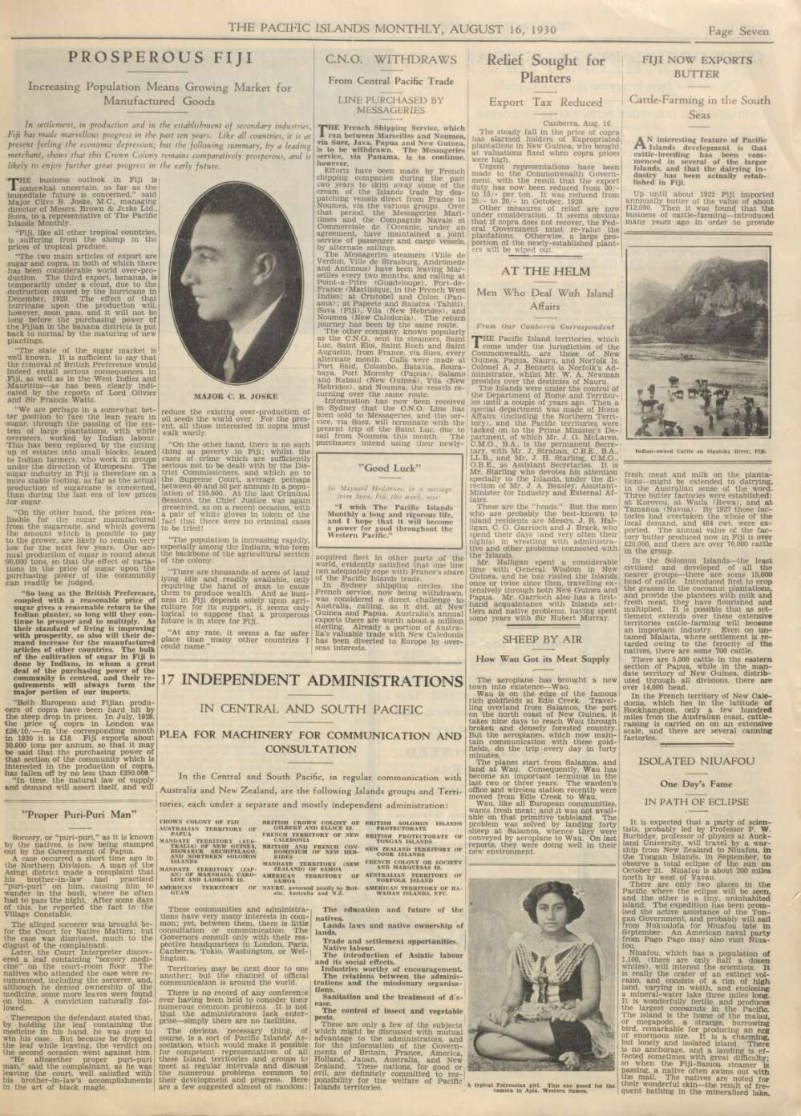
THE business outlook in Fiji is somewhat uncertain, so far as the immediate future is concerned,” said Major Clive B. Joske, M.C., managing director of Messrs. Brown & Jcske Ltd.
Suva, to a representative of The Pacific Islands Monthly.
“Fiji, like all other tropical countries is suffering from the slump in the prices of tropical produce.
“The two main articles of export are sugar and copra, in both of which there has been considerable world over-pro duction. The third export, bananas, is temporarily under a cloud, due to the destruction caused by the hurricane in December, 1929. The effect of that hurricane upon the production will however, soon pass, and it will not be long before the purchasing power of the Fijian in the banana districts is put back to normal by the maturing of new plantings.
“The state of the sugar market is well known. It is sufficient to say that the removal of British Preference would indeed entail serious consequences in Fiji, as well as in the West Indies and Mauritius —as has been clearly indi cated by the reports of Lord Olivier and Sir Francis Watts.
“We are perhaps in a somewhat bet ter position to face the lean years in sugar, through the passing of the sys tem of large plantations, with white overseers, worked by Indian labour.
This has been replaced by the cutting up of estates into small blocks, leased to Indian farmers, who work in groups under the direction of Europeans. The sugar industry in Fiji is therefore on a more stable footing, as far as the actual production of sugarcane is concerned, than during the last era of low prices tor sugar.
“On the other hand, the prices rea lisable for the sugar manufactured from the sugarcane, and which govern the amount which is possible to pay to the grower, are likely to remain very low for the next few' years. Our an nual production of sugar is round about 90,000 tons, so that the effect of varia tions in the price of sugar upon the purchasing power of the community can readily be judged.
“So long as the British Preference, coupled with a reasonable price of sugar gives a reasonable return to the Indian planter, so long will they con tinue to prosper and to multiply. As their standard of living is improving with prosperity, so also will their de mand increase for the manufactured articles of other countries. The bulk of the cultivation of sugar in Fiji is done by Indians, in whom a great deal of the purchasing power of the community is centred, and their re quirements will always form the major portion of our imports, “Both European and Fijian produ cers of copra have been hard hit by the steep drop in prices. In July, 1928, the price of copra in London was £26/10/ —in’“the corresponding month in 1930 it is £lB. Fiji exports about 30,000 tons per annum, so that it may be said that the purchasing power of that section of the community which is interested in the production of copra, has fallen off by no less than £250,000.”
“In time, the natural law of supply and demand will assert itself, and will
reduce the existing over-production of oil seeds the world over. For the pres ent, all those interested in copra must walk warily.
“On the other hand, there is no such thing as poverty in Fiji; whilst the cases of crime which are sufficiently serious not to be dealt with by the Dis trict Commissioners, and which go to the Supreme Court, average perhaps between 40 and 50 per annum in a popu lation of 155,000. At the last Criminal Sessions, the Chief Justice was again presented, as on a recent occasion, with a pair of whits gloves in token of the fact that there were no criminal cases to be tried!
“The population is increasing rapidly, especially among the Indians, who form the backbone of the agricultural section of the colony.
“There are thousands of acres of land lying idle and readily available, only requiring the hand of man to cause them to produce wealth. And as busi ness in Fiji depends solely upon agri culture for its support, it seems only logical to suppose that a prosperous future is in store for Fiji.
“At any rate, it seems a far safer place than many other countries I could name.”