Notable Men of The Pacific
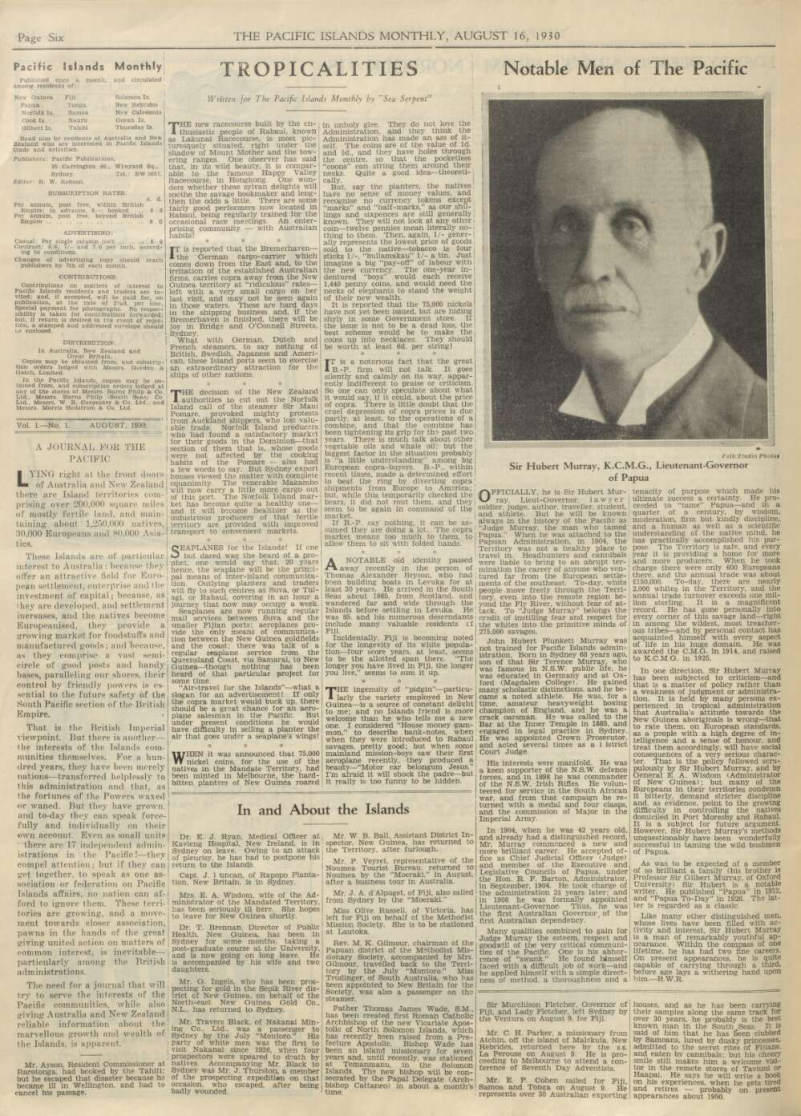
OFFICIALLY, he is Sir Hubert Mur ray, Lieut-Governor, lawyer soldier, judge, author, traveller, student, and athlete. But he will be known always in the history of the Pacific as “Judge Murray, the man who tamed Papua.” When he was attached to the Papuan Administration, in 1904, the Territory was not a healthy place to travel in. Headhunters and cannibals were liable to bring to an abrupt ter mination the career of anyone who ven tured far from the European settle ments of the southeast. To-day, white people move freely through the Terri tory, even into the remote region be yond the Fly River, without fear of at tack. To “Judge Murray” belongs the credit of instilling fear and respect for the whites into the primitive minds of 275,000 savages.
John Hubert Plunkett Murray was not trained for Pacific Islands administration. Born in Sydney 68 years ago, son of that Sir Terence Murray, who was famous in N.S.W. public life, he was educated in Germany and at Ox ford (Magdalen College). He gained many scholastic distinctions, and he be came a noted athlete. He was, for a time, amateur heavyweight boxing champion of England, and he was a crack oarsman. He was called to the Bar at the Inner Temple in 1885, and engaged in legal practice in Sydney.
He was appointed Crown Prosecutor, and acted several times as a District Court Judge.
His interests were manifold. He was a keen supporter of the N.S.W. defence forces, and in 1898 he was commander of the N.S.W. Irish Rifles. He volun teered for service in the South African war, and from that campaign he re turned with a medal and four clasps, and the commission of Major in the Imperial Army.
In 1904, when he was 42 years old, and already had a distinguished record, Mr. Murray commenced a new and more brilliant career. He accepted of fice as Chief Judicial Officer (Judge) and member of the Executive and Legislative Councils of Papua, under the Hon. R. F. Barton, Administrator, in September, 1904. He took charge of the administration 2½ years later; and in 1908 he was formally appointed Lieutenant-Governor. Thus, he was the first Australian Governor of the first Australian dependency.
Many qualities combined to gain for Judge Murray the esteem, respect and goodwill of the very critical communi ties of the Pacific. One is his abhor rence of “swank.” He found himself faced with a difficult job of work—and he applied himself with a simple direct ness of method, a thoroughness and a
tenacity of purpose which made his ultimate success a certainty. He pro ceeded to “tame” Papua—and in a quarter of a century, by wisdom, moderation, firm but kindly discipline, and a human as well as a scientific understanding of the native mind, he has practically accomplished his pur pose. The Territory is safe, and every year it is providing a home for more and more producers. When he took charge there were only 600 Europeans there, and the annual trade was about £150,000. To-day, there are nearly 2,000 whites in the Territory, and the annual trade turnover exceeds one mil lion sterling. It is a magnificent record. He has gone personally into every corner of this savage land —right in among the wildest, most treacher ous tribes —and by personal contact has acquainted himself with every aspect of life in his huge domain. He was awarded the C.M.G. in 1914, and raised to K.C.M.G. in 1925.
In one direction, Sir Hubert Murray has been subjected to criticism —and that is a matter of policy rather than a weakness of judgment or administra tion. It is held by many persons ex perienced in tropical administration that Australia’s attitude towards the New Guinea aboriginals is wrong—that to rate them, on European standards, as a people with a high degree of in telligence and a sense of honour, and treat them accordingly, will have social consequences of a very serious charac ter. That is the policy followed scru pulously by Sir Hubert Murray, and by General E. A. Wisdom (Administrator of New Guinea); but many of the Europeans in their territories condemn it bitterly, demand stricter discipline and, as evidence, point to the growing difficulty in controlling the natives domiciled in Port Moresby and Rabaul.
It is a subject for future argument.
However, Sir Hubert Murray’s methods unquestionably have been wonderfully successful in taming the wild bushmen of Papua.
As was to be expected of a member of so brilliant a family (his brother is Professor Sir Gilbert Murray, of Oxford University) Sir Hubert is a notable writer. He published “Papua” in 1912, and “Papua To-Day” in 1926. The lat ter is regarded as a classic.
Like many other distinguished men, whose lives have been filled with ac tivity and interest, Sir Hubert Murray is a man of remarkably youthful ap nsarance. Within the compass of one lifetime, he has had two fine careers.
On present appearances, he is quite capable of carrying through a third, before age lays a withering hand upon
him.
R.W.R.
Sir Hubert Murray, K.C.M.G., Lieutenant-Governor of Papua