Pacific
Islands
Monthly
Vol. Xii. No. 11.
June 15, 1942
Established 1930
ißegistered at the transmission by post as a newspaper ]
8
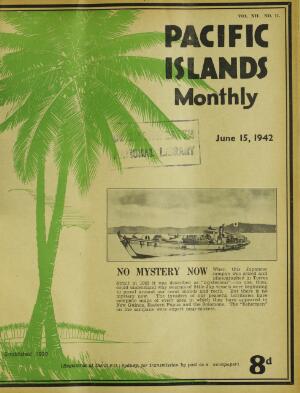
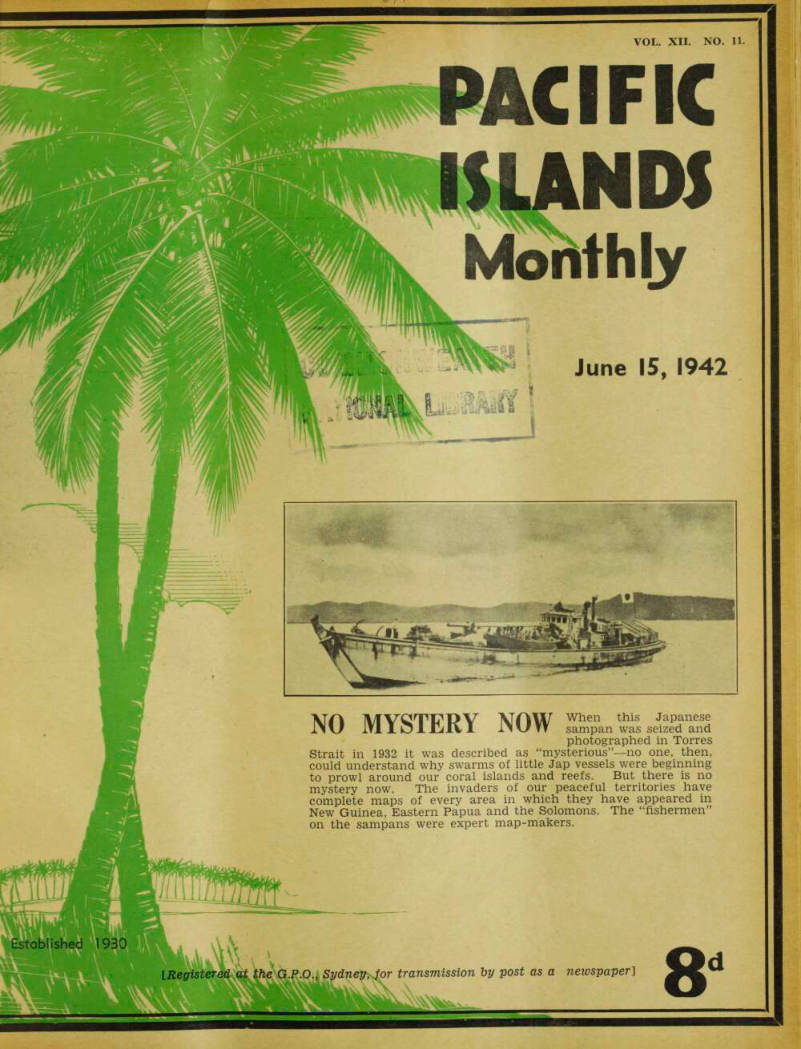
No Mystery Now
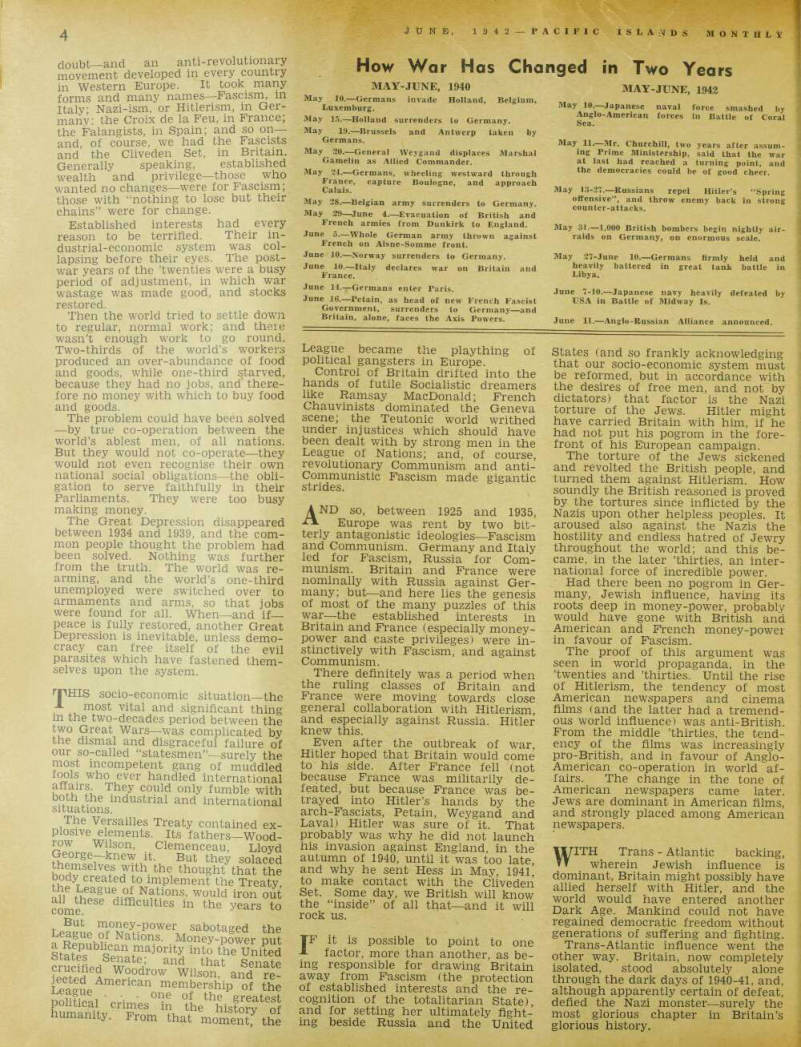
When this Japanese sampan was seized and photographed in Torres Strait in 1932 it was described as “mysterious”—no one, then, could understand why swarms of little Jap vessels were beginning to prowl around our coral islands and reefs. But there is no mystery now. The invaders of our peaceful territories have complete maps of every area in which they have appeared in New Guinea, Eastern Papua and the Solomons. The “fishermen” on the sampans were expert map-makers.
Advertisements & other items, pp. 2-3 (1 item)
Page 2
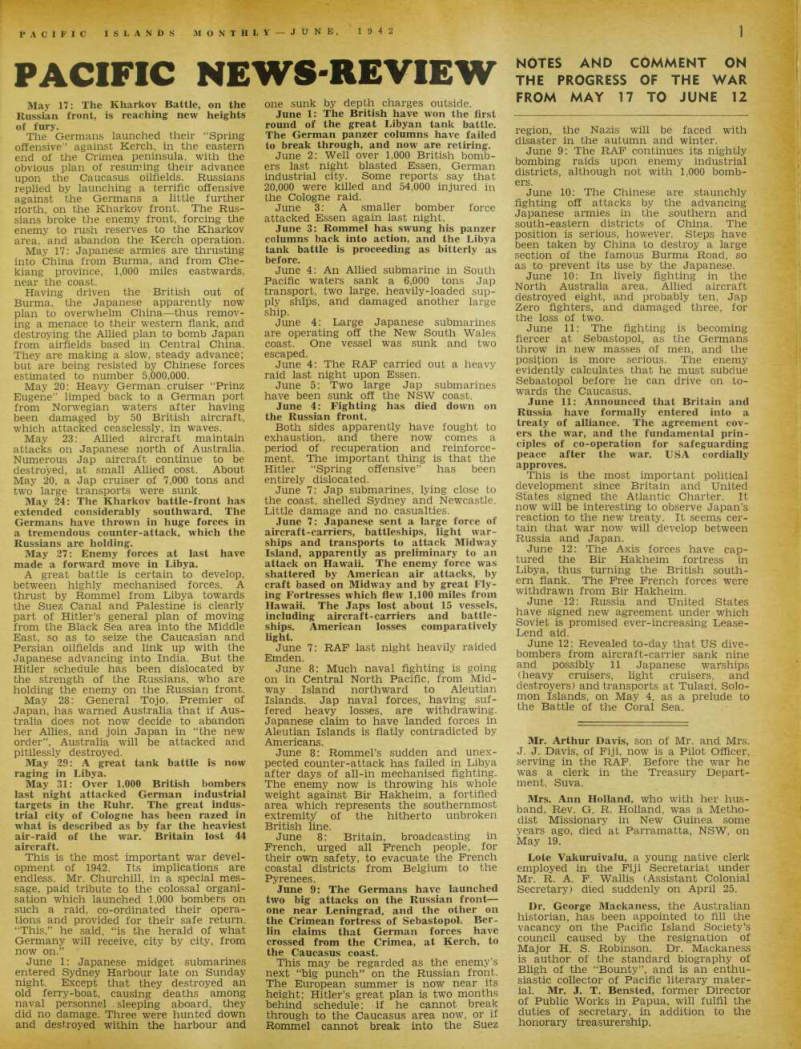
PACIFIC NEWS-REVIEW
NOTES AND COMMENT ON
THE PROGRESS OF THE WAR
FROM MAY 17 TO JUNE 12
May 17: The Kharkov Battle, on the Russian front, is reaching new heights of fury.
The Germans launched their “Spring offensive” against Kerch, in the eastern end of the Crimea peninsula, with the obvious plan of resuming their advance upon the Caucasus oilfields. Russians replied by launching a terrific offensive against the Germans a little further north, on the Kharkov front. The Rus sians broke the enemy front, forcing the enemy to rush reserves to the Kharkov area, and abandon the Kerch operation.
May 17: Japanese armies are thrusting into China from Burma, and from Che kiang province, 1,000 miles eastwards, near the coast.
Having driven the British out of Burma, the Japanese apparently now plan to overwhelm China —thus remov ing a menace to their western flank, and destroying the Allied plan to bomb Japan from airfields based in Central China.
They are making a slow, steady advance; but are being resisted by Chinese forces estimated to number 5,000,000.
May 20: Heavy German cruiser “Prinz Eugene” limped back to a German port from Norwegian waters after having been damaged by 50 British aircraft, which attacked ceaselessly, in waves.
May 23: Allied aircraft maintain attacks on Japanese north of Australia.
Numerous Jap aircraft continue to be destroyed, at small Allied cost. About May 20, a Jap cruiser of 7,000 tons and two large transports were sunk.
May 24: The Kharkov battle-front has extended considerably southward. The Germans have thrown in huge forces in a tremendous counter-attack, which the Russians are holding.
May 27: Enemy forces at last have made a forward move in Libya.
A great battle is certain to develop, between highly mechanised forces. A thrust by Rommel from Libya towards the Suez Canal and Palestine is clearly part of Hitler’s general plan of moving from the Black Sea area into the Middle East, so as to seize the Caucasian and Persian oilfields and link up with the Japanese advancing into India. But the Hitler schedule has been dislocated by the strength of the Russians, who are holding the enemy on the Russian front.
May 28: General Tojo, Premier of Japan, has warned Australia that if Aus tralia does not now decide to abandon her Allies, and join Japan in “the new order”, Australia will be attacked and pitilessly destroyed.
May 29: A great tank battle is now raging in Libya.
May 31: Over 1,000 British bombers last night attacked German industrial targets in the Ruhr. The great indus trial city of Cologne has been razed in what is described as by far the heaviest air-raid of the war. Britain lost 44 aircraft.
This is the most important war devel opment of 1942. Its implications are endless. Mr. Churchill, in a special mes sage, paid tribute to the colossal organi sation which launched 1,000 bombers on such a raid, co-ordinated their opera tions and provided for their safe return.
“This,” he said, “is the herald of what Germany will receive, city by city, from now on.”
June 1: Japanese midget submarines entered Sydney Harbour late on Sunday night. Except that they destroyed an old ferry-boat, causing deaths among naval personnel . sleeping aboard, they did no damage. Three were hunted down and destroyed within the harbour and
one sunk by depth charges outside.
June 1: The British have won the first round of the great Libyan tank battle.
The German panzer columns have failed to break through, and now are retiring.
June 2: Well over 1.000 British bomb ers last night blasted Essen, German industrial city. Some reports say that 20,000 were killed and 54,000 injured in the Cologne raid.
June 3: A smaller bomber force attacked Essen again last night.
June 3: Rommel has swung his panzer columns back into action, and the Libya tank battle is proceeding as bitterly as before.
June 4: An Allied submarine in South Pacific waters sank a 6,000 tons Jap transport, two large, heavily-loaded sup ply ships, and damaged another large ship.
June 4: Large Japanese submarines are operating off the New South Wales coast. One vessel was sunk and two escaped.
June 4: The RAF carried out a heavy raid last night upon Essen.
June 5: Two large Jap submarines have been sunk off the NSW coast.
June 4: Fighting has died down on the Russian front.
Both sides apparently have fought to exhaustion, and there now comes a period of recuperation and reinforce ment. The important thing is that the Hitler “Spring offensive” has been entirely dislocated.
June 7: Jap submarines, lying close to the coast, shelled Sydney and Newcastle.
Little damage and no casualties.
June 7: Japanese sent a large force of aircraft-carriers, battleships, light war ships and transports to attack Midway Island, apparently as preliminary to an attack on Hawaii. The enemy force was shattered by American air attacks, by craft based on Midway and by great Fly ing Fortresses which flew 1,100 miles from Hawaii. The Japs lost about 15 vessels, including aircraft-carriers and battle ships. American losses comparatively light.
June 7: RAF last night heavily raided Emden.
June 8: Much naval fighting is going on in Central North Pacific, from Mid way Island northward to Aleutian Islands. Jap naval forces, having suf fered heavy losses, are withdrawing.
Japanese claim to have landed forces in Aleutian Islands is flatly contradicted by Americans.
June 8: Rommel’s sudden and unex pected counter-attack has failed in Libya after days of all-in mechanised fighting.
The enemy now is throwing his whole weight against Bir Hakheim, a fortified area which represents the southernmost extremity of the hitherto unbroken British line.
June 8: Britain, broadcasting in French, urged all French people, for their own safety, to evacuate the French coastal districts from Belgium to the Pyrenees.
June 9: The Germans have launched two big attacks on the Russian front — one near Leningrad, and the other on the Crimean fortress of Sebastopol. Ber lin claims that German forces have crossed from the Crimea, at Kerch, to the Caucasus coast.
This may be regarded as the enemy’s next “big punch” on the Russian front.
The European summer is now near its height; Hitler’s great plan is two months behind schedule; if he cannot break through to the Caucasus area now, or if Rommel cannot break into the Suez
region, the Nazis will be faced with disaster in the autumn and winter.
June 9: The RAF continues its nightly bombing raids upon enemy industrial districts, although not with 1,000 bomb ers.
June 10: The Chinese are staunchly fighting off attacks by the advancing Japanese armies in the southern and south-eastern districts of China. The position is serious, however. Steps have been taken by China to destroy a large section of the famous Burma Road, so as to prevent its use by the Japanese.
June 10: In lively fighting in the North Australia area, Allied aircraft destroyed eight, and probably ten, Jap Zero fighters, and damaged three, for the loss of two.
June 11: The fighting is becoming fiercer at Sebastopol, as the Germans throw in new masses of men, and the position is more serious. The enemy evidently calculates that he must subdue Sebastopol before he can drive on to wards the Caucasus.
June 11: Announced that Britain and Russia have formally entered into a treaty of alliance. The agreement cov ers the war, and the fundamental prin ciples of co-operation for safeguarding peace after the war. USA cordially approves.
This is the most important political development since Britain and United States signed the Atlantic Charter. It now will be interesting to observe Japan’s reaction to the new treaty. It seems cer tain that war now will develop between Russia and Japan.
June 12: The Axis forces have cap tured the Bir Hakheim fortress in Libya, thus turning the British south ern flank. The Free French forces were withdrawn from Bir Hakheim.
June 12: Russia and United States have signed new agreement under which Soviet is promised ever-increasing Lease- Lend aid.
June 12: Revealed to-day that US dive bombers from aircraft-carrier sank nine and possibly 11 Japanese warships (heavy cruisers, light cruisers, and destroyers) and transports at Tulagi, Solo mon Islands, on May 4, as a prelude to the Battle of the Coral Sea.
Mr. Arthur Davis, son of Mr. and Mrs.
J. J. Davis, of Fiji, now is a Pilot Officer, serving in the RAF. Before the war he was a clerk in the Treasury Depart ment, Suva.
Mrs. Ann Holland, who with her hus band, Rev. G. R. Holland, was a Metho dist Missionary in New Guinea some years ago, died at Parramatta, NSW, on May 19.
Lote Vakuruivalu, a young native clerk employed in the Fiji Secretariat under Mr. R. A. F. Wallis (Assistant Colonial Secretary) died suddenly on April 25.
Dr. George Mackaness, the Australian historian, has been appointed to fill the vacancy on the Pacific Island Society’s council caused by the resignation of Major H. S. Robinson. Dr. Mackaness is author of the standard biography of Bligh of the “Bounty”, and is an enthu siastic collector of Pacific literary mater ial. Mr. J. T. Bensted, former Director of Public Works in Papua, will fulfil the duties of secretary, in addition to the
honorary treasurership.
Contents
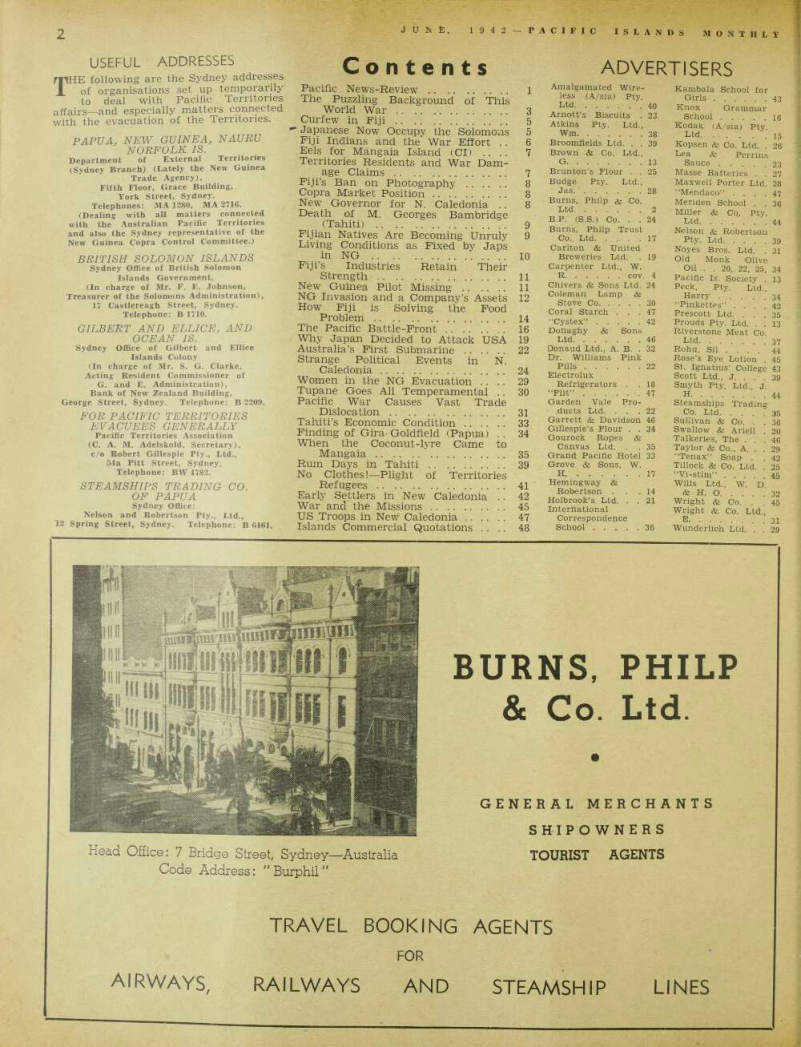
Pacific News-Review 1 The Puzzling Background of This World War 3 Curfew in Fiji 5 Japanese Now Occupy the Solomons 5 Fiji Indians and the War Effort .. 6 Eels for Mangaia Island (Cl) ... 7 Territories Residents and War Dam age Claims 7 Fiji’s Ban on Photography 8 Copra Market Position 8 New Governor for N. Caledonia .. 8 Death of M. Georges Bambridge ... (Tahiti) 9 Fijian Natives Are Becoming Unruly 9 Living Conditions as Fixed by Japs in NG 10 Fiji’s Industries Retain Their Strength 11 New Guinea Pilot Missing 11 NG Invasion and a Company’s Assets 12 How Fiji is Solving the Food Problem 14 The Pacific Battle-Front 16 Why Japan Decided to Attack USA 19 Australia’s First Submarine 22 Strange Political Events in N.
Caledonia 24 Women in the NG Evacuation ... 29 Tupane Goes All Temperamental .. 30 Pacific War Causes Vast Trade Dislocation 31 Tahiti’s Economic Condition 33 Finding of Gira Goldfield (Papua) .. 34 When the Coconut-lyre Came to Mangaia 35 Rum Days in Tahiti 39 No Clothes!—Plight of Territories Refugees 41 Early Settlers in New Caledonia .. 42 War and the Missions 45 US Troops in New Caledonia 47 Islands Commercial Quotations ... 48
Advertisers
Amalgamated Wire less (A/sia) Pty.
Ltd 40 Arnott’s Biscuits . 23 Atkins Pty. Ltd., Wm 38 Broomfields Ltd. . . 39 Brown & Co. Ltd., G 13 Brunton’s Flour . . 25 Budge Pty. Ltd., Jas 28 Burns, Philp & Co.
Ltd 2
B.P. (S.S.) Co. . . 24
Burns, Philp Trust Co. Ltd 17 Carlton & United ' Breweries Ltd. . 19 Carpenter Ltd., W, R cov. 4 Chivers & Sons Ltd. 24 Coleman Lamp & Stove Co 30 Coral Starch ... 47 “Cystex” 42 Donaghy & Sons Ltd 46 Donaud Ltd., A. B. . 32 Dr. Williams Pink Pills 22 Electrolux Refrigerators . . 18 “Flit” 47 Garden Vale Pro ducts Ltd. ... 22 Garrett & Davidson 46 Gillespie’s Flour . . 34 Gourock Ropes & Canvas Ltd. . . 35 Grand Pacific Hotel 33 Grove & Sons, W.
H 17 Hemingway & Robertson ... 14 Holbrook’s Ltd. . . 21 International Correspondence School 36
Kambala School for Girls 43 Knox Grammar School 16 Kodak (A/sia) Pty.
Ltd is Kopsen & Co. Ltd. . 26 Lea & Perrins Sauce 23 Masse Batteries . . 27 Maxwell Porter Ltd. 28 “Mendaco” ... 47 Meriden School . . 36 Miller & Co. Pty.
Ltd 44 Nelson & Robertson Pty. Ltd 39 Noyes Bros. Ltd. . 31 Old Monk Olive Oil . . 20, 22, 25, 34 Pacific Is. Society . 13 Peck, Pty. Ltd., Harry 34 “Pinkettes” ... 42 Prescott Ltd. ... 35 Prouds Pty. Ltd. . . 13 Riverstone Meat Co.
Ltd 37 Rohu, Sil . . . . 44 Rose’s Eye Lotion . 45 St. Ignatius’ College 43 Scott Ltd., J. ... 39 Smyth Pty. Ltd., J.
H 44 Steamships Trading Co. Ltd 3-5 Sullivan & Co. . . 36 Swallow & Ariell . 20 Talkeries, The ... 46 Taylor & Co., A. . . 29 “Tenax” Soap . . 42 Tillock & Co. Ltd. . 25 “Vi-stim” 45 Wills Ltd., W. D. & H. 0 32 Wright & Co. . . 45 Wright & Co. Ltd., E 31 Wunderlich Ltd. . . 29
Advertisements & other items, p. 4 (2 items)
Useful Addresses
THE following are the Sydney addresses of organisations set up temporarily to deal with Pacific Territories affairs—and especially matters connected with the evacuation of the Territories.
PAPUA, NEW GUINEA, NAURU
NORFOLK IS.
Department of External Territories (Sydney Branch) (Lately the New Guinea Trade Agency), Fifth Floor, Grace Building, York Street, Sydney.
Telephones: MA 1280, MA 2716. (Dealing with all matters connected with the Australian Pacific Territories and also the Sydney representative of the New Guinea Copra Control Committee.)
BRITISH SOLOMON ISLANDS
Sydney Office of British Solomon Islands Government, (In charge of Mr. F, E. Johnson, Treasurer of the Solomons Administration), 17 Castlereagh Street, Sydney.
Telephone: B 1710.
GILBERT AND ELLICE, AND
OCEAN IS.
Sydney Office of Gilbert and Ellice Islands Colony (In charge of Mr. S. G. Clarke, Acting Resident Commissioner of G. and E. Administration), Bank of New Zealand Building, George Street, Sydney, Telephone; B 2209.
FOR PACIFIC TERRITORIES
EVACUEES GENERALLY
Pacific Territories Association (C. A. M. Adelskold, Secretary), c/o Robert Gillespie Pty., Ltd., 54a Pitt Street, Sydney.
Telephone: BW 4782.
STEAMSHIPS TRADING CO.
OF PAPUA
Sydney Office: Nelson and Robertson Pty., Ltd., 12 Spring Street, Sydney. Telephone: B 6461.
Burns, Philp
m ■ir B j iiimiin
iiiiiiii
i in mi HI 111 i
tin
mm I p Mi .
Head Office: 7 Bridge Street, Sydney—Australia Code Address: " Burphil"
BURNS, PHILP
& Co. Ltd.
GENERAL MERCHANTS
SHIPOWNERS
TOURIST AGENTS
TRAVEL BOOKING AGENTS
FOR
airways, railways and steamship lines
Pacific Islands Monthly
The Newspaper-Magazine of the South Seas LRegistered at the G.P.0., Sydney, for transmission by post as a newspaper .]
Published Once Each Month and Circulated in Australia and New Zealand and in the following Pacific Territories and Islands Groups;
Australian Territory of Papua.
Mandated Territory (Australia) of New Guinea.
Australian Territory of Norfolk Island.
New Zealand Territory of Cook Islands.
Mandated Territory (NZ) of Western Samoa.
British Colony of Fiji.
British Solomon Islands Protectorate.
British Protectorate of Tongan Islands.
British Crown Colony of Gilbert and Ellice Islands.
Mandated Territory of Nauru.
British and Free French Condominium of New Hebrides.
Free French Colony of New Caledonia.
Free French Colony of Oceania (Tahiti, etc.).
American Territory of Eastern Samoa.
American Territory of Hawaiian Islands.
Owned and Produced by Pacific Publications Pty. Ltd., Union House, 247 George Street, Sydney.
TFT fpttdnf S Managing Director .. BW 5037 ielephowe £ Business and Editorial MA 4369
P.O. Box 3408 R
Registered Address of Telegrams, Radiograms, and Cables: “Pacpub”, Sydney.
Contributions.
Articles, Stories, and Photographs dealing with Pacific Islands subjects are invited and will be paid for on publication.
Subscription Rates.
Per Annum, within British Empire, Prepaid, Post Free 8/- Per Annum, elsewhere, prepaid, Post Free. 107- Single Copies Bd.
Editor and Publisher:
R. W. Robson, F.R.G.S.
Assisted by Selwyn Hughes.' Advertising Manager; L. W. Bailey.
Advertising Office and Printing-House: 29 Alberta Street, Sydney.
Advertising rates furnished on application.
Colours, etc., by arrangement.
Process Blocks made at Advertiser’s expense when required. Screen 100.
Changes of Advertising Copy should reach this office by Ist of each month, otherwise previous advertisement may be repeated.
Representative In London.
W. C. Harvey, Coronation House, 4 Lloyds Avenue, London, E.C.3, from whom may be obtained copies of Pacific Islands Monthly, Pacific Is. Year Book, advertising schedules, etc.
Agents.
The following are authorised to receive sub scriptions for Pacific Islands Monthly;— Burns, Philp & Co., Ltd., and Burns Phllp (South Sea) Co., Ltd. All branches.
W. R. Carpenter & Co., Ltd. All branches.
Morris, Hedstrom, Ltd. All branches.
Steamships Trading Co., Papua. All branches.
B.N.G. Trading Co., Ltd., Port Moresby, Papua.
J. Muir, Suva. Fiji.
Miss R. Castles, Suva, Fiji.
N. C. Mackenzie Hunt, Wainunu, Bua, Fiji.
Kirpal & Co., Victoria Parade, Suva, Fiji.
Cook Islands Trading Co,, Rarotonga, Cook Is.
A. C. Rowland, Papeete. Tahiti.
Islands Branches and Representatives of W. H.
Grove & Sons, Ltd., Auckland, New Zealand.
Ed. Pentecost, Noumea, New Caledonia.
Kerr & Co., Noumea, New Caledonia.
Vol. XII. No. 11.
June 15, 1942
PrirP i Bd ’ Per Copy 'i Iv-c £ Prepaid: 8/- p.a.
The Puzzling Background Of This
World War
“I have been reading Shiver’s ‘Berlin Diary’. And I want to ask you : If the causes of this foul war were seen so clearly years before it broke out, why did we do nothing to prevent it? If we had warnings of what Italy and Germany and Japan intended to do, why did we not prepare for them?” —In a letter from a young reader of the “PIM”.
IT is impossible to discuss this World War piece-meal. The thing that is happening in the Pacific to-day is closely linked with what happened in Russia yesterday.
The events of to-day in Libya will bear directly on what happens in Western Germany or China to morrow. It is a vast checker-board, on which every piece is placed and moved in close relationship with every other piece. And the causes of this war go far back into past de cades.
We cannot hope to make a reason ably correct estimate of what is happening, and is likely to happen, unless we appreciate the vast and complicated socio-economic back ground of these events, the tremend ous canvas upon which this section of human history is being recorded, and the intricate pattern of the picture that is being made. Demo cracy, we believe, will win the war; but unless democracy can get that background into focus, democracy will make a terrible mess of the peace.
And how can the masses which constitute democracy get the grip of understanding upon the real issues, when those issues are so vast and so elusive that they defeated the states men of two decades, and brought European civilisation within a hair’s breadth of destruction in 1940?
THE roots of this World War lie deep in the failure of the demo cratic system to control money power. The development of machines, incredible improvements in trans portation, the appearance of radio and aviation, changed the face of civilisation. Those things should have been used to give more comfort, more security, more culture to humanity as a whole. That was achieved, to an extent—but only as a secondary consideration.
A world that even yet has not escaped from the ideas of feudalism accepted as a principle the practice that developed in the last hundred years, that every advance and dis covery in production and distribution should be used primarily to give ever greater riches and privileges to a com parative few.
The evil was accentuated by, and became manifest in the establish ment and growth of international combines. The latter organised mono polies in most of humanity’s funda mental needs (especially foodstuffs, entertainment, transport and com
munications) and a fuddled demo cratic system allowed them to handle those monopolies with profit and privilege as a primary consideration, while their obligations to humanity were allowed to be a secondary matter, or were ignored altogether.
It may not be easy to see: but every known fact of history and logic insists that therein lie the roots of this hellish war.
THE Victory and Peace of 1918 were to make the world safe for democracy. Actually, they only gave greater strength and power to the already entrenched interests of privi lege and money. The masses, un comprehending, but dimly conscious that somehow they had been tricked, blindly resentful of the increasing activities of international money power and combines preying upon the democratic system, began to seethe. Discontent was translated into extreme political action in nearly every country—almost revolutionary, but still contained within and con trolled by the Parliamentary system.
But the Parliamentary system was under a severe strain, and in danger of breaking. “Why should our move ments be controlled by the Parlia mentary (democratic) system, while international money-power dodges and evades all Parliamentary con trol?” cried the Leftist leaders. They turned for inspiration to Communist Russia, then in the throes of “extremism”.
WEALTH and privilege were terri fied—of that there can be no
doubt—and an anti-revolutionary movement developed in every country in Western Europe. It took many forms and many names—Fascism, in Italy; Nazi-ism, or Hitlerism, in Ger many; the Croix de la Feu, in France; the Falangists, in Spain; and so on— and of course, we had the Fascists and the Cliveden Set, in Britain.
Generally speaking, established wealth and privilege—those who wanted no changes—were for Fascism; those with “nothing to lose but their chains” were for change.
Established interests had every reason to be terrified. Their in dustrial-economic system was col lapsing before their eyes. The post war years of the ’twenties were a busy period of adjustment, in which war wastage was made good, and stocks restored.
Then the world tried to settle down to regular, normal work; and there wasn’t enough work to go round.
Two-thirds of the world’s workers produced an over-abundance of food and goods, while one-third starved, because they had no jobs, and there fore no money with which to buy food and goods.
The problem could have been solved —by true co-operation between the world’s ablest men, of all nations.
But they would not co-operate—they would not even recognise their own national social obligations—the obli gation to serve faithfully in their Parliaments. They were too busy making money.
The Great Depression disappeared between 1934 and 1939, and the com mon people thought the problem had been solved. Nothing was further from the truth. The world was re arming, and the world’s one-third unemployed were switched over to armaments and arms, so that jobs were found for all. When—and if— peace is fully restored, another Great Depression is inevitable, unless demo cracy can free itself of the evil parasites which have fastened them selves upon the system. rpHIS socio-economic situation—the A most vital and significant thing m the two-decades period between the two Great Wars—was complicated by the dismal and disgraceful failure of
our so-called “statesmen”—surely the
most incompetent gang of muddled fools who ever handled international could only fumble with both the industrial and international situations.
The Versailles Treaty contained ex plosive elements. Its fathers—Wood row Wilson, Clemenceau, Lloyd George—knew it. But they solaced themseives with the thought that the body created to implement the Treaty, an 6 Nations, would iron out come h dimculties the years to But money-power sabotaged the League of Nations. Money-power put lt?fpq Übl i Can f ma;sority into the United A Woodrow Wilson, and re- Leaffup Am6riCan membei *ship of the .League . . . one of the ereatp<?t political crimes in the histmv 1 of humanity. From that moment? th
League became the plaything of political gangsters in Europe.
Control of Britain drifted into the hands of futile Socialistic dreamers like Ramsay MacDonald; French Chauvinists dominated the Geneva scene; the Teutonic world writhed under injustices which should have been dealt with by strong men in the League of Nations; and, of course, revolutionary Communism and anti- Communistic Fascism made gigantic strides.
AND so, between 1925 and 1935, Europe was rent by two bit terly antagonistic ideologies—Fascism and Communism. Germany and Italy led for Fascism, Russia for Com munism. Britain and France were nominally with Russia against Ger many; but—and here lies the genesis of most of the many puzzles of this war—the established interests in Britain and France (especially money power and caste privileges) were in stinctively with Fascism, and against Communism.
There definitely was a period when the ruling classes of Britain and France were moving towards close general collaboration with Hitlerism, and especially against Russia. Hitler knew this.
Even after the outbreak of war, Hitler hoped that Britain would come to his side. After France fell (not because France was militarily de feated, but because France was be trayed into Hitler’s hands by the arch-Fascists, Retain, Weygand and Laval) Hitler was sure of it. That probably was why he did not launch his invasion against England, in the autumn of 1940, until it was too late, and why he sent Hess in May, 1941, to make contact with the Cliveden Set. Some day, we British will know the “inside” of all that—and it will rock us.
IF it is possible to point to one factor, more than another, as be ing responsible for drawing Britain away from Fascism (the protection of established interests and the re cognition of the totalitarian State), and for setting her ultimately fight ing beside Russia and the United
States (and so frankly acknowledging that our socio-economic system must be reformed, but in accordance with the desires of free men, and not by dictators) that factor is the Nazi torture of the Jews. Hitler might have carried Britain with him, if he had not put his pogrom in the fore front of his European campaign.
The torture of the Jews sickened and revolted the British people, and turned them against Hitlerism. How soundly the British reasoned is proved by the tortures since inflicted by the Nazis upon other helpless peoples. It aroused also against the Nazis the hostility and endless hatred of Jewry throughout the world; and this be came, in the later ’thirties, an inter national force of incredible power.
Had there been no pogrom in Ger many, Jewish influence, having its roots deep in money-power, probably would have gone with British and American and French money-power in favour of Fascism.
The proof of this argument was seen in world propaganda, in the ’twenties and ’thirties. Until the rise of Hitlerism, the tendency of most American newspapers and cinema films (and the latter had a tremend ous world influence) was anti-British.
From the middle ’thirties, the tend ency of the films was increasingly pro-British, and in favour of Anglo- American co-operation in world af fairs. The change in the tone of American newspapers came later.
Jews are dominant in American films, and strongly placed among American newspapers.
WITH Trans - Atlantic backing, wherein Jewish influence is dominant, Britain might possibly have allied herself with Hitler, and the world would have entered another Dark Age. Mankind could not have regained democratic freedom without generations of suffering and fighting.
Trans-Atlantic influence went the other way. Britain, now completely isolated, stood absolutely alone through the dark days of 1940-41, and, although apparently certain of defeat, defied the Nazi monster—surely the most glorious chapter in Britain’s glorious history.
A year later (June, 1941), Russia was at war with Germany; and, six months after that, the militaristic madmen of Japan brought into the war, beside Britain and Russia, a United States more completely united and war-like than ever before in her history; and thus the doom of the Axis in general, and of Hitlerism in particular, was irrevocably sealed.
The end of the war is only a matter of time, patience and hard work.
BUT what of the peace that will follow? Will the world return to a democracy that was but the play thing of the parasites which had battened upon it? It will not. The background of the war, sketched roughly in this article, shows that if an attempt is made to restore what is so blandly called the status quo ante helium, the peace will be far worse than the war. That danger of a plunge into another Dark Age will not disappear with the Axis.
We must retain our democracy, while ruthlessly destroying the rub bish that has encumbered it. In dividualism, freedom of competition in rendering service, stimulation and encouragement of private enterprise —these are the keystones of our democratic system, evolved in two thousand years of human effort; and they must not be destroyed. What must go is the parasitism which has been developed, with genius incred ible, by the highwaymen of our modern world, and fastened cun ningly by them, for their own en richment, upon the healthy body of our democracy.
If the effect of World War II is to line up the nations of the world for the planning of a New Order, cal culated to preserve and extend the dearly-won liberties of mankind (in contrast with the Hitler and Tojd New Order, which would finally des troy individual liberty), then the horrors of Hitlerism will not have been suffered in vain.—R.
How War Hos Changed in Two Years
May-June, 1940
May 10.—Germans invade Holland, Belgium, Luxemburg.
May 15.—Holland surrenders to Germany.
May 19.—Brussels and Antwerp taken by Germans.
May 20. —General Weygand displaces Marshal Gamelin as Allied Commander.
May 24.—Germans, wheeling westward through France, capture Boulogne, and approach Calais.
May 28.—Belgian army surrenders to Germany.
May 29—June 4.—Evacuation of British and French armies from Dunkirk to England.
June s.—Whole German army thrown against French on Aisne-Somme front.
June 10.—Norway surrenders to Germany.
June 10.—Italy declares war on Britain and France.
June 14.—Germans enter Paris.
June 16.—Petain, as head of new French Fascist Government, surrenders to Germany—and Britain, alone, faces the Axis Powers.
May-June, 1942
May 10. Japanese naval force smashed by Anglo-American forces in Battle of Coral Sea.
May 11.—Mr. Churchill, two years after assum ing Prime Ministership, said that the war at last had reached a turning point, and the democracies could be of good cheer.
May 13-27.—Russians repel Hitler’s “Spring offensive”, and throw enemy back in strong counter-attacks.
May 31.—1,000 British bombers begin nightly air raids on Germany, on enormous scale.
May 27-June 10.—Germans firmly held and heavily battered in great tank battle in Libya.
June 7-10.—Japanese navy heavily defeated by USA in Battle of Midway Is.
June 11. —Anglo-Russian Alliance announced.
Curfew In Fiji
All Home by 11.30
BY a Gazette issued on May 12, the Government of Fiji brought “Cur few Regulations” into operation, as from June 1, 1942. These provide that no person may be abroad without a per mit, in the defined areas of Suva, Lau toka and Momi, between 11.30 pm. and 5 am.
There was a call for a curfew for Fijian natives (see article on page 9 of this issue): but the imposition of a cur few on the other three communities (European, Indian and Chinese) came as something of a surprise. Late revellers in Suva—and there have been many such, since social life there was jazzed up by the presence of troops—will not like it much.
The curfew will remain for the dura tion of the war. It is hoped by many that, so far as it applies to the less sophisticated non-European classes, it will remain indefinitely.
Solomons
Japanese Now Occupy The
Allied Planes Repeatedly Raid Enemy Seaplane Base at Tulagi
(ADAPTED FROM RADIO BROADCAST BY R. W. ROBSON)
MANY of us, who had been trying to follow any southwards progress of the Japanese which might be indicated in the official communiques, learned with something of a shock on May 30 that the enemy has established a seaplane base at Tulagi, in the British Solomon Islands, and is apparently present in that area in some strength.
The following are the dates and exact phraseology of the various official communiques: T ,„ ’ , , r ™ , • /c. , , Issued Saturday, May 30: Tulagi (Solomons).— The enemy seaplane base was attacked on Friday night by our Air Force. Fires started and destroyed fuel dumps, wharves, and adjoining buildings, and were visible for so miles. An enemy flying-boat was destroyed and antiaircraft guns at Tanamboga and Gavutu were sllenced> (Gavutu and Tanamboga are little islands near Tulagi Island.) Issued Wednesday, June 3: Solomons.—Tulagi: Our Air Force bombed enemy installations. starting huge fires. One large warehouse was destroyed. All of our planes returned.
V. „ .
Issued Friday, June 5: Solomons.-Tulagi: An Allied reconnaissance aircraft machine-gunned an enemy float-plane on the water. „ J , Until May 30, nothing had been said of strong Japanese penetration of the Solomons. Enemy landings at Faisi and Gizo, up near the New Guinea Mandated Territory, and at Santa Cruz, in the extreme south of the group, had been reported—but, generally, such news as we had had indicated that the
enemy’s activities in this area had been mostly air reconnaissance, As is well known, the European women were evacuated from the Solomons in December and January; but it was assumed that some British Government officials still were at administrative head quarters in Tulagi, and that a few coco nut planters were hanging on in the other islands. We regarded the Solo m2!ls L as a No-Man’s-Land.
But now we know that the Japanese are at Gizo and Faisi, and that they u.,. 0 „I m,, r • . aVG a base at Tulagi, and are present there in sufficient strength to require the frequent attentions of our bombers. It is clear, therefore, that the Japanese, for the present, are virtually in occupation of the Solomons.
A Tokio message, published in Sydney 0 n June 2, claimed precisely that. Japan it said. now occup i es the Solomons.
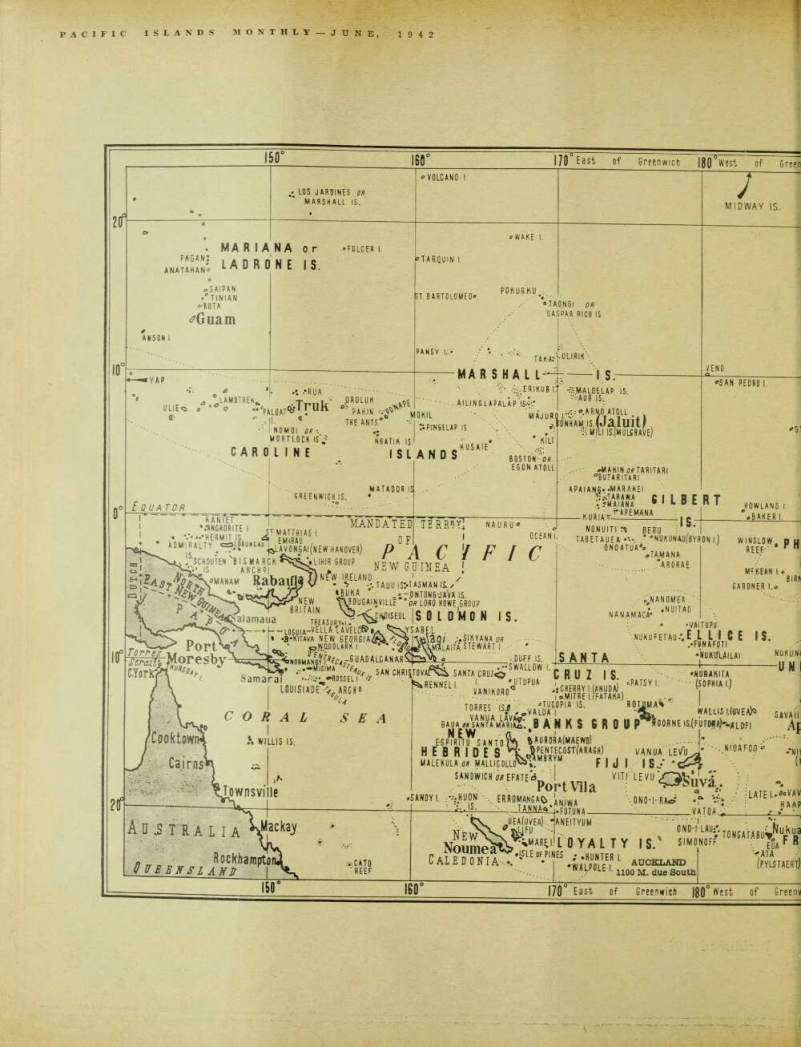
Apart from strategical considerations this is not a Very serious item in the wnrlH-wnr rmtfprn Fmnomiooll,, worm-war pattern Economically the Solomons are of little value. But that is cold comfort for the planters and trad „„„ TTT i ilr „ •„ • „ , T . ? rS wl ™, like their fellows in New Guinea, have been forced to leave all their pos sessions and a lifetime of work, to Jap anese invaders and native looters mHE map does not give the impression X that the Solomdhs are unimportant There, one sees a double chain com prising six of the largest islands in the South Pacific—with an area of well over
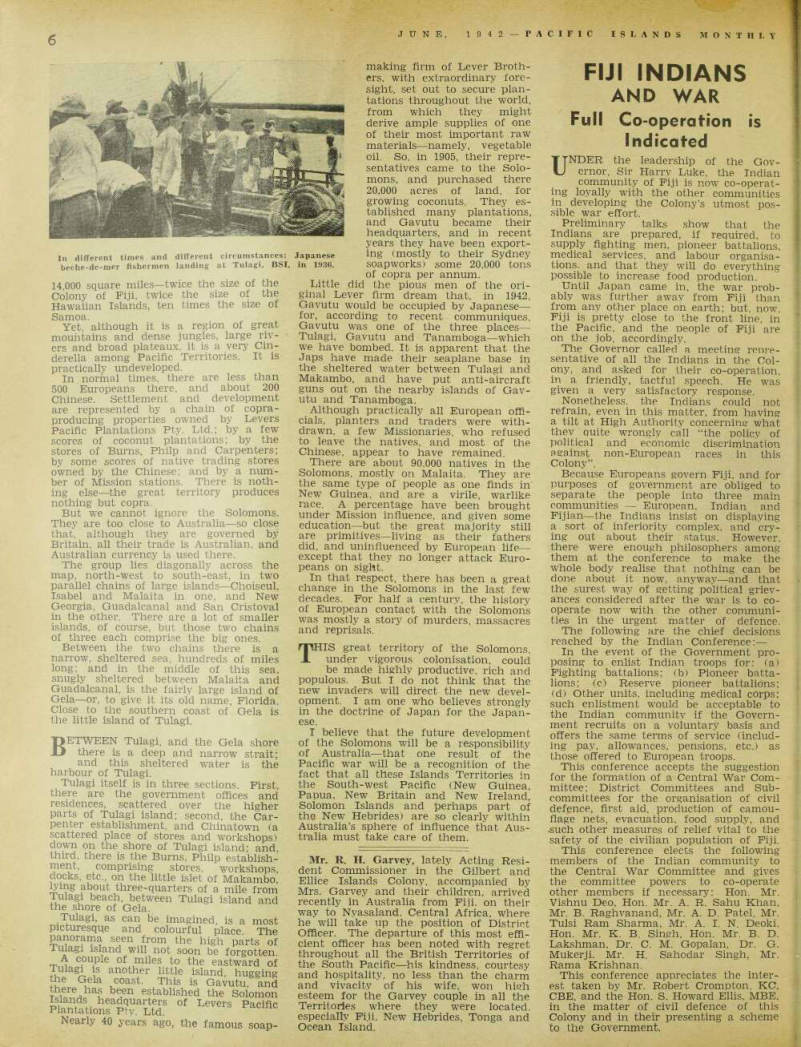
This photograph of Tulagi (kindly made available by the Melanesian Mission) shows an area now in the occupation of the Japanese and used by them as a seaplane base.
The picture was taken from the high (or residential) portion of little Tulagi island. At the foot of the hill is seen the commercial section (Carpenters’ stores, etc.) and part of Chinatown.
Looking eastward, across the water, over half a mile away, is the islet of Makambo, where is the Burns, Philp establishment. The shore of the big island of Gela is seen in the distance, beyond Makambo. The islet of Gavutu (headquarters of Levers Pacific Plantations, Pty., Ltd.) and Tanamboga islet, are round to the right, two miles away.
Our planes, on May 29 and subsequently, severely bombed this seaplane base, including the buildings on Makambo and anti-aircraft guns on Gavutu and Tanamboga.
14,000 square miles—twice the size of the Colony of Fiji, twice the size of the Hawaiian Islands, ten times the size of Samoa.
Yet, although it is a region of great mountains and dense jungles, large riv ers and broad plateaux, it is a very Cin derella among Pacific Territories. It is practically undeveloped.
In normal times, there are less than 500 Europeans there, and about 200 Chinese. Settlement and development are represented by a chain of copra producing properties owned by Levers Pacific Plantations Pty. Ltd.; by a few scores of coconut plantations; by the stores of Burns, Philp and Carpenters; by some scores of native trading stores owned by the Chinese; and by a num ber of Mission stations. There is noth ing else —the great territory produces nothing but copra.
But we cannot ignore the Solomons.
They are too close to Australia —so close that, although they are governed by Britain, all their trade is Australian, and Australian currency is used there.
The group lies diagonally across the map. north-west to south-east, in two parallel chains of large islands—Choiseul, Isabel and Malaita in one, and New Georgia, Guadalcanal and San Cristoval in the other. There are a lot of smaller islands, of course, but those two chains of three each comprise the big ones.
Between the two chains there is a narrow, sheltered sea, hundreds of miles long; and in the middle of this sea, snugly sheltered between Malaita and Guadalcanal, is the fairly large island of Gela —or, to give it its old name, Florida.
Close to the southern coast of Gela is the little island of Tulagi.
BETWEEN Tulagi, and the Gela shore there is a deep and narrow strait; and this sheltered water is the harbour of Tulagi.
Tulagi itself is in three sections. First, there are the government offices and residences, scattered over the higher parts of Tulagi island; second, the Car penter establishment, and Chinatown (a scattered place of stores and workshops) down on the shore of Tulagi island; and. third, there is the Burns, Philp establish ment, comprising stores, workshops, docks, etc., on the little islet of Makambo, lying about three-quarters of a mile from Tulagi beach, between Tulagi island and the shore of Gela.
Tulagi, as can be imagined, is a most picturesque and colourful place The panorama seen from the high parts of Tulagi island will not soon be forgotten.
A couple of miles to the eastward of Tulagi is another little island, hugging G Sf la u coast - This is Gavutu, and there has been established the Solomon Islands headquarters of Levers Pacific Plantations Pty. Ltd.
Nearly 40 years ago, the famous soap
making firm of Lever Broth ers, with extraordinary fore sight, set out to secure plan tations throughout the world, from which they might derive ample supplies of one of their most important raw materials —namely, vegetable oil. So, in 1905, their repre sentatives came to the Solo mons, and purchased there 20,000 acres of land, for growing coconuts. They es tablished many plantations,, and Gavutu became their headquarters, and in recent years they have been export ing (mostly to their Sydney soapworks) some 20,000 tons of copra per annum.
Little did the pious men of the ori ginal Lever firm dream that, in 1942, Gavutu would be occupied by Japanese— for, according to recent communiques, Gavutu was one of the three places— Tulagi, Gavutu and Tanamboga—which we have bombed. It is apparent that the Japs have made their seaplane base in the sheltered water between Tulagi and Makambo, and have put anti-aircraft guns out on the nearby islands of Gav utu and Tanamboga.
Although practically all European offi cials, planters and traders were with drawn, a few Missionaries, who refused to leave the natives, and most of the Chinese, appear to have remained.
There are about 90,000 natives in the Solomons, mostly on Malaita. They are the same type of people as one finds in New Guinea, and are a virile, warlike race. A percentage have been brought under Mission influence, and given some education—but the great majority still are primitives—living as their fathers did, and uninfluenced by European life— except that they no longer attack Euro peans on sight.
In that respect, there has been a great change in the Solomons in the last few decades. For half a century, the history of European contact with the Solomons was mostly a story of murders, massacres and reprisals.
THIS great territory of the Solomons, under vigorous colonisation, could be made highly productive, rich and populous. But I do not think that the new invaders will direct the new devel opment. I am one who believes strongly in the doctrine of Japan for the Japan ese.
I believe that the future development of the Solomons will be a responsibility of Australia—that one result of the Pacific war will be a recognition of the fact that all these Islands Territories in the South-west Pacific (New Guinea.
Papua, New Britain and New Ireland, Solomon Islands and perhaps part of the New Hebrides) are so clearly within Australia’s sphere of influence that Aus tralia must take care of them.
Mr. R. H. Garvey, lately Acting Resi dent Commissioner in the Gilbert and Ellice Islands Colony, accompanied by Mrs. Garvey and their children, arrived recently in Australia from Fiji, on their way to Nyasaland. Central Africa, where he will take up the position of District Officer. The departure of this most effi cient officer has been noted with regret throughout all the British Territories of the South Pacific—his kindness, courtesy and hospitality, no less than the charm and vivacity of his wife, won high esteem for the Garvey couple in all the Territories where they were located, especially Fiji, New Hebrides, Tonga and Ocean Island.
In different times and different circumstances: Japanese beche-de-mer fishermen landing at Tulagi, BSI, in 1936.
Advertisements & other items, p. 7 (1 item)
5
PA C I iC ISLANDS MONTHLY JUNE, 1942
Fiji Indians
And War
Full Co-operation is Indicated
UNDER the leadership of the Gov ernor, Sir Harry Luke, the Indian community of Fiji is now co-operat ing loyally with the other communities in developing the Colony’s utmost pos sible war effort.
Preliminary talks show that the Indians are prepared, if required, to supply fighting men, pioneer battalions, medical services, and labour organisa tions. and that they will do everything possible to increase food production.
Until Japan came in, the war prob ably was further away from Fiji than from any other place on earth; but, now.
Fiji is pretty close to the front line, in the Pacific, and the neople of Fiji are on the job, accordingly.
The Governor called a meeting repre sentative of all the Indians in the Col ony, and asked for their co-operation, in a friendly, tactful speech. He was given a very satisfactory response.
Nonetheless, the Indians could not refrain, even in this matter, from having a tilt at High Authority concerning what thev quite wrongly call “the policy of political and economic discrimination against non-European races in this Colony”.
Because Europeans govern Fiji, and for purposes of government are obliged to separate the people into three main communities European, Indian and Fijian—the Indians insist on displaying a sort of inferiority complex, and cry ing out about their status. However, there were enough philosophers among them at the conference to make the whole body realise that nothing can be done about it now, anyway—and that the surest way of getting political griev ances considered after the war is to co operate now with the other communi ties in the urgent matter of defence.
The following are the chief decisions reached by the Indian Conference:— In the event of the Government pro posing to enlist Indian troops for: (a) Fighting battalions; (b) Pioneer batta lions: (c) Reserve pioneer battalions; (d) Other units, including medical corps; such enlistment would be acceptable to the Indian community if the Govern ment recruits on a voluntary basis and offers the same terms of service (includ ing pay, allowances, pensions, etc.) as those offered to European troops.
This conference accepts the suggestion for the formation of a Central War Com mittee: District Committees and Sub committees for the organisation of civil defence, first aid, production of camou flage nets, evacuation, food supply, and -such other measures of relief vital to the safety of the civilian population of Fiji.
This conference elects the following members of the Indian community to the Central War Committee and gives the committee powers to co-operate other members if necessary: Hon. Mr.
Vishnu Deo, Hon. Mr. A. R. Sahu Khan, Mr. B. Raghvanand, Mr. A. D. Patel, Mr.
Tulsi Ram Sharma, Mr. A. I. N. Deoki, Hon. Mr. K. B. Singh. Hon. Mr. B. D.
Lakshman, Dr. C. M. Gopalan, Dr. G.
Mukerji. Mr. H. Sahodar Singh, Mr.
Rama Krishnan.
This conference appreciates the inter est taken by Mr. Robert Crompton. KC, CBE, and the Hon. S. Howard Ellis. MBE, in the matter of civil defence of this Colony and in their presenting a scheme to the Government.
Eels For Mangaia
Captain Andy Thomson Becomes a Good Sea Fairy
rE Cook Islands are fortunate in possessing an outsize in good fairies in the form of Captain “Andy”
Thomson, of the schooner “Tiare Tap oro”, who drifts eternally from isle to isle, casting golden-toothed sunshine wherever he makes a landfall.
Captain Thomson takes a keen inter est in the welfare of the Islanders, par ticularly in matters of health and food distribution, and natives and whites alike have benefited by his thoughtful Outstanding of his good deeds was the stocking of the Cook Islands with mos quito-fish. brought from Tahiti. All streams and taro swamps now abound with these useful little creatures, which destroy the mosquito larvae.
Mangaia, southernmost of the Cooks, is a “hard” island for food-fish; and in an endeavour to add to the diet of the Mangaians, Captain Thomson recently
brought a quantity of the celebrated eels, known as “itiki”, which are plentiful in the swampy interior of Mitiaro Island (Southern Cook Group).
Near Tamarua village, on Mangaia, is a fairlv large sheet of water, and fring ing swamps, called Tiriara.
Where the water meets the foot of the sheer cliff of the “makatea”, a cavern, famed in Mangaian history and legend, carries the overflow under the mass of raised coral, half a mile, to the ocean.
Captain Thomson considered that this little lake would be an ideal breeding place for “itiki”.
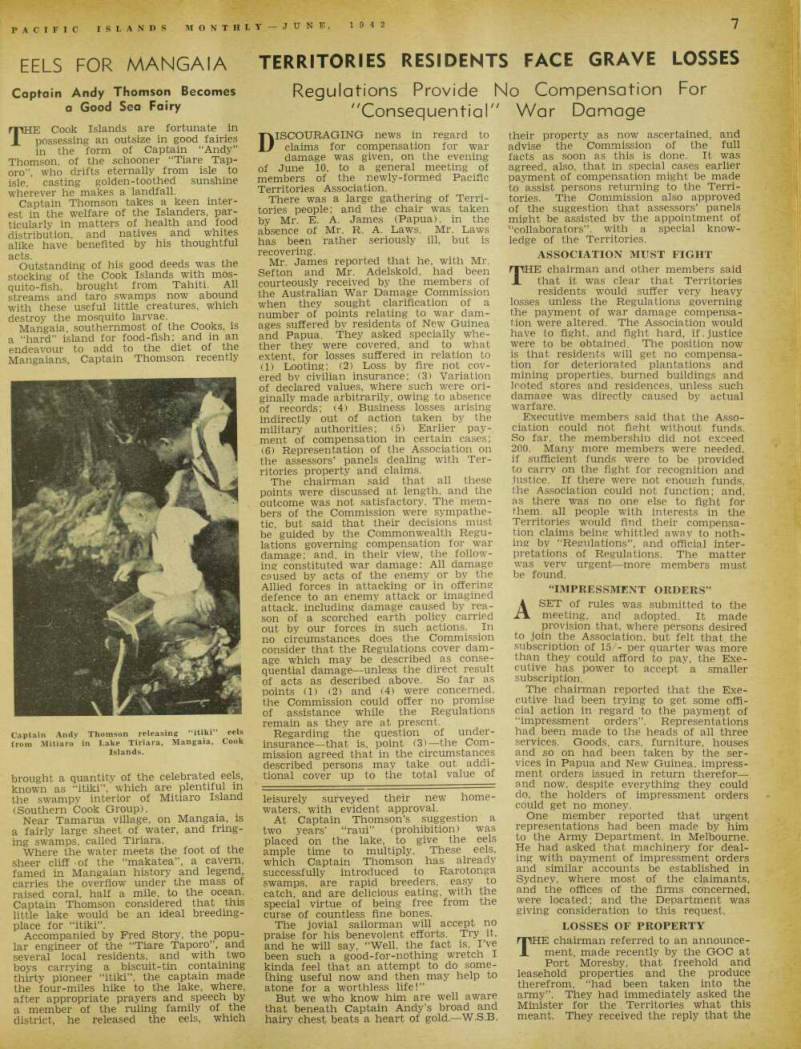
Accompanied by Fred Story, the popu lar engineer of the “Tiare Taporo”, and several local residents, and with two boys carrying a biscuit-tin containing thirty pioneer “itiki”, the captain made the four-miles hike to the lake, where, after appropriate prayers and speech by a member of the ruling family of the district, he released the eels, which
leisurely surveyed their new home waters, with evident approval.
At Captain Thomson’s suggestion a two years’ “raui” (prohibition) was placed on the lake, to give the eels ample time to multiply. These eels, which Captain Thomson has already successfully introduced to Rarotonga swamps, are rapid breeders, easy to catch, and are delicious eating, with the special virtue of being free from the curse of countless fine bones.
The jovial sailorman will accept no praise for his benevolent efforts. Try it, and he will say, “Well, the fact is, I’ve been such a good-for-nothing wretch I kinda feel that an attempt to do some thing useful now and then may help to atone for a worthless life!”
But we who know him are well aware that beneath Captain Andy’s broad and hairy chest beats a heart of gold—W.S.B.
Captain Andy Thomson releasing “itiki” eels from Mitiaro in Lake Tiriara, Mangaia, Cook Islands.
"Consequential" War Damage
Territories Residents Face Grave Losses
Regulations Provide No Compensation For "Consequential" War Damage
Discouraging news in regard to claims for compensation for war damage was given, on the evening of June 10, to a general meeting of members of the newly-formed Pacific Territories Association.
There was a large gathering of Terri tories people: and the chair was taken by Mr. E. A. James (Papua), in the absence of Mr. R. A. Laws. Mr. Laws has been rather seriously ill, but is recovering.
Mr. James reported that he, with Mr.
Sefton and Mr. Adelskold, had been courteously received by the members of the Australian War Damage Commission when they sought clarification of a number of points relating to war dam ages suffered bv residents of New Guinea and Papua. They asked specially whe ther they were covered, and to what extent, for losses suffered in relation to (1) Looting; (2) Loss by fire not cov ered by civilian insurance; (3) Variation of declared values, where such were ori ginally made arbitrarily, owing to absence of records; (4) Business losses arising indirectly out of action taken by the military authorities; (5) Earlier pay ment of compensation in certain cases; (6) Representation of the Association on the assessors’ panels dealing with Ter ritories property and claims.
The chairman said that all these points were discussed at length, and the outcome was not satisfactory. The mem bers of the Commission were sympathe tic, but said that their decisions must be guided bv the Commonwealth Regu lations governing compensation for war damage: and. in their view, the follow ing constituted war damage; All damage caused by acts of the enemy or by the Allied forces in attacking or in offering defence to an enemy attack or imagined attack, including damage caused by rea son of a scorched earth policy carried out by our forces in such actions. In no circumstances does the Commission consider that the Regulations cover dam age which may be described as conse quential damage—unless the direct result of acts as described above. So far as points (1) (2) and (4) were concerned, the Commission could offer no promise of assistance while the Regulations remain as they are at present.
Regarding the question of under insurance—that is, point (3) —the Com mission agreed that in the circumstances described persons may take out addi tional cover up to the total value of
their property as now ascertained, and advise the Commission of the full facts as soon as this is done. It was agreed, also, that in special cases eajlier payment of compensation might be made to assist persons returning to the Terri tories. The Commission also approved of the suggestion that assessors’ panels might be assisted bv the appointment of “collaborators”, with a special know ledge of the Territories.
Association Must Fight
THE chairman and other members said that it was clear that Territories residents would suffer very heavy losses unless the Regulations governing the payment of war damage compensa tion were altered. The Association would have to fight, and fight hard, if,justice were to be obtained. The position now is that residents will get no compensa tion for deteriorated plantations and mining properties, burned buildings and looted stores and residences, unless such damage was directly caused by actual warfare.
Executive members said that the Asso ciation could not fieht without funds.
So far, the membershin did not exceed 200. Many more members were needed, if sufficient funds were to be provided to carry on the fight for recognition and justice. If there were not enough funds, the Association could not function; and, as there was no one else to fight for them, all people with interests in the Territories would find their compensa tion claims beine whittled away to noth ing bv “Regulations”, and official inter pretations of Regulations. The matter was very urgent—more members must be found.
“Impressment Orders”
ASET of rules was submitted to the meeting, and adopted. It made provision that, where persons desired to join the Association, but felt that, the subscription of 15/- per quarter was more than they could afford to pay, the Exe cutive has power to accept a smaller subscription.
The chairman reported that the Exe cutive had been trying to get some offi cial action in regard to the payment of “impressment orders”. Representations had been made to the heads of all three services. Goods, cars, furniture, houses and so on had been taken by the ser vices in Papua and New Guinea, impress ment orders issued in return therefor — and now. despite everything they could do, the holders of impressment orders could get no money.
One member reported that urgent representations had been made by him to the Army Department, in Melbourne.
He had asked that machinery for deal ing with nayment of impressment orders and similar accounts be established in Sydney, where most of the claimants, and the offices of the firms concerned, were located; and the Department was giving consideration to this request.
Losses Of Property
rE chairman referred to an announce ment, made recently by the GOG at Port Moresby, that freehold and leasehold properties and the produce therefrom, “had been taken into the army”. They had immediately asked the Minister for the Territories what this meant. They received the reply that the
matter was being inquired into.
A member: So apparently the Minis ter does not himself know what it is all about. (Laughter.) A member; When shall we know what damage has been done to our properties?
The chairman said that they were trying to get information under that head. The War Damage Commission proposes to send “panels” to the Ter ritories to examine the position as soon as that was possible.
Voices: “Panels! What would they know about it?”
The chairman: We shall, of course, do our best to see that Territories people, and especially people who understand local conditions, are on the panels.
Members gave numerous instances of goods, motor cars, equipment, etc., hay ing been taken over by the forces in both Territories; and, owing to the hurry and confusion of the circum stances, no receipt for same had been given to the owners.
It was suggested that the only way to handle such claims, in the absence of receipts, was to submit them as claims for war damage to property. But, then, of course, they would be barred by the present interpretations of the War Dam age Compensation Regulations.
Members asked when monies held on deposit by the Administrations as a guar antee in respect of indentured labourers would be returned.
The secretary said that he had been told by Mr. Halligan (Territories Dept.) that a proportion of such monies would be repaid soon, but a proportion would be held to meet any claims made in respect of unpaid wages, after the Ter ritories were reoccupied and the inden turing system was resumed.
Now is Time to Fight
EDITORIAL NOTE— The importance of supporting the Association, and pro viding it with members and funds, can not be over-emphasised. Territories re sidents are urged to recognise the following facts: — As the law is at present, they will get no compensation for losses or damage to their properties, unless such damage or losses have been caused by actual battle operations.
If the regulations are not altered there will be no compensation for such things as looting, damage caused by uncontrolled natives, deterioration of properties owing to absence of owners or managers, loss of business owing to military control— although all those things may be the direct result of war conditions over taking the Territories.
The regulations will not be altered by officialdom. The only way in which we can get them altered is to appeal strongly to Ministers and to members of Parlia ment; and, failing them, to appeal to Australian public opinion. The Austra lian people, almost certainly, will be in favour of treating the Territories people with justice, and generosity, and will re sent any niggardly, cheese-paring inter pretation of what is “war damage”. territories people have no elected re presentatives to fight for them. They must fight for themselves, through their own Association. . r^e . Association wants members to to V fieht Str Tb gth ’ a £ d money ’ wherewith to fight. Those who cannot spare 15/hlrd qU h a it te hv <a th d m T any - ol us hPave been ioln 3 UD Snst Jap lnvasi °n) should w£t they can Same ' and Send al °"8 to lf flJh e f rn f torieS folk d 0 not now, J°j„ fl8 h ht or amended regulations, they NOwYs t& n t y o fl^t aXed l3ter
Engagement
On May 10, at the home of Mrs.
R. H. Weymouth, Strong Avenue, Graceville, Bris bane, a party was held to cele brate the an nouncement of the engagement of Miss Merle Selwood (only daughter of Mr. and Mrs. H. Sel wood, Nukualofa, Tonga) to Ser geant W. V.
Ginn, RAE, of Ipswich, Q. Mr. Selwood is Acting Director of Education and Principal of the Government College, in Nukualofa, Tonga.
No Photographs!
Fiji Enforces a Ban
From Our Own Correspondent
Suva, May 9.
rE ban against the production of photographs of places of military significance (which include most places) is being very strictly enforced in Fiji.
The well-known Suva chemist. Mr. I.
E. Michelmore, was fined no less than £25 for an offence that was little more than a technicality. He has maintained a photographic branch of his business, in charge of an Indian, for 15 years; and it appears that, while no photo graphs were taken, a number of pictures were printed off by the assistant from negatives in the shop. The pictures cer tainly showed places which could not now be photographed; but they were of no more value than many pictures already distributed around the town on publicity material; and the Indian assist ant had no suspicion that any harm was being done.
The magistrate admitted that the defendant did not act other than negli gently—but he imposed a punitive fine.
Exactly the same thing could have been achieved, in the case of a well-known man like Mr. Michelmore, by imposing a small fine and a solemn warning.
Another case was entirely different.
There was an air-raid alert in Suva, and a young Chinese, Tiy Wing On, went onto the roof of his building and took many photographs of aircraft, military vehicles and defence buildings. He was fined £2O. and his two cameras were confiscated.
Gallant Fighters of N. Caledonia
A BATTALION of Free Frenchmen from New Caledonia, who left Noumea on May 5, 1941, were among the heroic Free Frenchmen who defended to the last the fortress of Bir Hakheim, in the great Battle of Libya early in June.
On May 5, the day before his own de parture from Noumea, and on the anni versary of the departure of the battalion, Governor Henri Sautot stood before the Soldiers’ Monument in Noumea and paid homage to the volunteers. He announced the death in battle of Georges Clemens, and said that other casualties included Camille Vincent, Henri Riviere, Albert Cubadda, Henri Meyer, Henri Guilbaud, Alexandre Huyard, Raymond Chautard, and Jean Merignac.
Copra
South Pacific Market Fantastic
THE copra situation in the South Pacific is almost fantastic.
Nominally, according to Australian copra-control machinery (which was brought into operation in relation to New Guinea and is now, therefore, moribund), the price of copra is around £2O; but sales have actually been recorded in Sydney at over £24 Australian, and it is rumoured that £3O has been paid re cently.
The nominal price in Suva is still £lB Fijian, in store, Suva, which is the price fixed officially when the British Govern ment bought all the copra output of Fiji, Tonga, New Hebrides, Solomons, and G. and E. Colony.
The outside market now would pay almost any price for copra, because copra is urgently needed in Australia and America; and the only Pacific territories from which it now may be procured, in a free market, are New Caledonia, the French section of New Hebrides (which means practically all New Hebrides), Cook Islands, Ellice Islands, Samoa, French Oceania, and Hawaii. All others are either in enemy occupation, or in No-man’s-land.
It is reported in Sydney that there are over 20,000 tons accumulated in New Hebrides, which may be soon made available to the hungry markets.
New Governor Of New
Caledonia
THE causes and course of the dispute between Rear-Admiral Thierry d’Argenlieu (Free French High Commissioner in the South Pacific) and M. Henri Sautot (Free French Governor of New Caledonia) referred to in an article on page 24, are not made clear in the New Caledonia newspapers of April and May, just to hand.
After the departure for London of M.
Sautot, on May 6, the High Commissioner publicly made generous references to M.
Sautot’s probity and loyalty to the cause of Free France.
M. Marie Montchamp has been ap pointed Governor of New Caledonia by General de Gaulle. He is 54 years old, and a distinguished colonial adminis trator. His appointment represents New Caledonia’s 28th Governor in 45 years.
Sir Harry Luke
, Governor of Fiji and High Commissioner for the Western Pacific, announced on May 5 that he would be absent from Fiji for a short period. Mr. H. H. Vaskess was appointed to act, during his absence, as High Com missioner.
Mr. S. G. Clarke, a senior official of the Gilbert and Ellice Islands Colony, who is now in Sydney in charge of the Colony’s temporary office there, has been appointed Acting Resident Commis sioner of the Colony, with effect from March 25.
Mr. W. C. Brierly, well known in Fiji as a CSR Co. officer, before he came to Australia a few years ago, has received advice that his daughter, Mrs. F. M.
Crawford, escaped from Miri, Sarawak, with her husband and daughter, Raine, before the Japs occupied Borneo.
Bambridge
Death of M. Georges Bambridge
From Our Own Correspondent
Papeete, Feb. 10.
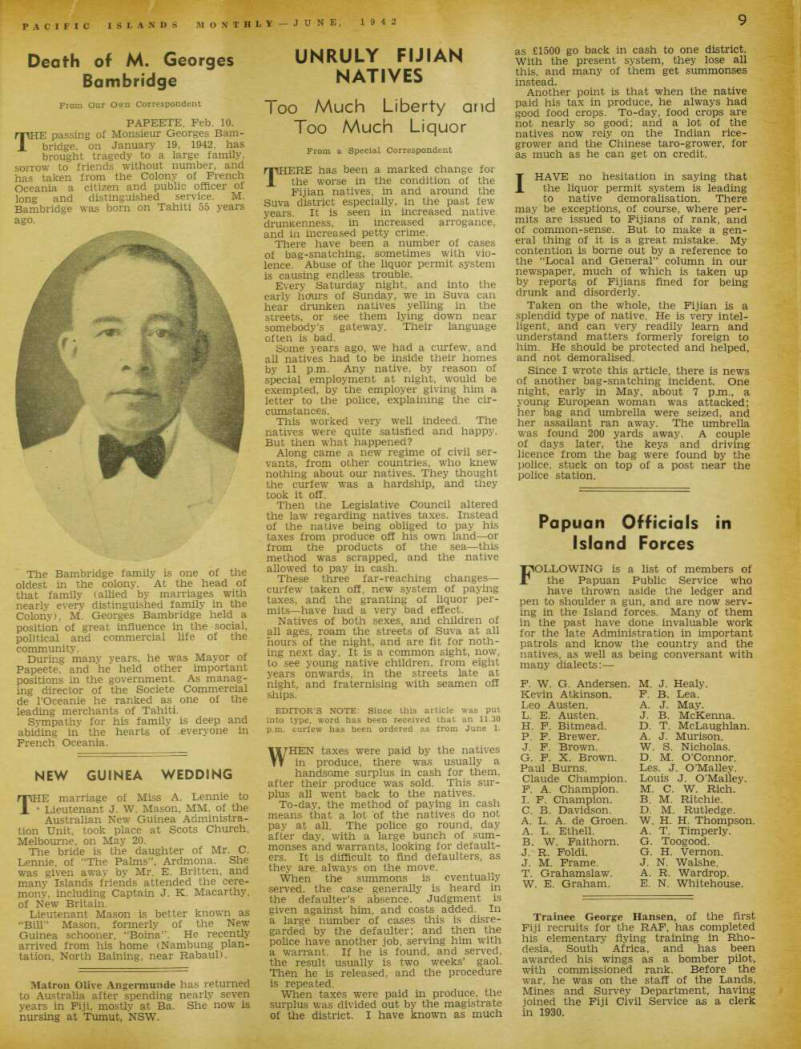
rE passing of Monsieur Georges Barn bridge, on January 19, 1942, has brought tragedy to a large family, sorrow to friends without number, and has taken from the Colony of French Oceania a citizen and public officer of long and distinguished service. M.
Bambridge was born on Tahiti 55 years ago.
The Bambridge family is one of the oldest in the colony. At the head of that family (allied by marriages with nearly every distinguished family in the Colony), M. Georges Bambridge held a position of great influence in the social, political and commercial life of the community.
During many years, he was Mayor of Papeete, and he held other important positions in the government. As manag ing director of the Societe Commercial de I’Oceanie he ranked as one of the leading merchants of Tahiti.
Sympathy for his family is deep and abiding in the hearts of .everyone in French Oceania.
New Guinea Wedding
mHE marriage of Miss A. Lennie to X * Lieutenant J. W. Mason, MM, of the Australian New Guinea Administra tion Unit, took place at Scots Church, Melbourne, on May 20.
The bride is the daughter of Mr. C.
Lennie, of “The Palms”, Ardmona. She was given away by Mr. E. Britten, and many Islands friends attended the cere mony, including Captain J. K. Macarthy, of New Britain.
Lieutenant Mason is better known as “Bill” Mason, formerly of the New Guinea schooner, “Boina”. He recently arrived from his home (Nambung plan tation, North Baining, near Rabaul).
Matron Olive Angermunde has returned to Australia after spending nearly seven years in Fiji, mostly at Ba. She now is nursing at Tumut, NSW.
Unruly Fijian
Natives
Too Much Liberty and Too Much Liquor
From a Special Correspondent THERE has been a marked change for the worse in the condition of the Fijian natives, in and around the Suva district especially, in the past few years. It is seen in increased native drunkenness, in increased arrogance, and in increased petty crime.
There have been a number of cases of bag-snatching, sometimes with vio lence. Abuse of the liquor permit system is causing endless trouble.
Every Saturday night, and into the early hours of Sunday, we in Suva can hear drunken natives yelling in the streets, or see them lying down near somebody’s gateway. Their language often is bad.
Some years ago, we had a curfew, and all natives had to be inside their homes by 11 p.m. Any native, by reason of special employment at night, would be exempted, by the employer giving him a letter to the police, explaining the cir cumstances.
This worked very well indeed. The natives were quite satisfied and happy.
But then what happened?
Along came a new regime of civil ser vants, from other countries, who knew nothing about our natives. They thought the curfew was a hardship, and they took it off.
Then the Legislative Council altered the law regarding natives taxes. Instead of the native being obliged to pay his taxes from produce off his own land —or from the products of the sea—this method was scrapped, and the native allowed to pay in cash.
These three far-reaching changes— curfew taken off, new system of paying taxes, and the granting of liquor per mits—have had a very bad effect.
Natives of both sexes, and children of all ages, roam the streets of Suva at all hours of the night, and are fit for noth ing next day. It is a common sight, now, to see young native children, from eight years onwards, in the streets late at night, and fraternising with seamen off ships.
EDITOR’S NOTE: Since this article was put into type, word has been received that an 11.30 p.m. curfew has been ordered as from June 1.
WHEN taxes were paid by the natives in produce, there was usually a handsome surplus in cash for them, after their produce was sold. This sur plus all went back to the natives.
To-day, the method of paying in cash means that a lot of the natives do not pay at all. The police go round, day after day, with a large bunch of sum monses and warrants, looking for default ers. It is difficult to find defaulters, as they are. always on the move.
When the summons is eventually served, the case generally is heard in the defaulter’s absence. Judgment is given against him, and costs added. In a large number of cases this is disre garded by the defaulter; and then the police have another job, serving him with a warrant. If he is found, and served, the result usually is two weeks’ gaol.
Then he is released, and the procedure is repeated.
When taxes were paid in produce, the surplus was divided out by the magistrate of the district. I have known as much
as £l5OO go back in cash to one district.
With the present system, they lose all this, and many of them get summonses instead.
Another point is that when the native paid his tax in produce, he always had good food crops. To-day, food crops are hot nearly so good; and a lot of the natives now rely on the Indian rice grower and the Chinese taro-grower, for as much as he can get on credit.
IHAVE no hesitation in saying that the liquor permit system is leading to native demoralisation. There may be exceptions, of course, where per mits are issued to Fijians of rank, and of common-sense. But to make a gen eral thing of it is a great mistake. My contention is borne out by a reference to the “Local and General” column in our newspaper, much of which is taken up by reports of Fijians fined for being drunk and disorderly.
Taken on the whole, the Fijian is a splendid type of native. He is very intel ligent, and can very readily learn and understand matters formerly foreign to him. He should be protected and helped, and not demoralised.
Since I wrote this article, there is news of another bag-snatching incident. One night, early in May, about 7 p.m., a young European woman was attacked; her bag and umbrella were seized, and her assailant ran away. The umbrella was found 200 yards away. A couple of days later, the keys and driving licence from the bag were found by the police, stuck on top of a post near the police station.
Papuan Officials in Island Forces
Island Forces
FOLLOWING is a list of members of the Papuan Public Service who have thrown aside the ledger and pen to shoulder a gun, and are now serv ing in the Island forces. Many of them in the past have done invaluable work for the late Administration in important patrols and know the country and the natives, as well as being conversant with many dialects:— F. W. G. Andersen. M. J. Healy.
Kevin Atkinson. F. B. Lea.
Leo Austen, A. J. May.
L. E. Austen. J. B. McKenna.
H. F. Bitmead. D. T. McLaughlan.
P. F. Brewer. A. J. Murison.
J. F. Brown. W. S. Nicholas.
G. F. X. Brown. D. M. O’Connor.
Paul Burns. Les. J. O’Malley.
Claude Champion, Louis J. O’Malley.
F. A. Champion. M. C. W. Rich.
I. F. Champion. B. M. Ritchie.
C. B. Davidson. D. M. Rutledge.
A. L. A. de Groen. W. H. H. Thompson.
A. L. Ethell. A. T. Timperly.
B. W. Faithorn. G. Toogood.
J. R. Foldi. G. H. Vernon.
J. M. Frame. J. N. Walshe.
T. Grahamslaw. A. R. Wardrop.
W. E. Graham. E. N. Whitehouse.
Trainee George Hansen, of the first Fiji recruits for the RAF, has completed his elementary flying training in Rho desia, South Africa, and has been awarded his wings as a bomber pilot, with commissioned rank. Before the war, he was on the staff of the Lands, Mines and Survey Department, having joined the Fiji Civil Service as a clerk in 1930.
Living Conditions As Fixed By
Japs In New Guinea
What People Trapped by Invasion in Rabaul and Kavieng Have to Submit to
COPIES of orders issued by the invading Japanese to residents of New Guinea have reached Aus tralia.
There were two proclamations— one by the military commandant at Kavieng, which is in fairly good English; and one by the naval com mander-in-chief, which is in English so crude that it is difficult to under stand.
As these documents are likely to have historical value, they are pub lished here in full.
All Islands residents will read, with interest, the details of what their less fortunate brethren in captivity are forced to do.
Paragraph 7 of the Kavieng pro clamation especially is interesting— especially the bit: “Now that all the Territory of New Ireland belongs to the Empire of Japan”. This is count ing the unhatched chickens, with a vengeance.
The proclamations were:—
“Bow To Soldiers”
KAVIENG, February 12, 1942. I, the undersigned, herewith proclaim:— (1) That no trade, viz., neither buying or selling of any commodity is per mitted unless a written licence is previously applied for and obtained. (2) That all or any one of the citizens of Kavieng shall be required from time to time to engage in such labours as are ordered by me for any purpose as I think necessary. In such cases appropriate reward shall be given to labourers. (3) That no traffic, either on land or sea including harbour limits is per mitted from 6 p.m. to 5 a.m., and that no sea traffic is permitted unless provided with a written licence by me. (4) That no removal of any commodity is permitted unless provided with a written licence by me. (5) That no light or fire is permitted to leak out of doors from 6 a.m. to 5 p.m. A strict and complete black out shall be observed during the hours ordered.
(6) That every house shall hoist a Jap anese National flag as a token of the relative citizen’s allegiance to the Empire of Japan. All and everyone shall bow their heads (making Kei rei) whenever they see Japanese soldiers. (7) That all and every citizens are required to learn the Japanese lan guage in the earliest possible time now that all the Territory of New Ireland belongs to the Empire of Japan.
Any breakage of any one of the above mentioned orders shall be punish able.
Commander of Japanese Garrison at Kavieng.
Ban On Religion
January 23, 2602.
Commander-in-Chief of Nipponese Navy proclaims undermentioned and those come into effect force on the Twenty-third day of January, 2602. (1) Navy of Great Empire of Nippon should confiscate all of the state pro perties of the enemy and freeze the private properties of citizens for some time. (2) Movement of commodities, utensils, materials, and those accessories with out articles of daily use to be indis pensable should be strictly prohibited. (3) Listening to the radio, intercepting messages, publishing printed matters, writing to each other, meeting, photographing, going out at night, and communications to or from other territories are strictly pro hibited. (4) Propagation of a religion, and meet ing by European missionary are pro hibited, too, for some time. All refugees from Kavieng, Rabaul, etc., should come back safely. (5) Inhabitants—including Europeans— who serve loyally to the “Tenno- Heika” His Majesty the Emperor of Nippon are stabilised their living by Nipponese Navy.
“Punished Together”
(6) Construct neighbouring units with houses and after deciding represen tative report the constructive mem bers, i.e., names, ages, sex, number of house. Representatives meet in the golf links at 9 a.m. and 3 p.m. every day in order to get Naval instructions and let them know those. (7) All of the members of units will be gathered occasionally. In that case Navy will notify beforehand to repre sentatives of units. (8) Each of unit have the joint respon sibility, consequently, if unit have any violator for Naval Forces, all the members of units have to be punished altogether. All houses in the Territory ordered to hoist the Nippon flag as illustrated. (9) “Yen-note” circulated by Nipponese soldiers in the currency issued by the Central Bank in Govt, of Nippon.
Whoever refuses to receive it in every transaction and disturbs its circulation should be punished sev erely.
Exchange rate: £1: YlO (Ten yen). 1/-: Y 0.50 (Fifty sen). (10) The prices in retail or wholesale shops must be fixed in the same prices on the twentieth day of this month (January). Whoever raise the prices by manipulations and hoard the prices should bev punished severely by the concerned authori ties.
Headquarters of Imperial Nipponese Navy.
"Hanahana"
Tribute to Late Mlle. Banzet
From Our Own Correspondent
Papeete, Feb. 10.
THE Tahitian word Hanahana, in addi tion to its superficial meaning— “splendour, glory”—expresses, as an adjective, those qualities of character and spirit which endow their possessor with worshipful distinction in the esteem of all his fellows.
No other word, we believe, can more fitly describe the honour and reverence in which all Tahiti held Mademoiselle Emilie Helene Banzet, Directrice Hono raire des Ecoles Francaises Indigenes de Papeete, Chevalier de la Legion d’Hon neur, who died on December 13, 1941.
Mile. Banzet was born in France 88 years ago. By descent and blood relation ship, she was allied with many powerful Protestant families of her native coun try. She came to Tahiti in 1885.
As teacher and as head-mistress of the Protestant School at Papeete she had been the guide, mentor and friend of every generation of young women in this community, for over half a century.
During all these years Mile. Banzet’s gentle but inflexible inculcation of “whatsoever things are true, whatsoever things are honest, whatsoever things are just, whatsoever things are pure, whatso ever things are lovely, whatsoever things are of good report” had implanted in her pupils an understanding of those virtues of which she, herself, was a living example.
Australian Rice Disliked
In Fiji
From Our Own Correspondent
Suva, May 12.
A FAIRLY large quantity of Austra lian-grown rice is coming into this Colony; but the Indians —who are the principal consumers—do not like it much, and buy it only when they can not get other varieties. They say that it is too soft and starchy.
' Now that the chief rice-growing coun tries are in enemy hands, there is a South Seas market for Australian rice, and it is a pity that Australian growers do not give attention to the varieties that will sell readily—such as Chetua, Patna, or Motka. Supplies of seed could be obtained here.
At the Polynesian Club of Sydney recently, the president (Mr. Leonard Moran) was given a handsome and ancient kava bowl from Wallis Island (Uvea). It was presented by the Wallis Island members of the crew of a Free French steamer who have been wel comed and entertained by the Club members.
Advertisements & other items, p. 12 (1 item)
Us Ts Om
n* uli-in fight 7*utcJlifour money in * snujnos^
Copra Flourishing; Others
Fiji Industries
Copra Flourishing; Others in Good Condition
DESPITE war conditions, the primary industries of Fiji retain remarkable strength and vigour. The following summary, covering the activities of 1941, was prepared some time ago by the Suva Chamber of Commerce, and published recently in the “Fiji Times”.
Owing to war conditions, it is impos sible to present the usual form of report on the commercial conditions of the Colony for the past year. Customs sta tistics are not yet available, as many of the Customs staff have been absent from their duties and engaged on military work. Financial figures for the year are also not yet published.
Sugar
For similar reasons, it is not possible to show the destination of exports, dur ing the year. The production in 1941 was severely limited, and the industry was obliged to make many adjustments to meet the unprecedented circumstances.
The arrangements made under which all cane was purchased can be consid ered as very satisfactory.
A moderate crop only is in sight for 1942. There are many reasons for this, among which may be mentioned the very low rainfall in the main producing districts over the last ten months.
Gold
Activities at the three principal mines (Emperor, Loloma and Mount Kasi) have continued, but the management of the two former companies have an nounced their intention to suspend the payment of dividends for the present.
Copra
This industry, which a year ago appeared to have collapsed entirely, has revived quite unexpectedly owing to the loss of the Philippine and Malayan sources of supply. The Government has been able to make arrangements through the Ministry of Production, whereby the whole of the output of the Colony, and of the Western Pacific High Commis sion territories, has been sold at a price of £lB (Fiji) f.o.b.
It is hoped that buying prices of £l5/15/- for first-grade and £l4/14/- for FMS copra, which are now being offered will restore the production of the Colony in the near future to somewhere near the 35,000 tons per annum once reached.
It is realised that many plantations have, by compulsion, been neglected and that it will take some months for cleaning up to be done, but the immediate prospects for copra planters are brighter than they have been for the past ten years.
Pineapples
The canning industry is still progress ing, although exports have been ham pered by shipping difficulties.
Bananas
The hurricane of February, 1941, re duced exports of bananas to a negligible figure, but the areas have recovered and moderate shipments are again being made.
Shipping
Regular shipping services have natur ally been affected by war conditions, but the Colony is fortunate that supplies have been maintained.
An ordinary meeting followed the annual meeting, the following officers being elected: President, Sir Maynard Hedstrom; vice-presidents, Messrs. A. ♦Barker and J. Trotter; secretary and treasurer, Mr. C. W. Aidney; auditor, Mr. A. E. Pearce.
G. E. Hemsworth
Well-known Pilot Missing in New Guinea Area
ONE of New Guinea’s famous air pilots, Squadron-Leader Godfrey Ellard Hemsworth, aged 32, was reported missing late in May, when he failed to return from an operational flight against the Japanese in the New Guinea area.
In the King’s Birthday honours, announced on June 11, Squadron-Leader Hemsworth was awarded the Air Force Cross.
He is one of four brothers in the RAAF; and he was very well known in New Guinea in the early thirties, when he flew for Guinea Airways and Pacific
Aerial Transport. He became associated with Ray Parer, and they flew together in the London-Melbourne Centenary Air Race. Later, he flew in Australia for Ansetts and Airlines of Australia; and in 1938 he joined Qantas as first officer of a flying-boat running between Singa pore and Sydney. He joined the RAAF after the outbreak of war, and his not able performances against the Japanese soon brought him the rank of Squadron- Leader,
Ray Parer and Godfrey Hemsworth, a “snap shot” in New Guinea in 1934, before they left for England to take part in the London- Melbourne Centenary Air Race.
Csr Investments In
Fiji
OUT of £5,950,000 invested in sugar mills by the Colonial Sugar Refin ing Company, £1,657,000 is repre sented by sugar mills in Fiji. The com pany is by far the biggest industrial enterprise in the Colony.
In the year ended March 31, 1942, the company made a profit of £934,619 from its Australian and Fijian enterprises, compared with £1,054,000 in 1941. and £1.103,000 in 1940.
It is noted that the company now has £89,463 invested in its fruit-canning fac tory in Fiji.
Hawaii Morale is High
“T WOULD rather like to see the Jap l anese make another try for Hawaii,” writes Dr. Peter H. Buck, director of the Bishop Museum at Honolulu, in a recent letter to Mr. Eric Ramsden, of Sydney. “They would pay very dearly!”
Civilian morale, he says, is excellent.
Though the blitz of December 7 did not affect either Dr. or Mrs. Buck per sonally, they had plenty of excitement.
“However, we have full confidence in the future,” he remarked, “and I do not think that the Japanese will ever score again with sneak tactics in Hawaii.”
Following the attack, a local resident, he says, was reported to the police for playing a radio at night. Over the ’phone came the reply: “Let them play the radio. It’s good for morale!”
Dr. Buck says that work is proceeding at the Bishop Museum as usual. Pre cautions have been taken, of course, to protect the type specimens (which are of world-wide value). He has finished his manuscript on the Cook Islands, and is now at work on the material culture of Hawaii. “This is quite a job, when tech nology is included,” he added.
Rabaul Colony In
Canberra
SINCE the evacuation of New Guinea, a Rabaul colony of interest and importance has been established in Canberra.
Well-known New Guinea public ser vants, in the persons of Messrs. R. Mel rose, “Pat” Holmes, Maunsell Turner, and Siggins (audit branch) are now attached to the Territories Department, or allied departments; Miss Vivian Thwaite and Mr. Paddy Georges are also employed in Canberra; Mrs. George Mur ray (wife of the Director of Agriculture, missing since the Jap invasion), is now living in Canberra; and Mr. and Mrs.
Tombs (he was connected with the old Expro. Board) are also residents of the capital.
Effort To Save Trocas
Shell
From Our Own Correspondent
Suva, May 10.
THE Fiji Government has placed abso lute protection upon all Trocas Shell, of the kind known as Trochus Niloticus, which measures less than 21 inches across the mouth whorl. No per son may take, sell or export it.
This is an attempt to save the “chicken shell” and protect a valuable industry. But small trocas shell-fish are much sought after by the Fijians as an article of food, and the policing of the new law will be no easy matter. It should not be difficult to prevent the sale and handling of the shell; but how can one prevent the natives going out onto the reefs after one of their regular food stuffs?
Mrs. C. R. Field, wife of the New Guinea Director of Public Works, died recently in West Australia. Mr. Field returned to New Guinea, after furlough, in January, and was in Rabaul when the Jap invasion took place. His fate, like that of other departmental heads (Messrs. Harold Page, G. G. Hogan, H.
O. Townsend, and George Murray) is unknown.
Rev. A. E. Corner, who had been organising secretary in England for the Melanesian Mission since 1906 and com missary for the Bishops of Melanesia since 1915, died at Bournemouth, Hants., England, on April 17. During his long years of association with the Melanesian Mission, he travelled many thousands of miles throughout the British Isles, addressed many hundreds of meetings, and raised a very considerable sum of money for use in extending the Mis sion’s work in the Western Pacific.
Nearly 80 years of age, he was one of the few remaining members of the Mis sion who knew the pioneer Bishop John Selwyn.
Guinea Airways Points the Way to Some Headaches
New Guinea Invasion And A Company's
Assets
INDUSTRIAL operations in New Guinea were suspended in the third week of January, 1942, when the Japs came.
The cessation of Morobe goldfield activi ties occurred, as near as can be fixed, on January 21.
On that date, Guinea Airways estab lishment at Lae was smashed to pieces by enemy bombs, and the few planes that were saved were taken to Australia.
The financial year of Guinea Airways ends on February 28; so the 1941-42 year was complete except for five weeks; and the annual report shows that, in that year, the Co. made a profit of £13,945, which was £1,200 better than the previous year. Consequently, preference and ordinary dividends are unchanged, at 7 per cent.
As the Co.’s aerial transport business in New Guinea is “suspended for the duration”, it is worth while to glance over its interesting history.
In the early twenties, the “father of Bulolo”, the late Cecil J. Levien, planned something so unusual and unorthodox that no ordinary investor would look at it—gold-dredges in the inaccessible Bulolo Valley, in the interior of New Guinea, and air transport as the pioneer (and only) means of communication between the Bulolo Valley and the coast. Two old friends, C. V. T. Wells and W. P. A.
Lapthorne, had faith in his vision; they succeeded somehow in conveying their faith to an Adelaide syndicate; and so was born the money-spinning “Bulolo Group” of companies—Guinea Gold NL, Placer, Bulolo Gold Dredging, Ltd., and Guinea Airways, Ltd.
Guinea Airways, of course, was the air transport company. It started oper ations in 1928, and its success was amazing. These figures tell the story more clearly than words. It is to be remembered that, until 1937, when opera tions were extended to Australia, the Co.’s subscribed capital was only £50,000:—
Features worth noting in this table are, first, the way in which the Co.’s annual profit was governed exactly by the average freight rate per pound; and, second, how the rapidly-growing Austra lian business consists almost exclusively of carrying passengers (and, presumably, mails) between Adelaide and Darwin.
Headache For Taxers And
Accountants
AS this is the first important balance sheet to be issued by a New Guinea trading company since the invasion, it is most interesting to observe how the
Co. has dealt with its New Guinea assets.
A year ago, buildings, fittings, aircraft and plant were shown as worth £183,574.
In this balance-sheet they are shown thus: Buildings, fittings, aircraft, and plant, at cost less depreciation of £41,726, £91,645; war damage claim, £98,230; total, £189,875. Apparently, little new plant was bought in the year; so, obviously, the balance-sheet was out of gear—the total should have been nearer £140,000 than £189,000. The explanation, of course, is that given by the Directors.
“The Co. has compiled its formal claim to the Federal Government for compen sation for damage in New Guinea by enemy action. Owing to the Co.’s con servative valuation, the assets which are the subject of the claim had been written down to figures far below those at which they could be replaced. Recording the amount of claim in the balance-sheet in place of the assets destroyed had raised a special depreciation reserve, represent ing the margin above book value”.
In other words, the Co., for purposes of war damage compensation, has been obliged to write up its plant and build ings again, and create, to balance the new assets item, a “special reserve for depreciation” of £48,959.
Which seems to be the only way to handle the thing; but it is going to give a few taxation experts and accountants a headache, before it is all over. If the war damage claim for the asset is re cognised, the taxing authority will want to collect (at wartime assessment rates!) on the amount in excess of the normal balance-sheet figure showing valuation of the asset.
Adelaide-Darwin Service
THE action of Guinea Airways directors, in transferring surplus plant from New Guinea to Australia in 1937, raising new capital, buying additional plant, and establishing the entirely new Adelaide-Darwin service, was much criticised.
But the critics are silent now. The New Guinea service is completely sus pended, and most of the New Guinea plant and equipment is blown to pieces.
But Guinea Airways is carrying on with the Adelaide-Darwin service, which war conditions have made enormously impor tant. The new service is clearing over £10,000 per annum, which is a good return on the £100,000 or so which, in the Co.’s total subscribed capital of £160,000, is about the cost of establishing the Ade laide-Darwin service.
Guinea Airways shareholders will con tinue to collect; whereas, if it had not been for the lucky move made in 1937, they probably now would be hawking their scrip for the price of the stamp.
Future Of Air Transport In
New Guinea
NO one now can say what is to be the future of air transport in the north.
It would not surprise this writer to see the Australian Government, already so closely wedded to socialistic adminis tration, try to establish a Government owned air transport service in the new New Guinea.
If the Ministers have any such plans in their heads, this might seem to them the God-given (the god being Mars, of course!) opportunity to put it into opera tion. The thing would be almost auto matic.
The Japs destroy the air transport com panies’ property, and drive the concerns
New Guinea Operations
Av.
Year Cargo Passengers Freight ended Carried Carried Profit Rate Feb.
Tons £ per lb. 192ff .. 434 869 6,226 10.6d 1930 .. 949 2,047 31,567 8.2d 1931 .. 1,146 1,995 22,077 6.5d 1932 .. 3,947 1,607 28,725 5.9d 1933 .. 3,980 3,856 13,053 4.3d 1934 .. 6,044 7,398 30,202 4.Id 1935 .. 6,102 9,721 21,818 3.3d 1936 .. 6,476 12,137 25,876 2.9d 1937 .. 6,705 11,869 13,887 2.4d 1938 .. 8,408 12,120 10,895 1.9d 1939 .. 8,804 11,626 17,020 2.0d 1940 8,374 11,481 14,899 1.9d 1941 .. 7,123 10,740 4,423 1.9d 1942 4,988 7,848 3,753 1.9d
Australian Operations
1938 .. 18 1,918 — — 1939 .. 117 2,332 755 — 1940 .. 135 5,938 1,856 — 1941 .. 125 13,392 8,275 — 1942 . . 308 19,591 *0,192 —
out of New Guinea. The war damage compensation fund provides the com panies with compensation. The slate is wiped clean. The Government declares transport a State monopoly.
“But” cry the outraged air transport companies, “What about our goodwill?”
“Pooh!” reply the gallant theorists of Mr. Curtin’s Cabinet, in the true manner of 1942, “What is goodwill, anyway? Just a nasty capitalistic trick!”
It cannot happen in New Guinea?
Well, maybe not. But many strange things are going to happen in New Guinea before normality returns.
George Jeffrey Passes On
IT is noted that Mr. George Jeffrey, one of Adelaide’s Grand Old Men, whose faith and courage in backing Levien, Wells and Lapthorne in the early days did so much towards launching the Bulolo Group and the great New Guinea gold industry, died in January. He was full of years, and honour. Nonetheless, we regret the passing of one who was a good man and a “real person”.
Advertisements & other items, p. 14 (1 item)
Membership of Pacific Territories
Association
Temporary office accommodation has been provided for the new body, and the address of the secretary now is: Mr. C. A. M. Adelskold, secretary of Pacific Territories Association, c/o Robert Gillespie Pty., Ltd., Royal Exchange Building, 54a Pitt Street, Sydney; or, briefly, Secretary, Pacific Territories Association, Box 137 CC, GPO, Sydney. The telephone number is BW 4782. Evacuees who require the services of the Association in any way, or who desire to become members, should communicate with him at that address.
Members are wanted. So are funds. The subscription is 15/- per quarter; but evacuees whose cash position is not what it was are asked to become members anyway, and contribute as much as they feel they can afford.
The secretary informs us that the following form could be used: —
APPLICATION FOR MEMBERSHIP
Secretary, Pacific Territories Association, Box 137 CC, GPO, Sydney.
Please enrol me as a member of your Association.
Name (Mr., Mrs. or Miss) Present address Former Address in Territories Present occupation, if any Previous occupation, in Territories If you want employment in Australia send full particulars on an attached statement (which please sign) showing your age, qualifications, details of experience, and what class of work you would prefer.
If you want the assistance of the Association in any way, send full particulars on an attached statement (which please sign).
Amount of subscription forwarded herewith, or to be forwarded; Signature Date
Death Of A New Hebrides
Pioneer
ON April 25, at Whangarei, NZ, another pioneer of the New Heb rides passed on—Mr. F. J. Fleming, of Meta van Plantations, Ltd., Bushman’s Bav, Malekula.
For 30 years, Mr. Fleming lived at Bushman’s Bay. except for brief visits to Australia and New Zealand for medi cal attention. Under his supervision, Metavan steadily developed from the jungle until to-day it is the largest Brit ish-owned plantation in the group. On steamer days, the few settlers from the surrounding district assembled at his home to take delivery of their stores and accept his never-failing hospitality. He was a auiet, unassuming man. and his death will be regretted by both English and French. He is survived by a daugh ter, Mrs. Whiteman, who was born at Dip Point, Ambrym, a few hours before the great volcanic eruption, and who now is living in New Zealand.
Mr. John Herdman, who is on the staff of the Bank of New Zealand in Fiji, recently married Miss Margaret Barnett, only daughter of Major and Mrs. D.
Barnett, of Suva.
Mr. Oscar Nordman, of Papeete, Tahiti, has disposed of his well-known ship chandlery business in Tahiti, and has offered his services to the American mer cantile marine. Meanwhile, he is living at his plantation in Papara, Tahiti. At one time, Mr. Nordman was a well known member of the purser’s staff on vessels of the old Oceanic Company—the “Sierra”, “Sonoma” and “Ventura”, run ning between San Francisco and Sydney.
Ladylike
Rationing In
Tahiti
When Ladies Are Not Ladylike
From Our Own Correspondent PAPEETE, April 24.
IN Tahiti, that Vorpal blade, that two edged sword, the tongue of man (and of woman), although exceeding sharp and active, is overshadowed by the gnawing monster athwart the dia phragm—Te Opu, known to Anglo- Saxons as the stomach.
The exigencies of war have compelled the rationing of some few imported food stuffs, such as butter, sugar, potatoes, onions and so forth, and certain days are appointed for their distribution.
The majority of those gathered about the doors and counters of places of sale are women; and one attending on the outskirts of the assembly has eye-witness evidence of the poet’s assertion that “the female of the species is more deadly than the male”.
The violent, clamorous scenes have been extended to the market-place, when certain desirable varieties of fish are scarce, and to those now rare occasions when cotton dress-wares are offered for sale.
We are developing a race of Amazons
at Tahiti; and mere man, in fear of his life and limb, stays far away from the battle-front, even if he must deprive himself of exotic luxuries.
Crafty males, whose womenfolk are unequal to the undertaking, finance militant females so that they may charge into the storm and fray on their behalf.
When war was declared, Sir Charles Mappin, a young English baronet, was visiting Mangareva, Gambier Islands, in a Papeete-hired schooner. The English man and his party at once returned to Tahiti, en route for Europe. Sir Charles refused a commission, and joined up with the RAF in London. Now comes news of his death, as a gunner, while flying over Germany. The origin of the Mappin wealth was Sheffield cutlery.
Sir Charles, who was born in 1909, was the third baronet: he left no heir.
“Eriki”.
Advertisements & other items, pp. 15-16 (1 item)
Pty. Ltd.
PACIFIC ISLANDS SOCIETY
Visitors from the Islands to Sydney (or those interested in Islands affairs), are advised to communicate with the honorary secretary of the above Society, which has been formed to study the history, traditions, economics, and political developments of the Pacific Islands.
Regular monthly meetings will be held throughout 1942 at Hotel Carlton, Sydney.
Address for Correspondence:
THE PACIFIC ISLANDS SOCIETY,
Box 2434 MM., G.P.0., Sydney.
Prouds Present— "ROYAL DOULTON
r f * i A'
"WINSTON"
A superbly modelled “Royal Doulton” production with the flag hand painted in vivid colours of highly glazed finish. A novel gift that would be appreciated.
“Winston” is in two sizes—6 in., 15/-; 3£ in., 8/6.
PROUDS PTY. LTD. Cnr. King and Pitt Streets, Sydney.
I u Jl m
POWERFUL MULTI-VALVE BANDSPREAD
Full particulars from
GEORGE BROWN & CO.
Electrical Engineers Used by • Commander R. E. Byrd on his South Pole Expedition. • Official Australian Adviser to British Broadcasting Commission. • Mr. R. N. Shaw, Editor Short-wave Section “Wireless Weekly”. • Mr. L. J. Keast, Editor Short-wave Section ( “Radio World”.
There is not a better radio obtainable.
AC & BATTERY MODELS
PTY. LTD.
267 Clarence Street, Sydney, N.S.W.
NOW IS THE TIME
Business is having a difficult time at present because of the shortage of trained men to carry on the work of those who have been called to other national duties.
This fact means that younger—and older—men must take up the running; but to do this efficiently and successfully requires training.
Now is the time to start training, because even partially trained men are of more value to business and to themselves, than those without any specific training.
Men with even an elementary knowledge of Accountancy, Secretarial and Cost Accountancy principles and practice are required in hundreds to take the place of those who have been called into the administrative branches of the Forces and the Government special Services.
WHAT ARE YOU GOING TO DO ABOUT IT?
Are you going to drift along—or are you going to fit yourself for one of these vitally important positions that H. & R. are being asked every day to fill?
Are you going to start now to train yourself quickly to take advantage of present-day conditions that offer the trained and partially trained man opportunities for bigger jobs and bigger pay—and security of position during and after the war?
NOW IS THE TIME
to discuss with Hemingway & Robertson your training plan for your future. So write, ’phone or call and consult our advisory staff NOW.
Department of Accountancy and Commerce
HEMINGWAY &
ROBERTSON
The Accountancy Specialists
FOUNDERS OF COMMERCIAL EDUCATION
IN AUSTRALASIA.
127 A Bank House, Bank Place, Melbourne 127 A Barrack House, 16 Barrack St., Sydney Offices in all Capital Cities, Newcastle and Launceston.
To HEMINGWAY & ROBERTSON,
Please send me FREE copy of the 108-page illustrated handbook, “The Guide to Careers in Business”.
Name Address Age 127AA/532
How Fiji Is Solving The Food
Problem
APART from the Europeans in Fiji, there are nearly 100,000 Fijians and not far short of 90.000 Indians; and these large communities consume a lot of food. In past years, considerable quantities were imported.
Ever since the outbreak of war, the Government has been appealing for an ever-greater effort in the local pro duction of foodstuffs, and considerable success has been achieved, despite drought conditions.
The position is surveyed in the last issue of the “Fiji Agricultural Journal” by Mr. C. Harvey, B.Sc.; and he sum marises the steps taken and being taken to meet the war time shortage of rice, potatoes and sharps. Sharps cannot be grown in Fiji, but the Indians are doing an increasing amount with maize, and in the western districts they are using half sharps and half maize. Bread being sold in Sigatoka carries 25 per cent, maize meal.
Potatoes can be grown only for a short period in one or two suitable localities. Fiji now must rely more on yams, kumeras, tapioca and dalo. Says Mr. Harvey:—
Increase In Rice Growing
PRIOR to the war the Colony was producing an estimated total of 12 000 tons of rice per annum, a large propor tion of which was consumed by the growers themselves.
Imports varied from 2,000 to 3.000 tons according to season.
Efforts to extend plantings were made during 1940 and 1941 but these were nullified by unduly dry weather.
“After a bad start, with a drought in December and January, the present season gives promise of a record crop, and it seems probable that Fiji will this season approach nearer to self-sufficiency in rice than at any previous time.
There has been a considerable increase in the number of farmers (Indians) growing rice, largely due to the action of the Colonial Sugar Refining Company Limited in permitting all their tenants who have no access to other rice land to plant up to one acre of rice on their cane fallows.
“Many other farmers who have not previously grown rice and many Indians employed in townships or outside who have been able to secure suitable land, have this year prepared land for this crop.
“There has been a large demand for seed; all regular growers made use of their own seed, but the Government has supplied over 21 tons to new growers, principally to CSR tenants through the company’s mill managers, while many other newcomers to rice-planting have been able to secure seed from their neighbours.
“The number of Fijians growing rice has also increased, and this portion of the crop will be wholly available for the local market, as consumption of rice by Fijians in country districts is very small.
More Root Crops
“¥>LANTINGS by Fijians, especially, of the common root Ml crops (dalo, kumalas and tapioca) have greatly increased since the outbreak of war, and many more Europeans and Indians now have small plots of these crops. However, the demand has recently overtaken even the increased supply, firstly by reason of the greatly increased non-producing popu lation engaged on military duties or defence works, and latterly because of the lack of imported potatoes and the shortage of rice . . .
“There are welcome signs that the temporary shortage of rice and sharps has impelled Indian farmers to give more attention to the planting of kumalas and tapioca. Though these foodstuffs are less palatable to Indians than rice and sharps, they nevertheless form a useful and easily grown reserve of bulk food, available throughout the year.
“Recommendations are, therefore, in brief, that all Fijians should continue to plant up dalo, kumalas and tapioca suffi cient for their own needs, and that those conveniently situated for transport to a market should plant up each < month half a chain to a chain of kumalas and dalo, particularly, for sale. They should in addition increase their seasonal plantings of yams, when the time comes; although more laborious than kumalas and dalo in planting and digging, this crop is particularly useful and profitable, as it can be stored for a considerable time, and it fetches higher prices in Suva than the other root crops.
“Indian farmers should maintain regular plantings of kumalas and tapioca, say one quarter to a half chain monthly, for their own consumption and for sale. They should, of course, plant up as much rice as possible, in season, and should also plant maize, dhall and chillies for home consumption and sale. Europeans with available land would be well advised to maintain sufficient plantings of the root crops for their own use.”
Advertisements & other items, p. 16 (1 item)
14
JUNE, 1942 PACIFIC ISLANDS* MONTHLY
His Mistake !
IT was told me by one of the best known Cook Islands identities.
“Yes, my boy,” he said, “I’ve traded right through from the Solomons to the Marquesas. Exciting job in the Solo mons? Too right! In those days you had to keep your wits about you. to keep one jump ahead of the stew-pot!
“I well remember one night. I was sit ting in the house reading, and waiting for my dinner, when I heard my wife approaching along the verandah. Sud denly I was startled by a scream and the crash of falling crockery.
“Grabbing my gun and rushing out, I found mv wife unhurt, but pinned to the wall, by her dress, by a quivering arrow.
“I jumped to the verandah rail and roared, ’Hey! You s! What the hell do you well think you’re doing of?’ That shook them up a bit!” (Author’s note: I can quite believe it!) “There was silence for a moment.
Then a voice called from the darkness — in native, of course: ‘Oh! Sorry, boss!
We thought it was the missionary’s
wife!’
W.S.B.
Death Of Mrs. Mary
Preston
THE sudden death of Mrs. Mary Pres ton, at King’s Cross, Sydney, on Mav 18, one of the popular person alities of Panua and a member of a fam ily associated with Port Moresby since the 1890’s, came as a shock to her many friends at present in Australia.
She, in the early days, was an employee of Burns. Philp & Co.’s branch in Port Moresby, and it was probably through the experience gained there that she in later years made a success of her trad ing store on Ela Beach. She knew how to cater for the natives, and they, not slow to appreciate her fair treatment, came long distances in canoes to do busi ness at her store.
Aged 58. she was a sister of the well known Christie brothers (Sandy and George), two well-known pioneer pros pectors of Papua. Her death was due to a sudden heart seizure while out walk ing with’ her two daughters, Prue (Mrs.
K. Franks) and Laurel.
"Bp Magazine" Is
Discontinued
MANY people will learn, with regret, that, owing to the publishing diffi culties created by the war, Burns.
Philo & Co. Ltd. have discontinued the publication of their well-known quar terly, “BP Magazine”.
It was first published, as a travel magazine. 14 years ago; it was edited by people who demanded a high literary standard: and, typographically, it was one of the finest periodicals produced in Australia. It served a definite purpose in two directions —it regularly presented to all parts of the world the most attrac tive features of travel; and it gave substantial encouragement to South Seas writers, artists and photo graphers, of whose best it purchased a good deal. Its extinction, by circum stances beyond the control of its owners, removes a periodical of a type that, unfortunately, is all too rare.
Mr. W. J. Burton, manager of the ship ping department of the Vacuum Oil Company, Sydney, concluded 40 years of service with the company last month.
Mr. Francis Edgar Williams, Government Anthropologist in Papua since 1922, will in future be Dr. F. E. Williams —the degree of Doctor of Science has been conferred upon him by the University of Oxford. He took the degree of Master of Arts of Adelaide University; served in the 1914-18 war; took up the Rhodes Scholarship which he had won in 1914 and specialised in anthropology at Oxford; and, two years after he was appointed to Papua, he was awarded a Rockefeller Fellowship, and studied at the London University with
Malinowski. He is 49 years old and is living in Adelaide at present.
Mrs. Wiki Byron, hon. secretary of the Polynesian Club of Sydney, received news that her father, Tamaiharoa te Tauri Mokena (Mr. Harry Morgan), died at his home at Awahou, Lake Rotorua, on May 26. He was an elder of the Ngati Rangiwewehi hapu of the Arawa tribe. Mrs. Byron’s son is Sergeant H.
J. Byron, probably one of the youngest non-coms, serving with the Australian Imperial Forces.
Advertisements & other items, p. 17 (1 item)
Kodak
w t 3» * f / \" X At lonely battle stations all over this vast continent are our Service Men... eagerly looking forward to mail - day when there’s sure to be a letter and perhaps better still some
SNAPSHOTS FROM HOME
For details of the Y.M.C.A. SNAPSHOTS FROM HOME LEAGUE write to the Y.M.C.A. of your State capital city.
KODAK
(A'ASIA) PTY. LTD.
KODAK DEALERS EVERYWHERE
Battle-front
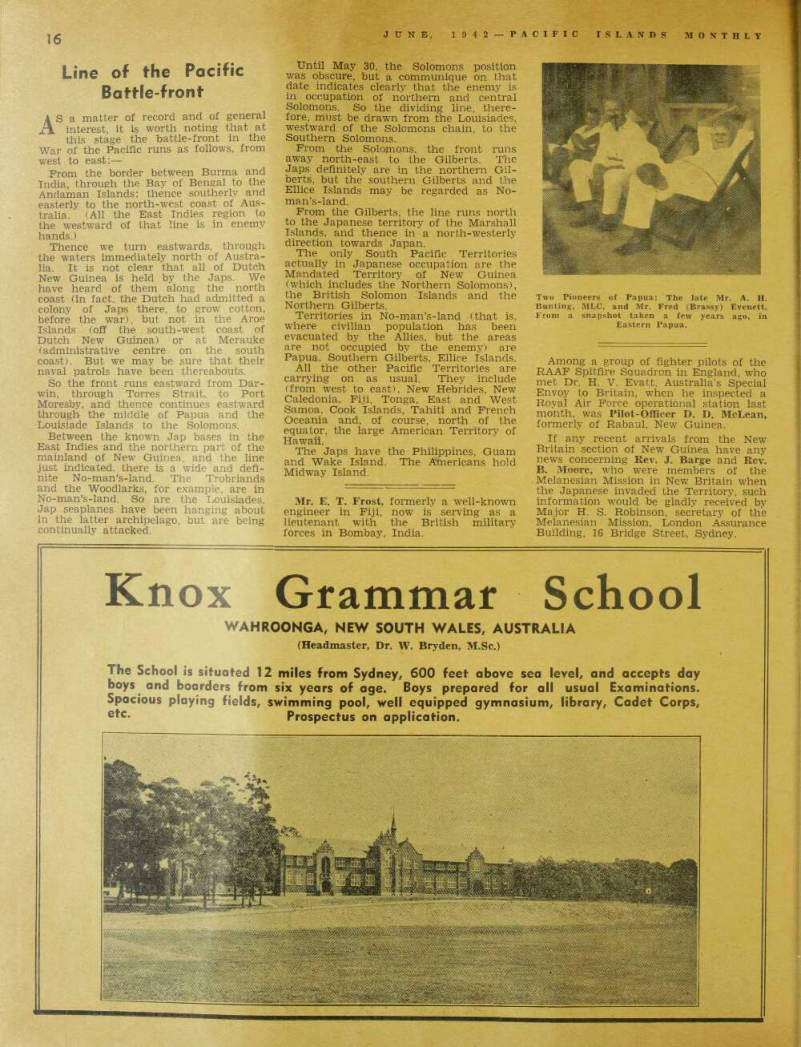
Line of the Pacific Battle-front
AS a matter of record and of general interest, it is worth noting that at this stage the battle-front in the War of the Pacific runs as follows, from west to east:— From the border between Burma and India, through the Bay of Bengal to the Andaman Islands; thence southerly and easterly to the north-west coast of Aus tralia. (All the East Indies region to the westward of that line is in enemy hands.) Thence we turn eastwards, through the waters immediately north of Austra lia. It is not clear that all of Dutch New Guinea is held by the Japs. We have heard of them along the north coast (in fact, the Dutch had admitted a colony of Japs there, to grow cotton, before the war), but not in the Aroe Islands (off the south-west coast of Dutch New Guinea) or at Merauke (administrative centre on the south coast). But we may be sure that then naval patrols have been thereabouts.
So the front runs eastward from Dar win, through Torres Strait, to Port Moresby, and thence continues eastward through the middle of Papua and the Louisiade Islands to the Solomons.
Between the known Jap bases in the East Indies and the northern part of the mainland of New Guinea, and the line just indicated, there is a wide and defi nite No-man’s-land. The Trobriands and the Woodlarks, for example, are in No-man’s-land. So are the Louisiades.
Jap seaplanes have been hanging about in the latter archipelago, but are being continually attacked.
Until May 30, the Solomons position was obscure, but a communique on that date indicates clearly that the enemy is in occupation of northern and central Solomons. So the dividing line, there fore, must be drawn from the Louisiades, westward of the Solomons chain, to the Southern Solomons.
From the Solomons, the front runs away north-east to the Gilberts. The Japs definitely are in the northern Gil berts, but the southern Gilberts and the Ellice Islands may be regarded as No man’s-land.
From the Gilberts, the line runs north to the Japanese territory of the Marshall Islands, and thence in a north-westerly direction towards Japan.
The only South Pacific Territories actually in Japanese occupation are the Mandated Territory of New Guinea (which includes the Northern Solomons), the British Solomon Islands and the Northern Gilberts.
Territories in No-man’s-land (that is, where civilian population has been evacuated by the Allies, but the areas are not occupied by the enemy) are Papua, Southern Gilberts, Ellice islands.
All the other Pacific Territories are carrying on as usual. They include (from west to east), New Hebrides, New Caledonia, Fiji, Tonga, East and West Samoa. Cook Islands, Tahiti and French Oceania and, of course, north of the equator, the large American Territory of Hawaii.
The Japs have the Philippines, Guam and Wake Island. The Americans hold Midway Island.
Mr. E. T. Frost, formerly a well-known engineer in Fiji, now is serving as a lieutenant with the British military forces in Bombay, India.
Among a group of fighter pilots of the RAAF Spitfire Squadron in England, who met Dr. H. V. Evatt, Australia’s Special Envoy to Britain, when he inspected a Royal Air Force operational station last month, was Pilot-Officer D. D. McLean, formerly of Rabaul, New Guinea.
If any recent arrivals from the New Britain section of New Guinea have any news concerning Rev. J. Barge and Rev.
B. Moore, who were members of the Melanesian Mission in New Britain when the Japanese invaded the Territory, such information would be gladly received by Major H. S. Robinson, secretary of the Melanesian Mission, London Assurance Building, 16 Bridge Street, Sydney.
Two Pioneers of Papua: The late Mr. A. H.
Bunting, MLC, and Mr. Fred (Brassy) Evenett.
From a snapshot taken a few years ago, in Eastern Papua.
Advertisements & other items, p. 18 (1 item)
Knox Grammar School
WAHROONGA, NEW SOUTH WALES, AUSTRALIA
(Headmaster, Dr. W. Bryden, M.Sc.) The School is situated 12 miles from Sydney, 600 feet above sea level, and accepts day boys and boarders from six years of age. Boys prepared for all usual Examinations.
Spacious playing fields, swimming pool, well equipped gymnasium, library. Cadet Corps, ei-c * Prospectus on application. , A. m a
a Guest
I Reassure and Entertain a Guest A Tooth-and-claw Memory of Vila
By “Snikwad”
I COULD see that something typically tropically tragical had happened to the hollow-eyed and cadaverous cheeked wreck of his former self, who sat before me. So I said: “Pour your self a bracer, and tell me all about it, from the beginning.”
“Well,” he said, shakily, “I went out aboard the ‘Morinda’ and there was quite a crowd of the shore people there, including the nurses from the hospital; quite a merry party. We all had a few drinks, and all came off together on the last launch, and just as we were getting off at HP’s wharf I had the ”
“Yes, yes,” I interjected. “I quite understand. Now, tell me what you did and everywhere you went after you—er— landed.”
“Well —er —feeling sure I’d have a pretty stiffish attack of fever after my — er—”
“Yes, yes; go on,” I said.
“I went into the Bar Condominium and had a couple of strengtheners, and — er —”
“You mean, you don’t want to admit to more than a couple,” I interrupted.
“But never mind. Did you go straight home after that?”
“Well, as straight as I could. I have some recollection of loitering somewhere under a tree, and I have a hell of a sore shin.”
“Oh,” I said. “Excuse me. Fill your self another, while I give my boy some instructions.”
I went to the kitchen and held rapid converse in Pidgin with Kalamua, and then returned to my distressed guest.
Ten minutes later I heard a call, “Mastah,” and there was Kalamua, grin ning from ear to ear.
I went to the kitchen again and filled a glass with water, listening to Kala mua’s breathless recital the while.
Then I gave him some more instruc tions and returned to my guest, poured out drinks, and addressed him.
“Be of good cheer, my boy. When you have been in Vila as long as I have you will know that misjudging your distance from launch to wharf, when returning from ship and Residency parties, might almost be called a pleasant diversion here. Every male inhabitant does it sometime or other. You’ll be guyed over it, of course, but the Native Advocate, who did it last, and was nearly drowned, will be tickled to death, as the guying will now be transferred from him to you.
“The second matter,” I continued, “occurs to most of us almost as fre quently, but it is rather more serious.
The nearest dentist is at Noumea, a mat ter of hundreds of sea-miles away, and there is only a boat once a month.”
“Kalamua,” I called.
Kalamau appeared, his big broad hand encircling a tumbler.
“However,” I said, “owing to my local knowledge and Kalamua’s keen eyesight and greater local knowledge”—l took the glass from Kalamua —“your denture has been recovered. Not, Kalamua tells me, where you were sick under the flam boyant tree, near the Ecole des Jeunes Filles, nor where you barked your shin on the culvert on your journey to re-dis cover the Rue Bougainville; but some considerable distance away along a gutter.
“A piece chipped from the back edge, and certain claw scratches indicate that it had been dragged off by a hermit crab. The crab apparently came to the conclusion that appearances were deceiv ing, and that the first promise of edi bility was a washout and held nothing more than a stale whisky-like flavour, and, in the second place, in spite of its shell-like hardness, that it lacked the contours necessary for its adoption as a covering for his tender rear. Hermit crabs will try anything once.
“Well, now, put your teeth in. What a transformation! From tropical derelict to pukka sahib in one act.
“Kalamua will bring the kai in a min ute. You’ll certainly need some solid refreshment.
“Don’t worry about falling in the water occasionally for the amusement of our
Vila ladies. They like it. And, any way, there’s more water in the world than anything else, so it’s no disgrace.
“With regard to the second mishap: prudence is its own reward. Write to your own dentist and order a set of spares. Next time, .the hermit crab might snap out a bigger lump of vul canite, or drag it down a hole or into the middle of the road, to be trodden on by a wandering cow.
“Such things have happened.”
Mrs. J. McGeady, of Suva, Fiji, has been advised by the NZ military authori ties that her son Ernest (“Paddy”), pre viously reported as “missing believed killed”, now has been located in an Italian prisoner of war camp.
Advertisements & other items, pp. 19-20 (1 item)
W.H. Grove & Sons
THAT
the
TWO BOOKS
WORTH READING
Two special books are available free of charge from Burns Philp Trust Company Ltd., The first, entitled "The Task That Few Men Want," deals with the Company's special service in connection with the execution of Wills and the administration of Estates. The second book, entitled "Hand Over Your Worries," tells how Burns Philp Trust Company Ltd. can assume responsibility for your personal business affairs during your lifetime. It has special appeal to those living in retirement, ancl to those whose professional activities are of an arduous character.
These publications will be forwarded immediately on request. Both are of particular importance in current circumstances.
DIRECTORS—James Burns - Robert John Nosworthy - Lewis Armstrong - Joseph Mitchell MANAGER— C. H. Chester
Burns Philp Trust
COMPANY LIMITED
7 BRIDGE STREET. SYDNEY
PHONE: B 7901. Box 543 B. G.P.0., Sydney.
W.H. GROVE & SONS
Limited
AUCKLAND
Island Traders. PO - Box 49 °* Telegraphic and Cable Address: “Grove”, Auckland.
Shippers of ail classes of New Zealand products.
Representing English Manufacturers throughout the Cook and Society Islands, Fiji, Tonga, Samoa, Niue, New Caledonia, New Guinea, etc.
In FIJI as—W. H. Grove & Sons (Fiji) Ltd.
Modern Refrigeration for the South Sea Islands The
ELECTROLUX
KEROSENE OPERATED
REFRIGERATOR
MARVEL
OF
MODERN
SCIENCE
THE
MIRACLE
OF
ICE
FROM
HEAT
ELECTROLUX offers economical, modern and completely efficient
REFRIGERATION FOR ISLANDS' HOMES.
FREEZES CONTINUOUSLY WHILE SMALL LAMP BURNS.
Freezing controlled by simply regulating height of flame. Uses only f gallon of kerosene per week.
MOTORLESS ... NO PARTS TO GET OUT OF ORDER.
MODEL L 22 MODEL L3BO MODEL LKSSO CapaClty 9 < as illustrated) • Capacity Capacity 4 cubic feet. 5.5 cubic feet- -2.2 cubic feet.
GUARANTEED FOR TWO YEARS.
* Write to your Local Distributor for prices and full details.
OBTAINABLE FROM ALL W. R. CARPENTER & CO. LTD.
BRANCHES THROUGHOUT THE ISLANDS
Representation in Papua and New Hebrides.
SSS to A*?andislands
"Inside" Stories of the War
Why Japan Decided To Attack Usa
ONE of the war developments which still puzzle commentators is the decision of Japan to attack the United States.
It is most clear that Japan cannot succeed unless: (1) She crippled United States in her first rush; or (2) Germany is victorious in Europe, thus crippling Britain, Russia and United States.
Neither of those* things has happened; so that the destruction of Japan as a dangerous Power is inevitable.
The hazard must have been seen in Japan. Therefore, why did Japan fight?
Mr. George H. E. Smith, a noted American commentator on international affairs, in an article in the notable American magazine, “Current History”, tries to answer the question. rE Japanese attack upon Pearl Har bor came as a shock but not as a surprise to those who have closely followed Japanese-American relations in recent years. Most observers looked for a Japanese advance on Burma and Thai land in December, not for a sneak attack directly against the United States.
Japanese-American relations, which were thus finally broken off, began with Commodore Perry’s visit to Japan in 1853. Although he arrived there with a naval squadron, his was a peaceful mis sion. He went to prepare the way for American trade and friendship with Japan. Credited with having introduced a backward and self-isolated nation to modern trade and civilisation, Perry’s" mission was regarded by the Japanese as a great service to their country.
For almost half a century thereafter, American policy toward Japan was a part of America’s simple policy toward the Far .East generally—peace, friend ship, and trade, with a rehgio-social interest zealously pushed by missionaries.
The policy involved no American politi cal undertakings.
BY the late 1890’s, America’s earlier Far Eastern policy had crystallised into two principles that have ever since remained unchanged.
The claim to eqpal commercial oppor tunities became the policy of the Open Door. And to insure an open door for American trade and investments, the United States came more and more to insist upon the territorial integrity and political independence of the Oriental nations, particularly China. To this policy Japan in great measure owes her escape from being yoked by foreign interests as China had been in earlier years.
The one exception came when, as a result of the war with Spain in 1898, the United States acquired the Philippines.
Possessed of a territorial stake in the Western Pacific, the United States was henceforth committed to a share in the political developments of Asia. The simple Open Door to commercial oppor tunity in Asia thus became the open door to American political involvement in Asia, and also in Europe through the Oriental back door.
For a few years after 1900, American policy took the form of opposition to any threat of domination of East Asia, whe ther it came from Western European nations or from within the Orient itself.
Japan, still struggling to modernise a feudal society, was as much the benefi ciary of American policy as was China.
American sympathies and support of
S JaDanes U e ed Wa e r en “ **" 38 **"
Russo-Japanese War.
Wwat wnc; tntallv missed at the time
itThr fact that S slekine
is the.lact tnat in seexmg territory on the Asiatic coast, Japan was responding to that principle of military geography which impels a nation bor dered by narrow waters to seek possession or control of the opposite shore. In the Russo-Japanese war, if not before, Japan had definitely commenced the struggle for a foothold on the Asiatic mainland.
Partly in response, perhaps, to that principle of military geography, partly from pressures exerted by the needs of a growing population and from indus trial expansion, and partly through dreams of a great empire, Japan inten-
SSS to A*?andislands
periphery of her homeland in the West ern Pacific. Korea. Formosa, Sakhalin, attempts to hold Shantung, and to reach , Manchuria, were manifestations of janan’s new nolicv Japans new P V- Soon after the Russo-Japanese War, it began to appear that of all nations interested in the Far East, Japan was the one most likely to seek exclusive rule over that part of the world. As Japan by successive steps confirmed this view,
American policy, which had been more or less general up to this time, converged upon her. The change was at first from open friendship to a vacillating policy, veering between a willingness to recog nise Japan’s “special interests” in Asia (as in the Lansing-Ishii agreement), and a desire to block her expansion Ihere.
This hesitant policy was in some degree a reflection of America’s opposing forces of isolationism and internationalism.
Moreover, the imperialistic itch in the United States had been satisfied for the time, and Japan’s actions did not directly endanger real American interests.
POINTS of friction and irritation between Japan and the United States existed throughout the momentous years between 1905 and 1930.
The immigration policy of the United States which excluded Japanese was one. The issue was further inflamed by racial discrimination in California.
American resistance on lines of tradi ditional policy to Japan’s “Twenty-one Demands” on China in 1915 was still another of the issues that contributed
toward the growing divergence between the two countries.
Similar issues grew out of Japan’s participation in the First World War.
Taking advantage of the French and British need for allies, Japan stood out for promises of territories and conces sions in the Far East as the price of her aid. It was in this way that she ultimately acquired the three groups of Pacific Islands—the Carolines, Marshalls and Marianas—under a League man date. She took over the German con cessions on the China coast and occu pied Shantung, Her policy during this period was as much to advance her aim of expansion as it was to aid the Allies.
At the Peace Conference, and after, the United States strove to block Jap anese expansionist policy, American insistence ultimately compelled Japan to restore Shantung to Chinese rule.
Unable to do anything about the par celling out of Pacific Islands to Japan, while at the same time wishing to make a genuine contribution to peace in the Pacific, the United States fostered the Washington Naval Conference in 1921, out of which came the agreement to limit naval competition, the Nine-Power Treaty including the pledge of all parties to respect Chinese territory and sover eignty, the promise not to fortify Pacific Islands, and the promise to settle all disputes by pacific means.
Throughout the 1920’5, the united States continued to work for arma ment limitation, international co operation along economic and social lines, and the peaceful settlement of con troversies. In Europe, the League of Nations struggled for the same objec
tives but without success. European politics aggravated rather than removed what Germany openly began to charge were the injustices of the Treaty of Ver sailles.
The collapse, confusion, and distress that soon followed the economic depres sion after 1929 compelled each nation to keep its eyes on its home problems and afforded the opportunity for Hitler’s rise to power in Germany and for his subse quent triumphs in European politics.
Although efforts were made from the time of the Paris Peace Conference to 1930, neither the League of Nations, nor enlightened statesmanship in other world councils, nor developments in Japanese- American relations, met the Japanese problems of growing population pressure, of increasing need for food and raw materials, and of the other less tangible aspects of her expansionist tendencies.
And so, while the world was struggling with the economic breakdown, Japan once again turned to an imperialist solu tion of her difficulties by the invasion of Manchuria in September, 1931.
Chinese resentment and resistance, and her own determination to make the most of her opportunity, compelled Japan to enlarge her activities in 1937 by the extended invasion of China proper.
UNTIL the Manchurian invasion, American-Japanese relations were marked by misunderstandings, rifts, irritations, mutual fears and suspicions, but there was no open hostility or irre trievable break. Any time until 1931, and even as late as the invasion of China in 1937, the issues between the two coun tries might have been settled peaceably and to their mutual benefit.
But the far-sighted statesmanship necessary for sdch a settlement did not exist in either nation, and except for the report of the Lytton Commission appointed by the League (on which the United States was represented) little was done to meet the Japanese prob lem constructively.
Instead, the American policy of vacil lation which had marked American diplomacy since 1905. began to crystallise into a policy of determined opposition.
The United States refused to recognise the Japanese conquests. It sought to induce Japan to return to the principles of the Ooen Door and of the Nine-Power Treaty, ‘it sought to preserve, as Japan denounced, the treaties and efforts toward naval limitation. It tried to persuade Japan to abandon aggressive tactics and return to the methods of law, order, and peaceful settlement.
In the effort to gain these ends, the United States tried gentle diplomacy, frank denunciation, and blunt warnings, without avail. Such constructive mea sures as it suggested and practised (called “appeasement”) came too late and did not cut deep enough to the real issues.
On several occasions the United States was eager to block Japanese expansion by economic pressure and a show of force, by using the machinery of the League of Nations, by proposing joint action with Great Britain, and by con certed measures with other powers, as at Brussels in November, 1937. In each instance, the United States failed to obtain the outside support that it felt necessary, and nothing came of its efforts.
AND then developments set in that were soon to crystallise the policies of both countries, and to drive them toward open conflict, avoidable only if one or the other executed a complete reversal of attitude. Japan first joined in the German-inspired Anti-Commintern Pact, while the policy of the Roosevelt Administration hardened against Hitler and the “aggressors”.
In the first year after the war broke out in September, 1939, the United States moved rapidly to the side of Britain and France through the change in the neu trality laws and the granting of “aid short of war”. Japan, on the other hand, entered into closer relations with Ger many and Italy through the Tripartite Pact of September. 1940. Thus, as has so often happened before, Far Eastern issues merged with European issues in American foreign policy.
Japan signed the Tripartite Pact, hop ing to dangle the threat of a two-ocean war before American eyes while making further advances in Asia and the Pacific.
To Germany the Pact meant the hope of keeping the United States out of the war in Europe and Africa. Both coun tries banked on the anti-war sentiment that had crystallised in the Neutrality Acts to hold America in check. It was not forseen at the time the Pact was made that the United States would move so swiftly in the direction of open con flict with Germany. rIS shift of American policy, taking place almost within six months, completely altered the setting of Japanese-American relations.
On the occasions before 1940. when the United States sought to block Japanese expansion, the world political situation had been unfavorable to such ventures.
Now European and Far Eastern issues had become merged. The United States was committed to Hitler’s defeat. She was practically an ally of Soviet Russia.
Great Britain, the stumbling block on
previous occasions when the United States desired to act against Japan, now wanted American aid and was willing to support anything the United States might do to immobilise Japan and settle the Far Eastern question.
In short. Japanese expansion now coincided with issues and circumstances on which the United States would go to war.
By the late summer and fall of 1941, Japan was caught up by circumstances, partly of her own making, and swept along by the shifty winds of power poli tics. She was rapidly being driven into a corner where the pressures were becoming unbearable.
Beginning with the Mukden incideyit in 1931, she took on a war in China that she could neither finish victoriously nor settle hy negotiation without damaging her national pride and policy. Hoping to play the game of power politics for her own ends, she had aligned herself with the Axis , little suspecting that the move would point up the one issue likely to arouse the United States to active opposition.
SORELY aggravating these conditions was the fact that the Japanese people were harassed by economic pressures from two sides.
The needs of the growing population and the strain of a war economy served to whip the government to action to avoid inner explosion, while from with out the economic pressure exerted by America. Britain, China, and the Dutch East Indies (the ABCD Powers) under American leadership had begun to pinch hard.
Heavily dependent upon supplies from outside her borders, Japan had been cut off from 75 per cent, of her normal imports by the Allied blockade.
The strain of these circumstances and the hope of finding a way out of them led Japan to rush Saburo Kurusu to Washington in November. There is scarcely any doubt that he came to make a deal.
The Japanese note of November 20 and Secretary Hull’s note of November 26, summarising the American position, showed how far apart the tw T o govern ments had drawn since 1931.
To bring them together asrain. Kurusu had only one price to offer—Japan’s apparent willingness to stop playing the game on the side of the Axis—and this offer was not enough. rthe original historic objectives of the United States regarding East Asia, there had been added those generated by recent American diplomacy.
So far as these were based upon direct American interests, they revolved around the fear that circumstances might give Japan the opportunity to work her way into the important rectangle enclosed by Ceylon, Canton. New Caledonia, and Melbourne, to cut off American supplies of critical raw materials by an Axis squeeze. Japanese troop movements to Indo-China dramatised American fear.
The remaining aims of American diplomacy in these momentous weeks had to do with its immediate objectives relating to the European War —to wean Japan away from the Axis, if possible: to protect Britain’s imperial position as an indirect means of protecting Amer ica’s own position; to safeguard Russia’s rear.
To meet the American position, Japan would have had to retire from China, respect the territory and political inde pendence of Asiatic countries, subscribe to the Open Door policy, agree to con duct her relations according to law,
order and peaceful measures, relinquish her ’ claim to domination over the •‘Greater East Asia Co-prosperity Sphere”, and withdraw from her associa tion with the Axis Powers.
However just and equitable this may have been from an American viewpoint
—considering the United States was will ing to take measures to ease Japan’s economic strain—it was too much to expect from Japan at this juncture. It asked her to reverse half a century of Japanese policy at a single stroke, to give up all that had been gained in China at such great cost since 1931, and to cast about once more for some solu tion to her needs for raw materials.
MEANWHILE, the pressure within Japan continued. Army and navy cliques who had been behind Japan ese aggression since 1931 and were now in control saw their own power and prestige hanging in the balance.
German advisers moved among them, pressing for action against the United States and Britain. British naval units moved to Singapore, American marines were withdrawn from Shanghai, Chur chill publicly promised immediate armed support to the United States, bellicose speeches were being made by responsible men in Japan and America, while the daily newspapers carried the information that the whole Pacific was on the alert.
It is difficult to decide when Japan made the decision to go to war, but it must have been soon after receiving Secretary Hull’s note of November 26.
Kurusu originally came to make a deal, but the last days of his negotia tions, whether he was aware of it or not, were used to gain time until Japanese naval units could reach Pearl Harbor for a surprise attack.
Supplies of a new twopenny stamp for Fiji, with a fresh design, showing the Government Buildings at Suva, are now on sale in the Colony.
Advertisements & other items, pp. 21-24 (1 item)
Ale
o
BREWED BY
CARLTON & UNITED BREWERIES LTD.
V.l
There is no substitute for
OLD MONK
VIRGIN PURE
OLIVE OIL
San Francisco
SPEtUI, TODH!
,J 9 x's 3 MJhy ,
\a\ [S&r n here’s S*a"°*
ea' e ° Spec when a\ daV sp eC ' tru»'V \h<u'mou / MS N »a*' e evetV Once an* <■' 0 ca V.e*° ra '~" _P\om "«f '' see l >-' oe, 'l\wo^ Pla'"'" f, '‘ Chef* R ’ pe , Ori ,r
x£2*jsr*~' *
nd 9°
SWMOH HRimiTD.
PORT MELBOURNE, VICTORIA, AUSTRALIA
■feat says-
L **“
qU/LoentS
Uk/tcesfetsAiw
Sauce U(mM
"I h& Wcntd
t
Uppefiset I
fest
emVudlwts
Always serve it at table and use it when cooking, too, for it will savor the soup and add a delightful zest to every meat or made-up dish.
Try this recipe for a Worcestershire Omelette-a favorite breakfast or luncheon dish: Vz lb. cold Chicken or Mutton 2 teaspoons Holbrooks Worcestershire Sauce Vi pint Milk 4 eggs Pepper and Salt Butter a glass baking dish, half fill with the minced chicken or mutton seasoned with the Holbrooks Worcestershire Sauce. Beat the eggs and add milk, pepper and salt. Pour over meat and bake in moderate oven until custard is set. Serve very hot.
HS-2
TAKE THE
“LEAD” FEELING
OUT OF YOUR LEGS
Get More Oxygen in Your Blood and Get that Pep that Sends You Bounding Up the Stairs.
People who smother to death die because oxygen has been completely cut off from them. Just as surely you are slowly smothering if your blood lacks red corpuscles. Red corpuscles are your oxygen carriers. They carry the oxygen you breathe in to every part of your system.
Without enough oxygen-carrying corpuscles, your kidneys, liver, stomach and bowels slow down. Your skin gets pale, flabby, often pimply. Your nerves may become jittery—you tire quickly— feel depressed.
What you need is Dr. Williams’ Pink Pills. These world-famous pills help you make more and better red corpuscles and thus increase the oxygen-carrying power of your blood. Get Dr. Williams’
Pink Pills to-day at your chemist or store and see for yourself how quickly this time-proven blood-builder will help give you back your pep and clear complexion.* *•
Products: Australia’s Choicest Green Peas French Beans Cauliflower Brussels Sprouts White Turnips Sweet Com Tomato Puree Tomato Sauce Tomato Soup Tutti Fruit Sauce Beetroot Spinach Cahbag Carrots Parsnips fi Celery
g a^ehVsJ{
Always make sure you have at hand an ample Reserve of these Delicious
Garden
Vole
Ready-toserve Vegetables
A Mystery Of
1914 Australia's First Submarine, AE1, Disappeared at Rabaul
RECENT activity and success —of Allied submarines in New Guinea and Western Pacific waters against Japanese shipping recalls the interest ing though melancholy, fact that Rabaul Harbour was the graveyard of Austra lia’s first submarine.
When the Great War broke out, the unfledged Royal Australian Navy had just received from Britain two 800-tons submarines, AEI and AE2. Quickly re fitted in Port Jackson, the AEI cruised north to join other units of the RAN detailed to occupy Rabaul, seat of gov ernment and chief centre of settlement in German New Guinea. An out-of-the way island in the Louisiades (Papua) was the rendezvous. Rabaul was seized on September 11, 1914, and the German wireless station at Bita Paka occupied. Six Australians lost their lives in the clash between men of the Australian Naval and Military Expe ditionary Force (unofficially and collo quially known as the “Coconut Lancers”) and the Germans and their armed native police, on the road leading to Bita Paka At 7 a.m. on September 14. the sloop “Parramatta”, from Herbertshohe (now Kokopo) and the submarine AEI, from Rabaul, left Blanche Bay together to patrol off Cape Gazelle, the most east erly point of the bay. Blanche Bay forms a wide semi-circular entrance, with Rabaul at the north-west corner.
They were in communication with each other hourly; and at 3.30 p.m., offi cers on the “Parramatta” saw the sub marine south-west of the Duke of York Islands, apparently on her way back to Rabaul Harbour. The destroyer stayed in St. George’s Channel for an hour or two longer, then made Herbertshohe at twi light.
By nightfall, the Admiral of the fleet signalled that AEI had not returned to her moorings. “Parramatta” and “Yarra”, using searchlights and flares, made an immediate search in the vicinity of the harbour, but without avail. Next day all the smaller vessels of the squadron at Rabaul and dozens of commandeered motor and steam launches scoured the coasts of New Britain and New Ireland.
All the neighbouring waters for 30 miles and more were examined, but no trace of the AEI was found —not even the tell tale shimmer of escaping oil on the water.
To this day, the fate of the AEI and her complement of 35 —Lt.-Commander T. Besant, RN (one of the most skilful and alert underwater-craft commanders of the day), two officers, and 32 ratings (half of them Australians, the other half British) —is a mystery.
Many theories have been advanced to explain away the AETs disappearance— the least improbable, according to official records, is that the submarine dived for practice when nearing the mouth of
Blanche Bay and came up close to the coastal reef which there forms a preci pitous, overhanging edge to the deep entrance channel and that her steel plates were pierced by the sharp coral rock. But why were no traces of oil seen, ask the experts?
Exactly what happened will always remain a question mark, for the sea keeps well her secrets.
AE2 Broached the Dardanelles AE2, sister sub. of the AEI, accom panied HMAS “Australia” to Fiji in Sep tember, 1914, and then returned to Syd ney As German New Guinea had been captured and the Pacific situation now seemed under control, the Royal Navy asked that AE2 be transferred to- the Mediterranean command.
During the Gallipoli campaign, she did splendid work and actually made a pas sage through the mined Dardanelles— the first Allied craft to do so. After a series of adventurous encounters with Turkish naval patrols—once she grounded and the crew spent a ticklish hour or two counting enemy ships passing over head. seeking their quarry—she was shelled and sunk in the Sea of Mar mara, on April 30, 1915. All her officers and crew (Australian and British) were rescued.
Advertisements & other items, p. 24 (1 item)
Old Monk
There is no substitute for
VIRGIN PURE
OLIVE OIL
.i v< San Francisco
Delta Into Rain
Rain and a grey mist falls, No palms swing or sway; A bird with a sad note calls Softly through the grey.
At times the quiet air sighs, Though only when in vain A wind in passing tries To lift her veil of rain.
Drenched by the weeping clouds Noon arrives and soon Solitude claims and crowds The long mute afternoon.
But patient earth abides By brooding in the rain, While misty silence glides Through corridors of pain.
As each day’s weary tread Gives way to that of night, One thought drives through my head And lingers on my sight— O, to wake and find The tassel and the plume Of sunshine on the blind Instead of Delta gloom!
-Richard Humphries.
Papua, 1934.
Rev. H. Mayo-Harris, formerly Arch deacon of the Anglican Church in Fiji, now holds the rank of Lieut.-Commander and is in command of a Royal Austra lian Navy ship.
Pilot-Officer Pat Richardson, son of Mr. W. Richardson, who managed the Penang Sugar Mill in Fiji before it was taken over by the GSR Co., has been awarded the Distinguished Flying Cross for bravery during the RAP attack on the Nazi cruiser “Scharnhorst”, when she escaped from Brest recently. Flying a Wellington bomber, Richardson dived to within 400 feet of the German warship’s anti-aircraft barrage and, though wounded, dropped a stick of heavy bombs across her bows. Prior to the outbreak of war, Richardson was a mem ber of the CSR Company’s staff.
Kava
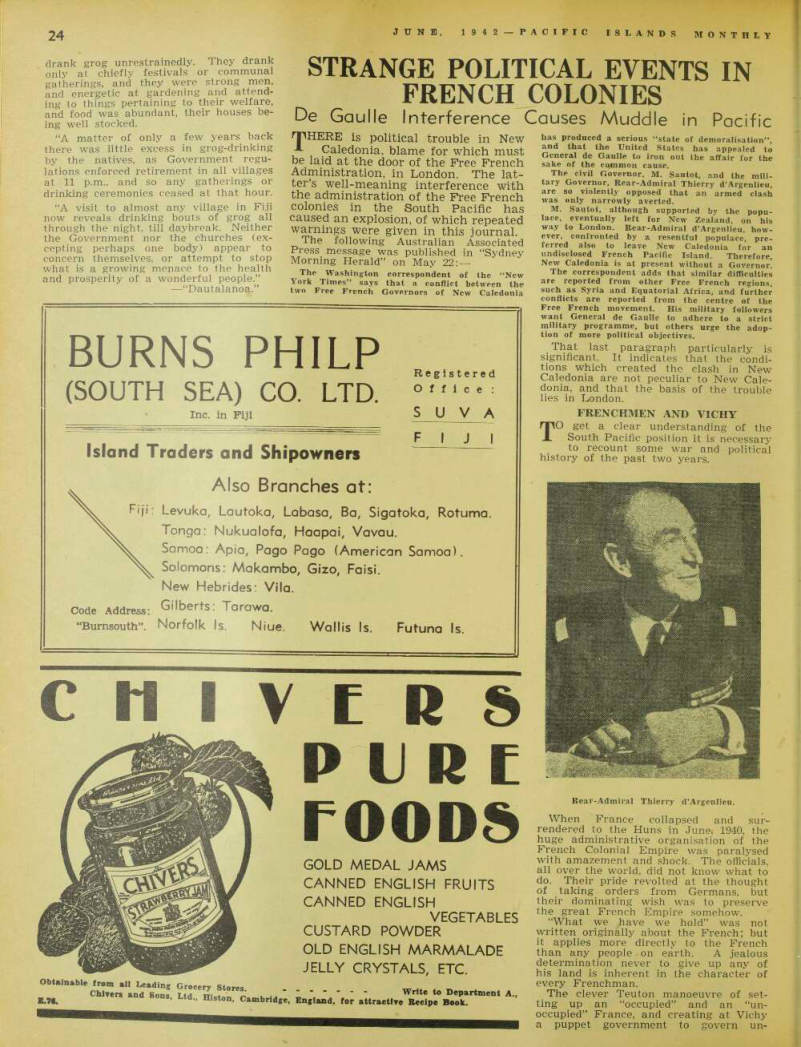
(Commonly Called "Native Grog")
MUCH has been said and written about the evil effects of kava drinking. Some of your correspon dents have admirably exposed the evils of the continual use of this drug. Per haps no better condemnation of grog drinking could have been written than the following, which is a free translation from the native.
This article, by the way, was the basis for a translation from Fijian into Eng lish, as set by the Education Department of Fiji for a Teacher’s Certificate (Grade IV) examination. The Government ad vice, as is evidenced by the candid sub ject matter of this examination, is as follows: — “There is one cause for the apparent laziness among us natives, in these days, and that is the excessive drinking of Fiji grog, which so weakens the spirits of some of us as to cause them to neglect planting or attending to any comforts for their wives or children. Our women also are guilty of excessive drinking of Fiji grog, the result being that they are unable to accomplish their usual duties.
“Our ancestors in olden times never
drank grog unrestrainedly. They drank only at chiefly festivals or communal gatherings, and they were strong men, and energetic at gardening and attend ing to things pertaining to their welfare, and food was abundant, their houses be ing well stocked.
“A matter of only a few years back there was little excess in grog-drinking by the natives, as Government regu lations enforced retirement in all villages at 11 p.m., and so any gatherings or drinking ceremonies ceased at that hour.
“A visit to almost any village in Fiji now reveals drinking bouts of grog all through the night, till daybreak. Neither the Government nor the churches (ex cepting perhaps one body) appear to concern themselves, or attempt to stop what is a growing menace to the health and prosperity of a wonderful people.”
“Dautalanoa.”
Advertisements & other items, pp. 25-26 (1 item)
CLmx>tt!s
Ine/tdid
MRS
SAUCE
Uied bif Oeh UteJVci'ld cmr
ECONOMICAL.BECAUSE YOUNKP
JUST A FEW DROPS AT A TIME -
OFTEN BUTTERED
NEVER BETTERED
CRISP, LIGHT BISCUITS which
bring out the flavour of cheese and add a new attractiveness to fresh or stewed fruit.
A delicious supplement to ham or paste or other tasty savoury, and still an epicurean delight, served simply with fresh butter.
The rich excellence of these famous Biscuits is the result of 67 years of specialisation.
They are packed in air-tight tins*,or packets for picnic convenience.
CLmx>tt!s
FAMOUS
SAO BISCUITS
A 26 ALWAYS ASK YOUR GROCER FOR ARNOTT'S !
BURNS PHILP
(SOUTH SEA) CO. LTD.
Inc. in Fiji Island Traders and Shipowners Registered Office :
SUV A
FIJI
\Also Branches at: Fiji: Levuka, Lautoka, Labasa, Ba, Sigatoka, Rotuma.
Tonga: Nukualofa, Haapai, Vavau.
Samoa; Apia, Pago Pago (American Samoa).
Solomons: Makambo, Gizo, Faisi.
New Hebrides: Vila.
Code Address: Gilberts: Tarawa.
“Burnsouth”. Norfolk Is Niue. Wallis Is. Futuna Is.
c n i v Mt »
PURE
FOODS
GOLD MEDAL JAMS
CANNED ENGLISH FRUITS
CANNED ENGLISH
VEGETABLES
CUSTARD POWDER
OLD ENGLISH MARMALADE
JELLY CRYSTALS, ETC.
Chlvers andVons LtT'm Write to Department A., . td., Histon, Cambridge, England, for attractive Recipe Book.
Obtainable from all Leading Grocery Stores.
K.7C.
Strange Political Events In
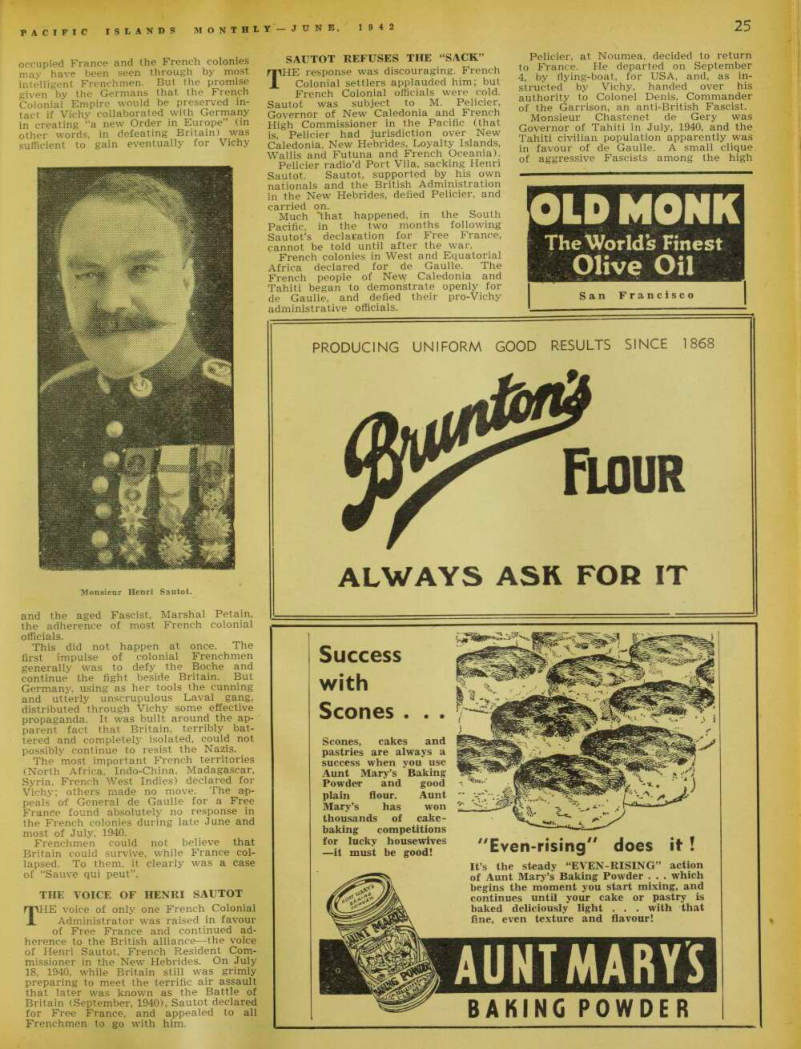
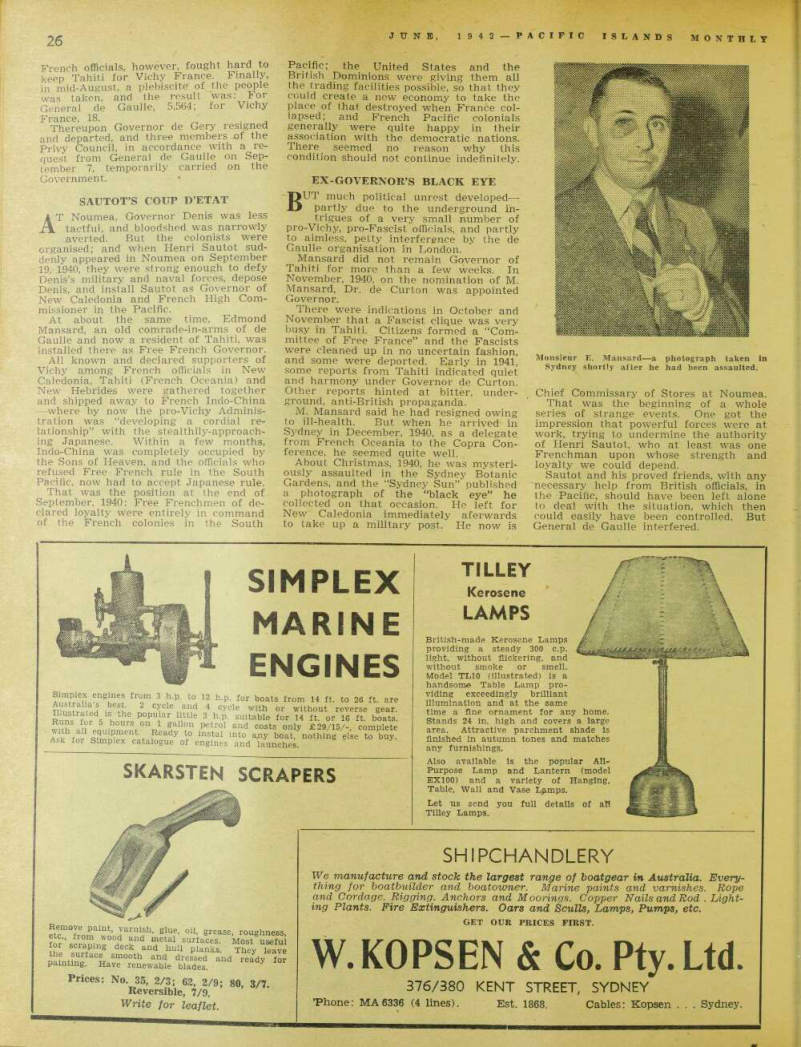
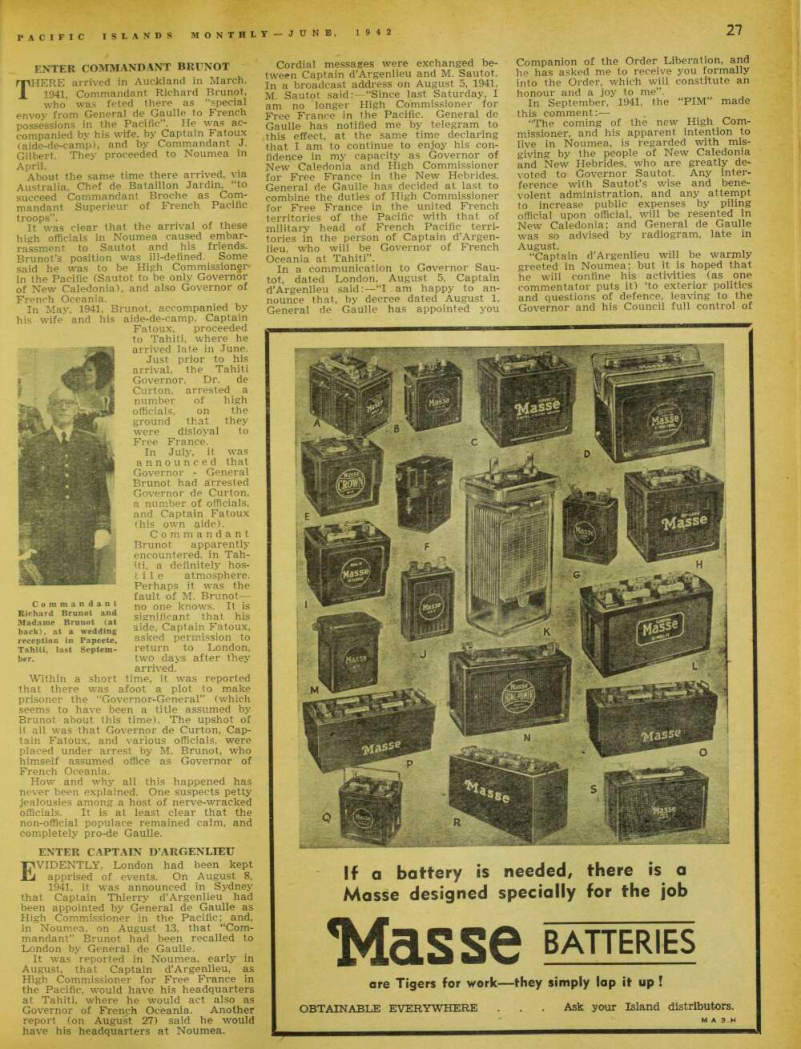
French Colonies
De Gaulle Interference Causes Muddle in Pacific
rpHERE is political trouble in New A Caledonia, blame for which must be laid at the door of the Free French Administration, in London. The lat ter’s well-meaning interference with the administration of the Free French colonies in the South Pacific has caused an explosion, of which repeated warnings were given in this journal.
The following Australian Associated Press message was published in “Sydney Morning Herald” on May 22: The Washington correspondent of the “New York Times” says that a conflict between the two Free French Governors of New Caledonia
has produced a serious “state of demoralisation”, and that the United States has appealed to General de Gaulle to iron out the affair for the sake of the common cause.
The civil Governor. M. Sautot. and the mili tary Governor, Rear-Admiral Thierry d’Argenlieu, are so violently opposed that an armed clash was only narrowly averted.
M. Sautot, although supported by the popu lace, eventually left for New Zealand, on his way to London. Rear-Admiral d’Argenlieu, how ever, confronted by a resentful populace, pre ferred also to leave New Caledonia for an undisclosed French Pacific Island. Therefore, New Caledonia is at present without a Governor.
The correspondent adds that similar difficulties are reported from other Free French regions, such as Syria and Equatorial Africa, and further conflicts are reported from the centre of the Free French movement. His military followers want General de Gaulle to adhere to a strict military programme, but others urge the adop tion of more political objectives.
That last paragraph particularly is significant. It indicates that the condi tions which created the clash in New Caledonia are not peculiar to New Cale donia, and that the basis of the trouble lies in London.
Frenchmen And Vichy
TO get a clear understanding of the South Pacific position it is necessary to recount some war and political history of the past two years.
When France collapsed and sur rendered to the Huns in June, 1940, the huge administrative organisation of the French Colonial Empire was paralysed with amazement and shock. The officials, all over the world, did not know what to do. Their pride revolted at the thought of taking orders from Germans, but their dominating wish was to preserve the great French Empire somehow.
“What we have we hold” was not written originally about the French; but it applies more directly to the French than any people on earth. A jealous determination never to give up any of his land is inherent in the character of every Frenchman.
The clever Teuton manoeuvre of set ting up an “occupied” and an “un occupied” France, and creating at Vichy a puppet government to govern un
Rear-Admiral Thierry d’Argenlieu.
occupied France and the French colonies may have been seen through by most intelligent Frenchmen. But the promise given by the Germans that the French Colonial Empire would be preserved in tact if Vichy collaborated with Germany in creating “a new Order in Europe” (in other words, in defeating Britain) was sufficient to gain eventually for Vichy
and the aged Fascist, Marshal Petain, the adherence of most French colonial officials.
This did not happen at once. The first impulse of colonial Frenchmen generally was to defy the Boche and continue the fight beside Britain. But Germany, using as her tools the cunning and utterly unscrupulous Laval gang, distributed through Vichy some effective propaganda. It was built around the ap parent fact that Britain, terribly bat tered and completely isolated, could not possibly continue to resist the Nazis.
The most important French territories (North Africa, Indo-China, Madagascar, Syria, French West Indies) declared for Vichy; others made no move. The ap peals of General de Gaulle for a Free France found absolutely no response in the French colonies during late June and most of July, 1940.
Frenchmen could not believe that Britain could survive, while France col lapsed. To them, it clearly was a case of “Sauve qui peut”.
The Voice Of Henri Sautot
THE voice of only one French Colonial Administrator was raised in favour of Free France and continued ad herence to the British alliance —the voice of Henri Sautot, French Resident Com missioner in the New Hebrides. On July 18, 1940, while Britain still was grimly preparing to meet the terrific air assault that later was known as the Battle of Britain (September, 1940), Sautot declared for Free France, and appealed to all Frenchmen to go with him.
Sautot Refuses The “Sack”
THE response was discouraging. French Colonial settlers applauded him; but French Colonial officials were cold.
Sautot was subject to M. Pelicier, Governor of New Caledonia and French High Commissioner in the Pacific (that is, Pelicier had jurisdiction over New Caledonia, New Hebrides, Loyalty Islands, Wallis and Futuna and French Oceania).
Pelicier radio’d Port Vila, sacking Henri Sautot. Sautot, supported by his own nationals and the British Administration in the New Hebrides, defied Pelicier, and carried on.
Much That happened, in the South Pacific, in the two months following Sautot’s declaration for Free France, cannot be told until after the war.
French colonies in West and Equatorial Africa declared for de Gaulle. The French people of New Caledonia and Tahiti began to demonstrate openly for de Gaulle, and defied their pro-Vichy administrative officials.
Pelicier, at Noumea, decided to return to ra SJ? n de f P®rtu|AonandPtir*in
vlchf handed ove? his
au thority to Colonel Denis, Commander of the Garrison, an anti-British Fascist.
Monsieur Chastenet de Gery was Governor of Tahiti in July, 1940, and the Tahiti civilian population apparently was - n f avour 0 f de Gaulle. A small clique ° £ aggressive Fascists among the high
Monsieur Henri Sautot.
French officials, however, fought hard to keep Tahiti for Vichy France. Finally, in mid-August, a plebiscite' of the people was taken, and the result was: For General de Gaulle, 5,564; for Vichy France, 18. ' .
Thereupon Governor de Gery resigned and departed, and three members nf the Privy Council, in accordance with a re quest from General de Gaulle on Sep tember 7, temporarily carried on the Government.
Sautot’S Coup D’Etat
AT Noumea, Governor Denis was less tactful, and bloodshed was narrowly averted. But the colonists were organised; and when Henri Sautot sud denly appeared in Noumea on September 19, 1940, they were strong enough to defy Denis’s military and naval forces, depose Denis, and install Sautot as Governor of New Caledonia and French High Com missioner in the Pacific.
At about the same time, Edmond Mansard, an old comrade-in-arms of de Gaulle and now a resident of Tahiti, was installed there as Free French Governor.
All known and declared supporters of Vichy among French officials in New Caledonia, Tahiti (French Oceania) and New Hebrides were gathered together and shipped away to French Indo-China —where by now the pro-Vichy Adminis tration was “developing a cordial re lationship” with the stealthily-approach ing Japanese. Within a few months, Indo-China was completely occupied by the Sons of Heaven, and the officials who refused Free French rule in the South Pacific, now had to accept Japanese rule.
That was the position at the end of September, 1940; Free Frenchmen of de clared loyalty were entirely in command of the French colonies in the South
Pacific; the United States and the British Dominions were giving them all the trading facilities possible, so that they could create a new economy to take the place of that destroyed when France col lapsed; and French Pacific colonials generally were quite happy in their association with the democratic nations.
There seemed no reason why this condition should not continue indefinitely.
Ex-Governor’S Black Eye
BUT much political unrest developed—partly due to the underground in trigues of a very small number of pro-Vichy, pro-Fascist officials, and partly to aimless, petty interference by the de Gaulle organisation in London.
Mansard did not remain Governor of Tahiti for more than a few weeks. In November, 1940, on the nomination of M.
Mansard, Dr. de Curton was appointed Governor.
There were indications in October and November that a Fascist clique was very busy in Tahiti. Citizens formed a “Com mittee of Free France” and the Fascists were cleaned up in no uncertain fashion, and some were deported. Early in 1941, some reports from Tahiti indicated quiet and harmony under Governor de Curton.
Other reports hinted at bitter, under ground, anti-British propaganda.
M. Mansard said he had resigned owing to ill-health. But when he arrived in Sydney in December, 1940, as a delegate from French Oceania to the Copra Con ference, he seemed quite well.
About Christmas, 1940, he was mysteri ously assaulted in the Sydney Botanic Gardens, and the “Sydney Sun” published a photograph of the “black eye” he collected on that occasion. He left for New Caledonia immediately aferwards to take up a military post. He now is
Chief Commissary of Stores at Noumea.
That was the beginning of a whole series of strange events. One got the impression that powerful forces were at work, trying to undermine the authority of Henri Sautot, who at least was one Frenchman upon whose strength and loyalty we could depend.
Sautot and his proved friends, with any necessary help from British officials, in the Pacific, should have been left alone to deal with the situation, which then could easily have been controlled. But General de Gaulle interfered.
Monsieur E. Mansard—a photograph taken in Sydney shortly after he had been assaulted.
Enter Commandant Brunot
THERE arrived in Auckland in March, 1941, Commandant Richard Brunot, who was feted there as “special envoy from General de Gaulle to French possessions in the Pacific”. He was ac companied by his wife, by Captain Fatoux (aide-de-camp), and by Commandant J.
Gilbert. They proceeded to Noumea in April.
About the same time there arrived, via Australia, Chef de Bataillon Jardin, “to succeed Commandant Broche as Com mandant Superieur of French Pacific troops”. . , . „ It was clear that the arrival of these high officials in Noumea caused embar rassment to Sautot and his friends.
Brunot’s position was ill-defined. Some said he was to be High Commissioner in the Pacific (Sautot to be only Governor of New Caledonia), and also Governor of French Oceania.
In May, 1941, Brunot, accompanied by his wife and his aide-de-camp, Captain
Fatoux, proceeded to Tahiti, where he arrived late in June.
Just prior to his arrival, the Tahiti Governor, Dr. de Curton, arrested a number of high officials, on the ground that they were disloyal to Free France.
In July, it was announced that Governor - General Brunot had arrested Governor de Curton, a number of officials, and Captain Fatoux (his own aide).
Commandant Brunot apparently encountered, in Tah iti, a definitely hos c i 1 e atmosphere.
Perhaps it was the fault of M. Brunot— no one knows. It is significant that his aide, Captain Fatoux, asked permission to return to London, two days after they arrived.
Within a short time, it was reported that there was afoot a plot to make prisoner the “Governor-General” (which seems to have been a title assumed by Brunot about this time). The upshot of it all was that Governor de Curton, Cap tain Fatoux, and various officials, were placed under arrest by M. Brunot, who himself assumed office as Governor of French Oceania.
How and why all this happened has never been explained. One suspects petty jealousies among a host of nerve-wracked officials. It is at least clear that the non-official populace remained calm, and completely pro-de Gaulle.
Enter Captain D’Argenlieu
EVIDENTLY, London had been kept apprised of events. On August 8, 1941, it was announced in Sydney that Captain Thierry d’Argenlieu had been appointed by General de Gaulle as High Commissioner in the Pacific; and, in Noumea, on August 13, that “Com mandant” Brunot had been recalled to London by General de Gaulle.
It was reported in Noumea, early in August, that Captain d’Argenlieu, as High Commissioner for Free France in the Pacific, would have his headquarters at Tahiti, where he would act also as Governor of French Oceania. Another report (on August 27) said he would have his headouarters at Noumea.
Cordial messages were exchanged between Captain d’Argenlieu and M. Sautot.
In a broadcast address on August 5, 1941, M. Sautot said:—“Since last Saturday, I am no longer High Commissioner for Free France in the Pacific. General de Gaulle has notified me by telegram to this effect, at the same time declaring that I am to continue to enjoy his confidence in my capacity as Governor of New Caledonia and High Commissioner fer Free France in the New Hebrides.
General de Gaulle has decided at last to combine the duties of High Commissioner for Free France in the united French territories of the Pacific with that of military head of French Pacific territories in the person of Captain d’Argenlieu, who will be Governor of French Oceania at Tahiti”.
In a communication to Governor Sautot, dated London, August 5, Captain d’Argenlieu said:—“l .am happy to announce that, by decree dated August 1, General de Gaulle has appointed you
Companion of the Order Liberation, and he has asked me to receive you formally into the Order, which will constitute an honour and a joy to me .
In September, 1941, the PIM made this comment: — , “The coming of the new High Com missioner, and his apparent intention to live in Noumea, is regarded with mis giving by the people of New Caledonia and New Hebrides, who are greatly de voted to Governor Sautot. Any mter ference with Sautot’s wise and bene volent administration, and any attempt to increase public expenses by piling official upon official, will be resented m New Caledonia: and General de Gaulle was so advised by radiogram, late in August.
“Captain d'Argenlieu will be warmly greeted in Noumea; but it is hoped that he will confine his activities (as one commentator puts it) ‘to exterior politics and questions of defence, leaving to the Governor and his Council full control of
Commandant Richard Brunot and Madame Brunot (at back), at a wedding reception in Papeete, Tahiti, last Septem ber.
New Caledonia’s economic and adminis trative affairs.’ ”
As it proved, those fears were well founded.
Captain Thierry d’Argenlieu arrived in Tahiti in August, 1941, from United States, and officially took over, from Commandant Richard Brunot the duties of High Commissioner, and Governor of French Oceania. With him was Frigate- Captain Cabanier, who had been ap pointed “Commanding Officer of the De fence of the Free French Pacific Colonies”.
Commandant Brunot returned to London.
“You Lie, Darlan!”
MEANWHILE, in New Caledonia, Governor Henri Sautot was on good terms with his people, and he came into the news occasionally.
He spoke from Radio Noumea on June 18, 1941, and referred to the statement of Admiral Darlan, in Vichy, that “Britain has taken over the Free French colonies”.
“Monsieur Darlan, you are a liar” de clared Sautot. The colonies, he said, were completely free, under the French French administration.
In July, 1941, Darlan announced from Vichy that Sautot had been deprived of French nationality. Sautot retorted: “This is the greatest honour of my life.
It shows that Vichy recognises that I really am working for the liberation of France”. General de Gaulle telegraphed: “Congratulations on the honour done you by the Vichy Gestapo!”
D’Argenlieu And Sautot
CAPTAIN d’Argenlieu arrived in New Caledonia in September, 1941. He was received cordially, but cau tiously, by a community devoted to Sautot. His extraordinarily romantic career (he was a very courageous naval officer until 1918, then a Carmelite monk until August, 1939, then a French naval
officer, and finally a prominent executive of the de Gaulle Administration) gave him an assurance of respect. Not long after d’Argenlieu’s arrival in New Cale donia, General de Gaulle raised him to the rank of Rear-Admiral.
One heard echoes of what was hap pening in Noumea: but, at first, High Commissioner and Governor got along together very well. But it soon became apparent that d’Argenlieu was not go ing to be Governor in Tahiti, as had been expected—Lieut.-Colonel George Orselli, of the Free French Air Force was appointed Governor of French Oceania.
An explosion was bound to occur; and it came when New Caledonia was oc cupied by a defensive force of American troops, early in 1942.
The Americans did not wish to inter fere, in any way, with the civil adminis tration. But, when it came to clari fying the relationship between the Goyernment and the military organi sation, trouble inevitably developed be tween d’Argenlieu, who claimed re sponsibility for defence, and Sautot, who was responsible for New Caledonian government generally.
But there are no details—nothing be yond the above-quoted news despatch from Washington.
One Sydney newspaper, on April 30, said that General de Gaulle had recalled M. Sautot to London, and that he would be sent to another Free French colony; but this was not confirmed.
It can be understood that the dispute between d’Argenlieu and Sautot has caused the Americans much embarrass ment. They are not concerned with Free French politics—only with doing an ef ficient job as fighting men. The action of both d’Argenlieu and Sautot in de parting from the colony, under the present most difficult conditions, must have created a special headache for the American Commandant.
A Free French Problem
THE following, from the “Sydney Morning Herald” correspondent at General MacArthur’s headquarters in Australia, throws some light upon the situation:— “As Rear-Admiral Thierry d’Argenlieu is passionately loyal to the Free French cause, his clash with M. Sautot, who is on his way to London, does not suggest on either side a defection from the Allies. Indeed, it appears to be only a local manifestation of a universal prob lem for the Free French—whether the fight to free France should be confined to a military movement, leaving political problems until after the war, or whether the movement under General de Gaulle should branch out into civil as well as
military affairs.”
Advertisements & other items, pp. 27-30 (1 item)
Auntmarys
Drf « San Francisco
PRODUCING UNIFORM GOOD RESULTS SINCE 1868
ALWAYS ASR FOR IT
Success
with
Scones. . .
Scones, cakes and pastries are always a success when you use Aunt Mary's Baking Powder and good plain flour. Aunt Mary’s has won thousands of cakebaking competitions for lucky housewives —it must be good! r «
Even-rising" does it !
mk i It’s the steady “EVEN-RISING” action of Aunt Mary’s Baking Powder . . . which begins the moment you start mixing, and continues until your cake or pastry is baked deliciously light . . . with that fine, even texture and flavour!
AUNTMARYS
BAKING POWDER
SIMPLEX
MARINE
ENGINES
Simplex engines from 3 h.p. to 12 h.p. for boats from 14 ft. to 26 ft. are tiWrittn 2 C3 f Cle , and 4 cycle with or without reverse gear.
Run? fnr d s P ° PU i lar V,^ 6 3 h ' p ' suitable for 14 ft. or 16 ft. boats. wjh flll pm.i t ? all ? n petr ° 1 and costs only £29/15/-, complete Mk h fn? SE p't Ready to mstal into a,ny boat, nothing else to buy.
Ask for Simplex catalogue of engines and launches
SKARSTEN SCRAPERS
TILLEY
Kerosene
LAMPS
British-made Kerosene Lamps providing a steady 300 c.p. light, without flickering, and without smoke or smell.
IVfodel TLIO (illustrated) is a handsome Table Lamp providing exceedingly brilliant illumination and at the same time a fine ornament for any home.
Stands 24 in. high and covers a large area. Attractive parchment shade is finished in autumn tones and matches any furnishings.
Also available is the popular All- Purpose Lamp and Lantern (model EX100) and a variety of Hanging, Table, Wall and Vase L^mps.
Let us send you full details of aH Tilley Lamps. ■ Sc m °f V r e o£ ai « 1 J arn !f h ’ glue ’ oil ’ § rease . roughness, ?r’ Wood f nd metal surfaces. Most useful the See 112 deck and hull Planks. They leave the surface smooth and dressed and readv for painting. Have renewable blades. Y Prices: No. 35, 2/3; 62, 2/9; 80, 3/7.
Reversible, 7/9.
Write for leaflet.
SHIPCHANDLERY
We manufacture and stock the largest range of hoatgear in Australia. Everything for boatbuilder and boatowner. Marine paints and varnishes. Rope and Cordage. Rigging. Anchors and M oorings. Copper Nails and Rod . Lighting Plants. Fire Extinguishers. Oars and Sculls, Lamps, Pumps, etc.
GET OUR PRICES FIRST.
W.KOPSEN& Co. Pty.Ltd.
376/380 KENT STREET, SYDNEY
’Phone: MA6336 (4 lines). Est. 1868. Cables: Kopsen . . . Sydney.
If a battery is needed, there is a Masse designed specially for the job
'Masse BATTERIES
are Tigers for work—they simply lap it up !
OBTAINABLE EVERYWHERE Ask your Island distributors.
M A 3 . H
BITUMENOID ROOFING
MADE IN AUSTRALIA,
Bltumenold Roofings, Dampcourse and Insulating Pelts are made from the world's best raw materials. Warranted to stand the most rigid tests.
, BITUMENOID THE BEST
Naturfl’ P Ainh F Q 1 i 0 f Or S g ’ Water Proof Materials; Saturated Pelt; Resilient Road jointing, Natural Asphalt Dampcourse; 2 and 3-ply Dampcourse- 1-2 lb Lead-core Dampcourse: Roofing Cement; Asphalt Paints; RoofingCo mpoSnd Lead-core
SAMPLES AND PRICE LISTS ON APPLICATION.
MAXWELL PORTER & SON LTD.
ESTABLISHED 1888
107 BEDFEBN ST., REDFERN, SYDNEY, N.S.W.
BUILDERS’ SUPPLIES).
'Phone: M 3167. Cables Bltumenold.
■JAMES BUDGE
IiTD
REFRIGERATION . .
“BUDGE” Automatic or Manually-controlled Refrigeration and Ice-making Plants, with or without insulated Cabinets or Rooms, ranging from 4 cubic feet to 1000 cubic feet or arger, using ammonia in the large and sulphur dioxide (bO2) in the small units. Where electricity is not available, crude oil engines may be utilised for driving the larger plants and petrol engines for driving the smaller machines. The accompanying illustration is of a petrol engine driven SO2 unit. Enquirers please state power (if any), size of cabinet and amount of ice required per day.
ALL CLASSES OF REFRIGERATION EQUIPMENT.
JAMES BUDGE PTY. LIMITED
Refrigeration and General Engineers Office and Works:
McEvoy and Harley Streets
ALEXANDRIA, SYDNEY. Established 1890.
Death Of Mr. J. T
Mcevoy
INFORMATION reached Sydney this month that the death had occurred in New Guinea of Mr. J. T. McEvoy in circumstances at present unknown ’
When the Japanese struck southwards, in January, Mr. McEvoy, accompanied by the Lorengau radio officer, Mr. H. S.
Taylor, left the Admiralty Islands (Manus) v in Mr. McEvoy’s schooner and it was calculated that they would have reached Rabaul about the time of the Japanese invasion. Nothing was heard of them for some time. Mr. Taylor recently arrived safely in Australia, but it is reported that Mr. McEvoy is dead Mr. McEvoy went to New Guinea nearly 20 years ago as a plantation manager and he later acquired his own plantation in the Manus Group. . When he was in Sydney in 1939, buy ing a schooner, his friends jokingly told him that “he was living too near the Japs for comfort”; neither he nor they realised how truly they were speaking.
Mr. Frederick Moore, manager of the Melbourne Hotel, Suva, Fiji, who had lived in the Colony for over 40 years, died recently, aged 64. Born in NSW, he went to Fiji in 1900 to join A. M.
Brodziak and Company’s staff; then he was partner in the firm of Koroniva Trading Co. For many years he man aged the Rewa Hotel. Mr. Moore is sur vived by two daughters, Mrs. L. Lee and Mrs. B. Storck, and a son, Second Lieu tenant T. Moore, of the Fiji Defence Force.
We Of Buka
Women in the New Guinea Evacuation
Written for the “PIM” by Nurse Alice Menzies, of the Catholic Mission Hospital, For or an, Buka, TNG.
THERE is no fence or hedge round Time that has gone. One can go back and have of it what you like, if you remember it well enough. But we people of Buka, though our memories are vivid, would not wish again to go through the ordeal of evacuation.
We were preparing for Christmas. Our Christmas pudding was made, as well as the cake. The Christmas cargo had arrived, with its variety of things for the festive season—not forgetting a tin of boiled lollies for our patients and school children.
At 9 p.m. on December 16 a Govern ment official came to warn us of impend ing evacuation.
No one but those who have experienced it can imagine that sinking feeling. We thought of the closing of our hospital (which we had worked so hard to estab lish, and which was looking so well, with its new coat of green paint); the dis charging of patients, who would surely die if left without treatment; the babies, motherless; the school.
But such regrets had to be put aside, for the moment, as secondary. Our thoughts were concentrated upon what we could pack into two suit-cases; and the disposal of an eight-months’ supply of food, medicine, etc., as well as our little pinnace.
There was no time to indulge in sen timent. It was common-sense and action.
WE were instructed at 6 p.m. on Thursday, December 18, to be ready on the beach the following morn ing at 7 am., with two suit-cases each.
Far into the night we worked, packing.
Dr. Hennessey (an American priest who elected to remain behind, when the men were evacuated in January) came to our rescue, and offered to dispose of all equipment left behind by sending it to the Sisters. It was he who helped us to keep level heads —no easy task for four women. We owe Dr. Hennessey a large debt of gratitude.
At 6 am. we saw the “Bolia”, the Methodist Mission schooner, making her way along the coast to Kessa (now reported to be an enemy base); then back to Karoola; and at seven sharp she crossed to our little coastal islet of Pororan.
We left about 200 natives standing bewildered upon the beach. They could not understand this sudden departure of the nurses who had spent three years with them upon their little island, caring for the sick, looking after their babies, and teaching school.
Mrs. Percy Goode, from Kessa, and Mrs. Newall, from Karoola, were on board. Both had had to leave home, and most of their possessions and, what was hardest of all, their husbands. We continued the journey, picking up Mrs.
Hewson, Mrs. Luxton and Miss Commons, en route to Buka Passage, which we reached soon after mid-day. We spent the night there. The men gave a party —which, like all Islands parties, was a good one. rE women from Bougainville arrived early the following morning. We were now about 30, including child
ren, and we left Buka Passage for Rabaul by the “Asakage” on the very wet morning of Saturday, December 20.
Our luggage was all down in the hold; and, as we had to find accommodation on the hatch, there was no chance of
getting anything.
The mothers and children occupied the only two cabins, and the rest of us tried to make ourselves at home on the hatch.
The rain came down in torrents; the sea all but swallowed us up* and, for two days, we tossed and rolled, and were at its mercy. We were driven 20 miles out of our course. Our clothes were sodden, and black from the dirt of the ag'fes upon the hatch, and the majority of us were seasick.
So, when we eventually reached Rabaul at midnight on Sunday, December 21, and we were told that as we were not expected until the morning, no accom modation had been provided for us, we were not altogether happy. However, after a lot of argument, we were allowed to go on board a waiting steamer; but we were informed that there were no baths available until morning. So we got rid of what mud we could by sluicing in the hand-basins.
WE left Rabaul on December 22. There were 134 women and 104 children on board. Children, with their mothers, slept on the floor of the music room; decks were full of camp stretch
ers; and the cabins were overflowing.
However, we were on our way. We had a lot of sleep to make up, and stiff limbs to coax back to suppleness.
Then we of Buka were put off at Townsville, to continue the journey by rail. After three days in the train our limbs had stiffened up again—but what did it matter, for we reached Sydney at 11.30 a.m. on December 29. We were home!
Great thanks are due to the officials in charge of the evacuation for, despite terrific difficulties, they did their job well. The people of Brisbane and Towns ville won all our gratitude for their kindness and hospitality. And let us not forget a word of praise for the officers and crew of our steamer (“Boat A”) for bringing us safely home. Their’s was no small task.
Sergeant Edward Wilson, of Suva, a member of the Fiji Defence Force, was accidentally drowned in the Lami River, Viti Levu, in April.
Mrs. Gretchen Howell, who escaped from Singapore on a cattle boat just before the Japs attacked the island, and who now is living in Australia, is the wife of a former Fiji official, Mr. C.
Gough Howell, whose post in the Far East was Attorney-General of Straits Settlements.
Advertisements & other items, p. 31 (1 item)
Ceiling Safety!
Allen Taylor & Co. Ltd.
COMMERCIAL ROAD, ROZELLE,
SYDNEY
Sawmillers and Wholesale Suppliers of Hardwoods for Constructional Purposes GIRDERS . . . PILES . . . POLES . . . SLEEPERS, Etc.
EXPORTING TO PACIFIC” ISLANDS SINCE 1893
CEILING SAFETY!
SHOCK.. .vibration...
ground movement, may cause an old-fashioned lath and plaster ceiling to fall at any time.
Avoid that danger by having a SAFE METAL CEILING fixed overthe present plaster ceiling NOW . . . without disturbance or creating dust and litter.
Install this Avoid this n Ik Write to Wunderlich Ltd., G.P.O .
Box 474 aa, Sydney, for full particulars.
WUNDERLICH mejal CEILINGS
• ATTRACTIVE • SAFE • FIRE - RETARDANT
Tupane Goes All
Temperamenta l
A Trader's Tale By "Tukapa
TUPANE was a jolly fellow of bibulous and eccentric tendency, whom I, as village trader, delighted with my confidence, as expressed in a little bit of kaiou —otherwise designated “tick”.
He was a stout worker, and never let me down, so his entry into the store moved me to genial beams and weather prophecy. I have never been able to acquire‘ the art of hand-washing with invisible soap and water that is the mark of commercial guest-welcome.
Tupane was something very near to that awful character, the Native Pro fessionally Quaint. He had seen men and cities, had even “fought”—his fight ing consisted of transporting cases of bully—in Egypt, in the now-no-longer Great War.
Tupane had a fund of carefully broken English, and it was his life-ambition to akamaroiroi in church—a sort of speaking-when-the-Spirit-moves, as prac tlsed by the Society of Friends. But he never seemed to be moved on Sundays by anything but “bush-beer”—and later, policemen!
Upon a day, I had need of some sand from the beach—still free, in our island paradise!—and with sack in hand, went down the rocky Jacob’s-ladder that leads from our village ki tai, as the populace call seaward.
It was Court day; not the royal variety but that when the local Old 5~ ley T deal . s ltb smn ers Outside the Office I met Do-Funny, as he was known and deservedly to me.
H 1 4. had in his hand a bi £> ugly machete, or cane-knife; the snickersnee waved as he beat time to some sort of droning song, and he stood swaying with hls e ,yes closed, incongruously bedight in an old military great-coat. I don’t know what he had thereunder; nothing, more than hkely!
I hailed Do-Funny with jocund jest, and he Rolanded my Attic Oliver. For about five minutes we had great fun; but Do-Funny’s obvious unsteadiness, and his noisy hilarity, made him an embarrassing companion. Besides, I had uiy bag of sand to get. I went to the Place of shining coral “sugar”, and filled W sack, leaving Do-Funny to face—as I then thought—his waiting trial for insobriety.
The same night, I was just about to turn in, after my fatiguing sand-labours, when I had my mind altered by the very devil of a rumpus down the village „ eet ; u Sil °uts, screams, yells; and, fina uy. the roar of a shot-gun. There was plainly something wrong. As I listened, the sound of heavy feet, pounding the earth road outside my hut, faded inland. 1 grabbed a wooden axe-handle, and went out on the road to investigate.
As I reached the public thoroughfare a drum began to rattle. The voice of news then sounded: “Beware, all! Tupane has gone crazy and killed two men. Get your guns and come!”
A pretty kettle of fish! The village was terrified. All sorts of tales were passed from neighbour to aroused neighhour, and the death-roll swelled by repetition from two to two hundred.
It was a card-game that sent Tupane “off”. When I met him on the beach road he was not drunk. The man had beeu going insane for years, and now he was a dangerous, homicidal maniac at large; but I found out, by inquiry
from the native cop, that no one had been really killed ; Do-Funny had just given two of his card-companions a chop or two—nothing serious; he had nearly cut off the hand of one, and split the scalp of the other. , This news was cheering; but in spite of the absence of actual mayhem in the case, as expected, in the form of first degree evisceration, the village got no sleep that night, We patrolled, with such arms as were available; but Do-Funny had vanished from the haunts of men.
When I had time to remember how I had stood with this knife-armed maniac for so long, only that morning, I went goosey all over, The denouement was not dramatic Tupane, “Do-Funny”, didn’t! He re turned to his home the next morning as quiet as the sanest of citizens and was found tending his horse, But Do-Funny, seized from behind and tied up by a gang of men, immediately reverted to a foaming, gnashing man killer, and he had to be watched all the time thereafter. Even manacled, tied with rope, and with his feet in another pair of “darbies”, he was a menace; and the bonds had to be constantly renewed After three weeks of constant anxiety to his keepers, Do-Funny was removed bv steamer to his right place. He lived only six months, poor old fellow! ■ Mrs. Emma Smith, wife of Captain Arthur Smith, of the Fiji inter-island motor-ship, “Tui Kauvaro”, died recently m Su Y a o War Memorial Hospital, at the age 52 ' Mrs. K. C. Crump, wife of Rev. Crumn of the Presbyterian Mission, Nguna, New Hebrides, recently arrived in New Zea land with her young son.
Advertisements & other items, p. 32 (1 item)
o-jf iks, nUjhi,!
''A 300
POWER
A
JiuAnJ>kivUL,
o-jf iks, nUjhi,!
IV . 500
POWDER
brighter light
for
BETTER SIGHT
Coleman Products can be obtained from all Leading Firms throughout the Pacific Island..
All Types Mantles Instant Lighting Irons Kerosene Pressure Stoves
EASE OF OPERATION
combines
ECONOMY with COMFORT
In case of difficulty in obtaining supplies write to:— Pearce & Co., Suva, Fiji Is.
Dislocation
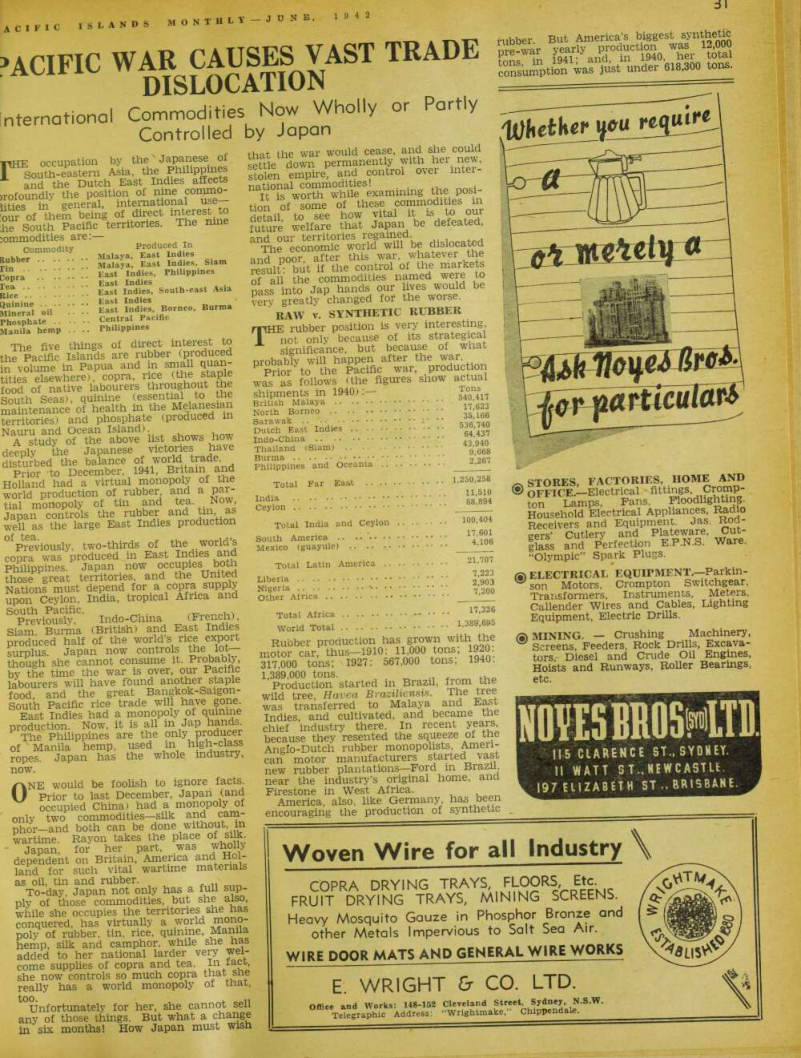
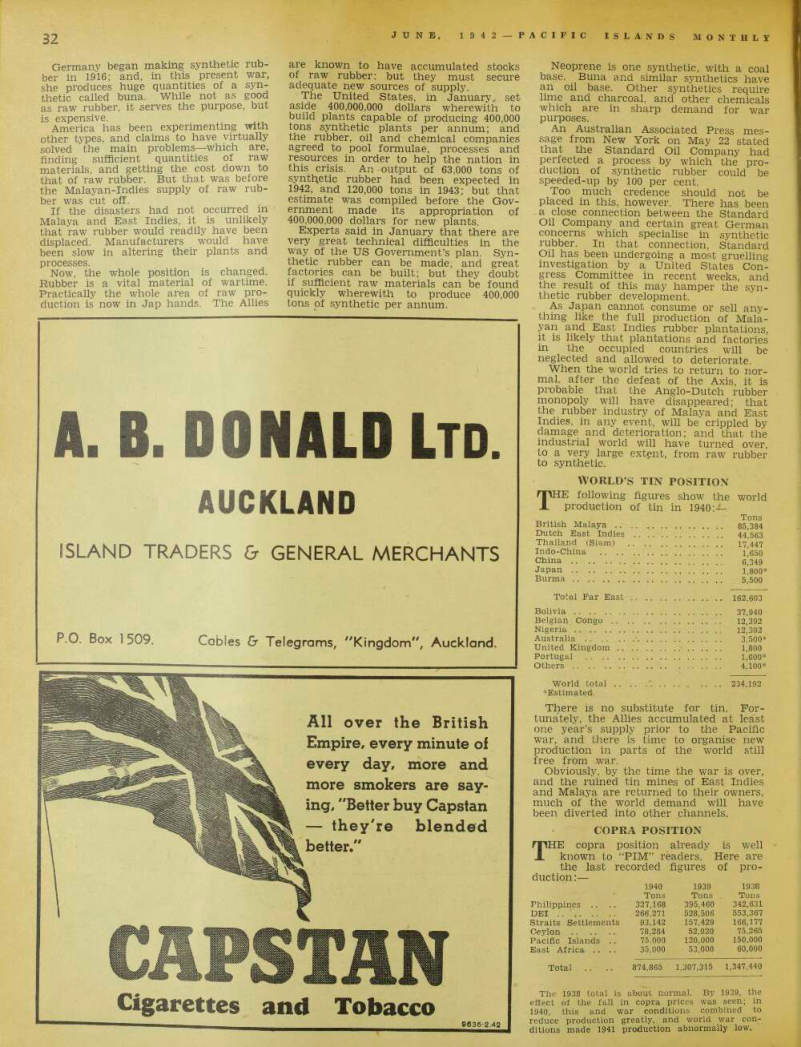
Pacific War Causes Vast Trade
internotional Commodities Now Wholly or Portly Controlled by Japan
rE occupation by the Japanese of South-eastern Asia, the Philippines and the Dutch East Indies affects )rofoundly the position of nine comm°iities in general, international use ■our of them being of direct interest to he South Pacific territories. The nme jommodities are;—
The five things of direct interest to the Pacific Islands are rubber (produced in volume in Papua and in small quan tities elsewhere), copra, rice (the staple food of native labourers throughout the South Seas), quinine (essential to the maintenance of health in the Melanesian territories) and phosphate (produced in Nauru and Ocean Island).
A study of the above list shows how deeply the Japanese victories have disturbed the balance of world trade.
Prior to December, 1941, Britain and Holland had a virtual monopoly of the world production of rubber, and a par tial monopoly of tin and tea. Now Japan controls the rubber and jin, as well as the large East Indies production Previously, two-thirds of ~w Ol copra was produced in East Indies and Philippines. Japan now occupies both those great territories, and the United Nations must depend for a copra upon Ceylon, India, tropical Africa and South Pacific. .
Previously, Indo-China (French), Siam, Burma (British) and East Indies produced half of the world’s rice export surplus. Japan now controls the lot— though she cannot consume it. Probably, bv the time the war is over, our Pacific labourers will have found another staple food, and the great Bangkok-Saigon- South Pacific rice trade will have gone.
East Indies had a monopoly of quinine production. Now, it is all in Jap hands.
The Philippines are the only producer of v Manila hemp, used in high-class ropes. Japan has the whole mdustry, now.
ONE would be foolish to ignore facts.
Prior to last December, Japan (and occupied China) had a monopoly of only two commodities—silk and cam phor—and both can be done without, in wartime. Rayon takes the place of silk.
Japan, for her part, was wholly dependent on Britain, America Hol land for such vital wartime materials as oil, tin and rubber.
To-day, Japan not only has a full sup ply of those commodities, but she also, while she occupies the territories she has conquered, has virtually a world mono poly of rubber, tin, rice, quinine, Manila hemp, silk and camphor, while she has added to her national larder very wel come supplies of copra and tea. In i act, she now controls so much copra that sne really has a world monopoly of tnat, for her, she cannot sell any of those things. But what a change in six months! How Japan must wish
that the war would cease, and she could settle down permanently with her new, stolen empire, and control over inter
nana”whuf examining the posi
tion of some of these commodities m detail to see how vital it is to our future welfare that Japan be defeated, and our territories regained The economic world will be dislocated and poor after this war, whatever the result: but if the control of the markets of all the commodities named were to nass into Jap hands our lives would be very greatly changed for the worse.
Raw V. Synthetic Rubber
THE rubber position is very interesting, not only because of its strategical significance, but because of what probably will happen after the war P Prior *to the Pacific war, production was as follows (the figures show actual shipments in 1940): ? 4 ° 0 n 17 British Malaya n’e23 North Borneo Sarawak co fi ’ 740
Dutch East Indies g 4 437
Indo-China 4 0’q 40 Thailand (Siam) 9668 Burma 2267 Philippines and Oceania ’
Total Far East 1,250,258 _. 11,510 India 88,894 Ceylon Total India and Ceylon 100,404 South America .. l l’lo6 Mexico (guayule) .. .. ’
Total Latin America 21,707 ... 7,223 Liberia 2 ,903 Nigeria 7 2 00 Other Africa Total Africa -•• •• 17,326 World Total 1,385? ’ 695 Rubber production has grown with the motor car, thus—l9lo: 11,000 tons, 1920. 317,000 tons; 1927: 567,000 tons; 1940. 1,389,000 tons. , .. .
Production started in Brazil, from the wild tree, Havea Braziliensis. The tree was transferred to Malaya and East Indies, and cultivated, and became the chief industry there. In recent years, because they resented the squeeze of the Anglo-Dutch rubber monopolists, Ameri can motor manufacturers started vast new rubber plantations—Ford in Brazil, near the industry’s original home, and Firestone in West Africa.
America, also, like Germany, has been encouraging the production of synthetic
rubber But America’s biggest synthetic pre-war yearly g was, 12,000 consumption was just under 618,300 tons.
Commodity Produced In . Malaya, East Indies :“ n .. Malaya, East Indies, isiam ronra' .. .. East Indies, Philippines „!r„ • • East Indies, South-east Asia East Indies Mineral oil • • • Phosphate Manila hemp .. .
East Indies, Borneo, Burma Central Pacific , Philippines
Germany began making synthetic rubber in 1916; and, in this present war, she produces huge quantities of a synthetic called buna. While not as good as raw rubber, it serves the purpose, but is expensive.
America has been experimenting with other types, and claims to have virtually solved the main problems-—which are, finding sufficient quantities of raw materials, and getting the cost down to that of raw rubber. But that was before the Malayan-Indies supply of raw rubber was cut off.
If the disasters had not occurred in Malaya and East Indies, it is unlikely that raw rubber would readily have been displaced. Manufacturers would have been slow in altering their plants and processes.
Now, the whole position is changed.
Rubber is a vital material of wartime.
Practically the whole area of raw production is now in Jap hands. The Allies
are known to have accumulated stocks of raw rubber: but they must secure adequate new sources of supply, The United States, in January,, set aside 400,000,000 dollars wherewith to build plants capable of producing 400,000 tons synthetic plants per annum; and the rubber, oil and chemical companies agreed to pool formulae, processes and resources in order to help the nation in this crisis. An output of 63,000 tons of synthetic rubber had been expected in 1942, and 120,000 tons in 1943; but that estimate was compiled before the Gov ernment made its appropriation of 400,000,000 dollars for new plants, Experts said in January that there are very great technical difficulties in the way of the US Government’s plan. Syn thetic rubber can be made, and great factories can be built; but they doubt if sufficient raw materials can be found quickly wherewith to produce 400,000 tons of synthetic per annum.
Neoprene is one synthetic, with a coal base. Buna and similar synthetics have an oil base. Other synthetics require lime and charcoal, and other chemicals which are in sharp demand for war purposes.
An Australian Associated Press mes sage from New York on May 22 stated that the Standard Oil Company had perfected a process by which the pro duction of synthetic rubber could be speeded-up by 100 per cent.
Too much credence should not be placed in this, however. There has been a close connection between the Standard Oil Company and certain great German concerns which specialise in synthetic rubber. In that connection, Standard Oil has been undergoing a most gruelling investigation by a United States Con gress Committee in recent weeks, and the result of this may hamper the syn thetic rubber development.
As Japan cannot consume or sell any thing like the full production of Mala yan and East Indies rubber plantations, it is likely that plantations and factories in the occupied countries will be neglected and allowed to deteriorate.
When the world tries to return to nor mal, after the defeat of the Axis, it is probable that the Anglo-Dutch rubber monopoly will have disappeared; that the rubber industry of Malaya and East Indies, in any event, will be crippled by damage and deterioration; and that the industrial world will have turned over, to a very large extent, from raw rubber to synthetic.
World’S Tin Position
THE following figures show the world production of tin in 1940:^-
There is no substitute for tin. For tunately, the Allies accumulated at least one year’s supply prior to the Pacific war, and there is time to organise new production in parts of the world still free from war.
Obviously, by the time the war is over, and the ruined tin mines of East Indies and Malaya are returned to their owners, much of the world demand will have been diverted into other channels.
Copra Position
THE copra position already is well known to “PIM” readers. Here are the last recorded figures of pro duction:—
The 1938 total is about normal. By 1939, the effect of the fall in copra prices was seen; in 1940, this and war conditions combined to reduce production greatly, and world war con ditions made 1941 production abnormally low.
British Malaya Dutch East Indies Thailand (Siam) Indo-China China Tons Japan Burma Total Far East Bolivia 37,940 Belgian Congo Nigeria Australia ■ 3 500* United Kingdom
Moo
Portugal 1,600* Others World total
1940 1939 1938 Tons Tons Tons Philippines .. .. 327,168 395,460 342,631
Dei
266,271 528,506 553,367 Straits Settlements 93,142 157,429 166,177 Oeylon 78,284 52,920 75,265 Pacific Islands .. 75.009 120,000 150,000 East Africa .. .. 35,000 53,000 60,000 Total .. .. 874,865 1,307,315 1,347,440
Advertisements & other items, pp. 33-34 (2 items)
31
ACIFI C ISLANDS MONTHLY JUNE, 104.
Whether rquire '
r
r\ STORES, FACTORIES. HOME AND
® OFFICE. —Electrical fittings, Crompton Lamps, Fans, Floodlighting.
Household Electrical Appliances. Radio Receivers and Equipment. Jas. Roocers’ Cutlery and Plateware, Cut- |lass and Perfection E.P.N.S. Ware.
“Olympic” Spark Plugs.
(i) ELECTRICAL EQUIPMENT.— Parkin-
w son Motors, Crompton Switchgear, Transformers, Instruments, Meters, Callender Wires and Cables, Lighting Equipment, Electric Drills. (S\ MINING. Crushing Machinery, Screens, Feeders, Rock Drills, Excavators. Diesel and Crude Oil Engines, Hoists and Runways, Roller Bearings, etc.
Woven Wire for all Industry
COPRA DRYING TRAYS, FLOORS Etc
FRUIT DRYING TRAYS, MINING SCREENS.
Heavy Mosquito Gauze in Phosphor Bronze and other Metals Impervious to Salt Sea Air.
WIRE DOOR MATS AND GENERAL WIRE WORKS
E. WRIGHT & CO. LTD.
Office and Works Telegraphic : 148-152 Cleveland Street, Sydney, N.S.W.
Address: “Wrightmake,” Chippendale.
A. B. DONALD Ltd.
AUCKLAND
ISLAND TRADERS & GENERAL MERCHANTS
P.O. Box 1509. Cobles £r Telegrams, "Kingdom", Auckland.
& All over the British Empire, every minute of every day, more and more smokers are saying, "Better buy Capstan they're blended better."
CAPSTAN
Cigarettes and Tobacco
6636-2.42
Tahiti's Economic
Condition Reassuring and Inspiring Address
by New Governor
THE following address was delivered by Lieut.-Colonel George Orselh. the new Governor of French Oceania, at the opening of the 1942 session of the Economic and Finance Council;— Sixteen months have passed since you met together, feeling overwhelmed by the ruin of the past and the uncertainty of The armies of France were beaten. A few defeatists, a few traitors, sheltering behind the glorious past of a pusillani mous old man. were ready to deliver up all that remained of France: the , re / n “ nants of her army, her entire fleet, her Empire France, however, was not dead. Some of her sons, under the guidance and example of a great soldier, General de Gaulle, were concentrating upon the sole aim of continuing the struggle.
Never was there a better occasion to apply the watchword of William the Silent, liberator of the Low Countries.
“There is no need of hope in order to attempt a task, nor of success m order to persevere with it. ’ They have attempted, they have persevered, and now hope has been born and success is 8 Free French Empire exists; Tahiti stands at the head of it. Your children are fighting to liberate the soil of France.
Others are working and preparing for the defence of their country. For Tahiti will be defended; it will be defended by its sons, by all the French people of the
Pacific; it will be defended by our great Allies the British Empire and the twenty nations of the Americas.
And the day of victory will come to us; for always has France, the France of Lafayette, been present m the fight When Clemenceau, that great French man of whom we stood in such dire need in 1940 on November 11. 1918, announced the ultimate victory, he ended his speech with these words: ‘‘France, yes terday the Crusader of God, to-day the Crusader of Liberty, will always be the Crusader of the Ideal.”
Gentlemen, we are fighting for an ideal. But economical and financial questions are of utmost importance in the conduct of the war, and it is for that reason that we are here to-day in order to legislate for the economic life of the Colony during this year.
Before we can legislate for the future, we must be thoroughly familiar with the present, and prepare our budget. Let us, therefore, consider certain figures which have been furnished for us by the Chief of the Customs Services—figures which are irrefutable.
Certain pessimists, certain defeatists, certain propagandists working for the enemy, continue to repeat over the Franco-Japanese radio at Saigon that there is an economic crisis at Tahiti, and that certain essential products are scarce.
Well, let us say definitely that there is no such crisis here in Tahiti, and that essential products are not scarce, in fact never has Tahiti been so rich, never has’ so much wealth come into this Colony.
Statistics for the year 1941 show that Tahiti has sold and Tahiti has received three times more money than m 1940,
twice as much as In 1939, the last year of peace— l24,ooo,ooo francs m 1941, 47 000,000 in 1940. 63,000,000 in 1939.
Certainly, there is always the problem and it is a very real problem—that this wealth will not be equally distributed certain members of the community will have too much, while others will not have enough. But our care will be to see that those who have not enough shall have more, that a greater justice will come to pass, and in this task we shall have the help of everyone.
The same statistics show us that not only are essential commodities not scarce, but rather, that we have more than we had in times of peace. Here are a few the basic food: We have received during 1941 two and a half times more flour than in 1940. 500,000 kilogrammes more than in 1939. . 2 Meat' 478 tons in 1941 as against only 167 tons in 1940 and 312 tons m
Iq3Q
3. Rice; 1.559 tons in 1941; 1.373 tons in 1940; 1,560 in 1939. 4. Sugar: 1,195 tons in 1941; 645 tons in 1940; 778 tons in 1939. 5. Milk: 206 tons in 1941; 164 tons m 1940; 223 tons in 1939. 6. Butter: 55 tons in 1941; 37 tons In 1940; 59 tons in 1939. 7. Finally, gentlemen, we have petrol, which was one of the great problems of 1941 We received 11,337 hectolitres in 194 T 9 840 in 1940, and 10,380 in 1939.
We received, in 1941, 100,000 litres more than in 1939.
Think, gentlemen of France, of all the countries of Europe, of Japan, of Indo china, and compare the position of those countries with our abundance a nd, when next the professional defeatists tell their sad tale to you, ask them to
read these Customs statistics.
Certainly, we have received less wine, less cigarettes, less whisky, lesser quanti ties of certain luxury lines, but those are the sort of economies which allow us to have an abundance of essential products, and which constitute reserves for the future. Consider that a very small sacri fice, when we think of our families in France who lack bread, meat and coal.
There is, however, one unfortunate fact which I will not hesitate to mention here. At the moment, it does not mat ter so very much, but in the long run, it may have grave consequences. I refer to the scarcity of construction materials.
We are trying very hard to remedy this position, and if we can procure the ship ping space, we shall have timber and cement during 1942.
In conclusion, gentlemen, I must again stress this fact: Tahiti is rich, but Tahiti could be richer, if her natural wealth were properly used. Why, for instance, import tobacco, sugar, potatoes, fruit,
when we could produce all our own sugar and tobacco, and, in the Tubuai Group nearby, our own fruit and vege tables? We must, therefore, work a little harder, and so ensure a good future for Tahiti.
Work for ourselves; work for Tahiti; work for France; and work for liberty!
Advertisements & other items, pp. 35-36 (1 item)
** *£ *•**! a*
i w <■«#■ V V* **■* oi 4 So v».' Ot 1 i fc 9 ■ *«SS
There is no substitute for
OLD MONK
VIRGIN PURE
OLIVE OIL
San Francisco
FISH & MEAT PASTES
For lunches or savouries for suppers or breakfast dishes, you can’t beat Peck’s fish and meat pastes . . .
Discriminating hostesses everywhere are using Peck’s Pastes in a hundred different ways. Try them to-day.
Get your supplies from
HARRY J. YOUNG
PTY. LTD.
379 Kent Street, Sydney A Product of Harry Peck & Co. (Aust.), Pty., Ltd., Sydney.
hh
Fiji Abandons Daylight
Saving
From Our Own Correspondent
Suva, May 12.
AFTER 2i months’ trial, public opinion was emphatically against daylight saving; and so the Government has withdrawn the Ordinance and we have returned to “correct” time.
One of our main troubles, in relation to daylight-saving, was native labour.
Large numbers of workers live four and five miles outside the town. They could not get accustomed to the new conditions and were always late for work. The great majority of people had no use for that extra hour of daylight in the after noon.
Mr. Christopher Attlee, who joined the British Solomon Islands Service in 1940, as a cadet officer in the District Administration, has resigned, according to a recent notice in the Western Pacific High Commission Gazette.
Goldfield
Finding Of Gira
Old Miner's Memories of Early Papua
By D. H. Osborne, of Papua, now residing in Brisbane.
AN article on early gold discoveries on the Mambare, by Mollie Lett, in your magazine recently, reminded me of yarns I heard around the camp fires on the Gira goldfield, in Papua, long ago.
The early prospectors worked up the main Mambare River as far as McLach lin’s Creek, After Green’s death, Sir William Mc- Gregor appointed Shanahan as warden of the goldfield. Sir William paid a visit to Tamata, and went up the Gira River some distance by launch and canoe. He considered the Gira River likely to bear gold.
Tamata Creek was a tributary of the Mambare, and had its source in a low range of hills forming the divide be tween the Mambare and the Gira. Sir William instructed the warden to cut a track up Tamata Creek, cross the divide, and continue on until he met the Gira River.
Bob Elliot and Alec Clunas accom panied the warden and prospected as they went along. They found gold in a creek flowing into the .Tamata, called “Seventeen Mile”.
Then Warden Shanahan found gold in a creek flowing into the Gira, near the junction of the Gira, and he named it Clunas Creek. Elliot and Clunas worked at each place and won 22 ounces of gold and some osmiridium. which was not of commercial value at that time.
Elliot and Clunas followed the crefck up a short distance and came to a rough gorge. They considered the country too rough, and turned back.
Jim Linden passed through the gorge and found that the country opened out into a tableland, with Clunas Creek and gullies carrying payable gold—the first payable gold-bearing country on the mainland of New Guinea.
The Warden would not grant Linden a reward claim. He considered that Lin den had not been the discoverer of the field. Linden therefore only had one man’s ground.
A rush set in from North Queensland.
At that period there were no motor launches or luxury steamers—onlv sail ing vessels between Cooktown and Sama rai, Woodlark and the Mambare. Whale boats were on the Mambare River, and the river journey took from four to six days. The field was from 18 to 24 miles through the bush from the river.
Malaria and dysentery broke out among the Europeans, and dysentery among the native carriers, and numbers of both died. Food was poor and there was no medical attention. Nursing and good food would have saved many of them.
After Linden had worked out his claim he prospected the country towards Tam ata. He found payable gold in a gully running into a branch of Tamata Creek, which also carried payable gold, and is called Linden Creek. Beaches were worked along the creek, nearer Tamata, to a place known as “Sixteen Miles”.
Mr. A. T. Newboult, MC, formerly of the Malayan Civil Service, which he joined in 1920, has been appointed Colonial Secretary of Fiji. In recent months, Mr. C. W. T. Johnson has been Acting Colonial Secretary.
Come to Mangaia
When the Coconut-lyre Come to Mangaia
A Trader’S Tale, By “Tukapa
Koko”
rE slippered ease of my hillside trading establishment has been sliehtly frayed of late, since the Muse of Harmony came to dwell in our midst. The net result, so far, has been to make me wish—within the limits of auricular disability—that I were Helen Keller. That famous deaf-mute lady little knows what she has been spared.
It all began with the visit of one Tu karoa. a citizen of no mean island—Atm, to wit—that turned Mangaia into a nation of luthiers.
In the knowledgeable bosom of Tuka roa reposed the secret of converting a half-coconut-shell, a piece of wood, and four gut strings, into an instrument that resembled the miscegenated offspring of a mandolin and a ukulele, and which sounded like Hell.
True, every cloud has a silver lining.
The increased demand for ukulele-strings and glue was a solace in a way, but I am not at all sure where the credit balance really lay. in view of the increased amount of comfort, at 13/- a bottle, that was reouired to aid me to achieve anaesthesia when the band came march ing by.
The. instruments were produced by Tukaroa’s disciples with the most p-hastlv sneed; and at the end of a week the whole island had one each.
That was not all the misery. With the acouisition of the means of expression, inspiration spread its wings in the free air of opportunity, and composers appeared in our midst.
Herewith a sample, to a dismally repe titious waltz air, maddeningly mono tonous: — “You see Tinito (pronounced “Sindo”) He no like Rarotonga boy; He like’a Tahitian boy.
I dun-no what da mat-TER!”
The final note, emphasised, gave me the greatest agony. I would wait for it, wincing, as one does while waiting for a 12-inch gun to announce the departure of a projectile. At times it was length ened out, as if the minstrel hated to part w it,h it—“i-I-I dun-no what da mat-
Ter-Er-Er!”
Then there was that other lovely gem. rendered directly from someone’s gramo phone record: — “Dairza dar kanatrubl sidalife Dairza brytana sunniside too Tfwemee twida dar knessanstrife Da sunniside we awso ree-WOO!”
The chorus, which is the essence of the song, is probably well known to fellow-sufferers who may read this, so I stint further torturous quotation.
Like Abudah in the Arabian Nights. I fear the darkness that sets in after the taro-weeder homeward ploughs his weary way about six-thirty each night I used to enjoy my supper; but now, with more musicians around the place than Old King Cole ever dreamed of, I am any thing but a merry old soul.
The village bucks, parading the earth road that leads up the hill —and down again, after the well-known martial strategy of His Highness of York —come in duos, quartets, sextettes, orchestras; the singers unite in the massed choruses of a negative Handel Festival —the very antithesis of harmony.
I call for my bowl —of tea —and my pipe- I stir to waltz time, I “wait for the beat'’ before allowing a lump of sugar to clink into the cup.
There is only one remedy—a “hair of the dog”, etc.
My coconut-ukulele, ordered and in course of construction at an outlay of five “bob”, will be in playing order to-morrow, when the glue has dried.
Moral: When in Rome, etc.
Death Of Mr. A. B. Gibson
MR. A. B. Gibson, father of Mr. H. B.
Gibson, MLC,<of Labasa, Fiji, died in New Plymouth, NZ, on May 10.
He was the son of a New Zealand pio neer, and he had many public interests.
When his son went to Fiji, in 1926, the late Mr. Gibson took a keen inter est in Fijian affairs, and he was one of the somewhat small band who refused to believe that “copra is finished”. In 1940, he co-operated enthusiastically with his son in experimenting with copra as fod der for pigs and cattle. Although he was not able to arrange for shipments from
Fiji, he was indirectly responsible for the direct shipments from Samoa to the port of New Plymouth, which were of such real assistance to Samoan planters at a time when copra was said to be unsaleable.
Mr, Claud Milton Allpress, who had been with the Colonial Sugar Refining Co. for over 40 years and was well known in the Rewa River district, Fiji, where he was a CSR official for some years, died suddenly at his home in Kew, Vic toria, on May 14. He was 62 years of age. His wife (Mrs. Lilly Allpress), daughter (Rewa), and son (Eric, who is serving in the AIF), survive him.
Mr. Robert Iredale, who was manager for the Vacuum Oil Co. Pty. Ltd. in New Guinea prior to the outbreak of war, now is serving in the Royal Australian Air Force, in Britain, attached to the RAF. Recently, he was given the rank of Acting Squadron-Leader in charge of Blenheim bombers that make nightly raids over Germany.
Advertisements & other items, pp. 37-38 (1 item)
Prescott Pty. Ltd.
BIRKMYRE’S
WATERPROOF CANVAS
• The Original and Best for all purposes where a thoroughly waterproof covering is required.
S A I LCLOTHS. DUCKS, &c.
of FLAX, HEMP, and COTTON.
FISHING NETS,
LINES and TWINES
Extensive Stocks Carried.
Ensuring Prompt Despatch
GOUROCK ROPES &
CANVAS LTD.
397 KENT STREET, SYDNEY. N.S.W.
PRESCOTT Pty. Ltd.
SUSSEX ST., SYDNEY,
are tale wholesale agents for
PINEAPPLE BACON&HAMS
DAISY brand BUTTER "375" BUTTER in TINS Ilb.-21b.-slb. Siies.
LEA & PERRINS’ Sauces and Most other Super-Quality Lines of the Trade, such as Cheese, Eggs, Etc.
Steamships Trading
Company Limited
PORT MORESBY
SAMARA!
PAPUA.
WHOLESALE & RETAIL MERCHANTS, SHIPOWNERS,
PLANTERS, ENGINEERS & SLIP PROPRIETORS:
Customs, Shipping, Insurance, and Forwarding Agents.
MANAGING AGENTS AND VISITING REPRESENTA-
TIVES FOR COCONUT AND RUBBER ESTATES.
SYDNEY REPRESENTATIVES: Nelson & Robertson Pty. Ltd., 12 Spring Street.
CLIENTS PLEASE NOTE
Temporary War Address — C/o Nelson Cr Robertson Pty. Ltd., 12 Spring St., Sydney.
WRITE, CABLE, OR CALL
STEAMSHIPS TRADING COMPANY LIMITED
Cable Address: "Steamships"
MERIDEN
Church of England Grammar School for Girls.
REDMYRE ROAD, STRATHFIELD, N.S.W.
Situated in beautiful and healthy surroundings within 15 minutes of Sydney.
Comfortable, modern accommodation for boarders. Education from Kindergarten to Leaving Certificate Honours. Scientific Physical Culture and instruction in Art and Musical Appreciation.
Prospectus on Application.
QeJt&v ftlen
Any Employer NEEDS YOU if you arc
AN I. C.S. TRAINED MAN!
¥ Q 140 ELIZABETH STREET,
SYDNEY.
Sits, Please send free prospectus showing how I can succeed in the occupation 1 have marked X Accountancy— Secretarial (all Inst. Ex.) Bookkeeping —General. Store, Station.
Salesmanship —Gen., Speciality, Retail.
Psychology and Personality in Business.
Advertising— Retail, Mail-Ord., Agency.
Window Disp.— Show Card, Shop Tckts.
Illustrating— Newspaper, Fash., Poster.
Free Lance lour'ism— Short Story Writ Matriculation— Leaving-Inter.-Pub. Serv Gen. Education— Bus. and Sales Letters.
Police Entr. Exam., Nurses Entr. Exam.
Architecture— Structural Concrete.
Building Contracting—Air Conditioning.
Draftsmanship (Mech. & all branches).
Eng.-Mtr. Mech.. Mtr. Exams.
Diesel Eng.—Ulumin. Engr., Weld. Eng.
Internal Comb, and Steam Drivers' Exs Radio Eng.-£adio Serv., Radio Exms.’
Aero Eng,—Gd. Eng., Licenses, Rigging.
SSI S ont techs' Exml
- ivi :. En g.— Shire Eng. — Shire Overseer
Textile (all branches)—Analyt. Chem’
Dress Design— Drafting, Cutting. Mlnry (Underline your subject above if not on list write it here ... 11 no Enquiries cost a 2d. stamp Post Now!
Name Address
m =fs
General
Merchant
and
Agents
mil
c m REPRESENTING LEADING FIRMS IN THE PACIPIC ISLANDS
379 KENT STREET,
SYDNEY.
Telephones: MJ 4657 (5 lines), °iT ° n . Skippers’ Acconnt Buyers of all Islands’ requirements on Commisrai Advances against Consignments. s i on Original Invoices Furnished. 25 Years’ Islands Trade Experience. —ankers. Bank of New South Wales. Correspondence in English and French.
Roll Of Honour
(It is hoped to assemble, here, the names of men former residents of the Pacific Territories, which appear in British and Free French casualty lists, or in lists of honours awarded.
We should be grateful if relations and friends would send us details.)
Killed
Pilot-Officer Len BAYLISS, flying instructor in the RAAF, formerly of Rabaul, New Guinea.
Killed in Sydney, 18/11/1940, when he fell from a trainer aircraft in flight.
A/Bdr. Neville W. BERTWISTLE, AIF artillery (tank unit), formerly a clerk on the staff of W. R. Carpenter and Co. Ltd., of Rabaul, New Guinea. Killed in action, April, 1941.
Pte. W. R. M. BRADNAM, of the NZ Forces, formerly of Fiji. Reported killed in action in the Middle East, 25/11/1941. „ . P i i i ht " Lieutenant G. J. I. CLARKE, of the RAAF, formerly Assistant Flight Superintendent of Carpenter Airlines, New Guinea. Killed in action during operations off Dakar (French West Africa), while attached to HMAS “Aus tralia”, September, 1940.
Flying-Officer Jack R. COATH, of the RNZAF formerly on the staff of the Bank of New Zealand, in Suva, Fiji. Killed October, 1941 when a training aircraft crashed in NZ.
Pte Felix CRAIG, AIF, formerly of accounts department. Australasian Petroleum Co., Port Moresby. Papua. Killed in action, June, 1941.
L. J. DAWES, of the NZ Forces, formerly Dis trict Officer of Savaii, Western Samoa. Reported killed in action, February, 1942.
Pilot-Officer V. L. DEARMAN, of the RAAF (observer), formerly overseer and clerk at the Colonial Sugar Refining Co., Ltd., Raravai, Fiji Reported killed in action,in the Middle East, October, 1941.
Captain Kenneth GARDEN, of the RAF Ferry Command, formerly of Guinea Airways Ltd in New Guinea. Killed, 2/9/1941, when a bomber he “ferried” from USA crashed on west coast of Britain.
Flying-Officer Moresby GOFTON, of the RAP son of Mrs. F. S. Stewart, of Wau, New Guinea’
Reported missing, 17/5/1940—presumed killed in air operations.
Rifleman J. A. GOODWIN, AIR infantry for -0f * Bulwa - TNG - Reported “accidentally killed”, April, 1942.
Pte Wallace GRAHAM, of the NZ Forces (infantry), formerly on the staff of Morris Ltd ” Fiji - Killed in action in the Middle East. November, 1941.
Squadron-Leader C. R. GURNEY, RAAF a former chief pilot of Guinea Airways Ltd Kinged in action in the New Guinea area’ Mayj Flying-Officer Alan JOHNSTONE, of the RAP who was born in Suva, Fiji, in 1915. Killed during bombing raid on Kristiansand, Norway.
April, 1940.
LAC Douglas KIRBY, RAF, who left Suva Fiji, with the first contingent of Air Force trainees. Reported killed in a flying accident m South Africa, March, 1942.
Flying-Officer John C. LOWE, RAAF, formerly an overseer with the CSR Co. in Fiji. Reported 11/4/1942, “took part in air defence of Rabaul’
TNG,—missing, believed killed”.
Pte. L. P. McCarthy, AIF infantry, form erly supercargo on W. R. Carpenter and Co’s Inter-island vessels “Desikoko” and “Mako” in New Guinea. Reported “killed in action” in Syria 30/10/1941. y ’
Spr. A. L. MORANDINI, AIF Engineers, for merly of Konedobu, Papua. Reported killed in action, April, 1942.
Pte. Edward Harold PRICE, 2nd NZBF (Machine-gun Battalion), youngest son of Mr and Mrs. J. Price, Savu Savu West, Fiji. Killed in action during the Libyan campaign, Middle East, 27/11/1941. ’ e
Captain W. H. ROBERTS, NZEP, who was Accountant in the Samoa Treasury Dept, dur bef mi' 35 ' Kill6d iU aCti ° n in Libya ’ Decem , Alex - C. SCOTT, AIF, formerly manager t ,, K i et . a ’ TNG ’ for Burns - Philp and Co. Ltd Killed in action in the Middle East, 19/6/1941 ’
Pte. Popoare TANGIITI, of the NZ Forces (Maori Battalion), formerly of Mangaia, Cook Islands. Reported “missing after Battle of Greece—presumed dead”, July, 1941 Sgt. Edward WILSON, of Suva, serving in the Fiji Defence Force. Accidentally drowned in the Lami River, Fiji, April, 1942.
Died From Wounds
Pte. Ernest HENRY, AIF, formerly of the Rabaul (NG) staff of Burns, Philp and Co Crete WoUnds received in Battle of Pte. Alec. MUNRO, NZ Forces, formerly of Norfolk Island. Died in Libya (Middle East) December, 1941.
A-£, te ',.^ alter PEARSON - of fir st NG quota of AIF (infantry). Died from wounds received in action, 24/6/1941.
A/Bdr. W. R. SCOTT, AIF, of New Guinea.
Died from wounds, July, 1941.
Sgt.-Pilot Peter Clarkson WISE, of the RAF, son of Mr. w. Wise, OBE, Director of Public Works, Fiji. Died from wounds received during bombing raid over Germany, January, 1941.
Died From Illness
Pte. Clarence A. HUTTON, AIR, formerly of Edie Creek, TNG. Died from illness, April 1941 A/Sgt. J. H. STANE. Royal Australian En gineers, formerly of Port Moresby, Papua. Died from illness, May, 1942.
Major P. J. WOODHILL, AIF infantry, formerly legal assistant in the Crown Law Office, Rabaul, New Guinea. Reported “deceased”, December, 1941.
Missing
Pte. P. F. BAILEY, AIF infantry, of Rabaul, TNG. Reported missing, 17/2/1942.
Pte. E. L. CHRISTIE, AIF infantry, of Rabaul, TNG. Reported missing, 17/2/1942.
Pte. A. G. DICKSON, ALP infantry, of Rabaul. TNG. Reported “missing, believed wounded”, 17/2/1942.
Squadron-Leader Godfrey HEMSWORTH, of the RAAF, formerly a well-known commercial pilot in Morobe, TNG. Reported missing after an operational flight against the Japanese in the New Guinea area.
Pte. R. J. PASCOE. AIF infantry, of Rabaul, TNG. Reported missing, 27/1/1942.
Pilot Tom PATTERSON. of the RNZAF formerly of Levuka. Fiji. Reported missing in November, 1941, after bombing raid on the Continent.
Gnr. Allan H. ROSS, AIF artillery, formerly planter in New Britain, TNG. Reported “miss ing—believed prisoner of war”, 28/9/1941.
Pte. William RUPE, of the NZ Forces (Maori Battalion), formerly of Aitutaki. Cook Islands.
Reported “missing after Battle of Greece”, July, 1941.
Pilot James SIMPSON, of the RAF, formerly of Vatukoula, Fiji. Reported missing after air operations over Malta, in the Mediterranean. 1/7/1941.
Pilot-Officer Neville George STOKES, of the RAF, formerly a pilot with Guinea Airways.
Ltd., in New Guinea. Reported missing after air operations in Europe, December, 1941.
Wounded
Pte. V. BLANCO., AIF infantry, of Thursday Island. Wounded in action. July, 1941.
L/Cpl. J. P. BLENCOWE, AIF Infantry, of Rabaul. TNG. Wounded in action. July, 1941.
Pte. George BUCKNELL, AIF, son cf Mr. and Mrs.. C. Bucknell, of Korolevu, Fiji. Wounded in action in Malaya, January, 1942.
Pte. Thomas BYERS, AIF infantry, of Thurs day island. Wounded in action, May, 1941.
V FAIRHALL, 2nd NZEP, formerly of the Treasury Department, Western Samoa. Reported wounded in action, February, 1942. ATT; , Acting Warrant-Officer V. M. I. GORDON, AIF infantry, of Wau, TNG. Wounded in action, Fe pt^. ar john 942 GRANT, AIF infantry, of New Guinea. Wounded in neck and thigh, September, 1941; later, reported “rejoined unit”.
Sgt. C. HENDRICK, AIF infantry, of Rabaul, TNG. Wounded in action, July, 1941.
Stanley HIGGS, son of Mr. and Mrs. Gordon Higgs, of W. R. Carpenter and Co. Ltd., New Guinea Member of an English Lancers’ regiment, wounded during British evacuation from Dun kirk (France). May, 1940.
S a t.-Pilot Andrew KRONFELD, of the NZ Fighter Squadron attached to the RAF. Wounded in knee during operations over France, December, 1941 Lieut. Lloyd T. HURRELL, AIF infantry, of Rabaul, TNG. Wounded in action, July, 1941.
Cpl. W. H. LANNEN, AIF artillery, of Rabaul, New Guinea. Wounded in action, June, 1941.
Gnr. E. G. LOBAN, AIF artillery, of Thursday Island. Wounded during campaign in Greece, May, 1941; invalided home after having his left forearm amputated.
Capt. Edward Tiwi LOVE, NZ Maori Battalion, husband of Mrs. Takau Rio Love, Ariki-nui of Rarotonga, Cook Islands. Reported missing dur ing campaign in Greece, May, 1941; later, June, 1941 reported “wounded and safe”.
A/Sgt. Alastair MACLEAN, AIF infantry, of Rabaul, New Guinea. Wounded in action, in Libya, June, 1941. .
Sgt. J, D. McCLYMONT, NZEF, son of Capt.
D. McClymont, Harbourmaster of Apia, Western Samoa * Wounded in action, November, 1941.
Cpl R. McKERLIE, AIF, of Yandina, BSI, wounded in face by bomb explosion, April, 1941.
S/Sgt. Graham B. MIRFIELD, AIF engineers, of Rabaul. New Guinea. Wounded in action, JU pte. 19 L 4I G. (“Mick”) REECE, AIF, of Bulolo, New Guinea. Wounded in action, July, 1941.
A/Cpl. N. K. SAWYER, AIF infantry, of Rabaul TNG. Wounded in action, July, 1941.
Lieut. Jeffrey SEAGOE, serving with the British forces in the Far East, formerly of Vila, New Hebrides. Reported “wounded in action .
March, 1942.
Pte. Lance STAMPER, AIF, formerly school master at Wau, New Guinea. Wounded in action.
August, 1941.
Pte. Harold G. TURNER, AIF, of Samarai, Eastern Papua. Wounded in action at Bardia (Libya), January, 1941.
Pte. F. D. TWTSS, AIF infantry, of New Guinea. Wounded in action, August, 1941.
Sgt.-Pilot W. WRIGHT, of the Australian Spitfire Squadron, attached to the RAF, for merly of New Guinea. Wounded in knee during aerial “dog-fight” over the English Channel, March, 1942.
Prisoners Of War
A/Cpl. Peter W. BOSGARD, AIF infantry, formerly of the Lands Department, Port Moresby, Papua. Reported prisoner of war at Sulmona, Italy, 29/6/1941; transferred to Bolzano prison camp, September, 1941.
A/Sgt. A. A. S. COTMAN, AIF infantry, of Abau, Papua. Reported missing—believed prisoner of war, 5/5/1941; reported later, July, 1941, “wounded in chest and head by shrapnel— taken prisoner”.
Pte. J. DALTON, AIF Transport and Supply, formerly of Thursday Island. Reported prisoner of war, April, 1942.
Pte. W. GOSSNER, AIF infantry, formerly of the BNG Development Co., Port Moresby, Papua.
Reported prisoner of war, Sulmona, Italy, 6/7/1941.
Lieut. J. M. HARCOURT, 2nd NZEF, son of Mr. H. W. Harcourt, formerly Deputy Treasurer in Fiji. Reported “captured in Libya and now prisoner of war”, March, 1942.
Gnr. A. L. B. KING, AIF artillery, of Rabaul, TNG. Reported prisoner of war, 29/7/1941.
A/Cpl. John H. LONERGAN, AIF, Supply and Transport, of New Guinea. Reported prisoner of war at Corinthia, Italy, 8/7/1941, Pte. Ernest (“Paddy”) McGEADY, NZEP, son of Mrs. J. McGeady, of Suva, Fiji. Reported “missing, believed killed”, after fighting in Libya, January, 1942; reported prisoner of war in Italy, April, 1942.
Observer Alex. McKAY, of the RAAF, formerly of the CSR Co.’s staff, at Penang sugar-mill, Fiji. Reported missing, 27/7/1941; reported prisoner of war in Italy, 26/10/1941.
Pte. Harry M ARC HEN GTON , of the NZ Forces formerly of Fiji. Reported prisoner of war after Battle of Crete, 2/12/1941.
Pte. John O. SMITH, of the NZ Forces, son o Captain Arthur Smith, of the Fiji inter-island
vessel “Tui Kauvaro”. Missing after battle of Crete, May, 1941; reported prisoner of war in Germany, 21/10/1941.
Squadron-Leader L. C. SHOPPEE, DSO, RAF formerly of Edie Creek, New Guinea. Was in Java during Japanese invasion; now pre sumed to be a prisoner of war.
LAC Charles SOLLITT, of the RAAP (wire less operator), son of Mr. and Mrs. C. H.
Sollitt, of Nausori, Fiji. Reported missing after air operations in New Guinea, January, 1942, later, March, 1942, reported rescued from sea by Japanese —now prisoner of war.
Pte. Fred SWAN, NZ Army Medical Corps, formerly of Apia, Western Samoa. Missing after Battle of Crete, August, 1941; reported prisoner of war in Germany, November, 1941.
Pte John D. WHITCOMBE, of the NZ Forces, formerly of Levuka, Fiji. Reported prisoner of war in Germany, November, 1941.
Decorations
Maior H. T. ALLEN, A IF, formerly of Wau,
Morobe District, TNG. Awarded the QBE.
Sgt. Henry C. S. COTTON, of the RNZAF, who was born in Samoa (his father was Secre tary of Native Affairs during the NZ military occupation). Awarded the Distinguished Flying Cross. t Lieut. Colin HILL, RANK, of the Australian destroyer, “Waterhen”, formerly second officer on the trans-Pacific liner “Niagara”. Awarded the OBE. , Flying-Officer James R. HYDE, of the RAF, formerly a Patrol Officer in Namatanai and Sepik Districts, TNG. Awarded the Distinguished Flying Cross.
Lieut.-Commander A. W. R. McNICOLL, RAN, son of Sir Ramsay McNicoU, Administrator of New Guinea, and Lady McNicoll. Awarded the George Medal.
Sgt Geoffrey MOORE, of the RNZAF, formerly engineer on the NG inter-island vessel “Maivara” and on the trans-Pacific liner “Aorangi”. Awarded the Distinguished Flying Medal.
Pilot-Officer Pat RICHARDSON, RAF, son of Mr W. Richardson, formerly of Penang, Fiji.
Awarded the DFC for his part in bombing the German battle cruiser “Scharnhorst” during her recent escape from Brest.
Commander Alvord S. ROSENTHAL, RAN, son of Major-General Sir Charles Rosenthal, KCB, CMG, DSO, VD, Administrator of Norfolk Island. Awarded the DSO, November, 1941; awarded the Bar to DSO, February, 1942.
Lieut. George Raymond WORLEDGE, of the RANVR, formerly of Fiji. Awarded the MBE (Military;.
Advertisements & other items, p. 39 (1 item)
riLl
* * o [ vN .
A Here s How to Serve
COOL
ENTICING
TROPICAL MEALS
And what an idea to servo crisp, cool salads in just 5 minutes with Imperial “Hampe”—The quick-serve summer delicacy that’s ready-cooked and flavour-sealed. Try it sliced or diced or serve it whole as it comes from the can. Everyone loves the delightful flavour of the mildcured ham and tender veal in “Hampe”. Be prepared and order some cans to-day!
Impefi
Product of Riverstone Meat Coy. Pty.
Ltd., Sydney.
FIJI Representatives: Pearce & Co. Ltd. ▲
Race Problems Of The
Pacific
RACIAL problems in the Pacific were discussed by Rabbi Max Schenk, chief minister of the Temple Emmanuel, Sydney, when he spoke before members of the Pacific Islands Society at History House, Sydney, on May 28.
The Rabbi, who took as his subject “An American Looks at the Pacific”, made a strong plea for less colour pre judice and a better understanding of native problems. “It is apparent that Russia will in time exercise a great influ ence in the Pacific,” he said, “and one of the many lessons that we can learn from Russia is the elimination of racial prejudice and discrimination. In the Soviets that is punishable by law. They have solved a problem that as yet remains unsolved in the Pacific.”
Mr. Richard Humphries, until recently Resident Magistrate at Port Moresby, and a member of the Legislative Coun cil, said that the Papuan Public Service had endeavoured to live up to the high standard set by the late Sir Hubert Murray. The latter’s objective was to protect the natives from commercial exploitation and to preserve their rights.
“The fruit of that policy is shown by the loyalty of the natives in the North, according to recent reports that I have received,” he said, “and I think the same can be said of the other districts.
I know that they have given our men food and helped them in every way pos sible. Therefore, I do think that the ethical standard established by Sir Hubert has borne results.”
The guest of honour and other visitors were welcomed by Noho Toki in tra ditional Maori form. Mr. Alfred E.
Stephen, now president for the third year in succession, was in the chair.
Back From Middle East
AMONG the New Guinea and Papua soldiers who have returned to Aus tralia with AIF units from the Middle East are Messrs. M. W. S.
Rylands, of the New Guinea Lands Department (now a Corporal); J. C.
Dennis, of Bulolo (now Trooper); R.
McKay, of Kiep Plantation, Rabaul (now Trooper); W. Alley, of Choiseul Planta tion, Kieta (now Trooper); J. D. Wil kinson, of Papua (now a Sergeant); S.
S. Grimson, New Guinea recruiter (now a machine-gunner); and E. S. L. Burke, formerly of the staff of W. R. Carpenter & Co.
Of all the troops now in Australia, none are turning their noses more eagerly towards the North Australian front than these men of the Territories.
They went half-way around the world to seek the enemy—and they return to find him on the front-door step!
Mr. David Lawton, son of Rev. and Mrs. E. Lawton, of Lord Howe Is., died in Sydney recently.
Nutfall In The Solomons
Letter to the Editor 1 REFER to Dr. J. S. Phillips’ letter on page 24 of your issue for March on the subject of immature nutfall of coconuts.
Dr. Phillips states that Mr. R. A. Lever (former entomologist to the British Solomon Islands) first “cast suspicion” on the bug Amblypelta as the cause of the injury. This, however, is hardly correct.
In the issue of the BSIP “Agricultural Gazette” for April, 1935, (Vol. 111, No. 2), Mr. Lever showed that Amblypelta is instrumental in causing nutfall; and in the number for October, 1935 (Vol. 111, No. 4) he gives full details of experi ments which proved that this bug causes 90 per cent, nutfall, compared with only 70 per cent, when the insect was excluded from the young nuts. (This latter figure was later found to be only 60 per cent.) It should be borne in mind that the infrequent pre-war mail service imposed a great delay in having the “Gazette” published; as an article printed in Syd ney in April, 1935, was the result of experiments carried out and written up in the Solomons months beforehand.
This letter should be read in conjunc tion with my previous one of September 27, 1941, on the same subject.
I am, etc.,
H. W. Jack
Director of Agriculture.
Suva, 29/4/1942.
Colonel George Golding, who was Inspector-General of Constabulary in Fiji from 1919 to 1927, when he retired from the Colonial Service, died recently in England at the age of 71.
Advertisements & other items, p. 40 (1 item)
William Atkins Pty. Ltd.
Head Office 449-451 KENT ST., SYDNEY.
Iron & Steel Merchants—Engineers' Supplies
Coach & Motor Hardware
ESTABLISHED 50 YEARS
Cable Address: WILATKIN, Sydney.
STEEL DEPARTMENT
MILD STEEL:
Rounds, Squares, Flats, Half-rounds, Hexagons, Bevel, Shoeing, Tyre, Angles, Tees, Sheets, Plates, Girder Plates, Chequer Plates, Channels, Hoops, Etc.
BRIGHT STEEL:
Rounds, Squares, Hexagons.
Extra Special High Speed Tool Steel, Mining Steel, Blister Steel and Spring Steel, Rounds, Flats & Squares.
Bor Iron—All sections and sizes.
Engineers' Supplies: Set Screws, Studs, Metal Thread Screws, Coach Screws, Files, Cotter Pins, Bright and Black Bolts, Rivets, Etc., Hack Saw Blades.
Power Transmission Gear: Including Plummer Blocks, Couplings, Collars, Etc.
Coach and Motor Hardware: Axles, Springs, Wheelstuff, Duck, Paints.
Farriers' Supplies: Horse Nails, Anvils, Vices, Etc.
Motor-Trimmers and Motor Builders' Cr Motor Painters' Requirements
C. A. WILLEY'S
Quick-Drying Coach and Car Paints. Roughstuff, Elastic Gloss, Synflex Enamels, Lacquers.
DUCO Lacquers and DULUX Enamels—FAßßEX Motor Toppings and Leather Cloths, House & Decorators' Points, Varnishes & Brushware.
Sole Distributors of CHAMPION'S Decorators Paint Products.
Distributing Agents tor BROLITE Lacquers, SYNFLEX Enamels and "POLYGLOSS" Finish.
Rum Days In
Tahiti
Memories of "Chinless"
Murphy
rE placid Tahiti of the present day is in great contrast with the period when our island was a supply base of illicit liquor during Prohibition in the United States of America.
The king of rum-runners in those feverish days was one spoken of surrep tltiously as "Chinless” Murphy but addressed in his presence with all the titles of respect and deference; for he was an exhaustless fountain of favours and revenues.
Mr. Murphy did have a retreating chin.
His cranium was, by compensation, fully developed. No more canny individual has ever landed on Tahiti’s shores. He did not partake of his own merchandise and, surrounded tlmugh he was by greed, sycophancy and wishful expectation, no penny of his resources was wastefully expended. . , , There was, however, a lavish distribu tion of the King’s shillings, pounds and pence, as well as francs, Canadian and USA dollars, in the course of his opera tions. The cargoes were brought from Canada and accumulated in Tahiti warehouses; thence to be transported on power-schooners and other craft to a store-ship off the coast of Mexico—well out of the three-miles limit.
Other countries than Canada contri buted wines, champagne, liqueurs, gin, saki. It seemed as though all the liquor in the world was coming to Papeete.
To this Damascus—whose gardens sounded with the tinkling of alcoholic waters and whose very gutters gushed reviving streams —the tribes of the parched Arabia of Prohibition came m ever-increasing numbers. They came on steamers, on yachts, on cutters, on tiny sail-boats, on skiffs—and, we came to believe, on rafts. A motley company, urged by the common quest of rum and license.
Papeete assumed the aspects of a roar ing frontier mining town and a circus parade.
Steamer days had the true Fifteen men on the dead man’s chest, yo-ho-ho and a bottle of rum” atmosphere. The first whistle summoned the passengers from the nearby tourists’ club, and the lesser honky-tonks of the waterfront.
The procession resembled the return from a striken Flodden Field.
The dead and dying were dragged up the gangway by the ship’s winches and deposited in their several cabins. The battered survivors lined the railings, ges ticulating and emitting loud, uncouth noises which nearly drowned out the ship’s bugler who, on the boat-deck, valiantly trumpeted “Aloha Oe”, while the steamer sailed down the harbour and out of the pass.
Natives from every part of the island, and, of course, every man, woman and child in Papeete, gathered on the water front to witness these spectacles.
This sort of thing continued, until the repeal of Prohibition and the later withdrawal of passenger steamers from the San Francisco-Tahiti-Australasia run.
It left behind it, however, a demorali sation of our Tahitian people which will require many years to remedy.—A.C.R.
Captain J. Rankine, of the Union SS Co., retired in May. His commands included the cargo steamer “Wairuna”.
The Ja P'sri Ce Ration
JAPANESE rice is preferred, by rice eaters, to any other rice, and is dearer to buy. When it is to be cooked, it is worked into a thick paste, rolled out into sheets about three-quar ters of an inch thick, then desiccated, which reduces it in size to about three sixteenths of an inch in thickness. Then it is cut into leaves, about six by four inches.
Forty or more sheets are made up like a book. One or more of those sheets, crumpled up in a ball, with hot water poured on, makes the rice swell up into an eatable paste.
This paste, in making, is seasoned with bean sauce, which is very tasty and strengthening, and can be eaten dry, if necessary, like biscuits.
That is the ration that Japanese sol diers carry with them in war. During the Boxer Rebellion -in China, the Jap anese soldiers out-marched the sailors and soldiers of every nation represented there. It was claimed that this was due to their changing their heavy boots to light shoes, made of straw, and to their lightweight rations.—Robert Bruce.
The copra production in the New Heb rides in the current year is estimated at 18,000 tons, compared with the normal production of 12,000 tons.
Rev. c - w - M cLeod > who married Miss Jean Eddy at Coburg) Victoria, in May, was to have left late in the month for the New Hebrides to assist Dr. and Mrs. w. Armstrong at the Presbyterian Mis sion station on Tanna Island; but in view of present Pacific conditions the Foreign Mission Board has delayed their departure. Meanwhile, they are serving at Prospect, in South Australia,
Advertisements & other items, pp. 41-42 (1 item)
Cordage and
NELSON & ROBERTSON
PTY., LTD.
Established 1895.
Islands Merchants
All classes of merchandise purchased at wholesale prices and original invoices supplied to Islands clients.
Cocoa Beans, Rubber and other Islands 7 produce sold on commission.
Nelson & Robertson
Pty. Ltd. 12 Spring Street, Sydney, Australia.
Ship Chandlery Hardware
I
Write for j
Ship Chandlery /
Catalogue J
Special “In Bond” Prices for all Islands enquiries quoted on application.
BROOMFIELDS LIMITED
152 SUSSEX STREET :: SYDNEY.
Cables: “Boom”, Sydney.
Large and Complete Stocks of
SHIP CHANDLERY
•IRONMONGERY OF ALL KINDS, PAINTS,
WHITE LEAD AND OILS.
Sole Agents for: P. H. MUNTZ & CO.’S 3-CROWN BRAND METAL SHEATHING.
PEACOCK & BUCHANS’ ENGLISH READY-MIXED PAINTS.
Scott’s “Renown” Brand Rope,
Cordage and
Binder
Twine
Cable Address: Ropeyard, Sydney.
of Every
Description
MANUFACTURED AT
MASCOT, N.S.W.
By
J SCOTT
PTY. LTD.
Head Office and Store
lf»3 CLARENCE STREET,
SYDNEY,
N.S.W.
TELERADIO 3B
Protect your business and personal interests by installing Teleradio 3B Radio-Telephone communication apparatus. . . . Instantaneous contact with the outside world has become a necessity in households beyond the reach ol landlines . . . not only to expedite business transactions but to provide a means ol acquiring medical or other service in times oi emergency.
A.W.A. Radio Stations at Suva, Rabaul, Pt.
Moresby and other Island Centres will be glad to supply information on this equipment.
AMALGAMATED WIRELESS (A'SIA) LIMITED
f I \ f
47 YORK STREET, SYDNEY, AUSTRALIA
Refugees
No Clothes!
Plight of Territories Refugees
EXCLAMATIONS of anger and indig nation came from many people at the meeting of the Pacific Terri tories Association on June 10, when a resident of New Guinea, who had arrived as a refugee only four days previously, described his experiences.
He was one of a party of nine men who were making their way southward, equipped with little beyond the light tropical clothes they were wearing.
Nowhere did they find any special arrangements made for their comfort and welfare Thev were granted trans portation-all else had to be fought for.
No accommodation was provided for them in Port Moresby. After hours of waiting, they were permitted to “sleep hard’’ in the wharf goodshed—no mos quito-net. no towels, nothing.
It was the same on arrival at a North Queensland port. There was train trans portation provided: and “tickets” were supplied which entitled them to a few very slender meals—wholly insufficient for hungry men. They had no toilet articles, nothing to keep'them warm dur ing the several bitter nights in the train, no money with which to buy necessities.
Eventually they arrived in Sydney.
They waited for hours upon Central Station, expecting some kind of assist ance. but none came. They telephoned —and those lucky enough to have friends in the city received help.
The real problem came whem they tried to purchase some clothes. “Ration ing” was now in operation and they were shunted on from one official to another, until they were nearly crazy.
Some got clothes—bv robbing their rela tions!—but others did not. Officialdom, while professing great eagerness to help, really did nothing.
The Association set up a committee, consisting of Messrs. Munday, Murray and Robson, to try and create some civilian organisation which might co operate with Commonwealth officials and make contact with refugees as soon as possible after their arrival in Australia, and assist them until they were in a position to assist themselves.
The committee was on the job next dav. It was ascertained that clothes rationing had passed on to another set of officials, and that provision has been made in the new clothing rationing plan, which is to operate from June 15. for granting special rations to refugees in the circumstances named.
The committee will try to assist refugees, after June 15, in getting their identity cards, and special ration allow ance for clothing, as quickly as possible.
Persons desiring this assistance should get in touch with the secretary of the Association (address on page 2).
Mr. David Collins, cadet officer of the Fiji Administration, who had been sec onded for service in the G. and E. Col ony. returned to Fiji in April, after spending vacation leave in Australia.
Dr. V. W ( T. McGusty, Director of Medical Services in Fiji and Secretary for Indian Affairs, was awarded the CMG in the King’s Birthday Honours on June 11. He is one of the best known and esteemed Fiji officials, having joined the Service in 1912 as a Government Medical Officer. His daughter is Mrs. R.
H. Garvey, now en route to Nyasaland with her husband.
Fiji's Part in Pacific
War
THE Governor of Fiji and High Com missioner for the Western Pacific (Sir Harry Luke), in a broadcast address on Empire Day, said that Fiji’s contribution to the war effort amounted to £115,000, including bombers (£66,000), Red Cross (£17,500), Fighters (£25,000).
Tonga had contributed over £ll,OOO. In addition, Fiji had contributed £20,000 an nually for two years toward the defence of the Gilbert and Ellice Islands Colony. (The above report was published in Australia’s leading newspapers on May 26. So little do they know of the Pacific Territories that sofne of them made it read that Tonga had provided £20,000 annually for the defence of the G. and E.
Colony!)
Prisoners
Mail From Rabaul
LATE in April a Japanese aeroplane from Rabaul dropped, over Port Moresby, attached to a small para chute, a bag which, when recovered, was found to contain about 400 letters —300 being from Australian soldiers, and 100 from civilians, who were taken prisoners by Japanese in the New Guinea area.
Each letter was limited to a single sheet, and all conformed to one pattern —stating that the senders were in good health and were being well cared for.
Owing to inquiries from large numbers of anxious people whose relations and friends were among the civilians who disappeared in the Rabaul area in January, we have made efforts to obtain the names of the 100 civilians who sent letters; but officialdom, although it has a list, refuses to permit publication— Heaven alone knows why.
We do know, however, that the list does not contain the names of any of the prominent officials and merchants who disappeared in January. This gives colour to a report that leading residents were sent away from the New Guinea area by the Japanese.
The Australian Army Minister, on May 22, said that the following were extracts from the letters:— “We are getting used to the diet of rice, fish, and milk.”
“I do not know how often we will be able to write —probably not for a long time after this.”
“The Japanese are going to great trouble to see that we have the privilege of writing this note.”
“We are fortunate in having a padre with us.”
“They have given us a blanket and a sleeping mat each.”
“Matupe (volcano) is going it hot and strong, and we are living in a perpetual rain of pumice.”
“All together, with 13 other nurses— all well.”
“Have said more prayers than ever be fore in my life.”
“A large number of Japanese soldiers speak English quite well, and we often converse with them.”
“We have Mass every Sunday.”
Squadron-Leader Charles Raymond Gurney, formerly of Guinea Airways Ltd., and Qantas Empire Airways, who was killed on Mav 7 in a forced landing in New Guinea, after taking part in an RAAF raid on Rabaul, has been post humously awarded the Air Force Cross.
Burns, Philp
Earnings
Effect of Jap Invasion
THE sixtieth annual report of Burns, Philp and Co. Ltd. (year ended March 31) and the twenty-second annual report of Burns Philp (South Sea) Co. Ltd. (year ended January 31) were issued during the month. The fol lowing figures summarise the results of the year’s trading, with previous year’s figures added for comparison:—
The figures show the great internal strength of both companies. Although they both were subject to general war conditions, and although both received some set-back from the Japanese inva sion before their books closed, they were able to maintain their rates of dividend.
But the position now is much altered.
The parent companv has lost all its busi ness. and much of its assets, in New Guinea. Papua and the East Indies, while the South Sea Co. similarly has lost its Solomon Islands and Gilbert Islands establishments. The parent com pany, however, retains its now very con siderable Australian and New Zealand business; while the South Sea Co. is as yet untouched in Fiji, Tonga, Samoa, New Hebrides, etc.
Nonetheless, both companies probably will show much reduced figures in the current year—especially the parent com pany. Discussing prospects at the annual general meeting of the parent company on Mav 28, the chairman, Mr. James Burns, said that the company would do well if, a year ahead, it were able to distribute a dividend similar to that paid this vear. or at the approved rate—as it seemed likely that legislation to control dividends would be passed.
While the fleet was under Government control, he said, the company would be unlikelv to receive from shipping more than denreciation on the original cost and the bare rate to cover interest. After the war. large sums would be necessary for shipping replacements.
1942. 1941.
RP Net Profit .. • • £194,435 £270.657 ■R P (S.S.) Net Profit 45.661 38.971 Dividend,
Bp. Co. .. 10%
10%
B.P. (S.S) Co. 5%
5%
Territories Officials In
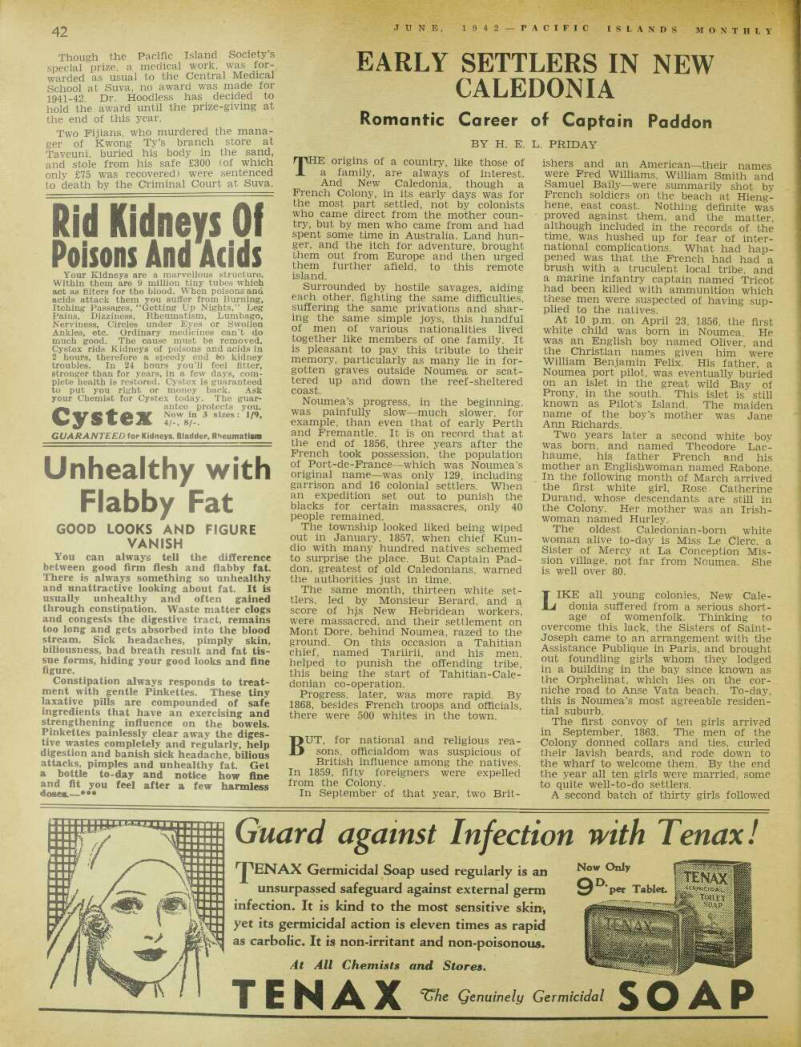
Strange Jobs
MOST of the New Guinea and Papua public servants who, being over age, were not taken into the military forces, have been provided with some sort of departmental job in Australia.
In not more than one or two cases—if that—do the jobs carry either the status or the pay which the men had during long years in the Territories’ Services.
A few men—especially the higher offi cials—have not been provided with jobs.
Their ordinary salary ceased in Febru ary. Thev then were allowed to take whatever leave had accumulated, for which period they received their salary.
After that, salary ceased (or will cease).
They then may, if they so elect, retire from the Service, and receive the super annuation allowance commensurate with their position as it was when military rule was established. (The official date, in the case of Papua, is February 12.) The future of the officials in tempor ary jobs, who do not plan retirement, is obscure. Canberra will give them no promises. They appear to have no chance of going back to the Territories until war is over and military rule ends.
Though the Pacific Island Society’s special prize, a medical work, was for warded as usual to the Central Medical School at Suva, no award was made for 1941-42 Dr. Hoodless has decided to hold the award until the prize-giving at the end of this year.
Two Fijians, who murdered the mana ger of Kwong Ty’s branch store at Taveuni, buried his body in the sand, and stole from his safe £3OO (of which only £75 was recovered) were sentenced to death by the Criminal Court at Suva.
Early Settlers In New
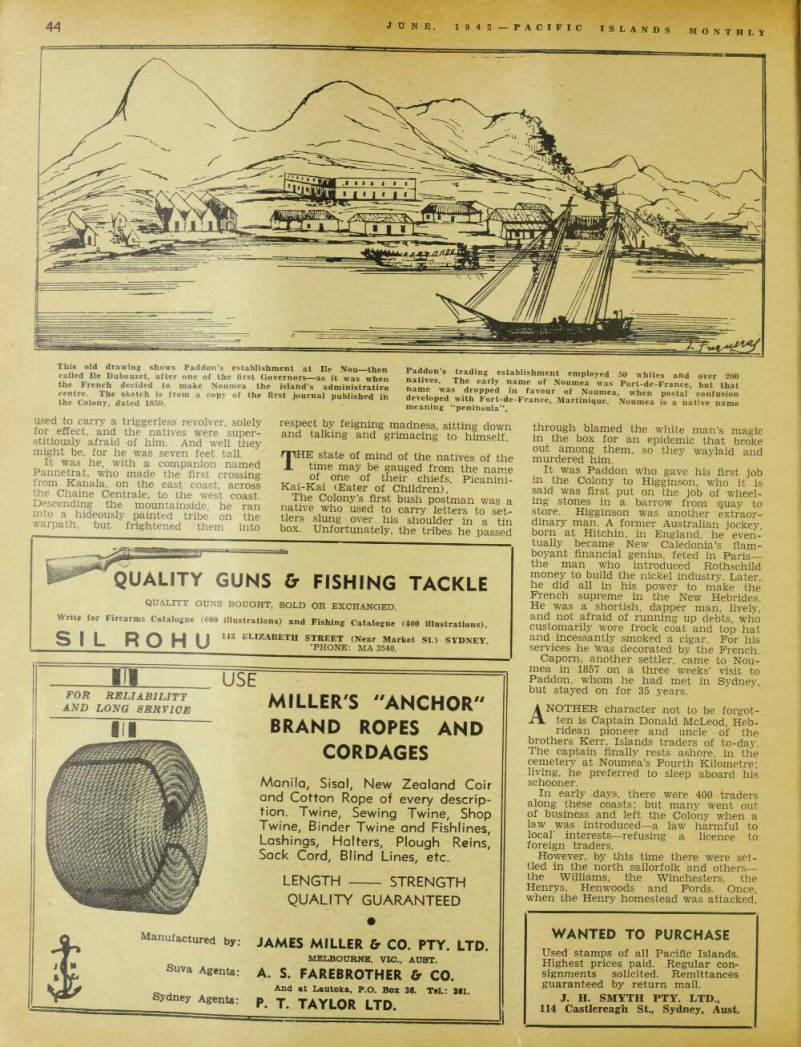
Caledonia
Romantic Career of Captain Paddon
By H. E. L. Friday
THE origins of a country, like those of a family, are always of interest.
And New Caledonia, though a French Colony, in its early days was for the most part settled, not by colonists who came direct from the mother coun try, but by men who came from and had spent some time in Australia. Land hun ger, and the itch for adventure, brought them out from Europe and then urged them further afield, to this remote island.
Surrounded by hostile savages, aiding each other, fighting the same difficulties, suffering the same privations and shar ing the same simple joys, this handful of men of various nationalities lived together like members of one family. It is pleasant to pay this tribute to their memory, particularly as many lie in for gotten graves outside Noumea or scat tered up and down the reef-sheltered coast.
Noumea’s progress, in the beginning, was painfully slow —much slower, for example, than even that of early Perth and Fremantle. It is on record that at the end of 1856, three years after the French took possession, the population of Port-de-France—which was Noumea’s original name—was only 129, including garrison and 16 colonial settlers. When an expedition set out to punish the blacks for certain massacres, only 40 people remained.
The township looked liked being wiped out in January, 1857, when chief Kun dio with many hundred natives schemed to surprise the place. But Captain Pad don, greatest of old Caledonians, warned the authorities just in time.
The same month, thirteen white set tlers, led by Monsieur Berard, and a score of hjs New Hebridean workers, were massacred, and their settlement on Mont Dore, behind Noumea, razed to the ground. On this occasion a Tahitian chief, named Tariirii, and his men, helped to punish the offending tribe, this being the start of Tahitian-Cale donian co-operation.
Progress, later, was more rapid. By 1868, besides French troops and officials, there were 500 whites in the town.
BUT, for national and religious rea sons, officialdom was suspicious of British influence among the natives.
In 1859, fifty foreigners were expelled from the Colony.
In September of that year, two Brit
ishers and an American—their names were Fred Williams, William Smith and Samuel Baily—were summarily shot by French soldiers on the beach at Hieng hene, east coast. Nothing definite was proved against them, and the matter, although included in the records of the time, was hushed up for fear of inter national complications. What had hap pened was that the French had had a brush with a truculent local tribe, and a marine infantry captain named Tricot had been killed with ammunition which these men were suspected of having sup plied to the natives.
At 10 p.m. on April 23, 1856, the first white child was born in Noumea. He was an English boy named Oliver, and the Christian names given him were William Benjamin Felix. His father, a Noumea port pilot, was eventually buried on an islet in the great wild Bay of Prony, in the south. This islet is still known as Pilot’s Island. The maiden name of the boy’s mother was Jane Ann Richards.
Two years later a second white boy was born, and named Theodore Lac haume, his father French and his mother an Englishwoman named Rabone.
In the following month of March arrived the first white girl, Rose Catherine Durand, whose descendants are still in the Colony. Her mother was an Irish woman named Hurley.
The oldest Caledonian-born white woman alive to-day is Miss Le Clerc, a Sister of Mercy at La Conception Mis sion village, not far from Noumea. She is well over 80.
LIKE all young colonies, New Cale donia suffered from a serious short age of womenfolk. Thinking to overcome this lack, the Sisters of Saint- Joseph came to an arrangement with the Assistance Publique in Paris, and brought out foundling girls whom they lodged in a building in the bay since known as the Orphelinat, which lies on the cor niche road to Anse Vata beach. To-day, this is Noumea’s most agreeable residen tial suburb.
The first convoy of ten girls arrived in September, 1863. The men of the Colony donned collars and ties, curled their lavish beards, and rode down to the wharf to welcome them. By the end the year all ten girls were married, some to quite well-to-do settlers.
A second batch of thirty girls followed
in February, 1864. Of these, twelve im mediately found husbands and the rest were placed in employment while await ing suitable marriage offers. rE hero, the legendary personage of Caledonian history, is the Captain Paddon already referred to, mar iner whaler, trader, hailing from Ports mouth, in England. Every contemporary, French priest Montrouzier as much as English Admiral Erskine, praises this extraordinary man.
He emerges, trafficking along the coast, in 1841; also in the New Hebrides, where he had his first big station, with small posts scattered throughout outlymg islands and among Caledonian tribes where his representative—usually an English sailorman —would be the only white within scores of miles.
He made a fortune, and his reputa tion for generosity and fair dealing is proverbial. As Admiral Erskine remarks, if other white traders had been as he, there would have been fewer massacres and fewer disgraceful incidents in the South Seas. , , , , Yet he thrived on danger and had to suffer for the bad faith of others. Once, at Mare, in the Loyalty group (now a Caledonian dependency) seventeen of his men were slaughtered by angry natives in revenge for the disreputable doings of another vessel. Even here Paddon emerged from the situation with honour.
AFTER the French occupation in 1853 it was Captain Paddon, from his great trading establishment at He Noii, in Noumea harbour, who directed the ’industrial, commercial and agricul tural life of the baby Colony.
He had a fleet of ships; he organised the vital postal service with Sydney; he was the first to raise cattle, the first successfully to introduce immigrants, the
first to found a bush township, the pretty village of Paita.
He saved Noumea, as I have said, but on one occasion he fell foul of the French Governor (possiblv for selling guns to the natives) and found it prudent, with a kanaka crew, to escape to Sydney in an open whale-boat. He brought the boat back, too, and for years, his sur viving daughter (now over 80) tells me, it lay beached at Paddon Bay.
“Look at the boat papa escaped to Sydney in,” the children used to say to one another.
A great man in every sense, Paddon’s sudden death at the age of 49 was a calamity—the Colony would have pros pered more had he lived longer. Hand some were the eulogies uttered over his first grave in Noumea’s first cemetery and recorded in the “Moniteur Imperial” of the time; and handsome those a few years later when . his remains were removed to the village of Paita, there to be placed in an impressive mausoleum. A great man, his history should some day be written.
Among the families he introduced to his estate at Paita were his relatives, the Martins, from England; and from Australia, Britain or Germany, the Lynches, Sleaths, and Ambroses, the Abels, Ohlens, Gaertners, Metzgers and Yeomans. These settlers had to send their produce to Noumea by boat, for no real road was yet available.
From a trip Paddon made to China with sandalwood —once a most import ant article of trade, but now cut right out—he brought back another well known settler. This was the Chinaman, Jimmy Song, a thorough gentleman, to whom nobody ever went in vain for a meal or a night’s lodging—in fact, he hated to see his guests leave him. It was Jimmy’s hobby to cross sheep and
to” ay* sCTvtag o 'with the
They^eft°Noumet with'"the* first Cale
(lonian contingent on May 5 1941. .
The tallest man in Caledoman his tory was . t ’ in eventually be:ame an art master^^^ Sydney, where he before he went into don’s chief clerk he went into business on his own account—-a hairless individual, but brave and intelligent. He
used to carry a triggerless revolver, solely for effect, and the natives were super stitiously afraid of him. And well they might be, for he was seven feet tall.
It was he, with a companion named Pannetrat, who made the first crossing from Kanala, on the east coast, across the Chaine Centrale, to the west coast.
Descending the mountainside, he ran into a hideously painted tribe on the warpath, but frightened them into
respect by feigning madness, sitting down and talking and grimacing to himself.
THE state of mind of the natives of the time may be gauged from the name . of. on e of their chiefs, Picanini- Kai-Kai (Eater of Children).
The Colony’s first bush postman was a native who used to carry letters to set tlers slung over his shoulder in a tin box. Unfortunately, the tribes he passed
through blamed the white man’s magic in the box for an epidemic that broke out among them, so they waylaid and murdered him.
It was Paddon who gave his first job in the Colony to Higginson, who it is said was first put on the job of wheel ing stones in a barrow from quay to store. Higginson was another extraor dinary man. A former Australian jockey, born at Hitchin, in England, he even tually became New Caledonia’s flam boyant financial genius, feted in Paris— the man who introduced Rothschild money to build the nickel industry. Later, he did all in his power to make the French supreme in the New Hebrides.
He was a shortish, dapper man, lively, and not afraid of running up debts, who customarily wore frock coat and top hat and incessantly smoked a cigar. For his services he Was decorated by the French.
Capom, another settler, came to Nou mea in 1857 on a three weeks’ visit to Paddon, whom he had met in Sydney, but stayed on for 35 years.
ANOTHER character not to be forgot ten is Captain Donald McLeod, Heb ridean pioneer and uncle of the brothers Kerr, Islands traders of to-day.
The captain finally rests ashore, in the cemetery at Noumea’s Fourth Kilometre; living, he preferred to sleep aboard his schooner.
In early days, there were 400 traders along these coasts; but many went out of business and left the Colony when a law was introduced—a law harmful to local' interests—refusing a licence to foreign traders.
However, by this time there were set tled in the north sailorfolk and others— the Williams, the Winchesters, the Henrys, Henwoods and Fords. Once, when the Henry homestead was attacked,
This old drawing shows Paddon’s establishment at He Nou then called He Dubouzet, after one of the first Governors—as it was when the French decided to make Noumea the island’s administrative centre. The sketch is from a copy of the first journal published in the Colony, dated 1859.
Paddon's trading establishment employed 50 whites and over 200 natives. The early name of Noumea was Port-de-France, but that Was i n favour of Noumea, when postal confusion developed with Fort-de-France, Martinique. Noumea is a native name meaning “peninsula”.
the mother hid the younger children in a clothes-press, while the elder boy, who was wounded, helped repel the attackers.
Lynn, a big Dane, ruled over the isle of Pott. It was he who discovered the Walpole Island guano deposits, of im portance to New Zealand agriculture.
Three bachelor brothers of a well-known South Australian family who for a time made their home in the Colony were William. Frank and Jack Morgan. Jack ran a Noumea flour-mill.
Cheval, a restauranteur from Sydney, took up land at Saint-Vincent, west coast, and introduced some families, not ably the O’Donoghues and the Dalys.
Nearby, Bouloupari—place meaning Red Earth—became a regular cattle-raising centre, full of Britons. There were Tom Lewis, Bobby Henderson, Peter Walker, Charlie and Joe Bull, a London-Italian named Panorma, and an Anglo-Indian named Atkinson, whose son, James Jas per, became a “Sydney Bulletin” artist.
OTHER early settlements were less successful. Australians named Brown and Byrne took up a big concession on the same lines as Cheval, but lost their contract for not fulfilling their bargain to introduce settlers.
Another failure was a French com munity experiment known as the Pha lanstere, at Yate, on the south coast somewhat on the lines of William Lane’s Australian Utopian scheme in Paraguay in the ’nineties.
But, successful or unsuccessful, the men of the first hour, who contributed to the making of white New Caledonia should not be forgotten.
Mr. H. A. Markham, of Marovo Lagoon, Solomon Islands, who underwent an operation in Sydney Hospital last month, spent some weeks in a convales cent home. The first operation was complicated by malaria, and another operation has to be undergone in June.
Mr. James Boyer, of Suva, Fiji, mar ried Miss Rosemary Collins, second daughter of Mr. and Mrs. L. Collins, late of Suva, at the Sacred Heart Cathedral, Suva, in May.
Mr. Roy Gorringe, of Huhurangi Plan tation, Ysabel, British Solomon Islands, and Mr. Charles Bignell, of Marovo Lagoon, BSI, got away from the Solo mons together in April, just one hop ahead of the Japanese, on Mr. Bignell’s schooner. Mr. Gorringe, who arrived in Sydney in May, reports that most of the Europeans had left the Group before the Japanese arrived —some going to New Hebrides and some to Fiji. A few who remained have gone into the interior of the big islands, well out of harm’s way.
Mr. Bignell remained in Port Vila (New Hebrides). A number of missionaries refused to leave the Solomons.
Advertisements & other items, pp. 44-46 (2 items)
Rid Kidneys Of
Poisons And Acids
Your Kidneys are a marvellous structure.
Within them are 9 million tiny tubes which act as filters for the blood. When poisons and acids attack them you suffer from Burning, Itching Passages, “Getting Up Nights,” Leg Pains, Dizziness, Rheumatism, Lumbago, Nerviness, Circles under Eyes or Swollen Ankles, etc. Ordinary medicines can’t do much good. The cause must be removed.
Cystex rids Kidneys of poisons and acids in 2 hours, therefore a speedy end to kidney troubles. In 24 hours you’ll feel fitter, stronger than for years, in a few days, complete health is restored, Cystex is guaranteed to put you right or money back. Ask your Chemist for Cystex today. The guarantee protects you.
Now in 3 sizes : 1/9, 4/-, 8/-.
Cystex
GUARANTEED tor Kidneys, Bladder, Rheumatism
Unhealthy with
Flabby Fat
GOOD LOOKS AND FIGURE
VANISH
You can always tell the difference between good firm flesh and flabby fat.
There is always something so unhealthy and unattractive looking about fat. It is usually unhealthy and often gained through constipation. Waste matter clogs and congests the digestive tract, remains too long and gets absorbed into the blood stream. Sick headaches, pimply skin, biliousness, bad breath result and fat tissue forms, hiding your good looks and fine figure.
Constipation always responds to treatment with gentle Pinkettes. These tiny laxative pills are compounded of safe ingredients that have an exercising and strengthening influence on the bowels.
Pinkettes painlessly clear away the digestive wastes completely and regularly, help digestion and banish sick headache, bilious attacks, pimples and unhealthy fat. Get a bottle to-day and notice how fine and fit you feel after a few harmless doses.—***
lililji Guard against Infection with Tenax!
Germicidal Soap used regularly is an
unsurpassed safeguard against external germ
infection. It is kind to the most sensitive skin, j.nj yet its germicidal action is eleven times as rapid as carbolic. It is non-irritant and non-poisonous.
At All Chemists and Stores, Now Only
mmm
per Tablet. jmt.
. S v OAP •'
9
TENAX The Genuinely Germicidal SOAP
St. Ignatius’ College
KAMBALA
Church of England Girls’ School I
t jjnji
Ml Kambala Church of England School for Girls at Rose Bay, Sydney, provides complete modem education for girls from the age of five. Under the direction of the Principal. Miss F. Hawthorne, 8.A., and a fully qualified staff, Kambala offers thorough preparation for either academic or professional careers, Sport and physical training is supervised by a competent Sports Mistress.
For full prospectus apply to the Principal or Secretary.— Miss F. Hawthorne, B.A.
R. E. Cox, Esq., 28 Bond Street, Sydney.
St. Ignatius’ College
Riverview Sydney
Boys are prepared for Intermediate and Leaving Certificate Examinations and for Exhibitions, Scholarships and Bursaries at the University.
Boys are arranged in three Divisions according to age. Each Division has its own Library, Debating Society, Cricket and Football Fields, and Tennis Courts.
Senior and Junior Rowing Sheds, with a large fleet of pleasure and racing boats.
Private Swimming Baths.
Prospectus and further particulars on application to the — Rector: St. Ignatius’ College, Riverview, Sydney, Australia.
Tel.: JB 1106.
BOARDING AND DAY SCHOOL
Conducted by the Jesuit Fathers
1 1 *
ONE OF SYDNEY'S GREAT PUBLIC SCHOOLS
QUALITY GUNS Cr FISHING TACKLE
QUALITY GUNS BOUGHT, SOLD OR EXCHANGED.
Write for Firearms Catalogue (600 Illustrations) and Fishing Catalogue (400 Illustrations).
I I P LJ I I 143 ELIZABETH STREET (Near Market St.) SYDNEY Wit. n VJ» n U ’PHONE: MA 3540.
FOR RELIABILITY
AND LONG SERVICE
Manufactured by: Suva Agents; Sydney Agents:
MILLER'S "ANCHOR"
BRAND ROPES AND
CORDAGES
Manila, Sisal, New Zealand Coir and Cotton Rope of every description. Twine, Sewing Twine, Shop Twine, Binder Twine and Fishlines, Lashings, Halters, Plough Reins, Sack Cord, Blind Lines, etc.
LENGTH STRENGTH
QUALITY GUARANTEED
JAMES MILLER Cr CO. PTY. LTD.
MELBOURNE. VIC., AUST.
A. S. FAREBROTHER & CO.
And at Lautoka, P.O. Box 38. Tei.: 381.
P. T. TAYLOR LTD.
WANTED TO PURCHASE
Used stamps of all Pacific Islands.
Highest prices paid. Regular consignments solicited. Remittances guaranteed by return mail.
J. H. SMYTH PTY. LTD.,
114 Castlereagh St., Sydney, Aust.
Work
War And Mission
Vast Disturbance in Pacific
MISSION bodies generally are much concerned about what is happening to the native peoples in Pacific areas occupied by the Japanese.
The Newcastle Diocesan Synod has urged the Australian Prime Minister to arrange for aeroplanes to distribute leaf lets over native areas in enemy terri tory, printed in the native languages, explaining the withdrawal of the Euro peans, and informing the natives that the Europeans now are fighting the Japanese, and will return and continue their educational and medical work.
Some speakers feared that the with drawal of the Europeans, in the face of the Japanese, would undo much of the good work done during the past quarter century.
Fate Of Bishop Wade
THE journal “Catholic Missions”, stated in May that Bishop Wade and his two assistants, Fathers Conley and Hennessy, who remained in the Bougain ville district with the natives, had been made prisoners by the Japanese, and taken to Rabaul. The same journal, in June, announced that a message received late in May, via the Solomons Islands Resident Commissioner and Suva, stated that Bishop Wade had not been taken prisoner; and that the previous report had been of enemy origin.
Since then, the Japanese have come southwards in force from Bougainville and occupied most of the Solomons; so the fate of the Bishop and his assistants is still obscure.
Territories Residents In
Australia
FURTHER names and addresses (in some cases, change of address only) of evacuees from the Western Paci fic Territories, which have come to hand during the month, are:— Bartlett, Rev. H. H. (P), Methodist Manse, Burra North, SA.
Brudo, —. (P), “Linton”, 51 Upper Pitt St., Kirribilli, NSW.
Craig, T. E. (P), Verry St., Coorparoo, Brisbane, Q.
Daniel, Rev. W. (TI), Bishop’s Registry, Flinders St., Townsville, Q.
Davies, Rt. Rev. S. (TI), Bishop’s Regis try, Flinders St., Townsville, Q.
De Latour, E. A. (NG), “Winchester”, Edgecliffe Sq., Edgecliffe, NSW.
Fergusson, James (TI), c/o Constable Bramley, Cairns, Q.
Foo, George (TI), 26 Nudgee Rd., Ham ilton, Brisbane, Q.
Fryer, H. A. J. (P), 242 Kooyong Rd., Toorak, V.
Keleher, T. (TI), Atherton, Q.
Kingsley, Mr. and Mrs. Arthur (P), 7 Elizabeth St., Sydney, NSW.
Kirke, Clem (NG), Dept, of Interior, Townsville, Q.
Mendis, P. H. (TI), Adelaide St., Bris bane, Q.
Saker, Mrs. F. M. (NG), 126 Ben Boyd Rd., Neutral Bay, NSW.
Simpson, H. G. (TI), c/o Mrs. Collins, 121 Riding Rd., Hawthorne, Bris bane, Q.
Sullivan, Arthur (TI), c/o Mr. Harry Rowan, Brookfield, Brisbane, Q.
Thorpe, E. K. (TI), Herberton, via Cairns, Q.
Vivian, R. A. (P) c/o 11 Denbigh Rd., Armadale, V.
Williams, Dr. F. J. (P), Kennedy Hos pital, Bowen, Q.
Mr. Claude Stanton, of the Suva branch of the Shell Oil Company, has been compelled by ill-health to return to Australia, and his place has been taken by Mr. Norton Smith, of Sydney.
Mr. Stanton was popular in Suva, where he took an active interest in sport, rac ing and social affairs generally.
Latest news of RSM Jim Rennie, once of Rarotonga, and now in a New Zealand unit, is that he is in Syria. During the fighting in Libya, when attached to a British unit, he was captured by the Germans, but subsequently was recap tured by the New Zealanders. He was promoted sergeant-major on the field.
RSM Rennie was educated at Te Aute College. New Zealand, and later trained as a native medical practitioner at the Suva Central Medical School, where he won the Pacific Islands Society’s special prize.
Advertisements & other items, pp. 47-48 (1 item)
Vigour Restored,
Glands Made Young
In 24 Hours
It is no longer necessary to suffer from loss of vigour and manhood, weak memory and body, nervousness, impure blood, sickly skin, depression, and poor sleep, because an American Doctor has discovered a quick, easy way to end these troubles.
This discovery is in pleasant, easy-to-take tablet form, is absolutely harmless, does away with gland operations and is bringing new youth and vigour to thousands. It works directly on the glands and nerves, and puts new, rich blood and energy in your veins. In 24 hours you can see and feel yourself getting younger. Your eyes sparkle, you feel alive and full of youthful vigour and power.
And this amazing, new gland and vigour restorer, called Vi-Stim, is guaranteed. It has been proved by thousands in America and is now distributed by chemists here under a guarantee of satisfaction or money back.
Vi-Stim must make you feel full of vigour and energy and from 10 to 20 years younger, or you merely return the empty package and get your money baok. A special, double-strength bottle of 48 Vi-Stim tablets costs little, and the For Inflamed Eyes and Eyelids
SOLD EVERYWHERE
H. A. Rose A Co. Pty. Ltd., King St., Sydney guarantee protects you.
GUARANTEED
Vi-sti
to Restore Manhood and Vitality . . .
/, r c
IN WAR-TIME
Monel finds a place in a wide range of essential industries; in fact in many cases there is no substitute—that is why to-day our stocks of Monel are strictly reserved for Defence and essential purposes.
For such applications however, we have adequate stocks and will value your enquiries.
STRENGTH + TOUGHNESS + CORROSION-RESISTANCE = MONEL Sole Australian Distributors of Monel ; WRIGHT AND COMPANY, 81 Clarence Street, Sydney Monel is a registered trade mark ■
KANGAROO BRAND
Ropes,
Cordage,
and Twines for every purpose
Backed by
86 years of service.
Manufactured by
M. DONAGHY AND SONS,
Pty. Ltd.,Geelong and Sydney, Fiji Representatives:
PEARCE AND CO.
LIMITED
P.O. BOX 237, SUVA
Highest Prices Paid For
GOLD
Garrett & Davidson’s organisation is acknowledged far and wide as the main clearing house for precious metals in the Southern Hemisphere.
They have earned a reputation for accuracy and integrity in all their business dealings, which is proved by the fact that they are privileged to handle more gold from the Islands of the Pacific than any other organisation.
Therefore for your complete and lasting satisfaction, you are advised to transact all your precious metals business through the house of Garrett & Davidson.
GARRETT & DAVIDSON PTY. LTD.
ASSAYERS METALLURGISTS REFINERS
Bank of N.S.W. Buildings,
REGENT AND GEORGE STS., SYDNEY.
Happy Dispatch
A Trader’S Tale, By “Tukapa
Koko”
ON one of my Sunday-afternoon visits to the Hermit, in his little Noah’s ark of a bungalow at the boundary of the village, I again found the hoary sinner in tale-telling mood.
His mind, like an old calendar hang ing forgotten on a wall, recked little of to-day’s men and events; and our friend ship was more founded on the loneliness of white men in the Islands than on co-eval experiences. But it was an edu cation to me; and in the Hermit’s yarns, men who died many years before I was born became contemporaries. I talked familiarly of “Old Jock”, “Old Cap’n Blank”, “Old Tinomana”, and others once famous but now forgotten.
The Hermit, piratically parrot-looking, beaky and ancient, seemed to enjoy this instruction of the Young Idea in ancient history.
Pulling at his pipe, with his “cuspidor” —a little wooden box filled with sand— at his feet, he smoked and spat, while I, as his guest, waited for the tale that was sure to come to birth, for native shag acted as the midwife of the Hermit’s travailing memory.
He began: “D’you ever hear of Wun Lung Wow?”
“Who was he?” I asked.
“Why he was a chow,” replied the Her mit, with a pitying smile at my ignor ance.
He spat into the sand-box, and dealt at length with the Cathayan who was the subject of his discourse.
“Old Wun Lung Wow was a China man who lived in Rarotonga in the late ’eighties, when I was trading there for the Company. He kept a little tea shop—the “tea” was coffee, though—and it rather more than kept him, for Wun Lung was a good business man, and he did well in Rarotonga.
“As time went on, Wun Lung got so rich that he got out a few more of his clan from Canton —there was no immi gration law then—and used them to count his money for him, while he took a few naps, for he was no Living Skele ton.
“Wun Lung, was number one teashop keeper in Rarotonga after a few years, and it began to look as if he was for tune’s darling.”
The Hermit re-charged his ancient, odorous pipe, lit up again, and proceeded under forced draught.
“But Wun Lung’s joss was only pull ing his leg, I fear. One fine day, the yellow man found he was not so well off, for he had all the symptoms of the worst form of leprosy.
“Of course, a leper couldn’t be a tea shop-keeper, so Wun Lung Wow put the business into his manager’s hands, and retired.
“Not to China, though! He stayed on in Raro., and gave out that as his days were numbered, he’d be buried there.
And sure enough, he was, about six months later. I know, for I was one of the mourners.”
The Hermit, grinning oddly, could have cracked a nut between nose and chin as he ruminated a while in silence.
“And so, what?” I asked, knowing that the end was not yet in sight.
“That’s about all, except for one thing,” resumed the Hermit.
“What was missing?” I inquired, intrigued.
“Why, the corpse,” said the Hermit; and his nose and chin met in such a grin that they could have crushed a pea.
“But Wun Lung was the corpse, you say!” I protested.
“Not quite,” said the Ancient. “Burial alive was Wun Lung’s way out—he knew he wouldn’t stay alive very long, any how. But the piece de resistance was the final handwaggle he gave as he went down —whether of farewell, or to indi cate change of mind, I don’t know. And none of his grave-digger relations stop ped to inquire as they filled in the earth on top of him!”
Arrested In Tahiti
TWO men admitted in the Auckland Police Court on May 25 that they had left New Zealand in a yacht to evade military service. They were trying to get to South America but were arrested in Tahiti.
The men, Ronald Ernest Johnson, 33, and George Noakes, 28, were each sen tenced to six months’ gaol for having evaded service, and having left New Zea land without permission.
They had appealed against military service, one as a conscientious objector, but their appeals had been refused.
Johnson obtained permission from the military authorities to cruise in Auck land Harbour, but loaded the yacht with stores and left the harbour at night.
Although a number of Papuan resi dents have attended to the matter of loss- sustained by them through war damage, there are still many who have lodged no claim. Should any reader require information on this important matter he can procure it from Mr. E. E.
Washington, War Damage Commission (Papuan and NG Section), Sixth Floor, Australia House, Carrington St., Sydney.
Advertisements & other items, p. 48 (1 item)
Gramophone Records
SEND US YOUR ORDERS.
Goods sent C.O.D. at no extra charge.
Catalogues sent without obligation.
THE TALKERIES,
161 Castlereagh Street, SYDNEY.
Caledonia
Two Flags Over New Caledonia Stars and Stripes and Cross of Lorraine
mHE following are interesting items J. from a report by “an official correspondent at an operational base”, dated June 8, and published in •“Sydney Morning Herald”.
“It should be remembered that, running south-eastward from New Guinea, form ing a long chain off the north-east coast of Australia, are three groups of islands —Solomons, New Hebrides, and New Caledonia. The Japanese have advanced from New Guinea more than half-way down through the Solomons. The Americans are in New Caledonia. The New Hebrides lie between the Solomons and New Caledonia.
“New Caledonia to-day is busier than ever before in its short history.
“American troops are here in strength and splendidly equipped. It is their equipment more than anything else that astounds the Australian observer.
“The importance of this island to Aus tralian defence needs no stressing. Who holds it holds the key to our vital life lines. Modern bombers can span the waters between here and Australia in a matter of hours.
“From their automatic weapons to their artillery, American troops are equipped with the best. Living condi tions are good, and their excellent “post exchange” system—canteens to the Aus tralians —is operating in full swing.
“The climate of New Caledonia is per fect, and the country, with its hills and rolling ti-tree-covered slopes, must be strangely reminiscent of home to many Americans. Cattle graze in the uplands, and herds of deer run into tens of thou sands. Venison appears on the troops’ menus, but has disappointed them. There are few refrigeration facilities, and the meat when fresh killed is like leather.
“New Caledonia has become perhaps our most vital outpost. Under the Stars and Stripes and the Cross of Lorraine our shores—and more important—our very lifelines are being protected.”
Changed Face Of Noumea
THE following is from a published re port by a correspondent of the “New York Times”:— “The Americans have changed the face of Noumea. Sandbags, barbed wire, trenches, bold new signs in English, new restaurants and army stations provide a touch of wartime grimness.
“The troops themselves unloaded an enormous amount of cargo within a few weeks after they landed and trucked it to centres all over the island.
“In addition, to speed distribution, old locomotives and rolling stock of a rail way line running along the waterfront and 30 miles inland, which has not been operated for decades, has been knocked into shape. /Now it is hauling hundreds of tons of cargo from Noumea daily.
“Hundreds of miles of roads have been built or reconditioned, and big American four-wheel and six-wheel trucks are now able to ply the arteries day and night, moving men and materials.
“Americans, almost overworked, get homesick and bored with a place where there is little amusement available. Two have married local girls, but girl friends are definitely limited.”
Yam Sik Cheung, who has been Chin ese Interpreter in the Gilbert and Ellice Islands Colony since 1933, now occupies a post in the British Service, Condo minium of the New Hebrides.
Suva Bride's Sudden Death
From Our Own Correspondent
Suva, May 10.
rE unexpected and sudden death of Miss Lorraine Kermode, the attrac tive 20-years-old daughter of our well-known and esteemed Inspector Ker mode, of the Fiji Police Force, was a real tragedy.
Her marriage to Lieutenant Boyce was to have taken place in the following week, and her many girl friends were busily completing arrangements which would have made of it an outstanding social event. An elaborate function, arranged by the young ladies, had been fixed for the afternoon of the day on which she passed' away. The funeral was one of the largest seen here in a long time.
BSI Officers Move to Other
Territories
A WESTERN Pacific High Commission Gazette, Issued at Suva last month, chronicled the secondment to other territories of seven members of the BSI Government service, following Jap air attacks on Tulagi:— Dr. H. B. Hetherington, OBE, Senior Medical Officer, to Fiji.
Mr. J. I. Blaikie, Superintendent of Police and Prisons, to Fiji.
Mr. R. S. Taylor, Chief Radio Officer, to Fiji.
Mr. J. B. Hicks, Clerk and Customs Officer, to the New Hebrides Mr. P. Colley, Cadet Officer, to the New Hebrides.
Miss H. M. Cleaver, Sister-in-Charge of Tulagi Hospital, to Fiji.
Miss E. M. Kennedy, Nurse, Tulagi Hospital, to Fiji.
Mr. H. E. Woodman, who was a dis trict officer in New Guinea before the war, and who went to the Middle East in charge of an AIF battalion, is now back in Australia. He has retired from the AIF, owing to poor health.
Advertisements & other items, p. 49 (1 item)
Asthma Agony
Curbed in 3 minutes
Choking, gasping, wheezing Asthma and Bronchitis poison your system, rum your health and weaken your heart. Mendaco, the prescription of an American physician, starts relieving Asthma in 3 minutes, and builds new vitality so that you can sleep soundly all night, eat anything and enjoy life. Mendaco is so successful that it is guaranteed to give you free, easy breathing in 2i hours, and to satisfy completely or money back on return of empty package. Get Mendaco from
Ml Jf J 3 your chemist.
RW A* MBO at CO The guarantee ftTMVmmwiTwv protects you.
Ends Asthma . . . Now 3/2, 6/3, 12/6
PURE RICE
STARCH
Always ask for . . .
CORAL BRAND
100% PURE
Noted for its
QUALITY
and
WHITENESS.
Goes Farthest and gives Lasting Finish.
WILL NOT
STICK TO
IRON.
Obtainable from Leading Island Stores.
Manufactured by
AUSTRALIAN RICE LTD.,
Sydney, N.S.W.
CORAL BRAND
RICE STARCH
S ' COtAt
HA^* - insects F«» V * willing a !u P d -- u r te n\'^"'r^^ of cannot be . e most * h ' C has undergo 0 ® -, s of F "LhaostWe te k «l,nj
because
r not a
U\W‘°S
p ot !?t of neb nderg°«' ct a* •,thas oode r S an d knov-n % at - s «hy t Y o „ p°* e . t a\* a * s ' a \\ subiSft and * is of a “ killi°S a\way; f a n sub and refos e 4 \\
«‘5 ■.iC-niess
Fi't .^tess
to the bottie-
s o\d»cr »s flit “
stitutes-
* ♦ «.ta»' Kills flies Moths Mosquitoes Cockroaches Silverfish / Bed Bugs/ Ants a W =K 3
Australian Short Wave
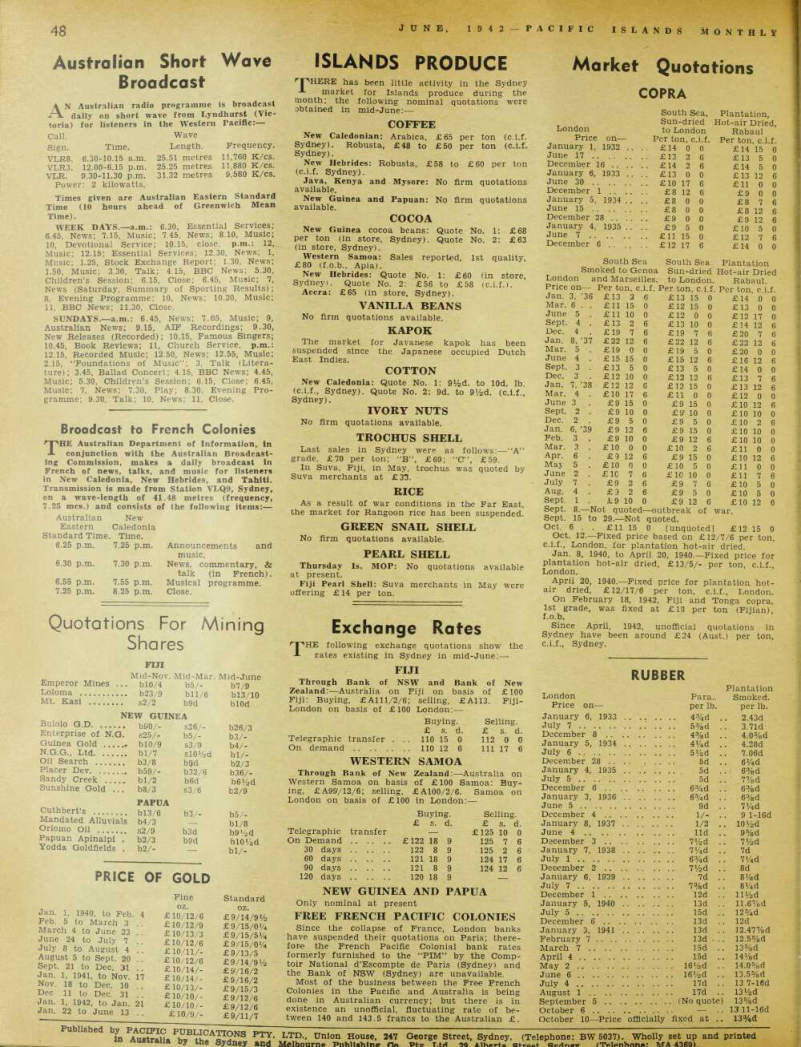
Broadcast
AN Australian radio programme is broadcast daily on short wave from Lyndhurst (Vic toria) for listeners in the Western Pacific: —
Times given are Australian Eastern Standard Time (10 hours ahead of Greenwich Mean Time).
WEEK DAYS.— a.m.: 6.30, Essential Services; 6.45, News; 7.15, Music; 7.45, News; 8.10, Music; 10. Devotional Service; 10.15, close, p.m.: 12, Music; 12.15; Essential Services; 12.30, News; 1, Music: 1.25, Stock Exchange Report; 1.30, News; 1.50, Music; 3.30, Talk; 4.15, BBC News; 5.30, Children’s Session; 6.15, Close; 6.45, Music; 7, News (Saturday, Summary of Sporting Results); 8, Evening Programme; 10, News; 10.20, Music; 11, BBC News; 11.30, Close.
SUNDAYS.—a.m.: 6.45, News; 7.05, Music; 9, Australian News; 9.15, AIF Recordings: 9.30, New Releases (Recorded); 10.15, Famous Singers; 10.45, Book Reviews: 11, Church Service, p.m.: 12.15, Recorded Music; 12.50, News; 12.55, Music; 2.15, “Foundations of Music”: 3, Talk (Litera ture); 3.45, Ballad Concert; 4.15, BBC News; 4.45, Music; 5.30, Children’s Session; 6.15, Close; 6.45, Music; 7, News; 7.30, Play; 8.30, Evening Pro gramme; 9.30, Talk; 10, News; 11, Close.
Broadcast to French Colonies
THE Australian Department of Information, in conjunction with the Australian Broadcast ing Commission, makes a daily broadcast in French of news, talks, and music for listeners in New Caledonia, New Hebrides, and Tahiti.
Transmission is made from Station VLQ9, Sydney, on a wave-length of 41.48 metres (frequency, 7.25 mcs.) and consists of the following items:—
Call.
Wave Sign.
Time.
Length.
Frequency.
Vlr8.
6.30-10.15 a.m. 25.51 metres 11,760 K/cs.
Vlr3.
12.00-6.15 p.m. 25.25 metres 11,880 K/cs.
Vlr.
9.30-11.30 p.m. 31.32 metres 9,580 K/cs.
Power: 2 kilowatts.
Australian New Eastern Caledonia Standard Time. Time. 6.25 p.m. 7.25 p.m. Announcements and music. 6.30 p.m. 7.30 p.m. News, commentary, & talk (in French). 6.55 p.m. 7.55 p.m. Musical programme. 7.25 p.m. 8.25 p.m. Close.
Quotations For Mining
Shares
Emperor Mines ...
Fiji
Mid-Nov. Mid-Mar. Mid-June blO/4 b5/b7/9 Loloma b23/9 bll/6 bl3/10 Mt. Kasi S2/2 b9d blOd
New Guinea
Bulolo G.D bffO/s26/b26/3 Enterprise of N.G. s25/b5/b3/- Guinea Gold blO/9 s3/9 b4/- N.G.G., Ltd bl/7 slOVzd bl/- Oil Search b3/8 b$d b2/3 Placer Dev b59/b32/6 b36/- Sandy Creek bl/2 b6d b6»/ 2 d Sunshine Gold ... b8/3 s3/6 b2/9 Cuthbert’s
Papua
bl3/6 b3/b5/- Mandated Alluvials b4/3 bl/8 b9y 2 d Orlomo Oil . s2/9 b3d Papuan Apinaipi . b2/3 b9d blOVzd Yodda Goldfields . b2/bl/-
Price Of Gold
Fine Standard Jan. 1, 1940, to Feb, Feb. 5 to March 3 March 4 to June 23 June 24 to July 7 July 8 to August 4 August 5 to Sept. 20 Sept. 21 to Dec. 31 Jan. 1, 1941, to Nov.
Nov. 18 to Dec. 10 Dec 11 to Dec. 31 Jan. 1, 1942, to Jan.
Jan. 22 to June 13 , 4 17 21 oz. £10/12/6 £10/12/9 £10/13/3 £10/12/6 £10/11/- £10/12/6 £10/14/- £10/14/- £10/13/- £10/10/- £10/10/- £10/9/oz. £9/14/9V a £9/15/0»/ 4 £ 9/15/5 V 4 £9/15/0V 4 £9/13/5 £9/14/9V2 £ 9716/2 £9/16/2 £9/15/3 £9/12/6 £9/12/6 £9/11/7
Exchange Rates
Islands Produce
HpHERE has been little activity in the Sydney L market for Islands produce during the month; the following nominal quotations were obtained in mid-June:—
Coffee
New Caledonian: Arabica, £65 per ton (c.i.f.
Sydney). Robusta, £4B to £5O per ton (c.i.f.
Sydney).
New Hebrides: Robusta, £5B to £6O per ton (c.i.f. Sydney), Java, Kenya and Mysore: No firm quotations available.
New Guinea and Papuan: No firm quotations available.
Cocoa
New Guinea cocoa beans: Quote No. 1; £6B per ton (in store, Sydney). Quote No. 2: £63 (in store, Sydney).
Western Samoa: Sales reported, Ist quality, £BO (f.0.b., Apia).
New Hebrides: Quote No. 1: £6O (in store, Sydney I. Quote No. 2: £56 to £5B (c.i.f.).
Accra: £65 (in store, Sydney).
Vanilla Beans
No firm quotations available.
Kapok
The market for Javanese kapok has been suspended since the Japanese occupied Dutch East Indies,
Cotton
New Caledonia: Quote No, 1: OVfed. to lOd. lb. (c.i.f., Sydney). Quote No. 2: 9d. to 9V 2 d. (c.i.f., Sydney).
Ivory Nuts
No firm quotations available.
Trochus Shell
Last sales in Sydney were as follows;—“A” grade, £7O per ton; “B”, £69; “C”, £59.
In Suva, Fiji, in May, trochus was quoted by Suva merchants at £33.
Rice
As a result of war conditions in the Far East, the market for Rangoon rice has been suspended.
Green Snail Shell
No firm quotations available.
Pearl Shell
Thursday Is. MOP: No quotations available at present.
Fiji Pearl Shell: Suva merchants in May were offering £l4 per ton.
Exchange Rates
THE following exchange quotations show the rates existing in Sydney in mid-June:—
Fiji
Through Bank of NSW and Bank of New Zealand;—Australia on Fiji on basis of £lOO Fiji: Buying, £Alll/2/6; selling, £AII3. Fiji- London on basis of £lOO London:—
Western Samoa
Through Bank of New Zealand Australia on Western Samoa on basis of £lOO Samoa: Buy ing, £A9S’/12/6: selling, £AIOO/2/6. Samoa on London on basis of £lOO in London:—
New Guinea And Papua
Only nominal at present
Free French Pacific Colonies
Since the collapse of France, London banks have suspended their quotations on Paris; there fore the French Pacific Colonial bank rates formerly furnished to the “PIM” by the Comp toir National d’Escompte de Paris (Sydney) and the Bank of NSW (Sydney) are unavailable.
Most of the business between the Free French Colonies in the Pacific and Australia is being done in Australian currency: but there is in existence an unofficial, fluctuating rate of be tween 140 and 143.5 francs to the Australian £.
Buying.
Selling. £ s. d. £ s. d.
Telegraphic transfer . .. 110 15 0 112 0 0 On demand .. 110 12 6 111 17 6
Buying.
Selling. £ s. d. £ s. d.
Telegraphic transfer — £125 10 0 On Demand £122 18 9 125 7 6 30 days 122 8 9 125 2 6 60 days 121 18 9 124 17 6 90 days 121 8 9 124 12 6 120 days 120 18 9 —
Market Quotations
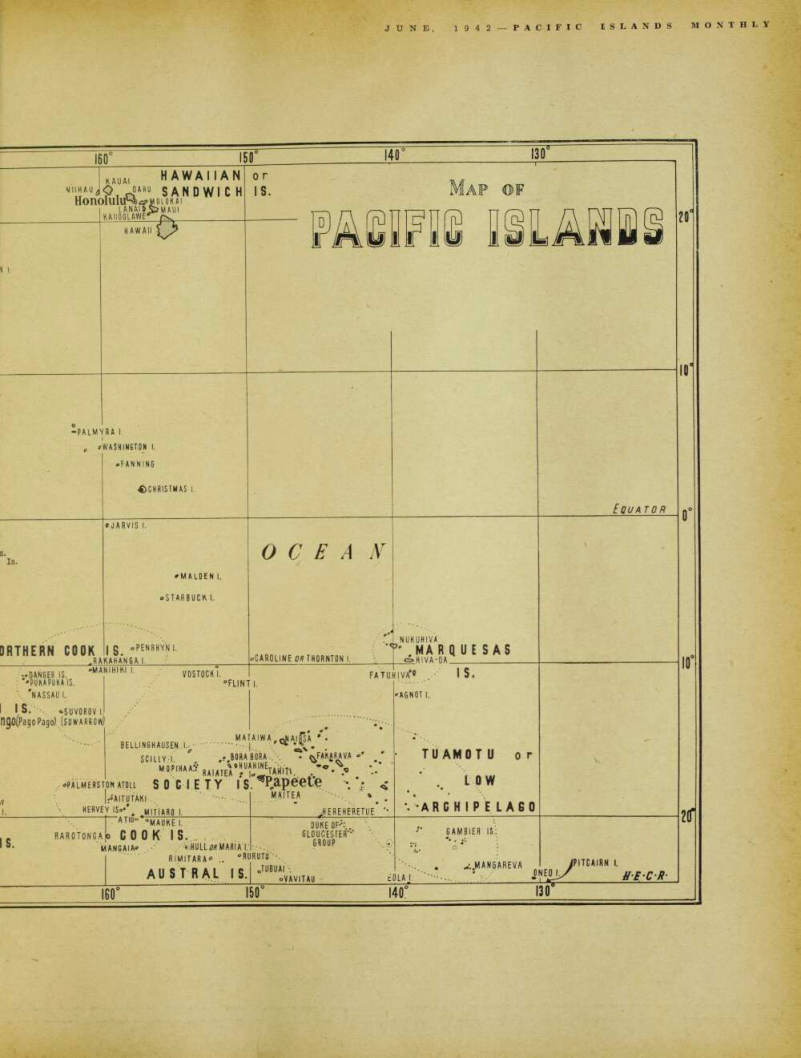
Copra
South Sea, Plantation.
Sun-dried Hot-air Dried.
London to London Rabaul Price on— Per ton, c.i.f.
Per ton, c.i.f.
January 1, 1932 . . £14 0 0 £14 15 0 June 17 .. . . £13 2 6 £13 5 0 December 16 .. £14 2 6 £14 5 0 January 6, 1933 £13 0 0 £13 12 6 June 30 .. .. £10 17 6 £11 0 0 December 1 .. £8 12 6 £9 0 0 January 5, 1934 £8 0 0 £8 7 6 June 15 .. .. £8 0 0 £8 12 6 December 28 . . £9 0 0 £9 12 6 January 4, 1935 £9 5 0 £10 5 0 June 7 .. .. £11 15 0 £12 7 6 December 6 .. £12 17 6 £14 0 0 South Sea South Sea Plantation Smoked to Genoa Sun-dried Hot-air Dried London and Marseilles, to London.
Rabaul.
Price on— Per ton, i c.i.f. Per ton, c.i.f.
Per ton, c.i.f.
Jan. 3, ’36 £13 3 6 £13 15 0 £14 0 0 Mar. 6 . . £11 15 0 £12 15 0 £13 0 0 June 5 . £11 10 0 £12 0 0 £12 17 0 Sept. 4 . £13 2 6 £13 10 0 £14 12 6 Dec. 4 . £ 19 7 6 £19 7 6 £20 7 6 Jan. 8, '37 £22 12 6 £22 12 6 £22 12 6 Mar. 5 . £19 0 0 £19 5 0 £20 0 0 June 4 . £15 15 0 £15 12 6 £16 12 6 Sept. 3 . £13 5 0 £13 5 0 £14 0 0 Dec. 3 £12 10 0 £12 12 6 £13 7 6 Jan. 7. ’38 £12 12 6 £12 15 0 £13 12 6 Mar. 4 £10 17 6 £11 0 0 £12 0 0 June 3 . £9 15 0 £9 15 0 £10 12 6 Sept. 2 . £9 10 0 £9’ 10 0 £10 10 0 Dec. 2 . £9 5 0 £9 5 0 £10 2 6 Jan. 6, ’39 £9 12 6 £9 15 0 £10 10 0 Feb. 3 . £9 10 0 £9 12 6 £10 10 0 Mar. 3 . £10 0 0 £10 2 6 £11 0 0 Apr. 6 . £9 12 6 £9 15 0 £10 12 6 May 5 . £10 0 0 £10 5 0 £11 0 0 June 2 . £ 1C 7 6 £10 10 0 £11 7 6 July 7 . £9 2 6 £9 7 6 £10 5 0 Aug. 4 . £ 9 2 6 £9 5 0 £10 5 0 Sept. 1 . £9 10 0 £9 12 6 £10 12 6 Sept. 8.—Not quoted— outbreak of war.
Sept. 15 to 29.— -Not quoted.
Oct. 6 . . £11 15 0 [unquoted] £12 15 0 Oct. 12.—Fixed price based on £12/7/6 per ton. c.i.f., London, for plantation hot-air dried.
Jan. 8, 1940, tc i April 20, 1940. —Fixed price for plantation hot-air dried, £13/5/- per ton. c.i.f..
London.
April 20, 1940.- -Fixed price for plantation hotair dried, £12/17/6 per ton, c.i.f., London.
On February 18, 1942, Fiji and Tonga copra. 1st grade, was : fixed at £18 per ton (Fijian), f.o.b.
Since April, 1942, unofficial quotations in Sydney have been around £24 (Aust.) per ton. c.i.f., Sydney.
Rubber
Plantation London Para..
Smoked.
Price on— per lb. per lb.
January 6, 1933 ... 4%d .. 2.43d July 7 3.71d December 8 . . . . 4.0%d January 5, 1934 ... 4V 4 d .. 4.28d July 6 ., 7.06d December 28 .. .. .. 5d . . 6V 4 d January 4, 1935 ... 5d 6%d July 5 ... 5d .. 7 7 /sd December 6 .. . ... 6%d .. 6%d January 3, 1936 ... 6%d .. 6 3 /ad June 5 ... 9d .. 7>/ 4 d December 4 .. . .. .. 1/- 9 l-16d January 8, 1937 .. .. 1/2 .. 10V 2 d June 4 .. 9%d December 3 .. . .. .. V/ S d .. 7V 2 d January 7, 1938 .. .. 7»/ 4 d .. 7d July 1 .. ?y 4 d December 2 .. . .. .. 7V 2 d .. 8d January 6, 19’39 .. .. 7d 8y a d July 7 .. .. 7%d .. sy 4 d December 1 .. . ., .. 12d .. ny 2 d January 5, 1940 .. .. 13d . . 11.6 7 /ad July 5 .. . . 15d .. 12%d December 6 .. . ... 13d .. 12d January 3, 1941 .. .. 13d . . 12.47 7 / 8 d February 7 .. .. .. .. 13d ■ .. 12.5 s /sd March 7 .. . . 15d .. 13%d April 4 . . . . 15d .. 14y 8 d May 2 . . . . 16i/ a d .. 14.0%d June 6 .. . . 16V 2 d . . 13.5%d July 4 .. .. 17d .. 13 7-16d August 1 .. .. 17d .. 13*/ 2 d September 5 .. .
October 6 .. .. . . . . .. 131 ll-16d October 10 —Price officially fixed at .. 13%d
Advertisements & other items, pp. 50-52 (2 items)
48
JUNE, 1942 PACIFIC ISLANDS MONTHLY
Published p UBLICATO>NS PTY. LTD., Union House, 247 George Street, Sydney. (Telephone: BW 5037). Wholly set up and printed Australia oy the Sydney and Melbourne Publishing Cn Ptv T.trf 90 Alhert.a ntraat ITelenhon*: MA 43691.
W. R. Carpenter & Co. Ltd.
TRAVEL BY CARPENTER AIRLINES IN THE
- MM ii :■ . ■ ' m ■ ms. m -
EFFORTLESS SPEED and LUXURIOUS COMFORT
OF A "LOCKHEED 14
CARPENTER AIRLINES, by the recent installation of worldrenowned Lockheed "14' aircraft on their regular service between Sydney and the Territories, bring to this airway the high standard of the world's best air services. Every detail of comfort and convenience has been studied to assure that travellers may thoroughly enjoy, in every respect, their flight over this most glorious of scenic air routes.
FREIGHT
A special feature of "Lockheed 14" Aircraft is their large freight capacity and consignees are now assured that all Freight booked will be despatched without delay.
Minimum Charge 5/-.
Full particulars regarding time-table, fares, etc., are available from the following agencies.— SYDNEY: Macdonald, Hamilton Cr Co. PAPUA: Burns, Philp & Co. Ltd. „ Howard Smith Ltd. NEW GUINEA: W. R. Carpenter Cr Co. Ltd.
W. R. CARPENTER & CO. LTD.
Merchants and Shipowners.
AGENTS for Australian, European and American Manufacturers, and Distributors of Every Description of Merchandise Complete Range of all Stocks Carried.
Head Office: 16 O’CONNELL STREET, SYDNEY
Branches at; RABAUL (New Britain), KAVTENG (New Ireland), MADANG, SALAMAUA, WAU (New Guinea), TULAGI (Solomon Islands), SUVA (Fiji), and other Pacific Islands; and in LONDON.
Buyers and Shippers of: Copra, Trocas, and all Classes of Islands Produce.