Islands
Pacific
Monthly
Vol. Xii. No. 10.
May 16, 1942
Established 1930
[Registered at the G.P.O., transmission hy post as a newspaper ]
8“
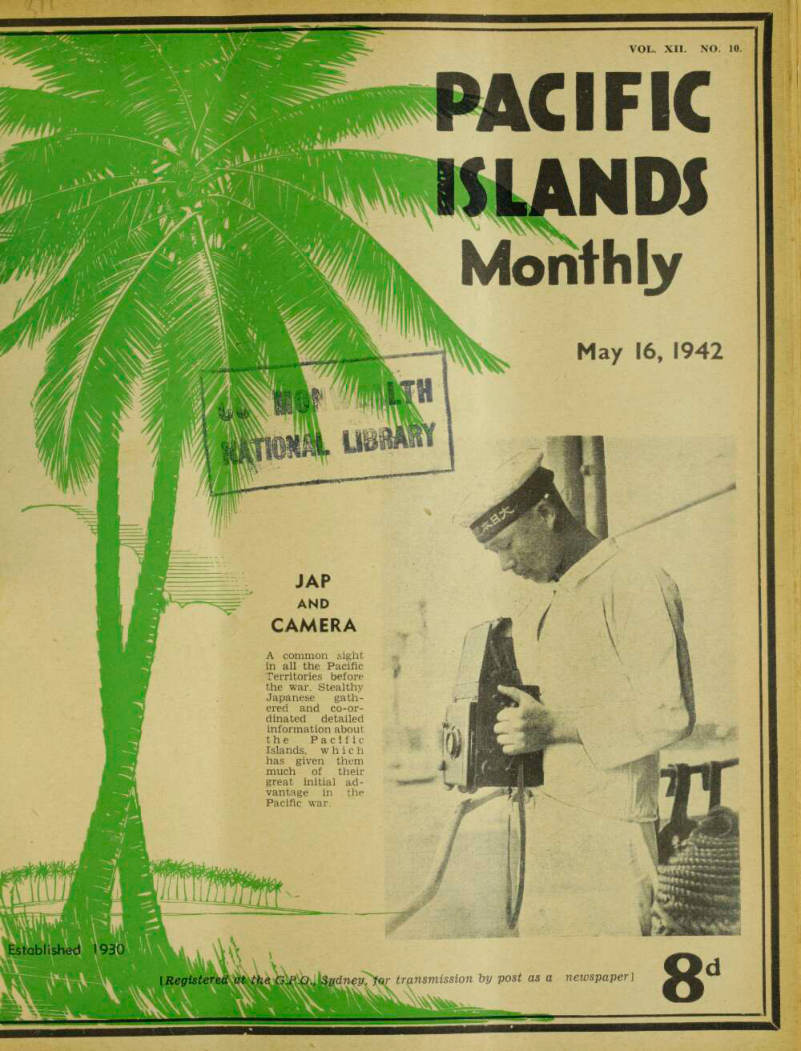
Jap
And
Camera
A common sight in all the Pacific Territories before the war. Stealthy Japanese gath ered and co-or dinated detailed information about the Pacific Islands, which has given them much of their great initial ad vantage in the Pacific war.
Advertisements & other items, pp. 2-3 (1 item)
Page 2
PACIFIC NEWS-REVIEW
NOTES AND COMMENT ON
THE PROGRESS OF THE WAR
FROM APRIL 18 TO MAY 15
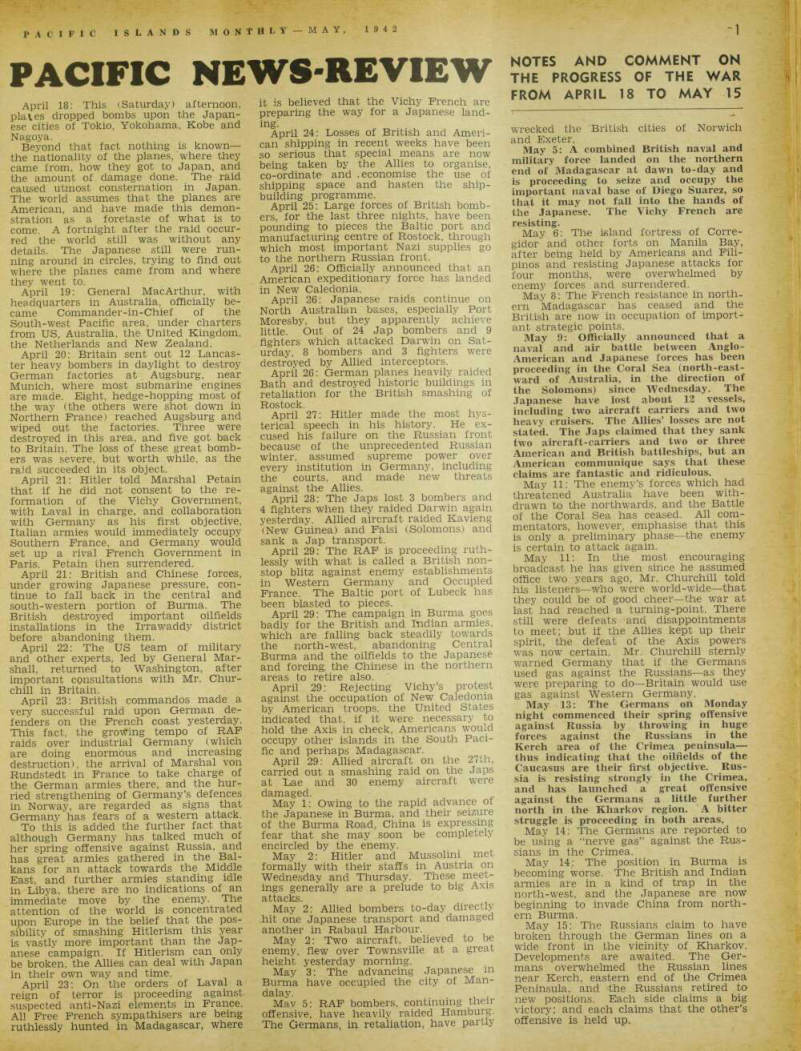
April 18: This (Saturday) afternoon, plaves dropped bombs upon the Japan ese cities of Tokio, Yokohama, Kobe and Nagoya.
Beyond that fact nothing is known— the nationality of the planes, where they came from, how they got to Japan, and the amount of damage done. The raid caused utmost consternation in Japan.
The world assumes that the planes are American, and have made this demon stration as a foretaste of what is to come. A fortnight after the raid occur red the world still was without any details. The Japanese still were run ning around in circles, trying to find out where the planes came from and where they went to.
April 19: General MacArthur, with headquarters in Australia, officially be came Commander-in-Chief of the South-west Pacific area, under charters from US, Australia, the United Kingdom, the Netherlands and New Zealand.
April 20: Britain sent out 12 Lancas ter heavy bombers in daylight to destroy German factories at Augsburg, near Munich, where most submarine engines are made. Eight, hedge-hopping most of the way (the others were shot down in Northern Prance) reached Augsburg and wiped out the factories. Three were destroyed in this area, and five got back to Britain. The loss of these great bomb ers was severe, but worth while, as the raid succeeded in its object.
April 21: Hitler told Marshal Petain that if he did not consent to the re formation of the Vichy Government, with Laval in charge, and collaboration with Germany as his first objective, Italian armies would immediately occupy Southern France, and Germany would set up a rival French Government in Paris. Petain then surrendered.
April 21: British and Chinese forces, under growing Japanese pressure, con tinue to fall back in the central and south-western portion of Burma. The British destroyed important oilfields installations in the Irrawaddy district before abandoning them.
April 22: The US team of military and other experts, led by General Mar shall, returned to Washington, after important consultations with Mr. Chur chill in Britain.
April 23: British commandos made a very successful raid upon German de fenders on the French coast yesterday.
This fact, the growing tempo of RAF raids over industrial Germany (which are doing enormous and increasing destruction), the arrival of Marshal von Rundstedt in France to take charge of the German armies there, and the hur ried strengthening of Germany’s defences in Norway, are regarded as signs that Germany has fears of a western attack.
To this is added the further fact that although Germany has talked much of her spring offensive against Russia, and has great armies gathered in the Bal kans for an attack towards the Middle East, and further armies standing idle in Libya, there are no indications of an immediate move by the enemy. The attention of the world is concentrated upon Europe in the belief that the pos sibility of smashing Hitlerism this year is vastly more important than the Jap anese campaign. If Hitlerism can only be broken, the Allies can deal with Japan in their own way and time.
April 23: On the orders of Laval a reign of terror is proceeding against suspected anti-Nazi elements in France.
All Free French sympathisers are being ruthlessly hunted in Madagascar, where
it is believed that the Vichy French are preparing the way for a Japanese land ing.
April 24: Losses of British and Ameri can shipping in recent weeks have been so serious that special means are now being taken by the Allies to organise, co-ordinate and .economise the use of shipping space and hasten the ship building programme.
April 25: Large forces of British bomb ers, for the last three nights, have been pounding to pieces the Baltic port and manufacturing centre of Rostock, through which most important Nazi supplies go to the northern Russian front.
April 26: Officially announced that an American expeditionary force has landed in New Caledonia.
April 26: Japanese raids continue on North Australian bases, especially Port Moresby, but they apparently achieve little. Out of 24 Jap bombers and 9 fighters which attacked Darwin on Sat urday, 8 bombers and 3 fighters were destroyed by Allied interceptors.
April 26: German planes heavily raided Bath and destroyed historic buildings in retaliation for the British smashing of Rostock April 27: Hitler made the most hys terical speech in his history. He ex cused his failure on the Russian front because of the unprecedented Russian winter, assumed supreme power over every institution in Germany, including the courts, and made new threats against the Allies.
April 28: The Japs lost 3 bombers and 4 fighters when they raided Darwin again yesterday. Allied aircraft raided Kavieng (New Guinea) and Faisi (Solomons) and sank a Jap transport.
April 29: The RAF is proceeding ruth lessly with what is called a British non stop blitz against enemy establishments in Western Germany and Occupied France. The Baltic port of Lubeck has been blasted to pieces.
April 29: The campaign in Burma goes badly for the British and Indian armies, which are falling back steadily towards the north-west, abandoning Central Burma and the oilfields to the Japanese and forcing the Chinese in the northern areas to retire also.
April 29: Rejecting Vichy’s protest against the occupation of New Caledonia by American troops, the United States indicated that, if it were necessary to hold the Axis in check, Americans would occupy other islands in the South Paci fic and perhaps Madagascar.
April 29: Allied aircraft on the 27th, carried out a smashing raid on the Japs at Lae and 30 enemy aircraft were damaged.
May 1: Owing to the rapid advance of the Japanese in Burma, and their seizure of the Burma Road, China is expressing fear that she may soon be completely encircled by the enemy.
May 2: Hitler and Mussolini met formally with their staffs in Austria on Wednesday and Thursday. These meet ings generally are a prelude to big Axis attacks May 2: Allied bombers to-day directly hit one Japanese transport and damaged another in Rabaul Harbour.
May 2: Two aircraft, believed to be enemy, flew over Townsville at a great height yesterday morning.
May 3: The advancing Japanese m Burma have occupied the city of Man
dalay. , .
Mav 5; RAF bombers, continuing their offensive, have heavily raided Hamburg.
The Germans, in retaliation, have partly
wrecked the British cities of Norwich and Exeter.
May 5: A combined British naval and military force landed on the northern end of Madagascar at dawn to-day and is proceeding to seize and occupy the important naval base of Diego Suarez, so that it may not fall into the hands of the Japanese. The Vichy French are resisting.
May 6: The island fortress of Corre gidor and other forts on Manila Bay, after being held by Americans and Fili pinos and resisting Japanese attacks for four months, were overwhelmed by enemy forces and surrendered.
May 8: The French resistance in north ern Madagascar has ceased and the British are now in occupation of import ant strategic points.
May 9: Officially announced that a naval and air battle between Anglo- American and Japanese forces has been proceeding in the Coral Sea (north-east ward of Australia, in the direction of the Solomons) since Wednesday. The Japanese have lost about 12 vessels, including two aircraft carriers and two heavy cruisers. The Allies’ losses are not stated. The Japs claimed that they sank two aircraft-carriers and two or three American and British battleships, but an American communique says that these claims are fantastic and ridiculous.
May 11: The enemy’s forces which had threatened Australia have been with drawn to the northwards, and the Battle of the Coral Sea has ceased. All com mentators, however, emphasise that this is only a preliminary phase—the enemy is certain to attack again.
May 11: In the most encouraging broadcast he has given since he assumed office two years ago, Mr. Churchill told his listeners —who were world-wide —that they could be of good cheer —the war at last had reached a turning-point. There still were defeats and disappointments to meet; but if the Allies kept up their spirit, the defeat of the Axis powers was now certain. Mr. Churchill sternly warned Germany that if the Germans used gas against the Russians —as they were preparing to do—Britain would use gas against Western Germany.
May 13: The Germans on Monday night commenced their spring offensive against Russia by throwing in huge forces against the Russians in the Kerch area of the Crimea peninsula— thus indicating that the oilfields of the Caucasus are their first objective. Rus sia is resisting strongly in the Crimea, and has launched a great offensive against the Germans a little further north in the Kharkov region. A bitter struggle is proceeding in both areas.
May 14: The Germans are reported to be using a “nerve gas” against the Rus sians in the Crimea.
May 14: The position in Burma is becoming worse. The British and Indian armies are in a kind of trap in the north-west, and the Japanese are now beginning to invade China from north ern Burma.
May 15: The Russians claim to have broken through the German lines on a wide front in the vicinity of Kharkov.
Developments are awaited. The Ger mans overwhelmed the Russian lines near Kerch, eastern end of the Crimea Peninsula, and the Russians retired to new positions. Each side claims a big victory; and each claims that the other’s offensive is held up.
Contents
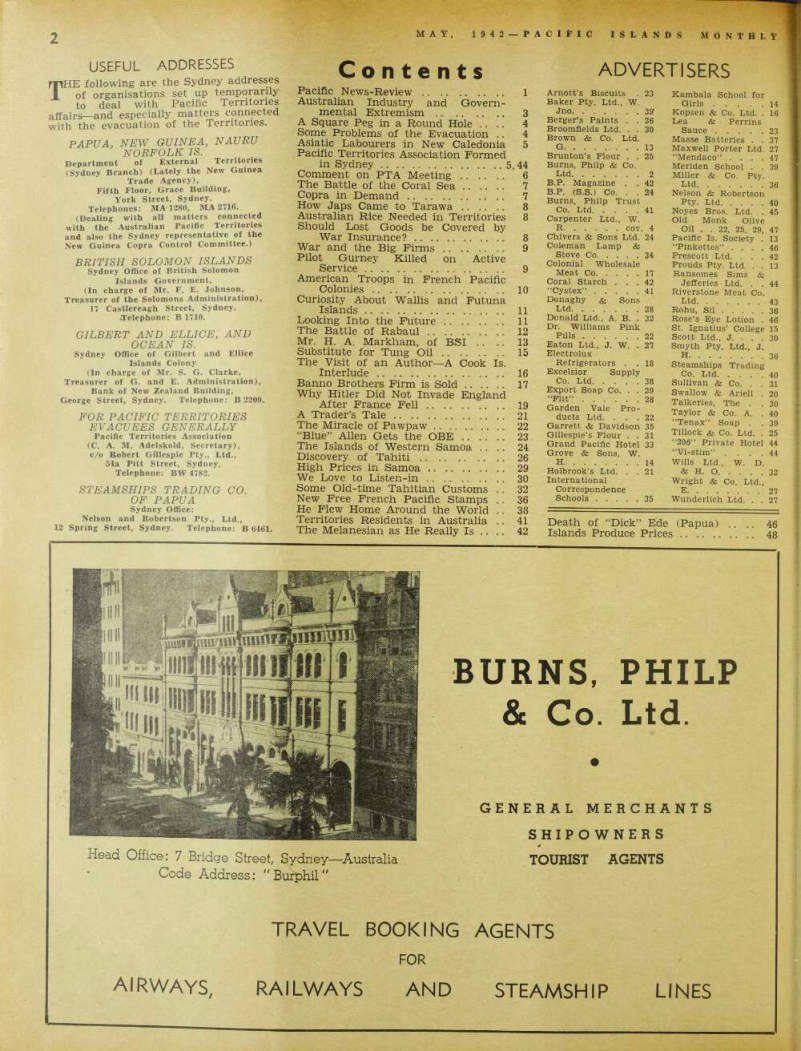
Pacific News-Review 1 Australian Industry and Govern mental Extremism 3 A Square Peg in a Round Hole ... 4 Some Problems of the Evacuation .. 4 Asiatic Labourers in New Caledonia 5 Pacific Territories Association Formed in Sydney 5,44 Comment on PTA Meeting 6 The Battle of the Coral Sea 7 Copra in Demand 7 How Japs Came to Tarawa 8 Australian Rice Needed in Territories 8 Should Lost Goods be Covered by War Insurance? 8 War and the Big Firms 9 Pilot Gurney Killed on Active Service 9 American Troops in French Pacific Colonies 10 Curiosity About Wallis and Futuna Islands 11 Looking Into the Future 11 The Battle of Rabaul 12 Mr. H. A. Markham, of BSI .. .. 13 Substitute for Tung Oil 15 The Visit of an Author—A Cook Is.
Interlude 16 Banno Brothers Firm is Sold 17 Why Hitler Did Not Invade England After France Fell 19 A Trader’s Tale 21 The Miracle of Pawpaw 22 “Blue” Allen Gets the OBE 23 The Islands of Western Samoa ... 24 Discovery of Tahiti 26 High Prices in Samoa 29 We Love to Listen-in 30 Some Old-time Tahitian Customs .. 32 New Free French Pacific Stamps .. 36 He Flew Home Around the World .. 38 Territories Residents in Australia .. 41 The Melanesian as He Really Is ... 42
Death of “Dick” Ede (Papua) ... 46 Islands Produce Prices 48
Advertisers
Arnott’s Biscuits . 23 Baker Pty. Ltd., W.
Jno 3ff Berger’s Paints . . 26 Broomfields Ltd. . . 30 Brown & Co. Ltd.
G 13 Brunton’s Flour . . 25 Burns, Philp & Co.
Ltd 2 B.P. Magazine . . 42
B.P. (S.S.) Co. . . 24
Burns, Philp Trust Co. Ltd 41 Carpenter Ltd., W.
R cov. 4 Chivers & Sons Ltd. 24 Coleman Lamp & Stove Co 34 Colonial Wholesale Meat Co 17 Coral Starch ... 42 “Cystex” 41 Donaghy & Sons Ltd 28 Donald Ltd., A. B. . 32 Dr. Williams Pink Pills 22 Eaton Ltd., J. W. . 27 Electrolux Refrigerators . . 18 Excelsior Supply Co. Ltd 38 Export Soap Co. . . 29 “Flit” 28 Garden Vale Pro ducts Ltd. ... 22 Garrett & Davidson 35 Gillespie’s Flour . , 31 Grand Pacific Hotel 33 Grove & Sons, W.
H 14 Holbrook’s Ltd. . .21 International Correspondence Schools 35
Kambala School for Girls 14 Kopsen & Co. Ltd. , 16 Lea & Perrins Sauce 23 Masse Batteries . . 37 Maxwell Porter Ltd. 27 “Mendaco” ... 47 Meriden School . . 39 Miller & Co. Pty.
Ltd 36 Nelson & Robertson Pty. Ltd 40 Noyes Bros. Ltd. . 45 Old Monk Olive Oil . . 22, 25, 29, 47 Pacific Is. Society . 13 “Pinkettes” ... 46 Prescott Ltd. ... 42 Prouds Pty. Ltd. . . 13 Ransomes Sims & Jefferies Ltd. . . 44 Riverstone Meat Co.
Ltd 43 Rohu, Sil 36 Rose’s Eye Lotion . 46 St. Ignatius’ College 15 Scott Ltd., J. ... 30 Smyth Pty. Ltd., J, H 36 Steamships Trading Co. Ltd 40 Sullivan & Co. . . 3,1 Swallow & Ariell . 20 Talkeries, The . . 30 Taylor & Co. A. . 40 “Tenax” Soap . . 39 Tillock & Co. Ltd. . 25 “206” Private Hotel 44 “Vi-stim” ... 44 Wills Ltd., W. D. & H. 0 32 Wright & Co. Ltd., E 27 Wunderlich Ltd. . . 27
Advertisements & other items, p. 4 (2 items)
Useful Addresses
rE following are the Sydney addresses of organisations set up temporarily to deal with Pacific Territories affairs —and especially matters connected with the evacuation of the Territories.
PAPUA, NEW GUINEA, NAURU
NORFOLK IS.
Department of External Territories (Sydney Branch) (Lately the New Guinea Trade Agency), Fifth Floor, Grace Building, York Street, Sydney.
Telephones: MA 1280, 3VLA 2716. (Dealing with all matters connected with the Australian Pacific Territories and also the Sydney representative of the New Guinea Copra Control Committee.)
BRITISH SOLOMON ISLANDS
Sydney Office of British Solomon Islands Government, (In charge of Mr. F. E. Johnson, Treasurer of the Solomons Administration), 17 Castlereagh Street, Sydney.
Telephone: B 1710.
GILBERT AND ELLICE, AND
OCEAN IS.
Sydney Office of Gilbert and Ellice Islands Colony (In charge of Mr. S. G. Clarke, Treasurer of G. and E. Administration), Bank of New Zealand Building, George Street, Sydney. Telephone: B 2209.
FOR PACIFIC TERRITORIES
EVACUEES GENERALLY
Pacific Territories Association (C. A. M. Adelskold, Secretary), c/o Robert Gillespie Pty., Ltd., 54a Pitt Street, Sydney.
Telephone: BW 4782.
STEAMSHIPS TRADING CO.
OF PAPUA
Sydney Office: Nelson and Robertson Pty., Ltd., 12 Spring Street, Sydney. Telephone: B 6461.
Burns, Philp
It!
I Hi
III)
111 til if
ion
Head Office: 7 Bridge Street, Sydney—Australia Code Address: " Burphil"
BURNS, PHILP
& Co. Ltd.
GENERAL MERCHANTS
SHIPOWNERS
TOURIST AGENTS
TRAVEL BOOKING AGENTS
FOR
airways, railways and steamship lines
Pacific Islands Monthly
The Newspaper-Magazine of the South Seas [.Registered at the G.P.0., Sydney, for transmission hy post as a newspaper A
Published Once Each Month and Circulated in Australia and New Zealand and in the following Pacific Territories and Islands Groups:
Australian Territory of Papua.
Mandated Territory (Australia) of New Guinea.
Australian Territory of Norfolk Island.
New Zealand Territory of Cook Islands.
Mandated Territory (NZ) of Western Samoa.
British Colony of Fiji.
British Solomon Islands Protectorate.
British Protectorate of Tongan Islands.
British Crown Colony of Gilbert and Ellice Islands.
Mandated Territory of Nauru.
British and Free French Condominium of New Hebrides.
Free French Colony of New Caledonia.
Free French Colony of Oceania (Tahiti, etc.).
American Territory of Eastern Samoa.
American Territory of Hawaiian Islands.
Owned and Produced by Pacific Publications Pty. Ltd., Union House, 247 George Street, Sydney.
TFT f Managing Director .. BW 3037 TELEPHONE £ Business and Editorial MA4369
P.O. Box 3408 R
Registered Address of Telegrams, Radiograms, and Cables: “Pacpub”, Sydney.
Contributions.
Articles, Stories, and Photographs dealing with Pacific Islands subjects are invited and will be paid for on publication.
Subscription Rates.
Per Annum, within British Empire, Prepaid, Post Free 8/- Per Annum, elsewhere, prepaid, Post Free. 107- Single Copies Bd.
Editor and Publisher:
R. W. Robson, F.R.G.S.
Assisted by Selwyn Hughes.
Advertising Manager: L. W. Bailey.
Advertising Office and Printing-House: 29 Alberta Street, Sydney.
Advertising rates furnished on application.
Colours, etc., by arrangement.
Process Blocks made at Advertiser’s expense when required. Screen 100.
Changes of Advertising Copy should reach this office by Ist of each month, otherwise previous advertisement may be repeated.
Representative In London.
W. C. Harvey, Coronation House, 4 Lloyds Avenue, London, E.C.3, from whom may be obtained copies of Pacific Islands Monthly, Pacific Is. Year Book, advertising schedules, etc.
Agents.
The following are authorised to receive sub scriptions for Pacific Islands Monthly;— Burns, Philp & Co., Ltd., and Burns Philp (South Sea) Co., Ltd. All branches.
W. R. Carpenter & Co., Ltd. All branches.
Morris, Hedstrom, Ltd. All branches.
Steamships Trading Co., Papua. All branches.
B.N.G. Trading Co., Ltd., Port Moresby, Papua.
J. Muir, Suva, Fiji.
Miss R. Castles, Suva, Fiji.
N. C. Mackenzie Hunt, Wainunu, Bua, Fiji.
Kirpal & Co., Victoria Parade, Suva, Fiji.
Cook Islands Trading Co., Rarotonga, Cook Is.
A. C. Rowland, Papeete, Tahiti.
Islands Branches and Representatives of W. H.
Grove & Sons, Ltd., Auckland, New Zealand.
Ed. Pentecost, Noumea, New Caledonia.
Kerr & Co., Noumea, New Caledonia.
Vol. XII. No. 10.
May 16, 1942
PrirP f 8d - Per Copy rnce £ Prepaid: 8/- p.a.
Advertisements & other items, pp. 5-6 (1 item)
oufof™ e^Ly^usiZt
Australian Industry and Governmental Extremism
WE have stated elsewhere, in reply to inquiries, that the publi cation of the “Pacific Islands Monthly” will be carried on, without interruption. The evacuation of the European population from some of the Melanesian groups, as a result of the southwards attack by Japanese, cer tainly has affected the advertising business and created difficulties in relation to news-gathering and the distribution of the journal; but we still have free access and means of distribution in New Caledonia, New Hebrides, and in all Polynesia, in cluding Fiji, Tonga, Samoa, Cook Islands and French Oceania—and that is enough to keep the wheels turn ing.
Kevenues are thin, and difficulties are many; but we mean to carry on— if the Australian Governmental authority permits. That is an “If” of considerable magnitude. It is time that some one described, in plain language, what is going on in this country.
A KIND of madness seems to have fallen upon the Australian Gov ernment, so that nearly every little personally-controlled business of every kind is in danger of destruction, and none knows what the morrow holds. It is reported that some war time bureaucrat somewhere “thinks the publication of so many monthly journals quite unnecessary”, and we may be closed up at any time.
Never, in a lifetime which has in eluded much study of national economics, has this writer seen any thing so fantastic as the present Australian Government’s plan for producing another 50,000 men for military service. They are being pro duced by what is called “ration alisation of industry '—in other words, by closing up small businesses in every direction, and leaving to blanket organisations (or monopolies) controlled by governments the per formance of services hitherto carried out by small, individual businesses controlled by private enterprise and competitive conditions.
There has been no more amazing
mint irately' creating coitions
f avoura ble for the operations of com bines and money-power.
In order to get that last 50,000 men, Australian trade and industry is be ing smashed—especially that part of it carried on by “small” people. On every hand, one hears stories of men who are losing their businesses, into which they have put the savings and the hard work of the best years of their lives. They go to Magistrates or “Manpower” officers, and plead for consideration; and, in most cases, they are given “a month to make arrangements to carry on”—which, of course, means that they either close up or sell at a heavy sacrifice. They are mostly good Australians: but the feeling in their heart, as they go to
patriot. And who can blame them?
The foreeoine is the citv anele— f JL viewooint of secondarv f n dustr?es The Position 86 of the
™ ei3^ n d?stHes P wor?e-and
threatens to become catastronhic So *ns Ito 1 to So has been eiv^the P resiaonsi “S? no t onlv ofmdDDing but also iffeedinff °aree forces which presently will onen one of the most M
fronts alainst the Txis It
dearlv is a time when we must oro-
Suci more noTw foodstuffs Yet
thpsp of’ Can b are draeeinl men in hundreds ?n d out of the Sarv
fndustrfef Xch must sunnlv Tood
oufof™ e^Ly^usiZt
anc j sm all factories are being reduced fn ob- P i P t n n<; nr P i n <?inp- un niWpthpr to skeletons, or closing up altogether If this thing is carried to us logical conclusion, our war effort will become ridiculous. That last 50,000 men, taken out of our basic industries, will not affect the final issue of the war in any degree. But Australia’s failure to properly feed and equip the armies gathered in Australia could seriously affect the course of the war. The logical conclusion of this man power policy is that Australian in dustry will be handed over as a gift to monopolies and money-power.
But the thing will not go on to its apparently logical conclusion. If this muddled Commonwealth Government
does not hold its hand, it will find itself faced with most serious poli tical trouble. Already, in tne snops and ortices of hign and low, in tne tram cars and tne streets, one nears an angry murmuring wmch is daily growing in volume. it is like the rumblings which preceded the defeat of Mr. Menzies.
THERE is no lack of war spirit in Australia. Literally, everyone re cognises that there can be neither security nor peace until Hitlerism is smashed and Japan is put back wnere she belongs. Everyone demands the • utmost war effort”. The Menzies Government was not put out of office by Curtin cleverness or Labour strength or Fifth Column intrigues— it was forced out by the people’s mounting outcry against the feeble ness and fumbling of Ministers who could not get their vital war-time jobs into focus, and the people’s insistence on a greater war effort.
The Curtin Government gave us that greater war effort—but attained such momentum that now, apparently, it cannot stop—it is sweeping the country on into an economic condi tion from which we may not recover in a generation. Men are asking, Is this a genuine war effort? Or does it mean that certain Curtin Ministers are using their war-time powers and the country’s war-time helplessness to fasten upon the country the con ditions and institutions of ultra- Socialism, or even of Communism?
This so-called “rationalisation of in dustry”, the direction of which seems to be largely in the hands of fanatics and impractical theorists, has features which are both suspicious and alarm ing.
THIS destruction of little businesses strikes at the very root of the private enterprise and individualism on which the Anglo-Saxon Powers were built and became great. If it is carried to its logical conclusion, no man will be allowed to start in as a baker or a milkman, a chemist or a doctor or a lawyer, a garage-man or an electrician or a printer, unless he first obtains the permission of some bureaucratic authority who will de cide whether the service proposed is really needed by the community. If the bureaucrat decides that it is not (and he will so decide, in nine cases out of ten) the man who was anxious to “start on his own”, and demon strate his efficiency, energy and in dustry, will go back to his circum scribed, paid job, where he may have to wait years for promotion, no matter how able he may be. Take competition out of trade and industry, and we shall follow such nations as Spain and Portugal into national
degeneracy.
The Curtin Ministers will say that this is all imaginative and ridiculous.
It is not—it is a very real danger. It threatens immediately to hand the free trade and industry of this coun try over to the combines, bound hand and foot by a blind and fumbling Government. That is why the people are discontented and murmuring.
They may not clearly see this yet—but they can sense it, clearly enough; and if the Government does
not recognise this growing feeling, a very dangerous situation will arise. It will stifle, rather than stimulate, the war effort, because it will take the heart out of the people.
Australia’s war effort, up to date, is magnificent—let it rest there. Why destroy the national economy, and arouse an angry public feeling, for the sake of another 50,000 men?
Australia, by herself, could not win this war, if every male from 17 to 70 were mobilised. We shall do our full share in winning the war; but it is not our war alone—Russia, the United States and China have reasons, more urgent even than ours, for destroying the Axis. They did not come into the war merely to help us. They do not ask us for sacrifices greater than theirs.
Will it not be time enough for us to begin to destroy our national economy so as to meet extreme mili tary demands, when the United States gets to the same point? The United States could mobilise ten million men before it would become necessary to attack the American economic condi tions which permit private enterprise and individualism to function—and which are the basis of American economic power.
Round Hole
A Square Peg in a Round Hole
A FAMOUS London commentator, Hannen Swaffer, has this to say in.
“World’s Press News”, of February 26. about a gentleman well known in Fiji:— Now that Singapore has fallen, we can look back and wonder what share the press repression had to do with the catastrophe.
Australian journalists were censored.
An American news commentator was thrown out for daring to say a few words of the truth.
“Nothing made sense in Singapore,”
Frank Gervasi, the American journalist, warned us, weeks ago. “The funniest and the most exasperating character was the local Press Relations Officer.
“For some 20 years he had been a magistrate—in the Fiji Islands. He was a naval reserve officer, a lieutenant-com mander. and was called to duty recently.
As a former magistrate in the Fiji Islands he was, of course, extremely helpful to the foreign press. He didn’t know one newspaper from another and the only press association he’d ever heard of was Reuter’s.
“He knew what the BBC was, but he’d never heard of CBS or NBC. He dedi cated himself to the proposition that no one. absolutely no one, old boy, should find out one damned thing about Singa pore.
“He was eminently successful.”
Mr. Theo Thomas, who got away to Australia from New Guinea just after the Jap invasion, recently enlisted in the AIF in Sydney. His wife now is living at Picton, NSW.
Miss M. Clipstone and Miss V. Wakely, of the New Hebrides Field Mission, recently returned to Australia.
Monsieur Guillot, formerly chief jus tice of the French Colony of St. Pierre and Miquelon, has been nominated as head of the Department of Justice at Papeete, Tahiti.
Federal Authority
Problems Of The
Evacuation
Some Headaches for the Federal Authority
rE diversity and character of the problems created by the civil evacuation of the Territories of Papua and New Guinea are indicated by the following list. They are matters submitted by Mr. C. W. Kirke, of Wau, to the public meeting in Sydney of Ter ritories’ evacuees, and he suggested that they form the subject of inquiry by the newly-formed Pacific Territories Asso ciation.
Definition of looting in relation to war damage, and causes of looting.
How are we to assess depreciation, in relation to wartime damage, of such things as goods, plant, mining plant, race construction, plantations, plantation buildings, residences, and so on?
What action is the Government prepared to take to assist us in replacing vital documents lost, such as bonds, insurance policies—and what is to be done in regard to the records lost in Rabaul of marriages, births and deaths, of land registrations, and so on?
What does the Government propose to do in relation to public officials who were removed from the Territories—too old to enter the military forces there, but who have not yet reached the retiring stage, and who are capable of giving many more years of experienced service?
Should not compensation payments made in respect of crops be made quarterly instead of annually?
What are to be the conditions of re patriation after the Territories are clear of the enemy—and how are vital goods, such as horses, plant, etc., to be replaced?
Is it possible to get from the Federal authority a clear ruling regarding the position of employers of indentured labour, whose arrangements and con tracts were summarily ended by the evacuation? What about guarantee money? What is happening to it? Are these broken contracts to be taken into consideration when employers try to re establish their labour lines?
What form of protection is being given to the holders of the various ten ures—planting, mining, trading stations, etc.—while the holders are compulsorily absent from the Territories?
Engagement
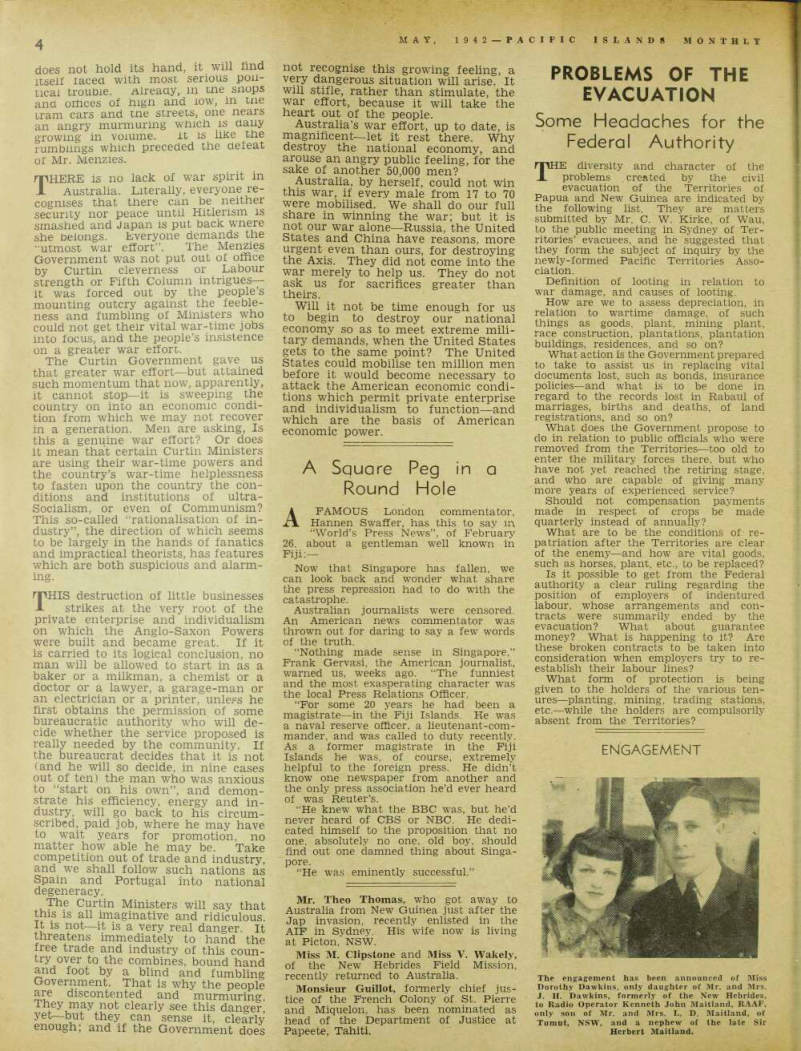
The engagement has been announced of Miss Dorothy Dawkins, only daughter of Mr. and Mrs.
J. H. Dawkins, formerly of the New Hebrides, to Radio Operator Kenneth John Maitland, RAAF, only son of Mr. and Mrs. L. D. Maitland, of Tumut, NSW, and a nephew of the late Sir Herbert Maitland.
Indonesian
Labourers
How N. Caledonia Plans to Solve Repatriation Difficulty
DURING a recent session, the Chamber of Agriculture of New Caledonia considered the problem presented in the repatriation of Tonkinese and Javanese labourers now working on New Caledonian plantations, who have to be returned to their own country on the expiration of their labour contracts.
To deal with the situation, the Cham ber of Commerce adopted the following resolution; — “In consideration of the fact that a state of war exists in the Pacific, creat ing insuperable difficulties in communi cation between the Netherlands East Indies, Indo-China and New Caledonia: and having regard to the alliance which binds Holland and the East Indies with Free France against a common enemy, the mobilisation of men in New Cale donia, the consequent scarcity of agri cultural labourers, the absolute necessity of maintaining agricultural production, and the difficulty of recruiting further Javanese or Tonkinese labourers; the Chamber of Agriculture asks that an Act be passed to make it legal to retain Asiatic labourers at present employed (Javanese and Tonkinese) for the dura tion of the war.”
Suva Residents' Gift To
Assist Evacuees
TWO Suva residents, Mr. and Mrs. S.
H. Ellis, who have shown commend able generosity in donating funds for British aircraft and other patriotic causes since the outbreak of war, have made yet another public-spirited gesture.
They have established a trust fund of £250 (with another £250 to follow) for the purpose of assisting Fiji residents — especially married women with children — to evacuate to New Zealand. The gift will be known as the “Fiji Evacuee Trust” and three well-known Suva men, Messrs.
Frank Smith Malcolm Brodie and George Barrett have agreed to administer the fund.
A short time ago the Fiji Government recommended the evacuation of women and children from the Colony, but the authorities made it clear that Fiji’s present financial and domestic position would not permit the payment of evacuees’ passages to NZ.
Rationing In Tahiti
IT was announced recently at Free French headquarters in Noumea that certain rationing measures have been taken in French Oceania. It is now forbidden to sell meat on Monday, Tuesday and Friday in Tahiti.
The new duties on wines and all alcoholic beverages have been fixed in Tahiti as follows: —Wine (cask) 137 frs. 50 c. per hectolitre; otherwise; 30 frs.
All alcoholic beverages, other than wines and liqueurs, 24 frs. per litre.
A special department for the protection of New Caledonian forests has been created and placed in charge of M. Virot.
He will receive a monthly allowance of 3,000 francs.
Pacific Territories
Association
Evacuees in Australia Form Organisation for Mutual Protection and Help
Pacific Territories Association, which is a mutual-help organisation of evacuees from the Pacific Territories, was formed at a public meeting held in Sydney on May 14. The meeting was called by an advertisement, and there was a large gathering in the YMCA Hall, Pitt Street. The objects of the Association were set out, and an Executive Committee was appointed, to give effect to them.
THE chair was taken temporarily, on behalf of the convenors, by Mr. R.
W. Robson, editor and publisher of the “Pacific Islands Monthly”.
“This meeting,” said Mr. Robson, “is the result of a spontaneous movement among evacuees, who feel that they should combine in one organisation for the following purposes:—
Three Main Objects
“First: They feel that occasions arise when they need assistance and protec tion in connection with the conditions under which they are living in Austra lia. Manv, formerly enjoying comfort and security in their Islands homes, now suddenly find themselves, through no fault of their own, without either secur ity or comfort.
“They are not squealing—in view of all the circumstances, there has been extraordinarily little squealing bv evacu ees—but they do feel that they are entitled to reasonable consideration and all the assistance that Australia can give them: and it is feared that (in a number of cases, this may be due to misunderstanding) they have not received the treatment to which they feel thev are entitled. If we can form a strong and fearless organisation, individual casec of hardshin can be handled better bv the organisation than by the indi vidual concerned.
“In the second nlace. there is need for an organisation like this to deal with the very vexed and difficult subject of comnensation for war damage. It is nrobable that every person evacuated from Panua and New Guinea is much noorer as a result of that evacuation.
Few of these peonle feel that they can not justly lodge a claim for comoensa tion. A number of official nromises of compensation were made at the time the evacuation took nlace. Since then, there has been noticed a growing tendency on the nart of the officials concerned to make sharper and ever sharner defini tions of what constitutes war damage, and many people now are beginning to feel that the compensation unon which they .had counted to re-establish them in civil fife is likely to disappear into thin air.
“There is looting, for example. Is loot ing war damage? This is a matter con cerning which more will be said later — I mention it now merely to indicate how necessary it is that the evacuees stand together in such matters for the protec tion of thmr individual interests.
“Then there is a third way in which it is believed that an organisation of this kind will be generally helnful.
Sooner or later the Japanese are going to be driven away, and it will be pos sible for civilians to re-occupy the Ter ritories. We believe that we shall have plenty of little troubles in these Pacific Territories between the time that civilian re-occupation becomes possible, and the
military administration is replaced by a civilian administration.
Relations With Government
“The plan to set up this organisation must not be regarded as criticism, in any sense, of what the Australian Gov ernment has done. There are those who point out that evacuees’ claims upon Australia, for help in the shape of monetary assistance, are based as much upon sentiment as upon actuality. Resi dents of Papua and New Guinea were not Australian taxpayers and their legal claim upon Australia consequently is not easy to define. But those Territories were not self-governing communities.
For better or worse, Australia accepted responsibility for their government and welfare, and Australia now cannot be allowed to ignore the obligation to see them through this most critical period. We must admit that a number of over worked officials, without precedents to snide them, or machinery to assist them, in this emergency, have done wonders in getting some sort of order out of the chaos that threatened to develop.
“But many individuals are suffering a sense of grievance—inevitable, in the cir cumstances. I believe that if the office bearers of the proposed Association go about their task tactfully, the Common wealth officials will be glad of their assistance, and in turn will co-operate with the Association.
Four Sections Of Evacuees
‘ TITHE convenors, in planning this ]i organisation, regarded the evacuees from the Territories as falling nat urally into four sections or communities —namely, the public servants, the plant ers, the miners and the commercial interests or traders. In three directions to which I have referred —conditions of life in Australia, claims for compensa tion for war damage, conditions of civi lian re-occupation of the Territories—the interests of these four classes appear to be as one, and we believe that they can make common cause within this proposed organisation.
“But it is recognised also that in some directions there may be a tendency for conflict to develop between the different sections. We hope that these various matters will be smoothed out by tactful handling—we ask these people of New Guinea and Papua to remember that the things which possibly may divide them are small and insignificant compared with the much more important things upon which they must stand united and prepared to take united action. Remem ber, the people of the Territories, now so
(Continued On Page 44)
tragically dependant upon the goodwill of Australia, have no representation in the Australian Parliament.
Future Of Administrations
“It is expected that Territories condi tions in the future will be much changed.
Vast masses of men are going to move through those Territories in the course of this war. The natives are going to be affected profoundly by the things that are happening in connection with the war.
“Above all, we must expect far-reach ing changes in the administration. In the past these have been two separate Territories administered, so to speak, in water-tight compartments, even the per sonnel of their public services kept strictly apart. That was because Papua was an Australian Territory and the New Guinea Territory was a Territory man dated to Australia by the League of Nations. It is very clear that New Guinea and Papua will be administered in the future as one Australian Terri tory.
Solomons And New Hebrides
“The political and constitutional changes which we foresee may not stop at Papua and New Guinea. It is quite probable, as part of the post-war re arrangement of Pacific affairs that the responsibilities of Great Britain in con nection with the administration of the British Solomon Islands and the New Hebrides, will be passed over to Austra lia. That is something which has re ceived academic consideration on a num ber of occasions but in the past 20 years no one seemed to have sufficient energy or knowledge of the subject to bring the plan to a head.
“It has been rather an anomaly that, while all the trade of the British Solo mons. and the currency in use there, should be Australian, the administration should be controlled from Whitehall.
The same applies in a large degree to the British share of the administration
of the Condominium of the New Heb rides. If there is to be British adminis tration in that Group in future, it is reasonable to suppose that it will be Australia who will share the responsi bility of Government with France, rather than Great Britain.
“These are matters concerning which it is idle to speculate at this stage of the war. Nevertheless, they are matters which deserve the consideration of such an organisation as we hope that this will prove to be, and that is why they are mentioned now, and why evacuees from the Solomons and New Hebrides—a number of whom are now in Australia— have been invited to join the Associa tion.”
Tribute To Convenors
The chairman paid a tribute to the work done by the convenors (Messrs. V.
Pennefather, C. W. Kirke, D. Mackin non, E. A. James and J. Clay) in
arranging the meeting. Mr. Kirke, un
fortunately, had been called away to
Queensland on business.
THE chairman read the following
message from Mr. Kirke:— My object in planning this meeting was to weld the residents of the Pacific Territories into one strong organisation, with a view to our helping each other, placing our disabilities before the Federal Government and seeking sympathetic treatment in this, our time of exile.
To-day there is in Australia an army that is without leadership, that is little cared for, and which feels that it Is unwanted—we are that army of evacuees. In the same way that our ancestors came to Australia, we have gone for ward into these little-known, uncivilised and undeveloped countries in the Pacific, and we have helped materially in the development of a new and important section of the Empire. Many made the supreme sacrifice; but always there were others to come forward and take their places. We do feel that we are entitled to consideration.
The organisation we have planned can and will play an important part in Pacific affairs— but only with your sincere and loyal co-opera tion. I believe that the big trading companies, like Burns, Philp and Co., W. R. Carpenter and Co., Steamships Trading Co., recognise that they owe us much, and that they will co-operate with us in our general purposes. I beg of you, do not let our broad outlook be jeopardised by self-interest. We must stand together in seek ing a more liberal interpretation than appar ently is proposed of the regulations governing the payment of compensation for war damage.
We may have to fight as one organisation to protect the rights and privileges of one par ticular section of our people.
Especially I would like the organisation to immediately undertake the registration of every citizen of the Islands, male and female, who is able to work, with a statement of their qualifi cations, so that they may be placed in positions, and given a chance to do their part in Aus tralia’s war effort.
I regret my unavoidable absence and I wish you a successful meeting. Salaams.
Association Is Formed
rE following motion was moved by
Mr. C. A. M. Adelskold (New
Guinea); —
That this meeting forms an Association of Residents of, and Persons Interested in, the Pacific Territories which have been affected by war conditions, to be known as the Pacific Territories Association, and the objects of which are:— (a) To protect the interests of members who are evacuees from their homes in the Territories owing to war conditions. (b) To assist members in presenting and prosecuting their claims for compensa tion for war damage. (c) To give all reasonable assistance to members in connection with the civil re-occupation of the Territories.
Mr. Adelskold said that one of their most difficult tasks would be to assist in the change-over from military to civil
administration—he thought that within
six months after the war ended they should be back again in the Territories,
picking up the threads of their old civil jobs. It would not be an easy matter— the civilians probably would have to fight every inch of the way, just as resi dents did after the last Great War, and in that the Association could give much help.
Seconding the motion, Mr. E. A.
James, of Port Moresby, Papua, brought three points before the notice of the meeting:— 1. General Assistance.—There were many minor matters —as well as a host of major matters —in which the Associa tion no doubt could assist members. One, for instance, was the rationing of cloth ing—most Islands evacuees reached Aus tralia with very little of their personal effects and if they were restricted in their purchases of clothing hardship would probably result. 2. Insurance. —The question of civil fire risk should be investigated. He understood that in cases where fires occurred on abandoned plantations, etc., the damage was not covered either by the War Risk Insurance or by ordinary commercial insurance.
What, too, was the position of those who were unable to make a complete, detailed inventory of their losses when they claimed war damage?
Provision should be -made on assessors’ panels for a non-official representative from the Territory affected —it would be a beneficial move for all concerned if such a representative were nominated by the Association. 3. Repatriation.—lndications are that during the initial period, when Islands people return to their homes in the Ter ritories, they will have to guard their interests jealously—otherwise they will suffer, perhaps far more even than they do now.
There would have to be a change in the system of administration, continued Mr. James. For years, New Guinea and Papua had been governed by regulations.
During the war these regulations, of necessity, would increase in volume.
“After the war we must introduce into the Territories a better system of legis lation,” he said. “The various interests must have representation, must have some say in the legislation and the way in which we are going to be governed in the future. If we don’t get it then, we never shall.
“To-day, we Islands folk are scattered all over Australia; a year hence we shall be scattered even wider—therefore, we must band together now and in this new Association we have an organisation that can speak for every one of us,” he concluded.
In the absence of Mr. D. Mackinnon (Solomon Islands), Mr. V. Pennefather spoke briefly in support of the motion.
Mr. R. A. Laws, well-known New Guinea merchant, said that Islands resi dents generally would benefit by the formation of the proposed Association— particularly what the organisation could do in the direction of gaining equitable compensation for war damage.
He feared that when Islands people were allowed to return to Papua and New Guinea there still would be a ten dency to try and run the Territories by the former “red-tape” and “old school tie” methods. The sooner that was eli minated the better.
Mr. Laws referred to remarks made by the chairman that the proposed Associa tion was not antagonistic to the Federal Government—but it was his experience, he said, that Islands people received very little from the Government that they did not have to fight for. Through a strong Association, they would have a better chance of fighting their battles
successfully.
Mr. G. Butterworth (New Guinea) asked how many Territories residents had been evacuated from Papua and New Guinea. The chairman replied that he thought the figure would be between 2,000 and 3,000. Mr. R. Donaldson (Papua) put the number at 2,300 men, women and children.
Mr. J. Pollard (NG), an official of the Miners’ Union of New Guinea, told the meeting that he had attended an Aus tralian Miners’ Convention, since his arrival in Australia. The miners placed on record five resolutions which later were transmitted to Senator Fraser (Minister in Charge of Islands Terri tories). They were: — 1. That suitable work be found in Aus tralia for evacuated New Guinea miners, most of whom were returned soldiers and over military age. 2. Inquiry should be made to ascertain if war damage covered looting and loss through plant deterioration. 3. That gold held by the Government on behalf of NG miners be covered by war damage insurance. 4. That gold royalty refunds be paid as soon as possible. 5. That a moratorium be declared for the duration of the war covering the recognised goldfields of New Guinea.
Mr. Pollard added that he brought these resolutions before the notice of the meeting to show that at least some sec tions of the Australian people were interested in their present plight and were sympathetic to their cause.
Mrs. O’Brien (New Guinea) asked that the Association make urgent representa tions to the Federal Government for the rescue of some 170 men from Wewak and Madang districts, who “went bush” when the Japs landed on the mainland of New Guinea and who still were in the jungle. The chairman said that satisfactory news of the Madang men could be expected.
Mr. Tex Thomas (NG) queried whe ther the proposed title of the organisa tion, Pacific Territories Association, was sufficiently broad in scope. The chair man said that several names had been considered, but the convenors thought the one chosen would be most suitable.
Incorporating “Pacific” it gave the or ganisation a South Seas wide scope, and the word “Territories” inferentially brought in New Guinea and Papua.
There being no further discussion, the motion was carried unanimously.
The chairman then moved the follow ing motion: — That all those present agree to become members of the Association.
This was seconded by Mr. Harold Tay lour, of New Guinea.
At this juncture, Mr. W. Quinn (New Guinea) raised the point whether the suggested subscription of 15/- per quar ter was excessive.
Mr. Robson said the executive would be given power to vary this amount in individual cases as they thought neces sary. Members, not money, was the prime consideration—if an Islands resi dent could not afford, under present circumstances, to pay the full amount, he felt sure the executive would accept him as a member if he sent along a smaller sum.
Office-Bearers
The following office-bearers were elected:— President: R. A. Laws, New Guinea.
Vice-president: E. A. James, Papua.
Treasurer: Gerald Smith, Papua.
Organising secretary; C. A. M. Adel skold, New Guinea.
Committee. New Guinea. Papua.
Planters .. G. Renton. T. L. Sefton.
Miners ... G. Moen. Capt. Alexander.
Commercial N. Nelson. J. R. Clay.
Mr. A. Gaskin was appointed auditor.
Womens Committee
To assist the executive in matters con nected with the living conditions of women evacuees, the following sub-com mittee of women was appointed; Mrs. M.
Costello (Rabaul), Mrs. D. Plumb (Wau), Mrs. Nicholas (Port Moresby), Mrs.
Jewell (Port Moresby), Mrs. Sanders (Solomon Islands), Mrs. Bourne (Solo mon Islands).
Subscriptions, Etc.
Mr. Laws, as incoming president, then took charge of the meeting, and the following motions were passed unani mously:— That the Executive be instructed to prepare a set of rules, for submission to another gen eral meeting; to open a Bank Account and
receive and bank Subscriptions in the name of the Association; to appoint selected members of the Executive to operate upon said Bank Account: to appoint an Organising Secretary who shall be, ex officio, a member of the Executive; and to use the funds of the Asso ciation in carrying out, without delay, and at the discretion of the Executive, the purposes and objects of the Association.
That the subscription to the Association shall be 15/- per quarter, payable in advance, pro vided that the Executive shall have power to vary this subscription in individual cases, as they think necessary.
The majority of those present imme diately handed in their names, addresses and subscriptions, and the Association
began to function, as such, forthwith.
The chairman asked that all Terri tories residents who wish to become members should communicate with the secretary at the Association’s address. (See page 6.)
Advertisements & other items, p. 7 (1 item)
For membership enrolment form,
and address of Association, see page 6.
Meeting
Comment on Territories Meeting Urgent Jobs for the Association
Contributed By “Observer”
IWAS an interested onlooker at the meeting of Territories people on the 14th. The Association that they formed is long overdue—it should do some good work.
I talked to a dozen people at the meeting—men and women. More than half of them were labouring under a sense of grievance—Government officials appear to have treated them brusquely, and shown indifference to their personal troubles, and given them the impression that officialdom generally is indifferent towards them. Well, the Association should be able to make officialdom rea lise that these are people with real grievances and a real claim for con sideration.
But how is the Association going to do it? I cannot see how. The chairman said that the Association must have teeth in it, so that it can bite if necessary.
But no one asked him how it is going to bite.
If Australian people are not getting a square deal, they appeal to Ministers.
If Ministers are indifferent, the people can have their grievance brought up in Parliament; and then the Ministers usually hop to it. Parliament is their boss. If Parliament also is indifferent, the peoole can deal with the matter at the ballot-box.
But Territories people have no ballot box, and therefore no channel into Par liament. If Federal Ministers and Com monwealth officials will not help us, what are we going to do? We have no votes, so members of Parliament do not care two hoots about us? I cannot find an answer. (There are two ways in which Terri tories people may retaliate against Ministerial injustice or indifference. One lies through the newspapers, most of which are more than ready to expose Ministerial incompetence or indifference; and the other is the fact that 90 per cent, of Territories people are Aus tralians; and, while they may not have a vote themselves, they all have many relations and friends who have votes, and who will make common cause with them. —Ed. “PIM”) TERRITORIES people are born fighters —I suppose it is the pioneering spirit—and at one period I was afraid that there were going to be seri ous disagreements on matters of pro cedure. It is strange that so many of our public movements are wrecked by this tendency to suspect and to squabble. The people who are sitting back always are ready to suspect that the people who are pushing forward are merely self-seekers. I suppose we have had too many self-seekers in the past, using our democratic institutions for their own selfish ends.
However, this Association movement seems spontaneous and honest, and I think all of us were glad that the con venors hurried on in getting it into shape and getting on with the job. There is plenty to do, and it would have been a pity to waste days and weeks in argu ing about procedure.
Problem Of Damage By Looting
IT was easy to see that the matter of most concern to everyone was the question of compensation for looting I should say that 99 per cent, of evacuees
will be heavy losers through looting— one hears most distressing tales of what has happened to private property since the owners left.
At first, accepting official assurances at their face value, everyone was quite sure that all damage to property after the evacuation—looting, or fire, or de preciation through lack of care, or any thing else —would be covered by the compensation scheme. But now the thing has a different appearance. Official dom is trying to whittle down the de finition so that it may be very difficult to get looting in under the compensation plan.
If looting is excluded from compen sation, the loss which the Territories people will be asked to bear will be absolutely crushing—and that applies to everyone, from the small planter who has lost his furniture and effects, to the merchant whose stocks have disappeared.
Members expect the Association to fight hard in this matter of looting, and not to retreat an inch. Australian pub lic opinion will support us —I am positive of that. Our claim is morally sound.
There can be no distinction made be tween loss caused by a bomb, and loss caused through property being left un guarded, following compulsory evacua tion.
It is my belief that officialdom is not so much trying to dodge responsibility for looting, as to prevent all sorts of excessive and unreasonable claims being made under the head of looting.
There are “shrewd-heads” in all com munities, and we have plenty of them in the Territories, who will fake up all sorts of claims if they think they have a chance of getting away with it. We know most of these people—the claims assessors may not. That is why the Territories should be well represented by trust worthy men on any panels of assessors that may be appointed. Mr. James sug gested one representative on each panel.
Our representation should be stronger than that —local conditions, which include the reputation of the claimant and the reasonableness of his claim, are going to be an important factor in these settle ments.
Position Of Public Servants
IT was disappointing to see that public servants took no part in the meeting, and that their places on the Exe cutive are still vacant. But we can understand the position, and sympathise with our erstwhile masters.
All the younger public servants have gone into the Army, and are now voice less and virtually without civil rights.
All the older public servants are here in Australia, their jobs gone, their homes wrecked and their future completely un certain. Their future, in fact, lies in the hands of Canberra officials and bureau crats generally—and we know all too well that it is God help the Territories official who gives those self-important gentlemen any displeasure or offence.
I saw two men of the Public Services —“Ted” Taylor, of New Guinea, and R.
A. Woodward, of Papua—at the back of the hall, for a while, but they did not remain. I understand that both of these officials are now without employment.
What a reflection upon the Canberra mind—or whoever is responsible for these things—that a man like Taylor (recently head of the District Services in New Guinea, an official with a splendid re cord, knows New Guinea and its natives like the palm of his hand, still young and fit) and a man like Woodward (lately Resident Magistrate at Samarai, an unimpeachable record, knows every inch and corner of Papua, also young and fit) should be idle in Sydney, while the Territories are under travail. And I
understand that there are other Terri tories officials in the same position.
The Executive
THE Executive could have been stronger. People around me wanted to know why such forceful personalities as Mrs. Flo Stewart, Harold Taylour and Bretag, of Morobe, Loudon, of Papua, Pennefather, of Rabaul, were not brought in; and, even if he could not attend meet ings, C. W. Kirke should have been per manently tied up to the organisation.
Still, I suppose the main thing is to have a strong president and secretary— and there are no complaints on that score. Laws can fight or be tactful, as required; and all who know Adelskold agree that he probably is as good an organising secretary as can be found for a difficult job like this. Good luck to them, anyway.
Advertisements & other items, p. 8 (1 item)
Membership Of Pta
Temporary office accommodation has been provided for the new body, and the address of the secretary now is: Mr. C. A. M. Adelskold, secretary of Pacific Territories Association, c/o Robert Gillespie Pty., Ltd., Royal Exchange Building, 54a Pitt Street, Sydney; or, briefly, Secretary, Pacific Territories Association, Box 137 CC, GPO, Sydney. The telephone number is BW 4782. Evacuees who require the services of the Association in any way, or who desire to become members, should communicate with him at that address.
Members are wanted. So are funds. The subscription is 15/- per quarter; but evacuees whose cash position is not what it was are asked to become members anyway, and contribute as much as they feel they can afford.
The secretary informs us that the following form could be used:—
APPLICATION FOR MEMBERSHIP
Secretary, Pacific Territories Association, Box 137 CC, GPO, Sydney.
Please enrol me as a member of your Association.
Name (Mr., Mrs. or Miss) Present address Former Address in Territories Present occupation, if any Previous occupation, in Territories If you want employment in Australia send full particulars on an attached statement (which please sign) showing your age, qualifications, details of experience, and what class of work you would prefer.
If you want the assistance, of the Association in any way, send full particulars on an attached statement (which please sign).
Amount of subscription forwarded herewith, or to be forwarded: Signature Date
The War In The Pacific
Battle of the Coral Sea —And After
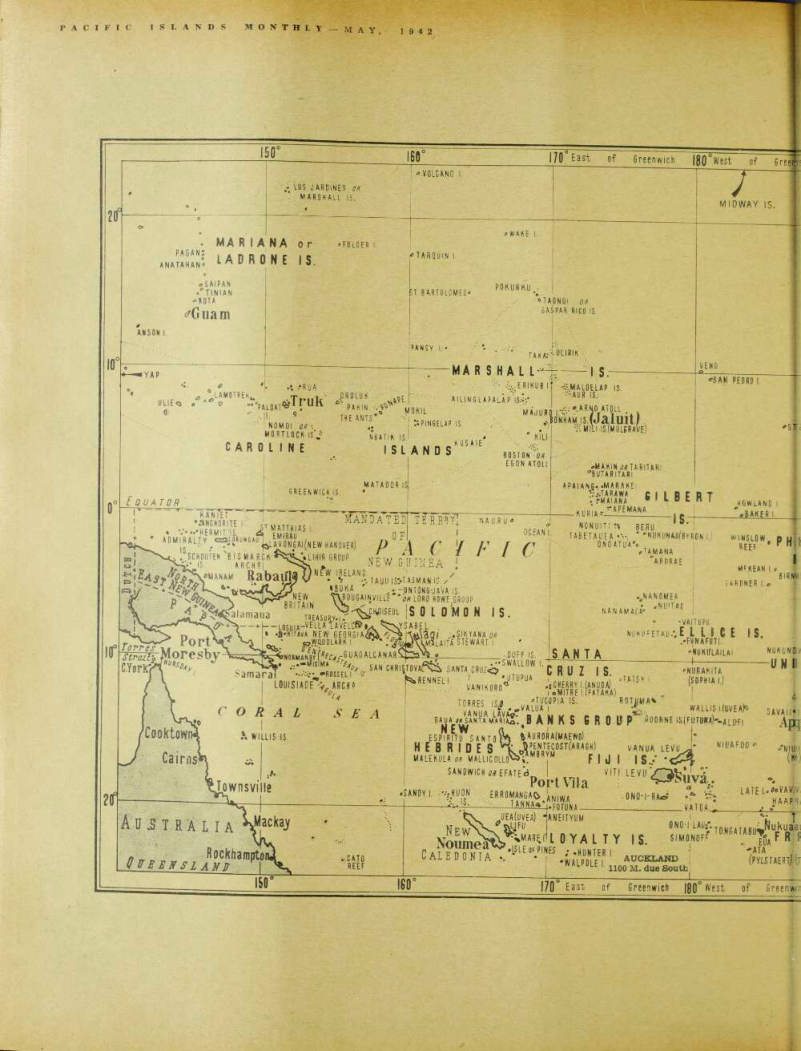
T'HE Battle of the Coral Sea was fought, between May 6 and May 10, “*■ in that wide area of sea southwards of the Louisiades, and between the coast of Australia, on the west, and the chain of islands represented by the Solomons, the New Hebrides and New Caledonia, on the east.
There are no details of the battle. But the brief official com muniques issued make it clear that the Japanese forces were badly mauled by a combined force of American and British ships and planes, and returned to their bases in the New Guinea area.
ON what may be called the North-east ern Australian front, the Japanese now hold (naming the places from west to east) Lae and Salamaua, on the mainland of New Guinea; Gasmata. on the south coast of New Britain; Rabaul town and harbour, at the eastern end of New Britain; Kavieng and other points in New Ireland; Kessa, a good sheltered anchorage on the western side of the island of Buka: Kieta, a harbour on the south-east of the large island of Bou gainville; Faisi and some other ports (we do not know how many) in the British Solomons; and Graciosa Bay, on the main island of Santa Ci'uz, Southern Solomons, between the Solomons and the New Hebrides.
This Santa Cruz position is the most southerly at which the Japanese have been officially reported in these islands.
They have not been officially reported in the New Hebrides, from which it may be assumed that the Allies have some strength thereabouts. It is well-known that the only harbours worthy of the name, between Rabaul and New Cale donia, are those in the New Hebrides.
The Japs would have entered the New Hebrides, if they could.
How The Battle Started
IT had been reported, during late April and early May, that the Japs were assembling forces, presumably naval, in the New Guinea area, and some sort of thrust southwards was anticipated.
We now know, from official communi ques, that the enemy had distributed naval vessels and transports at Rabaul, Kessa, Kieta, and in the British Solo mons, and he also placed a seaplane force at the Deboyne Islands, in the Louisiade Archipelago (eastwards of Samarai), pre sumably to assist his ships when they made their southwards drive.
The Japs seem to have made their move south on May 5 or 6, and they came through into the Coral Sea from the general direction of the Northern Solo mon Islands. We have no details —only that there were heavy cruisers, at least two aircraft-carriers, and a large num ber of lighter warships. The transports seem to have hung back, waiting.
Air Forces Employed
rE Allies were waiting for them —but how, and with what, there has not been the slightest indication. They must have had strong forces. An hys terical communique from Japan, about May 8, claimed that the Japs had sunk two American aircraft-carriers, two American battleships and the British battleship “Warspite”. Washington later described these claims as “fantastic”. It is clear, at any rate, that if they were not battleships, the Japanese did run into something pretty solid.
Were The Japs Trapped?
IT has been officially announced that the Japanese lost one or two air craft-carriers, and one or two heavy
cruisers, in addition to seven or eight smaller vessels; and from this, plus the fact that the battle was broken off about May 9, owing to the Japs retiring to the north, it is possible to guess what hap pened. American commentators insist that the Japs fell into a trap.
So far as naval and ship-based air craft were concerned, the Japs evidently were prepared to join issue completely with the Allied forces; but when thev met the full weight of the Allied naval force, plus the great air power disclosed by the Allies, the Japanese found that they were getting the worst of it.
When they lost their aircraft-carriers they could not cope with the Allies’ air power. The Allies could call up reserves of land-based planes, if needed. The nearest land-bases for Jap planes were at Rabaul, Gasmata, and Lae, far away in the north.
There was nothing else for it—the Japs, headed for their New Guinea bases, skedaddled back behind the shelter of the Louisiades, which lie like a screen between the Coral Sea and New Guinea.
The battle was broken off —and Allied bombers proceeded to search out those seaplanes in the Louisiades and give them “curry”.
The Known Facts
MUCH of the foregoing is guess-work, of course, but these are facts:— The battle commenced about May 6 in the north-eastern corner of the Coral Sea —that is, over towards the Solomons.
The battle continued for at least three days, and the area affected extended rapidly towards the south westward.
The Japanese lost 11 ships, altogether.
The Allies losses, though not pub lished, were much smaller.
The Japanese withdrew to the north ward of the Louisiades.
And What Now?
AND now, what? Where were the Japanese going, and will they resume the attack?
The Japanese have withdrawn, but they are by no means defeated. They will come back. This commentator, dis cussing the New Guinea position, has said again and again that the Japan ese cannot stand still in New Guinea — they must either advance, thrusting south-eastward towards New Caledonia, and the Coral Sea, and attacking Port Moresby—or they must retire from New Guinea towards the much more easily defended line of Marshalls, Carolines and East Indies.
The Japanese, now, are cock-a-hoop and arrogant. So far, they nowhere have retreated. They believe they are invin cible. The mauling they received in the
Coral Sea represents their first serious set-back. They cannot bear such a loss of face. It seems certain that they will call up new forces from the Philippines and East Indies, and attack again.
But there ir o_.e difficulty. This Paci fic war is primarily a job for naval and air forces and the Japs are beginning to feel the need for economy in those forces. They can produce very large armies, but the Allies, week by week, are increasingly outbuilding them in planes and ships, and the time must come—if Japan cannot get a decision first—when the Allies will have such superiority in the air and on the sea that the Japs must fall back to a defensive war, and defeat.
Before that time comes, however, the Japs are likely to make a great effort to smash in on Eastern Australia, now the Allies’ most important base for the pro secution of the Pacific war.
From this viewpoint, the Battle of the Coral Sea was but an incident with sig nificance, but of no great value.
Supply
Copra
Demand Far Exceeds Supply
THERE has been little change in the copra situation, as it was reported in this journal last month.
Although coconut planters throughout the South Seas are doing their utmost to produce every possible bag of copra, to take advantage of the exceptional price, the increase in output is very far behind the demands of the United Nations. That position is likely to remain, so long as the great copra-producing territories of Philippines and East Indies are in enemy hands.
The official prices are £lB (Fijian) per ton in Fiji, and up to £24 (Australian) in the Western Pacific. But, so keen is the demand, it is likely that sales at higher prices are taking place.
The planters of New Guinea, Papua and Solomons may get back in time to gain some benefit from these prices.
There is ground for hoping that the Japs will be thrown out of New Guinea some time before the Philippines and East Indies are freed from their grip.
Wives And Land
New Guinea's Basic Records Reported Lost
rERE was consternation among New Guinea people—especially women— when it became known that all records of births, marriages and deaths which have occurred in New Guinea in recent years, disappeared into enemy hands when the Japanese occupied Rabaul.
It is feared that valuable records relating to land ownership also have been lost.
The absence of such records may lead to embarrassing and difficult situations.
It is understood that the Australian Gov ernment proposes to introduce some law or regulation to cover the position— something that will allow a man to prove title to his land, and a lady to prove title to her husband, even although the basic documents cannot be produced.
How Japs Came To
Tarawa
Early Call in December
AUCKLAND, April 6. rE following was published this morning in the “New Zealand Herald”:— Uninjured when the Japanese mach ine-gunned his vessel, the auxiliary ketch “Helena A”, in the lagoon at Tarawa, Northern Gilbert Islands, on December 10, Captain T. C. Doughty is at present a patient in the Auckland Hospital, suffering from blood-poisoning in the left leg. He arrived in Auckland recently with other Europeans from the Gilbert Islands, and hopes to go to sea again when he is well enough, his em ployers. Bums. Philp and Co. Ltd., hav ing offered him a ship.
When the Japanese landed on Tarawa at 3.30 a.m. from two destroyers, Captain- Doughty was on board the ketch and all but two of his native crew were ashore.
Two and a-half hours later a machine gun was turned on the small Govern ment vessel, “Nimanoa”, and then on the “Helena A”. The two natives promptly dived overboard and swam to the reef.
Captain Doughty lay flat on the deck until the firing ceased.
Two Natives Bayoneted
rLLING his experiences, the captain said that about 10 a.m. he went ashore and was taken in charge by two Japanese sailors. After officers had questioned him as well as their small stock of English permitted, he was ordered to take his vessel out through the reef channel and return. He did so, and one of the destroyers followed him into the lagoon.
He learned later that on landing the Japanese tied up all the Europeans on the island, but released them after ques tioning. When a party of sailors went to the medical officer’s house their way was barred by two mentally-deficient natives who were under care there and who did not understand the situation.
The Japanese ruthlessly bayoneted them, one dying almost immediately and the other the next day. Otherwise no one was maltreated.
Looting Of Stores
A FEW days before the destroyers’ arrival, the two masts of Burns.
Philp and Co.’s wireless station had been taken down when it was known that the Japanese had been at Ocean Island. One of the invaders’ first acts was to wreck the plant, together with the electric lighting installation. They also destroyed all the seagoing boats they could find.
After one destroyer had been brought into the lagoon, said Captain Doughty, the Japanese looted the trading stores and Government station of quantities of goods, particularly textiles, and loaded them into the destroyer and the “Hel ena A”. They would have taken more but for the impossibility of working except at high tide. The two warships then left, one towing the ketch.
Left The Island
STOCKS of foodstuffs had been run ning low when Japan entered the war, and for nearly three months, until early in March, the Europeans lived largely on coconuts and fish. They received two visits from the Japanese in a light cruiser and a flying-boat, and aeroplanes flew low over the island from time to time.
Eventually a motor-launch and a life boat in which survivors from the tor pedoed steamer “Donerail” had arrived, were put into order, and in these he and 24 other European men left the island.
Three British residents elected to remain behind, as did the priests, brothers, and sisters of the Sacred Heart Mission, who decided to carry on their work among the 3,000 native inhabitants. The Roman Catholic Vicar Apostolic of the Gilbert Islands, Bishop Terrienne, who was there on a visitation, also remained.
Captain Doughty is a veteran ship master, who has been trading in all parts of the Central and Western Pacific for about 27 years.
Australian Rice
Kept at Home While Urgently Needed in the Territories
CONSIDERABLE irritation was ex pressed in Pacific Islands trading circles when it was officially announced on May 6 that the Australian Government proposes to urge the Aus tralian people to eat more rice in place of potatoes, so as to take care of the “considerable surplus” of Australian grown rice.
This shows an appalling ignorance of the labour conditions created by the war in the adjoining Pacific Territories.
Since the Japs invaded Indo-China, Malay, Siam and Burma, the large sup plies of rice which usually came from
those countries to provide the staple food for native and Asiatic labourers in most of the South Pacific Territories have been cut off; the employers have been hard put to it to find substitutes.
Rice is urgently needed in all the Territories still in British occupation— probably the whole of Australia’s surplus could be taken by the Free French Territories of New Caledonia and New Heb rides. Large number of time - expired Javanese and Tonkinese labourers have been retained in New Caledonia because they cannot be returned to their own countries, and no one knows exactly how they are now being fed.
One would have sun posed that Australia would have been glad of an opportunity of making overseas sales and estab lishing overseas credits.
Mr. and Mrs. Standen, who conducted the Bamu River Mission, in the western section of the Gulf region of Papua, were evacuated from the Territory several weeks ago—Mrs. Standen, first, and her husband was sent out later. He had to undergo medical treat ment in Brisbane, for a variety of tropical sick nesses contracted in the unhealthy Bamu country.
They both now are seek ing wartime jobs.
Should be Covered by
Lost Goods
Should be Covered by War Insurance
THE following motion will be submit ted at an early meeting of the executive of the Pacific Territories Association. Its significance will be appreciated by those merchants who have lost large and valuable stocks in Papua and New Guinea;— “That this organisation make repre sentation, to the appropriate quarter, that all stocks of merchandise and plant left in Papua, subsequent to February 12, 1942, when the firms and civilian popu lation were compulsorily evacuated from the Territory, be included for protection under the War Damage Insurance Scheme, on the grounds that such mer chandise and plant were left under the care and jurisdiction of the Army.”
The irregular appearance of news bulletins from various Territories of the Pacific, usually published regularly in this journal, is due, of course, to the irregularity of shipping and mail services under wartime conditions. In the old days, we knew, within an hour, when Pacific mails would arrive and depart.
To-day, although mails come in with surprising frequency, we cannot even guess when they are coming. More often than not, interesting news budgets arrive in the “PIM” office a few hours after the journal has gone to press.
Advertisements & other items, p. 10 (1 item)
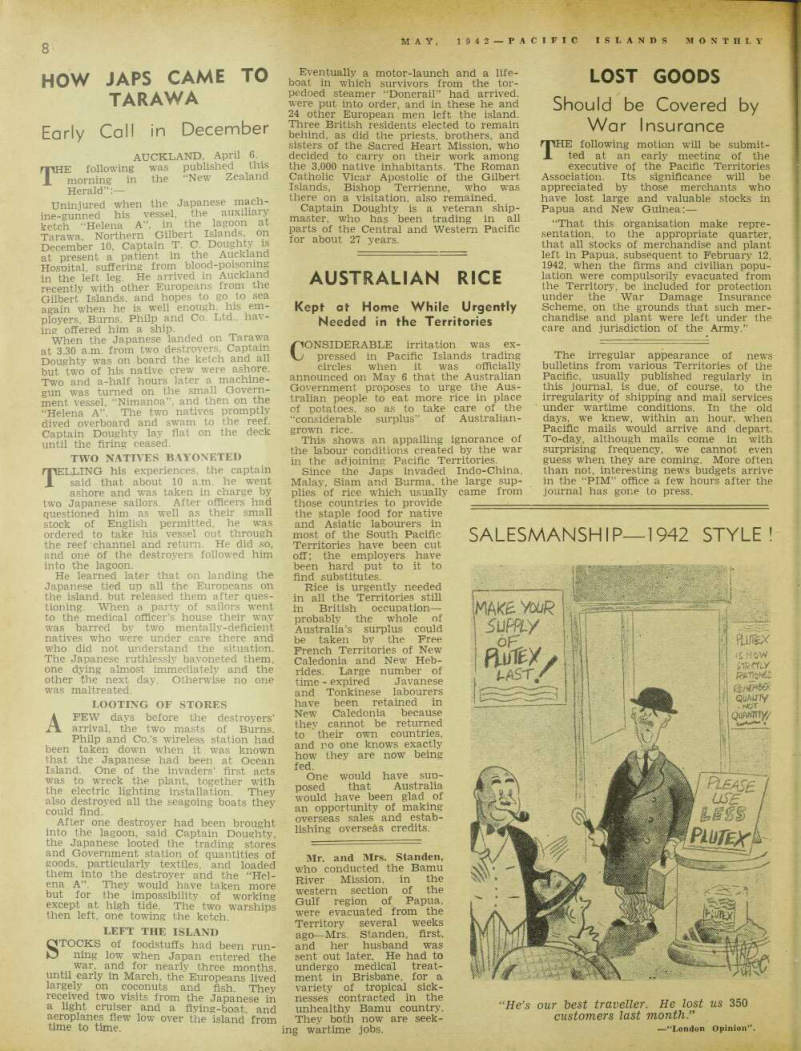
Salesmanship—1942 Style!
“He's our best traveller. He lost us 350 customers last month”
“London Opinion”.
Old German Flag
A small photographic reproduction of the flag of the old German trading company, which used to operate in New Guinea, prior to 1914. The original flag (a gift from Mrs. Helen Nurton, of Melbourne), is now in a glass frame, hanging in the office of the “Pacific Islands Monthly”.
Temporary Jobs
Papuan Public Servants in Temporary Jobs
A NUMBER of members of the Papuan Public Service are now engaged in urgent war work in Sydney. Among them are Mr. Tom Lowney, late private secretary in the Papuan Administration, who is now employed on the Munitions Board, and Mr. H. W. Hardy, late Regis trar of Titles, who is on the staff of the Shipping Board. Mr. W. R. Humphries, late Magistrate at Port Moresby, is now filling an important Federal job con nected with the legal side.
A “tiger for work” —a reputation he earned when he controlled the Papuan Treasury—Mr. S. Smith, a veteran with 26 years’ service, is now busy in Sydney with a host of matters connected with the Administration affairs of Papua. His office is on the Bth floor of Grace Build ing, in York Street, and associated with him in this task is Mr. E. H. Dettman, late Collector of Customs at Port Moresby, and Mr. A. N. Minogue, late Clerk of the Treasury. The latter officers have a service record of 20 and 18 years respectively—a great team.
On the sth floor of Grace Building, in York Street, are the offices of the NG Trade Agency, and they are the ren dezvous of all Islands people in search of information or assistance of various kinds. Those officers of the late Papuan Administration engaged in this busy bureau are Mr. T. Byrne (late Registrar of Titles in Papua) and Mr. E. E. Wash ington. The former is a veteran of the PS, with 26 years to his credit, and the latter with 18 years’ service, most of which time he was engaged in the Lands Department. Both of these highly-quali fied officials, working under the direction of Mr. S. Smith, are engaged in work connected with war damage, and the clearing up of accounts. As Secretary of the Papuan Superannuation Fund, Mr.
Washington is also attending to all mat ters connected with that important department.
Mr. Oscar Corbett, foreman in the Fiji Public Works Department, is at pre sent on two months’ leave in New Zea land. He is a well known engineer of the Works section of the Civil Service, having been employed in that branch for 30 years—at different periods he has been assistant engineer on the “Ran adi”, first engineering officer on HMCS “Pioneer”, and Public Works Inspector.
War And The
Big Firms
Establishments Ruined and Trade Dislocated
TO obtain an adequate idea of how trade and commerce in the South Pacific have been disorganised by the Pacific war, one need only turn to the organisations of the big trading firms.
Prior to December last, Burns, Philp and Co. Ltd. (as distinct from Burns Philp (South Sea) Co. Ltd., which oper ates mostly in Polynesia) had busy and profitable branches in the East Indies and Malaya, in every one of the West ern Pacific territories and in New Heb rides. To-day, the only branches run ning normally are those in Australia and New Hebrides.
The position in the Western Pacific territories is as follows:
New Guinea
The branches at Rabaul, Salamaua, Lae, Wau, Madang, Lorengau, Kavieng and Kieta, and some smaller places, have been closed and, where not taken prisoner or “gone bush”, the staffs have been withdrawn.
The Rabaul, Kavieng, Lorengau and Kieta staffs mostly were overwhelmed in the Japanese invasion, and records were lost. Some of these men are believed to be still in the jungle, but others appar ently are prisoners. It is believed that Mr. Philip Coote, general manager at Rabaul, is a prisoner.
Stores, stocks, workshops and shipping in all these places represented invest ments running into many hundreds of thousands of pounds. In some places— Rabaul and Lae, for instance—the estab lishments were destroyed by fire and bombs; in others they were destroyed as part of the “scorched earth” policy. The Rabaul building was new and handsome —it replaced one destroyed by fire only four or five years ago.
Ninety per cent, of all this property will have to be regarded as a “write-off”.
Papua
The main BP stores in Papua were at Port Moresby and Samarai. So far as is known, the Samarai establishment is burned out, and the various subsidiaries are in somewhat similar condition. This looks like an 80 to 90 per cent, “write off”. Papuan records were saved.
Mr. G. Moore, manager at Port Moresby and Mr. George Aumuller, manager at Samarai, have retired from the BP service.
Solomon Islands
The establishments at Tulagi (Mak ambo), Faisi and Gizo have been closed and the staffs withdrawn. The indica tions are that the destruction in the Solomons centres has not been as bad as that elsewhere. Tulagi has been bombed on a number of occasions, but there is no available report of damage done.
Other Territories
Burns, Philp and Co. Ltd. also had trading establishments at Nauru, and at Tarawa, in the Gilbert Islands.
The staff has been withdrawn from Nauru.
When the Japanese war came, the firm had only one store still operating in the Gilberts—that at Tarawa. The Japan ese looted the store when they landed there on December 10, and filled the BP schooner “Helena” with BP mer chandise and towed her north. They
made prisoners of the BP staff; but three members of the latter (Messrs.
George Jenner, manager, Clark, account ant, and Captain Doughty, of the “Hel ena”) eventually got away south. So far as is now known, the BP buildings on Tarawa are intact, but the merchandise and shipping are gone. Mr. Jehner, despite hazardous adventures, escaped with some of the records, and all the firm’s cash.
It will be seen from the foregoing that BP operations generally have been greatly dislocated. Not only has there been widespread destruction of stores, merchandise, workshops, shipping, plan tations, and buildings, but there is also the loss caused by complete paralysis of trading, shipping and planting activities.
The firm will receive something from war damage compensation funds, but this is not expected to cover the losses indicated above.
Other Big Firms
Almost the same remarks may be applied to W. R. Carpenter and Co. Ltd., merchants, planters and shipowners, in relation to New Guinea, the Solomons and the Gilberts (through On Chong and Co., a Carpenter subsidiary); and to Steamships Trading Co. Ltd., a com pany with stores, trading stations, work shops and shipping, in Papua, and especially in Port Moresby and Samarai.
Some of the Carpenter staff were caught in Rabaul, but the principal executives got away in time. The Car penter staffs were trapped at Kavieng and at Pondo —Carpenters operated a large desiccated coconut factory at Pondo —and most of them appear to be still in enemy-occupied territory.
If the three companies named are not to suffer very heavy losses, war damage compensation will have to be on an exceedingly generous scale.
The lucky one of the Pacific trading companies, of course, is Morris, Hed strom Ltd., whose headquarters are in Suva, and whose trading area is confined to the Central Pacific.
Pilot Gurney
Killed on Active Service
AN aeroplane pilot well-known and highly-esteemed in New Guinea, Squadron-Leader Charles Raymond Gurney, was killed on active service on the Northern Australian front early in May. He was formerly chief pilot in New Guinea for Guinea Airways Ltd.
Later, he joined Qantas; and, when the war came, he transferred to the RAAF.
Captain Lester Brain, operations man ager for Qantas, who frequently flew with Squadron-Leader Gurney, described him as one of the best natural pilots fie had ever been in contact with, and a big loss to Australian aviation.
Captain Brain added that Squadron- Leader Gurney, who had flown more than a million miles, originally trained with the RAAF at Point Cook, and after became chief pilot for Guinea Airways.
In 1936, he joined Qantas Airways, and a year later was sent to England for a special flying-boat course. He then had a regular command on the Sydney-Sin gapore run until the outbreak of war, when he transferred to the RAAF.
Squadron-Leader Gurney, who was 35, is survived by his wife and a daughter, aged 12 months.
Dr. Pottier, formerly of New Caledonia, has been appointed to a Government post in the Marquesas Group, French Oceania.
Pacific Colonies
American Troops In French
Another Sequel to the Treachery of Vichy
FROM the point of view of the South Pacific Islands, troop movements of far-reaching political importance have taken place during the past four months. .
According to various official announce ments, there now are United States forces in the following South Pacific territories (counting from west to east): — In AUSTRALIA, where the Supreme Commander of the South-west Pacific war area, General MacArthur (American) has his headquarters.
In the Australian Pacific territory of PAPUA, American airmen are co operating actively w y ith the Australians.
In NEW CALEDONIA, French colony, where an American expeditionary force landed some time ago. No details.
In NEW ZEALAND. No details.
In FIJI. No details.
In EASTERN SAMOA (Pago Pago) which, of course, is American territory, and where there is a strong American naval and air base.
In FRENCH OCEANIA It was an nounced on April 30 that American forces had “occupied” Tahiti, and the groups known respectively as Marquesas, Tua motu, Leeward, Gambier, Austral and Rapa. There are no details.
Although the word “occupation” has been freely used in connection with these operations, it is explained that the American forces in the various islands, and especially the French colonies, are there entirely for defence purposes, and are taking no part in the general adminis tration.
New Caledonia and French Oceania, for instance, still are being administered by the Free French governments set up there in 1940. The Americans every where, in both British and French terri tories, have been most scrupulous in avoiding any interference with the civil administration.
The announcement of the occupation of New Caledonia by the Americans was made on April 26.
Line To Protect Communications
rE effect of the disposition of American forces, in the manner shown above, is that there is now a line of American defence extending from Australia and Papua eastward to French Oceania, and thence northwards to Hawaii, and the North American con tinent.
That defence line protects vital com munications between Australia and North America, and it will be surprising if Japan does not attempt to break it.
If the attempt is made it would represent a hazardous lengthening of Japanese communications, and a danger ous enterprise; but Japan may attempt it, rather than allow America to build up a powerful striking force in Australia with out interference.
But it is the political, rather than the military significance of these events that is interesting to us.
Vichy’S Disgraceful History
THE appearance of American troops in the South Pacific colonies of France serves only to emphasise the descreditable character of the story of Vichy France, as seen in the Pacific since June, 1940.
When France surrendered, the French colonies of Indo-China, New Caledonia, French Oceania and New Hebrides (if we include the Condominium) lay help
less —officials and colonists alike stunned by the catastrophe. That was bad enough; but the quick reaction of greedy Japan was worse. Japan, like Italy, was out to grab every possible acre of territory from a France and Holland now prostrate under the heel of the Hun.
Most of the French people in France’s Pacific colonies did not think that Britain long would survive; some officials, bitter Anglophobes, hoped to see proud Albion down in the dust with proud France.
Mean and poor of spirit, they were ready to go with Vichy and make obeisance to maniacal Schnickelgruber (which is the real name of Adolf Hitler), and submit to occupation by Japanese, rather than fight on for freedom and honour.
Three months (July, August and Sep tember of 1940) passed before the French men of the Pacific colonies would believe that Britain was capable of defying Schnickelgruber and fighting on, alone.
Meanwhile, the little men of Vichy in New Caledonia and Tahiti took adminis trative charge of those colonies on behalf of Vichy (and Schnickelgruber).
Henri Sautot
BUT not all. In mid-July, long before Britain had demonstrated her ability of resist invasion, one strong, clear, French voice arose, defying the Huns and the Huns’ Japanese friends, and calling upon all Free Frenchmen to stand beside their British Allies in this, their darkest hour.
That was the voice of Henri Sautot, French Resident Commissioner in the New Hebrides, to whom history will render homage.
Henri Sautot became the rallying point for Free France in the South Pacific. Vichy officials attacked him savagely, like angry rats caught in a trap; but practically all the French colonists, and many officials, supported him —so much so that, within a few weeks, Sautot was at Noumea as Free French Governor of the South Pacific Colonies of Free France, and a shipload of deposed Vichy officials were en route to Indo-China.
By this time Indo-China had been grabbed by 'Japan, with Vichy conni vance; and the Vichy gentlemen from New Caledonia, New Hebrides and Tahiti were able to make proper obeisance to the Son of Heaven.
To-day, what a contrast! Those men of Vichy now are the servants of con temptuous Japanese in Indo-China; but the Free French of the South Pacific colonies are fighting beside the Ameri cans and the British, with continuing and increasing pride in their flag and their destiny.
France Will Be Re Born
THERE are those who despair of the re-birth of France —who fear that the nation will be led to destruction by the Vichy traitors, and utterly dis membered in the ruin in which Europe will be involved by the degenerate Schnickelgruber.
But France cannot be destroyed. She now is controlled by cowards and pol troons, for whom there is set a bloody day of reckoning; and her politics have been the plaything of gangs and gang sters. But the soul of France is not found in the politicians, nor among the screeching mobs of the cities. France will be built again upon the love and
patriotism of thirty million country dwellers; and Britain and America will see to it that the still free colonies of France will go back into the hands of the patriots.
But, much may happen before then.
God help poor France when the Schnickel grubers are finished with it! There may come a long and terrible period of in ternal unrest and strife. During that period the colonies of Free France may elect to remain, as at present, under the protection of the Anglo-American Powers.
That is why the occupation of these South Pacific colonies by Americans is so significant. It is not likely that those French colonies will be removed from American protection until they can be restored to the protection of their mother-land.
And no one will quarrel with that arrangement. If British troops were in possession, sneering voices would arise in different countries to declare “This is the first step towards annexation by Britain” —although Britain, for half a century, has refused to annex any more territory, unless literally forced into it.
But there cannot be, and never has been, any suggestion of imperialistic am bitions on the part of United States. For one reason and another, Americans have been forced to take possession of other countries; but every one, except Philip pines, has been given protection and complete freedom —and Philippines was booked for complete freedom in 1946.
New Caledonia and Tahiti (with de pendencies) probably will remain under the protection of the Stars and Stripes for a long time —it depends upon the shape taken by the war, in its later stages. But no one is going to worry about it, except a few discredited Vichy officials. New Caledonia and Tahiti, in the interim, will be completely free — and, probably, quite happy.
Statement
USA Makes Clear Statement Recognition of Free French Authority
From Our Own Correspondent NOUMEA, March 9. mHE Free French High Commissioner in X the Pacific, Admiral Thierry d’Ar genlieu, on February 28, announced in Noumea that he had received the following communication from the State Department of the United States Gov ernment: — “The policy of the Government of the United States, as regards the French people and French territory, has been based upon the maintenance of the in tegrity of France and of the French Empire, and of the eventual restoration and the complete reconstitution of all French territories.
“Mindful of its traditional friendship for France, the United States Govern ment deeply sympathizes, not only with the desire of the French people to main tain their territories intact, but with the efforts of the French people to con tinue to resist the forces of aggression.
“In its relations with the local French authorities, in French territories, the United States has been, and will con tinue to be, governed by the manifest effort with which those authorities en deavour to protect their territories from domination and control by the common enemy.
“With the French authorities in con trol of French territories in the Pacific, the United States Government has treated, and will continue to treat, on the basis of their actual administration
of the Islands territories involved.
"The United States recognizes, in par ticular, that French Islands possessions in the Pacific area are under the control of the French National Committee estab lished in London, and the United States authorities are co-operating for the de fence of these Islands with the authorities established by the French National Com mittee, and with no other French authority.
“The United States appreciates the importance of New Caledonia in the defence of the Pacific area.”
Curiosity About State of
Wallis And
Futuna
Curiosity About State of French Islands
THERE is much curiosity in Australia and the South Seas concerning the French South Pacific Colony of Wallis and Futuna.
New Caledonia (with the Loyalty Group), New Hebrides and French Oceania declared definitely for General de Gaulle and Free France in 1940; but the position of Wallis and Futuna never has been made clear.
For convenience, the Wallis and Futuna administration seldom is referred to .separately—it usually is included, along with the Loyalty Islands under the general heading of New Caledonia.
But these small islands are a long way from Noumea. Wallis a little group of nine islands, with a total area of 40 square miles and about 4,200 people; and Futuna (or Horne) comprises two small islands, total area 34 square miles, with a population of 1,200. The two groups lie fairly close together, north-east of Fiji, and due west of Samoa. (See map on inside cover of this issue.) There were rumours, last year, that Vichy influence continued among the few Europeans in the administration; but little notice was taken —the groups were too small to worry about.
Communication is cut off. There has been -no word, for months, from the Burns, Philp representative there.
But now, with Japanese hovering somewhere along the equator, and Wallis and Futuna lying within 300 miles of Fiji and Samoa, the condition of affairs in the two little groups becomes a matter of some interest.
The nine islets of Wallis (enclosed within the one reef) are not likely to be of value as an airfield; but both Futuna and Alofi (Horne Islands) are large (each about 15 square miles), although each has a mount running up over 2,000 feet.
There are no ports in the group, but each island has a fairly good anchorage, sheltered from the prevailing wind.
New Guinea Public
Servants
MEMBERS of the New Guinea public service who at present are resident in Sydney have held meetings to discuss matters of mutual concern, especially in relation to the future of the Territory. They had planned to form some sort of temporary association; but it is probable that they now will find their interests taken care of by the large organisation of evacuees formed at the general meeting on May 14 (see page 5).
Looking Into The Future
Some Occasions When the "PIM"
Was Right
A Review by R. W. Robson
THIS journalist would not be human if he did not occasionally want to say “I told you so!” As this war has developed, the temptation to quote from old commentaries in the “PIM” has been strong—now it is irresistible. Let us look back over comment and prognostication.
In September, 1940, writing on “One Year of War—and What Now?” I re ferred to the rescue of the British armies from France, the defeat of the German attempt to invade England, the Anglo- American agreement to protect the status quo in the Pacific, especially in relation to the East Indies, and we said: — “These events may prove to be the most important development in modern history. . . . It is now possible that Anglo-Saxondom (the British Empire and the United States ) will save, for the human race, the human decencies evolved in two thousand years of Christian civilisation. . . .
“But it was a near thing. We still can almost smell the stink of the Nazi con centration camps, and hear the maniacal screeches of the egocentric Hitler. Some day, perhaps, we shall know why this ‘natural military genius’ did not leap at England in June, while her coasts were unguarded, and there were confusion and chaos within.”
That was written while Goering’s bom bers still were pounding the heart of London, while Russia’s involvement in the war still was nearly a year away, and fateful Pearl Harbour was 15 months away. And we know now why Hitler failed to invade England—read the article on page 19 of this issue.
IN October, 1940, after describing the Pact that had just been entered into between Germany, Italy and Japan, we said:— “So far from scaring America, the Pact has done more than any other single thing to unite Americans in a deter mination to assist Britain to rid the world of Nazi-dom.”
Then we added the following comments, which we submit as having been a pretty good forecast: — “The waiting may be long, and the years hard and harsh; but . . . we can depend upon forces which have nothing to do with fighters and fighting machines. . . . It is inevitable that Germany and Russia will clash, sooner or later. If soon, it may shorten and end the war.
Watch Balkans developments and Russia’s reaction. And there is the possibility— fantastic, yet definitely there—that the new Pact is aimed, not at the United States, but at Russia.”
Although we offer that as an example of sound reasoning, we confess that, when the Nazis suddenly hurled them selves upon the more-than-ready Russians, we were as helpless as the next com mentator in trying to explain why it had happened like that.
All we knew then was that Russo- German hatred is fundamental —it goes deep down into racial antagonism, and far back into history. These two nations must fight.
The present indications are that they will exhaust each other. The German has the greater skill, but the Russian has the better staying-power. If, as now seems possible, Germany crumples under the combined weight of Russian military blows, British air attacks, and American industrial and economic strength, the German people will be faced with such a catastrophe as can scarcely be envisaged
now. Can anything save them from the masses of Russians and Frenchmen, Poles and Czechs, Dutch and Norwegians, who, maddened by misery and torture and clamorous for revenge, will fall upon them from every side, like tigers un leased? It is a picture fearful to con template; but it most definitely is within the realm of possibilities.
IN April, 1941, in an article entitled “We Now Are Under United States Pro tection”, we outlined the de facto situation in the Pacific—although it did not become the de jure situation until eight months later, when Japan attacked the United States in Hawaii. Here is an extract: — “Two years ago, we in the Pacific lived in complacent security under the White Ensign and the Anglo-French Alliance.
A few voices warned that a combination of the three predatory nations ( Germany, Italy and Japan ) might mean a return to jungle law and the destruction of our Pacific world; but most people dismissed the idea as fantastic.” (Again and again, in the years between 1932 and 1939, the “PIM” warned its readers of the danger of an alliance be tween the three great landless and pre datory Powers—Germany, Japan and Italy. This was said in the “PIM” in September, 1937, when we commented upon Japan’s attack upon China: “On the one side, we have Britain, France and USA, richly endowed with territory, democratic in government, and naturally eager to preserve the status quo. On the other side, Germany, Italy and Japan, all desperately overcrowded, all demanding new territories for colonisation, all im bued with the spirit of war, and all dominated by the idea of the totalitarian state. . . . The foregoing outlines as pretty an international problem as the Pacific has ever seen. No one can see the end of it. But this is certain: If Japan is allowed to ‘get away with it’, there will be very little safety for Europeans in future in the Pacific territories”. That danger was so very plain; but Britain’s only answer was a folded umbrella in the hand of septuagenarian.) The April, 1941, article proceeded:— “Six months ago, Japan became the official ally of Germany and Italy. The three 'predatory nations now were to gether, shieking for the kill. We in the Pacific face stark reality at last. . . .
“To-day we feel secure again; but all our complacency is gone. We know now that had it not been for the clear vision, unswerving courage and inspired leader ship of one of history’s greatest men (a reference to the munitions help given to Britain by President Roosevelt, and his guarantees in relation to the status quo in the Pacific) Britain to-day might have been fighting her last grim battle, and we here in the Pacific almost certainly would have been facing something worse than death. Within a few months, Franklin Delano Roosevelt changed the face of the world and the course of history.”
We said that eight months before war broke out between the United States and Japan, and a year before the armed forces of America came quietly to the occupation and protection of the South Pacific terri tories.
Mr. J. Hartley, formerly of the Papuan Customs, now is a member of the Com monwealth Customs Department, Sydney.
The Battle Of
Rabaul
Demand for an Inquiry Into Grave Charges of Muddling
AUSTRALIAN newspapers, accepting as complete and well-informed reports the “stories” supplied by “our special war correspondents on the North Australian front” (actually, a handful of cow-reporters isolated in Port Moresby) have been shouting about the achievements of the Australian troops in the “Battle of Rabaul”.
One daily news-sheet, famous for the blurb and twaddle it employs whenever it discusses Australia’s war effort, was almost lyrical when it referred to “Anzac and Pozieres, Tobruk and Rabaul”.
Actually, the less said about Rabaul the better. The Australian anny has plenty of fine deeds to its credit, with out having to call for glory upon Rabaul, which was by no means a well-managed show.
Two months ago, the “PIM” compiled the story of Rabaul, from first-hand accounts by people who were there when the Japs came, and sent all the details, in a special private report, to the Minis ter for the Army.
“Smith’s Weekly", of Sydney, in its issue of May 9, prominently publishes an article entitled “Investigation of New Guinea Affair Demanded”. Much of the information given in the “SW” article is similar to that which was presented in the “PIM” report.
Presumably, there is no official objec tion to the publication of the “SW” article, so we take the liberty of printing most of it, below, with our own com ments added in Italic type.
SMITH’S” demands that the Federal Government make a full investi gation into the whole circum stances of the capitulation. It is a sorry story, ard there are many people now in Australia from whom evidence may be taken. It is in this nation’s interest that such an inquiry be held.
Rabaul was raided from the air on Tuesday, January 20, 1942. There were about 90 Jap planes in the raid. They blasted the garrison fort to pieces.
Civilian population began to evacuate the town the following day—Wednesday.
Troops left the town which, by its position on a narrow neck of land, was difficult to defend, and took up defensive positions behind the town, covering beaches and approaches.
On the same day there was a small Burns, Philp steamer in Rabaul. The few civilians left in the town could all have been taken off on it. There was room for 250 at a pinch. But apparently nobody was told about it—and those who knew and went off to pack a few things found, when they returned, that the ship had sailed an hour earlier than they were told she would sail. Instead of taking off all those civilians who were in the town, she took off only five. Many icked l6ft Again some body had pan- The position was worse than that. A large, modern, motor-ship, which had been sewf into Rabaul with supplies, just before the Jap blitzes started, was ordered to remain there and load copra.
When the blitzes began, about January 19, and it was clear that an invasion was threatened; and later, when the Jap
invasion fleet was reported approaching, certain people begged permission to get that big motor-ship away south, with as many Rabaul civilians as she could carry.
Permission was refused. That ship was bombed, set afire and sunk, alongside the wharf, and copra-sheds, which were destroyed in the same fire. The people whom she could have brought away are now in the jungle, or in prison camps— no one knows.
JAPS did not arrive in Rabaul Harbour until the morning of Friday, Jan uary 23.
Meantime those who had been left began to evacuate themselves on foot— to the hills or along the coast. Many are still there. Some have been taken out.
In Tuesday’s air-raid Rabaifi’s fortress and its defenders, along with its guns, had been blown to bits. Left in the town were AIF and some militia. Their heaviest armament now consisted of some mortars and machine guns.
Five Wirraway planes of the RAAF had gone up to meet the horde of Jap planes and were blown out of the sky by Zero fighters.
The few anti-aircraft guns soon ex pended their ammunition, iney got one Jap plane. It crashed in the hills behind the town. A civilian went out to it—but no Army or Air Force men had visited it. Tne civilian “souvenired ’ a paracnute and some of the piane s instruments. It was a bomber-fighter type—single engined, mere were three dead Japs in it —stocky little fellows aged 24 or 25.
Bombs were lying some little distance from the crasnea plane. The civilian did not “souvenir” these!
Has the Federal Government taken any steps to ascertain from that civilian, now in Australia, what he discovered on his visit to the piane? Has it made any attempt to get evidence of the type of plane, nature of its construction and other important information about what happened in Rabaul from this civilian, or from anyone else?
According to our information, the fore going, if anything, understates the posi tion. Our information is that neither on that occasion, nor subsequently, did officialdom display any interest in the secrets of the crashed plane—and it had secrets.
WHEN the Japs came into Rabaul Harbour on Friday, January 23, the troops opened fire on them, but their ammunition soon ran out and they took to the bush. They carried out cer tain demolitions before they went. Their stores were blown up and some petrol installations were demolished.
But this job was not thoroughly done.
Unexploded bombs —ours —were lying all over the place and at least one petrol tank was untouched because the man who was supposed to touch it off was away serving in the volunteers.
Five hundred tons of rice and three hundred tons of sugar were left in the Government stores. A thousand dozen bottles of beer were also left. At the hotel the beds were all made—sheets turned down, ready for occupation. Japs must have thought it the height of hos pitality !
We are informed that there was a worse “oversight” than that. There were a number of engineering workshops, with modern machinery, in Rabaul — in valuable to an invader requiring urgent repairs while far from home. Those workshops were not so completely demolished that they could not be used by the enemy. Some were not smashed at all.
YES, somebody blundered at Rabaul —blundered badly. They had three weeks’ notice from the Japs that they were coming. Yet no demolitions were made. Wharves were left intact.
They could have been blown up. Now the Air Force has to go over and try to demolish them from the air.
Tokio has advised that the troops have come in from the hills and surrendered —l7OO of them.
Apparently we had no air force (except the Wirraways), totally inadequate equipment, poor leadership, no cohesion between military and administration. It would be interesting to know how many officers got away from Rabaul, too.
The military forces appear to have formed some sort of defence line west ward of the town, and extending far southwards along the western side of the harbour. When the Japanese came into the harbour, on January 23, the lads along the western shores opened up against them vigorously, but with wholly inadequate equipment. At one or two points, where the Japs tried to land, our men put up a stout resistance, and in flicted heavy casualties on the enemy. In this action, the New Guinea Volunteer Rifles, recruited from in and around Rabaul, appear to have particularly distinguished themselves.
But the bravery of our men accom plished little. They soon were driven back into the jungle by superior forces and equipment. Their heroism is the only binght spot in this dismal story of Rabaul, of lack of planning, and of incompetent leadership of both military and civilians.
Preferred Death To Life
As A Leper
A MINOR tragedy, which gives some indication of the horror with which leprosy is regarded in the Pacific Islands, is reported from Suva.
A Fijian man, Josese Daveta, employed in Suva, became ill; and finally, after medical examination, he was certified to be a leper, and his removal to the leper settlement at Makogai, in the Fiji Group, was ordered. Daveta, greatly distressed, returned to his place ,of employment, and shortly afterwards disappeared.
Alarm was felt when it was noted that he had taken a loaded revolver with him.
It was later reported that he had tried to shoot himself, and so police were sent out to take charge of him. They searched all that night and far into the follow ing day, and then they located him, hiding in the scrub, in a valley, at the back of the emergency hospital.
The police exercised care because of the revolver and the man’s desperate condition. But as they closed in on him a shot was heard, and they found him with a bullet wound in his head. He died in the hospital some hours later.
Miss Ngaire Gilmour, sister at the Colonial War Memorial Hospital, Suva, Fiji, is at present absent from the Col ony on three months’ leave.
Monsieur Albert Bonneaud, a former director-general of Etablissements Bal lande (one of the largest commercial firms in New Caledonia) and formerly vice-president of the Societe des Comp toirs Francais des Nouvelles Hebrides (of Vila, New Hebrides), died in France on April 10, at the age of 68.
Mr. K. Griffiths, of the South Seas Evangelical Mission’s vessel “Evangel”, which operates in the Solomon Islands, is at present on furlough in Australia.
Advertisements & other items, p. 14 (1 item)
12
MAY, 1942 HCIHC ISLANDS MONTHLY
Mr. H. A. Markham
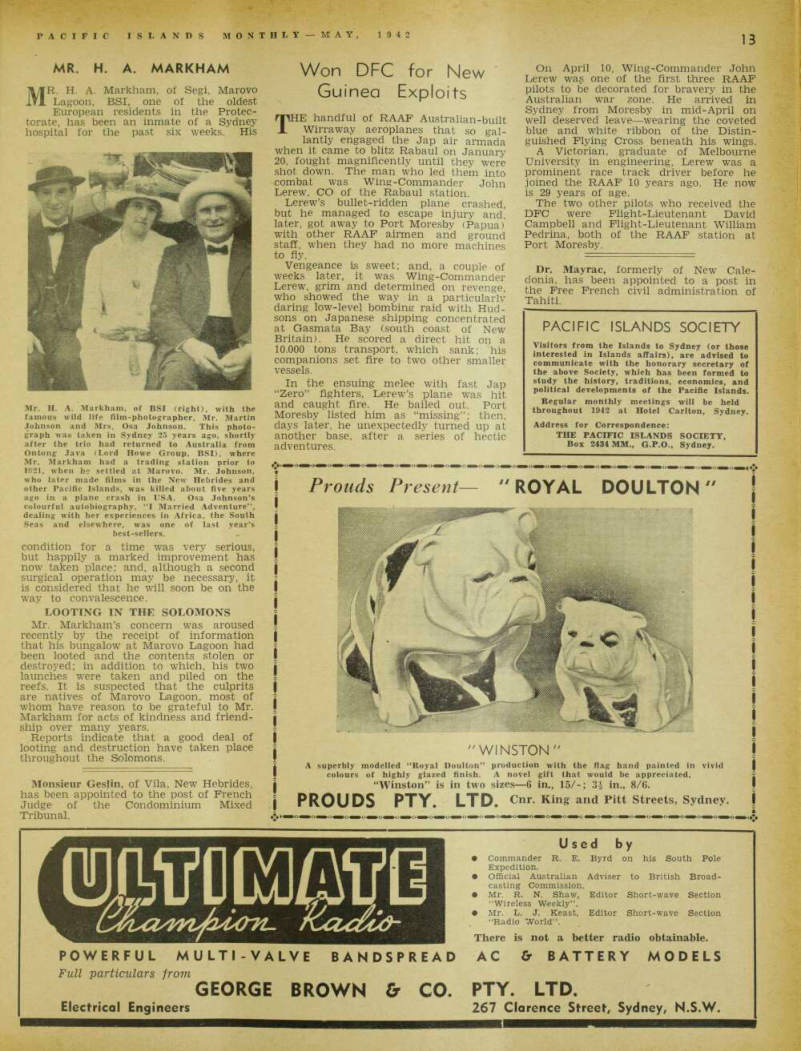
, of Segi, Marovo Lagoon, BSI, one of the oldest European residents in the Protec torate, has been an inmate of a Sydney hospital for the past six weeks. His
condition for a time was very serious, but happily a marked improvement has now taken place; and, although a second surgical operation may be necessary, it is considered that he will soon be on the way to convalescence.
Looting In The Solomons
Mr. Markham’s concern was aroused recently by the receipt of information that his bungalow at Marovo Lagoon had been looted and the contents stolen or destroyed; in addition to which, his two launches were taken and piled on the reefs. It is suspected that the culprits are natives of Marovo Lagoon, most of whom have reason to be grateful to Mr.
Markham for acts of kindness and friend ship over many years.
Reports indicate that a good deal of looting and destruction have taken place throughout the Solomons.
Monsieur Geslin, of Vila, New Hebrides, has been appointed to the post of French Judge of the Condominium Mixed Tribunal.
Mr. H. A. Markham, of BSI (right), with the famous wild life film-photographer, Mr. Martin Johnson and Mrs. Osa Johnson. This photo graph was taken in Sydney 25 years ago, shortly after the trio had returned to Australia from Ontong Java (Lord Howe Group, BSI), where Mr. Markham had a trading station prior to 1921, when he settled at Marovo. Mr. Johnson, who later made films in the New Hebrides and other Pacific Islands, was killed about five years ago in a plane crash in USA. Osa Johnson’s colourful autobiography, “I Married Adventure”, dealing with her experiences in Africa, the South Seas and elsewhere, was one of last year’s best-sellers.
Guinea Exploits
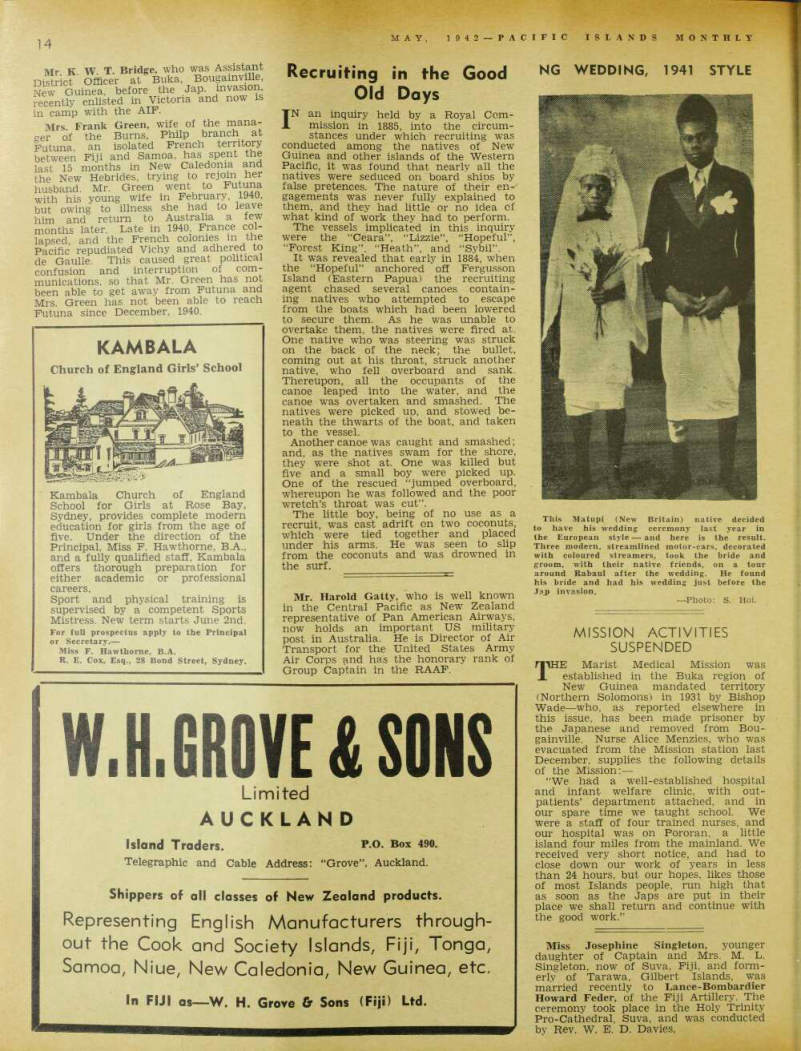
Won DFC for New Guinea Exploits
THE handful of RAAF Australian-built Wirraway aeroplanes that so gal lantly engaged the Jap air armada when it came to blitz Rabaul on January 20, fought magnificently until they were shot down. The man who led them into combat was Wing-Commander John Lerew, CO of the Rabaul station.
Lerew’s bullet-ridden plane crashed, but he managed to escape injury and! later, got away to Port Moresby (Papua)’ with other RAAF airmen and ground staff, when they had no more machines to fly.
Vengeance is sweet; and, a couple of weeks later, it was Wing-Commander Lerew, grim and determined on revenge, who showed the way in a particularly daring low-level bombing raid with Hud sons on Japanese shipping concentrated at Gasmata Bay (south coast of New Britain). He scored a direct hit on a 10.000 tons transport, which sank; his companions set fire to two other smaller vessels.
In the ensuing melee with fast Jap “Zero” fighters, Lerew’s plane was hit and caught fire. He bailed out. Port Moresby listed him as “missing”: then, days later, he unexpectedly turned up at another base, after a series of hectic adventures.
On April 10, Wing-Commander John Lerew was one of the first three RAAF pilots to be decorated for bravery in the Australian war zone. He arrived in Sydney from Moresby in mid-April on well deserved leave—wearing the coveted blue and white ribbon of the Distin guished Flying Cross beneath his wings.
A Victorian, graduate of Melbourne University in engineering, Lerew was a prominent race track driver before he joined the RAAF 10 years ago. He now is 29 years of age.
The two other pilots who received the DFC were Flight-Lieutenant David Campbell and Flight-Lieutenant William Pedrina, both of the RAAF station at Port Moresby.
Dr. Mayrac, formerly of New Cale donia, has been appointed to a post in the Free French civil administration of Tahiti.
Mr K W T. Bridge, who was Assistant District Officer at Buka, Bougainville, New Guinea, before the Jap. invasion recently enlisted in Victoria and now is in camp with the AIF.
Mrs. Frank Green, wife of the mana ger of the Bums, Philp branch at Futuna, an isolated French territory between Fiji and Samoa, has spent the last 15 months in New Caledonia and the New Hebrides, trying to rejoin her husband. Mr. Green went to Futuna with his young wife in February, 1940, but owing to illness she had to leave him and return to Australia a few months later. Late in 1940. France col lapsed, and the French colonies m the Pacific repudiated Vichy and adhered to de Gaulle. This caused great political confusion and interruption of com munications. so that Mr. Green has not been able to get away from Futuna and Mrs. Green has not been able to reach Futuna since December, 1940.
Advertisements & other items, pp. 15-16 (1 item)
ffl HAVE
PACIFIC ISLANDS SOCIETY
Visitors from the Islands to Sydney (or those interested in Islands affairs), are advised to communicate with the honorary secretary of the above Society, which has been formed to study the history, traditions, economics, and political developments of the Pacific Islands.
Regular monthly meetings will be held throughout 1942 at Hotel Carlton, Sydney.
Address for Correspondence:
THE PACIFIC ISLANDS SOCIETY,
Box 2434 MM., G.P.0., Sydney.
Prouds Present — "ROYAL DOULTON"
r C v a
" WINSTON "
A superbly modelled “Royal Doulton” production with the flag: hand painted in vivid colours of highly glazed finish. A novel gift that would be appreciated, “Winston” is in two sizes—6 in., 15/-; 3£ in., 8/6.
PROUDS PTY. LTD. Cnr. King and Pitt Streets, Sydney.
ffl HAVE
U Va /
POWERFUL MULTI-VALVE BANDSPREAD
Full particulars from
GEORGE BROWN & CO.
Electrical Engineers Used by There is not a better radio obtainable.
AC & BATTERY MODELS
PTY. LTD.
267 Clarence Street, Sydney, N.S.W.
KAMBALA
Church of England Girls’ School ft
lawu
Kambala Church of England School for Girls at Rose Bay, Sydney, provides complete modem education for girls from the age of five. Under the direction of the Principal, Miss F. Hawthorne, 8.A., and a fully qualified staff, Kambala offers thorough preparation for either academic or professional careers.
Sport and physical training is supervised by a competent Sports Mistress. New term starts June 2nd.
For full prospectus apply to the Principal or Secretary.— Miss F. Hawthorne, B.A.
R. E. Cox, Esq., 28 Bond Street, Sydney.
Old Days
Recruiting in the Good Old Days
IN an inquiry held by a Royal Com mission in 1885, into the circum stances under which recruiting was conducted among the natives of New Guinea and other islands of the Western Pacific, it was found that nearly all the natives were seduced on board ships by false pretences. The nature of their en gagements was never fully explained to them, and they had little or no idea of what kind of work they had to perform.
The vessels implicated in this inquiry were the “Ceara”, “Lizzie”, “Hopeful”, “Forest King”. "Heath”, and “Sybil”.
It was revealed that early in 1884, when the “Hopeful” anchored off Fergusson Island (Eastern Papua) the recruiting agent chased several canoes contain ing natives who attempted to escape from the boats which had been lowered to secure them. As he was unable to overtake them, the natives were fired at.
One native who was steering was struck on the back of the neck; the bullet, coming out at his throat, struck another native, who fell overboard and sank.
Thereupon, all the occupants of the canoe leaped into the water, and the canoe was overtaken and smashed. The natives were picked up, and stowed be neath the thwarts of the boat, and taken to the vessel.
Another canoe was caught and smashed; and, as the natives swam for the shore, they were shot at. One was killed but five and a small boy were picked up.
One of the rescued “jumped overboard, whereupon he was followed and the poor wretch’s throat was cut”.
The little boy, being of no use as a recruit, was cast adrift on two coconuts, which were tied together and placed under his arms. He was seen to slip from the coconuts and was drowned in the surf.
Mr. Harold Gatty, who is well known in the Central Pacific as New Zealand representative of Pan American Airways, now holds an important US military post in Australia. He is Director of Air Transport for the United States Army Air Corps and has the honorary rank of Group Captain in the RAAF.
Ng Wedding, 1941 Style
This Matupi (New Britain) native decided to have his wedding ceremony last year in the European style and here is the result.
Three modern, streamlined motor-cars, decorated with coloured streamers, took the bride and groom, with their native friends, on a tour around abaul after the wedding. He found his bride and had his wedding just before the Jap invasion, -Photo: S. Hoi.
Mission Activities
Suspended
rE Marist Medical Mission was established in the Buka region of New Guinea mandated territory (Northern Solomons) in 1931 by Bishop Wade —who, as reported elsewhere in this issue, has been made prisoner by the Japanese and removed from Bou gainville. Nurse Alice Menzies, who was evacuated from the Mission station last December, supplies the following details of the Mission: — “We had a well-established hospital and infant welfare clinic, with out patients’ department attached, and in our spare time we taught school. We were a staff of four trained nurses, and our hospital was on Pororan, a little island four miles from the mainland. We received very short notice, and had to close down our work of years in less than 24 hours, but our hopes, likes those of most Islands people, run high that as soon as the Japs are put in their place we shall return and continue with the good work.”
Miss Josephine Singleton, younger daughter of Captain and Mrs. M. L.
Singleton, now of Suva, Fiji, and form erly of Tarawa, Gilbert Islands, was married recently to Lance-Bombardier Howard Feder, of the Fiji Artillery. The ceremony took place in the Holy Trinity Pro-Cathedral, Suva, and was conducted by Rev. W, E. D. Davies,
Advertisements & other items, p. 16 (1 item)
W.H.Grove & Sons
Limited
AUCKLAND
Island Traders. p -°- Box 49 °- Telegraphic and Cable Address; “Grove”, Auckland.
Shippers of all classes of New Zealand products.
Representing English Manufacturers throughout the Cook and Society Islands, Fiji, Tonga, Samoa, Niue, New Caledonia, New Guinea, etc.
In FIJI as— W. H. Grove & Sons (Fiji) Ltd.
Substitute For
Tung Oil
THE following interesting material, about Oiticica (an oil-producing tree of Brazil that is regarded as supply ing an excellent substitute for Tung Oil, now in great demand), is taken from the “Brazil Trade Journal”.
The history of oiticica dates further back than the days of the discovery of Brazil; and despite the recognition of its drying qualities more than a centurv ago, its industrial and commercial history starts in 1927.
It is true that the Baron of Ibiapaba mounted two hydraulic presses and other machinery imported from France in the Capital of the State of Ceara, Fortaleza, in 1876 and thus may be said to have brought the history of this oil back to the days of Imperial Brazil. But this enter prise was abandoned, due to the dis agreeable and strong odour of the product, and resulted in a loss of 100 contos to its proprietor.
The second phase of oiticica history, opens 50 years later, when another plant was opened in the State of Rio Grande do Norte for the utilization of the oil in the manufacture of soap. This was a theoretically ingenious idea, because of the lack of cattle (and hence, tallow) due to the devastating droughts that strike the arid region. However, among many reasons, the undesirable qualities of the product precluded its further use and thus resulted in the second failure in this oil.
The successful phase of this industry coincides with the utilization of this oil in another industry, that of paints, which was initiated in 1927 by the Sardinha Company of Rio de Janeiro. Following this new start was the impelling force given the oil by the small but active
Miriam Plant, in Fortaleza, which de voted all its energies and capital to proving the drying qualities of the oil in the principal industrial countries of the world.
Later, there was installed the first modernized factory for exploiting this oilseed, which in turn led to the estab lishment of over 22 factories in the north-east, the sole source of this oil seed in the world.
Indigenous, and known for centuries in the north-east, this tree, with a beautiful spread of thin leaves, presents a bushy appearance and prefers the banks of rivers and brooks, the surrounding al luvial plains and the margins of lakes and ponds. The trunk, short and stout, is about a metre in diameter and is sup ported by a strong network of roots which withstand the corrosive action of the occasional floods which strike the region. The tree also endures the effects of droughts which repeatedly strike the region. The life of the tree is estimated to be about a century, the production of seeds beginning in the fourth year, the maximum being attained during the tenth year. One tree is estimated to produce an average of about 150 kilo grams of seed.
Harvesting consists merely of the col lection of the seeds which fall on the ground. In 1937, the recorded Brazilian output of these seeds was estimated at 14,800 tons. Production in 1938 rose to 20,300 tons and the output of 1939 totalled about 36,000 tons.
Rev. E. A. Wale, a well-known mission ary of Aulua, Malekula, New Hebrides, who has been in Australia on short fur lough, has been ordered to take at least another six months’ furlough, on the grounds of ill health, and accordingly he does not expect to return to Malekula much before the end of this year.
"Pacific Islands Monthly"
Will Carry On
THE ‘PIM’ is eagerly looked forward to each month by this exile. It is the principal remaining link with the life I loved, and which now seems ‘so fur and far away’. I hope you will be able to keep going, despite the hard knocks the war must have given you.”
That is an extract from a letter that is typical of many received lately by the editor of the “PIM”. It is characteristic of Islands folk that, in spite of the dis asters that have befallen them, they think of others’ troubles.
The “PIM” is taking knocks. Although its circulation in Polynesia is undis turbed, all its readers from New Guinea, Papua and Solomons are scattered far and wide, and we have had great diffi culty in regaining contact with our sub scribers. Many are in the New Guinea jungles, and others, we fear, are prison ers in the hands of the Japanese.
Our important advertising service has been dislocated, of course. But many advertisers, while recognising that the Australian territories’ buying power is temporarily crippled, prefer to retain their advertisements and their old good will connection with the thousands of people who, although now marking time in Australia, presently will return to the Islands, to rebuild their homes and their fortunes.
So long as we are permitted to func tion, as an independent publishing enter prise, the “Pacific Islands Monthly” will be published, despite thin revenues.
Mr. William Spiers, who spent 17 years in Fiji—l 4 in the service of BP (SS) Co. —died recently in NZ, aged 63.
Advertisements & other items, p. 17 (1 item)
St. Ignatius’ College
Riverview Sydney
Boys are prepared for Intermediate and Leaving Certificate Examinations and for Exhibitions, Scholarships and Bursaries at the University.
Boys are arranged in three Divisions according to age. Each Division has its own Library, Debating Society, Cricket and Football Fields, and Tennis Courts.
Senior and Junior Rowing Sheds, with a large fleet of pleasure and racing boats.
Private Swimming Baths, Prospectus and further particulars on application to the— Rector: St. Ignatius’ College, Riverview, Sydney, Australia.
Tel.: JB 1106.
BOARDING AND DAY SCHOOL
Conducted by the Jesuit Fathers SI
ONE OF SYDNEY'S GREAT PUBLIC SCHOOLS
The Visit of an Author
By “Tukapa Koko”
, YEARS ago, we on isolated, map-specK Mangaia were favoured by a visit from a real, live book-writer, who had fathered a goodly tome—yes, and had it printed, even. .
That was in the days of the consulship of—not Plancus, for he was said of know ledgable Romans to be a just ruler; our reigning pro-consul was then a man of irascible temper and some self-conceit, and when he was around I, and others, found it a good idea to imitate Biblical Agag and be as infrequent as possible.
Bibson, the literaire, was on a material-gathering trip, and had stopped off at Mangaia to see if there really was such a place. Like a donkey’s corpse, many refused to accept the possi bility of the little-known island as a visible reality. Bibson, an American, though not the Man From Missouri, was in our midst to see—perchance even to conquer, for he was a very devil with the ladies.
I, small trader and general dealer, found Bibson a customer for a line that I had deemed a dead loss.
Some years before, the native school teachers had asked me to order for them various “penny-horribles”, priced at four pence per volume, and detailing the pis tolic adventures of Buffalo Bill: which I did. The thrillers, about four dozen of them, arriving, there was nothing doing.
The market collapsed, for they were written in English. . . The Mangaians had not realised the ignorance of the civilised world, that has not yet had the sense to adopt the Maori tongue as a medium of conversation and romance.
Till Bibson came, the despised volumes languished on a shelf. But he. coming
? ne ; d / y ’ of idle curiosity, to see what I had for sale, happened on the pile of trash, and was delighted.
I acquired four dozen fourpences, and Bibson the market-drug that, despised by other men, began his fashion in Man gaia. We became friends.
There were dances. Bibson was there; and, with him, I. There were feasts where the guests numbered dozens; and, of them, I. Bibson, eloquent of past adventure in the States, was entertain ing when he had well drunk.
He had one friend who stuck closer than a brother, and with whom he lived.
Theirs was a tolerant household, a menage-a-deux—the gentlemen, and their respective ladies to wait on them. The pair, Bibson and his trader pal, had so much in common that they got on right well together.
The trader was the stronger person ality. He made the ammunition for Bibson to fire, and found the author a useful man to have around when it was a matter of argument with the Resident Agent over liquor supplies, which a paternal Administration restricts to two bottles of tiger-juice per month—unless the Bacchanalian beneficiary can pro duce doctor’s recommendation for more, by reason of ill-health.
There came a ship; came, also, a doctor.
Bibson, well gone already in liquid cheer, was prevailed on by his trader friend to present what the latter re presented as a medical order for enlarge ment of liquor supply to the Lord of the Manor, in whose hands lay the keys of heaven or hell, according as the petitioner could produce proof of claim for more.
The Resident Agent was not in his office, behind the counter of which lay the “Bonded Store”—a packing-case con taining the liquid joy.
Bibson, not to be deterred, visited the
Residency itself. His cargo, already ample, seemed to have shifted, for he had a marked list to port, and also had a certain difficulty in negotiating the three gates he saw. The middle one proved to be not a mirage; he staggered to the verandah.
The Lord of All was there; but if he was glad to see Bibson, he made no un mannerly demonstration of his joy. kfis “What d’you want?” was curt, and the baronial visage grim.
Bibson, t stuttering slightly, indicated drought; produced the alleged passport to Elysium.
The paper was an obvious fake, an illegible scrawl. The Cat, watching from the Road, saw that the Monkey, though burning his paws, got no chestnuts. The Cat, cunning trader, grinned a Cheshire grin.
The Lord of the Manor indicated to Bibson that there was positively nothing doing, and that he was at liberty to de part in peace.
Bibson, balked, refused to wend his way liquor-less; at last, apostrophising the Overlord as the offspring of a female of canine species, he made, as far as his condition permitted, physical attack on the vice-royal person.
The Overlord, like a lamp-post swung on by a child, let Bibson maul him for about three-fifths of a second, Then, springing into action, he divested himself of the clinging form of Bibson, who was battering him with one hand, while he held on with the other, and grasped the literaire by the scruff of his nether habiliment.
It looked, from the motion that fol .lowed, as if “over the garden wall” was the final destination of Author Bibson.
When the shio departed, the Man From Missouri was a passenger—he had decided that Mangaia did -not agree with him.
Which, I rather fancy, was a fact!
Advertisements & other items, p. 18 (1 item)
W.KOPSEN & Co. Pty.Ltd.
SIMPLEX
MARINE
ENGINES
Simplex engines from 3 h.p. to 12 h.p. for boats from 14 ft. to 26 ft. are Australia’s best. 2 cycle and 4 cycle with or without reverse gear.
Illustrated is the popular little 3 h.p. suitable for 14 ft. or 16 ft. boats.
R^ S f,° r 5 , hours i on 1 gallon petrol and costs only £29/15/-, complete with all equipment. Ready to instal into any boat, nothing else to buy.
Ask for Simplex catalogue of engines and launches.
SKARSTEN SCRAPERS
Remove paint, varnish, glue, oil, grease, roughness, etc., from wood and metal surfaces. Most useful for scraping deck and hull planks. They leave the surface smooth and dressed and ready for painting. Have renewable blades.
Prices; No. 35, 2/3; 62, 2/9; 80, 3/7.
Reversible, 7/9.
Write for leaflet.
TILLEY
Kerosene
LAMPS
British-made Kerosene Lamps providing a steady 300 c.p. light, without flickering, and without smoke or smell.
Model TLIO (illustrated) is a handsome Table Lamp providing exceedingly brilliant illumination and at the same time a fine ornament for any home.
Stands 24 in. high and covers a large area. Attractive parchment shade is finished in autumn tones and matches any furnishings.
Also available is the popular All- Purpose Lamp and Lantern (model EX100) and a variety of Hanging, Table, Wall and Vase Lamps.
Let us send you full details of all Tilley Lamps.
SHIPCHANDLERY
We manufacture and stock the largest range of boatgear in Australia. Everything for boatbuilder and boatowner. Marine paints and varnishes. Rope and Cordage. Rigging. Anchors and Moorings. Copper Nails and Rod . Lighting Plants. Fire Extinguishers. Oars and Sculls, Lamps, Pumps, etc.
GET OUR PRICES FIRST.
W.KOPSEN & Co. Pty.Ltd.
376/380 KENT STREET, SYDNEY
Thone: MA 6336 (4 lines). Est. 1868. Cables: Kopsen . . . Sydney.
Missionaries Are Prisoners
Of The Japs
The following is from the May issue of the journal “Catholic Missionslt will be remembered that, when the evacuation of Europeans from Bougainville was proceeding, Bishop Thomas Wade refused to abandon the care of the native people, to which he had devoted his life.
NEWS has just been received at the National Office that Bishop Wade, together with Fathers J. Hennessy and C. Conley, have been taken to Rabaul (New Britain) as prisoners of war of the Japanese, following on the recent occupation by the Japanese forces of the island of Bougainville.
The two priests, together with the Bishop, are the only three American priests in the Solomon Islands. The news is tempered somewhat by the fact that, as far as is known, all priests interned or taken as prisoners of war in the Territory of New Guinea have been placed at the Sacred Heart Mission of Vunapope. Thus the Bishop and his companions will be free to say Mass and enjoy personal liberty within the con fines of the Mission Compound. Small consolation, however, for the Bishop, who refused to take the opportunity of escaping from the Northern Solomons because he wanted to stay with the people who were his life’s work.
Father Conley is a Marist Father; Dr.
Hennessy is a priest of the Archdiocese of Boston, who volunteered to work for a number of years with the Marist Mis sion in the Northern Solomons—he was due to return to America this year.
Banno Brothers
Depart
Trading Firm is Sold
MANY times, during the past six or seven years, the “PIM” has referred to the appearance, establishment and growth of the Japanese trading firm of Banno Brothers. It appeared in Auckland, it “horned in” on the Tongan trade, and then it spread its operations to Samoa and Fiji.
We did not like it because it was Japanese, and we could see no reason why the distributing trade of the South Pacific should pass out of European hands.
But we disliked it more because all the information available—there was not much, but it was significant—indicated that there was a close tie-up between this firm and official Japan. To put it in blunt words, there was reason to suspect that the activities of Banno Brothers has as much to do with espionage as with commerce.
The business was carried on by Banno and his brother-in-law. They evidently knew what was coming, and got out early. Banno arrived in Sydney about the middle of last year. The editor of the “PIM” learned that he was here, and called upon him, to ask him about Japanese buying of copra. Russia had just entered the war, and the track from Japan to Germany across Siberia was closed.
“Now”, we said to Mr. Banno, “Japan can buy our South Pacific copra, and be under no suspicion that she is sending
it to Germany. This should be a good thing for both the British and the Japanese.”
But Mr. Banno did not want to talk about copra. He was very vague, and he eyed the editor of the “PIM” warily.
In fact, he did not seem to like the editor at all; so the interview ended.
He did not say he was leaving, but his bags must even then have been packed.
Mr. Banno left Sydney a few hours later on a ship bound for Japan.
His brother-in-lay left Auckland for Japan in August.
It was formally announced in New Zealand early this year that all the in terests of Banno Brothers had been bought by a group of New Zealanders, and that the name of the firm has been changed to Wales and Mackinlay, Ltd.
It is emphasised that ‘the business now has no connection whatever with Japan”.
Samoan Newspaper
Suspends
THE “Western Samoa Mail”, a weekly newspaper, established in 1901, has suspended publication, its last issue having been on March 28. The owner editor, Mr. J. W. Liston, announced that suspension was caused by circumstances over which the owner had no control, but it was hoped to resume publication before very long.
These are bad times for publishing concerns. There is a growing shortage of paper, skilled men are being called away to war duties, and the disruption of commercial life cuts away advertise ments, upon which popular newspapers depend for their principal revenues.
Advertisements & other items, pp. 19-20 (1 item)
Equal to the World’s Best
Throughout Australia and Overseas there is an ever-increasing demand for
COLONIAL & BRONTE
HIGH-GRADE CANNED MEATS
There is no better quality—none more wholesome. •
TRADE MEATS FOR THE ISLANDS
order
COLONIAL’ BRAND
Roast, Corned and Boiled Beef Packed in 6,5, 4,3, 2, 1 lb. and 12 oz. tins.
Also Corned Beef in 12 oz. Taper Tins.
Roast, Corned and Boiled Mutton. 1 lb. and 12 oz. tins.
Choice Dripping
36 lb., 2 lb., 1 lb. tins, and 1 lb. packets.
Nm P
WMOUSALi
rrr
M£AT
DELICIOUS
BRONTE" HOT MEALS
Steak and Kidney ( Lamb and Green Peas.
Pudding. Corned Beef and Boston Beef Steak Pudding. Beans with Tomato Sausages and Tomato. i Sauce.
Sausages and Vegetable. Steak and Tomato.
Under present conditions it is wise to ensure that you have ample stocks of all our lines.
The Colonial Wholesale Meat Coy. Pty. Ltd.
30 GROSVENOR STREET, SYDNEY
Modern Refrigeration for the South Sea Islands
The ELECTROLUX KEROSENE OPERATED
REFRIGERATOR
MARVEL
OF
MODERN
SCIENCE
yds
THE
MIRACLE
OF
ICE
FROM
HEAT
ELECTROLUX offers economical, modern and completely efficient
REFRIGERATION FOR ISLANDS' HOMES.
FREEZES CONTINUOUSLY WHILE SMALL LAMP BURNS.
Freezing controlled by simply regulating height of flame. Uses pnly gallon of kerosene per week, MOTORLESS ... NO PARTS TO GET OUT OF ORDER.
MODEL L 22
Capacity 2.2 cubic feet.
MODEL L3BO
(as illustrated) Capacity 4 cubic feet.
GUARANTEED FOR TWO YEARS.
MODEL LKSSO
, Capacity 5.5 cubic feet. • Write to your Local Distributor for prices and full details.
OBTAINABLE FROM ALL W. R. CARPENTER Cr CO. LTD.
BRANCHES THROUGHOUT THE ISLANDS
Representation in Papua and New Hebrides.
Why Hitler Did Not Invade England
Inside Stories of the War
After France Fell
S\NE of the mysteries of the war was the strange behaviour of Hitler in June and July, 1940. France, Belgium and Holland had collapsed; western Europe was completely under the domin ation of the Hun; only the British remained unconquered, but the army which they had saved from Dunkirk was without equipment or organisation, the Home Guard was unequipped and almost unarmed, and the total of planes, in operation and in reserve, was pitifully small.
If Hitler had attacked Britain swiftly, after the fall of France in June, 1940, he almost certainly would have succeeded.
But he stayed too long to gloat over his prostrate enemy, and to lead goose stepping celebrations of victory, and the British used the unexpected respite to get ready for the Huns; and when the belated attempt at invasion did come, they smashed it.
The following is condensed from “Berlin Diary”, a book by a famous American correspondent, William L.
Shirer. Written originally behind the scenes in Germany, it explains much that hitherto puzzled us.
IN summer, 1940, when the demoralised French asked for an armistice on June 18, many of us who followed the German army into France expected Hitler to turn and strike at Britain immediately. The British, now alone, were reeling from titanic blows.
They had abandoned irreplaceable arms and equipment on the beach of Dunkirk, and no longer had an organised army. Their shore defences were pitiful.
Their navy could not fight in great force in the narrow waters of the Eng lish Channel, over which Goering’s planes now had control.
But Hitler hesitated and his hesitation may well prove to have been a blunder as colossal as the indecision of the Ger man High Command before Paris in 1914.
Why was the invasion of England not attempted immediately? What went wrong?
The answer, I think, is that Hitler believed an invasion would never be necessary. He felt so certain of con cluding a final triumphant peace before the summer’s end that he ordered re viewing stands erected in Berlin—they were completed early in August—for the great Victory Parade through the Bran denburger Tor.
I recall now—though the fact made no impression on me at the time—that at Compiegne, where Hitler dictated a harsh armistice to France, the Germans seemed to be in no hurry to finish with Britain.
Piecing together stray bits of conversa tion picked up in Compiegne and Paris, I think word had come from Hitler that he believed Churchill would now accept a face-saving negotiated peace. And though he ordered an invasion prepared, his certainty that it would never be necessary delayed and slackened the work of its preparation—the construction and concentration of barges, shipping, and a thousand kinds of equipment.
IT may well be that Hitler expected Churchill to make the first move for peace. He waited a month for the realisation of defeat to sink in. The Luftwaffe had been established on the North Sea and the Channel, but he held it back. Then, on July 19, speaking in the Reichstag, he publicly offered Britain
peace. At the same session he made his leading generals field marshals, as though the victorious war were in truth over England’s prompt and unequivocal rejection of his “offer of peace’’ came as a shock to him. He hesitated until the end of July—l 2 days—before accepting it as final. By then a month and a half of precious time had been largely lost.
Britain had meanwhile, to some recovered from the earlier blows, and there is reason to believe that most of the German High Command now had grave doubts as to the success of an invasion. The naval problem involved baffled them. And though Goering assured them he could knock out the RAF in a fortnight, as he had destroyed the Polish air force in three days, they seem to have had some doubts—later fully justified—on this score, too.
THROUGHOUT July the Germans had been gathering barges and pontoons along the French, Belgian and Dutch coasts and assembling shipping at Bremen, Hamburg, Kiel, and various ports in Denmark and Norway. A com mon sight in western Germany was that of diesel-motored barges from as far away as the Danube being hauled on rollers toward the coast. Workshops and garages all over the Reich were put to work on armored, self-propelling pon toons which, in a calm sea, could carry a tank or a heavy gun or a company of troops over the Channel.
On the night of August 5, Hitler had a long conference in the Chancellery with his chief military advisers; Goering, Admiral Raeder, Generals von Brau chitsch and Keitel, and the extremely influential General Jodi from Hitler’s own military staff. It is likely that Hit ler at this meeting made his decision to attempt the invasion as soon as possible, and went over the final plans.
From what has leaked out we can deduce the strategy decided upon. A great air offensive against the British air force would be launched about Aug ust 13. The RAF would be wiped out by September 1. And then, with complete mastery of the air over the Channel so as to prevent the British navy from con centrating, and over England to smash the defending British artillery, the inva sion would be launched.
The main force would cross the Chan nel in barges, pontoons and small boats.
Other ships, protected by planes, would set out from Bremen, Hamburg and the Norwegian ports for Scotland. A small expedition from Brest would take Ire land. And, of course, there would be large-scale parachute action to demora lise the British and Irish in the rear.
EVERYTHING depended upon annihi lating the Royal Air Force. Goer ing promised swift success. But like many a German before him, he gravely miscalculated British character and therefore British strategy.
Goering based his confidence on very simple mathematics. He had four times as many planes as the British. No mat ter how good English planes and pilots were—and he had a healthy respect for both—he had only to attack in superior numbers, and even if he lost as many planes as the enemy, in the end he would still have a substantial air fleet and the British would have none.
What Goering was incapable of grasp ing was that the British were prepared
to see their cities bombed and destroyed before they would risk all their planes to defend them. To the British this was mere common sense and the only tactic that could save them.
To destroy the British air force Goer ing had to get it off the ground. But try as he did—and when I was on the Channel in mid-August he was sending over as many as 1,000 planes a day to lure the British into the air—he never succeeded. The British kept most of their planes in reserve. Their cities, for a while, suffered as a result. But the RAF remained intact.
WHY could not the Luftwaffe destroy the RAF on the ground as it had largely destroyed the air forces of other nations? The Luftwaffe’s own answer is undoubtedly true. German air men tell me that the British simply scattered their planes on a thousand far-flung fields. No air force in the world, with any opposition at all, could hunt them out in sufficient numbers to destroy any sizable portion of them.
Goering tried for a month to destroy Britain’s air arm, using great daylight attacks, for you cannot destroy a nation’s air force at night.
But by the third week of September the grandiose daylight raids had ceased.
The RAF had taken such a toll of Ger man planes that Goering had to aban don them. For while the British never risked more than a small portion of their available fighters on any one day, they did send up enough to destroy more German bombers per day than Goering could afford to lose. For he was using them in mass formations, more as a snare to get the British fighters off the ground so that his Messerschmitts could get at them than for mere bombing.
And here British air tactics played an important role. The Germans tell me that the British fighter squadrons had strict orders to avoid combat with Ger man fighters whenever possible. Instead they were instructed to dart in on the bombers, knock off as many as they could, and then steal away before the German fighters could engage them.
These tactics led many a Messer schmitt pilot to complain that the Brit ish Spitfire and Hurricane pilots were cowards, that they fled whenever they saw a German fighter. But knowing that Britain was lost if her outnumbered fighters were destroyed, the British adopted the only strategy which would save them.
The result was that on at least three separate days British fighters shot down some 175 to 200 German planes, mostly bombers, and crippled probably half as many more.
Moreover, as most of the air battles took place over England, the British were saving at least half of their pilots whose machines were shot down. But the crews of every German plane shot down were lost to the Luftwaffe for the duration of the war—a loss of four highly trained men per plane in the case of bombers. The Luftwaffe could not indefinitely sustain such losses of planes and crews, despite its numerical super iority.
AND so the first fortnight in Septem ber came and went, and still the Germans could not destroy the British air force. And the great Nazi army waited, cooling its heels behind the cliffs at Boulogne and Calais and along the canals behind the sea.
It was not left entirely unmolested.
At night British bombers blasted away at the ports and canals and beaches where the barges were being assembled.
The German High Command has main
tained absolute silence about the losses in men and materials sustained by these insistent British air attacks. But from what I saw of these bombings and from what I’ve been told by German airmen, I think it is highly improbable that the German army was ever able to assemble enoueh barges or ships to launch an invasion in adequate force.
The stories emanating from France that an actual full-fledged invasion was attempted in mid-September seem with out foundation. What probably hap pened is that the Germans attempted a fairly extensive invasion rehearsal. They put barges and ships to sea, the weather turned against them, and naval forces and planes caught them, set a number of barges on fire, and caused heavy casualties.
The unusual number of hospital trains filled with men suffering from burns would bear out this version. I know of four such trains which arrived in Ber lin alone within two days, September 18-19. One of them, stretching out from the Potsdamer Bahnhof for half a mile, was the longest Red Cross train I’ve ever seen.
By October the Germans were in a great state of mind because the British would not admit they were licked. They could not repress their rage against Churchill for still holding out hopes of victory to his people, instead of surren dering as had all of Hitler’s other opponents. The Germans cannot under stand a people with character and guts, and their mis judgment of the British and the consequent failure of their pro ject to invade Britain in the summer of 1940 may have marked the turning point of the war.
Polynesian Migrations
Speculations by "Young Cubs" of Anthropology
WHEN Dr. Peter H. Buck’s book con cerning Polynesian migrations was published at the end of 1938, it was felt by some that the last word had not been said, and his conclusions were challenged, in some directions.
The war, coming in 1939, has inter rupted discussion of this most fascinating subject; but the war presently will be over, and we then must continue with our inquiries.
The following letter, by a well-known authority to the editor of the “FIM”, was not written for publication, but we are publishing some portions of it to help maintain interest in the subject.
“I have read Dr. Buck’s “Vikings of the Sunrise” and I find it disappointing as a work on Polynesian migrations.
“What Dr. Buck writes from his own knowledge and study is authentic. But the greater part of his book is derived from the speculations of a lot of young cubs who have taken a course in anthro pology but know nothing of Polynesian languages and less about native mentality and ancient custom. They ransack a few burial caves, measure a few platforms and marae and then ponderously pro nounce some pontificial theory to justify the time and expense of their expedition.
“As far as I have been able to dis cover, there is not a scrap of evidence or reference in the chants and legends of Central Polynesia, to justify the theory of any migration into this area via Micronesia—in the manner stated in the book.
“Dr. Buck quotes that woolly-brained professor, McMillan-Brown—who was a laughing stock for all serious students when he came this way—and ignores William Churchill, whose work (pub lished by the Carnegie Foundation) is the most able and scholarly study of the Polynesian problem I have ever seen.
“I think there is much to support the theory of a migration via Rotuma, in asmuch as the legends of Ra’i’atea have been the foundation on which that theory has been built.
“It would require a book to record the references, quotations and detailed rea sons for the Rotuma theory.
“My friend, Mr. Charles B. Nordhoff, of Tahiti, who has read Dr. Buck’s book, is of the same opinion as to its value as a document on Polynesian migrations. He tells me that Dr. Buck is the leading authority on certain aspects of old Poly nesian society, but has to take the word of others in many major departments of the study of the ancient people and Islands lore.
“Dr. Buck’s book is, of course, delight ful reading and gives a clear outline of the results of the investigations by scientists of the Bishop Museum.”
Mr. Richard Humble, who served in the Fiji Civil Service from 1918 until November, 1941, died in Suva War Memorial Hospital at the end of March, aged 55. An Englishman, he arrived in Fiji 45 years ago and joined the Penang Sugar Company. His service with the Government, variously as clerk, bond keeper, boarding officer, and, at one per iod, postmaster, was spent mostly in Levuka. His long leave prior to retire ment expired only a few days before he died.
Advertisements & other items, p. 22 (1 item)
Swallowariell L-
BISCUITS Popular Everywhere! "Milk Arrowroot," full of nourishment, ideal for kiddies. "Club Cheese," a savory in itself, and "Shredded Wheatmeal," Swallow's own delicious new health biscuit.
... ONLY IF ITS SWALLOWS
Tasty eating comes only from good cooking and finest ingredients, and Swallow & Ariell's products have both. So always say SWALLOW'S when ordering Biscuits . . . Puddings • . . Cakes . . . Cabin Biscuits . . . Navy and Pilot Bread.
Remember that all Swallow's Products are specially tropic-packed in air-tight tins to retain their freshness.
SWALLOWARIELL L-
PORT MELBOURNE, VICTORIA, AUSTRALIA
CANTERBURY CAKES Chockful of fruity . . and with an inviting "Home Plain . . Fruit . . Seed, etc. There's £ every taste. flavour . . rich.
Made" flavour, variety fo suit PLUM PUDDINGS Expertly prepared by Swallow's master cooks. Everyone loves "Olde Englyshe" style plum pudding and the rich goodness of Swallow's is unique.
I ” ■I I f 11
mmm
A Trader's Tale
By “Tukapa Koko”
IT is one of the by-product? of my business to purchase, buy, >,r acquire by barter, as many eggs as I can honestly obtain, for here in Mangaia (Cook Group) the cackle-fruit are goodly cates, and held in high esteem.
To which honest purpose I am fain to bestow marbles, crayons, or sweets, on those native cherubs who bring me their plunder, ex bush —belike the addled off spring of some dignified but short memoried dowager hen, or the fresh, good offering of sprightly pullets, from nests ravished and reft.
One of my customers was sweet Pe’e, a maiden of bashful 13. Pe’e was a school girl, the daughter of a godlv deacon named Ivaiti, who, along with other of the fold, had the nrivilege of wearing his shirt-tails outside his pants. This, seen on a Mangaian, is the diaconal insignia.
Pe'e was no angel—but her mother, Neke, was still less. Neke was a huge, dusky creature, a six-foot Amazon with the build of a blacksmith. They of Africa are wont to say that every monkey is a gazelle to its mother. Neke was no beauty, but Ivaiti loved her in the same un critical fashion.
Came a day, when Neke, needing cloth, sought my “notion counter”, where were displayed goodly prints. She purchased seven shillings’ worth; the hiatus lav in the fact that she had only three shillings of -immediate wealth to defray said costs.
She deposited the three shillings, pro mising faithfully to bring the other four in the afterno’on, when honest Ivaiti should return from the beach, where orange-money was being naid out to the planters.
I saw no harm; it seemed a reasonable proposition. Neke, with fine raiment in a parcel, went off.
Came noon, came two, came four p.m.; but came not Neke.
At five o’clock I sent along a bill by messenger.
Came diaconal Ivaiti, in godlv wrath.
Neke, on his showing, knew nothing of any credit transaction with me. And I realised that I was ganged up on, put on the snot, and taken, commercially speak ing. for a one-way ride.
There was no redress. One is not sup nosed to allow credit to natives, though it is customary to concede the nrivilege of trust to the godly and their wives.
We “had words”, and parted, while the sun went down on our wrath.
Next day came Ivaiti’s daughter, Pe’e, a casual egg-merchant of old standing, to trade for marbles. These are two per egg: she had not the albuminous ovum of the species Gallus, but threepence of the realm in cash. I passed over six scintillating glass snheres, and Pe’e de narted in glee to play marbles with a fellow-scholar on the road for in Mangaia, the game is not exclusively a male pastime.
I. leaning on the counter, wished that naternal Neke had been equally as prompt in settlement. It was a warm, fine day.
I day-dreamed, lulled by the vociferations of the marble-plavers on the road outside.
The game, noisily disputatious, suddenly ceased; the sound of lamentation was heard in the land.
Came worthy Ivaiti, holding Pe’e by the arm, in policemen-like style.
I saw trouble; assumed my judicial face, grave and stern.
It was a case of grand larceny. The threepence, used by Pe’e to purchase the equipment for the juvenile bowling match, had come illegally out of the hung-up garment of her father.
The vice was versa; Ivaiti’s trouble
belonged not to my care. He, worthy deacon, knew it; and made humble re quest that the marbles be returned, and the threepence handed back to its rightful owner.
This, again, seemed a reasonable prop osition; but I felt it my duty to public morality to deliver a very pointed lecture regarding two cases of dishonesty in the same family—though, after all, not so rare a phenomenon as the same place being twice thunder-smitten.
It is one of the arts in handling semi civilised natives to know when to yield, and when to be adamant, lest precious “face” —as important in Polynesia as in far Nippon or Cathay—be lost.
Here, I might safely permit the return of the threepence, for I had a case— the whip-hand—and worthy Ivaiti knew it.
I handed over the coin; waited for Pe’e to produce the marbles. She, snivel ling, lamented with Rachel-like tears, but made no move to ante-up.
Ivaiti, losing patience, took the law into his own paternal hands. He explored the nether habiliment of his daughter.
In the lower hem, coyly held by elastic pressure, still warm with flesh-contact, were the spheres, hastily concealed by Pe’e when she saw her parent in the offing.
En passant: some time ago, great Mr.
G. Bernard Shaw, pressed to write for an admirer a one-sentence story having sex-interest, religion, and drama all in one, with a setting in high society, pro duced this lovely cameo;— “My God!” laughed the Duchess. “Take your hand off my knee!”
Ivaiti, deacon of Mangaia and eke hus band and father of slippery customers, seeking the hidden marbles, recalled this gem of art to my mind.
£250,000 Gone
The War and Guinea Gold
MAIN asset of Guinea Gold, NL, is its holding of 64,050 shares in Bulolo Gold Dredging, Ltd. Since enemy action caused complete suspension of Bulolo’s operations, its shares have fallen in market-price from £5 to 24/-.
Extent of actual damage to Bulolo’s property is not yet known, but the directors of Guinea Gold, in their annual report, state that whether Bulolo decides to resume operations after the war or not, insurance compensation settlement, when made, should have a substantial influence upon the ultimate asset backing of the shares.
The directors add that they have con sidered whether any positive action could be taken, such as going into voluntary liquidation, but, after taking legal ad vice, they have come to the conclusion that the only policy is to continue as at present at a minimum of expense until the war position clarifies the future of the Bulolo Co.
Net profit of Guinea Gold for the year ended February 28 was £44,248, com pared with £50,754 for the previous year.
A year ago, Guinea Gold’s share hold ing was worth £320,250. It balanced this valuation, in its balance sheet, by showing a general reserve of £263,142 (compared with a paid up capital of £50,000). At the end of February, the shares were worth £76,860—a loss of £250,000 caused by the war—and the general reserve took the strain and was reduced to £17,140.
Mrs Wiki Byron, secretary of the nesian Club of Sydney, has been advised that her brother, Eddie Morgan of Rotorua. NZ, has been promoted to com missioned rank of lieutenant in the Maori Battalion, abroad.
Advertisements & other items, pp. 23-24 (1 item)
St otfe^oofes
II IaPtAS lbs.
o| 'to
It is delicious with hot or cold meats, and may be combined with many of your favourite meat dishes to give an
exquisite flavor, and
appetite appeal.
Try this mince pie:
V 2 lb. Mince Steak 2 Onions (Sliced) Pepper and Salt Holbrooks Tomato Sauce 4 Mashed Potatoes Crated Cheese Place mince steak, pepper and salt and sliced onions in greased pie dish. Cover with Holbrooks Tomato Sauce and then mashed potatoes.
Sprinkle with grated cheese and bake in moderate oven for half an hour.
TS-2
TAKE THE
“LEAD” FEELING
OUT OF YOUR LEGS
Get More Oxygen in Your Blood and Get that Pep that Sends You Bounding Up the Stairs.
People who smother to death die because oxygen has been completely cut off from them. Just as surely you are slowly smothering if your blood lacks red corpuscles. Red corpuscles are your oxygen carriers. They carry the oxygen you breathe in to every part of your system.
Without enough oxygen-carrying corpuscles, your kidneys, liver, stomach and bowels slow down. Your skin gets pale, flabby, often pimply. Your nerves may become jittery—you tire quickly— feel depressed.
What you need is Dr. Williams’ Pink Pills. These world-famous pills help you make more and better red corpuscles and thus increase the oxygen-carrying power of your blood. Get Dr. Williams’
Pink Pills to-day at your chemist or store and see for yourself how quickly this time-proven blood-builder will help give you back your pep and clear complexion.***
Wi A 4 /
LjQhdm yak
V-ARI-ETI-E5
Australia’s Choicest Products: Green Peas French Beans Cauliflower
Qarde^
m Always . . . make sure you have at hand an ample Reserve of these Delicious . .
Garden Vale Ready-toserve Vegetables
Pawpaw
The Miracle of the Pawpaw
By E. G. Buehler, in “Paradise of the Pacific”.
THE Golden Papaya (or Pawpaw) a melon that grows in trees, traces its history to the stirring days of America’s discovery, of pirates along the Spanish Main, to Balboa, struggling through Central American jungle, fighting his way to the Pacific Ocean.
Out of the centuries comes a fruit, whose life-giving, health-preserving prop erties, combined with its luscious qualities, are being extracted, stored and offered to the world.
In Hawaii, a company was organized to herald to the world a food that bids fair to achieve tremendous popularity and vogue, because of its vitamin con tent, discovered by science. Authorities tell us that papaya is one of the greatest sources of vitamin A in the vegetable kingdom. In every 100 grams (or less than four ounces of papaya), there are 2.500 international units of vitamin A, which is known by science as the anti infective vitamin, and also a vitamin that is necessary in the growth of children and the maintenance of healthy eyes in both young and old. Papaya is also high in vitamin C, with a represen tative amount of vitamins G and B.
Papaya, so far as known, is the only fruit in the world to contain enzyme papain, the vegetable equivalent to animal pepsin. Papain digests heavy pro teins that, in many instances, are prone to lie too long in the stomach. Viewing it from the medical standpoint, one can
understand what this actually means in the relief of indigestion and gastric dis turbances.
The fruit is being grown commercially in Hawaii and is being shipped to main land United States, both as fresh fruit and as a canned juice. Papaya are picked green, like bananas, and are prevented from ripening by temperature control until they reach their destination.
Under such circumstances, the fruit naturally lacks some of the exotic flavour of the tree-ripened papaya, although many enjoy the new flavour and find it delicious. In this latter respect, science has again stepped forward to aid in the canning industry. Methods are employed that capture the real papaya flavor, har ness it, retain it and seal it in the can.
There are twenty varieties of papaya in the world. In Hawaii the carica papaya, or what is commonly known as the solo papaya, is being cultivated. This type is considerably smaller than other varieties, but possesses, all admit, a superior flavour.
The tree grows only in tropical coun tries and looks like an umbrella, having a slender trunk with branches and leaves at the top only.
The papaya develops out of blossoms, like other fruit. But, unlike other fruit, it does not grow or hang from a limb, but from a short stem growing directly out of the trunk of the tree, near the top and sheltered by leaves.
The history of papaya is traced to 1513, when Ponce de Leon was looking for the “Fountain of Youth”. It was then that he discovered the melon, and found it to have what he described as “miraculous curative powers”. He was so impressed with it that he wrote a lengthy report about it to his king, Ponce de Leon is quoted as saying: “The Indians prepare meat by wrapping it overnight in the leaves taken from a tree which grows a delicious melon, which they eat, and which I have found to be delightful and palatable. This made the meat so tender it came apart in their fingers. The fruit they called vant, which I afterward found means ‘keep well’. The fruit is used abundantly by them, both as food and a medicine, and it prevents as well as cures many kinds of sickness.”
The following year, Balboa was fighting his way through the jungle across Central America, when he discovered a vast body of water which he named the Pacific Ocean.
According to the notes he left behind, he might not have completed the journey had he not had the aid of the melon which provided sustenance for his struggling men.
In the newest canning processes, papaya juices are being combined with other tropical fruits, such as pineapple, a combination that has found high favour everywhere.
Mr. Charles McKinnon, who was a well-known member of the staff of Steamships Trading Co. Ltd., now is serving with the Royal Australian En gineers in Papua.
Advertisements & other items, p. 24 (1 item)
119(4
San Francisc o
"Blue" Allen Gets the
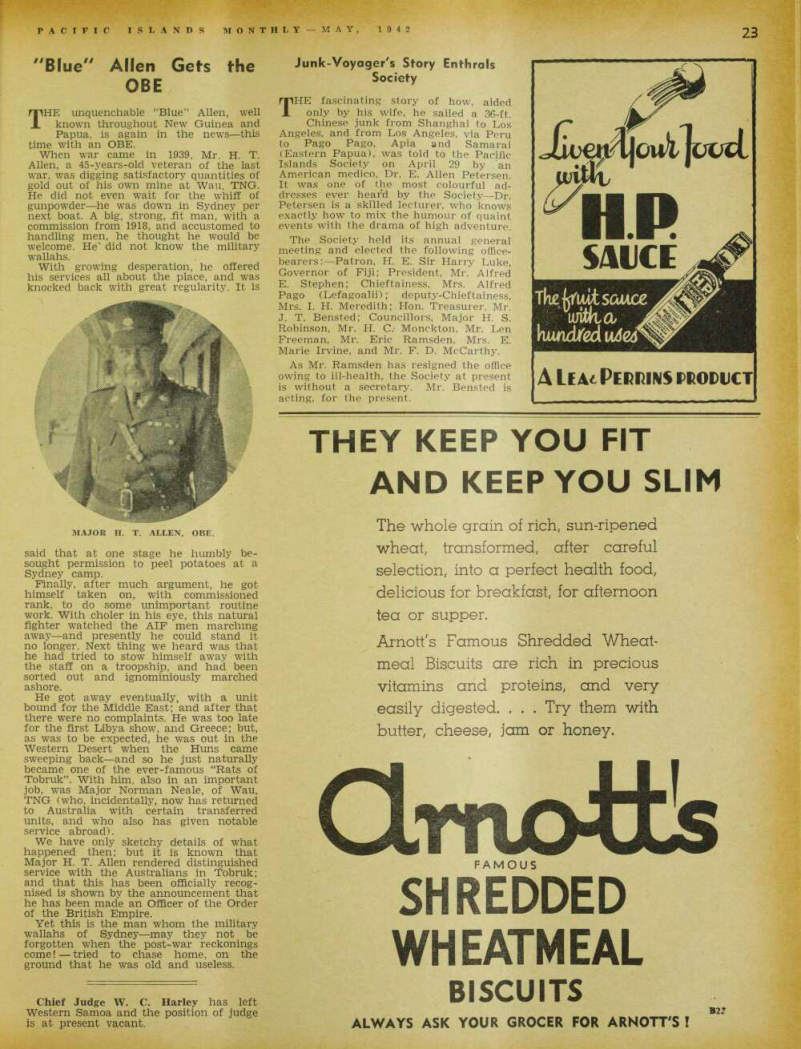
Qbe
THE unquenchable “Blue” Allen, well known throughout New Guinea and Papua, is again in the news—this time with an OBE.
When war came in 1939, Mr. H. T.
Allen, a 45-years-old veteran of the last war, was digging satisfactory quantities of gold out of his own mine at Wau. TNG.
He did not even wait for the whiff of gunpowder—he was down in Sydney per next boat. A big, strong, iit man, with a commission from 1918, and accustomed to handling men, he thought he would be welcome. He' did not know the military wallahs.
With growing desperation, he offered his services all about the place, and was knocked back with great regularity. It is
said that at one stage he humbly be sought permission to peel potatoes at a Sydney camp.
Finally, after much argument, he got himself taken on, with commissioned rank, to do some unimportant routine work. With choler in his eye, this natural fighter watched the AIF men marching away—and presently he could stand it no longer. Next thing we heard was that he had tried to stow himself away with the staff on a troopship, and had been sorted out and ignominiously marched ashore.
He got away eventually, with a unit bound for the Middle East; and after that there were no complaints. He was too late for the first Libya show, and Greece; but, as was to be expected, he was out in the Western Desert when the Huns came sweeping back —and so he just naturally became one of the ever-famous “Rats of Tobruk”. With him, also in an important job, was Major Norman Neale, of Wau, TNG (who, incidentally, now has returned to Australia with certain transferred units, and who also has given notable service abroad), We have only sketchy details of what happened then; but it is known that Major H. T. Allen rendered distinguished service with the Australians in Tobruk; and that this has been officially recog nised is shown by the announcement that he has been made an Officer of the Order of the British Empire.
Yet this is the man whom the military wallahs of Sydney—may they not be forgotten when the post-war reckonings come! tried to chase home, on the ground that he was old and useless.
Chief Judge W. C. Harley has left Western Samoa and the position of judge is at present vacant.
Major H. T. Allen, Obe.
Junk-Voyager's Story Enthrals
Society
THE fascinating story of how, aided only by his wife, he sailed a 36-ft.
Chinese junk from Shanghai to Los Angeles, and from Los Angeles, via Peru to Pago Pago, Apia and Samarai (Eastern Papua), was told to the Pacific Islands Society on April 29 by an American medico, Dr. E. Allen Petersen.
It was one of the most colourful ad dresses ever heard by the Society—Dr.
Petersen is a skilled lecturer, who knows exactly how to mix the humour of quaint events with the drama of high adventure.
The Society held its annual general meeting and elected the following office bearers —Patron, H. E. Sir Harry Luke, Governor of Fiji; President, Mr. Alfred E. Stephen; Chief tainess, Mrs. Alfred Pago (Lefagoalii); deputy-Chieftainess, Mrs. I. H. Meredith; Hon, Treasurer, Mr.
J. T. Bensted; Councillors, Major H. S.
Robinson, Mr. H. C.- Monckton, Mr. Len Freeman, Mr. Eric Ramsden, Mrs. E.
Marie Irvine, and Mr. F. D. McCarthy.
As Mr. Ramsden has resigned the office owing to ill-health, the Society at present is without a secretary. Mr. Bensted is acting, for the present.
Advertisements & other items, p. 25 (1 item)
.-eii-llottV- jctid
SAUCE ,
m
SCOACZ
•k , "foWta mmd/edudea A li At Perkins product
THEY KEEP YOU FIT
AND KEEP YOU SLIM
The whole grain of rich, sun-ripened wheat, transformed, after careful selection, into a perfect health food, delicious for breakfast, for afternoon tea or supper.
Arnott's Famous Shredded Wheatmeal Biscuits are rich in precious vitamins and proteins, and very easily digested. ... Try them with butter, cheese, jam or honey.
FAMOUS
SHREDDED
WHEATMEAL
BISCUITS
ALWAYS ASK YOUR GROCER FOR ARNOTT'S !
Notable Airman
Samoa Claims This
Distinguished service has been rendered by Sergeant-Pilot Andrew Kronfeld, of the New Ze a}and Fighter Squadron, attached to the RAF.
He is a grandson of a famous old Samoan trading family, and his mother was a member of the Pecham family, also of Samoa. The later generations of Kron felds are well-known in Auckland s com mercial life. Here is a bright story of the young airman, told by a irutn writer last December:— The Duke of Connaught gave a young New Zealand Sergeant-Pilot, Kronfeld, the biggest whisky of his life the other day.
Andy got shot in the knee returning from a sweep over France. But. what worried him more, he hadn t enough petrol and was kept hanging about await
*ng Permission to land. Finally, he had t 0 Crash his plane into a field * When he walked up to the only house nearby he found it was a big one. He was startled to find it belonged to the Duke of Connaught, who immediately asked him in for a drink.
“You don’t mind a couple of fingers, do you „ said the Dukej and imme diately poured out, to use Andy’s own words, “a five-finger nobler of the best whisky I have ever drunk in my lif e » The New Zealand squadron to which Kronfeld is attached is thinking of mak- \ he Duke its adviser on strong liquors.
When Western Samoa subscribed a few thousand pounds, wherewith to buy a fighter plane, to be called “Western Samoa”, Pilot Sergeant Kronfeld was the man selected to fly it. Up to De cember, he had accounted for two or three Messerschmitt fighters.
Samoa
The Islands Of
A Valuable Publication
(~)F all the large South Pacific Islands groups, the islands of Samoa, although they have a fascinating history and are among the richest and most beautiful in Polynesia, have the poorest literature. Therefore, the publication referred to below has special interest.
DR. Augustin Kramer was born in Chile, took his doctorate at the University of Kiel, and became a naval surgeon. From 1893 to 1895 he was stationed in Samoa on the German war ship “Bussard”; and later, released from his duties in order that he might prose cute his researches, he spent a further two years there, from 1897 to 1899.
During his stay in the group he made an intensive study of the Samoan people, their traditions, history, legends, social and political constitutions, arts, crafts, amusements, habits, and the general regulation of their lives, and of the flora and fauna of the islands.
His conclusions were published in a work of exceptionally sound and meri torious scholarship, “Die Samoa-Inseln.
Entwurf einer Monogranhic mit beson derer Berucksichtigung Deutsch-Samoas”, which, in two large volumes, came from the press in Stuttgart in 1902 and 1903. subsidised by the Colonial Department of the German Foreign Office. Students of Samoan affairs regard this learned monograph as the most exhaustive and authoritative fundamental work on the subject with which it deals; but it has loner been difficult to procure.
The Administration of Western Samoa is to be congratulated, therefore, on its enternrise in making available an Eng lish translation of the work under the title. “The Samoan Islands”.
This translation consists of nine bound parts, each containing about two hundred sheets of cyclostyled foolscap typescript.
The first five of these comprise Volume I. and the remaining four. Volume 11.
The price of the translation is six guineas which, though expensive is. all things considered. far from excessive: and as it is understood that the edition is limited to thirtv numbered sets, it is obvious that it has been produced at a loss.
It seems a pity that the Administra tion has not added a foreword explain ing the circumstances surrounding the translating of Kramer’s monograph and the work of revising and printing, for the work involved has been considerable: the original translation was completed in September, 1930, and publication has just been made in February, 1942. Apart 'from the typing of the stencil sheets, the work of publication has been carried out as a spare-time activity of certain offi cers of the Department of Native Affairs.
In a rapid perusal of the translation, the reviewer has found few faults. Gen erally, the value of the production makes these blemishes insignificant.
The Samoan texts given in the ori ginal do not appear in full throughout the translation. This is regrettable, for the complete versions of such texts are here available only as English transla tions of German translation of the original Samoan.
In that section of Volume II which deals with medicine and diseases, there is frequent reference to an appendix, for which the reviewer has searched in vain.
The Table of Contents of Volume I
gives the original German page num bers. It is a pity that these were not converted to agree with the present pag ing. True, one can apply the excellent concordance supplied with the Index; but the conversion would have facilitated the finding of one’s way about the book.
No page numbers are given in the Table of Contents of Volume II; and it is as convenient to use as that of the first volume.
The Index of each volume is merely a transcript of the corresponding Index in the original, prefixed by a concordance, or “key”, with the aid of which the cor responding page in the translation can readily be found. This presents no diffi culty in Volume I, where the Index is a list of Samoan names; but with Volume II the position is different, for there the Index is largely composed of German words. Thus, if one wants to look up burial, the reference in the Index is Beerdigung; if one wants cuttle-fish, one must look for Tintenfisch; for the tooth billed pigeon (manumea), the Index gives Zahntaube, and so on. There should have been a translation or a con cordance of English and German words appended to this Index. Perhaps it is not too much to hope that one may be prepared and distributed to the pur chasers of the translation.
Page references in the text are given as blanks. This is the most serious and annoying defect in the whole translation.
If one wishes to consult such a reference, one must tread a wearisome path through the Index (which in Vol. II may be in German) and the concordance, in order to locate it; and in some cases it is not easy to find the proper reference in the Index. Had the original German page references been given, there would have been little difficulty, whereas the system adopted is often acutely exasperating.
The work deserves a much stronger binding than it has been given. Paper covers may be good enough for cheap novels, or even for parliamentary Blue Books, but reference books of the size and weight of the nine parts of the pre sent monograph require stiff boards. The cost would have been greater, but pur chasers would not have objected to pay ing for the more serviceable binding.
Unfortunately, it was not found pos sible to reproduce the illustrations. The cost would have been prohibitive.
There is nothing to show that this translation has been published by the Administration of Western Samoa; nor is the date of its publication given.
This information should have appeared on the title page. It is an unfortunate omission, for the Administration has every reason to take pride in so success fully completing the venture.
In the first instance, this exceedingly valuable monograph would never have been available at all but for the liberality of the old Imperial German Government, which not only granted Dr. Kramer the necessary leave from his duties so that he could complete his researches, but also paid a large share of the cost of publica tion. At this latter time, Western Samoa was a German Colonv; now it is man dated to the British Crown and is under the tutelage of the New Zealand Gov ernment.
The attitude of governments in gen eral to pure scientific research is notori ously apathetic; and it is pleasing to have such an opportunity as this of com plimenting the Administration of West ern Samoa on its wisdom, enterprise, and liberalitv in making available to English speaking people, in their own language, the valuable fruits of Dr.
Kramer’s investigations. Dr. Kramer’s work is as valuable to-dav as when it was written—especially to those who take
part in the shaping and administration of Government policy in Samoa, or who are interested in Samoan affairs, or who conduct missionary activities in the Ter ritory P. W. Glover, BSc., FRAS.
Apia, March 1, 1942.
Advertisements & other items, p. 26 (1 item)
Chi Vers
BURNS PHILP
(SOUTH SEA) CO. LTD.
Inc. in Fiji
Island Traders and Shipowners
Registered Office :
SU V A
FI J 1
Also Branches at:
Fiji: Levuka, Lautoka, Labasa, Ba, Sigatoka, Rotuma.
Tonga: Nukualofa, Haapai, Vavau. nn Samoa: Apia, Pago Pago (American Samoa).
Solomons: Makambo, Gizo, Faisi.
New Hebrides: Vila.
Code Address; Gilberts: Tarawa.
“Burnsouth”. Norfolk Is. Niue. Wallis Is. Futuna Is.
CHI VERS
FAMOUS ENGLISH PRODUCTS
CANNED ENGLISH VEGETABLES
CANNED ENGLISH FRUITS
OLDE ENGLISH MARMALADE
GOLD MEDAL JAMS
JELLY CRYSTALS, ETC.
Obtainable from all leading Grocery Stores
WRITE TO DEPARTMENT “A”
CHI VERS & SONS LTD.
Histon, Combs., Eng.
FOR ATTRACTIVE RECIPE BOOK
cc~ m Tm'im
CHIV£RS
COLD
ST4MD4RO
FRESH
ENGLISH
PEAS
L*»cmn awp
Sudden Death Of Mr.
Jack Turner
ALL residents of Papua—especially of the Samarai end—will learn with deep regret of the death on April 29, at Lismore, of Mr. Jack Turner, who had lived for over 30 years in Papua, mostly in the service of Burns, Philp &' Co., Ltd. He was evacuated from Samarai— where he was one of the town’s most highly esteemed residents—just before the Japanese bombed the place; and he went to Lismore, to a position in the service of Pennys, Limited (a company
associated with Burns, Philp & Co.).
He had been there only a few weeks when he became ill, and he died at'his home shortly afterwards. He was born in England 59 years ago.
Mr. Turner is survived by his wife and one son, Harold. The latter enlisted early in the AIF. He was wounded at Bardia, and now is believed to be with the Aus tralians in the Middle East.
Advertisements & other items, p. 27 (1 item)
*cjyy^ Flour
r« San Francisco
You con make lovely light cakes always with Aunt Mary's Baking Powder and good plain flour! The special "EVEN-RISING" action of Aunt Mary's begins the moment you add it to the mixture.
Result—your cake is baked exceptionally light, with that delicious flavour that only good, even baking can give. Also, this "EVEN-RISING" action of Aunt Mary's gives a fine, even grain, which will hold moisture, and so keep fresh to the last crumb!
A PRODUCT OF TILLOCK & CO. PTY. LTD., SYDNEY.
PRODUCING UNIFORM GOOD RESULTS SINCE 1868
*cjyy^ Flour
ALWAYS ASR FOR IT
Polynesian Club
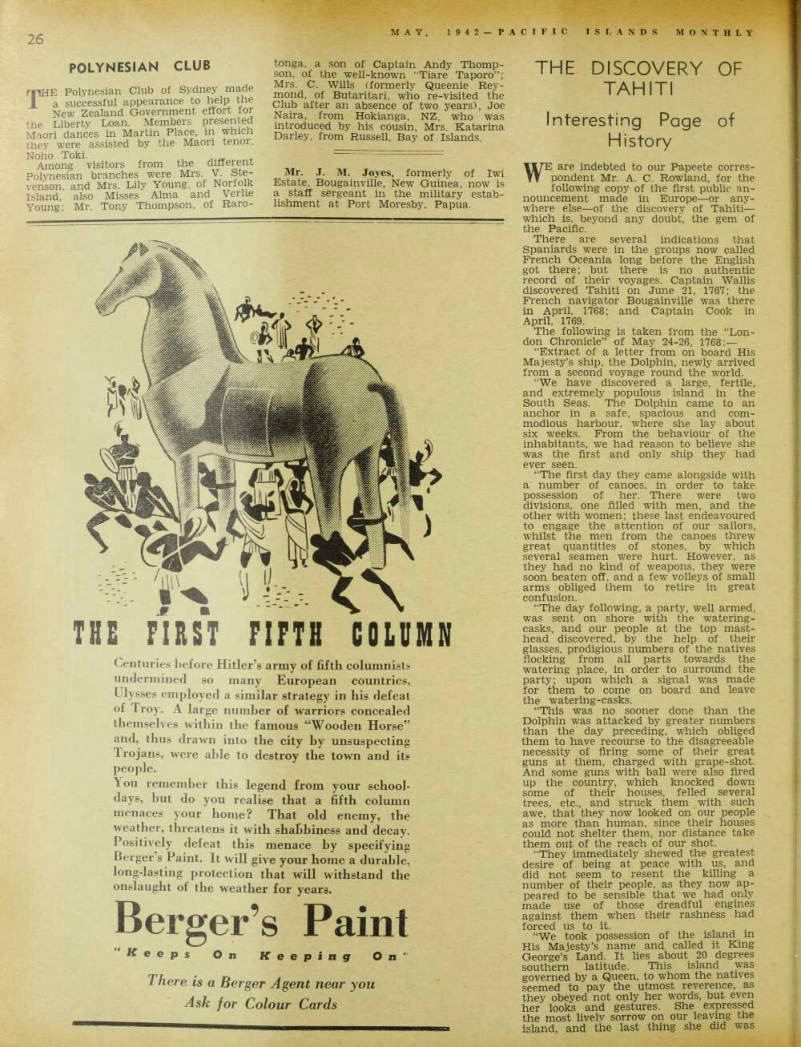
rE Polynesian Club of Sydney made a successful appearance to help the New Zealand Government effort for the Liberty Loan. Members presented Maori dances in Martin Place, in which they were assisted by the Maori tenor, Noho Toki.
Among visitors from the different Polynesian branches were Mrs. V. Ste venson, and Mrs. Lily Young, of Norfolk Island, also Misses Alma and Verlie Young: Mr. Tony Thompson, of Raro
tonga, a son of Captain Andy Thomp son, of the well-known “Tiare Taporo”; Mrs. C. Wills (formerly Queenie Rey mond, of Butaritari, who re-visited the Club after an absence of two years), Joe Naira, from Hokianga, NZ, who was introduced by his cousin, Mrs. Katarina Darley, from Russell, Bay of Islands.
Mr. J. M. Joyes, formerly of Iwi Estate, Bougainville, New Guinea, now is a staff sergeant in the military estab lishment at Port Moresby, Papua.
History
The Discovery Of
Tahiti
Interesting Page of History
llfE are indebted to our Papeete corres iT pondent Mr. A. C. Rowland, for the following copy of the first public an nouncement made in Europe—or any where else —of the discovery of Tahiti — which is, beyond any doubt, the gem of the Pacific.
There are several indications that Spaniards were in the groups now called French Oceania long before the English got there; but there is no authentic record of their voyages. Captain Wallis discovered Tahiti on June 21, 1767; the French navigator Bougainville was there in April, 1768; and Captain Cook in April, 1769.
The following is taken from the “Lon don Chronicle” of May 24-26, 1768: — “Extract of a letter from on board His Majesty’s ship, the Dolphin, newly arrived from a second voyage round the world.
“We have discovered a large, fertile, and extremely populous island in the South Seas. The Dolphin came to an anchor in a safe, spacious and com modious harbour, where she lay about six weeks. From the behaviour of the inhabitants, we had reason to believe she was the first and only ship they had ever seen.
“The first day they came alongside with a number of canoes, in order to take possession of her. There were two divisions, one filled with men, and the other with women; these last endeavoured to engage the attention of our sailors, whilst the men from the canoes threw great quantities of stones, by which several seamen were hurt. However, as they had no kind of weapons, they were soon beaten off, and a few volleys of small arms obliged them to retire in great confusion.
“The day following, a party, well armed, was sent on shore with the watering casks, and our people at the top mast head discovered, by the help of their glasses, prodigious numbers of the natives flocking from all parts towards the watering place, in order to surround the party; upon which a signal was made for them to come on board and leave the watering-casks.
“This was no sooner done than the Dolphin was attacked by greater numbers than the day preceding, which obliged them to have recourse to the disagreeable necessity of firing some of their great guns at them, charged with grape-shot.
And some guns with ball were also fired up the country, which knocked down some of their houses, felled several trees, etc., and struck them with such awe, that they now looked on our people as more than human, since their houses could not shelter them, nor distance take them out of the reach of our shot.
“They immediately shewed the greatest desire of being at peace with us, and did not seem to resent the killing a number of their people, as they now ap peared to be sensible that we had only made use of those dreadful engines against them when their rashness had forced us to it.
“We took possession of the island m His Majesty’s name and called it King George’s Land. It lies about 20 degrees southern latitude. This island was governed by a Queen, to whom the natives seemed to pay the utmost reverence, as they obeyed not only her words, but even her looks and gestures. She expressed the most livelv sorrow on our leaving the island, and the last thing she did was
to take the crown from her own head, and present it to Captain Wallis. It has been carefully preserved, and is to be presented to Her Majesty of Great Britain.
“During the remainder of our stay, we continued to trade with the natives in the most amicable manner, giving them nails, buttons, beads, and trinkets, in exchange for fresh provisions, which we were greatly in want of.
“The natives are pretty much civilized, considering that the arts have made but little progress among them. They are in general, taller and stouter made than our people, and are mostly of a copper colour, with black hair; others are fairer, especially the women, some of whom were observed to be red-haired.
“It does not appear that they know the use of any one metal whatever. When the grape-shot came among them, they dived after it, and brought up pieces of lead. They swim like fish, and can remain a long time under water. They were clothed with a kind of stuff made of the bark of trees, some red, some yellow: its texture resembles that of coarse, thick paper, and cannot resist wet.
“From some circumstances, we had reason to imagine that the King of the island was killed in the attack the second day; and the Queen was clothed in red, which, we found, was the mourn ing of the country.
“It is impossible to describe the beau tiful prospects we beheld in this charming spot. The verdure is as fine as that of England, there is great plenty of live stock, and it abounds with all the choicest productions of the earth.
“Besides the large island, there are several lesser ones, which have been named Charlotte Island, Glocester Island, Boscawen Island, Keppel Island, Wallis Island, etc.”
Doctor Bolton Glanvill Corney, from whose work “Quest and Occupation of Tahiti by Emissaries of Spain” this ex tract is taken, adds the following note: “Lloyd’s Evening Post and British Chronicle of May 23-24 reported the Dolphin’s return to England, and gave a notice of her discovery of Tahiti and of her sojourn there, with some account of the natives, which was continued in the succeeding issue.
“The same notice appeared in the cor responding number of the London Chronicle of May 24-26; and was re printed by the Gazetteer and New Daily Advertiser on May 26 and 27, with a few important words of comment added. This seems to have been the first public an nouncement in England of the discovery of Tahiti, the Dolphin having arrived in the Downs on May 20.”
She Was Not “Queen”
EVEN to this day, there is considerable misconception about the high chiefess, Opurea, who received Cap tain Wallis, when the Dolphin was at Matavai, in 1767, and was by him styled Queen of Tahiti.
In the supplementary papers of Doctor Bolton Glanvill Corney’s monumental work: “The Quest and Occupation of Tahiti by Emissaries of Spain, 1772- 1776”, is to be found “A Passage from the Journal of Henry Ibbot, Midshipman, 1767”, from which we take the following: “The natives being very sociable with us, Captain Wallis gave leave for a stated number of men to go on shore every day with the trading party, and the in habitants behaved very kindly to them and never offered them the least insult, though some of them strolled for miles into the country, having no manner of weapons with them.
“Pettycoat interest here as well as in other parts, is the most prevailing, the principal person hereabout who appeared to have any authority over the rest being
a woman, whom we styled the Queen; she was the stoutest woman I ever saw there, and had a very commanding as pect, but not handsome, being on the decline.”
Appended is a note by Doctor Corney: “This, of course, was Te Vahine Airoro- Atua-i-Ahurai, familiarly known as ‘Opurea’; quoted by Wallis as Oberea and by Banks as Oborea. She was a daughter of Terii Vaetua, chief of Fa’a’a, whose wife was a lady of the Vaiari family; and she married Tevahitua-i-Patea, chief of Papara and head of the Teva clan, who adopted the name ‘Amo’ when his son was born, because the child had a habit of blinking.
“Airoro was a headstrong, ambitious, and influential chief ess; but to describe her as ‘Queen’ of Tahiti is a misnomer, though her small sen, Teriirere did run Tu (Pomare First) very closely during sometime for the paramountcy.”
Lieutenant J. M. Harcourt, son of Mr.
H. W. Harcourt (former Deputy Trea surer of Fiji), was captured by Axis troops in Libya recently and now is a prisoner of war. He was serving with the New Zealand Expeditionary Force.
Lieutenant Harcourt is 27 years old and married, his wife at present living in Wellington, NZ.
Mr. John W. M. Whiting, who earned out anthropological research work in New Guinea a couple of years ago, has just had his book, “Becoming a Kwoma , published by the Yale University Press, USA. It deals with the culture of the Kwoma, a people living 250 miles up the Sepik River, Northern New Guinea.
Mr. Eric J. Hobson, formerly of the Department of Public Health in New Guinea, stationed at Buka Passage, re cently joined the RAAF and now holds the rank of ACI at an Air Force hospital in Victoria.
Malakai, a Tongan workman employed on a building construction job in Suva, Fiji, fell from a high girder and was killed, on March 26.
Advertisements & other items, pp. 28-30 (2 items)
Berger’s Paint
J a\ Y. *4i ST OS w
ife
1 'll 11 I \ I ' • -■-
THE FIRST FIFTH COLUMN
Centuries before Hitler’s army of fifth columnists undermined so many European countries, Ulysses employed a similar strategy in his defeat of Troy. A large number of warriors concealed themselves within the famous “Wooden Horse” and, thus drawn into the city by unsuspecting Trojans, were able to destroy the town and its people. ou remember this legend from your schooldays, but do you realise that a fifth column menaces your home? That old enemy, the weather, threatens it with shabbiness and decay.
Positively defeat this menace by specifying Berger’s Paint. It will give your home a durable, long-lasting protection that will withstand the onslaught of the weather for years.
Berger’s Paint
"Keeps On Keeping On" 7 here is a Berger Agent near you Ash for Colour Cards
Durhtile
Timber, Joinery
ETC.
PREPARED BUILDINGS ready for erection a specialty.
SHIP AND BOAT BUILDING.
TIMBERS specially catered for,
PIBROLITE, PLYWOODS.
GALVANISED IRON.
CONSIGNMENTS shipped
by RETURN STEAMERS
to the Islands.
John W. Eaton
PTY. LTD.
WEST CRESCENT STREET,
NORTH SYDNEY.
Telephones: X 84051 (6 lines.)
BITUMENOID ROOFING
MADE IN AUSTRALIA.
Bltumenold Roofings, Dampcourse and Insulating Felts are made from the* world’s best raw materials. Warranted to stand the most rigid tests.
• BITUMENOID THE BEST
Roofing, 1,2, 3-ply; Flooring, Waterproof Materials; Saturated Pelt; Resilient Road Jointing; Natural Asphalt Dampcourse; 2 and 3-ply Dampcourse; 1-2 lb. Lead-core Dampcourse; Roofing Cement; Asphalt Paints; Roofing Compound.
SAMPLES AND PRICE LISTS ON APPLICATION.
MAXWELL PORTER & SON LTD.
ESTABLISHED 1888. BUILDERS’ SUPPLIES.
107 REDFERN ST., REDFERN, SYDNEY, N.S.W. ’Phone: M 8157. Cables Bltumenold.
Woven Wire for all Industry \
COPRA DRYING TRAYS, FLOORS, Etc.
FRUIT DRYING TRAYS, MINING SCREENS.
Heavy Mosquito Gauze in Phosphor Bronze and other Metals Impervious to Salt Sea Air.
WIRE DOOR MATS AND GENERAL WIRE WORKS f- Or r" £ SO S' f'.
"'SI is^
E. WRIGHT & CO. LTD.
Office and Works: 148-152 Cleveland Street, Sydney, N.S.W.
Telegraphic Address: “Wrightmake,” Chippendale,
uiill make your kitchen
really modem... daft
fnyourspare time!
All the colourful, washable advantages of ceramic wall tiles is provided at less cost when you use DU RATI LE. Write for descriptive literature. Wunderlich Ltd., Crown and Cleveland Sts., Redfern, Sydney.
U/UND£RUCH<
a jjj 000 Jj
DURHTILE
KANGAROO BRAND
Ropes,
Cordage,
and Twines for every purpose
Backed by
86 years of service.
Manufactured by
M. DONAGHY AND SONS,
Pty. Ltd./Geelong and Sydney.
Fiji Representatives:
PEARCE AND CO.
LIMITED
P.O. BOX 237, SUVA
WAR ON FLIES
\ sh ° u 'd alwa 's ?° Wer - That’s ° f u k ° OWn Imitates. y Ff , ;? S,St ° n F '«t -- anrf W s y you harmless to f ft spra y will not USe a,/ 15 on «>e bottle" 13 " 5 - Be sure the"' and "
ALWAYS KILLS
Forced Laromp
German Practices in Pre-1914 felonies
THE statement that a system of forced labour, closely resembling slavery, was practised in the former German colonies, has been proved by the repre sentations of those who knew the actual conditions governing the supply of labour for plantations, and public works.
Labour was supplied by native chiefs, when asked for, and upon terms dictated by the Germans. There was no such thing as an open market, where wages were adjusted to the laws of supply and demand. The wages paid were fixed by an official, and a planter could not pay more than the prescribed rate.
In Africa, the hut tax was designed primarily to force the natives to work.
German opinion was that, in return for the so-called benefits of European civili sation, the natives should render an equivalent service to the State. This opinion was gathered from the views of three representative and well-known Germans, Lt.-Colonel von Morgen, Major von Wissman and Karl Peters.
Lt.-Col. von Morgen, who was a leader of an exploring expedition to the Cameroons, stated: “The only real tax, which is also of cultural value, is com pulsory labour.”
“We can do nothing in the tropics without native workmen,” he added: “and especially we cannot make progress in the Cameroons, whose future depends on plantations. As we in Germany have compulsory schooling, so there must be compulsory work in the colonies. . . .
As to how this labour is to be supplied, and for how long, the District Judge must decide.”
Similar views were expressed by Major von Wissman and Karl Peters. “A very good recipe,” stated Karl Peters, “is the demand of a hut tax from every nigger over the age of sixteen —and one of not less than five pounds: so that they are forced to work. ... To me, the advan
tageous system seems to be one in which the negro is forced, following the example laid down by Prussian military law, to devote some twelve years of his life to working for the Government. During this time, he should receive food and shelter and a small wage, say about two shillings a month, like a Prussian soldier.”
PRIOR to the outbreak of the war in 1914, the practice in German East Africa and the Cameroons, was described.
Labour was divided into day (casual) labour and contract (recruited) labour.
The day labourers were not bound to any master, and worked on plantations near their own homes. They were usually given piece-work, and paid for it on the same day.
Contract labourers were recruited up country, and were signed on for 180 or 240 working days. In East Africa, thousands of men were recruited from back country districts for the plantations in the coastal belt. Manv of these were “raw”, who had had little idea how far they were going, what work they were to do. and under what conditions they were to live.
The recruiting agents paid the chiefs and headmen one rupee or more for each black man recruited, and naturally the headmen coerced as many followers as nossible, in order to swell their receipts.
In some cases, the recruiter got into touch with the Government official of the district, and the latter simply announced to the people that so many labourers were required, and his native underlings pro ceeded to muster the necessary men through the native chiefs and headmen, who were first intimidated.
Not long before the outbreak of war in 1914, a new labour ordinance was made in which it was stated that labour was a compulsory contribution to the welfare of the State, and allowance was made for the first time for their return into the interior. Formerly, men got back again—if they ever did—as best they could.
THE labour thus requisitioned in Ger man East Africa was obtained most freauently by force: and what oc curred there went on also in the Cam eroons. where the conditions seemed to have been still worse.
In the Cameroons, there was constant friction between planters, merchants and the Government. One merchant com plained that “the desire of the planters, whose wishes the Cameroon Government was only too ready to meet, was com nletely to improverish and expropriate the natives living on their domains, in order to force them to work at low wages on the nlantations. Old men, children, and weaklings were forced to work by Commissioners of the Government and the planters, who shrank from no tricks for this purpose.”
On one plantation, the Prince Albert, the death rate in 1913 amounted to 26.8 per cent.; on others the rate was 10.24, and as much as 20. ...
It was generally known in one district in East Africa that a native who once had taken a worker’s ticket with a planter could hardly ever get free from his labour relationship to that particular employer.
The employer did not give the natives their discharge certificates and wages un til the men had taken another work ticket.
IN South-west Africa, the conditions were deplorable. Not only were the natives deprived of their lands, as a punishment for the Herero Rebellion but a degree was issued placing most of the inhabitants under forced labour.
A farmer in the district stated that “every native capable of working” was
registered and wore a brass label with a number and the name of the town where he lived. “When we require labourers”, he said, “we simply ask the police to send them, and the natives have to come, whether they want to or not.”
Compare these methods with those em ployed in the British colonies, as described by Lord Lugard when discussing the problems of native labour in a report on the amalgamation of Northern and Southern Nigeria.
Under the heading “Warning to Em ployers of Labour” he wrote: “It is well that employers of labour, whether on the mine-fields or elsewhere, should realise two important facts in regard to labour.
First, that the Government policy, being radically opposed to coercion in any form, even for works of such urgency and im portance to the country as railways and roads, will not employ coercion in order to procure labour for private undertakings.
“Employers must, therefore, make con ditions of service sufficiently attractive to secure the labourers they need. To effect this, high wages are not necessary, and they are to be deprecated. An employer who pays more than the standard wage, does an injury to the development of the country. Labour will be secured only by kind and fair treatment, decent hut ments, the entire absence of blows and rough usage, and the facilities already described.”
The effect on the natives in the Ger man colonies of the exploiting reign of capitalism was appalling. The Bishop of the Cameroons stated in 1914: “Cam eroon is suffering depopulation in a truly terrible degree; the land has only miserable remains of population where twenty years ago there were flourishing villages”.
Samoa
High Prices In
Effect of the War
From Our Own Correspondent APIA, April 9.
FROM the outbreak of the war against Japan, for nearly 3 months, Western Samoa had no shipping communi cations or mail services connecting the Territory with the outside world. Im ported foodstuffs ran out or were very low, and planters and traders suffered considerably from the lack of export facilities and unprofitable produce prices.
Natives stopped the cutting of copra and cocoa beans accumulated in Apia sheds.
Actual warfare did not reach Western Samoa, though the shelling of the US Naval Base of Pago Pago, Eastern Samoa, by a small Jap vessel early in January, caused some excitement.
However, transport facilities are better now, and the commercial position has
improved.
Owing to the cutting of communications with the Philippines and East Indies, the prices for Samoan copra, cocoa beans and rubber have been greatly increased.
Copra is now (early April) purchased in Apia at 7/6 per 100 lbs., with £9/12/6 per ton for larger lots. Cocoa beans are quoted at £65 to £75 per ton for plantation cocoa. This is the off-season for cocoa, and stocks on hand are small. So far, the price of bananas has not been in creased and stands at 5/- per case.
Benzine and kerosene supplies are strictly rationed, though other essentials, mainly foodstuffs, have so far only been
temporarily restricted. Local food supplies are sufficient for all needs so far.
Prices of imported foodstuffs, clothing and boots, however, have risen very ap preciably. Wages of labour have gone up in consequence, and European planters complain about a serious labour shortage on plantations, owing to remunerative employment offering in American Samoa.
Trainee Maurice Scott, who held the rank of captain in the Fiji Defence Force at the outbreak of war and who sub sequently joined the first contingent of RAF recruits to leave Fiji, has gained his wings at a South African flying school.
He is the son of Sir Henry Scott, KC, and Lady Scott, of Suva. Another Fiji man at the same establishment, Trainee K. Nicholson, only son of Mr. and Mrs.
W. Nicholson, of Suva, has also been awarded wings and been commissioned as a Pilot Officer.
Captain William Bernard Robertson, who spent a number of years among the Western Pacific Islands as an officer on the old Melanesian Mission steamer “Southern Cross”, died in Auckland re cently at the age of 59. In recent years, he was a well-known master mariner of the New Zealand coastal trade.
Advertisements & other items, p. 31 (1 item)
Export Soap Company
There Is no substitute for
OLD MONK
VIRGIN PURE
OLIVE OIL
San Francisco
We are Specialists in Trade Soap for Natives Se nd us your enquiries
EXPORT SOAP COMPANY
41 Church Street, Newtown, Sydney, N.S.W.
Cable Address: XSOAP, Sydney. 'Phone: LA2436.
Rights
Protection of N. Guinea Miners Rights
IN February last, a number of mine owners from the Mandated Territory formed themselves into the Evacu ated Miners’ Association of New Guinea, and made certain representations to the Minister in Charge of Territories, Senator Fraser. They asked, especially, that their mining rights be protected during the period of their involuntary absence.
When two months had passed without any official action, the secretary of the Association moved again, and on April 28 he received from the Assistant Secretary of the Department of External Territories (Mr. J. R. Halligan), advice that “this matter is still under investigation and it is expected that regulations in regard thereto will be enacted at an early date”.
We Love To Listen-In
WHAT price is copra in London, Bill?”
“Dunno!”
“Isn’t your wireless going?”
“Yeah . . . But reception ain’t too good in the mornings.”
“Can’t you get the evening news?”
“Well . . . Yeah . . . But the weather ain’t been too good either, lately, in the evenings.”
“Good Heavens! Then what use is the thing?”
“Aw! It’s great having it. Keeps a man amused, y'know. I get bonzer .reception from LXI3YPB Siberia around 2 a.m., and I get South America, an’
Japan, an’ Central China, an’ Holland, an’ . . .”
“Yes —yes! Quite. But what’s bene ficial about that?”
“Well, it’s pretty fair, don’t you think?”
“I’d think it a better wheeze if I could get something broadcast in English.
Don’t you ever hear anything you can understand?”
“ ’Course I do. I got the news from Queensland this morning.”
“Oh? Any war news?”
“The Germans are doing something or other at some place.”
“How d’ye mean. . . ? Something or other . . . ? Some place . . . ?”
“Well , . , Y’see, she faded out just as the codger was starting on the news, and b’ the time I got ’er tuned in again, he’d finished.”
“Hell’s bells, man! What do you get out of it?”
“Aw, she’s alright. Yessir! Plenty o’ music, y’know, from all over the world.”
“Music?” I bleated. “But dammit! I get music from all over the world with a gramophone.”
“Ah! But you don’t get the latest!”
“Oh?” ‘No! That’s the point! I heard one this morning—a real corker —about three little fishies.”
I reeled.
“Three little fishes?” I gasped. “Why, I had that one sent up four steamers ago.”
“Well come up to-night an’ listen-in.
Stay the night if you’re not in a hurry to go out. And, say, have you got your gramophone on board? Good! Bring it up, too.”
“Gramophone?”
“Yeah! Fetch it up. I’d like to hear that there Three Little Fishies again.”
I’VE been to Bill’s on three occasions since he purchased his radio, and circumstances have been so similar that I will say nothing of the previous two. On this visit, he assured me that he had new batteries, and what I needed was a dose of civilisation after nine months on an out-station, and I could take it from him that an hour or two with a wireless would be just what the old steamer doctor would order.
So, when the shades of evening and pouring rain were falling fast, r left my comfortable bunk, rowed ashore, and slushed along through the wet grass and bog-holes towards his bungalow, with mixed feelings. A man was a fool —yes.
But one can’t pass-up an opportunity to listen-in without a struggle. Slip, you may; fall face forward into numerous ditches, you are compelled to; get your self soaked through, you assuredly will; but go, you simply must.
Bill is a good fellow, an Australian of Scotch descent —though it seems a hard thing to say about a cobber —with a long frame, an O.S. heart, an ability to con sume anything drinkable except water, and a large cellar that holds everything drinkable except water. He has one of those faces which would be improved by any kind of accident—be it ever such a smash-up—and apart from the fact that he considers all women are angels, he is quite sane.
His only vice is the possession of a wireless, and his virtues are too numer ous to recount. The main one, however, is worthy of note, it being his habit —at least, it was before the radio-bug bit him —to mooch around perpetually fill ing the glass (or glasses) of his guest (or 'guests), try he (or they) ever so hard to keep it (or them) empty.
IN less time than it takes to tell, Bill had several whiskys and myself inside some dry clothes, thus giving me an erroneous impression that God was in his heaven and all was right with this particular part of the world.
Dinner music was conspicuous by its absence, but with kai-kai defeated, smokes going and the soda-syphon func tioning well, I sat back contentedly while mine host approached the “works”.
Said “works” showed considerable resentment when requested to perform for the visitor, and, unlike an unfor tunate child for whom I once felt deep sympathy, they could not be slapped into
obedience. There was nothing I could do except manfully to pretend that I was surprised, and tickled to death.
He cajoled the thing wtih numerous tongue-clickings, “dear-dears”, “drat-its” and “what-d’ye-know-about-thats”, entic ing it only to make hideous noises.
“That’s POQ Calithumpia,” he said, after a time.
“Really?”
He twirled a streamlined knob. The “works” uttered a protesting squeal and lapsed into statical mutterings. After much ado a weak musical whine could be heard faintly in the background. It was, however, quickly stonkered by other more robust uproars.
For all that, it had been there; and as the smell of blood is to a man-eating lion, so was one note of music to my cobber Bill.
“By heck!” He eyed the knob, as a world-famous engineer would eye the button prior to pressing it and blowing four or five mountains out of the way, and got right down to it.
His whisky forgotten, he knelt before the set with hands poised over knobs, scarcely daring to breathe.
“Delicate things, these,” he whispered.
“You gotta be careful or you go right past the station on to another.”
The fact that we were after no par ticular station didn’t matter to him. Per sonally, I would have been overjoyed if he had got on to anything by merely going past something else, and catching it unawares, so to speak.
Meanwhile, the musical whine came in and out a time or two, to be overwhelmed by splutters, crackles and roars.
“I’ll get it d’rectly,” said Bill “Here’s luck!” said I, raising my glass.
THE sounds issuing from the set reminded me of a morning I once spent at a poultry market. I re member the solution I used that same morning to get the quacks, cackles, barks and yabbering out of my system. I used it again now. The bottle wouldn’t last too long unless he got some music, I decided.
“Here’s luck!” I said again.
Occasionally very occasionally the spot of music floated in and was gone.
“What’s that you’ve got?”
He was too engrossed to answer. His whole attention was centred raptly on his beloved’s dial. Kneeling there, with arms outstretched, and eyes staring pleadingly upwards, he reminded me of that frontispiece of Christian on my grandmother’s copy of “Pilgrim’s Pro gress”.
I continued with the perseverance of a heckler who is going to make his point or get chucked out in the attempt.
“Wonderful static, fella! Quite as good as any I’ve heard. One wonders how such a small machine can cope with it, doesn’t one?”
A grunt was all reply I got.
“Marvellous!” I said, appreciatively.
“Astonishing! That’s what I call static.
Practically no musical interference what ever.”
“Shssssh!” said he.
“Eeeeepee! Stahkee! WeeeeeeePPEE!
Squark-crash-bang! EEeeeeeEEEEEee!
WOoooroooOH! ” said the “works”.
“I dunno what station this is,” said Bill, quite seriously.
“What are you on?”
“Short wave.”
“I thought perhaps you might be on ‘reacher-out-and-bring-it-back’. It sounds like Ancient Rome to me. I can hear lions roaring: the blood-thirsty cries of a multitude: and every now and then the terrified shrieks of Christians in mortal agony. Are you sure you haven’t inadvertently tuned-in to The Colosseum of bygone days?”
“Aw! Shut up!”
“Just made the suggestion for what it’s worth, son. Take it or leave it.” I bent the elbow again. “Well —here’s luck!”
Luckily I'm not a sensitive chap and I wasn’t offended because I seemed to be doing all the drinking, by myself.
Bill suddenly got on to something with a crash. At the moment, I thought the house had collected a Nazi bomb, and accordingly I sat as though petrified.
Bill, however, wasn’t the least bit dis mayed.
“I’m getting Victoria,” he explained.
“Y’ can’t beat Victoria. Always get a good reception from Victoria. Bound to be a snifter programme from Victoria.”
Victoria seemed to do the dirty on him
after that first careless rapture, though, and he twiddled feverishly.
“Dam’!” he said.
PRESENTLY there came a whinge — it may have been a musical sound when it started out from Victoria, but you know how these tropics deterio rate things. A whinge, I say, floated feebly in; was gone; in again; away; more static; in with a sudden rush; swelled to enormous proportions; roared our heads off for three seconds; faded; roared again. Dead silence. Bash!
Crackle! Spit!
Apparently this suited Bill, for he left the thing and resumed his “spot”.
The “works” then proceeded to enter tain us thus: — “WAAOHAAH! ome . . . mmm . . .
Swee . . . Eeeesquealee . . . There’s . . . no-ooh . . . whistle.. .place... Eepeesqwee . . . oomme . . . There’s . . . no-oOH . . . peeupee-crack-whistle . . . like . . . silence . . . mmm . . . crackle-pop-bash!”
“That was ’ome sweet ’ome they was sinein’,” said Bill.
“You don’t say! I must get it for my gramophone. Is it one of the latest?”
But I doubt if he heard me. He was busy putting a sock in it.
“Didja bring y’ gramophone up?”
I said “No!” and, “What would I be lugging it about in this weather for?”
He went to the cupboard to get another bottle.
“I wish y’d brought it,” he said plain tively. “I’d’ve liked to hear that there
Three Little Fishies again.”
J. G. Mci.
Advertisements & other items, pp. 32-33 (2 items)
Cordage and
GRAMOPHONE RECORDS
SEND US YOUR ORDERS.
Goods sent C.O.D. at no extra charge.
Catalogues sent without obligation.
THE TALKERIES,
161 Castlereagh Street, SYDNEY.
Ship Chandlery Hardware
/Write for 7
Ship Chandlery /
Catalogue J
BROOMFIELDS LIMITED
153 SUSSEX STREET :: SYDNEY.
Cables; “Boom”, Sydney.
Special “In Bond” Prices for all Islands enquiries quoted on application.
Sole Agents for: Large and Complete Stocks of
SHIP CHANDLERY
IRONMONGERY OF ALL KINDS, PAINTS,
WHITE LEAD AND OILS.
P. H. MUNTZ & CO.’S 3-CROWN BRAND METAL SHEATHING.
PEACOCK & BUCHANS’ ENGLISH READY-MIXED PAINTS.
Scott’s “Renown” Brand Rope,
Cordage and
Binder
Twine
Cable Address Ropeyard, Sydney. —*
of Every
Description
MANUFACTURED AT
MASCOT, N.S.W.
J. SCOTT
PTY. LTD.
Head Office and Store:
163 CLARENCE STREET,
SYDNEY,
N.S.W.
Gillespie’S
The Flour
TRADE
MARK
of the Islands
- SYD NEY -
c m a m
General
Merchants
and
Agents
REPRESENTING LEADING FIRMS IN THE ISLANDS
379 KENT STREET,
SYDNEY.
Telephones: MJ 4657 (5 lines).
Islands Produce Sold on Shippers* Account Liberal Advances against Consignments. 25 Years’ Islands Trade Experience Bankers: Bank of New South Wales.
Buyers of all Islands’ requirements on Commission Original Invoices Furnished.
Correspondence in English and French.
P.I. Society And Military
Service
Letter to the Editor AS one of the foundation members of the Pacific Islands Society, I have tendered my resignation therefrom, because I am inexpressibly disgusted with the thoughtlessness—or, it may be, sheer complacency—of the executive officers in allowing those to remain as members who are entirely devoid of the requisite in testinal fortitude to play a man’s part in the present world crisis.
The very existence of this country is at stake. Had the Council of the Society decided to display a spirit worthy of the Anzac tradition, it might have added inimitably to the prestige of the Society.
With best wishes, I am, etc.,
H. S. N. Robinson.
P.O. Box 3416 R., Sydney, 4/5/1942.
Advertisements & other items, pp. 34-35 (3 items)
VTavfeUhe?
SOME OLD-TIME TAHITIAN CUSTOMS
By W. W. Bolton, MA, of Tahiti
F°^™^J E , LY u° T th ° Se in f ter v! st !? in A the P ast ’ we have accounts by those who witnessed these strange cus-
VTavfeUhe?
outiined them or duoSin 1
MARRIAGE
.. , , IyfARRIAGE ever played an important Part in Tahitian society, whether aristocratic or plebeian. There was, moreover, a recognized table of affinity, or prohibited degrees, as to matrimony, though the high and mighty ones did not always observe such rules in eugenics.
These unions through marriage were often matters of profound and social consequence among the Arii, for their women had equal rights and status with
the men. Purea’s history, alike with Itea’s, proves this to the hilt. Among the com mon folk, unions were not promiscuous, and the knot was tied in a formal, if in a less grandiloquent manner. Here is such an occasion.
With dawn, friends assembled for the ceremony. The mother and uncles of the bride were soon busy giving cloth (tapa) to the welcomed visitors, in one of the houses of the family a kind of altar was erected, covered with a piece of white cloth, and placed thereon were some old cloths which had lately been used to cover the tomb of the deceased father of the bride. The distribution finished, the parties went to the family’s domestic marae, where the ceremony commenced, with spreading a large piece of cloth— this white —across the pavement. This done, the bride and bridegroom each changed their dress and took their seats on the ground, about six yards apart, with the marae between them.
Now the mother of the bride, with two or three female relations, having taken a sugar-cane and broken it into small pieces, laid the same upon the leaves of a tree called Amai. The mother and female assistants then wounded their heads with shark’s teeth, and caught the blood upon the leaves, on which were placed the broken sugar-cane, which were thereupon presented by both male and female relatives to the bride and bride groom. They were then offered to the god of the family, and laid upon the altar of the marae. There was no solemnity about it —all was done with levity.
Next, the mother of the bride produced the skulls of her deceased husband and elder brother, which she had preserved; and, anointing them with coconut oil, she placed them on the altar in front of the leaves, the broken sugar-cane, and the blood.
All now being finished, the cloth spread upon the pavement was folded up and, awhile later, was presented to the High Chief, at the place wherever he might be.
MAKING PEACE
PEACE-MAKING, after war between districts, not being possible by pen and paper, objects were called upon in place thereof.
On the summit of a hill a pole was set up, upon which were fastened a dead dog and a young plantain tree. By this standard, notice was given to all that peace reigned supreme.
If any were to break down the pole, it would be looked upon as a deliberate challenge to war. If, by any mischance, it should fall, the High Chief must be at once informed, and a declaration made of its not being intentionally done.
Were chiefs to have misunderstandings, atonement could be made by one or other of the parties, who felt his case was weak, by certain specified gifts. If to a High Chief, it was a live pig and a young plantain tree; if to a lesser chief, a young chicken, together with a plantain tree, would suffice. The live stock was looked upon as a sin offering, the banana as a peace offering—and so the trouble was closed.
THE USE OF LIQUOR
LIQUOR stronger than water was much in request. Kava was the stand-by custom of that day and was drunk to excess by both chiefs and the common people.
“It is a root of a sharp, peppery taste, which is chewed and spat into a wooden bowl, into which coconut milk is poured, and after a little while, fermentation is excited, when the whole is strained and
wrung through coconut husk, then served in cups of leaves made on the spot and thrown aside when once used.
“The effect it produces is a weakness in the legs at the time, but not of the brain; but its continued use is visible from the head to the soles of the feet.
The eyes of the drinkers are much blood shot and at times very sore, the skin is covered with a thick scurf, and the soles of the feet become chopped or cracked.
It also subjects some to fits.
“Notwithstanding the filthy manner of preparation, its nauseous smell and, to many, its disagreeable taste, it is as much admired by Otaheitean epicures as the finest wines produced in Italy or France are by the most refined sensualist at Home.”
But a change came in 1798, with the arrival on Tahiti of some Hawaiians who came on the scene by the “Nautilus”. On Hawaii, spirits had long been distilled from the Ti root, which grows just as abundantly on Tahiti. Ti has many varieties, and its uses were numerous, but alcohol therefrom was, up to that year, beyond their ken.
Under the direction of the newcomers, the new liquor was evolved, and it played havoc with the natives, from the High Chiefs to the humblest of the people.
The labour of distillation was great with but a rough, unsightly machine as the only means.
Pomare II was very partial to the flowing bowl, and he sought something more up-to-date. He appealed to one of the -Duff” company, Hassall, at Sydney (NSW), as follows: '•Matavae, Otahete, January 1, 1807—Sir, I shall esteem it a favour if you can procure me a still, in return for which, if hogs will be acceptable, please to write to me that I may know how many. I am, Sir, Yours, etc., Pomare.”
Hassall replied diplomatically that the
laws prohibited under heavy penalty any person from making a still; but, if at some future time circumstances per mitted, he would send one.
PERSONAL DECORATION
TATTOOING was considered a most pleasing and graceful adornment for both sexes.
“It is commenced at an early age and gradually the patterns spread themselves over most of the body of the man; women are restricted to their hands, fin gers, wrists, feet and ankles, mittens for the hands, rings for the fingers, bracelets for the wrists, sandals for feet and ankles The men have chest and back, arms and legs covered with great variety of figures, trees and vines, birds, beasts and fish, circles and squares, with feet like to the woman’s. The face and throat are rarely marked and, if so, it is but a small mark on the forehead.
“The Tatatau uses either the sharpened bones of birds or the teeth of fishes. The dve is the drippings of oil obtained by burning the fruit of the candlenut, which turns from jet to blue when it comes in contact with the skin.”
This custom was fiercely denounced by the missionaries: and Terito, the widow cf the second Pomare. was considered quite out of the pale when she called in the Tatatau to adorn her body with the markings of the heathen.
DISPOSAL OF DEAD
BURIAL was either sun-drying and cave, or the direct burial of the corpse.
Coffins were unknown; and if the two Spaniards (the “Boenechea” Captain and his sailorman) were not interred in 1774 at Tautira in cofiins. the responsibility for the innovation may go to the “Brethren”.
A boy known to the Brethren, who fell from a breadfruit tree on Christmas Day, died on December 30; and an entry in
their journal for the year 1797 reads as follows: — “Brother Puckey promised to make a coffin for the child, which was carried the next day by four little boys, and several of the Brethren followed. This being the first coffin ever made on Otaheite, they were surrounded by crowds of natives, who admired the construction of it and said ‘it would make a fine chest to put cloth in’. A long ceremony was performed by the father, which appeared to consist principally of an oration on the prospect of his future usefulness, had he lived.”
The father, mother and relatives were prevailed upon not to perform the usual custom at the conclusion of the office of slashing themselves on the head and elsewhere with a shark’s tooth, the blood, flowing freely, being caught on a piece of white cloth and laid upon the grave.
This was the serious side of the burial.
There was a preliminary, far from serious, at the home of the deceased, as a rule.
Some 20 persons, men and boys, daubed all over with smut, red clay and white in various forms, most of them armed with sticks, attended by one dressed in a fantastic robe called a mourning dress, ran about from house to house, also round the corpse, beating their sticks against the outside, those within pretend ing to be scared, suddenly they disap peared. This tumult over, the walk to the grave commenced. • Mrs. Nellie Arnold, wife of Rev. H. A.
Arnold, former London Missionary Society worker in the Gilbert Islands, died at her home in Maroubra, NSW, on April 9. For 15 years she and her hus band were on Abaiang atoll, just north of the equator: they returned to Queensland in 1929, later serving the Congregational Church at Epping, NSW.
Capstan
A. B. DONALD Ltd.
AUCKLAND
ISLAND TRADERS & GENERAL MERCHANTS
P.O. Box 1509. Cables £r Telegrams, "Kingdom", Auckland.
All over the British Empire, every minute of every day, more and more smokers are saying, "Better buy Capstan they're blended better."
CAPSTAN
Cigarettes and Tobacco
Jbw. &*****
JBW. &***
4< W \o *
AS ° StX '
r ° U ?ac^' c ■'" -£*; *• g *** *! s b>' <0 ' fn'- W e ce V« ** 5 pS** ' d ser^ tt ‘ Svl v». <ot - >* c ' f t ra^ cd O b ' pr <^7f|6 * eT
ese^
Roll Of Honour
fit is hoped to assemble, here, the names of men forme? residents of the Pacific Territories which appear in British and Free French casualty lists, or in lists of honours awarded.
We should be grateful if relations and friends would send us details.)
Killed
Pilot-Officer Len BAYLISS, flying instructor in the RAAF, formerly of Rabaul, New Killed in Sydney, 18/11/1940, when he fell from a trainer aircraft in flight.
A/Bdr. Neville W. BERTWISTLE, AIF artillery (tank unit), formerly a clerk on the of W R. Carpenter and Co. Ltd., of Rabaul, New Guinea. Killed in action, April, 1941.
Pte W. R. M. BRADNAM, of the NZ Forces, formerly of Fiji. Reported killed in action m the Middle East, 25/11/1941.
Flight-Lieutenant G. J. I. CLARKE, of the RAAF, formerly Assistant Flight Superintendent of Carpenter Airlines, New Guinea. Killed in action during operations off Dakar (French West Africa), while attached to HMAS Aus tralia”, September, 1940.
Flying-Officer Jack R. COATH. of the RNZAF, formerly on the staff of the Bank of New Zealand, in Suva, Fiji. Killed October, 1941, when a training aircraft crashed in NZ.
Pte. Felix CRAIG, AIF, formerly of accounts department, Australasian Petroleum Co., Port Moresby, Papua. Killed in action, June, 1941.
L J. DAWES, 2nd NZEF, formerly District Officer of Savaii, Western Samoa. Reported killed in action, February, 1942.
Pilot-Officer V. L. DEARMAN, of the RAAF (observer), formerly overseer and clerk at the Colonial Sugar Refining Co., Ltd.. Raravai, Fiji. Reported killed in action in the Middle East, October, 1941.
Captain Kenneth GARDEN, of the RAP Ferry Command, formerly of Guinea Airways Ltd., in New Guinea. Killed, 2/9/1941, when a bomber he “ferried” from USA crashed on west coast of Britain.
Flying-Officer Moresby GOFTON, of the RAF, son of Mrs. F. S. Stewart, of Wau, New Guinea.
Reported missing, 17/5/1940 —presumed killed in air operations.
Rifleman J. A. GOODWIN, AIF infantry, for merly of Bulwa, TNG. Reported “accidentally killed”, April, 1942.
Pte. Wallace GRAHAM, of the NZ Forces (infantry), formerly on the staff of Morris Hedstrom Ltd., Fiji. Killed in action in the Middle East, November, 1941.
Squadron-Leader C. R. GURNEY, RAAF, a former chief pilot of Guinea Airways, Ltd.
Killed in action in the New Guinea area, May, 1942.
Flying-Officer Alan JOHNSTONE, of the RAF, who was born in Suva, Fiji, In 1915. Killed during bombing raid on Kristiansand, Norway, April. 1940.
LAC Douglas KIRBY, RAF, who left Suva, Fiji, wiWi the first contingent of Air Force trainees. Reported “killed in a flying accident overseas”, March, 1942.
Flying-Officer John C. LOWE, RAAF, formerly an overseer with the CSR Co. in Fiji. Reported, 11/4/1942, “took part in air defence of Rabaul, TNG, —missing, believed killed”.
Pte. L. F. MCCARTHY, ALP infantry, form erly supercargo on W. R. Carpenter and Co.’s inter-island vessels “Desikoko” and “Mako”, in New Guinea. Reported “killed in action” in Syria, 30/10/1941.
Spr. A. L. MORANDINI, AIF Engineers, for merly of Konedobu, Papua. Reported killed in action, April, 1942.
Pte. Edward Harold PRICE, 2nd NZEF (Machine-gun Battalion), youngest son of Mr. and Mrs. J. Price, Savu Savu West, Fiji. Killed in action during the Libyan campaign, Middle East, 27/11/1941.
Captain W. H. ROBERTS, NZEF, who was Accountant in the Samoa Treasury Dept., dur ing 1934-35. Killed in action in Libya, Decem ber, 1941.
Cpl. Alex. C. SCOTT, AIF, formerly manager at Kieta, TNG, for Burns, Philp and Co. Ltd.
Killed in action in the Middle East, 19/6/1941.
Pte. Popoare TANGIITI, of the NZ Forces (Maori Battalion), formerly of Mangaia, Cook Islands. Reported “missing after Battle of Greece—presumed dead”, July, 1941.
Died From Wounds
Pte. Ernest HENRY, AIF, formerly of the Rabaul (NG) staff of Burns, Philp and Co.
Ltd. Died from wounds received in Battle of Crete, 1/6/1941.
Pte. Alec. MUNRO, NZ Forces, formerly of Norfolk Island. Died in Libya (Middle East), December, 1941.
Pte. Walter PEARSON, of first NG quota of
AIP (infantry). Died from wounds received in action, 24/6/1941.
A/Bdr. W. R. SCOTT, AIF, of New Guinea.
Died from wounds, July, 1941.
Sgt.-Pilot Peter Clarkson WISE, of the RAF, son of Mir. W. Wise, OBE, Director of Public Works, Fiji. Died from wounds received during bombing raid over Germany, January, 1941.
Died From Illness
Pte. Clarence A. HUTTON, AIF, formerly of Edie Creek, TNG. Died from illness, April, 19‘41.
Major P J. WOODHILL, AIF infantry, formerly legal assistant in the Crown Law Office, Rabaul, New Guinea. Reported “deceased”, December, 1941.
Missing
Pte. P. F. BAILEY, AIF infantry, of Rabaul, TNG. Reported missing, 17/2/1942.
Pte. E. L. CHRISTIE, AIF infantry, of Rabaul, TNG. Reported missing, 17/2/1942.
Pte. A. G. DICKSON, AIF Infantry, of Rabaul, TNG. Reported “missing, believed wounded”, 17/2/1942.
Pte. Ernest (“Paddy”) McGEADY, NZEF, son of Mrs. J. McGeady, of Suva, Fiji. Reported “missing, believed killed”, in Libya, January, 1942.
Pte. R. J. PASCOE, AIF infantry, of Rabaul, TNG. Reported missing, 27/1/1942.
Pilot Tom PATTERSON, of the RNZAF, formerly of Levuka, Fiji. Reported missing, in November, 1941, after bombing raid on the Continent.
Gnr. Allan H. ROSS, AIF artillery, formerly planter in New Britain, TNG. Reported “miss ing—believed prisoner of war”, 28/9/19‘41.
Pte. William RUPE, of the NZ Forces (Maori Battalion), formerly of Aitutaki, Cook Islands.
Reported “missing after Battle of Greece”, July, 1941.
Pilot James SIMPSON, of the RAF, formerly of Vatukoula, Fiji. Reported missing after air operations over Malta, in the Mediterranean, 1/7/1941.
Pilot-Officer Neville George STOKES, of the RAF, formerly a pilot with Guinea Airways, Ltd., in New Guinea. Reported missing after air operations in Europe, December, 1941.
Wounded
Pte. V. BLANCO, AIF infantry, of Thursday Island. Wounded in action, July, 1941.
L/Cpl. J. P. BLENCOWE, AIF infantry, of
Rabaul, TNG. Wounded in action, July. 1941.
Pte. George BUCKNELL, AIF, son of Mr. and Mrs. C. Bucknell, of Korolevu, Fiji. Wounded in action in Malaya, January, 1942.
Pte. Thomas BYERS, AIF infantry, of Thurs day Island. Wounded in action, May, 1941.
V. FAIRHALL, 2nd NZEF, formerly of the Treasury Department, Western Samoa. Reported wounded in action, February, 1942.
Acting Warrant-Officer V. M. I. GORDON, AIF infantry, of Wau, TNG. Wounded in action, February, 1942.
Pte. John GRANT, AIF infantry, of New Guinea. Wounded in neck and thigh, September, 1941; later, reported “rejoined unit”.
Sgt. C. HENDRICK, ALP infantry, of Rabaul, TNG. Wounded in action, July, 1941.
Stanley HIGGS, son of Mr. and Mrs. Gordon Higgs, of W. R. Carpenter and Co. Ltd., New Guinea. Member of an English Lancers’ regiment, wounded during British evacuation from Dun kirk (Prance), May. 1940.
Lieut. Lloyd T. HTJRRELL, AIF infantry, of Rabaul, TNG. Wounded in action, July, 1941.
Cpl. W. H. LANNEN, ALP artillery, of Rabaul, New Guinea. Wounded in action, June, 1941.
Gnr. E. G. LOBAN, AIF artillery, of Thursday Island. Wounded during Greek campaign, May, 1941; invalided home after having his left forearm amputated.
Capt. Edward Tiwi LOVE, NZ Maori Battalion, husband of Mrs. Takau Rio Love, Ariki-nui of Rarotonga, Cook Islands. Reported missing dur ing Greek campaign, 27/5/1941; later, 22/6/1941, reported “wounded and safe”.
A/Sgt. Alastair MACLEAN, AIF infantry, of Rabaul, New Guinea. Wounded in action, in Libya, June, 1941.
Sgt. J. D. McCLYMIONT, NZEF, son of Capt.
D. McClymont, Harbourmaster of Apia, Western Samoa. Wounded in action, November, 1941.
Cpl. R. McKERLIE, AIF, of Yandina, BSI, wounded in face by bomb explosion, April, 1941.
S/Sgt. Graham B. MIRFIELD, AIF engineers, of Rabaul, New Guinea. Wounded in action, July, 1941.
Pte. L. G. (“Mick”) REECE, AIF, of Bulolo, New Guinea. Wounded in action, July, IS4I.
A/Cpl. N. K. SAWYER, AIF infantry, of Rabaul, TNG. Wounded in action, July, 1941, Lieut. Jeffrey SEAGOE, serving with the British forces in the Far East, formerly of Vila, New Hebrides. Reported “wounded in action”.
March, 19'42.
Pte. Lance STAMPER, AIF, formerly school master at Wau, New Guinea. Wounded in action.
August, 1941.
Pte. Harold G. TURNER, AIF, of Samarai, Eastern Papua. Wounded in action at Bardia (Libya), January, 1941.
Pte. F. D. TWISS, AIF infantry, of New Quinea. Wounded in action, August, 1941, Sgt.-Pilot W. WRIGHT, RAAF Spitfire Squadron, formerly of New Guinea. Wounded in knee during aerial “dog-fight” over the Eng lish Channel, March, 1942.
Prisoners Of War
A/Cpl. Peter W. BOSGARD, AIF infantry, formerly of the Lands Department, Port Moresby, Papua. Reported prisoner of war at Sulmona, Italy, 29/6/1941; transferred to Bolzano prison camp, September, 1941.
A/Sgt. A. A. S. COTMAN, AIF Infantry, of Abau, Papua. Reported missing—believed prisoner of war, 5/5/1941; reported later, July, 1941, “wounded in chest and head by shrapnel— taken prisoner”, Pte. J. DALTON, AJP Transport and Supply, formerly of Thursday Island. Reported prisoner of war, April, 1942.
Pte. W. GOSSNER, AIF infantry, formerly of the BNG Development Co., Port Moresby, Papua.
Reported prisoner of war, Sulmona, Italy, 6/7/1941.
Lieut. J. M. HARCOURT, 2nd NZEF, son of Mr. H. W. Harcourt, formerly Deputy Treasurer in Fiji, Reported “captured in Libya and now prisoner of war”, March, 1942.
Gnr. A. L. B. KING, AIF artillery, of Rabaul, TNG. Reported prisoner of war, 29/7/1941.
A/Cpl. John H. LONERGAN, AIF, Supply and Transport, of New Guinea. Reported prisoner of war at Corinthia, Italy, 8/7/1941.
Observer Alex. McKAY, of the RAAP, formerly of the CSR Co.’s staff, at Penang sugar-mill, Fiji. Reported missing, 27/7/1941; reported prisoner of war in Italy, 26/10/1941.
Pte. Harry MARCHINGTON, of the NZ Forces, formerly of Fiji. Reported prisoner of war after Battle of Crete, 2/12/1941.
Pte. John O. SMITH, of the NZ Forces, son of Captain Harry Smith, of “Tul Kauvaro”, and Mrs. Smith, of Suva, Fiji. Missing after Battle of Crete, May, 1941; reported prisoner of war, 21/10/1941.
Squadron-Leader L. C. SHOPPEE, DSO, RAF, formerly of Edie Creek, New Guinea. Was
in Java during Japanese invasion; now pre sumed to be a prisoner of war.
LAC Charles SOLLITT, of the RAAP (wire less operator), son of Mr. and Mrs. C. H.
Sollitt, of Nausori, Fiji. Reported missing after air operations in New Guinea, January, 1942; later, March, 1942, reported rescued from sea by Japanese—now prisoner of war.
Pte. Fred SWAN, NZ Army Medical Corps, formerly of Apia, Western Samoa. Missing after Battle of Crete, August, 1941; reported prisoner of war in Germany, November, 1941 Pte. John D. WHITCOMBE, of the NZ Forces, formerly of Levuka, Fiji. Reported prisoner of war in Germany, November, 1941.
Decorations
Major H. T. ALLEN, AIF, formerly of Wau, Morobe District, TNG. Awarded the OBE.
Sgt. Henry C. S. COTTON, of the RNZAF, who was born in Samoa (his father was Secre tary of Native Affairs during the NZ military occupation). Awarded the Distinguished Flying Cross.
Lieut. Colin HILL, RANR, of the Australian destroyer, “Waterhen”, formerly second officer on the trans-Pacific liner “Niagara”. Awarded the OBE.
Flying-Officer James R. HYDE, of the RAF, formerly a Patrol Officer in Namatanal and Sepik Districts, TNG. Awarded the Distinguished Flying Cross.
Lieut.-Commander A. W. R. McNICOLL, RAN, son of Sir Ramsay McNicoll, Administrator of New Guinea, and Lady McNicoll. Awarded the George Medal.
Sgt. Geoffrey MOORE, of the RNZAF, for merly engineer on the NG inter-island vessel “Maiwara” and on the trans-Pacific liner “Aorangi”. Awarded the Distinguished Plying Medal.
Commander Alvord S. ROSENTHAL, RAN, son of Major-General Sir Charles Rosenthal, KCB, CMG, DSO, VD, Administrator of Norfolk Island. Awarded the DSO, November, 1941; awarded the Bar to DSO, February, 1942.
Lieut. George Raymond WORLEDGE, of the RANVR, formerly of Fiji. Awarded the MBE (Military).
Advertisements & other items, p. 36 (1 item)
o/ fAe niqkt!
3K 5
AIA/yiikivUL.
/ *SS fg; y r 500
CANDLE
POWER
i 300
CANDLE
POWER
EASE
All Types Mantles
BRIGHTER LIGHT
for
BETTER SIGHT
Coleman Products can be obtained from all Leading Firms throughout the Pacific Islands.
Instant Lighting Irons Kerosene Pressure Stoves
OF OPERATION
combines
ECONOMY with COMFORT
In case of difficulty in obtaining supplies write to:— Pearce & Co., Suva, Fiji Is.
Own Liquor
New Caledonia Makes Its
From Our Own Correspondent NOUMEA, April 9.
THE police report on New Caledonia for the year 1941 shows that crime in the Colony is almost negligible. But a new and difficult problem has arisen relating to liquor. Since liquor imports
have almost ceased, the people have begun making their own.
The police report states that all the 44 bars in Noumea are run by Europeans.
It is recommended that the conditions under which local spirituous liquors are now being made should be investigated, to see that drinks likely to have a harm ful effect on consumers are not sold.
The report states that in October last there were 1,418 foreigners in the country, representing 22 nationalities, of whom Japanese were 80 per cent. But when Japan entered the war, all Japanese save a few market gardeners were interned.
Advertisements & other items, p. 37 (1 item)
Gold
Power behind the Job!
Trained Men are Indispensable That’s why I.C.S. Students get the good jobs and hold them !
Sirs,—Please send free prospectus showing how 1 can succeed in the occupation I have marked X Accountancy —Secretarial (all Inst. Ex.) Bookkeeping —General. Store, Station.
Salesmanship —Gen., Speciality, Retail.
Psychology and Personality in Business.
Advertising —Retail, Mail-Ord., Agency.
Window Disp. —Show Card, Shop Tckts.
Illustrating —Newspaper, Fash., Poster.
Free Lance Jour'ism —Short Story Writ.
Matriculation —Leaving-Inter.-Pub. Serv.
Gen. Education —Bus. and Sales Letters.
Police Entr. Exam., Nurses Entr. Exam.
Architecture —Structural Concrete.
Building Contracting —Air Conditioning.
Draftsmanship (Mech. & all branches).
Motor Eng. —Mtr. Mech., Mtr. Exams.
Diesel Eng. —lllumin. Engr., Weld. Eng.
Internal Ccmb. and Steam Drivers' Exs.
Radio Eng. —Radio Serv., Radio Exms.
Aero Eng. —Gd. Eng., Licenses, Rigging.
Elec. Eng. —Elec. Cont. & Mechs' Exms.
Civil Eng. —Shire Eng.—Shire Overseer.
Textile (all branches) —Analyt. Chem.
Dress Design —Drafting, Cutting, Mlnry. (Underline your subject above— if not on list write it here ) Enquiries cost a 2d. stamp Post Now!
Name p/M Address
140 ELIZABETH STREET.
SYDNEY.
INTERNATIONAL CORRESPONDENCE SCHOOLS
Highest Prices Paid For
GOLD
Garrett & Davidson’s organisation is acknowledged far and wide as the main clearing house for precious metals in the Southern Hemisphere.
They have earned a reputation for accuracy and integrity in all their business dealings, which is proved by the fact that they are privileged to handle more gold from the Islands of the Pacific than any other organisation.
Therefore for your complete and lasting satisfaction, you are advised to transact all your precious metals business through the house of Garrett & Davidson.
GARRETT & DAVIDSON PTY. LTD.
ASSAYERS METALLURGISTS REFINERS
Bank of N.S.W. Buildings,
REGENT AND GEORGE STS., SYDNEY.
Postal Charges For
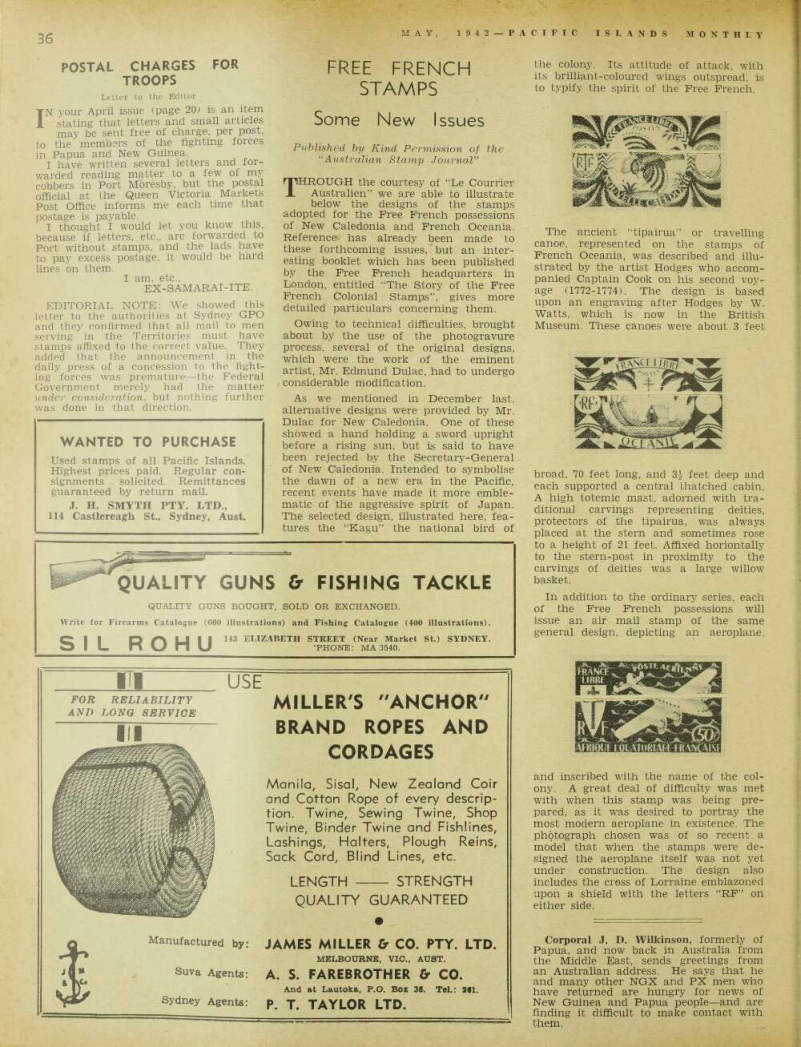
Troops
Letter to the Editor IN your April issue (page 20) is an item stating that letters and small articles may be sent free of charge, per post, to the members of the fighting forces in Papua and New Guinea.
I have written several letters and for warded reading matter to a few of my cobbers in Port Moresby, but the postal official at the Queen Victoria Markets Post Office informs me each time that postage is payable. .
I thought I would let you know this, because if letters, etc., are forwarded to Port without stamps, and the lads have to pay excess postage, it would be hkrd lines on them.
I am, etc.,
Ex-Samarai-Ite.
EDITORIAL NOTE: We showed this letter to the authorities at Sydney GPO and they confirmed that all mail to men serving in the Territories must have stamps affixed to the correct value. They added that the announcement in the daily press of a concession to the fight ing forces was premature —the Federal Government merely had the matter under consideration, but nothing further was done in that direction.
Stamps
Free French
Some New Issues
Published by Kind Permission of the “Australian Stamp Journal”
THROUGH the courtesy of “Le Courrier Australien” we are able to illustrate below the designs of the stamps adopted for the Free French possessions of New Caledonia and French Oceania.
Reference has already been made to these forthcoming issues, but an inter esting booklet which has been published by the Free French headquarters in London, entitled “The Story of the Free French Colonial Stamps”, gives more detailed particulars concerning them.
Owing to technical difficulties, brought about by the use of the photogravure process, several of the original designs, which were the work of the eminent artist, Mr. Edmund Dulac, had to undergo considerable modification.
As we mentioned in December last, alternative designs were provided by Mr.
Dulac for New Caledonia. One of these showed a hand holding a sword upright before a rising sun, but is said to have been rejected by the Secretary-General of New Caledonia. Intended to symbolise the dawn of a new era in the Pacific, recent events have made it more emble matic of the aggressive spirit of Japan.
The selected design, illustrated here, fea tures the “Kagu” the national bird of
the colony. Its attitude of attack, with its brilliant-coloured wings outspread, is to typify the spirit of the Free French.
The ancient “tipairua” or travelling canoe, represented on the stamps of French Oceania, was described and illu strated by the artist Hodges who accom panied Captain Cook on his second voy age (1772-1774). The design is based upon an engraving after Hodges by W.
Watts, which is now in the British Museum. These canoes were about 3 feet
broad, 70 feet long, and 3* feet deep and each supported a central thatched cabin.
A high totemic mast, adorned with tra ditional carvings representing deities, protectors of the tipairua, was always placed at the stern and sometimes rose to a height of 21 feet. Affixed horiontally to the stern-post in proximity to the carvings of deities was a large willow basket.
In addition to the ordinary series, each of the Free French possessions will issue an air mail stamp of the same general design, depicting an aeroplane,
and inscribed with the name of the col ony. A great deal of difficulty was met with when this stamp was being pre pared, as it was desired to portray the most modern aeroplane in existence. The photograph chosen was of so recent a model that when the stamps were de signed the aeroplane itself was not yet under construction. The design also includes the cross of Lorraine emblazoned upon a shield with the letters “RF” on either side.
Corporal J. D. Wilkinson, formerly of Papua, and now back in Australia from the Middle East, sends greetings from an Australian address. He says that he and many other NGX and PX men who have returned are hungry for news of New Guinea and Papua people—and are finding it difficult to make contact with them,
Advertisements & other items, p. 38 (1 item)
Quality Guns & Fishing Tackle
WANTED TO PURCHASE
Used stamps of all Pacific Islands.
Highest prices paid. Regular consignments solicited. Remittances guaranteed by return mail.
J. H. SMYTH PTY. LTD.,
114 Castlereagh St., Sydney, Aust.
QUALITY GUNS & FISHING TACKLE
QUALITY GUNS BOUGHT, SOLD OR EXCHANGED.
Write for Firearms Catalogue (GOO illustrations) and Fishing Catalogue (400 illustrations).
SI D IJ 143 ELIZABETH STREET (Near Market St.) SYDNEY.
I I— n VJ 1 IS U ’PHONE: MA 3540.
11l
FOR RELIABILITY
AND LONG SERVICE
USE
MILLER'S "ANCHOR"
BRAND ROPES AND
CORDAGES
Manila, Sisal, New Zealand Coir and Cotton Rope of every description. Twine, Sewing Twine, Shop Twine, Binder Twine and Fishlines, Lashings, Halters, Plough Reins, Sack Cord, Blind Lines, etc.
LENGTH STRENGTH
QUALITY GUARANTEED
• Manufactured by. JAMES MILLER Cr CO. PTY. LTD.
MELBOURNE, VIC., AUST.
Suva Agents: A. S. FAREBROTHER & CO.
And at Lautoka, P.O. Box 38. Tel.; 261.
Sydney Agents; p. J. TAYLOR LTD.
On And Off The
Dole
Experiences of NG Planter's Wife
HERE is an example of how a strong Association of Territory evacuees could assist its members.
Mrs. Willmott, by herself, can do little more than submit her complaints against officialdom to the newspapers, for public ventilation, in the hope that some public-spirited person will take up her case. But Mrs. Willmott, as a mem ber of the Association, will have no need to appeal to the public—the Association has been formed to protect the just claims of every evacuee.
On April 24. the following letter, from Mrs. R. Willmott, late of Rabaul, appeared in “The Age”, Melbourne: — “I would like to point out the hard ship caused by the decision of the War Damages Commission not to pay any compensation until after the war. In the case of New Guinea planters like myself, who have lost their properties, livelihood and all personal possessions, it operates very harshly, especially as we are also unable to collect any credits due to us.
“In this respect the Government is one of the principal offenders, as from October 1, 1941, all copra was compul sorily acquired by the copra pool. So far we have received for 1941 copra only half the price at which all NG copra production was sold in advance for six months by the pool, and nothing at all for January, 1942.
“Further, in the matter of war dam
age insurance, even if the actual capital losses cannot be assessed till after the war, surely the insurance payable on loss of crops could be paid at once in view of the fact that premiums already paid have reached such an enormous sum.”
“Financial Assistance”
Someone noticed Mrs. Willmott’s com plaint, for the following appeared a few hours later in the Melbourne “Herald”:— “While it is true that New Guinea planters who have lost their estates because of enemy occupation cannot be compensated until after the war, they will be entitled to financial assistance as evacuees.
“This was stated by a Commonwealth spokesman to-day. He said that a scale of assistance for all types of evacuees was now being drawn up and would shortly be approved. He pointed out further that in addition to giving them financial assistance as evacuees the Com monwealth Government would endeavour to find suitable jobs for dispossessed New Guinea planters.”
“Off The Dole”
On May 6, Mrs. Willmott, of 29 Park Street, South Yarra, Melbourne, wrote thus to the editor of the “PIM”:— “The assertions of the ‘Commonwealth spokesman’, which are embodied in the second cutting, read like an attempt to answer the points raised in my letter.
“It is to be hoped that the financial assistance promised will soon be forth coming, that it will be adequate, and that it will be given in a more generous spirit than the inadequate loan of £2 per week grudgingly doled out as sus tenance to the unfortunate women refu gees from NG.
“My own experience does not incline
me to optimism. In common with other women evacuees from NG, in January, 1942, I was granted a weekly sustenance allowance of £2. In February, 1942, the NG Trade Agent took it upon himself, apparently, to notify me that I would be ‘off the dole’ with effect from the 27th day of that month. His letter reads: ‘As it is noted that your husband has now arrived in Australia, I have to inform you that no further payment of the evacuee allotment will be made. It is desired that as soon as 'practicable you will take steps to repay any advances made to you. (Signed).—C* Leake.’ (Our italics).
“I am not aware that the Common wealth Government has made any effort to find a suitable job for my husband, whose arrival in Australia —suffering from the effects of malaria and exposure after a long and hazardous journey, and possessing only what he stood up in— is given as the reason for the cessation of the allowance.
“The thinly-veiled hostility displayed by some Commonwealth officials towards refugees from the Territory is sufficient warrant for my belief that we are re garded, not as distressed fellow-country men, but rather as undesirable aliens.
It is possible that our enforced stay in Australia serves as an irritant, an ever present reminder of past neglect to ensure the retention by Australia of the TNG, a Territory of which the strategic value is now realised —too late.”
Mr. Christopher Legge, BA, District Officer of Taveuni, Fiji, has been trans ferred to Ra as Assistant Provincial Com missioner.
Miss Hilda Toombs, sister in the Fiji Nursing Service, is at present on three months’ vacation leave.
Advertisements & other items, p. 39 (1 item)
Masse Batteries
FOR YOUR BOAT
Pit Masse for lighting, for wire-
less, for starting
Masse Batteries are made of the finest materials obtainable in the largest and most scientifically equipped factory in the Southern Hemisphere.
Investigate Masse's scientific design and rugged construction and you will be convinced there is no better battery made.
Masse BATTERIES
Masse Batteries are Tigers for Work—they simply lap it up!
OBTAINABLE EVERYWHERE.
Ask your Island Distributor.
Warning To
Traitors
No Mercy for "Defeatist" in New Caledonia
From Our Own Correspondent NOUMEA, March 11.
ANY person in New Caledonia who tries to spread the poison of “defeatist” propaganda by exploiting the gravity of the situation in the Pacific will be treated as he merits—not as an enemy, but as a common criminal, said High Commissioner Admiral Thierry d’Ar genlieu broadcasting from Radio-Noumea.
“I assure such people—and I am be ginning to know well their names —that they will not be regarded as political prisoners but will be condemned by com mon law. Under martial law, there will be no hesitation about that. I have warned them publicly before searching them out.
With firm resolution when the hour comes, I shall have them executed.”
Mr, Peter Rasmussen, who recently re turned to Western Samoa after com pleting a three years’ course of training at Auckland Hospital (NZ), has been ap pointed bacteriologist at Apia Government Hospital.
He Flew Home Around The World
THE Pacific Clipper of Pan American Airways, caught midway between New Caledonia and New Zealand by the outbreak of war in the Pacific on December 7, arrived safetly at La Guardia Field, New York, on January 6, after having gone around the world to skirt the trouble zones. It was a secret trip, unreported throughout, states the “New York Times”, but it was a trip packed with adventure.
Captain Robert Ford, who brought the Pacific Clipper through, told about a few of those adventures. He did not tell much, for secrecy was imposed on most details by Army and Navy officials. But as an instance of the sharp watch being kept for enemy aircraft in the ports of the United Nations, the captain told this story.
Suspicions Aroused
THE Clipper was approaching a port in the Far East —either British or pro tected by British arms. There had been a breakdown in arrangements, and the captain’s huge craft was not ex pected by the Royal Air Force control officer. It was daylight and, as he neared his landing place, Captain Ford saw a British fighter aeroplane ascend with great speed. The aeroplane got on his tail and he heard the radio conversation
between the fighter pilot and the control officer on the ground. He could not participate in that conversation because he did not know what radio frequency to use.
“What is she?” the control officer asked the fighter.
“I don’t know, but she’s a big one.
Might be German or might be Japanese.
Wait. There’s part of an American flag on her side.”
“That doesn’t mean a thing,” remarked the control officer. “Any one can paint on an American flag!”
“You’d better send up some help,” the fighter pilot said.
Escorted By Fighters
CAPTAIN FORD saw, a few seconds later, four more British fighters take to the air. In an incredibly short time they were in position to do him very grave harm indeed. And the captain heard some more conversation between the British aloft and the control officer below:— “What shall I do?” asked the pilot of the first fighter.
“Stay on her tail,” ordered the control officer. “If she gets even a little way off the normal course for landing, shoot her down.”
With five fighters having him under their guns, Captain Ford brought his ship to the water. And, he remarked, “we were very careful to use a conservative approach.”
The Final Adventure
THE final adventure of the Clipper took place, fittingly enough, at its final port—New York. The officer on duty in the control tower at La Guardia Field had not been informed that any thing out of the way was expected. And so he was astonished when he heard over the air these words from Captain Ford: — “Pacific Clipper, inbound from Auck land, New Zealand, Captain Ford report ing, due arrive Pan American Marine Terminal, La Guardia, seven minutes.”
The moment the message was received a representative of Pan American arrived at the control tower to tell the officer on duty that he was not hearing things.
But the trials of the Clipper were not yet over. Captain Ford’s announcement of his arrival was received at 5.54 a.m.
That was more than an hour before sun rise—and La Guardia Field regulations are that no Clipper may land before the sun is up. And so Captain Ford—22 days out of Auckland, more than a month out of San Francisco—was forced to fly around in circles until after seven o’clock, when the sun was properly up.
New Caledonia's Mines
From Our Own Correspondent NOUMEA, March 9.
THE number of workers employed in the mining industry in New Cale donia, varied between 6,000 and 6,400 in 1941, of whom 300 were heads and foremen —an average of one foreman to every 21 labourers.
The nickel smelters employed 19 per cent., and the nickel mines 54 per cent, of the total; thus the nickel industry was responsible for 73 per cent, of the mining effective. Chrome mines came next with 16 per cent., then iron with 9 per cent.
All but 10 per cent, of the work was above ground, for the major part of Caledonian mines use open cut quarrying methods, and only in certain of the largest mines, like the American Fan toche chrome mine, do works go far
underground.
Advertisements & other items, p. 40 (1 item)
Excelsior Supply Cd. Pty. Ltd
SHEAFFER’S WORLD FAMOUS
Streamlined, Feather Touch PENS and PENCILS
If you want Design, Beauty and Quality buy
a SHEAFFER
All Lifetime Pens are guaranteed for the life of the user except against loss and wilful damage.
When serviced, they are subject to a small fee for insurance, postage and handling.
Beautiful and Useful Gifts for All Occasions.
SKRIP- The
Successor to Ink makes all Pens write better. 2 oz. 1/6, 4 oz. 2/6 Plus Postage Distributors Identify the Lifetime Pen by the white dot
74T LTSC AA 3T
Feather Touch Lifetime Pencil Regular Pen Lifetime Pen Pencil 9.6 2b/- 75/- each 35 - ea. each each The working parts of the Sheaffer Pencil are guaranteed against wear for the lifetime of the user.
When serviced they are subject to a small fee for insurance, postage and handling.
All Sheaffer regular pens are guaranteed against defects of material -and workmanship.
Obtainable from Selected Jewellers and Sta tioners everywhere
EXCELSIOR SUPPLY CD. PTY. LTD
278 Post Office Place,
MELBOURNE, VIC.
HEAD OFFICEJ
160 BROADWAY,
SYDNEY, N.S,W.
50 Victoria Street,
WELLINGTON, N.Z.
The Birds Of
Paradise
By June Lett
THE birds of Papua are remarkable for the brilliance of their plumage, and their metallic colourings.
The Birds of Paradise, Racquet Tailed Kingfisher, the largest and smallest of parrots, and the great crowned pigeons, chiefly the Goura, are characteristic, as also are the Megapodes.
The Birds of Paradise were named by the Dutch on account of the brilliancy of their plumage and the belief that “possessing neither feet nor wings, they passed their lives in the air, sustained on their ample plumes from the branches of the lofty trees by the wire-like feathers of the tail”, and drawing their food “from the dews of heaven and the nectar of flowers”.
As late as 1760, no perfect specimen of the Paradise bird had been seen in Europe, for the natives who sold the skins to coastal traders, always removed their feet and wings.
They belong to the family Paradiseidae, and are closely allied to the crows. The largest of them all is the great Emerald Bird of Paradise, whose head and neck are covered with short, thick-set feathers of a bright straw colour, and a brilliant emerald green beneath. From under the shoulders, on each side, springs a dense tuft of golden-orange plumes about two feet in length, which the bird can raise to. enclose the greater part of its body.
The two centre tail feathers grow to a length of thirty-four inches; and, being destitute of webs, have a thin, wire-like appearance.
This plumage, however, belongs only to the adult males. The females are ex ceedingly plain, of uniform dusky brown colour, possessing neither plumes nor lengthened tail feathers. The young males at first resemble the females, but change to their perfect plumage after the fourth moulting.
When they are dancing, their wings are raised vertically over the back, the head is bent down and stretched out, and the long plumes are raised up and expanded till they form two magnificent golden fans striped with deep red at the base, and fading off into a pale brown tint down to the divided and softly waving points, and the whole bird is then over shadowed by this fan. The crouching body, yellow head and emerald green throat provide a foundation and setting for the golden glory which waves above.
It is at this season that these birds generally are captured.
Another specie's of this bird, the Prince Rudolph’s Blue Bird of Paradise, displays its feathers by hanging upside down.
With its legs fully extended, and wings slightly spread, the breast feathers are expanded forward, just enough to hide
the wings. The tail is then pressed for ward between the legs until nearly hori zontal, and its head is turned upward, while the bird swings backward and for ward from the hips, and occasionally draws the body upward and downward, bending the leg points.
This goes on for quite a while. Then the bird returns to its normal position, and starts all over again.
The native’s method of capturing Birds of Paradise is to hide among the lower branches of trees near the birds’ dancing ground, and as soon as they begin to “play” he shoots them with blunt arrows, to stun them and bring them to the ground without drawing blood, which would injure their plumage. So eager are these birds in their courtship that almost all the males are brought down before the danger is perceived.
It is the plumage of the lesser Bird of Paradise which is used for ladies’ head dresses.
These birds rarely live in captivity, and a bird in an aviary is not to be com pared with one of the same kind in the wilds. The bloom seems to fade from their beauty when they are caged for any length of time.
Papuans And Their First
Bombs
PORT Moresby had been bombed for the first time; and hundreds of native Papuans, new to this form of modern war, raced away inland, heading for the jungle with all possible speed.
Mr. H. Shaw, of Port Romilly sawmill, met an intelligent native of Hanuabada village, who had been watching the first wave of runaways.
“Well, Vagi,” remarked Mr. Shaw.
“How you like bombs, eh?”
“You know, Taubada, this war ’nother kind,” said Vagi. “I think New Guinea boy, inside here (placing his hand on his heart) must be more small than white men, and plenty boy he die.”
“How he die?”
“Well, plenty he die, I think,” repeated Vagi. “He get big fright and he run and run, and he so fright he keep on running ’til he run no more, and then he drop down dead.”
But that was in the beginning. It is said that the natives around Port Moresby are learning to treat bombs with indifference.
Names of two former members of the Western Samoa Administration appeared in New Zealand Army casualty lists re cently—Mr. L. J. Dawes (at one time District Officer on Savaii) was posted as “killed in action”, and Mr. V. Fairhall (formerly of the Treasury Department) as “wounded in action”.
Attacked by Japs
Launch's Escape
SOON after the Japanese launched their attack, in December, it was reported in Western Samoa, that distress signals had been received from what was believed to be an Allied aero plane, far out at sea. A large launch, manned by ten men, put out to sea, to give any help that was needed. The crew included Dr. P. R. Skinner, and the following is taken from a letter written by him and published in New Zealand.
When the launch was 100 miles out to sea it was suddenly attacked by a Japanese bomber aeroplane.
There was a savage onslaught of machine-gun fire, to escape which all of the occupants of the launch dived into the sea. The attack ceased, presum ably on the Japanese assumption that the crew had been wiped out, but mira culously not a man had been injured.
The launch was burning, the hull being badly holed and the engine damaged.
After a desperate struggle the fire was extinguished and order was restored sufficiently to enable the launch to make a perilous return voyage in two days.
Mr Warren Clemens, who has been a cadet in the BSIP Service since 1938 was recently appointed to be acting District Officer of Guadalcanal, according to a notice in the Western Pacific High Com mission Gazette.
Dr. Robert Snodgrass, Chief Medical Officer at the Suva Colonial War Mem orial Hospital, Fiji, has been in New Zealand on short furlough recently.
Advertisements & other items, pp. 41-42 (1 item)
Guard against Infection with Tenax!
MERIDEN
Church of England Grammar School for Girls.
REDMYRE ROAD, STRATHFIELD, N.S.W.
Situated In beautiful and healthy surroundings within 15 minutes of Sydney.
Comfortable, modern accommodation for boarders. Education from Kindergarten to Leaving Certificate Honours. Scientific Physical Culture and instruction in Art and Musical Appreciation.
Prospectus on Application.
The House of Steel for Quality Cutlery n We have a large range of Scissors, Knives, Razors, etc.
W. JNO. BAKER
3 HUNTER STREET, SYDNEY.
Established 1888.
Guard against Infection with Tenax!
ft iffl+ffl O / Wf y r /i ■+ i Germicidal Soap used regularly is an
unsurpassed safeguard against external germ
infection. It is kind to the most sensitive skin, - ■ yet its germicidal action is eleven times as rapid as carbolic. It is non-irritant and non-poisonous.
At All Chemists and Stores.
Now Only
ad tenax!
y per Tablet.
Tuan-
TENAX 'Uhe Genuinely Germicidal SOAP
NELSON & ROBERTSON
PTY., LTD.
Established 1895.
Islands Merchants
All classes of merchandise purchased at wholesale prices and original invoices supplied to Islands clients.
Cocoa Beans, Rubber and other Islands 7 produce sold on commission.
Nelson & Robertson
Pty. Ltd. 12 Spring Street, Sydney, Australia.
"Carrying On"
ANXIETY for the safety of the Euro pean personnel of the Melanesian Mission—numbering over 20 men and women—in the Solomon Islands, since the Japs began to pay attention to that part of the Western Pacific, has been alleviated by a message received in Sydney during the month. It stated that Rt. Rev. Walter Baddeley, DSO, MC, MA, and his staff have ample supplies, and that the work of the Mission is “carrying on”.
It was announced recently that the Mission’s trim little motor vessel “Southern Cross” (7th of her line), which had been running in BSI since 1932, now is in the service of the Royal Australian Navy, m Australian waters.
Free French Officer In
New Hebrides
A HIGH official from Noumea, Mons.
Fourcade, who is head of the French High Commissioner’s Civil Cabinet, recently visited the New Hebrides. His visit was welcomed by the planters, of whom he has seen a great number. At Port Vila he had lengthy conferences with the French Resident Commissioner, M. Kuter, upon matters of importance to the Administration. The New Heb rides de Gaulle Committee accorded him an official welcome.
Queen Salote's Kingdom
IN these days of frenzied finance, it is interesting to learn of a country without a national debt, a kingdom that pays its way, and a Treasury that boasts a surplus of about £200,000, com fortably invested.
Such is the happy state of Tonga, the only real island kingdom in the Pacific.
Nature has been more than lavish in her gifts to the Tongans, who are a charming people—kindly and courteous, of magnificent physique and dignified bearing.
Nukualofa, capital of this model State, lies beside a large lagoon on Tongatabu.
It is an attractive village, and gains interest by carrying all the machinery necessary for the working of an inde pendent kingdom. At the flagpole on the foreshore floats the Tongan stan dard. Not far from the wharf, and set in trees, is the wooden palace of the Queen, and the Chapel Royal. And, scattered within easy range, are the Treasury building, the tiny House of Parliament, the British Residency, and the offices of the Chief Justice and the Premier.
The Tongans should be the happiest race on earth. No one worries. Old age has no terrors. There is enough of everything for everybody.
Queen Salote is recognised in the Pacific as a woman of strong personal ity, with the interest of her 33,000 sub jects deeply at heart, and who does not hesitate to speak her mind when the occasion demands it. She is a forceful speaker, too, and, when she feels so dis posed, lets her legislators know what she thinks of their politics.
Queen Salote received her education at the Diocesan School in Auckland, and is an interesting and cultured woman, with a commanding appearance. The Queen has a private purse of about £2,000 a year on which to maintain her position.
F. T. Goedicke.
Fiji Airman In Hands Of
Japs
BECAUSE he chanced to switch on his radio and tune into a Tokyo short wave broadcast, just before going to bed at 10.15 p.m. on March 20, Mr. R. C.
Farquhar, of Suva, Fiji, was able to in form Mr. and Mrs. C. Sollitt, of Nausori, that their son, Aircraftsman Charles Sollitt, RAAF, who had been reported missing, is now safe and unhurt in a Japanese prison camp.
Mr. Farquhar said he had just got on to the Jap station when the announcer said “I have messages from war prisoners —the first is from Sollitt, Charles Hickson, Aircraftsman, Royal Australian Air Force, aged 20. His parents live at Nausori, Fiji Islands. He sends his love to his mother and father and Eileen (his sister). He was picked up out of the sea and is unhurt, and is now in a prisoner of-war camp with some Australians and Americans.
“Sollitt says T am unhurt. It’s fairly cold here, and if I am going to be here next year I shall be glad if you will send some warm clothing. I shall also be grateful for some comforts. I don’t know when I shall be able to write’.”
Burns, Philp and Co. Ltd., and Burns Philp (S.S.) Co. Ltd. report that because war conditions have delayed receipt of returns from branches, the issue of the balance sheets will be delayed this year.
The balance sheets are usually available late in April or early in May.
Advertisements & other items, p. 42 (1 item)
Steamships Trading
Allen Taylor &! Co. Ltd.
COMMERCIAL ROAD, ROZELLE,
SYDNEY
Sawmillers and Wholesale Suppliers of Hardwoods for Constructional Purposes GIRDERS . . . PILES . . . POLES . . . SLEEPERS, Etc,
EXPORTING TO PACIFIC ISLANDS SINCE 1893
Steamships Trading
Company Limited
PORT MORESBY SAMARA! PAPUA.
WHOLESALE & RETAIL MERCHANTS, SHIPOWNERS,
PLANTERS, TNGINEERS & SLIP PROPRIETORS.
Customs, Shipping, Insurance, and Forwarding Agents.
MANAGING AGENTS AND VISITING REPRESENTA-
TIVES FOR COCONUT AND RUBBER ESTATES.
SYDNEY REPRESENTATIVES: Nelson & Robertson Pty. Ltd., 12 Spring Street.
CLIENTS PLEASE NOTE
Temporary War Address— C/o Nelson & Robertson Pty. Ltd., 12 Spring St., Sydney.
WRITE, CABLE, OR CALL
STEAMSHIPS TRADING COMPANY LIMITED
Cable Address: "Steamships".
About Islands
People
Rev. J. H. Spivey? of the London Mis sionary Society station at Abaiang, Gil bert Islands, is at present doing deputa tion work in South Australia.
Mr. David Hammer, of the Church of Christ Mission in the New Hebrides, is at present servirTg temporarily as min ister of Tumby Bay, South Australia.
Monsieur Maurice Schwob, who is in charge of the economic section of the Free French High Commissioner’s staff at Noumea. New Caledonia, visited Australia last month.
Rev. Godfrey Gilbert, of the Austra lian Board of Missions staff on Moa Island, Torres Strait, has been trans ferred to the Lockhart River Mission in Northern Australia.
Monsieur Henri Basquin, of La Foa, New Caledonia, was killed in a motor car accident last month near La Ton touta. The vehicle ran off the road and overturned, M. Basquin being killed and the two other occupants injured.
Mrs. Maud Payten, wife of Mr. H. A.
Payten, of Lord Howe Island, was brought to Sydney, critically ill, early in April, by flying'-boat. When the Lord Howe Island Board of Control in Sydney learned that an urgent operation was necessary, it contacted the military authorities and a seaplane was des patched early one morning; it alighted on the lagoon at LHI a few hours later, took aboard Mrs. Payten, and returned immediately to Sydney. From the land ing-place, she was taken by a waiting ambulance to Prince Henry Hospital.
Her condition on May 12 was described as “progressing favourably”.
Rev. John Gilkison, of the London Mis sionary Society, who died recently from blackwater fever at Mogubu, in the Mailu District, Papua, had been in the Territory only three years. He was just 28. Born in NZ, he studied for the min istry at Trinity Theological College, Auckland, and then was in charge of the Lower Hutt Congregational Church.
After receiving training in Sydney in tropical medicine and dentistry, and in anthropology, he went to Papua at the end of 1938. The following year he mar ried Miss Ngaire Hill, formerly an LMS worker in Western Samoa. A fortnight before Mr. Gilkison died, his wife and baby daughter were evacuated from Papua in company with other women residents. They now have returned to New Zealand.
Territories Residents in Australia
Australia
SINCE the full list of Australian addresses of evacuees from New Guinea and Papua was published in the February, March and April issues of the “PIM”, the following additional names (in some cases, merely new addresses) have been received:— Allen, J. T. (NG), c/o E. J. Dengate, Camden, NSW.
Baker, Mrs. W. (NG), 58 Springdale Rd., Killara, NSW.
Briggs, W. H. (NG), 43 Thompson St., Ormond, Melbourne, V.
Cambridge, R. (NG), 197 Eastern Rd., Wahroonga, NSW.
Coote, Mrs. P. (NG), 58 Springdale Rd., Killara, NSW.
Crozier, H. C. (P), Marlborough, Q.
Davis, E. A. (P), HMA Naval Establish ments, Sydney, NSW.
Douglas, W. (NG), 2 Real St., Annerley, Q.
Ede, Isadore (P), c/o Elliott’s & Aus tralian Drug Co., Ltd., 20 O’Connell St., Sydney, NSW.
Eylitz, Axel (NG), c/o Swedish Consul, 254 George St., Sydney, NSW.
Forsyth, G. (NG), Short St., Stanthorpe, Q.
Froggatt, J. L., 80 St. George’s Crescent, Drummoyne, NSW.
Furlong, Mrs. R. B. (NG), “Sunnymead”, Roma, Q.
George, P. (NG), Treasury, Canberra,
Act
Gibson,’T. C. (NG), c/o Zinc Corpora tion, Broken Hill, NSW. .
Hann, E. (NG), 77 Albion Rd., Albion, Q.
Herbert-Hughes, E. (Pi, Lower Portland, Hawkesbury River, NSW.
Kenny, J. T. (NG), 64 Wellington St., Sydney, NSW.
Koch, H. (NG), Redcliffe, Q.
Koskey, A. C. (NG), Box 1454 N, GPO, Elizabeth St., Melbourne, V. (Address incorrectly stated in April issue.)
MacEachran, Mrs. (BSD, Faulds Bridge Bag. Wynyard, T.
Miles, R. P. (NG), East St., Warwick, Q.
Munt, J. G. (P), c/o Travel Dept., Bank of NSW, Brisbane, Q.
Pennefather, V. (NG), 43 Darling St., Chatswood, NSW.
Priebe, A. R. (NG), Wood St., Dalby, Q.
Prince, T. (NG), Catten, Q.
Reid. Mr. and Mrs. J. B. (NG), 115 Bar kers Rd.. Kew, E 4, Melbourne, V.
Richards, A. (NG), Treasury, Canberra,
Act.
Roberts, E. (NG), c/o W. G. Clark, AWA Ltd., 47 York St., Sydney, NSW.
Robinson, R. (NG), c/o BP and Co. Ltd., 7 Bridge St., Sydney, NSW.
Ross, Mrs. Alan (NG), 12 “Ellerstie”, Vic toria St., King’s Cross, NSW.
Ryall, K. W. (NG), 30 Trafalgar St., Brighton-Le-Sands, NSW.
Seale, H. P. (NG), 6 Mason Ave., Chel tenham, NSW.
Schultze, H. L. (NG), Lagoon St., Goul burn, NSW.
Taylor, E. (NG), 103 Silver St., Marrick ville, NSW.
Winfield, Mrs. G. B. (NG), 30 Darling St., South Yarra, SEI, V.
"C'est La Guerre"
THE brisk young man whose name is Ignorance is a familiar character in the “Pilgrim’s Progress”. We some times meet him in common life. We found him in a store the other day.
Lady: “I want a wire stretcher, please.”
“Yes, madame; but we can not provide it under a fortnight.”
Lady: “Oh. dear! I want it to-night.” 8.Y.M.: “Quite impossible; don’t you know there is a war on?”
Lady: “I ought to, considering I lost everything in New Guinea!”
La Legion Valmy, a group of volunteers organised for the defence of Tahiti, is being financed by the local budget, says “Bulletin du Commerce”. An amount of 350,000 francs is to be allowed to cover requirements.
Rev. J. F. Goldie, pioneer BSI mission ary, is at present living in Queensland.
Advertisements & other items, pp. 43-44 (2 items)
Burns Philp Trust
Above
PEACE OF MIND
A visit or a brief note to the offices of this Company will bring you two special booklets setting out a plan for assuring peace of mind in connection with the efficient conduct of your affairs during lifetime, and the administration of your estate after death.
Burns Philp Trust Co. Ltd. undertake the supervision of investments and property, the preparation of income tax returns, collection of rents, payments of rates, taxes, etc., thus providing relief of mind and assurance of conscientious administration for those who desire a greater degree of equanimity in these anxious days. This service is additional to that whereby the Company undertakes the administration of estates under wills.
DIRECTORS—James Burns - Robert John Nosworthy - Lewis Armstrong - Joseph Mitchell MANAGER—C. H. Chester
Burns Philp Trust
COMPANY LIMITED
my
7 BRIDGE STREET. SYDNEY
PHONE: B 7901. Box 543 B, G.P.0., Sydney. v:: - -- ■ =
PURE RICE
STARCH
Always ask for . . .
CORAL” BRAND
100% PURE
Noted for Its
QUALITY
and
WHITENESS.
Goes Farthest and gives Lasting Finish
WILL NOT
STICK TO
IRON.
Obtainable from Leading Island Stores.
Manufactured by
AUSTRALIAN RICE, LTD.,
Sydney, N.S.W.
CORAL BRAND
RICE STARCH
CORAL
PRESCOTT Pty. Ltd.
SUSSEX ST. SYDNEY,
are sole wholesale agents for
PINEAPPLE BACON&HAMS
DAISY brand BUTTER "375" BUTTER in TINS Ilb.-21b.-slb. Size*.
LEA & PERRINS’ Sauces and Most other Super-Quality Lines of the Trade, such as Cheese, Eggs, Etc.
READ THE
B. P. MAGAZINE
AUTUMN NUMBER
iiiiiiiiiiiiiiiiiiiiiiiiiiiiiiiiiiiiiiiiiiiiiiiiiiiiiiiiiiiiiiiiiiiiiiiiiiiiiiiiiiiiiiiiiiiiitinniiiii
NOW ON SALE
Short Stories - Pictures Travel Articles - - - - Pages for the Children Stage Latest Fashions --- Screen A
ONE SHILLING PER COPY.
ON SALE AT ALL NEWSAGENTS AND BOOKSELLERS
End Rheumatism
While You Sleep
If you suffer sharp, stabbing pains, if joints are swollen, it shows your blood is poisoned through faulty kidney action. Other symptoms of Kidney Disorders are Burning, Itching Passages, “Getting up Nights,” Backaches, Lumbago, Leg Pains, Nervousness, Dizziness, Headaches, Colds, Puffy Ankles, Circles under Eyes, Lack of Energy, Appetite, etc. Ordinary medicines can’t help much —you must kill the germs ruining health. Cystex ends these troubles by removing the cause. Get Cystex from any Chemist on Guarantee to put you right or money back. Act Now ! In 24 hours you will feel better and be completely well in one week. The Guar- PVGTOV antee protects you. Now jf ® wCA in 3 sizes: 1/9, 4/-, 8/-.
GUARANTEED for Kidneys, Rheumatism, Bladder
The Melanesian As He Really Is
A Character Study by the Late Rev. Maurice Prater, Who Died Last Year After a Lifetime of Missionary Service in the New Hebrides.
IF you take the South Seas slowly and deliberately, you may come to learn something of the races that inhabit them; and to know them is to under stand many pages of their history.
I thought I knew all that was to be known about these people during my first twelve months among them. They appeared to be quite simple and unso phisticated. I was sure that as soon as I was master of their language, I should find them easy to read and still more easy to handle.
I did not know half as much about them after three or four years, and the longer I lived among them the less con fident I became. Now, after nearly forty years among the natives of the New Hebrides, I realise that there is still a great deal to learn, and that I should require another lifetime to learn all.
Simple and childlike one moment, art ful and intriguing the next, the native is complex in his simplicity and artless in his scheming and duplicity. Often behind the apparently simple statement of one you detect a hidden meaning, and then when you suspect a sinister motive be hind the speech of another you find it is not there. Tantalising, yet engaging.
crafty yet guileless, suspicious yet con fiding, they confound all your precon ceived ideas, provoke all your senses, and call for all the patience that is in you.
Kindly And Courteous
rE world knows them as savages, but they are kindly and courteous, with a natural charm of manner befit ting their fabled home. There are some outstanding characters among them, such as one can find in any race, and such men and women are regarded by their fellows with the deference every where paid to talent and superior stature. There is a natural refinement about these folks, dignity and politeness being conspicuous features whether in dealing with one another or with Euro peans.
At times this politeness can be highly exasperating when, for fear of giving offence, they are economical of truth and are reluctant to give a straight answer.
You put a question to a native and the first thing he does is not to state what he thinks, but to discover the sort of answer you want. Watching your countenance and tone of voice, he will try and find out what you think about it yourself. Should you have an open mind he is not afraid to speak, but if you maintain a sphinx-like silence, he refuses to commit himself and takes refuge in a subterfuge, answering, “Whatever you say yourself.”
This reserve is a great stumbling-block to free intercourse and reciprocal rela tions between the two races. Doubtless it arises from a fundamental difference in outlook and upbringing: the one obeys written laws, the other tribal customs.
But when unfettered by convention, natives are not sycophants by any means.
They express their minds freely, and give constructive views on the subject under review, showing confidence in themselves and their capabilities. Such men are to be found everywhere, and are excellent material to work with.
Stoical Children
NATIVES are naturally cheerful, and not easily turned from the even tenor of their ways. Children of nature and of the sun, they live on the sunny side of life and are never dejected for long by adversity or sorrow. They enjoy life to the full, untroubled with the care of yesterday and heedless of what to-morrow may bring. Even after a night of wailing, when stricken with grief, they soon regain their gaiety of spirit. Death is marked by unrelieved and bitter mourning, when the men, with stolid mien, and the women, with violent lamentations, give way to implacable grief. Yet it is not long before you see the mourners resuming the daily routine of life and chattering as gaily as before.
As babies, they are far more solemn and staid than white children. They do not cry nearly so much, and will endure discomfort without a murmur.
Wrapped up in a blanket upon their mother’s back, with only their woolly heads appearing over her shoulder, they will travel for hours with the scorching sun beating upon them. Under the fierce heat the tiny heads toss and roll from side to side without a word of complaint from the little mites. Under such an ordeal white babies would kick and scream.
At play they are less noisy and lack
the bounding spirits and tireless energy of white children. With spleens enlarged from constant malaria, they clasp their hands over their fat, distended stomachs and stare like graven images at passers by. But as soon as babyhood is left behind, and they are set free from the pampered care of their mothers and the village matrons, they, in company with the young life of the village, grow up cheerful as the birds and happy as the day is long.
A Born Dramatist
rE native is 'by nature unsceptical and, from his earliest contact with Europeans, this trait has made him the prey of every unscrupulous adven turer that crossed his path.
Coupled with this natural characteris tic is another which makes him an easy victim for exnloitation. He is a born dramatist. “All the world’s a stage, and men and women merely players.” Noth ing throws him off his balance like the lure of the fantastic, and he is at the mercy of any garrulous man of fortune.
Travellers from overseas soon learned to take advantage of this weakness, and would snin all sorts of grotesque fairy tales. The most absurd and impossible stories were accepted with question; indeed, the more improbable and fan tastic the tale, the greater the likelihood of obtaining credence.
With such a capacity for being duped, Pacific Islanders have provided a happy hunting ground for all kinds of rogues, from blackbirders to pirates. Reacting to this trait in the native character, the South Sea Islanders have produced more soldiers of fortune than any other part of the world. Bully Hayes was a product of the South Seas.
Easily Duped
AN adventurer from America, with a flair for the fantastic and theatri cal, landed on the island of Am brim, New Hebrides, with a consignment of grog. The natives had only shortly before taken a pledge to abstain from intoxicating liquors and the exploiter soon recognised that he was going to have difficulty in disposing of his wares.
Bargaining on the credulity of his cus tomers. he hit upon a novel device and electrified the natives by exhibiting on the door of his tent a proclamation from the President of the United States giv ing him authority to sell, and the natives permission to buy as much grog as they panted. The unsophisticated islanders accepted the notice at its face value and were at once converted from passive resisters into active customers and agents. As soon as the stock was cleared, the Yankee made a hurried departure, leaving his dupes, poorer, sadder and wiser men.
Prey To Recruiters
RECRUITERS from overseas visited the New Hebrides islands, and from them the young men heard of the wonderful lands just over the sky-line, and the fortunes that awaited them there. Living in a drab and lonesome world, they were excited beyond mea sure and welcomed the opportunity of escape from the monotony of their hum drum existence.
On the impulse of the moment, at the beck of an unknown wanderer, they left their homes in great numbers and embarked on what turned out to be in many instances either a wild goose chase or a mad adventure. The early history of native contact with Europeans is a chronicle of one long series of ruinous escapades and outrages.
Conscientious traders who reside in the Islands and refuse to countenance such methods are placed at a great dis
advantage in their dealings with the natives. They are no match for the wild romancers to whose promises and programmes there is no limit. Though they c?eTu.l?y^rt h e OP naTives e is 10 a ng m enace th to which they are continually exposed.
And, unfortunately, though the natives have been taught dearly-bought lessons, they never remember for long. The stage is set always for the man of fortune; and the next one who comes along, with another version of the same old story, offering rivers of rum and mountains of sugar, is sure of a welcome and of the readiness of the natives to embark on a new venture. But every act of the drama ends in the same way, and the natives leave the stage the dupes of the travelling showmen.
Why Hurry?
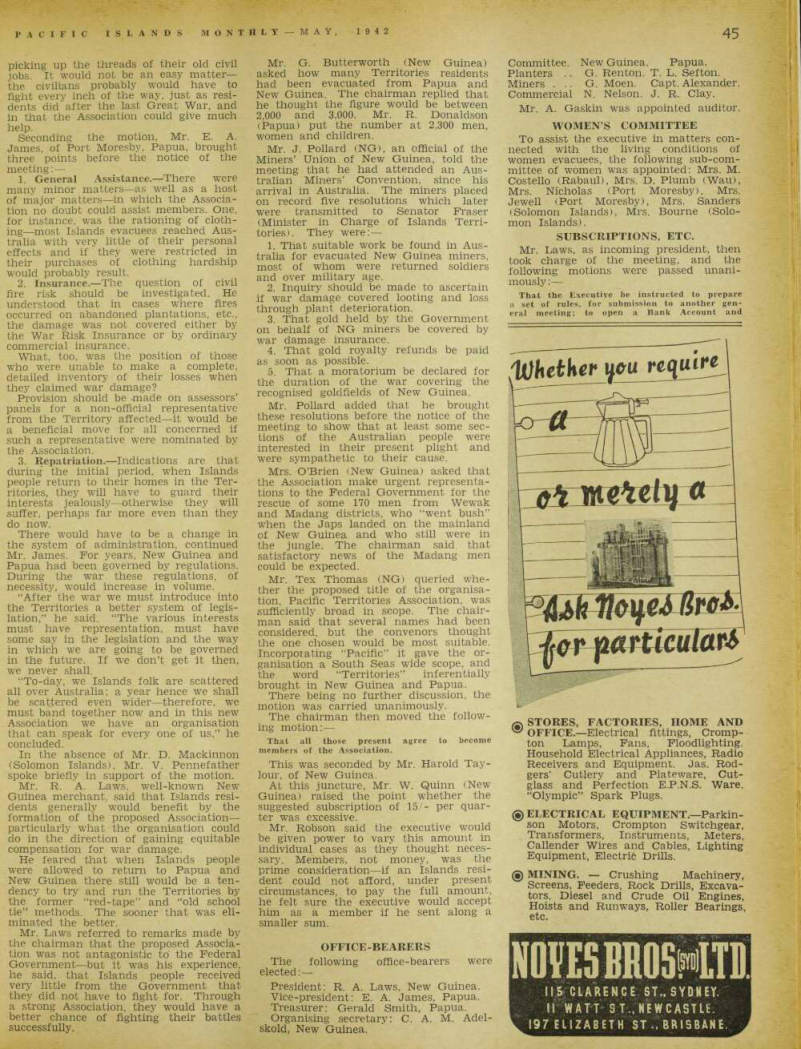
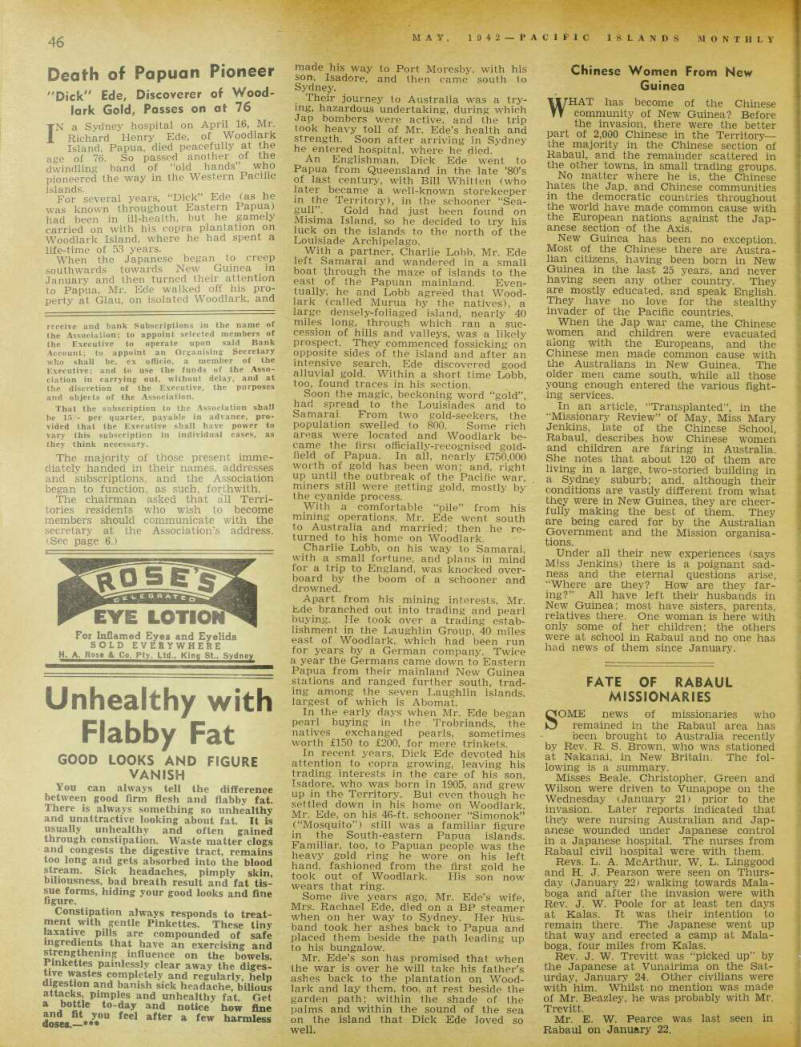
THE islanders have an infinite capacity for patience; it is pre-eminently a native virtue. The whole scheme of life is adapted to its cultivation. No delirium of speed here. The natives are never pressed for time and remain in blissful ignorance of the bustle and hustle of express locomotion. No need for time-tables; there is no bus or train to catch or office enforcing punctuality.
Why hurry? All time is before you.
The classic answer which was made to a request for a time-table in Skye, Wes tern Hebrides, Scotland, is every whit as appropriate to the New Hebrides: “Weel, she’ll be coming sometimes sooner, and whiles earlier, and sometimes before that again”.
(Continued on Page 47)
A daughter has been born each to Mrs. A. Wagner, Mrs. Emil Wagner, and Mrs. C. Kirsch, of the New Guinea Lutheran Mission, who were evacuated to Adelaide, South Australia, a short time ago. Their husbands are still in the Territory.
Only during the seven months of the garden season are they really busy. For the rest of the year, time lies heavy on their hands.
Before the advent of the white man, when the claims of industry were not recognised, the natives, during the off season, were experts at doing nothing.
Grown-up men were content to pass their time drawing meaningless scrawls on the sand and chattering aimlessly.
Now, however, their hoary traditions are breaking down before the advance of “civilisation”, and the altered condi tions are obliging the natives to work in order to meet their share of communal expenses and furnish their homes with what are now necessities of life.
The world calls them lazy, but that is a mistaken epithet. Laziness is a deliberate thing. Their idiosyncracy is not so much a matter of choice and temperament as of native climate. In industry and agriculture they are already proving capable and diligent workmen.
In their savage environment endurance went hand in hand with patience. In the old days when blood feuds and rapine were every day features of Islands life, patience and endurance were endow ments sorely needed. In the peaceful days in which they now live, these quali ties are still strikingly reproduced in times of sickness. Pain is endured patiently and unflinchingly. To see a man, with feet twisted and lacerated with yaws, limping along a ragged bush track without a groan, is to see patience and endurance personified. I do not suppose they feel pain and fatigue as Europeans do, but they have their own share of the ills that flesh is heir to and they bear them resolutely. The advent of civilisation has brought them many gains, and by no means the least is the care and treatment of a medical hos pital.
Indifferent To Pain
WHILE patient under pain themselves, they are extraordinarily indifferent to pain in others and callous to the sufferings of animals. They are very clannish and extremely sensitive to trouble in their own tribe, but their sympathy seldom crosses the border. One would not like to say they are deliber ately harsh, but they have an animal indifference to pain which does not touch them.
Their treatment of animals is notorious.
Lameness in dog or cow or horse awakens no feelings of compassion nor makes them eager to alleviate the suffering, except in the most casual way. A native ser vant thinks nothing of tying a string of fowls to the end of a bamboo carrier and letting them hang for hours head downwards in the blazing sun. The misery and distress of the birds do not give them the slightest concern. Re prove them as you like, they have diffi culty in understanding your point of view, and think you foolish to trouble about it. The Mission schools are con fronted with a big and commendable task in instilling into the minds of the rising generation a new and compassion ate attitude to the sufferings of the lower animals. In the New Hebrides, among aborigines who have an unyield ing clutch of the past, one learns that the tender graces of sympathy and com passion are virtues of slow and gradual growth.
They are proud, but not with the cheap pride of arrogance. Theirs is the pride that is easily offended, almost childishly, but not a pride that willingly offends.
They rarely cherish rancour and do not
keep up ill-will for long. Enemies of yesterday will meet to-day the best of friends. They quickly forget past troubles and treat them as though they never existed.
The natives have achieved consider able dexterity in wood-carving, the best examples of which may be seen in the figures decorating their canoes, images and fighting clubs. Compared with their style of carving, their efforts in drawing are quite primitive and childlike. They are ignorant of perspective and sym metry and cannot draw a straight line Among European residents it is a fre quent remark that the native is com pletely lacking in a straight eye. They find it difficult to put a blanket on a bed straight, and to find a route between two points they would be sure to choose a roundabout rather than a direct way.
This characteristic appears in the af fairs of everyday life. They delight to approach an objective from an angle, and, no matter how trivial the affair may be, make a business of it. They will not go straight to the goal if there is a roundabout way of getting there.
Were the end sought of great import ance, their methods might savour of policy, but even where the object is one of everyday occurrence and perfectly harmless, the means employed would be indirect to please them; possibly, what appears indirect to us may be to them the most likely method.
The Native Mind
rpHE native is the slave of precedent.
X Each succeeding generation follows its predecessor in the track of a long line of ancestors, trodden down by cen turies of bare feet. The whole of native philosophy is summed up in their roads.
The Oxford Dictionary is of little value when you want the definition of a road in New Hebrides. It is not a substantive thing but only a trail or goat-track.
Travelling is simply a question of “Follow the leader”. The islander’s way of doing a thing is to do it as the man who went before him did it. Precedent, not principle, is the time-honoured law.
Among natives there is a real com radeship, most apparent when Europeans are involved. Unless they have a par ticular purpose to serve, they will not willingly get each other into trouble. The boat’s crew of an Islands steamer, when summoned before the captain for delin quency, are like schoolboys in the pre sence of a master. They show a united front against the common enemy. They will not let each other down. In this they are real sports.
They have wonderful memories and have no need of extraneous aids like Pel manism. Their system of life tends to develop the memory. Unable to read or write, their fathers trusted their memories where we depend on note books. They can recall incidents that happened years before and give details like a newspaper. Not through books, but through the living tales of racon teurs around the camp fire, history and mythology were transmitted from gener ation to generation with scarcely any variation in the process.
I have often wondered at the reten tive memories of natives who accom panied me on island journeys. They will tell you the names of all the birds, trees and fruits you meet in the bush. Very few European youths could do the same.
The native mind is capable of great ex pansion, and the teaching and training of the schools will yet fit them for tak ing a larger and more responsible place in the industry and councils of their island world.
The native is incurably religious. Like men of every race and place he has been moved to explain in myth the origin of himself and the world in which he finds his home. He lives in a world filled with spirit powers, between whom and himself there is constant communi cation. Everything around him is charged with mystic properties which may at any moment come into his life for good or evil. Even when travelling in the lonely bush, the crackling of a twig is an indication of the presence of some spirit seeking to communicate with him, and he responds to the gesture by throwing an answering twig in the direc tion of the sound.
Whatever he may be, the native is no materialist. Pierce down beneath the happy, careless demeanour of the New Hebrides native and you will find that the things that move him most are not the things that are seen, but the things that are unseen. These unseen forces are the determining factors in his life.
Advertisements & other items, pp. 45-47 (2 items)
Impe rial
★ Jane Wyman—Hollywood Star, now housewife and mother, serves quick, tasty saiads on hot summer days.
Every successful young housewife saves herself
TIME . . . WORRY . . . ENERGY—THIS WAY And what an idea to serve crisp, cool salads in just 5 minutes with Imperial “Hampe”—the quick-serve summer delicacy that’s ready cooked and flavoursealed. Try it sliced or diced or serve it whole as it comes from the can.
Everyone loves the delightful flavour of the mild-cured ham and tender veal in “Hampe”. Be prepared and order three or four cans to-day!
Impe rial
HAMPE
Product of Riverstone Meat Co. Pty. Ltd., Sydney.
Islands' Visitors to Sydney Will find excellent accommodation at
u 106" PRIVATE HOTEL
204-8 Victoria Street, Kings Cross, Sydney.
Every Comfort, Splendid Table.
Tariff from 35/- per week.
MRS. C. PYATT, Proprietress.
Tel. FL 4272.
Gland Discovery
Restores Youth
in 24 Hours
Sufferers from loss of vigour, nervousness weak body, impure blood, failing memory, and who are old and worn-out before their time will be delighted to learn of a new gland discovery by an American Doctor.
This new discovery makes it possible to quickly and easily restore vigour to your glands and body, to build rich, pure blood, to strengthen your mind and memory and feel like a new man in only 8 days. In fact, this discovery, which is a home medicine in pleasant, easy-to-take tablet form, does away with gland operations and begins to build new vigour and energy in 24 hours, yet it is absolutely harmless and natural in action.
The success of this amazing discovery, called Vi-Stlm has been so great in America that it is now being distributed by all chemists here under a guarantee of complete satisfaction or money back. In other words, Vi-Stim must make you feel full of vigour and energy and from 10 to 20 years younger, or you merely return the empty package and your money will be refunded. A special, double-strength bottle of 48 Vi-Stim tablets costs little and the guarantee protects you.
Vi-Stim
GUARANTEED
h to Restore I Manhood and Vitality . . ,
For perfect cutting
under all conditions
There is a Ransomes Mower for every lawn cur range covers machines for every requirement from the smooth, even surface of the putting green to the sports ground, golf course or aerodrome.
The "MOON" Mower
GANG
MOWERS
For grass such as couch, kikuyu, buffalo, etc., and grass longer than the average. 14-in. and 18-in. wide. 50 acres a day can easily be cut with a Ransomes Quintuple Mower drawn by a tractor and even larger outfits up to' 25 ft. wide are available. -
ansomes
Lawn Mowers
Write for illustrated literature and all information
MORRIS, HEDSTROM LTD.,
Suva, Lautoka, and Ba.
Made by RANSOMES, SIMS & JEFFERIES LTD., IPSWICH, ENGLAND.
STORES, FACTORIES, HOME AND
OFFICE. —Electrical fittings, Crompton Lamps, Fans, Floodlighting.
Household Electrical Appliances, Radio Receivers and Equipment. Jas. Rodgers’ Cutlery and Plateware, Cutglass and Perfection E.P.N.S. Ware.
“Olympic” Spark Plugs.
© ELECTRICAL EQUIPMENT.—Parkin-
son Motors, Crompton Switchgear, Transformers, Instruments, Meters, Callender Wires and Cables, Lighting Equipment, Electric Drills. © MINING. Crushing Machinery, Screens, Feeders, Rock Drills, Excavators, Diesel and Crude Oil Engines, Hoists and Runways, Roller Bearings, etc.
NOVESBROS.ITD
115 CLARENCE ST.,SYDNEY.
II WATT ST..NEWCASTLE.
Lj97 ELIZABETH ST .. BRISBANE. 1
Pacific Territories
44
MAY, 1942 PACIFIC ISLANDS MONTHLY
Pacific Territories Association
(CONTINUED FROM PAGE 5)
Death of Papuan Pioneer
"Dick" Ede, Discoverer of Wood lark Gold, Passes on at 76
IN a Sydney hospital on April 16, Mr.
Richard Henry Ede, of Woodlark Island, Papua, died peacefully at the age of 76. So passed another of the dwindling band of “old hands ’ who pioneered the way in the Western Pacific islands. .. „ , For several years, “Dick” Ede (as he was known throughout Eastern Papua) had been in ill-health, but he gamely carried on with his copra plantation on Woodlark Island, where he had spent a life-time of 53 years.
When the Japanese began to creep southwards towards New Guinea in January and then turned their attention to Papua, Mr. Ede walked off his pro perty at Glau, on isolated Woodlark, and
made his way to Port Moresby, with his son, Isadore, and then came south to Sydney.
Their journey to Australia was a try ing, hazardous undertaking, during which Jap bombers were active, and the trip took heavy toll of Mr. Ede’s health and strength. Soon after arriving in Sydney he entered hospital, where he died.
An Englishman, Dick Ede went to Papua from Queensland in the late ’Bo’s of last century, with Bill Whitten (who later became a well-known storekeeper in the Territory), in the schooner “Sea gull”. Gold had just been found on Misima Island, so he decided to try his luck on the islands to the north of the Louisiade Archipelago.
With a partner, Charlie Lobb, Mr. Ede left Samarai and wandered in a small boat through the maze of islands to the east of the Papuan mainland. Even tually, he and Lobb agreed that Wood lark (called Murua by the natives), a large densely-foliaged island, nearly 40 miles long, through which ran a suc cession of hills and valleys, was a likely prospect. They commenced fossicking on opposite sides of the island and after an intensive search, Ede discovered good alluvial gold. Within a short time Lobb, too, found traces in his section.
Soon the magic, beckoning word “gold”, had spread to the Louisiades and to Samarai. From two gold-seekers, the population swelled to 800. Some rich areas were located and Woodlark be came the first officially-recognised gold field of Papua. In all, nearly £750,000 worth of gold has been won; and, right up until the outbreak of the Pacific war, miners still were getting gold, mostly by the cyanide process.
With a comfortable “pile” from his mining operations, Mr. Ede went south to Australia and married; then he re turned to his home on Woodlark.
Charlie Lobb, on his way to Samarai, with a small fortune, and plans in mind for a trip to England, was knocked over board by the boom of a schooner and drowned.
Apart from his mining interests, Mr.
Ede branched out into trading and pearl buying. He took over a trading estab lishment in the Laughlin Group, 40 miles east of Woodlark, which had been run for years by a German company. Twice a year the Germans came down to Eastern Papua from their mainland New Guinea stations and ranged further south, trad ing among the seven Laughlin islands, largest of which is Abomat.
In the early days when Mr. Ede began pearl buying in the Trobriands, the natives exchanged pearls, sometimes worth £l5O to £2OO, for mere trinkets.
In recent years, Dick Ede devoted his attention to copra growing, leaving his trading interests in the care of his son, Isadore, who was born in 1905, and grew up in the Territory. But even though he settled down in his home on Woodlark, Mr. Ede, on his 46-ft. schooner “Simonok” (“Mosquito”) still was a familiar figure in the South-eastern Papua islands.
Familiar, too, to Papuan people was the heavy gold ring he wore on his left hand, fashioned from the first gold he took out of Woodlark. His son now wears that ring.
Some five years ago, Mr. Ede’s wife, Mrs. Rachael Ede, died on a BP steamer when on her way to Sydney. Her hus band took her ashes back to Papua and placed them beside the path leading up to his bungalow.
Mr. Ede’s son has promised that when the war is over he will take his father’s ashes back to the plantation on Wood lark and lay them, too, at rest beside the garden path; within the shade of the palms and within the sound of the sea on the island that Dick Ede loved so well.
Chinese Women From New
Guinea
WHAT has become of the Chinese community of New Guinea? Before the invasion, there were the better part of 2,000 Chinese in the Territory— the majority in the Chinese section of Rabaul, and the remainder scattered in the other towns, in small trading groups.
No matter where he is, the Chinese hates the Jap, and Chinese communities in the democratic countries throughout the world have made common cause with the European nations against the Jap anese section of the Axis.
New Guinea has been no exception.
Most of the Chinese there are Austra lian citizens, having been born in New Guinea in the last 25 years, and never having seen any other country. They are mostly educated, and speak English.
They have no love for the stealthy invader of the Pacific countries.
When the Jap war came, the Chinese women and children were evacuated along with the Europeans, and the Chinese men made common cause with the Australians in New Guinea. The older men came south, while all those young enough entered the various fight ing services.
In an article, “Transplanted”, in the “Missionary Review” of May, Miss Mary Jenkins, late of the Chinese School, Rabaul, describes how Chinese women and children are faring in Australia.
She notes that about 120 of them are living in a large, two-storied building in a Sydney suburb; and, although their conditions are vastly different from what thqy were in New Guinea, they are cheer fully making the best of them. They are being cared for by the Australian Government and the Mission organisa tions.
Under all their new experiences (says Miss Jenkins) there is a poignant sad ness and the eternal questions arise, “Where are they? How are they far ing?” All have left their husbands in New Guinea; most have sisters, parents, relatives there. One woman is here with only some of her children; the others were at school in Rabaul and no one has had news of them since January.
Fate Of Rabaul
Missionaries
SOME news of missionaries who remained in the Rabaul area has been brought to Australia recently by Rev. R. S. Brown, who was stationed at Nakanai, in New Britain. The fol lowing is a summary.
Misses Beale, Christopher, Green and Wilson were driven to Vunapope on the Wednesday (January 21) prior to the invasion. Later reports indicated that they were nursing Australian and Jap anese wounded under Japanese control in a Japanese hospital. The nurses from Rabaul civil hospital were with them.
Revs. L. A. McArthur, W. L. Linggood and H. J. Pearson were seen on Thurs day (January 22) walking towards Mala boga and after the invasion were with Rev. J. W. Poole for at least ten days at Kalas. It was their intention to remain there. The Japanese went up that way and erected a camp at Mala boga, four miles from Kalas.
Rev. J. W. Trevitt was “picked up” by the Japanese at Vunairima on the Sat urday, January 24. Other civilians were with him. Whilst •no mention was made of Mr. Beazley, he was probably with Mr.
Trevitt.
Mr. E. W. Pearce was last seen in Rabaul on January 22.
Advertisements & other items, pp. 48-49 (3 items)
Unhealthy with
5 SJ3 E S
LOTIO
For Inflamed Eyes and Eyelids
SOLD EVERYWHERE
Unhealthy with
Flabby Fat
GOOD LOOKS AND FIGURE
VANISH
You can always tell the difference between good firm flesh and flabby fat.
There is always something so unhealthy and unattractive looking about fat. It is usually unhealthy and often gained through constipation. Waste matter clogs and congests the digestive tract, remains too long and gets absorbed into the blood stream. Sick headaches, pimply skin, biliousness, bad breath result and fat tissue forms, hiding your good looks and fine figure.
Constipation always responds to treatment with gentle Pinkettes. These tiny laxative pills are compounded of safe ingredients that have an exercising and strengthening influence on the bowels.
Pinkettes painlessly clear away the digestive wastes completely and regularly, help digestion and banish sick headache, bilious attacks, pimples and unhealthy fat. Get a bottle to-day and notice how fine and fit you feel after a few harmless
Really Is
47
The Melanesian As He Really Is
(CONTINUED FROM PAGE 43)
PACIFIC ISLANDS MONTHLY MAY, 1942
Coughing, Strangling Asthma,
There is no substitute for
OLD MONK
VIRGIN PURE
OLIVE OIL
San Francisco
Coughing, Strangling Asthma,
Bronchitis Curbed in 3 Minutes
Do you have attacks of Asthma or Bronhitis so bad that you choke and gasp for breath and can’t sleep ? Do you cough so bard you feel like you were being ruptured ?
Do you feel weak, unable to work, and have to be careful not to take cold and can’t eat certain foods ?
No matter how long you have suffered or what you have tried, there is new hope for you in a Doctor’s prescription called Mendaoo. No dopes, no smokes, no injections, no atomizer. All you do is take two tasteless tablets at meals and your attacks seem to vanish like magic. In 3 minutes Mendaco starts working through your blood aiding nature to dissolve and remove strangling phlegm, promote free easy breathing and bring sound sleep the first night so that you soon feel years younger and stronger.
No Asthma in 2 Years
Mendaco not only brings almost immediate comfort and free breathing but builds up the system to ward off future attacks. For instance, J. Richards, Hamilton, Ont., Canada, had lost 40 lbs., suffered coughing, choking and strangling every night, couldn’t sleep, expected to die. Mendaco stopped Asthma spasms first night and he has had none since in over two years.
Money Back Guarantee
The very first dose of Mendaco goes right to work circulating through your blood and helping nature rid you of the effects of Asthma. Try Mendaco under an iron-clad money back guarantee. You be the judge.
If you don’t feel entirely well, like a new person, and fully satisfied after taking Mendaco just return the empty package and the full purchase price will be refunded.
Get Mendaco from your Chemist today and see how well you sleep tonight and how much better yon will feel.
tONQUfflj v asTHMa
Mendaco
Now io 3 sizes
3/-, 6/- and 12/-
Australian Short Wave
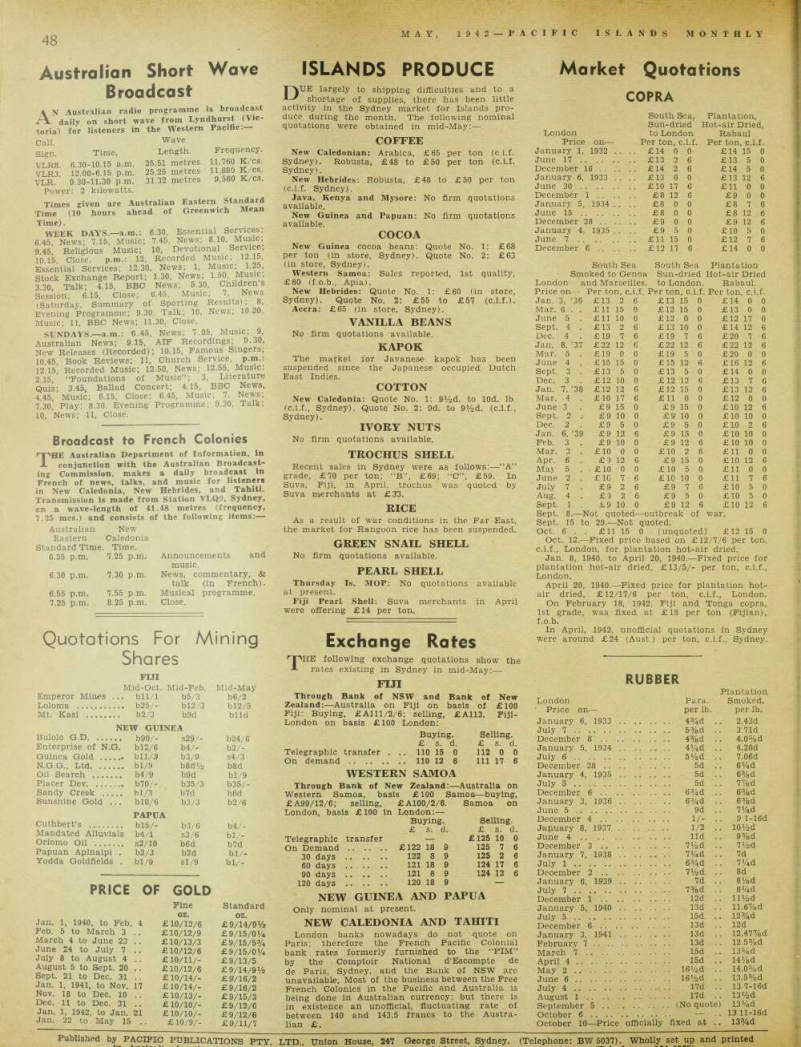
Broadcast
AN Australian radio programme is broadcast daily on short wave from Lyndhurst (Vic toria) for listeners in the Western Pacific:
Times given are Australian Eastern Standard Time (10 hours ahead of Greenwich Mean Time).
WEEK DAYS.—a.m.: 6.30, Essential Services, 6.45 News; 7.15, Music; 7.45, News; 8.10, Music; 9.45, Religious Music; 10, Devotional Service; 10.15, Close. p.m.: 12, Recorded Music; 12.15, Essential Services; 12.30, News; 1, Music; 1.25, Stock Exchange Report; 1.30, News; 1.50, Music; 330 Talk; 4.15, BBC News; 5.30, Childrens Session; 6.15, Close; 6.45, Music; 7, News (Saturday, Summary of Sporting Results); 8, Evening Programme; 9.30, Talk; 10, News; 10.20, Music; 11, BBC News; 11.30, Close.
SUNDAYS. —a.m.: 6.45, News; 7.05, Music; 9, Australian News; 9.15, AIF Recordings; 9.30, New Releases (Recorded); 10.15, Famous Singers; 10.45, Book Reviews: 11, Church Service, p.m.: 12.15, Recorded Music; 12.50, News; 12.55, Music; 2 15, “Foundations of Music”; 3, Literature Quiz; 3.45, Ballad Concert; 4.15, BBC News, 4.45, Music: 6.15, Close; 6.45, Music; 7, News; 7.30,’ Play; 8.30, Evening Programme; 9.30, Talk; 10, News; 11, Close.
Call.
Wave Sign.
Time.
Length.
Frequency.
Vlr8.
6.30-10.15 a.m. 25.51 metres 11,760 K/cs.
Vlr3.
12.00-6.15 p.m. 25.25 metres 11,880 K/cs.
Vlr.
9.30-11.30 p.m. 31.32 metres 9,580 K/cs.
Power: 2 kilowatts.
Broadcast to French Colonies
THE Australian Department of Information, in conjunction with the Australian Broadcast ing Commission, makes a daily broadcast in French of news, talks, and music for listeners in New Caledonia, New Hebrides, and Tahiti.
Transmission is made from Station VLQ!), Sydney, on a wave-length of 41.48 metres (frequency, 7.25 mcs.) and consists of the following items: — Australian New Eastern Caledonia Standard Time. Time. 6.25 p.m. 7.25 p.m. Announcements and music. 6.30 p.m. 7.30 p.m. News, commentary, & talk (in French). 6.55 p.m. 7.55 p.m. Musical programme. 7.25 p.m. 8.25 p.m. Close,
Quotations For Mining
Shares
Fiji
Mid-Oct.
Mid-Feb.
Mid-May Emperor Mines ... bll/1 b5/3 b6/2 Loloma b25/bl2/3 bl2/5 Mt. Kasi b2/3 b9d blld
New Guinea
Bulolo G.D b90/s29/b24/6 Enterprise of N.G. bl2/6 b4/b2/- Guinea Gold bll/3 b3/9 s4/3 N.G.G., Ltd bl/9 bSdVa b8d Oil Search b4/9 b9d bl/9 Placer Dev b70/b35/3 b35/- Sandy Creek bl/3 b7d b6d Sunshine Gold ... blO/6 b3/3 b2/6 Cuthbert’s
Papua
b!5/b3/6 b4/- Mandated Alluvials b4/l s3/6 bl/- Oriomo Oil S2/10 b6d b7d Papuan Apinaipi . b2/3 b2d bl/- Yodda Goldfields . bl/9 sl/9 biy-
Price Of Gold
Fine Standard oz. oz.
Jan. 1, 1940, to Feb. 4 £ 10/12/6 £ 9/14/9 y 2 Feb. 5 to March 3 £10/12/9 £ 9/15/0 V* March 4 to June 23 .. £10/13/3 £9/15/5% June 24 to July 7 . . £10/12/6 £ 9/15/0 V* July 8 to August 4 .. £10/11/- £9/13/5 August 5 to Sept. 20 .. £10/12/6 £ 9/14/9V2 Sept, 21 to Dec. 31 £ 10/14/- £9/16/2 Jan. 1. 1941, to Nov. 17 £10/14/- £9/16/2 Nov. 18 to Dec. 10 £10/13/- £9/15/3 Dec. 11 to Dec. 31 .. £10/10/- £9/12/6 Jan. 1, 1942, to Jan. 21 £10/10/- £9/12/6 Jan. 22 to May 15 £ 10/9/- £9/11/7
Islands Produce
DUE largely to shipping difficulties and to a shortage of supplies, there has been little activity in the Sydney market for Islands pro duce during the month. The following nominal quotations were obtained in mid-May:—
Coffee
New Caledonian: Arabica, £65 per ton (c.i.f.
Sydney). Robusta, £4B to £5O per ton (c.i.f.
Sydney).
New Hebrides: Robusta, £4B to £5O per ton (c.i.f. Sydney).
Java, Kenya and Mysore: No firm quotations available.
New Guinea and Papuan: No firm quotations available.
Cocoa
New Guinea cocoa beans: Quote No. 1: £6B per ton' (in store, Sydney). Quote No. 2: £63 (in store, Sydney).
Western Samoa: Sales reported, Ist quality, £BO (f.0.b., Apia).
New Hebrides: Quote No. 1: £6O (in store, Sydney). Quote No. 2: £55 to £57 (c.i.f.).
Accra: £65 (in store, Sydney).
Vanilla Beans
No firm quotations available.
Kapok
The market for Javanese kapok has been suspended since the Japanese occupied Dutch East Indies.
Cotton
New Caledonia: Quote No. 1: 9V2d. to lOd. lb. (c.i.f., Sydney). Quote No. 2: 9d. to 9y 2 d. (c.i.f., Sydney).
Ivory Nuts
No firm quotations available.
Trochus Shell
Recent sales in Sydney were as follows:—“A” grade, £7O per ton; “B”, £69; “C”, £59. In Suva, Fiji, in April, trochus was quoted by Suva merchants at £33.
Rice
As a result of war conditions in the Far East, the market for Rangoon rice has been suspended.
Green Snail Shell
No firm quotations available.
Pearl Shell
Thursday Is. MOP: No quotations available at present.
Fiji Pearl Shell: Suva merchants in April were offering £l4 per ton.
Exchange Rates
THE following exchange quotations show the rates existing in Sydney in mid-May:—
Fiji
Through Bank of NSW and Bank of New Zealand:—Australia on Fiji on basis of £lOO Fiji: Buying, £Alll/2/6; selling, £AII3. Fijl- London on basis £lOO London:
Western Samoa
Through Bank of New Zealand:—Australia on Western Samoa, basis £lOO Samoa —buying, £ A99/12/6; selling, £AIOO/2/6. Samoa on London, basis £lOO in London: —
New Guinea And Papua
Only nominal at present.
New Caledonia And Tahiti
London banks nowadays do not quote on Paris; therefore the French Pacific Colonial bank rates formerly furnished to the “PlM’' by the Comptoir National d’Escompte de de Paris, Sydney, and the Bank of NSW are unavailable. Most of the business between the Free French Colonies in the Pacific and Australia is being done in Australian currency: but there is in existence an unofficial, fluctuating rate of between 140 and 143.5 francs to the Austra lian £.
Buying.
Selling. £ s. d. £ s. d.
Telegraphic transfer . .. 110 15 0 112 0 0 On demand .. 110 12 6 111 17 6
Buying.
Selling. £ s. d. £ s. d.
Telegraphic transfer — £125 10 0 On Demand £122 18 9 125 7 6 30 days 122 8 9 125 2 6 60 days 121 18 9 124 17 6 90 days 121 8 9 124 12 6 120 days 120 18 9 —
Market Quotations
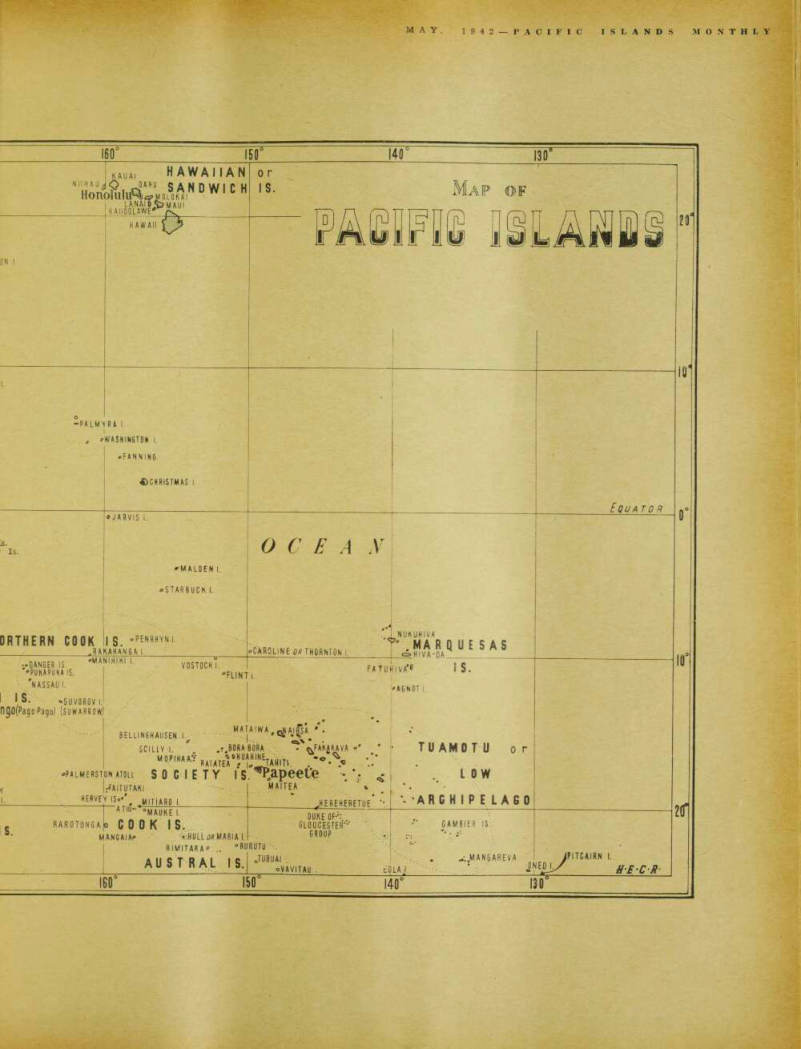
Sept. 8. —Not quoted—outbreak of war.
Sept. 15 to 29. —Not quoted.
Oct. 6 . . £ll 15 0 [unquoted] £l2 15 0 Oct. 12. —Fixed price based on £l2/7/6 per ton, c.i.f., London, for plantation hot-air dried.
Jan. 8, 1940, to April 20, 1940. —Fixed price for plantation hot-air dried, £l3/5/- per ton, c.i.f., London.
April 20, 1940. —-Fixed price for plantation hot air dried, £l2/17/6 per ton, c.i.f., London.
On February 18, 1942, Fiji and Tonga copra, Ist grade, was fixed at £lB per ton (Fijian), f.o.b.
In April, 1942, unofficial quotations in Sydney were around £24 (Aust.) per ton, c.i.f., Sydney.
Copra
South Sea, Plantation, Sun-dried Hot-air Dried, London to London Rabaul Price i on— Per ton, c.i.f Per ton, c.i.f.
January 1, 1932 £14 0 0 £14 15 0 June 17 . £13 2 6 £13 5 0 December 16 . . £14 2 6 £14 5 0 January 6, 1933 £13 0 0 £13 12 6 June 30 . £10 17 6 £11 0 0 December 1 .. £8 12 6 £9 0 0 January 5, 1934 £8 0 0 £8 7 6 June 15 . £8 0 0 £8 12 6 December 28 .. £9 0 0 £9 12 6 January 4, 1935 £9 5 0 £10 5 0 June 7 .. £11 15 0 £12 7 6 December 6 . . £12 17 6 £14 0 0 South Sea South Sea Plantation Smoked to Genoa Sundried Hot-air Dried London and Marseilles . to London.
Rabaul.
Price on— Per ton, c.i.f.
Per ton, c.i.f.
Per ton, c.i.f.
Jan. 3, ’36 £13 2 6 £13 15 0 £14 0 0 Mar. 6 . . £11 15 0 £12 15 0 £13 0 0 June 5 . £11 10 0 £12 0 0 £12 17 0 Sept. 4 . £13 2 6 £13 10 0 £14 12 6 Dec. 4 . £19 7 6 £19 7 6 £20 7 6 Jan. 8, ’37 £22 12 6 £22 12 6 £22 12 6 Mar. 5 . £19 0 0 £19 5 0 £20 0 0 June 4 . £15 15 0 £15 12 6 £16 12 6 Sept. 3 . £13 5 0 £13 5 0 £14 0 0 Dec. 3 £12 10 0 £12 12 6 £13 7 6 Jan. 7, ’38 £12 12 6 £12 15 0 £13 12 6 Mar. 4 . £10 17 6 £11 0 0 £12 0 0 June 3 £9 15 0 £9 15 0 £10 12 6 Sept. 2 . £9 10 0 £9 10 0 £10 10 0 Dec. 2 . £9 5 0 £9 5 0 £10 2 6 Jan. 6, ’39 £9 12 6 £9 15 0 £10 10 0 Feb. 3 . £9 10 0 £9 12 6 £10 10 0 Mar. 3 . £10 0 0 £10 2 6 £11 0 0 Apr. 6 . £9 12 6 £9 15 0 £10 12 6 May 5 . • £10 0 0 £10 5 0 £11 0 0 June 2 . £10 7 6 £10 10 0 £11 7 6 July 7 . £9 2 6 £9 7 6 £10 5 0 Aug. 4 . £9 2 6 £9 5 0 £10 5 0 Sept. 1 . £9 10 0 £9 12 6 £10 12 6
Rubber
Plantation London Para.
Smoked.
Price on— per lb. per lb.
January 6, 1933 . 4%d .. 2.43d July 7 5%d .. 3.71d December 8 . . . 4%d .. 4.0%d January 5, 1934 . 4V 4 d .. 4.28d July 6 5V 2 d .. 7.06d December 28 .. . 5d .. ey 4 d January 4, 1935 . 5d .. 6%d July 5 5d .. 7%d December 6 . . . 6%d .. 6%d January 3, 1936 . 6%d .. 6%d June 5 9d .. 7y 4 d December 4 .. . 1/- .. 9 l-16d Japuary 8, 1937 . 1/2 .. ioy 2 d June 4 lid .. 9%d December 3 .. . 7V 2 d .. 7y 2 d January 7, 1938 . 7VW .. 7d July 1 7y 4 d December 2 .. .
V/ 2 d .. 8d January 6, 19'39 . 7d .. sy 8 d July 7 sy 4 d December 1 .. . 12d .. ny 2 d January 5, 1940 . 13d .. 11.6 7 /sd July 5 15d .. 12 3 / 4 d December 6 .. . . 13d .. 12d January 3, 1941 . 13d .. 12.47 7 / 8 d February 7 . . . . 13d .. 12.5 5 /sd March 7 15d .. 13%d April 4 15d .. 14y 8 d May 2 16V 2 d .. 14.0 5 /ad June 6 iey 2 d .. 13.5%d July 4 17d .. 13 7-16d August 1 17d . . 13y 2 d September 5 . . . (No quote) 13 5 /ad October 6 ., .. 13 ll-16d October 10 —Price officially fixed at .. 13 3 / 4 d
Advertisements & other items, pp. 50-52 (2 items)
48
MAY, 1 942 PACIFIC ISLANDS MONTHLY
Published by PACIFIC PUBLICATIONS PTY. LTD., Union House, 247 George Street, Sydney. (Telephone: BW 5037). Wholly set up and printed
W. R. Carpenter & Co. Ltd.
TRAVEL BY CARPENTER AIRLINES IN THE
liiiWS Hi .
HH / - m wm m m i iHi ■aar^ m ■ ■ m m
EFFORTLESS SPEED and LUXURIOUS COMFORT
OF A "LOCKHEED 14
CARPENTER AIRLINES, by the recent installation of worldrenowned Lockheed "14' aircraft on their regular service between Sydney and the Territories, bring to this airway the high standard of the world's best air services. Every detail of comfort and convenience has been studied to assure that travellers may thoroughly enjoy, in every respect, their flight over this most glorious of scenic air routes.
FREIGHT
A special feature of "Lockheed 14" Aircraft is their large freight capacity and consignees are now assured that all Freight booked will be despatched without delay.
Minimum Charge 5/-.
Full particulars regarding time-table, fares, etc., are available from the following agencies.— SYDNEY: Macdonald, Hamilton Cr Co. PAPUA: Burns, Philp & Co. Ltd. „ Howard Smith Ltd. NEW GUINEA: W. R. Carpenter & Co. Ltd.
W. R. CARPENTER & CO. LTD.
Merchants and Shipowners.
3ENTS for Australian, European and American Manufacturers, and Distributors of Every Description of Merchandise Complete Range of all Stocks Carried.
Head Office: 16 O’CONNELL STREET, SYDNEY
inches at: RABAUL (New Britain), KAVIENG (New Ireland). MADANG. SALAMAUA. WAU (New Guinea), TULAGI (Solomon Islands), SUVA (Fiji), and other Pacific Islands; and in LONDON.
Buyers and Shippers of: Copra, Trocas, and all Classes of Islands Produce.