Pacific
Islands
Monthly
Vol. Xi. No. 3.
October 15, 1940
Established 1930
[Registered at the G&.0& sydneifr<Jor transmission by post as a newspaper ]
8“
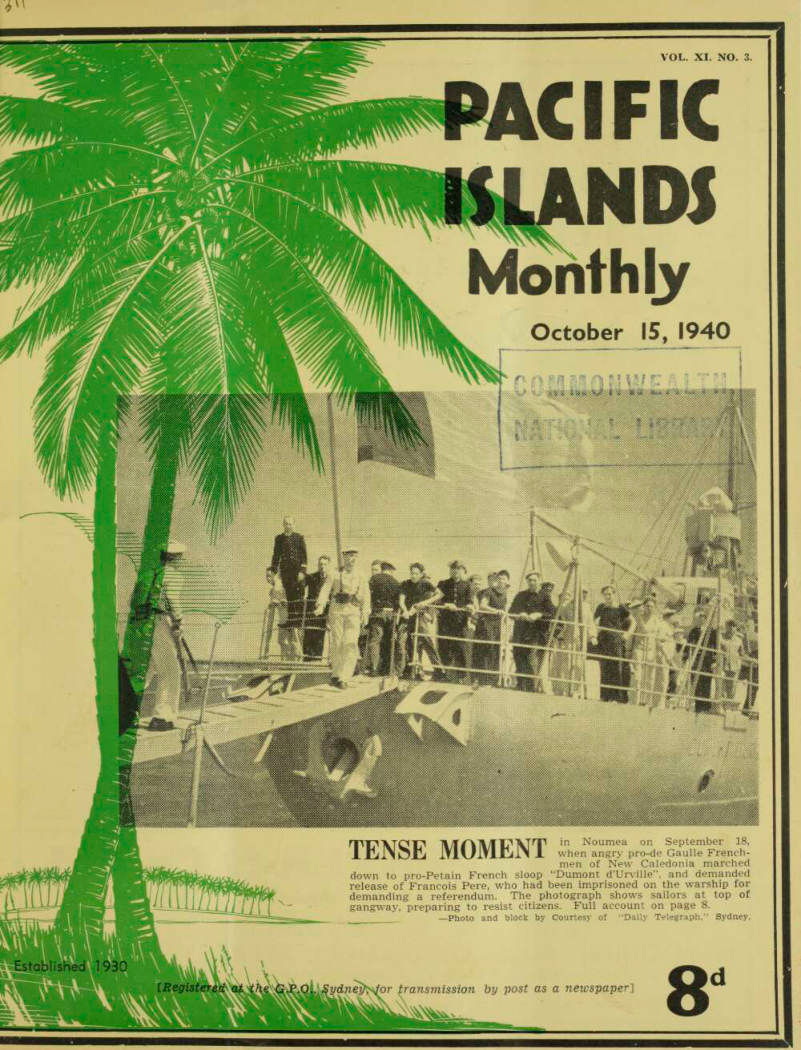
Tense Moment
in Noumea on September 18,
when angry pro-de Gaulle French
men of New Caledonia marched down to pro-Petain French sloop “Dumont d’Urville”, and demanded release of Francois Pere, who had been imprisoned on the warship for demanding a referendum. The photograph shows sailors at top of gangway, preparing to resist citizens. Full account on page 8. —Photo and block by Courtesy of “Daily Telegraph,” Sydney.
Advertisements & other items, p. 2 (1 item)
Carpenters
FLY between
SYDNEY-PAPUA-N. GUINEA
mon r n \
F/d U R E N G I N E\D
AIRLINERS
RABAUL
2 527. MILES
CARPENTERS
AIRLINES
Swift Aerial Transport
for
General Merchandise
Parcels & Packets
Sydney - - - New Guinea
in 2 days.
MINIMUM CHARGE 5/-
Apply to the following W.R.C. Agents for full information:
SYDNEY:
Macdonald, Hamilton Gr Co.; Howard Smith Ltd.
PAPUA:
Burns Philp & Co. Ltd.
NEW GUINEA:
W. R. Carpenter Gr Co. Ltd.
W. R. C. SHIPPING LINE
The first Direct and Regular Cargo and Passenger Service between Europe and Pacific Islands ports was established by W. R. Carpenter & Co. Ltd.
One Modern Steamer (S.S. Suva, 9,000 tons) and two Modern Motor Vessels (M.V. Rabaul, 9,000 tons, and M.V.
Salamaua, 9,000 tons) are available, under normal conditions, for carrying on a Regular Freight and Passenger Service between European and Pacific Islands Ports.
Comfortable accommodation for a limited number of saloon passengers, at special rates.
Details of Freight Rates, Passenger Fares, Time Tables, etc., supplied on application at any of our Branches.
W. R. CARPENTER & Co. Ltd.
Merchant's and Shipowners.
AGENTS for Australian, European and American Manufacturers, and Distributors of Every Description of Merchandise Complete Range of all Stocks Carried.
Head Office: 19-21 O’CONNELL STREET, SYDNEY
Branches at: RABAUL (New Britain), KAVIENG (New Ireland), MADANG, SALAMAUA, WAU (New Guinea).
TULAGI (Solomon Islands), SUVA (Fiji), and other Pacific Islands; and in LONDON.
Buyers and Shippers of: Copra, Trocas, and all Classes of Islands Produce.
Pacific News-Review
Notes And Comment On
The Progress Of The War
From September 13 To Oct. 13
Sept. 13: The German air offensive against England and especially against London is now reaching its peak. The attacks are almost ceaseless, day and night. The day attacks, in spite of an al most daily variation in the technique employed by the enemy, are being held and defeated, especially by the brilliant R.A.F.; but there appears to be no reai answer yet to the night bombers. Each night they appear to creep further over London, and the damage they have done already is very large.
It is quite apparent that the Germans hope, by this means, to start a panic rush from the capital and, under cover of civil confusion and industrial disrup tion, to launch their invasion attack in a few days’ time, which will correspond with the full moon and the highest tide.
Londoners remain undismayed however.
There is absolutely no panic—and, despite much damage to streets and transport systems, the normal life of the city goes on practically without interruption.
Sept. 13: It is reported from several sources that the great mechanised Italian army in Libya—comprising at least 250,000 Italians and very large numbers of native troops—has begun to move east ward along the coast across the Egyptian frontier. Between the frontier and Alex andria there are about 250 miles of bar ren, waterless desert. The defending British forces, which are being strength ened daily, are around Mersa Matru, which is about 80 miles east of the Libyan frontier, and nearly 160 miles west of Alexandria.
This Italian move gives colour to the frequent reports that Hitler and Musso lini have arranged simultaneous attacks —the Germans to invade England, from the Channel ports, and the Italians to invade Egypt from Libya.
Sept. 14; It is now clear that the Aus tralian forces in the Middle East have been moved from Palestine to support the British armies in Egypt against the Italians.
Sept. 15: While Germany’s air attacks upon London continue, the British Fleet and Air Force have commenced, and are continuing, a tremendous all-round-the clock attack upon German shipping and ports in Norway, Belgium, Holland and France, evidently to destroy port and shipping facilities which are necessary to the German invasion. Enormous damage has been done. All British air forces have been concentrated on this work, and the nightly raids upon German centres have been discontinued for the present Sept. 15: The Italian army is slowly advancing across the Libyan-Egyptian frontier, and is being continuously har ried by British air and ground raiders.
Sept. 15; Hitler is reported to have arrived at his invasion headquarters in Northern France, and has invited German and neutral journalists to assemble on the French coasts and “witness the greatest spectacle of the ages—the in vasion of England”.
Sept. 15: King Michael of Roumania has proclaimed that the structure of the Roumanian state will henceforth be totalitarian, and that its foreign policy will be based on that of the Axis Powers.
Sept. 16: The United States had added drastically to the list of goods which may not be exported except under licence to other countries. This will prevent the export of vital equipment to Japan. The important conferences between the United States Secretary of State, the British Ambassador and the Australian Minister, relative to Pacific defence have been given a new turn by discussions with Mr. So’ong, the chairman of the Bank of China, which is believed to involve United
states support for Chinese currency.
Sept. 16: When the Germans surpris ingly renewed their mass daylight raids on Britain, yesterday, the R.A.F. dealt a terrific blow. British fighters shot down 185 German raiders—representing Ger many’s heaviest loss of the war—for the loss of only 25 British machines and 13 pilots. Great numbers of bombs have fallen on London but London carries on calm and unperturbed.
Greatest concern was felt because a de layed-action bomb fell just outside St.
Paul’s Cathedral. After two days, a squad of the Royal Engineers, displaying extra ordinary bravery, dug up the bomb and carted it out to an open space, where it was exploded.
Incalculable destruction has been done to Hitler’s various invasion bases. It is noted, to-day, that there are hints ap pearing in the controlled Italian press that the German attempt to invade Britain will be postponed until after the winter.
Sept. 17: German round-the-clock air attacks upon London continue unceas ingly. The Prime Minister in a public statement, to-day, said that concentra tions of barges and shipping in enemy ports on the Channel facing England, were still increasing, and they must ex pect Germany to make an attempt to in vade England, at the first opportunity.
The damage done in London is very great—all classes of buildings have suffered, from Buckingham Palace, through the great departmental stores of Oxford Street, down to hundreds of workmen’s dwellings in the East End.
Sept. 17; The Italian army is advancing slowly into Egypt, while the coastal roads and camps are being ceaselessly harried by British airmen and warships.
Sept. 18: Yesterday, a gale swept the English Channel, creating conditions al most impossible for an invasion. It has died away to-day, but a big sea is still running. Great masses of German air raiders again crossed the coast, but large numbers of British fighters tackled them and they turned back long before they reached London.
Sept. 18; R.A.F. bombers have resumed their nightly raids upon Berlin and mili tary objectives in Western Germany gen erally.
Sept. 18: The Italians have advanced 60 miles, in five days, into Egypt’s west ern desert. They appear to be digging in along the line of Sidi Barrani village. A water supply is their main problem. They are being constantly raided by the British.
Sept. 18; Reports reaching London in dicate many and increasing clashes be tween Free Frenchmen and followers of the Vichy Government in the French Colonies in North and Equatorial Africa.
Sept. 19: Yesterday, 48 German raiders were shot down; 12 British fighters were lost, but 9 pilots are safe. German air raids over England continue almost with out cessation —but the people carry on doggedly. Londoners have quickly adapted themselves to spending their nights in shelters, and securing sufficient sleep, in spite of the night-long roar of anti-air craft guns.
Sept. 19: It is reported that Hitler and Mussolini are trying to induce Franco to enter the Axis bloc against Britain. They are offering Spain Gibraltar, and sub stantial colonies in North Africa. Franco is against war; but his brother-in-law, Suner, the next most powerful man in Spain, is completely in the Axis “bag”.
If he can swing Spain into line with the Axis Powers he will do so.
Sept. 19: Discussions between Japan and France over Indo-China continue.
Japan, with increasing insistence, seeks
naval, military and air bases in Indo china. It is thought that Japan may de cide upon a fait accompli, and invade Indo-China at any time.
Sept. 20; The German air force con tinues its blind, savage bombing of Lon don and England generally, while the R.A.F., with increasing strength, is at tacking the whole of Western Germany.
In addition, the R.A.F. practically every night makes smashing attacks upon Ger many’s invasion ports on the Dutch, Bel gium and French coasts.
Sept. 20: The Italians in Western Egypt caught before they had established themselves at Sidi Barrani, were heavily pounded by British artillery, the R.A.F., and British warships and enormous dam age was done.
Sept. 22: London is now entering its third week of nightly bombing. But the people stubbornly maintain their calm and cheerful spirit, and despite destruc tion in all quarters of the city, the na tional work goes on. Women and children are being sent away, according to an organised plan, but the panic evacuation of London, which the Germans have been trying to force, is not taking place in any shape or form. The courage of the people is something to be seen to be believed.
Meanwhile, every night, the R.A.F. is blasting the German invasion bases all along the Channel coast, and this sys tematic bombing cf ports and barge con centrations undoubtedly must affect the enemy’s invasion plans.
Sept. 23; General de' Gaulle led a Free French force, supported by a British naval squadron, to Dakar, in West Africa, in the belief that that French Colony was ready to join him. But French officials, under instructions from the Vichy Gov ernment, resisted the landing and fired upon his emissaries; and rather than en gage in battle between Frenchmen, he withdrew his forces. French naval forces at Dakar attacked the British squadron, and the British replied. Two French sub marines and a French destroyer were sunk. There has been no official report of the incident, which is described as “a very unfortunate fiasco ’.
Sept. 23: The growing collaboration be tween Britain and the United States, for Pacific defence, snd the probability that United States warships will use Aus tralian and Singapore bases, are causing considerable alarm in Japan.
Sept. 23: It is reported that the French are resisting the Japanese on the frontier of Indo-Chma and that a good deal of bitter fighting is in progress.
Sept. 23: A liner, carrying evacuee children aged between 5 and lb, was tor pedoed by the Germans in a storm, 600 miles out in the Atlantic, at 10.30 p.m.
The ship sank in 20 minutes. Of 406 per sons aboard, 250 were lost including 90 children.
Sept. 23: Although German air attacks upon England continue furiously, the be lief is growing that Hitler’s invasion plans have been shattered—by the unexpected strength of British civilian resistance, by Ihe smashing attacks of the R.A.F. upon invasion concentrations and German bases in Germany, and by the unfavour able weather.
Sept. 23: R.A F. bombers have resumed their nightly attacks upon Berlin. The British refuse to bomb indiscriminately, and scrupulously reserve their attacks for military objectives.
Sept. 24; There are increasing reports of fighting between the EYench and Japanese in Indo-China. The whole situ ation there appears much confused.
Sept. 25: There is an unconfirmed re
port in the United States that Japan and Germany have agreed, in principle, on a defensive alliance, which would become effective in the event of further Anglo- American collaboration.
Sept. 25: The German air attacks on London continue but in a most frenzied fashion. Planes are flying: wildly in ah directions, dropping bombs indiscrimin ately. Much damage continues to be done, but the London populace remains calm and orderly.
Sept. 25: The Nazis are reported to be screeching with fury at the latest British air raids on Berlin, where it is insisted that “the British airmen are murdering the civilian population and the unfortun ate Berliners cannot get sufficient sleep”.
Sept. 25: United States to-day banned all exports of iron and steel scrap, except to Western Hemisphere countries and Britain. This measure is obviously aimed at Japan, which will be seriously affected.
Sept. 26: It is announced that an agree ment has been reached between France and Japan, which provides tor the en trance of Japanese troops to Indo-China, to occupy certain military and air bases.
The Japanese official agency announces: “An amicable settlement has been reached and hostilities have ceased”.
Sept. 26: Large German bomber forma tions came over England yesterday in the first big scale daylight raids since Sep tember 15, and 26 German planes were destroyed; 4 British fighters were lost, but pilots of 3 are safe. British bombers raided Berlin for 5 hours last night.
Sept. 27: It is officially announced that Germany, Italy and Japan, in Berlin to day, signed a pact covering mutual mili tary, political and economic support over a period of 10 years. Each agrees to sup port the other, with all the means at his disposal, if one of them is attacked by a power not vet involved either in the war against Britain or in the Sino-Japanesc war. Japan recognises the leadership of Germany and Italy in Europe, and the latter recognises “Japan’s leadership in the creation of a New Order in Asia”.
It is clear that the pact is designed to prevent American participation in the European war, or the creation of an Anglo-American front in the Pacific. It is directed immediately against the United States —although it might also operate against Russia.
Sept. 27: In daylight thrusts against London to-day, all of which were foiled, the German air fleets lost 98 planes, their heaviest loss since September 15. The German raids upon England and London continue: but, meanwhile, the R.A.F. raids against Germany, increasing in frequency and extent, are creating havoc.
Sept. 27: There are indications of hiuch closer collaboration between Britain and the United States m regard to placing a heavy embargo upon the shipment of essential commodities to Japan. Many be lieve that Japan can be more effectively crippled in this wav than by any employ ment of armed forces.
Sept. 27: American sources believe that Germany will soon abandon the attack on Britain in favour of the occupation of the remainder of France, preparatory to an attempt to take Gibraltar and bottle up the British naval squadrons in the Mediterranean.
Sept. 29: The new Axis pact (or Triple Alliance), under which the three great predatory nations of the world propose to divide up the world between them, has caused no surprise in either Britain or United States. It merely puts into words what has long been a fact.
The Pact has not altered American foreign policy in the slightest—indeed, it is having a good effect, because it is bringing American public opinion face to face with realities. Americans now are realising that there is no freedom for
them in the world unless Britain holds off the Axis Powers.
Meanwhile, attempts are being made, by both Germany and Japan, to get Russia’s goodwill in the new pact. But none knows where Russia stan'ds in re lation to the Pact—she may give it her blessing, and withdraw her assistance from China or she may gradually take an attitude which may bring her into line with Great Britain, the United States and China, against the Axis Powers.
Sept. 29: The Italian army, from Libya is still standing on the Sidi Barrani line, in western Egypt. It is being ceaselessly raided by British ground parties, aero planes and warships.
Oct. 1: United States Congress proposes to give the President authority to acquire, lease or purchase British possessions in the Pacific, or bordering on the Pacific, as part of the new defence plan. The new Triple Alliance has had exactly the oppo site effect to what was apparently ex pected by Japan. Aid for Britain is be ing intensified and there is growing co operation between Britain and the United States.
America has expressed her opinion that she would like to see the Burma Road open when the closing agreement between Britain and Japan expires on October 16.
The Japanese attitude towards the United States continues belligerent and threat ening.
Oct. 2: After having visited Berlin and Rome, where he had long talks with the Dictators, the Spanish Foreign Minister (General Suner) departed for Madrid. It is announced, contrary to all expectations, that Spain will not join the Axis Powers.
Some believe that Spain has a kind of secret alliance with the Axis Powers and, if necessary, will allow German troops to pass through en route to Northern Africa.
Oct. 2: The fact that September is over and the German invasion has not mater ialised is referred to by many newspapers.
It is generally believed that Hitler’s plans have gone sadly astray.
Meanwhile, raids over London and Eng land continue day and night; and the British R.A.F., with the same regularity, is bombing German invasion ports along the Dutch, Belgium and French coasts, and military objectives throughout West ern Germany, as far east as Berlin. Ber lin is raided and bombed almost every night.
Oct. 3: Because of ill-health Mr.
Chamberlain has retired from the British Government, and there has been a con siderable re-shuffling of portfolios.
Oct. 3: The American Ambassador in Moscow is attempting to discourage Russia from associating herself with Japan.
Oct. 3: Yesterday, the Germans made their most determined onslaught on Lon don, employing about 1,000 machines.
R.A.F. fighters and anti-aircraft guns smashed the formations and drove the Germans pell-mell to the Channel. Al though few Germans were brought down, it was the R.A.F.’s greatest triumph to date.
Oct. 4: Hitler and Mussolini met in a special train at the frontier, at the top of Brenner Pass, at noon to-day, and con ferred for 2i hours. They were accompan ied by imposing retinues. The facts that the German invasion of England has failed, and that the Italian invasion of Egypt is still held up, suggest that the two Dictators are revising their war plans.
Their next step may be an intensification of the war in the Mediterranean area.
Marshal Graziani, commander of the Italian army in Libya, is now in Rome, awaiting instructions.
Oct. 4: The Admiralty announces that 7 German submarines, two Italian sub marines and an Italian destroyer have
been sunk by the British Navy in recent actions.
Oct. 4: In the week ended September 22, enemy submarines destroyed 27 British and Allied merchantmen, totall ing 159,000 tons. This is the most serious loss of merchant tonnage yet recorded It is calculated that anything over 40,000 or 50,000 tons a week is a serious em barrassment to the Allies.
Oct. 6: Some frank talks between the Government of Russia and the British Ambassador will take place this week in Moscow. All comment is cautious. Not one “expert” in Britain, apparently, cares to guess whether Russia will incline towards Germany or Britain.
Oct. 6: A highly important development is that the American Navy Department has called up 27,000 reservists. This means that the total naval strength of the United States will be 235,000 officers and men— the largest since the Great War.
Oct. 6; Raids by Germans on Britain and by the British on Germany go on day and night. Last night, the R.A.F. dropped two tons of bombs upon Krupps arms factory at Essen.
Oct. 7: German troops are entering Roumania. The Nazis claim they are technicians, specially selected to guard the oilfields. Britons in Roumania are being persecuted and maltreated.
Oct. 7: The increasing operations of enemy submarines in the Atlantic, where British shipping losses continue to be very heavy, is causing concern.
Oct. 8: Britain has formally notified Japan that the Burma Road, closed three months ago in an attempt to appease Japan, will be opened for traffic to Free China on October 18. Japan professes in difference, saying the road now will be of little use to the Chinese.
Oct. 10: German troops are now pour ing into Roumania —it is believed as part of a plan for a German invasion of Asia Minor and Palestine via the Bal kans. A declaration of war by Britain upon Roumania is probable.
Oct. 11: Increasing air raids by Ger mans upon Britain and by the R.A.F. upon Germany are reported daily. Great damage is being done to both London and Berlin. London damage yesterday in cluded a direct hit upon St. Paul’s Cathedral.
Oct. 11; American public opinion, so far from being panicked by the Japanese- German Pact, is now becaming solid in the belief that there can be no safety for America until Nazidom is destroyed.
Oct. 13: In blunt speech, President Roosevelt warned Axis dictators that their threats will not stop continued American aid to Britain. America’s traditional policy, he added, is to defend the Western Hemisphere and the right to the peaceful use of the Atlantic and the Pacific.
Mr. and Mrs. N. Penglase, of New Ire land, T.N.G., arrived in Sydney in Sep tember by the “Macdhui”. He is D.O. at Kavieng and will spend some months in Sydney.
Mr. and Mrs. J. R. Waddell, of Nama tanai, New Ireland, T.N.G., arrived in Sydney during September by the “Macdhui”. Mr. Waddell, who is a medi cal officer with the Administration, in tends to join the A.I.F.
Captain R. C. Duncan, of Rabaul, who brought to Australia recently a small steamer which Messrs. W. R. Carpenter & Co., Ltd., have sold returned to New Guinea last week.
Mr. and Mrs. S. E. Sutcliffe, of Sala maua, New Guinea, passed through Sydney in September en route to Ade laide, S.A., where they will spend three months’ holiday. He is chief pilot for Mandated Airlines.
Advertisements & other items, p. 3 (1 item)
1
PACIFIC ISLANDS MONTH LY OCTOBER, 1940
Pacific Islands Travellers
PER AIRLINER FROM N.G. & PAPUA: Messrs.
Hewson, Scherp, Snook, Jacobsen, Scott, Frame.
PER AIRLINER FOR PAPUA & N.G.: Messrs.
Hardaker, Walsh, Emery, Mrs. Shaw. Misses ■Rvm#> Stuart PER AIRLINER FROM N G & PAPUA - Messrs
CaVSenteTLloyd Armstrong MarfhaU PknS
pßSfrom n g & PAPUA- Messrs Weston Mrs Morean PAPUA ' Messrs ' PER AIRLINER FOR PAPUA & N G • Messrs Richfrdson HHI Phillips Messrs.
PER AIRLINER FROM N G & PAPUA- Messrs
l-rosl Parker Mrs Chr s holm.
Per “Tegelberg” For Port Moresby-
Messfs. Smtth Watton. Tlfwa™ S.X “ws',
Mesdames Thomas, Fletcher.
Per “Aorangi" For Suva, Fiji; Messrs.
Harwood, Leung. Mesdames Harwood, Rae.
Misses Stinson, Harwood. ’
PER “MACDHUI" FOR PAPUA & N.G : Messrs Reid, Johns, Harvey. Lanyon, Charles Dean' Matthews, Scott, Keane, Wylie, O’Halloran (2)’
Wyngrove, Elwell, Clark, Collins, Gregory, Innes!
Jones, Kerr, Law, Martin, Pearce, Stephenson' Stewart, Stane, Stow, Thurlow, Wright, Alexander, Turner, Worden, Bird, Chambers, English, Fienberg, Mader, O’Connor, Slattery,’ Thomas (2), White, Lucas, Moore, Bone, Henderson, Sargent, Wauchope, Bernarding, Kotrba, Ross, Burden, Jackett, Young, Ireland. Mesdames
Gorkin, Chaplin, Coredon, Foley. Speedie, Bird.
Chambers, Mader, Pennefather, Thomas (2), Tomkins. Morgan, Moore, Aitchinson. Long!
Misses Inman, Devlin, Franklin, McLean.
PI ? R ‘‘ MORIN P A ” FROM N. HEBRIDES & ? Messrs. Cason, Francis, Hams, Bushell, Long Lucas McArthur, Payten, Cassagne, Doley. de Gaillande, Gillan, Jeanson, Kanony, Keran S e l> Kerr, Seagoe, Patching, Pincombe, Stevenson Vormister. Mesdames Purdy. Francis, S amS> D^ wkins - Cassagne, Gillan, Jocteur. kanony, Carr, Fox-Rogers, Larkin, McPhall, Nobbs, Rossiter, Vormister. Misses Mitchell,
SonnT*' DaWkmS - Nobbs '
Per “Malaita” From N.G., Papua &
8.5.1.: Messrs. Abbott, Barns, Brockman, Burnside, Clarke, Clay, Harkins, Helm, Hewitt, Mocatta, Rawson, Richardson. Slater, Slattery, Surr - Wa ß er - Widdy, Bartlett, Bergin. Elliot.
Guthrie, Luxmore, Dean. Rev. Clarke, Rev.
Madigan. Dr. Price. Mesdames Clarke, Coe, Ferris, Harkins, Helm, Paton, Price, Rutter, Bartlett. Elliot, Owen-Turner. Misses Cannon, Civil, Mcßae, Todd, Gribben.
Per “Neptuna” For Papua & Ng-
Messrs. Bird, Curry, Taylor, Moloney, Edwards McLeod. Bitton, Flanagan, Smith, Baker. Hill, Chapman, Baulty. Mesdames Moloney, Thomp-
son, Hill (2), Cleary, Baker, Blackman, Baulty, Spencer. Misses Siggins, Dibley, Hays.
Per ■‘Neptuna” From N.G. & Papua:
Messrs. Austin, Andersen, Bitton, Bell, Bushby, Berry, Callaghan, Cooper, Dennis, Dickson, Edwards, Gold, Hughes, Harvey, Hatton, Jay, Johnson (2), Naulty, Preston, Sargent, Simpson, Wrightson, Watkins, Yuen, Moore. Mesdames Anderson, Bedser, Cowley, Dean, Dowsett, Har vey, Hatton, Lyons, Layton, Moen, Middenway, Purves, Smeeton, Sutherland, Simpson, Turner, Walsh, Watkins. Misses Lyons.
Per “Mariposa” From Suva; Messrs.
Gumming, Grahame, Roberts, Robins, Chen, Chun, Gock, Little, Martin, Regan, Ryder, Sale.
Tattersall. Masters Mei, Martin, Regan, Tat tersall. Mesdames Grahame, Phillips, Alieta, Lees, Martin, Regan, Tattersall. Misses Far quhar, Lawrence, Tattersall (3).
PER “MONTEREY” TO SUVA: Messrs. Green ing. Gregg. Illingworth, Mukkamala, Powell, Patel, Robins, Simone. Masters Calmyre, Muk kamala, Mesdames Calmyre, Collins. Greening, Mukkamala. Morison. Misses Marr, Ramsamuj, James, Morison.
PER “MALAITA” FOR 8.5.1.: Messrs. Lockie, Svensen, Batiste, Boles, Campbell, Crampton, Congdon, Grimaldy, Holliday, Hosie, Houston, Kelly, King, McLenehan, Posford, Sardonne, Stack, Wall, Watson, Radford, Voyce, Kidnie.
Dr. May. Mesdames Svensen, Edwards, Holli day, Hannam, May, Thurlow, Wyatt, Aumuller,
(Continued On Page 68)
(Continued From Page 3)
Garrard, Neilsen, Radford, Greenough, Bourne, Kidnie. Misses Hosie, Barker, Burgess, Coates, Unkenstein.
PER “MORINDA’ - FOR LORD HOWE IS.,
Norfolk Is., N. Hebrides, And B.S.I.:
Messrs. Grave, Taylor, Pauling, Whiting, Tucker, Wilson, Twiss, Wilson, Paton. Father Rocke.
Mesdames McLean, Pauling, Waley, Tucker, Wil son (2), Anderson. Misses Martin, Malone (2).
The Norfolk Island branch of the Red Cross Society has been active during the year, under the presidency of Lady Rosenthal, wife of the Administrator.
Although there are less than 1,000 people on this island, the community has subscribed £40 towards the Turkish Earthquake Relief Fund; £100 for milit ary ambulances; £65 for materials to be made up into comforts for the troops; and various other contributions. Aus tralian headquarters expressed apprecia tion of this enthusiastic and sustained effort.
Advertisements & other items, p. 5 (1 item)
South Pacific Lire
Jj** k Taya .. v ./BABAUI v ‘f
H.«0«I8BY» • V “j
\ * SAMARAI
r%
SAI 6 0 N
S! ROAMS!
BATAVIA
N 6 SAUMAUA
SAMARANG
o <p <?
SYDNEY
<? / * J 'V
PACIFIC OCEAN
. >J dI»ORT VllA
\ouiu*
* [3
U CKIAN 0
WEIUNST ON
m
K. P. M.
SOUTH PACIFIC LINE,
Royal Packet Navigation Co. Ltd., Paketvaart House, 255 George Street, Sydney. * V V Konln *lljke Paketvaart Maatschappij— Incorporated in the Netherlands Indies) Saigon, Diethelm & Co.; Port iMoresby and Samarai, Steamships Trading Co Ltd.; Rabaul, Salamaua and Wau, W. R Carpenter & Co. Ltd.; Port Vila, Gubba> Freres; Noumea. Carlo Leoni; Auckland.
Russell & Somers Ltd.; Wellington Johnston & Co. Ltd.
k.p . m
Linking the East with South
Islands, New Zealand and Australia
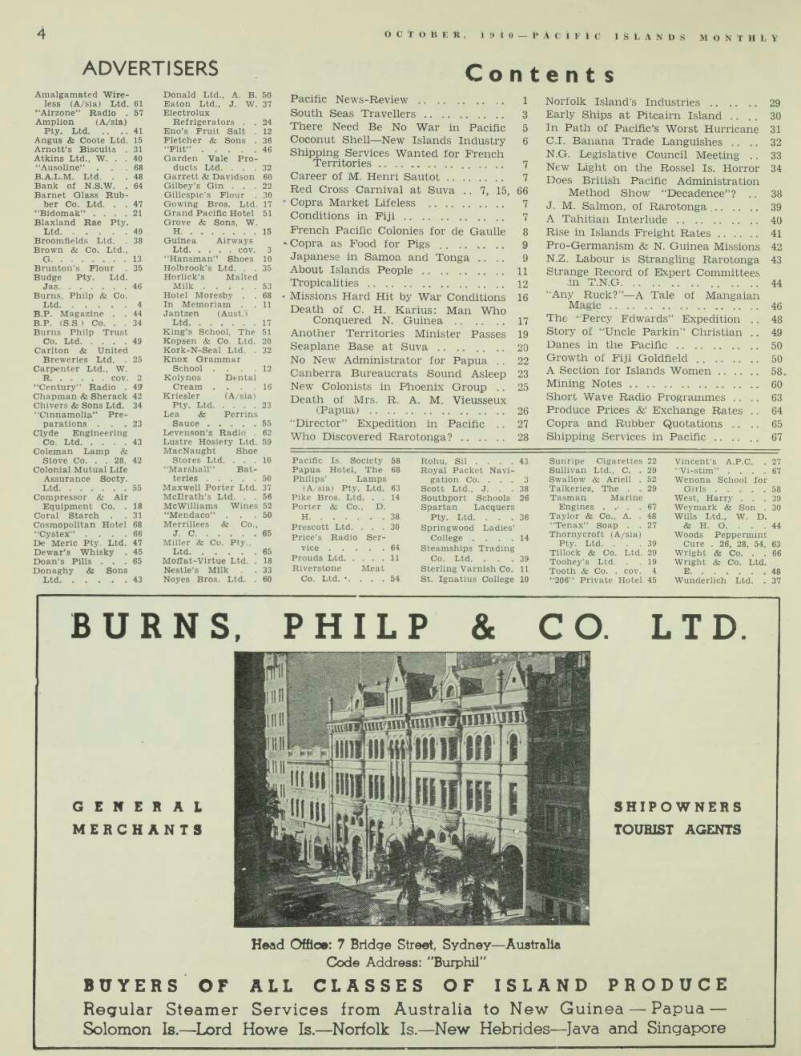
The track routes of the K.P.M.-South Pacific Line motor vessels “Maetsuycker” and “Tegelberg” are each as foIIows:—“TEGELBERG”: Saigon, Singapore, Batavia, Samarang, Sourabaya, Port Moresby, Port Vila, Noumea, Auckland, Wellington, Sydney, Port Moresby, Sourabaya, Samarang, Batavia, Singapore, Saigon. “MAETSUYCKER”; Saigon, Singapore, Batavia, Samarang, Sourabaya, Port Moresby, Samarai, Salamaua, Rabaul, Auckland, Wellington, Sydney, Port Moresby, Sourabaya, Samarang, Batavia, Singapore, Saigon.
SOUTH PACIFIC LIRE
Advertisers
Amalgamated Wire less (A/sia) Ltd. 61 “Airzone” Radio . 57 Amplion (A/sia) Pty. Ltd 41 Angus & Coote Ltd, 15 Arnott’s Biscuits . 31 Atkins Ltd., W. . . 40 “Ausoline” ... 68
B.A.L.M. Ltd. . . 48
Bank of N.S.W. . 64 Barnet Glass Rub ber Co. Ltd. . . 47 “Bidomak” ... 21 Blaxland Rae Pty.
Ltd 49 Broomfields Ltd. . 38 Brown & Co. Ltd., G 13 Brunton’s Flour . 35 Budge Pty. Ltd.
Jas 46 Burns, Philp & Co.
Ltd 4 B.P. Magazine . . 44
B.P. (S.S.) Co. . . 34
Burns Philp Trust Co. Ltd 49 Carlton & United Breweries Ltd. . 25 Carpenter Ltd., W.
R cov. 2 “Century” Radio . 49 Chapman & Sherack 42 Chivers & Sons Ltd. 34 “Cinnamolia” Pre parations ... 23 Clyde Engineering Co. Ltd 43 Coleman Lamp & Stove Co. . . 28, 42 Colonial Mutual Life Assurance Socty.
Ltd 55 Compressor & Air Equipment Co. . 18 Coral Starch . . 31 Cosmopolitan Hotel 68 “Cystex” ... 66 De Meric Pty. Ltd. 47 Dewar’s Whisky . 45 Doan’s Pills ... 65 Donaghy & Sons Ltd 43
Donald Ltd., A. B. 50 Eaton Ltd., J. W, 37 Electrolux Refrigerators . . 24 Eno’s Fruit Salt . 12 Fletcher & Sons . 36 “Flit” 46 Garden Vale Pro ducts Ltd. ... 32 Garrett & Davidson 60 Gilbey’s Gin ... 22 Gillespie’s Flour . 30 Gowing Bros. Ltd. 17 Grand Pacific Hotel 51 Grove & Sons, W.
H 15 Guinea Airways Ltd cov. 3 “Hansman” Shoes 10 Holbrook’s Ltd. . . 35 Horlick’s Malted Milk 53 Hotel Moresby . . 68 In Memoriam . 11 Jantzen (Aust.) Ltd 17 King’s School, The 51 Kopsen & Co. Ltd. 20 Kork-N-Seal Ltd. . 32 Knox Grammar School ... 12 Kolynos Dental Cream ... 16 Kriesler (A/sia) Pty. Ltd 23 Lea & Perrins Sauce 55 Levenson’s Radio . 62 Lustre Hosiery Ltd. 59 Mac Naught Shoe Stores Ltd. ... 10 “Marshall” Bat teries 50 Maxwell Porter Ltd. 37 Mcllrath’s Ltd. . . 56 McWilliams Wines 52 “Mendaco” . . .50 Merrillees & Co., J. C 65 Miller & Co. Pty., Ltd 65 Moffat-Virtue Ltd. . 18 Nestle’s Milk . . 33 Noyes Bros. Ltd. . 60
Pacific Is. Society 58 Papua Hotel, The 68 Philips’ Lamps (A/sia) Pty. Ltd. 63 Pike Bros. Ltd. . . 14 Porter & Co., D.
H 38 Prescott Ltd. ... 30 Price’s Radio Ser vice 64 Prouds Ltd 11 Riverstone Meat Co. Ltd. *. . . . 54
Rohu, Sil . . . . 43 Royal Packet Navi gation Co. ... 3 Scott Ltd., J. . .38 Southport Schools 26 Spartan Lacquers Pty. Ltd, ... 36 Springwood Ladies’
College ... 14 Steamships Trading Co. Ltd. ... 39 Sterling Varnish Co. 11 St. Ignatius College 10
Sunripe Cigarettes 22 Sullivan Ltd., C. . 29 Swallow & Ariell . 52 Talkeries, The . . 29 Tasman Marine Engines . . . .67 Taylor & Co., A. . 48 “Tenax” Soap . . 27 Thornycroft (A/sia) Pty. Ltd. ... 39 Tillock & Co. Ltd. 29 Toohey’s Ltd. . . 19 Tooth & Co. . cov. 4 “206” Private Hotel 45
Vincent’s A.P.C. , 27 “Vi-stim” ... 67 Wenona School for Girls 58 West, Harry ... 39 Weymark & Son . 30 Wills Ltd., W. D. & H. O. . . .44 Woods Peppermint Cure , 26, 28, 54, 63 Wright & Co. . . 66 Wright & Co. Ltd.
E 48 Wunderlich Ltd. . 37
Contents
Pacific News-Review 1 South Seas Travellers 3 There Need Be No War in Pacific 5 Coconut Shell —New Islands Industry 6 Shipping Services Wanted for French Territories 7 Career of M. Henri Sautot 7 Red Cross Carnival at Suva .. 7, 15, 66 Copra Market Lifeless 7 Conditions in Fiji 7 French Pacific Colonies for de Gaulle 8 Copra as Food for Pigs 9 Japanese in Samoa and Tonga ... 9 About Islands People 11 Tropicalities 12 Missions Hard Hit by War Conditions 16 Death of C. H. Karius: Man Wiio Conquered N, Guinea 17 Another Territories Minister Passes 19 Seaplane Base at Suva 20 No New Administrator for Papua .. 22 Canberra Bureaucrats Sound Asleep 23 New Colonists in Phoenix Group .. 25 Death of Mrs. R. A. M. Vieusseux (Papua) 26 “Director” Expedition in Pacific .. 27 Who Discovered Rarotonga? 28
Norfolk Island's Industries 29 Early Ships at Pitcairn Island ... 30 In Path of Pacific’s Worst Hurricane 31 C.I. Banana Trade Languishes ... 32 N.G. Legislative Council Meeting .. 33 New Light on the Rossel Is. Horror 34 Does British Pacific Administration Method Show “Decadence”? .. 38 J. M. Salmon, of Rarotonga 39 A Tahitian Interlude 40 Rise in Islands Freight Rates 41 Pro-Germanism &N. Guinea Missions 42 N.Z. Labour is Strangling Rarotonga 43 Strange Record of Expert Committees .in T.N.G 44 “Any Ruck?”—A Tale of Mangaian Magic 46 The “Percy Edwards” Expedition .. 48 Story of “Uncle Parkin” Christian .. 49 Danes in the Pacific 50 Growth of Fiji Goldfield 50 A Section for Islands Women 58 Mining Notes 60 Short Wave Radio Programmes ... 63 Produce Prices &’ Exchange Rates .. 64 Copra and Rubber Quotations ... 65 Shipping Services in Pacific 67
Advertisements & other items, p. 6 (1 item)
Burns, Philp & Co. Ltd
GENERAL
MERCHANTS
mu in
tin
HUH
ill
Ml
SHIPOWNERS
TOURIST AGENTS
Head Office: 7 Bridge Street, Sydney—Australia Code Address: "Burphil"
BUYERS OF ALL CLASSES OF ISLAND PRODUCE Regular Steamer Services from Australia to New Guinea Papua Solomon Is—Lord Howe Is. —Norfolk Is. —New Hebrides —Java and Singapore
Pacific Islands Monthly
The Newspaper-Magazine «f the South Seas [Registered at the G.P.O. y Sydney, for transmission by post as a newspaper. ]
Published Once Each Month and Circulated in Australia and New Zealand and in the following Pacific Territories and Islands Groups:
Australian Territory of Papua.
Mandated Territory (Australia) of New Guinea, Bismarck Archipelago and Northern Solomon Islands.
Australian Territory of Norfolk Island.
New Zealand Territory of Cook Islands.
Mandated Territory (New Zealand) of Samoa.
British Colony of Fiji.
British Solomon Islands Protectorate.
British Protectorate of Tongan Islands.
British Crown Colony of Gilbert and Ellice Islands.
Mandated Territory of Nauru.
British and French Condominium of New Hebrides.
French Colony of New Caledonia.
French Colony of Oceania (Tahiti, etc.).
American Territory of Eastern Samoa.
American Territory of Hawaiian Islands, American Territory of Guam.
Mandated Territory (Japan) of Marshall, Caroline and Mariana Islands.
Owned ond Produced by Pacific Publications Pty. Ltd., Union House, 247 George Street, Sydney.
TFT FPHONF f Managing Director .. BW 5037 ( Business and Editorial MA 7101
P.O. Box 3408 R
Registered Address of Telegrams, Radiograms, and Cables; “Pacpub”, Sydney.
Contributions.
Articles, Stories, and Photographs dealing wdth Pacific Islands subjects are invited and will be paid for on publication.
Subscription Rates.
Per Annum, within British Empire, Prepaid, Post Free 8/- Per Annum, elsewhere, prepaid, Post Free . 10/- Single Copies 8d
Editor and Publisher:
R. W. Robson, F.R.G.S.
Assisted by Selwyn Hughes.
Advertising Manager: L. W. Bailey.
Advertising Office and Printing-House; 29 Alberta Street, Sydney.
Advertising rates furnished on application.
Colours, etc., by Arrangement.
Process Blocks made at Advertiser’s expense when required. Screen 100.
Changes of Advertising Copy should reach this Office by Ist of each month, otherwise previous advertisement may be repeated.
IN LONDON, the Pacific Islands Monthly is on sale at the Bookstall, Australia House, The Strand, London.
Agents.
The following are authorised to receive sub scriptions for the Pacific Islands Monthly:— Islands Branches of Burns, Phllp & Co., Ltd., and Burns Philp (South Sea) Co., Ltd.
Islands Branches of W. R. Carpenter & Co., Ltd.
Islands Branches of Morris, Hedstrom, Ltd.
T. A. Olsson, Wau, New Guinea.
G. Thomas & Co., Rabaul, New Guinea.
Whitten Bros.. Ltd., Samarai, Papua.
Steamships Trading Co.. Papua. All Branches.
B.N.G. Trading Co., Ltd., Port Moresby. Papua.
J. Muir, Suva, Fiji, N. C. Mackenzie-Hunt, Walnunu, Bua, Fiji.
Islands Branches and Representatives of W. H.
Grove & Sons, Ltd., Auckland, New Zealand.
Cook Islands Trading Co., Rarotonga, Cook Is.
A. C. Rowland, Papeete, Tahiti, Representative in London: W. C. HARVEY, Coronation House, 4 Lloyds Avenue, London. E.C.3, from whom may be obtained copies of Pacific Islands Monthly, Pacific Islands Year Book, advertising schedules, etc.
Vol. Xi. No. 3.
October 15, 1940
Priced Per c °py rrK-e ( Prepaid: 8/- p.a.
There Need be no War in the Pacific
LAST month, reviewing a year of war, we said: “New phases should develop quickly, now. Hitler dare not stand still”.
Since then, Hitler, definitely de feated in his attempt to invade Britain, has over-run and occupied Roumania, without fighting; is pre paring, from there, a great thrust by German armies down through the Balkans and Asia Minor, to form part, with an Italian advance from Libya, of a pincers movement against the British in Egypt, and the Suez Canal; and, finally, he has brought Japan into an open pact with Germany and Italy, in an attempt to prevent the United States from giving much further assistance to Britain.
Britain, fighting alone in Egypt and Palestine against this double thrust, is faced with extremely grave prob lems of strategy, and of supplies. It is not certain that Turkey will join Britain. Turkey, in the development of this Hitler War, waits upon Russia —and Russia is incalculable. Russia’s only policy, apparently, is to wait until Hitlerism and Capitalism (Britain and U.S.A.), having destroyed each other, have laid the world open to the Stalin brand of Communism (which is something Lenin never dreamed of). Yet it is inconceivable that Russia will stand quietly by while over-runs the Balkans, and controls the Dardanelles and the Black Sea.
WE in the Pacific are more in terested, for the moment, in the Axis Pact, or Triple Alliance, be
tween Germany, Italy and Japan,
signed in Berlin on September 27. It
is a 10-years’ political, military and
economic pact of mutual assistance, and its terms are thus summarised:— (1) Japan recognises the leadership of Ger many and Italy In the creation of the new order in Europe. (2) Germany and Italy recognise Japan’s leadership in the creation of the new order of Great Asiatic lebensraum (living space). (3) The contracting parties agree to under take to support one another militarily, with all the means at their disposal, in the event of one of the parties being attacked by a Power not yet involved in either the war against Britain or the Sino-Japanese war. (4) With a view to implementing the terms of the pact, joint German, Italian, and Japanese Commissions will be appointed, and will meet without delay. (5) The agreement alters nothing in the political relations at present existing between each of the contracting parties and Soviet Russia. (6) The pact will be effective immediately it is signed, and will remain in force for 10 years.
The contracting parties, at the request of any one of them before the expiration of the pact, shall enter into negotiations for its renewal.
The course of events now seems clear.
Germany, in July and August, expected to conquer Britain. The invasion was to commence on September 15. In the greatest air battle of history, from about September 10 to September 26, the Ger mans were completely defeated—thanks to the magnificent R.A.F., the staunch ness of the British people, and the material and moral support of the United States.
A snarling Hitler returned to Berlin from his “invasion base” on the French coast, to think out a new plan. How was the A xis t° defeat a Britain that could not be invaded, and to whom the AmeHcans were giving ever-increasing aid? The Italians, who were to attack Egypt simultaneously with the German invasion of England, and who dulv marched into the Western Desert, from Libya, on September 15-20, were now standing, awaiting German orders.
Roumania, by now, was completely Nazified ; and Hitler and Mussolini, meeting on top of the Brenner Pass on October 4, decided to occupy Roumania and, from there, prepare an advance through the Balkans and Asia Minor- Turkey and Russia permitting! it is not yet clear whether the Italian Libyan army is to advance, or stay where it is until a German Balkans thrust develops British shipping is to be sunk, and British cities ceaselessly bombed.
Meanwhile, America! There was Hit lers worst headache. He thought he might presently destroy Britain; but what States combination, which plainly would come, if Britain were in danger of defeat? And so he bethought himself of opportunist Japan.
EVER since Holland was over-run and France was smashed, Japan had been in a political fever, eager to take advantage of the Nazi-given oppor tunity to seize new trade and territorial advantages in Indo-China and the East Indies, and cock-a-snook at preoccupied Britain: but afraid to make a grab, because of America’s clearly-stated demand for the status quo —a demand backed by the mighty American fleet at Hawaii.
Both Germany and Japan feared the
United States—though for different rea sons. If America could be involved in war with Japan, argued Hitler, she could not give aid to Britain.
And, so, the new Pact—long thought of, but only now definitely sought by Germany. The announcement of the Alliance, at first, shocked public opinion —just as it was intended to do. But that soon passed. To-day, it is seen in true perspective, merely as a bogey created by German and Japanese Nazis —an attempt either to involve Japan and America in an unnecessary war, or to scare America into cowed inactivity, while the three predatory nations sub due and carve up the British Empire. So far from scaring America, it has done more than any other single thing to unite Americans in a determination to assist Britain to rid the world of Nazi dom.
The Americans have kept their heads; and it can be said now that there will be no war in the Pacific, unless the United States goes to war in Europe beside Britain (which is not likely, at present) or unless Japan deliberately takes steps in the Pacific to force America to fight, which is equally unlikely.
Apart from the fire-eating Army and Navy elements which, at present, have charge of Japan’s government, Japan does not want war against a first-class power. The upper and middle-classes of Japan know well that, economically and militarily, Japan is poorly equipped to carry on a large-scale campaign. The condition of her internal affairs, and the position of her Army after three years of war against China, are sufficient proof of that. Her fine, modern Navy would be a great nuisance to Anglo- American Pacific trade; but a war in the Pacific, while greatly embarrassing American and British interests, would utterly destroy the Japanese Empire.
And Japan knows it.
UNLESS provoked by Japan, there is no reason why the United States should go to war. This is not—not yet, anyway—a contest between armies, but a war of machines —a struggle as between warships and aeroplanes.
America can give far more help to Britain through her workshops, than through her armies. Let our incompar able young Britishers have all the good ships and good planes they want, and they surely will hold secure the fron tiers of our free countries, so that we may grimly await the day when con quered Europe will turn upon and destroy the dictators.
The waiting may be long, and the years hard and harsh; but does anyone who knows history imagine that Prance, Bel gium. Holland, Denmark, Norway, Swe den, Poland. Czechoslovakia, Hungary, Roumania (not to mention Germany and Italy themselves) will remain indefinitely as the obedient subjects of the liberty hating beasts of Nazidom? Clearly, Britain’s plan must be to hold the seas, deliver shrewd blows upon the Axis war machine —especially by air—and avoid entanglement in any great military movements. For the rest, we can depend upon forces which have nothing to do with fighters, or fighting machines.
Furthermore, it is inevitable that Ger many and Russia will clash, sooner or later. If soon, it may shorten and end the war. Watch Balkans developments and Russia’s reaction.
And there is the possibility — fantastic, yet definitely there—that the new Pact is aimed, not at the United States, hut at Russia. * * * Do not worry about the Axis Pact,
and the Pacific, unless (a) Japan openly moves against Britain or Amer ica; (b) Japan tries to seize the Nether lands East Indies or the Philippines.
Already, Japan virtually has taken possession of Indo-China. Britain or U.S.A. could have regarded that as a casus belli. But why should they?
France, sold by anti-British political traitors to the Nazis, is no longer capable of protecting her Empire. Britain is doing her best for the Free French —but no French Colony is alone worth war with Japan. If possession of Indo-China will satisfy Japan, and keep her quiet while the European situation is cleaned up, and thus permit United States to remain at peace—then let her have it.
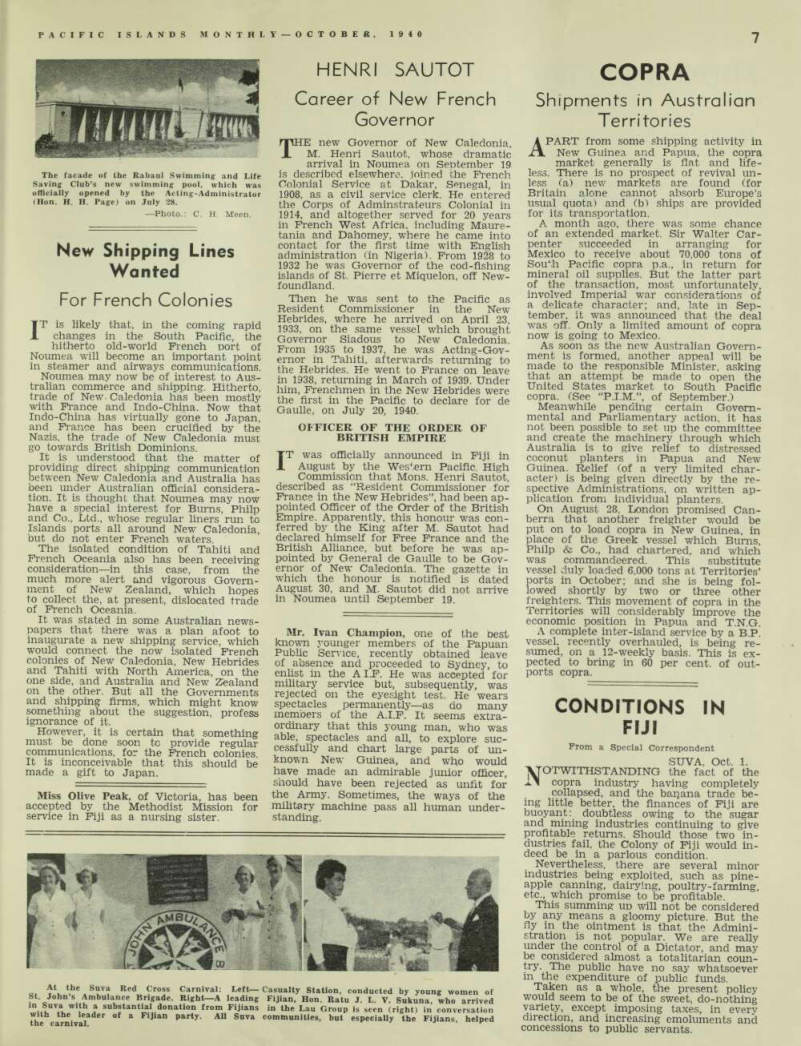
Miss June Mossman, aged 16, is Rabaul’s “wonder swimmer”. Recently, under official test by the Royal Life Saving Society, she swam 600 yards, fully dressed (200 yards breast-stroke; 200 yards back-stroke, 200 yards free-style) in 11 mins. 54 secs. The time officially allowed is 20 mins. Although fully clothed, she swam 200 yards over-arm in 3 mins. 15 secs. She is going to school soon, in Brisbane. Rabaul folk are eager that, in Australian swimming contests, she should represent New Guinea, rather than some Queensland club.
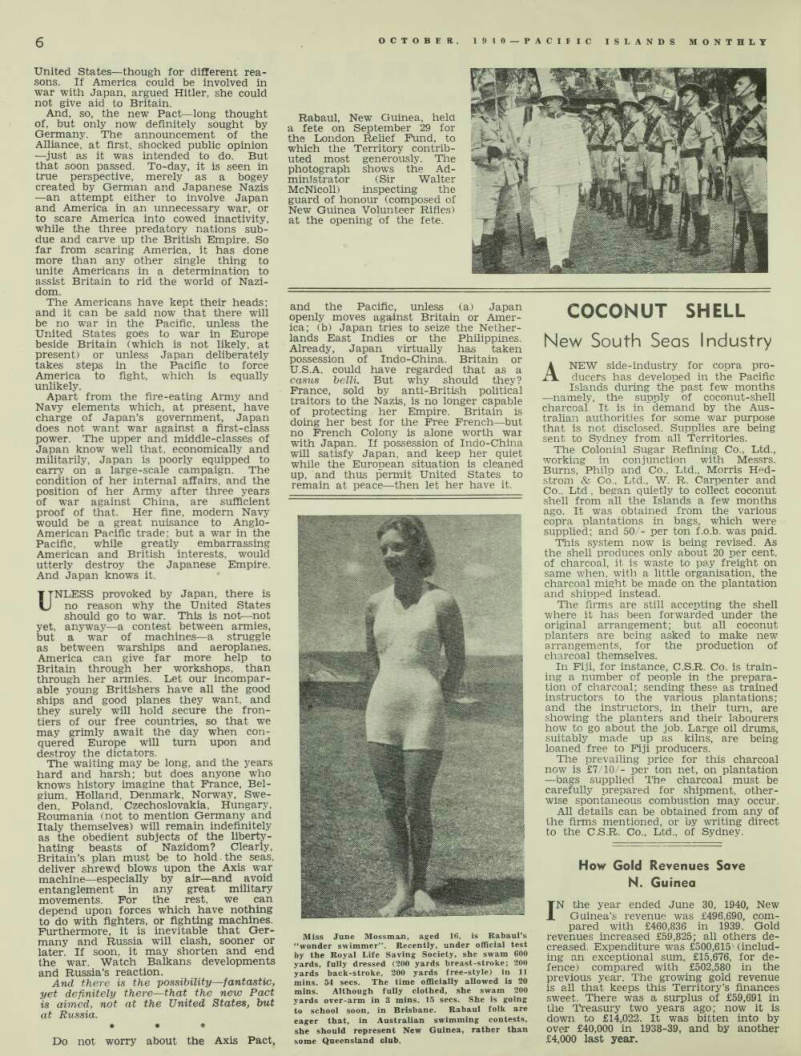
Rabaul, New Guinea, held a fete on September 29 for the London Relief Fund, to which the Territory contrib uted most generously. The photograph shows the Ad ministrator (Sir Walter McNicoll) inspecting the guard of honour (composed of New Guinea Volunteer Rifles) at the opening of the fete.
New South Seas Industry
Coconut Shell
ANEW side-industry for copra pro ducers has developed in the Pacific Islands during the* past few months —namely, the supply of coconut-shell charcoal. It is in demand by the Aus tralian authorities for some war purpose that is not disclosed. Supplies are being sent to Sydney from all Territories.
The Colonial Sugar Refining Co., Ltd., working in conjunction with Messrs.
Burns, Philp and Co., Ltd., Morris strom & Co., Ltd., W. R. Carpenter and Co.. Ltd. began quietly to collect coconut shell from all the Islands a few months ago. It was obtained from the various copra plantations in bags, which were supplied; and 50/- per ton f.o.b. was paid.
This system now is being revised. As the shell produces only about 20 per cent, of charcoal, it is waste to pay freight on same when, with a little organisation, the charcoal might be made on the plantation and shipped instead.
The firms are still accepting the shell where it has been forwarded under the original arrangement; but all coconut planters are being asked to make new arrangements, for the production of charcoal themselves.
In Fiji, for instance, C.S.R. Co. is train ing a number of people in the prepara tion of charcoal; sending these as trained instructors to the various plantations; and the instructors, in their turn, are showing the planters and their labourers how to go about the job. Large oil drums, suitably made up as kilns, are being loaned free to Fiji producers.
The prevailing price for this charcoal now is £7/10/- per ton net, on plantation —bags supplied The charcoal must be carefully prepared for shipment, other wise spontaneous combustion may occur.
All details can be obtained from any of the firms mentioned, or by writing direct to the C.S.R. Co., Ltd., of Sydney.
How Gold Revenues Save
N. Guinea
IN the year ended June 30, 1940, New Guinea’s revenue was £496,690, com pared with £460,836 in 1939. Gold revenues increased £59,825; all others de creased. Expenditure was £soo,6ls'(includ ing an exceptional sum, £15,676, for de fence) compared with £502,580 in the previous year. The growing gold revenue is all that keeps this Territory’s finances sweet. There was a surplus of £59,691 in the Treasury two years ago; now it is down to £14,022. It was bitten into by over £40,000 in 1938-39, and by another £4,000 last year.
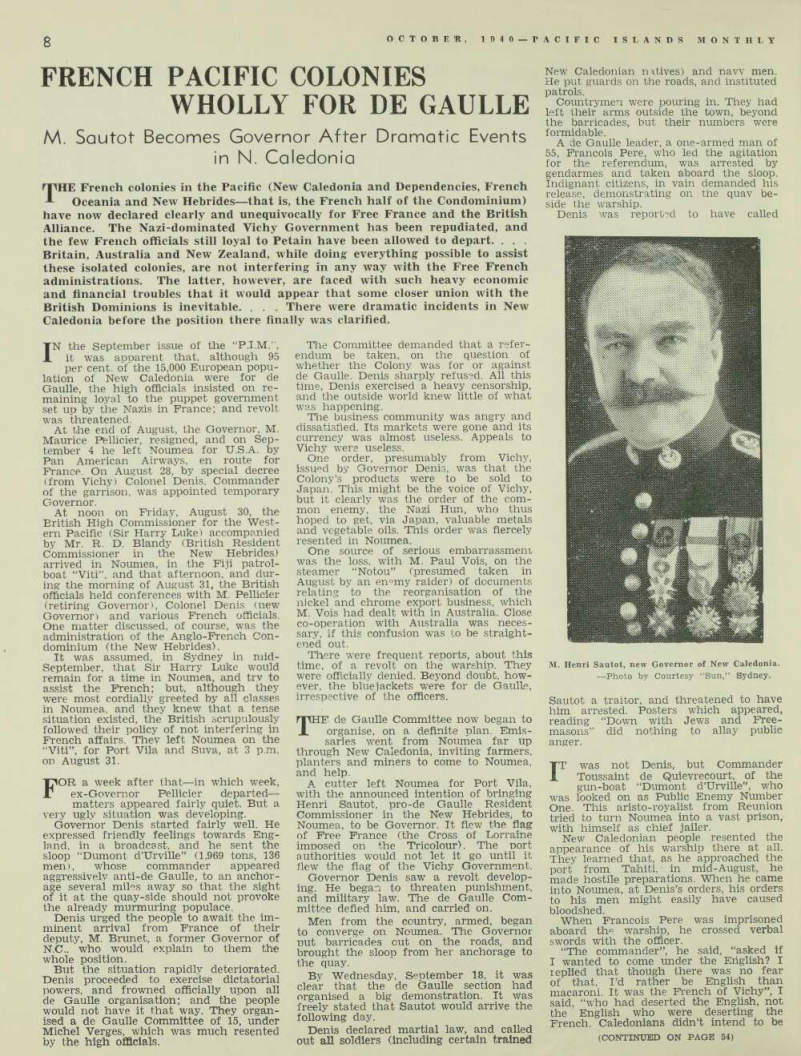
The facade of the Rabaul Swimming and Life Saving Club’s new swimming pool, which was officially opened by the Acting-Administrator (Hon. H. H. Page) on July 28. —Photo.; C. H. Mean.
New Shipping Lines
Wanted For French Colonies
IT is likely that, in the coming rapid changes in the South Pacific, the hitherto old-world French port of Noumea will become an important point in steamer and airways communications.
Noumea may now be of interest to Aus tralian commerce and shipping. Hitherto, trade of New Caledonia lias been mostly with France and Indo-China. Now that Indo-China has virtually gone to Japan, and France has been crucified by the Nazis, the trade of New Caledonia must go towards British Dominions.
It is understood that the matter of providing direct shipping communication between New Caledonia and Australia has been under Australian official considera tion. It is thought that Noumea may now have a special interest for Burns, Philp and Co., Ltd., whose regular liners run to Islands ports all around New Caledonia, but do not enter French waters.
The isolated condition of Tahiti and French Oceania also has been receiving consideration—in this case, from the much more alert and vigorous Govern ment of New Zealand, which hopes to collect the, at present, dislocated trade of French Oceania.
It was stated in some Australian news papers that there was a plan afoot to inaugurate a new shipping service, which would connect the now isolated French colonies of New Caledonia, New Hebrides and Tahiti with North America, on the one side, and Australia and New Zealand on the other. But all the Governments and shipping firms, which might know something about the suggestion, profess ignorance of it.
However, it is certain that something must be done soon to nrovide regular communications, for the French colonies It is inconceivable that this should be made a gift to Japan.
Miss Olive Peak, of Victoria, has been accepted by the Methodist Mission for service in Fiji as a nursing sister.
Suva Red Cross Carnival: Left— Casualty Station, conducted by young women of St. John s Ambulance Brigade. Right—A leading Fijian, Hon. Ratu J. L. V. Sukuna, who arrived m Suva with a substantial donation from Fijians in the Lau Group is seen (right) in conversation with the leader of a Fijian party. All Suva communities, but especially the Fijians, helped
Henri Sautot
Career of New French Governor
rE new Governor of New Caledonia, M. Henri Sautot, whose dramatic arrival in Noumea on Sentember 19 is described elsewhere, joined the French Colonial Service at Dakar, Senegal, in 1908, as a civil service clerk. He entered the Corps of Adminstrateurs Colonial in 1914, and altogether served for 20 years in French West Africa, including Maure tania and Dahomey, where he came into contact for the first time with English administration (in Nigeria). From 1928 to 1932 he was Governor of the cod-fishing islands of St. Pierre et Miquelon, off New foundland.
Then he was sent to the Pacific as Resident Commissioner in the New Hebrides, where he arrived on April 23, 1933, on the same vessel which brought Governor Siadous to New Caledonia.
From 1935 to 1937, he was Acting-Gov ernor in Tahiti, afterwards returning to the Hebrides. He went to France on leave in 1938, returning in March of 1939. Under him, Frenchmen in the New Hebrides were the first in the Pacific to declare for de Gaulle, on July 20, 1940.
Officer Of The Order Of
British Empire
IT was officially announced in Fiji in August by the Western Pacific. High Commission that Mons. Henri Sautot, described as “Resident Commissioner for France in the New Hebrides’’, had been ap pointed Officer of the Order of the British Empire. Apparently, this honour was con ferred by the King after M. Sautot had declared himself for Free France and the British Alliance, but before he was ap pointed by General de Gaulle to be Gov ernor of New Caledonia. The gazette in which the honour is notified is dated August 30, and M. Sautot did not arrive in Noumea until September 19.
Mr. Ivan Champion, one of the best known younger members of the Papuan Public Service, recently obtained leave of absence and proceeded to Sydney, to enlist in the A IP. He was accented for military service but, subsequently, was rejected on the eyesight test. He wears spectacles permanently—as do many members of the A.I.F. It seems extra ordinary that this young man, who was able, spectacles and all, to explore suc cessfully and chart large parts of un known New Guinea, and who would have made an admirable junior officer, should have been rejected as unfit for the Army. Sometimes, the ways of the military machine pass all human under standing.
Copra
Shipments in Australian Territories
APART from some shipping activity in New Guinea and Papua, the copra market generally is flat and life less. There is no prospect of revival un less (a) new markets are found (for Britain alone cannot absorb Europe’s usual quota) and (b) ships are provided for its transportation.
A month ago, there was some chance of an extended market. Sir Walter Car penter succeeded in arranging for Mexico to receive about 70,000 tons of South Pacific copra p.a., in return for mineral oil supplies. But the latter part of the transaction, most unfortunately, involved Imperial war considerations of a delicate character; and, late in Sep tember, it was announced that the deal was off. Only a limited amount of copra now is going to Mexico.
As soon as the new Australian Govern ment is formed, another appeal will be made to the responsible Minister, asking that an attempt be made to open the United States market to South Pacific copra. (See “P.1.M.”, of September.) Meanwhile pending certain Govern mental and Parliamentary action, it has not been possible to set up the committee and create the machinery through which Australia is to give relief to distressed coconut planters in Papua and New Guinea. Relief (of a very limited char acter) is being given directly by the re spective Administrations, on written ap plication from individual planters.
On August 28, London promised Can berra that another freighter would be put on to load copra in New Guinea, in place of the Greek vessel which Bums, Philp & Co., had chartered, and which was commandeered. This substitute vessel duly loaded 6,000 tons at Territories’ ports in October; and she is being fol lowed shortly by two or three other freighters. This movement of copra in the Territories will considerably improve the economic position in Papua and T.N.G.
A complete inter-island service by a BP. vessel, recently overhauled, is being re sumed, on a 12-weekly basis. This is ex pected to bring in 60 per cent, of out ports copra.
Conditions In
Fiji
Prom a Special Correspondent
Suva, Oct. 1.
Notwithstanding the fact of the copra industry having completely collapsed, and the bapana trade be ing little better, the finances of Fiji are buoyant: doubtless owing to the sugar and mining industries continuing to give profitable returns. Should those two in dustries fail, the Colony of Fiji would in deed be in a parlous condition.
Nevertheless, there are several minor industries being exploited, such as pine apple canning, dairying, poultry-farming, etc., which promise to be profitable.
This summing up will not be considered by any means a gloomy picture. But the fly in the ointment is that the Admini stration is not popular. We are really under the control of a Dictator, and may be considered almost a totalitarian coun try. The public have no say whatsoever in the expenditure of public funds.
Taken as a whole, the present policy would seem to be of the sweet, do-nothing variety, except imposing taxes, in every direction, and increasing emoluments and concessions to public servants.
French Pacific Colonies
Wholly For De Gaulle
M. Sautot Becomes Governor After Dramatic Events in N. Caledonia
THE French colonies in the Pacific (New Caledonia and Dependencies, French Oceania and New Hebrides—that is, the French half of the Condominium) have now declared clearly and unequivocally for Free France and the British Alliance. The Nazi-dominated Vichy Government has been repudiated, and the few French officials still loyal to Petain have been allowed to depart. . . .
Britain, Australia and New Zealand, while doing everything possible to assist these isolated colonies, are not interfering in any way with the Free French administrations. The latter, however, are faced with such heavy economic and financial troubles that it would appear that some closer union with the British Dominions is inevitable. . . . There were dramatic incidents in New Caledonia before the position there finally was clarified.
IN the September issue of the “P.1.M.”, it was apparent that, although 95 per cent, o'f the 15,000 European popu lation of New Caledonia were for de Gaulle, the high officials insisted on re maining loyal to the puppet government set up by the Nazis in France: and revolt was threatened.
At the end of August, the Governor, M.
Maurice Pellicier, resigned, and on Sep tember 4 he left Noumea for U.S.A. by Pan American Airways, en route for Prance. On August 28. by special decree (from Vichy) Colonel Denis, Commander of the garrison, was appointed temporary Governor.
At noon on Friday, August 30, the British High Commissioner for the West ern Pacific (Sir Harry Luke) accompanied by Mr. R. D. Blandy (British Resident Commissioner in the New Hebrides) arrived in Noumea, in the Fiji patrol boat “Viti”, and that afternoon, and dur ing the morning of August 31, the British officials held conferences with M. Pellicier (retiring Governor), Colonel Denis (new Governor) and various French officials.
One matter discussed, of course, was the administration of the Anglo-French Con dominium (the New Hebrides).
It was assumed, in Sydney in mid- September, that Sir Harry Luke would remain for a time in Noumea, and try to assist the French; but, although they were most cordially greeted by all classes in Noumea, and they knew that a tense situation existed, the British scrupulously followed their policy of not interfering in French affairs. They left Noumea on the “Viti”, for Port Vila and Suva, at 3 p.m. on August 31.
FOR a week after that —in which week, ex-Governor Pellicier departed— matters appeared fairly quiet. But a very ugly situation was developing.
Governor Denis started fairly well. He expressed friendly feelings towards Eng land, in a broadcast, and he sent the sloop “Dumont d’Urville” (1,969 tons, 136 men), whose commander appeared aggressively anti-de Gaulle, to an anchor age several miles away so that the sight of it at the quay-side should not provoke the already murmuring populace.
Denis urged the people to await the im minent arrival from France of their deputy, M. Brunet, a former Governor of N.C., who would explain to them the whole position.
But the situation rapidly deteriorated.
Denis proceeded to exercise dictatorial powers, and frowned officially upon all de Gaulle organisation; and the people would not have it that way. They organ ised a de Gaulle Committee of 15, under Michel Verges, which was much resented by the high officials.
The Committee demanded that a refer endum be taken, on the question of whether the Colony was for or against de Gaulle. Denis sharply refused. All this time, Denis exercised a heavy censorship, and the outside world knew little of what was happening.
The business community was angry and dissatisfied. Its markets were gone and its currency was almost useless. Appeals to Vichy were useless.
One order, presumably from Vichy, issued by Governor Denis, was that the Colony’s products were to be sold to Japan. This might be the voice of Vichy, but it clearly was the order of the com mon enemy, the Nazi Hun, who thus hoped to get, via Japan, valuable metals and vegetable oils. This order was fiercely resented in Noumea, One source of serious embarrassment was the loss, with M. Paul Vois, on the steamer “Notou” (presumed taken in August by an en°my raider) of documents relating to the reorganisation of the nickel and chrome export business, which M. Vois had dealt with in Australia. Close co-operation with Australia was neces sary, if this confusion was to be straight ened out.
There were frequent reports, about this time, of a revolt on the warship. They were officially denied. Beyond doubt, how ever, the bluejackets were for de Gaulle, irrespective of the officers.
THE de Gaulle Committee now began to organise, on a definite plan. Emis saries went from Noumea far up through New Caledonia, inviting farmers, planters and miners to come to Noumea, and help.
A cutter left Noumea for Port Vila, with the announced intention of bringing Henri Sautot, pro-de Gaulle Resident Commissioner in the New Hebrides, to Noumea, to be Governor. It flew the flag of Free France (the Cross of Lorraine imposed on the Tricolour). The port authorities would not let it go until it flew the flag of the Vichy Government.
Governor Denis saw a revolt develop ing. He began to threaten punishment, and military law. The de Gaulle Com mittee defied him, and carried on.
Men from the country, armed, began to converge on Noumea. The Governor put barricades cut on the roads, and brought the sloop from her anchorage to the quay.
By Wednesday, September 18, it was clear that the de Gaulle section had organised a big demonstration. It was freely stated that Sautot would arrive the following day.
Denis declared martial law, and called out all soldiers (including certain trained
New Caledonian natives) and navv men.
He put guards on the roads, and instituted patrols.
Countrymen were pouring in. They had left their arms outside the town, beyond the barricades, but their numbers were formidable.
A de Gaulle leader, a one-armed man of 55, Francois Pere, who led the agitation for the referendum, was arrested by gendarmes and taken aboard the sloop.
Indignant citizens, in vain demanded his release, demonstrating on the quav be side the warship.
Denis was reported to have called
Sautot a traitor, and threatened to have him arrested. Posters which appeared, reading “Down with Jews and Free masons” did nothing to allay public anger.
IT was not Denis, but Commander Toussaint de Quievrecourt, of the gun-boat “Dumont d’Urville”, who was looked on as Public Enemy Number One. This aristo-royalist from Reunion tried to turn Noumea into a vast prison, with himself as chief jailer.
New Caledonian people resented the appearance of his warship there at all.
They learned that, as he approached the port from Tahiti, in mid-August, he made hostile preparations. When he came into Noumea, at Denis’s orders, his orders to his men might easily have caused bloodshed.
When Francois Pere was imprisoned aboard the warship, he crossed verbal swords with the officer.
“The commander”, he said, “asked if I wanted to come under the Ehglish? I replied that though there was no fear of that. I’d rather be English than macaroni. It was the French of Vichy”, I said, “who had deserted the English, not the English who were deserting the French. Caledonians didn’t intend to be
(Continued On Page 54)
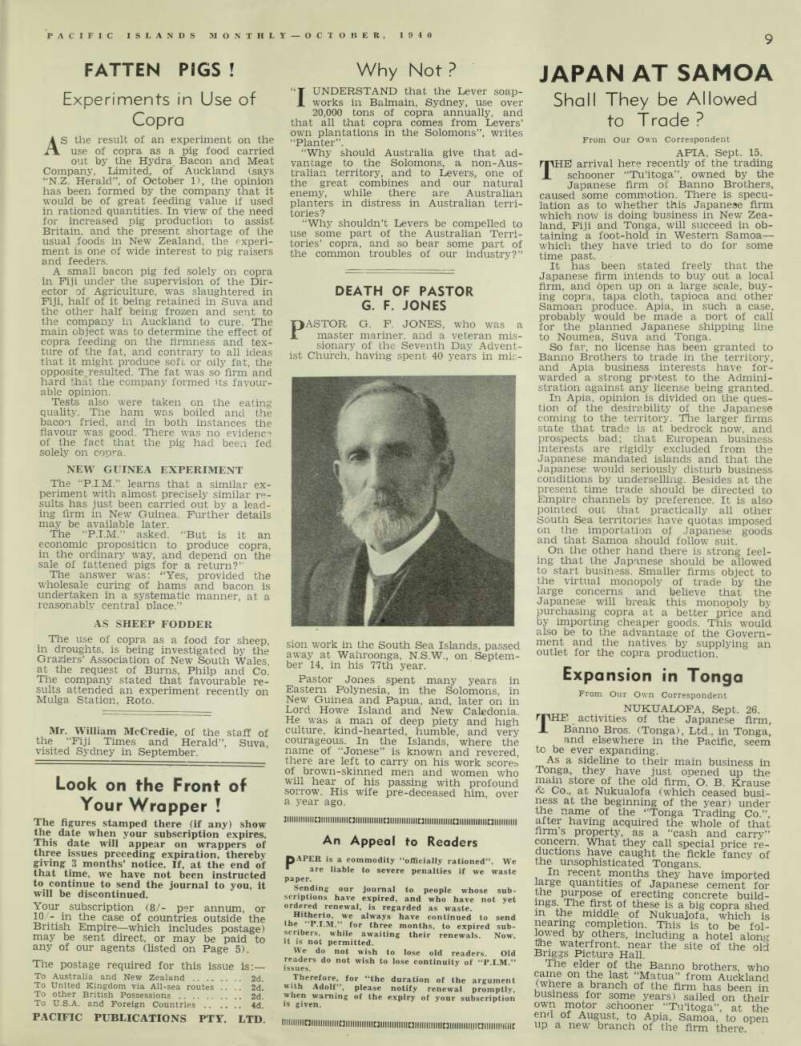
M. Henri Sautot, new Governor of New Caledonia. —Photo by Courtesy “Sun,” Sydney.
deserters, anyway. The commander didn’t seem to relish what I said.”
THINGS happened in Noumea streets that Wednesday evening, after Pere was taken aboard, for which the gun boat only was to blame.
It was an unforgivable mistake to asso ciate native New Caledonian troops (Tirailleurs de la Pacifique, good soldiers and popular locally) with the gun-boat’s sailors in the patrol, which blundered its way through the town, after a state of siege had been proclaimed by Governor Denis.
Cinemas, bars, etc., were promptly closed. Control formally passing from the civil police to the military.
But this measure did not procure tran quility. The patrol found an angry crowd waiting for them, the moment they arrived at the market place.
An ensign from the gun-boat, striking ridiculous attitudes, kept shouting, “In the name of the law. I order you all to disperse.” But nobody listened to him — or, rather, they told him to go away and treat himself in an Impolite manner.
The patrol was quickly surrounded and swamped. Being reassembled, and moving off under difficulty, the local lads linking arms with the Caledonian troops and even helped to carry their rifles. It was evident that no Tirailleur would obey any order to fire on a fellow citizen, though the sailors might do so.
The crowd arrived at the quay, and the gun-boat turned a hostile searchlight on the crowd, and seemed to have hoses and guns ready.
Then things got warmer. Stones flew
from all quarters after the patrol had been reinforced by a score or more of sailors. Volleys and cries of “Vive de Gaulle” were answered by sudden rushes by armed men. There were one or two injured, but injuries were slight.
The patrol went on board at 10 p.m. after one sailor had discharged his rifle in the air; and the whole town went to bed to await a stirring morrow.
That morrow (Thursday, September 19) turned out a day of emotion and final rejoicing.
Hundreds more men poured in, full of fight, from the bush. They had dumped their rifles en route, as town entrances were guarded by military.
The crowd passed from war memorial to Town Hall and Signal Hill and where ever they went, de Gaulle flags were hoisted. A deputation demanded the re signation of Colonel Denis in favour of M. Henri Sautot, who was by now out side the harbour, on board a Norwegian ship which had brought him from the New Hebrides.
Instead of ordering Sautot’s arrest, as he had promised the previous day, Denis allowed him to land unopposed.
M. Sautot landed about noon. Shortly before, Pere was released from the war ship.
Sautot was met by the acting-command ant of the troops who, with Messrs.
Verges, Prinet, Rabot, Pognon and others, members of the de Gaulle Committee asked him to arrange matters with Gov ernor Denis in keeping with the people’s decision.
Henri Sautot’s journey, on foot, to Gov ernment House, at the head of a vast crowd singing the “Marseillaise”, was a triumphal procession.
It was about 1 p.m. when Sautot, from the balcony of Government House, was able to announce that Denis had resigned and he had assumed control. The popu lar will had won.
The French Empire, said M. Sautot, amid cheers, must save the Mother Country, crushed under the German boot, and the only way to do that was to rally to the great patriot de Gaulle, whom future history would call liberator. Up to now New Caledonia had been the only French Pacific Colony whose directors had been able to suppress the popular will. But now they, with the people of the New Hebrides and Tahiti, formed a Pacific bastion alongside the British Fmpire, against aggression. Their sole aim was to save France.
Following this speech, the de Gaulle flag was hoisted over Government House; and when the new Governor formally took over at 2 p.m. Australian pressmen (one of whom had been threatened by Denis with expulsion the previous week) were able to get off cables that at last they felt had some chance of reaching their destination.
That evening, September 19. Colonel Denis and his family proceeded to the northern town of La Poa, under a civil guard, while another civil guard looked after Government House.
The Departmental heads decided to carry on, and the 600 men from the country were able to return, satisfied with the part they had played for the cause they had at heart.
They were, however, within two days
called back (and in even greater force, and this time armed with rifles) to counter plotting by a group of dis gruntled metropolitan officers and sous officiers. Supported by the New Caledon ian-born troops almost to a man, they cleaned up the situation by securing pos session of the infantry and artillery bar racks, and of the coastal batteries at Artillery Point and He de Nou.
IT happened that Tuesday, September 24, was the 87th anniversary of the
founding of the Colony: and the occasion was marked by practically the whole population—including men from the outside districts —making an enthusiastic demonstration for Free France, General de Gaulle, and the British alliance. Gov ernor Sautot laid a wreath upon the memorial of the Great War; and after wards he took the salute in a grand march-past.
There were notable speeches. Governor Sautot declared that there was nothing
to indicate that Australia has designs upon the independence of New Caledonia.
A leader of the de Gaulle movement said: ‘None will suffer by the Colony’s de cision to follow de Gaulle. Nothing is more certain than that France will be reborn.”
Everywhere there were great displays of friendship, towards Britain and Aus tralia.
Meantime, refractory officers and their
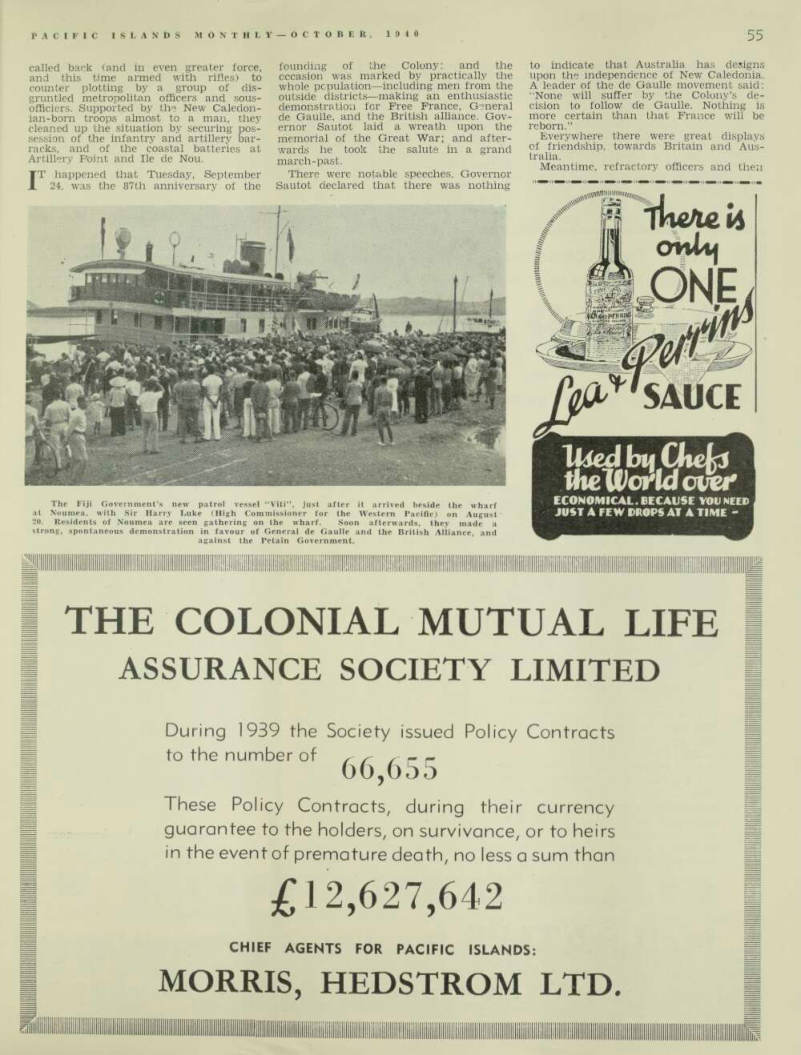
The Fiji Government’s new patrol vessel “Viti”, just after it arrived beside the wharf at Noumea, with Sir Harry Luke (High Commissioner for the Western Pacific) on August 20. Residents of Noumea are seen gathering on the wharf. Soon afterwards, they made a strong, spontaneous demonstration in favour of General de Gaulle and the British Alliance, and against the Petain Government.
families were put aboard a merchant ship with the intention of sending them to Indo-China; but the situation was then obscure, since the New Caledonian crew, being for de Gaulle, wanted to go to Sydney.
To save the warship commander's face, an arrangement was announced, permit ting the departure for Indo-China, ap parently, of the hostile “Dumont d’Urville”.
An interesting incident occurred aboard this warship when a group of soldiers assembled on the wharf, shouting “Vive de Gaulle” and singing the “Marseillaise”.
The sailors aboard (many among them
de Gaulle supporters when ashore) joined in the singing, and one of them was heard to shout the de Gaulle rallying cry.
By the time this appears in print, a clean-up appears possible in the magi strature. Meanwhile, Governor Sautot is proving an energetic and popular admini strator, and the way his speeches are greeted show that both he and the cause of Free France, for which he stands, have taken a real hold on the people of New Caledonia.
It is reported in Australia that there are in New Caledonia 1,200 Free French men who are anxious to join General de
Gaulle’s forces against Nazi Germany.
Many of them, if they cannot join de Gaulle, would like to form a unit of the Australian Army.
The Displaced Officials
It was offcially reported in Canberra on September 26 that the little group of high French officials who had tried to hold New Caledonia for the pro-Nazi Government at Vichy had been gathered aboard the warship “Dumont d’Urville” at Noumea, and permitted to leave—for Indo-China, it was understood. But, as Japan since has displayed activity in Indo-China, this plan may have been changed.
The position of M. Maurice Pellicier is obscure. He left by P.A.A. flying-boat for U.S.A. and Europe on September 4. Later reports indicate that, instead of going to France, he may join General de Gaulle in London. He had been only 10 months in Noumea, where he succeeded M.
Barthes as Governor in October, 1939.
Position In French Oceania
IT was announced by the Prime Mini ster of New Zealand on October 1 that a representative of the New Zea land Government had discussed with the Free French Administration in Tahiti methods of collaboration between French Oceania and the British Commonwealth.
These matters were now the subject of consultation between New Zealand, Britain and Australia, and it was in tended that New Zealand, as the closest neighbour of French Oceania, should maintain contact with the islands.
Mr. Fraser denied a suggestion that Tahiti was now practically a British pro tectorate. “The administration of French Oceania, under the authority of General de Gaulle, and through his appointee, Governor Edmond Mansard, is freely co operating with the British Commonwealth in the struggle for freedom, and is in no way under the supervision of New Zea land or any other British Government”, Mr. Fraser said.
Mr. Fraser added that the new Gov ernor and his advisers appeared to be firmly in control of the situation and to have the support of the great majority of the French and Polynesian population.
Grave Economic Problem
It is clear, however, that the economic situation in Tahiti and throughout the Colony is very bad. Almost all essential supplies, like food and oil, are in short supply. The Colony is eager to buy British or American goods; but, owing to the collapse of its oversea markets, it has little external credit, and neither Aus tralia, New Zealand nor the United States has a demand for Tahitian products.
Ways and means of helping the French colonies through this crisis are being sought by the British and Dominions Governments.
Sympathy For Ex-Governors
TAHITI and French Oceania appear to have settled down quietly under the Free French regime. General de Gaulle, in September, nominated M.
Edmond Mansard to be Governor, after the popular M. de Gery, Governor under the old regime, had resigned and left the Colony.
Interviewed in San Francisco early in October, M. de Gery spoke in friendly fashion of the new regime M. de Gery, like M. Maurice Pellicier, while loyal to France, is not the type of Frenchman who would be expected to submit humbly to the Hun-dominated Government at Vichy.
Both are fine men and splendid officials.
It is to be hoped that British under
standing and sympathy will be extended to such men, in these cruel times. Imagine their position—their proud flag and their great Imperial services under the heel of the Hun, their possessions gone, their official future destroyed.
Copra
Fatten Pigs !
Experiments in Use of Copra
AS the result of an experiment on the use of copra as a piig food carried out by the Hydra. Bacon and Meat Company, Limited, of Auckland (says “N.Z. Herald”, of October 1), the opinion has been formed by the company that it would be of great feeding value if used in rationed quantities. In view of the need for increased pig production to assist Britain, and the present shortage of the usual foods in New Zealand, the experi ment is one of wide interest to pig raisers and feeders.
A small bacon pig fed solely on copra in Fiji under the supervision of the Dir ector of Agriculture, was slaughtered in Fiji, half of it being retained in Suva and the other half being frozen and sent to the company in Auckland to cure. The main object was to determine the effect of copra feeding on the firmness and tex ture of the fat, and contrary to all ideas that it might produce soft or oily fat, the opposite, resulted. The fat was so firm and hard that the company formed its favour able opinion.
Tests also were taken on the eating quality. The ham was boiled and the bacon fried, and in both instances the flavour was good. There was no evidence of the fact that the pig had been fed solely on copra.
New’ Guinea Experiment
The “P.1.M.” learns that a similar ex periment with almost precisely similar re sults has just been carried out by a lead ing firm in New Guinea. Further details may be available later.
The “P.1.M.” asked. “But is it an economic proposition to produce copra, in the ordinary way, and depend on the sale of fattened pigs for a return?”
The answer was: “Yes, provided the wholesale curing of hams and bacon is undertaken in a systematic manner, at a reasonably central place.”
As Sheep Fodder
The use of copra as a food for sheep, in droughts, is being investigated by the Graziers’ Association of New South Wales, at the request of Burns, Philp and Co.
The company stated that favourable re sults attended an experiment recently on Mulga Station, Roto.
Mr. William McCredie, of the staff of the “Fiji Times and Herald”, Suva, visited Sydney in September.
Why Not ?
I UNDERSTAND that the Lever soap works in Balmain, Sydney, use over 20,000 tons of copra annually, and that all that copra comes from Levers’ own plantations in the Solomons”, writes “Planter”.
“Why should Australia give that ad vantage to the Solomons, a non-Aus tralian territory, and to Levers, one of the great combines and our natural enemy, while there are Australian planters in distress in Australian terri tories?
“Why shouldn’t Levers be compelled to use some part of the Australian Terri tories’ copra, and so bear some part of the common troubles of our industry?”
Death Of Pastor
G. F. Jones
PASTOR G. F. JONES, who was a master mariner, and a veteran mis sionary of the Seventh Day Advent ist Church, having spent 40 years in mic-
sion work in the South Sea Islands, passed away at Wahroonga, N.S.W., on Septem ber 14, in his 77th year.
Pastor Jones spent many years in Eastern Polynesia, in the Solomons, in New Guinea and Papua, and, later on in Lord Howe Island and New Caledonia.
He was a man of deep piety and high culture, kind-hearted, humble, and very courageous. In the Islands, where the name of ‘‘Jonese” is known and revered, there are left to carry on his work scores, of brown-skinned men and women who will hear of his passing with profound sorrow. His wife pre-deceased him, over a year ago.
An Appeal to Readers
p.APER is a commodity “officially rationed”. We r are liable to severe penalties if we waste paper.
Sending our journal to people whose sub scriptions have expired, and who have not yet ordered renewal, is regarded as waste.
Hitherto, we always have continued to send the “P.1.M.” for three months, to expired sub scribers, while awaiting their renewals. Now, it is not permitted.
We do not wish to lose old readers. Old readers do not wish to lose continuity of “P.1.M.” issues.
Therefore, for “the duration of the argument with Adolf”, please notify renewal promptly, when warning of the expiry of your subscription is given.
Japan At Samoa
Shall They be Allowed to Trade ?
From Our Own Correspondent APIA, Sept. 15.
THE arrival here recently of the trading schooner “Tu’itoga”, owned by the Japanese firm of Banno Brothers, caused some commotion. There is specu lation as to whether this Japanese firm which now is doing business in New Zea land, Fiji and Tonga, will succeed in ob taining a foot-hold in Western Samoa — which they have tried to do for some time past.
It has been stated freely that the Japanese firm intends to buy out a local firm, and 6pen up on a large scale, buy ing copra, tapa cloth, tapioca and other Samoan produce. Apia, in such a case, probably would be made a port of call for the planned Japanese shipping line to Noumea, Suva and Tonga.
So far, no license has been granted to Banno Brothers to trade in the territory, and Apia business interests have for warded a strong protest to the Admini stration against any license being granted.
In Apia, opinion is divided on the ques tion of the desirability of the Japanese coming to the territory. The larger firms state that trade is at bedrock now, and prospects bad; that European business interests are rigidly excluded from the Japanese mandated islands and that the Japanese would seriously disturb business conditions by underselling. Besides at the present time trade should be directed to Empire channels by preference. It is also pointed out that practically all other South Sea territories have quotas imposed on the importation of Japanese goods and that Samoa should follow suit.
On the other hand there is strong feel ing that the Japanese should be allowed to start business. Smaller firms object to the virtual monopoly of trade by the large concerns and believe that the Japanese will break this monoooly by purchasing copra at a better price and by importing cheaper goods. This would also be to the advantage of the Govern ment and the natives by supplying an outlet for the copra production.
Expansion in Tonga
From Our Own Correspondent
Nukualofa, Sept. 26.
THE activities of the Japanese firm, Banno Bros. (Tonga), Ltd., in Tonga, and elsewhere in the Pacific, seem to be ever expanding.
As a sideline to their main business in Tonga, they have just onened up the mam store of the old firm, O. B. Krause & Co., at Nukualofa (which ceased busi ness at the beginning of the year) under the name of the “Tonga Trading Co.”, after having acquired the whole of that firm’s property, as a “cash and carry” concern. What they call special nrice re ductions have caught the fickle fancy of the unsophisticated Tongans.
In recent months they have imported large quantities of Japanese cement for the purpose of erecting concrete build ings. The first of these is a big copra shed in the middle of Nukualofa, which is nearing completion. This is to be fol lowed by others, including a hotel along the waterfront, near the site of the old Briggs Picture Hall.
The elder of the Banno brothers, who came on the last “Matua” from Auckland (where a branch of the firm has been in business for some years) sailed on their own motor schooner “Tu’itoga”, at the end of August, to Apia, Samoa, to open up a new branch of the firm there.
Advertisements & other items, pp. 11-12 (2 items)
Look on the Front of
Your Wrapper !
The figures stamped there (if any) show the date when your subscription expires.
This date will appear on wrappers of three issues preceding expiration, thereby giving 3 months’ notice. If, at the end of that time, we have not been instructed to continue to send the journal to you, it will be discontinued.
Your subscription (8/- per annum, or 10 - in the case of countries outside the British Empire—which includes postage) may be sent direct, or may be paid to any of our agents (listed on Page 5).
The postage required for this issue is:— To Australia and New Zealand 2d.
To United Kingdom via All-sea routes ... 2d.
To other British Possessions 2d.
To U.S.A. and Foreign Countries 4d.
PACIFIC PUBLICATIONS PTY. LTD.
St. Ignatius’ College
Riverview Sydney
Boys are prepared for Intermediate and Leaving Certificate Examinations and for Exhibitions, Scholarships and Bursaries at the University.
Boys are arranged in three Divisions according to age. Each Division has its own Library, Debating Society, Cricket and Football Fields, and Tennis Courts.
Senior and Junior Rowing Sheds, with a large fleet of pleasure and racing boats.
Private Swimming Baths.
Prospectus and further particulars on application to the— Rector : St. Ignatius’ College, Riverview, Sydney, Australia.
Tel.: JB 1106.
BOARDING AND DAY SCHOOL
Conducted by the Jesuit Fathers
M li
ONE OF SYDNEY'S GREAT PUBLIC SCHOOLS
Order your “Hansman” Super-grade Shoes from
MACNAUGHTS
Sydney's Leading Shoe Stores
Recognised throughout -the industry as footwear of the highest quality, HANSMAN Shoes combine the ultimate in Distinction, Comfort and Longwear.
Every purchaser can feel content in the knowledge that absolute satisfaction in every detail is assured.
The non-corrosive brass slugging, too, is a feature that appeals to the wearer in the tropics.
Illustrated are two outstanding “Hansman” favourites.
Write to-day for the “Hansman”
Catalogue.
ADVANCE
Military Boot for Field Work
Footwear by HANSMAN is in the very front line for all military work. The boot illustrated has been supplied to Officers for many years, and is made of the best materials throughout. It is stocked in brown and black and may be obtained in full and half sizes.
Price, 52/6 . . . (Add postage).
HANSMAN high leg Field Boots, Artillery Boots, Half Wellingtons and Dress Boots are correct to the last detail. m
MACNAUGHTS
135 King Street, Sydney
MILTON;
Price, 49/6 (Add postage).
A popular styling by “Hansman”, for the welldressed male. Wide, square, extended toe. Wide welts and welted heel. Heavy single sole. Most fashionable shape of to-day. No. 8810: Dark Cherry Super Willow Calf. No. 1312: Smooth Finish Super Black Box Calf. ALSO obtainable m Brown or Black Yearling Calf, Punched Golosh and Cap. Pric6 42/6 (add Postage).
SHOE STORES SS:
Tel.: MA 6884 (3 lines).
About Islands People
Mr. Nicholas Hagen, merchant and shipowner, of Noumea, New Caledonia, was taken to St. Vincent’s Private Hos pital, Sydney, early in October, suffering from a very bad attack of bronchitis. His condition, on October 11, was reported “improved”.
Captain “Pop” Preece, lately harbour master at Nauru, has retired from the service of the B.P.C. and has settled in a brand-new, ultra-modern home at Bur wood, Melbourne. "Pop” and Mrs. Preece were highly regarded at Nauru and on Ocean Island by all who came in con tact with them, and they will be always remembered there with affection. Prior to departure from Nauru, he and Mrs.
Preece received numerous gifts.
Dr. Clive Backhouse, who obtained leave from the New Guinea Health De partment some time ago to join the A.1.F., is now pathologist with the 7th Australian General Hospital.
Mr. P. A. Snow, of the Administrative Service of Fiji, and now District Commis sioner in the Lau group, was married re cently, in Suva pro-Cathedral, to Miss Anne Harris, of Leicester, Fngland. The Governor of Fiji, Sir Harry Luke, was present at the ceremony.
Mr. D. G. Kennedy who was stationed for some years in the Ellice Islands, first as Headmaster of the Ellice Islands School at Vaitupu and later as Admini strative Officer of the Group, has taken up duty at Tulagi, with the Solomon Is lands Administration, where he has been acting as Superintendent of Police pend ing the arrival from Ocean Island of Mr. J. I. Blaikie, the latter having been promoted to the Tulagi post. Mr. Kennedy will act as Relieving District Officer for the Protectorate after handing over to Mr. Blaikie.
Miss Etella Williams, and Mrs. Cotton Stapleton, of Sydney, both of whom are great-grand-daughters of Rev. John Williams, were at a recent meeting of the Pacific Islands Society. These ladies lived for many years in Western Samoa, where Mrs. Stapleton’s grandfather, Mr.
John Chauner Williams, was British Consul for 25 years.
Rev. H. Lawrence, popular Anglican Chaplain of Rabaul, is at present in Mel bourne. It is reported that he is await ing the arrival from England of his fiancee, after which the wedding bells will ring before his return to N. Guinea.
Prior to his transfer to Rabaul early this year, he was with the Melanesian Mis sion in the Solomons, latterly acting in charge of the Central Training Institution at Pawa, San Cristoval.
Mr. Frank Stock, postmaster at Tulagi, B 5.1. P., accompanied by Mrs. Stock and son John, is spending short furlough in Melbourne, where Mrs Stock is under going treatment for an injury to the eye caused by a rebounding golf ball on the Tulagi links.
Mr. C. G. F. Cartwright, Administrative Officer of the G. and E. Islands Colony, who has spent the past two years on secondment to the Government of the Seychelles, in the Indian Ocean (where the former Resident Commissioner of
Mr. Ed. Pentecost, a well-known and pro gressive young business man of Noumea, New Caledonia, was in Sydney in September. He is proprietor of Libraire Pentecost (booksellers, etc.), managing director of Electric Radio (elec trical supplies) and of Agence Alma (motor cars and accessories).
Mr. John Wiley (chairman of the Queen Committee, Suva Red Cross Carnival), displays excellent taste in choosing camera companions.
Left: Miss L. Mansell (Commercial Queen).
Right: Miss E. Hopewell (Sports Queen),
the G. and E. Colony, now Sir Arthur Grimble, is Governor), recently passed through Melbourne on his return to Ocean Island, where his many friends will be glad to see him again.
Advertisements & other items, pp. 13-14 (1 item)
Or Soldier
IN MEMORIAM
LYALL. —In loving remembrance of my dear son, and our brother, David, who passed away at Daru, Papua, September 17, 1937.
Loved and respected by all around, Good was your heart, your friendship sound, To a wonderful life, came a sudden end, You died as you lived, Son, everyone’s friend.
Inserted by his loving Mother and brothers, Victor, Jackie and Clifford.
AT REST.
or SOLDIER
i
PROUDS PTY. LTD
Choose the Watch that has been proved to withstand ALL
THE ELEMENTS
under the most severe conditions of service.
With its high-grade 15-jewelled movement in an extra strong chrome case with stainless steel back, this is the right watch for a Soldier on active service.
Mail Orders despatched by return, registered and insured at our expense.
WATCHMAKERS AND JEWELLERS.
• KING AND. PITT STREETS, SYDNEY.
rrgßLi N g" r
FLAT OIL
FINISH
WATERPROOF
DRIES INHAIF HOUR
CREAM
Dries in half an hour on plaster walls, ceilings, cement, fibre, wood Cr iron.
Also Excellent as an Undercoat for lacquers, paints & enamels 14/4 per gallon
HIGHLY DURABLE
Write for a colour Card ...
STERLING VARNISH CO., Alexandria, N.S.W.
RADIANT HEALTH
Bright eyes and a clear skin are outward signs of inner cleanliness. Take Eno’s “Fruit Salt” and make sure of radiant health.
ENOS
Knox Grammar School
WAHROONGA, NEW SOUTH WALES, AUSTRALIA
(Headmaster, Dr. W. Bryden, M.Sc.) The School is situated 12 miles from Sydney, 600 feet above sea level, and accepts day boys and boarders from six years of age. Boys prepared for all usual Examinations.
Spacious playing fields, swimming pool, well equipped gymnasium, library. Cadet Corps, etc. Next term commences February 4. Prospectus on application. - M ■ “ ", ■ ■ " : . .
Tropicaoties
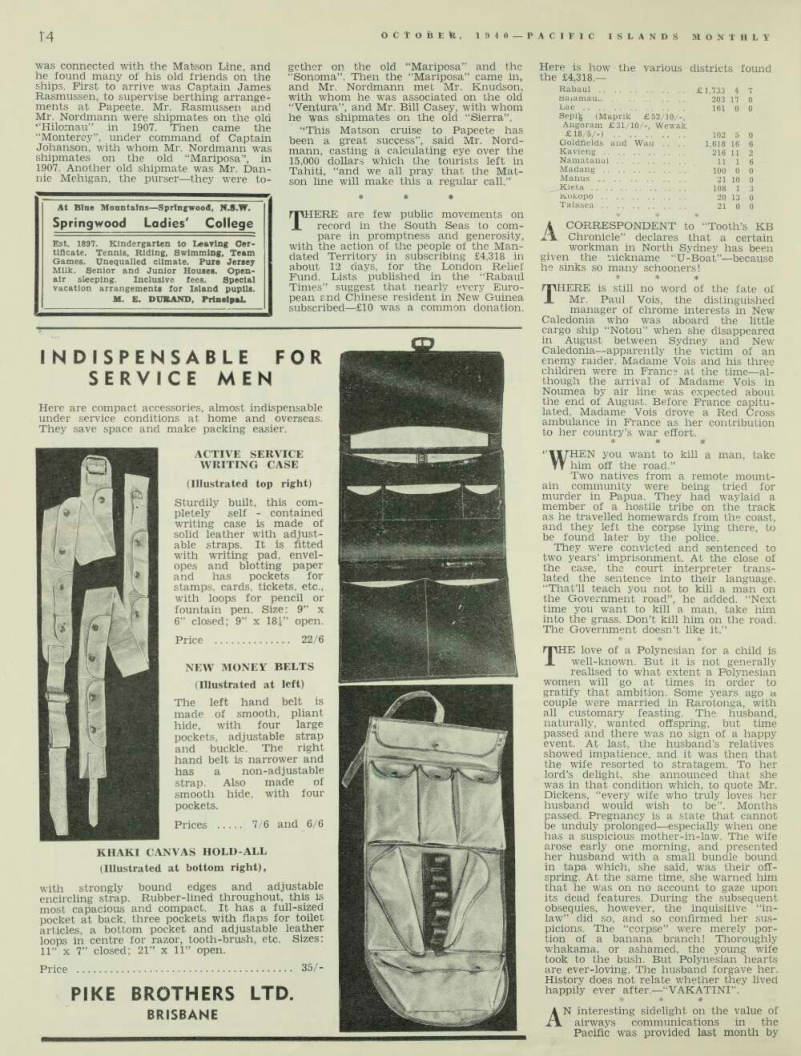
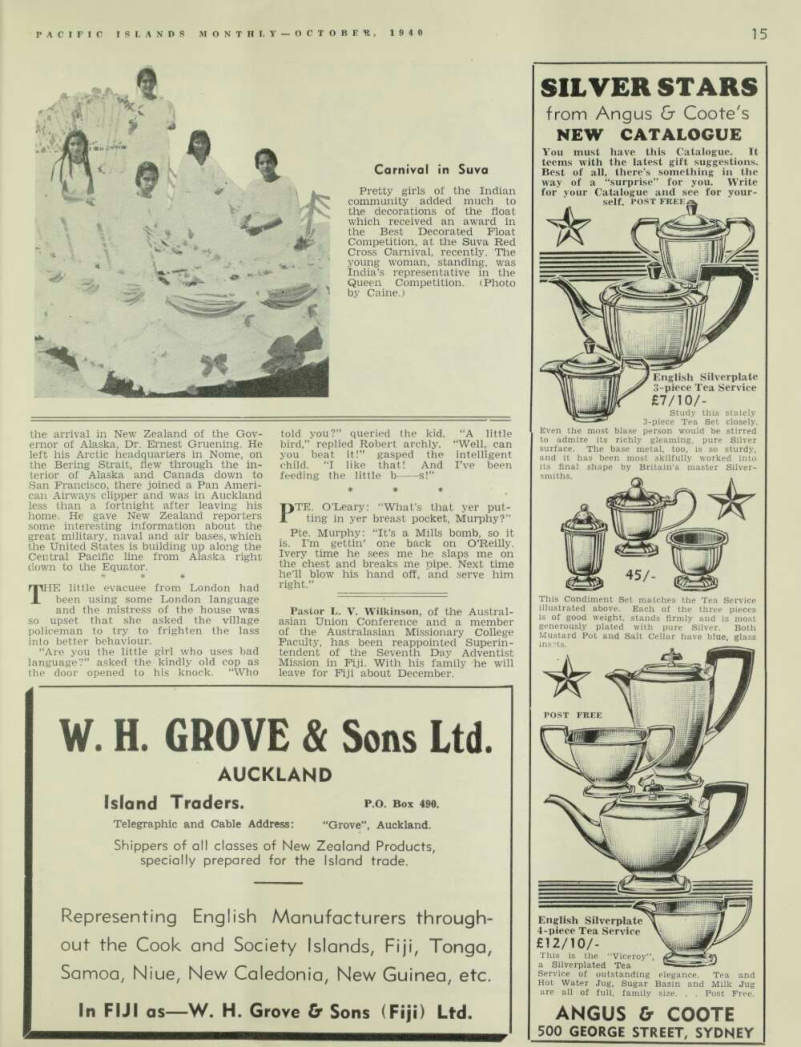
HAVING gone to Tahiti by Matson liner as (as he described it) a “banana tourist”, Sir Maynard Hedstrom, of Suva, contributed some inforesting impressions of Tahiti to the “Fiji Times”. He disagreed emphatically with some of the guide-book stuff published in relation to these Polynesian islands. For instance: — “I have quoted the statement that ‘the women (of Tahiti) are admittedly the most beautiful in the South Seas’. An expression of personal opinion—l saw some beautiful and attractive girls, mostly of mixed blood. One resident told me that only three or four families in Tahiti have preserved the purity of their Poly- * m lno SSjJ, rQ 1 / 1 Sh™
S Q!r a f"“yf
than those I happened to see in Tahiti.
At a cabaret we visited, the flpor dancing, P r actically confined to swinging and twitching of the hips, was less graceful than I have seen amongst other Polynesians or Euronesians.
T . 117 HEN, in September, Pan American Tf Airways great Boeing flying-boat was passing south-east of Howland Island, in the Central Pacific, on its first commercial passenger flight from San Francisco to Auckland, one of the passengers, Mrs. Clare Adams, a vice-president of the Women’s International Association of Aeronautics, cast into the sea a large wreath of bronze magnolia leaves, in memory of Amelia Earhart Putnam.
On July 3, 1937, Mrs. Putnam, one of the foremost women fliers of the world,
who was atempting to fly around the world from west to east, left Lae in New Guinea for Howland Island, where there was a newly-constructed aerodrome, and was never seen again. She was accotn panied by her co-pilot, Captain Fred Noonan. * * * A SHILLING was found inside a coco- J\ nut recently bought at a London shop. Perhaps the Islands planter had crossed his palm with silver!
“Punch”. * * ♦ rpHF. “banana tourists” who arrived by I the Mat son liners “Monterev” and A -Marinos!” in Tahiti in August were t allowed to get any advantage from the confused exchange position. Although at that time the la test quotation in the United States was 86 francs to the dollar, the P e °P le who arrived on the two Ameri can hners were not allowed to receive in Papeete more than 44 francs to the dol iar> This was not muc h more than the normal rate of exchange. Just before the arrival of the “banana tourists” in Papeete, traders there were giving from 100 to 120 francs for every American dol lai—but this trading advantage was not going to be permitted to ordinary com mon tourists whose main purpose in life is regarded as that of leaving as much money as possible in the various ports at which they call. Some of the tourists who knew their currency onions went ashore and insisted on having 60 and even 80 francs for their dollars; but the majority with the fear of the law before them (the French authorities had announced that nothing more than 44 francs were to be given to each dollar) meekly
accepted the controlled price. Conse quently nothing that the tourists bought in Tahiti was cheap—and the tourist snip left behind in the French Colony many thousands of dollars in good money, just at a time when the unfortunate French community wanted it most. * * ♦ rE anxious advice of a prospective husband in the Islands:— ‘•Don't play morning bridge—it’s noth ing but gossip.
“Don’t visit the women in the mornings —there s- too much scandal.
“Don’t be motherly to young cadets, or you’ll be talked about.
“Don’t go to the Club on Saturday or Sunday—the men don’t like it.
“Don’t play games in shorts; Mrs. So and-So looks ridiculous in them.’’ * * * THE idea of using coconut oil as a fuel for diesel engines is not new, and has been tried out a number of times in Australia”, writes “Islands Engineer”, commenting on a report in September “P.1.M.” that the Fiji Govern ment was experimenting with coconut oil.
“About 10 years ago, a German engineer ran a regular motor transport service be tween Sydney and the Hawkesbury Dis trict, N.S.W., with a Mercedes-Benz diesel engine burning coconut oil and it gave quite satisfactory performance. Expert opinion is that diesel engines can be adapted and adjusted to run on practi cally any vegetable oil fuel, but such sub stitutes usually cause premature wearing of vital parts, the injector pump par ticularly, which is one of the most ex pensive parts of a diesel engine to re place.” * * * WHEN a beloved missionary, in one oi the islands of the Pacific, was being transferred to another station, the native congregation he was leaving made him a present ,with these words: “Though you have a white face, you have a black heart.” ♦ ♦ ♦ RECENTLY, spread over a double page, a journal called “Match” published a most sensational photograph en titled “Cannibals Cooking a Man”, ac companied by this story: “This extraordinary photograph was taken by Mrs. Osa Johnson, in the course of a journey which she made with her late husband, Martin, to the island of Esperitu Santo, in the New Hebrides. It is probably the only document in ex istence showing this monstrous ceremony.
Different parts of a human body may be seen roasting on the spit; a foot, a calf of a leg, and to the right, a human stomach. The other parts are more diffi cult to identify. However, the entrails are easily discernible. The natives eat human flesh in the belief that they will become imbued with the strength, courage and other qualities of their victim. That is why they prefer men to women.”
After the publication of this photograph, these lines appeared in a Parisian journal; “I was myself in New Caledonia, in 1921, when the Johnson couple were there taking their photographs. I saw them, with my own eyes, arrange and set up the scene of this ‘monstrous cere mony’, the picture of which they proposed to spread across the world. The press of Noumea denounced their imposture. But, 20 years afterwards, these neonle can still abuse the easy minds of the French public, thanks to the facilities afforded by an irresponsible Dress.” (“Bulletin du Commerce”, Noumea). * * * SOME happy reunions are reported by Mr. Oscar Nordmann, of Papeete, as a result of the visit to Tahiti of the two Matson liners “Monterey” and “Mari posa”, in August. Mr. Nordmann formerly
was connected with the Matson Line, and he found many of his old friends on the ships. First to arrive was Captain James Rasmussen, to supervise berthing arrange ments at Papeete. Mr. Rasmussen and Mr. Nordmann were shipmates on the old “Hilomau” in 1907. Then came the “Monterey”, under command of Captain Johanson, with whom Mr. Nordmann was shipmates on the old “Mariposa”, in 1907. Another old shipmate was Mr. Dan nie Mehigan, the purser—they were to
gether on the old “Mariposa” and the “Sonoma”. Then the “Mariposa” came in, and Mr. Nordmann met Mr. Knudson, with whom he was associated on the old “Ventura”, and Mr. Bill Casey, with whom he was shipmates on the old “Sierra”.
“This Matson cruise to Papeete has been a great success”, said Mr. Nord mann, casting a calculating eye over the 15,000 dollars which the tourists left in Tahiti, “and we all pray that the Mat son line will make this a regular call.” * * ♦ THERE are few public movements on record in the South Seas to com pare in promptness and generosity, with the action of the people of the Man dated Territory in subscribing £4,318 in about 12 days, for the London Relief Fund. Lists published in the “Rabaul Times” suggest that nearly every Euro pean and Chinese resident in New Guinea subscribed —£10 was a common donation.
Here is how the various districts found the £4,318.
Rabaul £1,733 4 7 fc>aiamau~ 203 17 0 Lae 161 0 0 Sepifc (Maprik £52/10/-, Angoram £3l/10/-, Wewak £lB/5/-) 102 5 0 Goldfields and Wau . . . , 1,618 16 6 Kavieng 216 11 2 Namatanai 11 16 Madang 100 0 0 Manus 21 10 0 Kieta 108 1 3 Kokopo 20 13 0 Talasea 21 0 0 * * * \ CORRESPONDENT to “Tooth’s KB Chronicle” declares that a certain workman in North Sydney has been given the nickname “U-Boat”—because he sinks so many schooners! * * * THERE is still no word of the fate of Mr. Paul Vois, the distinguished manager of chrome interests in New Caledonia who was aboard the little cargo ship “Notou” when she disappeared in August between Sydney and New Caledonia—apparently the victim of an enemy raider. Madame Vois and his three children were in France at the time—al though the arrival of Madame Vois in Noumea by air line was expected about the end of August. Before France capitu lated, Madame Vois drove a Red Cross ambulance in France as her contribution to her country’s war effort. * * * “lITHEN you want to kill a man, take tt him off the road.”
Two natives from a remote mount ain community were being tried for murder in Papua. They had waylaid a member of a hostile tribe on the track as he travelled homewards from the coast, and they left the corpse lying there, to be found later by the police.
They were convicted and sentenced to two years’ imprisonment. At the close of the case, the court interpreter trans lated the sentence into their language.
“That’ll teach you not to kill a man on the Government road”, he added. “Next time you want to kill a man, take him into the grass. Don’t kill him on the road.
The Government doesn’t like it.” * * * THE love of a Polynesian for a child is well-known. But it is not generally realised to what extent a Polynesian women will go at times in order to gratify that ambition. Some years ago a couple were married in Rarotonga, with all customary feasting. The husband, naturally, wanted offspring, but time passed and there was no sign of a happy event. At last, the husband’s relatives showed impatience, and it was then that the wife resorted to stratagem. To her lord’s delight, she announced that she was in that condition which, to quote Mr.
Dickens, “every wife who truly loves her husband would wish to be”. Months passed. Pregnancy is a state that cannot be unduly prolonged—especially when one has a suspicious mother-in-law. The wife arose early one morning, and presented her husband with a small bundle bound in tapa which, she said, was their off spring. At the same time, she warned him that he was on no account to gaze upon its dead features. During the subsequent obsequies, however, the inquisitive “in law” did so, and so confirmed her sus picions. The “corpse” were merely por tion of a banana branch! Thoroughly whakama, or ashamed, the young wife took to the bush. But Polynesian hearts are ever-loving. The husband forgave her.
History does not relate whether they lived happily ever after.—“VAKATINI”. * * * AN interesting sidelight on the value of airways communications in the Pacific was provided last month by
the arrival in New Zealand of the Gov ernor of Alaska, Dr. Ernest Gruening. He left his Arctic headquarters in Nome, on the Bering Strait, flew through the in terior of Alaska and Canada down to San Francisco, there joined a Pan Ameri can Airways clipper and was in Auckland less than a fortnight after leaving his home. He gave New Zealand reporters some interesting information about the great military, naval and air bases, which the United States is building up along the Central Pacific line from Alaska right down to the Equator, * * * THE little evacuee from London had been using some London language and the mistress of the house was so upset that she asked the village policeman to try to frighten the lass into better behaviour.
“Are you the little girl who uses bad language?” asked the kindly old cop as the door opened to his knock. “Who
told you?” queried the kid. “A little bird,” replied Robert archly. “Well, can you beat it!” gasped the intelligent child. “I like that! And I’ve been feeding the little b s!” ♦ ♦ ♦ PTE. O’Leary: “What’s that yer put ting in yer breast pocket, Murphy?”
Pte. Murphy: “It’s a Mills bomb, so it is. I’m gettin’ one back on O’Reilly.
Ivery time he sees me he slaps me on the chest and breaks me pipe. Next time he’ll blow his hand off, and serve him right.”
Pastor L. V. Wilkinson, of the Austral asian Union Conference and a member of the Australasian Missionary College Faculty, has been reappointed Superin tendent of the Seventh Day Adventist Mission in Fiji. With his family he will leave for Fiji about December.
Carnival in Suva Pretty girls of the Indian community added much to the decorations of the float which received an award in the Best Decorated Float Competition, at the Suva Red Cross Carnival, recently. The young woman, standing, was India’s representative in the Queen Competition. (Photo by Caine.)
Advertisements & other items, pp. 15-18 (2 items)
Ultimate
44
*1 Cut out this Coupon and post to-day.
7-VALVE PORTABLE MANTEL
WORLD-WAVE VIBRATOR MODEL
Specially suited for Island conditions An unique Dual Purpose high quality Set exclusive to “ULTIMATE”.Two sets in one—a superior mantel model and easily-carried multi-wave Vibrator Portable. Instantly detachable lid effects the transformation.
Specially suited to Island reception. Magnificent performance under all circumstances. Thorough dependability guaranteed by “ULTIMATE”. Will satisfy the most fastidious expert.
Take it anywhere—picnics, meetings, dances, boating parties, car outings, etc., etc.— performance will always be superb! Exclusive Light Ray Tuning (obtainable only in “ULTIMATE”). Five controls: Tone, Volume, Dial Lamp (for conservation of Battery Power), Wave Band and Tuning-, Broadcast 1600-550 kilocycles ; Short Wave 16-52 metres; special 8 in. Rola Reproducer (sealed against humidity) ; High Fidelity Push-Pull Output (unusual in Vibrator Models) ; A.V.C. Spin Tuning, etc., etc. INSECT-PROOF!
Also obtainable in 5-Valve World-Wave Battery Vibrator, in 6- Valve World Wave, and 8 and 10-Valve All-Wave Electric.
GEORGE BROWN & CO. PTY. LTD., 267 Clarence Street, Sydney.
Please send me particulars of “ULTIMATE” Radio Receivers as advertised in “Pacific Islands Monthly ”.
Name Address. u 1 M m 5* 5* GEORGE BROWN & CO. PTY. LTD., 267 Clarence St., Sydney
At Bine Mountains—Sprlngwood, N.B.W.
Springwood Ladies' College
Est. 1897. Kindergarten to Leaving Certificate. Tennis, Riding, Swimming. Team Games. Unequalled climate. Pure Jersey Milk. Senior and Junior Houses. Openair sleeping. Inclusive fees. Special vacation arrangements for Island pupils.
M. E. DURAND, Principal.
INDISPENSABLE FOR
SERVICE MEN
Here are compact accessories, almost indispensable under service conditions at home and overseas.
They save space and make packing easier. f
ACTIVE SERVICE
WRITING CASE
(Illustrated top right) Sturdily built, this completely self - contained writing case is made of solid leather with adjustable straps. It is fitted with writing pad, envelopes and blotting paper and has pockets for stamps, cards, tickets, etc., with loops for pencil or fountain pen. Size: 9” x 6” closed: 9” x 18i” open.
Price 22/6
NEW MONEY BELTS
(Illustrated at left) The left hand belt is made of smooth, pliant hide, with four large pockets, adjustable strap and buckle. The right hand belt is narrower and has a non-adjustable strap. Also made of smooth hide, with four pockets.
Prices 7/6 and 6/6
KHAKI CANVAS HOLD-ALL
(Illustrated at bottom right), with strongly bound edges and adjustable encircling strap. Rubber-lined throughout, this is most capacious and compact. It has a full-sized pocket at back, three pockets with flaps for toilet articles, a bottom pocket and adjustable leather loops in centre for razor, tooth-brush, etc. Sizes: 11” x 7” closed; 21” x 11” open.
Price 35/-
PIKE BROTHERS LTD.
BRISBANE
ik tr
SILVER STARS
from Angus & Coote's
NEW CATALOGUE
You must have this Catalogue. It teems with the latest gift suggestions.
Best of all, there’s something in the way of a “surprise” for you. Write for your Catalogue and see for yourself. POST FREE^j English Silverplate 3-piece Tea Service £7/10/- Study this stately 3-piece Tea Set closely.
Even the most blase person would be stirred to admire its richly gleaming, pure Silver surface. The base metal, too, is so sturdy, and it has been most skilfully worked into its final shape by Britain’s master Silversmiths. 45/- This Condiment Set matches the Tea Service illustrated above. Each of the three pieces is of good weight, stands firmly and is most generously plated with pure Silver. Both Mustard Pot and Salt Cellar have blue, glass insets.
POST FREE
English Silverplate
4-piece Tea Service £l2/10/- This is the “Viceroy” a Silverplated Tea Service of outstanding elegance. Tea and Hot Water Jug, Sugar Basin and Milk Jug are all of full, family size. . . Post Free.
ANGUS & COOTE
500 GEORGE STREET, SYDNEY
W. H. GROVE & Sons Ltd.
AUCKLAND
Island Traders. p.o. box 490.
Telegraphic and Cable Address: “Grove”, Auckland.
Shippers of all classes of New Zealand Products, specially prepared for the Island trade.
Representing English Manufacturers throughout the Cook and Society Islands, Fiji, Tonga, Samoa, Niue, New Caledonia, New Guinea, etc.
In FIJI as —W. H. Grove & Sons (Fiji) Ltd.
DO YOU KNOW
XniA belles 1
pc fkM
ffflUe glamorous
Ü BELLES OF OLD
PERU CHEWED THE
LEAF OF THE COCA
TREE TO MAKE THEM
INSENSIBLE TO FAIN BEFORE
HAVING- GOLD FILIGREE WORK
INLAID IN THEIR TEETH. TODAY.
WE KNOW THERE IS NO
BEAUTY LIKE GLEAMING-
PEARLY TEETH-
WHITENEP AND PROTECTED
BY KOLYNOS. KOLYN OS
LEAVES TEETH-
SURGICALLY
X4Z hm w .I*o
C LEAN,freefrom
L cte/jfa/ acca i * ernrs.
U O 0 I' l . n * BACTERIAL MOUTH " IS ONE OF THE GREATEST **%gSs CAUSES OF DENTAL PECAy. " BACTERIAL MOUTH * ifa' 1 BEGINS WHEN TINY FOOD DEPOSITS ARE LEFT Ofcf
BETWEEN THE TEETH TO DECAY. KOLYNOS
BUBBLES BETWEEN YOUR TEETH
AND FLOATS AWAY THESE
DANGEROUS FOOD
DEPOSITS. KOLYNOS
KILLS DENTAL
DECAY OERMS, *
LEAVES TEETH-
SURGICALLY CLEAN. <
YOUR TEETH GLEAM **
i AND GLISTEN WITH
NEW LUSTRE . REMEMBER
I KOLYNOS LASTS TWICE AS LONG
aAS ORDINARY DENTAL CREAM -
a-t'ONA DRY BRUSH IS
ENOUGH-.
iffiW
* A
Be CAREFUL OP THY
TEETH AND THOU
J • item invi
J WILL SHOW |T IN
THY STEP.
5P aA 0.
14
OCTOBER, 1940 PACIFIC ISLANDS MONT fiUf
Missions Are
Hard Hit
Reduced Revenues Cripple Their Activities
ONE of the minor tragedies of the pre sent war has been its effect upon missionary activities in the Pacific.
The Melanesian Mission, which has operated so long and successfully in the Solomon Islands, New Hebrides and New Britain (New Guinea"), is faced with a serious curtailment of financial support from Great Britain. As a result, it has had to effect much retrenchment; a number of mission stations have been closed, and others are about to be closed.
In the New Hebrides, medical work is being maintained on a reduced scale, as is mission work at Kumbun, New Britain; and all hospitals are being controlled by New Zealand members of the mission’s staff. The present strength of the leper station at Fuaubu, 8.5.1., is being main tained but any extensions are out of the question.
Although English subscriptions have fallen off, both the New Zealand and Australian churches met their full quota in the financial year recently closed. It is obvious that native support in the Is lands must necessarily suffer a reduction owing to the state of the copra market.
The numerous mission stations through out the Pacific Groups, which are wholly or nartly self-supporting through copra production, are facing their blackest year. This especially has affected some Roman Catholic Missions and many of the Methodist Missionary Society stations.
Wherever possible, a hurried reorgani sation is being made, so that mission stations may grow their own foodstuffs and become as far as practicable self supporting.
These conditions, if they continue for long, will have a serious reaction, insofar that most of the missions, apart from moral teachings, carry out important edu cational and medical work.
Look For "Mon With a Million
Patients"
SOMETHING lively and entertaining, and some merciless disclosures of the weaknesses of “old school tie” ad ministration may be expected in a book which Dr. S. M. Lambert has written, and which will be published in January. Its title probably will be “The Man With a Million Patients”; and, as the American medico, in the course of his epochal work in the South Pacific possibly lived on more Pacific Islands than any other European, and as he is noted for his wit and his sham, discerning eye, the story should be one of the best of its kind seen for many years.
Dr. Lambert, for 22 years, carried on his war against disease in the South Seas; and, when he retired, in 1938, he was well known, and held in high regard, from Tahiti right across to Papua and New Guinea. He lives now at Walnut Creek, California, U S.A. Last June, his Alma Mater, Hamilton College, conferred upon him the well-deserved degree of Doctor of Science.
Mr. Eric Spencer, of the Department of Lands and Works, Tulagi, has settled down at his job again after a visit to Australia, where he was unsuccessful in his effort to rejoin the Air Force, with which he served as a pilot for some years prior to the war.
—C. H. Karius
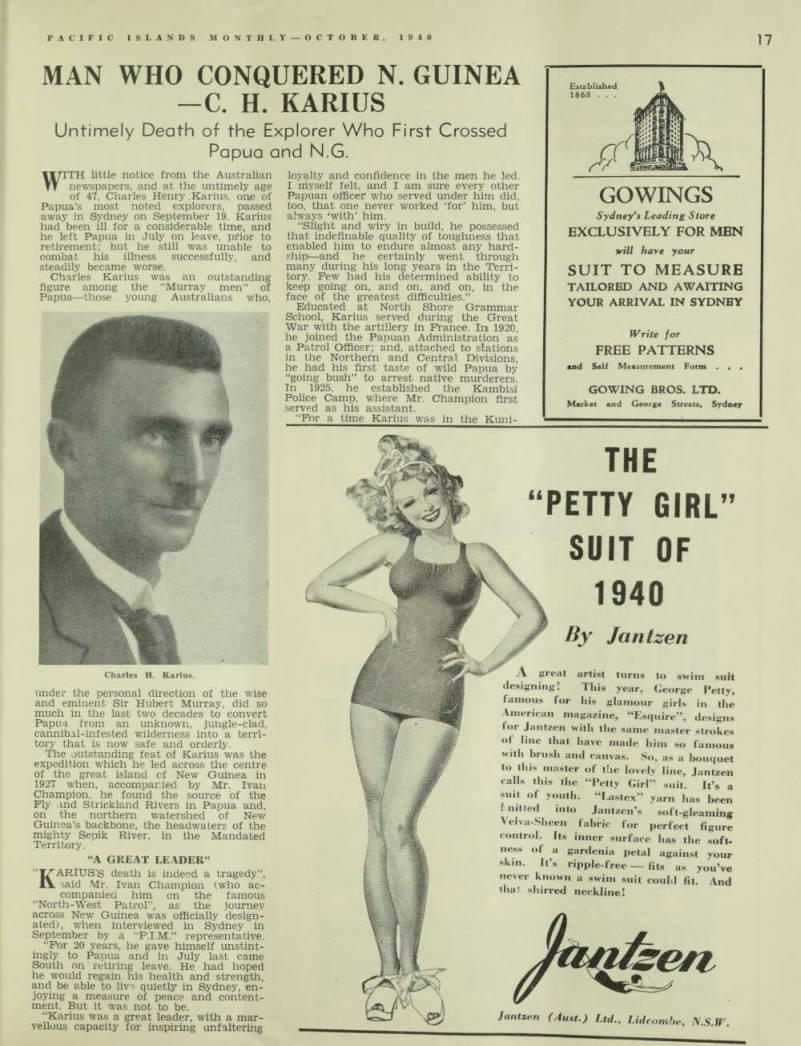
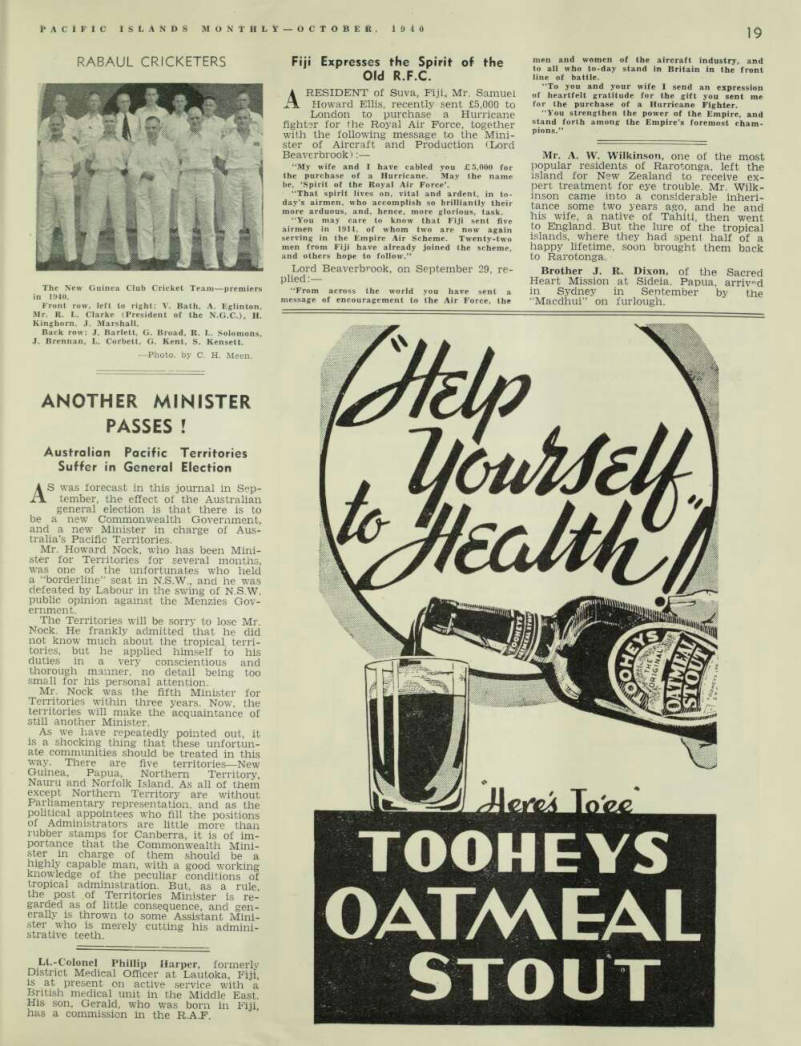
Man Who Conquered N. Guinea
Untimely Death of the Explorer Who First Crossed Papua and N.G.
WITH little notice from the Australian newspapers, and at the untimely age of 47, Charles Henry .Karius, one of Papua’s most noted explorers, passed away in Sydney on September 19. Karius had been ill for a considerable time, and he left Papua in July on leave, prior to retirement: but he still was unable to combat his illness successfully, and steadily became worse.
Charles Karius was an outstanding figure among the “Murray men” of Papua—those young Australians who,
under the personal direction of the wise and eminent Sir Hubert Murray, did so much in the last two decades to convert Papua from an unknown, jungle-clad, cannibal-infested wilderness into a terri tory that is now safe and orderly.
The outstanding feat of Karius was the expedition which he led across the centre of the great island of New Guinea in 1927 when, accompanied by Mr. Ivan Champion, he found the source of the Fly and Strickland Rivers in Papua and, on the northern watershed of New Guinea’s backbone, the headwaters of the mighty Sepik River, in the Mandated Territory.
“A Great Leader”
KARIUS’s death is indeed a tragedy”, said Mr. Ivan Champion (who ac companied him on the famous “North-West Patrol”, as the journey across New Guinea was officially design ated) , when interviewed in Sydney in September by a “P.1.M.” representative.
“For 20 years, he gave himself unstint ingly to Papua and in July last came South on retiring leave. He had hoped he would regain his health and strength, and be able to liv'? quietly in Sydney, en joying a measure of peace and content ment. But it was not to be.
“Karius was a great leader, with a mar vellous capacity for inspiring unfaltering
loyalty and confidence in the men he led.
I myself felt, and I am sure every other Papuan officer who served under him did, too, that one never worked ‘for’ him, but always ‘with’ him.
“Slight and wiry in build, he possessed that indefinable quality of toughness that enabled him to endure almost any hard ship—and he certainly went through many during his long years in the Terri tory. Few had his determined ability to keep going on, and on, and on, in the face of the greatest difficulties.”
Educated at North Shore Grammar School, Karius served during the Great War with the artillery in France. In 1920, he joined the Papuan Administration as a Patrol Officer; a'nd, attached to stations in the Northern and Central Divisions, he had his first taste of wild Papua by “going bush” to arrest native murderers.
In 1925, he established the Kambisi Police Camp, where Mr. Champion first served as his assistant.
“For a time Karius was in the Kuni
Charles H. Karius.
maipa Valley and Mount Yule area, and it was there that his doggedness and per sistency showed themselves”, remarked Mr. Champion, “Untamed natives attacked an officer named Flint, killing
some of his police. Karius was sent after the murderers, and for eight weary months he chased them up and down valleys, over mountains, and through rain-soaked jungles and swamps. Eventu ally he caught them, after the leader, Gouri, had put up a great fight. Inci dentally, Gouri became a well-known figure in Port Moresby while serving five years’ gaol sentence for his part in the attack on Flint.”
First Expedition Unsuccessful
THE Lieutenant-Governor (Sir Hubert Murray) held Karius in extremely high regard”, said Mr. Champion, “and he personally selected him to lead a small expedition in an attempt to cross New Guinea from south to north. I was at Kambisi as officer-in-charge in June, 1926, when Karius unexpectedly -walked into my camp and invited me to go with him, having been given a free hand to choose a European assistant. Naturally, I jumped at the chance.”
Mr. Champion described the expedition thus:— Leaving Port Moresby in the Govern ment vessel, “Elevara”, on December 3, they crossed the Gulf of Papua and went 500 miles up the Fly River in the Western Division. Stores were transported another 8 miles up-river in the launch of the Daru A.R.M. (Mr. W. Lambden). and the party, consisting of the two white officers, 30-cdd native carriers and a small squad of police, was left to its own resources. Kayius set off in advance, to wards the mountains which divide Papua from the Mandated Territory, while Champion and the main party com menced to relay stores and equipment from one base camp to the next further on.
“During these operations”, Mr. Champ ion recalled, “20 carriers stole some canoes and deserted. This was a bad set back, for we were entirely dependent upon carriers and only 12 remained, with practically the whole of the journey yet to go. I left my camp and went on *to Karius to report the desertions. Another man would have fumed in exasperation, but it was typical of his philosophic calmness that when he heard the news he merely looked northwards at the broad expanse of mountainous country stretching before us, the whole of un known New Guinea, and said quietly, de liberately, ‘We’ll go on, of course’.
“Some days later, the deserting carriers were rounded up by the local R.M. near Daru, having travelled the length of the Fly through hostile territory, and the R.M. sent them back to us under a police escort”, added Mr. Champion.
A Nightmare Journey
EVENTUALLY, after having been de layed by floods, Karius and Champ ion reached the great limestone barrier, which was crossed only after a difficult, heart-breaking journey. At Mt.
Blucher, Karius decided, after recon noitring, that the only chance of reach ing the Sepik, across the Victor Emanuel Range, was for him to make a dash with a small party. Accordingly they split forces —Ka'rius, with 18 carriers and 6 police, going north-east, and Champion remaining for a time to explore the country north-west.
Karius was not able to find a passage through the main dividing range and, short of supplies, was forced to return down the Strickland by rafts. After many adventures he succeeded in reaching Daru. His trip down the Strickland was practically the same nightmare journey as that which Jack Hides and David Lyall made 10 years later, and which ended in the death of Lyall at Daru and of Hides, shortly afterwards, in Sydney.
“Karius's journey through the tortuous Strickland gorges and his descent of the river was an epic in courage and endur ance”, stated * Mr. Champion. “I was privileged, a few years ago, to fly over that broken, terrible country and I was appalled by its nature. They were lucky to reach the coast alive, and it is no wonder that it took such a toll of his health.”
After Karius and Champion separated at Mt. Blucher, the latter traced the Palmer River to its source and, from Bolivip village where he stayed for a time, tramped to the Fly, close to its head waters. Faced with food shortage, he re turned to Blucher and then by the Palmer and Fly rafted 500 miles. Finally, he was picked up by Karius who, anxious for the party’s safety, had left Daru in the “Elevara”, almost immediately after his Strickland journey.
(Continued on Page 52)
THOUGH far from well on his return to Port Moresby, Karius sought per mission to attempt the crossing again, confident that it would succeed in the light of knowledge gained from the first expedition, and Sir Hubert Murray readily consented. After several months’ leave, regaining their severely damaged health, Karius and Chamnion left again on September 17, 1927.
Following much the same route, they went up the Fly, again in the “Elevara”, and then struck overland across to Mt.
Blucher and Bolivip. Obtaining food proved a serious problem, the natives scarcely having sufficient for their own needs in this off-season. After finding the actual source of the Fly the party pushed on through treacherous limestone, at a high altitude. They continued north north-west, along country pitted with yawning chasms and huge crater-like pot holes; and, finally, they crossed the Victor Emanuel Range at 8,500 ft. and came down upon the valley from whence the Sepik flows.
Following the Sepik, the party went through country hitherto unmapped, in habited by many types of new natives. At this stage Champion became almost a cripple, the result of a knee injury, and had to be carried on a litter up and down the precipitous mountain-sides and along the broken terrain through which the Sepik runs Brucken and Hoffnungs Rivers, flowing in from the west, were crossed, and the party finally emerged from the mountains on to flat forest country.
Karius’S Bravery
“ TUST about this time”, interrupted Mr.
J Champion, “Karius figured in an in cident that will remain long in my
memory. With three police, he was ahead of the main party and I, still handicap ped by my bad leg, was limping along with the carriers.
“Suddenly, we heard a commotion and much shouting in front. Karius had come upon a native village and taken it com pletely by surprise. Scores of fully armed men piled out of a large village-house and in an instant three lines of warriors stood a dozen yards in front of him, with bows drawn. Karius faced them without flinching, and continued to walk towards them, knowing that any trace of hesita tion or unfriendliness would have been the signal for a deadly flight of arrows.
“There were tense moments as he kept advancing, with arm unraised and call ing peace words we had learnt from other tribes, but which these men, of course, did not understand. Then a change came over the natives —they relaxed, seeing there was no intention of an attack; and soon they were crowding around us with gifts of sago. It was touch and go, but Karius’s pluck and nerve saved us.”' Onward' the expedition marched, keeping as close to the river as the country per mitted. Then, having passed Mountain Gate, where Dr. Schultze, the German scientist arrived with the Dutch-German Boundary Commission in 1910-11, it was decided to take to rafts, but when a num ber had been built, heavy rains swelled the river into a roaring, swirling mass of water impossible to navigate with any de gree of safety. One experiment by Champion resulted in his nearly being drowned, when the frail log-raft cap sized.
Continuing overland again, through a maze of swamps and thick jungle, the leaders and men were seized with violent illness and fever, from polluted drinking water. A few more day?’ travelling, and they were able to begin rafting, at a point some 580 miles from the river
mouth. Then, after a day on rafts, they came quite unexpectedly upon the Papuan Government vessel “Elevara”. Never was a sight more welcome.
By a fine feat of navigation, Mr. B. W.
Ritchie, of the Papuan Service, had brought the “Elevara” around the coasts of Papua and New Guinea and 500 miles up the dangerous waters of the Sepik.
The party was exceptionally fortunate in meeting the vessel, for Ritchie intended, within a day or so to return down the river to replenish supplies. As it was, they v/ere saved many days of hazardous rafting, and returned to Port Moresby on board the little steamer.
Honoured By King
ON all sides, the epic journey across Papua and New Guinea was hailed as one of the finest exploits in the history of the two territories. It was a triumph for the policy of peaceful pene tration, for on both expeditions there was no brush with any of the countless tribes met with—the only loss to the party was a carrier who died from sickness a day before they were picked up by the “Ele vara”. The following year, the King awarded Karius the Patron’s Gold Medal of the Royal Geographical Society.
After an extended period of leave abroad—he was a very keen traveller ana invariably spent his furlough in foreign parts—Karius returned to Papua and went to Baniara station, in the North- Eastern Division. Then followed four or five years at Kokoda (N.D.), until he was appointed Acting Resident Magistrate at Buna. Subsequently he served at Cape Nel son (N.E.D.), Rigo (C.D.) and Kerema (GD.), before being appointed Resident Magistrate at Kikori, in the Delta Divi sion, remaining there until he left for Australia.
It was a peculiar coincidence that Ivan Champion was sent to Kikori to relieve Karius, when Lake Kutubu Police Camp was closed down a few months ago; and the reunion called for much reminiscing.
Mr. Champion did not remain long at Kikori after Karius left—he decided to come to Australia to seek enlistment.
Apart from his renown as an explorer, Karius won the admiration of his fellow officers in the Service by the way he laid-out and arranged the various posts he was stationed at. He had a fine repu tation as a builder, and he made Kikori, where he served last, one of the best out stations in the Territory. Though modest about his accomplishments, he really could turn his hand to almost anything— cooking and piano playing were two of his hobbies that delighted his close friends—but always throughout his life his first and foremost interest was Papua, the land of his adoption, and he was never more content than when “on patrol”.
Mr. Karius was married, and is sur vived by his wife, who now is living in Sydney.
Back in the Solomons after a term on secondment to the G. and E. Islands Colony as Secretary to the Government at Ocean Island, is Mr. L. W. S. Wright, who had been nested to the Ysabel Dis trict. Mr. Wright was D.O. at Guadal canal for some years prior to his tem porary transfer to Ocean Island. He is regarded as something of an authority on the native people of Guadalcanal and their culture, of whch he made a special study during his term as District Officer there.
Monsieur Loraine Chevillard, second son of the late Monsieur M. F. Chevil lard, one of the foremost French pioneers in the New Hebrides, died at the end of August. His plantation was at Sarmettes, Malekula Island.
Advertisements & other items, pp. 19-20 (1 item)
“Petty Girl”
Established 1868 . . . n r/
GO WINGS
Sydney*s Leading Store
EXCLUSIVELY FOR MEN
will have your
SUIT TO MEASURE
TAILORED AND AWAITING
YOUR ARRIVAL IN SYDNEY
Write for
FREE PATTERNS
and Self Measurement Form . . .
COWING BROS. LTD.
Market and George Streets, Sydney
<£?
THE
“PETTY GIRL”
SUIT OF
1940
By Jantzen
r 4 great artist turns to swim suit designing! This year, George Petty, famous for his glamour girls in the American magazine, “Esquire”, designs for Jantzen with the same master strokes of line that have made him so famous with brush and canvas. So, as a bouquet to this master of the lovely line, Jantzen calls this the “Petty Girl” suit. It’s a suit of youth. “Lastex” yarn has been I nit led into Jantzen’s soft-gleaming Velva-Sheen fabric for perfect figure control. Its inner surface has the softness of a gardenia petal against your skin. It’s ripple-free— fits as you’ve never known a swim suit could fit. And tha? shirred neckline!
Jantzen (Aust.) Ltd., Lidcombe , N.S.W.
COMPRESSOR Plants
for MINING
Small one or two hammer plants, with Diesel, Kero, or Charcoal drive. 2 Stage high pressure Compressors for Diesel engine starting.
Spray Plants, etc.
Write for our price lists.
AGENTS WANTED.
Compressor Cr Air Equipment
Mtg. Co.
248 Elizabeth Street, Sydney.
ELECTRICITY IS NO
LONGER A LUXURY!
For the outlay of a few pence a day, you can enjoy the great benefits of safe and dependable electricity—yes, brilliant lighting for every room at an amazingly low cost, if you instal a . . .
PHILIPS HOME ELECTRIC
LIGHTING PLANT
complete with world renowned
EXIDE STORAGE BATTERIES
There is no other Lighting Plant that offers such exceptional value as this Philips. The engine is forced draught, air-cooled single cylinder and operates at low speed. The generator has extra larg-e commutator and collector rings, and cannot become overheated, which is most important. With cheap plants excessive heat causes lubrication failure and wear, and this means trouble. So play safe, decide on a Philips. The price of the Philips is only £69 TO 7 -. (Price includes Federal Sales Tax, and F. 0.8. Sydney). Lower price quoted for Plants sold in bond. Let us tell you all about it.
Telegrams: “Virtue," Sydney. ’Phones: FL5214 (6 lines)
MOFFAT-VIRIUE LTD.
MACHINERY
MERCHANTS
1-2-5 PALMER ST.. SYDNEY. BOX 15848, G.P.0., SHOWROOMS: 44 Bridge St. (opp. Winchcombe, Carson, Ltd.), Sydney
AND AT BRISBANE and LONGREACH, Q’LD.
Rabaul Cricketers
The New Guinea Club Cricket Team—premiers in 1940.
Front row. left to right: V. Bath, A. Eglinton, Mr. R. L. Clarke (President of the N.G.C.), H.
Kinghorn, J. Marshall.
Back row: J. Barlett, G. Broad, R. L. Solomons, J. Brennan, L. Corbett, G. Kent, S. Kensett. —Photo, by C. H. Meen.
Another Minister
Passes !
Australian Pacific Territories Suffer in General Election
AS was forecast in this journal in Sep tember, the effect of the Australian general election is that there is to be a new Commonwealth Government, and a new Minister in charge of Aus tralia’s Pacific Territories.
Mr. Howard Nock, who has been Mini ster for Territories for several months, was one of the unfortunates who held a “borderline” seat in N.S.W., and he was defeated by Labour in the swing of N.S.W. public opinion against the Menzies Gov ernment.
The Territories will be sorry to lose Mr.
Nock. He frankly admitted that he did not know much about the tropical terri tories, but he applied himself to his duties in a very conscientious and thorough manner, no detail being too small for his personal attention.
Mr. Nock was the fifth Minister for Territories within three years. Now, the territories will make the acquaintance of still another Minister.
As we have repeatedly pointed out, it is a shocking thing that these unfortun ate communities should be treated in this way. There are five territories—New Guinea, Papua, Northern Territory, Nauru and Norfolk Island. As all of them except Northern Territory are without Parliamentary representation, and as the political appointees who fill the positions of Administrators are little more than rubber stamps for Canberra, it is of im portance that the Commonwealth Mini ster in charge of them should be a highly capable man, with a good working knowledge of the peculiar conditions of tropical administration. But, as a rule, the post of Territories Minister is re garded as of little consequence, and gen erally is thrown to some Assistant Mini ster who is merely cutting his admini strative teeth, Lt.-Colonel Phillip Harper, formerly District Medical Officer at Lautoka, Fiji, is at present on active service with a British medical unit in the Middle East.
His son, Gerald, who was born in Fiji has a commission in the R.A.F.
Fiji Expresses the Spirit of the Old R.F.C
Old R.F.C.
A RESIDENT of Suva, Fiji,, Mr. Samuel Howard Ellis, recently sent £5,000 to London to purchase a Hurricane fighter for the Royal Air Force, together with the following message to the Mini ster of Aircraft and Production (Lord Beaverbrook): — “My wife and I have cabled you £5,000 for the purchase of a Hurricane. May the name be, ‘Spirit of the Royal Air Force’.
“That spirit lives on, vital and ardent, in to day’s airmen, who accomplish so brilliantly their more arduous, and, hence, more glorious, task.
“You may care to know that Fiji sent five airmen in 1914, of whom two are now again serving in the Empire Air Scheme. Twenty-two men from Fiji have already joined the scheme, and others hope to follow.”
Lord Beaverbrook, on September 29, re
plied:—
“From across the world you have sent a message of encouragement to the Air Force, the
men and women of the aircraft industry, and to all who to-day stand in Britain in the front line of battle.
“To you and your wife I send an expression of heartfelt gratitude for the gift you sent me for the purchase of a Hurricane Fighter.
“You strengthen the power of the Empire, and stand forth among the Empire’s foremost cham pions.”
Mr. A. W. Wilkinson, one of the most popular residents of Rarotonga, left the Island for New Zealand to receive ex pert treatment for eye trouble. Mr. Wilk inson came into a considerable inheri tance some two years ago, and he and his wife, a native of Tahiti, then went to England. But the lure of the tropical islands, where they had spent half of a happy lifetime, soon brought them back to Rarotonga.
Brother J. R. Dixon, of the Sacred Heart Mission at Sideia. Papua, arrived in Sydney in September by the “Macdhui” on furlough.
Advertisements & other items, p. 21 (1 item)
Ur
Soap From Coconut Oil
IN an effort to assist New Caledonian copra planters, Noumea soap manu facturers intend to speed up the pro duction of soap based exclusively on coconut oil (states the “Bulletin du Com merce”) . Hitherto local soap has been manufactured by a process known as the “Marseilles” method, whereby coconut oil is only one of a number of oil ingredi ents. It is believed that an excellent coconut oil soap, suitable for all domestic purposes, can be produced.
The same iournal announces that attempts will shortly be made in Noumea to manufacture edible coconut oil pro ducts, that will possess an agreeable taste and have many uses in the kitchen.
Mr. A. H. Egan has replaced Mr. William D, Carew as British Judge in the New Hebrides Condominium Administration.
Before going to Vila in 1935, Mr. Carew was for 14 years in the Fiji Civil Service.
Regular Stop on P.A.A.
Seaplane Base
At Suva
Service
mHE Fiji Government, with the formal Jl approval of Great Britain, is to commence immediately the con struction of a seaplane base at a bay on the coast of Viti Levu, about two miles from the seaport of Suva, in the direc tion of the mouth of the Rewa River.
Suva Harbour itself, on account of treacherous air currents created by the background of mountains, is not suitable as a seaplane base.
Pan American Airways, on the direct invitation of the British authorities, have agreed to include Suva as a regular call on the regular air mail service
between San Francisco and Auckland, as soon as the base is completed, which is expected to be about the end of this year. The P.A.A. clippers will make an overnight stop at Suva, both going and coming, on the flight between Canton Island and Noumea; and, in view of the importance of this new passenger traf fic, it is understood that certain im provements and alterations will be made to the Grand Pacific Hotel, which already is the leading hotel of the South Pacific territories.
The decision that both British and American interests shall use this new seaplane base in Fiji is significant and important. It was actually decided upon at the Pacific Defence Conference held in Wellington, New Zealand, several months ago; and it is evidence of the growing co-operation between the United States and the British Empire Govern ments in Pacific affairs.
There is a precedent, of course, in Canton Island, where the seaplane sta tion is available to the aircraft of Great Britain and the United States.
A few days after it was announced that Pan American Airways would make use of the Suva seaplane base, a lead ing Tokio newspaper, on September 24, warned the Japanese that “an import ant aspect of the Pacific front of Britain, the United States, and Australia, is the projected joint Anglo-American military and commercial air base at Fiji.”
Noumea-Sydney Connection
Important oversea air mails are now coming from Europe to Australia, via the United States, on the South Pacific air mail, conducted by P.A.A.; and it is a source of irritation in Australia that these air mails, having reached Noumea, in New Caledonia, within a few hundred miles of the Australian coast, should be diverted to Auckland and then be brought across the Tasman on another air service—thus causing a loss in time of delivery of from one to two days.
It has been persistently suggested that, sooner or later, P.A.A. will run a branch service from Noumea to Brisbane, in order to meet this demand for greater speed in mail delivery.
Mr. Harold Gatty (Auckland P.A.A. manager), when he was in Sydney late in September, however, stated that Pan American Airways had no intention of extending the service from Noumea to Sydney (a run from Noumea to Bris bane had never even been contem plated) unless they were asked to do so by the Australian Commonwealth authorities. At present, there was no indication that such an arrangement would be made.
Mr. Gatty said it was hoped eventually to use the P.A.A. luxury yacht “South ern Seas” to convey from Noumea to Sydney Clipper passengers bound for Australia. The yacht would maintain a regular service between Sydney and Noumea, and an interesting round trip for tourists would thus be provided— namely, Sydney to Noumea by luxury yacht, Noumea to Auckland by flying boat, and from Auckland to Sydney by flying boat or steamer.
The yacht was then in Sydney Har bour undergoing overhaul. It would return almost immediately to Noumea, said Mr. Gatty, and remain there for the present, in order to provide Clipper passengers with suitable accommodation during their overnight stay in Noumea.
He was unable to say when the yacht would commence a regular service between Noumea and Sydney.
Mr. A. E. Ray, manager for Burns, Philp and Co , Ltd., Kavieng, New Ire land, has been transferred to Lae, Morobe District.
Advertisements & other items, pp. 22-23 (2 items)
Anchors
PETROL RESTRICTIONS
DON'T WORRY THE
SMALL BOAT OWNER
Thousands of motorists are now turning to small launches for recreation and are surprised to find that it costs them less than a quarter to enjoy. A 16 ft. family motor launch costs from £74 and runs for 5 hours on 1 gallon of petrol. An outboard motor to fit on your own boat or a hired boat costs from £25. Let us send you full particulars of Launches and Engines.
SIMPLEX MARINE ENGINES
Illustrated is the new 5 h.p. 4 cycle, with built-in Reverse Gears. A fine, powerful little unit suitable for boats up to 20 ft. Has force-feed lubrication, Shebler Carburettor, removable English Magneto with impulse starter. No vibration, economical and sturdy. Bore 3f, Stroke 4 in., R.P.M. 1,000. Made in Australia for hard Australian coast conditions.
Prices: 5 h.p. 4 Cycle with Reverse Gear, £52/10/- 3 h.p. 2 Cycle with Equipment, £27/10/-.
Write for Engine Catalogue.
C. Q. R.
PATENT
ANCHORS
More than twice the holding power of any other anchor weight for weight. Cannot drag or foul, and holds in any type of ground.
Made in five sizes. 13 lbs. holds 4 tons; 20 lbs. 8 tons.
Write for C.Q.R.
Leaflet
TILLEY
KEROSENE
LAMPS
300 CP and
500 CP We stock all models and spare parts.
Tilley Lamps are now the British standard, and are used by military forces everywhere.
Prices from 63/6.
Special prices to the trade. Catalogue and parts list posted on request.
W. KOPSEN &CO. PTY. LTD.
Shipchandlers, Hardware Merchants. 380 KENT STREET, SYDNEY. Cables: "Kopsen". Sydney.
Send 6d. for latest Boatgear Catalogue. Tel. MA6336.
Nerves
Overcome TROPICAL LETHARGY
After MALARIA
Take BIDO M A K
BIDOMAK re-charges and re-vitalises the whole system with life-giving oxygen, it improves the activity of every gland and organ in the body and is essential for full recovery from the after-effects of Malaria.
SCIENTIFIC CONTROL
Manufactured in the Bidomak Pharmaceutical Laboratories —one of the most up-to-date, hygienic Laboratories in the Southern Hemisphere, to which is attached a fully qualified Doctor of Medicine, and under the control of a qualified chemist who was trained in the most modern and largest English Laboratories in the world.
NERVES
BRAIN-FAG and that
DEPRESSED FEELING
Lock of Confidence . . . Headaches . . . Nervous Indigestion . . . Sleeplessness . . . Listlessness . . . Anaemia , . .
Nerve pains and other similar nervous and Constitutional
weaknesses.
BIDOMAK provides a method of supplying energy to the cells of the body wherever the natural supply of vitality is insufficient to maintain the normal activity of glands and organs. It provides vital mineral elements. It is a scientific compound of certain vital mineral elements which are lacking in the average modern diet, and which include ferrum, calcium, sodium, potassium, phosphates, glycero-phosphates, and sucrose, as well as other necessary elements. These vital minerals quickly restore vitality, overcome nerves, brain-fag and depressed feeling. It is safe and pleasant to take, and contains no alcohol, opiates or narcotics, it’s perfectly safe for even young children, who like to take it because of the pleasant flavor.
WAS NERVOUS WRECK
“For years I have been in ill health. Unable to walk about, had no appetite, couldn’t sleep, and my nerves were in a terrible state. I had not been outside the gate for years and began to think I would be an invalid. One day, reading about Bidomak, I decided to get a bottle and give it a trial. After taking this marvellous tonic I soon began to feel much better. My appetite improved and I had more restful nights. After four months it made a marvellous difference to me. My nerves became steady, pain disappeared, and I was able to walk about freely. It is the most wonderful tonic I know.” (Sgd.) Miss E. Williams, 24 Princess Street, Canterbury. 29/6/’39.
South Seas Bullets For Mr
Mr. Hitler Patriotic Giving in Various Territories
BETWEEN September 12 and 30, the European, Chinese and native communities in the Mandated Terri tory of New Guinea subscribed £4,138 for the British Bomb Victims Relief Fund; and on October 3 the sum was remitted to London —a splendid effort.
The Rarotonga War Organisation Committee, comprising Europeans and Rarotongans, is very actively collecting money for the patriotic fund. The natives of the district of Tupapa and Marairenga recently collected £5O from two dances which they organised. The Island Council co-operates with the Committee and acts as trustees. The Council had a balance of £2,000 on hand, remaining from the 1914-18 war. Up to September 10, £1,550 had been transmitted
to New Zealand—the last £550 being specifically voted towards the purchase of a fighting aeroplane.
Late in August, a Western Samoan Committee representing Europeans, Euronesians and Samoans began to raise £5,000, wherewith to purchase a fighting plane for the R.A.F. Within a week, £1,332 had been raised. On last advices (mid- September) the £5,000 was within sight, Mr. and Mrs. George Dillon, of the British Phosphate Commission at Nauru Island, arrived in Melbourne recently on five months’ leave. They are spending part of their holiday in the Healesvilie mountains. Mr. and Mrs. S. Mitchell, also of Nauru, accompanied by daughter Betty, have also been spending furlough in Melbourne. “Sam” has had to have his leave extended because of illness, but expects to return to Nauru soon. He served with the Imperial Forces in Mes pot. during the last war and is itching to have another “go” this time, but doctors say “nay”.
Behind The Fan
(Japanese buyers, in August, were offering £9 per ton, Suva, for copra, although the local firms had ceased buying copra for cash. The “catch” was that, for every £9 worth of copra bought by the Japanese, the planter or trader had to buy from £25 to £3O worth of Japanese goods.)
Little Freddie Fiji ; “Mum! Look at the pretty girl! What a LOVELY fan she has!”
Mother Britain : “Come, my child, I don’t like you to talk to strangers.
There is much behind that fan that you cannot see ”
For Papua
No New Administrator For Papua
THE administratorship of Papua re mains vacant; and the Australian newspapers continue to exercise their cheery imagination regarding same.
Some time ago, one newspaper an nounced confidently that Sir Walter McNicoll, Administrator of New Guinea, was to be aooointed administrator over both territories. This press “rabbit” was allowed to have a good run before it was formally and officially slaughtered by the Minister for Territories.
On September 18, another Sydney newspaper stated that' Mr. H. W. Champ ion, who has been acting as Lieutenant- Governor of Papua since the death of Sir Hubert would probably be ap pointed administrator. Canberra, gently questioned, protested that it knew noth ing whatever about the matter.
The “P.1.M.” holds to its opinion, ex pressed over two months ago, that the position will not be filled until the new Commonwealth Government has taken office, and the new Minister in charge 01 Territories has had an opportunity of examining the whole situation.
The Pacific Islands Society in Sydney has instituted a fund, the proceeds of which will make gifts of books to edu cational institutions in the Pacific. The president (Mr. A. E. Stephen) has given a set of books on carpentry which will be forwarded in due course to the voca tional school at Nauru Island. Now comes a gift of £2/2/- to the fund from another ex-Nauruan, Sir Albert Ellis, of Auck land, who was one of the pioneers of the phosphate industry on that island. The Society hopes to expand its scheme which, hitherto, has been confined to a prize for the senior student at the Native Medical School at Suva.
Koitaki Para Rubber Estates, Ltd., a £75,000 company which owns plantations in Papua, earned a net profit of £12,132 in the year ended June 30 last and has paid a dividend of per cent. The Company made £3,555 profit in 1938, £9,882 in 1939, and £12,132 in 1940.
Advertisements & other items, p. 24 (2 items)
22
OCTOBER, 1940 PACIFIC ISLANDS MONtULV
Enerations
in juniper and healthful i i
ENGLISH
CIGARETTES
of QUALITY
• In case of difficulty In obtaining supplies, write to Box 1861 K., G.P.0., Sydney. e-
Bureaucrats Sound
Asleep
While Isolated French Colonies Beg For New Trade Machinery
ALTHOUGH the French Colonies 01 New Caledonia and New Hebrides now are wholly dependant, in an economic sense, upon Australia, and all their very considerable trade has b°en diverted by war conditions from France to Australia, it is not yet appar ent that any special step has been taken by the Commonwealth* Government to organise and develop this trade, and secure a full economic advantage from it.
The principal products of New Cale donia are metals and copra, and of the New Hebrides, copra, cocoa and coffee.
There is no market in the world now for copra, and only a limited market in Australia for metals. But there is a con siderable market in Australia for cocoa, coffee and several other smaller products of the two French colonies; and, as Aus tralia procures most of these commodities from non-British countries, it surely would be a reasonable thing to make arrangements to purchase as much as possible of the products of the two French Colonies, in return for the very substan tial purchases of Australian foodstuffs and 'manufactures, which the French colonists have to make in Australia.
But a formal inquiry made by a Sydney firm, from the Department of Trade and Customs, Canberra, in mid-September, brought the information that the duty on coffee and cocoa beans, ex New Hebrides, is still in force; that nothing has been done to remove the duty on coffee beans, haricot beans, trochus shell,
timber, etc., produced in New Caledonia; and that the Department was prepared to consider “on its merits” any applica tion that might be made for a licence to import goods from New Caledonia or the New Hebrides.
Is it any wonder that the common citizens of the business world sometimes feel that life would not have been lived in vain if only they could have the opportunity of kicking to death a few politicians and bureaucrats!
Why is it that the methods of the busi ness world cannot be applied to the ad ministration of a country. Surely, it is a most reasonable thing that, in the special circumstances created by the war relating to the French Colonies in the Pacific, Australia at this time should im mediately take every possible step to develop a new avenue of trade —instead of hanging on to the old systems and blandly quoting regulations that are long out of date!
Papuan Missionary's
Narrow Escape
REV. S. H. Dewdney, L.M.S. missionary at Orokolo, Papua, had a narrow escape from drowning recently, when a whaleboat overturned in heavy surf.
There is no reef around Orokolo, and seas sweeping into the Gulf of Papua prevent steamers from lying close in to the shore —stores and mails have to be taken off in small boats. In August, the M.V. “Lakatoi” hove to about a mile off the mission station and Mr. Dewdney, with 10 “boys”, launched the whaleboat and set out for her. Safely through the first two lines of breakers, the boat capsized suddenly in a particularly large sea.
When the natives came to the surface, Mr. Dewdney could not be seen. After swimming around for a time, one of the boys dived under the whaleboat, now floating upside down, and found the missionary, weak after the buffeting he had received. When the party reached shore it was discovered that one of the native crew was missing; subsequently his body was recovered.
Mr. Archie S. Glen, formerly of Rotuma, who is well-known in Fiji and Wallis Is land, and is now a resident of Sydney, has been elected a member of the Pacific Islands Society.
Advertisements & other items, pp. 25-26 (1 item)
Kriesler
REG. TRADE MARK, 72,783.
“CINNAMOLIA”
PREPARATIONS
No. 1 CINNAMOLIA for Dysentery, diarrhoea and other infections of the alimentary canal. 3/- per bottle.
No. 2 CINNAMOLIA INHALANT for
Coughs, colds, ’flu, catarrh and other infections of the nasal and respiratory passages. 2/- per bottle & dropper.
No. 3 CINNAMOLIA OINTMENT for
cuts, scratches, ulcers, piles, etc. 1/6 per pot.
Obtainable at these prices at
FALKS PHARMACY
238 GEORGE ST., SYDNEY.
For Wholesale Rates to Chemists, Hospitals, Institutions, etc., apply to “CINNAMOLIA” Preparations, 17 Murray Street, Waterloo, N.S.W.
I " Ei
- A vr 7= •j Zb-
YOU’RE THERE ...
WITH A
KRIESLER
Featured above is Kriesler Model 4K40 —Mantel type, 6 volt, vibrator operated radio in moisture proof walnut veneered cabinet. Full size chassis and speaker— specially built for the tropics.
Price 312 Gns.
“THE BEST SET AT ANY PRICE "
London .. . Paris .. . Berlin .. . U.S.A. etc. Perfect long range reception with supreme tonal quality.
Full particulars write: KRIESLER (AUSTRALASIA) PTY. LTD., BOX 23 P.O. NEWTOWN, N.S.W, Kriesler 1.4 volt low consumption battery world range portable Model 4K87.
Price 21 Gns.
Modern Refrigeration for the South Sea Islands
The ELECTROLUX
KEROSENE OPERATED
REFRIGERATOR
MARVEL
OF
MODERN
SCIENCE
THE
MIRACLE
OF
ICE
FROM
HEAT
ELECTROLUX offers economical, modern and completely efficient
REFRIGERATION FOR ISLANDS' HOMES.
FREEZES CONTINUOUSLY WHILE SMALL LAMP BURNS.
Freezing controlled by simply regulating height of flame. Uses only gallon of kerosene per week MOTORLESS ... NO PARTS TO GET OUT OF ORDER.
MODEL L 22
Capacity 2.2 cubic feet.
MODEL L3BO
S (as illustrated) • Capacity 4 cubic feet.
GUARANTEED FOR TWO YEARS.
Write to your Local Distributor for prices and full details.
MODEL LKSSO
Capacity 5.5 cubic feet.
Obtainable from: W. R. Carpenter & Company Ltd. —Sydney, and the following New Guinea Branches: Rabaul, Salamaua, Wau, Kavieng, Madang, and Wewak.
W. R. Carpenter & Coy. (Solomon Is.) Pty. Ltd. —Tulagi, British Solomon Islands.
On Chong & Company Pty. Ltd. —Butaritari, Gilbert and Ellice Islands.
Representation in Papua and New Hebrides.
Group
New Colonists in Phoenix Group Why Burns Philp Gave up Lease of Islands
THE article giving the history of Can ton Island and other portions of the Phoenix Group, which was published in the September issue of the “P.1.M.”, places some interesting facts of Central Pacific history upon record. I should like to make that record complete by explain ing what has happened there in recent years (writes a correspondent).
The interests of Captain Allen in the Phoenix Group, comorising the islands of Canton, Sydney, Hull, Gardner, Phoenix and Birney, were purchased in 1926, from the liquidator of the Samoa Shipping and Trading Co., Ltd., by Burns Phflp (South Sea) Co. Ltd. The licence to occupy these islands of the Phoenix Group, which was originally granted by the British Govern ment, was for a period of 99 years, and this licence still had 75 years to run when the islands passed into the control and occupation of Burns Philo (S.S.) Co., Ltd., in 1926.
Burns Philp (S S.) Co., Ltd., gave par ticular attention to the large fertile is lands of Hull and Sydney, and gangs of labourers were sent there and consider able areas planted up in coconuts.
In 1937-38, just when these extensive coconut plantations were coming into profitable bearing, the Phoenix Group— hitherto unpopulated and scarcely noted upon the current maps—came suddenly into world-wide importance because of their position on the direct aeroplane route between Hawaii and Fiji.
In 1938, the British High Commissioner for the Western Pacific informed Burns Philp (S.S.) Co.. Ltd., that the admini strator of the Gilbert and Ellice Islands Colony had reported that a surplus or population in the Gilbert Islands was creating an embarrassment; that it was desired to transfer this surplus popula tion from the Gilberts to some other is lands in the Pacific —preferably islands already developed and with considerable areas of good land suitable for garden ing, and with an abundant supply of fish, sea-fo.vl and other Islands food; and the High Commissioner regarded the Phoenix Group as being admirably suited for settlement because of their general fertil ity and their amnle supply of native food stuffs.
Discussions ensued between the High Commissioner and the directors of Bums Philp (S.S.) Co., Ltd., and finally the latter, in the belief that they were there by performing an Imperial service, re linquished their interests in the Phoenix Group to the British Government for a nominal payment, representing the capital expended on development since 1926. The arrangement was completed in 1938 and the High Commission lost no time in transferring considerable numbers of Gilbert Islands natives, as colonists, to the unoccupied islands of the Phoenix Group—especially Hull and Sydney Is lands, It may be noted now, as a matter of record, that American interests have established an important seaplane base on Canton Island; that Canton Island and Enderbury Island are now under the joint control of the United States and Great Britain; and that the other islands of the Phoenix Group are part of the Gilbert and Ellice Islands Colony Administration, and are being colonised by Gilbertese natives.
Monsieur Robert Kuter has replaced Monsieur Adolphe de Gaillande as As sistant French Resident Commissioner in the New Hebrides.
Green, M.P.
Death Of "Texas"
SINCERE regret will be felt in New Guinea when it is known that kindly old “Texas” Green (better known as Mr. A. E. Green, M.P., “unoffi cial member for the Mandated Terri tory”) died in Kalgoorlie, on October 2, at the age of 70.
He had wandered far and wide across the world in his younger days, and it was from some of his more colourful experiences in Central America that he derived the nickname of “Texas”. He was elected Labour member for Kal goorlie in 1912 and had held the seat ever since.
Several years ago, he paid a visit to the Mandated Territory and was so interested in all he saw and heard that he made the interests of the Mandated Territory—and especially the interests of the oppressed and non-official com
munity—his special concern in Parlia ment. None in Papua or New Guinea ever appealed in vain to him for help— no matter how trivial his grievance, the always courteous but very tenacious Mr.
Green would follow the matter out to the bitter end. His was a pleasing and colourful personality and the Federal Parliament is the poorer for his passing.
Mr. Trasford Smith, of the British Colonial Office, London, has been ap pointed Assistant to the British Resident Commissioner in the New Hebrides.
Mr. C. E. .3. Wilson, District Officer at Vanikoro, Santa Cruz Group, 8.5.1., is at present spending five months' leave in Australia.
Madame A. Henin, wife of a French planter on the island of Efate, New Hebrides, died recently and was buried at Vila.
Advertisements & other items, p. 27 (1 item)
Foster's
park ll ng refreshment from pure Malt and Hops •• • • & y**.r
LAGER
Papuan Woman
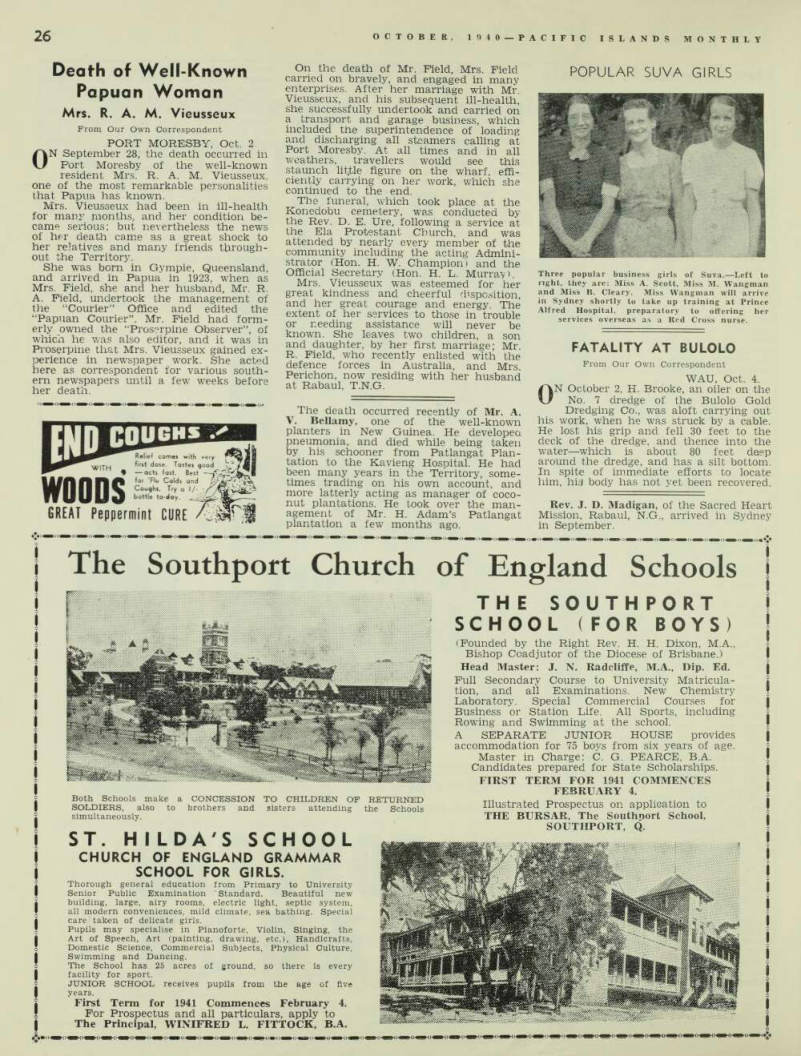
Death of Well-Known Papuan Woman Mrs. R. A. M. Vieusseux
From Our Own Correspondent
Port Moresby, Oct. 2
ON September 28, the death occurred in Port Moresby of the well-known resident Mrs. R. A. M. Vieusseux, one of the most remarkable personalities that Papua has known.
Mrs. Vieusseux had been in ill-health for many months, and her condition be came serious: but nevertheless the news of her death came as a great shock to her relatives and many friends through out the Territory.
She was born in Gympie, Queensland, and arrived in Papua in 1923, when as Mrs. Field, she and her husband, Mr. R.
A. Field, undertook the management of the “Courier” Office and edited the “Papuan Courier”. Mr. Field had form erly owned the “Proserpine Observer”, of which he was also editor, and it was in Proserpine that Mrs. Vieusseux gained ex perience in newspaper work. She acted here as correspondent for various south ern newspapers until a few weeks before her death.
On the death of Mr. Field, Mrs. Field carried on bravely, and engaged in many enterprises. After her marriage with Mr.
Vieusseux, and his subsequent ill-health, she successfully undertook and carried on a transport and garage business, which included the superintendence of loading and discharging all steamers calling at Port Moresby. At all times and in all weathers, travellers would see this staunch lit.tle figure on the wharf, effi ciently carrying on her work, which she continued to the end.
The funeral, which took place at the Konedobu cemetery, was conducted by the Rev. D. E. Ure. following a service at the Ela Protestant Church, and was attended by nearly every member of the community including the acting Admini strator (Hon. H. W. Champion) and the Official Secretary (Hon. H. L. Murray).
Mrs. Vieusseux was esteemed for her great kindness and cheerful disposition, and her great courage and energy. The extent of her services to those in trouble or needing assistance will never be known. She leaves two children, a son and daughter, by her first marriage; Mr.
R. Field, who recently enlisted with the defence forces in Australia, and Mrs.
Perichon, now residing with her husband at Rabaul, T.N.G.
The death occurred recently of Mr. A.
V. Bellamy, one of the well-known planters in New Guinea. He developed pneumonia, and died while being taken by his schooner from Patlangat Plan tation to the Kavieng Hosoital. He had been many years in the Territory, some times trading on his own account, and more latterly acting as manager of coco nut plantations. He took over the man agement of Mr. H. Adam’s Patlangat plantation a few months ago.
Popular Suva Girls
Three popular business girls of Suva.—Left to right, they are: Miss A. Scott, Miss M. Wangman and Miss B. Cleary. Miss Wangman will arrive in Sydney shortly to take up training at Prince Alfred Hospital, preparatory to offering her services overseas as a Red Cross nurse.
Fatality At Bulolo
From Our Own Correspondent WAU, Oct. 4.
ON October 2, H. Brooke, an oiler on the No. 7 dredge of the Bulolo Gold Dredging Co., was aloft carrying out his work, when he was struck by a cable.
He lost his grip and fell 30 feet to the deck of the dredge, and thence into the water—which is about 80 feet deep around the dredge, and has a silt bottom.
In spite of immediate efforts to locate him, his( body has not yet been recovered.
Rev. J. D. Madigan, of the Sacred Heart Mission, Rabaul, N.G., arrived in Sydney in September.
Advertisements & other items, p. 28 (1 item)
Woods
Relief come* first dose. Taste* good
WITH
GREAT Peppermint CURE
acts fast. Best for ‘Flu Colds and Coughs. Try a 1/ bottle to-doy.
The Southport Church of England Schools
*: £ s Both Schools make a CONCESSION TO CHILDREN OF RETURNED SOLDIERS, also to brothers and sisters attending the Schools simultaneously.
ST. H I IDA'S SCHOOL
CHURCH OF ENGLAND GRAMMAR
SCHOOL FOR GIRLS.
Thorough general education from Primary to University Senior Public Examination Standard. Beautiful new building, large, airy rooms, electric light, septic system, all modern conveniences, mild climate, sea bathing. Special care taken of delicate girls.
Pupils may specialise in Pianoforte, Violin, Singing, the Art of Speech, Art (painting, drawing, etc,), Handicrafts, Domestic Science, Commercial Subjects, Physical Culture, Swimming and Dancing.
The School has 25 acres of ground, so there is every facility for sport.
JUNIOR SCHOOL receives pupils from the age of five years.
First Term for 1941 Commences February 4.
For Prospectus and all particulars, apply to The Principal, WINIFRED L. FITTOCK, B.A.
THE SOUTHPORT
SCHOOL (FOR BOYS)
(Founded by the Right Rev. H. H. Dixon, M.A., Bishop Coadjutor of the Diocese of Brisbane.) Head Master: J. N. Radcliffe, M.A., Dip. Ed.
Full Secondary Course to University Matriculation, and all Examinations. New Chemistry Laboratory. Special Commercial Courses for Business or Station Life. All Sports, including Rowing and Swimming at the school.
A SEPARATE JUNIOR HOUSE provides
accommodation for 75 boys from six years of age.
Master in Charge: C. G. PEARCE. B.A.
Candidates prepared for State Scholarships.
FIRST TERM FOR 1941 COMMENCES
FEBRUARY 4.
Illustrated Prospectus on application to THE BURSAR, The Southnort School.
SOUTHPORT, Q.
i
Scientific Cruise
"Director" Expedition in the Pacific
ON a scientific cruise through the South Seas, the American yacht “Director ll’’ arrived in New Caledonia re cently from Fiji and during September members of the party were in the interior collecting flora and ornithological speci mens for despatch to the New York Museum of Natural History, She arrived in Brisbane on October 6.
The “Director” left U.S.A. on February 1, 1940, and, having lost two sails in a Cuban storm, stayed six weeks at Panama undergoing repairs (says the “Bulletin du Commerce”, of Noumea). The party then called at Malpelo Island, where four members landed to rectify navigation charts —the first persons on the island since 1860.
At Galapagos Group, the next port of call, men of the expedition found an egg of the rare “Dusky Gull”, the first ever having been recorded. From Tower Island (Isla Genovesa), they went to Charles Island (Isla Santa Maria), where a Ger man named Whitmer has lived alone for eight years. Three weeks’ sailing took them to the Marquesas Group, and then on to Tahiti, where they remained for a month, recording native music.
Pago Pago (Am. Samoa) next saw the expedition and, after a month’s stay there, they went on to Fiji. On Vanua Levu, Mr. Bruce Fahnestock, leader of the party obtained a large number of photographs of rocks covered with curious inscriptions, which he took back to U.S.A. for identification, when he left the “Dir ector” at Suva a short time later. The hieroglyphics were described as “almost identical with designs engraved on stones found in India”.
Heading for New Caledonia, the “Dir ector” put in at Conway Reef, where they found three old wrecks, and a num ber of cannon and cannon balls, dating from 1850. Conway had not been visited since 1903.
Formerly used in the liquor trade dur ing prohibition days, the “Director” was purchased by the Fahnestock family in 1938. She is 137 ft. long, with 25 ft. beam, and has a displacement of 110 tons.
The expedition originally comprised: Bruce Fahnestock, leader (who left the yacht at Fiji and returned to America); Sheridan Fahnestock, captain of the “Dir ector”; their mother, Mrs. Fahnestock; Ned Dair, first officer and artist, who was with the Fahnestocks on their mission in the Pacific in 1935-8: Dr. Jack Morris, who disembarked at Samoa; Coleman Glover, radio operator; George Folster, second officer and assistant to the head of the expedition; Jack Scott, anthro pologist; George Peterson, of the New York Museum (who journeyed as far as Samoa); Laddie Reday, electrician; Roy Glover, chief engineer; together with nine passengers including three women) and members of the crew. It is expected that the “Director” will return to U.S.A. in about a year’s time.
Scholarships for Islands Lads
The King’s School, one of the Great Public Schools of New South Wales, advises that four Exhibitions, each to the value of £6O a year and tenable for three years, are at present open to boys between 12 and 16. Winners must enter the school as boarders, beginning at the first term of 1941, Ordinarily, entry forms for the Exhibitions should reach the Headmaster not later than October 22, but the School Council has extended the closing date for sons of Islands residents. Details of the Exhibitions will be found in the King’s School announcement pub lished in this issue.***
Value Of Sharks
Letter to the Editor NO doubt, some readers have had their interest stirred in the commercial possibilities of shark fishing— at> discussed in recent issues of the “P.IM.”.
Perhaps it has not been made sufficiently clear that there are many fine points connected with the business, and that a skin or fin cut the wrong way, or the oil heated to the wrong temperature in rendering, can completely ruin the com mercial value of the various products.
Furthermore, the value of products from the various varieties of shark—of which there are many—varies very consider ably.
Several years ago, I was particularly interested in the subject, and while in London, towards the end of 1938, I col lected a considerable amount of informa tion from the Imperial Institute and from several firms who handle the products.
This material ranges from full details concerning the making and repairing of nets to the drying of the meat, curing of skins, preparing of rectum tubes, full information regarding the identification of the various varieties, etc. —in short, just about everything except the actual latitude and longitude of the best fish ing grounds.
Owing to ill-health I have not been able to make use of the information gathered. However, should anv of your readers be interested, I am prepared to supply typed copies, complete with sketches, etc. (the whole covering about 15 pages of foolscap) on receipt of 2/6, to cover cost of paper, postage and typ ing.
I am. etc.,
James P. Shortall.
Spur Road, Colvton.
Fielding, New Zealand.
September 23, 1940.
Captain Walton Drake, R.N., who was Administrator of Norfolk Island from 1904 to 1907, died at Wahroonga, N.S.W., on September 9. He was responsible, with the late Sir Francis Suttor, for locating the anchor from H.M.S. “Sirus”, which was lost off N. 1., and sending it to Aus tralia for erection in its present position in Macquarie Place, Sydney.
Advertisements & other items, p. 29 (2 items)
27
PACIFIC ISLANDS MoNlfltt-OCIOBtK, 1940
tfcH Kf
GET POSITIVE
RELIEF FROM
Tested and proved for over 20 years, genuine Vincent’s A.P.C. is acknowledged by the medical profession and the public as the safest and best to relieve all pains and tropical fevers. The reason why Vincent’s A.P.C. is safer and more effective is because it is prepared on the prescription originated by the medical superintendent of one of| Australia’s largest public hospitals, where it was first used. Genuine Vincent’s A.P.C. is the only A.P.C. prepared on this scientific hospital prescription. No other A.P.C. is the same as Vincent’s. o. rowoiis «
TAII t T $
I/* AND 2/*.
SINGHS 24 to.
FOR SAFETY'S SAKE—SAY “VINCENT’S ”.
U! /v ’ . iV
tfcH Kf
No^ o 5t li 4 GERMS of Diphtheria, Malaria, Dhobie Itch, Tinea or Surfers’ Foot, cannot live under “TENAX” lather.
Tropical Skin Diseases can be cured by its regular
only 9° P er
fabl et
NO VARIATION HAS BEEN
MADE IN ITS COMPOSITION—
judged from the only true angle, that of quality, TENAX has no competitors as a satisfactory germicidal soap, eleven times as rapid in action as carbolic, yet NON-
IRRITANT and NON-POISONOUS. The
Medical Journal of Australia states that TENAX is a germicidal soap that may be recommended with confidence.
TENAX
GENUINE
GERMICIDAL
SOAP
PRODUCT OF AUSTRALIAN SOAPS, LTD.
Discovery Of

Rarotonga
Important New Evidence
THE average person, if asked who was the discoverer of Rarotonga, would invariably reply: “The Rev. John Williams”. Such, however, was not the case, though Williams, obviously under a misapprehension, made that claim for himself.
The late Mr. Ralph W. G. Gosset, of Sydney, who lived on the island as a young man, and was deeply versed in its history since European contact, made re search into this aspect of European dis covery in the Mitchell Library, in Sydney.
The last article that he wrote, “Notes on the Discovery of Rarotonga”, appears in the August issue of “The Australian Geographer”. (Mr. Gosset, at the time of his death, in June, was the president of the Geographical Society of N.S.W.) His conclusions are summarised as follows: — (1) The “Bounty”, with Fletcher Christian in charge, in May, 1789, was the first European vessel to sight Rarotonga.
No one landed, but natives visited the ship. (2) The “Seringapatam”, on May 23, 1814, was the second ship to sight the is
land. Again no one landed, but natives went off to the ship. (3) The “Cumberland” (Captain Good enough) in August, 1814, entered Ngatan giia Harbour, and anchored. The ship re mained there for some time, and the crew were the first white people to land, and leave some account of their visit. (4) The “Endeavour” (Captain John Dibbs), with the Rev. John Williams, landed missionary teachers there, also some Rarotongan natives, (who had been at Aitutaki) on July 25. 1823. (5) The “Medway” (Captain White) arrived there on March 5, 1824. No one landed, nor did any natives go off to the vessel.
Mr. Gosset pointed out that consider able research vet remains for the in vestigator, especially in connection with early Calcutta papers, the Honourable East India Company’s papers, and the whaling records at Nantucket and New Bedford (U.S.A.). “There is a wide field open for this work”, he wrote, “and doubtless in the fullness of time someone with the leisure and means will carry it out, and thus add considerably to our geographical knowledge (of Rarotonga).”
His note on the “Seringapatam” was important, inasmuch as his extracts from the pencilled log (one of the treasures of the Mitchell Library) have not, appar ently, been published previously. This vessel had been captured by the U.S. frigate “Essex” and kept a prisoner at Nukuhiva, in the Marquesas Islands, Fourteen British seamen, however, obtained possession of the “Seringapatam”, and sailed for Sydney. There was no officer on board to navigate but, as the log testifies, one member of the crew must have had some knowledge of navigation.
The Mitchell Library possesses a set of old Arrov/smith charts, the earliest dated October 1, 1789. There is no record of their origin, or even how the Library came into possession of them. On the back of one was written in pencil the log
of the voyage from Nukuhiva to Sydney.
Mr. Gosset came to the conclusion that the pencilled record of the voyage men tioned can be accepted as authentic.
Although the log did not mention the name of the island found on May 23, 1814, it did give the island’s latitude and longitude, which agree approximately with that of Rarotonga. One extract he gives says: “. . . Made an island, name unknown. . . . Calm. Natives came along side. We permitted several to come aboard . . . they seemed to have no knowledge of ever seeing a ship or any white person as they came and smelt us and seemed to discredit our being alive.” (The “smelling” refers to the hongi, or ancient Maori form of greeting by pressing noses.) It was known, of course, that John Williams had knowledge of Rarotonga be fore he set eyes on the island. Mr.
Gosset has the following to say concern ing the famous missionary: “As Williams’s pioneering nature would make him avid for information of new island discoveries in order to diffuse Christianity, he would necessarily endeavour to obtain all the knowledge he could of the Eastern Pacific. To that end he would have been a subscriber to what was then the only newspaper in the South Pacific, ‘The Sydney Gazette’, and he would probably have seen Goodenough’s account of Raro tonga in 1814, nine years before he him self went there.”
If so, one wonders, why did Williams make such a positive claim to being its discoverer?
Goodenough’s “Cumberland”, by the way, is credited by Mr. Gosset with hav ing introduced the first fleas in Raro tonga. On that voyage she was absent from Sydney for nine months. Well might one ask, as did the writer of this article, what was she doing during that period? “Goodenough’s reputation was not of the best”, said Mr. Gosset. There fore, that still elusive character probably had a good reason for his silence.—E.R.
Advertisements & other items, p. 30 (1 item)
-WOODSY curs
KIDDIES’ COUGHS
Break nasty coughs and colds quickly.
Sooth* nos*, throat chest and lungs.
Sat* and pleasant to tak*. Handy-snad bottl*. I/-.
-WOODSY curs
ema
'J9Z-
o-fr iha, r
wz / * ■ -■- / Q * 500 h
CANDLE I
POWER 1
300
CANDLE
POWM
BRIGHTER LIGHT
tor
BETTER SIGHT
Coleman Products can be obtained from all Leading Firms throughout the Pacific Islands.
Coleman Mantles supply Sun-like light.
Instant Lighting Stoves & Irons giving maximum of heat in minimum of time
EASE OF OPERATION
combines
ECONOMY with COMFORT
In case of difficulty in obtaining supplies write to:— Pearce & Co., Suva, Fiji Is.
N.I. Industries
Passion fruit—Beans—Oranges— Fish
UNDER the vigorous direction of the Administrator, Major-General Sir Charles Rosenthal, and in spite of the trade handicaps imposed by war conditions, Norfolk Island is developing its economic resources and planning an increased export trade in passionfruit, beans and oranges. Messrs. Cottees, Ltd., of Australia, are handling the canned passionfruit, but are operating at a dis advantage because the war has restricted the oversea market for canned passion fruit.
When the Administrator was recently in Australia he made inquiries about mar kets for his territory’s products, and he reported as follows on his return to a meeting of growers: There was a good and increasing market in Australia for beans; while in Sydney he had examined N.I. oranges, in transit to New Zealand, and they suffered in comparison with Australian irrigation oranges—the latter were much larger and of more attractive appearance, but the N.I. oranges were much superior in flavour; that the K.P.M. line probably next season would put on two faster vessels to run between the Islands and N.Z., and one might make a regular call at Norfolk Island on its way to Auckland.
The Administrator said there was a shortage of fish in N.Z. and Australia owing to trawlers being used for war pur poses, and he believed that a fish export industry could be set up on Norfolk Is land. Messrs. Cottees, Ltd., were prepared to provide a fishing vessel and erect a freezer. The Commonwealth Government was anxious that the cultivation of N.I. flax should be proceeded with, and there also was a demand for ramie and other similar fibrous plants.
In a note to the Editor, the Admini strator says that the statement in the July issue of the “P.1.M.” that there are some scores of tung oil trees in Norfolk Island now yielding luxuriantly is not correct. There are a number of young tung trees doing well in Norfolk Island, but only one tree, in the Anson Bay dis trict, which is some years old, has borne abundantly during the past four years.
The Administrator also says that the plan to provide a sheltered anchorage at Nor folk Island refers to a proposed cause way from Point Hunter to Nepean Is land, and not from the boat-landing at Kingston to Nepean Island, as stated in “P.1.M.”. The boat-landing is approxi mately half a mile from Point Hunter.
Rev. Dr. Walter Ivens, vicar of Ware home, Kent, England, who was an author ity on Melanesian languages, died late in September, aged 70. For some years he was travelling secretary in the Pacific for the Melanesian Mission.
Journal Of The Polynesian
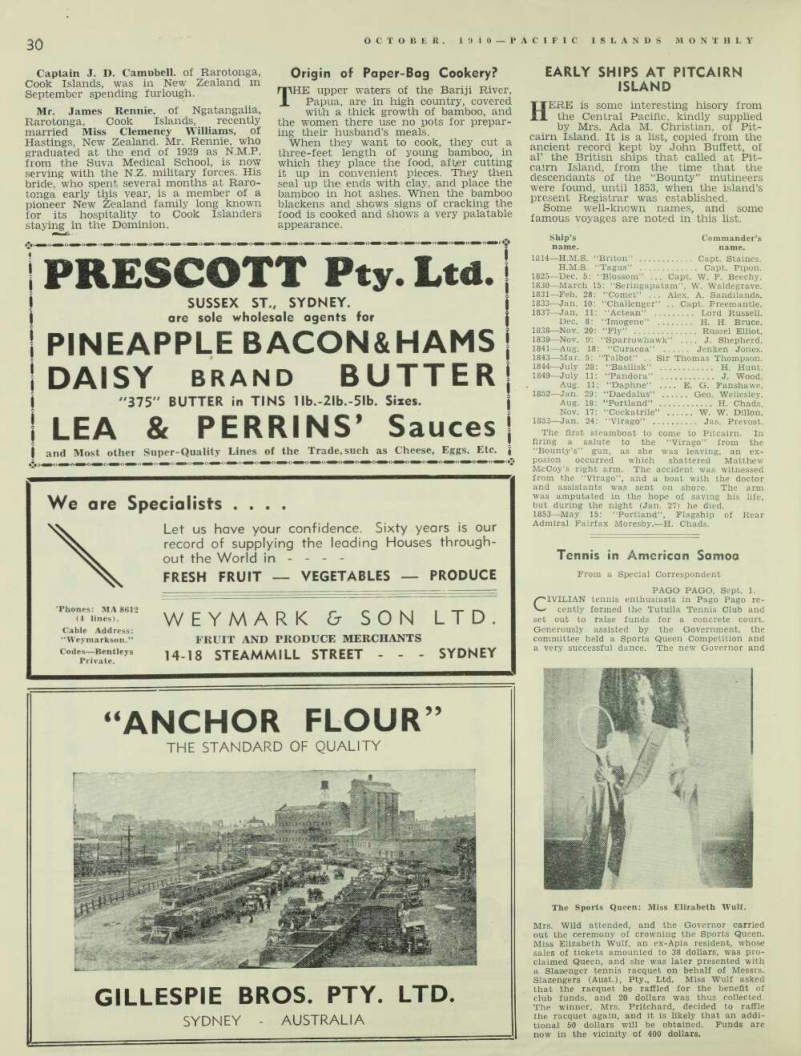
Society
THE June issue of the Polynesian Society’s Journal, recently to hand, contains a number of interesting articles dealing with the Pacific Islands.
This is the second Centennial number issued by the Society, whose headquarters are in Wellington.
It must have struck many readers of early South Seas records left by mission aries and travellers that there are dis crepancies in the reports they gave of native myths and traditions. In a search ing article, Dr. Katharine Luomala, of the Bishop Museum (Honolulu), attempts some assessments of such sources, as well as others less common. In the process, she produces interesting anomalies, up sets a few accepted stories and gives authority for others.
Dr. H. lan Hogbin’s paper on the ex istence of Polynesian elements among the Melanesian areas demonstrates the method of using myths and legends, physical characteristics, and articles oi material culture as bases for comparison and identification.
Mrs. H. B. R. Parham continues her useful annotated list of Fiji plants. Also of Fijian interest is Mr. R. R. C.
MacLachlan’s comprehensive treatise on Fijian native pottery; the Journal is al ways notable for the excellence of its
illustrations, and supplementing this article they are quite up to standard.
Illustrations again, are an eloquent ad junct to the supplement on Polynesian artifacts from the Oldman collection, which are well explained in brief notes.
There are three other short items on Easter and other islands and a couple on aspects of Maori history and genealogy.
Mr. A. L. Lewis, manager of W. H.
Grove and Sons, Ltd., Rarotonga, Cook Group, returned to New Zealand in Sep tember, accompanied by his wife and two daughters.
Captain J. D. Camobell. of Rarotonga, Cook Islands, was in New Zealand in September spending furlough.
Mr. James Rennie, of Ngatangaiia, Rarotonga, Cook Islands, recently married Miss Clemency Williams, of Hastings, New Zealand. Mr. Rennie, who graduated at the end of 1939 as N.M.P. from the Suva Medical School, is now serving with the N.Z. military forces. His bride, who spent several months at Raro tonga early this year, is a member of a pioneer New Zealand family long known for its hospitality to Cook Islanders staying in the Dominion.
Advertisements & other items, pp. 31-32 (2 items)
29
PAdFIC ISLANDS MONTHLY OCTOBER, 1940
Aunt Mary’s
GRAMOPHONE
RECORDS
SEND US YOUR ORDERS
Goods sent C.O.D. at no extra charge.
Catalogues sent without obligation.
THE TALKERIES
161 Castlereagh Street,
SYDNEY
PACKED AS THEY’RE PICKED
TO PRESERVE FLAVOUR AND NUTRIMENT
Aunt Mary’s
PREPARED
VEGETABLES
only require heating and are then ready to serve, full flavoured, attractive and satisfying.
Green Peas, Celery, Cauliflower and other Aunt Mary's prepared vegetables are specially packed for Tropical conditions in 1 lb. hermetically sealed cans.
SOLD BY ALL PACIFIC ISLAND STORES
Order an assortment. Be sure it is Aunt Mary's brand; packed by Tillock & Co., Pty., Ltd., Sydney.
c 0
General
Merchants
and
Agents
REPRESENTING LEADING FIRMS IN THE PACIFIC ISLANDS
379 KENT STREET,
SYDNEY.
Cable Address: “Trocas”, Sydney.
Telephones: MJ4657 (5 lines).
Islands Produce Sold on Shippers’ Account Buyers of all Islands’ requirements on Comxnis- Liberal Advances against Consignments. sion Original Invoices Furnished. 25 Years Islands Trade Experience.
Bankers: Bank of New South Wales. Correspondence in English, French <fe German.
PRESCOTT Pty. Ltd.
SUSSEX ST., SYDNEY,
are sole wholesale agents for
PINEAPPLE BACON&HAMS
DAISY brand BUTTER "375" BUTTER in TINS llb.-21b.-slb. Sizes.
LEA & PERRINS* Sauces and Most other Super-Quality Lines of the Trade, such as Cheese, Eggs, Etc.
We are Specialist's
X Let us have your confidence. Sixty years is our record of supplying the leading Houses throughout the World in - - - -
FRESH FRUIT VEGETABLES PRODUCE
’Phones: MA 8612 (4 lines).
Cable Address: “Weymarkson.”
Codes—Bentleys Private.
WEYMARK & SON LTD.
FRUIT AND PRODUCE MERCHANTS
14-18 STEAMMILL STREET - - - SYDNEY
* 'Lit a
ANCHOR FLOUR
THE STANDARD OF QUALITY
• m m mm m i
GILLESPIE BROS. PTY. LTD.
SYDNEY - AUSTRALIA
Origin of Paper-Bag Cookery?
THE upper waters of the Bariji River, Papua, are in high country, covered with a thick growth of bamboo, and the women there use no pots for prepar ing their husband’s meals.
When they want to cook, they cut a three-feet length of young bamboo, in which they place the food, after cutting it up in convenient pieces. They then seal up thei ends with clay, and place the bamboo in hot ashes. When the bamboo blackens and shows signs of cracking the food is cooked and shows a very palatable appearance.
Early Ships At Pitcairn
Island
HERE is some interesting hisory from
the Central Pacific, kindly supplied
by Mrs. Ada M. Christian, of Pit cairn Island. It is a list, copied from the ancient record kept by John Buffett, of al 1 the British ships that called at Pit cairn Island, from the time that the descendants of the “Bounty" mutineers were found, until 1853, when the island’s
present Registrar was established.
Some well-known names, and some famous voyages are noted in this list.
Ship’s Commander’s name. name. 1814—H.M.S. “Briton” Capt. Staines.
H.M.S. “Tagus” Capt. Pipon. 1825 —Dec. 5: “Blossom” ... Capt. W. P. Beechy. 1830 —March 15; “Seringapatam”, W. Waldegrave. 1831—Feb. 28: “Comet” ... Alex. A. Sandilands. 1833—Jan. 10: “Challenger” .. Capt. Preemantle. 1837 —Jan. 11: “Actean” Lord Russell.
Dec. 8: “Imogene” H. H. Bruce. 1838—Nov. 20: “Fly” Russel Elliot. 1839—Nov. 9': “Sparrowhawk” ... J. Shepherd. 1841—Aug. 18: “Curacoa” Jenken Jones. 1843 —Mar. 5: “Talbot” .. Sir Thomas Thompson. 1844—July 28: “Basilisk” H. Hunt. 1849—July 11: “Pandora” J. Wood.
Aug. 11; “Daphne” E, G. Fanshawe. 1852—Jan. 29: “Daedalus” Geo. Wellesley.
Aug. 18: “Portland” H. Chads.
Nov. 17: “Cockatrile” W. W. Dillon. 1853 —Jan. 24: “Virago” Jas. Prevost.
The first steamboat to come to Pitcairn. In firing a salute to the “Virago” from the “Bounty’s” gun, as she was leaving, an ex posion occurred which shattered Matthew McCoy’s right arm. The accident was witnessed from the “Virago”, and a boat with the doctor and assistants was sent on shore. The arm was amputated in the hope of saving his life, but during the night (Jan. 27) he died. 1853—May 15: “Portland”, Flagship of Rear Admiral Fairfax Moresby.—H. Chads.
Tennis in American Samoa
From a Special Correspondent
Pago Pago, Sept. 1.
CIVILIAN tennis enthusiasts in Pago Pago re cently formed the Tutuila Tennis Club and set out to raise funds for a concrete court.
Generously assisted by the Government, the committee held a Sports Queen Competition and a very successful dance. The new Governor and
Mrs. Wild attended, and the Governor carried out the ceremony of crowning the Sports Queen.
Miss Elizabeth Wulf, an ex-Apia resident, whose sales of tickets amounted to 38 dollars, was pro claimed Queen, and she was later presented with a Slazenger tennis racquet on behalf of Messrs.
Slazengers (Aust.), Pty., Ltd. Miss Wulf asked that the racquet be raffled for the benefit of club funds, and 20 dollars was thus collected.
The winner, Mrs. Pritchard, decided to raffle the racquet again, and it is likely that an addi tional 50 dollars will be obtained. Funds are now in the vicinity of 400 dollars.
The Sports Queen: Miss Elizabeth Wulf,
Hurricane
In Path Of Pacific’S Worst
Terrifying Experience of French Trader's Family in New Hebrides Cyclone
IN February last, the central islands of the New Hebrides were ravaged by a great, terrifying hurricane—probably one of the worst in Pacific history. The area is credited by Australian meteorolo gists with at least one hurricane (1922) more severe than any other recorded in the South Seas, yet both Europeans and natives were emphatic that the February tornado surpassed even its fury.
The hurricane lasted a comparatively short time —the fiercest part of it a little more than an hour—but, as one New Hebrides resident who has encountered every cyclone in the Group since the be ginning of the century, expressed it: “For that hour, I really thought the last day had come—l have never seen anything like it!”
In the July “P.1.M.” was published the poignant story of a planter who lost everything he had worked for and ac cumulated during his lifetime, when the hurricane sweot through his property; and, in the August issue, photographs showed how the islarl of Emae had been devastated. We now have received the following graphic account of the experi ence of a French trader (Monsieur J.
Dupuy) and his family when the tornado hit Tongoa Island, SUNDAY, 5 p.m. (February 18): Baro metric pressure reads 28.7 (Note; M. Dupuy’s barometer needs about .4 inch added to make correct sea-level reading).
At 5.15 p.m.. barometric pressure 28.6.
The sea is calm and flat, like a mirror.
Strong squalls spin over the water, lift ing up wisps of sea-spray. And so we are warned—there will be a hurricane and, as always, in the night!
We take all precautions, but not hav ing complete confidence in the solidity of our house, we decide to take refuge in the store, as in a fort, to resist the assault of the winds. Barometer still falling; now 28.1.
At 2 a.m.. with the glass reading 27.1, the elements are unleashed. We discon nect the radio and pack it in its case.
Half an hour later, we rouse the child ren and, followed by our two “boys”, make our way with difficulty to the con crete store.
From this moment, it is “all tricks lost”!
The store, apparently so solid, was torn to pieces in less than five minutes. The roof gave way first, after some vertical gusts of wind from Lumbukuti valley, E.S.F., which were as shattering as a great battleship’s broadside. The rafters broke away, smashed lust like matches; and then the roofing flew off in a single ln which direction? Without doubt, into the sea, for to this day we have not recovered a single sheet of it!
Then the walls facing north and south hurled themselves down upon us, crush ing almost everything under their con siderable weight. We escaped certain death by a miracle. Outside, too. death was hovering near as we fled from the ruined store, my wife and children press ing close ta me: sheet-iron sailed through the air just above our heads, with a whistling sound like shrapnel. Around us, as we ran, coconut palms and other trees, including a huge uprooted mango, fell as at the touch of a giant, unseen hand. At last we reached the house which, to our astonishment, had weathered the “blow” very well.
It was then that a sudden and abso lute calm succeeded the infernal noise of the wind, which had blown, up to now, from the south-east. Thus we survived the first phase of the tempest.
DECEIVED by the misleading calm, my wife began to prepare a cup of tea, for we were all chilled from cold.
There was no breath of wind —not even enough to waver the spirit-flame burning in the cup of our “primus”—and we were beginning to joke light-heartedly about the intense terror we had just endured.
Suddenly, from the north, we heard a furious roar, similar to the nqises pre ceding an earthquake. In a few seconds the storm was upon us again, this time with unprecedented force and velocity. In a twinkling, the old house collapsed. We had time only to scramble under the floor, to a little corner somewhat sheltered by two pillars of concrete. There, flat on our stomachs, in this narrow corner of
tutelary refuge, we awaited the dawn of a better day.
That was the second phase of the hurricane—but not the end. Four days after the cataclysm, the wind had still not completed the round of the compass; it still kept blowing from the N.E., and the sea was still very disturbed.
In our life, already long, we have been eye-witnesses of four true hurricanes, al most as strong as this, but none behaved like this last one. They all commenced in the east or south-east and, after 12, 18 or 24 hours, the wind completed the turn of the compass and then, as in the old adage, “the calm succeeded the storm”.
THREE weeks later, on the morning of March 12, I went up to the plateau of Lumbukuti village, having arranged to meet the neighbouring British trader and make an inspection of the damaged native plantations. .As we could not possibly go around the whole island in one day together, we agreed to divide the task and walk in opposite dir ections. So we parted, to meet again on the morrow where my house formerly stood and to share our impressions.
We found that Lumbukuti plateau was the least affected. About 25 per cent, of the coconut palms had been destroyed, trees aged from 15 to 20 years. It appeared to us that the plantations of Tavakiki, Pakoa and all the others, as far as the village of Pele, cannot hope to make re covery under three to five years.
From Pele on, it was desolation, de struction, and utter ruin—so not to be taxed with exaggeration, I should say that 85 per cent, of the palms were devastated.
The village plantations at Lupalea, Woraviu, Ravehga, Kurumambe, Purau, Oriu, Itakoma, Euto and Mangarisu were in the same lamentable condition.
The crown of martyrdom, though, was awarded to the following villages: Meriu, Bongabonga and Panita—there, practi cally nothing remained. The trunks of the few trees that were standing re sembled dead men’s bones, for they had been stripped bare by the voracious winds.
As for my pretty station at the beach, with its concrete store, its comfortable house, its girdle of oranges, coconuts, nakavikas, and venerable mango trees, and its beautiful green turf, thick and short, that stretched like a carpet to the sea—what remains of it? Merely a cold heap of ruins!
Advertisements & other items, pp. 33-34 (1 item)
CLrruotts
PURE RICE
STARCH
Always ask for . . .
CORAL BRAND
100% PURE
& U>
CORAL BRAND
RICE STARCH
Noted for Its
QUALITY
and
WHITENESS.
Goes Farthest and gives Lasting Finish
WILL NOT
STICK TO
IRON.
Obtainable from Leading Island Stores.
Manufactured by
AUSTRALIAN RICE, LTD.,
Sydney, N.S.W.
THE FAVOURITE
SCHOOL LUNCH
Usually the school lunch is a very scratchy meal, eaten just when the vigorous exercise of the playground has made a strong demand on the endurance of the child. However, with little trouble it can be improved in value and made wonderfully attractive, simply by adding buttered Milk Arrowroot Biscuits. All children love them.
CLrruotts
FAMOUS
MILK
ARROWROOT
BISCUITS
C 34 ALWAYS ASK YOUR GROCER FOR ARNOTT'S I
Kork-N-Scal
FOR
HOME
USE
• Hand Applied Airtight Pressure Proof
FOR ALL HOME BOTTLING
—THE LITTLE CAP THAT
will Re-seal ,000 Times
KORK-N-SEAL (Aust.) LTD.
106 COMMONWEALTH STREET,
SYDNEY, AUSTRALIA.
yf Australia*s Choicest Products .* Green Pea* French Bear Cauliflower M*
gaiden^c
m
VALE
N PRODUCTS LIHIT-CD
• 2-4 BROWN STR-E-CT, N-EWTOVN
(YDM«Y. AUSTRALIA
Always . . . make sure you have at hand an ample Reserve of these Delicious . .
Garden Vale Ready-toserve Vegetables
Languishes
C.I. Banana Trade Languishes “ Matua's" Calls Reduced
From Our Own Correspondent
Rarotonga, Sept. 2.
A BOMBSHELL was dropped in Raro tongan commercial circles last month when the Resident Commis sioner announced that the usual monthly mail steamer, M.V. “Matua”, would omit this port in alternative months until next orange season. This is the outcome of the stagnation in banana planting during the last two years, the Adminis tration no longer being able to guaran tee sufficient fruit to make the monthly trips worth-while.
With the N.Z. Government buying bananas under the Fruit Control scheme here at 4/- per case, the bulk of the growers hold the opinion that it is pro fiteering on the sale of fruit in New Zealand, since market prices there are firm. Growers, therefore, consider 4/insufficient and the result is—a two monthly steamer service. In view of the fact that Samoa and Fiji, with their big areas of land suitable for banana plant ing on a large commercial scale, are continually seeking larger quotas it seems unlikely that the fall in C.I. banana exports will be felt anywhere else than in the unfortunate Cook Islands!
Exports of tomatoes and kumaras, which are still in the hands of the “grasping” traders, are bringing in par ticularly good returns this year and, in consequence, the pinch has not yet been felt.
Not since the first development of the Cook Islands fruit export trade have things come to such a parlous state.
One boat per month is not considered sufficient to make banana planting pay: anybody foolish enough to plant for a two-monthly steamer would soon be ruined.
C.I. growers are not the only ones who believe that the N.Z. Government is not giving Islands planters a fair deal.
Some months ago Mr. J. Hutchinson, a prominent planter from Tonga, voiced the same opinion in the newspapers, giv ing figures to back his statements.
recently.
Educating Your Children.
OF interest to Islands residents contemplating sending their children to Australia for education is the announcement of the South port Schools, in this issue. Situated on the Pacific coast of Southern Queensland, the Southport School for boys and St. Hilda’s School for girls offer every facility for study and sport. Apart from the usual curriculum, both schools specialise in developing the art of correct speech. Special arrangements can be made to care for Islands pupils over the schools’ vacation periods. Details can be obtained from the Bursar, Southport School, or the Principal, St.
Hilda’s School, Southport, Queensland. —•** Mr. J. B. Grove, head of the Islands trading company of W. H. Grove and
Sons, Ltd., whose headquarters are in
Auckland, NZ, visited Suva and Tahiti
recently.
Council
New Guinea
Various Effects of War
From Our Own Correspondent
Rabaul, Sept. 26.
THE following changes in membership were referred to when the Admini strator (Sir Walter McNicoll) form ally opened the 13th session of the New Guinea Legislative Council on September 24: A motion was adopted expressing the Council’s sense of deep loss in the death of Hon. W. E. Grose (which occurred in Melbourne last May).
Hon. Harry Adams, newly-appointed, was welcomed to the Council.
Hon. R. C. A. Ollerenshaw was granted leave of absence, as he was in camp in Australia with the A.I.F.
Hon. B. B. Perriman intimated that, as he is not now permanently resident in the Territory, he had forwarded his re signation to the Governor-General.
The Administrator said that out of the many men who had enlisted in New Guinea and been drafted to Australia, 57 were members of the Public Service.
Goldfields Road Prospects
The Administrator referred to the con struction of the Goldfields Road. Plans for certain sections had been completed and instructions were being awaited from Canberra. Up to date, the cost of the surveys and examinations had been over £17,000. He pointed out the financial aspect of the road construction, and in timated that the public loan of £150,000, which had been promised, might not now be forthcoming.
The Copra Position
Reference was also made by the Ad ministrator to the copra position, and the Commonwealth Government proposed re lief measures for planters. He spoke of the problem of 'inter-island shipping which, as a result of there being no con centration of produce at central points, has been practically abandoned.
Relief For Mortgagors
The most important Bill introduced was the Mortgagors Relief Bill, which is on similar lines to the Ordinance which was in operation in 1934, and which was ex tended in 1936. It provides that, while copra is “depressed”, repayment obliga tions under expropriated plantations shall be suspended.
The Treasurer, Mr. Townsend, intro duced the Budget. His figures showed the estimated revenue for the coming year (ending June 30, 1941) as £471,350, with an estimated expenditure of £485,355. With a surplus of some £14,000 carried from the past year, it was expected that at the end of the present year there would be a small surplus.
There was some comment on the Budget from Non-Official members, but no alteration was made in the original figures, and the estimates were passed.
It was pointed out, however, that the items “Salaries and Contingencies”, mounted to £390,000, as compared with New Works of £51,000, out of a total esti mated expenditure of £4Bs,ooo—which did not appear well in the case of a young, vigorous country.
Dr. Monfort and Dr. Lamy, of the New Hebrides Medical Service, arrived in Sydney recently from Vila, en route to England to offer their services to General de Gaulle, leader of the Free French forces. Their wives and children will re main in Australia.
Advertisements & other items, p. 35 (1 item)
Nestle Sswilr
Ships carry nothing more precious to tropical settlements than their regular cargoes of Neslle’s Sweetened Condensed Milk. Neslle’s Sweetened Condensed Milk is the safest milk because it is the purest; because it can never sour or become contaminated while unopened; and because it is fully guaranteed to retain its original freshness and purity under any climatic conditions. To protect your health and the health of your family, use Nestle’s Sweetened Condensed Milk always.
COPYRIGHT 8226
N.G. Public Service
THE following staff movements in the New Guinea Public Service were announced in September by the Government Secretary;—
Transfers
Health Dept.— C. B. Walsh, Medical Assistant, Rabaul to Salamaua; Dr. H. S. Roberts, Medical Officer, Wewak to Wau; D. Joycey, Medical Assistant, Talasea to Rabaul.
District Services Dept. —S. H. Filan, Clerk, Rabaul to Buka Passage.
Agriculture Dept. —J. A. Ewen, Inspector and Instructor, Manus to Rabaul.
Police Force.—L. G. Dean, Warrant Officer, Salamaua to Rabaul; N. B. N. Blood, Warrant Officer, Kieta to Rabaul; G. M. Hill, Warrant Officer, Rabaul to Salamaua.
Temporary Engagements ,
J. C. Goad, to be Medical Assistant.
A daughter was born to Mr. and Mrs.
E. G. McAdam at Namanula Hospital,
Rabaul, New Guinea, on September 19.
"Comforts" for Kioto Soldiers
SINCE its inauguration a year ago, the Kieta District Comforts Fund, under the direction of Mr. Drummond Thompson (chairman and treasurer), has raised £365, donations having been received from 90 per cent, of the British and foreign residents and from local natives.
The district was divided into four groups and subscriptions from each have been: —Numa Numa, £163 (including £2B from indentured labourers); Kieta, £B2; Buka Passage, £80; Marists, £4O.
Three-quarters of the money raised has been passed on to the Red Cross Association. Out of the balance, a donation was forwarded to Rabaul for the N.G. Ambulance Appeal and much material bought, from which Kieta auxiliary workers have made socks, scarves, shirts and pullovers for the Navy League, London. Com mencing shortly, a parcel of selected “com forts” valued at 30/- each will be sent monthly to men from Kieta District serving overseas, Mcllraths, Ltd., of Sydney, having accepted re sponsibility for packing and despatching parcels.
Burns, Philp and Co.. Ltd., has granted free freight on their vessels for all “Comforts”.
New Light on the Rossel
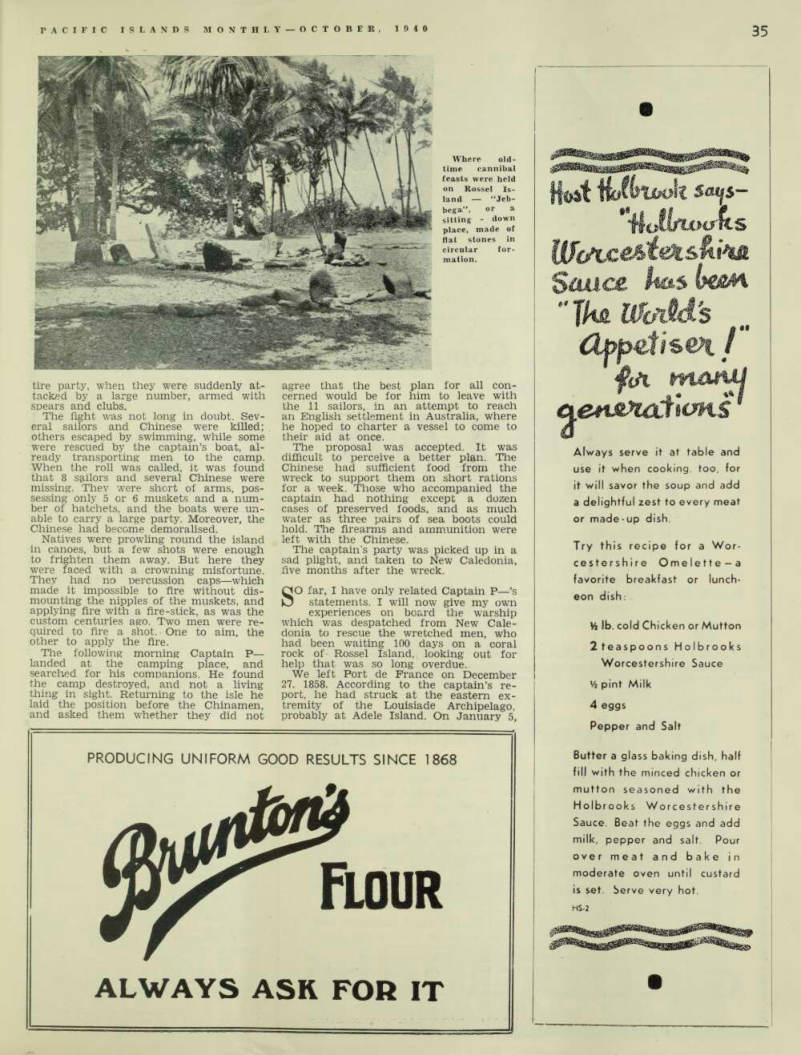
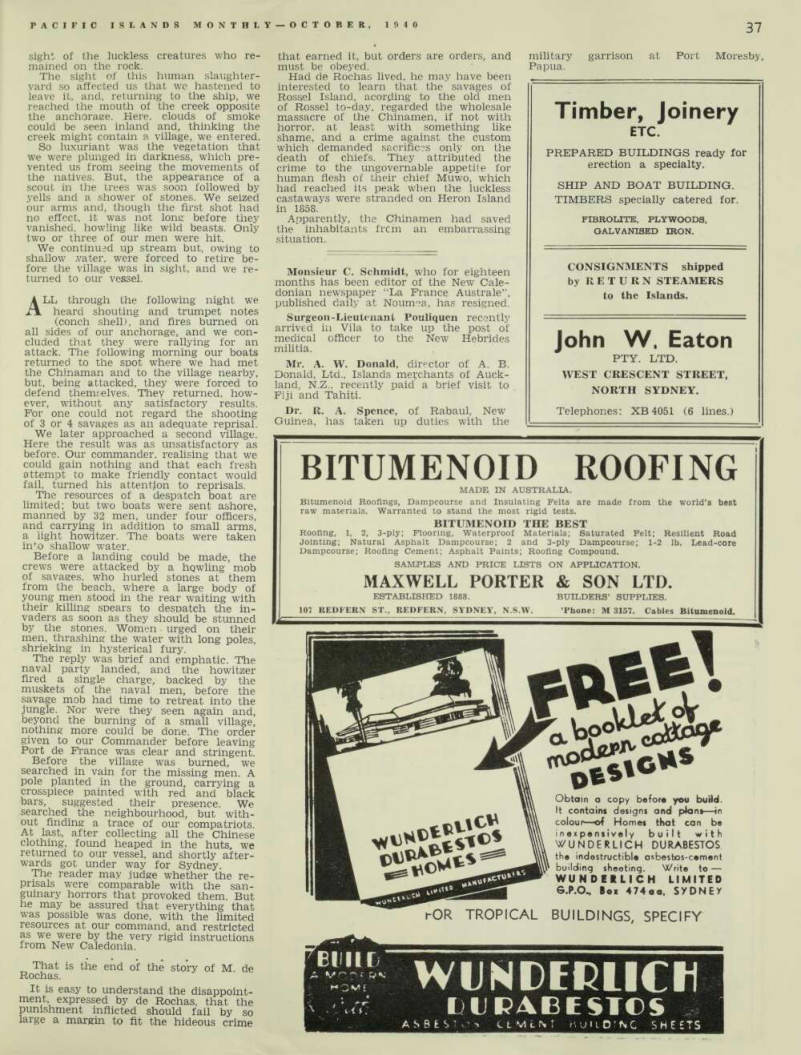
Eating A Chinaman
A Day
New Light on the Rossel Island Horror
MOST persons familiar with Western Pacific history have heard of the Rossel Island horror. Some 80 years ago, a ship carrying Chinese coolies was lost on either Heron or Rossel Island, in Eastern Papua. Some escaped, but most of the 300 who remained were captured by the natives, imprisoned (some say, in a compound, where they were fattened) and slaughtered, cooked and eaten at the rate of two or three a day.
The following article is a translation by Mrs. Mollie Lett, of Port Moresby, of a section of an old book which she found, written by V. de Rochas.
IN the month of December, 1858, seven castaways, rescued by the English schooner “Prince of Denmark” ar rived at Port de France in New Cale donia. The leader of these unfortunate men, Captain P— appeared before the authorities of the colony, where I hap pened to be when he made his report, of which the following is a summary.
Captain P— had left Hong Kong the previous July, on the three master “Saint Paul”, with a crew of twenty, and 317 Chinese passengers, engaged for work on the Australian gold-fields. De layed by calms, and threatened by shortage of supplies, the captain, in his anxiety to reach Sydney as soon as pos sible, decided upon a course between the Solomons and the Louisiade Archipelago, rather than the usual course round these islands.
This, it is true, was a dangerous pro cedure, but he was driven to it by sheer necessity. Unfortunately, gales and thick mists followed calm weather, and for three days the captain was unable to get his correct bearings, and was forced to rely on dead reckoning; with the re sult that, on the third day, the vessel grounded on a reef.
But where? The captain was not cer tain. All he knew was that he was some where in Melanesia, and therefore in in hospitable country.
The vessel struck several hours before dawn, and at daylight it was clear that they were fast on the extreme point of a large reef; running for several thou sand yards from the shore, which was banked by densely wooded mountains; probably inhabited.
Owing to heavy seas, it was soon neces sary to abandon the “Saint Paul” and, fortunately, rocks afforded means of crossing to a small island, some distance away; otherwise it would have been im possible to transport the large number of men before the vessel became a total wreck. Here, at least, they obtained refuge. All that they were able to rescue from the wreck were a few barrels of damp flour, two or three sides of salt meat, and a number of cases of pre served foods. Slender resources indeed, for so large a partv. and added to their problems was that of water. There was none on the island.
Captain P — made haste to cross to the mainland with a number of his crew and passengers, where he chose a camping ground on the bank of a creek, a short distance from the beach, in sight of the island. Here, while preparing the ground, they made contact with natives, black in colour, and extremely ugly and savage and naked. At first sight, they appeared timid, which was encouraging, and the captain was even able to secure a few coconuts. They were making arrange ments for the accommodation of the en-
tire party, when they were suddenly at tacked by a large number, armed with spears and clubs.
The fight was not long in doubt. Sev eral sailors and Chinese were killed; others escaped by swimming, while some were rescued by the captain’s boat, al ready transporting men to the camp.
When the roll was called, it was found that 8 sailors and several Chinese were missing. Thev were short of arms, pos sessing only 5 or 6 muskets and a num ber of hatchets, and the boats were un able to carry a large party. Moreover, the Chinese had become demoralised.
Natives were prowling round the island in canoes, but a few shots were enough to frighten them away. But here they were faced with a crowning misfortune.
They had no percussion caps—which made it impossible to fire without dis mounting the nipples of the muskets, and applying fire with a fire-stick, as was the custom centuries ago. Two men were re quired to fire a shot. One to aim. the other to apply the fire.
The following morning Captain P— landed at the camping place, and searched for his companions. He found the camp destroyed, and not a living thing in sight. Returning to the isle he laid the position before the Chinamen, and asked them whether they did not
agree that the best plan for all con cerned would be for him to leave with the 11 sailors, in an attempt to reach an English settlement in Australia, where he hoped to charter a vessel to come to their aid at once.
The proposal was accepted. It was difficult to perceive a better plan. The Chinese had sufficient food from the wreck to support them on short rations for a week. Those who accompanied the captain had nothing except a dozen cases of preserved foods, and as much water as three pairs of sea boots could hold. The firearms and ammunition were left with the Chinese.
The captain s party was picked up in a sad plight, and taken to New Caledonia, five months after the wreck.
SO far, I have only related Captain P—’s statements. I will now give my own experiences on board the warship which was despatched from New Cale donia to rescue the wretched men, who had been waiting 100 days on a coral rock of Rossel Island, looking out for help that was so long overdue.
We left Port de France on December 27. 1858. According to the captain’s re port, he had struck at the eastern ex tremity of the Louisiade Archipelago, probably at Adele Island. On January 5,
Where old time cannibal feasts were held on Rossel Is land “Jeb bega”, or a sitting - down place, made of flat stones in circular for mation.
-1859, a small and densely wooded island hove in sight, but we could see no sign of the “Saint Paul” on the low coral shore, and Captain P — who accompanied us, knowing that he had grounded near high land, suggested an island ahead.
This was Rossel Island and we approached it and soon sighted the “Saint Paul”, with her bowsprit and poop still showing above the reef. It could be seen that had the “Saint Paul” passed only a few hundred yards further on her course, she would have weathered the reef.
Nearby, lay the - isle, only about 20 by 35 yards in area. It was deserted. We looked in vain for signals from the 300 Chinamen who had been left on this coral patch.
On landing, one officer found a ragged tent still fixed to two trees, some rags, and two corpses buried under a layer of pebbles. He also found a large quantity of burnt shells, which had apparently served as food for the unfortunate men.
Several tree-trunks, sawn a few feet
from the ground, had been hollowed out for the purpose of collecting water The light was failing and as the anchorage was unknown to us we were compelled to wait outside.
At the first streak of dawn, our com mander sought for an entrance through the reef and found an anchorage Immediately on anchoring, armed parties were sent in search of the cast aways. We kept close to the shore in the hope of meeting natives or some of the missing Chinamen. We sighted two canoes containing natives. They evaded us and soon disappeared in the thick mangrove. 11 fE continued on our course, and while we were skirting the shore, we saw a small, naked figure wading to wards us in the water, beckoning to us without speaking a word. This conduct suggested a fugitive, and therefore one of the castaways.
The poor little Chinaman threw him
self into the arms of Captain P— and his first words were “all dead”. We were horrified. It was inconceivable that 317 Chinamen could have become the prey of the type of native we had just seen, badly armed and of poor physique. How ever, the Chinaman, who expressed him self as much by signs as by broken Eng lish, soon left us in no doubt of the dreadful tragedy. Four of his companions, he informed us, remained on shore, one of whom belonged to the crew, and was probably the master-carpenter. This was a Prussian, shipped at Hong Kong.
According to the Chinaman, this un fortunate man was tied up and was be ing closely watched, and was in the last stages of consumption. The natives had decorated him with a nose-bone, one of their most favoured ornaments. Without doubt, the carpenter had been adopted by some chief, like the little Chinaman, who wore a necklace and armlets.
We continued until we came to a creek, where the Chinaman assured us stood a village. We very soon found ourselves in the presence of about 30 natives. We had hidden our arms but they held aloof and it was impossible to come to friendly terms. However, one of the boldest ap proached armed with spears, and at tempted to persuade the Chinaman to return to them.
Having failed with the Chinaman, they turned their attention to us. The natives, after refusing our gifts, attempted to surround us, but seeing that we were pre pared they withdrew. In the end we were forced to retire, as we could gain noth ing from the wretched people. Our de mands for the return of the four prisoners, through the intervention of the little Chinaman, fell on deaf ears. We therefore proceeded along the coastline.
We stopped at the mouth of a stream, where Captain P— had established his first camp. There a dreadful sight met our eyes. Heaps of clothes, and pig-tails, marked the spot where the unfortunate Chinamen had been massacred. An over thrown trunk had served as a block, on which they placed the neck of each victim.
It appeared from the Chinaman’s de scription (which he succeeded in making us understand) that the natives had torn off the pig tails before the Chinamen were killed, and had afterwards cut their throats with a spear, but not be fore flogging them with sticks to make their flesh soft for eating.
This frightful description was later confirmed and elaborated in Sydney by an interpreter. It was true in every de tail.
IT appeared that, so long as the cast aways were able to sustain them selves on the islet they remained deaf to the invitations of the savages, who prowled round their refuge in canoes, offering them food and water on thes mainland. By a miracle of industry and ingenuity, the Chinamen had succeeded in making drinking water by means of a distilling apparatus, improvised with large marine shells, and pipes of leather saved from the wreck. They had also cut and hollowed trees, only a little larger than brushwood, in which they had stored water caught in the canvas of their tents.
But at last, having long exhausted their provisions and the beds of shell-fish nearby, and having already seen two of their number die of starvation, the bravest, or the most desperate, succumbed to the treacherous advances of the savages and left for the mainland. The savages took them by threes, which was as’ many as the canoes would hold, to the old camping ground, where they were met by a howling mob. The cries of the victims could not reach the island, and trees concealed the massacre from the
sight of the luckless creatures who re mained on the rock.
The sight of this human slaughter yard so affected us that we hastened to leave it, and, returning to the ship, we reached the mouth of the creek opposite the anchorage. Here, clouds of smoke could be seen inland and, thinking the creek might contain a village, we entered.
So luxuriant was the vegetation that we were plunged in darkness, which pre vented us from seeing the movements of the natives. But, the appearance of a scout in the trees was soon followed by yells and a shower of stones. We seized our arms and, though the first shot had no effect, it was not long before they vanished, howling like wild beasts. Only two or three of our men were hit.
We continued up stream but, owing to shallow .vater, were forced to retire be fore the village was in sight, and we re turned to our vessel.
ALL through the following night we heard shouting and trumpet notes (conch shell), and fires burned on all sides of our anchorage, and we con cluded that they were rallying for an attack. The following morning our boats returned to the spot where we had met the Chinaman and to the village nearby, but, being attacked, they were forced to defend themselves. They returned, how ever, without any satisfactory results.
For one could not regard the shooting of 3 or 4 savages as an adequate reprisal.
We later approached a second village.
Here the result was as unsatisfactory as before. Our commander, realising that we could gain nothing and that each fresh attempt to make friendly contact would fail, turned his attention to reprisals.
The resources of a despatch boat are limited: but two boats were sent ashore, manned by 32 men, under four officers, and carrying in addition to small arms, a light howitzer. The boats were taken in f o shallow water.
Before a landing could be made, the crews were attacked by a howling mob of savages, who hurled stones at them from the beach, where a large body of young men stood in the rear waiting with their killing spears to despatch the in vaders as soon as they should be stunned by the stones. Women urged on their men. thrashing the water with long poles, shrieking in hysterical fury.
The reply was brief and emphatic. The naval party landed, and the howitzer fired a single charge, backed by the muskets of the naval men, before the savage mob had time to retreat into the jungle. Nor were they seen again and, beyond the burning of a small village, nothing more could be done. The order given to our Commander before leaving Port de France was clear and stringent.
Before the village was burned, we searched in vain for the missing men. A pole planted in the ground, carrying a crosspiece painted with red and black bars, suggested their presence. We searched the neighbourhood, but with out finding a trace of our compatriots.
At last, after collecting all the Chinese clothing, found heaped in the huts, we returned to our vessel, and shortly after wards got under way for Sydney.
The reader may judge whether the re prisals were comparable with the san guinary horrors that provoked them. But he may be assured that everything that was possible was done, with the limited resources at our command, and restricted as we were by the very rigid instructions from New Caledonia.
That is the end of the story of M. de Rochas.
It is easy to understand the disappoint ment, expressed by de Rochas, that the punishment inflicted should fail by so large a margin to fit the hideous crime
that earned it, but orders are orders, and must be obeyed.
Had de Rochas lived, he may have been interested to learn that the savages of Rossel Island, accruing to the old men of Rossel to-day, regarded the wholesale massacre of the Chinamen, if not with horror, at least with something like shame, and a crime against the custom which demanded sacrifices only on the death of chiefs. They attributed the crime to the ungovernable appetite for human flesh of their chief Muwo, which had reached its peak when the luckless castaways were stranded on Heron Island in 1858.
Apparently, the Chinamen had saved the inhabitants frcm an embarrassing situation.
Monsieur C. Schmidt, who for eighteen months has been editor of the New Cale donian newspaper “La France Australe’’, published daily at Noumea, has resigned.
Surgeon-Lieutenant Pouliquen recently arrived in Vila to take up the post of medical officer to the New Hebrides militia.
Mr. A. W. Donald, director of A. B.
Donald, Ltd., Islands merchants of Auck land, N.Z., recently paid a brief visit to Fiji and Tahiti.
Dr. R. A. Spence, of Rabaul, New Guinea, has taken un duties with the
military garrison at Port Moresby, Papua.
Advertisements & other items, pp. 36-39 (2 items)
Chi Vers
BURNS PHILP
(SOUTH SEA) CO. LTD.
Inc. in Fiji
Island Traders and Shipowners
Registered Office :
SUVA
FIJI
Also Branches at:
\Fiji: Levuka, Lautoka, Labasa, Ba, Sigatoka, Rotuma.
Tonga: Nukualofa, Haapai, Vavau.
Samoa: Apia, Pago Pago (American Samoa).
Solomons: Makambo, Gizo, Faisi.
New Hebrides: Vila.
Code Address: “Burnsouth”.
Gilberts: Tarawa.
Norfolk Is. Niue.
Wallis Is.
Futuna Is.
CHI VERS
FAMOUS ENGLISH PRODUCTS
CANNED ENGLISH VEGETABLES
CANNED ENGLISH FRUITS
OLDE ENGLISH MARMALADE
GOLD MEDAL JAMS
JELLY CRYSTALS, ETC.
Obtainable from all leading Grocery Stores
WRITE TO DEPARTMENT “A”
CHIVERS & SONS LTD.
Histon, Combs., Eng.
FOR ATTRACTIVE RECIPE BOOK
on;
IMS
CHIVSRS/
COLD
standard
FRESH
ENGLISH
PEAS
Ufc/tce&ieis&i'ui
ffojit ife/tlW)!? SatfS—
fiolljtipaitS
Sauce h 6e®H
"I 'hAW&ld's
tippet * sex
fiA
e^ern Medians '
Always serve it at table and use it when cooking, too, for it will savor the soup and add a delightful zest to every meat or made ■ up dish.
Try this recipe for a Worcestershire Omelette-a favorite breakfast or luncheon dish: Vi lb. cold Chicken or Mutton 2 teaspoons Holbrooks Worcestershire Sauce Vi pint Milk 4 eggs Pepper and Salt Butter a glass baking dish, half fill with the minced chicken or mutton seasoned with the Holbrooks Worcestershire Sauce. Beat the eggs and add milk, pepper and salt. Pour over meat and bake in moderate oven until custard is set. Serve very hot.
HS-2
PRODUCING UNIFORM GOOD RESULTS SINCE 1868
ALWAYS ASK FOR IT
For Islands Conditions
use
SPARTAN
PAINTS - ENAMELS
PAVING PAINT
QDE ENAMEL
CAR POLISH
SASH & TRIM PAINT
ZINC PASTE
VELOX ENAMEL
TROJAN PAINT
Request your Sydney Agent to obtain details, price lists and color cards of Spartan Paints.
IT WILL PAY YOU
SPARTAN LACQUERS PTY. LTD
74 Commonwealth St.,
SYDNEY.
If you want "Perfection in Cooking" use a
“Younger” cooking stove
These stoves have been on the market in Australia for over Sixty Years, and are still recognised as “The Best”.
They are made with Extended Firebox specially for Long Wood fuel, also special stoves with Cast Iron Oven suitable for Island requirements.
Send for Illustrated Catalogue and Price of Single and Double Oven Stoves.
G. FLETCHER & SON
50 OXFORD STREET, SYDNEY.
Timber, Joinery
ETC.
PREPARED BUILDINGS ready for erection a specialty.
SHIP AND BOAT BUILDING.
TIMBERS specially catered for.
FIBROLITE, PLYWOODS,
GALVANISED IRON.
CONSIGNMENTS shipped
by RETURN STEAMERS
to the Islands.
John W. Eaton
PTY. LTD.
WEST CRESCENT STREET,
NORTH SYDNEY.
Telephones: XB 4051 (6 lines.)
BITUMENOID ROOFING
MADE IN AUSTRALIA.
Bltumenoid Roofings, Dampcourse and Insulating Felts are made from the world’s best raw materials. Warranted to stand the most rigid tests.
BITUMENOID THE BEST
Roofing, 1,2, 3-ply; Flooring, Waterproof Materials; Saturated Pelt; Resilient Road Jointing; Natural Asphalt Dampcourse: 2 and 3-ply Dampcourse; 1-2 lb. Lead-core Dampcourse; Roofing Cement; Asphalt Paints; Roofing Compound.
SAMPLES AND PRICE LISTS ON APPLICATION.
MAXWELL PORTER & SON LTD.
ESTABLISHED 1888. BUILDERS’ SUPPLIES.
107 REDFERN ST., REDFERN, SYDNEY, N.S.W. ’Phone: M 3157. Cables Bitamenoid.
Obtain a copy before you build.
It contains designs and plans—in colour— of Homes that can be inexpensively built with
WUNDERLICH DURABESTOS
the indestructible asbestos-cement building sheeting. Write to
WUNDERLICH LIMITED
S.P.O„ Box 474 aa, SYDNEY
rOR TROPICAL BUILDINGS, SPECIFY
"r WUNDECUCfI
wr. I I UABISHS
ASBES' >' > CLMLM hu (lo ’ N C SHEETS
Leprosy In Cook Group
From Our Own Correspondent
Rarotonga, Sept. 3.
NOTWITHSTANDING modern and in creased medical services, the scourge of leprosy is apparently not decreas ing in the Cook Islands.
A recent trip of the CJ. schooner “Tiare Taporo” took 12 lepers from Aitutaki to the concentration island at Penrhyn, there to await removal to Makogai (Fiji). Although Aitutaki has the highest leper rate in the Cook Group, it is reported that two or three persons in Rarotonga are now under observation.
John Numa, a Suva-trained Native Medical Practitioner, who has been in charge of the Penrhyn leper station for the past 3a years, came to Rarotonga by the return trip of the “Tiare Taporo”.
Another Suva graduate, Tu Nia Rua, has taken his place. Altogether, the work of these native trainees is of inestimable value; one hopes that their fine services will be adequately rewarded by increased prospects for advancement.
Miss W. Shearman, daughter of Mr.
Herbert Shearman, of Rarotonga arrived in New Zealand recently from the Cook Islands by the “Matua”.
Administrative Problems
in Pacific Does British Method Show "Decadence"?
THE British conception of trusteeship for native peoples in the Pacific and on its margins was discussed by Dr.
Raymond Firth, reader in anthropology in the University of London, at a luncheon gathering in Auckland on August 22 by the Auckland branch of the Royal Empire Society (says “New Zealand Herald”).
A traveller in British Pacific countries, said Dr. Firth, was struck by the com plexity of the problems they presented and of their political relations with Great Britain. There were the great self governing Dominions, Crown colonies, Dominions’ colonies, Malayan protector ates ruled by sultans with British ad visers, mandated territories, and finally the Anglo-French Condominium in the New Hebrides, which had been termed “an experiment in obstructive co-opera tion”.
The Ethical Aim
The role of the British people in the Pacific had varied considerably and so had the aims of its policy. Among these had been political and economic develop ment, strategic and political control, and philanthropic or humanitarian objectives, often associated with the aims of Christian missionaries. Combinations of all these three could be traced in every territory.
The principle that the well-being of the native peoples was a paramount con sideration, and the ethical aim accom panying it, were novel and had never been entertained by ancient Rome or 16th century Spain.
The conception of Imperial trusteeship was in marked contrast with German or Japanese conceptions. How it had been arrived at was difficult to explain. Con tinental critics said that it was a sign of decadence, and that Britain, being now unable to hold native peoples by force, was endeavoring to do so by persuasion.
Others declared that it was a belated re action from the evils of the industrial revolution, an attack of “social con science”, or a clever, if unintentional, move in the Imperial game. None of these was a comnlete explanation, but all were elements in the process.
Challenge Of Another System
Dr. Firth reviewed in detail many of the problems encountered by admini strators in endeavouring to help native peoples to realise their own welfare in a changing modem world. He expressed the warmest approval of the British Gov ernment's decision to set aside £5,000,000 a year for development in the Colonial Empire and a further £500,000 a year for research.
The rate of nrogress, he said, varied much as betwee'n different regions, and every imnrovement carried with it some disadvantages in the transition from old ways to new. However, his travels had convinced him that British officials were faithfully and competently seeking to do a good job of work. The British Com mon v;ealth must be prepared to make sac rifices and yield some economic advan tages in the cause of Empire-building. It had to face the challenge of a Machiavel lian system which was unhampered by moral preoccupations, and which might be the more efficient. This called for a measure of sacrifice and more clearly cut aims.
Mr. W. Bryan retired recently from the position of Union Co. wharfinger at Avarua, Rarotonga and has gone to New Zealand.
Advertisements & other items, p. 40 (1 item)
/Write for
PHOPELLORS
All Si zes to 54 in. diameter . , . any pitch.
SHAFTS MADE TO ORDER.
Bearing and Stuffing Boxes —Rudders— Tanks for Water and Fuel —Exhaust Pipes and Mufflers.
Copper, Bronze and Aluminium Founders.
D. H. PORTER & CO.
43-45 DRUITT STREET, SYDNEY.
Ship Chandlery Hardware
/Write for
Ship Chandlery
Catalogue
] Special “In Bond” Prices for all Islands enquiries quoted on application.
BROOMFIELDS LIMITED
152 SUSSEX STREET :: SYDNEY.
Cables: “Boom”, Sydney.
Large and Complete Stocks of
SHIP CHANDLERY
IRONMONGERY OF ALL KINDS, PAINTS,
WHITE LEAD AND OILS.
Sole Agents for: P. H. MUNTZ & CO.’S 3-CROWN BRAND METAL SHEATHING.
PEACOCK & BUCHANS’ ENGLISH READY-MIXED PAINTS.
Scott’s “Renown” Brand Rope,
Cordage and
Binder
Twine
Cable Address: Ropeyard, Sydney.
of Every
Description
MANUFACTURED AT
MASCOT, N.S.W.
J. SCOTT
PTY. LTD.
Head Office and Store:
163 CLARENCE STREET,
SYDNEY,
N.S.W.
Rarotonga
J. M. Salmon, of Rarotonga His Connection With the Tahiti Salmons
Letter to the Editor REFERRING to the remarks of Eric Ramsden in your issues of July and August, concerning John Mortimer Salmon, I can but say that I personally knew John for some years, and as he and I were the only Europeans living in Arorangi settlement (Rarotonga) at the time we foregathered often.
Now as John was obviously a European with no strain of Polynesian blood, ap parently he could not have been de scended from Arii-taimai, of Papara (Tahiti) but this does not exclude re lationship. The Salmons of Tahiti and John mutually claimed and admitted close relationship, referring to each other as cousins. I always gathered from John that he was born in America, but grew up in Tahiti, Tati Salmon, of Tahiti, and his sister Queen Maru (wife of Pomare V) invari ably enquired concerning the welfare of their "fetii” (relative) John, from Raro tongan visitors to Tahiti. For some months, Tati Salmon was his visiting guest about 1897, as were Tati’s two sons Tauraa and Mote (understood to be native for Mortimer) in 1904.
Brander married a sister of Tati, hence the connection of John and Brander and the setting up of John in a branch store for Brander in early part of 1874 when brought to Rarotonga by Brander’s boat, the "Venus”.
John had an adopted son Willie from the Tahitian Salmons. This lad, then about 13, was drowned almost in front of my home, in 1909, I think. (We who live here in this kindly climate have hazy ideas of dates—events, not dates, are kept in mind.). John’s father, it was always understood, had been a wealthy man.
I am extending my tales regarding John Mortimer Salmon and as I have friendships which should enable me to learn as much as the Papara Salmons know of him, I shall probably have many more details for publication later on. I am principally concerned with his Raro tongan adventures, but as it seems to be a matter of some interest, I intend to ex plore further afield.
I was always given to understand that John was partly Jewish; one naturally did not press such enquiry on the "sub ject”. To me it seemed that certain minor mannerisms he had confirmed that opinion.
I am, etc.,
Cloghogue.
Rarotonga, C. 1., 2/9/1940.
Native Speedster and Bad Smash
From Our Own Correspondent
Port Moresby, Oct. 1.
riTWO natives were killed, and many in i jured seriously, early on September 25, when a lorry-load of labourers was overturned, as the result of furious driving.
The lorry, owned by Burns, Philp and Co., driven by a native George Herosi, was on its way from Koki, with nearly 30 natives,, making for the town along Ela beach road. The driver, wishing to keep ahead of a following lorry raced his machine; and, making the curve into Musgrave Street, he lost control. The lorry overturned, crushing a number of natives underneath it.
One native had his leg nearly severed, and he died shortly after amputation. A second died the following day, from head injuries. Three others, including the driver, are in a serious condition.
The injured were taken to the native hospital, where four doctors were quickly in attendance —the Chief Medical Officer (Dr. F. Williams), Dr. Spence, Dr. Preston (of the Defence services) and a visiting doctor, who offered his services.
Mrs. Annie Buckland, wife of Mr.
Geoffrey Buekland, of the A.W.A. station at Rabaul, New Guinea, died in Naman ula Hospital at the end of September at the age of 27. They were married only in January, last year, and lived for a time at Bulolo before going to Rabaul.
Mr. F. O’Neil has been appointed man ager of the Southern Pacific Insurance Co., Ltd., Rabaul, New Guinea, replacing Mr. G. Kent, who recently enlisted.
Advertisements & other items, p. 41 (1 item)
Steamships Trading
SYDNEY'S LEADING
SAILMAKER
AND RIGGER
Also Manufacturer of all Canvas and Rope Work.
ISLANDS WORK a
Speciality.
HARRY WEST
Balmain East, Sydney. Tel.: W 1105
Steamships Trading
Company Limited
PORT MORESBY SAMARA! MISIMA, PAPUA.
WHOLESALE & RETAIL MERCHANTS, SHIPOWNERS,
PLANTERS, ENGINEERS & SLIP PROPRIETORS.
Customs, Shipping, Insurance, and Forwarding Agents.
MANAGING AGENTS AND VISITING REPRESENTA-
TIVES FOR COCONUT AND RUBBER ESTATES.
A full range of Merchandise always in stock, including Plantation, Mining, Prospecting and General supplies.
All classes of ship repairs and engine overhauls undertaken. Vessels up to 400 tons gross slipped at any tide on our patent Slipway, Port Moresby.
AGENTS FOR:—Vacuum Oil Co. Pty., Ltd., Bankers & Traders Ins. Co., Royal Packet Navigation Co., American Trading & Shipping Co., Wunderlich, Ltd., Dodge Motor Co., Diamond T Motor Trucks, Johnston Outboard Motors. Sawmillers & Traders, Ltd., Coral Sea Insurance Co., Australian General Electric Refrigerators, Hallstroms Kerosene Refrigerators, B.A.L.M. Paints, Kodak, Ltd., Acme Bakery Co.
SYDNEY REPRESENTATIVES: Nelson & Robertson Pty. Ltd., 12 Spring Street.
WRITE, CABLE, OR CALL FOR PARTICULARS
STEAMSHIPS TRADING COMPANY LIMITED
Head Office: Port Moresby. Cable Address: "Steamships".
R.J.2,
18/20 B.H.P. C.I. (DIESEL)
MARINE ENGINE
& ■Jb
(AUST.) PTY. LTD.
ALL BRITISH MARINE
PETROL AND DIESEL ENGINES
are not subject to import restrictions. Good deliveries can be given from stock, and your inquiries will be given our immediate attention.
Write, Cable or Call at
6/10 WATTLE STREET,
•PYRMONT, N.S.W.
Cable Address: “Thornmotor”, Sydney.
Agents for the famous Stuart Turner Marine Engines and Auxiliary Lighting Sets. t.
A Tahitian
Interlude
HE stood on the sidewalk in Papeete, across from the noisy bars on the “Quai de Commerce”. He was old and seemed to be of pure Tahitian blood.
There he stood, watching with fascin ation the crow 7 d that seemed to have gone mad.
Drunken people staggered out of the bars. A fight was in full progress. Two men, with blood streaming down their faces and their eyes swollen, were led back to the ship. A tipsy youth ran after a frightened native girl, seizing her by the hair, which she wore long and falling down her back. Hell seemed to have broken loose all over the place.
The native watched with an amazed expression. He walked over to me and asked in good French; “These ships, when do they go, monsieur?”
“To-morrow”, I answered. “How quiet and lonely this place will be after we have left.”
“Quiet, but not lonely”, he answered.
“You see, lonely we are never, and we really do not have to find our ‘escape’ m beer halls.”
“You do not seem to approve of the way we are having a good time.”
“A good time?” He looked at me in astonishment. “A good time, monsieur.
Do you really call this a good time? Ex cuse me for saying so, but I have never in all my life seen and heard so many shocking things. But then, I have nevei seen so many white people together in Tahiti.”
He spoke with bitterness, and he assured me several times that he did not mean to be rude. I felt that he spoke for the whole Tahitian race, a race that is
dying fast to make room for the white man with his “civilisation”.
“I am an old man”, he added. “I am not sorry to die. I have known Tahiti when it was almost unsnoilt. Then life was simple, and we did not buy content ment in gin bottles.
“I have two lovely daughters. They are now at home in my hut near the beach.
They watched the ships arrive yesterday.
For days they have been flushed with excitement, they wanted to meet some of the nice white friends. They stood arouna the streets for hours, and then came home disappointed and sad. They have seen their white friends at their worst and do not care if they never see them again. I am rather glad for that, as they will appreciate Tahiti and Tahitians in the future.”
The old man tried to smile: “Bon nuit!
I must not bore you with my story. It really is the story of all the rac-s in the South Seas. But then ‘le temns passe’.
Bon nuit, forgive me.” and so lie walked away.
I walked back to the ship, passing groups of silent and watching Tahitians —watching the white man going a-muck in the dance halls, finding no time to watch the most beautiful sunset I have ever seen.—J, Mr. W. it. Huntley, who has had charge of the Methodist Mission’s Vunakambi Plantation in New Britain for some years, has resigned in order to accept a post in the New Guinea Administration Service.
Mr. H. Carpenter, eldest son of Mr. W.
H. Carpenter, manager of the Rabaul branch <pf W. R. Carpenter and Co., Ltd., New Guinea, arrived in New Britain from Sydney by plane in September to spend a short holiday with his parents.
Much Damage
Edie Creek Cloud-Burst Does
From Our Own Correspondent OWAU, Sept. 28.
N Saturday, September 21, there was a cloud burst at Edie Creek, and 62 inches of rain fell in an hour.
Severe damage was done in the mines, and there were narrow escapes from deaths by drowning.
One miner, with two natives, had to swim in the rising waters in a mine with just enough head-room to reach the cage, the door of which could not be opened, as it was under water. Climbing on to the top of the cage, this party was brought to the surface just in time to avert a catastrophe.
Some portions of the mines were so severely damaged that they will not be workable for months.
Embarrassed, But Carrying On
A TRUE picture of economic conditions in the Pacific Territories is provided by the half-yearly report of Burns Philp (S.S.) Co., Ltd. Copra is almost unsale able; but most of the Territories are carrying on with alternative industries.
The directors state that, with the British Government holding about a year’s supply of copra and the over supplied Mexican market the only other market available, the value of copra has been below cpst of production for some time. Many plantations and trading stations have either curtailed production or closed down. Several of the company’s inter-island ships have been laid up.
In the sugar and mining districts, mer chandise operations have been satisfac tory and sundry Islands products continue to find a moderate market in Australia, New Zealand and U.S.A.
Advertisements & other items, p. 42 (1 item)
William Atkins Pty. Ltd.
Established 50 years—and carrying one oj the largest stocks of Iron and Steel in Australia.
Head Office 449-451 KENT ST., SYDNEY.
FULL, COMPREHENSIVE & UP-TO-DATE RANGE IN ALL
DEPARTMENTS, INCLUDING THE FOLLOWING LINES:—
STEEL DEPARTMENT
MILD STEEL:
Rounds, Squares, Flats, Half-rounds, Hexagons, Bevel, Shoeing, Tyre, Angles, Tees, Sheets, Plates, Girder Plates, Chequer Plates, Channels, Hoops, Etc.
BRIGHT STEEL:
Rounds, Squares, Hexagons.
Iron & Steel Merchants
ENGINEERS' SUPPLIES
COACH & MOTOR HARDWARE.
MARK
Cable Addreai: WILATKIN, SYDNEY.
Engineers" Supplies: Set Screws, Studs, Metal Thread Screws, Coach Screws, Files, Cotter Pins, Bright and Black Bolts, Rivets, Etc., Hack Saw Blades.
Power Transmission Gear: Including Plummer Blocks, Couplings, Collars, Etc.
Coach and Motor Hardware: Axles, Springs, Wheelstuff, Duck, Paints.
Farriers" Supplies: Horse Nails, Anvils, Vices, Etc, Extra Special High Speed Tool Steel, Mining Steel, Blister Steel and Spring Steel, Rounds, Flats £r Squares.
Bar Iron— AH sections and sizes.
Motor-Trimmers and Motor Builders" & Motor Painters' Requirements
C. A. WILLEY'S
Quick-Drying Coach and Car Paints, Roughstuff. Elastic Gloss, Synflex Enamels, Lacquers.
DUCO Lacquers and DULUX Enamels—FAßßEX Motor Toppings and Leather Cloths, House & Decorators" Paints, Varnishes & Brushware Sole Distributors of CHAMPION'S Decorators Paint Products.
Distributing Agents for BROLITE Lacquers, SYNFLEX Enamels and "POLYGLOSS" Finish.
The Unusual Yacht "Chang Ho"
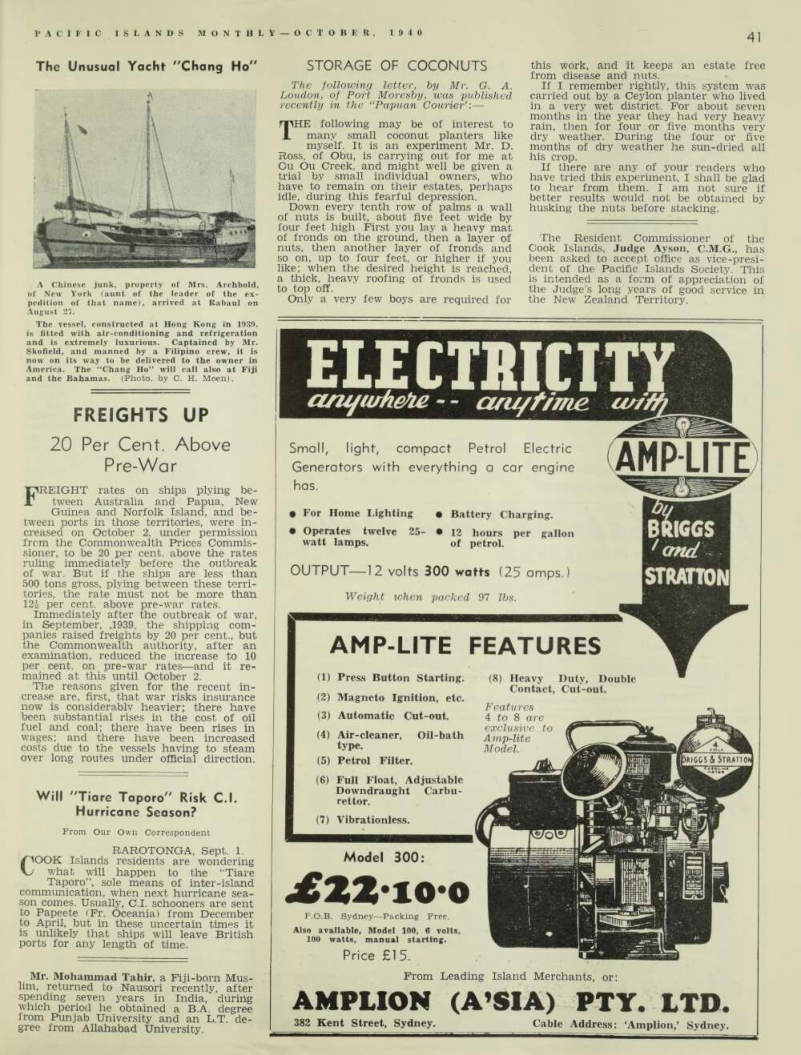
A Chinese junk, property of Mrs. Archbold, of New York (aunt of the leader of the ex pedition of that name), arrived at Rabaul on August 27.
The vessel, constructed at Hong Kong in 1939, is fitted with air-conditioning and refrigeration and is extremely luxurious. Captained by Mr.
Skofield, and manned by a Filipino crew, it is now on its way to be delivered to the owner in America, The “Chang Ho’’ will call also at Fiji and the Bahamas. (Photo, by C. H. Meen).
Freights Up
20 Per Cent. Above Pre-War
FREIGHT rates on ships plying be tween Australia and Papua, New Guinea and Norfolk Island, and be tween ports in those territories, were in creased on October 2, under permission from the Commonwealth Prices Commis sioner, to be 20 per cent, above the rates ruling immediately before the outbreak of war. But if the ships are less than 500 tons gross, plying between these terri tories, the rate must not be more than 12! per cent, above pre-war rates.
Immediately after the outbreak of war, in September, .1939. the shipping com panies raised freights by 20 per cent., but the Commonwealth authority, after an examination, reduced the increase to 10 per cent, on pre-war rates —and it re mained at this until October 2.
The reasons given for the recent in crease are, first, that war risks insurance now is considerablv heavier; there have been substantial rises in the cost of oil fuel and coal; there have been rises in wages; and there have been increased costs due to the vessels having to steam over long routes under official direction.
Will "Tiare Taporo" Risk C.I.
Hurricane Season?
From Our Own Correspondent
Rarotonga, Sept. 1.
COOK Islands residents are wondering what will happen to the “Tiare Taporo”, sole means of inter-island communication, when next hurricane sea son comes. Usually, C.I. schooners are sent to Papeete (Fr. Oceania) from December to April, but in these uncertain times it is unlikely that ships will leave British ports for any length of time.
Mr. Mohammad Tahir, a Fiji-born Mus lim, returned to Nausori recently, after spending seven years in India, during which period he obtained a B.A. degree from Punjab University and an L.T. de gree from Allahabad University.
Storage Of Coconuts
The following letter, by Mr. G. A.
Loudon, of Port Moresby, was published recently in the “Papuan Courier — THE following may be of interest to many small coconut planters like myself. It is an experiment Mr. D.
Ross, of Obu, is carrying out for me at Ou Ou Creek, and might well be given a trial by small individual owners, who have to remain on their estates, perhaps idle, during this fearful depression.
Down every tenth row of palms a wall of nuts is built, about five feet wide by four feet high First you lay a heavy mat of fronds on the ground, then a layer of nuts, then another layer of fronds and so on, up to four feet, or higher if you like: when the desired height is reached, a thick, heavy roofing of fronds is used to top off.
Only a very few boys are required for
this work, and it keeps an estate free from disease and nuts.
If I remember rightly, this system was carried out by a Ceylon planter who lived in a very wet district. For about seven months in the year they had very heavy rain, then for four or five months very dry weather. During the four or five months of dry weather he sun-dried all his crop.
If there are any of your readers who have tried this experiment, I shall be glad to hear from them. I am not sure if better results would not be obtained by husking the nuts before stacking.
The Resident Commissioner of the Cook Islands, Judge Ayson, C.M.G., has been asked to accept office as vice-presi dent of the Pacific Islands Society. This is intended as a form of appreciation of the Judge's long years of good service in the New Zealand Territory.
Advertisements & other items, pp. 43-44 (1 item)
Amplite
asuftirhefre - - Small, light, compact Petrol Electric Generators with everything a car engine has. • For Home Lighting • Battery Charging. • Operates twelve 25- • 12 hours per gallon watt lamps. of petrol.
OUTPUT—I 2 volts 300 watts (25 amps.) Weight when packed 97 lbs.
BRIGGS
1 and
STRATTON
AMP-LITE FEATURES
(1) Press Button Starting. (2) Magneto Ignition, etc. (3) Automatic Cut-out. (4) Air-cleaner, Oil-bath type. (5) Petrol Filter. (6) Full Float, Adjustable Downdraught Carburettor. (7) Vibrationless. (8) Heavy Duty, Double Contact, Cut-out.
Features 4 to 8 are exclusive to Amp-lit e Model.
Model 300
«£22'io*o
F. 0.8. Sydney—Packing Free.
Also available, Model 100, 6 volts, 100 watts, manual starting.
Price £l5.
RIOCS & SIRATTO
From Leading Island Merchants, or:
AMPLION (A’SIA) PTY. LTD.
382 Kent Street, Sydney.
Cable Address: ‘Amplion/ Sydney.
SIMILAR TO EUROPEAN MAKES
now made by
COLEMAN LAMP & STOVE CO.
LTD.
Toronto, Ontario, Canada and sold by All Leading Stores in the Pacific Islands.
In case of difficulty in obtaining supplies write to —
PEARCE & CO.—SUVA, FIJI IS.
/streamlined veauty
iisa tauncA
This is the first announcement in the Islands of this new Chapman cruiser. You'll be proud to own this craft, its sleek, stream-lined appearance will be admired, its performance under all conditions will amaze you.
Interior appointments include large lockers, comfortable bunks. The power is, of course, a reliable, economical Chapman Super Pup h.p. engine.
There is a 20 ft. cruiser—of identical design—olso available. Write for full details.
CHAPMAN & SHERACK
CLARA STREET. ERSKINEVILLE. N. S. W.
Guinea Missions
Pro-Germanism and N.
Guinea Missions Outspoken Reply to Father Madigan
From a Special Correspondent WAU, October 1.
THERE is intense indignation in the Territory, as a result of the im proper, scurrilous attack upon administrative officers by Father Madi gan, in a recent issue of the “Catholic Press” (see “P.1.M.”, September, 1940).
Perhaps you will allow me to present, with equal frankness, the other side of the picture. Father Madigan’s attack was made in defence of the German- Roman Catholic missions in New Guinea, whom he and others (including the “P.1.M.”) claim are staffed by non- Nazis. There are those who think other wise, however.
Let us take the position at Sek. where there is a very large Catholic mission, with a large German personnel. It is alleged that here some 600 native women work in the preparation of desiccated coconut, etc., under the supervision of nuns. These women are collected from native villages where, owing to their absence, the population decreases and such villages become closed to recruiting on this account. The women are herded together in wired enclosures; live in huts of which every door and window is locked and barred at nights; they are
escorted to work and back again; they are marched to Mass and back again; they are not permitted any communica tion with the males of their species. By the time the Mission has finished with them, many of these females are of unmarriageable age. They are then sent back on their villages.
All this is free labour; these women are not paid—they live on work, pray ers and very plain food. They are kept at the Mission presumably for their moral good, and thus the Mission com petes unfairly with commercial enter prise. Many boys who come from these villages, and have been repatriated, are precluded from renewing their contracts with firms and individuals under the N.A.R.. because their villages are becom ing de-populated. How can they assist in propagation, if their women are locked behind barbed wire at the Mission? And a great number of these boys desire to get back to better conditions.
Father Madigan declared that it was an outrage that priests of his order — enemy aliens —should be interned. The Administration has erred on the side of leniency, in sifting every grain of evi dence before interning any enemy aliens, and all those interned undoubt edly merited it. There still remain others who merit it. Why should a priest hide behind his cloth, escape internment, and be allowed to continue enemy propaganda? If public feeling here were consulted, Father Madigan might find himself interned.
Father Madigan harps on the medical attention (among other benefits) be stowed on the natives of his Mission.
It is a well-known fact, on the main land at any rate, that every sick case that possibly can be sent is sent to the P.H.D. for treatment. Compare this with the Lutheran Mission, which has up-to-date hospitals and is doing won derful medical work among natives.
It is a remarkable fact that boys indentured to this particular Mission rarely make a second contract. There must be something in this, when natives who work on plantations and the gold fields make contract after contract.
It is a matter of speculation among mainland residents as to why a German Mission is to-day allowed to own and fly a plane from its Sek aerodrome! It will be argued that it is not a mission plane: but there are people who know better. It is also asked why they should own a launch, or launches, and put to sea, going who knows where, and on what business bent!
Father Madigan’s reference to “sexual beasts, without religion, morality or respect for themselves” would appear to be definitely libellous, particularly as he states that the Administration hushes up the majority of cases of misconduct between officials and natives. This is definitely untrue. It is just as easy for people who know of conditions in the Sepik district to make somewhat similar charges against missionaries. And per haps just as baseless!
Father Madigan’s appeal to co-reli gionists outside the Territory to co-oper ate in a movement against the War Securities legislation could be classed as “Fifth Column” activity (as a sympa thiser with enemy aliens, if for no other reason). The German Missions in New Guinea have been given enough rope to hang themselves with in times oi peace, and that rope should now be used, when the British Empire is fighting a life-or-death struggle against the hor rors and iniquities that Germany stands for to-day.
Advertisements & other items, p. 44 (1 item)
42
OCtOBEU, 1940 PACIFIC ISLA N 1) S MONTHLY
N.Z. Labour is Strangling
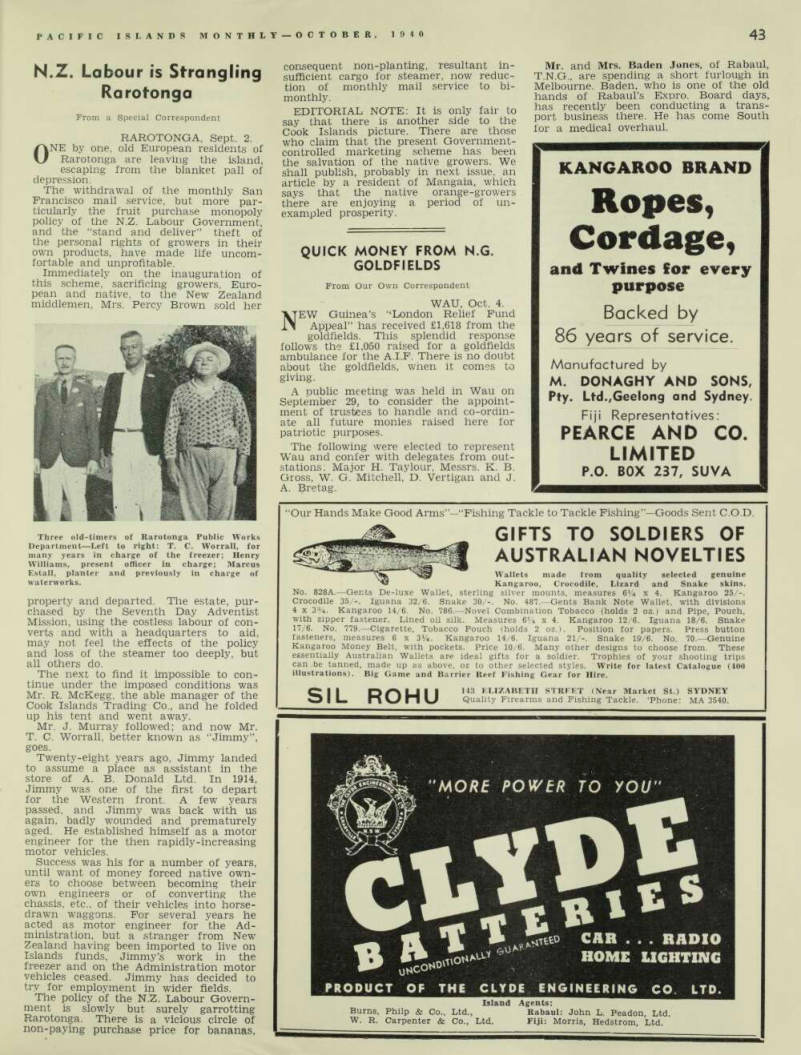
Rarotonga
Prom a Special Correspondent
Rarotonga, Sept. 2.
ONE by one, old European residents of Rarotonga are leaving the island, escaping from the blanket pall of depression.
The withdrawal of the monthly San Francisco mail service, but more par ticularly the fruit purchase monopoly policy of the N.Z. Labour Government, and the “stand and deliver” theft of the personal rights of growers in their own products, have made life uncom fortable and unprofitable.
Immediately on the inauguration of this scheme, sacrificing growers, Euro pean and native, to the New Zealand middlemen, Mrs. Percy Brown sold her
property and departed. The estate, pur chased by the Seventh Day Adventist Mission, using the costless labour of con verts and with a headquarters to aid, may not feel the effects of the policy and loss of the steamer too deeply, but all others do.
The next to find it impossible to con tinue under the imposed conditions was Mr. R. McKegg, the able manager of the Cook Islands Trading Co., and he folded up his tent and went away.
Mr. J. Murray followed; and now Mr.
T. C. Worrall, better known as “Jimmy”, goes.
Twenty-eight years ago. Jimmy landed to assume a place as assistant in the store of A. B. Donald Ltd. In 1914, Jimmy was one of the first to depart for the Western front. A few years passed, and Jimmy was back with us again, badly wounded and prematurely aged. He established himself as a motor engineer for the then rapidly-increasing motor vehicles.
Success was his for a number of years, until want of money forced native own ers to choose between becoming their own engineers or of converting the chassis, etc., of their vehicles into horse drawn waggons. For several years he acted as motor engineer for the Ad ministration, but a stranger from New Zealand having been imported to live on Islands funds, Jimmy’s work in the freezer and on the Administration motor vehicles ceased. Jimmy has decided to try for employment in wider fields.
The policy of the N.Z. Labour Govern ment is slowly but surely garrotting Rarotonga. There is a vicious circle of
non-paying purchase price for bananas,
consequent non-planting, resultant in sufficient cargo for steamer, now reduc tion of monthly mail service to bi monthly.
EDITORIAL NOTE: It is only fair to say that there is another side to the Cook Islands picture. There are those who claim that the present Government controlled marketing scheme has been the salvation of the native growers. We shall publish, probably in next issue, an article by a resident of Mangaia, which says that the native orange-growers there are enjoying a period of un exampled prosperity.
Three old-timers of Rarotonga Public Works Department—Left to right: T. C. Worrall, for many years in charge of the freezer; Henry Williams, present officer in charge; Marcus Estall, planter and previously in charge of waterworks.
Quick Money From N.G.
Goldfields
From Our Own Correspondent WAU, Oct. 4.
NEW Guinea’s “London Relief Fund Appeal” has received £1,618 from the goldfields. This splendid response follows the £1,050 raised for a goldfields ambulance for the A.I.F. There is no doubt about the goldfields, when it comes to giving.
A public meeting was held in Wau on September 29, to consider the appoint ment of trustees to handle and co-ordin ate all future monies raised here for patriotic purposes.
The following were elected to represent Wau and confer with delegates from out stations; Major H. Taylour, Messrs. K. B.
Gross, W. G. Mitchell, D. Vertigan and J.
A. Bretag.
Mr. and Mrs. Baden Jones, of Rabaul, T.N.G., are snending a short furlough in Melbourne. Baden, who is one of the old hands of Rabaul’s Expro. Board days, has recently been conducting a trans port business there. He has come South for a medical overhaul.
Advertisements & other items, p. 45 (1 item)
Ropes,
KANGAROO BRAND
Cordage,
and Twines tor every purpose
Backed by
86 years of service.
Manufactured by
M. DONAGHY AND SONS,
Pty. Ltd.,Geelong and Sydney.
Fiji Representatives:
PEARCE AND CO.
LIMITED
P.O. BOX 237, SUVA
“Our Hands Make Good Arms”—“Fishing Tackle to Tackle Fishing”—Goods Sent C.O.D No, 828 A De-luxe Wallet, sterling silver mounts, measures 6V4 x 4. Kangaroo 25/-.
Crocodile 35/-. Iguana 32/6. Snake 30/-. No. 487.—Gents Bank Note Wallet, with divisions 4 x 3%. Kangaroo 14/6. No. 786.—Novel Combination Tobacco (holds 2 oz.) and Pipe, Pouch, with zipper fastener. Lined oil silk. Measures 6'4 x 4. Kangaroo 12/6. Iguana 18/6. Snake 17/6. No. 779. —Cigarette, Tobacco Pouch (holds 2 oz.). Position for papers. Press button fasteners, measures 6 x 3*4. Kangaroo 14/6. Iguana 21/-. Snake 19/6. No. 70.—Genuine Kangaroo Money Belt, with pockets. Price 10/6. Many other designs to choose from. These essentially Australian Wallets are ideal gifts for a soldier. Trophies of your shooting trips can be tanned, made up as above, or to other selected styles. Write for latest Catalogue (400 illustrations). Big Game and Barrier Reef Fishing Gear for Hire.
GIFTS TO SOLDIERS OF
AUSTRALIAN NOVELTIES
Wallets made from quality selected genuine Kangaroo, Crocodile, Lizard and Snake skins.
SIL ROHU
143 ELIZABETH STREET (Near Market St.) SYDNEY Quality Firearms and Fishing Tackle. ’Phone: MA 3540.
NT*
MORE POWER TO YOU"
its
9* .vAlttO Ci s nto CAR . . . RADIO
HOME LIGHTING
o.co^'°
PRODUCT OF THE CLYDE ENGINEERING CO. LTD.
Island Agents: Burns, Philp & Co., Ltd., Rabaul: John L. Peadon, Ltd.
W. R. Carpenter & Co., Ltd. Fiji: Morris, Hedstrom, Ltd.
Polynesian Club
THE Polynesian Club of Sydney’s meetings have been the scene of many re-unions, when members greet friends from Polynesia and other overseas places. Among recent interest ing visitors were: Mr. Robert Young, a young Pitcairn Islander; two charming Islands visitors, Miss Ana LaurenSPn of Apia, Samoa, who is closely related to the Royal Chief Tamasese, as well as to the High Chief Faumuina, of Samoa, and Miss Matarii Nicholas, from Avarua, Rarotonga, who is staying at Wahroonga with her aunt, Mrs. Waugh, formerly of Avarua; M. Marc Grand (with Madame and Miss Grand) of Vila, New Hebrides, who is a son of M. Henri Grand, a well-known resident of Tahiti; Mr.
Rangaihi Te Aka, a young Maori, of Taranaki, who responded to his welcome with a “karanga” in the old Maori style, waving branches of green fern; Dr. A.
Earl, recently of Trinidad, and now at Nauru; Mr. George Farwell, whose play on a Tahitian subject, “Peacocks in Paradise”, is now running at a Sydney Little Theatre, Polynesian members have re sponded well to the call to arms, and ar > T 5L un l f( ?r m V ie ? n N °kb. s of (who is in the R.A.A.F.), Victor Tipene and Wiremu Takarangi N.Z. Maori, who are in camp, Hemi Hawkins, another Maori, is already in England. Others are in Palestine.
Nearly 1,300 cases of fruit juice were included in a large shipment of Cook Islands produce which arrived in Auck land, N.Z. recently. In the Cook Islands there has been developed a growing in dustry in which the juice is extracted from exceptionally large oranges, which had little commercial value.
Consistently Stands
Administration That
On its Head The Strange Record of Expert Commissions in New Guinea
Prom Our Own Correspondent
Rabaul, Oct. 1.
COMMISSIONS, or committees of inquiry, into matters affecting New Guinea function conscientiously, from time to time, submit their recom mendations, and are promptly forgotten.
Some Minister, or some person at the Federal Capital, over-rules the expert advice of the properly-constituted board of inquiry.
In 1937, after the eruption, we had the Woolnough-Stehn Inquiry into the safety of Rabaul. The removal of the capital was recommended.
To find a suitable capital site, another committee was appointed, under Brig.-: General Griffiths, and it travelled far and wide, seeking a suitable area. Lae was recommended as the best location.
The Minister, Mr. Hughes, favoured Salamaua and there was lengthy argu ment. Eventually, the Federal Govern ment said that the capital would remain at Rabaul.
Then came a committee, under Mr. F.
W. Egglestone, to inquire about the administrative merging of Papua and New Guinea. They also travelled many miles, collected much valuable informa tion, and their recommendation was against amalgamation. Now, there would appear to be a move for a unification of the administrations: Papua’s executive head has been brought down to the level of New Guinea’s —a mere Administrator; Canberra is to have more say than ever in its legislative procedure.
A road from Salamaua to Wau, on the goldfields, was provided for by the Legislative Council of New Guinea; a special Bill authorising it went through the Commonwealth Parliament and Mr.
Hughes, himself, undertook to see, per sonally, that the road went through. But there is no sign of the road being built —it is shelved, apparently.
Another local committee was formed to investigate the need for the re-intro duction of the Mortgagors’ Relief Bill; the recommendation of this committee was a negative one. But, at the last meeting of the Council, the Relief Bill was formally brought in and passed.
More recently, there was a local com mittee of inquiry into the Native Labour question. It is some months since the inquiry closed, but there has been no report submitted yet. The betting is a bob to a pinch of copra that, whatever the committee’s recommendations are, Canberra will step in and reverse them.
Why the appointment of these com missions and committees if no notice is taken of them?
The Pacific Islands Society organised a special function in Sydney on Septem ber 25 to assist the Netherlands Relief Fund. The Consul-General for the Nether lands and his wife were the guests of honour, and other guests included the Crown Prince of Tonga, Admiral Feakes (who is an expert on Pacific defence) and Mrs. Feakes, Mr. and Mrs. Patrick Purcell (of Penang, Malaya) and Madamoiselle Alix Hagen (of Noumea).
The function produced £2O for the fund.
Advertisements & other items, p. 46 (1 item)
Capstans
.. :s D
READ THE
B.P. MAGAZINE
SPRING NUMBER
iiiiiiiiiiiiiiiiiniiiiiiiiiiiiiiiiiiiiiiiiiiiiiiiiitiiiiiiiiiiiiiiiiiiiiiiiiiiiiiiiiiiin
NOW ON SALE
Short Stories Pictures Travel Articles - - - - Pages for the Children --- Stage Latest Fashions Screen A
ONE SHILLING PER COPY.
ON SALE AT ALL NEWSAGENTS AND BOOKSELLERS
CAPSTANS
r^ Capstan Cigarettes, round airtight 50's.
Medium and full strength.
SPECIALLY
PACKED FOR
THE TROPICS
ip#' yy Capstan \ Navy ) Cut Tobacco, made from the finest Virginia leaf.
Famous Anthropologist
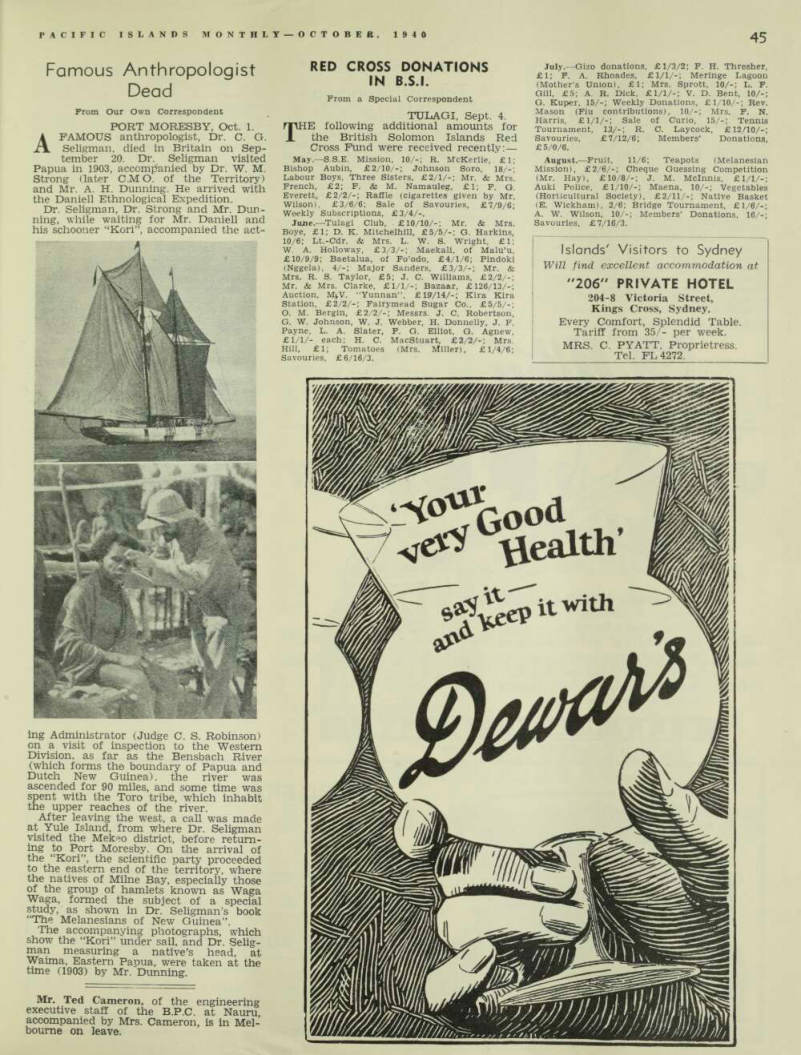
Dead
Prom Our Own Correspondent
Port Moresby, Oct. 1.
A FAMOUS anthropologist, Dr. C. G.
Seligman, died in Britain on Sep tember 20. Dr. Seligman visited Papua in 1903, accompanied by Dr. W. M.
Strong (later C.MO. of the Territory) and Mr. A. H. Dunning. He arrived with the Daniell Ethnological Expedition.
Dr. Seligman, Dr. Strong and Mr. Dun ning, while waiting for Mr. Daniell and his schooner “Kori”, accompanied the act-
ing Administrator (Judge C. S. Robinson) on a visit of inspection to the Western Division, as far as the Bensbach River (which forms the boundary of Papua and Dutch New Guinea), the river was ascended for 90 miles, and some time was spent with the Toro tribe, which inhabit the upper reaches of the river.
After leaving the west, a call was made at Yule Island, from where Dr. Seligman visited the Mekeo district, before return ing to Port Moresby. On the arrival of the “Kori”, the scientific party proceeded to the eastern end of the territory, where the natives of Milne Bay, especially those of the group of hamlets known as Waga Waga, formed the subject of a special study, as shown in Dr. Seligman’s book “The Melanesians of New Guinea”.
The accompanying photographs, which show the “Kori” under sail, and Dr. Selig man measuring a native’s head, at Waima, Eastern Panua, were taken at the time (1903) by Mr. Dunning.
Mr. Ted Cameron, of the engineering executive staff of the B.P.C. at Nauru accompanied by Mrs. Cameron, is in Mel bourne on leave.
Red Cross Donations
In B.S.I.
Prom a Special Correspondent
Tulagi, Sept. 4.
rE following additional amounts for the British Solomon Islands Red Cross Fund were received recently:— May.—S.S.E. Mission, 10/-; R. M'cKerlie, £1; Bishop Aubin, £2/10/-; Johnson Soro, 18/-; Labour Boys, Three Sisters, £2/1/-; Mr. & Mrs.
French, £2; F. & M. Namauleg, £1; P. G.
Everett, £2/2/-; Raffle (cigarettes given by Mr.
Wilson), £3/6/6; Sale of Savouries, £7/9/6; Weekly Subscriptions, £3/4/-.
June. —Tulagi Club, £lO/10/-; Mr. & Mrs.
Boye, £1; D. K. Mitchelhill, £5/5/-; G. Harkins, 10/6; Lt.-Cdr. & Mrs. L. W. S. Wright, £1; W. A. Holloway, £3/3/-; Maekali, of Malu’u, £lO/9/9; Baetalua, of Fo’odo, £4/1/6; Pindoki (Nggela), 4/-; Major Sanders, £3/3/-; Mr. & Mrs. R. S. Taylor, £5; J. C. Williams, £2/2/-; Mr. & Mrs. Clarke, £l/1/-; Bazaar, £126/13/-; Auction, “Yunnan”, £l9/14/-; Kira Kira Station, £2/2/-; Fairymead Sugar Co., £5/5/-; O. M. Bergin, £2/2/-; Messrs. J. C. Robertson, G. W. Johnson, W. J. Webber, H. Donnelly, J. F.
Payne, L. A. Slater, F. G. Elliot, G. Agnew, £l/1/- each; H. C. Mac Stuart, £2/2/-; Mrs.
Hill, £1; Tomatoes (Mrs. Miller), £l/4/6; Savouries, £6/16/3.
July.—Gizo donations, £l/3/2; F. H. Thresher, £1; F. A. Rhoades, £l/1/-; Meringe Lagoon (Mother’s Union), £1; Mrs. Sprott, 10/-; L. F.
Gill, £5; A. R. Dick, £l/1/-: V. D. Bent, 10/-; G. Kuper, 15/-; Weekly Donations, £l/10/-; Rev.
Mason (Piu contributions), 10/-; Mrs. P. N.
Harris, £l/1/-; Sale of Curio, 15/-; Tennis Tournament, 13/-; R. C. Laycock, £l2/10/-; Savouries, £7/12/6; Members’ Donations, £ 5/0/6.
August.—Fruit, 11/6; Teapots (Melanesian Mission), £2/6/-; Cheque Guessing Competition (Mr. Hay), £lO/8/-; J. M. Mclnnis, £l/1/-; Auki Police, £l/10/-; Maena, 10/-; Vegetables (Horticultural Society), £2/11/-; Native Basket (E. Wickham), 2/6; Bridge Tournament, £l/6/-; A. W. Wilson, 10/-; Members’ Donations, 16/-; Savouries, £7/16/3.
Residents of Tahiti will learn with re gret of the sudden death in Sydney of Mrs. Louise Floyd Murray, of Kowloon, Hong Kong, who had been evacuated with other women from Hong Kong, and had been one month in Australia when her untimely death occurred. Mrs.
Murray, whose Tahitian name was Manuura (the Bird of Paradise), came of an old Tahitian family, and, through her father, Edward Chapman, was re lated to almost every family in the is land. She was born in Swatow, China, where her father had been in the Gov ernment Service. An aunt of Mrs.
Murray was the late and renowned Lovaina Chapman, hostess of the Hotel Tiare in its palmy days, and friend of writers and poets. Mrs. Murray was an overseas member of the Polynesian Club of Sydney, and was chief guest at a wel come in the club-room, only three days before her death. She spoke at least five Cninese dialects, as well as English, French and Tahitian.
Advertisements & other items, pp. 47-48 (1 item)
health’
Islands' Visitors to Sydney Will find excellent accommodation at
"206" PRIVATE HOTEL
204-8 Victoria Street, Kings Cross, Sydney.
Every Comfort, Splendid Table.
Tariff from 35/- per week.
MRS. C. PYATT, Proprietress.
Tel. FL 4272.
MX SO
Good
health’
it with 9 ucep A
no other
insect
has the killinq-power of
FLIT
it is sure death to insects because it contains a number of killing agents found in no other insect spray. FI it kills where othersfail. Flitisdeadlytoinsects but harmless to humans. Buy FLIT refuse substitutes. Take a bottle or tin home to-day.
FBl2 Kills n '«» Moth) /'“•quitoei ~!*ltroachos s 'lverfi»h Bugs Ants U
FLIT always KILLS/
Vacuum Oil Co. Pty. Ltd. (Incorp. in Aust.), Distributors.
»» JAMES BUDGE.'LTD
REFRIGERATION ...
“BUDGE” Automatic or Manually-controlled Refrigeration and Ice-making Plants, with or without insulated Cabinets or Rooms, ranging from 4 cubic feet to 1000 cubic feet or larger, using ammonia in the large and sulphur dioxide (SO2) in the small units. Where electricity is not available, crude oil engines may be utilised for driving the larger plants and petrol engines for driving the smaller machines. The accompanying illustration is of a petrol engine driven SO2 unit. Enquirers please state power (if any), size of cabinet and amount of ice required per day.
JAMES BUDGE PTY. LIMITED
Refrigeration and General Engineers Office and Works:
McEvoy and Harley Streets Established 1890.
ALEXANDRIA, SYDNEY.
ALL CLASSES OF REFRIGERATION EQUIPMENT.
Magic
'Any Ruck?'
A Tale of Mangaian Magic
DURING three recent months, the natives of Mangaia have contributed £l4O to the Patriotic Fund —the highest figure, I believe, for the Cook Group outside of Rarotonga itself. The total from the whole Group is really splendid—particularly when one bears in mind the poorness of the Cook Islanders since copra lost value.
While a large number of purely spon taneous gifts have swelled the Mangaian total, a considerable proportion has be Q n derived from the patriotic dances held in the onen-sided, cement-floored cargo shed on the beach, which serves as the local “Royal Hall”.
I have endeavoured to make myself useful at these functions by providing
conjuring interludes. Carrying a kit of conjuring apparatus in the Pacific Is lands affords one not only a vast amount of amusement, but some remarkable in sights to native character.
On the occasion of the last patriotic dance, I was sitting on the counter in my store, running over final points of the evening’s programme with Tere Williams our Iccal N.M.P., who renders valuable assistance as my interpreter and “gag man”, when Makike, our village con stable, called in to make a small pur chase.
While pulling his money from his hip pocket, he unwittingly dropped a £1 note, and I was just about to call his atten tion to the fact when my companion gave me a “pipe-down” signal. As soon as Makike had left the store, Tere retrieved the note and handed it to me.
“Here is the chance of your lifetime!”, he exclaimed. “All you have to do is to wait until Makike discovers his loss, then ‘find’ the note—and your reputation as a ‘tangata manamana’ will know no bounds! ”
By a coincidence, I had arranged to run a series of all the “money-making” tricks that I know to “make money for the Patriotic Fund”.
Well, we watched P. C. Makike, and for the greater part of the evening he was his old, cheery self. The shock came when he visited the stall, where an enterpris ing Rarotongan gentleman was dispens ing drinks in the form of rain-water tinted a delicate pink with cochineal, (fully complying with the Cook Islands alcohol laws), and jaw-testing dough nuts.
When he felt for his money, a change came upon the constable’s countenance as a storm-cloud darkens a summer sky.
I felt horribly guilty as we watched the poor fellow “frisk” himself, and start to hunt around with his flashlight.
It was some time before he came into contact with us, when Tere inquired why the look of anguish.
“Don’t worry”, he said, having lent a sympathetic ear to Makike’s sad tale.
“Wait until the ‘popaa’ has finished his performance, and then we will see if he can do anything for you.”
Makike waited anxiously until I had concluded my turn, when I invited him to join us round my “black art” table.
I showed an empty metal case, closed it, and placed it in the centre of the table. There were a couple of minutes of strained silence while I “concentrated”; then I reopened the case, and there, sure enough, was the missing £1 note.
There were tears in Makike’s eyes as he cranked my arm and thanked me again and again. I felt mean at playing
such a trick, but Tere was screwing him self up in knots, trying to control his laughter.
The next day, of course, the whole is land was talking of this latest demon stration of my wonderful powers. But another day later came a somewhat em barrassing sequel.
Ngai, a young women of ample pro portions, entered the store with solemn countenance, and beckoned me to the far end of the counter, where, with fur tive glances at the other customers, she addressed me in a low whisper—so low that I was some* time in getting the drift of her own particular brand of English mixed with Maori.
It turned out that her poor mother was crying her eyes out over the loss of a £1 note, and she had come to me quite confident of my ability to “find” it!
Here was a fine go. My ears burned as I paced the back-yard seekiqg a solu tion. To gain time, I suggested that Ngai call back at four o’clock.
When in difficulty, I make a point of appealing to the superior knowledge of our Resident Agent, and I hurried to “the office”, where I found that gentleman with my friend Dr. Williams.
I explained my predicament—and waited patiently until the pair of them had recovered from an extraordinary fit of convulsions.
“Ha! Hum!” said the R.A., having re gained his composure. “For the sake of your reputation, I think the best thing you can do is to give the girl a pound.”
To which I replied, “Oh yeah! And I suppose you fellows will get a lot of fun sitting on my verandah to-morrow watching me handing out quids to heart-broken Mangaians?”
However, punctually at four o’clock.
Ngai entered the store door and fixed me with a searching gaze.
"Any ruck?” she asked.
“No luck.” I replied.
“Aue! Pad ruck!”
I tried to ease myself out by explain ing that as the loss was in the next village, it was a bit beyond my sphere.
In the case of Makike, the loss was much closer to me—which was telling the truth, if nothing else!
For the next two days, Ngai hung around my store, watching my every movement, as though expecting that any moment I might pull a £1 note from my ear or something, until I felt almost like giving .her a pound to be rid of her haunting presence.
I have since learned that her poor old mother is herself a noted “lady witch-doctor”, and it has been suggested that the lost note may have been a “frame-up”, prompted by professional jealousy, to test my powers. But, which ever way you look at it, I can always point out that the “physician was unable to cure herself”.
Anyway, I have decided to cut out all “money-making” tricks—or I am afraid it may cost me quite a lot of money to uphold my reputation as a “Tangata Manamana”—and that would be very “pad ruck”.—W.S.B.
Mr. Harold R. Rabone, of Sydney, has followed in the literary footsteps of his distinguished grandfather, the Rev.
Stephen Rabone, of Tonga, and published a book. Rabone’s Tcngan dictionary is now regarded as a Polynesian classic. The former’s work deals with Lord Howe Is land, and is based on a lecture which he delivered some time ago before the Royal Australian Historical Societv. Mr. Rabone has frequently visited Lord Howe, Norfolk and the Tongan Islands.
Captain A. S. Fitch, managing director of Steamships Trading Co., Ltd., Port Moresby, is spending his annual furlough, as usual, in Sydney.
Reprieved
Two New Hebrides Murderers Reprieved
ALTHOUGH it was reported from Vila in May last that Seine Sicambi and Nari, two members of the savage Big Nambas tribe of the New Hebrides, had been sentenced to death and executed for the murder of M. Paul Mazoyer, a French planter, we learn now that the execution was not carried out.
The French and British High Commis sioners for the Western Pacific, invoking powers conferred upon them by the 1914 Protocol, commuted the sentences to 10 years’ hard labour.
M. Mazoyer, of Aore, was recruiting at Malekula Island in October, 1939, when natives from the shore, aided by some of his own crew, attacked the schooner.
After fierce fighting, Mazoyer was over powered and killed. Some time later, three Malekula natives were captured and tried in Vila for murder. One received five years’ hard labour and the other two (Sicambi and Nari) were sentenced to death.
Monsieur G. Jeanson, a French official in the New Hebrides, recently left Vila for France, his post in the Condominium Administration having been abolished, as a measure of economy.
Returned to Tulagi recently after fur lough in Australia is Mr. “Jock” Beveridge with Mrs. Beveridge. “Jock” and Mrs.
Beveridge came to Tulagi originally from Fiji. He is Deputy Superintendent of Police at Tulagi, plays an excellent game of golf, and wears the Military Medal awarded in the Great War, his service in which terminated as a prisoner of war in Germany, with the rank of Lieutenant.
Another recent returnee to the Protec torate is Mrs. Gaskell, of Buena Vista, Nggela Island, who underwent a serious operation during her stay in Melbourne.
Mrs. Gaskell, whose husband is one of the oldest residents in the Solomons, has lived there for over 20 years. Her two sons Geoff, and Jack recently offered themselves for the A.I.F.
Advertisements & other items, pp. 49-50 (2 items)
47
rACIF'IC ISLANDS MONTHLY OCTOfeEk, 1940
Oe Meric’S
BARNET GLASS
RUBBER CO. LTD.
Wentworth Avenue,
SYDNEY
Radio : “BARNGLASS”—SYDNEY.
—o — Manufacturers and Suppliers to the Islands’ trade of all rubber goods:— Tyres, Tubes and Accessories Rubber Soled Footwear Tennis Balls Waterproof Garments Mechanical Hoses, Transmission Belting, etc.
Tennis Racquets, Golf Balls, Toy Balls, etc., and native trade lines. —o — Prompt and efficient attention to all enquiries.
Box 2629 E.E., Tel. MA 6151 G.P.0., SYDNEY. M 4409 25 lines.
WHEN YOU NEED
Creosote, Coal Tar Stockholm Tar, Pitch or Neatsfoot Oil it pays to buy De MERIC'S Standard Products. Their quality and purity satisfy Government specifications.
De Meric Products give maximum service under exacting conditions.
Oe MERIC’S
STANDARD PRODUCTS
Obtainable at good stores everywhere. Traders are invited to write tor full wholesale list.
DE MERIC’PTY. LTD.
COMMONWEALTH AND STATE GOVERNMENT CONTRACTORS
Doody Street, Alexandria, N.S.W.
Allen Taylor & Co. Ltd.
SYDNEY
Sawmillers and Wholesale Suppliers of Hardwoods for Constructional Purposes GIRDERS . . . PILES . . . POLES . . . SLEEPERS, Etc.
EXPORTING TO PACIFIC"" ISLANDS SINCE 1893
Cables: Tuxedo, Sydney
Woven Wire for all Industry
COPRA DRYING TRAYS, FLOORS, Etc.
FRUIT DRYING TRAYS, MINING SCREENS.
Heavy Mosquito Gauze in Phosphor Bronze and other Metals Impervious to Salt Sea Air.
WIRE DOOR MATS AND GENERAL WIRE WORKS
E. WRIGHT & CO. LTD.
Office and Works: 148-152 Cleveland Street, Sydney, N.S.W.
Telegraphic Address: “Wrightmake,” Chippendale, T Or £
DISTRIBUTORS; Greenwood & Laws Ltd,, Rabaul and Wau; Steamships Trading Co. Ltd., Port Moresby and Samarai; Miners Ltd,, Suva, Fiji.
For Protection and
Appearance - - use
“B A L M” Paint
PROTECTION —is the main job of Paint . . . APPEARANCE is next . . . and, to get the most efficient combination of both . . . use “8.A.L.M.” Paint.
“8.A.L.M.” Paint is a product of scientific research and practical experience . . . It has been tested for durability, protective qualities and colour retention, and proved to be the best that can be made.
Measure the value of Paint by years of service, protection and appearance, and NOT by cost per tin. Specify “8.A.L.M.”
Paint.
CftADf »OR|
f\ 1N If*
p !»h MS A Product of British Australian Lead Manufacturers Pty. Ltd.
Missed
Another Arcadia That
Story ot the Percy Edwards"
. , A REQUEST by a correspondent, in the J uly “P.I-M.”, for some details of „, the career of the brigantine “Percy Edwards” has brought forth the story of a strange expedition, Mr. P. Hill, of 844 Military Roaa Mosman, Sydney, gives the following ex tracts from “ a story of great length”- The American ship “Big Bonanza' arrived in San Francisco in 1896 and her skipper, Captain Bergmann, reported that while his shin was becalmed off the is land of St. John, in the Hermit Group
they found that the island was populated entirely by “dusky amazons”—ladies who were ready and willing to entertain visitors.
When they spread this story around, people laughed at them. But a company was started, with shares at fifty dollars; and soon they had a hundred share holders. The company was called the “United Brotherhood of the South Seas”.
The shareholders included 50 young men, who were to go to the island of St. John, to start a colony—a sort of Arcadia.
The brigantine, “Percy Edwards”, of 189 tons register, was bought for 3,000 dollars.
She sailed from San Francisco on Febru ary 25, 1897, with Bougainville, in the Solomons, as the final destination. They called at Honolulu, thence to Levuka, and thence to Suva.
The authorities refused to let the party land at Bougainville, so the Brotherhood was abandoned, and they sailed for New Zealand.
On the way they ran into dirty weather, and the old vessel began to leak. The course was set for New r Caledonia, where the “P.E.” was sold for 4,000 dollars to a French trader, who was said to have used her as a “blackbirder”.
From then on the “P.E.” was not heard of, but in 1914 the “bones” of an old ship on the beach at Noumea were identified, without hestitation, as that of the “Percy Edwards”, by an elderly man who was once a cadet on her.
How the "P.E." Ended Her
Career
MR. Thomas Nicholls, of Vila, New Hebrides, has supplied the follow ing information: — rE vessel “Percy Edwards” arrived at Noumea about 1897, under the com mand of Captain Julius Peterson.
The remainder of the expedition dis banded and some of them remained in New Caledonia for some time. Captain Peterson went to the New Hebrides, where he settled, first at Tanna and, later, at Pentecost and Santo. At the latter place, he made a large plantation, which he afterwards sold to Kerr Bros.
The “Percy Edwards” was bought by the Societe Francaise des Nouvelles Hebrides. This company refitted her ana renamed her the “Jeanette”, and usea her for recruiting in the New Hebrides.
When she had outlived her use she was beached in the southern end of Vila Harbour, near Colardeau’s plantation, where time and hurricanes gradually broke her up. She has now completely disappeared.
Whale Oil From Tonga
WHEN a request was made recently to Australia that whale oil from Tonga be allowed in duty free, the Australian Government took one look at the trade figures between the two countries, and hastened to grant the concession. Australia’s exports to Tonga average about £30,000 annually, whereas Tonga’s annual exports to Australia do not average more than £l5O. Many whales pass through the Tongan Islands in the season and it is hoped that a few may now be caught and the valuable oil exported to Australia, where a con siderable quantity is used.
It is reported that the storekeeping business conducted in Nukualofa, Tonga, for many years by Mr. W. Davidson, closed down recently.
Advertisements & other items, p. 50 (1 item)
48
OCTOBER, 1940—1 P A C I F 1 C ISLANDS MONTHLY
Story of "Uncle Parkin"
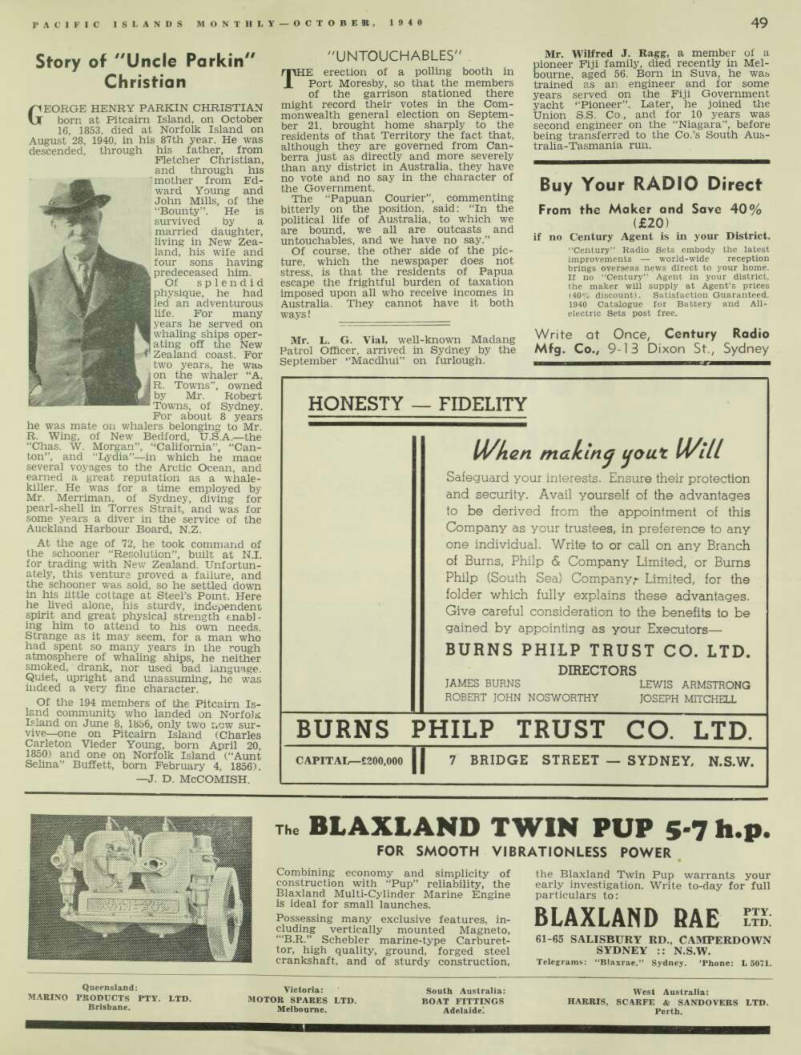
Christian
George henry parkin Christian born at Pitcairn Island, on October 16, 1853, died at Norfolk Island on August 28, 1940, in his 87th year. He was descended, through his father, from Fletcher Christian,
and through his 'mother from Ed ward Young and John Mills, of the “Bounty”. He is survived by a married daughter, living in New Zea land, his wife and four sons having predeceased him.
Of splendid physique, he had led an adventurous life. For many years he served on whaling ships oper ating off the New Zealand coast. For two years, he wa& on the whaler “A.
R. Towns”, owned by Mr. Robert Towns, of Sydney.
For about 8 years
he was mate on whalers belonging to Mr.
R. Wing, of New Bedford, U.S.A.—the “Chas. W. Morgan”, “California”, “Can ton”, and “Lydia”—in which he maae several voyages to the Arctic Ocean, and earned a great reputation as a whale killer. He was for a time employed by Mr. Merriman, of Sydney, diving for pearl-shell in Torres Strait, and was for some years a diver in the service of the Auckland Harbour Board, N.Z.
At the age of 72, he took command of the schooner “Resolution”, built at N.I. for trading with New Zealand. Unfortun ately, this venture proved a failure, and the schooner was sold, so he settled down in his little cottage at Steel’s Point. Here he lived alone, his sturdv, independent spirit and great physical strength enabl ing him to attend to his own needs.
Strange as it may seem, for a man who had spent so many years in the rough atmosphere of whaling ships, he neither smoked, drank, nor used bad language.
Quiet, upright and unassuming, he was indeed a very fine character.
Of the 194 members of the Pitcairn Is land community who landed on Norfolk Island on June 8, 1856, only two now sur vive—one on Pitcairn Island (Charles Carleton Vieder Young, born Aoril 20, 1850) and one on Norfolk Island*(“Aunt Selina” Buffett, born February 4, 1856).
J. D. Mccomish.
"Untouchables"
rE erection of a polling booth in Port Moresby, so that the members of the garrison stationed there might record their votes in the Com monwealth general election on Septem ber 21, brought home sharply to the residents of that Territory the fact that, although they are governed from Can berra just as directly and more severely than any district in Australia, they have no vote and no say in the character of the Government.
The “Papuan Courier”, commenting bitterly on the position, said: “In the political life of Australia, to which we are bound, we all are outcasts and untouchables, and we have no say.”
Of course, the other side of the pic ture, which the newspaper does not stress, is that the residents of Papua escape the frightful burden of taxation imposed upon all who receive incomes in Australia. They cannot have it both ways!
Mr. L. G. Vial, well-known Madang Patrol Officer, arrived in Sydney by the September “Macdhui” on furlough.
Mr. Wilfred J. Ragg, a member of a pioneer Fiji family, died recently in Mel bourne, aged 56. Born in Suva, he was trained as an engineer and for some years served on the Fiji Government yacht “Pioneer”. Later, he joined the Union S.S. Co., and for 10 years was second engineer on the “Niagara”, before being transferred to the Co.’s South Aus tralia-Tasmania run.
Advertisements & other items, pp. 51-52 (1 item)
[Vken making gout
Buy Your RADIO Direct
From the Maker and Save 40%
(£2O) if no Century Agent is in your District.
“Century” Radio Sets embody the latest improvements world-wide reception brings overseas news direct to your home.
If no “Century” Agent in your district, the maker will supply at Agent’s prices (40% discount). Satisfaction Guaranteed. 1940 Catalogue for Battery and Allelectric Sets post free.
Write at Once, Century Radio
Mfg. Co., 9-13 Dixon St., Sydney
HONESTY FIDELITY
[Vken making gout
Safeguard your interests. Ensure their protection and security. Avail yourself of the advantages to be derived from the appointment of this Company as your trustees, in preference to any one individual. Write to or call on any Branch of Burns, Philp & Company Limited, or Burns Philp (South Sea) Company,- Limited, for the folder which fully explains these advantages.
Give careful consideration to the benefits to be gained by appointing as your Executors—
BURNS PHILP TRUST CO. LTD.
DIRECTORS
JAMES BURNS LEWIS ARMSTRONG
ROBERT JOHN NOSWORTHY JOSEPH MITCHELL
t». BLAXLAND TWIN PUP 5-7 h.p.
FOR SMOOTH VIBRATIONLESS POWER
Combining economy and simplicity of construction with “Pup” reliability, the Blaxland Multi-Cylinder Marine Engine is ideal for small launches.
Possessing many exclusive features, including vertically mounted Magneto, ‘“B.R.” Schebler marine-type Carburettor, high quality, ground, forged steel crankshaft, and of sturdy construction, the Blaxland Twin Pup warrants your early investigation. Write to-day for full particulars to:
BLAXLAND RAE EfJ:
61-65 SALISBURY RD., CAMPERDOWN
SYDNEY N.S.W.
Telegrams: “Blaxrae,” Sydney. ’Phone: L 5071.
Queensland:
MARINO PRODUCTS PTY. LTD.
Brisbane.
Victoria:
MOTOR SPARES LTD.
Melbourne.
South Australia:
BOAT FITTINGS
Adelaide!
West Australia:
HARRIS, SCARFE & SANDOVERS LTD.
Perth.
Buy Your New BATTERY
from the Maker at Wholesale Prices—
Save
£2 Marshall Batteries are covered by a watertight guarantee, and you can buy them at a price which keeps pounds in your pocket because all the profits of the middle-man are saved for YOU. The Marshall catalogue is packed with information about batteries for cars, trucks, cycles, home and theatre lighting. It will be sent to you free of cost.
The Marshall Battery Mfg. Co.
36-38 Harbour Street, Sydney.
A. B. DONALD Ltd.
AUCKLAND
ISLAND TRADERS & GENERAL MERCHANTS
P.O. Box 1509. Cables & Telegrams, "Kingdom", Auckland.
Asthma Mucus Dissolved in 1 Day
Since the discovery of Mendaco by a famous physician it is no longer necessary for anyone to suffer from choking, wheezing, gasping Asthma. Mendaco does away with expensive injections and offensive smokes.
All you do is to take 2 tasteless tablets with mea Is and Mendaco starts circulating through the blood in 10 minutes. Soon the choking mucus and phlegm dissolves. You breathe easily and freely. Your nerves relax, you get good, fresh, pure air into your lungs, and vigour returns.
Sleep Like a Baby
Thousands of former sufferers from Asthma say that the very first dose of Mendaco brought them glorious ease and comfort, and that they slept soundly the very first night. Then their vigour returned and they felt healthier and stronger, and 5 to 10 years younger. The reason for this is that Mendaco acts in natural ways to overcome the effects*)! Asthma. (1) It dissolves, liquefies and removes the strangling mucus or phlegm ; (2) It relaxes thousands of tiny muscles in your bronchial tubes so that the air can got in and out of your lungs ; (3) It promotes body vigour, and stimulates the building of rich, revitalised blood.
Ho Asthma lor Five Years
Mendaco not only brings almost immediate results, free breathing and comfort and enables you to sleep, but also builds up th« system to ward off future attacks. Mr. J. R.
writes : “I was almost dead with Asthma.
Had lost 40 lbs. in weight, suffered coughing, choking and strangling every night—couldn’t sleep—expected to die. Mendaco stopped spasms first night and I have had no Asthma since in over 2 years.” Mrs. A. W. writes : “I had Asthma for 25 years. After using Mendaco I can sleep all night and have not had an attack since taking it.” Mrs. G. E. C. writes : “1 bless the day I first heard of Mendaco. What a god-send it is to a poor woman like me who for 35 years never knew what it was to have a good night’s rest.
The constant fight between Asthma and sleep was wearing me down, but I feel now I want to forget my past suffering.”
Benefits Immediate
The very first dose of Mendaco goes right to work circulating through your blood and helping nature rid you of the eflects of Asthma. Try Mendaco under an iron-clad money back guarantee. You be the judge.
If you don’t feel entirely well and fully satisfied after taking Mendaco just return the package and the purchase price will be refunded. Get Mendaco from your Chemist todav and see how well you sleep tonight and how much better you will feel mm tONQUffls ■ A s T M M 4
Mendaco
Now in 3 sizes
3/- 6/- and 12/-
SCHAFFER & CO„ SYDNEY.
Pacific
Danes In The
1™ has - " f US ’ “T** 1 devious cnannels, from unhappy , Denmark~at present occupied by the Nazis ’ and therefore shut off from the rest of the world-a letter written by Bent R - Nielsen > journalist, 28-1 Oester Voldgate, Copenhagen. Mr. Nielsen has made a hobb y of collecting the story of the adventurous lives of Danes who'have become domiciled in the South Seas, and letter has particular reference to the history of Captain Viggo Rasmussen (well-known in Polynesia). Mr. Nielsen £ ives the following details of South
Pacific Danes whose histories he has col lected:— “Old Harry”, who lived and died a hermit, on Deliverance Is., Torres Stran.
His real name was Henrik Enevoldsen. (See Maugham’s story “German Harry”, in “Cosmopolitan”).
“German Harry” actually was Captain Soren Christensen, born in Jutland, lived in Australia, New Guinea and different islands and died in Sydney in 1912 or 1913.
Captain, trader and consul (Norway), Christian Kaad, born Sonderborg, Den mark.; lived and died (some years ago) at Levuka, Fiji. He had three children there, with Danish names, Peter Hansen, born in Langeland. He was captain and trader for Queen Emma and Hernsheim. He lived at French Is. and New Guinea, and died there 10 years ago. Port Peterhafen is called after him. He had several children there.
William Leonard (or Edvard Christian Antonius Nielson Or toff) was born in Samso and lived as a trader for Hern sheim on Wuvulu, Matty Is., New Guinea.
He was the sole white man (“King”) for many years. He had three children there with Danish names, and he died and was buried there on Matty Plantation, 1920-22.
Captain Orbek was pilot for R. L.
Stevenson, from Tahiti to Makemo Is., on the ship “Casco”. He lived for many years on Makemo, where Alain Gerbault met him on his voyage from U.S.A. to Europe. His son, Willie Orbek, a half caste, is living in Papeete, or on the schooner “Gisborne” in Tahiti.
Captain Sonne (Sonnichsen) born on Fano, was master of McLeod’s schooner "Windward Ho”, and lived at Port Havannah, (Efate Is.), New Hebrides.
Mr. Nielsen would be very glad to re ceive further particulars about these or other Danish men in the Pacific. It is difficult to communicate with Denmark, however, so long as the Nazi hordes occupy the country.
Continued Growth of Fiji
Goldfield
IT was reported recently in Suva that it is confidently anticipated that Vatukoula goldfield (Tavua, Northern Fiji) will this year produce gold worth £1,000,000 Fijian—thus taking definite second place to the sugar industry in the scale of Fijian production.
The three mines on the goldfield, which are under the control of Mr. F.
G. Theodore, are Emperor, Loloma and Dolphin, and between them they employ 1,700 men.
The goldfield now is a hive of activity.
Everything is operated by electric power derived from Tavua Power Pty., Ltd., and the most modern equipment is being in stalled. For example, over 100 carpenters are working under European supervision in the carpentry and furniture shops.
The little town is spreading constantly, as ever more new cottages are erected for the various staffs. There are three com munities—Europeans, Euronesians and Fijians.
The establishment of this great gold in dustry, within a period of five or six years, is one of the romances of the South Seas.
Mr. D. G. Tomblings, C.M.G. M.A., arrived in Fiji recently to be headmaster of the Queen Victoria School for Boys.
Since 1925 he had been principal of Makerere College, Uganda, in East Africa.
Rev. K. L. Newman and Miss Bessie Smith, of the New Guinea Mission, were married in Queensland during their re cent furlough. They have now returned to Papua and are stationed at Eforo.
Advertisements & other items, p. 52 (1 item)
50
OCTOBER, 1940 EACIFiC ISLANDS MONtHLI
Sharks In Fiji
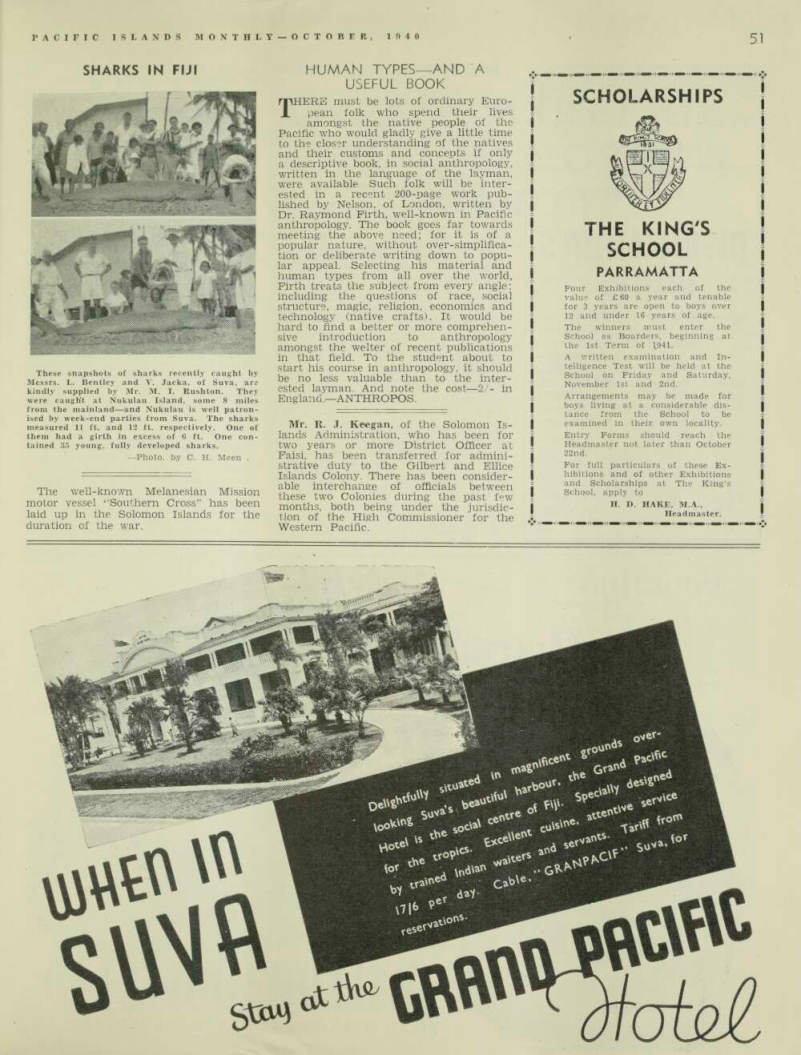
The well-known Melanesian Mission motor vessel “Southern Cross” has been laid up in the Solomon Islands for the duration of the war.
These snapshots of sharks recently caught by Messrs. L. Bentley and V. Jacka, of Suva, are kindly supplied by Mr. M. I. Rushton. They were caught at Nukulau Island, some 8 miles from the mainland—and Nukulau is well patron ised by week-end parties from Suva. The sharks measured 11 ft. and 12 ft. respectively. One of them had a girth in excess of 6 ft. One con tained 35 young, fully developed sharks. —Photo, by C. H. Meen .
Human Types—And A
Useful Book
THERE must be lots of ordinary Euro pean folk who spend their lives amongst the native people of the Pacific who would gladly give a little time to the closer understanding of the natives and their customs and concepts if only a descriptive book, in social anthropology, written in the language of the layman, were available Such folk will be inter ested in a recent 200-page work pub lished by Nelson, of London, written by Dr. Raymond Firth, well-known in Pacific anthropology. The book goes far towards meeting the above need; for it is of a popular nature, without over-simplifica tion or deliberate writing down to popu lar appeal. Selecting his material and human types from all over the world, Firth treats the subject from every angle: including the questions of race, social structure, magic, religion, economics and technology (native crafts). It would be hard to find a better or more comprehen sive introduction to anthropology amongst the welter of recent publications in that field. To the student about to start his course in anthropology, it should be no less valuable than to the inter ested layman. And note the cost—2/- in
England.-
Anthropos.
Mr. R. J. Keegan, of the Solomon Is lands Administration, who has been for two years or more District Officer at Faisi, has been transferred for admini strative duty to the Gilbert and Ellice Islands Colony. There has been consider able interchange of officials between these two Colonies during the past few months, both being under the jurisdic tion of the High Commissioner for the Western Pacific.
Dr. David, of Santo, New Hebrides, re cently returned to France and has been succeeded by Dr, Massall. The latter’s post at Norsup, Malekula, has been filled by a new French medical officer, Dr.
Languillon.
Advertisements & other items, pp. 53-59 (4 items)
Scholarships
THE KING'S
SCHOOL
PARRAMATTA
Pour Exhibitions each of the value of £6O a year and tenable for 3 years are open to boys over 12 and under 16 years of age.
The winners must enter the School as Boarders, beginning at the Ist Term of 1,941.
A written examination and Intelligence Test will be held at the School on Friday and Saturday, November Ist and 2nd.
Arrangements may be made for boys living at a considerable distance from the School to be examined in their own locality.
Entry Forms should reach the Headmaster not later than October 22nd.
For full particulars of these Exhibitions and of other Exhibitions and Scholarships at The King’s School, apply to
H. D. HAKE, M.A.
1., Headmaster.
% 9SO* SW3
MATURED
TO
PERFECTION
imUIILLIRffI’S
WINES
SMOOTH out your worries of these trying days with a perfect aperitif and a smoothly restful glass of port, each evening.
You’ll thoroughly appreciate YEN- DARRA Extra Dry SHERRY or
ROYAL RESERVE Sweet SHERRY
and VINTAGE 99 PORT—products of Australia’s leading wine makers for over 60 years.
Write to your nearest agent for supplies:—C. J. CASHMAN & CO.,
DARWIN; J. R. CLAY & CO.,
PAPUA; F. R. FORSYTH, NEW
GUINEA; C. R. YOUNGER,
k SOLOMON ISLANDS.
. , 10 aa,i
. ,« v° u " 1 ,^-r»cn. * rV *hem. 'l n a voor ,„■:. . :: - ; ;;U - ec'o borV Ca°' er >you troW tr>o° S=S N A P\a‘ n cV»® rr Y - Su\^ ye d G 'a 1 " 1 r>*a \©n9 S ° <a^» uS P o^ er , MaW an ' p\ u ra r »as' e very p\ u m Genoa Mm° n R'P e de n 9® r \\o* doc' Brea \or
SOU'
an ] ;. /■
PORT MELBOURNE, VICTORIA, AUSTRALIA
NEED MARRIAGE
SPOIL A WOMAN’S
BEA Uf
Jack and Betty Tyler were a happily married couple. They had two of the loveliest little youngsters you could imagine. Jack had a good position and Betty was the sort of woman who knew how to make friends and keep them. They should have been happy . . . very happy.
But they weren’t, and here’s the reason why. Betty had always sworn to herself before marriage that she would not let marriage ruin her appearance. Of course, it’s easy to make such promises to yourself, but they’re not always so easy to keep. Listen now to Jack.
Betty is powdering her nose. Jack is looking at her in a very critical way. After a while he says: “You’re always messing round with your powder puff. What’s the matter with you lately? If it’s not your powder puff it’s your lipstick.”
Those few words cut Betty to the quick. She didn’t say anything at the time, but that night before she went to bed she sat in front of her big mirror. She looked at herself closely. This is what she thought: “He’s noticed . . . I’m losing my looks . . . and no wonder . . . this heat. You’d think I was forty to look at me. I’m always tired, worn out. What IS the matter with me?”
Then she looked at herself very critically in the mirror and this is what she saw. Her eyes were dull, her skin had a strained, pinched look ... it was pasty too. Her hair was lifeless and there were tiny little lines beginning to show round her eyes, and above her eyebrows.
Something had to be done! She decided to have a chat to her doctor.
She told him everything. And then finished up by saying: “I know it’s no use trying to fix myself up with face creams and powder and paint. It’s something more than that, doctor, and it’s beginning to show on my face! Do you think it’s the heat?”
“Well, Mrs. Tyler,” said the doctor, “it’s not just the heat alone. The most important thing you’ve told me is that you wake tired in the mornings. That means a lot. You see, when you wake tired in the morning you naturally become more tired as the day goes on. You feel dull, listless. And that’s really Night-Starvation. Not many people realise it, but even at night you go on using up energy. Your heart beats, your lungs make muscular movements; and it stands to reason, if energy isn’t replaced, you wake tired. And that’s when this hot climate begins to tell on you. The best thing for you is Horlicks. Get some Horlicks and drink a cupful every night before you go to bed. You’ll feel right as rain in no time.”
Horlicks made a wonderful difference to Betty. It was marvellous the way her strength and vitality came hack. A couple of months after her visit to the doctor she and Jack were starting off one morning for a picnic. The children were ready, all the sandwiches were cut. Betty had been going like fury all the morning and still looked so fresh and lovely that Jack remarked on it.
“Bet,” he said, “it’s marvellous the difference that’s come over you during the last month. You look really lovely!” * * * If you wake up tired ... get more tired as the day goes on, then the chances are that you're suffering from Night-Starvation. Remember what the doctor said. A cupful of Horlicks last thing at night before bed guards against Night-Starvation and replaces energy lost during sleep.
You wake up feeling full of life and vitality.
JJorucics >•*)— \ orlic
For QUICK, ECONOMICAL,
ASTY MEALS
That Give VARIETY
To Your MENUS
Imperial
GOOD FOOD
Delicious and different. Served, in a moment, without fuss or bother. Try Imperial good foods for flavour and variety. Perfect ingredients, excellent cooking make Imperial foods universal favourites.
Al! These Different Foods from the Gold Lined Imperial Cans—B oz. & 16 oz.
Lamb Tongues, 12 oz.
Sheep Tongues, 12 oz.
P Imperial Camp Pie. nit» Steak and Kidney Pudding Lamb and Green Peas © Sausages and Tomato $ Sausages, Spaghetti and Tomato Frankfurts in Tomato Sauce © Steak and Tomato & Sausages and Vegetables © Beef Steak Pudding © Irish Stew Imperial Hot Meals. 9 Varieties.
ALSO
Imperial Ox Tongues 24 oz. & 32 oz.
Imperial Hampe 12 oz.
Imperial Cheese 8 oz.
Mild or Tasty Imperial Savoury Spreads 4 Varieties
"FITZROY"
Luncheon Beef .. 16 oz. (in oblong can) Pork Sausages .. 16 oz.
Beef Sausages ... 16 oz.
"WESTFIELD"
Corned, Boiled and/or Roast Mutton, 12 oz.
"OX Cr PALM" OR
"RIVERSTONE"
Native Trade Meats.
Corned. Boiled and/or Roast Beef—l 2 oz., 16 oz., 24 oz., 2 lb., 3 lb., 4 lb., 5 lb,, and 6 lb.
Products of
Riverstone Meat Co. Pty. Ltd.
•5-7 O'Connell Street, Sydney
Coldest “IMPERIAL"
Fiji Representatives: PEARCE & CO.. LTD.
For children's coughs and colds
get WOODS'GREAT PEPPER-
MINT CURE. Safe —the best for 45 years. Tastes good and brings relief with the very first
dose. Handy-sized bottle, only
I/-. Also in 2/- and 3/- sues.
ihe/ieii
' lUedbuCheh UteWcrld cmr
ECONOMICAL. BECAUSE YOU NEED
JUST A FEW DROPS AT A TIME -
THE COLONIAL MUTUAL LIFE
ASSURANCE SOCIETY LIMITED
During 1939 the Society issued Policy Contracts to the number of r r r - - 66,655 These Policy Contracts, during their currency guarantee to the holders, on survivance, or to heirs in the event of premature death, no less a sum than £ I 2,627,642
CHIEF AGENTS FOR PACIFIC ISLANDS:
MORRIS, HEDSTROM LTD.
Send Your Christmas Grocery Orders
TO
MdLRATHS
SYDNEY, AUSTRALIA
WHERE YOUR MONEY BUYS MORE
Mcllrath’s Xmas Cakes, 3 lbs. in Fancy Tin 3/10i each Mcllrath’s Special Quality Xmas Cakes, 2,3, 4, 5 & 6 lb. size, 1/6 & 1/9 lb.
Arnott’s Fruit Cakes, 16 oz. Sealed Tins 1/9 tin, 20/6 doz.
Arnott’s Christmas Puddings, 1 lb l/7i tin, 19/- doz/ Arnott’s Christmas Puddings, 2 lb 3/1 tin, 35/6 doz.
Amott’s “King’s Own” Biscuits, li lb 2/11 tin Special Quality Christmas Hams, 12 to 14 lb per lb. l/6i Best Fruit Mincemeat, 12 oz 1/1 jar, 12/6 doz.
Freshly Roasted Peanuts 10id. lb., 10/- doz.
Walnuts in Shell 1/2 lb., 13/6 doz.
Dessert Almonds in Shell l/4i lb., 16/- doz.
Dessert Almond Kernels 4 ozs. for Hid., 3/6 lb.
Ground Almonds 4 oz. l/4i tin, 8 oz. 2/7i tin New Season’s Muscatel Clusters 8 oz. 10id. pkt., 16 oz. 1/6 pkt.
Choice Australian Pressed Figs in Cellophane, 8 oz. 9id. t»kt., 16 oz. 1/6 pkt.
Finest Crystallised Ginger 1/li lb.
Preserved Ginger in Syrup, 16 oz 1/8 jar, 19/6 doz.
Mixed Cake & Pudding Fruits with Peel .. 16 oz. 1/1 pkt., 12/9 doz.
Best Jelly Crystals, all Flavours 4 oz, 4id. pkt., 4/3 doz.
Cut Mixed Peel (ready for use) 8 oz. 7id. pkt., 7/3 doz.
New Season’s Extra Choice Currants .6id. lb.. 6/3 doz.
New Season’s Extra Choice Sultanas 6d. lb., 5/9 doz.
New Season’s Finest Pitted Dates Bid. lb., 8/3 doz.
Cadbury’s Tropical Pack Chocolates, 1 lb 3/9 tin, 44/- doz.
“1.X.L.” Sliced Peaches, 30 oz 9id. tin, 9/4i doz.
“1.X.L.” Bartlett Pears, 30 oz Hid. tin, 11/3 doz.
“1.X.L.” Diced Fruit Salad 16 oz., 9/3 doz., 30 oz. 14/9 doz.
Nestle’s Pure Reduced Cream, 4 oz 4d. tin, 3/9 doz.
Schweppes’ Lime Juice Cordial, 26 oz 1/11 bot., 22/6 doz.
Schweppes’ Lemon Juice Cordial, 26 oz 1/5 bot., 16/6 doz.
Mcllrath’s Royal Reserve Port, 26 oz 3/6 bot., 41/- doz.
Mcllrath’s R.R. Dry Sherry, 26 oz 3/6 bot., 41/- doz.
Mcllrath’s Brown Muscat, 26 oz 2/2 bot., 25/- doz.
All prices f.o.b. Sydney
No charge for cases or packing
McILRATH’S Pty. Ltd.
EXPORT DEPARTMENT
202-204 PITT STREET, SYDNEY
AUSTRALIA
IN TUNE WITH EVERY OCCASION
Whether in sun porch -vM camp I Q iS or on location ■v-: A there's an Airzone 0 or city flat mantel radio for every occasion, -f + + For quiet entertainment,
or midnight dance party
or local sporting res news bulletins for latest war ull s. \ * Airzone fine Radio can satisfy your every need. + * At left is the "Symphony Leader"
Model 5098. 5 Valve 1.4 Volt Battery Dual Wave Mantel, designed to measure up to the exacting requirements of those wilhout electric current. Also as Model 5059. 5 Valve Vibrator Powered Dual Wave. Both are Airzone masterpieces of Mantel Model Art!
J Above is shown Airzone's new mantel production, Model 1072VM. It is a 7 Valve Vibrator Powered Dual Vc ave Mantel with EVERY feature of a console radio in mantel form. The seven valves make it very powerful and long distance or local reception is extremely good. Also as a 6 Valve A.C. Dual Wave Model 1062 AM housed in the same cabinet.
AGENTS FOR NEW GUINEA, PAPUA AND SOLOMON ISLANDS-
W. R. CARPENTER & CO., LTD.
19 O'Connell Street, Sydney: Salamau, Rabaul, Kavieng and Madang, N.G.: and Tulagi, Solomon Islands Designed and manufactured by Airzone (1931) Ltd.. Camyerdown. A .SAW. Australia. HA3SO.
Death Of Mr. C. H. Karius
( Continued from Page 18)
54
OCTOBER, 1940 PACIFIC ISLANDS MONTHLY
FRENCH PACIFIC COLONIES
JOIN DE GAULLE
(Continued from Page 8)
57
r ACIFIC ISLANDS MONTHLY OCTOBER. 1940
"Yankee" On World Tour
THE American schooner “Yankee”, on a world cruise, on August 11 arrived at Dobo, in the Aroe Islands, south westwards of Dutch New Guinea. She was under the command of Captain Irving Johnson.
In addition to Mrs. Irving Johnson and two children, the “Yankee” had on board 12 Americans, who are going round the world, sightseeing and gaining experience of “sailing before the mast”. After leaving Dobo they hoped to tour Bali and Java, in the East indies. This is the second time Captain Johnson has called at Dobo.
Mr. Skelly Maynard Warren, aged 66, a former resident of Pitcairn Island, and a descendant of Fletcher Christian, of “Bounty” fame, died last month in Wel lington, N.Z.
A Section For Women
By "Therese"
ONE of the smartest ensembles to-day is the printed frock and tailored matching jacket. The frock should be cut on simple tailored lines though the skirt may be either flared or pleated—a panel of pleats down the front gives a slim and youthful swing to any frock. jacket should have wide shoulders and neat revers, with either short oi bracelet-length sleeves.
The charm of white for Spring or Summer wear is indisputable, and a white coat, redingote style, a jacket or bolero worn over a flowered dress is “tops” in the Fashion world.
Hats, at the moment, are flower and ribbon trimmed, with large brims in first place. For cocktail and informal dinner parties, there are delightful bits of absurdity—flowers and ribbon—that perch on the head at becoming angles.
In choosing footwear, the übiquitous court shoe is always a safe bet and can be worn on any occasion. The Oxford has its devotees and for hot weather it appears in mesh, punched leather and kid with eyelets and openings to allow air to circulate. Sandals seem part of the scheme of things and are as cool as they look. Heels vary in height from the stilt to the Cuban, many of the latter being of leather with square backs. Macrame shoes for sports wear are cool and attrac tive; so, too, are those of fish-net.
Handbags are becoming more capacious than ever and are offered in all colours and shapes. Some look like barrister’s brief others are of soft leather in pouch and pocket style. Macrame bags are popular, too, particularly with spec tator sports clothes.
Necklets have come into their own again and are presented in all sorts of guises. Wooden beads, look delightful with linen frocks; choose these to match or contrast. Clusters of multi-coloured ber ries hang together from a fine gilt chain and look most attractive with white or pastel frocks. Then there are the silver chains like Grandma used to wear, so unearth all the old fashioned bits and pieces and you are sure to be right in line with Fashion.
Recipes To Please
IN these days when we hear so much about the importance of eating vege tables it is pleasant to come upon a few new ways of preparing them. Here are some variations on a familiar theme.
Stuffed Carrots With the hearts taken out by a knife, the carrots are boiled in salt and water until tender. Chopped onions and celery are browned in butter and stuffed into the carrots. Then the carrots are rolled in beaten egg and biscuit (or bread crumbs) and browned in butter. They are served with a few parsley leaves at the large end.
Baked Cabbage A cabbage is boiled for 10 minutes; then placed on a baking dish in this manner —a layer of cabbage, a layer of bread crumbs dotted with butter and sea soned with salt and pepper. This is covered with milk and baked in a slow oven.
Cucumber Dishes
Cucumber rarely features on the menu except in the guise of salad, yet there are
several ways of cooking it and it can be served as a separate course or with poultry or meats.
A simple way of serving it as a hot vegetable is to peel and cut a cucumber into slices about I inch thick. Boil these in salted water for a few minutes; drain on a colander: put ’ into a hot dish, sprinkle with pepper and salt and pour over them a little brown butter (which is made by boiling the butter until it turns a nutty brown).
Cucumbers are equally nice with white sauce made with butter, a little flour, hot milk and some grated cheese. For this method they should be boiled as in the previous recipe.
Cucumber Au Gratin Slice one or two cucumbers, toss them in a little butter until tender, and place in a well-buttered fire-proof dish. Season with salt and pepper; sprinkle with a little grated cheese and bread crumbs. Dot with small pats of butter, and cook for 20 min utes in a moderate oven.
Stuffed Cucumber This makes a delightful entree. Choose large firm straight cucumbers and peel carefully and evenly. Cut into lengths of about 3 inches, and, with a small sharp knife, scoop out the inside, leaving, how ever, a thickness of about k inch. Par boil these for a few minutes in salted water, being careful not to overboil, as they should be quite firm. Make a stuff ing with the inside of the cucumber, a little finely chopped onion, grated bread crumbs and a seasoning of salt and pepper. Cook this in butter until slightly brown and stuff the cucumber. Sprinkle each end of the cucumber with bread crumbs; arrange neatly in a buttered fire-proof dish; add a little pat of butter here and there, and bake in, a quick oven for 15 minutes until cucumber is slightly browned.
Baked Bean Dishes
Among the many tinned foods in tropical cupboards, baked beans are a general favourite. Here are some recipes that are sure to find favour.
Mock Curry , Boil rice as f or curry Heat contents of a 0 f baked beans and put in centre of a larffe hot dish Make a wall around them with the rice 'serve tomato ketchup this dish ' . Baked Bean Bie Line a fire-proof dish with wellmashed potatoes. Chop some onion finely an d mix with bake d beans. Put alternate layers of beans and slices of fresh tomato well seasoned in the pie -dish. Pour over a little gravy or stock enough to moisten.
Finish with a layer of mashed potato.
Smooth it down and decorate it with fork markings. Dot with butter and bake m a hot oven tIU the P ie 15 golden brown.
Bean Croquettes put the contents of a tin of baked beans through a sieve. Add creamed butter, pepper and salt and enough egg to bind. p orm into croquettes; dip into egg and bread crumbs and fry in deep fat until golden brown. Drain, dust with chopped parsley and serve very hot.
Serve tomato ketchup separately.
Baked Bean and Cheese Roll Half P ound baked beans . ’ lb - cheese,
&JSS& butt s r - *fSP
salt, cayenne and a little beans and cheese through a mincer Add crumbs salt and and tod haTMould ito a ffi or roll brmh ovS‘ with mehed butter in brlad crumbs and bS outier. koii m oread crumps and bake in a d^ rate oven till browned. place on a hot dish, garnish with parsley a ™ serve with tomato sauce.
Health Salad Mix the contents of a tin of baked
beans (drained from their sauce) with equal quantity of chopped celery and a squeeze of lemon juice. Arrange crisp young lettuce leaves on individual salad plates and place a portion of the bean and celery mixture on each. Serve with mayonnaise, Mayonnaise Two e £g’ y° lks > 2 teaspoon mustard, 2 tablespoons vinegar, 3 tablespoons olive oil, i teaspoon sugar.
Put yolks into basin. Add oil a drop at a time, stirring the one way with a wooden spoon until oil is used and the mixture thick. Add vinegar, sugar, salt and mustard. Serve in a small glass jug, not poured over salad.
Cork For Cleaning
has excellent cleaning qualities, and is exce ii e nt for the removal of stains and spots on hous°ho 1 d articles. Spots and blemishes on window glass that have defied ordinary cleaning generally will vanish if rubbed with a dry cork.
A dry cork also will remove stains from plate or silver and, of course, it never scratches. If the cork is cut to a point it can be worked into clean crevices that have become tarnished.
Burnt marks on pie-dishes and plates will disappear if treated with a cork dip- P ed sa't.Marks ° n aluminium ware rem ° Ved W “ h 8 C ° rk 3 For scouring deca nters and other narrow-necked vessels, there is nothing better than finel y divided cork well shaken with warm soa Py water, Corks moistened with turbentine will remove marks from white glazed bricks corks dinned in naraffin will snppriiiv ?em oV e rust marks pe trol forparaffin and snots on Unota
equafease and qmc^
neS s. Brisk rubbing is essential in all cases.
Advertisements & other items, pp. 60-61 (3 items)
58
OCTOBEU, 1 940 —TAC 1 F i C ISLAKfiS M6Kt ti L t
WENONA School for Girls
PACIFIC ISLANDS SOCIETY
Visitors from the Islands to Sydney (or those interested in Islands affairs), are advised to communicate with the honorary secretary of the above Society, which has been formed to study the history, traditions, economics, and political developments of the Pacific Islands.
Next Meeting will be held at the Hotel Carlton, Sydney, on October 30, 1940.
Address for Correspondence:
THE PACIFIC ISLANDS SOCIETY,
Box 2434 MM., G.P.0., Sydney.
WENONA School for Girls
WALKER STREET, NORTH SYDNEY, NEW SOUTH WALES mmmm TWO OF THE THREE HOUSES OF WENONA. NORTH SYDNEY. airy class rooms. sleeping-out accommodation. large playground.
SWIMMING. TENNIS COURTS.
EXCELLENT SCHOLASTIC AND SPORTS RECORD.
n ■ C DAI CTfIKI • r Assisted by University Graduates Principal: Miss E. RALb I UN. f And other Qualifled Te achers.
Prospectus on Application.
Telephone: XB 3000.
quality
* 1 A
kfi
or
LINGERIE :
I h t You I I love its extra
quality
FROM ALL AUSTRALIAN DEPT. STORES
And in the Pacific from Burns Philp & Co. Ltd
Islands Mining Shares
Fiji
Mid-April.
Mid-Aug.
Mid-Oct.
Emperor Mines .. b!5/7y 2 b9/9 blO/4 Loloma b32/6 b21/9 b23/4»/ 2 Mt. Kasi . s4/9 s3/3 b2/8 Tavua Dev s4d s2d s2d Bulolo G.D
New Guinea
b £ 6 s£5/10/b £4/10/- Enterprise of N.G. b27/6 blO/blO/- Guinea Gold b!4/10 b8/ll b9/9 N.G.G., Ltd . b2/7V a b2/3 b2/4 Oil Search b6/ll b3/5 b3/ll Placer Dev b £3/17/s £ 2/13 b£2/17/6 Sandy Creek blld blld blOV 2 d Sunshine Gold .. b8/3 b7/10 blO/4 Cuthbert’s
Papua
. bl7/3 bl2/bl3/4 Mandated All. ... b3/2 b2/2 b2/9 Oriomo Oil blO/s6/6 Papuan Apinaipl b5/9 b3/3 b3/9 Yodda Goldfields . bl/10 bl/2 bl/4
From Fiji
Mining News
From Papua
Cuthbert’S Misima Gold Mines, Ltd.
SEPTEMBER production at the Cuthbert mine on Misima Island, Eastern Papua, is com pared with July and August in the following table: —
Mandated Alluvials, N.L.
Directors of Mandated Alluvials, N.L., report that shipments of matte, Nos. 26 and 27. amount ing to 95 tons, have been received. The assays give contents as 342 oz. of fine gold, 1,030 oz. of silver, and 18 tons of copper. The net value,
after allowing for deductions, cost of refining and goid tax, should exceed £4.000. Shipment No. 28, of 49 tons, has been received, but assays are not yet available.
Papuan Apinaipi Petroleum Co.. Ltd.
Early in October. Papuan Apinaipi Petroleum Co., Ltd., reported that the broken bit in No. 1 major bore at Oiapp had been recovered. The bore is now being reamed preparatory to the insertion of casing.
From New Guinea
new guinea goldfields, ltd.
"T* HE latest report issued by the Mining Trust, 1 Ltd., consulting engineers for N.G.G. Ltd ' compares August production with June and July as follows:
Sandy Creek Gold Sluicing, Ltd.
September production at the Sandy Creek mine is compared with June, July and August in the following table:—
Sunshine Gold Development, Ltd.
Directors of Sunshine Gold Development, Ltd., report that the clean-up for September yielded 587 oz. of gold, compared with 881 oz. in August and 990 oz. in July.
Yield for quarter ended September 30: 2.501 oz. (elevator, 2,147 oz.; sluicing. 290; tributors 63).
A dividend of 6d. a share has been declared and the first bonus declared by the company 6d. a share —will be paid on October 24.
Bulolo Gold Dredging, Ltd.
Bulolo Gold Dredging, Ltd., reports that August production from the Co.’s dredges in New Guinea compares with June and July as follows:
From Fiji
Emperor Mines, Ltd.
[RESULTS from the Emperor mine, at Tavua, •N for the past four months compare as follows:
‘Apparent discrepancy between yield and head values due to gold still in circuit. In addition, 270 tons of Customs ore were treated, tlncluding treatment of concentrates.
Loloma Gold Mines, Ltd.
Production at the Loloma mine for October is compared with the three previous months as follows;
treatment of accumulated slags and amalgam, making the total recovery for the period 4,424.
Mt. Kasi Mines, Ltd.
Latest yields from Mt. Kasi mine, Vanua Levu, are as follows: —
July. Aug. Sept.
Mill treated, tons .. 3,054 3,313 3,210 Bullion, oz 3.348 3,162 3,402 Gold, fine, oz 717 802 780 Silver, fine, oz 2.551 2,278 2,538 Estimated value .. .. £5,837 £6.487 £6,343 Value per ton of ore 38/3 39/2 39/6
Edie Creek mill— June.
July.
Aug.
Ore, tons 2.942 3,275 3,105 Gold, oz., fine .. 883 912 918 Silver, oz., fine . .
Golden Ridges mill— 4.219 5,218 5,713 Tons treated .. . 2,295 2,696 2,616 Gold, oz., fine .. .. 871 1,115 l!l84 Silver, oz., fine . . .
Alluvial— 1,060 1,237 1,350 Gold, oz., fine .. 1,563 1,417 1,335 Silver, oz., fine . .
Operating profit— 1,071 1.005 988 Edie Creek, . £ 1.901 2,020 2,019 Golden Ridges, £ 1,105 2,309 2,772 Alluvial, £ .. . 6,204 4,798 5,120
. . June. July. Aug. Sept.
Cubic yards .. .. 15,433 16,052 16,530 14 110 Gold . OS! 218 316 258 243 Per cubic yard .. 2/3 3/1% 2/6 2/9 Working cost .. .. /H3/ 4 k)3 4 1/x
Cubic yards . .
June.
July.
Aug. 1.432,000 1.545.000 1,613.000 Bullion 07 23.178 20,032 22,304 Gold, fine oz. 15,994 13,822 15,389 Estimated working profit for August, 7,254 oz. of fine gold.
July Aug.
Sept. ♦Oct. 10. 7. 4. 2.
Ore treated, tons . . 11,184 10,367 10,098 9,899 Head value, dwt. .. 7.8 6.95 7.1 10.75 Gold, oz., fine 4,000 3,716 3,653 t3,026 Residues, dwt 1.0 0.95 1.0 1.1
July Aug.
Sept. *Oct. 10. 7. 4. 2.
Tons, treated .. .. 2,659 2,493 2,527 2,623 Gold, oz., fine . .. 3.523 3.428 3,361 3.419 Head value, dwt. .. 27.49 28.33 27.7 27.4 Residues, dwt 0.5'9 1.33 1.1 1.38 *In addition 1,005 oz. gold was : recovered from
Period ended Aug. 7.
Sep. 4.
Oct. 9.
Ore, tons . . .. 3.348 3,366 4.040 Gold, fine oz. . 655 693 853 Value, £ A 6.550 6.930 8.530
Advertisements & other items, pp. 62-64 (2 items)
Gold
NOYES BROS.
FOR DETAILS OF
p BRISBANE.
V
NOTES BROS.
SYDNEY
• MIXING EQUIPMENT.—Crushing Machinery, Screens, Feeders, Rock Drills, Excavators, Diesel and Crude Oil Engines, Hoists and Runways, Roller Bearings, etc.
• ELECTRICAL EQUIPMENT. Parkinson
Motors, Crompton Switchgear, Transformers, Instruments, Meters, Callender Wires and Cables, Lighting Equipment, Electric Drills.
NEWf ACTi c •STORES, FACTORIES, HOME AND OFFICE.— Accessories, Airspeed Fans, Floodlighting Equipment, Domestic Electric Appliances, Joseph Rodgers Cutlery & Plateware, Chinaware, "Perfection” E.P.N.S. Ware, Clocks.
• NON-FERROUS METALS OF ALL DESCRIP-
TIONS.—In sheets, Strips. Rods. Tubes, Wire and Extruded Sections.
NOYES BROS.(Sydney) Ltd
11 5 Clarence Street, Sydney. 1 1 Watt Street, Newcastle 197 Elizabeth Street, Brisbane
Highest Prices Paid For
GOLD
Garrett & Davidson’s organisation is acknowledged far and wide as the main clearing house for precious metals in the Southern Hemisphere.
They have earned a reputation for accuracy and integrity in all their business dealings, which is proved by the fact that they are privileged to handle more gold from the Islands of the Pacific than any other organisation.
Therefore for your complete and lasting satisfaction, you are advised to transact all your precious metals business through the house of Garrett & Davidson.
GARRETT Cr DAVIDSON PTY, LTD.
ASSAYERS METALLURGISTS REFINERS
Bank of N.S.W. Buildings,
REGENT AND GEORGE STS., SYDNEY.
Amalgamated Wireless (A/Sia) Limited
v~ * * * *> t° o \ ' o SO Ui** St* \ \o* c** r. tit* CO No technical knowledge required . . .
Keep in touch with the world expedite business transactions—be prepared to quickly call medical or other services in an emergency.
Install an A.W.A. Teleradio 38.
Compact radiotelephone providing communication facilities for parts beyond the reaches of landlines. Reliable and economical.
Illustrated booklet and quotations gladly supplied on request.
AMALGAMATED WIRELESS (A/SIA) LIMITED
47 YORK STREET, SYDNEY 167 QUEEN STREET, MELBOURNE Branches at: Wellington, Suva, Rabaul, Port Moresby and other island centres.
LEARN MORSE CODE. “LIKE-A-
FLASH” KITS, KEYS & BUZZERS.
P.M.G. type Key, 15/-.
Professional Buzzer & Battery, all assembled on Base Board, 39/6. d
“PRESTO”
THE
MAGIC
BOX
The most Amazing Trick- Just out.
“Presto”. —The greatest, most alluring and outstanding little trick ever Introduced, 2/9. Post Free.
Money back If it’s not the best yet.
POLICE PATROL MULTI STRAND
RUBBER COVERED AERIAL.
Needs No Separate Lead-in. 50 ft., 2/6; 100 ft., 5/-.
MAN-O-WAR HEAVY DUTY
INSULATED AERIAL. MULTI
STRAND WIRES.
50 ft., 5/-; 100 ft. 10/-.
Electric MODEL MOTORS, work off wet or dry batteries: 5/9, 9/6, 12/6 Electric 240 volt G r a m o p h one Motors, complete 50/-. Highestgrade Gramophone Needles, long lasting, 3/6, 4/6, 5/6 box.
RADIO ACCUMULATORS.
2 Volt. 110 Amp 17/- 2 „ 150 20/- 4 „ 65 20/6 4 „ 90 22/6 6 90 36/3 6 „ 110 46/6 6 „ 130 66/- 6 „ 150 78/9 6 „ 170 84/6
AUTO ACCUMULATORS.
6 Volt. 9 Plate 60 Amp. .. 31/9 6 „ 13 „ 90 .. 40/- 6 „ 15 „ 103 .. 44/6 6 .. 17 116 „ .. 51/- 12 .. 7 „ 50 .. .. 49/3 12 „ 9 60 „ .. 66/9
HOME LIGHTING ACCUMULATORS.
2 Volt. 120 Amps 20/9 2 „ 210 35/9 2 „ 200 41/-
WORLD'S LATEST
GAMES
Dart Boards. 4/6, 8/6, 10/6, 16/-.
Brass Competition Darts, Set of 3, 3/11, 4/6, 5/61 Monopoly. 10/6.
Totopoly, 10/6. Bucaneer, 10/6. 3 of the World’s Most Popular Games.
Chinese Checkers, 2/6, 4/6, 8/6.
Tripoly Card Game, 5/-. De Luxe Type, 10/6. Poker Rummy, 1/-.
Pot Luck, 1/-. Playing Card Lotto, 1/-. We Stock All Kinds of Indoor Games. Send for Booklet.
Adjustable Morse Code Key on Bakelite Base, highly plated parts, 12/6. Higher grade instrument.
Morse Code Set —Key, Buzzer, Battery, Light and Throwover Switch. A very fine job, 30/-, for professional or novice.
SWOOP! BRITAIN’S BEST.
“Amplion,” Bakelite PICK-UP, with Volume Control unequalled. Brand new, in original cartons. Listed to sell at 37/6. Now 32/6. Fits and suits all sets.
Rubber Head-phone Pads, 2/6 pair.
THE WIRELESS CONSTRUCTOR’S
ENCYCLOPEDIA, 7/6.
Cloth bound, nearly 400 pages, full of interesting and useful hints.
“Wheres” and “Whys” book of Radio.
THE TELEVISION AND SHORT
WAVE HANDBOOK. 5/6.
Cloth bound—up to the moment, simply written explanation and instructions on building Short Wave Sets. etc. A useful dictionary—you should have a copy.
METERS.—Pocket Volt Meters. 2 Reading for A. & B. Batteries, 8/6. 10/6.
WATES.—4 in 1 Meter; 0 to 6, 0 to 15, 0 to 180 volts; 0 to 30 M/A, 14/-.
TELSEN.—Millimeter A.C., D.C., British. Reads everything in Radio.
Bench type, 22/6.
PIPCO —A.C.-D.C. Bench Type Radiometer. British. Reads 0 to 30 M/A Valve and Circuit Tester, 0 to 240 V. 0 to 15 V.. 25/-.
BOOKS! BOOKS! BOOKS! The Be-
ginners' Book of Radio. The Radio Beginners’ Dictionary. 2/- the 2. The Wireless Constructor’s Encyclopaedia. Giant size, 7/6. Newnes "Everyman’s” Wireless Book, 5/6.
The Book of Practical Radio, also The Book of Practical Television, 8/6 each. Foulshatn’s Giant "Party and Fun Book”, 1/6. Humorous Stories and Recitations, 3/9. Card and Conjuring Tricks, 3/9. Tea- Cup Fortune Telling, 3/9, 100 Party Games for Old and Young, 1/9.
Popular Magic and Amateur Conjurer, 1/9. 50 Best Party Games, 1/6. Tricks with Cards, 1/6.
Combination Nest of 4 Pocket Screw Drivers, 2/- Steel or Bakelite.
Strong Breast Drills, 4/11. Card of Steel Drills, 1/9. Radio Saw, 3 Blades, 1 for iron, Bakelite and Metal, 1/9.
Rush Bd. in Stamps for our "GREAT
WONDER BOOK OF SPECIALTIES".
Games, Radio, Tricks, Puzzles, etc..
Complete Mechanical Units for Musical Cigarette Boxes, etc., 12/6, 15/-. Plays two Tunes. Music- Boxes, SO/-, 35/-, 45/-. Musical Cigarette Boxes, 35/-.
P.M.G. Model Adjustable Morse Code Key. Heavy Precision Fittings on solid Wooden Base, 19/6.
Morse Buzzer and Light Set, illustrated, 25/-.
I /// Morse Code Light and Buzzer Set.
A precision De-luxe outfit that cannot be bettered. Perfect Adjustable Morse Code Key, with professional type Buzzer. Light to Buzzer throw-over Switch, and Battery, all ready mounted, for immediate use, on strong solid wooden Base Board, 39/6 the outfit.
Volt Ammeter Panel Type, 0 to 25 V., 0 to 5 A., 15/-. British Pocket Volt Meter, 0 to 12, 0 to 150, 0 to 30 M/amps, 10/6. 58/6 From London, “Cosmocord” De Luxe Crystal Pick-up, with Built-in Vol.
Control, 58/6. Magnetic type Pickups, complete with volume control and tone arm. British Make, 30/-, 35/-, 38/6, 45/-. Studio Model, 50/-.
Play, Talk, Sing, Joke through your Radio. Great Fun. Batteryless type.
Microphone for Hand Holding or Hanging, 22/6. Complete with Flex fixed in a second. Others, 12/6, 15/-, 17/6, 25/-, 28/6, 32/6. All plus 2/for Battery and 1/6 for 20 ft. Cord. mi B.G.E. Table Type Microphone. Highly recommended far Amateur or Profee- ■ional use. Built-In Transformer and Battery with Volume Control incorporated Just plug into pickup terminals jf any set. 39/6. New Bullet Model, also 39/6.
Morse Set Buzzer to light with single switch. All parts include adjustable Key, Switch, Buzzer, Lamp and Battery, all assembled on Base Board, 30/-.
Morse Code Set “De Luxe”. Adjustable High-grade Key, Buzzer and Battery. All mounted on base board ready for use, 22/6.
“Duplex” Single 1-Valve Battery Set. A smart little outfit to buy in Kit form, or purchase Readymade. Parts, 63/2. Valves, 12/6.
Batteries, 33/3, Phones, Readymade, complete, £7/18/11. Simple Chart with instructions, 6d., or free with Kit.
Hunting and Sporting Knives in Sheath, 10/6. A Beautiful Article.
Throwing Knives, in Sheath, 6/9.
Australian Naval Design Dress Rings for Gents, 6/6. Air Force Dress Rings for Lady or Gent. 4/6.
Just Arrived! The new Model Aeroplane Manual. Complete guide for Building and Flying, 6/11.
HEADPHONES. All 4000 ohms.
Lissen 19/6. S.T.C. or B.T.H. 30/-.
Ericssons 32/6. All British.
Now available (not less than 10/parcels): Magic Wand, 1/6 Jafet’s Wallet, 1/-; Obedient Ball, 1/6; Rattle Box; Mystic Head Chopper, 2/6; Shy Lock, 2/-; Dribble Glass, 2/-; Ventrillo. 1/-; Magic Coin, 1/-; Nest of Nests, 5/-; Voice Echoer, 1/-; Magic Bottle. 1/-; 3 Bell Trick, 1/-. 2 Knife Trick. 6/6. Giant Dice Trick, 1/6. Wonderful Rattle Box Trick, 7/6. 10/-, 20/-, 30/-, 40/-, 50/- Parcels.
Money Belts For All. Zipper types, 10/6 and 8/6. Other pocket types, 6/6 and 7/6. Leather Lanyard, 1/6.
Plaited Leather Swagger Canes, 4/6, 6/6, 8/6. Steel Kit Bag, Handle and Lock, 3/3.
. PATRIOTIC
SOUVENIRS
■ 4 Felt Pennants • Ak for Wall; Autos.,
tX U L U 0.,
Launches, etc., R.A.A.F., Royal Remington, U.S.A. made, Books just landed, 1/9 ea.
Popular Party Games.
Tea Cup Telling Fortune Card Tricks— High-pitched Tone Oe Luxe Pro* Sessional Buzzer. The best mMo
(imromiininniii
Write for Punch Board Leaflets
(IITTTTTTIITTTTTTTTTTTI
J.LEVENSON RADIO
GAMES, NOVELTIES AND HOBBIES.
226 A PITT STREET, SYDNEY
Manufacturers. Importers, and Exporters.
N.S.W.. AUSTRALIA.
miiiimniiiinnimiT Write for Pin-Game, Totem and Odds and Evens Leaflets mnniiiiimiiiiiiiiiii Cable address; “Leveradioh". Goods forwarded V.P.P. or Sight Draft. Satisfaction and Service Guaranteed. We can supply by mail all General Merchandise at a Better Price. Quotations with pleasure. Please add freight and packing. Write for full list of interesting leaflets of Games. Hobbies, Novelties, and Electrical Goods. Write for full list of Radio Meters.
We Con Supply, at a Keen Price, Any Available Article You Require.
Australian Short Wave
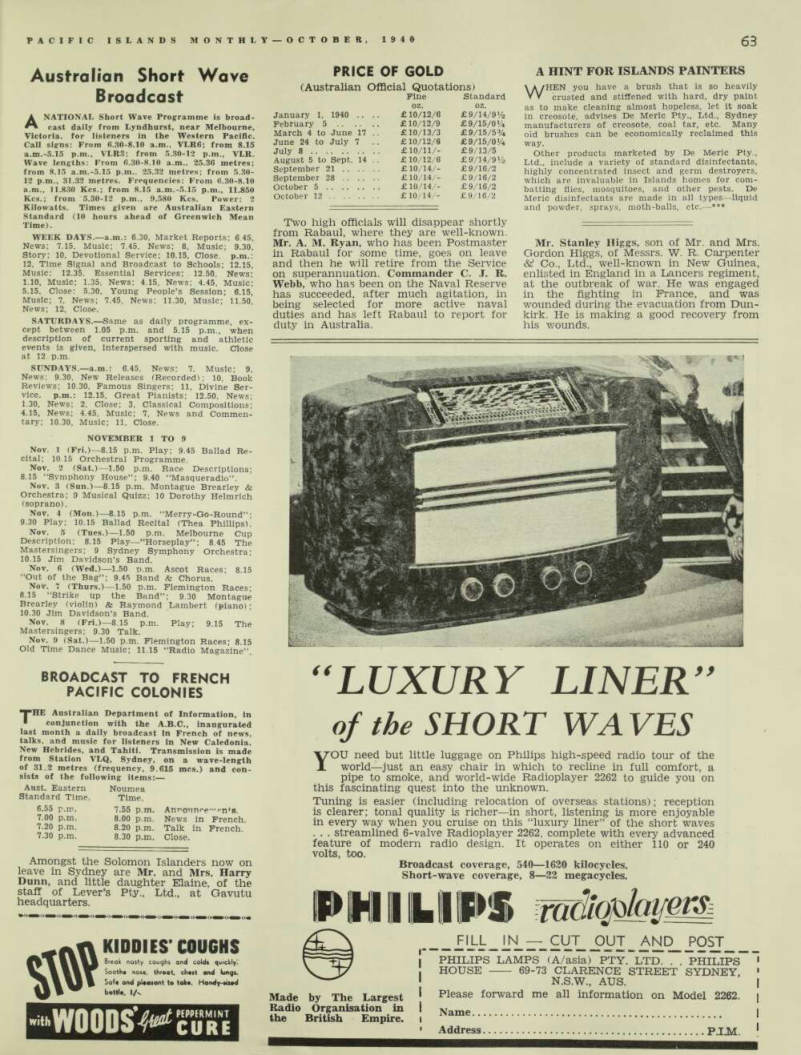
Broadcast
A NATIONAL Short Wave Programme is broad cast daily from Lyndhurst, near Melbourne.
Victoria, for listeners in the Western Pacific.
Call signs: From 6.30-8.10 a.m.. VLR6; from 8.15 a.m.-5.13 p.m., VLR3; from 5.30-12 p.m., VLR.
Wave lengths: From 6.30-8.10 a.m.. 23.36 metres; from 8.13 a.m.-5.15 p.m.. 25.32 metres; from 5.30- 12 p.m., 31.32 metres. Frequencies: From 6.30-8.10 a.m., 11.830 Kcs.; from 8.15 a.m.-5.15 p.m., 11.850 Kcs.; from 5.30-12 p.m., 9,580 Kcs. Power: 2 Kilowatts. Times given are Australian Eastern Standard (10 hours ahead of Greenwich Mean Time).
WEEK DAYS.—a.m.; 6.30, Market Reports; 6.45, News; 7.15. Music; 7.45, News; 8, Music; 9.30, Story: 10, Devotional Service; 10.15, Close, p.m.: 12, Time Signal and Broadcast to Schools; 12.15, Music; 12.35. Essential Services; 12.50. News; 1.10, Music; 1.35, News; 4.15, News; 4.45, Music; 5.15, Close: 5.30, Young People’s Session; 6.15, Music; 7. News; 7.45, News; 11.30, Music; 11.50, News; 12, Close.
SATURDAYS.—Same as daily programme, ex cept between 1.05 p.m. and 5.15 p.m., when description of current sporting and athletic events is given, Interspersed with music. Close at 12 p.m.
SUNDAYS.—a.m.: 6.45, News; 7, Music; 9, News: 9.30. New Releases (Recorded); 10, Book Reviews; 10.30, Famous Singers; 11, Divine Ser vice. p.m.: 12.15, Great Pianists; 12.50, News; 1.30, News; 2. Close; 3, Classical Compositions; 4.15, News; 4.45, Music; 7, News and Commen tary: 10.30, Music; 11, Close.
November 1 To 9
Nov. 1 (Fri.)—B.ls p.m. Play; 9.45 Ballad Re cital; 10.15 Orchestral Programme.
Nov. 2 (Sat.) —1.50 p.m. Race Descriptions; 8.15 “Symphony House”: 9.40 “Masqueradio”.
Nov. 3 (Sun.) —8.15 p.m. Montague Brearley & Orchestra: 9 Musical Quizz; 10 Dorothy Helmrich (soprano).
Nov. 4 (Mon.) —8.15 p.m. “Merry-Go-Round”; 9.30 Play; 10.15 Ballad Recital (Thea Phillips).
Nov. 5 (Tues.) —1.50 p.m. Melbourne Cup Description: 8.15 Play—“ Horseplay”; 8.45 The Mastersingers; 9 Sydney Symphony Orchestra; 10.15 Jim Davidson’s Band.
Nov. 6 (Wed.) —1.50 p.m. Ascot Races; 8.15 “Out of the Bag”; 9.45 Band & Chorus.
Nov. 7 (Thurs.)—l.so p.m. Flemington Races; 8.15 “Strike up the Band”; 9.30 Montague Brearley (violin) & Raymond Lambert (piano); 10.30 Jim Davidson’s Band.
Nov. « (Fii.) —8.15 p.m. Play; 9.15 The Mastersingers: 9.30 Talk.
Nov. 9 (Sat.) —1.50 p.m. Flemington Races; 8.15 Old Time Dance Music; 11.15 “Radio Magazine”.
Broadcast To French
Pacific Colonies
THE Australian Department of Information, in ■ conjunction with the A.8.C., inaugurated last month a daily broadcast In French of news, talks, and music for listeners in New Caledonia, New Hebrides, and Tahiti. Transmission is made from Station VLQ, Sydney, on a wave-length of 31.2 metres (frequency, 9.615 mcs.) and con sists of the following items:— Aust. Eastern Noumea Standard Time. Time. 6.55 p.m. 7.55 p.m. Announce"’‘ , n + s. 7.00 p.m. 8.00 p.m. News in French. 7.20 p.m. 8.20 p.m. Talk in French. 7.30 p.m. 8.30 p.m. Close.
Amongst the Solomon Islanders now on leave in Sydney are Mr. and Mrs. Harry Dunn, and little daughter Elaine, of the staff of Lever’s Pty., Ltd., at Gavutu
headquarters.
Price Of Gold
(Australian Official Quotations)
Two high officials will disappear shortly from Rabaul, where they are well-known.
Mr. A. M. Ryan, who has been Postmaster in Rabaul for some time, goes on leave and then he will retire from the Service on superannuation. Commander C. J. R.
Webb, who has been on the Naval Reserve has succeeded, after much agitation, in being selected for more active naval duties and has left Rabaul to report for duty in Australia.
Pine Standard oz. oz.
January 1, 1940 .. .. £10/12/6 £9/14/9% February 5 £10/12/9 £9/15/0% March 4 to June 17 .. £10/13/3 £9/15/5% June 24 to July 7 £10/12/6 £9/15/oy 4 July 8 £10/11/- £9/13/5 August 5 to Sept. 14 .. £10/12/6 £ff/14/9y 2 September 21 £10/14/- £9/16/2 September 28 £10/14/- £9/16/2 October 5 £10/14/- £9/16/2 October 12 £10/14 - £9 16/2
A Hint For Islands Painters
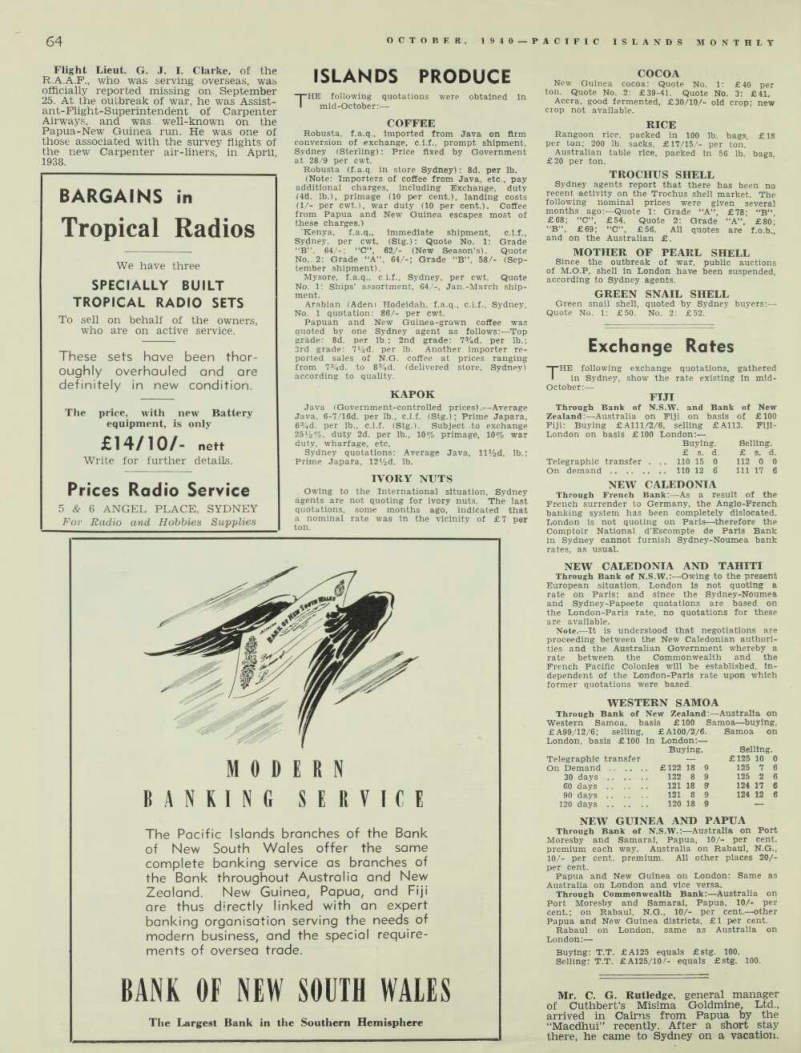
WHEN you have a brush that is so heavily crusted and stiffened with hard, dry paint as to make cleaning almost hopeless, let it soak in creosote, advises De Meric Pty., Ltd., Sydney manufacturers of creosote, coal tar, etc. Many old brushes can be economically reclaimed this way.
Other products marketed by De Meric Pty., Ltd., include a variety of standard disinfectants, highly concentrated insect and germ destroyers, which are invaluable in Islands homes for com batting flies, mosquitoes, and other pests. De Meric disinfectants are made in all types—liquid and powder, sprays, moth-balls, etc. —*** Mr. Stanley Higgs, son of Mr. and Mrs.
Gordon Higgs, of Messrs. W. R. Carpenter <& Co., Ltd., well-known in New Guinea, enlisted in England in a Lancers regiment, at the outbreak of war. He was engaged in the fighting in Prance, and was wounded during the evacuation from Dun kirk. He is making a good recovery from his wounds.
Flight Lieut. G. J. I. Clarke, of the R.A.A.F., who was serving overseas, was officially reported missing on September 25. At the outbreak of war, he was Assist ant-Flight-Superintendent of Carpenter Airways, and was well-known on the Papua-New Guinea run. He was one of those associated with the survey flights of the new Carpenter air-liners, in April, 1938.
Advertisements & other items, pp. 65-66 (2 items)
I Lips
*• f * 1
asr
SS«!i‘SS;SSS
LUXURY LINER”
of the SHORT WA VES
YOU need but little luggage on Philips high-speed radio tour of the world—just an easy chair in which to recline in full comfort, a pipe to smoke, and world-wide Radioplayer 2262 to guide you on this fascinating quest into the unknown.
Tuning is easier (including relocation of overseas stations); reception is clearer; tonal quality is richer —in short, listening is more enjoyable in every way when you cruise on this “luxury liner” of the short waves . . . streamlined 6-valve Radioplayer 2262, complete with every advanced feature of modern radio design. It operates on either 110 or 240 volts, too.
Broadcast coverage, 540—1620 kilocycles.
Short-wave coverage, 8—22 megacycles.
I LIPS
Made by The Largest Radio Organisation in the British Empire.
FILL IN CUT OUT AND POST
PHILIPS LAMPS (A/asia) PTY, LTD. . . PHILIPS
HOUSE 69-73 CLARENCE STREET SYDNEY.
N.S.W., AUS.
Please forward me all information on Model 2262.
Name Address
BARGAINS in
Tropical Radios
We have three
SPECIALLY BUILT
TROPICAL RADIO SETS
To sell on behalf of the owners, who are on active service.
These sets have been thoroughly overhauled and are definitely in new condition.
The price, with new Battery equipment, is only
£l4/10/- nett
Write for further details.
Prices Radio Service
5 & 6 ANGEL PLACE, SYDNEY
For Radio and Hobbies Supplies
y/. ■W'
MODERN
BANKING SERVICE
The Pacific Islands branches of the Bank of New South Wales offer the same complete banking service as branches of the Bank throughout Australia and New Zealand. New Guinea, Papua, and Fiji are thus directly linked with an expert banking organisation serving the needs of modern business, and the special requirements of oversea trade.
BANK OF NEW SOUTH WALES
The Largest Bank in the Southern Hemisphere
■“WOODSY cure
<0
KIDDIES’COUCHS
Break nasty coughs and colds quickly.
Sooth* nose, threat eh*it and lungs.
Sa(* and pUasant ta lots. Handy-*a*d be«l*. I/*.
■“WOODSY cure
Islands Produce
THE following quotations were obtained in mid-October;—
Coffee
Robusta, f.a.q., Imported from Java on firm conversion of exchange, c.1.f., prompt shipment, Sydney (Sterling): Price fixed by Government at 28/9 per cwt.
Robusta (f.a.q. in store Sydney): Bd. per lb. (Note: Importers of coffee from Java, etc., pay additional charges, including Exchange, duty (4d. lb.), primage (10 per cent.), landing costs (1/- per cwt.), war duty (10 per cent.). Coffee from Papua and New Guinea escapes most of these charges.) Kenya, f.a.q.. Immediate shipment, c.1.f., Sydney, per cwt. (Stg.): Quote No. 1: Grade “B”, 64/-; “C”, 62/- (New Season’s). Quote No. 2; Grade “A”, 64/-; Grade “B”, 58/- (Sep tember shipment).
Mysore, f.a.q., c.i.f., Sydney, per cwt. Quote No. 1; Ships’ assortment, 64/-. Jan.-March ship ment.
Arabian (Aden) Hodeidah. f.a.q., c.i.f., Sydney, No. 1 quotation: 86/- per cwt.
Papuan and New Guinea-grown coffee was quoted by one Sydney agent as follows:—Top grade: Bd. per lb.; 2nd grade; 7%d. per lb.; 3rd grade; 7V2d. per lb. Another importer re ported sales of N.G. coffee at prices ranging from 7 3 4 d. to 8 3 4 d. (delivered store, Sydney) according to quality.
Kapok
Java (Government-controlled prices).—Average Java, 6-7/16d. per lb., c.i.f. (Stg.); Prime Japara, 6 3 4 d. per lb., c.i.f. (Stg.). Subject to exchange 25V 2 %, duty 2d. per lb., 10% primage, 10% war duty, wharfage, etc.
Sydney quotations: Average Java, UVad. lb.; Prime Japara, 12V 2 d. lb.
Ivory Nuts
Owing to the International situation, Sydney agents are not quoting for ivory nuts. The last quotations, some months ago, indicated that a nominal rate was in the vicinity of £7 per ton.
Cocoa
New Guinea cocoa; Quote No. 1: £4O per ton. Quote No. 2: £39-41. Quote No. 3: £4l.
Accra, good fermented, £3O/10/- old crop; new crop not available.
Rice
Rangoon rice, packed in 100 lb. bags. £lB per ton; 200 lb. sacks, £l7/15/- per ton.
Australian table rice, packed in 56 lb. bags, £2O per ton.
Trochus Shell
Sydney agents report that there has been no recent activity on the Trochus shell market. The following nominal prices were given several months ago:—Quote 1; Grade “A”, £7B; “B”. £6B; “C”, £54. Quote 2: Grade “A”, £80; “B”, £69; “C”, £56. All quotes are f.0.b., and on the Australian £.
Mother Of Pearl Shell
Since the outbreak of war, public auctions of M.O.P. shell in London have been suspended, according to Sydney agents.
Green Snail Shell
Green snail shell, quoted by Sydney buyers:— Quote No. 1: £5O. No. 2: £52.
Exchange Rates
THE following exchange quotations, gathered in Sydney, show the rate existing In mid- October:—
Fiji
Through Bank of N.S.W. and Bank of New Zealand: —Australia on Fiji on basis of £lOO Fiji: Buying £ All 1/2/6, selling £AII3. Pijl- London on basis £lOO London:—
New Caledonia
Through French Bank;—As a result of the French surrender to Germany, the Anglo-French banking system has been completely dislocated.
London is not quoting on Paris—therefore the Comptoir National d’Escompte de Paris Bank in Sydney cannot furnish Sydney-Noumea bank rates, as usual.
New Caledonia And Tahiti
Through Bank of N.S.W.; —Owing to the present European situation, London is not quoting a rate on Paris; and since the Sydney-Noumea and Sydney-Papeete quotations are based on the London-Paris rate, no quotations for these are available.
Note. —It is understood that negotiations are proceeding between the New Caledonian authori ties and the Australian Government whereby a rate between the Commonwealth and the French Pacific Colonies will be established, in dependent of the London-Paris rate upon which former quotations were based.
Western Samoa
Through Bank of New Zealand; —Australia on Western Samoa, basis £lOO Samoa —buying, £ A99/12/6; selling, £AIOO/2/6. Samoa on London, basis £lOO in London;—
New Guinea And Papua
Through Bank of N.S.W.:—Australia on Port Moresby and Samaral, Papua, 10/- per cent, premium each way. Australia on Rabaul, N.G., 10/- per cent, premium. All other places 20/per cent.
Papua and New Guinea on London: Same as Australia on London and vice versa.
Through Commonwealth Bank;—Australia on Port Moresby and Samarai, Papua, 10/- per cent.; on Rabaul. N.G., 10/- per cent. —other Papua and New Guinea districts, £1 per cent.
Rabaul on London, same as Australia on London: — Buying: T.T. £AI2S equals £stg. 100.
Selling; T.T. £AI2S/10/- equals £stg. 100.
Mr. C. G. Rutledge, general manager of Cuthbert’s Misima Goldmine, Ltd., arrived in Cairns from Papua by the “Macdhui” recently. After a short stay there, he came to Sydney on a vacation.
Buying. Selling, £ s. d. £ s. d.
Telegraphic transfer . .. 110 15 0 112 0 0 On demand 110 12 6 111 17 6
Buying. Selling.
Telegraphic transfer — £125 10 0 On Demand £122 18 9 125 7 6 30 days 122 8 9 125 2 6 60 days 121 18 9 124 17 6 90 days 121 8 9 124 12 6 120 days 120 18 9 —
Market Quotations
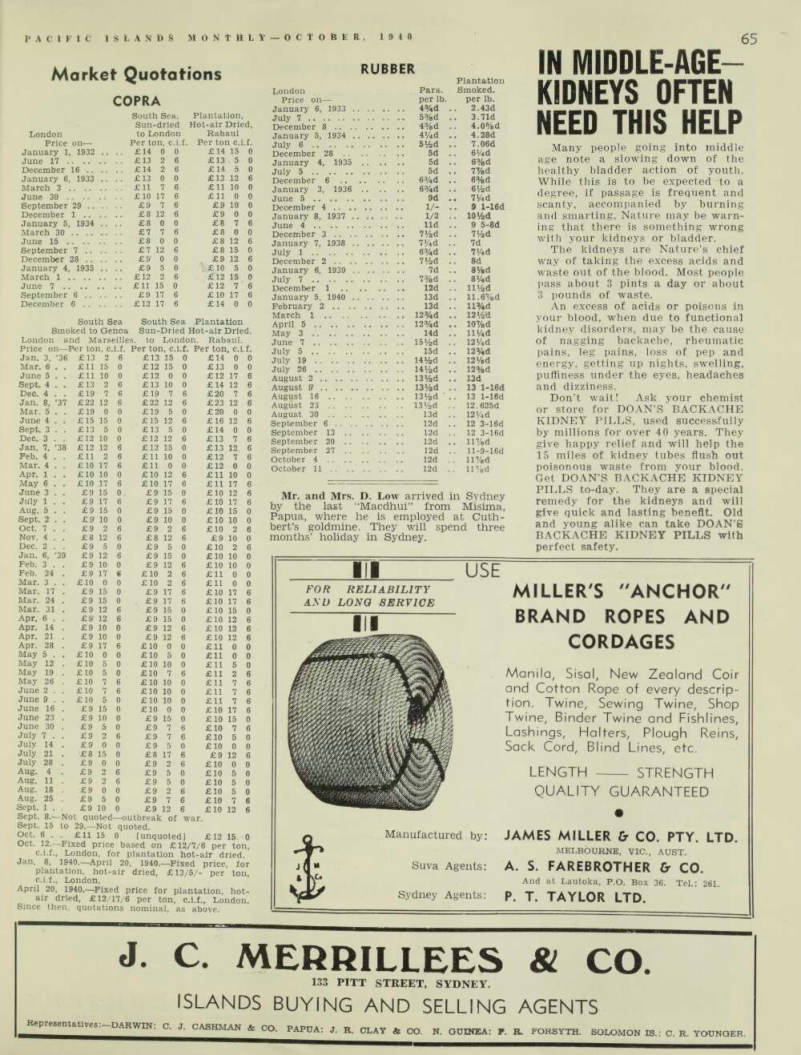
Mr, and Mrs. D. Low arrived in Sydney by the last “Macdhui” from Misima, Papua, where he is employed at Cuth bert’s goldmine. They will spend three months’ holiday in Sydney.
Rubber
Plantation London Para.
Smoked.
Price on— per lb. per lb.
January 6, 1933 . 2.43d July 7 3.71d December 8 .. . 4%d . 4.0 5 /ed January 5, 1934 . 4.28d July 6 5%d . 7.06d December 28 5d . 6V 4 d January 4, 1935 5d . 6%d July 5 5d . 7%d December 6 .. 6 3 Ad . 6%d January 3, 1936 6 3 Ad . ey 2 d June 5 9d . 7y 4 d December 4 .. .. 1/- . 9 l-16d January 8, 1937 . 1/2 . lOVad June 4 lid . 9 5-8d December 3 .. .. 7>/ 2 d . 7»/ 2 d January 7, 1938 . 7«/ 4 d . 7d July 1 6 3 Ad . 7y 4 d December 2 .. .. 7’/ 2 d . 8d January 6, 1939 . 7d . sy 8 d July 7 7%d . sy 4 d December 1 ny 2 d January 5, 1940 . 13d . 11.6% d February 2 .. .. 13d . ll%d March 1 .. .. 12%d . 12*/ 2 d April 5 12 3 Ad . ioy 8 d May 3 14d . ny 4 d June 7 15V 2 d . 12y 4 d July 5 15d . i2y 4 d July 19 14V 2 d . i2y a d July 26 14V 2 d . 12%d August 2 isy 2 d . 13d August 9 13>/ 2 d . 13 l-16d August 16 .. .. 13«/ 2 d ■. 13 l-16d August 23 . . .. 13y 2 d . 12.625d August 30 . . . . 13d . 12»/ 4 d September 6 . . . , 12d . 12 3-16d September 13 .. 12 3-16d September 20 .. ny 8 d September 27 12d . ll-9-16d October 4 12d . ll 7 / 8 d October 11 .. ., 12d . ny 8 d
Copra
South Sea.
Plantation, Sun-dried Hot-air Dried, London to London Rabaul Price on— Per ton, c.i.f.
Per ton c.i.f.
January 1, 1932 £14 0 0 £14 15 0 June 17 . £13 2 6 £13 5 0 December 16 .. £14 2 6 £14 5 0 January 6, , 1933 . . £13 0 0 £13 12 6 March 3 £11 7 6 £11 10 0 June 30 . £10 17 6 £11 0 0 September 29 .. £9 7 6 £9 10 0 December 1 .. £8 12 6 £9 0 0 January 5, 1934 £8 0 0 £8 7 6 March 30 £7 7 6 £8 0 0 June 15 . £8 0 0 £8 12 6 September 7 .. £7 12 6 £8 15 0 December 28 .. £9 0 0 £9 12 6 January 4, 1935 , . . , £9 5 0 £10 5 0 March 1 , £12 2 6 £12 15 0 June 7 .. £11 15 0 £12 7 6 September 6 .. £9 17 6 £10 17 6 December 6 . . £12 17 6 £14 0 0 South Sea South Sea Plantation Smoked to Genoa Sun-Dried Hot-air Dried.
London and Marseilles, to London. Rabaul.
Price on—] Per ton, c.i.f.
Per ton, c.i.f.
Per ton, c.i.f.
Jan. 3, ’36 £13 2 6 £13 15 0 £14 0 0 Mar. 6 . . £11 15 0 £12 15 0 £13 0 0 June 5 . . £11 10 0 £12 0 0 £12 17 6 Sept. 4 . . £13 2 6 £13 10 0 £14 12 6 Dec. 4 . . £19 7 6 £19 7 6 £20 7 6 Jan. 8, ’37 £22 12 6 £22 12 6 £23 12 6 Mar. 5 . . £19 0 0 £19 5 0 £20 0 0 June 4 . . £15 15 0 £15 12 6 £16 12 6 Sept. 3 . . £13 5 0 £13 5 0 £14 0 0 Dec. 3 . . £12 10 0 £12 12 6 £13 7 6 Jan. 7, ’38 £12 12 6 £12 15 0 £13 12 6 Feb. 4 . . £11 2 6 £11 10 0 £12 7 6 Mar. 4 . . £10 17 6 £11 0 0 £12 0 0 Apr. 1 . . £10 10 0 £10 12 6 £11 10 0 May 6 . . £10 17 6 £10 17 6 £11 17 6 June 3 . . £9 15 0 £9 15 0 £10 12 6 July 1 . . £9 17 6 £9 17 6 £10 17 6 Aug. 5 . . £9 15 0 £9 15 0 £10 15 0 Sept. 2 . . £9 10 0 £9 10 0 £10 10 0 Oct. 7 . . £9 2 6 £9 2 6 £10 2 6 Nov. 4 . , £8 12 6 £8 12 6 £9 10 0 Dec. 2 . . £9 5 0 £9 5 0 £10 2 6 Jan. 6, '39 £9 12 6 £9 15 0 £10 10 0 Feb. 3 . . £9 10 0 £9 12 6 £10 10 0 Feb. 24 . £9 17 6 £10 2 6 £11 0 0 Mar. 3 . . £10 0 0 £10 2 6 £11 0 0 Mar. 17 . £9 15 0 £9 17 6 £10 17 6 Mar. 24 . £9 15 0 £9 17 6 £10 17 6 Mar. 31 . £9 12 6 £9 1-6 0 £10 15 0 Apr. 6 . . £9 12 6 £9 15 0 £10 12 6 Apr. 14 . £9 10 0 £9 12 6 £10 12 6 Apr. 21 . £9 10 0 £9 12 6 £10 12 6 Apr. 28 . £9 17 6 £10 0 0 £11 0 0 May 5 . . £10 0 0 £10 5 0 £11 0 0 May 12 . £10 5 0 £10 10 0 £11 5 0 May 19 . £10 5 0 £10 7 6 £11 2 6 May 26 . £10 7 6 £10 10 0 £11 7 6 June 2 . . £10 7 6 £10 10 0 £11 7 6 June 9 . . £10 5 0 £10 10 0 £11 7 6 June 16 . £9 15 0 £10 0 0 £10 17 6 June 23 . £9 10 0 £9 15 0 £10 15 0 June 30 . £9 5 0 £9 7 6 £10 7 6 July 7 . . £9 2 6 £9 7 6 £10 5 0 July 14 . £9 0 0 £9 5 0 £10 0 0 July 21 . £8 15 0 £8 17 6 £9 12 6 July 28 . £9 0 0 £9 2 6 £10 0 0 Aug. 4 £9 2 6 £9 5 0 £10 5 0 Aug. 11 , £9 2 6 £9 5 0 £10 5 0 Aug. 18 . £9 0 0 £9 2 6 £10 5 0 Aug. 25 . £9 5 0 £9 7 6 £10 7 6 Sept. 1 . . £9 10 0 £9 12 6 £10 12 6 Sept. 8. —Not quoted—outbreak of war.
Sept. 15 to 29.— Not quoted.
Oct. 6 . . £11 15 0 [unquoted] £12 15 0 Oct. 12.—Fixed price based on £12/7/6 per ton. c.i.f., London, for plantation hot-air dried.
Jan. 8, 1940.—April 20, 1940.—Fixed price, for plantation, hotair dried, £13/5/- per ton. c.i.f., London.
April 20, 1940.—Fixed price for plantation, hotair dried, £ 12/17/ 6 per ton. c.i.f., London.
Since then, quotations nominal, as above.
Advertisements & other items, p. 67 (2 items)
65
PACIFIC ISLANDS MoKtHLt OClOftH, 1940
In Middle-Age-
KIDNEYS OFTEN
NEED THIS HELP
Many people going into middle age note a slowing down of the healthy bladder action of youth.
While this is to be expected to a degree, if passage is frequent and scanty, accompanied by burning and smarting, Nature may be warning that there is something wrong with your kidneys or bladder.
The kidneys are Nature’s chief way of taking the excess acids and waste out of the blood. Most people pass about 3 pints a day or about 3 pounds of waste.
An excess of acids or poisons in your blood, when due to functional kidney disorders, may be the cause of nagging backache, rheumatic pains, leg pains, loss of pep and energy, getting up nights, swelling, puffiness under the eyes, headaches and dizziness.
Don’t wait! Ask your chemist or store for DOAN’S BACKACHE KIDNEY PILLS, used successfully by millions for over 4 0 years. They give happy relief and will help the 15 miles of kidney tubes flush out poisonous waste from your blood.
Get DOAN’S BACKACHE KIDNEY
PILLS to-day. They are a special remedy for the kidneys and will give quick and lasting benefit. Old and young alike can take DOAN’S
BACKACHE KIDNEY PILLS with
perfect safety.
11l
FOR RELIABILITY
AX D LONG SERVICE
USE
MILLER'S "ANCHOR"
BRAND ROPES AND
CORDAGES
Manila, Sisal, New Zealand Coir and Cotton Rope of every description. Twine, Sewing Twine, Shop Twine, Binder Twine and Fishlines, Lashings, Halters, Plough Reins, Sack Cord, Blind Lines, etc.
LENGTH STRENGTH
QUALITY GUARANTEED
• Manufactured by: JAMES MILLER tj CO. PTY. LTD.
MELBOURNE, VIC., AUST.
Suva Agents: A. S. FAREBROTHER Cr CO.
And at Lautoka, P.O. Box 36. Tel.: 261.
Sydney Agents. p. J. TAYLOR LTD.
J. C. MERHILLEES & CO.
133 PITT STREET, SYDNEY.
ISLANDS BUYING AND SELLING AGENTS
Representatives: DARWIN: c. J. CASHMAN & CO. PAPDA: J. R. CLAT & CO.
N. GUINEA: P. R. FORSYTH.
SOLOMON IS.: C. R. YOUNGER.
Nauru War Funds
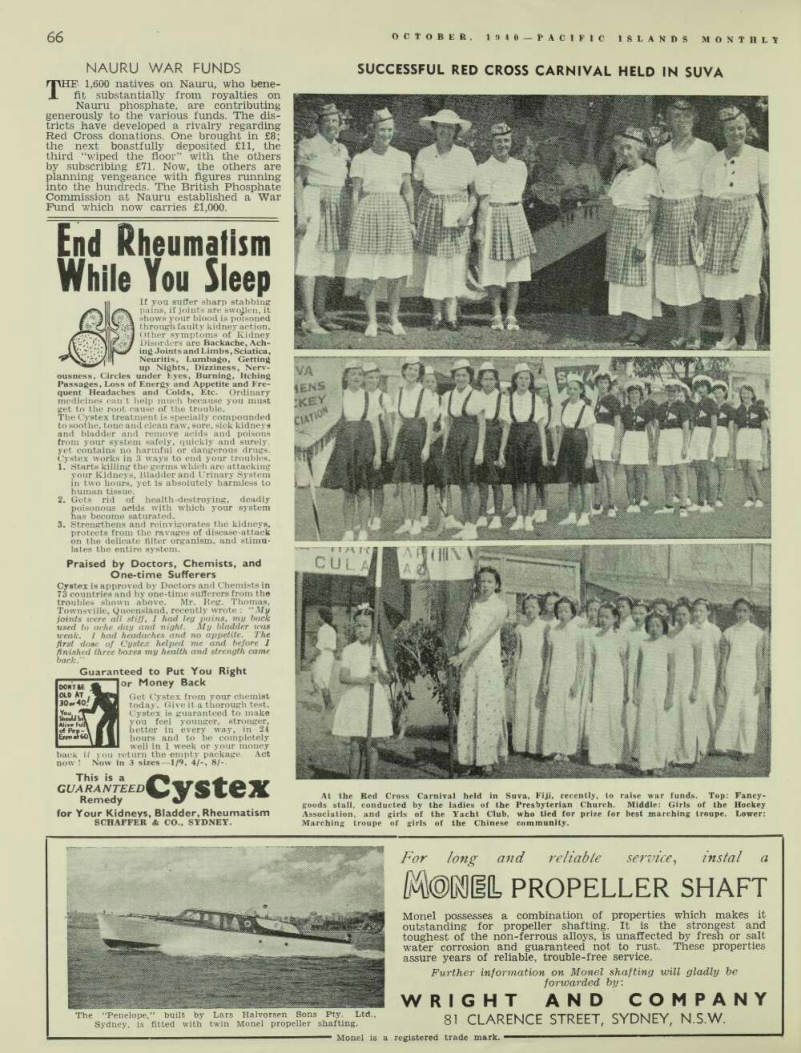
THE 1,600 natives on Nauru, who bene fit substantially from royalties on Nauru phosphate, are contributing generously to the various funds. The dis tricts have developed a rivalry regarding Red Cross donations. One brought in £8; the next boastfully deposited £ll, the third “wiped the floor” with the others by subscribing £7l. Now, the others are planning vengeance with figures running into the hundreds. The British Phosphate Commission at Nauru established a War Fund which now carries £l,OOO.
Successful Red Cross Carnival Held In Suva
At the Red Cross Carnival held in Suva, Fiji, recently, to raise war funds. Top: Fancy goods stall, conducted by the ladies of the Presbyterian Church. Middle: Girls of the Hockey Association, and girls of the Yacht Club, who tied for prize for best marching troupe. Lower: Marching troupe of girls of the Chinese community.
Advertisements & other items, p. 68 (1 item)
End Rheumatism
While You Sleep
If you suffer sharp stabbing pains, if joints are swollen, it shows your blood is poisoned through faulty kidney action.
Other symptoms of Kidney Disorders are Backache, Aching Joints and Limbs, Sciatica, Neuritis, Lumbago, Getting up Nights, Dizziness, Nervousness, Circles under Lyes, Burning, Itching Passages, Loss of Energy and Appetite and Frequent Headaches and Colds, Etc. Ordinary medicines can’t help much because you must get to the root cause of the trouble.
The Cystex treatment is specially compounded to soothe, tone and clean raw, sore, sick kidneys and bladder and remove acids and poisons from your system safely, quickly and surely, yet contains no harmful or dangerous drugs.
Cystex works in 3 ways to end your troubles. 1. Starts killing the germs which are attacking your Kidneys, Bladder and Urinary System in two hours, yet is absolutely harmless to human tissue. 2. Gets rid of health-destroying, deadly poisonous acids with which your system has become saturated. 3. Strengthens and reinvigorates the kidneys, protects from the ravages of disease-attack on the delicate filter organism, and stimulates the entire system.
Praised by Doctors, Chemists, and
One-time Sufferers Cystex is approved by Doctors and Chemists in 73 countries and by one-time sufferers from the troubles shown above. Mr. Reg. Thomas, Townsville, Queensland, recently wrote : “My joints were all stiff, I had leg pains, my back used to ache day and night. My bladder teas weak. I had headaches and no appetite. The first dose of Cystex helped me and before 1 finished three boxes my health and strength came back."
Guaranteed to Put You Right or Money Back Get Cystex from your chemist today. Give it a thorough test.
Cystex is guaranteed to make you feel younger, stronger, better in every way, in 24 hours and to be completely well in 1 week or your money back if you return the empty package. Act now ! Now in 3 sizes—l/9, 4/-, 8/- *3
DON I 6*
OLD AT
300c4 Too Shoal Jb Alive hi of Pep Even a for Your Kidneys, Bladder, Rheumatism
SCHAFFER & CO.. SYDNEY.
For long and reliable service , instal a
PROPELLER SHAFT
Monel possesses a combination of properties which makes it outstanding for propeller shafting. It is the strongest and toughest of the non-ferrous alloys, is unaffected by fresh or salt water corrosion and guaranteed not to rust. These properties assure years of reliable, trouble-free service.
Further information on Monel shafting will gladly be forwarded by:
WRIGHT AND COMPANY
The “Penelope,” built by Lars Halvorsen Sons Pty. Ltd., Sydney, is fitted with twin Monel propeller shafting.
81 CLARENCE STREET, SYDNEY,
Monel is a registered trade mark.
N.S.W.
Shipping Services In The Pacific
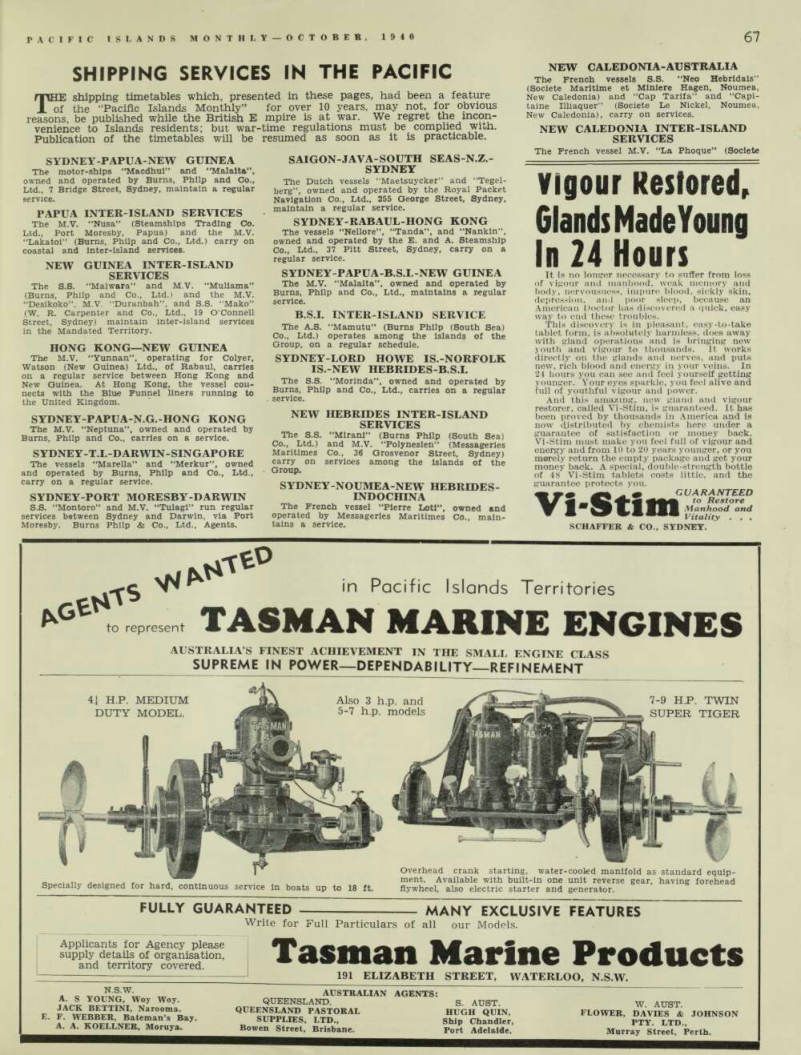
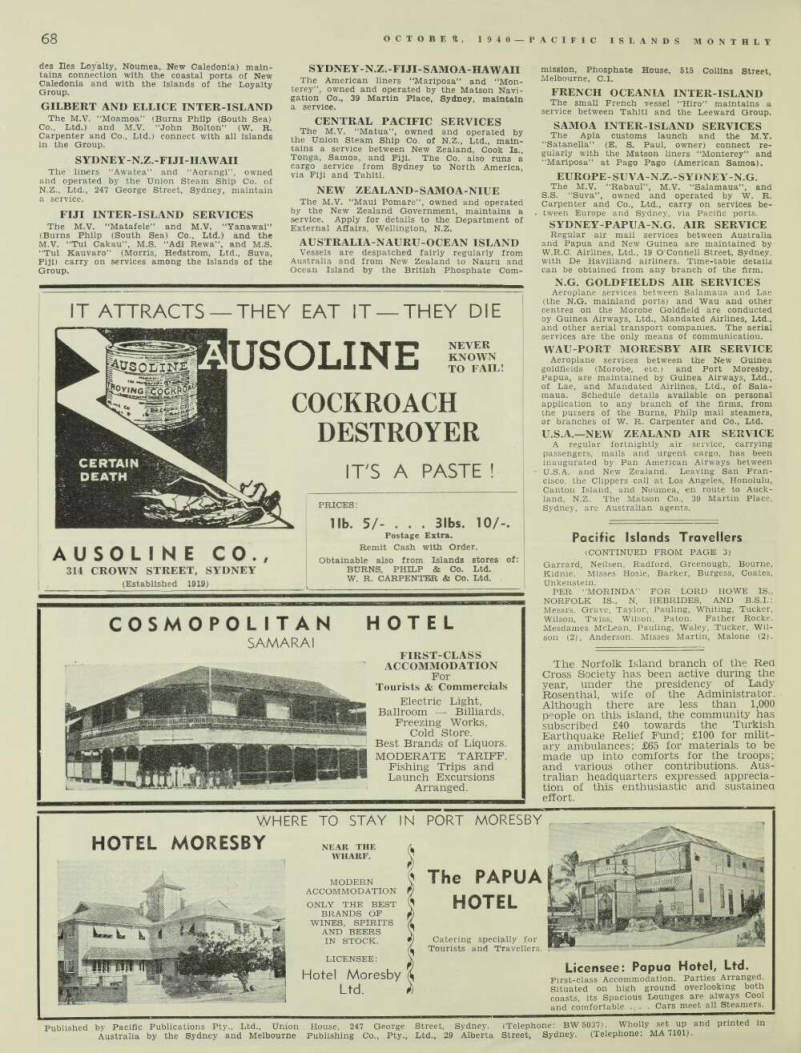
rIE shipping timetables which, presented in these pages, had been a feature of the “Pacific Islands Monthly” for over 10 years, may not, for obvious reasons, be published while the British E mpire is at war. We regret the incon venience to Islands residents; but war-time regulations must be complied with.
Publication of the timetables will be resumed as soon as it is practicable.
Sydney-Papua-New Guinea
The motor-ships “Macdhul” and “Malaita”, owned and operated by Burns, Philp and Co., Ltd., 7 Bridge Street, Sydney, maintain a regular service.
Papua Inter-Island Services
The M.V. “Nusa” (Steamships Trading Co.
Ltd., Port Moresby, Papua) and the M.V.
"Lakatoi” (Burns, Philp and Co., Ltd.) carry on coastal and Inter-island services.
New Guinea Inter-Island
Services
The S.S. “Maiwara” and M.V. “Muliama” (Burns, Philp and Co., Ltd.) and the M.V.
“Desikoko”, M.V. “Duranbah”, and S.S. “Mako” (W. R. Carpenter and Co., Ltd., 19 O’Connell Street, Sydney) maintain inter-island services in the Mandated Territory.
Hong Kong—New Guinea
The M.V. “Yunnan”, operating for Colyer, Watson (New Guinea) Ltd., of Rabaul, carries on a regular service between Hong Kong and New Guinea, At Hong Kong, the vessel con nects with the Blue Funnel liners running to the United Kingdom.
Sydney-Papua-N.G.-Hong Kong
The M.V. "Neptuna”, owned and operated by Burns, Philp and Co., carries on a service.
Sydney-T.1.-Darwin-Singapore
The vessels “Marella” and “Merkur”, owned and operated by Burns, Philp and Co., Ltd., carry on a regular service.
Sydney-Port Moresby-Darwin
S.S. “Montoro” and M.V. “Tulagi” run regular services between Sydney and Darwin, via Port Moresby. Burns Philp & Co., Ltd., Agents.
Saigon-Java-South Seas-N.Z.-
Sydney
The Dutch vessels “Maetsuycker” and “Tegel berg”, owned and operated by the Royal Packet Navigation Co., Ltd., 255 George Street, Sydney, maintain a regular service.
Sydney-Rabaul-Hong Kong
The vessels “Nellore”, “Tanda”, and “Nankin’’, owned and operated by the E. and A. Steamship Co., Ltd., 37 Pitt Street, Sydney, carry on a regular service.
Sydney-Papua-8.5.1.-New Guinea
The M.V. “Malaita”, owned and operated by Burns, Philp and Co., Ltd., maintains a regular service.
8.5.1. Inter-Island Service
The A.S. “Mamutu” (Burns Philp (South Sea) Co., Ltd.) operates among the Islands of the Group, on a regular schedule.
Sydney-Lord Howe Is.-Norfolk
Is.-New Hebrides-8.5.1.
The S.S. “Morinda”, owned and operated by Burns, Philp and Co., Ltd., carries on a regular service.
New Hebrides Inter-Island
Services
The S.S. “Mlrani” (Burns Philp (South Sea) Co., Ltd.) and M.V. “Polyneslen” (Messageries Maritimes Co., 36 Grosvenor Street, Sydney) carry on services among the islands of the Group.
Sydney-Noumea-New Hebrides
Indochina
The French vessel “Pierre Loti”, owned and operated by Messageries Maritimes Co., main tains a service.
New Caledonia-Australia
The French vessels S.S. “Neo Hebrldais” (Societe Maritime et Minlere Hagen, Noumea, New Caledonia) and “Cap Tarifa” and “Capi taine Illiaquer” (Societe Le Nickel, Noumea, New Caledonia), carry on services.
New Caledonia Inter-Island
Services
The French vessel M.V. “La Phoque” (Societe
des lies Loyalty, Noumea, New Caledonia) maintains connection with the coastal ports of New Caledonia and with the Islands of the Loyalty Group y y
Gilbert And Ellice Inter-Island
The M.V. “Moamoa” (Burns Philp (South Sea) p '
Sydney-N Z -Fi Ti-H Await
. A ? ' . " „ The liners “Awatea” and “Aorangi”, owned and operated by the Union Steam Ship Co. of N.Z., Ltd., 247 George Street, Sydney, maintain a service. pm nviT'i?!? id avn
Tui Linit.K-Im.Ainu Fefckviges
The M.V. “Matafele” and M.V. “Yanawai” (Burns Philp (South Sea) Co., Ltd.) and the M.V. “Tui Cakau”. M.S. “Adi Rewa”, and M.S.
“Tui Kauvaro” (Morris, Hedstrom, Ltd., Suva, Fiji) carry on services among the Islands of the Group.
Sydney-N.Z.-Fiji-Samoa-Hawaii
* , Th ?, American liners Mariposa and Mon terey , owned and operated by the Matson Navi gation Co., 39 Martin Place, Sydney, maintain a service.
Central Pacific Services
°c w o ne l ItS-S
tains a service between New Zealand, Cook Is., Tonga, Samoa, and Fiji. The Co. also runs a cargo service from Sydney to North America, V j a Fiji and Tahiti,
New Zealand-Samoa-Niue
The m.V. “Maui Pomare”, owned and operated by the New Zealand Government, maintains a service. Apply for details to the Department of External Affairs, Wellington, N.Z. .
Australia-Nauru-Ocean Island
Vessels are despatched fairly regularly from Australia and from New Zealand to Nauru and Ocean Island by the British Phosphate Corn
mission, Phosphate House, 515 Collins Street, Melbourne, 0.1.
French Oceania Inter-Island
The small French vessel “Hiro” maintains a service between Tahiti and the Leeward Group.
Samoa Inter-Island Services
The Apia customs launch and the M.Y.
“Satanella” (E. S. Paul, owner) connect re gularly with the Matson liners “Monterey” and “Mariposa” at Pago Pago (American Samoa).
Europe-Suva-N.Z.-Sydney-N.G.
The M.V. “Rabaul”, M.V. “Salamaua”, and S.S. “Suva”, owned and operated by W. R.
Carpenter and Co., Ltd., carry on services be tween Europe and Sydney, via Pacific ports.
Sydney-Papua-N.G. Air Service
Regular air mail services between Australia and Papua and New Guinea are maintained by W.R.C. Airlines, Ltd., 19 O’Connell Street, Sydney, with De Havilland airliners. Time-table details can be obtained from any branch of the firm.
N.G. Goldfields Air Services
Aeroplane services between Salamaua and Lae (the N.G. mainland ports) and Wau and other centres on the Morobe Goldfield are conducted by Guinea Airways, Ltd., Mandated Airlines, Ltd., and other aerial transport companies. The aerial services are the only means of communication.
Wau-Port Moresby Air Service
Aeroplane services between the New Guinea goldfields (Morobe, etc.; and Port Moresby, Papua, are maintained by Guinea Airways, Ltd., of Lae, and Mandated Airlines, Ltd., of Sala maua. Schedule details available on personal application to any branch of the firms, from the pursers of the Burns, Philp mail steamers, or branches of W. R. Carpenter and Co., Ltd.
U.S.A.—New Zealand Air Service
A regular fortnightly air service, carrying passengers, mails and urgent cargo, has been inaugurated by Pan American Airways between U.S.A. and New Zealand. Leaving San Fran cisco, the Clippers call at Los Angeles, Honolulu, Canton Island, and Noumea, en route to Auck land, N.Z. The Matson Co., 39 Martin Place, Sydney, are Australian agents.
Advertisements & other items, pp. 69-72 (2 items)
vigour Restored,
Glands Made Young
In 24 Hours
It is no longer necessary to suffer from loss of vigour and manhood, weak memory and body, nervousness, impure blood, sickly skin, depression, and poor sleep, because an American Doctor has discovered a quick, easy way to end these troubles.
This discovery is in pleasant, easy-to-take tablet form, is absolutely harmless, does away with gland operations and is bringing new youth and vigour to thousands. It works directly on the glands and nerves, and puts new, rich blood and energy in your veins. In 24 hours you can see and feel yourself getting younger. Your eyes sparkle, you feel alive and full of youthful vigour and power.
And this amazing, new gland and vigour restorer, called Vi-Stim, is guaranteed. It has been proved by thousands in America and is now distributed by chemists here under a guarantee of satisfaction or money back.
Vi-Stim must make you feel full of vigour and energy and from 10 to 20 years younger, or you merely return the empty package and get your money back. A special, double-strength bottle of 48 Vi-Stim tablets costs little, and the guarantee protects you.
Vi-Stim
GUARANTEED
to Restore Manhood and Vitality . . .
SCHAFFER & CO., SYDNEY.
-TtO
in Pacific Islands Territories
to represent
TASMAN MARINE ENGINES
AUSTRALIA’S FINEST ACHIEVEMENT IN THE SMALL ENGINE CLASS
SUPREME IN POWER—DEPENDABILITY—REFINEMENT
4t HP. MEDIUM
DUTY MODEL.
7-9 HP. TWIN
SUPER TIGER
Also 3 h.p. and 5-7 h.p. models i r Specially designed for hard, continuous service in boats up to 18 ft.
Overhead crank starting, water-cooled manifold as standard equipment. Available with built-in one unit reverse gear, having forehead flywheel, also electric starter and generator.
FULLY GUARANTEED
Applicants for Agency please supply details of organisation, and territory covered.
MANY EXCLUSIVE FEATURES
Write for Full Particulars of all our Models.
Tasman Marine Products
191 ELIZABETH STREET, WATERLOO, N.S.W.
N.S.W.
A. S YOUNG, Woy Woy.
JACK BETTINI, Narooma.
E. F. WEBBER, Bateman’s Bay.
A. A. KOELLNER, Moruya.
AUSTRALIAN AGENTS:
QUEENSLAND. s. AUST.
QUEENSLAND PASTORAL HUGH QUIN,
SUPPLIES, LTD., Ship Chandler, Bowen Street, Brisbane. Port Adelaide.
W. AUST.
FLOWER, DAVIES & JOHNSON
PTY. LTD.,
Murray Street, Perth.
IT ATTRACTS —THEY EAT IT —THEY DIE
IUSOLINE
B^VSOLI
I ...
OviNGiSToCKR
im-mm
NEVER
KNOWN
TO FAIL
COCKROACH
DESTROYER
IT'S A PASTE !
AUSOLINE CO.,
314 CROWN STREET, SYDNEY
(Established 1919)
PRICES:
lib.
5/- . . . 3lbs. 10/-.
Postage Extra.
Remit Cash with Order.
Obtainable also from Islands stores of:
BURNS, PHILP & Co. Ltd.
W. R. CARPENTER & Co. Ltd.
COSMOPOLITAN
SAMARA I
HOTEL
FIRST-CLASS
ACCOMMODATION
For Tourists & Commercials Electric Light, Ballroom Billiards, Freezing Works, Cold Store.
Best Brands of Liquors.
MODERATE TARIFF.
Fishing Trips and Launch Excursions Arranged.
WHERE TO STAY IN
HOTEL MORESBY
X
NEAR THE
WHARF.
MODERN
ACCOMMODATION
ONLY THE BEST
BRANDS OF
WINES, SPIRITS
AND BEERS
IN STOCK.
LICENSEE:
Hotel Moresby
Ltd.
PORT MORESBY
The PAPUA
HOTEL
Catering specially for Tourists and Travellers. \:1 «r
Licensee: Papua Hotel, Ltd.
First-class Accommodation. Parties Arranged.
Situated on high ground overlooking both coasts, its Spacious Lounges are always Cool and comfortable ... Cars meet all Steamers.
u % Vs I Guinea Airways Service awaits your arrival at Port Moresby to speed your passage by air to any one of over 50 aerodromes and landing grounds served by the Company throughout New Guinea and Papua.
Guinea Airways' fast- modern planes cut days of travelling time to a few hours of flight. As an example, the time of travel by plane to the Goldfields from Port Moresby is only 1 hour 40 minutes as compared with 6to 7 days by surface routes. See more of New Guinea from a better angle and save time and money . . . Travel by Air.
The GUI ME A AIRWAY is /he ONLY WAY A) defeat Time and Distance Guinea Airways’ fleet offers the choice of a large variety of passenger and freight planes for special charter service to any point in New Guinea and Papua ...
Investigate this special
CHARTER SERVICE
When sailing from Australia book steamer and air passage at the Steamship Office or obtain full particulars from the purser. i a i i THE WORLDS LARGEST FREIGHT CARRYING AIR SERVICE
LAE-SALAMAUA:
New Guinea Office: LAE, Mandated Territory of New Guinea Branch Offices and Agents at WAU-SALAMATJA-
PORT MORESBY and SYDNEY.
•■.isSs
:^*B •V- -• -' Jn * • ' \» ffEVv IT
OTUID lr'
TOOTH i CO LIM
r
LIMITED
WAVERIEY BREWERY
\ &I>H( h A
-A WAVIW.It » uwtl ) fv J| R\t 21 A s> ytxC'i/ilfei ' v*:
ensures a
PERFECT DRINK
atu/' t/ie /tea/
PRESERVES THE FLAVOUR
When ordering lager, first look for the Diamond-shaped Label-that is your guarantee of quality. Then notice the "Spot" Crown Seal, it is designed to retain that quality, and ensure perfect freshness and flavour in any climate.
VT4.
RESCH'S^LACER
68
OCTOBER, 1940 PACIFIC ISLANDS MONTHLY
Pacific islands Travellers
Published by Pacific Publications Pty., Ltd., Union House, 247 George Street, Sydney. (Telephone: BW 5037). Wholly set up and printed in Australia by the Sydney and Melbourne Publishing Co., Pty., Ltd., 29 Alberta Street, Sydney. (Telephone; MA7101).