Pacific
Islands
Monthly
Vol. Xi. No. 2.
September 14, 1940
Established 1930
IRegistered at transmission by post as a newspaper ]
8"
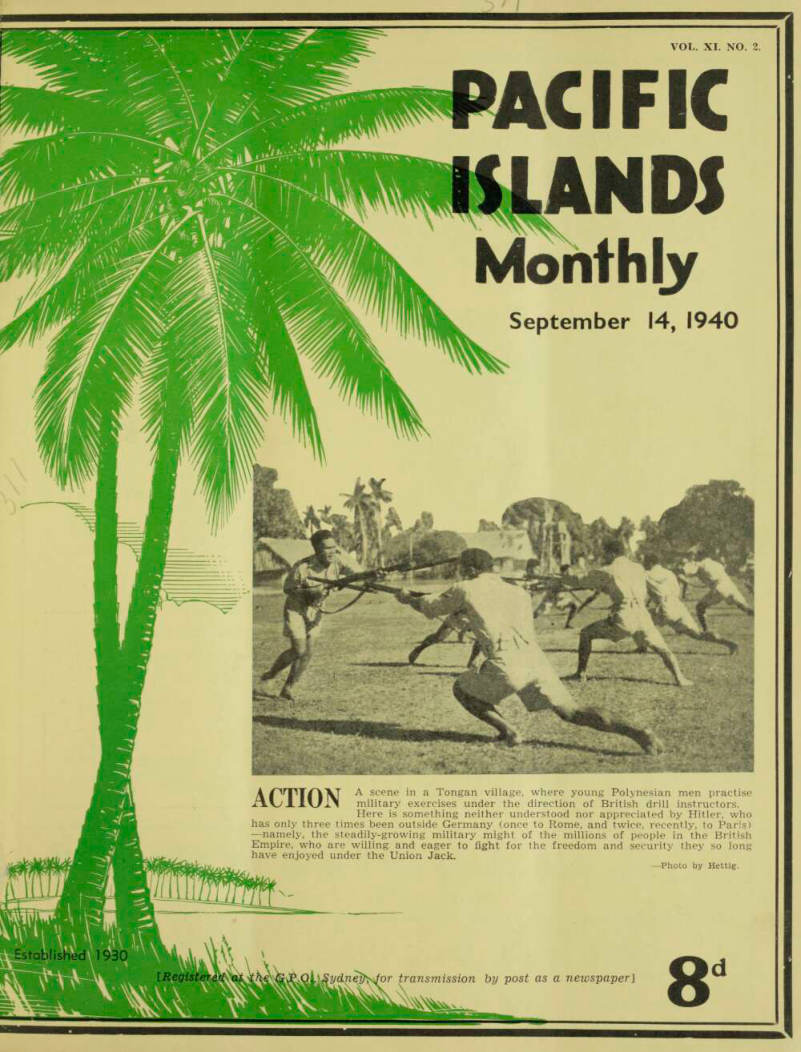
ACTION A scene in a Tongan village, where young Polynesian men practise military exercises under the direction of British drill instructors.
Here is something neither understood nor appreciated by Hitler, who has only three times been outside Germany (once to Rome, and twice, recently, to Paris) —namely, the steadily-growing military might of the millions of people in the British Empire, who are willing and eager to fight for the freedom and security they so long have enjoyed under the Union Jack. —Photo by Hettig.
Advertisements & other items, p. 2 (1 item)
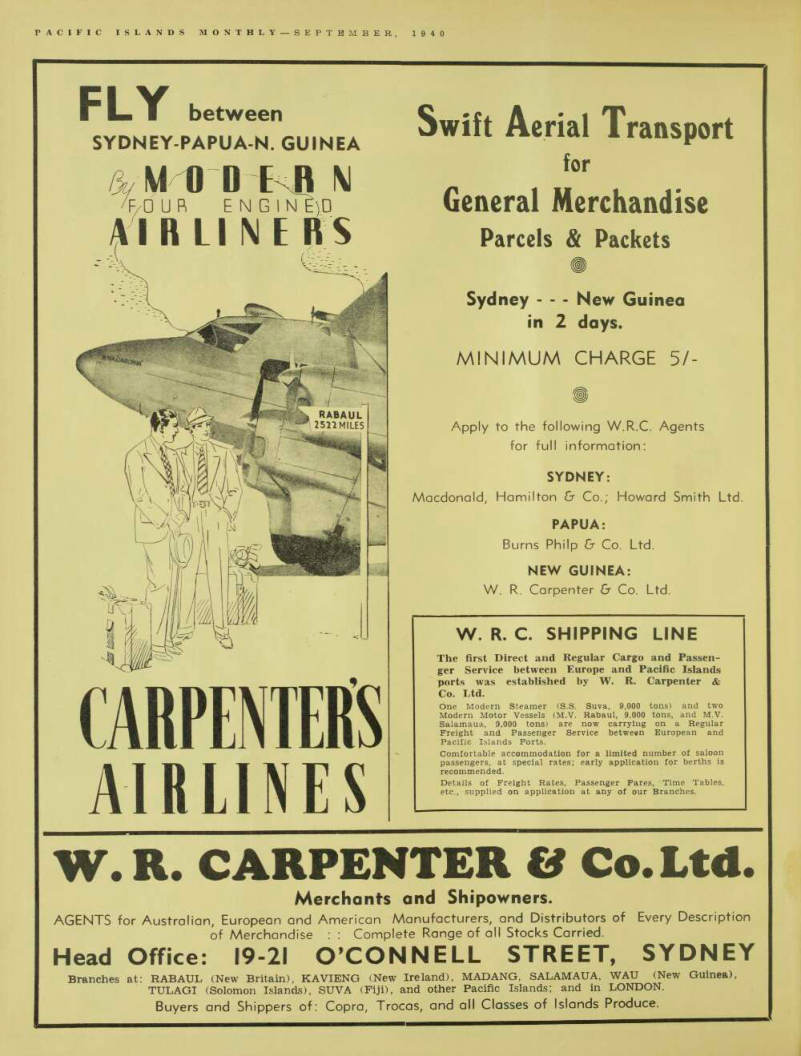
Carpenters
FLY between
SYDNEY-PAPUA-N. GUINEA
MOD T R M
F/Q U R E N G I
AIRLINE RS
RABAUL
2521 MILES
Qa
CARPENTERS
AIRLINES
Swift Aerial Transport
for
General Merchandise
Parcels & Packets
Sydney - - - New Guinea
in 2 days.
MINIMUM CHARGE 51-
w Apply to the following W.R.C. Agents for full information:
SYDNEY:
Macdonald, Hamilton Gr Co.; Howard Smith Ltd.
PAPUA:
Burns Philp Cr Co. Ltd.
NEW GUINEA:
W. R. Carpenter Cr Co. Ltd.
W. R. C. SHIPPING LINE
The first Direct and Regular Cargo and Passenger Service between Europe and Pacific Islands ports was established by W. R. Carpenter & Co. Ltd.
One Modern Steamer (S.S. Suva, 9,000 tons) and two Modern Motor Vessels (M.V. Rabaul, 9,000 tons, and M.V.
Salamaua, 9,000 tons) are now carrying on a Regular Freight and Passenger Service between European and Pacific Islands Ports.
Comfortable accommodation for a limited number of saloon passengers, at special rates; early application for berths is recommended.
Details of Freight Rates, Passenger Fares, Time Tables, etc., supplied on application at any of our Branches.
W.R. CARPENTER & Co. Ltd.
Merchants and Shipowners.
AGENTS for Australian, European and American Manufacturers, and Distributors of of Merchandise : : Complete Range of all Stocks Carried.
Head Office: 19-21 O’CONNELL STREET,
Every Description
SYDNEY
Branches at: RABAUL (New Britain), KAVIENG (New Ireland), MADANG, SALAMAUA, WAU (New Guinea), TULAGI (Solomon Islands), SUVA (Fiji), and other Pacific Islands; and in LONDON.
Buyers and Shippers of: Copra, Trocas, and all Classes of Islands Produce.
Pacific News-Review
Notes And Comment On
The Progress Of The War.
From August 13 To Sept. 10
Aug. 13: Severe air raids on Britain continue daily, and all classes are hasten ing their preparations to resist the ex pected attempt by the Germans to invade Britain. Confidence is growing, in the be lief that the Germans can be success fully resisted.
Aug. 13: The despatch of Rear-Admiral Gormley by President Roosevelt to Britain, as a special envoy, to investigate the possibility *of Britain being able to resist further advances by Germany, is regarded as highly significant. It is thought that if the envoy’s report is sat isfactory, there will be great and in creasing help for Britain from the United States.
Aug. 13: Soldiers and naval ratings aboard the troopship “Mohamed Ali el Kibir’’, which was torpedoed and sunk in the Atlantic, showed magnificent discip line and steadiness. There were 755 sur vivors, out of 860.
Aug. 13: Boasting extravagantly of the victories which they expect to win shortly in Africa, the Italians say that in the Middle East they are facing Australian, New Zealand, South African, British and Indian troops. They deride these forces, and say they lack war spirit and have an inferior command, and that their fighting will and organisation will break down when they face the manly warlike quali ties of the Italians.
Aug. 13: A fierce controversy is pro ceeding in the United States as a result of a proposal by Mr. Hoover, head of the European Food Distribution Commission, that the United States should ship large quantities of foodstuffs to the countries occupied by Germany, which are threatened with famine. It is recognised that the British attitude to any such pro posal will be an uncompromising “no”— because all occupied countries are being deliberately and systematically denuded of food supplies by the invading Ger mans. Foodstuffs sent in by charitable Americans, in such circumstances, will merely assist Hitler to defeat the block ade.
Aug. 14: Australia had its most serious air accident to-day, when a Defence De partment plane, flying from Melbourne to Canberra, crashed near Canberra, ana the Minister for Army (Mr. Street), Minister for Air (Mr. Fairbairn), Vice- President of Executive Council (Sir H.
Gullet) and Chief of General Staff (Sir Brudenell White), with six minor officials, were all killed.
Aug. 14: Relations between Italy and Greece are strained, but Rome denies re ports that military action is imminent.
Aug. 14: Big fleet of British bombers crossed the Alps and did great damage to aircraft factories and motor plants in northern Italy—especially Milan and Turin.
Aug. 14: Large forces of Italians are advancing in British Somaliland and, al though the much smaller British forces are resisting, it seems likely that they will retire to the coast. British Somaliland is a small barren country of no economic value.
Aug\ 15: An unknown submarine tor pedoed the Greek cruiser “Helle” (2,115 tons) wiiiie she was anchored off one of the Greek islands. This is causing great excitement and tension in Greece. There is no doubt that the submarine was Italian.
A s this was to have been Hitler s day of triumph—he announced in May that he would be in Paris on June 15 and m London on August 15—the occasion is being celebrated throughout Britain by a sober weighing up of the general military situation. It is being found very encouraging. The British are
more than holding their own against all the air forces which Germany can bring against them.
Aug. 15: The Italians are advancing rapidly in British Somaliland and are only 75 miles from the main port, Berbera, Aug. 15: The armed merchant cruiser “Transylvania” was sunk by a U-boat in the Atlantic —over 30 men lost.
Aug. 16: The German air raids cul minated yesterday in a great attack by no less than 1,000 machines, but the Ger mans did not make any breach in Britain’s aerial defences. British destroyed no less than 169 German aeroplanes—a record for one day. Only 34 British fighters were lost, and 17 of their pilots are safe.
Aug. 16: The tension between Italy and Greece, as a result of the sinking of a Greek cruiser by an Italian submarine, is increasing. Greek forces are being mobilised.
Aug. 18: Spanish troops, estimated at 16,000, with guns and light and medium tanks, have landed in Spanish Morocco.
The intentions of Spain are not clear, and it is thought by some that this may be a prelude to a plan under which Ger many will march huge armies through France and Spain, across into North Africa, in order to mop up the French and British Colonies there. But Gibraltar must first be taken from Britain.
Aug. 19: R.A.F. bombers, every night without fail, on an ever-increasing scale, make attacks upon military objectives in Germany and the German-occupied parts of Holland, Belgium and France. Attacks upon factories in North Italy are also be ing made with growing frequency—al though this involves an air-journey of over 1,600 miles.
Aug. 16: It is authoritatively reported that Britain has offered to lease naval base sites in the Western Hemisphere to the United States in return for 50 American destroyers.
Aug. 18: After a couple of quiet days, in which Germany probably is re-organ ismg her battered air fleets, intense air
raids upon England were resumed. New methods of attack had no more success than hitherto in penetrating Britain’s de fences.
Aug. 18: The British Navy appeared suddenly upon the coast of Libya and. with long-range gun-fire from many ships, smashed up Italian concentrations, which had been preparing for the invasion of Egypt. Great damage was done to Fort Capuzzo, which the Italians have now abandoned.
Aug. 19: Although the partial mobili sation of Greek reservists has been ordered, it appears that the Italo-Greek tension is decreasing. Italy has apologised to Greece for bombing two Greek destroyers, claiming that she was under the impression they were British.
Aug. 19: About 600 German planes at tacked objectives in England yesterday, but did no material damage. The Ger mans lost 141 planes in this day’s raid, and the British 22 fighters, the pilots of ten of which are safe.
Aug. 19; The effect of the British naval attack upon Italian forces in Libya was shattering. About 90 minutes after the British ships left, they were found by Italian bombers, but before the Italians could attack, R.A.F. planes, which had been waiting for them, swooped down upon them, and 11 Italian planes were destroyed, without any British losses.
A ug- i 5: A shai ’P dispute between the United States and Japan, as to who would take over the guarding of the Inter national Settlement when the British troops were withdrawn from Shanghai has been settled. The United States has gamed control of the central section in cluding the waterfront.
T An agreement between the united States and Canada to establish immediately a permuient Joint Defence Board is regarded as an event of histori cal importance, and is another step in the apparently inevitable alliance between Great Britain and the United States in the defence of European civilisation. * s re P° r ted from Hong Kong that oetween 30 and 40 French warships an if-LnYS? "I Indo-China from Madagascar d base - th °W*t to be i Aug : * 9 / J/AJ. bombers again attacked important Italian factories in Northern iiaiy.
Aug. 20; The British evacuation of Somalnand is now complete, o T^iB cam Paign was of minor importance.
Somaliland had no value, either economi caliy or strategically, although it is ad mitted that it may be regarded as another set-pack to British prestige in the Middle r>ast. Hitler has congratulated Mussolini hls magnificent victory in Somali- Au &; Bri tain’s Prime Minister (Mr.
Churchill) says that the total of British killed, missing, wounded and prisoners in Qo^ ar ’ lncludin 8 civilians up to date is 92,000, a large proportion of whom are prisoners. Casualties in the first year of the last war, he said, were 365,000. “We will resolutely and methodically prepare a Si ai^^ gn a B ains t the enemy in 1941 and 1942”, he said.
Aug. 20; R.A.F. planes attacked mili tary objectives in Berlin last night and about 40 explosions were heard.
Aug. 21: Italian troops are concentrated on the Italian-Greek border and Greece has called up further military classes.
The Axis Powers are trying to force Greece to abandon the British guarantee.
Greece is unwilling to do this.
Aug. 21: It is clear now that Britain is rapidly overhauling Germany’s numeri cal lead in aeroplanes. German bombers and fighters are being destroyed more quickly than the German factories can replace them, whereas Britain is receiv ing an ever-increasing supply of mach ines from the United States. Mr.
Churchill says that new aircraft pro duction in Britain already exceeds the output of the German factories.
Aug. 21; It is officially announced that the same amount of shipping is using British ports as before the recent in tensification of air raids on Britain.
Aug. 22; German guns mounted on the French coast, which occasionally drop shells in English coastal districts, this morning shelled a convoy passing through the Straits of Dover, out did not score a hit. Then German bombers at tacked the convoy and British fighters came and drove off the bombers.
Aug. 22: The Premier of Egypt an nounced, at a secret session of the Egyptian Parliament, that Egypt will de clare war on Italy if Italian troons in vade Egypt. This has reference to the ex pected advance of Italian armies con centrated in Libya.
Aug. 22: Trotskv. exiled Bolshevik leader, died in Mexico City from wounds inflicted by an assassin.
Aug. 23: British guns on the Kentish coast are now firing at the German guns on the coast of France across the Straits of Dover (21 miles wide).
Aug. 24: German air formations con tinue their daily and nightly attacks upon England and Scotland. Formations to an increasing degree F.re trying to penetrate the defences of London. Yesterday, for the first time, people in Trafalgar Square could hear the anti-aircraft guns on the outskirts of the city.
Aug. 24: R.AE. bombers, on August 22, daringly raided the Italian base at Boma, in Libya, and destroyed two Italian sub marines. an Italian destroyer and a sub marine depot ship.
Aug. 24; The Foreign Minister in the Petain Government made a bitter attacx upon Britain for refusing to lower the British blockade so as to permit the entry of foodstuffs into Prance.
Aug. 25: Germans made the biggest mass raids of the war upon Britain yesterday, using over 1,000 planes. London and Portsmouth were attacked. Damage was done and many casualties caused but not on an alarming scale. 48 German planes and 10 British fighters were lost. A par ticularly savage attack was made by enemy bombers upon Ramsgate, and a large part of the undefended town was wiped out. Little damage was done to Portsmouth.
Aug. 25: War continues to threaten the Balkans, as Italy menaces Greece, and Roumania and Hungary distrustfully negotiate about a revision of their boundaries. There is no indication of what Russia is likely to do.
Aug. 26: So seriously has the official relationship between Britain and France deteriorated that, it is stated, a declara tion of war against Britain by the French Government at Vichy would not take the British Government by surprise.
It is believed that Germany and Italy are trying to induce France to take this step. Against this, however, it should be pointed out that if France officially de clares war on Britain, Britain immediately will seize the greater part of the French Empire. Under' present conditions it is the" intention of Britain, when she has defeated the Nazis, to assist in the res toration of the French Empire. In the meantime the French Colonies are not being interfered with —on the contrary, they are being economically assisted in many cases by Britain.
Aug. 26: To-day, London had its 15th air raid. German plane formations are
daily and persistently trying to break through the outer defences of London.
Meanwhile, R.A.F. bombers are nightly attacking objectives in Germany, Italy, France, Holland, etc. Their activities ex tend as their numbers increase. All the evidence shows that they are doing an enormous amount of military damage.
Aug. 27: Britain last night experienced the most extensive night raid of the war.
At least 50 enemy planes, operating singly, circled over London for over six hours. Bombs fell over a wide area. Much troublesome damage was done, but little of military importance.
Aug. 27: British naval forces on Friday and Saturday penetrated into the Italian harbour of Bardia, near the Egyptian frontier, engaged their targets at point blank range, and bombarded the Italian troop concentrations in the fort, and the seaplane base.
Aug. 27: The German air force has had such severe reverses in its attacks upon Britain that it is now expected that dif ferent tactics will be employed, with harder blows and probably an intensifica tion of night-bombing. It is expected that Germany from now on will attack with waves of aeroplanes day and night. But British defences are in excellent order, and British morale is high.
Aug. 27: The situation between Greece and Italy is still regarded as grave.
Aug. 29: Germany and Italy, determined to prevent war in the Balkans, have sent their respective Foreign Ministers to Vienna, to which city also the Foreign Ministers of Hungary and Roumania have been summoned.
It is expected that Roumania will be told that she must give up a large por tion of Transvlvania to Hungary, other wise she will be invaded by Germany. If Roumania resists it is possible that Russia will interfere—Russia has large troop formations on the Russo-Roumanian frontier.
Aug. 30: There is an interesting report from Washington, that the United States and Russia have agreed to re-consider their mutual interests in view of the moves being made by the Axis Powers and Japan.
Aug. 31: Roumania has agreed, at Vienna, under pressure by Germany and Italy, to cede to Hungary about two thirds of the province of Transylvania.
The cession has been received with con sternation throughout Roumania and pub lic disorder is feared. It means that Rou mania becomes a German puppet state, and Germany gets all her oil and wheat.
Sept. 1; Germany continues savage mass air attacks upon British towns. Yesterday German raiders dive-bombed and mach ine-gunned women and children in Lon don shopping areas. The R.A.F. hit back at German military targets with deadly precision.
Sept. 1: It is reported at Vichy that rebellion against the Petain Government has broken out in Indo-China, as well as in the various territories of French Equatorial Africa.
Sept. 1: There is great resentment in Roumania against the territorial disposi tions made at Vienna and all the elements of a widespread revolt are appearing.
Sept. 1: The British armed cruiser “Dunvegan Castle”, 15,000 tons, was sunk by a submarine in the North Atlantic; 30 men are missing.
Sept. 2: The air attack on Britain is intense. The fact that the ratio of Ger man losses to Britain has fallen consid erably does not mean that the defence is weakening. It means that Hitler, stung by his heavy losses of bombers, is now sending over fewer bombers, and far more fighters to protect them.
Sept. 2: Independent correspondents re cently in occupied France say that, de spite German propaganda, the French nation remains anti-German and pro-
British. The French neonle seem to be now emerging from a kind of torpor, which followed the shattering news of their capitulation to Germany, and there is a marked revival of the national spirit, a desire for independence and a pride in nationalitv.
Sept. 3; Desnite ceaseless attacks by German air squadrons upon Britain, the R.A.F. bombers go out every night on a front extending from Norway, through Germany and France, to Northern Italy, and do enormous damage. Berlin now is raided by R.A.F. bombers every night.
Sept. 3: It is announced on the anni versary of the outbreak of war that an agreement has been reached between Britain and the United States under which the United States will supply Britain with 50 destroyers, to be put into service immediately, while Britain will lease to the United States important naval and air bases in New Foundland, the West Indies and British Guiana. This is regarded as the most important event of the war.
Sept. 4: Japan’s demands for permis sion to send Japanese troops! across Indo china to attack the Chinese are creating a condition of tension which concerns both Great Britain and the United States.
Sept. 5: U.S. Secretary of State (Mr.
Cordell Hull) has publicly warned Japan that she must not alter the status quo of French Indo-China or the Dutch East Indies.
Sept. 5: The air raids against England are mounting in fury. The enemy attacks upon the London area are almost con tinuous, day and night. A good deal of damage is being done, but it seems only to strengthen the resolution of the British people.
Sept. 5: Hitler, in an unexpected public speech, announces an unrestricted “all in” air attack upon England—especially Lon don. He abandons his promise of an early defeat of Britain. He talks now of a war that will last five years, in which Ger many will outlast and out-bomb England.
Sept. 6: Hitler’s admission now that the war may last for years has started an extraordinary rally in the stock exchanges of the world. It is accepted as a clear cut admission that he cannot beat Britain.
Sept. 6: King Carol of Roumania has abdicated in favour of his son Michael, 19. Carol is leaving for Switzerland. Gen eral Antonescu, a pro-German reaction ary, becomes dictator of Roumania, which is now wholly under the domination of the Axis Powers.
Sept. 6: Japan, replying to U.S.A., said that the latter country had no cause for alarm concerning the status quo of Indo- China.
Sept. 6: Large naval reinforcements have almost doubled the effective strength of the British Navy in the Med iterranean.
Sept. 8: The Nazi’s most savage air assault upon London to date took place on Saturday. Over 300 people were killed and about 1,300 seriously injured. A great deal of severe damage was done in east ern and south-eastern London—especi ally along the Thames. Bombing was in discriminate. The Germans simply drop ped their bombs as far in over the city as they could get.
Sept. 9: What is described as the big gest convoy ever assembled has arrived safely in the Mediterranean, without enemy interference, carrying very large reinforcements for all classes of British troops in the Middle East, where heavy fighting is expected soon.
Sept. 10: The enemy’s aerial assault on London continues. Damage is severe, but not paralysing. Germany is sacrificing hundreds of planes.
The following table, carefully compiled
Losses Of Fighters And
Bombers
The following table, carefully compiled from the communiques of the British Air Ministry (accepted by the neutral world as truthful and reliable) shows the known losses each day of fighters and bombers, by both sides, during the Ger man air attacks on Britain:
August 12 German 62 British 13 13 9 ? 14 31 7 „ 15 169’ 34 16 75 ? 18 141 22 „ 20 9 0 21 13 1 „ 22 9 4 24 48 10 ,, 25 . , 55 13 „ 26 46 15 29 9 3 30 19 6 „ 31 . 85 37 September 1 25 15 2 55 20 3 25 15 >* 4 54 11 99 5 39 20 9* 6 46 14 99 7 (Sat.) 99 22
Advertisements & other items, pp. 3-4 (2 items)
1
PACIFIC ISLANDS MONt H L t SEPTEMBER, 1946
2
SfeftEMBER, 1940 BACtt'lC ISLANDS MONTHLY
Son 5 ' C.arke, Chavoyron &een S™"
Patific Islands Travellers
Per “Macdhui” Prom Papua And N.G.:
Messrs. Brown, Butler, Beattie. Clarke, Clark, Coleman, Fox, Furlong. Hallows, Hodgson, Higgins, Jones, Jackson. Kamp, Low, Milligan, McShane, Penglase. Probert (2). Ryall, Smith, Sutcliffe, Stevens, Vial, Waddell. Rev. Dixon, Rev. Lilwall, Rev. Hannemann, Father Dingles.
Mesdames Beattie, Clarke, Chambers. Coleman, Eilertz, Fox, Fitch, Frame, Glanville. Gray, Garrett, Gay, Godson. Hallows. Healy, Hanne mann, Janke, Jones, Low, Mocatta, Milne, Mitchell. Penglase, Paulini. Pangarazzio, Rovere, Smith. Sullivan, Strudwick, Sutcliffe, Spagnola.
Vial, Warrant, Wales, Waddell. Misses Chudleigh, Evenett, Fitch, Richardson.
PER ‘ MORINDA” FROM LORD HOWE IS.
NORFOLK IS., N. HEBRIDES AND BSI ' Messrs. Friend. Park. Coates, Garrity, Seilers Mart*. Perry -T, umer ’ Worden. Gazzard, Green! c Fd ’r«n MCCa w-i NObb L Uin a ;i Twist, Son 5 ' C.arke, Chavoyron &een S™"
Anderson, Mitchell, Newbery, Westwood Misses Hand, Blandy, Mitchell, Burkitt, Nobbs.
Per “Malaita” To Papuan. N.G.. And
8.5.1. PORTS: Messrs. Coates, Davis, Stokes, Skelly, O’Dea, Gridley, Crawford, Blake, Dean.
Huish, Ferguson, Champion, Johns, Croucher.
Sparks, Bray. Hewitt, Firth, Wilson, Downey, Callaghen, Goode, Bourne, Sladdery, Vance,
Frick, Ireland, Eklade, Pye, Garbutt, Pollock, Barrett, Richter, Richardson, Hearnes, Gough, Curtis, Henderson, Spencer, Anderson. Black, Newman. Mesdames Cornell, Ross, Searle, Ewan Todd, Hilder, Summerland, Archer, O’Dea, Champion, Johns, Drysdale, Jamieson, Goode, Gladstone, Turner. Griffin. Barrett. Misses Todd, O’Dea, Skelly (2), Campbell, Granger, Over, Moss, Oliver.
Per “Morinda” For Lord Howe Is.,
Norfolk Is., N. Hebrides And Solomon
IS.: Messrs. Pincombe, McArthur, Canon, Towner, Stevenson, Payten, Betts, Harris, Ahrens, Holland, Richards, Part, Buffett, Francis. Mesdames Fenton, Towner, Larkin, Parkes, Betts, Ahrens, Larney, Holland, Quintal, Baxter, Hughes, Buffett. Misses Thomas. Gunn, RIC ards ’ pER « MALAITA .. FROM PAPUAN NG AND PORTS: Messrs. Armstrong, Baxter, Bell, Bengough, Binskm, Chapman, Clarke, Colman, Cummins, Dunn, Dyer. Evennett, Gluyas, Grassick, Johnson, Love, Mclnnes, MacPherson, Murnin, Ollerenshaw, Rigden, Sadgrove. Scott.
Sewell, Stock, Voyoe, Waddell, Williams. Rev Bergeron, Rev. Centauro. Mesdames Aumuller, Clarke. Corkin, Dunn. Hazewinkel, Ollerenshaw!
Scott, Stock, Thomson. Misses Arliss, Davis!
Gibbon, Inman, Neylan, Totenhofer. ’ ’
Per "Limerick” To Papeete: Messrs.
Johnson. Purdy, Shiu Kao Yle. TO SUVA: Messrs. Blanch, Evans, Whitelaw, Josselyn. Mes dames Whitelaw, Pratt. Miss Whitelaw.
PER “AWATEA” FOR SUVA: Messrs. Wood man, Wignall (3), Booth, Davis, Murray, Tuxley, Tiller, Rev. Davis. Mesdames Davis (2), Tur ley. Miss Davis.
Per "Aorangi” From Suva: Messrs.
Colohan, Hawes, Lyon-Pield, Mitchell. Nicholls (2», Sissons, Clothier, Crook, Grant, Keefe, Cor bett, Mathew, Moulds, Nilsson, Naden, Rice, Watts, Anderson, Craven, Debnam, Dollin, Denning, Dixon, Foster, Hawkins. Mesdames Colohan, Forrest, McKay, Lyon-Field, Mitchell, Nichplls, Sissons, Hewitt, Keefe, Merritt, Richardson, Taylor, Arnold, Craven, Debnam, Dollin, Hawkins. Misses Colohan, Hopewell.
Leaver, Davidson, McMahon, Sends, Taylor, Craven (2), Davies, Hawkins.
PER "MARIPOSA” TO SUVA: Messrs. Forster, Gangaram. Livie, Nasmyth, Prindiville, Theodore.
Mesdames Macdonald, Nasmyth, Stafford, Wisdom.
Misses Macdonald, Nasmyth.
Per Airliner For Papua And N.G.:
Messrs. Hannan, Peadon. Bayliss, Franklin.
Mesdames Bayliss, Whittaker.
Per Airliner From Papua And N.G.;
Messrs. Leahy, Lord. Mesdames Carpenter, Kondahl, Bellamy, Cunico.
(Continued On Page 72)
Per Airliner For Papua And N.G.:
Sir Walter McNicoll. Messrs. Chapman, Brogan.
Mrs. Chapman.
Per Airliner From Papua And N.G.:
Messrs. Hallowell, Symes (2), Richardson. Mes dames Brennan, Man.
Per Airliner For Papua And N.G.:
Messrs. Carpenter, Zafiman, O’Hara, Lesmond.
Mrs. McSween and infant.
Per Airliner From Papua And N.G.:
Messrs, Brogan, Willis, Crampton, Pringle, Roberts, Foda. Mesdames Cronin, Willis, Grose, Crampton. Miss Beale.
PER AIRLINER TO PAPUA AND N.G.: Messrs.
Brown, Mollison, McKillop, Smith. Mesdames Brown, Sherry and infant.
Mr. G. M. Rodger, of the Papuan Gov ernment Service, has been granted leave of absence so that he may enlist, and he now is Bombardier G. M. Rodger, 23262, C. Troop, 29th Battery, 6th Field Regi ment, New Zealand Artillery, Papakura, New Zealand. Mr. Rodger, in a cheery note from the camp says that if any readers of the “P.IM.” do not know what to do with their old copies, they would confer a favour bv sending them to his address. Men from the Islands who are in the New Zealand forces are glad to get the journal.
Mr. Ernest Wauchope, who has been in Australia on furlough with his wife and daughter Pat, will return to Madang, N.
Guinea, by the September “Macdhui”.
Mr. and Mrs. A. Hardy, of Port Moresby, Papua, are at present staying in Sydney. He is in the Papuan Customs Department.
Advertisements & other items, p. 5 (1 item)
SB' .atavuV^
■ M I mg p. m - PA FI ;.■••• 0 C E N ... ; : : «
. . \ j/* SAlftUl
MAUA
SAMARA!
PORT
VILA
OUMEA
;-ri> ~««3I
N E Y
sv AN m ■ - • : - ' N
UIHS
m m m ■
MiiiiiM
; . -I v m
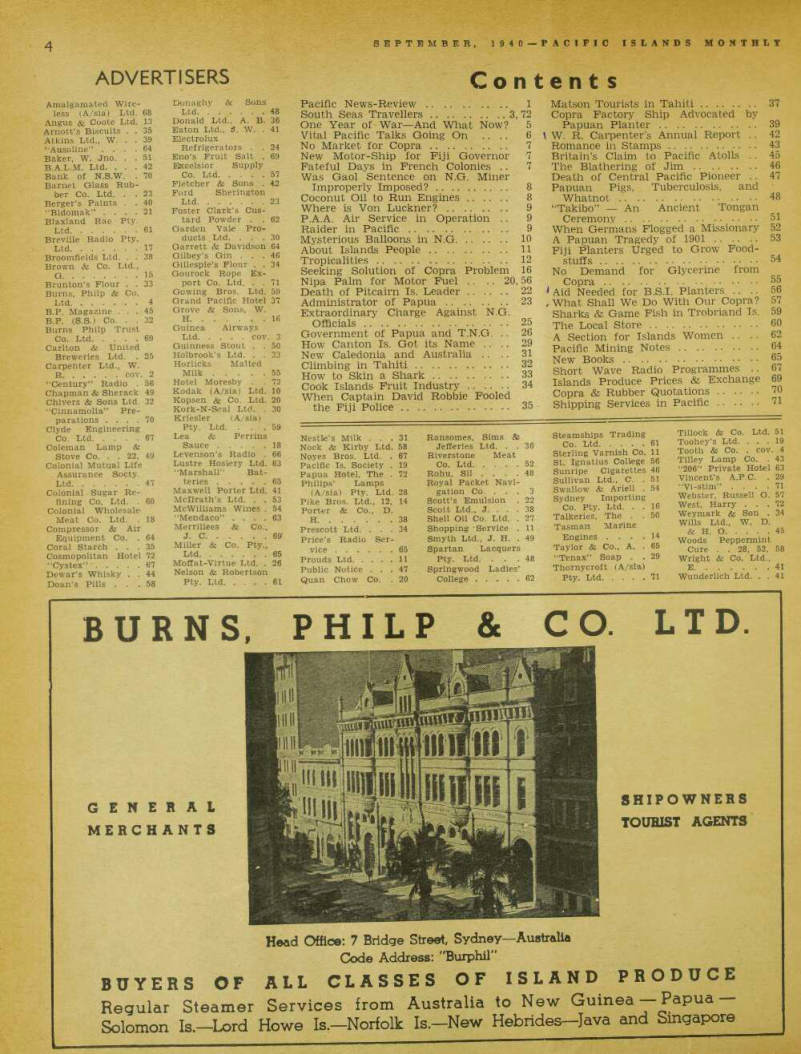
K. P. M.
SOUTH PACIFIC LINE.
Royal Packet Navigation Co. Ltd., Paketvaart House, 255 George Street, Sydney. (N. v. Koninklijke Paketvaart Maatschappij—lncorporated in the Netherlands Indies) Saigon, Diet helm & Co.; Port Moresby and Samarai, Steamships Trading Co.
Ltd.; Rabaul, Salamaua and Wan, W. B Carpenter & Co. Ltd.; Port Vila, Gnbbay Freres; Noumea. Carlo Leonl; Auckland, Bussell & Somers Ltd.; Wellington.
Johnston A Co. Ltd.
K
Linking the East with South Pacific
Islands, New Zealand and Australia
The track routes of the K.P.M.-South Pacific Line motor vessels Maetsuycker” and “Tegelberg” are each as foIIows:—“TEGELBERG”: Saigon, Singapore, Batavia, Samarang, Sourabaya, Port Moresby, Port Vila, Noumea, Auckland, Wellington, Sydney, Port Moresby, Sourabaya, Samarang, Batavia, Singapore, Saigon. “MAETSUYCKER”: Saigon, Singapore, Batavia, Samarang, Sourabaya, Port Moresby, Samarai, Salamaua, Rabaul, Auckland, Wellington, Sydney, Port Moresby, Sourabaya, Samarang, Batavia, Singapore, Saigon.
SOUTH PACIFIC Line
Advertisers
Amalgamated Wire less (A/sia) Ltd. 68 Angus & Coote Ltd. 13 Arnott’s Biscuits . . 35 Atkins Ltd., W. . . 39 “Ausoline” ... 64 Baker, W. Jno. . . 51
B.A.L.M. Ltd. ... 42
Bank of N.S.W. . 70 Barnet Glass Rub ber Co. Ltd. . . 23 Berger’s Paints . . 40 “Bidomak” ... 21 Blaxland Rae Pty.
Ltd 61 Breville Radio Pty.
Ltd 17 Broomfields Ltd. . . 38 Brown & Co. Ltd., G 15 Brunton’s Flour . . 33 Burns, Philp & Co.
Ltd 4 B.P. Magazine ... 45
B.P. (S.S.) Co. . . 32
Burns Philp Trust Co. Ltd 69 Carlton & United Breweries Ltd. . 25 Carpenter Ltd., W.
R cov. 2 “Century” Radio . 56 Chapman & Sherack 49 Chivers & Sons Ltd. 32 “Cinnamolia” Pre parations ... 70 Clyde Engineering Co. Ltd 67 Coleman Lamp & Stove Co. . . 22, 49 Colonial Mutual Life Assurance Socty.
Ltd 47 Colonial Sugar Re fining Co. Ltd. . 60 Colonial Wholesale Meat Co. Ltd. . 18 Compressor & Air Equipment Co. . 64 Coral Starch ... 35 Cosmopolitan Hotel 72 “Cystex” 67 Dewar’s Whisky . . 44 Doan’s Pills ... 58
Donaghy & Sons Ltd 48 Donald Ltd., A. B. 36 Eaton Ltd., J. W. . 41 Electrolux Refrigerators . . 24 Eno’s Fruit Salt . 69 EKcelsior Supply Co. Ltd. ... 57 Fletcher & Sons . 42 Ford Sherington Ltd 23 Foster Clark’s Cus tard Powder . . 62 Garden Vale Pro ducts Ltd. ... 30 Garrett & Davidson 64 Gilbey’s Gin ... 46 Gillespie’s Flour . , 34 Gourock Rope Ex port Co. Ltd, . . 71 Gowing Bros. Ltd. 59 Grand Pacific Hotel 37 Grove & Sons, W.
H 16 Guinea Airways Ltd cov. 3 Guinness Stout . . 50 Holbrook’s Ltd. . . 33 Horlicks Malted Milk 55 Hotel Moresby . . 72 Kodak (A/sia) Ltd. 10 Kopsen & Co. Ltd. 20 Kork-N-Seal Ltd. . 30 Kriesler (A/sia) Pty. Ltd. ... 59 Lea & Perrins Sauce 18 Levenson’s Radio . 66 Lustre Hosiery Ltd. 63 “Marshall” Bat teries 65 Maxwell Porter Ltd. 41 McHrath’s Ltd. . . 53 McWilliams Wines . 54 “Mendaco” ... 63 Merrillees & Co., J. C 69 Miller & Co. Pty., Ltd 65 Moffat-Virtue Ltd. . 26 Nelson & Robertson Pty. Ltd 61
Nestle’s Milk ... 31 Nock & Kirby Ltd. 58 Noyes Bros. Ltd. . 67 Pacific Is. Society . 19 Papua Hotel, The . 72 Philips’ Lamps (A/sia) Pty. Ltd. 28 Pike Bros, Ltd., 12, 14 Porter & Co., D.
H 38 Prescott Ltd. ... 34 Price’s Radio Ser vice 65 Prouds Ltd 11 Public Notice ... 47 Quan Chow Co. . 20
Ransomes, Sims & Jefferies Ltd. . . 36 Riverstone Meat Co. Ltd 52 Rohu, Sil . . . . 48 Royal Packet Navi gation Co. ... 3 Scott’s Emulsion . 22 Scott Ltd., J. ... 38 Shell Oil Co. Ltd. , 27 Shopping Service . 11 Smyth Ltd., J. H. . 49 Spartan Lacquers Pty. Ltd. ... 48 Springwood Ladies’
College 62
Steamships Trading Co. Ltd 61 Sterling Varnish Co. 11 St, Ignatius College 56 Sunripe Cigarettes 46 Sullivan Ltd., C. .51 Swallow & Ariell . 54 Sydney Importing Co. Pty. Ltd. . . 16 Talkeries, The . . 50 Tasman Marine Engines ... 14 Taylor & Co., A. . 65 “Tenax” Soap . . 29 Thornycroft (A/sia) Pty. Ltd 71
Tillock & Co. Ltd. 51 Toohey’s Ltd. ... 19 Tooth & CO. . cov. 4 Tilley Lamp Co. . 43 “206” Private Hotel 63 Vincent’s A.P.C. . 29 “Vi-stim” ... 71 Webster, Russell G. 57 West, Harry ... 72 Weymark & Son . 34 Wills Ltd., W. D. & H. 0 45 Woods Peppermint Cure . . 28, 52, 58 Wright & Co. Ltd., E 41 Wunderlich Ltd. • . 41
Contents
Pacific News-Review 1 South Seas Travellers 3, 72 One Year of War—And What Now? 5 Vital Pacific Talks Going On ... 6 No Market for Copra 7 New Motor-Ship for Fiji Governor 7 Fateful Days in French Colonies .. 7 Was Gaol Sentence on N.G. Miner Improperly Imposed? 8 Coconut Oil to Run Engines 8 Where is Von Luckner? 9 P.A.A. Air Service in Operation .. 9 Raider in Pacific 9 Mysterious Balloons in N.G 10 About Islands People 11 Tropicalities 12 Seeking Solution of Copra Problem 16 Nipa Palm for Motor Fuel .. .. 20,56 Death of Pitcairn Is. Leader 22 Administrator of Papua 23 Extraordinary Charge Against N.G.
Officials 25 Government of Papua and T.N.G. .. 26 How Canton Is. Got its Name ... 29 New Caledonia and Australia .. .. 31 Climbing in Tahiti 32 How to Skin a Shark 33 Cook Islands Fruit Industry 34 When Captain David Robbie Fooled the Fiji Police 35
Matson Tourists in Tahiti 37 Copra Factory Ship Advocated by Papuan Planter 39 W. R. Carpenter’s Annual Report .. 42 Romance in Stamps 43 Britain’s Claim to Pacific Atolls .. 45 The Blathering of Jim 46 Death of Central Pacific Pioneer .. 47 Papuan Pigs, Tuberculosis, and Whatnot 48 “Takibo” An Ancient Tongan Ceremony 51 When Germans Flogged a Missionary 52 A Papuan Tragedy of 1901 53 Fiji Planters Urged to Grow Food stuffs 54 No Demand for Glycerine from Copra 55 1 Aid Needed for 8.5.1. Planters ... 56 , What Shall We Do With Our Copra? 57 Sharks & Game Fish in Trobriand Is. 59 The Local Store 60 A Section for Islands Women ... 62 Pacific Mining Notes 64 New Books 65 Short Wave Radio Programmes .. 67 Islands Produce Prices & Exchange 69 Copra & Rubber Quotations 70 Shipping Services in Pacific 71
Advertisements & other items, p. 6 (1 item)
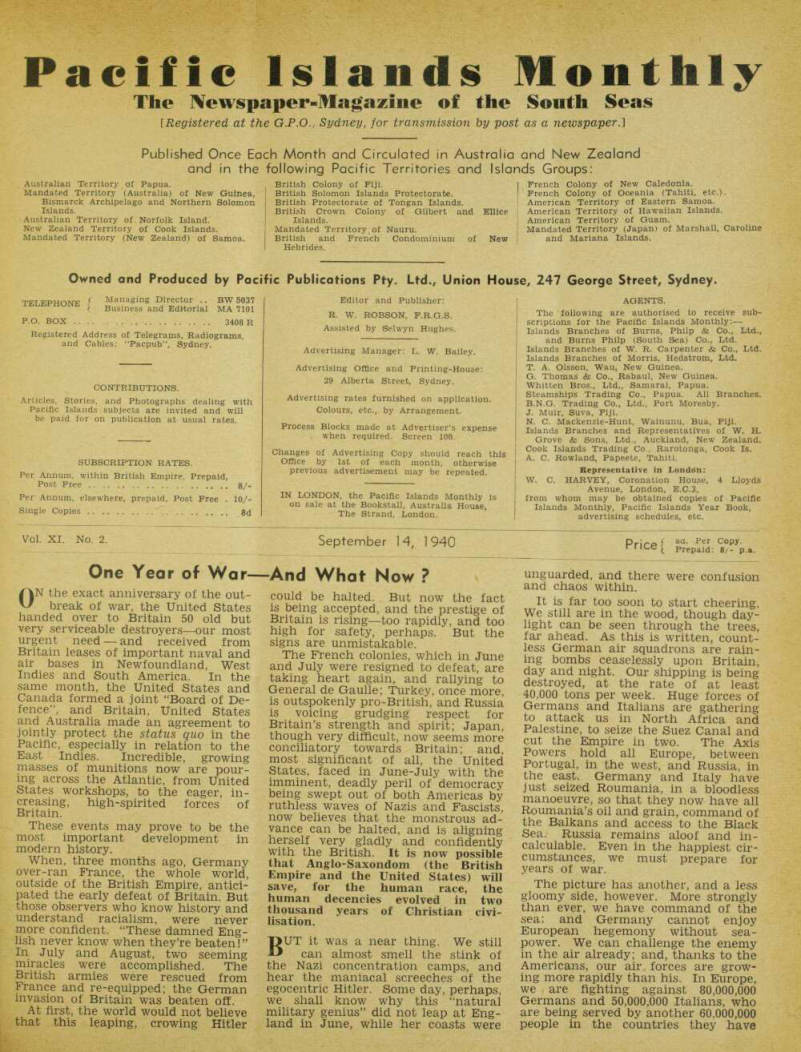
Burns, Philp & Co. Ltd.
GENERAL
MERCHANTS
m nil m nil HI 111 nit HI IN
ifi Hi
I
IIHI
SHIPOWNERS
TOURIST AGENTS
Head Office: 7 Bridge Street, Sydney—Australia Code Address: "Burphil"
BUYERS OF ALL CLASSES OF ISLAND PRODUCE Regular Steamer Services from Australia to New Guinea — Papua— Solomon Is.—Lord Howe Is.—Norfolk Is.—New Hebrides—Java and Singapore
Pacific Islands Monthly
The Newspaper-Magazine of the South Seas [Registered at the G.P.0., Sydney, for transmission by post as a newspaper .]
Published Once Each Month and Circulated in Australia and New Zealand and in the following Pacific Territories and Islands Groups:
Australian Territory of Papua.
Mandated Territory (Australia) of New Guinea, Bismarck Archipelago and Northern Solomon Islands.
Australian Territory of Norfolk Island.
New Zealand Territory of Cook Islands.
Mandated Territory (New Zealand) of Samoa.
British Colony of Fiji.
British Solomon Islands Protectorate.
British Protectorate of Tongan Islands.
British Crown Colony of Gilbert and Ellice Islands.
Mandated Territory of Nauru.
British and French Condominium of New Hebrides.
French Colony of New Caledonia.
French Colony of Oceania (Tahiti, etc.).
American Territory of Eastern Samoa.
American Territory of Hawaiian Islands.
American Territory of Guam.
Mandated Territory (Japan) of Marshall, Caroline and Mariana Islands.
Owned ond Produced by Pacific Publications Pty. Ltd., Union House, 247 George Street, Sydney.
rpriT pphamf f Managing Director .. BW 5037 I Business and Editorial MA 7101
P.O. Box 3408 R
Registered Address of Telegrams, Radiograms, and Cables; “Pacpub”, Sydney.
Contributions.
Articles, Stories, and Photographs dealing with Pacific Islands subjects are invited and will be paid for on publication at usual rates.
Subscription Rates.
Per Annum, within British Empire, Prepaid, Post Free 8/- Per Annum, elsewhere, prepaid, Post Free . 10/- Single Copies 8d
Editor and Publisher:
R. W. Robson, F.R.G.S.
Assisted by Selwyn Hughes, Advertising Manager; L. W. Bailey.
Advertising Office and Printing-House: 29 Alberta Street, Sydney.
Advertising rates furnished on application.
Colours, etc., by Arrangement.
Process Blocks made at Advertiser’s expense when required. Screen 100.
Changes of Advertising Copy should reach this Office by Ist of each month, otherwise previous advertisement may be repeated.
IN LONDON, the Pacific Islands Monthly is on sale at the Bookstall, Australia House, The Strand, London.
Agents.
The following are authorised to receive sub scriptions for the Pacific Islands Monthly:— Islands Branches of Burns, Philp & Co., Ltd., and Burns Philp (South Sea) Co., Ltd.
Islands Branches of W. R. Carpenter & Co., Ltd.
Islands Branches of Morris, Hedstrom, Ltd.
T. A. Olsson, Wau, New Guinea.
G. Thomas & Co., Rabaul, New Guinea.
Whitten Bros., Ltd., Samarai, Papua.
Steamships Trading Co., Papua. All Branches.
B.N.G. Trading Co., Ltd., Port Moresby.
J. Muir, Suva, Fiji.
N. C. Mackenzie-Hunt, Wainunu, Bua, Fiji.
Islands Branches and Representatives of W. H.
Grove & Sons, Ltd., Auckland, New Zealand.
Cook Islands Trading Co., Rarotonga, Cook Is.
A. C, Rowland, Papeete, Tahiti.
Representative in London: W. C. HARVEY, Coronation House, 4 Lloyds Avenue, London, E.C.3, from whom may be obtained copies of Pacific Islands Monthly, Pacific Islands Year Book, advertising schedules, etc.
Vol. XI. No. 2.
September 14, 1940
Prirot ttcl - Per Copy rr,c-et Prepaid; 8/- p.a.
One Year of War—And What Now ?
ON the exact anniversary of the out break of war, the United States handed over to Britain 50 old but very serviceable destroyers—our most urgent need and received from Britain leases of important naval and air bases in Newfoundland, West Indies and South America. In the same month, the United States and Canada formed a joint “Board of De fence”, and Britain, United States and Australia made an agreement to jointly protect the status quo in the Pacific, especially in relation to the East Indies. Incredible, growing masses of munitions now are pour ing across the Atlantic, from United States workshops, to the eager, in creasing, high-spirited forces of Britain.
These events may prove to be the most important development in modern history.
When, three months ago, Germany over-ran France, the whole world, outside of the British Empire, antici pated the early defeat of Britain. But those observers who know history and understand racialism, were never more confident. “These damned Eng lish never know when they’re beaten!”
In July and August, two seeming miracles were accomplished. The British armies were rescued from France and re-equipped; the German invasion of Britain was beaten off.
At first, the world would not believe that this leaping, crowing Hitler
could be halted. But now the fact is being accepted, and the prestige of Britain is rising—too rapidly, and too high for safety, perhaps. But the signs are unmistakable.
The French colonies, which in June and July were resigned to defeat, are taking heart again, and rallying to General de Gaulle; Turkey, once more, is outspokenly pro-British, and Russia is voicing grudging respect for Britain’s strength and spirit; Japan, though very difficult, now seems more conciliatory towards Britain; and, most significant of all, the United States, faced in June-July with the imminent, deadly peril of democracy being swept out of both Americas by ruthless waves of Nazis and Fascists, now believes that the monstrous ad vance can be halted, and is aligning herself very gladly and confidently with the British. It is now possible that Anglo-Saxondom (the British Empire and the United States) will save, for the human race, the human decencies evolved in two thousand years of Christian civi lisation.
BUT it was a near thing. We still can almost smell the stink of the Nazi concentration camps, and hear the maniacal screeches of the egocentric Hitler. Some day, perhaps, we shall know why this “natural military genius” did not leap at Eng land in June, while her coasts were
unguarded, and there were confusion and chaos within.
It is far too soon to start cheering.
We still are in the wood, though day light can be seen through the trees, far ahead. As this is written, count less German air squadrons are rain ing bombs ceaselessly upon Britain, day and night. Our shipping is being destroyed, at the rate of at least 40,000 tons per week. Huge forces of Germans and Italians are gathering to attack us in North Africa and Palestine, to seize the Suez Canal and cut the Empire in two. The Axis Powers hold all Europe, between Portugal, in the west, and Russia, in the east. Germany and Italy have just seized Roumania, in a bloodless manoeuvre, so that they now have all Roumania’s oil and grain, command of the Balkans and access to the Black Sea. Russia remains aloof and in calculable. Even in the happiest cir cumstances, we must prepare for years of war.
The picture has another, and a less gloomy side, however. More strongly than ever, we have command of the sea: and Germany cannot enjoy European hegemony without sea power. We can challenge the enemy in the air already; and, thanks to the Americans, our air forces are grow ing more rapidly than his. In Europe, we are fighting against 80,000,000 Germans and 50,000,000 Italians, who are being served by another 60,000,000 people in the countries they have
conquered. How can 40,000,000 op pose 130,000,000 British enemies, and b 0,000,000 enslaved peoples? Because, behind Britain, there are now, being organised for war on a great scale, at least 20,000,000 more Europeans in the Empire, 50,000,000 non-Europeans, 350,000,000 people in the Indian Em pire—and, in addition, 120,000,000 Europeans in the United States, who are giving Britain non-belligerent aid of incalculable value, and who cer tainly will become belligerents if Britain is in danger of defeat.
If this war were a straight-out military contest, we should, long ere this, have been stamped into the dust. But, everywhere, we are pro tected by salt-water. Those goose stepping Axis millions cannot get at us anywhere; and so, because of our R.A.F. and our Navy, we can develop and use against the enemy the over whelming economic strength of our Empire, while, behind our water barriers, we can build up armies which will be a real, and maybe the final factor in the struggle.
Britain, within Britain, can mobi lise sufficient military strength to defend the country, so long as the R.A.F. and the Navy are the first lines of defence. From the Dominions and colonies there can be mobilised prob ably 2,000,000 white soldiers; while India can contribute unlimited mil lions of men, known to us for more than a century as brave, clever and loyal fighters under the Union Jack.
We have no hint of British strategy; but what we can see seems to in dicate the probable shape of the coming war.
While Britain holds the seas, and pounds ceaselessly with her air force at her Continental enemies, great armies will be prepared in India, Australia, New Zealand and South and East Africa and, supplied by factories in those countries and U.S.A., those armies eventually will move up through the Near East and North east Africa, to attack the enemy in the Mediterranean region.
Some commentators believe that this war will be decided in the air.
Perhaps it will. But more conser vative thinkers prefer to plan for a long, hard war that will be, ulti mately, a test of staying-power and morale. In such a war, the vast re sources of the British Empire, and the dauntless spirit of our people, will decide the issue. * * * BUT be prepared for hard knocks.
It may have seemed to us that all the disasters that possibly could damage our cause happened between March and August, 1940—and that any big international event, from now on, must be in our favour.
But there still are three countries which can add to our embarrassments.
Spain may join the Axis, and pro vide for German armies a bridge to North Africa. Russia may just as readily go towards Berlin as towards London. And Japan, in her Chauv inistic eagerness to gain territory and trade from the now unprotected French and Dutch empires, may pre cipitate a struggle in the Pacific with those committed to the status quo.
Nevertheless, at the end of the first
year of the Hitler War, British pros pects are far better than would have seemed possible three months ago.
New phases should develop quickly, now. Hitler dare not stand still: if he does, he will be overtaken and overwhelmed by the discontent of those German masses to whom he promised victory and peace in 1940.
Vital Talks
Going On
Future of Pacific Territories
DISCUSSIONS of the utmost import ance to the future of all Pacific countries and races now are pro ceeding between Great Britain, the United States, Holland, Australia and New Zealand. There are indications that Russia is being consulted, to an increas
ing degree.
Here, briefly stated, are the factors in a situation of great delicacy; The future of the vast territories of Indo china and East Indies, and the French Pacific colonies, is uncertain, so long as Germany holds France and Holland.
It is a fundamental of Japanese policy that Japan shall acquire new territories in Eastern Asia and the Pacific. Any changes in European possessions in East Asia or the Pacific vitally affect Japan.
The aggressive spirit of Japan, displayed towards Britain for three years (and more marked since the collapse of France) and the relationship between Japan and the Axis Powers, have caused great embarrassment to Britain.
Japan’s attack upon China, like her original attack upon Manchuria, has given much offence to American opinion. The present aggressive attitude of Japan towards non-Asiatic powers, and Japan’s apparent preoccupation with Indo-
China and East Indies, are resented by United States.
The probable purpose of the present discussions is to create a combination strong enough to talk to the Japanese in language they will understand.
There is no indication that Britain or U.S.A. are anti-Japanese. They under stand Japan’s cruel problems, both economic and political; and they know there will be no peace in the Pacific un less they help Japan to solve them. But they will not be ordered about by Japanese Nazis, or told what they may, or may not do, in South-east Asia and the Pacific.
Supply
Port Moresby Water Supply
THE construction of a water supply for Port Moresby, Papua, is proceeding rapidly. The first shipment of pipes has been landed, and several already are in position in the trench which is being dug now over the 20 miles route by a special trenching machine, brought in for the purpose. It is believed that the town will have a water supply before the next south-east (dry) season.
Revived Demand For Pacific
Gold Shares
THE strong stand taken by the British and U.S.A. Governments over the situation in the Far East and the Pacific has given renewed impetus to demand for shares of companies whose interests lie in these areas.
Not only Islands trading, but also gold mining company shares have benefited, and Placer. Bulolo. Emperor, Loloma and Sunshine have all strengthened appre ciably.—Sydney “Sun”, Sept. 8.
(Can Fashion, Like Morals, Become a Matter of Latitude and Longitude?) "Look, Sinobodo! I got y em, too!"
No Copra
Market
Fiji Government's Review
IN an official communique on the copra industry, issued by the Fiji Govern ment in August, it was pointed out that the colonial empires of Britain, France, Holland and Belgium together produce 900,000 tons of copra per annum; and that, as the European markets have been cut off, the available markets can not absorb more that a quarter of that amount.
The Fiji Government adds to these plain facts its own opinion that “it is unsafe to anticipate an automatic revival of the copra market when peace conditions are restored”.
This apparently is based upon the as sumption—fairly sound—that the Euro pean countries, under the stress of the blockade, will become accustomed to us ing substitutes for copra and coconut oil, and will not readily return to those com modities when the war is over.
Fiji coconut planters are being urged to examine immediately the possibilities of cultivating other crops, as an alter native to copra.
The outlook is not encouraging. Readers are referred to an article on page 16 of this issue, in which the possibility of getting some portion of the huge United States copra market opened to South Pacific copra is discussed.
On the eve of going to press we learn that Sir Walter Carpenter has placed before the Commonwealth authorities a plan under which he hopes that a market for approximately 70,000 tons of South Pacific copra per annum will be found in Mexico.
"Viti" Arrives
Useful Motor-Ship For Fiji Governor
THE new patrol motor-vessel “Viti”, which has just been built in Hong Kong to the order of the Fiji Gov ernment, arrived in Suva on August 14. after a voyage from Hong Kong of 24 days, including a call at Tulagi (Solomon Islands).
The vessel is 168 feet long, 3U feet in beam, and her displacement is 1,000 tons.
She has been constructed so as to per form a multiplicity of duties—Governor’s yacht, lighthouse inspection, hospital ship, hydrographic survey ship, and armed mine-sweeper. The accommodation consists of a suite for the Governor, 8 staterooms for the Governor’s staff or passengers, six rooms for European officers, and accommodation for 30 Fijian petty officers and members of the crew She can carry 100 tons of cargo.
She is a handsome little ship. Her use fulness was demonstrated within a few days, when she departed from Suva carrying the High Commissioner for the Western Pacific (Sir Harry Luke) on an urgent mission to New Caledonia.
The “Viti” was launched in Hong Kong on November 21. 1939, but was not ready for her trials until July. After she was launched, it was decided to alter her equipment in certain ways, as a result of war conditions.
“Viti”, of course, is “Fiji”, in the native form.
Mr. Noel Stock, formerly of Tulaen and Dew au Plantations, Buka, New Guinea, has enlisted in the A.I.F.
Colonies
Fateful Days In The French
Governors Swept Away by Peoples' Overwhelming Declaration For "Free France"
THERE have been three events of out standing importance in France’s South Pacific Colonies, since France surrendered to Germany on June 17.
First: A declaration by the French Governor (M. Henri Sautot) and people of New Hebrides, on July 18, in favour of Free France and General de Gaulle. (This was fully reported in August and in a French supplement of that issue.) Second: The arrival in Noumea, on Friday, August 30, of Sir Harry Luke, British High Commissioner for the Western Pacific, who obviously had come specially from Suva in an attempt to assist the French of New Caledonia in clearing up a confused situation—although it was evident that New Caledonia was for de Gaulle.
Third: The announcement by the Premier of New Zealand that the French population of Tahiti had declared for the British alliance and the leadership of General de Gaulle.
In New Caledonia
rE position, in August “PJM.”, showed considerable tension in New Caledonia in mid-August. The people, generally, and through their Conseil-General (or elected House of Representatives, of 15 members) had de clared for the Anglo-Australian alliance, while the Governor, M. Georges Pelissier, although displaying all possible friend ship towards the British, continued to accept instructions from the Retain Gov ernment, in Vichy, France.
About the third week in August the French naval sloop Dumont d’Urville (1,969 tons, three 5.5 in. guns) com manded by Captain Quivrecourt, arrived in Noumea from Tahiti. The captain de finitely was pro-Petain; the crew, equally definitely, were pro-de Gaulle.
It was an impossible situation.
On the night of Sunday, August 18, two bombs were thrown into the grounds of Government House. One exploded, and broke several windows.
Tension continued for a couple of weeks. The successful resistance of Britain to German attacks, the out spoken adherence of M. Sautot to Gen eral de Gaulle, knowledge that only Aus tralian financial help (through the pur chase of her metals) was allowing New Caledonia to function economically, the announcement that the Colonies of French Equatorial Africa were renounc ing Retain and declaring for Free France —all had their effect on public opinion.
Towards the end of August, Mr. Bal lard, special representative of the Aus tralian Government arrived in Noumea from New Hebrides.
On August 28, the Conseil-General re affirmed its adherence to Free France and General de Gaulle, and demanded that Governor cease all communication with the Retain Government.
The Governor (a man with a distin guished record, and held in general high regard, who became Governor in April, 1939) in this difficult position, advised the Petain Government that he would re tire from the Colony.
On August 29, the Petain Government appointed Colonel Denis, Commandant of the military forces, to be Governor. The
Conseil-General of 15 members there upon resigned.
It was thought, apparently, that this would force a general election. But there was nothing to prevent the new Governor carrying on a military administration.
The situation was dangerous. The officials of the government and of the warship were pro-Petain. The people of the Colony and the crew of the warship were overwhelmingly pro-British.
It was reported that any attempt to use the guns of the sloop against the
British or the pro-de Gaulle people ashore, would cause a mutiny on the warship.
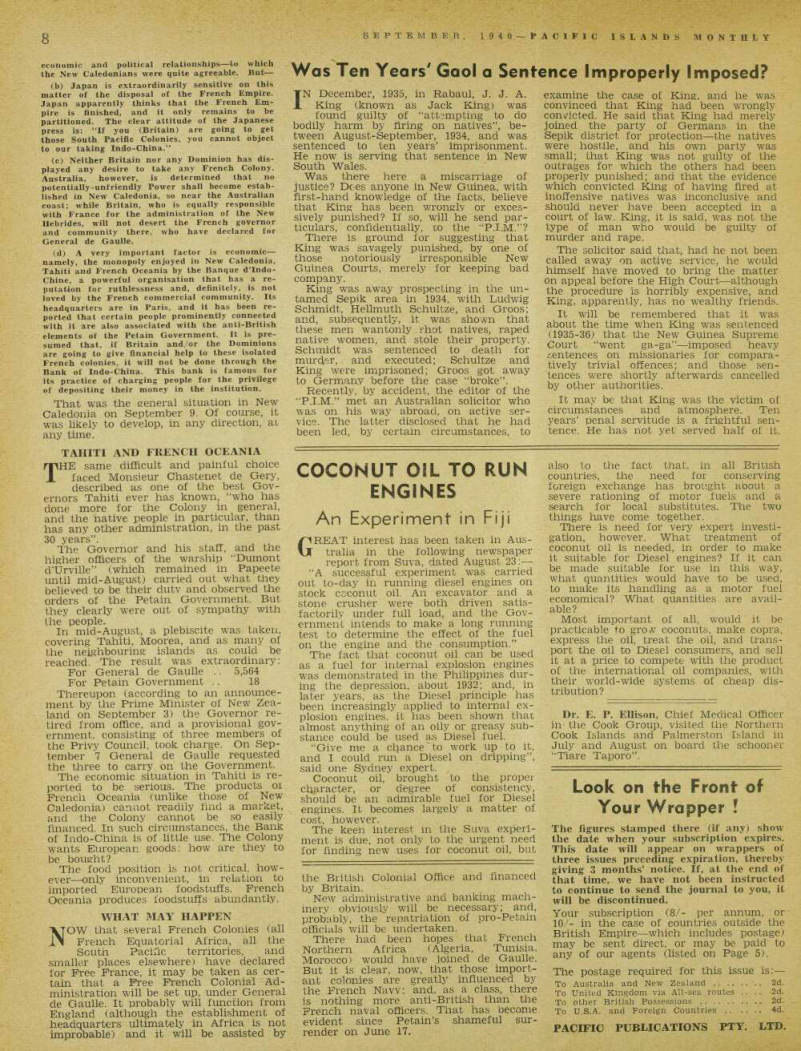
On Friday, August 30, the Fiji Govern ment yacht “Viti”, quite unexpectedly arrived in Noumea, bringing the High Commissioner for the Western Pacific, Sir Harry Luke, to discuss the difficult situ ation with the unhappy French officials.
Never was the arrival of a high official more opnortune. The Noumea people gathered spontaneously on the wharf (where the “Viti” had tied up close be side the French warship), waved French (de Gaulle) and British flags, cheered Sir Harry, and demonstrated vociferously for General de Gaulle and the British alliance.
Early in September, the British party were still in Noumea: and it was hoped that Sir Harry Luke, a man noted for his tact and diplomacy, would assist the French in solving their troubles.
Naturally, Sir Harry would do every thing possible to advance the cause of Free France; but it nevertheless was a situation calculated to give anyone a first-class headache. Here were the appar ent factors;— (a) The overwhelming majority of the people (everyone, indeed, except certain of the official class) was for joining General de Gaulle. This meant that Britain (or Australia) must finance the Colony—which Britain was quite willing to do. This meant the establishment of much closer
Sir Harry Luke (British High Commissioner for the Western Pacific), who visited New Caledonia early this month.
economic and political relationships—to which the New Caledonians were quite agreeable. But — (b) Japan is extraordinarily sensitive on this matter of the disposal of the French Empire.
Japan apparently thinks that the French Em pire is finished, and it only remains to be partitioned. The clear attitude of the Japanese press is: “If you (Britain) are going to get those South Pacific Colonies, you cannot object to our taking Indo-China.” (c) Neither Britain nor any Dominion has dis played any desire to take any French Colony.
Australia. however, is determined that no potentially-unfriendly Power shall become estab lished in New Caledonia, so near the Australian coast; while Britain, who is equally responsible with France for the administration of the New Hebrides, will not desert the French governor and community there, who have declared for General de Gaulle. (d) A very important factor is economic— namely, the monopoly enjoyed in New Caledonia, Tahiti and French Oceania by the Banque dTndo- Chine, a powerful organisation that has a re putation for ruthlessness and, definitely, is not loved by the French commercial community. Its headquarters are in Paris, and it has been re ported that certain people prominently connected with it are also associated with the anti-British elements of the Petain Government. It is pre sumed that, if Britain and/or the Dominions are going to give financial help to these isolated French colonies, it will not be done through the Bank of Indo-China. This bank is famous for its practice of charging people for the privilege of depositing their money in the institution.
That was the general situation in New Caledonia on September 9. Of course, it was likely to develop, in any direction, at any time.
Tahiti And French Oceania
THE same difficult and painful choice faced Monsieur Chastenet de Gery, described as one of the best Gov ernors Tahiti ever has known, “who has done more for the Colony in general, and the native people in particular, than has any other administration, in the past 30 years”.
The Governor and his staff, and the higher officers of the warship “Dumont d'Urville” (which remained in Papeete until mid-August) carried out what they believed to be their dutv and observed the orders of the Petain Government. But they clearly were out of sympathy with the people.
In mid-August, a plebiscite was taken, covering Tahiti, Moorea, and as many of the neighbouring islands as could be reached. The result was extraordinary: For General de Gaulle .. 5,564 For Petain Government .. 18 Thereupon (according to an announce ment by the Prime Minister of New Zea land on September 3) the Governor re tired from office, and a provisional gov ernment, consisting of three members of the Privy Council, took charge. On Sep tember 7 General de Gaulle requested the three to carry on the Government.
The economic situation in Tahiti is re ported to be serious. The products oi French Oceania (unlike those of New Caledonia) cannot readily find a market, and the Colony cannot be so easily financed. In such circumstances, the Bank of Indo-China is of little use. The Colony wants European goods: how are they to be bought?
The food position is not critical, how ever—only inconvenient, in relation to imported European foodstuffs. French Oceania produces foodstuffs abundantly.
What May Happen
NOW that several French Colonies (all French Equatorial Africa, all the South Pacific territories, and smaller places elsewhere) have declared for Free France, it may be taken as cer tain that a Free French Colonial Ad ministration will be set up, under General de Gaulle. It probably will function from England (although the establishment of headquarters ultimately in Africa is not improbable) and it will be assisted by
the British Colonial Office and financed by Britain.
New administrative and banking mach inery obviously will be necessary; and, probably, the repatriation of pro-Petain officials will be undertaken.
There had been hopes that French Northern Africa (Algeria, Tunisia.
Morocco) would have joined de Gaulle.
But it is clear, now, that those import ant colonies are greatly influenced by the French Navv: and, as a class, there is nothing more anti-British than the French naval officers. That has become evident since Petain’s shameful sur render on June 17.
Was Ten Years ' Gaol a Sentence improperly Imposed?
IN December, 1935, in Rabaul, J. J. A.
King (known as Jack King) was found guilty of “attempting to do bodily harm by firing on natives”, between August-September, 1934, and was sentenced to ten years’ imprisonment.
He now is serving that sentence in New South Wales.
Was there here a miscarriage of justice? Dees anyone in New Guinea, with first-hand knowledge of the facts, believe that King has been wrongly or excessively punished? If so, will he send particulars, confidentially, to the “P.1.M.”?
There is ground for suggesting that King was savagely punished, by one of those notoriously irresponsible New Guinea Courts, merely for keeping bad company.
King was away prospecting in the untamed Sepik area in 1934, with Ludwig mi s d uijs?auentlv h these men -hot'"natives raped native and was ’ sentenced to death for
S.viiTuS? 1 c.rS[
were n^Dr^oned^ ’ awav to Germany before the c°se “broke” V Recently, by accident, the editor of the “P.1.M.” met an Australian solicitor who was on his way abroad, on active service. The latter disclosed that he had been led, by certain circumstances, to
examine the case of Kins, and he was convinced that King had been wrongly convicted. He said that King had merely joined the party of Germans in the Sepik district for protection—the natives were hostile, and his own party was small; that King was not guilty of the outrages for which the others had been properly punished; and that the evidence which convicted King of having fired at inoffensive natives was inconclusive and should never have been accepted in a court of law. King, it is said, was not the type of man who would be guilty of murder and rape.
The solicitor said that, had he not been called away on active service, he would himself have moved to bring the matter on appeal before the High Court—although the procedure is horribly expensive, and King, apparently, has no wealthy friends. will be remembered that it was about the time when King was sentenced (1935 - 36) that the New Guinea Supreme Court “ went ga-ga”-imposed heavy sentences on missionaries for compara tively trivial offences; and those sen a£t6rwards celled Dy otner authorities.
It may be that King was the victim of circumstances and atmosphere. Ten years’ penal servitude is a frightful sen tence. He has not yet served half of it.
An Experiment in Fiji
Coconut Oil To Run
Engines
GREAT interest has been taken in Aus tralia in the following newspaper report from Suva, dated August 23: “A successful experiment was carried out to-day in running diesel engines on stock coconut oil. An excavator and a stone crusher were both driven satis factorily under full load, and the Gov ernment intends to make a long running test to determine the effect of the fuel on the engine and the consumption.”
The fact that coconut oil can be used as a fuel for internal explosion engines was demonstrated in the Philippines dur ing the denression, about 1932; and, in later years, as the Diesel principle has been increasingly applied to internal ex plosion engines, it has been shown that almost anything of an oily or greasy sub stance could be used as Diesel fuel.
“Give me a cljance to work up to it, and I could run a Diesel on dripping”, said one Sydney expert.
Coconut oil, brought to the proper character, or degree of consistency, should be an admirable fuel for Diesel engines. It becomes largely a matter of cost, however.
The keen interest m the Suva experi ment is due, not only to the urgent need for finding new uses for coconut oil, but
also to the fact that, in all British countries, the need for conserving foreign exchange has brought about a severe rationing of motor fuels and a search for local substitutes. The two things have come together.
There is need for very expert investi gation, however. What treatment of coconut oil is needed, in order to make it suitable for Diesel engines? If it can be made suitable for use in this way, what quantities would have to be used, to make its handling as a motor fuel economical? What quantities are avail able?
Most important of all, would it be practicable to grow coconuts, make copra, express the oil, treat the oil, and trans port the oil to Diesel consumers, and sell it at a price to compete with the product of the international oil companies, with their world-wide systems of cheap dis tribution?
Dr. E. P. Ellison, Chief Medical Officer in the Cook Group, visited the Northern Cook Islands and Palmerston Island in July and August on board the schooner “Tiare Taporo”.
Advertisements & other items, p. 10 (2 items)
8
SEPTEMBER, 1940-I’ACIfIC ISLANDS MONTHLY
Look on the Front of
Your Wrapper !
The figures stamped there (if any) show the date when your subscription expires.
This date will appear on wrappers of three issues preceding expiration, thereby giving 3 months’ notice. If, at the end of that time, we have not been instructed to continue to send the journal to you, it will be discontinued.
Your subscription (8/- per annum, or 10/- in the case of countries outside the British Empire—which includes postage) may be sent direct, or may be paid to any of our agents (listed on Page 5).
The postage required for this issue is: To Australia and New Zealand 2d.
To United Kingdom via All-sea routes ... 2d.
To other British Possessions 2d.
To U.S.A. and Foreign Countries 4d.
PACIFIC PUBLICATIONS PTY. LTD.
Luckner?
Where Is Von
A REMARKABLE story about Count von Luckner has been published in some British and American news papers.
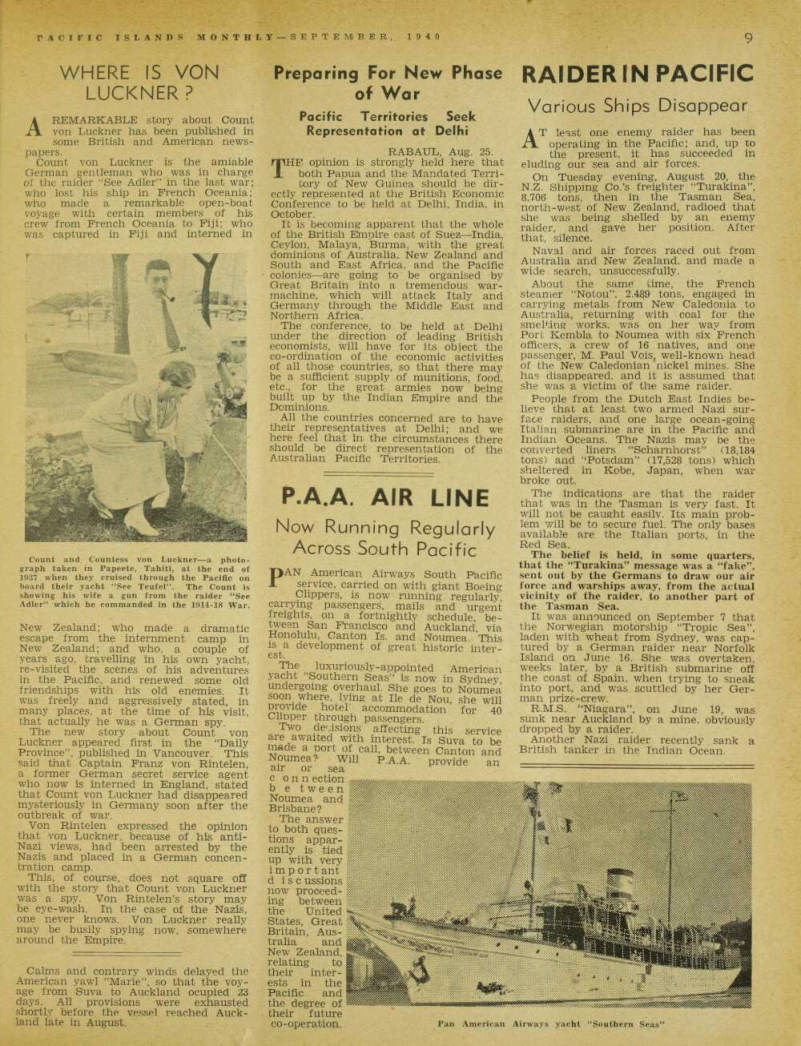
Count von Luckner is the amiable German gentleman who was in charge of the raider “See Adler” in the last war; who lost his ship in French Oceania; who made a remarkable open-boat voyage with certain members of his crew from French Oceania to Fiji; who was captured in Fiji and interned in
New Zealand; who made a dramatic escape from the internment camp in New Zealand; and who, a couple of years ago, travelling in his own yacht, re-visited the scenes of his adventures in the Pacific, and renewed some old friendships with his old enemies. It was freely and aggressively stated, in many places, at the time of his visit, that actually he was a German spy.
The new story about Count von Luckner appeared first in the “Daily Province”, published in Vancouver. This said that Captain Franz von Rintelen, a former German secret service agent who now is interned in England, stated that Count von Luckner had disappeared mysteriously in Germany soon after the outbreak of war.
Von Rintelen expressed the opinion that von Luckner, because of his anti- Nazi views, had been arrested by the Nazis and placed in a German concen tration camp.
This, of course, does not square off with the story that Count von Luckner was a spy. Von Rintelen’s story may be eye-wash. In the case of the Nazis, one never knows. Von Luckner really may be busily spying now, somewhere around the Empire.
Calms and contrary winds delayed the American yawl “Marie”, so that the voy age from Suva to Auckland ocupied 23 days. All provisions were exhausted shortly before the vessel reached Auck land late in August.
Count and Countess von Luckner —a photo graph taken in Papeete, Tahiti, at the end of 1937 when they cruised through the Pacific on board their yacht “See Teufel”. The Count is showing his wife a gun from the raider “See Adler” which he commanded in the 1914-18 War.
Preparing For New Phase
of War Pacific Territories Seek Representation at Delhi
Rabaul, Aug. 25.
THE opinion is strongly held here that both Papua and the Mandated Terri tory of New Guinea should be dir ectly represented at the British Economic Conference to be held at Delhi, India, in October.
It is becoming apparent that the whole of the British Empire east of Suez—lndia, Ceylon, Malaya, Burma, with the great dominions of Australia. New Zealand and South and East Africa, and the Pacific colonies —are going to be organised by Great Britain into a tremendous war machine, which will attack Italy and Germany through the Middle East and Northern Africa.
The conference, to be held at Delhi under the direction of leading British economists, will have for its object the co-ordination of the economic activities of all those countries, so that there may be a sufficient supply of munitions, food, etc., for the great armies now being built up by the Indian Empire and the Dominions.
All the countries concerned are to have their representatives at Delhi; and we here feel that in the circumstances there should be direct representation of the Australian Pacific Territories.
Now Running Regularly
P.A.A. Air Line
Now Running Regularly Across South Pacific
PAN American Airways South Pacific service, carried on with giant Boeing Clippers, is now running regularly carrying passengers, mails and urgent freights, on a fortnightly schedule, be tween San Francisco and Auckland, via Honolulu, Canton Is. and Noumea This is a development of great historic inter est. - „ luxuriously-appointed American Southern Seas” is now in Sydnev undergoing overhaul. She goes to Noumea soon where, lying at He de Nou, she will provide hotel accommodation for 40 Clmper thrpugh passengers.
Two decisions affecting this service are awaited with interest. Is Suva to be made a port of call, between Canton and Noumea? Will P.A.A. provide an
air or sea c on n ection b e twe en Noumea and Brisbane?
The answer to both ques tions appar ently is tied up with very import ant d i s c ussions now proceed ing between the United States, Great Britain, Aus tralia and New Zealand, relating to their inter ests in the Pacific and the degree of their future co-operation.
Pan American Airways yacht “Southern Seas”
Raider In Pacific
Various Ships Disappear
AT least one enemy raider has been operating in the Pacific; and, up to the present, it has succeeded in eluding our sea and air forces.
On Tuesday evening, August 20, the N.Z. Shinning Co.’s freighter “Turakina”, 8,706 tons, then in the Tasman Sea, north-west of New Zealand, radioed that she was being shelled by an enemy raider, and gave her position. After that, silence.
Naval and air forces raced out from Australia and New Zealand, and made a wide search, unsuccessfully.
About the same time, the French steamer “Notou”. 2.489 tons, engaged in carrying metals from New Caledonia to Australia, returning with coal for the smelting works, was on her way from Port Kembla to Noumea with six French officers, a crew of 16 natives, and one passenger, M. Paul Vois, well-known head of the New Caledonian nickel mines. She has disappeared, and it is assumed that she was a victim of the same raider.
People from the Dutch East Indies be lieve that at least two armed Nazi sur face raiders, and one large ocean-going Italian submarine are in the Pacific and Indian Oceans. The Nazis may be the converted liners “Scharnhorst” (18,184 tons) and “Potsdam” (17,528 tons) which sheltered in Kobe, Japan, when war broke out.
The indications are that the raider that was in the Tasman is very fast. It will not be caught easilv. Its main prob lem will be to secure fuel. The only bases available are the Italian ports, in the Red Sea.
The belief is held, in some quarters, that the “Turakina” message was a “fake”, sent out by the Germans to draw our air force and warships away, from the actual vicinity of the raider, to another part of the Tasman Sea.
It was announced on September 7 that the Norwegian motorship “Tropic Sea”, laden with wheat from Sydney, ‘was cap tured by a German raider near Norfolk Island on June 16. She was overtaken, weeks later, by a British submarine off the coast of Spain, when trying to sneak into port, and was scuttled by her Ger man prize-crew.
R.M.S. “Niagara”, on June 19, was sunk near Auckland by a mine, obviously dropped by a raider.
Another Nazi raider recently sank a British tanker in the Indian Ocean.
R.A.F Plane From Western

... , , a . pUb^ lC tr mee^P g TT r an 2, worth SS a b comm?ttee n representing all sections in Western Samoa, began to collect funds wherewith to donate an aeroplane to the R.A.F.
The Administrator, Mr. A. C. Turnbull, is chairman, and the arduous work of col lecting is under the direction of a well
known and popular lady, Mrs. A. G.
Smyth. The committee includes three Samoan High Chiefs—Tamasese, Mataafa and Malietoa. Europeans and Samoans ar e co-operating heartily in raising money - A notable gift is £lOO from the little Polynesian community of Fakaofo, L n T°kelau Islands, attached to Samoa. Fakaofo’s total population is 575, a nd these Polynesians are entirely de pendent upon their production of the, at present, unsaleable copra.
Did They Chase Venus ?
Story of Mysterious Balloons
rE Sydney newspapers, on September 9, published extremely humorous articles concerning a couple of brave men in Salamaua. New Guinea, who sighted the planet Venus in the noon sky (Venus, being very near the earth at pre sent, is discernible in the day-time) and, thinking it was an enemy balloon or some thing, went after it, armed with rifles, in Ray Parer’s Boeing aeroplane.
The Commonwealth duly laughed.
But a report in the “Rabaul Times”, of September 6, puts a different aspect upon the story. When the aviators re turned, they insisted that the object they chased was a balloon, with a small basket floating below. They photographed it be fore it disappeared behind clouds. Sala maua jeered, of course.
Two days later the aviators got their own back. Four more balloons are said to have been seen floating over Sala maua district. One came very low. It is reported to have been about 6 ft. in dia meter, made of black rubber, with a small basket attached. The purpose of the balloons (or, as the doubters say “alleged balloons”) is a complete mystery.
Soap-Making Factory
In Fiji
COPRA growers in the Pacific may be interested in the fact that the Suva works of Union Soaps Pty., Ltd., mills an average of five tons of copra every eight working hours. The resultant coconut oil, which is part of the material used in soap-making, is stored in tanks, the capacity of which is nearly 300 tons.
An article in the “Fiji Times'’ of Aug ust 19 describes the activities of this enterprising concern which manufac tures ten varieties of household soap, a toilet soap and sand soap. To carry out its operations the company has to import tallow and fine pumice sand from New Zealand: but, at any rate, it has the ad vantage of an abundant supply of copra right on the spot.
The company does not appear to en gage to any extent in the export trade— it confines itself to meeting the local de mand.
No Rubber Tax for Papua
Prom Our Own Correspondent
Port Moresby, Aug. 25.
IT is understood that, as a result of representations by a deputation which recently waited upon the acting Lt.-Governor, and by non-official members of the Council at its recent sittings, the Government has decided not to introduce the rubber tax this year.
The gold tax, and the new primage duty, already imposed, will remain, however.
Mr. and Mrs. Mitchellhill, formerly of the Solomon Islands, are now in Aus tralia. He resigned his position as In spector with Lever Bros, in order to en list in the AT.F.
Mrs. Kit McKerlie, whose husband owns a plantation and trade stores in the Western Solomons, is now hostess at the Cosmopolitan Hotel, Samarai, Papua.
Miss Joyce James, of Victoria, will shortly leave for Fiji to take up an ap pointment as Teaching Sister on the staff of the Methodist Mission.
Advertisements & other items, p. 12 (1 item)
KODAK (A/asia) Pty. Ltd.
NEWEST! BROWNIE
SPECIALS are the latest in box-type cameras. "Body release " type of shutter and many other new features.
All metal construction.
BULLET KODAK. All-
moulded, folding style Kodak with lens carried on threaded draw tube.
A truly novel idea in camera construction.
SIX-20 KODAKS
SENIOR. Magnificent series featuring body release for shutter, action front, etc.,
BANTAM KODAKS
MODERN MINIATURES
specially designed to place modern miniature photography within reach of all. Of smart modern appearance and accurate con struction.
SL Other Six-20 Kodaks
KODAKS THIRTY-
FIVE. Precisionmade 36-exp. 35mm. models, modestly priced. Accurately machined and constructed to the last detail. Folding optical eye-level view finder, finger - tip focussing, etc., etc.
EDCCI WRITE FOR LATEST
rncc* PHOTOGRAPHIC BOOKLETS
OF ALL KODAK DEALERS and
KODAK (A/asia) Pty. Ltd.
379 George Street, Sydney
9 Wolfe Street, Newcastle.
Dealers throughout the Islands.
About Islands People
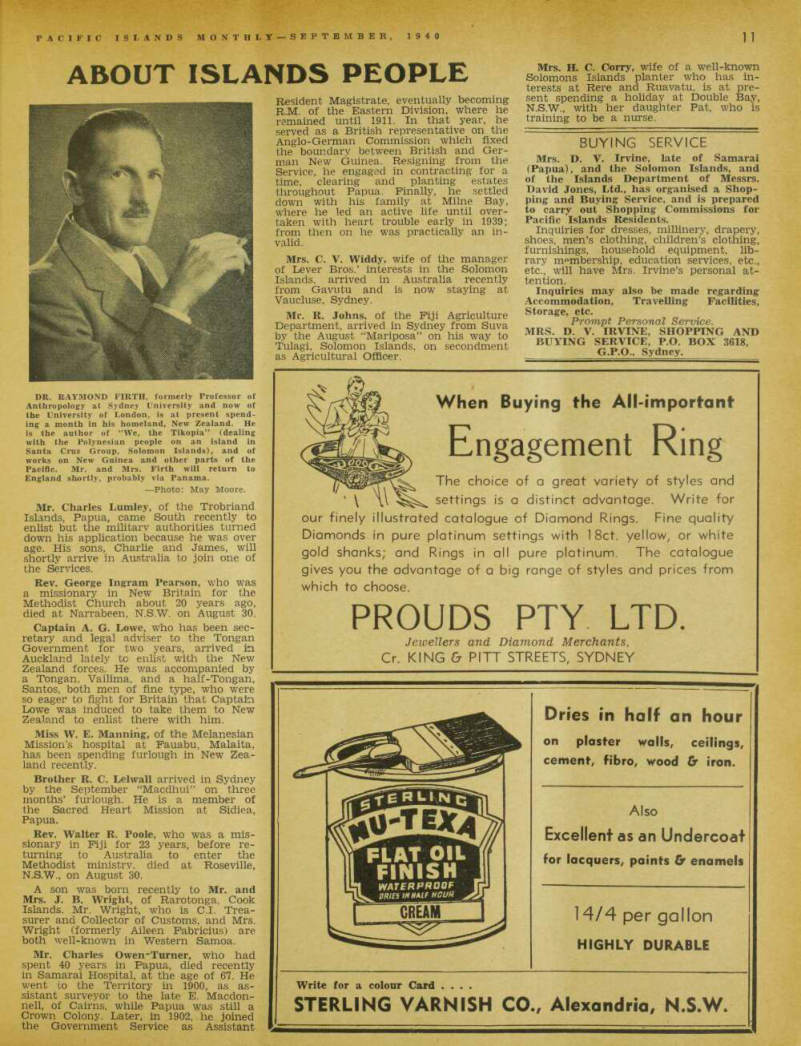
Mr. Charles Lumley, of the Trobriand Islands, Papua, came South recently to enlist but the military authorities turned down his application because he was over age. His sons, Charlie and James, will shortly arrive in Australia to join one of the Services.
Rev. George Ingram Pearson, who was a missionary in New Britain for the Methodist Church about 20 years ago, died at Narrabeen, N.S.W. on August 30.
Captain A. G. Lowe, who has been sec retary and legal adviser to the Tongan Government for two years, arrived in Auckland lately to enlist with the New Zealand forces. He was accompanied by a Tongan, Vailima, and a half-Tongan.
Santos, both men of fine type, who were so eager to fight for Britain that Captain Lowe was induced to take them to New Zealand to enlist there with him.
Miss W. E. Manning, of the Melanesian Mission’s hospital at Fauabu, Malaita, has been spending furlough in New Zea land recently.
Brother R. C. Lelwall arrived in Sydney by the September “Macdhui” on three months’ furlough. He is a member of the Sacred Heart Mission at Sidiea, Papua.
Rev. Walter R. Poole, who was a mis sionary in Fiji for 23 years, before re turning to Australia to enter the Methodist ministry, died at Roseville, N.S.W., on August 30.
A son was born recently to Mr. and Mrs. J. B. Wright, of Rarotonga, Cook Islands. Mr. Wright, who is C.I. Trea surer and Collector of Customs, and Mrs.
Wright (formerly Aileen Fabricius) are both well-known in Western Samoa.
Mr. Charles Owen-Turner, who had spent 40 years in Papua, died recently in Samarai Hospital, at the age of 67. He went co the Territory in 1900, as as sistant surveyor to the late E. Macdon nell, of Cairns, while Papua was still a Crown Colony. Later, in 1902, he joined the Government Service as Assistant
Resident Magistrate, eventually becoming r.M. of the Eastern Division, where he remained until 1911. In that year, he served as a British representative on the Anglo-German Commission which fixed the boundary between British and Ger man New Guinea. Resigning from the Service, he engaged in contracting for a time, clearing and planting estates throughout Papua. Finally, he settled down with his family at Milne Bay, where he led an active life until over taken with heart trouble early in 1939; from then on he was practically an in valid.
Mrs. C. V. Widdy, wife of the manager of Lever Bros.’ interests in the Solomon Islands, arrived in Australia recently from Gavutu and is now staying at Vaucluse, Sydney.
Mr. R. Johns, of the Fiji Agriculture Department, arrived in Sydney from Suva by the August “Mariposa” on his way to Tulagi, Solomon Islands, on secondment as Agricultural Officer.
Mrs. IL C. Cony, wife of a well-known Solomons Islands planter who has in terests at Rere and Ruavatu, is at pre sent spending a holiday at Double Bay, N.S.W., with her daughter Pat, who is training to be a nurse.
DR. RAYMOND FIRTH, formerly Professor of Anthropology at Sydney University and now of the University of London, is at present spend ing a month in his homeland, New Zealand. He is the author of “We, the Tikopia” (dealing with the Polynesian people on an island in Santa Cruz Group, Solomon Islands), and of works on New Guinea and other parts of the Pacific. Mr. and Mrs. Firth will return to England shortly, probably via Panama. —Photo: May Moore.
Advertisements & other items, p. 13 (1 item)
Engagement Ring
BUYING SERVICE
Mrs. D. V. Irvine, late of Samarai (Papua), and the Solomon Islands, and of the Islands Department of Messrs.
David Jones, Ltd., has organised a Shopping and Buying Service, and is prepared to carry out Shopping Commissions for Pacific Islands Residents.
Inquiries for dresses, millinery, drapery, shoes, men’s clothing, children’s clothing, furnishings, household equipment, library membership, education services, etc., etc., will have Mrs. Irvine’s personal attention.
Inquiries may also be made regarding Accommodation, Travelling Facilities, Storage, etc.
Prompt Personal Service.
MRS. D. V. IRVINE, SHOPPING AND
BUYING SERVICE, P.O. BOX 3618,
G.P.0., Sydney.
a m
When Buying the All-important
Engagement Ring
The choice of a great variety of styles and settings is a distinct advantage. Write for our finely illustrated catalogue of Diamond Rings. Fine quality Diamonds in pure platinum settings with 1 Bct. yellow, or white gold shanks; and Rings in all pure platinum. The catalogue gives you the advantage of a big range of styles and prices from which to choose.
PROUDS PTY LTD.
Jewellers and Diamond Merchants,
Cr. KING & PITT STREETS, SYDNEY
SfrT t*A
CREAM
555 Dries in holf an hour on plaster walls, ceilings, cement, fibre, wood Cr iron.
Also Excellent as an Undercoat for lacquers, paints & enamels 14/4 per gallon
HIGHLY DURABLE
Write for a colour Card ...
STERLING VARNISH CO., Alexandria, N.S.W.
Tropicalities
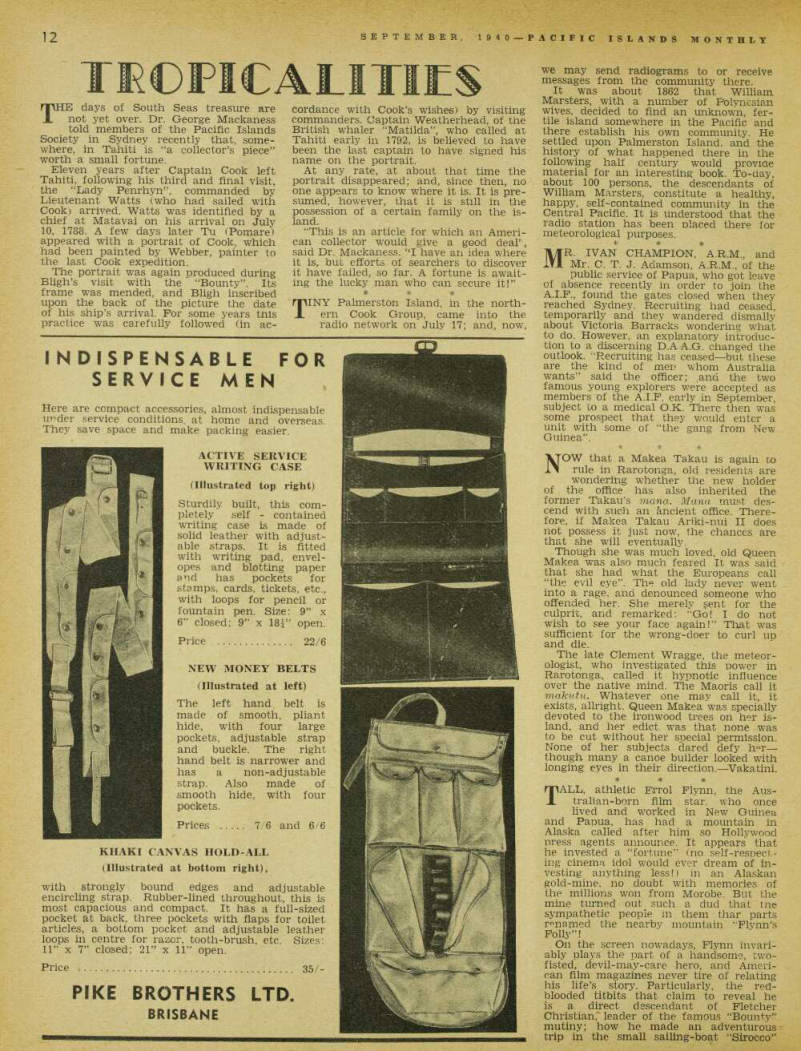
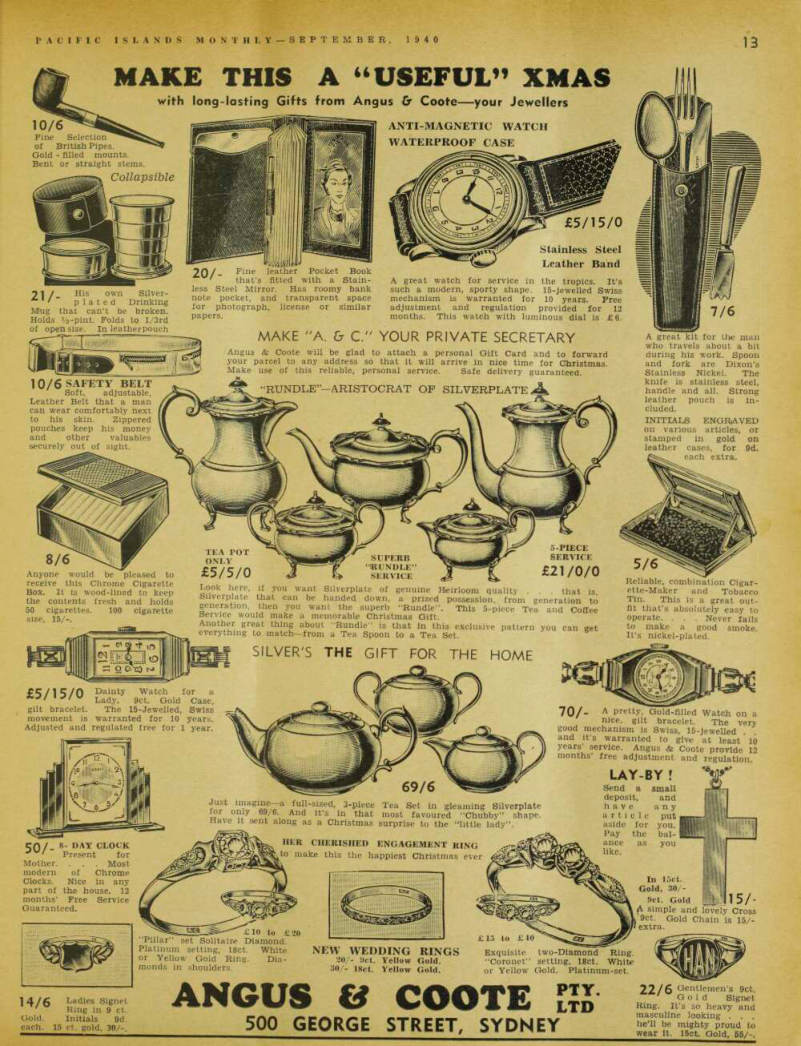
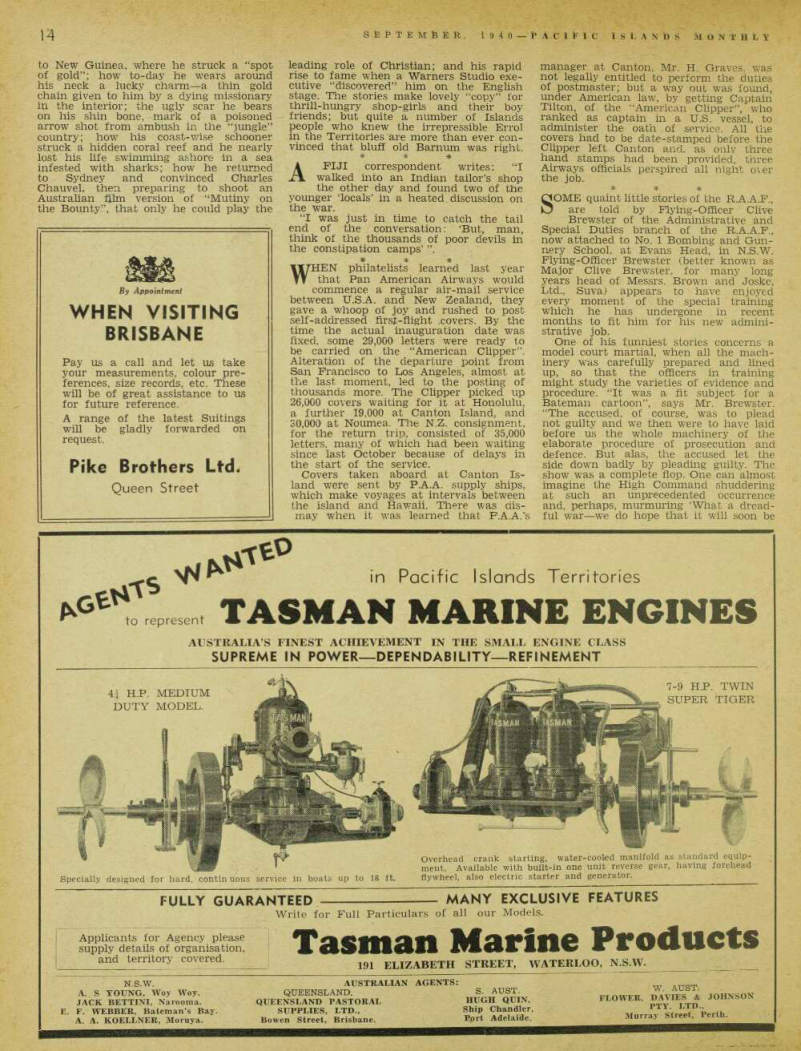

FTtHE days of South Seas treasure are JL not yet over. Dr. George Mackaness told members of the Pacific Islands Society in Sydney recently that, some where, in Tahiti is “a collector’s piece” worth a small fortune.
Eleven years after Captain Cook left Tahiti, following his third and final visit, the “Lady Penrhyn”, commanded by Lieutenant Watts (who had sailed with Cook) arrived. Watts was identified by a chief at Matavai on his arrival on July 10, 1788. A few days later Tu (Pomare) appeared with a portrait of Cook, which had been painted by Webber, painter to the last Cook expedition.
The portrait was again nroduced during Bligh’s visit with the “Bounty”. Its frame was mended, and Bligh inscribed upon the back of the picture the date of his ship’s arrival. For some years this practice was carefully followed (in ac
cordance with Cook’s wishes) by visiting commanders. Captain Weatherhead, of the British whaler “Matilda”, who called at Tahiti early in 1792, is believed to have been the last captain to have signed his name on the portrait.
At any rate, at about that time the portrait disappeared; and, since then, no one appears to know where it is. It is pre sumed, however, that it is still in the possession of a certain family on the is land.
“This is an article for which an Ameri can collector w r ould give a good deal’ , said Dr. Mackaness. ‘T have an idea where it is, but efforts of searchers to discover it have failed, so far. A fortune is await ing the lucky man who can secure it!” * * * TINY Palmerston Island, in the north ern Cook Group, came into the radio network on July 17; and, now,
we may send radiograms to or receive messages from the community there.
It was about 1862 that William Marsters, with a number of Polynesian wives, decided to find an unknown, fer tile island somewhere in the Pacific and there establish his own community. He settled upon Palmerston Island, and the history of what happened there in the following half century would provide material for an interesting book. To-day, about 100 persons, the descendants of William Marsters, constitute a healthy, happy, self-contained community in the Central Pacific. It is understood that the radio station has been placed there for meteorological purposes. * * *
Mr. Ivan Champion, A.R.M., And
Mr. C. T. J. Adamson, A.R.M., of the public service of Papua, who got leave of absence recently in order to join the A.1.F., found the gates closed when they reached Sydney. Recruiting had ceased, temporarily and they wandered dismally about Victoria Barracks wondering what to do. However, an explanatory introduc tion to a discerning D.A A.G. changed the outlook. "Recruiting has ceased—but these are the kind of men whom Australia wants” said the officer; and the two famous young explorers were accepted as members of the A.I.F. early in September, subject to a medical O.K. There then was some prospect that they would enter a unit with some of “the gang from New Guinea”. * * * NOW that a Makea Takau is again to rule in Rarotonga, old residents are wondering whether the new holder of the office has also inherited the former Takau’s mana. Mana must des cend with such an ancient office. There fore, if Makea Takau Ariki-nui II does not possess it just now, the chances are that she will eventually.
Though she was much loved, old Queen Makea was also much feared It was said that she had what the Europeans call “the evil eye”. The old lady never went into a rage, and denounced someone who offended her. She merely §ent for the culprit, and remarked: “Go! I do not wish to see your face again!” That was sufficient for the wrong-doer to curl up and die.
The late Clement Wragge, the meteor ologist, who investigated this power in Rarotonga, called it hypnotic influence over the native mind. The Maoris call it makutu. Whatever one may call it, it exists, allright. Queen Makea was specially devoted to the ironwood trees on her is land, and her edict was that none was to be cut without her special permission.
None of her subjects dared defy h°r— though many a canoe builder looked with longing eyes in their direction.—Vakatini. * * * TALL, athletic Errol Flynn, the Aus tralian-born film star, who once lived and worked in New Guinea and Papua, has had a mountain in Alaska called after him so Hollywood press agents announce. It appears that he invested a “fortune” (no self-respect ing cinema idol would ever dream of in vesting anything less!) in an Alaskan gold-mine, no doubt with memories of the millions won from Morobe. But the mine turned out such a dud that tne sympathetic people in them thar parts renamed the nearby mountain “FlymTs Folly”!
On the screen nowadays, Flynn invari ably plays the part of a handsome, two fisted, devil-may-care hero, and Ameri can film magazines never tire of relating his life’s story. Particularly, the red blooded titbits that claim to reveal he is a direct descendant of Fletcher Christian, leader of the famous “Bounty” mutiny; how he made an adventurous trip in the small sailing-boat “Sirocco”
to New Guinea, where he struck a “spot of gold”; how to-day he wears around his neck a lucky thin gold chain given to him by a dying missionary in the interior; the ugly scar he bears on his shin bone, mark of a poisoned arrow shot from ambush in the “jungle” country; how his coast-wise schooner struck a hidden coral reef and he nearly lost his life swimming ashore in a sea infested with sharks; how he returned to Sydney and convinced Charles Chauvel, then preparing to shoot an Australian film version of “Mutiny on the Bounty”, that only he could play the
leading role of Christian; and his rapid rise to fame when a Warners Studio exe cutive “discovered” him on the English stage. The stories make lovely “copy” for thrill-hungry shop-girls and their boy friends; but quite a number of Islands people who knew the irrepressible Errol in the Territories are more than ever con vinced that bluff old Barnum was right. * * * A FIJI correspondent writes: “I walked into an Indian tailor’s shop the other day and found two of the younger ‘locals’ in a heated discussion on the war.
“I was just in time to catch the tail end of the conversation: ‘But, man, think of the thousands of poor devils in the constipation camps’ * * * 11THEN philatelists learned last year TT that Pan American Airways would commence a regular air-mail service between U.S.A. and New Zealand, they gave a whoop of joy and rushed to post self-addressed first-flight .covers. By the time the actual inauguration date was fixed, some 29,000 letters were ready to be carried on the “American Clipper”.
Alteration of the departure point from San Francisco to Los Angeles, almost at the last moment, led to the posting of thousands more. The Clipper picked up 26,000 covers waiting for it at Honolulu, a further 19,000 at Canton Island, and 30,000 at Noumea. The N.Z. consignment, for the return trip, consisted of 35,000 letters, many of which had been waiting since last October because of delays in the start of the service.
Covers taken aboard at Canton Is land were sent by P.A.A. supply ships, which make voyages at interval's between the island and Hawaii, There was dis may when it was learned that P.A.A.’s
managei* at Canton, Mr. H. Graves, was not legally entitled to perform the duties of postmaster; but a way out was found, under American law, by getting Captain Tilton, of the “American Clipper”, who ranked as captain in a U.S. vessel, to administer the oath of service. All the covers had to be date-stamped before the Clipper left Canton and. as only three hand stamps had been provided, three Airways officials perspired all night over the job. * * ■* SOME quaint little stories of the R.A.A.F., are told by Flying-Officer Clive Brewster of the Administrative and Special Duties branch of the R.A.A.F., now attached to No. 1 Bombing and Gun nery School, at Evans Head, in N.S.W.
Flying-Officer Brewster (better known as Major Clive Brewster, for many long years head of Messrs. Brown and Joske, Ltd., Suva) appears to have enjoyed every moment of the special training which he has undergone in recent months to fit him for his new admini strative job.
One of his funniest stories concerns a model court martial, when all the mach inery was carefully prepared and lined up, so that the officers in training might study the varieties of evidence and procedure. “It was a fit subject for a Bateman cartoon”, says Mr. Brewster.
“The accused, of course, was to plead not guilty and we then were to have laid before us the whole machinery of the elaborate procedure of prosecution and defence. But alas, the accused let the side down badly by pleading guilty. The show was a complete flop. One can almost imagine the High Command shuddering at such an unprecedented occurrence and, perhaps, murmuring ‘What a dread ful war—we do hope that it will soon be
over and we can get back to real soldier ing’.”
Flying-Officer Brewster says that among the first batch of trainees at Evans Head are three men from Fiji—O’Connor, Mackay and Dearman. * * * FINDS of La Perouse relics on Vani koro (Santa Cruz Group) are becom ing increasingly rare. Even the lead shot balls from the old muskets turn up only rarely nowadays. However, not long ago a native dreamt on two occasions that he dug up something valuable in the vicinity of a certain tree; he infected some of the others with his enthusiasm and, as a result, considerable trenching was done, though there was no sign of any Spanish money. Some years ago a Chinaman working on Vanikoro showed a Spanish real to a trader, who tried to obtain it from him. After the Chinese had departed, it was learned that he had made a haul of about 80 or 90. The coins were taken back to China, and probably melted down, the owner not realising that he could have secured more for them as curios. When Dr.
Raymond Firth (now Reader in Anthro pology at London University) was on Tikopia Island (southwards of Vanikoro) he recognised a glass decanter as un doubtedly being a La Perouse relic. Still preserved in a temple of the Taumako clan, it is dedicated to the Eel God. The anthropologist offered a soda-water bottle (the only glass he had with him) for it. With some reluctance the priest declined. The god, he explained, was summoned only on special occasions, by shaking the decanter, and if summoned without sufficient reason there was no knowing how angry he would be.—E.R. * *. *
Captain “Blue” Allen, Of Wau,
New Guinea, was in Sydney early in September. He now holds an im portant post in an Australian unit which hopes to be going overseas at no distant date. He is looking particularly well, brown and fit. and when one notices the straight line where formerly there was a pronounced convex, one accepts his statement that he has taken off a couple of stone. He was with the troops which recently marched from their camo, near Sydney, over the Blue Mountains to Bathurst, and he states, with grim satis faction, that he saw many of them more or less under the table. “It was a long, hard walk”, he says, “but I had got used to that in New Guinea.” * * * WHEN the Polynesian Vikings of old voyaged across the Pacific, ever to wards the rising sun, they carried with them passengers to whom they paid little attention. However, it now looks as if the descendants of the flies that also made those sea trips may throw some light on those early journeyings.
Insect fauna in Hawaii, it has been proved, has definite examples of Indian origin. Both the Hawaiian house-fly and the rat, being closely associated with the lives of the early travellers, are now be ing studied with particular attention. All the evidence goes to show that they also, must have travelled in the canoes. These species have been found by Bishop Museum investigators on the southern Asiatic coast, as well as on most of the Polynesian islands, and suggest two main lines of migration—one from the south, designated as India, and the other from the north, which is possibly Siberian in origin. The two lines converge, roughly, along the Yangtze River in China, and at Yokohama, in Japan.
New species now are being investigated, and, when they have been identified, it is believed that many gaps in present day charts of Pacific migrations will be filled.
Advertisements & other items, pp. 14-17 (2 items)
Indispensable For
SERVICE MEN
Here are compact accessories, almost indispensable under service conditions at home and overseas.
They save space and make packing easier. ¥
ACTIVE SERVICE
WRITING CASE
(Illustrated top right) Sturdily built, this completely self - contained writing case is made of solid leather with adjustable straps. It is fitted with writing pad, envelopes and blotting paper and has pockets for stamps, cards, tickets, etc., with loops for pencil or fountain pen. Size: 9” x 6” closed: 9” x 18£” open.
Price 22/6
NEW MONEY BELTS
(Illustrated at left) The left hand belt is made of smooth, pliant hide, with four large pockets, adjustable strap and buckle. The right hand belt is narrower and has a non-adjustable strap. Also made of smooth hide, with four pockets.
Prices 7 6 and 6 6
KHAKI CANVAS HOLD-ALL
(Illustrated at bottom right). with strongly bound edges and adjustable encircling strap. Rubber-lined throughout, this is most capacious and compact. It has a full-sized pocket at back, three pockets with flaps for toilet articles, a bottom pocket and adjustable leather loops in centre for razor, tooth-brush, etc. Sizes: 11” x 7” closed: 21” x 11” open.
Price 35/-
PIKE BROTHERS LTD.
BRISBANE
MAKE THIS A “USEFUL” XMAS
with long-lasting Gifts from Angus Cr Coote—your Jewellers 10/6 Fine Selection of British Pipes.
Gold - filled mounts.
Bent or straight stems.
Collapsible
L I ■ ■ ft
ANTI-MAGNETIC WATCH
WATERPROOF CASE
2]/_ His own Silver- • plated Drinking Mug that can’t be broken.
Holds Vz-pint. Folds to l/3rd of open size. In leather pouch 20/- Fin e leather Pocket Book ' that’s fitted with a Stainless Steel Mirror. Has roomy bank note pocket, and transparent space for photograph, license or similar papers.
S.V £5/15/0 J Stainless Steel m Leather Band == A great watch for service in the tropics. It’s such a modern, sporty shape. 15-jewelled Swiss mechanism is warranted for 10 years. Free adjustment and regulation provided for 12 months. This watch with luminous dial is £6.
MAKE "A. & C." YOUR PRIVATE SECRETARY Angus & Coote will be glad to attach a personal Gift Card and to forward your parcel to any address so that it will arrive in nice time for Christmas.
Make use of this reliable, personal service. Safe delivery guaranteed. 7/6 10/6 safety belt Soft, adjustable, Leather Belt that a man can wear comfortably next to his skin. Zippered pouches keep his money and other valuables securely out of sight. 8/6 A great kit for the man who travels about a bit during his work. Spoon and fork are Dixon’s Stainless Nickel. The knife is stainless steel, handle and all. Strong leather pouch is included.
INITIALS ENGRAVED
on various articles, or stamped in gold on leather cases, for 9d. each extra.
Anyone would be pleased to receive this Chrome Cigarette Box. It is wood-lined to keep the contents fresh and holds 50 cigarettes. 100 cigarette size, 15/-.
RUNDLE - ARISTOCRAT OF SILVERPLATE
5-PIECE
SERVICE
SUPERB
KINDLE
SERVICE
5/6 £2l/0/0
TEA POT
ONLY
£5/5/0 Look here, if you want Silverplate of genuine Heirloom quality . . that is Silverplate that can be handed down, a prized possession, from generation to generation, then you want the superb “Rundle”. This 5-piece Tea and Coffee Service would make a memorable Christmas Gift.
Another great thing about “Rundle” is that in this exclusive pattern you can get everything to -match —from a Tea Spoon to a Tea Set.
SILVER'S THE GIFT FOR THE HOME
Reliable, combination Cigarette-Maker and Tobacco Tin. This is a great outfit that’s absolutely easy to operate. . . . Never fails to make a good smoke.
It’s nickel-plated.
CC/IC/Q Dainty Watch for a v Lady. 9ct. Gold Case, gilt bracelet. The 15-Jewelled, Swiss movement is warranted for 10 years.
Adjusted and regulated free for 1 year. /*\ 5./ V 7 J L 69/6 50/- 8 ‘ DAY clock ' Present for Mother. Most modern of Chrome Clocks. Nice in any part of the house. 12 months’ Free Service Guaranteed.
Just imagine—a full-sized, 3-piece Tea Set in gleaming Silverplate for only 69/6 And it’s in that most favoured “Chubby” shape.
Have it sent along as a Christmas surprise to the “little lady”.
HER CHERISHED ENGAGEMENT RING
make this the happiest Christmas ever r m £lO to £2O “Pillar” set Solitaire Diamond.
Platinum setting, 18ct. White or Yellow Gold Ring. Diamonds in shoulders. 70/- A P re tty, Gold-filled Watch on a nice, gilt bracelet. The very good mechanism is Swiss, 15-jewelled and it’s warranted to give at least 10 years’ service. Angus & Coote provide 12 months’ free adjustment and regulation.
LAY-BY I
Send a small deposit, and have any article put aside for you.
Pay the bals you In 15ct.
Gold, 30/- 9ct. Gold simple and lovely Cross 9ct. Gold Chain is 15/extra.
NEW WEDDING RINGS
20/- 9ct. Yellow Gold. 30/- 18ct. Yellow Gold. m like A 3 115/- £l5 to Exquisite two-Diamond Ring.
“Coronet” setting, 18ct. White or Yellow Gold. Platinum-set. 14/6 Ladies Signet Ring in 9 ct.
Gold. Initials 9d each. 15 ct. gold, 30/-.
ANGUS & COOTE [JJ
500 GEORGE STREET, SYDNEY
22/6 Gentlemen
' Gold ’s , d Sign Ring. It’s so heavy ai masculine looking . . he’ll be mighty proud wear It. 15ct. Gold, 55/
By Appointment
WHEN VISITING
BRISBANE
Pay us a call and let us take your measurements, colour preferences, size records, etc. These will be of great assistance to us for future reference.
A range of the latest Suitings will be gladly forwarded on request.
Pike Brothers Ltd.
Queen Street
in Pacific Islands Territories
to represent
TASMAN MARINE ENGINES
AUSTRALIA’S FINEST ACHIEVEMENT IN THE SMALL ENGINE CLASS
SUPREME IN POWER—DEPENDABILITY—REFINEMENT
4‘ HP. MEDIUM
DUTY MODEL.
7-9 HP. TWIN
SUPER TIGER
* M f r Overhead crank starting, water-cooled manifold as ment. Available with built-in one unit reverse gear, standard equiphaving forehead Specially designed for hard, continuous service in boats up to 18 ft. flywheel, also electric starter and generator.
FULLY GUARANTEED
MANY EXCLUSIVE FEATURES
Write for Full Particulars of all our Models.
Applicants for Agency please supply details of organisation, and territory covered.
Tasman Marine Products
191 ELIZABETH STREET, WATERLOO, N.S.W.
N.S.W.
A. S YOUNG, Woy Woy.
JACK BETTINI, Narooma.
F. WEBBER, Bateman’s Bay.
A. A. KOELLNER, Moruya.
AUSTRALIAN AGENTS:
QUEENSLAND. S. AUST.
QUEENSLAND PASTORAL HUGH QUIN,
SUPPLIES, LTD., Ship Chandler, Bowen Street. Brisbane.
Da t<4 A rl nl o irlo
W. AUST.
FLOWER, DAVIES & JOHNSON
PTY. LTD.,
Clhaa! Pori V»
44
ULTIMATE
If Cut out this Coupon and post to-day.
7-VALVE PORTABLE MANTEL
WORLD-WAVE VIBRATOR MODEL
Specially suited for
Island conditions
An unique Dual Purpose high quality Set exclusive to “ULTIMATE”.Two sets in one—a superior mantel model and easily-carried multi-wave Vibrator Portable. Instantly detachable lid effects the transformation.
Specially suited to Island reception. Magnificent performance under all circumstances. Thorough dependability guaranteed by “ULTIMATE”. Will satisfy the most fastidious expert.
Take it anywhere—picnics, meetings, dances, boating parties, car outings, etc., etc. —performance will always be superb! Exclusive Light Ray Tuning {obtainable only in “ULTIMATE”) . Five controls: Tone, Volume, Dial Lamp {for conservation of Battery Power), Wave Band and Tuning ; Broadcast 1600-550 kilocycles', Short Wave 16-52 metres; special 8 in. Rola Reproducer {sealed against humidity) ; High Fidelity Push-Pull Output {unusual in Vibrator Models) ; A.V.C. Spin Tuning, etc., etc. INSECT-PROOF!
Also obtainable in 5-Valve World-Wave Battery Vibrator, in 6- Valve World Wave, and 8 and 10-Valve All-Wave Electric.
GEORGE BROWN & CO. PTY. LTD., 267 Clarence Street, Sydney.
Please send me particulars of “ULTIMATE” Radio Receivers as advertised in “Pacific Islands Monthly”.
Name Address u
ill
I M m s * GEORGE BROWN Cr CO. PTY. LTD., 267 Clarence St., Sydney
14
SEPTEMBER, 194 0 - PACIFIC ISLANDS MONT H L V
Last of Male Pitcairners Dies on
N.I. at 87
AT Norfolk Island on August 28, the only male survivor of the original Pitcairners, who went to Norfolk Island in 1856, died in hospital—George Parkin Christian, aged 87. He had been in good health until recently, but was admitted to hospital late in August for treatment.
There now remains only one survivor of the 1856 band of Pitcairners—Mrs.
Selina Buffett, who is 84 years of age.
A photograph and article dealing with these two old Pitcairners appeared in the “P.1.M.” of June, 1934.
Miss Edna Charlotte, eldest daughter of Captain and Mrs. Low, was married to Mr. Archibald Boulton, second son of Mr. and Mrs. C. W. Boulton, at Suva, Fiji, recently.
European Markets?
Seeking Solution Of Copra Problem
How Shall We Find Compensation For The Lost European Markets?
By R. W. Robson
FOR weeks, I have been studying this South Pacific copra situation. It is as plain as the nose on your face that, unless some extraordinary step is taken, the South Pacific copra industry is going to be more or less wiped out.
This must not be permitted—not with out a fight, anyway. All the principal Territories now have alternative indus tries, but everyone of them still has a copra industry—there are coconut plan tations, where copra regularly is cut for sale, on every coraline island south of the Line. There are thousands of little trade stores handling that copra; hund
reds and hundreds of little vessels, trans porting it.
Copra is the cement which holds to gether the bricks of the economic struc ture in the South Seas.
There has been talk of Government re lief, and sustenance payments, and what nots. Mere stop-gaps, postponing the day of evil reckoning.
What is the use of giving “relief”, when at least half the world’s market has been wiped out? Hitler, to-day, squats on top of Germany, Austria, Poland, Czecho slovakia, Denmark, Norway, Holland, Bel gium, France and Italy—everyone of them, formerly, a large consumer 01 copra. Other countries, like Sweden, Spain and the Balkans, are also more or less blockaded. The British market has a limit.
That market will come back —some day.
But this war is going on for years.
Even if that European market was open, there are not nearly enough ships to carry the South Pacific copra—not when they can cut thousands of miles ofi their voyages by loading Dutch East Indies or Malayan copra.
Normally, the South Pacific produces 200.000 tons of copra annually. Under present conditions, production may be down 50 per cent. That leaves 100,000 to 120.000 tons to be sold, somehow, if a skeletonised industry is to be kept alive.
Europe (mostly Britain) might take 30.000 or 40,000 tons; there is a market in Mexico for another 30,000 tons or so.
And, after that, what? That was the problem to which I could see no answer, although I talked and exchanged letters with a score of people even more inter ested and bothered than I.
Obviously, there must be found either a new territorial market for copra, or a new use for coconut oil, on a vast scale.
That latter alternative is discussed elsewhere in this issue. There may be something to it. But new uses for coco nut oil cannot be developed in a week.
And weeks are very precious to the harassed coconut-planters, just now.
Where cn earth could one look for a new territorial market?
THEN I got what I thought was a brainwave. I was chatting with Sir Walter Carpenter, just back from the United States, and he told me of how he had been examining the Mexican mar ket.
“If only we could get into that United States market!” he remarked. “But they’re tied up to the Philippines—they take anything up to half a million tons from that group every year.”
“But why not?” I said. “There is a new relationship now between Britain and America—surely, it would be possible to put it up to Washington. There is nothing we need so much as dollar ex change, and nothing they need more than a continuing market for their petrol and cars and films. If U.S.A. would ad mit 50,000 tons p.a. of South Pacific copra, our industry would be able to carry on, and their Philippines industry would be scarcely affected.”
We discussed it at some length. Sir Walter jeered at the idea that I, or any one else, could induce the slow-moving Australian Government to hurry in a matter like this; but he admitted that, if the proposal were properly presented to Washington, there would be a fair chance of its acceptance.
“Give me authority to approach the
United States Government, and I guai antee I would at least have it fully con sidered”, he exclaimed, thumping his desk in characteristic fashion.
It was an idea. I could imagine no better copra ambassador than the rest less, tireless founder of Carpenter and Co. He made his original fortune, buying
and selling copra, and there is no man alive who knows more about the quirks and twists of the market.
So I sent off the following letter, im mediately, to the always-courteous Terri tories Minister, Mr. Howard Nock. May be it was impertinence: but someone has to try something. What’s the use of our all sitting around the South Pacific
copra industry, merely moaning? The
letter:— Hon. Howard Nock, M.P., Minister in Charge of External Territories, Canberra.
Dear Mr. Nock, —
Re Situation Of Copra Industry.
For many weeks past I have been giving con sideration to the condition of the copra industry, and I now wish to make a suggestion to you, which will, I believe, if acted upon promptly, give some hope of providing a new market for copra from the British Pacific Islands.
The position is well known to you now, I think. In ordinary times, the Pacific Islands south of the equator produced annually from 150,000 to 200,000 tons of copra. The market was for the most part in Europe, with a small proportion going to Mexico and a smaller pro portion still to Australia. As a result of the war, the European market is entirely closed, and the Mexican and Australian markets cannot take any more copra than they have been tak ing in the past. Furthermore, even if there were markets available in Europe, there are not enough ships to carry the product from the Pacific, half way around the world to Europe.
As a result of these depressed conditions, copra production in the Pacific territories has fallen very much, especially copra from native sources. But the great majority of European planters, unable to get rid of their labour and fearing to allow their expensively made plan tations to return to the jungle, are keeping on making copra in the hope that they may get some small sum for it. It is impossible to estimate present-day production in the British territories south of the equator. It probably is less than 100,000 tons per annum. There is no
market for this copra and, as you know, all the Islands stores are full to overflowing.
During the past three months I have discussed with all the interests concerned all the various plans put up to give relief to planters and traders in this desperate situation—but none of the plans, although some are very interesting, seem practicable. There just simply is not any available market for copra, or coconut oil, or coconut cake—and the old markets in Europe are not likely to be re-opened for a long time.
The only possible market which could give us relief is that of the United States. I have no doubt that you know the position there. By means of a processing tax, the United States protects the copra production of the Philippine Islands, about 400,000 tons per annum, against the competition of copra grown anywhere else.
Now if U.S.A. could be induced to open its gates to. say, 50,000 tons per annum of copra produced in British Pacific territories, a very great measure of relief would be afforded to the British communities in New Guinea, Papua, Solomon Islands, Tonga, Fiji, Samoa and the Cook Islands. From what I know of the con dition of the copra market in the United States, I believe that this quantity of British Pacific copra could be admitted without serious em barrassment to the American and Philippine interests concerned. This morning, I discussed the matter with Sir Walter Carpenter, head of W. R. Carpenter & Company, Limited, who has just returned to Sydney after purchasing in the United States two 5,000 ton steamers which he proposes to use as freighters in the Pacific.
Sir Walter while in the United States carefully examined the copra position, especially the market in Mexico, and the United States capacity for copra consumption.
Finally, I said to him: “If you had Common wealth authority, do you think that, knowing the copra industry as you do, you could get the United States Government to seriously consider a proposal that British Pacific copra should be admitted?” We discussed the matter for some time, and Sir Walter finally said that if he could get the assistance of the Commonwealth Government in putting up such a plan, he was sure that he would secure a favourable reaction in the United States. Then, after some further
talk, I secured his permission to put this pro posal up to you.
I want you to accept my assurance that this idea came from me—the plan was not suggested originally by Sir Walter Carpenter.
I am sure that if the Commonwealth Govern ment would authorise Sir Walter Carpenter to take up this matter with the United States, he could get the backing also of the Government of New Zealand and the High Commissioner for the Western Pacific (Sir Harry Luke, in Suva), both of whom are vitally interested.
I gathered in conversation with Sir Walter that he is very eager to give public service in some way in this time of crisis. For that reason alone I think that he would put his whole heart into the task that I have sug gested. But, in any event, he could be ex pected to do his very utmost, because the in terests of his own group of companies are so vitally affected.
Sir Walter Carpenter intends to return to the United States at a very early date on business connected with his own firm. I think that this would be an admirable opportunity for him to try to get the American market opened for some of our South Pacific copra.
I am dictating this letter immediately follow ing my conversation with Sir Walter Carpenter, in the hope that it will catch you before you leave Canberra, and allow you to place it before the Prime Minister.
I need not urge upon you the great urgency of this matter, nor express my belief that you will do your very utmost to assist the industry in the way proposed, if you think it is a prac ticable plan.
Obviously, of course, Sir Walter Carpenter in a matter of that kind, would have to work in close co-operation with Mr. Casey, in Washing ton. He recognises that. But in a matter of such importance to all the British Pacific com munities, we may be sure that we would have the utmost co-operation of Mr. Casey, once the Commonwealth Government approved of the proposal.
With kind regards, Yours faithfully,
22/8/1940. R. W. Robson.
The more I thought about it, the better I liked it. I decided I would combat De
partmental laissez-faire by following up
the letter with a couple of urgent, long distance, telephone calls. Within three days, I received this reply:— Dear Mr. Robson.—Thanks for yours of 22nd August. The Government have approved of my proposal to carry the copra industry along dur ing its depression, and I have arranged with three representatives of the three leading traders to meet me on Monday next. I am anxious to have their co-operation, and the details of the proposal will be available after it has been discussed with them.
Yours sincerely,
H. K. Nock,
Minister in Charge of External Territories.
Sydney, 24/8/1940.
Not a word about the United States idea, or any reference to the fact that, if our industry is to survive, we must find a new market, to replace a huge market that has disappeared. Only a complacent statement about the Aus
tralian Government’s sustenance relief
and pooling plan—a thing so feeble and footling that it would be funny, if it were not that it spells tragedy for so many good men in the Territories.
I went back to Sir Walter Carpenter, and told him about mv letter, and its
extraordinary reply.
“Was there anything impracticable
about that suggestion?” I asked. “Isn’t it possible to approach America in this way’
Or have I made an ass of myself?”
He gave a shout of laughter. “You’re old enough to know that Governments won’t hurry”, he said. “Of course, there should be a market available for us in America. But the proposal ties up with a few matters of international policy, and wants some thought and delicate handling: and it really is easier to start a relief and pooling scheme, with much expense and lots of officials, about the practical value of which I am very doubtful.”
Later on, I got some details of the copra relief and pooling plan. They are printed below. Read them' and weep!
THE conscientious Mr. Nock is now away electioneering—he holds a border-line seat. All the indications, at the moment, are that Australia shortly will have a new Government, and a new Minister for Pacific Territories.
That may mean a new policy of relief for copra-growers. If it does, there should be a chance at last of getting con certed action as between Australia, New Zealand and the High Commission for
the Western Pacific —thus bringing into line the conditions of the copra industry in all British territories and colonies south of the equator. That is the only way in which this copra problem can be handled.
It was useless to look to the Menzies Government, in Australia, for any kind of lead—it was pathetically incapable of constructive effort.
Advertisements & other items, pp. 18-21 (2 items)
W. H. GROVE & Sons Ltd.
AUCKLAND
Island Traders. p.o. box 490.
Telegraphic and Cable Address: “Grove”, Auckland.
Shippers of all classes of New Zealand Products, specially prepared for the Island trade.
Representing English Manufacturers throughout the Cook and Society Islands, Fiji, Tonga, Samoa, Niue, New Caledonia, New Guinea, etc.
In FIJI as—W. H. Grove & Sons (Fiji) Ltd.
London-Made GUNS
The high-grade productions of the leading London Makers are regarded as unequalled in the world. Of these, there is none greater than E. J. CHURCHILL
(GUNMAKERS) LTD., LONDON.
We have in stock 4 only Churchill's famous Utility Models.
A superior quality gun, hand made, at £65/12/6 ea.
Also, 1 only Walter Betts Royal Model, one of the best weapons ever built, a quality production from first to last; embodiment of the very best material and workmanship, at £lO5.
We have a wide range of Sporting Guns and Rifles by leading makers.
SEND FOR OUR CATALOGUE.
SYDNEY IMPORTING CO. PTY. LTD.
HARDWARE AND ELECTRICAL MERCHANTS
521-3 KENT STREET, SYDNEY
Breville Wins Again!
A Wonderful Record . . .
Two of the first three International DX (long distance) Contests conducted by the “Australasian Radio World” were won by Breville users. The First Contest was won by Mr. Ern Neill, of Ipswich, Queensland, with the wonderful record of receiving 1,825 stations on his Breville Receiver.
Now BREVILLE Receives Over 80 COUNTRIES
the
ades
par
befo
re Id or Winner of the Third DX Contest, Mr. R. G. Cook, with his Breville receivers.
BREVILLE MANUFACTURES A COM-
PLETE RANGE OF HIGH-GRADE A.C.
ELECTRIC AND A.C.-D.C. UNIVERSAL
RECEIVERS. ALSO VIBRATOR AND
1.4 DRY BATTERY SETS FOR ALL
WAVE RANGES. SPECIAL SETS FOR
ANY VOLTAGE OR FREQUENCY-
Special impregnation for tropical conditions.
Manufactured and fully guaranteed by:
BREVILLE RADIO
Pty. Ltd.
Head Office and Factory: 67-73 Missenden Road, Camperdown, N.S.W., Australia. ’Phone: L 3688 (4 lines).
Telegrams & Cables: “Breville,” Sydney.
And at Brisbane and Newcastle.
Distributors in all States of the Commonwealth.
First place in the Third Contest goes to Mr. R. G. Cook, of Bowen, Queensland, who writes as follows: “My main receiver is the latest eight-tube triple-wave Breville, using Radiotrons 6U7 (2), 6AB, 686, 6U6, 6C5, 5Y3, 6U6, coupled to a 12 in. Rola speaker. This set gives me all the power that is required. I find that it is 100 per cent, efficient, and may add that the climatic conditions of North Queensland are not the best for DX on account of the heat and the heavy atmospheric conditions that prevail at all times of the year. At the present time I can bring in any of the southern commercial stations at R 6-7 at mid-day, which is good for this part of the globe.
“My second set is a five-valve Breville vibrator broadcast model, with which I do all broadcast DX and have picked up many foreign stations in the wee small hours.
“Catching the elusive DX is a matter of sitting up late or early, and by doing this I have logged over 80 countries, giving me a total of 500 odd cards, which include Alaska, U.S.A., Germany, Belgium, South Africa, India, England, Scotland, Ecuador, Panama, Malaya, Manila, Hawaii, and others, which, if typed here, would take the entire page.
My best reception was from K7ANQ, Alaska.”
Send the coupon for full particulars of Breville “Record-Breaking” Sets.
AGENTS WANTED.
POST THIS COUPON NOW!
Without obligation, send me FREE illustrated Catalogue of Breville Radio Receivers.
NAME
ADDRESS
P.1.M., Sept., 1940.
PURE TOMATO
CONTENT
m
IN A CLASS OF ITS OWN
Equal to the World’s Best
Throughout Australia and Overseas there is an ever-increasing demand for Under present conditions it is wise to ensure that you have ample stocks of all our lines.
“COLONIAL”and
“BRONTE”
HIGH-GRADE CANNED MEATS
There is no better quality — none more wholesome.
TRADE MEATS FOR THE ISLANDS
order
COLONIAL’ BRAND
Roast, Corned and Boiled Beef Packed in 6,5, 4,3, 2, 1 lb. and 12 oz. tins.
Also Corned Beef in 12 oz. Taper Tins.
Roast, Corned and Boiled Mutton. 1 lb. and 12 oz. tins.
Choice Dripping
36 lb., 2 lb., 1 lb. tins, and 1 lb. packets.
All our Meats are canned under the supervision of a Meat Inspector of the Commonwealth of Australia. m ca S M P P PT»
WHOUSAIf
DELICIOUS
"BRONTE" HOT MEALS
Steak and Kidney Pudding.
Beef Steak Pudding.
Sausages and Tomato.
Sausages and Vegetable.
Lamb and Green Peas.
Corned Beef and Boston Beans with Tomato Sauce.
Steak and Tomato.
The Colonial Wholesale Meat Coy. Pty. Ltd.
30 GROSVENOR STREET, SYDNEY
or OATS
i. BRING HEALTH TO
•A; your class
& ■ r ;s»b.' , ‘ v cjS * > 4W, HR «r. ■sac !§s*«£2S^*A
-f»TOOHEVS LTP.
* SYDNEY
TOOHEYS
OATMEAL
STOUT
here's to'ee
PACIFIC ISLANDS SOCIETY
Visitors from the Islands to Sydney (or those interested in Islands affairs), are advised to communicate with the honorary secretary of the above Society, which has been formed to study the history, traditions, economics, and political developments of the Pacific Islands.
Next Meeting, Hotel Carlton, September 25, at 8 p.m.
Films of Bali, D.E.1., will be shown in aid of Netherlands’ Relief Appeal.
Address for Correspondence;
THE PACIFIC ISLANDS SOCIETY,
Box 2434 MM., G.P.0., Sydney.
Papua Copra
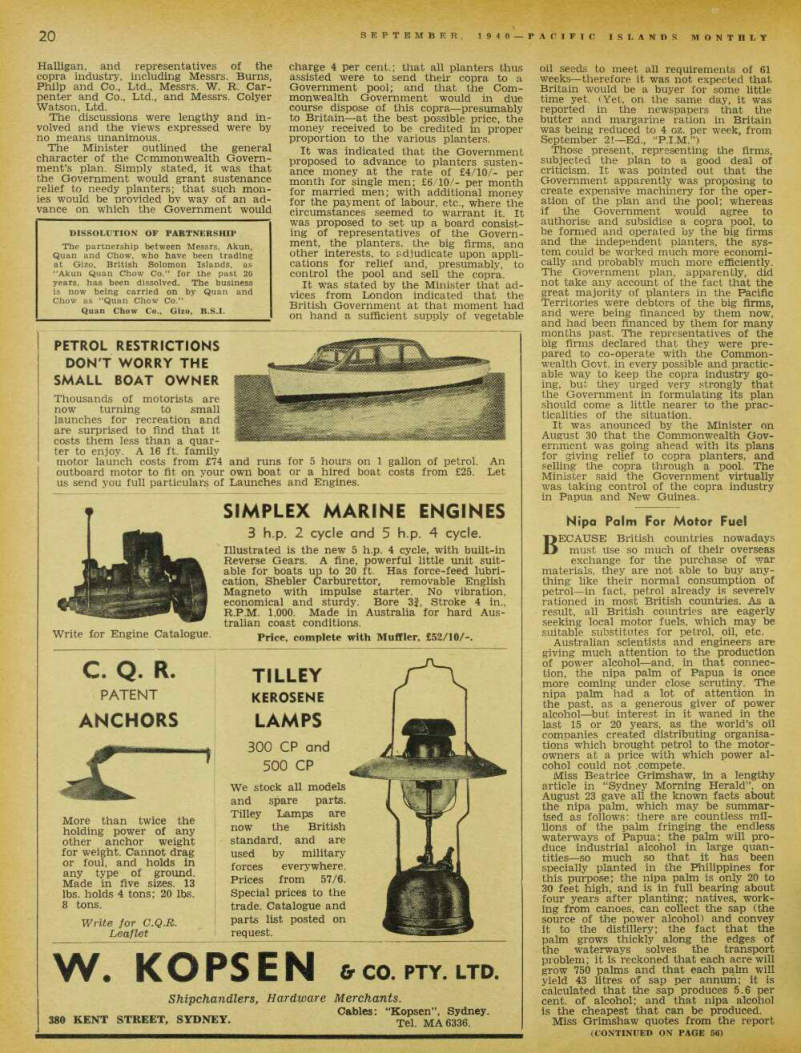
New Guinea And
How Australian Government is "Taking Control"
WAYS and means of giving relief to coconut planters in the Australian Pacific territories were discussed at a meeting in Sydney on August 26 at tended by the Minister in Charge of Ex ternal Territories (Mr. Nock), the sec retary of the Islands branch of the Prime Minister’s Department, Mr. J. R.
Halligan, and representatives of the copra industry, including Messrs. Burns, Philp and Co., Ltd., Messrs. W. R. Carpenter and Co., Ltd., and Messrs. Colyer Watson, Ltd.
The discussions were lengthy and involved and the views expressed were by no means unanimous.
The Minister outlined the general character of the Commonwealth Governments plan. Simply stated, it was that the Government would grant sustenance relief to needy planters, that such monles would be provided by way of an advance on which the Government would
charge 4 per cent.; that all planters thus assisted were to send their copra to a Government pool; and that the Com monwealth Government would in due course dispose of this copra—presumably to Britain—at the best possible price, the money received to be credited in proper proportion to the various planters.
It was indicated that the Government proposed to advance to planters susten ance money at the rate of £4/10/- per month for single men; £6/10/- per month for married men; with additional money for the payment of labour, etc., where the circumstances seemed to warrant it. It was proposed to set up a board consist ing of representatives of the Govern ment, the planters, the big firms, ana other interests, to adjudicate upon appli cations for relief and, presumably, to control the pool and sell the copra.
It was stated by the Minister that ad vices from London indicated that the British Government at that moment had on hand a sufficient supply of vegetable
oil seeds to meet all requirements of 61 weeks—therefore it was not expected that Britain would be a buyer for some little time yet. (Yet, on the same day, it was reported in the newspapers that the butter and margarine ration in Britain was being reduced to 4 oz. per week, from September 2!—Ed., Those present, representing the firms, subjected the plan to a good deal of criticism. It was pointed out that the Government apparently was proposing to create expensive machinery for the oper ation of the plan and the pool; whereas if the Government would agree to authorise and subsidise a copra pool, to be formed and operated by the big firms and the independent planters, the sys tem could be worked much more economi cally and probably much more efficiently.
The Government plan, apparently, did not take any account of the fact that the great majority of planters in the Pacific Territories were debtors of the big firms, and were being financed by them now, and had been financed by them for many months past. The representatives of the big firms declared that they were pre pared to co-operate with the Common wealth Govt, in every possible and practic able way to keep the copra industry go ing, but they urged very strongly that the Government in formulating its plan should come a little nearer to the prac ticalities of the situation.
It was anounced by the Minister on August 30 that the Commonwealth Gov ernment was going ahead with its plans for giving relief to copra planters, and selling the copra through a pool. The Minister said the Government virtually was taking control of the copra industry in Papua and New Guinea.
Nipa Palm For Motor Fuel

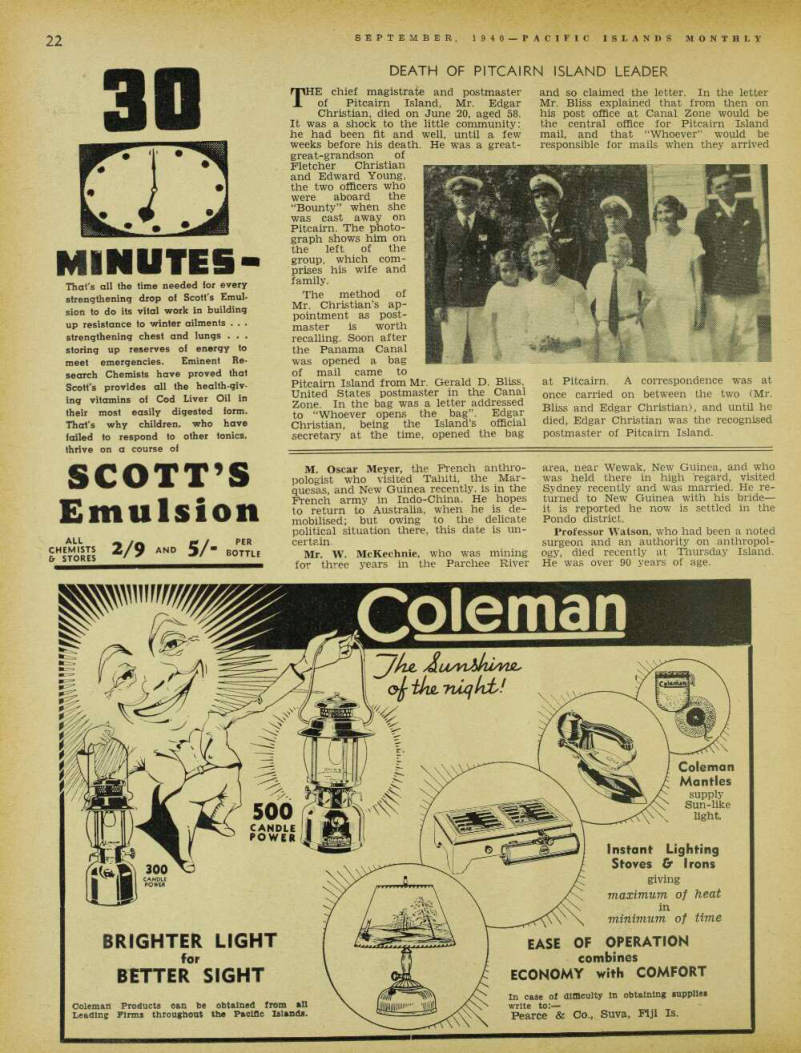
BECAUSE British countries nowadays must Use so much of their overseas exchange for the purchase of war materials, they are not able to buy any thing like their normal consumption of petrol—in fact, petrol already is severely rationed in most British countries. As a result, all British countries are eagerly seeking local motor fuels, which may be suitable substitutes for petrol, oil, etc.
Australian scientists and engineers are giving much attention to the production of power alcohol —and, in that connec tion, the nipa palm of Papua is once more coming under close scrutiny. The nipa palm had a lot of attention in the past, as a generous giver of power alcohol —but interest in it waned in the last 15 or 20 years, as the world’s oil comnanies created distributing organisa tions which brought petrol to the motor owners at a price with which power al cohol could not .compete.
Miss Beatrice Grimshaw, in a lengthy article in “Sydney Morning Herald”, on August 23 gave all the known facts about the nipa palm, which may be summar ised as follows: there are countless mil lions of the palm fringing the endless waterways of Papua: the palm will pro duce industrial alcohol in large quan tities—so much so that it has been specially planted in the Philippines for this purpose; the nipa palm is only 20 to 30 feet high, and is in full bearing about four years after planting; natives, work ing from canoes, can collect the sap (the source of the power alcohol) and convey it to the distillery; the fact that the palm grows thickly along the edges of the waterways solves the transport problem; it is reckoned that each acre will grow 750 palms and that each palm will yield 43 litres of sap per annum; it is calculated that the sap produces 5.6 per cent, of alcohol; and that nipa alcohol is the cheapest that can be produced.
Miss Grimshaw quotes from the report
(Continued On Page 56)
of Mr. C. E. Lane Poole, on “The Forest Resources of Papua and New Guinea”, published in 1925, in which he says: “The nipa palm is a striking object in every waterway. In other lands it is a valuable source of alcohol. . . . The absence of a local supply of petrol would cripple Aus tralia were a war to cut her off from petroleum. The solution lies in the de velopment of another motor fuel. Alco hol is one which offers every promise.
Papua has in her nipa palm a very large source of this motor fuel.”
These were curiously prophetic words.
Sago Palm Also Suggested
It has also been suggested that large quantities of power alcohol, suitable as a motor fuel, can be obtained from the sago palms of New Guinea and Papua.
It is claimed that each ton of sago will yield 70 gallons of power alcohol, at a cost (at the distillery) of Bd. per gal lon. The plan is beinsr investigated.
Advertisements & other items, pp. 22-24 (3 items)
Anchors
DISSOLUTION OF PARTNERSHIP
The partnership between Messrs. Akun, Quan and Chow, who have been trading at Gizo, British Solomon Islands, as “Akun Quan Chow Co.” for the past 20 years, has been dissolved. The business is now being carried on by Quan and Chow as “Quan Chow Co.”
Quan Chow Co., Gizo, 8.5.1.
PETROL RESTRICTIONS
DON'T WORRY THE
SMALL BOAT OWNER
Thousands of motorists are now turning to small launches for recreation and are surprised to find that it costs them less than a quarter to enjoy. A 16 ft. family motor launch costs from £74 and runs for 5 hours on 1 gallon of petrol, outboard motor to fit on your own boat or a hired boat costs from £25. us send you full particulars of Launches and Engines.
An Let
SIMPLEX MARINE ENGINES
Write lor Engine Catalogue.
C. Q. R.
PATENT
ANCHORS
More than twice the holding power of any other anchor weight for weight. Cannot drag or foul, and holds in any type of ground.
Made in five sizes. 13 lbs. holds 4 tons; 20 lbs. 8 tons.
Write for C.Q.R.
Leaflet 3 h.p. 2 cycle and 5 h.p. 4 cycle. s Illustrated is the new 5 h.p. 4 cycle, with built-in Reverse Gears. A fine, powerful little unit suitable for boats up to 20 ft. Has force-feed lubrication, Shebler Carburettor, removable English Magneto with impulse starter. No vibration, economical and sturdy. Bore 3f, Stroke 4 in., R.P.M. 1,000. Made in Australia for hard Australian coast conditions.
Price, complete with Muffler, £52/10/-.
TILLEY
KEROSENE
LAMPS
300 CP and 500 CP We stock all models and spare parts.
Tilley Lamps are now the British standard, and are used by military forces everywhere.
Prices from 57/6.
Special prices to the trade. Catalogue and parts list posted on request.
W. KOPSEN & CO. PTY. LTD.
Shipchandlers, Hardware Merchants.
380 KENT STREET, SYDNEY.
Cables: “Kopsen”, Sydney.
Tel. MA 6336.
21
i‘ ACIF 1C ISLANDS MONTHLY SEPTEMBER, 19 4 0
uiion
NERVY, FATIGUED
MALARIA SUFFERER
Now Better—with more
energy than ever
'wm.
A REFRESHING HEALTH
DRINK
A delightful health drink can be made by mixing a dose of BIDOMAK with a wine-glassful or half a tumbler of ice cold water, or any aerated water.
A few drops of BIDOMAK in a tumbler of ice cold water is a
delightful refreshing thirst-
quencher.
SCIENTIFIC CONTROL
Manufactured in the Bidomak Pharmaceutical Laboratories, one of the most up-to-date, hygienic laboratories in the Southern Hemisphere, to which is attached a fully qualified Doctor of Medicine, and under the control of a qualified chemist, who was trained in the most modern English Laboratory in the world. 70 Newlaw Street, Waverley, 27/3/39.
"For many years I have suffered from Malaria. This left me in a very debilitated state, always feeling fatigued and nervy.
I have tried many preparations, but I had not received real benefit until I commenced taking BIDOMAK. I now feel much better in every way, I eat better, and have much more energy than I had previously.
"My eldest daughter, who has been very run down recently, is feeling much benefit from your wonderful tonic/' (Signed) (Mr.) A. F. GROVER.
BIDOMAK’S Vital Minerals Overcome the Depressing
After-Effects of Malaria and Tropical Lethargy !
Bidomak provides a method of supplying energy to the cells of the body wherever the natural supply of vitality is insufficient to maintain the normal activity of glands and organs. It is a scientific compound of VITAL MINERALS in a pre-dissolved liquid form that act quickly to restore vitality and overcome the depressing after-effects of severe tropical lethargy and malaria.
Bidomak’s vital minerals include FERRUM—to build rich, red blood and so carry extra oxygen to the tissues. CALCIUM to build up bone and nerve tissues as well as general bodily ENDURANCE. SODIUM —to keep digestion keen, counter acidity, clear away depression, and make you feel well.
PHOSPHORUS to
prevent nervous breakdown and fatigue. POTASSIUM —to prevent nerve pains and prevent constipation. GLY-
CEROPHOSPHAT E S
for nervous disorders. If you want to take a new “lease on life”—to feel gloriously fit and well then start to-day on a course of revitalising BIDOMAK to make you fit and, keep you fit.
uiion
AT ALL LEADING ISLAND STORES
J
MINUTES-
That's all the time needed for every strengthening drop of Scott's Emulsion to do its vital work in building up resistance to winter ailments . . . strengthening chest and lungs . . . storing up reserves of energy to meet emergencies. Eminent Research Chemists have proved that Scott's provides all the health-giving vitamins of Cod Liver Oil in their most easily digested form.
Thai's why children, who have failed to respond to other tonics, thrive on a course of
SCOTT’S
Emulsion
ALL a / A
CHEMISTS 2/9
& STORES ' *
PER
BOTTLE
2K-
Au/nhkivuL,
ike, Tiiql^t!
/ *<3 Eg? 3 500 I
CANDLE
POWER
300
CANOU
POWt*
BRIGHTER LIGHT
for
BETTER SIGHT
Coleman Products can be obtained from all Leading Firms throughout the Pacific Island*.
Coleman Mantles supply Sun-like light.
Instant Lighting Stoves & Irons giving maximum of heat in minimum of time
EASE OF OPERATION
combines
ECONOMY with COMFORT
In case of difficulty In obtaining supplies write to:— Pearce & Co., Suva, Fiji Is.
Death Of Pitcairn Island Leader
rr\HE chief magistrate and postmaster X of Pitcairn Island, Mr. Edgar Christian, died on June 20, aged 58.
It was a shock to the little community; he had been fit and well, until a few weeks before his death. He was a great
great-grandson of Fletcher Christian and Edward Young, the two officers who were aboard the “Bounty” when she was cast away on Pitcairn. The photo graph shows him on the left of the group, which com prises his wife and family.
The method of Mr. Christian’s ap pointment as post master is worth recalling. Soon after the Panama Canal was opened a bag of mail came to
Pitcairn Island from Mr. Gerald D. Bliss, United States postmaster in the Canal Zone. In the bag was a letter addressed to “Whoever opens the bag”. Edgar Christian, being the Island’s official secretary at the time, opened the bag
and so claimed the letter. In the letter Mr. Bliss explained that from then on his post office at Canal Zone would be the central office for Pitcairn Island mail, and that “Whoever” would be responsible for mails when they arrived
at Pitcairn. A correspondence was at once carried on between the two (Mr.
Bliss and Edgar Christian), and until he died, Edgar Christian was the recognised postmaster of Pitcairn Island.
M. Oscar Meyer, the French anthro pologist who visited Tahiti, the Mar quesas, and New Guinea recently, is in the French army in Indo-China. He hopes to return to Australia, when he is de mobilised; but owing to the delicate political situation there, this date is un certain.
Mr. W. McKechnie, who was mining for three years in the Parchee River
area, near Wewak, New Guinea, and who was held there in high regard, visited Sydney recently and was married. He re turned to New Guinea with his bride — it is reported he now is settled in the Pondo district.
Professor Watson, who had been a noted surgeon and an authority on anthropol ogy, died recently at Thursday Island.
He was over 90 years of age.
Administrator Of
Papua
A Report and a Contradiction
NO appointment has been made to the position of Administrator of the Australian Territory of Papua; and the indications are that nothing will be done by the Federal Government until after the general election on September 21.
A stir was caused by a report in the “Sydney Morning Herald”, of August 19, that the Federal Government probably would decide to have only one adminis trator for the two territories of Papua and New Guinea, and it was expected that Sir Walter McNicoll (the present Administrator of New Guinea) would take charge of the two territories — probably with his headquarters at Port Moresby.
Some such move as this was not unexpected—the formation of Papua and New Guinea into the Bth Australian Military district, with headquarters at Port Moresby, had suggested that for reasons of economy it might be desirable to have one man who would act at once as Administrator of the two territories and officer in charge of the military district.
As no contradiction was published, the editor of the “P.1.M.”, on August 21, directed the attention of the Minister for External Territories to the newspaper report, and asked whether the proposal was being seriously entertained. The Minister sent a reply by telegram. He said that the statement in the “Sydney Morning Herald” was “purely a press man's imagination”, and that no such suggestion had even been considered.
The indications are that Mr. Cham pion will retain his present office, as Acting-Lieutenant Governor of Papua, for some time to come. There prob ably will be a change of Government at Canberra; there will be a new Minister for External Territories: and that new Minister, instead of taking so import ant a step as the appointment of a new Administrator, almost certainly will wish to visit Papua and New Guinea and make himself acquainted, not only with the Territories themselves, but with the principal officials in the Territories.
Hit-And-Run Driver
From Our Own Correspondent
Nukualofa, Aug. 16.
THEY have hit-and-run motor drivers here, even in this quiet part of the Pacific.
A Tongan man, Funakivale, was knocked down and run over by a car when walking along the road in Nukua lofa near the Victoria Memorial Hall, shortly after dark. He was taken to the hospital by the police, somewhat seriously injured, and the police are now trying to locate the irresponsible driver.
Mr. J. W. P. Fitzgerald arrived at Wau, New Guinea, from Darwin in August. He will represent the legal firm of Olleren shaw and Macgregor, the latter partner having gone South for war service.
Mr. R. H. Ferguson, representative of an English business enterprise, returned to Australia in August after a visit to New Guinea.
Lemons Wanted In
Australia
THE long-continued drought has ruined the Australian lemon-crop; and this, combined with wartime inability to import from the Mediter ranean, has sent Australian pastrycooks and confectionery manufacturers search ing frantically for supplies of “candied peel”. Much attention has been given to Norfolk Island, where lemons grow wild, and plentifully; but the fruit there has a coarse, thick skin, and is not what the market urgently demands.
The only Australian districts producing good lemons at present are Queensland and Mildura (Vic.) and growers there are getting up to £lB per ton. Any Islands planters with crops of good lemons should make contact with the Australian market.
Mr. T. T. Russell, Resident Magistrate at Suva, Fiji, has received notice of his transfer on promotion to the Straits Settlements as Crown Counsel. He has been in Fiji since 1936, having previously served in Siam. Mr. A. G. Forbes, Crown Attorney at Dominica, who will succeed Mr. Russell, is expected to arrive in Suva in December.
Advertisements & other items, pp. 25-26 (2 items)
Dustproof Steel Uniform Trunks
BARNET GLASS
RUBBER CO. LTD.
Wentworth Avenue,
SYDNEY
Radio : “BARNGLASS” — SYDNEY.
—o— Manufacturers and Suppliers to the Islands’ trade of all rubber goods:— Tyres, Tubes and Accessories Rubber Soled Footwear Tennis Balls Waterproof Garments Mechanical Hoses, Transmission Belting, etc.
Tennis Racquets, Golf Balls, Toy Bails, etc., and native trade lines. —o — Prompt and efficient attention to all enquiries.
Box 2629 E.E., Tel. MA 6151 G.P.0., SYDNEY. M 4409 25 lines.
DUSTPROOF STEEL UNIFORM TRUNKS
Made of strongly reinforced steel with rubber-sealed lid, this handsome black japanned uniform case is both water- and dustproof. It has two nickel lock bolts, handles at ends and is finished inside in dark blue. Size 36” x 20” x 12”. a
STEEL CASH BOX
Coloured olive green, this cash box has an inside tray with divisions and is fitted with a four-lever lock. Two sizes: 10 in. x 6 in. x 3Vz in., and 12 in. x 9 in. x 5 in.
HEAVY STEEL DEED BOX
This is made in seven sizes;—l2 in., 14 in., 16 in., 18 in., 20 in., 22 in. and 24 in. It is handsomely finished with a strong four-lever English lock.
TRADERS INVITED TO APPLY FOR PRICE LIST AND FULL PARTICULARS.
FORD SHERI NGTON LTD.
MANUFACTURERS, KIPPAX STREET, SYDNEY
Modern Refrigeration for the South Sea Islands
The ELECTROLUX
KEROSENE OPERATED
REFRIGERATOR
ELECTROLUX offers economical, modern and completely efficient
REFRIGERATION FOR ISLANDS' HOMES.
FREEZES CONTINUOUSLY WHILE SMALL LAMP BURNS
Freezing controlled by simply regulating height of flame. Uses only f gallon of kerosene per week.
MOTORLESS ... NO PARTS TO GET OUT OF ORDER.
MODEL L 22 MODEL L3BO MODEL LKSSO Capacity • (as Illustrated) Capacity 3.2 cubic feet. Capacity 4 cubic feet. 5.5 cubic feet.
GUARANTEED FOR TWO YEARS.
• Write to your Local Distributor for prices and full details.
Obtainable from W. R. Carpenter & Company Ltd.—Sydney, and following New Guinea Branches; Rabaul, Salamaua, Wau, Kavieng, Madang, and Wewak.
W. R. Carpenter & Coy. (Solomon Is.) Pty. Ltd. —Tulagi, British Solomon Islands.
On Chong & Company Pty. Ltd.—Butaritari, Gilbert and Ellice Islands.
Representation in Papua and New Hebrides.
24
SEPTEMBER, 1940 PACIFIC ISLANDS MONT fi 1 $
Extraordinary Charge Against New
Guinea Officials
Well-Known Missionary Suggests Sex Offences and Motive of Revenge
IT is reported in the “Rabaul Times” of August 23 that very strong representa tions have been made in Canberra against the action of the New Guinea Administration in removing seven Roman Catholic Missionaries of German nation ality from their stations in outlying places, and placing them under guard.
It is stated that the Administrator re fused to give any information to the Roman Catholic authorities, and it is contended that the missionaries “have been loyal and devoted citizens and have confined themselves solely to their mis sion work, never mentioning war matters to anyone”.
Charge Of “Sex Perversion”
117RITING in the “Catholic Press” of TT August 1, Rev. J. D. Madigan, of Rabaul, refers to the arrest of the missionaries in strong terms; and then makes this statement: — “I have been now a long time in the Territory of New Guinea and I think 1 can form a fairly accurate estimate of the methods and motives employed by those who to-day gloat over the fact that a few Catholic missionaries have been removed from the villages and 'that others may soon share the same fate.
“It is an extraordinary fact, common to all tropical regions, that a certain type of person throws off all restraint when removed from civilisation. Overseers on lonely plantations, and Government officials also, adopt the practice of barter ing with the native chief for a native girl while they will be in the locality. If the unfortunate native girl, who is the nroposed victim, is a Catholic or is at tending the village mission school, she at once seeks the protection of the mis sionary with the result that the official or overseer is reported and quietly re moved.
“For the sake of the prestige of the white race very few of these cases ever become public. Unfortunately for native welfare and for the prestige of the whites, these sexual beasts without re ligion, morality or respect for themselves, not only move from place to nlace but even boast of their conduct.
“The Administrator remarked to one of our missionaries soon after the be ginning of the war that he was seeking the reports of his officers in outside places on the conduct of the local mis sionary in reference to the war. Imagine the Administrator writing to one of these officers and asking for his confi dential opinion of the local missionary.
If the person to whom the application is made is a good man. all is well, but if, as too often happens, he is a sexual pervert whose only restraint in the dis trict is the presence of a missionary, here is his golden opportunity of secretly as sisting in the removal of the missionary from the village. Devoted missionaries should be protected from such people”
Editorial Comment
WHILE conceding to Father Madigan the authority given to him by his long, splendid work in the mission field, and his well-known zeal in defend ing the natives against Depression and in justice. we feel that he has gone too far in making so foul a charge against officers of the New Guinea service.
Father Madigan says, in effect, that many of the administrative officials are “sex nerverts”. who misuse native girls, and he frankly infers that these men have revenged themselves upon Roman Catholic missionaries, who have rescued
native girls from their clutches, by re porting adversely upon the missionaries, thus causing them to be arrested and re moved.
This outrageous charge against the men of the New Guinea field staffs —men whose record is most creditable to them selves and to Australia—has been given such wide publicity that it cannot be allowed to remain where it is. Father Madigan has made the charges, deliber ately, in cold print; Father Madigan now should be given the opportunity of prov ing them, or withdrawing them, and apologising to the body of men whom he has vilified. It obviously is a matter for the Administrator, whom we presume is jealous of the honour of his service. If the Administrator does not take action,
then the matter should be brought up in the Commonwealth Parliament.
Father Madigan, in making his charges, must have had some particular case in mind. But he must not be permitted to go irresponsibly from the particular to the general, in this fashion. The New Guinea Public Service Association should see to it that so foul a calumny is answered.
The arrest of the seven Roman Catho lic missionaries is not a matter that can be discussed, without permission. But this may be said: Is it not possible, in view of the fact that enemy raiders are prowling about in the Pacific, and the Empire is fighting for its life, that the action taken was purely precautionary, and had nothing to do with the activities and opinions of the individual missionar ies?
Mr. H. S. Taylor, of A.W.A., Ltd., re turned to New Guinea in August from five months’ holiday in Australia. He is now stationed at Manus.
Advertisements & other items, p. 27 (1 item)
Ctoria
BITTER
vfW m 1 mm
Soap From Coconuts
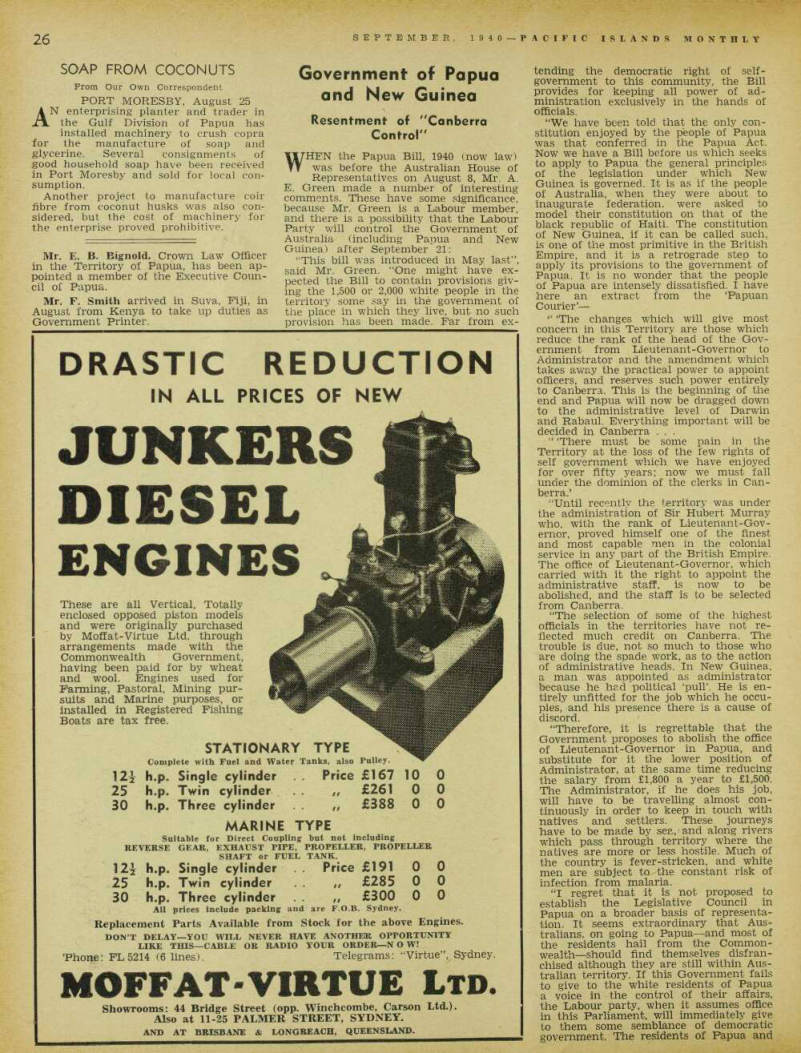
From Our Own Correspondent
Port Moresby, August 25
AN enterprising planter and trader in the Gulf Division of Papua has installed machinery to crush copra for the manufacture of soap and glycerine. Several consignments of good household soap have been received in Port Moresby and sold for local con sumption.
Another project to manufacture coir fibre from coconut husks was also con sidered, but the cost of machinery for the enterprise proved prohibitive.
Mr. E. B. Bignold, Crown Law Officer in the Territory of Papua, has been ap pointed a member of the Executive Coun cil of Papua.
Mr. F. Smith arrived in Suva, Fiji, in August from Kenya to take up duties as Government Printer.
Government' of Papua
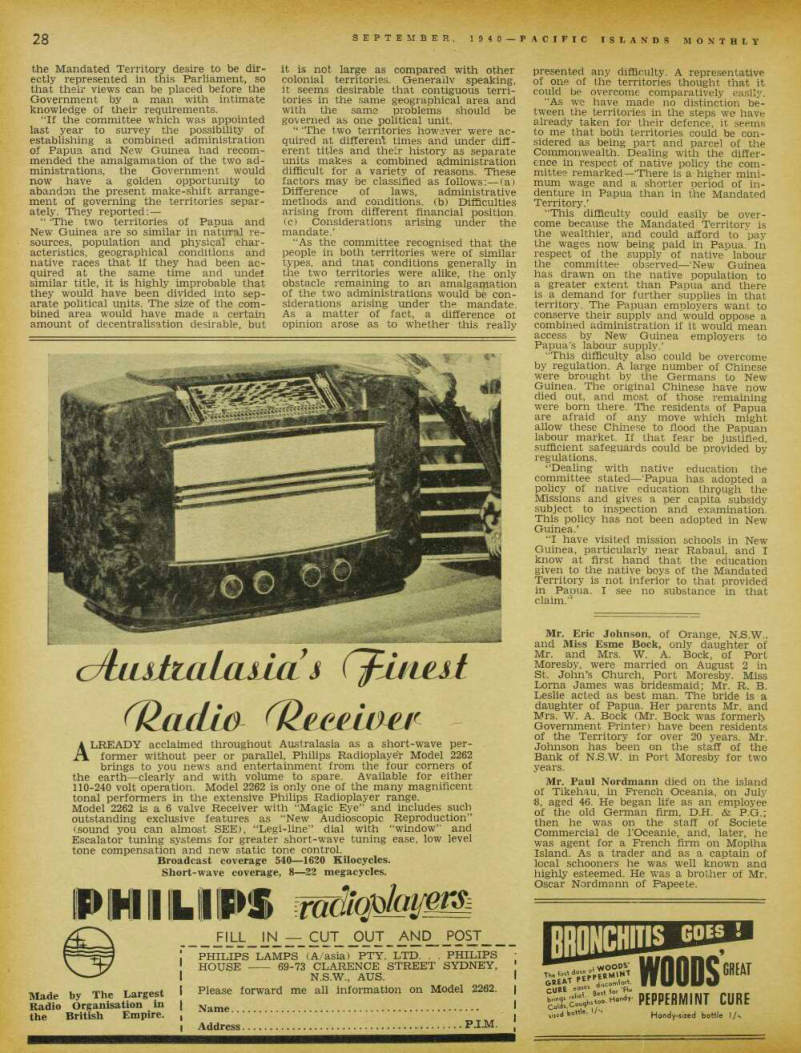
and New Guinea Resentment of "Canberra Control"
WHEN the Papua Bill, 1940 (now law) was before the Australian House of Representatives on August 8, Mr. A.
E. Green made a number of interesting comments. These have some significance, because Mr. Green is a Labour member, and there is a possibility that the Labour Party will control the Government of Australia (including Papua and New Guinea) after September 21; “This bill was introduced in May last’’, said Mr. Green. “One might have ex pected the Bill to contain provisions giv ing the 1,500 or 2,000 white people in the territory some say in the government of the place in which they live, but no such provision has been made. Far from ex
tending the democratic right of self government to this community, the Bill provides for keeping all power of ad ministration exclusively in the hands of officials.
“We have been told that the only con stitution enjoyed by the people of Papua was that conferred in the Papua Act.
Now we have a Bill before us which seeks to apply to Papua the general principles of the legislation under which New Guinea is governed. It is as if the people of Australia, when they were about to inaugurate federation, were asked to model their constitution on that of the black republic of Haiti. The constitution of New Guinea, if it can be called such, is one of the most primitive in the British Empire, and it is a retrograde step to apply its provisions to the government of Papua. It is no wonder that the people of Papua are intensely dissatisfied. I have here an extract from the ‘Papuan Courier’— “ ‘The changes which will give most concern in this Territory are those which reduce the rank of the head of the Gov ernment from Lieutenant-Governor to Administrator and the amendment which takes away the practical power to appoint officers, and reserves such power entirely to Canberra. This is the beginning of the end and Papua will now be dragged down to the administrative level of Darwin and Rabaul. Everything important will be decided in Canberra . . .
“ ‘There must be some pain in the Territory at the loss of the few rights of self government which we have enjoyed for over fifty years; now we must fall under the dominion of the clerks in Can berra.’
“Until recently the territory was under the administration of Sir Hubert Murray who. with the rank of Lieutenant-Gov ernor, proved himself one of the finest and most capable men in the colonial service in any nart of the British Empire.
The office of Lieutenant-Governor, which carried with it the right to appoint the administrative staff, is now to be abolished, and the staff is to be selected from Canberra.
“The selection of some of the highest officials in the territories have not re flected much credit on Canberra. The trouble is due, not so much to those who are doing the spade work, as to the action of administrative heads. In New Guinea, a man was anpointed as administrator because he had political ‘puli’. He is en tirely unfitted for the job which he occu pies, and his presence there is a cause of discord.
“Therefore, it is regrettable that the Government proposes to abolish the office of Lieutenant-Governor in Papua, and substitute for it the lower position of Administrator, at the same time reducing the salary from £l,BOO a year to £1,500.
The Administrator, if he does his job, will have to be travelling almost con tinuously in order to keep in touch with natives and settlers. These journeys have to be made by sea,-and along rivers which pass through territory where the natives are more or less hostile. Much of the country is fever-stricken, and white men are subject to the constant risk of infection from malaria.
“I regret that it is not proposed to establish the Legislative Council in Papua on a broader basis of representa tion. It seems extraordinary that Aus tralians, on going to Papua—and most of the residents hail from the Common wealth-should find themselves disfran chised although they are still within Aus tralian territory. If this Government fails to give to the white residents of Papua a voice in the control of their affairs, the Labour party, when it assumes office in this Parliament, will immediately give to them some semblance of democratic government. The residents of Papua and
the Mandated Territory desire to be directly represented in this Parliament, so that their views can be placed before the Government by a man with intimate knowledge of their requirements.
“If the committee which was appointed last year to survey the possibility of establishing a combined administration of Papua and New Guinea had recommended the amalgamation of the two administrations, the Government would now have a golden opportunity to abandon the present make-shift arrangement of governing the territories separately. They reported:— “ ‘The two territories of Papua and New Guinea are so similar in natural resources, population and physical characteristics, geographical conditions and native races that if they had been acquired at the same time and undel similar title, it is highly improbable that they would have been divided into separate political units. The size of the combined area would have made a certain amount of decentralisation desirable, but
it is not large as compared with other colonial territories. Generally speaking, it seems desirable that contiguous terri tories in the same geogranhical area and with the same problems should be governed as one political unit, “ 'The two territories however were ac quired at different times and under diff erent titles and their history as separate units makes a combined administration difficult for a variety of reasons. These factors may be classified as follows:—(a) Difference of laws, administrative methods and conditions, (b) Difficulties arising from different financial position. (c) Considerations arising under the mandate.’
“As the committee recognised that the people in both territories were of similar types, and that conditions generally in the two territories were alike, the only obstacle remaining to an amalgamation of the two administrations would be con siderations arising under the mandate, As a matter of fact, a difference of opinion arose as to whether this really
presented any difficulty. A representative of one of the territories thought that it could be overcome comparatively easily.
“As we have made no distinction be tween the territories in the steps we have already taken for their defence, it seems to me that both territories could be con sidered as being part and parcel of the Commonwealth. Dealing with the differ ence in respect of native policy the com mittee remarked—‘There is a higher mini mum wage and a shorter oeriod of in denture in Papua than in the Mandated Territory.’
“This difficulty could easily be over come because the Mandated Territorv is the wealthier, and could afford to 'pay the wages now being paid in Papua. In respect of the supply of native labour the committee obierved—‘New Guinea has drawn on the native population to a greater extent than Papua and there is a demand for further supplies in that territory. The Papuan employers want to conserve their supply and'would oppose a combined administration if it would mean access by New Guinea employers to Papua’s labour supply.’
“This difficulty also could be overcome by regulation. A large number of Chinese were brought by the Germans to New Guinea. The original Chinese have now died out, and most of those remaining were born there. The residents of Papua are afraid of any move which might allow these Chinese to flood the Papuan labour market. If that fear be justified, sufficient safeguards could be provided by regulations.
“Dealing with native education the committee stated—‘Papua has adonted a policy of native education thrpugh the Missions and gives a per capita subsidy subject to inspection and examination.
This policy has not been adopted in New Guinea.’
“I have visited mission schools in New Guinea, particularly near Rabaul, and I know at first hand that the education given to the native boys of the Mandated Territory is not inferior to that provided in Papua. I see no substance in that claim.’’
Mr. Eric Johnson, of Orange, N.S.W., and Miss Esme Bock, only daughter of Mr. and Mrs. W. A, Bock, of Port Moresby, were married on August 2 in St. John's Church, Port Moresby. Miss Lorna James was bridesmaid; Mr. R. B.
Leslie acted as best man. The bride is a daughter of Papua. Her parents Mr. and Mrs, W. A, Bock (Mr. Bock was formerl> Government Printer) have been residents of the Territory for over 20 years. Mr.
Johnson has been on the staff of the Bank of N.S.W. in Port Moresby for two years.
Mr. Paul Nordmann died on the island of Tikehau, in French Oceania, on July 8, aged 46. He began life as an employee of the old German firm, D.H. & P.G.; then he was on the staff of Societe Commercial de I’Oceanie, and, later, he was agent for a French firm on Mopiha Island. As a trader and as a captain of local schooners he was well known and highly esteemed. He was a brother of Mr.
Oscar Nordmann of Papeete.
Advertisements & other items, pp. 28-30 (2 items)
Diesel
DRASTIC REDUCTION
IN ALL PRICES OF NEW
JUNKERS
DIESEL
ENGINES
These are all Vertical, Totally enclosed opposed piston models and were originally purchased by Moffat-Virtue Ltd. through arrangements made with the Commonwealth Government, having been paid for by wheat and wool. Engines used for Farming, Pastoral, Mining pursuits and Marine purposes, or installed in Registered Fishing Boats are tax free.
STATIONARY TYPE
Complete with Fuel and Water Tanks, also Pulley.
121 h.p. Single cylinder
25 h.p. Twin cylinder
30 h.p. Three cylinder
Price £167 10 „ £261 0 „ £3BB 0
MARINE TYPE
Suitable for Direct Coupling but not including
REVERSE GEAR, EXHAUST PIPE, PROPELLER, PROPELLER
SHAFT or FUEL TANK.
121 h.p. Single cylinder . . Price £l9l 0 0 25 h.p. Twin cylinder . . „ £285 0 0 30 h.p. Three cylinder . . „ £3OO 0 0 All prices include packing and are F. 0.8. Sydney.
Replacement Parts Available from Stock for the above Engines.
DON’T DELAY—YOU WILL NEVER HAVE ANOTHER OPPORTUNITY LIKE THIS—CABLE OR RADIO YOUR ORDER—N OW! ’Phone: FL5214 (6 lines). Telegrams: “Virtue”, Sydney.
MOFFAT-VIRTUE Ltd.
Showrooms: 44 Bridge Street (opp. Winchcombe, Carson Ltd.).
Also at 11-25 PALMER STREET, SYDNEY.
AND AT BRISBANE & LONGREACH, QUEENSLAND.
its Proa-Free
, „ p A * o> The thin J M Owners of the largest fleets of Buses tough film W J J and Trucks use the “Drag-Free’ of Shell Motor Shell Motor Oil because it Oil protects the reduces wear - cuts vital moving parts of down repair bills your engine under all |U| fl Trt D and easier conditions idling - starting IYI U I UVI starting and or working under the extreme more milepressure of pull or speed. Aw age.
THE SHELL COMPANY Of AUSTRALIA LIMITED (Incorporated In Great Britain) 10.09
fC ** mm 52 *s» H
cdashulasias (finest
fßeoewer
ALREADY acclaimed throughout Australasia as a short-wave performer without peer or parallel, Philips Radioplayer Model 2262 brings to you news and entertainment from the four corners of the earth —clearly and with volume to spare. Available for either 110-240 volt operation. Model 2262 is only one of the many magnificent tonal performers in the extensive Philips Radioplayer range.
Model 2262 is a 6 valve Receiver with “Magic Eye” and includes such outstanding exclusive features as “New Audioscopic Reproduction” (sound you can almost SEE), “Legi-line” dial with “window” and Escalator tuning systems for greater short-wave tuning ease, low level tone compensation and new static tone control.
Broadcast coverage 540—1620 Kilocycles.
Short-wave coverage, 8—22 megacycles.
PHI I LIPS
raoiQ
Made by The Largest Radio Organisation in the British Empire. _I L L ill Jpuj _AN fOSJ_ ! PHILIPS LAMPS (A/asia) PTY. LTD. . . PHILIPS
HOUSE 69-73 CLARENCE STREET SYDNEY,
I N.S.W., AUS. I
I Please forward me all information on Model 2262.
1 Name
I Address P.I.M. (
JllillilH” asrtß« WOODS*' 1 peppermint cure iiied bottle, >/ • Handy-sized bottle 1/-^
How Canton Island
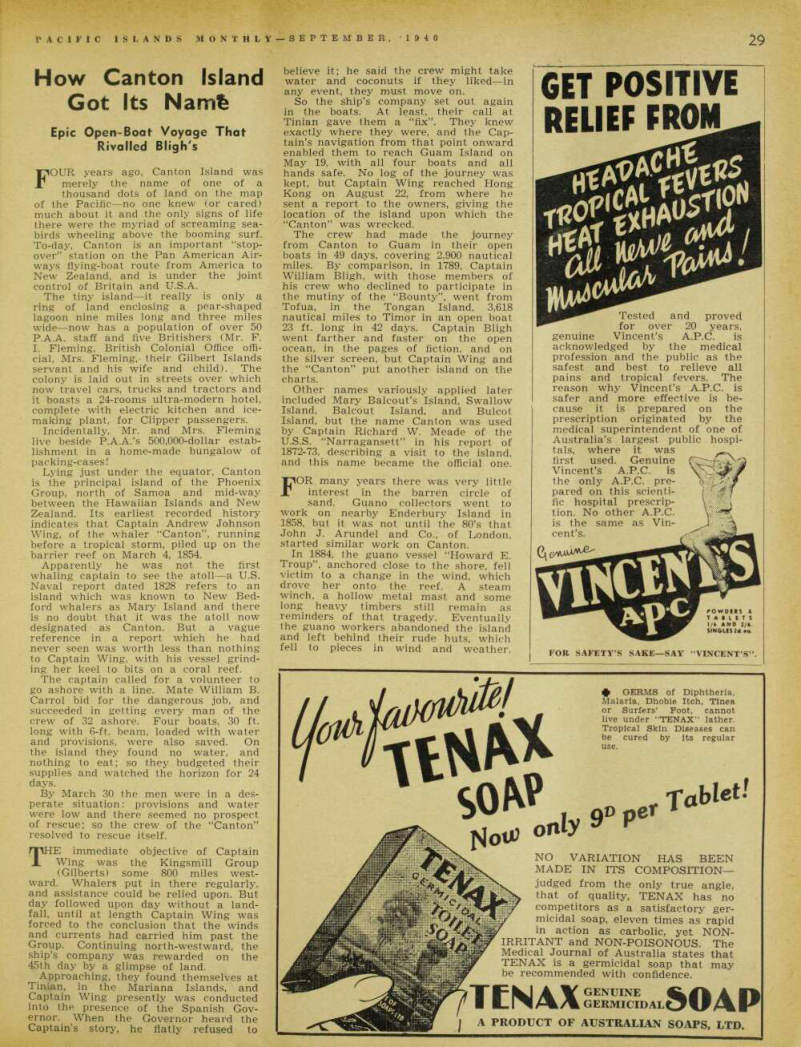
Got Its Name Epic Open-Boat Voyage That Rivalled Bligh's
FOUR years ago, Canton Island was merely the name of one of a thousand dots of land on the map of the Pacific —no one knew (or cared) much about it and the only signs of life there were the myriad of screaming sea birds wheeling above the booming surf.
To-day, Canton is an important “stop over” station on the Pan American Air ways flying-boat route from America to New Zealand, and is under the joint control of Britain and U.S.A.
The tiny island —it really is only a ring of land enclosing a pear-shaped lagoon nine miles long and three miles wide —now has a population of over 50 P.A.A. staff and five Britishers (Mr. F.
I. Fleming, British Colonial Office offi cial, Mrs. Fleming, their Gilbert Islands servant and his wife and child). , The colony is laid out in streets over which now travel cars, trucks and tractors and it boasts a 24-rooms ultra-modern hotel, complete with electric kitchen and ice making plant, for Clipper passengers.
Incidentally, Mr. and Mrs. Fleming live beside P.A.A.’s 500,000-dollar estab lishment in a home-made bungalow of packing-cases!
Lying just under the equator, Canton is the principal island of the Phoenix Group, north of Samoa and mid-way between the Hawaiian Islands and New Zealand. Its earliest recorded history indicates that Captain Andrew Johnson Wing, of the whaler “Canton”, running before a tropical storm, piled up on the barrier reef on March 4, 1854.
Apparently he was not the first whaling captain to see the atoll —a U.S.
Naval report dated 1828 refers to an island which was known to New Bed ford whalers as Mary Island and there is no doubt that it was the atoll now designated as Canton. But a vague reference in a report which he had never seen was worth less than nothing to Captain Wing, with his vessel grind ing her keel to bits on a coral reef.
The captain called for a volunteer to go ashore with a line. Mate William B.
Carrol bid for the dangerous job, and succeeded in getting every man of the crew of 32 ashore. Four boats, 30 ft. long with 6-ft. beam, loaded with water and provisions, were also saved. On the island they found no water, and nothing to eat; so they budgeted their supplies and watched the horizon for 24 days.
By March 30 the men were in a des perate situation: provisions and water were low and there seemed no prospect of rescue; so the crew of the “Canton” resolved to rescue itself.
THE immediate objective of Captain Wing was the Kingsmill Group (Gilberts) some 800 miles west ward. Whalers put in there regularly, and assistance could be relied upon. But day followed upon day without a land fall, until at length Captain Wing was forced to the conclusion that the winds and currents had carried him past the Group. Continuing north-westward, the ship’s company was rewarded on the 45th day by a glimpse of land.
Approaching, they found themselves at Tinian, in the Mariana Islands, and Captain Wing presently was conducted into the presence of the Spanish Gov ernor. When the Governor heard the Captain’s story, he flatly refused to
believe it; he said the crew might take water and coconuts if they liked—in any event, they must move on.
So the ship’s company set out again in the boats. At least, their call at Tinian gave them a “fix”. They knew exactly where they were, and the Cap tain’s navigation from that point onward enabled them to reach Guam Island on May 19, with all four boats and all hands safe. No log of the journey was kept, but Captain Wing reached Hong Kong on August 22, from where he sent a report to the owners, giving the location of the island upon which the “Canton” was wrecked.
The crew had made the journey from Canton to Guam in their open boats in 49 days, covering 2,900 nautical miles. By comparison, in 1789, Captain William Bligh, with those members of his crew who declined to participate in the mutiny of the “Bounty”, went from Tofua, in the Tongan Island, 3,618 nautical miles to Timor in an open boat 23 ft. long in 42 days. Captain Bligh went farther and faster on the open ocean, in the pages of fiction, and on the silver screen, but Captain Wing and the “Canton” put another island on the charts.
Other names variously applied later included Mary Balcout’s Island, Swallow Island, Balcout Island, and Bulcot Island, but the name Canton was used by Captain Richard W. Meade of the U.S.S. “Narragansett” in his report of 1872-73, describing a visit to the island, and this name became the official one.
FOR many years there was very little interest in the barren circle of sand. Guano collectors went to work on nearby Enderbury Island in 1858, but it was not until the 80’s that John J. Arundel and Co., of London, started similar work on Canton.
In 1884, the guano vessel “Howard E.
Troup”, anchored close to the shore, fell victim to a change in the wind, which drove her onto the reef. A steam winch, a hollow metal mast and some long heavy timbers still remain as reminders of that tragedy. Eventually the guano workers abandoned the island and left behind their rude huts, which fell to pieces in wind and weather,
leaving only corrugated roofs to mark the site of the camp.
Then the übiquitous Captain Allen entered into the picture. For his com pany, the Samoa Shipping and Trading Co. Ltd., Captain Allen seemingly took a lease on every uninhabited South Sea
island he could discover on the charts.
In 1915, he visited Canton, erected a beacon, and planted hundreds of coco nut trees. The idea, of course, was to let the trees get a good start, and then establish a copra industry. When he returned for an inspection in 1919 all but 5 or 6 of the trees had died, so the experiment was abandoned. A wistful clump of coconut palms still remains on the island.
CANTON was neglected then until 1936 when, following claims by U.S.A. to the titles of various small Pacific Islands, the N.Z. sloop “Leith” called there and a British flag was planted, together with a proclamation signed by Captain L. C. P. Tudway, declaring British sovereignty.
The following year a New Zealand scientific party decided on Canton as a base from which to observe a solar eclipse on June 8. On arrival, they found an American expedition already in possession there, having arrived in the U.S. naval tender “Avocet” to study the eclipse also. During their stay, the Americans erected a concrete plinth into which an American flag was built.
This and other incidents caused much discussion as to which nation actually owned the island, the point being even tually referred to London and Washing ton.
In August, 1938, the “Leith” again visited Canton and left two radio operators and equipment. Three months later a party of Americans, including young Hawaiian natives, arrived to occupy the island.
Shortly afterwards, it was officially announced that an agreement had been
reached between Britain and U.S.A. under which both nations would be entitled to use the island as an ocean air base, with the question of actual sovereignty postponed until later.
IT was in May, 1939, that Pan American Airways’ supply ship, “North Haven”, out of San Francisco, dropped anchor off the barrier reef of Canton Island and put ashore a con struction crew of 43, together with launch, tractor, building materials, food, gasoline, and an endless list of supplies necessary for establishing a going community and a Clipper air base.
A radio and meteorological station was erected, with permanent direction finder tower, barracks for the P.A.A. ground staff, buildings to house power plants and refrigerator units, evapora tors to obtain fresh water, warehouses, airport offices, shops, etc. High explo sives were used to destroy over 500 dangerous coral heads studding the lagoon so as to provide a smooth, safe water runway for the giant seaplanes.
By August, 1939, work had progressed to the point where the base was equip ped to receive a Clipper, and so the “California Clipper” set out for the first survey flight over this route. (The N.Z. surveys of 1937 were over the first considered route via Kingman Reef and American Samoa, which would have been a spur line connecting with the northerly trans-Pacific service at Hono lulu and which was discarded in favour of the present route when the advent of the huge Boeings of the “Yankee Clipr per” and “California Clipper” type made it possible to plan in terms of a service starting from San Francisco, and by way of the somewhat longer jumps to Canton and Noumea.) A SECOND flight over the route, for familiarising flight and ground crews with facilities and pro cedures, was completed to N.Z. and return to San Francisco in 11 days, in November, 1939, and was the means of getting members of the construction crew back to U.S.A.
Further test flights were made, using Boeing machines. Then, for many months, delay caused by U.S. officialdom and the war in Europe held up the actual commencement of the service.
Finally, on July 12, 1940, the “American Clipper” took off from San Francisco harbour and inaugurated a regular fort nightly service to New Zealand, via Los Angeles, Honolulu, Canton Island, and Noumea.
And so Canton Island, from its insigni ficant beginning, has become a stepping stone between America and the Antipo des, and now takes its place beside other important front-rank islands of the Pacific.
Advertisements & other items, pp. 31-32 (1 item)
Get Positive
RELIEF FROM
Tested and proved for over 20 years, genuine Vincent’s A.P.C. is acknowledged by the medical profession and the public as the safest and best to relieve all pains and tropical fevers. The reason why Vincent’s A.P.C. is safer and more effective is because it is prepared on the prescription originated by the medical superintendent of one of Australia’s largest public hospitals, where it was first used. Genuine Vincent’s A.P.C. is the only A.P.C. prepared on this scientific hospital prescription. No other A.P.C. is the same as Vincent’s.
fOWOERS 4
TABLETS
1/4 AND 2/4.
SINGLES 14
FOR SAFETY’S SAKE—SAY “VINCENT S’
IS ou>
£ * s» -V £ o 5; • GERMS of Diphtheria.
Malaria, Dhobie Itch, Tinea or Surfers’ Foot, cannot live under "TENAX” lather.
Tropical Skin Diseases can be cured by its regular
only 9 D P er
NO VARIATION HAS BEEN
MADE IN ITS COMPOSITION—
judged from the only true angle, that of quality, TENAX has no competitors as a satisfactory germicidal soap, eleven times as rapid in action as carbolic, yet NON-
IRRITANT and NON-POISONOUS. The
Medical Journal of Australia states that TENAX is a germicidal soap that may be recommended with confidence.
TENAX
NO AI
A PRODUCT OF AUSTRALIAN SOAPS, LTD.
GENUINE
GERMICIDAL!
Kork-N-Seal
FOR HOME USE
Hand Applied Airtight Pressure Proof
FOR ALL HOME BOTTLING
—THE LITTLE CAP THAT
will Re-seal 1,000 Times
KORK-N-SEAL (Aust.) LTD.
106 COMMONWEALTH STREET,
SYDNEY, AUSTRALIA.
yctiudm \ait
V-API-CTI-E5
Australia's Choicest Products Green Peas French Bea Cauliflower Always . . make sure you have at hand an ample Reserve of these A 4 / a m
ggjpenVaf,
M *J B 1 B Delicious .
Garden Vale Ready-toserve Vegetables
Norfolk Island's Trade
THE following trade figures show the value of Norfolk Island’s imports and exports for the six months ending June 30, 1940, compared with the same period last year:—
Imports
Prom From Prom Australia.
N.Z.
Pacific Islands.
Six months ended June 30. 1939 . . £13.535 — £90 Six months ended June 30, 1940 . £13,343
Exports
£54 To To To Australia.
N.Z.
Pacific Islands.
Six months ended June 30. 1939 . . £11,286 £170 £85 Six months ended June 30. 1940 . . £11,422 £288 £71
Australia

New Caledonia and Australia "We Must Pull Along Together"
ONE of the interesting personalities of the Western Pacific, Monsieur Nicholas Hagen, of Noumea, and his daughter, Mile. Alix Hagen (of the staff of the French Consulate-General, Sydney) were guests of the Pacific Islands Society on August 28.
In a short address to members, M.
Hagen traced the history of New Cale donia from the arrival of Cook, at Balade. in 1774, until the present day, when it is' one of the busy cross-roads of the Pacific —particularly since Pan American Airways established a base at Noumea, on the new South Pacific air-mail ser vice, from San Francisco to Auckland.
Economically, the mining industry comes first, he continued. Ten per cent, of the world’s nickel supply comes from the New Caledonian mines, and the chrome ore content is the richest in the world. Many other mineral deposits are also being exploited, including iron ore, manganese, cobalt, antimony, copper and lead. Besides mining, other valuable industries may be found on the cigar shaped island, which is about one-third the size of Tasmania. Large tracts of kauri pine—a similar type of wood to the famous New Zealand kauri —have formed the basis of a flourishing export industry and, in recent years, consign ments of kauri logs have been arriving in Australia. Some of these trees have a girth of 30 to 32 feet. Another tree commonly met with is the niaouli, the leaves of which are distilled, giving an oil similar to eucalyptus.
The Colony has large herds of cattle and, during the last war, canned beef from New Caledonia fed Australian troops in Egypt and Palestine. The quality of this beef is well thought of, added M.
Hagen, probably because of the miner alised pastures.
Many years ago, two pairs of deer were brought into the Colony from Java. They multiplied to such an extent that to-day there are about 300,000 deer on the island.
Over 75,000 were shot last year, and their hides exported. These hides always seem to retain their high value, said M. Hagen, and this partly offsets any loss a planter may suffer if his other crops are not do ing so well. The large coffee crop usually goes to France, but with that market now cut off, this product probably will find its way to Australia.
The Government looks after the New Caledonian natives very well, and most children are taught to read and write French. A reserve for natives has been created in the Loyalty Islands —a group of 800 square miles, east of New Cale donia—and officials strictly maintain the rule which does not allow Europeans to live there.
Referring to the New Hebrides. M.
Hagen said that although some people chose to call it the “Pandemonium”, he found that the British and French got along very well under the dual govern ment. When in London, some time ago, he was asked how the system was work ing, and the best reply he could give was to quote the following story, which indicates the spirit of the Condominium; One hot Saturday afternoon, in Vila (the administrative headquarters of the Group), an Englishman decided to go for a drive. A French planter, who lived out of the town, also decided he would take a trip to Vila. Merrily they bowled along —the Englishman keeping well to the left, which is the British way, and the Frenchman to the right, according to French law. Unfortunately, they were coming in opposite directions. The re sult: a collision. Both men extricated themselves from the tangle and surveyed
one another. “Well, I was on my right side”, said the Frenchman; and the Englishman replied, “So was I! Oh, well, this is a Condominium!” And they ad journed to the local hotel to drink one another’s health in jugs of beer!
“The French people of New Caledonia have a warm feeling of friendship for Australians. If anything happens, we look to Australia for help. To-day, the Colony exports nickel matte to the Com monwealth, and thus credits are built up, and we can purchase goods here. Both geographically and politically, the two countries are tied close together, and I have always held the opinion that it would be the most natural thing for New Caledonia to come under Australian rule. We have to be between the one set of shafts and pull along together”, M.
Hagen concluded, amid applause.
Major H. Hunt, formerly of Fiji, died recently in an Auckland hospital in N.Z.
Advertisements & other items, pp. 33-34 (1 item)
Nestles-Milk
1 \ N i X i B I I r \ s m
SWEETEN®
i B Jn rr ® pa, *ed SPECIALLY
Msti£ FPA RED IN
%K Co ANGLO-SWISS
0 AUSTRALASIA) LȤfa^
Nestle’s Sweetened Condensed Milk has been described as “Sealed Purity.” And so it is! Absolutely pure and germ free when it leaves Nestle’s Condenseries, it reaches you in the same perfect condition because it is sealed against all chance of contamination, whether from heat or any other cause. Nestle’s Sweetened Condensed Milk remains pure and fresh indefinitely while unopened—it is the SAFE milk for use in a tropical climate.
NESTLES-MILK
COPYRIGHT 8225
BURNS PHILP
(SOUTH SEA) CO. LTD.
Inc. In R|i Island Traders and Shipowners Registered Office:
SUVA
FJ J I
Also Branches at: \Fiji: Levuka, Lautoka, Labasa, Ba, Sigatoka, Rotuma.
Tonga: Nukualofa, Haapai, Vavau.
Samoa: Apia, Pago Pago (American Samoa).
Solomons: Makambo, Gizo, Faisi.
New Hebrides: Vila.
Gilberts: Tarawa.
Code Address*.
"Burnsouth”. Norfolk Is. Niue. Wallis Is. Futuna Is.
CHI VERS
FAMOUS ENGLISH PRODUCTS
CANNED ENGLISH VEGETABLES
CANNED ENGLISH FRUITS
OLDE ENGLISH MARMALADE
GOLD MEDAL JAMS
JELLY CRYSTALS, ETC.
Obtainable from all leading Grocery Stores
WRITE TO DEPARTMENT "A'
CHIVERS & SONS LTD.
Histon, Cambs., Eng.
FOR ATTRACTIVE RECIPE BOOK
mi on LL&ll
CHiVfRS
COLD
standard
FRESH
‘ CNCLISH i
PEAS
Climbing in Tahiti
What a Pair of Good Legs Did For a Young Consul
ANYONE who has lived, during a num ber of decades, on the island of Tahiti, has had occasion to behold the great ones of the earth, from five continents and the archipelagoes of seven seas, in wider variety than per haps is given to dwellers of any other community outside of the great metro politan centres.
Princes and dukes, marquesses and counts, baronets and knights, field marshals and admirals, as well as em perors of finance, maharajas of 5 and 10 cent principalities, zinc barons and whisky mandarins from the Great Re public of the North, have passed in more or less glittering pageant before the eyes of the inhabitants of this remote isle
The impressions they have made, and the memories they have left behind them, have been proportionate with their several personalities.
Titles and honours, of admittedly human origin, inspire little awe in people whose ancestries trace through dim ages of antiquity to the august gods of ancient Polynesia. On the waterfront at Papeete the appraisal—ignoring rank, ribands and insignia—has always been commen surate with the rotundity of wallets and the pliability of purse-strings.
One of the really eminent visitors —in the period preceding the Great War— was Viscount Bryce, who is remembered not only on account of his scholarship and ambassadorial dignity, but oecause he gave a shining proof of the old saying that “Victories are won on the cricket fields of Eton”, or on equivalent stadia in other lands.
Lord Bryce, notwithstanding his three score years and ten, was still possessed of the springy muscles of his Etonian days. His energy and endurance as a pedestrian and climber of mountains were, apparently, without limits.
The then British Consul —whom years of service in the hottest places on the globe (Zanzibar, Basra and such) until he had lately settled in the comparatively frigid climate of Tahiti —had attuned him to the mild exercise of crossing and re crossing his legs in an ample easy chair, by day, and an easy stroll of half a mile, after sundown —was speedily in a state of consternation.
After one day with Lord Bryce, the British Consul, a pallid shadow of the man he had been 48 hours before, drove up to the Consulate of the United States.
“Look here,” he told his colleague, “you are a young man, fresh out from home.
Perhaps you can keep up with this old whirlwind. I cannot. The old devil pro poses to go out to that old native fort up in the mountains to-morrow. I couldn’t do it out to save my life. Be a good fellow, and go with him, and I shall be obliged to you beyond measure.”
The U.S. Consul was, indeed, a young man; recently graduated from University and at the very beginning of his career.
He agreed to oblige the British Consul.
He and Lord Bryce went to the fort in the mountains the next day; and on many other days thereafter the two climbed hills and explored valleys and went on fishing expeditions, until Lord Bryce departed to his post as H.B.
Majesty’s ambassador at Washington.
On his first visit of ceremony to the U.S. Secretary of State, Lord Bryce re marked : “Do you know, sir, that you have a remarkably fine and able young man as Consul at Tahiti?”
The Secretary of State (whose usual reports about consuls from unofficial sources were caustic, violent and some times profane complaints from disgruntled American tourists) was surprised and pleased.
“This is very happy news, Your Ex cellency,” he told Lord Bryce.
Some time afterward, the young consul was summoned from Tahiti to Washing ton. His next appointment was to one of the juiciest plums of the service, in Europe, and he is still rising in the ser vice.
His British colleague continued to take mild exercise at the Tahiti consulate for many subsequent years, and meditated sourly on the vicissitudes of fortune.
A.C.R.
Ramon M. Sablan, a native of Guam Island, North-West Pacific, has returned home after graduating at an American university as a doctor, with the degrees of B.Sc. and M.D. He is the first Chamorro to gain this distinction. Guam has a native population of over 20,000 and the large island is by no means free of tuberculosis, pneumonia and certain other tropical diseases.
How To Skin A Shark
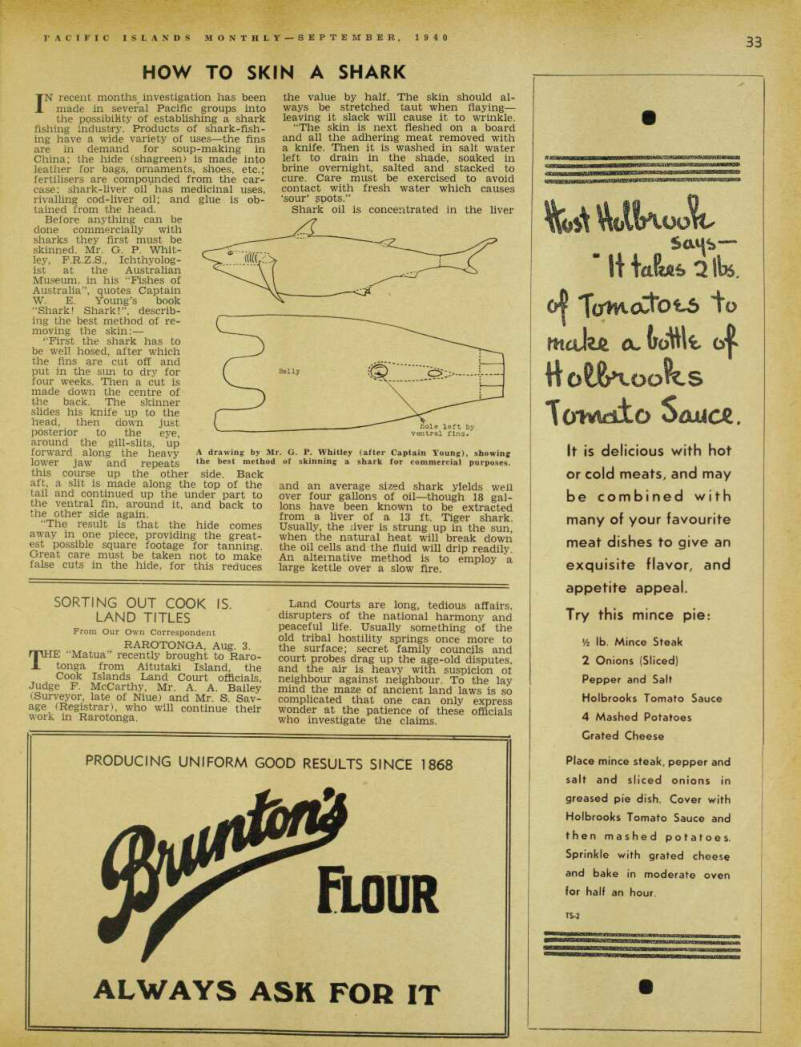
IN recent investigation has been made in several Pacific groups into the possibility of establishing a shark fishing industry. Products of shark-fish ing have a wide variety of uses—the fins are in demand for soup-making in China; the hide (shagreen) is made into leather for bags, ornaments, shoes, etc.; fertilisers are compounded from the car case: shark-liver oil 'has medicinal uses, rivalling cod-liver oil; and glue is ob tained from the head.
Before anything can be done commercially with sharks they first must be skinned. Mr. G. P. Whit ley, F.R.Z.S., Ichthyolog ist at the Australian Museum, in his “Fishes of Australia”, quotes Captain W. E. Young's book “Shark! Shark!”, describ ing the best method of re moving the skin;— “First the shark has to be well hosed, after which the fins are cut off and put in the sun to dry for four weeks. Then a cut is made down the centre of the back. The skinner slides his knife up to the head, then down just posterior to the eye, around the gill-slits, "up forward along the heavy lower jaw and repeats
this course up the other side. Back aft, a slit is made along the top of the tail and continued up the under part to the ventral fin, around it, and back to the other side again.
“The result is that the hide comes away in one piece, providing the great est possible square footage for tanning.
Great care must be taken not to make false cuts in the hide, for this reduces
the value by half. The skin should al ways be stretched taut when flaying— leaving it slack will cause it to wrinkle.
“The skin is next fleshed on a board and all the adhering meat removed with a knife. Then it is washed in salt water left to drain in the shade, soaked in brine overnight, salted and stacked to cure. Care must be exercised to avoid contact with fresh water which causes ‘sour' spots.”
Shark oil is concentrated in the liver
and an average sized shark yields well over four gallons of oil—though 18 gal lons have been known to be extracted from a liver of a 13 ft. Tiger shark.
Usually, the fiver is strung up in the sun when the natural heat will break down the oil cells and the fluid will drip readilv.
An alternative method is to employ a large kettle over a slow fire.
A drawing by Mr. G. P. Whitley (after Captain Young), showing the best method of skinning a shark for commercial purposes.
Advertisements & other items, p. 35 (2 items)
rF “Mntnn” 3 ‘
SORTING OUT COOK IS.
LAND TITLES
From our Own Correspondent a o
rF “Mntnn” 3 ‘
E Matua recently brought to Raro tonga from Aitutaki Island, the t . Co ° k Land Court officials, i^>r A ‘o B 2; iley (Surveyor, late of Niue) and Mr. S. Sav age (Registrar), who will continue their work m Rarotonga.
Land Courts are long, tedious affairs, disrupters of the national harmony and something of the old tribal hostility springs once more to the surface i secret family councils and court probes drag up the age-old disputes, and the air is heavy with susnicion of neighbour against neighbour. To the lay mind the maze of anci ent land laws is so complicated that one can only express wonder at the patience of these officials who investigate the claims.
Hot&'uxAs
SttMS—
It taftfls 31W.
o| TolHaiTo€6 to
maJt£ cc fcdttlfe
Hot&'uxAs
Totvidio Sauce.
It is delicious with hot or cold meats, and may be combined with many of your favourite meat dishes to give an
exquisite flavor, and
appetite appeal.
Try this mince pie;
x k lb. Mince Steak 2 Onions (Sliced) Pepper and Salt Holbrooks Tomato Sauce 4 Mashed Potatoes Crated Cheese Place mince steak, pepper and salt and sliced onions in greased pie dish. Cover with Holbrooks Tomato Sauce and then mashed potatoes.
Sprinkle with grated cheese and bake in moderate oven for half an hour.
TS-2
PRODUCING UNIFORM GOOD RESULTS SINCE 1868
ALWAYS ASK FOR IT
New Buildings for Port Moresby
From Our Own Correspondent
Port Moresby, August 20.
MR. H. G. Hannam, Commonwealth Works Director in Port Moresby, who has a full programme before him, returned recently to Papua after a brief visit to Australia. It is understood that a large and up-to-date hospital for the defence forces is to be constructed; also a freezing store, and offices and other buildings for the combined Services stationed here.
Sister J. M. Bovd recently resigned from the Fiji Nursing Service.
Industry
Cook Islands Fruit Industry Lag in Banana Planting
From Our Own Correspondent
Rarotonga, Aug. 2.
A MEETING of the Rarotonga Island Council on July 22, debated the vital question of banana planting on the island. Since the Government took con trol of the exoort of bananas, the low price offered and the strict regulations enforced have resulted in a heavy de crease in planting.
It was pointed out that if exports fall below the present average of 2,000 cases per month, it will not be worth the steamer’s while to make a regular call outside the orange season of four or five months. In view of this contingency, it is generally realised that instant banana planting is essential.
A haphazard scheme of Government assistance has been in operation for the last few years, whereby tins of meal were advanced to growers to tide them over the nine to twelve months of fruition. At the meeting, the Acting-Director of Agri culture (Mr. M. B. Baker) suggested an extension of this system. This, however, was opposed by most of the Council mem bers, who pointed out that the scheme had already proved unsuccessful in the past and that one could not pay labour for planting, etc, with tins of beef. An alternative scheme has been drawn up, in which the Government would advance 5/- cash per 100 shoots at planting, fol lowed by a further amount every three months for weeding and manuring.
In view of the failure of the Govern ment’s orange replanting scheme, an outside Committee was set up by the same meeting of the Council in order to explore iDOssible modifications that would make the plan more acceptable.
The failure of these replanting schemes simply boils down to the fact that the returns and conditions in the fruit in dustry are so unsatisfactory that people have not the urge to plant. How is it that a beneficent Government can give no better prices than the grasping N.Z. fruit combines, who were allegedly mak ing such large profits? This question, at a time when “uncontrolled” Cook Islands tomatoes are bringing such satisfactory returns, represents the whole problem of the industry.
Refund To Orange-Growers
The C.I. Fruit Control Administration has arranged to refund to growers part of the amount deducted from orange payments in May. A further 3d. per case will therefore be naid out at the next fruit payments, shortly. This action is appreciated by growers but has not in fluenced their dissatisfaction with pre vailing conditions in the orange industry.
Papua Legislative
Council
From Our Own Correspondent
Port Moresby, Aug. 20.
THE annual session of the Legislative Council was opened on August 5 and continued on August 12. The Acting Lt.-Governor (Hon. H. W. Champion) presided. The newly-appointed non official member, representing the missions in Papua, Hon. the Rev. J. D. Bodger, was sworn in.
The Acting Governor said it was with regret that he announced the imposition of additional taxation, but it was essen tial if the Government was to be carried on effectively.
The Lake Kutubu Police Camp had been closed down as a measure of economy, he said. The position in regard to the depletion of Government staff, due to enlistments, had changed, owing to the recent suspension of recruiting.
The view now was held that the best service officers could give was to remain at their posts.
Among Bills brought forward were the Papuan Antiquities Bill, which provides for the protection and preservation of mineral remains of historic interest in the territory.
Another Bill amends the Liquor Ordin ance, so that in Port Moresby the licensing fee for a hotel is £lOO instead of £3O, as charged in Samarai.
The Appropriation Ordinance for 1940- 41, amounting to £172,432, was passed also.
Advertisements & other items, p. 36 (1 item)
Prescott Pty. Ltd.
SUSSEX ST., SYDNEY,
ore sole wholesale agents for
PINEAPPLE BACON&HAMS
DAISY brand BUTTER "375" BUTTER in TINS 1 lb.-21b.-slb. Sixe*.
LEA & PERRINS’ Sauces and Most other Super-Quality Lines of the Trade, such as Cheese, Eggs. Etc.
kĥ
“ANCHOR FLOUR
THE STANDARD OF QUALITY
|g- ■ .r m
GILLESPIE BROS. PTY. LTD
SYDNEY - AUSTRALIA
When Captain David Robbie
Fooled The Police
Incidents in the Life of Fiji's "Grand Old Man", Just Dead at 91
AMONG the dwindling company of men and women who have grown old in the service of Fiji, who saw it develop, thrive, and advance and who helped in that development and ad vancement, few had such a reputation or commanded such respect as Captain David Robbie, whose death at 91, in Levuka, was announced in the last issue of the “P.1.M.”
A MERE recital of facts concerning Captain Robbie is impressive. He had been in Fiji for 64 years, a life time for many men; was Warden and Mayor of Levuka at various times for a period covering 30 years; was the first European member of the Legislative Council: and he was at one time Har bourmaster at Levuka. As a trader, planter and shipowner, he lived a life packed full of adventure and excite ment. Having sailed the length and breadth of the Pacific, he knew it as few men do—if you look at a chart of the South Seas you will find near Wallis Island (north-east of Fiji) a sunken lagoon marked Robbie Shoal, which he discovered.
Born in Forfarshire, Scotland, David Robbie first went to sea in a barque called the “Seafield”, after earlier hav ing tried his hand as a clerk in the Scottish Railway Co. An interesting story belongs to the time when he sailed in this ship.
On one occasion they met with a ter rific storm and spent the night shorten ing sail. At dawn, they saw an object in the distance, and coming closer found it to be the “Mary Pollock” in distress, with her sails gone and the seas rolling over her. Up in the mast, in the mizzen top, were four men —the captain, mate, second mate, and a volunteer from a Norwegian ship that had taken off the rest of the crew some time before. The “Seafield’s” captain signalled that al though he could not lower a boat owing to the weather, he would not desert the derelict as the other ship had done.
They lay by for a whole day, and then lowered a boat which rescued the men.
The coxswain of the rescuing boat was David Robbie.
Do you know your Kipling? If so, you will remember his poem, “The Derelict”, and recall that at the top of the verse is a quotation from the Ship ping News —“And reports the ‘Mary Pol lock’ still at sea. . . .”
IN 1873, Captain Robbie left England for New Zealand as second mate of an immigrant ship, the “Queen of the Age”. Some 400 immigrants were on board, sleeping in rows of bunks three tiers high that ran almost the whole length of the ship. The voyage out proved very lively—the ship’s officers were under arms practically all the way and many passengers (ex-Indian Army men) had to be sworn in as special constables. When the vessel reached Auckland every man of the crew, except the apprentices, was put into gaol for mutiny!
Having had enough of the sea for the present, Robbie left the ship and made his way to the Thames goldfields, where he worked underground for a consider able time. But the sea’s call could not remain unanswered and he joined a
vessel in the New Zealand coastal trade, eventually gaining his master’s ticket.
Captain Robbie went to Fiji in 1876 as master of the “Nymph” (43 tons) and, later, having acquired a vessel of his own, traded all through the Central Pacific groups. For many years his schooner “Midge” was engaged in the labour recruiting trade. This vessel was Captain Robbie’s pride and in his latter years he used to relate a fund of stories concerning her.
With a grin he would tell you, for instance, how he once conspired to defeat the ends of justice. A resident of Taveuni had received a summons to appear at court, and the magistrate who was to try the case had arranged to have a Government vessel anchored off-shore to take the man to Suva as soon as the court proceedings finished.
Now, it looked to Captain Robbie and some of the others at the island that
the magistrate had pre-judged the case; so it was decided to smuggle the accused man out of the group.
Late at night, the “Midge” picked the man up and took him across to Udu Point, where he was carefully hidden.
Then the schooner sailed back to Levuka to load cargo and obtain a clearance.
The police, learning of the Taveuni man’s disappearance, searched the ship, tiw °n C( ? urse Ca P^? in R f ob J? ie p £ ot . ested th l h n ll ” ,r. f , w g T® f Passage was the Government ketch “Barb” (50 tons), but the “Midge” gave her the slip by sailing through the Passage at night in the middle of a fierce thunderstorm. Robbie always said he made his way through the pass by flashes of lightning!
Next evening, anchor was dropped off
Udu and in the dim light of dawn the following morning the Taveuni man was brought on board. Then, not 300 yards away, they noticed a police boat mak ing towards them—but she was inside the reef and the “Midge” was outside, with a strong, fair wind. Captain Robbie dipped his flag in salute and headed to sea.
When Robbie returned to Levuka bo took the ship’s papers to the Collector Customs. Having examined them, the official was about to hand the sheat of documents back when the Inspector of p ° 1 * c l f- who had been waiting alongside ad time, held out his hand for them, The Customs man looked from one to the other, then exclaimed, “No. I’ve seen through the papers, they’re quite in order. That’ll be all, thanks, Captain.”
Robbie, with a wink and a nod, gladly took his leave.
ANOTHER of Captain Robbie’s stories concerned a mistake he himself made, but which was responsible for saving a number of lives.
On one trip from the Line Islands to the Leewards, the set of the current made it practically impossible to keep the ship on its course. They had been at sea for over a fortnight—the usual time for the journey was four days— and were acutely short of water, even tually reaching the stage where each person was allowed only a teaspoon of water a day. When they were almost on the verge of insanity through thirst, one of the passengers, who had been a whisky-maker in Hawaii, conceived the idea of rigging up a make-shift distilling
plant. With the aid of three kerosene tins and other crude apparatus, they were able to distil a bucket of fresh water every four hours.
Then, by some strange chance, Captain Robbie made an error in his reckoning and set a course that was wrong by 30 miles. At dusk the lookout man saw two masts; so the “Midge” tacked to windward and waited until daylight.
There, not more than 30 yards from them, was a whaleboat with 20 natives in it, dying of thirst and hunger. They were taken on board, fed, and given some of the distilled water. All survived and were later landed on the island Robbie was making for.
IN 1882, Captain Robbie settled down in Suva, at the time when the capital and seat of Government was transferred from Levuka, eight years after the group was annexed by Great Britain. He was the first manager of William Kopsen and Co., ship chandlers and general merchants, whose large building occupied practically the whole of Pier Street. It was while in this shop that the Captain, as he himself related jovially, became so exasperated with the annoying antics of a small boy that he up-ended him and soundly spanked the seat of his trousers; that little boy to-day is one of the best-known and successful merchants in the Colony, Mr. Tommy Horne.
Kopsen’s premises were destroyed in Suva’s big fire, in 1889, and Captain Robbie decided to return to Levuka. He always had a special weakness for that town and more than once remarked that though he had travelled all over the South Seas he had never seen a place more naturally beautiful.
About this time he married a Mrs.
Thompson and took charge of the Royal Hotel. Later, he went into business again, forming Robbie and Evans Ltd.
Some time afterwards, he joined Cap tain Christian Kaad, another pioneer trader who had interests at Rotuma.
Then, after retiring from business, he
Captain David Robbie, a “snapshot” on his 86th birthday.
took up tea planting at Wainunu, on Vanua Levu, and made a success with his “Masusu” brand. Subsequently, he also engaged in copra production and rubber planting.
LEVUKA knew him as one of the most prominent citizens in the Colony: he never failed in his interest in public affairs and his open-handed generosity was a by-word. Some people in Levuka thought that the wharf there (one of its greatest assets) should have been called Robbie Wharf. Captain Robbie drove a ship right through the old wooden one—-not intentionally, of course, but still, as he declared later, it served the purpose of removing a nuisance and an eye-sore! When the new wharf was put up, Robbie drove the first pile, and he also filled in the last piece of decking. To-day, at the end of the wharf is an inscribed plate com memorating his association with the building of it.
His civic good deeds were legion. He donated part of the land on which the Anglican Church in Levuka stands; he helped found the Ovalau Club; and he played a great part in building up the traditions and prestige of the Levuka Public School.
One day a friend o his, Mr. Tom Burness, came in to Levuka from an out station. As they chatted, Burness asked what the town was doing to celebrate Queen Victoria’s Diamond Jubilee. It appeared that very little had been done; so the two men decided that it would be a fine gesture if a memorial hall were erected. Robbie took a sheet of paper from his pocket, wrote down their names with £5O beside each and then strolled down the road. When they returned, 10 more names were on
the list, each for £50 —£600 in half an hour! Other subscriptions were added later and so the Queen Victoria Memor ial Hall was built.
ALL who knew him insisted that “gentleman” was the word that came immediately and most natur ally to mind when Captain Robbie’s name was mentioned. Although he had lived a full life and had many irons in the fire during his prime, he was hard put during the last few years to make ends meet; but it was characteristic of him that one day when he met the widow of Tukai, his old skipper, he just emptied his pockets and gave her all the money he had with him.
Sir Maynard Hedstrom, who person ally knew Captain Robbie over a period of half a century, paid an apt tribute to his old friend recently. Writing in the “Fiji Times” he said: “No one who went to Robbie with a hard-luck story appealed in vain and, after he had given credit, he found it very difficult indeed to press for payment. In any case of distress in Levuka his hand went imme diately to his pocket. Working on these principles, a man may store up treasures in heaven, but does not acquire ‘filthy lucre’ on earth. Consequently, Captain Robbie died a poor man financially but rich in the esteem and affection of very many people.”; Mr. E. G. Theodore, well known resi dent of Fiji, who is a director of Emperor and Loloma gold mines, was in Victoria on a business visit in August.
Mr. H. C. Mac Lean, of Burns Philp (S.S.) Co. Ltd., Suva, Fiji, has left the Colony to enlist.
Advertisements & other items, pp. 37-38 (1 item)
CLmotts
PURE RICE
STARCH
Always ask f»P . . .
CORAL” BRAND
100% PURE
Noted for Its
QUALITY
and
WHITENESS.
Goes Farthest and gives Lasting Finish
WILL NOT
STICK TO
IRON.
Obtainable from Leading Island Stores. by
!E. LTD.,
w.
CORAL BRAND
rice'stahdn
co>u Manufacture
AUSTRALIAN R 1
Sydney, N.l
OFTEN BUTTERED
NEVER BETTERED
CRISP, LIGHT BISCUITS which
bring out the flavour of cheese and add a new attractiveness to fresh or stewed fruit.
A delicious supplement to ham or paste or other tasty savoury, and still an epicurean delight, served simply with fresh butter.
The rich excellence of these famous Biscuits is the result of 67 years of specialisation.
They are packed in air-tight tins or packets for picnic convenience.
CLmotts
FAMOUS
SAO BISCUITS
A2/S ALWAYS ASK YOUR GROCER FOR ARNOTT'S !
A. B. DONALD Ltd.
AUCKLAND
ISLAND TRADERS & GENERAL MERCHANTS
P.O. Box 1509. Cables Gr Telegrams, "Kingdom", Auckland.
For perfect cutting
under all conditions
There is a Ransomes Mower for every lawn our range covers machines for every requirement from the smooth, even surface of the putting green to the sports ground, golf course or aerodrome.
The "MOON" Mower
GANG
MOWERS
For grass such as couch, kikuyu, buffalo, etc., and grass longer than the average. 14-in. and 18-in. wide. 50 acres a day can easily be cut with a Ransomes Quintuple Mower drawn by a tractor and even larger outfits up to 25 ft. wide are available.
I
Htansomes
Lawn Mowers
Write for illustrated literature and all information
MORRIS, HEDSTROM LTD.,
Suva, Lautoka, and Ba.
Made by RANSOMES, SIMS & JEFFERIES LTD., IPSWICH, ENGLAND,
A Windfall For
Tahiti
Matson Tourists Spend 1 5,000 Dollars
ON August 2, the Matson liner “Mon terey” from Sydney called at Papeete, Tahiti, on a special cruise visit, and the same day her sister-ship, “Mariposa” arrived with a boat-load of excursionists from America. For three days, the passengers and two crews, totalling more than 1,000, over-ran the island; but Tahiti did not mind particu larly—it was calculated that the visitors spent something like 15,000 dollars during their stay.
The •Monterey” cruise passengers transferred to the “Mariposa” and re turned south to Australia; while the tourists from U.S.A. left the “Mariposa” and joined the “Monterey” for her voyage north, back home.
A Traveller’S Impressions
HERE are some jottings on the round trip, written by a special repre sentative of the “P.1.M.” who travelled from Sydney to Tahiti and re turn: — As the 400 passengers from the “Mon terey”—6o of them cruise round-trippers from Australia and N.Z.—came ashore in the morning, comely Tahitian girls placed garlands of flowers about their necks. The Bank of Indo-Chine and Spitz’s curio store were quickly besieged by people wishing to convert their money into francs. The official exchange rate was 43 francs 23 centimes for 1 dollar, 139 fr. for £1 Australian, and 139 fr. 50
cm. for £1 N.Z. However, the Chinese market stores changed dollars at 55 francs on the first day and their rate in creased during each day of the visit un til it was possible to obtain 85 francs to the dollar.
The “Mariposa” arrived early in the afternoon and tied up astern of the “Monterey”, a fine feat of manoeuvring by the captain. Almost immediately the American tourists joined the “Monterey’s passengers, making Papeete's streets full of life and American voices.
Numerous excursions were arranged, including an 80-miles motor tour arouna the island, complete with a native feast
in the Tahitian manner; and a schooner trip under full sail to Moorea. From mid-day until the small hours of morn ing, the three cabarets in Papeete did a roaring trade, while featuring hula dancing, fire-walking, and boxing. Sailors from a French warship joined in all the fun—they were most jolly fellows and al ways insisted on paying their way.
In the evenings, the more select cabarets just outside Papette were well patronised, though they were far from cheap. In fact the onlv things I heard the Americans complain about were the high charges for drinks (a good bottle of champagne cost about three and a
half dollars) and the exorbitant rates charged by taxi drivers.
One interesting entertainment that in trigued the visitors was a play, adapted from an old native legend dealing with human sacrifice, performed by 40 Tahitian men and women, under the direction of Monsieur Jay at his resi dence, Taharaa.
The effect of the war and consequent disruption of shipping was seen at Papeete in a shortage of some commodi ties, especially flour and petrol. It seemed probable that there would also be a shortage of wines and liquor after the tourist ships departed; however, a good light beer is brewed in Tahiti.
Scientists At Tahiti
THOSE of us having connection with the Islands were interested to learn that Monsieur and Madame Van den Broek d’Obrenan, of the yacht “Le Korrigan II”, are now staying in Tahiti, at a plantation 15 kilometres outside Papeete. Originally attached to the Museum of Natural History in Paris, he is now in charge of the Papeete Ethno graphic Museum. Monsieur d’Obrenan, who has written several books about the Pacific, made a voyage around the world in 1934-36 in the 200 tons schooner yacht “La Korrigaine”. (Note: “La Kor rigaine”, his first yacht, meant a female elf; “Le Korrigan”, his present boat, is the masculine form of the same name.) Also in Papeete was Alain Gerbault, the former international tennis star, who has made a name for himself as a writer and lone voyager. His yacht is almost a replica of “Le Korrigan”, both being very seaworthy craft, painted black, and double-ended. Gerbault’s boat has a short bowsprit, while the mast is not as high as d’Obrenan’s yacht.
Another yacht that attracted quite a lot of attention in the Colony recently was the three-masted schooner “Director”, owned by Mrs. Fahnestock and her two sons, of Rhode Island, U.S.A. The party is collecting specimens of bird life for the American Museum of Natural History and will spend a couple of years in the Pacific and the Philippines before re turning to America, via the Horn.
Originally, they had a plane on board, but owing to the restrictions imposed by the authorities in French Oceania and other places as to where it could and could not fly, it was decided to ship the machine back to U.S.A.
Highlights Of Pago Pago
ON the way to Tahiti, we called at American Samoa. Highlights of Pago Pago were: A trip to Lauli-i, a pretty 20 miles’ journey past native villages and ruined churches, and along the shore all the way; a drink at Sadie Thompson’s Hotel, kept by Bella, a part- Samoan, and ownedi by an American who lives in the States; and a visit to the market where tappa cloth, mats, hats and curios are sold —the natives impressed everyone with their pleasantness and softly-spoken voices and there was very little “thrusting” or bargaining.
An Australian at Pago Pago, who is well-known in Norfolk Island, Fiji and Western Samoa, has charge of Burns, Philp (South Sea) Co.’s branch —Mr. D. C.
McFadyen, who has been in B.P.’s ser vice for 14 years. He is very hospitable and is popular with the residents of the American ’ territory.
Captain E. W. Hanson, Governor of American Samoa, left Pago Pago on the “Monterey” and was given a grand send off by the population. After a two years’ term of office, during which he did splen did work in providing new roads on the various islands of the Group, he has been appointed to command the U.S.
Navy cruiser “Indianapolis”.
Advertisements & other items, pp. 39-40 (1 item)
Sa9Ss
Up & y&r • *i Ji\ PS ove»oi f,ceot l* 0^ . n p G** nd A s \tu* ed ' w a rbo uT ’ 1 a \w A cS '^ ne , cen ire 0< »tieo'-> »** r e " ent r— ?suv». <or * e ers ,.v^ c tfa' ned c» b ' e ’ 4»Vjfc P er - *e^° 0S
Ship Chandlery Hardware
/Write for j
Ship Chandlery /
Catalogue J
Special “In Bond” Prices for all Islands enquiries quoted on application.
Sole Agents for;
BROOMFIELDS LIMITED
152 SUSSEX STREET SYDNEY.
Cables: “Boom”, Sydney.
Large and Complete Stocks of
SHIP CHANDLERY
IRONMONGERY OF ALL KINDS, PAINTS
WHITE LEAD AND OILS.
P. H. MUNTZ & CO.’S 3-CROWN BRAND METAL SHEATHING.
PEACOCK & BUCHANS’ ENGLISH READY-MIXED PAINTS.
PHOPELLORS
All Sizes to 54 in. diameter . . . any pitch.
SHAFTS MADE TO ORDER.
Bearing and Stuffing Boxes —Rudders— Tanks for Water and Fuel —Exhaust Pipes and Mufflers.
Copper, Bronze and Aluminium Founders.
D. H. PORTER & CO.
43-45 DRUITT STREET, SYDNEY.
Scott’s “Renown” Brand Rope,
Cordage and
Cable Address Ropeyard, Sydney.
V4K
, fed
>— UsMki
Binder
Twine
of Every
Description
MANUFACTURED AT
MASCOT, N.S.W.
By
J. SCOTT
PTY. LTD.
Head Office and Store:
163 CLARENCE STREET,
SYDNEY,
N.S.W.
Skip ?
A Copra Factory
Advocated by Leading Planter of Papua
UP to the moment of this writing, the only practical plans that have been put forward, as a means of assist ing the copra industry in its present parlous condition, are two—one by Mr.
George Murray, M.L.C., Director of Agri culture of New Guinea, and one by Mr.
G. A. Loudon, oresident of the Planters’
Association, of Papua.
Mr. Murray urges the wholesale stor age of good, properly-cured copra, and that special steps be taken by the Ad ministrations concerned to build large, additional stores. Mr. Loudon advocates the use of a copra factory ship, to cruise in the Islands—storage in another form.
Mr. Loudon has kindly supplied us with the following details; — Mr. George Murray wrote me fully about his scheme of copra storage and I countered with a suggestion that a copra factory ship should be commis sioned to cruise in these Islands. I have not heard from him, but I sent a copy of my letter to Mr. James Burns. Mr.
Burns replied at some length, mainly commenting on the high costs of running ships in Australian waters and the high insurance rates, war risks, etc. I then placed my suggestions before the Papuan Government. They replied that the Commonwealth Government appeared to have provided the solution, and thought it better to leave my suggestion in abeyance, for the moment.
The following is a copy of part of a letter I sent on August 6 to the Official
Secretary of the Papuan Government, with some additions I have made; I firmly believe that the copra factory ship is the only method to create cheap production and a market. The milling or copra and treatment of by-products would be carried out at the point of pro duction. The ship would anchor off the estates, the transport from unsuitable beaches or poor anchorages would be carried out by a small vessel, attached to the factory ship. With the exception of supervising Europeans, the whole crew and factory would be run by Papuan or New Guinea labour, so that costs would be kept to a minimum. In support of this, i would mention the various desiccated coconut plants in these islands, staffed entirely by natives, with a European manager only. The treatment of desiccated coconut is far more intri cate than the treatment of a crushing plant for copra.
I suggest the formation of a company to operate on the coasts of Papua, New Guinea and the Solomons, the sub scribers to be:—The British Government (subscribe from Colonial Fund) £100,000; the New Guinea Government (loan from Gold Tax Funds) £100,000; Papuan Gov ernment (borrow) £50,000; Burns, Philp &' Co., Ltd., and W. R. Carpenter & Co., Ltd., each £75,000; and general public and planters £100,000; total, £500,000.
The interest rate on the above funds would be 4J per cent, to 5 per cent, and, after writing off depreciation and re newals, the balance would be paid to the suppliers, according to tonnage delivered and quality of copra. It could also be arranged to pay a bonus to shareholders in the above company. The details of financing are best left to the Govern ments and firms concerned. It is a great opportunity for them to show some sym pathy with the primary producers of
these Islands, who live and work in un healthy, uncivilised conditions with very little profit or chances of saving.
In discussing this matter, a shipping expert mentioned the high rate of in surance and war insurance for such a vessel. As the factory ship would be oper ating only in territorial waters, within the three-miles limit most of the time.
I cannot see that insurance should be excessive. A special rate would be arranged when the vessel was despatched to Australia for overhaul.
With the inclusion of the Solomon Is lands, the factory ship probably would be called unon to mill about 100,000 tons of copra p.a. This would produce:— Coconut oil: 15,000,000 gallons.
Oil cake; 30,000 to 40,000 tons.
Coconut fibre: There would be enough short fibre, long fibre, mattress and spin ning fibre to supply the whole of the re quirements of Australia and N.Z.
Coconut charcoal.
Glycerine: Glycerine is a very neces sary war product. Figures are not avail able as to quantity of glycerine to oil produced.
The production of soap in Australia is more or less under the control of tne Combine, and it would be necessary for the Government to insist on a proportion of coconut oil being used in every pound of soap, which would be all to the ad vantage of the housewives of Australia.
Imports of any form of grease for the manufacture of soap should be prohibited.
After the war England and Europe will absorb more butter than Australia can produce. Markets in the East should also expand both for butter and margarine.
Butter in Australia is expensive, and often beyond the means of the working classes. It has been proved that margar ine, produced from vegetable oils is equal
to butter in vitamins, and further, that it is more easily digested.
Prior to the war, increasing quantities of coconut oil were being used all over Europe for cooking purposes. Large mills had been erected, and the shortage of olive oil was made good with substitutes, such as coconut oil. If every housewife in Australia and New Zealand consumed two gallons per annum our troubles would soon be over; and this could be brought about by an advertising campaign.
I am given to understand that coconut
oil can be used as a fuel in diesel engines, and it is said to give 75 per cent, effi ciency, against 100 per cent, for pure diesel oil. Nothing is said as to its effi ciency, when mixed with diesel oil. At present, every effort is being made in Australia to replace oil fuel with char coal. Diesel stationary engines and farm tractors could probably use coconut oil.
At the moment I am paying 1/6 per gallon for diesolene. One ton of copra produces 150 gallons of coconut oil, equal to £ll/5/- per ton, if valued on basis of diesolene. This same ton of copra will
also produce by-products—copra cake and glycerine.
The use of coconut oil as lubricating oil is a matter for experiment by the chemist.
Castor oil is supposed to be one of the finest lubricants. Why not coconut oil?
Enormous savings can be made by the use of the factory ship. By these savings, a very low-priced cattle-cake and sheep-nuts can be produced for the Aus tralian farmer and sheep man. Unlike the farmer in Europe they know little of the benefits of feeding cattle-cake in time ol drought and shortage of fodder. We would have surplus supplies of Queensland molasses and cotton-seed to make the copra cake more attractive for sheep.
Charcoal from coconut shell can be used for gas masks and other war re quirements, as it is the purest form of charcoal. It can also be burned in pro ducer gas plants, and in plants attached to motor cars. It would make a cheap form of transport for the coconut planter.
In summing up, let us see what savings could be made in handling and transport of 100,000 tons of copra, if a copra fac tory ship was anchored alongside plan tations situated on an average, say, 100 to 150 miles from an Islands shipping centre, such as Port Moresby, Samarai, Rabaul or Kavieng.
I am basing these calculations on actual transactions prior to the war, in June, 1939, when hot-air copra was selling in London at £ll/7/6 per ton; — Copra Production Costs Cost of manufacture and bags 5 0 0 Loading 2 6 Coastal freight 1 5 0 Insurance 1 8 Wharfage 10 Freight to Europe and selling costs 3 0 3 Total cost 9 10 5 Gross Realisation 11 7 6 Profit per ton 1 17 1 Profit per acre at I cwt. p.a. 18 61 Equal to profit of 4.6 per cent., with out allowing for depreciation or amorti sation, on a capital value of £2O per acre.
Copra Factory Ship Savings Handling from beach—no saving as copra would have to be de livered to factory ship ..
Bags—l,4oo,ooo @ Bd. each .. 49,583 Coastal freight—loo,ooo tons @£l 100,000 Wharfage at shipping centres — @l/- 5,000 Coastal insurance—@ 15/- .. .. 8,531 London shipping and selling costs, £3/0/3 p.t 301,250 £464.364 This is equal to a saving of £4/12/10 per ton.
The suggestion of a copra factory ship, of course, will bring a good deal of criticism, but I consider the costs would be very much cheaper than a factory whaling ship for the following reasons:— 1. The whaling factory ship, with its attendant chasers, is operating perhaps 15,000 miles from its European base. 2. It travels with attendant chasers to the whaling grounds empty, and returns only with a full load, if in luck. 3. It is quite speculative, with no guar anteed turnover. 4. The risk of loss of ships operating in Arctic seas, is considerable. 5. Only highly-paid Europeans are em ployed. 6. The price of whale oil fluctuates just as much as copra.
A great deal more could be written on this subject, but I will leave it to those more qualified than I am to judge if it could be made a financial success.
Advertisements & other items, pp. 41-42 (1 item)
William Atkins Pty. Ltd.
Established 50 years—and carrying one of the largest stocks of Iron and Steel in Australia.
Head Office 449-451 KENT ST., SYDNEY.
FULL, COMPREHENSIVE Cx UP-TO-DATE RANGE IN ALL
DEPARTMENTS, INCLUDING THE FOLLOWING LINES:—
STEEL DEPARTMENT
MILD STEEL:
Rounds, Squares, Flats, Half-rounds, Hexagons, Bevel, Shoeing, Tyre, Angles, Tees, Sheets, Plates, Girder Plates, Chequer Plates, Channels, Hoops, Etc.
BRIGHT STEEL:
Rounds, Squares, Hexagons.
Iron & Steel Merchants
ENGINEERS' SUPPLIES
COACH & MOTOR HARDWARE.
CabU Address: WILATKIN, SYDNEY.
Engineers' Supplies: Set Screws, Studs, Metal Thread Screws, Coach Screws, Files, Cotter Pins, Bright and Black Bolts, Rivets, Etc., Hack Saw Blades.
Power Transmission Gear: Including Plummer Blocks, Couplings, Collars, Etc.
Coach and Motor Hardware: Axles, Springs, Wheelstuff, Duck, Paints.
Farriers' Supplies: Horse Nails, Anvils, Vices, Etc.
Extra Special High Speed Tool Steel, Mining Steel, Blister Steel and Spring Steel, Rounds, Flats Gr Squares.
Bar Iron —All sections and sizes.
Motor-Trimmers and Motor Builders' fir Motor Painters' Requirements
C. A. WILLEY'S
Quick-Drying Coach and Car Paints, Roughstuff, Elastic Gloss, Synflex Enamels, Lacquers.
DUCO Lacquers and DULUX Enamels—FAßßEX Motor Toppings and Leather Cloths, House Cr Decorators' Paints, Varnishes fir Brushware Sole Distributors of CHAMPION'S Decorators Paint Products.
Distributing Agents for BROLITE Lacquers, SYNFLEX Enamels and "POLYGLOSS" Finish.
YES/
but rV
which)
paint (
>?■ •ct* "; m
OF COURSE
*«• JCeeps on DCeep
AGENTS THROUGHOUT THE ISLANDS
Japanese Fish-Catching
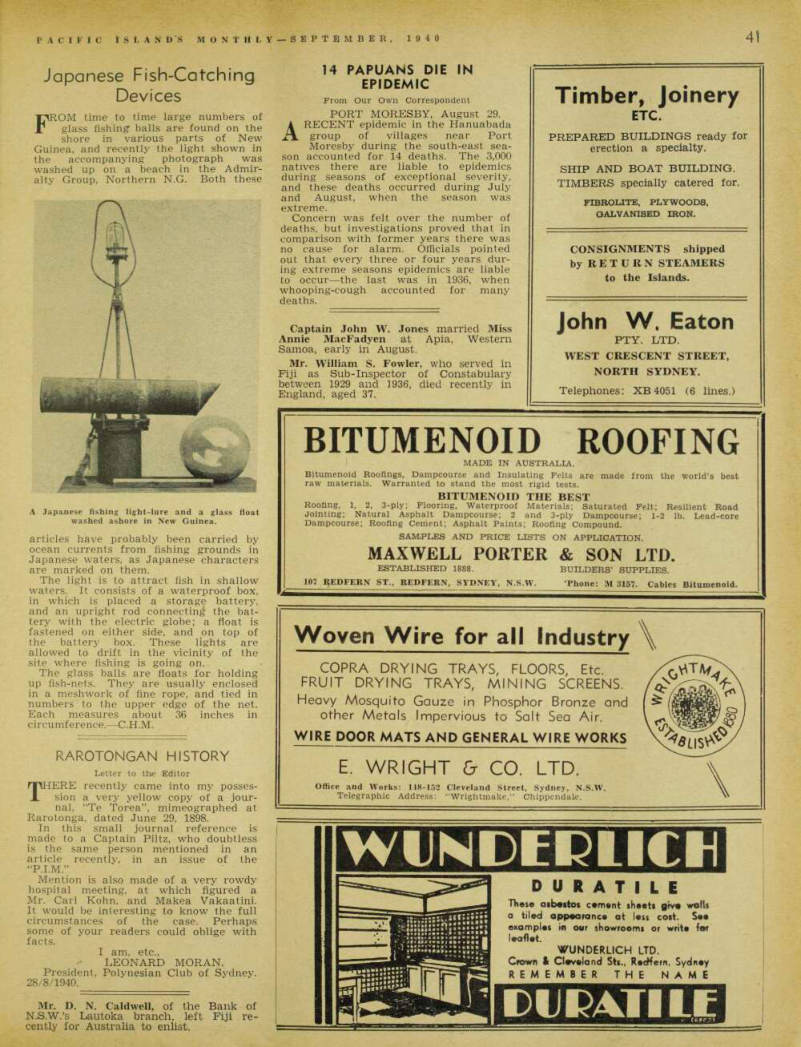
Devices
FROM time to time large numbers of glass fishing balls are found on the shore in various parts of New Guinea, and recently the light shown in the accompanying photograph was washed up on a beach in the Admir alty Group, Northern N.G. Both these
articles have probably been carried by ocean currents from fishing grounds in Japanese waters, as Japanese characters are marked on them.
The light is to attract fish in shallow waters. It consists of a waterproof box, in which is placed a storage battery, and an upright rod connecting the bat tery with the electric globe; a float is fastened on either side, and on top of the battery box. These lights are allowed to drift in the vicinity of the site where fishing is going on.
The glass balls are floats for holding up fish-nets. They are usually enclosed in a meshwork of fine rope, and tied in numbers to the upper edge of the net.
Each measures about 36 inches in circumference.—C.H.M.
A Japanese fishing light-lure and a glass float washed ashore in New Guinea.
Rarotongan History
Letter to the Editor THERE recently came into my posses sion a very yellow copy of a jour nal, “Te Torea”, mimeographed at Rarotonga, dated June 29, 1898.
In this small journal reference is made to a Captain Piltz, who doubtless is the same person mentioned in an article recently, in an issue of the “P.1.M.”
Mention is also made of a very rowdy hospital meeting, at which figured a Mr. Carl Kohn, and Makea Vakaatini.
It would be interesting to know the full circumstances of the case. Perhaps some of your readers could oblige with facts.
I am, etc.,
Leonard Moran
President, Polynesian Club of Sydney. 28/8/1940.
Mr. D. N. Caldwell, of the Bank of N.S.W.’s Lautoka branch, left Fiji re cently for Australia to enlist.
14 Papuans Die In
Epidemic
From Our Own Correspondent
Port Moresby, August 29.
A RECENT epidemic in the Hanuabada group of villages near Port Moresby during the south-east sea son accounted for 14 deaths. The 3,000 natives there are liable to epidemics during seasons of exceptional severity, and these deaths occurred during July and August, when the season was extreme.
Concern was felt over the number of deaths, but investigations proved that in comparison with former years there was no cause for alarm. Officials pointed out that every three or four years dur ing extreme seasons epidemics are liable to occur —the last was in 1936, when whooping-cough accounted for many deaths.
Captain John W. Jones married Miss Annie MacFadyen at Apia, Western Samoa, early in August.
Mr. William S. Fowler, who served in Fiji as Sub-Inspector of Constabulary between 1929 and 1936, died recently in England, aged 37.
Advertisements & other items, p. 43 (2 items)
41
PACIFIC ISLAND S MONTHLY SEPTEMBER, 1940
Wunderlich!
Timber, Joinery
ETC.
PREPARED BUILDINGS ready for erection a specialty.
SHIP AND BOAT BUILDING.
TIMBERS specially catered for.
FIBROLITE, PLYWOODS,
GALVANISED IRON.
CONSIGNMENTS shipped
by RETURN STEAMERS
to the Islands.
John W. Eaton
PTY. LTD.
WEST CRESCENT STREET,
NORTH SYDNEY.
Telephones: X 84051 (6 lines.)
BITUMENOID ROOFING
MADE IN AUSTRALIA.
Bitumenoid Roofings, Dampcourse and Insulating Felts are made from the world’s best raw materials. Warranted to stand the most rigid tests.
BITUMENOID THE BEST
Roofing, 1,2, 3-ply; Flooring, Waterproof Materials: Saturated Felt; Resilient Road Jointing; Natural Asphalt Dampcourse: 2 and 3-ply Dampcourse; 1-2 lb. Lead-core Dampcourse; Roofing Cement; Asphalt Paints; Roofing Compound.
SAMPLES AND PRICE LISTS ON APPLICATION.
MAXWELL PORTER & SON LTD.
ESTABLISHED 1888. BUILDERS’ SUPPLIES.
107 REDFERN ST., REDFERN, SYDNEY, N.S.W. Phone: M 3157. Cables Bitumenoid.
Woven Wire for all Industry \
COPRA DRYING TRAYS, FLOORS, Etc.
FRUIT DRYING TRAYS, MINING SCREENS.
Heavy Mosquito Gauze in Phosphor Bronze and other Metals Impervious to Salt Sea Air.
WIRE DOOR MATS AND GENERAL WIRE WORKS
E. WRIGHT & CO. LTD.
Office and Works: 148-152 Cleveland Street, Sydney, N.S.W.
Telegraphic Address; “Wrightmake,” Chippendale. f- Or £ TO
WUNDERLICH!
.8* !••• «»»; Fill r IttiKltFF. » < 41 Smm>«SS iw
duratile
These asbestos cement sheets give walls a tiled appearance at less cost. See examples in our showrooms or write for leaflet.
WUNDERLICH LTD.
Crown It Cleveland Sts., Rectfern, Sydney
REMEMBER THE NAME
PUEATIIE!
Suva Pilot Boat Destroyed
By Fire
From Our Own Correspondent
Suva, Aug. 13
LAST week, the pilot launch “Mona” caught fire in the harbour and, after drifting on to the reef, burned fiercely for several hours, becoming a total loss.
The “Mona” went outside the entrance to pick up Captain W. F. D. Hay, acting harbourmaster, who piloted an overseas liner out. On taking Captain Hay on board, the officer in charge of the launch, Mr. N. MacDonald, advanced the throttle to pick up speed. The engine backfired and flames burst from the carburettor.
The engine-room hand, Aliki Dabaka, was sprayed with burning petrol, and by the time the flames on him were sup pressed the fire had a good hold of the launch.
As there was danger of the benzine in the launch exploding, it was decided to abandon her and take to the dinghy. The plight of the party was noticed from the signal station, and a launch put off at once to give assistance, and brought them in to Suva.
The “Mona” was built 30 years ago in New Zealand and had had many vicis situdes. She first saw service in Tonga and Samoa, and later served as the launch to the Makogai leper station in Fiji. She had been rebuilt and refitted several times and was one of the best pilot boats Suva ever had.
Mr. H. O. Townsend, head of the Trea sury Department in New Guinea, was in Australia in August on official business.
Mr, J. Wilson, of New Guinea Gold fields Ltd., married Mrs. Lottie Wilton, at Salamaua, N.G., recently.
Make Good Showing
W. R. Carpenter Ltd, Make Good Showing in Bad Year
DESPITE almost a year of war, in which their ships were taken over by the British Government, and in which the copra industry has suffered the worst blow in its history, the accounts of Messrs. W. R. Carpenter & Co. Ltd. for the year ended June 30, 1940, show a profit of £115,904, which permits the dividend to continue at 10 per cent. The detailed figures, from “Sydney Morning Herald” compilation, are printed below. They show remark ably little movement in the accounts.
The company holds a reserve of £200,000, against a subscribed capital of £775,000; and, from this year’s profit, it has taken £25,000 for “contingencies”, as against £lO,OOO usually set aside for this purpose. Stock is down —probably the result of the decision not to re-open the general store in Rabaul—but the item, “due by subsidiaries” shows an unex plained jump, from £30,000 to £llO,OOO.
This is one of the companies that is bound to feel the cold breeze now blow ing in the copra industry; but it has great financial strength and, in recent years, its shrewd directors have spread its interests much more widely, into many industries separated from coconut plantations, so that it is well equipped to stand a long siege, and help South Pacific planters and traders through the difficult years ahead.
Fiji Subsidiary Co.'S Profit
Higher
Carpenter’s subsidiary concern in Fiji, W. R. Carpenter and Co. (Fiji), Ltd., (formerly known as Brown and Joske, Ltd.) showed a net profit for the year ended March 31, of £8,819. This compared with £l5O for 1938-39, and £4,401 for 1937-38. Preference dividend of 7 per cent, required £1,400; it was not proposed to pay a dividend on the ordinary shares.
The directors state that the increase in profits was fortuitous and demonstrates the uncertainties of Islands trading. A contributing factor was the abnormal provision for depreciation in the previous accounts.
The acting Lieutenant-Governor of Papua, Hon. H. W. Champion, C.8.E., at Government House, Port Moresby, on the evening of August 9, entertained over 100 guests ar a cocktail party. August 9 was the anniversary of Mr. Champion’s birth day and, during the evening, the oppor tunity was taken to offer him the good wishes of all present and to drink to his continued health and happiness.
Year ended June 30. 1938. 1939. 1940. £ £ £ Profit 111,372 115,281 115,904 Dividend, p.c 10 10 10 Dividend, amount . . 74,000 76,250 77,500 To superannuation . 2,000 2,000 — To contingency acct. 10,000 10,000 25,000 Forward 36,638 63,669 77,073 Depreciation 8,767 18,512 15.867
Liabilities —
Capital 740,000 775,000 775,000 Premium on shares . 10,374 10,374 10.375 Reserve . * 200,000 200,000 200.000 Creditors 89,891 93,685 114,146 Due to subsidiaries 49,400 47,721 45,351 Branch remittances . — 10.861 8,275 Deferred income . . . — — 1,113
Assets—
Investments 497,263 527,686 528,693 Property, ships, etc. 373,509 387,349 326.618 Plantation advances 89,757 96,949 105,911 Debtors 65,089' 81,801 93,692 Due by subsidiaries 14,641 30,176 110,011 Stock 125,941 104,434 75,541 Cash 3,899 12,326 36,784 Unexpired charges .. 5,201 11,340 17.833
Advertisements & other items, p. 44 (1 item)
G. Fletcher & Son
LiSTRliSUTOKS: Greenwood & laws Ltd., Rabaul and Wau; Steamships Trading Co. Ltd., Port Moresby and Samarai; Millers Ltd., Suva, Fiji.
For Protection and
Appearance - - use
“B A L M” Paint
PROTECTION —is the main job of Paint . . . APPEARANCE is next . . . and, to get the most efficient combination of both . . . use “B.A.L.M.” Paint.
“B.A.L.M.” Paint is a product of scientific research and practical experience . . . It has been tested for durability, protective qualities and colour retention, and proved to be the best that can be made.
Measure the value of Paint by years of service, protection and appearance, and NOT by cost per tin. Specify “B.A.L.M.”
Paint.
A Product of British Australian Lead Manufacturers Pty. Ltd.
If you wont “Perfection in Cooking" use a
“Younger” cooking stove
r These stoves have been on the market in Australia for over Sixty Years, and are still recognised as “The Best”.
They are made with Extended Firebox specially for Long Wood fuel, also special stoves with Cast Iron Oven suitable for Island requirements.
Send for Illustrated Catalogue and Price of Single and Double Oven Stoves.
G. FLETCHER & SON
50 OXFORD STREET, SYDNEY.
Stamps
Romance In
Philatelist Illustrates Some Queer Pacific History
A SORE point with the British Solo mon Islands administration in the early part of the century, was the fact that the Territory did not have its own postage stamp; but had to use the one issued by the High Commission for the Western Pacific at Suva, Fiji, said Mr. Walter Finigan, headmaster of the Correspondence School, Blackfriars, in the course of a lecture to the Pacific Islands Society in Sydney on August 28.
The 8.5.1. Resident Commissioner had made many applications to the Governor for permission to issue a 8.5.1. stamp, but each time the matter had been put aside Finally, in 1906, the exasperated R.C. took matters into his own hands, and sent to Sydney for a specimen. This arrived at Tulagi in due course and, although the quotation for the order was quite satisfactory, the stamp was most definitely not. The Sydney designer, apparently, did not know anything about the Solomon Islands, so the R.C. set to and designed a stamp showing a Solo mon Islands war canoe.
The sketch was sent to a Sydney printer who prepared the necessary plates and printed an issue of stamps.
The Commissioner had a bond drawn up with the proprietor of the printing firm, which provided that on the com pletion of the order, the plates and any damaged prints were to be destroyed; otherwise a forfeiture of £5OO could be claimed.
As communications were rather irregu lar in those days, it was some time after
the stamps had actually been issued before the Governor at Suva became aware of what had happened. He was furious, but as the Australian Govern ment has recognised the stamp, and had handled mail bearing it, there was little he could do. He had no alternative, other than to sanction the issue. It was not for many years afterwards, how ever, that the necessary Act was passed, making the stamp legal.
Meanwhile, the proprietor of the print ing firm had retired, and a company took over the business. One day, one of the executives found the original plates of a stamp. It was the Solomon Islands stamp, and they had not been destroyed according to the agreement between the Commissioner and the printer. About 200 sets of these stamps were then run off. They were not per forated, but were distributed among Sydney philatelists. As a result, the retired printer paid £5OO to the Adminis tration. He was told that he need not do this, but he held the view that a breach of faith had occurred, and should be paid for. So, actually, the first two issues of the Solomon Islands “canoe stamp” were unauthorised.
MR. FMnigan then traced, with his stamps, the discoveries of Cook, Tasman. La Perouse, Bougainville, etc., who ventured out into unknown waters to discover and name the Pacific islands, right up to 1935, when transpor tation in the Pacific took another form —aviation. Two stamps, one depicting the inauguration of sea, and the other, air power in the Pacific were shown.
The first commemorated Magellan’s arrival at Guam, and the second the giant Pan American Airways flying-boat, which lands at the island en route from America to China.
Nauru has seen three different ad ministrations and, for each, there has been a different stamp. German stamps were used from 1888 to 1914; then, when the “Messina” arrived from Rabaul with 66 soldiers, British administration commenced. An English stamp was issued, over-printed “N.W. Pacific Islands”. After the war, when the island was placed under British Empire con trol, Nauru was given its own stamp.
Mr. Finigan said that Nauru might have been taken over by Japan, for just a few hours after the “Messina” had landed her troops, a Japanese battle ship, with two transports, arrived. The Japanese had just seized the Marshall and Caroline Islands and were appar ently ready to occupy Nauru, had the Australians not been there.
MR. Finigan explained that Australian stamps are used on Willis, Lord Howe and Norfolk Islands. New Zealand stamps are used at Pitcairn Island, but in October this year the little island will have a series of its own. New Guinea, Panua, New Caledonia, Fiji, Samoa, Cook Islands, Tahiti, and the Gilbert and Ellice Islands, all have stamps of their own.
For many years officials on Hull and Sydney Islands—mere specks in the Phoenix Group—were without a cancel ling stamp. They had to write the date and name of the island across the stamp. To remedy this, the Administra tion had cancelling stamps made and sent one to each of these islands in January, 1940. They were useless, how ever, as the dates only went up to 1939, and so the officials are still cancelling letters by hand.
Until quite recently, Christmas Island had a more or less private stamp. In 1914, a priest (the late Father Rougier)
obtained a lease of the island and issued a stamp. It depicted the yacht in which he travelled to and from Tahiti, but was only good until it reached an official post office. Gilbert and Ellice Islands stamps are now used on the island.
Another interesting stamp in Mr. Finigan’s collection is a Fiji stamp cancelled on the vessel “Amra”, which figured so prominently in the capture of Count von Luckner during the last war.
MR. Finigan also explained the use of “half-stamps”—stamps cut in two pieces diagonally. The German post office in Samoa was destroyed by fire in 1895, and it was found that all of the 5-pfennig stamps had been lost. Officials, to meet the situation, cut some 10 pfennig stamps in half and sold them at 5 pfennigs each. This happened frequently, many years ago, when com-
munications made the renewal of stamp supplies difficult.
In 1898 a unique postal service was inaugurated between the Great Barrier Islands and Auckland, New Zealand, Letters were attached to carrier pigeons and the stamps used on these were called “pigeongrams”. Two companies commenced a daily service to Auck land, but it was discontinued after the telegraph cable was laid.
The Samoan administration issued a special series of stamps in memory of Robert Louis Stevenson, who died in the Territory in 1894. They comprise an illustration of his home (now the resi dence of the Administrator); a portrait of R.L.S.; and his tomb at the top of Mount Vaea, at Vailima.
“New Zealand has always been enter prising when it came to making money out of stamps,” the speaker continued, He told of an experiment the Govern
ment tried in 1896. They let contracts to various firms to advertise on the backs of postage stamps, and advertise ments such as “Sunlight soap for wash ing dogs and prize poultry”, vied with others proclaiming the quality of choice coffees, cloths, perambulators, and jellies, etc. The venture proved a failure, and was discontinued.
TONGAN stamps are always interest ing, concluded Mr. Finigan. One set shows the mysterious Ha’amonga— a huge trilithon of mortised stones not far from Nukualofa, and supposed to have been built in 1200 A.D. Another shows the breadfruit tree under which Tongan kings are consecrated. A third illustrates coral —showing the composi tion of the Tongan Islands; while a fourth, of a Tongan king, recalls the interesting fact that when George Tubou I came to the throne he was aged 48 and ruled for a further 48 years, thus outliving several of his pos sible successors. It was his great grandson, George Taufaahau, who was crowned George Tubou II in 1893, when the first king died at the great age of 96.
Advertisements & other items, pp. 45-46 (1 item)
Tilley
Brilliant Lighting—Simple in use—One fuel only
KEROSENE VAPOUR LAMPS AND LANTERNS
Give light of 300 candle-power for 6 hours for Id.
A brilliant light, efficient in performance, cheap to run— these are some points which make the Tilley Lamps and Lanterns so outstanding. Their popularity throughout the British Dominions, Colonies and other parts of the world is shown by their rapidly increasing sales. Burn ordinary kerosene under pressure and are preheated by the same oil so that only one fuel is necessary. The Kerosene Lighter draws its oil supply from the container of the Lamp itself and does away with the use of methylated spirit. Designed to withstand rough usage. Absolutely safe. Makes no hissing noise and all indoor models are fitted with a special silencer. British made throughout of the finest material and workmanship.
Obtainable throughout the Pacific Islands from the Branches of:
BURNS. PHILP & CO. LTD., and
BURNS PHILP (SOUTH SEAS) CO. LTD.
Spare Parts and Lamps \k/ |/ApCCM fim rr\ ITh CLARENCE ST., also obtainable from— ▼▼ • IVvJrDCIN C 7 VV./ L I L/ SYDNEY.
If any difficulty, write direct to: THE TILLEY LAMP CO. (Dept. P.M.), HENDON, LONDON, N.W.4.
No Wicks
No Chimneys
No Smell
Draught Proof
Insect Proof
British Made
Throughout.
T.L. 10. gk(£
yih
I lifltgggg P.L. 54 The Tilley Table Lamp with its clear, white, steady light shows your room to the best advantage, as well as banishing eyestrain when reading or doing needlework.
No smell or glare. Does not flicker when standing in a draught. Made throughout in lacquered brass and fitted with opal shade. Free from danger and cannot explode.
Tilley Storm Lantern is invaluable for all indoor or outdoor work; can be hung up, stood down or carried about as required. Will burn steadily anywhere, unaffected by weather, however severe. Wind and rainproof. Strongly made of brass. No parts to rust, corrode or get out of order. You cannot do better than get this All- British Storm Lantern.
DRWa
DRWA
D-iV*.
OS WAR
DRWAS
DE WAR'S D»
DE WAR'S DEW
DEW A R'S DEWAR'S DRWA
DE WAR'S DEWAR'S DEW A R'S DRWAR'S DE W DEWAR’S DRWAR S DRWaR S DE WAR'SDEV*
DRW'r
DEW
DEWAR
DEWAR
DRWA
DEW A
DEW/
DEW A.'
illlil
s %
aR'SDI: WAR E DEWAR'S
f / A REDE Wa R S DE W A R S > A R S DEW A RE DRWA R'S
;wa R E DRWaR'S DRWAR'S
EWARE DE W A R SDR WA R' E
EWA R' SDRWaR'S DE WAR E
*✓:: WARE DRWaR'S DR WAR'S DE WARE DE WAR E DE WA R E DRWAR'S DE WAR'S DE WA R E DE. WA R'S DE W A R'S D E WAR.' E 0 EWA R E DRWA R E DE W A R.'E DEW m< E DE W A R' E DRWAR';/- DE. WAR'S DEWAR'SDRWAR'S DE.WAR'E DE WA R'E DEWAR' E DEW A R E
'.DE ERE WAR'S
WAR'S DE WAR'S
*AR'S DEWAR'S
fww R E DEW'A RS
R E DRWa RE Da WAR'S
R'E DRWAR'S DRWaR'S DE WAR'S
W7TRE DaWaR'E DE WAR'S DE WAR'S DEWAR'S ;.R /TDRWaR'S DE WAR'S DEWAR'S DE WAR'S DEW'A.R.'E ?aRS DE. WAR'S DE WAR'S DEWAR E DE WEAR'S DRWAR'S aRe DRWAR'S DEWAR'S DRWAR S DRWaR'S DRWaR'S ERE WAR'S S'A WAR'S DEWAR'S DE WAR'S DEWAR'S DRW ARE DE. WA R'S DE WAR'S DEW'A R E DEWAR'S DEWAR'S DEWAR’S DRWaR S DRWAR'S DEWAR'S DE W'A.R E DRWAR’S DE WAR’S DRWaR'S DR WARS DaWAR’S DE WAR'S DEW ARE DEW'A RE DRW'ARE DEWAR'S DaWAR'S DEWAR'S DE WAR'S DEWAR’S DRWaR'S DaWAR'S DR WAR'S
DRWAR'SDEWAR/SDEWAR'SDEW.AREDRWaR'SDaWAR'SDEWAR'SDEWAR'S
DE WARSDEWA'R’SDRWaR'S DRWaR'S DaWAR'S DE WAR'S DEWAR'S DEWAR'S
ARRED'R
R'S
SDSSDS
AR DE w:
WAR’S DRW'aR E
RS DaWAR'S
R'S DE WAR'S
vVAE.rs DE WAR'S DE WAR'S
SR'S DE WAR'S DEWAR'S DR WAR S W A R'S DIPT; A R E DEW a R E DRW AR' SDRWA R' S E WAR E DEWA R S DRWaR'S DE.WAR'S DEWAR'S ,'AR E DRWAR'S DE WAR'S DE WAR'S DEWAR’S DEWAR'S DR WARS DRWAR'S DE WAR'S DE WAR'S DE DRWA R'S DR WA R'S DE. WA R* S D;
DE V/AR'SDEWAR'S DEW'A
DE WAR'S DEWAR'S DEW'A
D EWAR S DRWAR'S DRW'A
DRWAR'S DRWAR'SDRWA
DRW'A R'S DE WAR'S DE WAR
DE WAR'S DE WAR'S DEW
DEWAR'S DRWaR'S DRWAK'S DRWAR’S DE WAR'S DE W a R’S DEWA R S DEWARS
DRW
SD DRWAR'S DRWAR'S DE WAR'S DE WAR'S DEW/ DE'
DEW
DRW
DEW
DEW
DEW
DEWAR'S DRW A-R'S DRWAR'S DE WAR'S Dr DRWA R'S DRWAR'S DE WAR'S DE WA DE WA R' S D E W A R£££Wa£ S'
DEWAR S DEW'A I
DRWA E' S DRWA R DRWAR'S D
DRWAR'S
A R'S
A R’S
'ARS-
ES R'S
IS D;
AR. S
A R S DE Wa R S DE WA R’S
R'S. DRWaR'S DRWAR'S
Al//E WAR'S DE WAR'S
DEWAR'S DEWAR'S
DRWAR’S DRWAR’S
DRWAR'S DRWAR'S
DE WAR'S DE WAR'S DE'WAR'S DE'WaR’SDEW'A R> DRW'aS DEWARS DEWAR'S DEW'A R S DRWaR'S DRWA R'S DE WAR'S DRWAR'S DE WAR'S DRW'A R' S DRWA R' S DRWA R SDRWAR'SDEW A R' S D E W A R'S DE WA R'S D E WAR'S DRWA R'S DRWA R' S DE WAR' S DS' W A R'S DE W A R.' S D EWA R S DRWA R'S DEW'A R’S DRWAR'S DEWAR'S DEWAR S DRWARW DRWAR'S DRWaR’S DRWaR’S DEWAR'S
DRWAR'SDRWAR'SDEWARSDEWAR'SDEWARSDEWAR’SDRWAR'SDRWAR'S
10% Sales Tax Suggested for Cook Is
Cook Is.
From Our Own Correspondent
Rarotonga, Aug. 5.
IN July, a further £550 was sent to N.Z. for war purposes, bringing the total for Rarotonga alone up to £1,050. In view of this fine voluntary effort Cook Islanders were surprised at the terms of an answering telegram from the N.Z.
Minister for the Cook Is. (Hon. Frank Langstone).
While thanking the C.I. people for their unstinted support he mooted the sugges tion that a 10 per cent, sales tax should be imposed on all N.Z. exports to this Group.
This Minister recently introduced in come tax to the Cook Is. which, while it will yield very little in revenue, compels native and half-caste traders to pay an accountant to prove that their profits are not taxable. In view of present economic conditions here, income tax is quite su perfluous and to bring in an additional tax would be a most unfair burden upon the Islanders, especially when prices are rising and the value of a day’s work has fallen to 2/-.
A protest has been despatched to N.Z.
Papuan Oldtimer
Death of "Scottie" Currie, Papuan Oldtimer
From Our Own Correspondent
Port Moresby, August 25.
ON August 17, at Port Moresby Hos pital, the death occurred of Mr. W.
Currie, a well-known resident of the Gulf Division, aged 70. “Scottie”
Currie, as he was known to his many friends, arrived in the Territory over 30 years ago, and took up trading in the Gulf area.
Mr. Currie had an eventful life. As a young man he served in the Navy on various foreign stations and later was a member of Shackleton’s expedition to the South Pole, when he sustained frost-bitten hands and feet, signs of which he bore all his life.
Mr. George Alexander Wishart died in Fiji recently, after a long illness. He was an inspector of produce in the Depart ment of Agriculture some years ago, and for a time was connected with the Dominion Fruit Company. Mr. Wishart was 59 years of age.
Britain's Claim To Central
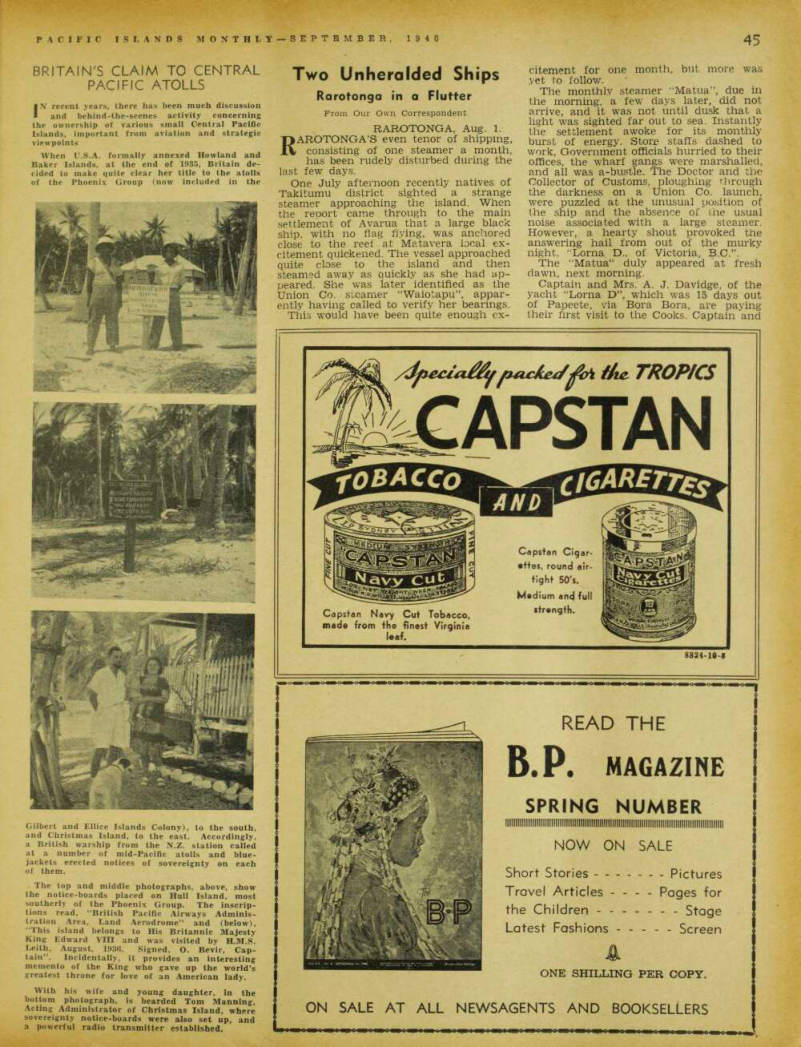
Pacific Atolls
IN recent years, there has been much discussion and behind-the-scenes activity concerning the ownership of various small Central Pacific Islands, important from aviation and strategic viewpoints When U.S.A. formally annexed Howland and Baker Islands, at the end of 1935, Britain de cided to make quite clear her title to the atolls of the Phoenix Group (now included in the
Gilbert and Ellice Islands Colony), to the south, and Christmas Island, to the east. Accordingly, a British warship from the N.Z. station called at a number of mid-Pacific atolls and blue jackets erected notices of sovereignty on each of them.
The top and middle photographs, above, show the notice-boards placed on Hull Island, most southerly of the Phoenix Group. The inscrip tions read. “British Pacific Airways Adminis tration Area, Land Aerodrome” and (below), "This island belongs to His Britannic Majesty King Edward VIII and was visited by H.M.S.
Leith, August, 1936. Signed, O. Bevir, Cap tain”. Incidentally, it provides an interesting memento of the King who gave up the world’s greatest throne for love of an American lady.
With his wife and young daughter, in the bottom photograph, is bearded Tom Manning.
Acting Administrator of Christmas Island, where sovereignty notice-boards were also set up, and a powerful radio transmitter established.
Two Unheralded Ships
Rarotonga in a Flutter
From Our Own Correspondent
Rarotonga, Aug. 1.
RAROTONGA’S even tenor of shipping, consisting of one steamer a month, has been rudely disturbed during the last few days.
One July afternoon recently natives of Takitumu district sighted a strange steamer approaching the island. When the reoort came through to the main settlement of Avarua that a large black ship, with no flag flying, was anchored close to the reef at Matavera local ex citement quickened. The vessel approached quite close to the island and then steamed away as quickly as she had ap peared. She was later identified as the Union Co. steamer “Waiotapu”, appar ently having called to verify her bearings.
This would have been quite enough cx
citement for one month, but more was yet to follow.
The monthly steamer ”Matua”, due in the morning, a few days later, did not arrive, and it was not until dusk that a light was sighted far out to sea. Instantly the settlement awoke for its monthly burst of energy. Store staffs dashed to work, Government officials hurried to their offices, the wharf gangs were marshalled, and all was a-bustle. The Doctor and the Collector of Customs, ploughing through the darkness on a Union Co. launch, were puzzled at the unusual position of the ship and the absence of the usual noise associated with a large steamer.
However, a hearty shout provoked the answering hail from out of the murky night, 'Lorna D.. of Victoria, 8.C.”.
The ”Matua“ duly appeared at fresh dawn, next morning.
Captain and Mrs. A. J. Davidge, of the yacht “Lorna D”, which was 15 days out of Papeete, via Bora Bora, are paying their first visit to the Cooks. Captain "and
Mrs. Davidge built their sturdy craft in Canada 15 years ago and have made it their home ever since. They will shortly proceed to Suva, via Suwarrow and Tonga.
Advertisements & other items, p. 47 (1 item)
Capstan
r\
/Jpecia&tj jiucAet/j&r'i fhn TROPICS
sCiO N »r Capstan Navy Cut Tobacco, made from the finest Virginia leaf.
QGARBTf^
Capstan Cigarettes, round airtight 50's.
Medium and full strength.
Isa CM 8824-10-8
READ THE
B.P. MAGAZINE
SPRING NUMBER
lllillllllllllllllllllllllllllllllllllllllllllllllllllllllllllllllllllllllllllllllllllllllll
NOW ON SALE
Short Stories Pictures Travel Articles - - - - Pages for the Children Stage Latest Fashions Screen A
ONE SHILLING PER COPY.
ON SALE AT ALL NEWSAGENTS AND BOOKSELLERS
Bananas and Cocoa to Samoa's
Rescue
From Our Own Correspondent
Apia, Aug. 6.
SINCE the copra market became de pressed, bananas are now more than ever the mainstay of Western Samoa. The quantity exported to New Zealand is at present between 18,000 and 20,000 cases per month.
Cocoa beans help also, though the mar ket price does not leave too much margin of profit. Good quality beans sell locally at around £4O per ton and over.
Mr. G. B. Gallagher, of the Western Pacific High Commission Service, has been appointed Officer in Charge of the Phoenix Islands Settlement Scheme.
in Papua
On the Lakekamu Goldfield in Papua
From Our Own Correspondent
Port Moresby, Aug. 27.
TWO well-known Papuan miners, Messrs. A. E. Bethune and H. Gar butt, who have been prospecting the headwaters of the Tauri and Tiveri Rivers on the Lakekapm goldfield since the field was re-opened in 1930, have been on fair gold—enough to make a comfort able living, according to reports.
On a visit to Port Moresby recently.
Mr. Garbutt praised the district and the climate. On his holding he has electric light installed, and with the convenience of a wireless has few faults to find with his isolated position. It is understood that Mr. Bethune, who was one of the first prospectors to work the Lakekamu when it was originally opened in 1909, will shortly leave the field to settle near Port Moresby.
The Blathering Of
Jim
Another Pacific "Wanderer"
Writes Another of Those Books
NO doubt, European residents in the Solomons will be interested to learn the real reason why missionaries, unlike traders and recruiters, were never attacked during their wanderings amongst the “savage” tribes of Malaita, in the “good old days”.
We are indebted to Mr. James Brook, author of “Jim of the Seven Seas”, for the explanation:—“l asked a chief on Malaita the reason and, in pidgin-Eng lish, this was his reply—‘Head belong missionary he good a little bit. Me like em head belong recruiter, trader more better; plenty more grease stop along him’.”
One wonders whether the same prin ciple still applies in these days of declin ing returns from trading and recruiting; for it is surely a moot point whether is really much to choose in the matter of “grease” between missionary and trader on Malaita to-day. What’s wrong, anyhow, with a morsel of Gov ernment official? Mr. Brook, whose travel autobiography takes him over the seven seas and who claims to have spent a good slice of his time in the Solomons, ought to know!
Some of the samples of pidgin-English quoted in the book appear to lack the true Solomons flavour —of to-day, at any rate —though the stories in the back ground are somewhat bewhiskered with years.
Take the old one about the wood-saw.
Mr. Brook was employed in an “engineer ing workshop”, somewhere in the Solo mons. at the time. One day, a native brought a message about a saw from the Euronean carpenter working in an adjacent 'shop. He couldn’t understand the native until this latter blurted out, with dramatic emphasis—“Pullem he come, pushem he go, brother belong axe”.
Yes, we certainly do seem to have heard that one before —and not only in the Solomons!
One day a native, entering Mr. Brook’s trade-store, asked for a “holdem bullama cow”. It nroved eventually, to be a leather belt that he wanted. And the explanation of this term’s use offered by Mr. Brook, is that bullamacow being the native word for bully-beef, and the native concerned having just gorged himself to repletion on the stuff, something of the kind was wanted to tie round his middle to sup port his distended belly, to “holdem bullamacow” in place. An ingenious ex planation, to say the least of it; and with the added attractiveness of novelty.
It must be many years since Mr. Broox had his surprisingly adventurous sojourn in the Solomons; for he tells of customs which, to say the least, are not on local record. When he was visiting a village in the “Marow Straits”, for example, (probably he means Marau Sound, at the bottom end of Guadalcanar) he noticed “a number of posts, four feet high, stuck in the ground. On top of each rested a neatly-shaped box, having a sliding door in front”.
The author narrates how. on lifting the sliding shutter of one of the boxes, “I obtained up to this period the shock of my life—what seemed to be the culmina tion of all possible frightfulness and awe.
This time, within three inches of my nose, I beheld a human head resting on the bottom of the small box”. Human heads, we are told are left in these boxes until the maggots have cleaned all the flesh off, after which the skulls are transferred to the village skull-house. Well, well!
There is a highly-dramatic story of a recruiting vessel in which a treacherous Malaitaman swung an axe over the skipper’s head. The skipper was lying on his back in his bunk —foolish fellow — when he “saw the axe rise for its in tended purpose, and closed his eyes to re ceive the fatal blow”. But the blow did not come, and the skipper was saved by a miracle. One would like to know the name of the skipper concerned. Perhaps some old-hand of the Solomons could identify him for us.
From the Solomons, the author takes us across to the Gilberts, and there in troduces us to a curious encounter he had with the native king o£ “South Apamama”, a “white negro, with pink eyes”.
Mr. Brook appears to have served for some years in the Royal Navy, prior to his adventurous career in Australia and the South Pacific. One wonders if there is anyone nowadays in the Solomons or Gilberts who remembers him and his so journ in those places. The book received a lengthy and appreciative review in one of London’s important literary periodi cals. —“Islander”.'
Advertisements & other items, p. 48 (1 item)
rafter saps strength
$ Rich in jumper and healthful herbs m K % h
THE GIN OF GENERATIONS
ENGLISH
CIGARETTES
of QUALITY
•—w] • In case of difficulty In obtaining supplies, write to Box 1861 K., G.P.0., Sydney.
“3 m
Tongan's Suicide
From Our Own Correspondent
Nukualofa, Aug. 16.
A CASE of suicide occurred at Vavau in August, when a Tongan youth shot himself dead with a shotgun, on the morning of the day when he was to be brought up on a charge of perjury.
The youth, with two other youths, broke into a store; and it was during inquiry into that offence that he was alleged to have committed perjury.
Death of Central Pacific Pioneer
MR. James Morgan Ellis, a pioneer of the development of British-owned islands in the Central Pacific, died in Auckland, in August, aged 75 (says “New Zealand Herald”).
In the employ of the London firm of John T. Arundel and Company, Mr.
Ellis and his younger brother (now Sir Albert) went to Hull Island, in the Phoenix Group, in 1887, to take charge of coconut planting operations. “You’re the king of the island,” the captain of the schooner which took them there, Captain W. Ross, said to Mr. Ellis when he deposited the brothers on the island; and, to Sir Albert, “You’re the prime minister.”
Captain Ross called at the island on subsequent occasions with stores and with coconuts for planting. After a few months, Sir Albert left for Baker Island, and henceforth devoted his attention to the phosphate side of development in the islands but his brother remained chiefly in the coconut industry.
During most of his stay at Hull Island, Mr. Ellis was the only white man in the group, the importance of which has been realised in recent years. Three of the islands have now been colonised by natives from the over-crowded south ern Gilbert Islands, while Canton Island has sprung into prominence as an air base.
Mr. Ellis engaged in similar pioneer ing work elsewhere in the Central Paci fic, chiefly as manager of Flint Island, near Tahiti. He was also associated with the phosphate operations at Makatea, in the Eastern Pacific.
For some years Mr. Ellis lived in England, but had been visiting Auckland since early last year.
Mr. J. T. McEvoy, who was in Rabaul for some weeks supervising the recondi tioning of the new vessel he purchased in Australia recently, has now returned to his home at Maron in the Western Islands Group, T.N.G.
Miss Joan Constance Highfield was married to Mr. Ronald Henry Biffin at St, George’s Church, Rabaul, recently.
Advertisements & other items, pp. 49-50 (1 item)
The Colonial Mutual Life
CADVT.]
Fiji Legislative Council
To the European Electors of the
Eastern Division
(WISH to return my heartfelt thanks to the people of Macuata, Savu Savu and Fawn Harbour who, by their unity and consistency, have again returned me to the Legislative Council of Fiji—this time with an increased majority over my former opponent, Major Tottenham.
I also especially thank my loyal friends at Levuka, Lau, Nabouwalu, Mt. Kasi, Natewa Bay, Buca Bay and Taveuni and Rotuma, and I desire to explain to all voters in these latter places that my failure to visit them was not a matter of slothfulness or neglect, but was very deliberate and occurred solely because I disapproved of an election at the present time.
As I delivered but one political address since nominations were filed, the result is particularly gratifying to me.
I thank Mr. Baker for the friendly manner in which be conducted his campaign and pay tribute to the sportsmanship and gentlemanliness of Mr. Costello.
Although I realise that the Labasa vote again counted so greatly I assure the Part-European people that they will again be my very especial care, and the copra planters will be interested to hear that I am already at work on the big problem concerning their industry which confronts me.
I face another three years of hard work in all humility, but with unbroken resolve, by the sharpness of my criticism and the fulness of my advocacy, to draw continued attention to the needs of this vast neglected portion of Fiji.
Labasa. 31/7/40. HAROLD BROCKET GIBSON.
THE COLONIAL MUTUAL LIFE
ASSURANCE SOCIETY LIMITED
During 1939 the Society issued Policy Contracts to the number of (355 These Policy Contracts, during their currency guarantee to the holders, on survivance, or to heirs in the event of premature death, no less a sum than £12,627,642
CHIEF AGENTS FOR PACIFIC ISLANDS:
MORRIS, HEDSTROM LTD,
KANGAROO BRAND
Ropes,
Cordage,
and Twines for every purpose
Backed by
86 years of service.
Manufactured by
M. DONAGHY AND SONS,
Pty. Ltd.,Geelong and Sydney.
Fiji Representatives:
PEARCE AND CO.
LIMITED
P.O. BOX 237, SUVA
FISHING TACKLE TO TACKLE FISHING
QUALITY LINES
Their Fame is Standing the Strain
Sil Rohu’s “Swordfish” Brand Genuine Cutty Hunk Line, of 50 lea thread standard, recognised for all competitions. 9 12 15 18 Cord ... 24 36 39 54 20 27 34 40 Dry Test lbs. 60 81 88 120 50 yard reels 2/6 3/6 3/6 3/9 4/3 100 yd. reels 9/6 13/6 14/6 18/6 Wet Breaking Strain 15% to 20% higher. The best line it is possible to buy.
New Polaroid Non-Glare Spectacles, 15These Glasses absolutely banish glare and reflection. For Big Game and Deep Sea Fishermen they are the best.
Big game and barrier reef fishing gear for hire. Quality Rod and Reel Repairs.
SI D II 143 ELIZABETH STREET (Near Market St.) SYDNEY I nUnU ’Phone: MA 3540.
Cord 6 Dry Test lbs. 14
For Islands Conditions
use
SPARTAN
PAINTS - ENAMELS
PAVING PAINT
QDE ENAMEL
CAR POLISH
SASH & TRIM PAINT
ZINC PASTE
VELOX ENAMEL
TROJAN PAINT
Request your Sydney Agent to obtain details, price lists and color cards of Spartan Paints.
IT WILL PAY YOU
SPARTAN LACQUERS PTY. LTD.’
74 Commonwealth St.,
SYDNEY.
Papuan Pigs, Tuberculosis, And Whatnot
Letter to the Editor
AN article in your July issue, “T.B. in Papua”, by “Daika”, calls for com ment.
“Daika” appears to have written about something of which he knows nothing, and about which he has made no enquiries in the proper quarter. Every time he feels himself getting a bit out of depth, he throws the onus on to his meat-inspector pal. Bill.
There are four types of wogs belong ing to the family mycobacterium tuber culosis —viz., the human, bovine, avian and piscine. Of these the first two can cause tuberculosis in man.
Mycobacterium tuberculosis hominis is almost solely found in man, and, for all practical purposes, is the only cause of pulmonary tuberculosis (phthisis). This apparently is the disease that “Daika” refers to when he speaks of black brother spitting around the place. Myco bacterium tuberculosis bovis, which is al most solely the cause of tuberculosis in animals, can also cause T.B. in man, but this type of T.B. usually only affects children, the germs affecting the glands, joints, bones or internal organs. It does not cause, pulmonary tuberculosis.
It therefore follows that pulmonary tuberculosis, the only type of T.B. re ferred to by “Daika”, cannot be caused by T.B. wogs from animals. are certain exceptions to this, but for all
practical purposes these exceptions can be discounted. In most countries, the only serious vehicle for the spread of bovine infections is by infected milk. However, under Papuan conditions, it is probable that there are other avenues for the spread of this type of T.B.
IN 1935, Dr. F. W. Clements, then of the Sydney University, at the request of the late Sir Hubert Murray, carried out an extensive tuberculosis survey of the population of Hanuabada village.
From* his report, published in the “Medi cal Journal of Australia”, February 22, 1936, we can gain the following informa tion.
Of 2,000 natives examined the follow ing figures were obtained: 8 cases of pul monary tuberculosis. 14 cases of sus pected pulmonary tuberculosis. 20 cases of non-pulmonary tuberculosis. Of the latter 20 cases, 18 were cases of T.B. affecting the glands of the neck.
Of these, it is only the 20 cases of non pulmonary tuberculosis that would likely be infected with bovine T.B. According to world figures and the ages mentioned in Dr. Clements’ report, it is likely that only about 10 of these cases were of bovine origin.
From the above it will be seen that Hanuabada village has a high incidence of T.B. This is not due to pigs, as sug gested by “Daika”, but, in the first place, to European contact, and is now being spread by the unhygienic mode of life of the natives. The above figures apply only to Hanuabada village and are out of all proportion to the true incidence of T.B. in Papua, which must be very much lower than what it is in most European countries.
Some interesting figures regarding T.B. may be quoted. Medical recruiting commissions in England during the last war estimated that one person in every hundred had pulmonary tuberculosis.
Only one person in every sixty infected with T.B. feels ill or develops active tuberculosis. Up to a few years ago T.B. held pride of place as the greatest killer of mankind. However, it is now on the decline. It is still the greatest of in fective diseases. Pulmonary tuberculosis (caused by human type) causes nine tenths of total deaths from T.B. De pending on locality, 50 to 100 per cent, of all Europeans become infected with T.B. at some stage in their life. In an extensive survey of 4,000 post mortems, 40 per cent, showed evidence of tuber culosis which had undergone spontaneous cure.
T.B. is rare in wild animals, so it is fair to state that Europeans were also responsible for introducing this type ol TB. in Papua, by diseased animals, etc.
T B. is said to be the most widely-spread disease in domestic animals. T.B. is rife among millions of Europeans who only see a pig after it has left the frying pan.
TO realise the difficulties ahead of those trying to deal with the T.B. ques tion, once the disease has reached a high incidence in a Papuan village, it is well to consider some of the living conditions of these people: Living in houses which are perfect incubators for most pathogenic bacteria; consumptives spitting on the floor, and everywhere else, where people live and children crawl; everyone using the same spoons, lime sticks, etc., smoking the same pipes and cigarettes; mothers feeding their infants with bolus from their own mouth. I have only spent a few days in Port Moresby and do not know Hanuabada village, but I take it that conditions are much the same there as in other parts of Papua,
The reduction of the incidence of T.B. in Hanuabada village now depends on educating the natives on the same lines as Europeans are being educated, at a colossal expenditure of energy and money.
The natives will have to open up their houses; let the sunshine in and keep the dust out. They will have to be scrupulous about spitting and the disposal of excreta.
Community limesticks and smoking will have to disappear. Native mothers will have to be taught not to infect then children. Standards of living will have to be raised. Then the avenues of bovine T.B. infections in children should be in vestigated and checked. It will be then that the incidence of T.B. in Hanuabada will begin to decline, as it has been do ing in most European countries of recent years.
Can the above be accomplished in a Papuan village? Let those who know the Papuan native best, answer this question.
In the circumstances, the Government and the L.M.S. Mission have taken the only apparent possible step, that of establishing a hospital for the treatment of infective cases, on Gemo Island. This, I imagine, is costing the Government in the vicinity of £l,OOO per annum, and it is costing the L.M.S. nurses, who are voluntarily staffing the hospital, a sacri fice that cannot be measured in money.
A pamphlet on “The Prevention of Tuberculosis”, dated June 4, 1937. was written by Dr. W. M. Strong, then Chief Medical Officer of the Territory, and printed in English and Motuan, and dis tributed throughout Papua. Dr. Strong did everything possible to educate the people regarding the prevention of tuberculosis and Dr. F. J. Williams (pre sent Chief Medical Officer) is continuing this work.
“Daika”, apparently, considers that no body in Papua has taken the question of T.B. seriously.
RETURNING to the eating of the flesh of the porker as a potential source of bovine T.B. infections in child ren: The T.B. germs in pigs are usually in the organs of the chest and abdomen.
If the meat is well cooked, or boiled, the germs will be destroyed. Recent research work has accumulated a great deal of evidence (but no definite proof) that active T.B. infections in the great major ity of cases are caused by repeated in fections following at short intervals. So the occasional ceremonial eating of a pig, with the remote possibility that live bovine T.B. germs will be swallowed by a susceptible child, and the further re mote possibility that such germs will cause an active, serious T.B. condition, can be discarded as of no importance.
Pigs, through other means, may be one of the channels of bovine infections in Papuan children.
There is a case for the pig. By his partiality to a diet of human excreta, the village pig acts as the village sanit ary man, and is very effective as such Many diseases, including T. 8., can be transferred through contamination by infected faeces. Many of the pathogenic wogs ingested must be destroyed in the alimentary canal of the pig. In some villages it is a matter of which is the more desirable, human or bovine excreta.
The latter is often cleaned up by the
village people, but never the former.
A more important point in favour of the pig is that in most districts it is the main source of native wealth, is the centre of most important festivals, and plays a big part in marriage! transactions, etc. The removal of the pig would mean a great disorganisation of the community life of the native. Such a move is likely to have dire consequences.
I am, etc.
Tam Aiai.
Papua, August 10, 1940.
South Africa
How T.B. is Treated In South Africa
Letter to the Editor IREAD with great interest the article on “Tuberculosis in Papua” (July —mainly because I myseli have had 24 years’ experience in treat ing natives and half-castes for tuber culosis of the lungs in Africa and in places where there were no doctors.
My practice was to give a T.B. family an atomiser, filled with menthol and oil solution and see that they learned to work it properly, so that there was a good flow of mist. I made the patient place the atomiser in his mouth and then inhale deeply to fill the lungs three times.
The same procedure was then repeated three times using each nostril. This was carried out three times daily.
I found that in early cases of T.B.
the cough stopped after three weeks’ treatment and the disease was definitely overcome in three months. The cost of this cure worked out at under 12/- per annum for each family.
This method, which really is only applying a soothing antiseptic to the lung sores, has been successfully used at Capetown sanatorium for over 30 years.
I am, etc.
W. H. Williams.
G.P.0., Suva, Fiji. 24/7/40.
Commodore W. E. Parry, C. 8., of H.M.S. “Achilles”, was presented with a tabua (whale’s tooth) by Fijian chiefs recently, in commemoration of the N.Z. warship’s, successful engagement with the German pocket-battleship “Graf Spee”.
The ceremony took place in Suva Botani cal Gardens and was attended by Mr. C.
E. Pennefather (Adviser on Native Affairs), the Commandant of the Fiji De fence Force (Colonel J. E. Workman), Messrs. C. Caldwell and G. K. Roth (of the Fiji Administration) and a number of officers from the “Achilles”.
Advertisements & other items, pp. 51-52 (2 items)
/streamlined veauty
SOL
SIMILAR TO EUROPEAN MAKES
now made hy
COLEMAN LAMP & STOVE CO.
LTD.
Toronto, Ontario, Canada and sold hy All Leading Stores in the Pacific Islands.
In case of difficulty in obtaining supplies write to —
PEARCE & CO.—SUVA, FIJI IS.
/streamlined veauty
€ I _i
Us a newCna/tman/auneA
This is the first announcement in the Islands of this new Chapman cruiser. You'll be proud to own this craft, its sleek, stream-lined appearance will be admired, its performance under all conditions will amaze you.
Interior appointments include large lockers, comfortable bunks. The power is, of course, a reliable, economical Chapman Super Pup 4* h.p. engine.
There is a 20 ft. cruiser—of identical design—also available. Write for full details.
CHAPMAN & SHERACK
ERSKINEVILLE, N. S. W.
Gramophone and
Record Buyers
Reconditioned His Master's Voice Portables Equal to New.
Delivered Straight to You for £li/li/-. No extras to pay for.
Send your record orders to us.
Immediate attention. Can be sent c.o.d.
TALKERIES
161 CASTLEREAGH ST., SYDNEY
GUINNESS
Stout
FOR STRENGTH
9 i •Hi ■
STOCKED BY ALL BRANCHES OF
Brown & Joske Ltd. W. R. Carpenter & Co. Ltd.
Bums Philp & Co. Ltd. Morris Hedstrom Ltd.
Advertisement of Export Bottlers Ltd., London. A. Maefee ft Co. Ltd., Wapplng, Liverpool, England.
Wanted To Purchase
Used stamps of all Pacific Islands.
Highest prices paid. Regular consignments solicited. Remittances guaranteed by return mail.
J. H. SMYTH PTY. LTD.,
114 Castlereagh St., Sydney, Aust.
Duel At Tahiti
Gentleman is Twice Punctured
From Our Own Correspondent
Papeete, Aug. 18.
THE days of the Great Cardinal and of Athos, Aramis and Porthos were revived at Tahiti, during the early days of August, when Porthos fought a duel,, after the old manner, with a nobleman of Richelieu’s entourage.
It is not quite clear what started the rumpus. Rumour has it that Porthos flung at the nobleman that he is a Fifth Columnist, and the Cardinal’s friend retorted with an insult equally deadly.
Anger flamed, and one challenged the other to mortal combat.
All the etiquette of the ancient code was observed —even to the chivalric gestures on the field of battle.
The timekeeper has let it be known that the battle lasted 55 seconds. Dur ing that period, Richelieu’s champion suffered two punctures in the arm.
Blood having flowed, the seconds intervened. Honour had been re-estab lished on her throne.
Actually, this is the first time in nearly half a century that a duel has been car ried to a conclusion at Tahiti. Chal lenges have been made often enough, and the details of battle arranged; but hitherto all have been called off with out a meeting on “the field of honour”.
B.S.I. First Horticultural Show
THE first annual show of the British Solomon Islands Horticultural Society was held on August 10 in the Tulagi store of Messrs. Burns Philp (S.S.) Co. Ltd., loaned for the occasion.
The opening ceremony was performed by the Resident Commissioner. Despite unfavourable weather, over 50 were present to view the large number and variety of flowers, fruits and vege tables. The twelve sections were:— Flowers; Mixed Bowl of Flowers; Best Single Bloom; Pot Plants—Flowering: Pot Plants—Non flowering; Hanging Baskets; Ornamental Shrubs; Basket of Mixed Fruits; Basket of Native Vegetables; Vegetables: Basket of Mixed Vege tables; Best Decorated Table.
Two silver cup challenge trophies were presented, one by Mrs. W. S. Mar chant, wife of the patron, which was won for the first year by Mrs. M. Bern hardt. with an orchid, shown under sec tion 3; and one donated by Messrs.
Burns Philp (S.S.) Co. Ltd., retained for one year by Mrs. A. H. Wilson, who gained the highest number of marks.
Other prize winners were:— Mrs. J. C. M. Scott. Sisters of the Cross, Miss M. Cleaver. Bungnana.
Master James Scott. Girls’ School, Mrs. W. G. Hobbs. Bungnana.
Miss M. Kennedy. ,„ n Mrs. W. H. Miller. Boys College ’
Mrs. R. Hyne. Taroamaro.
Miss L. Higginbottom. Sundry Natives.
A number of exhibits for the show, from out-stations, were held up in trans port by weather conditions, and were received too late.
Mrs. W. S. Marchant exhibited flowers, fruits and vegetables but, at her own request, these were non-competitive.
At the conclusion, fruit and vegetables donated by competitors were auctioned for the Red Cross Society.
Captain William Sinker, who was well known in Pacific ports as master of the “Southern Cross V”, died recently in England.
An Ancient Ceremony of
"Takibo"
An Ancient Ceremony of Tonga
Letter to the Editor 1 RECENTLY received from Rabaul a letter from someone who calls him self ‘‘A Student of Polynesian His tory”, whose signature I cannot de cipher, and he asks if I will explain for him the meaning of the Tongan word “Takibo”.
“Takibo”, according to the edition of the Tongan vocabulary originally pub lished by the late Rev. Stephen Rabone, means: “To hold a lighted torch through the night; a ceremony performed at the death of a chief”.
The ceremony of “Takibo” was per formed during the five days of lying-in state of the late Tongan King George Tubou 11. Guards stood upon the thres hold of the throne room, wherein the body of the King lay. Near the body stood other attendants who, silently, slowly and continuously waved silk streamers of red and white, the Tongan colours. This went on during the day.
Each evening, as the .sun set, lights appeared at regular intervals along the top of the broad stone wall which sur rounded the palace grounds—the lights being supplied by natives outside the grounds—while inside the grounds ap peared another series of lights whicn brought into relief the outline of the palace.
And then was seen a custom which is purely Tongan. Small parties of natives, clad in mats, took up positions several feet from the stone wall. They seated themselves before a mat or basket con taining very fine sand, which was spread over a space about 3 feet square. The headman of each group sat facing the wall and he was supported by a compan ion on either side —they faced each other with the sand heaped between them.
Certain dried parts of the coconut palm were then produced, and these were lighted and held over the sand by the headman of each group. As the flame gained strength, it produced a bright light.
There were about 60 of these watch fires, and each party of a dozen or more represented a district or town in Tonga.
As the sparks fell from the blazing torches, the men on either side of the torch quickly extinguished and removed all the falling cinders, so that the sand patch was kept clean and white. The people who looked after the torches were relieved, at intervals, and the ceremony went on all night. The spectacle was im pressive—especially the silence of the natives, who were assembled there in thousands. They simply sat in the dark ness, watching and waiting, with the characteristic patience of the Polynesian.
I do not know the meaning of the
ceremony. A Tongan will tell one that it is “faka toga”—that is, in the old Tongan way—but it is clear that it is something that has been handed down through the ages, and that it is em ployed only as a tribute to very high chiefs.
To students of Polynesian history—like my friend in Rabaul—there should be much of interest in this undoubtedly ancient ceremony. The attendance each evening of several bands of native musicians, who played in a very solemn fashion many selections of sacred music upon modern instruments, was a ming ling of the old order with the new.
I am, etc.
F. T. Goedicke.
Lotofoa, Haapai, July 30, 1940. (Mr. Goedicke’s letter has been some what condensed. If the resident of Rabaul who desires the particulars of “Takibo” will send his address to us, we shall send him Mr. Goedicke’s letter in full.—Ed. “P.1.M.”) The next meeting of the New Guinea Legislative Council will be held at Rabaul on September 24.
European residents and natives of Western Samoa are endeavoring to raise £5,000 for the purchase of a fighter plane for the Royal Air Force.
Mr. and Mrs. E. Grevsmuehi, of San Francisco U.S.A., who visited Western Samoa in July to renew old friendships, arrived in Tahiti in August. Mr. Grevs muehi was born in Samoa, his father having been engaged in trading for many years as Grevsmuehi and Co., on the present site of Bums Philp (S.S.) Co.’s large premises. Mr. Grevsmuehi went to America from Samoa in 1913.
Advertisements & other items, p. 53 (1 item)
Aunt Mary’s
The House of Steel for Quality Cutlery a ygjgv 1 CD We have a large range of Scissors, Knives, Razors, etc.
W. JNO. BAKER
3 HUNTER STREET. SYDNEY.
Established 1888.
READY TO HEAT
AND SERVE!
Aunt Mary’s
PREPARED SOUPS AND
TASTY MEAL-TIME PRODUCTS
include delicious Mulligatawny, Tomato, Pea and other rich Soups, also Baked Beans with Tomato Sauce, Curried Baked Beans, Spaghetti with Cheese, Curried Spaghetti and other appetizing, wholesome food products. Ready to heat and serve!
Aunt Mary’s
PREPARED
VEGETABLES
offer a great variety of fullflavoured, nutritious dinner vegetables; ready to heat and serve. All Aunt Mary's food products are packed in 1 lb. cans for Tropical conditions
and SOLD BY ALL STORES.
m a
CSd
i
General
Merchants
and
Agents
REPRESENTING LEADING FIRMS IN THE PACIFIC ISLANDS
379 KENT STREET,
SYDNEY.
Cable Address: “Trocas”, Sydney.
Telephones: MJ 4657 (5 lines).
Islands Produce Sold on Shippers' Account Buyers of all Islands’ requirements on Commis Liberal Advances against Consignments. sion Original Invoices Furnished. 25 Years Islands Trade Experience.
Bankers: Bank of New South Wales. Correspondence in English, French & German,
Fiji Councillors Re-Elected
AT the recent Legislative Council elections in Fiji, Mr. H. B. Gibson was re-elected as the Eastern Divi sion European member. Other candi dates were Messrs. W. E. Willoughby- Tottenham, C. W. Baker and P. Costello.
Mr. Tularam the retiring member, again topped the poll to represent the Indian section in the Eastern Division.
Two other Indians, Messrs. Jafar Khan and Sahdu Lai, contested the seat.
Miss Bertha Bird, who was a nursing sister at the Methodist Mission hospital in New Britain for five years, between 1920 and 1925, died in Victoria recently.
Mr. F. G. Foster, of Ellis, Munro, War ren and Leys, arrived in Sydney recently from Fiji to enlist in the A.I.F.
a Missionary
When Germans Flogged a Missionary An Incident in New Guinea in 1914
I often have sought, in 25-years-old re cords, for an authentic account of the flogging of Rev. W. H. Cox, by the Germans in New Guinea, in 1914; but I never could locate the story. But here, m “Why Gather Moss?”, a new book by George Clune, are all the details. Clune was a member of the Australian force in Rabaul, and was one of the party which dealt with the incident. . Rev. W. H. Cox was a Methodist mis sionary, whose station was at Namatanai, New Ireland, but, when war broke out, he happened to be in Rabaul, and was one of the British arrested by the Ger
mans. When the Australians occupied Rabaul, he was released, and returned to his station.
Australian troops had gone to Kavieng (northern end of New Ireland), but communications were so bad that the little German community far to the south, at Namatanai, were left alone. They did not realise their position—apparently, they thought the Australians were afraid of them—and they were very cocky, and racial feeling ran high.
For some obscure reason, they decided that the returned missionary was a British spy, and must be dealt with according to the laws of the Fatherland. One day, half a dozen of them, more or less drunk, seized him and carried him into a public place.
The Germans had a system of punish ing delinquent natives. The latter were put, face down, over a barrel, and, with a stout cane, they were given “ten alonga arse”, or twenty, or thirty, as the case might be. It was a painful and humi liating punishment. The gallant Huns of Namatanai stripped the British mis sionary, forced him down over a log, and gg-ve him thirty lashes.
A little later, sober, they realised what was likely to happen and, like cowardly curs, they fled into the jungle.
Several days later, Mr. Cox arrived in Rabaul and told his story. A medical examination confirmed the brutality of his treatment.
Colonel Holmes, Australian Commander, sent troops at once to Namatanai. The search was long and arduous; but event ually the gentlemen were rounded up, taken to Rabaul, tried, found guilty, and sentenced to what they had given the missionary—“thirty alonga arse”.
“This operation was carried out in the presence of all available troops, formed into a hollow square,” says Mr. Clune.
“Natives, and citizens of the town, were forbidden the area. With their bare, pink, fat. German buttocks exposed to the tropical sun, the guilty prisoners whimpered like lost curs as they lay across the barrel, and received a well deserved dose of their own medicine. Be tween moans and wails, they promised that they never again would give a Britisher ‘thirty alonga arse’.”
But what is the value of a German promise, anyway?—R.
Tonga
Higher Duties in Tonga
From Our Own Correspondent
Nukualofa, Aug. 1.
THE Legislative Assembly, at its recent session, raised the import duties on certain articles, which came into effect as from July 1, 1940. The follow ing are the new duty rates:—
There is also a new tax of 3 per cent, known as the port and service tax, levied on the value of all imported goods.
This is additional to all other levies.
British General Pref.
Tariff, Ale, beer and porter, per gal.
Benzine, gasolene or other 2/6 3/6 motor spirit, per gal, .. 6d 6d Cigars and cigarettes, per lb. 11/- 13/- Kerosene, per gal Spirits, proof or over-proof, 4d 4d per lb 34/- 40/- Spirits, under-proof, per gal.
Spirits whose strength cannot be ascertained by Syfces’ 29/- 35/hydrometer, per gal 29/- 35/- Sugar, per lb Timber, undressed, per 100 Id IVzd super ft Timber, dressed or surfaced, 2/- 3/per 100 super ft 2/6 3/6 Tobacco, manufactured, per lb. 7/- 9/-
Advertisements & other items, p. 54 (2 items)
52
September, igio-i* Acific islands monthly
Imperial
3/9AH 0 Lamb Tongues, 12 oz.
For QUICK, ECONOMICAL,
TASTY MEALS
That Give VARIETY
To Your MENUS
Imperial
GOOD FOOD
Delicious and different. Served, in a moment, without fuss or bother. Try Imperial good foods
for flavour and variety. Perfect ingredients,
excellent cooking make Imperial foods universal
favourites.
All These Different Foods from the Gold Lined Imperial Cans—B oz. fir 16 oz.
UJItIUmL
JB IfP~T OH CUES
Sheep Tongues, 12 oz.
MP imperial Camp Pie urn Imperial Hot Meals.
Varieties.
ALSO
Imperial Ox Tongues 24 oz. & 32 oz.
Imperial Hampe 12 oz.
Imperial Cheese 8 oz.
Mild or Tasty Imperial Savoury Spreads 4 Varieties Products of ® Steak and Kidney Pudding ® Lamb and Green Peas O Sausages and Tomato $ Sausages, Spaghetti and O Irish Stew Tomato Frankfurts in Tomato Sauce ® Steak and Tomato & Sausages and Vegetables Beef 'Steak Pudding
"FITZROY"
Luncheon Beef .. 16 oz. (in oblong can) Pork Sausages .. 16 oz.
Beef Sausages ... 16 oz.
"WESTFIELD"
Corned, Boiled and/or Roast Mutton, 12 oz.
"OX Cr PALM" OR
"RIVERSTONE"
Native Trade Meats.
Corned, Boiled and/or Roast Beef —12 oz., 16 oz., 24 oz.. 2 lb.. 3 lb.. 4 lb., 5 lb,, and 6 lb.
Riverstone Meat Co. Ply. Lid.
5-7 O'tomiell Street, Sydney
Cables: k IMPERIAL ”
Fiji Representatives:
PEARCE & CO., LTD.
Tragedy Of 1901
When Two Papuan Miners Were Roasted and Eaten
By Edward Auerbach, Pioneer Prospector, now a Resident of the Trobriand Islands.
IN 1901, Tom Campion, Darkie Davis and W. MacClelland left Clunas & Clark’s store at Bogi, 60 miles up the Kumusi River, Papua, on a prospecting trip to the head-waters of the Kumusi (at the Papangi Plains).
They were in a creek which runs into the left or northern branch of the Kumusi, on the divide between the Kumusi and Mambare Rivers. The Ora kivas, the fierce, war-like natives of that region, came in with native food from Tweedie Village.
The prospectors bought the food from the natives and, as they seemed very friendly, the whites got careless. Cam pion and Davis were sitting on the bank of the creek, their rifles a few feet away from them, when about 12 natives came in with the foodstuffs. But a big party of natives had hidden in the bush, where they waited.
When the prospectors had moved away from their rifles, the Orakivas rushed them. One drove a pickaxe through Campion’s head and killed him. Others seized Davis, and tied him up.
Bill MacClelland was in the camp, nearby. One of their boys told MacClel land that the Orakivas had killed his two mates, so he dashed into the bush, and got away.
On the track MacClelland met Bill Whitten, who was on his way from Bogi to the Yodda, and the two men returned to Bogi, with the bad news.
Alec. Elliot was A.R.M. at Bogi. There were then five or six miners, including myself, at Bogi. We wanted to go, straight away, to the scene of the murder, but Elliot, being the A.R.M., and the man in charge, objected. He said he had only a few police, and he would try and get some local natives. We heard, afterwards, that the Orakivas had stolen most of his rifles, but no cartridges.
We waited there for two days, and then, as there was no sign of Elliot mak ing a move, we went off without him. We got to Tweedie Village, but we were too late. We rescued one indentured boy.
On making enquiries, we found that after the natives killed Campion and captured Davis, they brought both to their village. They tied Davis’ hands and feet together and carried him by slinging him under a pole, the same way as they carry a pig. They got him to their village and tied him to a post.
The natives roasted the body of Cam pion and ate it. They offered Davis a piece of this flesh to eat. I do not think he ate it, though he must have been starving.
Some time later, they roasted Davis while he was still alive and finally they ate him. We recovered the skulls of both Davis and Campion.
Bill Whitten went on to the Yodda.
When they learned what had happened, the miners on the Yodda formed a puni tive expedition to go out and punish the natives. J. Murphy and George Arnold (who died in Sydney a few months ago? took the lead. They found the Orakivas and they shot down everything they saw. They made a fairly good job of it.
About a couple of months after this, I brought Governor Le Hunt and his party up the Kumusi to Bogi in my launch “Balmain”. This affair came up, in the course of conversation, and the Governor told me that the miners had had no right to take the law into their own hands, in the way they had done.
He said he would see that they were punished.
I told him that if A.R.M. Elliot had gone out at once, he very likely would have saved Davis! Also reminded him that there were then about 300 miners on the Yodda; and, if he tried to punish those who had gone out on the punitive expedition, he would have to punish the lot; and I advised him to get a couple of regiments of soldiers from Sydney.
Before we got to Bogi, the Governor acknowledged that the miners had done thp rnrroct thineme corr.cb wring.
Billy MacClelland died a few years later, on the Yodda.
Mrs. Arthur Young, of Pitcairn Island, died on September 10, 1939, at the age y - SJ 16 was of Spanish descent; but her husband, Mr. Arthur Young, is a vonn? C of ntv’’^ lc ipman Edward °* B °unty fame, „ Mlss Marjorie Cooper, of Samara!, Pa P ua > recently commenced a nursing course at Ipswich General Hospital, w T ee sia “ a - .
Lance-Corporal M. Rylands, of the New Guinea contingent of the A.1.P., recently married Miss Joyes Fraser, of Croydon, N.S.W. He was formerly a member of the N.G. Lands Department.
Last year, 109 Papuan cases of T.B. were admitted to the Government Hos pital on Gemo Island, according to the annual report.
Advertisements & other items, pp. 55-56 (2 items)
53
PACIFIC ISLANDS MONT II I, Y — SEPTEMBER, 1940
Mcllrath’S
Send Your Christmas Grocery Orders
TO
SYDNEY, AUSTRALIA
WHERE YOUR MONEY BUYS MORE
Mcllrath’s Xmas Cakes, 3 lbs. in Fancy Tin 3 TOi each Mcllrath’s Special Quality Xmas Cakes, 2. 3. 4, 5 & 6 lb. size, 1/6 & 1/9 lb.
Arnott’s Fruit Cakes, 16 oz. Sealed Tins 1/9 tin, 20/6 doz.
Arnott’s Christmas Puddings, 1 lb l/7i tin, 19/- doz.
Arnott’s Christmas Puddings, 2 lb 3/1 tin, 35/6 doz.
Amott’s “King’s Own” Biscuits, li lb 2/11 tin Special Quality Christmas Hams, 12 to 14 lb per lb. l/6i Best Fruit Mincemeat, 12 oz 1/1 jar, 12/6 doz.
Freshly Roasted Peanuts 10id. lb., 10/- doz.
Walnuts in Shell 1/2 lb., 13/6 doz.
Dessert Almonds in Shell l/4i lb., 16/- doz.
Dessert Almond Kernels 4 ozs. for Hid., 3/6 lb.
Ground Almonds 4 oz. l/4i tin, 8 oz. 2/7i tin New Season’s Muscatel Clusters 8 oz. 10id. pkt., 16 oz. 1/6 pkt.
Choice Australian Pressed Figs in Cellophane, 8 oz. 9id. pkt., 16 oz. 1/6 pkt.
Finest Crystallised Ginger 1/li lb.
Preserved Ginger in Syrup, 16 oz 1/8 jar, 19/6 doz.
Mixed Cake & Pudding Fruits with Peel .. 16 oz. 1/1 pkt., 12/9 doz.
Best Jelly Crystals, all Flavours 4 oz. 4id. pkt., 4/3 doz.
Cut Mixed Peel (ready for use) 8 oz. 7id. pkt., 7/3 doz.
New Season’s Extra Choice Currants 6Jd. lb.. 6/3 doz.
New Season’s Extra Choice Sultanas 6d. lb., 5/9 doz.
New Season’s Finest Pitted Dates 8id. lb., 8/3 doz.
Cadbury’s Tropical Pack Chocolates, 1 lb 3/9 tin, 44/- doz.
“I.X.L.” Sliced Peaches, 30 oz 9id. tin, 9/4i doz.
“I.X.L.” Bartlett Pears, 30 oz Hid. tin, 11/3 doz.
“I.X.L.” Diced Fruit Salad 16 oz., 9/3 doz., 30 oz. 14/9 doz.
Nestle’s Pure Reduced Cream, 4 oz 4d. tin, 3/9 doz, Schweppes’ Lime Juice Cordial, 26 oz 1/11 bot., 22/6 doz.
Schweppes’ Lemon Juice Cordial, 26 oz 1/5 bot., 16/6 doz.
Mcllrath’s Royal Reserve Port, 26 oz 3/6 bot., 41/- doz.
Mcllrath’s R.R. Dry Sherry, 26 oz 3/6 bot., 41/- doz.
Mcllrath’s Brown Muscat, 26 oz 2/2 bot., 25/- doz.
All prices f.o.b. Sydney
No charge for cases or packing
MclLRATH’S Pty. Ltd.
EXPORT DEPARTMENT
202-204 PITT STREET, SYDNEY
AUSTRALIA
MATURED
TO
PERFECTION
imuiuimm’s
WINES
SMOOTH out your worries of these trying days with a perfect aperitif and a smoothly restful glass of port, each evening.
You’ll thoroughly appreciate YEN- DARRA Extra Dry SHERRY or
ROYAL RESERVE Sweet SHERRY
and VINTAGE 99 PORT—products of Australia’s leading wine makers for over 60 years.
Write to your nearest agent for supplies:— C. J. CASHMAN & CO.,
DARWIN; J. R. CLAY & CO.,
PAPUA; F. R. FORSYTH, NEW
GUINEA; C. R. YOUNGER,
-• k * SOLOMON ISLANDS.
Hemp Corporation Gentlemen
in Trouble
THERE was interest for Papua and New Guinea in the arrest in Sydney on August 23 of five well-known men connected with the Commonwealth Hemp Corporation and other allied companies, namely, David Hampton, Michael Sin clair (or Spiegel), George S. Holburn, Edward R. White and P. R. Higgins. They have been charged with conspiring "with a certain William James Fullerton, to obtain money by fraudulent means. Some of them had been charged a week earlier with not making income tax returns and heavily fined. In these proceedings the companies mentioned were the British- Australian Fibre Company, Ltd., the British-Australian Pulp and Paper Co., Ltd., the Commonwealth Hemp Corpora tion, Ltd., and Issuing Houses of Australia.
This is the group which extended its activities to Papua and New Guinea a few years ago—first, with a view to growing hemp in Papua, and, later, with the idea of utilising the kunai grass of New Guinea for paoer-making.
The “P.1.M.”, in the plainest language possible in the circumstances, urged people in the Territories to carefully in vestigate the records of these companies before having anything to do with them; and, as a result, certain of the gentlemen named above threatened the “P.1.M.” and its printers with action for libel.
Mr. R. Anderson, late quartermaster of the Union Co.’s Islands vessel “Matua”, has taken up shore duties as wharfinger at Avarua, Rarotonga, Cook Islands, re placing Mr. W. Bryan who has retired after 25 years’ service in the Group.
Fiji Planters
Urged to Grow Foodstuffs
THE present 'position of the copra in dustry is a matter of serious import to Fiji, where copra production ranks as the third biggest industry. It was the second biggest, being next to sugar, until recent times, when it was displaced by gold production. The value of Fiji’s copra production has ranged from £500,000 in the good years to as low as £120,000 in the depression. Production in 1938 was worth £270.000 and in 1939 £207,000.
Many correspondents, and the “Fiji Times” editorially, have discussed the problem of what is to be done to hold up the copra industry, under the un favourable conditions imposed by the war.
During August, while there was much interesting discussion, nothing of’ a practicable character was put forward.
The “Fiji Times” points out that the problem is one for which solution can not be quickly or easily found. It is re commended that in the meantime coco nut planters should give all possible at tention to the production within Fiji of many foodstuffs which now are imported, and which could be quite well-grown on the coconut plantations. Fiji has a large and rapidly growing population, whose food requirements in the bulk now re present a large volume of imports.
Commander R. C. Garsia, who was Ad ministrator of Nauru from 1933 to 1938, attended the August meeting of the Pacific Islands Society in Sydney. He is now living at Canberra.
Advertisements & other items, p. 56 (1 item)
Plum Pudding
✓ >5 1 l/'L 2 •i.
You'll earn tribute from your family when you serve Swallow's delicious Plum Pudding. They're full flavoured and expertly prepared by Swallow's master cooks. Everybody loves plum pudding and the rich goodness of Swallow's is unique.
Specially tropic-packed in air-tight tins of exact quantities... but always allow for extra helpings. lb. ... 3 serves, 1 lb. ... 6 serves, 1 lb. ... 9 serves, 2 lb. ... 12 serves, 3 lb. ... 18 serves.
SWALLOW & ARIELL LTD.
Port Melbourne , Australia
Glycerine From
Copra
Apparently Not Wanted in This War
IN the war of 1914-18, glycerine, as a component of explosives, was in great demand among the belligerent nations: and. as coconut oil then gave high quality glycerine, copra went to prices never formerly heard of.
Some people, remembering this, and noting the enormous use of high explo sives in this war, have been watching copra quotations hopefully: but we are told, now, by experts, that in 25 years the position has changed completely. In 1914, the nations had no stocks of gly cerine; this time, they have huge re serves.
Moreover (says one American writer) a great many processes for the produc tion of glycerine bv fermentation of sugars and by synthesis from petroleum pro ducts or from acetylene, ethylene and propylene have been developed, particu larly in Germany, since 1914. Whether these processes are being utilised on a commercial scale in Germany to-day de pends on the relative availability of soap making raw materials on the one hand and sources of cheap sugar on the other.
Processes of this type serve to make gly cerine more readily available from a greater variety of sources and less de pendent on a supply of oils and fats.
Gold industry Gets Raw Deal in
New Guinea
MR. R. A. LAWS, of Wau, New Guinea, in a letter in the “Rabaul Times”, argues that if the authorities would only get on with their plan to construct the road between Salamaua and Wau — to which they are definitely committed— a means would be provided for employ ing large numbers of thei native labourers who, under the copra depression, are now being released from the plantations. Also, it might provide employment for many Europeans who otherwise are dependent upon the copra industry.
Mr. Laws points out that funds for this project can properly be drawn from the rapidly-accumulating amount derived from the excise tax on gold instituted since the outbreak of war. He points out that, 12 years ago, the royalty on gold was raised from 1 to 5 per cent, for the specific purpose of securing funds for the construction of the road, and that the whole of this revenue, probably half a million pounds, instead of being used for that purpose, was absorbed into New Guinea’s general revenue.
From that angle the residents of New Guinea certainly have had a raw deal— and it becomes more raw, because Can berra now, using the war as an excuse, clearly does not intend to proceed with the road, which it definitely promised two years ago.
Rev. C. S. Bull, of the Anglican Mis sion, Suva, Fiji, has been on leave in Hobart, Tasmania, and Melbourne, for the past 12 months, and is expected to return to the Colony at the end of Sep tember, Miss Ina Thomson, daughter of Captain and Mrs. Andy Thomson (he is one of the best known identities of the Cook Islands), arrived in Rarotonga recently from New Zealand to spend a short vacation.
Advertisements & other items, pp. 57-58 (1 item)
Need Marriage
SPOIL A WOMAN’S
BEA U
Jack and Betty Tyler were a happily married couple. They had two of the loveliest little youngsters you could imagine. Jack had a good position and Betty was the sort of woman who knew how to make friends and keep them. They should have been happy . . . very happy.
But they weren’t, and here’s the reason why. Betty had always sworn to herself before marriage that she would not let marriage ruin her appearance. Of course, it’s easy to make such promises to yourself, but they’re not always so easy to keep. Listen now to Jack.
Betty is powdering her nose. Jack is looking at her in a very critical way. After a while he says : “You’re always messing round with your powder puff. What’s the matter with you lately? If it’s not your powder puff it’s your lipstick.”
Those few words cut Betty to the quick. She didn’t say anything at the time, but that night before she went to bed she sat in front of her big mirror. She looked at herself closely. This is what she thought : “He’s noticed . . . I’m losing my looks . . . and no wonder . . . this heat. You’d think I was forty to look at me. I’m always tired, worn out. What IS the matter with me?”
Then she looked at herself very critically in the mirror and this is what she saw. Her eyes were dull, her skin had a strained, pinched look ... it was pasty too. Her hair was lifeless and there were tiny little lines beginning to show round her eyes, and above her eyebrows.
Something had to be done! She decided to have a chat to her doctor.
She told him everything. And then finished up by saying : “I know it’s no use trying to fix myself up with face creams and powder and paint. It’s something more than that, doctor, and it’s beginning to show on my face! Do you think it’s the heat?’’
“Well, Mrs. Tyler,” said the doctor, “it’s not just the heat alone. The most important thing you’ve told me is that you wake tired in the mornings. That means a lot. You see, when you wake tired in the morning you naturally become more tired as the day goes on. You feel dull, listless. And that’s really Night-Starvation. Not many people realise it, but even at night you go on using up energy. Your heart beats, your lungs make muscular movements; and it stands to reason, if energy isn’t replaced, you wake tired. And that’s when this hot climate begins to tell on you. The best thing for you is Horlicks. Get some Horlicks and drink a cupful every night before you go to bed. You’ll feel right as rain in no time.”
Horlicks made a wonderful difference to Betty. It was marvellous the way her strength and vitality came hack. A couple of months after her visit to the doctor she and Jack were starting off one morning for a picnic. The children were ready, all the sandwiches were cut. Betty had been going like fury all the morning and still looked so fresh and lovely that Jack remarked on it.
“Bet,” he said, “it’s marvellous the difference that’s come over you during the last month. You look really lovely!” * * * If you wake up tired . . . get more tired as the day goes on, then the chances are that you're suffering from Night-Starvation. Remember what the doctor said. A cupful of Horlicks last thing at night before bed guards against Night-Starvation and replaces energy lost during sleep.
You wake up feeling full of life and vitality.
••ORUCIIS
\ orlic l **uroM.
W*~ LATEST Radio Sets
£2O below Retail Price
You can buy direct from factory if no Century Agent in your District.
You thus save up to £2O on retail prices.
Marvellous tone, sensitivity and economy; world-wide reception brings overseas news direct to your home. Absolute satisfaction is guaranteed by FREE TEN DAY
TRIAL TO INTENDING PURCHASERS.
Illustrated catalogue of Battery and Allelectric sets post free on request.
WRITE AT ONCE, Century Radio Mfg.
Co., 9-13 Dixon Street, Sydney.
St. Ignatius’ College
Riverview Sydney
Boys are prepared for Intermediate and Leaving Certificate Examinations and for Exhibitions, Scholarships and Bursaries at the University.
Boys are arranged in three Divisions > according to age. Each Division has its own Library, Debating Society, Cricket and Football Fields, and Tennis Courts.
Senior and Junior Rowing Sheds, with a large fleet of pleasure and racing boats.
Private Swimming Baths.
Prospectus and further particulars on application to the— Rector: St. Ignatius’ College, Riverview, Sydney.
Tel.: JB 1106.
BOARDING AND DAY SCHOOL
Conducted by the Jesuit Fathers
m m
SJSJt
ONE OF SYDNEY'S GREAT PUBLIC SCHOOLS
Solomons
Aid Needed In
ALL over the Pacific, copra planters are facing one of the most difficult periods in the industry’s history.
Fortunately, the majority of the terri tories are not wholly dependent upon copra and have alternative industries to help tide them over.
Not so with the Solomon Islands; and this is what one planter, who arrived in Sydney in August from Tulagi, had to say; “The outlook for copra planters in the Solomon Islands is very black; so serious in fact, that unless we get assist ance in some way, very soon we shall have to let 9m* plantations go.”
“Planters in the Protectorate have not made a profit for at least two years. The London market was fixed at £l3/10/sterling, soon after the outbreak of war, yet in the Solomons earlv in this August we were receiving £3/-/6 Australian per ton, on the beach. Against that, the cost of production alone on the average plan tation is in the vicinity of £6 a ton.
Of course, we cannot blame the big trading companies for the wide margin between the London and Islands price— they are up against it, too. Not only are they finding it difficult to get a market, but they are having a great deal 01 trouble in getting boats to take the copra away; and sheds are chock full.
Alternative Industries And
Labour Problem
“The Solomon Islands have no alter native industries like other territories in the Pacific”, he continued. “We cannot plant cocoa and coffee or dig gold, like New Guinea, or the New Hebrides; we haven’t got the rubber industry of Papua, or the sugar industry of Fiji— but not because we don’t want to. Our trouble is labour.
“In the Solomons you can get labour only on a strict indenture system for periods of two years. The recruiting of each labourer costs at least £lO. How are you going to plant cocoa or coffee under those conditions! When these crops come into bearing, they have to be picked quickly, and to do this you need a large number of natives; but you cannot just go out and get ‘boys’ for a short time.
You have to indenture them for two years. For instance, on a plantation of 500 acres, about 25 to 30 natives would be all that one would need to plant copra. With nuts dropping all the year round, these boys are kept busy. But if you planted coffee on that plantation, you would need about 200 boys, at only one or two periods in the year. What then, are you going to do with them for the rest of the time? There would be nothing for them to do, and you cannot get rid of them because they are inden tured for two years.”
Position In Samoa
IT was reported from Western Samoa in August that Burns, Philp and Co., Ltd., and Morris, Hedstrom, Ltd., would continue to purchase copra on a barter basis as in Fiji and at a reduced rate—they will not take copra from other than their regular customers and they will not pay cash for it.
The American Samoan Islands (Tutuila, Manua, etc.) still have a market in U.S.A., where their copra is allowed in duty free, and they have direct and cheap transportation by the Matson liners. For the past 18 months, their copra has been shipped on consignment, after only one bid was received for the territory’s 1939 output. The selling price during 1939 averaged 44.8 dollars (about £ll/14/- N.Z.) per ton and during 1940 38 dollars (about £9/10/- N.Z.) per ton.
Producers were paid 80 cents (4/- N.Z.) per 100 lb.
Advertisements & other items, p. 58 (1 item)
Nipo Polm for Motor Fuel
(CONTINUED FROM PAGE 20)
The Plight of Coconut
Planters
Letter to the Editor /COCONUT planters should give thanks vy to you for your continued advocacy on their behalf. The “P.1.M.” seems to be the only paper taking any interest in us.
Our situation grows steadily worse— it is approaching the stage when many of us will have to abandon our planta tions and try to get a wages job some where—if we can.
We who came here when Papua was a land of promise are at an age which, in modern life, is “too old”, and we are worn and weary with years of desperate efforts to keep going on low copra prices.
At the present price of copra, we cannot possibly carry on.
Unfortunately many of those who should represent us here have other in terests, so that copra is only a sideline to them. For instance, a man holding a store manager’s job, or other interests, is not greatly worried by the price of copra. The position is that we are simply “taking in each other’s washing” or living on the charity of our storekeepers and bankers who cannot carry us indefinitely.
With a widely scattered community, there is no cohesion or combining of forces, and people have reached a stage of numb despair.
In addition to our other troubles, our native labour is rapidly deteriorating, and work is done in a grudging manner, while orders are treated with insolence or worse. Our business firms are increas ing their freights, insurance and costs of all necessities; but they do not take into consideration the fact that copra, at time of writing, is unsaleable.
I, for one, would welcome the chance to return to Australia and take any form of employment, war work or otherwise, for the sake of a regular wage on which my wife and X could live. We had dreams that we could, in the evening of our days, retire and let younger ones carry on; but they are shattered by the indifference and inertia of our Governments.
I say emphatically that the only in dustry Papua was suitable for is being allowed to die slowly and with agony for those who have made their homes here and have been good citizens.
I am, etc.
W. Herbert Hughes.
Woodlark Is., Papua, 23/6/1940.
What Shall We Do With
Our Copra P
Letter to the Editor UNDER the title, “Crush Copra in the Islands” (“P.1.M.”, June, 1940), “Ganibulu” has suggested a hope ful solution of the copra growers’ main problem (low prices). His final words, “Grow our own copra, crush our own copra, make our own margarine,” etc., if adopted, would place the industry on a securer foundation and give the coco nut planters of the Pacific a brighter future than that which continued domination by the Copra Trust seems to offer.
While every coconut-planter would have read “Ganibulu’s” letter with re newed hope, how many of them, in their unorganised state, feel they could assist such an enterprise? There seems a danger that the idea of manufacturing margarine, to say nothing of soap and by-products, in the Islands may remain
merely recorded and not acted upon.
Yet, if anything is to be done, the initia tive must come from them.
The Trust will never voluntarily help growers to fair profits; a distant Gov ernment, like Britain, has shown that it acquiesces in the present rate of copra; home Governments have done practically nothing to relieve the coconut planter, though definite and reasonable proposals from the growers might be better re ceived than vague calls for assistance. So that the only people likely to help the coconut planters are the planters them selves.
The writer, with a complete ignorance of the exact nature of margarine and what it would cost to produce in a mar ketable form, makes the following sug gestions for furthering the scheme. The subject ought to be kept alive and bet ter informed people induced to express their opinions.
Surely, in Sydney, there are three or four retired coconut planters er men with Islands interests, who would have leisure to examine “Ganibulu’s” project.
Perhaps the editor, whom we all know to have a keen interest in the welfare of the copra industry, would hunt up such a trio and place the investigation in their hands. The next step would be for the margarine committee to obtain details of margarine production, mater ials, plant, running costs. This could be
well placed in the hands of the Commonwealth Bureau of Science and Industry, who would be in a better position to obtain the requisite data. A recent number of the “British Medical Journal” observed that the margarine supplied to Britain during the present war is far superior to that of 1914-1918, the vitamin constituents having been increased by adding certain unspecified animal fats; hence it is important to discover what ingredients, other than coconut oil, are needed for a standard
product and if such are obtainable in the Pacific.
While these facts are being collected local support must be sought from the various planters’ associations, which no doubt exist in most Islands centres— there is certainly one in Papua. These bodies should register all coconut grow ers and file production returns, so that all may benefit if the scheme can be carried through. When the details of manufacture and costs are obtained, they should be submitted to the Islands asso ciations and a decision as to whether the SC h eme i s feasible, and finance avail able, arrived at.
We wm su pp° se that at this stage margarine manufacture appears a prac tical venture. Then factory sites—one a t Rabaul and one at Suva, are sug gested—can be determined in readiness step now becomes neces sary; that of cer tainty of sale after manufacture.
The Trust, no doubt, will make strenu ous efforts to prevent imports of mar garine, on which they obtain no profits, into Britain, and they may be powerful enough to succeed. The demand in Australia and other nearby butter-pro ducing countries will be insufficient to keep the factory going, so that there remains only the local Pacific market, And how many Islands families are UP bUtt6r 10 he ' P the °° Pra A pSslble answer to the problem ot consumption is sketched below, The rations of native labourers are regulated by local governments, who can alter them if good reasons are given. In Papua, these rations consist of cereals, one pound of sugar and one pound of
peas, besides a more liberal issue of imported or native-grown vegetables— these two last-named being added to ensure sufficient vitamins in the dietary.
Armed with every fact concerning the food value of margarine and with full details of cost of production, factory sites, and financial sources to launch the scheme, the associations should then approach their governments and ask for practical help. This, apart from finan cial help, would consist in urging the governments to make one pound of margarine a compulsory issue to native labourers every week. This addition would cost about sd. or 6d. per labourer per week, no small matter in big estates, but it might be urged that the vitamin content of the margarine could replace the dried peas and part of the vegetable ration, and the sugar issue could be halved without detriment to the ration.
Hence the extra cost of this scheme could be reduced and even eradicated, while the benefit to each territory by consuming margarine would be enormous.
If the consumption of margarine is thus assured, the scheme might become practical, as some thousands of inden tured natives would require at least one pound each per week.
In searching for other markets, Japan appears a likely customer. Japanese cuisine and cooking indicate a deficiency of fats, and indeed the individuals of that spare and acid race might well be benefited by a little more oil in their make-up. Where do the masses in Japan obtain their dietary fats? Could they not be induced to buy manufactured forms of coconut oil from the Pacific?
The manufacture of soap and by products in demand in Australia and New Zealand must be taken into con sideration in estimating how far the scheme is feasible. The least one could ask of Islands residents is to use “Paci fic Soap’’ for their labourers and for themselves.
In conclusion, I repeat that one object of this letter is to draw those with more practical ideas into the discussion of a subject which is of vital importance to a community so dependent on fair copra
prices.
I am, etc..
G. H. Vernon.
Misima, Papua, 15/7/1940.
Advertisements & other items, pp. 59-60 (1 item)
Trintex" Sunspecs
For Sun-giare Protection “Trintex” scientifically tinted optical glass prevents all injurious rays reaching the eyes and eliminates glare.
Special “Trintex” Sunspecs are made up in modern, superior quality Fulvue frames. They are not ordinary glare goggles. “Trintex” lenses are in 2 shades — medium and dark.
PRICE: 35/-.
Obtainable from
RUSSELL G. WEBSTER
Optometrist - Optician,
135 PITT STREET, SYDNEY.
Spectacle repairs done expertly.
Special mail service.
SHEAFFER’S WORLD FAMOUS
Streamlined, Feather Touch PENS and PENCILS
If you want Design, Beauty and Quality buy
a SHEAFFER
All Lifetime Pens are guaranteed for the life of the user except against loss and wilful damage.
When serviced, they are subject to a small fee for insurance, postage and handling.
Beautiful and Useful Gifts for All Occasions.
SKRIP - The
Successor to Ink makes all Pens write better. 2 oz. 1/6, 4 oz. 2/6 Plus Postage Distributors Identify the Lifetime i Pen by the white dot
74T LTSC AA 3T
Feather Touch Lifetime Pencil Regular Pen Lifetime Pen Pencil 9 6 26/- 761- each 35/- ea. each each The working parts of the Sheaffer Pencil are guaranteed against wear for the lifetime of the user.
When serviced they are subject to a small fee for insurance, postage and handling.
All Sheaffer regular pens are guaranteed against defects of material and workmanship.
Obtainable from Selected Jewellers and Stationers everywhere
EXCELSIOR SUPPLY CD. PTY. LTD.
HEAD OFFICE;
160 BROADWAY,
SYDNEY, IM.S.W.
278 Post Office Place,
MELBOURNE, VIC.
50 Victoria Street,
WELLINGTON, N.Z.
Serious Chances
Are Taken in Neglecting a Simple
Case of Piles
Any person takes serious chances in neglecting an attack of Piles.
This ailment has a tendency to become chronic and there is also danger of ulceration, and forming of Fistula, both very difficult to cure. The safest remedy for any form of Piles, whether itching or protruding, is DOAN'S OINTMENT.
In using it there is no detention from daily occupation, and the many cures made by it have made it famous in every corner of the world. It enjoys a greater demand and more enthusiastic popularity than any other Pile remedy ever placed on the market.
Let DOAN’S OINTMENT give
you the relief you so sorely need.
Refuse all substitutes. Remember the name DOAN’S.
gilllllllllllllllllllllllllllillllllllllllllillllllllllllltllllllillllll NOCK & KIRBY LTD. Illllllllllllllillllllllllllllllllllllllllllllillillllllllllllllllllllli
A SIMPLE AND EFFICIENT \
JOHNSON IRON HORSE
4 CYCLE *“
I PETROL
The Unit costs less than many types of non-electric installations —most dependable—it starts with one push of foot pedal— perfect balance, constant speed—mechanical governor fully enclosed and running in oil —petrol consumption is extremely low—l 6 to 20 hours on 1 gallon of petrol.
This Dependable Compact Petrol Engine is built by the famous Johnson Motor Company of Canada. Efficient g h.p. single-cylinder four-cycle, air cooled, self-contained, weighing only 34 lb. Suitable for driving Lighting Plants, Circular Saws, Lathes, Power TooLs, Washing Machines, Pumps, Separators, Grinding Machines, Chaff-cutters, Shearing Machines, Sheep Drenching Pumps, etc.
I NOCK & KIRBY Ltd. I
ENGINE
CASH PRICE F. 0.8. Ex bond <£l4/15/
BOX 4250 Y, G.P.O. SYDNEY
lllllllllllllll.'lllillillliliiiliilllllllllillp
Sydney
Copra Accumulations in Sydney
Letter to the Editor IDO not know whether you are aware of the anomalous position which plantation-owners and agents are in at present, in regard to consignments of copra stored in lighters in Sydney.
When shipments were stopped, sud denly, some months ago, some thousands of tons of copra had arrived in Sydney.
This produce is now lying stored, at the owners’ expense.
I understand that Lever Brothers, in
Sydney, are the only users of our pro duct. now that overseas shipping is blocked, and that they hold out no hope of making use of the present accumulation in Sydney, but state they are getting sufficient copra for their use from their own plantations; and Burns.
Philp steamers have brought in several consignments since this accumulation occurred.
It is known that certain manufactur ers have a monopoly in Australia, in regard to crushing and manufacturing; but it seems to us that under present circumstances they should have to bear a share of the burden under which other planters are labouring, under the present conditions.
Most companies have to store their copra on the plantations, and it seems only fair that all companies should store some of theirs until such time as the present accumulation in Sydney is absorbed. Unless something is done in that line, it seems, we shall be forced to carry our stocks outside the Heads and dump them.
In case all the companies are unwill ing to do something in this regard, could not the Commonwealth authorities be prevailed upon to prohibit the landing of all copra in Australia, until the pre sent accumulation is disnosed of?
I am, etc.,
"Planter".
Brisbane, Qld., 28/8 40.
Mr. J. Mainka, a Pole, who went to New Guinea over 30 years ago and who was postmaster at Rabaul for several years, died recently in Sydney at the age or 64. Before the Great War, he owned Londip Plantation at Kokopo and eventu ally disposed of it to the Melanesia Company.
Advertisements & other items, p. 60 (2 items)
58
SEPTEMBER, 1940 PACIFIC ISLA N 1) S MONI H L V
The first dose of WOODS'
GREAT PEPPERMINT CURE
eoses throat, relieves pain. Get
quick, pleasant help from 'Flu
Colds, Coughs. Throat and Chest complaints with WOODS’
GREAT PEPPERMINT CURE.
1 : iu m r:.i
Sharks And Game
Fish
In the Trobriand Islands
VALUABLE information is sent by Mr.
E. Auerbach, Trobriand Islands, Eastern Papua. He refers to an article in “P.1.M." of June, reporting that Mr. G. F. Russell has gone to Fiji, with a view to establishing a shark catching industry, and wanted to know where in the Pacific sharks are plentiful. Says Mr. Auerbach: You may be interested to know that, on the Vakuta reef, from Vakula to Tewara (about 35 miles long) there is plenty trochus shell and bech-de-mer, but the boys cannot work it, on account of the sharks.
There are hundreds of sharks. 1 anchored there in about 2 fathoms, on the reef, and in less than half an hour there were at least 40 or 50 sharks around the boat. I have been about New Guinea and Torres Strait, but never have I seen sharks so plentiful as there.
There is a large area there for shark fishing.
I think that the sharks are numerous on Vakuto reef on account of fish be ing so plentiful—marlin, sail fish, all kinds of sharks, groper.
When I was a kid, I used to do a lot of line fishing off Barrenjoey, Sydney Heads, and Long Reef; but there is no comparison of those places, with this, as far as game fish are concerned. If the Trobriands were only known to the game fishermen in Australia! It is a fisherman’s paradise.
If you have a look at No. 4 Coral Sea Admiralty Chart, from Tewara Island to the reef (Vakuta Island, Trobriands), then from Vakuta to the end of Luscany
reef, including the lagoon in Trcbriands, you will see an area in which there are sharks galore, and big ones.
There are also plenty of alligators. 1 ought to know, because between the sharks and the alligators they have taken, in the last 12 months. 30 head of cattle and about 60 pigs. When the cattle go in swimming, the sharks snap off the bushy part of their tails.
If Mr. Russell is interested, it would be worth his while to have a look at the Trobriands.
Advertisements & other items, p. 61 (2 items)
59
PACIFIC ISLANDS MOtftHL* SEPTEMBER. 1940
Kriesler
Established 1868 . . . n
GO WINGS
Sydney’s Leading Store
EXCLUSIVELY FOR MEN
will have your
SUIT TO MEASURE
TAILORED AND AWAITING
YOUR ARRIVAL IN SYDNEY
Write for
FREE PATTERNS
and Self Measurement Form . . .
COWING BROS. LTD.
Market and George Streets, Sydney
k IP ,7 * * yf NN ■j V • •
YOU'RE THERE
WITH A
KRIESLER
o.* «the BEST SET AT ANY PRICE”
London .. Paris .. . Berlin .. . U.S.A. etc. Perfect long range reception with supreme tonal quality.
Full particulars write: KRIESLER (AUSTRALASIA) PTY. LTD., BOX 23 P.O. NEWTOWN, N.S.W.
Featured above is Kriesler Model 4K40 —Mantel type, 6 volt, vibrator operated radio in moisture proof walnut veneered cabinet. Full size chassis and speaker— specially built for the tropics.
Price 31£ Gns.
Kriesler 1.4 volt low consumption battery world range portable Model 4K87.
Price 21 Gns.
Papuans Get £454 Compensation
For Aerodrome Land
From Our Own Correspondent
Port Moresby, August 20.
MR. Justice Gore yesterday gave reserved judgment in the Central Court in the suit brought by natives of Kila Kila against the Admin istration of Papua seeking compensa tion for land resumed as an aerodrome.
He ordered the sum of £454 to be paid to the natives, with costs to be fixed later. When the areas concerned were taken for use as Kila Kila airport, the Government offered the villagers £269, but this was refused, the natives claim ing £4,478 (£5O an acre).
Mr. C. Johnston, Assistant Colonial Secretary in Fiji, returned to Suva from Hong Kong in mid-August by the new Government vessel “Viti”.
The Local Store
By “Amel”
AFTER plodding a couple of miles along a winding road, fording an extremely muddy creek, braving the snarling dogs in the Fijian village, and negotiating two slippery coconut logs placed at an angle that makes a double somersault almost inevitable, you come to our local store.
It is not an imposing building. Corru gated iron buildings seldom are. It stands a little way off the road. Bushes of brilliant red hibiscus give colour to the section. A horse, a few fowls and a vege table garden are dotted, here and there.
The hefty Chinese proprietor shuffles out in his heel-less sandals to greet you at the door. He gives you a large grin and washes his hands with invisible soap.
Inside the store, you seat yourself com fortably on a case of trade salmon, and
get an eyeful of the dazzling contents oi shelves and show-cases.
Tinned fruit, pilchards, meat and jam rub shoulders with packets of tea, bottles of Chinese sauce, tins of water-lily roots, boxes of every dead fish and jars or highly-coloured boiled lollies. An odd glass case is devoted to copra knives and canvas shoes. Whales’ teeth and paper leis swing idly in a corner.
The shelves are crammed with all sorts of materials, from khaki to crepe-de chine. On the counter stands a glass case containing a wonderful jumble of soap, hair oil, face powder, toothbrushes, babies’ comforters, electric torches, fishing lines, wooden combs, ribbons, hankies, vanish ing cream, beads, bow ties and a hundred other articles that you would never ex pect to see in such an outlandish spot.
The rows of gaudy frocks suspended on hangers from the cross-beams are de signed by the proprietor, who obviously doesn’t care two hoots whether pink and yellow fight with each other or not!
On one of the glass cases, some notices are pasted. There is one telling of the dire penalties which will befall any young Fijian girl who remains in the store after a certain hour each night. Another notice announces that a bazaar will be held in a distant village at an, early date.
The gist of the third notice is that you mustn’t spit on the floor ... a dictum continually disregarded by no less a per son that the storekeeper himself!
We, who live far away from the thrill of “real” shops, find the local store a fascinating place. It may be small, tumble-down and shabby, but it has a friendly atmosphere. It shows its wares as proudly as if they were the best on earth; and we feel, as we hang over the counter, that it beats anything they’ve got in Pitt Street.
Edie Creek Residents in Divorce
Court
PEOPLE well-known in the Morobe district of New Guinea were prom inent in the Sydney divorce court, on September 3, when J. H. Robinson, 30, analytical chemist, formerly of Edie Creek, secured a decree nisi from Audrey Robinson (formerly Howarth), 27; and Catherine Brennan (formerly Jarmain) obtained a divorce from C. J.
Brennan, 33, now a building contractor at Edie Creek.
The divorces were based on the same set of circumstances. The Robinsons and Brennans lived near each other at Edie Creek. In November, 1939, Mrs. Robinson and Mr. Brennan travelled south on the same boat. At the end of the year Mrs.
Robinson, instead of returning to New Guinea, went with Brennan to New Caledonia. Subsequently, both admitted that they had lived together in Sydney; and neither offered any defence in the suits for divorce.
High Chieftainess of Rarotonga
THE Makea-elect of Rarotonga (Mrs.
Tiwi Love) Is still in New Zealand —apparently awaiting the result of the appeal against her election which has been lodged by Mr. Willie Browne.
If Mrs. Love goes to Rarotonga as Makea Takau Ariki Nui, she will be re ceived with traditional ceremony and feasting, for which preparations have been in hand for several weeks. The coronation celebrations are likely to be marked by two weeks of festivities, in which the whole island of Rarotonga will take part.
Advertisements & other items, p. 62 (1 item)
&
\ a * When it’s a question of saving money and doing a job well, you can rely on the “Island” man to solve the problem! His keen sense of value and desire to “see a job well done” unerringly direct his choice to Masonite! i Masonite Tempered Presdwood has proved again and again by its durability and ease of working, its value as the ideal material for the construction or extension of homes, garages, men’s quarters, huts—in fact all types of Islands’ buildings. Hundreds of thousands of feet of Masonite Presdwood are being used for interior walls, furniture, shelves, cupboards, and other fixtures. In bathrooms, kitchens, foodshops—Masonite Temprtile makes possible the easy erection of hygienic, inexpensive, modern, easily-cleaned walls and fixtures, without the need for skilled labour or special construction. Booklets describing these widely-useful Masonite products free on request. 8 f
TEMPERED PRESDWOOD PRESDWOOD
TEMPRTILE QUARTRBOARD DE LUXE
COLONIAL SUGAR REFINING COMPANY LIMITED BUILDING MATERIALS DIVISION.
Sydney Brisbane Melbourne Adelaide Perth.
World
Music In A Mad
The Prophetic Words of Plato
THE reader of a learned essay may dis cover words of prophetic import in the following paragraphs:— “Every Greek boy was carefully trained in the theory and practice of musical art.
Music was not only the gymnastic of the ear and voice but also of the spirit, and the foundation of all the higher life. In union with poetry, it led the soul to vir tue and inspired it with courage.
“Nothing shows the importance which the Greeks attached to music more than their strong condemnation of the flute as compared with the seven-stringed lyre.
The one was the basis of true wisdom and morality, and the other, the instru ment of general laxity and corruption.
“Plato writes: ‘The introduction of a new kind of music must be shunned as im perilling the whole state . . . since styles of music are never disturbed without affecting the most important political in stitutions . . . for it is here that lawless ness creeps in unawares in the guise of amusement and professing to do no mis chief ... It goes on to attack laws and constitutions, displaying the utmost im pudence until it ends by overturning everything both in public and private’.”
Alas, the perverse Athenians passed on to posterity the words of Plato, without themselves giving heed thereto.
The Athens of Pericles swarmed with jitterbugs (if the decorations on the vases of the period bear true witness) who danced madly to the sound of in struments closely akin to the horrid pipes, which have corrupted the taste and manners of our modern world.
History records the dolorous fate of Athens at the hands of Sparta, where only the seven-stringed lyre was heard as accompaniment to the war-inspiring poems of Homer; and jitterbugs with their flutes were cast to destruction from the cliffs of Mount Taygetus.
Those who have lived in the South Seas since the early years of the century can trace the transformation of the Polynesian—mentally and ethically—with the deterioration of native music.
The extent of that transformation is a matter of opinion; but it dates from the introduction into the Islands of the first saxophone phonograph record. How ever, it is not for the Islands alone that Plato’s words carry prophetic portent.
By whatever standards mankind ap praise him, it is generally recognised that Hitler is a sound musician.
Is it not possible that one day—with the
writings of Plato and the history of Athens before him. and his ear to a radio tuned to the Western Hemisphere —the idea of the possibility of world conquest dawned on his mind?
It behoves, then, that the democracies of that hemisphere beware and, in addi tion to beating plowshares into swords and anti-aircraft guns. to melt saxo phones into haros on which their bards may strike martial chords that will rouse in them the indomitable spirit of their unconquerable ancestors. —A.C.R.
Dr. Robert Fruchtmann, medical officer at Salamo, Eastern Papua, for the Methodist Mission, arrived in Australia in August by air from Port Moresby, to obtain medical attention for injuries sus tained in a car accident at the end of July. He had gone to Port Moresby to re lieve Dr. A. J. May as Government Medical Officer while the latter was on three months’ furlough and had been in the town only a few days when his car, cut of control and racing downhill, crushed him against a mango tree.
Mr. Alex. Scott, who has been manager for Burns, Philo and Co.. Ltd., at Kieta, New Guinea, for some time, arrived in Australia recently to enlist. He has been relieved by Mr. S. G. Lawrence.
Mr. J. Merry lees, of the N.G. District Services Department, returned to the Territory in mid-August from leave spent in Australia and is now stationed at Kavieng, New Ireland.
Advertisements & other items, pp. 63-64 (1 item)
POWSiR to spare when wind or tide is tough
BEEBE
ALL STEEL
Portable /
Winches “
With
Holding
Yokes.
For use where Power is not Practical or Available. Especially suitable for Log Hauling, Timber Getting and Mill Work. 2-ton capacity, weight .. 6Glb. 5-ton capacity, weight HOIh.
Illustrated folder with full particulars obtainable from;—
Nelson & Robertson Pty. Lht
12 Spring Street, Sydney.
Steamships Trading
Company Limited
PORT MORESBY SAMARAI MISIMA, PAPUA.
WHOLESALE & RETAIL MERCHANTS, SHIPOWNERS,
PLANTERS, ENGINEERS & SLIP PROPRIETORS.
Customs, Shipping, Insurance, and Forwarding Agents.
MANAGING AGENTS AND VISITING REPRESENTA-
TIVES FOR COCONUT AND RUBBER ESTATES.
A full range of Merchandise always in stock, including Plantation, Mining, Prospecting and General supplies.
All classes of ship repairs and engine overhauls undertaken. Vessels up to 400 tons gross slipped at any tide on our patent Slipway, Port Moresby.
AGENTS FOR:—Vacuum Oil Co. Pty., Ltd., Bankers & Traders Ins. Co., Royal Packet Navigation Co., American Trading & Shipping Co., Wunderlich, Ltd., Dodge Motor Co., Diamond T Motor Trucks, Johnston Outboard Motors, Sawmillers & Traders, Ltd., Coral Sea Insurance Co., Australian General Electric Refrigerators, Hallstroms Kerosene Refrigerators, B.A.L.M. Paints, Kodak, Ltd., Acme Bakery Co.
SYDNEY REPRESENTATIVES: Nelson & Robertson Pty. Ltd., 12 Spring Street.
WRITE, CABLE, OR CALL FOR PARTICULARS
STEAMSHIPS TRADING COMPANY LIMITED
Head Office: Port Moresby. Coble Address: "Steamships".
POWSiR to spare when wind or tide is tough The Blaxland 3! h.p. pup provides just that extra power to combat a heavy swell or a swift-running tide.
Outstanding mechanical features are the detachable cylinder block, and either the “8.R.” Schebler pattern carburettor or the Chapman Floatless type. Other conveniences are the “8.R.” spring-loaded, self-adjusting clutch, and the patent bounce starting without handle or strap. A “8.R.” product manufactured under licence and employing the famous Chapman Pup patents, this efficient power unit has already established for itself a fine reputation throughout Australia.
BLAXLAND RAE Pty. Ltd.
61-65 SALISBURY ROAD, CAMPERDOWN, SYDNEY, N.S.W.
Tfilfimms; “Rlavrn.p” (Jvflnpv >pv>nr>n- f son Telegrams: “Blaxrae”, Sydney. ’Phone: L 5071.
Queensland:
MAKING PRODUCTS PTY. LTD,
Brisbane.
Victoria:
MOTOR SPARES LTD.
Melbourne.
South Australia:
BOAT FITTINGS,
Adelaide.
West. Australia:
HARRIS, SCARFE & SANDOVERS LTD,
Perth.
At Blue Mountains—Springwood, N.S.W.
Springwood Lodies' College
Est. 1897. Kindergarten to Leaving Certificate. Tennis, Riding, Swimming, Team Games. Unequalled climate. Pure Jersey Milk. Senior and Junior Houses. Openair sleeping. Inclusive Tees. Special vacation arrangements for Island pupils.
M. E. DURAND, Principal.
•*o* Y
t)\CKORy DOCK
*\C
*- y vS >°' )St
*AN UP THt
Cl °C/c
J* o^”
CI OCK struck.
' M -
time for FRUIT
and CREAMY CUSTARD
0^ V 1735 A Healthy young appetites need nourishment and what could be more nourishing than Foster Clark’s rich, delicious Creamy Custard? It’s four-fifths milk. Even children who ’’won’t touch” milk, demand second helpings of Creamy Custard.
Never accept substitutes for Foster Clark’s Custard. Its world-wide reputation for quality proves that it is better . . yet Foster Clark’s is economical, too. The trial size package costs only a penny!
Write for your FREE copy of Elizabeth Craig’s Recipe Book to Foster Clark ( Aust .) Ltd., Dept. R. 8., Redfern N.S.W. Enclose a penny stamp for postage.
FOSTER CLARKS
A
A Section For Women
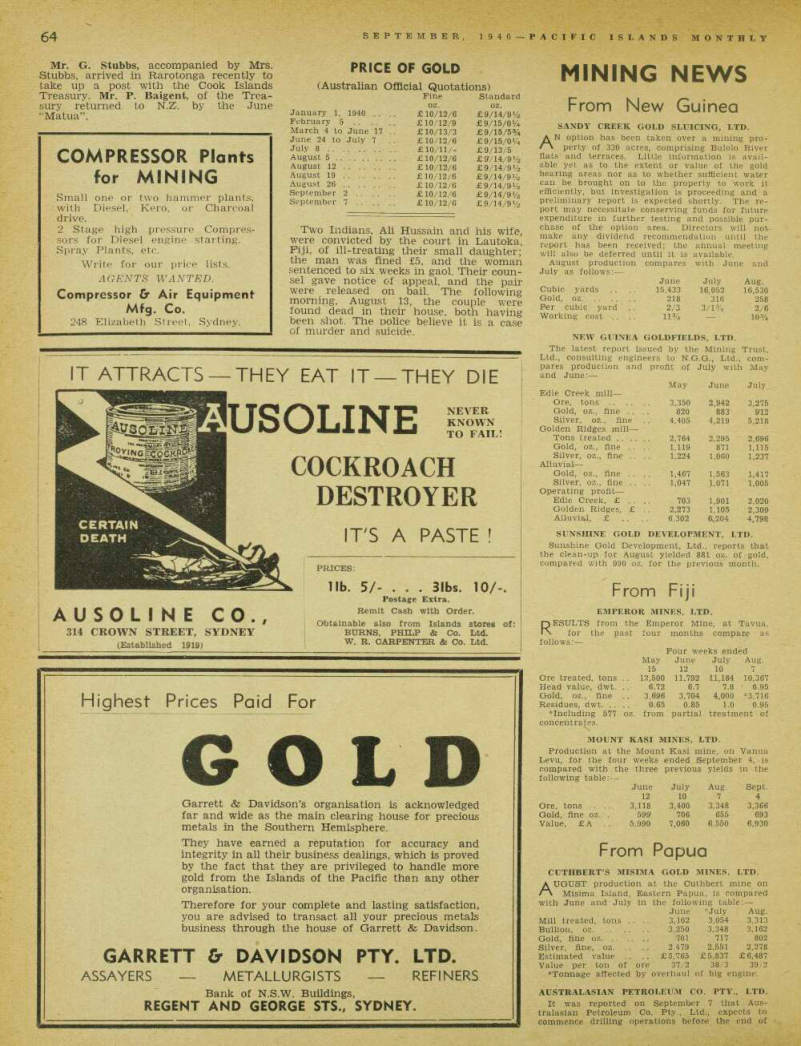
By "Therese"
IjILOWERS are influencing the new sea -1 son’s fabrics —they are splashed on cottons, linens and silks and are worn on hats in clusters or large single blooms. Plain fabrics in sweetpea shades also demand attention. Blue is to-day’s favourite colour —Air Force blue, tur quoise, duck egg, gentian and steel blue.
Now is the time to collect jackets: they will be worn with everything—dresses, skirts, slacks and shorts. Most jackets are of the suit type, but there is also the loose boxy one, swinging loosely, which is cool and attractive, particularly with a shirt frock. Odd jackets have caught the Spring fever and are in contrasting colours to the skirt or frock. Duck egg
blue and palest pink look enchanting over black skirts and there are numerous other colour combinations.
Flares are popular in skirts, and are introduced cunningly below the hip line.
Pleats inverted and unpressed are stitched close to the hips and then flow out; knife pleats fall from hip yokes, so that down to about seven inches be low the waistline there is no bulk.
Blouses are as varied as they are de lightful. Narrow rows of lace are gathered from shoulder to waist, or frills and ruffles give them distinction. There are lace blouses for evening wear, too, worn with pleated skirts and cummer bunds of gaily coloured satin.
THE shirtfrock is still the most import ant frock in the wardrobe. This year it has mpre feminine touches.
Large soft bows are worn at the waist line and artist’s bows at the neck.
A new appearance to shirt waist dresses is achieved by floral prints. A very crisp-looking frock of this type is of American cotton with white daisies patterned on a sky-blue background and a short boxy jacket of blue gives it dis tinction.
Accessories can make or mar a de lightful ensemble, so they should never be bought in a haphazard way. Dress maker jewellery is most attractive, but the barbaric type has given way to lighter ornaments. Bead necklets with matching bracelets are popular, and gaily coloured bone bangles make a bright splash of colour against white or pastel frocks. Clip-on ear-rings have ousted the screw-on variety; they are neater and more comfortable. Wear drop ear-rings with cocktail and evening ensembles; the stud variety is the day-time choice,
Household Hints
rA, coffee and cocoa stored in glass screw-top jars retain strength of flavour longer than when kept in their original tins.
To clean old brass, pour ammonia on it and scrub with a brush, afterwards rinsing in clean water.
Green vegetables will retain their colour, as well as their vitamin content, if a pinch of borax instead of bi-carbon ate of soda is added to the water when boiling. Soda destroys vitamins.
A little lemon juice added to water in which celery is boiled will keep it white.
Boiled celery with white sauce is a good accompaniment to roast mutton.
Fold a newspaper into a thick wad small enough to hold in your hand and use for polishing windows and mirrors.
Add a little methylated spirits to the water used to wash the windows.
To clean ivory knife handles, make a paste or whitening .and peroxide; rub over the handle and allow to remain un til dry, then brush off and finally polish with a chamois.
A tiny bag filled with unslaked lime and hung by a tape inside the piano will prevent dampness from spoiling the in strument.
When washing up put a piece of lemon peel in the bowl It will soften the water, remove all trace of the smell of fish, onions, etc., and give a gloss to the china.
A few hints on cake baking: The time a cake takes to cook can be divided into three periods: (1) The top of the cake flattens and the cake half rises. (2) It finishes rising. (3) It sets firmly, finishes browning and shrinks slightly from the sides. Never move a cake to another part
of the oven until it has finished rising.
To prevent small cakes from sticking to paper cases, warm the cases before put ting in the mixture.
An excellent method for freezing ice cream or making a block of pure ice:— Stand a tin bucket containing the food to be frozen inside a large wooden or earthenware vessel of water in which has been dissolved a little sulphuric acid and a handful of sulphate of soda; the liquid in the small bucket will freeze solidly at the cost of only a few pence.
The Recipe Book
HERE are some cheese and egg recipes that will find favour with the family.
Cheese Pancakes Put four tablespoonfuls self raising flour, 2 tablespoons cheese, and pinch of salt into a basin. Put one egg into a cup, add a little milk, then beat well. Work egg and milk into the flour gradually to form a smooth creamy batter. Cover the basin and leave from one and a half to two hours. Place some lard in a pan.
Stir batter well, drop in one tablespoon of mixture and fry golden brown; turn or toss. Have grated cheese on grease proof paper, putting pancakes, as each one is cooked, on this: then roll up and serve hot.
Eggs Tartare Boil 6 eggs: allow them to become quite cold; then cut in halves length wise. Remove yolks and mix them with 1 teaspoon minced or finely-grated onion, 4 oz. lean minced ham or bacon, I tea spoon made-mustard, pepper, salt and cayenne. Add enough mayonnaise to moisten mixture to right consistency, then fill whites neatly. Arrange crisp lettuce leaf with dab of mayon naise on each and a caper on top.
Macaroni Cheese Fry 6 medium-sized tomatoes, pre
viously skinned, with one large finely chopped onion. Add pepper and salt and a little cayenne. Place I lb. cooked macaroni in a buttered pie dish, cover with the tomatoes with which 4 table spoons grated cheese have been stirred.
Cover with buttered breadcrumbs and bake golden brown.
Sardines Au Parmesan 1 small tin of sardines, 2 tablespoons grated cheese, I lb. flour, 1 egg yolk, 1 tablespoon butter, 1 tablespoon water, salt, cayenne pepper, lemon juice.
Sift flour, salt and cayenne. Rub in butter and cheese and add egg yolk beaten with water. Make a soft dough, roll out thin; cut in oblong pieces about Vh by 2 inches. Skin and bone sardines, marinade with lemon juice. Place on pastry; brush edges and fold over; brush pastry with egg and sprinkle with cheese.
Bake in a moderate oven until golden brown.
Cheese Globes 4 oz. grated cheese, 1 egg, 5 cup soft white breadcrumbs, salt and cayenne.
Beat egg volk and add cheese, soft breadcrumbs and seasoning. Form into small balls and roll in slightly beaten egg white and dry crumbs. Drop into smoking fat; drain on Kitchen paper.
Serve on coloured tooth picks stuck in grapefruit.
Stuffed Prunes 1 dozen table prunes, I cup grated cheese, pinch cayenne, I cup whipped cream, pinch salt, 3 stuffed olives.
Stone the prunes; sprinkle with lemon juice; mix cream, cheese and cayenne; fill prunes; garnish each with slice of olive and serve on lettuce leaves.
Whiting Mornay Four medium whiting fillets, 2 table spoons white wine, juice of half lemon, 1 small minced onion, salt, cayenne pep
per, J Dint milk. 3 oz. butter, 21 oz. cheese, kitchen herbs.
Put fillets in greased baking dish, sea son with salt and pepper, lemon juice and wine; sprinkle with grated onion.
Cover with buttered paper and cook in oven 7-10 minutes. Put milk, herbs, bones from fish into saucepan and reduce to half. Melt butter, add flour; stir until smooth and add milk stock. Stir till it boils, gradually addins - half the grated cheese. Spread layer of sauce on a flat oval dish and arrange fillets on this.
Pour over sauce and sorinkle thickly with grated cheese. Bake in a brisk oven until golden; serve with lemon and parsley.
Mr. G. Stubbs, accompanied by Mrs.
Stubbs, arrived in Rarotonga recently to take up a post with the Cook Islands Treasury. Mr. P. Baigent, of the Trea sury returned to N.Z. by the June “Matua”.
Advertisements & other items, pp. 65-66 (1 item)
No Asthma Years
Islands 7 Visitors to Sydney Will find excellent accommodation at
"206" PRIVATE HOTEL
204-8 Victoria Street, Kings Cross, Sydney.
Every Comfort, Splendid Table.
Tariff from 35/- per week.
MRS. C. PYATT, Proprietress.
Tel. FL 4272.
No Asthma Years
Two years ago J. Richards, Hamilton, Ont., Canada, was in bed with Asthma. Had lost 40 pounds weight, suffered coughing, choking and strangling every night—couldn't sleep— expected to die. Mendaco stopped spasms first night and he has had none since—in OVER TWO YEARS. Mendaco is so successful it is guaranteed to give you free, easy breathing in 24 hours and to stop your Asthma completely in 8 days or money MCItOBCO back on return of Ends Asthma empty package.
Now 3/-, 6/- and 12/-
SCHAFFER & CO., SYDNEY.
Ask Jr
> Of '{oV 1 * <’> 1
LINGER /
\ You I I love its extra
quality
FROM ALL AUSTRALIAN DEPT. STORES
And in the Pacific from Burns Philp & Co. Ltd.
COMPRESSOR Plants
for MINING
Small one or two hammer plants, with Diesel, Kero, or Charcoal drive. 2 Stage high pressure Compressors for Diesel engine starting.
Spray Plants, etc.
Write for our price lists.
AGENTS WANTED.
Compressor Cr Air Equipment
Mfg. Co.
248 Elizabeth Street, Sydney.
IT ATTRACTS —THEY EAT IT —THEY DIE
lUSOLINE
m l*Oy
ING^COC
NEVER
KNOWN
TO FAIL
AUSOLINE CO.,
314 CROWN STREET, SYDNEY
(Established 1919)
COCKROACH
DESTROYER
IT'S A PASTE !
PRICES:
1 !b. 5/- . . . Bibs. 10/-.
Postage Extra.
Remit Cash with Order.
Obtainable also from Islands stores of:
BURNS, PHILP & Co. Ltd.
W. R. CARPENTER & Co. Ltd.
Highest Prices Paid For
GOLD
Garrett & Davidson’s organisation is acknowledged far and wide as the main clearing house for precious metals in the Southern Hemisphere.
They have earned a reputation for accuracy and integrity in all their business dealings, which is proved by the fact that they are privileged to handle more gold from the Islands of the Pacific than any other organisation.
Therefore for your complete and lasting satisfaction, you are advised to transact all your precious metals business through the house of Garrett & Davidson.
GARRETT & DAVIDSON PTY. LTD.
ASSAYERS METALLURGISTS REFINERS
Bank of N.S.W. Buildings,
REGENT AND GEORGE STS., SYDNEY.
Price Of Gold
Two Indians, Ali Hussain and his wife, were convicted by the court in Lautoka, Fiji, of ill-treating their small daughter; the man was fined £5, and the woman sentenced to six weeks in gaol. Their coun sel gave notice of appeal, and the pair were released on bail. The following morning, August 13, the couple were found dead in their house, both having been shot. The police believe it is a case of murder and suicide.
(Australian Official Quotations) Fine Standard oz. oz.
January 1, 1940 .. £ 10/12/6 £9/14/9 Vi February 5 £ 10/12/9 £9/15/014 March 4 to June 17 £10/13/3 £9/15/53/4 June 24 to July 7 £ 10/12/6 £9/15/0y 4 July 8 £9/13/5 August 5 £9714/9 y 2 August 12 £10/12/6 £9/14/91/2 August 19 £9/14/91/2 August 26 £10/12/6 £9/14/91/2 September 2 . . .. £10/12/6 £9/14/91/2 September 7 . . .. £10/12/6 £9/14/91/2
From Fiji
Mining News
From New Guinea
Sandy Creek Gold Sluicing, Ltd.
AN option has been taken over a mining pro perty of 330 acres, comprising Bulolo River flats and terraces. Little Information is avail able yet as to the extent or value of the gold bearing areas nor as to whether sufficient water can be brought on to the property to work it efficiently, but investigation is proceeding and a preliminary report is expected shortly. The re port may necessitate conserving funds for future expenditure in further testing and possible pur chase of the option area. Directors will not make any dividend recommendation until the report has been received; the annual meeting will also be deferred until it is available.
August production compares with June and July as follows:
New Guinea Goldfields, Ltd.
The latest report issued by the Mining Trust, Ltd., consulting engineers to N.G.G., Ltd., com pares production and profit of July with May and June:—
Sunshine Gold Development, Ltd.
Sunshine Gold Development, Ltd., reports that the clean-up for August yielded 881 oz. of gold, compared with 990 oz. for the previous month.
From Fiji
Emperor Mines, Ltd.
RESULTS from the Emperor Mine, at Tavua. for the past four months compare as follows:
Mount Kasi Mines, Ltd.
Production at the Mount Kasi mine, on Vanua Levu, for the four weeks ended September 4. is compared with the three previous yields in the following table;—
From Papua
Cuthbert S Misima Gold Mines, Ltd.
AUGUST production at the Cuthbert mine on Misima Island, Eastern Papua, is compared with June and July in the following table; —
Australasian Petroleum Co. Pty., Ltd.
It was reported on September 7 that Aus tralasian Petroleum Co. Pty., Ltd., expects to commence drilling operations before the end of
June July Aug.
Cubic yards . . . . 15,433 16,052 16,530 Gold, oz 218 316 258 Per cubic yard . . 2/3 3/1% 2/6 Working cost .. .. 11% — 10%
May June July Edie Creek mill — Ore, tons 3,350 2,942 3,275 Gold, oz., fine .. .. 820 883 912 Silver, oz., fine 4.405 4,219 5,218 Golden Ridges mill— Tons treated 2,764 2,295 2,696 Gold, oz., fine .. . . 1,119 871 1,115 Silver, oz., fine . . 1,224 1,060 1,237 Alluvial— Gold, oz., fine .. 1,467 1,563 1,417 Silver, oz., fine .. 1,047 1,071 1,005 Operating profit— Edie Creek, £ .. 703 1,901 2,020 Golden Ridges, £ . . 2,273 1,105 2,309 Alluvial, £ .. .. 6,302 6^204 4,798
Four weeks ended May June July Aug. 15 12 10 7 Ore treated, tons .. 12,500 11,792 11,184 10,367 Head value, dwt. .. 6.72 6.7 7.8 6.95 Gold, oz., fine .. 3,696 3,704 4,000 ♦3,716 Residues, dwt. .. .. 0.65 0.85 1.0 0.95 ♦Including 577 oz. from partial treatment of concentrates.
June July Aug. Sept. 12 10 7 4 Ore, tons . . . . 3,118 3,400 3,348 3,366 Gold, fine oz. . 599 1 706 655 693 Value, £ A . . 5,990 7,060 6,550 6,930
June *July Aug.
Mill treated, tons . 3,102 3,054 3,313 Bullion, oz 3,250 3,348 3,162 Gold, fine oz 701 717 802 Silver, fine, oz. . . 2,479 2,551 2,278 Estimated value .. .. £5,765 £5,837 £6,487 Value per ton of ore 37/2 38/3 39/2 *Tonnage affected by overhaul of big engine.
the year. The drilling area selected is a few mites from the Vailala River, at a point 75 miles from its mouth. Construction of the wharf and jetty at the final river base has been completed, and over two miles of the road out of a total of 3V 2 mites has been built. Geological work is still being carried out.
Islands Mining Shares
Fiji
Mid-Mar.
Mid-July Mid-Sept.
Emperor Mines .. bl4/l b9/4 blO/2 Loloma b31/hlQ/lVz b22/6 Mt. Kasl b4/6 b2/3 b2/6 Tavua Dev. s4d s4d s2d
New Guinea
Bulolo G.D s£ 6/12/6 s£5 b £3/15/- Enterprise of N.G. b27/6 b7/6 bl7/6 Guinea Gold bl4/9 b6/3 blO/- N.G.G., Ltd b2/3 bl/4 b2/3 Oil Search b5/2 b2/9 b3/ll Placer Dev b79/6 b80/3 b57/- Sandy Creek blOd b7V z d blOd Sunshine Gold ... b7/6 b4/6 b8/ll Cuthbert’s
Papua
bl7/bl2/bl2/2 G.M. of Papua .. — s3d s3d Mandated All. ... b3/5^ b2/l b3/- Oriomo Oil b8/6 s9/b5/- Papuan Apinaipi b5/8 b3/8 b3/3 Yodda Goldfields . bl/6 bl/1 bl/4
Why No "Canteen Orders" For Territories?
Territories?
THE following letter was sent by the editor of the “P.1.M.” to the Deputy Postmaster General, Sydney:— “We were asked by one of the Govern ment departments to publish in the ‘P.I.M.’ a paragraph giving publicity to the ‘Canteen Order’ arrangement—a re quest which we were happy to accede to.
We assumed, naturally, that as the can teen orders could be purchased at any Australian postal money order office, and as New Guinea and Papua have con tributed men liberally to the A.1.F., this admirable system would extend also to the money order offices of Papua and New Guinea. To-day, on enquiring of your department, we learned to our astonishment that this is not the case.
“Would you please let me know, for publication, why this ‘Canteen Order’ arrangement is being withheld from the Australian Pacific Territories? Are the friends and relations of A.I.F. men in Papua and New Guinea not as much en titled to this privilege as similar people in Australia? In fact, owing to their geographical position, have they not an even greater claim upon this method oi transferring gifts to their soldier friends?”
“Canteen orders” are issued in denom inations of 5/-, 10/- and 20/-, and may be used by the soldier to buy anything stocked in the canteen in his camp— where goods are sold at low prices.
Mr. J. S. Milligan, of Wide Bay, New Britain, arrived in Sydney in September and proceeded to Melbourne on leave.
New Books
WHY GATHER MOSS? by George Clune. Published by Angus and Robert son, Ltd. 7/6 George Clune has sailored, vagabonded, dallied, soldiered and, at times, seriously worked, in five continents and seven seas; and he gives a merry, entertaining ac count of his adventures and observations.
The value of this book, for Pacific readers, is its detailed unconventional story of the occupation of New Guinea by the Australian force in 1914. George Clune is a brother of Frank Clune, already known to Australian readers as a story-telling wanderer, and he writes a similar kind of readable book.
Everything that is known about sharks appears to be contained in a monumental
New Work, Sharks, Stingrays, Etc.,
by G. P. Whitley, F.R.Z.S., which has just been published by the Royal Zoo logical Society of N.S.W. Mr. Whitley is the ichthyologist at the Australian Museum, Sydney, and this volume repre sents years of intensely hard research.
The habits of scores of types of sharks are discussed in an interesting way and means :>f identifying them are clearly set out. The book, published at 7/6, should be of interest to many residents of the Pacific Islands.
Guard And Sentry Duties, Giving
the duties of the field officer, the captain and the subaltern of the day; and the commander, the sergeant, the corporal and the private of the guard. 1/-.
SOLDIER IN BATTLE, by Captain G.
D. Mitchell, contains innumerable, valu
able hints for men on active service, face to face with the enemy. 1/6. These two little books would make an admirable, helpful gift for any man on active ser vice. Both published by Angus and Robertson, Ltd., Sydney.
Advertisements & other items, pp. 67-68 (2 items)
Allen Taylor & Co. Ltd.
BARGAINS in
Tropical Radios
We have three
SPECIALLY BUILT
TROPICAL RADIO SETS
To sell on behalf of the owners, who are on active service.
These sets have been thoroughly overhauled and are definitely in new condition.
The price, with new Battery equipment, is only £l4/10/ - nett Write for further details.
Prices Radio Service
5 & 6 ANGEL PLACE, SYDNEY
For Radio and Hobbies Supplies
Allen Taylor & Co. Ltd.
SYDNEY
Sawmillers and Wholesale Suppliers of Hardwoods for Constructional Purposes GIRDERS . . . PILES . . . POLES . . . SLEEPERS, Etc.
EXPORTING TO PACIFIC ISLANDS SINCE 1893
Cables: Tuxedo, Sydney
n
FOR RELIABILITY
AND LONG SERVICE
USE
MILLER'S "ANCHOR"
BRAND ROPES AND
CORDAGES.
Manila, Sisal, New Zealand Coir and Cotton Rope of every description.
Twine, Sewing Twine, Shop Twine, Binder Twine and Fishlines, Lashings. Halters, Plough Reins, Sack Cord, Blind Lines, etc.
LENGTH STRENGTH
QUALITY GUARANTEED
Manufactured by: Suva Agent*: Sydney Agent*:
JAMES MILLER & Co. Pty. Ltd.
MELBOURNE, VIC., AUST.
A. S. FAREBROTHER & CO.
And at Lautoka. P.O. Box 36. Tel. 261
P. T. TAYLOR LTD.
“PRESTO”
THE
MAGIC
BOX
The most Amazing Trick — Just out.
“Presto”.—The greatest, most alluring and outstanding little trick ever Introduced, 2/9. Post Free.
Money back if it’s not the best yet.
Try i i
POLICE PATROL MULTI STRAND
RUBBER COVERED AERIAL.
Needs No Separate Lead-in. 50 ft., 2/6; 100 ft., 5/-.
MAN-O-WAR HEAVY DUTY
INSULATED AERIAL, MULTI
STRAND WIRES.
50 ft., 5/-; 100 ft. 10/-.
Electric MODEL MOTORS, work off wet or dry batteries: 5/9, 9/6, 12/6 N Electric 240 volt G r a m o p h one Motors, complete 40/-. Highestgrade Gramophone Needles, long lasting, 3/6, 4/6, 5/6 box.
RADIO ACCUMULATORS.
2 Volt. 110 Amp 17/ 20/- 20/6 22/6 86/8 45/6 66/- 78/9 84/6
WORLDS LATEST
GAMES
Dart Boards, 4/6, 8/6, 10/6, 15/-.
Brass Competition Darts, Set of 3, 3/11. 4/6, 5/61. Monopoly, 10/6.
Totopoly, 10/6, Bucaneer, 10/6. 3 of the World’s Most Popular Games.
Chinese Checkers. 2/6, 4/6, 8/6.
Tripoly Card Game, 5/-. De Luxe Type, 10/6. Poker Rummy, 1/-, Pot Luck, 1 Playing Card Lotto, 1/-. We Stock All Kinds of Indoor Games. Send for Booklet.
Neat Wooden Cigarette Cabinet, 4/9, for building Music Box unit into.
Complete Mechanical Units for Musical Cigarette Boxes, etc., 12/6, 15/-. Plays two Tones. Music- Boxes, 30/-, 35/-, 45/-. Musical Cigarette Boxes, 35/-.
PATRIOTIC I
SOUVENIRS
Felt Pennants for Wall; Autos., Launches, etc., R.A.A.F., Royal he latest m* n a v v and best MATCH . T ,y , BOX tor Sotety s Will lost to A.I.F. Splendid ycots. Take out one mateh « designs, 3/6 you require it; no opening base; , toch time. Bakelite mouWe4 G«Cn.
I/.. Post Tree “Duplex” Single 1-Valve Battery Set. A smart little outfit to buy in Kit form, or purchase Readymade. Parts, 63/2. Valves, 12/6.
Batteries, 33/3. Phones, Readymade, complete, £7/18/11. Simple Chart with instructions, ,6d., or free with Kit.
Remington, U.S.A. made.
Hunting and Sporting Knives in Sheath, 10/6. A Beautiful Article.
Throwing Knives, in Sheath, 6/9.
Australian Naval Design Dress Rings for Gents, 6/6. Air Force Dress Rings for Lady or Gent, 4/6.
Just Arrived! The new Model Aeroplane Manual. Complete guide for Building and Flying, 6/11.
HEADPHONES. All 4000 Ohms.
Lissen 19/6. S.T.C. or B.T.H. 30/-.
Ericssons 32/6. All British.
THE WIRELESS CONSTRUCTOR’S
ENCYCLOPEDIA, 7/6,
Cloth bound, nearly 400 pages, full of interesting and useful hints.
“Wheres” and “Whys” book of Radio.
THE TELEVISION AND SHORT
WAVE HANDBOOK, 5/6.
Cloth bound —up to the moment, simply written explanation and instructions on building Short Wave Sets, etc. A useful dictionary—you should have a copy.
METERS.—Pocket Volt Meters. 2 Reading for A. & B. Batteries, 8/6. 10/6.
WATES.— 4 in 1 Meter: 0 to 6, 0 to 15, 0 to 180 volts; 0 to 30 M/A, 14/-.
TELSEN.—Millimeter A.C., D.C., British. Reads everything in Radio.
Bench type, 22/6.
PIFCO—A.C.-D.C. Bench Type Radiometer. British. Reads 0 to 30 M/A Valve and Circuit Tester, 0 to 240 V. 0 to 15 V„ 25/-.
BOOKS! BOOKS! BOOKS! The Be-
ginners’ Book of Radio. The Radio Beginners’ Dictionary. 2/- the 2. The Wireless Constructor’s Encyclopaedia. Giant size, 7/6. Newnes “Everyman’s” Wireless Book, 5/6.
The Book of Practical Radio, also The Book of Practical Television, 8/6 each. Foulsham’s Giant “Party and Fun Book”, 1/6. Humorous Stories and Recitations, 3/9. Card and Conjuring Tricks, 3/9. Tea- Cup Fortune Telling, 3/9. 100 Party Games for Old and Young, 1/9.
Popular Magic and Amateur Conjurer, 1/9. 50 Best Party Games, 1/6. Tricks with Cards, 1/6.
“LIKE-A-FLASH” DE LUXE
RADIO RECEIVERS FROM
MAKER TO USER
Regardless of Make, Trade-Name or Price, “Like-a-Flash” Radio Sets cannot be bettered. Hundreds of our sets are giving excellent service right throughout the Islands.
“Like-a-Flash” De Luxe Dual Wave 5 Valve Battery Operated Receiver.
This is one of the most powerful models In our battery set series, and the Radio Frequency stage of amplification gives the set a world range on short wave channels as well as full coverage range of Australasian “A” and “B” Class Broadcasters.
The set is also specially designed to give maximum service in humid climates, such as North Queensland and Pacific Island Territories. A vital part very vulnerable to “dampness” in ordinary receivers is the “Hitermediate Frequency Section”.
In this set our Engineers have fitted special inductance tuned intermediate frequency transformers, which do not require trimmers.
These units ensure correct alignment for a continuous period. An 8 in. Aero Dial calibrated in stations facilitates tuning. Valves used are:
2 IC4, I—KK2, I—lK6. I—lD4
The speaker is the latest Amplion Permagnetic Model, capable of high fidelity reproduction. Battery equip ment consists of extra heavy capa city units as follows: 1 2 Volt 100 amp. Accumulator. 3 Ever-Ready Superdyne 45 Vok “B” Batteries. 1 Ever-Ready 4V 2 in. “O’* Battery.
The outfit is housed in a beautfully veneered floor model Console Cabinet. PRICE: £22/5/-.
Now available (not less than 10/parcels): Magic Wand, 1/6 Jafet’s Wallet, 1/-; Obedient Ball, 1/6; Rattle Box; Mystic Head Chopper, 2/6; Shy Lock, 2/-; Dribble Glass, 2/-; Ventrillo, 1/-; Magic Coin, 1/-; Nest of Nests, 5/-; Voice Echoer, 1/-; Magic Bottle, 1/-; 3 Bell Trick, 1/-. 2 Knife Trick, 6/6. Giant Dice Trick, 1/6. Wonderful Rattle Box Trick, 7/6. 10/-, 20/-, 30/-, 40/-, 50/- Parcels.
DRINKING GLASSES. —What a
Novelty. Outside the Glass a Pretty Miss —portrayed inside it’s a different story. She’s nice and bright, and is a surprise to all.
The Water magnifies her handsome form. Set of 6 for 12/-.
Money Belts For All. Zipper types, 10/6 and 8/6. Other pocket types, 6/6 and 7/6. Leather Lanyard, 1/6.
Plaited Leather Swagger Canes, 4/6, 6/6, 8/6. Steel Kit Bag, Handle and
No. 1 Morse Code Practice Sets, with Switch Buzzer to Light. Use as you desire. 25/- complete.
No. 2, with Heavier Type Morse Key; 30/-.
De Luxe Morse Code Sets; P.M.G.
Key, Highest-Gra'fie Buzzer, 39/6.
Adjustable Bakelite Base, Highestgrade Buzzer, 32/6.
Adjustable All-way Chromiumed Morse Code Key on Bakelite Base, 12/6.
How To Learn Morse Code Book, 1/-.
Combination Nest of 4 Pocket Screw Drivers, 2/- Steel or Bakelite.
Strong Breast Drills, 4/11. Card of Steel Drills, 1/9. Radio Saw, 3 Blades, 1 for iron, Bakelite and Metal, 1/9.
Volt Ammeter Panel Type, 0 to 25 V., 0 to 5 A., 15/-. British Pocket Volt Meter, 0 to 12, 0 to 150, 0 to 30 M/amps, 10/6.
From London, “Cosmocord” De Luxe Crystal Pick-up, with Built-in Vol.
Control, 58/6. Magnetic type Pickups, complete with volume control and tone arm. British Make, 30/-, 35/-, 38/6, 45/-. Studio Model, 50/-.
Play, Talk, Sing, Joke through your Radio. Great Fun. Batteryless type.
Microphone for Hand Holding or Hanging, 22/6. Complete with Flex fixed in a second. Others, 12/6, 15/-, 17/6, 25/-, 28/6, 32/6. All plus 2/for Battery and 1/6 for 20 ft. Cord.
Adjustable Bakelite Base Morse Code Buzzers, British Make, 4/9. Larger size, 3/6. Special High - pitched Circular Buzzers i n Bakelite Case, 5/6.
P.M C,
type
IOUNDERi
B.G.E. Table Type Microphone. Highly recommended for Amateur or Professional nse. Built-in Transformer and Battery with Volume Control incorporated.
Just plug into pickup terminals if any set. 39/6.
j LEVEMSOM radio
Write for GAMES, NOVELTIES AND HOBBIES.
Punch
Board 226 A PITT STREET, SYDNEY
Leaflets Manufacturers, Importers, and Exporters.
Itlllimilimimnil n.s.w., AUSTRALIA.
fiiiiiimniiiiimimir
Write for Pin-Game, Totem and Odds and Evens Leaflets
iiiiiiiiiiiiiniiiiiiiiiii
Cable address: “Leveradioh”. Goods forwarded V.P.P. or Sight Draft. Satisfaction and Service Guaranteed. We can supply by mail all General Merchandise at a Better Price, Quotations with pleasure. Please add freight and packing. Write for full list of interesting leaflets of Games. Bobbies. Novelties, and Electrical Goods. Write for full list of Radio Meters.
We Con Supply, at a Keen Price, Any Available Article You Require.
snsss BATTERIES
DIRECT AT WHOLESALE PRICES
CUT YOUR COSTS IN HALF.
Every type of wet battery for car, truck, cycle, radio, home or theatre lighting approximately fifty per cent, cheaper than retail.
Marshall Batteries are entirely new throughout and guaranteed in writing. Our 16-page catalogue on how to choose and look after batteries is yours for the asking.
The Marshall Battery Mfg. Co. 36-38 Harbour Street, Sydney.
Australian Short Wave
Broadcast
A NATIONAL Short Wave Programme is broad cast daily from Lyndhurst, near Melbourne, Victoria, for listeners in the Western Pacific.
Call signs: From 6.30-8.10 a.m., VLR6; from 8.15 a.m.-5.15 p.m., VLR3; from 5.30-11 p.m., VLR.
Wave lengths: From 6.30-8.10 a.m., 25.36 metres; from 8.15 a.m.-5.15 p.m., 25.32 metres; from 5.30- 11 p.m., 31.32 metres. Frequencies: From 6.30-8.10 a.m., 11.830 Kcs.; from 8.15 a.m.-5.15 p.m., 11.850 Kcs.; from 5.30-11 p.m., 9,580 Kcs. Power: 2 Kilowatts. Times given are Australian Eastern Standard (10 hours ahead of Greenwich Mean Time).
WEEK DAYS.—a.m.: 6.30, Market Reports; 6.50, News; 7.15, Music; 7.45, News; 8, Music; 9.30, Story; 10, Devotional Service; 10.15, Close, p.m.: 12, Time Signal and Broadcast to Schools; 12.15, Music; 12.35, Essential Services; 12.50, News; 1.10, Music; 4.15, Overseas News; 4.35, Music; 5.15, Close; 5.30, Young People’s Session; 6.15, Mwsic; 7, News; 7.45, Talk; 9.30, News; 11.15, Talk; 11.50, News; 12, Close.
SATURDAYS. —Same as daily programme, ex cept between 1.05 p.m. and 5.15 p.m., when description of current sporting and athletic events is given, interspersed with music. Close at 12 p.m.
SUNDAYS. —a.m.: 6.45, Music; 6.50, News; 7, Music; 9, News; 9.30, New Releases (Recorded); 10, Book Reviews: 10.30, Famous Singers; 11, Divine Service, p.m.: 12.15, Great Pianists; 12.40, News; 1, Music; 3, Classical Compositions: 4.15, News: 4.45, Music; 7, News and Commentary; 9.30, News; 11, Close.
October 1 To October 5
Oct. 1 (Tues.) —1.10 p.m. Avenal Races; 8 “The Lying Jade”; 8.45 Professor Heinz and Adelaide Symphony Orchestra, with Sigrid Sund gren (pianist); 10.30 Jim Davidson’s Band.
Oct. 2 (Wed.) —1.10 p.m. Mentone Races; 7.45 Salon Orchestra and Chorus; 8.15, “Masquer adio”; 9.10 Violin Recital; 10.15 Talk (Captain Frank Harvey).
Oct. 3 (Thurs.) —8 p.m. “Strike Up the Band”; 9 Story; 10 Modern Compositions; 10.30 Ballad Recital; 10.40 Jim Davidson.
Oct. 4 (Fri.) —8 p.m. Dance Music; 8.30 Play; 10 Melbourne Philharmonic Society: 10.30 Or chestral Presentation.
Oct. 5 (Sat.) —1.10 p.m. Sporting Descriptions; 7.45 “Out of the Bag”; 8.15 Georg Schneevoigt and Sydney Symphony Orchestra; 10 Heddle Nash (Tenor) and Oscar Natzke (Bass).
Broadcast To French
Pacific Colonies
THE Australian Department of Information, in conjunction with the A.8.C., inaugurated this month a daily broadcast in French of news, talks, and music for listeners in New Caledonia, New Hebrides, and Tahiti. Transmission is made from Station VLQ, Sydney, on a wave-length of 31.2 metres (frequency, 9.615 mcs.) and con sists of the following items:—
Aust. Eastern Noumea Standard Time.
Time. 8.55 p.m. 9.55 p.m.
Announcements. 9.00 p.m. 10.00 p.m.
News In French. 9.20 p.m. 10.20 p.m.
Talk in French.
S'.SO p.m. 10.30 v p.m.
Close.
Early Copies of "P.I.M." Wanted
r complete its file of the “Pacific Is lands Monthly” from the first issue, the Institute of Biological Explora tions, America Museum of Natural His tory, Central Park West, 79th Street, New York, U.S.A., is anxious to obtain Nos. 1 to 10 of Volume 1. Any Islands resident, therefore, willing to sell his “P.1.M.” copies covering the issues from August, 1930, to May, 1931, should write to the above-mentioned Institute (which is the organisation represented by Mr.
Richard Archbold, well-known in con nection with New Guinea exploration).
Mr. W. H. Wright, Jnr., son of Mr. W.
H. Wright, of Ahioma, Milne Bay, East ern Papua, has joined the R.A.A.F.
two C^tirposes— lt*
Use Wheat Instead Of Rice !
A PLEA that, in order to conserve over seas exchange, the employers of native labour in Papua and the Mandated Territory should be encouraged to supply hour and wheatmeal as a staple food to their labourers, instead of rice, has been made by Mr. R. A. Laws, of Wau, T.N.G.
Actually, there is little difference in the onct nf rirp as Inndpd in the Islands norts cost of rice, as lanaea in tne isianas poi ts, and Australian floui and .wheatmeal, but, Of course, if the policy suggested were followed the economic difference would cyvpnl' r T T Hp phano’P-nvpr woulri sptvp
two C^tirposes— lt*
out a large item of overseas exchange, and it would substantially aid the Aus tralian wheat-growing and flour-milling inrinetrioc m 2,, .
The natives accustomed to rice, now prefer rice to wheaten products. But that is all a matter of custom. From the diet ary point Of view, the advantage probably lies with wheat.
Advertisements & other items, pp. 69-70 (3 items)
67
PACIFIC ISLANDS MONTHLY—S E P T B M B E R , 1940
Slop Kidney
Poisoning To-day
If vou suffer from Rheumatism, Get up Nights, Leg Pains, Backache, Lumbago, Nervousness, Headaches and Colds, Dizziness, Circles under Eyes, Swollen Ankles, Loss of Appetite or Energy, you should know that your system is being poisoned because germs are impairing the vital process of your kidneys. Ordinary medicines can’t help much, because you must kill the germs which cause these troubles, and blood can’t be pure till kidneys function normally. Stop troubles by removing cause with Cystex— the new scientific discovery which starts benefit in 2 hours. Cystex must prove entirely satisfactory and be exactly the medicine you need or money back is guaranteed. Ask your chemist for Cystex today.
The guarantee mj f♦ A protects yo\i. Now in V J ® IvA 3 sizes: 1/9, 4/-, 8/-.
GUARANTEED for Kidneys, Bladder, Rheumatism
SCHAFFER & CO.. SYDNEY.
ft "MORE POWER TO YOU"
m CAR
GO***
RADIO
HOME LIGHTING
o*CO' PRODUCT OF THE CLYDE ENGINEERING CO. LTD.
Island Agents: Burns, Philp & Co., Ltd., Rabaul; John L. Peadop, Ltd.
W. R. Carpenter & Co., Ltd. Fiji: Morris, Hedstrom, Ltd.
d
BRISBANE.
V
OYES BROS.
NOYES BROS.
FOR DETAILS OF
• MINING EQUIPMENT.—Crushing Machinery, Screens, Feeders, Bock Drills, Excavators, Diesel and Crude Oil Engines, Hoists and Runways, Roller Bearings, etc.
• ELECTRICAL EQUIPMENT. Parkinson
Motors, Crompton Switchgear, Transformers.
Instruments, Meters, Callender Wires and Cables, Lighting Equipment, Electric Drills.
NEVVCACTI c •STORES, FACTORIES, HOME AND OFFICE.— " * LC. rrnmnfnn T.atnnc VitHnps and
“SYDNEY
Accessories, Airspeed Fans, Floodlighting Equipment, Domestic Electric Appliances, Joseph Rodgers Cutlery & Plateware, Chinaware, “Perfection” E.P.N.S. Ware, Clocks.
• NON-FERROUS METALS OF ALL DESCRIP-
TIONS.—In sheets, Strips, Rods, Tubes, Wire and Extruded Sections.
NOYES BROS.(Sydney) Ltd.
115 Clarence Street, Sydney. 1 1 Watt Street, Newcastle 197 Elizabeth Street, Brisbane
V * o \t» st S Ot» ti' C CO No technical knowledge required . . .
Keep in touch with the world expedite business transactions—be prepared to quickly call medical or other services in an emergency.
Install an A.W.A, Teleradio 38.
Compact radiotelephone providing communication facilities for parts beyond the reaches of landlines. Reliable and economical.
Illustrated booklet and quotations gladly supplied on request.
AMALGAMATED WIRELESS (A/SIA) LIMITED
47 YORK STREET, SYDNEY 167 QUEEN STREET, MELBOURNE Branches at; Wellington, Suva, Rabaul, Port Moresby and other island centres.
68
SEPTEMBER, IHO-P ACIFIC ISLANDS MONTHLY
Islands Produce
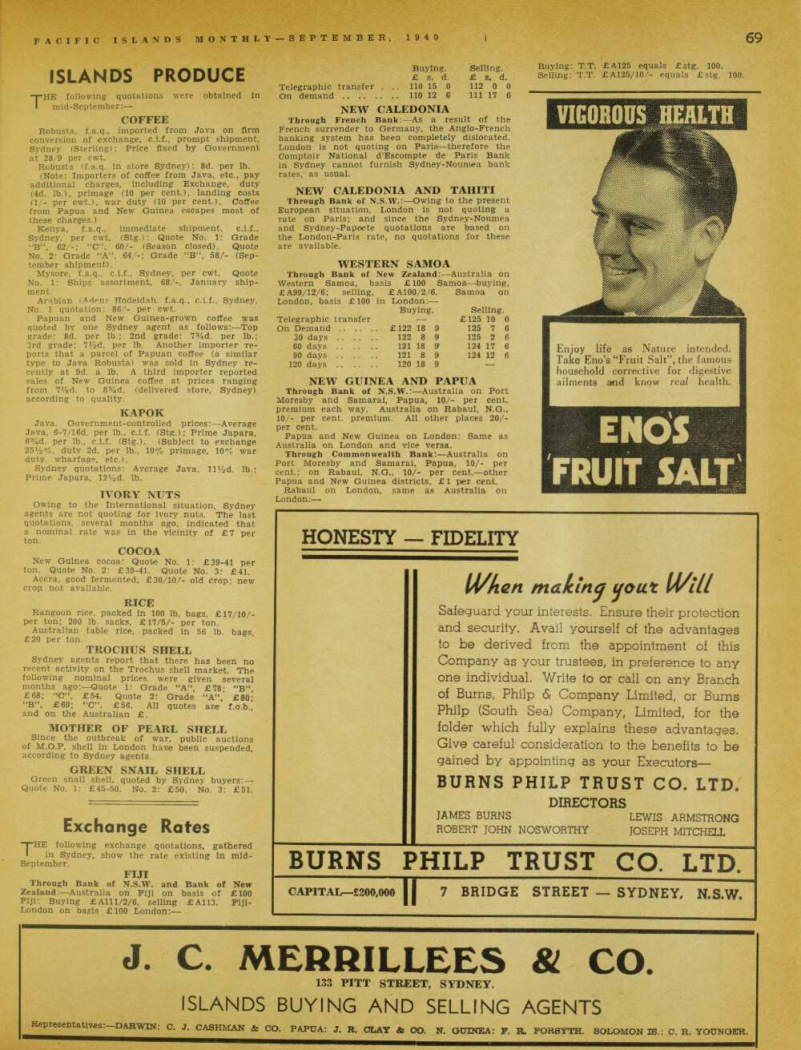
THE following quotations were obtained in mid-September:—
Coffee
Robusta, f.a.q., imported from Java on firm conversion of exchange, c.i.f., prompt shipment, Sydney (Sterling): Price fixed by Government at 28/9 per cwt.
Robusta (f.a.q. in store Sydney): Bd. per lb. (Note: Importers of coffee from Java, etc., pay additional charges, including Exchange, duty (4d. lb.), primage (10 per cent.), landing costs (1/- per cwt.), war duty (10 per cent.). Coffee from Papua and New Guinea escapes most of these charges.) Kenya, f.a.q., immediate shipment, c.i.f., Sydney, per cwt. (Stg.): Quote No. 1: Grade “B”. 62/-; “C”, 60/- (Season closed). Quote No. 2: Grade “A”, 64/-; Grade “B”, 58/- (Sep tember shipment).
Mysore, f.a.q., c.i.f.. Sydney, per cwt. Quote No. 1: Ships assortment, 68/-, January ship ment.
Arabian (Adeni Hodeidah. f.a.q., c.i.f., Sydney, No. 1 quotation: 86/- per cwt.
Papuan and New Guinea-grown coffee was quoted by one Sydney agent as follows:—Top grade: Bd. per lb.; 2nd grade: 7%d. per lb.; 3rd grade: 7 1 / 2 d. per lb. Another importer re ports that a parcel of Papuan coffee (a similar type to Java Robusta) was sold in Sydney re cently at 9d. a lb. A third importer reported sales of New Guinea coffee at prices ranging from 7Vad. to BV 4 d. (delivered store, Sydney) according to quality.
Kapok
Java. Government-controlled prices:—Average Java, 6-7/16d. per lb., c.i.f. (Stg.); Prime Japara, 6 3 /4d. per lb., c.i.f. (Stg.). (Subject to exchange 25 1 / 2 %, duty 2d. per lb.. 10% primage, 10% war duty, wharfage, etc.).
Sydney quotations; Average Java, ll*/ 2 d. lb.; Prime Japara, 12t£d. lb.
Ivory Nuts
Owing to the International situation, Sydney agents are not quoting for ivory nuts. The last quotations, several months ago, indicated that a nominal rate was in the vicinity of £7 per ton.
Cocoa
New Guinea cocoa: Quote No. 1: £39-41 per ton. Quote No. 2: £39-41. Quote No. 3: £4l.
Accra, good fermented, £3O/10/- old crop; new crop not available.
Rice
Rangoon rice, packed in 100 lb. bags. £l7/10/per ton; 200 lb. sacks, £l7/5/- per ton.
Australian table rice, packed in 56 lb. bags, £2O per ton.
Trochus Shell
Sydney agents report that there has been no recent activity on the Trochus shell market. The following nominal prices were given several months ago:—Quote 1: Grade “A”, £7B; “B”, £6B; “C”, £54. Quote 2: Grade “A”, £Bo’
“B”, £69; “C”. £56. All quotes are f.0.b., and on the Australian £.
Mother Of Pearl Shell
Since the outbreak of war, public auctions of M.O.P. shell in London have been suspended, according to Sydney agents.
Green Snail Shell
Green snail shell, quoted by Sydney buyers:— Quote No. 1: £45-50. No. 2: £5O. No. 3: £5l.
Exchange Rates
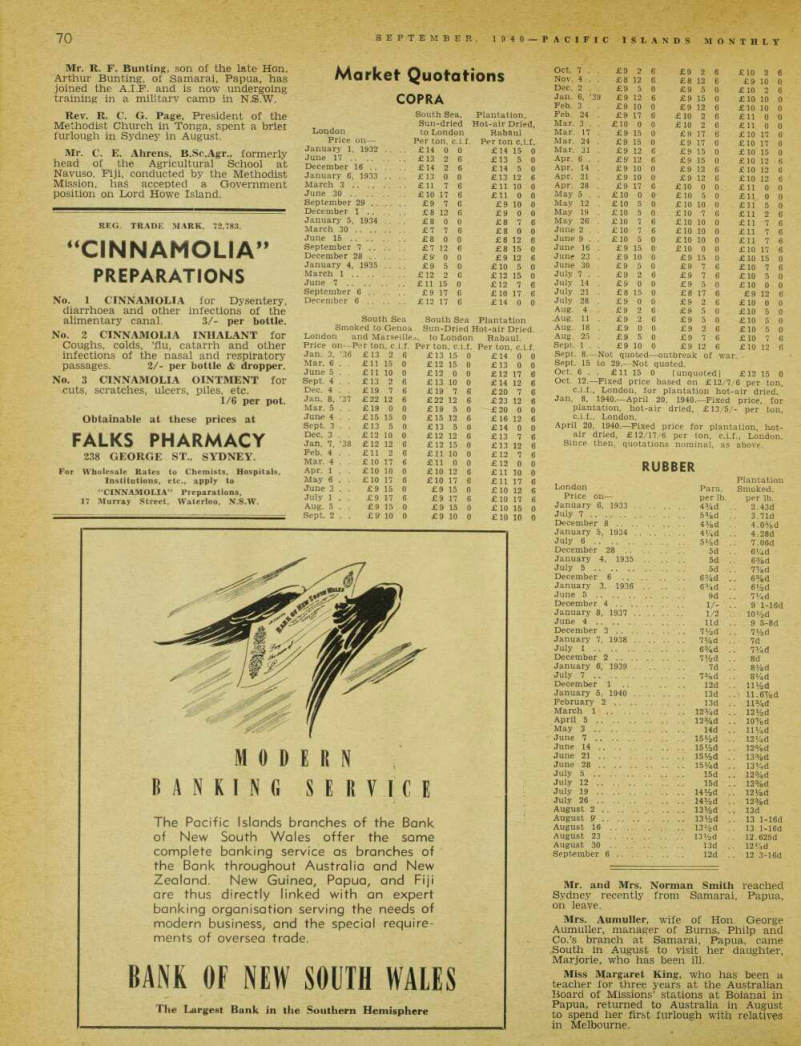
THE following exchange quotations, gathered in Sydney, show the rate existing in mid- September.
Fiji
Through Bank of N.S.W. and Bank of New Zealand:—Australia on Fiji on basis of £lOO Fiji: Buying £Alll/2/6. selling £AII3. Fiji- London on basis £lOO London;—
New Caledonia
Through French Bank:—As a result of the French surrender to Germany, the Anglo-French banking system has been completely dislocated.
London is not quoting on Paris—therefore the Comptoir National d’Escompte de Paris Bank in Sydney cannot furnish Sydney-Noumea bank rates, as usual.
New Caledonia And Tahiti
Through Bank of N.S.W.:—Owing to the present European situation, London is not quoting a rate on Paris; and since the Sydney-Noumea and Sydney-Papeete quotations are based on the London-Paris rate, no quotations for these are available.
Western Samoa
Through Bank of New Zealand:—Australia on Western Samoa, basis £ 100 Samoa —buying, £ A99/12/6; selling, £AIOO/2/6. Samoa on London, basis £lOO in London;—
New Guinea And Papua
Through Bank of N.S.W.;—Australia on Port Moresby and Samaral, Papua, 10/- per cent, premium each way. Australia on Rabaul, N.G., 10/- per cent, premium. All other places 20/per cent.
Papua and New Guinea on London: Same as Australia on London and vice versa.
Through Commonwealth Bank;—Australia on Port Moresby and Samarai, Papua, 10/- per cent.; on Rabaul, N.G., 10/- per cent.—other Papua and New Guinea districts, £1 per cent.
Rabaul on London, same as Australia on London;—
Buying: T.T. £AI2S equals £stg. 100.
Selling: T.T. £AI2S/10/- equals £stg. 100.
Buying.
Selling. £ s. d. £ s. d.
Telegraphic transfer . .. 110 15 0 112 0 0 On demand .. 110 12 6 111 17 6
Buying. Selling.
Telegraphic transfer — £125 10 0 On Demand £ 122 18 9 125 7 6 30 days 122 8 9 125 2 6 60 days 121 18 9r 124 17 6 90 days 121 8 9 124 12 6 120 days 120 18 9 —
Mr. R. F. Bunting, son of the late Hon.
Arthur Bunting, of Samarai, Papua, has joined the A.I.F. and is now undergoing training in a military camp in N.S.W.
Rev. R. C. G. Page, President of the Methodist Church in Tonga, spent a brief furlough in Sydney in August.
Mr. C. E. Ahrens, B.Sc.Agr., formerly head of the Agricultural School at Navuso, Fiji, conducted by the Methodist Mission, has accepted a Government position on Lord Howe Island.
Advertisements & other items, pp. 71-72 (1 item)
Enos
VIGOROUS HEALTH
Enjoy life as Nature intended.
Take Eno’s “Fruit Salt”, the famous household corrective for digestive ailments and know real health.
ENOS
FRUIT SALT
bb
J. C. MERRILLEES & CO.
133 PITT STREET, SYDNEY.
ISLANDS BUYING AND SELLING AGENTS
Representatives.—DAßWlN: C. J. CASHMAN & CO. PAPUA: J. R. OLAY Sc CO, N. GUINEA: P, R. FORSYTH. SOLOMON IS.: C. R. YOUNGER.
REG. TRADE MARK, 72,783.
“CINNAMOLIA”
PREPARATIONS
No. 1 CINNAMOLIA for Dysentery, diarrhoea and other infections of the alimentary canal. 3/- per bottle.
No. 2 CINNAMOLIA INHALANT for
Coughs, colds, ’flu, catarrh and other infections of the nasal and respiratory passages. 2/- per bottle & dropper.
No. 3 CINNAMOLIA OINTMENT for
cuts, scratches, ulcers, piles, etc. 1/6 per pot.
Obtainable at these prices at
FALKS PHARMACY
238 GEORGE ST., SYDNEY.
For Wholesale Rates to Chemists, Hospitals, Institutions, etc., apply to “CINNAMOLIA” Preparations, 17 Murray Street, Waterloo, N.S.W.
v /
MODERN
BANKING SERVICE
The Pacific Islands branches of the Bank of New South Wales offer the same complete banking service as branches of the Bank throughout Australia and New Zealand. New Guinea, Papua, and Fiji are thus directly linked with an expert banking organisation serving the needs of modern business, and the special requirements of oversea trade.
BANK OF NEW SOUTH WALES
The Largest Bank in the Southern Hemisphere
Market Quotations
Copra
Mr. and Mrs. Norman Smith reached Sydney recently from Samarai, Papua, on leave.
Mrs. Aumuller, wife of Hon. George Aumuller, manager of Burns, Philp and Co.’s branch at Samarai, Papua, came South in August to visit her daughter, Marjorie, who has been ill.
Miss Margaret King, who has been a teacher for three years at the Australian Board of Missions’ stations at Boianai in Papua, returned to Australia in August to spend her first furlough with relatives in Melbourne.
South Sea, Plantation, Sun-dried Hot-air Dried, London to London Rabaul Price on— Per ton. c.i.f.
Per ton c.i.f.
January 1, 1932 £14 0 0 £14 15 0 June 17 £13 2 6 £13 5 0 December 16 .. £14 2 6 £14 5 0 January 6 1933 £13 0 0 £13 12 6 March 3 £11 7 6 £11 10 0 June 30 . £10 17 6 £11 0 0 September 29 .. £9 7 6 £9 10 0 December 1 .. £8 12 6 £9 0 0 January 5 1934 £8 0 0 £8 7 6 March 30 £7 7 6 £8 0 0 June 15 . £8 0 0 £8 12 6 September 7 .. £7 12 6 £8 15 0 December 28 .. £ S' 0 0 £9 12 6 January 4 1935 £9 5 0 £10 5 0 March 1 £12 2 6 £12 15 0 June 7 . £11 15 0 £12 7 6 September 6 . . £9 17 6 £10 17 6 December 6 . . £12 17 6 £14 0 0 South Sea South Sea Plantation Smoked to Genoa Sun-Dried Hot-air Dried.
London and Marseille o, to London Rabaul.
Price on— Per ton, c.i.f.
Per ton. c.i.f.
Per ton. c.i. f.
Jan. 3, ’36 £13 2 6 £13 15 0 £14 0 0 Mar. 6 . . £11 15 0 £12 15 0 £13 0 0 June 5 . . £11 10 0 £12 0 0 £12 17 6 Sept. 4 . . £13 2 6 £13 10 0 £14 12 6 Dec. 4 . . £19 7 6 £19 7 6 £20 7 6 Jan. 8. ’37 £22 12 6 £22 12 6 £23 12 6 Mar. 5 . . £19 0 0 £19 5 0 £20 0 0 June 4 . . £15 15 0 £15 12 6 £16 12 6 Sept. 3 . . £13 5 0 £13 5 0 £14 0 0 Dec. 3 . . £12 10 0 £12 12 6 £13 7 6 Jan. 7, ’38 £12 12 6 £12 15 0 £13 12 6 Peb. 4 . . £11 2 6 £11 10 0 £12 7 6 Mar. 4 . . £10 17 6 £11 0 0 £12 0 0 Apr. 1 . . £10 10 0 £10 12 6 £11 10 0 May 6 . , £10 17 6 £10 17 6 £11 17 6 June 3 . . £9 15 0 £9 15 0 £10 12 6 July 1 . . £9 17 6 £9 17 6 £10 17 6 Aug. 5 . . £9 15 0 £9 15 0 £10 15 0 Sept. 2 . . £9 10 0 £9 10 0 £10 10 0
Oct. 7 . . £9 2 6 £9 2 6 £10 2 6 Nov. 4 . . £8 12 6 £8 12 6 £9 10 0 Dec. 2 . . £9 5 0 £9 5 0 £10 2 6 Jan. 6. ’39 £9 12 6 £9 15 0 £10 10 0 Feb. 3 . . £9 10 0 £9 12 6 £10 10 0 Feb. 24 . £9 17 6 £10 2 6 £11 0 0 Mar. 3 . . £10 0 0 £10 2 6 £11 0 0 Mar. 17 . £9 15 0 £9 17 6 £10 17 6 Mar. 24 . £9 15 0 £9 17 6 £10 17 6 Mar. 31 . £9 12 6 £9 15 0 £10 15 0 Apr. 6 . . £9’ 12 6 £9 15 0 £10 12 6 Apr. 14 , £9 10 0 £9 12 6 £10 12 6 Apr. 21 . £9 10 0 £9 12 6 £10 12 6 Apr. 28 , £9 17 6 £10 0 0 £11 0 0 May 5 . . £ 10 0 0 £10 5 0 £11 0 0 May 12 . £10 5 0 £10 10 0 £11 5 0 May 19 . £10 5 0 £10 7 6 £11 2 6 May 26 . £10 7 6 £10 10 0 £11 7 6 June 2 . . £10 7 6 £10 10 0 £11 7 6 June 9 . . £10 5 0 £10 10 0 £11 7 6 June 16 . £9 15 0 £10 0 0 £10 17 6 June 23 . £9 10 0 £9 15 0 £10 15 0 June 30 . £9 5 0 £9 7 6 £10 7 6 July 7 . . £9 2 6 £9 7 6 £10 5 0 July 14 . £9 0 0 £9 5 0 £10 0 0 July 21 . £8 15 0 £8 17 6 £9 12 6 July 28 . £9 0 0 £9 2 6 £10 0 0 Aug. 4 £9 2 6 £9 5 0 £10 5 0 Aug. 11 . £9 2 6 £9 5 0 £10 5 0 Aug. 18 . £9 0 0 £9 2 6 £10 5 0 Aug. 25 . £9 5 0 £9 7 6 £10 7 6 Sept. 1 . . £9 10 0 £9 12 6 £10 12 6 Sept. 8.—Not quoted—outbreak of war.
Sept. 15 to 29.— -Not quoted.
Oct. 6 . . £11 15 0 [unquoted] £12 15 0 Oct. 12. —Fixed price based on £12/7/6 per ton. c.i.f..
London, for plantation hot-air dried.
Jan. 8. 1940.—April 20. 1940.—Fixed price, for plantation. hot-air dried, £13/5/- per ton. c.i.f., London.
April 20, 1940.— Fixed price for plantation, hotair dried, £12/17/6 per ton, c.i.f., London.
Since then, quotations nominal, as above.
Rubber
Plantation London Para.
Smoked.
Price on— per lb. per lb.
January 6 , 1933 . .. 4%d . 2.43d July 7 .. 3.71d December 8 . . 43/ 8 d . 4.0%d January 5, , 1934 . •• 4y 4 d . 4.28d July 6 .. 7.06d December 28 . 5d . 6«/ 4 d January 4, 1935 5d . 6%d July 5 .. . 7 7 /ad December 6 . . 6%d . . 6%d January 3, 1936 . .. 6%d . . ey 2 d June 5 .. . 7y»d December 4 .. 1/- . 9 l-16d January 8, , 1937 1/2 . . ioy 2 d June 4 .. 9 5-8d December 3 .. . ?y 2 d January 7, 1938 .. ?y 4 d . 7d July 1 .. . ?y 4 d December 2 .. ?y 2 d . 8d January 6, 1939 7d . sy 8 d July 7 .. . sy 4 d December 1 . . . ny 2 d January 5, 1940 13d . . 11.6%d February : 2 .. . ll 3 /4d March 1 . 12y 2 d April 5 .. . 10 7 / a d May 3 .. . ny 4 d June 7 .. .. 15y 2 d . . i2y 4 d June 14 . . 12 5 /ad June 21 . . 133/ad June 28 . . 13y 4 d July 5 .. 15d . . 12%d July 12 15d . . 12%d July 19 . 12y a d July 26 .. .. 14y 2 d . . 123/ 8 d August 2 . 13d August S’ . 13 l-16d August 16 . . 13y 2 d . . 13 l-16d August 23 . . 13y 2 d . . 12.625d August 30 13d . . 12y 4 d September 6 . . 12d . . 12 3-16d
Shipping Services In The Pacific
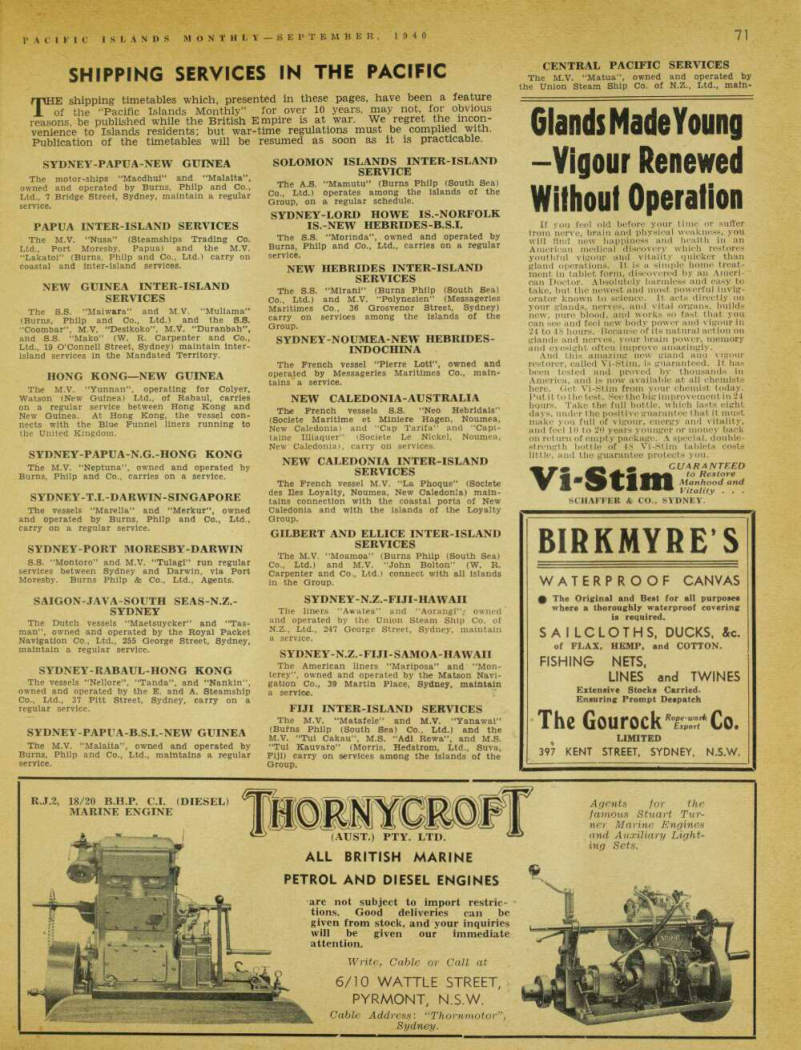
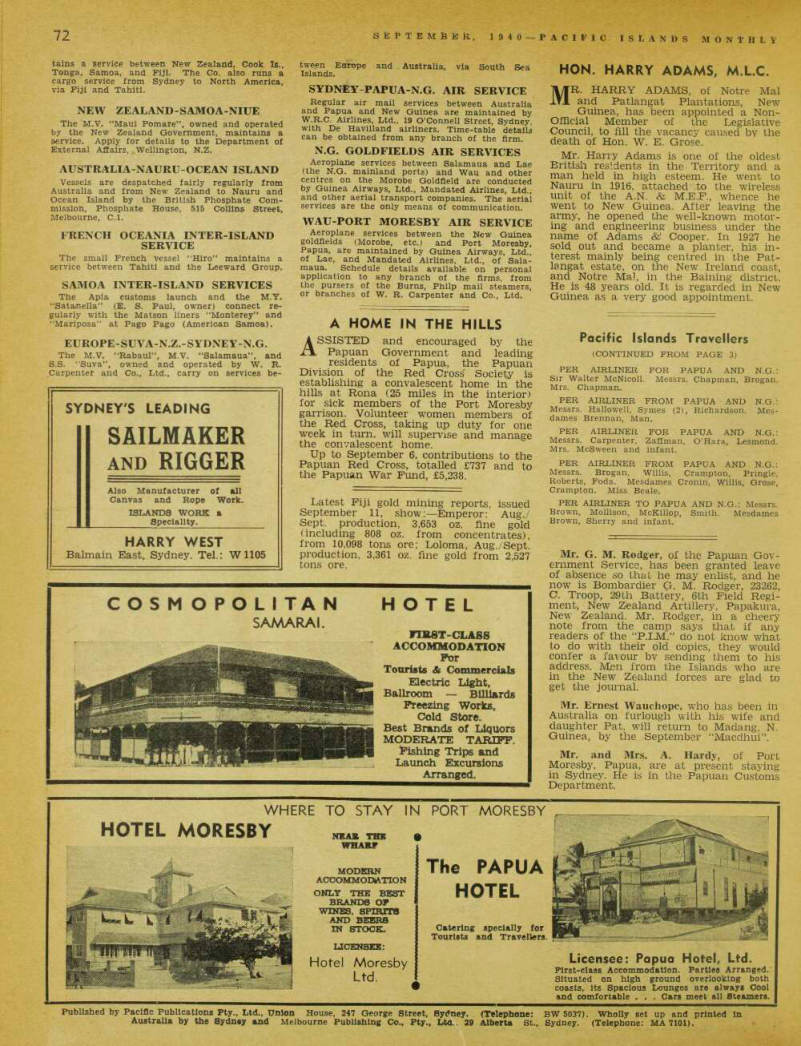
rE shipping timetables which, presented in these pages, have been a feature of the “Pacific Islands Monthly” for over 1G years, may not, for obvious reasons, be published while the British Empire is at war. We regret the incon venience to Islands residents; but war-time regulations must be complied with.
Publication of the timetables will be resumed as soon as it is practicable.
Sydney-Papua-New Guinea
The motor-ships "Macdhui” and "Malalta”, owned and operated by Burns, Philp and Co., Ltd., 7 Bridge Street, Sydney, maintain a regular service.
Papua Inter-Island Services
The M.V. "Nusa” (Steamships Trading Co.
Ltd., Port Moresby, Papua) and the M.V.
“Lakatoi” (Burns, Philp and Co., Ltd.) carry on coastal and inter-island services.
New Guinea Inter-Island
Services
The S.S. "Maiwara” and M.V. "Mullama” (Burns, Philp and Co., Ltd.) and the S.S.
“Coombar”, M.V. “Deslkoko”, M.V. "Duranbah”, and S.S. “Mako” (W. R. Carpenter and Co., Ltd., 19 O’Connell Street, Sydney) maintain inter island services in the Mandated Territory.
Hong Kong—New Guinea
The M.V. "Yunnan”, operating for Colyer, Watson (New Guinea) Ltd., of Rabaul, carries on a regular service between Hong Kong and New Guinea. At Hong Kong, the vessel con nects with the Blue Funnel liners running to the United Kingdom.
Sydney-Papua-N.G.-Hong Kong
The M.V. "Neptuna”, owned and operated by Burns, Philp and Co., carries on a service.
Sydney-T.1.-Darwin-Singapore
The vessels "Marella” and “Merkur”, owned and operated by Burns, Philp and Co., Ltd., carry on a regular service.
Sydney-Port Moresby-Darwin
S.S. "Montoro” and M.V. "Tulagi” run regular services between Sydney and Darwin, via Port Moresby. Burns Philp & Co., Ltd., Agents.
Saigon-Java-South Seas-N.Z.-
Sydney
The Dutch vessels "Maetsuycker” and “Tas man”, owned and operated by the Royal Packet Navigation Co., Ltd., 255 George Street, Sydney, maintain a regular service.
Sydney-Rabaul-Hong Kong
The vessels “Nellore”, "Tanda”, and “Nankin”, owned and operated by the E. and A. Steamship Co., Ltd., 37 Pitt Street, Sydney, carry on a regular service.
Sydney-Papua-8.5.1.-New Guinea
The M.V. "Malaita”, owned and operated by Burns, Philp and Co., Ltd., maintains a regular service.
Solomon Islands Inter-Island
Service
The A.S. "Mamutu” (Burns Philp (South Sea) Co., Ltd.) operates among the islands of the Group, on a regular schedule.
Sydney-Lord Howe Is.-Norfolk
Is.-New Hebrides-8.5.1.
The S.S. “Morinda”, owned and operated by Burns, Philp and Co., Ltd., carries on a regular service.
New Hebrides Inter-Island
Services
The S.S. “Mlrani” (Burns Philp (South Sea) Co., Ltd.) and M.V. “Polynesien” (Messageries Maritimes Co., 36 Grosvenor Street, Sydney) carry on services among the islands of the Group.
Sydney-Noumea-New Hebrides
Indochina
The French vessel "Pierre Loti”, owned and operated by Messageries Maritimes Co., main tains a service.
New Caledonia-Australia
The French vessels S.S. "Neo Hebrldais” (Societe Maritime et Mlnlere Hagen, Noumea, New Caledonia) and “Cap Tarifa” and “Capi taine Illiaquer” (Societe Le Nickel, Noumea, New Caledonia), carry on services.
New Caledonia Inter-Island
Services
The French vessel M.V. “La Phoque” (Societe des lies Loyalty, Noumea, New Caledonia) main tains connection with the coastal ports of New Caledonia and with the islands of the Loyalty Group.
Gilbert And Ellice Inter-Island
Services
The M.V. “Moamoa” (Burns Philp (South Sea) Co., Ltd.) and M.V. “John Bolton” (W. R.
Carpenter and Co., Ltd.) connect with all Islands in the Group.
Sydney-N.Z.-Fiji-Hawaii
The liners “Awatea” and “Aorangi’V owned and operated by the Union Steam Ship Co. of N.Z., Ltd., 247 George Street, Sydney, maintain a service.
Sydney-N.Z.-Fiji-Samoa-Hawaii
The American liners "Mariposa” and "Mon terey”, owned and operated by the Matson Navi gation Co., 39 Martin Place, Sydney, maintain a service.
Fiji Inter-Island Services
The M.V. "Matafele” and M.V. "Yanawal” (Burns Philp (South Sea) Co.. Ltd.) and the M.V. “Tui Cakau”, M.S. "Adi Rewa”, and M.S.
“Tui Kauvaro” (Morris, Hedstrom, Ltd., Suva, Fiji) carry on services among the Islands of the Group.
Central Pacific Services
The M.V. "Matua”, owned and operated by the Union Steam Ship Co. of N.Z., Ltd., maln
tains a service between New Zealand, Cook Is., Tonga, Samoa, and Fiji. The Co. also runs a cargo service from Sydney to North America, via Fiji and Tahiti,
New Zealand-Samoa-Niue
The M.V. “Maui Pomare”, owned and operated by the New Zealand Government, maintains a service. Apply for details to the Department of External Affairs, Wellington, N.Z.
Australia-Nauru-Ocean Island
Vessels are despatched fairly regularly from Australia and from New Zealand to Nauru and Ocean Island by the British Phosphate Com mission, Phosphate House, 515 Collins Street, Melbourne, C.l.
French Oceania Inter-Island
Service
The small French vessel “Hiro” maintains a service between Tahiti and the Leeward Group.
Samoa Inter-Island Services
The Apia customs launch and the M.Y.
“Satanella” (E, S. Paul, owner) connect re gularly with the Matson liners “Monterey” and “Mariposa” at Pago Pago (American Samoa).
Europe-Suva-N.Z.-Sydney-N.G.
The M.V. “Rabaul”, M.V. “Salamaua”, and S.S. “Suva”, owned and operated by W. R.
Carpenter and Co., Ltd., carry on services be
tween Europe and Australia, via South Sea Islands.
Sydney-Papua-N.G. Air Service
Regular air mail services between Australia and Papua and New Guinea are maintained by W.R.C. Airlines, Ltd., 19 O’Connell Street, Sydnev. with De Havilland airliners. Time-table details can be obtained from any branch of the firm.
N.G. Goldfields Air Services
Aeroplane services between Salamaua and Lae (the N.G. mainland ports) and Wau and other centres on the Morobe Goldfield are conducted by Guinea Airways, Ltd., Mandated Airlines, Ltd., and other aerial transport companies. The aerial services are the only means of communication.
Wau-Port Moresby Air Service
Aeroplane services between the New Guinea goldfields (Morobe, etc.) and Port Moresby, Papua, are maintained by Guinea Airways, Ltd., of Lae, and Mandated Airlines, Ltd., of Sala maua. Schedule details available on personal application to any branch of the firms, from the pursers of the Burns, Philp mail steamers, or branches of W. R. Carpenter and Co., Ltd.
Advertisements & other items, pp. 73-74 (1 item)
-Vigour Renewed
Glands Made Young
Without Operation
If you feel old before your time or suffer trom nerve, brain and physical weakness, you will find new happiness and health in an American medical discovery which restores youthful vigour and vitality quicker than gland operations. It is a simple home treatment in tablet form, discovered by an American Doctor. Absolutely harmless and easy to take, but the newest and most powerful invigorator known to science. It acts directly on your glands, nerves, and vital organs, builds new, pure blood, and works so fast that you can see and feel new body power and vigour in 24 to 48 hours. Because of its natural action on glands and nerves, your brain power, memory and eyesight often improve amazingly.
And this amazing new gland ana vigour restorer, called Vi-Stim, is guaranteed. It has been tested and proved by thousands in America, and is now available at all chemists here. Get Vi-Stim from your chemist today.
Put it to the test. See the big improvement in 24 hours. Take the full bottle, which lasts eight days, under the positive guarantee that it must make you full of vigour, energy and vitality, and feel 10 to 20 years younger or money back on return of empty package. A special, doublestrength bottle of 48 Vi-Stim tablets costs little, and the guarantee protects you.
Vi-Stim
GUARANTEED
to Restore Manhood and Vitality . . .
SCHAFFER & CO., SIDNEY.
BIRKMYRES
WATERPROOF CANVAS
9 The Original and Best for all purposes where a thoroughly waterproof covering is required.
S A I LCLOTHS, DUCKS, &c.
of FLAX. HEMP, and COTTON.
FISHING NETS,
LINES and TWINES
Extensive Stocks Carried.
Ensuring Prompt Despatch
The Gourock'te*Co.
% LIMITED
397 KENT STREET. SYDNEY, N.S.W.
R.J.2, 18/20 B.H.P. C.I. (DIESEL)
MARINE ENGINE
m i c. f l^l
(AUST.) PTY. LTD.
ALL BRITISH MARINE
PETROL AND DIESEL ENGINES
are not subject to import restrictions. Good deliveries can be given from stock, and your inquiries will be given our immediate attention.
Write, Cable or Call at
6/10 WATTLE STREET,
PYRMONT, N.S.W.
Cable Address: “Thornmotor”, Sydney.
Agents for the famous Stuart Turner Marine Engines and Auxiliary Lighting Sets.
SYDNEY'S LEADING
SAILMAKER
and RIGGER
Also Manufacturer of all Canvas and Rope Work.
ISLANDS WORK a
Speciality.
HARRY WEST
Balmain East. Sydney. Tel.: W 1105
CO S M
O P O LITA N
SAMARAI.
HOTEL
FIBBT-CLASS
ACCOMMODATION
For Tourists & Commercials Electric Light, Ballroom Billiards Freezing Works, Cold Store.
Best Brands of Liquors
MODERATE TARIFF.
Fishing Trips and Launch Excursions Arranged.
WHERE TO STAY IN PORT MORESBY
HOTEL MORESBY
NEAR THE
WHARF
MODERN
ACCOMMODATION
ONLY THE BEST
BRANDS OF
WINES, SPIRITS
AND BEERS
IN STOCK.
LICENSEE:
Hotel Moresby
Ltd.
The PAPUA
HOTEL
Catering specially for Tourists and Travellers.
Licensee: Papua Hotel, Ltd.
First-class Accommodation. Parties Arranged.
Situated on high ground overlooking both coasts. Its Spacious Lounges are always Cool and comfortable . . . Cars meet all Steamers.
A Home In The Hills
ASSISTED and encouraged by the Papuan Government and leading residents of Papua, the Papuan Division of the Red Cross' Society is establishing a convalescent home in the hills at Rona (25 miles in the interior) for sick members of the Port Moresby garrison. Volunteer women members of the Red Cross, taking up duty for one week in turn, will supervise and manage the convalescent home.
Up to September 6, contributions to the Papuan Red Cross, totalled £737 and to the Papuan War Fund, £5,238.
Latest Fiji gold mining reports, issued September 11, show; —Emperor: Aug./ Sept, production, 3,653 oz. fine gold (including 808 oz. from concentrates), from 10,098 tons ore; Loloma, Aug./Sept. production, 3,361 oz. fine gold from 2,527 tons ore.
Hon. Harry Adams, M.L.C
MR. HARRY ADAMS, of Notre Mai and Patlangat Plantations, New Guinea, has been appointed a Non- Official Member of the Legislative Council, to fill the vacancy caused by the death of Hon. W. E. Grose.
Mr. Harry Adams is one of the oldest British residents in the Territory and a man held in high esteem. He went to Nauru in 1916, attached to the wireless unit of the A.N. & M.E.F., whence he went to New Guinea. After leaving the army, he opened the well-known motor ing and engineering business under the name of Adams &' Cooper. In 1927 he sold out and became a planter, his in terest mainly being centred in the Pat langat estate, on the New Ireland coast, and Notre Mai, in the Baining district.
He is 48 years old. It is regarded in New Guinea as a very good appointment.
Advertisements & other items, pp. 74-76 (2 items)
Pacific Islands Travellers
72
(CONTINUED FROM PAGE 3)
SEHBMBER, 1940 PACIFIC ISLANDS MONTHLY
Published by Pacific Publications Pty., Ltd., Union House, 247 George Street, Sydney. (Telephone: BW 5037). Wholly set up and printed In Australia by the Sydney and Melbourne Publishing Co., Pty., Ltd., 29 Alberta St.. Sydney, (Telephone: MA 7101).
ntfort /
* I
and
Co w 's* r vr
Flying high above Ihe disadvantages
and difficulties of slow surface travel
Guinea Airways Service awaits your arrival at Port Moresby to speed your passage by air to any one of over 50 aerodromes and landing grounds served by the Company throughout New Guinea and Papua.
Guinea Airways* fast’ modern planes cut days of travelling time to a few hours of flight. As an example, the time of travel by plane to the Goldfields from Port Moresby is only 1 hour 40 minutes as compared with 6to 7 days by surface routes. See more of New Guinea from a better angle and save time and money . . . Travel by Air.
The GUINEA AIRWAY is /he ONLY WAY /o defeat Time and Distance Guinea Airways’ fleet offers the choice of a large variety of passenger and freight planes for special charter service to any point in New Guinea and Papua ...
Investigate this special
CHARTER SERVICE
When sailing from Australia book steamer and air passage at the Steamship Office or obtain full particulars from the purser. i i i THE WORLDS LARGEST FREIGHT CARRYING AIR SERVICE
LAE-SALAM AU A:
New Guinea Office: LAE, Mandated Territory of New Guinea Branch Offices and Agents at WAU-SALAMAUA-
PORT MORESBY and SYDNEY.
FIRST CHOICE... with those
who prefer a bitter beer
If you like a bitter beer—you'll enjoy the rich wholesome flavor of Resch's Waverley Bitter Ale. Best appreciated after a hot, trying day—Waverley Bitter Ale is a real health drink for the tropics. For a refreshing change, make YOUR next order - - - - (’// '■)-
WAVERLEY BITTER ALE
IN THE BOTTLE WITH THE GREEK LABEL