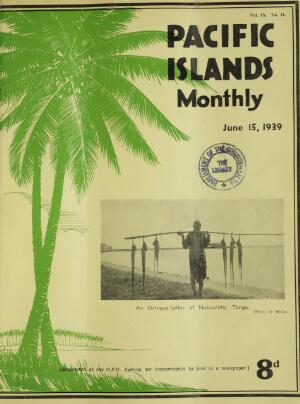
Pacific
Islands
Monthly
Vol. IX. No. 11.
June 15, 1989
l&eaisterecL at the G.P.0., Sydney, for transmission by post as a newspaper .] nA. \\ \ \ > i, \
8"
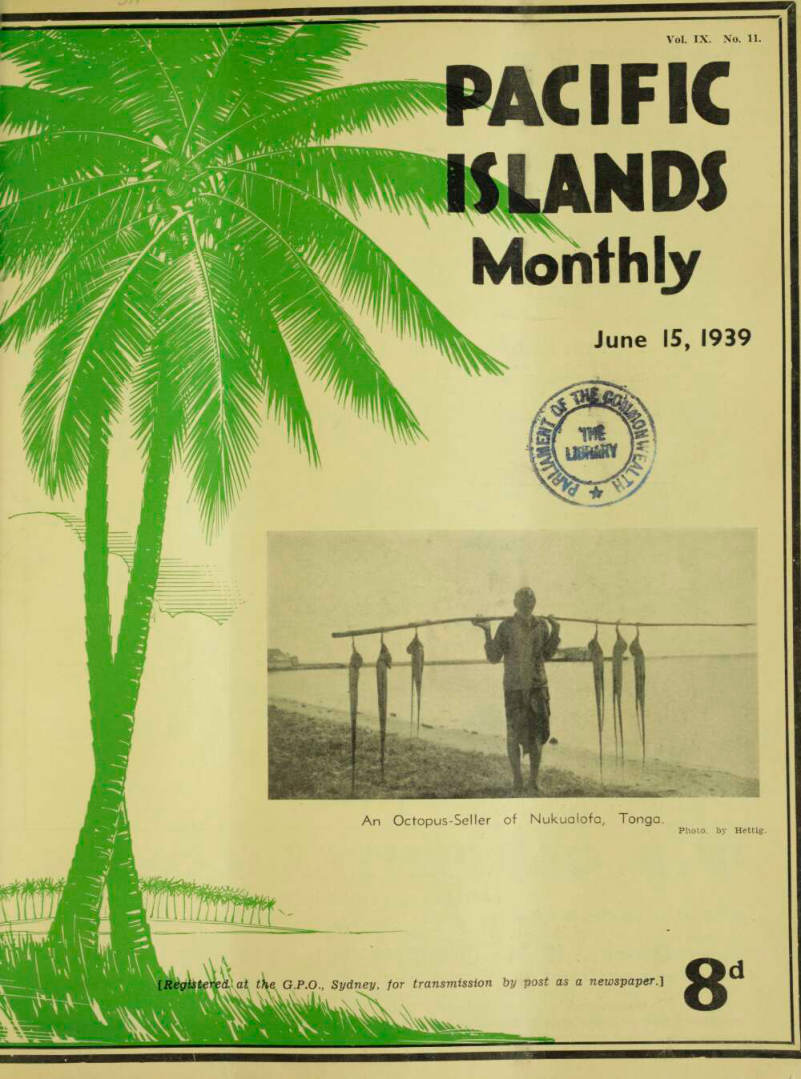
An Octopus-Seller of Nukualofa, Tonga.
Photo, by Hettig.
Advertisements & other items, p. 2 (2 items)
Pacific Islands Mont hi y—J une 15, 1939
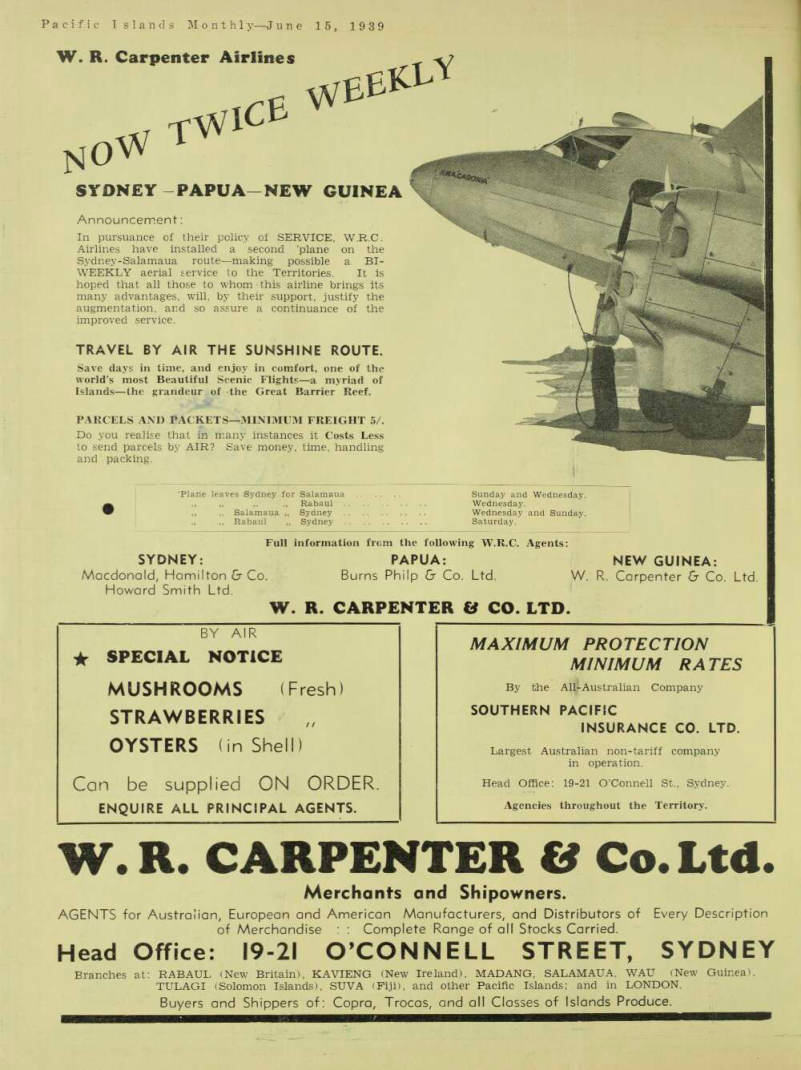
W. R. Carpenter & Co. Ltd.
W. R. Carpenter Airlines
SYDNEY-PAPUA—NEW GUINEA
Announcement; In pursuance of their policy of SERVICE, W.R.C.
Airlines have installed a second ’plane on the Sydney-Salamaua route —making possible a BI- WEEKLY aerial service to the Territories. It is hoped that all those to whom this airline brings its many advantages, will, by their support, justify the augmentation, and so assure a continuance of the improved service.
TRAVEL BY AIR THE SUNSHINE ROUTE.
Save days in time, and enjoy in comfort, one of the world’s most Beautiful Scenic Flights—a myriad of Islands —the grandeur of the Great Barrier Reef.
PARCELS AND PACKETS—MINIMUM FREIGHT 5/.
Do you realise that in many instances it Costs Less to send parcels by AIR? Save money, time, handling and packing.
'Plane leaves Sydney for Salamaua Rabaul . Salamaua „ Sydney Rabaul Sydney Sunday and Wednesday.
Wednesday.
Wednesday and Sunday.
Saturday.
Full information from the following W.R.C. Agents:
SYDNEY: PAPUA: NEW GUINEA:
Macdonald, Hamilton & Co. Burns Philp &• Co. Ltd. W. R. Carpenter £r Co. Ltd.
Howard Smith Ltd.
W. R. CARPENTER & CO. LTD.
BY AIR
* SPECIAL NOTICE
MUSHROOMS (Fresh)
STRAWBERRIES
OYSTERS (in Shell)
Can be supplied ON ORDER.
ENQUIRE ALL PRINCIPAL AGENTS.
MAXIMUM PROTECTION
MINIMUM RATES
By the AlLAustralian Company
SOUTHERN PACIFIC
INSURANCE CO. LTD.
Largest Australian non-tariff company in operation.
Head Office: 19-21 O’Connell St., Sydney.
Agencies throughout the Territory.
W. R. CARPENTER & Co. Ltd.
Merchants and Shipowners.
AGENTS for Australian, European and American Manufacturers, and Distributors of Every Description of Merchandise : ; Complete Range of all Stocks Carried.
Head Office: 19-21 O’CONNELL STREET, SYDNEY
Branches at: RABAUL (New Britain), KAVIENG (New Ireland), MADANG, SALAMAUA, WAU (New Guinea), TULAGI (Solomon Islands), SUVA (Fiji), and other Pacific Islands; and in LONDON.
Buyers and Shippers of: Copra, Trocas, and all Classes of Islands Produce.
Pacific Islands Travellers
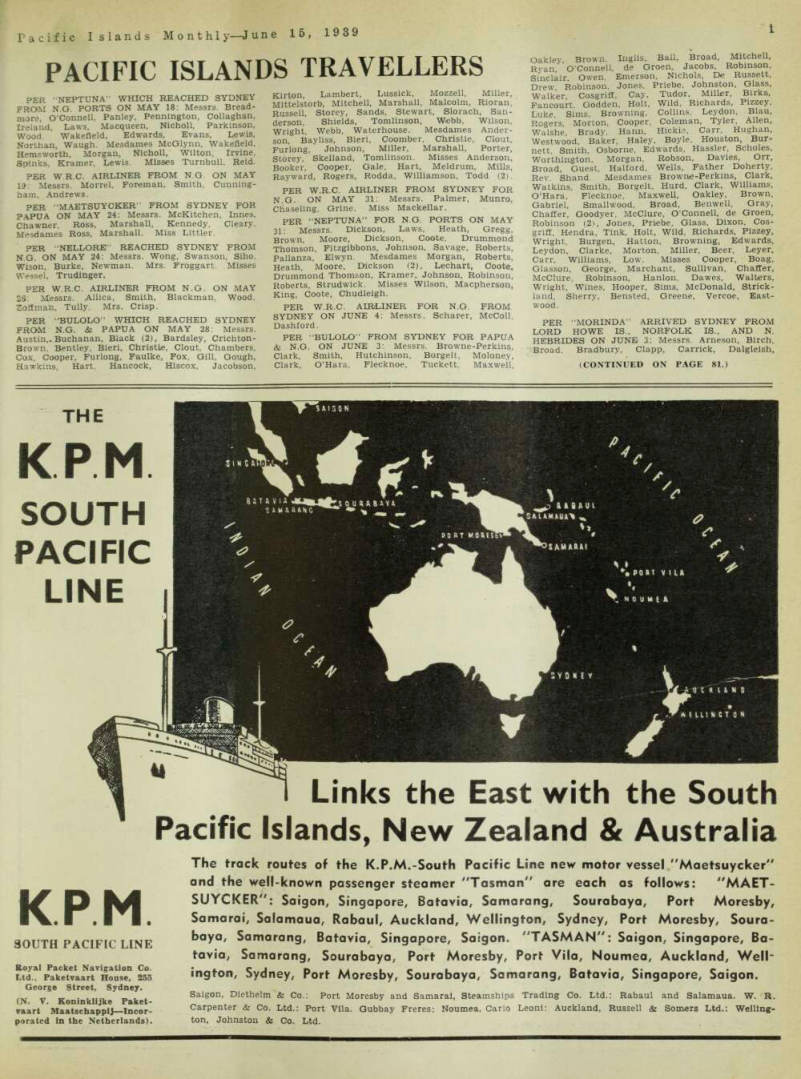
Per -Neptuna’- Which Reached Sydney
FROM N.G. PORTS ON MAY 18; Messrs Bread more, O’Connell, Panley, Pennington, Collaghan, Ireland, Laws, Macqueen, Nicholl, Parkinson, Wood, Wakefield, Edwards, Evans, Lewis, Northan, Waugh. Mesdames McGlynn, Wakefield, Hemsworth, Morgan, Nicholl, Wilton, Irvine, Spinks, Kramer, Lewis. Miss.es Turnbull. Reid.
PER W.R.C. AIRLINER FROM N.G ON MAY 19: Messrs. Morrel, Foreman, Smith. Cunning ham. Andrews.
Per “Maetsuycker” From Sydney For
PAPUA ON MAY 24; Messrs. McKitchen. Innes, Chawner, Ross, Marshall, Kennedy. Cleary.
Mesdames Ross, Marshall. Miss Littler.
Per ‘Nellore’ Reached Sydney From
N.G. ON MAY 24: Messrs. Wong, Swanson, Siho.
Wison, Burke, Newman. Mrs. Froggart. Misses Wessel, Trudinger.
PER W.R.C. AIRLINER PROM N.G. ON MAY 26: Messrs. Alhca. Smith, Blackman, Wood.
Zoffman, Tully. Mrs. Crisp.
Per “Bulolo’’ Which Reached Sydney
PROM N.G. & PAPUA ON MAY 28; Messrs.
Austin,. Buchanan, Black (2), Bardsley, Crichton- Brown. Bentley, Bieri, Christie, Clout, Chambers, Cox, Cooper, Furlong, Paulke, Fox, Gill. Gough, Hawkins, Hart. Hancock, Hiscox. Jacobson,
Kirton, Lambert, Lussick, Mozzell, Miller, Mittelstorb, Mitchell, Marshall, Malcolm, Rioran, Russell, Storey, Sands, Stewart, Slorach, San derson, Shields, Tomlinson, Webb, Wilson, Wright, Webb, Waterhouse. Mesdames Ander son, Bayliss, Bieri, Coomber, Christie, Clout, Furlong, Johnson, Miller, Marshall, Porter, Storey, Skeiland, Tomlinson. Misses Anderson, Booker, Cooper, Gale, Hart, Meldrum, Mills, Rayward, Rogers, Rodda, Williamson, Todd (2).
Per W.R.C. Airliner From Sydney For
N.G. ON MAY 31: Messrs. Palmer, Munro, Chaseling, Grine. Miss Mackellar.
PER “NEPTUNA” FOR N.G. PORTS ON MAY 31: Messrs. Dickson, Laws, Heath, Gregg, Brown, Moore, Dickson, Coote, Drummond Thomson, Fitzgibbons, Johnson, Savage, Roberts, Pallanza, Elwyn. Mesdames Morgan, Roberts, Heath, Moore, Dickson (2), Lechart, Coote, Drummond Thomson, Kramer, Johnson, Robinson, Roberts, Strudwick. Misses Wilson, Macpherson, King, Coote, Chudleigh.
Per W.R.C. Airliner For N.G. From
SYDNEY ON JUNE 4; Messrs. Scharer, McColl.
Dashford.
Per “Bulolo” From Sydney For Papua
& N.G. ON JUNE 3: Messrs. Browne-Perkins, Clark, Smith, Hutchinson, Borgelt, Moloney, Clark, O’Hara, Flecknoe, Tuckett, Maxwell,
Oakley. Brown. Inglis, Ball, Broad, Mitchell, Ryan. O'Connell, de Groen, Jacobs, Robinson, Sinclair. Owen, Emerson, Nichols, De Russett, Drew Robinson, Jones, Priebe, Johnston, Glass, Walker, Cosgriff, Cay. Tudor, Miller, Birks.
Fancourt, Godden, Holt, Wild, Richards, Pizzey, Luke, Sims, Browning, Collins, Leydon, Blau, Rogers, Morton, Cooper, Coleman, Tyler, Allen, Walshe, Brady, Hann, Hicki?. Carr, Hughan, Westwood, Baker, Haley, Boyle, Houston, Bur nett, Smith, Osborne, Edwards, Hassler, Scholes, Worthington, Morgan, Robson, Davies, Orr, Broad, Guest. Halford, Wells, Father Doherty, Rev. Shand. Mesdames Browne-Perkins, Clark, Watkins, Smith, Borgelt, Hurd, Clark, Williams, O’Hara, Flecknoe. Maxwell, Oakley, Brown, Gabriel, Smallwood, Broad, Benwell, Gray, Chaffer, Goodyer, McClure, O’Connell, de Groen, Robinson (2), Jones, Priebe, Glass, Dixon, Cos griff, Hendra, Tink, Holt, Wild, Richards, Pizzey, Wright, Burgen, Hatton, Browning, Edwards, Leydon, Clarke, Morton, Miller, Beer, Leyer, Carr, Williams, Low. Misses Cooper, Boag, Glasson. George. Marchant, Sullivan, Chaffer, McClure, Robinson, Hanlon. Dawes, Walters, Wright. Wines, Hooper, Sims, McDonald, Strick land, Sherry. Bensted, Greene, Vercoe, East wood.
Per “Morinda” Arrived Sydney Prom
LORD HOWE IS.. NORFOLK IS., AND N.
HEBRIDES ON JUNE 3: Messrs. Arneson, Birch, Broad, Bradbury, Clapp, Garrick, Dalgleish,
(Continued On Page 81.)
Davies, Dalziel, De Groen, Dupertuis, Frost, Graham, Grand, Hogan, Hall, Hunter, Jurd, Lindsay, Mullen, Northcott, Newson, Scott, Riley. Mesdames Birch. Garrick, Davison, Fenton, Frost, Grand, Hayman, Hooke, Hollison, Lucas, Northcott, Purdy, Riley, Scott, Wills.
Misses Barker Cerutty. Doran, Daley, Ely ward, Frost, Grand, Harris, Hudson, Lipscomb, Mes siter, Matthews, Singleton, Sharp, White.
Per W.R.C Airliner Prom N.G. On
JUNE 3 Messrs Schumaker, Huson, McGeorge, Ritchie, Ollson. Dr. McQueen. Misses Rossi -2).
Per ‘ Aorangi Reached Sydney From
FIJI ON JUNE! 4 Messrs Browne, Davis, Mc- Pherson, Rice, Martin. Mesdames Beattie, Cahill, Davis, McPherson, Rice. Misses Cahill, Harrowell, Martin.
Pee Niagara From Sydney For Fiji
ON JUNE 9 Messrs Adams, Arnheim, Allpress, Burnitt, Browne, Cadawallader, Clarke, Davis, Derrick, Day, Farrer, Groom, Greenward, Handley, Jones Judd, Kendrick, Mumford, Matthews, Newland (2), Palmer, Parker, Riley, Sunderland, Trewenack, Wyatt, Watson, Waugh, Grant, Hem brough, Jeram, Maranj, Steel, Wood, Brodie- Hall, Martin Rev. Bull. Mesdames Clark, Donnan, Fenner, Greenward. Handley, Jones Judd, Kendrick, Mumford, Palmer, Parker, Sheedy, Trewenack, Watson (2), Williams, Clark, McMillan. Misses Hill, Jones, Judd (2), McKay, Ohlson Sheedy, Watson (2), Williams, Chap man, Hembrough, Lechte, Guire.
Per “Macdhui’ Reached Sydney From
PAPUA & N.G ON JUNE 14; Messrs. Small, Worsley, Stewart, Robertson, Schuch, Devine, Buhl, Delangre, Fell, Maggs, Purves, Gillespie, Parkes, Rawnsley, Smart. Bell. Hearn, Barnes Barrow, Cheetham, Clarke, Egan, Gauld, Gibson,
Gilchrist, Hancock, Johnston, Rickman, Stocker, Thomas, Walshe, McK. White. Mesdames Schu macher, Schuch, Gillespie, Pearson, Owen McK.
White. Misses Cassidy, Gill, Kirby, McCullough, Rudd, Tyson, Chalmers. Brother Friche.
Advertisements & other items, p. 3 (2 items)
I
Pacific Islands Monthl y—J une 16, 1939
Pacific
THE
KPM
SOUTH
PACIFIC
LINE
* II
KPM
SOUTH PACIFIC LINE
Royal Packet Navigation Co.
Ltd., Paketvaart House, 255 George Street, Sydney. (N. V. Koninklijke Paketvaart MaatschappiJ—lncorporated in the Netherlands).
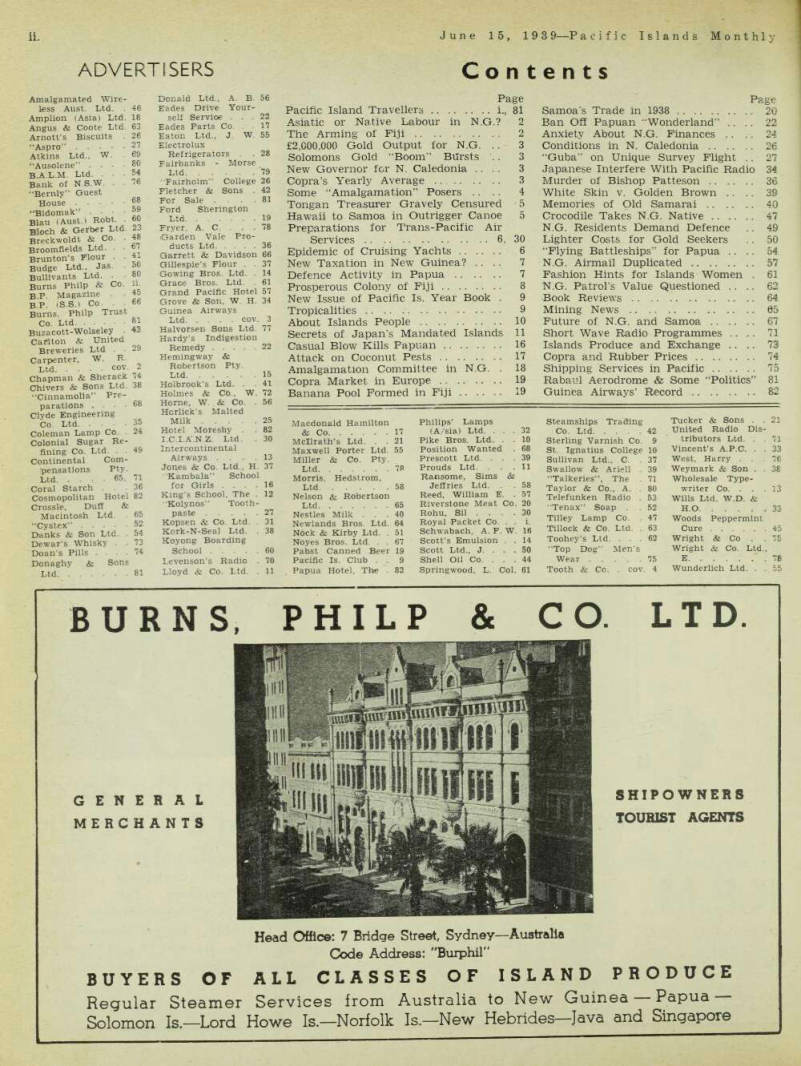
Links the East with the South
Pacific Islands, New Zealand & Australia
The track routes of the K.P.M.-South Pacific Line new motor vessel "Maetsuycker" and the well-known passenger steamer "Tasman" are each as follows: "MAET- SUYCKER”: Saigon, Singapore, Batavia, Samarang, Sourabaya, Port Moresby, Samarai, Salamaua, Rabaul, Auckland, Wellington, Sydney, Port Moresby, Sourabaya, Samarang, Batavia, Singapore, Saigon. "TASMAN": Saigon, Singapore, Batavia, Samarang, Sourabaya, Port Moresby, Port Vila, Noumea, Auckland, Wellington, Sydney, Port Moresby, Sourabaya, Samarang, Batavia, Singapore, Saigon.
Saigon, Diethelm & Co.: Port Moresby and Samarai, Steamships Trading Co. Ltd.: Rabaul and Salamaua. W. R.
Carpenter & Co. Ltd.; Port Vila. Gubbay Freres: Noumea, Carlo Leonl: Auckland, Russell & Somers Ltd.: Wellington, Johnston & Co. Ltd.
Advertisers
Amalgamated Wire less Aust. Ltd. . 46 Amplion (Asia) Ltd. 18 Angus & Coote Ltd. 63 Arnott’s Biscuits - 26 “Aspro” 27 Atkins Ltd., W. 69 “Ausolene” .. . . 80
B.A.L.M. Ltd. . 54
Bank of N.S.W. . . 76 “Bernly” Guest House “Bidomak” • Blau (Aust.) Robt. . 60 Bloch & Gerber Ltd. 23 Breckwoldt & Co. . 48 Broomfields Ltd. 67 Brunton’s Flour . 41 Budge Ltd.. Jas. • o 0 Bullivants Ltd. . 80 Burns Philp & Co - h.
B.P. Magazine . 45
B.P. (S.S.) Co. 66
Burns. Philp Trust Co. Ltd 81
Buzacott-Wolseley • 43
Caflton & United Breweries Ltd ■ 29 Carpenter, W. R Ltd cov. 2 Chapman & Sherack 74 Chivers & Sons Ltd. 38 “Cinnamolia” Pre parations ... 68
Clyde Engineering
Co. Ltd 35 Coleman Lamp Co. 24 Colonial Sugar Re fining Co. Ltd. 49 Continental Com pensations Pty.
Ltd 65. 71 Coral Starch .36 Cosmopolitan Hotel 82 Crossle, Duff & Macintosh Ltd. 65 “Cystex” 52 Danks & Son Ltd. 54 Dewar’s Whisky 73 Doan’s Pills ... 74 Donaghy & Sons Ltd 81
Donald Ltd., A. B. 56 Eades Drive Your self Service ... 22 Eades Parts Co. . . 17 Eaton Ltd., J. W. 55 Electrolux
Refrigerators . . 28
Fairbanks - Morse Ltd ’79 Fairholm” College 26 Fletcher & Sons . 42 For Sale ... 81 Ford Sherington Ltd 19 Fryer, A. C. . . .78 (Garden Vale Pro ducts Ltd 36 Garrett & Davidson 66 Gillespie’s Flour . . 37 Gowing Bros. Ltd. . 14 Grace Bros. Ltd. 61 Grand Pacific Hotel 57 Grove & Son. W. H. 34 Guinea Airways Ltd cov. 3 Halvorsen Sons Ltd. 77 Hardy’s Indigestion Remedy 22 Hemingway & Robertson Pty.
Ltd 15 Holbrook’s Ltd. . .41 Holmes & CO., W. 72 Horne, W. & Co. . 56 Horlick’s Malted Milk 25 Hotel Moresby . . 82
1.C.1.A'.N.Z. Ltd. . 30
Intercontinental Airways ... 13 Jones & Co. Ltd., H. 37 Kambala” School for Girls ... 16 King’s School. The . 12 Kolynos” Tooth paste 27 Kopsen & Co. Ltd. . 31 Kork-N-Seal Ltd. . 38 Koyong Boarding School 60 Levenson’s Radio . 70 Lloyd & Co. Ltd. . 11
Macdonald Hamilton & Co 17 Mcllrath’s Ltd. . . 21 Maxwell Porter Ltd. 55 Miller & Co. Pty.
Ltd 78 Morris, Hedstrom, Ltd 58 Nelson & Robertson Ltd 65 Nestles Milk ... 40 Newlands Bros. Ltd. 64 N6ck & Kirby Ltd. . 51 Noyes Bros. Ltd. . . 67 Pabst Canned Beer 19 Pacific Is. Club . . 9 Papua Hotel, The . 82
Philips’ Lamps (A/sia) Ltd. ... 32 Pike Bros. Ltd. . . 10 Position Wanted . 68 Prescott Ltd. ... 39 Prouds Ltd. ... 11 Ransome, Sims & Jeffries Ltd. . . 58 Reed, William E. . 57 Riverstone Meat Co. 20 Rohu, Sil . . . . 30 Royal Packet Co. . . i.
Schwabach, A. F. W. 16 Scott’s Emulsion . . 14 Scott Ltd., J. ... 50 Shell Oil Co. . . . 44 Springwood, L. Col. 61
Steamships Trading Co. Ltd 42 Sterling Varnish Co. 9 St. Ignatius College 10 Sullivan Ltd., C. . 37 Swallow & Ariell . 39 “Talkeries”, The . 71 Taylor & Co., A. 80 Telefunken Radio . 53 “Tenax” Soap . 52 Tilley Lamp Co. .47 Tillock & Co. Ltd. . 63 Toohey’s Ltd. ... 62 “Top Dog” Men’s Wear 75 Tooth & Co. . cov. 4
Tucker & Sons . . 21 United Radio Dis tributors Ltd. . . 71 Vincent’s A.P.C. . . 33 West, Harry ... 76 Weymark & Son . . 38 Wholesale Type writer Co. ... 13 Wills Ltd. W.D. & HO 33 Woods Peppermint Cure 45 Wright & Co . .75 Wright & Co. Ltd., E 78 Wunderlich Ltd. . . 55
Contents
Page Pacific Island Travellers i., 81 Asiatic or Native Labour in N.G.? 2 The Arming of Fiji 2 £2,000,000 Gold Output for N.G. .. 3 Solomons Gold “Boom” Bursts .. 3 New Governor for N. Caledonia ... 3 Copra’s Yearly Average .. 3 Some “Amalgamation” Posers ... 4 Tongan Treasurer Gravely Censured 5 Hawaii to Samoa in Outrigger Canoe 5 Preparations for Trans-Pacific Air Services 6. 30 Epidemic of Cruising Yachts 6 New Taxation in New Guinea? ... 7 Defence Activity in Papua 7 Prosperous Colony of Fiji 8 New Issue of Pacific Is. Year Book . 9 Tropicalities 9 About Islands People 10 Secrets of Japan’s Mandated Islands 11 Casual Blow Kills Papuan 16 Attack on Coconut Pests 17 Amalgamation Committee in N.G. . 18 Copra Market in Europe 19 Banana Pool Formed in Fiji 19
Page Samoa's Trade in 1938 20 Ban Off Papuan “Wonderland” ... 22 Anxiety About N.G. Finances .. .. 24 Conditions in N. Caledonia 26 “Guba” on Unique Survey Flight .. 27 Japanese Interfere With Pacific Radio 34 Murder of Bishop Patteson 36 White Skin v. Golden Brown .. .. 39 Memories of Old Samarai 40 Crocodile Takes N.G. Native 47 N.G. Residents Demand Defence .. 49 Lighter Costs for Gold Seekers .. 50 “Flying Battleships” for Papua ... 54 N.G. Airmail Duplicated 57 Fashion Hints for Islands Women . 61 N.G. Patrol's Value Questioned ... 62 Book Reviews 64 Mining News 65 Future of N.G. and Samoa 67 Short Wave Radio Programmes ... 71 Islands Produce and Exchange ... 73 Copra and Rubber Prices 74 Shipping Services in Pacific 75 Rabaul Aerodrome & Some “Politics” 81 Guinea Airways’ Record 82
Advertisements & other items, p. 4 (2 items)
Ii
June 15, 193 9 —P acific Islands Monthly
Burns, Philp & Co.
GENERAL
MERCHANTS
lill nii Hi m 111
III!
si 111
illi
Hi til
iii
HI if
Ull
Head Office: 7 Bridge Street, Sydney—Australia Code Address: "Burphil"
LTD.
SHIPOWNERS
TOURIST AGENTS
BUYERS OF ALL CLASSES OF ISLAND PRODUCE Regular Steamer Services from Australia to New Guinea Papua Solomon Is.—Lord Howe Is. —Norfolk Is. —New Hebrides —Java and Singapore
Pacific Islands Monthly
The Newspaper-Magazine of the South Seas
IRegistered at the G.P.0., Sydney, for transmission by post as a newspaper. ] Published Once Each Month and Circulated in Australia and New Zealand and in the following Pacific Territories and Islands Groups:
rrnwn Pnlonv of Pill Australian Territory of Papua Mandated Terrltor? (AustraUa) of New Guinea. ‘ Bismarck Archfpelago and Northern Solomon j^, and s Mandated Territory (Japan) of Marshall. Caroline and Marianna Islands.
French Territory of New Caledonia.
British and French Condominium of New Hebrides.
American Territory of Eastern Samoa.
American Territory of Guam.
Mandated Territory of Nauru.
British Crown Colony of Gilbert and Ellice Islands.
Mandated Territory (New Zealand) of Samoa.
British Solomon Islands Protectorate.
British Protectorate of Tongan Islands.
New Zealand Territory of Cook Islands.
Australian Territory of Norfolk Island.
French Colony of Oceania (Tahiti, etc.).
American Territory of Hawaiian Islands.
Owned and Produced by Pacific Publications Pty. Ltd., Union House, 247 George Street, Sydney.
Vol. IX. No. 11.
June 15, 1939.
p ( Bd. Per Copy, r TICS ( prepaid: 8/- p.a.
Approaching
Asiatic or Native Labour in New Guinea? —A Crisis Approaching
THE native labour problem in New Guinea is not only more serious than is generally realised; but it is stead ily becoming worse, because the Admin istration seems unable to help the situ ation, and is itself contributing to the general confusion by competing with pri vate employers for the use of available labour.
Three questions call urgently for at tention by the Australian Commonwealth: Is there an obligation upon Australia to encourage Europeans to settle in and develop the Territory of New Guinea?
If there is to be settlement and develop ment, should the natives of New Guinea provide the necessary labour supply?
To what extent should the New Guinea Administration take responsibility for seeing that private employers secure an adequate supply of labour?
The present position is that employers now are experiencing great difficulty in obtaining labour recruits. As the com bined result of the shortage of labour supplies, and the persistence with which the Administration, year after year, has increased the scale of food, shelter, cloth ing, etc., which must be supplied to la bourers, the cost of labour in New Guinea has risen in the last ten years, and the two principal classes of employers namely, planters and goldminers are being correspondingly embarrassed.
For many years, the employers in New Guinea were chiefly coconut planters, and there was an ample supply of native labour for all their needs. Then came the establishment of the important gold industry, and developments since then are shown by the following figures:—
Ten or 15 years ago, an employer could get a labourer for a recruiting fee of £4 or £5, plus wages and cost of living. To day, it is difficult to get a boy even at a recruiting fee of £lO, while extra food stuffs. housing, wages, etc., ordered by the Government have increased other costs by 40 to 60 per cent.
EMPLOYERS of all descriptions now urgently need recruits to take the place of the labourers whose three years’ contracts are expiring. Recruiters
engaged by them are out in all directions in the Territory, but they, to an increas ing degree, report their inability to se cure the number of men needed.
Employers are accusing the Adminis tration of closing several parts of the Territory against recruiting; and they in sist, further, that the Administration shows no sympathy whatever with the requirements of industry within the Territory. The Government is accused of competing with professional recruiters in that it sends its own parties into the bush to procure natives for its own ser vice.
Whereas the recruiters are not allow ed to use anything except verbal per suasion to induce natives to accept in dentures, the Government parties fol low different tactics. The officials go into villages and demand the payment of the annual head tax. When told by the chiefs that the natives have no money, it is intimated that the Govern ment requires labourers. As a result, the chiefs arrange with the officials that a certain number of recruits shall be made available; officials hand to the head men the “hand money” of the re cruits (that is the payment always made to the recruit, or his family, when he agrees to enter a labour contract), and the “hand money” is then given back to the officials to pay the Government head tax.
We have been supplied with details of how this system is operated by Govern ment officials in the Sepik area of New Guinea. One party of officials recently obtained 370 recruits in this fashion and it is understood that they were to be used in the Government road works in the Sepik district. Professional recruiters in the Sepik district complain that they are quite unable to obtain recruits for pri vate employers in the Territory.
EMPLOYERS complain that the atti tude of certain well-known officials is sharply and definitely against re cruiting. They take the view that the system whereby large parties of young native men are taken away from their primitive villages for periods of three years, and then are returned to their villages, learned in the ways of the white men, is not only destroying native cul ture but is introducing to these native communities a degree of sophistication that is undesirable. The officials also take the stand that their primary duty under the terms of the Mandate is pro tection of the native people.
There is a great deal to be said for the officials’ attitude. It does seem wrong that native life should be unbalanced and native institutions destroyed by the cease less demands of unimaginative commerce.
But there is also something to be said for the employers. They are in the Territory because it is the policy of Aus tralia to develop this Territory. Deve lopment cannot take place without an adequate labour supply. If there is to be increased development there must be an increased labour supply. But the fact is that the present labour supply is not nearly sufficient for present demands. So far as the employers know, the attitude of the Administrative officials to all this is indifference and lack of sympathy.
“rpHE natives should not be further in- I terfered with by recruiters”, say certain officials. ‘Tf more labour is needed, Asiatics should be brought into the Territory under a strict system of in denture.”
“Then”, retort the employers, ‘‘why on earth doesn’t the Government bring in Asiatics —or do something!”
Already, there are 2,000 Asiatics in the Territory of New Guinea —an established Chinese community—but they supply no labour whatever. Private employers ask: If more Asiatics were brought in would they also become storekeepers and ar tisans? This has happened in the case of New Guinea, Fiji, Tahiti and other places.
It is admitted that the French in New Caledonia have worked their industrial enterprises satisfactorily by indenting Javanese and Tonkinese labourers, and seeing that they are returned to their own country at the expiry of their in dentures. That class of labour is prob ably no more expensive than the class of labour upon which the present economic structure has been erected in New Guinea. The New Guinea labourer can be hired for a sum of from 6/- to 10 - shillings per month, plus food, clothing, shelter and medical attention.
If the Asiatic labourer should cost more, this would put out of gear the majority
of industrial undertakings already
established in the Territory.
It is actually the most difficult problem in Australia’s tropical territories —and yet the Administration is contributing nothing to its solution.
Indignant employers point out, for ex ample. that the Government, being un able to hire sufficient recruits itself, is now on a large scale hiring casual labour on a basis of 2/6 per labourer per work ing day. A number of New Guinea men with lines of labourers (indentured at
Total Indentured Year. Indentured on goldfield. 1928 28.253 3,215 1932 26,606 5,729 1934 30,595 9.403 1937 40,259 12,850
10/- per month and found) are hiring out their lines to the Government now on the profitable basis of 2/6 per labourer per working day. This is all right for the men with the lines of labourers—but it is upsetting the industrial situation in New Guinea.
NOW there comes a threat of an even more serious dislocation of New Guinea labour conditions.
It is well-known that if a New Guinea labourer refuses to carry on with his indentures he may receive penal punish ment—usually imprisonment for a short period. News has been received that the Anti-Slavery and Aborigines Protection Society of London has brought the whole subject of labour contracts up for dis cussion at Geneva (it was on the agenda for discussion in June) and it was ex pected that an agreement would be reached by which penal sanctions will be abolished.
Such a decision might apply to New Guinea, which is under the mandates system, but, of course, would not apply to Papua, which is an Australian terri tory. If the penal system is abolished in New Guinea, the labour contract will be come simply a civil contract, as between the employer and the native, and it would be difficult to enforce it. The punishment for desertion would be only a fine and as the natives have no money and the em ployers cannot touch their property, it is difficult to see how employers will be able to control large numbers of labourers satisfactorily. The inevitable effect will be a rise in wages.
HERE is still another aspect of this vexed question. There seems to be a movement afoot, in many tropical coun tries in the British Empire, to raise the level of wages paid to native labourers.
The “Crown Colonist” says: “The West India Committee Circular has published some figures for unskilled agricultural labourers’ wages in other Colonies which compare with those in the West Indies, but it must be admitted that all are very low. In Mauritius, these are given as 1/to l/10is per day for a working week of 40 to 48 hours; or 15/- per month plus food, lodging and medical attendance.
In Fiji, it works out at 1/91 to 2/3 per day on the sugar estates. In Ceylon, the statutory minimum daily wage is to 9d.; in Singapore, factory labourers’ pay is 9’id. per day; in the Gold Coast, on cocoa plantations, hiring rates are lOd. per day; in Java, it is understood to be Bd. per day; and in India, labourers en gaged in sugar cultivation earn 3d. to 4d. a day. But it is probably misleading to take wages alone in different countries, since other Jactors, including living condi tions, have to be taken into account be fore a fair comparison can be made.”
The same journal says that a new Masters and Servants’ Ordinance in Trinidad eliminates the penalty of im prisonment for breaches of contract be tween employers and employed.
It would be difficult to say what 10/per month and “all found” including re cruiting and repatriation, is equal to in New Guinea, on a basis of a 48 hours’ working week—probably, 1/6 per working day, or £2 per month. Labourers from Java or Cochin-China, or Tamils from India, would cost no more than that— and they are more industrious and skil ful than New Guinea natives. rE serious character of the present position and general outlook, so far as it affects present employers in New Guinea, cannot be too strongly em
phasised. Employers in New Guinea find it heartbreaking that the Commonwealth Government is apparently unable to understand their difficulties, and formu late plans for their relief.
If New Guinea were an unimportant territory, where retrogression did not matter, it might not be worth while mak ing a fuss. But the occupation of New Guinea is vital to Australian safety and Australia cannot expect to continue in occupation if she does not make proper use of so large and rich a country.
Many representations along these lines have been made to Ministers in Canberra, But Ministers, being ignorant of the whole thing, simply refer these repre sentations back to the Administrator in New Guinea. And, of course, the Admini strator in New Guinea, being not sure of himself, will make no important move without the direct permission of Can berra.
The war which took place between Mr.
S. J. Smith, when Resident Commissioner in Rarotonga, and Mr. A. Carlyon, his chief police officer, ended in Wellington, N.Z., on June 7, when the Court of Ap peal gave a decision against the Public Service Commissioner. It would need a Calathumpian lawyer to follow the thing through all the trials and appeals; but apparently Mr. Carlyon (who entered the Commissioner’s office with a search war rant and seized certain papers) has been held justified.
Rev. E. O. Theile, of Dornoch Terrace, Highgate Hill, Brisbane, director of the Lutheran Mission in New Guinea, has been advised that the Board of Regents of the Wartburg Theological Seminary, of the American Lutheran Church, has conferred upon him the degree of Doctor of Divinity, honoris causa.
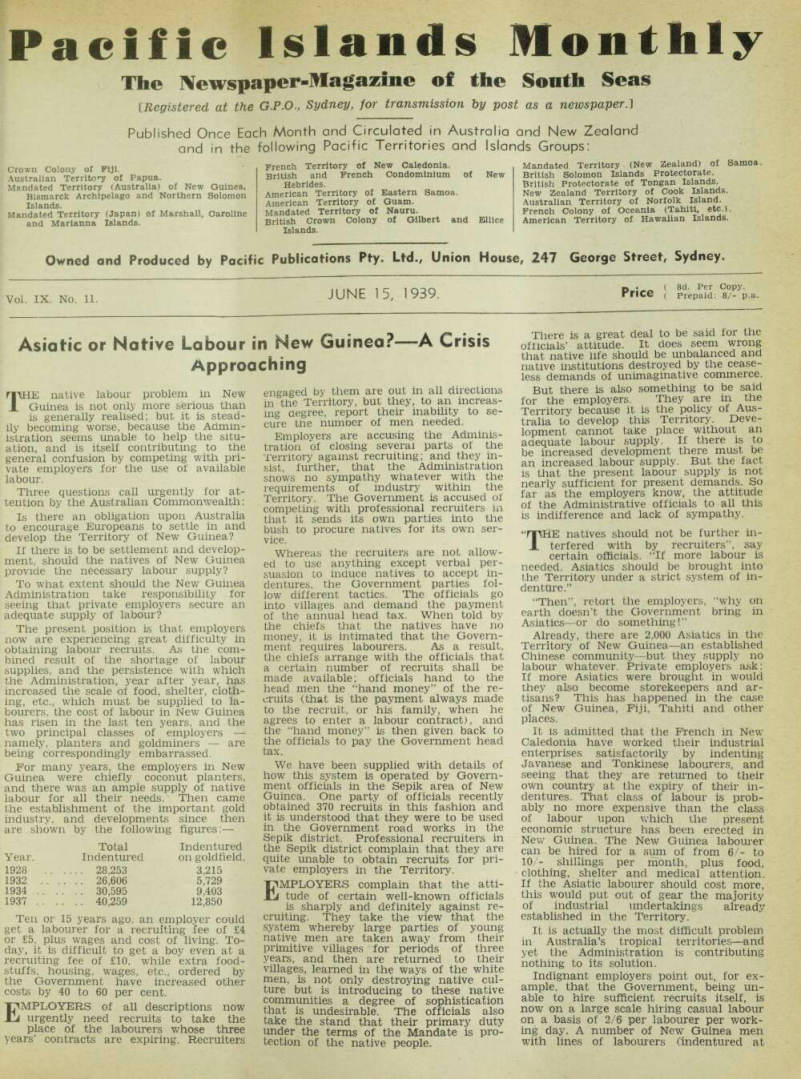
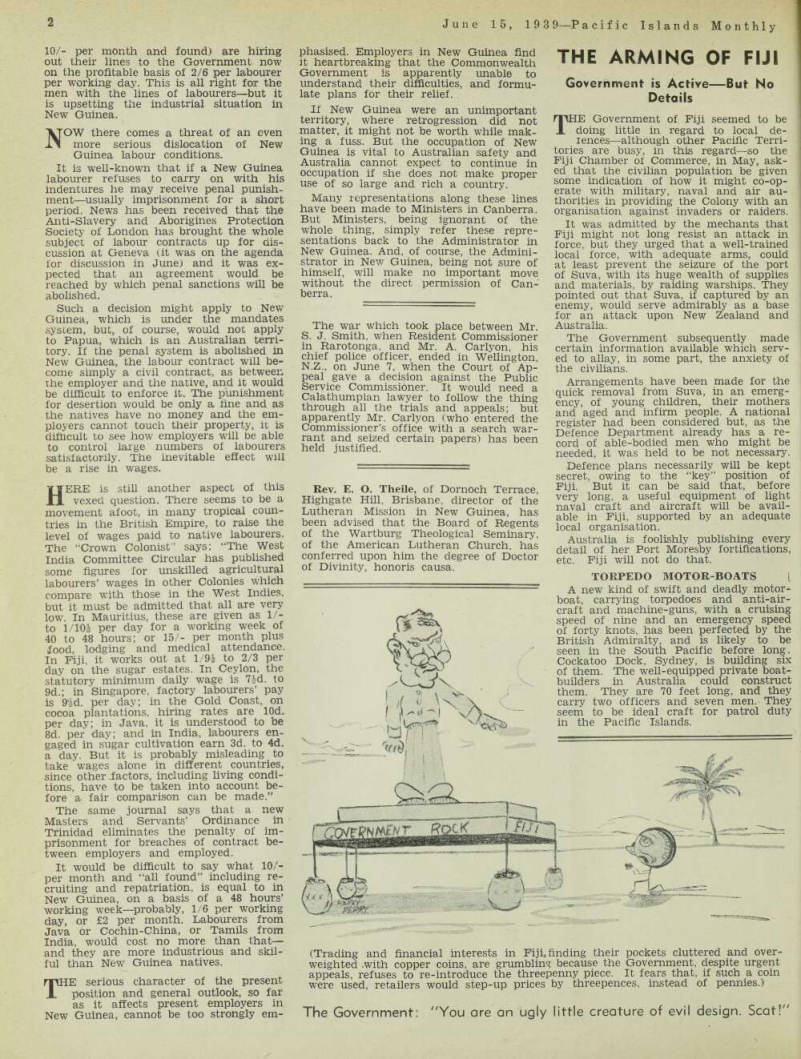
(Trading and financial interests in Fiji, finding their pockets cluttered and over weighted -with copper coins, are grumbling because the Government, despite urgent appeals, refuses to re-introduce the threepenny piece. It fears that, if such a coin were used, retailers would step-up prices by threepences, instead of pennies.) The Government: "You ore on ugly little creature of evil design. Scat!"
The Arming Of Fiji
Government is Active—But No Details
r:E Government of Fiji seemed to be doing little in regard to local de lences —although other Pacific Terri tories are busy, in this regard—so the Fiji Chamber of Commerce, in May, ask ed that the civilian population be given some indication of how it might co-op erate with military, naval and air au thorities in providing the Colony with an organisation against invaders or raiders.
It was admitted by the mechants that Fiji might not long resist an attack in force, but they urged that a well-trained local force, with adequate arms, could at least prevent the seizure of the port of Suva, with its huge wealth of supplies and materials, by raiding warships. They pointed out that Suva, if captured by an enemy, would serve admirably as a base for an attack upon New Zealand and Australia.
The Government subsequently made certain information available which serv ed to allay, in some part, the anxiety of the civilians.
Arrangements have been made for the quick removal from Suva, in an emerg ency, of young children, their mothers and aged and infirm people. A national register had been considered but, as the Defence Department already has a re cord of able-bodied men who might be needed, it was held to be not necessary.
Defence plans necessarily will be kept secret, owing to the “key” position of Fiji. But it can be said that, before very long, a useful equipment of light naval craft and aircraft will be avail able in Fiji, supported by an adequate local organisation.
Australia is foolishly publishing every detail of her Port Moresby fortifications, etc. Fiji will not do that.
Torpedo Motor-Boats [
A new kind of swift and deadly motor boat, carrying torpedoes and anti-air craft and machine-guns, with a cruising speed of nine and an emergency speed of forty knots, has been perfected by the British Admiralty, and is likely to be seen in the South Pacific before long.
Cockatoo Dock, Sydney, is building six of them. The well-equipped private boat builders in Australia could construct them. They are 70 feet long, and they carry two officers and seven men. They seem to be ideal craft for patrol duty in the Pacific Islands.
Advertisements & other items, pp. 6-7 (2 items)
2
June 15, 193 9—P acific Islands Monthly
£2,000,000!
Probable Value of 1938-9 Gold Output in New Guinea
From Our Own Correspondent WAU, May 23. rE gold output from the Morobe Gold fields promises to exceed all records for the year ending June 30 next.
Already, for ten months, the value of gold won on Morobe is estimated at £1,692,000.
With two months of the year to go, it is probable that the £2,000,000 mark will be exceeded.
The Territory revenue will receive no less a sum than £lOO,OOO in gold royalty from this output.
Residents of Wau believe that when the road from the coast to the goldfield is built, the foregoing figures will be ex ceeded; for much ground which cannot be exploited with present transport costs will be worked, and an incentive will be given to prospecting—which at the pre sent moment is practically dead.
Death Of A Royal Raiatean,
Aged 86
From Our Own Correspondent
Papeete, May, 20.
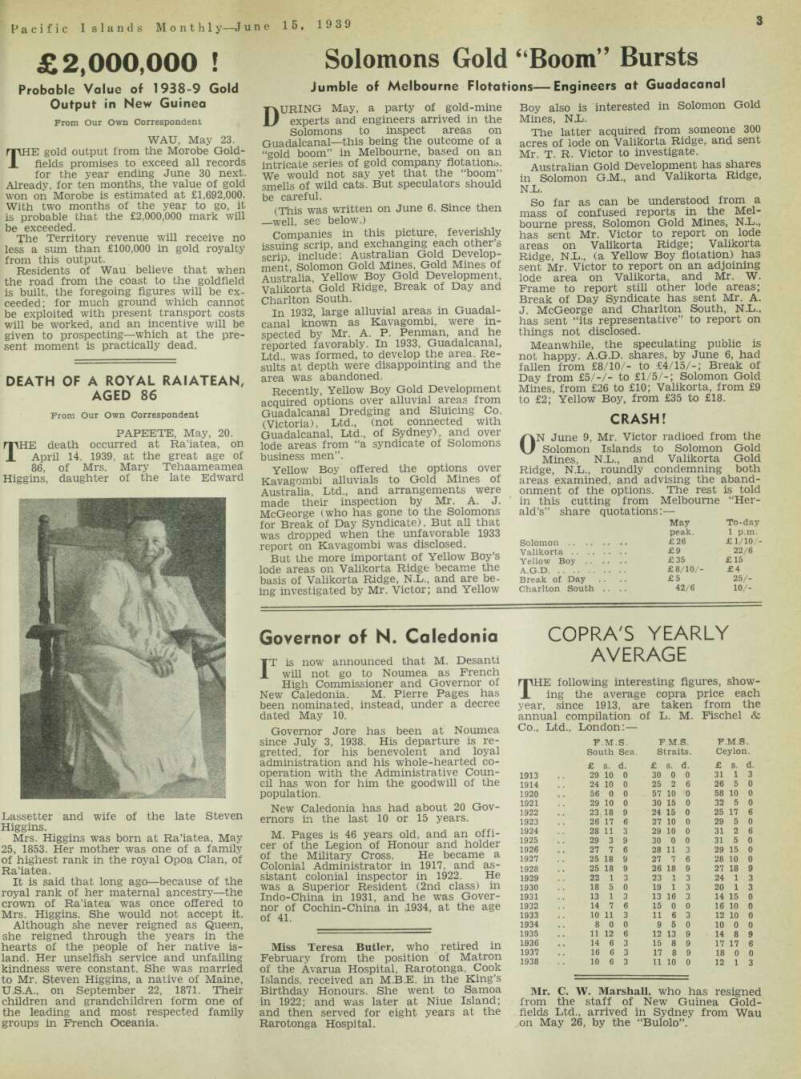
THE death occurred at Ra’iatea, on April 14. 1939, at the great age of 86, of Mrs. Mary Tehaameamea Higgins, daughter of the late Edward
Lassetter and wife of the late Steven Higgins.
Mrs. Higgins was born at Ra’iatea, May 25, 1853. Her mother was one of a family of highest rank in the royal Opoa Clan, of Ra’iatea.
It is said that long ago—because of the royal rank of her maternal ancestry—the crown of Ra’iatea was once offered to Mrs. Higgins. She would not accept it.
Although she never reigned as Queen, she reigned through the years in the hearts of the people of her native is land. Her unselfish service and unfailing kindness were constant. She was married to Mr. Steven Higgins, a native of Maine, U.S.A., on September 22, 1871. Their children and grandchildren form one of the leading and most respected family groups in French Oceania.
Solomons Gold “Boom” Bursts
Jumble of Melbourne Flotations—Engineers at Guadacanal
DURING May, a party of gold-mine experts and engineers arrived in the Solomons to inspect areas on Guadalcanal—this being the outcome of a “gold boom” in Melbourne, based on an intricate series of gold company flotations.
We would not say yet that the “boom” smells of wild cats. But speculators should be careful. (This was written on June 6. Since then —well, see below.) Companies in this picture, feverishly issuing scrip, and exchanging each other’s scrip, include: Australian Gold Develop ment Solomon Gold Mines, Gold Mines of Australia, Yellow Boy Gold Development, Valikorta Gold Ridge, Break of Day and Charlton South.
In 1932, large alluvial areas in Guadal canal known as Kavagombi, were in spected by Mr. A. P. Penman, and he reported favorably. In 1933, Guadalcanal, Ltd. was formed, to develop the area. Re sults at depth were disappointing and the area was abandoned.
Recently, Yellow Boy Gold Development acquired options over alluvial areas from Guadalcanal Dredging and Sluicing Co. (Victoria), Ltd., (not connected with Guadalcanal, Ltd., of Sydney), and over lode areas from “a syndicate of Solomons business men”.
Yellow Boy offered the options over Kavagombi alluvials to Gold Mines of Australia, Ltd., and arrangements were made their inspection by Mr. A. J.
McGeorge (who has gone to the Solomons for Break of Day Syndicate). But all that was dropped when the unfavorable 1933 report on Kavagombi was disclosed.
But the more important of Yellow Boy’s lode areas on Valikorta Ridge became the basis of Valikorta Ridge, N.L., and are be ing investigated by Mr. Victor; and Yellow
Boy also is interested in Solomon Gold Mines, N.L.
The latter acquired from someone 300 acres of lode on Valikorta Ridge, and sent Mr. T. R. Victor to investigate.
Australian Gold Development has shares in Solomon G.M., and Valikorta Ridge, N.L.
So far as can be understood from a mass of confused reports in the Mel bourne press, Solomon Gold Mines, N.L., has sent Mr. Victor to report on lode areas on Valikorta Ridge; Valikorta Ridge, N.L., (a Yellow Boy flotation) has sent Mr. Victor to report on an adjoining lode area on Valikorta, and Mr. W.
Frame to report still other lode areas; Break of Day Syndicate has sent Mr. A.
J. McGeorge and Charlton South, N.L., has sent “its representative” to report on things not disclosed.
Meanwhile, the speculating public is not happy. A.G.D. shares, by June 6, had fallen from £B/10/- to £4/15/-; Break of Day from £5/-/- to £l/5/-; Solomon Gold Mines, from £26 to £10; Valikorta, from £9 to £2; Yellow Boy, from £35 to £lB.
Crash!
ON June 9, Mr. Victor radioed from the Solomon Islands to Solomon Gold Mines, N.L., and Valikorta Gold Ridge, N.L., roundly condemning both areas examined, and advising the aband onment of the options. The rest is told in this cutting from Melbourne “Her ald’s” share quotations:—
May To-day peak. 1 p.m.
Solomon £26 £1/10/- Valikorta £9 22/6 Yellow Boy £35 £15 £8/10/- £4 Break of Day £5 25/- Charlton South .. .. 42/6 10/-
Governor of N. Caledonia
IT is now announced that M. Desanti will not go to Noumea as French High Commissioner and Governor of New Caledonia. M. Pierre Pages has been nominated, instead, under a decree dated May 10.
Governor Jore has been at Noumea since July 3, 1938. His departure is re gretted, for his benevolent and loyal administration and his whole-hearted co operation with the Administrative Coun cil has won for him the goodwill of the population.
New Caledonia has had about 20 Gov ernors in the last 10 or 15 years.
M. Pages is 46 years old, and an offi cer of the Legion of Honour and holder of the Military Cross. He became a Colonial Administrator in 1917, and as sistant colonial inspector in 1922. He was a Superior Resident (2nd class) in Indo-China in 1931, and he was Gover nor of Cochin-China in 1934, at the age of 41.
Miss Teresa Butler, who retired in February from the position of Matron of the Avarua Hospital, Rarotonga, Cook Islands, received an M.B.E. in the King’s Birthday Honours. She went to Samoa in 1922; and was later at Niue Island; and then served for eight years at the
Rarotonga Hospital.
Copra's Yearly
Average
THE following interesting figures, show ing the average copra price each year, since 1913, are taken from the annual compilation of L. M. Fischel & Co., Ltd., London: —
Mr. C. W. Marshall, who has resigned from the staff of New Guinea Gold fields Ltd., arrived in Sydney from Wau on May 26, by the “Bulolo”.
F.M.S.
F.M.S.
F.M.S.
South Sea.
Straits.
Ceylon. £ S. d. £ s. d. £ s. d. 1913 29 10 0 30 0 0 31 1 3 1914 24 10 0 25 2 6 26 5 0 1920 56 0 0 57 10 0 58 10 0 1921 29 10 0 30 15 0 32 5 0 1922 23 18 9 24 15 0 25 17 6 1923 26 17 6 27 10 0 29 5 0 1924 28 11 3 29 10 0 31 2 6 1925 29 3 9 30 0 0 31 5 0 1926 27 7 6 28 11 3 29 15 0 1927 25 18 9 27 7 6 28 10 0 1928 25 18 9 26 18 9 27 18 9 1929 22 1 3 23 1 3 24 1 3 1930 18 5 0 19 1 3 20 1 3 1931 13 1 3 13 16 3 14 15 0 1932 14 7 6 15 0 0 16 10 0 1933 10 11 3 11 6 3 12 10 0 1934 8 0 0 9 5 0 10 0 0 1935 11 12 6 12 13 9 14 8 9 1936 14 6 3 15 8 9 17 17 6 1937 16 6 3 17 8 9 18 0 0 1938 10 6 3 11 10 0 12 1 3
Advertisements & other items, p. 7 (1 item)
3
Pacific Islands Monthl y—J une 15, 1939
Amalgamation?
Some Posers for the Experts in Australian Territories
NOW that the residents of the Terri tories of Papua and New Guinea are thinking seriously about the plan of amalgamating the two Territories, a number of practical questions are being asked which indicate the difficulties in the way of finding a modus operandi.
Here are some of the questions which have been asked and which apparently will provide the inquiry committee with some posers.
How can there be effective amalga mation when, under the terms of the Mandate, the revenue and profits of a country governed under Mandate must be used solely for the benefit of that Ter ritory?
How is it proposed to provide funds to allow the administrative machinery in Papua to be doubled —which would be necessary if the financial and adminis trative status of Papua were to be the same as New Guinea? Is it suggested that new taxation should be imposed upon Papua?
Will recruiters from New Guinea, where there is a grave and growing shortage of labour, be allowed to recruit labour in the Territory of Papua?
Under amalgamation, will the Chinese in New Guinea, whose growing numbers are now such a problem and a menace, be allowed to come over into Papua, and mop up the native trade-store industry in Papua, and drive European traders and artisans out of business, as they have done in New Guinea?
Will the mining interests in Papua be compelled to pay the heavier royalty on gold, and the heavy customs duties on mining machinery, which are imposed in New Guinea? Or as an alternative, can the mining interests in New Guinea ex pect to have lower royalties and lower customs duties to accord with present con ditions in Papua?
Do the facts that the New Guinea Administration is now being carried on at a loss, and that the large accumula ted surplus has disappeared, which ap parently make new taxation necessary in New Guinea, mean that Papuan inter ests also will be taxed to provide for New Guinea’s extravagances?
The most difficult question is that re lating to the Chinese. It is a fact that the Chinese population in New Guinea has displaced Europeans, instead of sup plementing European settlement and development; and a Chinese invasion of Papua would most certainly have serious political repercussions in Australia.
Capital
Wealth Of Guinea Gold
Annual Income Nearly Equal to Capital
fT~HE annual accounts of Guinea Gold, A N.L., come along to remind us again that there still is romance in gold mining.
Guinea Gold was formed by a little group of courageous Adelaide men to finance the late CL J. Levien in establish ing, in the interior of New Guinea, a gold-dredging industry, serviced by aero planes. They subscribed £50.000. The seemingly fantastic idea was a winner.
Now, each year, the holders of those £50,000 worth of shares receive almost (in round figures) £50,000 per annum from Bulolo Gold Dredging Ltd. (the operat ing company formed to work Guinea Gold’s leases).
The Venom Of Mr.
Keegan
A Gentleman Who Disliked Samarai
IN the May issue of the “P.1.M.”, we reprinted from Sydney “Telegraph” a statement by a Mr. J. Keegan, who described Samarai as a “fever-ridden hell”, and said he would not return to the place if his fare were paid. He was very contemptuous in his references to Eastern Papua.
It is revealed that this Mr. Keegan was employed on Misima by Gold Mines of Papua Ltd., in a trusted position. Cer tain native labourers, more honest than the European, reported on strange things they had seen; with the result that Mr.
Keegan appeared before the Resident Magistrate, and was convicted of “taking and concealing” the gold-bearing ore that had been in his charge.
Mr. Keegan was fined £25, or six months’ gaol. He paid the fine, and “hopped it”. In Sydney, an unfledged newspaper reporter allowed him to spit venom at his late associates and at Sa marai—which actually is one of the most beautiful places in the Pacific, and quite free of fever.
Profit Over £12,000,000
Operations of Unilever Combine
IT was announced at the annual meet ing of Lever Brothers and the Uni lever Group, in London in May, that the profit distributed to shareholders was £12,250,000.
This is the international combine which now controls the world’s vegetable oil markets, and, apparently, also the whale oil market.
The combine, last year, received in all countries, about £200,000.000 for soap, margarine, edible fats and various food stuffs.
Negotiations regarding the construction of two new British liners for service in the Pacific, between Canada and Aus tralia, have apparently been resumed, ac cording to a recent statement made at Vancouver by Mr. J. N. Greenland, gen eral manager of the Union Steam Ship Company.
Mr. C. H. Beach, who served for 10 years in the Wellington City Council, N.Z., arrived in Fiji in May to take up the post of Engineer to the Suva Town Board.
New Government Block In Fiji
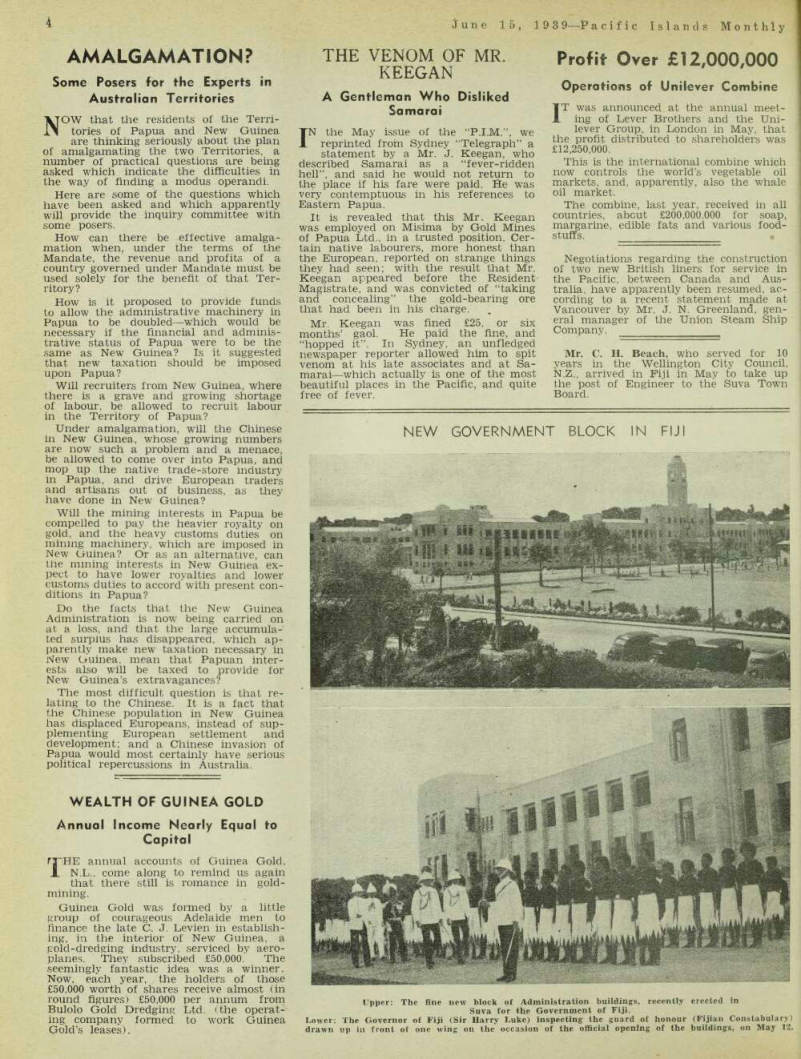
Upper: The fine new block of Administration buildings, recently erected in Suva for the Government of Fiji.
Lower: The Governor of Fiji (Sir Harry Luke) inspecting the guard of honour (Fijian Constabulary) drawn up in front of one wing on the occasion of the official opening of the buildings, on May 12.
Advertisements & other items, p. 8 (1 item)
4
June 15, 193 9—P acific Islands Monthly
Censured
Very Gravely
Chief Justice on Tongan Treasurer
From Our Own Correspondent
Nukualofa, May 5.
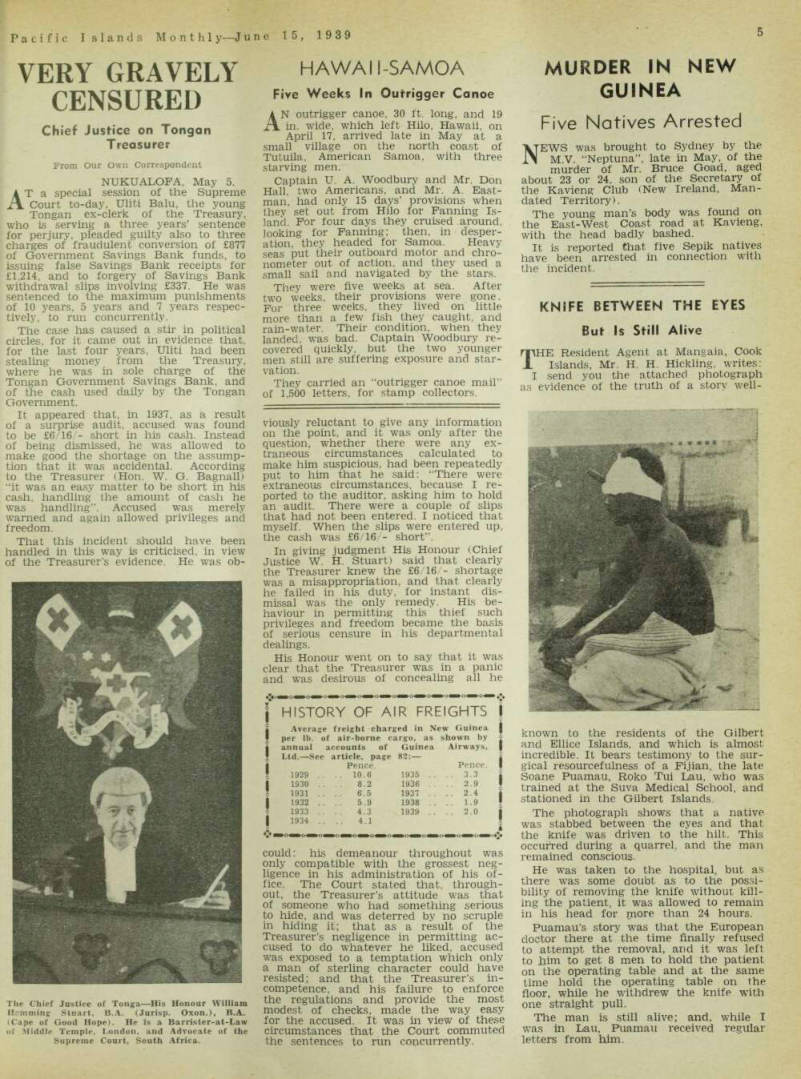
AT a special session of the Supreme Court to-day, Uliti Balu, the young Tongan ex-clerk of the Treasury, who is serving a three years’ sentence for perjury, pleaded guilty also to three charges of fraudulent conversion of £877 of Government Savings Bank funds, to issuing false Savings Bank receipts for £1,214, and to forgery of Savings Bank withdrawal slips involving £337. He was sentenced to the maximum punishments of 10 years, 5 years and 7 years respec tively, to run concurrently.
The case has caused a stir in political circles, for it came out in evidence that, for the last four years, Uliti had been stealing money from the Treasury, where he was in sole charge of the Tongan Government Savings Bank, and of the cash used daily by the Tongan Government.
It appeared that, in 1937, as a result of a surprise audit, accused was found to be £6/16/- short in his cash. Instead of being dismissed, he was allowed to make good the shortage on the assump tion that it was accidental. According to the Treasurer (Hon. W. G. Bagnall) “it was an easy matter to be short in his cash, handling the amount of cash he was handling”. Accused was merely warned and again allowed privileges and freedom.
That this incident should have been handled in this way is criticised, in view of the Treasurer’s evidence. He was ob-
viously reluctant to give any information on the point, and it was only after the question, whether there were any ex traneous circumstances calculated to make him suspicious, had been repeatedly put to him that he said: “There were extraneous circumstances, because I re ported to the auditor, asking him to hold an audit. There were a couple of slips that had not been entered. I noticed that myself. When the slips were entered up, the cash was £6/16/- short”.
In giving judgment His Honour (Chief Justice W. H. Stuart) said that clearly the Treasurer knew the £6/16 - shortage was a misappropriation, and that clearly he failed in his duty, for instant dis missal was the only remedy. His be haviour in permitting this thief such privileges and freedom became the basis of serious censure in his departmental dealings.
His Honour went on to say that it was clear that the Treasurer was in a panic and was desirous of concealing all he
could; his demeanour throughout was only compatible with the grossest neg ligence in his administration of his of fice. The Court stated that, through out, the Treasurer’s attitude was that of someone who had something serious to hide, and was deterred by no scruple in hiding it; that as a result of the Treasurer’s negligence in permitting ac cused to do whatever he liked, accused was exposed to a temptation which only a man of sterling character could have resisted; and that the Treasurer’s in competence, and his failure to enforce the regulations and provide the most modest of checks, made the way easy for the accused. It was in view of these circumstances that the Court commuted the sentences to run concurrently.
The Chief Justice of Tonga—His Honour William Hemming Stuart, B.A. (Jurisp. Oxon.), B.A. (Cape of Good Hope). He is a Barrister-at-Law of Middle Temple, London, and Advocate of the Supreme Court, South Africa.
Hawaii-Samoa
Five Weeks In Outrigger Canoe
AN outrigger canoe, 30 ft. long, and 19 in. wide, which left Hilo, Hawaii, on April 17, arrived late in May at a small village on the north coast of Tutuila, American Samoa, with three starving men.
Captain U. A. Woodbury and Mr. Don Hall, two Americans, and Mr. A. East man, had only 15 days’ provisions when they set out from Hilo for Fanning Is land. For four days they cruised around, looking for Fanning; then, in desper ation, they headed for Samoa. Heavy seas put their outboard motor and chro nometer out of action, and they used a small sail and navigated by the stars.
They were five weeks at sea. After two weeks, their provisions were gone.
For three weeks, they lived on little more than a few fish they caught, and rain-water. Their condition, when they landed, was bad. Captain Woodbury re covered quickly, but the two younger men still are suffering exposure and star vation.
They carried an “outrigger canoe mail” of 1,500 letters, for stamp collectors.
History Of Air Freights
Average freight charged in New Guinea per lb. of air-borne cargo, as shown by annual accounts of Guinea Airways, Ltd.—See article, page 82; —
Pence, Pence 1929 . . . 10.6 1935 .. .. 3.3 1930 .. . 8.2 1936 .. 2.9 1931 ... 6.5 1937 .. 2.4 1932 .. .. 5.9 1938 .. .. 1.9 1933 ... 4.3 1939 .. .. 2.0 1934 .. .. 4.1
Guinea
Murder In New
Five Natives Arrested
NEWS was brought to Sydney by the M.V. “Neptuna”, late in May, of the murder of Mr. Bruce Goad, aged about 23 or 24. son of the Secretary of the Kavieng Club (New Ireland, Man dated Territory).
The young man’s body was found on the East-West Coast road at Kavieng, with the head badly bashed.
It is reported that five Sepik natiyes have been arrested in connection with the incident.
Knife Between The Eyes
But Is Still Alive
THE Resident Agent at Mangaia, Cook Islands, Mr. H. H. Hickling. writes; I send you the attached photograph as evidence of the truth of a story well-
known to the residents of the Gilbert and Ellice Islands, and which is almost incredible. It bears testimony to the sur gical resourcefulness of a Fijian, the late Soane Puamau, Roko Tui Lau, who was trained at the Suva Medical School, and stationed in the Gilbert Islands.
The photograph shows that a native was stabbed between the eyes and that the knife was driven to the hilt. This occurred during a quarrel, and the man remained conscious.
He was taken to the hospital, but as there was some doubt as to the possi bility of removing the knife without kill ing the patient, it was allowed to remain in his head for more than 24 hours.
Puamau’s story was that the European doctor there at the time finally refused to attempt the removal, and it was left to him to get 8 men to hold the patient on the operating table and at the same time hold the operating table on the floor, while he withdrew the knife with one straight pull.
The man is still alive; and, while I was in Lau, Puamau received regular letters from turn.
Advertisements & other items, p. 9 (1 item)
5
Pacific I slands Monthl y—J une 15, 1939
Preparations By P.A.A. and Imperial Airways
Transpacific Air Services
r:E aerial transport picture of the South and Central Pacific, which we may expect to see more clearly in the future, is beginning to take shape.
Six members of Pan American Airways technical staff arrived at Noumea (New Caledonia) at the end of May and com menced the installation of a flying-boat base at Nouville. It is still insisted, on behalf of Pan American Airways, that this base will be part of the route be tween Honolulu and New Zealand.
There is a general belief, however, that even if P.A.A. machines fly south from Honolulu to Canton Is. and Noumea, and then cut off at an angle towards Auck land, they sooner or later will fly the 700 miles between Noumea and Australia.
New Zealand
The Pan American Airways establish ment in Auckland is being maintained, and the P.A.A. meteorologist. Mr. E. B.
Buxton, arrived there at the end of May, and took charge of the P.A.A. weather-map organisation in that part of the Pacific.
Meanwhile, as indicated in the “P.1.M.” last month, British Imperial Airways steadily are making their pre parations for trial flights between Syd ney and Auckland, and Auckland and Suva. The latest official announcement is that it is probable that the new regu lar airmail between Sydney and New Zealand will commence in October.
Canton Island
A party of Americans has arrived at Canton Island and is busilv preparing there a suitable base for P.A.A. sea planes. There is a clear understanding now between Britain and the United States that all aeroplane and seaplane facilities which are provided by either nation at Canton Island for the use of its air transport, will also be available for use by the air transport of the other nation.
Singularly little has been published in the newspapers about the preparation of a base in Fiji for seaplanes and aero planes, but it is known that important plans are being given effect to. and it is probable that by this time next year the people of Viti Levu, and especially of Suva, will be well accustomed to the sight, not only of the great trans-ocean seaplanes, but also of large aeroplanes and seaplanes used as part of the new Pacific defence organisation.
Noumea Base To Cost 700,000
Francs
According to the “Bulletin du Com merce”. the estimated cost of creating, at Nouville. Noumea, New Caledonia, an
aviation base for the use of Pan Ame rican Airways is as follows;— Supply of electric light and power 110,000 francs.
Water installation, including motor pump and reservoir. .. 50,000 francs.
Building for officer in charge of T.S.P., postal officials and sub sidiary offices 160,000 francs.
Building to house meteorological service and equipment 80,000 francs.
Quarters for meteorological en gineer 20,000 francs.
Quarters for representative of the Administration 20,000 francs.
Quarters for T.S.F. assistant, meteorological assistant, doctor, inspector and Customs officials. 40,000 francs.
Building for T.S.F 90,000 francs.
Additional, in connection with lighting unit 40,000 francs.
The total of these works is 610,000 francs, plus a sum to the value of 90,000 francs, making 700,000 francs in all.
Will Be Resisted
P.A.A. Wish to Enter Australia
THE Melbourne “Herald”, which is understood to be in the confidence of the Commonwealth Government, stated on June 3 that Pan American Airways is expected to apply to the Com monwealth Government shortly for per mission to bring into Australia, by way of the Company’s new base at Noumea, the giant clippers from San Francisco across the Central Pacific.
The newspaper says that the proposal will be strenuously resisted, on the ground that these main lines of airmail communication throughout the Empire should belong to British Imperial inter ests. It is indicated that the same kind of opposition is being enforced to the new arrangement under which the Dutch airliners, flying from Holland to the Netherlands Indies, are allowed to come into Australia and terminate the service at Sydney.
The idea of keeping all these airways communications for British airplanes ap pears beautiful and patriotic, until one discovers that practically the whole of the British airlines of any importance are now owned by British shipping in terests —and most of us have heard of the British shipping combine. The free thinking Australian is inclined to argue that the airlines of other nations should be allowed to enter Australia, so that they may provide the British concerns with healthy competition and keep their natural rapacity in check.
Well-Loved Missionary
Passes On
Prom a Special Correspondent
Rarotonga, May 24.
THE death occurred at Rarotonga on May 14 of the Rt. Reverend Father Jean Marie Bemadine Custanie, Pre fect of the Roman Catholic Church in the Cook Islands.
The good Father was born on January 31, 1869, at Aboul, Aveyron. France. He entered the congregation of the Sacred Heart in May. 1889, and was ordained priest on October, 1892.
He arrived in Tahiti in 1893, and the year following he was sent to open the
Cook Islands Mission. From that date on he worked lovingly and unceasingly, until three days before his death. In 1922. the Cook Islands Mission was separated from the Vicariate of Tahiti to become a Prefecture, and the Rev. Father Ber nardine was appointed Prefect Apostolic.
A Requiem Mass took place at Avarua, Rarotonga, on May 15. Although the day was extremely wet and cold, the Mass was largely attended by Catholics and non-Catholics. The burial service was again the occasion of a large gathering of all his friends.
The absence of the Reverend Father’s cheerful face from the “places which knew him and will know him no more” is deeply regretted by us all.
Epidemic of Cruising
Yachts in Pacific
rpHE South Seas, nowadays, seem to be X the happy hunting-ground for world-wandering yachtsmen—almost a dozen small craft from all over the world are leisurely cruising at the mo ment through the Pacific. Among them are:— “Ahto” (70 tons) from Greenwich, U.S.A., with Mr. and Mrs. Ahto Walter and party of 12. Arrived Sydney on June 12 from Fiji, Vila and Noumea.
“Land’s End” (Capt. Jeffreys), from Durban, South Africa, was in Fiji in May, “Ronda” (Lt.-Commander Hudson), English auxiliary ketch, sailed from N.Z. in May for Tonga.
“Hispaniola”, with Mr. and Mrs. G.
O’Brien and family on board, returned to Sydney on June 1 on its second un successful attempt to reach Lord Howe Is., on the first stage of a Pacific cruise.
They will try again shortly.
“Silver Spray” (48ft.), from San Fran cisco, U.S.A., reached Russell, N.Z., via Tahiti and Cook Is., at end of May, with Mr. and Mrs. E. J. Thomas and two children aboard.
“Seaward” (34ft.), departed from Auck land on May 23 for a five months’ Is lands cruise, under Mr. D. Wellington and three New Zealanders.
“Navigator” (48 tons), owned by Mr.
G. H. Singer, of U.S.A., is en route to Tonga and Tahiti from N.Z.
“Henrietta” will leave Sydney shortly for New Guinea, on her way to Ame rica.
“Marie” (Capt. Frank Dona), from Seattle. U.S.A., was in N.Z. in mid-May ready to leave for the Kermadecs, Ton ga, and Fiji.
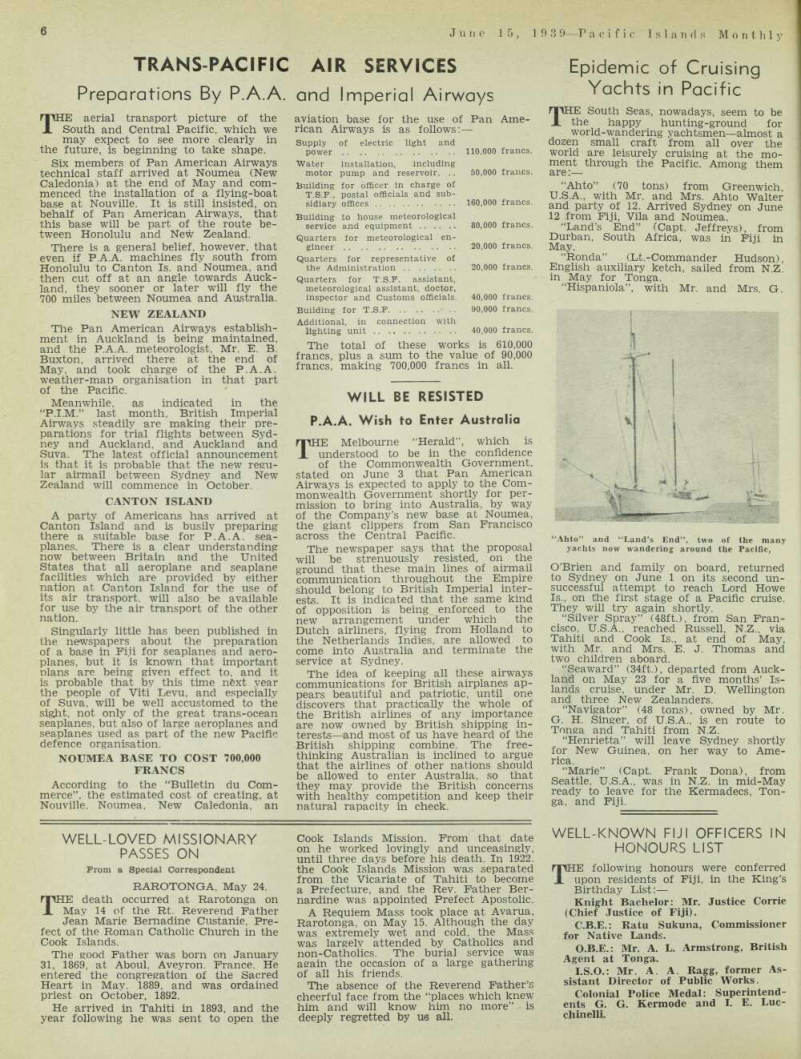
“Ahto” and “Land’s End", two of the many yachts now wandering around the Pacific,
Well-Known Fiji Officers In
Honours List
r:E following honours were conferred upon residents of Fiji, in the King’s Birthday List: — Knight Bachelor: Mr. Justice Corrie (Chief Justice of Fiji).
C.8.E.: Ratu Sukuna, Commissioner for Native Lands. 0.8. E.; Mr. A. L. Armstrong, British Agent at Tonga. 1.5.0.: Mr. A. A. Ragg, former As sistant Director of Public Works.
Colonial Police Medal: Superintend ents G. G. Kermode and I. E. Luc chinelli.
Advertisements & other items, p. 10 (1 item)
6
June 15, 193 9—P acific Islands Monthly
"Bulolo" Passengers
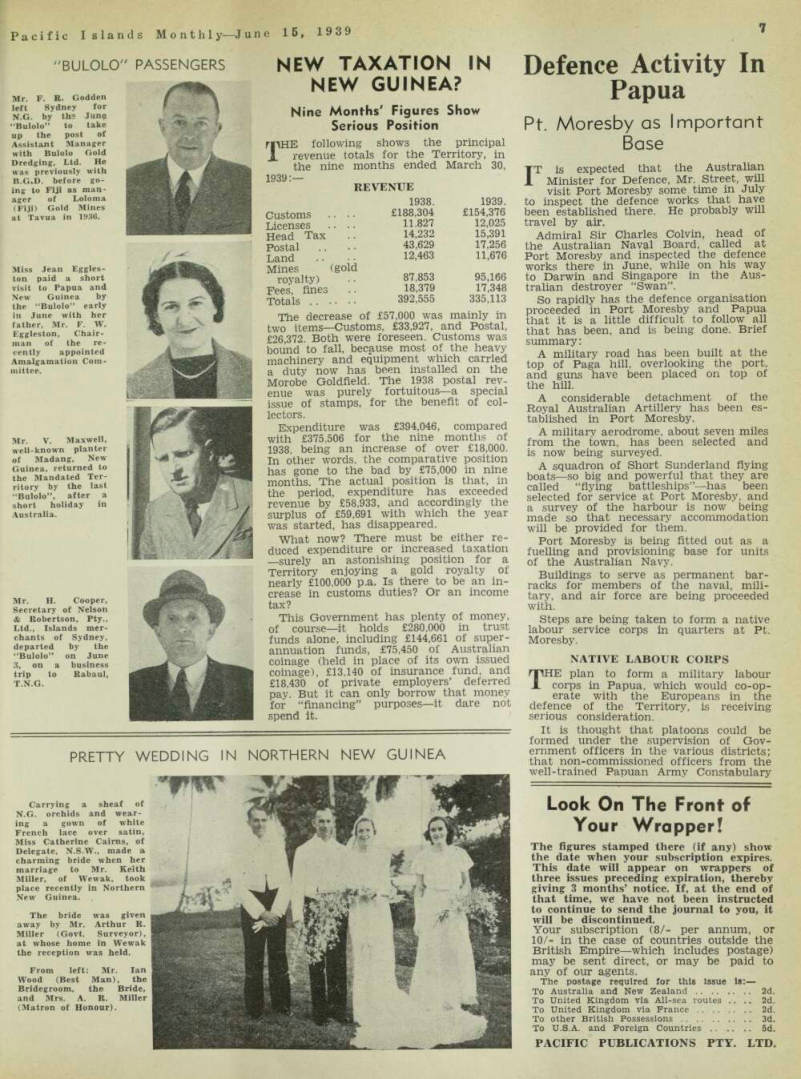
Mr. F. R. Godden left Sydney for N.G. by the June “Bulolo” to take up the post of Assistant Manager with Bulolo Gold Dredging, Ltd. He was previously with B.GkD. before go ing to Fiji as man ager of Loloma (Fiji) Gold Mines at Tavua in 1936.
Miss Jean Eggles ton paid a short visit to Papua and New Guinea by the “Bulolo” early in June with her father, Mr, F. W.
Eggleston, Chair man of the re cently appointed Amalgamation Com mittee.
Mr. V. Maxwell, well-known planter of Madang, New Guinea, returned to the Mandated Ter ritory by the last “Bulolo”, after a short holiday in Australia.
Mr. H. Cooper, Secretary of Nelson & Robertson, Pty., Ltd., Islands mer chants of Sydney, departed by the “Bulolo” on June 3, on a business trip to Rabaul,
T.N.G.
Pretty Wedding In Northern New Guinea
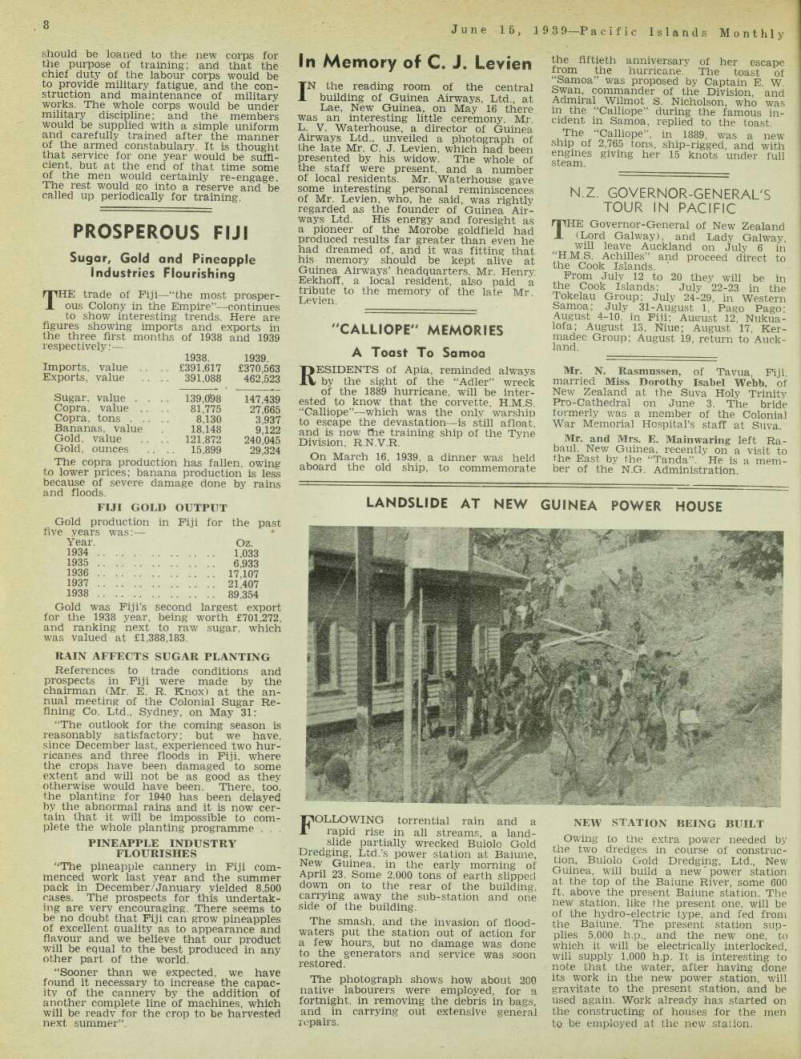
Carrying a sheaf of N.G. orchids and wear ing a gown of white French lace over satin.
Miss Catherine Cairns, of Delegate, N.S.W., made a charming bride when her marriage to Mr. Keith Miller, of Wewak, took place recently in Northern New Guinea.
The bride was given away by Mr. Arthur R.
Miller (Govt. Surveyor), at whose home in Wewak the reception was held.
From left: Mr. lan Wood (Best Man), the Bridegroom, the Bride, and Mrs. A. R. Miller (Matron of Honour),
New Guinea?
New Taxation In
Nine Months' Figures Show Serious Position
rpHE following shows the principal 1 revenue totals for the Territory, in the nine months ended March 30, 1939:
The decrease of £57,000 was mainly in two items—Customs, £33,927, and Postal, £26,372. Both were foreseen. Customs was bound to fall, because most of the heavy machinery and equipment which carried a duty now has been installed on the Morobe Goldfield. The 1938 postal rev enue was purely special issue of stamps, for the benefit of col lectors.
Expenditure was £394,046, compared with £375.506 for the nine months of 1938, being an increase of over £lB,OOO.
In other words, the comparative position has gone to the bad by £75,000 in nine months. The actual position is that, in the period, expenditure has exceeded revenue by £58,933, and accordingly the surplus of £59,691 with which the year was started, has disappeared.
What now? There must be either re duced expenditure or increased taxation —surely an astonishing position for a Territory enjoying a gold royalty of nearly £lOO,OOO p.a. Is there to be an in crease in customs duties? Or an income tax?
This Government has plenty of money, of course—it holds £280,000 in trust funds alone, including £144,661 of super annuation funds, £75,450 of Australian coinage (held in place of its own issued coinage), £13,140 of insurance fund, and £18,430 of private employers’ deferred pay. But it can only borrow that money for “financing” purposes—it dare not spend it.
Revenue
1938. 1939.
Customs .. . • £188,304 £154,376 Licenses .. .. 11.827 12,025 Head Tax 14,232 15,391 Postal 43,629 17,256 Land 12,463 11,676 Mines (gold royalty) 87,853 95,166 Fees, fines 18,379 17,348 Totals .. • • • • 392,555 335,113
Papua
Defence Activity In Papua Pt. Moresby as Important Base
IT is expected that the Australian Minister for Defence, Mr. Street, will visit Port Moresby some time in July to inspect the defence works that haye been established there. He probably will travel by air.
Admiral Sir Charles Colvin, head of the Australian Naval Board, called at Port Moresby and inspected the defence works there in June, while on his way to Darwin and Singapore in the Aus tralian destroyer “Swan”.
So rapidly has the defence organisation proceeded in Port Moresby and Papua that it is a little difficult to follow all that has been, and is being done. Brief summary: A military road has been built at the top of Paga hill, overlooking the port, and guns have been placed on top of the hill.
A considerable detachment of the Royal Australian Artillery has been es tablished in Port Moresby.
A military aerodrome, about seven miles from the town, has been selected and is now being surveyed.
A squadron of Short Sunderland flying boats —so big and powerful that they are called “flying battleships’’—has been selected for service at Port Moresby, and a survey of the harbour is now being made so that necessary accommodation will be provided for them.
Port Moresby is being fitted out as a fuelling and provisioning base for units of the Australian Navy.
Buildings to serve as permanent bar racks for members of the naval, mili tary, and air force are being proceeded with.
Steps are being taken to form a native labour service corps in quarters at Pt.
Moresby.
Native Labour Corps
THE plan to form a military labour corps in Papua, which would co-op erate with the Europeans in the defence of the Territory, is receiving serious consideration.
It is thought that platoons could be formed under the supervision of Gov ernment officers in the various districts; that non-commissioned officers from the well-trained Papuan Army Constabulary
should be loaned to the new corps for the purpose of training; and that the chief duty of the labour corps would be to provide military fatigue, and the con struction and maintenance of military works. The whole corps would be under military discipline; and the members would be supplied with a simple uniform and carefully trained after the manner of the armed constabulary. It is thought that service for one year would be suffi cient, but at the end of that time some of the men would certainly re-engage.
The rest would go into a reserve and be called up periodically for training.
Advertisements & other items, p. 11 (2 items)
7
Pacific Islands Mont hi y—J une 16, 1939
Your Wrapper!
Look On The Front of
The figures stamped there (if any) show the date when your subscription expires.
This date will appear on wrappers of three issues preceding expiration, thereby giving 3 months’ notice. If, at the end of that time, we have not been instructed to continue to send the journal to you, it will be discontinued.
Your subscription (8/- per annum, or 10/- in the case of countries outside the British Empire—which includes postage) may be sent direct, or may be paid to any of our agents.
The postage required for this issue is:— To Australia and New Zealand 2d.
To United Kingdom via All-sea routes ... 2d.
To United Kingdom via Prance 2d.
To other British Possessions 3d.
To U.S.A. and Foreign Countries sd.
PACIFIC PUBLICATIONS PTY. LTD.
Prosperous Fiji
Sugar, Gold and Pineapple Industries Flourishing
THE trade of Fiji—“the most prosper ous Colony in the Empire”—continues to show interesting trends. Here are figures showing imports and exports in the three first months of 1938 and 1939 respectively:—
The copra production has fallen, owing to lower prices: banana production is less because of severe damage done bv rains and floods.
Fiji Gold Output
Gold production in Fiji for the past five years was:— *
Gold was Fiji’s second largest export for the 1938 year, being worth £701.272. and ranking next to raw sugar, which was valued at £1,388,183.
Rain Affects Sugar Planting
References to trade conditions and prospects in Fiji were made by the chairman (Mr. E. R. Knox) at the an nual meeting of the Colonial Sugar Re fining Co. Ltd., Sydney, on May 31: “The outlook for the coming season is reasonably satisfactory; but we have, since December last, experienced two hur ricanes and three floods in Fiji, where the crops have been damaged to some extent and will not be as good as they otherwise would have been. There, too. the planting for 1940 has been delayed by the abnormal rains and it is now cer tain that it will be impossible to com plete the whole planting programme . . .
Pineapple Industry
Flourishes
“The pineapple cannery in Fiji com menced work last year and the summer pack in December/January yielded 8,500 cases. The prospects for this undertak ing are very encouraging. There seems to be no doubt that Fiji can grow pineapples of excellent quality as to appearance and flavour and we believe that our product will be equal to the best produced in any other part of the world.
“Sooner than we expected, we have found it necessary to increase the capac ity of the cannery by the addition of another complete line of machines, which will be ready for the crop to be harvested next summer”
1938. 1939.
Imports, value .. . . £391,617 £370,563 Exports, value 391,088 462,523 Sugar, value . . . . 139,098 147.439 Copra, value .. 81,775 27,665 Copra, tons . .. 8,130 3.937 Bananas, value 18.148 9,122 Gold, value 121.872 240,045 Gold, ounces . . . 15,899 29.324
Year. Oz. 1934 1,033 1935 6.933 1936 17.107 1937 21.407 1938 89.354
In Memory of C. J. Levien
IN the reading room of the central building of Guinea Airways, Ltd., at Lae, New Guinea, on May 16 there was an interesting little ceremony. Mr.
L. V. Waterhouse, a director of Guinea Airways Ltd., unveiled a photograph of the late Mr. C. J. Levien, which had been presented by his widow. The whole of the staff were present, and a number of local residents. Mr. Waterhouse gave some interesting personal reminiscences of Mr. Levien, who, he said, was rightly regarded as the founder of Guinea Air ways Ltd. His energy and foresight as a pioneer of the Morobe goldfield had produced results far greater than even he had dreamed of, and it was fitting that his memory should be kept alive at Guinea Airways’ headquarters. Mr. Henry Eekhoff, a local resident, also paid a tribute to the memory of the late Mr Levien.
"Calliope'' Memories
A Toast To Samoa
RESIDENTS of Apia, reminded always by the sight of the “Adler” wreck of the 1889 hurricane, will be inter ested to know that the corvette, H.M.S.
“Calliope”—which was the only warship to escape the devastation—is still afloat, and is now the training ship of the Tyne Division, R.N.V.R.
On March 16, 1939, a dinner was held aboard the old ship, to commemorate
the fiftieth anniversary of her escape from the hurricane. The toast of ‘Samoa” was proposed by Captain E. W Swan, commander of the Division, and Admiral Wilmot S. Nicholson, who was in the “Calliope” during the famous in cident in Samoa, replied to the toast.
The “Calliope”, in 1889, was a new ship of 2,765 tons, ship-rigged, and with engines giving her 15 knots under full steam.
N.Z. Governor-General's
Tour In Pacific
THE Governor-General of New Zealand (Lord Galway), and Lady Galway will leave Auckland on July 6 in “H.M.S. Achilles” and proceed direct to the Cook Islands.
From July 12 to 20 they will be in the Cook Islands: July 22-23 in the Tokelau Group; July 24-29, in Western Samoa: July 31-August 1, Pago Pago* August 4-10, in Fiji; August 12, Nukua lofa; August 13, Niue; August 17. Ker madec Group; August 19, return to Auck land, Mr. N. Rasmussen, of Tavua, Fiji married Miss Dorothy Isabel Webb, of New Zealand at the Suva Holy Trinity Pro-Cathedral on June 3. The bride formerly -was a member of the Colonial War Memorial Hospital’s staff at Suva.
Mr. and Mrs. E. Main waring left Ra baul. New Guinea, recently on a visit to the East by the “Tanda”. He is a mem ber of the N.G. Administration.
Landslide At New Guinea Power House
FOLLOWING torrential rain and a rapid rise in all streams, a land slide partially wrecked Bulolo Gold Dredging, Ltd.’s power station at Baiune, New Guinea, in the early morning of April 23. Some 2,000 tons of earth slipped down on to the rear of the building, carrying away the sub-station and one side of the building.
The smash, and the invasion of flood waters put the station out of action for a few hours, but no damage was done to the generators and service was soon restored.
The photograph shows how about 200 native labourers were employed, for a fortnight, in removing the debris in bags, and in carrying out extensive general
repairs.
New Station Being Built
Owing to the extra power needed by the two dredges in course of construc tion, Bulolo Gold Dredging, Ltd., New Guinea, will build a new” power station at the top of the Baiune River, some 600 ft. above the present Baiune station. The new station, like the present one, will be of the hydro-electric type, and fed from the Baiune. The present station sup plies 5,000 h.p., and the new one, to wdiich it will be electrically interlocked, will supply 1,000 h.p. It is interesting to note that the water, after having done its work in the new power station, will gravitate to the present station, and be used again. Work already has started on the constructing of houses for the men to be employed at the new station.
Advertisements & other items, p. 12 (1 item)
8
June 15, 193 9—P acific Islands Monthly
Tropicalities
JIROM “Daily Express’, London, of 1 May 1, 1939; “Franco's Spanish newspapers proclaim: •Britain is now enlisting cannibals for the English Army’.
“Explanation; A defence corps is be ing raised in New Guinea, famous for head-hunting before Australia took over the Mandate”.
Which is typical of the average daily newspaper when “explaining” the Paci fic Islands. The “Daily Express” refers to “New Guinea” and the “Mandate”, when the truth is that a labour battal ion is merely proposed in Papua, which is an Australian Territory and not a Mandate.
Some New Guinea humourist, uniden tified, who evidently is visiting London, has sent us the front page of the “Daily Express”, with this comment:— “Kanaka ’e finish dis talk-talk. ’E make ’em savvy. E kaikai ’em all up!”
IN the English-Samoan monthly Ga zette “O le Faatonu”, published in American Samoa, a Samoan who re turned recently to his Pago Pago home after a 10-years’ absence in the United States, expressed his disgust at the de terioration which had taken place in the beautiful Samoan language through the intrusion of many English terms and American jargon. As an instance, he cited the often-heard “Samoan” modern song:— Oka, oka la’u hani, la’u hani faasilisili Ou te faatusaina i se apa helepi; Po o se pisupo sili, Po o ni masi keke mai Fiti; Po o sina Sapa Sui, a fai i tamato ma ni pi, etc.
Translated literally, this is; Oh, oh my honey, my precious honey Whom I compare to a can of Hellaby meal: Or to a great can of corned beef, Or to some sweet cookies from Fiji, Or to some Chop Suey, that mix with tomatoes and peas— And so on, indefinitely.
He describes this as being considered the best and most popular “hit” of Sa moa to-day—sung even at formal and
royal entertainments!
* * * ri Frenchmen, champagne is a com mon wine. To others, including many Anglo-Saxons, it is the symbol of lavish entertainment, the badge of the nouveau riche. Some queer birds call at our island of Tahiti occasionally. Here is a story, true in every detail, about one of them: There came to Papeete a man whose fabric of wealth was so new that the varnish on it was not yet dry. He ar rived on a yacht that smelled of wet paint and gleamed with new chromium fixtures. He came ashore with his wife and child. It was a very hot day. After wandering about for a time, the three took refuge in a shop owned by a French citizen, and complained bitterly of the heat. The Frenchman courteously offer ed some liquid refreshment.
The yacht-owner drew himself up, laid his hand on his chest and remarked: “So good of you; but I never drink any thing but champagne”.
“Ah”, replied the Frenchman, “cham pagne is indeed a thrifty beverage, when one cannot afford the better wines of France”.
The yacht-owner stared. His carotids became congested and his cheeks purple.
Then, seizing his wife and child, he
stalked out into the sunlight; went to the quay, boarded his yacht, and the saipe day pulled up his anchor, sailed away over the horizon, and Tahiti has seen him no more.
The Frenchman, gazing after him mur mured: “I have heard of the bounder. I have read of the bounder. Now I have seen him”. —R. * ♦ * THE influence of the Bible on the Melanesian convert was demon strated recently.
Tommy’s varied career in the service of the Government had ended in gaol at Tulagi. and he was sent to Gizo, his own district, to serve his sentence. While a prisoner, he stole a couple of bottles of beer from the Government residence, and duly was charged. Four witnesses had given evidence and things looked bad for the prisoner, who was asked if he had anything to say.
“Me Klistian”. said Tommy. “Before me talk me want to smell him Bible”.
The Bible was produced and Tommy put it to his nose and sniffed it.
“This four fellow he gammon along me” was as far as he got, when the D.O. suggested another smell.
After a second, and decidedly audible sniff, Tommy’s face beamed with a feign ed enlightenment. “He true, master”,
he said. “Me do him”.
M.
THE threat of sabotage against French merchant vessels, causing the world wide interdict against any unauthor ised person going aboard such vessels in ports, has caused much perturbation in Papeete.
There, the arrivals and departures of Messageries Maritimes steamers have, hitherto, been occasions of social good comradeship: dinners on board to wel come arriving friends or to fete depart ing voyagers, and the pleasantly thrill ing excitement of gathering on the deck of a ship lately come directly from the home land. To home-sick exiles, the M.M. boats are a fragment of France and this new regulation, however neces sary, is cruel in its effect.
Book, 1939
Pacific Islands Year Book, 1939
THE Pacific Islands Year Book. 1939, was published in May.
It is a complete handbook of the Paci fic Islands. It contains 400 pages of de scriptive letterpress, together with a section of 16 pages, entitled ‘ Who s Who in the Pacific”, and another section giv ing merchandising information. There are numerous maps—in fact, in this edi tion. there are few important islands and territories which are not covered by maps.
Statistics relating to the various Ad ministrations are complete as at June 30, 1938, and in a number of cases they are brought up to December 31. 1938. There are business directories relating to all territories, and complete lists of Admin istrative officials, missionaries, etc.
Copies may be obtained as follows: In the Pacific Islands, from any of the prin cipal stores; in Australia, from the lead ing booksellers: in London, from W. R.
Carpenter and Co. Ltd.. Coronation House. 4 Lloyd’s Avenue, E.C.2; or direct from the publishers. Pacific Publications Pty. Ltd.. Union House, 247 George St..
Sydney. The price of the book is, per copy, 8/- (cloth cover) and 6/6 (paper cover), and postage (if necessary) should be added, as follows: Within British Empire, 6d. per copy: to points beyond the Empire, 1/-.
Two minesweepers and a survey ship, “Bushnell”, of the U.S. Pacific fleet, ar rived at Pago Pago, American Samoa, in May. The “Bushnell” is making a six months’ survey of the neighbouring is lands and reefs, using Pago Pago as a base.
It was announced in the “Sydney Morning Herald” on May 20 that Mr.
Wilfred Heritage, third son of the late Mr. George Heritage, of Launceston, Tas mania, had died in London on May 14 It is understood that this is the well known and popular Mr. Wilfred Herit age, -who was manager in the Solomon Islands for Messrs. W. R. Carpenter and Co. Ltd. in 1927 and subsequent years.
If this is so, the news will be received with regret by many “old hands” in the South Seas.
Mr. Jack Edward Evans, engineer of the “Tui Natewa”. Levuka, Fiji, recent ly married Miss Mary Gwilliam, of Na tewa Bay, Vanua Levu. The ceremony took place at the Catholic Church of the Sacred Heart, Levuka.
Advertisements & other items, pp. 13-14 (2 items)
9
Pacific Islands Monthl y—J une 15, 1939
Alexandria, N.S.W.
THE PACIFIC ISLANDS CLUB
Visitors from the Islands to Sydney (or those interested in Islands affairs), are advised to communicate with the honorary secretary of the above Club, which has been formed to study the history, traditions, economics, and political developments of the Pacific Islands.
Next Club Gathering, Wednesday, July 5, 8 p.m., Hotel Carlton, Sydney.
THE PACIFIC ISLANDS CLUB,
C/o Pacific Publications Pty. Ltd., Union House, George St., Sydney.
Write for a Colour Card . , .
STERLING VARNISH CO.
Dries in half an hour on plaster walls, ceilings, cement, fibro, wood and iron.
Also Excellent as an Undercoat for lacquers, paints and enamels.
11 /- per gallon
HIGHLY DURABLE
Alexandria, N.S.W.
Your Suit
ready in a
few hours
Make your selection from our patterns (gladly sent on request). Then whep your steamer arrives, our representative will conduct you to our premises for a “try-on”. A few hours later, your Suit will be ready— Hand Tailored to measure.
PIKE BROTHERS
LIMITED
Queen St., Brisbane.
About Islands People
Mr. James Fletcher, of Messrs. G.
Fletcher and Son, well-known Sydney firm of stovemakers, will sail for Rabaul by the “Orontes” on June 30 on a com bined business and pleasure trip. During his short stay in Rabaul, he will take the opportunity of meeting some of his firm’s New Guinea clients.
Mr. Ragnar Lin dahl, who was Swedish Consul in New Guinea for many years (he was there, first, over 25 years ago) built an aeroplane for himself, some years ago. Now, at his home in Stock sund, Sweden, he is writings songs and composing music.
“Nothing is impos sible for God and a sailor”, says he, m a letter of cheery greeting to old friends in the Pacific.
Mr. J. N. Montgomery, deputy chief geologist of the Australian Petroleum Company, whose headquarters are in Pa pua, paid a visit to the Sepik District, New Guinea, early in June to inspect his Co.’s interests there. Mrs. Montgomery, early this month, was in Melbourne after spending the school vacation with her two sons who are students at Geelong Grammar School.
Mr. A. McCarthy, who was recently appointed Judge of the Native Land Court at Rarotonga, arrived in the Cook Is. by
the “Matua” at the end of May to take up his new duties.
Mr. J. Broad arrived in Sydney from Noumea, New Caledonia, by the May “Pierre Loti”. He established a cheese factory at Bourail for the French Gov ernment, to supply the local market.
Mr. Ray Parer, well-known New Guinea identity, recently left Adelaide, South Australia, in a single-engined Junkers aeroplane which had been pur chased for the Catholic Mission at Alex ishafen. With Mr. W. Schaufenhouser, as passenger, he flew to the Territory, arriving at Wau on May 22. They later went on to Madang, via Salamaua.
Mr. N. E. Nilsen and family, of Tavua, Fiji, will return to the Colony in July after a visit to U.S.A.
Messrs. L. G. Faulkes and N. A. Wilson arrived at Wau, T.N.G., in May on their usual half-yearly audit visit for N.G.G.
Ltd. They returned to Australia by the “Bulolo” at the end of the month.
Mr. G. L. Snow, of Atiu Island, South ern Cook Group, was spending long leave in New Zealand early in June.
After 31 years in the service of the British Phosphate Commissioners at Ocean Island, Mr. J. Miller retired in May. His daughter, Miss Joy Miller, who was also on the staff as a typist, has accompanied him to New Zealand, where, probably, they will reside. As a tribute to their long residence on the island, a dance was held in honour of Mr. and Mrs. and Miss Joy Miller, at which a presentation was made, contri buted by members of the B.P.C. and Government staffs. Another farewell was given them by members of the Golf Club, together with further tokens of the esteem in which they had been held by all.
Mr. E. Lindahl.
Advertisements & other items, p. 14 (2 items)
10
June 15, 193 9—P acific Islands Monthly
St. Ignatius College -Riverview, Sydney
BOARDING and DAY SCHOOL Conducted by the Jesuit Fathers T>OYS prepared for Intermediate and Leaving Certificate Examinations and for Exhibitions, Scholarships and Bursaries at the University.
Boys are arranged in three divisions according to age and size. Each division has its own library, debating society, cricket and football field, tennis court.
Senior and Junior Rowing Sheds. Private Swimming Baths.
Prospectus and Further Particulars on application to the Rector,
REV. J. MEAGHER, S.J.
Telephone: JA 1106.
ONE OF SYDNEY’S GREAT PUBLIC SCHOOLS.
sJ&ii m u i m 111
Secrets Of Japan's Mandated Islands
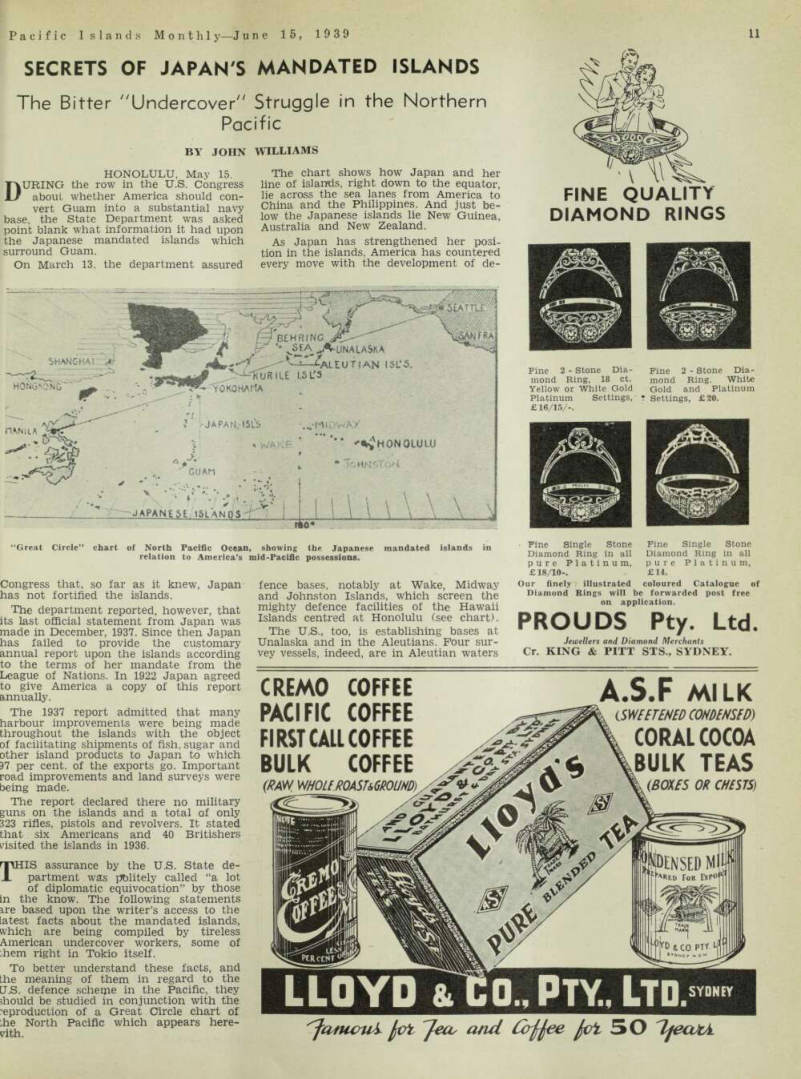
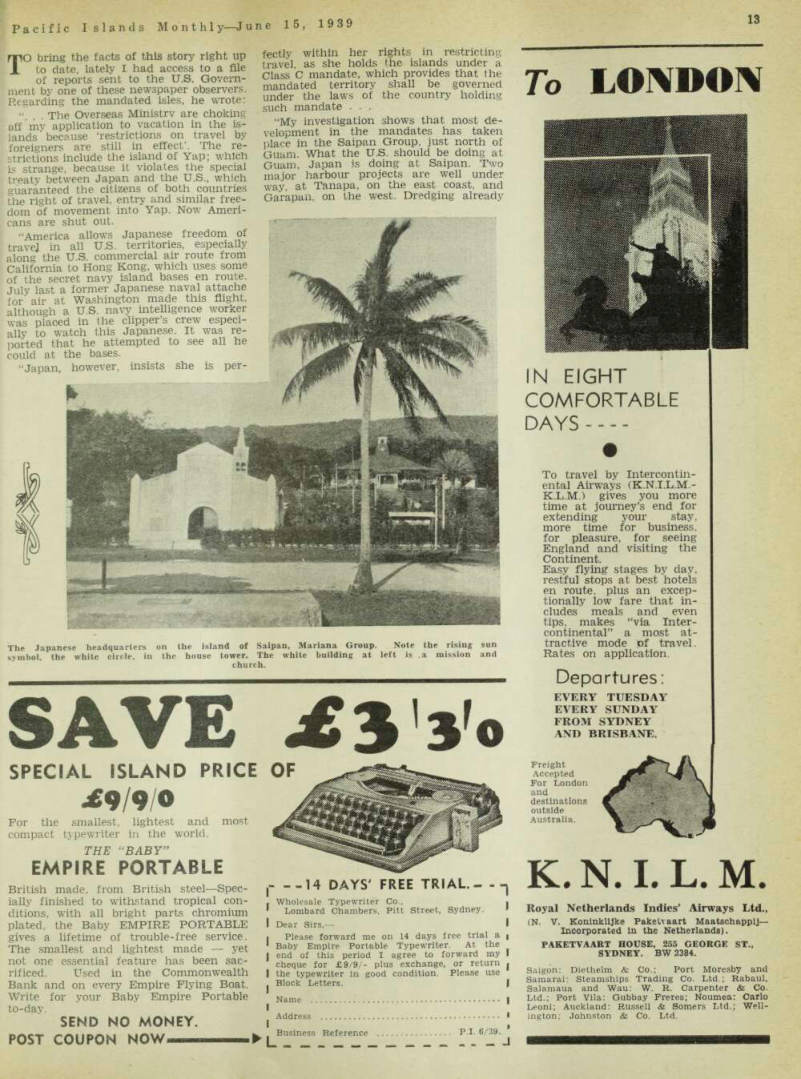
The Bitter "Undercover" Struggle in the Northern Pacific
By John Williams
Honolulu, May 15.
DURING the row in the U.S. Congress about whether America should convert Guam into a substantial navy base, the State Department was asked point blank what information it had upon the Japanese mandated islands which surround Guam.
On March 13, the department assured
The chart shows how Japan and her line of islands, right down to the equator, lie across the sea lanes from America to China and the Philippines. And just be l°w the Japanese islands he New Guinea, Australia and New Zealand, As Japan has strengthened her posi tion in the islands, America has countered every move with the development of de-
Congress that, so far as it knew, Japan has not fortified the islands.
The department reported, however, that its last official statement from Japan was made in December, 1937. Since then Japan has failed to provide the customary annual report upon the islands according to the terms of her mandate from the League of Nations. In 1922 Japan agreed to give America a copy of this report annually.
The 1937 report admitted that many harbour improvements were being made throughout the islands with the object of facilitating shipments of fish, sugar and other island products to Japan to which ?7 per cent, of the exports go. Important road improvements and land surveys were being made.
The report declared there no military guns on the islands and a total of only 323 rifles, pistols and revolvers. It stated that six Americans and 40 Britishers visited the islands in 1936.
FIS assurance by the U.S. State de partment was pblitely called “a lot of diplomatic equivocation” by those in the know. The following statements ire based upon the writer’s access to the latest facts about the mandated islands, which are being compiled by tireless American undercover workers, some of :hem right in Tokio itself.
To better understand these facts, and the meaning of them in regard to the LT.S. defence scheme in the Pacific, they ;hould be studied in conjunction with the 'eproduction of a Great Circle chart of :he North Pacific which appears here vith.
fence bases, notably at Wake, Midway and Johnston Islands, which screen the defence facilities of the Hawaii Islands centred at Honolulu (see chart), The U.S., too, is establishing bases at Unalaska and in the Aleutians. Four sur vey vessels, indeed, are in Aleutian waters
“Great Circle” chart of North Pacific Ocean, showing the Japanese mandated islands in relation to America’s mid-Pacific possessions.
now chartering a shorter great circle route from Pacific coast ports to the Asiatic mainland. This will shorten the route now commonly used by at least 100 miles and keep the ships more in Alaskan waters, where westerly storms are less severe.
At present, the great circle route is laid to the south of the Aleutians, a region frequently menaced by fogs. The line from Seattle to Manila on the chart herewith shows the proposed new route.
AMERICA boldly has gone below the equator in her countering of Japan.
Notable example is her decision to eventually convert Canton Island (north west of Samoa) and Rose Island (east of Samoa) into navy, air. submarine and destroyer bases.
America, with methodic purpose, is pouring billions of dollars into making and maintaining this great Pacific de
fence front, from Alaska to Samoa, as im pregnable as possible and this determina tion is perhaps the strongest point in America’s (apparently) undefined Pacific policy. At least, this defence bulwark is much more effective than the whims and rhetoric of the parochial politicians who live in the headlines back in Washington. rE navy, indeed, knows much more about the mandated islands than it cares to tell. The information is amazingly complete.
Right after America and Japan in 1922 agreed to exchange annual statements about the islands, first American to pop into them was William Herbert Hobbs, a specialist in corals and islands festoons, and he ostensibly was sponsored by the University of Michigan, but both the U.S. and Japanese navies, to use his own words, helped him to see the islands in “exceptional ways”. In 1923, my good
friend Junius Woods, a “Chicago Tribune” reporter, toured the islands, and much of the time he was accompanied by Albert W. Herre, an American fisheries expert.
Outstanding was the visit of Professor Paul Hibbert Clyde, of the University oi Kentucky, in 1935. As a result he wrote the masterly “Japan’s Pacific Mandate’ (Macmillan, 3 dollars), which is the most exhaustive and authoritative job done so far. That is, from the alien point of view.
There is little Japanese literature in English upon the islands. Most complete Japanese effort in Englisn is “Japan s Mandate in the South Seas”, by iadao Yanaihara, professor of economics, of the Imperial University, Tokio. He was given extraordinary official facilities and research aid, but his book to-day is only in manuscript form. The Institute of Pacific Relations in New York has a copy, and in due course it will be published.
The bulk of the American observers worked in cahoots with the U.S. navy. Men were specially chosen for their skill at observing—and remembering. The infor mation and photographs, which they later published, are superficial alongside the data which they turned over to secret hies in Washington.
The navy, of course, sends in under cover workers on its own account—and they don’t write books—if they escape!
IN 1932 there was an exciting incident — which ended in death. Two navy offi cers were assigned to get into the is lands and find out everything they could —from the navy angle.
For several months they lived “on the beach” in Hawaii. They suntanned deeply, studied Pacific languages, lived with Fili pinos and Japanese, and generally ac quired native angles of living and acting.
They became skilled in dialects.
Eventually they shipped into the is lands as hapa-haole (half-caste) seamen.
One of them never came back.
The survivor wrote a startling report about concrete artillery foundations, oil tanks, aircraft and submarine facilities— facts which were not mentioned in the annual reports made by Japan to the League of Nations and to America. Phis instance vividly let America know that Japan means business about her navy inspired drive southwards.
Immediately upon consideration of this dramatic report, America acted. Then be gan the “crop” of so-called annexations of long-forgotten and outlying isles, and the methodic development of them into “listening posts” and air and navy bases.
Outstanding among these is Wake, Mid way and Johnston Islands. Millions of dollars already have been poured into “improving” them. And the navy has clamped super-secret restrictions upon them. rE navy uses another angle: news paper reporters who are assigned to the Orient for U.S. mainland papers.
Some of these men become linguists. That it to say, a man assigned to Tokio (long before he goes) becomes skilled in Japan ese. In Tokio he acts dumb and conse quently overhears much valuable infor mation (and comment) during his move ments along official “beats”. These highly trained men actually become official ob servers and, by devious ways, they main tain contact with the U.S. army and navy networks.
These networks reciprocate. Thus, a re porter builds up his professional prestige and soon the world wonders at his un canny ability at forecasting outstanding international “developments”.
TO bring the facts of this story right up to date, lately I had access to a file of reports sent to the U.S, Govern ment by one of these newspaper observers.
Regarding the mandated isles, he wrote: •* . . The Overseas Ministry are choking off my application to vacation in the is lands because ‘restrictions on travel by foreigners are still in effect’. The re strictions include the island of Yap; which is strange, because it violates the special treaty between Japan and the U.S., which guaranteed the citizens of both countries the right of travel, entry and similar free dom of movement into Yap. Now Ameri cans are shut out.
“America allows Japanese freedom of travel in all U.S. territories, especially along the U.S. commercial air route from California to Hong Kong, which uses some of the secret navy island bases en route.
July last a former Japanese naval attache for air at Washington made this flight, although a U.S. navy intelligence worker was placed in the clipper’s crew especi ally to watch this Japanese. It was re ported that he attempted to see all he could at the bases.
“Japan, however, insists she is per
fectly within her rights in restricting travel, as she holds the islands under a Class C mandate, which provides that the mandated territory shall be governed under the laws of the country holding such mandate . . .
“My investigation shows that most de velopment in the mandates has taken place in the Saipan Group, just north of Guam. What the U.S. should be doing at Guam, Japan is doing at Saipan. Two major harbour projects are well under way, at Tanapa, on the east coast, and Garapan, on the west. Dredging already
The Japanese headquarters on the island of Saipan, Mariana Group. Note the rising sun symbol, the white circle, in the house tower. The white building at left is a mission and church.
has made fine anchorages for destroyers, submarines and airboats.
“Major developments also are taking place in the Palau Group, which lies with in ridiculously easy steaming and flying distance of the Philippines and New Guinea. Within Japan it is frankly ad mitted that Palau will be the springboard for the contemplated expansions into the Philippines, the Indies and New Guinea.
Japan wants their fathomless resources.
“Japan’s leading steamship company, which monopolises bookings for the is lands, told me that all steamers are booked for years ahead, a polite way of telling me to go to hell. . . .”
USING U. S. patterns for the ’planes, engines and instruments, a Japanese air company now is networking the entire mandated group so that, in effect, Japanese ’planes already are within site of New Guinea, in the same way as the American airway cuts through the Japan ese mandate at Guam.
In October, 1936, I twice flew in an American ’plane from Guam, and we pro ceeded to find out how close we could get to Rota, only 30 miles away, the nearest Japanese island to Guam; but pretty soon a Japanese radio station on Rota tapped a warning to keep away!
Below our wings were spread some of
the tiny isles that are scattered across more than a million square miles of the Pacific, an oceanic milky way that seems destined to inflame war passions.
Below us lay quiet lagoons, sheltered bays—fine roosting places for wings of death and hide-outs for stealthy under water prowlers. A vastness of ageless skies, ageless seas. In them fate is weaving a fantastic pattern. 1 THOUGHT of a precedent the Japanese quote. More than 500 years ago, the famed Satsuma clan set off from Japan in Malay junks and invaded the island of Luzon, in the Philippines.
November last, 500 years later, the Japanese came again. This time in fish ing sampans and trawlers. They landed. 200 of them, on Palawan Island and created serious disorders and bloodshed.
Filipino constabulary finally routed them.
The Japanese will come again. Their southward expansion is a national creed.
It is gaining momentum—and arrogance.
Their greed is being appeased by the Powers. They have snapped up the strategic Hainan and Spratley Islands.
America has appeased by stalling with Guam.
As the Japanese advance, they demand equal rights, the Open Door. When they have entered, they drive out rivals, then slam the door. The equality they demand in the Philippines, they refuse in the man dated isles. Why? (The next instalment of this series concerning Japanese expansion tactics in the Pacific will deal with Japan’s latest weapon: the development of wasp-like trawlers that, in effect, are long-range scouts and minelayers. To-day they are hovering near New Guinea, near the Indies, in Hawaii, Alaska, California, Mexico and Panama waters.
They trailed the U.S. battle fleet into the Atlantic during the recent war games. They are manned by navy-trained ratings. In emergencies they will menace all the shipping lanes.
Flotillas of them are familiarising them selves with equatorial waters from bases in the mandated groups.
These “trawlers” carry mines and torpedo tubes, cannon and anti-aircraft batteries.
Full details, including cross-section drawings that reveal the secret emplace ment, will be given in next month’s in stalment.)
Advertisements & other items, pp. 15-18 (4 items)
11
Pacific Islands Monthl y—J une 15, 1939
Pty. Ltd
(I*l* '
FINE QUALITY
DIAMOND RINGS
m Fine 2 - Stone Diamond Ring, 18 ct.
Yellow or White Gold Platinum Settings, £ 16/15/-.
Pine 2 - Stone Diamond Ring. White Gold and Platinum ? Settings, £2O. *«* HI & Pine Single Stone Diamond Ring in all pure Platinum, £ 18/10-.
Fine Single Stone Diamond Ring in all pure Platinum, £l4.
Our finely illustrated coloured Catalogue of Diamond Rings will be forwarded post free on application.
PROUDS Pty. Ltd.
Jewellers and Diamond Merchants
Cr. KING & PITT STS., SYDNEY.
CREMO COFFEE
PACIFIC COFFEE
FIRST CALL COFFEE
BULK COFFEE
(MW WOLEROASTM
A.S.F MILK
(sweetened
CORAL COCOA
BULK TEAS
(BOXES OR CHESTS)
* O A .i Cr 0 & v V
TONSED
r- Expo BM ''Red For 4) &
PTY
CO
PTY. LTD
SYDNEY
famous fet few and Coffee 50
THE KING’S SCHOOL
(PARRAMATTA)
N.S.W.
Boarding School, founded 1831.
School year begins February 7, 1940,
For further particulars apply to
H. D. HAKE, M.A. (Cantab.) Headmaster.
To LONDON
IN EIGHT
COMFORTABLE
DAYS
To travel by Intercontinental Airways (K.N.1.L.M.- K.L.M.) gives you more time at journey’s end for extending your stay, more time for business, for pleasure, for seeing England and visiting the Continent.
Easy flying stages by day, restful stops at best hotels en route, plus an exceptionally low fare that includes meals and even tips, makes “via Intercontinental” a most attractive mode pf travel.
Rates on application.
Departures:
EVERY TUESDAY
EVERY SUNDAY
FROM SYDNEY
AND BRISBANE.
Freight Accepted For London and destinations outside Australia.
K.N. I. L. M.
Royal Netherlands Indies’ Airways Ltd., (N. V. Koninklijke Paketvaart Maatschapplj— Incorporated In the Netherlands).
PAKETVAART HOUSE, 255 GEORGE ST.,
SYDNEY. BW 2384.
Saigon: Diethelm & Co.; Port Moresby and Samarai: Steamships Trading Co. Ltd.; Rabaul, Salamaua and Wau: W. R. Carpenter & Co.
Ltd.; Port Vila; Gubbay Freres; Noumea: Carlo Leoni; Auckland: Russell & Somers Ltd.; Wellington; Johnston & Co. Ltd.
SAVE so
SPECIAL ISLAND PRICE
■^9/9/0 For the smallest, lightest and most compact typewriter in the world.
THE “BABY”
EMPIRE PORTABLE
OF British made, from British steel —Specially finished to withstand tropical conditions, with all bright parts chromium plated, the Baby EMPIRE PORTABLE gives a lifetime of trouble-free service.
The smallest and lightest made yet not one essential feature has been sacrificed. Used in the Commonwealth Bank and on every Empire Flying Boat.
Write for your Baby Empire Portable to-day.
SEND NO MONEY.
POST COUPON NOW———
, 14 DAYS' FREE TRIAL. - - . Wholesale Typewriter Co , • 1 Lombard Chambers, Pitt Street, Sydney. 1 I Dear Sirs, — • I Please forward me on 14 days free trial a ( * Baby Empire Portable Typewriter. At the end of this period I agree to forward my I cheque for £9/9/- plus exchange, or return j I the typewriter in good condition. Please use . Block Letters. \ Name I I Address • ► . Business Reference P I 6/39.
I-- - J
n
GO WINGS
Sydney's Leading Store
EXCLUSIVELY FOR MEN
will have your
SUIT TO MEASURE
TAILORED AND AWAITING
YOUR ARRIVAL IN SYDNEY
Write for
FREE PATTERNS
and Self Measurement Form . . .
COWING BROS. LTD.
Market and George Streets, Sydney
COUGHS W
COLDS
« a •
ARE THEY YOUR
HANDICAP?
Have you ever played a round with head aching, limbs a burden, and each breath an effort? If so, you'll know what a handicap to your game a severe cold or cough can be.
Outdoor exercise is the finest means of gaining and keeping health; but for many people, whose every day occupations keep them indoors most of the time, even the mildest of outdoor activity is too strenuous, leaving them fatigued and with resistance lowered —open to the attacks of dangerous winter ailments.
Fatigue-resistance must be built up steadily if the full benefits are to be gained from your outdoor activities.
The Secret of Immunity:
The vitamins "A" and "D" contained in pure Cod Liver Oil are recognised by Health Authorities as Nature's finest safeguards against the attack of most winter ailments. Scott's Emulsion contains Cod Liver Oil in its most easily digested and palatable form. An eminent Research Body has definitely established that. within 30 minutes of taking, every drop of Scott's is strengthening chest and lungs, creating reserves of energy, and building up immunity to colds and coughs.
SCOTT’S
Emulsion
ALL CHEMISTS AND STORES
2/9
AND
5/-
PER BOTTLE
12
June 15, 19 3 9—t* acific Islands Monthly
13
Pacific I slands Monthl y—J une 15, 1939
70 Men Building Air Base on
Canton Is.
From Our Own Correspondent
Honolulu, May 24.
THERE can be no indication of when Pan American Airways will make test flights in the South Pacific un til the Canton Island base is made.
A P.A.A. construction gang left Hono lulu for Canton Is., by the “North Haven”, on May 9. Later, a U.S.S. Gov ernment expert, Mr. Robert Campbell, will check the construction.
The “North Haven” lifted 5,000 tons of varied cargo for Canton Is, Actually, the work to be done will simply duplicate the airport establishment on Wake Is.
The buildings are fabricated in Califor nia.
There are about 70 men in the con struction gang. They include Chamor ros, natives of Guam, who were flown to Honolulu to catch the “North Haven”.
They act as cooks, etc.
Advertisements & other items, p. 19 (2 items)
15
Pacific Islands Monthl y—J une 15, 1939
ypuf £ucceJJ
* ■ nr
—Li cUkAuhsud ifuA way
PROMOTION - SECURITY - PRESTIGE - COMFORT - TRAVEL- PLEASURE These are YOURS if you want them - Age is no handicap.
Some H. & R.
Career Training Plans Complete Accountancy Accountancy-Secretaryship Cost Accountancy and Factory Organization Complete Bookkeeping Marketing and Advertising Marketing and Selling General Business Training Effective English Handwriting Business Arithmetic etc.
YOU can be just the success you want to be—you have advantages few' other people had when they set out to make a success of their lives and decided to build a career for themselves—and determined to get to the TOP.
Under H. & R. guidance YOU can achieve success more quickly than many others who had hut 8 or 10 hours a week which they could devote . . . yet they are able under the H. & R. Home Study Plan of Training to gain their degree in two years.
Probably you don’t know, hut among your friends or acquaintances at this moment is one, or more, who is training under H. & R.
Each mail brings requests from various Islands, from men, who, like yourself, are eager to succeed, to improve their positions . . . each year among the men who win success at the Institute examinations, are men from the Islands who have completed their tuition by the same method that you will use.
Post the Coupon for this Handbook
NOW I
ree
We have published a handbook in which is described the method of our training, the costs and the opportunities for the trained men, and the various careers in which you can achieve greatest success.
Write tonight for this Free, 128 page illustrated handbook.
Department of Accountancy and Commerce. •XV x> :> (0 e The Accountancy Specialists.
Founders of Commercial Education in Australasia. 127 A Bank House, Bank Place, Melbourne, C.l. 127 A Barrack House, 16 Barrack Street, Sydney. / , 4^ tf.
V c>f ■fr p.oc*'
Easy To Kill
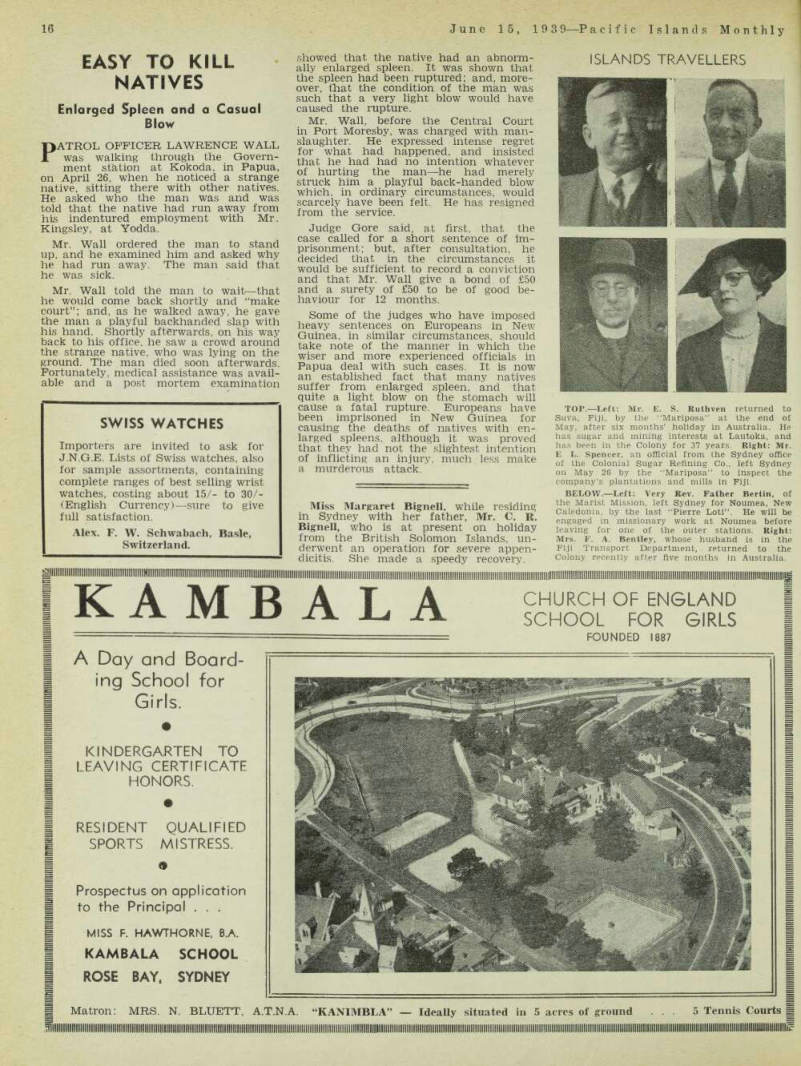
Natives
Enlarged Spleen and a Casual Blow
Patrol Officer Lawrence Wall
** fv-imiirrVi ranov,. was walking the Govern ment stktion at Kokoda, in Papua, on April 26, when he noticed a strange native sitting there with other natives Mri a t?a 6 i d fv?nc,fhiP ff fnU told that the native had run away from his indentured employment with Mr.
Kingsley, at Yodda. , i , w. aSprf^h v
-rhT a f?£? Tui\
he had run away. The man said that ne was sick.
Mr. Wall told the man to wait—that he would come back shortly and “make K a^S; d a 72 y ’ I he ga
v^ ai 3 a cSJS'jS? Wlth
his hand. Shortly afterwards, on his way back to his office, he saw a crowd around iv^,^ ai m^ natlVe ’ Was lyi fF 011 t ? e ground. The man died soon afterwards. rffi Unat . ely ’ assistance was avail able and a post mortem examination
showed that the native had an abnorm ally enlarged spleen. It was shown that the spleen had been ruptured; and, more over, that the condition of the man was such that a very light blow would have caused the rupture.
Mr. Wall, before the Central Court in Port Moresby, was charged with man slaughter. He expressed intense regret for what had happened, and insisted that he had had no intention whatever of hurting the man —he had merely struck him a playful back-handed blow which, in ordinary circumstances, would scarcely have been felt. He has resigned from the service.
Judge Gore said, at first, that the case called for a short sentence of im prisonment; but, after consultation, he decided that in the circumstances it would be sufficient to record a conviction and that Mr. Wall give a bond of £5O and a surety of £5O to be of good be haviour for 12 months.
Some of the judges who have imposed heavy sentences on Europeans in New Guinea, in similar circumstances, should take note of the manner in which the wiser and more experienced officials in Papua deal with such cases. It is now an established fact that many natives suffer from enlarged spleen, and that quite a light blow on the stomach will cause a fatal rupture. Europeans have been imprisoned in New Guinea for causing the deaths of natives with en larged spleens, although it was proved that they had not the slightest intention of inflicting an injury, much less make a murderous attack.
Miss Margaret Bignell, while residing in Sydney with her father, Mr. C. R.
Bignell, who is at present on holiday from the British Solomon Islands, un derwent an operation for severe appen dicitis. She made a speedy recovery.
Islands Travellers
TOP. —Left: Mr. E. S. Ruthven returned to Suva, Fiji, by the “Mariposa” at the end of May, after six months’ holiday in Australia. He has sugar and mining interests at Lautoka, and has been in the Colony for 37 years. Bight: Mr.
E L. Spencer, an official from the Sydney office of the Colonial Sugar Refining Co., left Sydney on May 26 by the “Mariposa” to inspect the company’s plantations and mills in Fiji.
BELOW. —Left; Very Rev. Father Bertin, of the Marist Mission, left Sydney for Noumea, New Caledonia, by the last “Pierre Loti”. He will be engaged in missionary work at Noumea before leaving for one of the outer stations. Right; Mrs. F. A. Bentley, whose husband is in the Fiji Transport Department, returned to the Colony recently after five months in Australia,
Advertisements & other items, p. 20 (3 items)
16
June 15, 193 9 —P acific Islands Monthly
Swiss Watches
Importers are invited to ask for J.N.G.E. Lists of Swiss watches, also for sample assortments, containing complete ranges of best selling wrist watches, costing about 15/- to 30/- (English Currency)—sure to give full satisfaction.
Alex. F. W. Schwabach, Basle, Switzerland.
Kamb A L A
CHURCH OF ENGLAND
SCHOOL FOR GIRLS
A Day and Board-
ing School for
Girls.
KINDERGARTEN TO
LEAVING CERTIFICATE
HONORS.
RESIDENT QUALIFIED
SPORTS MISTRESS.
Prospectus on application to the Principal . . .
MISS F. HAWTHORNE. B.A.
KAMBALA SCHOOL
ROSE BAY, SYDNEY
FOUNDED 1887
•■■■• tto ; • -fry m dK •« I m d •1 s m s m ..
Si m S*E& ■_. Wm M Matron; MRS. N. BLUETT. A.T.N.A. “KANIMBLA” Ideally situated in 5 acres of ground 5 Tennis Courts
Pests
Attack On Coconut
Success in Fiji, New Hebrides and New Guinea
IT was stated in a Sydney newspaper on June 3 that pleurotropis parvalus parasites, introduced into New Heb rides and New Guinea by Mr. C. B.
Depertuis, had substantially reduced the coconut pest promecotheca in both Ter ritories.
Mr. Depurtuis said that, following the example of Messrs. Paine and Taylor, Fiji entomologists, he had supplies of the larvae of the parasite brought from Java to Vila in the freezer of the liner “Maetsuycker”, and they duly hatched out, and, spread through the New Heb rides plantations. They quickly cleaned out the pest, so that a very great im provement had taken place in the out put of the plantations.
This statement was commented upon by Mr. George H. Murray, Director of Agriculture in New Guinea, who is at present in a private hospital in Sydney.
“I do not think that Mr. Depurtuis has been quite fair to the Department of Agriculture in New Guinea and to Sir Walter Carpenter”, he said.
“In the first place, in 1933, Mr. T. H.
C. Taylor brought the parasite, pleuro tropis parvalus, from Java to Fiji, via Rabaul, and I told him that, when they were established, I would be greatly ob liged if the Fijian Department of Agri culture would assist us in getting a colony from Fiji to New Guinea. It was not until the end of 1936 that it was proved that the parasites were a success in controlling promecotheca on the Lau Group, Fiji.
“As soon as I got word of this suc cess, a radio was sent to the Director of Agriculture in Fiji, asking him if he could send a colony of the parasite from Suva to Rabaul, by one of the W. R. Carpenter boats, and stating that the journey would take about 12 days.
I received a reply that the Lau Group is not easily accessible, and at that time they had no officer to do the collecting, and send the parasites.
“Early in 1938, the Department of Ag riculture in New Guinea obtained a col ony of the parasites from the New Hebrides, to which they had been in troduced: but, on arrival, they were all dead. But. with the assistance of Sir Walter Carpenter, a further colony was obtained from Fiji, and brought to New Guinea direct from Sydney by ’plane.
“From that colony many millions of them have been bred in the insectories of the New Guinea Department of Ag riculture in Rabaul, and distributed on numerous plantations in New Britain.
“It was after these were successfully established that Mr. Dupertuis, who had been engaged by Burns, Philp and Co.
Ltd., also to obtain parasites, brought a further colony from Java: but the para sites had been thoroughly established in our Territory before Mr. Dupertuis’ ar rival. Nevertheless, he received the co operation of the Department of Agri culture.
“Messrs. Paine and Taylor were en tomologists from the Imperial Institute of Entomologists, on loan to the Fiji Government, and when they had com pleted their work, they were withdrawn and sent to other parts of the Empire.
“Promecotheca is one of our two worst pests”, concluded Mr. Murray, “the other being Sexava. Both of these pests have probably been in New Guinea since there were coconut trees. In recent years,
with the growth of plantations, the in sects have multiplied. I do not want to belittle Mr. Dupertuis’ work, but I think it unfair that he should be given full credit for the introduction of the parasite into New Guinea”.
New Matson Ships
11HE president of the Matson Naviga tion Company, who has been on a visit to Sydney, said that the new ships which the company had in view for the Pacific trade would be about 25,000 tons, and probably they would carry 25 per cent, more passengers than the “Mariposa” or the “Monterey”.
He said, however, that the plans of his company had not been completed.
His company was willing to co-operate with competitors in the Pacific trade, and especially did he look forward to the time when ships of the Matson line, and British ships, would between them maintain a fortnightly service between Sydney and North America.
A Useful Catalogue.
I N 1832, the English firm of Ransomes Sims and I Jeffries, Ltd., built their first lawn mower and the progress that has been made in 100 years is shown in an attractive catalogue just issued by the Company. Profusely illustrated, it depicts the wide variety of lawn mowers manufactured to suit individual requirements, from the small hand-mower for the garden lawn to the large “gang” type for heavy work.
Numerous aerodromes in the Dutch East Indies are equipped with Ransomes mowers for main taining large tracts of land.
Interested Islands residents should write to
Ransomes Sims and Jeffries, Ltd., Ipswich, England, for a free copy of this comprehensive brochure.*** Mr. J. G. Sommerfield, manager of the Bank of N.S.W. at Levuka, Fiji, recently married Miss Octavia Jackson, of New Zealand.
Advertisements & other items, p. 21 (2 items)
17
Pacific Islands Monthl y—J une 15, 1939
Macdonald
For all your
MOTOR SPARE PARTS
and
ACCESSORY
REQUIREMENTS
write the
Eades Parts Company
275-277 Miller Sh,
NORTH SYDNEY, N.S.W.
WE ARE MAIL ORDER
SPECIALISTS
in the supply of new and used parts for all types of
CARS, TRUCKS & TRACTORS.
All orders have the personal attention of Mr. R. Eades, who has had a lifetime experience with used and new replacements.
LOW PRICES.
PROMPT DESPATCH.
IMMEDIATE ATTENTION TO
ALL INQUIRIES.
Instruction Books and Manuals available.
Tel.: XB 1523.
If flying to Europe or anywhere
consult
MACDONALD
HAMILTON & CO.
Air Travel Specialists Booking Agents for
W.R.C. AIRLINES
QANTAS EMPIRE AIRWAYS LTD.
INTERCONTINENTAL
AIRWAYS (KNILM & KLM)
Also Australian National Airways Airlines of Australia Ltd .
Ansett Airways Ltd.
For Reservations and further particulars write to:
MACDONALD HAMILTON & CO.
CHALLIS HOUSE, 4 MARTIN PLACE, SYDNEY
Telegraphic Address: "NALDHAM,” Sydney
Inquiry
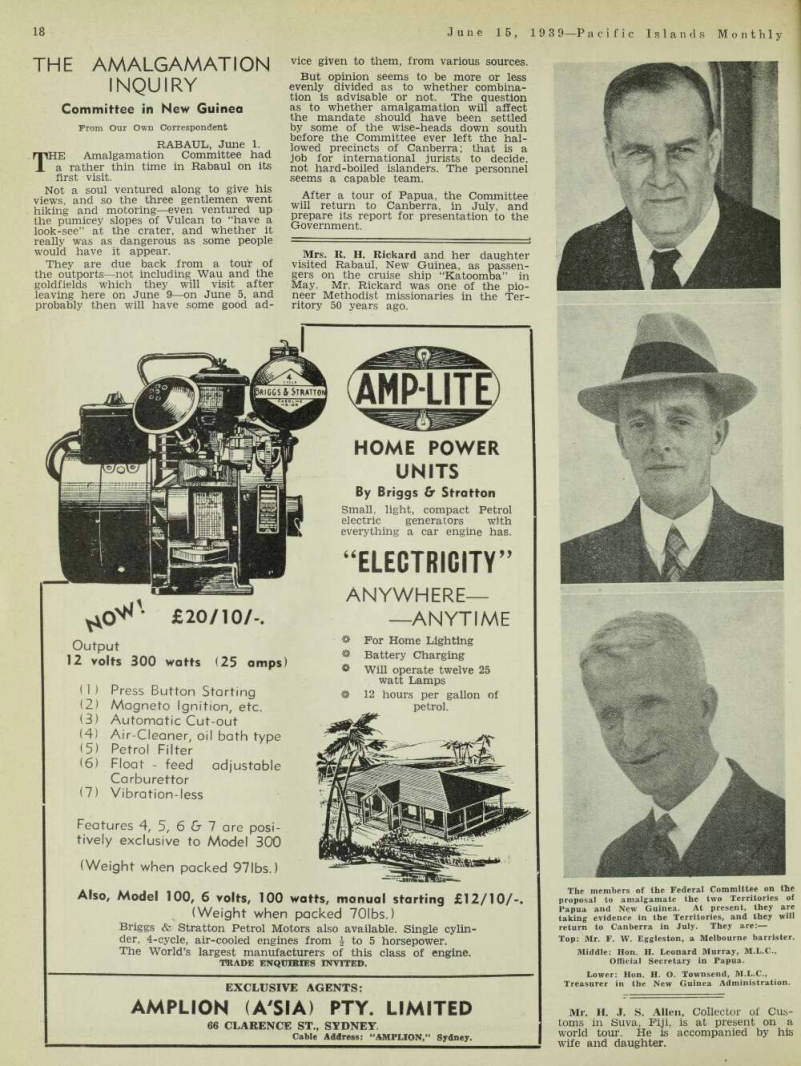
The Amalgamation
Committee in New Guinea
Prom Our Own Correspondent
Rabaul, June 1.
mHE Amalgamation Committee had J. a rather thin time in Rabaul on its first visit.
Not a soul ventured along to give his views, and so the three gentlemen went hiking and motoring—even ventured up the pumicey slopes of Vulcan to “have a look-see” at the crater, and whether it really was as dangerous as some people would have it appear.
They are due back from a tour of the outports—not including Wau and the goldfields which they will visit after leaving here on June 9 —on June 5, and probably then will have some good ad
vice given to them, from various sources.
But opinion seems to be more or less evenly divided as to whether combina tion is advisable or not. The question as to whether amalgamation will affect the mandate should have been settled by some of the wise-heads down south before the Committee ever left the hal lowed precincts of Canberra; that is a job for international jurists to decide, not hard-boiled islanders. The personnel seems a capable team.
After a tour of Papua, the Committee will return to Canberra, in July, and prepare its report for presentation to the Government.
Mrs. R. H. Rickard and her daughter visited Rabaul, New Guinea, as passen gers on the cruise ship “Katoomba” in May. Mr. Rickard was one of the pio neer Methodist missionaries in the Ter ritory 50 years ago.
Mr. H. J. S. Allen, Collector of Cus toms in Suva, Fiji, is at present on a world tour. He is accompanied by his wife and daughter.
The members of the Federal Committee on the proposal to amalgamate the two Territories of Papua and New Guinea. At present, they are taking evidence in the Territories, and they will return to Canberra in July. They are:— Top: Mr. F. W. Eggleston, a Melbourne barrister.
Middle: Hon. H. Leonard Murray, M.L.C., Official Secretary in Papua.
Lower: Hon. H. O. Townsend, M.L.C., Treasurer in the New Guinea Administration.
Advertisements & other items, p. 22 (2 items)
18
June 15, 193 9 — P acific Islands Monthly
Amp-Lt
RIOCS & Stratto o/r'.l® £2O/10/
HOME POWER
UNITS
By Briggs Cr Stratton Small, light, compact Petrol electric generators with everything a car engine has.
ELECTRICITY
ANYWHERE—
—ANYTIME
Output 12 volts 300 watts (25 amps) (1) Press Button Starting (2) Magneto Ignition, etc. (3) Automatic Cut-out (4) Air-Cleaner, oil bath type (5) Petrol Filter (6) Float - feed adjustable Carburettor (7) Vibration-less Features 4,5, 6 £r 7 are positively exclusive to Model 300 (Weight when packed 971b5.) ® For Home Lighting ® Battery Charging ® Will operate twelve 25 watt Lamps 12 hours per gallon of petrol. 9 Also, Model 100, 6 volts, 100 watts, manual starting £l2/10/-. (Weight when packed 701b5.) Briggs & Stratton Petrol Motors also available. Single cylinder, 4-cycle, air-cooled engines from i to 5 horsepower.
The World’s largest manufacturers of this class of engine.
TRADE ENQUIRIES INVITED.
EXCLUSIVE AGENTS:
AMPLION (A'SIA) PTY. LIMITED
66 CLARENCE ST., SYDNEY
Cable Address: “AMPLION,” Sydney.
In Europe
The Copra Market In Europe
Prom Our Own Correspondent
London, May 22.
WITH the improvement in the political situation, the outlook for copra also improved and is less unsettled.
Prices, accordingly, rose 10/- per ton during the month, but the last week has witnessed some reaction in prices.
This is attributed to a falling off in consumption and the fact that the East is offering fairly freely.
There is little change to report in world shipments of copra, these remain ing normal for this time of the year.
The cotton-seed market also has been more active and this is attributed to the demand from crushers. This activ ity has likewise been subject to a re action, and prices are about 5/- under the higher levels paid last month.
The whale-oil factor as a competitor of copra is now clarified. The entire catch has been marketed apart from a few lots held for re-sale. The trade generally is now looking to higher prices in the near future.
The demand from the Continent, par ticularly from Germany, is still con tracted on account of exchange restric tions. The result is that purchases are limited by the amount of foreign ex change available, aa purchases have mainly to be paid for in sterling, guild ers, or dollars.
As a whole, produce merchants in the city—H. M. F. Faure and Co. and others —seem to hold a more confident view for the future than has been the case for some little time past.
Banana Pool In Fiji
To Meet New Zealand's New Conditions
IN order to conserve their interests, and to cut out much wasteful expen diture caused by overlapping, the members of the Fiji Banana Associa tion, led by their president. Major C. A.
Brewster, and with the valuable co-op eration of the Director of Agriculture, Dr. H. W. Jack, and his assistant, Mr.
A. B. Ackland, have formed an export pool. It is hoped that in this way the interests of banana-growers and ship pers will be conserved.
For several years, Fiji has been per mitted to supply to New Zealand a cer tain quota of New Zealand’s banana re quirements; and the method followed was for individual shippers in Fiji to export their quotas to independent fruit agents in New Zealand—so that a healthy rivalry existed at both ends.
Last year, however, the Socialist Gov
ernment of New Zealand virtually took control of all fruit importations, and became the sole buyer of bananas exported from Fiji to New Zealand. The removal of the element of competition disorganised the production and export of Fiji bananas, and it soon became evident, both to the administrative officials and the shipping firms, that much closer organisation was necessary.
The banana shippers now have decided to pool all bananas purchased, and to share the fruit in agreed percentages.
In this way the boundaries of the present buying areas can be so adjusted as to provide transport with more economic
loads, and thus reduce overhead ex penses for the benefit, not only of the shipper, but of the native producers. All who contribute to the pool will get a fair share of the business, n j s a ver y interesting example of the far-reaching repercussions of a so cialist administration. When there was healthy competition among buyers in New Zealand, there was healthy indiy idualism among growers and shippers in Fiji. When the New Zealand Govern ment forced all the banana imports through the one channel, the Fiji inter ests found it equally necessary to pro vide one channel only for all exports.
Mrs. H. F. Ayson, wife of the Resident Commissioner of the Cook Islands, arrived in Rarotonga from N.Z. by the “Matua at the end of May.
N.G e %tston e |ria^arai T p\Tua n ’te f expected to arrive in Australia in July.
Makers f m rroiinnd and P c Priestley, of AW.A. Ltd., returned to Sydney in June from Willis Island, having served their term at the radio station there.
Rev. Eric Ure, of the London Missionary Society at Port Moresby, Papua, arrived in Australia early this month to do deputation work in Victoria.
Advertisements & other items, p. 23 (1 item)
Globite
PACKS SSUI7S
IN A FEW MINUTES
No trouble at all to pack threepiece suits in a non-crushing, Globite Five-Suiter. It's all done in a few minutes . . . and the suits come out at the end of your trip in perfect condition, ready for wear without any pressing. The Five- Suiter, too, has a special compartment for underwear.
Finished in smooth, glossy, weatherproof Globite, in brown, blue or black, with strong locks and hinges and reinforced corners.
GLOBITE
FIVE SUI T E H
OBTAINABLE AT GOOD STORES EVERYWHERE
FORD SHERINGTON LTD., Manufacturers. (Wholesale only)
PABST CANNED BEER
Brewed in one of the world's largest and most modern breweries, PABST comes to you
"KEGLINED" NON-REF I LIABLE CANS
TWO TYPES: I PABST EXPORT BEER—A Light Lager Beer.
'■ PABST OLD TANKARD ALE—An English Type stronger and heavier Packed In Cartons containing 24 x 12 oz. eans and sold throughout the Pacific; but In case of any difficulty In obtaining
BOX 1861 K, G.P.0., SYDNEY.
"NO LIGHT CAN STEAL ITS FLAVOUR"
n genuine than Export. supplies, write to;
"Legally Dead"
From ou r own correspondent wrnvroi ttt it tvt U'INAL chapter: Amelia ’ Earhart * Putnam, the American aviatnx, who, with pilot-navigator Fred Noonan, was lost while attempting to fly from Lae, Ne w Guinea, to Howland Island, m raid- Pacific, was I .. rece . n tly declared legally dead ’ California Courts, H er husband was granted permission to dispose of her estate, valued “in ex cess of 10,000 dollars”.
Samoa's Trade
IN 1938 Large Decrease in Imports and Exports
From Our Own Correspondent
Apia, May 2.
THE seventh annual report of the Chamber of Commerce of Western Samoa* gives trade developments and statistics for 1938 and preceding years, compiled by the secretary, Mr. P. W.
Glover, B.Sc., F.R.A.S.
For the twelfth consecutive year, 1938 showed a favourable trade balance—this year £52,333. The comparative trade fig ures for 1938 and the preceding five years are as follows: —
Exports In Detail
Owing to low prices in 1938, the share of copra in the total exports dropped con siderably. Cocoa production increased, with a record crop. Banana prices main tained their level and the exports in creased materially—bananas are now the second important product of the Terri tory, occupying the place formerly taken by cocoa. The following table shows the figures in detail (compared with 1937): —
*Cases.
The exports went to the following coun tries (percentage of total exports shown in parenthesis):—
Imports
Both New Zealand and Canada during 1938 obtained larger shares of Samoa's import trade —at the expense of Japan, which lost half her Samoan trade. Im port figures are shown thus: —
Copra
Copra production is still the most im portant industry in Samoa, but owing to a depressed market and the high cost of labour and other production charges,
Imports.
Exports.
Excess of Exports. £ £ £ 1933 .. . 150,856 173,837 22,981 1934 . . . 92,784 128,117 35,333 1935 .. . 135,757 189,298 53,541 1936 . . . 167,020 263,255 96,235 1937 267,868 352,436 84,568 1938 196,272 248,605 52,333
1937. 1938. £ Tons. £ Tons.
Copra .. .. 199,747 13,340 103,529 11,241 Cocoa .. .. 71,138 1,253 59,699 1,647 Bananas . .. 70.446 187,755* 77,143 205,715* Rubber .. .. 5.505 60 3,293 49 Miscellaneous & Re-Exports 5.600 — 4,995 — Total .. .. £352,436 £248.605
1937. 1938. £ £ N.Z .. 75,054 (21%) 84,021 (33%) U.K 66,578 (18%) 85,647 (34%)
U.S.A
56,445 (16%) 25,326 (10%) Australia 4,716 (1%) 788 (0.3%) Canada .. .. 6,006 (1%) — Holland . . .. 5,684 (2%) Germany 11,366 (3%) — France .. .. — Mexico ., .. ., — 4,207 (1%) Japan .. ,, .. — — Other .. .. .. 104,222 (29%) 42,932 (17%)
1937, 1938. £ £ N.Z 71,396 (26%) 58,815 (30%) U.K 42,365 (15%) 29,897 (15%)
U.S.A 21,252 (7%) 19.480 (9%)
Australia .. .. 40,857 (15%) 28,141 (14%) Canada 14,306 (5%) 16,432 (8%) Japan 39,613 (14%) 14,647 (7%) Holland ... 212 (0.1%) 216 (0.1%) Germany .. .. 3,760 (1%) 3.894 (2%) France 622 (0.2%) 878 (0.4%) Other 33,485 (12%) 23,872 (12%)
the industry remains principally in the hands of the native Samoans. Of 11,241 tons exported in 1938, 8,677 tons (77 per cent.) was native produced, against 13,340 tons exported in 1937, of which 10,605 tons (79 per cent.) was native produced.
Copra exports for 1938 compare with the preceding auinquennium as follows: —
Growth Of Banana Trade
Since the inception of the banana trade in 1928, the industry has grown in a remarkable manner. In 11 years the quantity exported has been increased ninefold and in value from £11,210 to £77,143. The following table tells the story:—
The further expansion of the banana industry depends wholly upon the pur chasing power of New Zealand consum ers and the quotas granted to Samoa by the N.Z. Government. The present plan is working successfully and smoothly, and the Produce Inspector and his staff were completely vindicated at a recent official investigation. Of the banana exports, approximately two-thirds are produced by native growers, the remainder by Euro pean planters.
Threat To Cocoa Industry
The quantity of cocoa exported in 1938 —1,647 tons —was the highest on record.
The value, however, was only £59,699, compared with £71,138 for 1,253 tons in 1937. Comparative figures since 1933 have been:—
Although cocoa production increased in 1938, a violent storm and heavy rains in January seriously damaged this year’s crop, which consequently will be small.
In addition, the proposed repatriation of Chinese plantation labour next year makes the position of cocoa planters precarious, so that the existence of the cocoa in dustry in the Territory is in danger.
Several European planters have been compelled recently to abandon their holdings.
Over 50 per cent, of the cocoa produc tion comes from the plantations of in dependent Europeans. The balance is evenly divided between the N.Z. Repara tion Estates and native growers.
Mr. and Mrs. S. H. Ellis returned to Suva, Fiji, early in June after a short visit to New Zealand.
Yen. H. Mayo Harris, Archdeacon of Suva, Fiji, is reported to be making satis factory progress following a serious operation in New Zealand recently.
Year. Tons. Year. Tons. 1933 11,526 1936 13,014 1934 8,948 1937 13,340 1935 12,501 1938 11,241
Year. Cases. Year. Cases. 1928 22,815 1934 96,225 1929 53,652 1935 109,000 1930 95,867 1936 128,045 1931 85,231 1937 187,755 1932 66,715 1938 205,715 1933 81,983
Year.
Tons.
Year.
Tons. 1933 .. . 1936 .. . 1934 .. . . .. 1,027 1937 .. , . . . 1,253 1935 .. . .. 576 1938 .. .
Advertisements & other items, p. 24 (2 items)
20
June 15, 193 9—P acific Islands Monthly
® Imperial
,11/M
TROPIC MEALS
Moments Notice
® Imperial
W Sheep Tongues 12 oz. / Lamb Tongues 12 oz.
Ox Tongues 24 oz.
Ox Tongues 2 lb.
Camp Pie 12 ozi Mango & PaPaw Chutney ... 15 oz.
Cheddar Cheese 8 oz.
Mild and Tasty.
ASSORTED HOT MEALS
Steak & Kidney Pudding.
Sausages & Tomato.
Lamb and Green Peas.
Steak & Tomato.
Beef Steak Pudding.
Chops & Tomato.
Sausages, Spaghetti & Tomato.
“ FITZROY”
Luncheon Beef 16 oz. (in oblong can) Pork Sausages 16 oz.
Beef Sausages 16 oz.
“ HAMPER ”
Corned Beef (Taper Can) ... 12 oz.
“OX & PA ” or
“ RIVERSTONE ”
Native Trade Meats.
Corned, Boiled and/or Roast Beef—l 2 oz., 16 oz., 24 oz., 2 lb., 3 lb., 4 lb., 5 lb., and 6 lb.
“ WESTFIELD ”
Corned, Boiled and/or Roast Mutton .. 12 oz.
All lines can be obtained from leading x Island Stores. m r'O I 9
Products of
Riverstone Meat Co. Pity. Ltd.
s*-7 O’Connell Street, Sydney
Cables: “ IMPERIAL ”
Fiji Representatives:
PEARCE & CO., LTD
New Road In New Guinea
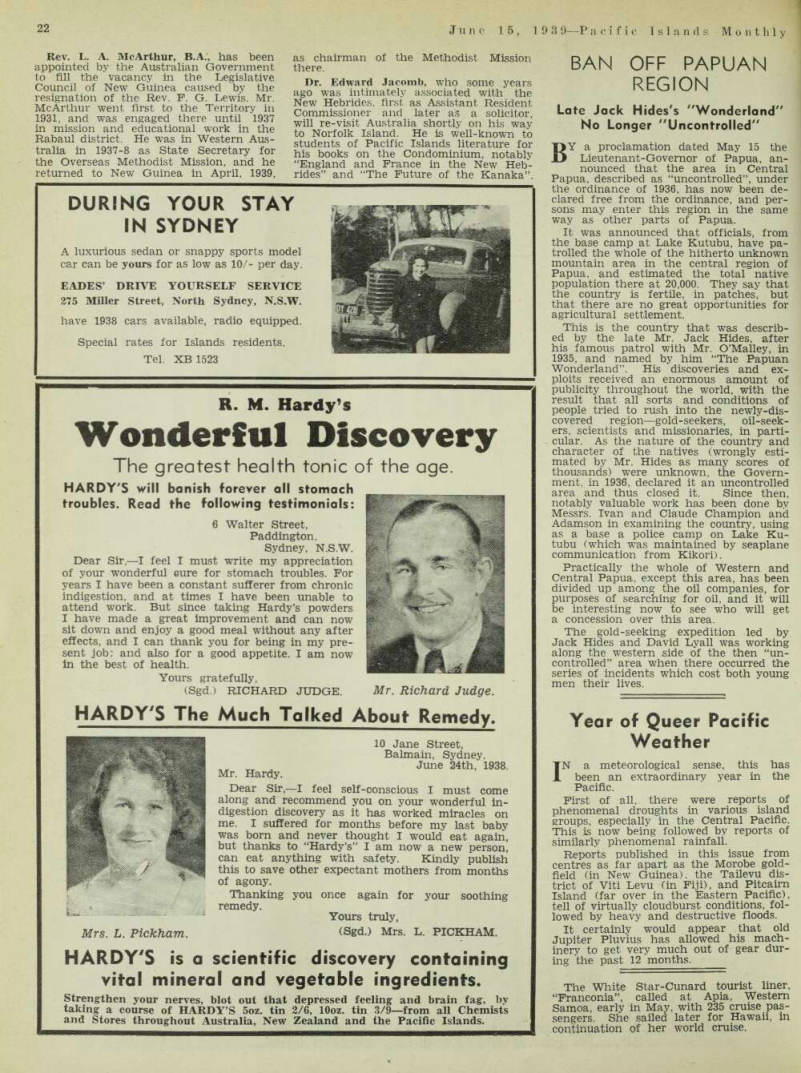
ANEW road, about 50 miles long, is being built by the New Guinea Ad ministration in north-west New Guinea. It is to run from a point near the Sepik River, just below Ambunti, in a northerly direction to Maprik, and it is understood that from Maprik it will be carried on to Wewak.
Roadmaster Gordon Ogg, with a large party of native labourers, is building the road from the Maprik end, and another Government roadmaster, with another party of labourers, is carrying on the work from the Sepik end.
Europeans in that section of New Guinea are very critical of this Gov
ernment enterprise. They declare that they cannot see any reason for the road or for this expenditure. They say it runs through swampy and comparatively useless country, and that the only pur pose it will serve will possibly be the assistance of the oil search companies.
The latter are busy in this area. The largest parties and the greatest activity are reported to be in an area south-west of Wewak, behind the Torricelli moun-. tains.
The road is also criticised on the ground that the Government has re cruited so many Sepik natives for the work that private recruiters find it prac tically impossible to get any labour at all for ordinary purposes.
Rev. L. A. McArthur, 8.A., has been appointed by the Australian Government to fill the vacancy in the Legislative Council of New Guinea caused by the resignation of the Rev. F. G. Lewis. Mr.
McArthur went first to the Territory in 1931, and was engaged there until 1937 in mission and educational work in the Rabaul district He was in Western Australia m 1937-8 as State Secretary for the Overseas Methodist Mission, and he returned to New Guinea in April, 1939,
as chairman of the Methodist Mission there.
I)r Fllwjiril whn vppvc ae n W as inthnatelv as’soctetedwfth the ?f° eb rides first al Sstlnt Resident
Commissioner' arid latef as a solicitor
Austraha shOTtlv on his wav to Norfolk Island He £ well kmJwn
ptific for
iis books on the Condominium, notably “England and France in the New Heb rides” and “The Future of the Kanaka”.
Advertisements & other items, pp. 25-26 (2 items)
21
Pacific Islands Month! y—J une 15, 1939
Mcilrath’S
FOR BETTER FOOD AT
CHEAPER PRICES DEAL WITH
Japanese Pink Salmon, 16oz. (cases only 4 dozen) 5/6 doz.
Japanese Pilchards in Sauce. 16oz. (cases only 4 dozen) 4/3 doz.
Sunshine Full Cream Powdered Milk, 12oz 1/2 tin 13/9 doz.
Ideal Unsweetened Milk, 6 or 12oz. tins 19/4 case Nestle’s Pure Cocoa 40z., 5d tin; Boz., 9id tin Yoga Tea; Choice Ceylon Blend, lb. 1/11 pkt. 2/3 tin Gartside’s Green Peas, lOoz 6d tin 5/9 doz.
Garden Vale Green Peas, 16oz Bid tin 8/3 doz. /LJ.C. Peeled Tomatoes. 30oz Hid tin 11/3 doz.
Cerebos Table Salt, 21b 1/6 jar 17/6 doz.
Norco Pork Sausages .. .. .. Boz., 7d tin; 160 z., lid tin Red Feather Camp Pie 40z., 3id; Boz., 5d tin.
Red Feather Camp Pie 120 z., 6id; 160 z., 7id tin.
St. George Fancy Assorted Meats 70z., 9/9 doz.
St. George Fancy Assorted Meats, 14oz. 15/6 doz.
I.X.L. Tomato Sauce 4oz„ sid.; lOoz., bot.
Pel-La-Co Shrimps, soz 1/- tin 11/- doz.
Selmore Choice Red Salmon .. Boz., 1/li tin; 160 z., 1/6 tin I.X.L. Peeled Grapefruit. 16oz 1/- tin 11/9 doz.
Rosa or I.X.L. Peaches .. .. 160 z., 6id. tin; 300 z., 9id. tin Rosa Dripak Prunes, 71b 3/6 tin 40/6 doz.
All Prices f.o.b. Sydney. Cases and Packing Free.
NEW EXPORT LISTS NOW AVAILABLE—POST FREE.
McILRATH’S Pty.Ltd.
EXPORT DEPARTMENT
202-204 PITT STREET, SYDNEY, AUSTRALIA
A Delicious Soup prepared in 5 minutes.
TIKI
Packed in ± and
OUP
The Flavor appeals from the First Sip
DURING YOUR STAY
IN SYDNEY
A luxurious sedan or snappy sports model car can be yours for as low as 10/- per day.
EADES’ DRIVE YOURSELF SERVICE
275 Miller Street, North Sydney, N.S.W. have 1938 cars available, radio equipped.
Special rates for Islands residents.
Tel. XB 1523 ■ , /
R. M. Hardy’s
Wonderful Discovery
The greatest health tonic of the age.
HARDY'S will banish forever all stomach troubles. Read the following testimonials: 6 Walter Street, Paddington.
Sydney, N.S.W.
Dear Sir, —I feel I must write my appreciation of your wonderful cure for stomach troubles. For years I have been a constant sufferer from chronic indigestion, and at times I have been unable to attend work. But since taking Hardy’s powders I have made a great improvement and can now sit down and enjoy a good meal without any after effects, and I can thank you for being in my present job: and also for a good appetite. I am now in the best of health.
Yours gratefully, (Sgd.) RICHARD JUDGE. Mr. Richard Judge.
HARDY'S The Much Talked About Remedy.
10 Jane Street, Balmain, Sydney.
June 24th, 1938.
Mr. Hardy.
Dear Sir, —I feel self-conscious I must come along and recommend you on your wonderful indigestion discovery as it has worked miracles on me. I suffered for months before my last baby was bom and never thought I would eat again, but thanks to “Hardy’s” I am now a new person, can eat anything with safety. Kindly publish this to save other expectant mothers from months of agony.
Thanking you once again for your soothing remedy.
Yours truly,
(Sgd.) Mrs. L. PICKHAM.
!n / Mrs. L. Pickham.
HARDY'S is a scientific discovery containing
vital mineral and vegetable ingredients.
Strengthen your nerves, blot out that depressed feeling and brain fag, by taking a course of HARDY’S soz. tin 2/6, lOoz. tin 3/9—from all Chemists and Stores throughout Australia, New Zealand and the Pacific Islands.
Ban Off Papuan
Region
Late Jack Hides's "Wonderland"
No Longer "Uncontrolled"
BY a proclamation dated May 15 the Lieutenant-Governor of Papua, an nounced that the area in Central Papua, described as “uncontrolled”, under the ordinance of 1936, has now been de clared free from the ordinance, and per sons may enter this region in the same way as other parts of Papua.
It was announced that officials, from the base camp at Lake Kutubu, have pa trolled the whole of the hitherto unknown mountain area in the central region of Papua, and estimated the total native population there at 20,000. They say that the country is fertile, in patches, but that there are no great opportunities for agricultural settlement.
This is the country that was describ ed by the late Mr. Jack Hides, after his famous patrol with Mr. O’Malley, in 1935, and named by him “The Papuan Wonderland”. His discoveries and ex ploits received an enormous amount of publicity throughout the world, with the result that all sorts and conditions of people tried to rush into the newly-dis covered region—gold-seekers, oil-seek ers, scientists and missionaries, in parti cular. As the nature of the country and character of the natives (wrongly esti mated by Mr. Hides as many scores of thousands) were unknown, the Govern ment, in 1936, declared it an uncontrolled area and thus closed it. Since then, notably valuable work has been done by Messrs. Ivan and Claude Champion and Adamson in examining the country, using as a base a police camp on Lake Ku tubu (which was maintained by seaplane communication from Kikori).
Practically the whole of Western and Central Papua, except this area, has been divided up among the oil companies, for purposes of searching for oil, and it will be interesting now to see who will get a concession over this area.
The gold-seeking expedition led by Jack Hides and David Lyall was working along the western side of the then “un controlled” area when there occurred the series of incidents which cost both young men their lives.
Year of Queer Pacific
Weather
IN a meteorological sense, this has been an extraordinary year in the Pacific.
First of all, there were reports of phenomenal droughts in various island groups, especially in the Central Pacific.
This is now being followed by reports of similarly phenomenal rainfall.
Reports published in this issue from centres as far apart as the Morobe gold field (in New Guinea), the Tailevu dis trict of Viti Levu (in Fiji), and Pitcairn Island (far over in the Eastern Pacific), tell of virtually cloudburst conditions, fol lowed by heavy and destructive floods.
It certainly would appear that old Jupiter Pluvius has allowed his mach inery to get very much out of gear dur ing the past 12 months.
The White Star-Cunard tourist liner, “Franconia”, called at Apia, Western Samoa, early in May, with 235 cruise pas sengers. She sailed later for Hawaii, in continuation of her world cruise.
Advertisements & other items, pp. 26-27 (2 items)
22
June 15, 193 9—P acific Islands Monthly
Maelstroms
ru . ii
THE GREATEST DEVELOPMENT
in MODERN REFRIGERATION
They are modern in every respect . . . they're revolutionary . . . unique. No matter if you live in town, suburbs, or in the back country, a Hallstrom will prove itself the most efficient Refrigerator you can possess.
ANYTHING AND EVERYTHING
IN ELECTRICAL and RADIO
GOODS
We carry complete stocks of all types and makes of Radio Components, Valves, Radio Kitsets, Batteries, Speakers, etc.
OPERATED BY GAS, ELECTRICITY OR KEROSENE.
There are no motors to get out of order, no specialised knowledge to install them. They operate equally well by electricity, gas or kerosene —to convert them one from the other is a simple task and requires very little additional equipment.
ID WEAR
RADIO TESTING EQUIPMENT, NOISE-FREE • AUTOMATIC • INEXPENSIVE TO OPERATE 1 including the well known brands of
PALEC, SLADE, TRIPLETT, WESTON.
ELECTRICAL APPLIANCES
include—
WELDON, HECLA, HOTPOINT, MAGNET
All Voltages:— 32 Volt, 110 Volt, 240 Volt.
JUMBO HOME LIGHTING PLANTS.
6 Volt, 12 Volt, 32 Volt.
RADIO SETS, ALL TYPES
Weldon Electric Sewing Machines, Vacuum Cleaners, Electric Washing Machines, Hot Water Jugs, Reading Lamps, Toasters and Weldon Fence Chargers, and Comprehensive Stocks of Electric Fans.
A. Hallstrom Refrigerator gives you larger holding capacity . . . handsome modern cabinet (high quality steel, Dulux finished), porcelain-lined interior, heavily chromium plated fittings . . . extra shelf area . . . ample cube-making trays . . . compact overall measurement.
HALLSTROM REFRIGERATORS
ARE FULLY GUARANTEED
FOR FIVE YEARS.
Dimensions and Weight: Height: 4 ft. 5Vi in.
Depth: 2 ft. 3V 2 in. Width; 2 ft. 1 in.
Inside area: 2 ft. 5Vi in. x 1 ft. IVi in. x 1 ft 6 in. (4.2 cubic ft.). Net weight, approx.: 3 cwt. 2 lb. Packed weight, approx.: 4 cwt. 2 lb.
Gas or Electrically Operated £42/10/-.
Kerosene Operated £45/10/-. ■#' :> '
BLOCH & GERBER LTD.
WITH WHICH IS ASSOCIATED WELDON ELECTRIC SUPPLY CO.. 46-48 YORK STREET, SYDNEY - - . - - ... . ‘Phone: MA 6291 (10 lines)
Anxiety About New
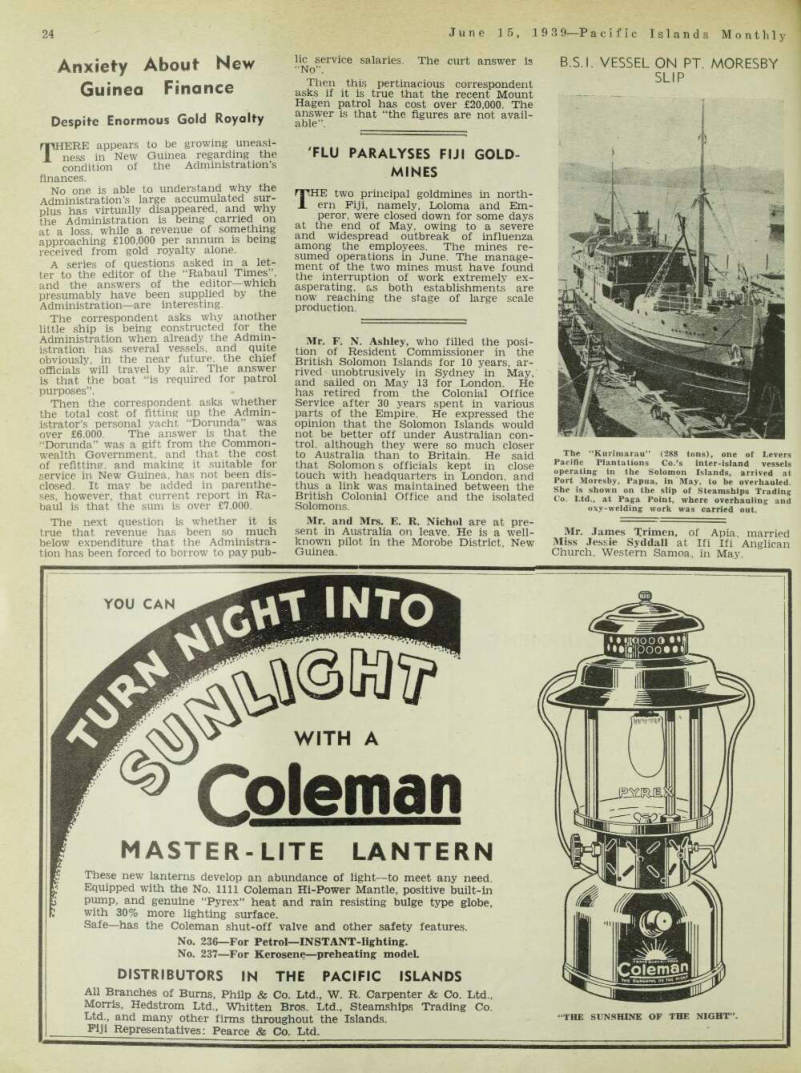
Guinea Finance Despite Enormous Gold Royalty
THERE appears to be growing uneasi ness in New Guinea regarding the condition of the Administration’s finances.
No one is able to understand why the Administration’s large accumulated sur plus has virtually disappeared, and why the Administration is being carried on at a loss, while a revenue of something approaching £lOO,OOO per annum is being received from gold royalty alone.
A series of questions asked in a let ter to the editor of the “Rabaul Times”, and the answers of the editor—-which presumably have been supplied by the Administration—are interesting.
The correspondent asks why another little ship is being constructed for the Administration when already the Admin istration has several vessels, and quite obviously, in the near future, the chief officials will travel by air. The answer is that the boat “is required for patrol purposes”.
Then the correspondent asks whether the total cost of fitting up the Admin istrator’s personal yacht “Dorunda” was over £6.000. The answer is that the “Dorunda” was a gift from the Common wealth Government, and that the cost of refitting, and making it suitable for service in New Guinea, has not been dis closed. It may be added in parenthe ses, however, that current report in Ra baul is that the sum is over £7,000.
The next question is whether it is true that revenue has been so much below expenditure that the Administra tion has been forced to borrow to pay pub
lie service salaries. The curt answer is “No’'.
Then this pertinacious correspondent asks if it is true that the recent Mount Hagen patrol has cost over £20,000. The answer is that “the figures are not avail able”.
'Flu Paralyses Fiji Gold
Mines
THE two principal goldmines in north ern Fiji, namely, Loloma and Em peror, were closed down for some days at the end of May. owing to a severe and widespread outbreak of influenza among the employees. The mines re sumed operations in June. The manage ment of the two mines must have found the interruption of work extremely ex asperating, as both establishments are now reaching the stage of large scale production.
Mr. F. N. Ashley, who filled the posi tion of Resident Commissioner in the British Solomon Islands for 10 years, ar rived unobtrusively in Sydney in May, and sailed on May 13 for London. He has retired from the Colonial Office Service after 30 years spent in various parts of the Empire. He expressed the opinion that the Solomon Islands would not be better off under Australian con trol. although they were so much closer to Australia than to Britain. He said that Solomon s officials kept in close touch with headquarters in London, and thus a link was maintained between the British Colonial Office and the isolated Solomons.
Mr. and Mrs. E. R. Nichol are at pre sent in Australia on leave. He is a well known pilot in the Morobe District, New Guinea.
B.S.I. Vessel On Pt. Moresby
Slip
Mr, James Xrimen, of Apia, married Miss Jessie Syddall at Ifi Ifi Anglican Church, Western Samoa, in May
The “Kurimarau” (288 tons), one of Levers Pacific Plantations Co.’s inter-island vessels operating in the Solomon Islands, arrived at Port Moresby, Papua, in May, to be overhauled.
She is shown on the slip of Steamships Trading Co. Ltd., at Paga Point, where overhauling and oxy-welding work was carried out.
Advertisements & other items, p. 28 (2 items)
24
June 15, 193 9~P acific Islands Monthly
-pieman
YOU CAN
qW’T !NTo
WITH A
-pieman
MASTER-LITE LANTERN
These new lanterns develop an abundance of light—to meet any need.
Equipped with the No. 1111 Coleman Hi-Power Mantle, positive built-in pump, and genuine “Pyrex” heat and rain resisting bulge type globe, with 30% more lighting surface.
Safe—has the Coleman shut-off valve and other safety features.
No. 236—For PetroI—INSTANT-lighting.
No. 237—For Kerosene —preheating model.
DISTRIBUTORS IN THE PACIFIC ISLANDS
All Branches of Burns, Philp & Co. Ltd., W. R. Carpenter & Co. Ltd., Morris, Hedstrom Ltd., Whitten Bros. Ltd., Steamships Trading Co.
Ltd., and many other firms throughout the Islands.
Fiji Representatives; Pearce & Co. Ltd.
THE SUNSHINE OF THE NIGHT’
Settlers Wanted
In islands and Northern Territory
Letter to the Editor UNDER the heading “Turned Down”, in your March issue, you review the action of the Federal Government in “turning down” the proposal to form i group settlement of Jewish migrants n the plateau country on the mainland )f New Guinea.
This action may be right, when ap )lied to the mainland of New Guinea, is objections may be taken to this by >ther natives having country there also, o which some of the so-called migrants nay find their way later on.
Why not settle migrants and others >n the adjacent Islands there —say, East ern Papua, New Britain, New Ireland, Jew Hebrides, and also the Solomons when federated under one Administra ion); and these peoples would act as ome slight deterrent to other nations •utting in, which is sure to happen if tot sufficiently populated. Moreover, eing on islands, legislation could pre ent them landing in Australia, if not wanted there. Population is urgently ranted; so why not Jewish migrants to ssist the present small communities. ’here would be many capable migrants d make good, to the benefit of the Is inds, and to the commercial benefit of .ustralia.
Again outside of populating these Is mds, it is far more important that opulation be supplied in the Northern erritory. This Territory has just start -1 to put its house in order, by follow ig the New Guinea methods of dividing ito Districts. To do this effectively, >me proper means of subsidising ships! ) connect either with the Southern tates or from Townsville, or even airns, from the Territory Districts, lust be found. The great trouble now to get there quickly and cheaply.
When these Divisions are opened, and ot forgetting to modify the New Guinea irvey fees and transport charges (which ave been the cause of delaying settle ment there, by individual settlers), and icluding a modified free selection scheme >r land, it will mean that there will be rush for land in the Territory.
Population for the islands mentioned, id the Northern Territory, are both ur mtly wanted, and prompt measures iould be taken for settlement. Both are rgent —more urgent, I think, than peo e know. But do everything possible to 3ep the Chinese and Jews off the gold :eas.
I am, etc.,
Safety First.
abaul, 10/5/1939.
Aerodrome For Thursday Is.
From Our Own Correspondent
. Thursday Is., May 22.
i PARTY of Defence Department offi- L cials have been busy on Horn Island, on the other side of Thursday Island arbour, surveying and planning for the 'oposed official aerodrome there. The srodrome, on Thursday Island itself, can •ovide only a runway of 300 yards.
Dr. P. Monoghan, who has been Chief edical Officer in Western Samoa for me years, is at present on a visit to ie United States. He intends to visit ; e New York World Fair and probably ill spend some time studying tropical edicine at the Rockefeller Institute.
Advertisements & other items, pp. 29-30 (1 item)
Horlicks
T/0 pN£S *
ZSfTH /S 7 is
J ME VOWN. / FEEL
S LIKE A WET
mm EVEN WANE UP /
/A m
TIREV !
SOUNDS
W LIKE 'N/ONT
M
STARVATION ! I NAD
IT UNTIL ONE OF
THE SHIP'S DOCTORS
\ CAVE ME NOR LICKS
\ couldn't feel
’.N. BETTER
if / TIRED before you start the day s work or play ... unable to concentrate ... “feel like a wet rag” ... are these your symptoms too ? Then probably you are suffering from
“Night Starvation”.
Doctors say your body uses up energy even while you sleep.
Failure to replace this energy means “Night Starvation”.
If you wake tired, start taking Horlicks regularly at bedtime.
Horlicks stores your body with the necessary vitality to face the most exacting climate.
Horlicks makes a delightful beverage mixed with iced milk or cold water in the Horlicks mixer. Horlicks contains milk, so where milk is scarce, you can use water only just add rather more Horlicks, that’s all.
Ask your chemist or storekeeper to-day for a bottle of Horlicks. (144 ozs. size costs 3/- in all main towns throughout the British Pacific Islands).
FREE
hotu/cks
CLASS M/XZK ■
All you need <0 Bo <s pos. «o HorlMs „y. tw„ G.P.O. Box No. 3609.5. Sydney.
N s W. ONE wrapper from a 14* ©«• l ar M vour nome end oddress. In return you Will receive a Horlicks Glass ; Mixer —FREE-
HORLICKS
guards against
NIGHT STARVATION
“FAIRHOLME”, Mountain School for Girls
VA X * • ' Aerial View of Grounds and Buildings.
PRESBYTERIAN GIRLS’ COLLEGE, TOOWOOMBA, Q’LAND.
2,000 feet above sea level. Unrivalled Climate. Academic, Home Science and Commercial Courses. Tennis, Swimming, Organised Games.
Principal: Miss D. E. CULPIN, B.A.
For Prospectus apply Secretary:-!?,. T. PHELPS, F.A.A., TOOWOOMBA, QLD.
THE FAVOURITE
SCHOOL LUNCH
Usually the school lunch is a very scratchy meal, eaten just when the vigorous exercise of the playground has made a strong demand on the endurance of the child. However, with little trouble it can be improved in value and made wonderfully attractive, simply by adding buttered Milk Arrowroot Biscuits. All children love them.
CLmottls
FAMOUS
MILK
ARROWROOT
BISCUITS
c: ALWAYS ASK YOUR GROCER FOR ARNOTT'S !
Caledonia
Conditions In New
The Problem of the Franc
“fTIHE chrome and nickel mines in X New Caledonia are working at full pressure”, said Mr. C. E. Tait, man aging director of W. S. Tait and Co.
Pty. Ltd., well-known Sydney merchants, on his return from a visit to the Colony recently.
The low rate of the franc is placing a handicap upon trade between Australia and New Caledonia, stated Mr. Tait. He pointed out that household com modities sucn as butter, cheese, etc., were looked upon as luxuries in New Cale donia to-day whereas previous to the devaluation of the franc, they were re garded merely as necessities.
As the result of a decree by the French Government on May 10, the importation of Japanese goods into all Frencn Colon ies was prohibited, continued Mr. Tait, but it was not known whether the em bargo would be strictly maintained or whether certain shipments could be im ported at the discretion of the French Consul in Japan. A large number of Japanese storekeepers operate in New Caledonia and Mr. Tait said that they could buy goods wholesale 10 per cent, cheaper than the French, and sell them at 5 per cent, cheaper than the other traders.
Noumea is looking very prosperous, add ed Mr. Tait. Roads have been improved, and a feature of the town was the con struction of new modern bungalow types of houses, replacing the old-fashioned type of colonial house.
N.G. Administrator At
Morobe
Prom Our Own Correspondent WAU, June 3.
His Honour Sir Walter Mc-
NICOLL, K.C.M.G., and Lady Mc- Nicoll, have paid their first residen tial visit to the goldfields. It was, in deed, Lady McNicoil’s first sight of this locality.
Arriving at Wau on Monday, May 29, they left again on Thursday afternoon, June 1. In addition to many social greetings extended by the goldfielders, His Honour took the opportunity to visit many of the within-reach mining cen tres.
After the recent floods and havoc, there were four perfectly delightful days during the Administrative visit—to be followed by a night of torrential rains as soon as they were gone, with landslides on both the Edie Creek and Bulolo Roads, and local crossings torn to shreds!
Mr. McCulloch, who served as Auditor to the Western Samoa Administration in 1935-6, returned to the Territory recently to take up the position of Secretary to the Administration.
Mrs. Mary Pfeiffer, an old identity of Levuka, Fiji, died recently at Levuka Hospital, aged 85. Born in the Caroline Islands in 1854, she went to Fiji early in the 70s and up to the time of her death was the oldest resident of Levuka.
She had, however, spent many years on Vanua Levu and Taveuni at various times. Mrs. Pfeiffer was the widow of the late Captain Pfeiffer, who had trad ing interests in neighbouring groups.
Advertisements & other items, p. 30 (1 item)
26
.Tune 15, 193 9—P acific Islands Monthly
Across The Indian Ocean
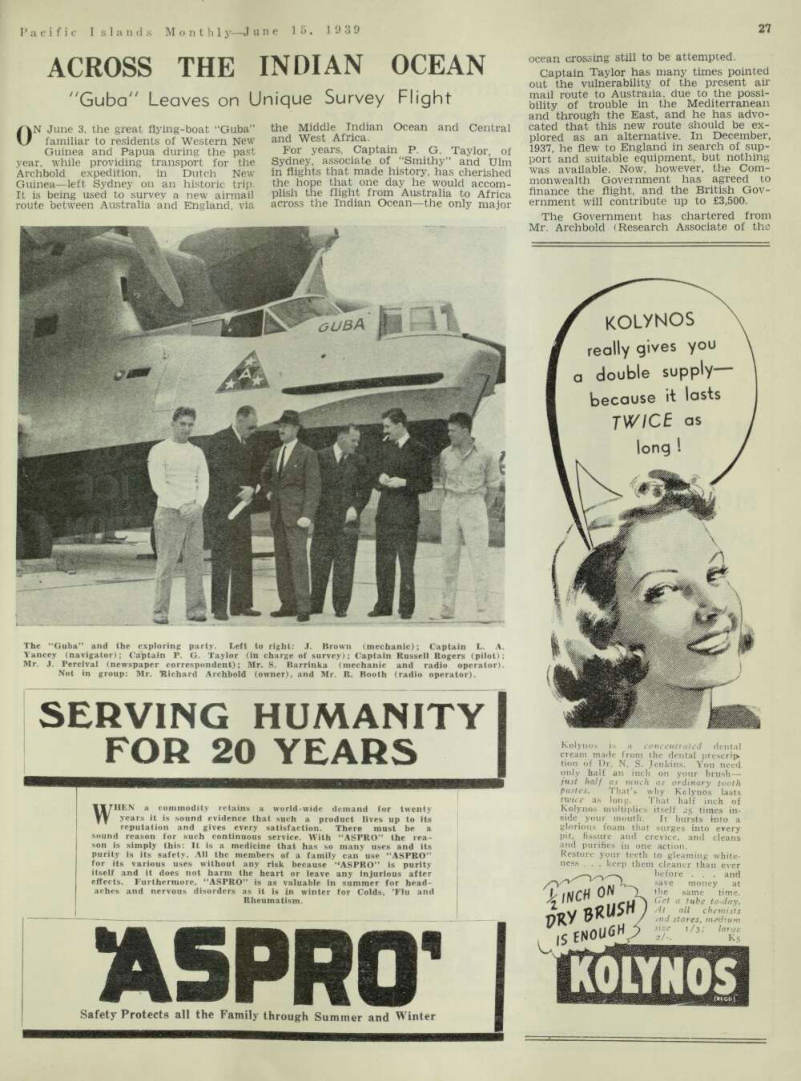
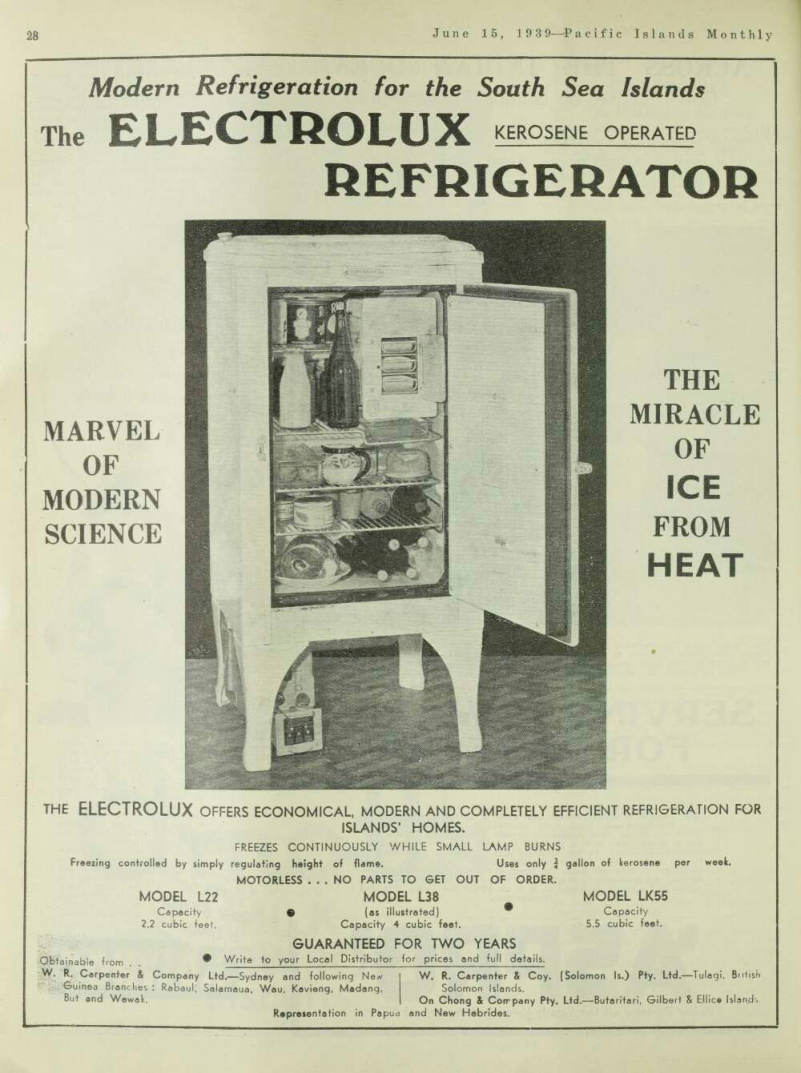
"Cuba" Leaves on Unique Survey Flight
ON June 3. the great flying-boat “Guba” familiar to residents of Western New Guinea and Papua during the past year, while providing transport for the Archbold expedition, in Dutch New Guinea —left Sydney on an historic trip.
It is being used to survey a new airmail route betw r een Australia and England, via
the Middle Indian Ocean and Central and West Africa.
For years, Captain P. G. Taylor, of Sydney, associate of “Smithy” and Ulm in flights that made history, has cherished the hope that one day he would accom plish the flight from Australia to Africa across the Indian Ocean—the only major
ocean crossing still to be attempted.
Captain Taylor has many times pointed out the vulnerability of the present air mail route to Australia, due to the possi bility of trouble in the Mediterranean and through the East, and he has advo cated that this new route should be ex plored as an alternative. In December, 1937, he flew to England in search of sup port and suitable equipment, but nothing was available. Now, however, the Com monwealth Government has agreed to finance the flight, and the British Gov ernment will contribute up to £3,500.
The Government has chartered from Mr. Archbold (Research Associate of the
The “Cuba” and the exploring party. Left to right: J. Brown (mechanic); Captain L. A.
Yancey (navigator); Captain P. G. Taylor (in charge of survey); Captain Russell Rogers (pilot); Mr. J. Percival (newspaper correspondent); Mr. S. Barrinka (mechanic and radio operator).
Not in group; Mr. Richard Archbold (owner), and Mr. R. Booth (radio operator).
American Museum of Natural History) his flying-boat “Cuba”, which arrived in Sydney from New Guinea on May 14.
Captain Taylor is in charge of the sur vey, to ascertain the value of the islands en route for flying-boat bases, land plane aerodromes, and for aviation generally, and this work will include the sounding of coral lagoons to determine their suit ability for flying-boats. With Captain Taylor are Mr. Archbold and his crew of five, and Mr. J. Percival, second repre sentative of the Commonwealth Govern ment and newspaper correspondent.
The route of the flight is from Port Hedland, West Australia, to Cocos Island (approximately 1.230 nautical miles); from Cocos Island to Diego Garcia Island, in the Chagos Archipelago (1,472 nautical miles); from Diego Garcia to Port Vic toria. on Mahe Island, in the Seychelles (1,022 nautical miles); and from the Sey chelles to Mombasa, in Kenya Colony (950 nautical miles).
After leaving Pt. Hedland (W.A.) on June 4 on the first stage of the flight, the “Guba’s” navigator (Capt. Yancey) was unable to find Cocos Island, owing to bad weather conditions. The course was changed N.E. and the “Guba” flew to Batavia. Dutch East Indies. ft took off for Cocos two days later.
After reaching Africa Captain Taylor «nd Mr Percival will return to Australia by boat, but Mr. Archbold will continue the flight across Africa and the Atlantic Ocean to the United States, thus com pleting a flight round the world.
Vacuum Oil Company Pty., Ltd., sent 2.500 gallons of petrol and supplies of oil by ship from Perth to Cocos Island; from India to Diego Garcia; and from South Africa to the Seychelles; and sup plies have been provided by the Com pany at all other points required between Africa and U.S.A.
The party propose to remain about a week at each island stopping-place, dur ing which period, while Captain Taylor is carrying out the survey, Mr. Archbold will undertake scientific studies, as these islands have never been visited by an ex pert biologist.
Advertisements & other items, pp. 31-32 (2 items)
27
Pacific 1 slands Monthl y—J une 15. 1939
Kolynos
kolvnos
really gives you
double supply—
because it lasts
TWICE as
long 1
Kolyuos is h concentrated dental cream made from the dental prescrip, tion of Dr. N. S. Jenkins. You need only half an inch on your brush— just half as much as ordinary tooth pastes. That’s why Kclynos lasts twice as long. That half inch of Kolynos multiplies itself 25 times inside your mouth. It bursts into a glorious foam that surges into every pit, fissure and crevice, and cleans and purifies in one action.
Restore your teeth to gleaming whiteness . . . keep them cleaner than ever before . . . and save money at I, ,kirU OJL t,ie same time.
AINCP w u N Get a tube to-day. v i chemists T)IZ/ Is'* / md stores, medium
J,S ENO^ H -i ,/3;
KOLYNOS
SERVING HUMANITY
FOR 20 YEARS
WHEN a commodity retains a world-wide demand for twenty years it is sound evidence that such a product lives up to its reputation and gives every satisfaction. There must be a sound reason for such continuous service. With “ASPRO” the reason is simply this: It is a medicine that has so many uses and its purity is its safety. All the members of a family can use “ASPRO” for its various uses without any risk because “ASPRO” is purity itself and it does not harm the heart or leave any injurious after effects. Furthermore, “ASPRO” is as valuable in summer for headaches and nervous disorders as it is in winter for Colds, ’Flu and Rheumatism.
Safety Protects all the Family through Summer and Winter
The
Modern Refrigeration for the South Sea Islands
ELECTROLUX
KEROSENE OPERATED
REFRIGERATOR
MARVEL
OF
MODERN
SCIENCE
* iNiS . m - : r- -m iX.., ■ '
THE
MIRACLE
OF
ICE
FROM
HEAT
THE ELECTROLUX OFFERS economical, modern and completely efficient refrigeration for
ISLANDS' HOMES.
FREEZES CONTINUOUSLY WHILE SMALL LAMP BURNS
Freezing controlled by simply regulating height of flame. Uses only gallon of kerosene per MOTORLESS ... NO PARTS TO GET OUT OF ORDER. reek.
MODEL L 22 MODEL L3B
Capacity (as illustrated) ® 2.2 cubic teef. Capacity 4 cubic feet.
GUARANTEED FOR TWO YEARS
• Write to your Local Distributor for prices and full details.
MODEL LKSS
Capacity 5.5 cubic feet.
Obtainable from . .
W. R. Carpenter & Company Ltd.—Sydney and following Ne* Guinea Branches : Rabaul, Salamaua, Wau, Kavieng, Madang But and Wewak.
W. R. Carpenter & Coy. (Solomon Is.) Pty. Ltd.—Tulagi, British Solomon Islands.
On Chong & Company Pty. Ltd.—Butaritari, Gilbert & Ellice Islands Representation in Papua and New Hebrides,
7 Up And 2 To Go!
From a Special Correspondent
Bulolo, May 20.
ON Saturday, May 13, the Bulolo Golf Club opened the seventh hole of Its course. Two more are being constructed, and the completed 9-hole links will have a total length of 3.250 yards, with a par 36.
The afternoon was given up to inter-club and individual matches. In the evening, at a pleasant and successful ball, Mr. L. V. Water house (director of Bulolo Gold Dredging, Ltd.) presented trophies won since last October. Suc cessful winners were;— Club Handicap.—The Johnnie Walker Club: Mr. Jack Goodwin. Runner-up—y 2 doz. D.P. golf balls: Mr. R. Walker Associates' Mixed Foursomes. —The Alan H.
Reid Club: Mrs. J. P. Wright.
Par Competition.—l doz. D.P. golf balls: Mr.
J. Evans.
Club Championship.—The President’s Cup (Presented by Dr. Carl Gunther): Mr. Jim Goodwin.
Associates’ Championship.—The Gannon Cup (Presented by the Associates’ Captain, Miss J.
M. Gannon): Mrs. J. G. Percy.
Inter-Club Foursomes.—l doz. D.P. golf balls: Mr. K. Noblett and Mr. Jack Goodwin (Bulolo Golf Club).
Associates’ Open.—y 2 doz. D.P. golf balls: Mrs.
W. Doe (Bulwa Golf Club).
Open Championship—>/ 2 doz. golf balls: Mr. S.
Atkinson (Bulwa Golf Club).
The Waterhouse Cup (Presented for annual competition between the golf clubs of Morobe District with a miniature replica to be held by the winners of the first year’s competition): Wau Golf Club.
Disturbs Papuan Shipping
Measles Case
From Our Own Correspondent
Pt. Moresby, May 10.
OWING to an outbreak of measles on the “Bulolo”, between Sydney and Brisbane, on her voyage to Papua and New Guinea from Sydney on April 29, all passengers came under quaran tine regulations. The case (a child) was disembarked at Brisbane.
At Port Moresby, passengers under 16 years of age were placed in quarantine at the European Hospital; those over 16 were allowed to land, on condition that they reported to the Quarantine Officer daily for a specified time.
Cargo for Port Moresby was worked by a number of natives who. after load
ing, remained aboard for further work at Samarai, where they also were placed
in quarantine.
No other passengers were allowed ashore. Every measure other than plac ing the •‘Bulolo” in quarantine in the harbour was taken by the authorities to safeguard the native inhabitants against the epidemic. All this caused incon venience to Port Moresby passengers in tending to extend their journey along the coast or inland: and dissatisfaction to tourists making the round trip; but it is difficult to see what other arrange ments could have been made. Everyone knows the effect of measles epidemics on primitive populations. They have no re sistance, and die in great numbers.
Rev. C. E. Turnbull has been appointed Foreign Missions Secretary of the N.S.W.
Presbyterian Church.
Advertisements & other items, p. 33 (2 items)
29
Pacific Islands Month 1 y—J une 15, 1939
Sparkling
refreshment from pure Malt and Hops ★ Y.
Wait
FOSTER’S
LAGER
American Samoa Shows A
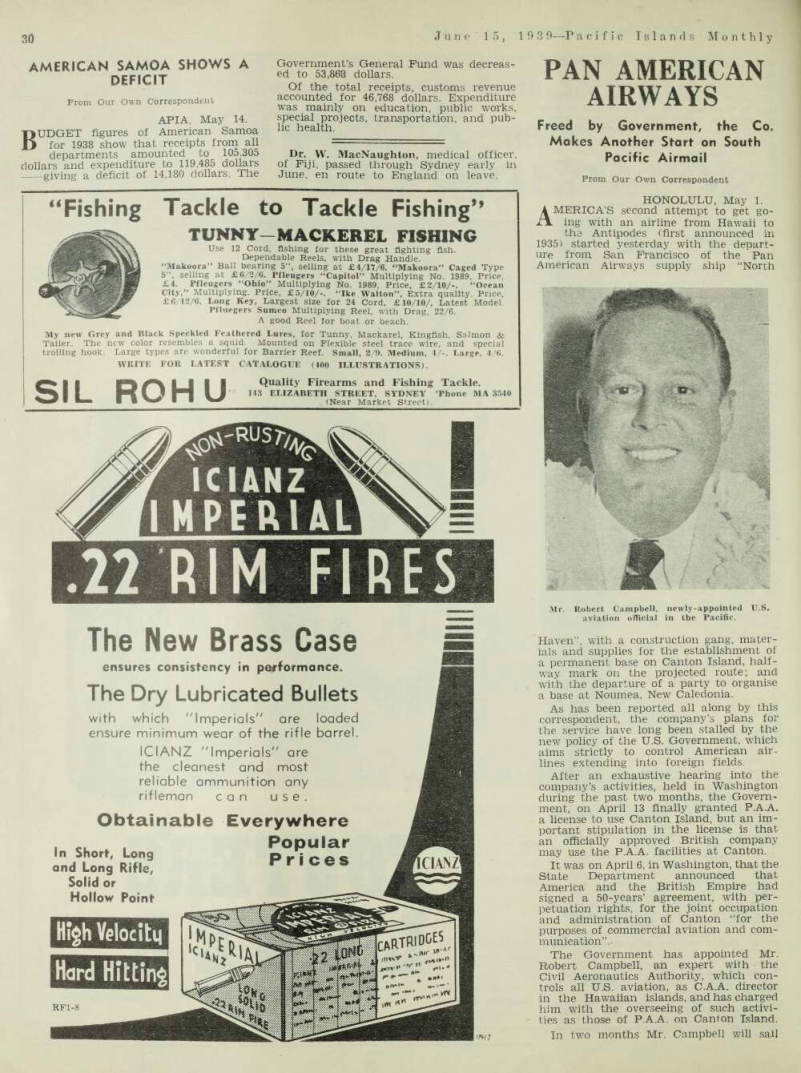
Deficit
From Our Own Correspondent
Apia. May 14.
BUDGET figures of American Samoa for 1938 show that receipts from all departments amounted to 105.305 dollars and expenditure to 119.485 dollars giving a deficit of 14,180 dollars. The
Government’s General Fund was decreas ed to 53,863 dollars.
Of the total receipts, customs revenue accounted for 46,768 dollars. Expenditure was mainly on education, public works, special projects, transportation, and pub lic health.
Dr, W. MacNaughton, medical officer, of Fiji, passed through Sydney early in June, en route to England on leave.
Airways
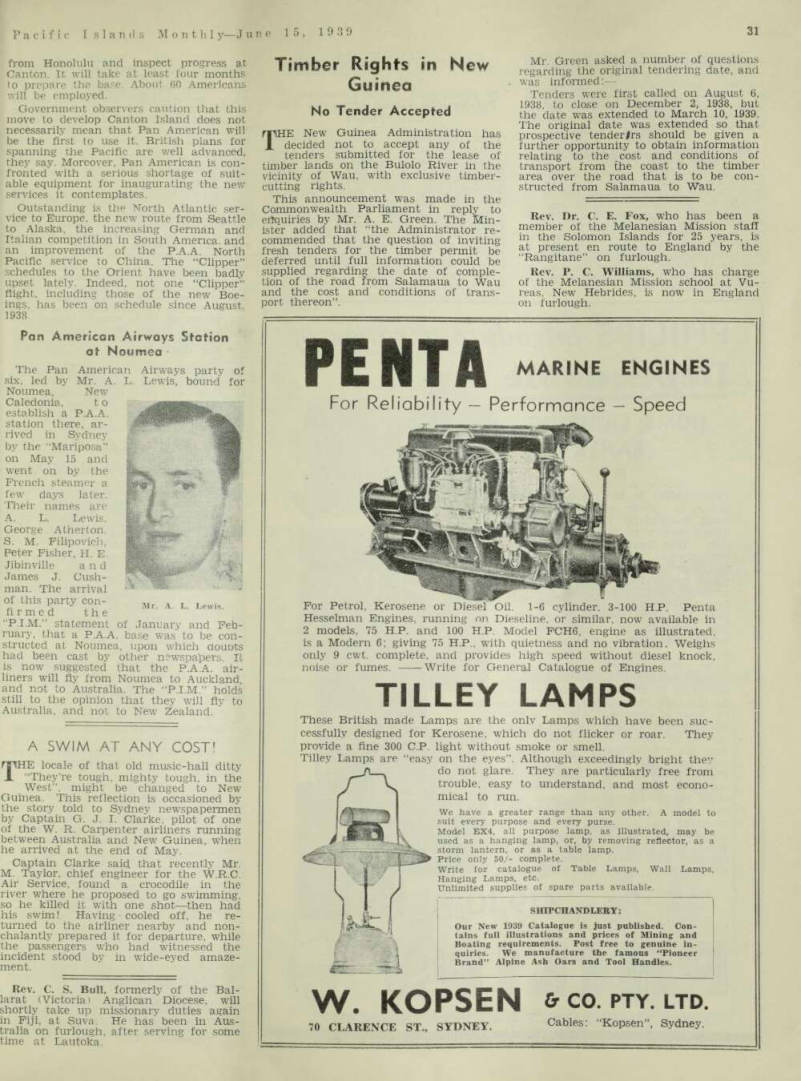
Pan American
Freed by Government, the Co.
Mokes Another Start on South Pacific Airmail
Prom Our Own Correspondent
Honolulu, May 1.
AMERICA’S second attempt to get go ing with an airline from Hawaii to the Antipodes (first announced in 1935) started yesterday with the depart ure from San Francisco of the Pan American Airways supply ship “North
Haven”, with a construction gang, mater ials and supplies for the establishment of a permanent base on Canton Island, half way mark on the projected route; and with the departure of a party to organise a base at Noumea, New Caledonia.
As has been reported all along by this correspondent, the company’s plans for the service have long been stalled by the new policy of the U.S. Government, which aims strictly to control American air lines extending into foreign fields.
After an exhaustive hearing into the company’s activities, held in Washington during the past two months, the Govern ment, on April 13 finally granted P.A.A. a license to use Canton Island, but an im portant stipulation in the license is that an officially approved British company may use the P.A.A. facilities at Canton.
It was on April 6, in Washington, that the State Department announced that America and the British Empire had signed a 50-years’ agreement, with per petuation rights, for the joint occupation and administration of Canton “for the purposes of commercial aviation and com munication”.- The Government has appointed Mr.
Robert Campbell, an expert with the Civil Aeronautics Authority, which con trols all U.S. aviation, as C.A.A. director in the Hawaiian islands, and has charged him with the overseeing of such activi ties as those of P.A.A. on Canton Island.
In two months Mr. Campbell will sail
Mr. Robert Campbell, newly-appointed U.S. aviation official in the Pacific.
from Honolulu and inspect progress at Canton. It will take at least four months to prepare the base. About 60 Americans will be employed.
Government observers caution that this move to develop Canton Island does not necessarily mean that Pan American will be the first to use it. British plans for spanning the Pacific are well advanced, they say. Moreover, Pan American is con fronted with a serious shortage of suit able equipment for inaugurating the new services it contemplates.
Outstanding is the North Atlantic ser vice to Europe, the new route from Seattle to Alaska, the increasing German and Italian competition in South America, and an improvement of the P.A.A. North Pacific service to China. The “Clipper” schedules to the Orient have been badly upset lately. Indeed, not one “Clipper” flight, including those of the new Boe ings, has been on schedule since August, 1938
Advertisements & other items, p. 34 (1 item)
Sil Rohu
“Fishing Tackle to Tackle Fishing”
TUNNY— MACKEREL FISHING
Use 12 Cord, fishing for these great fighting fish.
Dependable Reels, with Drag Handle.
“Makoora” Ball bearing 5”, selling at £4/17/6. “Makoora” Caged Type 5”, selling at £6/2/6. Pfleugers “Capitol” Multiplying No. 1989, Price, £4. Pfleugers “Ohio” Multiplying No. 1989, Price, £2/10/-. “Ocean City.” Multiplying. Price, £5/10/-. “Ike Walton”, Extra quality. Price, £6/12/6. Long Key, Largest size for 24 Cord, £lO/10/, Latest Model.
Pfluegers Sumeo Multiplying Reel, with Drag, 22/6.
A good Reel for boat or beach.
My new Grey and Black Speckled Feathered Lures, for Tunny, Mackarel, Kingfish, Salmon & Taller. The new color resembles a squid. Mounted on Flexible steel trace wire, and special trolling hook. Large types are wonderful for Barrier Reef. Small, 2/9. Medium. 4/-. Large, 4/6.
WRITE FOR LATEST CATALOGUE (400 ILLUSTRATIONS).
SIL ROHU
Quality Firearms and Fishing Tackle. 143 ELIZABETH STREET. SYDNEY Phone MA 3540 (Near Market Street).
i
The New Brass Case ss
ensures consistency in performance.
The Dry Lubricated Bullets
with which "Imperials" are loaded ensure minimum wear of the rifle barrel.
ICIANZ "Imperials" are the cleanest and most reliable ammunition any rifleman can use.
Obtainable
Everywhere
Popular
Prices
CIANZ
cartridges.
*IA >ci n (**<*• n'*• >rv’ 55 m
RFI-
In Short, Long and Long Rifle, Solid or Hollow Point
Fan American Airways Station
at Noumea
The Pan American Airways party of six, led by Mr. A. L. Lewis, bound for
Noumea, New Caledonia, t o establish a P.A.A. station there, ar rived in Sydney by the “Mariposa” on May 15 and went on by the French steamer a few days later.
Their names are A. L. Lewis.
George Atherton.
S. M. Filipovich, Peter Fisher, H. E.
Jibinville and James J. Cush man. The arrival of this party con firmed the
“P.1.M.” statement of January and Feb ruary, that a P.A.A. base was to be con structed at Noumea, upon which douots had been cast by other newspapers. It is now suggested that the P.A.A. air liners will fly from Noumea to Auckland, and not to Australia. The “P.1.M.” holds still to the opinion that they will fly to Australia, and not to New Zealand.
Mr. A. L. Lewis.
A Swim At Any Cost!
THE locale of that old music-hall ditty “They’re tough, mighty tough, in the West”, might be changed to New Guinea. This reflection is occasioned by the story told to Sydney newspapermen by Captain G. J. I. Clarke, pilot of one of the W. R. Carpenter airliners running between Australia and New Guinea, when he arrived at the end of May.
Captain Clarke said that recently Mr.
M. Taylor, chief engineer for the W.R.C.
Air Service, found a crocodile in the river where he proposed to go swimming, so he killed it with one shot—then had his swim! Having cooled off, he re turned to the airliner nearby and non chalantly prepared it for departure, while the passengers who had witnessed the incident stood by in wide-eyed amaze ment.
Rev. C. S. Bull, formerly of the Bal larat (Victoria) Anglican Diocese, will shortly take up missionary duties again in Fiji, at Suva. He has been in Aus tralia on furlough, after serving for some time at Lautoka,
Timber Rights in New

Guinea No Tender Accepted
THE New Guinea Administration has decided not to accept any of the tenders submitted for the lease of timber lands on the Bulolo River in the vicinity of Wau, with exclusive timber cutting rights.
This announcement was made in the Commonwealth Parliament in reply to enquiries by Mr. A. E. Green. The Min ister added that “the Administrator re commended that the question of inviting fresh tenders for the timber permit be deferred until full information could be supplied regarding the date of comple tion of the road from Salamaua to Wau and the cost and conditions of trans port thereon”.
Mr. Green asked a number of questions regarding the original tendering date, and was informed: — Tenders were first called on August 6, 1938. to close on December 2, 1938, but the date w r as extended to March 10, 1939.
The original date was extended so that prospective tenderers should be given a further opportunity to obtain information relating to the cost and conditions of transport from the coast to the timber area over the road that is to be con structed from Salamaua to Wau.
Rev. Dr. C. E. Fox, who has been a member of the Melanesian Mission staff in the Solomon Islands for 25 years, is at present en route to England by the “Rangitane” on furlough.
Rev. P. C. Williams, who has charge of the Melanesian Mission school at Vu reas, New Hebrides, is now in England on furlough.
The many friends of Captain E. Nelson Turner, throughout the British Solomons, where he held the post of District Commissioner and Commandant, and carried out 21 years’ pioneer service for the Colonial Office, will regret to learn of his retirement, on medical grounds, after his long leave has expired.
The University of Hawaii has appointed Dr John Wesley Coulter as its delegate to the Pacific Science Congress, which will be held in Berkeley and Stanford, California, U.S.A., from July 24 to August 12. Dr. Coulter, who is head of the University’s geography department, is a member of the Congress standing committee on land utilisation, and he will present a paper on the land utilisation in American Samoa. He recently spent four months in Samoa and three months in Fiji, New Zealand, and Australia making a land utilisation study.
Advertisements & other items, pp. 35-36 (2 items)
31
Pacific Islands Monthl y—J une 15, 1939
Pe Nt A Marine Engines
For Reliability Performance Speed
mi For Petrol, Kerosene or Diesel Oil. 1-6 cylinder. 3-100 HP. Penta Hesselman Engines, running on Dieseline, or similar, now available in 2 models, 75 HP. and 100 HP. Model FCH6, engine as illustrated, is a Modern 6; giving 75 HP., with quietness and no vibration. Weighs only 9 cwt. complete, and provides high speed without diesel knock, noise or fumes. Write for General Catalogue of Engines.
TILLEY LAMPS
These British made Lamps are the only Lamps which have been successfully designed for Kerosene, which do not flicker or roar. They provide a fine 300 CP. light without smoke or smell.
Tilley Lamps are “easy on the eyes”. Although exceedingly bright they do not glare. They are particularly free from trouble, easy to understand, and most economical to run.
We have a greater range than any other. A model to suit every purpose and every purse.
Model EX4, all purpose lamp, as illustrated, may be used as a hanging lamp, or, by removing reflector, as a storm lantern, or as a table lamp.
Price only 50/- complete.
Write for catalogue of Table Lamps, Wall Lamps, Hanging Lamps, etc.
Unlimited supplies of spare parts available.
SHIPCHANDLERY:
Our New 1939 Catalogue is just published. Contains full illustrations and prices of Mining and Boating requirements. Post free to genuine inquiries. We manufacture the famous “Pioneer Brand” Alpine Ash Oars and Tool Handles.
W. KOPSEN & CO. PTY. LTD,
70 CLARENCE ST., SYDNEY,
Cables: “Kopsen”, Sydney.
PHILIPS introduce range
Dependable
HOME LIGHTING
PLANTS
Dependability is the most important factor in power generating equipment, particularly in outlying areas where service is not readily accessible. Your lighting plant must give you constant, reliable service year in and year out. It must be troubleproof, powerful and rugged. In other words —a PHILIPS Home Lighting Plant!
Philips have been lighting experts for over forty years . . . have sold over 5,000.000.000 lamps throughout the world . . , are the world’s largest radio manufacturers. They have brought comfort and pleasure through electricity to people of every nation.
At the snap of a switch . . . enjoy the boon of abundant light . . . the breezes of a cooling fan . . , the comfort of freshly ironed linen . . . and the refreshment of cool drinks and tasty food.
Philips DEPENDABLE Home Lighting Plants give 25% more power than other brands in the same class, and they operate at extra low speed which decreases wear and tear, maintenance and upkeep costs.
Write to Philips Power Plant Division, Box 2703 C, G.P.0.. Sydney, for illustrated folder and price list.
S From £l9/10
PHILIPS
LAMPS, VALVES, RADIO, X-RAY, TRANSMISSION, ETC.
a A m
The Mystery Is
Solved!
Polynesians Came from the Ten Lost Tribes
rpHE paleontologist who can re-create A the image of some primeval mon ster on the foundation of a fossil tooth discovered in the depths of a chalk Pit, astonishes us no more than does the ethnologist whose great oaks grow from very small acorns, For instance, the ancestry of the Polynesian has been chevvied about from continent to continent, on the smallest possible evidence. Because of a word of two letters the ancestral land has been fixed in Egypt; because of a potato, in South America; because of a theory, at the bottom of the sea.
We have read a learned book which proves beyond all doubt that the South Sea islander is the blood brother of the builders of Stonehenge. The author traces the migration across the steppes of Asia, through the Caroline Islands to Tonga, as the gateway to Central Poly nesia. Later, this same scholar had a vision and wrote a new book to prove that the ancestral bones of Polynesia rest in the bosom of a lost continent deep down under the water of the Pa cific Ocean!
Lately, it has come to our knowledge that the final solution of the Polynesian mystery has been achieved—not as a con sequence of research by a college of sci entists, but by direct revelation from on high to a latter day prophet. In the days of that ancient Hitler, Haman, the son of Hammadatha the Agagite, the persecuted Hebrews packed their belong ings aboard a fleet of ships; fled down the Euphrates to the Persian Gulf; thence to the Indian Ocean, and turned the prows of their vessels toward the rising sun. In due time they arrived in Polynesia and the inhabitants of to-day are the descendants of the Ten Lost Tribes.
The followers of the prophet in the Tuamotus say the question is settled for all time, and the anthropologists and ethnologists can now go home and seek
other worlds to conquer.-
A.C.R.
Wau-Salamaua
Road Tenders Probable in July
MEMBERS of the Commonwealth Par liament have been bombarding Aus tralian Ministers with questions about the Wau-Salamaua road, in New Guinea. The following is a summary of Ministerial announcements;— The New Guinea Loan Guarantee Act 1938 was passed in July, 1938, by which the Commonwealth Government guaran tees the repayment of, and the payment of interest upon, a loan not exceeding £150,000 to be raised bv the Administra tor of the Territory of New Guinea for the purposes of the construction of a road between Salamaua and Wau.
It has been decided to construct a road from Salamaua to Wau by the shortest practicable route. The route selected is the Bitoi River route of ap proximately 50 miles, known as route “A”. The estimated cost of construction of a road over this route is £lBO,OOO.
The following alternative routes have been considered; — Route “B”—Bitoi Ridge. Distance, ap proximately 55 miles. Estimated cost, £194,000.
Route “C”—Buangs-Snake River.
Distance, approximately 96 miles. Esti mated cost, £197,000.
Route “D”—Markham Point, Gaben sis, Wampit. Distance, approximately, 116 miles. Estimated cost, £195,000.
The sections of the route nearest to Salamaua and Wau respectively are being surveyed, and it should be possible to call for tenders for those sections in July.
Unofficial opinion is that the building of the road will occupy two years and that the cost will greatly exceed £lBO.- 000.
Mr. A. E. Paulpv. who has been asso ciated for some time with Sandy Creek Sluicing Co. in New Guinea, arrived in Sydney by the May “Neptuna”.
Mr. Harold Brown, a member of the Svdney committee of the Melanesian Mission, departed by the last “Malaita” to visit the M.M. stations in the Solo mon Islands.
Advertisements & other items, p. 36 (1 item)
32
June 15, 193 9—P acific Islands Monthly
Gosiagu"
"Swonsong of the
Medical Work in Papua
Letter to the Editor SINCE we wrote you the epistle, “Swan song of the Gosiagu”. (which, by the way, you showed caution in not pub lishing, as Papuan officialdom doesn’t like such information being made public) a considerable amount of attention has been shown to the local inhabitants by the Medical Department.
Three trained medical assistants (white) have been working in both the D’Entrecasteaux and the Trobriand Groups during 1938. These men have been a great help to the villagers, and have tackled an almost hopeless situation with energy and enthusiasm.
In addition, Dr. E. Ford and Mr. Clinton (of the School of Public Health and Tropical Medicine) were sent here by the Commonwealth authorities and were en gaged in making a thorough medical sur vey of these islanders; unfortunately they have been suddenly called away before their work was completed.
Had these measures been put in opera tion 20 years ago, or even 15 years ago, the present serious situation might have been avoided, but now venereal disease, tuberculosis, hookworm, and other tropi cal diseases are sapping the vitality of these natives, and we doubt if much can be done to arrest the decline in popula tion. The high death-rate, combined with a low birth-rate, can have only one result.
The neglect for the past thirty years of this, the most energetic, industrious, and likeable, of any of the Papuan tribes is now bearing full fruit. So far as the “Gosiagu” is concerned “the writing is on the wall”.
Officialdom, especially Papuan official dom, strongly resents either advice or criticism; complete evidence of the con sequences of this policy can be seen in the D’Entrecasteaux Group to-day.
I am etc.,
E. W. Harrison
Sebulugomwa, Samarai, Papua. 18/4/1939.
Drought In Central Pacific
rE severe drought which was being ex perienced in many islands of the Central and South-Western Pacific, at the beginning of the year, has broken, in the majority of cases; but, on last ad vices, there still has been no rain in many of the Line islands—especially the Northern Cooks, the southern islands of the Gilbert Group, and Ocean Island. It has been necessary to send rice and other commodities to assist the 4,000 natives who are drought-stricken in the South ern Gilberts; and it is reported, also, that water has been at a premium on Ocean Island.
The drought has broken in the far east —Pitcairn Island now reports all well— and in the far west of the Pacific.
Mr. W. Cottrell-Dorman, who has been appointed Director of Agriculture in the Tongan Government service, sailed from Sydney in the “Awatea” on May 20. Mr.
Cottrell-Dorman was previously in the employ of the Fairymead Suear Com pany at Bundaberg, Queensland, and recently has spent some time in the Solomon Islands, investigating the causes of “nut-fall” for that Company.
Insolent Natives
Government Stops Sing-Sings in Morobe District
Prom Our Own Correspondent WAU, May, 20. rE Administration at last has called a halt to the weekly gatherings of natives in this area, which —for the sake of a better name—were called “sing sings”. The gatherings took place out side the town area, where the local police had no jurisdiction, and were causing the community some apprehension.
Organised sing-sings at certain festival or holiday periods have been recognised throughout the Territory always; but these gatherings scarcely came under that category, as they were not under any kind of control.
Malpractices of many descriptions were taking place and it was alleged that the “putting together of heads’’ by inden tured labourers from every corner of the Territory, was a feature of the gather ings.
Nothing but harm to both whites and natives would have resulted, had these gatherings been allowed to continue. In fact, many employers had already noticed an attitude of semi-defiance developing among their indentured labourers.
Borneo Oil
Prom Our Own Correspondent
Honolulu. May 10.
NO wonder Japan would like to possess Borneo.
Holland has reported to Washington that crude oil production in the East Indies for 1938 amounted to 7,398,585 metric tons, the highest in the history of the rich isles. It represented a two per cent, increase over the next best total, which was made in 1937.
Note: Six months ago certain exports of oil from the Indies became secret.
They were destined for Japan—for the war-machines of the Emperor!
Advertisements & other items, pp. 37-38 (2 items)
33
Pacific I slant! s Month! y—J une 15, 1939
Capstan
Quick, Safe
RELIEF from
• Headache
• Tropical Fevers
** Heat Exhaustion
® Nerve Gr Muscular Pains
YOU should NOT suffer pain—lt Is harmful and lowers resistance to dangerous germs. Vincent’s A.P.C Is deep-seated In its action; it stimulates the nerve and muscular system causing a healthful relaxation which removes pain and exhaustion. Because Vincent’s A.P.C. has a definite therepeutic value It assists greatly in fighting off and in the actual treatment of tropical fevers, rheumatism, arthritis and sciatica.
At the first sign of headache or any other nerve pain take Vincent’s A.P.C. powders or tablets —and get positive relief WITHOUT after-effects, because Vincent’s is the balanced prescription formulated by the Medical Superintendent of Australias largest public hospital.
Vincent’s A.P.C. is the safest and best keep it handy always. ; ** rowotits *
TAII C T S
1/* AND 2/4.
SINGLES 2d »o
FOR SAFETY’S SAKE. SAY “VINCENT’S”
/Jf\ecu*&tf juicAe*/the. TROP/CS
CAPSTAN
fpBACCp
-J.c-TUm ' i~i i hi ■ — * H*a r "Eioht w» £ “ s?***>.
Capstan Navy Cut Tobacco, made from the finest Virginia loaf.
AND
I § TA Capstan Cigarettes, round airtight 50's.
Medium and full strength. 8824-10-8
W. H. GROVE & Sons Ltd.
Islands Traders PO BOX ««• Auckland Telegraphic and Cable Address: “Grove”, Auckland.
Shippers of all classes of New Zealand Products, specially prepared for the Islands trade.
Representing Rylands & Sons (Col.) Ltd., of London and Manchester. (Including the famous "Dacca" Mills Products.) Parbury Henty & Co. Pty. Ltd., of Sydney and Kobe.
"AGFA" Photographic Corporation, of Berlin.
J. Blair King, of London. World-famed Shirts.
Burrell & Co. Ltd., Millwall, London, E. 14. Oil, White Lead and all classes of Paints, including "FERROCENE", their special Tropical Paint . PREVENTS CORROSION .. . made in RED,
GREY, and GREEN.
Q [Off 1 r J m
JJtepmt
far#
/ 'xm.
Photograph with Agfa Isochrom - this is a film for all types of exposures. It enables you to get the best out of your photographs. Good definition, reproduction of the finest details, brilliant gradation, and high sensitivity. Orthochromatic with wide exposure latitude. %
Signals

Mad Morse
Japanese Interference With Pacific Radio
By a Special Correspondent
COMPLAINTS from New Guinea and other Pacific Territories in the Aus tralian zone have focussed recent Commonwealth attention on a short wave radio reception problem now per turbing every country in the world.
There is little that any one country can do to solve it, unless other nations, con ducting short-wave broadcasts, agree to a set of international rules—and then stick to them.
Over the last year, short-wave recep tion of Australian national broadcast from Lyndhurst (Vic.) by listeners in Wau (T.N.G.) and other Pacific centres north of Australia, have been seriously affected by morse signals from a Japanese sta tion. Annoying, unintelligible dots-and dashes have intruded a destructive background to news and entertainment broadcasts.
“If wave-lengths are allotted by inter national convention, surely the Austra lian Broadcasting Commission has guts enough to push for its rights and the rights of Australian-born listeners in New Guinea and other Pacific Territories al legedly administered from Canberra”, is the sort of comment reaching the Com mission from exasperated correspondents in the Islands. “Can’t the A.B.C. do something before listeners up here go
Cranky?”
One Wau man wrote on April 21 that the interiering Jap. “does not appear to send messages at all. On April u all he sent out was JRI, V,V,V,V,L,I,L,L, JIO. It may make sense to the Japs, but it is just a pain in the ears to us. For the rest of the afternoon the Jap. seemed to jam his key and go off to afternoon tea”. rpHIS New Guinea listener thinks the A interference could be overcome if Lyndhurst’s power were anywhere near the power of the Japanese morse station. “But VRL’s power is ‘pussy’ compared with overseas stations, which can be picked up here on any sort of a set. England, Germany, Japan, Rus sia, Italy, the Philippines, in fact—come in with great gusto and better modula tion than VRL could ever hope to with its present equipment.
“Some of the best sets ever made are installed in this country; but trying to pick up VRL with any degree of power is like the little girl trying to pull up socks she hasn’t got on”.
INTERVIEWED in Melbourne for the “P.1.M.”, Mr. J. Malone, chief of the Postmaster-General’s wireless branch, which handles all the A.B.C.’s technical problems, explained that the type of interference being suffered by Pacific listeners keen to get Lyndhurst pro grammes is being experienced in every country. “Fact is that the world’s short-wave ether is overcrowded with stations broadcasting in every language”, he added. “Of necessity, two wave lengths may be so close together that one can easily wobble partially into its neighbour, causing interference for list eners tuned into each station”.
Mr. Malone said Australia had already asked radio authorities in Tokio to lift VLR interference from their morse sta tion. While he believed the Japanese
were doing what they could to ease the annoyance, he realised Tokio’s difficulties in the matter. If the Jap. station were transferred to a wave-length further from that used by Lyndhurst, it would merely crowd into an ether corridor al ready being used by some other short wave station.
The International Telecommunications Conference held in Cairo early in 1938, and attended for Australia by Mr. Ma lone, had not dealt with the re-alloca tion of wave-lengths on the short-wave band, but it was generally realised by delegates that this task would have to be undertaken in the near future.
“People in Australia’s overseas terri tories who rely on short-wave reception to keep them in daily touch with the march of Australian events may be bet ter pleased then”, Mr. Malone comment ed. “Still, the already over-crowded short-wave field can’t be enlarged by human agency, and limitation of short wave broadcasting, though in the inter ests of world reception, mightn’t please some countries”.
In other words, international agree ment on the matter will be subject to the same violation as any other inter national agreement, should the world ever again become involved in a general war. Interference then would probably be regarded by belligerents as a counter propaganda duty—and listeners in Aus tralia’s Pacific Territories who are now suffering the effects of accidental inter ference of the Japanese variety, have some idea how much worse reception could be made by deliberate interfer ence.
Mr. Malone does not think a more pow erful Lyndhurst would benefit listeners in the tropics to the extent implied by the Wau correspondent. But if Australia is to protect adequately its Pacific Terri tories in event of any war, it should also protect their residents from the worry ing impact of likely wartime propaganda and mis-information that would reach the Pacific so much more powerfully than reassurances from Lyndhurst.
Stepping up the strength of Austra lia’s short-wave broadcasts looks to Paci fic residents like a defence project that would possess more permanent peace time value than some of those already under way.
Rubber From Sugar
From Our Own Correspondent
Honolulu, May 10.
IF you have investments in sugar pro duction, you must be interested in patent No. 2,150,068 which has been granted by the U.S. office to Ernst Kleiber, of Lugano, Switzerland.
Mr. Kleiber has succeeded in produc ing artificial rubber from ordinary sugar and turpentine.
Beet or sugar cane will do. According to the patent, the sugar first is treated with a mixture of nitric and hydro chloric acid, while stirring for about 18 hours.
Then turpentine is added and the mass is stirred until fully thickened. In the reaction that takes place, the molecules of saccharose and turpentine “polymerise” or inter join to form complex rubber-like compounds.
The acids then are neutralised with caustic soda and the mass is washed and dried. The yield is said to be 78 to 83 per cent, of the starting material. The arti ficial rubber can be vulcanised.
Death of Bishop of New
Hebrides End of 50 Years of Mission Work
by Monseigneur Doucere
Monseiqneur Doucere, French
Roman Catholic Bishop of the New Hebrides, aged 82, quietly passed away at Vila on May 12. He came to the New Hebrides as a priest in 1889, and was made Bishop of the N.H. in 1904. Re cently, he published an interesting book describing his life as a missionary in the New Hebrides and the work of the Catholic Missions.
The Funeral Mass was held at the R.C. Church, Vila, on May 13. It was at
tended by the French and British Resi dent Commissioners, and the major part of the population, Catholic and Protest ant, of both nationalities. After the cere mony, sympathetic addresses were de livered by the French Resident Commis sioner (Monsieur Sautot) and the Act ing British Resident Commissioner (Mr.
Blandy).
The remains were interred at Mont matre, one of the principal Catholic Mission Stations in the N.H., some 5 miles from Vila. Despite the heavy rain, which fell all the morning, a large number of Vila residents followed the remains to their last resting place.
Mr. W. T. Martin has taken up his duties as Comptroller of Customs at Suva, Fiji.
Mr. R. H. Garvey, who has been acting as Resident Commissioner in the Gilbert and Ellice Islands Colony during the ab sence on long leave of Mr. Barley, passed through Sydney in May, on his way taac-i to Suva to resume duty as assistant sec retary of the High Commission for the Western Pacific.
Advertisements & other items, pp. 39-40 (2 items)
35
Pacific Islands Monthl y—J une 15, 1939
Services
- :C t
<4AW A
4 v$M s ■! II ■' mm
SERVICES
FOR ISLAND HOMES .
You can have all the convenience of electric light and power, by installing a home lighting plant equipped with Clyde storage batteries. Clyde Plates are specially designed for slow discharge over long periods. At the snap of a switch, the unfailing power of Clyde Batteries will illuminate your home, operate your wireless, fans, refrigerators and other electrical appliances. 0 Clyde Home Lighting Batteries are fully guaranteed .
HOME-LIGHTING BATTERIES
Sales & Service Division, 61-65 Wentworth Ave., Sydney.
Island Agents: Borns, Philp & Co. Ltd. W. R. Carpenter & Co., Ltd.
Rabaul: John L. Peadon Ltd. , Fiji: Morris Hedstrom Ltd. « hr. r* V
PURE RICE
STARCH
Always ask for . . .
'CORAL" BRAND
100% PURE
Noted for its
QUALITY
and
WHITENESS.
Goes Farthest and gives Lasting Finish
WILL NOT
STICK TO
IRON.
Obtainable from Leading Island Stores.
Manufactured by
AUSTRALIAN RICE, LTD.
Sydney, N.S.W. y
CORAL BRAND
RICE STARCH
'S
Australia's Choicest Products Green Peas French Beans Cauliflower
garden
m
‘MANUFACTUKJ
>v BY I
CARDCN VALE
PRODUCTS UNITED
2-4 BROWN STR-E-ET, N-EWTOWN
JYDM-EY. AUSTRALIA
Always . . .
make sure you have at hand an ample Reserve of these Delicious . .
Garden
Vale
Ready-toserve Vegetables
Murder Of Bishop
Patteson Old Records Clearly Suggest Revenge Motive
ON April 1, the anniversary of his birth, reference was made by missionary organisations to the life and death of the pioneer missionary. John Coleridge Patteson, first Bishop of Melanesia.
When the See of New Zealand was established in 1841. the erroneous boun daries. transcribed from the letters patent of the colony itself, which ex tended far north of the equator, gave an area of some 4,700 square miles of ocean to the diocese, including a large number of scattered islands.
Bishop Selwyn readily accepted the in accurate boundaries and in 1848. after a cruise, wrote to England suggesting that he should take spiritual charge of the area which embraced the New Heb rides, Solomon Islands, New Britain Archipelago, New Guinea, and all the Line Islands.
AT a meeting of the Bishops of Aus tralia and New Zealand, held at Sydney in 1850, the Australasian Board of Missions was set up. and it was decided that the work in the tropi cal islands should be carried out by long visits in the healthy season, instead of by permanent stations. An Ocean dio
cese was proposed, but complications arose, and it was not until 1861 that the consecration of a bishop was approv ed. In that year the Secretary of State in a despatch stated: “The Bishops of New Zealand are a liberty, without the invasion of the Royal prerogative or infringement of the law of England, to exercise what Bishop Selwyn describes as their power of consecrating Mr. Pat teson or any other person to take charge of the Melanesian Islands, provided that the consecration should take place be yond British territory”.
The Attorney General of New Zealand, citing precedent, held that there was no reason why Mr. Patteson should not be consecrated in Auckland. And so it was done on February 24. 1861.
Bishop Patteson who. as a worker in the mission field, had urgently pressed for the establishment of a British Pro tectorate over all the unoccupied islands in the area, was of the definite opinion that most of the native outrages were carried out in a spirit of revenge for wrongs perpetrated in connection with the labour traffic, and in this he was supported by naval officers. In the tur moil that existed, he realised the value of the navy to a mission “not with the idea of any protection being required, but with the intention of supporting the mission and giving help”.
On one occasion he cruised through the islands in the H.M.S. “Cordelia”; and in 1865 the H.M.S. “Curacoa” tow ed the “Southern 'Cross” through the Solomon Group, On each occasion, evi dence of outrages, committed in a spirit of revenge, was collected.
In September, 1871, in his last letter to Rev. R. H. Codrington. he wrote from the New Hebrides: “We only reached Mae to-day. I have spent the after noon on shore. One of the saddest after noons I have had for manv a day. No thing can be more deplorable than the state of the island. I counted 48 people in the village when of old 300 certainly were to be seen”.
He was depressed at the depletion of the nopulation by the labour trade, but could not bear to give up his hopes of securing some reforms.
On leaving the New Hebrides he pro ceeded to Nukanu, in the Santa Cruz group: and extracts from the log of Captain John Jacobs, master of the mis sion vessel “Southern Cross”, reveal the tragedy: “September 20. 1871; At 11.30 a.m. low ered boat. The Bishon went toward some canoes that were about one mile from the vessel: thev all nulled towards the reef. It being low water our boat could not cross.
“The Bishop went ashore in a canoe, six others remaining by the boat. They tried to get the boat’s crew to haul the boat on the reef: as thev could not suc ceed thev fired tie.. shot) into the boat and hit Mr. AtMns and two of the boat’s crew. One (Stenhen. a native) had five arrows broken in him; four were eut out but could not get the other. The beat returned to the vessel.
“I sent the mate, three of our crew and two black boys, with Mr. Atkins, to wateh the shore and see if thev could see the Bishop; and. when there was water enough to cross the reef and go as near to shore as was prudent.
“The boat went inside the reef. Ob served a canoe drifting towards them; thev pulled to it: the Bishop’s body was in it. He was killed—wrapped up in a mat. strinped of all his clothes, two fearful wounds in the head, the skull smashed in, several arrow marks, and his legs cut. Took him into the boat and pulled to the vessel.
“In the meantime a light air sprang up and we worked the vessel towards the reef to cover the boat. There was a cocoa palm leaf stuck in the mat, with five knots tied in it.
September 21; Mr. Brooke read the service for the dead over the Bishop, and we committed his body to the deep.
“September 27; Mr. Atkins departed this nfe. He suffered very much before he died. His breasts and shoulders turned quite blue shortly after he died.
“September 28; Stephen died; he suf fered dreadfully. Read the funeral ser vice and committed both bodies to the deep”.
A later report stated that two canoes went with the one in which the Bishop travelled, and in them were Mota and Taulu, two chiefs who had been on friendly terms. The remainder drifted about with the ship’s boat for about half an hour, when suddenly, without any warning a man stood up in one of them and, calling out, “Have you anything like this?”, he fired an arrow; and his companions in the other canoes called out, as they fired. “This for New Zea land Man”; “This for Bauro man”; “This for Mota man”.
Five men then in Fiji were known to have been stolen from Nukapu. and it is thought probable that their families believed they were dead. The five knots in the palm were presumed to indicate that the Bishop’s death was vengeance for the five stolen natives.—AM.
Advertisements & other items, p. 40 (1 item)
36
June 15.193 9—P acific Islands Monthly
Inter-Mission Sports
Prom Our Own Correspondent.
Samara!, May 2.
rr\HE town of Samarai was full of visitors 1 in mid-April, when teams of native boys from the Kwato, Dobu, Fife Bay and Dogura Mission Stations, escorted by European representatives, ar rived to take part in the Inter-Mission Sports Week, which had been organised by the mission bodies.
The mission lads took the keenest in terest in the various contests, a very good spirit was evident throughout, and the whole of the proceedings and functions so pleased the Europeans of Samarai that the wish was generally expressed that the sports week would be made an annual affair.
The cricket shield was won by the Fife Bay team and the football shield by the Kwato and Dogura teams to hold for 6 months each, as they came to a tie.
Miss Olwyn Rutherford, of the Auck land iN.ZJ Museum visited Tarawa. G. ind E. Colony recently, via Ocean Island, per the Government auxiliary vessel ‘Kiakia”. to carry out ethnological re search work for the Museum. She re turned to New Zealand with preliminary research reports, w T ith a view to a re turn visit later.
Melanesians?
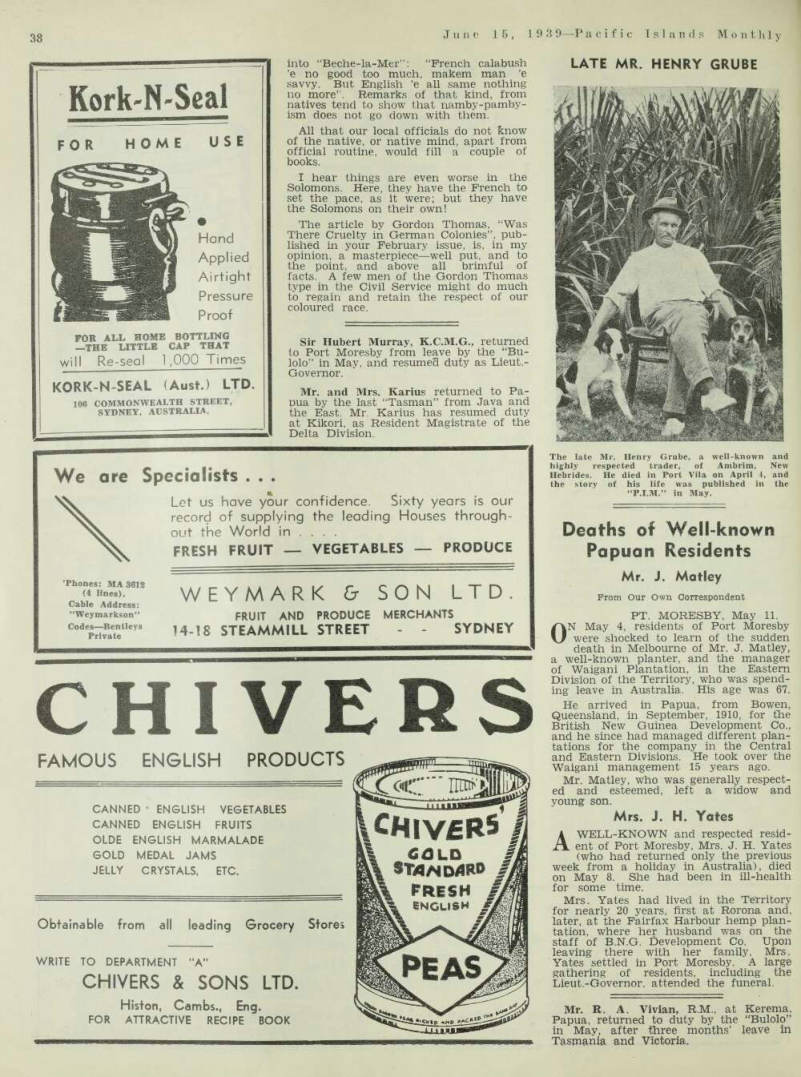
Are British too Kind to Melanesians?
(A British resident of the New Heb rides, in a private letter to the Editor, is outspoken on the subject of British Pacific Administration.) I HAVE read some of your articles, in which you argue that the so-called trained officials of the British Col onial Service, are well qualified to ad minister the affairs of the Pacific Is lands.
Judging by the samples hereabouts that training needs some revising and bring ing up to date. I will quote at random some of our little happenings, just to give you an idea of what the British portion of this group has to put up with.
This one happened on Tongoa. a neighbouring isle. A high official paid a formal visit, so the white population turn ed up en masse, in their “glad rags”, to welcome, and pay their respects to him.
The high official practically ignored them, but singled out a . well-known “half wit", a very cheeky native, to whom he bowed and saluted, and plied with questions as to the welfare of the island the people, etc. All this rather amused the whites, but thoroughly disgusted the village chiefs.
The natives here have a wholesale re spect for and fear of French official dom; but the British. I am sorry to say. are more or less a joke! I have heard natives say on many occasions, to put it
into “Beche-la-Mer”: “French calabush ’e no good too much, makem man ’e savvy. But English ’e all same nothing no more”. Remarks of that kind, from natives tend to show that namby-pamby ism does not go down with them.
All that our local officials do not know of the native, or native mind, apart from official routine, would fill a couple of books.
I hear things are even worse in the Solomons. Here, they have the French to set the pace, as it were; but they have the Solomons on their own!
The article by Gordon Thomas, “Was There Cruelty in German Colonies”, pub lished in your February issue, is, in my opinion, a masterpiece—well put, and to the point, and above all brimful of facts. A few men of the Gordon Thomas type in the Civil Service might do much to regain and retain the respect of our coloured race.
Sir Hubert Murray, K.C.M.G., returned to Port Moresby from leave by the “Bu lolo” in May, and resumed duty as Lieut.- Governor.
Mr. and Mrs. Karius returned to Pa pua by the last “Tasman” from Java and the East. Mr. Karius has resumed duty at Kikori, as Resident Magistrate of the Delta Division.
Advertisements & other items, pp. 41-42 (2 items)
37
Pacific Islands Monthl y—J une 15, 1939
«ulfva»
H. JONES & CO,
AUSTRALIA'S BEST
H. JONES & CO. LTD.,
Darlington, Sydney. Hobart, Tas.
44
ANCHOR FLOUR
THE STANDARD OF QUALITY
f f Mr m
GILLESPIE BROS. PTY. LTD
SYDNEY - AUSTRALIA
Telephones: MJ 4657 (4 lines) and M 2585.
IT z>m
«ulfva»
Cable Address; “Trocas”, Sydney.
379 KENT STREET, SYDNEY.
DUYERS of all Islands requirements on Commission— Original Invoices Furnished. 22 Years Islands Trade Experience.
JSLANDS Produce Sold on Shippers 7 Account Liberal Advances against Consignments.
Bankers: Bank of New South Wales. CORRESPONDENCE IN ENGLISH, FRENCH AND GERMAN.
Kork-N-Scal
FOR HOME USE
9 Hand Applied Airtight Pressure Proof
FOR ALL HOME BOTTLING
—THE LITTLE CAP THAT
will Re-seol 1,000 Times
KORK-N-SEAL (Aush) LTD.
106 COMMONWEALTH STREET,
SYDNEY, AUSTRALIA.
We ore Specialists
Let us have your confidence. Sixty years is our record of supplying the leading Houses throughout the World in ... .
FRESH FRUIT VEGETABLES PRODUCE
’Phones: MA 3612 (4 lines).
Cable Address: "Weymarkson”
Codes —Bentleys Private
WEYMARK & SON LTD.
FRUIT AND PRODUCE MERCHANTS
14-18 STEAMMILL STREET - - SYDNEY
CH
FAMOUS ENGLISH PRODUCTS
CANNED 1 ENGLISH VEGETABLES
CANNED ENGLISH FRUITS
OLDE ENGLISH MARMALADE
GOLD MEDAL JAMS
JELLY CRYSTALS. ETC.
Obtainable from all leading Grocery Stores
WRITE TO DEPARTMENT "A"
CHIVERS & SONS LTD.
Histon, Cambs., Eng.
FOR ATTRACTIVE RECIPE BOOK
nufr'i c< • 11
CHIV£RS
COLD
1 i 3 fresh h
ENGLISH
i
PEAS
paCMP »‘CKtp
Late Mr. Henry Grube
The late Mr. Henry Grube, a well-known and highly respected trader, of Ambrim, New Hebrides. He died in Port Vila on April 4, and the story of his life was published in the “P.I.M.” in May.
Papuan Residents
Deaths of Well-known Papuan Residents Mr. J. Motley
Prom Our Own Correspondent
Pt. Moresby, May 11.
ON May 4, residents of Port Moresby were shocked to learn of the sudden death in Melbourne of Mr. J. Matley, a well-known planter, and the manager of Waigani Plantation, in the Eastern Division of the Territory, who was spend ing leave in Australia. His age was 67, He arrived in Papua, from Bowen, Queensland, in September, 1910, for the British New Guinea Development Co., and he since had managed different plan tations for the company in the Central and Eastern Divisions. He took over the Waigani management 15 years ago.
Mr. Matley, who was generally respect ed and esteemed, left a widow and young son.
Mrs. J. H. Yates
A WELL-KNOWN and respected resid ent of Port Moresby, Mrs. J. H. Yates (who had returned only the previous week from a holiday in Australia), died on May 8. She had been in ill-health for some time.
Mrs. Yates had lived in the Territory for nearly 20 years, first at Rorona and, later, at the Fairfax Harbour hemp plan tation, where her husband was on the staff of B.N.G. development Co. Upon leaving there with her family, Mrs.
Yates settled in Port Moresby. A large gathering of residents, including the Lieut.-Governor, attended the funeral.
Mr. R. A. Vivian, R.M., at Kerema.
Papua, returned to duty by the “Bulolo” in May, after three months’ leave in Tasmania and Victoria.
Advertisements & other items, p. 42 (1 item)
38
June 15, 193 9 —P acific Islands Monthly
Golden-Brown
White Skin Versus Golden-Brown Some Considerations in Favour of the Polynesian
NOW and again, we meet an angry Englishman or a disillusioned Ame rican tourist who is affronted and outraged at the total absence of that fawning reverence the travel books and romances represent as due from native races of the Orient and Pacific Islands, to the superior white man.
We have heard and read many opin ions as to the probable causes of the diminishing prestige of the Caucasian among—what that lordly individual is pleased to term —inferior peoples; but we have never comprehended the really basal reason until we read the following paragraph in Doctor Peter H. Buck’s de lightful and scholarly book, “Vikings of the Sunrise”: “Probably no people have been prouder of their lineages than the mariners of the Pacific. In Polynesian mythology, the god Tane moulded the first woman out of earth, brought her to life by magic power, and made her the mother of the first human being. The descendants of this first union thus partook of divine attributes by direct physiological inherit ance.
“This may appear irrational to scien tists who claim descent from anthropoid apes, but it gave great confidence to chiefly leaders, who in moments of stress could call upon their divine ancestors for assistance whereas western man may ex pect little help from his remote arboreal progenitors”.
When we refresh our memory, the genesis of decay of European prestige in the Orient and elsewhere, actually coin cides with the period when Darwin and his coadjutors deposed their ancestors from the salubrious heights of Olympian glory to the dismal shadows of miasmic jungles.
Had they kept this shattering discov ery as a dark and dreadful secret with in the unpenetrable arcana of some mys tic cult, all might have been well, and the white man continued as the most favoured heir of the Sons of that Golden Age when the gods walked the earth.
But, after the manner of scientists, they and their successors have filled the world with books proclaiming the de gradation of their ancestry, as the pre mier achievement of their craft.
And now that knowledge of it is uni versal. they marvel and are astonished and resentful because those who still are convinced of their own divine ancestry, have ceased to pay reverence to the self proclaimed brother of the Orangutan and Barbary ape.
Moreover it has been observed that Caucasian women are, apparently, ashamed of their white complexion.
When they are not concealing it under paint and powder, they are lying about on sunny sea-beaches trying to darken it. If they can achieve the golden-brown of the Polynesian complexion, their hap piness is complete, and they endeavour to preserve that delectable shade for ever more.
Contrary to general opinion, the white complexion of the Caucasian is neither admired nor envied by Polynesians. His torians tell us that when the first white men appeared, the Tahitians viewed them with sympathy and pity; believing them to be afflicted with some mysterious disease which had robbed their skins of colour and beauty.
The Polynesians—and, no doubt, other
races of the Orient—are endowed with the same discrimination possessed by Caucasians in appraising the measure of a man. If a white man is respected by Polynesians, it is not because of his race; but because of those qualities of charac ter and spirit which have already estab lished him in the esteem of his own fel
lows.-
A.C.R.
Mr. R. A. Laws, of Messrs. Greenwood and Laws Ltd., New Guinea, was a visi tor to Sydney early in June.
Mr, H. S. Russell, Collector of Customs at Samarai, Papua, arrived in Australia by the “Bulolo” recently to undergo medical treatment.
Rev. E. C. Harris, 8.A., of the Method ist Mission, Vavau, Tonga, will return to Australia on leave at the end of the year.
Mr. L. Perichon has been relieving Mr. G. A. Bayer, manager of the Hotel Moresby, at Pt. Moresby, Papua, during the latter’s absence in Australia on holidays.
Advertisements & other items, pp. 43-44 (2 items)
39
Pacific Islands Mont hi y—J une 15, 1939
Plum
PRESCOTT Pty. Ltd.
SUSSEX ST., SYDNEY,
are sole wholesale agents for
PINEAPPLE BACON & HAMS
DAISY brand BUTTER "375" BUTTER in TINS llb.-21b.-slb. Sizes.
LEA & PERRINS’ Sauces nd Most other Super-Quality Lines of the Trade, such as Cheese, Eggs, Etc.
SWALLOW
& ARIELL’S
lllllllllllllllllllllllllllllllllillllllllllllllllllllllllllllllilllllll lllllllllllllllllllllllllllllllllilllllllllllllllllllllllllllllllllllllllllllllllllllllllllllllllllllllllllllllll
PLUM
PUDDINGS
I lb. : 1 lb.
Hlb. :21b. and 3 lb.
Renowned for Quality
Manufactured at Port Melbourne, Australia FIJI REPRESENTATIVES - - PEARCE & CO. LTD.
Safe Milk!
Make certain that your children are protected against the dangers of tropical heat by always keeping a supply of Nestle’s Milk. Hermetically sealed from every
possible danger Nestle’s
Milk is pure and safe and will keep indefinitely while unopened.
NESTLES
FULL CREAM
MILK
BEST, THEREFORE CHEAPEST
Copyright 8211
II SVV «TENEO
>/HL|| . .*'3 i«»* . 4
'«f r NEST BRAND . *
Tm* wt' Condensed Ml
SYDNEY
Memories Of Old
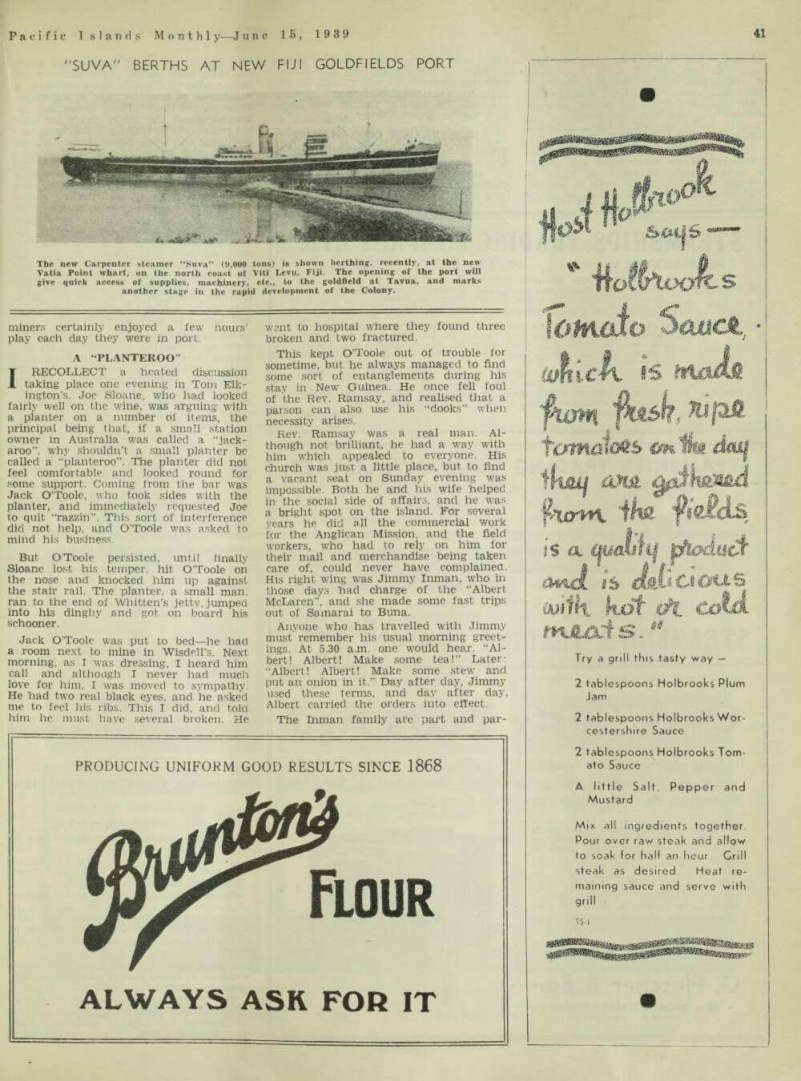
Samarai
By “Wakilobo Of Vilirupu”
NO. 1.
WHEN I first visited Samarai, still sometimes referred to by the older folk as Dinner Island, there were a few of the present residents already there.
But, prominent among those now gone may be included Mrs. Wisdell, whose husband was then known as “Billy the Cook”, the Rev. Ramsay of the Anglican Mission, Mr. W. B. Patching, auctioneer and ginger-pop maker, old Captain In man, etc., etc.
Life on the island in those days (1909- 10) was certainly full of thrills, and it was quite a novelty to one who had only heard of the place. Samarai was the chief commercial centre for the territory, it was from there that the miners did all their recruiting—if not by themselves then through some recognised agent. Of the agents, I should say that Les. Joubert and Ernie Oates were the leaders. Al though others could claim to having the ability to get the boys, Les. and Ernie had the better name, and large numbers of Orokiwais (or Buna Bay boys) knew these two men years before they had ever heard of other recruiters.
A number of alleged illegal methods were fired at Leslie, but he was able to refute them all and in one case, where a bright young Government officer thought he had it all over L.J., the case could not be finished. I wonder if Joubert re members the short speech he made in the Cosmopolitan bar, when the result was known. As at least two of the principals are still living, I am afraid I cannot give it here.
His greatest asset on these recruiting expeditions was little “Sindbad”, his Orokiwai boy. This little fellow was al ways with Leslie, and could almost claim to be his mouth-piece. “Sindbad” was al ways neatly dressed, and took great care of all his master’s equipment, and took care also to see that no one else did.
After the Joubert and Oates partnership.
I think Leslie joined forces with Gus. Nel sson, of Kulumadau and finally linked up with Frank Pryke.
On Samarai itself there was little to do, except at week-ends, when the local whites played the Kwato mission at cricket. Some good games were played, the results being about even. The Kwato boys owed their ability to the training by Mr. C. W. Abel, head of the indus trial side of the mission and he certainly knew how to teach them bowling, at any rate.
There were three hotels—“ Billy the Cook’s” the Cosmopolitan (run by Tom Elkington), the Clunn menage. There was also a School of Arts, overlooked by Mr. Patching. Most of the social life centred naturally around the pubs. Each, one had its turn for parties, and Clunn’s had its regulars. A number of miners al ways made Mrs. Clunn’s their head quarters, also a number went to Mis.
Wisdell’s, the Cosmopoitan being con sidered a bit better class. Joe Sloane, Jack O’Toole and Matt Crowe divided their time between Clunn’s and Wisdell’s.
As the evenings closed in, some would wander off to their rooms, whilst others would make up the gambling set. Poker was the principal game, and some of the
miners certainly enjoyed a few hours’ play each day they were in port.
A “Planteroo”
I RECOLLECT a heated discussion taking place one evening in Tom Elk ington’s. Joe Sloane, who had looked fairly well on the wine, was arguing l with a planter on a number of items, the principal being that, if a small station owner in Australia was called a “jack aroo”. why shouldn’t a small planter be called a “planteroo”. The planter did not feel comfortable and looked round for some support. Coming from the bar was Jack O’Toole, who took sides with the planter, and immediately requested Joe to quit “razzin”. This sort of interference did not help, and O’Toole was asked to mind his business.
But OToole persisted, until finally Sloane lost his temper, hit O’Toole on the nose and knocked him up against the stair rail. The planter, a small man. ran to the end of Whitten’s jetty, jumped into his dinghy and got on board his schooner.
Jack O’Toole was put to bed—he had a room next to mine in Wisde.ll’s. Next morning, as I was dressing, I heard him call and although I never had much love for him, I was moved to sympathy.
He had two real black eyes, and he asked me to feel his ribs. This I did. and told him he must have several broken. He
went to hospital where they found three broken and two fractured.
This kept O’Toole out of trouble for sometime, but he always managed to find some sort of entanglements during his stay in New Guinea. He once fell foul of the Rev. Ramsay, and realised that a parson can also use his “dooks” when necessity arises.
Rev. Ramsay was a real man. Al though not brilliant, he had a way with him which appealed to everyone. His church was just a little place, but to find a vacant seat on Sunday evening was impossible. Both he and his wife helped in the social side of affairs, and he was a bright spot on the island. For several years he did all the commercial work for the Anglican Mission, and the field workers, who had to rely on him for their mail and merchandise being taken care of, could never have complained.
His right wing was Jimmy Inman, who in those days had charge of the “Albert McLaren”, and she made some fast trips out of Samarai to Buna.
Anyone who has travelled with Jimmy must remember his usual morning greet ings. At 5.30 a.m. one would hear. “Al bert! Albert! Make some tea!” Later “ Albert! Albert! Make some stew r and put an onion in it.” Day after day, Jimmy used these terms, and day after day, Albert carried the orders into effect.
The Inman family are part and par
cel of the island, but I do not know how many of them are yet alive. They lived on the point, almost the last house to the left of the wharf. Here Mrs. Inman could look right down the straits, and see whether the “old man” was coming in on time. He had a number of boats, the most famous being the “Makaia”, and his sailings and arrivals on time were uncanny.
Another family whose name will always be allied with Samarai is that of Evenett. They did great work in the recruiting days, and Fred—or Brassy, as we
knew him—was and may still be, a part of Samarai history. Others who will al ways be remembered are the Platts, Flo.
Brabson. Charlie Whitehead, Charlie Arbouin, the Bunting family, Von Brem mer, Leach, Owen Turner,
Fascination Of Samarai
"ITIOR such a small island, there is no I 1 other part of the world where names help so much to make history.
Unlike Port Moresby, all the early set tiers in Samarai seem to have gone there
with a definite idea of settling, and when one looks back on the years, this is more fully realised. What is there on such a small area of land, 56 acres in all, which keeps people there? There is nothing at tractive about the place, except its Cro ton paths. The mainland is decidedly un inviting, and the other large islands nearby, such as Saibei and Rogeia, have nothing on them to help pass the time.
Yet some of the families mentioned have lived on Samarai upwards of 50 years, and their descendants are still staying on.
A number of names keep cropping up before me, and one is that of Hobart Spiller. Hobart was a born wit, his re partee being just so, and oftentimes al most got him into trouble. He was, for a time, supercargo on one of the first BP. coastal boats. Then he came ashore in Samarai. In those days, the Customs closed at 4 p.m. and the clerks were quite autocrats in their own way.
Red tape was their middle name.
But Spiller was more than a match for them on a number of occasions. He was loading a schooner for sailing at day break. and had, so he thought, got all the freight from the customs shed, and clearance papers, etc., fixed. The landing waiter was an English Public School boy call him Smith—and Mr. Smith was in a big hurry to close the shed and go play cricket. At about 5 minutes to 4 Spiller found he could not possibly comple f e the shifting of the cargo in time to allow the shed to close, so applied for permission to pay overtime, which was given. He then saw the Collector, and had the per mit signed, and told his boys they need not hurry, as the shed would not be closed until 5 p.m. Mr. Smith fussed and fumed and told Spiller he could easily have the freight out by 4.10 p.m. Spiller agreed, but, as he had to pay for one hour’s overtime, he was seHnsf that fhe Customs Officer earned that overtime.
Had Smith agreed to the extra few min utes, he could have got away at 4.15, and enjoyed his game of cricket.
How many, I wonder, remember “Flo” or Miss Brabson? She was about the only white who could neither read nor write, and when she got mail from her home in England, she would display such real joy, that everyone, who knew of her in ability must have felt very deeply for her.
However she managed to get to a place like Samarai, and stay there, is one of those mysteries which are unfathomable.
(To Be Continued)
Advertisements & other items, p. 44 (1 item)
40
June 15, 193 9 — P acific Islands Monthly
"Suva" Berths At New Fiji Goldfields Port
The new Carpenter steamer “Snva” (9,000 tons) is shown berthing, recently, at the new Vatia Point wharf, on the north coast of Viti Levu, Fiji. The opening of the port will give quick access of supplies, machinery, etc., to the goldfield at Tavua, and marks another stage in the rapid development of the Colony.
Advertisements & other items, pp. 45-46 (2 items)
41
Pacific Islands Monthl y—J une 15, 1939
Flour
6 Jl *
ftoM **
'O o
Sat|S
*■ H M§ yk
Hofhook
OHicdo Satie*.,
mtdch is
*ifa£
tonuitoes mi &e dmf
iiiOif iVtJI
fwn 'fftt fist
ss «, <j juauftf product
lAvuJt 16 rfftt Cl OttS
ouiik kof(A a
mjtcds. u
Try a grill this tasty way 2 tablespoons Holbrooks Plum Jam 2 tablespoons Holbrooks Worcestershire Sauce 2 tablespoons Holbrooks Tomato Sauce A little Salt, Pepper and Mustard Mix all ingredients together.
Pour over raw steak and allow to soak for half an hour Grill steak as desired. Heat remaining sauce and serve with grill IS-1
PRODUCING UNIFORM GOOD RESULTS SINCE 1868
Flour
ALWAYS ASK FOB IT
STEAMSHIPS TRADING COMPANY LTD.
PORT MORESBY PAPUA SAMARA I
Chairman and Managing Director: A. S. FITCH.
Shipowners, Wholesale and Retail Merchants and Traders; Shipping, Customs and Insurance Agents; Copra and Rubber Plantation Owners.
MAIL CONTRACTORS TO COMMONWEALTH AND PAPUAN GOVERNMENTS.
AGENCIES: —At Port Moresby: Coral Sea Insurance Co.: Phoenix Insurance Co.; Delta Sawmills, Ltd.; Acme Bakery Co.; Vacuum Oil Co., Pty., Ltd. At Samara!: Coral Sea Insurance Co.; Delta Sawmills, Ltd.; Bankers and Traders’
Insurance Co.; National Mutual Life Insurance Co.; Kularo Shipyards; Mamal Plantations, BRANCHES: —In Papua: Hanuabada, Sivltol, Aroma, Kokl, Hula. Ela Beach, Duga Duga, Yule Island.
SYDNEY: NELSON & ROBERTSON PTY. LTD., 12 Spring St.; Melbourne, 396 Flinders Lane: London, E. Whiteaway & Co., 7 Chiswell Street, Finsbury, London.
Cable Address: “STEAMSHIPS.” Code: Bentley’s.
STEAMSHIPS TRADING COMPANY, LIMITED.
' MERCHANTS, SHIPOWNERS AND PLANTERS
PORT MORESBY AND SAMARA I.
Our organisation provides every facility and efficient service as
MANAGING AGENTS AND VISITING REPRESENTATIVES OF
COCONUT AND RUBBER PLANTATIONS
Estates supervised in bearing and planting stages.
Comprehensive reports compiled and regular visits made to Estates by our competent Plantation Inspector.
WRITE, CABLE OR CALL FOR PARTICULARS:
STEAMSHIPS TRADING COMPANY LTD.
Over Thirty Years Ago
The first Younger Stove was exported to the Pacific Islands. Ruggedly strong in construction, highly efficient and economical in fuel, has made them the most popular stove in the South Seas.
The illustration shows a Younger Single Oven Stove. Special stoves, with cast iron ovens for Island requirements made to order. Write us for quotations for special sizes and catalogue of double and single oven stoves.
G. Fletcher & Son
50 OXFORD STREET. SYDNEY
How To Control Crayfish
From Our Own Correspondent
Honolulu, May 10.
IP crayfish have been drilling holes in the dykes surrounding your taro patches, get in touch with Dr. Joseph E. Alicata, of the University of Hawaii exneriment station, at Honolulu.
Dr. Alicata has worked out a method of control, by using copper sulohate in the irrigation water. If not watched with vigilance, the crayfish holes cause loss of irrigation water, and, in some cases, the dykes collapse.
A proportion of one pound of copper sulphate to 10,000 pounds of water is suffi cient to control the destructive crayfish.
The crayfish causing havoc in Hawaii were imported by a local resident anxious to improve the diet of his frogs. Then they became a pest for the taro farmers.
Advertisements & other items, p. 46 (1 item)
42
June 15, 193 9—P acific Islands Monthly
A King For A Day
Thrill for Tourists in French Oceania
From Our Own Correspondent
Papeete, May 5.
PROBABLY there is no man in all the forty-eight States of the American Republic who —having witnessed the pageant of a civic welcome to a base-ball hero, the annual spectacle of the tinsel robed figure of the Imperial Potentate of the Mystic Shrine receiving the plau dits of some metropolis, or the divine honours accorded the highest paid cine ma actor of the period—does not har bour in the secret recesses of his mind the ardent wish that Fate, one day, may grant him one brief hour of glory.
Our Tahitian psychologists have sensed this longing and have set a stage to satisfy this hidden desire.
The tourist, residing at one of the country inns, is informed that the na tives of the district wish to show him honour. He is conducted to a shady palm grove near the shore of the sea, or to a delectable glen in the heart of the hills.
There he is received with princely cour tesy, crowned with flowers, garlanded with fragrant maire, and seated at a sumptuous feast.
Replete with food and wassail, he is installed in a chair of state and blossom ed-decked singers and dancers appear.
The wassail-bowl is placed near at hand and his glass kept full by an obsequious attendant.
The exotic surroundings, the mounting exhilaration from his libations, the rhy thm of the drums, the memory of the
romances he has read, waft him to a world of illusion where he is a noble cast away on a primitive island, receiving the homage and entertainment accorded to high chiefs and Polynesian kings. He is kept in this dream world until the sun goes down.
When, a few days later, he comes into Papeete, he is aglow with the memory.
On the steamer, he recounts his apothe osis daily to the lady passengers. Ar rived at home, he lectures about it in the Town Hall, to his fellow citizens (carefully deleting any reference to the wassail-bowl, lest the Ladies’ Temperance Auxiliary cast him into outer darkness), and writes a full account for the county newspapers.
He never knows that the expenses of his royal day have been craftily inter woven into the ordinary items of his hotel bill.
It would make little difference if he did. A dream of a lifetime has come true.
He has been a king for a day.
Famous Old Sailing Ships
From Our Own Correspondent.
Honolulu, May 12.
r[IS item may stir old memories.
The U.S. Maritime Commission has de cided to name a new fleet of Govern ment-built cargo-steamers for 20 of the most famous American Clippers.
The names: Donald McKay, Flying Cloud, Lightning, Rainbow, Nightingale, Stag Hound. Shooting Star, Flying Fish, Sword Fish, Surprise, Comet, Raven.
Challenge, Northern Light, Sweepstakes, Sea Witch, Hornet. Twilight, Sea Ser pent, and Meteor.
The “Donald McMay” was chosen not only for an able clipper, but in memory of the man who perhaps more than any other developed this type of wessel and thus projected one of the greatest and most successful adventures in the his tory of the world ship-building.
The “Flying Cloud’’ generally is con sidered to have been McKay’s most note worthy ship. “Lightning” was the swift est, having logged 436 sea miles in one period of 24 hours. “Nightingale” was a pioneer in the Australian trade, a re markable ship that in the 42 years of her life sailed every ocean on the globe.
Bishop Of Tahiti
From Our Own. Correspondent
Papeete, May 10.
WITH the august ceremonies of the Roman Catholic Church, Pere Paul Mazet was consecrated Vicaire Apostolique de Tahiti, at the Cathedral at Papeete, on Sunday, May 1.
The consecrating prelate was Mon seigneur Lecarde, Vicaire Apostolique of the Marquesas Islands.
The Diocese of Tahiti includes not only the Islands of the Society Group, but the Tuamotu Archipelago, the Austral Islands, and the far-away Gambiers, where the first mission of the church in Central Polynesia was established over a century ago.
A plan for providing Port Vila (New Hebrides) with electric light and power has been completed and approved by the local authorities.
Advertisements & other items, pp. 47-48 (2 items)
43
Pacific I s lands Monthl y—J mie 15, 1939
“CenCnruqal Pumps
DIESELS For HARD JOBS ■ r h ■ c , n EVERY KIND oF PLOW
Fetter Crude Oil Engines
Valveless, Iwo-stroke Fetter patent cold starter. Low fuel consumption. Perfect lubrication. 6 to 21 B.H.P. Stationary and portable types. Send lor new catalogue just published.
Single or twostage, 1-in. to 6-in.
Direct-coupled vee belt or chain drive.
For Every Kind of Job
from singlefurrow mouldboard to heavy-duty tractor-drawn road plow. Long experience of specialized manufacturing gives leadership. Strength, without unnecessary weight, makes "BUZACOTT" the best plow you can buy. Let us quote for the plow you need. gxi*«cgft££o l .ele Y I flwwKcaHWWfcUelw I ITO II MARKET STREET SYDNEY. \JJL) 7TO II MARKET STREET SYDNEY. (23)
7TO II MARKET STREET SYDNEY.
PETROLECTRICLIGHT ■ CUTS LOGS QUICKLY ■ ONE-MAN CLEARING
BUZACOTT FETTER
800 Watt - 32 Volt Home Lighting Plant Dependable and very economical for the moderate size farm home.
Buzacotl Petrol-Kerosene 2 H.P. Series ”W“ engine, with multiple vee-belt drive to oversize generator.
Complete with battery, switchboard and push-button starting. Send for particulars.
Engine-driven saw for cutting logs up to 7 ft. diameter. Easily operated by one man. Propels itself.
Write to-day for descriptive folders.
"New Record"
Drag
Saw
"DIGGER” WINCH
Has enormous power, light weight, very compact. One man can operate. Easy to move around. Most powerful winch for its size. Does not dance around the ropes. Write to-day for descriptive folders.
I B«»«tcotts£ol*eW Y I gxrzolo V
7TO II MARKET STREET SYDNEY.
7TO II MARKET STREET SYDNEY.
7TO II MARKET STREET SYDNEY
Full details of these or any other machinery lines FREE on request.
BUZACOTT-WOLSELEY Ltd., 7-11 Market St., SYDNEY, N.S.W.
r <3 m U J ‘ &
SHELL
MOTOR SPIRIT
Shell develops greater power, gives much better top-gear performance on hills, saves many change-downs and therefore saves petrol. On short and long runs, for stopping and starting, Shell gives miles to the gallon by reason of its higher energy content.
When starting you get into top sooner.
When accelerating, you get instant pick-up because of the extra volatility of Shell. os 59/i E
A Famous Cannibal
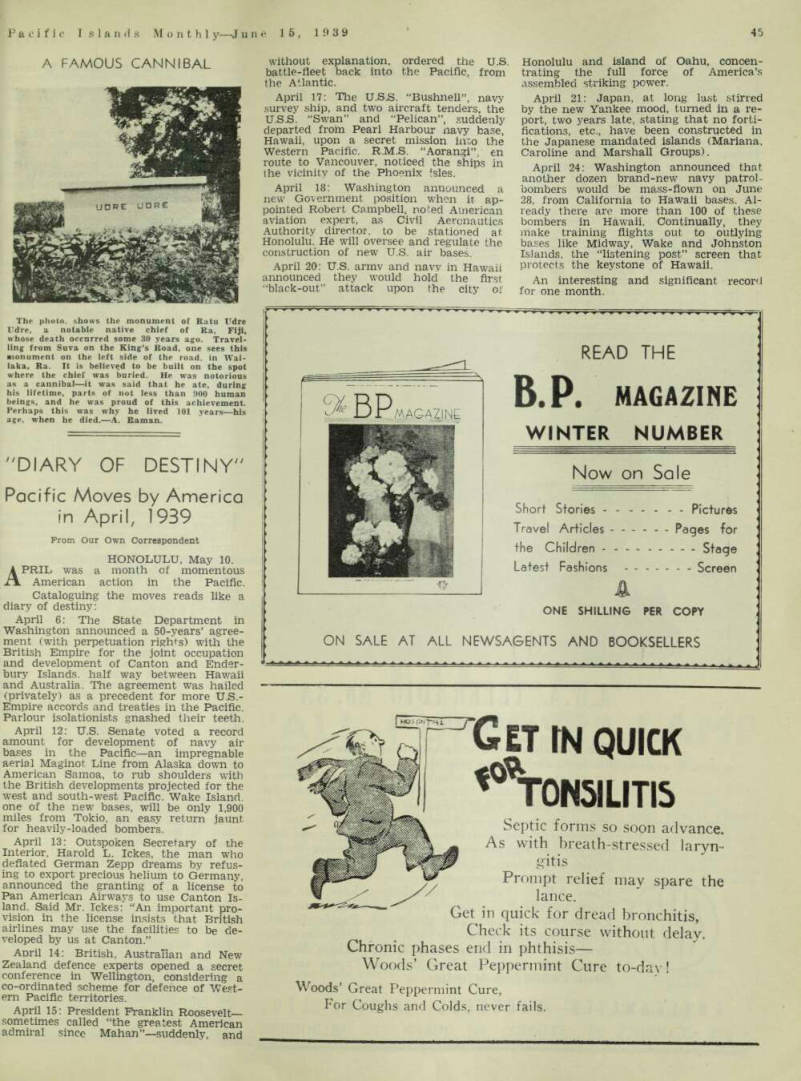
The photo, shows the monument of Ratu Udre Udre, a notable native chief of Ra, Fiji, whose death occurred some 30 years ago. Travel ling from Suva on the King’s Road, one sees this monument on the left side of the road, in Wai laka, Ra. It is believed to be built on the spot where the chief was buried. He was notorious as a cannibal —it was said that he ate, during his lifetime, parts of not less than 900 human beings, and he was proud of this achievement.
Perhaps this was why he lived 101 years—his age, when he died.—A. Raman.
"Diary Of Destiny"
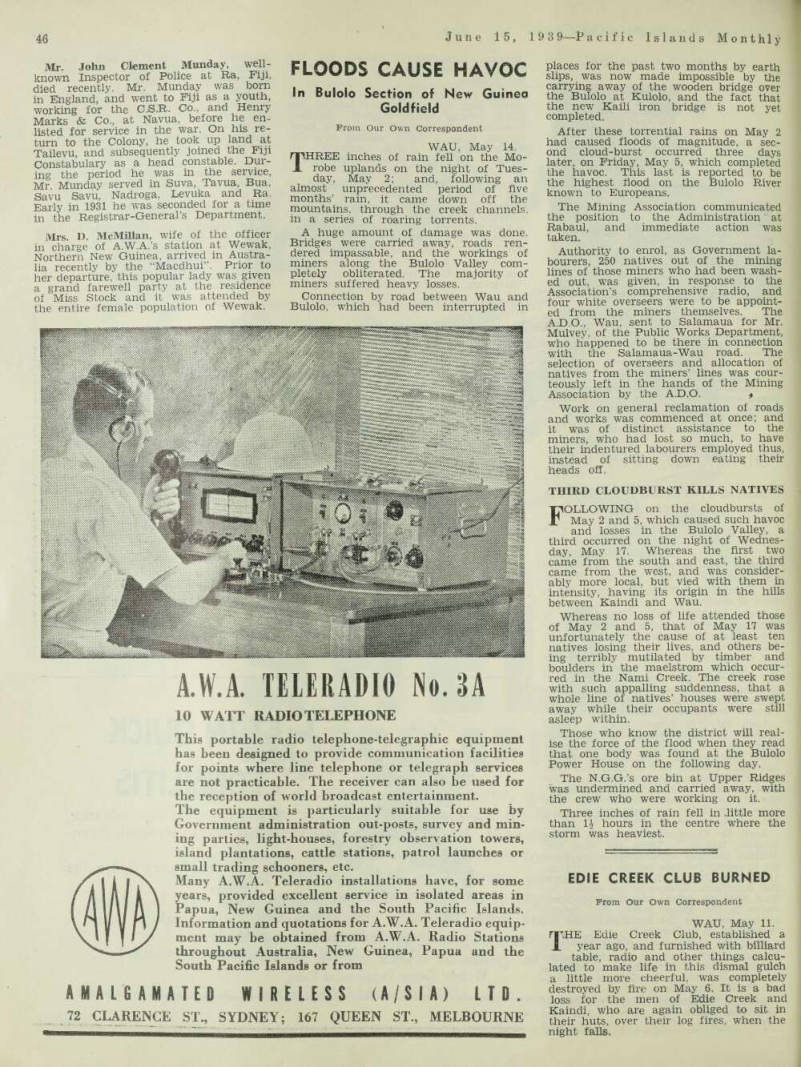
Pacific Moves by America in April, 1939
Prom Our Own Correspondent
Honolulu, May 10.
APRIL was a month of momentous American action in the Pacific.
Cataloguing the moves reads like a diary of destiny: April 6: The State Department in Washington announced a 50-years’ agree ment (with perpetuation rights) with the British Empire for the joint occupation and development of Canton and Ender bury Islands, half way between Hawaii and Australia. The agreement was hailed (privately) as a precedent for more U.S.- Empire accords and treaties in the Pacific.
Parlour isolationists gnashed their teeth.
April 12: U.S. Senate voted a record amount for development of navy air bases in the Pacific—an impregnable aerial Maginot Line from Alaska down to American Samoa, to rub shoulders with the British developments projected for the west and south-west Pacific. Wake Island, one of the new bases, will be only 1,900 miles from Tokio, an easy return jaunt for heavily-loaded bombers.
April 13: Outspoken Secretary of the Interior, Harold L. Ickes, the man who deflated German Zepp dreams by refus ing to export precious helium to Germany, announced the granting of a license to Pan American Airways to use Canton Is land. Said Mr. Ickes: “An important pro vision in the license insists that British airlines may use the facilities to be de veloped by us at Canton.”
Anril 14: British, Australian and New Zealand defence experts opened a secret conference in Wellington, considering a co-ordinated scheme for defence of West ern Pacific territories.
April 15: President Franklin Roosevelt— sometimes called “the greatest American admiral since Mahan”—suddenly, and
without explanation, ordered the U.S. battle-fleet back into the Pacific, from the Atlantic.
April 17: The U.S.S. “Bushnell”, navy survey ship, and two aircraft tenders, the U.SJ3. “Swan” and “Pelican”, suddenly departed from Pearl Harbour navy base, Hawaii, upon a secret mission iiiuo the Western Pacific. R.M.S. “Aorangi”, en route to Vancouver, noticed the ships in the vicinity of the Phoenix isles.
April 18: Washington announced a new Government position when it ap pointed Robert Campbell, noted American aviation expert, as Civil Aeronautics Authority director, to be stationed at Honolulu. He will oversee and regulate the construction of new U.S. air bases.
April 20: U.S. army and navy in Hawaii announced they would hold the first “black-out” attack upon the city of
Honolulu and island of Oahu, concen trating the full force of America’s assembled striking power.
April 21: Japan, at long last stirred by the new Yankee mood, turned in a re port, two years late, stating that no forti fications, etc., have been constructed in the Japanese mandated islands (Mariana, Caroline and Marshall Groups), April 24: Washington announced that another dozen brand-new navy patrol bombers would be mass-flown on June 28, from California to Hawaii bases. Al ready there are more than 100 of these bombers in Hawaii, Continually, they make training flights out to outlying bases like Midway, Wake and Johnston Islands, the “listening post” screen that protects the keystone of Hawaii.
An interesting and significant record for one month.
Mr. John Clement Munday, well known Inspector of Police at Ra, Fiji, died recently. Mr. Munday was born in England, and went to Fiji as a youth, working for the C.S.R. Co., and Henry Marks & Co., at Navua, before he en listed for service in the war. On his re turn to the Colony, he took up land at Tailevu, and subsequently joined the Fiji Constabulary as a head constable. Dur ing the period he was in the service, Mr. Munday served in Suva, Tavua, Bua, Savu Savu, Nadroga, Levuka and Ra.
Early in 1931 he was seconded for a time in the Registrar-General’s Department.
Mrs. D. McMillan, wife of the officer in charge of A.W.A.’s station at Wewak, Northern New Guinea, arrived in Austra lia recently by the “Macdhui”. Prior to her departure, this popular lady was given a grand farewell party at the residence of Miss Stock and it was attended by the entire female population of Wewak.
Advertisements & other items, pp. 49-50 (2 items)
45
Pacific Islands Mont hi y—J une 15, 1939
B.P. Magazine
READ THE
WINTER NUMBER
Now on Sole Short Stories Pictures Travel Articles Pages for the Children Stage Latest Fashions Screen A
ONE SHILLING PER COPY
ON SALE AT ALL NEWSAGENTS AND BOOKSELLERS BP
ZTi
Git in quick
TOMSILITIS
Septic forms so soon advance, As with breath-stressed larynoitis Prompt relief may spare the lance.
Get in quick for dread bronchitis, Check its course without delay.
Chronic phases end in phthisis— Woods’ Great Peppermint Cure to-day!
Woods’ Great Peppermint Cure, For Coughs and Colds, never fails.
s*v Q
A.W.A. TELERADIO No. 8A
10 WAIT RADIOTELEPHONE
This portable radio telephone-telegraphic equipment has been designed to provide communication facilities for points where line telephone or telegraph services are not practicable. The receiver can also be used for the reception of world broadcast entertainment.
The equipment is particularly suitable for use by Government administration out-posts, survey and mining parties, light-houses, forestry observation towers, island plantations, cattle stations, patrol launches or small trading schooners, etc.
Many A.W.A. Teleradio installations have, for some years, provided excellent service in isolated areas in Papua, New Guinea and the South Pacific Islands.
Information and quotations for A.W.A. Teleradio equipment may be obtained from A.W.A. Radio Stations throughout Australia, New Guinea, Papua and the South Pacific Islands or from
AMALGAMATED WIRELESS (A/SI A) LTD.
72 CLARENCE ST., SYDNEY; 167 QUEEN ST., MELBOURNE
Floods Cause Havoc
In Bulolo Section of New Guinea Goldfield
Prom Our Own Correspondent WAU, May 14. r-REE inches of rain fell on the Mo robe uplands on the night of Tues day, May 2; and, following an almost unprecedented period of five months’ rain, it came down off the mountains, through the creek channels, in a series of roaring torrents.
A huge amount of damage was done.
Bridges were carried away, roads ren dered impassable, and the workings of miners along the Bulolo Valley com pletely obliterated. The majority of miners suffered heavy losses.
Connection by road between Wau and Bulolo, which had been interrupted in
places for the past two months by earth slips, was now made impossible by the carrying away of the wooden bridge over the Bulolo at Kulolo, and the fact that the new Kaili iron bridge is not yet completed.
After these torrential rains on May 2 had caused floods of magnitude, a sec ond cloud-burst occurred three days later, on Friday, May 5, which completed the havoc. This last is reported to be the highest flood on the Bulolo River known to Europeans.
The Mining Association communicated the position to the Administration at Rabaul, and immediate action was taken.
Authority to enrol, as Government la bourers, 250 natives out of the mining lines of those miners who had been wash ed out, was given, in response to the Association’s comprehensive radio, and four white overseers were to be appoint ed from the miners themselves. The A.D.0., Wau, sent to Salamaua for Mr.
Mulvey, of the Public Works Department, who happened to be there in connection with the Salamaua-Wau road. The selection of overseers and allocation of natives from the miners’ lines was cour teously left in the hands of the Mining Association by the A.D.O. * Work on general reclamation of roads and works was commenced at once; and it was of distinct assistance to the miners, who had lost so much, to have their indentured labourers employed thus, instead of sitting down eating their heads off.
Third Cloudburst Kills Natives
Following on the cloudbursts of May 2 and 5, which caused such havoc and losses in the Bulolo Valley, a third occurred on the night of Wednes day, May 17. Whereas the first two came from the south and east, the third came from the west, and was consider ably more local, but vied with them in intensity, having its origin in the hills between Kaindi and Wau.
Whereas no loss of life attended those of May 2 and 5. that of May 17 was unfortunately the cause of at least ten natives losing their lives, and others be ing terribly mutilated by timber and boulders in the maelstrom which occur red in the Nami Creek, The creek rose with such appalling suddenness, that a whole line of natives’ houses were swept away while their occupants were still asleep within.
Those who know the district will real ise the force of the flood when they read that one body was found at the Bulolo Power House on the following day.
The N.G.G.’s ore bin at Upper Ridges was undermined and carried away, with the crew who were working on it.
Three inches of rain fell in .little more than li hours in the centre where the storm was heaviest.
Eoie Creek Club Burned
Prom Our Own Correspondent WAU, May 11.
TiHE Edie Creek Club, established a year ago, and furnished with billiard table, radio and other things calcu lated to make life in this dismal gulch a little more cheerful, was completely destroyed by fire on May 6. It is a bad loss for the men of Edie Creek and Kaindi, who are again obliged to sit in their huts, over their log fires, when the night falls.
Advertisements & other items, p. 50 (1 item)
46
June 15, 193 9 — P acific Islands Monthly
Crocodile Is
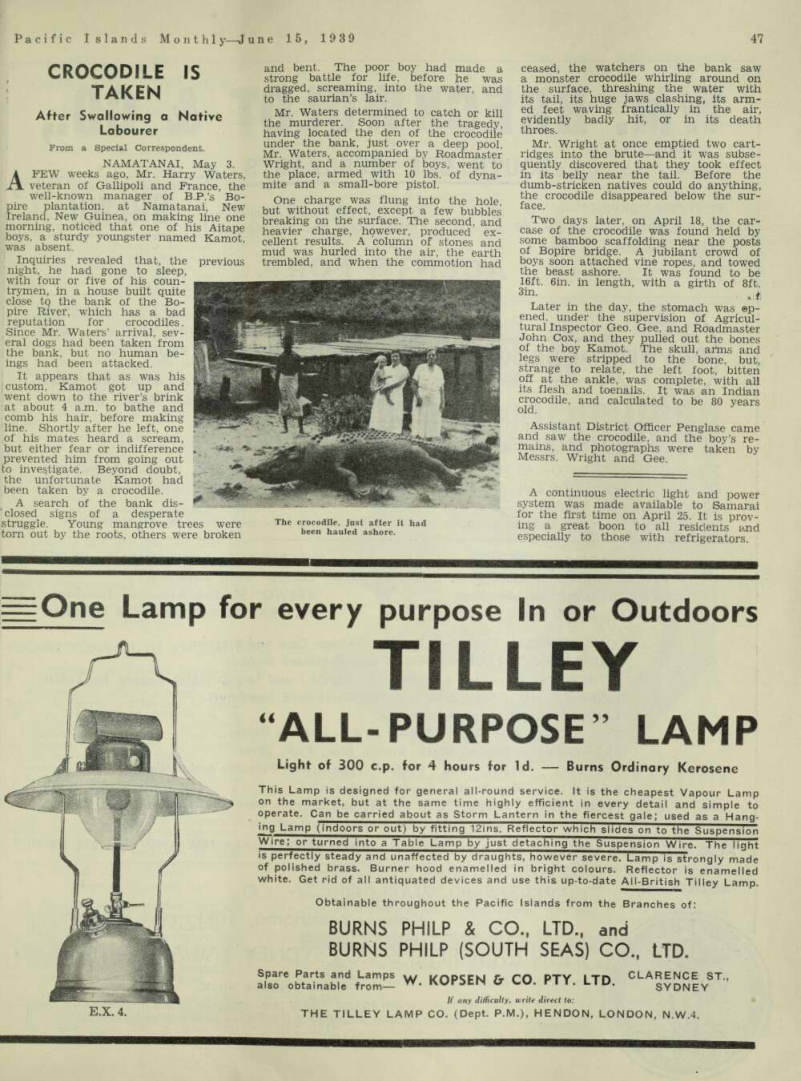
Taken
After Swallowing a Native Labourer
From a Special Correspondent.
Namatanai, May 3.
A FEW weeks ago, Mr. Harry Waters, veteran of Gallipoli and France, the well-known manager of B.P.’s Bo pire plantation, at Namatanai, New Ireland, New Guinea, on making line one morning, noticed that one of his Aitape boys, a sturdy youngster named Kamot, was absent.
Inquiries revealed that, the previous
night, he had gone to sleep, with four or five of his coun trymen, in a house built quite close tp the bank of the Bo pire River, which has a bad reputation for crocodiles.
Since Mr. Waters’ arrival, sev eral dogs had been taken from the bank, but no human be ings had been attacked.
It appears that as was his custom, Kamot got up and went down to the river’s brink at about 4 a.m. to bathe and comb his hair, before making line. Shortly after he left, one of his mates heard a scream, but either fear or indifference prevented him from going out to investigate. Beyond doubt, the unfortunate Kamot had been taken by a crocodile.
A search of the bank dis closed signs of a desperate
struggle. Young mangrove trees were torn out by the roots, others were broken
and bent. The poor boy had made a strong battle for life, before he was dragged, screaming, into the water, and to the saurian’s lair.
Mr. Waters determined to catch or kill the murderer. Soon after the tragedy, having located the den of the crocodile under the bank, just over a deep pool, Mr. Waters, accompanied by Roadmaster Wright, and a number of boys, went to the place, armed with 10 lbs. of dyna mite and a small-bore pistol.
One charge was flung into the hole, but without effect, except a few bubbles breaking on the surface. The second, and heavier charge, however, produced ex cellent results. A column of stones and mud was hurled into the air, the earth trembled, and when the commotion had
ceased, the watchers on the bank saw a monster crocodile whirling around on the surface, threshing the water with its tail, its huge jaws clashing, its arm ed feet waving frantically in the air, evidently badly hit, or in its death throes.
Mr. Wright at once emptied two cart ridges into the brute —and it was subse quently discovered that they took effect in its belly near the tail. Before the dumb-stricken natives could do anything, the crocodile disappeared below the sur face.
Two days later, on April 18, the car case of the crocodile was found held by some bamboo scaffolding near the posts of Bopire bridge. A jubilant crowd of boys soon attached vine ropes, and towed the beast ashore. It was found to be 16ft. 6in. in length, with a girth of Bft.
Sin. f * 1 1, Later in the day, the stomach was op ened, under the supervision of Agricul tural Inspector Geo. Gee, and Roadmaster John Cox, and they pulled out the bones of the boy Kamot. The skull, arms and legs were stripped to the bone, but, strange to relate, the left foot, bitten off at the ankle, was complete, with all its flesh and toenails. It was an Indian crocodile, and calculated to be 80 years old.
Assistant District Officer Penglase came and saw the crocodile, and the boy’s re mains, and photographs were taken by Messrs. Wright and Gee.
A continuous electric light and power system was made available to Samarai for the first time on April 25. It is prov ing a great boon to all residents and especially to those with refrigerators.
The crocodile, just after it had been hauled ashore.
Advertisements & other items, pp. 51-52 (2 items)
Tilley
One Lamp for every purpose In or Outdoors ii
ALL-PURPOSE” LAMP
E.X. 4.
Light of 300 c.p. for 4 hours for Id. Burns Ordinary Kerosene This Lamp is designed for general all-round service. It is the cheapest Vapour Lamp on the market, but at the same time highly efficient in every detail and simple to operate. Can be carried about as Storm Lantern in the fiercest gale; used as a Hanging Lamp (indoors or out) by fitting 12ins. Reflector which slides on to the Suspension Wire; or turned into a Table Lamp by just detaching the Suspension Wire. The light is perfectly steady and unaffected by draughts, however severe. Lamp is strongly made of polished brass. Burner hood enamelled in bright colours. Reflector is enamelled white. Get rid of all antiquated devices and use this up-to-date All-British Tilley Lamp.
Obtainable throughout the Pacific Islands from the Branches of:
BURNS PHILP & CO., LTD., and
BURNS PHILP (SOUTH SEAS) CO., LTD.
Spare Parts and Lamps Fv CO PTY ITH CLARENCE ST., also obtainable from— W * KOPiEN & L.U. PIT. LTD. SYDNEY If any difficulty, write direct to: THE TILLEY LAMP CO. (Dept. P.M.), HENDON, LONDON, N.W.4.
WM. BRECKWOLDT & CO.,
SOUTH SEA MERCHANTS
TELEGRAPHIC ADDRESS:
NEW GUINEA: —P.O. Box 89, Robaul. SAMOA:—P.O. Box 124, Apia.
FIJI: —p.O. Box 111, Suva.
POSTAL ADDRESSES:—
TAHITI:—P.O. Box 60, Papeete.
AGENTS FOR. ..
BAYER MEDICINES
ATEBRIN— THE PROTECTION AGAINST MALARIA
ASPIRIN BAYER— THE GENUINE ASPIRIN— AND
ALL OTHER BAYER PRODUCTS.
STOCK ALWAYS AVAILABLE AT OUR BRANCHES.
All Orders Executed at Original "Boyer" Prices.
MERCEDES-BENZ DIESEL TRUCKS
2 Tonner Type, L. ],500 -45 H.P.Just arrived in Rabaul for demonstration. Fuel consumption— -28 miles on one gallon only of SHELL DIESOLINE, costing about in Rabaul. Lubricating Oil—Shell Dervoil Medium.
Prices for all types, up to loading capacity of 12,000 lbs., and for special types, on application.
"CONTINENTAL" Tyres and Tubes for Motor Cars and Bicycles.
"DEUTZ" and "MERCEDES-BENZ" Diesel Marine Engines.
"PETROMAX" Hurricane Lanterns (Incandesc.) and Lamps. (Not Agents for Tahiti).
"TIGER BRAND" Corrugated and Flat Galvanised Ironsheets.
"TAIFUN" Bicycles and Accessories.
"TWO LIONS" Best Known Quality of A.l. Butcher Knives.
"BREWO" Razor Blades, Black, Brown, Blue, Pink, Silver.
"TORPEDO", "BIJOU" and "ERfCA" Typewriters, Portable and Office.
"BECK' S" "Key Brand" German Lager.
"TELEFUNKEN" Wireless Sets, Battery and Current. Best results obtained.
Many Sold. Ever-increasing Turnover.
SISO ALL TRADE LINES OF GERMAN, BRITISH, CONTINENTAL, JAPANESE AND CHINESE ORIGIN
LIEBERMANN. WAELCHLI & CO.,
Kobe, Yokohama, Tokio and Shanghai.
JOHN CAMPBELL & CO., SYDNEY. (Ail Australian Goods.) HANOMAG" Diesel Tractors.
ANCRE" Cast Iron Sauce Pots.
FROWO" Hurricane Lanterns.
ARARA" Gas Stoves.
VESTA" Sewing Machines.
LOHSE" Uralt Lavender.
BREWO" Swedish Axes and Hatchets, ARVIKA" Swedish Axes and Hatchets.
Our Trademark.
PLEASE NOTE:
[We sell WHOLESALE ONLY but. upon application, we will supply the”! names of firms at all places in the Pacific Islands retailing our goods.
48
June 15, 193 O—P ucific Islands Monthly
N. Guinea Residents
Demand Defence
How Movement Commenced
Prom Our Own Correspondent WAU, May 30. mHE organisation formed by New Guinea A residents, to demand that some means of defence be devised, to be used in the event of a national emerg ency, is getting results. The organisation represents a rebellion against the head quarters of the Returned Soldiers’ Lea gue, (which is in Rabaul) and it is called the Morobe Voluntary Defence Advisory Committee. The chairman of the com mittee, who is, incidentally, also presi dent of the R.S. & S.I.L.A. in the Mo robe District, Mr. E. A. Feldt, was sum moned to Rabaul in May and discussed the situation and the aims of the com mittee with the Administrator (Sir Wal ter McNicoll).
It appears that rifle clubs in all main centres have been authorised; sites for ranges are to be selected forthwith; rifles are to be loaned by the Administration, and ammunition provided; and a regis ter of eligible men is already well in hand.
Details of comprehensive plans and or ganisation of action, in the event of ac tual aggression, have been received in Wau from the Administrator. This or ganisation is Territory-wide and deals not only with internal defence, but with the evacuation of. or placing in safe areas, of non-combatant Europeans and natives. The organisation is at present secret.
It seems a pity that the fact that the Administration has applied itself to such a scheme has been withheld for so long.
It would have been better had the com munity been informed that their welfare was not being entirely disregarded during the anxious days of the past six months.
Young Tongan In England
IT is reported in London newspapers that a young Tongan named Tasi Kalaniuwalu, who is a cousin of the Queen of Tonga, is returning to Tonga via New Zealand, as a steward on one of the big passenger boats. He has been in England for 18 months studying farm ing, engineering and hotel management, and he has made many friends.
Because Tongans are very rarely seen in England—some people said that this was the first Tongan ever to visit Eng land, but that, of course, is absurd—a good deal of fuss was made over Tasi, and he has been feted, and featured in broadcast interviews. He told the news papers that he is returning to Tonga to ooen a hotel of his own. and to assist Tongan farmers in adopting more ad vanced methods of agriculture.
Mr. Reginald William Carlow, who had returned to his home at Samarai. East ern Papua, from leave in Australia, by the “Bulolo” only a week previously, died on May 12, He was 47 years of age, and is survived by his widow, Mrs. Vera Car low. and his mother, an old resident of many years’ standing in Samarai.
Mr. William Bentley, eldest son of Mr.
Henry Bentley, late of Fiji, married Miss Annie Moir, third daughter of Mr. James Moir. of Wellington, N.Z., in Suva, Fiji, in May.
Cruise Of "The Duff"
Letter to the Editor IN an article by Julian Dashwood, on page 17 of your issue of March, there are some incorrect and misleading statements regarding the despatch of missionaries to the South Sea Islands in the ship “Duff”, which Mr. Dashwood says is “familiar history”. As so many people believe everything they see in print, it behoves writers on historical sub jects to be accurate.
According to “Transactions of the Mis sionary Society” the “Duff”, under the command of Captain James Wilson, left England in August, 1796, with the first party of missionaries (29), landed them safely at their various destinations, and returned to England. Some time after wards (the date is not given) the “Duff”, this time under the command of Captain
Thos. Robson, was despatched on her second voyage to the South Sea Islands, having about 30 missionaries on board.
It was on this voyage that she was cap tured by a French privateer.
I am, etc.,
J. D. Mccomish.
Norfolk Is., May 4, 1939.
Samara! Gets a Wetting
Samarai, May 22.
SAMARAI has been experiencing some heavy rain during the last two months. April recorded 1289 points and May to the 20th showed a reading of 1992 points. Rain has fallen every day this month to date and on the even ing of the 3rd torrential rain fell—l2lo points being registered for the 24 hours.
Advertisements & other items, p. 53 (2 items)
49
Pacific Islands Monthl y —J une 15, 1939
Mail This Coupon To-Day
hi m
B i • Boards of Sheet-steel strength, impermeable, weatherproof—boards of Masonite Tempered Presdwood! Tempered Presdwood, properly applied, will never warp, crack or splinter. It is grainless and will take any grade of paint or lacquer. It is easy to work and is supplied in sheets of handy size and just the right thicknesses. For your barns, sheds and outhouses—for any type of construction which must stand up to all weathers and conditions. Masonite Tempered Presdwood, the manufactured all-wood boards in 4 ft. widths up to 12 ft. in length, has a hundred advantages over natural timber. The samples will convince you.
CANE-ITE
Insulation of all buildings for the housing of stock, poultry, etc., means better health conditions and higher output. Caneite, the white-ant proofed, non-warping non-sagging cane in solation boards, pro vide the most inexpensive yet highly effective medium for profitable insulation
MAIL THIS COUPON TO-DAY
THE COLONIAL SUGAR REFINING CO. LTD. (Building Materials Division)*.
Harwood House, 5 O’Connell Street, Sydney.
NAME
ADDRESS 36 t~ 6 -
♦Please send me free sample and details of () MASONITE () CANE-ITE. MA 28-9 I I I I I I i ■ i
Across North Pacific By Junk
ON June 2, John Anderson sailed from Kochi in an attempt t(3 cross the Pacific to San Francisco in a 29-tons iunk. He encountered trouble last month when sailing his junk from Shanghai to Japan. The auxiliary engine broke down.
Richard Haliburton. an American au thor set out earlier this year to sail a iunk across the Pacific, but has not been heard of for a long time.
Mrs. Chalmers, wife of Major Chalmers, in command of the R.A.A. in Papua, ar rived at Port Moresby by the Macdhui on May 21. She was accompanied by her three children and Miss Chalmers, a niece of Major Chalmers.
Leiataua Mana. a well-known chief of Manono Island, Western Samoa, died recently after a long illness. He was a member of the Fono of Faipule and one of the Faipule delegation which visited New Zealand two years ago.
Gold-Seekers
Lighter Costs For
New Guinea and Gold Royalty
THE request made in the Federal Par liament a year ago by the member for Kalgoorlie (Mr. Green), that the 5 per cent, imposed on the export of gold by the New Guinea Administration should be abolished so far as “small" miners and prospectors are concerned, appears to be still “under consideration".
Early in May, Mr. Green asked if any thing had been done, and the Minister now in charge of Australian Territories (Mr. Perkins) said that the matter had been examined by the Administrator of New Guinea, and considered by the Executive Council, but no finality had yet been reached.
It probably will be found that the Ad ministration is in favour of the principle of the proposal, but that it is difficult to find any method by which it may be put into operation.
At first glance, it seems simple enough to say that a small miner, or prospec tor, entitled to the concession, would be a man whose total net income did not exceed a certain amount; but the intro duction of such a system would mean, of course, that there would be an obligation upon all gold producers to submit to the Administration, each year, a return somewhat similar to the accursed income tax return which has to be submitted by practically every person in more civ ilised countries. That is the one thing above all others that the New Guinea community should avoid. One of the main attractions of life in the Pacific Territories now is that the people there are free of income tax.
There is another objection to the sys tem. If it were once agreed that men with a certain net income should not pay the gold royalty, it is inevitable that various other men with larger incomes would transfer certain of their gold ex ports to their less fortunate friends, and the whole system thereby would be abused.
Yet it is not only desirable, but de finitely necessary, that some relief in the form suggested be given to the small miners and prospectors in New Guinea.
There still are large numbers of them there, and their expenses—represented chiefly in labour and transport—are very heavy. During the past 15 years they have worked all the richer and more accessible gold deposits and, for the most part, have made profits which have en abled them to pay the 5 per cent, roy alty without hardship. But now the day has come when the gold deposits still available to them are not so rich, and unless some part of the expenses is removed, a considerable section of these individual miners and prospectors will go out of the country.
This obviously would be a calamity for the Territory. From every point of view, it would be to the advantage of the Ad ministration to encourage these men to remain and continue their industry.
Lighter costs will make the poorer gold deposits profitable. It should not be be yond the ability of a competent Admin istrator to find a method of giving the small men this suggested measure of re lief. without dislocating the financial system or opening the door to a series of abuses.
Rev. G. T. Warren, formerly of the Me lanesian Mission station at Maravovo, Solomon Islands, has taken up work in the parish of St. Martin’s, Croydon, Eng land.
Advertisements & other items, p. 54 (3 items)
50
June 15, 103 O—P acific Islands Monthly
Cordage and
ScottV'Renown” Brand Rope,
Cable Address: Ropeyard, Sydney. £*B
Binder
Twine
of Every
Description
MANUFACTURED AT
MASCOT, NS W.
By
J. SCOTT
PTY. LTD,
Head Office and Store
163 CLARENCE STREET,
SYDNEY,
N.S.W.
Refrigeration...
As. 9 2
JAMES BUDGE
ltd
REFRIGERATION...
'‘BUDGE" Automatic or Manually-controlled Refrigeration- and Ice-making Plants, with or without Insulated Cabinets or Rooms, ranging from 4 cubic feet to 1000 cubic feet or larger, using ammonia in the large and sulphur dioxide (SO2) in the small units.
Where electricity is not available, crude oil engines may be utilised for driving the larger plants and petrol engines for driving the smaller machines. The accompanying illustration is of a petrol engine driven SO2 unit. Enquirers please state power available (If any), size of cabinet and amount of Ice required per day.
JAMES BUDGE PTY. LIMITED
REFRIGERATION AND GENERAL ENGINEERS
McEvoy and Harley Streets ALEXANDRIA S Y D N E Y Established 1890
ENGINEERING WORKSHOPS
ALL CLASSES OF MACHINES MADE AND RECONDITIONED
Samoa's Defence Force
From Our Own Correspondent
Apia, May 7.
AS previously announced, the N.Z. Gov ernment has decided to raise in Western Samoa a volunteer defence force for the purpose of internal police and local defence, in an emergency.
In addition to the Territorial Force of untrained younger men, the Government resolved to create an emergency reserve force composed of older men with some military training, mostly returned sol diers of British and allied countries. The organisation of this force is now prac tically completed: every able-bodied Eu ropean eligible to the force has now been attested and training is proceeding satisfactorily. Members of the force ap pear to be keen to attain a high stand ard of efficiency.
The following officers have been ap pointed to the Force: Lieutenant-Colonel W. C. Harley, Commanding Officer, sec onded from the Nelson Marlborough and West Coast Regiment: Captain T. V.
Fitzpatrick (North Auckland Regt.); Lieutenant E. T. Pleasants (Wellington West Coast Regt.); Lieutenant A. S.
Batty (Auckland Regt.); Lieutenant J.
K. H. Clark (N.Z. Corps of Signals); Lieutenant Pilot Officer *A. W. R. Coker (Royal N.Z. Air Force).
Polynesian Club
THE Polynesian Club held a successful gathering on May 2 at the club room,
250 a George Street, Sydney. Poly
nesian dancing was the feature of the evening, the “Siva faa Samoa” being gracefully danced by Mrs. Charlotte Corn pain, of Tailevu, and Miss Peggy Aspin all, of Penang, Fiji. Under the direction of Mrs. Wiki Byron, of Rotorua, the Maori ladies of the club gave an exhi bition of “Poi Poneke”, “TPoi poto ma roa” and the ever-popular “Poi waka”, the Maori canoe poi.
The president (Mr. Leonard Moran) displayed a “Tabua”. the gift of Miss Margaret Whitcombe, of Levuka, and lec tured briefly on the significance of the whale’s tooth in old Fiji and its relative importance to-day.
Among the Islands people present were: Mrs. Lembke (Taisi) and Miss Christina Hellescoe, of Apia. Samoa; Mr. “Bill”
Goodman, formerly of Suva, who enter tained Mr. George Griffin, a new arrival from Fiji; Miss Everett, a descendant of Adams of the “Bounty”; Mrs. Lamacraft, of Nukualofa; Mrs. E. Gosnell, a chiefly • lady of Rotuma, Fiji, with three members of her family. The president and the club secretary. <Miss Frances Tie) entertained Madame Andriesse. formerly of Java. Lieutenants Purvis and Milner. R.A.N., Dr. Selby, and Mrs. Katerina Nehua Darley.
Phenomenal Rainfall On
Pitcairn
GREAT damage was done by a pheno menal rainfall on Pitcairn Island two hours before daylight on Mav 15.
It is estimated the damage will ‘ take years to repair. Twelve inches of rain fell in four hours.
Landslides carried many timber and food trees down the hillsides to the waterfront.
Mrs. Gladys Taylor, of Suva, Fiji, re turned to the Colony at the end of Mav after several months’ visit to Japan.
Advertisements & other items, pp. 55-56 (2 items)
51
Pacific Islands Monthl y—J un e 15, 1039
Nock E Kirby Ltd
i i i NOCK & KIRBY LTD
with a Johnson Iron-Horse Generator
ELECTRIC LIGHT
For Your Home
COSTS ONLY
• 300 Wans • 12 Volts
Lights 12 25 -Watt Globes
Have the extra comfort and convenience of ELECTRIC LIGHT FOR YOUR HOME. POWER FOR YOUR RADIO and POWER FOR CHARGING BATTERIES by installing a “JOHNSON”
IRON-HORSE GENERATOR. It will enable you to burn 3 lights for 3£ hours every night, and costs you only 1 - per week.
You no longer need to be inconvenienced with old-style lighting —the messy, dangerous and oldfashioned lamps—when ELEC- TRIC LIGHT, the boon of today’s civilisation, is now available quickly and economically, with
“JOHNSON” IRON - HORSE
GENERATOR.
Here are a Few of the more Important Features : 300 WATTS ... 12 VOLTS . . . Lights 12-25 Watt Globes . . .
ELECTRIC STARTING—just push a button . . . FULL RANGE CONTROL. . . Special Built-in Generator Powered by a Johnson Iron Horse 4-Cycle Petrol Engine . . . AUTOMATIC CUT-OUT disconnects when not running . . . Quiet Operation.
Minimum Vibration. 4 fiuMt y wm & £24/10/- ('ASH PRICE, with 70 Amp. Battery ex bond Approx, cost per Point for Material Only 12/6. Weight when packed 100 lbs.
Delivered to Main Island Ports FREE
NOCK & KIRBY LTD., BOX 4250 Y, G.P.0., SYDNEY. j Please forward me without obligation, a copy of the Illustrated “Johnson” Iron-Horse Generator Folder.
NAME j
ADDRESS
NOCK e KIRBY LTD
Stop Kidney
Poisoning To-day
If you suffer from Rheumatism, Sciatica, Neuritis? Lumbago, Pains in Back Nervousness, Dizziness, Circles under Eyes, Leg Pams, Poor Appetite and Energy, Puffy Ankles, Burning, Smarting Passages, or have frequently to Get Up Nights, etc., you should know that your system is being poisoned because germs, acids and wastes are impairing the vital functioning process of your kidneys. Take care I Ordinary medicines can’t help much and you must stop these troubles by removing the cause with Cystex which starts benefit in 2 hours and is offered on generous terms — No Benefit — No Pay. Cystex—the doctor’s prescription—is approved by doctors and chemists in 73 countries, and over 90,000 people have written to say how pleased they are to have found the right medicine for their troubles.^
One-time Sufferers PralseThls Medicine
Mr. R. T., Townsville, Queensland, recently wrote : 44 My joints were all stiff, I had leg pains, my hack used to ache day and night. My bladder teas weak. I had headaches and no appetite.
The first dose of Cystex helped me and before I finished three boxes my health and strength came Mrs. M. L. Z., Thompson Estate, Brisbane : “/ have been taking Cystex for Kidney and Bladder trouble and it has made a different woman of me, I am feeling splendid, can do all my work, run about and walk miles although I am 63 years of age. Cystex does all you claim for it."
Cystex Helps Nature 3 Ways
Gets rid of health-destroying, deadly poisonous acids. Kills the germs which are infecting kidneys, bladder and urinary system. Helps nature to strengthen and reinvigorate kidneys and protects against further attack.
Guaranteed to Put You Right or Money Back Get Cystex from your chemist today. Give it a thorough test.
Cystex is guaranteed to make you feel younger, stronger, better in every way, in 24 hours and to be completely well in 1 week or your money bank if you return the empty package. Act now! Now in 3 sizes—l/9, 4/-, 8/-.
CYSTEX
This is a
GUARANTEED
Remedy
for Your Kidneys, Bladder, Rheumatism
Cystex
h « -v. h o '/ s. /> GERMS of Diphtheria, Malaria, Dhobie Itch, Tinea or Surfers’ Foot, cannot live under “TENAX” lather.
Tropical Skin Diseases can be cured by its regular use.
only 9° P er
fable*
NO VARIATION HAS BEEN MADE
IN ITS COMPOSITION—judged
from the only true angle, that of quality, TENAX has no competitors a satisfactory germicidal soap, eleven times as rapid in action as carbolic, yet NON-IRRITANT and NON-POISONOUS. The Medical Journal of Australia states that TENAX is a germicidal soap that may be recommended with confidence.
GENUINE
GERMICIDAL
/TENAX:
SOAP
I A PRODUCT OF AUSTRALIAN SOAPS LTD.
Wau Pays Homage On Anzac Day
Over 70 returned soldiers of the Morobe District, New Guinea, gathered at Wan cemetery on April 25 to honour Anzac Day and an appropriate cere mony took place at the graves of fallen comrades.
A guard of honour of native constabulary with buglers attended.
In the background of the photo are Golden Ridges (in the distance) and the approach to Kaindi.
Jap. Pearlers In Northern
Waters
TiHE usual reply, that the Minister for the Interior was giving attention to the whole matter oi pearling in northern waters, was given to Mr. W.
J. Riordan (Qld.) in the Federal Par liament when he asked whether the Gov ernment intended to patrol those waters by seaplane to protect the local industry against foreign encroachment. He de clared that the Commonwealth patrol launch “Viligant” was useless for the purpose.
Mr. Riordan said that the last annual report of the Northern Territory showed that between 4,000 and 5,000 tons of pearl shell were fished out of Thursday Island and Northern Territory waters by Japanese pearlers, compared with about 800 tons recovered by local pearlers.
Mrs. C. R. Bignell, who took over the lease of the Hotel Rabaul, in New Guinea, some years ago, has decided not to renew the lease, and other arrange ments are now being made for the future conduct and management of the well-known establishment. There now are three hotels in Rabaul —namely, the Hotel Rabaul, the Hotel Pacific, and the Cosmopolitan Hotel—and it is possible that some co-operative arrangement will be made between two of them, which will affect the future conduct of the Hotel Rabaul.
Rats!
A Village Policeman Cleans Up Paama
SOUTHWARDS from Ambrim, one of the larger islands of the New Heb rides Group, lies the small rectangu lar island of Paama, where the natives, like most other islanders of that part of the Pacific, depend almost wholly upon copra for a livelihood and as a means of purchasing the European goods they have become accustomed to use.
In recent years, however, the Paamese have been in a minor state of pertur bation and despair. It appears that a plague of rats had been responsible for a depressing decrease in copra production (and, consequently, pocket-money!) by interfering with the coconut trees to such an extent that nuts were falling before maturing.
Then, nearly two years ago, a native who had been a policeman at Vila, the capital of the Group, returned to his village at Paama. He noticed the gloom, took stock of the situation—and ordered a dozen rat traps through a European trader. On his own initiative, he walk ed around the whole island, stopping at each village to hold “Down With Rats!” meetings, and urging the natives to help rid Paama of the pests.
The idea caught on; and the gloom disappeared like beer at a “wharfies’” picnic. In scattered villages, all over Paama. natives bought traps, set them, and gleefully surveyed the results—dur ing 18 months over 27,000 rats were killed.
To-day, copra production has risen, the Paamese are happy again, and the ex-policeman, enjoying well-earned ku dos, now spends his time wandering around the island, whipping up enthus iasm at meetings and carefully adding the latest score to his mounting tally of ex tinct rodents
Two Sailors Desert At
Samoa
Prom Our Own Correspondent
Apia, May 10.
nnHE Swedish motor-vessel “Tisnaren” 1 left Apia on May 8 with 1,800 tons of copra and 300 sacks of cocobeans for Continental markets—but minus two sailors.
Three of the crew, no doubt attracted by our Samoan beauties, deserted the ship in Apia. Though the police suc ceeded in finding one of the men, the other two (an Australian and an Eng lishman) are still at large.
Mr. Marc T. Greene, well-known Ame rican journalist, arrived in Suva in the middle of May, and after spending a few days in Fiji went on bv the Union com pany’s vessel to Tahiti.
Advertisements & other items, pp. 56-57 (3 items)
52
June 15, 193 9—P acific Islands Monthly
53
Pacific Islands Monthl y—J une 15, 1989
Wm. Breckwoldt & Co.
y f you listen to the sound as transmitted by our modern Telefunken-Super, you have the impression of seeing that fine fellow just in front of you. - Nothing will beat it in its sound true to life. The famous Telefunken-Supers called “CARMEN*’, “TOSCA" and "AIDA" have become standarded instruments of beauty in sound and of world reception. In more than 70 countries of the 5 continents, there are Telefunken radiosets, the best proof for the confidence of the whole world in the produces of Telefunken. And the latest models; “UNDINE** and “ARIADNE" are marvels of perfection and of beauty-sound, corresponding exactly to the sound produced in the transmitting-room. The new apparatusses have been developed after the same principles of technical reliability and efficiency as these of the transmitting-stations constructed by Telefunken.
Kindly apply to one of our branches, which will be pleased to give you further details.
P. O. Box 89, R A BAD L, New Guinea • P. O. Box 111, SUVA, Fiji Isles P.0.80x 124, APIA, Samoa . P.0.80x 60, PA PETE, Tahiti
Marquesas Drought Broken

From Our Own Correspondent
Papeete, May 10.
CIAPTAIN MERVIN, of the “Denise”. , reports that the drought in the Marquesas Group has bioken at all the Islands except Ua-Pou. This is rather extraordinary, as Ua-Pou is but 30 miles distant from Nukuhiva (where ample rain is now falling) and p<pssesses the highest mountains in the archipelago.
Yet Captain Mervin tells us, while the other Islands now are green with re vived plant life. Ua-Pou remains and,
and its plants and trees are still with ered and yellow.
Ua-Pou had the reputation, 30 years ago. of being a dangerous island. It was said that the natives there were still cannibals. Perhaps this story gained be lief because some of the elder natives had faces marked with tatoo and looked very fierce. More likely it was invented to give a thrill to tourists. Certainly the story has never been verified.
Miss Margaret Bechervaise, of the New Guinea Mission station at Sefoa. Papua, has been on furlough in Victoria.
"Flying Battleships" for Port Moresby Development
Port Moresby Development of Defence Plan
IT was announced at the end of May that the Australian air force, whicn is to be stationed in Port Moresby, will be one of major importance.
An undisclosed number of highly arm ed. lour-engined, Short Sunderland fly ing boats will arrive in Australia from Britain within a few months to be used for reconnaissance purposes off the coast of Australia. They will be at tached to No. 10 Squadron (which has been formed for purposes of general re connaissance) and which squadron will be divided between the new bases, which are being prepared at Lake Macquarie (between Sydney and Newcastle, on the eastern coast of Australia), and at Port Moresby, in Papua.
Each of these new flying boats will carry a crew of seven, and they will be the largest aeroplanes in the service of the Royal Australian Air Force, as well as being the only four-engined ma chines. The Sunderland is the military equivalent of the new Empire flying boat. It has a wing span of 109 feet, and a loaded weight of nearly 20 tons, and it can carry 30 or 40 men over short distances. The Sunderland has been called “The Flying Battleship”.
There appears to be considerable ac tivity in preparing and organising this new and important air force, which is to be the eyes and the ears of the Australian defence organisation; but all the more intimate details, including the number of flying boats to be used, are —very properly—being kept an official secret.
Aeroplane Mishap
AN R.A.A.F. Seagull amphibian, in charge of Flight Lieutenant W. M.
Gibson, with a crew of four, arrived in Port Moresby on May 21, from Aus tralia, to assist in the naval survey of Port Moresby and district which is being carried out under the direction of Lieut.-Commander Hunt, R.A.N., who ar rived by the “Macdhui” on the same day.
The machine, which was moored in the harbour, opposite the R.A.A. camp, at Konedobu, broke her moorings on May 25. during a heavy south-east squall and, drifting on to the reef off Tatana Is land, was badly damaged.
Another R.A.A.F. Seagull amphibian arrived on May 30 to take the place of the damaged machine.
“Annex And Amalgamate!”
TWO members of the Victorian Parlia ment, Dr. Clive Shields and Mr. A.
J. Kir ton, on returning to Sydney from New Guinea and Papua, late in May, expressed a number of emphatic opinions in the newspapers.
They urged that New Guinea should be annexed by Australia; that a strong defence line stretching from the Dutch East Indies through the New Guinea islands to the Solomons should be es tablished: that a base for a central air, navy and mobile military force should be made at Samarai; and that radio stations and landing grounds should be made available wherever necessary. They argued that with this defence organisa tion Australia would provide a barrier which would oppose and delay any enemy approaching from Asia.
Dr. Shields urged that a non-voting member should be elected to the Com monwealth Parliament, to represent the
interests of “the amalgamated territor ies of New Guinea and Papua”. He roundly condemned the failure of the New Guinea Government to encourage settlement in the Territory. He also said that the majority of opinions heard by the travellers in the two Territories were in favour of complete amalgamation of the two Territories.
Activity At Port Moresby
From Our Own Correspondent
Pt. Moresby, May 20.
MEMBERS of the 13th Heavy Battery, Royal Australian Artillery, now stationed at Port Moresby, have put in the foundations for their guns, on Paga Hill, since their arrival, and a great deal of heavy equipment has been trans ported to the site.
It is understood that a party of naval men will make a survey of the port in regard to Navy requirements.
Nothing definite has been heard about the further activities of the Air Force, but rumours state that negotiations are proceeding for the acquisition of a site on the harbour foreshore for a seaplane base.
The Lieut.-Governor. on May 11, in spected the various military works which had been carried out during his recent absence on furlough.
A public meeting on May 11. arranged by Major Chalmers (in command of the Battery), took steps to form a Militia Unit for Port Moresby, to co-operate with the garrison and the civilian population.
Judge Gore presided. A committee com prising Messrs. W. D. Brown. G. Moore.
F. E. Williams and E. J. Frame, was formed to assist the project. Major Chal mers asked those prepared to join the unit to hand in their names, and 39 names were submitted.
Advertisements & other items, p. 58 (2 items)
54
June 15, 193 9—P acific Islands Monthly
Danks’ for Building Supplies
WRITE FOR CATALOGUE
iitii
KMI
Baths, Basins, Heaters, Wallboard, Asbestos Board, Galvanised Iron, Cooking Ranges.
“Petromax”
Rapid Kerosene Hurricane Lanterns and table lamps, burn Kerosene.
Light on Kerosene in 30 seconds.
Latest models.
In BOND PRICES for PETROMAX
LAMPS AND LANiEKi'.S.
200 C.P. Lanterns, £2/16/6. 300 C.P. Rapid Lanterns, £3/5/-.
Old preheating type lanterns using petrol for starting. 200 C.P. Lanterns £2/6/6. 300 C.P. Lanterns £2/16/-. 200 C.P. Rapid Table Lambs £3/7/6. 300 C.P. Rapid Table Lamps £3/16/6.
Engineers and Plumber’s Brasswork.
Locksets. T Rpfrie- Garden Tools * Bituminous erators, in Tools of Trade.
Roofing Qak & ’ steel Bergers Paints.
Sheet Lead. Wallpaper., “Nox” Electric Lamps, Garden Hose, Sprinklers.
Bath Heaters. ‘Billabong” Windmills, Pumps, Water Piping.
Brass Cocks. . • P
foe SCHOOL
'.WQMESTtAP.
bells r
No for P
JOHN DANKS & SON
PROPRIETARY LIMITED (Incorp. in Victoria). 324-330 Pitt Street, SYDNEY.
And at Melbourne.
/ <r \j m s
It's CHEAPER to PAINT
than to repair!
DISTRIBUTORS:
Greenwood & Laws Ltd., Rabaul and Wau.
Steamships Trading Co. Ltd., Port Moresby and Samarai.
Millers, Ltd., Suva, FIJI.
Decay can do no damage if your home is properlyprotected with good paint.
Use “8.A.L.M.” Paint— “B.A.L.M.” Paint gives protection. And it wears down evenly and very slowly, lasting years longer than ordinary paint.
Decide now to save money by painting; and decide to make maximum savings by using - - - - “8.A.L.M.” Paint!
'PA I ft Tf"
A Product of British Australian Lead Manufacturers Pty. Ltd.,
Samoan Produce Prices
Rise
From Our Own Correspondent
Apia, May 11.
FOLLOWING the increase in prices on the European and American mar kets, local copra buyers have raised the Samoan price from 2 6 to 4/per 100 lbs. With dry weather ruling, it is expected that native and European producers will begin cutting large quan tities of copra and that trade generally, especially in Savaii and the outlying dis tricts, will greatly improve.
There is also reported an improvement in the cocoa price. A consignment was sold in America a few days ago at 81 cents c.i.f. San Francisco—the highest price obtained for Samoan cocoabeans for a considerable time.
The Cost Of Living In
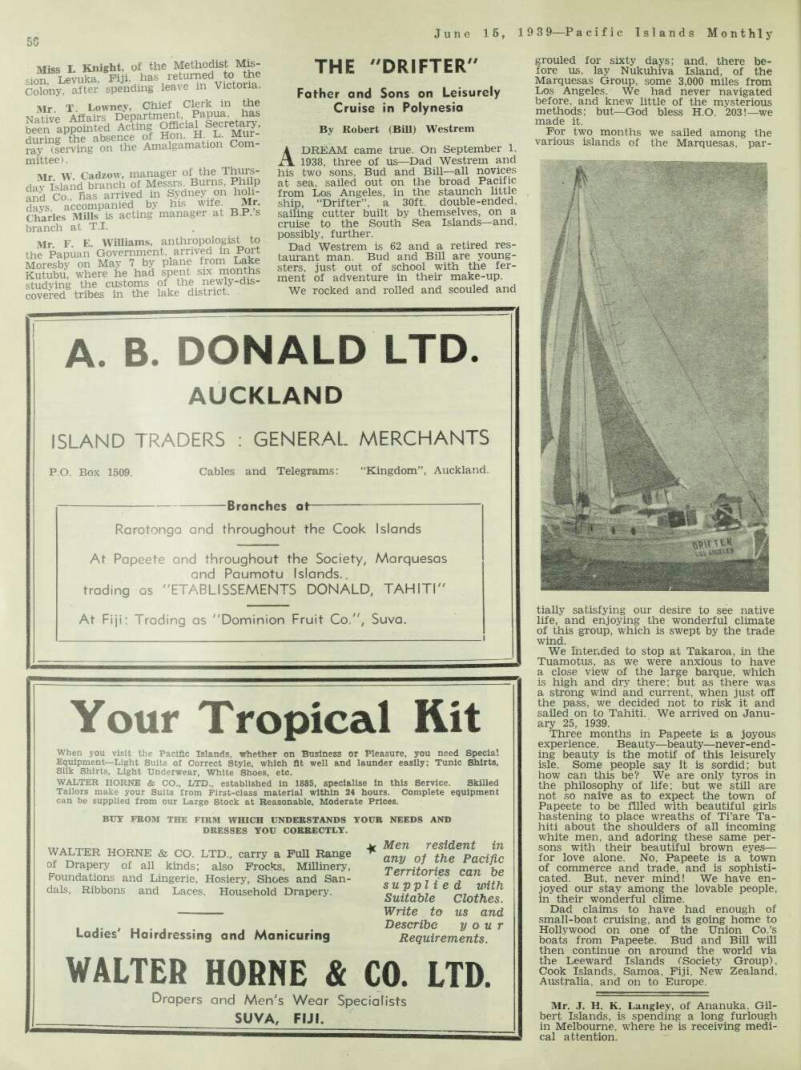
Tahiti
From Our Own Correspondent
. Papeete. May 5.
F the intelligence brought by travellers and letters is to be believed, there are mighty thunder-heads forming over the horizon to the North-east, and the storm is headed toward Tahiti. This commotion it appears, was stirred up by an article in the “American Mercury” (republished in the “P.1.M.”).
This article represents -'.the Tahitian Islands as a newly-discovered country as yet untouched by the tribulations of a tortured world —as a place where Euro peans may live happily on a very small income.
Should people of ample means accept as truth the romantic nonsense written about the South Seas and embark on the voyage to seek the unattainable, there is no harm done. Many of them adjust their minds to the fact that the Islands are as much a part of the world as any other community, and make the best of it. The others return to the place whence they came, having lost nothing but their time.
But. for people of slender resources, it is another matter.
They should remember that Tahiti was discovered in the year 1767; that it has been frequented by Europeans for over a century, that the people living there are as enlightened and accustomed to the ways of the world as are the inhabitants of any other land.
And. finally, they should write to the Consul of their country at Papeete for full information as to living conditions, before committing their fortunes to a perilous adventure.
Rev. H. Freer Lane, who is engaged in Mission work for the New Guinea Mis sion at Menapi, Papua, will return to the Territory by the “Macdhui” on June 21. Mr. Lane, who has been in Adelaide, S.A.. will be accompanied by his wife.
Miss I. Knight, of the Methodist Misunn Levuka Fiji, has returned to the Colony, after spending leave in Victoria.
Native has been appointed Acting S ? during the absence of Hon. H. d. wiur ray (serving on the Amalgamation uommittee) Mr W Cadzow, manager of the Thursriav Island branch of Messrs. Burns, Philp ro has arrived in Sydney on hohaccompanied by his wife. Mr. rharips Mills is acting manager at B.P.’s branch at TI .. ' , . . .
Mr F. E<
the Papuan amved m P Moresby on May 7 by plane homLake Kutubu, where he had p n ewlv-discovert tribes in the lake district.
Advertisements & other items, pp. 59-60 (2 items)
55
Pacific Islands Monthl y—J une 15, 1939
” Wunderlich
Timber, Joinery
ETC.
PREPARED BUILDINGS ready for erection a speciality.
SHIP AND BOAT BUILDING.
TIMBERS specially catered for.
FIBROLITE, PLYWOODS. GALVANISED
IRON.
CONSIGNMENTS shipped
by RETURN STEAMERS
to the Islands.
John W. Eaton
PTY. LTD.
WEST CRESCENT STREET
NORTH SYDNEY
Telephones: X 84051 (6 lines.)
BITUMENOID ROOFING
MADE IN AUSTRALIA.
Bitumenoid Roofings, Dampcourse and Insulating Felts are made from the world’s best raw materials. Warranted to stand the most rigid tests.
BITUMENOID THE BEST
Roofing, 1. 2. 3-ply; Flooring, Waterproof Materials: Saturated Felt; Resilient Road Jointing; Natural Asphalt Dampcourse; 2 and 3-ply Dampcourse; 1-2 lb. Lead-core Dampcourse; Roofing Cement; Asphalt Paints; Roofing Compound.
SAMPLES AND PRICE LISTS ON APPLICATION.
MAXWELL PORTER & SON LTD.
ESTABLISHED 1888. BUILDERS’ SUPPLIES.
107 EEDFERN ST., REDFERN, SYDNEY, N.S.W. ’Phone: M 3157. Cables Bitumenoid.
«•>«££& •2SS-‘‘~ Obtain a copy before you build.
It contains designs and plans —in colour—-of Homes that can be nexpensively built with
WUNDERLICH DURABESTOS,
the indestructible asbestos-cement building sheeting. Write to
WUNDERLICH LIMITED
5.P.0., Box 474 aa, SYDNEY
FOR TROPICAL BUILDINGS, SPECIFY
” WUNDERLICH
/ DURABESTCS
ASBESTOS CEMENT BUILDING SHEETS
A. B. DONALD LTD.
AUCKLAND
ISLAND TRADERS ; GENERAL MERCHANTS
P.O. Box 1509. Cables and Telegrams: “Kingdom”, Auckland.
Branches at— Rarotonga and throughout the Cook Islands At Papeete and throughout the Society, Marquesas and Paumotu Islands.,
trading as "ETABLISSEMENTS DONALD, TAHITI"
At Fiji; Trading as "Dominion Fruit Co.", Suva.
Your Tropical Kit
When you visit the Pacific Islands, whether on Business or Pleasure, you need Special Equipment—Light Suits of Correct Style, which fit well and launder easily: Tunic Shirts, Silk Shirts, Light Underwear, White Shoes, etc.
WALTER HORNE & CO., LTD., established in 1885, specialise in this Service. Skilled Tailors make your Suits from First-class material within 24 hours. Complete equipment can be supplied from our Large Stock at Reasonable, Moderate Prices.
BUY FROM THE FIRM WHICH UNDERSTANDS YOUR NEEDS AND
DRESSES YOU CORRECTLY.
WALTER HORNE & CO. LTD., carry a Pull Range of Drapery of all kinds; also Frocks, Millinery, Foundations and Lingerie, Hosiery, Shoes and Sandals, Ribbons and Laces, Household Drapery.
Led ies' Hairdressing and Manicuring + Men resident in any of the Pacific Territories can be supplied with Suitable Clothes.
Write to us and Describe your Requirements.
WALTER HORNE & CO. LTD
Drapers and Men's Wear Specialists
SUVA, FIJI.
The "Drifter"
Father and Sons on Leisure ly Cruise in Polynesia
By Robert (Bill) Westrem
DREAM came true. On September 1, 1933, three of us—Dad Westrem and his two sons, Bud and Bill—all novices a t sea, sailed out on the broad Pacific from Los Angeles, in the staunch little ship, “Driftef”, a 30ft. double-ended, sailing cutter built by themselves, on a cruise to the South Sea Islands—and. possibly, further.
Dad Westrem is 62 and a retired res taurant man. Bud and Bill are young sters just out of schoo l with the fer ment of adventure in their make-up.
We rocked and rolled and scouled and
grouled for sixty days; and, there be fore us, lay Nukuhiva Island, of the Marquesas Group, some 3,000 miles from Los Angeles. We had never navigated before, and knew little of the mysterious methods; but—God bless H.O. 203!—we made it.
For two months we sailed among the various islands of the Marquesas, par-
tially satisfying our desire to see native life, and enjoying the wonderful climate of this group, which is swept by the trade wind.
We Intended to stop at Takaroa, in the Tuamotus, as we were anxious to have a close view of the large barque, which is high and dry there; but as there was a strong wind and current, when just off the pass, we decided not to risk it and sailed on to Tahiti. We arrived on Janu ary 25, 1939.
Three months in Papeete is a joyous experience. Beauty—beauty—never-end ing beauty is the motif of this leisurely isle. Some people say it is sordid; but how can this be? We are only tyros in the philosophy of life; but we still are not so naive as to expect the town of Papeete to be filled with beautiful girls hastening to place wreaths of Ti’are Ta hiti about the shoulders of all incoming white men, and adoring these same per sons with their beautiful brown eyes— for love alone. No, Papeete is a town of commerce and trade, and is sophisti cated. But, never mind! We have en joyed our stay among the lovable people, in their wonderful clime.
Dad claims to have had enough of small-boat cruising, and is going home to Hollywood on one of the Union Co.’s boats from Papeete. Bud and Bill will then continue on around the world via the Leeward Islands (Society Group), Cook Islands, Samoa, Fiji. New Zealand.
Australia, and on to Europe.
Mr. J. H. K. Langley, of Ananuka, Gil bert Islands, is spending a long furlough in Melbourne, where he is receiving medi cal attention.
Advertisements & other items, p. 60 (1 item)
56
June 15, 193 9—P acific Islands Monthly
When the Crew Went
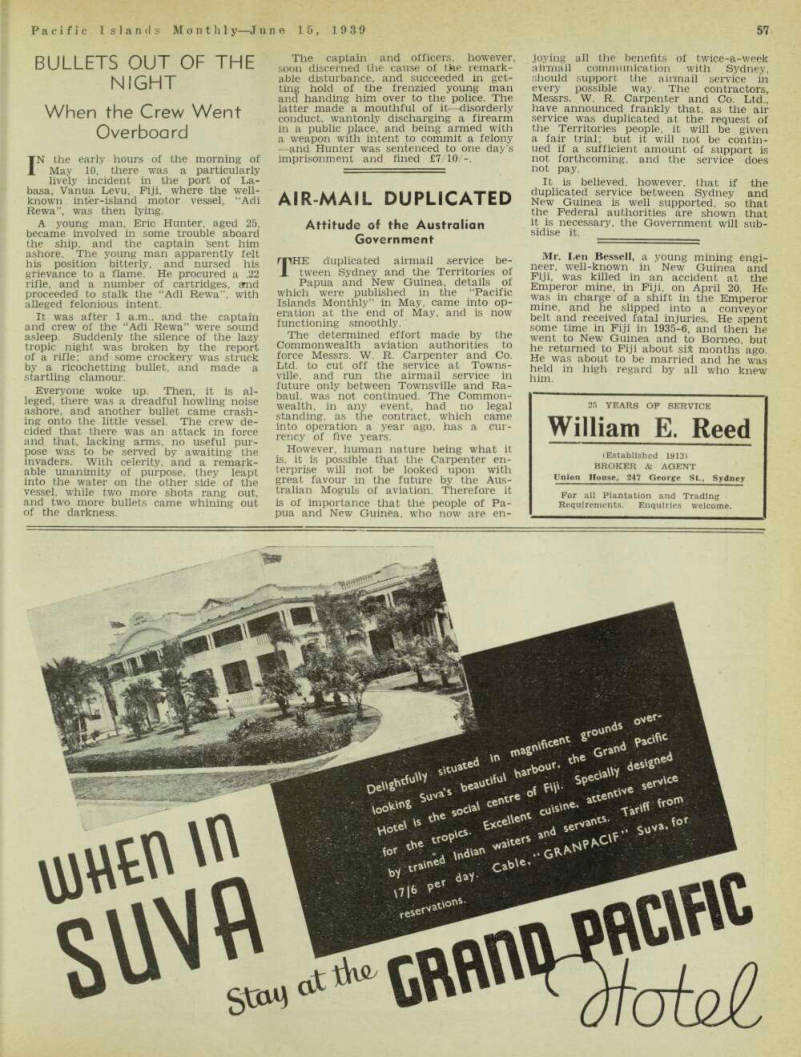
Bullets Out Of The
Night
When the Crew Went Overboard
IN the early hours of the morning of May 10, there was a particularly lively incident in the port of La basa, Vanua Levu, Fiji, where the well known inter-island motor vessel, “Adi Rewa”, was then lying.
A young man, Eric Hunter, aged 25, became involved in some trouble aboard the ship, and the captain sent him ashore. The young man apparently felt his position bitterly, and nursed his grievance to a flame. He procured a .22 rifle, and a number of cartridges, emd proceeded to stalk the “Adi Rewa”. with alleged felonious intent.
It was after 1 a.m., and the captain and crew of the “Adi Rewa” were sound asleep. Suddenly the silence of the lazy tropic night was broken by the report of a rifle; and some crockery was struck by a ricochetting bullet, and made a startling clamour.
Everyone woke up. Then, it is al leged, there was a dreadful howling noise ashore, and another bullet came crash ing onto the little vessel. The crew de cided that there was an attack in force and that, lacking arms, no useful pur pose was to be served by awaiting the invaders. With celerity, and a remark able unanimity of purpose, they leapt into the water on the other side of the vessel, while two more shots rang out, and two more bullets came whining out of the darkness.
The captain and officers, however, soon discerned the cause of the remark able disturbance, and succeeded in get ting hold of the frenzied young man and handing him over to the police. The latter made a mouthful of it—disorderly conduct, wantonly discharging a firearm in a public place, and being armed with a weapon with intent to commit a felony —and Hunter was sentenced to one day’s imprisonment and fined £7/10/-.
Air Mail Duplicated
Attitude of the Australian Government
r!E duplicated airmail service be tween Sydney and the Territories of Papua and New Guinea, details of which were published in the “Pacific Islands Monthly’’ in May, came into op eration at the end of May, and is now functioning smoothly.
The determined effort made by the Commonwealth aviation authorities to force Messrs. W. R. Carpenter and Co.
Ltd. to cut off the service at Towns ville, and run the airmail service in future only between Townsville and Ra baul, was not continued. The Common wealth, in any event, had no legal standing, as the contract, which came into operation a year ago, has a cur rency of five years.
However, human nature being what it is, it is possible that the Carpenter en terprise will not be looked upon with great favour in the future by the Aus tralian Moguls of aviation. Therefore it is of importance that the people of Pa pua and New Guinea, who now are en
joying all the benefits of twice-a-week airmail communication with Sydney, should support the airmail service in every possible way. The contractors, Messrs. W. R. Carpenter and Co. Ltd., have announced frankly that, as the air service was duplicated at the request of the Territories people, it will be given a fair trial; but it will not be contin ued if a sufficient amount of support is not forthcoming, and the service does not pay.
It is believed, however, that if the duplicated service between Sydney and New Guinea is well supported, so that the Federal authorities are shown that it is necessary, the Government will sub sidise it.
Mr. lien Bessell, a young mining engi neer, well-known in New Guinea and Fiji, was killed in an accident at the Emperor mine, in Fiji, on April 20. He was in charge of a shift in the Emperor mine, and he slipped into a conveyor belt and received fatal injuries. He spent some time in Fiji in 1935-6, and then he went to New Guinea and to Borneo, but he returned to Fiji about six months ago.
He was about to be married and he was held in high regard by all who knew him.
Mr. A. L. Braisby, Inspector of the Samoan Police, joined a Matson liner at American Samoa last month en route to the United States and Canada to spend an extended holiday. He was accompan ied by Mrs. Braisby.
Rev. C. W. Whonsbon-Aston left Syd ney by the “Mariposa” on May 26 to take up his new charge as vicar of Viti Levu West, in Fiji, where his headquart ers will be at Lautoka. Mr. Whonsbon- Aston was for some time engaged in mis sion work at Mukawa, Eastern Papua, and he has been on sick leave in Aus tralia for about a year.
Mr, Bailey, of New Zealand, who has been appointed surveyor to the Cook Is lands Administration, recently spent a short time at Niue Island surveying the coastline, before proceeding to Raroton ga, C.I. He was accompanied by Mrs.
Bailey.
Advertisements & other items, pp. 61-62 (2 items)
57
Pacific Islands Mon t h 1 y—J une 15, 1939
William E. Reed
25 YEARS OP SERVICE
(Established 1913)
BROKER & AGENT
Union House, 247 George St., Sydney For all Plantation and Trading Requirements. Enquiries welcome.
Sta*}
lW » ied '° har b° ur- ** \w 4es'& oe<i * s «• SPCC le -** s v **s- <or he « op ' C ; „**» l 0 a^P^' f ’
"a \n<* va ° “ L r^ cd C^ e ’ r daVb 9 e
MORRIS, HEDSTROM, ltd.,
Registered Office - - Suva, Fiji.
BRANCHES THROUGHOUT FIJI. TONGA AND SAMOA
Agents for:
LLOYD’S
NOBELS (AUSTRALIA) LIMITED—EXPLOSIVES
MATSON NAVIGATION COMPANY
RUSTON & HORNSBY LIMITED
IMPERIAL CHEMICAL INDUSTRIES LIMITED
JOHN LYSAGHT (AUST.) LTD.
VACUUM OIL COMPANY PROP’TY. LIMITED
FORD MOTOR COMPANY LIMITED
■I GOODYEAR TIRE & RUBBER EXPORT COY. j.
SYDNEY OFFICE: DALTON HOUSE. lIS PITT ST.
For perfect cutting
on all
Perfect results of any class of lawn can be obtained with one machine or other in our wide rang© of lawn mowers. Whether it is a side-wheel mower for dealing with long, coarse or tough grass, a motor mower, or a gang mower, cutting 50 acres a day, there is a Ransomes’ model which will give complete satisfaction.
catalogue of ’Zmd, hone°°™etnl.
Ransomes
tsssbstr • LAWN MOWER
SUVA - LAUTOKA - BA UJLjL-IlJtlL-
Made by: RANSOMES. SIMS & JEFFRIES LTD., IPSWICH, ENGLAND A
Develop New
Guinea!
A Visitor's Recent Opinion
mHE policy followed in relation to J. development in New Guinea has been receiving sharp criticism lately, in various directions.
A member of the Victorian Legislature, Dr. Shields, after returning in June from a visit to New Guinea, declared: — “The land policy there is too conser vative. It is extremely difficult under the present Administration for a man to get land”.
Dr. Shields emphasised the great ag ricultural possibilities of the Markham and Ramu River valleys, and in this di rection said that the Administration
should subsidise settlers to cultivate cof fee, cocoa, rubber, etc.
Dr. Shields expressed the opinion that the road to be built between Salamaua and Wau should have been constructed on route “D” of the four routes exam ined (via the Markham Valley). This route, he said, while much longer than the others, would open up a great deal of good agricultural country. On the other hand the goldfield will peter out eventually, like all goldfields do, and the road built specially, for goldfield needs only, would be wasted. Some might think he was not qualified to give such opinions after spending only a short time in the Territory, but while he was there he gave close study to the numerous problems.
Agricultural Expert’S
Opinion
Mr. George Murray, M.L.C., Who
has been for some weeks in a pri vate hospital in Sydney, was inter viewed in Mav by “Sydney Morning Her ald”, and made the following state ment: — “If Australia does not make use of the wonderful unlands of the mainland of New Guinea. I do not consider she is justified in holding the country. Certain ly no broad-minded anthropologist con siders that a large tract of 90.000 sq. miles of splendid country should be kept as an anthropological zoo.
“For the natives’ own welfare, the country should be opened up. But it must be by the right type of settler.
Mining, to-day the cause of our yearly surplus, is a diminishing asset, I be lieve. We should nut every penny we can to-day into public works and agri cultural develonment: and the training of the natives should have an agricultural basis”.
Mr. Murray is Director of Agriculture in New Guinea, and he has recently re turned from a visit to Malaya. Cochin China and the East Indies, where he made a close study of certain aspects of tropical agriculture.
Lautoka Grows
Plea for Government Help
mHERE are some indications of rest- J. lessness among the Lautoka peonle because of alleged failure by the Fiji Government to push on with what are described as urgent public works. It is stated also that the Government is spending unusually large sums of money, while not consulting the Legislative Council as frequently as formerly.
It is pointed out that very serious con gestion frequently arises at the port of Lautoka. but that there is no sign of the commencement of the additional harbour works that were authorised a long time ago. The town of Lautoka is growing fast, and there is need not only for extended public facilities, but for more land on which business premises and private houses may be erected. The citizens of Lautoka are seeking the right to make use of the recreation reserve in the centre of the township for build ing purposes, and to move the recre ation reserve further out: but in this matter thev are not receiving much co operation from the Government.
Mr. W. Tailby, formerly of the Cook Is lands Administration, who has joined the New Zealand External Affairs Depart ment as Inspector, recently paid an offi cial visit to Niue to inspect the Admin istration.
Advertisements & other items, pp. 62-63 (3 items)
58
June 15, 103 9—P aclfic Islands Monthly
59
Pacific 1 slant! s Monthly—June 15, 19 89
Nerves?
BRAIN FAG?—DEPRESSED FEELING?
You need Bidomak —to
‘ JITTERY” nerves, run-down feel- " ing, sleeplessness and depressed feeling: are caused by “Mineral Starvation” —a lack of certain vital food minerals in the modern diet. This condition causes many ailments, from a simple lack of “pep” to serious chronic headaches and constitutional disorders.
Bidomak easily, quickly and safely corrects this condition by providing vital minerals which increase the number of red blood corpuscles in the blood - stream, revitalises worn - out tissues. It makes you well and KEEPS you well.
Bidomak is a scientific compound of vital mineral elements: — FERRUM, to build rich, red blood, and so carry extra oxygen to the tissues, thus combating anaemia, and chasing poisons and wastes from the system.
CALCIUM, to build up bone and nerve tissues, as well as general bodily endurance.
SODIUM, to keep digestion keen, counter acidity, clear away depression, and make you feel well. *
end “Mineral Starvation
9 9 PHOSPHORUS, to prevent nervous breakdown and fatigue, and to help in creating new nerve, brain and red blood cells.
POTASSIUM, to relieve nerve pains, prevent constipation, build up the grey matter of the brain, and for muscular control.
GLYCEROPHOSPHATES, for nervous disorders.
We have thousands and thousands of testimonials praising Bidomak! Men, women and children, of all ages, have benefited by this miracle of medicine.
If you feel run-down, get a bottle of Bidomak to-day—take it yourself— give it to your family—children love its pleasant taste so much they LIKE taking it.
SCIENTIFIC CONTROL
Manufactured in one of the most up-to-date hygienic Laboratories in the Southern Hemisphere, to which is attached a fully qualified Doctor of Medicine, and under the control of Chemists who were trained in the most modern and largest English Laboratories in the world.
Start to-day on a course of
The Tonic of the Century
AT ALL LEADING ISLAND STORES
New Guinea Public Service
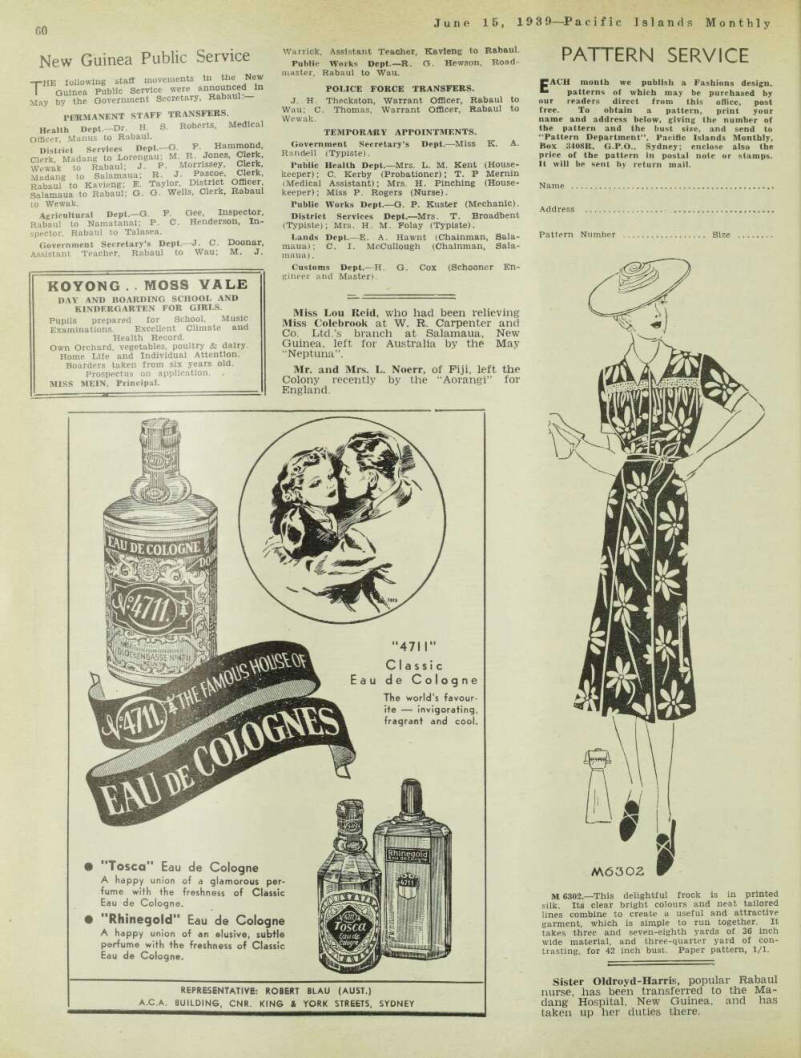
-r-HE following staff movements in the T Guinea Public Service were May by the Government Secretary, Rabaul.
Permanent Staff Transfers.
Health Dept.-Dr. H. S. Roberts, Medical Officer, Manus to Rabaul.
District Services Dept.—G. P. Hammond, Clerk, Madang to Lorengau; M. R. Jones, Clerk, Wewak to Rabaul; J. P. Morrissey, Clerk, Madang to Salamaua; R. J- Pascoe, Clerk, Rabaul to Kavieng; E. Taylor, District Officer Salamaua to Rabaul; G. G. Wells, Clerk, Rabaul to Wewak.
Agricultural Dept.—G. P. Gee, Inspector, Rabaul to Namatanai; P. C. Henderson, In spector, Rabaul to Talasea.
Government Secretary’s Dept.—J. C. Doonar, Assistant Teacher, Rabaul to Wau; M. J.
Warrick, Assistant Teacher, Kavleng to Rabaul Public Works Dept.—R. G. Hewson, Road master, Rabaul to Wau.
Police Force Transfers.
J. H. Theckston, Warrant Officer, Rabaul to Wau: C. Thomas, Warrant Officer, Rabaul to Wewak.
Temporary Appointments.
Government Secretary’s Dept.—'Miss K. A.
Randell (Typiste).
Public Health Dept.—Mrs. L. M. Kent (House keeper) ; C. Kerby (Probationer); T. P Mernin (Medical Assistant); Mrs. H. Pinching (House keeper); Miss P. Rogers (Nurse).
Public Works Dept.—G. P. Kusfcer (Mechanic).
District Services Dept.—Mrs. T. Broadbent (Typiste); Mrs. H. M. Polay (Typiste).
Lands Dept.—E. A. Hawnt (Chainman, Sala maua); C. I. McCullough (Chainman, Sala maua) .
Customs Dept.—H. G. Cox (Schooner En gineer and Master).
Miss Lou Reid, who had been relieving Miss Colebrook at W. R. Carpenter and Co. Ltd.’s branch at Salamaua, New Guinea, left for Australia by the May “Neptuna”.
Mr, and Mrs. L. Noerr, of Fiji, left the
Colony recently by the “Aorangi” for
England.
Pattern Service
EACH month we publish a Fashions design.
“ patterns of which may be purchased by our readers direct from this office, post free. To obtain a pattern, print your name and address below, giving the number of the pattern and the bust size, and send to “Pattern Department”, Pacific Islands Monthly, Box 3408 R, G.P.0., Sydney: enclose also the price of the pattern in postal note or stamps.
It will be sent by return mail.
Name Address Pattern Number Size
M 6302. —This delightful frock is in printed silk. Its clear bright colours and neat tailored lines combine to create a useful and attractive garment, which is simple to run together. It takes three and seven-eighth yards of 36 inch wide material, and three-quarter yard of con trasting, for 42 inch bust. Paper pattern, 1/1.
Sister Oldroyd-Harris, popular Rabaul
nurse, has been transferred to the Ma clang Hospital, New Guinea, and has taken up her duties there.
Advertisements & other items, p. 64 (2 items)
60
June 15, 103 9—P acific Islands Monthly
"Rhinegold" Eau de Cologne
KOYONG . . MOSS YALE
DAY AND BOARDING SCHOOL AND
KINDERGARTEN FOR GIRLS.
Pupils prepared for School, Music Examinations. Excellent Climate and Health Record.
Own Orchard, vegetables, poultry & dairy.
Home Life and Individual Attention.
Boarders taken from six years old.
Prospectus on application. , MISS MEIN, Principal,
W v .\ % \ %
VOCKEN
V \ 471 Classic Eau de Cologne The world's favourite invigorating, fragrant and cool.
"Tosco" Eau de Cologne A happy union of a glamorous perfume with the freshness of Classic Eau de Cologne.
"Rhinegold" Eau de Cologne
A happy union of an elusive, subtle perfume with the freshness of Classic Eau de Cologne.
REPRESENTATIVE: ROBERT BLAU (AUST.)
A.C.A. BUILDING, CNR. KING & YORK STREETS, SYDNEY
Fashion Hints for Islands Women
By Therese
CLOTHES are beautiful and arresting—Nature has again inspired manufacturers in their choice of colours with the result that the new materials are lovelier than ever. Wools have all the supple qualities of silk and are so rich in colour.
Winter clothes are distinguished for their simplicity of style. Great scope for individual choice is offered by the wide variety of weaves.
There are wools of exquisite fineness for formal afternoon wear and cocktail parties, and when these are allied to lace they become the high lights of any party.
Suiting-weight worsteds, heavier wools, and cloth of rougher weaves are ideal for general and sports wear and make up into delightful skirts, jackets and coats. Checks and stripes are the last word in chic. Plain materials can be procured that exactly match the pre dominating colours of the check. Combinations are presented in green and amber, biege and brown, amber and black, and blue and navy, with a fine red thread outlining the check.
EVENING materials are full of glamour and, whether the style chosen be crinoline or the newer moulded lines, there is a fabric for every choice. Velvets endow the wearer with an air of luxury.
Lames come in a variety of designs, including the new and equally attractive multi-coloured stripe effect. This enchanting material is also used effectively for blouses with evening en sembles and for dinner and cocktail frocks.
Silver lame and black velvet make contact for a cocktail hour in a frock that embodies many of the new fashion features. High-necked, the bodice is double-shirred into an uplift waist line. The skirt is flared in front. The un usual belt is about four inches wide at the back and gathered into a clip in the front to let the two ends form a butterfly bow.
The sleeves are cut on very generous lines to the elbow, from thence fitting tightly to the wrist. A smart black velvet pill-box is sur mounted with a black fur bottle brush and a
large black valvet handbag-cum-mufl. with gloves and shoes finish a delightful ensemble.
ALTHOUGH crinolines with their feminine ap peal will be seen frequently, form-fitting frocks are newer and Grecian lines are de manding attention. Charming effects are ob tained with draperies.
Tier on tier of frothing, billowing tulle or net goes to the making of a crinoline that would delight the debutante. The foundation is of rainbow-striped taffeta, the colours showing mistily through layers of tulle. Diamante shoulder straps make it sparkle.
Black lace and net are an attractive com bination for a frock of the same type, the skirt featuring bands of net and lace.
Daytime frocks and ensembles are full of charm. While many of them are on tailored lines, little dressmaker touches lend them a softly feminine air.
Sleeves are significant. Some overseas de signers stand firmly by bishop’s sleeves, which are long and full and gathered into a cuff.
There are variations of this theme; some are narrowed away under the wrist, and others are made cuffless, so that the frock’s contrasting cuff can show beneath.
Skirts are short and are given a shade more width without losing that inimitable slim line.
Movement is achieved by pleats and goring.
Perfect little suits, quaint and demure, are very appealing. On removing the coat of a black suit, a tucked white crepe shirt, waist linked to the skirt with a wide jade green cummerbund, is revealed.
Black is unfailingly chic for a score of oc casions. Try different coloured belts above a black winging skirt. They give a strong touch of individuality and allow the wearer to com bine two or even three colours.
ACCESSORIES are important—costumes are brightened with well chosen clips, pins and
bracelets. All dressmaker jewellery should be chosen discriminately.
A floor-length cape of petunia wool is worn over an azalia-pink evening gown cut on Grecian lines. With this ensemble a gold neck lace, a bouquet of crinkled gold flowers and matching bracelet are worn.
Attractive bag and belt combinations are seen in all the newest shades in many varieties of leather —suede, patent leather, morocco and crocodile—and in the most intriguing shapes.
Miniature kit bags arc very attractive and hold an amazing quantity of women’s bits and pieces. Pouch bags and the envelope variety find equal favour.
The strictly tailored bag with long shoulder straps is definitely sporting and is the perfect complement to tweeds. A brown coat suit with a twin personality is lined with green and biege tweed, with the skirt matching the tweed of the coat. It calls for a bag of this type, and when one of the new squash hats and low heeled suede walking shoes are worn it marches triumphantly on the way to success.
Miss Peggy Aspinall, of Penang, Fiji,
returned to her home by the May “Mo nowai”. after spending a holiday in Syd ney.
The engagement has been announced of Miss Bonnie Hamilton and Mr. Lionel Baker, of Papua. Mr. Baker, who was
formerly connected with Steamships
Trading Co. Ltd. at Samarai, recently
joined the staff of Gili Gili plantation.
Advertisements & other items, p. 65 (2 items)
61
Pacific Islands Mont hi y—J une 15, 1939
A GRACE BROS' Catalogue
At Blue Mountains—Springwood, N.S.W.
Springwood Ladies" College
Est. 1897. Kindergarten to Leaving Certificate. Tennis, Riding, Swimming, Team Games. Unequalled climate. Pure Jersey Milk. Senior and Junior Houses. Openair sleeping. Inclusive fees. Special vacation arrangements for Island pupils.
M. E. DUEAND, Principal.
A GRACE BROS' Catalogue
BRINGS THE BIGGEST STORE IN
AUSTRALIA TO YOUR DOOR
Let us put you on our Mailing List To all addresses on our list we send Free of Charge Six Catalogues a year, including two Sale Books, when prices of all goods, except Proprietary articles, are marked at attractive reductions.
WRITE TO GRACE BROS. FOR EVERYTHING.
From our huge selection of merchandise we are practically able to meet your every requirement.
Should you not see exactly what you need in any of our Catalogues write in just the same. If not in stock we will do our utmost to procure it for you.
When next in Sydney, call and inspect our extensive range of attractive merchandise.
CATALOGUES POST FREE ANYWHERE!
GRACE BROS. Pty. Ltd.
Broadway SYDNEY 'Phone: M 6506
S 3 r. u u c ■ Os Si €
Samoan "Nazis" Disbanded
Prom Our Own Correspondent
Apia, May 12.
THE Samoan branch of the German Nazi party was disbanded recently, by order of the German Consul- General in Wellington NZ. The exist ence and activities of the branch had led to severe criticism by British resid ents and dissension among the German nationals of the Territory.
Miss D. Norton has taken up duties as Matron of the Samarai European Hos pital. Papua.
Mr, and Mrs. D. Riemenschneider, of Suva, left Fiji by the May “Monterey for San Francisco, U.S.A.
Dr. Campbell, Economic Adviser to the N.Z. High Commissioner in London, who personally presented the last Annual Report of Samoa to the Mandates Com mission in Geneva, recently paid a short official visit to Apia.
Questioned
Patrol's Value
What Does New Guinea Gain from Huge Expenditure?
Prom Our Own Correspondent WAU, June 3.
ABOUT a year ago, a patrol of huge dimensions (for a patrol) set out on the Mount Hagen-Sepik trail, in charge of Mr. J. L. Taylor, A.D.0.. who was accompanied by Patrol Officer D.
Black and Medical Assistant J. Walsh.
There was a strong force of native con stabulary and a large number of car riers.
This patrol has been a costly affair, not only because of its size, but also be cause aeroplanes have been lavishly used for commissariat and other purposes.
Undoubtedly, its numbers have had a disturbing influence on the natives of
the country through which it has passed.
A patrol must to a certain extent live on the country. This can be harmoni ously done by a small party, who are able to purchase small quantities of food from native settlements without seriously depleting the local food re sources. It is a different matter when a large party require native foods, and pay for them in tomahawks, lava-lava and so forth —with which the natives cannot fill their stomachs after the party has passed.
Some five years ago two prospectors— the Fox Brothers —did, with a handful of boys, practically the same trek as this large and costly patrol is doing. They had no field-wireless, no constabulary es cort, no aeroplanes; but nevertheless they did a trek which has always been refer red to with admiration. Unfortunately no report of this exploration has ever been recorded. It certainly should have been, for the Fox Brothers were not in search of anthropological knowledge, but were good, solid seekers after what the earth may have contained in the way of minerals and, therefore, they saw the country from its geological aspect. (An account of the Fox Brothers’ remarkable journey, with a copy of a map which they drew, was published in the “P.1.M.” of February, 1936.—Ed.).
Some years ago, New Guinea Gold fields Ltd. financed and sent out a pros pecting party with a geologist, which covered the Purari and Ramu areas. As far as can be gathered, no data have been recorded oificially of this expedi tion. Mr. J. M. Burke, who was one of a party who walked through from the Fly River to the Sepik headwaters and down to the Ramu —minerally intention ed—offered his knowledge to the Pow ers-that-be, which was politely refused.
Anthropology may be “in the interests of posteritv” (to quote the editor of the “Rabaul limes’’), but what value has it from a budget point of view and the opening up and stabilising of this valu able country?
The Territory has been flooded with anthropologists from every corner of the world, under the auspices of scientific in stitutions. Perhaps their scope of re search has been limited by Government restrictions. A wider field of action and, if necessary, a Government subsidy, might have provided all the anthropo logical data required in the region now being covered by an expensive patrol, with no anthropologist, no surveys, no geologist, no agricultural expert in its composition.
One may pertinently ask what econo mic benefits have restated from the pre sent Mount Hagen-Sepik patrol, with no qualified surveyor to map accurately the country traversed; no geologist to deter mine and record the mineral potentiali ties; no agricultural expert to ascertain the capacity of the country to support a white population. As the patrol has not covered these essentials, there are many who rightly condemn it as a waste of money. (It is estimated to have cost between £25,000 and £30,000).
Mr. T. Aveling, formerly of Burns Philp (S.S.) Co.’s Apia branch, left Samoa for New Zealand in May.
Mr. W. Davidson, who is a merchant at Nukualofa, Tonga, paid a visit to New Zealand by the May “Matua”.
Mr. L. V. Waterhouse, well-known di rector of Bulolo Gold Dredging Ltd., returned to Sydney by the last “Bulolo after a short visit to the Company s workings on the Morobe Goldfield.
“B.G.D.’s No. 7 dredge should be operat ing about the middle of June”, he said, “and No. 8 in October”. He estimated that the Company has at least 12 more years of life.
Advertisements & other items, p. 66 (2 items)
62
June 15, 193 9—P acific Islands Monthly
tecpu»eff
s ctwvie
1 wilt
7 \ m
Stations
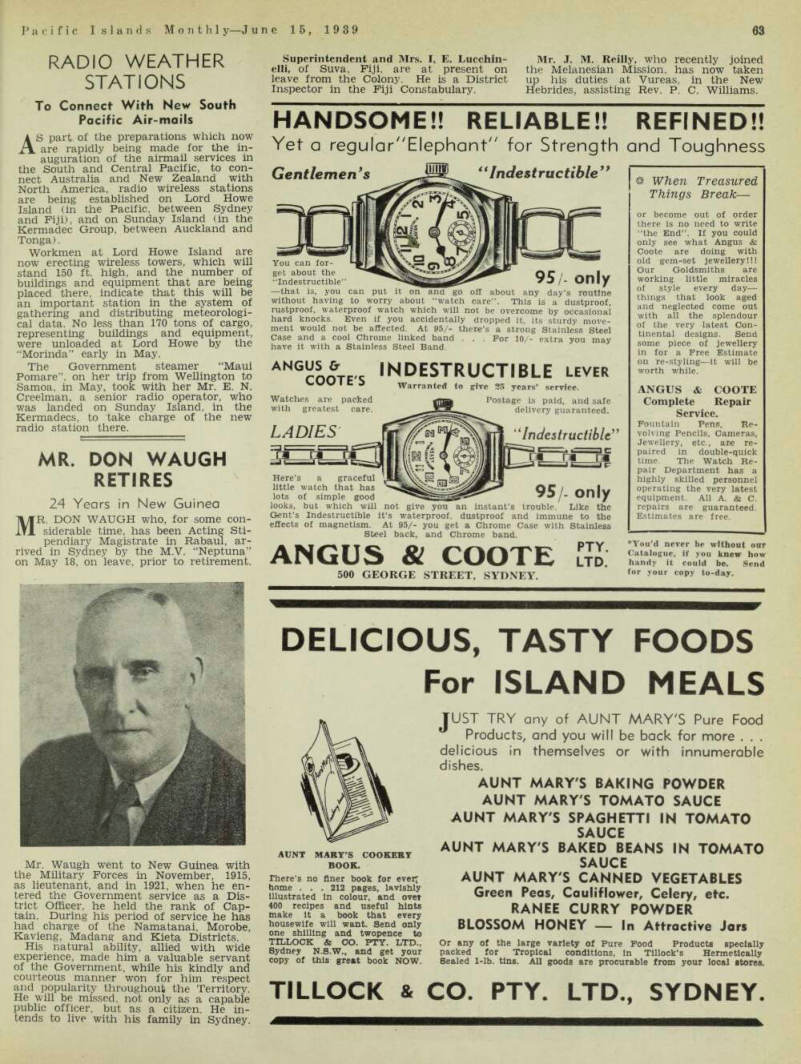
Radio Weather
To Connect With New South Pacific Air-mails
AS part of the preparations which now are rapidly being made for the in auguration of the airmail services in the South and Central Pacific, to con nect Australia and New Zealand with North America, radio wireless stations are being established on Lord Howe Island (in the Pacific, between Sydney and Fiji), and on Sunday Island (in the Kermadec Group, between Auckland and Tonga).
Workmen at Lord Howe Island are now erecting wireless towers, which will stand 150 ft. high, and the number of buildings and equipment that are being placed there, indicate that this will be an important station in the system of gathering and distributing meteorologi cal data. No less than 170 tons of cargo, representing buildings and equipment, were unloaded at Lord Howe by the “Morinda” early in May.
The Government steamer “Maui Pomare". on her trip from Wellington to Samoa, in May, took with her Mr. E. N.
Creelman, a senior radio operator, who was landed on Sunday Island, in the Kermadecs, to take charge of the new radio station there.
Mr. Don Waugh
Retires
24 Years in New Guinea MR. DON WAUGH who, for some con siderable time, has been Acting Sti pendiary Magistrate in Rabaul, ar rived in Sydney by the M.V. “Neptuna” on May 18, on leave, prior to retirement.
Mr. Waugh went to New Guinea with the Military Forces in November, 1915, as lieutenant, and in 1921, when he en tered the Government service as a Dis trict Officer, he held the rank of Cap tain. During his period of service he has had charge of the Namatanai, Morobe, Kavieng, Madang and Kieta Districts.
His natural ability, allied with wide experience, made him a valuable servant of the Government, while his kindly and courteous manner won for him respect and popularity throughout the Territory.
He will be missed, not only as a capable public officer, but as a citizen. He in tends to live with his family in Sydney.
Superintendent and Mrs. I, E. Lucchinelli, of Suva. Fiji, are at present on leave from the Colony. He is a District Inspector in the Fiji Constabulary.
Mr. J. M. Reilly, who recently joined the Melanesian Mission, has now taken up his duties at Vureas. in the New Hebrides, assisting Rev. P. C. Williams.
Advertisements & other items, p. 67 (2 items)
63
Pacific Islands Monthl y—J une 15, 1939
Delicious, Tasty Foods
HANDSOME!! RELIABLE!!
Yet a for Strength
Gentlemen's “Indestructible”
ro CM m a
95/- only
You can forget about the “Indestructible —that is, you can put it on and go off about any day’s routine without having to worry about “watch care”. This is a dustproof, rustproof, waterproof watch which will not be overcome by occasional hard knocks. Even if you accidentally dropped it, its sturdy movement would not be affected. At 95/- there’s a strong Stainless Steel Case and a cool Chrome linked band . . . For 10/- extra you may have it with a Stainless Steel Band.
ANG cootfs INDESTRUCTIBLE lever
t O Warranted to give 25 years’ service.
Watches are packed grj» Postage is paid, and safe with greatest care. delivery guaranteed.
LADIES
‘lndestructible
in n i a
95/. only
Here’s a graceful little watch that has lots of simple good looks, but which will not give you an instant’s trouble. Like the Gent’s Indestructible it’s waterproof, dustproof and immune to the effects of magnetism. At 95/- you get a Chrome Case with Stainless Steel back, and Chrome band.
ANGUS & COOTE
500 GEORGE STREET, SYDNEY.
REFINED!!
and Toughness
* When Treasured
Things Break —
or become out of order there is no need to write “the End’’. If you could only see what Angus & Coote are doing with old gem-set jewellery!!!
Our Goldsmiths are working little miracles of style every day— things that look aged and neglected come out with all the splendour of the very latest Continental designs. Send some piece of jewellery in for a Free Estimate on re-styling—it will be worth while.
ANGUS & COOTE
Complete Repair
Service.
Fountain Pens, Revolving Pencils, Cameras, Jewellery, etc., are repaired in double-quick time. The Watch Repair Department has a highly skilled personnel operating the very latest equipment. All A. & C. repairs are guaranteed.
Estimates are free. *You’d never be without our Catalogue, If you knew how handy it could be. Send for your copy to-day.
DELICIOUS, TASTY FOODS
For ISLAND MEALS
AUNT MARY’S COOKERY
BOOK.
There’s no finer book for ever! home ... 212 pages, lavishly Illustrated in colour, and over 400 recipes and useful hints make it a book that every housewife will want. Send only one shilling and twopence to
TILLOCK & CO. PTY. LTD.,
Sydney N.S.W., and get your copy of this great book NOW.
JUST TRY any of AUNT MARY'S Pure Food Products, and you will be back for more . . . delicious in themselves or with innumerable dishes.
AUNT MARY'S BAKING POWDER
AUNT MARY'S TOMATO SAUCE
AUNT MARY'S SPAGHETTI IN TOMATO
SAUCE
AUNT MARY'S BAKED BEANS IN TOMATO
SAUCE
AUNT MARY'S CANNED VEGETABLES
Green Peas, Cauliflower, Celery, etc.
RANEE CURRY POWDER
BLOSSOM HONEY In Attractive Jars Or any of the large variety of Pure Pood Products specially packed for Tropical conditions, In Tillock’s Hermetically Sealed 1-lb. tins. All goods are procurable from your local stores.
TILLOCK & CO. PTY. LTD., SYDNEY.
Might Be
The Horror That
Review of a New Book
AWAKENING", by Captain G. D.
I Mitchell. M.C.. D.C.M.: published by Angus & Robertson Ltd., Sydney, for 1/6.
Every Australian who knows the Paci fic probably has stood upon an Austra lian east-coast headland, at some time, and visualised an attack upon Australia by the Japanese. It is a picture that is frightfully easy to assemble in the mind.
There, away over the horizon to the north, is that overcrowded nation hungry for territory, armed tq the teeth in the modern fashion, and militarily ag gressive. Here is a country literally flow ing with milk and honey, carrying not one-tenth of the population that it might support, and offering an unprotected coast in which there is a suitable land ing-place at every mile.
Assuming that there was no British or United States navy to make the Japan ese stay at home, it is easy to imagine what would happen.
In this book “The Awakening” Captain Mitchell, an experienced military officer with an eye for strategy and a great gift for writing—he is one of the best-known of the A.I.F. writers—has imagined it.
The attackers come suddenly, without warning; and they find an Australia com pletely unprepared. They bombard the coastal districts, subject the civilian po pulation to the kind of murder, rape and ruthlessness that has been endured in recent times by the Chinese, and they occupy the fruitful Australian coast at a dozen points. The Australians, fighting like devils, with little more than their bare hands, against the most modern ar maments, are everywhere driven back into
the coastal range. In no time the strug gle becomes one between an overwhelm ing force of attackers, with the most modern equipment and backed by brist ling arrays of aeroplanes and warships, and men who have nothing, except a few bits and pieces of military equipment and whatever arms they can take from the enemy. We then are given the inevit able picture of pitiless guerilla warfare.
Neither side takes prisoners.
Not once in the book is the word “Asiatic” or “Japanese” used; but it is clear, from the first page, that the Jap anese are the attackers.
It is all imagination, of course —but no man who knows international poli tics and conditions in the Pacific, and has learned a little of military science, can deny that every frightful picture painted in these paragraphs is possible.
It is a startling book and it ends on a strange and unusual note.
As a plea for preparedness it should be in the hands of every Australian; and, because their fortunes are so closely bound up with those of the British Dominions in the South Seas, it should be read by every resident of the British Pacific Territories south of the Equator.
“Must Australia Fight?”, By
lon L. Idriess. Published by Angus and Robertson, Sydney, at 57-.
Here is another book, by another well-known writer, on the same subject—the need for Aus tralian preparedness. “If Australia were at war, what should we do?” is Mr. Idriess’ opening line; and then, step by step, he exposes Australia’s strength and her weaknesses, and shows the things that Australians must do, now, if they would be prepared to strike a blow in their own defence. They are only seven million people, holding a continent, and their vulnerable coast line is thousands of miles long. But there is only one possible enemy, who would have to attack at the end of a long communication line; and Australia has three strong and friendly Pacific neighbours—the United States, the Netherlands Indies and New Zealand. Summed
up; The position is not one to invite despair, if only Australia will prepare now.
Memories Of Last War
“The Cruise Of The Raider
WOLF ', by Roy Alexander. Published by Angus and Robertson, Sydney, at 7/6.
The “Wolf” slipped out of Germany in Nov ember, 1916, cruised 64,000 miles, destroyed 135,000 tons of allied shipping, and returned to Germany in February, 1918 —the only raider to escape the warships of the Allies. But, although the “Emden” and the “Seeadler” were lost— one by enemy gunfire and one by shipwreck— they somehow are better known to the present generation than the “Wolf”. Therefore, it is fitting that the story of the “Wolf” be told; and told it is, in one of the most fascinating post-war books we have read. Roy Alexander was a prisoner aboard the “Wolf” for the greater part of her voyage. (An account of how the “Wolf” captured the Burns, Philp steamer “Matunga”, near New Guinea, condensed from Mr. Alexander’s de tailed account of this extraordinary affair, will be published in the July issue.)
An Australian Novel
“THREE WENT WEST ’, by Gilbert Anstruther. Published by Angus & Rob ertson, Sydney, at 6/-.
An Australian novel, with a lively plot and plenty of quick-moving drama, against a background of the Australian bush and Australian mining camps. Two brothers love the same girl; and one tries to murder the other. Instead, he shoots the girl’s sister. Then he takes the girl and hides away in Central Aus tralia. Here, twenty years later, he is found eventually by his vengeance seeking brother. Mr. Anstruther displays technical skill in handling the plot, and working it out with swift dialogue, and literary cleverness in tell the story.
Rev. A. T. Hill, at the Melanesian Mis sion school on the island of Ugi, Solomon Islands, recently spent a short furlough in New Zealand,
Advertisements & other items, p. 68 (2 items)
64
June 15, 193 9—P acific Islands Monthly
Steel
o A mm
A NEW MODERN TYPE OF
FURNITURE
TUBULAR
STEEL
FOR INDOOR AND OUT-
DOOR USE.
Cool in any climate and Ideal for the tropics.
Newlands have designs for every need from the cheapest type of verandah chair to the most luxurious suite.
Ask for a catalogue showing a full range of this delightful furniture. It will be forwarded promptly.
For Tubular Steel Furniture and Modern Sleeping Equipment
NEWLANDS BROTHERS PTY. LTD.
Riley and Albion Sts. Sydney, N.S.W.
Mining Notes
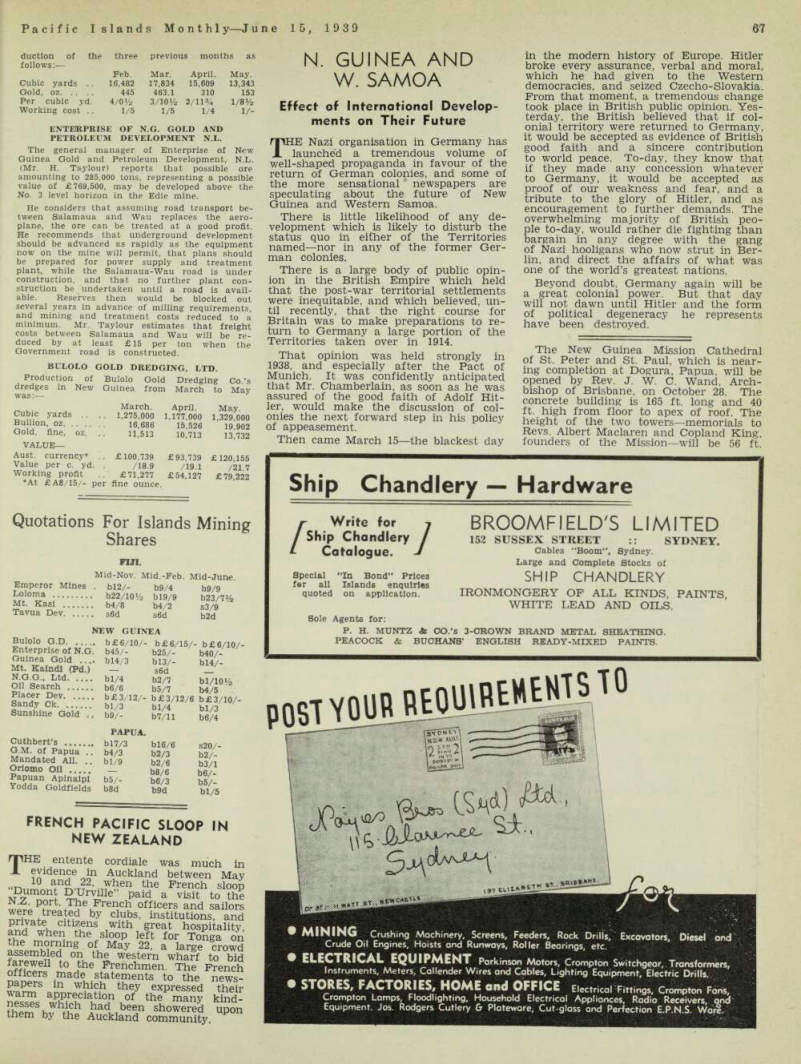
From Fiji
Emperor Gold Mining Co.. Ltd.
Emperor gold mining co., ltd., Tavua, Fiji, reports that figures for the last three production periods compare as follow: —
Mt. Kasi Mines, Ltd.
The expectation of a dividend within the next 12 months was mentioned by the chairman of Mount Kasi Mines, Ltd. (Mr. E. J. Coote) at the annual meeting in Sydney in May. “Recent development work had brought in sight at least six years of probable ore”, he said. “During the past year we have devoted profits to the im provements of the mine. Immediate require ments are now almost satisfied”. Mr. Coote stated that mine conditions had improved in every way, and that, although the top of the ore body only had been scratched, the new plant would facilitate a more intensive development programme.
A director (Mr. R. J. D. Richardson) said that the possibility of a prolonged breakdown of the treatment plant had been obviated by the in creased stock of spare parts.
Replying to a shareholder. Mr. Richardson said that if a large ore body should be discovered in the lower level, plant would be duplicated at an approximate cost of £15,000. “So far, how ever”, he added, “testing of the lower level values has been hampered by lack of power. A new compressor has now been installed”.
The chairman said that nothing had yet been done about diamond drilling, due to a lack of power.
Following the resignation of the mine manager (Major A. J. Peterson) for health reasons, Mr.
C. M. Willington has been appointed.
The Co. showed a net profit of £11,647 for the year ended December 31, 1938, compared with £8,046 for 1937, and a loss of £2.795 for 1936.
The figures are expressed in Fiji currency.
Results for the year, with those of the pre vious year in parentheses, are:—Ore treated, 38,420 (33.232) tons; value a ton, 5.06 (5.41) dwt.; recovery. 8,363 (7,497) fine oz.; residues, .71 (.9) dwt.; working costs, 21/- 9.25 d. (24/- 2.75 d.) a ton.
Recent yields from the Mount Kasi mine at Vanua Levu are compared in the following table:
Loloma (Fiji) Gold Mines, N.L.
The last clean-up from Loloma (Fiji) Gold Mines. NL.. for the four weeks ended May 17 compared with the two previous yields as follows:
tNo old residues were retreated pending the installation of a larger pump.
Progress Report, June 2.—Main shaft, 224 ft. level, main South drive advanced to 1,107 ft, average value from 1,103 ft. to 1,107 ft., 17.3 dwt’ per ton over width of 121 in. Theodore shaft; Advanced to 291 ft. from surface. Influenza epidemic easing, 17 per cent, of labour available mill working.
In the six months ended January 31, Loloma of £97,698, after providing £4,331 for Fiji income tax. For the year ended y 31 > 1938 ’ covering productive operations for 10 months, profit was £83,793. * n o\ he * last six-mon thly period one dividend i no. 3) of 1 - a share was paid on December 8 requiring £41,250. Two further dividends of 1/hay c since been declared, making total declarations 5/- a share, equal to £206,250.
Since July 31 the Co. has treated 22,975 tons of ore for 30,839 oz, of gold and 6,285 oz. of silver. Total production from the mine is 52,913 oz. of gold and 11,874 oz. of silver from 41,011 tons of ore, equal to just on 26 dwt. a ton.
From the Solomons
Australian Gold Development.
SHAREHOLDERS in Australian Gold Develop ment, N.L., at an extraordinary meeting late in May passed a resolution increasing capital from £25,000 to £50,000 by raising the amount of existing shares from £5 to £lO each. The chairman (Mr, E. A. Wisdom) said that it was only intended to call up 10/- a share to cover existing liabilities at present.
Mr. T. R. Victor, the Co.’s engineer, had proceeded to Guadalcanal Island, in the Solo mons, for Solomon G.M. and Valikorta in which A.G.D. has share interests. There was a possibility that he might also acquire a property for A.G.D.
Guadalcanal, Ltd.
The directors of Guadalcanal, Ltd., in their report for 1938 (just issued), state that no active operations have been undertaken, and little expense has been incurred. No expense on any proposition submitted to the company will be undertaken unless the possibilities are con sidered attractive.
Charlton South. N.L.
Charlton South, N.L., of Victoria, advises that the Company’s representative has cabled from Tulagi (Solomon Islands) as follows: “Secured
Four weeks ended Mar. 22. Apl. 19. tMay 17.
Ore treated, tons 14,750 13,650 13,912 Head value, dwt. .. 6.31 6.5 6.61 Gold. oz. fine .. .. 4,188 4.023 4,033 Residues, dwt 0.5 0.47 0.55 tConcentrates stacked, pending further treatment, totalled 28 tons, estimated to contain 185 oz. of fine gold.
Four weeks ended Feb. 22. Mar. 22. Apr. 19. May 17.
Ore. tons 3,554 3.310 2.826 2.893 Gold. fine, oz 712 652 633 669 Value, £ A .. 6,230 5.705 5.538 5,854
Pour weeks ended Mar. 22 Apr. 19. tMay 17.
Tons treated .. .. 2,355 2.185. 2,390 Gold, oz. fine .. .. 3,210 2,944 3.172 Silver, oz. fine ... 563 510 657 Residue, dwt 1.07 1.23 1 15
working option for company next to Solomons Gold Co.’s property”. Arrangements are being made for an inspection.
Pacific Gold, N.L.
? a fSv probably 5>- a a share. Their engineer, E J R Victor and his brother, Mr. T. R.
Victor, are at present investigating properties in the Solomons
Break Of Day Syndicate, N.L.
The Melbourne management of Break of Day Syndicate. N.L., early in June, received the following cable message from its mining en gineer (Mr. A. J. McGeorge), from Tulagi, British Solomon Islands ;-Finished inspection Some possible chances. Not any hurry. Great caution necessary. Arranged for option alluvial area 1,000 acres. Details my arrival Melbourne, June 19”.
From Papua
Papuan Apinaipi Petroleum Co., Ltd.
Papuan apinaipi petroleum company, LTD., reports that Mr. E. A. Kodyen ar rived on the field on May 20 to commence his investigations on behalf of the Commonwealth Government as to the best type of major drill to be used.
The Co. further advises that the No. 3 Oiapu bore has been completed at 892 ft. Drilling conditions were ideal. The first showings of oil were struck at 140 ft., and were almost con tinuous throughout a depth of 700 ft. Gas appeared with the oil at 786 ft., and continued to 791 ft. The nature of the oil shows that it has been forced from depth through restricted channels. That oil in commercial quantities exists, however, can only be proved by deep drilling on the Oiapu structure. The drilling plant is being transferred to the site of the No. 4 Oiapu bore, the site having already been prepared about six miles north-west of the No. 3 bore.
Cuthbert’S Misima Goldmine, Ltd.
Figures for the May clean-up from Cuthbert’s mine on Misima Island, Papua, compare with the two previous yields as follows;
Interim Dividend No. 10 has been declared payable on June 23—1/- per share. Books are closed from June 17 to 24 inclusive.
Total Development for April, 423 ft.; 500 tons of ore won from development; 2,556 tons from stoping; total, 3,056 tons. Average assay gold, 5 dwts. 18.4 grs. p.t.; silver, 37 dwts. 8 grs. p.t.
Gold Mines Of Papua, Ltd.
Returns for the past four months from Gold Mines of Papua, Ltd., at Misima Island, in Eastern Papua, show:—
Yodda Goldfields, Ltd.
The monthly statement issued by Yodda Gold fields, Ltd., reports that the amount of gold recovered during May totalled 96 oz. 2 dwt.
From New Guinea
Guinea Gold, N.L.
AN increase of £964 is shown in net profit of Guinea Gold, N.L., at £46,807 for the year ended February 28. Dividends of 1/10 per share of 2/- require £45,833. The balance of £974 is transferred to reserve, which appears at £396,583. During the year, 1,020 shares in Bulolo Gold Dredging, Ltd., were sold for £7,151, in reduction of the overdraft. The total reduction on the year was by £8,016 to £24,806. The Co. now holds 66,825 Bulolo shares, standing (at market valuation) at £471,341.
New Guinea Goldfields, Ltd.
The monthly progress report issued by The Mining Trust, Ltd., consulting engineers for New Guinea Goldfields, Ltd., on May 22. showed: —
Sunshine Gold Development, Ltd.
Sunshine Gold Development, Ltd., reports a clean-up for May of 276 oz. 4 dwt. Yardage sluiced was 25,000, and hours worked 503. The yardage treated included some of the deeper gravels. Six days were lost owing to heavy rains and floods.
Sandy Creek Gold Sluicing, Ltd,
The manager of Sandy Ck. G.S. Co. reported in June that heavy rain in May damaged the Sandy Creek and Poverty Creek water races, causing a suspension of operations for two weeks while repairs were effected. For the re mainder of the month the Sandy Creek plant was engaged in treating a terrace deposit of comparatively low value as the constant flood ing of the watercourse made it impracticable to operate the elevator in the creek bed.
The low yield for May compares with the pro-
March. April. May.
Treated, tons 2,850 3,056 2,698 Bullion, oz 2,701 2,966 2,525 Gold, fine, oz 757 808 617.6 Silver, fine, oz 1,878 2,088 1,840 Est. value —gold at £A8 per oz £6,166 £6,591 £5,052 Value per ton .. 43/4 43/2 *37/5 tReduced tonnage and grade caused by heavy rains and sickness.
Feb.
Mar.
Apl.
May.
Crushed, tons . 2,728 2,754 2,616 3,007 Gold, oz., fine . 367 374 339 323 Silver, oz 938 1,050 1,076 1,100 Value £3,275 £3,400 £3,150 £3,000 Residues, gr. . 7 7 7.5 8.0
Feb.
Mar.
Apl.
Edie Creek mill — Ore, tons .. 3,011 3,443 2,769 Gold, oz., fine . . 852 1,111 795 Silver, oz., fine .. 3,365 4,143 4,062 Alluvial — Gold, oz., fine .. 1,035 969 836 Silver, oz., fine .. 766 716 572 Golden Ridges mill— Tons treated .. .. 2,426 2,804 2,597 Gold, oz., fine .. 1,012 1,015 947 Silver, oz., fine .. 1,379 1,545 1,435 Operating profit— Edie Creek, £ .. 680 2,523 •189 Alluvial, £ .. .. 2,644 1,918 1,428 Golden Ridges, £ 2,540 1,627 1,555 ♦Loss.
April production at all the Easter holidays and centres was affected by by heavy rains.
Enterprise Of N.G. Gold And
Petroleum Development N.L.
The general manager of Enterprise of New Guinea Gold and Petroleum Development, N.L. (Mr. H. Taylour) reports that possible ore amounting to 285,000 tons, representing a possible value of £769,500, may be developed above the No. 3 level horizon in the Edie mine.
He considers that assuming road transport be tween Salamaua and Wau replaces the aero plane, the ore can be treated at a good profit.
He recommends that underground development should be advanced as rapidly as the equipment now on the mine will permit, that plans should be prepared for power supply and treatment plant, while the Salamaua-Wau road is under construction, and that no further plant con struction be undertaken until a road is avail able. Reserves then would be blocked out several years in advance of milling requirements, and mining and treatment costs reduced to a minimum. Mr. Taylour estimates that freight costs between Salamaua and Wau will be re duced by at least £l5 per ton when the Government road is constructed.
Bulolo Gold Dredging, Ltd.
Production of Bulolo Gold Dredging Co’s dredges in New Guinea from March to May was:—
ductlon of the three previous months as follows: — Feb. Mar. April. May.
Cubic yards . , 16,482 17,834 15,609 13,343 Gold, oz 445 463.1 310 153 Per cubic yd. 4/0% 3/10% 2/11% 1/8% Working cost .. 1/5 1/5 1/4 1/-
March. April. May.
Cubic yards .. .. 1,275.000 1.177.000 1,329.000 Bullion, oz 16.686 15.526 19,902 Gold, fine, oz. . . n,5l3 10,713 13,732
Value—
Aust. currency* .. £100,739 £93,739 £120 155 Value per c. yd. . /18.9 /19.1 /21 7 Working profit £71,277 £54,127 £79,222 •At £A8/15/- per fine ounce.
Advertisements & other items, pp. 69-70 (3 items)
65
Pacific Islands Monthl y—J une 15, 1939
Pumpmobll
Mining Ore
Treatment
Machinery
COMPLETE CYANIDE
PLANTS SUPPLIED
Dorr Classifiers Dorr Thickeners Dorr Agitators Oliver Filters Merrii Crowe Zinc Dust Gold Precipitation Richardson Mine Fans •
FANS AND AIR HEATERS
For Ventilation, Copra Drying Rooms, etc. • Enquire from
CROSSLE, DUFF AND
MACINTOSH LTD.
52 Bridge Street. SYDNEY
Pumpmobll
Self-contained Portable Pump
Output—
-15,000 gallons to \ gallon of benzine or kerosene per hour.
Pressure 601bs. to sq. inch.
All heads up to 132 feet.
Recommended for all Mining purposes. Spares in stock.
Further particulars from:
NELSON Cr ROBERTSON
Pty. Ltd.,
12 Spring St.,
SYDNEY.
Mine Owners and Contractors
BRING YOUR PLANT Up-t O-date
USE
Automatic Rockbreakers
AND Drills
These Machines are a SELF-CONTAINED UNIT and require no Air Compressor or Pipe Lines. 9 They are ready for work at all times. (B Owing to their Light Weight can be transported very easily.
Address enquiries to:
Continental Compensations Pty. Ltd.,
422 COLLINS ST., MELBOURNE, VIC.
“G” 44
and
D
The Beginning and End of
OLD
From the virgin gold to the finished refined ingot . . . from beginning to end . . . gold is scientifically and accurately treated in the modern laboratories and works of Garrett & Davidson.
The letters “G” and “D” . . . the beginning and end of gold, stand for Garrett & Davidson, and represent the highest ideals of business integrity . . . efficient service . . . topmost ruling prices . . and prompt payments.
Once you transact your Gold business with the house of “G. & D”, we are confident you will contact with no other, because Garrett & Davidson give you that extra service that welds them to their clients for all time.
GARRETT & DAVIDSON PTY. LTD.
ASSAYERS METALLURGISTS REFINERS
REGENT & GEORGE STS., SYDNEY.
BURNS PHILP
(SOUTH SEA) CO. LTD.
Inc. in Fiji Registered Office:
SUVA
FIJI
Island Traders and Shipowners
Also Branches at:
\Fiji: Levuka, Lautoka, Labasa, Ba, Sigatoka, Rotuma.
Tonga: Nukualofa, Haapai, Vavau.
Samoa: Apia, Pago Pago (American Samoa).
Solomons: Makambo, Sizo, Faisi.
New Hebrides: Vila.
Code Address: Gilberts: Tarawa.
"Bumsouth. ,v Norfolk Is. Niue. Wallis Is. Futuna Is.
66
June 15, 193 9—P acific Islands Monthly
Quotations For Islands Mining
Shares
Fiji.
Emperor Mines Loloma Mid-Nov. Mid.-Feb. Mid-June. . b!2/- b9/4 b9/9 H99/ini/ kin/n Mt. Kasl Tavua Dev b4/8 s6d b4/2 s6d
0.5 .J/ Iv2
s3/9 b2d
New Guinea
Bulolo G.D b£6/10/- b £ 6/15/- Enterprlse of N.G. b45/- b25/- Guinea Gold ... bl4/3 bl3/- Mt. Kalndl (Pd.) — S 6d N.G.G., Ltd bl/4 b2/7 Oil Search hfi/« w/n • b£6/10/b40/bl4/bl/lOVz b4/5 b£3/10/bl/3 b6/4 Placer Dev Sandy Ck . b£3/12/bl/3 . b9/- UkJ/ « b£ 3/12/6 /A Sunshine Gold ., b7/ll Cuthbert’s G.M. of Papua ..
Mandated All. ..
Orlomo Oil .
Papuan Apinalpi Yodda Goldfields
Papua.
. b!7/3 b4/3 bl/9 b5/b8d bl6/6 b2/3 b2/6 b8/6 b6/3 b9d s20/b2/b3/l b6/b5/bl/5
French Pacific Sloop In
New Zealand
THE entente cordiale was much in evidence in Auckland between May nd , T w hen the French sloop Dumont D’Urville” paid a visit to the port. The officers and sailors nrHr 6 ofi rea^ ed by cl . ubs ’ institutions, and Cltl f® ns with great hospitality, and when the sloop left for Tonga on the morning of May 22, a large crowd assembled on the western wharf to bid fareweil to the Frenchmen. The French officers made statements to the news papers in which they expressed their warm appreciation of the many ktnd them S bv h fhP l laC l 1 be S n shower ed upon mem by the Auckland community.
W. Samoa
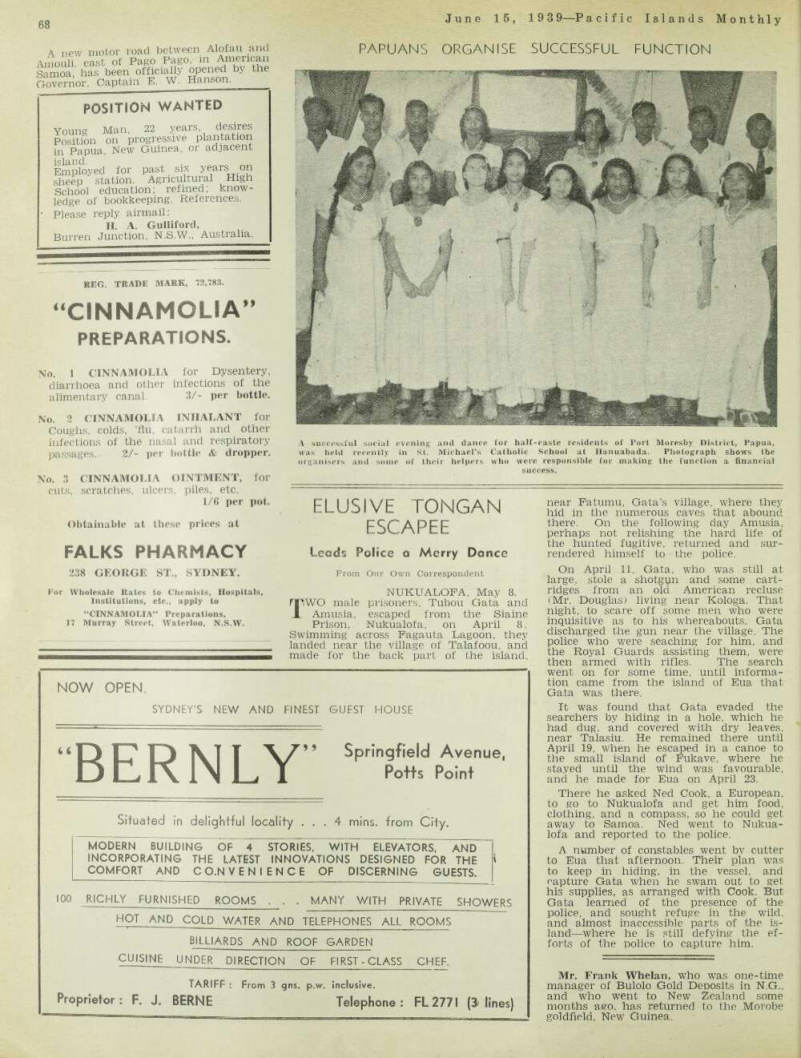
N. Guinea And
Effect of International Develop ments on Their Future
THE Nazi organisation in Germany has launched a tremendous volume of well-shaped propaganda in favour of the return of German colonies, and some of the more sensational newspapers are speculating about the future of New Guinea and Western Samoa.
There is little likelihood of any de velopment which is likely to disturb the status quo in either of the Territories named —nor in any of the former Ger man colonies.
There is a large body of public opin ion in the British Empire which held that the post-war territorial settlements were inequitable, and which believed, un til recently, that the right course for Britain was to make preparations to re turn to Germany a large portion of the Territories taken over in 1914.
That opinion was held strongly in 1938, and especially after the Pact of Munich. It was confidently anticipated that Mr. Chamberlain, as soon as he was assured of the good faith of Adolf Hit ler, would make the discussion of col onies the next forward step in his policy of appeasement.
Then came March 15 —the blackest day
in the modern history of Europe. Hitler broke every assurance, verbal and moral, which he had given to the Western democracies, and seized Czecho-Slovakia.
From that moment, a tremendous change took place in British public opinion. Yes terday, the British believed that if col onial territory were returned to Germany, it would be accepted as evidence of British good faith and a sincere contribution to world peace. To-day, they know that if they made any concession whatever to Germany, it would be accepted as proof of our weakness and fear, and a tribute to the glory of Hitler, and as encouragement to further demands. The overwhelming majority of British peo ple to-day, would rather die fighting than bargain in any degree with the gang of Nazi hooligans who now strut in Ber lin, and direct the affairs of what was one of the world’s greatest nations.
Beyond doubt, Germany again will be a great colonial power. But that day will not dawn until Hitler and the form of political degeneracy he represents have been destroyed.
The New Guinea Mission Cathedral of St. Peter and St. Paul, which is near ing completion at Dogura, Papua, will be opened by Rev. J. W. C. Wand, Arch bishop of Brisbane, on October 28. The concrete building is 165 ft. long and 40 ft. high from floor to apex of roof. The height of the two towers—memorials to Revs. Albert Maclaren and Copland King, founders of the Mission—will be 56 ft.
A new motor road between Alofau and Amouli east of Pago Pago, in American Samoa, has been officially opened by the Governor. Captain E. W. Hanson.
Advertisements & other items, pp. 71-72 (1 item)
Post Your
Ship Chandlery Hardware
Write for
/Ship Chandlery /
Catalogue. J
Special "In Bond" Prices fer all Islands enquiries quoted on application.
BROOMFIELD'S LIMITED
152 SUSSEX STREET :: SYDNEY.
Cables "Boom", Sydney.
Large and Complete Stocks of
SHIP CHANDLERY
IRONMONGERY OF ALL KINDS, PAINTS,
WHITE LEAD AND OILS.
Bole Agents for: P. H. MUNTZ <fe CO.’S 3-CROWN BRAND METAL SHEATHING.
PEACOCK & BUCHANS’ ENGLISH READY-MIXED PAINTS.
POST YOUR
... ‘ f
uit*s™S*JS^
St*CAB
• MINING Crushing Machinery. Screens, Feeders. Rock Drills, Excavators, Diesel and Crude Oil Engines, Hoists and Runways, Roller Bearings, etc. • ELECTRICAL EQUIPMENT Parkinson Motors, Crompton Switchgear, Transformers, Instruments. Meters, Callender Wires and Cables, Lighting Equipment Electric Drills • STORES, FACTORIES, HOME and OFFICE Electrical Fittings. Crompton Fans.
Crompton Lamps, Floodlighting, Household Electrical Appliances, Radio Receivers and Equipment. Jos. Rodgers Cutlery & Plateware, Cut-glass and Perfection E.P.N.S. Ware.
POSITION WANTED
Young Man, 22 years desires Position on progressive plantation in Papua, New Guinea, or adjacent island.
Employed for past six years on sheep station. Agricultural High School education: refined; knowledge of bookkeeping. References.
Please reply airmail: H. A. Gulliford, Burren Junction, N.S.W., Australia.
REG. TRADE MARK, 72,783.
“CINNAMOLIA”
PREPARATIONS.
No. 1 CINNAMOLIA for Dysentery, diarrhoea and other infections of the alimentary canal. 3/- per bottle.
No. 2 CINNAMOLIA INHALANT for
Coughs, colds, ’flu, catarrh and other infections of the nasal and respiratory passages. 2/- per bottle & dropper.
No. 3 CINNAMOLIA OINTMENT, for
cuts, scratches, ulcers, piles, etc. 1/6 per pot.
Obtainable at these prices at
FALKS PHARMACY
238 GEORGE ST., SYDNEY.
For Wholesale Rates to Chemists, Hospitals, Institutions, etc., apply to “CINNAMOLIA” Preparations, 17 Murray Street, Waterloo, N.S.W.
NOW OPEN.
SYDNEY'S NEW AND FINEST GUEST HOUSE
"BERNLY"
Situated in delightful locality ... 4 mins, from City.
MODERN BUILDING OF 4 STORIES, WITH ELEVATORS, AND INCORPORATING THE LATEST INNOVATIONS DESIGNED FOR THE I
COMFORT AND CONVENIENCE OF DISCERNING GUESTS.
100 RICHLY FURNISHED ROOMS . . . MANY WITH PRIVATE SHOWERS HOT AND COLD WATER AND TELEPHONES ALL ROOMS
BILLIARDS AND ROOF GARDEN
CUISINE UNDER DIRECTION OF FIRST-CLASS CHEF.
TARIFF : From 3 gns. p.w, inclusive.
Proprietor: F. J. BERNE Telephone: FL2771 (3 lines)
Springfield Avenue,
Po+fs Poinf
Papuans Organise Successful Function
A successful social evening and dance for half-caste residents of Port Moresby District, Papua, was held recently in St. Michael’s Catholic School at Hanuabada. Photograph shows the organisers and some of their helpers who were responsible for making the function a financial success.
Escapee
Elusive Tongan
Leads Police a Merry Donee
From Our Own Correspondent
Nukualofa, May 8.
fi'WO male prisoners, Tubou Gata and X Amusia, escaped from the Siaine Prison, Nukualofa, on April 8.
Swimming across Fagauta Lagoon, they landed near the village of Talafoou, and made for the back part of the island.
near Fatumu, Gata’s village, where they hid in the numerous caves that abound there. On the following day Amusia, perhaps not relishing the hard life of the hunted fugitive, returned and sur rendered himself to the police.
On April 11, Gata, who was still at large, stole a shotgun and some cart ridges from an old American recluse (Mr. Douglas) living near Kologa. That night, to scare off some men who were inquisitive as to his whereabouts, Gata discharged the gun near the village. The police who were seaching for him. and the Royal Guards assisting them, were then armed with rifles. The search went on for some time, until informa tion came from the island of Eua that Gata was there.
It was found that Gata evaded the searchers by hiding in a hole, which he had dug, and covered with dry leaves, near Talasiu. He remained there until April 19, when he escaped in a canoe to the small island of Fukave, where he stayed until the wind was favourable, and he made for Eua on April 23.
There he asked Ned Cook, a European, to go to Nukualofa and get him food, clothing, and a compass, so he could get away to Samoa. Ned went to Nukua lofa and reported to the police.
A number of constables went by cutter to Eua that afternoon. Their plan was to keep in hiding, in the vessel, and rapture Gata when he swam out to get his supplies, as arranged with Cook. But Gata learned of the presence of the police, and sought refuge in the wild, and almost inaccessible parts of the is land —where he is still defying the ef forts of the police to capture him.
Mr. Frank Whelan, who was one-time manager of Bulolo Gold Deposits in N.G., and who went to New Zealand some months ago. has returned to the Morobe goldfield, New Guinea.
Advertisements & other items, p. 72 (1 item)
68
June 15, 193 9—P acific Islands Monthly
Two Years Since
Eruption
Robaul's Memories of Scientists
From Our Own Correspondent
Rabaul, June 1.
THE town is just getting over its celebration of the second anniversary of its delivery from Vulcan.
Europeans keep up the day—Black Sat urday, some of them call it —by attend ing the New Guinea Club Frangipanni Ball. This year it was held on Satur day. May 27, and there were over 270 present. When the Club puts on an event it is usually pretty good. During the dance they staged a sort of a bur lesque sketch. This year it was a skit on the visit of the two vulcanologists, Drs. Stehn and Woolnough, and the conclusions they arrived at. Act 2 show ed Rabaul two years later, and every one happy, and the Frangipannis still blooming.
Startling Land Valuation
One of the recommendations made by Dr. Woolnough and Dr. Stehn. af ter having examined the vulcanological aspects of Rabaul, was the removal of the Government buildings situated at Rapindik, little more than a stone’s throw from the Matupi crater. Here are situated the native hospital and some labour houses. These recommendations were dated September, 1937.
The Administration decided on an area over on the North Coast, a few miles from Rabaul. and situated in a thickly populated native district called Ratavul.
Surveyors made a preliminary survey— and the natives took it into their heads to pull up the survey pegs. In a nut shell, the native-owners objected strong ly to the resumption of the land. How ever, the land was duly resumed and gazetted, despite radios and petitions for warded to Canberra at the instigation of a European.
The next act was staged in the Su preme Court this week, when Judge Phil lips was asked to fix a fair compensa tion. The area in question is about 17 acres (7 hectares). The natives still main tain their stubborn attitude, and will not even consider compensation. An other radio has been sent to Canberra, notwithstanding the fact that the re sumption is a fait accompli. The natives sought an adjournment for a fortnight, evidently hoping that Canberra may find time during the two weeks to cancel the action of the Administration. The ad journment was granted to June 14.
As a result, land values, with no other improvements than coconuts and bananas and bread-fruit trees, have soared in this area. It appears that the Admin istration is prepared, after valuations have been worked out by official val uers. to pay the dispossessed owners the astonishing sum of £727, or roughly £lOO a hectare!
It certainly is a generous gesture on the part of the Government. But what about the impression it will make upon the native mind? And how are the plant ers going to get on in later years if they want to obtain some native-owned land? Previous official instructions laid it down that native land shall be paid for at the rate of 6 - a hectare, and coconuts on such land valued at the rate of 4/- or 5/-.
Dwindling Surplus
The quarterly statement of the Con solidated Revenue Account, in the “New Guinea Gazette", shows that the Terri tory’s surplus at March 31, 1939. was a mere £758, 2 9. On the same date in 1938 the surplus stood at £78.955 12/2.
Only a decrease of £78,197/9 5!
Comparative revenue figures show de crease in every item except three (Licences. Head Tax and Mines), while the expenditure items show increases in all except Lands. Native Welfare and Volcanic Eruption, It seems to be a sorry state of affairs, and people are asking “Why?" Some even are so bold as to say that the equalisation of the financial positions of New Guinea and Papua have some con nection with the proposed amalgamation of the Administrations of the two Ter ritories! New Guinea-ites need not now be witty at the prospect of New Guinea carrying the Papuan Baby! Papua may be poor: but Papua never had tens of thousands of pounds of gold royalty to play with.
The Catholic Bishop of Fiji, the Right Rev. Dr. C. J. Nicolas, S.M., on May 12. was formally invested by the Governor of Fiji, Sir Harry Luke. K.C.M.G.. with the insignia of Commander of the Most Excellent Order of the British Empire.
His Excellency spoke feelingly of the splendid work done by Bishop Nicolas, and his devoted priests, brothers, and nuns, in the islands of Fiji. He praised the apostolic zeal displayed by Dr. Nicolas during half a century of work in the South Sea Islands.
Advertisements & other items, pp. 73-74 (2 items)
Iron Cr Steel Merchants
Established 50 years—and carrying one of the largest stocks of Iron and Steel in Australia.
William Atkins p ty lm.
Head Office 449-451 KENT ST., SYDNEY.
Iron Cr Steel Merchants
ENGINEERS' SUPPLIES
COACH & MOTOR HARDWARE.
FULL, COMPREHENSIVE & UP-TO-DATE RANGE IN ALL
DEPARTMENTS, INCLUDING THE FOLLOWING LINES:—
-STEEL DEPARTMENT
MILD STEEL:
Rounds, Squares, Fiats, Half-rounds, Hexagons, Bevel, Shoeing, Tyre, Angles, Tees, Sheets, Plates, Girder Plates, Chequer Plates, Channels, Hoops, Etc.
BRIGHT STEEL;
Rounds, Squares, Hexagons.
TRADE
MARK
Cable Address: WILATKIN, SYDNEY.
Engineers' Supplies: Set Screws, Studs. Metal Thread Screws, Coach Screws. Files, Cotter Pins, Bright and Black Bolts, Rivets, Etc., Hack Saw Blades.
Power Transmission Gear: Including Plummer Blocks, Couplings, Collars, Etc.
Coach and Motor Hardware: Axles, Springs, Wheelstuff, Duck, Paints.
Farriers' Supplies: Horse Nails, Anvils, Vices, Etc.
Extra Special High Speed Tool Steel, Mining Steel, Blister Steel and Spring Steel, Rounds, Flats £r Squares.
Bar Iron— All sections and sizes.
Motor-Trimmers and Motor Builders' & Motor Painters' Requirements
C. A. WILLEY'S
Quick-Drying Coach and Car Paints, Roughstuff. Elastic Gloss, Synflex Enamels, Lacquers.
DUCO Lacquers and DULUX Enamels-—FABREX Motor Toppings and Leather Cloths, House & Decorators' Paints, Varnishes Cr Brushware Sole Distributors of CHAMPION'S Decorators Paint Products.
Distributing Agents for BROLITE Lacquers, SYNFLEX Enamels and "POLYGLOSS" Finish.
Like-a-Flash Cigarette Seling Machines, for Wall or Counter. All Metal, Fool Proof. Two sizes, holds 18 pac- Kets of 6d cigarettes. Price, 45/- Larger size, holds 24 packets of 6d cigarettes. Price, 55/-. Special price in lots of 6 and 12. Traders, write for fullest details quantity lots.
“PRESTO”
THE
MAGIC
BOX
The most Amazing Trick- Just out. 2/9, Post Free. Money back if it’s not the best ever.
Full instructions. Here’s a splendid range of all the world’s best Tricks, Novelties, etc. “Presto,” the Magic Box, 2/6; The Great Lock Trick, 2/-; “Hindu,” the uncanny head cutter, 2/6; The Great Bolt' and Ring Trick, 2/-; The Hindu Magic Paper Folding Trick, 1/-; The Giant Novelty Cigar, 1/-; The Lot for 10/6, Post Free, 5/11 Lc: Extension Ball Bearing Skates, Steel Wheels, 15/-. Boys’ Street Skates, 5/11. Made in U.S.A, Model Electric Motors. Work off Wet or Dry Battery or Transformer, as illustrated, 4/9.
Other Types, 8/6, 11/6, 15/-. Small Model Motors, 3/6.
Kit of Parts to build Small Motors, 2/6. Small Outboard Boat Model Motors, 12/6, 19/6.
Special Prices to Wholesalers and Retailers.
Morse Code Keys, as illustrated.
Adjustable all ways, 12/6.
Buzzers, 2/6, 2/9, 3/6.
P.M.G.SV
P.M.G.
TYPE
WUNDER
&-S. 194 w Revolvi just like t Real Thii C o mbinati C h r omium Cigarette Ci and Light) Revolver, Novel Rev ver Cigare Case, p u trigger, 0 jumps cig; ette, 3/6.
48/6 Just arrived from the maker in London, “Cosmocord” De Luxe Crystal Pick-me-up, with incorporated Vol. Control. 48/6.
Write for Full Lists.
Just arrived, the Mysterious Moving Pig Joke, 2/-.
The Buzzer Hand Shaker, a Thrill, 3/-.
Battery-operated Electric Clock Movements, 42/-, 45/-.
OUTBOARD
MOT
MODEL
01 Model Outboard Motors 19/9. Splendid little jobs; work off wet or dry batteries. Complete with 18in.
Boat, 25/-.
Like-a-Flash De Luxe Portable Battery-operated 4 Valves Radio—just designed.
All that is new and worth while incorporated. £l3/5/-, complete. Take it anywhere.
Headphones, 4000 ohms, 4/11.
S.T.C. and B.T.H. Phones, 32/6. Like-a-Flash, 15/-.
Like-a-Flash Auto Radio, all in one unit, £l6/16/-.
Cash. Write for fullest details.
'SCKIXa)
OSCE®
(s£u23a> Lijke-a-Flash “Eliminoise”
Aerial Kit for short or dualwave sets. Aerial, Pyrex type Insulators, transposition blocks and 200 ft. aerial coil, 22/6. Eliminates unwanted aerial and hideous electrical noises from your dual-wave or short-wave set.
LEARN TO DRAW,
GRAPHOSCOPE.
With it you can copy drawi ings, photos, illustrations of all kinds, 8/6. Write for Full List of Novelties. 500 Foreign Stamps :ypt 6d, 3 Spain Pictorials , 6 Nicaragua 6d.
“Like-a-Flash” De Luxe Dual Ware 5 Valve Battery Operated Receiver.
This is one of the most powerful models in the battery set series, and the Radio Frequency stage of amplification gives the set a world range on short wave channels as well as full coverage range of Australasian ‘A” and “B” Class Broadcasters.
The set is also specially designed to give maximum service in humid climates, such as North Queensland and Pacific Island Territories.
A vital part very vulnerable to “dampness” in ordinary receivers is the “Intermediate Frequency Section”, In this set our Engineers have fitted special inductance tuned intermediate frequency transformers, which do not require trimmers. These units ensure correct alignment for a continuous period.
An “8” Aero Dial calibrated in stations facilitates tuning. Valves used are: 2—lC4, I—KK2, I—lK6, I—lD4.
The speaker is the latest Amplion Permagnetic Model, capable of high fidelity reproduction. Battery equipment consists of extra heavy capacity units as follows; 1 2 Volt 100 amp. Accumulator. 3 Ever -Ready Superdyne 45 Volt “B” Batteries. 1 Ever-Ready 4y 2 in. “C” Battery.
The outfit is housed in a beautifully veneered floor model Console Cabinet.
PRICE: £22/5/-.
“LIKE-A-FLASH” 1939-40 AUTO.
RADIO SET.
Suitable for installation in any make of motor car, truck, launch, or ’plane. A single unit 4-valve Radio Receiver fitted with triple purpose valves and special High Gain Coils.
Reception guaranteed: 75 miles in daylight—inter-State and all local and country stations.
BY NIGHT
Highest Grade Permagnetic Magnet Speaker, lifelike. Excellent quality.
Tonal Reproduction. Lowest possible battery current consumption. Synchronous Vibrator. Six month’s Free service. Fitted to car 30/- extra.
Price: 16 guineas, cash only.
Extremely low noise level. Easily and quickly tuned to the stations you desire. Volume to please yourself.
“Like-a-Flash” 5 Valve Battery Operated Receiver for Broadcast Reception on Wave Lengths between 220 and 550 Metres.
This special receiver has world range valve model, but with a stage of Radio Frequency Amplification added. This gives the receiver long range and is capable of excellent reception from most Australasian stations.
Valves used are: 2—lC4, I—lC6 or
KK2, I—lK6, I—lD4.
Speaker is an “8” Amplion Permagnetic Unit.
A very neat and attractive floor model cabinet houses all equipment. Battery consists of triple capacity units, as follows: 1 2 Volt 100 amp. Accumulator. 345 Volt Ever-Ready Superdyne “B” Batteries. 1 41/2 Volt Ever-Ready “C” Battery.
PRICE: £2O/7/6.
Goldring English Pick-up Heads.
Suit and Fit all Gramophone Tone Arms. Type 44/4 Pick-up Head with Built-in Volume Control; 19/6. Type 44/5 Pick-up Head, with Volume Control attached; 31/-. Type 33/3 Pick-up Head, with Highly Polished Nickel Finish: 18/6. Bakelite Cased Pick-up Head: 16/6.
Play, Talk, Sing, Joke through your Radio. Great Fun. Batteryless type Microphone for Hand Holding or Hanging, 22/6. Complete with lead, fixed in a second. Others, 12/6, 15/-, 17/6. 25/-, 28/6, 32/6. All plus 1/9 for Battery and 1/6 for 20 ft. Cord.
Write for Detailed List.
A //A • o qo
//lAS
B.G.E. Table Type Microphone. Highly recommended for Amateur or Professional use. Built-in Transformer and Battery with Volume Control incorporated.
Just plug into pickup terminals of any set. 39/6.
Table Type Interesting Pin Games: 12/6, 15/-. Competition Dart Boards: 21/-. Others: 2/6, 8/11, 11/6. Competition Brass & Feathered Darts: 3 for 5/6. Table Tennis Sets: 7/6, 15/-. Model Aeroplane Kits, all types. Write for leaflets. Draught Sets; 4/6, 6/6, 10/6.
Ormond British Made Highest Grade Vernier Dials, 3 inch Brown Bakelite or Metal, 8/6.
“UTILITY” Short Wave Dials World’s Best: 12/6.
No. 1 Morse Code Practice Sets, with Switch Buzzer to Light. Use as you desire. 22/6 complete.
No. 2, with Heavier Type Morse Key: 30/-. Pendograph Bug Key: 70/-.
Write for Punch Board Leaflets
LEVENSON'S RADIO
GAMES, NOVELTIES AND HOBBIES Pi^-GamJ,
226 Pin STREET, SYDNEY UTAT
Manufacturers, Importers, and Exporters.
Branches: Radio Cheapside. 240 a Pitt St. anets
N.S.W., AUSTRALIA
Cable address: “Leveradioh.” Goods forwarded V.P.P. or Sight Draft. Satisfaction and Service Guaranteed. We can supply by mail all General Merchandise at a Better Price. Quotations with pleasure.
Please add freight and packing. Write tor full list of interesting leaflets of Games, Hobbies, Novelties, and Electrical Goods.
70
May 31, 193 9—T he Australasian Baker
Broadcast
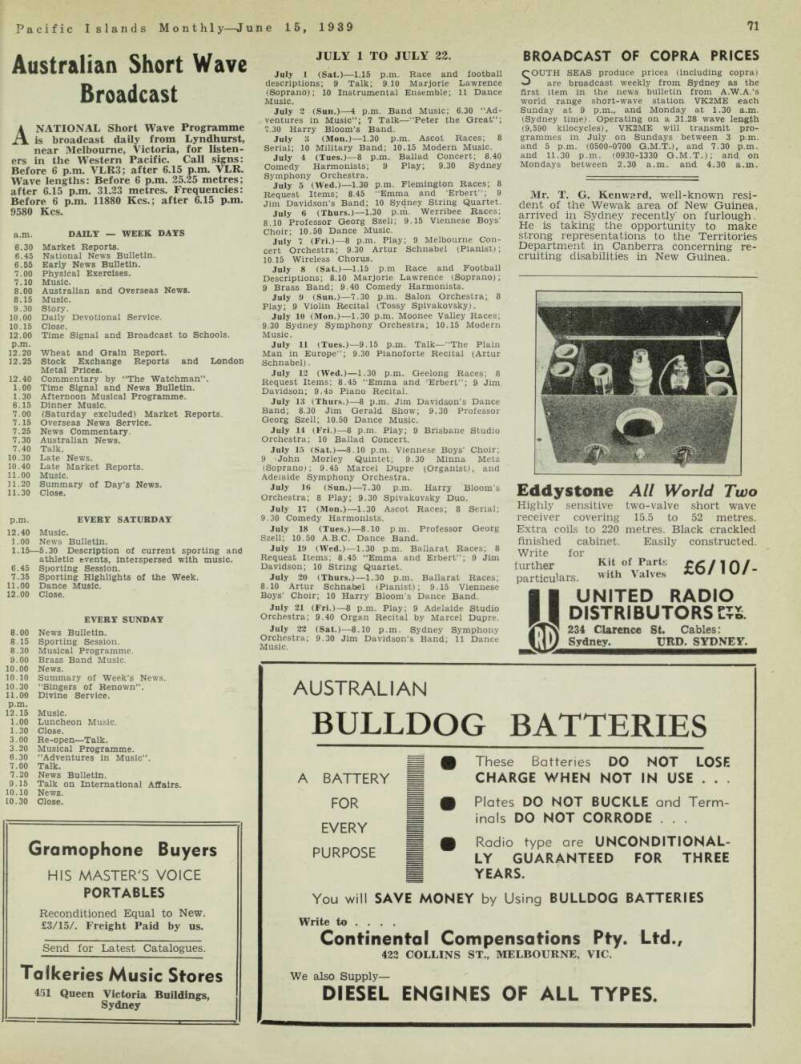
Australian Short Wave Broadcast
A NATIONAL Short Wave Programme is broadcast daily from Lyndhurst, near Melbourne, Victoria, for listen ers in the Western Pacific. Call signs; Before 6 p.m. VLR3; after 6.15 p.m. VLR.
Wave lengths: Before 6 p.m. 25.25 metres; after 6.15 p.m. 31.23 metres. Frequencies: Before 6 p.m. 11880 Kcs.; after 6.15 p.m. 9580 Kcs.
A.M. Daily Week Days
6.30 Market Reports. 6.45 National News Bulletin. 6.55 Early News Bulletin. 7.00 Physical Exercises. 7.10 Music. 8.00 Australian and Overseas News. 8.15 Music. 9.30 Story. 10.00 Daily Devotional Service. 10.15 Close. 12.00 Time Signal and Broadcast to Schools, p.m. 12.20 Wheat and Grain Report. 12.25 Stock Exchange Reports and London Metal Prices. 12.40 Commentary by “The Watchman”. 1.00 Time Signal and News Bulletin. 1.30 Afternoon Musical Programme. 6.15 Dinner Music. 7.00 (Saturday excluded) Market Reports. 7.15 Overseas News Service. 7.25 News Commentary. 7.30 Australian News. 7.40 Talk. 10.30 Late News. 10.40 Late Market Reports. 11.00 Music. 11.20 Summary of Day’s News. 11.30 Close.
P.M. Every Saturday
12.40 Music. 1.00 News Bulletin. 1.15—5.30 Description of current sporting and athletic events, interspersed with music. 6.45 Sporting Session. 7.35 Sporting Highlights of the Week, 11.00 Dance Music. 12.00 Close.
Every Sunday
8.00 News Bulletin. 8.15 Sporting Session. 8.30 Musical Programme. 9.00 Brass Band Music. 10.00 News. 10.10 Summary of Week’s News. 10.30 “Singers of Renown”. 11.00 Divine Service, p.m. 12.15 Music. 1.00 Luncheon Music. 1.30 Close. 3.00 Re-open—Talk. 3.20 Musical Programme. 6.30 “Adventures in Music”. 7.00 Talk. 7.20 News Bulletin. 9.15 Talk on International Affairs. 10.10 News. 10.30 Close.
July 1 To July 22.
July 1 (Sat.) —1.15 p.m. Race and football descriptions; 9 Talk; 9.10 Marjorie Lawrence (Soprano); 10 Instrumental Ensemble; 11 Dance Music.
July 2 (Sun.) —4 p.m. Band Music; 6.30 “Ad ventures in Music’’; 7 Talk —“Peter the Great”; 7.30 Harry Bloom’s Band.
July 3 (Mon.) —1.30 p.m. Ascot Races; 8 Serial; 10 Military Band; 10.15 Modern Music.
July 4 (Tues.) —8 p.m. Ballad Concert; 8.40 Comedy Harmonists; 9 Play; 9.30 Sydney Symphony Orchestra.
July 5 (Wed.) —1.30 p.m. Flemington Races; 8 Request Items; 8.45 “Emma and ’Erbert”; 9 Jim Davidson’s Band; 10 Sydney String Quartet.
July 6 (Thurs.)—l.3o p.m. Werribee Races; 8.10 Professor Georg Szell; 9.15 Viennese Boys’
Choir; 10.50 Dance Music.
July 7 (Fri.) —8 p.m. Play; 9 Melbourne Con cert Orchestra: 9.30 Artur Schnabel (Pianist); 10.15 Wireless Chorus.
July 8 (Sat.) —1.15 p.m Race and Football Descriptions; 8.10 Marjorie Lawrence (Soprano); 9 Brass Band; 9.40 Comedy Harmonists.
July 9 (Sun.) —7.30 p.m. Salon Orchestra; 8 Play; 9 Violin Recital (Tossy Spivakovsky).
July 10 (Mon.) —1.30 p.m. Moonee Valley Races; 9.30 Sydney Symphony Orchestra; 10.15 Modern Music.
July 11 (Tues.) —9.15 p.m. Talk —“The Plain Man in Europe”; 9.30 Pianoforte Recital (Artur Schnabel).
July 12 (Wed.) —1.30 p.m. Geelong Races; 8 Request Items; 8.45 “Emma and ’Erbert”; 9 Jim Davidson; 9.45 Piano Recital.
July 13 (Thurs.) —8 p.m. Jim Davidson’s Dance Band; 8.30 Jim Gerald Show; 9.30 Professor Georg Szell; 10.50 Dance Music, July 14 (Fri.)—B p.m. Play; 9 Brisbane Studio Orchestra; 10 Ballad Concert.
July 15 (Sat.) —8.10 p.m. Viennese Boys’ Choir; 9 John Morley Quintet; 9.30 Minna Metz (Soprano); 9.45 Marcel Dupre (Organist), and Adelaide Symphony Orchestra.
July 16 (Sun.) —7.30 p.m. Harry Bloom’s Orchestra; 8 Play; 9.30 Spivakovsky Duo.
July 17 (Mon.) —1.30 Ascot Races; 8 Serial; 9.30 Comedy Harmonists.
July 18 (Tues.) —8.10 p.m. Professor Georg Szell; 10.50 A.B.C. Dance Band.
July 19 (Wed.) —1.30 p.m. Ballarat Races; 8 Request Items; 8.45 “Emma and Erbert”; 9 Jim Davidson; 10 String Quartet.
July 20 (Thurs.) —1.30 p.m. Ballarat Races; 8.10 Artur Schnabel (Pianist); 9.15 Viennese Boys’ Choir; 10 Harry Bloom’s Dance Band.
July 21 (Fri.) —8 p.m. Play; 9 Adelaide Studio Orchestra; 9.40 Organ Recital by Marcel Dupre.
July 22 (Sat.) —8.10 p.m. Sydney Symphony Orchestra; 9.30 Jim Davidson’s Band; 11 Dance Music.
Broadcast Of Copra Prices
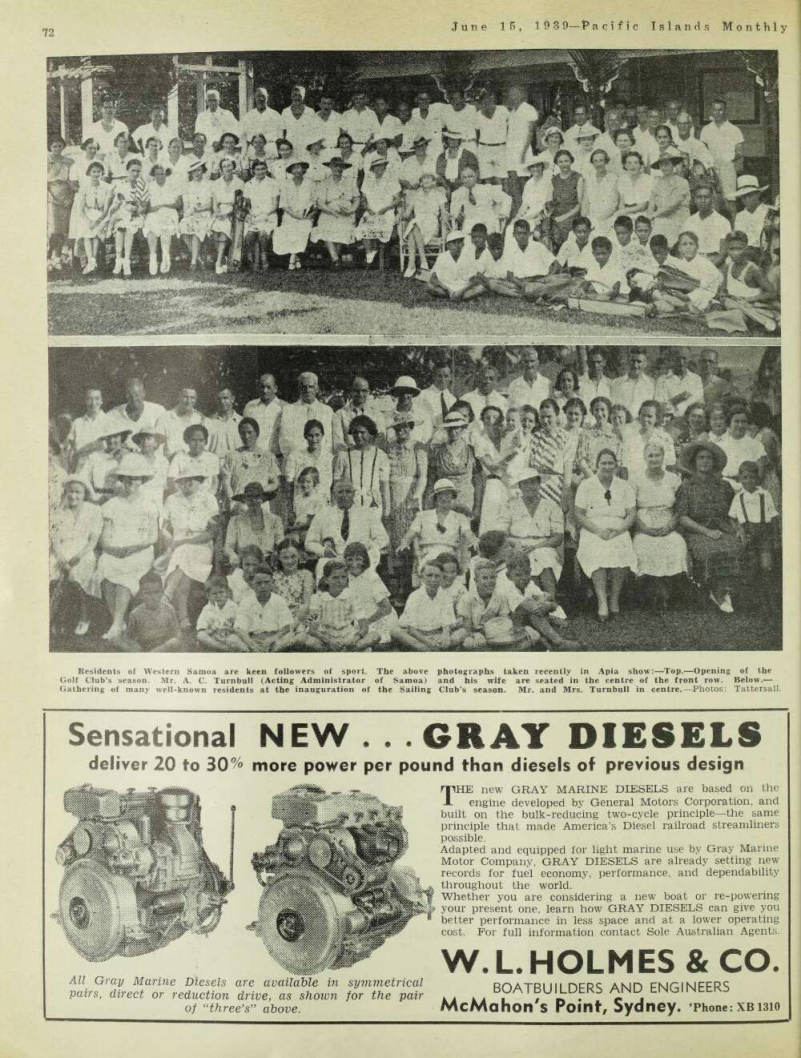
SOUTH SEAS produce prices (including copra) are broadcast weekly from Sydney as the first item in the news bulletin from A.W.A.’s world range short-wave station VK2ME each Sunday at 9 p.m., and Monday at 1.30 a.m. (Sydney time). Operating on a 31.28 wave length (9,590 kilocycles), VK2ME will transmit pro grammes in July on Sundays between 3 p.m. and 5 p.m. (0500-0700 G.M.T.), and 7.30 p.m. and 11.30 p.m. (0930-1330 G.M.T.); and on Mondays between 2.30 a.m. and 4.30 a.m.
Mr. T. G. Kenward, well-known resi dent of the Wewak area of New Guinea,
arrived in Sydney recently' on furlough.
He is taking the opportunity to make strong representations to the Territories Department in Canberra concerning re cruiting disabilities in New Guinea.
Residents of Western Samoa are keen followers of sport. The above photographs taken recently in Apia show: —Top.—Opening of the Golf Club’s season. Mr. A. C. Turnbull (Acting Administrator of Samoa) and his wife are seated in the centre of the front row. Below.— Gathering of many well-known residents at the inauguration of the Sailing Club’s season. Mr. and Mrs. Turnbull in centre. —Photos: Tattersall.
Advertisements & other items, pp. 75-76 (3 items)
Bulldog Batteries
A
Eddystone All World Two
Highly sensitive two-valve short wave receiver covering 15.5 to 52 metres.
Extra coils to 220 metres. Black crackled finished cabinet. Easily constructed.
Write for further Kit of Parts £6/10/particulars. with Valves XD/ lU/ u
UNITED RADIO
DISTRIBUTORS LTD.
St. Cables:
URD. SYDNEY.
234 Clarence *1 Sydney.
AUSTRALIAN
BULLDOG BATTERIES
You will SAVE MONEY by Using BULLDOG BATTERIES Write to ... .
Continental Compensations Pty. Ltd.,
422 COLLINS ST., MELBOURNE, VIC.
We also Supply—
DIESEL ENGINES OF ALL TYPES.
Sensational NEW . . .GRAY DIESELS
deliver 20 to 30% more power per pound than diesels of previous design -■A All Gray Marine Diesels are available in symmetrical pairs, direct or reduction drive, as shown for the pair of “three’s” above.
THE new GRAY MARINE DIESELS are based on the engine developed by General Motors Corporation, and built on the bulk-reducing two-cycle principle—the same principle that made America’s Diesel railroad streamliners possible.
Adapted and equipped for light marine use by Gray Marine Motor Company. GRAY DIESELS are already setting new records for fuel economy, performance, and dependability throughout the world.
Whether you are considering a new boat or re-powering your present one, learn how GRAY DIESELS can give you better performance in less space and at a lower operating cost. For full information contact Sole Australian Agents.
W.L.HOLMES & CO.
BOATBUILDERS AND ENGINEERS
McMahon's Point, Sydney. ’Phone: xbmo
Gramophone Buyers
HIS MASTER'S VOICE
PORTABLES
Reconditioned Equal to New. £3/15/. Freight Paid by us.
Send for Latest Catalogues.
Talkeries Music Stores
451 Queen Victoria Buildings, Sydney
72
June 15, 193 9—P acific Islands Monthly
Islands Produce
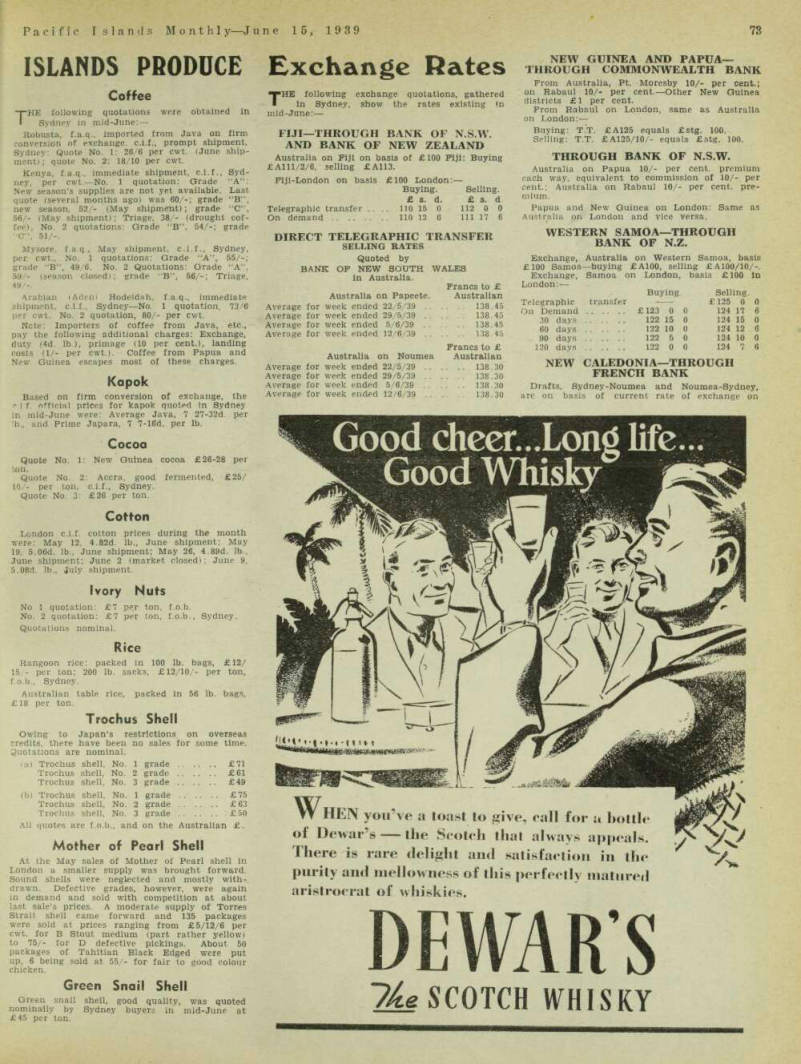
Coffee
THE following quotations were obtained in Sydney in mid-June;— Robusta, f.a.q., imported from Java on firm conversion of exchange, c.i.f., prompt shipment, Sydney: Quote No. 1; 26/6 per cwt. (June ship ment) ; quote No. 2: 18/10 per cwt.
Kenya, f.a.q., immediate shipment, c.i.f., Syd ney, per cwt.—No. 1 quotation: Grade “A”: New season’s supplies are not yet available. Last quote (several months ago) was 60/-; grade “B”, new season, 52/- (May shipment); grade “C”, 56/- (May shipment): Triage, 38/- (drought cof fee), No. 2 quotations: Grade “B”, 54/-; grade “C”, 51/-.
Mysore, f.a.q., May shipment, c.i.f., Sydney, per cwt., No. 1 quotations; Grade “A”, 55/-; grade “B”, 49/6. No. 2 Quotations: Grade “A”, 59/- (season closed); grade ’B”, 56/-; Triage, 49/-.
Arabian (Aden) Hodeidah, f.a.q., immediate shipment, c.i.f., Sydney—No. 1 quotation, 73/6 per cwt. No. 2 quotation, 80/- per cwt.
Note; Importers of coffee from Java, etc., pay the following additional charges: Exchange, duty (4d. lb), primage (10 per cent.), landing costs (1/- per cwt.). Coffee from Papua and New Guinea escapes most of these charges.
Kapok
Based on firm conversion of exchange, the « i f. official prices for kapok quoted in Sydney in mid-June were; Average Java, 7 27-32 d. per 'h>., and Prime Japara, 7 7-16 d. per lb.
Cocoa
Quote No. 1: New Guinea cocoa £26-28 per ton.
Quote No. 2; Accra, good fermented, £25/ 10 - per ton. c.i.f., Sydney.
Quote No. 3: £26 per ton.
Cotton
London c.i.f. cotton prices during the month were; May 12, 4.82 d. lb., June shipment; May 19, 5.06 d. lb., June shipment; May 26, 4.89 d. lb., June shipment; June 2 (market closed); June 9, 5.08 d. lb., July shipment.
Ivory Nuts
No 1 quotation; £7 per ton, f.o.b.
No. 2 quotation: £7 per ton, f.0.b., Sydney.
Quotations nominal.
Rice
Rangoon rice: packed in 100 lb. bags, £l2/ 15,- per ton; 200 lb. sacks, £l2/10/- per ton, f.0.b., Sydney.
Australian table rice, packed in 56 lb. bags, £lB per ton.
Trochus Shell
Owing to Japan’s restrictions on overseas credits, there have been no sales for some time.
Quotations are nominal. (a) Trochus shell. No. 1 grade £7l Trochus shell, No. 2 grade £6l Trochus shell, No. 3 grade £49 (b) Trochus shell, No. 1 grade £75 Trochus shell, No. 2 grade £63 Trochus shell, No. 3 grade £5O All quotes are f.0.b., and on the Australian £.
Mother of Pearl Shell
At the May sales of Mother of Pearl shell in London a smaller supply was brought forward.
Sound shells were neglected and mostly with drawn. Defective grades, however, were again in demand and sold with competition at about last sale’s prices. A moderate supply of Torres Strait shell came forward and 135 packages were sold at prices ranging from £5/12/6 per cwt. for B Stout medium (part rather yellow) to 75/- for D defective pickings. About 50 packages of Tahitian Black Edged were put up, 6 being sold at 55/- for fair to good colour chicken.
Green Snail Shell
Green snail shell, good quality, was quoted nominally by Sydney buyers in mid-June at £45 per ton.
Exchange Rates
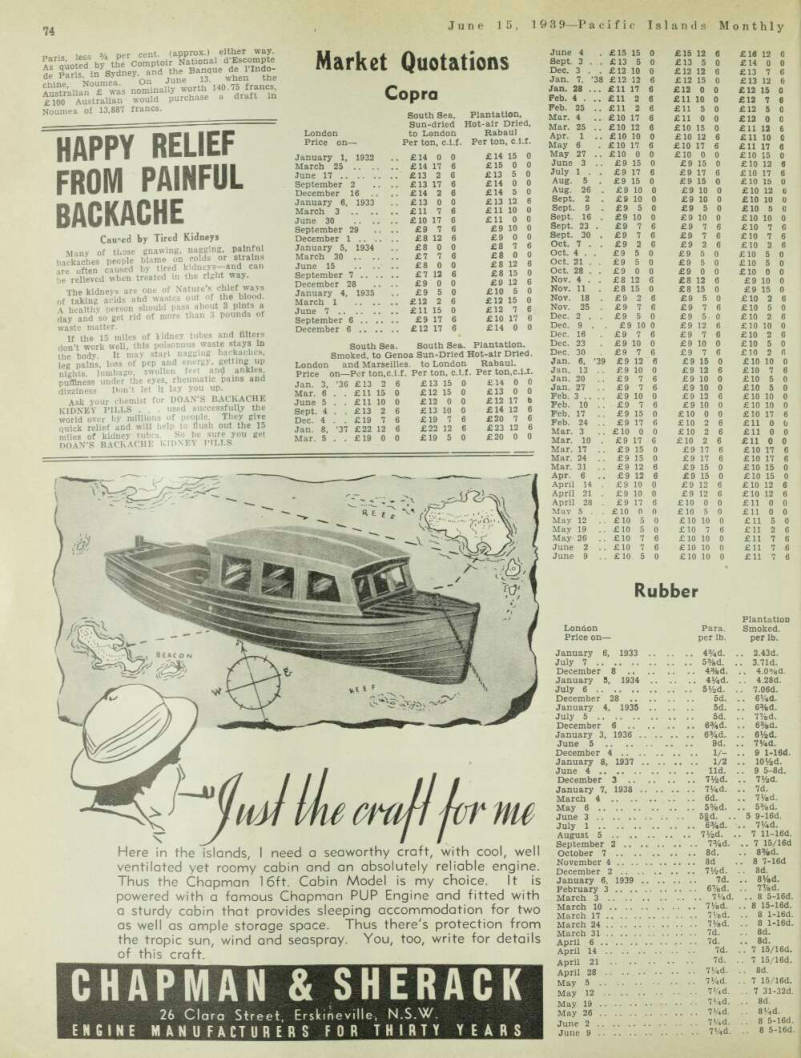
THE following exchange quotations, gathered in Sydney, show the rates existing in mid-June:—
Fiji—Through Bank Of N.S.W.
And Bank Of New Zealand
Australia on Fiji on basis of £lOO Fiji; Buying £AIII/2/6, selling £AII3.
Piji-London on basis £lOO London: —
Direct Telegraphic Transfer
Selling Rates
Quoted by
Bank Op New South Wales
in Australia.
New Guinea And Papua
Through Commonwealth Bank
From Australia, Pt. Moresby 10/- per cent.; on Rabaul 10/- per cent. —Other New Guinea districts £1 per cent.
From Rabaul on London, same as Australia on London: — Buying: T.T. £AI2S equals £stg. 100.
Selling: T.T. £AI2S/10/- equals £stg. 100.
Through Bank Of N.S.W.
Australia on Papua 10/- per cent, premium each way, equivalent to commission of 10/- per cent.; Australia on Rabaul 10/- per cent, pre mium.
Papua and New Guinea on London: Same as Australia on London and vice versa.
Western Samoa—Through
Bank Of N.Z.
Exchange, Australia on Western Samoa, basis £lOO Samoa —buying £AIOO, selling £AIOO/10/-.
Exchange, Samoa on London, basis £lOO In London: —
New Caledonia—Through
French Bank
Drafts, Sydney-Noumea and Noumea-Sydney, are on basis of current rate of exchange on
Buying.
Selling. £ s. d. £ s. d Telegraphic transfer .. 110 15 0 112 0 0 On demand . . 110 12 6 111 17 6
Francs to £ Australia on Papeete. Australian Average for week ended 22/5/39 138.45 Average for week ended 29/5/39 138.45 Average for week ended 5/6/39 138.45 Average for week ended 12/6/39 138.45 Francs to £ Australia on Noumea Australian Average for week ended 22/5/39 138.30 Average for week ended 29/5/39 138.30 Average for week ended 5/6/39 138.30 Average for week ended 12/6/39 138.30
Buying. Selling.
Telegraphic transfer £ 125 0 0 On Demand £123 0 0 124 17 6 30 days 122 15 0 124 15 0 60 days 122 10 0 124 12 6 90 days 122 5 0 124 10 0 120 days 122 0 0 124 7 6
Paris less % per cent, (approx.) either way.
As quo ed by the Comptoir National d’Escompte de Paris, inSydney. and the Banque de^imdo ius n t e ralian 0 £ m w a a S nominally “worth ’ 140. 75 francs, IWO Australian would purchase a draft m Noumea of 13,887 francs.
Advertisements & other items, pp. 77-78 (2 items)
73
Pacific Islands Mont hi y—J une 15, 1939
Dewars
V * o t I 5 * IP k I '1 * C w
tar*
$p \ ✓ / y. \ M<• 1»«•• . •(< t * a_ :
Whe
IN you’ve a toast to give, rail for a bottle of Dewar’s the Scotch that always appeals.
There is rare delight and satisfaction in the purity and mellowness of this perfectly matured aristrocrat of whiskies. > y. /
DEWARS
l£s SCOTCH WHISKY
happy relief
FROM PAINFUL
BACKACHE
Caused by Tired Kidneys
Many of those gnawing, nagging, painful backaches people blame on colds or strains are often caused by tired kidneys-andcan be relieved when treated in the right way.
The kidneys are one of Nature’s chief ways of taking acids ahd wastes out of the blood. \ healthy person should pass about 3 pints a day and so get rid of more than 3 pounds of waste matter.
If the 15 miles of 1 idney tubes and filters don't work well, this poisonous waste stays in the body. It may start nagging backaches, leg pains, loss of pep and energy, getting up nights, lumbago, swollen feet ans ankles, pufflness under the eyes, rheumatic pains and dizziness Don’t let it lay you up.
Ask your chemist for DOAN'S BACKACHE KIDNEY PILLS . . . used successfully the world over by millions of people. They give quick relief and will help to flush out the 15 miles of kidney tubes. So be sure you get
DOAN’S BACKACHE KIDNEY PILLS.
\ Here in the islands, I need a seaworthy craft, with cool, well ventilated yet roomy cabin and an absolutely reliable engine.
Thus the Chapman 16ft. Cabin Model is my choice. It is powered with a famous Chapman PUP Engine and fitted with a sturdy cabin that provides sleeping accommodation for two as well as ample storage space. Thus there's protection from the tropic sun, wind and seaspray. You, too, write for details of this craft.
CHAPMAN & SHERACK
26 Clara Street, Erskineville, N.S.W.
ENGINE MANUFACTURERS FOR THIRTY YEARS
Market Quotations
June 4 £15 15 0 £15 12 6 £ 16 12 6 Sept. 3 . . £13 5 0 £13 5 0 £14 0 0 Dec. 3 . . £12 10 0 £12 12 6 £13 7 6 Jan. 7, ’38 £12 12 6 £12 15 0 £13 12 6 Jan. 28 ... £11 17 6 £12 0 0 £12 15 0 Peb. 4 . .. £11 2 6 £11 10 0 £12 7 6 Feb. 25 .. £11 2 6 £11 5 0 £12 5 0 Mar. 4 .. £10 17 6 £11 0 0 £12 0 0 Mar. 25 .. £10 12 6 £10 15 0 £11 12 6 Apr. 1 .. £10 10 0 £10 12 6 £11 10 0 May 6 £10 17 6 £10 17 6 £11 17 6 May 27 .. £10 0 0 £10 0 0 £10 15 0 June 3 .. £9 15 0 £9 15 0 £10 12 6 July 1 . . £9 17 6 £9 17 6 £10 17 6 Aug. 5 . £9 15 0 £9 15 0 £10 15 0 Aug. 26 . £9 10 0 £9 10 0 £10 12 e Sept. 2 . £9 10 0 £9 10 0 £ 10 10 0 Sept. 9 . £9 5 0 £9 5 0 £10 5 0 Sept. 16 . £9 10 0 £9 10 0 £10 10 0 Sept. 23 . £9 7 6 £9 7 6 £10 7 6 Sept. 30 . £9 7 6 £9 7 6 £10 7 6 Oct. 7 . . £9 2 6 £9 2 6 £10 2 6 Oct. 4 . . £9 5 0 £9 5 0 £10 5 0 Oct. 21 . . £9 5 0 £9 5 0 £10 5 0 Oct. 28 . . £9 0 0 £9 0 0 £10 0 0 Nov. 4 . . £8 12 6 £8 12 6 £9 10 0 Nov. 11 £8 15 0 £8 15 0 £9 15 0 Nov. 18 £9 2 6 £9 5 0 £10 2 6 Nov. 25 . £9 7 6 £9 7 6 £10 5 0 Dec. 2 . . £9 5 0 £9 5 0 £10 2 6 Dec. 9 . . £9 10 0 £9 12 6 £10 10 0 Dec. 16 £9 7 6 £9 7 6 £10 2 6 Dec. 23 . £9 10 0 £9 10 0 £10 5 0 Dec. 30 £9 7 6 £9 7 6 £10 2 6 Jan. 6. ’39 £9 12 6 £9 15 0 £10 10 0 Jan. 13 .. £9 10 0 £9 12 6 £10 7 6 Jan. 20 £9 7 6 £9 10 0 £10 5 0 Jan. 27 . . £9 7 6 £9 10 0 £10 5 0 Feb. 3 .. .. £9 10 0 £9 12 6 £10 10 0 Peb. 10 .. £9 7 6 £9 10 0 £ 10 10 0 Feb. 17 .. £9 15 0 £10 0 0 £10 17 6 Feb. 24 . . £9 17 6 £10 2 6 £11 0 0 Mar. 3 £10 0 0 £10 2 6 £11 0 0 Mar. 10 . £9 17 6 £10 2 6 £11 0 0 Mar. 17 ,. £9 15 0 £9 17 6 £10 17 6 Mar. 24 . . £9 15 0 £9 17 6 £10 17 6 Mar. 31 . . £9 12 6 £9 15 0 £10 15 0 Apr. 6 £9 12 6 £9 15 0 £10 15 0 April 14 £9 10 0 £9 12 6 £10 12 6 April 21 . £9 10 0 £9 12 6 £10 12 6 April 28 . £9 17 6 £10 0 0 £11 0 0 Mav 5 . . £10 0 n £10 5 0 £11 0 0 May 12 £10 5 0 £10 10 0 £11 5 0 May 19 £10 5 0 £10 7 6 £11 2 6 May 26 £10 7 6 £10 10 0 £11 7 6 June 2 .. £10 7 6 £10 10 0 £11 7 6 June 9 £10 5 0 £10 10 0 * £11 7 6
Rubbei
• Plantation London Para.
Smoked.
Price onper lb. per lb.
January 6 , 1933 4%d. .. 2.43d.
July 7 .. 5 3 /ad. ., 3.71d.
December 8 .. 4%d. .. 4.oy 8 d.
January 3 1934 4V 4 d. .. 4.28d.
July 6 .. 5>/ 2 d. .. 7.06d.
December 28 .. 5d. .. ey 4 d.
January 4, 1935 5d. .. 6%d.
July 5 .. 5d. .. 7 7 / 8 d.
December 6 .. 6%d. .. 6 3 / 8 d.
January 3, 1936 .. 6%d. .. ey 2 d.
June 5 9d. .. ?y 4 d.
December 4 .. .. . 1/- .. 9 l-16d.
January 8, , 1937 . . 1/2 .. ioy 2 d.
June 4 .. lid. .. 9 5-8d.
December 3 .. 7%d. .. 7y 2 d.
January 7, 1938 .. ?y 4 d. .. 7d.
March 4 . . , , . . 6d. .. ?y 8 d.
May 6 .. 5%d. .. 5 5 /sd.
June 3 .. 5|d. ., . 5 9-16d.
July 1 .. 6%d. .. 7>/ 4 d.
August 5 7y 2 d. .. 7 ll-16d.
September 2 .. . 7%d. .. 7 15/16d October 7 . . , • • • • 8d. .. 8%d.
November 4 .. .. 8d .. 8 7-16d December 2 .. .. ?y 2 d. .. 8d.
January 6, , 1939 . 7d. .. sy 8 d.
February 2 1 ey 8 d. .. 7 7 / 8 d.
March 3 . 7V 4 d. .. 8 5-16d.
March 10 7y 8 d. .. 8 15-16d.
March 17 , 7Vad. . . 8 l-16d.
March 24 . 7V 8 d. .. 8 l-16d.
March 31 7d. .. 8d.
April 6 .. . . . , , 7d. .. 8d.
April 14 . 7d. .. 7 15/16d.
April 21 7d. . . 7 15/16d.
April 28 . 7y 4 d. .. 8d.
May 3 ?y 4 d. .. 7 15/16d.
May 12 . . VAd. . . 7 31-32d.
May 19 .. . 7V 4 d. .. 8d.
May 26 .. . ?y 4 d. . . 8*/ 4 d.
June 2 .. . 7V 4 d. .. 8 5-16d, June 9 .. . 7y 4 d. .. 8 5-16d
Copra
South Sea, Plantation, Sun-dried Hot-air Dried, London to London Rabaul Price on— Per ton, c.i.f.
Per ton, c.i.f.
January 1, 1932 £14 0 0 £14 15 0 March 25 .. . £14 17 6 £15 0 0 June 17 £13 2 6 £13 5 0 September 2 £13 17 6 £14 0 0 December 16 £14 2 6 £14 5 0 January 6, 1933 £13 0 0 £13 12 6 March 3 .. £11 7 6 £11 10 0 June 30 .. . £10 17 6 £11 0 0 September 29 , £9 7 6 £9 10 0 December 1 .. . £8 12 6 £9 0 0 January 5, 1934 £8 0 0 £8 7 6 March 30 .. . £7 7 6 £8 0 0 June 15 .. . £8 0 0 £8 12 6 September 7 .. £7 12 6 £8 15 0 December 28 . £9 0 0 £9 12 6 January 4, 1935 . . £9 5 0 £10 5 0 March 1 .. . £12 2 6 £12 15 0 June 7 £11 15 0 £12 7 6 September 6 .. £9 17 6 £10 17 6 December 6 .. , £12 17 6 £14 0 0 South Sea.
South Sea.
Plantation.
Smoked, to Genoa Sun-Dried Hot-air Dried.
London and Marseilles, to London Rabaul.
Price on—Per ton,c.i.f. Per ton ., c.i.f. Per ton,c.l.i.
Jan. 3, ’36 £13 2 6 £13 : 15 0 £14 0 0 Mar. 6 . . £11 15 0 £12 15 0 £13 0 0 June 5 . . £11 10 0 £12 0 0 £12 17 b Sept. 4 . ; £13 2 6 £13 10 0 £14 12 6 Dec. 4 . . £19 7 6 £19 7 6 £20 7 6 Jan. 8, ’37 £22 12 6 £22 : 12 6 £23 12 6 Mar. 5 . . £19 0 0 £19 5 0 £20 0 0
Advertisements & other items, p. 78 (1 item)
74
June 15, 193 9—P acific Islands Monthly
Shipping Services in the Pacific
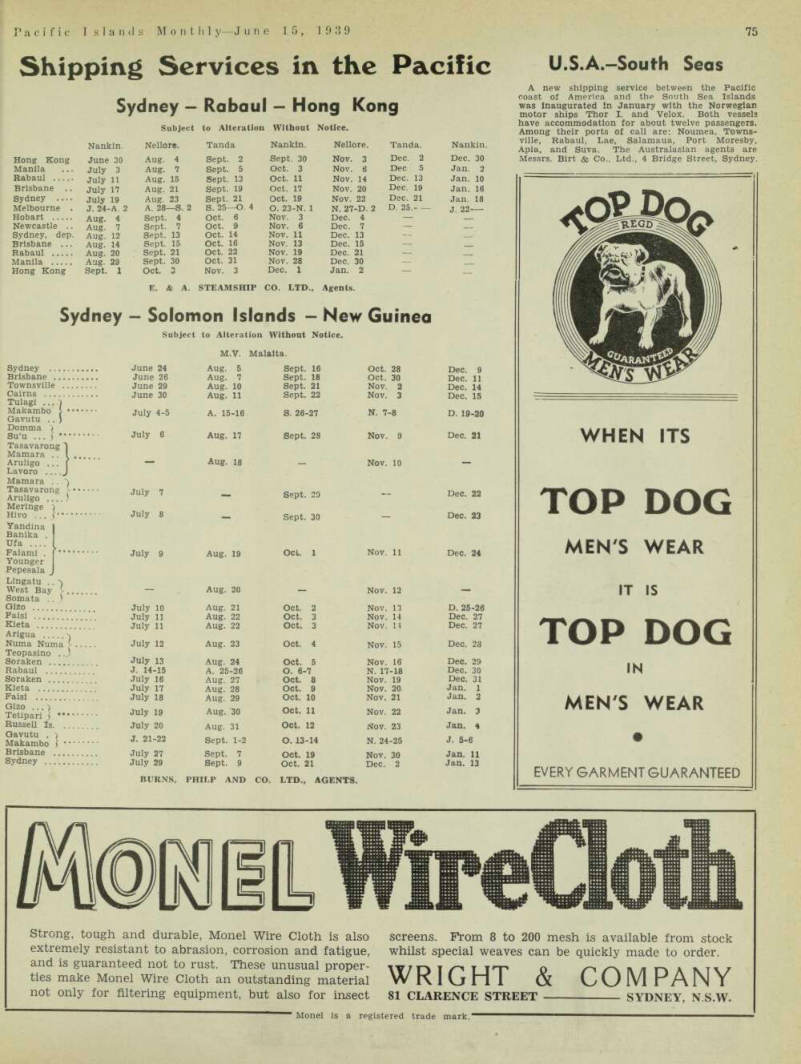
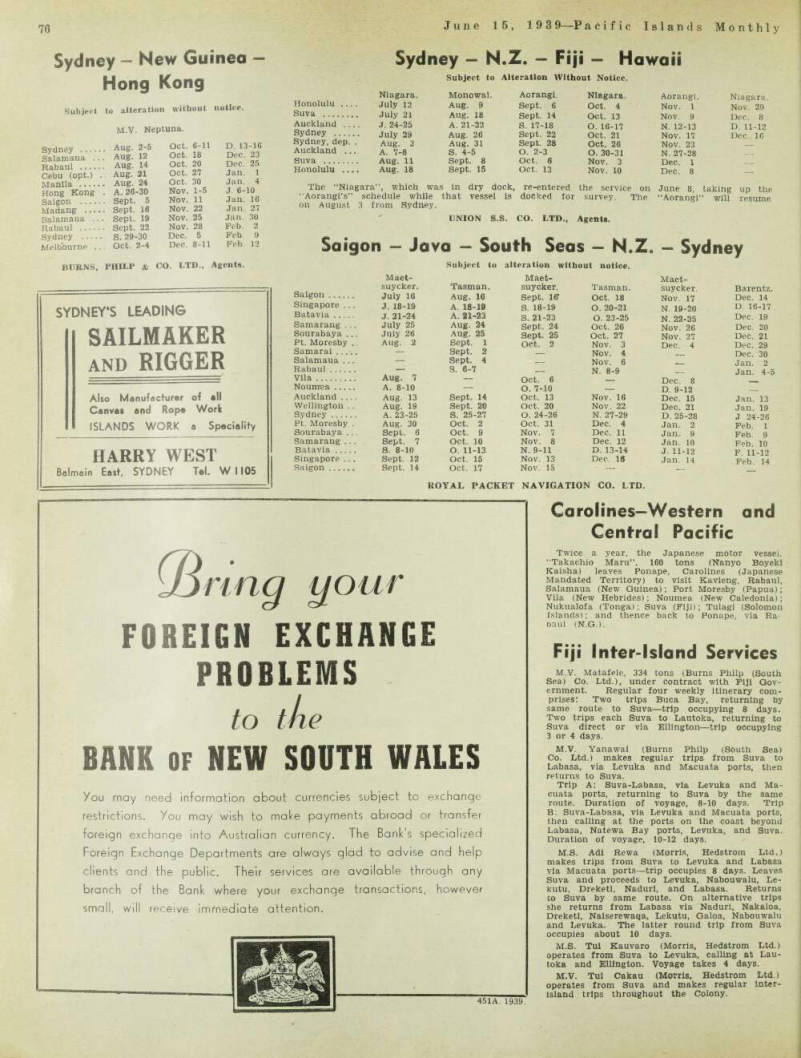
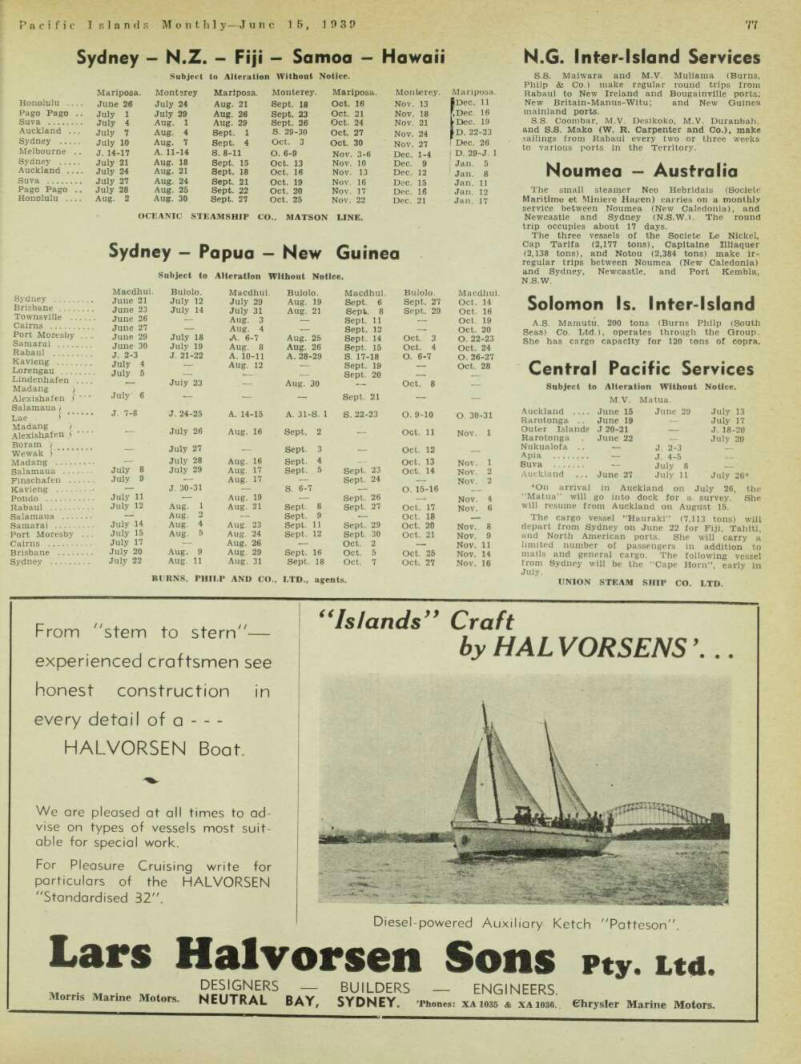
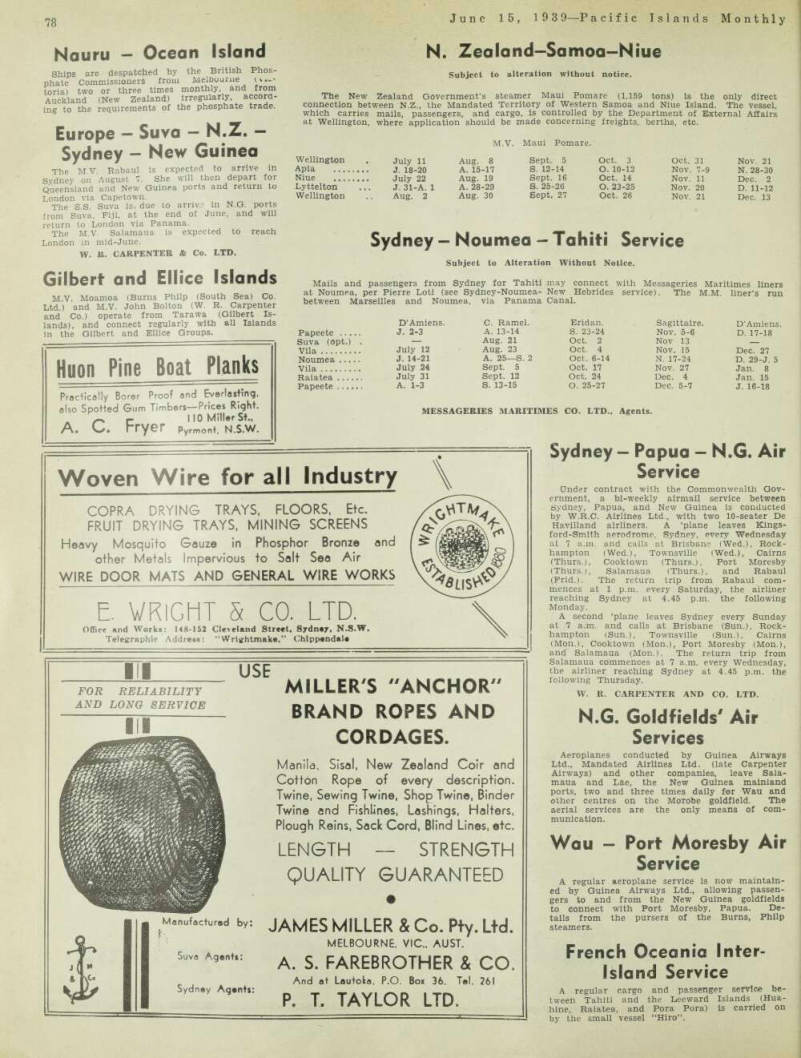
U.S.A.—South Seas
A new shipping service between the Pacific coast of America and the South Sea Islands was inaugurated In January with the Norwegian motor ships Thor I. and Velox. Both vessels have accommodation for about twelve passengers.
Among their ports of call are: Noumea, Towns ville, Rabaul, Lae, Salamaua, Port Moresby, Apia, and Suva. The Australasian agents are Messrs. Birt & Co., Ltd., 4 Bridge Street, Sydney.
Sydney —
Rabaul
- Hong Kong
Subject to Alteration Without Notice.
Nankin.
Nellore.
Tanda Nankin. Nellore. Tanda.
Nankin.
Hong Kong Manila Rabaul Brisbane ..
Sydney Melbourne .
Hobart Newcastle ..
Sydney, dep.
Brisbane ...
Rabaul Manila Hong Kong June 30 July 3 July 11 July 17 July 19 J. 24-A. 2 Aug. 4 Aug. 7 Aug. 12 Aug. 14 Aug. 20 Aug. 29 Sept. 1 Aug. 4 Aug. 7 Aug. 15 Aug. 21 Aug. 23 A. 28—S. 2 Sept. 4 Sept. 7 Sept. 13 Sept. 15 Sept. 21 Sept. 30 Oct. 3 Sept. 2 Sept. 5 Sept. 13 Sept. 19 Sept. 21 S. 25—0. 4 Oct. 6 Oct. 9 Oct. 14 Oct. 16 Oct. 22 Oct. 31 Nov. 3 Sept. 30 Nov. 3 Dec. 2 Oct. 3 Nov. 6 Dec 5 Oct. 11 Nov. 14 Dec. 13 Oct. 17 Nov. 20 Dec. 19 Oct. 19 Nov. 22 Dec. 21 O. 23-N. 1 N. 27-D. 2 D. 25.
Nov. 3 Dec. 4 — Nov. 6 Dec. 7 Nov. 11 Dec. 13 Nov. 13 Dec. 15 Nov. 19 Dec. 21 Nov. 28 Dec. 30 Dec. 1 Jan. 2 Dec. 30 Jan. 2 Jan. 10 Jan. 16 Jan. 18 J. 22— E. & A.
Steamship Co. Ltd., Agents.
Sydney
- Solomon Islands - New Guinea
Subject to Alteration Without Notice.
M.V. Malalta.
Sydney Brisbane Townsville ...
Cairns Tulagi l Makambo [ •• Gavutu .. ) Domma > Su’u ... S **'* Tasavarong 1
Mamara .. 1 .
Aruligo ... j
Lavoro j
Mamara ..r\ Tasavarong • Aruligo 3 Meringe l June 24 June 26 June 29 June 30 July 4-5 July 6 July 7 July 8 Aug. 5 Aug. 7 Aug. 10 Aug. 11 A. 15-16 Aug. 17 Aug. 18 Sept. 16 Oct. 28 Sept. 18 Oct. 30 Sept. 21 Nov. 2 Sept. 22 Nov. 3 S. 26-27 N. 7-8 Sept. 28 Nov. 9 — Nov. 10 Sept. 29 — Dec. 9 Dec. 11 Dec. 14 Dec. 15 D. 19-20 Dec. 21 Dec. 22 Dec. 23 Dec. 24 D.25-26 mvo . . . j Yandina Banika .
Ufa ...
Falami .
Younger Pepesala Llngatu ..
West Bay Somata ..
Glzo Sept. 30 — Oct. 1 Nov. 11 — Nov. 12 Oct. 2 Nov. 13 1- July 9 July 10 July 11 July 11 July 12 July 13 Aug. 19 Aug. 20 Aug. 21 Aug. 22 Aug. 22 Aug. 23 Aug. 24 A. 25-26 Paisi Oct. 3 Nov. 14 Dec. 27 Kleta ...
Oct. 3 Nov. 14 Dec. 27 Arlgua
Numa Numa [ ,
Teopaslno . J Soraken Oct. 4 Nov. 15 Oct. 5 Nov. 16 Dec. 28 Dec. 29 Rabaul ..
J. 14-15 O, 6-7 N. 17-18 Dec. 30 Soraken .
Kleta ...
Paisi July 16 July 17 July 18 July 19 July 20 J. 21-22 Aug. 27 Aug. 28 Aug. 29 Aug. 30 Aug. 31 Sept. 1-2 Sept. 7 Sept. 9 Oct. 8 Nov. 19 Oct. 9 Nov. 20 Oct. 10 Nov. 21 Dec. 31 Jan. 1 Jan. 2 Gizo .,.
Oct. 11 Nov. 22 Jan. 3 j.eupari ) Russell Is. . . .
Oct. 12 Nov. 23 O. 13-14 N. 24-25 Oct. 19 Nov. 30 Oct. 21 Dec. 2 Jan. 4 Gavutu .
Makambo Brisbane Sydney .. ] ...
J. 5-6 3 July 27 July 29 Jan. 11 Jan. 13
Burns, Philp And Co. Ltd., Agents.
Sydney New Guinea Hong Kong Subject to alteration without notice.
Sydney - N.Z. - Fiji - Hawaii Subject to Alteration Without Notice.
Saigon - Java - South Seas - N.Z. - Sydney Subject to alteration without notice.
Carolines-Western and
Central Pacific
Twice a year, the Japanese motor vessel, “Takachio Maru”, 160 tons (Nanyo Boyeki Kaisha) leaves Ponape, Carolines (Japanese Mandated Territory) to visit Kavieng, Rabaul, Salamaua (New Guinea); Port Moresby (Papua); Vila (New Hebrides); Noumea (New Caledonia); Nukualofa (Tonga); Suva (Fiji); Tulagi (Solomon Islands): and thence back to Ponape, via Ra oaul (N.G.).
Fiji Inter-Island Services
M.V. Matafele, 334 tons (Burns Philp (South Sea) Co. Ltd.), under contract with Fiji Gov ernment. Regular four weekly itinerary com prises: Two trips Buca Bay, returning by same route to Suva —trip occupying 8 days.
Two trips each Suva to Lautoka, returning to Suva direct or via Ellington—trip occupying 3 or 4 days.
M.V. Yanawai (Burns Philp (South Sea) Co. Ltd.) makes regular trips from Suva to Labasa, via Levuka and Macuata ports, then returns to Suva.
Trip A: Suva-Labasa, via Levuka and Ma cuata ports, returning to Suva by the same route. Duration of voyage, 8-10 days. Trip B. Suva-Labasa, via Levuka and Macuata ports, then calling at the ports on the coast beyond Labasa, Natewa Bay ports, Levuka, and Suva.
Duration of voyage, 10-12 days.
M.S. Adi Rewa (Morris, Hedstrom Ltd.) makes trips from Suva to Levuka and Labasa via Macuata ports—trip occupies 8 days. Leaves Suva and proceeds to Levuka, Nabouwalu, Le kutu, Dreketl, Nadurl, and Labasa. Returns to Suva by same route. On alternative trips she returns from Labasa via Nadurl, Nakaloa, Dreketl, Nalserewaqa, Lekutu, Galoa, Nabouwalu and Levuka. The latter round trip from Suva occupies about 10 days.
M.S. Tui Kauvaro (Morris, Hedstrom Ltd.) operates from Suva to Levuka, calling at Lau toka and Ellington. Voyage takes 4 days.
M.V. Tul Cakau (Morris, Hedstrom Ltd.) operates from Suva and makes regular inter island trips throughout the Colony.
M.V.
Neptuna.
Sydney Salamaua .. ,. Aug. . Aug. 2-5 12 Oct.
Oct. 6-11 18 D. 13 Dec. 1-16 23 Rabaul ... 14 Oct. 20 Dec. 25 Cebu (opt.) . Aug. 21 Oct. 27 Jan. 1 Manila 24 Oct. 30 Jan. 4 Hong Kong . A. 26 -30 Nov. 1-5 J. 6- 10 Saigon 5 Nov. 11 Jan. 16 Madang 16 Nov. 22 Jan. 27 Salamaua .. . Sept. 19 Nov. 25 Jan. 30 Rabaul 22 Nov. 28 Peb. 2 Sydney ■ S. 29- •30 Dec, 5 Feb, 9 Melbourne . . Oct. 2-4 Dec. 8-11 Peb. 12
Burns,
Philp
Co. Ltd.,
Agents.
Honolulu ...
Niagara.
Monowal.
Aorangi.
Niagara.
Aorangi.
Niagara. .July 12 Aug. 9 Sept. 6 Oct. 4 Nov. 1 Nov. 29 Suva July 21 Aug. 18 Sept. 14 Oct. 13 Nov. 9 Dec. 8 Auckland ..
J.24-25 A.21-22 S. 17-18 O. 16-17 N. 12-13 D.11-12 Sydney July 29 Aug. 26 Sept. 22 Oct. 21 Nov. 17 Dec. 16 Sydney, dep.
Aug. 3 Aug. 31 Sept. 28 Oct. 26 Nov. 23 Auckland ..
A. 7-8 S. 4-5 O. 2-3 O. 30-31 N. 27-28 Suva Aug. 11 Sept. 8 Oct. 6 Nov. 3 Dec. 1 Honolulu ... . Aug. 18 Sept. 15 Oct. 13 Nov. 10 Dec. 8 — The “Niagara”, which was in dry dock, re-entered the service on June 8, taking up the “Aorangi” will resume “Aorangi’s” on August schedule while 3 from Sydney. that vessel is
Union S.S.
docked for
Co. Ltd.,
survey. The Agents.
Saigon Maetsuycker.
Tasman.
Maetsuycker.
Tasman.
Maetsuycker.
Barentz.
July 16 Aug. 16 Sept. 16- Oct. 18 Nov. 17 Dec. 14 Singapore ...
J. 18-19 A 18-19 S. 18-19 O.20-21 N. 19-20 D. 16-17 Batavia J. 21-24 A. 21-23 S. 21-23 O.23-25 N. 22-25 Dec. 19 Samarang ...
July 25 Aug. 24 Sept. 24 Oct. 26 Nov. 26 Dec. 20 Sourabaya ...
July 26 Aug. 25 S6pt. 25 Oct. 27 Nov. 27 Dec. 21 Pt. Moresby ., Aug. 2 Sept. 1 Oct. 2 Nov. 3 Dec. 4 Dec. 29 Samarai — Sept. 2 Nov. 4 Dec. 30 Salamaua ... — Sept. 4 Nov. 6 .
Jan. 2 Rabaul — S. 6-7 N. 8-9 Jan. 4-5 Vila Aug. 7 — Oct. 6 Dec. 8 Noumea A. 8-10 — O. 7-10 — D. 9-12 Auckland Aug. 13 Sept. 14 Oct. 13 Nov. 16 Dec. 15 Jan. 13 Wellington ..
Aug. 19 Sept. 20 Oct. 20 Nov. 22 Dec. 21 Jan. 19 Sydney A. 23-25 S. 25-27 O. 24-26 N. 27-29 D. 25-28 J 24-26 Pt. Moresby .
Aug. 30 Oct. 2 Oct. 31 Dec. 4 Jan. 2 Feb. 1 Sourabaya ...
Sept. 6 Oct. 9 Nov. 7 Dec. 11 Jan. 9 Feb. 9 Samarang ...
Sept. 7 Oct. 10 Nov. 8 Dec. 12 Jan. 10 Feb. 10 Batavia S. 8-10 O. 11-13 N.9-11 D. 13-14 J. 11-12 F. 11-12 Singapore ...
Sept. 12 Oct. 15 Nov. 13 Dec. 16 Jan. 14 Feb. 14 Saigon Sept. 14 Oct. 17 Nov. 15 — —
Koyal Packet
Navigation Co. Ltd.
Sydney - N.Z. - Fiji - Samoa - Hawaii Subject to Alteration Without Notice.
Sydney - Papua New Guinea Subject to Alteration Without Notice.
N.G. Inter-Island Services
5.5. Maiwara and M.V. Muliama (Burns, Philp & Co.) make regular round trips from Rabaul to New Ireland and Bougainville porta; New Britain-Manus-Witu; and New Guinea mainland ports. 5.5. Coombar, M.V. Desikoko, M.V. Duranbah, and S.S. Mako (W. R, Carpenter and Co.), make sailings from Rabaul every two or three weeks to various ports in the Territory.
Noumea Australia
The small steamer Neo Hebridais (Societe Maritime et Miniere Hairen) carries on a monthly service between Noumea (New Caledonia), and Newcastle and Sydney (N.S.W.I. The round trip occupies about 17 days.
The three vessels of the Societe Le Nickel, Cap Tarifa (2,177 tons), Capltalne Illiaquer (2,138 tons), and Notou (2,384 tons) make ir regular trips between Noumea (New Caledonia) and Sydney, Newcastle, and Port Kembla,
N.S.W.
Solomon Is. Inter-Island
A.S. Mamutu, 200 tons (Burns Philp (South Seas) Co. Ltd.), operates through the Group.
She has cargo capacity for 120 tons of copra.
♦On arrival in Auckland on July 26, the “Matua” will go into dock for a survey. She will resume from Auckland on August 15.
The cargo vessel “Hauraki” (7,113 tons) will depart from Sydney on June 22 for Fiji, Tahiti, and North American ports. She will carry a limited number of passengers in addition to mails and general cargo. The following vessel from Sydney will be the “Cape Horn”, early in July.
Union Steam Ship Co. Ltd.
Mariposa.
Monterey Mariposa Monterey.
Mariposa.
Monterey.
Mariposa.
Honolulu June 26 July 24 Aug. 21 Sept. 18 Oct. 16 Nov. 13
(Dec. 11
Pago Pago ..
July 1 July 29 Aug. 26 Sept. 23 Oct. 21 Nov. 18
bee. 16
Suva July 4 Aug. 1 Aug. 29 Sept. 26 Oct. 24 Nov. 21 1 I Dec. 19 Auckland ...
July 7 Aug. 4 Sept. 1 S. 29-30 Oct. 27 Nov. 24 |D. 22-23 Sydney July 10 Aug. 7 Sept. 4 Oct. 3 Oct. 30 Nov. 27 ' Dec. 26 Melbourne ..
J. 14-17 A. 11-14 S. 8-11 O. 6-9 Nov. 3-6 Dec. 1-4 D. 29-J. 1 Sydney July 21 Aug. 18 Sept. 15 Oct. 13 Nov. 10 Dec. 9 Jan. 5 Auckland July 24 Aug. 21 Sept. 18 Oct. 16 Nov. 13 Dec. 12 Jan. 8 Suva July 27 Aug. 24 Sept. 21 Oct. 19 Nov. 16 Dec. 15 Jan. 11 Pago Pago ..
July 28 Aug. 25 Sept. 22 Oct. 20 Nov. 17 Dec. 16 Jan. 12 Honolulu Aug. 2 Aug. 30 Sept. 27
Oceanic Steamship
Oct. 25
Co., Matson
Nov. 22
Line.
Dec. 21 Jan. 17
Sydney Macdhui.
Bulolo.
Macdhui.
Bulolo.
Macdhui.
Bulolo.
Macdhui.
June 21 July 12 July 29 Aug. 19 Sept. 6 Sept. 27 Oct. 14 Brisbane June 23 July 14 July 31 Aug. 21 Sept. 8 Sept. 29 Oct. 16 Townsville June 26 — Aug. 3 — Sept. 11 Oct. 19 Cairns June 27 — Aug. 4 .
Sept. 12 Oct. 20 Port Moresby . . .
June 29 July 18 A- 6-7 Aug. 25 Sept. 14 Oct. 3 O. 22-23 Samarai Rabaul June 30 July 19 Aug. 8 Aug. 26 Sept. 15 Oct. 4 Oct. 24 J. 2-3 J. 21-22 A.10-11 A. 28-29 S. 17-18 O. 6-7 O. 26-27 Kavieng Lorengau Lindenhafen Madang ) Alexishafen j '' * July 4 July 5 July 23 Aug. 12 Aug. 30 Sept. 19 Sept. 20 Oct. 8 Oct. 28 July 6 ■— — — Sept. 21 — — Salamaua > J. 7-8 J. 24-25
Lae i
A. 14-15 A. 31-S. 1 S.22-23 O. 9-10 O. 30-31 Madang > Alexishafen ) * ’ ' — July 26 Aug. 16 Sept. 2 — Oct. 11 Nov. 1 Boram 1 July 27 Qnnf *1 Wewak ) oepi. o UCt. 1* — Madang — July 28 Aug. 16 Sept. 4 — Oct. 13 Nov. 1 Salamaua July 8 July 29 Aug. 17 Sept. 5 Sept. 23 Oct. 14 Nov. 2 Finschafen July 9 •— Aug. 17 — Sept. 24 — Nov. 2 Kavieng — J. 30-31 •— S. 6-7 — O.15-16 Pondo July 11 — Aug. 19 •— Sept. 26 — Nov. 4 Rabaul July 12 Aug. 1 Aug. 21 Sept. 8 Sept. 27 Oct, 17 Nov. 6 Salamaua — Aug. 2 — Sept. 9 — Oct. 18 Samarai July 14 Aug. 4 Aug. 23 Sept. 11 Sept. 29 Oct. 20 Nov, 8 Port Moresby . .
July 15 Aug. 5 Aug. 24 Sept. 12 Sept. 30 Oct. 21 Nov. 9 Cairns July 17 — Aug. 26 Oct. 2 Nov. 11 Brisbane July 20 Aug. 9 Aug. 29 Sept. 16 Oct. 5 Oct. 25 Nov. 14 Sydney July 22 Aug. 11 Aug. 31 Sept. 18 Oct. 7 Oct. 27 Nov. 16
Burns. Philp
And Co.,
LTD., agents.
Central
Pacific Services
Subject to i Alteration Without M.V. Matua.
Notice.
Auckland June 15 June 29 July 13 Rarotonga June 19 — July 17 Outer Islands’
J 20-21 .— J. 18-20 Rarotonga June 22 July 20 Nukualofa .. — J. 2-3 Apia — J. 4-5 Suva — July 8 — Auckland June 27 July 11 July 26*
Nauru Ocean Island
Ships are despatched by the British Phos phate Commissioners from Melbourne (v*v toria) two or three times monthly, and from Auckland (New Zealand) irregularly accord ing to the requirements of the phosphate trade.
Europe - Suvo - N.Z. -
Sydney - New Guinea
The M.V. Rabaul is expected to arrive in Sydney on August 7. She will then depart for Queensland and New Guinea ports and return to London via Capetown.
The SS. Suva is. due to arrivo in N.G. ports from Suva, Fiji, at the end of June, and will return to London via Panama.
The M.V. Salamaua is expected to reach London in mid-June.
W. B. Carpenter & Co. Ltd.
Gilbert and Ellice Islands
M.V. Moamoa (Burns Philp (South Sea) Co.
Ltd.) and M.V. John Bolton (W. R. Carpenter and Co.) operate from Tarawa (Gilbert Is lands), and connect regularly with all Islands in the Gilbert and Ellice Groups.
N. Zealand—Samoa-Niue
Subject to alteration without notice.
The New Zealand Government’s steamer Maui Pomare (1,159 tons) is the only direct connection between N.Z., the Mandated Territory of Western Samoa and Niue Island. The vessel, which carries mails, passengers, and cargo, is controlled by the Department of External Affairs at Wellington, where application should be made concerning freights, berths, etc.
Sydney - Noumea-Tahiti Service
Subject to Alteration Without Notice.
Mails and passengers from Sydney for Tahiti may connect with Messageries Maritimes liners at Noumea, per Pierre Loti (see Sydney-Noumea- New Hebrides service). The M.M. liner’s run between Marseilles and Noumea, via Panama Canal.
Sydney - Papua - N.G. Air
Service
Under contract with the Commonwealth Gov ernment, a bi-weekly airmail service between Sydney, Papua, and New Guinea is conducted by W.R.C. Airlines Ltd., with two 10-seater De Havilland airliners. A ’plane leaves Kings ford-Smith aerodrome, Sydney, every Wednesday at 7 a.m. and calls at Brisbane (Wed.), Rock hampton (Wed.), Townsville (Wed.), Cairns (Thurs.), Cooktown (Thurs.), Port Moresby (Thurs.), Salamaua (Thurs.), and Rabaul (Frid.). The return trip from Rabaul com mences at 1 p.m. every Saturday, the airliner reaching Sydney at 4.45 p.m. the following Monday.
A second ’plane leaves Sydney every Sunday at 7 a.m. and calls at Brisbane (Sun.), Rock hampton (Sun.), Townsville (Sun.), Cairns (Mon.), Cooktown (Mon.), Port Moresby (Mon.), and Salamaua (Mon.). The return trip from Salamaua commences at 7 a.m. every Wednesday, the airliner reaching Sydney at 4.45 p.m. the following Thursday.
W. K. Carpenter And Co. Ltd.
N.G. Goldfields' Air
Services
Aeroplanes conducted by Guinea Airways Ltd., Mandated Airlines Ltd. (late Carpenter Airways) and other companies, leave Sala maua and Lae, the New Guinea mainland ports, two and three times daily for Wau and other centres on the Morobe goldfield. The aerial services are the only means of com munication.
Wou - Port Moresby Air
Service
A regular aeroplane service is now maintain ed by Guinea Airways Ltd., allowing passen gers to and from the New Guinea goldfields to connect with Port Moresby, Papua. De tails from the pursers of the Burns, Philp steamers.
French Oceania Inter-
Island Service
A regular cargo and passenger service be tween Tahiti and the Leeward Islands (Hua hine, Raiatea, and Pora Pora) is carried on by the small vessel “Hiro”.
M.V.
Maui Pomare.
Wellington July 11 Aug. 8 Sept. 5 Oct. 3 Oct. 31 Nov. 21 Apia J. 18-20 A. 15-17 S. 12-14 O. 10-12 Nov. 7-9 N. 28-30 Niue July 22 Aug. 19 Sept. 16 Oct. 14 Nov. 11 Dec. 2 Lyttelton . • .
J. 31-A. 1 A. 28-29 S. 25-26 O. 23-25 Nov. 20 D. 11-12 Wellington ..
Aug. 2 Aug. 30 Sept. 27 Oct. 26 Nov. 21 Dec. 13
D’Amiens.
C. Ramel.
Eridan.
Sagittaire.
D’Amiens.
Papeete J. 2-3 A. 13-14 S. 23-24 Nov. 5-6 D. 17-18 Suva (opt.) . — Aug. 21 Oct. 2 Nov 13 Vila July 12 Aug. 23 Oct. 4 Nov. 15 Dec. 27 Noumea J. 14-21 A. 25—S. 2 Oct. 6-14 N. 17-24 D. 29-J. 5 Vila July 24 Sept. 5 Oct. 17 Nov. 27 Jan. 8 Raiatea July 31 Sept. 12 Oct. 24 Dec. 4 Jan. 15 Papeete A. 1-3 S. 13-15 O. 25-27 Dec. 5-7 J. 16-18
Messageries Maritimes
Co. Ltd.,
Agents.
Sydney - Noumea - New Hebrides - Indochina Subject to alteration without notice.
Sydney - Norfolk Is. New Hebrides Subject to alteration without notice.
Sydney - T.l. Darwin - Singapore Subject to Alteration Without Notice.
New Caledonian Inter-
Island Services
A vessel owned by Societe des lies Loyalty makes regular trips, carrying mails and pass engers, from Noumea along the east coast to Arama. Also from Noumea to Poum and Be lep Islands, via the west coast. Leaving Nou mea on the run up the east coast the vessel calls at Yate, Touarou, N. Goye, Kaukue, Thio, Nakety, Canalo, Gouaoua, Hauoilou, Moueo, Pouerihouen, Tieti, Poindimie, Wagap, Touho, Kokingone, Hieghene, Tao, Outbatch, Pouebo, Balada, Pam and Arama. Return by same route. Ports visited on west coast trip are: Bourail, Poya, Mueo, Poumbout, Kono, Voh, Temala, Ouaco, Koumac, Karamble, Tanga
Sydney June 29 July 20 Pierre Loti.
Aug. 17 Sept. 7 Sept. 21 Oct. 19 Noumea Jly. 3-4 J.24-25 A. 21-22 Sept. 11 S. 25-26 O.23-25 Mare July 5 July 26 Aug. 23 — Sept. 27 ■— Vila July 6 J. 27-28 Aug. 24 — S. 28-29 Oct. 26 Luganville ...
July 7 July 29 Aug. 25 — Sept. 30 Oct. 27 Le Dart J. 8-9 J. 30-31 A. 26-27 — O. 1-2 Oct. 28 Norsup July 9 July 31 Aug. 27 — Oct. 2 — Saigon — — — — — N. 11-13 Haiphong — — — — — N. 16-19 Zamboanga . — — — — — N.24-25 Luganville .. — ■— — — — Dec. 5 Le Dart — — — — — Dec. 6 Vila J. 10-11 A. 1-2 Aug. 28 — Oct. 3 D. 7-8 Mare July 12 Aug. 3 Aug. 29 — Oct. 4 — Noumea J. 13-14 A. 4-5 A. 30-31 Sept. 12 O. 5-6 D. 9-12 Sydney July 18 Aug. 9 Sept. 2 Sept. 16 Oct. 10 Dec. 16
Messageries
Maritimes
CO., Agents.
s.s.
Morinda Sydney July 20 Aug. 19 Aug. 31 Sept. 30 Oct. 12 Nov. 11 Nov. 23 Lord Howe July 22 Aug. 21 Sept. 2 Oct. 2 Oct. 14 Nov. 13 Nov. 25 Norfolk Is. .
July 24 Aug. 23 Sept. 4 Oct. 4 Oct. 16 Nov. 15 Nov. 27 Vila J. 27-28 Sept. 7-8 O. 19-20 — N. 30 -D. 1 Ringdove Bay July 29 Oct. 21 — Bushman's B.
July 29 — Sept. 9 — Oct. 21 — Dec. 2 Malo
Tangoa [
July 30 — Sept. 9 — Oct. 22 — Dec. 2
Segond )
Aoba ■> Hog Har. i July 31 Sept. 10 — Oct. 23 - Dec.
Dec. 3 4 Vila Aug. 1 Aug. 4 Sept.
Sept. 11 14 m Oct.
Oct. 24 - - Norfolk Is. ..
Aug. 24 Oct. 5 27 Nov. 16 Dec. 7 Lord Howe ..
Aug. 6 Aug. 26 Sept. 16 Oct. 7 Oct. 29 Nov. 18 Dec. 9 Sydney Aug. 9 Aug. 28 Sept. 19 Oct. 9 Nov. 1 Nov. 20 Dec. 12
Burns,
Philp
Co. Ltd.,
Agents.
Marella.
Merkur.
Marella.
Sydney , July 8 Aug. 7 Sept. 7 Brisbane , July 10 Aug. 9 Sept. 9 Townsville (opt.) July 13 Aug. 12 Sept. 12 Thursday Is July 16 Aug 19 Sept. 15 Darwin July 20 Aug. 19 Sept. 19 Sourabaya . July 25 Aug. 24 Sept. 24 Samarang July 26 Aug. 25 Sept. 25 Cheribon (opt.) .
Ju)y 27 Aug. 26 Sept. 26 Batavia , July 28 Aug. 27 Sept. 27 Singapore J. 30-A. 4 A 29-S. 4 S. 29-0. 3 Batavia . Aug. 7
Sept.' 7
Oct. 6 Samarang Aug. 8 Sept. 8 Oct. 7 Sourabaya Aug. 9 Sept. 9 Oct. 8 Darwin Aug. 14 Sept. 14 Oct. 13 Thursday Is . Aug. 17 Sept. 17 Oct. 16 Townsville (opt.) Aug. 19 Sept. 19 Oct. 18 Brisbane Aug. 22 Sept. 22 Oct. 21 Sydney A. 24-25 S. 24-25 O. 23-24 Melbourne Aug. 28 Sept. 28 Oct. 27
Burns, Philp & Co.
LTD., Agents.
diou. Paagouraene. Nehoue, Mouac, Belep, and rpturn bv same route.
The same vessel also maintains a 4 weeks service between Noumea and the Loyalty Group, me vessel calls at Tadlne (Mare Is), Chep enehe and We (Lifou Is.), Fajoue, St. Joseph and Banout (Ouvea Is.) Cal ' S n / r^ a T D a 0 d l e e Is’casionally at Isle of Pines and Walpole Is land.
New Hebrides Inter-Island
S.S. Mirani (Burns Philp (South Sea) Co Ltd.) connects every six weeks at Vila with as Morinda from Sydney, then proceeds on south era trip, calling at the Islands of Efate, Erromanga. Tanna, Aneityum, turns to Vila—trip occupying 7 or 8 days.
After 2 or 3 days at Vila, departs on north ern trip, calling at the Islands of Efate, Mai, Tongoa; Epi, Paama, Ambrym, Malekula, Aoba, Malo, Santo and returns to Vila, trip oc cupying 25 to 28 days. Vessel extends to Banks Group every second trip equivalent to about every six weeks.
M.V. Polynesien (Messageries Maritimes Ltd.) maintains a service from Vila to northern and southern ports as well as occasional trips to Wallis and Futuna Islands. The service com prises the following;— Northern run: Leaves Vila on August 4, call ing at N’Guna, Mai, Tongoa, Diamond Bay, Ringdove, Nelson, Paama, Port Sandwich, Craig cove, Olal, Rhanone, Wanour, Baie Homo, Pointe Truchy, Melsissi, Namarang, Loltong, Loloque-pue, Nengire, Lone, N’Dui-N’Dul, Port Patteson, Port Olry, Hog Harbour, Baie des Requins, Baie des Tortues, Mate Wulu, Saramy, Saraoutou, Surrenda, Alsse, Luganville, Malo, Barclay, Malo Pass, Baie Benler, Vao, Walla, Norsup, Sarmette, Rensari, Banam Bay, Ouesso, Port Sandwich, Lamap, Sakau (Maskelines) and returns to Vila on August 18.
Southern Run:—Leaves Vila on September 24, calling at Lenakel, Ibock, White Sands, Wais sissi, Erromanga, La Teouma, Mele, and re turns to Vila on September 29.
Wallis and Futuna Is,:—Leaves Vila on October 4, calling at Siguave, Mata Utu, and returns to Vila on October 21.
Hong Kong - New Guinea
- Solomon Islands
Subject to alteration without notice.
S.S. Friderun (cabin, third-class and deck passengers) runs from Hong Kong to New Guinea and Solomon Islands ports. In the Solomons she calls at Tulagi, Here, Fulakora and Meringe.
Papuan Inter-Island
Services
M.V. Lakatoi (Burns, Philp & Co. Ltd.) makes round trips on a regular schedule from Samarai to Misima Island, via the Conflict Group: also calls at Woodlark Island,
M.V. Nusa (Steamships Trading Co. Ltd.) holds the Papuan Government’s contract for carry ing mails and passengers on the north-east coast of Papua. The Nusa connects with all Southern mail steamers at Samarai.
S.S. Papuan Chief (Steamships Trading Co.
Ltd.) makes regular round trips from Port Moresby to Samarai via Kapa Kapa, Abau, and Baibara, returns by same route; then Port Moresby to Daru via Hisiu, Yule Is., Kukipi, Orokolo, Kikori and back via Orokolo.
Yule Island, and Hisiu—full trip occupying about one month.
Samoa Inter-Island
Service
Operating from Pago Pago, the small vessel Tutuila makes regular trips between American Samoa and Apia, Western Samoa.
The Apia customs launch connects regularly with the Matson liners “Monterey” and “Mari posa” at Pago Pago.
Mr. Peter Seaforth has taken over Mr.
Jack Hoile's mining property on the Bulolo River, T.N.G.
s.s.
Friderun.
Hong Kong June 23 Aug. 11 Sept. 29 Madang July 5 Aug. 23 Oct. 11 Salamaua .. . July 7 Aug. 25 Oct. 13 Tulagi J. 12- -14 A. 30-S. 1 O.18-20 Rabaul . J. 17-22 S. 4-9 O.23-28 Lorengau .. . July 24 Sept. 11 Oct. 30 Hong Kong . Aug. 4 Sept, 22 Nov. 10
Gilchrist,
Watt
Sanderson,
Agents.
M.V.
Lakatoi.
Samarai . July 2 Samarai .. .. July 7-9 Conflicts Misima . July 2 . July 3 Conflicts ... July 9 Woodlark Is. . July 4 Misima .. J. 10-11 Trobriands . J. 5-6 Samarai . ... July 11
M.V.
Nusa.
Samarai ... . July 4 Buna .. July 9 Puni Puni .. . July 4 Cape Nelson . July 10 Dogura Baniara Cape Nelson . July 4 . July 4 . July 5 Baniara ...
Puni Puni . . July 11 . July 12 Mambare ... . J. 7-8 Samarai . July 13
Advertisements & other items, pp. 79-84 (6 items)
75
ra cif i c Islands Mon t h 1 y—J une 15, 1939
Top Dog
P.EGD
I \ Vl>
WHEN ITS
TOP DOG
MEN'S WEAR
IT IS
TOP DOG
IN
MEN'S WEAR
EVERY GARMENT GUARANTEED
I I iq ■w Strong, tough and durable, Monel Wire Cloth is also extremely resistant to abrasion, corrosion and fatigue, and is guaranteed not to rust. These unusual properties make Monel Wire Cloth an outstanding material not only for filtering equipment, but also for insect screens. From 8 to 200 mesh is available from stock whilst special weaves can be quickly made to order.
WRIGHT & COMPANY
81 CLARENCE STREET SYDNEY, N S.W.
Monel is a registered trade mark.'
SYDNEY'S LEADING
SAILMAKER
AND RIGGER
Also Manufacturer of ell Canvas and Rope Work ISLANDS WORK a Speciality
HARRY WEST
Balmain East, SYDNEY Tel. W 1105
ring gour
FOREIGN EXCHANGE
PROBLEMS
to tk
BANK of NEW SOUTH WALES
You may need information about currencies subject to exchange restrictions. You may wish to make payments abroad or transfer foreign exchange into Australian currency. The Bank's specialized Foreign Exchange Departments are always glad to advise and help clients and the public. Their services are available through any branch of the Bank where your exchange transactions, however small, will receive immediate attention. 451 A 1939
ii From '"stem to stern 7 ' — experienced craftsmen see
Islands” Craft
by HAL VORSENS
y honest construction in every detail of a
HALVORSEN Boat.
We are pleased at all times to advise on types of vessels most suitable for special work.
For Pleasure Cruising write for particulars of the HALVORSEN "Standardised 32". t Diesel-powered Auxiliary Ketch "Patteson".
Lars Halvorsen Sons pty. Ltd.
M . „ . DESIGNERS BUILDERS ENGINEERS. orris anne Motors. NEUTRAL BAY, SYDNEY, 'Phones; xa 1035 & XA1036. Chrysler Marine Motors.
Huon Pine Boat Planks
Practically Borer Proof and Everlasting, also Spotted Gum Timbers —Prices Right. r 110 Miller St., A. C. rryer Pyrmo nt. n.s.w.
Woven Wire for all Industry
COPRA DRYING TRAYS, FLOORS, Etc.
FRUIT DRYING TRAYS, MINING SCREENS
Heavy Mosquito Gauze in Phosphor Bronze and other Metals Impervious to Salt Sea Air WIRE DOOR MATS AND GENERAL WIRE WORKS
E, WEIGHT & CO. LTD,
Office and Work*: 148-152 Cleveland Street, Sydney, N.S.W.
Telegraphic Address: *'Wrightmake.” Chippendale T!
Or £ A
11l
USE
FOR RELIABILITY
AND LONG SERVICE
Manufactured by: Suva Agents: Sydney Agents;
MILLER'S "ANCHOR"
BRAND ROPES AND
CORDAGES.
Manila, Sisal, New Zealand Coir and Cotton Rope of every description.
Twine, Sewing Twine, Shop Twine, Binder Twine and Fishlines, Lashings, Halters, Plough Reins, Sack Cord, Blind Lines, etc.
LENGTH STRENGTH
QUALITY GUARANTEED
JAMES MILLER & Co. Pty. Ltd.
MELBOURNE, VIC., AUST.
A. S. FAREBROTHER & CO.
And at Lautoka, P.O. Box 36. Tel. 261
P. T. TAYLOR LTD.
Backed by a great name! ■■■
FAIRBANKS MORSE
and Company
Manufacturers of
DIESEL ENGINES, STATIONARY, MARINE
AND DREDGE SERVICE, from 10 to 1,500 H.P.
FAIRBANKS SCALES AND WEIGHING
MACHINES
FARM ENGINES and FEED GRINDERS.
RAILROAD EQUIPMENT.
DIESEL ELECTRIC SETS, 6 to 1,200 KW.,
ALTERNATING OR DIRECT CURRENT.
FAIRDAY'
WASHING MACHINES
IRONERS.
and
PUMPING EQUIPMENT for EVERY SERVICE.
HOME LIGHTING SETS.
Fullest information and data available from
Fairbanks Morse [A/sia] Pty. Ltd.
29-33 CLARENCE ST., SYDNEY.
Allen Taylor & Co. Ltd.
SYDNEY
Sawmillers and Wholesale Suppliers of Hardwoods for Constructional Purposes GIRDERS . . . PILES . . . POLES . . . SLEEPERS. Etc.
EXPORTING TO PACIFIC ISLANDS SINCE 1893
Cables: Tuxedo, Sydney
IT ATTRACTS THEY EAT IT
OVINGSCfiSK?
DIE
NEVER
KNOWN
TO FAIL !
USOLINE
COCKROACH
DESTROYER
IT'S A PASTE!
AUSOLINE CO..
314 CROWN STREET, SYDNEY
(Established 1919)
PRICES:
Mb. 5/- . . . 3lbs. 10/- Postage Extra.
Remit Cash with Order.
Obtainable also from Islands stores of;
BURNS. PHILP & Co. Ltd.
W. R. CARPENTER & Co. Ltd.
II BU LLIV ANT’S WIRE ROPES
THE WORLDS STANDARD
LARGEST STOCKS IN AUSTRALASIA : FOR ALL PURPOSES Also Blocks, Hooks, Shackles, Thimbles, Si-rand, Seizing, Aircraft Cord, etc.
Attention! Efficient Service!! Complete Satisfaction!!!™™.
• BULLIVANTS' Australian Co. Pty., Ltd.
Letters: Incorporated in Victoria. Telegrams; Box 1298 J, Q.P.O. 331 KENT STREET, SYDNEY. “BulUrontef' Ltd.”
76
June 15, 193 9—P acific Islands Monthly
77
Pacific I slands Mont hi y—J unc 15, 1939
78
June 15, 193 9—P acific Islands Monthly
80
June 15, 193 9 —V acific Islands Monthly
Aerodrome and Some
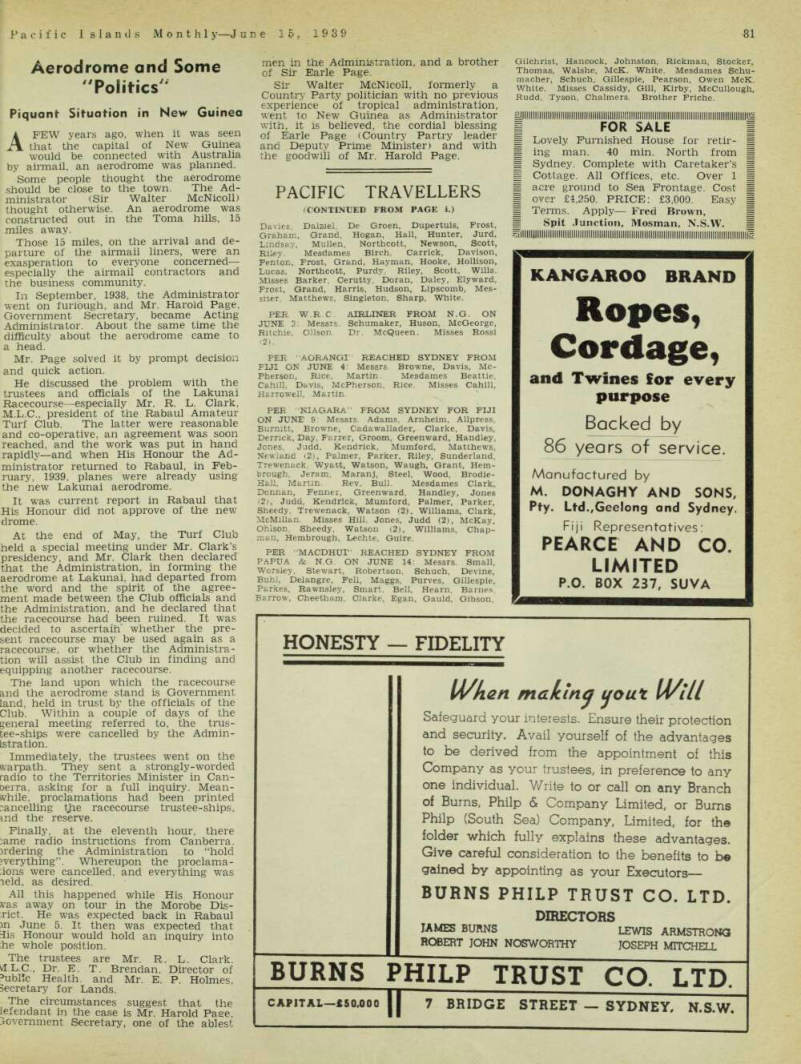
"Politics"
Piquant Situation in New Guinea
A FEW years ago, when it was seen that the capital of New Guinea would be connected with Australia by airmail, an aerodrome was planned.
Some people thought the aerodrome should be close to the town. The Ad ministrator (Sir Walter McNicoll) thought otherwise. An aerodrome was constructed out in the Toma hills, 15 miles away.
Those 15 miles, on the arrival and de parture of the airmail liners, were an exasperation to everyone concerned — especially the airmail contractors and the business community.
In September, 1938, the Administrator went on furlough, and Mr. Harold Page.
Government Secretary, became Acting Administrator. About the same time the difficulty about the aerodrome came to a head.
Mr. Page solved it by prompt decision and quick action.
He discussed the problem with the trustees and officials of the Lakunai Racecourse —especially Mr. R. L. Clark, M.L.C., president of the Rabaul Amateur Turf Club. The latter were reasonable and co-operative, an agreement was soon reached, and the work was put in hand rapidly—and when His Honour the Ad ministrator returned to Rabaul, in Feb ruary, 1939, planes were already using the new Lakunai aerodrome.
It was current report in Rabaul that His Honour did not approve of the new drome.
At the end of May, the Turf Club held a special meeting under Mr. Clark’s presidency, and Mr. Clark then declared that the Administration, in forming the aerodrome at Lakunai, had departed from the word and the spirit of the agree ment made between the Club officials and the Administration, and he declared that the racecourse had been ruined. It was decided to ascertaih’ whether the pre sent racecourse may be used again as a racecourse, or whether the Administra tion will assist the Club in finding and equipping another racecourse.
The land upon which the racecourse and the aerodrome stand is Government land, held in trust by the officials of the Club. Within a couple of days of the general meeting referred to, the trus tee-ships were cancelled by the Admin istration.
Immediately, the trustees went on the warpath. They sent a strongly-worded radio to the Territories Minister in Can oerra, asking for a full inquiry. Mean while, proclamations had been printed cancelling tjae racecourse trustee-ships, md the reserve.
Finally, at the eleventh hour, there came radio instructions from Canberra, irdering the Administration to “hold everything”. Whereupon the proclama tions were cancelled, and everything was leld, as desired.
Ail this happened while His Honour vas away on tour in the Morobe Dis trict. He was expected back in Rabaul m June 5. It then was expected that 3is Honour would hold an inquiry into he whole position.
The trustees are Mr. R. L. Clark. (LL.C., Dr. E. T. Brendan, Director of 3 ublic Health, and Mr. E. P. Holmes, Secretary for Lands.
The circumstances suggest that the lefendant in the case is Mr. Harold Paee.
Government Secretary, one of the ablest
men in the Administration, and a brother of Sir Earle Page Sir Walter McNicoll. formerly a Country Party politician with no previous experience of tropical administration, went to New Guinea as Administrator with, it is believed, the cordial blessing of Earle Page (Country Partry leader and Deputy Prime Minister) and with the goodwill of Mr. Harold Page.
Advertisements & other items, p. 85 (2 items)
Pacific Travellers
81
tCONTINUED FROM PAGE i.)
Pacific Islands Monthl y—J une 15, 1939
Ropes,
FOR SALE
Lovely Furnished House for retiring man. 40 min. North from Sydney. Complete with Caretaker’s Cottage. All Offices, etc. Over 1 acre ground to Sea Frontage. Cost over £4,250. PRICE: £3,000. Easy Terms. Apply— Fred Brown, Spit Junction, Mosman, N.S.W.
KANGAROO BRAND
Ropes,
Cordage,
and Twines for every purpose
Backed by
86 years of service.
Manufactured by
M. DONAGHY AND SONS,
Pty. Ltd.,Gceiong and Sydney.
Fiji Representatives:
PEARCE AND CO.
LIMITED
P.O. BOX 237, SUVA
HONESTY FIDELITY
When making gout Will
Safeguard your interests. Ensure their protection and security. Avail yourself of the advantages to be derived from the appointment of this Company as your trustees, in preference to any one individual. Write to or call on any Branch of Burns, Philp <& Company Limited, or Bums Philp (South Sea) Company, Limited, for the folder which fully explains these advantages.
Give careful consideration to the benefits to be gained by appointing as your Executors—
BURNS PHILP TRUST CO. LTD.
DIRECTORS
JAMES BURNS LEWIS ARMSTRONG
ROBERT JOHN NOSWORTHY JOSEPH MITCHELL
BURNS PHILP TRUST CO. LTD.
Capital—£so,ooo 7 BRIDGE STREET SYDNEY, N.S.W.
Company's Sound Position
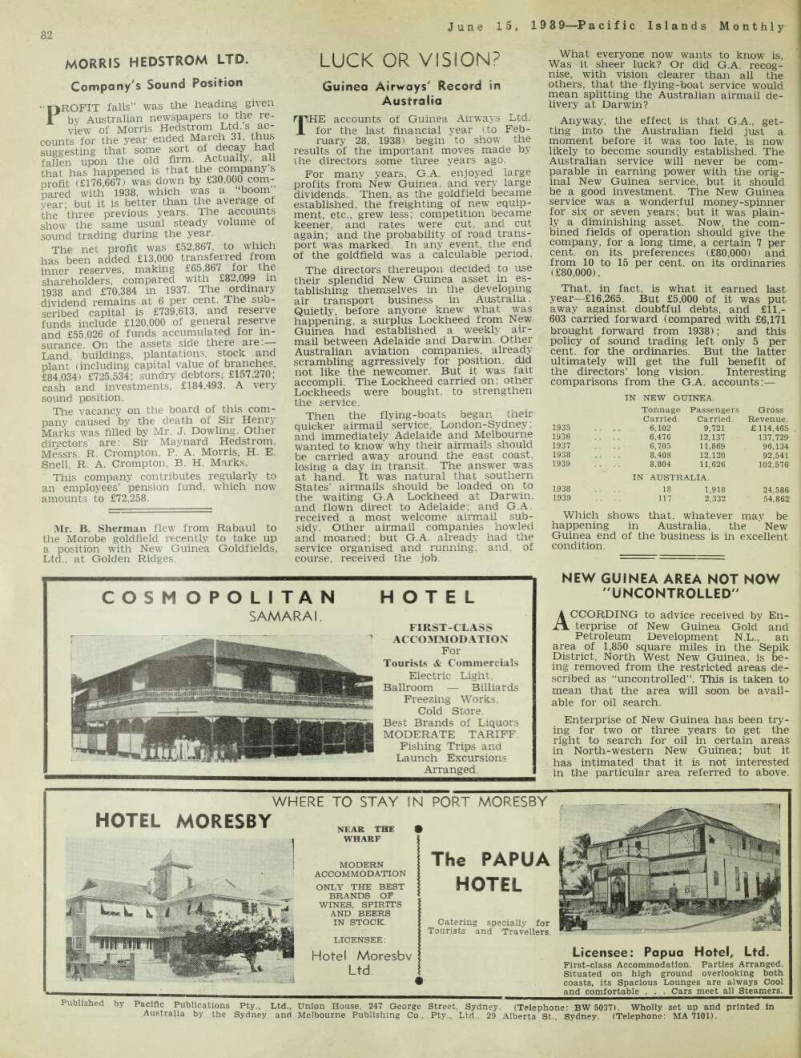
Morris Hedstrom Ltd.
PROFIT falls” was the heading given by Australian newspapers to the re view of Morris Hedstrom Ltd s ac counts for the year ended March 31. thus suggesting that some sort of decay had fallen upon the old firm. Actually, all that has happened is that the company s profit (£176.667) was down by £30,000 com pared with 1938, which was a “boom’ year- but it is better than the average of the three previous years. The accounts show the same usual steady volume of sound trading during the year.
The net profit was £52,867, to which has been added £13,000 transferred from inner reserves, making £65,867 for the shareholders, compared with £82,099 in 1938 and £70,384 in 1937. The ordinary dividend remains at 6 per cent. The suo scribed capital is £739,613, and reserve funds include £120,000 of general reserve and £55,026 of funds accumulated for in surance. On the assets side there are:— Land, buildings, plantations, stock and plant (including capital value of branches, £84,034) £725,534; sundry debtors; £157,270; cash and investments, £184,493. A very sound position.
The vacancy on the board of this com pany caused by the death of Sir Henry Marks was filled by Mr. J. Dowling. Other directors are: Sir Maynard Hedstrom.
Messrs. R. Crompton, P. A. Morris, H. E.
Snell. R. A. Crompton, B. H. Marks.
This company contributes regularly to an employees’ pension fund, which now amounts to £72,258.
Mr. B. Sherman flew from Rabaul to the Morobe goldfield recently to take up a position with New Guinea Goldfields, Ltd., at Golden Ridges.
Luck Or Vision?
Guinea Airways' Record in Australia
TSHE accounts of Guinea Airways Ltd. for the last financial year (to Feb ruary 28, 1938) begin to show the results of the important moves made by the directors some three years ago.
For many years, G.A. enjoyed large profits from New Guinea, and very large dividends. Then, as the goldfield became established, the freighting of new equip ment, etc., grew less; competition became keener, and rates were cut. and cut again; and the probability of road trans port was marked. In any event, the end of the goldfield was a calculable period.
The directors thereupon decided to use their splendid New Guinea asset in es tablishing themselves in the developing air transport business in Australia.
Quietly, before anyone knew what was happening, a surplus Lockheed from New Guinea had established a weekly air mail between Adelaide and Darwin. Other Australian aviation companies, already scrambling agrressively for position, did not like the newcomer. But it was fait accompli. The Lockheed carried on: other Lockheeds were bought, to strengthen the service.
Then the flying-boats began their quicker airmail service. London-Sydney: and immediately Adelaide and Melbourne wanted to know why their airmails should be carried away around the east coast, losing a day in transit. The answer was at hand. It was natural that southern States’ airmails should be loaded on to the waiting G.A Lockheed at Darwin, and flown direct to Adelaide; and G.A. received a most welcome airmail sub sidy. Other airmail companies howded and moaned: but G.A. already had the service organised and running, and. of course, received the job.
What everyone now wants to know is, Was it sheer luck? Or did G.A. recog nise, with vision clearer than all the others, that the flying-boat service would mean splitting the Australian airmail de livery at Darwin?
Anyway, the effect is that G.A., get ting into the Australian field just a moment before it was too late, is now likely to become soundly established. The Australian service will never be com parable in earning power with the orig inal New Guinea service, but it should be a good investment. The New Guinea service was a wonderful money-spinner for six or seven years; but it was plain ly a diminishing asset. Now, the com bined fields of operation should give the company, for a long time, a certain 7 per cent, on its preferences (£80,000) and from 10 to 15 per cent, on its ordinaries (£80,000).
That, in fact, is what it earned last year—£l6,26s. But £5,000 of it was put away against doubtful debts, and £ll.- 603 carried forward (compared with £6,171 brought forward from 1938); and this policy of sound trading left only 5 per cent, for the ordinaries. But the latter ultimately will get the full benefit of the directors’ long vision. Interesting comparisons from the G.A. accounts;—
In New Guinea.
Which shows that, whatever may be happening in Australia. the New Guinea end of the business is in excellent condition.
Tonnage Passengers Gross Carried.
Carried.
Revenue. 1935 6,102 9,721 £114,465 1936 6.476 12,137 137,729 1937 6,705 11,869 96,134 1938 8,403 12,120 92,541 1939 8,804 11,626 102,576
In Australia.
1938 18 1,918 24,586 1939 117 2,332 54,862
New Guinea Area Not Now
"Uncontrolled"
ACCORDING to advice received by En terprise of New Guinea Gold and Petroleum Development N.L., an area of 1,850 square miles in the Sepik District, North West New Guinea, is be ing removed from the restricted areas de scribed as “uncontrolled”. This is taken to mean that the area will soon be avail able for oil search.
Enterprise of New Guinea has been try ing for two or three years to get the right to search for oil in certain areas in North-western New Guinea; but it has intimated that it is not interested in the particular area referred to above.
Advertisements & other items, pp. 86-88 (5 items)
82
June 15, 193 9—P acific Islands Monthly
Published by Pacific Publications Pty., Ltd., Union House. 247 George Street, Sydney. (Telephone: BW 5037). Wholly set up and printed In Australia by the Sydney and Melbourne Publishing Co , Pty.. Ltd.. 29 Alberta St., Sydney. (Telephone: MA 7101).
Cosmopolitan
SAMARA I.
HOTEL
FIRST-CLASS
1 ACCOMMODATION'
For Tourists & Commercials Electric Light, Ballroom Billiards Freezing Works.
Cold Store.
Best Brands of Liquors
MODERATE TARIFF.
Fishing Trips and Launch Excursions Arranged.
Hotel Moresby
WHERE TO STAY IN
x
NEAR THE
WHARF
MODERN
ACCOMMODATION
ONLY THE BEST
BRANDS OF
WINES, SPIRITS
AND BEERS
IN STOCK.
LICENSEE;
Hotel Moresby
Ltd.
PORT MORESBY
The PAPUA
HOTEL
Catering specially for Tourists and Travellers. * I
Licensee: Papua Hotel, Ltd.
First-class Accommodation. Parties Arranged.
Situated on high ground overlooking both coasts, its Spacious Lounges are always Cool and comfortable . . . Cars meet all Steamers.
FROM COAST TO MOUNTAINS...
LAE
wv A a /V\ li
GUINEA AIRWAYS, LIMITED
was established in 1927; and has grown as the figures show.
To-day it is the largest freight-carrying service in the world.
Year Tonnage Passen- Ended Trans- gers Feb. 28. ported Carried. 1929 434 869 1930 ... 949 2,047 1931 1,146 1,995 1932 3,947 1,607 1933 3,980 3,856 1934 6,044 7,398 1935 6,102 9,721 1936 6,476 12,137 1937 6,705 11,869 1938 ... 8.408 12.120 1939 8,939 15,876 Totals .. 53,130 79,495
Building a New Civilization — m
...BY AIR!
The development of the Territory has been amazingly rapid—thanks to air transport.
GUINEA AIRWAYS LIMITED has transported every type of goods needed by the large and ever-growing European community.
GUINEA AIRWAYS operates regular air services in New Guinea and Papua, using over fifty aerodromes and landing grounds in the two Territories.
GUINEA AIRWAYS planes depart from Port Moresby for the Goldfield on the arrival of each boat. Tickets obtainable from Purser.
Fly with GUINEA AIRWAYS—the pioneer Company—in New Guinea and in Australia.
AUSTRALIAN SERVICES
ADELAIDE-DARWIN—Three times weekly, connecting with overseas services.
ADELAI DE-KANGAROO ISLAND, 4 Times Weekly.
ADELAIDE-PT. LINCOLN, 3 Times Weekly.
LIMITED
LAE- SALAMAUA
Head Office: Austral Chambers, New Guinea Office: Lae, Currie Street, Adelaide, S.A. Mandated Territory of New Guinea BRANCH OFFICES AND AGENTS AT WAU— SALAMAUA—PORT MORESBY AND SYDNEY. 2 •2 9
I
PILSENER
»0»
qual
ih Whe lon irst one I wo
long
SCHS
EXPO
■SENE
0
IT t D
VDNEY
>• ■ £ bottle "IV hat’s yours?”
"Resch’s Pilsener /’
"So’s mine.”
When you ask for Pilsener insist on the |ong bottle.
RiSCH'S
PILSENER
P lO 2?