Pacific
Islands
Monthly
Vol. V.-No, 9
April 17th, 1935
[Registered at the G.P.O., Sydney for transmission by post as a newspaper.]
6 d
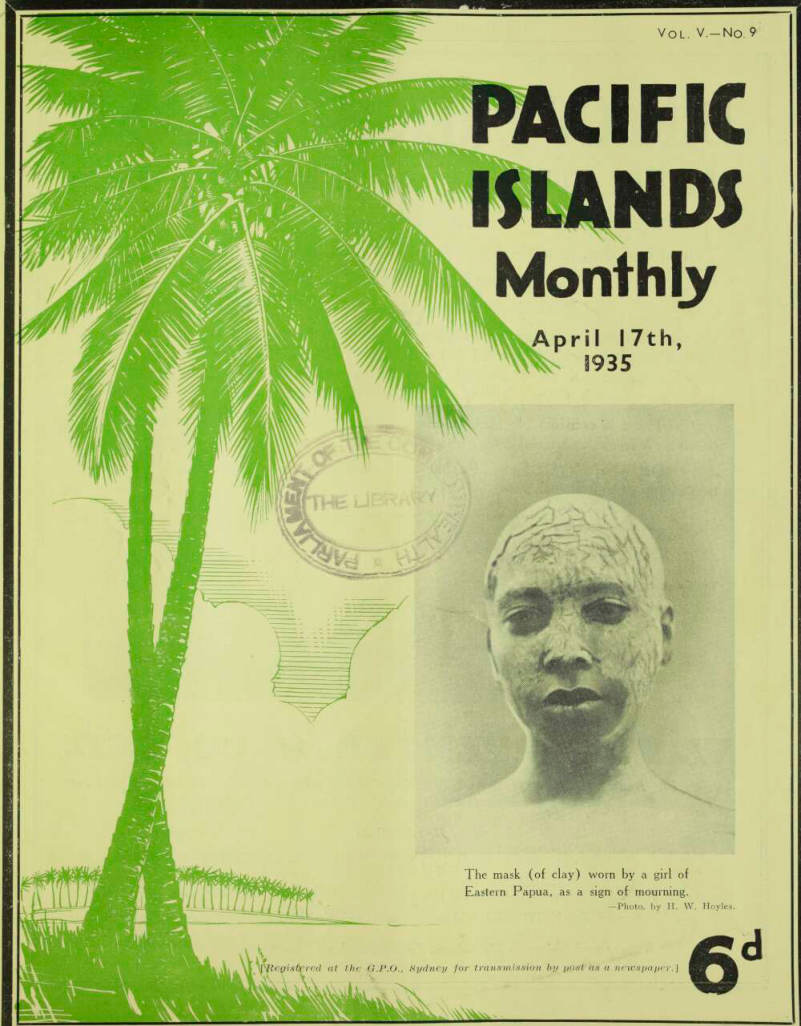
The mask (of clay) worn by a girl of Eastern Papua, as a sign of mourning. —Photo, by H. W. Hoyles.
Advertisements & other items, p. 2 (1 item)
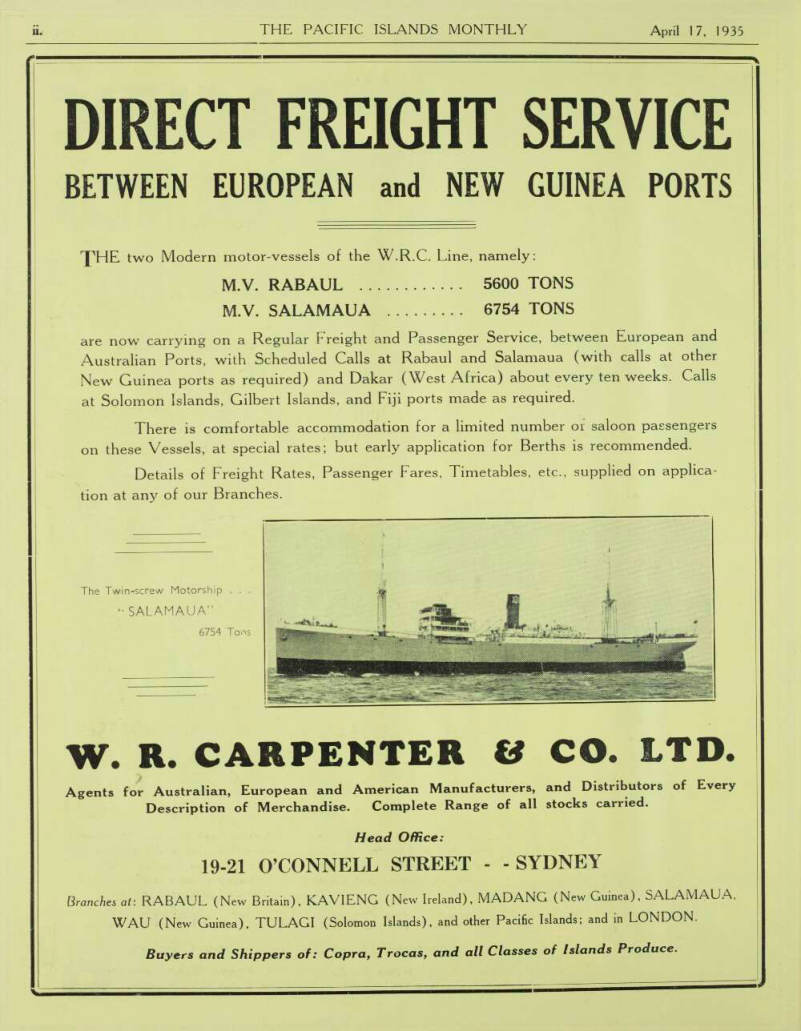
Direct Freight Service
BETWEEN EUROPEAN and NEW GUINEA PORTS
THE two Modern motor-vessels of the W.R.C. Line, namely:
M.V. RABAUL 5600 TONS
M.V. SALAMAUA 6754 TONS
are now carrying on a Regular Freight and Passenger Service, between European and Australian Ports, with Scheduled Calls at Rabaul and Salamaua (with calls at other New Guinea ports as required) and Dakar (West Africa) about every ten weeks. Calls at Solomon Islands, Gilbert Islands, and Fiji ports made as required.
There is comfortable accommodation for a limited number or saloon passengers on these Vessels, at special rates; but early application for Berths is recommended.
Details of Freight Rates, Passenger Fares, Timetables, etc., supplied on application at any of our Branches.
The Twin-screw Motorship . . .
“SALAMAUA”
6754 Tons
W. R. CARPENTER & CO. LTD.
Agents for Australian, European and American Manufacturers, and Distributors of Every Description of Merchandise. Complete Range of all stocks carried.
Head Office:
19-21 O’CONNELL STREET - - SYDNEY
Branches at: RABAUL (New Britain), KAVIENG (New Ireland), MADANG (New Guinea), SALAMAUA, WAU (New Guinea), TULAGI (Solomon Islands), and other Pacific Islands: and in LONDON.
Buyers and Shippers of: Copra, Trocas, and all Classes of Islands Produce.
Pacific Islands Travellers
Passengers Per Morinda Which Left
Sydney For Norfolk Island On March
16: Messrs. Alderson, Halligan, Legge, Osmond, Senator Pearce; Mesdames Williams, Lady Pearce; Misses Litchfield, Twiss, Willis (2).
Passengers Per Morinda Which Ar
Rived In Sydney From Norfolk
ISLAND ON MARCH 25: Messrs. Brennan, Lloyd, McGrath, Halligan, Mullens, Osmond, Swinnerton, Wilson, Sir George Pearce; Mesdames Allen, Brodie, Woods, Lady Pearce; Misses Day, Willis and Willis.
Passengers Per Morinda Which De
Parted From Sydney For
Island And New Hebrides On March
28: —Messrs Bull, Carew, Childs, Daniels, Jones, Jaffray, Hollingsworth, May, McDougall, Power, Peacock, Reynolds, Scott, Smith, Teall, Tully, Wilson, Father Allridge, Master Martin; Mes dames Elliott, Edmonds, Ireton, Jones, Jaffray, Hollingsworth, Lake, Smith, Teall, Wilson; Misses Bell, Bull, Fagan, Fosbery, Muir, Welsh (2).
Passengers Per Montoro Which Ar
Rived In Sydney From Papua And
NEW GUINEA ON APRIL 1: Messrs. Ander son, Blanden, Bartlett, Barnes, Byrnes, Beckett, Bayer, Rev. Brawn, Burston, Crocker, Dr. Coul son, Disney, Denny, De Kantzow, Gore, Giles, Grieve, Glanfield, Harper, Hickey, Howell, John son, Jervis, Jones, Joubert, Johnson, Jones, Keys, Kendall, Lees, Lyall, Lyon, Rev. Leek, Lilley, Madden, Mullins, McNicoll, McDonald, Nibloe, Owens, O’Brien, Poland (2), Pierce, Ryan, Rich ards, Saunders, Spence, Symes, Turner, Travers, Upson, Voysey, Walke. Mesdames Atcherly, Aitchison, Blanden, Brawn, Cowley, Gore, Field, Giles, Grieve, Howell, Joubert, Johnson, Lees, Porter, Poland, Travers, Upson. Misses Cooper, Hack, Hunter, Krasnik, Wilkins.
Passengers Per Aorangi Which
SAILED FROM SYDNEY FOR SUVA, FIJI, ON MARCH 28:—Miss J. Millard, Mrs. D. E. Millard, Mrs. C. Fenner, G. A. Young, G. M. Waine, G.
F. Mitchell, Mr. and Mrs. A. E. Crawford, Mr. and Mrs. C. R. Farquhar, F. G. Brooks Mrs. G.
M. Waine, Miss Waine, P. Leggett, T. Fisher, L. M. Sherwood, Miss A. Street, Mrs. E. Fisher, Mrs. B. S. Jones, Master B. Jones, Mr. and Mrs.
O. Stevenson, Miss A. Stevenson, Miss J. Steven son, Mrs. L. M. Sherwood, Mr. and Mrs. J. L.
Scott. Miss B. Sherwood. Miss G. Sherwood, Mrs.
M. Cannon. Mrs. E. E. Thompson, Miss P. Scott, Mrs. M. T. Hawkins, Mr. and Mrs. L. Stouck, Miss M. Stouck. Mrs. J. C. Trevitt, Mrs A. M.
Towner, J. Morrison, J. Mclntosh. Mr. and Mrs.
E. J. Harding, Mr. and Mrs. Ganet, Mrs. H.
Nieholls. Mrs. R. S. P. Hopkins, Mrs. E M. Turner. Miss A. O’Brien, Miss E. McDonald, Rev. and Mrs. W. Chambers. T. Smart. Miss C. Joshita, Miss R. Parsons, Capt. and Mrs. E. W. G.
Twentyman, Master W. Twentyman, Mr. and Mrs.
W. MacKellar, M. A. Ogilvie, R. B. Hopkins, L.
C. Cox, T. A. Grainger, H. C. Charlton, Miss J.
White.
Passengers Per Van Rees Which Ar
Rived In Sydney From Papua, N.G.,
VILA, and NOUMEA ON MARCH 19; Mr. C.
H. Stringer, Mr. A. C. Hall, Mr. W. H. Robin son, Mr. E. A. James, Rev. H. J. Short, Mr. and Mrs. Clark, Mr J. A. Watson, Mr. and Mrs.
Walmsly, Mr. and Mrs. G. H. Murray, Mr. W.
W. Elsworthy, Mrs. F. Pratt, Mr. A. S. Young, Mr. H. W. Grambs, Mr. C. M. Pines, Mr. R. P.
Bertin, Miss M. Lietart, Miss M. Lietart, Mrs.
A. Waldron, Mr. and Mrs. Cayrol and child, Mrs. and Miss Mourat, Mr. J. Kanno, Mr. T. Kunitake, Mr. I. Mr. M. Kojima, Mr. K. Seigan, Mr. and Mrs. Shiwojiri and two children, Mr. Y Uno.
Passengers Per Monterey Which
ARRIVED IN SYDNEY FROM SUVA, FIJI, ON MARCH 25.—R. M. Aitchison, Mrs. A. W. An drews, Miss B. F. Andrews. G G. Bateman. C. R.
Browne, A. G. Campbell, W. D. Carew, Mrs. H.
Coleman, J. A. Cormack, H C. Cornforth, D. B.
Costello, Mrs. H. J. Durward, Mrs. A. E. Fisher, Mr. and Mrs. R. S. Gordon, Dr. W. Hellenthal, Miss P. M. Hipsley, L. A. Hooke, Mrs. B. Kelly, Mr. B. Kerr, Mark Mayne, H. H. Miller, Mrs.
G. Noall, Miss G. Peere, Mr. and Mrs. L. .S Andrews, Miss O. Andrews, Miss E. Andrews, Mrs. Janet Amos, A. W. Caten, E. Duncan, Mrs. P. Hansen, Mrs. D. Hawkins, A. Jarratt, E.
J. Lambert, Tollo Laupue, Mrs. R. G. Lennox, Masters K. and J. Lennox, Mrs. E. T. Lambert, Misses D., J., P., and I. McIlwain, Mrs. J.
Midson, Master F. Midson, Miss L. J. Samers, Mrs. V. Schrader.
Passengers Per Monterey Which
LEFT SYDNEY FOR SUVA, FIJI, ON APRIL 3.—Mr. and Mrs. A. E. Abrahams, Miss M.
Abrahams, Master L. Abrahams, Mrs. A. Aconley, Miss M. Aconley, Mr. and Mrs. G. H. Allen, Miss E. Allen, A. S. Bailleu, Miss G. Buddie, John Christenson, S. H. Ellis, Dr. A. E. Frost, Mrs. Hall, Miss Hall, Claude Heather, Mr. and Mrs. E. Livock, Mr. A. O. Mackenzie, Mrs. S. A.
Mackenzie, Miss N. Mackenzie, Mrs. S. Myer, Mr. and Mrs. C. W. Pinkerton, Miss B. Price, Mrs.
B. Price, Mrs. A. Richards, Mrs. M. Roberg, D. M. Robertson, T. J. Rogers, Mr. and Mrs. L.
Silk, Dr. J. Simpson, G. W. Sneddon, H. K.
Shimfs, Mr. and Mrs. E. G. Theodore, Mrs. H.
Upton, Miss Upton, Mrs. H. W. Ward, Mrs. H.
Warne-Nicholls, Mrs. M. Collins, Mrs. S. Crouch, S. Harris.
Passengers Per Malaita Which Ar
Rived In Sydney From Solomon
ISLANDS ON APRIL 9:-Messrs. Foulkes, Ste vens, Carson, Bax. Stewart, Russell, Berry, O’Connor, Corry, Cliff, Dickes, Matthews, Murphy, Thebon, Barnes, Dr. Todd, Masters Cattell (2); Mesdames Barker, Carson, Todd, Stewart, Corry, Colley, Clarke, Dickes, Hodgess, Barnes; Misses Svensen, Foxell, Dobbin.
Passengers Per Montoro Which
Sailed From Sydney For Papua And
NEW GUINEA ON APRIL 10:-Messrs. Petersen, Hilder, Duchatel, Martin, Cohen, McDonald, Dette, Clinton, Burne, Stevenson, Hunter, Tealby, Zan rosso, McDonald, Silvester, Black, Crawford, Crane, Batich, Roche, Smith, Brett, Craig, Laird, Provan, Jones, McNamara, Voysey, Moore, Allan, Ross, Whiteman, Allan, Duncan, Trowsdale, Mc- Donald, Bultitude, Kincaid, Turner, Anderson, Power, McLaren, Davidson, Ogg, Cook, O'Neill, Trajoli, Martini, MacDonald, Hicks, Weldon, Brown, Noblett, Eckhoff, Hambert, Mackie, Capt. Kenrick, Rev. Father Dontenwill, Archdeacon de Voil, Colonel Cameron; Mesdames Bradley, Petersen, Hilder, Moates, Duchatel, Dett mann, Avery, Field, Gabriel, Bunting, Love, Greenwood, Laird, Smith, Carden, Provan, Jones, Moore, Comrie, Ross. Whiteman, Schmidt, Reid, de Vojl, Swanson, Ball, Bedser, Oveall, Burns, Nelsson, Luff, Eckhoff, Swanson, Gilweller; Misses Reckner, Cox, Owens, Gilweller.
Passengers Per Neptuna Which Ar
RIVED IN SYDNEY FROM NEW GUINEA ON APRIL 8: —Messrs. T. Allan, S. G. A.
Ford, Granter, J. Lang, M. Mable, W. G. Mitchell, K. Munro, G. H. Roberts, E. P. Hitchcock, J.
Sabine, F. Thomas, F. H. Taylour, J. Twist, J.
Welsh, H. P. Wilkins, J. Winters; Mesdames Anthonsen, T. Allan, B. Best, G. Broadbent, M.
E. Bayliss, D. R. Dickson, P. J. Martin, W. G.
Mitchell, K. Munro, M. L. Oakes, D. C. Phillips, G. H. Roberts, Rose, A. Smith; Misses E. Blake, J. Carter.
Gizo Resistance To Poll
Tax Fades Out
From Our Own Correspondent.
TULAGI, April 1.
AN attempted passive resistance to the native poll tax in the Gizo District has collapsed. Forty natives chose im prisonment rather than pay. About 600 natives (one or two Europeans also being present) represented their case to the Dis trict Officer.
By then, however, there were deflections from the movement, and the requests were very much modified. The requests will be conveyed to higher authority, but in the meantime the Administration in sists on payment of the taxes. The Gov ernment headman at Simbo has been sus pended as a result of this movement, and he may have to stand trial.
The “conspiracy” was remarkably well organised, and only just fell short of im mediate success: the final outcome is un certain. The factors which will decide against the natives’ case are the high price paid in the district for trochus shell and the fact that they made no attempt to cook copra.
Tulagi
Chinese Junk Intrigues
From Our Own Correspondent.
TULAGI, April 1.
COMMERCIAL vessels came to Tulagi in a rush during March. In addition, Lord Moyne in his yacht, a converted channel steamer, paid a brief visit to the port, afterwards leaving for Batavia, from whence he will fly to England. The “pas senger list” read like the social column of a London newspaper.
Then one morning recently Tulagi awoke to see, apparently, a Japanese sampan anchored boldly on the shoals between Bunana and the township. H.M.C.Y.
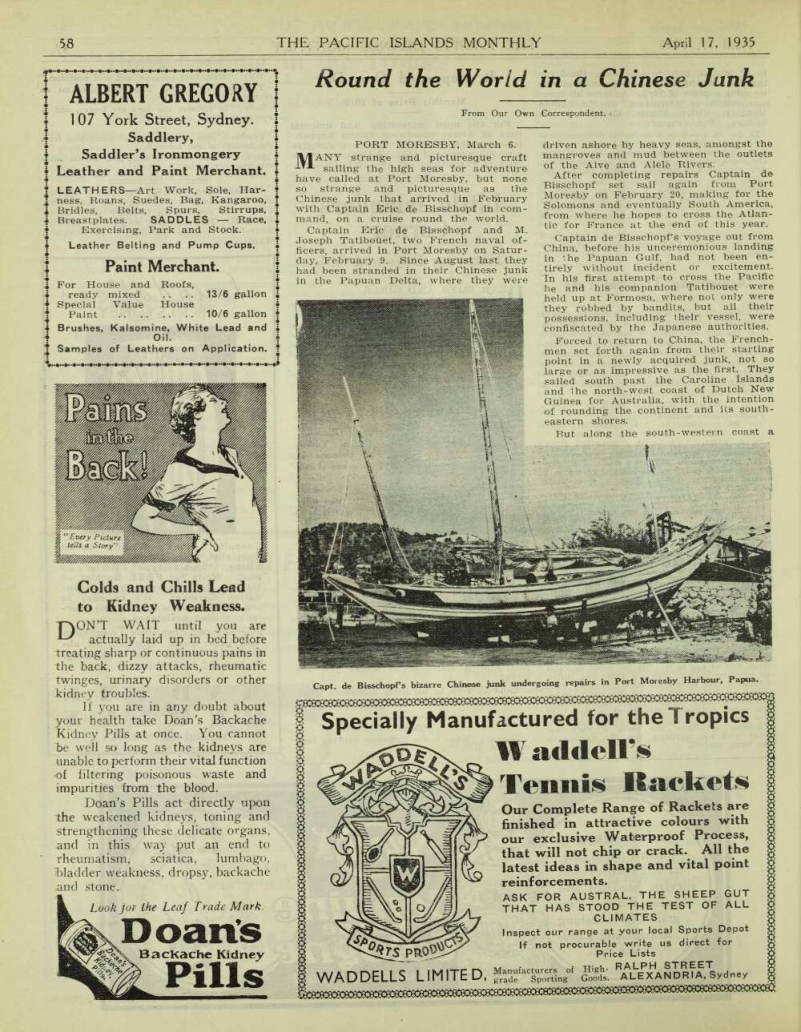
“Tulagi” went out to the supposed poacher and very shortly an interested population saw the stranger towed in to port. It turned out to be a Chinese junk, manned by two Frenchmen, on a world tour, and interested in proving certain theories re garding Pacific migration and population.
The unusual build and rig of the junk created much comment.
(See article and photograph on Page 58.)
Advertisements & other items, p. 3 (1 item)
Saicon-Batavia-Samarang-Port Moresby
SAMARAI-RABAUL- PORT VILA-NOUMEA
SYDNEY - PORT MORESBY - BATAVIA - SAICON
bi-monthly by the "VAN REES"
You will enjoy travelling by this popular, fast and modern steamer of the K.P.M., noted for its comfort, excellent cuisine, and economical fares.
With a fleet of over 130 vessels the K.P.M. Line is in a position to accept cargo for all ports in Netherlands India, and wi+h transhipment at Batavia for Africa.
ROYAL PACKET NAVIGATION CO.
Paketvaart House, 255 George Street, Sydney
Diethelm & Co., Saigon; E. A. James, Port Moresby; Whitten Bros., Samarai; W R. Carpenter & Co. Ltd.. Rabaul, Gubbay Freres, Port Vila: Carlo Leoni, Noumea.
Advertisers
Page Adams Wm. 21 Antinea Drug. Co. . 21 Arnott’s Biscuits .. 24 Asprey’s Compound 28
Aspro 45
Ausoline Co 19 Aus. Scale Co. .. 70
A.W.A. 53
Bains 8 Bank of N.S.W. .. 25 Barnes, Jas. 34 Barrington, D.Y.S. 36 Bell, L. L .30 Belvedere 17 Bentley, E. 44 Blau, Julius .. .. 57 Boat Wanted .. .. 72 Breckwoldt & Co. . 13 Bridge Bird Shop . 13 Broomfields, Ltd. .. 12 Bruce, Robert .. .. 59 Brunton’s Flour .. 31 Budge, James .. .. 12 Bullivants .. .. .. 51 Burns, Philp & Co. iv
B.P. (S.S.) Co. .. 50
B.P. Magazine . .. 16 Burton, F. W. . .. 42 Buzacott Ltd. 59 Byrne, C. R. 23 Campbell 45 Capell, J. 48 Carpenter, W. R. .. ii Christies, Ltd. 29 Close, W. J. 47
Coleman Quicklite . 8
A. H. J. Coles .. 62 Coral Starch .. .. 38 Cowles & Dunn .. 51 Craignathan .. .. 70 Cropleys, Ltd. 9 Croston, W. E. .. 47 Cyclone G. & F. .. 69 Dangar, Gedye .. 44 Dawn Cafe 31 Delicia Food Co. .. 36 Doans 58 Doyle, T. G. 20 Eaton, Ltd., J. W. 38 Electrolytic R. & S.
Co. 64 Ellerker, A. J. 71 Elvy & Co., Ltd. .. 23
Page Erg Batteries .. .. 67 Excel Battery Co... 66 Fairbanks Morse .. 52 Fletcher & Sons .. 25 Flexibo Lighting .. 40 Flynn, Mrs. W. .. 55 Ford, W. M. 14 Forsyth, A. 17 Foster & Sons, Geo. 64 Forster’s Bedsteads 63 Garrett & Davidson 34 Gillespie’s Flour .. 53 Gleniffer Engines .. 46 Grahame, C. 43 Gregory, A. 58 Guinea Airways .. vii.
Hailstorm, E. 9 Halvorsen, L. 60 Hammett, Al. 40 Hardie, Jas. 41 Harmony House .. 24 Harper, M. 40 Harper, Robt. 32 Henly’s 13 Holbrook’s, Ltd. .. 35 Holden’s Air T. .. 76 Holmes 41 Hordern Bros. . .. 55 Hotel Gnd. Central 13 Hotel Mansions .. 16 Hurley, Madam .. 57
I.C.I.A.N.Z. 14
Jones, A. 43 Kelvin Engines .. 27 Kepert, V. R. 31 Kerr Bros. 10 Kilrust 32 Kodak 54 Kookaburra Products 51 Kopsen & Co. 74 Kork-N-Seal .. .. 10 Lane and Girvan .. 46
Langbecker, C. .. 22
Light, N. 42 Littlewood 50 Lone Hand Shop .. 20 McHugh 52 McIlraith’s, Ltd. .. 19 McKay 72 Mangrovite Belting 30 Marr, E. A. 65 Martins, D.Y.S. .. 53 Matthews, A. E. .. 47
Page Maxwell, Porter .. 68 Mortein 33 Mungo Scott, Ltd... 11 Murray, Ltd., D. W. 56 Napier, Gardiner.. 23
N.D.L. 75
Nelson & Robertson 15 New Brit. Express 73 Nolan, Spencer. .. 46 Norco 48 Noyes Bros 29 Ozo Salt Co. 23 Pabco Products .. 33 Pacific Hotels .. .. 4 9 Pacific Publications 62 Paine & Co. 26 Pike Bros. ... 9 Pioneer Spring Co.. 32 Position Wanted .. 70 Pottery Shop .. .. 72 Prescott, Ltd. 31
Page Prouds, Ltd. 37 Rasmussen 48 Reid, W. M. 24 Richard’s Remedies 56 Robinson, J. 10 Rohu, Sil 45 Rolls Razor .. .. 66 Royal Packet N. Co. iii Royale Soap .. .. 66 Russell, S. 19 Ruston & Hornsby 22 Scott, Ltd., J. 34 Scott & Bowne .. 11 Scott & Sons .. .. 36 Selby, H. B. 64 Shaw, E. 16 Shell 39 Smith, Geo. E. 68 Smyth, J. H. 68 Springwood L. Col. 10 Standard Drug .. 11
Page Stanley, Chris. .. 67 Steamships T. Co. . 74 Steel Imp. Co. .. 50 Sterling Varnish Co. 7 Swallow & Ariell .. 43 Summerbell, A. .. 41 Tahiti Hdbk. .. .. 49 Taubman’s Paints . 36 Thornthwaite, H. G. 46 Tillock & Co., Ltd. 40 Tilly, J. E. 45 Titon 61 Toohey’s Ltd. 30 Tooth & Co. viii.
Traders, Ltd. .. .. 26 Trufood 68 Tudor Hotel .. .. 8
T.W.H. 14
Tyrrell’s 14 Victor Chemical .. 8 Vincent’s A.P.C. .. 17
Page Vincent Bros. 75 Waddells Ltd. . .. 58 Wallaringa Mansions 73 Wallis, J. B. .. .. 65 Warburton Franki.. 18 Ward, L. A. 47 Ward’s Stoves . ..26 Wearnes 28 Webb, A. 20 West, H. 43 West’s Wheels .. 28 Weymark & Son .. 46 Wheeler, B. R. .. 9 While, John .. .. 42 Williams, W. H. 62, 66 Wills, W. D. & H. O. 42 Wood’s Peppermint. 35 Wright & Co., E. . 2& Wunderlich, Ltd. .. 61
Contents
Page Pacific Islands Travellers iii.
Coconuts and Goldmines v.
N.I. Administration Changes 1 Union Co.’s New Islands Vessel .. . . 1 N.G. Gold Royalty 2 Crime in the Solomons 2 Copra Market Reports 4 Probable Effects of Americanising S.I.
Group 5 Kata Rangoso Visits Sydney 6 Tropicalities 7 About Islands People 8 Isolated Among Headhunters .. .. 10 Germany and Her Colonies 12 General McNicoll —a Personal Sketch 13 Fiji’s Gold Boom 14 N.G.G. Ltd. Reduce Capital by 75 per cent. 15 Through Unknown New Guinea .. .. IS Sir Hubert Murray’s Rule in Papua . . 21 Samoan Mau is Quiet 25 Copra Tax in Samoa 2S An Aggrieved Anthropologist . . .. 29
Page New Caledonian Notes 81 Early Days in Papua 85 The Pomare Family 36 Child Welfare in Fiji 40 Samoa’s Trade 42 Extraordinary Exchange Position in New Hebrides 43 Papuan Gold Seekers Active .. .. 46 Assaults on N.G. Native Labourers .. 51 Fashion Hints for Islands Women .. 54 Housekeeping in the Tropics .. .. 56 Little Islanders’ Corner 57 Round the World in a Chinese Junk .. 58 “Sly Grog” in Samoa 59 Useful Yam Recipes 62 Pacific Mining Notes 64 Morobe Warden’s Report 68 History of N.G.G. Ltd. 69 British Pacific Shipping 71 Law and Order in Polynesia 72 Market Quotations 73 Islands Produce Prices 74 Pacific Islands Shipping Services 75
Advertisements & other items, p. 4 (1 item)
Burns, Philp & Co. Ltd.
GENERAL
MERCHANTS
Head Office: 7 Bridge Street, Sydney—Australia Code Address: "Burphil"
LTD.
SHIPOWNERS
TOURIST AGENTS
BUYERS OF ALL CLASSES OF ISLAND PRODUCE Regular Steamer Services from Australia to New Guinea Papua Solomon Is. —Lord Howe Is. —Norfolk Is.—New Hebrides —Java and Singapore
The Pacific Islands Monthly
The Newspaper-Magazine Of The South Seas
[Registered at G.P.O., Sydney, for transmission by post as a newspaper.']
Published Once Each Month and Circulated in Australia and New Zealand and in the following Pacific Territories and Islands Groups:
Crown Colony of Fiji.
Australian Territory of Papua.
Mandated Territory (Australia) of New Guinea, Bismarck Archipelago, and Northern Solomon Islands.
Mandated Territory (Japan) of Marshall, Caroline and Marianna Islands.
French Territory of New Caledonia.
British and French Condominium of New Hebrides.
American Territory of Eastern Samoa.
American Territory of Guam.
Mandated Territory of Nauru.
British Crown Colony of Gilbert and Ellice Islands.
Mandated Territory (New Zealand) of Samoa.
British Solomon Islands Protectorate.
British Protectorate of Tongan Islands.
New Zealand Territory of Cook Islands.
Australian Territory of Norfolk Island.
French Colony of Oceania (Tahiti, etc.).
American Territory of Hawaiian Islands.
Owned and Produced by Pacific Publications Ltd., Union House, 247 George Street, Sydney .
Telephone Bw 5037
P.O. Box 3408 R
Contributions Articles, Stories, and Photographs dealing with Pacific Islands Subjects are invited, and will be paid for on publication at usual rates.
Subscription Rates Per Annum, within British Empire, Prepaid Post Free 6/- Per Annum, elsewhere, prepaid, Post Free .. 87- Single Copies 6d.
Editor and Publisher:
R. W. Robson.
Advertisements Advertising rates furnished on application.
Colours, etc. by Arrangement.
Process Blocks made at Advertiser’s expense when required. Screen, 100.
Changes of Advertising Copy should reach this Office by 8th of each month, otherwise previous advertisement may be repeated.
Registered Address for Radiograms and Cables: “PACPUB” Sydney Agents The following are authorised to receive subscrip tions for “The Pacific Islands Monthly”— Islands Branches of Burns, Philp & Co., Ltd., and Burns Philp (South Seas) Co., Ltd.
Islands Branches of W. R. Carpenter & Co., Ltd.
All Branches of Morris, Hedstrom & Co., Ltd.
G. Thomas & Co., Rabaul.
Whitten Bros., Ltd., Samarai.
P. Costello, Suva, Fiji.
All Branches and Representatives of W. H. Grove and Sons, Ltd., Auckland.
S. Russell, Papeete, Tahiti.
Cook Islands Trading Co., Raratonga.
Vol. V., No. 9.
Sydney, April 17, 1933.
Price 6d Per Copy Prepaid: 6/- p.a.
Coconuts And Goldmines
IT seems useless to urge anything of the kind; but, if ever economic con ditions demanded a move towards co-operation by the Administrations of the principal territories in central and western Pacific, the time is now.
For one hundred years the chief pro duct of the Pacific Islands has been copra. In recent times we have seen the oil of the coconut fall out of favour, with the result that many important Pacific concerns have looked blue ruin in the face. The market now has im proved and the planters have been saved; but a great deal remains yet to be done if the copra industry of the future is to be anything like as profitable as the copra industry of the normal years before the war.
Copra growers are faced with the competition of such products as whale oil, soya bean oil, peanut oil, cotton seed oil, and various related commodities; but it is the considered judgment of experts that there always will be a demand for the sweet and wholesome oil of the coconut. But competition from a dozen directions will tend to keep the
price down to a fighting level; so that copra producers, like the producers of any other commodity in world-wide use, must systematically study every possible means of reducing production cost and increasing the quality of their copra.
It is in this connection that there seems to be a really urgent need for co-operation between the Administra tions of such important South Seas territories as New Guinea, Papua, Fiji, and the various other groups under the jurisdiction of the High Commissioner for the Western Pacific. A coconut is a coconut whether it be grown in Ceylon, Malaya, East Indies, New Guinea, or Fiji. Yet consider the wide difference in price commanded by the copra of those various islands. In London at the end of February the copra from Ceylon was worth £14/15/- per ton; Straits sun-dried, on the same day, brought £13/7/6; Dutch East Indies was worth about £13; whereas the best quotation for South Seas was £12/2/6.
There always has been a difference between the price of Cingalese-East Indies copra and the copra that is made
in the South Pacific Islands. It is said that the London quotations represent the difference in the quality of the respective products; but we have more than a sus picion that the difference is not all represented by quality, and that organ ised marketing has a good deal to do with it. However that may be, it surely is a desirable and necessary thing that the South Seas Administrations should get together in some way to see whether it is not possible, by co-operative action, to reduce that long-standing, irritating gap of from 20/- to 40/- per ton, between the London price of the reputed best copra and the average price of South Seas copra. If the gap could be wiped out it would mean the distribution each year of tens of thousands of pounds of additional money in the South Seas. It goes without saying that the Adminis trations in such a move would have the
heartiest co-operation of the big trading
firms, shipping companies, and the
planters.
Then there is something of very recent development which demands the attention of all the Administrations, acting in unison, and that is the rapid growth of the gold industry. Raw gold has doubled in value, and it is present, apparently in quite payable quantities, in
New Guinea, Papua, Solomon Islands, and Fiji. The industry has been most profitably established in New Guinea; and there is great developmental activity in Papua and Fiji. But so far as the Administrations are concerned —and this applies also to the great majority of bona fide shareholders in gold companies—the only people who have made any money worth talking about (apart from the Bulolo group in New Guinea) are the share merchants of Sydney, Melbourne and Adelaide. Those cities, for some years past, have been literally alive with the cunning and exceedingly undesirable animal known as “wild-cat.” In other words, company promoters have had a marvellous time, fleecing the incautious people who wish to invest in goldmines; while the actual goldmining done in the Islands has received a comparatively small portion of the capital subscribed.
If this aspect of the goldmining business of recent years were to be investigated by a competent tribunal it would be shown up as a first-class scandal.
However, in spite of the parasites which have clung so tenaciously around the various enterprises, and crippled many of them, the mining activities in Papua and Fiji are now apparently moving towards production; and it is here that there should be a co-operative move on the part of the Administrations concerned to prevent “exploitation” of the subscribed capital, and to compel the companies, which raise capital so easily, really to spend it on the production of gold. The Governor of Fiji recently showed how it might be done; and every man who is anxious to see the Islands communities benefit from the establish ment of this new industry must com mend his action. Sir Hubert Murray, Lieut.-Governor of Papua, has followed a policy calculated to encourage new companies to come into Papua and develop the goldmining industry there; but the time must soon come, if it is not already here, when it will be desirable to take steps to prevent mad speculation, and to compel the companies to get the gold out of the Papuan hills, and not out of the flats in Pitt St. and Collins St. This consideration is presented in view of a report that the £5 shares in a No Liability company, which has just entered the Lakekamu region, are already quoted at well over £30.
It seems in the highest degree neces sary that there should be a general understanding among the South Seas Administrations affected by this mining boom, so that the laws governing the
goldmining industry may be reasonably uniform in character; and so that the undesirable elements which cluster around this industry —described as “wild-cats,” “sharks,” “pirates” and “scoundrels”—should be held in check, while providing every possible encour agement for the genuine enterprise.
In both matters —the copra industry and the goldmining industry—there are obvious advantages to be gained by dis cussion and co-operative action among the Administrations concerned.
N. Guinea Archdeacon’S
Marriage
Saturday, March 23, Archdeacon Ralph de Voil, of Rabaul, who has been serving with the Melanesian Mission in New Guinea since 1931, was married at St. James’ Church, Sydney, to Miss E. A.
Lee (England). The Bishop’s Commis sary in Australia, Rev. P. A. Micklem, M.A., D.D., performed the ceremony.
Miss Lee, who arrived in Sydney from London by the Bendigo the day previous to her wedding, is a native of Lancashire.
She holds the B.A. degree of Leeds Uni versity, and had been employed on the technical staff of the Oxford University Press.
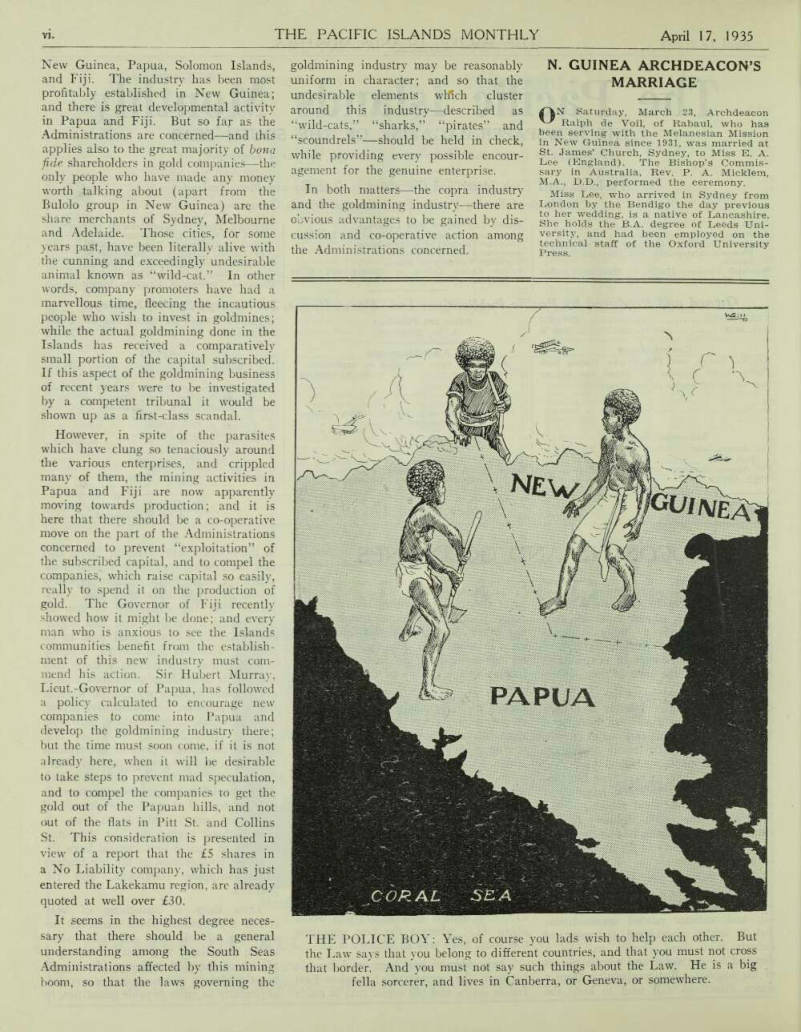
THE POLICE BOY: Yes, of course you lads wish to help each other. But the Law says that you belong to different countries, and that you must not cross that border. And you must not say such things about the Law. He is a big fella sorcerer, and lives in Canberra, or Geneva, or somewhere.
Administration
Norfolk Island
Proposed Changes in Existing Method
AS a result of the recent official visit to Norfolk Island of the Federal Minister in Charge of Territories (Sir George Pearce), it is reported that several changes will be made in the present form of administration.
The Administrator is to relinquish the position of magistrate, and arrangements are to be made for the appointment of lo cal residents as justices of the peace to deal with minor criminal and civil cases. A magistrate will visit the island to deal with more serious cases.
The present Executive Council is to be terminated and to be replaced by a wholly elected Advisory Council, with the right to advise on all matters affecting Norfolk Island. There will be no nominee mem bers of the council.
The expenditure of public moneys is to be carried out by the Administrator, after consultation with the Advisory Council. The franchise is to remain as at present.
Later Details
Sir George Pearce, in an official announcement at Canberra on April 4, confirmed the rearrangements described above. He said he thought that the separation of the administration and judicial responsibilities would remove a certain antagonism against the Adminis trator (Captain Pinney) which he found on his visit to the Island. The new Advis ory Council will be composed of eight elected members. N.I. will be divided into four wards, each to elect two members.
It is intended to tighten up the regula
tions governing the sale of liquor, particu larly in relation to “home-brew” liquor.
The Commonwealth Government had al ready provided £2000 for expenditure on public works to assist the residents and a further £2000 will be made available. Representations will be made to the New Zealand Government in an effort to pro vide a market there for Norfolk Island produce.
Mr. W. D. Mackenzie, chairman and managing director of Lever Bros. Ltd., Sydney, has been appointed chairman of directors of Lever’s Pacific Plantations Pty. Ltd. and the Commonwealth Copra Co. Pty. Ltd., in succession to Mr. George Fulton, who has recently retired. Major F. R. Hewitt, formerly of the Solomon Islands, has also been appointed a direc tor of these companies.
Holden’S Giant Plane For New Guinea
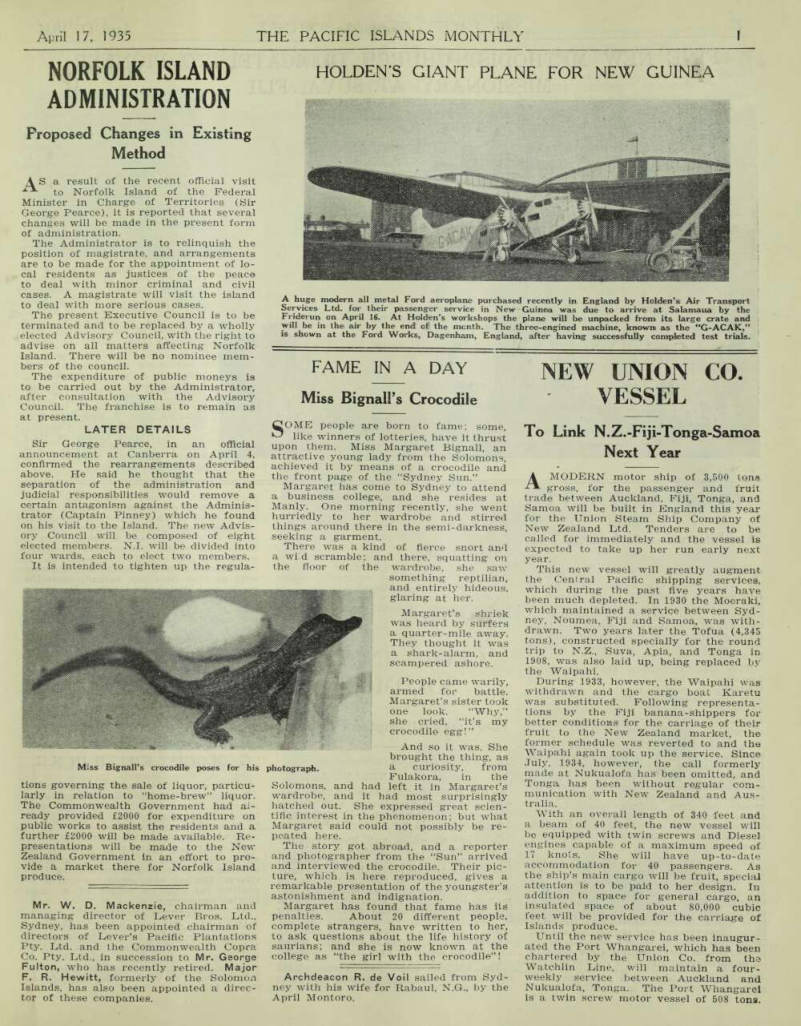
A huge modern all metal Ford aeroplane purchased recently in England by Holden's Air Transport Services Ltd. for their passenger service in New Guinea was due to arrive at Salatnaua by the Friderun on April 16. At Holden’s workshops the plane will be unpacked from its large crate and will be in the air by the end of the month. The three-engined machine, known as the “G-ACAK,” is shown at the Ford Works, Dagenham, England, after having successfully completed test trials.
Miss Bignall’s Crocodile
Fame In A Day
SOME people are born to fame; some, like winners of lotteries, have it thrust upon them. Miss Margaret Bignall, an attractive young lady from the Solomons, achieved it by means of a crocodile and the front page of the “Sydney Sun.”
Margaret has come to Sydney to attend a business college, and she resides at Manly. One morning recently, she went hurriedly to her wardrobe and stirred things around there in the semi-darkness, seeking a garment.
There was a kind of fierce snort and a wild scramble; and there, squatting on the floor of the wardrobe, she saw
something reptilian, and entirely hideous, glaring at her.
Margaret’s shriek was heard by surfers a quarter-mile away.
They thought it was a shark-alarm, and scampered ashore.
People came warily, armed for battle.
Margaret’s sister took one look. “Why,” she cried, “it’s my crocodile egg!”
And so it was. She brought the thing, as a curiosity, from Fulakora, in the
Solomons, and had left it in Margaret’s wardrobe, and it had most surprisingly hatched out. She expressed great scien tific interest in the phenomenon: but what Margaret said could not possibly be re peated here.
The story got abroad, and a reporter and photographer from the “Sun” arrived and interviewed the crocodile. Their pic ture, which is here reproduced, gives a remarkable presentation of the youngster’s astonishment and indignation.
Margaret has found that fame has its penalties. About 20 different people, complete strangers, have written to her, to ask questions about the life history of saurians; and she is now known at the college as “the girl with the crocodile”!
Archdeacon R. de Voil sailed from Syd ney with his wife for Rabaul, N.G., by the April Montoro,
Miss Bignall’s crocodile poses for his photograph.
Vessel
New Union Co.
To Link N.Z.-Fiji-Tonga-Samoa Next Year
A MODERN motor ship of 3,500 tons gross, for the passenger and fruit trade between Auckland, Fiji, Tonga, and Samoa will be built in England this year for the Union Steam Ship Company of New Zealand Ltd. Tenders are to be called for immediately and the vessel is expected to take up her run early next year.
This new vessel will greatly augment the Central Pacific shipping services, which during the past five years have been much depleted. In 1930 the Moeraki, which maintained a service between Syd ney, Noumea, Fiji and Samoa, was with drawn. Two years later the Tofua (4,345 tons), constructed specially for the round trip to N.Z., Suva, Apia, and Tonga in 1908, was also laid up, being replaced by the Waipahi.
During 1933, however, the Waipahi was withdrawn and the cargo boat Karetu was substituted. Following representa tions by the Fiji banana-shippers for better conditions for the carriage of their fruit to the New Zealand market, the former schedule was reverted to and the Waipahi again took up the service. Since July, 1934, however, the call formerly made at Nukualofa has been omitted, and Tonga has been without regular com munication with New Zealand and Aus tralia.
With an overall length of 340 feet and a beam of 40 feet, the new vessel will be equipped with twin screws and Diesel engines capable of a maximum speed of 17 knots. She will have up-to-date accommodation for 40 passengers. As the ship’s main cargo will be fruit, special attention is to be paid to her design. In addition to space for general cargo, an insulated space of about 80,000 cubic feet will be provided for the carriage of Islands produce.
Until the new service has been inaugur ated the Port Whangarei, which has been chartered by the Union Co. from the Watchlin Line, will maintain a four weekly service between Auckland and Nukualofa, Tonga. The Port Whangarei is a twin screw motor vessel of 508 tons.
Missionary At. Suva, Fiji
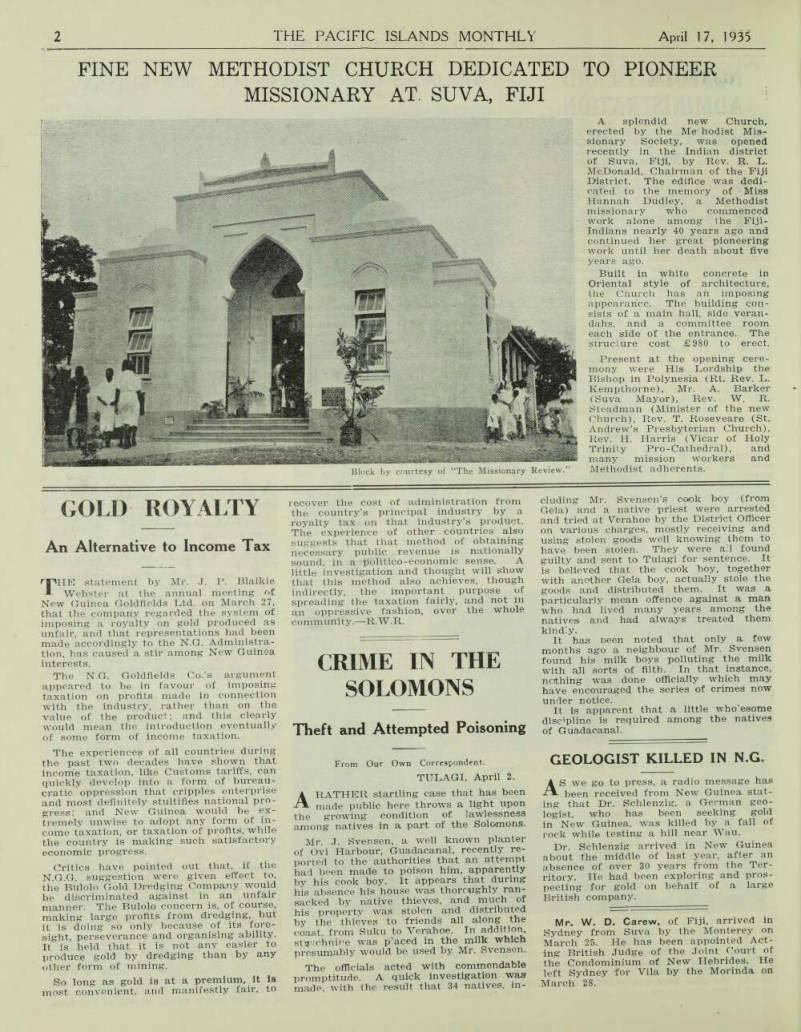
FINE NEW METHODIST CHURCH DEDICATED TO PIONEER
A splendid new Church, erected by the Methodist Mis sionary Society, was opened recently in the Indian district of Suva, Fiji, by Rev. R. L.
McDonald, Chairman of the Fiji District. The edifice was dedi cated to the memory of Miss Hannah Dudley, a Methodist missionary who commenced work alone among the Fiji- Indians nearly 40 years ago and continued her great pioneering work until her death about five years ago.
Built in white concrete in Oriental style of architecture, the Church has an imposing appearance. The building con sists of a main hall, side veran dahs, and a committee room each side of the entrance. The structure cost £980 to erect.
Present at the opening cere mony were His Lordship the Bishop in Polynesia (Rt. Rev. L.
Kempthorne), Mr. A. Barker (Suva Mayor), Rev. W. R.
Steadman (Minister of the new Church), Rev. T. Roseveare (St.
Andrew’s Presbyterian Church), Rev. H. Harris (Vicar of Holy Trinity Pro-Cathedral), and many mission workers and Methodist adherents.
Block by courtesy of “The Missionary Review.”
Gold Royalty
An Alternative to Income Tax
THE statement by Mr. J. P. Blaikie Webster at the annual meeting of New Guinea Goldfields Ltd. on March 27, that the company regarded the system of imposing a royalty on gold produced as unfair, and that representations had been made accordingly to the N.G. Administra tion, has caused a stir among New Guinea interests.
The N.G. Goldfields Co.’s argument appeared to be in favour of imposing taxation on profits made in connection with the industry, rather than on the value of the product; and this clearly would mean the introduction eventually of some form of income taxation.
The experiences of all countries during the past two decades have shown that income taxation, like Customs tariffs, can quickly develop into a form of bureau cratic oppression that cripples enterprise and most definitely stultifies national pro gress; and New Guinea would be ex tremely unwise to adopt any form of in come taxation, or taxation of profits, while the country is making such satisfactory economic progress.
Critics have pointed out that, if the N.G.G. suggestion were given effect to, the Bulolo Gold Dredging Company would be discriminated against in an unfair manner. The Bulolo concern is, of course, making large profits from dredging, but it is doing so only because of its fore sight, perseverance and organising ability.
It is held that it is not anv easier to produce gold by dredging than by any other form of mining.
So long as gold is at a premium, it Is most convenient, and manifestly fair, to
recover the cost of administration from the country’s principal industry by a royalty tax on that industry’s product.
The experience of other countries also suggests that that method of obtaining necessary public revenue is nationally sound, in a politico-economic sense. A little investigation and thought will show that this method also achieves, though indirectly, the important purpose of spreading the taxation fairly, and not in an oppressive fashion, over the whole
community.—R.W.R.
Solomons
Crime In The
Theft and Attempted Poisoning
From Our Own Correspondent.
TULAGI, April 2.
A RATHER startling case that has been made public here throws a light upon the growing condition of lawlessness among natives in a part of the Solomons.
Mr. J. Svensen, a well known planter of Ovi Harbour, Guadacanal, recently re ported to the authorities that an attempt had been made to poison him, apparently by his cook boy. It appears that during his absence his house was thoroughly ran sacked by native thieves, and much of his property was stolen and distributed by the thieves to friends all along the coast, from Suku to Verahoe. In addition, strychnine was placed in the milk which presumably would be used by Mr. Svensen.
The officials acted with commendable promptitude. A quick investigation was made, with the result that 34 natives, in
cluding Mr. Svensen’s cook boy (from Gela) and a native priest were arrested and tried at Verahoe by the District Officer on various charges, mostly receiving and using stolen goods well knowing them to have been stolen. They were all found guilty and sent to Tulagi for sentence. It is believed that the cook boy, together with another Gela boy, actually stole the goods and distributed them. It was a particularly mean offence against a man who had lived many years among the natives and had always treated them kindly.
It has been noted that only a few months ago a neighbour of Mr. Svensen found his milk boys polluting the milk with all sorts of filth. In that instance, nothing was done officially which may have encouraged the series of crimes now under notice.
It is apparent that a little wholesome discipline is required among the natives of Guadacanal.
Geologist Killed In N.G.
AS we go to press, a radio message has been received from New Guinea stat ing that Dr. Schlenzig, a German geo logist, who has been seeking gold in New Guinea, was killed by a fall of rock while testing a hill near Wau.
Dr. Schlenzig arrived in New Guinea about the middle of last year, after an absence of over 30 years from the Ter ritory. He had been exploring and pros pecting for gold on behalf of a large British company.
Mr. W. D. Carew, of Fiji, arrived in Sydney from Suva by the Monterey on March 25. He has been appointed Act ing British Judge of the Joint Court of the Condominium of New Hebrides. He left Sydney for Vila by the Morinda on March 28.
King George’S Jubilee
Gift From Tonga
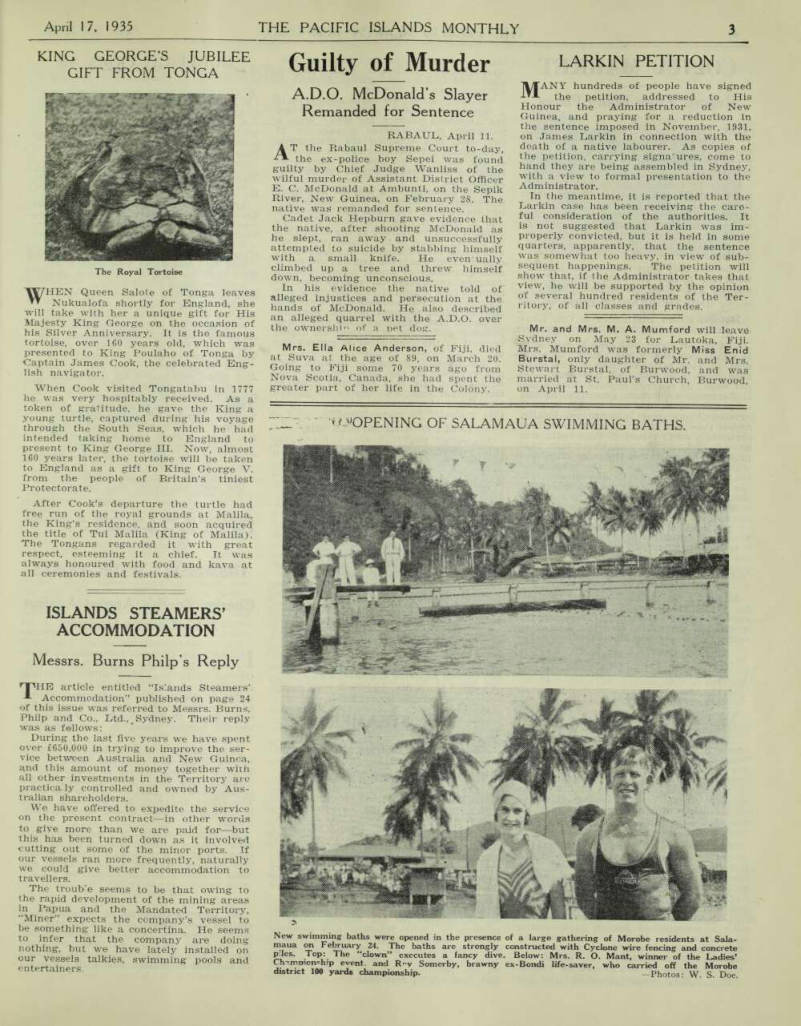
WHEN Queen Salote of Tonga leaves Nukualofa shortly for England, she will take with her a unique gift for His Majesty King George on the occasion of his Silver Anniversary. It is the famous tortoise, over 160 years old, which was presented to King Poulaho of Tonga by Captain James Cook, the celebrated Eng lish navigator.
When Cook visited Tongatabu in 1777 he was very hospitably received. As a token of gratitude, he gave the King a young turtle, captured during his voyage through the South Seas, which he had intended taking home to England to present to King George III. Now, almost 160 years later, the tortoise will be taken to England as a gift to King George V. from the people of Britain’s tiniest Protectorate.
After Cook’s departure the turtle had free run of the royal grounds at Malila, the King’s residence, and soon acquired the title of Tui Malila (King of Malila).
The Tongans regarded it with great respect, esteeming it a chief. It was always honoured with food and kava at all ceremonies and festivals.
The Royal Tortoise
Messrs. Burns Philp’s Reply
Islands Steamers'
Accommodation
THE article entitled “Islands Steamers’
Accommodation” published on page 24 of this issue was referred to Messrs. Burns, Philp and Co., Ltd., a Sydney. Their reply was as fellows: During the last five years we have spent over £650,000 in trying to improve the ser vice between Australia and New Guinea, and this amount of money together with all other investments in the Territory are practically controlled and owned by Aus tralian shareholders.
We have offered to expedite the service on the present contract—in other words to give more than we are paid for —but this has been turned down as it involved cutting out some of the minor ports. If our vessels ran more frequently, naturally we could give better accommodation to travellers.
The trouble seems to be that owing to the rapid development of the mining areas in Papua and the Mandated Territory, “Miner” expects the company’s vessel to be something like a concertina. He seems to infer that the company are doing nothing, but we have lately installed on our vessels talkies, swimming pools and entertainers.
Guilty of Murder
A.D.O. McDonald’s Slayer Remanded for Sentence
RABAUL, April 11.
AT the Rabaul Supreme Court to-day, the ex-police boy Sepei was found guilty by Chief Judge Wanliss of the wilful murder of Assistant District Officer E. C. McDonald at Ambunti, on the Sepik River, New Guinea, on February 28. The native was remanded for sentence.
Cadet Jack Hepburn gave evidence that the native, after shooting McDonald as he slept, ran away and unsuccessfully attempted to suicide by stabbing himself with a small knife. He eventually climbed up a tree and threw himself down, becoming unconscious.
In his evidence the native told of alleged injustices and persecution at the hands of McDonald. He also described an alleged quarrel with the A.D.O. over the ownership of a pet dog.
Mrs. Ella Alice Anderson, of Fiji, died at Suva at the age of 89, on March 20.
Going to Fiji some 70 years ago from Nova Scotia, Canada, she had spent the greater part of her life in the Colony.
Larkin Petition
MANY hundreds of people have signed the petition, addressed to His Honour the Administrator of New Guinea, and praying for a reduction in the sentence imposed in November, 1931, on James Larkin in connection with the death of a native labourer. As copies of the petition, carrying signatures, come to hand they are being assembled in Sydney, with a view to formal presentation to the Administrator.
In the meantime, it is reported that the Larkin case has been receiving the care ful consideration of the authorities. It is not suggested that Larkin was im properly convicted, but it is held in some quarters, apparently, that the sentence was somewhat too heavy, in view of sub sequent happenings. The petition will show that, if the Administrator takes that view, he will be supported by the opinion of several hundred residents of the Ter ritory, of all classes and grades.
Mr. and Mrs. M. A. Mumford will leave Sydney on May 23 for Lautoka, Fiji.
Mrs, Mumford was formerly Miss Enid Borstal, only daughter of Mr. and Mrs.
Stewart Burstal, of Burwood, and was married at St. Paul’s Church, Burwood, on April 11.
Opening Of Salamaua Swimming Baths.
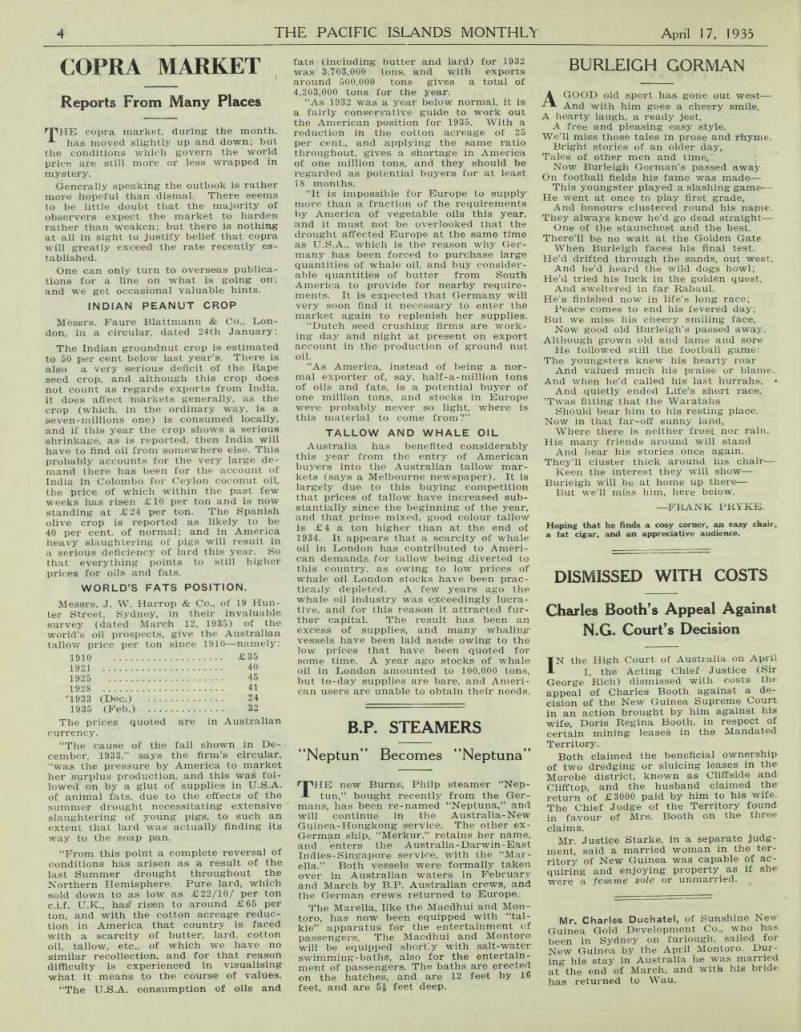
New swimming baths were opened in the presence of a large gathering of Morobe residents at Sala maua on February 24. The baths are strongly constructed with Cyclone wire fencing and concrete piles. Top: The “clown” executes a fancy dive. Below: Mrs. R. O. Mant, winner of the Ladies’
Championship event, and Rov Somerby, brawny ex-Bondi life-saver, who carried off the Morobe district 100 yards championship. —Photos: W. S. Doe.
Copra Market
Reports From Many Places
THE copra market, during the month, has moved slightly up and down; but the conditions which govern the world price are still more or less wrapped in mystery.
Generally speaking the outlook is rather more hopeful than dismal. There seems to be little doubt that the majority of observers expect the market to harden rather than weaken; but there is nothing at all in sight to justify belief that copra will greatly exceed the rate recently es tablished.
One can only turn to overseas publica tions for a line on what is going on; and we get occasional valuable hints.
Indian Peanut Crop
Messrs. Faure Blattmann & Co., Lon don, in a circular, dated 24th January: The Indian groundnut crop is estimated to 50 per cent below last year’s. There is also a very serious deficit of the Rape seed crop, and although this crop does not count as regards exports from India, it does affect markets generally, as the crop (which, in the ordinary way, is a seven-millions one) is consumed locally, and if this year the crop shows a serious shrinkage, as is reported, then India will have to find oil from somewhere else. This probably accounts for the very large de mand there has been for the account of India in Colombo for Ceylon coconut oil, the price of which within the past few weeks has risen £10 per ton and is now standing at £24 per ton. The Spanish olive crop is reported as likely to be 40 per cent, of normal; and in America heavy slaughtering of pigs will result in a serious deficiency of lard this year. So that everything points to still higher prices for oils and fats.
World’S Fats Position.
Messrs. J. W. Harrop & Co., of 19 Hun ter Street, Sydney, in their invaluable survey (dated March 12, 1935) of the world’s oil prospects, give the Australian tallow price per ton since 1910—namely; 1910 £35 1921 40 1925 45 1928 41 1933 (Dec.) 24 1935 (Feb.) 32 The prices quoted are in Australian currency.
“The cause of the fall shown in De cember, 1933,” says the firm’s circular, “was the pressure by America to market her surplus production, and this was followed on by a glut of supplies in U.S.A. of animal fats, due to the effects of the summer drought necessitating extensive slaughtering of young pigs, to such an extent that lard was actually finding its way to the soap pan.
“From this point a complete reversal of conditions has arisen as a result of the last Summer drought throughout the Northern Hemisphere. Pure lard, which sold down to as low as £22/10/ per ton c.i.f. U.K., has risen to around £65 per ton, and with the cotton acreage reduc tion in America that country is faced with a scarcity of butter, lard, cotton oil, tallow, etc., of which we have no similar recollection, and for that reason difficulty is experienced in visualising what it means to the course of values.
“The U.S.A. consumption of oils and
fats (including butter and lard) for 1932 was 3,703,000 tons, and with exports around 500,000 tons gives a total of 4,203,000 tons for the year.
“As 1932 was a year below normal, it is a fairly conservative guide to work out the American position for 1935. With a reduction in the cotton acreage of 25 per cent., and applying the same ratio throughout, gives a shortage in America of one million tons, and they should be regarded as potential buyers for at least 18 months.
“It is impossible for Europe to supply more than a fraction of the requirements by America of vegetable oils this year, and it must not be overlooked that the drought affected Europe at the same time as U.S.A., which is the reason why Ger many has been forced to purchase large quantities of whale oil, and buy consider able quantities of butter from South America to provide for nearby require ments. It is expected that Germany will very soon find it necessary to enter the market again to replenish her supplies.
“Dutch seed crushing firms are work ing day and night at present on export account in the production of ground nut oil.
“As America, instead of being a nor mal exporter of, say, half-a-million tons of oils and fats, is a potential buyer of one million tons, and stocks in Europe were probably never so light, where is this material to come from?”
Tallow And Whale Oil
Australia has benefited considerably this year from the entry of American buyers into the Australian tallow mar kets (says a Melbourne newspaper). It is largely due to this buying competition that prices of tallow have increased sub stantially since the beginning of the year, and that prime mixed, good colour tallow is £4 a ton higher than at the end of 1934. It appears that a scarcity of whale oil in London has contributed to Ameri can demands for tallow being diverted to this country, as owing to low prices of whale oil London stocks have been prac tically depleted. A few years ago the whale oil industry was exceedingly lucra tive, and for this reason it attracted fur ther capital. The result has been an excess of supplies, and many whaling vessels have been laid aside owing to the low prices that have been quoted for some time. A year ago stocks of whale oil in London amounted to 100,000 tons, but to-day supplies are bare, and Ameri can users are unable to obtain their needs.
“Neptun” Becomes “Neptuna”
B.P. Steamers
THE new Burns, Philp steamer “Nep tun,” bought recently from the Ger mans, has been re-named “Neptuna,” and will continue in the Australia-New Guinea-Hongkong service. The other ex- German ship, “Merkur,” retains her name, and enters the Australia-Darwin-East Indies-Singapore service, with the “Mar ella.” Both vessels were formally taken over in Australian waters in February and March by B.P, Australian crews, and the German crews returned to Europe.
The Marella, like the Macdhui and Mon toro, has now been equipped with “tal kie” apparatus for the entertainment of passengers. The Macdhui and Montoro will be equipped shortly with salt-water swimming-baths, also for the entertain ment of passengers. The baths are erected on the hatches, and are 12 feet by 16 feet, and are 5½ feet deep.
Burleigh Gorman
A GOOD old sport has gone out west — And with him goes a cheery smile, A hearty laugh, a ready jest, A free and pleasing easy style.
We’ll miss those tales in prose and rhyme.
Bright stories of an older day, Tales of other men and time, Now Burleigh Gorman’s passed away.
On football fields his fame was made — This youngster played a slashing game— He went at once to play first grade, And honours clustered round his name.
They always knew he’d go dead straight— One of the staunchest and the best.
There’ll be no wait at the Golden Gate When Burleigh faces his final test.
He’d drifted through the sands, out west.
And he’d heard the wild dogs howl; He’d tried his luck in the golden quest.
And sweltered in far Rabaul.
He’s finished now in life’s long race; Peace comes to end his fevered day; But we miss his cheery smiling face, Now good old Burleigh’s passed away.
Although grown old and lame and sore He followed still the football game: The youngsters knew his hearty roar And valued much his praise or blame.
And when he’d called his last hurrahs, And quietly ended Life’s short race, ’Twas fitting that the Waratahs Should bear him to his resting place.
Now in that far-off sunny land, Where there is neither frost nor rain.
His many friends around will stand And hear his stories once again.
They’ll cluster thick around his chair — Keen the interest they will show — Burieigh will be at home up there — But we’ll miss him, here below.
Frank Pryke.
Hoping that he finds a cosy comer, an easy chair, a fat cigar, and an appreciative audience.
Charles Booth’s Appeal Against
Dismissed With Costs
Charles Booth’s Appeal Against N.G. Court’s Decision
IN the High Court of Australia on April 1, the Acting Chief Justice (Sir George Rich) dismissed with costs the appeal of Charles Booth against a de cision of the New Guinea Supreme Court in an action brought by him against his wife, Doris Regina Booth, in respect of certain mining leases in the Mandated Territory.
Both claimed the beneficial ownership of two dredging or sluicing leases in the Morobe district, known as Cliffside and Clifftop, and the husband claimed the return of £3000 paid by him to his wife.
The Chief Judge of the Territory found in favour of Mrs. Booth on the three claims.
Mr. Justice Starke, in a separate judg ment, said a married woman in the ter ritory of New Guinea was capable of ac quiring and enjoying property as if she were a femme sole or unmarried, Mr. Charles Duchatel, of Sunshine New Guinea Gold Development Co., who has been in Sydney on furlough, sailed for New Guinea by the April Montoro. Dur ing his stay in Australia he was married at the end of March, and with his bride has returned to Wau.
Notes on the Probable Effects of Turning
the Solomons Into American Territory
By G. J. Mackay
An American Admiral, in a U.S.A. naval journal, suggested the handing-over of the Solomon Islands to U.S.A. as part-payment of war-debts —but Prime Minister Ramsay MacDonald said, “Nay, mon!”
Mr. MacKay spent four years in California after living three years in the Solomons. He now sends us the following article from British Columbia.
IMAGINE Tulagi as the dead-spit of Honolulu, and a grinning Japanese pushing his hot narli-nut cart along Marmalade Avenue with the cry of “Narli-nuts all hot-cha!” Take comfort in the civilised appearance of overhead wires enmeshing Chinatown, for every Chinese-American is a ’phone addict.
Listen to the never-ceasing clang of tramcar bells! How convenient to have trams circling Tulagi, starting from the Mendana Statue (outside the Treasury), climbing past cement houses to the Governor’s Palace on top, down the hill to the police campus baseball-diamond, through a new and populous Japanese settlement and around to the skyscrapers of Chinatown by way of Ellisville bath ing-beach resort!
The Post Office exterior would be or namented with an inlaid m.o.p. shoeshine throne and a “long” (?) pig sandwich stand. Wearing turtle-shell goggles and ice-cream tuxedos, San Francisco Orien tals of the “make-it-snappy” blend would speed up the Ambassador’s, adding thereto an “honest-to-goodness” Coconut Grove.
For the benefit of gobs stationed at Hyman Point Naval Barracks, the Hill side Hotel would present an all-night cabaret of Makira tap-dancers. Bromo seltzer would be on tap at a “We Never Close” drug store—breakfast really be ing the specialty here. In the hotel annex barber-shop your Melanesian dude could get his frizzy golliwog slicked back for a dollar, the mezzanine-floor mani curists filing his nails for half a buck.
Then he’d hie to the news-stand to pur chase cigars and copies of “P.I.M..”
“American Planters’ Gazette” and “Man grove Skippers’ Daily.” Next he’d take the nickel hydroplane-ferry to Makambo and play skittles in the Y.M.C.A. bowl ing-alley. Maybe he’d stay on the plane ferry and call on the girl-friend in Bun gana Y.W.C.A. An alternative would be to visit the Religious Revivalists’ Hall, located by the Americans on Gavutu-for the reason that an American obser ver, Jack London, does not speak highly of that place in his reports.
The Salvation Army would be stationed at Tulagi, so as to have a big brass band handy on Tulagi Pier to welcome liner tourists with the haunting theme-song of the islands, “Sorrowful Isles,” speci ally composed by the Queen of Santiana, vice-president of the Solomons Women’s Club, whose members would train slen der Gela ladies of Florida (S’mons, not U.S.A.) as “official greeters” to garland all tourists and “front page” visitors with leis of copra and ivory-nuts.
In good American style, Savo Spring Water (trade-named “Nulla-Nulla” by the Chamber of Commerce) would be quaffed from Mandoliana clam-shells at the soda-fountains of No. 1 and No. 2 Chain Stores, where one could purchase souvenirs like the megapode, balloon-frog and giant-rat.
In order to enable Malaita hoodlums to join the Gangsters’ Union, a racketeer branch of Chicago local No. 1 would be established at Diamond Bay—and to be right on the scene of action for 100 per cent, thrills, Maramasike, Malaita, would be the locale of numerous motion-picture studios.
The broadcasting-station would be set up on the weather side of Guadalcanal.
The crooning of love-sick cannibals would subjugate the female universe (increas ing tourist traffic to Mala). Boy-oh-boy, can’t those cannibals croon—and how!
Everyone would sure go plumb crazy over that weird negro spiritual, “Solomon Devi,” when chanted by the Roviana Darktown Chorus.
American politicians would have all copra dried by hot-air, which they’d donate to planters in unlimited quan tities. They’d give frequent “pep-talks” at Lord Howe, Siota, Sikiana and Fula kora, so as to stimulate public interest in King Solomon’s Mines.
It would be good-bye to beche-de-mer talk —farewell to pidgin-English. Im ported instructors would educate Solo mon Islanders (of all colours) in modern English—“hornswoggle” replacing the word “gammon,” “flop” in lieu of “buckle up,” “kibitzer” traded for “stickybeak,”
“top-notcher” for “good-feller-too-much,”
“yep” for “yis,” “cap” for “master,” “pie eyed” for “shickered,” and “scram!” for “butter-off!” The expression “No savvy,” to the joy of planters, traders and recruiters would be tamhu by law, there being no American equivalent for “No savvy.”
Trade with the natives would be liv ened up. A movie-show on every island in the Group would advertise U.S.A. products to one-time “lava-lava’d” coons through the medium of “horse-operas,”
“s.a. triangles” and similar “educational” pictures. The Marys, aping American ladies of colour, would invest in Aus tralian rabbit-fur coats in both seasons, S.E. and N.W. Village beauty-salons, specialising in “reducing,” would line up queues of patronesses—black, brown, chocolate and maroon. To be up-to-the minute the boys would want to be flash and wear brown shoes with knobby toes (size 13). Pants-pressing parlours in every native village would hasten the “Trousers and Respectability” move ment.
One great advantage in trade would be the development of the chewing-gum in dustry. As every island-man knows, betel-nut chewing is no good to the trader. The Americans, therefore, would stop the chewing of betel-nut by legis lation in order to encourage the chewing gum trade.
In their native territories the Ameri cans endeavour to abolish the native “musical” instrument. No longer would one hear the plaintive note of the reed or the bang-bang-bang of the tree-drum.
The saxophone would be heard a’nights wailing down in the labour-huts. And big business would be effected in “har monicas” (mouth-organs to you) and “ukes” (small steel guitars likewise to you).
Britain pioneered the Islands with a tin-opener. Australia civilised the scene
with a bottle-opener. The U.S.A. will Americanise the South Seas with a gad get that will be a combination of bottle and can-opener, nut-cracker and cigar lighter.
And talking of cigars, a better money circulating system would be in vogue h the Islands, for the cigar would replace the present-day “stick.” The cigar wouldn’t last long in the way of hand ling, and would have to be smoked or disintegrate; then the native would have to buy another. The disadvantage of the stick of tobacco is that it is made to last a long time. This is contrary to all American business laws. They make a thing quick, to be sold quick, and con sumed quick.
Progress At Wau.
Guinea Airways Ltd. recently moved into their newly completed offices at Wau, the administrative centre of the Morobe Goldfields, New Guinea.
Note the modem transport truck at left of photo.
Photo:—L. V. Waterhouse.
Drought
Lucky Yarnspinner
How Mr. Lotze Broke Tillages Drought
From Our Own Correspondent.
TULAGI, March 18.
THERE has been a terrible drought in Tulagi. For weeks not a glass of beer has been available.
A few days before the arrival of the March Malaita, a schooner drifted into port, whose absent-minded skipper had overlooked one lone bottle of beer. Im mediately some votaries arranged a din ner at Stirling’s Hotel. The precious bottle was placed in decorated and gar landed eminence on a table of its own: a prize to be won by the teller of the best story at the dinner.
After due obeisance to the lager the dinner was held and the after-dinner stories told. The bottle of beer finally was awarded to Mr. R. J. Lotze. The winner, with noble self abnegation, shared the precious amber fluid, served in cham pagne glasses, with his hosts and fellow guests.
Major C. B. Joske, of Suva, who is at present in Australia on business, made a quick return visit to Suva during April by the Strathnaver. He returned on the Strathnaver and proceeded immediately to Melbourne on mining business.
Mr. G. Holt, engineer to the British Phosphate Commission at Ocean Island, Central Pacific, left Melbourne for Eng land by R.M.S. Orsova on April 2.
Sydney
Kata Rangoso Visits Sydney Former Cannibal’s Son is Now Able S.D.A. Missionary
A TALL, happy-faced Solomon Islander of magnificent physique, with a great crop of black bushy hair and neatly attired in tailored coat, vest and sulu, has been creating considerable interest in Sydney. He is Kata Rangoso, son of a former head-hunter of Marovo Lagoon, who is now a leading S.D.A. mission teacher in the Solomons and who has been in Australia attending conferences of the Seventh Day Adventist Mission.
Though understanding English thor oughly. Rangoso is not yet adept in speaking the language. His visit to Australia was made in order to improve his knowledge of English, and on his return to S.I. he will completely translate the Bible into the Ulesaghi tongue, with the assistance of Mr. A. R. Barrett, S.D.A. missionary at Batuna. The translation ultimately will be printed and circulated throughout the Group by the British and Foreign Bible Society.
On Saturday, April 6, Rangoso ad dressed a crowded meeting at the Pres byterian Assembly Hall, Sydney, in his native language. Pastor N. A. Ferris, S.D.A, missionary, of Guadalcanal, S.I., acted as interpreter. The native made a fine figure as he stood on the dias speak ing in a clear, sharp voice. As he warmed to his subject and spoke of the work of the missions his wide eyes shone with the fire of devotion, and he accom panied his words with characteristic gestures.
In the musical Ulesaghi tongue he told of the bloodshed, massacre, and can nibalism practised by the S.I. people before the advent of Christianity. Dis playing a grotesquely carved idol, he explained that raids were often carried out at the command of the tribal sorcerer, who claimed to communicate with spirits of the dead. He exhibited a long-handled battle axe and painted shield used by his uncle, Jorovo, who killed five natives in the last cannibal raid to take place at Marovo Lagoon.
Some 20 years ago, he said, his father, Tetangu, shortly before he died, placed his brothers and himself under the care of Captain G. F. Jones, of the schooner Advent Herald, one of the pioneer S.D.A. missionaries in the Solomons. His family ever since had been ardent Chris tians and active supporters of the mis sion. One of his brothers visited Sydney with a party of mission boys in 1918.
Two others, Peo and Jimiru, are mission teachers and his youngest brother, Joseph, is now receiving training prior to being appointed a teacher.
Rangoso said that in the Solomons there were 4,000 native adherents to the S.D.A. faith, and that 100 native mis sionaries were working among the heathen tribes in remote areas. Their work has met with great success, he concluded, and a state of comparative peace has replaced the tribal warfare which formerly prevailed among the people.
With Mr. N. A. Ferris, Rangoso will sail by the Malaita on April 18, and return to his home and family at Batuna, Solomon Islands.
Dr. W. Hellenthal, Consul for Germany in New South Wales, left Sydney on an official visit to New Caledonia and New Hebrides' by the Laperouse on April 5.
Oceania
Orion Visits Fr.
U.S. Millionaire’s Palatial Yacht
From Our Own Correspondent.
PAPEETE, March 29.
Mr. Julius Forstmann, American
millionaire industrialist, who owns one of the largest wollen mills in the world at New Jersey, paid a visit to Tahiti recently in his palatial yacht Orion. After making a tour of the Lee ward group, the vessel sailed for Los Angeles on March 15.
Luxury and hospitality on a fantastic scale are the predominating impressions of a visit aboard this German-built craft, which was launched at Kiel in 1929, There is also, however, a very noticeable disci pline and a quiet efficiency among the crew, which is unusual on a vessel devot ed to pleasure. This is no doubt account ed for to a great extent by the fact that the Orion is captained by a German ex naval officer, and that many of the crew of 56 have seen naval service.
The Orion is 400 feet in length and has a registered tonnage of 1600. She Is equipped with Krupp Deisel engines, which enable her to keep up a steady 15 knots per hour. As might be expected on such a vessel, the wireless installation, which employs four operators, contains the latest and most elaborate devices. There is also a beam steering apparatus for use in foggy weather, and an automatic re cording sonic sounding equipment which flashes a coloured light apd starts a bell ringing in the pilot house whenever the vessel is approaching water below a cer tain depth. For exercise, as well as amusement, there is a very large swim ming bath, a gymnasium containing elec tric riding horses and rowing machines, and many more unusual innovations.
A native entertainment was given on the after deck of the Orion during her stay in Papeete. The visitors also took part in one of the celebrated stone Ashing events, arranged for them by the people of Borabora.
Group
Leprosy In Cook
Dr. Ellison Examining Northern Islanders
From Our Own Correspondent.
Rarotonga, Mar. 24.
DR. E. ELLISON, Resident Medical Offi cer, has gone north on the N.Z. Govt, vessel Matai and will examine the North ern Islanders for signs of leprosy. Those affected will be taken to the Government leper station in Fiji.
Leprosy in the Cook Group has greatly decreased as the result of careful surveil lance, local segregation and ultimate removal to Fiji, from which place a sub stantial percentage return home cured.
The majority of cases come from the Northern Islands, where, in 1926, some 14 lepers were taken off from Manihiki and Rakahanga. From the same two islands this time there will in all probability be less than half that number and of these three are under 19 years of age.
It is pleasant to think that the Matai’s arrival will most likely be the means of saving these young lives, doomed other wise to one of the most appalling of lonely deaths.
Temporarily relieving Dr. Ellison is Lieut.-Colonel F. W. W. Dawson, who retired from the R.A.M.C. in 1925 after 21 years’ service. Colonel Dawson was until recently in Christchurch, N.Z., as Medical Health Officer and he is now making his first visit to the South Seas. Stocky, erect, blue-eyed, Colonel Dawson carries about with him an invigorating atmos phere of “thermometers at attention,” which is in itself a menace to ill-health.
We Came Singing To
Tahiti
By Ben Field.
WE came singing, rapturously singing, To Tahiti Island singing; E Maururu a-vau.
Never from far Northland winging Came there yet a message flinging: Te Tiare Vare-au.
From a mighty white ship bringing Brotherhood and good will now, E Maururu a-vau.
We cam© giving, yes forgiving Every frown upon a brow, Te Tiare Vare-au.
Mist clouds on high mountains clinging.
We must follow our ship's prow, E Maururu a-vau.
We came singing, brothers singing.
Sweethearts have received our vow: Te Tiare Vare-au.
This poem embodies the Tahitian National Anthem. The steamer, the City of Los Angeles of the Matson Line, first of the cruisers to the South Seas, on which the author, together with over 200 passengers from Los Angeles, California, visited Tahiti in January, 1934, actually came in to the dock at Papeete with all hands on board sing : ng the Tahitians’ own National Song. Ben Field is the author of three volumes of poetry, and he is on the staff of the Overland-Out West Magazine of California.
Advertisements & other items, p. 12 (1 item)
Wrapper!
Look on the Front of Your
There may be a sign stamped on the front of the wrapper which brings this copy of the “P.I.M.” to you.
The meaning of the marks: — Your subscription (6/- per annum, or 8/in the case of countries outside the British Empire—which includes postage) may be sent direct, or may be paid to any of our agents (listed on page v.)
PACIFIC PUBLICATIONS LTD.,
Union House. 247 Georoe St.. Sydney
Wrapper!
Your subscription will expire with the next or following issue.
Your subscription will expire with this issue.
This means that your subscription has expired; and that we have sent you this further copy in caso you wish to continue as a subscriber, and have forgotten to send in your subscription. Prompt attention is respectfully requested.
Tropicalities
THE announcement that 60 Metro- Goldwyn-Mayer players, led by Charles Laughton, Robert Montgomery and Clark Gable, have gone from Hollywood to Tahiti to make a film portrayal of Nord hoff and Hall’s story of the “Bounty” mutiny, is of outstanding interest. Tens of thousands of feet of film have been exposed in the South Seas, but we have never yet seen a Pacific film-story worthy of the name. It is to be hoped that this new M.G.M. effort will give us, at last, the long-awaited Pacific film; and that also it will show producers what a rich new field there is for their genius in the South Seas.
Incidentally, it seems a good guess that the three famous Hollywood stars will be cast thus: Bligh, Charles Laugh ton; Fletcher Christian, Clark Gable; Peter Heywood, Robert Montgomery. The director in charge is Frank Lloyd, who made such a success of “Cavalcade.” * * * ACCORDING to “The Times” Literary Supplement of February 7, “Jock of the Islands” has been published in London by Faber and Faber —price 8/6. This is the book, to which we made reference last year, by our old friend “Jock”
Cromar, of Tulagi, Solomon Islands. The book apparently records Mr. Cromar’s lively memories of the native recruiting trade prior to 1889. * * * A EUROPEAN recently stumbled over a Samoan policeman, member of a numerous and efficient body, sitting in a corner of Apia Customs Wharf, and busily contemplating the Royal badge affixed to his police felt hat. Looking up, he pointed to the inscription on the badge (Dieu et mon Droit) and asked the European whether he knew what the inscription meant in English. Feigning ignorance, the European said he did not.
“Well,” said the guardian of the peace, “it is ‘Chew ate mong droight.’ That’s Latin, you know. You savee what that means?” he inquired suspiciously.
“No, no idea whatever,” the questioned one asserted, trying to look as stupid as possible.
“Well, I’ll tell you, then. It means: ‘I’m all right!’” And waving his hand in a farewell gesture, the Babu-Samoan proudly and with dignity marched off to attend to his onerous duties elsewhere.
Captain S. L. Diamond, A Torres
Strait shipping master, who ar rived in Sydney by the Taiping on March 31, told the “Sydney Morning Herald” that the Commonwealth Go vernment’s decision to use speed boats to check Japanese sampans from operating in the trochus shell areas of the Barrier Reef would be welcomed by Australians engaged in the industry.
He had seen scores of sampans at work during the past 18 months, and sometimes they operated quite openly in areas where Australians were at work.
He had not heard of any cases where Australian operators had taken the posi tion into their own hands and dealt with the Japanese, but feeling was very tense.
Japanese were taking out all the “chicken shell” which the Australians were forced to leave behind under penalty of a fine.
That has been the position for about three years, in which time scores of shell-beds have been ruined. Now, when It is almost too late, a leisurely Govern
ment decides to send a speed-boat to Torres Strait. The ways of politicians and bureaucrats pass all human under standing. * * * IT was stated in an article in this journal in December that an American expedi tion under Commander Dyatt was making plans to carry out exploration work in New Guinea This statement contained a number of errors. The expedition is British, Is being planned by Commander G. M. Dyott, and it has the approval, according to Commander Dyott, of the Commonwealth Government and the sup port of the Royal Geographical Society.
Commander Dyott is British, not Ameri can. He says that the expedition will not be a very large affair and that its ener gies will be devoted to scientific research.
Commander Dyott visited Australia 20 years ago, and, on the present occasion, if time permits, he will visit Sydney be fore proceeding to New Guinea. * * * “NO names, no pack-drill”—but here’s one with a peculiarly sinister twist in its tail. Apropos of the Matai’s round of inspection in the Cook Group the visit ing officials were entertained by a certain Resident-Agent at an excellently cooked and served dinner. The following morn ing a medical parade was held with the object of discovering any cases of leprosy on the island. Out of the entire popula tion only one person was found. And that was the cook who had prepared the very excellent dinner! She had been in the Resident-Agent’s service for over two years. * * * A SERIAL story, “Mountains of the Moon,” is now running in the “Sydney Morning Herald.” It is a tale of life in New Guinea and Papua and is by Mr. G. Munro Turnbull, who re tired last year from the Papuan Public Service, and who already has won fame as a writer of short stories and a few novels. His “Paradise Plumes” was published by Angus and Robertson, Ltd., last year.
Mosquitoes
Checking Pest in N.G.
A MAJOR problem of the Administration in all Pacific Territories is that of checking and, if possible, controlling the mosquito pest.
Measures that have been taken in New Guinea were briefly referred to by Mr. G.
H. Murray, Director of Agriculture in New Guinea, who has been recently on a visit to Sydney. Mr. Murray says that experi ence has shown that one of the most suc cessful and effective methods used against the mosquito is the introduction into all water, that might become a possible mos quito breeding place, of the small fish called Gamhusia, which feed on the larvae of the mosquitoes. The fish can live in almost any kind of water, no matter how stagnant or how limited in quantity; and the liberation of Gamhusia again and again has greatly reduced the mosquito pest within a very short time.
It is clear, however, that an open breed ing place for the mosquito is provided by dead leaves. The leaves curl up so that they hold water and in damp places, par ticularly in and about heavy timber, there is always water in the leaves. Investiga tion has shown that this very small quan tity of permanent water permits mos quitoes to breed. Gamhusia cannot live under those conditions and therefore the only remedy is to see that all dead leaves are raked away for a considerable distance around dwelling places. Mr. Murray says from actual experience that when this is done carefully there is a marked difference in the number of mosquitoes which haunt dwelling places. This method has been followed with marked success in the Territory.
Rev. H. B. Shelton, B.A., has been appointed by the Methodist Mission to work at Ulu, New Britain. Rev. P. Clark, of Western Australia, has been accepted for Rabaul. Before commencing duties in the Mandated Territory, both missionaries will undergo training at the George Brown College.
Advertisements & other items, pp. 13-14 (1 item)
Home paint
for SEA AIR
AND
TROPICAL
SUN ...
STERLING
Home paint
Will look Better—longer
STERLING VARNISH CO., N.S.W.
IN CASES OF EMERGENCY YOUR
HOME IS INCOMPLETE WITHOUT A
MEDICINE CABINET. BE PREPARED!
You can purchase the highest quality surgical dressings, pharmaceutical requirements and all chemists sundries at the lowest possible prices direct from
The VICTOR PHARMACEUTICAL
AGENCIES
Phillip House, Phillip St., Sydney.
Orders, inquiries and quotations attended to immediately. Enclose postage for reply.
Address all mail to The Manager, Box 374955, G.P.O., Sydney
“BAINOL”
WHITE ANT PREVENTIVE
BORER EXTERMINATOR
WOOD PRESERVATIVE
The most scientific preparation on the market for the above purposes "BAINOL” is packed in containers to suit any size job, and is sold in quarts, halfgallon, one-gallon and four-gallon tins, and in 45-gallon drums at a reduced rate.
Prices; Quarts 2/11, Gallons 7/11, 4-Gallons £1/6/3, 45 Gallons £13/4/2.
Australian Currency, F.O.B., Sydney Sole Manufacturers:
Bains' White Ant Exterminator
BW 6462 CO. LTD. LM1025
Established 40 Years.
Scottish House, 17-19 Bridge St., Sydney Lauries Regarding Agency Invited.
Just Think of it—!
COLEMAN
Kerosene
Burning Lamps
The Same Splendid Construction & Efficiency but
GREATER BRILLIANCE
GREATER ECONOMY
These Beautiful KEROSENE Burning Lamps are finished in the New Silvertone colorings, and equipped with handsome modern parchment shades lending dignity to the Home, and giving Brilliance of Light to the user.
Built especially for Kerosene, BUT if your supply of Kerosene runs out, it will burn benzine equally as well.
Coleman Kerosene Junior Lantern
Look at its Splendid Features Pyrex Globe Porcelain Enamel Top Brass throughout Roto Long Life Generator Built-in pump Hand Operated Filler Plug, and it Burns
KEROSENE or BENZINE.
A Lantern for every Island use Indoors or Out-of-doors.
Ask your Island Storekeeper for Catalogues and Information COLEMAN LAMP & STOVE CO., LTD., Toronto, Canada 500 Kent Street, Sydney
About Islands People

Lady Murray, wife of the Lieutenant- Governor of Papua, who has been visiting Australia, and has spent several weeks at Government House, Canberra, as the guest of Lady Isaacs (wife of the Gover nor-General of Australia), intends to return to Port Moresby in April.
Mr. Adolphus Unger, of New Caledonia, died at Noumea at the age of 77, on April 3. Born in Melbourne and educated at Sydney Grammar School, he went to the French colony and set up business as a general merchant in Noumea. Later he became a naturalised French citizen and was appointed a member of the Council General. Mr. Unger had been elected to the Legion of Honour for his valuable ser vices in the community.
Mr. A. O. Mackenzie, general manager in Fiji for Messrs. Burns Philp (South Sea) Co. Ltd., sailed from Sydney for Suva by the Monterey on April 3, after a business visit to Australia.
Mr. Noel Vernon McKenna, M.D., M.R.C.P., of Wau, New Guinea, was mar ried at St. John’s Church, Darlinghurst, Sydney, on March 22, to Miss Nancy Sydney Acraman, of South Australia.
Rev. Richard Godfrey, Archdeacon of Southern Melanesia since 1924, who ar rived in Sydney recently to seek expert ocular attention, has retired from the
Melanesian Mission field, as a return to the tropics might permanently impair his weakened eyesight. Joining the mission from New Zealand in 1918, Mr. Godfrey served as a district priest in New Heb rides for several years. Later, he was in charge of the Native Teachers’ Train ing College on Aoba Island, Mr. A. C. Hall, Assistant Resident Magistrate of the Papuan Public Service, arrived in Australia on extended leave from Port Moresby by the Van Rees on March 19.
Miss Erima Muir departed from Sydney by the Morinda at the end of March for the school at Torgil, New Hebrides, con ducted by the Melanesian Mission.
Mr. Raymond Hill, a young New Zea lander, sailed from Sydney by the Malaita on March 9 for work with the Melanesian Mission at Maravovo, Solomon Islands.
Mr. J. P. Blaikie Webster, the new chair man of New Guinea Goldfields, Ltd., is to sail for London this month. He expects to visit Australia and New Guinea again in September or October.
Rev. Alfred E. Teall left Sydney with his wife for New Hebrides by the Morinda on March 28. They had been on furlough in England, and returned to do further work for the Melanesian Mission at Vureas School, Banks Islands.
Rev. Harry V. C. Reynolds, a new re cruit for the Melanesian Mission, left Sydney at the end of March for the Native College at Lolowai, Aoba, New Hebrides.
Mr. G. E. Aumuller, manager at Samarai of Messrs. Burns, Philp and Co.’s store, arrived in Sydney in March from Papua, on furlough. During his absence, Mr.
Craig will have charge of B.P. affairs at Samarai.
Miss Ellen Fagen has returned to the Melanesian Mission’s station at Raga, New Hebrides, after furlough spent In South Australia.
Mr. W. J. Lambden, relieving Resident Magistrate at Port Moresby, Papua, is at present in Australia on long leave.
Dr. Temple Utley died on April 2 at Suva, Fiji, as the result of blood poison ing caused through a scratch incurred during his professional duties. In Sep tember, 1930, he left England for the South Seas in his 10-tons yacht Inyala, accom panied by his wife and several friends.
After a leisurely voyage—nine months being spent in French Oceania—the party arrived in Suva in 1933.
Hon. Geoffrey Pinchot, and Mrs. Pinchot, of Pennsylvania, U.S.A., who have been staying in Tahiti for the past month, re cently chartered the schooner Gisborne for some fishing among the Leeward Group islands. They were accompanied on their fishing trip by Messrs. J. N. Hall and C. B. Nordhoff, of Tahiti. Mr. and Mrs. Pinchot will return to America by the April Maunganui.
Pastor W. G. Turner, President of the Australasian Union Conference of Seventh Day Adventists, left Sydney by the Montoro on April 10. He intends to visit S.D.A, mission stations in Papua and then go on to Rabaul, New Guinea, to join Pastor A. G. Stewart. From Sala maua they will fly inland to visit the new S.D.A. mission station recently established in the Ramu-Purari area.
Mrs. J. G. Nelsson, wife of Mr. Gus Nelsson, nominated member of the Legis lative Council of Papua, returned to her home on Woodlark Island, Papua, by the Montoro on April 10.
Rev. Dontenwill, missionary of the Sacred Heart of Jesus, returned to Yule Island, Papua, by the April Montoro after furlough in Australia.
Mrs. F. O. Greenwood, wife of the well-known partner of Messrs. Green wood and Laws, Ltd., of Rabaul, New Guinea, returned to New Britain with her small daughter by the Montoro early in April.
Pastor N. A. Ferris, of the Seventh Day Adventist Mission at Guadalcanal, Solo mon Islands, who has been in Australia on leave for eight months, will return to S.I. by the Malaita on April 18.
Colonel H. L. Cameron, of Djaul Plan tation, Kavieng, T.N.G., was a passenger for New Guinea by the April Montoro.
Mr. W. Middleton, of Kulili Plantation, Madang, New Guinea, departed from Sydney by the Montoro on April 10. He disembarked at Brisbane and will return to New Guinea by the Macdhui in May.
Mr. A. G. Campbell, Fiji Prospecting Co.’s mining engineer, returned to Mel bourne from Suva by the Monterey on March 29. Mr. Campbell secured two properties, from which ore assays are at present being made.
Mr. T. J. Rogers and Dr. A. E. Frost, directors of East Reefs (Bendigo) N.L., left Sydney for Fiji by the Monterey on April 3. They will inspect the area of 700 acres recently taken up by their representative at Tavua.
Mr. H. N. Murray, manager of the Levuka branch of Messrs. Morris, Hed strom Ltd., was married at Levuka on March 2 to Miss Jean Weir, of Glen field, New Zealand.
Mr. A. L. Joubert, acting general manager of Bulolo Gold Dredging Ltd., arrived in Sydney from Bulolo, New Guinea, by the Montoro early in April.
Mr. C. Beckett, the popular and highly respected officer in charge of Amalga mated Wireless (A/sia) Ltd., at Wau, New Guinea, arrived in Sydney by the Montoro in April,on holiday leave.
Miss Beatrice Grimshaw, the wellknown author, whose home for many years was in Papua, is at present living among the mountains at Oberon, N.S.W., where she is the guest of her brother, Mr. Ramsay Grimshaw.
Mr. W. Gill, who is well-known in eastern Papua has bought Loani Planta tion near Samarai (rubber and coconuts) from the Hon. A. H. Bunting and it is expected that he will enter into occupa tion in April.
Miss Estelle Field, a New Zealand nurse of the Melanesian Mission’s Hospital at Malaita, Solomon Is., who returned to her work in March, after furlough in N.Z. and Australia
Mrs. H. P. Wilkins, of Salamaua, New Guinea, died at Rabaul on March 4, after a grave illness. Born in 1904 in Vienna, she later travelled extensively in various parts of the world. Arriving in New Guinea early in 1930, she was married to Mr. Wilkins shortly afterwards.
Advertisements & other items, pp. 14-16 (2 items)
Tudor Hotel
Room and Breakfast from 7/6 per day. All meals a la carte. Accommodation for 100 guests. Two minutes from G.P.O.
127 PHILLIP ST. Tel.: BW 2788
One door from the New Martin Place,
SYDNEY
ISLAND SHIPPING
Freight, Forwarding and Customs Service. Import and Export.
B. R. Wheeler
17-19 Bridge St., SYDNEY Correspondence Invited. Tel.: B 5396
"A Thousand Miles from the nearest ice-works, and yet we always have ice cubes for drinks and all the conveniences of an electric refrigerator." —Extract from letter from satisfied Island client.
HALLSTROM’S non-electric Refrigerators give efficient refrigeration without trouble. So simple a child can operate it.
Price £49/10/- f.o.b. Sydney. Others from £20. Write for descriptive folder to the manufacturer.
E. HALLSTROM
462 Willoughby Road, Willoughby
SYDNEY
DESIRABLE - RELIABLE SHOES!
FOR EVERY MEMBER OF THE FAMILY
Our Catalogue will be posted free on request.
Your Order will be Personally
Supervised
J106.—Black or Brown fine Kid Tie, or Gusset Court Shoe, pump sole, sport heel; perfect fitting with our “Pedofiex” Cushion inner sole. Half sizes 2 to 8 19/6 (Kindly add postage) Headquarters and Mail Orders:
CROPLEIS LIMITED
Kork-N-Seal
FOR ALL HOME BOTTLING - THE
LITTLE CAP THAT WILL RE-SEAL
1,000 TIMES
KORK-N-SEAL (Aust.) Ltd.
106 COMMONWEALTH STREET
SYDNEY, AUSTRALIA
FOR HOME USE
Applied Airtight Pressure Hand Proof
A YACHT TO BE PROUD OF
... at a price within reason
EXPERT BOATBUILDER
AND DESIGNER. . .
ISLAND WORK A
SPECIALITY. . .
J. ROBINSON, 8 School St., Balmain, N.S.W.
Established N.H. 1894
Kerr Brothers Limited
ISLAND MERCHANTS & AGENTS
139 Clarence Street
SYDNEY
PRODUCE Shipped Overseas: Advance 80% of Value
Agents for:
G.P.O. Box 3838 T
Cable Address:
“CARE SYDNEY”
Machinery for complete preparation Cacao, C°ff ee , Castor Seed * Agricu tural Machinery * Tractors, equipped w.th Rubber Tyres * Trailers Rotary Hoe * Flame Thrower to destroy noxious plants make * Fire and Earthquake Insurance * Marine Insurance of Vessels and Cargo.
Write to us for particulars and prices.
MERCHANDISE PURCHASED AT BEST PRICES AND ORIGINAL
INVOICES SUPPLIED
About Islands People
9
THE PACIFIC ISLANDS MONTHLY
April 17, 1935
ABOUT ISLANDS PEOPLE
Isolated Among Headhunters
The East Indies Communist Camp in Dutch New Guinea
AT a point very close to the centre of the great untamed island of New Guinea (which is the largest as well as the least civilised island in the world) there is a remarkable community. It is a Communist camp established some years ago by the Government of the Netherlands East Indies.
The doctrines of communism, for some reason, secured an extraordinary hold upon the natives of Java, Sumatra, etc., and upon certain of the numerous half castle population, and a revolutionary movement developed which eventually gave the Government much concern. Anti communist propaganda was tried; but reason has little effect upon fanaticism, and the Dutch found that they would have to adopt more drastic measures. It was decided to round up all the principal Com munists in the East Indies, and particu larly those engaged in propaganda, and remove them to some inaccessible place where they might brood at leisure upon the world’s economic injustices, but where they could do nothing to disturb their neighbours. .
The Dutch authorities selected for their purpose one of the wildest and most iso lated places in the world —namely, the interior of Dutch New Guinea, near the border line which separates Dutch New Guinea from Papua and the Mandated Territory of New Guinea.
New Guinea is a land of mighty rivers.
We have heard often enough of the Sepik and the Ramu, of the Fly and the Purari. all of which are in British Territory. But there are equally great rivers in the little known Dutch Territory: and one of those is the Digoel, which flows in a south-wes terly direction from a point near che head waters of the Sepik and the Fly, and which reaches the Timor Sea on the south coast of Dutch New Guinea.
The Dutch Government, having gather ed the Communists together, brought them to Dutch New Guinea and took them hundreds of miles up the River, far into the mountainous interior. There they established two great camps—one a place of temporary residence, and the other (Tanah Merah, 100 miles further inland) a place of a more permanent character. Those camps are very well equipped. They are controlled by soldiers and supervised by medical officials; and, as far as possible, they are self-support ing. The country is high and very fer tile, and almost every kind of foodstuff may be grown there.
The captured Communist is taken first to the lower camp. He is treated firmly, but not cruelly. He is allowed to live in what may be called communistic condi tions. He is given every opportunity to think seriously about his communistic convictions in relation to his future life; and if, in the course of a little while, he can convince the officials that he will keep his politico-economic ideas to himself, and will behave in future as a good citizen of the Netherlands East Indies, he is re turned by the authorities to his home in Java or Sumatra, or where ever he may have come from.
But if the gentleman irreconcilable, and is so eaten up with the fervour of communism that he feels that he must convert all and sundry to a belief in his ideals, he is classed finally as a hopeless case, and accordingly he makes a further journey of 100 miles to the up-river camp of Communist irreconcilables. He may, if his conduct should justify it, be re leased from this place at some time or other, but the chances now are not very favourable.
Not many white except Dutch officials, have seen Tanah Merah; but apparently it is simply a compulsory community of Communists, isolated in the centre of New Guinea. The Com munists are not unkindly treated —they are forced, as far as possible, to be selfsupporting; they must observe the simple rules for health and the protection of person, and personal property; and they may not go away. But otherwise they conduct the affairs of their community much as they please. They are not alone —a large proportion of the men are allowed to have their wives with them, and there is accordingly a small number of children; but the men in the camp very considerably outnumber the women.
The native tribes which surround this settlement are among the most dangerous in the world. They are just as irrecon cilable head-hunters and man-eaters as the Javanese and Sumatrans are irrecon cilable Communists. As a consequence, the Communists make very few attempts to escape from Tanah Merah. It is better to be a well-fed Communist, still free co cherish certain political convictions, rather than a quite useless and insignifi cant part of a well-fed cannibal.
On a very few occasions, the Commu nists have fled into the jungle and tried to get across the border into Papua, which is not very far away. But almost invari ably- they have been either recaptured, or killed by the natives. A party of 16 made a dash for freedom about two years ago.
Only two came out of the jungle on the coast of Papua, and got across to Thurs day Island—where they were duly gather ed in by the Dutch authorities.
At one time, some five years ago, there were between 4000 and 5000 Communists in the two camps on the Digoel River, but the numbers since then have gradually dwindled, and to-day there are only about 1500 there altogether. Communism is not as active as it was in the Netherlands East Indies.
Advertisements & other items, p. 16 (1 item)
Springwood Ladies’ College
AT BLUE MOUNTAINS
SPRINGWOOD, N.S.W.
Est. 1897. Kindergarten to Leaving Certificate. Tennis, Riding, Swimming, Team Games. Unequalled climate, Pure Jersey Milk. Senior and Junior Houses. Open-air sleeping. Inclusive fees. Special vacation arrangements for Island pupils.
M. E. DURAND, Principal.
Minimum Rates
Recruiting At Double
Gold Seekers Try to Forestall S.I. Planters
From Our Own Correspondent.
TULAGI, April 1.
WHILE local residents rejoice that, although copra has collapsed, the S.I. gold industry, seems very lusty, but there are a few points about it not all to the good.
With the help of able and sensible offi cials to make the situation clear to the natives, experienced recruiters were be ginning to recruit Malaita boys at the reduced minimum wage. This would almost have enabled copra planters to carry on, but now a vessel has been sent out to recruit mining labourers at double minimum wage.
The ship, however, returned without one recruit for mining, but was able to fill up an alternate order, for plantation boys, at the minimum wage. Another boat has now gone out to endeavour to obtain labour for mining, still at the in creased wage, but at time of writing has not returned.
In the meantime, mining investigations of the area have been very much ham pered by the impossibility of getting satis factory transport in the bush. As in the early days in New Guinea, carriers desert by the score when half the journey is complete, and other casuals to replace them are increasingly difficult to engage.
When the field is proved, better trans port facilities and improved working con ditions will, of course, follow with develop ment, but at thQ present stage the posi tion is very difficult and trying.
Murray
N.G. Agricultural
Experts
Work Praised by Mr. G. H.
Murray
ATTRIBUTE to the splendid work carried out by the officers of the New Guinea Department of Agriculture was rendered by the Director of Agriculture in the Man dated Territory on his arrival in Sydney by the Van Rees on March 19.
One of the officers of the department (Mr. E. C. Green) had spent his accumu lated leave in Trinidad studying cocoa and coffee growing at the Imperial College of Tropical Agriculture, said Mr. Murray, and another, the economic botanist (Mr. H.
E. Dwyer), had studied the problem in Java. These two specialists were now giving advice to planters, while their re searches had been published by the de partment in the form of a bulletin.
Action taken by the agricultural experts early in 1933, he continued, had resulted in a check being supplied to the ravages of a pest which attacked the coconut. Minute parasitic wasps had been introduced from the Moluccas, and by preying on the eggs of the pest had rendered great service.
Colonies were now being established and the wasps were being spread over the af fected areas where they sufficed to con trol, although not to eradicate, the pest.
Fiji Government’S Policy
For Tavua Field
AN official announcement regarding the Government’s policy in respect of Tavua goldfield was made at Suva on March 29. Applications for prospecting licenses can be made at any time, but they will not be considered until the ex piry of the present licenses on June 1.
In the granting of new licenses, either for an area previously under license, or for new areas, the Government will consider the amount of work already done, the amount of capital commanded by the applicant, and the proposals for future operations. Licenses will be issued as soon as possible after June 1. The banana embargo, has no connection with prospecting licenses.
Advertisements & other items, p. 17 (2 items)
advt
Every growing child
has this same
Every child has an
incomplete defen-
sive system against disease germs until after 13 years of age.
Doctors have proved that this Weak Spot is through the tissues of the throat
and lungs.
SCOTT’S EMULSION is
made specially to protect and strengthen these vital organs.
Give children SCOTT’S
EMULSION and
you help them to fight off all infection
—especially coughs,
colds, bronchitis,
measles and whoop-
ing cough.
SCOTT'S
Emulsion
Strengthens the Weak Spot
advt
Standard Drug Co.
FOR ALL YOUR
CHEMICAL AND TOILET
REQUIREMENTS
Island Representative:
W. M. REID, YORK STREET, SYDNEY
Head Office:
572-574 KING STREET, NEWTOWN
Colonies
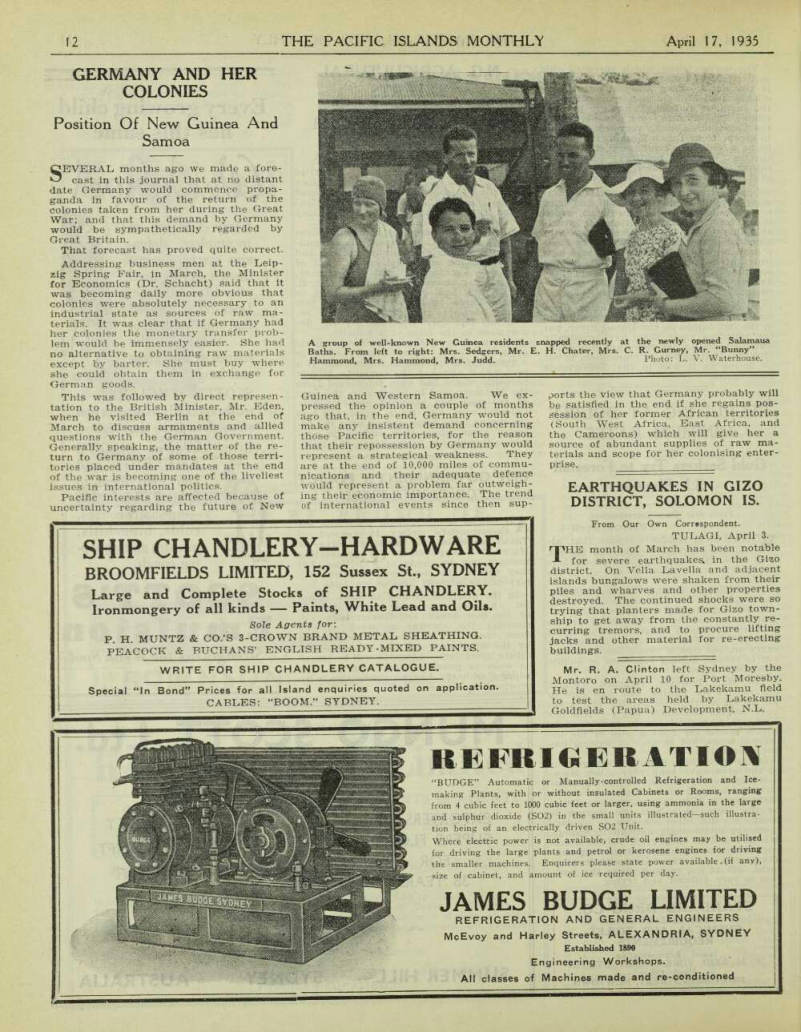
Germany And Her
Position Of New Guinea And Samoa
SEVERAL months ago we made a fore cast in this journal that at no distant date Germany would commence propa ganda in favour of the return of the colonies taken from her during the Great War; and that this demand by Germany would be sympathetically regarded by Great Britain.
That forecast has proved quite correct.
Addressing business men at the Leip zig Spring Fair, in March, the Minister for Economics (Dr. Schacht) said that It was becoming daily more obvious that colonies were absolutely necessary to an industrial state as sources of raw ma terials. It was clear that if Germany had her colonies the monetary transfer prob lem would be immensely easier. She had no alternative to obtaining raw materials except by barter. She must buy where she could obtain them in exchange for German goods.
This was followed by direct represen tation to the British Minister, Mr. Eden, when he visited Berlin at the end of March to discuss armaments and allied questions with the German Government.
Generally speaking, the matter of the re turn to Germany of some of those terri tories placed under mandates at the end of the war is becoming one of the liveliest issues in international politics.
Pacific interests are affected because of uncertainty regarding the future of New
Guinea and Western Samoa. We ex pressed the opinion a couple of months ago that, in the end, Germany would not make any insistent demand concerning those Pacific territories, for the reason that their repossession by Germany would represent a strategical weakness. They are at the end of 10,000 miles of commu nications and their adequate defence would represent a problem far outweigh ing their economic importance. The trend of international events since then sup
ports the view that Germany probably will be satisfied in the end if she regains pos session of her former African territories (South West Africa, East Africa, and the Cameroons) which will give her a source of abundant supplies of raw ma terials and scope for her colonising enter prise.
A group of well-known New Guinea residents snapped recently at the newly opened Salamaua Baths. From left to right: Mrs. Sedgers, Mr. E. H. Chater, Mrs. C. R. Gurney, Mr. “Bunny”
Hammond, Mrs. Hammond, Mrs. Judd.
Photo; L. V. Waterhouse.
Earthquakes In Gizo
District, Solomon Is.
From Our Own Correspondent.
TULAGI, April 3.
THE month of March has been notable for severe earthquakes, in the Gizo district. On Vella Lavella and adjacent islands bungalows were shaken from their piles and wharves and other properties destroyed. The continued shocks were so trying that planters made for Gizo town ship to get away from the constantly re curring tremors, and to procure lifting jacks and other material for re-erecting buildings.
Mr. R. A. Clinton left Sydney by the Montoro on April 10 for Port Moresby.
He is en route to the Lakekamu field to test the areas held by Lakekamu Goldfields (Papua) Development, N.L.
Advertisements & other items, p. 18 (1 item)
Refrigeration
SHIP CHANDLERY-HARDWARE
BROOMFIELDS LIMITED, 152 Sussex St., SYDNEY
Large and Complete Stocks of SHIP CHANDLERY.
Ironmongery of all kinds Paints, White Lead and Oils.
Sole Agents for : P H. MUNTZ & CO.’S 3-CROWN BRAND METAL SHEATHING.
PEACOCK & BUCHANS’ ENGLISH READY-MIXED PAINTS.
WRITE FOR SHIP CHANDLERY CATALOGUE.
Special “In Bond” Prices for all Island enquiries quoted on application.
CABLES; “BOOM.” SYDNEY.
REFRIGERATION
“BUDGE” Automatic or Manually-controlled Refrigeration and Icemaking Plants, with or without insulated Cabinets or Rooms, ranging from 4 cubic feet to 1000 cubic feet or larger, using ammonia in the large and sulphur dioxide (SO2) in the small units illustrated—such illustration being of an electrically driven SO2 Unit.
Where electric power is not available, crude oil engines may be utilised for driving the large plants and petrol or kerosene engines for driving the smaller machines. Enquirers please state power available .(if any), size of cabinet, and amount of ice required per day.
JAMES BUDGE LIMITED
REFRIGERATION AND GENERAL ENGINEERS
McEvoy and Harley Streets, ALEXANDRIA, SYDNEY Established 1890 Engineering Workshops.
All classes of Machines made and re-conditioned
to His Job
A New Administrator Settles Down to His Job
THE appointment of a new Administrator is always a matter of outstand ing importance in the Pacific Territories.
Administrators usually hold enormous power; and on their vision and judg ment depend the welfare of large popu lations and important interests.
Brigadier-General Ramsay McNicoll took charge of New Guinea eight months ago, and, as His Honour now has had time to settle down, we asked Gordon Thomas to write his impressions of the new regime.
By Gordon Thomas.
WHEN New Guinea first learned that Brigadier-General McNicoll, C.B., C.M.G., etc., one-time A.D.C. to the Governor-General, and a Headmaster and Principal of various seats of learn ing, was to be appointed Administrator of the country, there was considerable ado of a speculative nature. There was dread of the introduction of a militaristic-auto cratic-political atmosphere, which is not altogether appreciated by the average dweller under tropical conditions. There was the fear that the easy-of-approach policy, inaugurated by General Griffiths, might be superseded by a system of bureaucratic barricades, and that the political-complex might be predominant in the Chief Executor’s make-up.
It was with mixed feelings of hope and curiosity that the crowd watched the erect, spare figure of the new Administra tor step off the “Mataram” on September 13th and, in company with the Chief Judge, inspect the guard-of-honour.
General McNicoll marched right into harness: for on the day following his arrival he opened the Third Session of the Legislative Council, and at this function the strength of his personality and his keen perceptiveness were demonstrated.
He couid not but sense the tense atmo sphere that filled the Council Chambers on that morning, when he rose to reply to the Deputy Administrator’s speech of wel come, after the swearing-in ceremony, and with the same keen observation he must have realised, after his address, in which he sought the co-operation of the in dividual as well as of the community, that there was a relaxation in the tenseness of the audience, and that his candid appeal for co-operation for the good of the Terri tory had won him many friends, whose objects were the advancement and welfare of New Guinea.
During the few months since his arrival General McNiccll already has covered much territory by sea, land and air. His first tour took him to the most important
centre of the goldfields in Morobe. Here he carefully studied conditions regarding roads, aerodromes, the Salamaua wharf and the penetration of new, uncontrolled areas. Later, he visited Madang, Sepik Wewak and Aitape areas, making contact with all classes of the white community and carefully studying the native problems as they were presented to him He mvh the impression of weighing the pros and cons of the recommendations, and thoroughly analysing the questions placed before him. with the brain of the scholar and the intuition of the soldier.
These months have been months of careful study for the new Administrator; months of making himself acquainted with white and black conditions; months of weighing, testing, seeking out reasons and
carefully indexing the knowledge for future reference. It has been a period of deliberation and study; of dissecting and labelling in order to decide upon future policies for the welfare of the Territory.
Apart from his official position as Administrator, Ramsay McNicoll is a most interesting man to meet. He has a personal inclination to learn all there is to know of native lores and customs; he has travelled extensively and is a keen observer; he an ardent lover of good music, nor does he spurn melodies in lighter vein; he is an enthusiast where musical and dramatic art is concerned; he is a prolific reader, and has an easy and versatile pen of his own, which might surprise many; and he is an ardent Shakespearian scholar.
Although he has spent so much of his time away from the capital, he has shown a marked interest in the sporting activities of Rabaul. He is in great demand for social functions, where he is often the centre of a group enjoying some interest ing anecdote culled from his many experi ences. In social functions the General now has his most able help-mate to assist
him, and Mrs. McNicoll already has made a host of friends amongst those with whom she has come in contact.
The First Lady in the Land is as assidu ously studying her new environment as the General and, likewise, is carefully absorbing each new condition and incident as it arises; making herself au fait with the most variable phases of life as pre sented in Rabaul —the paradox of the Pacific, where cliques are most exclusive (and unjustified) and conventions rigidly observed and as regularly violated.
General Ramsay McNicoll and his lady are quietly and studiously “getting ac quainted” with New Guinea and its people.
They are going about their task in the only way which will lead to a perfect and successful understanding for all.
If I were asked to describe our Chief Executive Officer and Mrs. McNicoll in one word I should write: Balance. And that is a quality which a new country like New Guinea—and particularly Rabaul— can well afford to cultivate.
Advertisements & other items, pp. 19-20 (1 item)
Hotel Grand Central
THE BRIDGE BIRD SHOP
For Well-bred Birds, Dogs, Persian Cats and other Animals All Pedigreed at Reasonable Prices We Buy as Well as Sell Islanders are Invited to Communicate
6 JUNCTION STREET NORTH SYDNEY
Wilhelm llreckwoldt Co.
9, Lange Muehren, South Sea Bldgs.
HAMBURG, GERMANY
(Exporters and Importers) We Export: Trade Goods of any description, Cutlery, Hardware, Miners' Requisites, etc., etc.
We Import: Any kind of Island Produce.
CORRESPONDENCE INVITED
HOTEL GRAND CENTRAL
151 CLARENCE STREET, SYDNEY, (opp. G.P.O.)
THE POPULAR “ROOM-ONLY”
TARIFF
is specially designed to meet modern requirements of business and pleasure. It enables patrons to enjoy every advantage of hotel life, at the same time keeping hotel expenses down to a minimum.
SERVICES INCLUDE:
Theatre Booking and Information Bureau.
Travel and Sightseeing Tours arranged.
Up-to-date Barber's Shop.
Cleaning and Pressing Service.
Garage accommodation nearby at usual rates.
Spacious Dining Room. All meals a la carte.
The HOTEL GRAND CENTRAL Ltd.
151 CLARENCE STREET, SYDNEY (opp. G.P.O.)
Telephone: BW 1531 (3 lines) Box 716 FF, Sydney Radio Cables and Telegrams: “Grancentral,” Sydney
FRASER WEBSTER, Manager.
’Phone FL 1266. ’Phone FL 1266,
HENLY’S
DRIVE YOURSELF
SERVICE
197 William Street Sydney Cars Hired without Drivers on a Mileage Basis as under:— OPEN CARS—By the Day. 3d. per Mile.
Minimum, 30 Miles Week Days. 60 Miles Sundays.
SEDANS—By the Day. 4d. per Mile.
Minimum 30 Miles Week Days. 60 Miles Sundays.
Special quotations for holidays.
Payment, plus 2/6 per day or 7/6 per week for insurance. A deposit must be left on car, which is refunded when car is returned.
Our Fleet of Cars includes 1934 Plymouths, Hired at a Slight Increase.
"Cleaning things up"
That’s what you’ll be doing, too, when—like the big majority of keen sportsmen—you Use "Duxbac"
& "ICIL SPECIAL"
Waterproof Cartridge
Without Excessive Pressure or Recoil.
Loaded with “Neoflak”
Powder the Newest and Most Successful Shot Gun Propellant.
Popular
Prices
T.W.H. WATERPROOFING
SOLUTION
Specially prepared for treating Tents, Tarpaulins, Cart, Wheat and Haystack Covers, Horse Rugs, Ground Sheets, and Oilskins Free of injurious chemicals & acids, penetrates, binds, and strengthens.
Is flexible and does not stick or rot material.
J. R. CLAY & CO. LTD.,
Agent for Port Moresby and Samarai
MADE IN 15 COLORS
TAYLOR WILLIAMS & HALLIDAY (SALES DEPT.)
180 Elizabeth Street, Sydnev
Fiji’S Gold Boom
£10 Shares Go To £430!
IN spite of what the Government of Fiji has done to discourage speculation in connection with Fiji’s new gold industry, the good work goes on—particularly in Melbourne, where most of the new Fiji gold companies have been formed.
The most spectacular development of the month has been the rise in the value of shares in Aloha Syndicate N.L. This con cern sent Mr. R. M. Boyd, an engineer, to Fiji to examine two areas over which it held options. He reported favourably on a 30-acres block, held by the Costello in terests, in the centre of the Tavua field, Fiji. This was the site of the original gold strike which led to the development of the Tavua field.
Messrs. P. and G. Costello, in the mean time, had arrived in Melbourne, and the
Syndicate early in April exercised its option and bought the block; and then proceeded to form a prospecting company for this lease, and two other companies, one for each of its other two properties.
This started something. It was reported on April 4 that Aloha Syndicate shares, paid only to £10, made a spectacular leap from £170 to £300 on the Melbourne Stock Exchange, two shares only changing hands. Later, on April 10, Aloha shares gained another £130, reaching the record high level of £430!
There are 120 shares in the company, 20 being fully-paid vendors, and 20 (contri buting) were taken by Wiluna Extended Gold Co. The first prospecting company will be Aloha Central Gold Mining, N.L.
Mr. Pat Costello told the Melbourne newspapers that the Tavua goldfield in Fiji was “the find of the century.” He said that the former Federal Treasurer (Mr. E.
G. Theodore) and certain associates would amass a fortune out of the rich returns from the field.
“It is my wish that Mr. Theodore and his business associates should make for tunes out of the field,” he said, “as they had the courage to risk from £75,000 to £80,000 of their own money in developing the area.”
Three times—in 1915, 1924 and 1928 Mr. Costello lost considerable sums in searching for gold in Fiji. In 1932 the tide turned.
“It is not exaggerating to say that this is the gold find of the century,” he said.
“One assay yielded 37 ounces of gold from 15 cwt. of ore. Here is a rich field that was rejected by several mining engineers who based their disapproval on Australian geological conditions. The geology of this part of Fiji, however, approximates more closely to that of New Zealand.”
Decline In Rubber Values
THE sharp fall in raw rubber values reported early in April was preceded by a downward movement which caused concern amongst growers.
An Amsterdam authority stated that the Dutch East Indies were largely respon sible for the movement. The first blow at the market, he said, was given some time ago when the Director of Economic Affairs of the Dutch East Indies declared that it was not the intention of the Dutch Govern ment to force up rubber prices.
The second came when the export duty on native rubber was lowered. The third and final blow, in the opinion of the authority referred to, is bound to come unless the International Rubber Regula tion Committee decides upon a drastic in crease of the restriction percentage to at least 30 per cent. Maintenance of the per centage at 25, it is contended, would lead to a sharp relapse in the rubber com modity market and might even lead to a complete breakdown of the regulation scheme.
Advertisements & other items, p. 20 (1 item)
W. M. Ford
Ship, Yacht & Boat Builder
Berry’s Bay, North Sydney
(Established 1870.) BUILDERS of all kinds of Island Craft from Dinghies to Auxiliary Schooners of any tonnage. New and Second-hand Island Craft of various types in stock. New and Second-hand Full Diesel, Crude Oil. Benzine and Kerosene Engines.
Please Send on Your Enquiries.
N. G. Goldfields Ltd. Reduce
CAPITAL BY 75 per cent.
Shareholders of New Guinea Goldfields Ltd., Held their annual meeting in Sydney on March 27. Features: Issued capital written down from £4,472,331 to £1,118,081; dividend of 4 per cent declared (equal to 16 per cent, on capital written down); Mr. J. P. Blaikie Webster (of Mining Trust) becomes chairman; Major G. A. Harrison joins board, and retires from general managership, and Mr. E. A. De Latour takes latter position; announced that policy of vigorous development will be followed, and that may expect better rewards in future.
THE annual meeting of New Guinea Goldfields, Ltd., which was held on March 27 was attended by about 300 per sons. Mr. Blaikie Webster, who recently has come to Australia as the representa tive of tbe Mining Trust presided. The proceedings were expected to be lively: but only a few questions were asked and little criticism was offered. It was clear that there was among those present an undercurrent of discontent; but it was felt that nothing was to be gained by opposing the recommendations of the directors, as the latter held far more than sufficient proxies to carry out their wishes.
The chairman, in moving the adoption of the annual report, addressed the meeting at length.
The chairman said that the year’s profit of £180,000 was £50,000 better than the previous year. Income from alluvial mining was lower at £65,000, but the treatment of a larger tonnage at Golden Ridges mill gave an operating surplus there of £151,000. Including £50,000 brought forward from the previous year, the company’s ac count was now £230,000 in credit, and it was proposed to pay a dividend of 9.6d per share, absorbing £171,000 and leaving £59,000 to be carried forward.
The chairman said that his outstanding impres sion of a recent visit to New Guinea was the
enormous amount of pioneering work that had Administration. He described the huge difficulties that the company had had to meet in its initial stages owing to enormous transport costs and the absence of mechanical power. He said that the company pioneered the triple-engined aero
plane; made details surveys; ascertained the
possibility of constructing a road from the coast; carried out an exhaustive geological survey of the whole field; and built roads, bridges and an aerodrome for the benefit of the whole community.
It was a unique record of pioneering work which entitled the company to every consideration at the hands of the Government concerned. The company now had on the field administrative offices, stores, hospitals, native quarters, and other buildings, together with houses of the most modern type, electric and water supplies, telephone service, roads, gardens and farms refrigerating plants and other amenities of civilisation.
In order to overcome one of their most serious difficulties they had finally arranged to purchase hydro-electric power from the Bulolo Co., and this new supply was now connected with all points at Wau, Golden Ridges, and Edie, which develop ment would enable them to keep their steam-plant at Golden Ridges as a standby. This new supply of power would enable operations at Edie Creek, Golden Ridges and on the alluvial leases to go ahead much more quickly.
Describing the “present position and programme,” the chairman said that in order to learn more of the three ore bodies at Edie, which they had so far developed, they proposed to commence
deep diamond drilling; and for this purpose exten sive new plant was being sent to the field. No. 1 shaft, now down 356 ft., will be sunk another 300 ft. No. 4 shaft, connected with Edie No. 1 and 2 and Karuka veins, will be used for main haulage. Work has now been commenced on the erection of the new central treatment plant at Edie which will be in operation in August. This plant is already assured of supplies until 1940.
Most of the cheaply-mined open-cut ore at Gol den Ridges has been extracted, and as deep mining is now necessary, a shaft is being sunk.
Present indications were that this ore would keep the mill going for at least another year. A tailings retreatment plant was being erected. Test ing work was proceeding at the adjoining Golden Peaks area where there may be considerable low grade material for this mill.
Important work had been done on the alluvial area. Testing of a small part of the property on the Bulolo River indicates a profit in sight there of more than £100,000 and attention is also being devoted to the claims in the lower part of the adjoining Koranga Creek, in regard to which they had entered into an arrangement, already producing revenue, with the Koranga Gold Sluic ing Co.
To expedite the drilling and other work being done in this area, an order has been placed for additional power driven alluvial drilling equipment.
Meantime treatment of the Bulolo gravels has been deferred, as the results from this alluvial drilling and testing campaign may make it neces sary to consider a much more comprehensive scheme of operations.
It is also proposed to test the possibility of gold occurrences in the Koranga Crater section by electric power diamond drilling. Geologically, this section has always been one of interest, recently increased by the exposure on the Koranga Sluicing Co.’s claim immediately adjoining N.G.G. property of a rich deep lead heading towards the c-ater.
The company has already commenced driving an adit from which, at a suitable distance, drilling will be undertaken.
Discussing other matters the chairman said that it had been decided to remove the company’s administrative centre from Wau to Edie; that steps were being taken to arrange air transport at a reduced rate; and that representations were being made to the Administration to secure better native labour conditions. The company was also urging the Administration to revise the incidence of taxation, which was now in the form of a 5
per cent, royalty on all gold produced. It was claimed that this system worked very unfairly and that it should be abolished, and instead a small tax imposed on the profits of all enter prises on the field, without penalising any par ticular industry or company, A member asked why Major Harrison had severed his connection with the com pany.
The chairman said that Mr. Harrison did not sever his connection. He was loaned by the Mining Trust to N.G.G.
Ltd. many years ago, and did very fine pioneering work in New Guinea. But he was a very expensive man and the Trust, naturally, wanted to use his services in other directions. He had joined the board and his valuable knowledge and experi ence would be available to the company.
The motion was carried and the direc tors then moved that a dividend at the rate of 4 per cent, be declared. They stated that they believed that share holders would experience better times.
A voice: They have been a long time coming. (Laughter).
The necessary motion was then moved to reduce the capital of the company both issued and non-issued by 75 per cent. — that is, by reducing the value of the £1 shares to 5/. The chairman said that the formal motion which had been already circulated to shareholders included the reduction (from £1 to 5/) of the 777,669 unissued shares of the company; but it had been strongly represented since then that it would be a mistake to do this, as it would leave the company with only £190,000 odd of unissued shares. It was therefore proposed to move an amend ment to the motion —the effect of which would be to reduce the 4,472,331 £1 shares already issued to 5/, and instead of re ducing the 777,669 unissued £1 shares to 5/, to create, instead of 777,669 £1 shares, a total of 3,110,996 shares of a nominal of 5/- each. This would leave the company with £777,669 of unissued capi tal to be availed of in case of need. The Board desired that the motion, amended now in the manner described, should be carried.
The chairman said that this question
of writing down the issued capital had received the very careful consideration of the principal shareholders in England and Australia. The balance sheet for years had been carrying very large amounts which were apparently not re presented by tangible assets. It was proposed to write off among other things the amount of £439,000 odd shown among the assets as “Prospecting and Developing Account.” It might be said that some portion of this should still remain as an asset; or that current earn ings should be applied to the writing off of certain of the assets shown in the capital account; but the board had deemed it better to write down the value of the assets immediately and take ad vantage of the much improved position now before the company. The share holders were asked to sacrifice a consid erable proportion of the nominal value of their shares; but in return they would immediately participate in a much big ger income. Another reason in favour of the proposal—but a reason, of course, that did not concern the directors —was the attitude of the share market towards shares which were quoted at a discount.
The market was inclined to assume that such shares meant that there were no funds or no property and no dividends.
Pie thought the shareholders in a mat ter of this kind should take the market quotation into consideration.
A member: If the capital is to be writ ten down like this, what assets do you propose to write down. I assume that you will not touch sundry debtors, or cash or stores or payments in advance.
The chairman agreed that those items would not be written down. The other assets would be reduced in valuation. He emphasised, however, that the same as sets would be there in the future —it was not proposed to destroy any.
A member: It is evident to me that the only object of this motion is to cover up the losses which the Directors have made in the past. I cannot see that any thing else is to be achieved.
A member: The more gold has gone up in value the more our shares have gone down.
The chairman said that the whole of those properties held by the company were acquired by the issue of paid up shares. The total cash subscribed in connection with the issue of shares repre senting £4,416,050 was only a little over a million pounds. It was not possible now to claim that there was on the field over three million pounds worth of proven ground.
A member: If you are going to reduce your capital from £4,000,000 to £ 1,000,000 do you think that there is any chance of a corresponding reduction in the cost of management and overhead expenses.
Another shareholder: Does this not mean that you paid those original share holders in scrip a good deal more for their leases than they were worth?
The chairman: That may be an in terpretation. The fact is that in the beginning there were a large number of
prospectors in that field and they were very optimistic. I had nothing to do with operations at that time but I as sume that the prospectors were rather eager to become partners in this company and they accepted our shares accordingly.
The chairman added that the reduction In the value of the issued shares was general—there was no distinction made between those who had subscribed cash and those who had received shares in payment for their ground.
A member: How many of these leases have been tested? I understand that some have been proved quite valueless.
Why not write off only those that have been proved valueless.
The chairman said that the company’s work up to the present had been re stricted owing to such difficulties as the heavy costs of transport and the lack gf power which prevented the operation of pumps and did not allow investigation to go below water level. It was pos sible —although he would not say so offi cially—that some of the company’s leases were not worth what had been paid for them. The work of testing would now proceed more rapidly. The company to day was in the position of receiving a fairly satisfactory income, based on what the market said was the value of the shares. If they accepted that position, adjusted their capital, and wrote down their assets, they were doing no harm to their shareholders. There were 300 or 400 leases and it was difficult to say what proportion of them was valueless.
A member expressed himself emphati cally against the motion as it had been amended. He thought that it would be most undesirable to make so large an amount of uncalled capital available to the board. This company had always been under the stigma that its capital was too heavy; and the criticism against the board and management was that, when ever they seemed to be getting on to good gold, they dashed off to experiment in some other direction and did not get on with the main job of producing gold. If the unissued as well as the issued capi tal were written down as originally pro posed, a check would be put on the board and management and they would be com pelled to get on with the job of producing gold and giving some reward to share holders.
Another member: Let us shorten all this —we are getting nowhere. Will the chairman tell us whether or not he has in hand sufficient proxies to carry this amended motion, whatever this meeting may think. (Laughter).
The chairman: I am the last man to use proxies to stifle discussion. We are very glad to have the opinion of this meeting. He went on to say that the board did not propose to acquire any new properties but would devote all its at tention and energy to developing the properties which it already holds in New Guinea and which it regards as very valuable. It did not intend to engage in any outside schemes which might in volve waste of capital.
The amended motion was then carried; directors and auditors were re-elected; and the meeting terminated.
The directors are now Mr. J. P. Blaikie Webster (chairman), Major G. A. Harri son. Mr. A. M. Hemsley, Mr. T. R. Mc- Culloch, Mr. D. P. Mitchell, Mr. J. M.
Bailey, and Earl Castle Stewart. Mr.
Bailey is a son of Sir Abe Bailey, the South African mining magnate.
Miss Daisy Coltheart and Nurse A. M.
Williamson, workers for the Methodist Church in Australia, have been accepted as mission trainees for Papua.
Advertisements & other items, pp. 21-22 (1 item)
Nelson And Robertson
ISLAND MERCHANTS. (Established, 1895.)
COCOA BEANS: Special attention devoted to their sale in Australian and Oversea markets.
COPRA, TROCAS SHELL, and other Island produce sold on commission.
All classes of merchandise purchased at wholesale prices and original invoices supplied to Island clients. Small commission.
SOLE AGENTS FOR
PUMPMOBIL, genuine portable pump, capacity up to 12,000 galls., weight 1 10 lbs.
PENTA ENGINES, utility outboard and inboard, Swedish manufacture, powers 4-60 h.p.
SKANDIA ENGINES, full diesel and semi-diesel, all powers, marine and stationary.
UPSON BRITISH BOARD, wallboard and insulating material in one, strong and light in weight. 6ft. to 12ft. lengths always in stock.
NELSON and ROBERTSON
12 SPRING STREET SYDNEY, AUSTRALIA
Telegraphic Address: “IVAN SYDNEY.”
VIRTUS SHIRTS
are obtainable in
Three Sleeve Lengths
Short—eliminating the necessity of wearing armbands or sewing tucks in sleeves.
Medium—the regular average sleeve length.
Long—made extra long in sleeves specially to fit men with very long arms.
Reliable English Woven Shirtings Prices from 10/6 —Patterns Posted free. Write to
ERNEST SHAW
135 PITT ST., SYDNEY
READ THE
B.P. MAGAZINE
AUTUMN NUMBER
Now on Sale Short Stories Pictures Travel Articles Pages for the Children. Stage.
Latest Fashions Screen One Shilling per Copy ON SALE AT ALL NEWSAGENTS AND BOOKSELLERS
TARIFF:
Single Room and Breakfast from 8/-
HOTEL MANSIONS
SYDNEY’S IDEALLY SITUATED PALATIAL HOTEL
INCLUSIVE
TARIFF:
Single Room from 12/per diem. per night.
WEEKLY
from £2/2/- WIRES: “Mansions,” Sydney.
Renowned for Exquisite Cuisine, Perfect Service and Luxurious Appointments.
Make the Mansions your home whilst in Sydney and enjoy Unsurpassed Comfort at Moderate Cost. WEEKLY INDIVIDUAL, DOUBLE ROOMS AND FAMILY SUITES from £3/10/- ADDRESS: Bayswater Rd., King’s Cross.
Laloki Water
Supply
Proposed Scheme for Pt. Moresby
From Our Own Correspondent.
Port Moresby, March 21.
NOW that the prospects of the Territory seem brighter, Port Moresby is agitating for a water supply from the Laloki River, which runs parallel with coast about 21 miles from the capital, to take the place of the large storage reser voir on the hill behind the town.
The project is by no means a new one.
In 1928 it was brought forward, and had it not been for the depression the scheme would have been established long ago.
The idea is generally considered a sound one. Though some residents, while admitting the advantages and comfort of a plentiful water supply, consider that it is a little premature to burden a small township of only 350 residents with the responsibility of a debt of over £20,000 until the markets have become steadier and a permanent and successful mining community has become an established fact in the Territory.
Advertisements & other items, p. 23 (1 item)
Ropes,
STOP
Tired nerves are the cause of Headache, Neuritis, Neuralgia, Rheumatism, Lumbago, Sciatica. Get instant relief from all nerve pains with Genuine VINCENT’S A.P.C. as recommended by Doctors, Dentists, Chemists, and Nurses. 12 for 1/6, 24 for 2/6.
All Chemists and Stores, or direct from Vincent Chemical Company Limited, Market St., Sydney, Australia
Nerve
Pains
FOR SAFETY’S SAKE. SAY “VINCENTS"
The Islanders’ Sydney Home . . .
Location BELVEDERE
81 BAYSWATER ROAD, DARLINGHURST
Exclusive.
A fine house with its wealth of pleasant old associations.
The Garden Suites, designed on most modern lines.
Excellent grounds with beautifully kept gardens—and dotted with comfortable garden seats.
Private telephones if desired.
An atmosphere of rest and grateful quietness.
Ideal location.
Near White City Tennis Courts.
Seven minutes to G.P.O.
Close to Shopping Centre.
Trams stop at gates.
BELVEDERE
is Controlled and Supervised by Island People for Island People TERMS: From £2/12/6 Weekly. M MR. & MRS. C. WAGER (late of Fiji), Proprietors.
Save time, trouble, temper specify these universally preferred
ROPES,
Made by the largest Rope and Cordage manufacturers in Australasia, “Kookooburra” Ropes, Cordages, and Twines are tested to provide that extra endurance, which is only found in quality lines.
Specially manufactured for the stresses of tropical conditions.
Other well-known products include Sash Cords, Halters, Plow Reins, Jute and Hemp Seaming Twines.
KOO K OOKIRUA
BRAND
A. FORSYTH & Co. Ltd. 339 KENT ST Cable Address: “Rope," Sydney
SYDNEY.
Duty
Devotion To
How Cook Is. Officer Received Fatal Storm Injuries
From Our Own Correspondent.
Rarotonga, Mar. 23.
THE conscientious attention to detail which characterised Mr. C. J. Bou chier’s work in the Cook Is. was the in direct cause of the accident which led to his death on February 20.
Shortly after mid-day on the 10th heavy seas began breaking against the Fruit Dept.’s office and fumigation shed, a small building standing about 10yds. above nor mal high-water mark. Accompanied by Mr. L. M. Cook, private secretary to the Resident Commissioner, and Mr. Ivan Nottage, of the N.Z. Fruit Dept., Mr.
Bouchier entered the premises and re moved practically all the office contents.
At this time the fumigation shed, being built of cement, was not thought to be in any danger.
Later in the afternoon, however, the seas increased and Mr, Bouchier, again accompanied by Mr. Cook, ran over with the intention of removing the fumiga tion tents. They had barely reached the door when a wave, probably the largest during the whole hurricane, swept in from the lagoon. Both men turned and ran, making for the shelter of the Government buildings across the road. The wave, travelling breast high, caught them almost immediately.
Mr. Cook was carried across the road and flung unhurt into an adjoining gar den. Mr. Bouchier, less fortunate, was swept away by a cross-current and driven
against a large cargo lighter which had broken free from its moorings on the slipway. In the maelstrom of rushing water the lighter was refloated and in some manner crushed the lower part of his right leg.
Suffering indescribable agony, Mr. Bou chier was taken to the hospital where Dr.
Ellison worked heroically, attempting to save the limb. Eventually, however, it was found necessary to amputate. On February 20, exactly a week after the operation, Mr. Bouchier died suddenly as the result of a “blood-clot.”
The deceased, who served during the War with the South African Artillery, was buried in the Catholic Cemetery with full military honours, the funeral being one of the largest seen for many years in Rarotonga. He had been in the Cook.
Is. Service for upwards of 12 years, and was 36 at the time of his death. He left a wife and six little girls, the eldest of whom is only ten.
The post of Director of Agriculture has been filled by the temporary appointment of Mr. E. A. Reid. The work will be no novelty to Mr. Reid, who prior to his retirement some years ago, occupied the same position. Mr. Reid is also a director and leading spirit in the Rarotonga Fruit Cos., the younger of our two native com panies.
Hon. George H. Murray, M.L.C., Direc tor of Agriculture in New Guinea, will sail from Sydney by the Mariposa at the beginning of May on a visit to America and Europe. Mr. Murray, as usual, will spend most of his long leave visiting agricultural research stations in different parts of the world. He intends to pay a special visit to the famous station in Hawaii maintained by the sugar industry there. Mr. Murray’s mother, who is aged 84, has made a remarkably rapid recovery from a recent serious accident.
Through Unknown
N. Guinea
Papuan Prospectors In An Unexplored Region
From Our Own Correspondent.
Port Moresby, March 22.
A JOURNEY through the unmapped and unknown central area of New Guinea is reported by a party of gold prospectors,.
Messrs. Westhoven, McCabe and Minahan. who arrived in Port Moresby on March 19 after five months spent in the region west and north-west of the Lakekamu River.
In November, the party, after visiting the Lakekamu goldfield, pushed on farther west, up the head waters of the Kikori River, in the Delta Division. Then, from the Samberigi Valley, they reached the Erewa River, flowing from the Sir Arthur Gordon Range; and eventually they got into the unknown valleys running west from Mt. Hagen (in the newly-discovered region, in New Guinea, north-west of the Morobe goldfield).
They found the districts inhabited by virile tribes, continually at war with one another, who became extremely friendly to the party, after the first shock of con tact. These people had not previously made contact with white men.
An interesting collection of stone axes was made.
The continual line of limestone the party encountered was disappointing. In not one instance was gold bearing country met with on the trip.
Preparations for further investigations
in other unexplored districts are in hand.
While camping on the banks of the Erewa River, the party saw with the aid of field glasses what appeared to be a large canvas tent on the side of a distant mountain which they thought might pos sibly be that of the Hides and O’Malley patrol. But it is generally understood to have been the face of a limestone cliff, for the country to the west is closed by high limestone ridges. Messrs. Hides and O’Malley’s route from the Fly and Strick land lies more to the north, near the boun dary.
Mr. Ward Williams has arrived here with six men, including Messrs. Corn, Gwilt and Anderson, ready for the ex pedition up the Fly River on behalf of Oroviole Company. He will have a police escort, led by Patrol-Officer Cowley. It is said that this expedition will use an auto gyro machine, capable of landing on sea or land, and two pilots.
There is no further word of the Govern ment exploring expedition led by A.R.M.
Jack Hides, which disappeared into the in terior beyond the Fly River in January in an attempt to get through into the Mount Hagen district, in the Mandated Territory.
Advertisements & other items, p. 24 (1 item)
Delco-Light
8C3 DELCO - LIGHT
AN AUTOMATIC PLANT AT LOW COST
Here is an inexpensive, automatic and battery charging plant giving ample power for operating Frigidaire and other household accessories, fans, irons, pumps, etc. In addition, it provides brilliant electric light for bungalows, outhouses, etc., at the touch of a switch.
Combining the admirable features of both an automatic and battery charging plant, Model 8C3 is designed to allow all loads over 200 watts (seven 50 c.p. lamps) to be supplied from the battery; loads over 200 watts automatically start the generator instantly—thus protecting the battery against heavy discharges. It also enables the use of a smaller battery than would otherwise be the case.
Write to us by next mail; let us tell you more about the advantages of Delco-Light Model 8C3. Mention this publication.
Distributors: WARBURTON, FRANKI LTD.
MELBOURNE. 307-15 KENT STREET, SYDNEY Brisbane.
DELCO-LIGHT
TUDOR PLANTE TYPE BATTERIES ARE STANDARD WITH DELCO-LIGHT
DOOKWIT
DhLCO - LIGHT, MODEL BC3 (800 Watts. 32 Volts).
Caledonia
Japanese Beer in New Caledonia
From Our Own Correspondent.
NOUMEA, March 24.
IN a recent issue of a leading Australian newspaper reference was made to Japanese beer, stating that Germany found it impossible to compete with the light beer manufactured by Japan, and placed at a very reasonable price on the world’s market. For a considerable time Japanese beer has beep selling readily in Noumea, and has found favour with the beer drink ing section of the community here, which is not a large one—red wine being the usual drink.
Italian Honeybees
Scientific Research in Tahiti
From Our Own Correspondent.
PAPEETE, March 26.
MUCH scientific research work is being done in Tahiti with the honeybee by Mr. E. L. Sechrist, who was for many years apiculturist with the United States Dept. of Agriculture at Washington, D.C., and recently, until his retirement, in charge of the U.S. Research on Honeyin California. The honeybees of Tahiti are the famous old Italian stock brought here in 1869. They soon became naturalized here and, curiously enough, appear to be the purest stock of Italian bees to be found anywhere outside Italy.
It is of much interest to beekeepers of the world that Mr. Sechrist has located a reservoir of the pure Italian bees in Tahiti and that he has been stationed here permanently to do research work and to distribute queen bees of this stock to beekeepers who wish to begin with the original Italian honeybee. Particularly is this true because of the work now be ing done on scientific, or instrumental, insemination of queen bees, by which a selected queen bee can be mated with a drone of selected stock, whereby a strain can be kept pure, or line bred, or any particular characteristic developed.
Soon after bees were introduced into Tahiti, an export business in honey and wax sprang up, but this has almost dis appeared. With the renewed interest in
Tahitian bees, this industry may again become of importance, particularly as Mr.
Sechrist and Mr. Harrison Smith are introducing new honey plants to Tahiti.
One of these is the Algaroba tree, which has made Hawaii famous for its honey.
The naturalisation of the Algaroba tree in Tahiti would have a double value, as besides its importance as a source of honey, its seed pods provide a rich and abundant food for cattle.
Advertisements & other items, pp. 25-26 (1 item)
Mcilrath’S Ltd.
SAMUEL RUSSELL
ESTATE AND GENERAL AGENT.
P.O. Box 64, Papeete, Tahiti
Real Estate. Investments. Estate Management and Administration. Valuations and Reports. Houses and Lands for Lease or Sale.
Sole Proprietor: TAHITI PERFUMES C atiUs Russell. Tahiti (Bentley's Code)
AUSOLINE
COCKROACH DESTROYER
It Attracts—They Eat It—They Die
AUSOLINE CO.
314 CROWN STREET, SYDNEY
Established 1919 PRICES: 1lb. 5/-, 3lbs. 10/-. Postage Extra.
Remit Cash with Order.
It’s Paste
Money Go Further by Sending Your Orders to McILRATH’S The Leading Southern Food Store Selmore Sockeye Salmon, 16oz. tins (4 doz.) 14/9 doz., 52/- case St, George Assorted Meats, 7oz. tins (6 doz.) 9/9 doz., 54/- case St. George Assorted Meats, 14oz. tins (4 doz.) 15/6 doz., 56/- case I.X.L. Best Assorted Jams, 24oz. tins (4 doz.) 10/3 doz., 34/- case Ideal Unsweetened Milk, 6oz. tins (8 doz.) 2/10½ doz., 20/- case Rosa Full Cream Condensed Milk, 14oz. tins (4 doz.) 5/10½ doz., 22/- case / Searchlight Phenyle, sgal. drums 10/- drum New Season’s Evaporated Peaches, 3 crown, loose 8d. lb., 7/6 doz. lbs.
New Season’s Evaporated Pears, 3 crown, loose 8d. lb., 7/6 doz. lbs.
Finest Apple Rings, 2lb. tins 1/9 tin, 20/- doz.
I.X.L. Prunes in Syrup, 16oz. tins 7d. tin, 6/9 doz.
Rosa or I.X.L. Peaches in Syrup, 30oz. tins 9d. tin, 8/10½ doz.
Rosa Custard Powder, finest quality, 8oz. pkts. 6½d. pkt., 6/3 doz.
Nestle’s Reduced Cream, 4oz. tins 4d. tin, 3/9 doz.
Rex Luncheon Cheese, 4oz. tins 9d. tin, 8/6 doz.
Garden Vale Cauliflower, 16oz. tin 8d. tin, 7/6 doz.
I.X.L. Baked Beans in Sauce, 10oz. tins . . 6½d. tin, 6/- doz.
McILRATH’S Rich Port, 26oz. bottles . . 2/- bot., 23/6 doz.
Prices f.o.b. Sydney Export Price Lists available on application.
McILRATH’S LTD.
To Pacific Islands
Traders
SAVE MONEY AND BUY YOUR
GOODS DIRECT FROM
MANCHESTER—
Write to us for Quotations, Details, etc.
WE ARE MANUFACTURERS OF
GREY, WHITE AND COLOURED
TEXTILES
Rami materials of every description.
Para Reds.
White and Blue Drills.
Grey and White Calicos.
Super Drill.
Ecru Tussore.
Dyed Pop’ins.
Woven-striped Poplins.
Table Cloths.
Serviettes.
Sheets.
Pillow Cases.
Quilts.
Bedspreads.
Art Silk Piece Goods.
Bath Wraps.
Glass Cloths.
Sweat Rags.
Bias Binding.
Braids, etc.
Extract from a letter sent to us by an Islands storekeeper who recently retired: Milne Bay, Papua. 1.10.34. . .a success due—in a great measure —to the excellent service rendered for so many years by your firm. Yours faithfully,
"H. DEXTER.”
A. WEBB & COMPANY
(Manchester) LTD.
86 GEORGE ST., MANCHESTER
Contractors to H.M. and Foreign Governments.
Bentley’s Code, and ABC Code 4th and 5th Editions.
Telegraphic Address: “WASTOCK,” Manchester.
DOYLE’S famous VETERINARY REMEDIES
REDUCINE—Cures Your Lame Horse. Cures him painlessly and you can work him all the time.
Cures Splints, Curbs, Capped Hocks, Sprung Tendons, Bog Spavins, and all Bony and Bursal Enlargements. Price. 12/6 per can. Postage, 1/-.
LARYNGINE.—A sure cure for Coughs, Colds, Strangles, etc. Price, 5/- per can. Postage, 1/-.
SKIN DRESSING.—A certain remedy for Mange and Allied Parasitic Skin Diseases in Horses, Dogs, etc. Price, 7/6 (large), 3/6 (small). Postage, 1/-.
DISTEMPER MIXTURE.—A safe and reliable remedy for Coughs, Colds, Asthma, etc. Price, 2/6. Postage, 9d.
T. G. DOYLE, v.s., 9 KING STREET, RANDWICK, N.S.W.
Write for Free Veterinary Advice and Booklet
A CLEAN PLANTATION GUARANTEED
WITH
B.A.C. Weed Killer
Used on Malay States Rubber Plantations; approved by British Malay Rubber Institute F.O.B. Sydney. Sold in 4 gallon tins —2 tins to a case. 4/3 per gallon (Australian Currency). In concentrated form. Agents wanted in every group Particulars from:
LONE HAND SOAP CO.
554 Botany Rd,, Alexandria, Sydney, Australia
Damage
Cook Is. Storm
Aitutaki Suffers Heaviest Losses
From Our Own Correspondent.
Rarotonga, Mar. 24.
THE Resident Commissioner of the Cook Is., Judge H. F. Ayson, C.M.G., on his return from a tour of the Lower Group immediately after the recent hurricane, reported that the island of Aitutaki had suffered the heaviest damage, about 95 per cent, of the orange and 50 per cent, of the kumura crops were lost, in addi tion to the total loss of all taro, yam, arrowroot, banana, and breadfruit plant ings.
Sixty-four stone and wooden houses with iron roofs were demolished, making, with the native built dwellings destroyed, a total of 123 homes completely wrecked.
The wharf, school, and other Government property also suffered considerable dam age, several detached classrooms being blown down by the wind. Mountainous seas swept all the motus along the reef, washing away thousands of coconut trees and completely changing the formation of these islets, many of which are now covered by several feet of sand.
Relief food supplies were left by the Matai, the supply being augmented by a very substantial gift of taro, kumura, arrowroot, etc., cuttings sent over by rhe people of Mangaia, which island, inciden tally, experienced the least damage of all.
The islands of Mauke and Atiu were comparatively fortunate, the crop losses being respectively 50 and 30 per cent. In both places the approach to the main landing and a number of dwellings were damaged either by the sea or the high
winds. On Mitiaro there was a very heavy loss of orange, banana, coconut, and all domestic plantings. So much so that in view of a threatened shortage, relief supplies were landed from the ship.
At Palmerston—that isle of plausible opportunists who have never yet been known to be in any state other than that of “extreme privation”—the roof of the L.M.S. church was blown away and a large number of coconut trees destroyed.
The loss of the church roof is a serious matter, since it formed the principal catchment area for the island’s fresh water. That such a limited supply is sufficient may possibly be explained by the fact that ever since the wreck of a French barque carrying a cargo of mixed wines the Islanders have lost interest in H2O.
Lady Mountbatten’s Wander
Escaped Hurricane
Lady Mountbatten’s Wander ings in Fr. Oceania
From Our Own Correspondent.
PAPEETE, March 24.
LADY MOUNTBATTEN, who chartered the schooner Gisborne for a tour of French Oceania, has returned to Papeete after an absence of two months during which she visited several islands of the Tuamotu Archipelago, the Gambier group, the Austral Islands, and finally the Leeward Group of the Society Islands.
Her ladyship appears to have enjoyed her experiences immensely in spite of the discomfort caused by occasional spells of bad weather. Luckily the Gisborne was able to make the commodious lagoon of Tubuai, Austral Islands, and there ride out in safety the hurricane which worked such havoc in Rarotonga and other islands of the Cook Group during the early part of February.
Lady Mountbatten intends to leave for Australia by the Makura on March 26.
Creek
Progress At Edie
New Goldfields Plant
From a Special Correspondent.
WAU, March 23.
DAY DAWN staff (Edie Creek) are all agog over the arrival by the incoming Macdhui of the hydro-electric plant, which will mean big things for the field. Mr. B. Lane is going to Salamaua to supervise the transhipping from the ship to the ’plane, which will carry it to Wau, and from thence it will come here on the big motor lorries now operating.
The new Cyanide Plant is now in full swing, and Mr. Anderson, who is manager, has an ex cellent staff which works efficiently right through the 24 hours. Mr. J. Plumb is expected by the Macdhui from Sydney, on his way to Bulolo.
By “bush wireless” we learn that good old Jack Hemsworth and Mr. T. Woods carried off the prizes on the Macdhui for the various sports.
Also by “bush wireless” we learn that some of our “cobbers” who have been South, have been riotiously “celebrating” on the way up. At one port one well-known Territory identity had to be wheeled up to the ship on a trolly and literally carried aboard.
Time was when one knew everyone in the Terri tory, but by every ship crowds of newcomers arrive, and to-day the place is filled with strangers.
New bungalows are going up everywhere, and at Wau, quite a suburban look is coming over the place.
Sir Hubert Murray
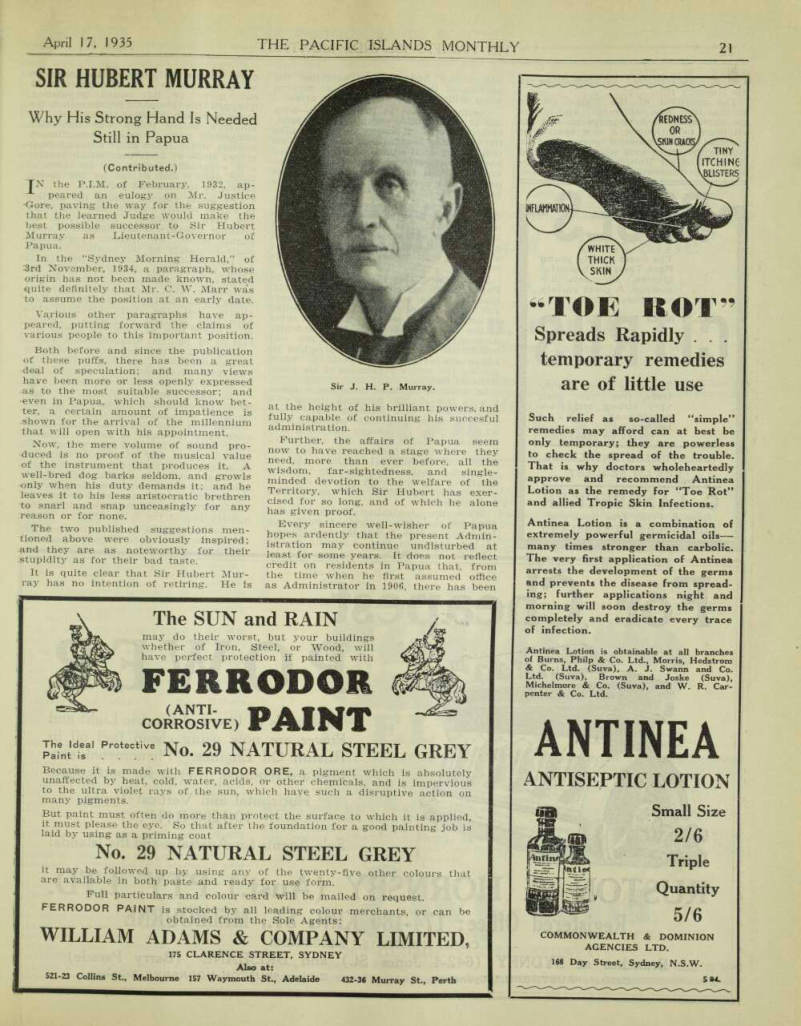
Why His Strong Hand Is Needed Still in Papua
(Contributed.)
IN the P.I.M. of February, 1932, appeared an eulogy on Mr. Justice Gore, paving the way for the suggestion that the learned Judge would make the best possible successor to Sir Hubert Murray as Lieutenant-Governor of Papua.
In the “Sydney Morning Herald,” of 3rd November, 1934, a paragraph, whose origin has not been made known, stated quite definitely that Mr. C. W. Marr was to assume the position at an early date.
Various other paragraphs have ap peared, putting forward the claims of various people to this important position.
Both before and since the publication of these puffs, there has been a great deal of speculation; and many views have been more or less openly expressed as to the most suitable successor; and even in Papua, which should know bet ter, a certain amount of impatience is shown for the arrival of the millennium that will open with his appointment.
Now, the mere volume of sound pro duced is no proof of the musical value of the instrument that produces it. A well-bred dog barks seldom, and growls only when his duty demands it; and he leaves it to his less aristocratic brethren to snarl and snap unceasingly for any reason or for none.
The two published suggestions men tioned above were obviously inspired; and they are as noteworthy for their stupidity as for their bad taste.
It is quite clear that Sir Hubert Mur ray has no intention of retiring. He is
at the height of his brilliant powers, and fully capable of continuing his succesful administration.
Further, the affairs of Papua seem now to have reached a stage where they need, more than ever before, all the wisdom, far-sightedness, and single minded devotion to the welfare of the Territory, which Sir Hubert has exer cised for so long, and of which he alone has given proof.
Every sincere well-wisher of Papua hopes ardently that the present Admin istration may continue undisturbed at least for some years. It does not reflect credit on residents in Papua that, from the time when he first assumed office as Administrator in 1906, there has been
Sir J. H. P. Murray.
a small undercurrent of opposition to Sir Hubert’s rule.
The condition of the Public Service at that time was deplorable; and it was his unpleasant task to purge it, and his privilege to introduce a new system of coherent and purposeful government to replace the chaos into which Papua had fallen. And Sir Hubert was hardly ap pointed permanently as Administrator,
had hardly had time to establish the nucleus of the present excellent service, when difficulties of another kind arose.
Commerce came to Papua. Not —with one or two notable exceptions—the solid, creative form of commerce that builds its own firm foundations, and erects on them a dignified edifice of lasting value; but the fraternity of uncreative specula tors who look for large and immediate profits, and care not at all how they are gained.
Papua was an undeveloped country that seemed to offer vast wealth to the unscrupulous; just another savage land in which fat dividends might be gained at the cost of small sacrifice, or of none; a land of easy money for the incompet ent.
It is among this class, represented in Papua as in all countries of the world, that it seems most of the malcontents are to be found. And it is instructive to note that they are quite unable to agree to the necessary reforms. Each ardently desires reform; but only such as will benefit his own business, and give him an advantage over his competitors, while placing the native population at his ques tionable mercy.
In addition to these there are a few — a very few —Public Servants whose own incompetence and lethargy have rele gated them to subordinate positions from which nothing but energy and loyal ser vice can extricate them. The real griev ance with these few, as with the more numerous commercial malcontents, is solely that their own prosperity must be measured by their own efforts, and not by their purely selfish and unproductive aspirations.
When the Australian Commonwealth assumed complete control of Papua on Ist January, 1906, it was the daring boast of her statesmen that Australia would
prove to the world that civilisation could be introduced to a black country with out harm to its native population.
Through the present administration, the boast has been justified to the full. Sir Hubert’s native policy was something completely new. It was a revolutionary method which made other Colonial Gov ernors smile at first; then watch keenly; and eventually imitate to the best of their ability and so far as the sacred claims of trade would permit.
The better element among the settlers in Papua readily concede that the policy has been successful. Industry, in its teething stages, was handicapped to some slight extent by irksome regulations made necessary by the conduct of some of the settlers themselves. But it is plain to all who can see beyond the range of their personal ambition, and can understand that their own welfare is firmly bound to the welfare of the Terthat the slight handicap has been fully justified by results. To-day, in a world torn as much by labour un rest as by political disagreements, Papua possesses a native population educated to civilised labour; and can boast a lab our force as efficient, as contented, and as disciplined as any in the world.
The chief complaint among the com mercial malcontents appears to be that no form of commercial slavery is per mitted, and that the Administration In sists upon the right of natives to spend their wages when and where they will.
Forced labour (for natives), a reduction of wages (for natives), more stringent working conditions (again, for natives), are among the reforms suggested; and the witholding of these benefits from the hard-worked speculator is magnified into a grievance of the first order.
It is largely due to these irresponsible chatterers that such ridiculous sugges
tions and reports arise as the two that have been mentioned.
In their great minds they have skinned the bear, portioned out the flesh, and pegged out the skin to dry, while the bear himself still roams the forest, force ful and unassailable.
Does it not seem that, apart from the question of good taste, it would be wiser not to nominate a motley multitude of successors until a man appears on the horizon who would not look merely ridi culous in the mantle that Sir Hubert Murray has worn for so long, and with so fine a dignity.
Advertisements & other items, pp. 27-28 (1 item)
Antinea
“TOE ROT"
Spreads Rapidly . . .
temporary remedies
are of little use
Such relief as so-called “simple" remedies may afford can at best be only temporary; they are powerless to check the spread of the trouble.
That is why doctors wholeheartedly approve and recommend Antinea Lotion as the remedy for “Toe Rot” and allied Tropic Skin Infections.
Antinea Lotion is a combination of extremely powerful germicidal oils— many times stronger than carbolic.
The very first application of Antinea arrests the development of the germs and prevents the disease from spreading; further applications night and morning will soon destroy the germs completely and eradicate every trace of infection.
Antinea Lotion is obtainable at all branches of Burns, Philp & Co. Ltd., Morris, Hedstrom & Co. Ltd. (Suva), A. J. Swann and Co.
Ltd. (Suva), Brown and Joske (Suva), Michelmore & Co. (Suva), and W. R. Carpenter & Co. Ltd.
ANTINEA
ANTISEPTIC LOTION
COMMONWEALTH & DOMINION
AGENCIES LTD.
168 Day Street, Sydney, N.S.W. m
Small Size
Quantity
The SUN and RAIN
may do their worst, but your buildings whether of Iron, Steel, or Wood, will have perfect protection if painted with
FERRODOR
(ANTI-
CORROSIVE)
PAINT
No. 29 NATURAL STEEL GREY
Because it is made with FERRODOR ORE, a pigment which is absolutely unaffected by heat, cold, water, acids, or other chemicals, and is impervious to the ultra violet rays of the sun, which have such a disruptive action on many pigments.
But paint must often do more than protect the surface to which it is applied, it must please the eye. So that after the foundation for a good painting job is laid by using as a priming coat
No. 29 NATURAL STEEL GREY
it may be followed up by using any of the twenty-five other colours that are available in both paste and ready for use form.
Full particulars and colour card will be mailed on request.
FERRODOR PAINT is stocked by all leading colour merchants, or can be obtained from the Sole Agents:
WILLIAM ADAMS & COMPANY LIMITED,
175 CLARENCE STREET, SYDNEY
Also at: 521-23 Collins St., Melbourne 157 Waymouth St., Adelaide 432-36 Murray St., Perth
"ROSES"
The finest quality young Rose Trees for beautiful blooms. 10/- doz. 57postage. A great variety to choose from.
CITRUS
The very best quality trees, free from pest, very strong and from exceptionally heavy bearers.
Prices on request.
ILLUSTRATED CATALOGUE
FREE ON REQUEST
C. LANGBECKER
Rose & Fruit Tree Specialist
BUNDABERG, QUEENSLAND
For Cheapest
POWER
Thousands of Users of Electric Light and Power are now using cheap fuel oil in Ruston Oil Engines. Phenomenal savings are reported. Write for particulars.
Horizontal and Vertical Types,
10-1200 B.H.P.
Sole Agents for Australia and the Islands:
RUSTON & HORNSBY (Aust.) PTY. LTD.
Registered Office; 174-180 KING ST., MELBOURNE
Cables: "HORNSBYS." MELBOURNE
Branches at SYDNEY (642-4 Jones St.) and BRISBANE (Barry Parade) Cables: “RUSTHORN,” Sydney. Cables: “RUSTON-HORNSBY,” Brisbane.
Editorial Note
We endorse, heartily and sincerely, every word that has been written by our contributor about Sir Hubert Murray.
There is no doubt that many people covet the position of Lieutenant-Gover nor of Papua; but we think that the at titude of the Commonwealth Government is clearly indicated in the following ex tract from Parliamentary reports of December 5, 1934: Mr. Beasley (West Sydney}: I direct attention to newspaper reports published recently to the effect that it is the intention of the Government either to ask for the resignation of the Adminis trator of Papua (Sir Hubert Murray), or, failing his resignation, to retire him from his present position in order to appoint in his stead the honour able member for Parkes (Mr. Marr), who, it is understood, will resign his position as Assistant Minister at the conclusion of the visit of H.R.H. the Duke of Gloucester. This is a live issue in political circles, and I think I am expressing the opinion generally held, not only in the Common wealth but in the Territory concerned, that Sir Hubert Murray is the most capable Administrator who has served the Commonwealth in any of its Territories. Residents of Papua are, I believe, deeply perturbed by the rumour. I understand that they are prefectly satisfied with the present Administrator whose fairness and ability are not questioned. They feel that nothing should be done to disturb his tenure of office.
Mr. Casey (Assistant Treasurer): The honourable member for West Sydney (Mr. Beasley) mentioned reports which have apeared in certain newspapers to the effect that arrangements were to be made for the retirement of Sir Hubert Murray, the Lieutenant-Governor of Papua. Every one who knows Sir Hubert will agree with the honourable member’s testimony as to his ability and experi ence. I have no knowledge of any such intention as he has suggested.
For a time, there was abroad a general belief that Sir Hubert Murray himself, having reached an age exceeding 70 years, desired retirement; and speculation was based on that. But we have not met one person who personally knows Sir Hubert Murray—and this includes Federal Ministers —who says that Sir Hubert ought to retire. On the contrary, every one, without exception, is of opinion that the Lieutenant-Governor, despite his years, retains all the physical activity and mental alertness which have dis tinguished him during his career; and that these qualities, added to his vast experience, broad vision and fine judicial mind, make him still the ideal Adminis trator of Papua.
The Territory, under his guiding hand, has qome, almost unscathed, through a depression which crippled some South Seas communities: and now, with copra recovering, rubber in a good position, and more than a likelihood of a profitable gold industry being established, the economic outlook is improving every day. If Sir Hubert is willing—and apparently he is —to remain at the helm in Papua for a few more years, then Papua is fortunate indeed: for there is a possibility of rapid developments there, and it is in the highest degree desirable that there should be in control a man of skill, ex perience and unchallengeable honesty of purpose, capable of handling the “get
rich-quick” commercial interests which, probably, will come snarling into the Ter ritory as soon as they discern the smell of gold.
Captain George Kerr, an old identity of Thursday Island, died recently at Brisbane, Queensland. In the early days he was a well-known pearler in Torres Strait, and later was master of the Gov ernment vessels Albatross, White Star, and John Douglas. Captain Kerr was a foundation member of the Torres Strait Lodge.
Advertisements & other items, pp. 29-30 (1 item)
Elvy’S
DO YOU WRITE-?
Napier, Gardiner and Co. read, and advise on, all classes of literary work—books, serials, short stories, articles and verse — and arrange for publication in England or Australia.
They also advise on and arrange local and world copyrights, picture and stage rights. Advice given to aspiring authors.
Particulars on application to:
NAPIER, GARDINER & CO.
Literary Agents, 79 Pitt St., Sydney
“Invincible” a “Duralife”
ALUMINIUM WARE
MANUFACTURED BY
C. R. Byrne 187 9 William Street, Bankstown, N.S.W.
Island Traders apply for Price Lists and Agency Terms
Neptune’s Greatest Gift to Man—
OZO SALT
The word “OZO” means the Sea. OZO SALT is made from Sterilized Sea Water of the Pacific Ocean and dried in vacuum.
“NOTHING PURER ON EARTH.”
Ask for it in the new 1½lb. Patent Package. Specially designed (for the Island and Eastern Trade) to resist Moisture, Humidity and Water. CAN BE OPENED AND RESEALED WITH THE GREATEST OF EASE. ORDER A PACKET TO-DAY.
Other “OZO” Specialities are: Ozo Health Salt.
Ozo Celery Salt.
“Sea-King” Gravy Salt.
ELVY’S
FOR
RECORDS
For Elvy’s stand pre-eminent in the field for the very latest gramaphone record* including the newest song hits from England and America. ORCHESTRAL, SINGING, PIANO, and TOPICAL records are all stocked.
You can be sure if you buy at Elvy’s your records will reach you by return mail safely wrapped and the price you pay will be the lowest possible.
H.M.V., COLUMBIA, PARLOPHONE, and REGAL ZONOPHONE catalogues will be posted you FREE upon application.
Elvy’s seventy-two years’ trading in musical instruments assure that your every requirement in RADIO, PIANOS, PLAYER PIANOS, ORGANS, and ANY OTHER musical instruments will be fulfilled to your utmost satisfaction. Special terms for those resident in the Pacific Islands.
Est. 1863.
397 GEORGE STREET, SYDNEY
Between King and Market Streets. - ’Phone M 2319
W. M. REID
C/o Robert Reid & Co., Ltd.
32-34 YORK STREET, SYDNEY
Wholesale Exporter of Goods of ail Classes from Australia
Bargains in Gramophones
Floor Models 35/- Portables 39/6
LATEST COLUMBIA 90/-
RECORDS AND MUSIC
Packed and Posted FREE Orders Promptly Supplied Ask for FREE LISTS
HARMONY HOUSE
for Everything Musical
177 GEORGE STREET
SYDNEY
Near Circular Quay
DELICIOUS!!
THE crisp, tempting quality of
ARNOTT’S FAMOUS SAO
BISCUITS is the result of 64 years of specialisation. They stand unrivalled in quality and excellence. For lunch or supper they are delicious with butter and cheese, fresh and stewed fruit, ham paste, or savouries.
ALWAYS ASK FOR ARNOTT’S
AND BE SURE YOU GET THEM
Islands Steamers’
Accommodation
Letter to the Editor.
I HAVE been asked by a number of mining men here to enter a strong protest against the conditions of passage on the B.P. line of steamers to this Territory.
It is almost impossible for a mining man to obtain decent accommodation on these boats. If one books in Melbourne he is invariably told “only shake-downs available,” and relegated to the steerage or “Chinatown,” as it is termed by the old hands. Nevertheless, full first-class fares are charged and it is only if a friendly passenger “in the know” gives you a tip that you are entitled to a 10 per cent. rebate on application to the purser that you realise you have been “stung.”
The steerage cabins graced by the title “staterooms” are a disgrace to the owners. They consist of four berths and little else. Outside the doors is a welter
of junk thrown higgledy-piggledy all over the deck. During rough and wet weather passengers have to get drenched through in order to reach the bath or dining rooms. Yet no hesitation is made about placing ladies in these cabins.
Having applied in Melbourne for deck cabins for four persons three weeks be fore the boat sailed from Sydney, and being offered “Chinatown” in a take-it or-leave-it attitude, I made close enquiry on my arrival in Sydney as to the reason.
I was told by an official of B.P.’s that the New Guinea Administration and Levers, Ltd., have the first call upon the best cabins in the ship and must receive preference over ordinary passengers.
This toadying to the authorities is to be deprecated, and in any case isn’t the private individual’s money as good as that of an Administrative official? Also, a 25 per cent, reduction in fares is allowed to the privileged persons.
Of course, the B.P. line is a monopoly and those who, of necessity, have to visit the Islands have unfortunately no choice but to travel on the B.P. boats. Never theless, the mining interests of the Ter ritory have kept both B.P.’s and the Administration in affluence during the past few years and now, with their womenfolk and children constantly trav elling up and down, they believe it time to voice a protest. Children are badly catered for and it is absolute hell for women with babies in arms.
There is no desire to see an Australian company lose business, but if a radical improvement is not made there is no doubt that a Japanese passenger line will be invited to call at Salamaua and Port Moresby.
A friend of mine was quoted £20 fare from Sydney to Salamaua, in the Nep tun, a few weeks ago, when B.P. were first thinking of taking over the steamer.
Recently he decided to travel by the steamer and went to B.P.’s offices to book —only to be informed that the fare is now £24. Can you wonder that this end of the Territory is seething with dis content?
I am, etc.,
Wau, T.N.G.
“Miner.”
14/3/35.
Samoan Woman’S Tragic
Death
From Our Own Correspondent.
APIA, March 9.
AN alleged murder case with some unusual fea tures was tried at the High Court of Apia recently before His Honour Judge Luxford.
An old Samoan woman named Tailesa had been teased by a small native boy of Lepa village, Aleipata district, on Upolu Island. The woman, with a large stone in her hand chased the youth, who took refuge in a Samoan “fale” occupied by Amio and her family. In endeavouring to protect the boy, Amio struck at Tailesa with a fishing spear, which entered her shoulder, and the barbed point of which remained in the wound.
Amio’s husband arrived on the scene and pulled the barb from the wound, which he cleansed and bandaged. Tailesa was asked to stay with Amio and her family so they could care for her wound.
She refused, however, and departed. A few days later she was found in the bush in a delirious state, with the wound swollen and septic. Tailesa was removed immediately to Lalomanu hospital, where Dr. Monaghan examined her. Her condi tion, however, was hopeless, and she died the same day.
Amio was arrested and prosecuted on a charge of alleged murder. After a short hearing the jury, comprising three Europeans and one Samoan, found her “not guilty,” and she was discharged.
Mrs. O. Stevenson, accompanied by her two daughters, returned to Fiji by the Aorangi on March 28, after spending a few weeks’ holiday in Sydney.
Is Quiet
Samoan Mau
Administration’s Policy Of Patience is Praised
A gentleman who knows Samoan conditions intimately, and who recently visited the Territory, writes to the Editor as follows: — THERE are definite signs of a breaking up of the native political body—the Mau.
Already some of the Chiefs indicate that they are withdrawing their support, and many others are luke-warm. The chiefs’ followers will be sure to follow suit. There are other indications of internal disagree ment. The reasons—or some of them— are that the Chiefs do not wish to be directed by the Mau Committee, which, as the Chiefs say, is dominated by a person not in the Territory. You will understand that when a Chief takes action of this kind he is followed by the people in his district.
It is not strange that the Mau should be collapsing. A few years ago, Mauites used to parade the streets, even in the early hours of the morning, and openly defy the police. The people gathered in large num bers at the village of Vaimoso, the head quarters of the Mau, where many meetings would be held. There was food in plenty There was the “New Zealand Samoa Guardian” to be read and gloated over, and there was the local propaganda going on. The native mind was kept in high excitement.
Since Mr. Nelson’s trial and banishment from Samoa a large number of the natives have gone back to the quiet of their native villages. There are not nearly so many people or meetings at Vaimoso as there used to be. Most of the flourish, and fuss, and show, which the native so dearly loves, no longer exists. On the surface, political conditions have quietened down consider ably. To my way of thinking, this means that the Chiefs have sat down in their vil lages and have had time to think quietly, and have come to the conclusion that they are getting nowhere. They are beginning to ask: Why?
Although these Chiefs and their people may break away from the Mau, it does not mean that they forego their claims that injustice has been done to the Samoans by New Zealand. They seem pretty firm about that point.
I can only think that they are possibly considering some other way of tackling the problem. Open opposition, such as they have been pursuing, has not brought the results expected. The Government has not been brought to its knees, as the natives were told it would be. It is certain now that a big section of the Mau is viewing the position in that light.
Co-operation with the Administration might be the means of strengthening the hands of the natives to the point of their being able, when opportunity occurs, to present a reasonable and just appeal for full consideration and adjustment of the matters in dispute. There would seem a good chance of this being done once they dispose of the idea of an outside represen tative for the Mau being present at any conference between the Samoans and the Administration. It would appear from the recent action of the Chiefs referred to that a belief is growing that such outside in fluences are not helpful to a reconciliation.
The present attitude of the Administra tion may be called one of attrition, to the extent that by leaving the natives alone
the subject will wear itself out. “Patience” seems to be the slogan. It is the right course, in the circumstances.
Should the natives be roused again by any stupm act on the part of the police or other officials, there is sure to be another oiow-out, and a renewal of the gatherings and meetings at Vaimoso. The natives would again become agitated, and we would have all the trouble back again.
Europeans in Samoa do not want any more trouble of that nature. They want
to see law and order restored and a return to the good feelings of friendship which once existed between the Samoans, the officials, and the Europeans.
General Hart and Mr. Turnbull (Secre tary to the Administration) are playing the game of patience right now—and have done so for many months past. They are perhaps more patient than they care to admit. Nevertheless, there are good re sults from such a policy—and it should be pursued. If the heads keep their heads,
all should be well. If they run amok —so will the natives. There is a rumour cur rent there that General Hart now is to remain as Administrator for another term —for how long is not stated.
The Pacific Islands Association on March 26 entertained at luncheon a num ber of visitors from Island Territories and others interested in Pacific affairs.
Those present included Mr. George Mur ray (Director of Agriculture, New Guinea), Mr. R. W. Robson (Chairman of the Association), Mr. Roland Green, M.P.,, Rev. Harold Short (London Mis sionary Society, Papua), Mr. L. L. Bell, Drs. C. C. Simson, E. Pockley and W.
L. Calov, Rev. M. A. Warren (Secretary, Australian Board of Missions), Messrs.
R. J. Sands and W. B. Rainsford (Char tered Accountants), Messrs. G. M. Rod ger and O. E. Provis, of Malayta Co.
Ltd., and Mr. M. C. Crocker, Department of Agriculture, Territory of New Guinea.
Rev. J. W. Chambers, accompanied by his wife, left Sydney for Suva, Fiji, by the Aorangi on March 28. Having served for many years in various fields for the Methodist Mission Society, they now in tend to settle down in the Rewa dis trict of Fiji.
Advertisements & other items, pp. 31-32 (1 item)
Ample Funds
OVER 30 YEARS AGO . . . .
The first Younger Stove was exported to the Pacific Islands.
Ruggedly strong in construction, highly efficient and economical in fuel has made them the most popular stove in the
South Seas.
The illustration shows a Younger Single Stove. Special stoves with cast iron ovens for Island requirements.
Write us for quotations for special sizes and catalogue of double and single oven stoves.
G. Fletcher & Son
50 OXFORD STREET, SYDNEY
Ample Funds
for
Productive Enterprise...
The Bank of New South Wales has ample funds available for those who can profitably employ money to extend productive activities and thus create employment.
Producers, manufacturers and others are invited to discuss their financial problems with the Manager of any branch of the Bank of New South Wales.
Overdrafts are made available against usual banking securities at a maximum rate of 5%, the lowest maximum rate on record.
Bank of New South Wales
(Established 1817).
Malt & Hops
(SOLID BEER)
MADE FROM THE
FINEST ENGLISH
MALT & HOPS
STOCKED BY:
Burns, Philp & Co., Ltd.,
RABAUL
MAKERS:
Paine & Co., Ltd.,
St. Neots, Hunts., England.
WARD'S famous
Fuel Stoves
Renowned for 50 Years
The “BEACONLIGHT"
Specially Made for Islands.
Cast Iron Throughout.
May be Purchased through Island Merchants or from
JAMES WARD LTD.,
372 Pitt Street, Sydney
ABOVE ALL—
Aeroplane Pure Fruit Jellies Aeroplane High-Grade Custard Powder Aeroplane Junket Crystals Aeroplane Flavouring Essence Products of Distinction Manufactured by
TRADERS LTD.
NEWTOWN
SYDNEY
Risk of Uncontrolled
Areas N.G. Government Insists On Reform
By Gordon Thomas
ANOTHER example of the trouble that follows in the train of declaring dan gerous areas in New Guinea “uncontrol led” and then granting permisison for anyone to enter, providing they conform with certain conditions, was brought to the notice of the public recently when a young miner (and, incidentally, a minor), S. H. de Kantzow, came before the Rabaul Supreme Court for sentence on a charge of assaulting a native and doing him bodily harm.
The Crown’s case was that the accused had whipped, punched in the nose and broken off the tooth of one Ravakia.
Counsel for defence brought out mitigat ing circumstances, showing how the native, who was an indentured labourer with a record for deserting, had run away, been captured, and that the accused had threatened him with disfiguring his teeth if he again deserted. This the native did, despite the threat, which the accused felt bound to carry out.
Counsel for the defence laid consider able stress upon the disadvantages of the indenture system.
His Honour Judge Phillips sentenced the accused to a year’s imprisonment, and fined him £40.
The fundamental cause of the whole un happy business was the fact that the youth found himself in an isolated, dangerous and officially “uncontrolled” area of New Guinea; and he was inexperienced and was unsuited to be solely in charge of native labourers located in hostile country.
The wear and tear upon the nerves of old-time miners, accustomed to the vicis situdes prevailing in such localities, is often more than they can bear. There is the constant vigilance against attack; the careful supervision of the labourers; the teupply of rations to be kept up: the treatment of their ailments and, on the top of everything else, the financial worry of the undertaking. All this was thrust upon the shoulders of a mere youth, emerg ing from his “teens.” Officialdom should never have allowed such a lad to enter and remain in an “uncontrolled” area.
Since the December murders, in the Chimbu River area, the Administration has definitely excluded all whites —other than officials —from “uncontrolled areas.” We may now hear less of crime In these dis tricts, and fewer charges brought against whites, who live under abnormal condi tions and excessive mental strain.
Of recent years most of our troubles have come from these same dangerous areas, where contact has not been pro perly established. There has been too much of the Speed Age in a Stone-age country.
Mr. S. G. C. Knibbs, Commissioner of Lands and Crown Surveyor, of Tulagi, Solomon Islands, and Mr. J. C. M. Scott, manager of Messrs. Burns Philp (S.S.) Co. Ltd. at Makambo, have been appointed members of the S.I. Advisory Council.
They have filled the vacancies caused by the transfer to Palestine of Mr. P. C.
Hubbard, and the resignation of Major F. R. Hewitt.
Advertisements & other items, pp. 33-34 (1 item)
. . . Kelvin Diesel Engines
. . . British Made . . .
Kelvin-Ricardo Kerosene Engines Manufactured by BERGIUS CO. LTD., Glasgow, Scotland
Announcement of Prices
KELVIN DIESEL ENGINES MODEL K
6 Inches Bore. 9 Inches Stroke. 750 Revs.
K. 1.1 Cylinder Engine 22 Horse Power £335 K. 2. 2 Cylinder Engine 44 Horse Power £600 K. 3. 3 Cylinder Engine 66 Horse Power £800 K. 4. 4 Cylinder Engine 84 Horse Power £1000 K. 6. 6 Cylinder Engine 136 Horse Power £1530
KELVIN DIESEL ENGINES, MODEL J
4¼ Inches Bore. 6f Inches Stroke. 1000 Revs.
J. 2. 2 Cylinder Engine 22 Horse Power £335 J. 3. 3 Cylinder Engine 33 Horse Power £435 J. 4. 4 Cylinder Engine 44 Horse Power £535 KELVIN RICARDO MODEL G. 560 Revolutions. KEROSENE G. 2. 2 Cylinder Engine. 30 Horse Power £400 G. 4. 4 Cylinder Engine. 60 Horse Power £635 KELVIN RICARDO MODEL F. 840 Revolutions. KEROSENE F. 2. 2 Cylinder Engine. 15 Horse Power £200 F. 4. 4 Cylinder Engine. 30 Horse Power £280 All prices are for engine
F.O.B. IN BOND, SYDNEY.
KELVIN RICARDO MODEL E. 1140 Revolutions. KEROSENE E. 2. 2 Cylinder Engine, Horse Power £120 E. 4. 4 Cylinder Engine. 15 Horse Power £175 The above prices include complete engine with reverse gear, tanks, all hull fittings, pipes and the equipment is complete with the last screw required for a complete equipment, compete set of tools, oil cans and spares. The prices are for equipments with Bronze Tail Shaft 6 feet long and Sterntube to suit deadwood 4 feet long.
Every engine is guaranteed to develop the listed horse power at the stated revolutions and be capable of an overload of 15 per cent. on the stated horse powers. With Diesel Engines every engine is supplied with Lloyd’s Certificate of the actual test.
Dynamo for lighting or electric starting can be supplied, also Combination Bilge Pump.
Full information will be forwarded on request from
GEO. RUTHERFORD
46 PITT STREET, SYDNEY
West’s Wheel
Works
(F. H. Bishop, Proprietor)
60-64 Bay St., Sydney
MANUFACTURERS
OF ALL TYPES OF WHEELS
FOR WAGGONS, CARTS,
TRAILERS, CARS
SUPPLIERS
OF WHEEL PARTS, RIMS,
SPOKES, AXLES, BOXES, etc.
We have the plant and have been established forty years Write for Information and Quotations
“WYRNWAY” BRAND
SHIRTS, PYJAMAS
UNDERWEAR AND TIES
ARE QUALITY PRODUCTS
WEARNES LIMITED
MANUFACTURERS 17 PARKER ST.. SYDNEY
ASPREY’S LATEX COMPOUND
(PATENTED)
FOR IMPROVING LUBRICATING OILS
Adds Years to the Life of Machinery and Motor Cars LATEX COMPOUND improves any oil, adds extra oiliness, resists heat and makes the oil last twice as long, saves wear and tear, and halves lubrication and maintenance costs.
INTERNAL Add ½ pint of Asprey’s Latex Compound to each gallon of lubri- COMBUSTION cating oil for motor cars, lorries, tractors and stationary engines, ENGINES and note cooler and sweeter running, lower fuel consumption, greater power, fewer repairs and lower oil consumption.
FARMING
MACHINERY
SAWMILLING
MACHINERY
Add ½ Pint of Asprey’s Latex Compound to each gallon of lubricating oil for headers, harvesters, reapers and binders, ploughs, drills, mowers, disc cultivators, windmills, separators, chaffcutters, etc., and save time and repair tills Add ½ pint of Asprey’s Latex Compound to each gallon of oil for saw spindle bearings and all sawmilling machinery and be free from hot and scored bearings.
STEAM Add ½ pint of Asprey’s Latex Compound to each gallon of oil.
CYLINDER which will result in more horsepower with lessened oil consumption LUBRICATION and general increase in efficiency.
MANUFACTURERS ALSO OF ASPREY'S SUPER BELT DRESSING Obtainable from the Trade and from WILLIAM BROOKS & CO., LTD., 35 Pitt Street, Sydney.
Samoan Copra
Tax
Administration Hurriedly Reimposes 30/- per Ton
From Our Own Correspondent.
APIA, March 8.
SEVERAL months ago., when the price of copra, Samoa’s staple product, was at a record low level, having dropped as low as £7 per ton on the London market, the Samoan Administration reduced the existing copra export duty of £1/10/- per ton to 10/- per ton. The Administration expressly stipulated that it reserved the right to reintroduce the previous duty whenever the copra price returned to normal.
Lately, when the London copra price rose rapidly to above £12 which, together with the exchange benefit of 25 per cent., was in excess of £15 per ton in Samoan currency in London, the Apia merchants decided to raise the local prices. Accord ingly from March 1 the local prices were fixed as follows: Native copra, 4/- per 100 lb. in Apia district; 3/9 per 100 lbs. coast districts, Falefa to Mulifanua; other out
side districts and Savaii, 2/6 per 100 lbs.; planters’ copra, sun-dried, delivered at Apia, £6 per ton; planters’ hot-air dried, £6/10/- per ton.
These rates, however, were in force only a few hours on March 1 when Apia mer chants were informed by the Administra tion that the old copra export duty of £1/10/- would be reimposed immediately.
In consequence the merchants had to alter their new purchasing rates and the price to natives was reduced 6d per 100 lbs. all round, while European planters are to re ceive 10/- per ton less for their copra.
While it is generally admitted that the Administration is entitled to benefit from, the rise in the market price and to levy a higher export duty, merchants point out that it would have been preferable to in crease the duty gradually and not by £1 at a time. In any case the Administration, will benefit very considerably from the ex ceptionally large quantities of copra which at present, favoured by good weather con ditions, are being cut all over the islands.
The motor vessels of the copra buyers are busily running to and from outside districts transporting large copra loads to- Apia sheds. In consequence, business at trading stations, after being stagnant for many months, has now revived and is re ported to be very satisfactory.
Newspaper
Chinese Immigration
In New Hebrides
Protest by New Caledonian Newspaper
THE “Bulletin du Commerce” of Noumea in its issue of February 20, pointedly directs attention to the fact that another 10 Chinese immigrants had arrived in the New Hebrides and apparently settled down in Vila. As we have already pointed out,, there is now a considerable Chinese com munity in Vila —the French newspaper estimates that the Chinese represent one fifth of the non-native population.
It is suggested that this continual aug mentation of the Chinese population in the New Hebrides by fresh arrivals from overseas is an actual menace to Franco-British interests in the Group. The Chinese trader there is undermining the European, trader, particularly in connection with the trade of the Annamite labourers. The Chinese treat the Annamites as their equals; they associate freely in the resi dential quarter, and the Chinese stores naturally get the Annamite trade. It ap pears that the Chinese also are invading Santo.
The newspaper refers bitterly to the fail ure of the Franco-British Administration, to deal with this matter. It says that by the time the Administration wakes up and puts an end to. this dangerous immigra tion the Chinese will be as strongly estab lished in the New Hebrides as they are now in Tahiti.
Mr. E. J. Frame, manager of the British New Guinea Trading Co., Port Moresby, Papua, arrived in Sydney recently to join his wife and two young sons. They are now staying at Manly, N.S.W., where they will spend the remainder of Mr.
Frame’s leave.
Mr. T. G. Aitcherson and Mr. K. Hickey, cadets in the Department of District Ser vices of the New Guinea Administration, arrived in Sydney on leave by the Mon toro on April 1.
An Aggrieved Anthropologist
Letter to the Editor.
INSTEAD of confining himself, in your January issue, to matters raised by me, Mr. W. C.
Groves has surveyed a vast amount of irrele vant material, which has little or no bearing on the main issue and which has not been called in dis pute.
Mr. Groves, a teacher from the Victorian Edu cational Department, came to the Territory on loan in 1922 to take charge of the newly-established Government Native School of Kokopo. During the whole of his short stay in the Territory he was en gaged in teaching native children drawn from different and widely separated parts of the Terri tory. I met him during the early part of 1924, and afterwards, rather frequently, until his return to Victoria.
About three years ago Mr. Groves returned to the Territory as an anthropologist. I met him on the steamer and I well remember his anxiety to get in touch with Father Neuhaus, the an thropologist. On Mr. Groves’ return from New Ireland I again met him and discussed with him matters relating to native education. Our rela tions were always frank and friendly.
Your September leader, Mr. Editor, entitled “Un co-ordinated Mission Effort,” contained a state ment in parenthesis by Mr. Groves to the effect that “every mission should have an organiser of joy, someone who can supply the natives with occupations for their minds and bodies which will take the place of the songs and dances we have taken from them.” The tone of the leader, as I observed, tended to create the view that the Missions are destroying useful native customs to the detriment of the native races. As is usually the case, a bald statement without any proof was advanced reflecting on the Missions. I wrote a reply which embodied an answer both to your leader and to the statement in parenthesis at tributed by you to Mr. Groves. My letter was entitled “Missions and Native Customs.” I drew attention to the want of justice in making sweep ing statements reflecting on Missions without making any attempt to indicate who the offenders are, where they reside and practise their mis
chievous work, or even what the customs referred to consist of. As your leader, in my opinion, was based on the statements which it embodied from Mr. Groves. I observed that Mr. Groves’ state ment was misleading and that it was a pity that Mr. Groves, who was helped by the Missions, did not discuss with them what he considered weaknesses in missionary activity before leaving
the Territory.
I then endeavoured to show that Catholic Mis sions throughout the world have a uniform, definite and clearly-defined policy in dealing with native customs and that is, to do nothing until a native custom is thoroughly understood, then encourage, foster, and preserve what is good, leave alone what is indifferent, and gradually weaken and eventually destroy only what is bad for life, health, or morality.
My letter was directed primarily as a corrective, yet Mr. Groves sees in it only a personal attack on himself, and allows his own fertile imagination to manufacture bubbles which he explodes to his own complete satisfaction. 1. The title "Missionaries or Anthropologists” was not used by me. “Missions and Native Cus toms” was the title that I wrote on my letter. 2. To show that he has been keeping good company while in the Territory, Mr. Groves urges his close personal friendship with my confreres, Fathers Bley and Lakaff, and also his admiration for the late lamented Bishop Louis Couppe. Mr.
Groves’ conjectures that my attitude may cause a breach of the friendship that has, he alleges, existed since he went to Kokopo. My reply is that Mr. Groves has a very contracted memory if he fails to remember the unjust and offensive statement that appeared from his pen in a Mel bourne daily, many years ago, against the Mission at Kokopo, and the prompt and decisive stand taken by Dr. Couppe to counteract it. It is no pleasure for me to dwell on or even mention such a matter now, except to show that at least for a considerable time very strained relations existed between the Mission and Mr. Groves. 3. Mr. Groves suggests that I suddenly find
in him an enemy of the Mission. The suggestion is quite gratuitous. The only enemies of the Mis sion are people with a purely materialist outlook of life, those who can see in the native only what a farmer can see in his horse—a means of making money. Mr. Groves is a man of high moral qualities. I regard him as a man—a friend—who has blundered in stepping over the border-line of a teacher and anthropologist in presuming to dictate to missionaries in a matter he is not qualified to comment on. There is no necessity to be angry or lose one’s head. 4. Mr. Groves alleges that I suggest calling up
witnesses from Matupit and Nodup to prove the superiority of the present order, and that he can draw on a wider experience. I arrived in the Territory in March, 1924, and studied the native language—the first and only means of ever under standing natives thoroughly. My work during the past 11 years has been that of a Catholic Mission ary on Matupit Island, living among the people,
teaching the children in school, and identified with every phase of native village life. In addition, among the three or four thousand native labourers in Rabaul there are hundreds of Catholics drawn from at least twenty different and widely separated parts of the Territory. My experience with them is unique. Mr. Groves, on the other hand, came to the Territory in 1922 to take over a recentlyfounded native school. He was and is to-day unacquainted with any native language. His stay in the Territory was short and uneventful. When he returned as an anthropologist he set out for a locality in New Ireland, among a people whose language he did not know, and from this district he offers to introduce me to some old native men who are not particularly pleased with the present order. Most probably they are the few old sorcerers found in isolated places whose crude and cruel practices were found out by missionaries and stamped out by the Government. They certainly do not appreciate that aspect of the present order, which has abolished their lucrative practices 5. Mr. Groves seems deeply grieved that I should have used the expression that “he was so liberally and gratuitously helped by the Missions in his educational and scientific work in the Territory. This, at least, was the impression that I gathered from Mr. Groves’ own expressions. Referring to Bishop Vesters in his letter, Mr. Groves says that Dr. Vesters has always extended to him “the greatest possible assistance.” Again, nodding his head in the direction of a pile of books, many years ago Mr. Groves intimated to me that he secured them from the various Missions to understand his educational work better. When he arrived in the Territory as an anthropologist he was most anxious to meet our eminent anthropologist, Father Neuhaus. Surely then it is no exaggeration to say that Mr. Groves, as others, has been assisted in his work by the Missions. 6. As Mr. Groves suggests that I have made a hasty and ill-considered attack on anthropological work in New Guinea, I shall explain clearly my meaning.
Anthropology is a highly interesting as well as a very useful study, particularly in missionary countries, and a sound grasp of the principles of anthropology are to a missionary what a sound grasp of the principles of psychology are to the school-teacher. This explains the fact that the most advanced anthropologists in the Territory
are found in the ranks of the Catholic missionaries, The science of Anthropology, as well as Ethno logy, have been studied by Catholic Missionaries with the sole end in view to understand better the native races. Yet it does not follow that be cause one admires a science and respects those who pursue it, a person is bound to highly value or adopt unreservedly the conclusions of all anthro pologists. So far, at least, much that has been written is neither of great importance nor well established.
One observation, however, that has forcibly im pressed me in reference to anthropological in vestigation is, what useful field-knowledge can be obtained in a few months or even a year or two by one unacquainted with a native language and with no previous knowledge of a people? All native races are reticent in dealing with strangers, and it is usually a long time before natives will surrender their treasured customs even to their friends. Yet some anthropologists who are still in their swaddling cloths talk with the confidence of veterans and become quite annoyed unless their theories are adopted. 7. After many insulting references in his long letter, Mr. Groves quite surprisingly pulls up at the winning-post exhausted, with a plea for impartiality and sweet reasonableness-charming phrases if they are sincere. He is evidently satisfied that what he terms a regrettable controversy has demonstrated that he is not anti-mission and that (a more ambiguous term) my views are not shared by New Guinea Missionaries. I regard the incident not as a controversy but as a correction, and if, as I fondly hope, I have demonstrated satis factorily a. That the Catholic Mission does not interfere with good, indifferent, or useful native customs, and b. That a mature teacher but a new-born anthropologist, is not a reliable authority when he departs from his own domain and presumes to advise missionaries who were on the mission field before be was born what they require for their work among the natives, then what has been written will serve a useful purpose.
I am, etc.,
J. G. Madigan,
A Catholic Missionary.
Rabaul and Matupit Island, New Guinea, February 14, 1935.
Advertisements & other items, pp. 35-36 (1 item)
Davey Paxman Diesel Engines
CHRISTIES
Tropical
Umbrellas
Heavy Black Cotton Covering, All Brass Wires and fittings 27in. 12 ribs, 16/6 each 30in., 12 ribs, 18/6 each F.O.B. Sydney
CHRISTIES Ltd.
568 GEORGE ST.
SYDNEY
Davey Paxman Diesel Engines
—FOR PLANTATION, MINE AND MARINE WORK
Every Plantation or Mine can show a big saving in power and attendance costs by installing a Paxman Engine. It costs far too much money to run a boiler and steam engine for intermittent work. Power is available from a Paxman Engine in one minute.
The Paxman Diesel Engine satisfies the need for a completely reliable power unit which will operate continuously without the least worry or trouble.
It is completely self-contained, automatic in operation, and looks after its own fuel and lubrication just like a motor car engine.
It is started and stopped as readily as an electric motor and needs as little attention.
Manufactured hy :
DAVEY PAXMAN & CO (Colchester) LTD.
ENGLAND
Sizes available from 6 to 1,200 B.H.P.
Land or Marine types.
NOYES BROS. (Sydney) LTD.
115 Clarence Street, Sydney
BRANCHES AT NEWCASTLE AND BRISBANE
MANGROVITE
LEATHER
BELTING
MANGROVITE BELTING LTD.
Charles Ludowici, Managing Director
49 YORK STREET, WYNYARD SQUARE
SYDNEY, AUSTRALIA.
Post Office Box 1564 E. G.P.O. Sydney, Australia.
Wireless and Cable Address: “Mangrovite,”
Sydney.
Specialise in Leather and Rawhide Power Transmission Belting, Belt Laces, Pump and Hydraulic Leathers, Belt Fasteners, Tools of Trade, Sole Leather, Harness Leather, Scrap Leather, etc.
Write for illustrated catalogues. District Agents wanted.
Where You Will Meet Your Friends in Sydney
Dawn Cafe
(Late Silver Slipper) Hot Dinners, Grills, Toasted Sandwiches, etc. 53 ROWE ST. next Hotel Australia Bridge Parties Catered For
New Caledonian Notes
Prospects for Coffee Crop
From Our Own Correspondent.
NOUMEA. March 14.
THE coffee season has opened in a very promising way this year, and if the cyclones continue to pass us by the prospects are very bright for a good harvest. The bushes are very heavily laden, and already the beans are turning scarlet, and the first light picking has commenced. Coffee, unlike most crops which are harvested at one time, goes on for a considerable time. The beans ripen at different periods, and it is necessary to cover an area many times.
The rain has been more evenly distributed for the past six months—the long, dry season having been practically eliminated —with very favourable results to growers. The price of coffee is still very low, but with the increased output, the pros pects are much brighter.
Salt From N.E. Africa
Amongst the cargo of the Eridan, which arrived recently, was a large consignment of salt from Colombo where it had been sent by the Governor of French Somali Land, N.E. Africa, from the province of Djibouti. Salt, heretofore, has largely been imported from Australia, but by a new arrangement now in operation it is landed from Africa at 125 francs (about £2/5/- Australian) per ton—the Messageries Maritimes offering a special freight as it is produced in a French colony. The Eridan brought 250 tons of salt from Europe, 70 tons from Colombo, and 360 tons from Australia —680 tons all told —thus showing that New Caledonia is a very good customer of Aus tralia.
The Sugar Market
The Carriso arrived recently from U.S.A. with 1000 tons of mixed cargo, petrol, etc., and 735,000 feet of timber for La Societe Kaori. For the first time Noumea residents have been able to sample American sugar, supplies of which arrived on the vessel. The light open jute sacks are lined with strong brown paper, and the sugar is of a very high standard, exceptionally white and clean. Java sugar, so largely used in this country, is done up in rough half corn sacks, and is apt to contain jute hairs. The Eastern product can in no way compare with this American sample, which more resembles No. 1 brand of the C.S.R. Co., Australia.
The U.S. sugar is much more reasonable in price than that imported from Sydney.
Fruit Importations
The last St. Vincent de Paul from Sydney brought a large consignment of flour (2,686 bags), 933 bags of potatoes, 420 bags of rice, 110 bags of wheat, 86 bags of pollard, 70 bags of bran, 70 cases of beer, and many cases of fresh fruit. Several leading business houses have installed electric freezing chambers in Noumea, and there has been a great increase in the importation of fresh fruit, apples, pears, etc.
One wonders why the population prefer these imported fruits to the luscious New Caledonian fruits, such as paw-paw, pineapples, mangoes, oranges, and bananas, which the growers here find it does not pay to market.
New Aero Club
The Aero Club, which has lately been formed with His Excellency the Governor Monsieur Siadous as president, has opened a subscription list to buy an aeroplane, which is to be called the Cagou. There a quick response, and it will
not be long before the young French New Cale donians take to flying.
The Bucephale left Noumea on March 1 for Sydney, where she is to be dry-docked. She will return about the middle of March with 500 tons of general cargo.
The Committee of the Veloce Club Caledonian have invited two amateur cyclists from Sydney to compete in their local contests. Cycling is very popular in New Caledonia, and there are some very promising peddlers among the local sports men.
The mysterious disappearance of M. Detets, of the Boghern district, near Bourail, has caused alarm. A father of a large family, and owning several properties, he left his home on horseback at an early hour on February 4. Though his horse was subsequently found, no trace of him has been discovered by the gendarmerie and the many people who organised a hunt to locate the unfor tunate man. As several large rewards have been offered and nothing has transpired, it is feared that he has been the victim of a crime.
La Societe Caledon Nickel has purchased the Cap Tariffa for its fleet of cargo boats which are employed in bringing coal from Australia for the furnaces. This boat left Dunkirk, France, on December 20, and arrived at Noumea at the end of February.
Norfolk Island Trade
Mr. Harry Rosser, a well-known and respected resident of Papua, died at Mi sima Island on March 4. He had been in Papua for over 25 years and, at the time of his death, was employed by Misima Central Gold Co., having previously been in the employ of Misima Gold Reefs Ltd.
Mr. Rosser left a wife and three children, who are at present living in Port Moresby.
Imports
From Pacific Islands From Aust.
From N.Z.
Month.
February, 1934 February, 1935 £1307 Nil £45 £1479 Nil £89
Exports
To Pacific Islands To Aust.
To N.Z.
Month.
February, 1934 February, 1935 £2621 Nil £28 £2199 Nil £8
Dr. Monaghan, Chief Medical Officer of Western Samoa, left Apia by the April Maui Pomare to undertake medical re search work in New Zealand. During his absence Dr. Turbott, of New Zealand, will be relieving C.M.O.
Advertisements & other items, pp. 37-38 (2 items)
Flour
PRESCOTT LTD
are sole wholesale agents fbr
PINEAPPLE BACON & HAMS
DAISY BRAND BUTTER
FRESCO BRAND BUTTER
LEA & PERRINS’ SAUCE
FAST AUXILIARY KETCHES
AT ONE-THIRD OF SYDNEY PRICES
Offers are invited from anyone wishing to purchase a first-class ocean going ketch. There are eight to be selected from, ranging in size from 13 to over 20 tons, at prices from £350 to £1,300, the largest being a new boat still on the slips.
Apply—
V. R. KEPERT, Pearler, DARWIN, N.A.
PRODUCING UNIFORM GOOD RESULTS SINCE 1868
Flour
ALWAYS ASK FOR IT
Is RUST Destroying Your Property—?
We have much pleasure in announcing that Killrust is now available in WHITE and GREY, both of which are specially suitable for Tropical Countries. Killrust Metal Paint serves two distinct purposes: It kills the growth of rust and it protects iron against acids, alkalies, salt water and other corrosive agents. It is tasteless and non - poisonous, and therefore recommended for painting roofs and the interior of fresh-water containers.
1. KILLRUST METAL
PAINT Elastic Finish (Black) is a penetrating and quick drying paint for protecting surfaces which come in contact with water and for general inside work. It is also used for descaling badly rusted iron, (See instructions.)
2. KILLRUST SUPER
COAT (Black) is a powerful heavily-bodied paint, which can be used on surfaces exposed to the hottest tropical sun, and will also stand up to constant immersion in water.
Factory Distributors:
3. KILLRUST METAL
FLUID is a cdlourless solution for neutralising the growth of rust when ordinary coloured paints or lacquers are to be applied.
It is used extensively on motor bodies, petrol storage tanks, etc.
4. KILLRUST ROOF
PAINT. Red, White, Grey.
For rusted iron roofs and general structural painting.
Write for or ask your Sydney agents to procure from us Descriptive Leaflets
METAL PRESERVATION CO. o( N.S.W.
56 MARGARET STREET, SYDNEY, N.S.W. G.P.O. BOX 571 FF
Cable Address: “PIOSPRING.” Established 42 Years.
PIONEER SPRING CO. LTI>.
McEVOY STREET, ALEXANDRIA, SYDNEY, N.S.W.
Are the leading Springmakers, manufacturing Coil, Volute, and Laminated Springs for all Motor Cars, Trucks, Tractors, all kinds of Locomotives and Rolling Stock.
Write for our Catalogue and Price List We are also Expert Forgers and Blacksmiths.
Ll Bell, F.I.O. (Syd.)
OPTICIAN
WINGELLO HOUSE.
ANGEL PLACE :: SYDNEY
Prescriptions for Glasses made up and Despatched by Return Mail.
New Lenses or Frames supplied on receipt of the broken parts.
The best Goggles for Aviators, Motorists, Welders and Mechanics.
“Cash on Delivery Post”: Sydney Prices
Higher Prices
For Samoan Cocoa Beans
From Our Own Correspondent.
APIA, March 14. of Samoan cocoa beans are report ed to be at better rates and more satis factory than before, especially on the Lon don market where sales were recently effected at £45 per ton and better. There is also a fair demand for Samoan cocoa beans from Australia.
Unfortunately, the present season is a very bad one for cocoa planters, as plan tations have suffered severely from the heavy rains during January, which caused the cocoa pods to turn black. Losses are serious, and very little cocoa has been har vested during February and March, so that planters are prevented from taking advantage of the good prices.
Mr. W. Kiesewetter, a well-known Islands identity in the Central Pacific, died at the age of 70 at Lotopa, Apia district, Western Samoa on March 14.
Mr. Kiesewetter, who was a native of Germany, had been a trader for many years in Tonga, American Samoa, and Western Samoa.
Yugoslavs
Plan to Introduce Settlers In New Caledonia
A PUBLIC discussion is proceeding in New Caledonia on the question of whether it is desirable to encourage the plan of introducing families of Yugo slavs to settle in New Caledonia and de velop the country agriculturally and pas torally.
The suggestion is strongly resisted by some of the younger French people born in New Caledonia. They do not like any plan which may tend to create a growing community of foreigners in their country.
It is insisted that if the Yugo-Slavs are allowed to settle in New Caledonia they will appropriate the domains of the French New Caledonians, and take com mand of the industries and professions.
It is pointed out that this very thing has happened with the Japanese, who were brought to New Caledonia to work the chrome and nickel mines. It is argued that the limited commerce of New Cale donia already is under sufficient handi caps and it would be grossly unfair to increase the difficulties already borne by the French merchants of the colony.
The Noumea Chamber of Agriculture, however, is proceeding with its plan. Ne gotiations have taken place between a French official representative in Belgrade and the Government of Serbia, and ap parently it is proposed to test the plan in a modest fashion. For a start it is proposed to send five families of Yugo slavs to New Caledonia; each family con sisting of at least six persons, of whom four shall be between the ages of 22 and 50. The men must be experienced agri cultural workers and must be industrious and sober. It is proposed to convey the first of these agricultural pioneers to New Caledonia by the steamers of the Messa geries Maritimes line.
Bananas Ripened By Gas
Every week about 10,000 bunches of bananas are ripened in Birmingham by gas. Forty ripening rooms are now in use at one of the large warehouses adjoining one of the main railway depots, and by means of a band conveyor bunches of green bananas are taken straight from the railway trucks to the ripening rooms.
The temperature in these rooms is main tained between 60 degrees and 65 degrees Fahrenheit, the heat being supplied by gas burners controlled by an extremely sensitive thermostat. After about a week’s treatment the bananas are perfectly ripe, and are then graded for quality and size and packed into boxes of about 100.
Murder and Education
A Missionary's Views On Murder and Education
Letter to the Editor.
AS a reader of your Monthly from the first number, I have been somewhat surprised at your attitude over the murder of missionaries in the Mt. Hagen district of New Guinea. With the wisdom or otherwise of these missionaries rush ing into the newly discovered area as they did, I will not concern myself at the moment; but I am surprised that a journal having the well-informed outlook that characterises the P.I.M. should raise the old cry of “leave them alone,” and should raise it on humanitarian grounds.
The noble savage, still untempted by the snake of civilisation, living a life of idyllic happiness in an earthly paradise, may have actually existed in some parts of the Pacific, though I rather doubt it. Certainly he has never existed in Papua or New Guinea. Here primitive native life is, in the main, a dark and dreadful thing. The primitive native is only romantic when one is near enough to see him, but not near enough to smell him.
It is possible that a Government expedition to pacify the area may involve a certain amount of bloodshed, though experience in Papua (and prob ably in New Guinea, too) has shown that where such an expedition is led by well-trained and ex perienced officers the amount of bloodshed may be very small indeed. But suppose that a consider able number of natives are killed in the pacifica tion of the area. If, as a result, the area is brought under effective control, with consequent elimination (or at any rate, drastic reduction) of head-hunting, cannibalism, infanticide, and/or whatever other causes of sudden death are found in that particu lar region, it is, I think, safe to say that in five years many more native lives will have been saved that were lost in the original pacification.
Your humanitarianism, Sir, seems to be rather a short range one.
Now may I turn to another subject— not so com pletely disconnected with this as at first sight appears—Mr. W. C. Groves’ letter on “Mission aries and/or Anthropologists.” I am one of those missionaries who have had the pleasure of meet ing Mr. Groves. I was greatly impressed by his sympathetic interest in missionary work, and I
found his views on native education both interest ing and stimulating.
Many missionaries nowadays are glad to avail themselves of the results of the anthropologist's researches. In the field of native education, many of us are profoundly dissatisfied with the present too facile imitation of the conventional European curriculum, and are looking around for something more suited to the needs of the people. We are glad to take all the help that anthropology can give us. Unfortunately, it only too often hap pens that, when the anthropologist talks about native education, he indulges merely in vague generalisations, which, while perfectly true, are not of much help to the missionary who is tackling the job of organising native schools. We want the help of anthropologists, and particularly of those who, like Mr. Groves, have themselves been teachers, and know what it is like to stand up in front of a class of native children and wonder whether you have anything to give them that is worth giving. But we want the anthropologists to understand that it is time they had got past the generalisations—however true or however im portant—and got down to brass tacks. We want them to help us to produce a practical scheme of native education, which will meet the principles they have laid down in their generalisations, and which will work under the conditions in which educational work is carried on in the Territories.
When we have such a scheme, we can with even less reluctance than before “clean up” areas like the Mt. Hagen district, confident that any hurt we may do the people in the process of pacifica tion we shall be able to repay a thousand fold in the years to come.
Perhaps Mr. Groves’ forthcoming book is going to give us this scheme.
As regards the need for introducing new recrea tional activities to replace native ones that are dying out, I fancy that that need is widely recog nised among missionaries, and that on the mission stations of Papua (and probably of New Guinea, too) there are many “organisers of joy,” though they may not call themselves by that name. If the intent of Mr. Groves’ suggestion in that this matter is so important that the missions should have men devoting their whole time and attention to it, I entirely agree with him. But I am afraid that, in the present state of the missionary bodies’ fin ances, the suggestion is not very likely to hear fruit.
Apart from its general interest, Mr. Groves’ letter was worth reading for one notable phrase: “ . . the concern of Anthropology, as of the Missions, is with the living present and the hopeful future rather than with the dying past.” I
should like to have that sentence, printed in capital letters, placed over the desk of every anthropologist—and not a few missionaries. And judging by your attitude over the Mt. Hagen murders, it might usefully find a place, Mr. Editor, over yours.
I am, etc.,
Percy Chatterton.
London Missionary Society, Port Moresby, Papua.
February 26, 1935.
Advertisements & other items, pp. 39-40 (1 item)
Pabco
KILLS flies
mosquitoes
and all insect's
STONE
DEAD
MORTEIN
NON POISONOUS
WILL NOT STAIN
MADE IN
AUSTRALIA
NOW DOUBLE STRENGTH
BETTER THAN EVER
Obtainable through all Island Merchants, or write Samuel Taylor, Box 9, Surry Hills Sydney.
PABCO
HIGH GRADE
ENAMEL SURFACE
RUGS
A wonderful selection in an extensive range of beautiful patterns and modern colourations is always available in these durable, low-cost Squares. You are certain to find amongst them a delightful, low-cost Pabco Square for any room in your home be it bedroom, lounge, dining-room or verandah. Pabco Squares are so easily cleaned—just wipe a damp mop lightly over the surface—they can be laid on any wooden floor that is reasonably smooth.
LOW-COST, BRIGHT AND DURABLE
Patterns of this "beautiful, economical Floor Covering can be seen at any store of — Burns, Philp & Co. Ltd. W. R. Carpenter & Co. Ltd.
PABCO PRODUCTS (Australia) LIMITED, Sydney, N.S.W
GLOBEX
(GLOBE BEEF EXTRACT)
GLOBEX
FOR GOOD BEEF TEA
GLOBEX
FOR SOUPS & GRAVIES
GLOBEX
DELICIOUS SPREAD THINLY ON BREAD
Obtainable from All Island Traders
AUSTRALIA'S CLEARING HOUSE FOR THE PRECIOUS METALS.
BUYERS OF
GOLD
OSMIRIDIUM, PLATINUM, SILVER, &c.
GARRETT & DAVIDSON, LTD.
ASSAYERS, BULLION MERCHANTS, METALLURGISTS,
Bank of N.S.W. Buildings, Regent Street, Sydney
Scott’s Renown Brand Rope,
Cordage and
Binder
Cable Address: Ropeyard, Sydney.
Twine
of Every
Description
MANUFACTURED AT
MASCOT, N.S.W.
By J. Scott Ltd.
Head Office and Store:
163 CLARENCE ST.,
SYDNEY, N.S.W.
Editorial Note
Our correspondent, calmly and very reasonably, deals with two aspects of his subject—namely, the question of forcing Christianity upon natives who are not immediately in contact with civilisation, and the question of how best to train and educate natives who are more or less “Europeanised.”
So far as the second matter is concerned, we are quite in accord and sympathy with the Missionary.
But, with all respect to the Missionary’s calling and the Missionary’s point of view, we join issue with Mr. Chatterton concerning the desirableness of compelling completely primitive native peoples to accept the white man’s religion. This writer has been many times among native coloured peoples, some semi-civilised and some who had rarely seen white men, in the Pacific else where; and he has never yet seen any convincing reason why native communities should be disturbed, simply in order to allow Missionaries to work among them. Among the primitive peoples, as Mr.
Chatterton says, one may find sorcery, infanti cide, cannibalism, and other horrors; but are these things any more horrible, in the sight of God,
than the child-slavery, habitual drunkenness, sys tematic abortion, and legalised enslavement of helpless people by trusts and combines, which are characteristic of our so-called advanced Christian civilisation.
It is all a question of standards. In Mr. Chat terton’s view, the gentleman resident on the Ramtu plateau may be an ignorant and evil-smelling savage; but the Ramu gentleman may think much the same about Mr. Chatterton. And we may find, in the writings of the Apostles, complete justi fication for saying that the New Guinea native is just as much entitled to his opinion of Europeans as the latter are to their opinions of natives.
Christian civilisation usually does far more harm than good to non-European peoples. More often than not, “coloured” communities have dwindled in numbers, and frequently have disappeared alto gether, under the impact of Caucasian culture.
Under their own age-old culture, they are happy and healthy. We have no more right to force our social and moral standards upon them than they have to compel us to accept their practices and ideals.
But, inevitably, “Europeanism” is conquering the whole world; and as each native community col lapses before our implacable advance, and abandons its culture and accepts ours, there is work for the Christian Missionary—in full measure and flowing over. If it were not for the magnificent, self-sacrificing work of the Christian Mission aries, the record of the advance of European civi lisation over Africa, Asia, America, and the South.
Seas would be the most ghastly thing in the his tory of mankind.
Foreign Shipping In
The Pacific
Letter to the Editor.
RECENTLY, while British Shipping Lines ope rating in the Western Pacific were urging the Commonwealth to institute restrictive legislation against the competitive operations of foreign shipping, and particularly the Nord Deuts cher Lloyd, it was remarked that the petitioners had not the support of the planting and trading, interests in the Islands. Planters and traders of the Western Paci£c Islands, and the Solomons in particular, view with alarm anything that might tend to discourage any overseas shipping.
Over the last couple of years it has been pos sible to gauge to what extent the operation of foreign and competitive shipping has benefited the settlers producing or handling copra.
In the Solomons, about three years ago, and before the inception of foreign shipping, the price received locally for copra was London price, less about £9/-/- per ton. To-day the return is London price, less about £3/-/- per ton. It must not be forgotten that the purchasers were, until recently, in control of the available overseas shipping faci lities. Settlers have in mind, too, the difficulties experienced under those conditions when attempt ing to consign copra from the Solomons to Sydney, for sale there or for transhipment overseas. It is not good for the planters and traders to remem ber what they were losing before this competitive shipping operated. Nor do these memories tend to build up goodwill for the purchasers.
From time to time, in the columns of the there have been published instances of the high freight rates charged by British shipping when having the monopoly of carriage. These instances —and many more might be quoted are sufficient to show that it is not in the best interests of Islands planters, and traders to have" foreign ship ping restricted, and so probably eliminated. It is only by virtue of this competition that most Island businesses are able to carry on to-day The fact that this shipping safeguards Island business from monopolistic exploitation is the material reason why planters and traders desire it to continue.
Summaries are published from time to time showing the amounts , and destinations of con signments of copra from the Mandated Territory of New Guinea. For the months of September and November, 1934, England heads these lists with consignments totalling 7,000 odd tons. Germany is second best with 5,000 odd tons. It seems un reasonable that a country taking such a quantity of the Territory’s produce should have its shipping in any way restricted.
I am, etc.,
Planter And Trader.
Gizo.
12/2/35.
Early Days
Memories Of Pioneers In Papua
THE reminiscences of pioneers and old timers of the South Seas always make fascinating reading. Mr. J. Nixon-West wood, who has had experience in the Pacific Islands as a planter and miner and who is now residing in London, writes interestingly of the hectic times brought to mind by Frank Pryke’s poem “Old Samarai” in the December issue.
It was “Old Samarai” in those days, writes Mr. Nixon-Westwood, when the miners were “grubstaked” by the Honour able Bill, and the Auerbachs and Delaney came in from the Trobriands and when Gus Nelsson took into partnership that well-known youngster (in those days), Leslie Allan Joubert. Frank Pryke men tions Nicholas, known to most as “Nick the Greek” and to some with the prefix “Old Nick.” The names in the poem’s last stanza certainly make one live some of his past life over again, and to me the name of Matt. Crowe will always be one to cherish with sincerity.
When I first went to Papua there was only one “pub” in Port Moresby, and Tom McCrann was the genial “mine host.” All comers were welcome at his table, and no one ever went hungry. It was in the old “pub” that a reporter from Melbourne made his appearance, and also at that time a number of miners who were en route to Lakekamu. Before leaving they were having one last “binge” and the bar was full. Just before this, however, Matt, had shown a fatherly interest in me, and when he discovered that I did not drink, but at the same time was not wowser, he took me under his wing.
The reporter was looking for copy and stood drinks all round. When old Tom poured my “soft” one out the newspaper man, in a very strong and dissatisfied voice, said, “Hey, young man, what in the hell do you call that stuff You can’t expect me to pay for such ‘rot gut’.” Matt., standing next to me, immediately cham pioned my cause, and after giving the man a gentle but firm talking to, which did not have any effect, took him by the seat of the pants and the shirt collar, carried him
bodily to the edge of the verandah, and dropped him over, saying at the same time, “If anyone insuits my friend Jimmie, then he insults me.” From that time, as an abstainer, I was no longer chivvied, but I must say I had a hard fight at the start.
Matt. Crowe, with the Pryke Brothers, Leslie Joubert, Gus Nelsson, Billy Ivory and a host of others, made more history in New Guinea and Papua than will ever be told. I do hope Frank Pryke will, in his own poetic manner, give more of his ex periences, and take “P.I.M.” readers with him on that voyage of discovery to the source of the Fly River.
Reading “Old Samarai” puts me into touch with an happening which may be remembered by some of the older New Guineaites. I was staying at “Billy the Cook’s.” In the next room was a well known miner, O’Toole; he was an ornery person, and always looking for trouble which, strange to say, he appeared to be always able to find.
This particular time a well-known planter was discussing the merits of plant ing, and his opponent was an equally well known miner. The planter was getting the worst of the argument when O’Toole chipped in, and said, “Oh, leave the poor little man alone, can’t you?” With that the miner turned to O’Toole and his right arm shot out, a groan, and the splintering of woodwork, and O’Toole found himself up against the banister rails of the stairs in the Cosmopolitan Hotel. The planter discreetly made a getaway and some kindly disposed person took O’Toole back to his room.
When I awoke the next morning I was called for by O’Toole, and he asked me to feel his ribs and tell him if any were broken. My suggestion was that he should go to the hospital, which he did, and there they found he had three ribs fractured, in addition to the loveliest pair of black eyes one could ever see.
Mr. D. W. Robertson, of Messrs. Mor ris, Hedstrom Ltd.’s staff at Apia, Wes tern Samoa, died in hospital after a pro longed illness on March 4, at the age of 43. A native of Scotland, Mr. Robertson had had business experience in Australia and New Zealand before being appointed departmental manager of Messrs. Mor ris, Hedstrom’s Apia store in 1931.
Advertisements & other items, pp. 41-42 (1 item)
Holbrooks (A/sia.)
HOLBROOKS’
TABLE DELICACIES.
WORCESTERSHIRE SAUCE
—enjoys a world-wide reputation.
VAT 2 SAUCE a delicious thick, fruity sauce.
VINEGAR —strong, well matured, and guaranteed Pure Malt.
ESSENCE OF ANCHOVIES—
A fish sauce made from the finest Gorgona Anchovies.
TOMATO SAUCE— made from fresh, ripe tomatoes.
FRENCH CAPERS Capucines and Capottes.
SPANISH OLIVES
Varieties: Spanish Queens, Small Queens, Manzanillas, and Stuffed or Sliced ready for Sandwiches.
PURE OLIVE OlL —French or Italian. From the first pressings of selected Olives.
PICKLES
Varieties: Sweet Gherkins, Tiny White Onions, Walnuts, Piccalilli, Mixed and Green Tomato.
FISH AND MEAT PASTES,
in 1 and 3oz. glass jars.
Varieties: Anchovy, Salmon, Ham and Tongue, Veal and Tongue, Chicken and Ham, Turkey and Tongue, Salmon and Shrimp, Bloater.
SOUPS, in 8oz., 16oz., ½ gal. and 1 gal. tins.
Varieties: Vegetable, Ox Tail, Mulligatawny, Mock Turtle, Tomato.
JELLY CRYSTALS— Specially prepared for warm climates.
They set well, and are deliciously flavoured.
HEALTH SALINE— a refreshing health-giving beverage, suitable for hot climates, in ½lb. and 1lb. tins.
Holbrooks (A/sia.)
Ltd.
WATERLOO, N.S.W.
TIM
With needful burdens grow and grow; The more we pay, the more we owe; Tithe, tax and toll, tax, toll tithe, Make toiler and employer writhe.
A tax on life, a tax on death, We’ll soon be taxed for taking breath; Meanwhile we must for colds assure, Woods’ Great Peppermint Cure First aid for coughs, colds and influenza, Woods’ Great Peppermint Cure
Sutton’s
Canned Vegetables
GREEN PEAS
in ½lb., 1lb. and 2lb. tins.
FRENCH BEANS
(sliced), in ½lb. and 1lb. tins.
Delicia Food Products
Co.
DANK STREET, WATERLOO,
N.S.W.
COPRA MATS AND MATTING
Send your enquiries to us for Woven Wire Mesh in Rolls or framed for Copra drying, and all Screening purposes, Bird Cages, Sieves and Riddles, Builder’s Gravel Screens, Rat Traps, Door Mats, Garden Arches, Chain Wire Mesh, Crimped Wire Mesh for Window Guards, etc.
SCOTT AND SONS
WIREWORKS: RAILWAY PARADE AND MURRAY STREET, MARRICKVILLE
RECOMMENDED!
"SUN” Brand Paint on your Home means
definite PROTECTION against tropical
sun and sea-moist air.
Sun Proof and Rain Proof on every Surface
PAINT
W. R. CARPENTER & CO., LTD.
NEW GUINEA, SOLOMON ISLANDS
and all other South Sea Islands.
The Pomare Family
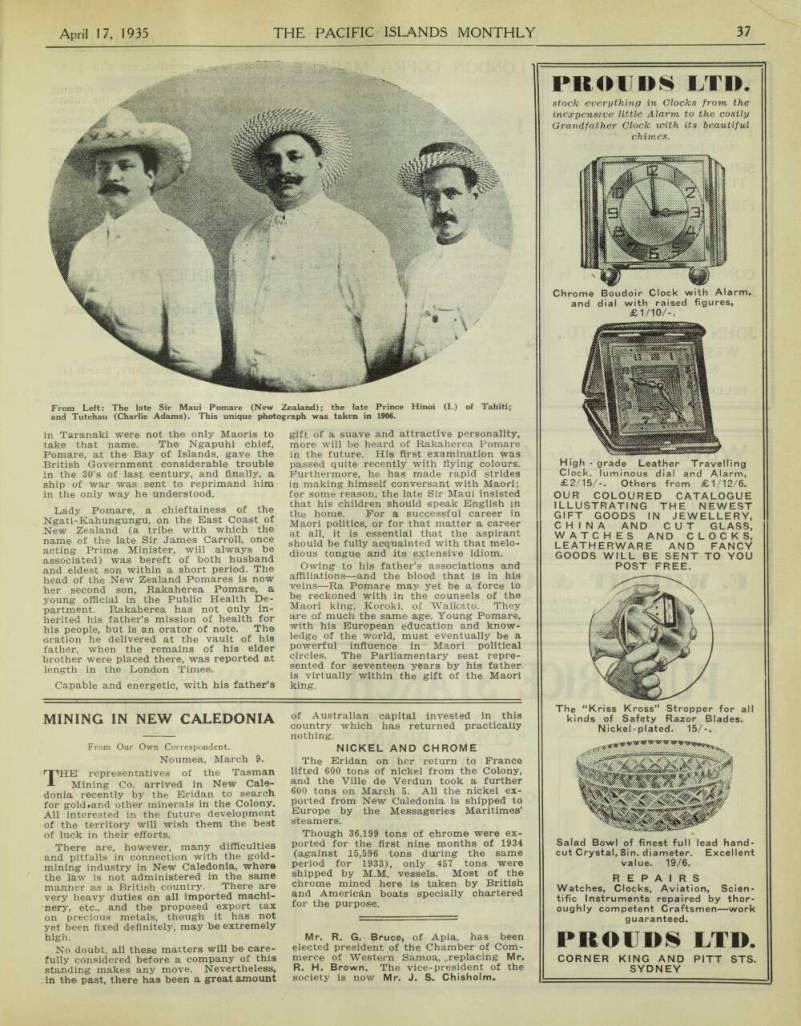
Name Borne by Famous Men in Tahiti and New Zealand
By Eric Ramsden
The accompanying photograph is of more than usual historic interest inasmuch as two of the sitters bore the same name but came from quarters of the Pacific hundreds of miles apart. Yet in the dim distant past Pomare of New Zealand claimed that the forbears of Pomare of Tahiti—who came from the Tuamotus'— were related to his own Polynesian people. The photograph also testifies to the marked physical resemblance between Sir Maui Pomare (formerly Dr.
Pomare), the Maori “Apostle of Health,” and Prince Hinoi (I.), of Tahiti.
The late Sir Maui is shown on the left wearing a Manihiki hat. Prince Hinoi stands in the centre. Tutehau (Charlie Adams), the figure on the right, is still living in Papeete. The photograph aroused keen interest when, by courtesy of Lady
Pomare, of Wellington, I was able to show it to some of the residents of Papeete. Sir Maui was well-known in Tahiti, for he passed through there on his way to and from the United States on several occa sions, from the days when he first crossed the Pacific to an American University to study for his medical degree. The know ledge gained by Sir Maui Pomare and his colleagues has enabled the Maori race to more than double its numbers since 1900.
His last visit to Tahiti was when, an ailing man, he decided to visit California in search of health for himself —a quest that did not bring the reward that he sought. On the return journey South Lady Pomare brought the ashes of her husband, and both Tahitians and Raro tongans paid tribute to a great fellow Polynesian.
Prince Hinoi was a grandson of Queen Pomare IV., and, if the Royal succession had been permitted by the French, he might have been King of Tahiti. Hinoi was the son of Prince Tereiitua, better known as “Joinville.” Pomare V., the last monarch, decided that the succession should go first to the daughter of his brother Prince Tamatoa—the Princess Terii-Vaetua (then aged twelve) and her issue. Failing that line, Prince Hinoi, then ten years of age, was to succeed. Hinoi’s son, the second Hinoi, a man of gargan tuan proportions, died in 1933, and the line is extinct.
The Hinois, father and son, are buried in the Pomare family burial plot at Arue, not far distant from the town of Papeete.
A wall to keep out pigs surrounds them; no tombs mark their last resting place.
In fact, it would now be difficult to say wherein that half-acre or so lie the bodies of Tu, the first Pomare; Pomare II., the friend of the missionaries; the boy king, Pomare III., and finally, the latter’s sister, the tragic Aimata (Queen Pomare IV.).
The gigantic walking stick of the second Hinoi, which is placed on his grave, is the only mark of identification.
The “Frenchified” Pomare V., the last of his line, is buried in a pretentious mauso leum, erected by the French Government, on a point of land some distance away.
Members of the Pomare family still reside in that immediate vicinity. His remains were not placed in the family burial ground, in the district with which his family was identified for centuries.
The name Pomare was borne by more than one New Zealand chief—probably by way of compliment to the Tahitian King, Pomare 11., then a figure of much import ance in the Pacific. Sir Maui’s forbears
in Taranaki were not the only Maoris to take that name. The Ngapuhi chief, Pomare, at the Bay of Islands, gave the British Government considerable trouble in the 30’s of last century, and finally, a ship of war was sent to reprimand him in the only way he understood.
Lady Pomare, a chieftainess of the Ngati-Kahungungu, on the East Coast of New Zealand (a tribe with which the name of the late Sir James Carroll, once actmg Prime Minister, will always be associated) was bereft of both husband and eldest son within a short period. The head of the New Zealand Pomares is now her second son, Rakaherea Pomare, a young official in the Public Health Department. Rakaherea has not only inherited his father’s mission of health for his people, but is an orator of note. The oration he delivered at the vault of his father, when the remains of his elder brother were placed there, was reported at length in the London Times.
Capable and energetic, with his father’s
gift of a suave and attractive personality, more will be heard of Rakaherea Pomare in the future. His first examination was passed quite recently with flying colours, Furthermore, he has made rapid strides in making himself conversant with Maori; for some reason, the late Sir Maui insisted that his children should speak English in the home. For a successful career in Maori politics, or for that matter a career at all, it is essential that the aspirant should be fully acquainted with that meloous tongue and its extensive idiom.
Owing to his father's associations and affiliations and the blood that is in his veins—Ra Pomare , may yet be a force to be reckoned with in the counsels of the Maori king, Koroki, of Waikato. They are of much the same age. Young Pomare, with his European education and know ledge of the world, must eventually be a powerful influence in Maori political circles. The Parliamentary seat represented for seventeen years by his father is virtually within the gift of the Maori king.
From Left: The late Sir Maui Pomare (New Zealand); the late Prince Hinoi (I.) of Tahiti; and Tutehau (Charlie Adams). This unique photograph was taken in 1906.
Advertisements & other items, p. 42 (1 item)
Barrington’S
Phone FX 3378 Phone FX 3378
DRIVE YOURSELF
SERVICE
Cars Hired without Drivers from 10/- per day; Tourers, 3d. per mile; Sedans, 4d. and 5d. per mile. Our Fleet includes 1934 Dodge Sedans.
Write for Reservations, or 'phone when in city and we will deliver Car to your address.
243 ANZAC PARADE, SOUTH
KENSINGTON, N.S.W.
Mining In New Caledonia
From Our Own Correspondent.
Noumea, March 9.
THE representatives of the Tasman Mining Co. arrived in New Cale donia recently by the Eridan to search for gold and other minerals in the Colony.
All interested in the future development of the territory will wish them the best of luck in their efforts.
There are, however, many difficulties and pitfalls in connection with the gold mining industry in New Caledonia, where the law is not administered in the same manner as a British country. There are very heavy duties on all imported machi nery, etc., and the proposed export tax on precious metals, though it has not yet been fixed definitely, may be extremely high.
No doubt, all these matters will be care fully considered before a company of this standing makes any move. Nevertheless, in the past, there has been a great amount
of Australian capital invested in this country which has returned practically nothing,
Nickel And Chrome
The Eridan on her return to France lifted 600 tons of nickel from the Colony, and the Ville de Verdun took a further 600 tons on March 5. All the nickel ex ported from New Caledonia is shipped to Europe by the Messageries Maritimes’ steamers.
Though 36,199 tons of chrome were ex ported for the first nine months of 1934 (against 15,596 tons during the same period for 1933), only 457 tons were shipped by M.M. vessels. Most of the chrome mined here is taken by British and American boats specially chartered for the purpose.
Mr. R. G. Bruce, of Apia, has been elected president of the Chamber of Com merce of Western Samoa, .replacing Mr.
R. H. Brown. The vice-president of the society is now Mr. J. S. Chisholm.
Advertisements & other items, pp. 43-44 (1 item)
Prouds Ctd.
stock everything in Clocks from the inexpensive little Alarm to the cosily Grandfather Clock with its beautiful chimes.
Chrome Boudoir Clock with Alarm, and dial with raised figures, £1/10/-.
High - grade Leather Travelling Clock, luminous dial and Alarm, £2/15/-. Others from £1/12/6.
OUR COLOURED CATALOGUE
ILLUSTRATING THE NEWEST
GIFT GOODS IN JEWELLERY,
CHINA AND CUT GLASS,
WATCHES AND CLOCKS,
LEATHERWARE AND FANCY
GOODS WILL BE SENT TO YOU
POST FREE.
The “Kriss Kross” Stropper for all kinds of Safety Razor Blades.
Nickel-plated. 15/-.
Salad Bowl of finest full lead handcut Crystal, Sin. diameter. Excellent value. 19/6.
REPAIRS
Watches, Clocks, Aviation, Scientific Instruments repaired by thoroughly competent Craftsmen —work guaranteed.
PROUDS CTD.
CORNER KING AND PITT STS.
SYDNEY
TIMBER, JOINERY,
Etc.
PREPARED BUILDINGS
ready for erection a speciality.
SHIP and BOAT BUILDING
TIMBERS specially catered for
FIBROLITE, PLYWOODS.
GALVANISED IRON,
CELOTEX.
CONSIGNMENTS shipped by
RETURN STEAMERS to the
Islands.
JOHN W. EATON LTD.,
WEST CRESCENT ST.,
NORTH SYDNEY
TELEPHONES; X 5051 (5 lines)
Woven Wire for All Industry
COPRA DRYING TRAYS. FLOORS, Etc.
FRUIT DRYING TRAYS, MINING SCREENS
Heavy Mosquito Gauze in Phosphor Bronze and Other Metals Impervious to Salt Sea Air WIRE DOOR MATS AND GENERAL WIRE WORKS
E. WRIGHT A CO. LTD.
Office and Works: 148-152 Cleveland St., Sydney, N.S.W.
Telegraphic Address: “Wrightmake,” Chippendale.
PURE RICE STARCH
ALWAYS ASK FOR
“CORAL BRAND ”
100% PURE
Noted for its
QUALITY and WHITENESS
Goes FARTHEST and gives
LASTING FINISH
Will not stick to iron.
CORAL BRAND
may be obtained from Leading Island Stores Manufactured by
CORAL STARCH LTD.
Sydney, N.S.W.
London Copra Market
From a Special Correspondent.
London, Feb. 25.
I HAVE been trying all over the place to find out what is happening to the copra market, but there does not seem to be anything definite as to why, when the price of soap and other articles which contain oils is being reduced, the price of the raw product should be hardening.
Some of the real brokers state that the recent rise is on account of the Eastern sellers holding off. The groundnut posi tion is also causing the market a little anxiety, but no doubt the conditions will, as soon as these positions are fixed, show the consumers of copra; or, I should say, the consumer may be able to see what is to be done. In any case, if the holding off by the East, can give the product such a jump up, then surely someone should be able to push the hold-up for all they are worth, and bring the selling price nearer to the ideas of the grower.
The closing prices on Saturday -were around 5/- higher all round, and there are buyers in the following: Ceylon £14 15 0 Straits Sundried £13 7 6 „ F.M £13 0 0 Cebu £12 17 6
South Seas nominal at, say £12 2 6 No other quoted.
The position is therefore very difficult, and still obscure as regards the future.
If there is any real movement in the gen eral position then some sort of forecast may be made, but for copra to increase at this time of the year is unusual.
Of course, it may be that the Proctor and Gamble holdings in England, through the soap company of Hedley and Co., at Newcastle, cutting into Lever Brothers, may have some effect. But no one will sqy, and they are playing the same game as Levers,’ by giving soap away for cou pons, etc., etc. Anyway, that is the posi tion, and it is causing a deal of com ment in Mincing Lane.
In Papua
Produce By Air
Coffee Planter’s Experiment In Papua
From Our Own Correspondent.
Pt. Moresby, March 11.
MR. G. A. LOUDON, the well-known planter of Eilogo, endeavoured recently to overcome transport difficulties with his produce by constructing a landing ground for Guinea Airways Ltd. near his coffee estate in the hills behind Port Moresby.
Unfortunately, on inspection, the chosen site proved impracticable for safe landings, and Mr. Loudon’s project had to be aban doned for the time being until either the site be improved or another area chosen in a more suitable quarter.
At first sight, this idea of transport of plantation produce by air may seem im possible. But in Papua and New Guinea the goldfields transport service justifies and pays for the organisation of aerial transport in the two territories. If suf ficient number of small landing grounds, each a produce depot for nearby planta tions, were constructed in isolated places and the freight charges brought within a reasonable figure, then a new era might be opened for the out-of-the-way planter, who now experiences considerable trouble in getting his produce to the main ship ping centres.
Wairuna Shipment
Samoan Bananas
N.Z. Dissatisfied With Wairuna Shipment
From Our Own Correspondent.
APIA, March 15.
THE banana shipment of 4000 cases by the “Wairuna” in February to Auck land is reported not to have landed to the satisfaction of the buyers. This is regret table, as the “Wairuna” shipment was con sidered one of the best parcels of fruit that ever left Samoa.
It may be that the fruit was affected by conditions in transit. On the other hand, the shipment reached Auckland when large quantities of New Zealand fruit were offering, and the bananas, therefore, had to stand the competition of a large and low priced supply of N.Z. fruit.
Produce Inspector H. Newton, who ar rived on March 14 from New Zealand by Matson liner, is to supervise the next ba nana shipment by the “Hauraki” on March 20. He will probably accompany the ship ment on the steamer to investigate con ditions in transit.
Advertisements & other items, pp. 45-46 (1 item)
Pennant
For Restful Unflickering Light
Kerosene
A Product of The Shell Company Limited
M. HARPER
MANDOLIANA ISLAND,
NORTH GELA, B.S.I.
Postal Address: P.O. Box 6, Tulagi, Solomon Islands.
Recruiting Contracts Undertaken.
Auxiliary Vessel “Papari” available for Charter.
Full details of Services from
BURNS PHILP (S.S.) CO., LTD.,
Makambo (B.S.I.) and Sydney.
Tie On Gas Mantels
Something Better for your Lamp
FLEXIBO LIGHTING CO
9-15 KIPPAX STREET ;; SYDNEY
Manufacturers of the famous Flexibo Gas Mantle, suitable for all petrol storm-proof lamps, table lamps, tilly lamps, and all hollow wire systems. Flying insects will not break this mantle. Agents wanted—samples to all prospective reputable agents.
BE A SOCIAL SUCCESS—LEARN TO PLAY THE
PIANO In Modern Dance Style
BY OUR SPECIAL CORRESPONDENCE COURSE
You are never too old to learn. Whether you have had previous experience with the piano or not, our course will teach you rapidly. Everything is carefully graded, making it concise and the essence of simplicity. Only the one course needed to make you a proficient pianist.
Moderate Fees. We guarantee results. Write for our prospectus.
Mr. Hammett will personally Moderate Fees. We guarantee results. Write
AL HAMMETT’S
SCHOOL OF MODERN DANCE MUSIC
3rd FLOOR, REVUE HOUSE, 106 KING ST., SYDNEY test, select, and have shipped any Musical Instrument that any of our readers may be interested in, free of charge.
“Defiance”
Brand
Canned
Goods
—are prepared and packed by the proprietors of Aunt Mary’s Pure Pood Products.
The finest quality goods are hermetically sealed to withstand tropical heat and give to consumers maximum satisfaction.
PURE FOOD
PRODUCTS
Supreme in quality and flavor, these pure food products have been supplied to the people of the Islands for more than thirty years. Specially manufactured and packed to meet Island conditions, they give complete satisfaction to both retailer and consumer.
Prepared and Packed only by—
TILLOCK & CO. LTD.
PURE FOOD MANUFACTURERS
KENT AND LIVERPOOL STREETS,
SYDNEY, N.S.W.
Child Welfare In Fiji
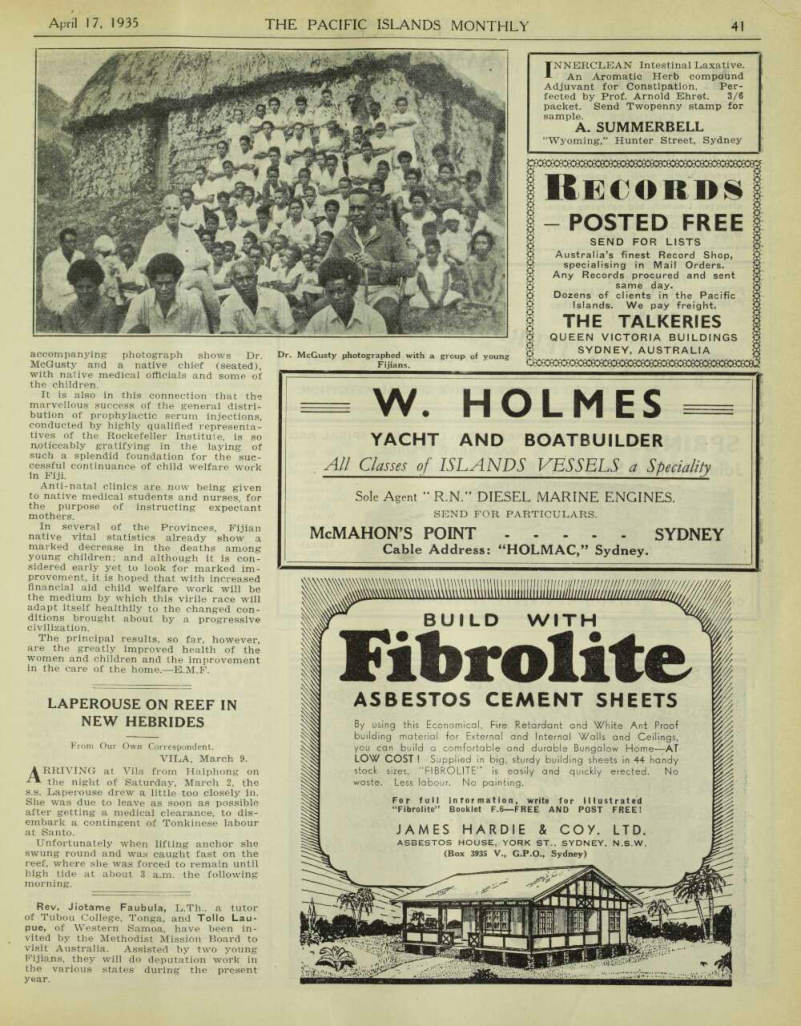
Natives Themselves Provide Successful Medical Service
THE proposal to establish a home for A the treatment and cure of ailing and ill-nourished children is one of the hoped for schemes of the Central Executive Council of Child Welfare in Fiji.
To-day, active interest in child wel fare work has rapidly extended from the comparatively small white population of the chief centres to the large and scat tered native race, and Indian and Chinese communities resident on the many islands in the Fijian group.
The scheme for the conduct of child welfare for the Fijians was inaugurated in 1927 by the Central Executive Council, consisting of the Secretary for Native Affairs, the Chief Medical Officer, and the Governor’s Commissioner.
The object of this Council is to work in co-operation with the Native Medical School, which has its headquarters at the Colonial War Memorial Hospital in Suva.
Native (Fijian) medical practitioners and native obstetric nurses receive special training in welfare work, and are sent out under the supervision of District Commissioners and District Medical Offi cers to the six Provinces into which Fiji’s populated islands are divided. Reports are forwarded quarterly from each Pro vince and all questions of policy are sent for the decision of the Central Executive Council.
At first, six specially trained European nurses were installed at the different centres, and in spite of the language diffi culty, the stubborn adherence to uncleanly superstitious habits, and the many hard ships due to weather conditions and means of transport, they did splendid pioneering work.
We learn, however, that recent vacan cies have not been filled, and the money thus saved is being utilized in equipping Fijian Women’s Committees, where there are no European nurses, and in supply ing the necessary drugs.
Previous distribution of canned milk and patent foods failed in their purpose as special and additional nourishment for weak and ailing children. From the irresponsible Fijians’ point of view, these comforting beverages, so easy of access, provided a popular sweetening fillip to the morning cup of tea, and were considered entirely wasted on their helpless and apparently unappreciative offspring. Con sequently, those expensive commodities have been withdrawn from the list of essentials which at first were considered indispensable to the work in connection with this movement. Instead, babies de prived of their mothers by death, or chil dren suffering from malnutrition, are conveyed to the district hospitals and there cared for until well enough to re turn to their villages.
And so Women’s Committees of four members are now formed under the super vision of the district native medical prac titioner, and the native nurse. These committee women, usually the wives of chiefs and native government officials, in spect the children daily, for cleanliness and minor ailments, if necessary. Regu lar visits are made to dwelling houses with the object of improving sanitary conditions generally. A very useful work is being done in this way, making it pos sible to extend the campaign to every part of Fiji.
Annual visits of inspection are made to every village in each Province by the Governor’s Commissioner (Dr. McGusty), who is also Inspecting Medical Officer.
The growing enthusiasm on the part of the natives and their keen appreciation of its beneficial results was especially shown on one occasion by the presenta tion of a huge pile of mats and enormous quantities of native vegetables. Sur rounded by these very sustaining edibles, Dr. McGusty sat himself comfortably on the lofty stack of mats and from this imposing height delivered his instruc tional lecture, to the evident delight of his squatting listeners.
During his recent tour of inspection this genial and energetic doctor expressed his gratification at the continued improved appearance of the children in the different villages. Where, less than a decade ago, native children, very often, presented an unwholesome sight, to-day we see clear, bright eyes in clean, healthy bodies. Won derful tributes to a wonderful work. The
accompanying photograph shows Dr.
McGusty and a native chief (seated), with native medical officials and some of the children.
It is also in this connection that the marvellous success of the general distri bution of prophylactic serum injections, conducted by highly qualified representa tives of the Rockefeller Institute, is so noticeably gratifying in the laying of such a splendid foundation for the suc cessful continuance of child welfare work in Fiji.
Anti-natal clinics are now being given to native medical students and nurses, for the purpose of instructing expectant mothers.
In several of the Provinces, Fijian native vital statistics already show a marked decrease in the deaths among young children; and although it is con sidered early yet to look for marked im provement, it is hoped that with increased financial aid child welfare work will be the medium by which this virile race will adapt itself healthily to the changed con ditions brought about by a progressive civilization.
The principal results, so far, however, are the greatly improved health of the women and children and the improvement
in the care of the home.
E.M.F.
Dr. McGusty photographed with a group of young Fijians.
Laperouse On Reef In
New Hebrides
From Our Own Correspondent.
VILA, March 9.
ARRIVING at Vila from Haiphong on the night of Saturday, March 2, the s.s. Laperouse drew a little too closely in.
She was due to leave as soon as possible after getting a medical clearance, to dis embark a contingent of Tonkinese labour at Santo.
Unfortunately when lifting anchor she swung round and was caught fast on the reef, where she was forced to remain until high tide at about 3 a.m. the following morning.
Rev. Jiotame Faubula, L.Th., a tutor of Tubou College, Tonga, and Tollo Lau pue, of Western Samoa, have been in vited by the Methodist Mission Board to visit Australia. Assisted by two young Fijians, they will do deputation work in the various states during the present year.
Advertisements & other items, p. 47 (1 item)
Fibrolite
INNERCLEAN Intestinal Laxative.
An Aromatic Herb compound Adjuvant for Constipation. Perfected by Prof. Arnold Ehret. 3/6 packet. Send Twopenny stamp for sample.
A. SUMMERBELL
“Wyoming,” Hunter Street, Sydney
Records
- POSTED FREE
SEND FOR LISTS
Australia’s finest Record Shop, specialising in Mail Orders.
Any Records procured and sent same day.
Dozens of clients in the Pacific Islands. We pay freight.
THE TALKERIES
QUEEN VICTORIA BUILDINGS
SYDNEY, AUSTRALIA
W. HOLMES .
YACHT AND BOATBUILDER
All Classes of ISLANDS VESSELS a Speciality Sole Agent “ R.N.” DIESEL MARINE ENGINES.
SEND FOR PARTICULARS.
McMAHON’S POINT SYDNEY
Cable Address: “HOLMAC,” Sydney.
BUILD WITH
Fibrolite
ASBESTOS CEMENT SHEETS
By using this Economical, Fire Retardant and White Ant Proof building material for External and Internal Walls and Ceilings, you can build a comfortable and durable Bungalow Home —AT LOW COST ! Supplied in big, sturdy building sheets in 44 handy stock sizes, "FIBROLITE'’ is easily and quickly erected. No waste. Less labour. No painting.
For full information, write for illustrated “Fibrolite” Booklet F.6—FREE AND POST FREE!
JAMES HARDIE & COY. LTD.
ASBESTOS HOUSE, YORK ST., SYDNEY. N.S.W.
(Box 3935 V., G.P.O., Sydney)
Yam Recipes
Fifteen Ways to Cook the Tubers
“HOW does one cook yams?” asked a correspondent in the December issue of the “Pacific Islands Monthly.” Rev. R.
R. Hanselmann, of Madang, New Guinea, who has had considerable experience In cultivating tropical vegetables and fruit, has replied by sending us a number of excellent recipes for cooking the roots of the humble yam.
“There are several species,” he writes, “and it is worth the time and trouble in experimenting with them to cultivate a variety with a suitable flavour. The largest yam I have seen weighed 781bs.
and the smallest, very delicate indeed, was the size and shape of a poultry egg.
“The following recipes have been tried at Madang, and proved very tasty.”
Boiled Yams. —Wash, pare, and cut the yam in halves or quarters, according to the size. Cook in boiling salted water until done. Dram off all water, return to fire until the yam pieces are dry and mealy.
Yams in Coconut Milk.— Wash, pare, and cut yams in large pieces and place in a saucepan.
Grate a coconut, press out the milk and mix it with some of the water of the nut. Add enough of this liquid just to cover the yams. Add salt and cook until tender.
Yams Boiled with White Sauce. —Take two table spoons flour and stir over fire to a golden yellow.
Add a little hot milk and salt and let come to the boil. A pinch of red pepper may be added for additional flavour. Into this hot liquid drop the boiled yams which have been cut into pieces. Allow to heat through thoroughly. Good served with liver, cold boiled ham, sausages, etc.
Baked Yams.— Wash the yams, using a vegetable brush; rub with lard and place in a dripping pan.
Bake in hot oven, 400 to 450 degrees F. until soft.
Split, and serve at once with butter.
Yams in Half Shell.— Follow recipe for baked yams. Remove from oven, split, and scrape out the inside. Mash, add 2 tablespoons butter, salt, pepper, and several tablespoons hot milk. If pre ferred, the whites of two eggs beaten stiff may also be added. Refill skins and bake from 5 to 8 minutes in a very hot oven. The yams may be sprinkled with grated cheese before putting into oven to brown.
Fried Yams. —Wash and pare yams. Cut in 3-inch thick slices and fry rather slowly in a hot greased-skillet until done.
French Fried Yams.— Wash, pare, and cut yams in strips, about as long and thick as one’s little finger. Soak one hour in cold water. Take from water, dry between towels and fry in deep fat.
Drain on paper and sprinkle with salt. Serve around fried or baked fish, chicken, or steak.
Boiled Yams, Fried. —Brown in melted butter or lard a few thin slices or tablespoons of finely
chopped onion, then add cold boiled yams which have been cut in thin, small slices, and fry to a golden brown.
Yam Patties. —Left-over boiled or mashed yams from the noonday meal can be made into patties for the evening. Work the cold yam with a fork to make sure there are no hard particles. Add 1 or 2 well-beaten eggs, a bit more salt and pepper,, shape into patties and fry a golden brown. If desired, the patties may be rolled in finely ground dry bread crumbs before frying.
Escalloped Yams.— Ingredients; 2lbs. raw meat (beef, pork, or what you have), 1 good-sized yam. 4 onions. The meat is cut into slices, as are also; the raw onions and yam. A casserole or baking dish is well-buttered and the ingredients put in in layers, the bottom and top layer being of yam.
Sprinkle each layer with salt and pepper, and dot the whole with lumps of butter. Add ½ cup hot stock or water, cover well and bake until done.
Meat Stew with Yam and Tomato Sauce. —Brown in butter one small, finely chopped onion. Remove from pan and fry small slices of any fresh meat on hand. Place onion, meat and one cup fresh tomato juice or one small can tomato soup into a kettle to cook. After the first 15 minutes of cooking, add the yam cut in cubes. Add season ings and simmer until done.
Yam with Parsley. —Two tablespoons flour are put into a saucepan together with two tablespoons of butter and stirred over fire to a light yellow.
One finely chopped onion is added and one cup stock, beef bouillon cube or water. A raw sliced yam is then put in and allowed to simmer slowly.
When almost done, add a generous amount of finely chopped parsley. Serve with steak or any fried meat dishes.
Curried Yam. —Cook cup butter with one small onion finely chopped, until yellow. Add three cups cold boiled yam cubes and cook until yams have absorbed butter. Then add from ½ to ¾ cup white stock, ½ tablespoon curry powder, a few drops lemon juice, and salt and pepper to taste.
Cook until yams have absorbed stock.
Yam Pancakes.—Grate a large yam. If watery, drain in a colander or sieve. For each cup of grated yam, use one egg and one tablespoon flour, a drop of milk, and salt to taste. Stir well, and bake immediately. Drop the batter by spoonsful in a hot, well-greased skillet and bake golden brown. Good served with stewed dried fruit, fish, sausages, or cold ham.
Yam Croquettes.— Cook the yam in salted water.
Drain water, add a bit of milk, butter, and two eggs. Shape into cones, roll in bread crumbs, and fry in deep fat to a delicate brown. They may be served plain with a vegetable course, or sprinkled with sugar as an accompaniment to stewed dried fruit.
Travel With B.P. Maga
Zine.
SINCE the days when valiant Drake sailed the Spanish Main and Cook combed the wide Pacific, the urge to travel has been inherent in civilised man. Not to everyone, however, comes the good fortune to climb aboard a giant liner, cruise cyanic seas, hear the quaint chatter of alien tongues, and gaze on scenes and people foreign to one’s ken. The unfortunates —and they are legion—usually seek solace in the printed word, and travel hooks and journals are always in de mand. In this connection the March issue of the B.P. Magazine is a veritable magic-carpet.
Following in the wake of Martyn Whyte’s pen and camera, we journey to Morocco, Land of Contrasts, where the beauty of marble mosques and glowing sunsets is offset by a nauseating glimpse of a Moorish market place crammed with swarthy, evil-smelling natives, gyrating dervishes, and howling, gesticulating merchants. On to Napoleon’s birthplace—Corsica, a wind-swept isle of towering mountain buttresses and peopled by a race of shy, pleasant folk, whose happy children romp among glades of tiny yellow Alpine flowers.
Then to New Guinea, with its fascinating story of the gold trail and the part played by aero planes in establishing a modern mining community in the heart of that great wild country, guarded by forbidding ranges and miasmic jungles. Soon we are in the East—China the Inscrutable, coun try of swarming millions. With Kurt Offenburg. we traverse narrow streets and crowded, winding canals seeking the key to the philosophic calmness of her people. Then in rapid succession we jour ney through Rome, Jamaica, Cornwall, Borneo.
California, London, and a score of other colourful lands and cities.
In addition ts the travel sketches, the issue contains a choice selection of short stories, verses, and notes on films, drama, the arts, fashions, aaid Sydney’s social life, together with innumerable beautifully reproduced photos and illustrations.
Rev. Robert Leek, of the New Guinea Mission staff at Samarai, Papua, arrived in Sydney on furlough by the Montoro on April 1.
Advertisements & other items, pp. 68-70 (2 items)
Pacific
A FREE BELT
Made of strong plaited kangaroo, is given away to every purchaser of 2 pairs of our
RIDING TROUSERS.
RIDING TWIST, expertly tailored. Shades: Dark Grey, Fawn, and Olive. 14/6 a pair.
W. H. WILLIAMS
18-20 WILSON-STREET,
NEWTOWN.
Makers of Newmarket Safer Saddlery.
Coles
Regalia
Sydney
ALF. H. J. COLES
Established 1920 Masonic Regalia, Jewels and General Requisites.
Master Masons’ Aprons 42/- and 457- Leather Regalia Cases, 16-inch, from 16/6 P.M, Jewels a Speciality.
Inquiries Solicited :: Prices Australian Currency
Room 19, Royal Arcade, Sydney
Pacific
The following maps by the well-known firm of Map Publishers, H. E. C. Robinson Ltd.: clear map of the Pacific from Australia to America, east and west, Japan on the north and New Zealand on the south. Showing all trade routes with, with mileage, thereon, and clearly defining all the Mandated Territories by tints of colour. SIZE: 30m. x 40m. PRICE: £1/5/-, including Postage.
MAP OF MOROBE DISTRICT, NEW GUINEA, MANDATED TERRITORY (Mercators Projection). —SCALE at EQUATOR, 6 Statute Miles to an inch. These maps have been compiled from all the official data Messrs. Robinson have been able to collect, much of which has been supplied by Mr.
Ralph W. Gossett, an authorised Surveyor of the Mandated Territory of New Guinea. SIZE. 30in. x 40in. PRICE: 20/-.
AUSTRALASIA.— A good clear Map of Australia and Surroundings, extending on the North Borneo and Caroline Islands; South to Tasmania and New Zealand; East to Fiji Islands; West to Singapore —showing all the Islands, with the Principal Trade Routes and Mileage. A clear index to places is printed beneath the Map. SIZE; 28in. x 30in. PRICE: Paper, 2/6; Cloth and Rollers, 7/6.
PAPUA AND NEW GUINEA.-Compiled from the Published Maps of Evan R Stanley, F.G.S., Geologist.
A good Map, showing detail and boundaries. SIZE: 30in. x 40in. PRICE: Black only, 15/-.
Coloured, showing Geological formation, £1.
MOROBE GOLDFIELDS— A clear detail Map of Bulolo area of Morobe Goldfields, showing Road-tracks and Air Routes from Salamaua and Lae to the Goldfields. SCALE: 2 miles to an inch—Statute Miles. By Chas. Lexius Burlington, SIZE: 30in. v 32in. PRICE: 12/6.
ALL COMMUNICATIONS TO-
ACIFIC PUBLICATIONS LIMITED
UNION HOUSE, 247 GEORGE STREET, SYDNEY. P.O. Box 3408 R
Forster’S Bedsteads Ltd.
SEVENTY SIX YEARS AGO
THE FOUNDATIONS OF THIS BUSINESS HOUSE WERE LAID Just think of it! When Dickens was writing his books Forster’s Bedsteads Ltd. commenced manufacturing. Employing highly skilled craftsmen—men who took a pride in their work—and backed with the Firm’s ideals of quality, and a fair dealing to all, a really worthwhile reputation was established.
To-day, in Ultimo, the latest modern methods are wedded to the ancient craft.
Up-to-date equipment worked by skilled men —men who still take a pride in their work—enables the Olympic Productions of Forster’s Bedsteads Ltd. to stand supreme in the Commonwealth.
We are proud of the reputation that our earnest endeavours have gained for us.
No other Australian furniture organisation—and few others the world over—offer to the public such a wide variety of proved products as Forster’s Bedsteads Ltd.
MANUFACTURERS OF
HIGH-GRADE FURNITURE
METALLIC AND WOOD BEDS
WIRE MATTRESSES
HOSPITAL FURNITURE
ICE-CHESTS
CHAIRS
REFRIGERATOR CABINETS, COM-
MERCIAL AND HOUSEHOLD
SHIPS’ ALL-METAL BERTHS
STEEL SHELVING
STEEL LOCKERS AND FILING
CABINETS, &c.
PORCELAIN ENAMELLING
WE WOULD APPRECIATE TRADE ENQUIRIES
FORSTER’S BEDSTEADS LTD.
MARY ANN STREET, ULTIMO, SYDNEY, NEW SOUTH WALES.
Cables; “Bedsteads,” Sydney. Codes: Bentley’s, and Private.
MINING AND ASSAY
MATERIAL
BALANCES, CRUSHERS, FURNACES,
CRUCIBLES, FLUXES, ETC.
LABORATORY AND SCHOOL
REQUISITES
Chemicals, Glassware, and all other Equipment
HOSPITAL AND SURGICAL
REQUIREMENTS
Incubators, Sterilizers, Centrifuges, Microscopes, Microtomes, etc.
Measures, Dispensing Scales, Enamel Ware, Bandages, Cotton Wool, and all Dispensing Material.
Write direct to
H. B. SELBY & CO., LTD,,
BULLETIN PLACE :: SYDNEY
Box 173D, G.P.O.
MINING MACHINERY
WE ARE MAKERS OF ALL CLASSES OF
MINING MACHINERY, STAMPER BATTERIES,
HUNTINGTON MILLS, Etc.
ALSO ALL CLASSES OF
BRICK-MAKING MACHINERY
GENERAL ENGINEERING AND FOUNDRY WORK
High-class SEMI-STEEL MACHINE MOULDED GEARING
UP TO 14 FT. DIA. x 24 IN. FACE
GEORGE FOSTER & SONS LTD.
Code: A.B.C. 5th Edition. ST. PETERS, N.S.W. Cable Address: Fosterion, Sydney.
Producers and sellers of Gold Bullion may feel assured that there are advantages in dealing with a well-established and widely-organised Company.
THE ELECTROLYTIC REFINING & SMELTING COMPANY OF AUSTRALIA LIMITED is equipped to provide those advantages in the highest degree possible combined with faithful service.
Its facilities for receiving and handling bullion are convenient and safe. Its assaying and refining are In the hands of highly qualified technicians. Its markets are world-wide, ensuring the best prices being paid.
For example the RECORD PRICE of gold in Australia was established by this Company on 6th March, 1935, when payment was made to its clients at the rate of £9/4/6 net per fine oz.
SELLERS IN NEW GUINEA, NEW ZEALAND, PACIFIC ISLANDS, and elsewhere outside Australia should consign their materials to the Company’s Sydney Office.
PROCEEDS FOR NEW GUINEA AND NEIGHBOURING CENTRES are forwarded by the outgoing mail of the same vessel which brings the bullion except in very unusual circumstances. Prompt settlement is a feature of the Company’s service.
Gold Miners: Instruct your Bankers or your Forwarding Agents to deposit your bullion with:
THE ELECTROLYTIC REFINING & SMELTING CO.
OF AUSTRALIA LIMITED
Melbourne: Works: Sydney: Collins House. Port Kembla, N.S.W. 25 O’Connell Street.
PURCHASERS AND REFINERS OF GOLD, SILVER, COPPER IN ANY FORM BANKERS: —The English, Scottish & Australian Bank Ltd.
Pacific Mining Notes
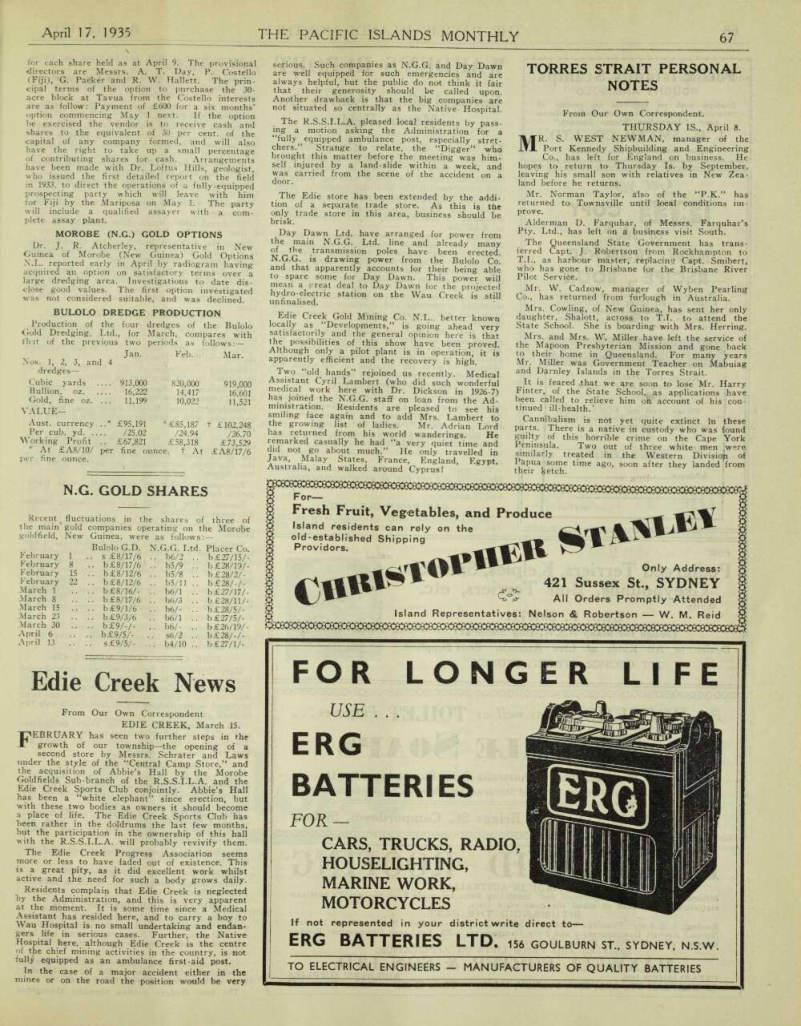
Papuan Expeditions N.L.
Directors of Papuan Expeditions N.L. have re ceived advice from Mr. F. G. Westhoven, who was in charge of the expedition to the Nabo Range and Erewa district, Papua, to the effect that he has returned to Port Moresby without securing a property suitable for the company.
Mr. Westhoven is preparing a detailed report on the work of the expedition. The directors have cabled Mr. Westhoven to stop expenditure on be half of the company and to return to Australia by the first available steamer.
Aloha Syndicate N.L.
Cable advice has been received by the manage ment of Aloha Syndicate N.L. from Mr. R. M.
Boyd, mining engineer, who is in Fiji, advising that he has examined one or two large areas over which the syndicate holds options. He states he is favourably impressed with the areas, and that each has good possibilities for sluicing and dredg ing. He will shortly proceed to examine a second property over which the syndicate has an option.
The syndicate has received licences for the pros pecting of both these properties.
Enterprise Of New Guinea
Expenditure of Enterprise of New Guinea N.L. for the period 18th October, 1933, to 31st October last, was £3342, said Mr. E. Ward, chairman, at a recent meeting. A profit of £860 was made on sales of shares in Edie Ck. Gold Mining Co.
N.L., and interest brought in £22, leaving a debit balance of £2460. Cash at bankers at the close of the period was £8230, and shares in Edie Ck. G.M. Co, N.L. were valued at £882. The co.’s holdings consist of 15 mining leases, with a total area of 5000 acres, upon which £2500 has been paid in lease, rents, and survey fees. Exemp tion from labour conditions has been obtained over a greater portion of the areas until July, 1935, when it will become necessary to develop them. The directors, in their report, advise that
apart from what has been done in prospecting leases held, and other areas in which it is likely to be interested in the near future, much work has been done to provide facilities for future operations. A considerable amount of pitting has been done on the alluvial areas, and as far as tested these show values of 8/- a yard, with gold at £8 an ounce. This figure cannot as yet be applied as an average for the whole of the areas.
Further boxing may either increase or reduce that figure. Enough, however, has been done to prove the ground as being highly payable. It will be necessary at an early date to enter upon a stage of more active development in respect to the holdings, and to provide plant for the working of alluvial areas. With this object in view the directors have arranged for the appointment of a qualified engineer and manager to take control of the properties. The directors propose to sub divide the present £10 shares into 10 of £1 each. This will leave 6000 shares in the hands of the company, which the directors propose to issue in due course, so as to provide capital sufficient for prospecting and development require ments.
As the result of an accident on the field, Mr.
W. Cash, the Company’s N.G. representative, was in Wau hospital for several weeks. He has now recovered and returned to the Ramu area.
A lengthy report has been received by the direc tors from Mr. W. F. McKenzie, hydraulic engineer, who visited New Guinea on the company’s behalf.
The directors consider the report a favourable one.
New Guinea Syndicate.
New Guinea Syndicate advises that an option has been obtained over a further area of 85 acres on Edie Creek, seven miles upstream from the Bulolo dredges. This property and the 50 acres already held are estimated by the vendors, Messrs. Wm.
Stower and Carl Wilde, of New Guinea, to con tain values totalling £367,000 (with gold at £8/10/- an ounce) in 1,226,000 cubic yards. Costs are stated at 2/- a yard to leave a working profit of £244,000. It is proposed to obtain a report on the property from a mining engineer.
Guinea Gold Leases.
Guinea Gold N.L. reports that the company is at present interested in leases and concessions in New Guinea and Papua, principally in the latter, aggregating 10,658 acres, and is actively engaged in testing operations. The areas are: Aiauwi leases, 2250 acres; Bubuau leases, 3308 acres; Pun jab leases, 1500 acres, and Tauri concession leases (jointly with Golden Stream N.L.), 7200 acres -one-half thereof, 3600 acres. Drilling is proceed ing on the Bubuau areas, and will shortly be augmented by pitting and trenching operations with a view to early production by sluicing and elevating methods. Simultaneously the Punjab leases are being tested by scout drilling. If the results justify anticipations, a light dredging plant will be obtained for this area, and can be con veyed to the property by sea and river transport at low cost. On the completion of the programme attention will be turned to the more extensive testing work on the dredging areas of the Aiauwi properties and the Lower Bubuau. The joint operations on the Tauri concession are in hand, and, with the arrival of further boring plant by the next steamer, it is expected rapid progress will be made. The question of expense in regard to these operations is being considered by the direc tors. The policy is being shaped so that, if pos sible, quick-producing sections of the field can be turned to account at an early date with a view to minimising the capital outlay necessary for pro perly testing the large lower-grade sections.
Sufficient preliminary work has now been accom plished to justify the employment of additional technical staff, and this is being arranged in con sultation with Placer Development Ltd.
Hickey’S Gordon Gold N.L.
Directors of Hickey’s Gordon Gold N.L., a Vic torian gold concern, report having secured an option of purchase over prospecting licence No. 220, Tavua, Fiji, containing 460 acres. The south west corner of this area joins the north-east corner of the Emperor lease, and its southern boundary runs along the Nasivi River. A lode formation was discovered crossing the Nasivi River striking N.E.-S.W., apparently coming from the Emperor lease through prospecting licence 222, and thence through prospecting licence 220. On the north-western section of prospecting licence 220 there are numerous quartz outcrops on the western side of a ridge, and trenches have shown good colours in the dish. The licence holder drove east at a point 120 feet below the crest of the After proceeding 20 feet lode matter was disclosed which assayed 13 dwt., and at 40 feet good pan results were obtained. Numerous out crops show up on the lease but beyond surface learning no serious prospecting has been done ex
cept as indicated. It is intended to carry out systematic testing and prospecting.
Loloma West Ltd.
Loloma West Ltd., to be registered as a limited liability company in Melbourne, has been formed with a nominal capital of £15,000 in 3000 shares of £5 each. Two thousand shares have been subscribed for at £5 each, 300 fully paid are to be allotted to the vendor, and 700 will be held in reserve, of which 300 are to be placed under option to the vendor for six months at a premium of 50 per cent. The company will take over from the vendor an application for a prospecting licence of approximately 247 acres, dated February 18, and an option to purchase mining tenements which may be issued by virtue of a prospecting licence of 488 acres. The vendor will receive £450, and should the option be exercised over mining tene ments which may be issued by virtue of the prospecting licence of 488 acres, the purchase price will be £7000. The areas are at present being developed, and are stated to be gold bearing. The company will immediately take over the develop ment work and prove the areas systematically.
The prospecting area of 488 acres is west of and adjoining the property of Loloma Gold Mines N.L., and the other area is to the north-west, about two miles. The directors are Messrs. E.
Ward, H. E. Thonnemann, D. Reid, and C. F.
Michell. A local director will be appointed at Suva. Mr. A. J. Phillips, 422 Collins Street, Melbourne, is the legal manager.
Edie Ck. Gold Co.
Owing to a breakdown of the old engine, Edie Creek Gold Mining Co. N.L. had a short run for February. Results for the period were: Ore treated, 175 tons; fine gold, 17 oz. 7 dwt.; silver, 20 oz. 6 dwt.; base metals, 2 oz. 12 dwt.
A progress report dated March 21, is as fol lows: Main drive, No. 1 level, 324 ft. to 339 ft. in ore. Average values, last 15ft., 7.4 dwt. gold and 3.8 oz. silver. Opening up face from wall to wall at 335 ft. Proved width of 17ft. As advance is made into mountain, character of ore is chang ing. From dish, prospects and assays would appear to be getting on higher grade.
S.W. drive on main lode discontinued for time being owing to slip from mountain side covering up work. Sloping on sill floor off No. 2 cross-cut with this ore and ore from development of main drive keeping plant supplied. When mine was opened up originally, wooden tramlines were used on account of economy. These are now becoming worn, making trucking of ore difficult and expen sive. Plant and treatment:—Although time for leaching of ore was cut down from 8 days to 6, owing to lack of sufficient labour it is found impossible to produce and treat tonnage plant is capable of handling. New engine for pumping plant has arrived, and is being installed. Old engine com pletely broke down two days before its arrival.
It is expected in future to get an uninterrupted run of plant. Government geologist has made exammation of property.
Lakekamu Goldfields N.L.
Lakekamu Goldfields (Papua) Development N.L. has obtained a working option for six months for £2000 over the main leases, dredge and other assets of the Tiveri Dredging Co. Mr. Greene, superintendent driller, and staff, with the excep tion of the assayer, arrived at the Twisty areas field on March 7. and the assayer on March 13.
Drilling and other equipment, together with native labour arrived some days earlier. The wireless telephone to the field was temporarily out of order for a few days. General Wisdom, one of the directors, arrived at Port Moresby recently to co-operate in consolidation of the company’s interests. In regard to other areas, arrangements are well advanced for a thoroughly equipped party to leave on a prospecting trip to deal with the various proposals defined in the prospectus, as submitted by Mr. P. R. Osborne.
It is anticipated the party will leave for the field during April.
The company later advised that boring on the Twisty areas commenced on March 18 with both plants. The first scout bore went to 60 feet, showing values of traces to 2d., par. The second scout bore was carried 45 feet, but did not bot tom, values being 1/5 a yard, with gold at £4/5/an oz., sterling. The third scout bore, 35 feet to bottom and 10 feet into bedrock, wash a yard, par. The plant is working well, but some difficulty has been experienced in removing the casing, as the wash is largely of loose gravel.
Arrangements have been made to overcome this difficulty. Application has been made for three further areas, totalling 124 acres, adjoining the Twisty areas.
Subsidiary Of Mt. Kasi Mines.
Kasi Development Ltd. is to be registered in Fiji by Mount Kasi Mines Ltd. to take over the
right, title and interest of the parent concern of three exclusive prospecting licences, covering an area of 1400 acres. The formation of a subsidiary company followed a decision by the directors to separate the producing from the prospecting operations of the company. The subsidiary will have an issued capital of £20,000 (Fijian currency) in 80,000 shares of 5/- each. Mount Kasi Mines Ltd. will receive 40,000 fully-paid shares in consideration of the transfer of its rights in the licences and the use of its organisation and its technical staff. Shareholders of Mount Kasi Mines Ltd. will have the first right to subscribe for the balance of the issued capital pro rata to their holdmgs. The licences to be transferred comprise the whole of the immediate vicinity of the Mount Kasi line on all sides. Directors of Mount Kasi Mines Ltd. will be the directors of the new companv
Oriomo Explorations Ltd.
Oriomo Explorations Ltd. reports that options in the Mandated Territory now include 140 acres of terraces, gravels, and alluvial flats, following both sides of the Bulolo River over a distance of approximately 62 chains, also approximately 1200 acres of contiguous land formerly held under pastoral lease. Captain S. N. McLean reports, following his investigation of these areas, that from the survey levels and preliminary pit sinking he has been able to define the old river beds. First attention is being given to the terraces and the result of four pits, none of which is bottomed, at depths varying from 15ft. to 33ft., and which give an average result in excess of 5/- a cubic yard gold 750 fine. The free option over the smaller area is for six months, with the right of renewal without cash consideration for a further six months.
The free option over the contiguous land is for 18 months. Agreements completed by vendors have been submitted for Administration approval, An extraordinary general meeting of shareholders of Oriomo Explorations, Ltd., has been called for April 17, to pass, if approved, a resolution in creasing capital from £24,000 to £100,000. Mr. W.
A. Freeman, chairman of Placer Development, Ltd., and Bulolo Gold Dredging Co., Ltd., has. considered that his existing position necessitates his resignation from the board of Oriomo Explora tions, Ltd. The directors have accepted with regret. Messrs. A. S. Lilburne, and G. A. More have been appointed directors,
Sandy Creek Gold Sluicing
Sandy Creek Gold Sluicing Ltd., has been registered in New Guinea, and has completed; the purchase and taken possession of the proper ties at Sandy Creek. Messrs. H. E. Hallam and E. A. Gumbley have been appointed acting-mine manager and assistant-mine manager respectively. They left Sydney by the March macdhui and arrived at Sandy Creek on March 22. Pending installation of plant for hydraulicing the company will carry on box sluicing with native labour.
Ramu (N.G.) Gold Syndicate
Mr. L. E. Stringer, legal manager of Rama (New Guinea) Gold Syndicate, N.L., advises that arrangements are being made for Mr. J. M.
Spence, mining engineer, to test and report on the areas under offer to the syndicate,
Navisi Gold Syndicate
A cablegram has been received by the management of Nasivi (Fiji) Gold Syndicate N.L., from the company’s prospector, who holds a licence to prospect in Fiji, indicating that he has left for a field which he intends to prospect immediately.
Viti Levu Gold Co.
Advice has been received by the management of Viti Levu Gold N.L., Fiji, from Mr. Scott, leader of the prospecting party, that a definite assurance had been received from the Fiji Gov ernment that it would grant prospecting licences.
Mr. Scott added that he had secured prospecting
rights entitling him to seek new areas. He was negotiating for promising areas with the Tavua Syndicate, and prospects were good. He asked that substantial credit be cabled, as he intended pros pecting new country.
An option for twelve months has been taken by the Co.’s prospectors over 500 acres on a new field at Momi Bay, on satisfactory terms. The vendor has placed in the possession of the pros pecting party a large area, containing loam gold, the occurrence being similar to Tavua, Fiji.
Loloma Gold Mines N.L.
Mining operations were started by Loloma Gold Mines N.L., at Fiji, on March 25. The company was formed with a nominal capital of £150,000 to acquire and subsequently exercise the option to purchase a prospecting licence covering 199 acres at Tova Tova, six miles from Tavua, Viti Levu Island, Fiji. Mr. W. J. Doran, the company’s representative, advises that he arrived at Tavua on March 14 with a party of miners.
Native labour was engaged and good progress has been made with the erection of camp quarters, cook house and mess. The erection of the explosives magazine has been started.
Directors of the Co. advise that Dr. Stillwell, of Melbourne University, has examined a sample of the sulphide ore from the company’s area at Tavua. The ore, which showed no free gold, had been previously assayed by Mr. C. W. Nash and gave a return of 22oz. a ton. Dr. Stillwell states definitely that the ore contains the gold-bearing telluride, nagyagite. This explains the high assay value, despite the absence of free gold.
Tavua Gold Options Ltd.
Tavua Gold Options Ltd. advises that at an extraordinary general meeting of shareholders the directors were authorised to proceed with the formation of a new company to develop the areas at Tavua, Fiji. The areas total 1299 acres, and are situated, adjacent to the Emperor mine, on the areas held by the Loloma and Korere companies.
The company has been officially notified by the Mining Board of Fiji that its areas will be pro tected. The new company will have a nominal capital of £100,000, in 400,000 shares of 5/- each, of which 180,000 contributing shares will be offered for subscription. Shareholders in Tavua Gold Op tions Ltd. will receive four fully paid shares ;n the new company for each share held, with a right to subscribe for two additional shares at par. The directors will be Sir Charles Marr, Sir Henry Scott, Messrs. E. G. Banks, H. E. Sizer, W. R. Car penter, H. R. R. Grieve, and H. J. Napthah.
The subscribed capital in the new company has been guaranteed by Australian Mining Trust Ltd.
The new company will be called Tavua Gold Development Ltd.
Rewa Prospecting Syndicate
Rewa Prospecting Syndicate N.L. has been regis tered in Victoria. The syndicate’s representatives are in Fiji and have obtained prospecting rights.
Messrs. J. D. Paterson, G. F. Leitch, and C.
Trist are the directors, and Mr. I. W. Barrett, 31 Queen Street, Melbourne, is legal manager.
Edie Options Ltd.
The directors of Edie Options, Ltd., report: Arrangements in hand for the registration of the company in New Guinea. Mr. K. A. MacGregor, solicitor, Wau, has been appointed legal manager and representative in the Territory. Mr. S. H.
Carroll (a director of the company) is at present in New Guinea, and will consult with J. M.
Spence (company’s consulting engineer) on matters of policy and proposed operations.
Misima Gold Reefs N.L.
Directors of Misima Gold Reefs (New Guinea) N.L. have acceded to the request of Mr. T. Owen, the Sydney representative of Oroville Dredging Co., Ltd., and granted a further one month’s ex tension to the first option, to 31st March, to test further the lower adit, before paying the deposit of £200.
Equatorial Gold Syndicate
Advice has been received by the management of Equatorial Gold Exploration (New Guinea and New Britain) Syndicate N.L., from Mr. J. De laney, one of the holders of the lease on the Ramu, over which the company holds an option, that 250 pits have been completed, and are showing excellent values, distributed over 10 feet of wash.
They are not bottomed.
Mr. A. M. Gunning, the Co.’s engineer, has radio’d that he arrived at Salamaua on April 2, and was leaving by ’plane for the company’s leases on the Ramu on April 5. He will immediately, upon arrival there, check and sample the pits sunk by the contractor. Dr. Atcherley, who was pre viously employed by the Co., and who is at present in New Guinea, visited the areas and reported privately that he had sampled 52 of the pits sunk, and that the average values over a depth of 10 feet of wash were 3/6 a cubic yard, and that no pit had been sunk to rock bottom. The man agement reports that the contractor undertook to sink 50 pits weekly. In view of such a large number to be completed within a short period, he was agreeable only to enter into a contract to sink to this depth. A proportion of these pits will later be bottomed when the engineer is present, and it is obvious from the work done to date that the total yardage will be greatly in excess of the original estimate of 7,000,000 cubic yards, and that even better values must be revealed when the pits are tested to the bottom.
Barola Gold Reefs N.L.
Barola Gold Reefs N.L. has obtained the ser vices of Mr. A. M. Gunning, mining engineer, and he has proceeded to the Ramu, New Guinea, to open up the reef on the area held under option, and at the same time work the alluvial there.
Mr. Gunning has had extensive mining experience in South Africa, Rhodesia, and California, and latterly in Victoria. For six years he was m New Guinea, and is fully conversant with its local conditions and the handling of native labour. Mr.
Gunning will also represent Equatorial Gold Ex ploration (New Guinea and New Britain) Syin dicate N.L., whose property is adjacent, during the
pitting operations now proceeding there.
Koroere Starts Operations
Work has been started by Koroere Gold N.L. on the property at Tova Tova, on the island of Viti Levu, Fiji, and a tunnel is being driven on the site recommended by Mr. T. R. Victor, who recently inspected the property.
Australian Prospecting Syndicate
Messrs. T. J. Shepherd and J. yictor, consulting engineers, of Australian Prospecting N-L., advise that they arrived at Suva, Fiji, on 13th March, and after obtaining prospectors’ licences left for Tavua, next day.
Aloha Central G.M., N.L.
Directors of Aloha Syndicate G.M., N.L. at a meeting early in April decided to form a pros pecting syndicate, to be registered in Melbourne, under the name of Aloha Central G.M., N.L., with a nominal capital of £12,500, in 2500 shares of £5 each. The syndicate will carry out an exhaustive examination and testing of the 30-acre block at Tavua, Fiji, an option over which has been ob tained from the Costello interests. Five hundred shares, fully paid, will be issued to Aloha Syndi cate G.M. N.L. as part vendors’ consideration.
Shareholders in Aloha Syndicate will be offered the right to subscribe for 1800 shares at par, being at the rate of 15 shares for each share held at the closing of the register on April 9 and 200 shares will be offered at par to Mr. P. Cos tello, on behalf of himself and his interests, for cash. In addition shareholders in Aloha Syn_ dicate will receive a cash consideration of £30
for each share held as at April 9. The provisional directors are Messrs. A. T. Day, P. Costello (Fiji), G. Packer and R. W. Hallett. The prin cipal terms of the option to purchase the 30acre block at Tavua from the Costello interests are as follow: Payment of £600 for a six months’ option commencing May 1 next. If the option be exercised the vendor is to receive cash and shares to the equivalent of 30 per cent, of the capital of any company formed, and will also have the right to take up a small percentage of contributing shares for cash. Arrangements have been made with Dr. Loftus Hills, geologist, who issued the first detailed report on the field in 1933, to direct the operations of a fully-equipped prospecting party which will leave with him for Fiji by the Mariposa on May I. The party will include a qualified assayer with a com plete assay plant.
Morobe (N.G.) Gold Options
Dr. J. R. Atcherley, representative in New Guinea of Morobe (New Guinea) Gold Options N.L. reported early in April by radiogram having acquired an option on satisfactory terms over a large dredging area. Investigations to date dis close good values. The first option investigated was not considered suitable, and was declined.
Bulolo Dredge Production
Production of the four dredges of the Bulolo Gold Dredging, Ltd., for March, compares with that of the previous two periods as follows:
Nos. 1, 2, 3, and 4 dredges— Jan.
Feb.
Mar.
Cubic yards 913,000 820,000 919,000 Bullion, oz 16,222 14,417 16,601 Gold, fine oz. ...
Value—
11,199 10,022 11,521 Aust. currency £95,191 £85,187 £102,248 Per cub. yd /25.02 724.94 /26.70 Working Profit .. £67,821 £58,318 £73,529 * At £A8/10/ per per fine ounce. fine ounce, t At £ A8/17/6
Advertisements & other items, pp. 71-72 (1 item)
E. A. Marr
Mining and General Machinery Merchants 5 and 10 Head Mining Batteries, Steam-Driven and Portable Air Compressors—all sizes. Centri- Tons of Steel Rails, 14lbs. to 100lbs. (New Condition). 200 Tons Steel Girders (all sizes).
Large Stock of Boilers, Suction Gas and Steam Engines, Winches, Pulleys, Rock-Crushers, Petrol and Crude Oil Engines, Elec. Motors, etc.
108 MILLER STREET, PYRMONT
fugal and Steam Pumps—Piping from ½in. to 6in. Black or Gal. Pipe and Air Fittings. 400 Telephone: MW 2296
Engineers
Write for Quotations for all types of Mining Machinery.
MINING PLANT
Portable Batteries, Fixed Batteries, Tube and Ball Mills, Shoes and Dies, Screens, Copper Plates, Trucks, "Challenge” Ore Feeders, Rock Crushers, Cyanide Tanks, Pipe Lines, Pumps
PROSPECTING PLANT
Casing, Drilling Tools, Engine Rigs, Sampling Gear, Pumps, Wire Ropes, etc.
DREDGING PLANT
Large or Small Designed and Built Agents for HADFIELD’S Manganese Steel Buckets, Tumblers, Gears, Carbon and Alloy Steels
J. B. WALLIS A CO.
CHALLIS HOUSE :: SYDNEY
Find out What’s Inside
before you buy a low-priced Saddle.
THE KING OF ’EM ALL
Being built on a Rustless Tree, heavily bar planted, and strained with English web, riders are assured of its genuine foundation. Its soft, pliant kip flaps are hardwearing, while the sweepy seat gives superb riding comfort.
Fitted with Best Leather, Folded Girth, Stirrups Freight Free.
Capped Pads as illustrated, 15/- extra.
Write for Catalogue P 1935.
SYDNEY’S HIGH-CLASS
SADDLER.
Newmarket Saddlery
W. H. Williams for “Safer” Saddles
18-20 WILSON ST.. NEWTOWN
N.S.W.
EXCEL BATTERIES
15 Months’ Guarantee.
The Product With A Reputation.
Prices F.O.B. Sydney (Australian Currency). Packing and Cases No Charge 13 Plate. 100 amp 30/- 15 Plate. 120 amp 35/- 17 Plate. 140 amp 45/-
SPECIAL CYCLE BATTERY
Six (6) Months’ Guarantee
At 25/- EACH.
EXCEL BATTERY COY., 77-79 William St., SYDNEY APPLICATIONS FOR AGENCY INVITED FROM ALL CENTRES
BRITAIN’S PRICELESS CONTRIBUTION TO MAN’S
COMFORT AND HAPPINESS
ROLLS-RAZOR
The Aristocrat of all Safety Razors SOLE AGENTS for Australia and the Islands of the Pacific.
THE ROLLS RAZOR CO. OF AUSTRALIA LTD.
Mendes Chambers, 8a Castlereagh Street, Sydney.
SERVICE. —We have a complete equipment for Repairs in case of accident to your Razor. Blades can be Reset and adjustments made by return mail.
N.G. Gold Shares
Recent fluctuations in the shares of three of the main'gold companies operating on the Morobe goldfield. New Guinea, were as follows:
Bulolo G.D. N.G.G. Ltd. Placer Co.
February 1 .. s £8/17/6 .. b6/2 .. b£27/15/- February 8 .. b£8/17/6 .. b5/9 .. b£28/19/- February IS .. b£8/12/6 .. b5/8 .. b£28/2/- February 22 .. b£8/12/6 .. bS/11 .. b£28/-/- March 1 ... b£8/16/- .. b6/l .. b£27/17/- .March 8 ... b £8/17/6 .. b6/3 .. b £28/11/- March 15 .. .. b£9/l/6 .. b6/- .. b£28/5/- March 23 .. .. b£9/3/6 .. b6/l .. b£27/S/- March 30 .. .. b£9/-/- ,. h6/- .. b£26/19/- Apnl 6 ... b£9/5/- .. s6/2 .. b£28/-/- Apnl 13 ... s£9/5/- .. b4/10 .. b£27/l/-
Edie Creek News
From Our Own Correspondent
Edie Creek, March 15.
FEBRUARY has seen two further steps in the growth of our township—the opening of a second store by Messrs. Schrater and Laws under the style of the “Central Camp Store,” and the acquisition of Abbie’s Hall by the Morobe Goldfields Sub-branch of the R.S.S.I.L.A. and the Edie Creek Sports Club conjointly. Abbie’s Hall has been a “white elephant” since erection, but with these two bodies as owners it should become a place of life. The Edie Creek Sports Club has been rather in the doldrums the last few months, but the participation in the ownership of this hall with the R.S.S.I.L.A. will probably revivify them.
The Edie Creek Progress Association seems more or less to have faded out of existence. This is a great pity, as it did excellent work whilst active and the need for such a body grows daily.
Residents complain that Edie Creek is neglected by the Administration, and this is very apparent at the moment. It is some time since a Medical Assistant has resided here, and to carry a boy to Wau Hospital is no small undertaking and endan gers life in serious cases. Further, the Native Hospital here, although Edie Creek is the centre of the chief mining activities in the country, is not fully equipped as an ambulance first-aid post.
In the case of a major accident either in the mines or on the road the position would be very
serious. Such companies as N.G.G. and Day Dawn are well equipped for such emergencies and are always helpful, but the public do not think it fair that their generosity should be called upon.
Another drawback is that the big companies are not situated so centrally as the Native Hospital.
The R.S.S.I.L.A. pleased local residents by pass ing a motion asking the Administration for a “fully equipped ambulance post, especially stret chers.” Strange to relate, the “Digger” who brought this matter before the meeting was him self injured by a land-slide within a week, and was carried from the scene of the accident on a door.
The Edie store has been extended by the addi tion of a separate trade store. As this is the only trade store in this area, business should be brisk.
Day Dawn Ltd. have arranged for power from the main N.G.G. Ltd. line and already many of the transmission poles have been erected.
N.G.G. is drawing power from the Bulolo Co. and that apparently accounts for their being able to spare some for Day Dawn. This power will mean a great deal to Day Dawn for the projected hydro-electric station on the Wau Creek is still unfinalised.
Edie Creek Gold Mining Co. N.L.. better known locally as “Developments,” is going ahead very satisfactorily and the general opinion here is that the possibilities of this show have been proved.
Although only a pilot plant is in operation, it is apparently efficient and the recovery is high.
Two “old hands” rejoined us recently. Medical Assistant Cyril Lambert (who did such wonderful medical work here with Dr. Dickson in 1926-7) has joined the N.G.G. staff on loan from the Ad ministration. Residents are pleased to see his smiling face again and to add Mrs. Lambert to the growing list of ladies. Mr. Adrian Lord has returned from his world wanderings. He remarked casually he had “a very quiet time and did not go about much.” He only travelled in Java, Malay States, France, England, Egypt, Australia, and walked around Cyprus !
Notes
Torres Strait Personal
From Our Own Correspondent.
Thursday Is., April 8.
MR. S. WEST NEWMAN, manager of the Port Kennedy Shipbuilding and Engineering Co., has left for England on business. He hopes to return to Thursday Is. by September, leaving his small son with relatives in New Zea land before he returns.
Mr. Norman Taylor, also of the “P.K.” has returned to Townsville until local conditions im prove.
Alderman D. Farquhar, of Messrs. Farquhar’s Pty. Ltd., has left on a business visit South.
The Queensland State Government has trans ferred Capt. J. Robertson from Rockhampton to T.I., as harbour master, replacing Capt. Smibert, who has gone to Brisbane for the Brisbane River Pilot Service.
Mr. W. Cadzow, manager of Wyben Pearling Co., has returned from furlough in Australia.
Mrs. Cowling, of New Guinea, has sent her only daughter, Shalott, across to T.I. to attend the State School. She is boarding with Mrs. Herring.
Mrs. and Mrs. W. Miller have left the service of the Mapoon Presbyterian Mission and gone back to their home in Queensland. For many years Mr. Miller was Government Teacher on Mabuiag and Darnley Islands in the Torres Strait.
It is feared that we are soon to lose Mr. Harry Finter, of the State School, as applications have been called to relieve him on account of his continued ill-health.
Cannibalism is not yet quite extinct in these parts. There is a native in custody who was found guilty of this horrible crime on the Cape York Peninsula. Two out of three white men were similarly treated in the Western Division of Papua some time ago, soon after they landed from their ketch.
Advertisements & other items, pp. 73-74 (1 item)
For Longer Life
For—
Fresh Fruit, Vegetables, and Produce
Island residents can rely on the old-established Shipping Providers.
Only Address:
421 Sussex St., SYDNEY
All Orders Promptly Attended Island Representatives: Nelson & Robertson W. M. Reid
FOR LONGER LIFE
USE .. .
ERG
BATTERIES
FOR
CARS, TRUCKS, RADIO,
HOUSELIGHTING,
MARINE WORK,
MOTORCYCLES
If not represented in your district write direct to— ERG BATTERIES LTD. 156 Goulburn St., Sydney, N.S.W.
TO ELECTRICAL ENGINEERS - MANUFACTURERS OF QUALITY BATTERIES
Pacific Islands Stamps
BOUGHT AND SOLD
Stamps sent on approval on receipt of reference. Send for free lists and specimen copy “Australian Stamp Journal.”
J. H. SMYTH CO. LTD.
121 a Castlereagh St., Sydney
Get your
FREE
COPY
of the
NEW TRUFOOD
RECIPE BOOK
69 specially tested recipes—all kinds of new ideas for attractive things to cook cakes, pastry, puddings, custards, desserts, es. sauces, etc.
POST THIS COUPON TODAY
'Recipe Department.' c/- box 3922TT G.P.O.
Sydney.
Please send me POST FREE, a copy of The Trufood Book of 69 Tempting Recipes Name
(BLOCK LETTERS)
Address
FOR
Pedigreed Terriers, Kelpies, Spaniels,
Greyhounds, Bull Terriers, etc.
Write
GEO. F. SMITH
(Judge for Many N.S.W. Dog Societies) Dealer in All Kinds of Live Animals. Zoos Supplied.
777 GEORGE STREET, SYDNEY.
For HOUSEHOLD a, well os TOILET
Royale Soaps
Manufactured in Australia from Purest Ingredients Special Quotes to Island Storekeepers—Samples on Application ROYALE SOAP CO., 24-26 Briggs St., Camperdown, Sydney
BITUMENOID ROOFING
MADE IN AUSTRALIA
Bitumenoid Roofings, Dampcourses and Insulating Felts arc made from the world s best raw materials. Warranted to stand the most rigid tests.
BITUMENOID THE BEST
Roofing, 1,2, 3-ply; Flooring, Waterproof Materials; Saturated Felt; Resilient Road Jointing; Natural Asphalt Dampcourse; 2 and 3-ply Dampcourse; 1-21b. Lead-core Dampcourse; Roofing Cement; Asphalt Paints; Roofing Compound.
SAMPLES AND PRICE LISTS ON APPLICATION.
MAXWELL PORTER & SON LTD.
ESTABLISHED 1888. BUILDERS’ SUPPLIES
107 REDFERN ST., REDFERN, SYDNEY, N.S.W. ’Phone M 3157 Cables: Bitumenoid
Warden’S Report
Increased Milling Activity On Morobe Field
EARLY in March the Mining Warden (Mr. Harold Taylour) submitted to the Secretary for Mines at Rabaul the following report covering mining activity and progress on the Morobe goldfield, New Guinea, during February: Gold and silver exported during the month amounted to approximately 34,371 ounces, valued at £A222,180.
During the month a large increase in mining activity was apparent throughout the goldfield.
Areas previously considered unpayable have been taken up for testing purposes, and, if found payable, will be equipped and worked by strong financial groups. Visits to the field by mining company directors and technicians have recently become more frequent, and there are many indications that much organised prospecting and development of raining properties will be seen during the next twelve months.
At least three well-equipped geological survey parties could, with advantage, be employed on the goldfields at the present time. The existing or ganisation of the Mines Department is quite in adequate to meet the demands of the public for maps, plans, and geological and technical data.
Bulolo Deposits Ltd.
Sluicing operations were carried on continuously during the period in Flat Creek, on dredging claim 29. One set of sluice boxes and two monitors were in use. No night work was carried out.
A gang of natives was at work on the clearing of timber ahead of sluicing operations, and on clear ing a new route for the main 22in. diameter pipe line.
The water race was in good condition throughout the period and the flow of water uninterrupted.
Labour employed consisted of four Europeans and 74 natives.
Day Dawn (N.G.) Ltd.
No. 2 Level (310 ft. level): Crosscut West at 230 ft. has been put out in slates for 15ft. Total 85ft.
Crosscut West at 357 ft. has been put out sft ini porphyry. Total 10ft.
Stope No. 6. —No. 6a Rise has been taken out over a length of 30ft. to an average height of 12ft. above the floor of the level.
Rise at 70ft. in Manganese south drive has been, commenced and put up 34ft.
Winze in Manganese North Drive has been sunk a further 10ft. Total 45ft. At this point a drive was put out 10ft., also a crosscut into the hang ing wall for 7ft.
Intermediate Level (270 ft. level). —Crosscut west at 400 ft. has been put out for 18ft, Hanging wall drive at 400 ft. has been driven for 12ft.
Winze at 400 ft. has been put down for 3ft. 6in.
and stopped.
“B” Level (140 ft. level). —Rise from No. 8a —No. 8 Rise Stope has been put up for lift.
Stope No. B—No.8 —No. 9 Rise has been carried along in ore for a length of 55ft., to an average height of 22ft. above the floor of the level.
For February, No. 1 Mill ran 276 hours and crushed 478.75 tons; No. 2 Mill ran 334 hours and crushed 549.75 tons, making a total running time of 610 hours, and total tonnage crushed 1028.50 tons.
Day Dawn South (N.G.) N.L.
No. 1 Vein (340 ft. level).—North Drive has been, advanced 61 ft. in ore. Total 276 ft.
No. 1 Vein, 200 ft. level—No. 2 Winze has been started and sunk 15 feet in ore.
Foreman’s residence. —A 20ft. by 10ft. house of galvanised iron is in course of erection.
The excavation necessary for a small limestone kiln is being carried out.
Benching of the Baiune water race has been, under way, with a daily average of 100 natives em
ployed.
A track suitable for pack horses through the Baiune River Gorge between the Bulolo Gold Dredg ing Ltd.’s power house road and the junction of the two main branches of the Baiune River has been formed.
Transport.—17,6oolb. of cargo, etc., were transported during the month.
Sawmill.—The sawmill has been cutting timber for house building.
A new Mess House has been erected during the
period.
Sunshine Leases.—The track through the gorge between the Consolidated Watut Claims and the Sunshine Leases near the Snake River has been widened to facilitate transport of the power drill
ing plant.
Ono Leases. —Drilling and testing is in progress on these leases under the supervision of Mr. D. D.
Smart. The power plant is at present drilling on dredging claim No. 210.
The number of Europeans engaged over the month amounted to 12, and the daily average num ber of natives engaged was 176.
Edie Creek Gold Mining Co.
Main Drive No. 1 Level.—All work underground has been confined to this level. Stoping on the Sill floor off No. 2 Crosscut and stoping on the Sill floor off No. 3 Crosscut. The Main drive has been advanced in nice-looking ore to 320 ft., with only the footwall exposed.
The leaching plant is giving every satisfaction and will be in full production in the near future.
The health of the labour covering the period has been fair.
N.G. Goldfields Ltd.
Edie Lode No. I.—No. 3 level, west drive from north crosscut at 790 feet, No. 2 south crosscut, ad vanced 64ft. to 107 ft. Rising for blocking out ore, 16ft.
Edie Lode No. 2.—No. 5 level, south crosscut, advanced 78 feet to 219 feet. No. 3 level, east winze, sunk an additional 36ft. to 136 ft. Rising for blocking out ore, 15ft.
Karuka Lode.—Haulage crosscut advanced 66ft. to 317 ft.
Diamond Drill Hole.—Advanced to 348 ft.
Golden Ridges Haulage Shaft.—Sunk an additional 14ft. to 87ft. below the collar.
Bulolo Gold Dredging Ltd.
Repairs to the Bulolo-Bulwa Road, consequent on the wash-outs caused by the December floods, are still proceeding. A temporary road has been constructed and opened to traffic between the two camps.
The Company’s G3l Junker aeroplanes operated satisfactorily during the month. About 140 short tons were carried, 49 trips being made The four dredges worked normally throughout
the period. There were 14,417oz. of gold recovered from the 820,000 cubic yards dredged.
General overhaul of the Bulolo power station and race was completed and the station placed in ser vice again. Steel tunnel sets have been installed in three tunnels.
During the month electric current was switched on to the New Guinea Goldfields line to Wau, under contract.
The replacement of old wooden power line poles by steel poles has been completed from the Bulolo Power House to the Bulolo Camp.
The Baiune Power Plant functioned satisfactorily throughout the month.
Placer Arnolds.—Work on this property was re sumed in February. Including the boxing opera tions, 117oz. of gold were recovered from 1083 yards treated.
Drilling and Testing.—Three Keystone drills (two on double shift) operated at Bulolo, and one at Bulwa during the period.
Further satisfactory progress was made with deep shaft sinking.
Extensions were made to mess, machine shop and residential buildings. Various repairs were effected, and the erection of five new married
quarters commenced. At Bulwa five married quarters are under construction.
The general health of the camp was good. Five Europeans and 44 natives were treated in hospital.
At the end of February, the company employed 233 Europeans, five Chinese, 1065 natives.
Placer Development Ltd.
The Wau-Koranga leases are still under exam ination by this company—option from Bulolo Gold Deposits Limited.
Two further options have been secured over leases adjacent to Wau, known respectively as dredging claims Nos. 298, 307.
Passages Aboard The
“Nimanoa”
NOTICE in a recent Western Pacific Gazette gives details of the passenger fares and freight rates which are being charged by the Resident Commissioner of the Gilbert and Ellice Islands for ser
vice aboard the Administration ship, “Nimanoa.” The latter runs fairly re gularly between the Colony and Suva.
The passenger fares are, for Europeans, 15/- per day (but wives of European public officers, accompanying their hus bands, half rate); natives, 5/ per day.
Freight rates have been fixed at £3 per ton between Islands of the Gilbert and Ellice Groups, including Ocean Island; and at £3 per ton between the Ellice Group and Fiji. To and from all other places the freight is £6 per ton.
Bulolo Goldfield On New
Guinea Stamps
A NEW set of New Guinea stamps of values of £2 and £5 will shortly her made available to the public, says tne “Australian Stamp Monthly.’’ Both stamps will be of the same design, show ing the Bulolo goldfield with rugged mountains in the background. A Spanish galleon will be depicted on one side panel and on the other a New Guinea native will be shown panning gold.
There is a real need in the Mandated Territory for such high value stamps, owing to the goldfields residents’ prac tice of sending bulky mails and goods by air from the mining centres. According to philatelists who have seen the design, the new stamps will be most attractive, providing a unique boost for the terri tory, as they will be eagerly sought after by stamp-collectors the world over.
N.G.G. Pyramid
Sydney Writer’s History Of Goldfields Co.
WHEN New Guinea Goldfields Ltd. decided to write down its issued capi tal from £4,472,000 to a little more than £1,100,000 (see report of meeting else where in this issue), a writer in “Smith’s Weekly,” Sydney, was bitter, and thus described the history of the Co.: The foundation of the financial pyramid was Edie Creek Pty. Ltd., a company registered in Rabaul in August, 1927, with an authorised capital of £500,000, About two years later the published ac counts showed that the issued capital was then £363,207 in £1 shares, of which, all but seven were paid up.
This company lived less than two years and in the middle of 1929 sold itself to New Guinea Goldfields Ltd. The “water” added in this transaction was in the vicinity of £140,000.
The second stone was laid in Novem ber, 1928, when Ellyou Goldfields De velopment Corporation Ltd., was regis tered in London. Its authorised capital was £300,000, in 1,200,000 5/ shares, and had objects somewhat similar to those of the Edie Creek company. The main intention was the development of the field with the idea of forming another company later on. It also took up 22,284 £1 ordinary shares in Edie Development Co, Ltd., and 55,000 5/ shares, together with options over 124,230 shares in New Guinea Goldfields Exploration Ltd.
But two injections in the pyramiding scheme were not enough. For taxation reasons it was decided to add yet an other.
This took the shape of another new
company, registered in September, 1929, as Edie Development Co. Ltd., with an authorised capital of £250,000 in 5/shares, which took over the assets and obligations of the Ellyou Goldfields De velopment Corporation Ltd. Included amongst these were the acquisition at cost of the properties, options and rights that company owned.
In July the following year this com pany was interred along with the rest.
In the meantime the final operating company that is now so well known to operators, New Guinea Goldfields, Ltd., was registered.
This was the peak of the pyramid. Com pared with its ancestors, its authorised capital assumed colossal proportions when 5,250,000 shares of £1 each were registered. The substantial increase was necessary because it was at this time that the infusion of an enormous volume of “water” was contemplated.
Shareholders in the Edie Development Co. Ltd., who had been issued a similar number of shares to that previously held in the Ellyou Corporation received 187½ £1 shares in New Guinea Goldfields Ltd.,
for every 100 5/ shares held in Edie Development. In addition a cash distri bution of 2/1 per 100 shares was made, while they were also given the option of applying for a further 75 shares at £1 a share. If this option was exercised, a further 37½ shares were issued free.
In other words, excluding the 2/1 cash distribution, this is how shareholders in Edie Development Co. Ltd. fared, assum ing that they exercised the option to put up an additional £75 to get £112/10/ of capital.
Shares issued for assets taken over (previously represented by £250,000 of capital) . . . . £1,875,000 Cash subscriptions . . . . 750,000 Bonus thereon . . . . 375,000 Total . . . . 3,000,000
Mining Trust Ltd. guaranteed the sub scription of this £750,000 of new capi tal for a commission of 75,000 £1 shares.
And as it was proposed to issue 1,475,000 shares to other claim holders, the issued capital proposed about six years ago was to be £4,550,000. The actual figure, how ever, was not quite so heavy, probably because of some adjustment. But last week’s meeting of shareholders was asked to write 75 per cent, off £4,472,332, meaning, in other words, that £4,472,332 of book assets are worth only £1,118,083.
This is a truer valuation, and if the cpntinuous injections of “water” had never been made, shareholders would have been much better off in the long run. Instead of seeing the value of their shares never much higher than 50 per cent, of par, there would, doubtless, have been a premium. This would have arisen because the 4 per cent, dividends that have been paid would have allowed a higher distribution on the smaller capi tal.
This colossal revaluation of assets should be a lesson to others who con template the capitalisation of optimism.
Advertisements & other items, p. 75 (1 item)
“Cyclone” Ring-lock!
Fenced for
Good — with
If a stretch is fenced with Cyclone forget it for the rest of your life. It will never let your stock escape will never let other stock break through will never need a penny cost or an hour’s work on maintenance or repair.
“Cyclone” is made entirely of HARD-steel wire.
No beast can break or shift the Ring-lock joint which is so wear-and-weather-proof as to be
practically everlasting.
Cyclone” Steel Posts!
Are white-ant proof, fire-proof and rot-proof. Their special “T” section gives an even distribution of weight and a good ground-bearing surface. They make fenceinsurance unnecessary.
“Cyclone” is not a “type” of fence, but is our registered trade mark, and can only be legally applied to fencing manufactured by us.
CYCLONE FENCE & GATE Co Pty Ltd.
The Grace Building, 77 York Street, Sydney—and at Melbourne and Adelaide Please send me by return mail your free, illustrated and priced Catalogue of Cyclone Metal Gates and Ring-lock Fences, and comparison of costs.
Name Address
Death Of Mr. J. W.
Andersen Of Tulagi
From Our Own Correspondent.
TULAGI, March 20.
ANOTHER well-known Islands identity passed away in March, in the person of Mr. J. W. Andersen, engineer at Messrs. W. R. Carpenter and Co.’s Tulagi workshops.
Mr. Andersen was born in Sweden, where he learned engineering, particularly in re lation to crude oil engines. He came to the islands as engineer for Carpenter’s, and was well-known in the Solomons and Mandated Territory as chief engineer, spending most of his time on the “Duran bar.” About seven years ago he took charge of the Tulagi engineering shop.
About a year ago symptoms of tuber culosis appeared and he was ordered South by the doctor. A few months after his return the tubercular symptoms recurred, aggravated by kidney trouble, and he went to Tulagi Hospital where he died.
Rabaul Notes
From Our Own Correspondent.
RABAUL, March 16.
THE wedding of Miss Mary Elizabeth Margerie and Mr. Tom Goss took place at St. George’s Church on March 2, Archdeacon de Voil performing the ceremony. Miss Margerie was, previous to her marriage, a very popular sister in the Namanula Hospital, while Mr. T. Goss has plantation interests in New Ireland and also at Toma, near Kokopo. The wedding breakfast was served at the home of Mr. and Mrs. Brinston.
Miss Muriel Marshall, who recently arrived from Hobart, Tasmania, was married to Mr. Ian Cartledge, of the Audit staff, on March 1, at St.
George’s Church, by Archdeacon de Voil.
Lord Moyne’s yacht Rosaura arrived in Rabaul on the morning of March 8. and departed the same afternoon for Java where he hopes to ob tain some specimens of the famous dragons, of which so much has been spoken lately. The party, which included Lady Broughton and Mrs. Winston Churchill, lunched at Government House, while the yacht obtained fresh supplies.
A successful swimming carnival was held at Ravuvu Baths on Sunday afternoon, March 3, under the patronage of His Honour the Adminis trator. The chamoionship between teams from B.P. New Guinea Club, Banks, and Adminis tration, was won by the New Guinea Club. This is the first time the trophy, presented by General Wisdom, has been won by any other than the B.P. team. Remarkable diving exhibitions were given bv Mr. F. Keys, of the Commonwealth Bank. This comnetitor also won the 50 yards open championship, 100 yards chamoionshio and the divin r championship. The Jantzen Cup for the winning water polo team was collected by the B.P. team from the New Guinea Club.
An “At Home” was held at Government House on March 11, when the Rabaul Younger Set spent an enjoyable evening in dancing. The guest-of honour was Mr. David R. McNicoll, son of Gene ral and Mrs. McNicoll who is spending a few weeks’ holiday in the Territorv. Mr. McNicoll is attached to the literary staff of the “Sydney Morn ing Herald.”
Mr. Lionel Pracht, the representative, departed recently for Germany, via Hong Kong.
After holidays in Europe he expects to return to the East in the interests of the N.D.L.
Sir Leslie Wilson, Governor of Queensland, was a passenger on the Tanda from the East, and paid a short visit to Rabaul on March 13. He was wel comed with a guard-of-honour, from the native constabulary. After inspecting the guard. Sir Leslie, in company with General McNicoll motored to Bitapaka, where they viewed the memorial to first Australian soldiers who fell in the Great War.
Crooner May Visit The South
Sea Islands
On a recent tour of U.S.A., Mr. Al Hammett, Sydney musician, had the good fortune to meet Rudy Vallee, who is now turning his hand to motion picture acting. The famous American orchestra leader told Mr. Hammett that it was his ambition to visit the South Seas for a holi day. So don’t be surprised Islanders, if he should drop in on your island one day and want to croon to you.
Since his return to Sydney. Mr, Hammett has opened a Modern School of Syncopation, and has a special correspondence course for the which he considers the best in the world. The course has been endorsed by most of the leading dance pianists of to-day, and should be useful to Islands residents.—***
Advertisements & other items, p. 76 (2 items)
more weights!"
Position Wanted
Lady, experienced journalist, commercial secretary, has own typewriter, can teach shorthand, typewriting, English, elocution, art, sewing, like position Pacific Islands. Advertiser is middle-aged, of splendid physique, good health and birth.
Mrs. M. Morgan, “Broadford,” 92 Ocean Beach, Manly, N.S.W., Australia.
“Don’t lose any
more weights!"
This ASCO No. 568 Platform Scale has no small weights, or loose parts to get lost, or come adrift. The new Sliding Poise Beam is quick, accurate, and easy to use. Worth writing for full particulars.
AUSTRALASIAN SCALE CO. LTD.
89-91 QUAY ST, SYDNEY
CRAIGNATHAN Private Hotel,
Situated right at Neutral Bay Wharf 15 minutes from
G.P.O.
IS AN IDEAL RESIDENCE FOR THE ISLAND VISITOR
TO SYDNEY.
Families specially catered for.
NEUTRAL BAY
SYDNEY
Swimming Baths Tennis Billiards Boatsheds (Halvorsen’s).
Spacious Grounds FACING THE PICTURESQUE
HARBOUR.
Full Tariff from 10/- per day.
FULL INFORMATION AS TO TERMS, ETC., ON APPLICATION TO MANAGER.
Telegrams: “Craignathan,” Neutral Bay. 'Phone X 2472
British Pacific Shipping
Effect of Huge American Subsidies
IF there is one factor which contributes, more than another, to the lack of ade quate transport in the Central and East ern Pacific, it is the murderous competi tion of the heavily-subsidised American shipping line. It is crippling the enter prise and activities of the Union Steam ship Company of N.Z. Ltd.; yet such British territories as Fiji, Samoa, Tonga and Cook Islands, and the French colony of Tahiti, are almost wholly dependant upon the Union Co. for the provision of adequate communication with their usual and natural markets.
For several decades the Union Co. car ried on the Pacific Islands and Inter- Islands services without subsidy and, generally, the Islands flourished. Then, in the post-war years, the Matson Com pany came into the field, with huge sub sidies from the United States Govern ment; and, with this advantage, it has been able to take the cream of the traffic from the Union vessels. As a conse quence, the Union services have been re duced; and the Islands planters, being correspondingly cut off from their cus tomary markets, have suffered accordingly.
Efforts have been made again and again to secure co-operative govern mental action against the Matson Line, to protect the interests of British shipping, but nothing yet has been done. The posi tion may easily cause an unpleasant argu ment between Britain and America. Yet it is manifestly unfair that the Monterey and Mariposa, bought and equipped for the most part with U.S.A. subsidies, should come into Suva, Auckland and Sydney, and carry off the best of the traffic, while British ships may not under any conditions engage in similar traffic between Islands and American ports in the North Pacific.
The following was published in Sydney early in April: “Canberra, Wednesday. Negotiations Letween the British, Australian, and New Zealand Governments to combat competi tion by foreign subsidised shipping in the Pacific will be renewed when the New Zealand Prime Minister arrives in Lon don. This information was given by the Acting Prime Minister (Dr. Page) to Sir Charles Marr, (U.A.P., N.S.W.), in the House of Representatives.”
Scientific Records of the Pacific
THE report of the Director of the Bishop Museum, Honolulu, Hawaii, for the year 1933 has come to hand. This great institution (the Bishop Museum) is the one powerful and active organisation in the world which is making an authentic record of South Seas life and culture, not only as it is but as it was; and for that reason its service to mankind has a value almost beyond calculation. For that reason, also, the Annual Report of the Direc tor, summarising the activities of the Museum, should be in every reference library.
The Museum issues regular Bulletins, in which it places on record the results of its work in the fields of research and en quiry. During 1933 it issued 17 such Bul
letins, together with about a dozen special publications. Up to the end of 1933 the Museum had issued 116 Bulletins.
There is not an Administrator in the Pacific who does not provide the Bishop Museum with all the assistance within his power—and this is as it should be.
“Oceania”
A modest but important counterpart of the work that is done in the Pacific generally by the Bishop Museum of Hono lulu is carried out in the Australian Paci fic Territories (Papua, New Guinea, etc.) by the Australian National Research Council; and a record of much of the work of the latter body is contained in the Council’s quarterly journal, “Oceania.”
This extremely valuable magazine is edi ted by Professor A. P. Elkin, who is at the head of the department of Anthropo logy at the University of Sydney; and the assistant editor is Mr. Ian Hogbin, who is also a notable anthropologist.
Remarkable work in the field of an thropology has been done in New Guinea in recent years and much of it has been carefully described in the issues of “Oceania.” In the current issue (March, 1935) there are a number of articles of exceptional interest, including “Warfare Among the Tanga,” by F. L. S. Bell; "Sickness and Its Treatment in Manam Island, New Guinea,” by Camilla H.
Wedgwood; “Native Culture of Wogeo— Report of Field Work in New Guinea,”
H. Ian Hogbin; “The Balum Cult of the Bakaua of Huon Gulf, New Guinea,” by Stephen Lehner; and “Tabar To-day: A Study of a Melanesian Community in Contact with Alien Non-Primitive Cul tural Influences,” by William C. Groves.
Agriculture in New Guinea
AT Science House, Sydney, on April 12, Mr. George H. Murray, Director of Agriculture in New Guinea, delivered an extremely interesting lecture on “Agricul ture in the Mandated Territory” to mem bers of the newly-formed New South Wales Branch of the Australian Institute of Agricultural Science.
Mr. Murray dealt with cover crops, copra inspection and driers, pests and diseases, and market and transport difficulties in New Guinea. He told of the efforts of the Department of Agriculture to ccmbat the Sexava pest—a long-horned tree hopper, which attacks coconut palms and strips them of foliage. He spoke also of the various crops that are now being culti vated in the Mandated Territory, and of several new crops which the Agriculture Department is endeavouring to introduce in the territory.
A comprehensive report of Mr. Murray’s lecture will appear in next issue of the “Pacific Islands Monthly.”
Old Hulk Disappears
From Tulagi Harbour
From Our Own Correspondent.
TULAGI, March 20.
A PICTURESQUE feature (or an eye sore, whichever way one looks at it) is disappearing from Tulagi foreshore.
The remains of the “Wyalong,” towed here from Rabaul to be beached and re conditioned, were soon found not to war rant further attention, and the vessel was left on the reef half ashore. Recently a gang of Malaitamen, with all their genius and enthusiasm for destruction, was let loose on the remains of the ship, and in a few hours very little was left but the boiler.
How the boiler can be disposed of is not known. It has been suggested that it should be left as a basis for (1) a Statue of Liberty, (2) a memorial to the recent rise of copra, (3) a monument to the de funct prosperity of planters and traders, or (4) a memento of the beginning of the mining industry.
Mishap at Samarai Wharf
SAMARAI, April 2.
AN accident at the wharf here caused by a careless native labourer delayed the departure of the B.P. liner Macdhui on her trip up from Sydney on March 22.
The native operating the power winch allowed the cable to pay right out, with the result that the steel hawser snapped.
Several huge oil drums crashed on to the wharf, but fortunately no one was hurt. After some delay a new cable was procured and refitted.
Advertisements & other items, pp. 77-78 (1 item)
Auxiliary Ketch
New and Revised
MAP OF NEW GUINEA
AND PAPUA
Contains all Details added as result of Most Recent Patrols and Surveys—includes Bougainville Island and large Scale Map of Gazelle Peninsula Shows Details of Morobe Goldfield, and Newly Discovered Ramu-Mt. Hagen Region, also Aeroplane Landing Grounds Coloured to show Administrative Districts.
Posted direct to any address On Paper 3/.
Mounted on Linen . . 5/-
Pacific Publications Ltd.
Union House, 247 George Street
SYDNEY
P.O. Box 3408 R., Sydney (May also be obtained direct from Prime Minister’s Department, Canberra, for 2/6 (paper) plus postage.)
AUXILIARY KETCH
FOR SALE
70ft. X 18ft. X 7ft. 80 H.P.
Age, about 5 years, but has not done six months’ work. Large Cabin, useful as traderoom, etc., hold, power winch, separate engine room and ship is well found and equipped. The whole in good, sound, seaworthy condition. Owing exceptional circumstances, obtainable bargain price. We also have in hand STEAMERS, KETCHES, CUTTERS and all classes and size ships, suitable for Island trading. Several Diesel Engines available, also cheap Launches.
A. J. ELLERKER
63 PITT ST., SYDNEY.
Ship and Yacht Brokers.
Cables, “Hipex.”
BLACK BIRD PIE CRUST AND
FUNNELS
1/9 EACH—2/- POSTED
THE POTTERY SHOP
12 Rowe Street, Sydney Hand made Pottery from near Inspection invited. and
Books, Magazines & Newspapers
TO ANY PART OF THE ISLANDS
BARGAIN OFFER.—We will send half-a-dozen assorted Magazines for 4/- (post free).
We specialise in selecting reading matter for those unable to choose personally. We specialise in Mail Orders. Parcels posted by every boat. Send for our price list and full particulars of this unusual service for Island residents. You will find your instructions carried out promptly, carefully, and with intelligence.
McKAY’S BOOKSTALL
ROYAL ARCADE, SYDNEY
Wanted to Purchase
SCHOONER
Wanted, a well found schooner with diesel engine, for plantation purposes. Must be in good order and condition.
Quotations as to price and terms with complete specifications including size, draught, engine power, fuel consumption, speed, history, accommodation, freight space, sails and cordage to be sent to Trader, c/o. this office, together with copy of last survey and location for inspection.
All quotations confidential.
OLD ISLANDS
PHOTOGRAPHS
We have a unique collection of several thousands of original photographs of Natives and Scenes in New Guinea, Solomons, Tonga, Fiji, Samoa, New Hebrides, etc., taken during the years 1875 to 1895.
These supply invaluable records of fastdisappearing races.
Full-plate prints, 1/- each, or 12 for 10/-.
Details on application
TYRRELL’S MUSEUM,
281 GEORGE ST., SYDNEY
PACIFIC ISLANDS ASSOCIATION
Headquarters and Clubrooms:
MILLIONS HOUSE, ROWE STREET, SYDNEY
Telephone: B 4971 Founded in 1931 to Advance the Interests of Residents of the Pacific; Assist Island Trade; Provide Information for Tourists; and Promote the Welfare of the Native Races.
All Pacific Islands residents visiting Sydney are invited to call at Millions House and sign the Visitors’ Book kept at the Association’s office on the first floor.
Secretary’s Office: NATIONAL MUTUAL BUILDING, 350 GEORGE STREET, near G.P.O.
SYDNEY, AUSTRALIA :: :: :: Telephone: B 5067 Cable Address: “CERTAC,” Sydney.
Polynesia
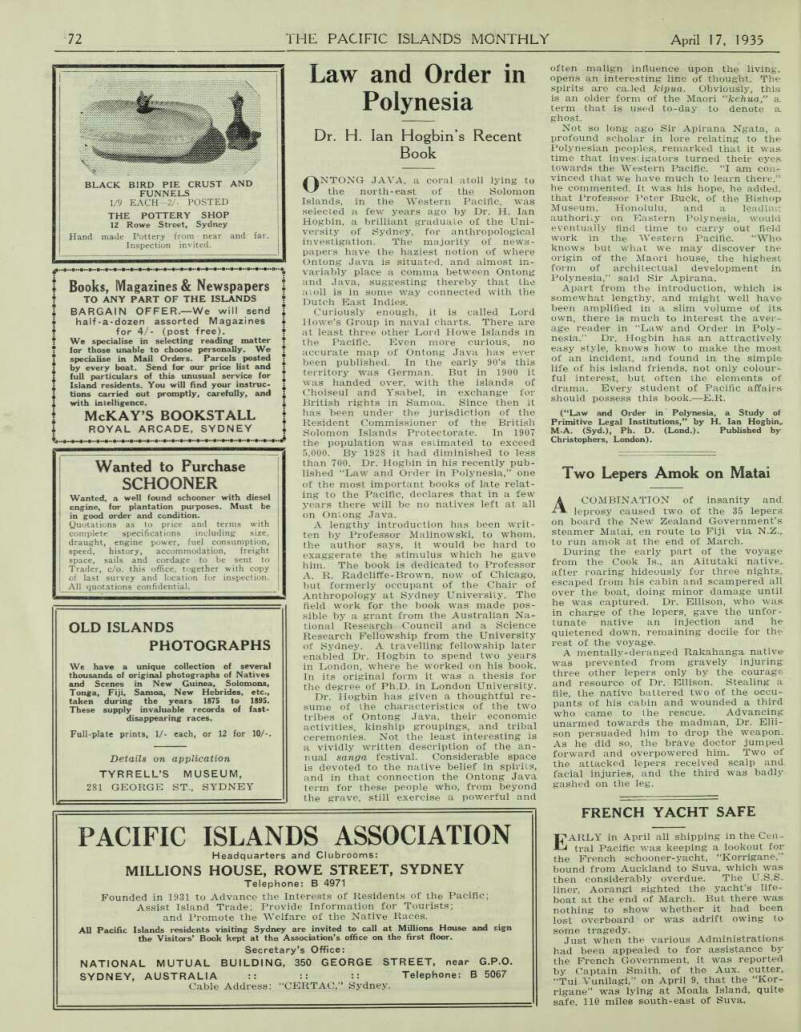
Law and Order in Polynesia Dr. H. Ian Hogbin’s Recent Book
ONTONG JAVA, a coral atoll lying to the north-east of the Solomon Islands, in the Western Pacific, was selected a few years ago by Dr. H. Ian Hogbin, a brilliant graduate of the Uni versity of Sydney, for anthropological investigation. The majority of news papers have the haziest notion of where Ontong Java is situated, and almost in variably place a comma between Ontong and Java, suggesting thereby that the atoll is in some way connected with the Dutch East Indies.
Curiously enough, it is called Lord Howe’s Group in naval charts. There are at least three other Lord Howe Islands in the Pacific. Even more curious, no accurate map of Ontong Java has ever been published. In the early 90’s this territory was German. But in 1900 it was handed over, with the islands of Choiseul and Ysabel, in exchange for British rights in Samoa. Since then it has been under the jurisdiction of the Resident Commissioner of the British Solomon Islands Protectorate. In 1907 the population was estimated to exceed 5,000. By 1928 it had diminished to less than 700. Dr. Hogbin in his recently pub lished “Law and Order in Polynesia,” one of the most important books of late relat ing to the Pacific, declares that in a few years there will be no natives left at all on Ontong Java.
A lengthy introduction has been writ ten by Professor Malinowski, to whom, the author says, it would be hard to exaggerate the stimulus which he gave him. The book is dedicated to Professor A. R. Radcliffe-Brown, now of Chicago, but formerly occupant of the Chair of Anthropology at Sydney University. The field work for the book was made pos sible by a grant from the Australian Na tional Research Council and a Science Research Fellowship from the University of Sydney. A travelling fellowship later enabled Dr. Hogbin to spend two years in London, where he worked on his book.
In its original form it was a thesis for the degree of Ph.D. in London University.
Dr. Hogbin has given a thoughtful re sume of the characteristics of the two tribes of Ontong Java, their economic activities, kinship groupings, and tribal ceremonies. Not the least interesting is a vividly written description of the an nual sanga festival. Considerable space is devoted to the native belief in spirits, and in that connection the Ontong Java term for these people who, from beyond the grave, still exercise a powerful and
often malign influence upon the living, opens an interesting line of thought. The spirits are caJed kipua. Obviously, this is an older form of the Maori “kehua,” a. term that is used to-day to denote a ghost.
Not so long ago Sir Apirana Ngata, a profound scholar in lore relating to the Polynesian peoples, remarked that it was time that investigators turned their eyes towards the Western Pacific. “I am con vinced that we have much to learn there,” he commented. It was his hope, he added, that Professor Peter Buck, of the Bishop Museum, Honolulu, and a leading authority on Eastern Polynesia, would eventually find time to carry out field work in the Western Pacific. “Who knows but what we may discover the origin of the Maori house, the highest form of architectual development in Polynesia,” said Sir Apirana.
Apart from the introduction, which is somewhat lengthy, and might well have been amplified in a slim volume of its own, there is much to interest the aver age reader in “Law and Order in Poly nesia.” Dr. Hogbin has an attractively easy style, knows how to make the most of an incident, and found in the simple life of his island friends, not only colour ful interest, but often the elements of drama. Every student of Pacific affairs should possess this book. —E.R. (“Law and Order in Polynesia, a Study of Primitive Legal Institutions,” by H. Ian Hogbin, M.A. (Syd.), Ph. D. (Lond.). Published by Christophers, London).
Two Lepers Amok on Matai
A COMBINATION of insanity and leprosy caused two of the 35 lepers on board the New Zealand Government’s steamer Matai, en route to Fiji via N.Z., to run amok at the end of March.
During the early part of the voyage from the Cook Is., an Aitutaki native, after roaring hideously for three nights, escaped from his cabin and scampered all over the boat, doing minor damage until he was captured. Dr. Ellison, who was in charge of the lepers, gave the unfor tunate native an injection and he quietened down, remaining docile for the rest of the voyage.
A mentally-deranged Rakahanga native was prevented from gravely injuring: three other lepers only by the courage and resource of Dr. Ellison. Stealing a file, the native battered two of the occu pants of his cabin and wounded a third who came to the rescue. Advancing unarmed towards the madman, Dr. Elli son persuaded him to drop the weapon.
As he did so, the brave doctor jumped forward and overpowered him. Two of the attacked lepers received scalp and facial injuries, and the third was badly gashed on the leg.
French Yacht Safe
EARLY in April all shipping in the Cen tral Pacific was keeping a lookout for the French schooner-yacht, “Korrigane,” bound from Auckland to Suva, which was then considerably overdue. The U.S.S. liner, Aorangi sighted the yacht’s life boat at the end of March. But there was nothing to show whether it had been lost overboard or was adrift owing to some tragedy.
Just when the various Administrations had been appealed to for assistance by the French Government, it was reported by Captain Smith, of the Aux. cutter.
“Tui Vunilagi,” on April 9, that the “Kor rigane” was lying at Moala Island, quite safe, 110 miles south-east of Suva.
Clarket Quotations
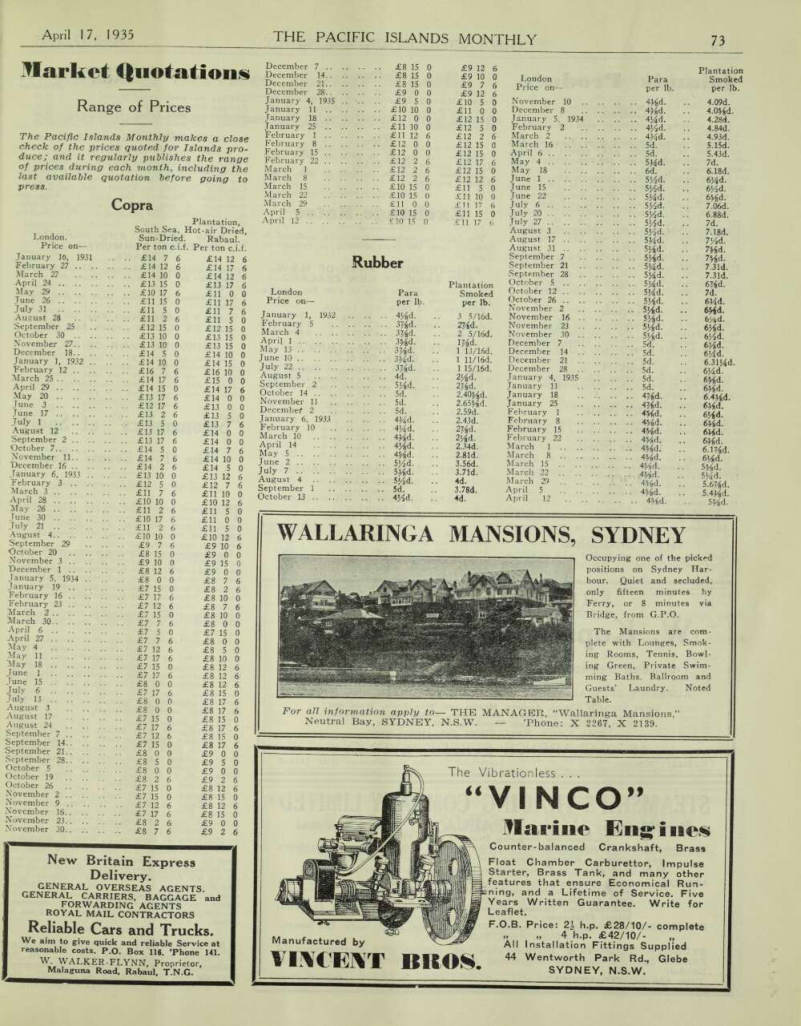
Range of Prices
The Pacific Islands Monthly makes a close check of the prices quoted for Islands pro duce; and it regularly publishes the range of prices during each month, including the last available quotation before going to press.
December 7 . .. £8 15 0 £9 12 6 December 14 . .. £8 15 0 £9 10 0 December 21 . .. £8 15 0 £9 7 6 December 28 . .. £9 0 0 £9 12 6 January 4, 1935 .. . . .. £9 5 0 £10 5 0 January 11 . .. £10 10 0 £11 0 0 January 18 . .. £12 0 0 £12 15 0 January 25 . .. £11 10 0 £12 5 0 February 1 . .. £11 12 6 £12 2 6
February 8
. .. £12 0 0 £12 15 0 February 15 . .. £12 0 0 £12 15 0
February 22
. .. £12 2 6 £12 17 6 March 1 . .. £12 2 6 £12 15 0 March 8 . .. £12 2 6 £12 12 6 March 15 , .. £10 15 0 £11 5 0 March 22 . .. £10 15 0 £11 10 0 March 29 .. £11 0 0 £11 17 6 April 5 .. £10 15 0 £11 15 0 April 12 £10 15 0 £11 17 6
Plantation Smoked per lb.
London Price on— Para per lb.
November 10 .. .. aha. 4.09d.
December 8 .. .. aha. 4.0^d.
January 5, 1934
.. .. Aha.
4.28d.
February 2 .. .. A%A. .. 4.84d.
March 2 .. .. AHd. 4.93d.
March 16 .. .. 5d.
S.lSd.
April 6 5.43d.
May 4 .. .. 5HA. .. 7d.
May 18 .. .. 6d. 6.18d.
June 1 6'AA.
June 15 .. .. 5/ 2 d. .. 6'AA.
June 22 .. .. 5'AA. .. 6HA.
July 6 .. .. 5'AA. .. 7.06A.
July 20 .. .. 5'AA. 6.88d.
July 27 .. .. 5'AA. .. 7d.
August 3 ■ ■ .. 5'AA. 7.18d.
August 17 .. .. 5HA. .. 7 'Ad.
August 31 .. .. 5%A. 7HA.
September 7 .. .. 5'AA. .. 7HA.
September 21 .. .. 5'AA. .. 7.31A.
September 28 .. .. 5>4d. 7.31d.
October S .. .. 5'AA. .. 6%A.
October 12 .. .. 5'AA. 7A.
October 26 .. .. 5'AA. .. 6 HA.
November 2 .. .. 5'Ad. .. 6 HA.
November 16 .. .. 5'AA. .. 6y 4 d.
November 23 .. .. 5'AA. .. 6'AA.
November 30 .. .. .. 6'AA.
December 7 .. .. Sd. 6HA.
December 14 .. .. 5d 6'AA. 6.31'AA.
December 21 December 28 6'AA.
January 4, 1935 .. .. Sd. 6HA. 6HA. 6.AHd.
January 11 . 5d January 18 • •• 47^d.
January 25 6HA.
February 1
• Aha.
6'AA.
February 8 • •• 4^d. 6HA.
February 15 6HA.
February 22 6HA.
March 1 ■ .. 4^d. 6.V4A.
March 8 March 15 March 22 6'AA. 5HA.
Ct A A
March 29 5.6^d.
April 5 • .. ;;
5.Aha.
5HA.
April 12
London. Price on—
Copra
Plantation, Hot-air Dried, Rabaul. Per ton c.i.f.
South Sea, Sun-Dried. Per ton c.i.f.
January 16, 1931 February 27 .. .. £14 7 6 £14 12 6 £14 17 6 March 27 .. .. £14 10 0 £14 12 6 April 24 £13 17 6 May 29 £11 0 0 Tune 26 £11 17 6 July 31 £11 7 6 Ausrust 28 .. .. £11 2 6 £11 5 0 September 25 • • .. £12 15 0 £12 15 0 October 30 .. .. £13 10 0 £13 15 0 November 27 .. .. £13 10 0 £13 15 0 December 18 .. .. £14 5 0 £14 10 0 January 1, 1932 .. .. £14 10 0 £14 15 0 February 12 .. .. £16 7 6 £16 10 0 March 25 .. .. £14 17 6 £15 0 0 April 29 .. .. £14 15 0 £14 17 6 May 20 £14 0 0 June 3 .. .. £12 17 6 £13 0 0
June 17
£13 5 0 July 1 £13 7 6 August 12 .. .. £13 17 6 £14 0 0 September 2 .. .. £13 17 6 £14 0 0 October 7 £14 7 6 November 11 .. .. £14 7 6 £14 10 0 December 16 .. .. £14 2 6 £14 5 0 January 6, 1933 .. .. £13 10 0 £13 12 6 February 3 £12 7 6 March 3 .. .. £11 7 6 £11 10 0 April 28 .. .. £10 10 0 £10 12 6 May 26 .. .. £11 2 6 £11 5 0 June 30 £11 0 0
July 21
£11 5 0 August 4 £10 12 6 September 29 • • £9 7 6 £9 10 6 October 20 £9 0 0 November 3 £9 15 0 December 1 £9 0 0 January 5, 1934 £8 7 6 January 19 £8 2 6
February 16
£8 10 0 February 23 £8 7 6 March 2 £7 15 0 £8 10 0 March 30 £7 7 6 £8 0 0 April 6 £7 15 0 April 27 £8 0 0 May 4 £8 5 0 May 11 £8 10 0 May 18 £8 12 6 June 1 £8 12 6 June 15 £8 0 0 £8 12 6 July 6 £7 17 6 £8 15 0
July 13
£8 17 6 August 3 £8 0 0 £8 17 6 August 17 £7 15 0 £8 15 0 August 24 £8 17 6
September 7
£8 15 0 September 14 £8 17 6 September 21 £8 0 0 £9 0 0
September 28
£9 5 0 October 5 £8 0 0 £9 0 0 October 19 £8 2 6 £9 2 6 October 26 £7 15 0 £8 12 6 November 2 £7 15 0 £8 15 0 November 9 £7 12 6 £8 12 6 November 16 £7 17 6 £8 15 0 November 23 £8 2 6 £9 0 0 November 30 £9 2 6
London Price on—
Rubber
Para per lb.
Plantation Smoked per lb.
January 1, 1932 4j*d. 3 5/l6d.
February 5 3Hd. 2Hd.
March 4 Slid. 2 5/16d.
April 1 3^d. md.
May 13 W. 1 13/16d.
June 10 3Hd. 1 ll/16d.
July 22 37/ a d. 1 15/16d.
August 5 2j/£d.
September 2 5 z Ad. 2tid.
October 14 5d. 2.40^d.
November 11 5d. 2.65JR Decembef 2 5d, 2.59d.
January 6, 1933 4J4d. 2.43d.
February 10 4^d. 2j/ a d.
March 10 4*id. 2^d.
April 14 4'Ad. 2.34d.
May 5 4Hd. 2.81d.
June 2 5'Ad. 3.S6d.
July 7 3.71d.
August 4 4d.
September 1 5d. 3.78d.
October 13 4J^d. 4d.
Advertisements & other items, p. 79 (1 item)
Marine Engines
WALLARINGA MANSIONS, SYDNEY
Occupying one of the picked positions on Sydney Harbour. Quiet and secluded, only fifteen minutes by Ferry, or 8 minutes via Bridge, from G.P.O.
The Mansions are complete with Lounges, Smoking Rooms, Tennis, Bowling Green, Private Swimming Baths. Ballroom and Guests’ Laundry. Noted Table.
For all information apply to— THE MANAGER. “Wallaringa Mansions,”
Neutral Bay, SYDNEY. N.S.W. ’Phone: X 2267, X 2139.
The Vibrationless
Manufactured by
VINCENT BROS.
"VINCO"
Marine Engines
Counter-balanced Crankshaft, Brass Float Chamber Carburettor, Impulse Starter, Brass Tank, and many other features that ensure Economical Running, and a Lifetime of Service. Five Years Written Guarantee. Write for Leaflet.
F.O.B. Price: h.p. £28/10/- complete „ „ 4 h.p. £42/10/- All Installation Fittings Supplied 44 Wentworth Park Rd., Glebe
SYDNEY, N.S.W.
New Britain Express
Delivery.
GENERAL OVERSEAS AGENTS.
GENERAL CARRIERS, BAGGAGE and
FORWARDING AGENTS
ROYAL MAIL CONTRACTORS
Reliable Cars and Trucks.
We aim to give quick and reliable Service at reasonable costs. P.O. Box 116. ’Phone 141.
W. WALKER-FLYNN, Proprietor, Malaguna Road. Rabaul. T.N.G.
Islands Produce
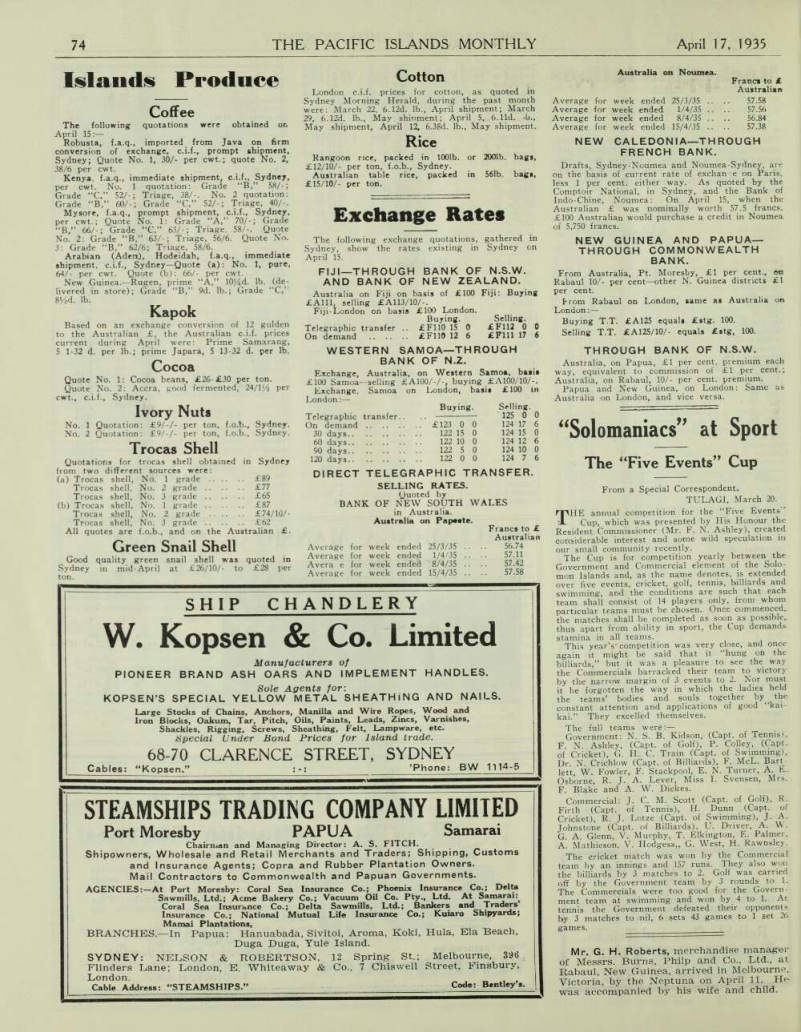
Coffee
The following quotations were obtained or.
April 15:— Robusta, f.a.q., imported from Java on firm conversion of exchange, c.i.f., prompt shipment, Sydney; Quote No. 1, 30/- per cwt.; quote No. 2, 38/6 per cwt.
Kenya, f.a.q., immediate shipment, c.i.f., Sydney, per cwt. No. 1 quotation: Grade “B,” 58/-; Grade “C,” 52/-; Triage, 38/-. No. 2 quotation: Grade “B,” 60/-; Grade “C,” 52/-; Triage, 40/-.
Mysore, f.a.q., prompt shipment, c.i.f., Sydney, per cwt.; Quote No. 1: Grade “A,” 70/-; Grade “B,” 66/-; Grade “C.” 63/-; Triage, 58/-. Quote No. 2: Grade “B,” 63/-; Triage, 56/6. Quote No, 3: Grade “B,” 62/6; Triage, 58/6.
Arabian (Aden), Hodeidah, f.a.q., immediate shipment, c.i.f., Sydney—Quote (a): No. 1, pure, 64/- per cwt. Quote (b): 66/- per cwff.
New Guinea. —Rugen, prime “A,” 10%d. lb. (de livered in store); Grade “B,” 9d. lb.; Grade “C,’ 8½d. lb.
Kapok
Based on an exchange conversion of 12 gulden to the Australian £, the Australian c.i.f. prices current during April were: Prime Samarang, 5 1-32 d. per lb.; prime Japara, 5 13-32 d. per lb.
Cocoa
Quote No. 1: Cocoa beans, £26- £30 per ton.
Quote No. 2: Accra, good fermented, per cwt., c.i.f., Sydney.
Ivory Nuts
No. 1 Quotation: £9/-/- per ton, f.o.b., Sydney.
No. 2 Quotation: £9/-/- per ton, f.o.b., Sydney.
Trocas Shell
Quotations for trocas shell obtained in Sydney from two different sources were; (a) Trocas shell, No. 1 grade £89 Trocas shell, No. 2 grade £77 Trocas shell, No. 3 grade £65 (b) Trocas shell, No. 1 grade £87 Trocas shell, No. 2 grade £74/10/- Trocas shell. No. 3 grade £62 All quotes are f.o.b., and on the Australian £.
Green Snail Shell
Good quality green snail shell was quoted in Sydney in mid-April at £26/10/- to £28 per ton.
Cotton
London c.i.f. prices for cotton, as quoted in Sydney Morning Herald, during the past month were: March 22, 6.12 d. lb., April shipment; March 29, 6.12 d. lb., May shipment; April 5, 6.11d. lb., May shipment, April 12, 6.38 d. lb., May shipment.
Rice
Rangoon rice, packed in 100lb. or 200lb. bags, £12/10/- per ton, f.o.b., Sydney.
Australian table rice, packed in 56lb. bags, £15/10/- per ton.
Exchange Rates
The following exchange quotations, gathered in Sydney, show the rates existing in Sydney on April 15.
Fiji—Through Bank Of N.S.W.
And Bank Of New Zealand.
Australia on Fiji on basis of £100 Fiji: Buying £A111, selling £A113/10/-.
Fiji-London on basis £100 London.
Buying. Selling.
Telegraphic transfer .. £F110 15 0 £F112 0 0 On demand £F110 12 6 £F111 17 6
Western Samoa—Through
Bank Of N. 2.
Exchange, Australia, on Western Samoa, basis £100 Samoa—selling £A100/-/-, buying £A100/10/-.
Exchange, Samoa on London, basis £100 in London :
Direct Telegraphic Transfer.
Selling Rates.
Quoted by
Bank Of New South Wales
in Australia.
Australia on Papaate.
Australia on Noumea.
New Caledonia—Through
French Bank.
Drafts, Sydney-Noumea and Noumea-Sydney, are on the basis of current rate of exchan e on Paris, less 1 per cent, either way. As quoted by the Comptoir National, in Sydney, and the Bank of Indo-Chine, Noumea: On April 15, when the Australian £ was nominally worth 57.5 francs, £100 Australian would purchase a credit in Noumea of 5,750 francs.
New Guinea And Papua
Through Commonwealth
Bank.
From Australia, Pt. Moresby, £1 per cent., on Rabaul 10/- per cent —other N. Guinea districts £1 per cent. hrom Rabaul on London, same as Australia on London; — Buying T.T. £A125 equals £stg. 100.
Selling T.T. £A125/10/- equals £stg, 100.
Through Bank Of N.S.W.
Australia, on Papua, £1 per cent, premium each way, equivalent to commission of £1 per cent.; Australia, on Rabaul, 10/- per cent, premium.
Papua and New Guinea, on London: Same as Australia on London, and vice versa.
Buying. Selling.
Telegraphic transfer.. .. 125 0 0 On demand £123 0 0 124 17 6 30 days 122 IS 0 124 15 0 60 days 122 10 0 124 12 6 90 days 122 5 0 124 10 0 120 days 122 0 0 124 7 6
Average for week ended 25/3/35 .. 56.74 Francs to £ Australian Average for week ended 1/4/35 .. 57.11 Average for week ended 8/4/35 .. 57.42 Average for week ended 15/4/35 .. 57.58
Average for week ended 25/3/35 .. 57.58 Francs to £ Australian Average for week ended 1/4/35 .. 57.56 Average for week ended 8/4/35 .. 56.84 Average for week ended 15/4/35 .. 57.38
“Solomaniacs” at Sport
The “Five Events” Cup
From a Special Correspondent.
TULAGI, March 20.
THE annual competition for the “Five Events"
Cup, which was presented by His Honour the Resident Commissioner (Mr. F. N. Ashley), created considerable interest and some wild speculation m our small community recently.
The Cup is for competition yearly between the Government and Commercial element of the Solo mon Islands and, as the name denotes, is extended over five events, cricket, golf, tennis, billiards and swimming, and the conditions are such that each team shall consist of 14 players only, from whom particular teams must be chosen. Once commenced, the matches shall be completed as soon as possible, thus apart from ability in sport, the Cup demands, stamina in all teams.
This year’s' competition was very close, and once again it might be said that it “hung on the billiards,” but it was a pleasure to see the way the Commercials barracked their team to victory by the narrow margin of 3 events to 2. Nor must it be forgotten the way in which the ladies held the teams’ bodies and souls together the constant attention and applications of good “kai kai.” They excelled themselves.
The full teams were;— Government: N. S. B. Kidson, (Capt. of Tennis), F N. Ashley, (Capt. of Golf), P. Colley, (Capt. of Cricket), G. H. C. Train (Capt. of Swimming), Dr. N. Crichlow (Capt. of Billiards), F. McL. Bart lett, W. Fowler, F. Stackpool, E. N. Turner, A. E.
Osborne, R. J. A. Lever, Miss I. Svensen, Mrs.
F. Blake and A. W. Dickes.
Commercial: J. C. M. Scott (Capt. of Golf), R.
Firth (Capt. of Tennis), H. Dunn (Capt. ot Cricket), R. J. Lotze (Capt. of Swimming), J. A.
Johnstone (Capt. of Billiards), U. Driver, A. W .
G. A. Glenn, V. Murphy, T. Elkington, E. Palmer, A. Mathieson, V. Hodgess,, G. West, H. Rawnsley.
The cricket match was won by the Commercial team by an innings and 157 runs. They also won the billiards by 3 matches to 2. Golf was carried off by the Government team by 3 rounds to 1, The Commercials were too good for the Govern ment team at swimming and won by 4 to 1. At tennis the Government defeated their opponents by 3 matches to nil, 6 sets 43 games to 1 set 26 games.
Mr. G. H. Roberts, merchandise manager of Messrs. Burns, Philp and Co., Ltd., at Rabaul, New Guinea, arrived in Melbourne,.
Victoria, by the Neptuna on April 11. He was accompanied by his wife and child.
Advertisements & other items, p. 80 (1 item)
W. Kopsen & Co. Limited
SHIP CHANDLERY
Manufacturers of PIONEER BRAND ASH OARS AND IMPLEMENT HANDLES.
Sole Agents for : KOPSEN’S SPECIAL YELLOW METAL SHEATHING AND NAILS.
Large Stocks of Chains, Anchors, Manilla and Wire Ropes, Wood and Iron Blocks, Oakum, Tar, Pitch, Oils, Paints, Leads, Zincs, Varnishes, Shackles, Rigging, Screws, Sheathing, Felt, Lampware, etc.
Special Under Bond Prices for Island trade.
68-70 CLARENCE STREET, SYDNEY
Cables: “Kopsen.” ’Phone: BW 1114-5
STEAMSHIPS TRADING COMPANY LIMITED
Port Moresby PAPUA Samarai
Chairman and Managing Director: A. S. FITCH.
Shipowners, Wholesale and Retail Merchants and Traders; Shipping, Customs and Insurance Agents; Copra and Rubber Plantation Owners.
Mail Contractors to Commonwealth and Papuan Governments.
AGENCIES:—At Port Moresby: Coral Sea Insurance Co.; Phoenix Insurance Co,; Delta Sawmills, Ltd.; Acme Bakery Co.; Vacuum Oil Co. Pty., Ltd. At Coral Sea Insurance Co.; Delta Sawmills, Ltd.; Bankers and Traders Insurance Co.; National Mutual Life Insurance Co.; Kuiaro Shipyards; Mamai Plantations, BRANCHES.—In Papua: Hanuabada, Sivitoi, Aroma, Koki, Hula, Ela Beach, Duga Duga, Tule Island, SYDNEY: NELSON & ROBERTSON, 12 Spring St.; Melbourne, 396 Flinders Lane; London, E. Whiteaway & Co.. 7 Chiswell Street, Finsbury, London.
Cable Address: “STEAMSHIPS.” Code; Bentleys.
|june 25
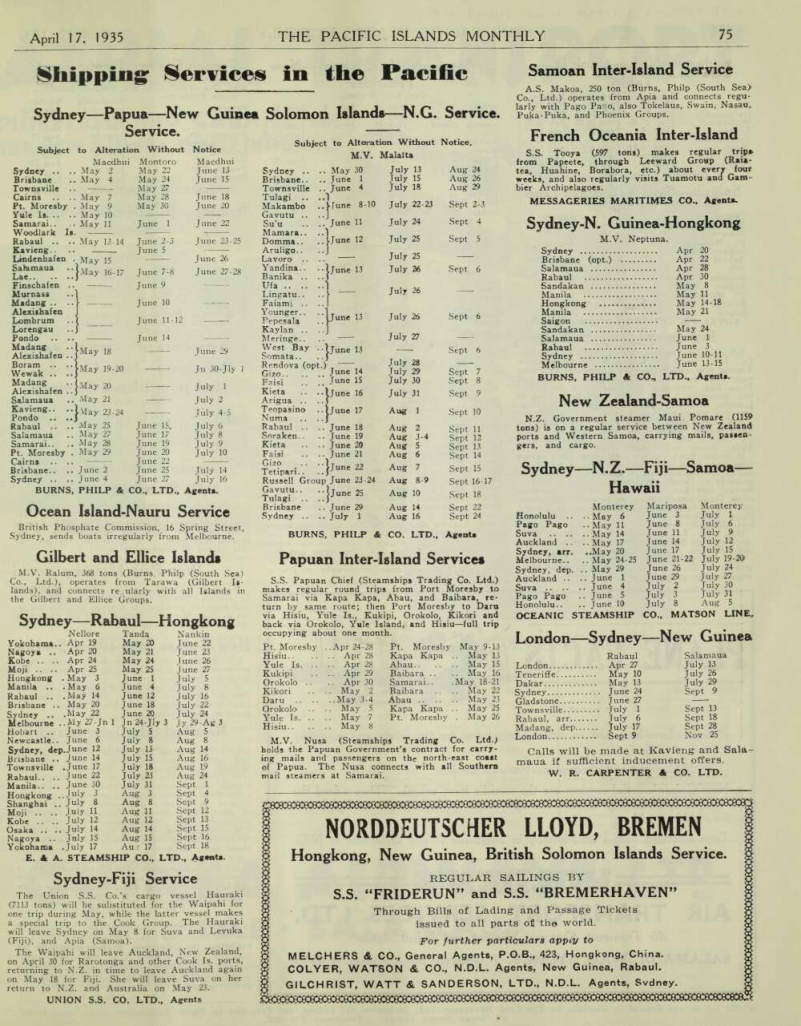
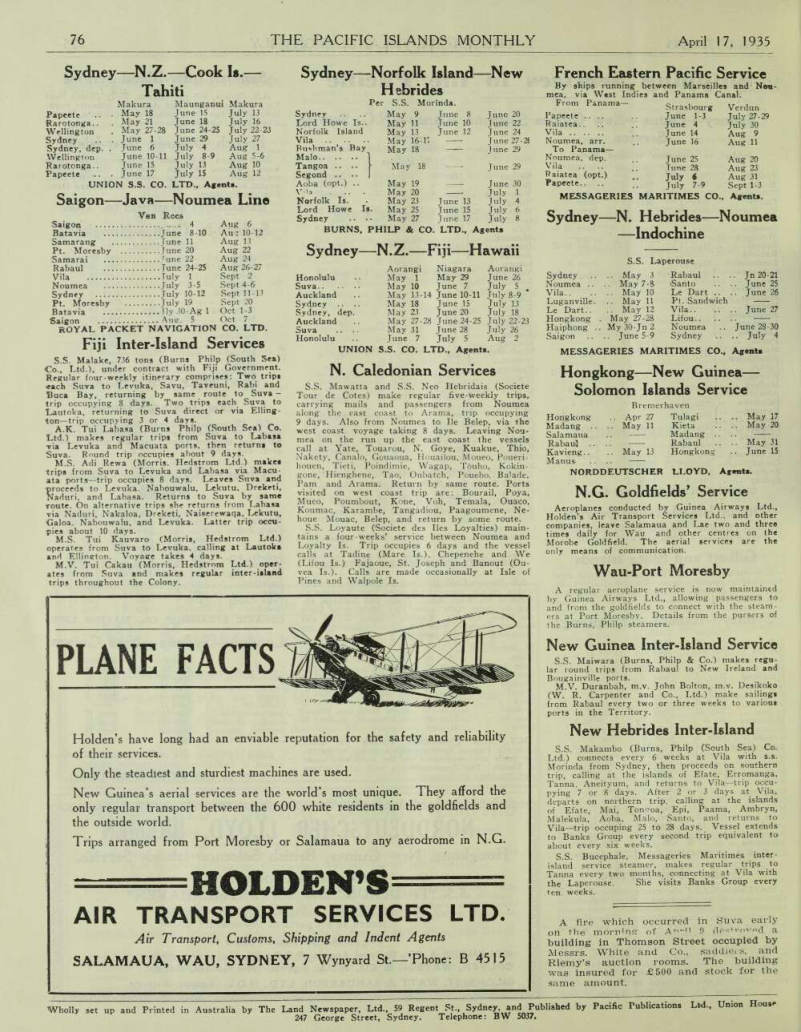
Shipping Services in the Pacific
Sydney—Papua —New Guinea Service.
Ocean Island-Nauru Service
British Phosphate Commission, 16 Spring Street, Sydney, sends boats irregularly from Melbourne.
Gilbert and Ellice Islands
M.V. Ralum, 368 tons (Burns, Philp (South Sea) Co., Ltd.), operates from Tarawa (Gilbert Is lands), and connects re ularly with all Islands in the Gilbert and Ellice Groups.
Sydney—Rabaul—Hongkong
Sydney-Fiji Service
The Union S.S. Co.’s cargo vessel Hauraki (7113 tons) will be substituted for the Waipahi for one trip during May, while the latter vessel makes a special trip to the Cook Group. The Hauraki will leave Sydney on May 8 for Suva and Levuka (Fiji), and Apia (Samoa).
The Waipahi will leave Auckland, New Zealand, on April 30 for Rarotonga and other Cook Is. ports, returning to N.Z. in time to leave Auckland again on May 18 for Fiji. She will leave Suva on her return to N.Z. and Australia on May 23.
Union S.S. Co. Ltd., Agents
Solomon Islands—N.G. Service.
Papuan Inter-Island Services
S.S. Papuan Chief (Steamships Trading Co. Ltd.) makes regular round trips from Port Moresby to Samarai via Kapa Kapa, Abau, and Baibara, re turn by same route; then Port Moresby to Daru via Hisiu, Yule Is., Kukipi, Orokolo, Kikori and back via Orokolo, Yule Island, and Hisiu —full trip occupying about one month.
M.V. Nusa (Steamships Trading Co. Ltd.) holds the Papuan Government’s contract for carry ing mails and passengers on the north-east coast of Papua. The Nusa connects with all Southern mail steamers at Samarai.
Samoan Inter-Island Service
A.S. Makoa, 250 ton (Burns, Philp (South Sea> Co., Ltd.) operates from Apia and connects regu larly with Pago also Tokelaus, Swain, Puka-Puka, and Phoenix Groups.
French Oceania Inter-Island
S.S. Tooya (597 tons) makes regular trips from Papeete, through Leeward Group (Rata tea, Huahine, Borabora, etc.) about every four weeks, and also regularly visits Tuamotu and Gam bier Archipelagoes.
Messageries Maritimes Co., Agents.
Sydney-N. Guinea-Hongkong
New Zealand-Samoa
N.Z. Government steamer Maui Pomare (1159 tons) is on a regular service between New Zealand ports and Western Samoa, carrying mails, passen gers, and cargo.
Sydney—N.Z.—Fiji—Samoa—
Hawaii
London —Sydney—New Guinea
Subject to Alteration Without Notice Macdhui Montoro Macdhui Sydney May 2 May 22 June 13 Brisbane May 4 May 24 June 15 Townsville May 27 — Cairns May 7 May 28 June 18 Pt. Moresby May 9 May 30 June 20 Yule Is May 10 Samarai May 11 June 1 June 22 Woodlark Is.
Rabaul May 13-14 June 2-3 June 5 June 23-25 Kavieng Lindenhafen May 15 June 26 Sahmaua Lae May 16-17 June 7-8 June 27-28 Finschafen June 9 Murnass Madang June 10 Alexishafen Lombrum June 11-12 Lorengau Pondo June 14 Madang Alexishafen May 18 June 29 Boram Wewak May 19-20 Jn 30-Jly 1 Madang Alexishafen May 20 July 1 Salamaua May 21 July 2 Kavieng Pondo
May 23-24
July 4-5 Rabaul May 25 June 15 July 6 Salamaua May 27 June 17 July 8 Samarai May 28 June 19 July 9 Pt. Moresby May 29 June 20 July 10 Cairns June 22 Brisbane June 2 June 25 July 14 Sydney June 4 June 27 July 16
Burns, Philp & Co., Ltd., Agents.
Pt. Moresby Apr 24-28 Pt. Moresby May 9-13 Hisiu Apr 28 Kapa Kapa .. May 13 Yule Is.
Apr 28 Abau Kukipi .. Apr 29 Barbara May 16 Orokolo .. Apr 30 Samarai May 18-21 Kikori May 2 Baibara .. May 22 Daru . .May 3-4 Abau .. May 23 Orokolo .. May 5 Kapa Kapa .. May 25 Yule Is. .. May 7 Pt. Moresby May 26 Hisiu.. .. May 8
Subject to Alteration Without Notice.
M.V. Malaita Sydney ..
May 30 July 13 Aug 24 Brisbane June 1 July IS Aug 26 Townsville June 4 July 18 Aug 29 Tulagi July 22-23 Sept 2-3 Makarabo June 8-10 Gavutu Sept 4 Su’u June 11 July 24 Mamara July 25 Sept 5 Domma June 12 Aruligo Lavoro July 25 Yandina June 13 July 26 Sept 6 Banika Ufa July 26 Lingatu Faiami Younger Pepesala June 13 July 26 Sept 6 Kaylan July 27 Meringe West Bay Somata 13 Sept 6 Rendova (opt.) July 28 Gizo June 14 July 29 Sept 7 Faisi June 15 July 30 Sept 8 Kieta June 16 July 31 Sept 9 Arigua Teopasino Numa June 17 Aug 1 Sept 10 Rabaul June 18 Aug 2 Sept 11 Soraken June 19 Aug 3-4 Sept 12 Kieta June 20 Aug 5 Sept 13 Faisi Gizo Tetipari June 21 22 Aug 6 Aug 7 Sept 14 Sept 15 Russell Group June 23-24 Aug 8 9 Sept 16-17 Gavutu Tulagi
|june 25
Aug 10 Sept 18 Brisbane June 29 Aug 14 Sept 22 Sydney July 1 Aug 16 Sept 24
Burns, Philp & Co. Ltd., Agents
M.V. Neptuna.
Sydney Brisbane (opt.) Apr 22 Salamaua Rabaul Sandakan Manila Hongkong Manila Saigon Sandakan May 24 Salamaua Rabaul Sydney June 10-11 Melbourne
Burns, Philp & Co., Ltd., Agents.
Monterey Mariposa Monterey Honolulu May 6 June 3 July 1 Pago Pago May 11 June 8 July 6 Suva ..May 14 June 11 July 9 Auckland ..May 17 June 14 July 12 Sydney, arr, May 20 June 17 July 15 Melbourne ..May 24-25 June 21-22 July 19-20 Sydney, dep . .. May 29 June 26 July 24 Auckland .. June 1 June 29 July 27 Suva July 2 July 30 Pago Pago .. June 5 July 3 July 31 Honolulu .. June 10 July 8 Aug 5
Oceanic Steamship Co., Matson Line,
Rabaul Salamaua London ... Apr 27 July 13 Teneriffe July 26 Dakar ... May 13 July 29 Sydney Sept 9 Gladstone Tune 27 Townsville July 1 Sept 13 Rabaul, arr.
Sept 18 Madang, dep. ... July 17 Sept 28 London Nov 25 Calls will be made at Kavieng and Salamaua if sufficient inducement offers.
W. R. Carpenter & Co. Ltd.
Nellore Tanda Nankin Yokohama Apr 19 May 20 June 22 Nagoya Apr 20 May 21 June 23 Kobe Apr 24 May 24 June 26 Moji Apr 25 May 25 June 27 Hongkong May 3 June 1 July 5 Manila .May 6 June 4 July 8 Rabaul .May 14 June 12 July 16 Brisbane May 20 June 18 July 22 Sydney .May 22 June 20 July 24 Melbourne .My 27 Jn 1 Jn 24-Jly 3 Jy 29-Ag 3 Hobart June 3 July 5 Aug 5 Newcastle June 6 July 8 Aug 8 Sydney. dep. June 12 July 13 Aug 14 Brisbane June 14 July IS Aug 16 Townsville June 17 July 18 Aug 19 Rabaul June 22 July 23 Aug 24 Manila June 30 July 31 Sept 1 Hongkong July 3 Aug 3 Sept 4 Shanghai July 8 Aug 8 Sept 9 Moji July 11 Aug 11 Sept 12 Kobe July 12 Aug 12 Sept 13 Osaka July 14 Aug 14 Sept 15 Nagoya July 15 Aug IS Sept 16 Yokohama July 17 Aur 17 Sept 18 E. & A. STEAMSHIP CO., LTD., Agents.
Sydney—N.Z.—Cook Is.— Tahiti
Saigon—Java—Noumea Line
Fiji Inter-Island Services
S.S. Malake, 736 tons (Burns Philp (South Sea) Co., Ltd.), under contract with Fiji Government.
Regular four-weekly itinerary comprises: Two trips each Suva to Levuka, Savu, Taveuni, Rabi and Buca Bay, returning by same route to Suva trip occupying 8 days. Two trips each Suva to Lautoka, returning to Suva direct or via Elling ton—trip occupying 3 or 4 days.
A.K. Tui Labasa (Burns Philp (South Sea) Co.
Ltd.) makes regular trips from Suva to Labasa via Levuka and Macuata ports, then returns to Suva. Round trip occupies about 9 days.
M.S. Adi Rewa (Morris. Hedstrom Ltd.) makes trips from Suva to Levuka and Labasa via Macu ata ports—trip occupies 8 days. Leaves Suva and proceeds to Levuka. Nabouwalu, Lekutu, Dreketi, Naduri, and Labasa. Returns to Suva by same route. On alternative trips she returns from Labasa via Naduri, Nakaloa, Dreketi, Naiserewaqa, Lekutu, Galoa, Nabouwalu, and Levuka. Latter trip occu pies about 10 days.
M.S. Tui Kauvaro (Morris, Hedstrom Ltd.) operates from Suva to Levuka. calling at Lautoka and Ellington. Voyage takes 4 days.
M.V. Tui Cakau (Morris, Hedstrom Ltd.) oper ates from Suva and makes regular inter-island trips throughout the Colony.
Sydney—Norfolk Island—New Hebrides
Sydney—N.Z.—Fiji—Hawaii
Union S.S. Co. Ltd., Agents.
N. Caledonian Services
S.S. Mawatta and S.S. Neo Hebridais (Societe Tour de Cotes) make regular five-weekly trips, carrying mails and passengers from Noumea along the east coast to Arama, trip occupying 9 days. Also from Noumea to lie Belep, via the west coast voyage taking 8 days. Leaving Nou mea on the run up the east coast the vessels call at Yate, Touarou, N. Goye, Kuakue, Thio, Nakety, Canalo, Gouaoua, Houailou, Moueo, Poueri houen, Tieti, Poindimie, Wagap, Touho, Kokin gone, Hienghene, Tao, Oubatch, Pouebo, Pam and Arama. Return by same route. Ports visited on west coast trip are: Bourail, Poya, Mueo, Poumbout, Kone, Voh, Temala, Ouaco, Koumac, Karambe, Tangadiou, Paagoumene, Ne houe Mouac, Belep, and return by some route.
S.S. Loyaute (Societe des lies Loyalties) maintains a four-weeks’ service between Noumea and Loyalty Is. Trip occupies 6 days and the vessel calls at Tadine (Mare Is.), Chepenehe and We (Lifou Is.) Fajaoue, St. Joseph and Banout (Ou vea Is.). Calls are made occasionally at Isle of Pines and Walpole Is.
French Eastern Pacific Service
By ships running between Marseilles and Nou mea, via West Indies and Panama Canal.
Sydney—N. Hebrides—Noumea —Indochine
Hongkong—New Guinea— Solomon Islands Service
Norddeutscher Lloyd, Agents.
N.G. Goldfields’ Service
Aeroplanes conducted by Guinea Airways Ltd., Holden’s Air Transport Services Ltd., and other companies, leave Salamaua and Lae two and three times daily for Wau and other centres on the Morobe Goldfield. The aerial services are the only means of communication.
Wau-Port Moresby
A regular aeroplane service is now maintained by Guinea Airways Ltd., allowing passengers to and from the goldfields to connect with the steam ers at Port Moresby. Details from the pursers of the Burns, Philp steamers.
New Guinea Inter-Island Service
S.S. Maiwara (Burns, Philp & Co.) makes regular round trips from Rabaul to New Ireland and Bougainville ports.
M.V. Duranbah, m.v. John Bolton, m.v. Desikoko (W. R. Carpenter and Co., Ltd.) make sailings from Rabaul every two or three weeks to various ports in the Territory.
New Hebrides Inter-Island
S.S. Makambo (Burns, Philp (South Sea) Co.
Ltd.) connects every 6 weeks at Vila with s.s.
Morinda from Sydney, then proceeds on southern trip, calling at the islands of Efate, Erromanga, Tanna, Aneityum, and returns to Vila —trip occu pying 7 or 8 days. After 2 or 3 days at Vila, departs on northern trip, calling at the islands of Efate, Mai, Ton-roa, Epi, Paama, Ambryn, Malekula, Aoba, Malo, Santo, and returns to Vila—trip occuping 25 to 28 days. Vessel extends to Banks Group every second trip equivalent to about every six weeks.
S.S. Bucephale, Messageries Maritimes inter island service steamer, makes regular trips to Tanna every two months, connecting at Vila with the Laperouse. She visits Banks Group every ten weeks.
A fire which occurred in Suva early on the morning of April 9 destroyed a building in Thomson Street occupied by Messrs. White and Co., saddlers, and Riemy’s auction rooms. The building was insured for £500 and stock for the same amount.
Makura Maunganui Makura Papeete . May 18 June 15 July 13 Rarotonga . May 21 June 18 July 16 Wellington . May 27-28 June 24-25 July 22-23 Sydney . June 1 June 29 July 27 Sydney, dep. . June 6 July 4 Aug 1 Wellington June 10-11 July 8-9 Aug 5-6 Rarotonga June 15 July 13 Aug 10 Papeete . June 17 July IS Aug 12
Union S.S. Co. Ltd., Agents.
Saigon Van Rees 4 Aug 6 Batavia Aut 10-12 Samarang Aug 13 Pt. Moresby Aug 22 Samarai Aug 24 Rabaul Tune 24-25 Aug 26-27 Vila July 1 Sept 2 Noumea July 3-5 Sept 4-6 Sydney July 10-12 Sept 11-13 Pt. Moresby July 19 Sept 20 Batavia Oct 1-3 Saieon Oct 7 ROYAL Packet Navigation CO. LTD.
Per S.S. Morinda.
Sydney May 9 June 8 June 20 Lord Howe Is.
May 11 June 10 June 22 Norfolk Island May 13 June 12 June 24 Vila May 16-1/ June 27-2f Bushman’s Bay May 18 June 29 Malo Tangoa May 18 June 29 Segond Aoba (opt.) May 19 June 30 Vila May 20 July 1 Norfolk Is.
May 23 June 13 July 4 Lord Howe Is.
May 25 June 15 July 6 Sydney May 27 June 17 July 8
Burns, Philp & Co. Ltd., Agents
Aorangi Niagara Aorangi Honolulu . • May 1 May 29 June 26 Suva May 10 June 7 July 5 Auckland .. May 13-14 June 10-11 July 8-9 Sydney .. .. May 18 June IS July 13 Sydney, dep. May 23 June 20 July 18 Auckland .. May 27-28 June 24-25 July 22-23 Suva .. .. May 31 June 28 July 26 Honolulu .. June 7 July 5 Aug 2
From Panama— Strasbourg Verdun Papeete ... June 1-3 July 27-29 Raiatea.. .. .. June 4 July 30 Vila .. June 14 Aug 9 Noumea, arr. .. June 16 Aug 11 To Panama — Noumea, dep. .. June 25 Aug 20 Vila .. .. .. June 28 Aug 23 Raiatea (opt.) .. July 6 Aug 31 Papeete.. .. j uly 7.9 Sept 1-3
Messageries Maritimes Co., Agents.
S.S. Laperouse Sydney May 3 Rabaul .. Jn 20-21 Noumea .. May 7-8 'Santo June 25 Vila..
May 10 Le Dart June 26 Luganville. .. May 11 Pt. Sandwich Le Dart. .. May 12 Vila.. .. June 27 Hongkong May 27-28 Lifou Haiphong My 30-Jn 2 Noumea June 28-30 Saigon .. June 5-9 Sydney July 4
Messageries Maritimes Co., Agents
Bremerhaven Hongkong .. Apr 27 Tulagi .. .. May 17 Madang .. .. May 11 Kieta .. .. May 20 Salamaua .. Madang Rabaul .. .. Rabaul .. .. May 31 Kavieng.. May 13 Hongkong .. June 15 Manus .. ..
Advertisements & other items, pp. 81-84 (2 items)
Norodeut3Cher Lloyd, Bremen
Hongkong, New Guinea, British Solomon Islands Service.
REGULAR SAILINGS BY
S.S. “FRIDERUN” and S.S. “BREMERHAVEN”
Through Bills of Lading and Passage Tickets issued to all parts ofi the world.
For further particulars apply to MELCHERS & CO., General Agents, P.O.B., 423, Hongkong, China.
COLYER, WATSON & CO., N.D.L. Agents, New Guinea, Rabaul.
GILCHRIST, WATT & SANDERSON, LTD., N.D.L. Agents, Svdney.
PLANE FACTS
Holden’s have long had an enviable reputation for the safety and reliability of their services.
Only the steadiest and sturdiest machines are used.
New Guinea’s aerial services are the world’s most unique. They afford the only regular transport between the 600 white residents in the goldfields and the outside world.
Trips arranged from Port Moresby or Salamaua to any aerodrome in N.G.
HOLDEN’S
AIR TRANSPORT SERVICES LTD.
Air Transport , Customs, Shipping and Indent Agents SALAMAUA, WAU, SYDNEY, 7 Wynyard St.—'Phone: B 4515
AERIAL TRANIPORT
PIONEERED AND CARRIES ON
THE NEW GUINEA GOLD INDUSTRY
Centre —One of the Bulolo Dredges under construction in Central New Guinea —three aeroplanes operated by Guinea Airways Ltd. discharging cargo.
Top right—Dairy cattle being loaded into a Guinea Airways plane for transport to the Goldfields.
Lower left —Interior of one of Guinea Airways cargo-carrying aeroplanes.
SAFETY . . . SPEED . . . COMFORT . . . DEPENDABILITY EIGHT years ago, Central New Guinea was almost unexplored, and practically inaccessible.
To-day, although there are no roads through the dense jungles and precipitous mountains, the Morobe Goldfield, in Central New Guinea, is the seat of a flourishing industry. There the half a dozen growing townships, four hugs, modern dredges, two hydro-electric stations, crushing-mills, saw-mills, etc. . . Aerial transport alone made this possible.
Aeroplanes, flying in all weathers on regular timetables, connecting the coastal towns of e, Salamaua and Port Moresby with over thirty inland aerodromes and landing-grounds, have carried in thousands of tons of engineering equipment, a large European population, thousands of native labourers, foodstuffs, live lock, mails ,etc.
Guinea Airways Ltd: launched its unique aerial transport service seven years ago, with one machine and a handful of men. To-day, it operates a fleet of modern aeroplanes, and employs very large European and native staffs.
NEW GUINEA service aeroplanes carry on one of the biggest transport organisations in the world, in one of the world’s most primitive tropical countries; yet no aerial transport system in the world can show a smaller percentage of accidents, or a better record of efficiency
and dependability.
GUINEA AIRWAYS LTD
A visit to Central New Guinea, in one of Guinea Airways speedy and comfortable air-liners, is a unique and delightful experience.
Travellers may leave the steamer at Port Moresby, fly across to Morobe (time of journey, 1 hour 45 minutes) and spend nine days in the Goldfield centres before rejoining steamer at Lae for Rabaul. Or, after visiting Rabaul, they may disembark at Salamaua or Lae, spend several days on the Goldfields, and fly to Port Moresby to rejoin the steamer. All information from Pursers on the steamers.
LAE - SALAMAUA
KB is the finest
of all hot weather drinks
When the air is shimmering with the heal . . . when you're hot and tired, and your throat is parched, what pleasure there is in a long glass of sparkling K.B. —straight off the ice. It sets you up in a moment ... it invigorates and refreshes you as no other drink can with its clean rich flavour of mall and hops. Now and always—on every thirsty occasion—drink Tooth’s K.B. Lager.
TOOTH'S K.B.
IN BOTTLES AND HALF BOTTLES
LAGER
TASTE THE MALT AND HOPS
76
April 17, 1935
THE PACIFIC ISLANDS MONTHLY
Wholly set up and Printed in Australia by The Land Newspaper, Ltd., 59 Regent St., Sydney and Published by Pacific Publications Ltd., Union House 247 George Street, Sydney, Telephone: BW 5037.