Monthly
THE Pacific lslands
THE ONLY JOURNAL CIRCULATING THROUGHOUT THE ISLAND TERRITORIES AND GROUPS
OF THE CENTRAL AND SOUTH PACIFIC . ===
Vol. 2— No. 3.
Registered at G.P.O., Sydney, for transmission by Post as a Newspaper
Sydney: Friday, October 23, 1931.
Subscription: Single Copy, 6d. Per Annum, posted, 6/-. ===
Sweet Potatoes
Tonga Invades N.Z. Market
From Our Own Correspondent
Nukualofa, Sept. 1.
A SMALL parcel of sweet potatoes shipped to New Zealand by the last steamer has brought forth orders from the Dominion.
By this month’s vessel, the Tongan Government has arranged to ship, on behalf of the natives, some 40 tons, in cases. As there has been a prolific crop this year in Tongatabu, the small consignment will undoubtedly be oversubscribed without any apparent diminution of the whole, and certainly without effecting the quantum required by the people towards their own sustenance.
Altogether, it is a pleasing start towards the export of continuous small monthly consignments during the season here, and it may be hoped that growers will also go a little further and consider the possibility of such produce as pumpkins, cucumbers, tomatoes, etc. ===
£4 Per Ton!
On Australian Rice
New Caledonia’S
Retaliation
PRIVATE advices received in Sydney state that a duty of 500 francs (about £4) a ton has been imposed on Australian rice imported into New Caledonia.
Sydney exporters declare the impost to be prohibitive.
Trade between New Caledonia and Australia had been increasing recently and evidently this has stirred the French authorities to action. They are not to be blamed, considering the enormous tariff which Australia has built up against the importation of all French goods.
It is only another example of the effect of Australia’s fiscal asininity.
She put on an absurd tariff, and promptly lost the valuable New Caledonia trade, which was at one time worth half a million per annum to Australia. For a time it looked as if Australia might recover this trade with rice. But now rice goes into the discard, in New Caledonia, along with Australia’s other primary products. ===
Passes
Another 'Pitcairner’
Death of Aunt Naomi Quintal
Picturesque 93 Years
From Our Own Correspondent
Norfolk Island, Oct. 2.
AT half past four on Sunday morning, September 27, there died, in the house of her only surviving son, Captain Fletcher Quintal, old Aunt Naomi Quintal, oldest of the five last Pitcairners—aged 93 picturesque years.
She was the daughter of George Hunn Nobbs, an Irishman and exofficer of the Chilean Navy, who threw in his lot a hundred years ago, with the then recently discovered refugees from the stolen King’s ship, Bounty— which they had sunk off the little lost isle of Pitcairn, marooning themselves with their Tahitian wives, prisoners of the sea for ever.
Nobbs, whose own name was an assumed one, and his birth a romantic mystery, married Sarah Christian, daughter of Fletcher Christian, first lieutenant of the Bounty—who led the mutiny against his overbearing commander, and who paid the price of his rebellion in long years of grief and despair within his island paradise and died and was buried there.
With their family, Mr. and Mrs.
Nobbs (how odd and prosaic that sounds) made the great migration to Norfolk Island in 1856, and Naomi, then a handsome, well-grown girl of 19, never set foot upon another shore.
She married Caleb Quintal, grandson of Ordinary Seaman Quintal, sometime of the Bounty, and had five children, of whom only two —Captain Fletcher Quintal, who fought for Britain both in the Boar War and the Great War, and a daughter, Mrs. Mallett, who lives in Sydney—survive her.
But there is still a sister, “Aunt Alice” Hebblethwaite, now resident in Auckland; and there are many, many relatives and descendants of varying degrees of kinship. In fact it might be said that the whole island community is one big family. For so many easy, dreamy generations they lived apart from all the world that inter-marriage was imposed upon them, and they are related, and related again, beyond hope of disentanglement. === Exports from the British Solomon Islands for 1929-30 were valued at £353,441, as compared with £480,831 for the previous 12 months. ===
Shore Depots Being Abandoned
The Slump In Central
Pacific
From Our Own Correspondent TAHITI, September 20.
The schooner “Tiare Taporo,” one of Messrs. A. B. Donald’s trading fleet, is in port from the Cook Islands.
Captain Viggo Rasmussen, an old timer who has been knocking around the Eastern Pacific for 40 years, reports a deplorable state of affairs in the remoter parts of the Cook Islands.
There, he says, copra is being sold at one farthing a pound, and yields no profit to the buyer at that. The firms who have done business there for generations are in process of closing up their depots and removing their agents, and, if there is to be any trading done at all in the future, which seems doubtful, it is proposed to conduct it from the ship’s trade room, as in the days of Bully Hayes. ===
Suva Sees Many Yachts
From Our Own Correspondent SUVA, October 2.
IT seems to have been an open season for yachts.
The list is headed by the imposing Motor Yacht Alva, commanded by “Willie K,” otherwise Commodore W.
K. Vanderbilt, U.S.N.R. She is reputed to be the largest yacht afloat and has a normal cruising speed of 15 knots, equal to that of the “Aorangi.”
Her owner is also her Master, no sinecure, though he carries a crew of somewhere over 50, as witnessed by the fact that when she was brought alongside the wharf at Suva to take in water, he did the actual bringing alongside himself. Aboard the yacht everything was of the best, but there was an entire absence of ostentation, and the Commodore himself was very pleasant and unaffected.
The little 30-tonner, “Southern Cross,” arrived from Tahiti with three young men from the Old Country, who are making their leisurely way round the world.
Another arrival was the “Viheele,” a yawl with a total complement of 7, also on her way round the world, and the “Arethusa,” a tiny craft, which a man in the Civil Service sailed down from Auckland. ===
Tongan Trade
THE following is a resume of the total value of imports and exports for the past five years (i.e., 1926-1930) as gleaned from the statistics published by the Government of Tonga : ... New ... Other ... Australia. . Zealand. . Countries.
Imports from .. £253,600 . £336,323 .. £354,036 Exports to ... £5,011 ... £8,728 £1,214,815 ===
Rich Metals In The Louisiades
A scene at the new Misima mine, Papua, showing the zinc precipitating boxes. The mine is worked by Misima Gold Mines Ltd., of Sydney. Last month this company reported having 10,979 tons of ore for a gold recovery of 4,704 ounces and 761 ounces of silver.
The company’s leases adjoin those of Mt. Sisa N.L., Misima Island is in the Louisiade Archipelago, to the south-east of the New Guinea mainland. The goldfields in the Archipelago have produced nearly £300,000 worth of gold. ===
Undisciplined Natives
A Growing Menace In New Guinea Planter’s Protest Against Official Mollycoddling of Plantation Labour
PERSONS interested in the future of New Guinea are asking, with increasing frequency, whether the present policy of the Administration, in regard to the treatment of native labourers and of natives generally, is working out in the best interests of all concerned.
The Commonwealth of Australia ever since it accepted from the League of Nations the Mandate for the government of the Territory of New Guinea, has interpreted in the strictest form This unique photograph is part of a group, taken on Christmas Day, 1929, on Koli Plantation, New Ireland, N.G. The white man. Mr. Don Edmonds, was brutally murdered shortly afterwards by the native who was his cook-boy and who was standing behind him when photographed. The crime is referred to in the accompanying article.
the provisions in Articles 2 and 3 of the Mandate, providing for the treatment of natives. The Articles referred to are: ‘“The mandatory shall promote to the utmost the material and moral well-being and social progress of the Inhabitants of the Territory.”
“The mandatory shall see ... that no forced labour is permitted except for essential public works and services, and then only for adequate remuneration.”
In the opinion of many people, the time has arrived when the Administration’s interpretation of those articles, as expressed in the policy it fol-
lows when controlling the relation ship between European employers and native labourers, should be revised. It is held that the Administration’s policy is wrong in conception and application and that, unless it is seriously challenged and altered, the effect upon the future of New Guinea is likely to be very serious.
Protection Of Natives
Apparently, the Commonwealth, in framing its policy of administration, decided to take the utmost precautions against ill-treatment of the natives in the direction of any suggestion of forced labour. This was wise. There is, unfortunately, a class of white man who will go to the limit in forcing manual labour upon native populations, and who, if he is permitted, will impose what is virtually a condition of slavery.
The Commonwealth officials, in planning the government of New Guinea, quite rightly decided to remain deaf to blandishments and blind to bribes —both of which might be readily forthcoming—in preventing any improper exploitation of native labour.
But, after ten years of Australian administration in New Guinea, the question must be seriously asked whether the officials have not misconstrued their own policy and unfairly expanded their authority, so that, in avoiding one possible evil, they have created others of an even more serious character.
Mollyycoddling Labourers
Again and again, since this journal was established, 18 months ago, we have been asked to give publicity to the difficulties which have been created owing to the interference of Administration officials in the relationship between planters and their native labour. We have hesitated to publish the statements supplied to us, because it is not our wish to embarrass the New Guinea Administration in the discharge of the very difficult and delicate responsibilities laid upon it by the League of Nations. Further, the gentlemen who supplied us with information did not wish to disclose their identity. This meant that this journal was obliged to carry full responsibility for the statements which it published. We were not prepared to do this until such time as we were able personally to investigate conditions on the spot. The following information, however, has been supplied to us by a well-known New Guinea planter, Captain N. A. Milton, of Kavieng, New Ireland, who stands by what he says.
Captain Milton’S Statement
Captain Milton is a Sandhurst man, who held a commission in the British Army before and during the War. He has had a lengthy experience in New Guinea, and is a staunch believer in the future of that rich Territory. He has not asked us to publish anything anonymously. If we will publish his allegations against the Administration, he says, he will publicly vouch for their accuracy. On that understanding, we are quite prepared to assist in having these matters publicly considered.
Captain Milton’s attack is not made against the Administration officials personally, nor is it based on personal animosities —although he appears to have had somewhat rough treatment at the hands of individual officials.
His criticism is submitted because he believes that the policy and system
(Continued On Page 2)
entirely wrong; and that their review is urgently necessary if the Territory is to make satisfactory progress in the future.
Captain Milton’s statements support the criticism of the system published in the last issue, in a letter written by “Mandateite.” That correspondent made very strong comment upon the fact that the Administration had permitted Siken, the native murderer of John Scott, of Bougainville, to return to his native village after serving only five years’ imprisonment. He said : “The policy forced upon the Administration by the League of Nations, to spoon-feed a race of natives who are only just emerging, comparatively, from the cannabalistic, blood-lusting stage, is so dangerous to the white residents that little faith or respect can be maintained towards the local Administration when they allow such conditions to exist.
“It surely behoves someone to take up the cudgels on behalf of the isolated white residents, who live amongst a race of spoilt, indolent and arrogant natives who can ‘get away’ even with such offences as brutal murder, as in the case of the one-armed Scott.”
Treatment Of Murderers
Captain Milton reminds us that about 18 months ago, a man named Don Edmonds, an Englishman who had a good record in the Territory, was brutally murdered on his plantation by his cook-boy. This boy was brought to trial. Only the evidence of natives was taken and it was to the effect that the wife of the cook boy had been seduced by Edmonds, who had been in the habit of interfering with native women.
White planters, who had known Edmonds personally for a long time, were prepared to give evidence that he was a moral type of man and that even those most closely associated with him had seen no evidence of relationships with native women.
They were prepared to swear that Edmonds was a good type of resident who had conscientiously supported his mother and sister in Australia.
The evidence of the white men, however, was not accepted and the natives’ plea of justification apparently weighed with the New Guinea court, because this native received only five years’ imprisonment.
A native who was a mission catechist in Rabaul murdered his son on Tabar Island. He was tried and sentenced to death. On the representations of the missionaries this sentence was commuted to life imprisonment and he was sent to Kavieng gaol.
There he declared he had beriberi and could not walk. The District Officer recommended that this prisoner be supplied with a bath chair; but the Rabaul authorities —evidently having a sense of humour —did not supply the equipment.
Last July, this prisoner arose in the night and chopped off the head of a fellow-prisoner with a bush-knife.
It was then found that he could walk quite easily and had evidently been shamming beriberi. He was taken to Rabaul Court and sentenced to death, and returned to Kavieng for execution. For some unexplained reason, he had not been hanged and was still in Kavieng gaol in September. It was reported that certain officials in Kavieng had point-blank refused to carry out the execution.
Appeals To The Kiap
“My own experiences with the District Officer at Kavieng may be recounted as an illustration of the irritation policy followed by some of the officials,” said Captain Milton “I treat my native labour firmly, but justly. My men are well fed and well
cared for, but I insist that they shall carry out the work for which they are engaged and paid—and it is impossible to profitably conduct a plantation under any other conditions.
“One day, I found a ‘boy’ asleep in the plantation with his allotted task uncompleted. When I aroused him he was insolent and belligerent; and I took stern measures to instil in him respect towards his master and to make him complete his work before he knocked off that evening. The following morning this ‘boy’ and two others had disappeared they had gone, of course, to Kavieng to tell a sob-story to the kiap (District Officer).
They had taken away with them their knives, axes and copra bags, which were my property.
“A couple of days later I went into Kavieng and called on the District Officer and tried to lay before him (as the only J.P. available) a charge of desertion against these ‘boys,’ and of theft in relation to the goods which they had taken. The attitude of the typical official towards the typical planter was, of course, cold and hostile. He ordered me to stand up in his presence (which I refused to do); and the haughtiness of his manner, no doubt, was intended to indicate that he was a very important person- On the left: Siken, the murderer of John Scott.
The N.G. Administration, by permitting his return to his village after his term of imprisonment, has provoked much sharp criticism.
On the right: A typical New Guinea “boy,” referred to in the accompanying article.
age indeed, while I was a delinquent who must be treated very firmly.
“Fortified by the knowledge that I had been working native labour for several years and had never had a serious charge made against me, I refused to be brow beaten. The kiap, however, would not sign the informations I had laid against these ‘boys’— and I had either to abandon the charges or carry the matter on to Rabaul.
Brush With The D.O.
“The official, apparently basing his judgment on the statements made to him by the deserters from my plantation, insisted that matters in regard to native labour on my plantation were in a condition requiring attention, and he arranged to visit me on the following Wednesday.
“I returned home, but he did not arrive as promised. On the following Saturday morning, just as a schooner had arrived opposite my plantation to load copra—an occasion when I have to assemble all my labour and rush the job through, because it is a dangerous beach—the kiap arrived.
Without any communication with me, he assembled all my labour and, when I came along, was about to interrogate the ‘boys.’ I made a very strong protest against this high-handed action and ordered the ‘boys’ to the beach. They took no notice and looked at the kiap. I then handed him the keys of the plantation.
“ ‘Here,’ I said, ‘You had better take charge. Let us see what you are going to do about it.’
“He knew that he had no right to assemble my labour without my knowledge or permission, so he allowed the ‘boys’ to break up and they were sent at once to the beach to load copra.
“That afternoon, all my labour was lined up—about 85 ‘boys,’ including the three ‘boys’ who had been brought back by the kiap personally after a fortnight’s absence.
“Procedure!”
“The District Officer then followed a procedure that is usual in these cases, but much to be deplored. Addressing the ‘boys’ in pidgin English, he reminded them that he was a much more powerful man than their master—that he was there to protect them, and that they could freely tell him all their wrongs and grievances.
He went among the ‘boys’ urging them to tell him whether they were welltreated and well-fed. It is a system that practically puts complaints into the mouths of these simple natives.
“He did not get any complaints from my ‘boys.’ Then he interrogated my head boy—a very loyal and
intelligent Talasea native. The ‘boy’ spoke up quite frankly and said that they had no complaints on that plantation —they were well-treated; and he added that it was only when kiaps like our friend came along and stirred up the native labour in the way that he was doing, that there was any trouble on the plantation.
“ ‘What have you given this boy to make him speak like this, Milton?’ asked the District Officer.
“I naturally resented the remark and told him that if he would remove his insignia of office and step around the corner, I would try to teach him the rudiments of ordinary courtesy.
“Then the District Officer further interrogated the natives and finally heard the story of the ‘boy’ I had dealt with in the plantation and who had run away. Just when the ‘boy’ had told his story against me, another ‘boy’ stepped out —a fellow villager— and told the kiap that the delinquent was known as a lazy fellow and that the master must make him work, and that he had been quite well-treated on the plantation.
“In the face of this entirely unsolicited testimonial, the District Officer could do no more and he, with apparent reluctance, dropped the matter and returned to Kavieng. Two days later, those ‘boys’ had again deserted, and ran crying to the kiap at Kavieng. I could not be charged this time with having ill-treated them, as I was not on the plantation. When I called on the kiap about the matter he said ‘There you are, Milton, it is just as I thought. That boss-boy of yours, who comes from Talasea, does not like these Aitape boys, and does not treat them well.’ Which was utter nonsense.
“And that is all the satisfaction I could get. I cancelled the contract of the lazy ‘boy’—but the other two also disappeared.
Lack Of Discipline
“The whole position simply cries aloud for attention. Because we are not allowed to use any form of corporal punishment, the ‘boys’ have completely the upper hand, and we can impose no discipline among our native labour without risking persecution and fine.
“Some of the district officers use their intelligence and do not harass the planters; but others, being small minded, bombastic men, go to ridiculous lengths to keep employers and labourers within the extremely narrow limits of what they conceive to be the native protection policy; and they have created a position which is becoming intolerable. They take a delight in arraigning planters before their courts and fining them for so called ‘assaults.’ They not only take the part of the ‘boys’ against their employers, as a general rule—they actually encourage the ‘boys’ to make complaints against their masters.
“The native labourers, if permitted, soon become cheeky, insolent and lazy and, year by year, they are losing their respect for the white man. They understand only one form of discipline, the firm order that, if necessary, is backed by a prompt blow —and, if that is not forthcoming they very quickly become difficult to handle.
“When they get a whip around their hindquarters—and anyone who has had anything to do with coloured labour knows that no other form of control is possible—they run crying to the kiap, and many of these kiaps, who are not suited by temperament or training to exercise official authority, seem to take a delight in prose-
cuting, fining and humiliating the planters in the face of their native labourers. The manifest and childish glee of these natives when their masters are punished, is not only hard to bear —it is a terribly serious matter so far as the future of the Territory is concerned.
The Theory Of It
“The theory is that if the natives are insolent, or disobedient, or desert, they shall be taken before the kiap and prosecuted. This is done, of course, but with what result?
“If the natives are found guilty they are sentenced to a term in the calaboose. It is a form of punishment they seek, rather than avoid. It is a pleasant change to them—and the work is no more arduous than it is on the plantation. In many cases it is less so, for the ‘boys’ are regularly used by the District Officer and white police as house-servants, etc. They go back to their villages, or to the plantations, and treat their imprisonment as a huge joke.
“The other Sunday, in Kavieng, I saw two ‘boys’ in the street carrying bags of coconut shell. Both, officially, were prisoners, one serving a sentence for having stolen liquor, and one for interfering with a white woman. They were being used by a leading European official as house servants. They had been sent to a plantation and were returning, without any form of supervision whatever. Yet these same officials very sternly administer the law, which says that we planters shall not work any of our labour on Sundays. The gangs of prisoners under
(Continued On Page 3)
FRIDAY, OCTOBER 23, 1931 . . . . . The PACIFIC ISLANDS MONTHLY . . . . . .Page Three ——— Undisciplined Natives
(Continued From Page 2.)
going ' punishment,' who work on the roads, are absolutely unescorted. The whole thing is a farce.
The Germans’ Discipline
“The Germans did not make the mistake of treating ‘boys’ in this manner—they understood that there can be no control over this low type of native unless he maintains completely his respect for the white man.
“When a German patrol official was approaching a native village, for instance, he would halt his party, make everything snappy and tidy, and would himself don an imposing uniform and sword. But a great many of our patrol officers and kiaps go about in singlets and shorts. I travelled for some weeks with one, who did not shave or bath or change his shirt during that period. When the luluais from one village came for a talk, they ignored him and approached me as No. 1 kiap, presumably because I shaved daily and tried to maintain the usual appearance of a white man in an uncivilised country.
“The Germans were strict, and used corporal punishment freely. But they were just and were generally respected.
“Only recently, some of the natives with whom I was in conversation made this comparison between the present Administration and the Germans: “ ‘Bulaminski (former German Governor in New Ireland) big fellow master too much. He strong—he white
man true. You fellow belong Sydney come behind. You liklik master —you white man—that all.’
“It is humiliating. We can handle natives quite as successfully as the Germans—if we are allowed.
“I am not exaggerating when I say that the planters in some parts of New Guinea go definitely in fear of their lives. The natives, spoon-fed in this way by the Administration, encouraged in their lack of respect for their employers by administrative officials who lack any real knowledge of the principles underlying the government of natives, are steadily becoming not only a nuisance, but a serious menace to our safety.
“Leaving aside their growing cheekiness towards white women, I would point out that murders of white men by natives have been too frequent; and the circumstances surrounding the punishment of the murderers do not, indicate a sufficient appreciation by the Administration of the serious issues at stake.
Demand For Policy Revision
“The net result of it all is that, so far from the Australian Administration improving the condition of the natives, it is definitely making it worse. It is surely better to have a primitive population, which can be handled in its untamed state, than a
mass of half-civilised ‘boys,’ who are insolent, cunning and dangerous.
“In so many words, the native population of New Guinea is being utterly spoiled by the Administration’s policy, and, as the future development of this country depends on a reliable supply of native labour, it follows that New Guinea’s future is being prejudiced by the present policy.
“A review of the whole situation is urgently called for. The trouble is, who is going to do the revising. It appears to me to be a job for officials with sound experience of native administration. Most of the trouble in New Guinea can be traced to the fact that Australia has had no experience of this kind of responsibility, and is incapable of appreciating the need for sending to New Guinea officials who are endowed with the necessary education and training and some under standing of the native mind. Some of the district officers and assistants are first-class men in their jobs. Very many, unfortunately, are not.” ... === Among recent visitors to Tahiti, Patsy Ruth Miller and Lilah Lee, Hollywood cinema queens, who have been staying with Mrs. Gouverneur Morris, at Paea. ... ===
Advertisements & other items, pp. 1-3 (2 items)
Residential Hotel
IMPERIAL
(No License)
221 DARLINGHURST RD. KING’S CROSS
SYDNEY. N.S.W.
FULL BOARD AND RESIDENCE :
Weekly, from 45 - to 63/-. Daily, 10/-.
Management : Mr. and Mrs. Cyril Edwards ===
MISS MURIEL STARR
The eminent Canadian actress writes : “I have been a user of mercolized wax for many years and
have always found it excellent for
preserving the skin.”
They have to use the best, the notable stage stars. Always must their skin show flawless, clear and lovely, on or oft the stage. You too should use mercolized wax, to beautify, protect. It does not grow hair. 2/6 and 5/6, chemists and stores. Invaluable for freckles, sunburn, windchap, etc. Don’t hesitate; it is really good ... 508
Lighting Plants
The reliable LISTERLITE, the '‘powerhouse” of thousands of homesteads. Unfailingly delivers electric current on the most economical basis. Plants in stock to suit every possible requirement, with or without storage batteries. Ask us to quote for your installation.
Diesel (crude oil)
Engines
Famous British Lister-Diesel crude oil engines start perfectly from dead cold, on regular crude oil fuel. From 5 b.h.p. upwards. Shortly available in marine type also.
Petrol Engines
The most reliable petrol engines in the world. British built for sheer reliability and economy. Thousands of owners have proved that Lister maintenance costs are hardly worth regarding. In all sizes from 1½ to 14 b.h.p. Petrol and kerosene types available.
Auto Trucks
Here is a neat little labour saving vehicle for haulage on road or rails, especially on long jetties. Equipped with air cooled engine; carries one ton or hauls three tons. Simple to operate, and available in varying body types for different classes of work. The most economical motor transport vehicle yet produced.
Pumps
of all kinds. If you have water to move you will find exactly the kind of pump in the “Nevertire” line. From the simple well pump to the powerful self-oiling “’Bulldozer” we have the right type of pump at the right price, for every job.
Windmills
Put the wind to work for you. We have proved makes of mills available in all regular sizes, with or without lowers. Tell us your water problem, and we can recommend the proper mill to do the work.
Enquiries for any of these lines will have our careful attention. Prices will be quoted free of Australian Customs’ Duty, in original cases.
Agents Wanted
We shall he glad to hear from responsible Island parties willing to undertake the sale and representation of these lines. Write us.
Dangar, Gedye & Co.
LIMITED
10-14 Young Street, Sydney
HOLBROOKS’
TABLE DELICACIES
WORCESTERSHIRE
SAUCE
No. 2 SAUCE
(A thick, fruity sauce)
TOMATO SAUCE
FRENCH OLIVE OIL
SPANISH OLIVES
(Plain and Stuffed)
CAPERS
Flavouring Essences
CHUTNEY
PURE MALT VINEGAR
JELLY CRYSTALS
TINNED SOUPS
BAKED BEANS AND
SPAGHETTI
In Tomato Sauce.
A wide variety of Pickles including Sweet Gherkins and Small Pearl White Onions.
Holbrooks (A/sia) Ltd.
WATERLOO. N.S.W.
James Sandy & Co. Ltd.
268-270 GEORGE STREET - - SYDNEY
Class, Paint and Wallpaper Merchants Manufacturers of : High Grade Mirrors Zinclights Plate Class Shelves Table Tops headlights Etc., etc.
Designs sent on application ===
Use
The Direct Wireless Service
With Australia & Overseas
for your communications MODERN high-speed direct wireless services are now in operation between Port Moresby and Sydney, Rabaul and Sydney, Noumea and Sydney, and Fiji and Sydney.
Speedy, economical and efficient service to Australia and overseas. Route your traffic “ Via the Wireless Service."
Lodge your message at the Wireless Stations.
For Great Britain. North and South America and all European Countries, route your message VIA BEAM " the longest direct wireless telegraph service in the world.
AMALGAMATED WIRELESS (AUSTRALASIA) LTD.
Write for Catalogue of —
Surveying and Scientific Instruments, Field Classes, Telescopes, Ships’
Clocks and Barometers, Drawing Instruments, Meteorological Instruments, Thermometers (household and industrial), Compasses, Rain Gauges, Microscopes, and all Optical Goods.
WE SPECIALISE IN REPAIRS OF ALL DESCRIPTIONS A good all-round Telescope for general purposes, touring, signalling, rifleshooting, etc., day and night eyepieces, tan leather covered £6/10/-
E. ESDAILE & SONS
42 HUNTER ST.
SYDNEY
Norfolk Island
M. B. Blake, Builder
PLANS DRAWN
Joinery and Furniture
Factory.
LAND AND COMMISSION
AGENT
Properties to suit all A visit from intending settlers would be to their advantage.
INQUIRIES PROMPTLY
ATTENDED TO.
We are Specialists in the supply of
Motor Engineering Requisites
Motor Accessories, Etc.
A few main lines are :
"K.L.G ” SPARKING PLUGS
(Car, Marine and Aviation)
"BRICO” PISTON RINGS
(1,150 sizes in stock) "CENTURY” Storage Batteries for Car and Radio and Motor Engineering Requisites
generally
Let us have your enquiries.
SMITH, SONS & REES
LIMITED
30-32 WENTWORTH AYE., SYDNEY
Machinery and Engineering Suppliers
Sole Agents for "BIG CHIEF” Oil Engines and Marshall’s
Steam Engines.
Saw Mill Plant Motor Garage Plant Boiler Fittings Iron and Steel Bars Picks, Shovels, Axes, Saws, Water Pipe Steam Pipe Shafting, PuUeys, Lathes, Drills.
SCRUTTONS LTD.
161 CLARENCE STREET, SYDNEY N.S.W.
Established 40 Years
Placer and Bulolo
Annual Reports Issued Satisfactory Progress
GENERAL satisfactory progress is
reported by Placer Develop-
ment Ltd. and its subsidiary, Bulolo Gold Dredging—both of which companies operate on the New Guinea goldfields—in their annual reports, issued from Vancouver on September 15.
Placer directors state that though testing was still uncompleted, the critical parts of the Bulowat area in New Guinea had been drilled and the results to date indicated that a volume of gravel somewhat in excess of 40,000,000 cubic yards, with, a recoverable gold content of roughly 30 cents per cubic yard, would be proved. Generally the ground was easier dredging than the Bulolo area, which should be reflected in the working costs.
The option on the Bulwa No. 1 and Bulwa No. 2 claims was exercised and a payment of £2,000 made last November, and an agreement was concluded whereby payment of the balance of the purchase price, amounting to £15,000, was deferred, subject to payment of 7 per cent, interest, until three months after dredging is commenced on the Bulwa claims. The drilling of the area will take some months to complete.
The equipment of the property on the One of the dredge hulls of Bulolo Gold Dredging Ltd., now nearing completion on the New Guinea goldfields. The hull was built in Sydney, dismantled for shipment to Lae, New Guinea, and transported from there to the field by planes. It is expected that the dredge will be in operation in March. At the right of the picture is the main camp at Bulolo. The aerodrome is situated between the camp and the dredge site.
Bulolo Gold Dredging Ltd., in which Placer holds a substantial share interest, is proceeding according to programme. The Burnside area, comprising four dredging claims, as yet untested, is estimated to have about 5,000,000 cubic yards, which will probably contain dredging values. Arnold’s leases, also adjoining the Bulolo area, were acquired during the vear for a consideration of £2,500 in cash and 1,000 shares In Bulolo Gold Dredging Ltd. From investigations it is believed that the equipment charge will be slight and the operations should be highly profitable. The Placer West area, acquired by pegging, covers an extensive area of possible dredging ground, and testing is being arranged for.
Statement Of Accounts
The accounts cover the year ended April 20 and show a loss of 46,637 dollars, which added to 155,845 dollars brought forward, makes a total debit balance of 202 532 dollars.
Properties previously written off in the sum of 104,966 dollars, have been capitalised, and are shown as property special account in the balance sheet. There is then a debit balance of 97,566 dollars to he carried forward. Paid up capital ’s 400.000 dollars, the unissued balance of 20,000 shares of five dollars each being under option at 15 dollars per share, expiring June 9, 1933. Premium received on share issues is 88,000 dollars. External liabilities are 380,826 dollars due under the agreement with the Bulolo Co. 96 000 dollars due to Guinea Gold. N.L., and associated companies, 72,000 dollars due under the Bulwa options, and 3,574 dollars due under current accounts.
Of the assets investment in Bulolo Gold Dredging is shown at 61,971 dollars. The agreement with that company having been ratified by the Government since the accounts closed, the profit derived from the sale will be shown in the next balance sheet. The balance of the consideration to be received by Placer Development is 224,173 dollars cash, and 224,000 fully paid Bulolo shares of five dollars each of which 70,000 shares will be transferred to Guinea Gold, NT. Other assets are chiefly properties 426,566 dollars, deferred charges 249.893 dollars, prospecting and development 73,785 dollars, and liquid assets 67,552. Preliminary expenses stand at 20,000 dollars.
Dredging To Commence In March
The directors of Bulolo state that progress with the equipment of the property has been satisfactory, and provided no serious setbacks are experienced, it appears that the financial arrangements as originally made will suffice to bring the company into production, and the dredging will begin about March next. In the design and manufacture of dredges the most modern practice and the best of materials and workmanship have been used to ensure, as far as possible, steady operation.
Paid-up capital is 1,883,053 dollars. Outside liabilities as at May 31 are 102,601 dollars.
Fixed assets are shown at 1,122,004 dollars, mining leases and water rights at 393,844 dollars, deferred charges at 143,249 dollars, stocks and stores at 77,246 dollars, cash at 224,223 dollars, and sundry debtors at 25,054 dollars. ... === Major Clive Joske, M.C., a partner in the firm of Brown and Joske, merchants, of Suva, and A.D.C. to the Governor of Fiji, has been awarded the decoration of Chevalier of the Legion of Honour. ... ===
Rain at Port Moresby
Six Months’ Drought Broken
From Our Own Correspondent PORT MORESBY, October 6.
RAIN has come at last to Port Moresby, after an absence of 6 or 7 months.
To show the seriousness of the position a public notice was put in The Papuan Courier by the Director of Public Works, to the effect that from October 2 not more than 100 gallons of water would be supplied from the town reservoir to any one tenement in a period of one month.
The shortage of water had become so alarming that the usual supply of 1,000 gallons on application had been withdrawn and a supplementary supply had been provided by two new wells at Konedobu, outside Port Moresby.
The rain tanks of the houses were nearly empty, and householders were taking their washing out to the Laloki River, 10 or more miles from Port, in order to cope with the situation. It is many years since rainfall has been so low. Some three years ago, public meetings were held in Port Moresby, which resulted in a request, through the Papuan Government, for a loan at interest from the Commonwealth, to provide a water supply from the Laloki River.
At the same time the Administration applied for a further loan for the extension and repairs of the wharf. Times were bad, and a lump sum less than the aggregate of the two amounts asked for was found by the Commonwealth.
The amount was not sufficient for both purposes and the Administration decided that the wharf was the more urgent. The water supply was, therefore postponed.
When times improve the question is likely to be revived. ... ===
Advertisements & other items, pp. 3-4 (1 item)
Stand-by
Ringworm
REDNESS
OR SKIN CRACKS
TINY
ITCHING
BLISTERS
INFLAMMATION
EXAMINE
YOUR
TOES
DRY SKIN
WHICH
BECOMES SCALY
Perhaps you have inflammation, redness, or skin cracks between the toes, tiny itching blisters, white thick skin which is always moist, or dry skin which becomes scaly, accompanied by an unpleasant and characteristic odour. These arc all definite symptoms of
“TINEA” or TROPIC RING-
WORM. This disease is very prevalent in all Tropical or Semi-Tropical climates.
Highly Contagious
This disease is highly contagious and may spread to other parts of the body—scalp, ears, arms, hands, legs, etc.—if immediate steps arc not taken to check same. To the many thousands who are suffering from these irritating skin diseases, “ANTINEA,” the definite cure, will come as a blessing.
For Dhobie Itch
Use “Antinea’*
“ANTINEA” is a specific preparation for Tinea or ringworm infections. The penetrative power of “ANTINEA” rapidly destroys the "Tinea” fungi, relieves discomfort, restores skin wholeness and ensures normal condition. “AN- TINEA” also relieves “DHOBIE ITCH,” Ringworm, Perionychia, Ringworm of the Nails and other similar skin troubles. “ANTINEA” will not harm the living tissues.
Obtainable from all branches of Burns, Philp and Co. Ltd., W. R. Carpenter and Co. Ltd., and A. J. Swann and Co. Ltd. (Suva).
PRICE
2/6 Or direct from
ANTINEA DRUG CO.
WINGELLO HOUSE.
ANGEL PLACE, SYDNEY
Postage, 3d. extra. ... ===
Auction Sales
MOTOR GARAGE AND WORKSHOPS FOR
SALE
BY PUBLIC AUCTION, at PYE’S MOTOR
GARAGE. RABAUL, TERRITORY OF
NEW GUINEA, 27th NOVEMBER 1931
at 2 p.m. (a) Lot 157 Rabaul, Administration Lease Vol. 1, Fol. 21 expiring 30/4/1965, annual rent £10 until 1945, with bungalow, store, work shop etc. Area 49 acres 3 sq. metres. Central position. (b) Lot 13 Malaguna (Rabaul, Administration Lease, Vol. 1, Fol. 5. expiring 30/6/1945 annual rent, £ 10, with bungalow, workshop, launch shed. etc. Area. 62 acres 72 sq. metres.
On harbour.
The properties are subject to 2 registered mortgages—total debt about £8,000—and will be submitted separately or together.
Terms, Cash. No bid necessarily accepted.
Transfer subject to approval of the Administiator of the Territory.
J. L. STREET.
Official Trustee. (As trustee of the estate of Russell David Pye an insolvent). ... ===
SMITH'S
R
TRINITY
GRAMMAR
SCHOOL
Melbourne
A Church of England Public School for boarders and day boys from 6 to 19 years of age.
Three separate boarding houses are beautifully situated in ideal surroundings on the crest of Kew Hill, the highest part of Melbourne.
The school is approved by the University of Melbourne for the issue of Headmasters’ Certificates.
Holiday arrangements made for boarders from distant parts. Strong Staff. Individual attention.
Illustrated Year Book for 1931 from the Headmaster.
FRANK SHANN, M.A., Dip. Ed. - - - KEW, E. 4., VICTORIA ... ===
Get
YOUR
FREE
COPY
NOW!
This masterpiece of literature will show you how to acquire dynamic health, how to add inches to your neck, arms, how to put inches of steel cables on your chest, how to get a mighty back, how to develop legs of a giant and a grip of steel.
Moulding men and boys, weak or strong, thin or fat, into mighty men, is my business. I've been doing it for years. Press and public proclaim me the World's super-man of strength and recreator of men, and—but this wonderful 84-page illusrated book tells the whole amazing story. Get your copy now—whike IT IS FREE. It's yours with my compliments. ... ——
Health is Your
Stand-by
When Everything Else Goes Wrong
Nothing is more important to you than a healthy, vigorous body. When your health be gins to slip—when energy oozes out of you :— when your nerves crackle—then it’s good-bye to happiness. In comes discouragement, worry, mental collapse—and failure! FAILURE IN
EVERYTHING !
Friend—are you 100% man? If you are not, well never mind blushing ! Don’t waste time being ashamed ! There’s no need of STAYING that way—because there is waiting for you a FREE copy of the book that has caused a senition throughout the world.
DON ATHALDO
Re-creator of Men Don Athaldo, 64 Oxford St. Sydney, N.S.W.
I want the proof that you can make me a New Man, with a healthy, husky body and big muscle development. Send me your free book, “Health, Strength, and Muscular Power,” I enclose 6d in stamps for postage.
NAME
ADDRESS
GOLDFIELDS OF NEW GUINEA
Information supplied by one who has been in close touch with the fields for past eight years.
PHOTOGRAPHS :
Series numbers over 300 photos and is being constantly added to. Subjects include : Morobe Goldfields Area, New Guinea Aerial Activities, Island Scenic Studies and Native Life and Types. Prints: 9/- per dozen, post free.
Native Implements, Weapons and Curios.
C. MACDONALD
Trader and Importer Mining, Customs, Recruiting & General Agent
SALAMAUA
TERRITORY OP NEW GUINEA
Vitality and Health are the
Main Factors in Every-day Life
Put yourself in the hands of Specialists who have made an intelligent study of your requirements; it is vital to your health. We are known everywhere as the Suppliers of the Right Goods and which put the VITAL into VITALITY. 35 years is our record of supplying Fresh Fruit, Vegetables and Produce to the leading Houses throughout the world.
GET FULLY ACQUAINTED WITH US
Tel • MA 4799 ; FX 4350 Private. Cable Address: Pigs, Sydney. Code: Bentley’s
C. G. PIGGOTT
WHOLESALE FRUIT AND PRODUCE MERCHANTS
DIRECT IMPORTERS AND EXPORTERS - SYDNEY
Office, Bulk Stores and Packing House ; Fruit Exchange, Sydney.
Sales Dept.: Fruit Exchange and City Markets, Sydney. Bank of N.S.W. Bankers ... ===
THE IDEAL COOLING APPARATUS FOR
TROPICAL CLIMATES
CHOWN GOODS
COLD STORE SAFE
Special Advantages:
1. Collapsible—saves freight. 2. Water supply is absolutely dust-proof. 3. No cloth to move or taps to shut off when opening door. 4. Bottom of door-cloth always in water. 5. Door and side cloths instantly removable for washing. 6. Safe fitted with Patent Valves and adjustable float, guaranteeing no drying of side or front cloths; no overflow. 7. Uses 50 per cent. less water. 9. Lacquered green outside.
8. ONCE FILLED WITH WATER, SAFE
WILL RUN FOR THREE DAYS WITHOUT
ATTENTION.
PRICE, Complete, packed in case: No. 1, 16½ x 15 x 17½in. high . . £4 5 0 No. 2, 20½ x 16 x 17½in. high ... £5 0 0 No. 3, 22 x 17 x 27½in. high ... £6 0 0 No. 1 packed weighs 46lbs. Cubic Measure 3½ft. No. 2 packed weighs 56lbs. Cubic Measure No. 3 packed weighs 90lbs. Cubic Measure 6½ft. C.I.F. delivered port of call. If not obtainable from your local storekeeper write to us direct. Spare parts for this cooling chest always kept on hand. Illustrated Catalogue on request.
CHOWN BROS. & MULHOLLAND LTD.
WATTLE STREET - - SYDNEY
Cable Address: Chowns, Sydney. ... ===
SPRINGS
Bumpers,
Forgings
Henderson’s is the largest Spring factory in the Southern Hemisphere and manufactures every conceivable type of spring for cars and trucks and all other purposes. Huge stocks are always on hand and single leaves as well as complete motor springs may be supplied.
We specialise also in drop forging and manufacturing hardware of all kinds.
Send your orders direct or through any Islands storekeeper, enclosing exact particulars, and goods will be sent by next return steamer.
Catalogues and Price Lists on all lines sent on request. Write for it!
We specialise in
SPRINGS, SHACKLES,
U-BOLTS, AXLES, etc.,
for all Cars and Trucks.
Also Miners’ Picks, Eye-bolts, Tug-hooks, Springs and Tines for Agricultural Machinery, and All classes of
SHOPKEEPERS’
HARDWARE
Henderson’s Federal Spring Works
PROPRIETARY LIMITED
6 HUNT STREET, SYDNEY, N.S.W.
Telegraphic Address: “Springs, Sydney.”
Head Office and Factory :
ALFRED STREET - - NORTH MELBOURNE
the air-transportation record
for the week ended October 3, advised that the weather conditions for flying, which had for a considerable time previously been bad, were improving, and in reporting the record for the week ended October 10 the weather conditions are again advised as improving.
For the former week there were 16 trips of the Bulolo G31 planes, and for the latter week 22 trips. ... ===
Papuan Sugar
Big Scheme Afoot Half Million for Enterprise Near Buna
THE prospectus has been issued of the Sangara Sugar Estates Ltd., a company with a nominal capital of £1,000,000. This company, which is registered in Papua, is to acquire 19,973 acres of sugar land in that Territory from the vendor company, and will plant sugar cane there on an extensive scale.
The projected scheme represents one of the biggest efforts yet made to develop the Territory. So far, the only two primary industries exploited to any extent have been copra and rubber. However, it is known that Papua possesses lands ideal for sugar growing-—it is the home of the “Badila” variety, the richest cane known in the world—and the new company is convinced that its market is assured.
The property acquired is in the Northern Division of Papua. The eastern boundary of the land is approximately 12 miles from Buna Bay, on the north coast. The land is well-drained and watered by five large fresh-water creeks of the Giriwu River. These have never been known to run dry.
The essential features of title are that it consists of four leases, totalling 19,973 acres, for 99 years, and the rental of the area (for the first 20 years) is only £275 per annum, or 3d. per acre, per annum. The four leases form one compact block, which will minimise cost of transport of cane, and provide for adequate ex pansion of the mill on economical lines.
Already 25 acres have been cleared and planted with “Badila” cane, reintroduced from Queensland. There is now sufficient cane to plant a further 400 acres, which in turn will provide ample cane for the optimum planting in the following year.
From actual investigations, it has been proved that the crops will mature in 11 to 15 months, and from the evidence of ratoonage in the native tillages, it appears that cane in Papua will ratoon profitably for a much longer period than is the case in Hawaii or North Queensland.
The company, in its prospectus, estimates that 240,000 tons of cane will be produced for the crushing season in July, 1934.
Papuan Administration's
Approval
The Papuan administration has shown itself to be distinctly sympathetic towards this new venture. The Lieut.-Governor, Sir Hubert Murray, writing on behalf of the Papuan Government, to Mr. Tom Nevitt, the general manager, in May of this year, washed the company every success.
He said that he had been informed that the conditions of the particular part in which the company had selected its plantations was exception ally favourable for sugar growing and, as labour should be readily available, the venture should have every chance of success.
It is interesting to recollect that in the Governor’s last annual report he said: “The sugar planters of Papua will certainly deserve success, and I see no reason why they should not achieve it.”
Strong Board Appointed
The company appears to have organised its enterprise on sound lines.
Its provisional directors are all men of standing. They include W. F.
Seymour-Howe, general manager of Mulgrave Central Mill Co., Queensland, and President for 1929-30 of the Queensland Society of Sugar Cane Technologists ; Sir Benjamin Morgan, engineer, of London ; Hon. Arthur Bunting, a well known merchant in Papua ; and Hon. G. W. Guttridge, general manager of the British New Guinea Development Co. Ltd., Port Moresby, Papua. Messrs. Bunting and Guttridge are members of the Papuan Legislative Council.
The company has contracted with Mr. T. Nevitt to act as general manager for a term of 5 years. Mr. Nevitt has been in the Territory for more than 20 years in charge of large plantations, and is considered to be one of the most reliable and experienced men in the plantation industry in Papua.
Marketing Of Sugar
Papuan sugar cannot enter Australia. The chief markets for the product will be Great Britain and Canada, and, as Papua is a British possession, the cane will have the advantage of a British Empire preference, which at present is £4/5/per ton.
It is pointed out by the company that while there is at present an overproduction of sugar in the world, it must be remembered that there is actually no overproduction within the Empire. In 1928, Britain imported 215,323 tons of refined sugar from foreign sources, and 86,412 tons from British sources-; whilst she imported 1,710,174 tons of raw sugar from foreign countries against 562,734 tons from her Dominions, The world’s production of sugar in 1928 was
28,218,000 tons, of which the British Empire produced only 4,675,000 tons.
Even if the preference, through political changes, is not continued, it is stated that, owing to the low cost of production, the Papuan sugar industry could successfully compete with foreign producers in supplying the United Kingdom and Canada, and show handsome profits by doing so.
Estimated revenue of the company is based on an annual output of 27,000 tons of sugar, at £9/10/- per ton, c.i.f.
London. This price is £3 below the world’s average selling price.
Another point, which is important to investors, is that the company is not subject to Federal, State, or Papuan taxation of any kind. Under the present Federal Income Tax Acts income derived in Papua is exempt from taxation.
In last issue, The Pacific Islands Monthly, after reviewing some company flotations based on Pacific Islands enterprises, urged investors to be very careful of this class of speculation. But the personnel of the Sangara Company is an indication of its being a genuine industrial enterprise.
It is proposed to issue 50,000 fully paid up £1 shares to the vendor, which is Sangara Sugar Estates Ltd.
The new company takes the same name—a rather unusual proceeding.
Evidently the shareholders in the present company (who are not disclosed) will distribute the 50,000 shares in the new company among themselves, pro rata ; and the present company's share list will be wiped out. Altogether 450,000 shares in the new company will be offered to the public.
The consideration for which the vendors will receive 50,000 £1 shares comprises 19,973 acres of leasehold, title for 99 years, the rental of which is £275 per annum The land has been surveyed, a road is being cleared and 25 acres have been planted with Badila cane. The vendors say that they have spent £7,000 on developmental work.
It is proposed to spend £337,000 on the erection of a mill, tramlines, rolling stock and wharf ; and another £113,000 in planting sugar and launching the enterprise.
Generally, the project is attractive, except that further particulars should have been given about the vendors’ consideration, which is the woodpile in which one naturally looks for the nigger. On the data given, £50,000— even if given in scrip—seems a lot to pay for the lease, the survey and 25 acres of plantation, on which only £7,000 has been spent. Promoters of such an enterprise are entitled to a substantial reward, but the present figures suggest a profit to the promoters of 500 per cent., which seems just a little excessive.
As against that, it may be noted that the vendors receive no cash consideration, and they may not sell any of their shares for five years. ... ===
Salamaua Wedding
Celebrated At Logui Church
From Our Own Correspondent
Salamaua, Sept. 15.
The first wedding to be celebrated in the Lutheran Mission Church at
Logui, Salamaua, took place in Sep-
tember, when Miss Anne Smail, daughter of the late Mr. R. Smail,
civil engineer, Federated Malay
States, and of Mrs. H. Smail, “Guna-
goola,” Hunter’s Hill, N.S.W., was
married to Mr. K. W. Nettleship, son of Mr. E. Nettleship, headmaster,
Randwick High School, Sydney.
Rev. F. Bishop performed the sacred ceremony.
The church was very prettily decorated by the natives of Logui Village.
The bride, who was given away by District Officer Mr. E. Feldt, wore a frock of white organdi in the very newest mode, simplicity being its keynote. She wore shoes, a velvet sash and picture hat of a gorgeous shade of new blue.
Mrs. R. Gurney was matron of honour, wearing a frock of blue shantung and large fawn hat.
Mr. Norman Spence was best man.
After the ceremony the happy couple received the guests at Salamaua Hotel, where a very enjoyable wedding dinner was given.
The guests included Dr. and Mrs. Broom, Mr. and Mrs. Drayton, Mr. and Mrs. Weston, Mr. and Mrs Macgilvery, Mr. and Mrs. Sadler (Sydney), Mesdames Innes, Binnie, Roberts, Cochran, Misses Field and Prielie, Messrs. Taylor, Holden, Samson, Gurney, Johns, Smith, Clarke, Russell, Knight, Sharp. ... ===
The Mongoose In Fiji
THE mongoose of India was introduced into Fiji originally to destroy rats, its natural prey, which infested the sugar plantations. In this it has been entirely successful, since rats to-day could not be called a serious pest in the cane areas, though some do exist in the townships.
This ferret-like animal has now over-run the whole of Viti Levu. It is very like the common rat, its enemy, with a prolonged body. It takes a tenacious hold of its prey, and the battle is of short duration—it invariably grips a vital spot at the back of the neck. It is a particularly deadly enemy of snakes—but on these islands to-day there is not a snake in existence. The question may be asked, if rats and snakes (which are its natural prey in India) have been exterminated, what is to be its food ?
It is becoming nothing short of a pest, as it has multiplied exceedingly, and has been forced to change its diet.
It is taking to vegetables, and the eggs of wild birds, and is even invading the domestic fowl-house. Being of the rat tribe, it has the agility of the rat in climbing trees, where it plays havoc with bird-nests, and is becoming responsible for the destruction of many of the Islands’ rare birds.
No organised attempt has yet been made to destroy the mongoose, but at the present rate of breeding it will become a menace to all forms of bird life.
Fiji has no animals, except those imported ; which, in view of the intense tropical vegetation on most parts of the island, seems contrary to the natural conditions prevailing in other parts of the world.
The mongoose is frequently attacked by dogs and killed. But occasionally it is the mongoose which is the victor, and, while a dog may not be killed, it is glad to slink away, after a severe mauling.
The mongoose is not often seen, as it is a timid animal. But at times it may be observed running across an open space in some sheltered glade in the bush, or across a main road. ... ===
Advertisements & other items, p. 4 (1 item)
Groth’S Wallpapers
POSITION WANTED
YOUTH, aged 21, seeks position in Islands.
Splendid health, eager worker, experienced as bookkeeper, well educated, excellent references. Will take any position, manual or otherwise.—R.E., Room 68, Albert House, Albert Street, Brisbane. ... ===
ALBERT JONES
Manufacturer of Sails, Tents. Tarpaulins and all Canvas goods. All classes of rigging work executed. Rope of all gauges in stock. Shackles, Thimbles and Blocks. Motor Car Tents, Birkmyre Coats, Verandah Blinds, Tennis Nets.
Horse and Cow Rugs, Bowling Mats.
178 CLARENCE STREET
SYDNEY
Tel., MA 5780. ... ===
SYDNEY
CLIFTON GARDENS
Hotel is right on the Harbour. Regular ferry service. Baths and shark proof beach. Tennis
Garages. Excellent
cuisine. Pre-war tariff. (Single room above the baths, and breakfast. 35/- per week.) Write Clifton Gardens Hotel.
Mosman Sydney Controlled by Sydney Ferries Ltd. ... ===
GROTH’S WALLPAPERS
B.A.L.M. PAINTS
Brushing “Duco” for Chairs, etc.
Floor Stains Roof and Bridge Paints Marine Varnishes.
PICTURES AND PICTURE FRAMING
Write for samples and wallpaper suggestions. Colour cards for paints.
H. H. GROTH & CO.
51 YORK STREET -
SYDNEY
Est. 1852.
Cable: “GROTH. SYDNEY.'
News From Western Samoa
Cocoa Crop Unsatisfactory Fine New Post Office Minor Industries Quiet
APIA, October 6.
UP to now, we have had a very unsatisfactory cocoa crop and most planters complain that their output will be smaller than for the last few years.
It seems, however, that a fairly good crop will be picked in October, Nov ember and December, and the pros pects for an early crop next year are good. The price in New York and Philadelphia, where practically all of our cocoa is being sent at present, is still keeping up for good quality washed cocoa.
Boxing Popular
Boxing is the favourite sport to-day in Samoa. The Tripaga Playhouse is giving boxing competitions every Wed nesday and great interest is shown by the crowded houses. Local fans have presented valuable prizes for the winners of the various divisions.
The heavy-weight division was re cently won by a Samoan boy, Moli, who was presented with his prize by the patron of the boxing show, Judge Luxford.
The next day the judge had the unpleasant duty of convicting the same boy, Moli, for embezzlement of moneys from his employers, Burns, Philp S.S. Co. Ltd., and sentenced him to a year’s imprisonment.
The Territory’S Finances
The new post office building, in course of erection, is now nearing completion, and will apparently be one of the finest buildings on Apia’s main road.
The cost of the building is approxi mately £8,000, and it is regrettable that this money had to be spent at a time when Samoa’s finances are in such a deplorable state and the reve nue decreasing continuously.
The public roads are in a shocking state and there is no money available to effect repairs. The police force is another expensive burden on Samoa, but there is some talk that shortly the force will be considerably reduced in numbers.
Following the example of other communities in the Pacific and else where, the cost of the Administra tion could be very much cut down, in accordance with the present New Zealand policy. Much, of course, de pends on a speedy settlement of the political trouble, of which, however, there is no sign so far.
The copra export duty is still at £1/10/- per ton, though most of the other Pacific countries have abolished the export tax on copra altogether.
The Samoan natives receive only about £3/10/- per ton for their copra.
European’S Enterprise
Unrewarded
An interesting instance of the state the minor industries of Samoa are in
at present is provided by the case of a European trader, who came to Samoa from America about a year ago.
The man was full of new ideas for money making. At a small trading station outside of Apia he started first to run a small refreshment room and ice cream counter. Later, he bought beche-de-mer from the nat ives, preparing it in his own drier.
He also conducted a butchery, killing and delivering meat in his own lorry.
He bought bananas for shipment by the Government steamer, and packed them himself. Not satisfied with that he started a small picture show for natives, Chinese and black-boy labour.
But all these ventures remained profitless. He lost heavily on most of them and had to give up one after the other.
The explanation was simple—there was no spending money, or at least not enough to show a profit over and above the expenses involved.
This case is typical of Samoa, as it is to-day.
Quite a few industries which paid in former times, are abandoned now as not paying expenses—viz., rubber tapping, growing of peanuts and pine apples, making papain (pepsin), making beche-de-mer, export of cola nuts, etc. Even the growing of fruit and vegetables for local consumption does not pay any more, owing to over production.
Samoa Popular With Chinese
The Coolie transport, “Apoey,” brought to Samoa, about 200 new Coolies, and left on September 11 with 403 time-expired labourers, for Hong kong.
Proof that Samoa is one of the fav oured destinations of the Chinese in dentured labourer, and that conditions here are ideal from his point of view, may be adduced by the fact that no less than 12 stowaways were making the trip to Samoa and 18 men evaded repatriation to China by hiding away till the boat had left.
The New Zealand Parliament re cently was petitioned by the Samoan wife of a Chinese worker, Ah Quoi, who a few years ago was deported from Samoa, for the return of her husband.
Ah Quoi left his wife and nine chil dren behind and owned some pro perty in Samoa. The Public Petitions Committee referred the petition to the Government for favourable consid eration, suggesting that Ah Quoi be permitted to return to Samoa at any time after the end of the current year, conditional on his entering into a bond as to good conduct.
There are, by the way, estimated to be about 1,500 Chinese half-castes in Western Samoa, the offspring of Chinese Coolies and Samoan women— a very considerable number in a total population of about 40,000. They constitute one of the many puzzling problems of our island community.
Papuan Patrol
To Heart of Gold Country Tiveri Watershed Visited
From Our Own Correspondent PORT MORESBY, October 6.
IN an interesting report of his patrol to the head-waters of the Tauri and Tiveri Rivers, Mr. Jack Hides describes the magnificent panoramic view gained from the top of the div iding range, between Papua and New Guinea, at 10,800 feet elevation.
It was on the fourth day out from Wau that he climbed, through a stunted and twisted growth, to the summit of a grassy knob, and from there, bathed in warm sunshine, he saw a view which, to quote his own words, “raised a cheer from the police and carriers.”
Far away to the south, stretching from Iokea Point to far in the West, could be seen the Papuan coast, and below, to the south, lay the Tiveri, flowing off into the south-west and joining up in the distance with a larger stream —the Lakekamu.
The mystery of the Tiveri water shed lay revealed. Towards the north stretched the Bulolo, Watut and the Waria rivers, and from the far dis tance drifted the drone of planes at Wau.
Mr. Hides reports the country from the range to be the very worst he had ever experienced in his patrols.
High mountain peaks, broken and distorted by deeply cut ravines, blocked their paths and forced them from the sides of the ranges down to the streams, hidden from sight by precipitous walls, which made the going a heavy and tedious affair, hold ing them up, and by keeping them back shortened the rations and dis heartened the carriers, who being de moralised, became weak, sick and useless.
The country was found to be very thickly populated on the Upper Tauri.
Mr. Hides estimated he saw about 6,000 natives in 40 or more villages.
The natives, though hostile at first — greeting the party with a shower of arrows more than once—became fairly friendly later though shy; inter changing food and pigs for trade knives and axes, with great satisfac tion. It was apparent that they had never before come into contact with Europeans. There were no traces of previous visits of white men.
The gardens throughout the coun try were well stocked and unusually large, some extending from the best part of a mile along river flats planted with banana, sugar cane and sweet potatoes.
Meeting With Hellmuth
Baum
Mr. Herbert Garbutt, from the Tauri goldfield, accompanied Mr.
Hides on his outward patrol, wishing to prospect the headwaters of the river. On their way down into the Mandated Territory, over the divid ing ranges, they met Mr. Baum (since killed) at his camp on the Upper Watut. He assured them that the country they had passed through was rich in minerals and that at some future date he hoped to visit Papua, as he felt certain he would strike pay able gold at a point between Kiapon (on the Upper Tauri) and Mt. Law son.
Hellmuth Baum was an associate of Capt. Detzner before the war and had accompanied him on many trips and was as well acquainted with the inland tribes of this Territory as any man. Yet, for all his knowledge, he was murdered.
The district through which Mr.
Hides and his patrol passed is con sidered highly dangerous by the Man dated Territory, and has since been declared closed.
Advertisements & other items, pp. 5-6 (2 items)
Mark
FOY’S
THE PIAZZA STORE SYDNEY
OUTSTANDING
BATTERY
VALUE
6 volt
11 PLATE
HEAVY DUTY
Fully Charged-Ready for Action
Mark Foy’s meet the new conditions with outstanding value in 6 volt, 11 plate, heavy duty Automobile Batteries, fully charged and ready for action.
This Battery will suit almost any make of 6 and 4 cylinder car—■
CHEVROLET OVERLAND
RUGBY CHRYSLER
WHIPPET ESSEX
AND LIGHT TRUCKS
Outstanding Battery Value To-day at 34/- 4 Volt Radio Battery Special at 28/6 F.O.B. Sydney.
MARK FOY’S LIMITED
THE HOME OF GOOD VALUE SYDNEY
ORIGINAL IMPORTED—
CINZANO
Is made with the finest Italian white wines, is not a liqueur. Some ways of using it: PLAIN; It's not too sweet and not too dry.
Where Vermouth is used. AS A LONG With mineral aerated waters.
Agents.:
FRANCESCO CINZANO & CIA (Australia) LTD.
G.P.O. BOX 3708 S.S., SYDNEY, N.S.W.
ITALIAN
VERMOUTH
It is very wholesome. It
IN ALL COCKTAILS:
DRINK IN SUMMER;
W. R. CARPENTER & CO. LTD.
Head Office
19-21 O’CONNELL STREET, SYDNEY
Buyers and Shippers of: Copra, Trocas, and all classes of Islands Produce.
Agents for Australian, European and American Manufacturers, and Distributors o£ Every Description o£ Merchandise. Full and complete range of all stocks carried.
Agents for: Ford Gars, Trucks and Fordson Tractors, Dodge Brothers Gars, Graham Dodge Trucks, Bolinder Marine and Stationary Engines, Goates’ Plymouth Gin, McGallums’ Perfection Whisky, Rimmel’s Perfumes, Houbigant’s Perfumes and Powders, Carlton V.B. Beer, Goodyear Tyres.
Branches at LONDON, RABAUL (New Britain), KAVIENG (New Ireland), MADANG (New Guinea), SALAMOA (New Guinea), TULAGI (Solomon Islands) and Other Pacific Islands WE SPECIALISE IN SUPPLYING THE REQUIREMENTS OF ISLANDS RESIDENTS, PLANTERS and TRADERS.
Conditions are different in the Pacific Islands—heavy rainfall and moist atmosphere call for care in the choice of cartridges, if the shooter would be sure of maximum results.
Eley “Duxbac”
are the preference of the experienced “Islands” sportsman, because not only are they smokeless and wet proof, but are specially loaded for Pacific Islands conditions.
NOBE
The name “NOBEL" is Your Guarantee of Satisfaction.
If a cartridge case is not stamped “Nobel,"
“Eley" o?
“Kynoch " it is NOT British made.
Specially Loaded For Pacific Islands Conditions
M ALLEY’S
Improved Sanitary Pan
(FITTED WITH RIVETLESS RIM—PATENT LID)
Unequalled for Strength, Durability and Value
ABSOLUTELY AIR, GAS AND WATERTIGHT
The Pan is manufactured of 24-gauge Black Iron, galvanised after completion. By this means a perfect coating of all parts with pure zinc is effected. Fitted with interchangeable lid, 14-gauge steel (solid drawn) if required.
Manufactured by —
HALLEYS L
CAN BE
SUPPLIED
WITH
SPRING
OR
LEVER
Write for Our Illustrated Leaflet Note Kivetless Hoop, which leaves Pan unpierced by rivets.
TD.
VENTILATING ENGINEERS. SHEET METAL WORKERS,
PORCELAIN ENAMELLERS, GALVANISERS, SHERARDISERS
AND TINNERS.
Cable Address: “Malleys, Sydney.”
Postal Address: Box No. 2 P.O. George Street West, Sydney.
HALF THE OIL COES MORE THAN
TWICE AS FAR
AND YOU GET A
WONDERFULLY SOFT,
WHITE LIGHT
Professor F, A. Eastaugh, A.R.S.M., F.1.C., of the University of Sydney, recently conducted a scries of comparative tests between the Aladdin Lamp and two ordinary centredraught, open-flame lamps, taking Nos. 2 and 3 wicks, respectively. He states in his report, under heading; “Consumption of Kerosene” — “The Aladdin was found to have consumed 64 grams per hour; the smaller centre-draught 104 grams per hour; the larger 200 grams. In other words, ONE GALLON OF
KEROSENE WOULD LAST 58 HOURS
IN THE ALADDIN LAMP, 36 in the smaller centre-draught, and 1 8 hours in the large centre-draught lamp. Worked out to candle power hours per gallon, the ALADDIN gave 4,081, the small and large centre-draughts slightly less than 1 ,000.
“These figures show that the Aladdin lamp produces light from kerosene more fhan four times as efficiently as the centre-draught lamps.
Not only is this an advantage from the point of view of economy, but in hot weather a noticeably smaller heating effect wiM be obtained from the Aladdin lamp.
“The Aladdin lamp is simple in construction, easy to light and use. and is undoubtedly an improvement on the ordinary kerosene lamo.”
Special offer to Pacific Islands residents: This large artistic Aladdin Mantle Lamp, complete with full equipment, securely packed, for £4/7/-, f.0.b., Sydney.
The ALADDIN costs very little to operate. It burns common kerosene, which is the cheapest, safest and most generally used lighting fuel. By mixing 94% air and 6% kerosene vapour we get a blue flame which heats the mantle to a white glow, thus producing a perfect light on the
smallest possible oil consumption.
SEND FOR OUR CATALOGUE.
ALADDIN INDUSTRIES LIMITED
ALADDIN HOUSE, 65 WILLIAM STREET, SYDNEY
Have Teeth by Post
If you are unable to visit Sydney, I can make you comfortable, natural and long lasting teeth by means of my well known method of “Self Taken Impressions.” Cut out this advertisement, attach vour name and address and post to me for full particulars.
Painless extractions. Reliable fillings. Cold crowns and comfortable and lasting plate work. 28 OXFORD ST., over Winns;
SPENCER NOLAN, Dentist
177 OXFORD ST., opposite Mcllraths; 139 ELIZABETH ST., two doors from Market St., Sydney.
Beam Wireless and Cable Address: "Fastplate,” Sydney.
Teeth in one day for visitors to my surgeries.
News From Norfolk Island
Chamber of Commerce Formed —More Settlers Arrive
From Our Own Correspondent.
Norfolk Island, Sept. 15.
IN addition to the reconstitution and reconstruction of our hospital, with a very able board in control, a very fine programme laid down for the coming year, and the fullest con fidence of the public, who will be asked to support them with voluntary subscriptions, the business men of the island have also formed a Chamber of Commerce, to be affiliated, we hope, with the Associated Chambers of Com merce of Australia.
These bodies would, one supposes, confer more benefits than they re ceive; but, after all, the Big Brother movement originated in Australia and really Little Brother Norfolk is a very attractive dependent and well deserv ing of support and assistance.
The longer established Planters’
Association also is growing and forg ing ahead and arousing more interest locally than ever before. A fine ex ecutive is in office and a militant cam paign of progress under way, one specific aim engaging its attention at the moment. For years past, shelter sheds, both at Kingston and Cascades, for the protection of incoming and outgoing cargo, have been an urgent necessity and it appears that, under pressure from the Planters’ Associ ation, who have now grown strong enough to obtain recognition and consideration, permission will be granted and assistance given by the higher powers concerned. The atten tion of all local readers is herewith drawn to the benefits to be obtained by paying in the incredibly small en trance fee of one shilling and the annual subscription of half-a-crown, enrolling as a member and thereby fairly earning their share of the im provements that the planters will undoubtedly bring about.
Need For Shelter At Post
Office
While on the subject of improve ments, may we pray to the Adminis tration or the Executive Council, or whatever gods there be, for some form of shelter to be raised at that side of the post office where, at present, we stand patiently for hours each mail day, grilled by the summer sun or drenched by the winter rains while waiting for the deliberate delivery of papers through a guarded doorway and parcels from a ticket window.
The issue of a few sheets of the picturesque corrugated iron so fami liar to tropical dwellers and the labour of two men for a day—or it might be rated as “public work” and wages saved —would call forth grati tude out of all proportion to the expense incurred. One of these fine days, we know, there are to be pri vate boxes installed, but they will be merely for the relief of the wealthy, and the proletariat will still rush the post office for their letters and emerge to stand in a weary queue along that heartless wall, waiting for the heavier mail that takes so much longer to sort and deliver.
To those who have only read of our quaint little two by four island, it would seem the easiest matter for us to stroll in any odd quarter of an hour down to the solitary post office situ ated in Kingston on our southern shore; but in the first place the office is only open for certain hours on cer tain days and, in the second, travel ling as we must do, up along and down along, by winding roads that negotiate hills and circumvent val leys, the collection of mail from out lying parts may consume the best part of a whole day.
Disappointing as the passenger lists of the Morinda have so far been since the inauguration of her service to Auckland from Norfolk, she has still brought us a certain number of sett lers and investors, and those residents seeking a long holiday oversea or weary of working with their hands as they never worked before, are busy snatching potential buyers from one another. Even if one has hith erto had no particular desire to sell out and would only re-invest the money in another property on the island, it is difficult not to be bitten by the craze to land a buyer—torn from the clutches of a neighbour, for choice—and dispose of one’s own highly desirable acreage. And this, in spite of the reports of new arrivals as to the lamentable state of affairs elsewhere and their deep envy of our happy ease and freedom from real anxiety in our island paradise.
Fine Dramatic Performance
On the night of September 1, all the roads converging upon the Rawson Hall were bright with the lights of lorries and cars carrying a record audience to the “Trial of Mary Dugan” produced and directed, as everybody is now prepared to hear, by young Mr. Bobbie Jarvis, who was for years with Alan Wilkie and Leon Gordon.
This writer has so many times com mented upon the remarkable perform ances presented by Mr. Jarvis before as sophisticated an audience as could he imagined in the cosmopolitan is lands, that it is difficult to convey, actually, what a supreme triumph this last offering was.
With weeks of faithful rehearsing, it really ’’cached professional stan dard: indeed, “professional” was the
adjective heard over and over again during the course of the play and for weeks after, when it was still a staple topic of conversation. Mr. Jarvis, him self, played Galwey, the District Attorney, bent upon the conviction of Mary Dugan, the unhappy young mis tress of the murdered man; and he played it with a cold, restrained venom that contrasted most effectively with the boyish simplicity and sin cerity of the clever youngster who, as Mary s brother, Jimmy, defended her and brought the real murderer to justice. The whole cast was admir ably chosen and each part extraord inarily well played within a court room scene that was a marvel of ac curacy and realism; while members of the audience, chosen at random and seated in breathless rows upon the stage, followed with real intensity of interest the unravelling of the plot.
From the first word to the last, the audience, which included His Honor the Administrator, Mrs. Bennett and the Private Secretary, Mr. Leonard — well known in Papua—was held en chanted and wherever applause was in order it broke out again and again.
A new standard of theatrical achieve ment was really and truly set on that night and while future productions are assured of capacity houses, the performers will have to do their very best if they are to rival the perform ance put up by the cast of “Mary Dugan.”
Tongan Parliament
Session Closes No Salary Reductions
From Our Own Correspondent
Nukualofa, Sept. 10.
PARLIAMENT has closed its doors and, predictions notwithstand ing, the Executive Council were able to get their estimates through without alteration.
The anticipated proposal to reduce salaries caused a rumpus when it was tabled, as it was looked upon darkly by Government members. The whole ended in the usual compromise.
The executive agreed to a commis sion being appointed for the specific purpose of exhaustively searching the Civil Service for possible avenues of retrenchment, and with this promise, the House accepted the budget.
The estimated revenue for the year ended June 30, 1932, is £71,315 and expenditure £69,045.
To balance the budget a motor li cence is to be levied, and consumers of spirituous liquors will in future be obliged to fork out another 6d. for each bottle purchased. The latter measure will affect no one overmuch, but motorists are grumbling at the former because the Government is giving them nothing in return. Had the Civil Servants been deprived of 10 per cent, of their salaries, it might reasonably have been hoped that the roads would have benefited; as it is there is no special provision made in this direction, so the cars and lor ries will still continue to bump along in the same old style.
One wonders that the House did not attack that swollen surplus, fail ing the “cut,” and urge the appropri ation of say, £10,000 towards road im provements.
Several Commissions
Appointed
The only tangible outcome of the session seems to be the appointment of several Commissions. Apart from the Retrenchment Commission, there is an Education Commission and a Lands’ Commission, and several minor ones. There is, in fact, a surfeit of Commissions and, in common with “dummy” in other countries, we view them with some suspicion.
However, it would be premature at this date to give a determined opinion -—we must give them a “fair go.”
It is significant and gratifying though that, as far as we can gather, no parliamentarian proposed the setting up of an Income Tax Com mission. This Kingdom has been so sufficiently prosperous that the bug bear of the taxpayer in other coun tries has never visited these islands to sting our legislators to further en deavours and we fervently hope it never will.
Cook Islands
Events Of The Month
From Our Own Correspondent RAROTONGA, September 14.
THE yacht "Vileehi,” from San Diego, called here on August 29, en route to Penryhn Island, on a pleasure cruise.
It is understood her owner, Mr.
Horton, very kindly carried mails for the northern group, and in addition offered to report by wireless any mat ters concerning administrative and commercial affairs requiring urgent attention at the outer islands
Special Copra Shipment
Some 500 tons of copra were ship ped by the “City of Orleans” (Roose velt Charter) which arrived at Raro tonga on September 5.
The two inter-island schooners have been collecting copra from both the northern and the lower group for disposal, while the price was showing a tendency to rise.
Precisely at the moment the local shipment was all aboard, Press Asso ciation News came through to the effect that the graph line on copra had plunged downwards to £10/5/per ton —a drop of 17/6, practically overnight. At the same time, a whale that had been cruising round the island for some days calmly “spouted” —a painful reminder of whale-oil.
In August, the motor-ship, “Haur aki” (Union S.S. Co.) stopped off the port to land a stowaway from Papeete who had counted on getting a free passage to Auckland.
It seems that yachts and steamers have formed the habit lately of call ing here on Saturday afternoons, the island half-holiday, to the mild con cern of those connected with business and port activities.
The customs and medical officers and the Manager of the Union Steam ship Company and staff frequently have their private plans upset on the sudden arrival of ships on that after noon.
Business Quiet
Business is dead. According to all accounts it is not improbable that one of the island schooners will lie up. The trading community view the coming months with some apprehen sion.
The Union Company announces the abandonment of further trips this year of its New Zealand-Cook Islands fruit-boat, the S.S. “Waipahi.” For some time past, local business people have reluctantly been cutting down on their wage outgoings—dismissing some of the staff and putting others on half-time.
A severe pruning down to meet the depression overhanging the scene of Government in New Zealand has been effected in the Administrative person nel. Medical and education seem to have been chiefly affected.
Despite their isolation, small island communities are in the melting pot with the rest of the outside world.
The only palliative immediately in sight is the much-talked-of possibil ity of the cost of bread and butter and rents coming down.
It seems almost hopeless to ask: Will fruit revive? Will pearls be worth diving for again? Will the copra trade boom as it once did? Some even ask the question whether the San Francisco mail-boats will be run ning on this route next year. In a word, there is nothing much in sight until New Zealand “turns the corner” and this issue probably depends on the course of events in the world’s market place—London.
Advertisements & other items, p. 6 (1 item)
Racquets
Visitors to Sydney
who desire a REPINED GUEST HOUSE at a moderate price, can be accommodated at
KIRKETON HOTEL
(Unlicensed)
229 DARLINGHURST ROAD,
KING’S CROSS
(5 minutes from G.P.0.) where, in addition to our exclusive and artistic furnishings and appointments, comfortable Lounge (equipped with Wireless and Wurlitzer Player Piano).
Card Rooms and unsurpassed Table, this modern Hotel has hot and cold water in every bedroom. Telephones on all floors.
MOTOR TOURS ARE ALSO
ARRANGED
and Intending Guests can be assured of every courtesy and excellent service.
TARIFF:
10/6 per day, or from £3 per week.
Bed and Breakfast, £2/2/- per week.
Night Porter in attendance Phones '. P 3640 and PL 1868 Cable and Radio Address:
“KIRKETON, SYDNEY”
RACQUETS
ALL FIRST-CLASS MAKES
STOCKED
Any Frame selected can be strung to order—Tropical Gut our speciality RE-STRINGING AND REPAIRS BY RETURN ISLAND STEAMER Ellis & Goldsmith 2 P ‘ T Y T )N S E T Y REET '
The Trochus
Is It Migratory?
Scientists And Divers
Differ
From Our Own Correspondent
Thursday Is., Sept. 1
IS the trochus a migratory creature?
Some time back, in an interesting article in The P.I.M., it was stated that the trochus fish does not move about much, and on the authority of a B.Sc., who has been studying the valuable shell fish, we are told that the idea that it travels from one sec tion of the ocean bed to another is without foundation.
The native boys, who spend a con siderable amount of their time in div ing and walking about under water collecting trochus, have a very diff erent opinion, however; and a num ber of them, who are of high intelli gence and have been made aware of the theory of the non-migratory char acter of the inmate of the conical house, declare most emphatically that it does travel over some distance and that it, moreover, moves with some degree of rapidity. They cite various instances in their personal experi ence to prove this.
It is well-known, of course, that the fish “digs in” under the stones, particularly in cold weather. But there have been cases where a lugger has come along, anchored on a likely patch, and the Japanese and other mixed swimmers have secured only a couple of kerosene-tins full after a whole afternoon’s work. At dusk, another lugger anchored alongside and got to work next day, successfully gathering several bags.
Both crews were pretty well matched so far as keenness goes, but they maintained that the fish were simply not there the first day, but had arrived afterwards.
“Sometimes we see them moving along underneath, with the shell standing up off the ground,” said one of the most experienced swim-divers hereabouts. “They go by the moon, too; and you have to watch the moon so as to get the trochus on certain reefs.”
So far as the natives are concerned, there is no doubt about it. But scien tists say otherwise. So, until someone else comes to the rescue and makes some practical observations, the ques tion will no doubt be one open to controversy.
The Troches That Walked
On the economic side, one sugges tion made is that with a view to in creasing the local production of trochus in special areas, small “chicken” shell be placed in plots in suitable marine gardens round the is lands, so that when it grew to the requisite size it might be garnered without difficulty. At least one islander has made the experiment; but he mournfully admitted the other day that he didn’t see much profit coming from it, because after being settled in its new location near the shore, the trochus had strolled off one morning and had not returned.
Still, if areas could be fenced in and protected, it is quite possible that “trochus gardens” might become quite common and worth cultivating. A number of the natives bring in young clams and place them in a marked area, so that after they have grown to a fair size (which takes not so long as one might imagine) they may be easily collected for food supplies, so that the idea of marine “fattening gardens” is not a new one Trochus is just now stiffening in price, latest parcels sold locally real ising £65 per ton.
Conditions In Tonga
Need For Constructive Policy
From Our Own Correspondent.
Nukualofa, Sept. 14.
I RAISE my hat to Mr. M. T.
Greene, much travelled foreign correspondent who, after a lengthy stay in the Friendly Islands, states in your July issue that, “If New Zealand wants an example to follow, it could take some points from the Crown Pro tectorate of Tonga—I have never seen a happier native people.”
This is certainly heartening stuff to read, having finished perusing the doleful effusions of three residents in the same number.
After wading through a heap of irrelevant matter, wholly inter-con tradictory statements and figures, the efforts of the three (Veracity, Ikai kaka, Toga maa Toga) anent local conditions in the Group, leave me cold.
TmT would like us to look upon the world’s pessimists as the world’s saviours. He may be right, but I am of the opinion that, with the excep tion of three, the whole of the King dom’s inhabitants will concur in the belief that Tonga is a prosperous little place to be in just now.
Surely these three critics are not in earnest when they more or less
demand that the Tongan with his free 12 acres of land —free education — free medicine —free medical attend ance and free dental treatment is oppressed when the Government asks him for £2 per annum in taxation.
Surely these three absorb the news that comes to us in the Australian and New Zealand papers; I commend to their notice particularly the last lot dealing with taxation figures in those countries.
The National Income.
Veracity, in his article, by an in teresting system of elimination, shows that the wretched Government glut tonously grabs half the Kingdom’s income, the while Ikaikaka, not quite so drastic in his method, concludes that the Government gets about one third. Neither tells us what happens to the money that the Government gets. Neither explains that this money, after passing through the Treasury chest, is again circulated to the inhabitants and the trading com munity, excepting only the quota of the national income that goes into foreign investment and oversea share holders’ dividends.
One can picture the plight of Veracity, though. He had pruned down the national income to £145,000 for 1930, and then, after giving the Government their £70,000 “cut” (dis posed of that alright), it must have struck him that it was about time to call a halt, otherwise he would be at a loss to account for the disposal of trading stocks. (I cannot discover that any contributor has questioned my statement in the February issue that, during the period 1926-29, the natives bought annually over the counter at least £200,000 in merchan dise.) Even supposing the 1930 sales dropped by half. Veracity had already got well below the hundred thousand mark and he could not reasonably go on in this wholesale fashion any lon ger. Still, being reluctant to drop the pruning knife he says, “Some further deduction should perhaps be made for benzine and wear and tear of vehicles and boats, but we will leave this in.”
Now, I ask, why leave anything in that shouldn’t be in? He could, in time, surely have arrived at the irre ducible minimum and then, having got there, he should immediately have made some attempt to explain away those trading stocks. In an exasperat ing manner he cuts his article short and leaves us all in the middle of his dilemma.
By the way, all, or some, of these critics, seem to wish readers to be lieve that I had some dark motive in quoting figures up to and including the year 1929. Nothing of the kind!
I only used available figures. The 1930 figures were gazetted in Tonga on February 19, exactly one month after my article was written. (In fact, it appears from the dates that
The P.I.M. was leaving the press in Sydney on the day the Gazette was making its appearance in Tonga.) These critics are also guilty of at least a “terminological inexactitude” when they try to coerce readers to believe that my tentative statement of transactions in Tonga’s “eternal economic circle” represented an esti mate of the national income. After setting out those figures in the Feb ruary P.I.M., as a possible foundation from which one might arrive at the probable income, I distinctly stated, “Anyone can make an attempt from the figures to fix the income to suit himself.”
It is pleasing to note that some of the critics have made the attempt, but it is neither pleasing nor justifi able to accuse me of making the at tempt.
I will welcome honest criticism al ways, preferably criticism that carries with it the embryo of some construc tive policy for the advancement of Tonga, but I object to any hits below the belt. And speaking of a construc tive policy as regards Tonga, is it not high time some or all of these contributors made some sort of an
endeavour to propound a scheme for their own betterment, and inciden tally the betterment of the nation that gives them domicile?
There is no country so prosperous that it cannot be helped to further prosperity. I have scanned their articles from end to end with a lin gering hope that perhaps some little sunshine is somewhere tucked away in the gloomy mass.
Curtailment Of Government
Expenditure.
Ikaikaka naively informs us that the trading community is doing its best when it urges the Government, through the Chamber of Commerce, to curtail expenditure. In effect, then, he urges us to believe that the trad ing community resents the expendi ture of money which, after passing through the Treasury coffers, mainly reaches that self-same trading com munity.
The motive for this extraordinary state of affairs is, to say the least of it, obscure. It seems to me that the curtailment of Government ex penditure could not by any stretch of imagination increase the national in come, but it would increase the Treasury surplus for further foreign investment, and thus react adversely on the trading community as a whole.
I am sure that the Chamber of Com merce appreciates this point fully.
Notwithstanding Toga man Toga’s dislike for slogans, I am still of the opinion that “Intensive (and extens ive) Cultivation,” even if it means nothing to the Tongan, is the only remedy for the trading sickness. We must remember that the native is on the box seat all the time —he is pros perous while the foreigner feels the pinch. We have a glut of trading sta tions erected in those “inflated years,” and if those stations want to do more than just exist, the trading community must keep on pressing for more production till it gets it. The problem to-day is not the native-born, but the European trader, who has sunk his capital in stock-in-trade. If any of my critics can evolve a better scheme than “Cultivation,” then out with it and remedy the ills of this congested trading community.
A coral crushing plant in Tonga. This is used for road construction purposes.
Norfolk Island Trade
THE following: are the Norfolk Is land Customs figures for August, 1931, compared with the figures for August, 19 30:
Imports.
From Australia.
From N.Z. 1930 £2,086 10 0 — 1931 £1.810 10 0 £1.513 5 0
Exports.
To Australia
To N.Z.
1930 £1.027 10 0 — 1931 . £231 0 0 £1.070 15 0
Advertisements & other items, p. 7 (2 items)
Australian-grown
FRESH FRUITS—VEGETABLES
F. CHILTON
WHOLESALE DISTRIBUTOR, CITY MARKETS
SYDNEY - - Established 1894 Shipments Direct from Source of Supply. All Goods Personally Selected and Carefully Packed for Tropical Requirements.
Quality—BEST. Price—LOWEST. Attention—PROMPT.
Codes : Bentley’s and Private. Cable Address: Chiltons, Sydney Agent for —Celebrated "Vallo” Brand Spray Preparations, used successfully by Orcbardists throughout Australia.
Its brewed from pure Australian-grown hops and barleyand tastes even better than it looks /
TOOTHS
Gillespies
ANCHOR
FLOUR
SYDNEY
The Standard of Quality
The Bremerhaven
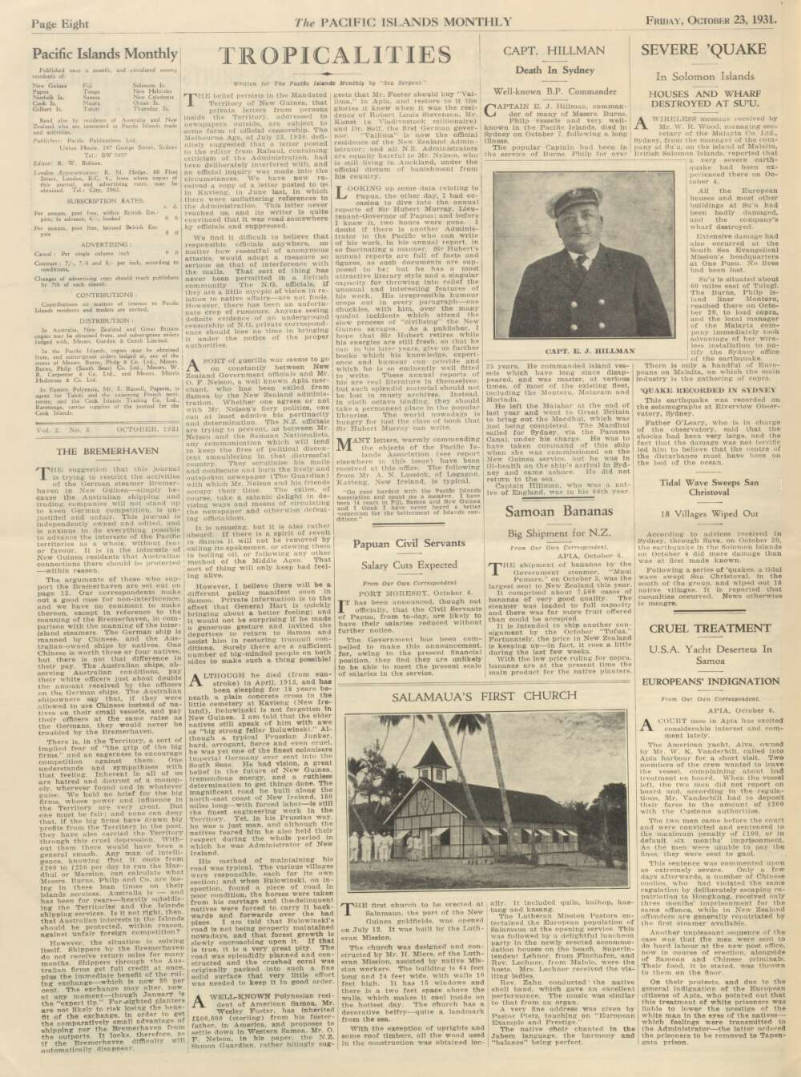
Vol. 2. No. 3.
October, 1931
THE suggestion that this journal is trying to restrict the activities of the German steamer Bremer haven in New Guinea —simply be cause the Australian shipping and trading companies will not stand up to keen German competition, is un justified and unfair. This journal is independently owned and edited, and is anxious to do everything possible to advance the interests of the Pacific territories as a whole, without fear or favour. It is in the interests of New Guinea residents that Australian connections there should be protected —within reason.
The arguments of those who sup port the Bremerhaven are set out on page 12. Our correspondents make out a good case for non-interference, and we have no comment to make thereon, except in reference to the manning of the Bremerhaven, in com parison with the manning of the inter island steamers. The German ship is manned by Chinese, and the Aus tralian-owned ships by natives. One Chinese is worth three or four natives, but there is not that difference in their pay. The Australian ships, ob serving Australian conditions, pay their white officers just about double the amount received by the officers on the German ships. The Australian shipowners say that, if they were allowed to use Chinese instead of na tives on their small vessels, and pay their officers at the same rates as the Germans, they would never be troubled by the Bremerhaven.
There is, in the Territory, a sort of Implied fear of “the grip of the big firms,” and an eagerness to encourage competition against them. One understands and sympathises with that feeling. Inherent in all of us are hatred and distrust of a monop oly, wherever found and in whatever guise. We hold no brief for the big firms, whose power and influence in the Territory are very great. But one must be fair; and none can deny that, if the big firms have drawn big profits from the Territory in the past, they have also carried the Territory through this cruel depression. With out them there would have been a general smash. Any man of intelli gence, knowing that it costs from £200 to £250 per day to run the Mac dhui or Marsina can calculate what Messrs. Burns, Philp and Co. are los ing in these lean times on their islands services. Australia is has been for years—heavily subsidis ing the Territories and the Islands shipping services. Is it not right, then, that Australian interests in the Islands should be protected, within reason, against unfair foreign competition?
However, the situation is solving itself. Shippers by the Bremerhaven do not receive return sales for many months. Shippers through the Aus tralian firms get full credit at once, plus the immediate benefit of the rul ing exchange—which is now 30 per cent. The exchange may alter, now, at any moment —though January is the “expert tip.” Far-sighted planters are not likely to risk losing the bene fit of the exchange, in order to get the comparatively small advantage of shipping per the Bremerhaven from the outports. It looks, therefore, as if the Bremerhaven difficulty will automatically disappear.
Tropicalities
Written for The Pacific Islands Monthly by “Sea Serpent:’
THE belief persists in the Mandated Territory of New Guinea, that private letters from persons inside the Territory, addressed to newspapers outside, are subject to some form of official censorship. The Melbourne Age, of July 23, 1930, defi nitely suggested that a letter posted to the editor from Rabaul, containing criticism of the Administration, had been deliberately interfered with, and an official inquiry was made into the circumstances. We have now re ceived a copy of a letter posted to us in Kavieng, in June last, in which there were unflattering references to the Administration. This letter never reached us, and its writer is quite convinced that it was read somewhere by officials and suppressed.
We find it difficult to believe that responsible officials anywhere, no matter how resentful of anonymous attacks, would adopt a measure so serious as that of interference with the mails. That sort of thing has never been permitted in a British community The N.G. officials, if they are a little myopic of vision in re lation to native affairs —are not fools.
However, there has been an unfortu nate crop of rumours. Anyone seeing definite evidence of an underground censorship of N.G. private correspond ence should lose no time in bringing it under the notice of the proper authorities.
A SORT of guerilla war seems to go on constantly between New Zealand Government officials and Mr.
O. F. Nelson, a well known Apia mer chant, who has been exiled from Samoa by the New Zealand adminis tration. Whether one agrees or not with Mr. Nelson’s fiery politics, one can at least admire his pertinacity and determination. The N.Z. officials are trying to prevent, as between Mr.
Nelson and the Samoan Nationalists, any communication which will tend to keep the fires of political discon tent smouldering in that distressful country. They scrutinise his mails and confiscate and burn the lively and outspoken newspaper (The Guardian) with which Mr. Nelson and his friends occupy their time. The exiles, of course, take a satanic delight in de vising ways and means of circulating the newspaper and otherwise defeat ing officialdom.
It is amusing, but it is also rather absurd. If there is a spirit of revolt in Samoa it will not be removed by exiling its spokesmen, or stewing them in boiling oil, or following any other method of the Middle Ages. That sort of thing will only keep bad feel ing alive.
However, I believe there will be a different policy manifest soon in Samoa. Private information is to the effect that General Hart is quickly bringing about a better feeling; and it would not be surprising if he made a generous gesture and invited the deportees to return to Samoa and assist him in restoring tranquil con ditions. Surely there are a sufficient number of big-minded people on both sides to make such a thing possible!
ALTHOUGH he died (from sun stroke) in April, 1913, and has been sleeping for 18 years be neath a plain concrete cross in the little cemetery at Kavieng (New Ire land), Boluwinski is not forgotten In New Guinea. I am told that the older natives still speak of him with awe as “big strong feller Boluwinski.” Al though a typical Prussian Junker, hard, arrogant, fierce and even cruel, he was yet one of the finest colonisers Imperial Germany ever sent into the South Seas. He had vision, a great belief in the future of New Guinea, tremendous energy, and a ruthless determination to get things done. The magnificent road he built along the north-east coast of New Ireland, 150 miles long —with forced labor —is still the finest engineering work in the Territory. Yet, in his Prussian way, he was a just man, and although the natives feared him he also held their respect during the whole period in which he was Administrator of New Ireland.
His method of maintaining his road was typical. The various villages were responsible, each for its own section; and when Bulowinski, on in spection, found a piece of road in poor condition, the horses were taken from his carriage and the delinquent natives were forced to carry it back wards and forwards over the bad piece. I am told that Bulowinski’s road is not being properly maintained nowadays, and that forest growth is slowly encroaching upon it. If that is true, it is a very great pity. The road was splendidly planned and con structed and the crushed coral was originally packed into such a fine solid surface that very little effort was needed to keep it in good order.
A WELL-KNOWN Polynesian resi dent of American Samoa, Mr.
Wesley Foster, has inherited £500,000 (sterling) from his foster father, In America, and proposes to settle down in Western Samoa. Mr. O.
F. Nelson, in his paper, the N.Z.
Samoa Guardian, rather bitingly sug
gests that Mr. Foster should buy “Vai lima,” in Apia, and restore to it the glories it knew when it was the resi dence of Robert Louis Stevenson, Mr.
Kunst (a Vladivostock millionaire) and Dr. Solf, the first German gover nor. “Vailima” is now the official residence of the New Zealand Admin istrator; and all N.Z. Administrators are equally hateful to Mr. Nelson, who is still living in Auckland, under the official dictum of banishment from his country.
LOOKING up some data relating to Papua, the other day, I had oc casion to dive into the annual reports of Sir Hubert Murray, Lieu tenant-Governor of Papua; and before I knew it, two hours were gone. I doubt if there is another Adminis trator in the Pacific who can write of his work, in his annual report, in so fascinating a manner. Sir Hubert’s annual reports are full of facts and figures, as such documents are sup posed to be; but he has a most attractive literary style and a singular capacity for throwing into relief the unusual and interesting features of his work. His irrepressible humour crops out in every paragraph—one chuckles, with him, over the many quaint incidents which attend the slow process of “civilising” the New Guinea savages. As a publisher, I hope that Sir Hubert retires while his energies are still fresh, so that he can in his later years, give us further books which his knowledge, experi ence and humour can provide and which he is so eminently well fitted to write. These annual reports of his are real literature in themselves; but such splendid material should not be lost in musty archives. Instead, in cloth octavo binding, they should take a permanent place in the popular libraries. The world nowadays is hungry for just the class of book that Sir Hubert Murray can write.
MANY letters, warmly commending the objects of the Pacific Is lands Association (see report elsewhere in this issue) have been received at this office. The following from Mr. A. N. Lussick, of Logagon.
Kavieng, New Ireland, is typical.
“Go your hardest with the Pacific Islands Association and count me a member. I have been 14 years in Fiji, Samoa and New Guinea and I think I have never heard a better susgestion for the betterment of Islands con ditions.”
Salary Cuts Expected
Papuan Civil Servants Salary Cuts Expected
From Our Own Correspondent PORT MORESBY, October 6.
IT has been announced, though not officially, that the Civil Servants of Papua, from to-day, are likely to have their salaries reduced without further notice.
The Government has been com pelled to make this announcement, for, owing to the present financial position, they find they are unlikely to be able to meet the present scale of salaries in the service.
Capt. Hillman
Death In Sydney Well-known B.P. Commander
CAPTAIN E. J. Hillman, comman der of many of Messrs. Burns, Philp vessels and very well known in the Pacific Islands, died in Sydney on October 7, following a long illness.
The popular Captain had been in the service of Burns, Philp for over
25 years. He commanded island ves sels which have long since disap peared, and was master, at various times, of most of the existing fleet, including the Montoro, Mataram and Morinda.
He left the Malabar at the end of last year and went to Great Britain to bring out the Macdhui, which was just being completed. The Macdhui sailed for Sydney, via the Panama Canal, under his charge. He was to have taken command of this ship when she was commissioned on the New Guinea service, but he was in ill-health on the ship’s arrival in Syd ney and came ashore. He did not return to the sea.
Captain Hillman, who was a nat ive of England, was in his 66th year.
Capt. E. J. Hillman
Samoan Bananas
Big Shipment for N.Z.
From Our Own Correspondent.
APIA, October 6.
THE shipment of bananas by the Government steamer, “Maui Pomare,” on October 3, was the largest sent to New Zealand this year.
It comprised about 7,500 cases of bananas of very good quality. The steamer was loaded to full capacity and there was far more fruit offered than could be accepted.
It is intended to ship another con signment by the October “Tofua.”
Fortunately, the price in New Zealand is keeping up—in fact, it rose a little during the last few weeks.
With the low price ruling for copra, bananas are at the present time the main product for the native planters.
Salamaua’S First Church
THE first church to be erected at Salamaua, the port of the New Guinea goldfields, was opened on July 12. It was built by the Luth eran Mission.
The church was designed and con structed by Mr. H. Miers, of the Luth eran Mission, assisted by native Mis sion workers. The building is 64 feet long and 24 feet -wide, with walls 10 feet high. It has 15 windows and there is a two feet space above the walls, which makes It cool inside on the hottest day. The church has a decorative belfry-—quite a landmark from the sea.
With the exception of uprights and some roof timbers, all the wood used in the construction was obtained loc
ally. It included quila, kaihop, kae tang and kasang.
The Lutheran Mission Pastors en tertained the European population of Salamaua at the opening service. This was followed by a delightful luncheon party in the newly erected accommo dation houses on the beach. Superin tendent Lehner, from Pinchafen, and Rev. Lechner, from Malolo, were the hosts. Mrs. Lechner received the vis iting ladies.
Rev. Zahn conducted the native shell band, which gave an excellent performance. The music was similar to that from an organ.
A very fine address was given by Pastor Pietz, touching on “European Example and Prestige.”
The native choir chanted in the Jabem language, the harmony and “balance” being perfect.
Severe ’Quake
In Solomon Islands
Houses And Wharf
Destroyed At Su’U.
A WIRELESS message received by Mr. W. R. Wood, managing sec retary of the Malayta Co. Ltd., Sydney, from the manager of the com pany at Su’u, on the island of Malaita, British Solomon Islands, reported that
a very severe earth quake had been ex perienced there on Oc tober 4.
All the European houses and most other buildings at Su’u had been badly damaged, and the company’s wharf destroyed.
Extensive damage had also occurred at the South Sea Evangelical Mission’s headquarters at One Pusu. No lives had been lost.
Su’u is situated about 60 miles east of Tulagl.
The Burns, Philp is land liner Montoro, reached there on Octo ber 20, to load copra, and the local manager of the Malayta com pany immediately took advantage of her wire less installation to no tify the Sydney office of the earthquake.
There is only a handful of Euro peans on Malaita, on which the main industry is the gathering of copra.
’Quake Recorded In Sydney
This earthquake was recorded on the seismographs at Riverview Obser vatory, Sydney.
Father O’Leary, who is in charge of the observatory, said that the shocks had been very large, and the fact that the damage was not terrific led him to believe that the centre of the disturbance must have been on the bed of the ocean.
18 Villages Wiped Out
Tidal Wave Sweeps San Christoval 18 Villages Wiped Out
According to advices received in Sydney, through Suva, on October 20, the earthquake in the Solomon Islands on October 4 did more damage than was at first made known.
Following a series of ’quakes, a tidal wave swept San Christoval, in the south of the group, and wiped out 18 native villages. It is reported that casualties occurred. News otherwise is meagre.
Cruel Treatment
U.S.A. Yacht Deserters In Samoa
Europeans’ Indignation
From Our Own Correspondent.
APIA, October 6.
A COURT case in Apia has excited considerable interest and com ment lately.
The American yacht, Alva, owned by Mr. W. K. Vanderbilt, called into Apia harbour for a short visit. Two members of the crew wanted to leave the vessel, complaining about bad treatment on board. When the vessel left, the two men did not report on board and, according to the regula tions, Mr. Vanderbilt had to deposit their fares to the amount of £200 with the Customs authorities.
The two men came before the court and were convicted and sentenced to the maximum penalty of £100, or in default six months’ imprisonment.
As the men were unable to pay the fines, they were sent to gaol.
This sentence was commented upon as extremely severe. Only a few days afterwards, a number of Chinese coolies, who had violated the same regulation by deliberately escaping re patriation to Hongkong, received only three months’ imprisonment for the same offence, while in New Zealand offenders are generally repatriated by the first steamer available.
Another unpleasant sequence of the case was that the men were sent to do hard labour at the new post office, now in course of erection, alongside of Samoan and Chinese criminals.
Their food, it is stated, was thrown to them on the floor.
On their protests, and due to the general indignation of the European citizens of Apia, who pointed out that this treatment of white prisoners was liable to lower the prestige of the white man in the eyes of the natives — which feelings were transmitted to the Administrator—the latter ordered the prisoners to be removed to Tapen gata prison.
Advertisements & other items, p. 8 (1 item)
Pacific Islands Monthly
8
Friday, October 23, 1931.
The PACIFIC ISLANDS MONTHLY
Pacific Islands Monthly
Published once a month, and circulated among residents of: New Guinea Fiji Solomon Is.
Papua Tonga New Hebrides Norfolk Is. Samoa New Caledonia Cook Is. Nauru Ocean Is.
Gilbert Is. Tahiti Thursday Is.
Read also by residents of Australia and New Zealand who are interested in Pacific Islands trade and activities.
Publishers-. Pacific Publications Ltd.
Union House, 247 George Street, Sydney Tel.: BW 5037 Editor: R. W. Robson.
London Representative: R. M. Hodge, 80 Fleet Street, London, E.C. 4., from whom copies of this journal, and advertising rates, may be obtained. Tel.: City, 2062.
SUBSCRIPTION RATES:
s. d. Per annum, post free, within British Em.pire; in advance, 6/-; booked 6 6 . Per annum, post free, beyond British Em pire 8 0
ADVERTISING :
Casual : Per single column inch 9 0 Contract : 7/-, 7/6 and 8/- per inch, according to conditions.
Changes of advertising copy should reach publishers by 7th of each month.
CONTRIBUTIONS :
Contributions on matters of interest to Pacific Islands residents and traders are invited.
DISTRIBUTION :
In Australia, New Zealand and Great Britain copies may be obtained from, and subscription orders lodged with, Messrs. Gordon & Gotch Limited.
In the Pacific Islands, copies may be obtained from, and subscription orders lodged at, any of the .stores of Messrs. Burns, Philp & Co. Ltd., Messrs.
Burns, Philp (South Seas) Co. Ltd., Messrs. W.
R. Carpenter & Co. Ltd., and Messrs. Morris Hedstrom & Co. Ltd.
In Eastern Polynesia, Mr. S. Russell, Papeete, is agent for Tahiti and the adjoining French terri tories; and the Cook Islands Trading Co. Ltd., Rarotonga, carries supplies of the journal for the Cook Islands.
Papuan Gold
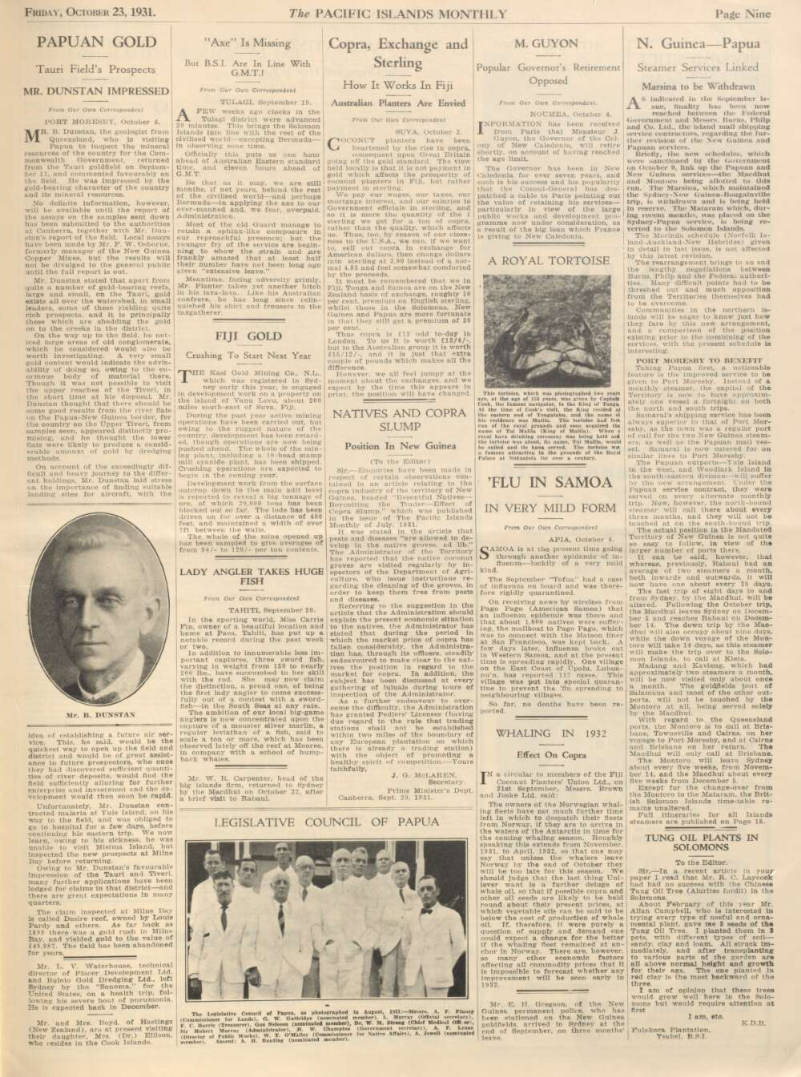
Tauri Field’s Prospects
Mr. Dunstan Impressed
From Our Own Correspondent PORT MORESBY, October 6.
MR. B. Dunstan, the geologist from Queensland, who is visiting Papua to inspect the mineral resources of the country for the Com monwealth Government, returned from the Tauri goldfield on Septem ber 11, and commented favourably on the field. He was impressed by the gold-bearing character of the country and its mineral resources.
No definite information, however, will be available until the report of the assays on the samples sent down has been submitted to the authorities at Canberra, together with Mr. Dun stan’s report of the field. Local assays have been made by Mr. F. W. Osborne, formerly manager of the New Guinea Copper Mines, but the results will not be divulged to the general public until the full report is out.
Mr. Dunstan stated that apart from quite a number of gold-bearing reefs, large and small, on the Tauri, gold exists all over the watershed, in small leaders, some of these yielding quite rich prospects, and it is principally these which are shedding the gold on to the creeks in the district.
On the way up to the field, he not iced large areas of old conglomerate, which he considered would also be worth investigating. A very small gold content would indicate the advis ability of doing so, owing to the en ormous body of material there.
Though it was not possible to visit the upper reaches of the Tiveri, in the short time at his disposal, Mr.
Dunstan thought that there should be some good results from the river flats on the Papua-New Guinea border, for the country on the Upper Tiveri, from samples seen, appeared distinctly pro mising, and he thought the lower flats were likely to produce a consid erable amount of gold by dredging methods.
On account of the exceedingly dif ficult and heavy journey to the differ ent holdings, Mr. Dunstan laid stress on the importance of finding suitable landing sites for aircraft, with the
idea of establishing a future air ser vice. This, he said, would be the quickest way to open up the field and district and would be of great assist ance to future prospectors, who once they had discovered sufficient quanti ties of river deposits, would find the field sufficiently alluring for further enterprise and investment and the de velopment would then soon be rapid.
Unfortunately, Mr. Dunstan con tracted malaria at Yule Island, on his way to the field, and was obliged to go to hospital for a few days, before continuing his eastern trip. We now learn, owing to his sickness, he was unable to visit Misima Island, but inspected the new prospects at Milne Bay before returning.
Owing to Mr. Dunstan’s favourable impression of the Tauri and Tiveri, many further applications have been lodged for claims in that district —and there are great expectations In many quarters.
The claim inspected at Milne Bay is called Desire reef, owned by Louis Pardy and others. As far back as 1899 there was a gold rush in Milne Bay, and yielded gold to the value of £49,987. The field has been abandoned for years.
Mr. L. V. Waterhouse, technical director of Placer Development Ltd. and Bulolo Gold Dredging Ltd., left Sydney by the “Sonoma.” for the United States, on a health trip, fol lowing his severe bout of pneumonia.
He is expected back in December.
Mr. and Mrs. Boyd, of Hastings (New Zealand), are at present visiting their daughter, Mrs. (Dr.) Ellison, who resides in the Cook Islands.
Mr. B. Dunstan
"Axe” Is Missing
But B.S.I. Are In Line With
G.M.T.!
From Our Own Correspondent TULAGI, September 19.
A FEW weeks ago clocks in the Tulagi district were advanced 20 minutes. This brings the Solomon Islands into line with the rest of the civilised world —excepting Bermuda— in observing zone time.
Officially this puts us one hour ahead of Australian Eastern standard time, and eleven hours ahead of
G.M.T.
Be that as it may, we are still months, if not years, behind the rest of the civilised world —and perhaps Bermuda—in applying the axe to our over-manned and, we fear, overpaid, Administration.
Most of the old Guard manage to retain a sphinx-like composure in our reproachful presence; but the younger fry of the service are begin ning to show the strain and ,are frankly amazed that at least half their number have not been long ago given “extensive leave.”
Meantime, facing adversity grimly, Mr. Planter takes yet another hitch in his lava-lava. Like his Australian confrere, he has long since relin quished his shirt and trousers to the taxgatherer.
Fiji Gold
Crushing To Start Next Year
THE Kasi Gold Mining Co., N.L., which was registered in Syd ney early this year, is engaged in development work on a property on the island of Vanu Levu, about 200 miles south-east of Suva, Fiji.
During the past year active mining operations have been carried out, but owing to the rugged nature of the country, development has been retard ed, though operations are now being pushed ahead. The whole of the min ing plant, including a 10-head stamp mill cyanide plant, has been shipped.
Crushing operations are expected to begin in the coming year.
Development work from the surface outcrop down to the main adit level is reported to reveal a big tonnage of ore, of which 20,000 tons has been blocked out so far. The lode has been driven on for over a distance of 400 feet, and maintained a width of over 7ft. between the walls.
The whole of the mine opened up has been sampled to give averages of from 94/- to 120/- per ton contents.
Lady Angler Takes Huge
Fish
From Our Own Correspondent TAHITI, September 20.
In the sporting world, Miss Carrie Pin, owner of a beautiful location and home at Paea, Tahiti, has put up a notable record during the past week or two.
In addition to innumerable less im portant captures, three sword fish, varying in weight from 150 to nearly 200 lbs., have succumbed to her skill with the rod. She may now claim the distinction, a proud one, of being the first lady angler to come success fully out of a contest with a sword fish—in the South Seas at any rate.
The ambition of our local big-game anglers is now concentrated upon the capture of a monster silver marlin, a regular leviathan of a fish, said to scale a ton or more, which has been observed lately off the reef at Moorea, in company with a school of hump back whales.
Mr. W. R. Carpenter, head of the big islands firm, returned to Sydney by the Macdhui on October 22, after a brief visit to Rabaul.
Sterling
Copra, Exchange and Sterling How It Works In Fiji Australian Planters Are Envied
From Our Own Correspondent SUVA, October 2.
COCONUT planters have been heartened by the rise in copra, consequent upon Great Britain going off the gold standard. The view held locally is that it is not payment in gold which affects the prosperity of coconut planters in Fiji, but rather payment in sterling.
We pay our wages, our taxes, our mortgage interest, and our salaries to Government officials in sterling, and so it is more the quantity of the £ sterling we get for a ton of copra, rather than the quality, which affects us. Thus, too, by reason of our close ness to the U.S.A., we can, if we want to, sell out copra in exchange for American dollars, then change dollars into sterling at 3.90 instead of a nor mal 4.85 and feel somewhat comforted by the proceeds.
It must be remembered that we in Fiji, Tonga and Samoa are on the New Zealand basis of exchange, roughly 10 per cent, premium on English sterling, whilst those in the Solomons, New Guinea and Papua are more fortunate in that they still get a premium of 30 per cent.
Thus copra is £12 odd to-day in London. To us it is worth £13/4/-, but to the Australian group it is worth £15/12/-, and it is just that extra couple of pounds which makes all the difference.
However, we all feel jumpy at the moment about the exchanges, and we expect by the time this appears in print, the position will have changed.
Natives And Copra
Slump
Position In New Guinea
(To the Editor) Sir, —Enquiries have been made in respect of certain observations con tained in an article relating to the copra industry of the territory of New Guinea, headed “Resentful Natives — Boycotting the Trader —Effect of Copra Slump,” which was published in the issue of The Pacific Islands Monthly of July, 1931.
It was stated in the article that pests and diseases “are allowed to de velop in the native groves, ad lib.”
The Administrator of the Territory has reported that the native coconut groves are visited regularly by in spectors of the Department of Agri culture, who issue instructions re garding the cleaning of the groves, in order to keep them free from pests and diseases.
Referring to the suggestion in the article that the Administration should explain the present economic situation to the natives, the Administrator has stated that during the period in which the market price of copra has fallen considerably, the Administra tion has, through its officers, steadily endeavoured to make clear to the nat ives the position in regard to the market for copra. In addition, the subject has been discussed at every gathering of luluais during tours of inspection of the Administrator.
As a further endeavour to over come the difficulty, the Administration has granted Pedlers’ Licenses (having due regard to the rule that trading stations shall not be established within two miles of the boundary of any European plantation on which there is already a trading station) with the object of promoting a healthy spirit of competition.—Yours faithfully,
J. G. Mclaren,
Secretary.
Prime Minister’s Dept.
Canberra, Sept. 29, 19 31.
Legislative Council Of Papua
The Legislative Council of Papua, as photographed in August, 1931:-Messrs. A. P. Finney (Commissioner for Lands) G. W. Guttridge (nominated member), L. Murray (Official secretary), F. C. Harris (Treasurer), Gus Nelsson (nominated member), Dr. W. M. Strong (Chief Medical Officer), Sir Hubert Murray (Administrator), H. W. Champion (Government secretary), A. P. Lyons (Director of Public Works), W. T. O'Malley (Commissioner for Native Affairs), A. Jewell (nominated member). Absent: A. H. Bunting (nominated member).
Opposed
M. Guyon
Popular Governor’s Retirement Opposed
From Our Own Correspondent.
NOUMEA, October 4.
INFORMATION has been received from Paris that Monsieur J.
Guyon, the Governor of the Col ony of New Caledonia, will retire shortly, on account of having reached the age limit.
The Governor has been in New Caledonia for over seven years, and such is his success and his popularity that the Consul-General has des patched a cable to Paris pointing out the value of retaining his services— particularly in view of the large public works and development pro gramme now under consideration, as a result of the big loan which France is giving to New Caledonia.
A Royal Tortoise
This tortoise, which was photographed two yean ago, at the age of 158 years, was given by Captain Cook, the famous navigator, to the King of Tonga At the time of Cook’s visit, the King resided at the eastern end of Tongatabu, and the name of his residence was Malila. The tortoise had free run of the royal grounds and soon acquired the name of Tui Malila (King of Malila). When a royal kava drinking ceremony was being held and the tortoise was about, its name, Tui Malila, would be called and its kava served. The tortoise was a famous attraction in the grounds of the Royal Palace at Nukualofa for over a century.
’Flu In Samoa
In Very Mild Form
From Our Own Correspondent APIA, October 6.
SAMOA is at the present time going through another epidemic of in fluenza —luckily of a very mild kind.
The September “Tofua” had a case of influenza on board and was there fore rigidly quarantined.
On receiving news by wireless from Pago Pago (American Samoa) that an influenza epidemic was there and that about 1,000 natives were suffer ing, the mailboat to Pago Pago, which was to connect with the Matson liner at San Francisco, was kept back. A few days later, influenza broke out in Western Samoa, and at the present time is spreading rapidly. One village on the East Coast of Upolu, Lubua nu’n, has reported 117 cases. This village was put into special quaran tine to prevent the ’flu spreading to neighbouring villages.
So far, no deaths have been re ported.
Whaling In 1932
Effect On Copra
IN a circular to members of the Fiji Coconut Planters’ Union Ltd., on 21st September, Messrs. Brown and Joske Ltd. said: The owners of the Norwegian whal ing fleets have not much further time left in which to despatch their fleets from Norway, if they are to arrive in the waters of the Antarctic in time for the coming whaling season. Roughly speaking this extends from November, 1931, to April, 1932, so that one may say that unless the whalers leave Norway by the end of October they will be too late for this season. We should judge that the last thing Uni lever want is a further deluge of whale oil, so that if possible copra and other oil seeds are likely to be held round about their present prices, at which vegetable oils can be said to be below the cost of production of whale oil. If, therefore, it were purely a question of supply and demand one could expect a change for the better if the whaling fleet remained at an chor in Norway. There are, however, so many other economic factors affecting all commodity prices that it is impossible to forecast whether any improvement will be seen early in 1932.
Mr. E. H. Gregson, of the New Guinea permanent police, who has been stationed on the New Guinea goldfields, arrived in Sydney at the end of September, on three months’ leave.
N. Guinea —Papua
Steamer Services Linked Marsina to be Withdrawn
AS indicated in the September is sue, finality has been now reached between the Federal Government and Messrs. Burns, Philp and Co. Ltd., the island mail shipping service contractors, regarding the fur ther revision of the New Guinea and Papuan services.
Briefly, the new schedules, which were sanctioned by the Government on October 9, link up the Papuan and New Guinea services—the Macdhui and Montaro being allotted to tills run. The Marsina, which maintained the Sydney-New Guinea-Bougainville trip, is withdrawn and is being held in reserve. The Mataram which, dur ing recent months, was placed on the Sydney-Papua service, is being re verted to the Solomon Islands.
The Morinda schedule (Norfolk Is land-Auckland-New Hebrides) given in detail in last issue, is not affected by this latest revision.
The rearrangement brings to an end the lengthy negotiations between Burns, Philp and the Federal authori ties. Many difficult points had to be threshed out and much opposition from the Territories themselves had to be overcome.
Communities in the northern is lands will be eager to know just how they fare by this new arrangement, and, a comparison of the position existing prior to the combining of the services, with the present schedule is interesting.
Port Moresby To Benefit
Taking Papua first, a noticeable feature is the improved service to be given to Port Moresby. Instead of a monthly steamer, the capital of the Territory is now to have approxim ately one vessel a fortnight on both the north and south trips.
Samarai’s shipping service has been always superior to that of Port Mor esby, as the town was a regular port of call for the two New Guinea steam ers, as well as the Papuan mail ves sel. Samarai is now catered for on similar lines to Port Moresby.
The Papuan outports—Yule Island to the west, and Woodlark Island in the south-eastern division —will suffer by the new arrangement. Under the Papuan service contract, they were served on every alternate monthly trip. Now, however, the north-bound steamer will call there about every three months, and they will not be touched at on the south-bound trip.
The actual position in the Mandated Territory of New Guinea is not quite so easy to follow, in view of the larger number of ports there.
It can be said, however, that whereas, previously, Rabaul had an average of two steamers a month, both inwards and outwards, it will now have one about every 20 days.
The fast trip of eight days to and from Sydney, by the Macdhui, will be altered. Following the October trip, the Macdhui leaves Sydney on Decem ber 5 and reaches Rabaul on Decem ber 14. The down trip by the Mac dhui will also occupy about nine days, while the down voyage of the Mon toro will take 14 days, as this steamer will make the trip over to the Solo mon Islands, to call at Kieta.
Madang and Kavieng, which had approximately two steamers a month, will be now visited only about once a month. The goldfields port of Salamaua and most of the other out ports, will not be touched by the Montoro at all, being served solely by the Macdhui.
With regard to the Queensland ports, the Montoro is to call at Bris bane, Townsville and Cairns, on her voyage to Port Moresby, and at Cairns and Brisbane on her return. The Macdhui will only call at Brisbane.
The Montoro will leave Sydney about every five weeks, from Novem ber 14, and the Macdhui about every five weeks from December 5.
Except for the change-over from the Montoro to the Mataram, the Brit ish Solomon Islands time-table re mains unaltered.
Pull itineraries for all Islands steamers are published on Page 18.
Tung Oil Plants In
Solomons
To the Editor.
Sir, —In a recent article in your paper I read that Mr. R. C. Laycock had had no success with the Chinese Tung Oil Tree (Alurites fordii) in the Solomons.
About February of this year Mr.
Allan Campbell, who is interested in trying every type of useful and orna mental plant, gave me 3 seeds of the Tung Oil Tree. I planted them in 3 pots, with different types of soil — sandy, clay and loam. All struck im mediately, and after transplanting to various parts of the garden are all above normal height and growth for their age. The one planted in red clay is the most backward of the three.
I am of opinion that these trees would grow well here in the Solo mons but would require attention at first I am, etc.
K.D.B.
Fulakora Plantation, Ysabel, B.S.I.
Aitutaki News
Island Recovering From Hurricane
From Our Own Correspondent
Rarotonga, Sept. 14.
MAIL advices show that the Island of Aitutaki is recovering satis factorily from the effects of the hurricane, which occurred in Febru ary last.
Mr. A. A. Fuckham has taken over from Mr. E. E. Vellenoweth the dut ies of Resident Agent. The latter in turn has replaced Mr. J. Dyer, Resi dent Agent, Mauke, who is at present at Rarotonga. Mr. Dyer, whose health is not good, proposes to go on to New Zealand by the next boat.
This Fascinating “Pidgin”
Its Origin, and How It Works
Written for The Pacific Islands Monthly by F. Robartson, Rabaul
That strange jargon known as “Pidgin English,” has become the lingua franca of much of Asia and Africa —but, more particu larly, of the many-tongued South Seas.
The dictionary tells us that “pidgin” is a corruption of the word “business,” pidgin English having been the medium through which the old British sea-dogs carried on their trading along the Chinese Coast, and in other places where the Chinese have become a business institution.
What a race were the Chinese! In the year 1200 B.C., we are told, a party of Chinese scientists made a voyage to Java, and hundreds of years before Don Juan de Meneses discov ered and named Papua, the peaceful penetrators from the North had estab lished trading points around New Guinea coasts.
It was Chinese traders who first brought “pidgin” to this part of the South Seas; and, despite the fact that Portuguese, Spanish, Dutch and French navigators had each done their part in discovering these “Isles of Romance,” “pidgin” was the only European language which had been made to serve a general utility pur pose for the white and coloured in habitants of the Pacific Islands.
The same brand of “pidgin” is not, of course, used in all countries, as every place has its own peculiar dialect. The vocabulary used in New Guinea would not be properly under stood in East Africa, or even in other parts of the Pacific.
The recipe for the language is inter esting: Take one sea full of British sailor men, hardy, daring, very British and profane, and leave in a cool place for two days; extract their speech, then bring to boil and extract what speech remains. Add a coconut shell each of Chinese, Malay, German and Kanaka, and bring to a boil a hundred or so times, then season with a little war or two; add a few drops of Mission sauce and sprinkle with black birder pepper and recruiter salt. Strain through Kanaka lips and serve with beer on boat days, or with undiluted Australian any other time.
Many travellers have visited New Guinea, doing the “round trip,” and some have written fairly extensively about the place, taking this “absurd garble” in their stride.
There are even those who have spent some time in the Territory who refuse to admit the usefulness of “pidgin”; but it will usually be found that these people have been either too stupid to master it, or have had that fear of ridicule or professed con tempt of so strange and unintellectual a tongue which makes the British probably the worst linguists in the world.
The difficulty of administration, and the absolute necessity for a common form of speech, may be appreciated when it is remembered that about 2,000 whites in New Guinea control — or endeavour to control —a greater number of Chinese, Malays, Japs and half-castes, and approximately 500,000 natives, scattered over innumerable islands. Each island of any size has its distinct language; the hill boys, the river boys, and the coast boys are unable to understand each other, while a stretch of 60 miles along the coast might take one among three different “talks.”
“Why not teach them real Eng lish?” has been asked. But to do so would mean making the language ten times more difficult for half a million primitive kanakas, merely to simplify matters for about 2,000 supposedly intelligent whites.
Another suggestion has been made that some native “talk” be used, such as the tinata Kuanua, or language of the Gazelle Peninsula, in the Island of New Britain, in which there already exists a considerable Mission litera ture.
This idea might eventually be car ried out. But “pidgin English” is now so firmly established, and the structure of Tinata Kuanua differs so greatly from English grammar, that the mental indolence of the master race will doubtless do its share to prevent any change.
A similar attempt to dislodge “pid gin English” was successfully made in Dutch New Guinea, where Malay has been made the universal conver sational medium. But in this case the Dutch have introduced a, language which is no more strange to them than that which they dislodged.
When Germany took possession of North-east New Guinea, in 1884, she found a, land which had already been tapped by the British, even to the extent of having been annexed by the East India Company in 1793, and again by Queensland in 1881. But the Company failed to occupy its annex ure in the first case, while the Home Government refused to endorse Queensland’s action, in the other.
This British influence created for the Germans the unpalatable neces sity of learning this “pidgin” jargon. for without it. successful colonisation of their new possession presented in finite difficulties.
It seems strange that, after 30 years of occupation, so few of their own
words have become grafted on to “pidgin” English They found their own tongue too lacking in flexibility, however, for nat ive speech so Government and Mission co-operated in an endeavour to oust our super-slang. A conference was called and the suggestion already mentioned in this article, of substi tuting the Rabaul (or Gazelle Penin sula) language, was made. Most of the speakers, however, found too many objections to the scheme, which was eventually turned down as impracticable. But the hope was expressed that, with continued propa ganda and prompting among the planters and other out-station whites, this desirable object might eventually be achieved.
Although not “woven with Italian Art,” and although no great poet or dramatist has found in it the echo of his soul, newcomers often find the old users of “pidgin” surprisingly fluent, and never at a loss to express any idea they wish to convey.
It provides, too, a never-ending source of amusement, both to the older residents ami the new, for the boys are constantly coming in contact with something, or some situation, new to their experience, and have no hesitation in putting to it their own “pidgin” interpretation.
Most words have several meanings, according to their use, or the gesticu lation which accompanies them. For example, “bullamoocow” means either a bull or a cow, and the meat of such, either cooked or raw, singular or plural. “Kai kai” means either food, meals, or the verb to eat. For instance, if a boy’s master went to dinner and ate meat which he enjoyed the boy might say “Masta, e go junis along kai kai, now e kai kai-im bul lamoocow. Em e good pella kai kai too mus.”
Deewhy (or diwai) means a tree or wood of any sort, whilst a piece of fruit is a “picaninny belong diwai.”
A friend of mine, wishing to order sausages for his kai kai, had the following conversation with his mon key (a small boy) : “You savvy sausage, eh?”
“No gut (No) Masta.”
“Orright, you savvy bullamoocow?”
“Essah!”
“Now, you savvy banan?” (banana).
“Essah ”
“Orright. Now you catch in banan belong bullamoocow!” —and his order was taken.
Another thing which never fails to confuse the newcomer is the positive answer to a negative question. For instance, were I to call on someone and find him apparently out, I might say to his boy, “Masta e no starp?”
To which I would expect the reply “Essah!”
If, however, 1 said “Masta e starp?” he would reply “No gut,” which means just “No.”
Some words which are quite allow able in the best “pidgin” circles could hardly take their place in polite soci ety down South, whilst some perfectly harmless English words take on a meaning which precludes their too frequent use, even in the circles referred to.
The trick of repetition to obtain effect, is even more often used than by some of our best novelists. A boy who has searched well, but unsuc cessfully, for something, would ex plain “Me lookoutim, me lookoutim, me lookoutim —e no starp.”
Water is “wara” or “vara”; the sea is “sodawara”; and hot water is, and remains even when cold again, “art wara.” A common reply to a request for hot water is, “Art wara e no art yet.”
Another strange thing is that every bird is a “pigeon” except a, pigeon, which is a “balus”: whilst “toomus” means merely “a lot.”
The following is a brief extract from the pidgin Bible: “Deo e hasikim Kain e sipik” (God he asked Cain he speaks).
“Kain, velsitap barata belong ju, Abel?” (Cain, where stops brother belong you, Abel?”).
Kain e sipik: “Me no sabe! vatpo, mi belong lakautim barata belong me?” (Kain he speaks; “I don’t know! what for, me belong lookout — im brother belong me?”) Every white woman is a “Missus”; a little girl is either a “picaninny” or a “liklik missus”: whilst a small boy or a youth is a “liklik masta.”
A “monkey” is a native boy up to perhaps 16 years, the age of a “boy”
running up to somewhere in the vic inity of 35, after which he approaches the state of being “lapoon.” This word “lapoon” is either adjective or noun, and applies to anything old. It is often mistakenly used by the stranger when he intends to use “long long,” which means either “Mad,”
“drunk,” “a madman,” or “a drunk.”
A conversation between two boys in pidgin would be absolutely unin telligible to a newcomer, but one learns to understand much more quickly than to speak it with any degree of confidence, This is parti cularly the case in the towns, where many of the boys are spoken to so frequently in straight English that they learn to understand almost any thing said to them, and so relieve the stranger of what would otherwise be an awkward necessity.
These boys, however, usually retain the pidgin pronunciation of their words, which require some little at tention to catch and learn.
Gold Quest Epic
"Lasseter’S Last
Ride”
OF outstanding interest to gold seekers the world over, but of much interest to all, is “Las seter’s Fast Ride,” by Ion F. Idriess.
Mr. Idriess is well-known on the New Guinea goldfields, where his latest book will be eagerly read. “Las seter’s Fast Ride” tells of gold pros pectors and their trials in the heart of Australia, of the efforts to use planes for survey purposes in this unmapped, arid country, and of natives, who, from the author’s des criptions, are as truculent and un tamed as the kanakas who roam the country in the hinterland of the New Guinea goldfields.
Many stories have been written of the hardships endured by pioneers endeavouring to open up new gold fields, and this book will stand comparison with the best of them.
A goldfield in Central Australia is on the brink of discovery. Indeed, according to Mr. Idriess, F. H. B. Las seter, the prospector of the Central Australian Gold Expedition, rediscov ered the reef, which he had found 30 years previously, but the desert was loath to let the secret reach the out side world. The prospector was unable to return to civilisation, and perished, after wanderings through the wilderness with a tribe of stone age aborigines.
The author describes Lasseter’s finding of the reef in this tense way: “Lasseter found his reef. As he gazed upon it a feeling came over him that he had done his life’s work. He sat down by the greenish-white quartz staring across the hill where the reef outcropped like a yellowish-brown cap, and for two hours never moved.
These blobs of dull yellow in this quartz had been the magnet drawing his thoughts for thirty years. This reef, he felt, was his life. . . .”
The book has been written from the related experiences of members of Lasseter’s expedition, from the let ters of Lasseter —some of which rep resent mere fragments buried by him beneath the ashes of his camp fires- — and from the records and correspon dence of the Central Australian Gold Exploration Co. Ftd. The author had no easy task in piecing all this infor mation together. He has, however, succeeded admirably and has com piled a story of absorbing interest, full of stirring adventure.
“Lasseter’s Fast Ride,” which is published by Messrs. Angus and Rob ertson Ltd., Sydney, has met with a large sale locally. The first edition was published on September 1, 1931, and the second edition is already off the press.
Advertisements & other items, p. 10 (2 items)
Excelsior Supply Co. Ltd.
NEWBOLD SILICA
FIRE-BRICK Co. Ltd.
Manufacturers of High Grade Refractories Silica Bricks, High Alumina Fire Bricks, Siliceous Fire Bricks, Chrome Bricks, Bauxite Bricks, “Sealtite” (hot patching cement), Dia tomaceous insulation.
Enquirers are requested to give full particulars of temperatures and purposes for which refractories are required.
The Newbold Silica Fire-Brick Co. Ltd.
109 ELIZABETH ST., SYDNEY
GUARANTEED M&S PRODUCTS
FISH PASTES in tin and glass jars ILLAWARRA PRAWNS packed as required CURRIED PRAWNS in Boz. food tumblers ALL KINDS OF FRESH AND SMOKED FISH
“EXCELSIOR” MEAT AND BONE MEALS
MIDDLEBROOK & STONE LTD.
Merchants and Manufacturers 38-40 Mountain St. 6? 6 Cunningham St.,SYDNEY
John L. Peadon Ltd.
Rabaul
TERRITORY OF NEW GUINEA
Engineers and Garage Proprietors
All Classes of General Engineering Undertaken
CARS FOR HIRE
Territory Agents fori Goodrich Products Clyde Batteries Berger’s Lacquers B.E.S. Plugs.
Ghas. Hope Ltd,, Bris. Lamson Paragon Ltd., Printers ’Phone: 20.
EXCELSIOR SUPPLY CO. LTD.
The most extensive Manufacturers in the British Empire of
RUBBER STAMPS.
INKS. STENCILS.
Marking Devices.
ACME STAMP PADS
We have a big range of Special
FRUIT CASE MARKING SETS
We also Manufacture or Supply a complete line of
Spraying Machines
for all purposes.
Let us know your requirements and we will quote you by return. Ask for our Big Catalogue.
Sole Australasian Distributors of the World Famous SHEAFFER FOUNTAIN
PENS and PENCILS.
EXCELSIOR SUPPLY CO. LTD.
Head Office:- 160 OEORQE STREET WEST,
SYDNEY, N.S.W.
R. Towns & Co.
BLACKLOCKS
R. E. FORSSBERC - Proprietor
Manufacturer’s Representative
381 PITT STREET - SYDNEY
Buying Agents for all requirements, at lowest prices, on commission basis.
Cable Address: “Diamondcss” Sydney
R. TOWNS & CO.
Established 1842 31 REIBY PLACE - - - SYDNEY “LORD BEACONSFIELD” 26’s Island Twist Tobacco “EDGEWORTH” Extra High Grade Smoking Tobacco, in 2oz. vacuum airtight Tins, and 11b. Class Jars.
“CUTICURA” Soap, Ointment and Talcum Powder.
Rice For Tahiti
A Chinese Syndicate’s Plans
Antimaono’S Interesting
History
From Our Own Correspondent TAHITI, September 20.
THE old established coconut and sugar plantation of Antimaono, situated in the Papara district of Tahiti, has been leased to a Chin ese syndicate by the local company that owns the property.
This land was acquired many years ago by a Mr. Stuart, who made a for tune out of it when cotton soared to unheard-of prices during the Ameri can war.
Stuart brought labourers from the Gilbert Islands, and, incidentally, the first Chinese coolies to be imported into the Society Islands, to work his cotton fields, while he himself lorded it in the grand style of an old-time West Indian planter. A few crumb ling foundations are all that now re main of Stuart’s once luxurious home on the beach. But a clump of noble mango trees on the heights above the present sugar mill still marks the site of “Montcalm,” where the cotton king of Tahiti built his mountain castle, and to which he was regularly carried in a litter, by relays of faith ful retainers.
With the fall of cotton prices, Anti maono plantation went over to sugar and, later on, to coconuts also, and for many years afterwards it enjoyed control of the small but highly re munerative local market for sugar, protected as it was against importa tions from foreign sources. With the opening of the Panama canal, how ever. French sugar grown in Marti nique began to compete with the local product, to an extent that made oper ations on Antimaono less and less profitable, as time went on.
Of late years, the property has changed hands several times and en countered a series of vicissitudes. Not only has sugar slumped, but copra also and, with it, cattle values have fallen on the local market to about one-third of the figure obtainable two years ago.
Antimaono is the only considerable tract of first-class agricultural land, under one ownership in Tahiti, and it will be interesting to observe just what the Chinese Syndicate will do with it. There are rumours that they intend turning the sugar fields over to rice and, as there is plenty of water available, this sounds feasible enough.
Rice has been grown in these is lands very successfully by small Chin ese cultivators, particularly in Moo rea, where there are some large areas of swamp land, but nothing has so far been attempted on the scale pro jected at Antimaono.
Large quantities of rice are im ported annually from China proper and French Indo-China. A good deal of it is consumed by the natives of the Tuamotu archipelago, where nat ure does not provide much in the way of foodstuffs, except fish and coco nuts. But the bulk of the imported rice goes to feed the growing Chinese population of Tahiti and the adiacent Islands. It may be that friend China man has hit upon an idea, by harvesting three crops as against one in China. That will kill the imported article and set Antimaono on its legs again.
Pacific Islands
Association
Draft Constitution
Important Meeting In
March
THE plan to form a Pacific Islands
Association is being proceeded
with steadily.
The provisional committee, set up by the general meeting in July, ap pointed a sub-committee to draft a constitution. This was submitted at
a meeting of the provisional commit
tee in Sydney, on October 7, at which Mr. W. Bruce Rainsford presided and,
with amendments, was accepted.
It is now proposed to hold another general meeting in November, to which all persons interested in the project are invited. This meeting, it is hoped, will definitely form the As sociation, adopt the constitution and proceed with organisation. It is hoped that the first annual meeting or Pacific Islands Convention—may be held in Sydney in March, during the Harbour Bridge Carnival.
It is not proposed to appoint a full Council at the meeting in November.
Instead, there will be only sufficient office-bearers to carry on; and, as soon as there is sufficient organisa tion to permit of it, members will be sought throughout the Pacific Islands, and representative residents in the different territories will be asked to join the Council. It may not be pos sible to get a full Council until the annual meeting is held in March.
The proposed Constitution is as fol lows: 1. The name of the Association shall be the “Pacific Islands Association.”
Objects.
2. The objects of the Association are: (a) To provide an organisation that will further the interests of Pacific Is lands residents and provide means of enabling ex-residents to retain their associations with the Islands. (b) To disseminate information relative to the Islands, and seek the estab lishment of an information bureau in connection with the Association, (c) To help to bring before the travel ling public the tourist facilities be tween the Islands, Australia and elsewhere. (dt To promote periodical conventions, at which there may be an inter change of opinions and experiences on matters affecting administrative, commercial, industrial and social conditions in the Pacific Islands. (e) To generally protect and advance the interests of all countries and territories in the Pacific and of the peoples residing therein; to assist wherever possible in the develop ment and progress of such countries, territories and peoples; and to pro mote peace, amity and a spirit of co-operation among all of them. (f) To encourage and stimulate the growth of trade and commerce be tween the Islands of the Pacific and with Australia, New Zealand and elsewhere. (g) To form and maintain Club rooms, literary and reading rooms and other facilities for the use and benefit of members of the Associ ation. (h) To acquire any rights or privileges which the Association may regard as necessary or convenient for the purposes of the Association or for promoting the interests of its mem bers. (i) To purchase, take on lease or ex change, hire or otherwise acquire any real or personal property which may be required for the purpose of the Association. (j) To do all such other things as are incidental or conducive to the attainment of the above objects.
Qualification For Membership.
3. Membership of the Association may he sought by any person who is interested in the Pacific islands. Persons eligible for member ship and desiring to join the Association shall lodge an application with the Secretary on the prescribed form, accompanied bv the amount of the subscription The committee shall have nower to accept or reject any application for membership without assigning any reason therefor.
Subscription.
4. The Annual Subscription shall be 10/6 in the case of members domiciled in the Paci fic Islands, and £ 1/1/- in the case of mem bers resident elsewhere, or such other sums as may be fixed from time to time by the Association at a General Meeting, The subscrintion, which shall be payable in advance, entitles members to the full privi leges and facilities of the Association. Sub scriptions shall become due and payable on the first day of January in each year. Mem bers admitted during the second half of a calendar year will pay only one half of the subscription for that year.
Any member who is at least three months in arrears in payment of any moneys due to the Association may be removed from mem bership by the committee without notice.
Expulsion Of Members.
5. It shall be the duty of the committee if at any time it shall be of the opinion that the interests of the Association so require, to request by letter any member to give a written explanation of his conduct in connection with any matter, and if he fail to make such explanation within a stipulated time, or if the explanation given is not deemed by the com mittee to be satisfactory, to expel such mem ber.
No Claim On Assets.
6. Any person, upon ceasing to be a mem ber of the Association, shall not have any claim upon the Association, its property or funds.
Election Op Council
7. The entire management of the Associ ation and the .control of its property and funds (including the expenditure thereof) ex cept as otherwise provided in these rules, shall be vested in a council consisting of a presi dent, vice-presidents and not more than twenty other members. The whole of the council shall retire at each annual meeting but shall be eligible for re-election. The
council shall meet as and when it deems desirable, but at least once a year.
The council shall have power to appoint a member to fill any casual vacancy thereon until the next annual general meeting.
Six members shall form a quorum. 8. The first council shall be elected at the first general meeting of proposed members convened to adopt the constitution, with power to add to its numbers.
Management.
9. The council shall have power to delegate any or all of its duties to an executive com mittee elected from its members and to con sist of not more than ten members who shall elect a chairman and vice-chairman from among themselves. Any vacancy on the executive committee will be filled by the com mittee. Three members of the executive com mittee shall form a quorum.
Alteration Of Constitution.
10. This constitution, including the objects of the Association, may be added to, amended or repealed by resolution of an annual or special general meeting, provided that no such resolution shall be deemed to have been passed unless it be carried by a majority of at least three-fifths of the members voting thereat in person or by proxy.
Auditor.
11. An auditor shall be appointed at each annual general meeting.
General Meetings.
12. The annual general meeting of the association shall be held on a date and at a time to be fixed by the council for the fol lowing purposes: (a) To receive from the council an audited revenue account and bal ance sheet for the preceding finan cial year. (b) To appoint a council and auditor for the ensuing year. (cj To consider any resolution relating to alteration of the rules of which due notice has been given, as pr vided for in rule 13. (d) To consider any other business which any member may desire to bring forward. 13. A member wishing to bring before any general meeting any resolution to amend or make additions to the constitution shall give notice thereof in writing to the council; such notice to be in the hands of the secretary not later than 14 days preceding such meeting. 14. At least seven days’ notice of all gen eral meetings and of the business to be trans acted thereat shall be sent to every member, and such notice may be either delivered or posted to him. 15. At all general meetings of the associ ation the president, or, in his absence, a vice president, or in the absence of the vice-presi dents, a member of the council elected by the meeting, shall take the chair. Every finan cial member present in person or by proxy shall be entitled to one vote on every motion.
In case of an equality of votes, the chairman shall have a second or casting vote. 16. The Council may at any time and for any purpose call a special general meeting and they shall do so within twenty-one days of the receipt of a requisition in writing signed by any twenty financial members stat ing the purpose for which the meeting is required.
Quorum.
17. The quorum at all general meetings of members shall be ten financial members pre sent in person or by proxy. 18. At any meeting should no quorum be present, such meeting shall stand adjourned for seven days at the same place and time and no notice of such adjournment need be sent out to members. At any such adjourned meeting the business (but no new business) shall be transacted and for such adjourned meeting a quorum consists of two personally present.
Proxies.
19. Proxies must be lodged with the Secre tary at least forty-eight hours before the meeting concerned.
Bank Account.
20. All cheques shall be drawn on behalf of the association by two members of the council and countersigned by the secretary.
Cheques may be endorsed on behalf of the association by one of the council, or other person authorised by the council.
Secretary And Other Officers
21. The executive committee shall have the power to appoint and remove a secretary and other officers from time to time and to fix their remuneration.
Winding-Up.
22. In the event of a resolution winding up the affairs of the Association being car ried by a three-fifths majority of those mem bers present either in person or by proxy, and entitled to vote at a special meeting, the property, books and records then available shall be disnosed of in such manner as such meeting shall decide.
The secretary, pro tem., is Mr. J.
W. Baldie CP.O. Box 3408 R., G.P.O., Sydney), who will gladly furnish any further information.
Taiping’s Unique Cargo
"Coffin Ship”
From Our Own Correspondent.
Thursday Is., Sept. 10.
ON her last trip north the Taiping deviated from her regular course to call in at Darwin, in order to pick up passengers, and also to col lect the remains of 200 or so Chinese, who had died in the Northern Terri tory at different times, and whose friends wanted the remains taken back to China for a second interment.
The coffins were of all shapes and sizes, ranging from kerosene boxes and tins to beer cases.
The “coffin ship” unloaded her gruesome cargo at Hongkong.
Advertisements & other items, pp. 11-12 (2 items)
Harry West
Wau Aerodrome —Serviced by Guinea Airways' Planes.
New Guinea Aerodromes
LAE
SALAMAUA
WATTUT
WAU
WAMPUT
SANCAN
BULOWAT
BULOLO
ZENAC
Before Guinea Airways’ aero planes linked Wau, headquar ters of the goldmines, to the seaport, here was the end of the seventh day’s trek from the coast.
Native carriers were the only transport then, and fifty pounds their maximum load. Now Guinea Airways' aircraft are flying three-ton loads over the same routes in thirty-five minutes; maintaining dependable transport service always.
BE WISE! - - - SAVE THE RATE OF EXCHANGE.
ORDER YOUR SAILS NOW
From
HARRY WEST
SYDNEY’S SAILMAKER
Sail Makers for 26 years.
Tarpaulins specially made for tropical climates.
Let next Spring find this part of your equipment ready. Have West make your Sails, Awnings and Upholstery. Tents and every class of canvas work a speciality. If it’s in canvas, rope or wire, we make it to any specification.
FOOT DUKE STREET - - - BALMAIN EAST ’Phone W 1 105
If You Want the Best ...
“THE YOUNGER” COOKING STOVE
Made with Extended Fire Box, specially for long wood fuel.
Also
DOUBLE OVEN
RANGES
suitable for Hotels or large establishments.
We always stock dupli cate parts, and they can be easily fixed in posi tion because the topplate of each stove is moveable.
Send for a copy of our Illustrated Catalogue and further information.
G. FLETCHER & SON
50 OXFORD STREET SYDNEY
Resident* of Rabaul can inspect sample of "Younger” Stove and obtain quotations from: CAMPBELL & CO., General Agents, Rabaul.
THE GRAINGER GLASS COMPANY
Stocks all kinds of PLATE, SHEET and FANCY GLASS. Send us Specifications, or a description of your requirements, and we will pack and ship to you at PRICES EQUAL TO THE WORLD’S BEST. headlight Artists - - Mirror Manufacturers Buy from Australia and get the full benefit of the Exchange.
GRAINGER GLASS CO., 32 Chalmers St., Sydney
“REEDTEX”
Wicker Furniture Invalid Chairs Invalid Lounges “Tubgrip” Washboards Dolls’ Perambulators and wheel Toys of every description.
Wholesale enquiries only to
Lloyd, Reed, Loom
& COMPANY LIMITED
601 BOTANY ROAD,
WATERLOO
Australia
IONA
BOOTS and SHOES
THE RECOGNISED QUALITY OF AUSTRALIA
M 166.
Medium Shade Tan Willow Calf.
Genuine Goodyear Welted Sole.
Medium Toe.
V 51 Cleopatra (regd.) Veldt Sewn sandle, made in any colour, com bination leather soles and heels.
A.O. 7795.
Brown Calf and White Nubuck Gillie Tie Shoe. 10/8 leather heel.
Goodyear Welted Sole.
Sports 7.
High Grade Tan Willow Calf and Nubuck Combination. Broad Toe, Genuine Goodyear Welted Sole.
Sports 1.
Havana Calf and Nubuck with Crepe Sole and Heel. Genuine Goodyear Welted Sole. Broad Toe.
A.O. 7775.
Brown Calf and White Nubuck Court Shoe. 16/8 covered heel, special feather lite Goodyear welt ed sole.
W.O. 7669.
Genuine Crocodile One-bar Shoe, on extended last, with 11 /8 leather heel. Genuine Goodyear Welted Sole.
B.O. 1740.
Box Calf Derby Bah, with special heavy Goodyear Welted Soles.
Leather lined to toe. A recom mended big fitter.
IF THESE BRANDS ARE NOT ALREADY STOCKED BY YOU, KINDLY
SEND TO US FOR ILLUSTRATED CATALOGUE.
McKINLAY & GUMMING LTD.
Manufacturers and Exporters Ladies and Gents’ Footwear
GEORGE STREET - ERSKINEVILLE - SYDNEY
Cable Address : “Ionashoe.” Code : Bentley’s
Household
CHEMICALS
B.T. 9
TOILET PREPARATIONS
Musk Brilliantine Eau de Cologne Face Creams Lime Cream Milk of Magnesia White Pine and Tar Tincture of lodine Glycerine and Linseed Syrup of Figs Zinc Ointment Highest Pharmaceutical Quality of a wide range of chemical and toilet goods at Manufacturers' prices.
Oil Extracts Chemical Co.
Manufacturers and Merchants
9, 11, 13 BRISBANE ST.
SYDNEY
Also at Melbourne, Brisbane, Adelaide Eucalyptus Glycerine Phenyle Fly Spray Peroxide Lysol Petroleum Jellies Mosquito Panic Lavender and Bay Rum
MEDICINES
Ariki Celebrates
10th Anniversary of Coronation
From Our Own Correspondent.
Rarotonga, Sept. 14.
Makea Tinirau Ariki Gave A
garden party on August 29 to celebrate the tenth anniversary of his coronation as Ariki.
The function was held in the palace grounds. A large number of Makea Tinirau’s European friends and lead chiefs and natives from the dif ferent villages were present.
Without doubt Makea has proved himself worthy of the rank which he occupies. He is the ideal type of Ariki, and both he and his family are highly respected on all sides for the part which they have played in pro moting the friendly relationship which exists between native and Euro pean.
Guinea
Finances Of New
Residents Enjoy Tax Remission
Seeking New Sources of Revenue
From Our Own Correspondent RABAUL, October 1.
THE outstanding event in New Guinea this month has been the announcement by the Adminis tration of a reduction of 7/6 per ton
in the copra export duty.
As already advised there has been an agitation for many months past for the total abolition of the tax in order to give relief to the planters.
Apparently, it has not been possible
to remove the tax altogether yet—
in this case, “half a loaf” is better than none, and the reduction has been received with great relief through out the Territory, and it is hoped that the remaining per ton will be re moved in the near future.
It speaks well for the financial posi tion of the Territory when relief of taxation to the extent of £24,000 can
be granted without, apparently, affect
ing the credit balance of our finances.
To a large extent this has been ren dered possible by the cessation of ca
pital expenditure on public works
which previously had been met out
of revenue.
It is probable, however, that new
taxation will have to be devised to compensate for the reduction in the copra tax and, in view of this, local
public associations have been discuss
ing possible new sources of revenue with the intention of submitting their proposals to the Government. The feasability of introducing income tax has been in the forefront of the dis cussions and, whilst it is generally conceded that this is the most equit able tax. the cost of establishing an Income Tax Department and the col lection of the tax in a small and widely scattered community is re garded by many as rendering the tax unprofitable. Nevertheless, some con sidered opinion holds that an income tax is feasible.
Another objection put forward to the income tax proposal is that it would be extremely difficult to collect
from the Asiatic community, owing to
the involved methods in which Chin
ese traders conduct their business. It is also questionable if an income tax would be legal in this Territory, and it is certain that, whilst the public have no representation or voice in the administration of the Territory, strong objection would be taken to the
introduction of the tax.
As an alternative to an income tax a poll tax has been suggested on all adult Europeans and Asiatics. Whilst such a tax would not be so equitable as an Income tax. yet the proposal appears to be worthy of consideration. With the recent great Influx of men to the goldfields our combined European and Asiatic adult population probably exceeds 5,000 , so that a poll tax of £4 or £6 per head would yield an appreciable sum.
At the present time a large proportion of resi dents escape any direct taxation, and a moderate poll tax payable half-yearly or quarterly, would not fall heavily on any class of resident. This tax would have the additional advantage of being easily collected and the Asiatics, many of whom derive handsome incomes but contribute very little towards revenue, would bear a share of the bur den of taxation.
It is understood that this proposal has been made to the Government, but the Administration do not appear to be favourably disposed towards its introduction. The poll tax certainly appears to be the best emergency method of making good loss of revenue bv remission of taxation on copra.
It has also been suggested that additional revenue could be secured bv special levies on profits of certain large foreign companies (i.e., companies that are controlled from without the Territory), who derive large profits from their trading in New Guinea. There are several com panies who have reaped rich harvests in this Territory for some years past, and a tax on their profits could not be regarded as an unfair im position.
A careful revision of our Custom Tariff would probably disclose many articles that are at pre sent admitted free of duty which could be taxed and a number of luxury lines which could bear a heavier rate of duty.
Other sources of revenue that might be investi gated with advantage are an Undeveloped Land Tax (including a tax on unearned increment) and an Absentee Planters’ Tax.
Generally speaking, this Territory has been ex ceedingly fortunate in the taxation imposed, but it would appear that the time is now ripe for a scientific investigation into the incidence of tax ation. Probably New Guinea is the only country in the world to-day that has actually decreased taxation during the present year, as against a universal increase in all other countries.
Co-incident with these discussions on taxation, the Administration has been urged to reduce ex penditure and practice economies, and in this connection it has been suggested that, as the cost of living has probably reduced by 10 per cent, during the current year, a reduction in the salaries of civil servants would be justified. An argument put forward in support of this is that salaries of public servants have been universally reduced in other countries but, as long as salaries can be maintained at the present rates without any increase in taxation on the general public, it would appear that there is no justification for this contention.
Whilst it is generally agreed that salaries should not be altered, it is felt that the Administration could effect certain economies within the service.
In this connection it is considered that the large Increase in the personnel of the European police officials during the past two years is entirely unwarranted, unnecessary and a great extrava gance.
Four years ago there were but two European police in Rabaul, to-day there are seventeen. Order and discipline in the town was just as good four years ago as it is to-day. No word is said against the present force. The only complaint is that it is unnecessary and that the Territory could save a considerable sum in expenditure by a sane re duction.
In regard to the conditions of service of the public service, the public feel that economies could be effected by a revision of the leave conditions.
In particular, it is felt that the long leave granted at the end of six years of service is too long; and that a total leave of six months would be ample.
Frequently, this long leave causes the recipient some concern as, in many cases, it is difficult for
a man with his family to carry on outside the Territory on his bare salary. Further, a long absence from his duties impairs an official’s efficiency, in that he gets out of touch with his duties and with the changes that have occur red during his absence. It is considered that a six months’ holiday should be ample to recup erate from continued residence In the Territory.
Turf Club Meeting.
The Rabaul Amateur Turf Club held their Sep tember meeting on the 26th instant. This proved to be by far the most successful meeting yet held, there being a record attendance of visitors and a record number of entries for the races. The weather was perfect, although the continued dry spell rendered the course dry and dusty. The principal race of the day, the New Guinea Cup. was won by the top weight, “Garbardene, ” owned by Mr. George Ellis. The winner was trained by Mr. S. O’Connor and ridden by Mr.
B, W, Costello.
Following the races a ball was held at Wuna wutung Hotel, which was very largely attended The new dance hall, erected by Mrs. Gilmore at considerable expense, was used for the first time.
The hall is tastefully decorated and is lit with multi-coloured electric lights, which enhance the general pleasing effect. The dance hall is quite the best in the Territory and is considered equal to any in Australia.
Motor Accident.
A distressing accident occurred on the night of the ball when cars owned by Mr. Gregory, the Assistant District Officer at Rabaul, and Mr. H.
K. Anthonsen, motor engineer, of Rabaul, collided in Casurina Avenue. Unfortunately, Mr. Anthon sen was severely injured, receiving head injuries and bad cuts on the face.
The Bremerhaven
Planters Defend N.D.L.
Service Suggested Penalty Strongly Opposed.
A NUMBER of letters have come to hand from New Guinea plan ters, in which The Pacific Is lands Monthly is criticised for hav ing given publicity to representations which have been made to the Fed eral Government concerning the N.D.L. steamer, Bremerhaven.
The Bremerhaven comes down from the Far East, visits the outports of New Guinea and loads copra at those outports, which is thus shipped direct to the European market. Aus tralian shipping and trading firms have complained that they are thereby placed under a disadvantage, insofar as they have to provide for the cost of transport of copra from the New Guinea outports to Rabaul, from which gathering point it is shipped to the world markets. The advantage obtained by the Bremerhaven is the amount of the freight between the outports and Rabaul.
A number of arguments in favour of the Bremerhaven being placed under some penalty, so that she might compete on equal terms with the Aus tralian firms, were published in this journal.
Space considerations make it im possible for us to publish the whole of the letters received; but we gladly give publicity to all the essential points. The considered attitude of The Pacific Islands Monthly towards the Bremerhaven question is set out in our leading article on page 8.
A typical letter from New Guinea on this subject has been written by Mr. W. L. Heron, of Tovakundum Es tate, and it contains the following: “Your references to the Bremerhaven have very much disappointed many of your planter sub scribers. The impression has gained ground that your publication is ‘pro big firms,’ to the detri ment of the planters and others interested. Mis representation was obvious—but, it is hoped, un intentional.
“The Bremerhaven is manned with European officers and coolie labour, and has no first class saloon accommodation for European passengers.
Exactly the same description applies to the steam ers belonging to the Australian-owned shipping
companies-—namely the Maiwarra, Mirani and Ralum (Burns, Philp), and the Durour, Duris and Duranbah (W. R. Carpenter & Co.), which are officered by Europeans and manned by natives.
One assumes that the steamers which are feeling the competition of the Bremerhaven do not in clude such vessels as the Macdhui and Marsina.
“Therefore, we cannot understand your argu ment when you say that the Bremerhaven, man ned by coolies, is unfairly competing with Aus tralian-owned vessels manned by whites. So far as labour conditions are concerned, there is no material difference between the Bremerhaven and the inter-island steamers referred to.
“Neither does the Bremerhaven compete in the passenger service unfairly with the inter-island Australian vessels —the accommodation in all these ships is distinctly second class and none employ other than coolies or natives as stewards.
“We all admire and welcome the spirit of your venture in providing for a long-felt want in The Pacific Islands Monthly—but any policy you enunciate should be reasonably backed up by facts when attempting to form public opinion. Any at tempt to bolster up a matter to serve certain interests, based on misrepresentation and ex-parte propaganda, will be thoroughly resented.
“One would like to point out that we are not here for the benefit of the Australian shipowners —whose freights and fares are unreasonably high —or for the benefit of Australian trade unions; and the time will certainly come when our trade with Australia will go elsewhere (as it has done in the case of Fiji, Norfolk Island, etc.) unless a more sympathetic attitude be adopted by Aus tralian interests.”
Mr. C. A. M. Aldeskold, agent in Rabaul for the Bremerhaven, in a
moderately-worded letter, makes the
following points:
The Bremerhaven is not subsidised in any way The Bremerhaven’s freight rate is not “ridicu lously low”. It is the same as freight on copra shipped from New Guinea to Europe, via Australia in 1925, and the rate for the outports to Europe is higher than that to Europe from Rabaul, Kavieng and Madang.
The Bremerhaven’s owners have nothing to do with the sale of the copra in Europe. They are merely freighters.
The Bremerhaven uses no larger proportion of coloured labour in its crew than does the Aus tralian-owned inter-island ships.
Other vessels call at non-Customs ports in the Territory, in the same way that the Bremerhaven does.
Mr. J. C. Mullaly, vice-president of
the Planters’ Association of New Guinea, sends a strongly-worded sum mary of the position as viewed by his Association. The arguments he ad vances are those of the other writers: The Bremerhaven has no unfair advantage over the Australian-owned ships, and the kind of com petition she is providing is for the distinct benefit of the planters of the Territory.
“The Germans meet the companies on equal terms in the Territory. These companies have their inter-island, native-manned ‘feeder’ steamers.
The Bremerhaven acts as its own ‘feeder’, and fortunately for the planter, its freight rates are fair, reasonable and beneficial to those in a posi tion to avail themselves of this vessel’s services.’'
Share In Plantation Wanted
EX-ARMY OFFICER, with wide ex perience of tropical planting and general agriculture, wishes to purchase share in plantation property in any group south of 10 degrees South, Fiji Islands preferred. Must be genuine proposition, open to full in vestigation. Or would act as manager, pending negotiations for purchase.
Send particulars, in first instance, to “R.W.T.,” c/o. Pacific Publications Bid., Union House, 247 George Street,
Advertisements & other items, p. 12 (1 item)
“Ozo” Table Salt
Samples and prices on application.
BIRKMYRE’S CLOTH
The best waterproof for motor car hoods. tarpaulins, horse and cow rugs, etc. Canvas of all kinds, cotton ducks and hessians, seaming, bagging and shop twines. Fishing nets and yarn, fishing lines and tennis nets.
-GODROCKSSSITD.
397 KENT STREET, SYDNEY, N.S.W.
“OZO” TABLE SALT
in the Patent I’outer Package.
Absolutely pure.
Made from sterilised sea water, evaporated by solar process.
When you want salt, ask your grocer or storekeeper for
“OZO”
in the handy container with the Patent Pourer.
Also in 281 b. tins.
Guaranteed to run freely in any climate.
Supplies obtainable from: BURNS, PHILP & CO. LTD. W. R. CARPENTER & CO. LTD). or other Island merchants.
Manufactured and packed by:
BENNETT, LORIMER & CO. LTD.
KNOX STREET - - - SYDNEY
Papuan News
Conditions In Territory Local Firm’s Fight for Trade
From Our Own Correspondent.
PORT MORESBY, October 5 THE gloomy position of the Terri tory remains about the same, in spite of the sudden short rise in copra from £10/5/- to £12/15/, and the expectations over the Tauri gold field.
Plantations are still carrying on and are hopeful of yet more rises in both copra and rubber, owing to the exchange position, and on the whole there is little unemployment in the country.
The storekeepers, who see their for mer profits gradually being trans ferred to the coffers of Sydney’s firms, tell us mournfully that the country has gone to the dogs, and that there is no hope for the Territory, but on the other hand, Civil Servants, who have not had their salaries reduced, tell us brightly that there is no real depression and that Papua is standing up well to the bad times.
Certainly, conditions could be worse, but not very much. Up to the present time, £6/17/6, the local price for copra, left very little margin to some plantations, after paying for coastal freights, insurance and handling, to gether with bags and labour. Freight age for plantations in some cases reached to £3 and over.
To the middle man, it makes little difference whether copra is £25 a ton or £10, their charges are the same.
The market price affects the planter only.
The plantations have had a very thin time in Papua, wedged in be tween the middleman and the costs of labour and production, and it is extraordinary how they have man aged to keep going for so long.
Focal Firm’S Announcement.
A local firm, in reducing its prices of groceries to meet those of the
Southern firms, supplying goods to many householders in Port Moresby, states in its announcement that here is the one bright spot in the present gloomy outlook for the Territory, and they are to be congratulated upon their efforts in this direction. They state their prices are now such as to equal Southern retail prices, allowing for a bare 25 per cent, landing charge, and they feel sure that those who have been dealing from South direct will agree, in view of the 4 per cent, prim age duty, recently imposed, that it is an extraordinarily moderate figure.
They are also hopeful that with the steady co-operation of the Port Mor esby public they will be able to recapture the trade that has so per sistently evaded them these recent years. It is also most cheering to learn that their concern is chiefly with the Territory’s prosperity. They emphasise the advantage of spending our money locally and circulating the little cash we may boast of within the Territory instead of sending it south every month where, unfortun ately for them, it enriches share holders in Sydney, other than their own.
PLANE flights popular Mr. Ray Parer has assembled his Fokker for the P.A.T. Co and has had initial flights over the town and is preparing to leave for Salamaua. He has been detained in Port Moresby on business in connection with a former company, in which he had interested himself.
Capt. Moody, who recently flew over from Queensland, on the way to Rabaul, caused some excitement here and in Samarai by taking passengers in his seaplane for short flights over the town and surrounding country for a nominal fee. Both Europeans and natives availed themselves of the op portunity with avidity and for two or three days the little Puss Moth buzzed merrily over the town. Capt.
Moody flew with passengers to the Vailala River, in the west, to Vilirupu, in the east, taking only a few hours.
Voyages to the Vailala River have been known to take seven days, on small launches, and it is rather stag gering to old hands to learn of the distance being spanned in such a short time.
Sporting Activities
Cricket, golf and canoe-racing are still in full swing, and it is difficult to say which of the three sports is the more popular in Port Moresby.
Golf competitions are held every Saturday afternoon and there is keen rivalry for the Fitch and Guttrldge cups, which are in their third round.
Cricket has been very strenuous. Teams matches have been played every Saturday on the Oval, all through the season, and a much discussed match between two teams —G.
Smith’s v. W. Leydin’s, was thrashed out to the finish on September 12, resulting in a victory for the Smith team, by an innings and 34 runs.
Besides being ardent golfers, the women of Port Moresby have also an interest in cricket and have their own teams —Married v. Single.
On September 14 a sports meeting was held on the Recreation Grounds of Port Moresby, followed in the evening by a Dinner Dance, both arranged by the committee of the Lib rary Institute, to raise funds. The sports and dance were immensely entertaining and successful, due to the ability of Mr. Flower as an organiser.
The dance music, supplied by Mr. G. J.
Flynn, of the Amalgamated Wireless Ltd. (re cently arrived) from an electric amplifier, was a novel experience to the weary plodders of Port Moresby.
The Unilever Combine
Thus a valued correspondent: At any rate, the world depression seems to make little difference to the Combine. The London Observer of May 5, 1931, says; “Unilevers at 35s. look cheap. At the annual meeting the chairman declared that it was a mistake to suppose that it was the policy of the company to limit dividends to 10 per cent. Last year 17½ per cent, was earned on the ordinary capital.”
A mistake, certainly! and their concern about the producers—is that also a mistake?
N. Guinea’s Depleted
Revenue Looking for New Tax Sources
Written for The Pacific Islands Monthly by Gordon Thomas According to the 1929-30 report of the Administration of the Mandated Territory of New Guinea to the League of Nations, at June 30, 1930, there remained in the coffers of the Treasury the unex pended balance of general revenue to the tune of £3,714. The amount of expenditure exceeding revenue for that period was £16,670, but as some £47,000 of unexpended revenue was carried forward from the 1927-28 period the Territory was still able to show a balance on the right side of the ledger.
The figures for the 1930-31 period are not yet available for public inspec tion, but it is patent the balance will be on the wrong side of the books this time.
In such cases there is only one thing to be done: Increase the reve nue. At present the method of taxa tion is from Customs duties, licenses, registration fees, native head tax, stamp duties and royalty on gold which, in 1929-30, totalled £222,687; with a further £75,654 derived from such sources as fees, harbour dues, storage, surveys and rents, with sup plementary revenue from the activ ities of the various government de partments, such as the post office, public works, public health, and other Public services, which in all bring the total revenue up to £339,642.
There is no tax on business turn over or profits, or individual incomes, and the salaried man goes untouched.
The big firms and importers pass on the amount of their import tax to the consumers—naturally—and thus es cape taxation. The professional man amasses a small fortune in fees and has no fear of the income tax man knocking at the door.
It is the primary producer, the planter, the miner and the trader— who contributes chiefly to the reve nue. He purchases goods in large quantities and thus pays the greater share of the importers’ duties; he ex ports his copra and his gold, on which export duty and royalty is collected: his licenses are numerous (dynamite, fishing, gun, trading and recruiting) and he shoulders the bulk of the in denture labour fees, survey charges and hospital fees.
And the primary producer—more especially the planter and the trader —is having the most difficult problems to face at the present time, as we all know.
What fairer method, therefore, could be adopted than a tax on pro fits derived by the commercial firms, the importers and the professional men, and last, but by no means least, the absentee land-owner! Of these latter, many of them domiciled good ness knows where, are the ostensible successful tenderers for the old Ger man properties from the Expropri ation Board. The big commercial firms act as agents for men whose interests run over a hundred thous and pounds and yet have never even set eyes on their properties! Surely such casual interest only shows they are moneyed owners who can well afford to be taxed; and fortunate they are that their money is invested in New Guinea and not Australia.
Such a suggestion is bound to meet with opposition from the interests concerned. But the money has to be raised somehow, and the primary pro ducer—the dinkum planter who lives on his place—is not the cow to be milked these days.
The Choice of Refinement
Ashes of Roses Perfume and Face Powder
No woman can afford to take liber ties with her complexion. The most perfect skin may quite easily be ruined in a very short time by the use of one of the so called “cheap” cosmetics.
The choice of one’s perfume and face powder are most important fac tors these days, when so many new and inferior productions have flooded the market. The wise choice unfail ingly means the saving of one’s com plexion from partial if not complete disfigurement.
The woman who has always chosen and still continues to choose “Ashes of Roses” Perfume and Pace Powder as the basis for her cosmetics, need never fear. Her’s is the choice of the refined. The choice of those who know that both quality and delicacy lie behind the production of these exquisite confections.
“Ashes of Roses” Perfume and Pace Powder are the delightful results of years of research in one of the most modern perfumery laboratories in Paris. They are the crowning success of a great Perfumier’s skill. They each have a purity that is entirely beyond question; made from the fin est ingredients, blended together with infinite skill, they have a happy fac ulty of freshening and accentuating the charm of even the most beautiful user.
No woman need be without “Ashes of Roses” either, for both perfume and powder are sold to suit every purse.
Advertisements & other items, pp. 13-14 (2 items)
Perfume
“Of many
Roses"
Not alone the wondrous fragrance of the Marechal Kiel rose. And not the honeyed fragrance of the Sweet-briar. Nor the full rich odor of the old Red rose. And again, not the shy perfume of the Tea rose. Not one of these, of these alone. In ‘Ashes of Roses” Perfume, Monsieur Bourjois caught the elusive and joyous fragrance of whole garden of roses, its spirit and its atmosphere.
Because of this, “Ashes of Roses” is famous throughout the world. While fashions come and fashions go, “Ashes of Roses” remains constant, ever new and delightful, presenting ever afresh its sensations of joy.—Always an added charm to beautiful womanhood !
Ashes of Roses
Bourjois — Paris
Perfume
Sold by all Chemists, Perfumers, Coiffeurs and Stores.
A. BOURJOIS ET CIE, 177-9 Clarence St. & 47-49 Sydney
BOURJOIS TOILET
To A. BOURJOIS et CIE (Aust.)Ltd.
Broughton House, 177-9 Clarence St., Sydney I enclose 2/6 ; please send, post free, the ASHES OF ROSES Presentation Case containing Perfume and Face Powder.
PREPARATIONS
PERFUMES
COMPACT POWDER
BATH POWDER
BABY POWDER
FACE POWDER
TALCUM POWDER
VANISHING CREAM
NIGHT CREAM
LIP STICK
TOILET AND BATH SOAP
COLOGNE
Name,.
Street..
Town
dockers
Made expressly to keep a lustrous, full gloss finish
against the varying con
ditions of moist weather exposure, and prevent the decaying ravages of rain and extreme heat by
giving a long lasting pro
tection to all surfaces.
SUN PROOF
RAIN PROOF
“Stronger than the Weather”
W. R. CARPENTER
& CO. LTD.
New Guinea, Solomon Islands, and all other South Sea Islands.
Beecraft Engines
HEAVY DUTY
5 and 10 h.p.
MEDIUM SPEED
3-4 h.p.
W. R.BEECRAFT
THE SPIT
MOSMAN - N.S.W.
Flour
ASK FOR IT
ESTABLISHED 186 S.
WHY YOU SHOULD
USE THE LEJOHN
Roller Fly Screen
It is of sound mechanical construction and first-class materials.
It is absolutely Fly and Mosquito Proof, It is simple to erect and easy to operate.
It is fitted inside the window and is simply rolled up when not in use.
It will outlast the old-fashioned fixed screen, because it is not directly exposed to the weather.
It is hidden from view when not in service.
It permits easy cleaning of windows.
It is suitable for box frame and casement windows.
It is supplied in standard sizes, from 1 Sins, by 3ft. to 36ins. by 6ft.
It is made in Australia.
ALL STEEL CONSTRUCTION
WRITE FOR ILLUSTRATED FOLDER AND PRICE LIST TO Sole Agents :
WILLIAM ADAMS € COMPANY
- limited
175 CLARENCE STREET - SYDNEY
‘CUPID’ REAL CAKE CONE
HAS A FLAVOUR ALL ITS OWN
Increase your Sales
With Quality
"CUPID
CONES ”
Make Real Ice Cream Taste Better Large or Small Orders Despatched with Greatest Care
NATIONAL CAKE CONE COMPANY
“CUPID HOUSE,” 52-56 SHEPHERD STREET, SYDNEY
Palm
CHEMICALS
The success of saving your property from serious fire damage depends on how quickly you can put it out.
“Simplex” Chemical Fire Extin guishers are instantaneous. They are always ready to use, and are much more potent than water. The cost is only £3/10/- f.o.r. Sydney, with suitable charge for 3 years.
Get this protection now and be prepared for any outbreak.
SIMPLEX
FIRE EXTINGUISHERS
Wormald Bros. Ltd.
Young Street, Waterloo,
Fire Protection Engineers since
FOR FIRE
FIGHTING
Sydney
1889.
PALM
KALSOMINE
Famous for 30 years.
All leading- brands of Paints, Oils, Varnishes, White Lead, Brushes, Enamels, Lacquers, Wallpapers Wallpaper patterns and booklets and Paint Colour Cards on request
WILLIAMSON CROFT & Co. Ltd.
268-272 CASTLEREAGH STREET --- SYDNEY
Engineer’s Unfavourable
Ara Creek Gold
Engineer’s Unfavourable Report
ARA Creek (New Guinea), N.L., ad vises that Mr. W. W. Grainger, mining engineer, who was sent to the company’s property, at Misima, in Eastern Papua, as representative of the board, reports that from the re sults of the testing both by plant and treatment and sampling and assayim he cannot recommend that any further expenditure be incurred on the pro perty, at any rate with the method already followed.
Samoan Affairs
Mr. Nelson’s Comments
(The following letter from Mr.
O. F. Nelson, Auckland, head of Messrs. O. F. Nelson and Co. Ltd., Samoa, came to hand in September, but, unfortunately, was crowded out of the September Issue. It is published without comment).
YOUR issue of August 22 is, like all your previous publications, full of very interesting matter to the people of the Pacific Islands and to all those connected with them in commerce and other ways, as well as to students of the social, political and economic life of those beautiful islands.
Samoa has been given a liberal allocation of space. On the first page, the article “Chinese Labour,” discloses the serious menace the presence of Chinese coolies has proved to be to the people of the Territory, which more than offsets any advantages accruing to the white planters from their labour. I should like to have been able to say that the dangers and fears expressed by the writer of that article were unfounded, but they are, unfortunately, only too well founded. Unless some drastic step is promptly taken by the Administration, Western Samoa will become a race of Asiatics and half-Asiatics, such as is already the case with some of the other Pacific Islands. Your editorial (page 8) handles the situation of “Chinese in Samoa” very well. You may justifiably assume that the state ments contained in your last issue “have not presented an exaggerated view of the situation.”
The article on the Government steamer, “Maui Pomare” (page 5) plying between New Zealand ports, Niue and Samoa, clearly shows the attitude of the Government in its per sistence to continue what is known to be a serious and costly blunder.
The “Tofua” is quite prepared to make a monthly call at Niue, and this should be encouraged instead of having such a good service by a good steamer interfered with by an unre liable packet such as the “Maui Pom are” has proved to be.
The Government could materially help the trade of Samoa by inducing the Matson steamers to resume their regular service with Apia. Every student of “Samoa’s shipping service” will agree with your remark (page 8) that “it does seem a shameful thing that this rich and progressive terri tory should be treated in a shipping sense as if it were Pitcairn Island.”
Mr. G. B. L. Westbrook, one of the oldest white residents in the Islands, can write with authority on the know ledge he has acquired first hand by his long residence in Samoa and other islands. His discussion of the past and present history of Samoa, on page 11 of your issue under review, clearly shows that he knows what he is talk ing about and can do so without pre judice. I am sorry that this cannot be said of the article “Western Samoa,” on page 13, “from our own correspondent.”
Referring to “the large majority of Europeans, who are neither Govern ment officials nor Mau men, nor Nel son supporters,” he adds that “the Europeans and the planters, practic ally without exception, have from the start of the trouble, in 1926, steadfastly adhered to their policy not to take sides in the fight between the Administration and the natives.” That he is all out of step with the true facts is easily proved by the follow ing: 1. There are but few Europeans in Western Samoa who are not Govern ment officials or planters, the latter being mostly lessees of Government Estates. 2. Messrs. Gurr and Smyth, white residents of Samoa of long standing, were deported from Samoa so they could not have “steadfastly adhered to their policy not to take sides.” The writer was deported, not because he was a Samoan, but because he was said to be a European. Three other Europeans (all British-born subjects) were actually arraigned before the Administrator to show cause why they should not be deported. Many other Europeans were cautioned or actually threatened. 3. The Government have all along blamed so-called “white agitators” for the trouble in Samoa. It is claimed that the Samoans have no real grievances and there is no “fight be tween the Administration and the natives.”
Your correspondent makes a per sonal attack against me in the state ment: “It must not be forgotten that Mr. Nelson, in New Zealand, through his representatives in Samoa, has much influence with the native movement; and an unfavourable feeling was created concerning him by a recent report that his representatives tried to persuade the Mau natives to deal only with Nelson’s stores.
If this was so, the move did not succeed.
I am entitled to demand from your correspondent who the author of that report was and how he came by it. It is a base falsehood, to say the least of it. My company’s offices at Apia have already been subjected to raids by the police, and business files searched. If that search was as thor ough as some of those on the sleeping quarters of the Samoan women and children, the police would, if they are allowed to tell the truth, be able to
state on oath that the said report could have no foundation in fact. They will say that in my letters of instruc tions to “my representatives at Apia,” in respect to the matter of reported boycotts, I have definitely laid it down as a policy of the company that whereas we will not interfere one way or the other with any proposal or intention of the Samoans to insti tute a boycott on a, part or the whole of the trade, our leading - position in the trade of the Territory has been established by honest trading and we will not tolerate any movement to secure any advantage over our com petitors through any sentiment of the Samoans towards me on account of the political controversy. This was the one point which my “represent atives” were instructed to convey to the Samoans.
I might here mention that the Samoan word, “Sa,” has often wrongly been interpreted “boycott.” The “Sa” is a regular by-law of the Samoans to prohibit the making of copra dur ing the wet and off seasons, so as to prevent the making of bad copra out of immature nuts.
If for no other reason, I consider you will allow me the space required for this letter to enable me to correct wrong impressions of my trading methods which this personal attack on me might have made on your readers. —I am, etc.
O. F. Nelson.
The Solomons
From Our Own Correspondent.
TULAGI, September 19.
ALTHOUGH the “Montoro” has a cargo capacity of some 4-5,000 sacks of copra more than the “Mat aram,” she was taxed to the utmost on her initial voyage to these parts, and cleared port jammed to the hatches with copra.
On her return from south, in Sep tember, however, she presented a top heavy appearance with a mere 300 tons of merchandise scattered throughout her holds —the require ments of the entire group—a new “low” record for recent years.
With the demand for labour at the vanishing point, recruiters are now seeking orders openly at the reduced rate of £9 per head, and they are expatriating time-expired labourers at the rate of £1 per head, and seem to like it.
Another old timer in the person of Mr. W. Heritage, returned recently to take charge of the W. R. Carpen ter interests in this vicinity. Mr.
Heritage in recent years has been guarding the same interests success fully in New Guinea Territory.
Gastric 'flu has been raging here to some purpose Most of the white people have been stricken with the malady, but without serious conse quences, although it made them mis erable enough whilst it ran its course.
Native labourers were, of course, afflicted in a big way and more than 20 per cent, of a gang was seldom available at a time. There were few deaths, however.
Making
Dressed Bamboo for Hat-
Tahiti Seeking New Industry
From Our Own Correspondent TAHITI, September 20.
SEVERAL local firms are experi menting again, and on sounder lines than formerly, with the ex port of bamboo as a material for the manufacture of women’s hats.
This material, as exported, is the product of a very old native industry, carried on exclusively in Tahiti and the surrounding islands, so far as is known.
The bamboo used is an indigenous wild variety, peculiar to these islands, with long spaces between the joints.
Only a few of these lengths, or "pona” as they are called by the natives, can be used, and that only at the proper season of the year. These lengths are subjected to a long and compli cated treatment of splitting, washing, bleaching and drying, until the mar ketable result appears in the form of lustrous white sheets of material, each the length of a “Pona,” and as wide as the circumference of the original bamboo.
These sheets are readily torn into narrow strips with a, needle, for plaiting into high grade and extremely attractive hats for ladies, and the fin ished article is both light and suit able for summer wear in any country Two or three years ago, before the slump in copra set in, considerable quantities of this hat material were exported to Europe. But, as the de mand increased and the local price rose accordingly, the natives became more and more careless with the work till finally they produced a very in ferior grade of stuff. The demand thus declined and, eventually, ceased entirely.
Advertisements & other items, p. 14 (1 item)
Canned Vegetables
Sutton’s
Green Peas In 1 lb. and 2 lb. Tins French Beans (Sliced) in 1 lb. Tins Carrots In 1 lb. Tins Beetroot (Sliced) in 1 lb. Tins Packed by
Delicia Food Products Co.
WATERLOO. N.S.W.
Repairs “OUR HANDS MAKE GOOD ARMS" Firearms sent C.O.D.
QUALITY FISHING TACKLE AND FIREARMS
Heavy English made Greenheart Boat Rod, will kill fish up to 70 lbs., 35/-, freight extra. 36 Cord, Best Linen Thread, 5/- 100 yards, postage 9d.
Sil Rohu’s High Standard of Quality Firearms and Pishing Tackle Is well known throughout Aus tralia. If considering the purchase of any of these goods, write for Catalogue. (Firearm, 500 illustrations; Pishing Tackle, 200 illustrations).
SIL ROHU
(Late A.I.F.) Gunsmith, Importer of High-Grade Firearms and Fishing Tackle Specialist 143 PR., ELIZABETH STREET, SYDNEY (Near Market Street)
“FISHING TACKLE TO TACKLE FISHING”
THE CARTER PAINT CO. LTD.
13 LITTLE BOURKE STREET - - SYDNEY Manufacturers of : Mixed Paints Cold Water Paints Kalsomines Dry Colours Varnish Stains Putty, etc.
Lines Specially Manufactured for Tropical Conditions.
Write for particulars of prices.
SHIPCHANDLERY
W. Kopsen & Co. Limited
Manufacturers of PIONEER BRAND ASH OARS AND IMPLEMENT HANDLES.
Sole Agents for: KOPSEN’S SPECIAL YELLOW METAL SHEATHING AND NAILS.
Large stocks of Chains, Anchors, Manilla and Wire Ropes, Wood and Iron Blocks. Oakum, Tar, Pitch, Oils, Paints, Leads, Zincs, Varnishes, Shackles. Rigging, Screws, Sheathing, Felt, Lampware, etc.
Prices and Particulars on Application.
68-70 CLARENCE ST. f SYDNEY
Cables: “Kopsen” ’Phone: BW 1114-5
Tip for the Tropics
How To Preserve Clothes
ANYONE living in a tropical cli mate will find that clothes which have been worn in a cool climate will very quickly mildew and often rot and fall to pieces when put away after their return to the tropics.
Any article may have the perspira tion removed by dipping in benzine and rubbing the soiled parts; then it should be hung up on a dress or coat hanger to dry thoroughly. Do not, of course, do this in a room where there is a fire, or a lighted lamp, or any one smoking. After the fumes of ben zine have vanished, roll the article up in a large piece of unbleached, un washed calico sheeting. Men’s winter suits can be sponged freely with ben zine, and when the fumes have gone, next day dry thoroughly in a hot kitchen, but not in front of the fire, before putting away. The sun is not advisable for this purpose, as the strong rays tend to fade the material and the air is too moist. Tissue paper should be rolled round the buttons before putting the clothing away in the calico sheet.
Washing of the calico sheet immedi ately makes it useless for the above purpose. Do not take the clothing out periodically to hang out in the air. If you leave it in your trunk for years, rolled up as described, without looking at it, you will find it at the end quite free from mildew and silverfish.
Silk stockings, if washed first and thoroughly dried and put away in a bag made of unbleached calico, will keep any length of time, with no fear of going into holes, as they do when left loose in a suit case or drawer.— E.E.N., Solomon Islands.
Policy
N.G. Native Affairs
Another Demand For Revision
To the Editor.
Sir, —The miner and others take all the risks—the Administration no risk whatever.
During recent months, a prospector named Baum, with several of his boys, was killed by the kanakas, on the Watut River. Two brothers, M. and P.
Leahy, were attacked before daylight, but owing to one of their boys giving warning they were able to beat the natives off and give a good account of themselves. Pilot Trist crashed somewhere about the Watut, and he and his plane were lost.
In the first case the Administration sent out a patrol, to enquire into the matter. All the patrol did was to capture six monkeys (small boys). The excuse made was that they intended to teach the monkeys “pidgin” and so find out all about it. Now, why did they not capture six men instead of monkeys—men would be much easier to catch? Did the patrol not go as far as the village of the murderers?
If not, why not? Why were the monkeys put in calaboose and, because they escaped, hunted all over the country? They have since recap tured four of them, and so the mat ter will end.
Anyone who knows the native knows that punishment should be meted out to them as soon as pos sible after they have done anything wrong—not long afterwards. The boys say, “Kanaka he kill master and plenty boy, gobberment he no fight them, gobberment he nothing.”
In the second case the brothers Leahy were awakened by one of their boys calling out, “Master, kanaka he come.” This enabled them to seize their arms and open fire. Daylight showed that they had given a good account of themselves. But, owing to their wounds, they had to go to Salamaua as soon as possible. It is their intention to go back and give the natives a few kindly words of advice. They are the kind of boys who will do it, and they have the best wishes of all miners and recruit ers. Here, the Administration did nothing but close the district for min ing and recruiting, instead of supply ing all miners and recruiters with ammunition. They could have got the matter settled for good, without any cost to themselves.
It makes one wonder what sort of Administration we have, as far as native affairs are concerned. The League of Nations cannot be claimed as a shelter. During the Samoan trouble, the Chairman of the Council is reported to have stated: “In my country we have a way of dealing with people who do not pay their taxes,” thus showing that he did not agree with our milksop method of treating the native. If the Adminis tration is from Australia, then it must be from that class of people who knit sox and make underclothing for the poor dear native to wear.
Is it not time that the administra tion of native affairs should be placed in the hands of men who have had outside and independent knowledge of the native, before taking up the administration of natives, and then given a free hand to work. It must be remembered that recruiters and all others who visit native villages must make friends with the native. As they must have about 10 boys to carry their own gear and supplies, they must depend upon the native villages for their boys’ food. There are cases where miners have gone to villages and recruited labour where a couple of weeks before the Kiap and his police boys had been chased out with spears.
The administrative official has no chance to study the native, and never will. The native knows that he is an official, and acts accordingly. If he goes to a village, the native knows that he is coming and the place is all nice and clean.
Some years ago I went to a village on the south coast, and noticed that for miles before I got there the road was broomed. On my arrival, the Luluai nearly cried, as he had heard that it was the Kiap that was coming, so had got his boys and Marys out on the job.
The same thing applies to the mis sions. The boys wear the lap-lap of religion when the missionary is about, and so are seen as very good boys only. That noted missionery, the Rev.
Mr. Carey, says: “You cannot make a Christian out of a native until you civilise him first —and that is impos sible, for the wildest native in the bush, be he man or woman, is better than he who has mixed with the white race, for he copies all the vices of the white man, but not one of his virtues.”
No one can deny the truth of that statement. Every boy in calaboose belongs to a mission of some sort.
A few weeks back a recruiter, R.
O’Sullivan, called at a village on the Markham to obtain carriers, but the Luluai said that the Kiap had told him that he was not to let any miners or recruiters have carriers, or allow any of his boys to be recruited. If this is correct, then the matter wants looking into. If the Luluai was lying
—which is more likely then the Kiap should interview him. Still, it shows that the prestige of the Admin istration, as far as the native is con cerned, is “Gobberment, he nothing.” —Yours faithfully,
A. Le Breton Mount
Wau, Salamaua.
Beans
Demand for N.I. Seeds Big Crops Being Planted
From Our Own Correspondent
Norfolk Is., Sept., 15.
BEANS! Have you got your beans in yet, or are you actually not planting beans this year?
This is —or these are — the main topic of conversation on the island just at present. With Sydney dead to us so far as bananas are concerned, and the Auckland market very pre carious, our interest in that staple industry has temporarily waned, and we are all busy, clearing and planting out acres and acres of Canadian Won der beans for next year’s seed.
Last year, when the Victorian crop failed and Australian merchants were looking round for a new source of supply, we sent our crop forward through local agents, realised a most satisfactory price per bushel, and established a great reputation for our seed. Buyers in bulk on the other side wrote to say that they had se cured from Norfolk the finest seed they had ever handled, and asked us to plant again this season and sell at as good, or better, a price.
So we are busy, and those who are not planting beans are lifting and grading and sacking splendid pota toes to go forward to Sydney on this Morinda, or to wait for the little Hikurangi from Auckland, which still obstinately invades our waters in search of cargo every few weeks.
New Company to Operate
Misima Gold
History Of Field
MISIMA Options Ltd., a new gold company to operate at Misima Island, in Eastern Papua, was registered in Sydney this month.
The company has a capital of £10,000, divided into 200,000 shares of 1/- each.
Misima Options has secured a work ing option over leases on Misima, which were worked, until recently, by the Mt. Sisa Goldfields Papua N.L., together with two other leases near Inhabit Creek. The company intends to increase the present plant and carry out a plan of development on the big lodes, which, to date, are stated to be proved to the extent of approximately 80,000 tons.
It is the intention of the company to send Mr. B. Saker mining engineer, to superintend mining operations.
The directors of Misima Options Ltd. are: Brig.-Gen. H. W. Lloyd, Hon.
C. W. C. Marr, Messrs. Sidney Mordin, Fred. C. Emanuel, H. D. Vautin and R. Bannon.
The secretary is Mr. Arthur H. Hill.
It is to be hoped that the formation of this company portends the com mencement of really worth-while developmental activities in Misima.
The gold is there—there is little doubt about that—but the work of obtaining the gold has been handicapped by mistakes, which have ranged from muddling to knavery; and investors may naturally be a little shy of any further Misima enterprise.
Misima (otherwise St. Aignan) is a forest-clad, mountainous island, and is one of the chief islands of the Louisiade Archipelago, east of Papua.
It is 24 miles long and ranging up to nine miles in width; and its highest peak, Mt. Oiatau, is 3,400 feet high.
Mt. Sisa is 1,207 feet. The most im portant gold has been found near Mt.
Sisa and Umuna, about four miles from the port of Bwagaoia, and seven miles of tramway connect the mining leases with Bwagaoia. The climate is healthy, and quite suitable for white settlement, and the temperature has little variation. There are some 2,500 natives on the island, scattered among 30 coastal villages, and many of them work the alluvial gold. This makes them independent, and indentured labour, from other districts, is essen tial to gold-mining.
The gold-bearing country was be ing worked on a considerable scale as long ago as 1915, by Misima Gold Mining Co. (formerly known as New Guinea Options, N.L.) and Block 10 Company, B.H.
Advertisements & other items, pp. 15-16 (2 items)
Arnott's
A HANDY
FAMILY SIZE
Cherry Ripe Biscuits.
These delicious biscuits are now available to you in a most economical and convenient size for the family. They are carefully packed in air-tight tins and are always crisp, fresh, rich and delicious.
Sold by all 4 Dealers
ARNOTT's
FAMOUS
IF YOU WANT SATISFACTION AND SERVICE
CANVAS PRODUCTS LTD.
YACHT AND BOAT SAIL MAKERS
Manufacturers of ; AUTOTENTS. TENTS, TARPAULINS, BUNDS AND ALL CANVAS COODS
35 SUSSEX STREET - - SYDNEY
Foreman Sailmaker ; ROBERT (BOB) BOYCE Let us have your enquiries. We shall be pleased to quote. ’PHONE, B 1613 SPECIALISTS IN ALL CLASSES OF BOAT RIGGING
CHAPMAN MARINE MOTORS
Here is an opportunity to secure one of these Famous Motors at a gift price This particular motor, known as the CHAPMAN “PUP” EXPORT MODEL, Is usually retailed abroad at £25. As our export business has been practically cut off through the world-wide depression, we are clearing out the entire stocks of these at £l4 each f.o.b. Sydney, complete with magneto and carburetter as illustrated. If an equipment is required we can supply a full outfit, including clutch, tank, shaft piping, etc for £5 extra. Sales Tax of 12/- must be added for shipments within the Commonwealth.
CHAPMAN & SHERACK, Erskineville - - - N.S.W.
GARDNER HEAVY OIL ENGINES
7 to 300 H.P. HORIZONTAL AND VERTICAL COLD STARTING - - SUITABLE FOR MARINE AND GENERAL INDUSTRIAL PURPOSES
PERRIER & DICKINSON LTD.
26 CLARENCE STREET - - STDNEY - - NSW. - . AGENTS
SPECIAL SERVICE FOR VISITORS
FROM PACIFIC ISLANDS
Accommodation arranged; shopping commissions carried out; travel by train, car or steamer Carefully planned and booked; baggage insurance.
Send full particulars and everything nill be done for you, at no additional cost.
MISS LYAL HILLIARD
Personal Travel Consultant The Block, 424 George St., Sydney Tel.: M 3592. Cables: “Lyalhill,” Sydney
Price Lists mailed “Post Free” on application Apply EXPORT DEPT., 202 PI IT STREET, SYDNEY, Australia
W. HOLMES
Ship, Launch and Boat Builder
McMAHON’S POINT SYDNEY
Cable Address: “HOLMAC,” SYDNEY.
The Famous Brands of
LYSAGHT
Galvanized Iron
ARE NOW MADE IN AUSTRALIA
At Newcastle, N.S.W.
ORB
CORRUGATED
PLAIN
Every Sheet Guaranteed
The first cost of these brands is so very little more than that of Inferior qualities that to buy
“ORB” or “QUEEN’S HEAD” is a
proved sound investment.
The 15th edition of "The Referee,” a handbook of useful information, containing a ready-reckoner of much value to all engaged in building operations, may be obtained post free on application to John Lysaght (Aust.) Ltd., c/o. Box 196 D, G.P.O., Sydney.
Marine Engines
In packets of 12 and 24
PINK
POWDERS
& TABLETS
1/6 a: 2/6
Marine Engines
are 100% marine, made specially for marine work. They are NOT converted car engines.
Statistics prove that 30% of the marine engines exported from U.S.A. (not in cluding Outboard) are Kermaths, thus proving the enormous sale and popu larity of these engines. There is nothing on the market to compare with them for quality and value.
We are the sole distributors for Aus tralia and the South Pacific Islands, and keep very large stocks of engines and parts in Sydney.
Write for prices. They will interest you.
We also have large stocks of UNIVERSAL and CADY Marine Engines, Lauson and Powell Stationary Engines, and Lauson Tractors.
HALL BROS. LTD.
(Established 40 years)
The Engine House
CAREENING COVE
AUSTRALIA
Wedding In British
Solomons
A wedding took place at Rendova Estate, Solomon Islands, on June 27, between Mr. H. Downs, manager of Lever’s Pacific Plantations Ltd., at Rendova, and Miss P. Durrant, daughter of Sir William and Lady Durrant, of Sydney.
The European population of the British Solomon Islands at the end of last year totalled 493.
Retrenchments
Proposed by Fiji Government Salary Cuts Thought Wiser
From Our Own Correspondent SUVA, October 2.
RUMOUR is rife as to the intention of the Government on the sub ject of economy and upon the proposals which will be submitted to the Legislative Council on October 13.
It, is understood that economies are being effected by, means of retrench ment of personnel, rather than by means of an all -round reduction in salaries. The Civil Servants are nat urally in one camp and the balance of us in the other. We believe that it would he economically sounder to make a cut of 10 per cent, in all sal aries, rather than throw a number of people into the cold, hard world.
One of Morris Hedstrom’s recent advertisements compare prices ruling in September, 1930, and September, 1931, and there is no question of the fact that there has been an all round reduction in the cost of living. The amount which any business can earn goes into a common pool, from which the employees receive their salaries and the shareholders receive their profits.
The finance of a colony is much on a parallel, since income from the produce exported likewise goes into a common pool from which Civil Servants and planter and native lab our alike take their share. And the case of the Colony is the case of all businesses in the Colony, in that the common pool available for division has been much reduced by circum stances quite beyond our control.
If firms such as Morris Hedstrom, Burns, Philp, and the Bank of New South Wales have felt it necessary to institute all round reductions in salaries (as is the case according to recent announcements) should not the same applv to the business of Fiji and Co.?
Need For Alternative Crops
The banana trade is recovering very slowly from the effects of the hurri cane. Many of the coconut planters on Taveuni have put in a few acres of bananas, but in general the situ ation of the coconut plantations in Fiji is not suited to alternative crops.
We cannot help feeling that such things as tung oil or cocoa might be developed at the Experimental Station under the auspices of our large staff of Agricultural Department experts.
The truth is, of course, that really sugar is king in Fiji, and that bananas and copra are minor crops in com parison.
In theory, pineapples should pro vide us with a fourth export crop and probably may do so at some future date. The present conditions of mar keting the crops, on account of trade depression through which both our local pineapple companies are pass ing, will force them to revise their idea of the profits which can be made from the pineapple industry.
Taking it on the whole, the Colony is weathering the storm reasonably well, and will continue to do so, unless those in charge of the navigation ask us to carry too much top-hamper.
Nukualofa Ball
"Most Successful”
To the Editor Sir, —I have been instructed by the committee of the Nukualofa Club to write to you in reference to a most misleading article under the heading “Club Ball,” in your correspondent’s notes from Tonga, August issue.
The question of holding a Ball, and the amount to be expended thereon, is decided by the members of the Club, and not by the committee. From 1920 to 1929 the affairs were on a rather large scale, and the cost was met entirely by subscribing members.
In 1930, owing to a number of mem bers having left the kingdom, and also owing to depressed conditions, it was decided that no ball be held.
This year, at the request of mem bers, the committee decided to hold a ball on a much reduced scale, each subscribing member’s liability being limited, and consequently, each sub scribing member was permitted to nominate one lady guest only. The arrangements were perfectly clear to the members interested, and 63 invi tations were sent out. It should he evident that, with the prevailing de pression, and reduction, or in some cases disappearance, of income, mem bers are perfectly within their rights in reducing their standard of enter tainment of non-members.
The suggestion that “members of committee, in a state of terror at their own temerity, are now hurriedly ar ranging to be away,” is mischievous and quite inaccurate. The committee carried out the expressed wishes of members, and only one member of committee, who was absent on holi dava, did not attend the ball.
In conclusion, the opinion was freely expressed that the Ball was the most successful the Club has held— Tours faithfully,
C. W. Kidney.
Hon. Secretary.
Nukualofa, 14th September.
Government Policy
Chinese In Samoa
Government Policy Is Permanent Settlement Permitted?
AN article, sharply criticising the New Zealand Adminis tration for permitting the settle ment of Chinese coolies In West ern Samoa, appeared in The Pacific Islands Monthly, in Aug ust. It was based on information which came to hand from two or three different sources We have now received, from an official source, a letter advising that our article “contained many inaccurate statements and is gen erally misleading.” The writer proceeds: This article apparently was the basis of your leading article and, no doubt, was written on the assumption that the Chinese were being allowed to settle permanently in Western Samoa.
The policy of the New Zealand Ad ministration shows this to be quite contrary to fact. Indeed, on the contrary, the policy has always been to steadily reduce the numbers.
When New Zealand occupied West ern Samoa, in 1914, there were 2,184 Chinese; and, as a matter of fact, in German times there were upwards of 4,000 in the Territory.
Since 1914 the numbers have been steadily reduced until at the date of your issue there were only 916 coolies in Western Samoa.
A transport, the s.s. “Apoey,” ar rived on September 8, with 206 coolies; and on it there were returned to China 403, leaving 719 resident in Western Samoa.
It is true that a coolie was stabbed by another in July last, but this did not occur in a gambling or opium smoking den, as alleged, but took place in broad daylight, at 9 o’clock in the morning, in the main thor oughfare.
No doubt, it can be found that a certain number of coolies, in any community, are given to gambling and opium smoking, but it cannot be said that in Samoa there are any gambling or opium smoking dens, in the objectionable sense your article implies.
We gladly give publicity to the above communication. But, in all fairness, we must point out that it avoids the gravamen of the charge we made —namely, that Chinese are being permitted to settle down per manently in commercial and indus trial pursuits in Samoa, and are inter-marrying or cohabiting with the Samoans and producing a half-caste race. If this is going on to any extent, and the N.Z authorities are permit ting the establishment of a little Chinatown in Samoa, it is time to take serious note of the matter and discuss probable social consequences in relation to the future of the Samoans.
The Chinese are such industrious and skilful workers that keen admin istrators, eager to assist the develop ment of a Territory, are always tempted to permit Chinese settle ments. But the social consequences of the introduction of Chinese settlers to a Polynesian community are so serious and far-reaching as always to offset the material advantages.—-Ed
P.I.M.
Advertisements & other items, p. 16 (1 item)
Value Of Gold Exported
FROM NEW GUINEA.
1925 £18,512 1926 25,169 1927 195,428 1928 256,216 1929 179,433 1930 . .. 96,338
Thursday Island Notes
House Accommodation Scarce
From Our Own Correspondent
Thursday Is., Sept 28.
FOR some considerable time there has been a shortage in house ac commodation on the island.
Various officials and public servants have, found it difficult to obtain a suitable house, and there are usually several applicants, whenever there is rumour of a house being vacated.
Some new dwellings have been erected during the past year, but the call for houses seems to be, as great as ever.
The Wireless Company is converting one of its concrete buildings into suit able quarters for the manager; they considered some time ago the question of erecting new houses for the various members of their staff, but so far this has not been proceeded with.
Costs of building are very high; freight charges eat tip a good deal and a house that costs say £800 down south runs into about twice the amount here.
It was thought at one time that in the erection of new houses in the town consideration might be given to buildings of more permanent material than is usually employed; but this is still a dream of the future. There is plenty of stone and sand available for concrete building; when better times come perhaps we shall see an advance in that direction.
New Memento For Quetta
Cathedral.
The Quetta Memorial Cathedral, which commemorates the tragedy of the sinking of the British India liner, “Quetta.” just outside Thursday Island, in 18 90, and which contains many relics and memorials, has just had another interesting memento presented. It is an enlargement of a photograph of the steamer itself, framed in timber taken from part of the wheelhouse of the “Quetta.” The picture has been hung on the Cathed ral walls.
The “Kamo Maru,” which called in on the 5th, took away about 35 tons of trochus shell for Japan The A. and O. steamer, Taiping,” on her run from China this week, brought the lightest cargo to Thurs day Island that she has carried for a long while —merely a few hundred weight. She took on over 20 passen gers for South from here.
Advertisements & other items, p. 16 (1 item)
Albert Gregory
WILLARD
BATTERIES
CAR TYPE OR RADIO
Highest Quality for Good Service in any climate.
We also stock a full range of Car Accessories and Engineer's Tools; also Radio Sets and Parts.
LET US SEND PRICE AND DETAILS.
Westcott Hazell
& Co. Ltd.
225 Castlereagh Street, Sydney
ALBERT GREGORY
107 YORK STREET, SYDNEY
SADDLERY AND SADDLERS’ IRONMONGER
LEATHER AND PAINT MERCHANT
Leather for Art Work, Sole and Harness “Remington” Cartridges and Guns. The Griffith Rabbit Traps Distributing Agents for : Docker’s and Borthwick’s Pty. Co. Celebrated Paints and Varnishes Sole Proprietor of CRECOLINE —Raw, Pure and Pearl White. Nothing quite so good for the Home, Stable and Dairy— great rust preventative
CORRESPONDENCE SOLICITED.
Products Of The South Seas
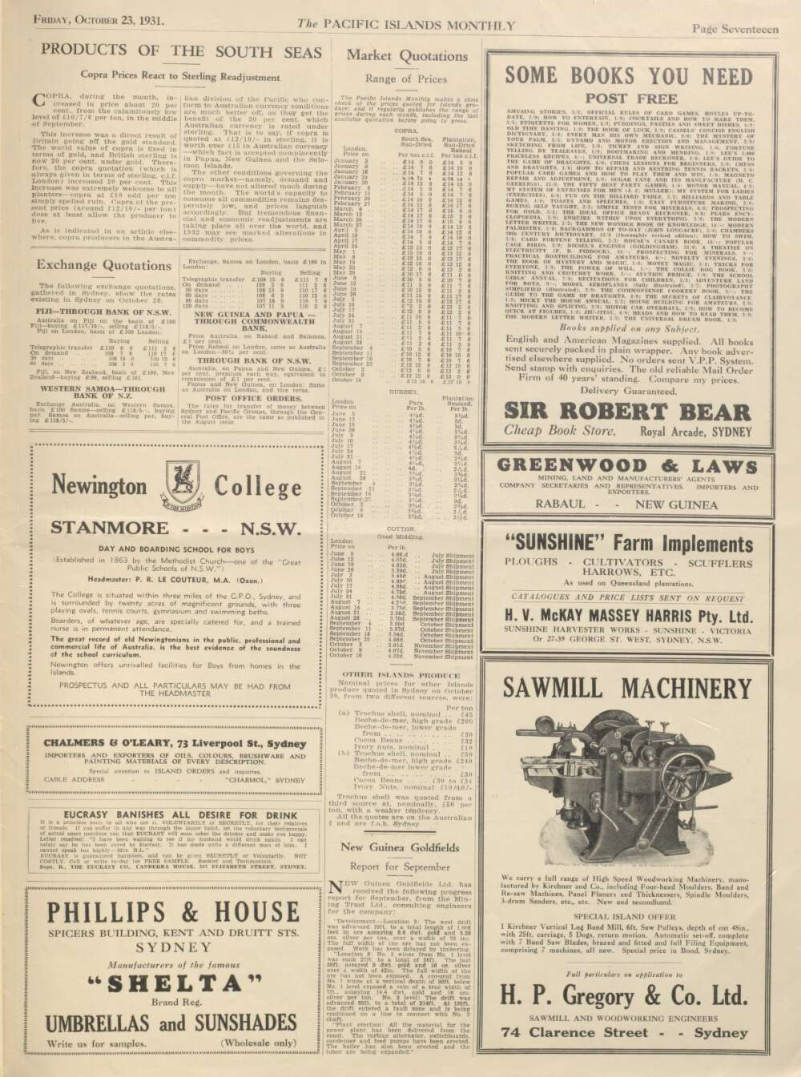
Copra Prices React to Sterling Readjustment
COPRA, during the month, in creased in price about 20 per cent., from the calamitously low level of £10/7/6 per ton, in the middle of September.
This increase was a direct result of Britain going off the gold standard.
The world value of copra is fixed in terms of gold, and British sterling is now 20 per cent, under gold. There fore, the copra quotation (which is always given in terms of sterling, c.i.f.
London) increased 20 per cent. This increase was extremely welcome to all planters—copra at £10 odd per ton simply spelled ruin. Copra at the pre sent price (around £12/10/- per ton) does at least allow the producer to live.
As is indicated in an article else where, copra producers in the Austra
lian division of the Pacific who con form to Australian currency conditions are much better off, as they get the benefit of the 30 per cent, which Australian currency is rated under sterling. That is to say, if copra is quoted at £12/10/- in sterling, it is worth over £15 in Australian currency —which fact is accepted complacently in Papua, New Guinea and the Solo mon Islands.
The other conditions governing the copra. market—namely, demand and supply—have not altered much during the month. The world’s capacity to consume all commodities remains des perately low, and prices languish accordingly. But tremendous finan cial and economic readjustments are taking place all over the world, and 19 32 may see marked alterations in commodity prices.
Exchange Quotations
The following exchange quotations, gathered in Sydney, show the rates existing in Sydney on October 20.
Fiji—Through Bank Of N.S.W.
Australia on Fiji on the basis of £100 Fiji—buying £117/10/-, selling £118/5/-.
Fiji on London, basis of £100 London:
Western Samoa—Through
Bank Of N.Z.
Exchange Australia, on Western Samoa, basis £100 Samoa —selling £118/5/-, buying par. Samoa on Australia —selling par, buy ing £118/5/-.
Exchange, Samoa on London, basis £100 in London:
New Guinea And Papua
Through Commonwealth
Bank.
Prom Australia, on Rabaul and Salamoa, £1 per cent.
From Rabaul on London, same as Australia on London — 30½ per cent.
Through Bank Of N.S.W.
Australia, on Papua and New Guinea, £ 1 per cent, premium each way, equivalent to commission of £ 1 per cent.
Papua and New Guinea, on London: Same as Australia on London, and vice versa.
Post Office Orders.
The rates for transfer of money between Sydney and Pacific Groups, through the Gen eral Post Office, are the same as published in the August issue.
Buying
Selling
Telegraphic transfer £110 0 0 £111 2 6 On demand . . . . 109 7 6 110 17 6 30 days 108 15 0 110 12 6 60 days 108 3 9 110 7 6 Fiji, on New Zealand, basis of
buying £99, selling £101
£100. New
Buying Selling Telegraphic transfer £109 15 0 £111 7 6 On demand 109 2 6 111 2 6 30 days 108 13 9 110 17 6 60 days 108 6 3 110 12 6 90 days 107 18 9 110 7 6 120 days 107 11 3 110 2 6
Market Quotations
Range of Prices
The Pacific Islands Monthly makes a close check of the prices quoted for Islands pro duce; and it regularly publishes the range of prices during each month, including the last available Quotation before going to press.
Copra.
South Sea, Plantation, Sun-Dried Sun-Dried London.
Rabaul Price on Per ton c.i.f.
Per ton c.i.f.
January 2 • . . £14 0 0 £ 14 5 0 January 9 .. . . £14 7 6 £14 10 0
January 16
-. .. £ 14 7 6 £ 14 12 6 January 23 -. .. 1.14 la i £14 19 1 January 30 . . £ 14 12 6 £14 15 0 February 6 ... .. £14 5 0 £ 14 7 6 February 13 . . . . £14 5 0 £ 14 7 6 February 20 - . . . £14 10 0 £ 14 12 6 February 27 . . . . £14 12 6 £ 14 17 6 March 6 • . . . £14 17 6 £ 15 0 6 March 13 .. . .. £14 17 6 £ 15 2 6 March 20 - £14 17 6 £ 15 0 6 March 27 .. .. . . £14 10 0 £14 12 6 Apr.l 3 • - . . £ 14 10 0 £14 12 6 April 10 • • . £14 7 6 £14 10 0 April 17 .. £14 5 0 £ 14 7 6 April 24 • - • . £13 15 0 £13 17 6 May 1 . . £13 10 0 £ 13 12 6 May 8 .. .. £ 12 15 0 £12 17 6 May 15 . . £ 12 10 0 £ 12 12 6 May 22 . . £ 12 0 0 £ 12 2 6 May 29 . . £10 17 6 £11 0 6 June 5 .. £10 5 0 £ 10 7 6 June 12 . . £11 5 0 £11 7 6 June 19 £10 15 0 £ 11 2 6 1 June 26 . £11 15 0 £11 17 6 July 3 £ 12 17 6 July 10 .. ..£12 2 6 £12 5 0 July 17 . . £12 0 0 £12 2 6 July 24 .. .. £ 11 15 0 £11 7 6 July 31 .. £11 5 0 £11 7 6 August 7 ..£1126 £11 5 6 August 14 .. £11 7 6 £11 10 6 August 21 ,. . . £ 11 2 6 £ 11 7 6 August 28 . . • • . £11 2 6 £ 11 s 0 September 4 . . £ 10 5 0 £ 10 7 6 September 11 . . £ 10 12 6 £10 15 0 September 18 £10 7 6 £ 10 7 6 September 25 . £ 12 15 0 £12 15 0 October 2 . . £ 12 0 0 £12 2 6 October 9 . . . £12 15 0 £13 0 6 October 16 .. .. £12 10 0 £12 15 0
Rubber.
London Para Plantation Price on Per lb.
Per lb.
June 5 .. 4V s d. 3 tid.
June 12 • . . 41/sd. 3d.
June 19 .. 41/sd. 3d.
June 26 .. .. 4V 4 d. 3V 4 d.
July 3 . . 4V 4 d.
Slid.
July 10 . 4i/ 2 d. 3V s d.
July 17 - . . . 4V 2 d.
SJijd.
July 24 .. .. 4 •'id. 3d July 31 . . . 41-id. 2 3 4d August 7 . 4V 4 d. 2 ] /.d August 14 . 4d. 2 1, d August 21 . . . . 3 3 / 4 d 2 3 /*d i August 28 .. . . 3 3 4d. 2V 4 d September 4 • - -. 3i/id. 2V 4 d September 11 . 3V 4 d. 2, 7 ,d j September 18 3i/sd, September 25 3 3 4d. 3d.
October 2 .. . . 3%d. 2 7 / 8 d October 9 • . 3%d.
October 16 ... 3V 8 d.
i 2|gd.
Cotton.
London Good Middling.
Price on Per lb.
June 5 4.66.d .. July Shipment June 12 ..
.. 4.57d. . . July Shipment
4.62d. July Shipment June 26 5,39d. .. July Shipment July 3 ., .. o.46d .. August Shipment July 10 4.89d. . August Shipment 4.98d. . . August Shipment July 24 4.78d. August Shipment July 31 August 7 .. 4 2id. September Shipment August 14 .. .. 3.73d. September Shipment August 21 3.56d. September Shipment August 28 3.70d. September Shipment September 4 3.59d. October Shipment September 11 September 18 September 25 4.88d. October Shipment October 2 .. 3,91d. November Shipment October 9 4.07d. November Shipment October 16 4.32d. November Shipment
Other Islands Produce
Nominal prices for other Islands produce quoted in Sydney on October 20, from two different sources, were: Per ton (a) Trochus shell, nominal . . £45 Reche-de-mer, high grade £200 Beche-de-mer, lower grade from £3O0 Cocoa Beans £32 Ivory nuts, nominal . . . . £10 (b) Trochus shell, nominal . . £50 Beche-de-mer, high grade £240 Beche-de-mer lower grade “ from £30 Cocoa Beans . . . . £30 to £34 Ivory Nuts, nominal £10/10/,- Trochus shell was quoted from a third source at, nominally, £50 per ton, with a weaker tendency.
All the quotes are on the Australian £ and are f.o.b. Sydney.
Report for September
New Guinea Goldfields Report for September
NEW Guinea Goldfields Ltd. has received the following' progress report for September, from the Min
ing Trust Ltd., consulting engineers
for the company; “Development.—Location 3: The west drift was advanced 10ft. to a total length of 1,056 feet in ore assaying 8.6 dwt. gold and 5.25 ozs. silver per ton, over a width of 33 ins.
The full width of the ore has not been ex posed. Work has been delayed by timbering.
“Location 8: No. 2 winze from No. 1 level was sunk 21ft. to a total of 56ft. The last 20ft. assayed 9 dwt. gold and 16 oz. silver over a width of 42in. The full width of the ore has not been exposed. A crosscut from No. 1 winze at a vertical depth of 50ft. below No. 1 level exposed a vein of a true width of 7ft,. assaying 14.4 dwt. gold and 18 ozs. silver per ton. No. 2 level: The drift was advanced 93ft. to a total of 214 ft. At 160 ft. the drift entered a fault zone and is being continued on a line to connect with No. 2 shaft.
“Plant erection: All the material for the power plant has been delivered from the coast. The turbine alternator, switchboards, condenser and feed pumps have been erected.
The boiler has also been erected and the tubes are being expanded.”
Advertisements & other items, p. 17 (2 items)
Sawmill Machinery
SOME BOOKS YOU NEED
POST FREE
AMUSING STORIES, 3/3; OFFICIAL RULES OF CARD GAMES, HOYLES UP-TO- DATE, 2/9; HOW TO ENTERTAIN, 1/9; COCKTAILS AND HOW TO MAKE THEM 3/3; ETIQUETTE FOR WOMEN, 2/9; PUDDINGS, PASTIES AND SWEET DISHES, 4/9; DANCING 1/9; THE BOOK OF LUCK, 1/9; CASSELS’ CONCISE ENGLISH DICTYONARY, 3/6; EVERY MAN HIS OWN MECHANIC, 9/6; THE MYSTERY OF YOUR PALM, 3/3; DYNAMO AND MOTOR ERECTION AND MANAGEMENT, 2/9,' SKETCHING FROM LIFE, 1/6; TICKET AND SIGN WRITING, 1/6 FORTUNE tiling by tealeaves, 1/9; bootmaking and mending, 2/9; lee s .i^ooo PRICELESS RECIPES, 4/-; UNIVERSAL TRADE RECKONER, 4 6; LEE’S GUIDE TO THE GAME OF DRAUGHTS, 4/6; CHESS LESSONS FOR BEGINNERS, 2/9; CHESS AND DRAUGHTS, 1/6; HOW TO REPAIR AND RESTRING TENNIS RACKETS, 3/6; POPULAR CARD GAMES AND HOW TO PLAY THEM AND WIN, 1/6; MAGNETO REPAIR AND ADJUSTMENT, 2/9; SUGAR CANE AND ITS MANUFACTURE (II C GEERLIGS), 35/6; THE FIFTY BEST PARTY GAMES, 1/6: MOTOR MANUAL, 4/9- MY SYSTEM OF EXFRCISES FOR MEN (J. C. MULLER); MY SYSTEM FOR LADIES i, E .^ E J? CISES) ’ 6/6; FUN ON THE BILLIARD TABLE, 3/3; BILLIARDS AND TABLE GAMES, 1/6; TOASTS AND SPEECHES, 1/6; EASY FURNITURE MAKING. 2/9; BOXING SELF TAUGHT, 2/3; SIMPLE TESTS FOR MINERALS, 4/6; PROSPECTING FOR GOLD, 5/3; THE IDEAL OFFICE READY RECKONER, 9/8; PEARS ENCY- CLOPOEDIA, 5/9; ENQUIRE WITHIN UPON EVERYTHING. 5/6; THE MODERN 3/3; THE NEW WONDER BOOK OF KNOWLEDGE, 14/-; MODERN fm’ BAeK GAMMON OF TO-DAY (JOHN LONGACRE), 5/6; CHAMBERS 20th CENTURY DICTIONARY, 12/6 (thoroughly revised edition); HOW TO SW’IM, EORTUNE TELLING, 3/3; HOUSE’S CANARY BOOK, 16/-; POPULAR CAGE BIRDS 2/8 DIESEL ’ S ENGINES (GOLDINGHAM), 33/6; A TREATISE ON PIDDOCK) ’ 32 PROSPECTING FOR MINERALS, 9-; PRACTICAL BOATBUILDING FOR AMATEURS, 6/-; NOVELTY EVENINGS 2/6- THE BOOK OF MYSTERY AND MAGIC, 1/6; MONEY MAGIC 3/3- TRICKS FOR EVERYONE, 3/3; THE POWER OF WILL, 1/-; THE COLLIE DOG BOOK WORK, 2/-; AUCTION BRIDGE. 1/9: THE SCHOOL GIRLS ANNUAL, 7/6; RECITATIONS FOR CHILDREN, 3/3; ADVENTURE LAND E J/ R BOYS. 9/-; MODEL AEROPLANES (fully illustrated), 2/7; PHOTOGRAPHY' SIMPLIFIED (illustrated), 2/9; THE COMMONSENSE COOKERY BOOK, 2/-- THE GUIDE TO THE GAME OF DRAUGHTS, 4/9; THE SECRETS OF CLAIRVOYANCE THE MOUSE ANNUAL. 5/3; HOUSE BUILDING FOR AMATEURS 2/9 : KNOT TI NG AND SPLICING, 2/9; MOTOR CAR OVERHAUL, 2/9; HOW TO BFCOMF QUICK AT FIGURES, 1/9; JIU-JITSU, 4/6; HEADS AND HOW TO READ THEM 2/9' THE MODERN LETTER WRITER, 3/3; THE UNIVERSAL DREAM BOOK 1 9^’
Books supplied on any Subject.
English and American Magazines supplied. All books sent securely packed in plain wrapper. Any book adver tised elsewhere supplied. No orders sent V.P.P. System.
Send stamp with enquiries. The old reliable Mail Order Firm of 40 years’ standing. Compare my prices.
Delivery Guaranteed.
SIR ROBERT BEAR
Cheap Book Store, Royal Arcade, SYDNEY
GREENWOOD LAWS
MINING, LAND AND MANUFACTURERS’ AGENTS
COMPANY SECRETARIES AND REPRESENTATIVES. IMPORTERS AND
EXPORTERS.
RABAUL - - NEW GUINEA
“SUNSHINE” Farm Implements
PLOUGHS - CULTIVATORS - SCUFFLERS
HARROWS, ETC.
As used on Queensland plantations.
CATALOGUES AND PRICE LISTS SENT ON REQVEST
H.V. McKAY MASSEY HARRIS Pty. Ltd.
SUNSHINE HARVESTER WORKS - SUNSHINE - VICTORIA Or 27-39 GEORGE ST. WEST, SYDNEY, N.S.W.
SAWMILL MACHINERY
We carry a full range of High Speed Woodworking Machinery, manufactured by Kirchner and Co., including Four-head Moulders, Band and Re-saw Machines, Panel Planers and Thicknessers, Spindle Moulders, 3-drum Sanders, etc., etc. New and secondhand.
SPECIAL ISLAND OFFER
1 Kirchner vertical Log Band Mill, 6ft. Saw Pulleys, depth of cut 48in., with 25ft. carriage, 5 Dogs, return motion. Automatic set-off, complete with 7 Band Saw Blades, brazed and fitted and full Filing Equipment, comprising 7 machines, all new. Special price in Bond, Sydney.
H. P. Gregory & Co. Ltd.
74 Clarence Street - - Sydney
Full particulars on application to
SAWMILL AND WOODWORKING ENGINEERS
Newington
STANMORE -
College
- N.S.W.
DAY AND BOARDING SCHOOL FOR BOYS
(Established in 1863 by the Methodist Church—one of the “Great Public Schools of N.S.W.”) Headmaster: P. R. LE COUTEUR, M.A. (Oxon.) The College is situated within three miles of the G.P.0., Sydney, and is surrounded by twenty acres of magnificent grounds, with three playing ovals, tennis courts, gymnasium and swimming baths.
Boarders, of whatever age, are specially catered for, and a trained nurse is in permanent attendance.
The great record of old Newingtonians in the public, professional and commercial life of Australia, is the best evidence of the soundness of the school curriculum.
Newington offers unrivalled facilities for Boys from homes in the Islands.
PROSPECTUS AND ALL PARTICULARS MAY BE HAD FROM
THE HEADMASTER
CHALMERS & O’LEARY, 73 Liverpool St., Sydney IMPORTERS AND EXPORTERS OF OILS, COLOURS, BRUSHWARE AND
PAINTING MATERIALS OF EVERY DESCRIPTION.
Special attention to ISLAND ORDERS and inquiries.
CABLE ADDRESS ... "CHARMOL,” SYDNEY
EUCRASY BANISHES ALL DESIRE FOR DRINK
It is a priceless boon to all who use it, VOLUNTARILY or SECRETLY, for their relatives or friends. If you suffer in any way through the liquor habit, let the voluntary testimonials of actual users convince you that EUCRASY will soon sober the drinker and make you happy.
Letter received: “I have been waiting to see if my husband would drink again. I can safely say he has been cured by Eucrasy. It has made quite a different man of him. I cannot speak too highly.—Mrs. B.L.”
EUCRASY is guaranteed harmless, and can be given SECRETLY or Voluntarily. NOT COSTLY. Call or write to-day for FREE SAMPLE. Booklet and Testimonials.
Dept. 8., THE EUCRASY CO., CANBERRA HOUSE, 297 ELIZABETH STREET, SYDNEY.
PHILLIPS & HOUSE
SPICERS BUILDING, KENT AND DRUITT STS.
SYDNEY
Manufacturers of the famous
“SHELTA"
Brand Reg.
UMBRELLAS and SUNSHADES
Write us for samples. (Wholesale only)
Shipping Services in The Pacific
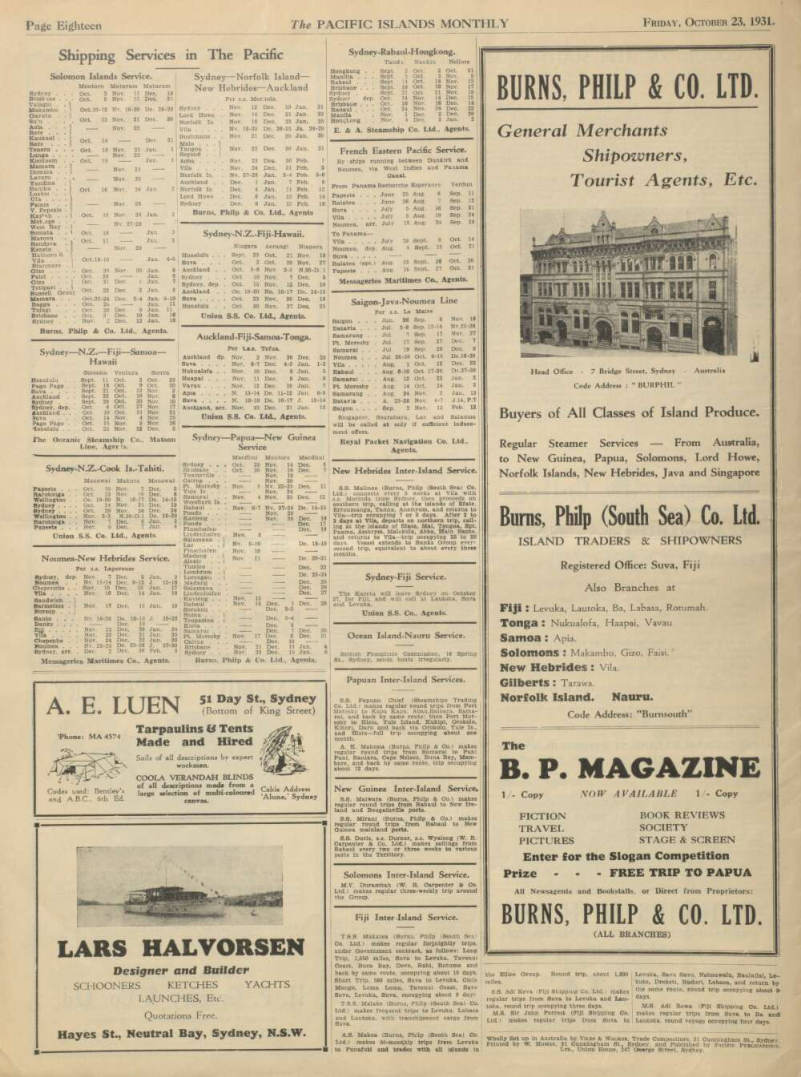
Solomon Islands Service.
Sydney—N.Z.—Fiji—Samoa— Hawaii
Sydney-N.Z.-Cook Is.-Tahiti.
Noumea-New Hebrides Service.
Per s.s. Laperouse
Sydney —Norfolk Island — New Hebrides —Auckland
Sydney-N.Z.-Fiji-Hawaii.
Auckland-Fiji-Samoa-Tonga.
Sydney—Papua—New Guinea Service
Sydney-Rabaul-Hongkong.
French Eastern Pacific Service.
By ships running between Dunkirk and Noumea, via West Indies and Panama
Saigon-Java-Noumea Line
New Hebrides Inter-Island Service.
S.S. Malinoa (Burns, Philp (South Sea) Co.
Ltd.) connects every 5 weeks at Vila with s.s. Morinda irom Sydney, then proceeds on southern trip, calling at the islands of Efate.
Erronmanga, Tanna, Aneityum, and returns to Vila—trip occupying 7 or 8 days. After 2 to 3 days at Vila, departs on northern trip, call ing at the Islands of Efate, Mai, Tongoa, Epi.
Paama, Ambrym, Malekula, Abba, Malo, Santo, and returns to Vila—trip occupying 25 to 28 days. Vessel extends to Banks Group even second trip, equivalent to about every three months.
Sydney-Fiji Service.
The Karetu will leave Sydney on October 27, for Fiji, and will call at Lautoka, Suva and Levuka.
Union S.S. Co., Agents.
Ocean Island-Nauru Service.
British Phosphate Commission, 16 Spring St., Sydney, sends boats irregularly.
Papuan Inter-Island Services.
S.S. Papuan Chief (Steamships Trading Co. Ltd.) makes regular round trips from Port Moresby to Kapa Kapa, Abau, Baibara, Sama rai, and back by same route: then Port Mor esby to Hislu, Yule Island, Kukipi, Orokolo, Kikori, Daru and back via Orokolo, Yule Is., and Hisiu—full trip occupying about one month.
A. K. Matoma (Burns, Philp & Co.) makes regular round trips from Samarai to Puni Puni, Banlara, Cape Nelson, Buna Bay, Mam bare, and back by same route, trip occupying about 12 days.
New Guinea Inter-Island Service
S.S. Maiwara (Burns, Philp & Co.) makes regular round trips from Rabaul to New Ire land and Bougainville ports.
S.S. Mirani (Burns, Philp & Co.) makes regular round trips from Rabaul to New Guinea mainland ports.
S.S. Duris, s.s. Durour, s.s. Wyalong (W. R.
Carpenter & Co. Ltd.) makes sailings from Rabaul every two or three weeks to various ports in the Territory.
Solomons Inter-Island Service.
M.V. Durambah (W. R. Carpenter & Co.
Ltd.) makes regular three-weekly trip around the Group.
Fiji Inter-Island Service.
T.S.S. Makatea (Burns, Philp (South Seas Co. Ltd.) makes regular fortnightly trips, under Government contract, as follows; Long Trip, 1,050 miles, Suva to Levuka, Tavenui Coast, Buca Bay, Devo, Rabi, Rotuma and back by same route, occupying about 10 days.
Short Trip, 560 miles, Suva to Levuka, Cicia Mango, Loma Loma, Tavenui Coast, Savu Savu, Levuka, Suva, occupying about 9 days T.S.S. Malake (Burns, Philp (South Sea) Co.
Ltd.) makes frequent trips to Levuka, Labasa and Lautoka, with transhipment cargo from Suva.
A.S. Makoa (Burns, Philp (South Sea) Co.
Ltd.) makes bi-mont.hly trips from Levuka to Funafuti and trades with all islands in
the Ellice Group. Round trip, about 1,800 miles.
S.S. Adi Keva (Fiji Shipping Co. Ltd.) makes regular trips from Suva to Levuka and Lau toka, round trip occupying three days.
M.S. Sir John Forrest (Fiji Shipping Co.
Ltd.) makes regular trips from Suva to
Levuka, Savu Savu, Nabouwalu, Baulailal, Le kutu, Dreketi, Radurl, Labasa, and return by the same route, round trip occupying about 9 days.
M.S. Adi Rewa (FIJI Shipping Co. Ltd.) makes regular trips from Suva to Ba and Lautoka. round voyage occupying four days.
Montoro Mataram Mataram
Sydney .
Oct. 3 Nov. 11 Dec. 19 Brisbane .
Oct. 5 Nov. 13 Dec. 21
Tulagai .
De. 26 29 Makambo Oct. 10- 12 Nv. 18- 20 Gavutu . 30 Bu’u . .
Oct. 13 Nov. 21 Dec.
Aola . 1 Nov. 22 Here . .
Kauk.au! .
Re re . .
Oct. 14 — Dec. 31 Teneru .
Oct. 15 Nov. 23 Jan. 1 Lunga . .
Nov. 23 — Kookoom Oct. 15 — Jan. 1 Mamara .
Domma . — Nov. 24 — Lavoro .
Nov. 25 .
Yandina Banika .
Oct. 16 Nov. 26 Jan. 2 Loabie .
Ufa . . .
Falatn — Nov. 26 —
Y. Pepsale
26 Jan.
Kay 1 ah .
Oct. 16 Nov. 2 Mer.nge .
West Bay — Nv. 27 -28 — Bomata .
Oct. 16 — Jan. 2 Marovo Rendova Oct. n — 29 Jan. 3 Kenelo . — Nov.
Hathorn S Vila . .
Oct.18 -19 — Jan. 4-5 Stanmore 6 Glzo . . .
Oct. 20 Nov. 30 Jan.
Falsi . .
Oct. 20 — Jan. 6 Gizo . .
Oct 21 Dec. 1 Jan. 7
Tetlparl . . (
Russell Group Oct. 22 Dec. 2 Jan. 8 Mamara Oct.23 -24 Dec. 3-4 Jan. 9 -10 Bagga .
Oct. 2b Jan. 11
Tulagi
Oct. 26 Dec.
S Jan. 11 Brisbane Oct. 3' Dec. 10 Jan. 16
Sydney .
Nov. 2 Dec. 12 Jan. 18 Burns, Philp & Co. Ltd., Agents.
Sonoma Ventura Sierra Honolulu . Sept. ll Oct. 2 Oct. 23 Pago Pago . . Sept. 18 Oct. 9 Oct. 30 Suva . . . . Sept. 21 Oct. 12 Nov. 2 Auckland . . Sept. 25 Oct. 16 Nov. 6 Sydney . . . Sept. 29 Oct. 20 Nov. 10 Sydney, dep. . Oct. 6 Oct. 27 Nov. 17 Auckland . . . Oct 10 Oct. 31 Nov. 21 Suva . . . . Oct. 14 Nov. 4 Nov. 25 Pago Pago . . Oct. 15 Nov. 5 Nov. 26 Honolulu . . . Oct. 22 Nov. 12 Dec. 3 The Oceanic Steamship Co., Matson
Line, Agents.
Monowai Makura Monowai
Papeete . .
Oct. 10 Nov. 7 Dec. 5
Rarotonga .
Oct. 13 Nov. 10 Dec. 8
Wellington .
Oc. 19-20 N. 16-17 De. 14-15
Sydney . . .
Oct. 24 Nov. 21 Dec. 19
Sydney , . .
Oct. 29 Nov. 26 Dec. 24
Wellington .
Nov 2-3 N.30-D.1 De. 28-29
Rarotonga .
Nov 7 Dec. 5 Jan 2
Papeete . .
Nov 9 Dec. 7 Jan 4 Union S.S. Co. Ltd., Agents.
Sydney, dep.
Nov. 7 Dec. 5 Jan. 9 Noumea Nv. 11-14 Dec. 9-12 J. 13-16 Chepenche . .
Nov, 15 Dec. 13 Jan. 17 Vila . . . , Nov. 16 Dec. 14 Jan. 18 Sandwich . 1 Barmettes . f Nov 17 Dec. 15 Jan, 19
Norsup . . )
Santo . . .
Nv. 18-20 De. 16-18 J. 20-23 Banks . . . .
Dec. 19 —
Eni
Vila ...
Nov 22 Dec. 20 Jan. 24 Nov 23 Dec. 21 Jan. 25
Chepenhe , .
Nov 24 Dec. 22 Jan. 26 Noumea . .
Nv. 25-23 De. 23-26 J. 27-30
Sydney, arr. .
Dec. 2 Dec. 30 Feb. 3
Messageries Maritimes Co., Agents.
Sydney . .
Per s.s. . Nov.
Morinda. 12 Dec. 19 Jan. 21 Lord Howe . Nov. 14 Dec. 21 Jan. 23 Norfolk Is. . Nov. 16 Dec. 23 Jan. 25 Vila ... . Nv. 19 20 Dc. 26-28 Ja. 28 -29 Bushmans . . Nov. 21 Dec. 29 Jan. 30 Malo . . .
Tangoa . .
Nov. 22 Dec. 30 Jan. 31 Segond . .
Aoba . . . . Nov. 23 Dec. 30 Feb. 1 Vila . . . . Nov. 24 Dec. 31 Feb. 2 Norfolk Is. . Nv. 27-28 Jan. 3-4 Feb. 5-6 Auckland . , Dec. 1 Jan. 7 Feb. 9 Norfolk Is. . Dec. 4 Jan. 11 Feb. 12 Lord Howe Dec. 6 Jan. 13 Feb. 14 Sydney . . . Dec. 8 Jan. 15 Feb. 16 Burns, Philp & Co. Ltd., Agents.
Niagara Aorangi Niagara Honolulu . . .
Sept. 23 Oct. 21 Nov. 18 Suva . . .
Oct. 2 Oct. 30 Nov. 27 Auckland . . Oct. 5-6 Nov. 2-3 N.30-D. 1 Sydney . . . Oct. 10 Nov. 7 Dec. 5
Sydney, dep.
, Oct. 15 Nov. 12 Dec. 10 Auckland . , . Oc. 19-20 No. 16-17 De. 14- 15 Suva , Oct. 23 Nov. 20 Dec. 18 Honolulu . , , Oct. 30 Nov. 27 Deo. 35 Union S.S. Co. Ltd., Agents.
Per t.«.s.
Tofua.
Auckland dp. Nov. 2 Nov. 30 Dec. 28 Suva . . . . Nov. 6-7 Dec. 4-5 Jan. 1-2 Nukualofa . . Nov. 10 Dec. 8 Jan. 5 Haapal . . . Nov. 11 Dec. 9 Jan. 6 Vavau . . . . Nov. 12 Dec. 10 Jan. 7 Apia . . . . N. 13-14 De. 11-12 Jan. 8-9 Suva . . . . N. 18-19 De. 16-17 J. 13-14 Auckland, arr. Nov. 23 Dec. 21 Jan. 18 Union S.S. Co. Ltd., Agents.
Macdhui Moutoro Macdhui Sydney . .
Oct. 28 Nov. 14 Dec. 5 Brisbane .
Oct. 30 Nov. 16 Dec. 7 Townsville . — Nov. 19 Cairns . . — Nov. 20
Pt. Moresby
Nov. 3 Nv. 22-23 Dec. 11 Yule Is. . . — Nov. 24 — Samarai Nov. 4 Nov. 25 Deo. 12 Woodlark Is.
Rabaul . .
Nov. 6-7 Nv. 27-28 De. 14- 15 Pondo , .
Nov. 29 — Kavieng . . — Nov. 30 Dec. 16 Pondo . . .
Dec. 17 Finschafen Dec. 18 Lindenhafen Nov. 8 — Salamaua .
De. 18 -19 Lae . . . f Nv. 9 -10 — Finschafen Nov. 10
Madang . .
Alexis , .
Nov. 11 De. 20-21 Tumleo . .
Dec. 22 Lombrum .
Lorengau . — — De. 23 -24 Madang . . — Dec. 25 Salamaua . — Dec. 26 Lindenhafen — Dec. 27 Kavieng . .
Nov. 13 — 28 Rabaul . .
Nov. 14 Dec. 1 Dec.
Soraken . . — Dec. 2-3 — Numa . . .
Dec.
Teopasina .
— 3-4 — Kieta . . . - .
Dec. 5 — Samarai . . — Dec. 7 Dec. 30
Pt. Moresby
Nov. 17 Dec. 8 Dec. 31 Cairns . . — Dec. 10 — Brisbane .
Nov. 21 Dec. 13 Jan. 4
Sydney , .
Nov. 23 Dec. 15 Jan. 6 Burns, Philp & Co. Ltd., Agents.
Tanda Nankin Nellore Hongkong , . Sept. 2 Oct. 2 Oct. 31 Manilla . . . Sept. 5 Oct. 5 Nov. 3 Rabaul . . . Sept. 14 Oct. 14 Nov. 12 Brisbane . . . Sept. 19 Oct. 19 Nov. 17 Sydney . . . Sept. 21 Oct. 21 Nov. 19 Sydney dep. Oct. 14 Nov. 14 Dec. 12 Brisbane . . . Oct. 16 Nov. 16 Dec. 14 Raoaul . , . . Oct. 24 Nov. 24 Dec. 22 Manila . Nov. 1 Dec. 2 Dec.
SO Hongkong . . Nov. 4 Dec. 5 Jan. 2 E. & A. Steamship Co. Ltd., Agents.
Canal.
Prom Panama Recherche Esperance Verdun Papeete . . .
June 25 Aug. 6 Sep. 11 Ralatea . . .
June 26 Aug. 7 Sep. )2 Suva . . . .
July 5 Aug. 16 Sep. 21 Vila July 8 Aug. 19 Sep. 24 Noumea, art.
July 13 Aug. 24 Sep. 29 To Panama — Vila July 28 Sept. 8 Oct. 14 Noumea, dep.
Aug. 4 Sept. 15 Oct. 21 Suva Raiatea (opt.) Aug. 15 Sept. 26 Oct. 30 Papeete . . .
Aug. 10 Sent. 27 Oct. 31
Messageries Maritimes Co., Agents.
Per s.s. Le Maire Saigon . . . Jun. 26 Sep. 6 Nov. 16 Batavia . . . Jul. 3-6 Sep. 13 -16 Nv.23 -26 Samarang . . Jul. 7 Sep. 17 Nov. 27 Pt. Moresby . Jul. 17 Sep. 27 Dec, 7 Samara! . . . Jul. 19 Sep. 29 Dec. 9 Noumea . . . Jul. 26-30 Oct. 6 -10 Dc.16 -20 Vila ... . Aug. 1 Oct. 12 Dec. 22 Rabaul . . . Aug. 8-10 Oct. 17-20 Dc.27-30 Samara! . . . Aug. 13 Oct. 23 Jan. 2 Pt. Moresby . Aug. 14 Oct. 24 Jan. 3 Samarang . . Aug. 24 Nov. 3 Jan. 13 Batavia . . . A. 25-28 Nov. 4-7 J.14, P.7 Saigon . . . . Sep. 2 Nov. 12 Feb. 12 Singapore, Sourabaya, Lae and Salamoa will be called at only if sufficient induce ment offers.
Royal Packet Navigation Co. Ltd.,
Agents.
Advertisements & other items, p. 18 (2 items)
18
Friday, October 23, 1931.
The PACIFIC ISLANDS MONTHLY
Wholly Set up in Australia by Viles & Walker, Trade Compositors, 31 Cunningham St Sydney Printed by W. Homer, 31 Cunningham St., Sydney, and Published bv Pacific Publications.' Ltd., Union House, 247 George Street. Sydney
Burns, Philp & Co. Ltd.
General Merchants
Shipowners,
Tourist Agents, Etc.
Head Office - 7 Bridge Street, Sydney Code Address : "BURPHIL"
Australia Buyers of All Classes of Island Produce, Regular Steamer Services From Australia, to New Guinea, Papua, Solomons, Lord Howe, Norfolk Islands, New Hebrides, Java and Singapore
Burns, Philp (South Sea) Co. Ltd.
ISLAND TRADERS & SHIPOWNERS
Registered Office: Suva, Fiji Also Branches at Fiji: Levulca, Lautoka, Ba, Labasa, Rotumah.
Tonga : Nukualofa, Haapai, Vavau Samoa: Apia.
Solomons : Makambo, Gizo, Faisi.
New Hebrides: Vila.
Gilberts: Tarawa.
Norfolk Island. Nauru.
Code Address: "Burnsouth"
The
B. P. MAGAZINE
1/- Copy NOW AVAILABLE 1/- Copy
FICTION BOOK REVIEWS
TRAVEL SOCIETY
PICTURES STAGE & SCREEN
Enter for the Slogan Competition Prize - - - FREE TRIP TO PAPUA All Newsagents and Bookstalls, or Direct from Proprietors:
BURNS, PHILP & CO. LTD.
(ALL BRANCHES)
AC T T TCM 51 Day St., Sydney
(Bottom of King Street)
’Phone: MA 4574 Codes used: Bentley’s and A.8.C., 6th Ed.
Tarpaulins & Tents
Made and Hired
Sails of all descriptions by expert workmen.
COOLA VERANDAH BLINDS
of all descriptions made from a large selection of multi-coloured canvas.
Cable Address ‘Alune,’ Sydney
LARS HALVORSEN
Designer and Builder
SCHOONERS KETCHES YACHTS
LAUNCHES, Etc.
Quotations Free.
Hayes St., Neutral Bay, Sydney, N.S.W.