Pacific Islands
Monthly
THE ONLY JOURNAL CIRCULATING THROUGHOUT THE ISLAND TERRITORIES AND GROUPS
Of The Central And South Pacific.
Vol. 2—No. 2.
Registered at G.P.O., Sydney, for transmission by Post as a Newspaper
Sydney; Friday, September 25, 1931
Subscriptiions
Single Copy, 6d.
Per Annum, posted, 6/-. ===
Year’s Work Reviewed
N.G. Planters Meet
From Our Own Correspondent
RABAUL, August 30.
THE Council of the Planters and Traders’ Association of New Guinea held its annual general meeting last month, when a very satisfactory report was submitted.
The Association was founded in 1927 and now has a membership of 84 planters.
The Council decided, in view of the unprecedented depression through which the copra industry is passing, to reduce the annual subscription to £3/3/-, and the entrance fee to £2/2/-.
The Association continues to perform very useful work on behalf of the planting community, and has been instrumental in securing, in conjunction with the R.S.S.I.L.A., the suspension of payments on plantations purchased from the Custodian of Expropriated Properties. ===
Copra Tax
Reduced to 7/6 per ton
More Relief For N.G.
Planters
IT was announced on September 22 that the Federal Cabinet had approved of a reduction of the Copra Export Tax in the Mandated Territory of New Guinea, from 15/- per ton to 7/6 per ton.
No further particulars are available.
It is assumed, however, that the tax will remain at the lower figure so long as the European quotation for copra is at an unprofitable level—which, with the Australian exchange at 30 per cent., is anything under £12 per ton c.i.f.
There has been no indication as yet of how the New Guinea Administration proposes to compensate itself for this loss of revenue. The tax was formerly 25/- per ton; but during the past year, there were two reductions of 5/each. The third fall, of 7/6 per ton, represents to the Administration a loss of revenue equal to 17/6 per ton on all copra exported—a very important consideration in the present difficult economic conditions.
It became known during the past month that the Administration officials had suggested to Canberra the refund of the export duty in necessitous cases only. The purpose of the plan, no doubt, was praiseworthy; but when those primarily concerned got down to an examination of the methods to be employed, many serious objections arose. Who was to decide which were necessitous cases? Was the provident planter, who had built up a reserve for a rainy day, to be penalised by having to pay the tax while the improvident planter, who could be classed as “necessitous,” was given special relief? However, the Canberra authorities soon decided that a discriminatory application of this form of relief was quite impracticable and the plan was abandoned.
Both the Planters and Traders’ Association of New Guinea, and the Returned Soldiers’ organisation, made very strong representations to the Federal Government. The matter was handled personally by Mr. Chifley, the Minister who assists the Prime Minister by attending to Pacific Islands affairs. Mr. Chifley has, during his period of office, dealt most sympathetically with requests from the Pacific Islands arising out of the present difficult economic conditions; and has displayed a comprehensive knowledge of Pacific territories’ requirements generally. His prompt decision in re gard to the Export Tax will be much appreciated. ... ===
First Edie Greek Wedding
THE first wedding to be celebrated on Edie Creek, New Guinea gold fields, took place early in August when Mr. H. A. Bodger, accountant on the Edie Creek section, for New Guinea Goldfields Ltd., was married to Miss Edith Bennett, niece of Mr. V. L. Newberry, manager of the Day Dawn mine.
Rev. F. Hughes, of Rabaul, performed the ceremony. ... ===
N.G. Patrol Attacked
Near Morobe Goldfields
A REPORT has reached Canberra that a New Guinea police patrol has been attacked by natives in the Upper Markham River district, which is near the Morobe goldfields The patrol officer, Mr. H. L. Downing, was wounded in the thigh by an arrow and a native policeman was seriously wounded.
Police reinforcements have been despatched to the locality. ... ===
Rubber’S Fall
From 12/- to 3d. per lb. in 20 Years
Serious Over-Supply
Rubber, once regarded as the magic talisman to the wealth of the East, has been deprived of all its glamour. From a price of 12/- per lb. in 1910, it has now reached the record low figure of 3½d. per lb. for Para and 2½d. for plantation smoked.
This essential product has during the past 20 years fluctuated remarkably. At one time its cultivation was held to be a means of quickly acquiring great A Native Rubber-tapper at work in Papua.
wealth, and investment in reputable rubber companies was much sought after. The price, after reaching its peak in 1910, dropped during the war, and, after the war period, declined even more rapidly until crepe rubber fell to 6d. and Para to 6d. per lb. In 1922, the average price was 6¾d. per lb.
Then Lord Stevenson’s scheme, in volving a voluntary restriction of out put, was agreed to by most of the growers in the British Empire. The price rose to 4/8 per lb. by 1925. The Stevenson scheme, however, had to be suddenly abandoned in 1928, owing to the Dutch expansion of planting and output. From that year the price has gradually declined to its present de pressed level.
Position In The Pacific
The main groups in the Pacific where rubber is being cultivated, are Papua —which has over 9,000 acres planted— Fiji, Western Samoa, and the British Solomons.
When the price fell to 9½d. in London in 1929, it was officially stated in Fiji that it did not pay planters there to tap their trees.
Nevertheless production continued in Fiji on a small scale and, for 1929, 6,855 lbs. »were exported. Exports for previous years were: 1922 9,142 lbs. 1923 89,753 lbs. 1924 159,995 lbs. 1925 144,313 lbs. 1926 233.999 lbs. 1927 221,238 lbs. 1928 94,661 lbs.
Exports from Western Samoa for 1930 were 116 tons, valued at £9,655, as compared with 167 tons, valued at £17,268, for 1928.
Papua’s annual production has remained around 600 tons during the
past five years. The exports, which in 1925 were valued at nearly £200,000, were last year worth only £50,000.
Planters in the Territory seem to consider 7d. per lb. almost sufficient to cover out of pocket expenses. Therefore when the price continued its downward trend past this figure, many contemplated closing down.
Towards the end of last year the Australian Government imposed a duty of 4d. per lb. on all foreign rubber entering the Commonwealth. This, giving as it did a definite preference to rubber produced in Papua, allowed tapping to continue there.
The future of rubber remains obscure. Restriction of output throughout the world is undoubtedly necessary.
As stated in a London trade report a couple of months ago, the only scheme of restriction that has a chance of being of any use is an international one. It would have to adjust supply to demand and allow the price to adjust itself.
It has been estimated that the world consumption of rubber for 1931 would show a decrease of nearly 100,000 tons on the previous year. ... ===
“Outing” Undesirables
Norfolk Island
Farce
A Brewer Who Spoke
French
From Our Own Correspondent NORFOLK IS., August 20.
WE have recently instituted a new means of getting rid of undesirables, of whom, naturally, we have our share.
This method appears to be strictly legal, but leaves a nasty, unsporting flavour in our mouths. Frankly almost without exception this community wishes that other steps might be taken when the deportation of British subjects from a British territory is deemed necessary.
A month or two ago, a gentleman with no financial resources, inspired with a laudable desire not to come upon the parish, so to speak, brewed and sold a mild, illicit beer; and was declared an “undesirable” within the meaning of the Act.
To facilitate his expulsion he was called before the headmaster of the local State School, who holds university degrees, and required to pass a language test in French. Unfortunately, French appears to be more widely known among this class of delinquent than was imagined. The candidate passed with flying colours and is still upon the island, employed more honourably nowadays with a mattock and hoe.
Last week, another nominee for a free passage westward was put through a Danish test—he might have known French!—at the hands of a Danish settler, with Government officials seated by to see foul play.
This entrant naturally made no attempt to cope with a language that he was probably hearing for the first time in his life; and, with his wife and three children, he leaves us by this Sydney-bound Morinda. Two nights ago he was the guest of honour of a hastily arranged public farewell at the Rawson Hall. All his friends attended. ... ===
Pilot Trist
Body Brought to Sydney
THE remains of Pilot L. J. Trist, who was killed when the aeroplane he was flying crashed near Wampit, New Guinea goldfields, while engaged on the goldfields transport service, were brought to Sydney from Salamoa, by the Macdhui, on September 18.
The funeral, which was largely attended, was held on the following day, at Waverley Cemetery. ... ===
B.P. Services
Another Revision
New Guinea And
Papua Again
CONVERSATIONS have been
proceeding during the whole of
the past month, between the Federal
Government and Messrs. Burns,
Philp and Co. Ltd., contractors for
the Pacific Islands mail and passen-
ger services, with reference to
further rearrangements.
A general revision was brought into effect only recently; but the effects of the depression have been so severe that passenger and freight traffic has shrunk below even the most pessimistic forecast, and the shipping company’s earnings have suffered accordingly. The position became so serious that, as indicated in last month’s issue, a further revision has become necessary.
The Federal Government has finally approved of the rearrangement of the Sydney-Norfoik Island-New Hebrides- Auckland service, carried out by the Morinda, and the new timetable is published on page 18 of this issue. It will be noted that the Morinda will leave Sydney every five weeks on the following schedule: Sydney-Norfoik Island-New Hebrides-Norfolk Island-
Auckland-Norfolk Island-Sydney.
It will be noted that an important development referred to in the August issue—namely, the inclusion of Noumea as a port of call in this service—has not taken place. It appears that several considerations enter into this proposal, the effect of which has been that the company has decided to hasten slowly. It can be stated, however, that the Noumea extension is still under consideration and will almost certainly be included in the Morinda’s service when various difficulties, which now present themselves, have been cleared away.
The Federal authorities still have under consideration the rearrangement of the Papuan and New Guinea services. These, at present, are carried out by three ships—the Macdhui, the Mataram and the Marsina. The traffic has sadly decreased; and, at the same time, the residents of the various Territories are crying out for cheaper fares and freights, while the Federal Government wants to reduce the subsidy.
The company has pointed out that all this is impossible so long as it is necessary to carry on these services with three steamers, but it is under stood that the company has advised the Government that, if the New Guinea and Papuan services are combined so as to permit the discontinuance of one steamer, it may be possible to reduce fares and freights and carry on on a smaller subsidy.
There are very many points to be considered in connection with these services. If ships going to and from (New Guinea are also to work the Papuan ports, it means that two or three days will be added to the voyages. That does not seem to matter very much to Papua, which will be the first Territory to be called at and the last to be left; but it does matter to the New Guinea Administration, which must make correspondingly larger provision for travelling expenses of its numerous officials between Sydney and the Territory. One objection from Papua is the fear that, under such an arrangement, New Guinea will get the best of the available accommodation.
There is also a difficulty about working the ports in the groups east of Papua, which have no medical officers to give pratique to through ships.
These are some of the numerous points with which the Federal officials and Messrs. Burns,. Philp and Co. are now wrestling, in an attempt to rearrange the northern islands services, and at the same time maintain efficiency.
A decision, it is expected, will be reached within the next few weeks. ... ===
Advertisements & other items, p. 1 (1 item)
Imperial
RESIDENTIAL HOTEL
(No License)
221 DARLINGHURST RD., KING’S CROSS
SYDNEY, N.S.W.
FULL BOARD AND RESIDENCE:
Weekly, from 45/- to 63/-. Daily, 10/- Management : Mr. and Mrs. Cyril Edwards ... ===
Signora TOTI DAL MONTE The brilliant prime donna writes : "It is with real pleasure that I write to you of my preference for your creme 'mercolized.’ I use it every day with a real delight as it does so much to keep the complexion
good.”
Let the clear beauty of your skin prove the worth of wonderful mercolized wax. Use daily. It doesn’t grow hair. 2/6 and 5/6, chemists and stores. Highly recommended for sunburn and freckles. 509
Ships
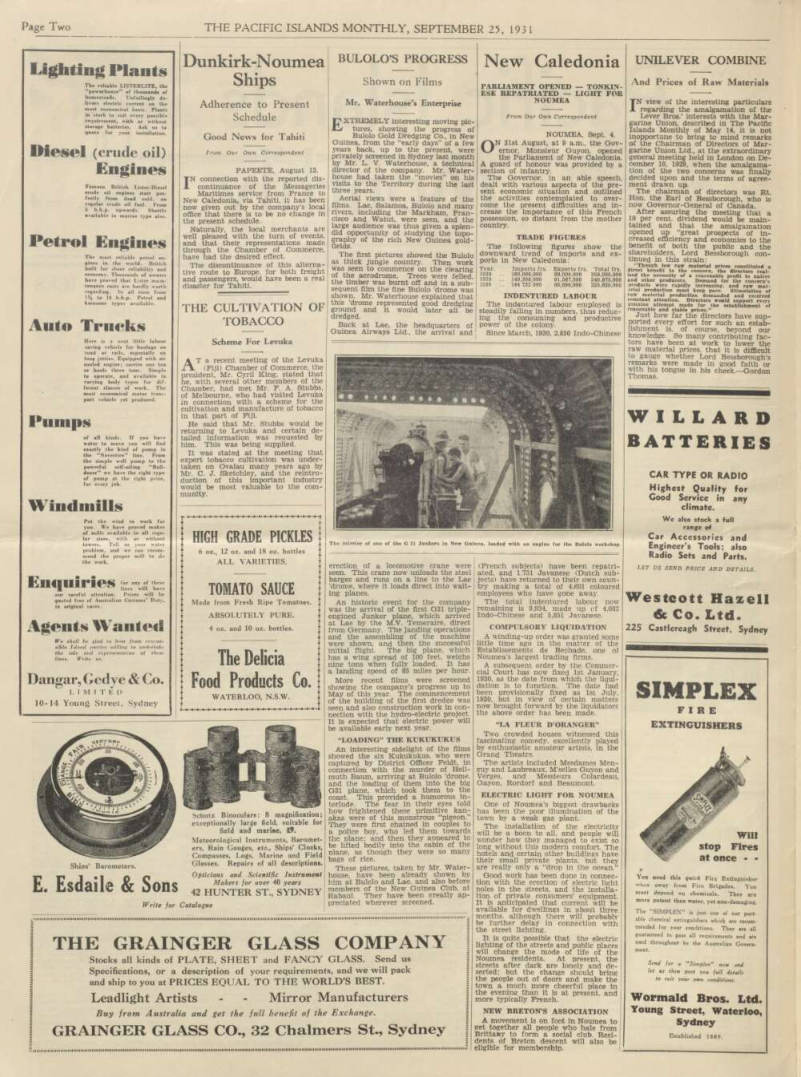
Adherence to Present Schedule Good News for Tahiti
From Our Own Correspondent PAPEETE, August 13.
IN connection with the reported discontinuance of the Messageries Maritimes service from France to New Caledonia, via Tahiti, it has been now given out by the company’s local office that there is to be no change in the present schedule.
Naturally, the local merchants are well pleased with the turn of events, and that their representations made through the Chamber of Commerce, have had the desired effect.
The discontinuance of this alternative route to Europe, for both freight and passengers, would have been a real disaster for Tahiti. ... ===
Tobacco
The Cultivation Of
Scheme For Levuka
AT a recent meeting of the Levuka (Fiji) Chamber of Commerce, the president, Mr. Cyril King, stated that he, with several other members of the Chamber, had met Mr. F. A. Stubbs, of Melbourne, who had visited Levuka in connection with a scheme for the cultivation and manufacture of tobacco in that part of Fiji.
He said that Mr. Stubbs would be returning to Levuka and certain detailed information was requested by him. This was being supplied.
It was stated at the meeting that expert tobacco cultivation was under taken on Ovalau many years ago by Mr. C. J. Sketchley, and the reintroduction of this important industry would be most valuable to the community. ... ===
Bulolo’S Progress
Shown on Films Mr. Waterhouse’s Enterprise
EXTREMELY interesting moving pictures, showing the progress of Bulolo Gold Dredging Co., in New Guinea, from the “early days” of a few years back, up to the present, were privately screened in Sydney last month by Mr. L. V. Waterhouse, a technical director of the company. Mr. Water house had taken the “movies” on his visits to the Territory during the last three years.
Aerial views were a feature of the films. Lae, Salamoa, Bulolo and many rivers, including the Markham, Francisco and Watut, were seen, and the large audience was thus given a splendid opportunity of studying the topography of the rich New Guinea gold fields.
The first pictures showed the Bulolo as thick jungle country. Then work was seen to commence on the clearing of the aerodrome. Trees were felled, the timber was burnt off and in a subsequent film the fine Bulolo ’drome was shown. Mr. Waterhouse explained that this ’drome represented good dredging ground and it would later all be dredged.
Back at Lae, the headquarters of Guinea Airways Ltd., the arrival and The interior of one of the G 31 Junkers in New Guinea, loaded with an engine for the Bulolo workshop
erection of a locomotive crane were seen. This crane now unloads the steel barges and runs on a line to the Lae ’drome, where it loads direct into waiting planes.
An historic event for the company was the arrival of the first G31 tripleengined Junker plane, which arrived at Lae by the M.V. Temeraire, direct from Germany. The landing operations and the assembling of the machine were shown, and then the successful initial flight. The big plane, which has a wing spread of 100 feet, weighs nine tons when fully loaded. It has a landing speed of 85 miles per hour.
More recent films were screened showing the company’s progress up to May of this year. The commencement of the building of the first dredge was seen and also construction work in connection with the hydro-electric project.
It is expected that electric power will be available early next year.
“Loading” The Kukukukus
An interesting sidelight of the films showed the six Kukukukus, who were captured by District Officer Feldt, in connection with the murder of Hellmuth Baum, arriving at Bulolo ’drome, and the loading of them into the big G31 plane, which took them to the coast. This provided a humorous interlude. The fear in their eyes told how frightened these primitive kanakas were of this monstrous “pigeon.”
They were first chained in couples to a police boy, who led them towards the plane; and then they anpeared to be lifted bodily into the cabin of the plane, as though they were so many bags of rice.
These pictures, taken by Mr. Waterhouse, have been already shown by him at Bulolo and Lae, and also before members of the New Guinea Club, at Rabaul. They have been greatly appreciated wherever screened. ... ===
New Caledonia
Parliament Opened — Tonkin-
Ese Repatriated — Light For
Noumea
From Our Own Correspondent
Noumea, Sept. 4.
ON 31st August, at 9 a.m., the Governor, Monsieur Guyon, opened the Parliament of New Caledonia.
A guard of honour was provided by a section of infantry.
The Governor, in an able speech, dealt with various aspects of the present economic situation and outlined the activities contemplated to overcome the present difficulties and increase the importance of this French possession, so distant from the mother country.
Trade Figures
The following figures show the downward trend of imports and exports in New Caledonia : Year. Imports frs. .. Exports frs. .. Total frs. 1928 . 160,000,000 .. 99,000,000 .. 259,000,000 1929 . 149,308,000 .. 91,567,000 .. 240,875,000 1930 . 144 722 000 .. 80,898,000 .. 225,620,000
Indentured Labour
The indentured labour employed is steadily falling in numbers, thus reducing the consuming and productive power of the colony.
Since March, 1930, 2,850 Indo-Chinese
(French subjects) have been repatriated, and 1,751 Javanese (Dutch subjects) have returned to their own country making a total of 4,601 coloured employees who have gone away.
The total indentured labour now remaining is 9,934, made up of 4,083 Indo-Chinese and 5,851 Javanese.
Compulsory Liquidation
A winding-up order was granted some little time ago in the matter of the Establissements de Bechade, one of Noumea’s largest trading firms.
A subsequent order by the Commercial Court has now fixed 1st January, 1930, as the date from which the liquidation is to function. The date had been provisionally fixed as 1st July, 1930, but in view of certain matters now brought forward by the liquidators the above order has been made.
“La Fleur D’Oranger”
Two crowded houses witnessed this fascinating comedy, excellently played by enthusiastic amateur artists, in the Grand Theatre.
The artists included Mesdames Menguy and Laubreaux, M’selles Guyon and Verges, and Messieurs Colardeau, Gayon, Rordorf and Beaumont.
Electric Light For Noumea
One of Noumea’s biggest drawbacks has been the poor illumination of the town by a weak gas plant.
The installation of the electricity will be a boon to all, and people will wonder how they managed to exist so long without this modern comfort. The hotels and certain other buildings have their small private plants, but they are really only a “drop in the ocean.”
Good work has been done in connection with the erection of electric light poles in the streets, and the installation of private consumers’ equipment.
It is anticipated that current will be available for dwellings in about three months, although there will probably be further delay in connection with the street lighting.
It is quite possible that the electric lighting of the streets and public places will change the mode of life of the Noumea residents. At present, the streets after dark are lonely and deserted; but the change should bring the people out of doors and make the town a much more cheerful place in the evening than it is at present, and more typically French.
New Breton’S Association
A movement is on foot in Noumea to get together all people who hale from Brittany to form a social club. Residents of Breton descent will also be eligible for membership. ... ===
Unilever Combine
And Prices of Raw Materials
IN view of the interesting particulars regarding the amalgamation of the Lever Bros.’ interests with the Margarine Union, described in The Pacific Islands Monthly of May 14, it is not inopportune to bring to mind remarks of the Chairman of Directors of Margarine Union Ltd., at the extraordinary general meeting held in London on December 10, 1929, when the amalgamation of the two concerns was finally decided upon and the terms of agreement drawn up.
The chairman of directors was Rt.
Hon. the Earl of Bessborough, who is now Governor-General of Canada.
After assuring the meeting that a 10 per cent. dividend would be maintained and that the amalgamation opened up “great prospects of increased efiiciency and economies to the benefit of both the public and the shareholders, Lord Bessborough continued in this strain: “Though low raw material prices constituted a direct benefit to the concern, the directors realised the necessity of a reasonable profit to native and other producers. Demand for the concern’s products were rapidly increasing, and raw material production must keep pace. Stimulation of raw material production demanded and received constant attention. Directors would support every genuine attempt made for the establishment of reasonable and stable prices.”
Just how far the directors have supported every effort for such an establishment is, of course, beyond our knowledge. So many contributing factors have been at work to lower the raw material prices, that it is difficult to gauge whether Lord Bessborough’s remarks were made in good faith or with his tongue in his cheek.—Gordon Thomas. ===
Advertisements & other items, p. 2 (3 items)
E. Esdaile & Sons
Lighting Plants
The reliable LISTERLITE, the “powerhouse" of thousands of homesteads. Unfailingly delivers electric current on the most economical basis. Plants in stock to suit every possible requirement, with or without storage batteries. Ask us to quote for your installation.
Diesel (crude oil)
Engines
Famous British Lister-Diesel crude oil engines start perfectly from dead cold, on regular crude oil fuel. From
5 b.h.p. upwards. Shortly
available in marine type also.
Petrol Engines
The most reliable petrol engines in the world. British built for sheer reliability and economy. Thousands of owners have proved that Lister maintenance costs are hardly worth regarding. In all sizes from 1½ to 14 b.h.p. Petrol and kerosene types available.
Auto Trucks
Here is a neat little labour saving vehicle for haulage on road or rails, especially on long jetties. Equipped with air cooled engine; carries one ton or hauls three tons. Simple to operate, and available in varying body types for different classes of work. The most economical motor transport vehicle yet produced.
Pumps
of all kinds. If you have water to move you will find exactly the kind of pump in the “Nevertire" line. From the simple well pump to the powerful self-oiling “Bulldozer" we have the right type of pump at the right price, for every job.
Windmills
Put the wind to work for you. We have proved makes of mills available in all regular sizes, with or without towers. Tell us your water problem, and we can recommend the proper mill to do the work.
Enquiries for any of these lines will have our careful attention. Prices will be quoted free of Australian Customs' Duty, in original cases.
Agents Wanted
We shall he glad to hear from responsible Island parties willing to undertake the sale and representation of these lines. Write us.
Dangar, Gedye & Co.
LIMITED
10-14 Young Street, Sydney
Ships’ Barometers.
E. Esdaile & Sons
Schutz Binoculars: 8 magnification ; exceptionally large field, suitable for field and marine, £9.
Meteorological Instruments, Barometers, Rain Gauges, etc., Ships’ Clocks, Compasses, Logs, Marine and Field Glasses. Repairs of all descriptions.
Opticians and Scientific Instrument Makers for over 40 years
42 HUNTER ST., SYDNEY
Write for Catalogue ===
THE GRAINGER GLASS COMPANY
Stocks all kinds of PLATE, SHEET and FANCY GLASS. Send us Specifications, or a description of your requirements, and we will pack and ship to you at PRICES EQUAL TO THE WORLD’S BEST.
Leadlight Artists - - Mirror Manufacturers Buy from Australia and get the full benefit of the Exchange.
GRAINGER GLASS CO., 32 Chalmers St., Sydney
Simplex
WILLARD
BATTERIES
CAR TYPE OR RADIO
Highest Quality for Good Service in any climate.
We also stock a full range of Car Accessories and Engineer’s Tools; also Radio Sets and Parts.
Let us send price and details.
Westcott Maxell
& Co. Ltd.
225 Castlereagh Street, Sydney ===
SIMPLEX
FIRE
EXTINGUISHERS
Will stop Fires at once - - You need this quick Fire Extinguisher when away from Fire Brigades. You must depend on chemicals. They are more potent than water, yet non-damaging.
The SIMPLEX” is just one of our portable chemical extinguishers which are recommended for your conditions. They are all guaranteed to pass all requirements and are used throughout by the Australian Government.
Send for a "Simplex” now and let us then post you full details to suit your own conditions.
Wormald Bros. Ltd.
Young Street, Waterloo,
Sydney
Established 1889. ===
Food Products Co
HIGH GRADE PICKLES
6 oz., 12 oz. and 18 oz. bottles
ALL VARIETIES.
TOMATO SAUCE
Made from Fresh Ripe Tomatoes.
ABSOLUTELY PURE.
4 oz. and 10 oz. bottles.
The Delicia
Food Products Co
WATERLOO, N.S.W.
Papuan Gold
Some Promising Shows
Result Of Misima
Crushings
From Our Own Correspondent
Port Moresby, Sept. 8.
GOLD mining has not provided any sensations during the month.
Misima reports having treated 10,979 tons of ore for a gold recovery of 4,704 ounces, and 761 ounces of silver.
Values work out to £1/6/7 per ton of ore treated, and profit and loss ac count shows a credit balance of £3,629 nett.
The Federation Mine, Woodlark Is land, is going ahead. The four mem bers of the syndicate, all local men, have put in a strenuous year re-tim bering the old workings, removing vast quantities of mullock and renovating tram lines, and have built dams, houses and battery sheds. It is gratifying to learn that they are now on good gold and that prospects are bright.
A new discovery, as yet of unknown value, is reported from the Waria River by two miners from the Man dated Territory, who wandered across the Papuan border.
Mr. Mahony’s Prospecting Syndicate has returned unsuccessful, though op timistic, from the Tiveri River, and is trying to raise further capital for a second venture at the head waters of the same river.
Messrs. Reid and J. Miller, well known in Papua, have returned to the Territory and are going out shortly on a prospecting trip to a locality un named. They have the financial sup port of a New Zealand company.
Mr. Dunstan, formerly geologist for the Queensland Government, is ex pected to return within the week from the Tauri goldfield, with his report on the district and its possibilities.
Mr. H. Garbutt, together with a police escort and patrol officer, Mr.
Speedie, accompanied Mr. Dunstan to the claims and different findings on the Tauri and Tiveri rivers.
Pioneer Missionary’S
Death
REV. Isaac Rooney, F.R.G.S., one of the oldest missionaries of the Methodist Missionary Society, died in South Australia recently.
He went to Fiji in 1865 and remained there for 15 years. Shortly after his return to Australia, after this long term in the Colony, he proceeded to the island of New Britain, in New Guinea, and worked there for eight years.
Lonely Hilltop
Historic Graves
Plea For A Memorial
From Our Own Correspondent
Thursday Is., Aug. 20.
IT is not generally known to passen gers travelling through the cele brated Albany Pass, on their way to Thursday Island, that right up on top of Albany Island are a number of graves.
In the early days of the north, a settlement was made at Albany Island by beche-de-mer fishers; and in the early sixties, on the recommendation of Sir George Bowen (then Governor of Queensland) a port of refuge was established for castaway voyagers, which was a few months later removed to Somerset, on the mainland opposite.
Those were the days when there were many shipwrecks, and when the island ers of Torres Straits bore a very un enviable reputation, a number of massacres being recorded.
The island had its own little grave yard on top of the hill, and amongst some of the earliest burials were two of the members of the ill-fated Ken nedy exploring expedition, Messrs.
Niblett and Wall, who perished on Cape York Peninsula in 1849. Their remains were brought across to Albany Island in the brig “Freak,” which was searching for Kennedy and his men, and were interred there.
The burial service was read by a young man named Christopher D’oyley Aplin, who during his later career held the post of Collector of Customs and Surveyor General in Labuan, and was afterwards Government Geologist in Victoria and Southern Queensland.
Twenty-six years later he was himself laid to rest beside Niblett and Wall; he had been appointed police magis trate at Somerset, and died while holding that office.
Another who lies on the lonely hill is Mrs. Mary Turner, who was the wife of one of the first medical mission aries to New Guinea, and died in 1876, at the age of 26.
Victims of the tragedy of the
of the Niblett and Wall graves, the wooden monument which was erected was some time ago removed to the Thursday Island Museum, owing to the possibility of scrub fires destroying it.
But time is not dealing very kindly
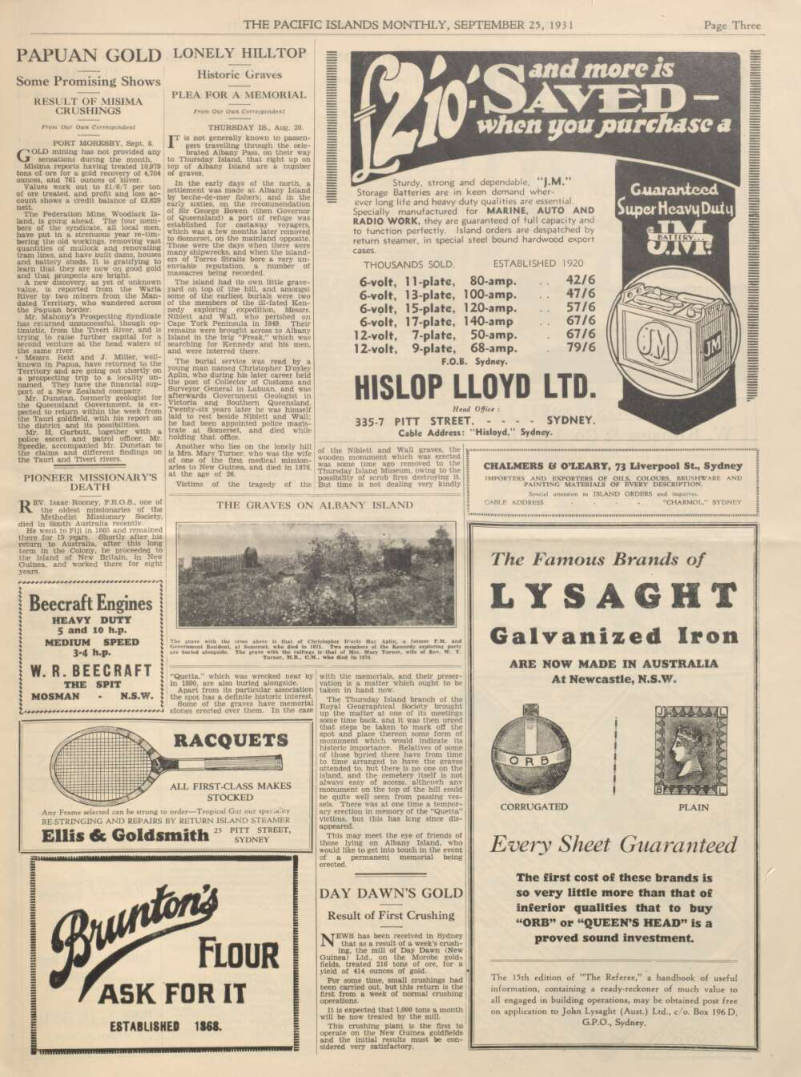
The Graves On Albany Island
“Quetta,” which was wrecked near by in 1890, are also buried alongside.
Apart from its particular association the spot has a definite historic interest.
Some of the graves have memorial stones erected over them. In the case
with the memorials, and their preser vation is a matter which ought to be taken in hand now.
The Thursday Island branch of the Royal Geographical Society brought up the matter at one of its meetings some time back, and it was then urged that steps be taken to mark off the spot and place thereon some form of monument which would indicate its historic importance. Relatives of some of those byried there have from time to time arranged to have the graves attended to, but there is no one on the island, and the cemetery itself is not always easy of access, although any monument on the top of the hill could be quite well seen from passing ves sels. There was at one time a tempor ary erection in memory of the “Quetta” victims, but this has long since dis appeared.
This may meet the eye of friends of those lying on Albany Island, who would like to get into touch in the event of a permanent memorial being erected.
The grave with the cross above is that of Christopher D’oyly Hay Aplin, a former P.M. and Government Resident, at Somerset, who died in 1875. Two members of the Kennedy exploring party are buried alongside. The grave with the railings is that of Mrs. Mary Turner, wife of Rev. W. Y.
Turner, M.B., C.M., who died in, 1876.
Day Dawn’S Gold
Result of First Crushing
NEWS has been received in Sydney that as a result of a week’s crush ing, the mill of Day Dawn (New Guinea) Ltd., on the Morobe gold fields, treated 216 tons of ore, for a yield of 414 ounces of gold.
For some time, small crushings had been carried out, but this return is the first from a week of normal crushing operations.
It is expected that 1,000 tons a month will be now treated by the mill.
This crushing plant is the first to operate on the New Guinea goldfields and the initial results must be con sidered very satisfactory.
Advertisements & other items, pp. 3-4 (2 items)
Hislop Lloyd Ltd.
when you purchase a Sturdy, strong and dependable, “J.M.”
Storage Batteries are in keen demand wher ever long life and heavy duty qualities are essential.
Specially manufactured for MARINE, AUTO AND RADIO WORK, they are guaranteed of full capacity and to function perfectly. Island orders are despatched by return steamer, in special steel bound hardwood export cases.
THOUSANDS SOLD. ESTABLISHED 1920
6-volt, 11-plate, 80-amp. 42/6
6-volt, 13-platc, 100-amp. . . 47/6
6-volt, 15-platc, 120-amp. 57/6
6-volt, 17-platc, 140-amp . . 67/6
12-volt, 7-plate, 50-amp. 67/6
12-volt, 9-platc, 68-amp. 79/6
F.O.B. Sydney.
HISLOP LLOYD LTD.
Head Office : 835-7 PITT STREET, - - - - SYDNEY.
Cable Address: "Hisloyd,” Sydney.
Guaranteed
Super Heavy Duty
BATTERY
CHALMERS & O’LEARY, 73 Liverpool St., Sydney IMPORTERS AND EXPORTERS OF OILS, COLOURS, BRUSHWARE AND
PAINTING MATERIALS OF EVERY DESCRIPTION.
Special attention to ISLAND ORDERS and inquiries.
CABLE ADDRESS ... "CHARMOL,” SYDNEY
The Famous Brands of
LYSAGHT
Galvanized Iron
ARE NOW MADE IN AUSTRALIA
At Newcastle, N.S.W.
CORRUGATED
PLAIN
Every Sheet Guaranteed
The first cost of these brands Is so very little more than that of inferior qualities that to buy
“ORB” or “QUEEN’S HEAD” is a
proved sound investment.
The 15th edition of "The Referee,” a handbook of useful information, containing a ready-reckoner of much value to all engaged in building operations, may be obtained post free on application to John Lysaght (Aust.) Ltd., c./o. Box 196 D, G.P.O., Sydney.
Made expressly to keep a lustrous, full gloss finish
against the varying con
ditions of moist weather exposure, and prevent the decaying ravages of rain and extreme heat by
giving a long lasting pro
tection to all surfaces.
SUN PROOF
RAIN PROOF
“Stronger than the Weather ”
W. R. CARPENTER
& GO. LTD
New Guinea, Solomon Islands, and all other South Sea Islands.
SHIPCHANDLERY
W. Kopsen & Co. Limited
Manufacturers of PIONEER BRAND ASH OARS AND IMPLEMENT HANDLES.
Sole Agents for: KOPSEN’S SPECIAL YELLOW METAL SHEATHING AND NAILS.
Large stocks of Chains, Anchors, Manilla and Wire Ropes, Wood and Iron Blocks, Oakum, Tar, Pitch, Oils, Paints, Leads, Zincs, Varnishes, Shackles, Rigging, Screws, Sheathing, Felt, Lampware, etc.
Prices and Particulars on Application.
68-70 CLARENCE ST., SYDNEY
Cables: “Kopsen” ’Phone: BW 1114-5
Camping Touring —Prospecting
We carry huge stocks of every conceivable article necessary on any of the above excursions. SEND FOR Auto Tents of every description.
FREE PRICE LIST
and Illustrations
CAMP SUPPLY STORES SYDNEY
Wholesale and Retail ‘Phone : BW 6389
The following papers—“ Smith’s,” “Tele graph,” “Truth.” “Arrow,” “Sportsman,” “Physical Culture,” “Referee,” “Sun,” “News” “Free Lance,” and other leading papers say: “Don Athaldo. strongest man in the world.”
DON
ATHALDO,
126 Oxford Si.,
Sydney, N.S.W
Dear Sir, — Please forward me a FREE copy of your amazing book—l enclose 6 d in stamps for postage.
Name Address
Ask For It
Beecraft Engines
HEAVY DUTY
5 and 10 h.p.
MEDIUM SPEED
3-4 h.p.
W. R.BEECRAFT
THE SPIT
MOSMAN - N.S.W.
RACQUETS
ALL FIRST-CLASS MAKES
STOCKED
Any Frame selected can be strung to order —Tropical Gut our speciality RE-STRINGING AND REPAIRS BY RETURN ISLAND STEAMER
Ellis Goldsmith 2
ASK FOR IT
ESTABLISHED 1868.
Fiji Conditions
Lower Costs and Cheaper Labour
Exchange Helps
Australian Exporters
From Our Own Correspondent SUVA, September 2.
THE cost of living is decreasing in Suva, as elsewhere. Rice has fallen greatly in price. Whereas the planter paid somewhere about £22 a ton a little more than a year ago, it is to-day sold at £14 a ton for Aus tralian rice, and £16 for Rangoon.
The character of the Australian rice is somewhat different to that of Ran goon, and is not so popular amongst our Indian population. On the other hand, the Fijian, who likes to boil his rice into a glutinous mass, prefers the Australian variety.
It is really the exchange discount which prevails between Sydney and Suva which permits Australian rice to compete here. The Australian £ is worth only 16/6 in Suva, an odd state of affairs, but one of which Australian exporters have not been slow to take advantage.
Sharps also have come down in price considerably. This is a low-grade flour largely used by our Indian commun ity for making chupatties, which, with them, take the place of bread.
A bag weighing 120 lbs. was selling a year ago round about 21/-, and is sold to-day at about 14/- or less, since every small Indian importer is being credited by his Sydney agent with the benefit of the exchange.
Thus the reduction in wages, which has taken place, is not being so keenly felt. Casual labour round Suva is plentiful to-day at 2/6 a day, whilst the semi-skilled type get about 18/a week. Of course, they have to fend for themselves in regard to food and housing.
On a plantation, the copra cutter or the casual labourer receives 2/- a day and housing, but otherwise finds himself. Gangs of Fijian labour are signing on under 12 months’ contract for £10 per annum and found, as against £18 to £20 of a year ago.
Interinsular freights have been cut from 1/6 to 1/3 a bag by the subsidised B.P. steamer, but, in most cases, plant ers would experience little difficulty in securing freight at 1/- a bag.
The re-adjustment of present-day costs to present-day results is thus pro ceeding, but the process is a slow and painful one, both for employer and employed, and it speaks volumes for the good sense of the community that there has not been the slightest hint of labour troubles as a result.
In fact, Fiji is in as sound a condi tion as can be expected of any trop ical country these days, and if our worthy administrators will only realise the absolute necessity for refraining from increasing overhead costs of liv ing through the Customs House to any further degree, we shall pull through with flying colours.
Exchange
The New Hebrides
Planters’ Difficulties
Coin May Now Be
Shipped
A New Hebrides planter writes as follows: I note that you published the gist of my letter re credit facilities in the New Hebrides, and am very interested in the reply (as published) of the gen eral manager of Messrs. Burns, Philp (South Sea) Ltd. He states, “Your correspondent is not correct. He can ship as much coin as he likes, either to or from the New Hebrides. There has never been any restriction or limit as far as Burns, Philp and Co. Ltd. are concerned.”
My experience was as follows: After B.P. (South Sea) had shut down on giving drafts I approached the purser of the Makambo with regard to sending coin to Sydney. He told me that an inspector of B.P. (South Sea) Co. had instructed him that under no circum stances was he (the purser) to accept money from residents of the New Heb rides for shipment to Sydney.
I intend now to make another appli cation, on the next trip of the Morinda, to forward some coin.
It is stated that “Drafts are made available by the company throughout the group for domestic and other ap proved transactions, at a maximum rate of 2i per cent.” Just so, the do mestic and other approved transactions are drafts for a remittance to send to one’s family in Australia, or a draft to pay a newspaper subscription.
I state, and I challenge a denial, that drafts are not issued to independent traders by B.P. (South Sea) for trad ing purposes—except where (as I men tioned in my previous letter) drafts have been issued to certain French companies. It is now about 18 months since Mr. Brady, an inspector of the firm of B.P. (S.S. Co.) made a trip on the “Malinoa” through this group, and he stated that there were to be no more drafts issued except for “domes tic and other approved' transactions.”
The company states: “The local ex change and currency is a Condominium matter and Burns, Philp and Co. Ltd. are just as much inconvenienced as your correspondent.” When I went to school I learnt that if you take like from like, like remains, but B.P.’s arith metic works out as follows: £10 Sterling Less .. 4 Sterling Equals .. £6 Australian currency As they do not take the exchange into consideration, I fail to see how they are inconvenienced. It seems to me that it is only the planter who is inconvenienced. All B.P.’s (South Sea) billheads are now rubber-stamped with the following or similar captions: “All transactions to be in British Sterling, at our option”; but when they buy conra there is no option for the planter.
“Copra prices are continually chang ing and competitive.” They are indeed, but mostly downward. As for being competitive—well, conra sold locally to French firms realises more (when converted to Australian currency at current rate of exchange) than copra sold to B.P. and shipped by the Mak ambo, as in the latter case the planter does not get the benefit of the exchange. Excepting certain cases, where the Malinoa has quoted a higher price (in francs) to French companies, the B.P. prices has been consistently lower than prices offered by French firms. On one trip B.P. were buying copra from the French at 1.200 francs (over £12 Aus. currency) and at the same time offering the British planter £8 in Australian cash.
Unless Messrs. Burns, Philp make some arrangement whereby the planter gets the benefit of the exchange, the Makambo (or Morinda) is not likely to pick up much copra.
Later: Since writing the above, the Morinda has called, and the purser has informed me that there is now no restriction on shipping coin to Sydney at a rate of 1½ per cent., but that he is not authorised to issue any drafts.
We have heard, unofficially, that an amicable arrangement has been made between the Commonwealth Postmas ter-General and Burns, Philp, but no one actually knows whether such ar rangement has been made and what it consists of, as no one here seems to have any further knowledge of the matter.
P.A.T. Co.’S New
Fokker
From Our Own Correspondent
Port Moresby, Sept. 8
MR. Ray Parer is in Port Moresby again assembling a Fokker plane for his company, the Pacific Aerial Transport Co., which works between the New Guinea goldfields and the coast. This is a nine-passenger mach ine, with a 450 h.p. Bristol-Jupiter engine.
Mr. Parer expects to get away after the necessary trials, in a few days’ time.
Infant Native
Welfare
American Woman’s Fine Work In Fiji
From Our Own Correspondent SUVA, September 2.
ONE of the interesting social ser vices inaugurated in the last two years in Fiji has been that of Infant Welfare, which owes its incep tion to Dr. Roberts, the wife of the American Consul in Fiji.
Soon after her husband was posted here, she offered her services volun tarily and she was assigned the district around Suva. Her methods include the formation of women’s com mittees in each native village and regu lar weekly visits.
This entails a certain degree of hard ship on the doctor, who suffers con siderably at times from the effects of illness contracted when she served as a Major in the Serbian army, in charge of hospitals during the War.
From this beginning the movement spread and was taken up enthusiastic ally by Sir Maynard Hedstrom, the Honourable Islay McOwan, C.M.G., at that time Secretary for Native Affairs, and by the Colonial Sugar Refining Co. Ltd., who made a grant of £2,000 a year, over some years.
European nurses have been employed to serve other districts, and in places such as Lau —the Island group lying between Fiji and Tonga—the Native medical practitioners have formed women’s committees and are carrying on the good work. In time to come the benefit will be seen in a stronger and healthier generation, and since the wealth of this Colony lies in the man-power available to till the soil, the movement should command the interest of planter, trader and civil servant alike.
Imports into Niue for 1930 were valued at £18,630, and exports £15,877.
The figures for the previous year were, imports £19,107, exports £22,206.
Advertisements & other items, p. 4 (1 item)
Holbrooks’
Visitors to Sydney
who desire a REFINED GUEST HOUSE at a moderate price, can be accommodated at
KIRKETON HOTEL
(Unlicensed)
229 DARLINGHURST ROAD,
KING’S CROSS
(5 minutes from G.P.0.) where, in addition to our exclusive and artistic furnishings and appointments, comfortable Lounge (equipped with Wireless and Wurlitzer Player Plano).
Card Rooms and unsurpassed Table, this modern Hotel has hot and cold water in every bedroom. Telephones on all floors.
MOTOR TOURS ARE ALSO
ARRANGED
and intending Guests can be assured of every courtesy and excellent service.
TARIFF;
10/6 per day, or from £3 per week.
Bed and Breakfast, £2/2/- per week.
Night Porter in attendance Phones: F 3640 and PL 1668 Cable and Radio Address:
“KIRKETON, SYDNEY’’
HOLBROOKS’
DELICIOUS SOUPS
In 8 oz. and 16 oz. Tins Ready to serve.
TOMATO, VEGETABLE,
MULLIGATAWNY, OX TAIL
AND MOCK TURTLE.
Holbrooks’ Spaghetti
IN TOMATO SAUCE
In 4 oz. and 8 oz. tins.
Holbrooks Baked Beans
WITH PORK
In 4 oz. and 8 oz. tins
Holbrooks (A/sia) Ltd.
WATERLOO, N.S.W.
Legislative Council
Sought for New Guinea
Action Required
From Our Own Correspondent RABAUL, August 30 Frequent comment is made that no action has been taken in regard to the appointment of a Legislative Council for this Territory.
As far back as 1926 an Act was passed by the Australian Senate for the establishment of a New Guinea Legislative Council, but owing to a dis solution of Parliament, the Act did not come before the House of Represen tatives.
It is felt that a Council, including nominated unofficial members, should be of assistance to the Administration and might, in many instances, consid erably strengthen the Administrator’s hands. An elected Council would cer tainly be more popular with many residents; but considered opinion is that this, at the present time, would be both impracticable and inadvisable.
A nominated Council representing the various interests planting, mining, commercial and missionary, would, if composed of men of sound views and with experience and knowledge of local conditions, be welcomed by the majority of residents. It is suggested, in order to partially meet those who demand an elected Council, that the Adminis trator should ask the various interests to submit names, from which he could make his selection.
In all probability, instances would arise where the Administration could not accept proposals of unofficial mem bers, but it should be noted that, in such instances, the views expressed by the unofficial members would be re corded in a manner which would make them available to Federal Members of Parliament. Further, there may be instances where the unanimous support by the unofficial members of Govern ment proposals would be an influential factor in overcoming opposition in Australia, It is hoped that a move will be made in the near future to pass the Act through the Federal Parliament and bring it into operation.
Goldfields Aerial
Service
To the Editor.
Sir, —When perusing your June num ber I noted references to the aerial transport companies operating between the coast and the goldfields here, that may be misleading. So I would appre ciate the publication of this letter.
A table of the companies operating and the number and capacity of ma chines, at the moment of this writing, is given below:
Included in the two machines repair able for the P.A.T. is a Fokker F VII due to arrive in Port Moresby on July 17 from Holland.
This reveals the present total carry ing capacity of each company as fol lows: Bulolo Gold Dredging Co. (8.G.D.) 12,000 lb.
Capt. L. Holden 1,750 lb.
Pacific Aerial Transport (P.A.T.) 1,200 lb.
Guinea Airways (G.A.) 600 lb.
Capt. L. Shoppee 300 lb.
When the article was written Guinea Airways had an extra two machines serviceable, but, since then, one single engine Junker W 34 crashed at the Wau. The following day their three engine ’plane became disabled, which left them with two Moth ’planes to carry on the service.
Guinea Airways is referred to as the “premier” company. If it is meant that it was the first, may I quote also the following: I was the first to buy an aeroplane for this service, and I was also first to form a company for aerial freightage to the Wau.
Referring to Mr. A. E. H. Evans’ letter, I should like to point out that Capt. L. Holden is now freighting for Guinea Airways, at a sub-contract
price.
I should like to congratulate you and add my appreciation of your use ful and impartial publication.
I am, etc..
Ray Parer.
WAU, N.G., July 3, 1931. (We have published the above let ter, as it was written, in order that we may remove any feeling of injus tice from Mr. Parer’s mind. The fig ures he gives, however, while possibly correct on July 3, may give a wrong impression now. We understand, for instance, that some of the big Guinea Airways machines are now back in commission, and carrying on the nor mal service.
G. Airways. B.G.D. P.A.T.
L. Holden.
L. Shoppee.
Machines owned 8 2 4 1 1 Machines serviceable 2 2 1 1 1
Capacity of each, lb
Machines unserviceable at present, but cap- 300 6,000 1,200 1,750 300 able of repair 3 — 2 — — Machines completely lost or crashed 3 — 1 — —
Botanist’S Work On
Bougainville
MR. J. H. L. Waterhouse, F.R.G.S., F.R.A.I., is still gathering botan ical specimens of Central Bou gainville (Solomon Islands) flora for the Royal Gardens, Kew, England, and incidentally to date has collected many hundreds of specimens—everyone com plete with local native name, and notes on its use by the natives there, e.g., medicinal, magical, etc.
He has also found already that there are considerably over 200 named vari eties of taro, the staple food of these natives. In between times he is doing some entomology, malacology, and anthoropology—especially linguistics.
Pacific Islands
Year Book
Ready Next Month
AFTER two years of preparatory work, the Pacific Islands Year Book for 1931 will be published about the end of October; and annually thereafter.
The Year Book is designed to meet a long-felt want. There is a constant demand for reliable information about the score or more of territories and
groups in the Pacific, which contain independent administrations and which function, in matters relating to trade, industry, education, communications, control of natives, etc., quite separately one from the other. These various Pacific territories purchase in a normal year goods to the value of £6,000,000, and their trade is eagerly sought by many countries. Exporters and distri butors everywhere want to know how to cater for that trade; and prospective settlers' and planters want to know where to go—the Year Book is designed to tell them.
Accurate and comprehensive infor mation relating to each group—history, method of government, names of ad ministrators, nature of taxation im posed, details of Customs tariffs —is contained in the different sections of the Year Book; and it is all so arranged as to be of the utmost value to the officials themselves. The latest statis tics—mostly summarised from annual reports and Blue Books—are included.
The Year Book is illustrated with numerous photographs and with clear maps of most of the principal groups.
Orders may be lodged with any of the Islands stores which sell The Pacific Islands Monthly; with any bookseller; or with Pacific Publications Ltd.. Union House, 247 George Street, Sydney. Price (postage paid), 8/6.
Success of Plane Transport
Bulolo’S Progress
THE erection of the pontoon of the No. 1 Bulolo dredge, on the New Guinea goldfields, is something over 50 per cent, completed, and the construction programme generally is well forward, reports the Sydney sec retary of Bulolo Gold Dredging Ltd.
Adverse meteorological conditions of recent months have caused some lag in the air-transportation schedule, but the better flying season of the year is now being entered upon, and there has been to date no delay in carrying out the construction work.
The general manager, writing from the field under date of September 4, has advised that it appears that it is entirely practical to handle the freight with the airplanes in sufficient quan tity to meet requirements, under fav orable weather conditions. Up to Sep tember 12, a total of 705 short tons had been transported from the coast by the large machines. All machinery and material for the No. 1 dredge is now in New Guinea.
Boxing, with native labour, for pro duction on a small scale, has com menced on the Bluenose base of the Arnold leases.
The Bulowat drilling has been proceeding steadily.
The reports and accounts presented at the annual meetings of both Bulolo and Placer held at Vancouver on Sep tember 24 will be in the hands of the Australian and New Zealand share holders during the first half of next month and subsequently printed reports of the proceedings at the meetings will be circulated to shareholders.
Advertisements & other items, pp. 5-6 (2 items)
Corona
MAKE YOUR OWN FLOUR AND
WHEATMEAL WITH ...
UNIVERSAL
CORONA
GRINDING MILLS
A boon to
the Man on
the Land!
THE Universal "Corona” Grinding Mill affords a real boon to the man and woman on the land, and more particularly in these difficult days. It will grind all kinds of grain, wet or dry, besides corn-meals, wheat for making flour, and nuts, breadcrumbs, coffee beans, etc. Only a simple adjustment is necessary to grind fine, medium or coarse, as required. The capacity is 1-lb. per minute. Easy to handle because it can be clamped on to any bench or table . . . easy to clean and simple to operate. Well made from strong cast iron, and heavily tinned to prevent rusting, which means that a lifetime of service is built into the "Corona.” It will pay you handsomely to order early while stocks hold.
F. O.B. SYDNEY.
MARK FOY’S LTD.
THE PIAZZA
ELIZABETH STREET
SYDNEY.
IF YOU WANT SATISFACTION AND SERVICE
CANVAS PRODUCTS LTD.
YACHT AND BOAT SAIL MAKERS
Manufacturers of • AUTOTENTS. TENTS, TARPAULINS, BLINDS AND ALL CANVAS GOODS
35 SUSSEX STREET - - SYDNEY
Foreman Sailmaker : ROBERT (BOB) BOYCE Let us have your enquiries. We shall be pleased to quote. ’PHONE, B 1613 SPECIALISTS IN ALL CLASSES OF BOAT RIGGING
W. R. CARPENTER & CO. LTD.
Buyers and Shippers of: Copra, Trocas, and all classes of Islands Produce.
Head Office
19-21 O’CONNELL STREET, SYDNEY
Agents for Australian, European and American Manufacturers, and Distributors of Every Description of Merchandise. Full and complete range of all stocks carried.
Agents for: Ford Gars, Trucks and Fordson Tractors, Dodge Brothers Cars, Graham Dodge Trucks, Bolinder Marine and Stationary Engines, Coates’ Plymouth Gin, McGallums’ Perfection Whisky, Rimmel’s Perfumes, Houbigant’s Perfumes and Powders, Carlton V.B. Beer, Goodyear Tyres.
Branches at LONDON, RABAUL (New Britain), KAVIENG (New Ireland), (New Guinea), SALAMOA (New Guinea), TULAGI (Solomon Islands) and Other Pacific Islands WE SPECIALISE IN SUPPLYING THE REQUIREMENTS OF ISLANDS RESIDENTS, PLANTERS and TRADERS.
Norfolk Island
M. B. Blake, Builder
PLANS DRAWN
Joinery and Furniture
Factory.
LAND AND COMMISSION
AGENT
Properties to suit all A visit from intending settlers would be to their advantage.
INQUIRIES PROMPTLY
ATTENDED TO.
Recommended by all Skin Specialists
throughout the
World.
Recommended by all Skin Specialists
throughout the
World.
There is no satisfactory
substitute for the genuine
(BOURJOIS)
JAVA RICE
FACE POWDER
The only genuine JAVA RICE Face Powder is made in Paris by expert French Perfumers. Bourjois JAVA RICE Face Powder has been used by women of all Nations for several generations. It has always given entire satisfaction and has increased in popularity, year by year, as evidenced by its ever extending sales.
LADIES! Keep to the Face Powder whose qualities you know.
It is of the finest consistency. It is composed of the purest ingrediente. There is nothing to harm the tenderest skin.
Obtainable in all shades.
All Chemists and Stores throughout the World.
A. BOURJOIS ET CIE (Aust.) LTD.
177-179 Clarence Street and 47-49 King Street, Sydney.
What Are Your Needs?
We have the following high
grade products, carrying the
reputation of this old-established English Firm: —
POWDER SHEEP DIP. —
For the destruction parasites on sheep. external
CATTLE DIP
For the destruction of Cattle Ticks. Also Lice and Mange on Cattle and Horses. for
MILK OIL FLUID.—
For general disinfection of premises, Shins, Launches, etc.
HEALING OIL.—
For the antiseptic treatment of cuts, wounds, etc. on humans and animals.
ARSINETTE.—
For the destruction of all leaf-eating insects infesting trees and plants.
KATAKILLA.—
For the destruction of all sucking insects infesting trees and plants.
ALBOLEUM.—
For the destruction of all Scale insects infesting trees and plants.
A non-poisonous dusting Powder for the destruction PULVEX.— of Fleas, Lice and other parasites on Dogs, Cats, Poultry, etc.
KUR-MANGE.—
For curing parasitic Mange and Skin diseases in Dogs, Horses, etc.
FLY KILLER.— For killing House Flies and Mosquitos.
For removing and preventing rust, BOILER COMPOUND. —scale and corrosion in boiler pipes, etc.
Enquiries in respect o£ the above are invited from Planters, Cattle Owners, Storekeepers and all Island Residents.
William Cooper & Nephews (Australia)
Limited
4 O’CONNELL STREET - - SYDNEY
Birkmyre’S Cloth
Samples and prices on application.
The best waterproof for motor car hoods, tarpaulins, horse and cow rugs. etc. Canvas of all kinds, cotton ducks and hessians, seaming, bagging and shop twines. Fishing nets and yarn, fishing lines and tennis nets.
397 KENT STKIIT, SY»NfY, M.f.W.
GOLDFIELDS OF NEW GUINEA
Information supplied by one who has been in close touch with the fields for past eight years.
PHOTOGRAPHS :
Series numbers over 300 photos and is being constantly added to. Subjects include: Morobe Goldfields Area, New Guinea Aerial Activities, Island Scenic Studies and Native Life and Types. Prints; 9/- per dozen, post free.
Native Implements, Weapons and Curios.
C. MACDONALD
Trader and Importer Mining, Customs, Recruiting & General Agent
SALAMAUA
TERRITORY OP NEW GUINEA
Eastern Polynesia
Visit of N.Z. Flagship—Raiatea’s Firewalkers
From Our Own Correspondent
PAPEETE, August 13.
H.M.S. Diomede left Tahiti on July 23, after a stay of several days in the group. Part of this time was spent at anchorage in the lovely bay of Openohu, island of Moorea, op posite the residence of Lord Hastings, where the officers were entertained with true island hospitality by Major Doug
las, the present tenant of the house.
At Papeete, the July celebrations were extended for another day by Gov ernmental decree, in order that the ship’s personnel might have the op portunity to participate.
In connection with the Diomede’s visit, it is worth noting that Admiral Blake, while the guest of Mr. H. Guild on a fishing expedition, succeeded in landing a good sized sail fish. For this he merited, and received, the congratu lations of all our local sportsmen.
Extension Of Hotel Tiare
In order to cope with an increasing number of visitors, M. Ravnek, the aff able proprietor of the Hotel Tiare, has leased a large 14-room bungalow situ ated nearby, which formerly belonged to the Compagnie Navale et Commer ciale de l’Oceanic.
For many years the destinies of this hotel were presided over by the famous Lovaina, until she succumbed during the great epidemic of 1918, and she ran it in a way that no one since has been able to emulate. Many guished persons have sojourned here, including, Somerset Maughan, Freder ick O’Brien and a host of others, and they all paid tribute to Lovaina, who created an atmosphere about the place that time has not been able to entirely dispel.
Something of that lady’s gracious genius still pervades the wide veran dahs, where Papeete’s cosmopolitan in habitants still gather, as of yore, for 11 o’clock dejeuner, and linger on about their wine till 2 p.m. or later. For here one may command a four-course meal for as little as ten francs, and have the wine and accessories thrown in for a few francs more.
The exterior surroundings of the hotel remain the same as 20 years ago.
There is the ancient screen of coffee bushes laden down with berries, be tween the diners and the street, the same old garden of odorous tropic blooms, and the same old breadfruit trees, from which, upon occasion, a ripe fruit crashes to the roof and mo mentarily puts a stop to the buzz of voices going on below. The serving women, brown and bouncing, carry in the viands from the same promiscuous kitchen; all this is as it was in Lo vaina’s day. It is true that an increas ing number of motor cars honk along the road outside, but that is all there is to remind us of the passing years.
The rest remains.
Whatever the exigencies of a modern tourist traffic may demand in the way of hotels, one thing is certain, Tahiti’s oldest hostelry will never lack patrons, for Papeete without its Hotel Tiare could never be the same to the old timers. Mr. Ravnek promises to be a worthy successor to the lamented Loy aina, and everybody wishes him well in his latest venture.
Strange Ceremony Attracts
Tourists
|Four months ago an enterprising theatrical promoter from Chicago vis ited Tahiti with the idea of exploiting in America the ancient ceremony of fire-walking, but the stringent immi gration laws in that country prevented the final realisation of his plans.
His preliminary efforts were entirely successful, however, in that he was able, with the help of some local experts fluent in the native tongue, to revive the almost extinct cult of the “Umu ti,” which since the advent of Christi anity has been sternly repressed by the missionaries as a relic of heathen ism and superstition.
Fortunately, there still exists in the island of Raiatea a middle-aged native last of an unbroken line of priests (Tahua) who refuses to renounce his ancestral gods, who carries with great dignity the knowledge handed down and carefully guarded through the ages, and who may be persuaded, upon occasion, to wield the sacred Ti for the benefit of visiting white people.
Briefly, for space will not permit of a full description, the performance con sists of walking barefoot across a pit filled to the brim with white hot stones and stepping out unharmed at the other side.
The Umu (oven) may be of any size.
One this writer saw in 1914 and walked across unscathed, was fully 18 feet in diameter. Tons of firewood are needed to fill the pit and heat the volcanic stones to the proper degree of inten sity. When all is in readiness the priest appears with his wand of sacred leaves, prepared with appropriate rites the day previously, and kept for a whole night in the temple (Marae).
In a long incantation he now in vokes the ancient gods, the presiding genii, and the spirit who enchants the flame, waving his wand the while from side to side. Any who please may now follow him across the flaming pit, but beware of looking backwards, lest the spell be broken and the feet get burned.
Scientists have so far failed to find a satisfactory explanation of this strange ceremony, which is naturally most impressive when performed at night. Visiting tourists who have been recently privileged to see it in Raiatea have returned to Tahiti well pleased, and expressed the opinion that this alone was well worth the trip.
Lost Fishermen
Cook Islands Incident
From Our Own Correspondent
Rarotonga, Aug. 16
THREE native fishermen, caught in a gale off the reef at Rarotonga, were rescued on the evening of August 6, in exciting circumstances.
An “all-night” fishing expedition, comprising some 20 canoes, set out off the south side of the island on the evening of the sth. During the night a wind from the north-east came up with a heavy sea, strongly set towards the reef.
Povaru, who was watching the wea ther conditions, warned the party to return to the lagoon. A number of the fishermen paddled some miles with the current to the lee of the island and came in over the reef at Aorangi.
Two canoes were capsized and the oc cupants injured.
Seven of the canoes proceeded in the direction of the Rutaki passage— a fairly wide opening in the reef, near the fishing grounds. Five of these canoes reached the lagoon safely.
Of the remaining two fishermen still outside, one, Mani, had become ex hausted from his efforts to make head way against the current. The other, Ua, had to put back to assist Mani.
Ua also was about done, but struggled in to report the plight of Mani.
At midday two natives, Eteke and Putou Henry, put out in small canoes in the hope of overtaking Mani and working round to the lee of the island.
From Nkatangiia (which was receiv ing the full blast of the gale) Mr.
Campbell, manager of the Cook Islands Native Association Ltd., and a native named Rennie, put out in a small out board motor dinghy. They proceeded some distance but saw no canoes. At 4.30 p.m. the dinghy returned, after a perilous run. A dangerous sea was running. All along the south side of the island the massive breakers were curling in over the reef.
At about 1.30 p.m., word reached the Resident Commissioner, Judge Ayson, that native fishermen were in difficul ties. His Honor promptly formed a rescue party. Makea Tinirau (Chief Ariki) placed his launch at the dis posal of the authorities. Captain Thom son, skipper of the Tagua, and Mr. W.
Bryan, Pilot and Harbourmaster, vol unteered their services. The engineer from the Tagua and three natives ac companied the party. Ballast was taken aboard, also benzine and a supply of food, etc.
At about 4 o’clock in the afternoon the launch left the Avarua wharf. The evening was closing in. Visibility was poor. The weather showed no signs of moderating. Mani had by then been adrift for about 30 hours, and was known to be in an exhausted condition.
Eteke and Potou Henry had disap peared out to sea, and Mr. Campbell and Rennie had not returned.
Mani’s canoe had been blown to sea.
About nightfall, watchers in the vicin ity of Black Rock (lee of the island) discerned three tiny specks on the sky line, appearing and disappearing.
Eteke and Potou had found Mani’s canoe and were evidently working in towards the island. When found, Mani was lying in the bottom of his canoe with only sufficient strength left to steady it from capsizing.
By this time Potou, who was one of the fishing party, was exhausted. Eteke had managed to lash the canoes to gether with fishing tackle and was making desperate efforts to reach the island before darkness came on. The launch shortly afterwards picked them up. The three natives who accom panied the rescue party dropped into the canoes and brought them in over the reef.
The search was continued. So far as the launch party knew, Mr. Camp bell and Rennie were still missing.
Finally a complete circuit of the is land was made. But these two had come ashore at Ngatangiia at 4.30.
The launch reached the wharf at about 8 p.m. Prolonged cheers greeted the rescue party. The exhausted fisher men were attended to. Mani’s condi tion was not serious.
High praise is due to everyone who took part in the rescue work. Makea Tinirau, as the leader of the rescue party, deserves special mention. Mr.
Campbell and Rennie took their lives in their hands in going out in a frail craft. Ua’s action was praiseworthy.
The attempt by Eteke and Putou, in the rescue of Mani, was a very gallant one.
Mrs. W. Cadzow
Death of Estimable T.I. Resident
From Our Own Correspondent
Thursday Is., Sept. 1.
A WAVE of shocked surprise and sorrow swept through the Island when news came through of the sudden death, in Brisbane, of Mrs.
W. Cadzow, wife of one of our best known townsmen, who occupies a lead ing position on the Wyben Pearling Company’s staff.
The sad event occurred a couple of weeks after her little one had been born.
The deceased lady was highly popu lar with a large circle of friends. Her musical talents were always at the dis posal of entertainment organisers for all and sundry causes, and in many ways she will be much missed.
The sympathy of the whole com munity goes out to the husband and his family of small children.
Advertisements & other items, p. 6 (1 item)
Diabolo Dairy
-ECONOMISE-
You can have fresh cream
and butter every day with a
It is a Separator and Churn in one unit, viz.: per hour. Churns 3 quarts cream.
Size 0...Separates 15 gallons milk per hour. Churns 5 quarts cream.
PRICE £l3
Size I.—Separates 27 gallons milk per hour. Churns 9 quarts cream.
PRICE: ... - £15/10/-
5 PER CENT DISCOUNT FOR
CASH SETTLEMENT
We will supply either separator or churn separately on folloanng prices :— Separator—Size 00 - - £5/15/- Separator—Size 0 - - £B/15/- Separator—Size 1 - - £lO/10/- Churn—Size 00-H - - £3/12/6 Churn—Size 0-A - - £4/10/- Churn—Size 1-B - - £5/10/-
5 PER CENT. DISCOUNT FOR
CASH SETTLEMENT
Tou save by purchasing the Dairy (Separator and Churn combined) .
Distributed by the Manufacturers:
Diabolo Separator Co.
LIMITED
305 Sussex Street, Sydney
G.P.O. Box 102 CC.
Diabolo Dairy
Size 00.—Separates 10 gallons milk
PRICE
£9
Have Teeth by Post
If you are unable to visit Sydney, I can make
you comfortable, natural and long lasting
teeth by means of my well known method of “Self Taken Impressions.” Cut out this advertisement, attach your name and address and post to me for full particulars.
Painless extractions. Reliable fillings. Cold crowns and comfortable and lasting plate work. 28 OXFORD ST., over Winns;
SPENCER NOLAN, Dentist
177 nyrncn ex 177 OXFORD ST., opposite Mcllraths; 139 ELIZABETH ST., two doors from Market St., Sydney Beam Wireless and Cable Address: “Fastplate,” Sydney.
Teeth in one day for visitors to my surgeries.
P.I.M.
Cook Islands
Shipping Movements for Month
From Our Own Corresponueni RAROTONGA, August 14.
H.M.S. Veronica sailed for Apia on July 23, via Mangaia, Atiu, Aitu taki and Palmerston Island. The Resident Commissioner, Judge Ayson, took passage by the sloop to Mangaia and remained there until August 3, when he returned to Rarotonga by the S.S. Waipahi.
A round trip of the four main islands of the Lower Group was made by the S.S. Waipahi, in July. A fair quan tity of oranges was shipped to the Auckland markets from the other is lands, but only a small number of cases from Rarotonga. The shipment from here comprised principally tomatoes.
The local orange crop is finished.
The island schooner, Tagua, is at present working her way round the Lower Group. Her companion ship in these waters, the Tiare Taporo, leaves on the 16th for Papeete, calling at Aitutaki, Atiu and Mauke en route.
Southern Cross Arrives
An unfamiliar sail appeared on the skyline on the morning of the 12th. It proved to be the ketch Southern Cross, from Scotland, and not the Vanderbilt yacht, as was rumoured.
The sturdy looking little craft bears on her bow the initials of the Royal Clyde Yachting Club. She carries a crew of three young looking, adven turous men —Dunn, Penman and Shackleton. The ketch is meandering through the Pacific on a pleasure cruise.
Biennial Elections
The biennial election for the Euro pean seat on the Island Council took place on August 5.
Two candidates were nominated, Mr.
W. J. Wigmore (sitting member) and Mr. H. B. Everett. The majority of electors favoured Mr. Wigmore, who was returned by a fair margin of votes.
Visitors To Group
We have with us at present the fol lowing visitors: Mr. C. G. Ogilvie (Wel lington), Mr. Burgess (Old Country), Mr. J. Browning (Auckland), Mr. Gell ing (Okoraire) and Mr. and Mrs. House (Wanganui).
Markham Valley
Rich Undeveloped Agricultural Region in New Guinea
Written for The Pacific Islands Monthly, By Henry G. Eekhoff, of Lae, N.G.
THE sleeping giant of the Pacific is the mainland of New Guinea, which stretches for 1,200 miles from tip to tip, shaped like some gig antic monster of past ages, with a corrugated backbone of range.
Whatever mineral riches may be found on the slopes of these gabled mountains, they are as a drop in a bucket, by comparison with the agri cultural possibilities of this mighty country.
Several great rivers flow into the ocean in the British Division—the two largest of which are the Fly and the Sepik, both of which are navigable for hundreds of miles. But the most significant river is the Markham, so called to perpetuate the name of the late Sir Clement Markham, the fam
ous President of the Royal Geograph ical Society, whose geographical ex ploits were of benefit to the whole world.
Unfortunately, the Markham is not navigable. It merely flows over gravel beds in wandering shallows, which cut eccentric patterns on the valley when viewed from the air.
Situated at Lae, on the mouth of the Markham, is the busiest aerodrome of the Southern Hemisphere, handling more freight than any other ’drome in the world. Hence, the Markham may be viewed from the air by all those who care to take the trip.
As may be well imagined, the shal low course of the great river has con tributed to vast alluvial flats, which stretch for miles and miles. Pro ceeding up the valley, tropical scrubs mark the first stage of twenty miles or so. Thence, the country opens up into grass lands —high grass matted above the head of the traveller, who boils for lack of air draughts, with the sun’s rays beating directly down.
For fifty, sixty and seventy miles inland, the gradual ascent is undis cernable, and the rich agricultural country stretches for miles to right and left, with never a break, right into the Atzera district, where, at between 3,000 and 4,000 feet, the gentle water shed separates the Markham’s head waters from those of the Ramu. From each side great valleys come in, with the good land stretching up into the funnel-shaped entrances.
On either side of the valley, but blue in the distance, are the various ranges, and fifty miles up the Watut, a tri butary of the Markham, lie the Edie Goldfields.
For quite twenty miles up the Watut River itself, the agricultural country persists: and the native foods pro duced there are phenomenal in their growth. One tribe of natives subsist almost entirely on bananas, and the variety of this fruit is astonishing.
There are red, green and yellow ban anas—which never seem to ripen— and also acid-flavoured and sugar ban anas.
In like variety is the indigenous sugar cane—striped, green, purple, red, close-jointed and long. In places it is trained to bamboo trellis-work. The natives do not grow large plots—simply a few square yards, stuck in haphazard, here and there.
Almost all of this Markham Valley is arable land, and it is over seventy miles long and averages over ten miles wide. Some hundreds of thousands of acres are there, without adding the tributary areas. It is little wonder that the Administrator has tried, un ceasingly, to get this valley, with its enormous potential wealth, opened to traffic.
Right in this part of the interior, strange to say, are the finest coconut palms known to New Guinea. The nuts have been repeatedly brought in, as specimens of what coconuts should be. Yet the coconut is not supposed to grow far away from salt water.
Perhaps, some day, when the sugar lands of the world get worked out, or when tariffs favour, or new markets open up, this valley will produce its fair share of the world’s sugar. Den sity of production should be assured — it is one of the homes of this valuable product. With no pest to destroy it, and acclimatised from time immemo rial, it is reasonable to expect high production.
Along the river, there is opportunity for rice-growing, as well as sugar, and
there is sufficient water to spare for that type of cultivation.
Stretching into the uplands is ex cellent coffee-growing country, in suffi cient areas to glut all our markets.
Stock do not do well, however, with out very close attention to the ever lasting sores which characterise the mission-owned animals. These are the only stock in the country and they have reached such a pass that one horse-lover considered purchasing the animals, to put them out of their misery by destroying them.
The Government hack seems to re tain its condition, however, and some of the mules owned privately are roll ing fat and sportive enough. There may, therefore, be hope for properly tended cattle —sufficient to supply the local demand.
The port of Salamoa is twenty miles along the coast, from the mouth of the Markham. Lae itself, though serv ing as a port, provides a doubtful anchorage at the best. But it is im proving and may serve.
As may be guessed, the climate is in varying zones, from the coast to the mountains. In the higher regions, blankets are very serviceable at night It cannot be said that malaria is bad. One individual has lived in the Valley for five years, without becoming acquainted personally with the dis ease. But this may be owing to some form of immunity, as others have suf fered.
The supply of native labour is one of the attractive features. These vil lagers can be seen actually looking for work, and they appear to want to get back as soon as they have been sent home (for it is compulsory in New Guinea for natives to proceed home before making fresh contracts).
These Atzeras appear to prefer some kind of employment and actually seek it for themselves.
The surrounding mountain tribes, however, are different; and have to be persuaded to try the venture.
The Valley has become a quiet and peaceful place since the advent of the mining industry, and no one will be bothered with the weight of a pendant revolver along the route.
The mountain natives have made at tacks lately; but that region is far removed from the actual valley, and fifty miles away up in the mountains.
Thus, with a fairly willing labour supply, a fertile valley of enormous potentiality, and obviously easily de veloped transport, the Markham must some day “arrive.” For the benefit of the pioneer whites, and on behalf of the natives, and for the good of British Pacific colonisation, we hope it will be soon.
The Mouth of the Markham River, New Guinea
Advertisements & other items, p. 7 (2 items)
Fresh Fruits—Vegetables
“TRUTH IN ADVERTISING"—
always at Anthony Horderns’.
“THE SENIOR STORE.”
Protect the Health of your
Family with FLYPROOF
DOORS and WINDOWS
AT FAMOUS LOW PRICES!
Make your own fly doors and screens this summer. All the materials can be pur-
chased ready for assembly at Anthony
Horderns’. These consist of:—Set of
Dressed Timber and Beading, set of 6
Comer and Centre Brackets, pair of
Spring Hinges, Door Handle, Brads and
Tacks, and sufficient Woven Wire to
complete. For doors up to 6ft lOin x
2ft 10in and 7ft x 3ft.
With Bronze Wire and Oregon Timber. 6ft 10in x 2ft 10in 7ft x 3ft
PRICES 18/3 20/3
With Bronze Wire and Redwood Timber. 6ft lOin x 2ft lOin. 7ft x 3ft
PRICES 18/3 20/3
With Galvanised Wire and Oregon Timber. 6ft 10in x 2ft 10in. 7ft x 3ft
PRICES 13/ 14/
With Galvanised Wire and Redwood Timber.
PRICES 13/ 14/
Fly-door Accessories
SETS OF OREGON TIMBER ONLY,
to make doors up ec 7ft x 3ft.
PRICE, Set 7/9
SETS OF REDWOOD TIMBER
ONLY, to make doors up to 7ft x 3ft.
PRICE, Set 7/9
JAPANNED DOOR HANDLES.
PRICE 3d. 4d, sd. 6d each
HALF-ROUND REDWOOD BEAD
ING, in 7ft length.
PRICE .. .• 9d
CORNER AND CENTRE BRACK-
ETS, Set of 6.
PRICE, per Set 1/6
ANTIQUE COPPERED SCREEN
DOOR HINGES.
PRICE, Pair 1/2
JAPANNED SCREEN DOOR
HINGES. Pair 9d
Woven Fly-proof Wire
GALVANISED. BRONZE.
F. 0.8. SYDNEY
ANTHONY HORDERN & SONS, LIMITED,
Phone; M 2401, C.ViyMtT'V’ Postal Address: Day and Night. 3 I L/iNE* I . Box 2712 C, G.P.O.
FRESH FRUITS—VEGETABLES
F. CHILTON
WHOLESALE DISTRIBUTOR, CITY MARKETS
SYDNEY - - Established 1894 Shipments Direct from Source of Supply. All Goods Personally Selected and Carefully Packed for Tropical Requirements.
Quality—BEST. Price—LOWEST. Attention—PßOMPT.
Codes: Bentley’s and Private. Cable Address : Chiltons, Sydney Agent for —Celebrated " Vallo” Brand Spray Preparations, used successfully by Orchardists throughout Australia.
Gillespies
BLACKLOCKS
R. E. FORSSBERC - Proprietor
Manufacturer’s Representative
381 PITT STREET - SYDNEY
Buying Agents for all requirements, at lowest prices, on commission basis.
Cable Address: “Diamondess” Sydney
ALBERT JONES
Manufacturer of Sails, Tents, Tarpaulins and all Canvas goods. All classes of rigging work executed. Rope of all gauges in stock. Shackles, Thimbles and Blocks. Motor Car Tents, Birkmyre Coats, Verandah Blinds, Tennis Nets.
Horse and Cow Rugs, Bowling Mats.
178 CLARENCE STREET
SYDNEY
Tel., MA 5730.
GILLESPIES
ANCHOR
FLOUR
SYDNEY
The Standard of
Quality
Pacific Islands Monthly
Published once a month, and circulated among residents of: New Guinea Fiji Solomon Is.
Papua Tonga New Hebrides Non oik Is. Samoa New Caledonia Cook xs. Nauru Ocean Is.
Giiocrt Is. Tahiti Thursday Is. trade and activities.
Publishers: Pacific Publications Ltd., Union House, 247 George Street, Sydney. Tel.: BW 5037.
Editor: R. W. Robson.
London R. M.^odge^OHeet ofthVs journal! advertising rates, may be obtained. Tel.. City, 20i2.
Subscription Rates:
Per annum, post tree wit^ n f d riUsh 6 fl Empire; in advance, 6/-, booxeQ ■■ Per anmim. post free, beyond Bntxsh g g Empire
Advertising;
Changes copy should reach publishers by 7th of each month.
Contributions:
Contributions on matters of interest to Pacific Islands residents and traders are vited.
Distribution:
In Australia, New Zealand and Great Britain copies may be obtained from, and subscription orders lodged with, Messrs. Gordon & Gotch, In the Pacific Islands, copies may be ob tained from, and subscription orders lodged at Papeete Is agent for Tahiti and the adjoining French tlrrftnrips and the Cook Islands Trading Co.
Ltd Rarotonga, carries supplies of the jour nal for the Cook Islands.
Vol. 2 No. 2.
September, 1931
South Seas Pirates
THE spirit which promoted the South Sea Bubble, 200 years ago, is not dead. Still alive, also, is that simple childlike faith in the funda mental soundness of any enterprise that has its roots in the South Seas.
Is it the “romance” of the Pacific Is lands that upsets the Judgment of otherwise shrewd investors? Or must we turn for explanation to the famous dictum of Mr. Barnum, and agree that one really is born every minute?
We believe that the economic pen dulum is about to swing back, and that presently we shall see a boom. The company-promoting adventurer will appear once more and, because many factors have directed attention to the Pacific Islands’ undeveloped wealth, the South Seas will be his happy hunting ground. There will be another crop of bond-selling enterprises: and peo ple with Pacific Islands interests at heart should be alert to discourage semi-fraudulent flotations, which will only give investors a bad impression of Pacific Islands resources. The oppor tunities presented by the wealth of the Islands, actual and potential, are too good to be destroyed by fools or pre iudiced by knaves. The average inves tor’s simple faith in the South Seas can be completely justified; but he must be protected against the sharks.
These reflections are the outcome of the arrest of Mr. “Mond,” a gentleman who as described elsewhere, planned a huge bond-selling enterprise, based on Papuan sugar-planting, and is now charged with falling foul of the law.
Only a few months ago, an ambitious bond-selling project, with coffee-plant ing in New Britain as its main objec tive, was thrust before Australian in vestors under the title of Islands Plan tations Ltd. It collapsed, and quite a few trusting people lost their money.
There is nothing fundamentally wrong with the idea of growing coffee in New Guinea, or sugar in Papua. Both Ter ritories, in future decades, probably will produce huge quantities of both commodities. But there is a very great deal wrong with the manner in which these enterprises have been planned— with the magnificence of their figures, the flamboyancy of their estimates and the lavishness of their promises.
They are presented in a “get-richquick” atmosphere which makes them immediately suspect.
As a matter of fact all these planting enterprises, based on bond-selling, should be most carefully examined, and ought to be subject to some form of Government control. Usually, they are so designed that the promoting com pany (which rarely, if ever, discloses its subscribed capital) makes a large profit out of the sale of bonds; while the profits of the bondholders are en tirely dependent upon the success of the plantation, which the promoting company manages, for fees paid by the bondholders. Some of these en terprises are simply an ingenious form of piracy—a “heads I win, tails you lose” proposition.
We have two other bond-selling com panies under notice—one interested in sisal hemp in Papua, and the other concerned with coffee-planting in New Guinea. These enterprises appear to have responsible directorates, and very wisely are not offering bonds to the public under existing condi tions. When they commence bond
selling, it will be opportune to very carefully analyse their respective pro positions.
But something more than examina tion by newspapers is needed. The only way to protect the basic interests of the Pacific Territories against unscru pulous company promoters in the boom times that are coming is to make some form of official check necessary before bond prospectuses can be issued.
Tropicalities
Written for The Pacific Islands Monthly by "Sea Serpent
THERE has been much interest ex pressed in the article, in last issue, dealing with the lack of a road from the New Guinea coast to the goldfields in the interior. We have heard, unofficially, that there is likely to be very early co-operation between the Government and the mining com panies, to build a road along the Markham Valley-Wampit route. This is longer, and more expensive, than the direct Sheldon route, Salamaua- Wau, but it will permanently open the rich agricultural country in the Mark ham Valley, as well as providing access to the goldfields.
Meanwhile, as evidence of public in terest, we have received the following unsigned letter, which is published for what it is worth: Regarding your article “Goldfields Road,” further points which may be investigated by you are: (1.) Regarding the many thousands of pounds of plant and materials which must have been abandoned as a result of the stop page of road construction. —Was this disposed of? And who were the largest buyers? (2.) Was it a fact that certain mining in terests offered to continue the construction of the road, and that such offer was refused? (3.) It has been ascertained that a Public Works organisation exists in the Terriory, and that same was carefully excluded from report ing on the proposed road and abandonment of same. Why? (4.) Was the road, as far as it went, car ried out by and advised upon by qualified men? It is understood that all organisation, hiring and firing was done by the clerical staff of the Administration. Is this correct?
MUCH rubbish about the Pacific Is lands is published in the popular press; but, for what a pressman I know would call “sheer unutterable tripe,” commend me to some of the recent articles in the Sydney Sunday newspapers. Two come particularly to mind. A ship which had called at Palmerston Island, in the Cook group, arrived in Sydney; and the crew pulled a reporter’s leg with their usual gusto.
The result was a feverish story about a patriarchal gentleman who visited the ship and who had founded the island community, with the aid of sundry Polynesian belles, and was either the father, grand-father or great grand-father of all of them. It read splendidly; but its value as a historical document was destroyed by the fact that the well known Marsters, of Pal merston Island, who did have some such romantic career, died many years ago.
Only the other day, the steamer Newton Elm arrived from Nauru, and a Sunday journal had a story, decor ated with typographical shrieks, about the Nauru natives—how they own the land, and do not work, and drive about in motor cars, and smoke expensive cigars. The reporter commented on the “ludicrous spectacle of a native, dressed as ordinary kanakas dress, driving an expensive car.” If this newspaper wishes to meet land-owning, non working, car-driving natives, “dressed as kanakas dress,” it is invited to call at 90 out of any hundred populated islands in the South Seas.
THIS, from a subscriber in remote Aitutaki, in the Cook Islands, is the sort of thing that makes editorship a pleasure; ‘‘Enclosed please find N.Z. postal notes for 6/-, being another year’s sub. to the P.I.M.
Shall always try and raise this —even if copra has ‘gone west.’
“My humble opinion on the copra position is this; The chemists got us into this hole, and it is up to them to get us out. Find new uses for coconuts!
“The P.I.M. is always a welcome little visitor to the home of, Yours very truly, That suggestion about the chemists is worth attention. The Norwegian whalers, faced with a vast over-produc tion of whale oil, recently set the best chemists in Europe at the task of find ing new uses for whale oil.
IT appears, after all, as if the name of the new goldfields port, in New Guinea, is to be “Salamaua.” There has been quite a lengthy battle be tween the official spelling and the sim pler form of “Salamoa.” Many people preferred to spell it as it is spoken— and the common, European pronuncia tion is “Salamoa.” But, it is argued, that is not the native pronunciation.
The final syllables are nearer “ooa” than “oa”; and as this is best spelled “aua,” as it was originally written, the official form has won out. There is also a danger of confusion between “Salamoa” and “Salamo,”' a port only a little distance away, on the Papuan coast. Sydney Morning Herald, the other day, introduced variation by spelling it “Salamua.” Everyone con cerned had better agree on “Salamaua” —particularly as officialdom has de cided that way, and officialdom, in these matters, likes its own way.
SOME people, both whites and nat ives, have the sort of brain that seems unable to keep them from being run over in the street. The hero was a Papuan walking down the beach road on Thursday Island, and behind him a motor-car, travelling about two miles an hour, was raising Cain with its hooter. The Papuan could not decide which side of the road to go and, while he was making up his mind the mud guard caught him on the stern and sent him sprawling. To the consternation of five 12-stone men sit ting inside, the wheel went right over his stomach. Out hopped the owner driver. “Are you hurt?” he shouted, as he dragged the speechless victim out from under. The others waited in suspense for his answer. It came in the form of profuse apologies as soon as he was capable of speaking. “Oh, Boss, I very sorry, I too sorry!” which was a very nice way of putting it, under the circumstances. It appeared that the native from the Fly River was very conscious of having com mitted a “faux pas” by getting in the way, but was otherwise unhurt, and that all he required was a new shirt and trousers, which were duly bought for him.
The sequel to this accident throws a light on the queer, secret ways of the Papuan mind. The car-owner rang up the Papuan’s employer and re ported that he had run over one of his men and had bought him a new outfit, but he had not learnt the fel low’s name. Next day, the employer, anxious to find out who it was, lined up all his New Guinea boys and asked the name of the “boy” who had been run over. No one owned up and to this day the victim has remained un identified.
Regulating the Industry
Trochus Shell
ACCORDING to an article in The Sydney Morning Herald, of Sep tember 9, the alarming decline in export of trochus has induced the Queensland Government to introduce a Bill giving authority for the regula tion of this industry.
Under the Bill, which was read the first time, the Govemor-in-Council is empowered to prescribe the minimum size of shell that may be taken, and the times during which fishing will be allowed. The penalties for breaches of the act are a fine not exceeding £5 for every undersized shell, and the for feiture of the catch.
Speaking from many years experi ence in fishing and trading for shell in the Solomons, it would seem wiser to ban the taking of shell over rather than (or as well as) under a given
size. Assuming that it does not begin breeding until it reaches a size of 2½ inches base diameter or thereabouts, which is the usual minimum size worked upon, there is not very much difference between taking it just before or just after it reaches that size, except that by leaving it, a very small pro portion *is given another chance to escape the fisherman until it reaches a size of say 31 inches.
If shell over this measurement — which is not nearly so valuable in the market as shell under that size—were left, it would still have a long breeding life before it, and thus the chances of its being fished out would be lessened, while the manufacturer would be get ting a grade more to his liking.
Trochus has its peculiarities. Writer has seen an isolated reef diligently “combed” for the first time and only yield 3 cwts. of old limy shell, while two years later a similar combing turned out 21 tons of nearly all first grade young stuff. I leave the explan
ation to others-
R.J.L.
Neiafu, the port of Vavau, Tonga.
General Wisdom
Report That He May Retire Difficult Post to Fill
THE Administrator of the Mandated Territory of New Guinea, Brig.- General A. E. Wisdom, arrived in Syd ney last week, by the Macdhui, from Rabaul. His Excellency has come south on an unhappy duty—that of bringing Mrs. Wisdom to a colder climate. Mrs.
Wisdom has been exceedingly ill and has undergone an operation which left her permanently incapacitated. It has been a most unfortunate development —it is only six months since Mrs.
Wisdom returned to the Territory—and the sympathy of the whole New Guinea
community has gone out spontane ously and sincerely to the kindly, hardworking Administrator and his loyal helpmate.
It is reported—although there has been no official announcement what ever—that General Wisdom does not wish to return to New Guinea; but that instead he contemplates retiring and accompanying Mrs. Wisdom to Eng land, whither she is anxious to go. The Federal Government’s attitude is un known. Obviously, it will not want to lose the services of this experienced Administrator at so awkward a time.
Well-informed people have been dis cussing the difficult problem of finding a successor to General Wisdom, should that become necessary. It appears that there is no one in sight with any great claim to the position. The general opinion is that, if the position has to be filled, Australia could not do better than transfer the experienced and successful Administrator of Papua, Sir Hubert Murray, from Port Moresby to Rabaul. The conditions of the two Territories are similar, except that Papua is a part of Australia, while New Guinea is administered by Australia, under a Mandate from the League of Nations. It is said that it would not be so difficult to replace Sir Hubert Mur ray as it would to find a successor for General Wisdom.
An objection is that Sir Hubert Mur ray is well over 60. But he is in no
sense an old man. He is, in fact, very active and young-looking; of wide vision, keen intelligence, and valuable experience in Islands administration; and it is argued that, if a change has to be made in the direction of New Guinea affairs at this critical time, the Government should play safe and put Sir Hubert Murray in charge there, for a few years. A wrong appointment would jeopardise much of the good work done, often under difficult and discouraging conditions, by General Wisdom during his 10 years of office.
Brig.-Gen. Wisdom
Sectarian Rivalry
In Papua
Written for The Pacific Islands Monthly by Gordon Thomas THE Rev. A. H. Scriven, who was acting-Chairman of the Method ist Mission in Papua last year, in a report published in The Missionary Review for April, writes, inter alia: “A number of matters of considerable import ance were discussed. We were perturbed by reports that the Roman Catholics and Seventh Day Ad ventists were making determined attempts to break down the wonderfully wise arrangement of separ ate spheres for the various missionary societies, made with the approval of the government. It is reported that the present administration has abandoned this wise policy, which has preserved the natives of Papua from any semblance of sectarian strife; and we would urge on our Board the importance of seeking by all possible means the reinstatement of a policy that has worked so well in the past.”
If the report, to which the reverend gentleman refers, is correct, and the Papuan administration intends making an alteration in its policy regarding the separate spheres for missionary activities, it would be well if the Ad ministration were to take a lesson from its neighbour —Mandated New Guinea —where no such boundaries have been defined and where “sectarian strife” is particularly in evidence.
Should the Papuan administration desire sectarian bitterness, scheming intrigues, religious hates and crass hypocrisy to enter into the village life of the Papuans, then its desire will soon be fulfilled by allowing the various proselytising factions to compete for adherents in one and the same vine yard.
On the other hand, by continuing the old policy of one district one sect, then the Administration may be assured that the converted brother accepts his new creed in simple sincerity, nor is he confused with the intricate workings of theological controversies, conflicting doctrines and mystifying dogmas.
It is a mental impossibility for the average village native to form an indi vidual opinion on the spiritual advan tages of one sect over another. Any advantages that he may consider are merely those which hold a material appeal either to his purse or his stom ach. Sectarian strife and religious frenzies are fostered, in most cases, by the native teachers, who know only too well how great is the appeal to their proselytes for competition and an opportunity to display that half tamed prowess which is so lightly veneered with a coating of Christian ethics.
In fifty or a hundred years, when the present-day villager has perhaps reached that stage when he can an lyse for himself the spiritual advan tages of one sect over another, he might freely choose the religious de nomination that appeals to him. But the present day is no time to confuse his awakening mentality with the in tricacies of sectarian controversies.
Peace should be the keynote of Christianising the native not strife and intrigue.
In and About the Islands
Miss Alice Watson, who for nearly 30 years was connected with the Metho dist Missionary Society in Fiji, passed away last month.
Nurse C. M. Woodings, of Salamo Hospital, Papua, came south on fur lough by the August trip of the Mac dhui.
Rev. Harold Short, a well-known L.M.S. Missionary in Papua, who has spent some 10 years in that Territory, has returned from a trip to England and is at present in Australia.
Brigadier-General Hart, Adminis trator of Western Samoa, recently vis ited the Tokelau Group and American Samoa, in H.M.S. Veronica, an old minesweeping sloop, now attached to the New Zealand section of the Navy.
The Tokelaus are now part of N. Zea land’s Pacific responsibilities and, for administration purposes, are tacked on to Samoa.
Mr. W. W. Bird. Inspector of Schools, from New Zealand, has arrived in Fiji, on his annual tour of inspection of Grammar and Public Schools in the Colony. Under an arrangement made between Fiji and New Zealand, the European section of the Fiji education system is under the supervision of the N.Z. Education Department, and New Zealand standards are generally fol lowed, particularly in regard to sec ondary education.
Mr. V. L. Newberry, accompanied by Mrs. Newberry and their three chil dren, arrived in Sydney by the last Macdhui, on holidays. Mr. Newberry is manager of Day Dawn (New Guinea) Ltd., the first company to commence crushing on New Guinea goldfields.
Mr. Howard Ward, of the Societe Chemique du Chrome, New Caledonia, has returned from a visit to the United States.
Mr. Clifford Brown, who has been doing a considerable amount of flying in New Caledonia, has returned to Noumea, from Sydney, with a second aeroplane, which has been christened “la Roussette” by his principals.
Mr. Howard Ross, Noumea, manager of the Nouvelle Compagnie Porestiere Caledonienne, is at present on a visit to Sydney.
Mr. W. J. Tully, field inspector for the Rockefeller Institute, in the Pacific, who has been studying health condi tions in the New Hebrides, arrived in Sydney by the Laperouse, on Septem ber 9, on his way to Fiji.
Mr. L. V. Waterhouse, a technical director of Placer Development Ltd. and Bulolo Gold Dredging Ltd., has been seriously ill with pneumonia. His many friends in New Guinea will be pleased to learn that he is now well on the road to recovery.
New Crops for the Islands
Castor Seed’s Strong Claim
Increasing Demand For Valuable
Lubricant
Six months ago, this journal brought before Pacific Islands planters the possibilities of tung oil cultivation. The result is that much interest is now being displayed in the prospects of establishing this industry throughout the Groups.
Now, through the courtesy of Mr. E. Cheel, Curator of the National Herbarium, Sydney, The P.I.M. is able to give information concerning other crops, which may prove profitable.
FIRST among these is the castor oil plant (Ricinus communis). This must deservedly attract attention because the oil provides a valuable lub ricant—as distinct from its use for medicinal purposes. It has been found that it is the best oil for machinery and is in growing demand for all air craft engines.
The castor oil plant is ideal for is lands cultivation. Mr. Cheel himself made an effort to introduce it into Fiji in 1918, for the specific purpose of carrying out experiments to discover the most suitable varieties for growing there. Unfortunately, the devastating pneumonic influenza which swept the Colony in the following year, interfered with his experiments. He has not heard anything further regarding those plants.
It is learned, however, from the offi cial publication, “the Colony of Fiji, 1874-1929,” that the castor oil plant now grows profusely on waste lands there, particularly in the dry zone.
“Samples of seeds submitted to experts” it is stated, “have been reported on as first-class and rich in oil, but, so far, no attempt has been made to cultivate the plant commercially.”
“Poppers” And “Non-Poppers.”
Mr. Cheel said that wild castor oil— a small-seeded form —is found scattered in various islands of the Pacific. Al though this may yield valuable oil, it is rather difficult to collect the seeds, because it is one of the “popping” vari ety of plants. That is to say, the cap sules, or husks, have a habit of bursting open and throwing the seeds out be fore the head of the cluster is ripe or mature. This means that a great many of the seeds are lost.
Mr. Cheel has now experimented with about 24 distinct varieties and he fav ours specially a red capsule variety and also the Eureka. The former is a larger seeded and larger bearing kind
and, with the Eur eka is a “non-pop per.” Therefore, the seeds are all main tained in the husks until they are ripe.
The appearance of the seed of the red variety is not unlike a cattle tick.
The seeds yield from 48 to 50 per cent, of oil.
Moderately
Rich Soil
Required
The plants of this variety grow six to eight feet tall and can be planted from eight to ten feet apart. It is as well to plant two or three seeds on each hill and then to eliminate the weak plants.
The plant needs moderately rich soil preferably near the sea coast. An ideal position is along the river embankments, in the rich silt, where the soil cannot be used for other pur poses.
A feature of the crop, which will ap peal to planters gen erally, is that a re turn is obtainable in seven to nine months after planting. The plant lives from two to three years, giving increasingly large crops after the first yield.
The method for the collection of the
seeds is for the whole bunch, as pic tured, to be nicked. These then are taken to a shed and spread on the ground, where they are threshed in order to release the seeds from the cap sules. Each capsule contains three seeds.
In the early stages of the industry, these seeds would have to be shipped to Australia for milling. A plant to treat castor oil seeds is already estab lished in Melbourne. At present this mill uses solely seeds produced in India and its requirements are about 2,000 tons annually—all imported, of course.
The first process is the decorticat ing of the seeds—that is, the removing of the parchment shell from the ker
nel. The kernels are then boiled, the oil coming to the top.
If this industry should ever reach a sufficient magnitude the erection of such a treatment plant at some islands centre should be quite possible and thus much money would be saved in freight.
During the war, seeds from India realised about £18 per ton, delivered in Melbourne, but the price at present stands at about £13/10/-. Even at this figure, the planter should show quite a fair return.
It may be asked why steps have not been taken to cultivate the plant in Australia. Mr. Cheel considers that labour conditions would be against this. The seeds have to compete with Indian coolie labour; and evidently the cost-of picking the seeds and, perhaps, the threshing, would make the product too expensive if produced locally.
Nevertheless, it grows wild in Aus tralia. There is a particularly good patch near Penrith, N.S.W. The red variety, which is recommended by Mr.
Cheel, is found here. Planters wishing to try out the castor oil plant could possibly obtain supplies by writing to Mr. C. J. Welch, Stock and Station Agent, of Penrith.
Experiments In New Guinea
In 1924, experiments were commenced with castor oil plants at the experi mental station, at Rabaul, and in Sep tember of that year the Director of Agriculture reported as follows: “This crop does best on well drained loams. Its cultivation is simple, as also are the harvesting and handling of the produce. Yields vary from 500 to 1,000 lbs. per acre. In India it is frequently grown in mixed cultivation with ground nuts. It is eminently adapted for cultivation by the natives and the greatest possibility of its successful establishment as an export crop undoubtedly lies in this direction.
“There is a considerable market for
castor seed. The imports into the United Kingdom in 1924 were 25,999 tons, valued at £650,012, i.e., an average price of £25 per ton.”
So far as is known no further steps have been taken with the cultivation of the plant in the Territory, though the report of the Director, in 1924, was distinctly encouraging and the demand for the oil is ever-increasing.
Castor oil seeds are now being tried in Papua, with good hopes of success.
Oil-Producing Trees
Another industry, which has much to recommend it, is the cultivation of the lemon-scented tea-tree, lemon scented gum and lemon-scentet iron bark.
The lemon-scented tea tree (Leptos perum citratum) which is described by
Mr. Cheel as a distinct species, yields from its leaves one per cent, of essen tial oil. Half of this oil is very similar to the citronella at present on the world’s markets for use as a protection against mosquitoes and other insects.
The other half contains citronelul, which can be converted into citronel lol, the basic principal of the finest odours in the perfumery trade.
The leaves of the lemon-scented gum contain similar properties.
The iron bark yields limonene, the technical name of an essential oil. This oil can be used in the manufacture of synthetic essence of lemon.
These trees now grow to some extent in India, Bulgaria and Italy. Here, again, as with the castor oil plant, the cheap labour conditions existing in the islands should enable the production of the oils on profitable lines.
The trees would have to be raised from seedlings; an ounce of seed, with careful handling, would give several hundreds of plants. They would re quire no cultivation. The first cutting of leaves is possible two years after planting. Leaves would then form again, and so there would be many crons during the life of the tree —15 to 20 years.
The preparation of the oil is very similar to that of eucalyptus oil. It is obtained by the distillation of the leaves by steam.
Mr. Cheel considers that the world’s markets would be at hand for these valuable oils, because the present sup ply is obtained mainly from lemon scented grasses, which give an aston ishingly low yield. In India there are at present thousands of acres under cultivation with this grass. To harvest it, it is mown down and then put through a still. Lemon-scented grass also grows wild in the Pacific Islands.
A photograph of a bunch of castor oil seeds (red capsules) reduced to half its usual size. Alongside are photographed two of the actual seeds and, for purposes of comparison in size, a penny.
’Flu In N.G.
Heavy Toll on Goldfields
Work Held Up
AN influenza epidemic, which proved to be of a very serious nature, broke out on the New Guinea goldfields early in August, and work generally was held up.
Although many of the whites on the field were affected there were no deaths among them. The natives, however, fared worse. It is unofficially estim ated that 60 of the labourers died.
Conditions on the goldfields are now normal.
Where the visitation appears to have had disastrous results was up the Markham River, near the goldfields. It is rumoured—but not officially con firmed—that 25 per cent. of the natives in this locality died as a result of the epidemic.
The origin of the epidemic is not known, but it is thought by some to have reached the goldfields from Rabaul. As was stated in last issue, I gastric influenza was raging in Rabaul early in July, and 400 indentured lab ourers had been admitted to the Rapindik Native Hospital, which was taxed to its limits.
Case On Tofua
Very strict precautions were taken at Apia, Samoa, this month, following a case of influenza appearing aboard the Tofua, which maintains a service be tween Auckland and Samoa. The nine passengers who disembarked there were quarantined, and labourers working the cargo had to wear masks. The Cus toms officials and the wharf were also quarantined.
New Caledonian
Cattle Numbers Increasing
Freezing Or Canning?
From Our Own Correspondent
Noumea, Sept. 4.
THE pastoral industry is in rather a depressed condition.
It is estimated that at the present time there are some 3,000 head of fat cattle, surplus to local requirements.
The problem presents itself as to the disposal of this stock.
A suggestion has been made that a freezing works be erected in New Cal edonia and the cattle exported in this manner. Another proposal is that the pastoralists form a co-operative com pany to purchase or take over the meat canning works at Mueo, which have been closed for some time.
In view of the continued reduction of Javanese and Tonkinese indentured labour, and the reduced purchasing power of the people generally, the cattle in excess to the country’s require ments are likely to continue to increase —subject of course to any severe drought conditions which might materi ally alter the position.
Papuan Undertakings
Sisal Hemp
Early Extension At Tavai
PREPARATIONS are being made by the Commonwealth Hemp Cor poration Ltd. to undertake vigor ous and extensive developments on its plantations in Papua, at a fairly early date.
This Corporation, early in 1930, took over the Papuan sisal hemp plantations from Australian-Papuan Investments Ltd. The latter had established two plantations 28 miles south-east of Port Moresby—namely, Tavai, which com prises 57 acres of freehold at the mouth of Tavai Creek, planted with coconuts, and 738 acres on a 99 years’ lease, of which 500 acres are planted with sisal hemp; and Kiana Plantation, of about 1,638 acres, on a 99 years’ lease. The latter property adjoins Tavai Estate and is described as eminently suited for growing sisal hemp.
The Commonwealth Hemp Corpora tion Ltd. has an authorised capital of £35,000 and it proposes to develop these properties by the usual kind of bond issue. In this case it proposes to sell 10,000 bonds for £10 each.
Up to the present, these bonds have not been offered for sale and the com pany states that it will not sell any bonds until the company’s capitalisa tion has been arranged to the com plete satisfaction of the Directors.
The vendors have accepted full pay ment for the assets of the old company in shares in the new company, and the remaining shares are now being sold for cash. It is expected that at an early date capitalisation will be completed and that the whole of the company’s authorised capital will be issued. When that is done developments in Papua will be commenced.
The old company was not very wise in its operations. Instead of planting extensively, it spent a great deal of money on a hemp decorticating plant, a kapok or cotton ginning plant, neces sary power equipment and gear, and a very extensive range of bungalows, stores, factory buildings, etc.
The new company obtained all this property at a remarkably small por
tion of its original cost. The new company, therefore, is in a very good position to commence profitable pro duction as soon as planting is pro ceeded with on an extensive scale.
The new company has spent about £7,000 in maintaining the plant, build ings and plantations, and further clear ing; and there are already about 500 acres planted in sisal hemp. A much larger! area of ground has been pre pared for planting. There appear to have been some difficulties in connec tion with management and control in Papua, since the new company took over, but we are informed that all these troubles are now overcome.
The market value of sisal hemp fibre, like everything else, has fallen consid erably. Early in 1930 it was quoted at about £40 per ton, and sisal hemp pro duced in Papua and brought to Aus tralia carried a bounty of £6 per ton.
The market price to-day, however, is down to £23 per ton, and the bounty is rather less than £6 per ton. Even at this price, however, it is considered that the production of sisal hemp in Papua would be a profitable under taking.
Sisal hemp being: loaded into trucks in Papua.
N.G. Stamps in Demand
Sales Realise £20,000
From Our Own Correspondent RABAUL, August 30.
THE Administration is to be con gratulated on evolving a novel scheme to increase revenue by the sale of a large quantity of official stamps, over-printed “0.5.”
As these stamps are used only by Government Departments, and in very small quantities, they are much sought after by philatelists, who immediately took advantage of the release of the stamps. Large sales have also been made of the new commemorative issues of postage, air mail and official stamps.
It is believed that a sum in the vicinity of £20,000 has been realised.
Development
In New Caledonia
Immigration From
France Likely
From Out Own Correspondent
Noumea, Sept. 3.
UNDER the stimulus of loan money from France, a policy of vigor ous development is expected in New Caledonia. Although all primary industries are depressed, the nickel in dustry is very busy and the mines are working full time.
As part of the large loan to New Caledonia by the French Government, 3,092 bonds, each of 1,000 francs, have been made available for subscription in New Caledonia and New Hebrides.
The Loan, which is guaranteed by the French Government, is for a term of 50 years, and carries interest at the rate of 4 per cent, free of all taxation, reissue price in Noumea is frs. 991 80.
The Governor (M. Guyon) has dis cussed with the Chamber of Agricul ture the proposal to increase popula te and production by the settlement on small blocks of New Caledonians and immigrants from France.
The Chamber of Agriculture has ap proved of the proposal generally and it now remains to estimate the finan cial requirements of the scheme and make application therefor to the Paris authorities.
Sullen Samoa
But Not Hostile to General Hart Mau Prepares Another Petition
From a Special Correspondent THERE has been little change in political conditions in Samoa Everyone seems to be standing by, waiting for something to happen.
There have been no displays of hos
tility by the Mau towards the new Ad ministrator (Brig.- Gen. H. E. Hart).
According to a Mau pronouncement he “seems affable en ough and shows anxiety to meet the Samoans in a friendly spirit.” . . .
“but his kindly dis position and person ality alone will not bring about better times for poor Samoa.” The Mau, apparently, want to see goodwill gestures translated into defi nite action, and are prepared to wait, patiently, if some what sullenly, for something to be done.
Meanwhile General Hart is wise in not
being hurried. The position so bristles with difficulties, ranging from strait ened finance (the result of the depression) to the sensitiveness and jealousy of officials, that one false step might easily lead to further disturb ances. But it would be equally unwise to allow action to be too long delayed.
The Mau have been very busy pre paring and signing a petition, ad dressed to the three Powers—Britain, America and Germany—who signed the old treaties with Samoa, in 1889, guar anteeing the neutrality, autonomy and independence of Samoa. The petition asks the Powers to come to the aid of Samoa, “because of the inhumane treatment of the Samoans by the N.Z.
Mandatory, and the indifference of the League of Nations to the prayers of Samoa.”
Obviously, nothing tangible is likely to result from the petition, which will only be transmitted automatically to the League of Nations; but it gives the restless Mau something to occupy itself with.
Developments connected with ban anas have somewhat disturbed the nat ives. Formerly, the Samoans disposed of their bananas through either O. F.
Nelson and Co. or the Government. The Government put on a whopping export duty and drove the Nelson firm out of the banana business. Then, when the Samoans brought their fruit to the Government, the latter carried out a very strict inspection, and 1,500 cases of bananas were rejected. Up to this point the proceedings were possibly defensible, but when, instead of hand ing the rejected fruit back to the own ers, as has been done always previously the Government sold it at 6d. per case, to pay the coastal freight, there were loud murmurings. The indignant grow ers made representations to the Ad ministrator; but he went off to the Tokelaus, in the Veronica, before any thing was done—and there the incident ended—except that the Samoans con cerned appear to be still angry.
Taming Papua

Slow But Steady Progress Tribes Mixing Freely Under White Protection
(From Our Own Correspondent )
Port Moresby, Aug. 25.
IT is an accepted idea generally that the white man, by taking possession of a country owned by an inferior dark skinned race, has invariably rob bed the natives of many of their privi leges and customs and given them little in return as compensation.
Papua has often been cited as an example, and there may appear to be justification in some instances, as in the prohibition of customs sacred to some tribes, head-hunting and canni balism, which the Government has felt it advisable to suppress.
The other side is worth considering before we accept the general idea.
Every village or district in Papua, however small, had its safety zone, or “no man’s land.” Forty or so years ago, even Port Moresby’s large native vil lage, Hanuabada, now a civilised com munity, was restricted in this way.
There was little safety for the natives who wandered outside their village bounds unarmed or in small parties, as any hunting party would attack them and drag them to their village or camp, where their fate would be as the tribal chief thought fit.
To-day, except in unexplored regions or among the most truculent tribes, the horror of these conditions has entirely vanished. Natives wander peacefully from district to district in safety, as sured of the protection the white man’s government affords them. This condi tion in itself raises the native to a higher level, which should compensate him for his former grotesque and gruesome customs and give him a freer and livelier existence.
It is natural that, from time to time, these people revert to their former customs, and occasional raids are made on defenceless natives. The Govern ment in these cases takes matters into it own hands and gives ample justice to the injured tribes, though, perhaps, not on the same lines as they would wish. Their former methods of re prisal could hardly be justified. It will no doubt take many years for them to understand the Government’s methods, which leave them unsatisfied and wondering.
Methods Of Inter-Tribal
Trading
In the Upper Purari River conditions of 50 years ago still prevail, though they are gradually disappearing. The “no man’s land” between the Koriki, a Delta tribe, and the Kuku-Kukus, a nomadic hill tribe, is a vast domain, many hundreds of square miles in extent, and though these people do not openly raid to the same extent as formerly, yet their methods of com munication with one another are still crafty and secretive.
One very enlightening custom gives a good idea of their watchfulness and of the suspicion with which they regarded one another.
From time to time, for years past, parties of Korikis travel up the Purari River as far as they consider safe, which is the junction of the Purari and Varoe Rivers, their imaginary boun dary. There they deposit trade goods in some deserted Kuku-Kuku hut.
They return later on to find, as they expect, their goods taken and replaced by trade of the Kuku-Kuku tribe.
This is generally taro, native veget ables, tobacco and sugar cane. These they collect and depart as silently and secretly as possible, not seeing one another nor holding any communica tion whatever —far too timid and sus picious of each other to risk a meeting or to make any advances.
Up to a few years ago this was the condition these natives lived un der. It is now known that the nomads are shyly making advances and mixing at intervals, without hostility, with natives from the coast, employed on the rivers under white supervision.
This is due to the feeling of security the Government has given them and to the organised patrols into the interior by white officials, accompanied by nat ive police.
Gradually, the feeling of security will spread, and within this generation it may be possible for all natives in Papua to mix freely, without fear of their stronger neighbours.
Formerly, tribes more powerful than others had pushed their weaker neigh bours before them into swamps and hidden water-ways, to perish or to exist in privation, as in the case of the Delta tribes. Until the white man came there was little security in their exist ence.
Death of Rev. H. H. Nolan
THE following, from a recent copy cently of Rev. H. H. Nolan, who had been associated with the Methodist Missionary Society of Aus tralasia for 36 years.
Mr. Nolan entered the Ministry in 1890, and five years later proceeded to Fiji. There he was stationed mainly at Kadavu, Lomaiviti. Rewa and Ba, and did much valuable work. He left the Colony in 1907 and has been since attached to various circuits in Queens land and New South Wales
Samoan Racial
Purity
Chinese and Melanesian Admixture
A Growing Problem
THE danger of the Samoan race being poisoned by an admix ture of Chinese has been re ferred to already by The Pacific Islands Monthly. A writer (Mr. West brook) in a recent issue of a New Zealand newspaper, deals with the subject in vigorous fashion. The fol lowing are extracts: The Chinese were imported to Samoa by the Germans, expressly for work on the plantations, and certainly not to work as mess boys, cooks and stew ards for officials. When the term of indenture had expired they were re turned to China, but could, if they liked, sign on for another term. Some of them became so expert and useful to their employers that they signed them on again and again. For economy sake, the same vessel which brought a fresh batch back took back with them a batch of time-expired labour. The passage money each way was 50 marks or £2/10/- per head.
Laws were made to keep the Chinese labour separate from the Samoans, as it not only bastardised the Samoan race by mixing with their women, but it distracted the coolies from their work.
Colonel Logan (the first New Zealand military administrator, who governed the country after it was taken from the Germans) realised this and sent a lot of Chinese, who were having children by Samoan women, back to China.
Under New Zealand civil administra tion, the Administration or the N.Z.
Reparation Estates have imported into Samoa Chinese mechanics to do all kinds of work in connection with the Administration and Public Works.
Boiler-makers, electricians, carpenters, blacksmiths, and other workers who have been given employment. Thereby they are keeping Samoans, half-castes and our Europeans, out of work, and putting the Chinese in competition against local mechanics. These imported coolies have no family or obligations in Samoa, and what they are able to save over and above their cost of living goes back to China.
The Germans were very particular in preventing Samoans from mixing with their black-boy and Chinese coolie labour, and would on no account permit interchange of visits.
Under New Zealand’s civil adminis tration the German plantations are the property of the people of New Zea land. Samoan women are permitted to visit and live on these plantations, co habiting with and raising children to the Chinese and Melanesian labour.
The intermixing of Samoans, who are a high type of Polynesians, with black boys from the Solomon Islands, New Guinea and other places where the natives are of a different type alto gether from the Samoans I look upon as an utter disgrace. That the cohab iting should be permitted to take place on New Zealand property I look upon as more disgraceful still. The Chinese coolies are not permitted by law to marry their concubines. There will come a time when they are repatri ated and returned to China. Who then is going to look after and father their children?
What is taking place has been brought to the notice of officials. No thing has been done. The nominated faipules have never done anything about the matter.
The restaurant of the Casino, the Government hotel, was leased to a Chinese coolie. A Chinese woman has been permitted to settle in Samoa and start a business and has been given the lease of one of the New Zealand Government plantations; 141 Chinese coolies have been released in Samoa to compete with the inhabitants; 143 Chinese in the country are restricted settlers; 42 have been freed, engaging in trading, etc.; 101 are also called “restricted settlers” these work on plantations or on their own ground— actually no difference in rights.
T. I. Shipping
Dearth of Passenger Steamers
From Our Own Correspondent
Thursday Is., Sept. 1.
AS yet, there is no regular passenger steamer put on to replace the Malabar, although the Mangola is on the run carrying cargo and a few male passengers. This means that lady pas sengers for Darwin have to wait for a month, until the Marella makes her trip. With the E. and A. steamers not calling at Thursday Island now, the passenger sailings are somewhat res tricted.
It has been suggested that, as the Japanese steamers make a regular monthly call for freight and passen gers to and from places outside Aus tralia, exemption might be applied for to allow them to carry passengers for Thursday Island, from the south, or to allow south-bound passengers to travel from T.I. by these boats.
Advertisements & other items, p. 10 (2 items)
Machinery and Engineering Suppliers
Sole Agents for "BIG CHIEF” Oil Engines and Marshall’s
Steam Engines.
Saw Mill Plant Motor Garage Plant Boiler Fittings Iron and Steel Bars Picks, Shovels, Axes, Saws, Water Pipe Steam Pipe Shafting, Pulleys, Lathes, Drills.
SCRUTTONS LTD.
161 CLARENCE STREET, SYDNEY NJS.W.
Established 40 Years
THE IDEAL COOLING APPARATUS FOR
TROPICAL
Goods
CLIMATES
COLD STORE SAFE
Special Advantages;
1. Collapsible—saves freight. 2. Water supply is absolutely dust-proof. 3. No cloth to move or taps to shut off when opening door. 4. Bottom of door-cloth always in water. 5. Door and side cloths instantly removable for washing. 6. Safe fitted with Patent Valves and adjust able float, guaranteeing no drying of side or front cloths; no overflow, 7. Uses 50 per cent, less water. 9. Lacquered green outside.
8. ONCE FILLED WITH WATER, SAFE
WILL RUN FOR THREE DAYS WITHOUT
ATTENTION.
PRICE, Complete, packed in ease: No. 1, 16| xl5 x 17}in. high .. £4 5 0 No. 2, 20* il6 x 17*in. high .. £5 0 0 No. 3, 22 xl7 x 27*in. high .. £6 0 0 No. 1 packed weighs 461bs. Cubic Measure 3*ft. No. 2 packed weigh! 561bs. Cubic Measure 4*ft. No. 3 packed weighs 901bs. Cubic Measure 6*ft. C.I.F. delivered port of call. If not obtainable from your local storekeeper write to us direct. Spare parts for this cooling chest always kept on hand. Illustrated Catalogue on request.
CHOWN BROS. & MULHOLLAND LTD.
WATTLE STREET - - SYDNEY
Cable Address: Chowns, Sydney.
EXCELSIOR SUPPLY CO. LTD.
The most extensive Manufacturers in the British Empire of
RUBBER STAMPS.
INKS, STENCILS.
Marking Devices.
ACME STAMP PADS
We have a big range of Special
FRUIT CASE MARKING SETS
We also Manufacture or Supply a complete line of
Spraying Machines
for all purposes.
Let us know your requirements and we will quote you by return. Ask for our Big Catalogue.
Sole Australasian Distributors of the World Famous SHEAFFER FOUNTAIN
PENS and PENCILS.
EXCELSIOR SUPPLY CO. LTD.
Head Office:- 160 GEORGE STREET WEST,
SYDNEY, N.S.W.
Cartridges
TROPIC
Ringworm
REDNESS
KHCIM
11 NY
ITCHING
BUSTERS
FUWfinON
EXAMINE
YOUR
TOES
WHITE
THICK
SKIH
itching Perhaps you have inflammation, redness, or skin cracks between the toes, tiny blisters, white thick skin which is always moist, or dry skin which becomes scaly, accompanied by an unpleasant and characteristic odour. These are all definite symptoms of
“TINEA” or TROPIC RING
WORM. This disease is very prevalent in all Tropical or Semi-Tropical climates.
T SKIN
WHICH
BECOMES
SCALY
Highly Contagious
This disease is highly contagious and may spread to other parts of the body—scalp, ears, arms, hands, legs, etc.—if immediate steps are not taken to check same. To the many thousands who are suffering from these irri tating skin diseases, “ANTINEA,” the definite cure, will come as a blessing.
For Dhobie Itch
Use “Antinea”
“ANTINEA" is a specific preparation for Tinea or ringworm infections. The penetrative power of “ANTINEA” rapidly destroys the “Tinea” fungi, relieves discomfort, restores skin whole ness and ensures normal condition. “AN TINEA” also relieves "DHOBIE ITCH,” Ring worm, Perionychia, Ringworm of the Nails and other similar skin troubles. “ANTINEA” will not harm the living tissues.
Obtainable from all branches of Burns, Philp and Co. Ltd., W. R. Carpenter and Co. Ltd., and A. J. Swann and Co. Ltd. (Suva).
PRICE
Or direct from
ANTINEA DRUG CO.
WINCELLO HOUSE,
ANGEL PLACE, SYDNEY
Postage, 3d. extra.
Pacific
Islands’
Can Pin Their Faith
To These Famous Cartridges
far, no matter what the quarry, their sheer dependability under all conditions assures a maximum bag. Produced by the most modern scientific methods
ELEY “DUXBAG”
are loaded to meet Pacific Is. conditions.
Eley and Kynoch Cartridges combine a high velocity, effectiveness of pattern and penetration that places them ahead of all others.
The name “NOBEL” is your guarantee of satisfaction.
If a cartridge is not stamped Nobel—Eley—or Kynoch—it is NOT British made.
NOBEL
IProol
Cartridges
Specially Loaded For Pacific Islands Conditions
News from Norfolk Island
Shipping Services and the Disappointing Tourist Traffic
From Our Own Correspondent
NORFOLK IS., August 20.
ON the evening of August 26, a fancy-dress dance was held at the Rawson Hall, for the purpose of raising funds for our little local hos pital.
The new committee elected at a crowded public meeting had the affair in hand, and, with the help of the Ladies’ auxiliary, they made a most successful business of it. The hall was thronged—wonderful and most credit able fancy costumes were evolved—and somewhere round about £20 was real ised. That doesn’t sound much, per haps, to larger and wealthier commun ities, but the tickets were cheap in order that everybody might afford to go, and also, times are hard here as elsewhere. Half-way through the en tertainment, Mr. Wickstead, the new chairman of the Hospital Board, made a most effective speech, which was greatly appreciated by all who have the interests of our public institutions at heart. It is believed that the hospital will be most ably administered during the coming year.
It is reported that the Lady Morinda is revising her recently drawn-up itin erary and will only be seen making her stately way up Sydney Harbour once in every five weeks, instead of more frequently, as was first arranged. It seems that since her initial appearance in our waters she has been running at a considerable loss and if there is one word not to be found in the bright lexicon of Messrs. Burns, Philp, it is the word “loss.” So she proposes to make one round trip of her two dis tinct services and, on her next depart ure from Sydney will be outward-bound as follows: Lord M Norfolk Island—Auck land—Norfolk—Vila and other parts in the New Hebrides—Norfolk—Lord Howe—Sydney. It is possible that, in response to a recommendation by our Planters’ Association, she may also call in at Noumea (New Caledonia) which lies not so far out of her course be tween here and the Hebrides. This inclusion would provide us with a pos sible market for fruits, vegetables, eggs and poultry and would only be a re sumption of what was once a most profitable inter-island trade.
All negotiations and arrangements,
of course, are conducted with the ut most stealth and secrecy; and then burst upon us, supposedly, like a thun der clap. But things leak out and we are seldom taken completely by sur prise, no matter what methods are employed. That famous wild duck, the canard, flies high and wide and handsome about the island; but the equally well known little bird dwells also with us, and truth falls from his beak.
But —as regards the Morinda run ning at a loss. Much of it is due, no doubt, to the fact that the banana market in Sydney is at such a low ebb that it is not worth our while to ship produce over, especially as we have a certain market in New Zealand and the choice of two steamers. But the disappointing traffic in tourists—from which we hoped so much, is undoubt edly due to the shortsighted policy of whoever drew up the table of fares between this island and the Dominion. I was told, on most reliable authority, only a few days ago, that a world-wide firm of tourist agents in Wellington reported a total loss of interest on the part of intending visitors since the passage rate became known. Previ ously, and while the proposed exten sion of the B.P. service to Auckland was under consideration, and fares were not yet fixed, endless enquiries were made and berths provisionally booked. That activity died upon a breath of horror and astonishment somewhere about the middle of June.
New Zealand is very little better off at present than Australia, and her people must either renounce holidays altogether or limit them within the boundaries of their own land, if pro hibitive rates are to be charged for such unambitious oversea excursions.
Even so, land is moving and buyers are coming in. Nothing can deprive us of our beautiful climate, our fer tile soil, our exquisite scenery, and our society, drawn from all classes and all parts of the earth. Two golf courses, innumerable tennis courts, cricket and football, bridge and Mah Jonggh (if that’s the way you spell it,) swimming and picnics, all the year round. Island boarding houses, mainland boarding houses, catering to all tastes. No one could do better.
Murderer Returns
Home
Despite Administration’s Promise
N.G.’S Protest
To the Editor.
Sir, —At the beginning of 1925, the whole of New Guinea was horrified by the atrocious murder of John Scott, at Enus plantation, in Bougainville, by one of his labourers —Siken —a native of the Solus district, in Buka, an ad joining island.
At the trial of the murderer, certain evidence was brought out, purporting to prove that Scott had ill-treated his labourers and that there was a certain amount of justification for Siken’s at tack upon the deceased. The murderer received a sentence of five years’ im prisonment. At the time when the sentence was promulgated, the natives of Solus were informed by the local representative of the government that on the expiry of the sentence Siken would not be allowed to return to his home.
A few months ago, however, the murderer arrived in his own village, having been repatriated by the govern ment; and he is now looked upon by his countrymen as somewhat of a hero and idol amongst the young bloods of the community.
The local residents immediately peti tioned the Administration, that the murderer should be transported to an other district, as was originally decided at the time of his sentence. It was urged that his return to his home, which is in such close proximity to the scene of the crime, is a menace to the white community and detrimental to the maintenance of discipline amongst the labour lines.
Only two months or so after the re patriation of Siken, the manager of a neighbouring plantation was brutally assaulted by his labourers (many of them from Siken’s village) and was only rescued by the timely intervention of his cook-boy and the later arrival of a patrol officer.
The policy forced upon the Adminis tration by the League of Nations, to spoon-feed a race of natives who are only just emerging, comparatively, from the cannabalistic, blood-lusting stage, is so dangerous to the white resi dents that little faith or respect can be maintained towards the local Ad ministration when they allow such conditions to exist.
It surely behoves someone to take up the cudgels on behalf of the isolated white residents, who live amongst a race of spoilt, indolent and arrogant natives, who can “get away” even with such offences a-s brutal murder, as in the case of the one-armed Scott.—I am. etc.
Mandateite.
New Guinea. July 15.
“Mandateite” certainly appears to have a justifiable grievance, if the facts as stated by him are correct. The light sentence passed upon the "boy”
Siken must have been given only after a thorough weighing of the evidence in the case, which probably proved a cer tain amount of justification—though it is difficult to believe that provocation could be shown to justify a white man’s death by cutting off his one remaining arm and stabbing him in the neck and throat.
But the question at issue, apparently, is the repatriation of the murderer after serving his sentence. If, as “Mandateite” states, the government informed the natives that he would not be repatriated, the Administration has made a serious mistake —first, in not keening its word to the natives, and. second, in endangering the safety of the local white residents by allowing: a notorious character (whose notoriety is probably looked upon with pride by his fellow-natives) scone for spreading anti-discipline propaganda.
There are always two sides to every question, and it is difficult to believe the Administration capable of such ac tion —or inaction. Any policy set down even by the League of Nations, must at least have due regard for the safety of the white Residents.
African Palm Oil
Mills Close Down
THE following, from a recent copy of a German oil journal (June 25, 1931) has a bearing upon the production of palm oil and palm kernel oil, which is a competitor of coconut oil: Belgian Congo—Oil Industry: Com pagnies Reunies des Raffineries du Congo Beige, and Savonneries Lever Preres, owners of large oil mills in Belgian Congo, have decided to close down part of their plant, owing to un favourable selling prices for palm oil and palm nuts. These mills produce a total of 20,000 tons of palm oil. Hull eries due Congo Beige made a net profit of 19,280,593 frs. for the 18 months period ending in 1931 compared with 27.353 980 frs. for 1928-29.
Advertisements & other items, pp. 11-12 (2 items)
A Delicious
LABOUR SAVER
SAO BISCUITS are rich and crisp, you will find them delicious in many and varied forms, with butter and cheese, with fresh or stewed fruit, ham or paste; and on cold nights heated in the oven with a little cheese and cayenne pepper.
They are most delicious supper items.
FAMOUS
GUARANTEED M&S PRODUCTS
FISH PASTES in tin and glass jars ILLAWARRA PRAWNS packed as required CURRIED PRAWNS in Boz. food tumblers ALL KINDS OF FRESH AND SMOKED FISH
“EXCELSIOR” MEAT AND BONE MEALS
MIDDLEBROOK & STONE LTD.
Merchants and Manufacturers 38-40 Mountain 5t.6?6 Cunningham St.,SYDNEY
THE SIMPLEX
CHALLENGER HEATER
A NECESSARY
CONVENIENCE IN
TROPIC HOMES
ABSOLUTE SAFETY
Simplicity and Economy
This revolutionary heater is explosion-proof, accident proof, child-proof and corrosion-proof, and provides the comfort and convenience of hot baths or hot showers, day or night, at a moment’s notice.
WORKS with KEROSENE
As a bath-heater or speedy boiler for any purpose, the Simplex Challenger eclipses gas, electricity, coal, wood, etc., both in speed and economy. You simply turn on the water and kerosene, light the burner, and turn off when finished.
It supplies 40 showers or 16 plunge baths for one gallon of kerosene. The flame does not come in direct contact with water; therefore, it is ft for’ drinking purposes.
Beautifully made from solid brass or copper, heavily nickelled.
Price
£8/15/- Plus 8/6 packing F.O.B. Sydney All ready to connect with water supply or tank.
SIMPLEX BALTIC
608-14 HARRIS STREET - SYDNEY
P.O. Box MM 2425, Sydney.
“KEEP AWAY!”
“KEEP AWAY!”
This is very possibly the unspoken thought of YOUR friend to YOU. There is simply nothing more embarrassing to friendship than the odour of perspiration.
Without JEXYL, and Jexyl
only, none can be certain of freedom from this intolerable and (now) un necessary burden.
JEXYL
Instantly banishes every semblance of body odour under all conditions. JEXYL is just a fine white powder with which you dust the essential parts every few days at first —later, once a week, and in many cases once a fortnight only.
Harmless, Certain, Instantaneous.
SEND P.O. 1/6 FOR 60-DAY SAMPLE
Money immediately refunded if dissatisfied. JEXYL is sent to you privately under plain cover.
JEXYL LABORATORIES
195 GEORGE STREET, SYDNEY
Agency for Islands is open to reputable distributors.
ORIGINAL IMPORTED—
CINZANO
ITALIAN
VERMOUTH
Is made with the finest Italian white wines. It is very wholesome. It is not a liqueur. Some ways of using it: PLAIN: It’s not too sweet and not too dry. IN ALL COCKTAILS.
Where Vermouth is used. AS A LONG DRINK IN SUMMER.
With mineral aerated waters.
Agents.:
FRANCESCO CINZANO & CIA (Australia) LTD.
G.P.O. BOX 3708 S.S., SYDNEY, N.S.W.
£500,000,000
Wasted Annually
Through Rust!
The Association of Non-corrosive and Anti-corrosive Products has declared war on RUST ! Mr. Robert Hadfield, the leading spirit of the movement, declares that the world’s rust and corrosion represents an annual wastage of more than £500,000,000 —practically one-third of the annual output of iron and steel products.
let FERRODOR PAINT
(Anti-corrosive and Elastic)
DEFEND YOUR STEEL STRUCTURES
Against the ravages of rust and corrosion caused by the action of moisture-laden atmosphere, chemical fumes, etc.
Obtainable from all Leading Paint Houses and the Sole Agents :
WILLIAM ADAMS € COMPANY
LIMITED S
175 CLARENCE STREET ... SYDNEY
HALF THE OIL COES MORE THAN
TWICE AS FAR
AND YOU GET A
WONDERFULLY SOFT,
WHITE LIGHT
Professor F. A. Eastaugh, A.R.S.M., F.I.C, of the University of Sydney, recently conducted a series of com parative tests between the Aladdin Lamp and two ordinary centredraught, open-flame lamps, taking Nos. 2 and 3 wicks, respectively. He states in his report, under heading; “Consumption of Kerosene” — “The Aladdin was found to have consumed 64 grams per hour; the smaller centre-draught 104 grams per hour; the larger 200 grams. In other words, ONE GALLON OF
KEROSENE WOULD LAST 58 HOURS
IN THE ALADDIN LAMP, 36 in the smaller centre-draught, and 18 hours in the large centre-draught lamp. Worked out to candle power hours per gallon, the ALADDIN gave 4,081, the small and large centre-draughts slightly less than 1 ,000.
“These figures show that the Alad din lamp produces light from kero sene more than four times as effi ciently as the centre-draught lamps.
Not only is this an advantage from the point of view of economy, but in hot weather a noticeably smaller heating effect will be obtained from the Aladdin lamp.
“The Aladdin lamp is simple in Special offer to Pacific Islands residents: construction, easy to light and use, This large artistic Aladdin Mantle Lamp, and is undoubtedly an improvement complete with full equipment, securely on the ordinary kerosene lamp.” packed, for £4/7/-, f.o.b., Sydney.
The ALADDIN costs very little to operate. It burns common kerosene, which is the cheapest, safest and most generally used lighting fuel. By mixing 94% air and 6% kerosene vapour we get a blue flame which heats the mantle to a white glow, thus producing a perfect light on the smallest possible oil consumption.
SEND FOR OUR CATALOGUE.
ALADDIN INDUSTRIES LIMITED
ALADDIN HOUSE, 63 WILLIAM STREET, SYDNEY
G. Fletcher
VALUE OF
PRIZE!
This may be your Lucky Year!
Drawn 18th NOV., 1931 Winner Last Year: Mrs. HALSTEAD, Kogarah. NIW. £1745
DON'T DELAY
Buy your ticket to-day from Local Agent, or send direct to—
A. W. YAGER. AILS.. Hit,
Secretary, Trade* Hall, Sv4m|
If You Want the Best ...
“THE YOUNGER” COOKING STOVE
G. FLETCHER
Will supply all requirements both regarding lasting and cooking qualities.
Also
DOUBLE OVEN
RANGES
suitable for Hotels or large estabishments, etc.
These Stoves are being used in practically every district throughout the Pacific Islands.
Send for Illustrated Catalogue and further information.
& SON
50 OXFORD STREET SYDNEY
Residents of Rabaul can inspect sample of “Younger” Stove and obtaia quotations from: CAMPBELL & CO., General Agents, Rabaul.
Success Of Java Rice Face
Powder
THROUGHOUT the world, in every coun try and every climate, women have chosen the Bourjois Jave Rice Pace Pow der for use, because of its extraordinarily fine consistency. The fact that 12,000,000 boxes were sold last year tells its own tale.
By merely sifting it through the fingers, it is possible to learn how fine this face powder is It is flake-like to the touch, being com posed of the finest possible ingredients, and has been proved beneficial to tender skins.
It has been recommended by skin specialists.
There have been lately several attempts to follow the Bourjois formula for producing this rice powder, and the manufacturers advise users to “beware of imitations” and buy only Java Rice Face Powder in the Emerald Green Box."
Position Wanted
MAN in vigorous middle age seeks position in islands. Has had lengthy experience of Pacific: speaks Samoan and Maori; command ed various vessels, with first-class record, managed trading stations and plantations; several years’ administrative service; has many excellent testimonials. Will consider any reasonable proposition commercial, administrative or seafaring.—Particulars from Manager, Pacific Islands Monthly, 247 George Street, Sydney.
New Guinea News
Popular Returned Soldiers’ President —Mrs. Wisdom Leaves tor Sydney
From Our Own Correspondent
RABAUL, August 30.
MR. D. M. Forsyth, one of the best known personalities in the Terri tory, who for some years past has been practising in Rabaul as an Accountant and company secretary, has decided to devote his attention in future to the management of his extensive plantation and land interests.
Mr. Forsyth is leaving Rabaul to re side at Gavit, his plantation in the Bainings district.
Mr. Forsyth has for the past two years most ably filled the position of President of the Returned Soldiers’
Association, New Guinea branch. No one could have worked harder or more energetically for the returned soldier, and Mr. Forsyth has the satisfaction of knowing that, in the majority of cases, his efforts have met with suc cess.
It is largely due to his efforts that returned soldier planters secured relief, during these times of depression, from payments of both interest and princi pal on their plantations. Mr. Forsyth has, under pressure, consented to com plete his term as President of the R.S.S.I.L.A. here, so it is gratifying to know that the Association will still have the benefit of his experience and advice.
It is understood that Mrs. Wisdom is now well enough to undertake the journey to Australia and she will leave by the Macdhui on September 12. Gen eral Wisdom is accompanying Mrs.
Wisdom, also Miss Mears, who arrived recently for the purpose of nursing Mrs. Wisdom.
Enterprising Planter
It takes more than the present con ditions to depress some of our younger planters. Mr. Oscar Rondahl, of Mak urapau Plantation, about 27 miles from Rabaul, in the populous Kokopo Dis trict, has installed a complete cine matograph at his home for the enter tainment of his friends and neighbours.
Not only does Mr. Rondahl secure films from the Rabaul Picture Theatre, but he makes himself a large number of films of local interest.
Mr. Rondahl took up flying when in Australia recently, and we believe re turns to complete his training at the end of the year. In all probability, Mr. Rondahl will have the distinction of being the first of our planters to use aviation as his means of transport between Rabaul and his plantation.
Popular Chinese Departs
A well known and highly respected member of the Chinese community, Lee Tam Tuck, generally known as Ah Tam, left last month for China, for an extended stay. Ah Tam has been a resident of this Territory for 49 years and during that time has acquired sev eral plantations and built up an ex tensive store business.
Some 18 years ago, Ah Tam’s wife died at his plantation at Mala, in New
Ireland, and Ah Tam has now taken her remains to be interred in her nat ive land. Before leaving, Ah Tam disposed of his interests to a syndicate of three of his compatriots, for a sum of about £40,000.
Mr. C. T. Wee, until recently man ager for Ah Tam and one of the syndi cate referred to above, has been ap pointed Honorary Chinese Consul for New Guinea by the Chinese Nationalist Government.
Amateur Theatricals
Thanks to Mr. C. B. Ayris, residents of Rabaul have been treated to another production by the local Amateur Dra matic Society, On this occasion the comedy, “Aren’t We All?” by Frederick Lonsdale, was staged. The play selected needs skilful acting and the company are to be congratulated on the good results obtained.
The cast included a number of play ers who were making a first appearance and, although it is appreciated that aspirants should be given a trial, yet many of the audience would have pre ferred in some instances to have seen local favourites who have appeared in previous plays.
The outstanding performances were those of Mr. Ayris, who, as Lord Gren ham, had a part that came naturally to him and to which he was able to do full justice, and Mrs. W. Jenner, who played the part of Lady Frinton admirably.
In the smaller parts the perform ances of Mrs. H. H. Page and Miss Roma Bryant are worthy of special mention. A feature of the production were the really beautiful frocks worn by the ladies, all of which were made locally and which were quite equal to those worn at any metropolitan pro duction. The play was well attended and it is believed was a financial suc cess.
“Tilly of Bloomsbury” is to be Mr.
Ayris’s next production, and it is pleas ing to know that such old and tried favourites as Mrs. Banks, Mrs. Stod dart and our star elocutionist, Mr. Pat Savage, mil be in the cast.
Personal
Mr. E. Chester Gifford, Accountant at the Commonwealth Bank, leaves next month, on the completion of his term at Rabaul. Before returning to Australia Mr. Gifford is making a trip to China by the E. and A. Line. Mr.
Gifford is well-known and popular, partly due to his unfailing courtesy at the Bank and partly to the fame he earned in his able handling of the parts allotted to him in several pro ductions of the local Amateur Dramatic Society.
Mr. R. L. Kennedy, formerly medical officer to the Melanesia Co. Ltd., leaves on the Macdhui. for a holiday in Aus tralia. Mr. Kennedy intends to return to the Territory early next year.
Tung Oil Culture
Success in New Zealand
British Firms
Interested
A RECENT issue of the Auckland (N.Z.) Chamber of Commerce Journal states that in New Zealand the tung oil industry is a new development, which should be very useful to the Dominion.
The cultivation of the tree is bringing poor gum lands into cultivation and is introducing a new and entirely differ ent exportable product of great value.
The pioneer New Zealand company growing the trees has had for two or three years several hundred acres of tung oil trees planted at Kaukapakapa and other companies are starting in other parts of North Auckland.
Experts have stated that the new trees are doing remarkably well and that the conditions in New Zealand are exceptionally favourable.
English varnish makers are inter ested —financially in some cases—in the New Zealand plantations, because of the prospect thus afforded of secur ing a regular supply of high quality oil.
Recently, a letter was received by the pioneer company in New Zealand from a firm in Germany, inquiring if it could purchase an interest in the com pany, so as to be assured of supply.
The trees referred to are no doubt of the Fordil variety. Experiments have been carried out with this tree in various islands of the Pacific, with, so far as is known, mixed results. Ef forts are now being made to get planters to try the Montana variety, as this is considered, by some experts, to be better fitted for tropical culti vation. It seems that Fordii furnishes the better and most sought-for oil, but,
with careful cultivation and prepara tion, the Montana oil might prove just as valuable. Or perhaps, as has been suggested by Mr. E. Cheel, Curator of the National Herbarium, Sydney, the two varieties (Fordii and Montana) might be grafted and thus a very suit able tree for Islands cultivation be obtained.
British buyers are eager to get sup plies of good quality tung oil, pro duced within the Empire, and any efforts made to establish plantations in the Pacific would seem to be well warranted.
Six More Murders
By Domara Natives Effect of Death Sentence Commutation ?
From Our Own Correspondent
Port Moresby, Sept. 8.
WITH regard to the commutation of death sentences, commented on in the leading article in the July number of The P.I.M., six more murders are reported from the Domara district.
The victims, five women and one male plantation labourer, were mem bers of the same tribe as the convicted murderers whose sentences were com muted some months ago.
This is evidently the result of Can berra’s interference with matters of which they know nothing; and Sir Hubert Murray has the more than doubtful satisfaction of being in a position to say “I told you so.”
Two natives have been arrested in connection with the murders, and it will be interesting to see whether the ineptitude of the Commonwealth Cab inet will go so far as a second reprieve.
Exchange
Sterling Off Gold Standard
What Does It Mean To
South Seas?
SYDNEY, September 22.
YESTERDAY, with dramatic sud denness, it was announced that England had abandoned the gold stan dard. In other words, the Bank of England will no longer hand over one gold sovereign in return for one English bank note for £1.
To-day, the whole of Australia is speculating as to what this means in relation to Australian business condi tions. The reaction on Australian trade will give some measure of the probable effect upon future trading conditions in the Pacific Islands.
There is much argument “about it and about.” Some hold that Austra lian international exchange will not be altered —that it will still cost 30 per cent, to convert £100 Australian into £100 sterling. If future money quotations are to be given in terms of gold sovereigns that may be correct.
But, if future money quotations are to be given in terms of English pounds (which, presumably, will still carry the title of sterling) and English pounds are to be no longer based on gold, then it seems certain that there will be an adjustment of the existing exchange rate between Australian currency and sterling.
Presumably, the dollar and the franc will remain on their present gold basis —that is to say, 4.86 dollars and 123 francs to the gold sovereign. That seems certain, indeed, because the U.S.A. and France, between them, hold most of the world’s gold. Already, even to-day, a review of the world’s bourses shows sterling at an average discount of 20 per cent, in rela tion to gold. Let us suppose, for the sake of easy figures, that the dis count settles down at 10 per cent. That is to say, the international exchange is against sterling (the English pound) in relation to gold, to the extent of 10 per cent. Let us suppose, also, that the discount of the Australian pound in relation to gold remains at 30 per cent, on the world’s bourses there may purpose of international trade, the ex change between Australian currency and English currency, stated in terms of pounds, will in future be 20 per cent., instead of 30 per cent. If English cur rency is to be at a discount of 20 per cent, on the world’s bourses, there may be only 10 per cent, between the Eng lish and Australian pound.
The effect of this, of course, will be that it will be correspondingly difficult for Australia to sell in England. Where last week England had to put up a little more than £70 to buy £100 worth of Australian products, under the new condition of exchange at 20 per cent. she would have to put up £80 or more.
In other words, people selling Austra lian products, or selling in Australian currency, would have to get 10 per cent. more for their products from the Eng lish markets, in order to receive the same amount as previously in Austra lian currency.
The other side of the picture, of course, is that it will be 10 per cent. easier to purchase goods from Britain, However, that, relates only to trade with Britain —and in that lies the com forting feature of the situation so far as the Pacific Islands are concerned.
The main product of the South Seas— copra—is sold mostly in France, Ger many and the U.S.A. It is quite unlikely on present appearances that there will be any alteration in the Australian and South Seas exchange rates, so far as they relate to those countries. If there is to be any change it will probably be represented by a larger discount of Australian currency.
Therefore, the opportunities of selling copra in the future will be at least just as good as they have been in the past.
If copra sales are to be made through London, then copra prices will rise proportionately to the alteration in Australian exchange.
If there was any chance of the Aus tralian exchange rate falling in relation to countries outside the Empire, the copra prospects would be exceedingly blue. But the contrary appears to be the case.
The whole position at the moment of writing is exceedingly confused and complicated. It is very difficult to read the probabilities—but, taken by and large, they appear at the moment to be on the whole in favour of the Pacific Islands producer and trader.—
R.W.R.
Advertisements & other items, p. 12 (1 item)
Selling Agents
WANTED
COMMISSION AGENTS, with connec tion in South Pacific Islands, required, calling on Mills, Factories, Stores, Docks, etc. No samples to carry. Com mission ranging from 33/- to £10/10/per article sold. Steady income for active salesman.
Reply in first case to BOX 467 U, T. B BROWNE LTD., 163 Queen Vic toria Street, London, E.C.4, England.
T.I.'s Tourist Trade
More “Boosting” Wanted
From Our Own Correspondent
Thursday Is., Sept. 1
TOURISTS are not travelling in such numbers as before, but T.I. still finds a good many passing through and a number who stay awhile to explore the beauties of the north or enjoy the delight and excite ment of the fishing. There are some who come up periodically, year after year, finding that the climate is just what they need.
So far there is no local organisation in existence to encourage tourist vis itors, or assist them to make the most of the “romance of the North.” how ever, and in this way the Island loses.
And dowm south there is a lamentable ignorance concerning this part of Aus tralia and the north generally, which needs a little more “booming” from this end, before the place becomes known as it should.
Administrative Changes
in Cook Islands
From Our Own Correspondent RAROTONGA, August 14.
MR. A. A. Luckham, late Commis sioner at Niue, is expected to arrive within the course of a few days to take up the position of Resi dent Agent at Aitutaki.
Captain Vellenoweth, the present Resident Agent there, proceeds to Mauke, to succeed Mr. J. Dyer, who is retiring after a number of years’ ser vice as the chief official at that island.
Extinction Of Whales
Enormous Over-Production of Whale Oil Must Soon End
ABOUT 8 differ ent species of whale have been successively slaughtered en masse for commer cial purposes, and in each case a few solitary survivors roam the seas where formerly schools of thous ands were met with. Some of the earlier enterprises lasted for a century or more, but with the development of the modern mach ery of slaughter a few years are now sufficient to reduce a species to vanish ing point.
The earliest whal ers of whom we
have any record were the Basques.
They hunted the Biscayan whale near the coast and in the Bay until it be came shy and scarce.
The Basques followed the whales to Norway and Newfoundland, but the fishery was declining rapidly when the discovery of Spitsbergen (then known as Greenland) led to its revival for an other species, the Greenland whale.
This creature was found in abundance in bays and inlets of Spitsbergen, and for about 20 years a bay fishery was carried on and every summer a town was established for the boiling down of the oil. The whales eventually left the bays and were followed by the whalers right up to the ice-floes. This fishery, though carried on by sailing boats and with the primitive har poon, eventually died out owing to the scarcity of the whales.
American Industry
The next phase was the development of the American whale fishery. This, like the Basque and Spitsbergen, orig inated as a coastal and inshore fishery.
Latterly, the American whalers en tered Behring Straits and there at tacked the bowhead —a variety of the Greenland whale, which is therefore circumpolar in distribution. The Am ericans killed hundreds of thousands of whales, with the result that they gradually became scarce. This fact, combined with the discovery of petro leum in 1859, led to the decadence of the greatest of all whale fisheries. To wards the end of the nineteenth cen tury whaling was apparently dying out and it was only the invention of the harpoon gun, by a Norwegian, Svend Foyn, that resuscitated the industry.
This gun, invented in 1860, does not appear to have been in general use until about 1880, from which time mod ern whaling dates.
World-Wide Activity
The coastal fishery for finners began in Finmark, Tronso and Iceland. In 1896 there were 29 steamers off Fin mark and 18 off Iceland engaged in the slaughter of finner whales, and any stragglers of other species which they might encounter. In Finmark alone 13,491 whales were killed in 27 years.
Whaling was also carried on from shore stations in Japan, Korea, West and South Africa, Australia, Tasmania, North and South America, Spain, and finally in the Antarctic.
In 1912 there were 60 Norwegian companies at work over the seas of the world, with 157 whaling steamers equipped with the harpoon gun, 11 transport vessels, and 37 floating fac tories, 30 land stations and nine guano works, with 13 factories for the pre paration of canned whale-meat and cattle-food products.
This year one South Georgian com pany paid a dividend of 100 per cent.
Factory Ships
The radius of whale-killing based on land stations is obviously limited by the necessity of towing the carcase ashore to be cut up; but with floating factories, entirely independent of land stations from the beginning to the end of the season, the whale can be fol lowed to its most remote fastnesses and there slaughtered without mercy. Nei ther the immature nor the pregnant female is spared.
Attempts were first made in 1903 to utilise an oil-burning apparatus on a small steamer. In 1904 a steamer of this kind operated at Spitsbergen; her
We hope that our readers are not becoming weary of whale-oil articles. But the importance of the subject cannot be exagger ated. So long as the enormous over-production of whale oil continues, so long will copra prices be depressed.
The following are extracts from a most interesting article by Dr. Travis Jenkins, published recently in The Sydney Sun, in which the world position of the whaling industry is surveyed, and the point emphasised that the complete extinction of the whales is threatened. Either that, or the present frightful slaughter of whales must cease.
In either event, the outcome will be relief for the coconut planter.
oil carrying capac rels. The earliest ity was 5,000 bar vessels of the kind that went to the South Shetlands were from 3,000 to 4,000 tons, and could produce 300 barrels of oil a day.
In the season 1910- 11 the size was in creased to 6,000 tons, with a daily production of 400 barrels.
After the war came the explora tion of Ross Sea and the shortness of the season there made larger factor ies imperative. The first Ross Sea whal ing expedition (1923-24) consisted
of a 12,000-ton steamer with five whale catchers. About this time the custom of flensing alongside gave place to cut ting up on board.
“Appalling Figures”
The most modern whaling factory is a ship of 22,000 tons, 550 ft. long and 77ft. beam, with a slip astern along which the whales can be bodily hoisted.
Seven killers provide the daily supply of victims. The productive capacity of this monster is 2,500 barrels a day, and her carrying capacity 135,000 barrels.
Her actual production in 1929-30 was 119,434 barrels, or nearly one-sixth of the entire Antarctic production of 1925-26. Her catch was from 1,300 to 1,400 whales. She captures more in two days than the original floating factories of 1904 were capable of carry ing away after a season’s work. And this vessel is only one of many.
In 1925-26 Antarctic waters yielded 1,181,891 barrels, being 66 per cent, of the world production. In 1929-30 Ant arctic waters produced 2,532,445 bar rels; the total world-production is not yet known. The imagination stands appalled at such slaughter.
The blue whale, most valuable of the surviving specie, shows unmistakable signs of diminution. The average length of this species in the 1926-27 season was 85.20 ft.; in 1928-29, 80.68 ft As the minimum length at which the southern female blue whale becomes mature is 77.75 ft., it follows that the supply is now only maintained by the slaughter of the immature.
No species of whale has yet been known to recover from over-fishing.
Oil Worth £4,363,900
What, then, of the future? In 1927 a Committee of Experts was appointed by the Council of the League of Na tions to prepare a provisional list of the subjects of international law, the regu lation of which by international agree ment would seem to be most desirable The exploitation of the products of the sea was included in a questionaire addressed to the various Governments adhering to the League of Nations.
Obviously, one of the most im portant matters to be dealt with is the ruthless slaughter of whales which now goes on in their last place of refuge the waters of the Antarctic. Existing treaties do not deal with the question at all.
More than 15 years ago, Dr. Char cot, who saw the slaughter of whales in the Antarctic, addressed a com munication to the French Colonial Ministry drawing attention to the dan ger of the extermination of these fin ner whales.
At the British Imperial Conference in 1923 one of the speakers, alluding to the wanton destruction, urged the British Empire to adopt regulations; but this is impracticable since whal ing is carried on on the high seas, and the equipment of floating factories makes a land base no longer necessary.
Meanwhile, the terrific slaughter goes on. In the dependencies of the Falkland Islands 14 companies (three British and 11 Norwegian) massacred 13,514 whales in the 1928-29 season, the landed value of the oil being £4,363,900. Enormous fortunes are made out of the life-blood of one of the most interesting and harmless creatures of the universe.
Rats Worry Penrhyn
A campaign against rats is in pro gress on Penrhyn Island, one of the northerly islands of the Cook group as these rodents have been causing much damage to the coconuts.
Recently, 2,000 traps of the break neck variety were distributed to the 400 natives on the island, and war has been now declared in earnest.
Advertisements & other items, pp. 13-14 (2 items)
Five Million/
Seven days’ walking from Salamaua to the mining headquarters at Wau; seven days of deserting carriers and hostile kanakas; yet previously this was the only transport.
Now Guinea Airways’ planes swiftly fly cargo over the same routes in thirty-five minutes . . . daily landing it safely, regularly; and maintaining dependable transport service always.
Guinea Airways Ltd
Lae - Salamaua.
John L. Peadon Ltd.
Rabaul
TERRITORY OF NEW GUINEA
Engineers and Garage Proprietors
All Classes of General Engineering Undertaken
CARS FOR HIRE
Territory Agents for: Goodrich Products Clyde Batteries Berger’s Lacquers B.E.S. Plugs.
Chas. Hope Ltd., Bris. Lamson Paragon Ltd., Printers ’Phone: 20.
Five Million/
HOLDING together the colossal fabric of the Sydney Harbour Bridge are 5,000,000 rivets, varying in size up to 6½ lbs. weight, 15 inches long, and weighing altogether 3,500 tons. Upon their quality depends the safety of the structure. It is significant that every one of those rivets will be a “MACSON” Rivet—every one made in Australia by McPherson’s Pty. Ltd.
Established In the year 1860. McPherson’s have now been supplying the needs of Engineers and tradesmen throughout the Commonwealth with DEPENDABLE GOODS for 71 years.
WE STOCK:
Shovels, Picks, Tools of all kinds, Mining Drill Steel, Pulleys, Shafting, Belting, Lubricating Supplies, Bolts, Nuts and Rivets, Tubes and Fittings, Lathes, Machine Tools, Hoists, Grinding Wheels, Steam Fittings, Air Compressors, Barrows, etc.
Write for a copy of our fully illustrated Catalogues. Post free anywhere. 51-65 Bathurst St.
SYDNEY
Proprietary Limited
Also at
MELBOURNE,
ADELAIDE,
and PERTH.
LARS HALVORSEN
Designer and Builder
SCHOONERS KETCHES YACHTS
LAUNCHES, Etc.
Quotations Free.
Hayes St., Neutral Bay, Sydney, N.S.W.
TEETH by POST
You can take your own im pressions and have the same success that hundreds of patients have had and whose letters I’ll send you upon request.
Established 40 years 3 years’ guarantee to every patient.
A SET OF TEETH GAN BE MADE IN A DAY
Dentist CHARLES I. HARRIS
Head Office : Cnr. KING AND PITT STREETS, SYDNEY And if you visit Sydney- Please send me, without obligation, instructions how to take the impression of my mouth; also the cost for
NAME
ADDRESS
(Write plainly)
MONEL METAL
Strong as Steel. - Is not affected by salt water.
The Wonderful Alloy of Nickel & Copper The Best Metal for Propeller Shafts, etc.
Stocks include Sheets, Rods, Bars, Wire, Tubes, etc.
Australian Distributors:
FERRIER & DICKINSON LTD.
26 CLARENCE STREET - - SYDNEY . - N.S.W. - - AGENTS
Head
THROB
WHEN your head throbs after shopping, house work or business, get quick re lief (1 to 8 minutes) by taking
GENUINE
All chemists and stores, or direct from Vincent Chemical Co Sydney.
Xn packets of 12 and 24 Pink Powders and Tablets 16 & 2 6
We are Specialists in the supply of
Motor Engineering Requisites
Motor Accessories, Etc.
A few main lines are :
"K.L.G.” SPARKING PLUGS
(Car, Marine and Aviation)
"BRICO” PISTON RINGS
(1.150 sizes in stock) "CENTURY” Storage Batteries for Car and Radio and Motor Engineering Requisites
generally
Let us have your enquiries.
SMITH, SONS & REES
LIMITED
30-32 WENTWORTH AYE., SYDNEY
GREENWOOD & LAWS
MINING, LAND AND MANUFACTURERS’ AGENTS
COMPANY SECRETARIES AND REPRESENTATIVES. IMPORTERS AND
EXPORTERS.
RABAUL - - NEW GUINEA
English Vegetables
Thrive in Torres Straits
From Our Own Correspondent
Thursday Is., Sept. 1.
THERE is a general impression that English vegetables will not grow in the north, but a visit to one of the islands adjacent to Thursday Island, in the Torres Straits group, would dispel that idea.
At St. Paul’s, Moa, the other day, the writer was shown fine specimens of cabbage, firm-hearted and large, which would do credit to any southern garden, and beans in several varieties, tomatoes, carrots, beetroot, lettuce, en dive, etc., were all thriving well. Cer tainly the making of a garden entails a good deal of effort and careful atten tion, but the benefit of being able to have fresh vegetables more than com pensates.
Mr. W. Turnbull, of Hicks Island, on the east coast of Cape York Penin sula, is another who has had good suc cess with his gardening operations, even to the production of English po tatoes. He has grown some remarkably fine tomatoes.
Lately, experimenting with the paw paw, he turned out quite a decent white wine; but some few days after wards discovered that it had become transformed into vinegar of good, sharp flavour. Whether it would have com mercial possibilities has not yet been tried, but there would seem to be an opening in that direction.
Population Exceeds
Growth Of Morobe
Population Exceeds Madang and Kavieng
Impetus Of Gold Mining
From Our Own Correspondent.
RABAUL, August 20.
WHAT a growth is pictured within the short space of about seven years with the advent of gold mining in the Morobe district.
Now, we read in our newspaper that a social and dance or a bridge after noon has been given at Salamoa, and of similar functions at Bulolo, Edie Creek, etc. —names unknown in 1924- 25.
Mining interests generally have be come very active, many re-organisa tions and changes have taken place on the Koranga Creek, the Bulolo River and Edie Creek. Concerns great and small are producing and working with much energy.
The little towns of Salamoa and Wau, with the three largest settle ments. Lae, Edie Creek and Bulolo, in the Morobe District, each has now a larger European ponulation than the townships of Madang or Kavieng which represent the seaports and centres of the most thickly planted districts in the Territory.
Madang and Kavieng are (excluding the town and settlements in the Mor obe district already referred to) next in size to the capital town of Rabaul, and its suburb Kokopo.
Salamoa has now a first class hotel, innumerable houses, Government of fices with a fairly large staff, stores from which almost anything can be purchased and a very busy branch of the Bank of New South Wales.
New let us look back in retrospect seven years. Salamoa, which is on a narrow isthmus of land, was planted With a few coconuts; new arrivals camped in tents how and where they could, preparatory to their long and arduous trip inland; and there was then no Government official stationed there.
The only method of proceeding from Salamoa to the goldfields was via a series of native pads, which from sev eral aspects were highly dangerous.
The journey took weeks, with all the discomforts and risks imaginable. Now, with several aerial transport com panies operating, it can be done in about an hour.
Bulolo consisted of a few camps scattered in the dense scrub or tronical jungle, which surrounded each tent, and the total European population was about six miners.
There has been a truly wonderful change in a short space of time.
Thursday Is. Notes
Electric Light This Month —Shell Industry Quiet
From Our Own Correspondent
Thursday Is., Sept. 1.
Thursday island is, like most other places, very quiet just now.
The engines for the electric light ing scheme have arrived and have been installed in the recently-completed power house. It is expected that the light will be switched on some time in September.
In the shelling industry, owing to the restricted amount agreed upon at the beginning of the year having been won by most of the boats at work —the quantity being about seven tons per lugger—there is now the question of what the boats will do for the remain der of the season. Some of the divers announce their intention of returning to Japan to engage in fishing, which they consider would be more profitable.
Trochus is maintaining a fair price, but the shell is become scarce and some of the boats come in with but very little, although, apart from the fact of there being less shell to pick up, there is also the point that July and August are the cold months of the year, when trochus likes to get beneath the stones, and the swimmers find it more difficult to pick it up. There is a rumour that there will be shortly res triction put upon gathering any shell smaller than three inches, so as to give the trochus patches time to re cuperate.
Nothing is doing in copra, but some parcels of husked coconut are being shipped to buyers south.
A number of boats are working beche de mer; one firm is sending away a quantity of chalk fish, which, being of lower price than other varieties, is generally not given a great amount of attention.
Low prices and restricted output have had a natural effect upon the Torres Straits islanders who engage in marine industries and whose fleet of 30 odd cutters and luggers is worked under the direction of the Aboriginal Department; but these are people who have gardens which they can go back to and work for the maintenance of their families. Of late years this pro ductive side of Island activity has been to a certain extent neglected, owing to all available men and boys being sent out for boat work, thus entailing ab sence from home for the greater part of the year; but this year the people residing on the fertile islands have put in much more time in their ban ana and sweet potato gardens. Some of the islanders, with an eye to busi ness, grew a quantity of fine tomatoes for sale, but as these when brought in to Thursday Island only produced an offer of 1d. per lb., they have decided that the industry is not likely to be a flourishing one.
There is not much doing in the sale of pearls either. Buyers are ready to do business only where really large and good pearls are concerned: smaller pearls are therefore held by various people awaiting sale, but without much nrospect of anything doing for some time.
Melbider Again In Commission
The Government ketch, Melbider, has now had her broken propeller replaced and is once again on the run. She left this week on a tour of the Tor res Straits islands, taking with her the Protector of Aboriginals (Mr. C. B.
Buxton) on official duties, and the Acting-Inspector of Schools (Mr. J.
Western) who is examining the various native schools in the islands.
Stolen Launch Recovered
The stolen launch mentioned in a previous issue, which was seized by some adventurers and brought up from Cairns and then on through the Straits in an effort to get away to Dutch terri tory, has been discovered in Dutch New Guinea and is being held by the auth orities.
The principal in the affair will be probably brought across to Australia shortly. Two of the men who had been put ashore at Naghir Island, in Torrest Straits, and were later brought in to Thursday Island and arrested by the police, are now awaiting trial.
Boatbuilding Enterprise
The recently-started boatbuilding company, known as the Port Kennedy Engineering Company, is finding itself kept busy, which is a very welcome sign. It is a European organisation and the white boatbuilders have introduced some new and practical ideas.
The venture is worthy of all success; a considerable sum has been laid out in up-to-date machinery and equip ment, and the slips are giving local young men employment and opportun ity of taking up both the engineering and boatbuilding work as a practical profession. The company is turning out kauri-built dinghies, a new depart ure, in place of the usual silky-oak, which has hitherto been used.
In The Cause Of Charity
One thing that the depression seems not to have effected to a large extent so far is the cause of charity, or anything connected with religious objects, so far as Thursday Island itself is concerned. Entertainments, dances, etc., in connection with the two local churches, continue to be well patronised.
The annual Moonlight Fete, organised by the parishioners of the Anglican Cathedral (All Souls’ Memorial) parish, was held on August 28, and the night being an ideal one
a large gathering turned out. The well-kept grounds were attractively decorated and the numerous stalls did good business, somewhere about £200 being taken.
The electric light is not yet on, so that the customary acetylene illuminations had to be again drawn upon, though probably for the last time, as the parish and cathedral authorities have made arrangements for the installation of the electric light in the vari ous buildings and grounds which come under their care.
Personal Items
Several changes are taking place in the official and commercial part of the commun ity. The manager of the Queensland Na tional Bank, after a three years’ term, goes to Brisbane. Our postmaster, Mr. G. Jack son, has notice of transfer. The wives of both these gentlemen are active C.W.A. mem bers and will be missed in that connection.
Mr. Shaw, manager of the National Bank of Australasia, is also amongst the batch who left by the Changte at the end of the month, but he is going on vacation only and returns later on; he is being relieved by Mr. Dixon.
The Bishop of Carpentaria, accompanied by Mrs. Davies, recently completed a visitation of the Torres Straits islands, in the mission ketch. Herald.
Mr. Oswald, the new manager of the Queens land National Bank, arrived in the Taiping on the 27th, relieving Mr. McMahon, who has been transferred south.
Advertisements & other items, p. 14 (1 item)
Islands-Bred
Cattle
For Sale
The New Caledonian Meat Co.
Ltd., Mueo, New Caledonia, in vites applications for the purchase of Fat Cattle, on the hoof.
These Cattle, bred from New Caledonian herds, by stud bulls specially imported from Australia, are thoroughly acclimatised to Pacific Islands conditions. They are of medium size and provide high quality beef. They are emi nently suitable for stocking plan tations or pastoral areas in the South Sea Islands.
LIGHT HORSES
of good quality, suitable as hacks, also For Sale.
For full particulars, apply to:
W. Bruce Rainsford & Co.
Chartered Accountants (Aust.)
350 GEORGE STREET,
SYDNEY
Or to F. Russell, Noumea, N. Caledonia.
Marine Engines
are 100% marine, made specially for marine work. They are NOT converted car engines.
Statistics prove that 30% of the marine engines exported from U.S.A. (not in cluding Outboard) are Kermaths, thus proving the enormous sale and popu larity of these engines. There is nothing on the market to compare with them for quality and value.
We are the sole -distributors for Aus tralia and the South Pacific Islands, and keep very large stocks of engines and parts in Sydney.
Write for prices. They will interest you We also have large stocks of UNIVERSAL and CADY Marine Engines. Lauson and Powell Stationary Engines, and Lauson Tractors.
HALL BROS. LTD.
(Established 40 years)
The Engine House
CAREENING COVE
WILSON’S POINT - NORTH SYDNEY
AUSTRALIA
Papuan Notes
All Industry Quiet —Experiments with Castor Seeds and Tobacco—Distress Among Natives
From Our Own Correspondent
Port Moresby, Sept. 8.
INDUSTRIAL affairs in Papua are stagnant. Rubber at 2½d. lb., even with the assistance of the Australian preferential duty and percentage of exchange, hardly justifies plantations in continuing operations, and copra at £11/2/6 is in almost as bad a position.
Desiccated coconut is up against saturation in the Australian market, and we have no other industries of any magnitude.
Loudon’s Eilogo Coffee estate is in creasing its shipments to Sydney and local sales are well maintained.
Preparatory work is going ahead in connection with a small tobacco plan tation and a small castor oil proposi tion, near Port Moresby. It is eloquent of the depressed condition of agricul ture in Papua that two such small concerns should attract the attention that they do.
We hear little of the Sangara Sugar Co.’s progress towards flotation. Local sympathy is strongly with the com pany on account of its local character and the scrupulous honesty of the pros pectus, and it is sincerely hoped that it will go ahead and prosper.
Cotton’S Flutter
The London price for cotton (3½d. per lb.) recalls the time, some years ago, when the high price offering in duced a fever of cotton planting in Papua. Dozens of small syndicates took up land in suitable and unsuit able positions, apparently without
much regard to the nature of the soil, drainage, rainfall, or the peculiar re quirements of the crop. Many estab lished plantations devoted a portion of their area to it or interplanted it with rubber or coconuts. A very few bales were shipped and the industry died out as quickly as it was born.
Devastating Drought
Coupled with the drought, which is very severe, exceptionally heavy winds have caused a good deal of distress among the natives of the central divi sion. Gardens are devastated and many villages are reduced to almost starvation point.
The Government is making the ut most of the opportunity to instil into the native mind the advantage of self help and initiative. Relief is not being given indiscriminately, but natives are being -mablea, by means of loans for trading purposes and similar measures to retrieve through other channels what they have lost in their gardens. This has been always the policy of the pre sent Administration, and an instance will show its efficacy.
The Hanuabada people have been suffering, not only in common with all central division natives from the effects of drought and strong winds, but also from the decrease in lucrative employ ment in Port Moresby. A short time ago they approched the Government, through their village council, with a request for a loan to finance a trading expedition to the west. The loan was granted from the Native Taxation Trust Fund, and a few weeks later was repaid with 16 per cent, interest voluntarily added.
Shipping
The Mataram arrived in Port Mor esby on September 3 with few passen gers and little cargo. On her previous trip south, in August, she shipped: 1,099 cases desiccated coconut 1,356 packages rubber. 27 bags coffee. 34 packages sandalwood. 12 bags shell.
The Le Maire, the K.P.M. steamer, arrived from Rabaul, on August 12, and left for Java ports on the same day, loading from here only 13 tons of copra. However, the Alynbank had taken the main stock in July (7,237 bags) for European ports, under the agency of Messrs. Burns, Philp and Co.
Recent visitors to the New Hebrides, from Sydney, were Messrs. C. J. Sulli van, F. Frow, G. Herr and Eisen.
Too Good to be
True Millions for Papua Imperial Sugar Go.’s Great Plan
IF there is any truth in a report which is agitating financial Sydney to day (September 15) Papua should give three hearty British cheers, for it may mean the dawning of an era of, at least, free expenditure of money in the Territory.
It appears that there is in Sydney a gentleman named Mr. Philip J. Mond, who is planning commercial and finan cial operations of extraordinary mag nitude. He has: (1) Registered the Britannia Insurance Corporation in Sydney, with a capital of £12,000,000; (2) registered the Britannia Bank, in Sydney, with a capital of £100,000,000; (3) taken over Papuan Rural Products Ltd. from the promoters, with a view to reorganising it as Imperial Sugar Industries Ltd., with a capital of £500,000 and an ultimate bond issue of £15,000,000.
Mr. Mond sounds too good to be true; and Sydney is still gasping under the magnitude of his figures and plans. But the various important people who have met him declare that his credentials are quite satisfactory: and Smith’s Weekly—which is certainly no respecter of persons after an “investigation,” acknowledges that the worst it can find out about Mr. Mond is that he appar ently is not related to Lord Melchett (formerly Sir Alfred Mond, a London public man and millionaire). It is not proved that Mr. P. J. Mond ever claimed to be Lord Melchett’s relation —it was assumed that he was because of his unusual name and his association with millions.
Meanwhile, while everyone is trying to find out whether Mr. Mond and his millions are real or simply a madden ing dream, we may give some parti culars of the scheme that interests Papua.
Papuan Rural Products Ltd. was formed some little time ago and has been described as “one of the flotations of W. J. Beckett”—a gentleman well known, for a time, in the Sydney news paper industry. His name dees not appear on the directorate in the orig inal prospectus, however. The com pany had a nominal capital of £25,000 and was offering to the public 40,000 bonds at £30 each. It described itself as “a company formed to exploit the natural advantages of Papua for grow ing sugar cane and the manufacturing of sugar and its various by-products.”
The company on the assumption tlhat a sufficient quantity of bonds would be sold to justify a start—“sel ected” 20.000 acres of sugar-land, four miles inland from Wanteela, south of Keppel Point, Collingwood Bay, in the North-east Division of Papua.
Nothing much was heard of the bond selling proposition, between the time the company was formed, in Anril. and August, when Imperial Sugar Industries Ltd. came into being. It was then announced that the new company was to be of the financial dimensions stated above and that the acreage for sugar planting was to be 250,000 acres! Some idea of the size of the project may be gained when it is stated that the Col onial Sugar Refining Co.’s plantations, in Fiji, have a total acreage of 80,000.
In the booklet issued by the new company it is stated that the first bond issue is to be 130,000 bonds of £30 each (£3,900,000), of which 65 000 bonds, re presenting £1,950,000. have been sub scribed by British investors, leaving 65,000 to be offered to Australian in vestors. It is announced that 6 per cent, interest is to be advanced annually on all paid-up bonds, until the first sugar harvest is sold, and that “a 100 per cent, guarantee is to be given for seven years from September 1, 1931, against loss of capital on paid up bonds.”
The board of directors of this new company comprises: P. J. Mond, gentleman, London (chairman).
W. Cunningham, company director, Mosman, Sydney (managing director).
Seymour H. Warner, sugar mill direc tor, Cairns, Queensland.
Dr. D. Guthrie Hunter, Eastwood, Sydney.
Leslie J. Thompson, M. B., Auckland, N.Z.
P. Warford-Mein, gentleman, Too rak, Melbourne.
Smiths Weekly says, of the board: “It is a collection of respectable names in Australia and New Zealand; and all those gentlemen must have satisfied themselves concerning the London end of the huge undertaking.”
We have not attempted to traverse the new company’s highly optimistic prospectus. It points out, with the flamboyancy usual in prospectuses, that Britain imports 1,700,000 tons of sugar yearly, of which over 1,000,000 tons is not Empire grown; that Britain grants from £3/5/- to £4/5/- per ton preference for Empire grown sugar; that Papua is one of the most suitable countries in the world for sugar growing and is destined to be the future ‘British Cuba.’
The fact that there is huge over-pro duction of sugar in the world to-day does not dampen the company’s enthusiasm.
There is the story. The Papuan scheme is part of Mr. Mond’s magnifi
cent plan; and concerning that, even the perspicacious “Smiths” confesses itself baffled and awed. So far, Mr Mond has not been faulted. There is money about somewhere—one does not register hundred million pounds com panies in Sydney for 6½d. But it DOES look too good to be true.
Anyway, if only a tithe of it comes to pass our friends up in Papua may turn their money cheerily in their pockets and go out and do obeisance to the new moon.—R.W.R.
Advertisements & other items, pp. 15-16 (2 items)
Meggitt’S
SPECIAL SERVICE FOR VISITORS
FROM PACIFIC ISLANDS
Accommodation arranged; shopping commissions carried out; travel by train, car or steamer carefully planned and booked; baggage insurance.
Send full particulars and everything will be done for you, at no additional cost.
MISS LYAL HILLIARD
Personal Travel Consultant
The Block, 424 George Sk, Sydney
Tel.: M 3592. Cables: "Lyalhill" Sydney
MEGGITT’S
LINSEED MEAL
“The returns I’ve had since using ‘Meggitt's' have been simply amazing, and even at the extremely low price of butter, I’ve netted more money than ever before.”
(Sgd.) F. H. JULIUS,
Gudgen Jersey Herd, Gudgen, N.S.W.
Works: Parramatta, N.S.W.; Melbourne, Victoria; Port Adelaide, S.A.
Head Office :
ASBESTOS HOUSE, YORK ST., SYDNEY, N.S.W.
The MITCHELL HARROW
The Peer of Pasture Harrows
FOR PENETRATION
FOR DEPTH CONTROL
FOR EASY CLEANING
FOR UNEVEN GROUND
FOR EASY TRANSPORT
This NEW Harrow works on an entirely new principle. The tines are gripped between two bars hinged at the front to the frame, so that they float.
PENETRATION AND DEPTH CONTROL.-The slope of the tine gives it extraordinary penetrative power, but this is under complete depth-control by a steel runner sloped in the opposite direction, that runs in front of the tine. Lowering the tine gives any desired depth from finch upward. Penetrates to any workable depth land too hard for ordinary harrows. These two new features put this harrow in a class by itself.
FOUR SETS OF TINES.—Here is another remarkable advantage —the tines and runners are interchangeable and double-ended, so that you have FOUR SETS OF TINES-an immense economy.
In addition, points are hardened to give still longer working life.
UNEVEN GROUND.—Because each tine floats, the tines rise or tall to suit the ground level, yet all penetrate to the same depth. No ground is missed. All is worked thoroughly and equally.
VERY EASY TRANSPORT.—In 30 seconds the tines’ can be turned over on to the frame, so the harrow then moves freely on its wheels. This is a great advantage, and at no extra cost.
Full particulars from
THE SIMPLEX BALTIC
MACHINERY Co. Ltd.
604-8 Harris Street,
ULTIMO, SYDNEY.
Or P.O. Box 2425 M.M.
PHILLIPS & HOUSE
SPICERS BUILDING, KENT AND DRUITT STS.
SYDNEY
Manufacturers of the famous
“SHELTA”
Brand Reg.
UMBRELLAS and SUNSHADES
Write us for samples. (Wholesale only)
W. HOLMES
Ship, Launch and Boat Builder
McMAHON’S POINT SYDNEY
Cable Address: “HOLMAC,” SYDNEY.
BE WISE! - - - SAVE THE RATE OF EXCHANGE.
ORDER YOUR SAILS NOW
From
HARRY WEST
SYDNEY’S SAILMAKER
Sail Makers for 26 years.
Tarpaulins specially made for tropical climates.
Let next Spring find this part of your equipment ready. Have West make your Sails, Awnings and Upholstery. Tents and every class of canvas work a speciality. If it’s in canvas, rope or wire, we make it to any specification.
FOOT DUKE STREET - - - BALMAIN EAST Thone W 1105
Goldfield Supplies
No. 535 A.
We carry a most comprehensive range of Gold Mining supplies and requisites—Drills, Forges, pans, Engines, Pumps, Mining Steels, Boiler Fittings, Picks, Shovels, Axes, etc., etc.
Sawmilling Machines and supplies. Machine Tools of all kinds, both new and second-hand. Steam and water valves.
Send Your Next Enquiry or Order to Us:
H. P. Gregory & Co. Ltd.
Engineers & General Machinery Merchants
74 Clarence Street - - Sydney
Cables: "Gregory, Sydney.” Box 446 F, G.P.O., Sydney
Newbold Silica
FIRE-BRICK Co. Ltd.
Manufacturers of High Grade Refractories Silica Bricks, High Alumina Fire Bricks, Siliceous Fire Bricks, Chrome Bricks, Bauxite Bricks, “Sealtite” (hot patching cement), Diatomaceous insulation.
Enquirers are requested to give full particulars of temperatures and purposes for which refractories are required.
The Newbold Silica Fire-Brick Co. Ltd.
109 ELIZABETH ST., SYDNEY
THE CARTER PAINT CO. LTD.
13 LITTLE BOURKE STREET - - SYDNEY Manufacturers of : Mixed Paints Cold Water Paints Kalsomines Dry Colours Varnish Stains Putty, etc.
Lines Specially Manufactured for Tropical Conditions.
Write for particulars of prices.
Repairs “OUR HANDS MAKE GOOD ARMS” Firearms sent C.O.D.
A PISTOL OR REVOLVER AFFORDS A FEELING OF SECURITY Browning, 32 ca!., Auto Pistol, £4/5/-.
Walther, Special Police Model, 32 cal., £6/5/-.
Both these Pistols hold 8 cartridges and are post free.
Colt, 32 cal., Revolver, £9/5/-, post free.
Sil Rohu’s High Standard of Quality Firearms and Fishing Tackle is well known throughout Australia. If considering the purchase of any of these goods, write for Catalogue (Firearm 500 illustrations, or Fishing Tackle 200 illustrations).
SILROHU
(Late A.1.F.) Gunsmith, Importer of High-Grade Firearms and Fishing Tackle Specialist 143 Z, ELIZABETH STREET SYDNEY (NEAR MARKET STREET).
“FISHING TACKLE TO TACKLE FISHING”
Newsletter From Fiji
New Zealand Squadron’s Visit Round of Functions Colony’s Financial Position From Our Own Correspondent.
SUVA, Sept. 3.
FOR THE past 10 days or so, the New Zealand Squadron of the Royal Navy has been at anchor in Suva Harbour.
The squadron consists of the Dio mede, a 6,000 ton cruiser, and the two old mine sweeping sloops of the Flower class, the Veronica and the Laburnum, The Diomede flies the flag of Rear- Admiral Blake, a genial personality, who has made himself very popular during the short visit. In this ship are two distinguished officers in Com mander Crutchley, V.C., D.S.O., and Lieutenant Commander Bremner, D.S.O., D.S.C. Both of them won their principal decorations for gallantry in the raids of Zeebrugge and Ostend.
Mr. Bremner was in the coastal motor boats and was delighted to meet in Suva Mr. L. R. McGinley, whom he described as being one of the best mechanics who had served with him in the C.M.B.’s. According to him, a large proportion of the mechanics in the C.M.B.’s came from Australia and New Zealand, and by reason of the excep tional danger and discomfort of the work, there was a remarkable bond of friendship between officers and men.
Naturally, Suva has had a gay time.
The ships of the New Zealand squadron regard Suva as their base in the Paci fic, and, after the difficult and tortu ous navigation amongst the other is land groups, they look forward with relief to the safe and comfortable anchorage of Suva.
Amongst the various functions in honour of our naval visitors, was a luncheon given by the Chamber of Commerce Luncheon Club, with Sir Maynard Hedstrom in the chair. The Chief Justice, Captain Maxwell Ander son, C.B.E., R.N. (Retd.), gave the toast of the naval guests and as an ex-naval officer and a contemporary of Admiral Blake, was free to indulge in some humorous chaff, which was promptly returned with equal vigour by Admiral Blake, much to the joy of the men of commerce present.
After saying he thought he had safely hit the Chief Justice to mid off, the Admiral in more serious vein gave some details of the police work of the squadron. The Diomede, on her present cruise had steamed over 5,000 miles, visiting over a dozen ports.
The sloops had each done something like 7,500 miles, the Laburnum visiting 21 ports and the Veronica 13.
It was indeed of great interest to Suva business men to hear the Admiral describe Suva as the focal point in the South Pacific and a place which he felt was destined to increase vastly in importance in the future. He spoke in glowing terms of the New Zealand personnel, whom, he said, numbered 50 per cent, of his ship’s company, and to whose endurance and cheerfulness in the recent troubles in Samoa he paid high tribute.
The Governor, Sir Murchison Flet cher, who had just returned from his Island cruise, and the Chief Justice of Eastern Samoa, the Hon. F. T.
Wood, were amongst the guests.
Many Sporting Fixtures
The sporting fixtures included a ver itable whirl of golf, football, tennis, water polo in the new baths, etc. Two fixtures of rather more than usual in terest were the matches arranged by the Suva Ladies’ Rifle Club and by a group of polo enthusiasts. In the for mer, a team of Suva ladies scored pre cisely the same number of points as the team from the Diomede, which included such eagle-eyed persons as the Admiral himself, his Commander and his Captain of Marines, whilst one of the ladies had the honour of obtain ing the top score of the match.
The polo match took place on the beach at Suva Point, at low tide, and resulted in a win for the navy by 4 goals to 2.
It was the versatile Admiral who was responsible for the commencement of polo in Suva, since the game was un known here until his visit last year.
His parting gift on that occasion of a couple of polo sticks to one of the local police officers created interest in polo and on Sundays nowadays in Suva anything up to a dozen horsemen may be seen swinging polo sticks round the necks of protesting ponies.
The Governor, Sir Murchison Flet cher, who is also High Commissioner of the Western Pacific, has been spend ing a couple of months touring the constituent parts of the High Commis sion.
The Laburnum (Captain Hotham, D.S.C.) has been responsible for his transport, and there is no doubt that his visit and the local knowledge thus acquired will prove of such benefit as is possible in these days of depression, to the settlers of other groups.
He visited the Solomons. New Heb rides, Santa Cruz, Gilbert and Ellice Islands, and Rotuma.
On his return to Suva he was plunged into the difficulties surrounding the preparation of the Budget for 1932, which will be presented to a meeting of the Legislative Council some time in October. In his absence, an Economy
Committee, under the Colonial Treas urer, has been hard at work, and it is sincerely to be hoped that the moun tains will not bring forth a mouse.
The expenditure of the Colony in 1930 was approximately £650,000, and the year closed with a small deficit of £6,000 odd. For 1931 revenue and ex penditure were expected to balance at about £600,000. It seems fairly certain that the estimate of revenue will not be reached, and we are all wondering how the gap is to be bridged.
The last statement of assets and lia bilities of the Colony shows a surplus of £150,000 odd, and the expected debit balance on this year’s accounts might be very properly written off against this surplus.
As to 1932, further taxation appears inevitable, unless very drastic economy can be effected, including a re-adjust ment of salaries and leave concessions amongst civil servants. In recent years social services have been largely ex tended and even the temporary cessa tion or diminution of them would prove a retrograde step.
Papuan Affairs
Natives’ Realisation of Position
From Our Own Correspondent
Port Moresby, Sept. 8.
PAPUAN residents are very conscious of the world-wide slump. But there has been, to date, very little real hardship.
Plantations have been obliged to pass dividends and to make heavy calls on their reserves, but there have been no crashes.
Two of the local stores have reduced wages a little and have suffered a con siderable loss of trade owing to their inability to compete with the prices of goods imported direct by the consum er from Australia. But they are still going strong, and presumably they are doing well out of their more regular customers.
The public revenue shows consider able contraction, due in part to the reduction of the subsidy from the Com monwealth, but in greater measure to the falling off in Customs revenue. But civil service salaries have not been reduced and a primage tax of four oer cent, represents the sole additional burden on the public.
These conditions compare very fav ourably with those obtaining in any other part of the world, and the sense of restriction which is common to all residents in Papua is likely to do far more good than harm.
The character of the natives has changed very considerably in the more settled districts. Up till two years ago they were inclined to look upon their employers as possessed of unlimited wealth, with inexhaustible supplies of sugar, tobacco, money and other desir able commodities at their command.
It was a common occurrence for a native, paid off with £60 to £100 for his year’s work, to spend the whole of that amount within a day or two on a big feast for his relatives and friends.
Economy on the part of employers, and a wise restraint exercised by the Administration, have taught them that resources are not limitless, and that Dayment is not merely a matter of goodwill, but a fair consideration for value received in labour or in kind.
Broadcasts for Islands
New A.W.A. Service
ANEW broadcasting service was commenced last month by Amal gamated Wireless (Australasia) Ltd., for the purpose of supplying a regular weekly programme for world wide reception.
The broadcast suitable for reception in Papua, New Guinea, Fiji, New Cale donia and New Hebrides is the one on Sundays, from 7.30 p.m. to 9.30 p.m. (Eastern Australian standard time).
The transmissions are carried out through the 20 kilowatt short wave transmitter at Radio Centre, Pennant Hills.
The total European population of Papua, at June 30, 1930, was 1,525 — only a slight increase on the previous year.
Advertisements & other items, p. 16 (1 item)
Free!
“NOT SO QUIET” On the Western Front.
This Wonderful Book of the War, never sold for less than 6/- a copy, will be given away absolutely FREE to all who send a postal note for 5/- for the following Four Wonderful books: “The Boy From Bullarah,” by Arthur Wright.
“Murty Brown,” by Edward Dyson.
“Overdue —A Romance of New Guinea,” by J. M, Walsh, and “Spear Eye,” by Jack McLaren.
These four wonderful Novels have never been sold less than 2/6 each, but to introduce our Books and New Catalogue we will send the four together with “NOT SO QUIET,” to any address, for a postal note for 5/-. Just think of it! 15/- worth of books for 5/-1 Don’t delay. Send to-day.
LONDON BOOK CO. LTD.
BOX 38 G.P.O., SYDNEY
HOUSEHOLD
CHEMICALS
B.T. 9
TOILET PREPARATIONS
Musk Brilliantine Eau de Cologne Face Creams Lime Cream Milk of Magnesia White Pine and Tar Tincture of lodine Glycerine and Linseed Syrup of Figs Zinc Ointment Highest Pharmaceutical Quality of a wide range of chemical and toilet goods at Manufacturers’ prices.
Oil Extracts Chemical Co.
Manufacturers and Merchants
9, 11, 13 BRISBANE ST.
SYDNEY
Also at Melbourne, Brisbane, Adelaide Eucalyptus Glycerine Phenyle Fly Spray Peroxide Lysol Petroleum Jellies Mosquito Panic Lavender and Bay Rum
MEDICINES
James Sandy & Co. Ltd.
268-270 GEORGE STREET - - SYDNEY
Class, Paint and Wallpaper Merchants Manufacturers of : High Grade Mirrors Zinclights Plate Class Shelves Table Tops headlights Etc., etc.
Designs sent on application
A. E. LUEN
51 Day St., Sydney
(Bottom of King Street)
’Phone; MA 4574 Codes used: Bentley’s and A.B.C., 6th Ed.
Tarpaulins & Tents
Made and Hired
Sails of all descriptions by expert workmen.
COOLA VERANDAH BLINDS
of all descriptions made from a large selection of multi-coloured canvas.
Cable Address 'Alune,’ Sydney
Products Of The South Seas
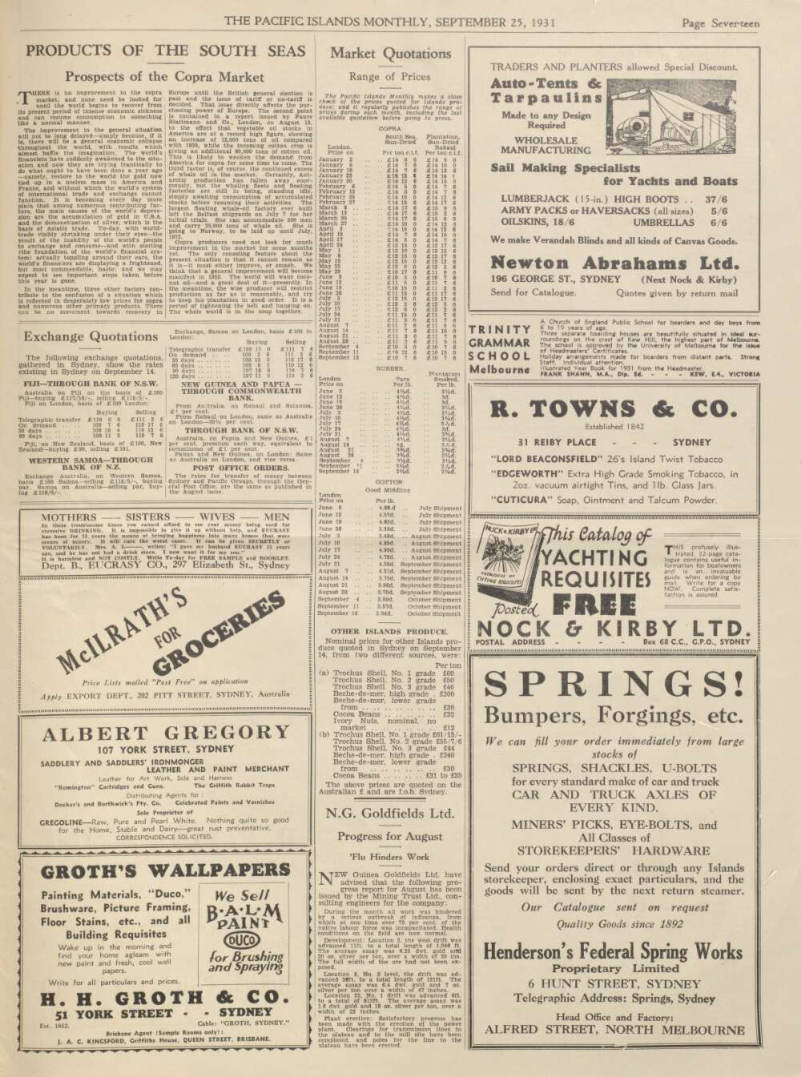
Prospects of the Copra Market
THERE is no improvement in the copra market; and none need be looked for until the world begins to recover from its present period of intense economic sickness and can resume consumption in something like a normal manner.
The improvement in the general situation will not be long delayed—simply because, if it is, there will be a general economic collapse throughout the world, with results which almost baffle the imagination. The world’s financiers have suddenly awakened to the situ ation and now they are trying frantically to do what ought to have been done a year ago —namely, restore to the world the gold now tied up in a useless mass in America and Prance, and without which the world’s system of international trade and exchange cannot function. It is becoming every day more plain that among numerous contributing fac tors, the main causes of the world’s depres sion are the accumulation of gold in U.S.A. and the demonetisation of silver, which is the basis of Asiatic trade. To-day, with world trade visibly shrinking under their eyes—the result of the inability of the world’s people to exchange and consume—and with sterling (the foundation of the world’s financial sys tem) actually toppling around their ears, the world’s financiers are displaying a frightened, but most commendable, haste; and we may expect to see important steps taken before this year is gone.
In the meantime, three other factors con tribute to the confusion of a situation which is reflected in desperately low prices for copra and numerous other primary products. There can be no movement towards recovery in
Europe until the British general election is past and the issue of tariff or no-tariff is decided. That issue directly affects the pur chasing power of Europe. The second point is contained in a report issued by Paure Blattmann and Co., London, on August 12, to the effect that vegetable oil stocks in America are at a record high figure, showing an increase of 12,000 tons of oil compared with 1930, while the incoming cotton crop is giving an additional 60,000 tons of cotton oil.
This is likely to weaken the demand from America for copra for some time to come. The third factor is, of course, the continued excess of whale oil in the market. Certainly, Ant arctic production has fallen away enor mously, but the whaling fleets and floating factories are still in being, standing idle, simply awaiting consumption of accumulated stocks before resuming their activities. The largest floating whale-oil factory ever built left the Belfast shipyards on July 7 for her initial trials. She can accommodate 300 men and carry 25,000 tons of whale oil. She is going to Norway, to be laid up until July, 1932.
Copra producers need not look for much improvement in the market for some months yet. The only consoling feature about the present situation is that it cannot remain as it is—it must either improve, or smash. We think that a general improvement will become manifest in 1932. The world will want coco nut oil—and a great deal of it —presently. In the meantime, the wise producer will restrict production as far as is reasonable, and try to keep his plantation in good order. It is a period of tightening the belt and hanging on.
The whole world is in the soup together.
Exchange Quotations
The following exchange quotations, gathered in Sydney, show the rates existing in Sydney on September 14.
Fiji—Through Bank Of N.S.W.
Australia on Fiji on the basis of £100 Fiji—buying £117/10/-, selling £118/5/-.
Fiji on London, basis of £100 London:
Fiji, on New Zealand, basis of £100, New Zealand —buying £99, selling £101.
Western Samoa—Through
Bank Of N.Z.
Exchange Australia, on Western Samoa, basis £100 Samoa—selling £118/5/-, buying par. Samoa on Australia —selling par, buy ing £118/5/-.
Exchange, Samoa on London, basis £ 100 in London:
New Guinea And Papua
Through Commonwealth
Bank.
From Australia, on Rabaul and Salamoa, £1 per cent.
From Rabaul on London, same as Australia on London —30½ per cent.
Through Bank Of N.S.W.
Australia, on Papua and New Guinea, £ 1 per cent, premium each way, equivalent to commission of £1 per cent.
Papua and New Guinea, on London; Same as Australia on London, and vice versa.
Post Office Orders.
The rates for transfer of money between Sydney and Pacific Groups, through the Gen eral Post Office, are the same as published in the August issue.
Buying
Selling
Telegraphic transfer
£110 0 0 £111 2 e On demand 109 7 6 110 17 6
30 days
108 18 4 110 12 6 60 days 108 11 3 110 7 6
Buying
Selling
Telegraphic transfer
£109 15 0 £111 7 a On demand 109 2 6 111 2 6 30 days 108 13 9 110 17 6
60 days
108 6 3 110 12 6
90 days
107 18 9 110 7 6 120 days 107 11 3 110 2 6
Market Quotations
Range of Prices
The Pacific Islands Monthly makes a close check of the prices quoted for Islands pro duce; and it regularly publishes the range of prices during each month, including the last available quotation before going to press.
Copra.
South Sea, plantation, Sun-Dried Sun-Dried London.
Rabaul Price on Per ton c.i.f. Per ton c.i.f January 2 .. £14 0 0 £14 5 0 January 9 . . £ 14 7 6 £14 10 0 January 16 . £14 7 6 £14 12 6 January 23 £14 12 ( £14 IS « January 30 . . £14 12 6 £14 15 0 February 6 . . £ 14 5 0 £14 7 6 February 13 . . £ 14 5 0 £14 7 6 February 20 . . £14 10 0 £14 12 6 February 27 . . £14 12 6 £14 17 6 March 6 .. . . £14 17 6 £15 0 0 March 13 .. .. .. £14 17 6 £15 2 6 March 20 .. . . £14 17 6 £15 0 0 March 27 .. . . £ 14 10 0 £14 12 6 April 3 .. .. . . £14 10 0 £14 12 6 April 10 .. .. .. £14 7 6 £14 10 0 April 17 ... . . £ 14 5 0 £14 7 6 April 24 . £13 15 0 £ 13 17 6 May 1 .. .. . £13 10 0 £13 12 6 May 8 . . £12 15 0 £12 17 6 May 15 .. . . . . £ 12 10 0 £12 12 6 May 22 ... .. £12 0 0 £12 2 6 May 29 . . . . . . £10 17 6 £11 0 0 June 5 .. £ 10 5 0 £10 7 6 June 12 .. £11 5 0 £11 7 6 June 19 .. £10 15 0 £11 2 6 June 26 . . £11 15 0 £11 17 6 July 3 ... . £12 15 0 £12 17 6 July 10 .. .. . . £ 12 2 6 £ 12 5 0 July 17 .. . . .. €12 0 0 £12 2 6 July 24 .. .. . . £11 15 0 £11 7 6 July 31 ..fill 5 0 £11 7 6 August 7 . £11 2 6 £11 5 0 August 14 ., .. fill 7 6 £11 10 0 August 21 .. .. fill 2 6 £11 7 6 August 28 .. .. £11 2 6 £11 5 0 September 4 . . £ 10 5 0 £10 7 6 September 11 . . £10 12 6 £10 15 0 September 18 .. £10 7 6 £10 7 6
Rubber.
Plantation London Smoked.
Price on Per lb.
Per lb.
June 5 . . . 4Vsd. 3V 8 d.
June 12 . 4%d 3d.
June 19 . . . 4V«d 3d.
June 26 .. .. 4Vid 3 V 4 d, July 3 .. .. 4V 4 d. 3" 4 d.
July 10 . .. 4V 2 d 3V«d.
July 17 . . . 4Vbd. 3J*d.
July 24 . . . 4V 2 d. 3d.
July 31 . . 4'/sd 2 3/ 4 d, August 7 . . . . 4V 4 d. 2V 2 d.
August 14 . . . -id. 2Xd.
August 21 . . . , 3*/ 4 d 2 ; V 8 d.
August 28 . . . . 3%d 2V„d.
September 4 . . .. 3VS,d. 2V 4 d.
September 1 1 . . . 3V 4 d. 2,Ld.
September 18 . .. 3'/sd 2V$d.
Cotton
Good Middling London Price on Per lb.
June 5 .. .. 4.68.d ..
July Shipment June 12 4.57d. ..
July Shipment June 19 .. .. 4.62d, ..
July Shipment June 26 5.39d. ..
July Shipment July 3 . . . . 5.46d. ..
August Shipment July 10 .. .. 4.89d. ..
August Shipment July 17 .. .. 4.98d. ..
August Shipment July 24 4.78d. ..
August Shipment July 31 .. .. 4.56d. September Shipment August 7 .. .. 4.21d. September Shipment August 14 .. 3.73d. September Shipment August 21 .. .. 3.56d. September Shipment August 28 .. .. 3.70d. September Shipment September 4 .. 3.59d. October Shipment September 11 .. 3.57d. October Shipment September 18 .. 3.54d. October Shipment
Other Islands Produce.
Nominal prices for other Islands pro duce quoted in Sydney on September 14, from two different sources, were: Per ton (a) Trochus Shell, No. 1 grade £60 Trochus Shell, No. 2 grade £50 Trochus Shell. No. 3 grade £40 Beche-de-mer, high grade . £200 Beche-de-mer, lower grade from £30 Cocoa Beans £32 Ivory Nuts, nominal, no market £12 (b) Trochus Shell, No. 1 grade £61/15/- Trochus Shell, No. 2 grade £55/7/6 Trochus Shell, No. 3 grade £44 Beche-de-mer, high grade . £240 Beche-de-mer, lower grade from £30 Cocoa Beans £31 to £35 The above prices are quoted on the Australian £ and are f.o.b. Sydney.
Progress for August
N.G. Goldfields Ltd.
Progress for August ’Flu Hinders Work
NEW Guinea Goldfields Ltd. have
advised that the following pro
gress report for August has been
issued by the Mining Trust Ltd., con
sulting engineers for the company:
During the month all work was hindered by a serious outbreak of influenza, from which at one time over 75 per cent. of the native labour force was incapacitated. Health conditions on the field are now normal.
Development: Location 3, the west drift was advanced lift, to a total length of 1.046 ft.
The average assay was 6.25 dwt. gold and 20 oz. silver per ton, over a width of 20 ins.
The full width of the ore had not been ex posed.
Location 8, No. 2 level, the drift was ad vanced 26ft. to a total length of 121 ft. The average assay was 6.4 dwt. gold and 7 oz. silver per ton over a width of 47 inches.
Location 22, No. 1 drift was advanced 8ft. to a total of 913 ft. The average assay was 1.6 dwt. gold and 18 oz. silver per ton, over a width of 22 inches.
Plant erection: Satisfactory progress has been made with the erection of the power plant. Clearings for transmission lines to the plateau and to the mill site have been completed, and poles for the line to the nlateau have been erected.
Advertisements & other items, p. 17 (2 items)
Springs!
TRADERS AND PLANTERS allowed Special Discount.
Auto-Tents &
Tarpaulins
Made to any Design Required
WHOLESALE
MANUFACTURING
Sail Making Specialists
for Yachts and Boats
LUMBERJACK (15-in.) HIGH BOOTS .. 37/6
ARMY PACKS or HAVERSACKS (all sizes) 5/6
OILSKINS, 18/6 UMBRELLAS 6/6
We make Verandah Blinds and all kinds of Canvas Goods.
Newton Abrahams Ltd.
196 GEORGE ST., SYDNEY (Next Nock & Kirby) Send for Catalogue. Quotes given by return mail
TRI N ITY
GRAMMAR
SCHOOL
Melbourne
A Church of England Public School for boarders and day boys from 6 to 19 years of age.
Three separate boarding houses are beautifully situated in ideal surroundings on the crest of Kew Hill, the highest part of Melbourne.
The school is approved by the University of Melbourne for the issue of Headmasters’ Certificates.
Holiday arrangements made for boarders from distant parts. Strong Staff. Individual attention.
Illustrated Year Book for 1931 from the Headmaster.
FRANK SHANN, M.A., Dip. Ed. - KEW. E. 4., VICTORIA
R. TOWNS & CO.
Established 1842 31 REIBY PLACE - - - SYDNEY “LORD BEACONSFIELD” 26’s Island Twist Tobacco “EDGEWORTH” Extra High Grade Smoking Tobacco, in 2oz. vacuum airtight Tins, and lib. Class Jars.
“CUTICURA” Soap, Ointment and Talcum Powder.
This Catalog of
YACHTING
REQUISITES
FREE
THIS profusely illus trated, 32-page cata logue contains useful in formation for boatowners and is an invaluable guide when ordering by mail. Write for a copy NOW. Complete satis faction is assured.
POSTAL ADDRESS
IRBY LTD.
Box 68 C.C., G.P.O., SYDNEY
SPRINGS!
Bumpers, Forgings, etc.
We can fill your order immediately from large stocks of
SPRINGS, SHACKLES, U-BOLTS
for every standard make of car and truck
CAR AND TRUCK AXLES OF
EVERY KIND.
MINERS’ PICKS, EYE-BOLTS, and
All Classes of
STOREKEEPERS’ HARDWARE
Send your orders direct or through any Islands storekeeper, enclosing exact particulars, and the goods will be sent by the next return steamer.
Catalogue sent on request Our Quality Goods since 1892
Henderson’s Federal Spring Works
Proprietary Limited
6 HUNT STREET, SYDNEY
Telegraphic Address: Springs, Sydney Head Office and Factory:
ALFRED STREET, NORTH MELBOURNE
Albert Gregory
MOTHERS SISTERS WIVES MEN
In these troublesome times you cannot afford to see your money being used for excessive DRINKING. It is impossible to give it up without help, and EUCRASY has been for 35 years the means of bringing happiness into many homes that were scenes of misery. It will cure the worst cases. It can be given SECRETLY or VOLUNTARILY. Mrs. A. L , writes: “I gave my husband EUCRASY 13 years ago, and he has not had a drink since. I now want it for my son.”
It is harmless and NOT COSTLY. Write To-day for FREE SAMPLE and BOOKLET.
Dept. 8., EUCRASY GO., 297 Elizabeth St., Sydney
Price Lists mailed “Post Free” on application Apply EXPORT DEPT., 202 PITT STREET, SYDNEY, Australia
ALBERT GREGORY
107 YORK STREET, SYDNEY
SADDLERY AND SADDLERS’ IRONMONGER
LEATHER AND PAINT
MERCHANT
Leather for Art Work, Sole and Harness “Remington” Cartridges and Guns. The Griffith Rabbit Traps Distributing Agents for : Docker’s and Borthwiek’s Pty. Co. Celebrated Paints and Varnishes Sole Proprietor of CRECOLINE —Raw, Pure and Pearl White. Nothing quite so good for the Home, Stable and Dairy—great rust preventative.
CORRESPONDENCE SOLICITED.
GROTH’S WALLPAPERS
Painting Materials, “Duco,"
Brushware, Picture Framing, Floor Stains, etc., and all Building Requisites Wake up in the morning and find your home agleam with new paint and fresh, cool wall papers.
Write for all particulars and prices.
We Sell
BALM
PAINT
for Brushing
and Spraying
H. H. GROTH & CO.
51 YORK STREET - - SYDNEY
18 „ Cable; “GROTH, SYDNEY."
Brisbane Agent (Sample Rooms only): J. A. C. KINCSFORD, Griffiths House, QUEEN STREET, BRISBANE.
Shipping Services in The Pacific
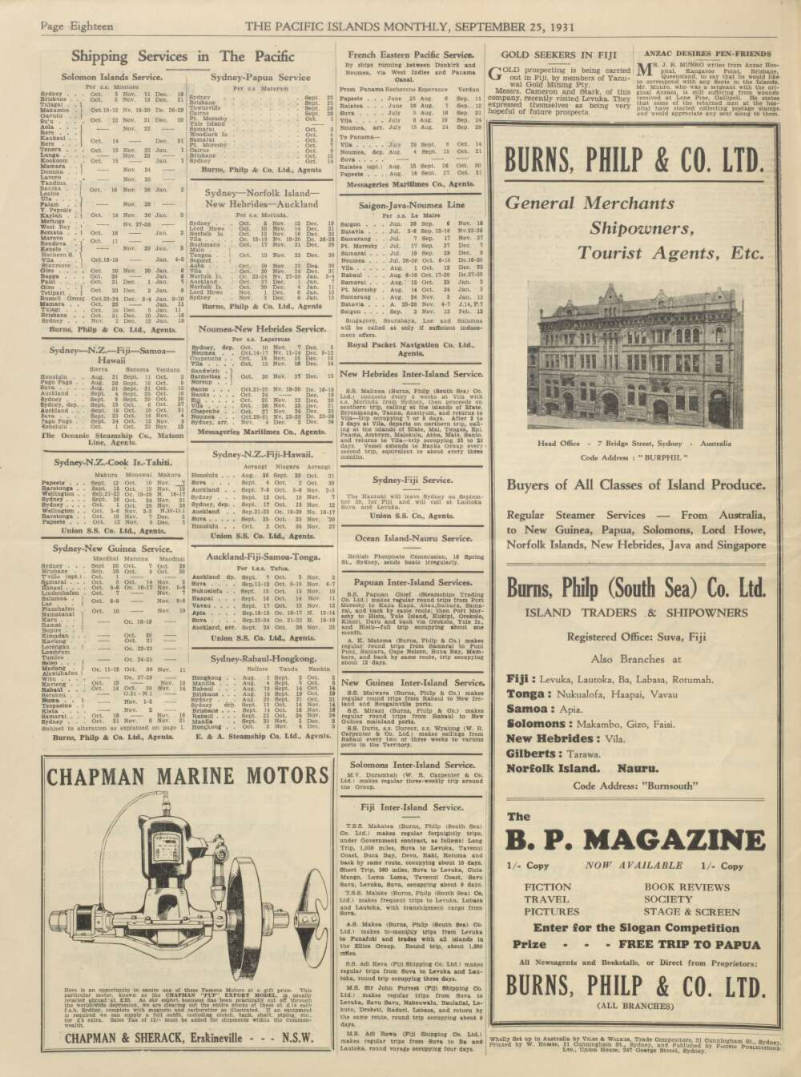
Solomon Islands Service.
Sydney—N.Z.—Fiji—Samoa— Hawaii
Sydney-N.Z.-Cook Is.-Tahiti.
Sydney-New Guinea Service.
Sydney-Papua Service
Sydney —Norfolk Island — New Hebrides —Auckland
Noumea-New Hebrides Service.
Per s.s. Laperouse
Sydney-N.Z.-Fiji-Hawaii.
Auckland-Fiji-Samoa-Tonga.
Sydney-Rabaul-Hongkong.
French Eastern Pacific Service.
By ships running between Dunkirk and Noumea, via West Indies and Panama Canal.
Saigon-Java-Noumca Line
Singapore, Sourabaya, Lae and Salamoa will be called at only if sufficient induce ment offers.
Royal Packet Navigation Co. Ltd.,
Agents.
New Hebrides Inter-Island Service.
S.S. Malinoa (Burns, Philp (South Sea) Co.
Ltd.) connects every 5 weeks at Vila with s.s. Morinda from Sydney, then proceeds On southern trip, calling at the Islands of Efate.
Erronmanga, Tanna, Aneityum, and returns to Vila—trip occupying 7 or 8 days. After 2 to 3 days at Vila, departs on northern trip, call ing at the islands of Efate, Mai, Tongoa, Epi.
Paama, Ambrym, Malekula, Abba, Malo, Santo, and returns to Vila —trip occupying 25 to 28 days. Vessel extends to Banks Group every second trip, equivalent to about every three months.
Sydney-Fiji Service.
The Hauraki will leave Sydney on Septem ber 29, for Piji_ and will call at Lautoka Suva and Levuka.
Union S.S. Co., Agents.
Ocean Island-Nauru Service.
British Phosphate Commission, 16 Spring St., Sydney, sends boats irregularly.
Papuan Inter-Island Services.
S.S. Papuan Chief (Steamships Trading Co. Ltd.) makes regular round trips from Port Moresby to Kapa Kapa, Abau.Baibara, Sama rai, and back by same route; then Port Mor esby to Hislu, Yule Island, Kukipl, Orokolo, Kikori, Daru and back via Orokolo, Yule Is., and Hisiu—full trip occupying about one month.
A. K. Matoma (Burns, Philp it Co.) makes regular round trips from Samara! to Puni Puni, Baniara, Cape Nelson, Buna Bay, Mam bare, and back by same route, trip occupying about 12 days.
New Guinea Inter-Island Service.
S.S. Maiwara (Burns, Philp & Co.) makes regular round trips from Rabaul to New Ire land and Bougainville ports.
S.S. Mirani (Burns, Philp & Co.) makes regular round trips from Rabaul to New Guinea mainland ports.
S.S. Duris, s.s. Durour, s.s. Wyalong (W. R.
Carpenter & Co. Ltd.) makes sailings from Rabaul every two or three weeks to various ports in the Territory.
Solomons Inter-Island Service.
M.V. Durambah (W. R. Carpenter & Co.
Ltd. I makes regular three-weekly trip around the Group.
Fiji Inter-Island Service.
T.S.S. Makatea (Burns, Philp (South Sea) Co. Ltd.) makes regular fortnightly trips, under Government contract, as follows: Long Trip, 1,050 miles, Suva to Levuka, Tavenui Coast, Buca Bay, Devo, Rabi, Rotuma and back by same route, occupying about 10 days.
Short Trip, 560 miles, Suva to Levuka, Cicia Mango, Loma Loma, Tavenui Coast, Savu Savu, Levuka, Suva, occupying about 9 days.
T.S.S. Malake (Burns, Philp (South Sea) Co.
Ltd.) makes frequent trips to Levuka, Labasa and Lautoka, with transhipment cargo from Suva.
A.S. Makoa (Burns, Philp (South Sea) Co.
Ltd.) makes bi-mont.hly trips from Levuka to Funafuti and trades with all islands in the Ellice Group. Round trip, about 1,800 mtles.
S.S. Adi Keva (Fiji Shipping Co. Ltd.) makes regular trips from Suva to Levuka and Lau toka, round trip occupying three days.
M.S. Sir John Forrest (Fiji Shipping Co.
Ltd.) makes regular trips from Suva to Levuka, Savu Savu, Nabouwalu, Baulailal, Le kutu, Dreketl, Raduri, Labasa, and return by the same route, round trip occupying about 9 days.
M.S. Adi Rewa (Fiji Shipping Co. Ltd.) makes regular trips from Suva to Ba and Lautoka. round voyage occupying four days.
Per s.s.
Montoro Sydney .
Oct. 3 Nov. 11 Dec. 19 Brisbane .
Oct. 5 Nov. 13 Dec. 21 Tulagai .
Makambo Oct.10-12 Nv. 18-20 De. 26-29 Gavutu .
Su’u . .
Oct. 13 Nov. 21 Dec. 30 Aola . .
Nov. 22 Rere . .
Kaukaul .
Rere . .
Oct. 14 Dec. 31 Teneru .
Oct. 15 Nov. 23 Jan. 1 Lunga . .
Nov. 23 — Kookoom Oct. 15 Jan. 1 Mamara .
Nov. 24 Domma . — — Lavoro .
Nov. 25 Yandina Banika .
Oct. 16 Nov. 26 Jan. 2 Loabie .
Ufa . . .
Paiam — Nov. 26 — Y. Pepsale Kaylah .
Oct. 16 Nov. 26 Jan. 2 Mennge .
West Bay Nv. 27-28 — Somata .
Oct. 16 Jan. 2 Marovo Oct.
Rendova Oct. 17 — — Kenelo . —,—.
NoV. 29 Jan. 3 Hathorn S.
Vila . .
Oct.18-19 — Jan. 4-5 Stanmore Olzo . , Oct. 20 Nov. 30 Jan. 6 Bagga .
Oct. 20 — Jan. 6 Palsl . ...
Oct. 21 Dec. 1 Jan. 7 Gizo . .
Tetiparl .
Oct. 22 Dec. 2 Jan. 8 Russell Group Oct.23-24 Dec. 3-4 Jan. 9-10 Mamara .
Oct. 25 Jan. 11 Tulagi .
Oct. 26 Dec. 5 Jan. 11 Brisbane Oct. 31 Dec. 10 Jan. 16 Sydney .
Nov. 2 Dec. 12 Jan. 18 Burns, Philp & Co. Ltd., Agents.
Sierra Sonoma Ventura Honolulu . . Aug. 21 Sept. 11 Oct. 2 Pago Pago , . Aug. 28 Sept. 18 Oct. 9 Suva . . . . Aug. 31 Sept. 21 Oct. 12 Auckland . . Sept. 4 Sept. 25 Oct. 16 Sydney . . . Sept. 8 Sept. 29 Oct. 20 Sydney, dep. . Sept. 15 Oct. 6 Oct. 27 Auckland . . . Sept. 19 Oct. 10 Oct. 31 Suva . . . . Sept. 23 Oct. 14
Nov.
4 Pago Pago . . Sept. 24 Oct. 15 Nov. 5 Honolulu . . . Oct. 1 Oct. 22 Nov. 12 The Oceanic Steamship Co., Matson
Line, Agents.
Makura Monowai Makura Papeete . .
Sept. 12 Oct. 10 Nov. 7 Rarotonga .
Sept. 15 Oct. 13 Nov. 10 Wellington .
Sep.21-22 Oc. 19-20 N. 16-17 Sydney . . .
Sept. 26 Oct. 24 Nov. 21 Sydney . , .
Oct. 1 Oct. 29 Nov. 26 Wellington .
Oct. 5-6 Nov. 2-3 N.30-D.1 Rarotonga .
Oct. 10 Nov. 7 Dec. 5 Papeete . .
Oct. 12 Nov 9 Dec. 7 Union S. S. Co. Ltd., Agents.
Macdhui Marsina Macdhui Sydney . . . Sept 26 Oct. 7 Oct. 28 Brisbane . . Sep. 28 Oct. 9 Oct. 30 T’ville (opt.) . Oct. 1 Samarai . . . Oct. 3 Oct. 14 Nov. 3 Sabaul . . . . Oct. 5-6 OC. 16-17 Nov. 5-6 Lindenhafen . Oct. 7 — Nov. 7 Salamoa . / Lae . . . ( Oct. 8-9 — Nov. 8-9 Plnschafen • Oct. 10 Nov. 10 Namatanai 1 Karu . . . 1 Hamat . . f — Oc. 18-19 —
Bopire . . 1
Oct. 20 Kimadan . , . — Kavieng . . .
Oct. 21 — Lorengau . ) Oc. 22-23 Lombrum .
Tumleo .
Seleo . . . ( Oc. 24-25 Madang . I Oc. 11 -12 Oct. 26 Nov. 11 Alexishafen f Oc. 27-29 Witu . . . . — - Kavieng . . . Oct. 13 — Nov. 13 Rabaul . . . Oct. 14 Oct. 30 Nov. 14 Soraken . . — 0.31 - N.l — Numa . . ) Nov. 1-2 „ Teopaslno . 1 i Kieta . . . , * Nov. 2 — 16 Samara! . . . Oct. 16 — Nov.
Sydney . . . Oct. 21 Nov. 8 Nov. 21 Subject to alteration as explained on page 1.
Burns, Philp & Co. Ltd., Agents.
S-J Per s.s.
Mataram
Sydney
23 Brisbane 25 Townsville 28 Cairns 29
Pt. Moresby
Yule Island 1 Samarai 3 Woodlark Is. . Oct. 4 Samarai 5
Pt. Moresby
. Oct. 7 Cairns 9 Brisbane . Oct. 12
Sydney
. Oct. 14 Bums, Philp & Co. Ltd., Agents.
Sydney . .
Per s.s.
Oct.
Morinda. 8 Nov. 12 Dec. 19 Lord Howe Oct. 10 Nov. 14 Dec. 21 Norfolk Is.
Oct. 12 Nov. 16 Dec. 23 Vila . . . .
Oc. 15 -IS Nv. 19 -20 Dc, 26 -28 Bushmans .
Oct- 17 Nov. 21 Dec. 29 Malo . . .
Tangoa . . i Oct. 13 Nov. 22 Dec. 30 Segond . .
Aoba . . . 1 Oct. 19 Nov. 23 Dec. 30 Vila . . .
Oct. 20 Nov. 24 Dec. 31 Norfolk Is.
Oc. 23 24 Nv. 27-28 Jan. 3-4 Auckland Oct. 27 Dec. 1 Jan. 7 Norfolk Is.
Oct. 30 Dec.
A Jan. 11 Lord Howe Nov. 1 Dec. 6 Jan. 13 Sydney . .
Nov.
3 Dec. 8 Jan. 15 Burns, Philp & Co. Ltd., Agents.
Sydney, dep.
Oct. 10 Nov. 7 Dec. 5 Noumea .
Oct. 14 -17 Nv. 11-14 Dec. 9-12 Chepenche . .
Oct. 18 Nov. 15 Dec. 13 Vila ...
Oct. 19 Nov. 16 Dec. 14 Sandwich . 1 Sarmettes . > Oct. 20 Nov. 17 Dec. 15 Norsup . . ) Santo . . .
Oct.21 -23 Nv. 18-20 De. 16-18 Banks ...
Oct. 24 Dec. 19 Eni Vila ...
Oct. 25 Nov. 22 Dec. 20 Oct. 26 Nov. 23 Dec. 21 Chepenhe . .
Oct. 27 Nov. 24 Dec. 22 Noumea . . .
Oct.28 -31 Nv. 25-28 De. 23-26 Sydney, arr. .
Nov. 4 Dec. 2 Dec. 36
Messageries Maritlmes Co., Agents.
Aorangl Niagara Aorangi Honolulu . . .
Aug. 26 Sept. 23 Oct. 21 Suva . . .
Sept. 4 Oct. 2 Oct. 30 Auckland . .
Sept. 7-8 Oct. 5-6 Nov. 2-3 Sydney . . . Sept. 12 Oct. 10 Nov. 7 Sydney, dep. . , Sept. 17 Oct. 15 Nov. 12 Auckland . . , Sep.21-22 Oc. 19-20 No. 16-17 Suva , Sept. 25 Oct. 23 Nov. 20 Honolulu . . , Oct. 2 Oct. 30 Nov. 27 Union S. S. Co. Ltd., Agents.
Per t.s.s.
Tofua.
Auckland dp.
Sept. 7 Oct. 5 Nov. 2 Suva . . , , Sep.11-12 Oct. 9-10 Nov. 6-7 Nukualofa Sept. 15 Oct. 13 Nov. 10 Haapal .
Sept. 16 Oct. 14 Nov, 11 Vavau . .
Sept. 17 Oct. 15 Nov. 12 Apia . .
Sep.18-19 Oc. 16-17 N. 13-14 Suva . . , , Sep.23-24 Oc. 21-22 N. 18-19 Auckland, arr.
Sept. 28 Oct. 26
Nov.
23 Union S. S. Co. Ltd., Agents.
Nellore Tanda Nankin Hongkong . • Aug. i Sept. 2 Oct. 2 Manilla . . . Aug. 4 Sept. 5 Oct. 5 Rabaul . . . Aug. 13 Sept. 14 Oct. 14 Brisbane . . . Aug. 18 Sept. 19 Oct. 19 Sydney . . . Aug. 20 Sept. 21 Oct. 21 Sydney dep. Sept. 12 Oct. 14 Nov. 14 Brisbane . . . Sept. 14 Oct. 16 Nov. 16 Rabaul . . , . . Sept. 22 Oct. 24 Nov. 24 Manila . . Sept. 30 Nov. 1 Dec. 2 Hongkong . . Oct. 3 Nov. 4 Dec. 5 E. & A. Steamship Co. Ltd., Agents.
Prom Panama Recherche Esperance Verdun Papeete . . .
June 25 Aug. 6 Sep. 11 Raiatea . . .
June 26 Aug. 7 Sep. .12 Suva . . . .
July 5 Aug. 16 Sep. 21 Vila July 8 Aug. 19 Sep. 24 Noumea, arr.
July 13 Aug. 24 Sep. 29 To Panama — Vila July 28 Sept. 8 Oct. 14 Noumea, dep.
Aug. 4 Sept. 15 Oct. 21 Suva — Raiatea (opt.) Aug. 15 Sept. 26 Oct. 30 Papeete . . .
Aug. 16 Sent. 27 Oct. 31
Messageries Mari times Co., Agents.
Per s.s.
Le Maire Saigon . . . Jun. 26 Sep. 6 Nov. 16 Batavia . . . Jul. -6 Sep. 13 -16 Nv.23-26 Samarang . . Jul. 7 Sep. 17 Nov. 27 Pt. Moresby . Jul. 17 Sep. 27 Dec. 7 Samaral . . . Jul. 19 Sep. 29 Dec. 9 Noumea . . . Jul. 26-30 Oct. 6-10 Dc. 16-20 Vila ...
Aug 1 Oct. 12 Dec. 22 Rabaul . . . Aug. 6-10 Oct. 17-20 Dc.27-30 Samaral . . . Aug. 13 Oct. 23 Jan. 2 Pt. Moresby . Aug. 14 Oct. 24 Jan. 3 Samarang . . Aug. 24 Nov. 3 Jan. 13 Batavia . . . A. 25-28 Nov. 4-7 J.14, P.7 Saigon . . . . Sep. 2 Nov. 12 Feb. 12
Gold Seekers In Fiji
GOLD prospecting is being carried out in Fiji, by members of Yanu wai Gold Mining Pty.
Messrs. Cameron and Stark, of this company, recently visited Levuka. They expressed themselves as being very hopeful of future prospects.
Anzac Desires Pen-Friends
MR. J. R. MUISTRO writes from Anzac Hos pital, Kangaroo Point, Brisbane, Queensland, to say that he would like to correspond with any Scots in the Islands.
Mr. Munro, who was a sergeant with the ori ginal Anzacs, is still suffering from wounds received at Lone Pine, Gallipoli. He states that some of the returned men at the hos pital have started collecting postage stamps and would appreciate any sent along to them.
Advertisements & other items, p. 18 (3 items)
The Pacific Islands Monthly, September 25, 1931
18
Wholly Set up in Australia by Viles & Walker, Trade Compositors, 31 Cunningham St Printed by W. Homer, 31 Cunningham St.. Sydney, and Published by Pacific Ltd.. Union House, 247 George Street, Sydney. ‘ blications.
Burns, Philp & Co. Ltd.
General Merchants
Shipowners,
Tourist Agents, Etc.
Head Office - 7 Bridge Street, Sydney - Australia Code Address : " BURPHIL ”
Buyers of All Classes of Island Produce.
Regular Steamer Services From Australia, to New Guinea, Papua, Solomons, Lord Howe, Norfolk Islands, New Hebrides, Java and Singapore
Burns, Philp (South Sea) Co. Ltd.
ISLAND TRADERS & SHIPOWNERS
Registered Office: Suva, Fiji Also Branches at FIJI: Levuka, Lautoka, Ba, Labasa, Rotumah.
Tonga: Nukualofa, Haapai, Vavau Samoa: Apia.
Solomons : Makambo, Gizo, Faisi.
New Hebrides: Vila.
Gilberts : Tarawa.
Norfolk Island. Nauru.
Code Address: "Bumsouth”
The
B. P. MAGAZINE
1/- Copy NOW AVAILABLE 1/- Copy
FICTION BOOK REVIEWS
TRAVEL SOCIETY
PICTURES STAGE & SCREEN
Enter for the Slogan Competition
Prize - FREE TRIP TO PAPUA
All Newsagents and Bookstalls, or Direct from Proprietors:
BURNS, PHILP & CO. LTD.
(ALL BRANCHES)
Chapman Marine Motors
Here is an opportunity to secure one of these Famous Motors at a gift price. This particular motor, known as the CHAPMAN “PCP” EXPORT MODEL, is usually retailed abroad at £25. As our export business has been practically cut off through the world-wide depression, we are clearing out the entire stocks of these at £14 each f.o.b. Sydriey, complete with magneto and carburetter as illustrated. If an equipment is required we can supply a full outfit, including clutch, tank, shaft, piping, etc., for £5 extra. Sales Tax of 12/- must be added for shipments within the Commonwealth.
CHAPMAN & SHERACK, Ersfeineville - - - N.S.W.