Monthly
THE Pacific Islands Monthly
THE ONLY JOURNAL CIRCULATING THROUGHOUT THE ISLAND TERRITORIES AND GROUPS
Of The Central And South Pacific.
Vol. 1—No.1 —No. 10
Registered at G.P.O., Sydney, for transmission by Post as a Newspaper
Sydney; Thursday, May 14, 1931
Single Copy, 6d.
Per Annum, posted, 6/-. ===
Tung Oil
———♦——— South Sea Experiments
Fordii Or Montana
A GOOD deal of interest has been evinced in the possibility of cultivating tung oil trees in the Pacific Islands, as a result of the article in the April issue of this journal, and we have had several requests for further information.
Mr. W. R. Carpenter advises that he is experimenting in New Britain with several scores of trees of the Fordii variety, which were obtained from the Botanic Gardens in Sydney.
The trees are now about two years old.
Mr. R. C. Laycock, writing from Tulagi, Solomon Islands, early in March, says: “One of the companies has just brought in some tung oil (Aleurites Fordii) plants and seeds for trial. But as I tried some myself about 12 months ago, and they failed absolutely to grow on the best of soil, I rather fear that this species finds the climate too hot.
Perhaps the Montana species would be O.K.”
Mr. Laycock lays his finger on a point that was later emphasised in our article in April—namely, that it is unlikely that the Fordii species will grow well in a tropical, oceanic climate. In China, the Fordii flourishes in Central China, particularly in the Yangtse Valley; while the Montana species does well in the hot coastal districts of Southern China, Cochin China and Burma. Fordii, therefore, should be suitable for cultivation in Australia and New Zealand, and possibly in the higher, inland altitudes of New Guinea: but, as Mr. Laycock says, it is likely that Montana will do better than Fordii in the Pacific Islands generally. Fordii is the better oil producer, and therefore the better commercial proposition; but cultivation of Montana, if practicable, is also quite profitable. ... ===
N. Guinea Mining
———♦——— Mr. Dunstan’s Investigations
From Our Canberra Correspondent
Canberra, May 12.
MR. B. DUNSTAN, formerly chief Government geologist in Queensland, is still in New Guinea, continuing his inquiry into the goldmining conditions there. The object of his visit is to ascertain whether, in view of the special conditions, any amendment of the mining laws is necessary.
The Papuan Government has asked that Mr. Dunstan’s services be made available for general geological work when he has completed his investigations in the Mandated Territory, and it has been arranged that this shall be done.
Whilst there have been no gold discoveries of any importance in Papua lately, it is desired that Mr. Dunstan shall make some examination of the country and report as to its possibilities.
Before the war there was considerable activity in copper-mining at Bootless Inlet, near Port Moresby—the Laloki Copper Mines. The works, however, were obliged to close down after the war, owing to the low price of copper, and the low prices which have since prevailed have rendered all efforts to revive the industry abortive. ... ===
Leipzig Trade Fair
Cabled advice has been received from the authorities of the Leipzig Trade Fair, in Germany, by their Sydney representative, Mr.
Lars. G. Brundahl, to the effect that the Spring Fair, which opened at Leipzig on March 1, was a great success. There were over 9,000 exhibitors.
Buyers were present from 86 different countries. ===
New Regulations
Papuan Native Labour ———♦——— New Regulations Mixed Reception Among Commercial Interests
From Our Own Correspondent
Port Moresby, May 2.
THERE have been two regulations of the Government lately that have caused some comment amongst the planters, storekeepers and traders.
The first is, that guarantees for native labour contracts are, in most cases, not acceptable, and that it is now compulsory to pay native labour in advance, to ensure the native getting his payments, owing to the uncertain state of the different companies and plantations during the depressed conditions of the country.
The second regulation is that all natives are to be paid off in the districts they were recruited and to which they belong, and that no advances on their contracts are permitted while they are being employed.
These regulations are both in the interests of the natives, the second regulation ensuring the native his entire earnings when he reaches his home, amongst his own people, the first guaranteeing that he gets his money.
These new laws have caused inconvenience. In the first place it has been hard to find ready money to pay a considerable number of boys their wages in advance and their recruiting and signing-on expenses at the same time.
In the second instance some storekeepers and traders have relied almost entirely on the purchases of natives before leaving for their districts after the completion of their contracts.
However, it is hard to please every one. The outside trader welcomes the changes. He now eagerly looks for ward to “pay-offs” in his district.
Many natives are not entirely pleased with the regulations, especially those who do not wish to return to their homes to share their wages, and those who are disgruntled that no advances are allowed to them—which the new law prevents. Others, of course, are entirely satisfied and look forward to the dash they will cut in their villages while the money lasts.
It is compulsory for a native to return to his village after a period of five years’ service before making another contract. This is to ensure the consolidation and continuance of native village life, which, if broken up, would be disastrous to the Territory generally. ... ===
Cook Is. Wedding
———♦——— Reception at The Residency
From Our Own Correspondent
Rarotonga, April 28
THE first European wedding for some time took place here on April 7. The contracting parties were Miss Nancy Ayson of Toiro, Otago, and Mr. A. Stevens of Rarotonga.
Miss Ayson came to Rarotonga to work in the field of education, and to the natives and Europeans she has become well known and well liked by all.
The reception was held at the residence of Judge Ayson, the Resident Commissioner, cousin of the bride. The Residency stands on a low knoll in delightful surroundings and commands a fine view. The bride and bridegroom were surely favoured with the best that tropical beauty could offer them.
The bride looked charming in a beautiful frock of white georgette and lace. ... === Mr. G. H. Murray, Director of Agriculture in New Guinea, recently arriv ed in Sydney on leave. ===
Islands Ships
———♦——— Itineraries Still Indefinite
Schedule Of Present
Arrangements
NO finality has yet been reached between the Federal Government and Messrs. Burns, Philp & Co. Ltd., regarding the rearrangement of Islands steamers, but it is expected that a definite decision will be reached shortly.
In the meantime the new M.V.
Macdhui is sailing from Sydney for New Guinea on May 16, and her schedule is published in our shipping columns. The next vessel to New Guinea will be probably the Marsina, and her sailing date will be May 30.
As regards the Solomon Islands service, the Mataram will leave Sydney on her next trip on June 10. The succeeding trip will be made on July 18, but it is not known what vessel will be then on the service.
The Morinda will leave Sydney for Papua on May 27. The next trip is scheduled for June 24, but here, again, the steamer for that trio is not known.
For the Norfolk Island-New Hebrides service, the Makambo will depart from Sydney on the short trip on June 6. This vessel, or a substitute, will leave on the long trip on June 25.
The Montoro is at present under going overhaul in Sydney, and she will not be in commission again until the latter end of June. ... ===
Honour For Peter
———♦——— Old Life-Saver From Solomons
From Our Own Correspondent.
Suva, May 2.
THE Long Room in the Customs House recently was filled by officials and shipping men, gathered to do honour to the little old Solomon Islander named Peter. He has lived in Fiji for 40 years, and has been night watchman on King’s Wharf for a number of years.
During that time he has, all alone, saved the lives of two white men and one Chinese.
Following the second act of bravery, the Royal Humane Society’s attention was called to Peter by the Secretary of State, and Peter was awarded the certificate and bronze medal of the Society.
At 11 p.m. on December 11 last, he heard cries and found a Chinese in the harbour, and two Europeans on the wharf vainly trying to catch hold of the drowning man. Divesting himself of his much-loved tunic, Peter jumped into the shark-infested waters and rescued the drowning man.
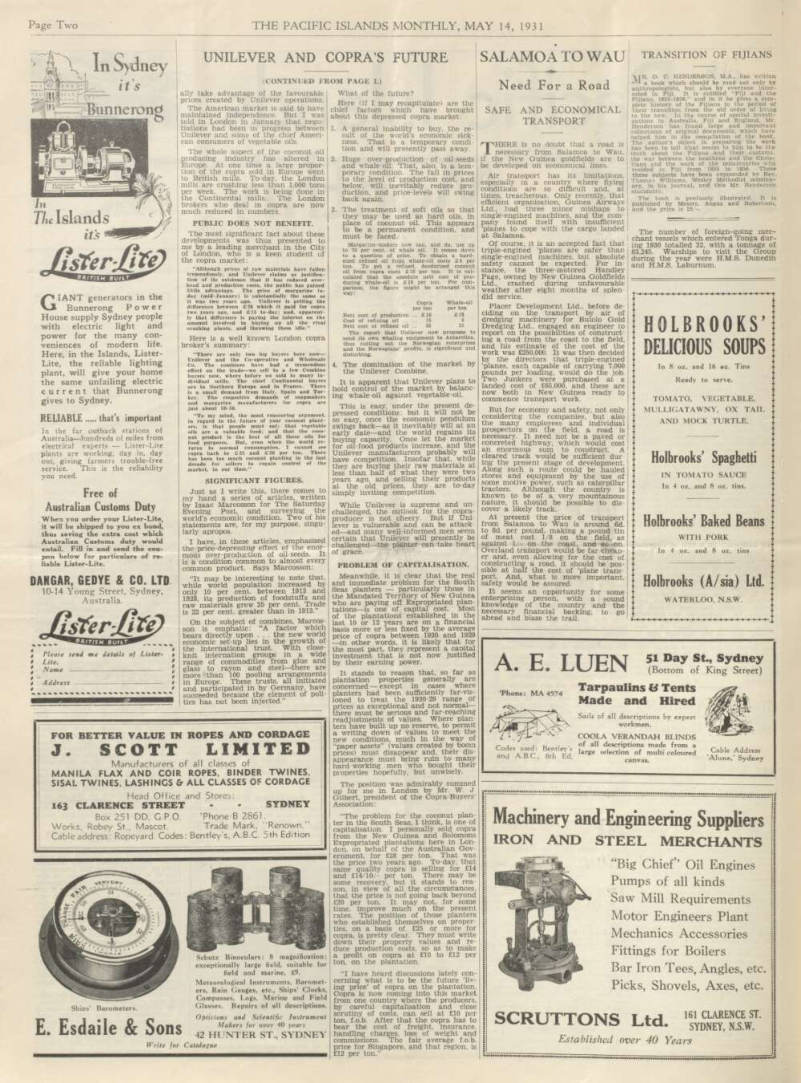
The Comptroller of Customs (Mr. J M. Wilson), addressed Peter, who wore his medal, and said that the Governor had decided that a monetary recognition should be given to him, “as a small reward in recognition of your brave act.” Mr, Wilson Snapshot of Peter, with Mr. Wilson, head of Customs Department (second from right), just after the presentation.
concluded, with some feeling, “I am proud to be the head of the Department that employs you.”
The address concluded with loud cheers and Peter’s hand was eagerly shaken by the people present, all of whom congratulated him.
It was a great occasion for Peter, who was moved almost to tears by the enthusiasm around him. He stood there, with a slight smile on his face, but never a word could he utter.
Like many an other brave man. he believed in deeds, not words ===
Unilever and Copra’s Future
———♦———
International Combine’S Stranglehold
Capitalisation Problem for South Seas Planters
BY R. W. ROBSON, EDITOR OF THE PACIFIC ISLANDS MONTHLY.
IN my first two articles, written in London in January, I dealt with two depressing and discouraging factors in the world copra market namely, the enormous over-production of all classes of vegetable oil seeds, and of whale oil; and the manner in which scientific discoveries and technical developments have allowed soap and margarine manufacturers to use, as substitutes for coconut oil, various soft vegetable oils and animal products which, formerly, could not be used in high-class goods.
In this article, I propose to give something about the most disturbing factor operating in the market —namely, the combination of buyers. The over-production of oil, and scientific progress, while unfortunate, cannot be resented—they are the natural results of commercial development and the law of supply and demand—and they will cure themselves.
BUT the Combine is in a different category. It is an artificial creation, a poisonous growth on the healthy body of trade, a sinister and cruel force designed to suck the life blood out of private enterprise, and rob honest industry of its just rewards.
Most of the things which alarm the coconut planter to-day are of transient character—with other economic abnormalities, they presently will pass away.
The Combine, I fear, is here to stay for some time —merciless in its purpose, and so strong that it can defy the strongest selling agent and the most determined Government. At the present time it is completely in command of the European market. Over production, chaotic economic conditions, and buyers’ weakness—all have given it a hold of the market from which it cannot easily be pried loose.
I can see only one ray of hope in the situation a possibility that the bludgeoning of the market will give small manufacturers a chance. That possibility is dealt with later on.
In a world of great combines, Unilever is among the most powerful. I have not the exact figures but I know that they are startling. It dominates the soap and margarine making industries of Europe few, if any, manufacturers of importance are now operating against it. Its operations extend over the whole world, and it controls almost every selling market— except possibly those in North America.
Unilever’S History.
The growth of the Unilever Combine can be traced from developments before and during the war. Originally there were two big operators in the copra market Yergen and Vanden-
berg, both Dutch. During the war, while the competing firms of the combatant nations were otherwise occupied, these two big concerns got together and bought a controlling interest in certain German mills.
After the war, a strong German organisation, the Heimer Combine, sprang up, and took control of mills in Czechoslovakia. Austria and Switzerland. It fought the Dutch Combine, and competition was healthy.
But the next move was bad—there came a Yergen-Vandenberg-Heimer combination, which gave them control of the margarine industry in nearly every country. They bought a mill in Latvia, a controlling interest in two big mills in Sweden, and, in the latter end of 1930, they got control of the Norwegian mills.
Meanwhile, the Continental organisation had linked up with British manufacturers—and so we obtain the famous “Margarine Union,” controlling margarine manufacture and distribution throughout Europe, and, in the copra market, buying for the mills of Britain, Scandinavia, Holland. Germany, Switzerland, Austria and Czecho-Slovakia.
During this period Lever Brothers were creating in the soap making industry of Europe the same dominant organisation that the Dutch-German Combine had brought into being in the margarine business. Since their chief raw materials were the same, it was inevitable that the Margarine Union and Lever Brothers should come close together—either as friends or enemies.
To the discomfiture of the oil seed producers of the world, they amalgamated their interests. And thus Unilever was born, less than two years ago.
Over Production Favours
Unilever.
No arguments or figures of mine are needed to show how Unilever can command the European copra market.
Even in normal times, the concentration of so much buying power in the one organisation must have adversely affected sellers’ interests. But, if all the high gods had combined to arrange favourable conditions for the advent of Unilever in the raw materials market, they could not have improved the position as Unilever found it in 1930. The phenomenal over-production of every kind of oil-seed, and of whale-oil, simply invited Unilever to pay what it liked for copra and all allied commodities. Unilever, naturally, took full advantage of its opportunities, and has established itself, firmly and permanently, as the most powerful factor governing the European copra market.
Unilever completely controls the selling price of copra in Northern Europe.
The Marseilles group of copra buyers is independent of the Combine and provides the chief market for the South Seas product. But the Marseilles market absorbs only 100,000 tons of copra annually, and the buyers there natur-
(Continued On Page 2.)
The American market is said to have maintained independence. But I was told in London in January that negotiations had been in progress between Unilever and some of the chief American consumers of vegetable oils.
The whole aspect of the coconut oil producing industry has altered in Europe. At one time a large proportion of the copra sold in Europe went to British mills. To-day, the London mills are crushing less than 1,000 tons per week. The work is being done in the Continental mills. The London brokers who deal in copra are now much reduced in numbers.
Public Does Not Benefit.
The most significant fact about these developments was thus presented to me by a leading merchant in the City of London, who is a keen student of the copra market: “Although prices of raw materials have fallen tremendously, and Unilever claims as justification of its existence that it has reduced over head and production costs, the public has gained little advantage. The price of margarine today (mid-January) is substantially the same as it was two years ago. Unilever is getting the difference between £28 which it paid for copra two years ago, and £15 to-day; and, apparently that difference is paying the interest on the amount involved in buying up all the rival crushing plants, and throwing them idle.”
Here is a well known London copra broker’s summary: “There are only two big buyers here now— Unilever and the Co-operative and Wholesale Co. The combines have had a tremendous effect on the trade—we sell to a few Combine buyers now, where before we sold to many individual mills. The chief Continental buyers are in Northern Europe and in France. There is a small demand from Italy, Spain and Turkey. The respective demands of soapmakers and margarine manufacturers for copra are just about 50-50.
“To my mind, the most reassuring argument, in regard to the future of your coconut planters, is that people must eat; that vegetable oils are a valuable food; and that the coconut product is the best of all these oils for food purposes. But, even when the world returns to normal consumption, I cannot see copra back to £25 and £28 per ton. There has been too much coconut planting in the last decade for sellers to regain control of the market, in our time.”
Significant Figures.
Just as I write this, there comes to my hand a series of articles, written by Isaac Marcosson for The Saturday Evening Post, and surveying the world’s economic condition. Two of his statements are, for my purpose, singularly apropos.
I have, in these articles, emphasised the price-depressing effect of the enormous over-production of oil-seeds. It is a condition common to almost every common product. Says Marcosson: “It may be interesting to note that, while world population increased by only 10 per cent, between 1913 and 1928, its production of foodstuffs and raw materials grew 25 per cent. Trade is 22 per cent, greater than in 1913.”
On the subject of combines, Marcos son is emphatic: “A factor which bears directly upon . . . the new world economic set-up lies in the growth of the international trust. With closeknit internation groups in a wide range of commodities from glue and glass to rayon and steel—there are more than 100 pooling arrangements in Europe. These trusts, all initiated and participated in by Germany, have succeeded because the element of politics has not been injected.”
What of the future?
Here (if I may recapitulate) are the chief factors which have brought about this depressed copra market: 1. A general inability to buy, the result of the world’s economic sickness. That is a temporary condition and will presently pass away. 2. Huge over-production of oil-seeds and whale-oil. That, also, is a temporary condition. The fall in prices to the level of production cost, and below, will inevitably reduce production, and price-levels will swing back again. 3. The treatment of soft oils so that they may be used as hard oils, in place of coconut oil. This appears to be a permanent condition, and must be faced.
Margarine-makers now can, and do, use up to 70 per cent, of whale oil. It comes down to a question of price. To obtain a hardened refined oil from whale-oil costs £6 per ton. To get a refined, deodorised coconut oil from copra costs £15 per ton. It is calculated that the absolute nett cost of producing whale-oil is £15 per ton. For comparison, the figure might be arranged this way: ... Copra ... Whale-oil ... per ton ... per ton Nett cost of production .. £10 ... £15 Cost of refining oil ... 15 ... 6 Nett cost of refined oil ... 25 ... 21
The report that Unilever now proposes to send its own whaling equipment to Antarctica, thus cutting out the Norwegian enterprises and the Norwegians’ profits, is significant and disturbing. 4. The domination of the market by the Unilever Combine.
It is apparent that Unilever plans to hold control of the market by balancing whale-oil against vegetable-oil.
This is easy, under the present depressed conditions: but it will not be so easy, once the economic pendulum swings back—as it inevitably will at an early date—and the world regains its buying capacity. Once let the market for oil-food products increase, and the Unilever manufacturers probably will have competition. Insofar that, while they are buying their raw materials at less than half of what they were two years ago, and selling their products at the old prices, they are to-day simply inviting competition.
While Unilever is supreme and unchallenged, the outlook for the copra producer is not cheery. But if Unilever is vulnerable and can be attacked—and many well-informed men seem certain that Unilever will presently be challenged—the planter can take heart of grace.
Problem Of Capitalisation.
Meanwhile, it is clear that the real and immediate problem for the South Seas planters particularly those in the Mandated Territory of New Guinea who are paying off Expropriated plantations—is one of capital cost. Most of the plantations established in the last 10 or 12 years are on a financial basis more or less fixed by the average price of copra between 1920 and 1929 —in other words, it is likely that for the most part, they represent a capital investment that is not now justified by their earning power.
It stands to reason that, so far as plantation properties generally are concerned except in cases where planters had been sufficiently far-visioned to treat the 1920-29 range of prices as exceptional and not normal— there must be serious and far-reaching readjustments of values. Where planters have built up no reserve, to permit a writing down of values to meet the new conditions, much in the way of “paper assets” (values created by boom prices) must disappear and, their disappearance must bring ruin to many hard-working men who bought their properties hopefully, but unwisely.
The position was admirably summed up for me in London by Mr. W. J Gilbert, president of the Copra-Buyers’
Association: “The problem for the coconut plan ter in the South Seas, I think, is one of capitalisation. I personally sold copra from the New Guinea and Solomons Expropriated plantations here in London, on behalf of the Australian Government, for £28 per ton. That was the price two years ago. To-day, that same quality copra is selling for £14 and £14/10/- per ton. There may be some recovery, but it stands to reason, in view of all the circumstances, that the price is not going back beyond £20 per ton. It may not, for some time, improve much on the present rates. The position of those planters who established themselves on properties, on a basis of £25 or more for copra, is pretty clear. They must write down their property values and reduce production costs, so as to make a profit on copra at £10 to £12 per ton, on the plantation.
“I have heard discussions lately concerning what is to be the future ‘living price’ of copra on the plantation.
Copra is now coming into this market from one country where the producers, by careful capitalisation and close scrutiny of costs, can sell at £10 per ton, f.o.b. After that the copra has to bear the cost of freight, insurance, handling charges, loss of weight and commissions. The fair average f.o.b. price for Singapore, and that region, is £12 per ton.” ===
Salamoa To Wau
———♦——— Need For a Road
Safe And Economical
Transport
THERE is no doubt that a road is necessary from Salamoa to Wau, if the New Guinea goldfields are to be developed on economical lines.
Air transport has its limitations, especially in a country where flying conditions are so difficult and, at times, treacherous. Only recently, that efficient organisation, Guinea Airways Ltd., had three minor mishaps to single-engined machines, and the company found itself with insufficient ’planes to cope with the cargo landed at Salamoa.
Of course, it is an accepted fact that triple-engined ’planes are safer than single-engined machines, but absolute safety cannot be expected. For instance, the three-motored Handley Page, owned by New Guinea Goldfields Ltd., crashed during unfavourable weather after eight months of splendid service.
Placer Development Ltd., before deciding on the transport by air of dredging machinery for Bulolo Gold Dredging Ltd., engaged an engineer to report on the possibilities of constructing a road from the coast to the field, and his estimate of the cost of the work was £250,000. It was then decided by the directors that triple-engined ’planes, each capable of carrying 7,000 pounds per loading, would do the job.
Two Junkers were purchased at a landed cost of £65,000, and these are now both in New Guinea ready to commence transport work.
But for economy and safety, not only considering the companies, but also the many employees and individual prospectors on the field, a road is necessary. It need not be a paved or concreted highway, which would cost an enormous sum to construct. A cleared track would be sufficient during the present stage of development.
Along such a route could be hauled stores and equipment by the use of some motive power, such as caterpillar tractors. Although the country is known to be of a very mountainous nature, it should be possible to discover a likely track.
At present the price of transport from Salamoa to Wau is around 6d. to 8d. per pound, making a pound tin of meat cost 1/8 on the field, as against 1/- on the coast, and so on.
Overland transport would be far cheaper and, even allowing for the cost of constructing a road, it should be possible at half the cost of ’plane transport. And, what is more important, safety would be assured.
It seems an opportunity for some enterprising person, with a sound knowledge of the country and the necessary financial backing, to go ahead and blaze the trail. ===
Transition Of Fijians
MR. G. C. HENDERSON, M.A., has written a book which should be read not only by anthropologists, but also by everyone interested in Fiji. It is entitled “Fiji and the Fijians, 1835-1856,” and in it he gives a complete history of the Fijians in the period of their transition from the old order of living to the new. In the course of special investigations in Australia, Fiji and England. Mr.
Henderson has found large and important collections of original documents, which have helped him in the compilation of the book.
The author’s object in preparing the work has been to tell what seems to him to be the truth about the Fijians and their customs, the war between the heathens and the Christians and the work of the missionaries who resided in Fiji from 1835 to 1856. These three subjects have been expounded by Rev.
Thomas Williams, Wesley Methodist missionary, in his journal, and this Mr. Henderson elucidates.
The book is profusely illustrated. It is published by Messrs. Angus and Robertson, and the price is 25/-. === The number of foreign-going merchant vessels which entered Tonga during 1930 totalled 32, with a tonnage of
83,245. Warships to visit the Group
during the year were H.M.S. Dunedin and H.M.S. Laburnum. ===
Advertisements & other items, p. 2 (2 items)
Esdaile & Sons
In Sydney it's Bunnerong In
The Islands
it's Lister-Lite
BRITISH BUILT
GIANT generators in the
Bunnerong Power
House supply Sydney people
with electric light and power for the many conveniences of modern life.
Here, in the Islands, Lister- Lite, the reliable lighting plant, will give your home the same unfailing electric current that Bunnerong
gives to Sydney.
RELIABLE ... that’s important
In the far outback stations of Australia—hundreds of miles from electrical experts — Lister-Lite plants are working, day in, day out, giving farmers trouble-free service. This is the reliability you need.
Free of
Australian Customs Duty
When you order your Lister-Lite, it will be shipped to you ex bond, thus saving the extra cost which Australian Customs duty would entail. Fill in and send the coupon below for particulars of reliable Lister-Lite.
DANGAR, GEDYE & CO. LTD
10-14 Young Street, Sydney,
Australia.
Lister-Lite
BRITISH BUILT
Please send me details of Lister- Lite.
Name ...
Address ... ===
FOR BETTER VALUE IN ROPES AND CORDAGE
J. SCOTT LIMITED
Manufacturers of all classes of MANILA FLAX AND COIR ROPES, BINDER TWINES, SISAL TWINES, LASHINGS & ALL CLASSES OF CORDAGE Head Office and Stores:
163 CLARENCE STREET - - SYDNEY
Box 251 DD, C.P.O. ‘Phone B 2861.
Works, Robey St., Mascot. Trade Mark, Renown.
Cable address: Ropeyard. Codes: Bentley’s, A.B.C. 5th Edition ===
Ships' Barometers.
Esdaile & Sons
Schutz Binoculars: 8 magnification; exceptionally large field, suitable for field and marine, £9.
Meteorological Instruments, Barometers, Rain Gauges, etc., Ships’ Clocks, Compasses, Logs, Marine and Field Glasses. Repairs of all descriptions.
Opticians and Scientific Instrument Makers for over 40 years
42 HUNTER ST., SYDNEY
Write for Catalogue
Machinery and Engineering Suppliers
HOLBROOKS’
DELICIOUS SOUPS
In 8 oz. and 16 oz. Tins Ready to serve.
TOMATO, VEGETABLE,
MULLIGATAWNY, OX TAIL
AND MOCK TURTLE.
Holbrooks’ Spaghetti
IN TOMATO SAUCE
In 4 oz. and 8 oz. tins.
Holbrooks’ Baked Beans
WITH PORK
In 4 oz. and 8 oz. tins
Holbrooks (A/sia) Ltd.
WATERLOO, N.S.W.
A. E. LUEN 51 Day St., Sydney
(Bottom of King Street)
’Phone: MA 4574 Codes used: Bentley’s and A.B.C., 6th Ed.
Tarpaulins & Tents
Made and Hired
Sails of all descriptions by expert workmen.
COOLA VERANDAH BLINDS
of all descriptions made from a large selection of multi coloured canvas.
Cable Address ‘Alune,’ Sydney ===
Machinery and Engineering Suppliers
IRON AND STEEL MERCHANTS
“Big Chief” Oil Engines Pumps of all kinds Saw Mill Requirements Motor Engineers Plant Mechanics Accessories Fittings for Boilers Bar Iron Tees, Angles, etc.
Picks, Shovels, Axes, etc.
161 CLARENCE ST.
SYDNEY, N.S.W.
Established over 40 Years
SCRUTTONS Ltd.
Papuan News
Copra Position Improves - Promising Sugar Crop
From Our Own Correspondent.
Port Moresby, April 16.
THERE is little to report in con nection with the Territory’s com merce. Rubber and copra remain about the same, though there is more activity in the sales of copra, owing to the favourable rate of exchange on London.
Planters and traders are sending in their available copra at every oppor tunity, and there is some activity and competition for freights from rival firms. Freight charges have been cut, and this has benefited the planters a little.
When possible, all copra is being shipped direct to European ports by steamers under the agency of Burns.
Philp & Co. The Parracombe arrived on March 29 and took a full comple ment of cargo. The storekeepers here arrange to give both to themselves and their customers the benefit of the rate of exchange, which seems to satisfy most of them, but not all.
Cultivation Of Sugar And
Coffee.
The cultivation of sugar is progress ing and further operations are well under way. The country is watching with interest the operations of the Sangara Sugar Co.
The Government has high hopes for the future of two new industries sugar and coffee. There will be plenty of opportunities in this territory when conditions become more normal for energetic enterprise in these two lines for it has been realised that to rely on rubber and copra entirely for ex ports is unsatisfactory.
Lady Murray Returns.
Lady Murray returned to Papua with His Excellency, Sir Hubert Murray, K.C.M.G., on the last Morinda, after an absence of several months, during wdiich time she has journeyed to Eng land and back.
Her reception by the ladies of Port Moresby was very warm and sincere, and many were down at the wharf as the Morinda drew alongside. The manner of the greetings, the flowers presented to her and the careful pre paration of Government House can leave no doubt in Lady Murray’s mind of the esteem with which she is re garded by the women of Papua, and the pleasure her return has given them.
Lady Murray will be accompanying His Excellency on a visit of inspection to Daru, along the west coast of Papua, and they will be leaving almost imme diately by the Laurabada, His Excel lency’s yacht.
Sporting Activities.
Cricketers and golfers cricketers especially are most enthusiastic at present. Every Saturday cricket matches are played on the Oval and prove quite a good afternoon’s enter tainment.
The golfing season and tournaments will be opening in May, and with the cooler weather there will be great activity on the links, which are im proving weekly. Many new members are rolling up.
Badminton is also very popular with both men and women in the town. It is played inside the Institute Hall, afternoons and evenings. A good deal of skill is needed in the game, and the mixed doubles tournaments in the evenings are quite worth watch ing.
To Badminton are added swimming and canoe racing. So it would appear that Port Moresby, on the whole, is not entirely backward in sports and pastimes.
Personal And Social.
A number of residents are away at present from the Territory. Amongst them are His Honour Mr. Justice Gore
and Mrs. Gore, who are absent on leave, and also the Hon. A. P. Lyons, Director of Public Works. Mr. G. M.
Turnbull, who has just returned, is relieving Mr. Lyons.
Mr. Ward Williams, the mining ex pert, who has been examining Papua’s prospects, has lately returned to Port Moresby from the mainland, beyond Yule Island.
In anticipation of cooler weather and brighter times a dance was held in the Institute Hall on March 28, and in spite of the heat and mosquitoes it was a considerable success, no doubt due to the excellent orchestra under the management of Mr. Hannam, the musical virtuoso of the town.
T.I.’S “Pearl King”
Sudden Death of Mr. Farquhar
From Our Own Correspondent
Thursday Is., April 16.
THE sudden death of Mr. T. J. Far quhar on March 21 removes one of the outstanding figures of Thursday Island, and deprives many people throughout the Pacific of an old friend.
Mq Farquhar was undoubtedly a link with the past, and to men of his type a certain amount of romance always attaches itself on account of an adventurous career and associations with the days when Thursday Island
was not quite the same peaceful, not to say tame spot, it is to-day.
Mr. Farquhar arrived at Thursday Island in 1893 in connection with the Queensland Pearling Co., and has been a prominent pearler ever since. Like most courageous men, he took risks in business at times and had his ups and downs, but in the main his shrewdness and capable management brought him success. He was essen tially a lucky man and won through where a lesser man might have failed.
He shone in the difficult art of pearl dealing, being one of the chief local buyers, and many fine gems from Tor res Straits passed through his hands.
In character he was marked by tol erance and good nature, qualities which made him a master man in dealing with natives, and there are many islanders who, having served him well, will regret the passing of an old “boss.” His readiness to help white men in distress was well known, and he had a special bias in favour of re turned soldiers, having lost his eldest son in the war.
He was constantly to the fore in civic matters during his long residence and was instrumental in establishing the telephone on the island by giving a personal guarantee that at least 25 subscribers would come forward.
Socially, too, he will be missed: his striking personality, stock of local lore, and his genial manner attracted attention amongst all visitors. Many a writer features “Tommy, the Pearl King,” as he was called.
In matters of sport he thoroughly deserved that typically Australian title of honour—“ a good sport.” He at tended and supported every form of game on Thursday Island, and had been himself a noted football player and amateur sculler in New Zealand.
The firm of Farquhars Ltd. will be carried on by his only surviving son, Donald Farquhar, but the pearling game will be the loser of one of ite keenest and brainiest followers.
Norfolk Island
By a Settler from Overseas
OH come away from cities, oh, come away with me.
Sail eastward out of Sydney across the Southern sea.
If your heart is sad and weary, and you’re longing for a rest.
I’ll take you to the land I call "The Island of The Blest.”
A gem it lies, encradled, amidst long rollers deep Of the wide, lone Pacific whose waves forever keep Their guard around this jewel that in their bosom lies — Its tall and stately pine trees branching upward to the skies.
It matters not which way you turn — North, South, or East or West —
And who can say one prospect is more fair than all the rest — There’s "Hundred Acres,” "Ferny Lane,” and "Longridge Avenue”; Rose pink glows Phillip Island ’gainst the ocean’s attire hue.
The homesteads with their paddocks where the quiet cattle feed Bring to your heart a sense of peace, of calm that is your need; Far, far away seem war and strife, and pain and bitterness — The wind-song murmured through the pines is soft as a caress.
So, come away from the cities, oh, come away with me — You never will regret it, for, no matter where you be.
Whenever things seem all awry and life is losing Zest, You’ll ne’er forget that once you found "The Island of The Blest.”
Advertisements & other items, pp. 3-4 (1 item)
Horderns
TRINITY
GRAMMAR
SCHOOL
Melbourne
A England Public School for boarders and day boys from 0 to 19 years of age.
Three separate boarding houses are beautifully situated in ideal surroundings on the crest of Kew Hill, the highest part of Melbourne.
Ihe school is approved by the University of Melbourne for the issue of Headmasters’ Certificates.
Holiday arrangements made for boarders from distant parts Strong Staff. Individual attention.
Illustrated Year Book for 1931 from the Headmaster.
FRANK SHANN, M.A., Dip. Ed. - - - KEW, E. 4., VICTORIA
TRUTH IN ADVERTISING—Anthony Horderns’ Unchanging Policy
Sent
Post
Free !
WRITE for a copy of Anthony Horderns’
Mail Order Catalog ue. It is compiled as a part of the Service that is maintained for the benefit of distant customers. In it are described and illustrated specially chosen values, some of which you may be needing now. With this Cata logue at your elbow you will be no farther from Anthony Horderns’ than your nearest letter box.
In the meantime, any request from you will have personal attention.
Such good features as sympathetic choosing, careful packing, quickness of despatch and an ever-present willingness to be of service contribute to the successful execution of all orders, and assure satisfaction complete and absolute in each and every transaction.
A comprehensive Grocery Catalogue is being specially prepared for our Island Customers.
You should have a copy! Write for one now!
Your name on our mailing list will assure the receipt of all suitable catalogues.
Anthony
Horderns
ANTHONY HORDERN 8C SONS, LTD,,
’Phone: M 2401 SYDNEY. Postal Address: Day and Night "THE SENIOR STORE’’ Box 2712 C, G.P.O.
W. R. CARPENTER & CO. LTD.
Head Office
19-21 O’CONNELL STREET, SYDNEY
Buyers and Shippers of: Copra, Trocas, and all classes of Islands Produce.
Agents for Australian, European and American Manu £acturers, and Distributors o£ Every Description o£ Merchandise. Full and complete range o£ all stocks carried.
Agents for: Ford Gars, Trucks and Fordson Tractors, Dodge Brothers Cars, Graham Dodge Trucks, Bolinder Marine and Stationary Engines, Coates’ Plymouth Gin, McGallums Perfection Whisky, Cream of east, Rimmel’s Perfumes, Houbigant’s Perfumes and Powders, Oertel’s Mineral Waters, Carlton V.B. Beer, Goodyear Tyres.
Branches at LONDON, RABAUL (New Britain), KAVIENG (New Ireland), MADANG (New Guinea), SALAMOA (New Guinea), TULAGI (Solomon Islands) and Other Pacific Islands WE SPECIALISE IN SUPPLYING THE REQUIREMENTS OF ISLANDS RESIDENTS
ROSS & BOWMAN Ltd.
MONUMENTAL SCULPTORS
Sydney’s Leading Monumental Masons.
Suppliers of Memorial Works to all Groups of the Pacific Islands.
31 FLINDERS STREET
Designs and Estimates on application Free of Charge
- - SYDNEY
“PERFECTION IN COOKING” BY USING . . .
“THE YOUNGER” COOKING STOVE
G. FLETCHER
Made with Extended Fire-box, specially for Long Wood Fuel.
Also
DOUBLE OVEN
RANGES
Duplicate parts of these stoves and ranges are always kept in stock and can be easily fixed in position.
Send for Illustrated Catalogue and further information
& SON
50 OXFORD STREET SYDNEY
Residents of Rabaul can inspect sample of “Younger'’ Stove and obtain quotations from: CAMPBELL & CO., General Agents, Rabaul.
CACY AMD CHEAP IrTW
EASY AND CHEAP
TO INSTAL.
Both systems are built for reliability, economy and trouble-free service, and arc thus ideal for homes in the remotest parts of the Islands
ELECTRICITY
With the aid of the “Gloria Matador” Plant city comforts of electricity are brought into your home. This plant gives ample power for lighting, heating, cooking, cleaning, etc.
Very simple to operate—very economical — works on crude oil. 1,800 C.P. burning 1 hour costs 4d. Automatic starting, regulation and lubrication.
PRICES OF THE POPULAR HOUSEHOLD
TYPE—F.O.B. SYDNEY OR MELBOURNE
£69 (Less Battery)
AIR CAS
A safe, simple, perfected system, now installed in nearly 30,000 homes in Australia.
The Pioneer Hollow Wire System—gives 1,000 C.P. light which costs only Id. per hour.
Light is provided direct from the fuel and 96 per cent, air is consumed. No machineryno engine—no danger. Only a few strokes of the pump needed occasionally. 2 light plant costs £l5/10/- (complete F. 0.8. Sydney or Melbourne) ; £4 for every additional lamp.
Any number of lamps can be installed up to 20 on one reservoir.
Write for Special Prices and Details of—
THE “GLORIA” HURRICANE LANTERN;
PORTABLE LAMP; COOKING AND BAKING
STOVE; HEATING RING; SELF-HEATING
IRON AND OTHER “GLORIA” SPECIALTIES.
Free Complete Literature gladly supplied.
SYDNEY: Gloria Chambers, Cor. Clarence Cr Market Sts.
Also at LAUNCESTON
and ADELAIDE.
The Gloria Light Co. of Aust.
Head Office: MELBOURNE HOUSE,
360 POST OFFICE PLACE, MELBOURNE, C.l.
Answer to Correspondent
C.A.S. (Sydney): We have pleasure in sup plying you with the following information about Tonga: Only leasehold land is obtain able. After obtaining the consent of the chief in whose district the land is situated, application is made to the Minister for Lands.
In the case of Crown lands, application is made direct to the Minister. The average rental of unemployed land is 4/- per acre.
Cocoa has not yet been planted commercially, but individual trees seem to thrive well. Pas sion fruit is not cultivated, but when sown on abandoned clearings and old yam patches, it grows profusely. There is no direct tax on Europeans, but they pay a general import duty of 12 per cent, ad valorem. Apart from Government Gazettes, there are no publica tions or newspapers. English currency is used, but it is supplemented by an issue of Tongan Treasury notes. There are no banks, but money transfers can be made through the trading firms. Exchange varies in sym pathy with the N.Z. and Fiji exchange. The cost of living is about 20 per cent, higher than in Australia and N.Z. Boarding house charges vary from £8 to £12 per month.
Ordinary labourers receive about £4 per month and keep. Native carpenters are paid from 10/- to 16/- per day; and European carpenters 25/- per day
New Guinea
Notes From Rabaul
From Our Own Correspondent.
RABAUL, April 20.
THE buildings for the new Native Maternity Welfare Centre at Mal ambunga, near the Bainnings District, are nearing completion, and the sec ond Nursing Sister has now arrived in the Territory.
The new Rabaul Club building is showing good progress, and it should not now be very long before it is ready for occupation.
New Compound For Natives.
It has been proposed that a new native compound should be built at Rapindik, where all Government in dentured natives may be quartered, thus keeping a great many natives out of the town area after nightfall.
This work cannot be commenced this financial year, however, as there are no funds available at present. But we have great hope that in the next financial year the work shall be gone on with.
Copra Shipments.
1930 1931 January 7,937 Tons 5,882 Tons February 2,263 Tons 4,908 Tons March 2,263 Tons 5,528 Tons Shipments of copra by the Nord- Deutscher Lloyd steamer Bremerhaven are now considerable. Last trip the Bremerhaven took a full quota of cargo, and we understand that space for the next trip is fully booked.
Planters’ Appeal.
The Returned Sailors and Soldiers’
Imperial League, Rabaul branch, has been in communication during March with the Commonwealth Government, with a view to having the present sus pension of payments to the Custodian of Expropriated Properties extended for another year, owing to the contin ued low price of copra.
The returned soldiers of the Terri tory have decided to form a Returned Soldiers, Planters and Traders’ Sub- Branch, which will be affiliated with the Territory of New Guinea State Branch. It is believed that such a move would be for the benefit of the returned soldiers interested in planting and trading, as these comprise 90 per cent, of the planters of the Territory.
They would then have the support of the governing body in Australia, and any representations made to the Com monwealth Government would have the backing of that strong organisa tion.
Education Tax Off.
The Administration has notified the R.S. and S. League that the native education tax of 1/- per native per month, which is paid to the Govern ment has been waived until June 30, 1931. This concession is greatly appre ciated by the returned soldier planters, as it represents in the vicinity of 3/per ton on their copra.
Personal.
The Administrator, Brigadier-Gen eral Wisdom, recently returned after an absence of about three months in Australia, on official business.
Our popular principal medical offi cer, Dr. T. Brennan, with Mrs. Bren nan and family, has returned after an absence of twelve months in Aus tralia. During his absence, Dr. Bren nan did a course in tropical medicine at the Sydney University, and gained his Diploma of Tropical Medicine.
Mr. E. P. Chinnery has returned after an absence of twelve months. Mr.
Chinnery carried out a very extensive tour and, during the time he was away went to Geneva on behalf of the Ad ministration to advise the League of Nations on native questions connected with this Mandated Territory.
Mr. and Mrs. W. R. Carpenter, of Messrs. W. R. Carnenter & Co. Ltd., paid a short visit to Rabaul, per M.V.
Templar, in April, and returned to Sydney by the same boat.
Mr. and Mrs. Hutchinson, of Kokopo, have returned, after an absence of four months.
Mr. E. M. Granter, who has been absent on leave in Australia for the past six months, has returned to Rabaul.
Mr. G. T. Wells, of the Lands Depart ment, is back again after a few months’ leave in Australia.
Our Chief Collector of Customs, Mr.
E. Featherstone Phibbs, proceeded south by the St. Albans last week on leave.
Social Notes.
The Rabaul Masonic Lodge gave a ball just before Easter, which was one of the best organised functions held in the Territory. The Regent Theatre which had been engaged, was tasteful ly decorated, good music was provided by the Tropical Troubadours, and about 190 guests spent a most enjoy able evening.
The Kavieng cricket team visited Rabaul during easter, in an endeavour to retain the “ashes” which they had won last Christmas, but Rabaul on this occasion were too good for the visitors.
On Easter Monday a dinner and dance were given to the visitors at the Ra baul Hotel, and His Honour the Ad ministrator presented the “ashes” to the Rabaul team.
Mr. and Mrs. W. L. Heron, of Tova kundum plantation, gave a farewell dinner party at the Wunawutung Hotel to Mr. and Mrs. E. Featherstone Phibbs (Chief Collector of Customs) prior to their departure south on leave.
Fijian Farmers
C. S. R. Co’s Interesting Experiment Favourable Comparison with Indians
From Our Own Correspondent SUVA, April 27.
ONE of the most important ques tions before the Fijian Adminis tration for some time has been whether it was possible to induce the Fijian to become a settler, and settle down to fixity of purpose and cultivate the soil, as Indian farmers have been doing for many years.
Hitherto, the Fijian has despised settled employment. He has hired himself out for a 12 months’ term on plantation work, but even then, he sometimes gets tired, and without rhyme or reason simply clears out. He has never shown a desire to become a cultivator. He plants his little gar den with sufficient foodstuffs to see him through the year. The plants are put in, usually, with a sharp stick, just as his forefathers did a hundred years ago.
In recent years, however, some at tempts have been made to make him take up agriculture seriously. Mere recently the C.S.R. Co., with a sympa thetic Government behind it, has placed Fijians on ten-acre lots of cane country. It was an experiment, which old residents smiled at. To-day, the Fijian has conquered prejudice and is making good.
In this connection, Sir Maynard Hedstrom, who recently has been touring the flood-stricken areas of Ba and Lautoka, and along the northern coast, gives his impressions, in a most interesting article, published in The Fiji Times.
In it Sir Maynard shows that the experiment is proving a success. First of all, the men work as labourers, and thereby acquire a good deal of know ledge of the growing of cane. When blocks of land become available, likely looking Fijian labourers are given, each, a ten-acres block. They till this land in compliance with the rules laid down by the company, and under the immediate superintendence of a European overseer.
Marriage is encouraged, as the mar ried state gives a better guarantee for a man to settle down. The natives erect their own bures and form village settlements. It is hoped that, finally, each family will work on its own block but, for the present, groups of Fijians work on a sort of co-operative plan, although when the cane is cut and de livered, the payments are made direct to each tenant, for his own particular block.
It was heartening for Sir Maynard to see young Fijians working in the fields. First, he saw two or three youths, from 16 to 18 years old, plough ing with pony ploughs, and they seem ed to work their horses well and the ploughing was well done. Further on he saw a Fijian operating a four-horse disc plough, and managing his horses quite capably. He was making a good job, ploughing in ratoons. In another field he saw a number of men, women and some children, planting out cane.
The experiment had a bad begin ning, because of the storms and floods, but they only served a good purpose by showing the mettle of the native.
While the Indian farmer, who had been affected by the floods, sat back mournfully, and contemplated, for say a couple of weeks, the havoc done, the Fijian farmer tackled at once the job of rehabilitating himself in many cases with a smile and a laugh. It was all part of the plan to these children of Nature.
An amusing instance is given of the native’s idea of the value of money.
Last season, when the native farmers were paid for their cane, they paid half of the proceeds into the Govern ment Savings Bank. When their crops were destroyed last February, and they were living on wild yams and ivi nuts, the overseers suggested that they draw the money, or part of it, from the bank for necessities. They frankly re jected the idea at once, SAYING
That The Money Had Not Been
THERE LONG ENOUGH. Questioned, the overseer said that the Fijian far mer was proving himself equal to the Indian cultivator.
Death of Mother Superior
From Our Rabaul Correspondent The death of Rev. Mother Gerard, Superior of the Convent of the Sacred Heart at Vunapope, Kokopo, New Guinea, occurred recently.
She had been superior of the Con vent for 30 years and was held in the highest respect and esteem, not only by the sisters, but by the hundreds of children who were in her care. She arrived in the Territory in 1896 and always took a leading part in the work of the Mission.
Advertisements & other items, p. 4 (1 item)
Marine Engines
Music in Gramophones
THE Gramophone has given more pleasure to the human race than any other musical instrument that has been made or invented; while the im provements made in manufacture have been so great that it is now pos sible to purchase for the sum of £9 a Strong Portable Gramophone, such as “His Master’s Voice,” equal or bet ter in Tone Value and Quality to Cabinet Machines which, a year or two ago, cost from £50 to £100 each.
PORTABLE GRAMOPHONES
From 30/- to £15.
Perhaps you already have a mach ine but, because of some minor defect, the motor will not work. It may only require a New Spring, and for most Portable Machines these will only cost 5/6 to replace. Why deny yourself further pleasure for this small amount?
I am an expert in Gramophones and Gramophone Repairs, carrying stocks of all makes of Gramophones, Records, Needles, Motors, Tonearms, Speakers and Spare Parts, Send your orders direct to me, or through your usual Agents, if it is anything to do with a Gramophone.
Advice freely given
H. T. BRITTAIN
98 Clarence Street, Sydney
Postal Address: Box 830 G., G.P.0., Sydney.
Marine Engines
are 100% marine, made specially for marine work. They are NOT converted car engines.
Statistics prove that 30% of the marine engines exported from U.S.A. (not including Outboard) are Kermaths, thus proving the enormous sale and popularity of these engines. There is nothing on the market to compare with them for quality and value.
We are the sole distributors for Australia and the South Pacific Islands, and keep very large stocks of engines and parts in Sydney.
Write for prices. They will interest you.
We also have large stocks of UNIVERSAL and CADY Marine Engines, Lauson and Powell Stationary Engines, and Lauson Tractors.
HALL BROS. LTD.
(Established 40 Years)
The Engine House
CAREENING COVE
MILSON’S POINT - NORTH SYDNEY
AUSTRALIA
Established 1844. Oldest Firm in Australia.
Tel. B 1732.
Our Motto: "Quality Counts.”
CANVAS GOODS MANUFACTURER
Manufacturer of: Sails, Marquees, Tents, Tarpaulins, Horse and Cow Rugs. Water Bags, etc. Flags of every descriotion. Any Canvas, Calico or Bunting Goods
-upplied
Hirer oS :
Marquees,
Tarpaulins, Stalls,
Chairs, Tables, Bunting and
Flags o£ every description.
Interesting, Incident
Saving Of Suva
Interesting, Incident of 1914 How “Dam Fool” Governor Scared off Enemy
In an article published recently in The Comhill Magazine, Mr. Malcolm Maxwell (formerly private secretary to Sir E. B. Sweet-Escott, K.C.M.G., Governor of Fiji) describes a hitherto unrevealed incident of the war.
THE Australian fleet, so long a re minder to Suva people that the war was a reality and not a de lusion, had left Fiji for New Guinea.
The exquisite harbour of Suva resum ed its tranquil appearance, its white reef glistening in the sun and inviting, so it would seem, not mighty battle ships but vessels of commerce and peaceful trade to enter its passage— that strange natural gateway so com mon to South Sea coral reefs —while the mountains which, like dark sen tinels of time, fringe the harbour shores, seemed to breathe once more of permanence and everlasting peace.
For me the absence of the fleet meant a certain respite from telegrams —telegrams to be dealt with at all hours, to be coded, decoded, recoded by day and by night. It was a pecu liarity of Fiji that the Governor was also Vice-Admiral of the Pacific waters, and as such all naval communications were addressed in the first instance to him, and on me devolved the task of decoding and recoding many a lengthy telegram from the Admiralty to Admiral Patey, the Commander-in- Chief in fact. For the Suva popula tion it meant a sense of being out of the war, the assumption being that the Scharnhorst and Gneisenau, those dread eagles of Von Spee which hov ered over the Pacific like a cloud, were
at a safe distance and occupied with other prey than us.
True, we still had the Sealark with us and her three-pounder and machine guns, but this protection, even as the trenches and barbed wire which sur rounded the Cable Station, now seem ed meaningless. The grey line of ships —Patey’s Australia, the Montcalm, fly ing the tricolor of Admiral Huguet, the Melbourne, the Encounter, and the rest were gone, and with their departure the grim picture which they had made seemed like a dream. Social life went on as before briskly in the capital, and it seemed that we read the official bulletins of war news as onlookers and no longer as actors in the drama which was being played on a stage greater than Europe, its footlights showing up such distant scenes as the Cam eroons and Cocos Islands.
A Startling Message.
It was, if I remember rightly, about 4 p.m. when I received and decoded a certain message from Apia, in Samoa.
I took it straight to the Governor’s office. I watched him closely, as I knew that its contents would —well, make him think. He read the decoded mes sage quietly, calmly—no change of ex pression showed on his face, but I no ticed that he looked tired, grey—what he read was roughly this: That at 6 a.m. that morning Von Spee had put into the harbour of Apia with Scharnhorst and Gneise nau, that their guns had been train ed on the town and the guns’ crews had taken station.
That no shot, however, was fired, the enemy cruisers weighing anchor at 7 a.m. and making for sea, there after steaming in a south-westerly direction.
The message was signed by the Ad ministrator and was for the Governor of Fiji’s “information,” as Suva lay in the course of the enemy ships.
The Governor gave his orders imme diately.
I was to ring up the wireless with instructions that they were to concen trate on receiving or “picking up” messages and that, if any was picked up in what appeared to be strange lettering, they were to send the mes sage forthwith to Government House,
noting, if possible, the approximate distance of the sender.
It was not long before an ominous message in an unfamiliar code was received, and I was busy at decoding it. The secret naval codes, the Civil codes, private codes between the flag ships—Australian, French, Japanese— not one would fit it.
I told the Governor: “This, sir, must be a German message. The wireless people report that the sender was, when the message was picked up, about 250 miles away.”
In A State Of Defence.
That night the town was in a state of defence. The Sealark’s men were at action stations, the Fiji Defence Force in the trenches, taxi-drivers did a roar ing trade and charged exhorbitant prices to drive the women and children (and less warlike of the men) to the interior and a place of safety beyond the range of German guns.
Suva was again in the war—really in it, it seemed now—but it was not till dawn that the reality would de clare itself, for Von Spee would stand off till there was sufficient light to navigate the treacherous shoals and reefs which encircle the Islands.
At 5.30 a.m. the next morning His Excellency and I “stood to.” In the grey light of coming dawn we looked towards the south, where Beqa Island stands sentry and where the first smoke of the mail steamers bringing news from home is seen by many an expectant eye, but this time we were not looking for letters and fresh faces, the telescope was sighted for a differ ent view—grim, cold, devastating.
What would the outline of two cruis ers each with four funnels silhouetted against the pink of the dawn signify?
It would mean death and worse than death: within the half-hour a peaceful town with red roofs peeping through the luxuriant green of tropic foliage, with but a handful of armed but harmless men, a crowd of weakling In dians, of laughing innocent Fijians, of refined and cultured Europeans, men of position and ladies of quality, would become a shambles, the pink of the dawn would turn to crimson, the crim son of blood, red blood, and the scar let of tongues of flame, of devastating
fire, ever swelling in volume, fanned and whipped by shrieking shell, the crash of explosives and the rumble of falling masonry. A town of almost voluptuous loveliness transformed into a spectacle of hideous ruin.
We waited anxious—more anxious as the moments passed and the grey light softened. Already the secret ciphers had been buried and their grave care fully concealed. Anxious eyes, too, be low round the cable station looked out towards the ocean, eyes of men who must be the first to feel the shock of high explosives, soldiers who must face death without a blow, without resist ance.
We waited and the grey gloom changed to pearly white with daubs of pink about the horizon. Thank God, the seas were clear! An hour passed, and then bright daylight—but no enemy was sighted, no German warship showed black against the sky line.
Suva was saved, so it seemed. But little was said. The taxi-drivers restor ed their fares of the night before to pleasant homes, dances became once more the evening pastime, once more there was calm, not again to be inter rupted by an enemy’s presence.
Some months later when Sturdee had cleared the Pacific, and the Scharnhorst and Gneisenau, with their gallant Admiral, lay at the bottom of the ocean, a German merchantman was captured, as she tried to round the Horn and slip out of the way of the British Fleet, and in the mail bag was found a letter from a young officer on board the Gneisenau. Only a para phrase of the letter can be given from memory, but this is roughly what he wrote: “At dawn we put into Apia intend ing to bombard the town, the flag of Britain now flying over Government House. We manned the guns, we trained them on the little capital— but did not fire.
“No, we thought of German hearts and German homes nestling there along the coral strand. We would strike one blow at England before the inevitable—our end. But we would not mingle our countrymen in the havoc.
Auckland, Wellington, Sydney too
dangerous a venture, they were too well protected.
“Suva, yes, Suva! there in her little outpost in the far Pacific Britain should feel the might of Germany, should hear the rumble of our Kaiser’s thunderbolt. Anchor weighed, we turn and steam S.W. towards Suva.
“Right gallantly the two ships hurry on their grim mission, when 10, a mes sage reaches us—it is in English, it is not even in code —Gott in Himmel, to the Admiral Australia! It gives us warning, the Australia is near.
“Damn fool of an English Governor he gives the show away. Yet, we thank him from the bottom of our hearts for his warning. So the British bulldog with gnashing teeth, is waiting for us round the corner—how nearly we have been bitten! Our Admiral, Von Spee, gives a merry laugh and signals his orders. Quickly we turn again and at full speed hasten to the north—to wards Honolulu and neutral waters.”
A message had indeed been prepared on that fateful afternoon and broad cast by the Governor’s orders into the winds of the night and over the face of the dark waters for whoever could, to pick up and to use as he thought best. It ran: To Admiral H.M.S. Australia.
Thanks for message. Shall expect you to-morrow at daylight.”
Governor Of Fiji.
A simple message in plain and simple English, yet not for English but for German ears, for, as His Excellency well knew, Patey with his ships was 2,000 miles away and beyond receiving range!
Von Spee might have laughed dif ferently had he known. As it is, let us hope that he died in happy ignorance of the truth, for happier were the for tunate ones in Suva, saved from a ter rible fate by an English Governor’s “damn folly”!
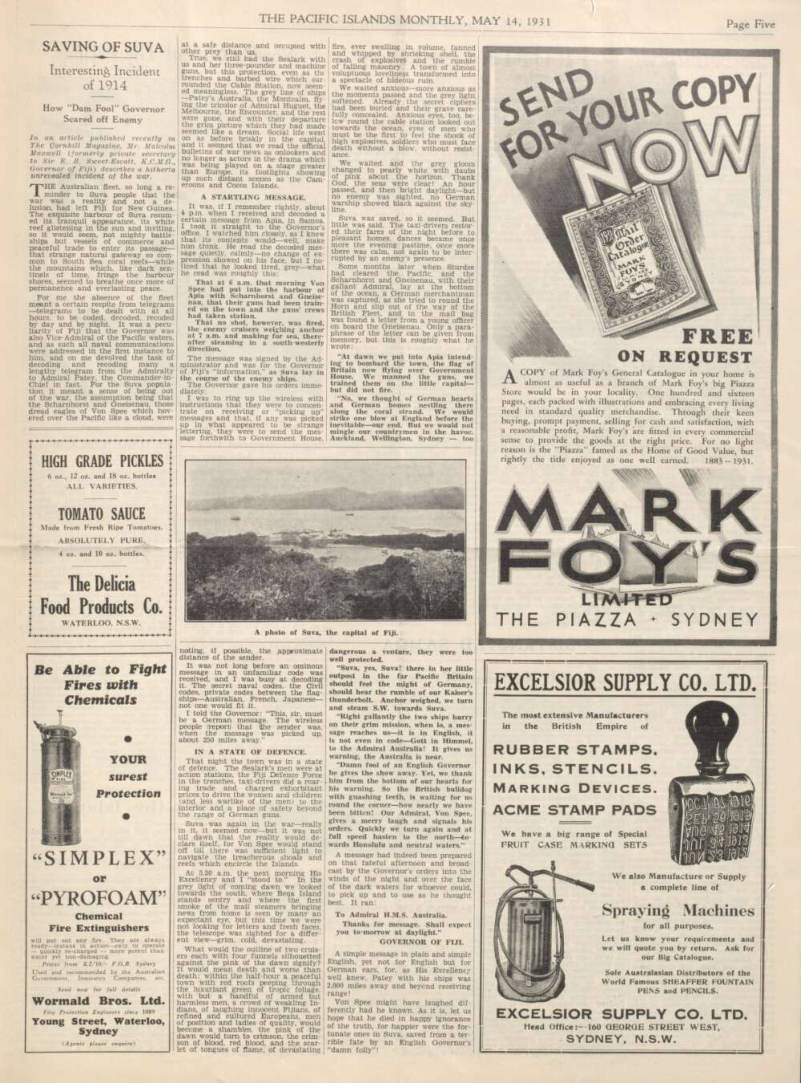
A photo of Suva, the capital of Fiji.
Advertisements & other items, p. 5 (1 item)
Excelsior Supply Co. Ltd.
FREE
ON REQUEST
A COPY of Mark Foy’s General Catalogue in your home is almost as useful as a branch of Mark Foy’s big Piazza Store would be in your locality. One hundred and sixteen pages, each packed with illustrations and embracing every living need in standard quality merchandise. Through their keen buying, prompt payment, selling for cash and satisfaction, with a reasonable profit, Mark Foy’s are fitted in every commercial sense to provide the goods at the right price. For no light reason is the "Piazza” famed as the Home of Good Value, but rightly the title enjoyed as one well earned. 1883 -- 1931.
THE PIAZZA + SYDNEY
HIGH GRADE PICKLES
6 oz., 12 oz. and 18 oz. bottles
ALL VARIETIES.
TOMATO SAUCE
Made from Fresh Ripe Tomatoes.
ABSOLUTELY PURE.
4 oz. and 10 oz. bottles.
The Delicia
Food Products Co.
WATERLOO, N.S.W.
Be Able to Fight Fires with Chemicals
YOUR
surest Protection
“SIMPLEX”
or
“PYROFOAM”
Chemical Fire Extinguishers will put out any fire. They are always ready—instant in action—easy to operate quickly re-charged more potent than water yet non-damaging.
Prices from £2/10/- F. O.B. Sydney Used and recommended by the Australian Government, Insurance Companies, etc.
Send now for full details Wormald Bros. Ltd.
Fire Protection Engineers since 1889 Young Street, Waterloo, Sydney (Agents please enquire)
EXCELSIOR SUPPLY CO. LTD.
The most extensive Manufacturers in the British Empire of
RUBBER STAMPS.
INKS, STENCILS,
Marking Devices.
ACME STAMP PADS
We have a big range of Special
FRUIT CASE MARKING SETS
We also Manufacture or Supply a complete line of
Spraying Machines
for all purposes.
Let us know your requirements and we will quote you by return. Ask for our Big Catalogue.
Sole Australasian Distributors of the World Famous SHEAFFER FOUNTAIN
PENS and PENCILS.
EXCELSIOR SUPPLY CO. LTD.
Head Office:- 160 GEORGE STREET WEST,
SYDNEY, N.S.W.
Parliamentary Representation
of Pacific Territories
Vol. 1 —No. 10
May, 1931,
THE Commonwealth of Australia is responsible for the government of three large and important Pacific ter ritories —namely, the Mandated Terri tory of New Guinea, Papua and Nor folk Island. Measured by their trade figures, and by their annual budgets, they compare not unfavourably with the smallest Australian State. Federal decisions, and Federal officials, have a far wider application and far wider powers in those Territories than in Tasmania; yet Tasmania has a dozen elected representatives in the Federal Parliament, and the Territories have no representation whatever.
The Northern Territory, for a long time, was in the same position; but, after a lengthy period of agitation, the Northern Territory was given a non voting representative in the Common wealth Parliament. The fact that he is prevented, by constitutional limita tions, from recording a vote, does not matter very much; what is important is that he can, and does, place the views of Northern Territory residents before the House when any matter affecting their interests arises.
New Guinea, of course, is in a dif ferent category, nominally, from Papua and Norfolk Island. Actually, it is in a very similar position. On all matters affecting the general policy of the Government of each Territory, whether under Mandate or not, it is the will of the Federal Cabinet, ex pressed through the respective Admin istrators, which is carried into effect.
Local councils, mostly nominative, assist and advise the Administrators; and, on the whole, the system works very well —particularly in comparison with the chaotic mess which is called “popular government” in some of the Australian States. For the most part, the Administrators discharge their re sponsible duties very fairly and effici ently—there have been remarkably few protests against their rulings.
But, from time to time, there arise trade and financial problems which affect the whole of the people in a particular Territory; and concerning which the voice of the people as a whole should be heard. We are now approaching such a period. The world wide readjustment of values is certain to create conditions in all the Territor ies which will call for review of many important matters and concerning which Government authority certainly will be invoked; and it would be a great advantage to the Islands com munities, and make for their peace and contentment, if some direct chan nel of communication could be estab lished between the people and the Fed eral Government. We hesitate to sug gest any particular method that ought to be a subject of discussion— but we do urge that consideration be given to the general principle, particu larly as we are certain that a demand for something of the kind will pre sently arise.
Tropicalities
Written for The Pacific Islands Monthly by “Sea Serpent.”
ELSEWHERE in this journal are figures showing the imports and exports of Norfolk Island. N.I. is part of Australia—a Federal Territory. It is not large but it is highly productive —a rich and beautiful place with a peculiar charm for tourists. Its trade is valuable and, since the Territory is a responsibility of the Common wealth, that trade should belong to Australia. But Australia is so indif ferent about overseas trade that, actu ally, much of Norfolk Island’s business is going to New Zealand—half the exports and a third of the imports, as a matter of fact. N.Z. gives better prices and better service. Australia has been warned again and again that, through indifference, she is losing her valuable Islands connection. But one might as well hammer on a stone wall.
Nobody cares. * * * * THE importance of wireless to the Islands was emphasised during the recent floods and hurricane in Fiji.
The Fiji manager of Amalgamated Wireless Ltd. (Mr. Farquhar) showed enterprise and ingenuity in providing radio communication with Lautoka, thus permitting the Administration to provide relief measures quickly and efficiently. A.W.A. is now experiment ing with a wireless station at Lautoka; and it is such a boon that there is not much doubt that the arrangement wall be made permanent. The effect of radio communication on the growth and development of the Islands trade and industry, during the last decade, has been extraordinary. * * * *
Congratulations To Rev. J. W.
Burton on the journalistic enter prise displayed in The Missionary Review of May 5. The lengthy graphic and well edited accounts of “The Hurricane and Floods in Fiji,” and the numerous striking photographs of the devastation wrought in the several dis tricts, not only make a striking story of courage and resource, but also pro vide a valuable record of one of the most severe visitations in the history of the Colony. * * * * OWING to the unsatisfactory prices for copra and the generally de pressed conditions, purchasers of Ex propriated plantations in New Guinea were granted a suspension of payments until the end of June next. The mat ter will then come up for further re view. The Custodian of Expropriated Properties, who has his office in Mel ourne, is at present examining the situation, but nothing definite has yet been decided on. It can be stated, how ever, that the Government is anxious to assist the planters to get on their feet again, and that no harsh meas ures will be adopted.
RETURNING to Auckland from Suva, after having been pilot for nine months for Mr. A. H.
Marlow’s Dornier flying boat, Mr.
W. Man gave the newspapers an interesting interview. He said that Mr. Marlow found the seaplane doubly useful. It not only saved time in visiting his contract work in various parts of the group, but it also bucked up the native workmen tremendously, and they finished jobs much more quickly. “A party working somewhere in the bush was afraid to go slow, be cause the men never knew when the machine would appear over the tree tops,” said Mr. Man. Sounds like “a tale from the far seas” —but it’s an in teresting theory, anyway. * * * * THE effects of the Great War are passing slowly. An unnoticed item in the Commonwealth Government Gazette the other day, repealed the German Admissions Ordinance of 1927, so that Germans may now enter the Territory of New Guinea on the same terms as any other foreigner who complies with the immigration laws.
Previously, any German who had been a resident of New Guinea before May 9, when civil administration was res tored, could not re-enter the Territory without special permission. * * * * AS there are many thousands of In dian farmers in Fiji; and as In dians usually bury their money in the ground, in preference to banking it; and as the recent hurricane and floods shifted a lot of soil, and altered many landscape contours—it is said that the western districts of Viti Levu, after the storm, saw more frantic treasure hunts to the square mile than was ever before recorded in history. * * * * THE Scullin Government’s tariff schedules are now being debated in the House of Representatives. Not the least important are the timber dulies. They have already been the subject of protests, notably by South Australian and Western Australian members. Representatives of firms which have established plants in the South Sea Islands, and are handling kauri and cedar, have made very strong representations to the Minister with a view to the lowering of duties on these logs. But it is not likely that the Government will agree to any re duction, as it is contended that Queensland is capable of supplying all the kauri and cedar required by Aus tralia. It is considered that 90 per cent, of the Government supporters will vote for the timber schedule as it stands, and any amendments will be only of a minor character. It is only another example of the way in which Australia’s tariff-mad politicians con tinue (in spite of the tragic and grow ing evidence of their foolishness) to close the door against oversea trade.
Distracted Samoa
There Is No Spirit Of Compromise
Judge Luxford, of the High Court of Western Samoa, on April 22, found O. F.
Nelson & Co. Ltd., guilty of 28 charges under the Seditious Organisations Ordin ance, and inflicted a fine of £200 in each case, or a total of £5,600. Forbearance was shown by the prosecution in with drawing a second series of charges laid under the Maintenance of Authority in Native Affairs Ordinance. The judge, summing up, strongly condemned the de fendant company. The offences commit ted, it appears, consisted mainly of re ceiving payments from a native organisa tion called the Mau. —Newspaper’ Report.
I HAVE no personal knowledge of the condition of affairs in Samoa.
All that I know of the protracted struggle between the New Zealand Ad ministration (which functions under a “C” class mandate) and the Mau, I have learned from ex parte statements.
The position is so difficult and critical, and the absence of unbiassed informa tion so marked that we of The Pacific Islands Monthly have left the whole subject severely alone. At the first opportunity, someone from this journal, as part of our policy of giving service to the Pacific communities, will visit Samoa and try and sum up the situa tion there truthfully and fairly.
In the meantime, one cannot but be impressed by the fact that ap parently every one of the few indepen dent commentators who have visited the Territory has attacked the New Zealand Administration. There seems to be no sign of a more amicable feel ing between officialdom and the Mau— no suggestion of a more conciliatory spirit. There has been still another change in the Administration, and another Administrator has gone down there, making the fifth since New Zealand took charge of the group.
Therefore, this fine that has been im posed upon O. F. Nelson, with its sug gestion of sheer savagery, gives a most unfortunate impression. No doubt, O. F. Nelson is a very stubborn, per tinacious. difficult man. In the eyes of the Administration, he is the world’s
prize nuisance. He represents—indeed, embodies—the fighting spirit of the Mau, and there is no suggestion of compromise about him. Probably, he has been hopelessly embittered by his deportation—which surely was the stupidest thing ever carried out by a bull-necked, swashbuckling, fatheaded administration—and will not permit the dead past to bury its dead.
Between the brutality of the Ad ministration (in imposing a fine of £5,600, when a tenth of the amount would have emphasised the law and established the principle) and the pig headed obstructiveness of O. F. Nelson and the Mau, there is no sign of com promise. Yet only by conciliation and compromise can this most unhappy state of affairs be ended.
Something must be done soon if not for the sake of bringing peace to beautiful, distracted Samoa, then in order that a British Dominion may be spared, the ultimate humiliation of being deprived of a mandate to govern a subject people. The League of Na tions is not particularly notable for its
patience.
R. W. Robson.
Samoa’S New Governor
From Our Own Correspondent.
Suva, April 24.
The new Administrator of Western Samoa, Major General Hart, arrived at Suva on Friday and stayed till 6 p.m. on Saturday, sailing by the Tofua for Apia. He was accompanied by Mrs.
Hart and their two daughters, Mary and Betty. The party was met by Captarn M. Godley, A.D.C.
When seen by your representative, the General said he had nothing to say.
He said it quite nicely, with a smile. and one could realise that the silence lived a live man — "every inch a soldier.” Passengers, who travelled with them, said the General was a “real good sort,” and he was quite a favourite on board.
Notable Men of The Pacific
Brigadier-General H. E. Hart, D.S.O., C.B., C.M.G., C.D.G, Administrator of Western Samoa.
NO one will envy Brigadier-General Hart the job which he has accep ted as Administrator of the Man dated Territory of Western Samoa; but everyone who knows him will wish him the best of good luck, and express a sincere wash that he will succeed in restoring tranquility to “the Ireland of the South Seas.”
Because of New Zealand’s outstand ing success in the administration of the Cook Islands, the embarrassment and difficulties which the Dominion has experienced in carrying out its mandate in Western Samoa, stand out sharply by comparison. The badgered New Zealand Government has now made four attempts to find an admin istrator who could persuade the Samo ans to become a peaceful and happy people—Col. R. W. Tait, C.M.G., was there from 1920 to 1923; Major-General Sir G. S. Richardson, C.B., C.M.G., from 1923 to 1928; and Col. S. S. Allen, C.M.G., D.S.O., from 1928 to 1931.
Little is known about General Hart’s ability as an administrator, but he was a most successful, efficient and popular soldier, and is reported to have a per sonality and temperament which fit him admirably for his new position.
What is needed in the Samoan ad ministration is not so much an admin istrative experience or high titles, or decorative orders, as a sympathetic understanding of this very sensitive section of the Polynesian race, com bined with unusual firmness and strength of character. There has been plenty of “backbone” in previous ad ministrators, but hardly enough under standing—so that we have had either latitude amounting to (weakness on the one hand, or much talk of “Prus sianism” on the other.
Mr. Hart was born in the Wairapa (district of New Zealand, in 1882, and,
except when; he has been away on active service, he has spent most of his life in Carterton and Masterton, where he has carried on practice as a barrister and solicitor. He has taken a keen interest in public affairs, but is known mostly for his outstanding services to the volunteer military organisation, with which he has been closely identi fied for 30 years.
As a very young man Mr. Hart serv ed for two years (1900-1902) in the South African War. On the outbreak of the Great War in 1914, he joined the Wellington Regiment as major, and saw much service in Egypt, Galipolli and France. In 1916, he was appoint ed to the command of the 1st bat talion. Among his fellow officers he was a warm favourite and was regard ed by the rank and file with unusual affection and respect. He never spared himself—he was found always at the point of danger—and the comfort and well-being of his men were among his first considerations. He became noted for the skill with which he directed his troops in battle, and the tact with which he controlled them behind the lines. When he was given command of the famous Rifle Brigade it was regarded as an excellent appointment; and the manner in which he handled his Brigade at Le Quesnoy—one of the notable exploits of the war, in which the N.Z. Division achieved its final and most spectacular success—earned him special notice. He became Brigad ier-General in May, 1917, and was the first N.Z. territorial officer to attain such a rank. He was mentioned in despatches no less than five times, and the number and quality of his decora tions are sufficient indication of what the High Command thought of his services.
Photograph shows Brig.-General Hart, with his wife and two daughters, in April, just before they sailed for Samoa.
In and About the Islands
Mr. James Burns, chairman of direc tors of Messrs. Burns, Philp & Co. Ltd., will be a passenger to New Guinea by the Macdhui, sailing from Sydney on May 16. He is doing the round trip.
Mr. Edward Mitty, hon. treasurer of the Melbourne branch, R.S.S.I.L.A., which is the largest branch of the League in the Southern Hemisphere, has been appointed a Justice of the Peace for the Territory of Papua. He is well known to the legal profession and carries on business as a law sta tioner, etc., at 143 Queen Street, Mel bourne.
Rev. G. S. Shinkfield, who is chair man of the Samoan District of the Methodist Missionary Society, has returned to Samoa after furlough.
Miss D. Coltheart leaves Sydney by the Macdhui on May 16 and will again take up her work among the Chinese at Rabaul. Miss Coltheart has been spending holidays in Tasmania.
Rev. L. M. Thompson arrived in Sydney, from Fiji, by the Sierra, on April 30, and has now proceeded to Victoria. Since 1916 Mr. Thompson has been specially interested in educational work among the Indians of Fiji.
Dr. and Mrs. E. G. Sayers and their two children are due to leave Sydney by the Mataram, for the Solomon Islands, on June 7. They are returning to the Missionary Hos pital at Roviana.
Dr. D. S. Davidson, anthropologist of the University of Pennsylvania, left Sydney by the Sierra on May 9, for Suva. Dr. Davidson had been doing research work in Australia on behalf of his university.
Mr. R. T. Rutledge, of the Colonial Sugar Refining Co., sailed by the last trip of the Sierra for Fiji.
Father Trillot, who has been with the Roman Catholic Mission in Fiji for 37 years, was burned to death at Nanukuola early this month. Natives saw the Presbytery afire, and on enter ing the building discovered Father in a pool of flaming oil with an overturned lamp alongside him.
Mr F. Largeau, general manager of Societe Francaise, New Hebrides, ar rived in Sydney by the Ormonde on May 6, after spending a holiday in France.
Advertisements & other items, p. 6 (1 item)
Pacific Islands Monthly
6
THE PACIFIC ISLANDS MONTHLY, MAY 14, 1931
Published once a month, and circulated among residents of: New Guinea Fiji Solomon Is.
Papua Tonga New Hebrides Norfolk Is. Samoa New Caledonia Cook Is. Nauru Ocean Is.
Gilbert Is. Tahiti Thursday Is.
Read also by residents of Australia and New Zealand who are interested in Pacific Islands trade and activities.
Publishers: Pacific Publications, Union House, 247 George Street, Sydney. Tel.: BW 5037.
Editor: R. W. Robson.
Melbourne Representative: A. W. Cummins, 167-169 Queen Street, Melbourne.
London Representative: R. M. Hodge, 80 Fleet Street, London, E.C.4., from whom copies of this journal, and advertising rates, may be obtained. Tel.: City, 2062.
SUBSCRIPTION RATES:
s. d.
Per annum, post free, within British Empire; in advance. 6/-; booked .. 6 6 Per annum, post free, beyond British Empire 8 0
ADVERTISING:
Casual: Per single column inch 9 0 Contract; 7/-, 7/6 and 8/- per inch, accord ing to conditions.
Changes of advertising copy should reach publishers by 7th of each month.
CONTRIBUTIONS:
Contributions on matters of interest to Pacific Islands residents and traders are in vited; and, if accepted, will be paid for, on publication, at the rate of 2½d. per line.
Special payment for photographs. No respon sibility is taken for contributions forwarded; but, if return is desired in the event of rejec tion, a stamped and addressed envelope should be enclosed.
DISTRIBUTION:
In Australia, New Zealand and Great Britain copies may be obtained from, and subscription orders lodged with, Messrs. Gordon & Gotch, Limited.
In the Pacific Islands, copies may be ob tained from, and subscription orders lodged at any of the stores of Messrs. Burns Philp & Co.
Ltd., Messrs. Burns Philp (South Seas) Co Ltd., Messrs. W. R. Carpenter & Co. Ltd., and Messrs. Morris Hedstrom & Co. Ltd.
Goldfields
Tax Burdens On
Killing the Goose that Lays Golden Eggs
(To the Editor.) Sir, — Mr. Freeman did not go far enough when he wrote under the above head ing.
What about the man who finds the gold? The prospector has now to pay into the Administration two years’ wages, for each boy, before he can sign him on, plus his fare home. With issue and signing-on fees this amounts to about £18 per boy, and as he requires ten boys, he has to have £180 to pay into the Administration before he can go out to look for gold, or work it—if he knows where it is.
Until recently he had to pay £20 per boy to the recruiter, but they are now a lot cheaper. But that is useless to him, if he has to find another £180, to remain idle for two years, when it could be put to a lot better purpose.
It would keep him in the bush a good many months, looking for gold, as it did the men who found Edie Creek and the Bulolo.
There are a large number of men on the field now, who are out of work.
Many know where there is payable gold, and there are others who are willing to go out and look for it; but, owing to the action of the Adminis tration, they are unable to work, though willing to do so. This seems a bit strange, when we understand that Australia is doing its best to find work for the unemployed, and we are ad ministered from Australia.
Let the Commonwealth pass a Bill that every employer has to pay his employee two years’ wages in advance, and see if the Government will last 24 hours in power.
The reason given for this action is that so many men are going south, without paying their boys off. But Ad ministration and Expro. Board officials were the chief offenders. Now, it is men employed in Rabaul who forget to pay their houseboys, but not the miners.
The miner is a speculator, gambler and a sport. He works with his boys and looks after their interests more than the white-collar-and-black-tie man of Rabaul.
If it were not for the gold there would be no Rabaul now, owing to the bottom having dropped out of copra.
It was the miner who found the gold; it is the miner who goes into the bush and brings the wild native into a state of semi-civilisation—not the Adminis tration; the miner who stands all the hardships and opens up the country, and finds the gold for Australia to pay the interest on the money it owes.
I am, etc..
A. Le Breton Mount.
Wau, Salamoa. New Guinea.
March 20, 1931.
Vicious System in Tonga
Native Debtors
Vicious System in Tonga Amendment of the Law Desirable
From Our Own Correspondent.
Nukualofa, April 25.
LEADING business men have lately expressed disapproval of the exist ing Debt Law, and the facilities grant ed by the Government for the introduc tion of “mushroom” trading stations throughout the group.
In perusing statistics, it is certainly interesting to note that the number of trading stations and bakeries oper ating in the Kingdom has nearly trebled in 15 years. As there has been no perceptible increase in population during that period, and even allowing for the country’s increased prosperity, it aopears that the number of stations to-day is excessive.
A surplus of small stores in the vil lages is a constant and indefensible in ducement for the native to plunge into debt. He never thinks of to-morrow — “sufficient unto the day” is his motto— with the result that he runs up a score with all the little shops in his town.
The time comes when the traders re quire payment, and the native finds he cannot satisfy their demands. The trader who gets in early promptly sues him and follows the summons up quick ly with a distress warrant. The debtor comes home one day and discovers his goods and chattels sold up, and his wife and family gone back to mother.
He sets about getting a home together again, only to discover that trader number two, awaiting his opportunity, has pounced on him with another dis tress warrant. Again he is sold up, and so the regrettable process goes on, from year to year, until, probably, some six or eight small traders have receiv ed satisfaction.
The remedy? Amend the debt law at once, so that a native must pay in spot cash (or produce) for his goods.
Then we can be assured that the num ber of “mushroom” stores, which at present flagrantly batten on the nat ives. will dron by half at least, and Dummy will have a home for his wife and family that he can call his own.
The complaints of the well-establish ed concerns are justified, and members of the Tongan Parliament would do well to ponder this for the future well being of their countrymen and coun trywomen.
“Pitcairner” Dead
Link with Bounty History
Norfolk Is. Mourns
From Our Norfolk Is. Correspondent
Norfolk Is., May 4.
SLOWLY are those few stalwarts, who provide the direct link between histone Pitcairn Is. the original home of the Bounty mutineers—and Norfolk Island, passing away Mr, Seymour Buffett, of Steel’s Point, one of the six remaining Pit cairners, died on May 1, aged 83 years, and thus another well known figure has been removed from our midst.
Mr. Buffett was only eight years of age when his section of the Bounty crew’s descendants were transferred from Pitcairn to Norfolk, three-quart ers of a century ago. He was a des cendant of John Buffett, who, with John Evans, joined the Pitcairn com munity in 1818 from the visiting ship Sinus.
He was a charming, handsome, courtly old man, with a wonderful store of reminiscences and tales of the old days.
His funeral, in the quaint old ceme tery on Norfolk Island, was largely attended, and all the old hymns and spirituals were sung.
Cook Is Arranges
New Season Commences
From Our Own Correspondent
Rarotonga, April 28.
ACTIVITY is again showing itself in several directions concerning the orange season. The first nick ing discloses a good crop—possibly not so heavy as last year—with fruit in clined to medium grade.
The Acting Director of Agriculture Mr. Bouchier, has returned from an extended trip to South Africa and Aus tralia. His propositions for improved cultivation and thoroughly careful packing methods have been placed be fore those concerned.
The native here is inclined to main tain that he did better when he was free to dump his oranges holus-bolus into cases than he does now under the ideas propounded by the Agricul tural Authorities. He knows nothing of course, of what he is up against with the foreign grower on his market delivering 100 per cent, perfectly sound fruit, uniform in grade, quality and appearance.
But the native grower works harder than he is given credit for and, all things considered, does his best to meet the refined tastes of the consum er or the distributor, or whoever is the mysterious individual commanding the size, quality and colour to which oranges are to be grown.
Appeals for Economy
Position in Tonga
From Our Own Correspondent
Nukualofa, April 26.
WE learn that the Tongan Cham ber of Commerce has again sent a Memorandum to the Tongan Gov ernment, urging the Executive to drastically retrench in all departments of the service.
On the other hand, it is whispered that a movement is on foot in Govern ment circles to petition the Chamber of Commerce and urge the curtail ment of certain imports which are said to be in the nature of luxuries and which the native would be hap pier without during a time of stress.
The list is said to contain such items as silk stockings, gramophones, motor cars, powder puffs, silks, satins, cashmeres, lipsticks and those hundred and one ephemeral nick-nacks so dear to the native feminine heart, once she has been taught that the use of them uplifts her to a sphere where she might even become persona grata with her European sisters.
It is extremely problematical, though, whether the Chamber’s memorandum or the proposed appeal to the Cham ber will alter matters worth a row of pins. We know that dummy will still continue to pay, in much the same old way.
New Shipping Line?
Australia to East Possible Extension of Trade
Thursday Is., May 4.
DIRECT rail communication be tween Canton and Paris will be shortly opened, if the disturbed state of affairs in China will permit of the running of trains.
This seems likely to open up new opportunities for trade in Australian goods, especially in the southern part of China, and an increase in the export of perishable goods, such as fruit, butter, meat, etc., is expected to occur. As it is, all the cargo between Australia and the Far East seems to be one way only, and that the right way for Australia.
It may be on this account that rumours of a new shipping line have reached Thursday Island. The route will be the usual one between Hong kong and Australian ports, Thursday Island being a port of call, unless the E. and A. Line returns to its old run when the new line will be deviated to Rabaul. It is said that an emissary of the new line has already proceeded to a Mediterranean port for the pur pose of inspecting two vessels that the company has under offer.
Although' this news is unconfirmed, it seems within the range of possibility.
Canoe Racing Commences at Port Moresby
(From Our Port Moresby Correspondent)
CANOE racing is one of the chief sports of the younger men in Port Moresby, and the season is now about to open.
The harbour, while extremely beauti ful, with hills sloping gradually to the waters’ edge, has the advantage of being almost completely land-locked
white men supply the sails and rigging, which become the property of the nat ives at the end of the season.
A silver cup was presented to the club by Lord Forster on his visit to Potr Moresby, in 1925, and there are other trophies, all hotly competed for.
It is a beautiful sight to watch the
and is addition ally protected by a coral reef lying approximately three miles from the mainland.
The racing sea son begins early in May each year and continues un til September, when the south east trade winds begin to die down. Native can oes and crews are used, with native - made European sails, one or more white men taking charge to captain and control the crew.
As many as fifteen canoes have been known to start, under varying handi caps, and there is a great deal of excitement and betting among both Europeans and natives. The course varies from time to time, around har bour buoys and local islands, and it is amazing to watch the skill of the natives when swinging round in the sudden gusts which sweep through gaps in the hills at various points on the course.
Formerly, the canoes and sails were owned by small syndicates and the ex penses of the outfit and crew were pooled at the end of the year. This was found to be too unsatisfactory and expensive, for the Papuan, like most natives, is an inveterate swindler, and exploited the white man for untold extras until, in desperation, he rebelled.
The canoes are now native-owned and the native captain and crew are paid a fixed sum per race for services and for the use of the canoe. The
races from the hill-side, on a brilliant south-east day—to see the spray dash ing over the canoes as they swing and swirl through the vivid blue waters inside the reef, and to follow with wonder the dexterity of the natives as they handle their outfits, amid much noise, excitement and loud hilarity.
A Canoe Race at Port Moresby.
Norfolk Island Trade
From Our Own Correspondent The following figures are provided by courtesy of Captain Stopp (Collec tor of Customs):
Imports.
From From Month.
Australia New Zealand March, 1930 . . .. £4,105 10 0 £3,424 15 0 March, 1931 . . .. 2,594 5 0 1,229 15 0
Exports.
To To Month.
Australia New Zealand March, 1930 . . .. £1,656 0 0 £1,172 10 0 March, 1931 . . .. 1,219 0 0 1,316 15 0
Pacific Islands
Seaplanes for the Pacific Islands Fiji’s Ideal Conditions Wide Use of Planes When Depression Lifts
INTERESTING facts concerning the development of aviation in Fiji were given to The New Zea land Herald by Mr. W. Man, who recently returned to Auckland after nine months’ flying in Fiji. Dur ing that period, Mr. Man was pilot of the three-seater Domier flying boat belonging to Mr. A. H. Mar low, the well-known Suva building contractor.
Mr. Man said that conditions in the Group were almost ideal for machines of a suitable type. Land locked waters abounded on every coast and many of them contained beaches of good hard sand upon which a flying boat or seaplane could be hauled up.
He did not find that the hurricanes were a drawback to aviation, as there was always fairly good warning of their approach. A larger wfiite popu-
lation would stimulate aviation in the Pacific; but he was convinced that when the present depression lifted and trade developed, flying boats and sea planes would be widely used by the present population.
The Fiji Government was very anxious to develop aviation, but any plans it had were shelved for the pre sent owing to lack of money. For the same economic reason Mr. Marlow had dismantled and stored the flying boat until times improved.
Mr. Man spoke highly of the flying done under difficulties by Mr. Chalm ers, a Suva solicitor, who imported a Moth aeroplane some time ago, but later shipped it to Auckland and dis posed of it.
There were too few landing grounds in Fiji for land machines to be of much use, he said, and in any case most of the towns and settlements were on or near the sea.
The type of Moth in use in Fiji.
Whale Oil Glut
Norwegians Alarmed Unilever to Operate in Antarctic
A CABLE from Oslo, published in The Sydney Sun on May 9, stated that consternation had been caused in whaling circles in Norway by the report that the Unilever Soap Syndi cate would send out its own whaling factories to the Antarctic to procure the 50,000 tons of oil needed in 1932.
Thepresident of the Norwegian Whaling Association has stated that the announcement that Unilever needs only 50,000 tons meant that the whole Norwegian fleet will be idle next season, as the present unsold surplus is 70,000 tons.
May Control
Abolition of Cook Is. Dept.
Native Affairs Department May Control N. Z. Government Economy
From Our Cook Islands Correspondent
Rarotonga, April 28.
LISTENERS on the air recently re port an announcement by 2YA (Wellington) of the New Zealand Gov ernment’s intention, embodied in a Bill before the House, no longer to retain the Cook Islands Administration as a separate department, but to hand the work over to the Department of Na tive Affairs.
So much to the good if something can be saved on “overhead,” but it is hoped that a policy of cheese-paring will not follow, to the detriment of the native people of the group.
Visitors coming down from the States on the mail steamers en route to the Dominion and Australia, get their first view of the New Zealand ensign at Rarotonga. The native peo ple here are distinctly on the up-grade, but, if their means of education and medical attention are cut into too much, they will certainly go back and the flag will not fly so proudly over the group as it does to-day.
Private advice received during the month indicates that several promin ent officials of the Cook Islands Ad ministration are being retrenched.
The Resident Agent at Aitutaki, Mr. E. C. Villenoweth, whose appoint ment expired on April 9, has not been reappointed, but will be replaced by Mr. Luckham, lately Resident Com missioner at Nuie. This represents a substantial fall in salary for Mr. Luck ham.
The Cook Islands
Ancient Customs Revived at Native Crowning Ceremony
From Our Own Correspondent.
Rarotonga, April 27.
THE installation of Vaikai Kainuku as chief of the Ngantangiia village took place recently.
Ngantangiia is credited wjth the dis tinction of being the actual spot from which the canoes departed from Raro tonga, which resulted in the landing of the handful of Polynesian people in New Zealand, to establish the great Maori race.
A large number of Europeans were invited to be present at the crowning.
In honour of the occasion the Com missioner, at 10 o’clock, called it “a day” for all Government offices.
The proceedings were marked with the etiquette of the native people and the courtesy for which the Polynesians are noted.
The chief’s attendants, dressed in their ancient native costumes, struck a note of old tribal times. The chief himself threw aside his European gar ments and appeared in a ceremonial robe fashioned in native style. The garment—of a somewhat Magyar cut —was made from the bark of the bread-fruit tree beaten out to the thickness of brown paper, and notched at the edges and ornamented with small square holes neatly snipped out in a manner resembling somewhat cross-word puzzle designs. A spangle of small yellow beads thrown across his shoulders and chest and with his ornamental spear grasped in his right hand, the chief came forward to the sacred ground to be crowned with the simple garland of leaves, the lawful assurance of his title.
Thanks were expressed by the Resi dent Commissioner for the privilege given to Europeans to be present at the function. Reference was made to the long title (700 years) and to the assurance given that the privileges at tached to the rank would be fully recognised by the New Zealand Gov ernment.
Speed Boating
An item of some interest locally was the appearance in the lagoon of a motor speed-boat. With the idea of fulfilling a desire to circumnavigate the island at high speed, Mr. J. McFar
lane, of Ohio, Cincinatti, transported his speed-boat to Rarotonga in a broken-down state. Due to the absorp tion of moisture, the parts could not be screwed together until complete shrinkage to their original state had taken place. After one or two trial spins the owner opened out the engine headed for the open sea, and circled the island—a distance of perhaps 30 miles. The stunt was not without risk—a breakdown in the works and the craft would have been hurled on the reef. Mr. McFarlane is the first person to tackle such a proposition here.
Postal Charges
Disappointment is felt here at the severity of the new postal charges, which were introduced on 1st March.
The restriction on the weight of par cels to 11 lb., combined with the in creased rate for postage, is a complete knock-out to the posting of fruit from the island in cases as hitherto.
It is understood that steps have been taken by the local administration to see what can be done to improve matters.
Prominent Government
Official Retires
The services of a valuable officer of the administration have been lost by the retirement on superannuation of Mr. Reid, Director of Agriculture and the Chief Public Works Officer of the Group. Solid pioneering work has been done by Mr. Reid during his 20 years’ service here. Apart from his practical work on water supply, road ing, fruit grading and packing, etc., Mr. Reid has handed out to the plant ers, both European and Native, handy pieces of knowledge on matters per taining to local agriculture. In the matter of proper grading and packing of fruit for export, it is a terrific job to implant into the native mind the importance to him in the long run of these measures: but Mr. Reid, backed by the administration, has made great headway here in the direction of the successful marketing of perishable exports from the island.
New Equipment for Loading Phosphate at Nauru
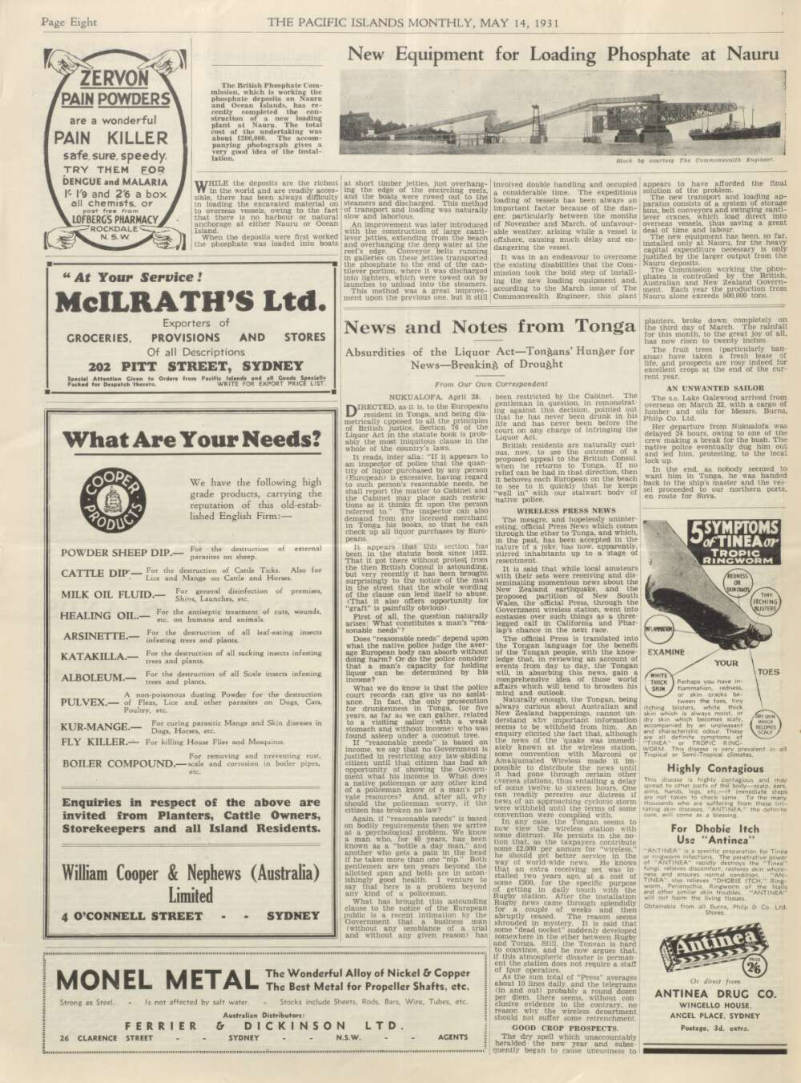
WHILE the deposits are the richest in the world and are readily acces sible, there has been always difficulty in loading the excavated material on to overseas vessels, owing to the fact that there is no harbour or natural anchorage at either Nauru or Ocean Island.
When the deposits were first worked the phosphate was loaded into boats
at short timber jetties, just overhang ing the edge of the encircling reefs, and the boats were rowed out to the steamers and discharged. This method of transport and loading was naturally slow and laborious.
An improvement was later introduced with the construction of large canti lever jetties, extending from the beach and overhanging the deep water at the reef’s edge. Conveyor belts running in galleries on these jetties transported the phosphate to the end of the can tilever portion, where it was discharged into lighters, which were towed out by launches to unload into the steamers.
This method was a great improve ment upon the previous one, but it still
involved double handling and occupied a considerable time. The expeditious loading of vessels has been always an important factor because of the dan ger, particularly between the months of November and March, of unfavour able weather, arising while a vessel is offshore, causing much delay and en dangering the vessel.
It was in an endeavour to overcome the existing disabilities that the Com mission took the bold step of install ing the new loading equipment and, according to the March issue of The Commonwealth Engineer, this plant
appears to have afforded the final solution of the problem.
The new transport and loading ap paratus consists of a system of storage bins, belt conveyors and swinging canti lever cranes, which load direct into overseas vessels, thus saving a great deal of time and labour.
The new equipment has been, so far, installed only at Nauru, for the heavy capital expenditure necessary is only justified by the larger output from the Nauru deposits.
The Commission working the phos phates is controlled by the British, Australian and New Zealand Govern ment. Each year the production from Nauru alone exceeds 500,000 tons.
The British Phosphate Com mission, which is working the phosphate deposits on Nauru and Ocean Islands, has re cently completed the con struction of a new loading plant at Nauru. The total cost of the undertaking was about £200,000. The accom panying photograph gives a very good idea of the instal lation.
Block by courtesy The Commonwealth Engineer.
News and Notes from Tonga
Absurdities of the Liquor Act —Tongans’ Hunger for News —Breaking of Drought
From Our Own Correspondent
Nukualofa, April 28.
DIRECTED, as it is, to the Europeans resident in Tonga, and being dia metrically opposed to all the principles of British justice, Section 76 of the Liquor Act in the statute book is prob ably the most iniquitous clause in the whole of the country’s laws.
It reads, inter alia: “If it appears to an inspector of police that the quan tity of liquor purchased by any person (European) is excessive, having regard to such person’s reasonable needs, he shall report the matter to Cabinet and the Cabinet may place such restric tions as it thinks fit upon the person referred to.” The inspector can also demand from any licensed merchant in Tonga his books, so that he can check up all liquor purchases by Euro peans.
It appears that this section has been in the statute book since 1922.
That it got there without protest from the then British Consul is astounding, but very recently it has been brought surprisingly to the notice of the man in the street that the whole wording of the clause can lend itself to abuse. (That it also offers opportunity for “graft” is painfully obvious).
First of all, the question naturally arises: What constitutes a man’s “rea sonable needs”?
Does “reasonable needs” depend upon what the native police judge the aver age European body can absorb without doing harm? Or do the police consider that a man’s capacity for holding liquor can be determined by his income?
What we do know is that the police court records can give us no assist ance. In fact, the only prosecution for drunkenness in Tonga, for five years, as far as we can gather, related to a visiting sailor (with a weak stomach and without income) who was found asleep under a coconut tree.
If “reasonable needs” is based on income, we say that no Government is justified in restricting any law-abiding citizen until that citizen has had an opportunity of showing the Govern ment what his income is. What does a native policeman or any other kind of a policeman know of a man’s pri vate resources? And, after all, why should the policeman worry, if the citizen has broken no law?
Again, if “reasonable needs” is based on bodily requirements then we arrive at a psychological problem. We know a man who, for 40 years, has been known as a “bottle a day man,” and another who gets a pain in the head if he takes more than one “nip.” Both gentlemen are ten years beyond the allotted span and both are in aston ishingly good health. I venture to say that here is a problem beyond any kind of a policeman.
What has brought this astounding clause to the notice of the European public is a recent intimation by the Government that a business man (without any semblance of a trial and without any given reason) has
been restricted by the Cabinet. The gentleman in question, in remonstrat ing against this decision, pointed out that he has never been drunk in his life and has never been before the court on any charge of infringing the Liquor Act.
British residents are naturally curi ous, now, to see the outcome of a proposed appeal to the British Consul, when he returns to Tonga. If no relief can be had in that direction, then it behoves each European on the beach to see to it quickly that he keeps “well in” with our stalwart body of native police.
Wireless Press News
The meagre, and hopelessly uninter esting, official Press News which comes through the ether to Tonga, and which, in the past, has been accepted in the nature of a joke, has how, apparently, stirred inhabitants up to a stage of resentment.
It is said that while local amateurs with their sets were receiving and dis seminating momentous news about the New Zealand earthquake, and the proposed partition of New South Wales, the official Press, through the Government wireless station, went into ecstasies over such things as a three legged calf in California and Phar lap’s chance in the next race.
The official Press is translated into the Tongan language for the benefit of the Tongan people, with the know ledge that, in reviewing an account of events from day to day, the Tongan will, in absorbing this news, gain a comprehensive idea of those world affairs which will tend to broaden his mind and outlook.
Naturally enough, the Tongan, being always curious about Australian and New Zealand happenings, cannot un derstand why important information seems to be withheld from him. An enquiry elicited the fact that, although the news of the ’quake was immedi ately known at the wireless station, some convention with Marconi or Amalgamated Wireless made it im possible to distribute the news until it had gone through certain other oversea stations, thus entailing a delay of some twelve to sixteen hours. One can readily perceive our distress if news of an approaching cyclonic storm were withheld until the terms of some convention were complied with.
In any case, the Tongan seems to now view the wireless station with some distrust. He persists in the no tion that, as the taxpayers contribute some £2,000 per annum for “wireless,” he should get better service in the way of world-wide news. He knows that an extra receiving set was in stalled two years ago, at a cost of some £200, for the specific purpose of getting in daily touch with the Rugby station. After the installation Rugby news came through splendidly for a couple of weeks and then abruptly ceased. The reason seems shrouded in mystery. It is said that some “dead pocket” suddenly developed somewhere in the ether between Rugby and Tonga. Still, the Tongan is hard to convince, and he now argues that, if this atmospheric disaster is perman ent the station does not require a staff of four operators.
As the sum total of “Press” averages about 10 lines daily, and the telegrams (in and out) probably a round dozen per diem, there seems, without con clusive evidence to the contrary, no reason why the wireless department should not suffer some retrenchment.
Good Crop Prospects.
The dry spell which unaccountably heralded the new year and subse quently began to cause uneasiness to
planters, broke down completely on the third day of March. The rainfall for this month, to the great joy of all, has now risen to twenty inches.
The fruit trees (particularly ban anas) have taken a fresh lease of life, and prospects are rosy indeed for excellent crops at the end of the cur rent year.
An Unwanted Sailor
The s.s. Lake Galewood arrived from overseas on March 22, with a cargo of lumber and oils for Messrs. Burns, Philp Co. Ltd.
Her departure from Nukualofa was delayed 24 hours, owing to one of the crew making a break for the bush. The native police eventually dug him out and led him, protesting, to the local lock-up.
In the end, as nobody seemed to want him in Tonga, he was handed back to the ship’s master and the ves sel proceeded to our northern ports, en route for Suva.
Advertisements & other items, p. 8 (2 items)
Mcilrath’S Ltd.
ZERVON
PAIN POWDERS
are a wonderful
PAIN KILLER
safe, sure, speedy.
TRY THEM FOR
DENGUE and MALARIA
I- l r 9 and 2'6 a box all chemists, or post free from
LOFBEROS PHARMACY,
'ROCKDALE'
N. S. W
“ At Your Service!
McILRATH’S Ltd.
Exporters of
GROCERIES, PROVISIONS AND STORES
Of all Descriptions
202 PITT STREET, SYDNEY
Special Attention Given to Order* from Pacific Islands and all Goods Specially Packed for Despatch thereto. WRITE FOR EXPORT PRICE LIST.
What Are Your Needs?
We have the following high
grade products, carrying the
reputation of this old-established English Firm:—
POWDER SHEEP DIP.—
For the destruction of external parasites on sheep.
PATTT P OTP’— — For t^le destruction of Cattle Ticks. Also Lice and Mange on Cattle and Horses. for
MILK OIL FLUID.—
For general disinfection of premises, Shios, Launches, etc.
HEALING OIL.—
For the antiseptic treatment of cuts, wounds, etc. on humans and animals.
ARSINETTE.—
For the destruction of all leaf-eating insects infesting trees and plants.
KATAKILLA.—
For the destruction of all sucking insects infesting trees and plants.
ALBOLEUM.—
For the destruction of all Scale insects infesting trees and plants.
A non-poisonous dusting Powder for the destruction PULVEX.— of Fleas, Lice and other parasites on Dogs, Cats, Poultry, etc.
KUR-MANGE.—
FLY KILLER.—
For curing parasitic Mange and Skin diseases in Dogs, Horses, etc.
For killing House Flies and Mosquitos.
For removing and preventing rust, BOILER COMPOUND. scale and corrosion in boiler pipes, etc.
Enquiries In respect o£ the above are Invited from Planters, Cattle Owners, Storekeepers and all Island Residents.
William Cooper & Nephews (Australia)
Limited
4 O’CONNELL STREET - - SYDNEY
The Wonderful Alloy of Nickel & Copper The Best Metal for Propeller Shafts, etc.
Strong as Steel. - Is not affected by salt water. - Stocks include Sheets, Rods, Bars, Wire, Tubes, etc.
Australian Distributors:
FERRIER & DICKINSON LTD.
26 CLARENCE STREET - - SYDNEY - - N.S.W. - - AGENTS
C Symptoms
Tropic
Ringworm
TINY
ITCHING
ISTERS
LAWWION
YOUR
TOES
EXAMINE
WHITE
THICK
SKIN
Perhaps you have inflammation, redness, or skin cracks between the toes, tiny itching blisters, white thick skin which is always moist, or dry skin which becomes scaly, accompanied by an unpleasant and characteristic odour. These are all definite symptoms of
“TINEA" or TROPIC RING-
WORM. This disease is very prevalent in al( Tropical or Semi-Tropical climates.
Highly Contagious
This disease is highly contagious and may spread to other parts of the body-—scalp, ears, arms, hands, legs, etc.—if immediate steps are not taken to check same. To the many thousands who are suffering from these irritating skin diseases, “ANTINEA,” the definite cure, will come as a blessing.
For DKobie Itch
Uss “Antinea”
“ANTINEA" is a specific preparation for Tinea or ringworm infections. The penetrative power of “ANTINEA” rapidly destroys the “Tinea" fungi, relieves discomfort, restores skin wholeness and ensures normal condition. “AN- TINEA” also relieves “DHOBIE ITCH,” Ringworm, Perionychia, Ringworm of the Nails and other similar skin troubles. "ANTINEA" will not harm the living tissues.
Obtainable from all Burns, Philp & Co. Ltd.
Stores.
Or direct from
ANTINEA DRUG CO.
WINCELLO HOUSE,
ANGEL PLACE, SYDNEY
Postage, 3d. extra.
No More Isolation
What Pacific “Listeners”
Want
Noises Of The City
From Our Own Correspondent
Norfolk Is., May 2.
I SUPPOSE countless readers of The P.I.M. “listen-in” all over the Paci fic. What a boon a radio set is on plantations, trading stations and lone islets set in empty seas!
This writer lived for years on a coco nut plantation 9 degrees south of the Equator, where the only sounds that broke the silence outside the domestic radius were the rush of wind through the tall palms, the roar of surf on the distant reef and the far singing of some solitary native boy, who quavered endlessly on three or four notes, re citing his personal griefs and joys and, probably, his opinion of the “taubada,” who held him to distasteful labour.
At night, the thumping of drums was added, and the concerted howling of a hundred natives.
What a joy a wireless would have been! To turn a dial and to have the whole world come flooding in. Voices . . . music . . . laughter . . . song. The applause of living audiences —even the shuffle of their feet. The hoot of mo tors along some city street and the chiming of city clocks!
I would like to tell the broadcasting companies that it isn’t the highbrow stuff we want, to comfort us, out here in the Pacific—we have had that for decades past, imprisoned on gramo phone records. It is the common, hu man, everyday touch—simple things to reassure us that we are still one with a familiar world—not removed to some strange planet, or sole survivors upon this one.
Tonga’S Trade
Effects of the 1930 Slump
A review of the trade conditions of Tonga for the year 1930 is contain ed in the annual report of the Presi dent of the Tonga Chamber of Com merce (Mr. J. H. Young). We are in debted for a copy to the secretary (Mr L. Davidson).
The report says that a request was made to the Government of Tonga with the object of amending the law in regard to native debts, but the Gov ernment met the matter only partially.
Trade Figures.
Both imports and exports again show a marked decline. Figures for the past seven years have been:
The total exports of copra for the year 1930 amounted to 14,134 tons, valued at £169,610 f.o.b., being 2,726 tons and £83,301 in value less than the previous year, and accounting for the further re striction of trade, until it may be de scribed as practically stagnant.
Copra exports for the past seven years have been.
This represents a fall in value over the period of 43 per cent. Prospects for the 1931 crop are bad, owing to a prolonged drought.
Public Expenditure.
The figures of Government expendi ture. as shown in the Estimates passed by the Legislative Assembly for the past seven years, are as follows:
This is an increase over the period of 25 per cent.
These figures should be compared with the value of copra exported, from which it will be seen that, as the in come of the Kingdom contracts, the ex penditure by the Government of Tonga expands.
To relieve the present penurious con dition of the Tongans, and to give some stimulation to trade, it is ap parent that, either (1) the national income (i.e., the wealth produced) must be materially increased or (2) the Government expenditure must be ma terially reduced. The cultivation of the banana for export is in a merely embryonic stage, and even in the event of sufficient quantities being pro duced to bring in any appreciable pro fit, the question of a market remains speculative and problematical.
Shipping.
The following are the figures for the past seven years:
Imports
Exports
Total
1924 .. .. £232,600 £306.658 £539,258 1925 .. .. 258,322 290,115 548,437 1926 . . . . 227.882 263,198 491,080 1927 . . . . 157,783 235,391 393,174 1928 .. .. 211.907 287,668 499,575 1929 .. 198,078 259.090 457,168 1930 .. .. 148,306 183,204 331,510
Tons
Value
1924 .. .. £297,487 1925 . . . . 280.386 1926 . . . , 255,156 1927 . . .. 225.044 1928 . . . . 282,083 1929 . . . . 252,911 1930 . . . . . . . . 14,134 169,610
Year
Amount
1924-5 . . . . .. .. £67,665 1925-6 . . . . .. .. 71,938 1926-7 . . . . 1927-8 . . . . 1928-9 . . . . .. . . 81.382 1929-30 . . . . .. .. 81,951 1930-31 . . . . . . . . 84,555
Inward
Number Of
Vessels
Tonnage
1924 . . . . . . . . 32 . . . . 87,250 1925 .. .. . 77,704 1926 .. . . . 81,424 1927 ,. . . . . . . 29 .. . . 62.605 1928 .. . . . 79,158 1929 .. ,. . . . . 37 .. . . 83,039 1930 .. ,. . 83,245
Outward
1924 .. .. . 83.762 1925 .. .. . . .. 37 . . . 74.067 1926 .. .. 81.271 1927 .. .. 58,252 1928 . . . . . . .. 32 . . . 79.092 1929 .. .. 81,243 1930 ., ,. . 79,778
Notes From Fiji
Governor’s Interest in Agriculture
From Our Own Correspondent.
Suva, May 2.
THE subject of agricultural educa tion is receiving consideration at the hands of His Excellency. During a recent visit to the Methodist Native school, at Toorak, the Governor in spected the plantations of the scholars and showed much interest in the prob lem of how best to protect the land (which is on sharp slopes, like most of the land around Suva) from being eroded by the heavy rains.
His Excellency said he liked the method used in Ceylon of making ter races, which sloped inwards, and so retained soil and water, which thus reached the roots. He also questioned the lads about the varieties of maize, and referred to the small round maize so much in evidence in China, where he lived so long.
The Government is urging agricul ture as an item in school curriculums, and already the missions are giving sound instruction in several schools.
The Government maintains experi ment farms in several parts of the Colony.
Where East And West Meet.
Some little time ago a European in stitution, called the St. Andrews Young Peoples’ Guild, asked for a site, for two tennis courts, on Victoria Park.
The Council granted the request and two fine courts are now in use. Then shortly after, the municipal authorities were asked to grant a site for a court for the Chinese community. This was granted. This week a further request came from the Oriental Association, asking for a site for another court.
This was also granted. The Park soon will present an interesting spectacle of East and West meeting upon one common ground—the sports ground.
Seventh Day Adventists.
This church’s mission work is devel oping in the Colony. This year the mission is itself spending, in addition to native contributions, £6,000. It has just announced that it is building a new school at Vatu Vonu, in Butha Bay, where it has bought a plantation of 350 acres, with 70 acres of coconut bearing land. The new school will have a school house, 50 feet by 25 feet, two large bures, each 50 feet by 25 feet, one for boys and one for girls.
There will be a head teacher’s house and three houses for three assistants.
The school is to cost £2,000. Mr.
Harry. Steed will be the first master.
Personal.
His Lordship the Bishop of Poly nesia has gone on a month’s visit to Tonga, to be followed by another month in Western Samoa. Mrs. Kemp thorne accompanied him. The Bishop recently visited Levuka, where he in stituted the Rev. C. W. Wonbon-Aston as Vicar of Levuka; while at Lambasa he opened the fine new Indian school for boys. The Anglican Church is con ducting a very live mission among the Indian community at Lambasa.
Mr. R. C. Farquhar, manager in Fiji for Amalgamated Wireless (Aust.) Ltd., has left, via Sydney, for a nine months’ holiday in the Old Country.
It is twelve years since Mr. Farquhar had leave. Recently he showed much initiative in installing a temporary wireless plant at Lautoka, just after the hurricane and floods, when news from the west coast was urgently wanted at the seat of Government here. He has received congratulations from the managing director (Mr. E. T.
Fisk) on his success. An arrangement has been made between the company and the Fiji Government, whereby a station will be maintained at Lautoka, on trial for three months, and if suc cessful, the station will be made a per manent one.
Mr. Bert Noerr left by the Niagara on a visit to Sydney, where his mother is in an unsatisfactory state of health.
Mr. Carroll, who has been relieving Mr. M. Brodie, as manager of the local business of the Pacific Biscuit Co. and Union Soaps Ltd., left here by R.M.S.
Niagara on his return to Sydney. Dur ing his stay here he made many friends.
Dr. C. R. B. Thompson. Medical Officer of Health, left Fuji by the Niagara for England on vacation. Dur ing his stay here Dr. Thompson has proved a most energetic official and has done really splendid work in clean ing up Suva, both rural aud urban.
He has also tackled the mosquito pest, with considerable success, despite lack of public support. During his absence his duties will be carried on by Dr.
M, L. McCauley.
Rev. James Jackson, late minister of St. Andrew’s Church, who took up dairying a year or two ago, has gone to Auckland for an operation on one eye. His many friends hope to see him return before long, quite re covered.
Among those specially commended by the District Commissioner at Rewa for their work during the recent floods were: Rev. T. N: Deller, C. Sachs, Capt.
Ramsewak, F. V. Dunstant, B. Meek (of the Methodist Mission), J. Garnett (one of the heaviest losers of stock by the flood), S. Kendrick (Sanitary In spector). Engineer Moses, Doneto (buli of Nuku), Luke Raiwalui (buli of Nakelo). Sakinasa N. M. P. Battan Singh Banwari, Levani, Rambissessar. and Ramjam. all of whom worked splendidly. There were many others not mentioned, but who all deserved praise.
H.M.S. Diomede For Island
Cruise
H.M.S. Diomede is to leave Auck land in the middle of next month, on an Islands cruise. Among the groups to be visited by the warship are Fiji, Tahiti, Cook Islands and Samoa.
Advertisements & other items, pp. 9-10 (2 items)
Gripoly
BLACKLOCKS
R. E. FORSSBERC - Proprietor Manufacturer's Representative
381 PITT STREET - SYDNEY
Buying Agents for all requirements, at lowest prices, on commission basis.
Cable Address: “Diamondcss” Sydney
IS ALUMINIUM KITCHENWARE POISONOUS?
Learn the facts and judge for yourselves Free Literature to any address, from
A. WASTALL
“MIRAMAR,” SUVA, FIJI
“MIRAMAR ”
FIRST-CLASS BOARDING
ESTABLISHMENT,
Cordon, Foster and Murray Streets
SUVA, FIJI
Safeguards the Health of its Guests by not using Aluminium Kitchenware.
Proximity Sea Baths Nine Bungalow Homes Elevated Position Varied Fare
TWO GUINEAS WEEK.
Mr. and Mrs. WASTALL ... PROPRIETORS
GRIPOLY
MACHINE BELTING
The Super Driving Belt for Tropical climates, guaranteed that the hair yarns used in the manufacture are 100%
PURE GENUINE CAMEL HAIR.
Gripoly Belting is woven solid. Heat does not separate it.
Gripoly grips the pulley its surface prevents it from slipping.
Gripoly Belting is not affected by steam and moisture. It is waterproofed and does not stretch.
Gripoly Belting withstands heat and grease, and may be used in cases where other Belting would perish.
Carried in stock in all sizes, 1½ inches to 12 inches wide In addition to Gripoly Belting, we carry full stocks of all transmission requirements, such as
LEATHER AND RUBBER BELTING - PULLEYS
BALL BEARINGS - PLUMMER BLOCKS - COLLARS
SHAFTING, ETC.
H, P. GREGORY <c CO., LTD.
ENGINEERS AND GENERAL MACHINERY MERCHANTS
74 CLARENCE STREET SYDNEY, N.S.W.
Established 1875.
Registered Cable address: “Gregory,” Sydney, Box 446 F., G.P.O,
ALWAYS FRESH
Air-light Tin guards Champions goodness for you
Champion
tobacco
Islands-Bred
Cattle
For Sale
The New Caledonian Meat Co.
Ltd., Mueo, New Caledonia, in vites applications for the purchase of Fat Cattle, on the hoof.
These Cattle, bred from New Caledonian herds, by stud bulls specially imported from Australia, are thoroughly acclimatised to Pacific Islands conditions. They are of medium size and provide high quality beef. They are emi nently suitable for stocking plan tations or pastoral areas in the South Sea Islands.
LIGHT HORSES
of good quality, suitable as
hacks, also For Sale.
For full particulars, apply to :
THE SECRETARY
W. Bruce Rainsford, F.C.A., Aust.
New Caledonian Meat Co.
Ltd.
350 GEORGE STREET,
SYDNEY
Or to F. Russell, Noumea, N. Caledonia.
Flour
ASK FOR IT
ESTABLISHED 1868.
BE WISE! - - - SAVE THE RATE OF EXCHANGE.
ORDER YOUR SAILS NOW
From
HARRY WEST
SYDNEY’S SAILMAKER
Sail Makers for 26 years.
Tarpaulins specially made for tropical climates.
Let next Spring find this part of your equipment ready. Have West make your Sails, Awnings and Upholstery. Tents and every class of canvas work a speciality. If it’s in canvas, rope or wire, we make it to any specification.
FOOT DUKE STREET - - - BALMAIN EAST ’Phone W 1 105
Vitality and Health are the
Main Factors in Every-day Life
Put yourself in the hands of Specialists who have made an intelligent study of your re quirements; it is vital to your health.
We are known everywhere as the Suppliers of the Right Goods and which put the VITAL into VITALITY. 35 years is our record of supplying Fresh Fruit, Vegetables and Pro duce to the leading Houses throughout the world.
GET FULLY ACQUAINTED WITH US
Tel.: MA 4799; FX 4350 Private Cable Address: PIGS, SYDNEY. Code: BENTLEYS
C. G. PIGGOTT
WHOLESALE FRUIT AND PRODUCE MERCHANTS
DIRECT IMPORTERS AND EXPORTERS.
SYDNEY.
Office, Bulk Stores & Packing House: Fruit Exchange, Sydney Sales Dept.: Fruit Exchange and City Markets, Sydney Bank of N.S.W. Bankers.
L. Halvorsen
HANDLEY & LAWS
Plantation and Mining Agents Manufacturers’ Representatives Company Local Agents and Public Officers
RABAUL - - NEW GUINEA
THE COLONY OF FIJI
For information regarding Fiji read the “Fiji Handbook,” an official publication, beautifully illustrated. Obtainable from: The Government Printer, Suva, Fiji; Dalgety & Co. Ltd., Sydney; L. D.
Nathan & Co. Ltd., Auckland. Price: Clpth board, 6/-; paper cover, 4/-.
Australia’s GISt
to Humanity
in Pain!
Vincent's A.P.C.
STOPS
Prepared on the scientific formula now in use in the argest hospitals in Australia. Recom mended with safety by your Doctor, Chemist, Dentist.
Nurse.
Headache, Neuralgia, Neuritis, Sciatica, Rheumatism, Backache, Sleeplessness, Influenza,
PAIN
SAFELY
All Chemists and Stores, or direct from Vincent Chemical Co.
Sydney.
Abdominal Pains in Women
Beware of
Imitations
genuine
Pink Powder* and Tablets. 1/6 & 2/6
DOES NOT AFFECT THE
HEART
OR NERVES
Boats Boats Boats
L. HALVORSEN
Yacht and Boat Builder Double Enders A Speciality
NEUTRAL BAY, SYDNEY
NEW SOUTH WALES
’Phone: X 4738; Private X 6077
News from Norfolk Island
Record Shipment of Bananas—Irritating Postal Regulation
From Our Own Correspondent.
Norfolk Is., May 2.
ON April 24 we sent away, per S.S.
Hikurangi, our record shipment of bananas to date, 2,800 cases con signed to Auckland and already sold at a stated price per case for three grades.
A week previously we shipped 1,540 cases to Sydney, gambling, as we always must do where Australia is concerned, on the condition of the market. Prices were splendid while we were packing and while the old Makambo plodded homeward; but they fell with a thud just about the time she berthed and, as only too fre quently happens, we realised just about enough to cover the actual cost of freight and labour.
We shall be fortunate if a scheme, now under consideration in New Zea land, materialises and we are once more assured of a regular service and an alternative market to Sydney. We should still be glad if Messrs. Burns, Philp would run a tourist service be tween Sydney and Auckland, via Lord Howe and Norfolk Islands, but, as re gards freight and mail, we should be better satisfied to have a small steam er plying direct.
Successful Race Meeting.
A week or so ago we held a race meeting—intended to take place on Easter Monday, but postponed on ac count of the long-delayed rains, which
decided to set in on that day and lasted until the island was nearly washed away and we were sick of the sight of heavy grey skies and the sound of rushing torrents.
The meeting was held in “Nobbs’
Paddock,” and everyone went and no body won anything, but everybody had a good time. The sea shone blue and silver beyond the cliffs, the sun was bright above us and the air was soft and warm.
One or two confidential bookies laid the odds among their friends, but, officially, all betting was transacted with the tote, a small and amateur enclosure where one executive wrote upon a school blackboard the names of the same half-dozen horses for every variety of event, and two others, seated at a kitchen table, issued quaint tickets in exchange for silver coin.
For we are an impoverished and un sophisticated community, and we bet in shillings and half-crowns.
The most exciting race was the Ladies’ Bracelet, ridden exclusively by women who, here, ride marvellously, and the most sporting race of the day, was won by Mr. “Tot” Chapman, ex-cable operator and present secre tary of the Planters and Growers’ As sociation. He arrived upon the field simply as owner of Lucky Star, which was to have been ridden by his nep hew, young Vincent Stevenson, not quite 16, and son of our popular and well known Registrar of Lands, and anything else that one registers upon this island. But Vincent, riding and winning an earlier race, crashed into a tree and fractured his elbow, so Mr.
Chapman, two stone over weight and utterly unprepared, pulled on the blue and white jacket and cap and rode his entry to a magnificent finish.
Whether we had backed him or not we cheered and clapped his victory.
An evening entertainment, classified as a “cabaret,” held in the public hall and carried well into the joyous hours of next morning, concluded a most popu lar innovation.
Registration Of Outward
Parcels Prohibited.
We suffer many disabilities in the transaction of business overseas, being severely rationed in the matter of steamers and, also, on every alternate visit of the Makambo, having to post our return mail within an hour of the receipt of letters.
Recently, an additional handicap has been imposed. From the dusty archives of the General Post Office in Sydney— I suppose it is the Sydney office —has been resurrected an aged ordinance prohibiting the outward registration of parcels from Norfolk Island, and the terms of this ordinance have been transmitted to the office here with in structions to enforce them.
It is obviously an imbecile and one sided regulation, because, by every mail we receive registered parcels in quantities that may be described in the words of a lady I know here as “by the galores,” and the measures that are taken to deliver them safely might be presumed to carry outward bound parcels with equal care; also, we are still permitted to register let ters. The registration of any kind of packet automatically transforms it into “first class mail matter,” with pre cedence over less important postage and a guaranteed degree of safety.
Surely we may be allowed this assur ance of speed and snecial consideration when posting, as many of us regularly do, right across the world.
Gold In Papua
History of the Fields Yield Approaching £2,000,000
From Our Own Correspondent
Port Moresby, May 2.
THE history of mining in Papua is interesting. As far back as 1884, in the first annual report, there is a mention of 375 ounces of gold be ing exported.
The next yield of gold was in 1889, when the Louisade rush occurred in the SE. Division (Misima). This and the Murua field (Wocdlark Island) rush in 1894 yielded between them over £991,000.
Later came the Gira, Milne Bay and the Yodda rushes —1898, 1899 and 1900 respectively. The Yodda was of out standing importance. The three fields were very profitable and yielded some where near £600,000.
The Keveri and Laloki (Astrolabe) came next (1904, 1906), but were of minor importance compared to the former enterprises, the results reach ing well under £36,000.
The old Lakekamu rush in 1909 was in the district of the new field of to day. which was re-opened by the Gov ernment in 1930. The Tauri and Tiveri are in its bounds.
The total yield of gold in the tre ritory since 1884 is approaching £2,000,000. It has involved the work of nearlv half a century and goodness knows of how many lives!
Competition
Government
Protest from Papua
(To The Editor) Sir, —Possibly a little ventilation in your paper might remedy the griev ances of people who have spent their lives in the Territory of Papua.
At the present time, like the rest of the world, the people here are suffering from the terrible depression and, nat urally, this is felt the more keenly with a Government which does not represent them in any way—members being nominated only by the Lieuten ant Governor.
The Government competes with them and very often causes them grievous loss. At the present time this Gov ernment is sawmilling, notwithstand ing that there is a mill in the Terri tory which has recently gone into liquidation. The Government vessels ply and carry cargoes, causing shippers grievous injury. All magistrates, now, are traders, and have to collect copra, etc.; without doubt they use the powers that are vested in them to stop the trader from making a living. It must be remembered that many of these traders have developed some of our best plantations, which are the only assets this country has, to carry on to-day. Is it right or fair, in a country like this, that all business should be interfered with by those who are as sured of their salaries each month and a pension at the end of twenty years’ service, with copious leaves?
Many men here, old residents, are at the present moment entirely without work and, in many cases, without homes. Surely people who have no vote, and are white, need as much protection as Brown Brother.
I am, etc.,
Fair Play.
Port Moresby, 12th March, 1931.
Tonga’s Constitutional
Difficulties
(To The Editor) Sir, —It is surely taxing the mental capacity of your readers to ask them to “construe these exasperating twelve words of the 12-points” imposed by Commander Wilkins, in 1905.
May I invite them to a far easier task —namely, to a moment’s review of your Correspondent’s article on the subject, which means nothing and points nowhere.
Consider that these “12 words which so seriously infringe the excellent Treaty” were subscribed to by Tubou the Second, a quarter of a century ago. That is far longer than any existing Minister of the Crown has been in office. The net result is—vide your Correspondent—a “little kingdom with probably the most stable Govern ment in the world, with no national debt, and a Treasury surplus of £150,000.” . . . “Consider this: One man and the destiny of 26,000 natives.”
In view of the results claimed by your writer, it is surely unduly taxing the credulity of your readers to expect them to sympathise with the postu late that undying fame awaits any obscure politician in the Old Country who will “out of curiosity start asking questions, which will lead him (the politician) to a solution”; which, your Correspondent hopes, may be soon “for the good of the little kingdom,”
“the betterment of Government,” be cause “the country never needed it more.”
Comment is unnecessary. It will be interesting to see how your Corres pondent extricates himself from the dilemma on which his obviously illog ical article impales him.
I am, etc.,
Toga-Maa-Toga.
Nukualofa, 2nd March, 1931.
Radioing Cyclone
Warnings
Willis Is. Operator Returns
AFTER spending six months on lonely Willis Island, Mr. F. R.
Snape, wireless operator of Amal gamated Wireless, returned to Sydney on May 6. Willis Island is a patch of sand on the edge of the Coral Sea, 250 miles from the Queensland coast. The wireless station was plac ed there by Amalgamated Wireless to enable warnings to be given of cyclones approaching the Australian mainland, Mr. Snape said that during his stay on the island a curious disturbance known as a “line squall” occurred.
This is a small rotary storm, having a whirling velocity of about 100 miles an hour and a forward movement of about 40 miles an hour. This particu lar squall missed the island by about 100 yards, which was lucky for the wireless aerials and buildings.
Advertisements & other items, p. 10 (1 item)
‘ ‘Duxbac’ ’ pToof Cartridges
Experienced Man Available
AN official who has been in the service of a Pacific Islands Administration for over six years as Resident Agent, with a first-class record, is being retired on June 30, for reasons of economy.
He holds an ordinary Master’s Certifi cate, was 17 years in the service of one shipping company, and was in charge of several of their Island steamers for eight years. During that period he never had an accident or lost a bonus.
This man, who has an extensive practi cal knowledge of Islands conditions, and is capable of organising and directing any enterprise, would be prepared to enter into negotiations with any Administration or trading firm, with a view to an en gagement, in any part of the Pacific, from about August next.
Letters in first place to
ISLANDS TRADER,
c/o Pacific Publications, Union House, 247 George Street,
SYDNEY.
Norfolk Island
M. B. Blake, Builder
PLANS DRAWN AND ANY TYPE
Of BUILDING ERECTED
All Building Material Imported.
Large, Well Equipped Workshop.
First-class Joinery and Furniture turned out.
Builders 9 Hardware,
General Plumbing
Goods, etc.
When in need of build ers’ hardware, plumbing and electrical goods, paints and painters’ mat erial, tank and tank fit tings, etc., obtain our quote.
Shipping orders receive special attention and prompt delivery is as sured. For satisfaction, speed and economy send your orders to
SWANS LIMITED
410-412 ELIZABETH ST., SYDNEY
Conditions Make No Difference
Rain or shine, heat or cold, conditions, make no difference if you use
‘ ‘Duxbac’ ’ pToof Cartridges
Specialty Loaded for Pacific Islands conditions; - —with Smokeless Diamond Powder.
They can be absolutely relied upon to givesatisfactory performance.
"Grand Prix” “Universal” “Kyblack’"
Smokeless Black Black Powder Powder Powder These are three lines that any sportsman can use and be sure of good shooting, because they combine high velocity, effective pattern and low recoil as in no other brand.
The name ‘NOBEL’ is your Sure Guarantee of Satisfaction”
NOBE
Products Of The South Seas
New Low Level Price for Copra
THE Unilever Combine, operating on a market that is enormously over-supplied, has been able to bring the price of copra down to a new low level, during the past fortnight. The latest quotation is appalling, and rep resents a definite loss for the major ity of coconut planters. The only ray of sunshine, so far as the South Seas are concerned, is that producers in Papua, New Guinea and the Solomons are getting the benefit of the depressed Australian exchange.
Although everyone has known that the buyers are completely in control of the market, with all that that means,
cue latest quote for copra has given most students of the market some thing of a shock. Experts, discussing copra prospects with the editor of this journal in London in January, were quite sure that “there is no room under the present quotation.” But since then, the average price has fallen by from 20/- to 30/- per ton!
The conditions which have brought about this state of affairs —particular ly the enormous flood of whale oil— have been fully discussed in the last two issues of this Monthly; and fur ther information on the same subject is given in the article of pages 1 and 2.
Thursday Is. Notes
Electrical Installation to Commence
From Our Own Correspondent
Thursday Is., April 21.
WORK will commence soon on the erection of the power house in Upper John Street, and this will be an important step in the establish ment of Thursday Island’s electric light service. Some of the poles will be delivered shortly and the engine is expected in June.
Mr. Kemp, an independent engineer, has opened up business in Thursday Island for the purpose of installing domestic services, so that everything points to an early completion of the whole undertaking. What the light means in the way of convenience and ultimate economy will be only discov ered when it is in use, but the Mayor and Council are to be congratulated on their progressive action and the very favourable terms they have arranged.
It should be remembered by our grate ful citizens that the work thus vol untarily performed by various mem bers of the council has been very con siderable.
Sporting Doings.
The Aquatic Club opened its season very auspiciously, not with a race, but with a subscription dance, which the members’ wives and lady friends help ed to make a success.
The Club has wisely realised the tightness of local purse strings and cut down the entry fees for races to half the former rate. Trophies are now substituted for cash prizes, which is a distinct advantage, bringing more honour to the winners and establishing more firmly the amateur status of the club.
The Sports Club has been reorganis ed and will start on a new lease of life under the guidance of Mr. H. M.
Green, the newly elected president. The objects of the club are most praise worthy and its progress will be watch ed with interest by all who know the value of active sport in promoting good comradeship and health in small tropical communities.
It is to be hoped that the Club decides upon the formation of a keen disciplined football team, which has been conspicuous by its absence for some years past. Two competing teams, principally composed of colour ed lads, would be found for matches, varied by an occasional ship’s com pany. Barriers between the white and coloured races in matters of sport are now completely broken down in most British tropical possessions, and inter racial matches are productive of much good. The coloured men who have kept Rugby going here for the last
couple of years show a good deal of talent and a very sporting spirit in all their games.
The new Sports Club opened with a cricket match against a team from the Malabar, and we hope this enjoyable game will be the fore-runner of many others.
Stranded On A Reef.
The steamer Temple Pier, en route from Hong Kong to Newcastle, passed the port at daylight on March 10 and stranded on Piper Island, 100 miles south, later on the same day. The vessel was fortunate enough to float off on the high tides then prevailing and proceeded on her way apparently undamaged. The vessel did not en gage a pilot at Thursday Island.
Pearling Veterans Visit T.I.
Two pearling veterans, both insepar ably connected with the prosperity of the industry and the district generally, have paid us a visit lately—Mr. R.
Hockings and Mr. Herbert Bowden.
Though neither of these gentlemen are resident here, they make frequent visits to their old home and seem to cherish an affection for the island.
There is something of the “Wongai” (the legend runs that he who eats the fruit of the Wongai tree must return to Torres Straits), discernible here, and neither seem to have lost their liking for the fishing and shooting excursions, which are such a feature of life on Thursday Island.
An Old Tale Revived.
One of those stories of buried treas ure that first arrived in Australia along with MacArthur’s merinos has come to life again, and is to have an other run for its money up this way.
It had its origin in the disappearance of certain governmental funds during a scrap in a South American State over a century ago. The “original plans” of the site of eventual disposal of the treasure invariably located on the Alice River, a tributary of the Mitchell —have been sold up and down the world the last 50 years.
Now they have changed hands again, possibly at a reduced price on account of the depression, and the new owner, who has implicit faith in his purchase, is coming up to Cape York Peninsula by car in May to start operations.
It did not damp his ardour when a local man who happened to be holi daying in Sydney told him everybody knew about the treasure on the Alice.
He just went on with his dream and asked the man from the Mitchell if he could get him some boys to help in the unearthing of the treasure.
“Sure thing,” said the northerner.
“I can get you the very boys that dug up the site 15 years ago for a Yank who came along with the same plans as yours!”
Trochus On The Upgrade
Large consignments of trochus are awaiting shipment to Japan and the price of this commodity is again on the upgrade at about £58 per ton, which is, however, less than this time last year.
Market Quotations
Range of Prices
The Pacific Islands Monthly makes a close check of the prices quoted for Islands pro duce; and it regularly publishes the range of prices during each month, including the last available quotation before going to press.
London February 13
Copra
South Sea, Plantation, Sun-Dried Sun-Dried, Rabaul Per ton c.i.f. Per ton c.i.f. •• 14 5 0 .. 14 7 6 February 20 .. 14 10 0 14 12 6 February 27 .. 14 12 6 14 17 6 March 6 .. 14 17 6 15 0 0 March 13 .. 14 17 o 15 2 6 March 20 .. 14 17 6 15 0 0 March 27 .. 14 10 0 14 12 6 April 3 .. 14 10 0 14 12 6 April 10 .. 14 7 6 14 10 0 April 17 .. 14 5 0 14 7 6 April 24 13 15 0 13 17 6 May 1 .. 13 10 0 13 12 6 May 8 . . 12 15 0 12 17 6 London Price on
Rubber.
Para Per lb.
Plantation Smoked Per lb.
March 20 4 3 4d. 313d.
March 27 3J*d.
April 3 . k- .. 4V,d. 3%d.
April 10 . 3V«d.
April 17 .
S^d.
April 24 . 4Vsd. 2%d.
May 1 4Ved. 2!i?d.
May 8 S'/gd.
London Price on March 20
Cotton.
Good Middling.
Per lb. .. 5.82d. ..
Apl.
Shipment March 27 .. 5.73d. ..
Apl.
Shipment April 3 .. 5.65d. ..
May Shipment April 10 .. 5.45d. ..
May Shipment April 17 ,. 5.47d. ..
May Shipment April 24 .. 5.49d. ..
May Shipment May 1 .. 6.33d. ..
June Shipment May 8 .. 5.29d. ..
June Shipment
Other Products.
Nominal prices quoted in Sydney on May 12 for other Island produce were:
The above prices are quoted on the Australian £ and are f.o.b. Sydney.
Trochus shell, No. 1 grade .
Per ton . £72 Ditto, No. 2 grade .. .. 61 Ditto, No. 3 grade 50 Beche-de-mef, high grade .. .
Ditto, lower grade, from .. . . 200 30 Cocoa beans (nominal) £32/10/ to £33/10 - Coffee, parchment . 56 Ivory nuts . 14
Record
B. P.’S Splendid
Profit Maintained for 1930-31
A FURTHER indication of the wis dom and efficiency with which the affairs of the South Seas trading companies are conducted is furnished in the annual report of Messrs. Burns, Philp & Co. Ltd. Although the opera tions of this particular company are world-wide, a very important section of its business relates to its trading in New Guinea and Papua, and the ship ping lines which run between Australia and those Pacific territories.
The company showed a profit for the year ended March 31 last, of £258,888, as compared with £256,000 in the previous year. This figure, con sidering the fact that practically the whole of the year under review was noted for chaotic economic conditions and extremely reduced commodity prices—affecting shipping services as well as general trading—is really re markable. The directors simply say, “The operations as a whole have given a result which may be regarded as sat isfactory.” The surprised and gratified shareholders may be expected to ex press their sentiments in much strong er language.
The directors, with their usual fore sight, are taking no chances so far as the current year is concerned. They have recommended that £75,000 be added to the reserve fund, making a total reserve of no less than £875,000 — a tremendously strong collateral back ing for the subscribed capital of £1,500,000. They also are carrying for ward a balance of £33,888.
The loss of the new M.V. Malabar, which occurred only two days after the termination of the financial year, is not included in this year’s accounts.
The facts and figures speak for themselves. There is no need for the planters and traders of the South Seas to worry overmuch, so long as the big trading companies, which give them such substantial backing, are conduct ed in this efficient and successful man ner.
The directors of the company are: Messrs. James Burns (chairman), R.
J. Nosworthy (managing director), Lord Inchcape, Lewis Armstrong.
Joseph Mitchell, W. A. Mackay and F. E. Loxton.
Advertisements & other items, p. 11 (2 items)
Ferrodor Paint
Anti-corrosive and Elastic) Affords Perfect Protection for Iron and Wood
HAWKES-
BURY
BRIDGE
painted with Natural Steel Grey Ferrodor Paint (Made in Australia) Obtainable Leading Paint Stores, or
WILLIAM ADAMS & COMPANY LIMITED
175 CLARENCE STREET, SYDNEY
Phones: B 7961, 5 Lines.
Use- :
The Direct Wireless Service
With Australia & Overseas
for your communications MODERN high-speed direct wireless ser vices are now in operation between Port Moresby and Sydney, Rabaul and Sydney, Noumea and Sydney, and Fiji and Sydney.
Speedy, economical and efficient service to Australia and overseas. Route your traffic “Via the Wireless Service ”
Lodge your message at the Wireless Stations.
For Great Britain, North and South America and all European Countries, route your message "VIA BEAM” the longest direct wireless telegraph service in the world.
AMALGAMATED WIRELESS (AUSTRALASIA) LTD.
Aladdin Light 1 Saves Eyesight There is only one Lamp that has no Competitor.
The name of that Lamp is Aladd in; its only rival is Daylight.
On tired eyes its effect is magical.
Aladdin Light soothes and strengthens tired eyes. Saves money, too!
ALADDIN INDUSTRIES LIMITED
Aladdin House - - 63 William Street - - Sydney
W. Kopsen & Co. Limited
Painless extractions. Reliable fillings. Cold crowns and com fortable and lasting plate work. 28 OXFORD ST., over Winns;
Have Teeth by Post 1
If you are unable to visit Sydney, I can make you comfortable, natural and long lasting teeth by means of my well known method of “Self Taken Impressions.” Cut out this advertisement, attach your name and address and post to me for full particulars.
SPENCER NOLAN, Dentist
177 OXFORD ST., opposite Mcllraths; 139 ELIZABETH ST., two doors from Market St., Sydney.
Beam Wireless and Cable Address: “Fastplate,” Sydney. P.I.M.
SHIPCHANDLERY
W. Kopsen & Co. Limited
Manufacturers of PIONEER BRAND ASH OARS AND IMPLEMENT HANDLES.
Sole Agents for : KOP.SEN’S SPECIAL YELLOW METAL SHEATHING AND NAILS.
Large stocks of Chains, Anchors, Manilla and Wire Ropes, Wood and Iron Blocks, Oakum, Tar. Pitch, Oils, Paints, Leads, Zincs, Varnishes, Shackles, Rigging, Screws, Sheathing, Felt, Lampware, etc.
Prices and Particulars on Application.
68-70 CLARENCE ST., SYDNEY
Cables: “Kopsen” ’Phone: BW 1114-5
Shipping Services in The Pacific
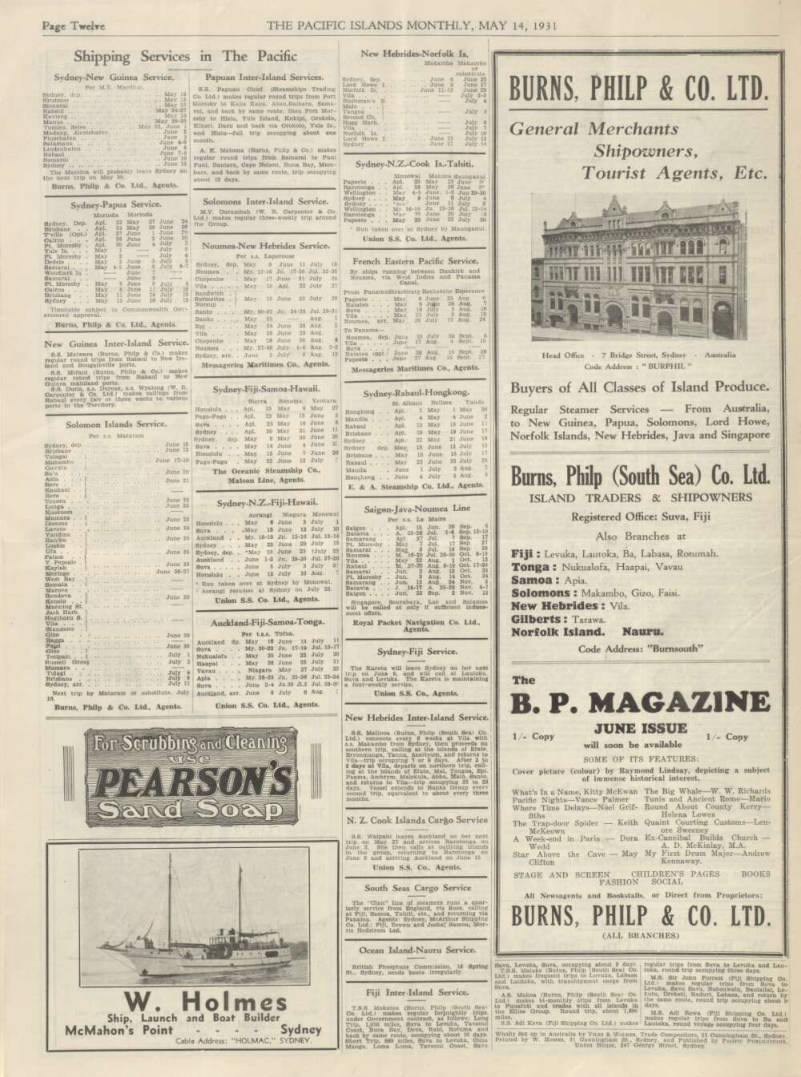
Sydney-New Guinea Service.
Sydney-Papua Service.
New Guinea Inter-Island Service.
S.S. Maiwara (Burns, Philp & Co.) makes regular round trips from Rabaul to New Ire land and Bougainville ports.
S.S. Mirant (Burns, Philp & Co.) makes regular round trips from Rabaul to New Guinea mainland ports.
S S. Duris, s.s. Durour, s.s. Wyalong (W. R.
Carpenter & Co. Ltd.) makes sailings from Rabaul every two or three weeks to various ports in the Territory.
Solomon Islands Service.
Papuan Inter-Island Services.
S.S. Papuan Chief (Steamships Trading Co. Ltd.) makes regular round trips from Port Moresby to Kapa Kapa, Abau, Baibara, Sama rai, and back by same route; then Port Mor esby to Hisiu, Yule Island, Kukipl, Orokolo, Kikori, Daru and back via Orokolo, Yule Is., and Hisiu —full trip occupying about one month.
A. K. Matoma (Burns, Philp & Co.) makes regular round trips from Samarai to Puni Puni, Baniara, Cape Nelson, Buna Bay, Mam bare, and back by same route, trip occupying about 12 days.
Solomons Inter-Island Service.
M.V. Durambah (W. R. Carpenter & Co.
Ltd.) makes regular three-weekly trip around the Group.
Noumea-New Hebrides Service.
Sydney-Fiji-Samoa-Hawaii.
Sydney-N.Z.-Fiji-Hawaii.
Auckland-Fiji-Samoa-Tonga.
New Hcbrides-Norfolk Is.
Sydney-N.Z.-Cook Is.-Tahiti.
French Eastern Pacific Service.
By ships running between Dunkirk and Noumea, via West Indies and Panama Canal.
Sydney-Rabaul-Hongkong.
Saigon-J ava-Noumea Line
Sydney-Fiji Service.
The Karetu will leave Sydney on her next trip on June 9, and will call at Lautoka, Suva and Levuka. The Karetu is maintaining a four-weekly service.
Union S.S. Co., Agents.
New Hebrides Inter-Island Service.
S.S. Malinoa (Burns, Philp (South Sea) Co.
Ltd.) connects every 6 weeks at Vila with s.s. Makambo from Sydney, then'proceeds on southern trip, calling at the islands of Efate.
Erronmanga, Tanna, Aneityum, and returns to Vila —trip occupying 7 or 8 days. After 2 to 3 days at Vila, departs on northern trip, call ing at the islands of Efate, Mai, Tongoa, Epi.
Paama, Ambrym, Malekula, Abba, Malo, Santo, and returns to Vila —trip occupying 25 to 28 days. Vessel extends to Banks Group every second trip, equivalent to about every three months.
N. Z. Cook Islands Car&o Service
S.S. Waipahi leaves Auckland on her next trip on May 27 and arrives Rarotonga on June 2. She then calls at outlying islands in the group, returning to Rarotonga on June 6 and arriving Auckland on June 15.
Union S.S. Co., Agents.
South Seas Cargo Service
The “Clan” line of steamers runs a quar terly service from England, via Suez, calling at Fiji, Samoa, Tahiti, etc., and returning via Panama. Agents; Sydney, McArthur Shipping Co. Ltd.: Fiji, Brown and Joskef Samoa, Mor ris Hedstrom Ltd.
Ocean Island-Nauru Service.
British Phosphate Commission, 16 Spring St., Sydney, sends boats irregularly.
Fiji Inter-Island Service.
T.S.S. Makatea (Burns, Philp (South Sea Co. Ltd.) makes regular fortnightly trips, under Government contract, as follows: Long Trip, 1,050 miles, Suva to Levuka, Tavenul Coast, Buca Bay, Devo, Rabi, Rotuma and back by same route, occupying about 10 days.
Short Trip, 560 miles, Suva to Levuka, Cicia Mango, Loma Loma, Tavenui Coast, Savu
Savu, Levuka, Suva, occupying about 9 days T.S.S. Malake (Burns, Philp (South Sea) Co.
Ltd.) makes frequent trips to Luvuka, Labasa and Lautoka, with transhipment cargo from Suva.
A.S. Makoa (Burns, Philp (South Sea) Co.
Ltd.) makes bi-monthly trips from Levuka to Funafuti and trades with all islands in the Ellice Group. Round trip, about 1,800 miles.
S.S. Adi Keva (Fiji Shipping Co. Ltd.) makes
regular trips from Suva to Levuka and Lau toka, round trip occupying three days.
M.S. Sir John Forrest (Fiji Shipping Co.
Ltd.) makes regular trips from Suva to Levuka, Savu Savu, Nabouwalu, Baulallai, Le kutu, Dreketl, Raduri, Labasa, and return by the same route, round trip occupying about 9 days.
M.S. Adi Rewa (Fiji Shipping Co. Ltd.) makes regular trips from Suva to Ba and Lautoka. round voyage occupying four days.
Per M.V.
Macdhui.
Sydney, dep Brisbane .. May 38 Samarai Rabaul May 24-27 Kavieng . . May 28 Manus May 29-30 Tumleo, Seleo . . May 31, June 1 Madang, Alexishafen .. June 2 Pinschafen .. June 3 Salamaua . June 4-5 Llndenhafen Rabaul . June 7-8 Samara!
The Marslna will probably leave Sydney on the next trip on May 30.
Burns, Philp & Co. Ltd., Agents.
Morinda Morinda Sydney, Dep . Apl. 22 May 27 June 24 Brisbane . . Apl. 24 May 29 June 26 T’ville (Opt.) Apl. 27 June 1 June 29 Cairns . . . Apl. 28 June 2 June 30 Pt. Moresby . Apl. 30 June 4 July 2 Yule Is. . . . May 1 July 3 Pt. Moresby . May 2 July 4 Dedele . . . . May 3 June 5 July 5 Samarai . . , May 4-5 June 6 July 6-7 Woodlark Is.
June 7 Samarai . .
June 8 ‘ — Pt. Moresby . May 6 June 9 July 8 Cairns . . . . May 8 June 11 July 10 Brisbane . May 11 June 14 July 13 Sydney . . . May 13 June 16 July 15 Timetable subject to Commonwealth Gov ernment approval.
Burns, Philp & Co. Ltd., Agents.
Per s.s.
Laperouse Sydney, dep.
May 9 June 13 July 18 Noumea .
My. 13 - 16 Jn. 17 - 20 Jul. 22-25 Chepenhe May 17 June 21 July 26 Vila ...
May 18 Apl. 22 July 27 Sandwich Sarmettes May 19 June 22 July 28
Norsup . . )
Santo . . .
My. 20 - 22 Jn. 24-26 Jul. 29-31 Banks . . . ,.
May 23 Aug. 1 Epl May 24 June 28 Aug. 2 Vila ...
May 25 June 29 Aug.
Chepenhe . .
May 26 June 30 Aug. 4 Noumea . . .
My. 27 - 30 July 1 - 4 Aug. 5-8 Sydney, arr. .
June 3 July 8 Aug. 12
Messageries Maritimes Co., Agents.
Makambo Makambo or substitute Sydney, dep. . . .
June 6 June 25 Lord Howe I. . .
June 8 June 27 Norfolk Is . June 11-12 June 29 Vila July 2-3 Bushman s B, . .
Halo ... 1 July 4 Tangoa Second Ch. ) July 5 Hogg Harb July 6 Vila July 7 Norfolk Is July 10 Lord Howe I. .. .
July 12 Sydney July 14
Monowai Makura Waunganui Papeete . . .
Apl. 25 May 23 June 26 Rarotonga . .
Apl. 28 May 26 June 29 Wellington . .
May 4-5 June 1-2 Jun 29-30 Sydney . . . .
May 9 June 6 July 4 Sydney . . . . •ha June 11 July 9 Wellington . .
My. 18-19 Jn. 15-16 Jul. 13 -14 Rarotonga . .
May 23 June 20 July 18 Papeete . . .
May 25 June 22 July 20 * Run taken over at Sydney by Maunganui.
Union S.S. Co. Ltd., Agents.
From PanamaStrasbourg Recherche Esperance Papeete . . .
May 8 June 25 Aug. 6 Raiatea . . .
May 9 June 26 Aug. 7 Suva . . . .
May 18 July 5 Aug. 16 Vila May 21 July 8 Aug. 19 Noumea, arr.
May 26 July 13 Aug. 24 To Panama — Noumea, dep.
June 10 July 28 Sept. 8 Vila June 17 Aug. 4 Sept. 15 Suva Raiatea (opt.) Papeete . . .
June 26 June 27 Aug. 15 Aug. 16 Sept. 26 Sept. 27
Messageries Maritimes Co., Agents
Per s.s. Mataram Sydney, dep.
Brisbane . .
Tulagai .
Makambo .
June 17-19 Gavutu . • Su'u . . .
Aola . . .
Here . . • Kaukaul . .
Here . .
Teneru . . . . June 22 Lunga . . .
June 22 Kookoom Mamara . . ( June 23 Domma .
Lavoro . .
June 24 Yandina .. June 25 Banika . .
Loabie . .
Ufa ...
Faiam . .
Y. Pepsale .
Kaylah Meringe .
June 26-27 West Bay .
Soraata . .
Marovo Rendova Kenelo . .
Manning St.
Jack Harb, 1 Hagthorn S.
Vila . . .
Stanmore Gizo . . .
Bagga . .
Paisi . . .
Oizo . . . / Tetipari . .
Russell Group Mamara . .
Tulagi . .
Brisbane Sydney, arr.
Next trip by Mataram or substitute, July 18.
Burns, Philp & Co. Ltd., Agents.
Sierra Sonoma Ventura Honolulu . . . Apl. 15 May 6 May 27 Pago-Pago . . Apl. 22 May 13 June 3 Suva . . . . Apl. 25 May 16 June 6 Sydney . . . . Apl. 30 May 21 June 11 Sydney, dep. May 9 May 30 June 20 Suva . . . . May 14 June 4 June 21 Honolulu . . May 15 June 5 June 26 Pago-Pago . May 22 June 12 July 1 The Oceanic Steamship Co., Matson Line, Agents.
Aorangi Niagara Monowai Honolulu . . . May 6 June 3 July 1 Suva . . .
May 15 June 12 July 10 Auckland . . My. 18-19 Jn. 15-16 Jul. 13-14 Sydney . . . May 23 June 20 July 18 Sydney, dep. . *May 28 June 25 tJuly 23 Auckland . June 1-2 Jn. 29-30 Jul. 27-28 Suva ... . June 5 July 3 July 3: Honolulu . . June 12 July 10 Aug. 7 * Run taken over at Sydney by Monowai.
Aorangi resumes at Sydney on July 23.
Union S.S. Co. Ltd., Agents.
Per t.s.s. Tofua.
Auckland dp. May 16 June 13 July 11 Suva . . . . My. 20-22 Jn. 17-19 Jul. 15-17 Nukualofa . . May 25 June 22 July 20 Haapai . . . May 26 June 23 July 21 Vavau . . . . Niagara May 27 July 22 Apia . . . , My. 28-29 Jn. 25-26 Jul. 23-24 Suva . . . . June 2-4 Jn.30 J1.2 Jul. 28-30 Auckland, arr. June 8 July 6 Aug. ' Union S.S. Co. Ltd., Agents.
St. Albans Nellore Tanda Hongkong . . Apl. 1 May 1 May 30 Manilla . . . Apl. 4 May 4 June 2 Rabaul . . . Apl. 13 May 13 June 11 Brisbane . . . Apl. 19 May 19 June 17 Sydney . . . Apl. 22 May 21 June 19 Sydney dep. May 13 June 13 July 15 Brisbane . , . . May 15 June 15 July 17 Rabaul . . . . May 23 June 23 July 25 Manila . . June 1 July 2 Aug. 2 Hongkong . . June 4 July 5 Aug. 5 E. & A. Steamship Co. Ltd., Agents.
Per s.s. Le Maire Saigon . . . Apl. 15 Jun. 26 Sep. 6 Batavia . . . A. 23-26 Jul. 3-6 Sep. 13-16 Samarang . . Ap!. 27 Jul. 7 Sep. 17 Pt. Moresby . May 7 Jul. 17 Sep. 27 Samaral . .
. M£ki 9
Jul. 19 Sep. 29 Noumea . . . M. 16-20 Jul. 26-30 Oct. 6-10 Vila ... . May 22 Aug. 1 Oct. 12 Rabaul . . . M. 27-30 Aug. 6-10 Oct. 17-20 Samara! . . . Jun. 2 Aug. 13 Oct. 23 Pt. Moresby . Jun. 3 Aug. 14 Oct. 24 Samarang . . Jun. 13 Aug. 24 Nov. 3 Batavia . . . J. 14-17 A. 25-28 Nov. 4-7 Saigon . . . . Jun. 22 Sep. 2 Nov. 12 Singapore, Sourabaya, Lae and Salamoa will be called at only if sufficient induce ment offers.
Royal Packet Navigation Co. Ltd.,
Agents.
Advertisements & other items, p. 12 (2 items)
The Pacific Islands Monthly, May 14, 1931
12
Wholly Set up in Australia by Viles & Walker, Trade Compositors, 31 Cunningham St Sydney Printed by W. Homer, 31 Cunningham St., Sydney, and Published by Pacific Publications’
Union House, 247 George Street, Sydney.
Burns, Philp & Co. Ltd.
General Merchants
Shipowners,
Tourist Agents, Etc.
Head Office - 7 Bridge Street, Sydney - Australia Code Address : " BURPHIL ”
Buyers of All Classes of Island Produce.
Regular Steamer Services From Australia, to New Guinea, Papua, Solomons, Lord Howe, Norfolk Islands, New Hebrides, Java and Singapore
Burns, Philp (South Sea) Co. Ltd.
ISLAND TRADERS & SHIPOWNERS
Registered Office: Suva, Fiji
Also Branches at FIJI Z Levuka, Lautoka, Ba, Labasa, Rotumah.
Tonga Z Nukualofa, Haapai, Vavau Samoa : Apia.
Solomons Z Makambo, Gizo, Faisi.
New Hebrides : Vila.
Gilberts Z Tarawa.
Norfolk Island. Nauru.
Code Address: "Bumsouth”
The
B. P. MAGAZINE
JUNE ISSUE
1/- Copy 1/- Copy will soon be available
SOME OF ITS FEATURES:
Cover picture (colour) by Raymond Lindsay, depicting a subject of immense historical interest.
What’s In a Name, Kitty McEwan The Big Whale —W. W. Richards Pacific Nights—Vance Palmer Tunis and Ancient Rome—Mario Where Time Delays—Noel Grif- Round About County Kerry— fiths Helena Lowes The Trap-door Spider Keith Quaint Courting Customs —Len- McKeown ore Sweeney A Week-end in Paris Dora Ex-Cannibal Builds Church Wedd A. D, McKinlay, M.A.
Star Above the Cave May My First Drum Major—Andrew Clifton Kennaway,
STAGE AND SCREEN CHILDREN’S PAGES BOOKS
FASHION SOCIAL
All Newsagents and Bookstalls, or Direct from Proprietors:
BURNS, PHILP & CO. LTD.
(ALL BRANCHES)
W. Holmes
Ship, Launch and Boat Builder McMahon’s Point - - - - Sydney Cable Address: “HOLMAC ” SYDNEY.