Monthly
THE Pacific lslands Monthly
THE ONLY JOURNAL CIRCULATING THROUGHOUT THE ISLAND TERRITORIES AND GROUPS
Of The Central And South Pacific.
Vol, 1—No.1 —No. 9
Registered at G.P.O., Sydney, for transmission by Post as a Newspaper
Sydney: Tuesday, April 21, 1931
(Single Copy, 6d. (Per Annum, posted, 6/-. ===
Fruit For N.Z.
New Duty on Bananas
Proposed
Problem For Fiji And
Tonga
AN item of considerable importance to planters in Fiji and Tonga is contained in the monthly notes issued by the Cook Islands Administration to growers, in March, 1931.
It appears that the Cook Islands authorities have been making urgent representations to the New Zealand Government on the question of giving protection to Cook Islands produce in the New Zealand market. The Cook Islands, as is generally known, is a dependency of New Zealand.
Apparently, the New Zealand Government is giving the matter attention. There has lately been a very businesslike interchange of radiograms and letters between Rarotonga and Wellington.
It is officially stated that the proposals are: That a duty of 2d. per lb. be imposed on foreign bananas.
A duty of 1d. per lb. on bananas from outside of New Zealand Territory.
Similar duties on citrus fruits from April to October.
It is not quite clear from this whether Samoa is to get the same treatment as the Cook Islands. But it certainly means that Fiji and Tonga, who send a good deal of fruit to New Zealand, will be placed under some disadvantage.
It really does appear as if the time has come when Fiji and Tonga should examine their position and see whether it is not possible to make representations to both the Australian and New Zealand Governments in a manner that will be noticed. Each Dominion is inclined to impose heavy tariffs against Fijian and Tongan fruit, with bad results on the primary industries of those island territories, and it is time that the other side of the picture was presented. Each Dominion is eager to obtain more overseas trade.
The very considerable value of Fiji’s import trade might be emphasised, for instance; and it might be shown that the effect of shutting out Fiji fruit is to also shut out trade with Fiji worth hundreds of thousands of pounds per annum.
Papua’S Exports
From Our Own Correspondent.
Pt. Moresby, April 8.
Some of our products are now moving out rapidly, under the stimulus of the exchange position. Shipments in March, compared with March of the previous year, are: ... Mar., 1930 ... Mar., 1931 Dess. cocoanut ... £4,542 ... £7,708 Copra ... 14,573 ... 6,032 Rubber ... 10,736 ... 13,384 Sandalwood ... 723 ... 244 Beche de Mer ... 60 ... 102 Total, all products . £30,901 ... £27,600 ... ===
Interesting Experiment in Fiji
Big Mosquito To Eat
Little Ones
From Our Own Correspondent SUVA, April 2 A recent importation from Java is a colony of a variety of large mosquito, which has been found to prey upon the smaller mosquito which attacks humans. It is itself a non-blood eating insect.
This new mosquito was introduced by Mr. Paine, second entomologist of the Coconut Committee, who recently returned to Suva, after spending two years in research work in Java.
It will be a big step forward in the control of tropical diseases if this parasite proves a successful worker and rids the Colony of the insects which introduce so much discomfort and danger to life in the tropics. ... ===
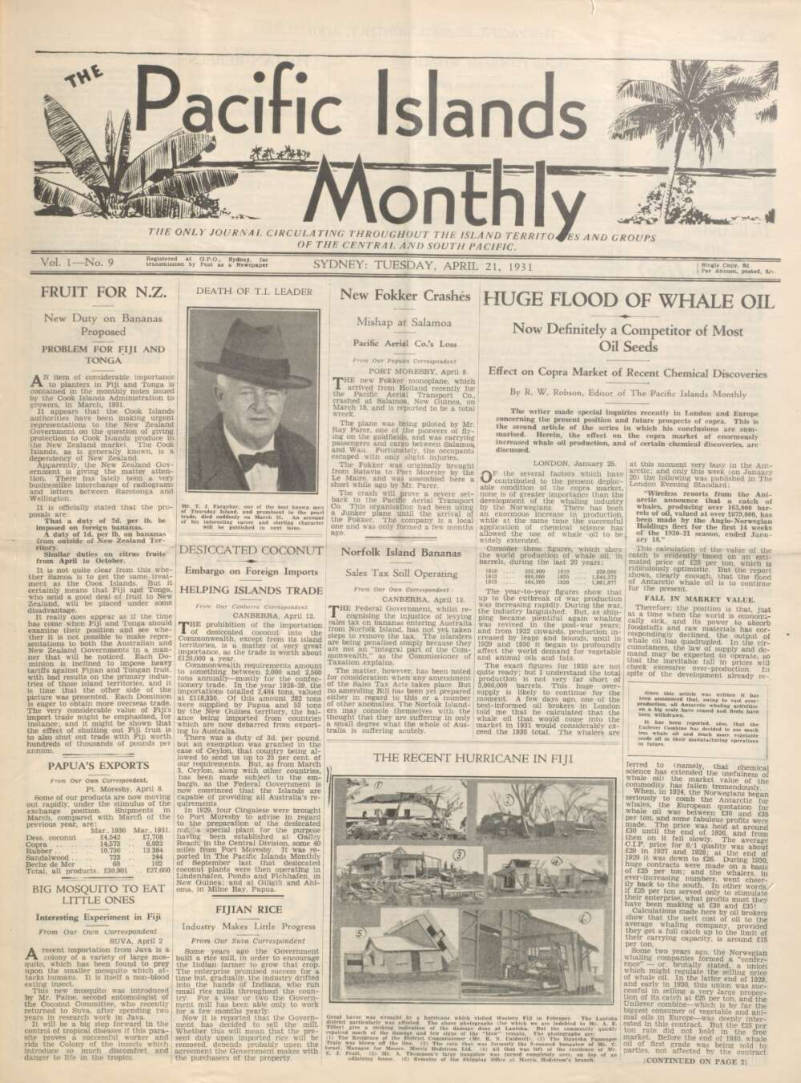
Death Of T.I. Leader
Mr. T. J. Farquhar, one of the best known men of Thursday Island, and prominent in the pearl trade, died suddenly on March 21. An account of his interesting career and sterling character will be published in next issue.
Embargo on Foreign Imports
Desiccated Coconut
Helping Islands Trade
From Our Canberra Correspondent CANBERRA, April 13.
THE prohibition of the importation of desiccated coconut into the Commonwealth, except from its island territories, is a matter of very great importance, as the trade is worth about £120,000 a year.
Commonwealth requirements amount to something between 2,000 and 2,500 tons annually—mostly for the confectionery trade. In the year 1928-29, the importations totalled 2,484 tons, valued at £118,330. Of this amount 282 tons were supplied by Papua and 53 tons by the New Guinea territory, the balance being imported from countries which are now debarred from export ing to Australia.
There was a duty of 3d. per pound, but an exemption was granted in the case of Ceylon, that country being allowed to send us up to 25 per cent. of our requirements. But, as from March 3, Ceylon, along with other countries, has been made subject to the embargo, as the Federal Government is now convinced that the Islands are capable of providing all Australia’s requirements In 1929, four Cingalese were brought to Port Moresby to advise in regard to the preparation of the desiccated nut, a special plant for the purpose having been established at Galley Reach, in the Central Division, some 40 miles from Port Moresby. It was reported in The Pacific Islands Monthly of September last that desiccated coconut plants were then operating in Lindenhafen, Pondo and Fichhafen, in New Guinea; and at Giligili and Ahioma, in Milne Bay, Papua.
Fijian Rice
Industry Makes Little Progress
From Our Suva Correspondent Some years ago the Government built a rice mill, in order to encourage the Indian farmer to grow that crop.
The enterprise promised success for a time but, gradually, the industry drifted into the hands of Indians, who run small rice mills throughout the country. For a year or two the Government mill has been able only to work for a few months yearly.
Now it is reported that the Government has decided to sell the mill.
Whether this will mean that the present duty upon imported rice will be removed, depends probably upon the agreement the Government makes with the purchasers of the property.
Advertisements & other items, p. 1 (1 item)
New Fokker Crashes
Mishap at Salamoa Pacific Aerial Co.’s Loss
From Our Papuan Correspondent
Port Moresby, April 8.
THE new Fokker monoplane, which arrived from Holland recently for the Pacific Aerial Transport Co., crashed at Salamoa. New Guinea, on March 18. and is reported to be a total wreck.
The plane was being piloted by Mr.
Ray Parer, one of the pioneers of flying on the goldfields, and was carrying passengers and cargo between Salamoa and Wau. Fortunately, the occupants escaped with only slight injuries.
The Fokker was originally brought from Batavia to Port Moresby by the Le Maire, and was assembled here a short while ago by Mr. Parer.
The crash will prove a severe setback to the Pacific Aerial Transport Co. This organisation had been using a Junker plane until the arrival of the Fokker. The company is a local one and was only formed a few months ago.
Norfolk Island Bananas
Sales Tax Still Operating
From Our Own Correspondent CANBERRA, April 13.
THE Federal Government, whilst recognising the injustice of levying sales tax on bananas entering Australia from Norfolk Island, has not yet taken steps to remove the tax. The islanders are being penalised simply because they are not an “integral part of the Commonwealth,” as the Commissioner of Taxation explains.
The matter, however, has been noted for consideration when any amendment of the Sales Tax Acts takes place. But no amending Bill has been yet prepared either in regard to this or a number of other anomalies. The Norfolk Islanders may console themselves with the thought that they are suffering in only a small degree what the whole of Australia is suffering acutely.
The Recent Hurricane In Fiji
Great havoc was wrought by a hurricane which visited Western Fiji in February. The Lautoka district particularly was affected. The above photographs (for which we are indebted to Mr. A. E.
Tilley) give a striking indication of the damage done at Lautoka. But the community quickly repaired much of the damage and few signs of the “blow” remain. The photographs are: (1) The Residence of the District Commissioner (Mr. R. N. Caldwell). (2) The Sigatoka Passenger Train was blown off the line. (3) The ruin that was formerly the 9-roomed bungalow of Mr. C.
Israel, Manager for Messrs. Morris Hedstrom Ltd. (4) All that was left of the residence of Mr.
E. J. Pratt. (5) Mr. A. Thompson’s large bungalow was turned completely over, on top of an adjoining house. (6) Remains of the Shipping Office at Morris Hedstrom’s branch.
Huge Flood Of Whale Oil
Now Definitely a Competitor of Most Oil Seeds Effect on Copra Market of Recent Chemical Discoveries
By R. W. Robson, Editor of The Pacific Islands Monthly
The writer made special inquiries recently in London and Europe concerning the present position and future prospects of copra. This is the second article of the series in which his conclusions are summarised. Herein, the effect on the copra market of enormously increased whale oil production, and of certain chemical discoveries, are discussed.
LONDON, January 25.
OF the several factors which have contributed to the present deplorable condition of the copra market, none is of greater importance than the development of the whaling industry by the Norwegians. There has been an enormous increase in production, while at the same time the successful application of chemical science has allowed the use of whale oil to be widely extended.
Consider these figures, which show the world production of whale oil, in barrels, during the last 20 years: 1910 ... 302,900 ... 1919 ... 359,000 1913 ... 805,000 ... 1925 ... 1,044,272 1915 ... 464,300 ... 1929 ... 1,861,877
The year-to-year figures show that up to the outbreak of war production was increasing rapidly. During the war, the industry languished. But, as shipping became plentiful again whaling was revived in the post-war years; and from 1922 onwards, production increased by leaps and bounds, until in 1929 and 1930 it began to profoundly affect the world demand for vegetable and animal oils and fats.
The exact figures for 1930 are not quite ready; but I understand the total production is not very far short of 3,000,000 barrels. This huge oversupply is likely to continue for the moment. A few days ago, one of the best-informed oil brokers in London told me that he calculated that the whale oil that would come into the market in 1931 would considerably exceed the 1930 total. The whalers are
at this moment very busy in the Antarctic; and only this week (on January 20) the following was published in The London Evening Standard: "Wireless reports from the Antarctic announce that a catch of whales, producing over 163,000 barrels of oil, valued at over £679,000, has been made by the Anglo-Norwegian Holdings fleet for the first 14 weeks of the 1930-31 season, ended January 18."
This calculation of the value of the catch is evidently based on an estimated price of £25 per ton, which is ridiculously optimistic. But the report shows, clearly enough, that the flood of Antarctic whale oil is to continue for the present.
Fall In Market Value.
Therefore, the position is that, just at a time when the world is economically sick, and its power to absorb foodstuffs and raw materials has correspondingly declined, the output of whale oil has quadrupled. In the circumstances, the law of supply and demand may be expected to operate, so that the inevitable fall in prices will check excessive over-production. In spite of the development already re-
Since this article was written it has been announced that, owing to vast overproduction, all Antarctic whaling activities on a big scale have ceased and fleets have been withdrawn.
It has been reported, also, that the Unilever Combine has decided to use much less whale oil and much more vegetable seeds oil in their manufacturing operations in future.
ferred to (namely, that chemical science has extended the usefulness of whale oil) the market value of the commodity has fallen tremendously.
When, in 1924, the Norwegians began seriously to comb the Antarctic for whales, the European quotation for whale oil was between £30 and £35 per ton, and some fabulous profits were made. The price was held at around £30 until the end of 1926, and from then on it fell slowly. The average C.I.F. price for 0/1 quality was about £29 in 1927 and 1928; at the end of 1929 it was down to £26. During 1930 huge contracts were made on a basis of £25 per ton; and the whalers, in ever-increasing numbers, went cheerily back to the south. In other words if £25 per ton served only to stimulate their enterprise, what profits must they have been making at £30 and £35 !
Calculations made here by oil brokers show that the nett cost of oil to the average whaling company, provided they get a full catch up to the limit of their carrying capacity, is around £15 per ton.
Some two years ago, the Norwegian whaling companies formed a "conference" — or brutally stated, a union which might regulate the selling price of whale oil. In the latter end of 1929 and early in 1930, this union was successful in selling a very large proportion of its catch at £25 per ton, and the Unilever combine—which is by far the biggest consumer of vegetable and animal oils in Europe—was deeply interested in this contract. But the £25 per ton rate did not hold in the free market. Before the end of 1930, whale oil of first grade was being sold to parties, not affected by the contract.
(Continued On Page 2)
as £15 per ton, C.I.F.
I am inclined to regard the generally accepted report that Unilever was caught with the £25 per ton contract for whale oil as a factor of great importance in the copra situation. Unilever, presumably, would buy whale oil at £15 in the free market, in order to get down its average expenditure on whale oil. But whether it did or did not so buy, it certainly would try to improve its average expenditure on raw materials by buying copra at the lowest possible figure. Either way, the copra producer would suffer. This awkward position in the whale oil market must have had a bad reaction upon the copra market in the latter part of 1930.
What Will Whalers Do?
It is understood that the big contracts based on £25 per ton are ended, or about to end, and that the whaling companies are now faced with a price (£15 per ton) that is barely profitable, a definitely falling market, an enormous and increasing over-production.
With the £25 rate finished with, and soap and margarine manufacturers no longer under the necessity of hammering down the prices of oil-seeds in order to keep down their average costs, the copra market may get some relief and report some improvement. But whale oil developments must be carefully watched and studied.
Only yesterday, there came to hand from Norway a report about the efforts the whaling companies are making to stabilise their market. They are, at this moment, holding a series of meetings, and they are trying to get cooperative action to accomplish the following: Keep whale oil production in closer relation to demand.
Arrange “close seasons” in the different whaling areas in turn, so as to prevent the herds falling below a point at which fishing might become unprofitable.
Arrange a scientific investigation of the value of the catches, so that whale products may be put to uses other than the present—which are oil for margarine, soap, candles and cosmetics, meat for human consumption, cattle-food, fertilisers.
In view of the very serious position of the whale oil industry, co-operative action along these lines may be expected.
Character Of Oils Changed.
Until a few years ago whale oil competition need not have kept the coconut planter awake at nights. In the fields where coconut and whale oil were competitive, whale oil was used only for coarser work. In comparison with coconut oil it had definitely an animal flavour, and qualities which placed it at a severe disadvantage. Coconut oil is naturally a hard oil, with a high melting point, which makes it an admirable material for many manufactured commodities.
Whale oil, ground nut oil, and other oils which are now being over-produced are soft oils, and were comparatively useless for many manufacturing purposes. But all that is now changed.
Mr. W. J. Gilbert, present president of the London Copra-buyers’ Association, thus summed it up for me: “Whale oil can now be deodorised and neutralised. A great blow to copra came when they discovered the hardening process for soft oils. Up till then copra had the great advantage that
its melting point was so much higher than that of most other oils. In hot weather, commodities with a base of coconut oil remained where they were.
But when they discovered the hardening process for soft oils, they were able to use many soft oils, where before they had little choice beyond coconut oil. This applies particularly to whale oil —these new discoveries have allowed whale oil to come into several processes and manufactures, out of which previously it was barred because of its softness and its strong flavour.”
New Market Conditions.
The natural qualities of coconut oil give it, for various important manufacturing processes advantages over all other oils; and it is still definitely preferred by manufacturers. But it is no use blinking facts. And one outstanding fact is that manufacturers, by these new processes, can use whale oil and the soft vegetable oils as definite alternatives to coconut oil; and will so use them if thereby they can reduce production costs without impairing the quality of their output.
Otherwise stated, this means that coconut oil will be used generally only when its price puts it on an equality with whale oil and the enormously over-produced oils from soya beans and ground nuts.
To get a hardened, refined oil from whale oil, one must add about £5 per ton to the whale oil price. To obtain a refined, deodorised coconut oil, about £15 has to be added to the copra price.
It is not to be supposed that manufacturers will chop and change about from one class of oil to another, according to market fluctuations. Formulas are far too carefully made, and processes far too delicately adjusted, to permit of quick alterations in the character of the chief material used.
But if a factory moves reluctantly from coconut oil to alkalised ground nut oil or to deodorised and neutralised and hardened whale oil; it is going to move back to coconut oil with equal slowness, even although the price of coconut oil has come down to its competitors’ levels.
Over-production of all oils, at the moment, is enormous, and the market is correspondingly depressed. The world’s economic sickness expressed mostly in its inability to buy—will pass, consumption of these commodities will definitely increase, and prices will tend to improve. But copra will not go alone happily in the future, as it did in the past, practically making its own independent price. The value of copra, in the future, will have an exact relation to the production and market price of other oil-bearing commodities. So long as the world is receiving these floods of soya beans from Manchuria, peanuts from India and whale oil from the Antarctic, the buver will remain on top of the market, and will nearly make his own price.
The question ot whether copra can be profitably produced in competition with these other oil-bearing commodities; the extent to which re-capitalisation of coconut plantations is necessary; and the exact bearing of Unilever domination upon these considerations, will be discussed in the third article of this series, to he published next month. ... ===
Sound Trading
———♦——— Burns, Philp (S.S.) Company Makes Healthy Profit
IN view of the acute depression which existed in 1930, shareholders in Messrs.
Burns Philp (South Seas) Co. Ltd. were more than delighted in March, when they received the balance sheet for the year ended December 31, to discover that the company had made a net profit of £62,660.
This compared favourably with £62,996 made in 1929, and £65,140 in 1928. It meant that the company comfortably maintained its ordinary dividend of 7½ per cent., and was able to carry £5,000 on to reserves, bringing the reserve fund total to the healthy figure of £85,000.
The report states that the value of all islands produce remained extremely low during 1930, and merchandise sales and shipping revenues declined owing to the curtailment of spending power in the Islands.
The following shows the balance sheet figures: ... Year ended December 31 ... 1928 ... 1929 ... 1930 ... £ ... £ ... £ Gross profit ... 181,583 . 192,137 . 185,059 Net profit ... 65,140 ... 62,996 .. 62,662 Dividend, p.c. ... 7½ ... 7½ ... 7½ Amount of div. ... 56,250 ... 56,250 ... 56,250 To reserve ... 10,000 ... 10,000 .. 10,000 Carried forward ... 5,425 ... 2,171 ... 1,410
... Liabilities—
Capital ... 750,000 . 750.000 . 750,000 Reserve fund ... 60,000 .. 70,000 ... 80,000 Creditors ... 67,286 .. 85,091 ... 67,104
... Assets—
Cash ... 41,615 .. 60,048 ... 47,055 Properties and ... shipping ... 332,955 . 435,890 . 420,557 Produce in transit .. 229,639 . 287,612 . 290,850 Merchandise ... 168,510 ... * ... * Debtors ... 176,241 . 189,962 . 201,301
* Included in “produce in transit.”
This is really a most creditable performance, and the directors of the company are to be heartily congratulated upon their excellent figures.
Trade in the Pacific Islands during 1930 was depressed to a far greater extent than is indicated by the quiet phrases of the directors’ annual report; and, if the disclosed profit had been half of that of 1929, there could have been no real complaint. It is evident that the directors had long vision, and made preparation for this slump a long time ago.
The directors are Messrs. James Burns, Lewis Armstrong, Lord Inchcape, Theodore C. Amsden, Robert J. Nosworthy and Joseph Mitchell. ... ===
Chilian Rebels
———♦——— Interesting Party in Tahiti
Escape From Easter Is.
From Our Own Correspondent.
TAHITI, March 26.
have had an interesting
glimpse of some of the princi-
pals in a South American revolu-
tion that missed fire.
The schooner Valencia, recently launched from Steve Higgin’s shipyard, returned on February 28 from her maiden voyage.
About the middle of January she departed on a mysterious charter to Easter Island, a remote spot some 3,000 miles to the eastward, with which Tahiti has had little communication since the Brander House flag dissappeared from the Pacific, owing to the opening of the Panama Canal and political changes. It was given out on the beach that the Valencia was to pick up a French cinema company and bring them to Tahiti, en route to France.
Latterly, however, one knows not how generated, rumours spread around that there was more behind this voyage than had been made generally known.
Consequently a large crowd assembled on the wharf and on the verandahs of the Bougainville Club when the Valencia berthed.
Closely escorted by local gendarmes, and in company with a Spanish interpreter, there stepped ashore four dapper gentlemen of exotic cut; and from the buzz of comments one at length formed the conclusion that these were no others than General Brado and his colleagues in the recent attempt to upset the Chilian Government.
The story goes that General Brado, together with a colonel of the army and a high legal luminary of Valparaiso, were escorted to Easter Island in a Chilian war vessel and placed in exile pending trial.
The war vessel having departed for the mainland, the Governor of the island apparently joined hands with the
revolutionaries and accompanied them to Tahiti.
The story, gathered in an interview with Senor Vicuna, the legal gentleman of the party, reveals a deplorable state of affairs in the Republic of Chili.
Political dishonesty and corruption appear to be rampant there, and some thousands of the leading families have been oppressed and exiled, often with out the formality of a trial. From his headquarters in the Argentine, General Brado and his colleagues planned a coup d’etat to upset the Government of President Ibenez. The movement was centred in the city of Conception, to which point the General and his party, crossing the Andes, journeyed by airplane. But the leaders there were not ready, and thus the scheme failed: and the party were taken prisoners. Luckily for them the troops were in sympathy with the revolutionary movement and refused to carry out the death sentence passed upon them, with the result that they were exiled to Easter Island. From there they escaped in the French schooner.
The General and his party are at present staying at the Hotel Diadem.
Papeete, and it is understood they will leave for France on the next Messagerie boat. ===
Advertisements & other items, p. 2 (2 items)
In Sydney
it's
Bunnerong
In
The Islands
it's Lister -Lite GIANT generators in the Bunnerong Power House supply Sydney people with electric light and power for the many conveniences of modern life.
Here, in the Islands, Lister- Lite, the reliable lighting plant, will give your home the same unfailing electric current that Bunnerong gives to Sydney.
RELIABLE ... that’s important In the far outback stations of Australia —hundreds of miles from electrical experts — Lister-Lite plants are working, day in, day out, giving farmers trouble-free service. This is the reliability you need.
Free of
Australian Customs Duty
When you order your Lister-Lite, it will be shipped to you ex bond, thus saving the extra cost which Australian Customs duty would entail. Fill in and send the coupon below for particulars of reliable Lister-Lite.
DANGAR, GEDYE & CO. LTD
10-14 Young Street, Sydney, Australia.
Please send me details of Lister- Lite.
Name Address ===
Use
The Direct Wireless Service
With Australia & Overseas
for your communications MODERN high-speed direct wireless services are now in operation between Port Moresby and Sydney, Rabaul and Sydney, Noumea and Sydney, and Fiji and Sydney.
Speedy, economical and efficient service to Australia and overseas. Route your traffic “Via the Wireless Service."
AWA Lodge your message at the Wireless Stations.
For Great Britain, North and South America and all European Countries, route your message “VIA BEAM” the longest direct wireless telegraph service in the world.
AMALGAMATED WIRELESS (AUSTRALASIA) LTD.
Canned Vegetables
Sutton’s
Green Peas In 1 lb. and 2 lb. Tins French Beans (Sliced) in 1 lb. Tins Carrots In 1 lb. Tins Beetroot (Sliced) in 1 lb. Tins Packed by
Delicia Food Products Co.
WATERLOO, N.S.W.
What Are Your Needs?
COOPER PRODUCTS
We have the following high
grade products, carrying the
reputation of this old-established English Firm:—
POWDER SHEEP DIP.—
For the destruction of external parasites on sheep.
CATTLE DIP
For the destruction of Cattle Ticks. Also Lice and Mange on Cattle and Horses. for
MILK OIL FLUID.—
For general disinfection of premises, Ships, Launches, etc.
HEALING OIL.—
For the antiseptic treatment of cuts, wounds, etc. on humans and animals.
ARSINETTE.—
For the destruction of all leaf-eating insects infesting trees and plants.
KATAKILLA
For the destruction of all sucking insects infesting trees and plants.
ALBOLEUM.—
For the destruction of all Scale insects infesting trees and plants.
PULVEX.— A non-poisonous dusting Powder for the destruction of Fleas, Lice and other parasites on Dogs, Cats, Poultry, etc.
KUR-MANGE.—For curing parasitic Mange and Skin diseases in Dogs, Horses, etc.
FLY KILLER.—For killing House Flies and Mosquitos.
BOILER COMPOUND.—For removing and preventing rust, —scale and corrosion in boiler pipes, etc.
Enquiries in respect of the above are invited from Planters, Cattle Owners, Storekeepers and all Island Residents.
William Cooper & Nephews (Australia)
Limited
4 O’CONNELL STREET - SYDNEY
The Rivers’ Source
Discoveries In Central New Guinea
From Our Own Correspondent.
Port Moresby, April 8
INTERESTING discoveries have been made in the interior of this Terri tory, in the mountainous regies be tween Papua and New Guinea, by Patrol-Officer Hides, who was accom panied by Mr. Garbutt. They carried out patrols through new country and, on his return, Mr. Hides made the fol lowing interesting report: “The Tauri River (Papua) which flows north, and the Bulolo River (New Guinea) and the Watut River (New Guinea) which flow south, all have their sources within a few hours’ march of one another.”
This is most interesting, as it shows that the new Tauri goldfield is practi cally within the same line of country as the more developed goldfields on the Bulolo (Edie Creek) on the other side of the border.
The Patrol Officer states that the country through which his party trav elled was very thickly populated—they estimate that they saw about 6,000 natives in 40 or more villages. The natives were very friendly, but shy, and it was apparent that they had never before come into contact with Europeans. There were no traces or previous visits by white men.
Islands Ships
Sailing Schedules Unfixed and Uncertain Discussion Between B.P. and Federal Government
From Our Own Correspondent CANBERRA, April 11.
Negotiations are still pro ceeding between the Federal Government and Messrs. Burns, Philp and Co. Ltd., for an improved Islands service, and it is expected that a representative of the Com pany will visit Canberra to discuss the position in detail. The wreck of the Malabar, off Long Bay has rather complicated the situation.
Under the mail contract entered into with the Company it was provided that the Malabar (which was engaged in the Singapore trade) or an equivalent vessel, was to be introduced into the Islands service to replace the Montoro, which runs to New Guinea. This was to take effect not later than April 1, 1932, and after that the position was to be further reviewed.
The s.s. Macdhui, built to the order of Burns, Philp and Co., is now on her way out and will be here nearly ahead of the contract requirements for the Islands. The Company made certain proposals for the introduction of the Macdhui into the Pacific Islands ser vice, but these proposals, which have received a lot of consideration, were not acceptable to the Papuan and New Guinea administrations.
The Company’s plan was that this vessel, being faster than those at present engaged on the run, might combine the Papuan and New Guinea services. To that the Territories are opposed and the Minister has, there fore, rejected the proposal. It is under stood that the company is about to submit new proposals.
At present, the Morinda runs to Port Moresby and the Montoro to Rabaul.
The people of New Guinea are anxious that the vessel which replaces the Montoro shall provide an improved service, whereas a combined service by the Macdhui would, they say, mean higher fares and generally be less satis factory than is the present position.
In addition to the Morinda and the Montoro, the Marsina has been making a three-weekly trip to the Islands and then calling at Norfolk Island for ban ana shipments to Sydney. The Marsina has now been diverted to the Solomons to take over the running of the Mat aram, which met with a mishap and has been towed to Sydney for repairs.
In regard to the more direct Nor folk Island service, provided by the Makambo, it was understood that in the re-arrangement of the services a better boat than this would be put on the run.
Norfolk Island is definitely to benefit in the re-arrangement, but the present proposals (which, as stated, have come a year ahead of contract time) have been vetoed.
Another matter that is receiving con sideration is the resumption of the service between Norfolk Island and New Zealand.
Present Arrangements
SYDNEY, April 17.
Inquiries made to-day indicate that the position in regard to the re-ar rangement of the services is unaltered.
A representative of Messrs. Burns, Philp and Co. is at present in Can berra negotiating with the authorities and no decision is expected before the end of the month.
Following the mishap to the Mat aram, at Makambo, arrangements were made by the Company to meet the immediate demands of Solomon Islands residents by diverting the Marsina to the Solomon Islands on her way to the Mandated Territory. She left Sydney on April 14.
The Mataram is scheduled to depart from Sydney on April 24, after repairs have been effected, and she will con nect with the Marsina at Faisi. This will allow of the transhipment of New Guinea mails and passengers from the Mataram to the Marsina.
The full itineraries of both vessels are published in the shipping columns.
It is expected that on the arrival in Sydney of the Montoro, from Rabaul, on April 28, she will be laid up in order to undergo overhaul.
Goldfield News
Two Deaths at Wau Difficulties of Aerial Com munication
From Our Own Correspondent.
WAU, March 10.
DURING the month of February, events have been moving rapidly in the Wau district.
Usually free from any serious bouts of illness, the inhabitants have become accustomed to speaking of this pictur esque little place in glowing terms as a health resort, and their sentiments in this respect are generally accepted.
Two events, calculated to mar this outlook, have occurred in quick suc cession, resulting in the deaths of two men —one, well known in local circles, and the other, although not so well known in Wau, was recognised as a man of high repute in Australia.
Mr. J. V. Nixon, a comparatively young man, highly esteemed and res pected by everyone, passed away after a short illness on February 17. That dreaded disease, “blackwater,” was re sponsible for his demise. The funeral was well attended by the many friends he had made in Wau.
Exactly one week afterwards, Mr. H.
S. King, a commissioner from Can berra, and formerly Under-Secretary for Mines in Western Australia, passed away after a sudden illness, which last ed but a few days.
Mr. King, who was 69 years of age, was a man well versed in the intricac ies which are always associated with mining matters, and was responsible for the drafting of the W.A. Mining Ordinances, which have successfully served that State for some years. Ap pointed by the Commonwealth Gov ernment to conduct an inquiry into the mining conditions on the field and to utilise his experience in effecting a mutual and satisfactory understanding between the Administration and the numerous lessees on the field, Mr. King unhappily succumbed to pleurisy be fore his enquiry had commenced.
The funeral was well attended by representatives from every section of the community, and the procession to the graveside was marked by a solemn ity, amplified by the eerie stillness of the tropical bush and accentuated by the unusual sight of the coffin being borne from the hospital down a rather steep and sinuous pathway, until the seldom-used cemetery was at last reached and the body was laid to rest.
The District Officer held a short ser vice at the graveside and said a few words befitting the occasion.
Plane Mishaps.
The frequency of small mishaps which Guinea Airways Ltd. have ex perienced of late, has excited comment amongst those interested. These mis haps have been in no way serious, save that three Junker ’planes are out of commission for a short period, and the premier company finds itself in the un usual position of having insufficient ’planes to cope with the cargo landed at Salamoa.
The Placer Aerodrome seems to bear a “hoodoo” in this respect, and two of the ’planes in question are now lying there until repairs will enable them to again take the air. The single-engined Junkers ’plane recently imported from Germany is on the injured list and will be out of commission until a new undercarriage can be rigged up in order to replace the original one, which was badly damaged by a faulty landing.
Hearts fluttered and search parties were visualised when word came through that one of the younger pilots had been reported missing and that all efforts to find him had revealed no trace of either the pilot or the ’plane.
All available machines were ordered into the air on the following day, and eventually the disabled ’plane was lo cated on the upper reaches of the Snake River, in the very place where a forced landing had been made some months before. The pilot was unin jured and managed to walk back to Lae, where he received a hearty wel come.
The Solomon Islands
From Our Own Correspondent.
IMPORTS continue to fall off and this last trip the Mataram arrived with the Plim soll mark about 5 or 6 feet above water.
Partly by way of taking up the slack of import revenue, the Government has reim posed, as from April 1, 5/- of the lately lifted 12/6 per ton export duty on copra. We understand that in future it is to be on a sliding scale and will be raised as the market appreciates.
A “luxury” tax (or so it would seem) has also been introduced, taking effect on goods brought in by this last Mataram, on wines, spirits, certain soft drinks and tobaccos.
While one can hardly take exception to extra duties on “luxuries.” we feel that, as tobacco is specially mentioned in the scale of compulsory rations to native labour, it is hardly a fair thing to the already overburdened producer to ask him to bear the brunt of an extra 9d., making 2/9 per lb. duty, on top of the recently increased invoice cost which was brought about by the soaring exchange rate.
We cannot impress too plainly upon the authorities that the planter is in a most precarious position. He has no reserves to fall back upon. His original estimates of the cost of bringing his plantation into bearing (made in the days of ignorance) have so fallen short of the actual figure that in most in stances he has had to go almost hopelessly into debt in order to complete the business.
It follows that he can now only carry on by the courtesy of his creditors. In other words, he is “on the dole”; and as at least one creditor has already circularised him to the effect that there is a limit to credit, he feels anything but happy about it. Extra
taxation under these circumstances savours all too painfully of attempting to lighten the poor old camel’s burden by heaping on a bale of wool as a pad. The Planters and Commer cial Association has taken up the matter of "ration” tobacco, and asked that it be deleted from the compulsory scale.
Two or three “retrenchments” have taken place in Government circles. Though one hesitates to suggest it, circumstances make it a case of “needs must,” in that more will have to follow, or other means found to lessen the cost of administration.
At the last Planters and Commercial Associ at on meeting an attempt was made to intro duce a little organisation into the matter of returning time-expired labourers to their homes, with a view of reducing costs. The meeting was not well attended and, to make matters worse, half of those present were not directly and personally interested, insofar as they were in a position to return their own labour. Nothing definite was done and poor old "Planter,” who is forced to depend on others, has to go on paying prices that were fixed when copra was about five times more valuable than it is to-day, and benzine, rice and other necessary commodities which are used in connection with this business, were one-half or one-third of present prices.
The import of phosphorous matches has been prohibited, as from March 1. Rumour has it that it was because head-hunting Mal aita-men used them for the purpose of firing their muzzle-loaders, but this is absurd. Any how, they will not be missed, as “safeties” are now almost entirely used owing to their standing the climate better. Years ago, wax vestas had the entire running.
Rumour also has it that stringent regula tions are to be instituted to prevent the arrival of a certain rhinoceros-beetle from other shores. Our own brand does not ap pear to do a great deal of damage, but apparently this is not the case elsewhere.
Advertisements & other items, pp. 3-4 (2 items)
Horderns’
Builders' Hardware,
General Plumbing
Goods, etc.
When in need of build ers’ hardware, plumbing and electrical goods, paints and painters’ mat erial, tank and tank fit tings, etc., obtain our quote.
Shipping orders receive special attention and prompt delivery is as sured. For satisfaction, speed and economy send your orders to
SWANS LIMITED
410-412 ELIZABETH ST., SYDNEY
TRINITY
GRAMMAR
SCHOOL
Melbourne
A England Public School for boarders and day boys from 6 to 19 years of age.
Three separate boarding houses arc beautifully situated in ideal surroundings on the crest of Kew Hill, the highest part of Melbourne.
The school is approved by the University of Melbourne for the issue of Headmasters’ Certificates.
Holiday arrangements made for boarders from distant parts. Strong Staff. Individual attention.
Illustrated Year Book for 1931 from the Headmaster.
FRANK SHANN, M.A., Dip. Ed. - - KEW, E. 4., VICTORIA
TRUTH IN ADVERTISING—Anthony Horderns’ Unchanging Policy '93?
Free!
WRITE for a copy of Anthony Horderns’
Mail Order Catalogue. It is compiled as a part of the Service that is maintained for the benefit of distant customers. In it are described and illustrated specially chosen values, some of which you may be needing now. With this Catalogue at your elbow you will be no farther from Anthony Horderns’ than your nearest letter box.
In the meantime, any request from you will have personal attention.
Such good features as sympathetic choosing, careful packing, quickness of despatch and an ever-present willingness to be of service contribute to the successful execution of all orders, and assure satisfaction complete and absolute in each and every transaction.
A comprehensive Grocery Catalogue is being specially prepared for our Island Customers.
You should have a copy! Write for one now!
Your name on our mailing list will assure the receipt of all suitable catalogues.
Anthony
Horderns’
ANTHONY HORDERN 8C SONS, LTD.,
’Phone: M 2401 SYDNEY. Postal Address: Day and Night "THE SENIOR STORE’’ Box 27UC, G.P.O.
Norfolk Island
M. B. Blake, Builder
PLANS DRAWN AND ANY TYPE
OF BUILDING ERECTED
All Building Material Imported.
Large, Well Equipped Workshop.
First-class Joinery and Furniture turned out.
ASK FOR IT
ESTABLISHED 1868.
EXCELSIOR SUPPLY CO. LTD.
The most extensive Manufacturers in the British Empire of
RUBBER STAMPS.
INKS, STENCILS.
Marking Devices.
We have a big range of Special
FRUIT CASE MARKING SETS
Spraying Machines
we will quote you by return. Ask for our Big Catalogue.
Sole Australasian Distributors of the World Famous SHEAFFER FOUNTAIN
PENS and PENCILS.
Head Office:- 160 GEORGE STREET WEST,
SYDNEY. N.S.W.
ACME STAMP PADS
for all purposes.
Let us know your requirements and We also Manufacture or Supply a complete line of
EXCELSIOR SUPPLY CO. LTD.
GARDNER HEAVY OIL ENGINES
7 to 300 H.P. HORIZONTAL AND VERTICAL COLD STARTING - - SUITABLE FOR MARINE AND GENERAL INDUSTRIAL PURPOSES
PERRIER & DICKINSON LTD.
26 CLARENCE STREET - - SYDNEY - - NSW. - - AGENTS
Highly Contagious
EXAMINE
YOUR
WHITE
THICK
SKIN
Perhaps you have inflammation, redness, or skin cracks beor skin cracks between the toes, tiny
'DRY SKIN'
WHICH
BECOMES
SCALY
itching blisters, white thick skin which is always moist, or dry skin which becomes scaly, accompanied by an unpleasant and characteristic odour. These are all definite symptoms of
“TINEA” or TROPIC RING
WORM. This disease is very prevalent in all Tropical or Semi-Tropical climates.
This disease is highly contagious and may spread to other parts of the body—scalp, ears, arms, hands, legs, etc.—if immediate steps are not taken to check same. To the many thousands who are suffering from these irritating skin diseases, “ANTINEA,” the definite cure, will come as a blessing.
“ANTINEA” is a specific preparation for Tinea or ringworm infections. The penetrative power of “ANTINEA” rapidly destroys the “Tinea” fungi, relieves discomfort, restores skin whole ness and ensures normal condition. “AN- TINEA” also relieves “DHOBIE ITCH,” Ring worm, Perionychia, Ringworm of the Nails and other similar skin troubles. “ANTINEA” will not harm the living tissues.
Obtainable from all Burns, Philp & Co. Ltd, Stores.
Highly Contagious
For Dhobie Itch
Use “Antinea”
Or direct from
ANTINEA DRUG CO.
WINCELLO HOUSE,
ANGEL PLACE, SYDNEY
Postage, 3d. extra.
Established 1844. Oldest Firm in Australia.
Tel. B 1732.
Our Motto: "Quality Counts.”
CANVAS GOODS MANUFACTURER
Manufacturer of: Sails, Marquees, Tents, Tarpaulins, Horse and Cow Rugs, Water Bags, etc. Flags of every description. Any Canvas, Calico or Bunting Goods yk 4 supplied.
Hirer of:
Marquees,
Tarpaulins, Stalls,
Chairs, Tables, Bunting and
Flags of every description.
Papuan Residents’
Bereavement
The death occurred on January 24 of little Richard Lewis Lett, the only son of Mr. and Mrs. Lewis Lett, of Ela Beach Rd., Port Moresby. He was only 11 years of age; he died of rheu matic fever after ten days of sickness.
Previously to that, he had been in ex cellent health. He was much loved, as a fine, manly little lad, and he was a member of the Boy Cubs and had won his first star. Richard Lett was the grandson of the late Colonel An drew Honman, formerly Principal Medical Officer of Rabaul.
Much sympathy is extended to Mr. and Mrs. Lett in their loss.
In Eastern Polynesia
A News Summary from Tahiti
From Our Own Correspondent.
PAPEETE, March 26.
Captain Andy Thomson, Of The
Cook Island schooner Tagua, which arrived in Tahiti for repairs towards the end of February, reports passing through a severe hurricane near the island of Aitutaki on February 14. The vessel was swept by tremendous seas, one of which smashed and carried away the ship’s dinghy. Considerable other damage was sustained by the Tagua, and for some hours Captain Thomson, who has some twenty years’ experience in these waters, despaired of winning through. A liberal use of oil bags proved the salvation of the vessel and crew.
From his observations. Captain Thomson thinks that the centre of the storm passed close to the Island of Manuac, which is privately owned by Mr. Bunting, a New Zealander largely interested in the Cook Island Trading Co. As all work has been closed down on this island for some months past, owing to the slump in copra values, there is no news' available from this point. The Tagua leaves in a few days’ time on her customary trip through the Cook and Line Islands.
The price of copra, with which nat urally everyone here is most intimately concerned, still remains lamentably low.
Nevertheless, there is a slight improve ment in values as compared with last month, and the market in San Fran cisco and Marseilles is apparently gain ing in strength. As a result there is an increased hopefulness abroad, and a slight loosening up of purse-strings amongst the community in general.
To-day’s figures for copra on the beach is nearly one franc per kilo for bone dry stuff, as against .75 franc at the end of February.
The Economic Situation.
Vanilla, a local product which for merly figured conspicuously in the ex port list, has gradually dropped from 80 francs per kilo for the green beans in 1924, to a mere 5 francs—a figure that scarcely pays the cost of fertilis ing the flower, to say nothing of gen eral plantation upkeep. Business in pearl shell is said to be practically at a standstill also.
Naturally, the local merchants and European planters, with capital invest ments and paid staffs to take care of it, are feeling the effects of the pre sent situation much more acutely than the generality of the native population.
With the latter, there is no real dis tress, but a gradual reversion, as prices decline, to a purely native regime of fish and breadfruit and a curtailment of the white man’s luxuries in the shape of wine, motor cars and cinema shows.
Unemployment, as it is understood in Europe, is unknown here. When things become really bad, there is at least enough to eat.
That the local Administration is hard put to it to balance its budget is apparent, and amongst other innova tions may be noted an import tax of 10 francs per case on petrol, which recently came into force.
New Holiday Resort.
Mr. and Mrs. Pitcairn, proprietors of the Blue Lagoon Hotel, near Papeete, announce the fact that they are ready to receive guests on March 1. This energetic couple, who recently arrived from Los Angeles, have taken over a collection of bungalows about a mile out of town, thoroughly renovated same and installed modern improve ments. The grounds are also assuming a most attractive appearance and a large and airy building over the water is nearing completion as a central din ing and recreation room.
Mr. Pitcairn has also large plans for the filling in and reclaiming of a con siderable area along the foreshore of the lagoon which, when carried out, will add much to the natural advant ages of the site. It is understood that the hotel will be run more or less in conjunction with the Faatcai Hotel, on the neighbouring island of Moorea, and that a launch will be maintained for transport of guests. Mr. and Mrs.
Pitcairn deserve all the success that is coming to them for their faith and enterprise.
Tourist Bureau Established.
Serious efforts are now being made to develop a tourist traffic to Tahiti, as a potential spur to prosperity. As a starter in this direction, a commit tee of influential citizens is working in conjunction with the Chamber of Commerce.
Already a Tourist Bureau has been established on the wharf under Gov ernment auspices. Here disembarking passengers can find courteous assist
ance in the hitherto difficult business, for those not speaking French, of pass ing through the Customs and meeting passport regulations, etc. This office is already appreciated and proving of considerable benefit.
New Hotel?
If reports from New Zealand are true, several schemes are afoot, some involv ing large amounts of capital, for the promotion of a large, up-to-date hotel for Tahiti. Whether these will come to fruition remains to be seen, but cer tainly Tahiti is deplorably lacking in first-class accommodation facilities, and the provision of such is an essen tial preliminary to a desirable tourist traffic.
Improved Shipping Service.
The Compagnie Messagerie Maritime has recently opened its own office in Papeete, instead of employing an agent as before. The schedule for 1931 pro vides ten vessels a year between France and New Caledonia, with Martinique, Tahiti, Fiji and the New Hebrides as ports of call.
This will give Tahiti a considerable advantage over 1930 in the matter of passenger requirements; but, as it is said that the M.M. will now carry ores from New Caledonia that were formerly carried by the mining companies them selves, it would seem that we shall be worse off rather than better in the matter of space for export cargo. On the other hand, importers will find some compensation in that goods ordered from Europe will now arrive with much less delay than before.
Zane Grey’S New Yacht.
The steel motor yacht “Fisherman” arrived here this morning after a six teen days’ voyage from San Francisco.
At the order of Mr. Zane Grey (who spends much of his time fishing in these waters) this one-time three masted schooner has been transformed into a modern pleasure cruiser, replete with every luxury. She is equipped with two 125-horse power Washington engines, capable of pushing her along at an easy 12 miles per 1 hour, with something in reserve for emergencies, and has two Atlas engines for gener ators, etc. On deck there are seven power launches, of varying size, the largest two of which are furnished with the latest thing in wireless tele phones for communication between themselves or with the parent vessel.
At present the vessel is manned by American sailors, but it is said that these are to be replaced by Tahitians when she finally leaves this port for the long cruise which is planned. The itinerary will include many points to the westward, until Madagascar is reached. In this locality, Mr. Grey an ticipates getting to work amongst the monstrous sailfish reputed to exist there.
Death Of Mr. Murnau.
News came to hand recently by wire less of the death in California of Mr.
Murnau, the well known cinema pro ducer and director.
The deceased gentleman left Tahiti some months ago for Hollywood, in order to complete the sound effects for a South Sea picture he had been en gaged upon in the Society Group for more than a year past. Mr. Murnau had built himself a luxurious home in the best native style of architecture on the most westerly point of Tahiti, at Punaavia, and it was his intention to maintain a permanent establishment there. He was also the owner of the yacht “Bali” and considerable other property in the Group. He will be sin cerely mourned by a large circle of friends, both European and native, and by his death the community here sus tains a very real loss. A motor car collision between Santa Barbara and Los Angeles is stated to have been the cause of the fatality.
Personal.
Mr. Edmunds for nearly a quarter of a century manager of the English ranch on Easter Island, passed through Tahiti recently en route to New Zea land. He expects to return after a few months and settle permanently in the Society Group.
Mr. Zane Grey and party, at present fishing on the south side of Tahiti, are meeting with fair success, but have not yet beaten Mr. Grey’s record 1,040pounder swordfish caught in the same vicinity last year.
The many friends of Gouverneur Morris will be pleased to learn that he is making a satisfactory recovery from the injuries he sustained in an explosion of a gasoline tank while touring recently in California. Mr Morris and family are expected to re turn to their home at Paca, Tahiti, in April next.
The death occurred on February 19 of Mr. Valentine Wilson, for many years the local manager of the Pacific Coconut Products Corporation Oil Mill.
Mr. Wilson was a prominent Freemason and an esteemed member of the Anglo- American community here.
400 Missionaries Per
Million
Rev. J. W. Burton’s Survey of Pacific
A useful and interesting missionary survey of the Pacific Islands has been written by Rev. J. W. Burton, secre tary of the Methodist Missionary Soc iety of Australia. It is published in book form by the World Dominion Press as one of its series of surveys.
In a foreword, the Survey Editor points out that nearly a million and a half of the total population of the South Seas are still unreached by the Christian Church, even in a region which has been popularly considered as a most successful missionary field.
In the face of figures like these, the question as to whether missionaries are still required takes on a new signific ance. Too often, successes and conse quent commitments in one part of the field have been allowed to obscure the vision of the needs of those parts still untouched.
Nevertheless a striking lesson of this survey is that relatively the Pacific Islands are numerously occupied, with 400 missionaries to every million of the population. India has only 17 and China to-day only 11 per million.
Mr. Burton thoroughly surveys the position of the missions in the partly evangelised and wholly evangelised areas. The present missionary situa tion is discussed and problems and dif ficulties exhaustively surveyed. Many valuable statistical facts are given.
Earth Tremors At
Port Moresby
On February 24 a severe earth tremor was felt about 12.30 a.m., some houses feeling the shock more than others (says our Port Moresby correspondent).
It is reported to have lasted about 30 seconds, during which time furniture rattled and beds rocked. It was the most definite tremor that Port Moresby has experienced for years.
Since then there have been slight tremors, but of no moment.
Advertisements & other items, p. 4 (1 item)
Islands-Bred
Merchants and Traders write for quote for Rice Any Quantity (Regular Fresh Supplies) Best Quality Broken Rice, for Native use, at reasonable rates.
Australian Rice Ltd.
HURSTVILLE - SYDNEY N.S.W.
THE
CENTRAL STORE
NORFOLK ISLAND
GROCERIES HARDWARE
DRAPERY BOOTS AND
SHOES MANURES AND
SEEDS
Agents for
MASSEY-HARRIS IMPLEMENTS
Good* Imported Direct from Englend
SHOP AT HOPKINS!
Islands-Bred
Cattle
For Sale
The New Caledonian Meat Co.
Ltd., Mueo, New Caledonia, invites applications for the purchase of Fat Cattle, on the hoof.
These Cattle, bred from New Caledonian herds, by stud bulls specially imported from Australia, are thoroughly acclimatised to Pacific Islands conditions. They are of medium size and provide high quality beef. They are eminently suitable for stocking plantations or pastoral areas in the South Sea Islands.
LIGHT HORSES
of good quality, suitable as
hacks, also For Sale.
For full particulars, apply to:
THE SECRETARY
W. Bruce Rainsford, F.C.A., Aust.
New Caledonian Meat Co.
Ltd.
350 GEORGE STREET,
SYDNEY
Or to F. Russell, Noumea, N. Caledonia.
Natives
Murder Of Papuan
From Our Own Correspondent.
Port. Moresby, March 12.
THE murder of some mountain nat ives has been reported. They were of the Kuni tribe, and had travelled down to the coast to trade. They had money and a good deal of New Guinea “riches” with them.
The murderers are thought to be Bailala natives, who had worked for white people in Port Moresby and the motive of the crime was robbery. Ar rests have been made and warrants sent for the arrest of others. The Bai lala and Delena people fear reprisals from the mountain men, and the Gov ernment are sending police at once to the Kuni people to warn them against “pay-back.” Mining parties and car riers will also have to be guarded.
This affair might cause trouble amongst the natives in that district, but they will be assured of justice by the Government.
The Tongan Islands
Agenda for Forthcoming Parliamentary Session
From Our Own Correspondent.
Nukualofa, March 3.
SESSIONS of the Tongan Parliament —the opening by Her Majesty Queen Salote, the deliberations and the results —are of little or no interest to the outside world but, to the Tongan mind, are of paramount importance to the welfare of their Kingdom in the South Seas.
From their point of view, the 31st session, which commences in June, will be probably one of the most import ant since the Kingdom has had re sponsible government.
Establishment Of Cocoa
Industry.
Undoubtedly, the most pertinent question, which will be asked of the Executive, is: “What have you done about cocoa?”
The Council certainly did give an undertaking last session that it would push on with the establishment of this industry, but, as far as one can see, the only pushing that has been done is into some obscure file somewhere or other. On the face of it, the Council seems to have been remiss, and there may be justification if the Assembly does really get annoyed about it.
Marketing Of Bananas.
With bananas, a lot has been done in the way of planting, but the “House” will probably want to know if any workable scheme has been formulated to get the fruit onto a market. It is to be hoped that a satisfactory answer will be forthcoming, and that the end of the year will see the commence ment of regular shipments from our ports.
The method of storage on board ship is a matter which the Executive has perhaps considered. In past years, our bananas have been always packed in cases for export. The cost of these cases makes a considerable hole in whatever profits accrue. One reads that all consignments of bananas from Atlantic tropical ports to Great Brit ain are on the stem. (A circular, issued by the Empire Marketing Board, states that the total banana imports into the United Kingdom for the first week in December was “a quarter million bunches.”) Of course, the At lantic ships may be soecially construc ted for the transport of bunches, but the local grower would like to be sure of this, as the cost of these cases has, many a time, turned his profit into a loss.
As the little Kingdom is already “snowed under” with laws and regula tions, it is not anticipated that the Judiciary will dig up any more new ones this year, but the Pensions Bill, held over from last session, must come up again.
A particular clause in this Bill gives the native civil servant (and European) opportunity of temporary transfer to other colonial services and, as he still requires a considerable knowledge of the outside world to fit him for the higher responsible positions in his own Kingdom, this outstanding feature may
pull the Bill through the “House” without much opposition.
Discussion of public works will as suredly take up a lot of time if ru mour proves correct. Rightly so, too!
Why the Works Department has been pushing on with new road construction to the utter exclusion of the crying needs of existing roads, is a mystery.
It is apparent that if something is net done, and done quickly, the metalled roads, which we viewed with pride a few years ago, will disappear altogether.
The Government must, as a national urgent duty, revise its public works policy.
Allegations Against Native
Police.
Gossip from the “kava circle” says that the “left wing” intends attaching the police system which obtains in Tonga to-day. It is said this Parlia mentary party avers that the native policeman, instead of being a counter part of the time-honoured European “Bobby,” has been, with a promise of promotion, gradually developed into an insidious, and iparticularly irritating spy; that natives —outside of the Police Department—are encouraged to act as “stool pigeons” with promise of mone tary reward; that witnesses for the Crown are called from distant parts and held for days without means of sustenance, and without reimburse ment; that public meetings have been held by the police at which people have been exhorted to come forward and give evidence against any of their fel lows . . . and so on, ad lib. . . .
Whether the “stalwart force” is as bad as it is painted, remains to be seen. Such little troubles are generally exaggerated. But if any such abuses do exist, the Government has been remiss in not taking steps towards re organising its Police Department.
Education Matters.
The question of the methods em ployed in the teaching of the younger generation those 3 R’s (reading, ’riting and ’rithmetic) is said to be on the agenda. Quite recently, there was a revolt in the Government College against some ruling of the European Acting-Principal. He, probably remem bering the satisfactory results obtained by Napoleon with his “whiff of grape shot,” nipped the conflagration in the bud by promptly “firing” 64 of the most objectionable of his students and in so doing gained the deserved applause of his fellow men. Still, in justice to teachers and students, there must be an inquiry into the whole system.
For some years the College has been looked upon as more or less an incu bus, and it is stated that a certain ele ment in the “House” will propose the disbandment of the College and advo cate the improvement of the Primary Schools to a higher standard of effici ency, even if it means abolishing cer tain of the existing schools to attain the desired result. The idea seems sound enough, provided always that European teachers are an integral part of the Board of Control.
Drought Conditions Cause
Water Shortage.
The continuous dry spell has devel oped into what seems to be a first class representation of a drought, and the fruit trees are suffering in conse quence. It is reported that the few tanks and cisterns in the country dis tricts have run dry and that the na tives have had recourse to the brack ish well-water for all domestic pur poses.
It is evident that the Kingdom is insufficiently provided with cisterns, and the Parliament will urge the Exe cutive during the coming session to build more and obviate a recurrence of the present trouble.
It is worthy of mention though, that the Executive has decided to provide for the rationing of water from the main Government cistern in the follow ing somewhat extraordinary terms: Allowance to Ministers of the Crown, 100 gallons per week; other Europeans, 50 gallons; natives, 8 gallons.
Now, this decision of the Executive has fomented a brand new controversy.
Even if a Privy Councillor can vote himself a double salary, is he justified in assuming that he is entitled to drink twice as much, and bath twice as much, as the unfortunate proletar iat? Parliament might wax sarcastic in determining this, for one must re member, it is a Tongan fetish that all men are equal in the sight of God!
Did it happen to be a famine instead of a drought, would our stalwart Coun cillors enjoy a double issue of rations?
Hurricanes In The North.
Several times during the last three months the northern-most islands of our Kingdom have been getting a “dusting up’” with heavy blasts of wind.
From the extensive damage done in other Pacific Groups, it can be assum ed that our Niuafoou and Keppel Is lands have been on the fringe of several cyclonic storms.
From all reports, the damage done up north is not of a sensational nature, yet still sufficient to warrant the Gov
(Continued On Page 9)
ernment expending a few hundreds to put the affected districts back into their original habitable state.
Government Vessels Under
Going Repairs.
The two Government despatch ves sels are laid up for complete overhaul.
With a view to keeping the expenditure within the confines of the Kingdom, the necessary repairs are to be effected here by local mechanics with native labour. For the next three months, inter-island “trippers” will gain the ex perience of conditions that obtain on native cutters, and, it may be, they will then view with less disdain the ap pointments of the State vessels, when they are once again in commission.
Personal Items.
The Hon. Garfield Bagnall (Tonga Minister of Finance) and Mrs. Bagnall with their adopted son, have returned to the Kingdom. Apart from his official position, Mr. Bagnall is a keen agricul turist and has an excellent plantation on our main island.
It is a pleasure to report that Mr.
J. M. Masterton, our British Vice-Con sul, who, through illness, has been for some months past, unable to attend to his official and social duties, is now well on the road to recovery. Together with his Consular position, Mr, Master ton is well known as the popular presi dent of the Nukualofa Club.
Medical Superintendent L. A. An drews, of the Haapai district, has left on a well-earned six months’ vacation.
Probably the most popular medico that Haapai has ever had, he has, since his appointment, taken a serious in terest in an intensive warfare against the ubiquitous mosquito, and has done much to improve health conditions in our middle group.
We learn that Mr. J. Trotter, man ager of Burns. Philp’s Haapai branch, leaves us for the firm’s Levuka branch, in Fiji. A returned soldier, and one time education officer in the Tongan Civil Service, Mr. Trotter has for 10 years devoted himself to commercial interests in our group.
Advertisements & other items, p. 5 (2 items)
Foys
MARK
SINCE 1883, "THE HOME
OF GOOD VALUES !’’
FOYS
Outstanding Value in
MEN’S
DOUBLE BREASTED
FLANNEL
SUITS
Light
Comfortable
Cool
Just the thing for tropical wear. Two-piece D.B. Flannel Suit, smartly cut and splendidly finished. In plain Grey, Fawn and Striped long service Flannel. Trousers have side straps, belt loops, side and hip pockets. Excep tional value at 59/6 Double the wear of Ordinary Trousers, Foy’s "No. 100”
FLANNELS
Foy s No. 100” Flannel Trousers wear equal to 2 pairs of ordinary Flannels. New Flannel Trousers called “No. 100” in sizes for every man and youth. 10 designs in selection. Plain Greys, Fawns, Fancy Fawns and Greys. These Trousers will wear equal to 2 pairs of ordinary flannel trousers and will keep their appearance.
All scams arc sewn with thread and all outside stitchings arc sewn with silk.
Write for patterns. Price pair .. 18/6
“SOU’WESTER” HATS
Light and cool. Made in Khaki drill or Crash. Green lined, strongly finished.
All sizes. Price—• Men's, 2/6; Boys’, 2/3.
SHIRTS.
Men's White and Cream Fuji de Luxe Sports Shirts. new two tone collar, one pocket, double sewn, ideal for sports wear. Sizes 14 to 18 ins. neck, 6/11 and 7/11.
Men’s Coat Shirts, attached collars, 2 pockets, superior quality Fuji de Luxe, in self colours. Blues, Greys, Sream and White. Sizes 14 to 17 ins. neck. Unbeatable value at 7/11 Write for a copy of our large and profusely illustrated General Catalogue, just off the press.
MARK
Limited
Liverpool Street
We deliver free to Boot Sydney only.
FOY'S
’The Piazza Store"
Sydney, N.S.W.
SEE NEW STUDENT LAMP MODELS
ALADDIN INDUSTRIES, LTD.,
Aladdin House, Sydney.
F 2. AN ALADDIN DEALER IN EVERY TOWN.
Eley & Kynoch
NOBEL;
Sure shooting is the experience of the sportsman who always uses
All - British
CARTRIDGES
No matter what the cartridge may be
“Grand Prix” S Z Jdir
“Universal” P ®“.
“Kyblack” „““ k r .
“Duxbac” Wet Proof
(Smokeless Powder) or other “Nobel-made” Brand —their scientific method of manufacture is a guarantee of perfect performance under all conditions.
High velocity, effective pattern and low recoil are combined as in no other brand.
Wet-Proot
Cartridges
Specially Loaded For
Pacific Islands Conditions
Painless extractions. Reliable fillings. Cold crowns and comfortable and lasting plate work.
Have Teeth by Post
If you are unable to visit Sydney, I can make you comfortable, natural and long lasting teeth by means of my well known method of “Self Taken Impressions.” Cut out this advertisment, attach your name and address, and post to me for full particulars.
SPENCER NOLAN, Dentist
28 OXFORD ST., over Winns; 177 OXFORD ST., opposite Mcllraths; 139 ELIZABETH ST., two doors from Market St., Sydney.
Beam Wireless and Cable Address: “Fastplate," Sydney. P.I.M.
“INVINCIBLE”
FOUR
CYCLE
MARINE & INDUSTRIAL ENGINES
2-J- h.p. to 90 h.p.
Benzine - Kerosene - Crude Oil “The Worlds’ Best since 1906.”
Write for 30page Cataiogue To-day.
Showing 60 h.p. INVINCIBLE DIESEL ENGINE, coupled to 30 K.W. Generator All sizes of Marine and Stationary Engines can be shipped from Sydney Stocks, Free of Australian Customs Duty. - Our Prices will amaze you.
INVINCIBLE MOTORS LTD., 53 North George St., Sydney, N.S.W. and at Chicago, 111.
Pacific Islands Monthly
Published once a month, and circulated among residents of: New Guinea Fiji Solomon Is.
Papua Tonga New Hebrides Norfolk Is. Samoa New Caledonia Cook Is. Nauru Ocean Is.
Gilbert Is. Tahiti Thursday Is.
Read also by residents of Australia and New Zealand who are interested in Pacific Islands trade and activities.
Publishers: Pacific Publications, Union House, 247 George Street, Sydney. Tel.: BW 5037.
Editor: R. W. Robson.
Melbourne Representative: A. W. Cummins, 167-169 Queen Street, Melbourne.
London Representative: R. M. Hodge, 80 Fleet Street, London, E.C.4., from whom copies of this journal, and advertising rates, may be obtained. Tel.: City, 2062.
Subscription Rates;
s. d.
Per annum, post free, within British Empire; in advance. 6/-; booked .. 6 6 Per annum, post free, beyond British Empire 8 0
Advertising:
Casual: Per single column inch 9 0 Contract; 7/-, 7/6 and 8/- per inch, accord ing to conditions.
Changes of advertising copy should reach publishers by 7th of each month.
Contributions;
Contributions on matters of interest to Pacific Islands residents and traders are in vited; and, if accepted, will be paid for, on publication, at the rate of 2½ d. per line.
Special payment for photographs. No respon sibility is taken for contributions forwarded; but, if return is desired in the event of rejec tion, a stamped and addressed envelope should be enclosed.
Distribution:
In Australia, New Zealand and Great Britain copies may be obtained from, and subscription orders lodged with, Messrs. Gordon & Gotch, Limited.
In the Pacific Islands, copies may be ob tained from, and subscription orders lodged at any of the stores of Messrs. Burns Philp & Co.
Ltd., Messrs. Burns Philp (South SeasJ Co Ltd., Messrs. W. R. Carpenter & Co. Ltd., and Messrs. Morris Hedstrom & Co. Ltd.
Vol. 1—No, 9
April, 1931
Corporations
The South Seas and the Big Corporations
THE wise policy and sound trading disclosed in the annual balance sheet of Burns, Philp (South Seas) Co.
Ltd. give rise to certain reflections.
In these days of noisy demagogues, and at this critical point in the world’s economic history, it is the fashion to speak of big trading companies and corporations handling public utilities as monopolists, financial bloodsuckers and excrescences generally on the face of a defenceless social structure.
Therefore, it might be well to pause and ask what would have happened to society if the big corporations, in this time of crisis, had been conducted in the same way as the average “demo cratic” government. The answer is easily given. There would have been a complete economic collapse, with all the attendant horrors of revolution, famine and rapine.
Take, as an example, the position in the South Seas, where trade and finance move, to a great extent, along the channels provided by the Big Three (Messrs. Burns, Philp and Co.
Ltd., Messrs. W. R. Carpenter and Co.
Ltd., and Messrs. Morris, Hedstrom Ltd.). The three companies dominate the South and Central Pacific—what they say goes. Even the Administra tions wisely refrain from getting into grips with them. It is not surprising, therefore, that many people very bit terly attack their power and influence.
More than a cart load of bricks have been brought to this office with a plea that we throw them at “the monopol ists.” Some of the statements made to us indicate that, at times, the com panies’ branch managers are more than a little arrogant in dealing with clients and with Islands communities gener ally.
But we prefer to set against the smaller evils the very large amount of benefit which the Islands territories re ceive from their close association with these companies. There is not the slightest doubt that if the big com panies had not been conducted with great skill, wisdom and foresight, so that the world-wide economic crisis was long foreseen and specially pro vided for, the majority of traders and planters in the South Seas would to day have been wiped out. As it is, the big trading companies, being ready for this emergency, have brought into use their tremendous reserves of financial strength and have been able, not only to carry on themselves with out serious embarrassment, but also to give support to a very large number of individuals who otherwise, because of lost revenue and absence of reserves, would inevitably have been ruined.
It is not to be assumed that the Islands communities are escaping light ly. Practically everyone is suffering severely. There have been serious per sonal losses and some bankruptcies,
and spending power generally has been much reduced. But there has been no general collapse, and the position is neither desperate nor hopeless. Owing to the facilities provided by the big corporations, the economic framework remains efficient and unimpaired.
When normal conditions return — that is, when the world can re-commence buying foodstuffs and raw materials at the normal rate, and we believe that that return to normality is not very far away—the Pacific Territories will make a very rapid recovery. That would not have been possible if the Territories had not had during the economic storm, the protection provid ed by the well-established trading companies.
Tropicalities
Written for The Pacific Islands Monthly by “Sea Serpent.”
THE following paragraph appeared in the February issue of this journal: “The Montoro had sailed on the previous day with more passengers than berths; this means that some thirty odd passengers were accommodated in the steerage, whilst a fur ther number had to be content with shake downs in the public rooms.”
A student once told a professor that “a crab was a red fish that walked side ways.”
“Your statement,” said the professor, “is perfectly correct, except for three things. A crab is not red, it is not a fish, and it does not walk sideways.”
We are advised by Messrs. Burns, Philp and Co. Ltd. that the quoted paragraph is like the student’s answer —it is perfectly correct—except that the Montoro did not have more pas sengers than berths, thirty odd pas sengers were not accommodated in the steerage and others had not to be content with shakedowns.
We are advised that berths were more numerous than passengers and there were actually four empty deck cabins. The only white passenger in the steerage was a convicted criminal being taken to Sydney to serve a sentence in gaol. * * * THERE has been correspondence with our Rabaul representative on this matter, which has developed into an argument concerning what is “first class accommodation." However, as our correspondent has explained, the object of the paragraph was not to be little the service given by Burns, Philp & Co. Ltd. —neither was it written in a spirit of adverse criticism. The ob ject was solely to draw attention to the policy adopted by the E. & A. Line in refusing to carry passengers to and from Australia, and to emphasise the fact that there are times when extra passenger-carrying vessels are needed. * * * * So much advertising space has been bought in this issue that several regular newsletters have been crowded out. Also held up is a very fine article by our Thursday Island Correspondent on Dr. James Chalmers, one of the most notable Pacific missioners, who was killed in Papua 30 years ago—on April 8, 1901. We regret the postpone ment of good literary matter—but these are hard times, and offers of advertis ing business must be treated with re spect. * * * * A CONFIDENTIAL memo., to hand from the North, reports a rumour there that the League of Nations con templates the cancellation of the New Guinea Mandate held by Australia.
This may be completely discounted — the condition of New Guinea at the present time is a credit to Australia and the Administrator. It is much more likely that Geneva will reconsider the mandate given New Zealand over Samoa, where the position is still most obscure and generally unsatisfactory.
An Auckland clergyman has been writ ing to the London newspapers, vigor
ously attacking New Zealand’s admin istration of Samoa, and declaring that officialdom leaves no stone unturned to prevent the truth reaching the pub lic ear. But what is the truth? * * * * THERE have been interesting de velopments following upon the article, by our Norfolk Island Corre spondent, published in our December issue, and commenting on the difficulty of selling N.I. passion-fruit. Mr.
Frank Edwards, the alert secretary of the Sydney Chamber of Manufacturers, sent copies of the article to several manufacturers, and subsequent in quiries showed that the whole trouble, so far as N.I. is concerned, is a com mon one—namely, the inability of the buyers and sellers to make contact with each other. N. 1., next season, will have no lack of buyers—thanks to this jour nal and its energetic N.I. correspondent. * * * * A CORRESPONDENT, writing re cently in this journal, said that the kauri forests of New Caledonia were, until very recent times, unknown and unexploited. We have had since a dozen communications, to state the contrary. We are advised, for instance, that Mr. A. C. Mac Kay, F.R.G.S., of New Guinea, has personally known these fine timber areas for 25 years, and he saw the timber being worked, in dif ferent parts of the island, in 1917. The depression has affected this industry, like many others; and the biggest saw mill in New Caledonia at present is closed down, with a large accumula tion of sawn kauri on hand. * * * * LEADING out from, one of the out ports of New Guinea, there are three miles of good road. In all that district, to use the road, there is only one motor vehicle—a motor lorry. Re cently, the owner was prosecuted, and fined 10/-, for failing to have a tail light on the lorry! * * * * THE wife of a Chinaman in Rabaul recently brought a fine baby boy into the world. The Chinaman knew that the occasion demanded a formal registration, so he sent this note to the Lands Department: “Please give bearer one form for birth control.” * * * * A FIJI magistrate imposed on a ras cally Indian, guilty of a calculated assault on three native girls (whom he had enticed away with a promise to train them as hospital nurses), a fine of £5 in one case, and two months’ gaol in each of the other cases. When a primitive Solomon Is. girl tried to steal a £10 note left in her way by her mis tress, the same magistrate fined her £10, or two months’ gaol. The contrast is rather remarkable. * * * * A FEW answers to correspondents: P.D.G. (Rabaul) : Looks as if your device is worth inquiring into. But more particulars are wanted. What is it you claim that your device does? Why cannot the gramophones play the records?
Toga (Nukualofa) : Will probably use in next issue.
Pair Play (Port Moresby) : The competition of the Government with private enterprise in this way certainly does seem to need atten tion. May publish next issue. * • * * EXAMPLES of “pidgin” given in an interesting article by Mr. Gordon Thomas in The Rabaul Times: What better description would you wish for a “kiss” than that of the house-boy who told the cook: “Two-feller he kai kai mouth.” Or the depth of disdain expressed by the blonde-haired New Ireland woman as she squatted at the corner and watched the approach of two Manus youths regally attired in their beaded “pas-pases” and high combed hair, when she grunted: “Something nothing!” Or, again, the apt definition of the youth who was wandering aimlessly about: “He jews harping about nothing.”
Tennis Courts for Suva Young People’s Guild
The Official Opening, by the Mayor of Suva, of the St. Andrew’s Young Peoples’ Guild Tennis Courts, at Victoria Park, Suva, a few weeks ago.
Standing: Rev. C. W. Turner, B.A. (President), Mr. W. McCreadie (Vice-President), Miss Wilkinson, Mr. , Mr. Fowler, Mrs. Ross, Mr. A. V. MacMillan (Inspector of Schools), Miss Evans, Mr. Cumming (Secretary of Tennis Courts).
Sitting: The Mayor of Suva (Hon. Alport Barker), Mrs. Turner, the Mayoress (Mrs. Barker).
Mrs. W. McCreadie.
Notable Men of The Pacific
THERE is always an element of luck in choosing a man who has to exercise wide powers as an adminis trator of territories largely peopled by aboriginals. A man may measure up admirably in the usual valuations, but may fail lamentably when called on to deal sympathetically with natives.
Therefore, New Zealand has been lucky since taking over the Cook Is lands, on June 11, 1901. Each Resi dent Commissioner —Colonel W. E.
Gudgeon (1901-1909), Captain J. Eman Smith (1909-1913), Mr. H. W. North croft (1913-16), Mr. F. W. Platts (1916- 1921) and Judge H. F. Ayson (now in office) —has been not only a man of vision and enterprise, but also has been happy in his relations with the natives who are temperamental people of the Maori race. Consequently, the Cook Islands are one of the best-governed territories in the Pacific; life there is comfortable and attractive; and Raro tonga, as a place of residence, is one of the charming spots in the world.
In this pleasant, serene place, Judge Ayson is the leading figure. As the administrator, with very wide powers, and the head of the official organisa tion, he is much respected; as a private citizen and a man. a keen sportsman and a good fellow, he is thoroughly liked by both Europeans and Maoris.
Judge Avson was only 38 when he was appointed Resident Commissioner in 1922; so he is still a comparatively
young man. He was born in the Clutha district, in Southern New Zealand, and was educated in the Wairarapa, and at Victoria University College, in Welling ton. In 1905, he commenced practice in Wellington as a barrister and solicitor as partner in the legal firm of Bunny and Ayson. After several years of legal work he got his first taste of the Paci fic —he was appointed to the Cook Islands, from 1916 to 1918, as judge of the Native Land Court and High Court, and deputy-Resident Commissioner.
Then, for four years, he was judge of the Native Land Court at Rotorua, N.Z.
In these positions he obtained a deep and sympathetic knowledge of the nat ive mind and character, and when he was selected to go to Rarotonga, in 1922, as Resident Commissioner, it was generally felt that an excellent ap pointment had been made.
“He is absolutely fair and just,” writes one who knows him well. “He is of a kindly disposition and does under stand the native character. The nat ives look upon him as a father and take all their family troubles along to him. He has done much to create a kindly, friendly feeling between natives and Europeans, The present spirit of co-operation in the group is the result of many years of hard and patient work by broad-visioned men and foremost among them we must place Judge Ayson.”
The C.M.G. was conferred on Judge Ayson in 1929.
Judge H. F. Ayson, C.M.G., Resident Commissioner of the Cook Islands
Personal Notes
Mr. W. R. Carpenter left Sydney on a hurried business visit to Rabaul by the S.S. Templar on April 8. He ex pected to be back in Sydney before the end of the month.
Mr. Harry Brittain, B.A., Dip. Ed., has left for Nauru, where he will occupy the position of Director of Education.
He has been loaned by the Victorian Education Department.
Rev. R. L. Turner, M.A.. and Mrs Turner, were passengers to Port Mores by by the March Morinda. Mr. Turner was until lately principal of Lawes Col lege, Papua. He has returned to the Territory to take up his new work at Delena, where the Hon. Rev. H. M.
Dauncey was engaged for so long, until he retired in 1929, after 42 years’ ser vice in Papua.
Among the outgoing passengers from Vavau (Tonga) on the February Tofua were Mrs. M. E. Thompson and, her niece. Miss E. Waldron. Mrs. Thomp son has been teaching at the Girls’
College during the past five years, and by her quiet and untiring devotion to her work she has won the respect and friendship of the Europeans and Ton gans of Vavau. Recently, however, failing health made it imperative for her to return to a mere temperate cli mate, and her friends hope she will rapidly regain her former health and strength. She will be a great loss to
the mission work in Vavau, and the post she has vacated will be a difficult one to fill.
Captain C. W. W. Bartram, a well known Torres Straits pilot, died sud denly at Thursday Island, on April 4.
He had been in the pilot service for the past 11 years. During the war, Captain Bartram served on H.M.A.S.
Encounter, and also on the E. and A. liner, Eastern, which carried troops to New Guinea at the outbreak of the war.
Mr. Lewis Armstrong, general man ager of Messrs. Burns, Philp & Co. Ltd., will leave Sydney this month on a visit to Europe.
Mr. E. W. P. Chinnery, Government Anthropologist in New Guinea, has re turned to the Territory.
Brigadier-General E. A. Wisdom, Ad ministrator of the Mandated Territory of New Guineo. returned to Rabaul by the Montoro at the end of March, af ter an official visit to Canberra.
Mr. G. W. Gutteridge, of the B.N.G.
Trading Co., Port Moresby, has been appointed to the vacant seat in the Papuan Legislative Council. The seat was formerly held by Mr. N. G. Arm strong, Manager of the Bank of New South Wales, Port Moresby.
"Wild” Exchange In The Pacific
Some of Maddening Problems Faced
by Pacific Traders
The exchange position in the Pacific Islands is in a chaotic con dition. Firms trading out of Australian ports to the various Islands Territories are faced with problems of the most complex and irritating character.
The position changes every day and, because financial adven turers are watching developments eagerly, with a view to seizing chance profits, the managers of the big trading companies must exercise keen and unceasing vigilance.
Messrs Burns, Philp & Co., for instance, through their different Islands branches are compelled to trade in the currencies of Australia, England.
New Zealand, France, Solomon Islands Fiji and Tonga. When the Australian exchange catapulted, the relationship of all the other exchanges, one to an other, began to shift about, until the position has become confusing beyond description.
To give some idea of the difficulties with which the “wild” exchange has surrounded South Seas trading, we have compiled the following summary:
New Guinea And Papua.
As these Australian territories use Australian currency, they have the same rate of exchange, in international trade, as Australia. Consequently, the producers there are now, equally with Australian producers, finding the over seas markets good and profitable; al though it is correspondingly difficult to purchase foods from overseas.
Solomon Islands.
The position here is confused. The Administration issues a £1 note, which apparently is reckoned on a par with English currency values. But, because there is no regular bank in the protec torate, and money transfer facilities are provided by Australian trading in stitutions, the S.I. £1 note is actually kept on a par with the Australian £1 note. There is much English silver in the Group and, naturally, because 20 English shillings are worth nearly 26 Australian shillings in international ex change, there is much eagerness to expert this English currency. But the S.I. authorities have placed a strict embargo on its removal from the ter ritory; and, for trading purposes, no difference is recognised between Eng lish silver and Australian silver, of which a great deal also circulates in the Group. Therefore, so far as in ternational trade is concerned, the Solomon Islands exchange is the same as that of Australia; and S I. producers should be enjoying the same advant ages in regard to overseas sales of their products.
New Hebrides.
The position here is one of great con fusion and difficulty. There are circu lating in the Condominium, as media of exchange, English silver, French notes and silver, and Australian notes and silver. There are practically no facilities for the transfer of credit be tween Australia and New Hebrides. The Bank of Indo-Chine operates in New Caledonia, and its agent in Sydney is the Comptoir Nationale; and it is pos sible to transfer money through these two establishments to Noumea, whence it is sent in bank notes, by post, to New Hebrides. Messrs. Burns, Philp (South Seas) and Co. Ltd., who trade in New Hebrides, provide some transfer accommodation, by drafts issued in New Hebrides on the head office in Sydney —but, outside of their domestic trad ing requirements, these facilities are extremely limited.
Because of the confusing mixture of currency, the lack of means of trans ferring credit to Australia (with which so much trade is done), and the uncer tainty regarding Australian currency values, it seems essential that some thing should be done at an early date to regularise the position in New Heb rides. It is highly important, from Australia’s viewpoint, that the problem be faced, so that Australia can take advantage of the present exchange position to sell her goods in this small, but eager and profitable market. We understand that, in this regard, cer tain pronosals already have been placed before the Condominium authorities.
Fiji, Tonga And Samoa.
There is confusion here, also, because there circulate in these Groups the Fijian paper £, the Tongan paper £ (both nominally on a par with the Eng lish £), Australian notes, New Zealand notes, and English and Australian sil ver. The Australian currency, of course, is seriously depreciated; the New Zea land notes slightly depreciated—and one would need the mental agility of a Gippo money-changer to discover the correct relationship of one to the other, and of both to the domestic paper money.
In Samoa, the position is less con fusing, because the Territory has most ly N.Z. currency (the notes of the N.Z. trading banks, and English silver), and the Bank of New Zealand operates freely there.
Many people, of course, are trying to get English silver away from these Territories, in order to avoid the high exchange rates; but the Governments are placing a strict embargo upon its removal.
Trading Conditions.
The export position, therefore is that the producers of New Guinea and Papua, because they employ Australian currency, and of the Solomons, because
of the curious combination of circum stances, are getting the benefit of the Australian exchange. If they sell their copra, for instance, at the English price of £14/7/6, they receive well over £18 in Australian money (each English £ being now worth 25/9 Australian).
Or, to put it another way, they can sell their copra as low as, say, £12 Eng lish, knowing that that is equal to £15 Australian. But, if they are going to retain that exchange benefit, they can not buy goods from abroad. They must buy Australian goods. Payment for £1 worth of English goods requires 25/9 Australian.
But the producers of Fiji, Tonga, Samoa and, to some extent, the New Hebrides, are working on a currency that is much closer to English currency values and, so far as export is concern ed, they are not getting such marked benefits from exchange. Their ex change, for all that, is at a discount of around 10 per cent., which appreci ably helps their selling activities, but makes it difficult for them to buy from Europe or America. But the exchange position between those Territories and Australia ought to make it extraordin arily easy for them to buy from Aus tralia. Apparently, they need only put up about £85 English to purchase a credit of £100 Australian.
Exchange Quotations.
The following exchange quotations gathered in Sydney, may be of use to our readers:
Fiji—Through Bank Of N.S.W.
Australia on Fiji, on the basis of £100 Fiji—buying, par; selling, £117/10/-, with concessions to £ 105, for genuine trade tran sactions.
Fiji, on London, basis of £100 London:
Western Samoa—Through
Bank Of N.Z.
Exchange Australia, on Western Samoa, basis £100 Samoa —selling, £117/10/-; buying, par. With concession rate of £105 for genuine export trade. Samoa on Australia— selling, par; buying, £117/10/-.
Exchange, Samoa on London, basis £100 in London:
New Guinea And Papua
Through Commonwealth
Bank.
From Australia, on Rabaul and Salamoa, £1 per cent.
From Rabaul on London, same as Australia on London —30 ½ per cent.
Through Bank Of N.S.W.
Australia, on Papua and New Guinea: £1 per cent, premium each way, equivalent to commission of £1 per cent.
Papua and New Guinea, on London: Same as Australia on London, and vice versa.
Post Office Orders.
The following are the rates for transfer of money between Sydney and Pacific Groups through the General Post Office. All such transfers are limited in amount: Papua, Mandated Territory of New Guinea, Fiji, New Caledonia —rate, 3d. for each £ or fraction, with minimum charge of 6d.; re mittances strictly restricted to small amounts for business purposes, at absolute discretion of post office authorities.
Norfolk Island—6d. for £5 or fraction; no restriction: same as Interstate.
Solomon Islands; Gilbert and Ellice Islands: Tonga.—No actual restriction, but an implied one; rate, 4d. for each £ or fraction, for first £6; and 3d. for each additional £, with minimum charge of 9d. Post office orders issued at discretion of post office authorities.
New Hebrides and Tahiti. —No money order issue through post office.
Western Samoa and Cook Island. —Small amounts can be transferred by Australian Post Office through New Zealand Post Office; but issue strictly limited, at discretion of post office authorities.
Buying
Telegraphic transfer £110 0 0 Selling £111 2 6 110 7 P 30 days 108 18 9 110 12 6 60 days 108 11 3 110 7 6 Fiji, on New Zealand, basis of £ 100, New
Zealand—buying, £99; selling, £101.
Buying
Selling
Telegraphic transfer
On demand £111 7 6 112 7 6 £109 2 6
30 days
110 17 6 108 13 9
60 days
110 12 6 108 6 3
90 days
110 7 6 107 18 9
120 days
110 2 6 107 11 3
Canned Pines
Fiji Industry Booming
From Our Own Correspondent.
Suva, April 8.
THE packs of the two pineapple fac tories have come quite up to ex
pectations.
The West Coast Pines Ltd. have made their first shipment per Tolken to Europe, half of the 1,000 cases being consigned to London and half to Ger many.
The pack of the Fiji Pineapple Co., at Waidau, Ovalau, has reached 17,000 cases this time, and the produce is being eagerly bought by firms overseas.
Prices also have gone up a little. The Fiji canned pine probably surpasses anything in the world.
Advertisements & other items, p. 7 (1 item)
Pioneer Missionary
Rev. James Chalmers, affectionately known throughout the Pacific as "Tam ate,” was murdered by Papuan natives exactly 30 years ago—on April 8, 1901.
Suggested
New Hebrides Note Suggested Way to Solve Acute Trade Problem
THE currency problem in the New Hebrides has become so acute as a result of the exchange confusion (as explained in another article in this issue) that consideration might be given to the suggestion of a valued correspondent.
It is suggested that the Condominium Government should collect and hold sufficient French and English bank notes to secure an issue of special cur rency notes for the New Hebrides. At present the N.H. Government issues a postage stamp in this form:
R F 50 cent.
G R 5d
This provides for the requirements of both French and British interests.
It is suggested that a currency note might be issued in the same fashion, having on one side a face value of 124 francs, and on the other £1. If the administration’s powers allow this to be done, and it is done quickly, an enormous amount of trouble and con fusion will be removed from New Heb rides trading.
Papuan Scouts Speak From Sydney
Motuan On The Air
From Our Own Correspondent
Port Moresby, April 8.
For the first time in history, the Motuan language of Papua was broadcast, when two Papuan boy scouts —Arua-Gavera and Lohia-Udu—who attended the Scout Rally in Sydney, in honour of Lord Baden-Powell, spoke over the new A.W.A. Radio service to their friends in Hanuabada village, in Papua.
The surprise that was expressed in the village when they heard the voices from far-away Sydney can be well imagined. Indeed, some of the older Papuans were convinced that it was nothing less than “puri-puri,” or white man’s magic, and was quite inexplic able.
It is of interest that when Lord Baden-Powell addresed the Rally he made special mention of these two visitors from Papua. He said how pleased he was to see them and re marked on the great educational value such an experience would be to them.
Imports into Tonga for 1930 were valued at £148,305. Of this total £89,653 entered the Group through Nukualofa, £17,208 through Haapai, and £41,443 through Vavau.
Do Not Buy Australian
Made!
Instruction for Fijian Officials
From Our Own Correspondent SUVA, April 8.
IT is reported, on good authority, that orders have been given to the vari ous Government departments of Fiji, to buy goods, as far as possible, in New Zealand and in Canada —but not in Australia.
This action is very difficult to under stand. There is, of course, resentment here against the foolish and unreas onable tariffs which Australia has im posed against the products of Fiji.
But as against that, our volume of trade with Australia is huge; a great deal of Australian capital is invested here; and, above all, there never was a time when—owing to the depreci ated Australian exchange—it was so profitable for Fiji to buy Autralian goods.
It appears to be a matter worthy of the notice of the Commonwealth auth orities.
Back To Normal
Fiji Cleans Up After Hurricane
From Our Own Correspondent THE work of cleaning up after the floods and hurricane, which brought such a trail of disaster in its wake to Fiji, is going ahead with cel erity.
The Government has shown an ap preciation of the position by losing no time in cleaning up the wreckage and encouraging the natives and Indians to rebuild their homes. The roads and damaged bridges are also being brought back to normal, and the traffic is now being conducted as before.
Owing to the depression, and the decrease of exports, the Colony is find ing it difficult to find money for all the work, and great economy is neces sary to cope with the demands. Outside of the public works, for which loan money is available, few new public works will be possible for some time.
The C.S.R. Co. has also made fine progress in repairing the serious dam age done to its properties, and many carpenters are busy now rebuilding houses, repairing mill buildings, etc.
As an example of the damage done, chiefly by the floods, at Ba, it may be mentioned that, between the mill and the store of Morris Hedstrom, no fewer than 27 houses of Europeans and others were absolutely destroyed. The sud denness of the flood suggests a cloud burst in the hills behind the settlement.
Story Of Storm
What Happened To
Cikobia
Little Cikobia lies away out in the ocean, some 30 miles from Udu Point, the most northerly end of Vanua Levu, in Fiji. There were four towns on the island. Two towns have churches, and there are several wooden buildings as well.
When the trading cutter left Cikobia on February 16, the island lay smiling under the tropic sun, the trees bearing plenty of food-stuffs, and the natives happy and contented.
When the vessel returned on March 9, fallen and stripped trees were all that could be seen. The island literally had been swept bare. The wooden houses were down, and not a single native house remained. One church had been blown off its foundation, and the other stood at a dangerous angle. The peo ple were living on dried copra and wild tapioca.
The natives say that never before has the island had a hurricane which lasted so long. Only one death was re ported.
It seems that when the second “blow” came, many were sheltering in the church, and when the hurricane looked like starting again after the lull, the natives sought other refuge, all ex cept one old man. After the storm had passed over, the people found that the church had partly broken un and, out side, the old man was found folded in his mat, dead.
Healthy Pineapple Industry
The rapid development of the pineapple industry in Fiji has been commented upon several times by this journal. The above snapshot shows the vigorous growth of the plants on Messrs. Bryant Bros.’ fine plantation at Nadi. Left to right: Messrs. Alf. R. Charrian, W. Jack, C. H. Bryant and Sukai.
Native Secrets
Anthropologist’s Work in Papua
From Our Own Correspondent.
Port Moresby, March 10.
MR. F. E. WILLIAMS, anthropolog ist to the Papuan Government a former Rhodes scholar (1915) and Bal liol man, Oxford, has been very ener getic in his inquiries into the customs, habits and traditions of the tribes in the different divisions in Papua.
Lately he returned from Kerema, in the Gulf Division. Previous to that he was in the district surrounding the Morehead River, and crossed the Dutch border, when getting in touch with the tribes in the Western Division. His recent trip up the Suki Creek was amongst natives of a particularly fierce and hostile character. Mr. Williams, however is well acquainted with the ways of the natives, and his excursions into the more remote villages have always ended in amicable relations be ing established.
Mr. Williams has written the follow ing: “Natives of the Purari Delta,” in which district he spent many months, carefully recording the customs of these extraordinarily primitive people of the Delta waterways; “Orakawa Magic”; “Orakawa Society,” dealing
with a north-east tribe of Papua. He is writing at present “The Social Organisations of the Koiari” (a hill tribe), and is engaged on a book in reference to the natives of the More head River.
The Papuan Villager, edited by Mr.
Williams, a monthly paper, printed for the Papuan native himself, is on en tirely new lines. It explains and teaches the natives their advantages and fos ters in them a love for their country.
It is well illustrated and the sales are increasing among the more educated natives. It has also a wide circulation amongst white people, and has created interest in other countries to quite an extent.
Mr. Williams brought into Port Moresby a large collection of 60 or so dancing masks, known as the Kaiva- Kuku masks, obtained from the Kerema people. In the ordinary course of events they are burnt after the Kaiva- Kukus have finished their dances and practises, as, above all things, they must never be seen by a woman or she dies. Mr. Williams had them con veyed secretly in the dark from the villages to the boat. These masks are fantastic and weird in the extreme, of great height, and represent figures of sharks, alligators and pigs. It is a novel sight to watch the Kaiva-Kukus dancing in their special season, along the sea shores of the Gulf of Papua.
People of Port Moresby are indebted to Mr. Williams for giving them the opportunity of viewing these unique and grotesque ornaments. They have been placed in the local museum for general view.
Mr. F. E. Williams.
Operations
New Tauri Field
Disappointed Miners Abandon Operations
From Our Own Correspondent
Port Moresby, April 8.
THE latest news from the new Tauri goldfield is far from encouraging and is causing disappointment to resi dents of the Territory, many of whom are directly interested in its develop ment.
The experienced miners have decided to abandon operations and the field has been described by one well-known miner as “an absolute washout.”
Prospecting parties have encountered a great deal of trouble with their car riers, who fear attacks from the hill tribes. Over 60 boys deserted from one party, leaving them with a mere hand ful to carry on their work.
Cultivation Of Tung Oil Trees
Growing Demand for Paint Ingredient Suggests New Industry for Islands Planters
THE oil, which is commonly called Chinese Wood Oil, is an essential raw material of present-day varnish manufacture, and its unique properties as a drying oil render it indispensable for certain types of varnish. It is also widely used as an ingredient of paint, and in the manufacture of electrical insulating varnishes.
The product was first introduced into Western Europe over 30 years ago and
was in greatest demand during the Great War, as it was essential for aero plane paints and varnishes. To-day. this oil constitutes one of the chief ex ports of China, and is worth approxi mately £3,000,000 per annum. There is keen competition for the oil and the price is maintained at a high level because all countries are dependent upon China for supplies.
The question of the cultivation of tung trees in the British Empire was taken up in 1927 by the Advisory Com mittee on Oils and Oilseeds of the Imperial Institute, London, in collab oration with the Director of the Royal Botanic Gardens, Kew, England, and the Director of the Research Associa tion of British Paint, Colour and Var nish Manufacturers. The Committee distributed supplies of seeds to many parts of the Empire, and results of trials are distinctly encouraging.
The cultivation of the trees in Flor ida, U.S.A., is successful. Over 550,000 are now growing there. In January
1930, an oil-mill was erected at Gaines ville, Florida, and this is the first com plete plant to be assembled in America for crushing tung oil seeds.
Two Species Of Trees.
There are two species of trees from which the nuts are obtained; the scien tific names being Aleurites Fordii and Aleurites Montana. The former fur nishes the bulk of tung oil exported from China.
A. Fordii is a quick-growing, small tree which occurs in the warm, tem perate parts of China, especially in the Yangtze Valley, where the Chinese grow small plantations on hillsides on land unsuitable for ordinary cultivation.
Here, the summers are warm enough for such crops as rice and giant mil let, while wheat is grown in the cold weather when slight frost and snow may occur on high ground.
The other species, A. Montana, ex tends from the province of Chekiang, in south-eastern China, to Tonkin, in French Indo-China, and the Shan States of Burma.
The presumption, therefore, is that A. Fordii is likely to thrive best in climates which are less tropical than those which favour A. Montana, and that the latter species may require a heavier hot-weather rainfall than
the former. Trials with the two spe cies in America seem to support this.
So far as is known, it appears that A. Fordii furnishes the best and most sought-for commercial oil.
Experiments In Australia.
Seeds of Aleurites Fordii were first sent to Australia in 1911. Experimental plots are now under cultivation at Pen nant Hills, near Sydney, at Grafton, N.S.W., and on the Johnston River, Queensland, where Amalgamated For ests (Australia) Ltd. have planted some 6,000 trees on red volcanic and alluvial soils.
Results of experiments with the oil produced in Australia show that it is of equivalent quality to that obtained from trees grown in China.
Through the Sydney Technological Museum, plants and seeds for experi mental purposes have been already sent to New Guinea and the Solomon Islands. On the Island of Malaita trees, which were planted in August of last year on certain selected situa tions, are doing remarkably well.
No seeds of the other species, A Montana, have yet reached Australia or the Islands, but some are now on their way to the Curator of the Syd ney Technological Museum.
Description Of The Trees.
In China the trees seldom exceed 30 feet in height and have a trunk of about 10 inches in diameter; the spread is from 15 to 30 feet. Tung trees have a low branching habit of growth. The foliage is dense, the leaves being large, dark green and more or less heart shaped. They are shed at the usual resting period for deciduous trees. The flowers are white, with pink centres.
Both in China and Florida the fruits ripen at approximately the same time— October. When fully ripe, they fall to the ground and eventually break open from the base upwards into three to five segments, each containing one seed. These seeds are composed of a fairly thick, woody shell, externally of a warty appearance, enclosing a creamy white kernel.
Some young trees in Florida com mence to bear fruit in the third year, though cropping on a commercial basis is not expected until the fifth year.
In New South Wales the experience has been that a good crop of fruit, yielding oil of satisfactory quality, is obtainable in the fourth year.
It is generally held that the trees will reach full bearing in their tenth year, though records of individual trees seem to indicate that progressive production may continue after this age. The oldest trees in Florida are not more than 25 years old, and they still appear to be vigorous.
Chinese trees are said to yield from 1 to 5 or more bushels of fruit, accord ing to their age.
As regards the yield of trees, a pam phlet on “The Production of Tuna Oil
in the Empire,’’ issued by the Empire Marketing Board, states: “Records for a group of 109 trees nine years of age and over growing in Florida, showed that these trees yielded 5,000 lb. (approximately) of dried fruit, equivalent to over 1,000 lb. of oil, in each of two different years. On another plot of 1.9 acres, three-year-old trees pro duced 1,096 lb. of fruit, or 576 lb. per acre, equivalent to 115 lb. of oil.”
It is estimated that 60 trees can be planted per acre.
Utilisation Of Nuts.
Concerning the utilisa tion of nuts, the pamplet says: “Although in America the intention is to crush the nuts for oil near the point of production, as re gards the produce of the British Empire it may be preferable in the early days of cultivation to export the nuts to the United King dom for the preparation of the oil. For this purpose the nuts would have to be separated from the fruits, and, after being dried in the air, if necessary, would be bagged for shipment.
“The outer husks yield only a very small amount of available ammonia, but their return to the soil would add appreciably to the humus content and this would be an important matter in sandy soil.
“The nuts are composed of about 43 per cent, of shell and 57 per cent, of kernel. In the kernels there is about 56 per cent, of oil. The nuts on ar rival in the United Kingdom would be
crushed by oil-crushers in much the same way as is practised with other nish and to other firms using tung oil. oil seeds. The expressed oil would be sold to the makers of paint and var nish and to other firms using tung oil.
It is considered that the English press ed oil would be of lighter colour and of better quality than the Chinese pro duct and, moreover, it would be of guaranteed purity.
“The oil would be readily saleable in the United Kingdom and would fetch a price equal to, or possibly a premium over, that of the Chinese oil, which was quoted at £69/10/- per ton in Lon don in January, 1930.” It has main tained its price during the past twelve months.
The Future Of Tung Oil.
Naturally, before proceeding with the planting of tung trees on a large scale, it would be essential to know the likely demand for the product in the future.
The question has been already raised abroad as to whether the larger quan tities of oil resulting from the extension of the cultivation of tung trees in America and the British Empire will have the effect of lowering the price of the oil to such an extent that the cultivation will become unprofitable.
The general opinion is that with in creased quantities becoming available, new uses will be found for tung oil, and those industries already employ ing this material will absorb greater amounts. The increased production will naturally tend to reduce the price somewhat, but it is considered that the reduction would not be so great as to render cultivation unprofitable.
As far as can be seen, there will be always a demand for tung oil, as it is a raw material which is essential in some industries —particularly the elec trical trades and aviation. It should always command a price higher than that of linseed oil.
The fact that America, which imports 80 per cent, of the world’s production, and whose annual consumption is 10,000,000 gallons—valued at about £2,400,000 —realised the urgent necessity for domestic production many years ago and is making steps to produce oil for her own needs, shows the import ance that she attaches to this crop.
In 1927-28, the first year for which individual figures are available, the im ports of tung oil into Australia were valued at nearly £36,000, and each year a slightly greater amount has been needed for local use.
Note: The Pacific Islands Monthly is endeavouring to gather all avail able information about the cultiva tion of Tung oil trees, and will publish further articles as material becomes available. Meanwhile we should be glad to hear from any of our Islands readers who are inter ested in the subject particularly about the progress of experimental plantations.
A full grown tree of average size, in China.
In the search for new crops to cultivate as an alternative for copra, islands planters might consider, the merits of the tung oil tree. The main product of this tree—tung oil—is each year increasing in im portance in the com mercial world.
Trials are being car ried out in New Guinea and the Solomon Is lands, and the results of these to date would suggest that the tree is suitable for cultivation in selected localities throughout the Islands.
There are already considerable plantations in Queensland, N.S.
Wales and New Zeal and. More information about the actual culti vation of the tree under South Pacific conditions is needed, however.
A Fordii tree 5½ years old, with fruit.
Advertisements & other items, p. 8 (2 items)
Harry West
ZERVON
PAIN POWDERS
are a wonderful
PAIN KILLER
safe, sure, speedy.
TRY THEM FOR
DENGUE and MALARIA
1'- 1'9 and 2'6 a box all chemists, or post free from
LOFBERC'S PHARMACY,
Rockdale n. s. w
ROSS & BOWMAN Ltd.
MONUMENTAL SCULPTORS
Sydney’s Leading Monumental Masons.
Suppliers of Memorial Works to all Croups of the Pacific Islands.
Designs and Estimates on application Free of Charge,
31 FLINDERS STREET
SYDNEY
BE WISE! - - - SAVE THE RATE OF EXCHANGE.
ORDER YOUR SAILS NOW
From
HARRY WEST
SYDNEY’S SAILMAKER
Sail Makers for 26 years.
Tarpaulins specially made for tropical climates.
Let next Spring find this part of your equipment ready. Have West make your Sails, Awnings and Upholstery. Tents and every class of canvas work a speciality. If it’s in canvas, rope or wire, we make it to any specification.
FOOT DUKE STREET - - - BALMAIN EAST ’Phone W 1105
Look at Your Hat
Everyone Else Does , But BE SURE IT IS A—D. & H.
The Mark of Infallible Choice.
They’re made to suit the most Delicate and Fastidious Tastes. In all the Latest Designs and Colours.
If not procurable from your local Store, send for Catalogue to:
Decent & Hutchison
"The Trade Headwear Service House” 52-54 BAY STREET - - - SYDNEY Cable Address: "Decency,” Sydney. Bentley’s Code.
Holbrooks’
TABLE DELICACIES
WORCESTERSHIRE
SAUCE
No. 2 SAUCE
(A thick, fruity sauce)
TOMATO SAUCE
FRENCH OLIVE OIL
SPANISH OLIVES
(Plain and Stuffed)
GAPERS
Flavouring Essences
CHUTNEY
PURE MALT VINEGAR
JELLY CRYSTALS
TINNED SOUPS
BAKED BEANS AND
SPAGHETTI
In Tomato Sauce.
A wide variety of Pickles inclu-ting Sweet Gherkins and Small Pearl White Onions.
Holbrooks (A/sia) Ltd.
WATERLOO, N.S.W.
A. E. LUEN 51 Day St., Sydney
(Bottom of King Street)
’Phone: MA 4574 Codes used: Bentley’s and A.8.C., 6th Ed.
Tarpaulins & Tents
Made and Hired
Sails of all descriptions by expert workmen.
COOLA VERANDAH BLINDS
of all descriptions made from a large selection of multi coloured canvas.
Cable Address ‘Alune,’ Sydney
Oil Search Ltd.
New Guinea Operations
OIL SEARCH LTD. reported at the end of last month concerning its
operations at Matapau, Mandated Ter
ritory of New Guinea, as follows;
Opening up by dynamiting the face of the recently disclosed rocks above the seepages in the Wakip River district has produced much valuable information. At one point 395 feet above sea level, the rock has been penetrated to a depth of about 14 feet, with a wall space of 11 feet. The last four feet is in what appears to be a dyke formation Throughout this formation all joints are full of oil. The bedding planes cross this section and show freely moving oil. This is appar ently a dyke coming up through the sediment ary strata, where the oil is accumulating This condition is met with in many of the producing oilfields of the world, and boring for production in the vicinity of these dykes has produced many commercial wells.
Copra exported from Tonga during
1930 totalled 14,134 tons, which was valued at £169,609. Also included in the exports were: Fungus of a value of £93; hides, valued at £58; live stock, £45; and oranges, £19.
Papuan News
Copra and Rubber Position—Provision Orders Ctill Going South Work on Tauri Goldfields
From Our Own Correspondent.
Port Moresby, March 11.
OWING to the high rate of exchange in London improving the local market value of copra, the planters are feeling more secure.
The local stores have made bonuses on the previous shipments of copra and are now making allowances for the ex change in London, on all new ship ments.
The rubber position also is consider ably relieved. The market on March 6 was 32d. per pound. To that must be added the 4d. bounty and also the ex change, bringing the price approxi mately to 10d. (a little over).
Some while back a company here stated in its report that its cost of pro duction had been reduced to 7.7 d. f.o.b. and the average net sale was 6.8 d. per pound. So, with the general econ omy that is prevailing in all directions, the rubber position in this country at the present state of the country’s fin ances should not find cause for many serious complaints.
It has been commented upon by many who have been lately down to Australia, that Papua, though heavily hit, does not realise the privations and miseries in other parts of the Common wealth, and that though life here is flat, unprofitable and dull, we are still financial. Certainly, salaries have been reduced and severe economies have been imposed, but still we have little unemployment and plantations are carrying on.
The Government salaries have also as yet not been reduced, nor have there been any dismissals, though it is diffi cult to see how they are to carry on.
Proposed Abolition Of
Long Leave.
The following circular was recently sent to each officer on the question of the abolition of long leave (six months’ leave granted at the end of each period of six years’ service, in ad dition to ordinary vacation leave).
“His Excellency, the Lieutenant-Governor, will be glad of your views on a proposal to abolish long leave. Any long leave due to an officer would be reserved to him, and also any proportion of long leave which an officer may have earned for his services to the date of abolition.
“Theoretically, about 16 of our staff of 131 officers needed only because of long leave, and as the average annual rate of pay of officers exceeds £500, the annual cost of long leave is approximately £8,000.
“Vacation leave appears to cost an equal amount. In practice the cost is very likely about half that quoted.
“As the vacancies occur in the service, they would not be filled, and, by the time all officers had taken the long leave due to them, a considerable reduction in staff should have resulted. Already there are three or four vacancies which, owing to long leave, have caused a certain amount of difficulty. If there had been no long leave the loss of these officers would not have been felt.”
It was pointed out that the majority of the European residents of Papua, not in the ser vice of the Government, seem to get on well without long leave, and that their vacation leave was less. In 1920 it was not the prac tice to grant more than one period of long leave.
There have been many vigorous ob jections to this suggestion, and the Public Servants’ Association, it is said, turned the proposal down and counter suggested that the Government might possibly find means to save money by dismissing those officers elligible for a pension, while the remaining more junior officers carried on, with all their existing privileges. The Government intends to address each officer indi vidually on the subject, and so far there has been no definite arrangement.
Trade Conditions In Port
Moresby.
The local stores complain that they are suffering inordinately—that there is no trade —and that people are ordering their stores from Australian firms. It is a pity that this is so. But the prices here are so high that the ordinary householder cannot afford to deal with them, and wherever possible orders direct from the Australian main land. The trouble probably is that the local stores are unwilling to face the inevitable and sacrifice their dearly bought stocks.
Work On Taurt Goldfield.
Little news has reached Port Moresby from the Tauri goldfield. Transporta tion to the field must necessarily take a good deal of time, and reports have come through from the coastal landing at Kukipi that several parties have had troubles with their carriers, owing to the fear the ordinary coastal native has of the hill tribe.
Several parties are trying to find a shorter track to Twisty Creek, in the Tauri district, where some prospectors are working, but little news has come through.
Mr. L. C. Shoppee flew in his Moth ’plane with a passenger, Mr. J. Jack son, from the New Guinea goldfields, over the gold area and landed at Ku kupi, but very little information was obtainable there.
The Hon. J. G. Nelsson and Mr. R.
M. Bunting went through from Sam arai on their launch “Lantic” for the Tauri, taking with them stores, provi sions and carriers. It is likely they are setting up a store at Kukupi for general provisions for the parties com ing to and from the interior.
New parties are being formed locally, and it is said that Mr. F. N. Davies,
Government Storekeeper, who has put in 20 years’ service, is retiring from the Public Service, and after a short holiday will return to fit out a pros pecting party. So it would appear that there is no lack of enthusiasm amongst the settlers here.
Mr. Ward Williams, the American mining engineer, has arrived. He is accompanied by Mr. B. Allen, who has already prospected in this country.
People will eagerly await their reports.
Mr. Williams’ trip on this occasion, it is said, is inland from the Mekeo district, on the mainland from Yule Island, up into the ranges near Bella- Vista, on the Mondo Road, where gold has been reported.
Mr. Williams will then go on to the New Guinea fields by air.
Planes Active.
Lately there has been a good deal of activity in the air. Mr. L. C. Shop pee has been flying to and from Sala moa, New Guinea, from the landing ground at Kila-Kila, carrying passen gers, and he has also circled round the Tauri field from Lae and the Eurron dery country.
The Fokker ’plane belonging to the Pacific Air Transport Company has been assembled under the direction of Mr. Ray Parer. It has already taken off from Kila Kila, and has been mak ing trial flights over the town and hills.
Mr. Parer prefers Galley Reach, west of Port Moresby, for a landing ground.
There is a large salt pan there, and he has used it for the initial trial landings and finds it satisfactory.
Water Shortage.
There has been little rain this sea son, the north-west season lasting only for a little over a month. We are again warned to be careful of water.
The native gardens are suffering, the corn, pumpkins and bananas have not had a chance with heat and lack of moisture. Some of the wells and springs are practically dry. This con dition, applies only to the dry belt around Port Moresby and villages in this district.
Death Of Mr. Harboard.
On March 1 a very well known and respected pioneer died, Mr. A. H. Har board. He had been suffering from pleurisy, had recovered, and had re turned to his home. He however, had an attack of fever, which proved too much for his weakened state and he died.
Mr. Harboard was 80 years of age.
He was born in Seaton Carew, West Hartlepool, England, in 1850. He spent a long life of pioneering and adventure here and in Queensland and, when still a young man, was recognised as one of the leading mining men of North Queensland. He and Mr. Mulligan discovered the now famous Palmer goldfield. Mr. Harboard first came to Papua in the eighties, and prospected the Brown River, Cloudy Bay and the Lakekamu on the original Lake Kamu rush.
Planters
"Islands” Minister
Mr. Chifley’s Interest in N.G.
From Our Canberra Correspondent CANBERRA, April 13.
FOLLOWING on the recent re arrangement of portfolios in the Federal Cabinet, the work relating to the Pacific Islands territories, which comes under the Prime Minister’s De partment, is being performed by the Minister for Defence, Mr. J. B. Chif ley. Mr. Beasley was formerly in charge of it.
Mr. Chifley has shown a particular interest in the welfare of the planters in the New Guinea territory, and dis cussed the position at length with the Administrator (General Wisdom) dur ing the latter’s recent stay in Can berra.
Many of the planters are in financial difficulties through no fault of their own, and the matter of rendering assistance where possible to them is under consideration.
The Minister also discussed the affairs of Papua with the Lieutenant- Governor, Sir Herbert Murray, during the latter’s visit to the capital.
Another visitor to Canberra has been Mr. W. Newman, Administrator of Nauru, who is on three months’ leave.
Advertisements & other items, pp. 9-10 (3 items)
9
the PACIFIC ISLANDS MONTHLY, APRIL 21, 1931
THE TONGAN ISLANDS
(CONTINUED FROM PAGE 5)
Mortein
IS BETTER
KILLS
FLIES and MOSQUITOES efc.
STONE DEAD
NOW
double strength
BETTER THAN EVER
FOR BETTER VALUE IN ROPES AND CORDAGE
J. SCOTT LIMITED
Manufacturers of all classes of MANILA FLAX AND COIR ROPES, BINDER TWINES SISAL TWINES, LASHINGS & ALL CLASSES OF CORDAGE Head Office and Stores :
163 CLARENCE STREET - - SYDNEY
Box 251 DD. C.P.O. ’Phone B 2861.
Works, Robey St., Mascot. Trade Mark, “Renown.”
Cable address: Ropeyard. Codes; Bentley’s, A.B.C. sth Edition
FERRODOR PAINT
(Anti-corrosive and Elastic) Affords Perfect Protection for Iron & Wood
HAWKES-
BURY
BRIDGE
painted with Natural
Steel Grey
Ferrodor Paint (Made in Australia) Obtainable Leading Paint Stores, or
WILLIAM ADAMS & COMPANY
LIMITED
’Phones: B 7961, 5 lines. 175 CLARENCE ST., SYDNEY
If You Want the Best ...
“THE YOUNGER” COOKING STOVE
Will supply all require ments both regarding lasting and cooking qualities.
Also
DOUBLE OVEN
RANGES
suitable for Hotels or large establishments, etc.
These Stoves are being used in practically every district throughout the Pacific Islands.
Send for Illustrated Catalogue and further information.
G. FLETCHER & SON
50 OXFORD STREET SYDNEY
Residents of Rabaul can inspect sample of “Younger” Stove and obtain quotations from: CAMPBELL & CO., General Agents, Rabaul,
IS ALUMINIUM KITCHENWARE POISONOUS?
Learn the facts and judge for yourselves Free Literature to any address, from
A. WASTALL
“MIRAMAR,” SUVA, FIJI
THE COLONY OF FIJI
For information regarding Fiji read the “Fiji Handbook,” an official publication, beautifully illustrated. Obtainable from; The Government Printer, Suva, Fiji; Dalgety & Co. Ltd., Sydney; L. D.
Nathan & Co. Ltd., Auckland. Price: Cloth board, 6/-; paper cover, 4/-,
Boats Boats Boats
L. HALVORSEN
Yacht and Boat Builder Double Enders A Speciality
NEUTRAL BAY, SYDNEY
NEW SOUTH WALES
’Phone: X 4738; Private X 6077
MALARIA
This scourge of the Tropics is best inhibited and treated by the well-tried remedy which has been on the market for nearly 20 years.
PRICE’S QUINCAPS
Presenting Quinine in the most soluble and active form.
Obtainable from: W. R. Carpenter & Co. Ltd.; Charles Helps, Sargood Gardiner Ltd.; Nelson & Robertson, Elliott Bros. Ltd., and from many local storekeepers.
Sole Manufacturers:
HALLAM LTD. - - SYDNEY
Leading DISPENSING CHEMISTS of Sydney for Nearly 50 years.
Prescriptions, Drugs and Chemica’s, all Surgical Appliances and Toilet Sundries forwarded by Parcels Post to any Address.
A Fair Pupil with our Splendid Violin.
(Note the Chart.)
LEARN TO
PLAY THE
VIOLIN
eJa H e send you the complete
MB outfit for practice purposes
for Six Months
FREE
THE
BRITISH
ACADEMY
OF MUSIC
through their wonderful method guaran antees to teach the Violin or Mandolin by post, and further guarantees that any person can play tunes from the first lesson, even though the student has neverstudied music before. System perfect, failure impossible. Every note marked on the special finger-board; impossible to play out of tune.
We send a Time-Beater; therefore impossible to play out of time. We will lend you one of our complete Violin Outfits (valued £4/8/6) for Six Months Free. The Violin, with case and all accessories as per photo, above, is lent to you for half-a-year without any obligation or agreement: we trust you. We know at the end of a reasonable period you will be a player capable of performing for either pleasure or profit. Our method taught from ordinary music. Young or old learn with ease. Established 35 years in Sydney. Thousands of pupils have passed successfully through our simple method. LEARN THE SWEETEST OF ALL INSTRUMENTS WRITE TO-DAY for free particulars, while chance remains, FRpp f and participate in the most offer ever presented to 1 those desirous of learning music without heavy cost of purchasing an instrument.
Send full name and address for particulars and enclose 2d. stamp for part postage. Teaching all Musical Instruments since 1893. With whom is associated a Staff of Efficient Teachers.
Address: THE BRITISH ACADEMY OF MUSIC (Regd.) Office No. 1, 213 George Street, Sydney.
Marine
World-Famous
ENGINES
at New Low Prices
Marine Engines
are the highest grade and have by far the largest sale of any Marine engine in the world.
They are made in all sizes, from 3-4 h.p. to 225 h.p., 1 to 6 cylinders, and are suitable for every class of work or pleasure boat.
We are the Sole Distributors for Australia and the South Pacific Islands, and keep very large stocks of engines and parts in Sydney.
Owing to the general depression, and with a desire to reduce our stocks, we are offering these engines at prices hitherto unheard of for this class of goods.
All the above, excepting the 3-4 h.p., include built-in reversing gear.
All engines are fitted with BOSCH hightension Magneto and Impulse Starters.
All prices include packing and delivery on Board Steamer Sydney. In bond.
MIETZ
Crude Oil Marine Engine
Hundreds of these engines are used by the U.S, Government for Lightship Service, where absolute reliability is required. There is noth ing better made in this type of engine. They have been on the market for over 30 years and have received dozens of medals and awards for their excellence.
AN ASTONISHING OFFER.
Particulars are as follows: 10 h.p., 2 cylinder, heavy duty. Bore 4-J-in., stroke revs. 550. Crankshaft T|in.
Weight, net 1,135 lbs. Fitted with reverse gear. Automatic force and sight feed lubri cator. Very fine governor. 20in. three-blade propeller. Suit boats up to about 35ft. Will run on crude oil or kerosene.
PRICE for Engine as above, with propeller and spares (F. O.B. Sydney, in Bond value) £185 This is £100 under value.
HALL BROS. LTD.
(Established 40 Years)
The Engine House
CAREENING COVE
MILSON’S POINT - NORTH SYDNEY
AUSTRALIA
Mining In N. Guinea
CANBERRA, April 13.
SOME time ago, the Federal Govern ment appointed Mr. H. S. King, formerly Under-Secretary for Mines in Western Australia, to proceed to New Guinea to investigate and report on mining conditions in the Territory, but unfortunately, on arrival there Mr.
King contracted pneumonia and died after a short illness.
The Government has now appointed Mr. B. Dunstan, up till lately Govern ment Geologist of Queensland, to take up the inquiry regarding the mining industry.
Caledonia
Beef Cattle in New
Export Trade Planned Growth of Pastoral Industry In South Seas
AN interesting development of the growing pastoral industry in the South Seas is the announce ment, made in our advertising col umns, that the New Caledonian Meat Co. Ltd. is prepared to sell cattle on the hoof to other Islands Territories.
The New Caledonian cattle provide high quality beef and they have been the basis of a considerable beef-can ning industry in New Caledonia during the past decade. It is claimed on their behalf that they have become accli matised to conditions in the South
Seas, and are comparatively free from liability to tropical diseases. The com pany believes that there is a market for these cattle in New Guinea, the Solomon Islands, New Hebrides and possibly in Fiji. The main problem is transport, and the company is pre pared to discuss this matter with pros pective purchasers.
An article published in 1929 by M.
Legras, Editor of the Bulletin du Com merce, Noumea, stated that in 1928 census showed 80,000 cattle in New Caledonia, but it was believed that there were not less than 90,000. Prob ably the number is much greater than that because the 47,000 people resi dent in New Caledonia annually consume over 14,000 head of cattle, and at least another 2,000 head are taken by the canning works. A total of over 16,000 hides were exported from New Caledonia in 1928. As the natural increase of these cattle is about 12 per cent, per annum and the herds appear to be increasing rather than decreasing it is calculated bv some that there are more than 100,000 head of cattle in the Territory. The herds are increasing rather more rapidly now than usual, because the depression and the repatri ation of Asiatic labourers have reduced the consumption of beef, while the sea sons have been very favourable to cattle-growing.
There are two canning companies operating in New Caledonia —the New Caledonia Meat Co. Ltd., an Australian concern, which has large works and an extensive area of high-class grazing country at Mueo, in the north-west, and another companv (French) which operates in the opposite direction. The Mueo factory is closed down at pre sent, but the other works are still carrying on operations. The Austra lian companv has been making efforts to improve the breed of cattle in the Territory and has imported a good class of Australian bulls. The lat ter company also is breeding on its pastoral area a very good class of light horse, suitable for racing, hack work and light carriage work.
It is interesting to note that there are now at least 15,000 head of cattle in the Solomon Islands and large num bers in the Mandated Territory of New Guinea. They are mostly in demand for grazing in coconut plantations, but in an increasing number of cases land owners are building up herds on suit able pastoral areas with a view to carrying on cattle-farming as such, in stead of merely running the cattle as an adjunct to the plantations. It has been said, for instance, that there are areas on the mainland of New Guinea particularly in the region of the Markham Valley, which are eminently suitable for cattle-farming.
The pastoral industry in Fiji has now attained large proportions and dairy ing has increased to that extent that Fiji not only supplies all her butter requirements, but now is also an im portant exporter of butter.
Scenes on the Mueo Cattle Station, in New Caledonia, showing some of the herds which are now being offered for sale in other parts of the Pacific territories.
The Bremerhaven
Disturbing Factor in N.G. Trade
The N.D.L. steamer, Bremerhaven, continues to run between New Guinea and the Far East, providing freights and trading, in copra and other pro ducts. at rates that are beyond the best that can be offered by the regu lar trading companies.
The latter express resentment that this unfair competition against them should be allowed to continue. It is believed that the Bremerhaven is spe cially subsidised and has the benefit of very cheap labour, while the trading companies are subject to the heavy costs imposed by Australian conditions The Bremerhaven offers tempting rates for copra—but the trading companies, unlike the Germans, have to finance against copra shipments. The Ger mans give no service, while the services provided by the trading companies have done a great deal to help the New Guinea community through the depression. There are likely to be interesting developments.
Fiji
Personal Notes From Fiji
By Our Suva Correspondent
We had Mr. James Burns in Suva recently for a few hours. He met several of the leading people and made a very favourable impression. His company, Messrs. Burns. Philp (South Sea) Co. Ltd., has its fine new building well on towards completion.
Mr. Thomas Horne, who recently vis ited Sydney, comes back with praise for The Pacific Islands Monthly, which he says should play a very useful part in the development of the Western Pacific.
His Excellency the Governor paid a visit to the districts most stricken by the recent floods and hurricane, and made himself personally acquainted with the local conditions. He travelled in H.M.C.S. “Pioneer.”
Sir Maynard Hedstrom returned on Thursday from a visit to Sydney of several weeks’ duration.
Mr. T. H. C. Taylor, entomologist to the Fiji Coconut Committee, has left on his vacation to England. At the conclusion of his holiday he will prob ably proceed to Java, with the object of securing some more parasites to cope with diseases of local plantations. Mr.
Taylor has been most active in helping to eradicate coconut pests.
Dr. Lambert, the special representa tive, in the Pacific, of the Rockefeller Foundation, has gone for his regular vacation. He recently visited New Zea land, and it is reported that the visit was in connection with developments in the Foundation’s work in the Cook and other islands.
The Colony is much the poorer by the withdrawal of several of the best known Methodist missionaries, owing to the depression, which has caused the Methodist Board of Missions to curtail their activities somewhat. One of the most valuable men is Rey. L. M.
Thompson, M.A., who has done splen did work as a member of the Board of Education, and also in connection with mission work among the Indians and at the Training College at Davui Levu. Another is the Rev. Mr. Cham bers, whose preaching was very highly esteemed.
Mr. C. R. H. Nott, who has been act ing A.D.C. to the Governor for some time, is leaving on vacation. Mr. God ley, the newly-appointed A.D.C., has arrived from England to take up his duties.
Mr. and Mrs. Pat Costello, the genial host and hostess of the Shamrock Hotel, Lautoka, have gone for a trip to Ireland and Europe. It is their first visit to Europe, and their many friends wish them good luck and a pleasant time.
Java Pest
Official Reply and Explanation Puzzling Export Figures
HAVING communicated with the Government Department of Agri culture in Java, the Sydney office of the Royal Packet Navigation Co. (Hol land) which is interested in the steam ship service between Java and New Guinea, challenges the accuracy of articles in our November and December issues about the danger of a coconut pest spreading from Java to New Guinea.
This journal urged that strict pre cautions be taken against the danger of the pest being conveyed from Java in cargo.
The letter from the Java Department of Agriculture, dated 26th January, is quoted: “The Pacific Islands Monthly, when speaking about an insect pest in coco nuts, refers in all probability to ‘Brach artona,’ of which there occurred a few light cases in Java during 1930.
“However, this infection is well under control and methods to check it are invariably effective.
“The Pacific Monthly states that this pest has not actually been combated for a long time, and further that ‘the Dutch entomologists have found noth ing as yet to check it.’ Both statements are untrue, as we repeat this pest is of very small importance.
“The reason why the export of copra during 1930 was only 10 per cent, of the quantity exported during 1929 must not be found in a shortage of production, but entirely adverse market conditions, which induced growers to dispose of their coconuts on the local market.
“We think that only if infected coco nuts were shipped in their green husks, or else if green palms were transported there might be a possibility of convey ing ‘Brachartona’ from one place to another. However, we are given assur ance that the steamer engaged in the Java-Port Moresby-Rabaul trade does not carry any such coconuts or palms, and, in our opinion, it is impossible to convey these insects in ordinary mer chandise.
“Provided the interests concerned prohibit the import of green coconuts or green palms, there need exist no fear that ‘Brachartona’ is introduced into their territories.
“During 1930 no other coconut pests occurred in Java.”
The returns issued by Faure Blatt man & Co., London, show that Java, in 1929, exported 101,818 tons of copra (or coconut oil converted to terms of copra); and in the same period of 1930 the total was 31,441 tons. Of copra, apart from coconut oil, the exports were 58,888 tons in 1929 and 7,364 tons in 1930. That enormous decrease in output is not shown by any other country which exports copra in quan tity. If growers had, to an increasing degree, disposed of their products loc ally, the export of coconut oil should have increased. Instead, it declined from 48 930 tons in 1929, to 24,077 in
1930.—Ed. P.I.M.
Advertisements & other items, p. 10 (1 item)
to Humanity
HANDLEY & LAWS
Plantation and Mining Agents Manufacturers’ Representatives Company Local Agents and Public Officers
RABAUL - - NEW GUINEA
Australia’s Gift
to Humanity
In Pain!
Vincent's A.P.C.
STOPS
Prepared on the scientific formula now in use in the argest hospitals in Australia. Recom mended with safety by your Doctor, Chemist, Dentist.
Nurse.
Headache, Neuralgia, Neuritis, Sciatica, Rheumatism, Backache, Sleeplessness, Influenza,
PAIN
SAFELY
Alt Chemists and Stores, or direct from Vincent Chemical Co.
Sydney.
Abdominal Pains in Women
genuine
Beware of
Imitations Pink Powders and Tablets, l/6 & 2/6
DO NOT AFFECT THE
HEART OR NERVES
Products Of The South Seas
Copra Market Continues Dull
THE copra market continues to see saw within a limited circle, and, at the moment of writing, the price has swung down almost to the lowest figure recorded. If the indications of the past 12 months are any guide it will now begin to swing the other way for a few weeks.
The market is extremely hard to forecast. Messrs. L. N. Fischel and Co., London, writing to Messrs. Brown and Joske, Suva, recently, placed their finger on the most curious fact of the situation when they said: “The general depression continues, but at the same time all the copra over here seems to be readily consumed at a price.” That is a thing that no one seems able to explain—all copra that reaches Europe goes quickly into con sumption and there is no marked ac cumulation of stocks.
Copra, as well as rival oil seeds, con
tinues to reach the European and American markets in very large quan tities, but already there are suggestions that the tremendous fall in prices in the past year is having the natural effect, and that production is steadily decreasing. Only very bold men ven ture to forecast the copra market — but it would not be surprising if the figures within the next three months indicate that the general price level for copra is moving to a somewhat higher plane.
However, South Seas planters in trading contact with Australia, who are getting the benefit of the Austra lian exchange position, have no reason to complain at present.
Whale oil production, which is now a most important factor in the fixation of copra prices, is dealt with elsewhere in this issue.
Notes From New Guinea
From Our Own Correspondent
RABAUL, March 24.
IT is gratifying to learn that the Adminis A tration, for some months past, has been taking steps to combat the serious menace of assaults by natives against white women and children. Natives who have been previ ously convicted of charges of this nature have been deported to their villages for periods of three to ten years, and in certain instances for life. The District Officers of the localities have been advised of the return of these natives, with copies of their records. Such natives are not permitted to sign on again for work with Europeans.
As a result, many natives in employment in private houses have been removed. Yet it is amazing that, although full reasons were given, the removal of these natives was strenuously opposed by some employers. It is to be hoped that the Administration keeps on with the work which will have a salutary effect on natives and at the same time con siderably ease the minds of the European
population here.
Germans Buying Copra
The agents of the Nord-Deutscher Line have offered to ship copra to Hamburg by their vessel, Bremerhaven (which calls here every six weeks from Hong Kong) and to pay owners the gross proceeds, less 3½ per cent, commission (which covers all charges in Europe) and £3/5/- freight. Hamburg, prices appear to be slightly more favourable than London, As an instance, £15/10/- gross was realised recently at Hamburg, which, less the above charges and export duty, plus exchange at £30 per cent., realised a nett amount of £14/5/- for the shipper; at the same date the local Rabaul price was £10/7/6.
The disadvantage is that shippers do not get the proceeds of their produce until it is actually sold, so that many are unable to take advantage of the offer at the present time.
Reference is made elsewhere in this issue to the Bremerhaven’s activities.
A Popular Banker
Mr Arthur Hamilton, manager of the Bank of New South Wales at Rabaul, left on the Montoro for a well-earned holiday of about four months. Mr. Hamilton has seen the branch of his Bank grow from a staff of three to one of eight, in a comparatively short time, and has opened branches at Salamoa and Kavieng, both of which are proving of great public convenience. As a banker and an individual, Mr. Hamilton is held in the highest regard by all with whom he comes in contact, and it is gratifying to learn that his head office have arranged for his return for a further term. This is an unusual course, as members of the staff do not return after completion of their term, and can be taken as an indication of the able manner in which Mr. Hamilton handles the difficult cond tions that rule here. Mr.
Hamilton is being relieved by Mr, Celf, of Head Office, Sydney.
Opening Of The W.R.C. Club
On the night of February 23, Mr. J. A.
Carpenter officially opened the new W.R.C.
Club, at Rabaul. The proceedings took the form of an inaugural Ball, attended by over 200.
A well known and somewhat historic build ing, formerly Whiteman’s Store, has been beautifully fitted out by W. R. Carpenter & Co. and given to their staff as a club room.
Mr. B. B. Perriman. manager of the firm in this Territory, proposed the health of the
patron and founder of the Club, Mr. J. A. Car penter, who responded with a fine speech on “Loyalty.”
Other speakers were: His Honor Judge Wanliss (Acting-Administrator), Mr. Jos.
Holmes (Store Manager) and His Honor Judge Phillips.
New Works, Buildings, Etc.
Owing to the financial stringency the Ad ministration is not carrying out any new works, other than essentials, for which finan cial provision had already been made.
Between Toma and the Bainings the Admin istration is establishing a Native Maternity Welfare Centre consisting of the hospital block, offices and residential quarters for the medical staff. One of the Sisters has been for some months at the Methodist Mission head quarters on the North Coast, learning the Toma and Baining Native Dialect.
At the Native Hospital and Compound, at Rapindik, near Rabaul, the Public Works De partment is building a mental ward and compound for natives.
Rabaul Club
Since it was founded the Rabaul Club has occupied quarters which, in military times, were the officers’ mess. As these premises have now been found unsuitable as the club rooms it was decided by the club to purchase a site of freehold land at the back of the township, adjoining the recreation reserve.
The president (Judge Wanliss) and committee have decided to admit the ladies of Rabaul as associate members, and so make the club the social centre of Rabaul.
The present estimate of the new club build ings is between £3,500 and £4,000. The architect is Mr. V. Garton, and the contrac ors the Bay Loo Company Ltd.
Schooner Matupi
The Matupi was missing for some weeks and great anxiety was felt for the safety of the crew. After an adventurous voyage, in which it drifted many hundreds of miles from the Tasmans to the Dutch New Guinea coast, with a broken down engine, broken steering gear, and sails blown to ribbons, advice has been received from Aitape that the Matupi is on her way to Rabaul, under sail.
Personal Notes
Recent arrivals from Australia have been Mr. A. N. McLellan, of the legal firm of McLellan & Clark; Mr. J. A. Carpenter, man aging director of Messrs. W. R. Carpenter and Co. Ltd., who is on a brief visit of inspection; Mr. Bernard Baker, formerly with the firm of Allen, Allen and Hemsley, Sydney, to join the staff of Brown and Flannery; and Mr. Pat Holmes, Acting-Secretary for Lands.
A hearty send-off was accorded Mr. and Mrs. F. O. Greenwood on their departure for Australia. Mr. Greenwood was, until last year, manager for Burns, Philp and Co.
Ltd., at Rabaul —a position that he relin quished to become Inspector for the Terri tory. A large number of farewell parties were arranged in their honour. Mr. Green wood had had an exceedingly difficult task during the past months of depression, but that he handled it with great tact is obvious by the esteem in which he was held by both the staff and clients of his firm. He will be greatly missed here and many express the hope that he will return to the Territory.
Copra Exports
1930 1931 Tons.
Tons.
January .. .. 7.937 5,882 February .. .. 2,263 4,908
Market Quotations
Range of Prices
The Pacific Islands Monthly makes a close check of the prices quoted for Islands pro duce; and it regularly publishes the range of prices during each month, including the last available quotation before going to press.
Other Products.
Prices quoted in Sydney on April 16 for other Island produce were:
The market for all grades of trochus shell weakened considerably during the month. Sales of cocoa beans were also made at reduced rates. The market for beche-de-mer, coffee and ivory nuts remained steady.
London February 13
Copra
South Sea Sun-Dried Per ton c.i.f .. 14 5 0 Plantation, Sun-Dried, Rabaul Per ton c.i.f. 14 7 6 February 20 .. 14 10 0 14 12 6 February 27 .. 14 12 6 14 17 6 March 6 .. 14 17 6 15 0 0 March 13 .. 14 17 3 15 2 6 March 20 14 17 6 15 0 0 March 27 14 10 0 14 12 6 April 3 14 10 0 14 12 6 April 10 14 7 6 14 10 0 April 17 . . 14 5 0 14 7 6 London Price on
Rubber.
Para Per lb.
Plantation Smoked Per lb.
March 20 4%d. 3}ld.
March 27 4%d. 3 Ad- April 3 4'Ad. 3 3 ad.
April 10 4»-4d.
SVad.
April 17 . 3 Ad.
London Price on March 20
Cotton.
Oood Middling Per lb. . , 5.82d. . .
Apl.
Shipment March 27 . . 5.73d. . .
Apl.
Shipment April 3 . . 5.65d. . .
Mav Shipment April 10 . . 5.45d. .
May Shipment April 17 .. 5.47d. . .
May Shipment
Per ton Trochus Shell, No. 1 grade .. £60 Ditto, No. 2 grade 45 Ditto, No. 3 grade 35 Beche-de-mer, high grade .. 200 Ditto, lower grade, from . . .. 50 Cocoa Beans (nominal ) .. .. 32 Coffee, Parchment 56 Ivory Nuts 11
Pearling Industry
Goes On
But With Reduced Personnel
From Our Own Correspondent
Thursday Is., April 9.
THE news that the pearl-shelling in dustry is to continue during 1931, even though in rather an emasculated form, was received with general relief.
The quota of shell allotted to the two principal Australian producing centres, Thursday Island and Broome, is 350 tons each —Darwin’s share being not yet decided upon, though likely to be in the neighbourhood of 120 tons, which is a just proportion for the number of boats employed. There is not likely to be much difficulty in disposing of this very diminished output, despite the fact that stocks overseas are still un sold. But, naturally, the general busi ness of the Island will suffer somewhat in consequence.
The cost of production will probably be considerably reduced for the 50 odd luggers engaged. Only 1 diver will be needed in each boat. The newly introduced engine power will be used very sparingly, and wages will be cut down.
Nearly 200 Japanese have left Thurs day Island this year, to say nothing of some very familiar faces among the Malays. Added to this, new regulations are now coming into force which will drive the New Guinea boys, with cook ing pots, war drums and sores com plete, out to sea. The waterside will shortly be quite a blank without its crowd of alien “Walk-abouts.”
More Shipping At Port
Moresby
From Our Own Correspondent
Port Moresby, April 8.
OVERSEAS vessels visiting Port Moresby have been lately more numerous. Besides the monthly Mor inda there has been the Carisso, the Le Havre, the Parracombe, and the Le Maire.
The Carisso and Le Havre are oil carriers and called with supplies for Papua, on their way to Australia and Pacific ports. The Parracombe, which is under the agency of Messrs. Burns, Philp and Co., loaded copra for direct shipment to Europe. The Le Maire, a Dutch Royal Packet steamer, is main taining a three-monthly service be tween the Dutch East Indies and the Western Pacific.
With so much shipping the wharf and sheds are liable to become con gested, and improved conditions would be necessary on the waterfront if any additional vessels were to visit the port.
Advertisements & other items, p. 11 (2 items)
Champion
W. R. CARPENTER & CO. LTD.
GENERAL MERCHANTS
INSURANCE AND
SHIPPING AGENTS, ETC.
Agents and Distributors of every class of Merchandise.
Full and complete range of stocks of every description carried. Specialising in supplying the requirements of Islands Residents.
Agents for Ford Gars, Trucks and Fordson Tractors; Dodge Bros. Gars; Bolinder Marine and Stationary Engines; Cream of Yeast; Kupper’s Lager; Goodyear Tyres, Etc.
Buyers of
COPRA, TROGAS AND
ALL ISLANDS PRODUCE
HEAD OFFICE:
19-21 O’CONNELL STREET, SYDNEY
Branches at: RABAUL (New Britain); KAVIENG (New Ireland); MADANG AND SALAMOA (New Guinea) ; TULAGI (Solomon la.).
T tit graphic Address : "CAMOHE" Code: BENTLEYS.
“At Your Service!
McILRATH’S Ltd.
Exporters of
GROCERIES, PROVISIONS AND STORES
Of all Descriptions
202 PITT STREET, SYDNEY
Special Attention Given to Orders from Pacific Islands and all Goods Specially Packed for Despatch thereto. WRITE FOR EXPORT PRICE LIST.
FIRST-CLASS BOARDING
ESTABLISHMENT,
Cordon, Foster and Murray Streets
SUVA, FIJI
Safeguards the Health of its Guests by not using Aluminium Kitchenware.
Proximity Sea Baths Nine Bungalow Homes Elevated Position Varied Fare
TWO GUINEAS WEEK,
Mr. and Mrs. WASTALL - - - PROPRIETORS
“MIRAMAR
Champion
TOBACCO
Vitality and Health are the
Main Factors in Every-day Life
Put yourself in the hands of Specialists who have made an intelligent study of your re quirements; it is vital to your health.
We are known everywhere as the Suppliers of the Right Goods and which put the VITAL into VITALITY. 35 years is our record of supplying Fresh Fruit, Vegetables and Produce to the leading Houses throughout the world.
GET FULLY ACQUAINTED WITH US
Tel.: MA 4799; FX 4350 Private Cable Address: PIGS. SYDNEY. Code: BENTLEYS
C. G. PIGGOTT
WHOLESALE FRUIT AND PRODUCE MERCHANTS
DIRECT IMPORTERS AND EXPORTERS.
SYDNEY.
Office, Bulk Stores & Packing House: Fruit Exchange, Sydney Sales Dept.: Fruft Exchange and City Markets, Sydney Bank of N.S.W. Bankers.
Shipping Services in The Pacific
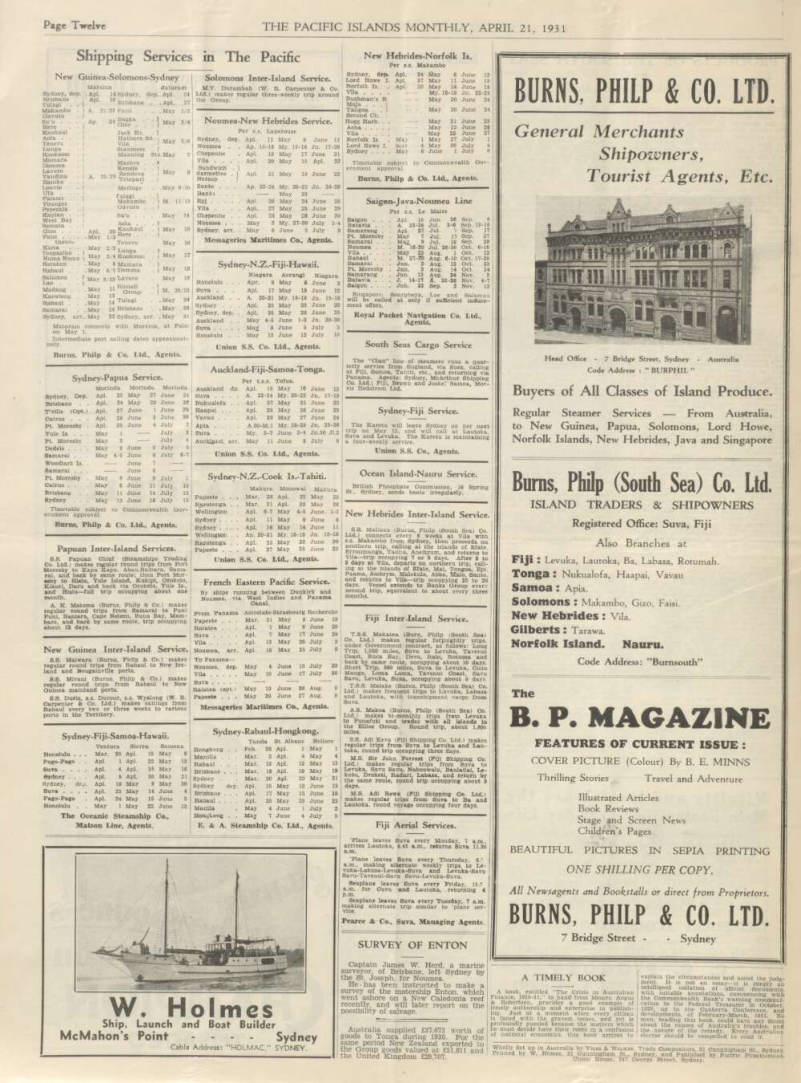
New Guinea-Solomons-Sydney
Sydney-Papua Service.
Papuan Inter-Island Services.
S.S. Papuan Chief (Steamships Trading Co. Ltd.) makes regular round trips from Port Moresby to Kapa Kapa. Abau.Baibara, Sama rai, and back by same route; then Port Mor esby to Hisiu, Yule Island, Kukipi, Orokolo, Kikori, Daru and back via Orokolo, Yule Is., and Hisiu —full trip occupying about one month.
A. K. Matoma (Burns, Philp & Co.) makes regular round trips from Samarai to Puni Puni, Baniara, Cape Nelson, Buna Bay, Mam bare, and back by same route, trip occupying about 12 days.
New Guinea Inter-Island Service.
S.S. Maiwara (Burns, Philp & Co.) makes regular round trips from Rabaul to New Ire land and Bougainville ports.
S.S. Mirani (Burns, Philp & Co.) makes regular round trips from Rabaul to New Guinea mainland ports.
S.S. Duris, s.s. Durour, s.s. Wyalong (W. R.
Carpenter & Co. Ltd.) makes sailings from Rabaul every two or three weeks to various ports In the Territory.
Sydney-Fiji-Samoa-Hawaii.
Solomons Inter-Island Service.
M.V. Durambah (W. R. Carpenter & Co.
Ltd.) makes regular three-weekly trip around the Group.
Noumea-New Hebrides Service.
Sydney-N.Z.-Fiji-Hawaii.
Auckland-Fiji-Samoa-Tonga.
Sydney-N.Z.-Cook Is.-Tahiti.
French Eastern Pacific Service.
By ships running between Dunkirk and Noumea, via West Indies and Panama Canal.
Sydney-Rabaul-Hongkong.
New Hebrides-Norfolk Is.
Saigon-Java-Noumea Line
Singapore, Sourabaya, Lae and Salamoa will be called at only if sufficient induce ment offers.
Royal Packet Navigation Co. Ltd.,
Agents,
South Seas Cargo Service
The “Clan” line of steamers runs a quar terly service from England, via Suez, calling at Fiji, Samoa, Tahiti, etc., and returning via Panama. Agents: Sydney, McArthur Shipping Co. Ltd.; Fiji, Brown and Joske; Samoa, Mor ris Hedstrom Ltd.
Sydney-Fiji Service.
The Karetu will leave Sydney on her next trip on May 12, and will call at Lautoka, Suva and Levuka. The Karetu is maintaining a four-weekly service.
Union S.S. Co., Agents.
Ocean Island-Nauru Service.
British Phosphate Commission, 16 Spring St., Sydney, sends boats irregularly.
New Hebrides Inter-Island Service.
S.S. Malinoa (Burns, Philp (South Sea) Co.
Ltd.) connects every 6 weeks at Vila with s.s. Makambo from Sydney, then proceeds on southern trip, calling at the islands of Efate.
Erronmanga, Tanna, Aneityum, and returns to Vila —trip occupying 7 or 8 days. After 2 to 3 days at Vila, departs on. northern trip, call ing at the islands of Efate, Mai, Tongoa, Epi.
Paama, Ambrym, Malekula, Abba, Halo, Santo, and returns to Vila—trip occupying 25 to 28 days. Vessel extends to Banks Group everv second trip, equivalent to about every three months.
Fiji Inter-Island Service.
T.S.S. Makatea (Burn, Philp (South Sea) Co. Ltd.) makes regular fortnightly trips, under Government contract, as follows: Long Trip, 1,050 miles, Suva to Levuka, Tavenui Coast, Buca Bay, Devo, Rabi, Rotuma and back by same route, occupying about 10 days.
Short Trip, 560 miles, Suva to Levuka, Cicia Mango, Lotna Loma, Tavenui Coast, Savu Savu, Levuka, Suva, occupying about 9 days T.S.S. Malake (Burns, Philp (South Sea) Co.
Ltd.) makes frequent trips to Luvuka, Labasa and Lautoka, with transhipment cargo from Suva.
A.S. Makoa (Burns, Philp (South Sea) Co.
Ltd.) makes bi-monthly trips from Levuka to Funafuti and trades with all islands in the Ellice Group. Round trip, about 1,800 miles.
S.S. Adi Keva (Fiji Shipping Co. Ltd.) makes regular trips from Suva to Levuka and Lau toka, round trip occupying three days.
M.S. Sir John Forrest (Fiji Shipping Co.
Ltd.) makes regular trips from Suva to Levuka, Savu Savu, Nabouwalu, Baulailai, Le kutu, Dreketi, Raduri, Labasa, and return by the same route, round trip occupying about 9 days.
M.S. Adi Rewa (Fiji Shipping Co. Ltd.) makes regular trips from Suva to Ba and Lautoka. round voyage occupying four days.
Fiji Aerial Services.
’Plane leaves Suva every Monday, 7 a.m., arrives Lautoka, 8.45 a.m., returns Suva 11.30 a.m. ’Plane leaves Suva every Thursday, 6.r a.m., making alternate weekly trips to Le vuka-Labusa-Levuka-Suva and Levuka-Savu Savu-Tavenui-Savu Savu-Levuka-Suva.
Seaplane leaves Suva every Friday, 10.? a.m. for Ouvu and Lautoka, returning 4 p.m.
Seaplane leaves Suva every Tuesday, 7 a.m. making alternate trip similar to ’plane ser vice.
Pearce & Co., Suva, Managing Agents.
Marsina tlataram Sydney, dep Apl. 14 Sydney, dep.. Apl. 24 Brisbane .
Tulagi . .
Apl.
Brisbane . . Apl. 27 Makambo .
A. 21/23 Faisi . . . -May 1/2 Gavutu Su’u . . .
Here Ap. 24 Bagga .
Gizo . .
May
3/4 Kaukaul Jack Hr.
Aola . . .
Hathorn Sd. i .. 5/6 Teneru . .
Vila . . may Lunga .
Stanmore Kookoom Manning Sts. May 7 Mamara Domma Lavoro Yandina Banika Marovo .
Kenelo . * OH/9Q Rendova A. 25/29 Tetepari
‘ [ May
8 Loavio Meringe . .May 9/10 Ufa Paiami .
Younger Pepesala Tulagi Makambo Gavutu . ’. M, 11/13 Kaylan . .
Su’u . . . . May 14 West Bay .
Aola . . „„ Kaukaul • 1 May Somata . .
Gizo . . - Apl. 15 Faisi . . .
May thence Teneru May 16 Kieta . .
Teopasino .
Numa Numa May May 23 Lunga 3/4 Kookoom
( May
17 Soraken . .
May 4 Mamara 18 Rabaul . .
May 6/7 Domma .
) May
Salamoa Lae . . .
Madang . .
May 9/10 Lavoro . . May 19 May Russell ' j M. 20/23 Kaewleng ...
Rabaul . .
May May 13 Group 14 Tulagi . . . May 24 Samarai May 16 Brisbane '. . May 29 Sydney, arr.
May 22 Sydney, arr. . May 31 Matarain connects with Marsina, at Faisi on May 1.
Intermediate port sailing dates approximate only.
Burns.
Philp
& Co. Ltd.,
Agents.
Per s.s.
Laperouse Sydney, dep.
Apl. 11 May 9 June 13 Noumea .
Ap. 15 -18 My. 13- 16 Jn. 17 -20 Chepenhe Apl, 19 May 17 June 21 Vila ...
Apl. 20 May 18 Apl. 22 Sandwich . 1 Sarmettes . 1 Apl. 21 May 19 June 22
Norsup . .
Santo . . .
Ap. 22 -24 My. 20- •22 Jn. 24-26 Banks ...
May 23 Epi Apl. 26 May 24 June 28 Vila . . . , Apl. 27 May 25 June 29 Chepenhe . .
Apl. 28 May 26 June 30 Noumea . . .
May 2 My. 27-30 July 1-4 Sydney, arr. .
May 6 June 3 July 8 Messageries Maritimes Co.
Agents.
Niagara Aorangi Niagara Honolulu . . .
Apr. 8 May 6 June 3 Suva . , .
Apl. 17 May 15 June 12 Auckland . .
A. 20 -21 My. : 18-19 Jn. 15 -16 Sydney . . .
Apl. 25 May 23 June 20 Sydney, dep. .
Apl. 30 May 28 June 25 Auckland . .
May 4-5 June 1-2 Jn. 29 -30 Suva May 8 June 5 July 3 Honolulu . .
May 15 June 12 July 10 Union
S.S. Co. Ltd.,
Agents.
Per t.s.s.
Tofua.
Auckland dp.
Apl. 18 May 16 June 13 Suva . .
A. 22-24 My. 20-22 Jn. 17 -19 Nukualofa Apl. 27 May 25 June 22 Haapai .
Apl. 28 May 26 June 23 Vavau . .
Apl. 29 May 27 June 24 Apia . .
A.30-M.1 My. 28-29 Jn. 25 -26 Suva , .
My. 5-7 June 2-4 Jn.30 J1.2 Auckland, arr.
May 11 June 8 July 6 Union
S.S. Co. Ltd., Agents.
Per s.s.
Makambo Sydney, dejx Apl. 24 May 8 June 12 Lord Howe I.
Apl. 27 Mav 11 June 15 Norfolk Is.
Apl. 30 May 14 June 18 Vila . . . .
My. 18 -19 Jn. 22 -23 Bushman's B, May 20 June 24 Malo . . . 1 Tangoa . .
May 20 June 24 Second Ch. i Hogg Harb. . .
May 21 June 25 Aoba May 22 June 26 Vila May 23 June 27 Norfolk Is.
May 1 May 27 July 1 Lord Howe I.
May 4 May 30 July 4 Sydney . . . .
May 6 June 1 July 6 Timetable subject to Commonwealth Goveminent approval.
Bums, Philp &
Co
. Ltd.,
Agents.
Per s.s.
Le Maire Saigon . . . Apl. 15 Jun. 26 Sep. 6 Batavia . . . A. 23 26 Jul. 3 -6 Sep. 13-16 Samarang . . Apl. 27 Jul. 7 Sep. 17 Pt. Moresby . May 7 Jul. 17 Sep. 27 Samara! . . . Mav 9 Jul. 19 Sep. 29 Noumea . . . M. 16 -20 Jul. 26 -30 Oct. 6-10 Vila ... . May 22 Aug.
I Oct. 12 Rabaul . . . M. 27 - 30 Aug. 6 -10 Oct. 17-20 Samarai . . . Jun. 2 Aug. 13 Oct. 23 Pt. Moresby . Jun. 3 Aug. 14 Oct. 24 Samarang . . Jun. 13 Aug. 24 Nov. 3 Batavia . . . J. 14- 17 A. 25- 38 Nov. 4-7 Saigon . . . . Jun. 22 Scp. 2 Nov. 12
Morinda Morinda Morinda Sydney, Dep.
Apl. 22 May 27 June 24 Brisbane . .
Apl. 24 May 29 June 26 T’yille (Opt.) Apl. 27 June 1 June 29 Cairns . . .
Apl. 28 June 2 June 30 Pt. Moresby .
Apl. 30 June 4 July 2 Yule Is. . . .
May X July 3 Pt. Moresby .
May 2 July 4 Dedele ...
May 3 June 5 July 5 Samarai . . .
May 4-5 June 6 July 6-7 Woodlark Is. .
June 7 Samarai . . .
June 8 Pt. Moresby May 6 June 9 July C Cairns ...
May 8 June 11 July 10 Brisbane . .
May 11 June 14 July 13 Sydney . . .
May 13 June 16 July 15 Timetable subject to Commonwealth Gov eminent approval.
Burns, Philp & Co. Ltd., Agents.
Ventura Sierra Sonoma Honolulu . . , Mar. 25 Apl. 15 May 6 Pago-Pago . . Apl. 1 Apl. 22 May 13 Suva . . . . Apl. 4 Apl. 25 May 16 Sydney . . . . Apl. 9 Apl. 30 May 21 Sydney, dep. Apl. 18 May 9 May 30 Suva . . . . Apl. 23 May 14 June 4 Pago-Pago . Apl. 24 May 15 June 5 Honolulu . . May 1 May 22 June 12
The
Oceanic
Steamship
Co.,
Matson Line, Agents.
Makura Monowai Makura Papeete . . , Mar. 28 Apl. 25 May 23 Rarotonga . , . Mar. 31 Apl. 28 May 26 Wellington . . Apl. 6-7 May 4-5 June. 1-2 Sydney . . . . , Apl. 11 May 9 June 6 Sydney . . . .
Apl. 16 May 14 June 11 Wellington . , Ap. 20-21 My. 18-19 Jn. 15 -16 Rarotonga .
Apl. 25 May 23 June 20 Papeete . . .
Apl. 27 May 25 June 22 Union S.S. Co. Ltd.,
Agents.
Prom Panama Astrolabe Strasbourg Recherche Papeete . . .
Mar. 31 May 8 June 19 Ralatea . . .
Apl. 1 May 9 June 20 Suva ...
Apl. 7 May 17 June 29 Vila Apl. 13 May 20 July 3 Noumea, arr.
Apl. 18 May 25 July 8 To Panama — Noumea, dep.
May 4 June 10 July 23 Vila May 10 June 17 July 30 Suva Raiatea (opt.) May 19 June 26 Aug. 8 Papeete . . .
May 20 June 27 Aug. 9 Messageries Maritimes Co., Agents.
Tanda St. Albans Nellore Hongkong . . Feb. 28 Apl. 1 May i Manilla . . . Mar. 3 Apl. 4 May 4 Rabaul . . . Mar. 12 Apl. 13 May 13 Brisbane . . . Mar. 18 Apl. 19 May 19 Sydney . . . Mar, 20 Apl. 22 May 21 Sydney dep. Apl. 15 May 13 June 13 Brisbane . . . Apl. 17 May 15 June 15 Kabaul . . , . . Apl. 25 May 23 June 23 Manila . May 4 June 1 July 2 Hongkong . . May 7 June 4 July 5 E. & A. Steamship Co. Ltd., Agents.
Survey Of Enton
Captain James W. Herd, a marine surveyor, of Brisbane, left Sydney by the St. Joseph, for Noumea.
He has been instructed to make a survey of the motorship Enton, which went ashore on a New Caledonia reef recently, and will later report on the possibility of salvage.
Australia supplied £37,672 worth of goods to Tonga during 1930. For the same period New Zealand exported to the Group goods valued at £51,811 and the United Kingdom £29,707.
A Timely Book
A book, entitled “The Crisis in Australian Finance, 1929-31,” to hand from Messrs. Angus & Robertson, provides a good example of timely authorship and enterprise in publish ing. Just at a moment when every citizen is faced with the gravest issues, and yet is profoundly puzzled because the matters which he must decide have their roots in a confusion of national economics, this book arrives to
explain the circumstances and assist the judg ment. It is not an essay—it is simply an intelligent collation of official documents, with suitable annotations, commencing with the Commonwealth Bank’s warning communi cation to the Federal Treasurer in October 1929 up to the Canberra Conference, and developments, of Pebruary-March, 1931. No man, reading this book, could have any doubt about the causes of Australia’s troubles, and the nature of the remedy. Every Australian elector should be compelled to read it.
Advertisements & other items, p. 12 (3 items)
The Pacific Islands Monthly, April 21, 1931
12
Wholly Set up m Australia by Viles & Walker, Trade Compositors, 31 Cunningham St Svdnev Printed by W. Homer, 31 Cunningham St., Sydney, and Published by Pacific Publications’
Union House, 247 George Street, Sydney.
Burns, Philp & Co. Ltd.
General Merchants
Shipowners,
Tourist Agents, Etc.
Head Office - 7 Bridge Street, Sydney - Australia Code Address : " BURPHIL ”
Buyers of All Classes of Island Produce.
Regular Steamer Services From Australia, to New Guinea, Papua, Solomons, Lord Howe, Norfolk Islands, New Hebrides, Java and Singapore
Bums, Philp (South Sea) Co. Ltd.
ISLAND TRADERS & SHIPOWNERS
Registered Office: Suva, Fiji Also Branches at Fiji : Levuka, Lautoka, Ba, Labasa, Rotumah.
Tonga : Nukualofa, Haapai, Vavau Samoa : Apia.
Solomons : Makambo, Gizo, Faisi.
New Hebrides : Vila.
Gilberts : Tarawa.
Norfolk Island. Nauru.
Code Address: "Burnsouth”
The
B. P. MAGAZINE
FEATURES OF CURRENT ISSUE :
COVER PICTURE (Colour) By B. E. MINNS Thrilling Stories Travel and Adventure Illustrated Articles Book Reviews Stage and Screen News Children’s Pages
BEAUTIFUL PICTURES IN SEPIA PRINTING
ONE SHILLING PER COPY.
All Newsagents and Bookstalls or direct from Proprietors.
BURNS, PHILP & CO. LTD.
7 Bridge Street - - Sydney
W. Holmes
Ship, Launch and Boat- Builder McMahon’s Point* - Sydney Cable Address: “HOLMAC,” SYDNEY.