THE Pacific Islands
Monthly
THE ONLY JOURNAL CIRCULATING THROUGHOUT THE ISLAND TERRITORIES AND GROUPS
Of The Central And South Pacific.
Vol. 1—No. 7
Registered at G.P.O., Sydney, for transmission by Post as a Newspaper
Sydney; Friday, February 20, 1931
Per Annum, posted, 6/-.
Single Copy, 6d. ———
Solid Fiji
Exports Exceed Imports
A Fijian’S Word Of Advice
“Fiji is absolutely solid. Our assets are above our liabilities and we practically have no debt. Our exports are far ahead of our imports.”
IN this brief but convincing manner, Mr. Thomas Horne, managing director of Messrs. W. Horne and Co. Ltd., of Suva, and a vice-president of the Suva Chamber of Commerce, described the present economic position of Fiji, in a recent interview. And, just to give a little more force to his remarks, he added, “And don’t forget, the Fiji £1 banknote is worth the full 20 shillings.”
Mr. Horne arrived in Sydney last month, coming South for health reasons. His many friends throughout the Colony will be pleased to know that he has recuperated and plans to return to Suva in March.
Fijians Are Fortunate
Mr. Horne related a most interesting story to show how the Fijian native views the present world-wide slump.
“A Fijian asked a Government official why the price of copra was so low, and the official referred him to me for an explanation. I told the native that there was over-production of nearly every commodity. There was more sugar than the world required, more copra, more coffee, more tea. The result was that prices of produce were low and this caused much unemployment and poverty. There was no chance of copra going up for some time.
“The old Fijian, who is 85 years of age—but who can still husk a coconut with his teeth —thanked me for the information.
“Addressing the assembled natives this old man said: “ ‘This is an object lesson to all you young people here. The island is ours and no one can take it away from us.
My advice to you is to plant up and produce yams, taros, bananas and coconuts. If you have not enough food to keep you going while your plantation is growing, you can live on the products of the bush. You have a sea all round you where you can catch fish. You can raise poultry and pigs.
If the worst comes to the worst and you have no money, do as your forefathers did and make your clothes out of bark. After what Mr. Horne has told us, we are better off in Fiji than anywhere else in the world.” ———
Fiji Mining Company
Mount Kasi Mining Co. (No Liability) has been registered in Sydney with a capital of £15,000 in 100,000 shares of 3/- each.
The first place of intended operations is the island of Vanua Levu, Fiji.
Intending subscribers are: E. J.
Whitehead, A. E. Brown, W. Mitchell.
C. T. Griffiths, T. L. Stark, I. B. Brown and T. G. Peek. ———
Search For Oil
———♦——— Prospects in New Guinea Dr. Woolnough’s Report
From Our Canberra Correspondent CANBERRA, February 14.
THE Minister for Home Affairs, Mr.
Blakeley, has received a voluminous report from Dr. W. G. Woolnough,
Commonwealth Geologist, who recently returned from a trip abroad.
Dr. Woolnough’s mission was to inquire into the most up-to-date methods of prospecting for oil, and most of his time was spent in America. He has returned hopeful that oil will be found in Australia.
So far as Papua and the Mandated Territory of New Guinea are concerned, Dr. Woolnough has never entertained any doubts about the existence of oil there, but one trouble has been that the mud-stone formation of the country, where bores have been put down, has militated against successful work. Possibly better results will be obtained in future.
For a considerable time the Commonwealth Government was financing operations in Papua, which were being jointly conducted by Commonwealth and Anglo-Persian Oil officials, but, owing to the financial stringency, it was compelled some time ago to restrict its operations, and at present they are practically at a standstill.
Generally speaking, it seems more likely that oil will be discovered in payable quantities in Papua or the Mandated Territory before such a discovery is made in Australia. It is said that the Anglo-Persian Company holds this view, and it will be interesting to see what Dr. Woolnough has to say about it in his report. ———
Dr. W. G. Woolnough
Chinese Commissioner To Visit
Pacific Islands
Mr. Yu Chuen Hsien, special commissioner from the National Government of China, arrived in Sydney on January 30.
He has been sent to investigate the affairs of overseas Chinese and to supervise and direct the Fourth Conference of the Australasia and South Pacific Kuo Min Tang (Chinese Nationalist Party) branches.
If time permits, he intends visiting the South Sea Islands. ——— The number of vessels which entered and cleared Papuan ports during 1928- 29 was 171. Of that number, 162 were British owned. The total tonnage was 184,946. ———
Acting-Administrator
Of Nauru
———♦——— Mr. Gabels’ Appointment
From Our Canberra Correspondent MR. CARL GABEL, who has been appointed Acting-Administrator of Nauru, left for the islands by the S.S.
Clydebank.
He will remain at Nauru for three months during the absence on leave of the Administrator, Mr. W. A. Newman, who is spending a holiday in Australia.
Mr. Gabel has acted as private secretary to Mr. Beasley ever since the latter assumed office as an Assistant Minister in the Scullin Government.
During Mr. Gabel’s absence, Mr. J.
L. Mulrooney will act as private secretary to Mr. Beasley. ———
Bee Culture
In Gilbert and Ellice Groups
AS the Mexican bee has been found to thrive in the Gilbert and Ellice Islands, steps are being taken there to carry out experiments in apiculture on a large scale.
The last annual report of the Colony, for the year ended June, 1929, states that the expenditure of a few hundred pounds each year in this direction would be justified by the great possibilities which might lie in the establishment of a beeswax industry. ———
Mining In N. Guinea
———♦——— Inquiry Into Conditions
From Our Canberra Correspondent CANBERRA, February 14.
THE Commonwealth Government recently appointed Mr. H. S. King, formerly Under Secretary for Mines in Western Australia, to visit New Guinea and report on the mining conditions there.
Mr. King was expected to arrive at Rabaul on February 5. His inquiries will probably occupy a couple of months. ——— Copra exported from the Gilbert and Ellice Islands during 1928-29 totalled 4,122 tons and was valued at £55,657.
For the previous twelve months 4,698 tons were exported and the value was £64,833. ———
Tropical Mankind’S Great Foe
———♦——— The History of Malaria Fever Some Hints for its Prevention and Treatment
Specially written for The Pacific Islands Monthly by two tropical practitioners MALARIA is such a common, homely sort of an occurrence in the routine of tropical life that very little notice is taken of it.
So frequently does it obtrude that we come to regard an attack —especially in the other fellow—as a "touch of fever,” and many a conscientious planter or official struggles on with his work simply because it is not considered playing the game to give way to it
too easily.
This is an error which is paid for rather dearly, for malaria is one of tropical mankind’s greatest foes.
LOOK at malaria’s record; delve into history and you will find that it has been blamed as one cause of the downfall of the Roman Empire, and it always in the past has been a deterrent to the work of civilisation in the tropics. The ambition of the French to cut the Panama Canal was frustrated by malaria; early efforts at mining in Papua were held back by its malign influence; one might even say that the British lost Sumatra largely on account of its heavy toll on officials at Bencoolen.
If that’s not making, or rather mismaking, history, well, what is?
Even at the present day the position is not much better.
Dr. Torrance, in his interesting book, “Tracking down the Enemies of Man,” states that: “Female mosquitoes cause a greater number of deaths every year than the number of citizens brought into the world by the mothers of any of the great nations. This is a startling statement, but facts bear it out. Actual records show that these insects kill two million people a year, . . .”
Anybody with experience of the disease could believe such figures.
For instance, about two years ago the natives in a little village in Torres Straits, where malaria is by no means common, were attacked almost to a man and many deaths resulted. Lawrence Hope knew what she was talking about when she described malaria’s “Gifts: Death and Delirium.”
Investigations By
Herodotus.
The story of the investigations into malaria fever, which have now brought us to a very complete understanding of the disease, reads like a romance.
It started in a very early stage of the
world’s history with a remarkably accurate description of the disease by Herodotus in the fifth century B.C.
In the Middle Ages our knowledge did not advance, in fact, that was a period of the world’s history when nothing advanced, but in 1640 we read of two doctors, Morton and Torti, first using Cinchona (quinine) in the treatment of ague. That was a step forward, a discovery worthy of being emblazoned on the records of the world’s progress, and yet, outside of academical circles, who has ever heard of the names of these benefactors of humanity?
In 1880 the French doctor, Laveran, discovered the parasitic nature of malaria and demonstrated the various forms of the parasite found within the blood corpuscles of the victims of the disease. But these forms only constitute one stage in the life history of the parasite, and the germ requires another host than Man for the completion of its cycle.
It is to two great Englishmen that we owe the final solution of how we catch malaria Sir Patrick Manson and Sir Ronald Ross. The great Manson, working patiently in his laboratory in Amoy, China, conceived the idea that the mosquito would be found to be the causative agent in malaria, and he handed on his theory to his young colleague, who finally solved the problem of mosquito transmission. His experiments were confirmed by Samborn and Low at the London School of Tropical Medicine. We believe that Dr.
Low practised in the Pacific, and some of those who read this little article may have made his acquaintance.
How Infection Takes Place.
Let us briefly summarise the process of mosquito infection, remembering that it is the female that causes the disease, the male being a poor, harmless sort of crank who lives upon fruit juices only: “In 1900 the tropical colonies of England, Holland, France, Germany, Italy and America were danger zones for white men. The mosquito had absolute right of way and worked as they still do whenever the opportunity is given them. The female blood-suckers gorge themselves with human blood, at the same time sucking into their bodies young germs that patiently swim in the blood, waiting for transference to their new home.
Then, after a few days, these same females hunt up a new victim, suck out a meal of blood, and for payment pump into the blood stream mature and dangerously developed malaria germs, each of which at once takes possession of a red blood cell. In this cell the parasite lives and multiplies into a family, in the process destroying the blood cell thousands and thousands of parasites develop and destroy enormous numbers of blood cells. The effect of this on the human victim is soon strikingly shown. After a number of days, approximately twelve, this causes periodic fevers, anaemia, a large spleen and numerous other conditions, producing less of vitality and weaken ing the body, leading to prostration and possibly death.”—Torrance.
In all respects but one the identification of the offending Anopheles mos-
(Continued On Page 2)
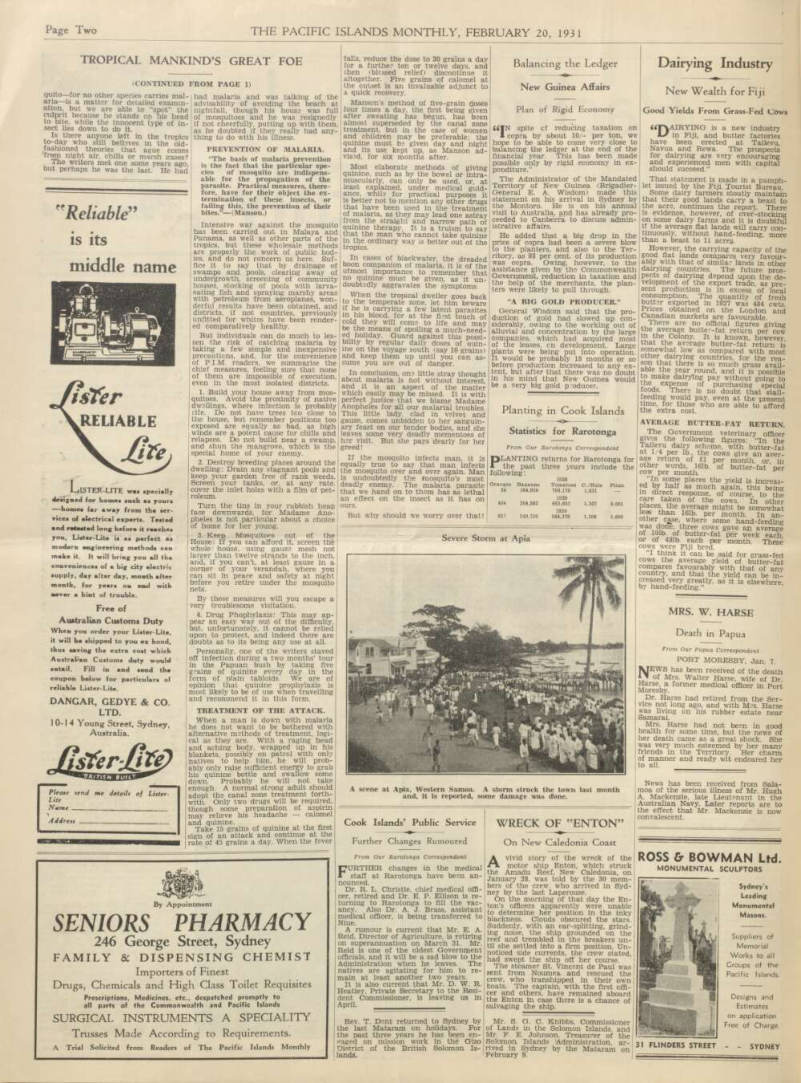
A mangrove swamp in New Guinea. As told in the accompanying article, places like this are the favourite homes of the Anopheles mosquito. ———
aria—is a matter for detailed examination, but we are able to “spot” the culprit because he stands on his head to bite, while the innocent type of insect lies down to do it.
Is there anyone left in the tropics to-day who still believes in the old fashioned theories that ague comes from night air, chills or marsh gases?
The writers met one some years ago, but perhaps he was the last. He had
had malaria and was talking of the advisability of avoiding the beach at nightfall, though his house was full of mosquitoes and he was resignedly if not cheerfully, putting up with them, as he doubted if they really had any thing to do with his illness.
Prevention Of Malaria.
“The basis of malaria prevention is the fact that the particular species of mosquito are indispensable for the propagation of the parasite. Practical measures, there fore, have for their object the extermination of these insects, or failing this, the prevention of their bites.” — (Manson.) Intensive war against the mosquito has been carried out in Malaya and Panama, as well as other parts of the tropics, but these wholesale methods are properly the work of public bodies, and do not concern us here. Suffice it to say that by drainage of swamps and pools, clearing away of undergrowth, screening of community houses, stocking of pools with larva eating fish and spraying marshy areas with petroleum from aeroplanes, wonderful results have been obtained, and districts, if not countries, previously unfitted for whites have been rendered comparatively healthy.
But individuals can do much to lessen the risk of catching malaria by taking a few simple and inexpensive precautions, and, for the convenience of P.I.M. readers, we summarise the chief measures, feeling sure that none of them are impossible of execution, even in the most isolated districts. 1. Build your house away from mosquitoes. Avoid the proximity of native dwellings, where infection is probably rife. Do not have trees too close to the house, but remember positions too exposed are equally as bad, as high winds are a potent cause for chills and relapses. Do not build near a swamp, and shun the mangrove, which is the special home of your enemy. 2. Destroy breeding places around the dwelling: Drain any stagnant pools and keep your garden free of rank weeds.
Screen your tanks, or, at any rate, cover the inlet holes with a film of petroleum.
Turn the tins in your rubbish heap face downwards, for Madame Anopheles is not particular about a choice of home for her young. 3. Keep Mosquitoes out of the House: If you can afford it, screen the whole house, using gauze mesh not larger than twelve strands to the inch, and, if you can’t, at least gauze in a corner of your verandah, where you can sit in peace and safety at night before you retire under the mosquito nets.
By these measures will you escape a very troublesome visitation. 4. Drug Phophylaxis: This may appear an easy way out of the difficulty, but, unfortunately, if cannot be relied upon to protect, and indeed there are doubts as to its being any use at all.
Personally, one of the writers staved off infection during a two months’ tour in the Papuan bush by taking five grains of quinine every day in the form of plain tabloids. We are of opinion that quinine prophylaxis is most likely to be of use when travelling and recommend it in this form.
Treatment Of The Attack.
When a man is down with malaria he does not want to be bothered with alternative methods of treatment, logical as they are. With a raging head and aching body, wrapped up in his blankets, possibly on patrol with only natives to help him, he will probably only raise sufficient energy to grab his quinine bottle and swallow some down. Probably he will not take enough. A normal strong adult should adopt the canal zone treatment forth with. Only two drugs will be required, though some preparation of aspirin may relieve his headache — calomel and quinine.
Take 15 grains of quinine at the first sign of an attack and continue at the rate of 45 grains a day. When the fever
falls, reduce the dose to 30 grains a day for a further ten or twelve days, and then (blessed relief) discontinue altogether. Five grains of calomel at the outset is an invaluable adjunct to a quick recovery.
Manson’s method of five-grain doses four times a day, the first being given after sweating has begun, has been almost superseded by the canal zone treatment, but in the case of women and children may be preferable; the quinine must be given day and night and its use kept up, as Manson advised, for six months after.
Most elaborate methods of giving quinine, such as by the bowel or intramuscularly, can only be used, or, at least explained, under medical guidance, while for practical purposes it is better not to mention any other drugs that have been used in the treatment of malaria, as they may lead one astray from the straight and narrow path of quinine therapy. It is a truism to say that the man who cannot take quinine in the ordinary way is better out of the tropics.
In cases of blackwater, the dreaded boon companion of malaria, it is of the utmost importance to remember that no quinine must be given, as it undoubtedly aggravates the symptoms.
When the tropical dweller goes back to the temperate zone, let him beware if he is carrying a few latent parasites in his blood, for at the first touch of cold they will come to life and may be the means of spoiling a much-needed holiday. Guard against this possibility by regular daily doses of quinine on the voyage south (say 10 grains) and keep them up until you can assume you are out of danger.
In conclusion, ons little stray thought about malaria is not without interest, and it is an aspect of the matter which easily may be missed. It is with perfect justice that we blame Madame Anopheles for all our malarial troubles.
This little lady, clad in velvet and gauze, comes unbidden to her sanguinary feast on our tender bodies, and she leaves some very deadly mementoes of her visit. But she pays dearly for her greed!
If the mosquito infects man, it is equally true to say that man infects the mosquito over and over again. Man is undoubtedly the mosquito’s most deadly enemy. The malaria parasite that we hand on to them has as lethal an effect on the insect as it has on ours.
But why should we worry over that! ———
Advertisements & other items, p. 1 (1 item)
Copra
SPECIAL ARTICLES ON
A careful investigation of the Copra Market was made by the editor of The Pacific Islands Monthly (Mr. R. W. Robson) during his visit to London in January. He obtained a great deal of valuable data from men in England, Germany, Holland and Ceylon, who have made a lifelong study of the production and treatment of Oil Seeds of all kinds, more particularly in relation to the Copra Industry.
The result of this inquiry which, it is hoped, will be of assistance to South Seas planters in their present difficult situation, will be published in a series of articles in this journal, commencing in the March issue.
The articles will explain some of the causes of the present depression and will give particular attention to the the probable future of the Copra Industry.
Those who are not regular subscribers to this journal should make certain of obtaining this useful information by immediately sending in their order for the paper.
Balancing the Ledger
———♦——— New Guinea Affairs Plan of Rigid Economy
" IN spite of reducing taxation on copra by about 10/- per ton, we hope to be able to come very close to balancing the ledger at the end of the financial year. This has been made possible only by rigid economy in expenditure.”
The Administrator of the Mandated Territory of New Guinea (Brigadier- General E. A. Wisdom) made this statement on his arrival in Sydney by the Montoro. He is on his annual visit to Australia, and has already proceeded to Canberra to discuss administrative affairs.
He added that a big drop in the price of copra had been a severe blow to the planters, and also to the Territory, as 93 per cent, of its production was copra. Owing, however, to the assistance given by the Commonwealth Government, reduction in taxation and the help of the merchants, the plan ters were likely to pull through.
“A Big Gold Producer.”
General Wisdom said that the production of gold had slowed up considerably, owing to the working out of alluvial and concentration by the large companies, which had acquired most of the leases, on development. Large plants were being put into operation.
It would be probably 18 months or so before production increased to any extent, but after that there was no doubt in his mind that New Guinea would be a very big gold producer. ———
Planting in Cook Islands
———♦——— Statistics for Rarotonga
From Our Rarotonga Correspondent PLANTING returns for Rarotonga for the past three years include the following: ... 1928 Oranges . Bananas . Tomatoes . C./Nuts . Pines ... 24 ... 164,850 ... 795,170 ... 1,831 ... — ... 1929 ... 404 ... 204,582 ... 653,693 ... 1,307 ... 8,001 ... 1930 ... 857 ... 240,736 ... 584,379 ... 1,308 ... 5,890 ———
Advertisements & other items, p. 2 (1 item)
Severe Storm at Apia ||
Severe Storm at Apia A scene at Apia, Western Samoa. A storm struck the town last month and, it is reported, some damage was done. ===
Cook Islands’ Public Service
———♦——— Further Changes Rumoured
From Our Rarotonga Correspondent FURTHER changes in the medical staff at Rarotonga have been announced.
Dr. R. L. Christie, chief medical officer, retired and Dr. E. P. Ellison is returning to Rarotonga to fill the vacancy. Also Dr. A. J. Brass, assistant medical officer, is being transferred to Niue.
A rumour is current that Mr. E. A.
Reid, Director of Agriculture, is retiring on superannuation on March 31. Mr.
Reid is one of the oldest Government officials, and it will be a sad blow to the Administration when he leaves. The natives are agitating for him to remain at least another two years.
It is also current that Mr. D. W. R.
Heatley, Private Secretary to the Resident Commissioner, is leaving us in April.
Rev. T. Dent returned to Sydney by the last Mataram on holidays. For the past three years he has been engaged on mission work in the Gizo District of the British Solomon Islands. ———
Wreck Of "Enton”
———♦——— On New Caledonia Coast
A vivid story of the wreck of the motor ship Enton, which struck the Amadu Reef, New Caledonia, on January 28, was told by the 30 members of the crew, who arrived in Sydney by the last Laperouse.
On the morning of that day the Enton’s officers apparently were unable to determine her position in the inky blackness. Clouds obscured the stars.
Suddenly, with an ear-splitting, grinding noise, the ship grounded on the reef and trembled in the breakers until she settled into a firm position. Unnoticed side currents, the crew stated, had swept the ship off her course.
The steamer St. Vincent de Paul was sent from Noumea and rescued the crew, who transhipped in their own boats. The captain, with the first officer and others, have remained aboard the Enton in case there is a chance of salvaging the ship. ... === Mr. S. G. C. Knibbs, Commissioner of Lands in the Solomon Islands, and Mr. F. E. Johnson, Treasurer of the Solomon Islands Administration, arrived in Sydney by the Mataram on February 9. ———
Dairying Industry
———♦——— New Wealth for Fiji Good Yields From Grass-Fed Cows
" DAIRYING is a new industry in Fiji, and butter factories have been erected at Tailevu, Navua and Rewa. The prospects for dairying are very encouraging and experienced men with capital should succeed.”
That statement is made in a pamphlet issued by the Fiji Tourist Bureau.
Some dairy farmers stoutly maintain that their good lands carry a beast to the acre, continues the report. There is evidence, however, of over-stocking on some dairy farms and it is doubtful if the average flat lands will carry continuously, without hand-feeding, more than a beast to 1½ acres.
However, the carrying capacity of the good flat lands compares very favourably with that of similar lands in other dairying countries. The future prospects of dairying depend upon the development of the export trade, as present production is in excess of local consumption. The quantity of fresh butter exported in 1927 was 484 cwts Prices obtained on the London and Canadian markets are favourable.
There are no official figures giving the average butter-fat return per cow the Colony. It is known, however that the average butter-fat return is somewhat low as compared with most other dairying countries, for the reathat there is so much grass available the year round, and it is possible to make dairying pay without going to the expense of purchasing special foods. There is no doubt that stall feeding would pay, even at the present time, for those who are able to afford the extra cost.
Average Butter-Fat Return.
The Government veterinary officer gives the following figures: “In the Tailevu dairy scheme, with butter-fat at 1/4 per lb., the cows give an average return of £1 per month, or, in other words, 16lb. of butter-fat per cow per month.
In some places the yield is increased by half as much again, this being in direct response, of course, to the care taken of the cows. In other places, the average might be somewhat less than 16lb. per month. In another case, where some hand-feeding was done, three cows gave an average of 10lb. of butter-fat per week each or of 43lb. each per month. These cows were Fiji bred.
“I think it can be said for grass-fed cows the average yield of butter-fat compares favourably with that of any country, and that the yield can be increased very greatly, as it is elsewhere,
by hand-feeding.”
Mrs. W. Harse
Death in Papua
From Our Papua Correspondent
Port Moresby, Jan. 7.
NEWS has been received of the death of Mrs. Walter Harse, wife of Dr Harse, a former medical officer in Port Moresby.
Dr. Harse had retired from the Service not long ago, and with Mrs. Harse was living on his rubber estate near Samarai.
Mrs. Harse had not been in good health for some time, but the news of her death came as a great shock. She was very much esteemed by her many friends in the Territory. Her charm of manner and ready wit endeared her to all. ... === News has been received from Salamoa of the serious illness of Mr. Hugh A. Mackenzie, late Lieutenant in the Australian Navy. Later reports are to the effect that Mr. Mackenzie is now convalescent.
Advertisements & other items, p. 2 (2 items)
Lister-Lite
"Reliable”
is its
middle name
Lister
RELIABLE
LISTER-LITE was specially designed for homes such as yours —homes far away from the services of electrical experts. Tested and retested long before it reaches you, Lister-Lite is as perfect as modern engineering methods can make it. It will bring you all the conveniences of a big city electric supply, day after day, month after month, for years on end with never a hint of trouble.
Free of Australian Customs Duty When you order your Lister-Lite, it will be shipped to you ex bond, thus saving the extra cost which Australian Customs duty would entail. Fill in and send the coupon below for particulars of reliable Lister-Lite.
DANGAR, GEDYE & CO.
LTD.
10-14 Young Street, Sydney,
Australia.
Lister-Lite
BRITISH BUILT
Please send me details of Lister- Lite Name Address ===
By Appointment
SENIORS PHARMACY
246 George Street, Sydney
FAMILY & DISPENSING CHEMIST
Importers of Finest Drugs, Chemicals and High Class Toilet Requisites Prescriptions, Medicines, etc., despatched promptly to all parts of the Commonwealth and Pacific Islands
SURGICAL INSTRUMENTS A SPECIALITY
Trusses Made According to Requirements.
A Trial Solicited from Readers of The Pacific Islands Monthly
Ross & Bowman Ltd
MONUMENTAL SCULPTORS
Sydney’s Leading Monumental Masons.
Suppliers of Memorial Works to all Croups of the Pacific Islands.
Designs and Estimates on application Free of Charge.
31 FLINDERS STREET - - SYDNEY
Cook Islands Notes
From Our Own Correspondent RAROTONGA, January 4.
THE Government schools closed up for the holidays just prior to the sail ing of last mail steamer, and the major ity of the European teachers sailed by that vessel on their yearly vacation in New Zealand. They will return by the Monowai on January 27.
The Resident Commissioner, accom panied by the Medical Officer and the Director of Agriculture, recently made an inspection of all villages in connec tion with the work being done by the “Au Vaine” (Women’s Committees). As a result of this inspection, the Silver Cup presented for the cleanest and best kept village was this year awarded to Arorangi.
A concert in aid of funds for the Rarotonga Sports Association was held recently and was most successful—the general opinion was expressed that the entertainment was one of the best of its kind seen here.
The horse races, which were to be held on New Year’s Day on the beach, were postponed until January 10, this being in order to allow the natives sufficient time to cut bananas for ex port by the steamer on January 5.
Administration Staff
Changes
Two changes in the Administration staff are taking place this boat. The Postmaster, Mr. E. C. Hardie, who has been 9 years in Rarotonga and is re turning to the N.Z. P. & T. Dept., is being replaced by Mr. W. H. Davis, of that Department The Matron, Miss G.
F. Sisley, who has had twelve years in Rarotonga and is returning to New Zealand, is being replaced by Miss T.
Butler, from the Niue staff.
A farewell party in the form of a Fancy Dress dance, was given to Mr and Mrs. Hardie at the “Bachelors Quarters” on the night of December 27 by the two inhabitants thereof and two young ladies —the whole signing them selves DEKGBMDWRHJBW. Over 50 Europeans were present and a most enjoyable evening was had by all.
Swept To Sea
Young Settler Drowned
From Our Norfolk Island Correspondent NORFOLK IS., January 16.
AVERY sad fatality has been re ported on Norfolk Island.
A young New Zealand settler named Wright went with a companion to gather small crabs for bait at the rocky base of the cliffs at Headstone.
The other man went home and Wright was to follow shortly. When 10 o’clock struck and there was no sign of him, “Bluey” Lloyd went back to look for him and found his fishing tackle, but nothing else. Wright had gone and no trace of him has been found, though search parties, both along the shore and round the coast in boats, have looked for him. The sea was heavy at the time, smashing in among the rocks and making a thorough search very difficult.
The deepest sympathy is felt for his father, who is on the island, and for his mother, two sisters and brother in New Zealand.
New Guinea News
Holiday Festivities Bonus on Copra E. & A. Service Inaugurated
From Our Own Correspondent
RABAUL, January 5.
CHRISTMAS festivities at Rabaul were marred by inclement weather, heavy rain falling on all days except Christmas Day.
The New Guinea Club, as usual, ar ranged a splendid entertainment for the local children, over 140 of whom attended the club on the afternoon of Christmas Eve. Most of the children came in fancy dress and, as they were attended by mothers and friends, the club premises, as well as the large marquee erected for the occasion, were crowded. The Administrator opened the proceedings with a speech to the children, after which presents were given to all by Father Christmas (Mr.
Jos. Holmes, the popular stores man
sufficient deterrent, and it would seem advisable for offenders to be sentenced to severe public floggings.
High Exchange Results In
Copra Bonus.
When advice was received in Rabaul of the rise in the exchange rate to £15/17/6 per cent., the Returned Sol diers’ Association (Rabaul Branch) promptly got in touch with the ex porting firms and asked that the whole of the increase be passed to the copra producers.
The firms have notified that an addi tional bonus of £1/2/6 per ton would be granted, and the prices now payable in Rabaul are London parity, less £5 per ton for Hot Air, £5/2/6 per ton for
Progress at Lae, New Guinea
ager of Carpenter & Co. Ltd.). Tea, followed by a Punch and Judy Show, completed the proceedings.
The Deutscher Club arranged a dance for members and their friends on Christmas Eve. The club premises were quite inadequate to cope with the number wishing to attend and the Re gent Theatre was used for the occasion.
The committee of this club lived up to its reputation and entertained nearly 200 people in great style.
Wunawutung Hotel, with every room booked some weeks ago, was the popular resort on Christmas Day. One hundred guests sat down to dinner, whilst it would appear that half of Rabaul migrated to this popular resort for the dance that followed.
It is exceedingly unfortunate that Boxing Day opened with heavy rain storms and that in consequence the race meeting arranged by the Kokopo Sports Club had to be postponed, also the race ball that was to take place in the evening at the Kokopo Hotel.
Race Meeting At Lukanai
A very successful meeting was held by the Rabaul Amateur Turf Club on New Year’s Day at their Lukanai Course on the outskirts of Rabaul. The attend ance was not up to that of former meetings, evidently a sign of the hard times, out the racing was good and the course benefiting by the rains that fell at Christmas, was in excel lent condition.
The principal event of the day was won by an outsider, Greta Boy, owned by Mr. Alan Puller, a popular mem ber of Burns, Philp’s staff. His Honour, the Administrator, presented the Wav efly Cup to Mr. Fuller at the conclusion of the races. Two of the keenest and strongest supporters of the Turf Club, Mr. V. B. Pennefather and Mr. J. Sa bine, each secured popular wins.
Assault On White Woman.
A lady visitor to Rabaul was vio lently assaulted recently by a native on the road to Namanula. She was badly hurt and suffering from shock, and had to receive treatment at Nam anula Hospital.
Her assailant was arrested, but for some inexplicable reason the lady re fused to make a charge or give evi dence, with the result that the native got off scot-free. In many cases here when white women are molested by natives, it is understandable that they are reluctant to give evidence in open court, but the present instance was, apparently, one of common assault, and it is regrettable that in the interests of the community that the lady did not allow the native to be tried and punished.
From Salamoa, there are disquieting reports of white women being molested and in spite of every precaution being taken by Government officials, it is reported the assaults continue.
It would appear that terms of im prisonment in “Calaboose” are not a
Sun Dried, and £6 per ton for Smoke Dried.
The Returned Soldiers’ Association have been very active in the interests of planters, the majority of whom are members, and allows no opportunities to pass to secure some advantage for the sorely pressed planter.
Death Of Mrs. W. G. Mitchell.
The death is reported of Mrs. Mit chell, wife of Mr. W. G. Mitchell, man ager for Burns, Philp & Co. Ltd., at Salamoa. Mrs. Mitchell was well known for her kindness and hospital ity at Salamoa to those passing through on their way to the goldfields. Mrs.
Mitchell was formerly resident in Papua, where her husband was stores superintendent for the New Guinea Copper Mines Ltd., at Bootless Inlet, Port Moresby, and her many friends in that Territory will grieve to learn of her death.
Tanda Visits Rabaul.
S.S. Tanda paid her first visit to Rabaul on December 16, thus inaugura te the new service of the E. & A. line. The arrival was celebrated by an official luncheon at which His Honour, the Administrator, a number of high Government officials and a few com mercial men to leaven the dough, were present.
As already reported, in announcing the calls of the E. & A. steamers to this port, the agents (Burns, Philp & Co. Ltd.) stated that it was not in tended to cater for freight and pas sengers to and from Australia. This course was relaxed on this occasion and it was stated that passengers would be carried at a fare of £28. As this announcement was only made a few hours before sailing, few were able to avail themselves of the opportunity, even if they were prepared to pay the high fare. Probably the concession was made as the Montoro had sailed on the previous day with more passen gers than berths; this means that some thirty odd passengers were accommo dated in the steerage, whilst a further number had to be content with shake downs in the public rooms.
The N.D.L. Co. have announced that passengers will be carried per S.S.
Bremerhaven to Hongkong for £20, in lieu of the charge of £36 formerly made.
Personal Items.
Mr. E. T. Brown, who has been a leading barrister and solicitor for many years, left by the last Montoro. Mr.
Brown has definitely retired from business and, we believe, intends to proceed to England on a prolonged holiday. Mr. Brown’s practice has been taken over by his partner, Mr. F. L Flannery.
Other travellers to Australia have been Mrs. H. O. Townsend, wife of the Treasurer. Dr. Sinclair of the Public Health Department, and Colonel Shil lington, Stipendiary Magistrate at Rabaul.
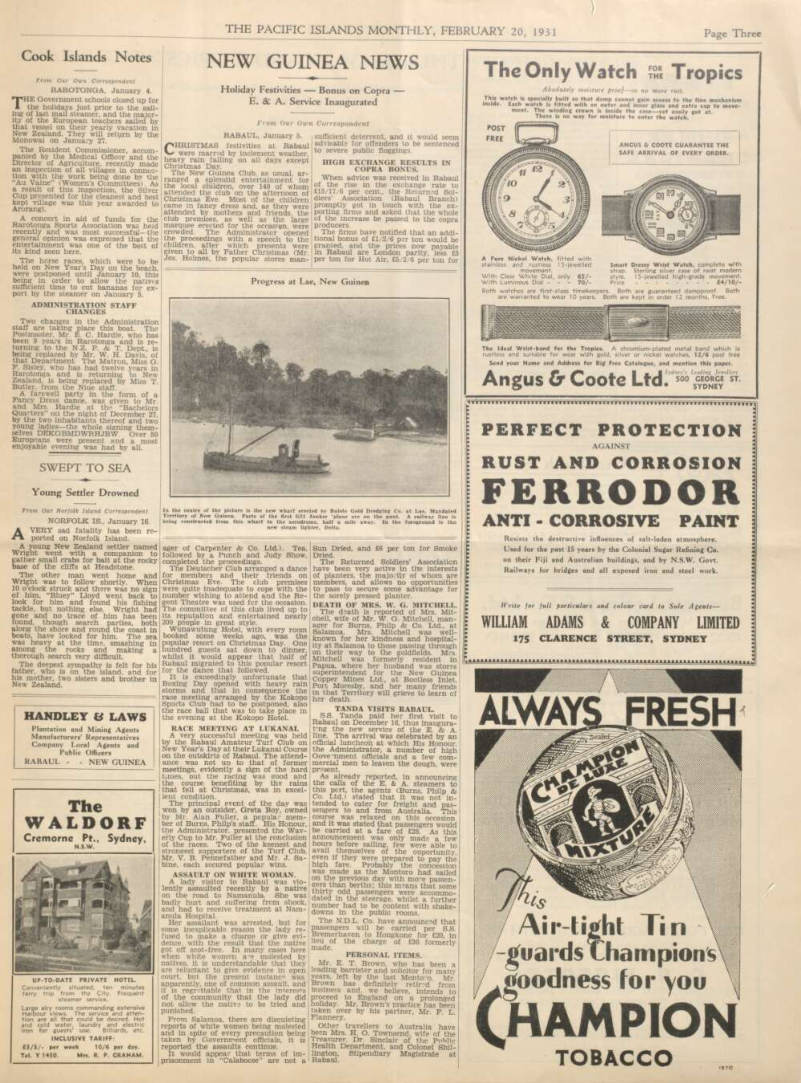
In the centre of the picture is the new wharf erected by Bulolo Gold Dredging Co. at Lae, Mandated Territory of New Guinea. Parts of the first G31 Junker ’plane are on the punt. A railway line is being constructed from this wharf to the aerodrome, half a mile away. In the foreground is the new steam lighter, Delta.
Advertisements & other items, pp. 3-4 (2 items)
Champion
The Only Watch the Tropics
Absolutely moisture proof— so no more rust.
This watch is specially built so that damp cannot gain access to the fine mechanism inside. Each watch is fitted with an outer' and inner glass and extra cap to movement. The winding crown is inside the ease—yet easily got at.
There is no way for moisture to enter the watch.
POST
FREE
ANGUS & COOTE GUARANTEE THE
SAFE ARRIVAL OF EVERY ORDER.
A Pure Nickel Watch, fitted with stainless and rustless 15-jewelled Smart Dressy Wrist Watch, complete with movement. strap. Sterling silver case of neat modern With Clear White Dial, only 65/- style. 15-jewelled high-grade movement.
With Luminous Dial - 70/- Price £4/10/- Both watches are first-class timekeepers. Both are guaranteed dampproof. Both are warranted to wear 10 years. Both are kept in order 12 months, Free.
The Ideal Wrist-band for the Tropics. A chromium-plated metal band which is rustless and suitable for wear with gold, silver or nickel watches, 12/6 post free Send your Name and Address for Big Free Catalogue, and mention this paper.
A Oa „ Hal Sydney’s Leading Jewellers Angus & Coote Ltd. 500 s c y e ° n r “ st
PERFECT PROTECTION
AGAINST
RUST AND CORROSION
FERRODOR
ANTI - CORROSIVE PAINT
Resists the destructive influences of salt-laden atmosphere.
Used for the past 15 years by the Colonial Sugar Refining Co. on their Fiji and Australian buildings, and by N.S.W. Govt.
Railways for bridges and all exposed iron and steel work.
Write for full particulars and colour card to Sole Agents —
WILLIAM ADAMS & COMPANY LIMITED
175 CLARENCE STREET, SYDNEY
FRESH
As Air-light lin guards Champions goodness for you
Champion
TOBACCO
FIRES
without fire engines
need
“SIMPLEX”
CHEMICAL
EXTINGUISHERS
They will put fires out much quicker than water—are easy to use —only cost a few shillings to re-charge—and are guaranteed to pass all regulations. You need them.
The Australian Governments have installed thousands of Simplex Hand Extinguishers.
Write now for full details to the makers.
Wormald Bros. Ltd.
PARK WORKS,” YOUNG ST.,
WATERLOO. SYDNEY, N.S.W.
Painless extractions. Reliable fillings. Cold crowns and comfortable and lasting plate work.
Have Teeth by Post
If you are unable to visit Sydney, I can make you comfortable, natural and long lasting teeth by means of my well known method of “Self Taken Impressions.” Cut out this advertisment, attach your name and address, and post to me for full particulars.
SPENCER NOLAN, Dentist
28 OXFORD ST., over Winns; 177 OXFORD ST., opposite Mcllraths; 139 ELIZABETH ST., two doors from Market St., Sydney.
Beam Wireless and Cable Address: “Fastplate,” Sydney. P.I.M.
Bennett, Lorimer &Co. Ltd.
Manufacturers and Merchants 20-22 KNOX STREET - - - SYDNEY Suppliers of all Fittings, Equipment and Ingredients for the Baking, Pastrycooking and Confectionery Trade. Dried and Canned Fruits, Macaroni, Spaghetti, Vermicilli and Australian-grown Prunes, packed in airtight tins specially suited for tropical climates.
Our Agency Department is competent to handle sales of all Island Products.
We invite Correspondence from Buyers and Sellers.
Bankers: Commercial Bank of Australia.
CABLE ADDRESS: “PRUNES,” SYDNEY - - CODE: BENTLEY’S
20-22 KNOX STREET - SYDNEY
Vitality and Health are the
Main Factors in Every-day Life
Put yourself in the hands of Specialists who have made an intelligent study of your requirements; it is vital to your health.
We are known everywhere as the Suppliers of the Right Goods and which put the VITAL into VITALITY. 35 years is our record of supplying Fresh Fruit, Vegetables and Produce to the leading Houses throughout the world.
GET FULLY ACQUAINTED WITH US
Tel.: MA 4799; FX 4350 Private Cable Address: PIGS, SYDNEY. Code: BENTLEYS
C. G. PIGGOTT
WHOLESALE FRUIT AND PRODUCE MERCHANTS
DIRECT IMPORTERS AND EXPORTERS.
SYDNEY.
Office, Bulk Stores & Packing House: Fruit Exchange, Sydney Sales Dept.: Fruit Exchange and City Markets, Sydney Bank of N.S.W. Bankers.
Waldorf
HANDLEY & LAWS
Plantation and Mining Agents Manufacturers’ Representatives Company Local Agents and Public Officers
RABAUL - - NEW GUINEA
The
WALDORF
Cremorne Pf., Sydney,
N.S.W.
UP-TO-DATE PRIVATE HOTEL.
Conveniently situated, ten minutes ferry trip from the City. Frequent steamer service.
Large airy rooms commanding extensive Harbour views. The service and attention are all that could be desired. Hot and cold water, laundry and electric iron for guests’ use. Billiards, etc.
INCLUSIVE TARIFF:
£3/3/- per week 10/6 per day.
Tel. Y 1450. Mrs. R. P. GRAHAM.
Sugar Cultivation
New Industry For Papua
From Our Canberra Correspondent CANBERRA, February 10.
LATTERLY an entirely new form of development has presented itself in Papua—the cultivation of sugar cane.
When, some time ago, an application was received for a large area of land at Sangara, in the Northern Division, which it was intended to develop as a sugar plantation, those engaged in the sugar industry in Australia were much perturbed; but in reply to questions in the Federal Parliament it was stated by the Government that the sugar grown in Papua would not be allowed to come into competition with the Aus tralian product.
On this subject, the Lieutenant-Gov ernor says in his last report: “Papua, or some part of the island of New Guinea is, I understand, thought to be the original home of the sugar cane.
Some of the best cane grown in Queensland came from Papua, and during the year under review an Ameri can expedition came to the territory with the object, which I believe they achieved, of finding a type of cane which would resist certain forms of disease.
“The land selected at Sangara is said to be very suitable for sugar, and as labour should be readily available the plantation ought to succeed.
“Some apprehension was expressed in the Commonwealth lest the cultivation of sugar in Papua might affect the in dustry in Queensland, but such fears are without foundation. The Papuan sugar will not be exported to Australia; the import duty would make that im possible.
“It will be sold in the markets of the world and there is ground for con fident hope that our advantages of climate, soil, rainfall and labour will enable Papuan planters to compete successfully against producers in any other country.”
Thursday Island Topics
Retrenchment in Marine Industries-Fewer Tourists Arriving- Electric Light for Hospital
From Our Own Correspondent
THURSDAY IS U January 27.
TO what extent the marine industries will be carried on during the next two years is very uncertain, but, doubt less, efforts will be made to continue production as far as possible.
In the meantime retrenchment is the order of the day and over 100 Jap anese, mostly old hands in the indus try, left for their homes early in Feb ruary.
The prosperity of local industries de pends on overseas demand, and if it
should improve, work will proceed here much as usual, in spite of the low state of Australian finances.
One result of the hard times is the small number of passengers arriving and leaving the ports, as people can not afford to travel for pleasure, and business depression does not warrant much coming and going.
Curtailment Of Mission
Expenses.
Local news, as may be imagined, is conspicuous by its absence. The Bis hop of Carpentaria reports that the balance-sheets of the various mission enterprises under his charge came out
nated by Messrs. Heinke, of London, is now completed and ready for use.
“Treacle” And The Shark.
The admission of another case of shark bite to the Torres Strait Hospi tal —this time a Malay who was at tacked at Haggerston Island recalls many similar occurrences in the past and reminds us of the constant risk that attends the crews of fishing and diving boats. The most famous of all these tragedies was that of Treacle, an aboriginal from the Lockhart River, whose narrow escape from death has been featured in many newspapers all over the world. So well-known is Treacle’s exploit that not long ago a member of the medical research coun cil in London wrote and asked for a photo of this hero for publication in a book to be devoted to the subject of diving accidents.
Treacle’s whole head and neck were engulfed in the monster’s mouth, but he managed to escape with terrible injuries, and was nursed to recovery in the local hospital. Treacle died of cancer two or three years ago, a not able fact in itself, as this disease is fortunately very rare among the abor iginals.
Cases of this sort do not make very pleasant reading, but they are worth recording if only to stress the remark able fortitude that is shown by natives who have been attacked.
From far away Coconut Island, a little wind-swept, coral atoll that is de scribed with great sympathy and charm by Alain Gerbault in a recent book of travels, comes the hero of another such exploit, and one is glad to make a pub lic tribute in this article to Johnny Maori’s courage. Though shockingly injured and unable to receive medical assistance for some 20 hours, he proved a true stoic in hospital. It was gener ally believed by those who nursed him that the little black pipe that, lit or unlit, stuck out of his mouth through out his long illness, was the chief fac tor in saving his life. Some years ago, the same man was capsized at sea while out alone in his dinghy; for no less than five days he drifted to and fro through lonely waters of the Straits before he was rescued —truly a very stout-hearted fellow—and we are glad to record that most of our Island folk display wonderful powers of endurance and personal bravery.
As an example of this, another inci dent may be quoted. A white lad was diving for trepang in the company of
better than was expected, but the pros pects for 1931 are not so hopeful and curtailment of expense in some way will have to be adopted.
The David Pitt, a cutter owned by Mr. Harvey, of the Papuan Industries, was sold to Mr. Hines, of Daru, re cently.
Swiss Anthropologist’S
Visit.
Dr. Wiertz, a well-known Swiss an thropologist, who had been on a previ ous visit to Dutch New Guinea, re turned there from Daru at Christmas time, after spending some time in Western Papua on anthropological work among the natives. After his first visit, he published a book, which is said to have been very clever, but, being in German, is beyond the ken of most of us. It is hoped that any new work of his, especially with regard to Papua, will be translated into Eng lish.
Hospital’S Financial
Position.
The annual report and balance-sheet of the Torres Strait Hospital was sub mitted to subscribers at the annual meeting on January 20, and it shows the financial position, which has always been very sound, to be satisfactory, though the income is bound to drop during the current year. The manage ment, which is carried on by a com mittee of business men, has been always marked by a careful policy of husband ing resources and yet keeping the in stitution up-to-date.
Further improvements are promised during the year—electric light and an X-ray plant—and these have been made possible chiefly owing to a handsome donation of £515, made by the pearlers in 1930. The compression chamber do
an aboriginal from a very uncivilised part of Cape York Peninsula, when they were rushed at by a shark. The native, without a moment’s hesitation, caught hold of his white companion and lifted him clean out of the water, quite ignoring his own danger. Both of them escaped injury.
Sharks usually make their attack in “dirty water,” and, in too many cases, the victim has never been seen again, but there have been instances in which natives have effected their escape by gouging out the eyes of the shark.
Action of this sort seems to be the most effective form of counter attack.
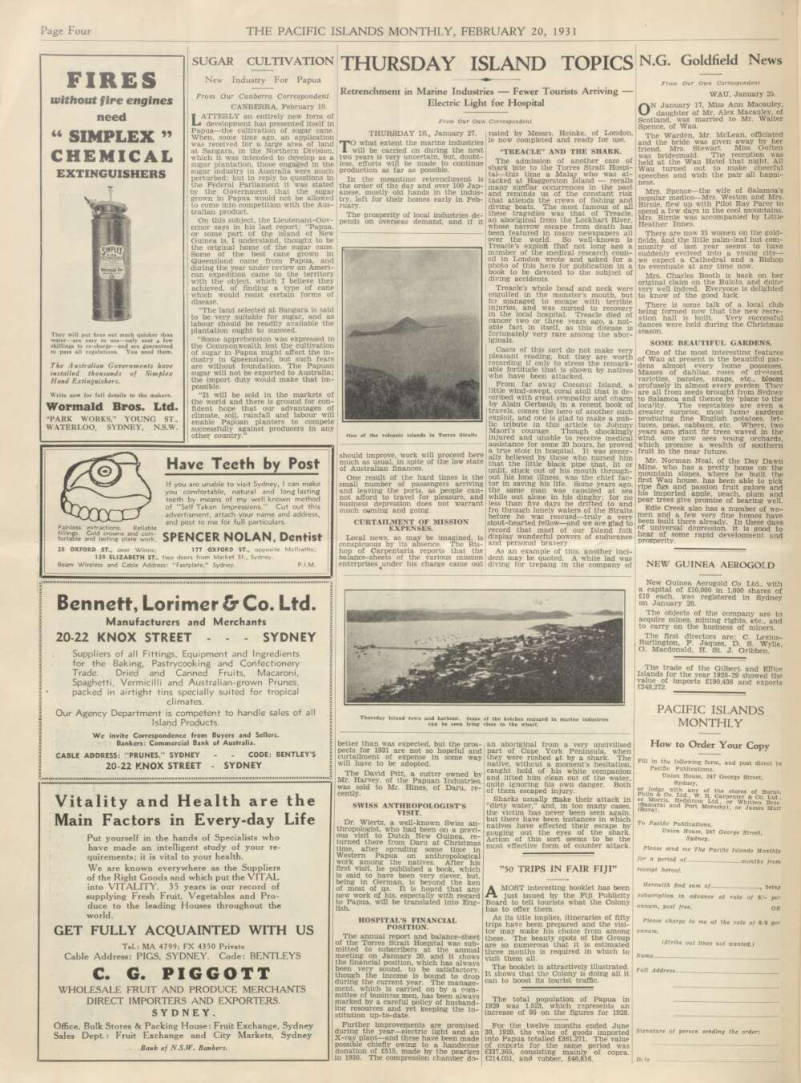
One of the volcanic islands in Torres Straits
Thursday Island town and harbour. Some of the ketches engaged in marine industries can be seen lying close to the wharf.
"50 Trips In Fair Fiji”
A MOST interesting booklet has been just issued by the Fiji Publicity Board to tell tourists what the Colony has to offer them.
As its title implies, itineraries of fifty trips have been prepared and the visi tor may make his choice from among these. The beauty spots of the Group are so numerous that it is estimated three months is required in which to visit them all.
The booklet is attractively illustrated.
It shows that the Colony is doing all it can to boost its tourist traffic.
The total population of Papua in 1929 was 1,523, which represents an increase of 95 on the figures for 1928.
For the twelve months ended June 30, 1929, the value of goods imported into Papua totalled £361,271. The value of exports for the same period was £337,365, consisting mainly of copra, £214,051, and rubber, £46,816.
N.G. Goldfield News
From Our Own Correspondent WAU, January 25.
ON January 17, Miss Ann Macauley, daughter of Mr. Alex Macauley, of Scotland, was married to Mr. Walter Spence, of Wau.
The Warden, Mr. McLean, officiated and the bride was given away by her friend, Mrs. Stewart. Miss Gotten was bridesmaid. The reception was held at the Wau Hotel that night. All Wau turned out to make cheerful speeches and wish the pair all happi ness.
Mrs. Spence —the wife of Salamoa’s popular medico —Mrs. Weston and Mrs.
Birnie, flew up with Pilot Ray Parer to spend a few days in the cool mountains.
Mrs. Birnie was accompanied by Little Heather Innes.
There are now 35 women on the gold fields, and the little palm-leaf hut com munity of last year seems to have suddenly evolved into a young city— we expect a Cathedral and a Bishop to eventuate at any time now.
Mrs. Charles Booth is back on her original claim on the Bulolo, and doing very well indeed. Everyone is delighted to know of the good luck.
There is some talk of a local club being formed now that the new recre ation hall is built. Very successful dances were held during the Christmas season.
Some Beautiful Gardens.
One of the most interesting features of Wau at present is the beautiful gar dens almost every home possesses.
Masses of dahlias, roses of choicest varieties, pansies, snaps, etc., bloom profusely in almost every garden They are all from seeds brought from Sydney to Salamoa and thence by ’plane to the locality. The vegetables are even a greater surprise, most home gardens producing fine English potatoes, let tuces, peas, cabbage, etc. Where, two years ago, giant fir trees waved in the wind, one now sees young orchards, which promise a wealth of southern fruit in the near future.
Mr. Norman Neal, of the Day Dawn Mine, who has a pretty home on the mountain slopes, where he built the first Wau house, has been able to pick ripe figs and passion fruit galore and his imported apple, peach, plum and pear trees give promise of bearing well.
Edie Creek also has a number of wo men and a few very fine homes have been built there already. In these days of universal depression, it is good to hear of some rapid development and prosperity.
New Guinea Aerogold
Co Ltd., with a capital of £10,000 in 1,000 shares of £10 each, was registered in Sydney on January 20.
The objects of the company are to acquire mines, mining rights, etc.. and to carry on the business of miners.
The first directors are: C. Lexius- Burlington, P. Jaques, D. S. Wylie, G. Macdonald, H. St. J. Gribben.
The trade of the Gilbert and Ellice Islands for the year 1928-29 showed the value of imports £190,436 and exports
Pacific Islands
Monthly
How to Order Your Copy
Fill in the following form, and post direct to Pacific Publications, Union House, 247 George Street, Sydney, of the stores of Burns. & Co. Ltd., W. R. Carpenter & Co Ltd or Morris, Hedstrom Ltd, or Whitten Bros) (Suva) d P 1 Moresb y), or James Muir To Pacific Publications, Union House. 247 George Street, Sydney.
Please send me The Pacific Islands Monthly for a period of. months from receipt hereof.
Herewith find sum of. t being subscription in advance at rate of 6/- per annum, post free. qj j Please charge to me at the rate of 6/6 per annum. (Strike out lines not wanted.) Name...
Full Address Signature of person sending the order: Dcte
Tonga’S Charms
Tips for Prospective Tourists
From Our Nukualofa Correspondent IT is first of all perhaps necessary to emphasise the fact that these tips are not for the straight-out round-trip tourist, who jumps off the mail boat for 36 hours and then passes on.
Such transient visitors see the sights in the whirl and clatter of motor buses, importunate taxi drivers, vendors of island fruits and peddlers of native craft. They view the famous flying foxes, the gushing blow-holes on the “liku,” the stately “lagis” (tombs) of century-dead kings, and the mysterious trilithcn erected in dim ages past by some forgotten race. Then, when the whistle blows, they hop aboard and, hot and bothered, wonder if they allowed the right aperture for that last snap.
These tips are not for such!
In a friendly way, I want to talk to the other kind. By this, I mean the man who is either tired out with worry ing over his overdraft, or the fall in price of wheat or wool, or the share market, and who must have a couple of months complete rest in some peace ful setting to regain something of his lost youth.
First of all, the mail-boat return fare from Sydney to Tonga will run you into £55, and if you come from New Zealand it works out at about £10 less.
If you are a golfer, you will bring with you your best clubs, because our links deserve the best —they are good
links, and the bunkers not too exas perating. If you fancy tennis don’t forget to bring a “tropical gut” racquet.
Should you lean towards the ancient game of bowls, fetch along the set you used in the last championship; our greens are good and our players have cleaned up some fair travelling teams from time to time.
If you are, by any chance, a disciple of Isaac Walton, get hold of a strong rod with a quality silk line suitable for trolling and an automatic spinner about 6 inches in length. It may be that you would like to explore the outer reefs and outlying islands. If so, this is a good tip; if you haven’t got one yourself, borrow from a friend his little outboard motor and put it in your kit.
Rowing boats are to be had at an insig nificant daily or weekly rental and the outboard will enable you to visit and explore any one of a dozen coral islets in a day.
Besides, in adopting this course, you go when and where you like without bowing to the wishes of some obstinate and probably expensive launch owner.
And if you take a native lad with you he will gather you in rock-oysters, or clams, or crayfish, just as your fancy directs him. Then on the sand, watch him cook for you in the native fashion.
You will wish for nothing better than this.
If you don’t wish to indulge in any of these pastimes, and just want to bask in the sun or sleep under a coco nut palm all day, then all you require is a couple of changes and a tooth brush. The great thing about Tonga is that if you don’t want to be fussed over you can safely rely on the local folk to respect your wishes. They are a peaceful people.
Do you sometimes frequent the silent movies? We have them three nights a week—the “talkies” were ruled out by the Chamber of Commerce or somebody on the ground that it would perplex the native if he was forced to learn the American language to understand the picture —quite right too, most of our English worries him enough.
The other nights of the week are generally used up in playing bridge, or watching the native girls dance, or, but perhaps you don’t like dancing.
By the way, we have a high-power wireless station, but I think the tired business man usually views it with dis favour. A visitor has told me that about the biggest mistake he had ever made in his long life was when he conveyed to his manager the informa tion that the office could keep in touch with him if necessary.
Well, when you arrive you will natur ally want accommodation at the capi tal town, Nukualofa. We have no ho tels, but we have a good boarding house
with a very reasonable tariff. Then, there are two men’s clubs that are really good clubs.
In concluding this short “tip” list, I wish to state that I have only touched on the fringe of the many attractions that may be sampled here. I have not spoken of that wondrous harbour that graces our northern island, Vavau —an artist’s paradise; I have not as yet spoken of the many things that delight the geologist, the biologist and the en tomologist.
I am simply passing the word to that “tired business man,” in the hope that what I have written may assist him to make up his mind to leave the “hurly burly” and get that quiet rest under tropical conditions which every medical man tells him he requires.
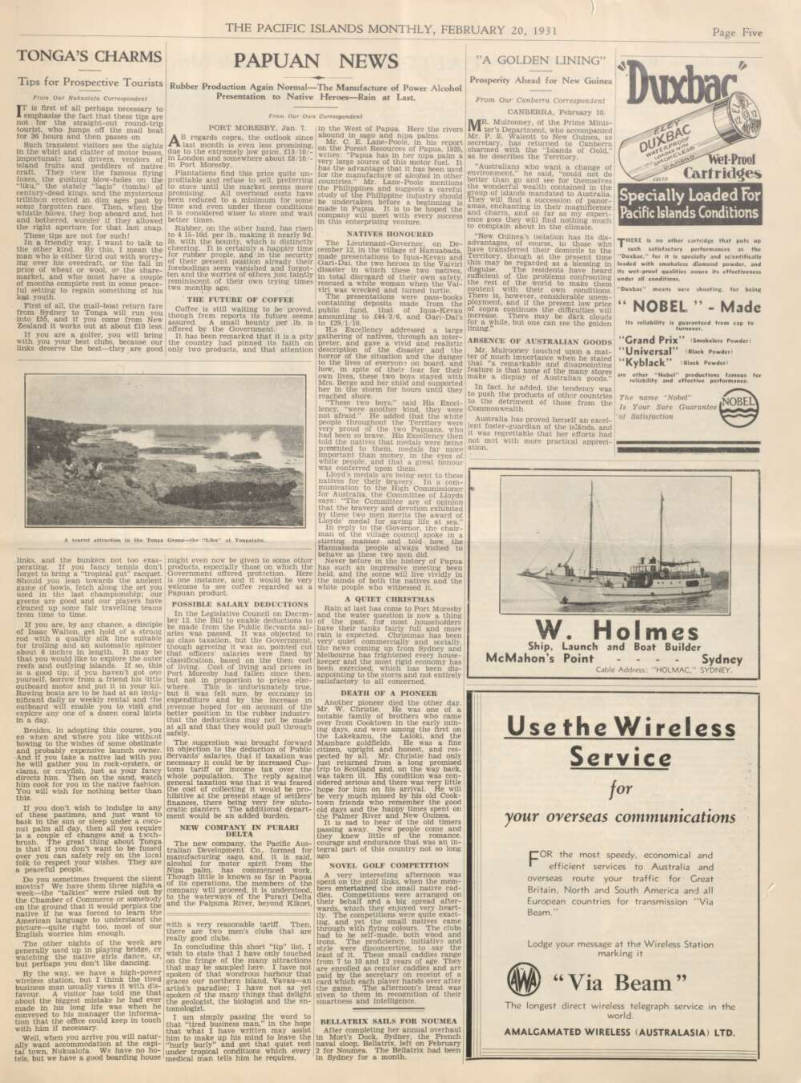
A tourist attraction in the Tonga Group—the “Liku" at Tongatabu.
Papuan News
Rubber Production Again Normal—The Manufacture of Power Alcohol Presentation to Native Heroes—Rain at Last.
From Our Own Correspondent
Port Moresby, Jan. 7.
AS regards copra, the outlook since last month is even less promising, due to the extremely low price, £13/10/in London and somewhere about £8/10/in Port Moresby.
Plantations find this price quite un profitable and refuse to sell, preferring to store until the market seems more promising. All overhead costs have been reduced to a minimum for some time and even under these conditions it is considered wiser to store and wait better times.
Rubber, on the other hand, has risen to 4 15-16 d. per lb., making it nearly 9d. lb. with the bounty, which is distinctly cheering. It is certainly a happier time for rubber people, and in the security of their present position already their forebodings seem vanished and forgot ten and the worries of others just faintly reminiscent of their own trying times two months ago.
The Future Of Coffee
Coffee is still waiting to be proved, though from reports its future seems assured. A small bounty per lb. is offered by the Government.
It has been remarked that it is a pity the country had pinned its faith on only two products, and that attention
might even now be given to some other products, especially those on which the Government offered protection. Here is one instance, and it would be very welcome to see coffee regarded as a Papuan product.
Possible Salary Deductions
In the Legislative Council on Decem ber 12, the Bill to enable deductions to be made from the Public Servants sal aries was passed. It was objected to as class taxation, but the Government, though agreeing it was so, pointed out that officers’ salaries were fixed by classification, based on the then cost of living. Cost of living and prices in Port Moresby had fallen since then, but not in proportion to prices else where. This is unfortunately true, but it was felt sure, by economy in expenditure and by the increase in revenue hoped for on account of the better position in the rubber industry. that the deductions may not be made at all and that they would pull through safely.
The suggestion was brought forward in objection to the deduction of Public Servants’ salaries, that if taxation was necessary it could be by increased Cus toms tariff or income tax over the whole population. The reply against general taxation was that it was feared the cost of collecting it would be pro hibitive at the present stage of settlers’ finances, there being very few pluto cratic planters. The additional depart ment would be an added burden.
New Company In Purari
Delta
The new company, the Pacific Aus tralian Development Co., formed for manufacturing sago, and, it is said, alcohol for motor spirit from the Nipa palm, has commenced work.
Though little is known so far in Papua of its operations, the members of the company will proceed, it is understood, to the waterways of the Purari Delta and the Paipuna River, beyond Kikori,
in the West of Papua. Here the rivers abound in sago and nipa palms.
Mr. C. E. Lane-Poole, in his report on the Forest Resources of Papua, 1925, writes; “Papua has in her nipa palm a very large source of this motor fuel. It has the advantage that it has been used for the manufacture of alcohol in other countries.” Mr. Lane-Poole mentions the Philippines and suggests a careful study of the Philippine industry should be undertaken before a beginning is made in Papua. It is to be hoped the company will meet with every success in this enterprising venture.
Natives Honoured
The Lieutenant-Governor, on De cember 12, in the village of Hanuabada, made presentations to Iqua-Kevau and Gari-Dai, the two heroes in the Vaiviri disaster in which these two natives, in total disregard of their own safety, rescued a white woman when the Vai viri was wrecked and turned turtle.
The presentations were pass-books containing deposits made from the public fund, that of Iqua-Kevau amounting to £44/3/6, and Gari-Dai’s to £29/1/10.
His Excellency addressed a large gathering of natives, through an inter preter, and gave a vivid and realistic description of the disaster and the horror of the situation and the danger to the lives of everyone on board, and how, in spite of their fear for their own lives, these two boys stayed with Mrs. Berge and her child and supported her in the storm for hours until they reached shore.
“These two boys,” said His Excel lency, “were another kind, they were not afraid.” He added that the white people throughout the Territory were very proud of the two Papuan's, who had been so brave. His Excellency then told the natives that medals were being presented to them, medals far more important than money, in the eyes of white people, and that a great honour was conferred upon them.
Lloyd’s medals are being sent to these natives for their bravery. In a com munication to the High Commissioner for Australia, the Committee of Lloyds says: “The Committee are of opinion that the bravery and devotion exhibited by these two men merits the award of Lloyds’ medal for saving life at sea.”
In reply to the Governor, the chair man of the village council spoke in a stirring manner and told how the Hanuabada people always wished to behave as these two men did.
Never before in the history of Papua has such an impressive meeting been held, and the scene will live vividly in the minds of both the natives and the white people who witnessed it.
A Quiet Christmas
Rain at last has come to Port Moresby and the water question is now a thing of the past, for most householders have their tanks fairly full and more rain is expected. Christmas has been very quiet commercially and socially, the news coming up from Sydney and Melbourne has frightened every house keeper and the most rigid economy has been exercised, which has been dis appointing to the stores and not entirely satisfactory to all concerned.
Death Of A Pioneer
Another pioneer died the other day, Mr. W. Christie. He was one of a notable family of brothers who came over from Cooktown in the early min ing days, and were among the first on the Lakekamu, the Laloki, and the Mambare goldfields. He was a fine citizen, upright and honest, and res pected by all. Mr. Christie had only just returned from a long promised trip to Scotland and, on the way back, was taken ill. His condition was con sidered serious and there was very little hope for him on his arrival. He will be very much missed by his old Cook town friends who remember the good old days and the happy times spent on the Palmer River and New Guinea.
It is sad to hear of the old timers passing away. New people come and they knew little of the romance, courage and endurance that was an in tegral part of this country not so long ago.
Novel Golf Competition
A very interesting afternoon was spent on the golf links, when the mem bers entertained the small native cad dies. Competitions were arranged on their behalf and a big spread after wards, which they enjoyed very heart ily. The competitions were quite exact ing, and yet the small natives came through with flying colours. The clubs had to be self-made, both wood and irons. The proficiency, initiative and style were disconcerting, to say the least of it. These small caddies range from 7 to 10 and 12 years of age. They are enrolled as regular caddies and are paid by the secretary on receipt of a card which each player hands over after the game. The afternoon’s treat was given to them in recognition of their smartness and intelligence.
Advertisements & other items, p. 5 (1 item)
Bellatrix Sails For Noumea
After completing her annual overhaul in Mort’s Dock, Sydney, the French naval sloop, Bellatrix, left on February 2 for Noumea. The Bellatrix had been in Sydney for a month.
"A Golden Lining”
Prosperity Ahead for New Guinea
From Our Canberra Correspondent CANBERRA, February 10.
MR. Mulrooney, of the Prime Minis ter’s Department, who accompanied Mr. P. E. Walcott to New Guinea, as secretary, has returned to Canberra charmed with the “Islands of Gold,” as he describes the Territory.
“Australians who want a change of environment,” he said, “could not do better than go and see for themselves the wonderful wealth contained in the group of islands mandated to Australia.
They will find a succession of panor amas, enchanting in their magnificence and charm, and so far as my experi ence goes they will find nothing much to complain about in the climate.
“New Guinea’s isolation has its dis advantages, of course, to those who have transferred their domicile to the Territory, though at the present time this may be regarded as a blessing in disguise. The residents have heard sufficient of the problems confronting the rest of the world to make them content with their own conditions.
There is, however, considerable unem ployment, and if the present low price of copra continues the difficulties will increase. There may be dark clouds for a while, but one can see the golden lining.”
Absence Of Australian Goods
Mr. Mulrooney touched upon a mat ter of such importance when he stated that “a remarkable and disapnointing feature is that none of the many stores make a display of Australian goods.”
In fact, he added, the tendency was to push the products of other countries to the detriment of those from the Commonwealth.
Australia has proved herself an excel lent foster-guardian of the islands, and it was regrettable that her efforts had not met with more practical appreci ation.
Advertisements & other items, p. 5 (1 item)
Service
Wet-Proof
Cartridges
Specially Loaded For
Pacific Islands Conditions
is no other cartridge that puts up such satisfactory performances as the “Duxbac,” for it is specially and scientifically loaded with smokeless diamond powder, and its wet-proof qualities assure its effectiveness under all conditions.
“Duxbac” means sure shooting, for being “ NOBEL ” - Made Its reliability is guaranteed from cap to turnover.
“Grand Pnx” (Smokeless Powder)
“Universal” (Black Powder) “Kyblack” (Black Powder) are other “Nobel” productions famous for reliability and effective performance.
The name “Nobel”
Is Your Sure Guarantee
of Satisfaction
NOBEL
W. Holmes
Ship, Launch and Boat Builder McMahon's Point - Sydney Cable Address: “HOLMAC,” SYDNEY.
Use the Wireless
Service
your overseas communications
FOR the most speedy, economical and efficient services to Australia and overseas route your traffic for Great Britain, North and South America and all European countries for transmission “Via Beam.”
Lodge your message at the Wireless Station marking it
“Via Beam”
The longest direct wireless telegraph service in the world.
AMALGAMATED WIRELESS (AUSTRALASIA) LTD.
Papua’S Potential
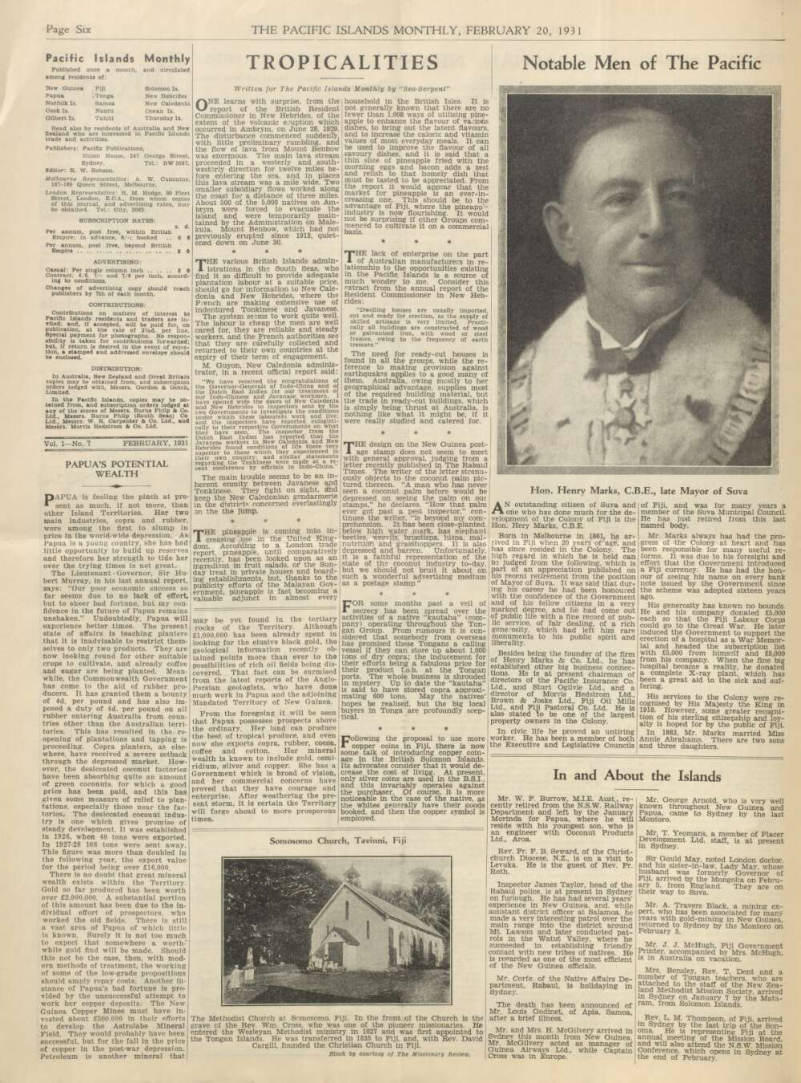
Wealth
Vol. 1—No. 7
February, 1931
PAPUA is feeling the pinch at pre sent as much, if not more, than other Island Territories. Her two main industries, copra and rubber, were among the first to slump in price in the world-wide depression. As Papua is a young country, she has had little opportunity to build up reserves and therefore her strength to tide her over the trying times is not great.
The Lieutenant - Governor, Sir Hu bert Murray, in his last annual report, says: “Our poor economic success so far seems due to no lack of effort, but to sheer had fortune, but my con fidence in the future of Papua remains unshaken.” Undoubtedly, Papua will experience better times. The present state of affairs is teaching planters that it is inadvisable to restrict them selves to only two products. They are now looking round for other suitable crops to cultivate, and already coffee and sugar are being planted. Mean while, the Commonwealth Government has come to the aid of rubber pro ducers. It has granted them a bounty of 4d. per pound and has also im posed a duty of 4d. per pound on all rubber entering Australia from coun tries other than the Australian terri tories. This has resulted in the re opening of plantations and tapping is proceeding. Copra planters, as else where, have received a severe setback through the depressed market. How ever, the desiccated coconut factories have been absorbing quite an amount of green coconuts, for which a good price has been paid, and this has given some measure of relief to plan tations, especially those near the fac tories,; The desiccated coconut indus try is one which gives promise of steady develepment. It was established in 1926, when 40 tons were exported.
In 1927-28 108 tons were sent away.
This figure was more than doubled in the following year, the export value for the period being over £16,000.
There is no doubt that great mineral wealth exists within the Territory.
Gold so far produced has been worth over £2,000,000. A substantial portion of this amount has been due to the in dividual effort of prospectors, who worked the old fields. There is still a vast area of Papua of which little is known. Surely it is not too much to expect that somewhere a worth while gold find will be made. Should this not be the case, then, with mod ern methods of treatment, the working of some of the low-grade propositions should amply repay costs. Another in stance of Papua’s bad fortune is pro vided by the unsuccessful attempt to work her copper deposits. The New Guinea Copper Mines must have in vested about £500,000 in their efforts to develop the Astrolabe Mineral Field. They would probably have been successful, but for the fall in the price of copper in the post-war depression.
Petroleum is another mineral that
may be yet found in the tertiary rocks of the Territory. Although £1,000,000 has been already spent in looking for the elusive black gold, the geological information recently ob tained points more than ever to the possibilities of rich oil fields being dis covered. That fact can be surmised from the latest reports of the Anglo- Persian geologists, who have done much work in Papua and the adjoining Mandated Territory of New Guinea.
From the foregoing it will be seen that Papua possesses prospects above the ordinary. Her land can produce the best of tropical produce, and even now she exports copra, rubber, cocoa, coffee and cotton. Her mineral wealth is known to include gold, osmi ridium, silver and copper. She has a Government which is broad of vision, and her commercial concerns have proved that they have courage and enterprise. After weathering the pre sent storm, it is certain the Territory will forge ahead to more prosperous times.
Tropicalities
Written for The Pacific Islands Monthly by ''Sea-Serpent”
ONE learns with surprise, from the report of the British Resident Commissioner in New Hebrides, of the extent of the volcanic eruption which occurred in Ambrym, on June 28, 1929.
The disturbance commenced suddenly, with little preliminary rumbling, and the flow of lava from Mount Benbow was enormous. The main lava stream proceeded in a westerly and south westerly direction for twelve miles be fore entering the sea, and in places this lava stream was a mile wide. Two smaller subsidiary flows worked along the coast for a distance of three miles.
About 500 of the 5,000 natives on Am brym were forced to evacuate the island and were temporarily main tained by the Administration on Male kula. Mount Benbow, which had not previously erupted since 1913, quiet ened dowh on June 30. * * * THE various British Islands admin istrations in the South Seas, who find it so difficult to provide adequate plantation labour at a suitable price, should go for information to New Cale donia and New Hebrides, where the French are making extensive use of indentured Tonkinese and Javanese.
The system seems to work quite well.
The labour is cheap the men are well cared for, they are reliable and steady workers, and the French authorities see that they are carefully collected and returned to their own countries at the expiry of their term of engagement.
M. Guyon, New Caledonia adminis trator, in a recent official report said: “We have received the congratulations of the Governor-Generals of Indo-China and of the Dutch East Indies for our treatment of our Indo-Chinese and Javanase workmen. I have opened wide the doors of New Caledonia and New Hebrides to inspectors sent by the two Governments to investigate the conditions under which these labourers work and live; and the inspectors have reported euloglsti cally to their respective Governments on what they have seen. The inspector from the Dutch East Indies has reported that the Javanese workers in New Caledonia and New Hebrides found conditions of life there very superior to those which they experienced in their own country; and similar statements regarding the Tonkinese were made at a re cent conference by officials in Indo-China.
The main trouble seems to be an in herent enmity between Javanese and Tonkinese. They fight on sight, and keep the New Caledonian gendarmerie in the district concerned everlastingly on the the jump. * * * THE pineapple is coming into in creasing use in the United King dom. According to a London trade
report, pineapple, until comparatively
recently, has been looked upon as an ingredient in fruit salads, or the Sun day treat in private houses and board ing establishments, but, thanks to the publicity efforts of the Malayan Gov ernment, pineapple is fast becoming a valuable adjunct in almost every
household in the British Isles. It is not generally known that there are no fewer than 1,008 ways of utilising pine apple to enhance the flavour of various dishes, to bring out the latent flavours, and to increase the caloric and vitamin values of most everyday meals. It can be used to improve the flavour of all savoury dishes, and it is said that a thin slice of pineapple fried with the morning eggs and bacon adds a zest and relish to that homely dish that must be tasted to be appreciated. From the report it would appear that the market for pineapple is an ever-in creasing one. This should be to the advantage of Fiji, where the pineapple industry is now flourishing. It would not be surprising if other Groups com menced to cultivate it on a commercial basis. * * * THE lack of enterprise on the part of Australian manufacturers in re lationship to the opportunities existing in the Pacific Islands is a source of much wonder to me. Consider this extract from the annual report of the Resident Commissioner in New Heb rides : “Dwelling houses are usually imported, cut and ready for erection, as the supply of skiiled artisans is very limited. Practi cally all buildings are constructed of wood or galvanised iron, with wood or steel frames, owing to the frequency of earth tremors.”
The need for ready-cut houses is found in all the groups, while the re ference to making provision against earthquakes applies to a good many of them. Australia, owing mostly to her geographical advantage, supplies most of the required building material, but the trade in ready-cut buildings, which is simply being thrust at Australia, is nothing like what it might be, if it were really studied and catered for. * * * THE design on the New Guinea post age stamp does not seem to meet with general approval, judging from a letter recently published in The Rabaul Times. The writer of the letter strenu ously objects to the coconut palm pic tured thereon. “A man who has never seen a coconut palm before would be depressed on seeing the palm on our stamps,” he declares. “How that palm ever got past a pest inspector,” con tinues the writer, “is beyond my com prehension. It has been close-planted, below high water mark, has elephant beetles, weevils, brontispa, hispa, mal nutrition and grasshoppers. It is also depressed and barren. Unfortunately, it is a faithful representation of the state of the coconut industry to-day. but we should not bruit it about on such a wonderful advertising medium as a postage stamp.” * * * FOR some months past a veil of secrecy has been spread over the activities of a native “kautaha” (com pany) operating throughout the Ton gan Group. From rumours it is con sidered that somebody from overseas has promised these Tongans a calling vessel if they can store up about 1,000 tons of dry copra; the inducement for their efforts being a fabulous price for their product f.o.b. at the Tongan ports. The whole business is shrouded in mystery. Up to date the “kautaha” is said to have stored copra approxi mating 600 tons. May the natives’ hopes be realised, but the big local buyers in Tonga are profoundly scep tical. * * * Following the proposal to use more copper coins in Fiji, there is now some talk of introducing copper coin age in the British Solomon Islands.
Its advocates consider that it would de crease the cost of livipg. At present, only silver coins are used in the B.S.I., and this invariably operates against the purchaser. Of course, it is more noticeable in the case of the native, as the whites generally have their goods booked, and then the copper symbol is employed.
Somosomo Church, Taviuni, Fiji
The Methodist Church at Somosomo. Fiji. In the front of the Church is the grave of the Rev. Wm. Cross, who was one of the pioneer missionaries. He entered the Wesleyan Methodist ministry in 1827 and was first appointed to the Tongan Islands. He was transferred in 1835 to Fiji, and, with Rev. David Cargill, founded the Christian Church in Fiji.
Block by courtesy of The Missionary Review.
Notable Men of The Pacific
AN outstanding citizen of Suva and one who has done much for the de velopment of the Colony of Fiji is the Hon. Hery Marks, C.B.E.
Born in Melbourne in 1861, he ar rived in Fiji when 20 years of age, and has since resided in the Colony. The high regard in which he is held can be judged from the following, which is part of an appreciation published on his recent retirement from the position of Mayor of Suva. It was said that dur ing his career he had been honoured with the confidence of the Government and of his fellow citizens in a very marked degree, and he had come out of public life with a fine record of pub lic service, of fair dealing, of a rich generosity, which had left him rare monuments to his public spirit and liberality.
Besides being the founder of the firm of Henry Marks & Co. Ltd., he has established other big business connec tions. He is at present chairman of directors of the Pacific Insurance Co.
Ltd., and Sturt Ogilvie Ltd., and a director of Morris Hedstrom Ltd., Brown & Joske Ltd., Fiji Oil Mills Ltd., and Fiji Pastoral Co. Ltd. He is also stated to be one of the largest property owners in the Colony.
In civic life he proved an untiring worker. He has been a member of both the Executive and Legislative Councils
of Fiji, and was for many years a member of the Suva Municipal Council.
He has just retired from this last named body.
Mr. Marks always has had the pro gress of the Colony at heart and has been responsible for many useful re forms. It was due to his foresight and effort that the Government introduced a Fiji currency. He has had the hon our of seeing his name on every bank note issued by the Government since the scheme was adopted sixteen years ago.
His generosity has known no bounds.
He and his company donated £5,000 each so that the Fiji Labour Corps could go to the Great War. He later induced the Government to support the erection of a hospital as a War Memor ial and headed the subscription list with £5,000 from himself and £5,000 from his company. When the fine big hospital became a reality, he donated a complete X-ray plant, which has been a great aid to the sick and suf fering.
His services to the Colony were re cognised by His Majesty the King in 1918. However, some greater recogni tion of his sterling citizenship and loy alty is hoped for by the public of Fiji.
In 1883, Mr. Marks married Miss Annie Abrahams. There are two sons and three daughters.
Hon. Henry Marks, C.B.E., late Mayor of Suva
In and About the Islands
Mr. W. P. Burrow, M.I.E. Aust., re cently retired from the N.S.W. Railway Department and left by the January Morinda for Papua, where he will reside with his youngest son, who is an engineer with Coconut Products Ltd., Aroa.
Rev. Fr. F. B. Seward, of the Christ church Diocese, N.Z., is on a visit to Levuka. He is the guest of Rev. Fr.
Roth.
Inspector James Taylor, head of the Rabaul police, is at present in Sydney on furlough. He has had several years’ experience in New Guinea, and, while assistant district officer at Salamoa, he made a very interesting patrol over the main range into the district around Mt. Lawson and later conducted pat rols in the Watut Valley, where he succeeded in establishing friendly contact with new tribes of natives. He is regarded as one of the most efficient of the New Guinea officials.
Mr. Corfe. of the Native Affairs De partment, Rabaul, is holidaying in Sydney.
The death has been announced of Mr. Louis Godinet, of Apia, Samoa, after a brief illness.
Mr. and Mrs. H. McGilvery arrived in Sydney this month from New Guinea.
Mr. McGilvery acted as manager of Guinea Airways Ltd., while Captain Cross was in Europe.
Mr. George Arnold, who is very well known throughout New Guinea and Papua, came to Sydney by the last Montoro.
Mr. T. Yeomans, a member of Placer Development Ltd. staff, is at present in Sydney.
Sir Gould May, noted London doctor, and his sister-in-law, Lady May, whose husband was formerly Governor of Fiji, arrived by the Mongolia on Febru ary 5, from England. They are on their way to Suva.
Mr. A. Travers Black, a mining ex pert, who has been associated for many years with gold-mining in New Guinea, returned to Sydney by the Montoro on February 5.
Mr. J. J. McHugh, Fiji Government Printer, accompanied by Mrs. McHugh, is in Australia on vacation.
Mrs. Bensley, Rev. T. Dent and a number of Tongan teachers, who are attached to the staff of the New Zea land Methodist Mission Society, arrived in Sydney on January 7 by the Mata ram, from Solomon Islands.
Rev. L. M. Thompson, of Fiji, arrived m Sydney by the last trip of the Son oma. He is representing Fiji at the annual meeting of the Mission Board, and will also attend the N.S.W. Mission Conference, which opens in Sydney at the end of February.
Advertisements & other items, p. 6 (1 item)
Pacific Islands Monthly
6
THE PACIFIC ISLANDS MONTHLY, FEBRUARY 20, 1931
Published once a month, and circulated among residents of: New Guinea Fiji Solomon Is.
Papua Tonga New Hebrides Norfolk Is. Samoa New Caledonia Cook Is. Nauru Ocean Is.
Gilbert Is. Tahiti Thursday Is.
Read also by residents of Australia and New Zealand who are interested in Pacific Islands trade and activities.
Publishers: Pacific Publications, Union House, 247 George Street, Sydney. Tel.: BW 5037.
Editor : R. W. Robson.
Melbourne Representative: A. W. Cummins, 167-169 Queen Street, Melbourne.
London Representative: R. M. Hodge, 80 Fleet Street, London, E.C.4., from whom copies of this journal, and advertising rates, may be obtained. Tel.: City, 2062.
SUBSCRIPTION RATES;
s. d.
Per annum, post free, within British Empire; in advance, 6/-; booked .. 6 6 Per annum, post free, beyond British Empire 8 0
ADVERTISING:
Casual: Per single column inch 8 0 Contract; 6/6, 7/- and 7/6 per inch, accord ing to conditions.
Changes of advertising copy should reach publishers by 7th of each month.
CONTRIBUTIONS:
Contributions on matters of Interest to Pacific Islands residents and traders are in vited; and, If accepted, will be paid for, on publication, at the rate of 2 Mid. per line.
Special payment for photographs. No respon sibility is taken for contributions forwarded; but. If return is desired in the event of rejec tion, a stamped and addressed envelope should be enclosed.
DISTRIBUTION:
In Australia, New Zealand and Great Britain copies may be obtained from, and subscription orders lodged with, Messrs. Gordon & Gotch, Limited.
In the Pacific Islands, copies may be ob tained from, and subscription orders lodged at any of the stores of Messrs. Burns Philp Ac Co.
Ltd., Messrs. Burns Philp (South SeasJ Co Ltd., Messrs. W. R. Carpenter b Co. Ltd., and Messrs. Morris Hedstrom b Co. Ltd.
Intensive Penetration of New Territory
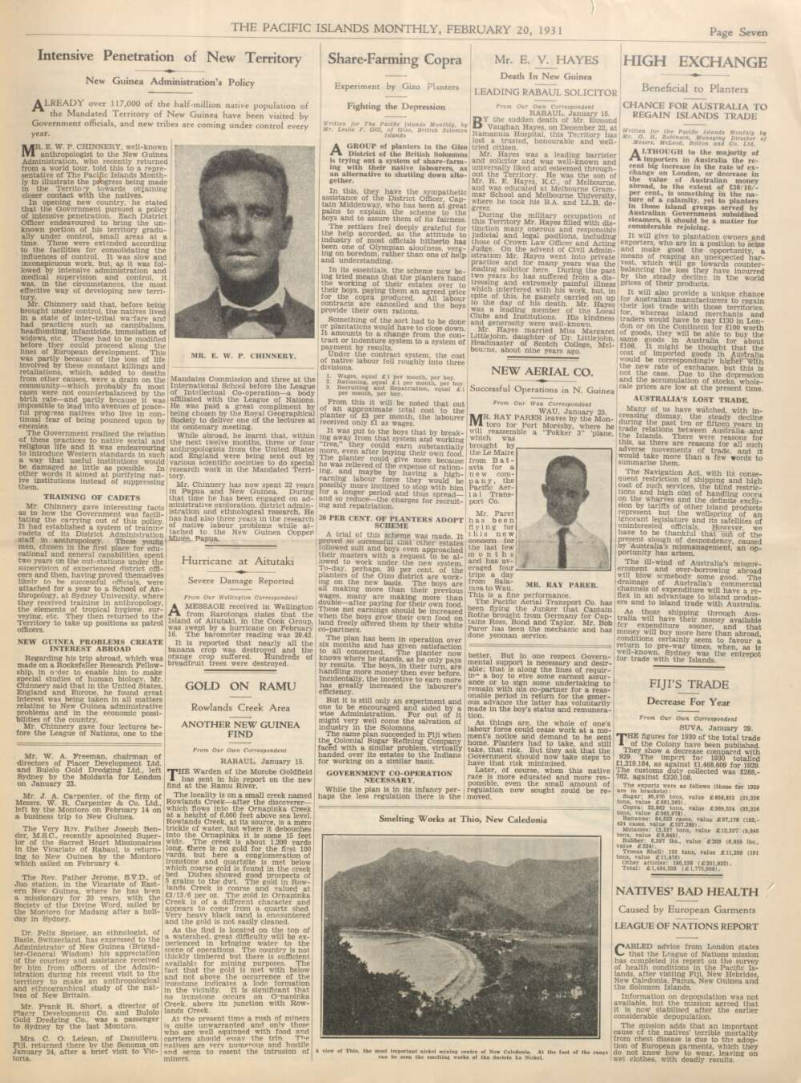
New Guinea Administration’s Policy
over 117,000 of the half-million native population of the Mandated Territory of New Guinea have been visited by Government officials, and new tribes are coming under control every year.
MR. E. W. P. CHINNERY, well-known anthropologist to the New Guinea Administration, who recently returned from a world tour, told this to a repre sentative of The Pacific Islands Month ly to illustrate the progress being made in the Territory towards obtaining closer contact with the natives.
In opening new country, he stated that the Government pursued a policy of intensive penetration. Each District Officer endeavoured to bring the un known portion of his territory gradu ally under control, small areas at a time. These were extended according to the facilities for consolidating the influences of control. It was slow and inconspicuous work, but, as it was fol lowed by intensive administration and medical supervision and control, it was, in the circumstances, the most effective way of developing new terri tory.
Mr. Chinnery said that, before being brought under control, the natives lived in a state of inter-tribal warfare and had practices such as cannibalism, headhunting, infanticide, immolation of widows, etc. These had to be modified before they could proceed along the lines of European development. This was partly because of the loss of life involved by these constant killings and retaliations, which, added to deaths from other causes, were a drain on the community—which probably in most cases were not counterbalanced by the birth rate—and partly because it was impossible to lead into avenues of peace ful progress natives who live in con tinual fear of being pounced upon by enemies.
The Government realised the relation of these practices to native social and religious life and it was endeavouring to introduce Western standards in such a way that useful institutions would be damaged as little as possible. In other words it aimed at purifying nat ive institutions instead of suppressing them.
Training Of Cadets
Mr. Chinnery gave interesting facts as to how the Government was facili tating the carrying out of this policy.
It had established a system of training cadets of its District Administration staff in anthropology. These young men, chosen in the first place for edu cational and general capabilities, spent two years on the out-stations under the supervision of experienced district offi cers and then, having proved themselves likely to be successful officials, were attached for a year to a School of An thropology, at Sydney University, where they received training in anthropology, the elements of tropical hygiene, sur veying, etc. They then returned to the Territory to take up positions as patrol officers.
New Guinea Problems Create
Interest Abroad
Regarding his trip abroad, which was made on a Rockefeller Research Fellow ship, in order to enable him to make special studies of human biology. Mr.
Chinnery said that in the United States, England and Europe, he found great interest was being taken in all matters relating to New Guinea administrative problems and in the economic possi bilities of the country.
Mr. Chinnery gave four lectures be fore the League of Nations, one to the
Mandates Commission and three at the International School before the League of Intellectual Co-operation—a body affiliated with the League of Nations.
He was paid a great compliment by being chosen by the Royal Geographical Society to deliver one of the lectures at its centenary meeting.
While abroad, he learnt that, within the next twelve months, three or four anthropologists from the United States and England were being sent out by various scientific societies to do special research work in the Mandated Terri tory.
Mr. Chinnery has now spent 22 years in Papua and New Guinea. During that time he has been engaged on ad ministrative exploration. district admin istration and ethnological research. He has had also three years in the research of native labour problems while at tached to the New Guinea Copper Mines, Papua.
Mr. E. W. P. Chinnery.
Severe Damage Reported
Hurricane at Aitutaki Severe Damage Reported
From Our Wellington Correspondent A MESSAGE received in Wellington from Rarotonga states that the Island of Aitutaki, in the Cook Group, was swept by a hurricane on February 16. The barometer reading was 29.42.
It is reported that nearly all the banana crop was destroyed and the orange crop suffered. Hundreds of breadfruit trees were destroyed.
Gold On Ramu
Rowlands Creek Area
Another New Guinea
Find
Mr. W. A. Freeman, chairman of directors of Placer Development Ltd. and Bulolo Gold Dredging Ltd., left Sydney by the Moldavia for London on January 23.
Mr. J. A. Carpenter, of the Arm of Messrs. W. R. Carpenter & Co. Ltd. left by the Montoro on February 14 on a business trip to New Guinea.
The Very Rev. Father Joseph Ben der, M.S.C., recently appointed Super ior of the Sacred Heart Missionairies in the Vicariate of Rabaul, is return ing to New Guinea by the Montoro which sailed on February 4.
The Rev. Father Jerome, S.V.D., of Juo station, in the Vicariate of East ern New Guinea, where he has been a missionary for 20 years, with the Society of the Divine Word, sailed by the Montoro for Madang after a holi day in Sydney.
Dr. Felix Speiser, an ethnologist, of Basle, Switzerland, has expressed to the Administrator of New Guinea (Brigad ier-General Wisdom) his appreciation of the courtesy and assistance received by him from officers of the Admin istration during his recent visit to the territory to make an anthropological and ethnographical study of the nat ives of New Britain.
Mr. Frank R. Short, a director of Placer Development Co. and Bulolo Gold Dredging Co., was a passenger to Sydney by the last Montoro.
Mrs. C. O. Lelean, of Danuilevu, Fiji, returned there by the Sonoma on January 24, after a brief visit to Vic toria.
From Our Own Correspondent RABAUL, January 15.
THE Warden of the Morobe Goldfield has sent in his report on the new find at the Ramu River.
The locality is on a small creek named Rowlands Creek —after the discoverer— which flows into the Ornapinka Creek at a height of 6,000 feet above sea level.
Rowlands Creek, at its source, is a mere trickle of water, but where it debouches into the Ornapinka it is some 15 feet wide. The creek is about 1,200 yards long, there is no gold for the first 100 yards, but here a conglomeration of ironstone and quartzite is met below which coarse gold is found in the creek bed. Dishes showed good prospects of 5 grains to the dwt. The gold in Row lands Creek is coarse and valued at £3/13/6 per oz. The gold in Ornapinka Creek is of a different character and appears to come from a quartz shed.
Very heavy black sand is encountered and the gold is not easily cleaned.
As the find is located on the top of a watershed, great difficulty will be ex perienced in bringing water to the scene of operations. The country is not thickly timbered but there is sufficient available for mining purposes. The fact that the gold is met with below and not above the occurrence of the ironstone indicates a lode formation in the vicinity. It is significant that no ironstone occurs on Omaninka Creek, above its junction with Row lands Creek.
At the present time a rush of miners is quite unwarranted and only those who are well equipped with food and carriers should essay the trip. The natives are very numerous and hostile and seem to resent the intrusion of miners.
Share-Farming Copra
Experiment by Gizo Planters Fighting the Depression
Written for The Pacific Islands Monthly, by Mr. Leslie F. Gill, of Gizo, British Solomon Islands A GROUP of planters in the Gizo District of the British Solomons is trying out a system of share-farm ing with their native labourers, as an alternative to shutting down alto gether.
In this, they have the sympathetic assistance of the District Officer, Cap tain Middenway, who has been at great pains to explain the scheme to the boys and to assure them of its fairness.
The settlers feel deeply grateful for the help accorded, as the attitude to industry of most officials hitherto has been one of Olympian aloofness, verg ing on boredom, rather than one of help and understanding.
In its essentials, the scheme now be ing tried means that the planters hand the working of their estates over to their boys, paying them an agreed price for the copra produced. All labour contracts are cancelled and the boys provide their own rations.
Something of the sort had to be done or plantations would have to close down.
It amounts to a change from the con tract or indenture system to a system of payment by results.
Under the contract system, the cost of native labour fell roughly into three divisions. 1. Wages, equal £ 1 per month, per boy. 2. Rationing, equal £ 1 per month, per boy. 3. Recruiting and Repatriation, equal £ 1 per month, per boy.
From this it will be noted that out of an approximate total cost to the planter of £3 per month, the labourer received only £1 as wages.
It was put to the boys that by break ing away from that system and working free, they could earn substantially more, even after buying their own food.
The planter could give more because he was relieved of the expense of ration ing, and maybe by having a high earning labour force they would be possibly more inclined to stop with him for a longer period and thus spread— and so reduce—the charges for recruit ing and repatriation.
30 Per Cent. Of Planters Adopt
Scheme
A trial of this scheme was made. It proved so successful that other estates followed suit and boys even approached their masters with a request to be al lowed to work under the new system To-day, perhaps, 30 per cent, of the planters of the Gizo district are work ing on the new basis. The boys are all making more than their previous wages, many are making more than double—after paying for their own food.
These net earnings should be increased when the boys grow their own food on land freely offered them by their white co-partners.
The plan has been in operation over six months and has given satisfaction to all concerned. The planter now knows where he stands, as he only pays by results. The boys, in their turn, are handling more money then ever before.
Incidentally, the incentive to earn more has greatly increased the labourer’s efficiency.
But it is still only an experiment and one to be encouraged and aided by a wise Administration. For out of it might very well come the salvation of industry in the Solomons.
The same plan succeeded in Fiji when Colonial Sugar Refining Company faced with a similar problem, virtually handed over its estates to the Indians for working on a similar basis.
Government Co-Operation
Necessary.
While the plan is in its infancy per haps the less regulation there is the
better. But in one respect Govern mental support is necessary and desir able; that is along the lines of requir in'* a boy to {five some earnest assur ance or to sign some undertaking to remain with nis co-partner for a reas onable period in return for the gener ous advance the latter has voluntarily made in the boy’s status and remunera tion.
As things are, the whole of one’s labour force could cease work at a mo ment’s notice and demand to be sent home. Planters had to take, and still take, that risk. But they ask that the Government should now take steps to have that risk minimised.
Later, of course, when this native race is more educated and more res ponsible, even the small amount of regulation now sought could be re moved.
Mr. E. V. Hayes
Death In New Guinea
Leading Rabaul Solicitor
From Our Own Correspondent RABAUL, January 15.
BY the sudden death of Mr. Esmond Vaughan Hayes, on December 22, at Namanula Hospital, this Territory has lost a trusted, honourable and well tried citizen.
Mr. Hayes was a leading barrister and solicitor and was well-known and universally liked and esteemed through out the Territory. He was the son of Mr. R. E. Hayes, K.C., of Melbourne, and was educated at Melbourne Gram mar School and Melbourne University, where he took his B.A. and LL.B de grees.
During the military occupation of this Territory Mr. Hayes filled with dis tinction many onerous and responsible judicial and legal positions, including those of Crown Law Officer and Acting Judge. On the advent of Civil Admin istration Mr. Hayes went into private practice and for many years was the leading solicitor here. During the past two years he has suffered from a dis tressing and extremely painful illness which interfered with his work, but, in spite of this, he gamely carried on up to the day of his death. Mr. Hayes was a leading member of the Local Clubs and Institutions. His kindness and generosity were well-known.
Mr. Hayes married Miss Margaret Littlejohn, daughter of Dr. Littlejohn, Headmaster of Scotch College, Mel bourne, about nine years ago.
New Aerial Co.
Successful Operations in N. Guinea
From Our Wau Correspondent
WAU, January 25.
R. RAY PARER leaves by the Mon toro for Port Moresby, where he will reassemble a “Fokker 3” ’plane which was
brought by the Le Maire from Bat avia for a new com pany , the Pacific Aer ial Trans port Co.
Mr. Parer has been flying for this new concern for the last few months and has av eraged four trips a day from Sala moa to Wau.
This is a fine performance.
The Pacific Aerial Transport Co. has been flying the Junker that Captain Rothe brought from Germany for Cap tains Ross, Bond and Taylor. Mr. Bob Parer has been the mechanic and has done yeoman service.
Mr. Ray Parer.
Smelting Works at Thio, New Caledonia
A view of Thio, the most important nickel mining centre of New Caledonia. At the foot of the range can be seen the smelting works of the Societe Le Nickel.
High Exchange
Beneficial to Planters
Chance For Australia To
Regain Islands Trade
Written for the Pacific Islands Monthly by Mr. G. H. Robinson, Managing Director of Messrs. McLeod, Bolton and Co. Ltd.
ALTHOUGH to the majority of importers in Australia the re cent big increase in the rate tof ex change on London, or decrease in the value of Australian money abroad, to the extent of £30/10/per cent., is something in the na ture of a calamity, yet to planters in those island groups served by Australian Government subsidised steamers, it should be a matter for considerable rejoicing.
It will give to plantation owners and exporters, who are in a position to seize and make good the opportunity, a means of reaping an unexpected har vest, which will go towards counter balancing the loss they have incurred by the steady decline in the world prices of their products.
It will also provide a unique chance for Australian manufacturers to regain their lost trade with those territories, for, whereas island merchants and traders would have to pay £130 in Lon don or on the Continent for £100 worth of goods, they will be able to buy the same goods in Australia for about £106. It might be thought that the cost of imported goods in Australia would be correspondingly the new rate of exchange, but this is not the case. Due to the depression and the accumulation of stocks whole sale prices are low at the present time.
Australia’S Lost Trade.
Many of us have watched, with in creasing dismay, the steady decline during the past ten or fifteen years in trade relations between Australia and the Islands. There were reasons for this, as there are reasons for all such adverse movements of trade, and it would take more than a few words to summarise them.
The Navigation Act, with its conse quent restriction of shipping and high cost of such services, the blind restric tions and high cost of handling copra on the wharves and the definite exclu sion by tariffs of other island products represent but the wellspring of an ignorant legislature and its satellites of uninterested officials. However we have to be thankful that out of the present slough of despondency, caused by Australia’s mismanagement, an op portunity has arisen.
The ill-wind of Australia’s misgo ernment and over-borrowing abroad will blow somebody some good. The drainage of Australia’s commercial channels of expenditure will have a re flex in an advantage to island produc ers and to Island trade with Australia.
As those shipping through Aus tralia will have their money available fer expenditure sooner, and that money will buy more here than abroad, conditions certainly seem to favour a return to pre-war times, when, as is well-known, Sydney was the entrepot for trade with the Islands.
Fiji’S Trade
Decrease For Year
From Our Own Correspondent
SUVA, January 29.
THE figures for 1930 of the total trade of the Colony have been published.
They show a decrease compared with 929- The import for 1930 totalled £1,219,184, as against £1,468,609 for 1929 The customs duty collected was £288, - 762, against £320,108.
The exports were as follows (those for 1929 are in brackets): Sugar: 90,970 tons, value £858,833 (33,226 tons, value £881,263).
Copra; 23,882 tons, value £369,524 (33,226 tons, value £563,978).
Bananas: 84,522 cases, value £57,178 (192,- 424 cases, value £107,280).
Molasses: 12,337 tons, value £12,337 (9,845 tons, value £9,845).
Rubber: 6,397 lbs., value £209 (6,855 lbs., value £224).
Trocas Shell: 193 tons, value £11,209 (191 tons, value £11,476).
Other articles: 180,236 (£201,932).
Total: £1,484,526 (£1,775,998).
Caused by European Garments
Natives’ Bad Health
League Of Nations Report
CABLED advice from London states that the League of Nations mission has completed its report on the survey of health conditions in the Pacific Is lands, after visiting Fiji, New Hebrides, New Caledonia, Papua, New Guinea and the Solomon Islands.
Information on depopulation was not available, but the mission agreed that it is now stabilised after the earlier considerable depopulation.
The mission adds that an important cause of the natives’ terrible mortality from chest disease is due to the adop tion of European garments, which they do not know how to wear, leaving on wet clothes, with deadly results.
New Papuan Company
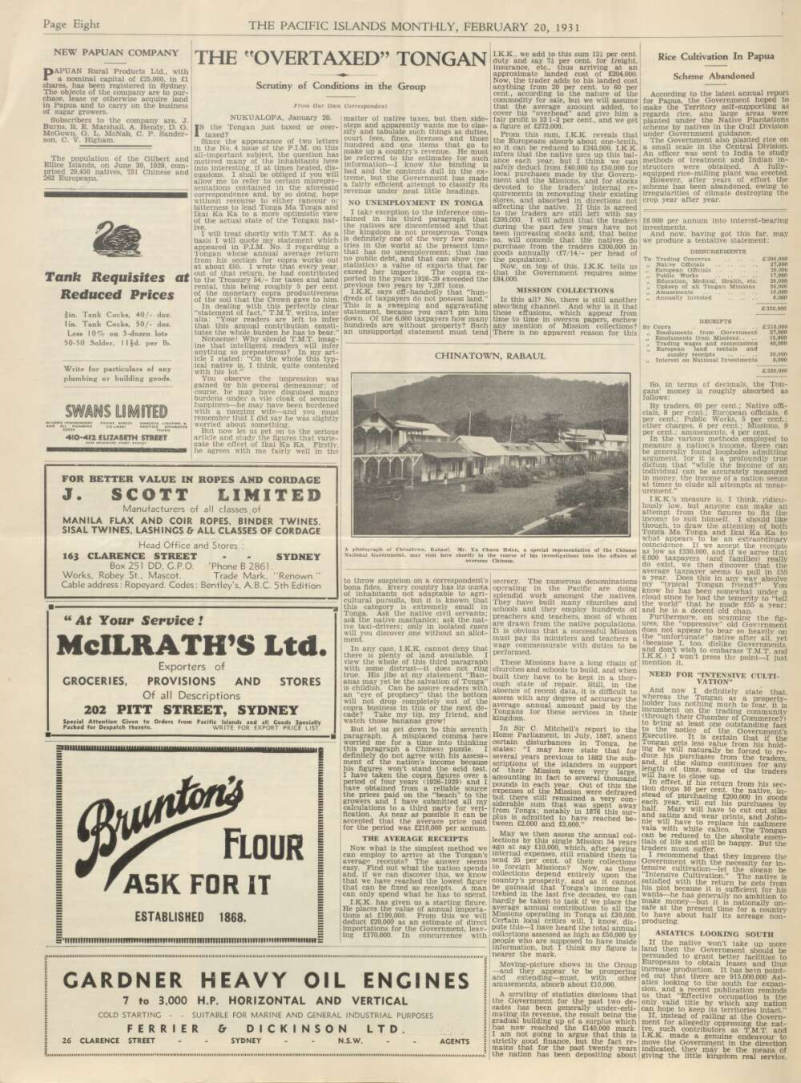
PAPUAN Rural Products Ltd., with a nominal capital of £25,000, in £1 shares, has been registered in Sydney.
The objects of the company are to pur chase, lease or otherwise acquire land in Papua and to carry on the business of sugar growers.
Subscribers to the company are, J.
Burns, R. E. Marshall, A. Hendy, D. G.
McGown, G. L. McNab, C. P. Sander son, C. V. Higham.
The population of the Gilbert and Ellice Islands, on June 30, 1929, com prised 29,450 natives, 751 Chinese and 262 Europeans.
The "Overtaxed” Tongan
Scrutiny of Conditions in the Group
From Our Own Correspondent
NUKUALOFA, January 20.
IS the Tongan just taxed or over taxed?
Since the appearance of two letters in the No. 4 issue of the P.I.M. on this all-important subject, the question has motived many of the inhabitants here into interesting, if at times heated, dis cussions. I shall be obliged if you will allow me to refer to certain misrepre sentations contained in the aforesaid correspondence and, by so doing, hope without recourse to either rancour or bitterness to lead Tonga Ma Tonga and Ikai Ka Ka to a more optimistic view of the actual state of the Tongan nat ive.
I will treat shortly with T.M.T. As a basis I will quote my statement which appeared in P.I.M. No. 2 regarding a Tongan whose annual average return from his section for copra works out at about £55. I wrote that every year, out of that return, he had contributed to the Treasury 54/- for taxes and land rental, this being roughly 5 per cent, of the monetary copra productiveness of the soil that the Crown gave to him.
In dealing with this perfectly clear “statement of fact,” T.M.T. writes, inter alia: “Your readers are left to infer that this annual contribution consti tutes the whole burden he has to bear.”
Nonsense! Why should T.M.T. imag ine that intelligent readers will infer anything so preposterous? In my art icle I stated: “On the whole this typ ical native is, I think, quite contented with his lot.”
You observe the impression was gained by his general demeanour; of course, he may have disguised many burdens under a vile cloak of seeming happiness—he may have been burdened with a nagging wife —and you must remember that I did say he was slightly worried about something.
But now let us get on to the serious article and study the figures that varie gate the effort of Ikai Ka Ka. Firstly, he agrees with me fairly well in the
matter of native taxes, but then side steps and apparently wants me to clas sify and tabulate such things as duties, court fees, fines, licenses and those hundred and one items that go to make up a country’s revenue. He must be referred to the estimates for such information—I know the binding is bad and the contents dull in the ex treme, but the Government has made a fairly efficient attempt to classify its revenue under neat little headings.
No Unemployment In Tonga
I take exception to the inference con tained in his third paragraph that the natives are discontented and that the kingdom is not prosperous. Tonga is definitely one of the very few coun tries in the world at the present time that has no unemployment: that has no public debt, and that can show (pei statistics) a value of exports that far exceed her imports. The copra ex ported in the years 1928-29 exceeded the previous two years by 7,287 tons.
I.K.K. says off-handedly that “hun dreds of taxpayers do not possess land.”
This is a sweeping and aggravating statement, because you can’t pin him down. Of the 6,000 taxpayers how many hundreds are without property? Such an unsupported statement must tend
I.K.K., we add to this sum 121 per cent, duty and say 71 per cent, for freight, insurance, etc., thus arriving at an approximate landed cost of £204,000.
Now, the trader adds to his landed cost anything from 20 per cent, to 60 per cent., according to the nature of the commodity for sale, but we will assume that the average amount added, to cover his “overhead” and give him a fair profit is 33 1-3 per cent., and we get a figure of £272,000.
From this sum, I.K.K. reveals that the Europeans absorb about one-tenth, so it can be reduced to £245,000. I.K.K. infers that the native uses up this bal ance each year, but I think we can safely deduct from £40,000 to £50,000 for local purchases made by the Govern ment and the Missions, and for stocks devoted to the traders’ internal re quirements in renovating their existing stores, and absorbed in directions not affecting the native. If this is agreed to the traders are still left with say £200,000. I will admit that the traders during the past few years have not been increasing stocks and, that being so, will concede that the natives do purchase from the traders £200,000 in goods annually (£7/14/- per head of the population).
Now, on top of this, I.K.K. tells us that the Government requires some £84,000.
Mission Collections
Is this all? No, there is still another absorbing channel. And why is it that these effusions, which appear from time to time in oversea papers, eschew any mention of Mission collections?
There is no apparent reason for this
£6 000 per annum into interest-bearing investments.
And now, having got this far, may we produce a tentative statement:
Disbursements
To Trading Concerns £200,000 „ Native Officials 27,000 European Officials 20,000 „ Public Works 17,000 Education, Medical. Health, etc. 20,000 „ Upkeep of all Tongan Missions 30,000 „ Amusements 10,000 Annually invested .. ... 6,000 £330,000
Receipts
By Copra £210,000 Emoluments from Government 27,000 Emoluments from Missions.. .. 15,000 Trading wages and commissions 40,000 „ European land rentals and sundry receipts 30,000 „ Interest on National Investments 8,000 £330,000 So, in terms of decimals, the Ton gans’ money is roughly absorbed as follows: By traders, 60 per cent.; Native offi cials, 8 per cent.; European officials, 6 per cent.; Public Works, 5 per cent.; other charges, 6 per cent.; Missions, 9 per cent.; amusements, 4 per cent.
In the various methods employed to measure a nation’s income, there can be generally found loopholes admitting argument, for it is a profoundly true dictum that “while the income of an individual can be accurately measured in money, the income of a nation seems at times to elude all attempts at meas urement.”
I.K.K.’s measure is, I think, ridicu lously low, but anyone can make an attempt from the figures to fix the income to suit himself. I should like though, to draw the attention of both Tonga Ma Tonga and Ikai Ka Ka to what appears to be an extraordinary coincidence. If we accept the receipts as low as £330,000, and if we agree that 6.000 taxpayers (and families) really do exist, we then discover that the average taxpayer seems to pull in £55 a year. Does this in any way absolve my “typical Tongan friend?” You know he has been somewhat under a cloud since he had the temerity to “tell the world” that he made £55 a year; and he is a decent old chap.
Furthermore, on scanning the fig ures, the “oppressive” old Government does not appear to bear so heavily on the “unfortunate” native after all, yet (because I, too, dislike Governments, and don’t wish to embarass T.M.T and I.K.K ) I won’t press the point—I just mention it.
Need For “Intensive Culti
Vation”
And now I definitely state that, whereas the Tongan as a property holder has nothing much to fear, it is incumbent on the trading community (through their Chamber of Commerce?) to bring at least one outstanding fact to the notice of the Government’s Executive. It is certain that if the Tongan gets less value from his hold ing he will naturally be forced to re duce his purchases from the traders, and, if the slump continues for any length of time, some of the traders will have to close up.
In effect, if his return from his sec tion drops 50 per cent, the native, in stead of purchasing £200,000 in goods each year, will cut his purchases by half. Mary will have to cut out silks and satins and wear prints, and John nie will have to replace his cashmere vala with white calico. The Tongan can be reduced to the absolute essen tials of life and still be happy. But the traders must suffer.
I recommend that they impress the Government with the necessity for in tensive cultivation—let the slogan be "Intensive Cultivation.” The native is satisfied with the return he gets from his plot because it is sufficient for his wants—he has generally no ambition to make money—but it is nationally un safe at the present time for a country to have about half its acreage non producing.
Asiatics Looking South
If the native won’t take up more land then the Government should be persuaded to grant better facilities to Europeans to obtain leases and thus increase production. It has been point ed out that there are 915,000,000 Asi atics looking to the south for expan sion. and a recent publication reminds us that “Effective occupation is the only valid title by which any nation can hope to keep its territories intact.”
If, instead of railing at the Govern ment for allegedly oppressing the nat ive, such contributors as T.M.T. and I.K.K. made a genuine endeavour to move the Government in the direction indicated, they may be the means of giving the little kingdom real service.
Chinatown, Rabaul
to throw suspicion on a correspondent’s bona fides. Every country has its quota of inhabitants not adaptable to agri cultural pursuits, but it is known that this category is extremely small in Tonga. Ask the native civil servants: ask the native machanics; ask the nat ive taxi-drivers; only in isolated cases will you discover one without an allot ment.
In any case, I.K.K. cannot deny that there is plenty of land available. I view the whole of this third paragraph with some distrust —it does not ring true. His jibe at my statement “Ban anas may yet be the salvation of Tonga” is childish. Can he assure readers with an “eye of prophecy” that the bottom will not drop completely out of the copra business in this or the next de cade? Take my tip, my friend, and watch those bananas grow!
But let us get down to this seventh paragraph. A misplaced comma here worried me for a time into thinking this paragraph a Chinese puzzle. I definitely do not agree with his assess ment of the nation’s income because his figures won’t stand the acid test.
I have taken the copra figures over a period of four years (1926-1929) and I have obtained from a reliable source the prices paid on the “beach” to the growers and I have submitted all my calculations to a third party for veri fication. As near as possible it can be accepted that the average price paid for the period was £210,000 per annum.
The Average Receipts
Now what is the simplest method we can employ to arrive at the Tongan’s average receipts? The answer seems easy. Find out what the nation spends and, if we can discover this, we know that we have reached the lowest figure that can be fixed as receipts. A man can only spend what he has to spend.
I.K.K. has given us a starting figure.
He places the value of annual importa tions at £190,000. Prom this we will deduct £20,000 as an estimate of direct importations for the Government, leav ing £170,000. In concurrence with
secrecy. The numerous denominations operating in the Pacific are doing splendid work amongst the natives.
They have built many churches and schools and they employ hundreds of preachers and teachers, most of whom are drawn from the native populations.
It is obvious that a successful Mission must pay its ministers and teachers a wage commensurate with duties to be performed.
These Missions have a long chain of churches and schools to build, and when built they have to be kept in a thor ough state of repair. Still, in the absence of recent data, it is difficult to assess with any degree of accuracy the average annual amount paid by the Tongans for these services in their kingdom.
In Sir C. Mitchell’s report to the Home Parliament, in July, 1887, anent certain disturbances in Tonga, he states: “I may here state that for several years previous to 1882 the sub scriptions of the islanders in support of their Mission were very large amounting in fact to several thousand pounds in each year. Out of this the expenses of the Mission were defrayed but there still remained a very con siderable sum that was spent away from Tonga; notably in 1876 this sur plus is admitted to have reached be tween £2,000 and £3,000.”
May we then assess the annual col lections by this single Mission 54 years ago at say £10,000, which, after paying internal expenses, still enabled them to send 25 per cent, of their collections to foreign Missions? Now, as these collections depend entirely upon the country’s prosperity, and as it cannot be gainsaid that Tonga’s income has trebled in the last five decades, we can hardly be taken to task if we place the average annual contribution to all the Missions operating in Tonga at £30,000.
Certain local critics will, I know, dis pute this—l have heard the total annual collections assessed as high as £50,000 by people who are supposed to have inside information, but I think my figure is nearer the mark.
Moving-picture shows in the Group —and they appear to be prospering and extending—must, with other amusements, absorb about £10,000.
A scrutiny of statistics discloses that the Government for the past two de cades has been generally under-esti mating its revenue, the result being the gradual building up of a surplus which has now reached the £140,000 mark.
I am not going to argue that this is strictly good finance, but the fact re mains that for the past twenty years the nation has been depositing about
A photograph of Chinatown, Rabaul. Mr. Yu Chuen Hsien, a special representative of the Chinese National Government, may visit here shortly in the course of his investigations into the affairs Of overseas Chinese.
Rice Cultivation In Papua
Scheme Abandoned
According to the latest annual report for Papua, the Government hoped to make the Territory self-supporting as regards rice, and large areas were planted under the Native Plantations scheme by natives in the Gulf Division under Government guidance.
The Government also planted rice on a small scale in the Central Division.
An officer was sent to India to study methods of treatment and Indian in structors were obtained. A fully equipped rice-milling plant was erected.
However, after years of effort the scheme has been abandoned, owing to irregularities of climate destroying the crop year after year.
Advertisements & other items, p. 8 (1 item)
Mcilrath’S Ltd.
Tank Requisites at
Reduced Prices
Tank Cocks, 40/- doz. 1 in. Tank Cocks, 50/- doz.
Less 10% on 3-dozen lots 50-50 Solder, 1 lid- lb.
Write for particulars of any plumbing or building goods.
WANS LIMITED
410-411 ELIZABETH STREET
FOR BETTER VALUE IN ROPES AND CORDAGE
J. SCOTT LIMITED
Manufacturers of all classes of MANILA FLAX AND COIR ROPES, BINDER TWINES, SISAL TWINES, LASHINGS & ALL CLASSES OF CORDAGE Head Office and Stores :
163 CLARENCE STREET - - SYDNEY
Box 251 DD. C.P.O. ’Phone B 2861.
Works, Robey St., Mascot. Trade Mark, “Renown.”
Cable address: Ropeyard. Codes: Bentley’s, A.B.C. sth Edition
" At Your Service !
McILRATH’S Ltd.
Exporters of
GROCERIES, PROVISIONS AND STORES
Of all Descriptions
202 PITT STREET, SYDNEY
Special Attention Given to Orders from Pacific Islands and all Goods Specially Packed for Despatch thereto. WRITE FOR EXPORT PRICE LIST.
r /ask for it
ESTABLISHED 1868.
GARDNER HEAVY OIL ENGINES
7 fro 3,000 H.P. HORIZONTAL AND VERTICAL COLD STARTING - - SUITABLE FOR MARINE AND GENERAL INDUSTRIAL PURPOSES
PERRIER & DICKINSON LTD.
26 CLARENCE STREET - - SYDNEY - - N.S.W. - - AGENTS
Captain David Reid
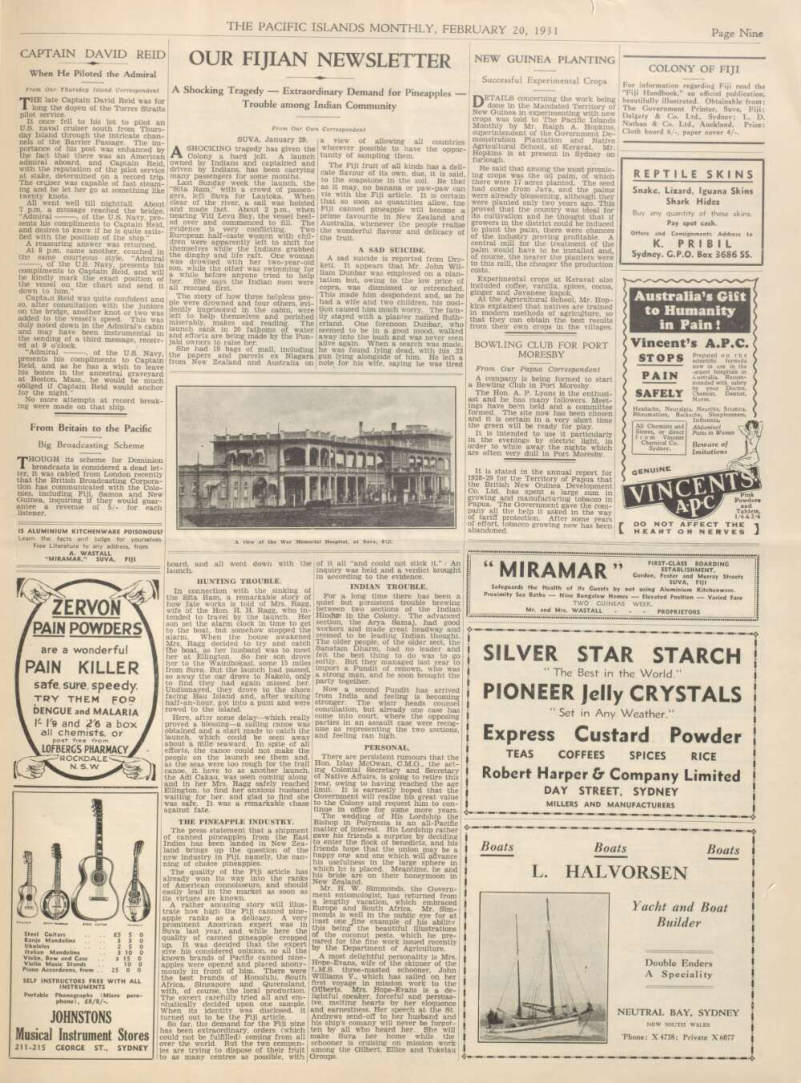
When He Piloted the Admiral
From Our Thursday Island Correspondent THE late Captain David Reid was for long the doyen of the Torres Straits pilot service.
It once fell to his lot to pilot an U.S. naval cruiser south from Thurs day Island through the intricate chan nels of the Barrier Passage. The im portance of his post was enhanced by the fact that there was an American admiral aboard, and Captain Reid, with the reputation of the pilot service at stake, determined on a record trip.
The cruiser was capable of fast steam ing and he let her go at something like twenty knots.
All went well till nightfall. About 7 p.m. a message reached the bridge.
“Admiral , of the U.S. Navy, pre sents his compliments to Captain Reid and desires to know if he is quite satis fied with the position of the ship.”
A reassuring answer was returned.
At 8 p.m. came another, couched in the same courteous style, “Admiral —, of the U.S. Navy, presents his compliments to Captain Reid, and will he kindly mark the exact position of the vessel on the chart and send it down to him.”
Captain Reid was quite confident and so, after consultation with the juniors on the bridge, another knot or two was added to the vessel’s speed. This was duly noted down in the Admiral’s cabin and may have been instrumental in the sending of a third message, receiv ed at 9 o’clock.
“Admiral —, of the U.S. Navy, presents his compliments to Captain Reid, and as he has a wish to leave his bones in the ancestral graveyard at Boston, Mass., he would be much obliged if Captain Reid would anchor for the night.”
No more attempts at record break ing were made on that ship.
Big Broadcasting Scheme
From Britain to the Pacific Big Broadcasting Scheme
THOUGH its scheme for Dominion broadcasts is considered a dead let ter, it was cabled from London recently that the British Broadcasting Corpora tion has communicated with the Colo nies, including Fiji, Samoa and New Guinea, inquiring if they would guar antee a revenue of 5/- for each listener.
Our Fijian Newsletter
A Shocking Tragedy-Extraordinary Demand for Pineapples- Trouble among Indian Community
From Our Own Correspondent
SUVA, January 29.
A SHOCKING tragedy has given the Colony a hard jolt. A launch owned by Indians and captained and driven by Indians, has been carrying many passengers for some months.
Last Sunday week the launch, the “Sita Ram,” with a crowd of passen gers, left Suva for Lautoka. When clear of the river, a sail was hoisted and made fast. About 2 p.m., when nearing Viti Levu Bay, the vessel heel ed over and commenced to fill. The evidence is very conflicting. Two European half-caste women with chil dren were apparently left to shift for themselves while the Indians grabbed the dinghy and life raft. One woman was drowned with her two-year-old son, while the other was swimming for a while before anyone tried to help her. She says the Indian men were all rescued first.
The story of how three helpless peo ple were drowned and four others, evi dently imprisoned in the cabin, were left to help themselves and perished miserably, makes sad reading. The launch sank in 20 fathoms of water and efforts are being made by the Pun jabi owners to raise her.
She had 19 bags of mail, including the papers and parcels ex Niagara from New Zealand and Australia on
board, and all went down with th launch.
Hunting Trouble.
In connection with the sinking of the Sita Ram, a remarkable story how fate works is told of Mrs. Ragg wife of the Hon. H. H. Ragg, who in tended to travel by the launch. He son set the alarm clock in time to get to the boat, but somehow stopped the alarm. When the house awakened Mrs. Ragg decided to try and catch the boat, as her husband was to meet her at Ellington. So her son drove her to the Wainibokasi, some 15 miles from Suva. But the launch had passed, so away the car drove to Nakelo, only to find they had again missed her.
Undismayed, they drove to the shore facing Bau Island and, after waiting half-an-hour, got into a punt and were rowed to the island.
Here, after some delay—which really proved a blessing—a sailing canoe was obtained and a start made to catch the launch, which could be seen away about a mile seaward. In spite of all efforts, the canoe could not make the people on the launch see them and as the seas were too rough for the frail canoe, it hove to as another launch, the Adi Cakau, was seen coming along and in her Mrs. Ragg safely reached Ellington, to find her anxious husband waiting for her, and glad to find she was safe. It was a remarkable chase against fate.
The Pineapple Industry.
The press statement that a shipment of canned pineapples from the East Indies has been landed in New Zea land brings up the question of the new industry in Fiji, namely, the can ning of choice pineapples.
The quality of the Fiji article has already won its way into the ranks of American connoisseurs, and should easily lead in the market as soon as its virtues are known.
A rather amusing story will illus trate how high the Fiji canned pine apple ranks as a delicacy. A very prominent American expert was in Suva last year, and while here the quality of canned pineapple cropped up. It was decided that the expert give his considered opinion, so all the known brands of Pacific canned pine apples were opened and placed anony mously in front of him. There were the best brands of Honolulu, South Africa, Singapore and Queensland, with, of course, the local production.
The expert carefully tried all and em phatically decided upon one sample.
When its identity was disclosed, it turned out to be the Fiji article.
So far, the demand for the Fiji pine has been extraordinary, orders (which could not be fulfilled) coming from all over the world. But the two compan ies are trying to dispose of their fruit to as many centres as possible, with
a view of allowing all countries wherever possible to have the oppor tunity of sampling them.
The Fiji fruit of all kinds has a deli cate flavour of its own, due, it is said, to the soapstone in the soil. Be that as it may, no banana or paw-paw can vie with the Fiji article. It is certain that so soon as quantities allow, the Fiji canned pineapple will become a prime favourite in New Zealand and Australia, whenever the people realise the wonderful flavour and delicacy of the fruit.
A Sad Suicide.
A sad suicide is reported from Dre keti. It appears that Mr. John Wil liam Dunbar was employed on a plan tation but, owing to the low price of copra, was dismissed or retrenched.
This made him despondent and, as he had a wife and two children, his posi tipn caused him much worry. The fam ily stayed with a planter named Suth erland. One forenoon Dunbar, who seemed to be in a good mood, walked away into the bush and was never seen alive again. When a search was made, he was found lying dead, with his .22 gun lying alongside of him. He left a note for his wife, saying he was tired
of it all “and could not stick it.” An inquiry was held and a verdict brought in according to the evidence.
Indian Trouble.
For a long time there has been a quiet but persistent trouble brewing between two sections of the Indian Hindus in the Colony. The advanced section, the Arya Samaj, had good workers and made great headway and seemed to be leading Indian thought.
The older people, of the older sect, the Sanatam Dharm, had no leader and felt the best thing to do was to go softly. But they managed last year to import a Pundit of renown, who was a strong man, and he soon brought the party together.
Now a second Pundit has arrived from India and feeling is becoming stronger. The wiser heads counsel conciliation, but already one case has come into court, where the opposing parties in an assault case were recog nise as representing the two sections, and feeling ran high.
Personal.
There are persistent rumours that the Hon. Islay McOwan, C.M.G., the act ing Colonial Secretary and Secretary of Native Affairs, is going to retire this year, owing to having reached the age limit. It is earnestly hoped that the Government will realise his great value to the Colony and request him to con tinue in office for some more years The wedding of His Lordship the Bishop in Polynesia is an all-Pacific matter of interest. His Lordship rather gave his friends a surprise by deciding to enter the flock of benedicts, and his friends hope that the union may be a happy one and one which will advance his usefulness in the large sphere in which he is placed. Meantime, he and his bride are on their honeymoon in New Zealand.
Mr. H. W. Simmonds, the Govern ment entomologist, has returned from a lengthy vacation, which embraced Europe and South Africa. Mr. Sim monds is well in the public eye for at least one fine example of his ability this being the beautiful illustrations of the coconut pests, which he pre pared for the fine work issued recently by the Department of Agriculture.
A most delightful personality is Mrs.
Hope-Evans, wife of the skipper of the L.M.S. three-masted schooner, John Williams V., which has sailed on her first voyage in mission work to the Gilberts. Mrs. Hope-Evans is a de lightful speaker, forceful and persuas ive, melting hearts by her eloquence and earnestness. Her speech at the St.
Andrews send-off to her husband and his ship’s comany will never be forgot ten by all who heard her. She will make Suva her home while the schooner is cruising on mission work among the Gilbert, Ellice and Tokelau Groups.
A view of the War Memorial Hospital, at Suva, Fiji.
Successful Experimental Crops
New Guinea Planting
DETAILS concerning the work being done in the Mandated Territory of New Guinea in experimenting with new crops was told to The Pacific Islands Monthly by Mr. Ralph A. Hopkins, superintendent of the Government De monstration Plantation and Native Agricultural School, at Keravat. Mr.
Hopkins is at present in Sydney on furlough.
He said that among the most promis ing crops was the oil palm, of which there were 17 acres planted. The seed had come from Java, and the palms were already blossoming, although they were planted only two years ago. This proved that the country was ideal for its cultivation and he thought that if growers in the district could be induced to plant the palm, there were chances of the industry proving profitable. A central mill for the treatment of the palm would have to be installed and, of course, the nearer the planters were to this mill, the cheaper the production costs.
Experimental crops at Keravat also included coffee, vanilla, spices, cocoa, ginger and Javanese kapok.
At the Agricultural School, Mr. Hop kins explained that natives are trained in modern methods of agriculture, so that they can obtain the best results from their own crops in the villages.
Bowling Club For Port
Moresby
From Our Papua Correspondent A company is being formed to start a Bowling Club in Port Moresby.
The Hon. A. P. Lyons is the enthusi ast and he has many followers. Meet ings have been held and a committee formed. The site now has been chosen and it is certain in a very short time the green will be ready for play.
It is intended to use it particularly in the evenings by electric light, in order to while away the nights which are often very dull in Port Moresby.
It is stated in the annual report for 1928-29 for the Territory of Papua that the British New Guinea Development Co. Ltd. has spent a large sum in growing and manufacturing tobacco in Papua. The Government gave the com pany all the help it asked in the way of tariff protection. After some years of effort, tobacco growing now has been abandoned.
Colony Of Fiji
For information regarding Fiji read the “Fiji Handbook,” an official publication, beautifully illustrated. Obtainable from: The Government Printer, Suva, Fiji; Dalgety & Co. Ltd., Sydney; L. D.
Nathan & Co. Ltd., Auckland. Price: Cloth board 6/-, paper cover 4/-.
Advertisements & other items, pp. 9-10 (2 items)
Miramar
REPTILE SKINS
Snake, Lizard, Iguana Skins Shark Hides Buy any quantity of these skins.
Pay spot cash.
Offers and Consignments Address to
K. PRI B I L
Sydney. G.P.O. Box 3686 SS.
Australia’s Gift
to Humanity
in Pain!
STOPS
Vincent’s A.P.C.
Prepared on the scientific formula now in use in the largest hospitals in Australia. Recommended with safety by your Doctor, Chemist, Dentist, Nurse.
Headache, Neuralgia, Neuritis, Sciatica, Rheumatism, Backache, Sleeplessness, Influenza,
PAIN
SAFELY
All Chemists and Stores, or direct from Vincent Chemical Co.
Sydney.
Abdominal Pains in Women
Beware of
Imitations
genuine
Sink Powder* and Tablets, 1/6 & 2/6
DO NOT AFFECT THE
HEART OR NERVES
MIRAMAR
FIRST-CLASS BOARDING
ESTABLISHMENT,
Cordon, Foster and Murray Streets
SUVA, FIJI
Safeguards the Health of its Guests by not using Aluminium Kitchenware.
Proximity Sea Baths Nine Bungalow Homes Elevated Position Varied Fare
TWO GUINEAS WEEK.
Mr. and Mrs. WASTALL ... PROPRIETORS
SILVER STAR STARCH
“ The Best in the World.”
PIONEER Jelly CRYSTALS
“ Set in Any Weather.”
Express Custard Powder
TEAS COFFEES SPICES RICE
Robert Harper & Company Limited
DAY STREET, SYDNEY
MILLERS AND MANUFACTURERS
Boats Boats Boats
L. HALVORSEN
Yacht and Boat Builder Double Enders A Speciality
NEUTRAL BAY, SYDNEY
NEW SOUTH WALES
’Phone: X 4738; Private X 6077
Opportunity!
HAVE YOU CONSIDERED THE CLAIMS
OF
Norfolk Island?
HERE ARE SOME OF THEM :
The Land is Marvellously Fertile; the Rainfall Regular and Certain; the Climate Equable and Pleasant; the Population (now nearly 1,000) is White, and Rapidly Increasing; the Taxation Very Small; the Cost of Living Remarkably Low; Close to Sydney and Auckland.
The Ideal Home for Retired Professional and Business People.
Particulars can be obtained from any of the N.I. Advertisers on this Page.
Why Not Spend a Holiday in
NORFOLK ISLAND?
FISHING BATHING RIDING
GOLF TENNIS.
All Particulars from
BURNS PHILP & CO. LTD.
Bridge Street, Sydney
THE
CENTRAL STORE
NORFOLK ISLAND
GROCERIES HARDWARE
DRAPERY BOOTS AND
SHOES MANURES AND
SEEDS
Agents for
MASSEY-HARRIS IMPLEMENTS
Goods Imported Direct from Englend
SHOP AT HOPKINS!
Norfolk Island
M. B. Blake, Builder
PLANS DRAWN AND ANY TYPE
OF BUILDING ERECTED
All Building Material Imported.
Large, Well Equipped Workshop.
First-class Joinery and Furniture turned out.
L. GRIFFITHS
Auctioneer & Land Agent Valuer & Planter
NORFOLK ISLAND
Properties for sale or lease.
Houses To Let.
Enquiries Invited.
JUST STEP OFF
DRIVE YOURSELF
THE BOAT &
AWAY.
Our Fleet consists of different types of Cars, from Light Tourers to large closed Cars, and our rates vary according to the type.
THE USE OF A CAR IS ESSENTIAL to the complete enjoyment of a HOLIDAY IN AUSTRALIA or the quick transaction of your business. Under our system you can hire any type of Car of the latest Model and drive yourself.
Write for further particulars :
DRIVE YOURSELF SERVICE LTD.
Circular Quay West - Sydney - Australia.
Zervon
IS ALUMINIUM KITCHENWARE POISONOUS?
Learn the facts and judge for yourselves Free Literature to any address, from
A. WASTALL
“MIRAMAR," SUVA, FIJI
ZERVON
PAIN POWDERS 1
are a wonderful
PAIN KILLER
safe, sure, speedy.
TRY THEM FOP
DENGUE and MALARIA
I- T 9 and 2' 6 a box all chemis+s. or post free from
LOFBERGS PHARMACY,
'ROCKDALE*
N. S. W
JOHNSTONS
Musical Instrument Stores
211-215 GEORGE ST., SYDNEY
News From Norfolk Island
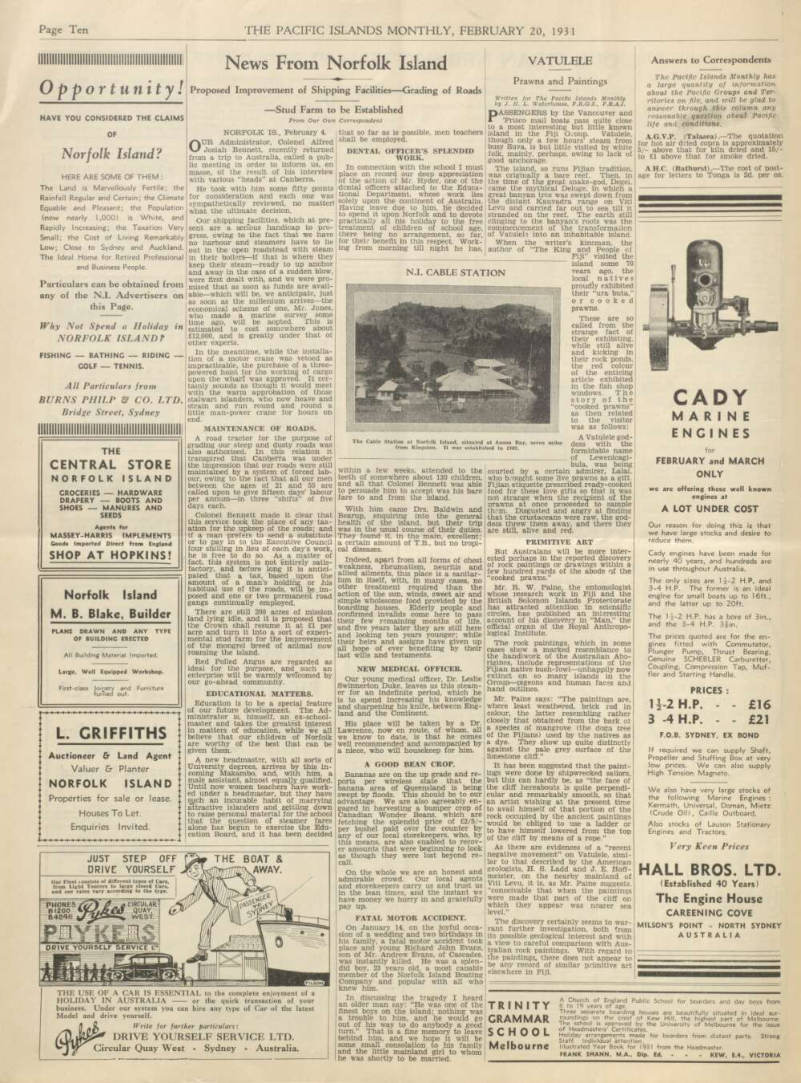
Proposed Improvement of Shipping Facilities —Grading of Roads —Stud Farm to be Established
From Our Own Correspondent
NORFOLK IS., February 4.
OUR Administrator, Colonel Alfred Josiah Bennett, recently returned from a trip to Australia, called a pub lic meeting in order to inform us, en masse, of the result of his interview with various “heads” at Canberra.
He took with him some fifty points for consideration and each one was sympathetically reviewed, no matter what the ultimate decision.
Our shipping facilities, which at pre sent are a serious handicap to pro gress, owing to the fact that we have no harbour and steamers have to lie out in the open roadstead with steam in their boilers—if that is where they keep their steam—ready to up anchor and away in the case of a sudden blow, were first dealt with, and we were pro mised that as soon as funds are avail able —which will be, we anticipate, just as soon as the millenium arrives—the economical scheme of one, Mr. Jones, who made a marine survey some time ago, will be aopted. This is estimated to cost somewhere about £12,000, and is greatly under that of other experts.
In the meantime, while the installa tion of a motor crane was vetoed as impracticable, the purchase of a three powered hoist for the working of cargo upon the wharf was approved. It cer tainly sounds as though it would meet with the warm approbation of those stalwart islanders, who now heave and strain and run round and round a little man-power crane for hours on end.
Maintenance Of Roads.
A road tractor for the purpose of grading our steep and dusty roads was also authorised. In this relation it transpired that Canberra was under the impression that our roads were still maintained by a system of forced lab our, owing to the fact that all our men between the ages of 21 and 55 are called upon to give fifteen days’ labour per annum—in three “shifts” of five days each.
Colonel Bennett made it clear that this service took the place of any tax ation for the upkeep of the roads; and if a man prefers to send a substitute or to pay in to the Executive Council four shilling in lieu of each day’s work, he is free to do so. As a matter of fact, this system is not entirely satis factory, and before long it is antici pated that a tax, based upon the amount of a man’s holding or his habitual use of the roads, will be im posed and one or two permanent road gangs continually employed.
There are still 200 acres of mission land lying idle, and it is proposed that the Crown shall resume it at £1 per acre and turn it into a sort of experi mental stud farm for the improvement of the mongrel breed of animal now roaming the island.
Red Polled Angus are regarded as ideal for the purpose, and such an enterprise will be warmly welcomed by our go-ahead community.
Educational Matters.
Education is to be a special feature of our future development. The Ad ministrator is, himself, an ex-school master and takes the greatest interest in matters of education, while we all believe that our children of Norfolk are worthy of the best that can be given them.
A new headmaster, with all sorts of University degrees, arrives by this in coming Makambo, and, with him, a male assistant, almost equally qualified.
Until now women teachers Tiave work ed under a headmaster, but they have such an incurable habit of marrying attractive islanders and settling down to raise personal material for the school that the question of steamer fares alone has begun to exercise the Edu cation Board, and it has been decided
that so far as is possible, men teachers shall be employed.
Dental Officer’S Splendid
Work.
In connection with the school I must place on record our deep appreciation of the action of Mr. Hyder, one of the dental officers attached to the Educa tional Department, whose work lies solely upon the continent of Australia.
Having leave due to him, he decided to spend it upon Norfolk and to devote practically all his holiday to the free treatment of children of school age, there being no arrangement, so far, for their benefit in this respect. Work ing from morning till night he has,
within a few weeks, attended to the teeth of somewhere about 130 children, and all that Colonel Bennett was able to persuade him to accept was his bare fare to and from the island.
With him came Drs. Baldwin and Bearup, enquiring into the general health of the island, but their trip was in the usual course of their duties.
They found it, in the main, excellent; a certain amount of T. B., but no tropi cal diseases.
Indeed, apart from all forms of chest weakness, rheumatism, neuritis and allied ailments, this place is a sanitar ium in itself, with, in many cases, no other treatment required than the action of the sun, winds, sweet air and simple wholesome food provided by the boarding houses. Elderly people and confirmed invalids come here to pass their few remaining months of life, and five years later they are still here and looking ten years younger; while their heirs and assigns have given up all hope of ever benefiting by their last wills and testaments.
New Medical Officer.
Our young medical officer, Dr. Leslie Swinnerton Duke, leaves us this steam er for an indefinite period, which he is to spend increasing his knowledge and sharpening his knife, between Eng land and the Continent.
His place will be taken by a Dr.
Lawrence, now en route, of whom, all we know to date, is that he comes well recommended and accompanied by a niece, who will housekeep for him.
A Good Bean Crop.
Bananas are on the up grade and re ports per wireless state that the banana area of Queensland is being swept by floods. This should be to our advantage. We are also agreeably en gaged in harvesting a bumper crop of Canadian Wonder Beans, which are fetching the splendid price of £2/5/per bushel paid over the counter by any of our local storekeepers, who, by this means, are also enabled to recov er amounts that were beginning to look as though they were lost beyond re call.
On the whole we are an honest and admirable crowd. Our local agents and storekeepers carry us and trust us in the lean times, and the instant we have money we hurry in and gratefully pay up.
Fatal Motor Accident.
On January 14, on the joyful occa sion of a wedding and two birthdays in his family, a fatal motor accident took place and young Richard John Evans, son of Mr. Andrew Evans, of Cascades, was instantly killed. He was a splen did boy, 23 years old, a most capable member of the Norfolk Island Boating Company and popular with all who knew him.
In discussing the tragedy I heard an older man say: “He was one of the finest boys on the island; nothing was a trouble to him, and he would go out of his way to do anybody a good turn.” That is a fine memory to leave behind him, and we hope it will be some small consolation to his family and the little mainland girl to whom he was shortly to be married.
Advertisements & other items, p. 10 (1 item)
N.I. Cable Station
The Cable Station at Norfolk Island, situated at Anson Bay, seven miles from Kingston. It was established in 1902.
Vatulele
Prawns and Paintings
Written for The Pacific Islands Monthly by J. H. L. Waterhouse, F.R.G.S., F.R.A.I.
PASSENGERS by the Vancouver and ’Frisco mail boats pass quite close to a most interesting but little known island in the Fiji Group. Vatulele, though only a few hours’ steam from busy Suva, is but little visited by white folk, mainly, perhaps, owing to lack of good anchorage.
The island, so runs Fijian tradition, was originally a bare reef. Then, in the time of the great snake-god, Degei, came the mythical Deluge, in which a great banyan tree was swept down from the distant Kauvadra range on Viti Levu and carried far out to sea till it stranded on the reef. The earth still clinging to the banyan’s roots was the commencement of the transformation of Vatulele into an inhabitable island.
When the writer’s kinsman, the author of “The King and People of
Fiji” visited the island some 70 vears ago, the local natives proudly exhibited their “ura buta,” or cooked prawns.
These are so called from the strange fact of their exhibiting, while still alive and kicking in their rock ponds, the red colour of the enticing article exhibited in the fish shop windows. The story of the “cooked prawns” as then related to the visitor was as follows: A Vatulele god dess with the formidable name of Lewenicagi bula, was being
courted by a certain admirer, Lalai, who brought some live prawns as a gift.
Fijian etiquette prescribed ready-cooked food for these love gifts so that it was not strange when the recipient of the prawns at once proceeded to sample them. Disgusted and angry at finding that the crustaceans were raw, the god dess threw them away, and there they are still, alive and red.
Primitive Art
But Australans will be more inter ested perhaps in the reported discovery of rock paintings or drawings within a few hundred yards of the abode af the “cooked prawns.”
Mr. R. W. Paine, the entomologist whose research work in Fiji and the British Solomon Islands Protectorate has attracted attention in scientific circles, has published an interesting account of his discovery in “Man,” the official organ of the Royal Anthropo logical Institute.
The rock paintings, which in some cases show a marked resemblance to the handiwork of the Australian Abo rigines, include representations of the Fijian native bush-fowl —unhappily now extinct on so many islands in the Group—pigeons and human faces and hand outlines.
Mr. Paine says: “The paintings are, where least weathered, brick red in colour, the latter resembling rather closely that obtained from the bark of a species of mangrove (the doga tree of the Fijians) used by the natives as a dye. They show up quite distinctly against the pale grey surface of the limestone cliff.”
It has been suggested that the paint ings were done by shipwrecked sailors, but this can hardly be, as “the face of the cliff hereabouts is quite perpendi cular and remarkably smooth, so that an artist wishing at the present time to avail himself of that portion of the rock occupied by the ancient paintings would be obliged to use a ladder or to have himself lowered from the top of the cliff by means of a rope.”
As there are evidences of a “recent negative movement” on Vatulele, simi lar to that described by the American geologists, H. S. Ladd and J. E. Hoff meister, on the nearby mainland of Viti Levu, it is, as Mr. Paine suggests, “conceivable that when the paintings were made that part of the cliff on which they appear was nearer sea level.”
The discovery certainly seems to war rant further investigation, both from its possible geological interest and with a view to careful comparison with Aus tralian rock paintings. With regard to the paintings, there does not appear to be any record of similar primitive art elsewhere in Fiji.
Answers to Correspondents
The Pacific Islands Monthly has a large quantity of information about the Pacific Groups and Ter ritories on file, and toill be glad to answer through this column any reasonable question about Pacific life and conditions.
A.G.V.P. (Talasea) —The quotation for hot air dried copra is approximately 5/- above that for kiln dried and 15/to £1 above that for smoke dried.
A H.C. (Bathurst). —The cost of post age for letters to Tonga is 2d. per oz.
Advertisements & other items, p. 10 (1 item)
Cady
MARINE
ENGINES
for
FEBRUARY and MARCH
ONLY
we are offering these well known engines at
A LOT UNDER COST
Our reason for doing this is that we have large stocks and desire to reduce them.
Cady engines have been made for nearly 40 years, and hundreds are in use throughout Australia.
The only sizes are H—2 H.P. and 3-4 H.P. The former is an ideal engine for small boats up to 16ft., and the latter up to 20ft.
The 1-2-2 H.P. has a bore of Sin., and the 3-4 H.P. 3|in, The prices quoted are for the engines fitted with Commutator, Plunger Pump, Thrust Bearing, Genuine SCHEBLER Carburetter, Coupling, Compression Tap, Muffler and Starting Handle.
PRICES
li-2 H.P.
3 -4 H.P. £16 £21
F. O.B. SYDNEY, EX BOND
If required we can supply Shaft, Propeller and Stuffing Box at very low prices. We can also supply High Tension Magneto.
We also have very large stocks of the following Marine Engines : Kermath, Universal, Doman, Mietz (Crude Oil), Caille Outboard.
Also stocks of Lauson Stationary Engines and Tractors.
Very Keen Prices
HALL BROS. LTD.
(Established 40 Years)
The Engine House
CAREENING COVE
MILSON’S POINT - NORTH SYDNEY
AUSTRALIA
TRINITY
GRAMMAR
SCHOOL
Melbourne
A Church of England Public School for boarders and day boys from 6 to 19 years of age.
Three separate boarding houses are beautifully situated in ideal surroundings on the crest of Kew Hill, the highest part of Melbourne.
The school is approved by the University of Melbourne for the issue of Headmasters’ Certificates.
Holiday arrangements made for boarders from distant parts. Strong Staff. Individual attention.
Illustrated Year Book for 1931 from the Headmaster.
FRANK SHANN, M.A., Dip. Ed. - - - KEW, E. 4., VICTORIA
Products Of The South Seas
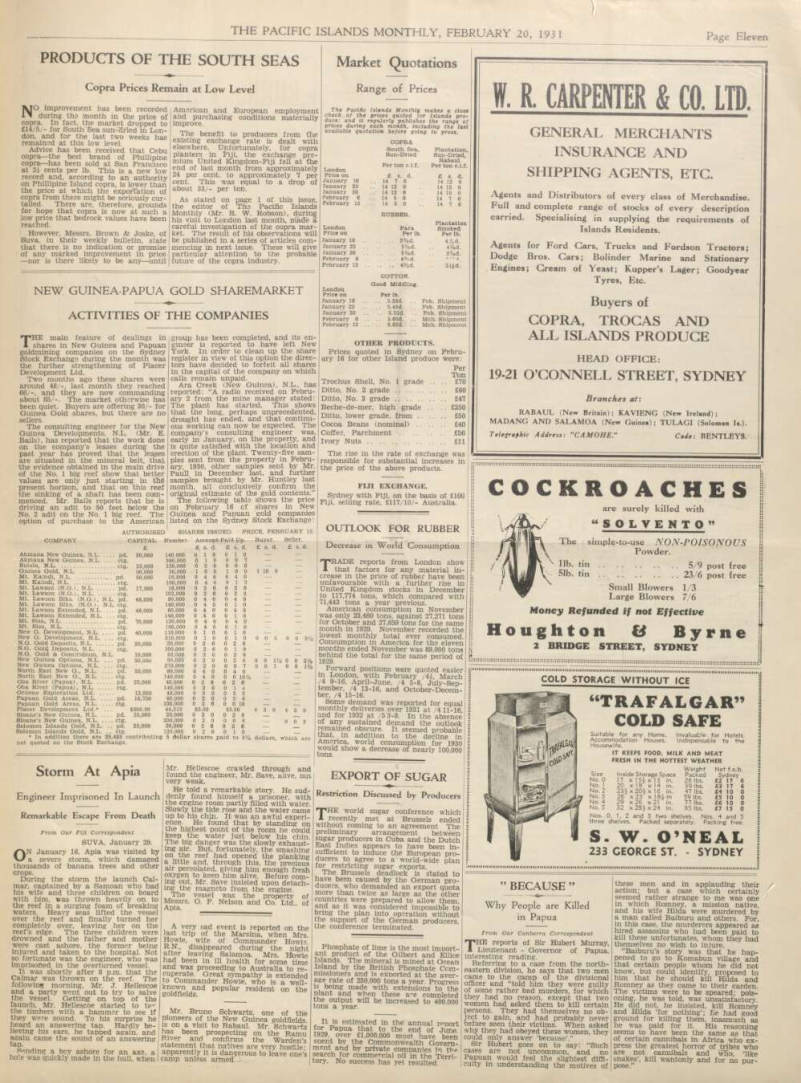
Copra Prices Remain at Low Level
NO improvement has been recorded during the month in the price of copra. In fact, the market dropped to £l4/5/- for South Sea sun-dried in Lon don, and for the last two weeks has remained at this low level.
Advice has been received that Cebu copra—the best brand of Phillipine copra—has been sold at San Francisco at 2i cents per lb. This is a new low record and, according to an authority on Phillipine Island copra, is lower than the price at which the exportation of copra from there might be seriously cur tailed. There are, therefore, grounds for hope that copra is now at such a low' price that bedrock values have been reached.
However, Messrs. Brown & Joske, of Suva, in their weekly bulletin, state that there is no indication or promise of any marked improvement in price —nor is there likely to be any—until
American and European employment and purchasing conditions materially improve.
The benefit to producers from the existing exchange rate is dealt with elsewhere. Unfortunately, for copra planters in Fiji, the exchange pre mium United Kingdom-Fiji fell at the end of last month from approximately 24 per cent, to approximately 7 per cent. This was equal to a drop of about 33/- per ton.
As stated on page 1 of this issue, the editor of The Pacific Islands Monthly (Mr. R. W. Robson), during his visit to London last month, made a careful investigation of the copra mar ket. The result of his observations will be published in a series of articles com mencing in next issue. These will give particular attention to the probable future of the copra industry.
New Guinea-Papua Gold Sharemarket
Activities Of The Companies
THE main feature of dealings in shares in New Guinea and Papuan goldmining companies on the Sydney Stock Exchange during the month was the further strengthening of Placer Development Ltd.
Two months ago these shares were around 48/-, last month they reached 66/-, and they are now commanding about 85/-. The market otherwise has been quiet. Buyers are offering 30/- for Guinea Gold shares, but there are no sellers.
The consulting engineer for the New Guinea Developments, N.L. (Mr. E.
Bails), has reported that the work done on the company’s leases during the past year has proved that the leases are situated in the mineral belt, that the evidence obtained in the main drive of the No. 1 big reef show that better values are only just starting in th 6 present horizon, and that on this reef the sinking of a shaft has been com menced. Mr. Bails reports that he is driving an adit to 50 feet below the No. 2 adit on the No. 1 big reef. The option of purchase to the American
group has been completed, and its en gineer is reported to have left New York. In order to clean up the share register in view of this option the direc tors have decided to forfeit all shares in the capital of the company on which calls remain unpaid.
Ara Creek (New Guinea), N.L., has reported: “A radio received on Febru ary 2 from the mine manager stated: The plant has started. This shows that the long, perhaps unprecedented, drought has ended, and that continu ous working can now be expected. The company’s consulting engineer was, early in January, on the property, and is quite satisfied with the location and erection of the plant. Twenty-five sam ples sent from the property in Febru ary, 1930, other samples sent by Mr.
Pauli in December last, and further samples brought by Mr. Huntley last month, all conclusively confirm the original estimate of the gold contents.”
The following table shows the price on February 16 of shares in New Guinea and Papuan gold companies listed on the Sydney Stock Exchange:
Authorised Shares Issued. Price, February Is.
Company
Capital.
Number.
Amount Paid Dp.
Buyer.
Seller £ £ S. d. £ s. d. £ s. d. £ s. d.
Akmana New Guinea, N.L. ... pd. 30,000 140,000 0 i 0 0 1 0 — — Akmana New Guinea, N.L. ctg. 360,000 0 i 0 0 0 7 — —
Bulolo, N.L
25,000 150,000 0 2 0 0 0 6 — — Guinea Gold, N.L 50,000 50,000 1 0 0 1 0 0 1 10 0 Mt. Kaindi, N.L ... pd. 50,000 50,000 0 4 0 0 4 0 — — Mt. Kaindi, N.L 160,000 0 4 0 0 1 3 — Mt. Lawson (N.G.), N.L. . ... pd. 17,500 18,000 0 2 6 0 2 6 — — Mt. Lawson (N.G.), N.L. .
ctg.
102,000 0 2 6 0 2 3 — — Mt. Lawson BIks. (N.G.),
N.L. pd.
48,000 80,000 0 4 0 0 4 0 — — Mt. Lawson BIks. (N.O.),
N.L. ctg.
140,000 0 4 0 0 1 0 — — Mt. Lawson Extended, N.L ... pd. 48,000 80,000 0 4 0 0 4 0 — — Mt. Lawson Extended, N.L ... ctg. 140,000 0 .4 0 0 1 0 — — Mt. Sisa, N.L 70,000 120,000 0 4 0 0 4 0 — Mt. Sisa, N.L ctg. 190,000 0 4 0 0 1 9 — New G. Development, N.L. pd. 40,000 110,000 0 1 0 0 1 0 New G. Development, N.L.
... ctg.
510,000 0 1 0 0 1 0 0 0 5 0 0 5 Vi
N.G. Gold Deposits, N.L. . .
pd. 20,000 20,000 0 2 6 0 2 6 — — N.G. Gold Deposits, N.L. .
ctg.
100,000 0 2 6 0 1 9 N.G. Gold & Osmiridium, N.L. 10,000 60,000 0 2 6 0 2 6 New Guinea Options. N.L. ... pd. 50,000 50,000 0 2 0 0 2 0 0 0 1V 2 0 0 2 Vi New Guinea Options, N.L. ... ctg. 279,000 0 2 0 0 0 7 0 0 1 0 0 IVa North East New G., N.L. pd. 50,000 90,000 0 4 0 0 4 0 North East New G., N.L. ctg. 140,000 0 4 0 0 0 io y 2 Oba River (Papua), N.L. . pd. 25,000 40,000 0 2 6 0 2 6 Oba River (Papua), N.L. . ... ctg. 140,000 0 2 6 0 1 0
Oriomo Exploration Ltd. .
12,000 48,000 0 5 0 0 5 0 Papuan Gold Areas, N.L. ... pd. 18,750 40,000 0 2 6 0 2 6 Papuan Gold Areas, N.L. ... . ctg. 100,000 0 2 6 0 0 10 Placer Development Ltd.* $500.00 44,515 $5.00 $5.00 4 2 0 4 5 0 Sloane’s New Guinea, N.L. ... pd. 25,000 25,000 0 2 0 0 2 0 Sloane’s New Guinea, N.L. ctg. 200,000 0 2 0 0 0 8 0 0 3 Solomon Islands Gold, N.L .. pd. 25,000 20,000 0 2 6 0 2 6 Solomon Islands Gold, N.L .. ctg. 120.000 0 2 6 0 1 0 * In addition there are
25,485 contributing
5 dollar shares paid to 3Vfe dollars. which not quoted on the Stock Exchange.
Storm At Apia
Engineer Imprisoned In Launch Remarkable Escape From Death
From Our Fiji Correspondent SUVA, January 29.
ON January 16, Apia was visited by a severe storm, which damaged thousands of banana trees and other crops.
During the storm the launch Cal mar, captained by a Samoan who had his wife and three children on board with him, was thrown heavily on to the reef in a surging foam of breaking waters. Heavy seas lifted the vessel over the reef and finally turned her completely over, leaving her on the reef’s edge. The three children were drowned and the father and mother were cast ashore, the former being injured and taken to the hospital. Not so fortunate was the engineer, who was imprisoned in the overturned vessel.
It was shortly after 8 p.m. that the Calmar was thrown on the reef. The following morning, Mr. J. Hellescoe and a party went out to try to salve the vessel. Getting on top of the launch, Mr. Hellescoe started to ta* the timbers with a hammer to see if they were sound. To his surprise he heard an answering tap. Hardly be lieving his ears, he tapped again, and again came the sound of an answering tap.
Pending a boy ashore for an axe, a hole was quickly made in the hull, when
Mr. Hellescoe crawled through and found the engineer, Mr. Save, alive, out very weak.
He told a remarkable story. He sud denly found himself a prisoner, with the engine room partly filled with water.
Slowly the tide rose and the water came up to his chin. It was an awful experi ence. He found that by standing on the highest point of the room he coulc keep the water just below his chin The big danger was the slowly exhaust ing air. But, fortunately, the smashing on the reef had opened the planking a little and, through this, the precious air percolated, giving him enough fresh oxygen to keep him alive. Before com ing out, Mr. Save insisted upon detach ing the magneto from the engine.
The vessel was the property of Messrs. O. F. Nelson and Co. Ltd., of Apia.
A very sad event is reported on the last trip of the Marsina, when Mrs.
Howie, wife of Commander Howie RN„ disappeared during the night after leaving Salamoa. Mrs. Howie had been in ill health for some time and was proceeding to Australia to re cuperate. Great sympathy is extended to Commander Howie, who is a well known and popular resident on the goldfields.
Mr. Bruno Schwartz, one of the pioneers of the New Guinea goldfields, is on a visit to Rabaul. Mr. Schwartz has been prospecting on the Ramu River and confirms the Warden’s statement that natives are very hostile; apparently it is dangerous to leave one’s camp unless armed. -
Market Quotations
Range of Prices
The Pacific Islands Monthly makes a close check. of the prices quoted for Islands pro duce; and it regularly publishes the range of prices during each month, including the last available quotation before going to press.
Other Products.
Prices quoted in Sydney on Febru ary 16 for other Island produce were: Per Ton Trochus Shell, No. 1 grade .. .. £70 Ditto, No. 2 grade £60 Ditto, No. 3 grade £47 Beche-de-mer, high grade .. .. £250 Ditto, lower grade, from £50 Cocoa Beans (nominal) £40 Coffee, Parchment £56 Ivory Nuts £11 The rise in the rate of exchange was responsible for substantial increases in the price of the above products.
Fiji Exchange.
Sydney with Fiji, on the basis of £100 Fiji, selling rate, £117/10/- Australia.
Copra
South Sea, Plantation, Sun-Dried Sun-Dried, Per ton c.i.f.
Rabaul Per ton c.i.f.
London Price on £ s. d. £ s. d.
January 16 . . 14 7 6 14 12 6 January 23 .. 14 12 6 14 15 0 January 30 .. 14 12 6 14 15 0 February 6 14 5 0 14 7 6 February 13 .. 14 5 0 14 7 6 London
Rubber.
Para Plantation Smoked Price on Per lb Per lb.
January 16 5%d. 4 Hid.
January 23 SVad. 4 Ved.
January 30 5 Ved. 3y»d.
February 6 4%d. •*» * February 13 4Vad. 3)id.
London Price on
Cotton.
Good Middling.
Per lb.
January 16 . .. 5.28d. ..
Feb. Shipment January 23 . .. 5.45d. ..
Feb. Shipment January 30 . .. 5.53d. ..
Feb. Shipment February 6 . .. 5.60d, ..
Mch. Shipment February 13 . .. 5.82d. ..
Mch. Shipment
Outlook For Rubber
Decrease in World Consumption
TRADE reports from London show that factors for any material in crease in the price of rubber have been unfavourable with a further rise in United Kingdom stocks in December to 117,774 tons, which compared with 71,443 tons a year previous.
American consumption in November was only 23,480 tons, against 27,271 tons for October and 27,659 tons for the same month in 1929. November recorded the lowest monthly total ever consumed.
Consumption in America for the eleven months ended November was 89,000 tons behind the total for the same period of Forward positions were quoted easier in London, with February /4i, March /4 9-16, April-June, /4 5-8, July-Sep tember, /4 13-16, and October-Decem ber, /4 15-16.
Some demand was reported for equal monthly deliveries over 1931 at /4 11-16 and for 1932 at /5 3-8. In the absence of any sustained demand the outlook remained obscure. It seemed probable that, in addition to the decline in America, world consumption for 1930 would show a decrease of nearly 100 000 tons.
Export Of Sugar
Restriction Discussed by Producers
The world sugar conference which recently met at Brussels ended without coming to an agreement The preliminary arrangement between sugar producers in Cuba and the Dutch East Indies appears to have been in sufficient to induce the European pro ducers to agree to a world-wide plan for restricting sugar exports.
The Brussels deadlock is stated to have been caused by the German pro ducers, who demanded an export quota more than twice as large as the other countries were prepared to allow them, and as it was considered impossible to bring the plan into operation without the support of the German producers, the conference terminated.
Phosphate of lime is the most import ant product of the Gilbert and Ellice Islands. The mineral is mined at Ocean Island by the British Phosphate Com missioners and is exported at the aver age rate of 250,000 tons a year. Progress is being made with extensions to the plant and when these are completed the output will be increased to 400 000 tons a year.
It is estimated in the annual report i«L Papua that to the end of June 1929 over £1,000,000 must have been spent by the Commonwealth Govern ment and by private companies in thp search for commercial oil in the Terri tory. No success has yet resulted.
Why People are Killed
"Because”
Why People are Killed in Papua
From Our Canberra Correspondent THE reports of Sir Hubert Murray, Lieutenant - Governor of Papua, interesting reading.
Referring to a case from the north eastern division, he says that two men came to the camp of the divisional officer and “told him they were guilty of some rather bad murders, for which they had no reason, except that two women had asked them to kill certain persons. They had themselves no ob ject to gain, and had probably never before seen their victims. When asked why they had obeyed these women, they could only answer ‘because’.”
Sir Hubert goes on to say: “Such cases are not uncommon, and no Papuan would feel the slightest diffi culty in understanding the motives of
these men and in applauding their action; but a case which certainly seemed rather strange to me was one in which Romney, a mission native, and his wife Hilda were murdered by a man called Baiburu and others. For, in this case, the murderers appeared as hired assassins who had been paid to kill these unfortunates, whom they had themselves no wish to injure.
“Baiburu’s story was that he hap pened to go to Komabun village and that certain people whom he did not know, but could identify, proposed to him that he should kill Hilda and Romney as they came to their garden.
The victims were to be speared; pois oning, he was told, was unsatisfactory.
He did not, he insisted, kill Romney and Hilda ‘for nothing’; he had good ground for killing them, inasmuch as he was paid for it. His reasoning seems to have been the same ,as that of certain cannibals in Africa who ex press the greatest horror of tribes who are not cannibals and who, ‘like snakes’, kill wantonly and for no pur pose.”
Advertisements & other items, p. 11 (1 item)
W. R. Carpenter & Co. Ltd.
GENERAL MERCHANTS
INSURANCE AND
SHIPPING AGENTS, ETC.
Agents and Distributors of every class of Merchandise.
Full and complete range of stocks of every description carried. Specialising in supplying the requirements of Islands Residents.
Agents for Ford Gars, Trucks and Fordson Tractors; Dodge Bros. Gars; Bolinder Marine and Stationary Engines; Cream of Yeast; Kupper’s Lager; Goodyear Tyres, Etc.
Buyers of
COPRA, TROGAS AND
ALL ISLANDS PRODUCE
HEAD OFFICE:
19-21 O’CONNELL STREET, SYDNEY
Branches at: RABAUL (New Britain); KAVIENG (New Ireland); MADANG AND SALAMOA (New Guinea) ; TULAGI (Solomon I*.).
Telegraphic Address: " CAMOHECode: BENTLEYS.
coc
CACHES
are surely killed with
“SOLVENTO”
The simple-to-use NON-POISONOUS Powder.
V *l° 5/9 post free 51b. tin 23/6 post free Small Blowers 1/3 Large Blowers 7/6 Money Refunded if not Effective
Houghton & Byrne
2 BRIDGE STREET, SYDNEY
COLD STORAGE WITHOUT ICE
iff 1
“TRAFALGAR”
COLD SAFE
Suitable for any Home. Invaluable for Hotels.
Accommodation Houses. Indispensable to the Housewife.
IT KEEPS FOOD, MILK AND MEAT
FRESH IN THE HOTTEST WEATHER
S. W. O’NEAL
233 GEORGE ST. - SYDNEY
Shipping Services in The Pacific
New Guinea-Solomons-Norfolk Is.
Timetable for February and March trips subject to Commonwealth Government ap proval.
Bums, Philp & Co. Ltd., Agents.
Sydney-Papua Service.
Timetable for February, March and April trips subject to Commonwealth Government approval.
Bums, Philp & Co. Ltd., Agents.
Papuan Inter-Island Services.
S.S. Papuan Chief (Steamships Trading Co. Ltd.) makes regular round trips from Port Moresby to Kapa Kapa, Abau,Barbara, Sama rai, and back by same route; then Port Mor esby to Hisiu, Yule Island, Kukipi, Orokolo, Kikori, Daru and back via Orokolo, Yule Is., and Hisiu—full trip occupying about one month.
A. K. Matoma (Burns, Philp & Co.) makes regular round trips from Samarai to Puni Puni, Baniara, Cape Nelson, Buna Bay, Mam bare, and back by same route, trip occupying about 12 days.
New Guinea Inter-Island Service.
S.S. Maiwara (Burns, Philp & Co.) makes regular round trips from Rabaul to New Ire land and Bougainville ports.
S.S. Mirani (Burns, Philp & Co.) makes regular round trips from Rabaul to New Guinea mainland ports.
S.S. Duris, s.s. Durour, s.s. Wyalong (W. R.
Carpenter & Co. Ltd.) makes sailings from Rabaul every two or three weeks to various ports in the Territory.
Solomon Islands Service.
Per s.s. Mataram.
Timetable for February, March, April and May trips subject to Commonwealth Govern ment approval.
Bums, Philp & Co. Ltd., Agents.
Solomons Inter-Island Service.
M.V. Durambah (W. R. Carpenter & Co.
Ltd.) makes regular three-weekly trip around the Group.
Noumea-New Hebrides Service.
Per s.s. Laperouse
Sydney-Fiji-Samoa-Hawaii.
Sydney-N.Z.-Fiji-Hawaii.
Auckland-F i ji-Samoa-Tonga.
Per t.s.s. Tofua.
Sydney-N.Z.-Cook Is.-Tahiti.
French Eastern Pacific Service.
By ships running between Dunkirk and Noumea, via West Indies and Panama Canal.
New Hebrides-Norfolk Is.
Per s.s. Makambo
Timeable for February and March trips subject to Commonwealth Government ap proval.
Burns, Philp & Co. Ltd., Agents.
Sydney-Rabaul-Hongkong.
Saigon-J ava-Noumea Line Per s.s. Le Maire
S ngapore, Sourabaya, Lae and Salamoa will be called at only if sufficient induce ment offers.
Royal Packet Navigation Co. Ltd., Agents.
South Seas Cargo Service
The “Clan” line of steamers runs a quar terly service from England, via Suez, calling at Fiji, Samoa, Tahiti, etc., and returning via Panama. Agents: Sydney, McArthur Shipping Co. Ltd.; Fiji, Brown and Joske; Samoa, Mor ris Hedstrom Ltd.
Sydney-Fiji Service.
The Karetu will leave Sydney on her next trip on February 17, and will call at Lautoka, Suva and Levuka. The Karetu is maintaining a four-weekly service.
Union S.S. Co., Agents.
Ocean Island-Nauru Service.
British Phosphate Commission, 16 Spring St., Sydney, sends boats irregularly.
New Hebrides Inter-Island Service.
S.S. Malinoa (Burns, Philp (South Sea) Co.
Ltd.) connects every 6 weeks at Vila with s.s. Makambo from Sydney, then proceeds on southern trip, calling at the islands of Efate, Erronmanga, Tanna, Aneityum, and returns to Vila —trip occupying 7 or 8 days. After 2 to 3 days at Vila, departs on. northern trip, call ing at the islands of Efate, Mai, Tongoa, Epi.
Paama, Ambrym, Malekula, Abba, Malo, Santo, and returns to Vila —trip occupying 25 to 28 days. Vessel extends to Banks Group every second trip, equivalent to about every three months.
Fiji Inter-Island Service.
T.S.S. Makatea (Burn, Philp (South Sea) Co. Ltd.) makes regular fortnightly trips, under Government contract, as follows: Long Trip, 1,050 miles, Suva to Levuka, Tavenui Coast, Buca Bay, Devo, Rabi, Rotuma and back by same route, occupying about 10 days.
Short Trip, 560 miles, Suva to Levuka, Cicia Mango, Loma Loma, Tavenui Coast, Savu Savu, Levuka, Suva, occupying about 9 days T.S.S. Malake (Burns, Philp (South Sea) Co.
Ltd.) makes bi-monthly trips to French Pro tectorates, Wallis and Futuna, 880 miles, time occupied about 10 days. Frequent trips to Luvuka, Labasa and Lautoka, with tranship ment cargo from Suva.
A.S. Makoa (Burns, Philp (South Sea) Co.
Ltd.) makes bi-monthly trips from Levuka to Funafuti and trades with all islands in the Ellice Group. Round trip, about 1,800 miles.
S.S. Adi Keva( Fiji Shipping Co. Ltd.) makes regular trips from Suva to Levuka and Lau toka, round trip occupying three days.
M.S. Sir John Forrest (Fiji Shipping Co.
Ltd.) makes regular trips from Suva to Levuka, Savu Savu, Nabouwalu, Baulailai, Le kutu, Dreketi, Raduri, Labasa, and return by the same route, round trip occupying about 9 days.
M.S. Adi Rewa (Fiji Shipping Co. Ltd.) makes regular trips from Suva to Ba and Lautoka. round voyage occupying four days.
Fiji Aerial Services.
’Plane leaves Suva every Monday, 7 a.m., arrives Lautoka, 8.45 a.m., returns Suva 11.30 a.m. ’Plane leaves Suva every Thursday, 6 ’ a.m., making alternate weekly trips to Le vuka-Labusa-Levuka-Suva and Levuka-Savu bavu-Tavenul-Savu Savu-Levuka-Suva.
Seaplane leaves Suva every Friday, 10/ a.m. for Cuvu and Lautoka, returning 4 p.m.
Seaplane leaves Suva every Tuesday, 7 a.m. making alternate inp similar io plane ser vice.
Pearce & Co., Suva, Managing Agents.
Sydney, dep. .
Montoro Marslna Montoro Peby. 14 Mar. 7 Mar. 28 Brisbane Peby. 16 Mar. 9 Mar. 30
Samarai . . .
Peby. 21 Mar. 14 Apl. 4 Rabaul . . .
Fb. 23 -25 Mr. 16-17 Apl. I 6-8 Salamoa . .
Mr. 19- -20
Kavleng . .
Peby. 26 Apl. 9 Lombrum . 1
borengau . (
Ap. 10 -11 Fb. 27-28 Tumleo & Seleo Mar. 1-2 Ap. 12 -13 Madang . . .
Mar. 3 Mar. 21 Apl. 14 Alexishafen Mar. 4 Apl. 15 Finschafen . .
Mar. 5 — Apl. 16 Salamoa . . .
Mar. 6-7 — Ap. 17 -18 Llndenhafen .
Mar. 8 Apl. 19
Kavieng . . .
Mar. 23 Rabaul . . .
Mar. 9 Mar. 24 Apl. 20 Samarai . . .
Mar. 11 Apl. 22 Soraken . . .
Mr. 25 -26 Teopasino . )
Numa . . . j
Mr. 26-27 Kieta . . .
Mar. 28 Tulagi ...
Mr. 30 -31 Norfolk Is. . .
Apl. i 6-7 Lord Howe Is.
Apl. 9 Sydney (arr.).
Mar. 17 Apl. 11 Apl. 28
Sydney, dep.
Mar. 7 Apl. 4 May 2 Noumea .
M. 11 -14 Apl. 8-11 May 6-9 Chepenhe Mar. 15 Apl. 12 May 10 Vila ...
Mar. 16 Anl. 13 May 11 Sandwich . 1
Sarmettes . i
Mar. 17 Apl. 14 May 12 Norsup . . Santo . . .
M. 18-20 Ap. 15-17 M. 13 -15 Banks ...
Mar. 21 — May 16 Epi Mar. 22 Apl. 19 May 17 Vila ...
Mar. 23 Apl. 20 May 18 Chepenhe . .
Mar. 24 Apl. 21 May 19 Noumea . . .
M. 25-28 Ap. 22-25 M. 20 -23 Sydney, arr. .
Apr. 1 Apl. 29 May 27
Messageries Maritimes Co., Agents
Sierra Sonoma Ventura Honolulu . . . Feb. 11 Mar. 4 Mar. 25 Pago-Pago . . Feb. 18 Mar. 11 Apl. 1 Suva . . . . Feb. 21 Mar. 14 Apl. 4 Sydney . . . . Feb. 26 Mar. 19 Apl. 9 Sydney, dep. Mch. 7 Mar. 28 Apl. 18 Suva . . . . Mar. 12 Apl. 2 Apl. 23 Pago-Pago . Mar. 13 Apl. 3 Apl. 24 Honolulu . . Mar. 20 Apl. 10 May 1 The Oceanic
Steamship
Co.,
Matson Line,
Agents.
St. Albans Nellore Tanda Hongkong . . Jan. 2 Jan. 31 Feb. 28 Manilla . . . Jan. 5 Feb. 3 Mar. 3 Rabaul . . . Jan. 14 Feb. 12 Mar. 12 Brisbane . . . Jan. 20 Feb. 18 Mar. 18 Sydney . . . Jan. 22 Feb. 20 Mar. 20 Sydney dep. Feb. 2 Mch. 14 Apl. 15 Brisbane . . . Feb. 11 Mch. 16 Apl. 17 Rabaul . , . . . Feb. 21 Mch. 24 Apl. 25 Manila . . Mch. 2 Apl. 2 May 4 Hongkong . . Mch. 5 Apl. 5
May
7 E. & A.
Steamship Co. Ltd.,
Agents.
Saigon . . . , Jan. 15 Apl. 15 Jun. 26 Batavia . . .
J. 22- 25 A. 23- 26 Jul. ; 3-6 Samarang . . . Jan. 26 Apl. 27 Jul. 7 Pt. Moresby . Feb. 5 May 7 Jul. 17 Samarai . . , , Feb. 7 Me^ 9 Jul. 19 Noumea . . , . Fb. 14- -18 M. 16- -20 Jul. 26 -30 Vila Feb. 20 May 22 Aug. 1 Rabaul . . . , Pb. 25 -28 M. 27 -.70 Aug, 6 -10 Samarai . .
Mch. 3 Jun. 2 Aug. 13 Pt. Moresby Mch. 4 Jun. 3 Aug. 14 Samarang . .
Mch. 14 Jun. 13 Aug. 24 Batavia . . , M 15-/ t 6 J. 14- -17 A, 25 -28 Saigon . . . .
Apl. 11 Jun. 22 Sep. 2
Morlnda Morlnda Morinda Sydney, Dep.
Feb. 25 Mch. 25 Apl. 22 Brisbane . .
Feb. 27 Mch. 27 Apl. 24 T’ville (Opt.) Mch. 2 Mch. 30 Apl, 27 Cairns . . .
Mch. 3 Mch. 31 Apl. 28 Pt. Moresby .
Mch. 5 Apl. 2 Apl. 30 Yule Is. . . .
Mch. 6 — May 1 Pt. Moresby .
Mch. 7 May 2 Dedele ...
Mch. 8 Apl. 3 May 3 Samarai . . .
M. 9- •10 Apl. 4 May 4-5 Woodlark Is. . — Apl. 5 Samarai . . . — Apl. 6-7 Pt. Moresby .
Mch. 11 Apl. 8 May 6 Cairns ...
Mch. 13 Apl. 10 May 8 Brisbane . .
Mch. 16 Apl. 13 May 11 Sydney . . .
Mch. 18 Apl. 15 May 13
Niagara Aorangi Niagara Honolulu . . , , Feb. 11 Mch. 11 Apr. 8 Suva . . .
Feb. 20 Mch. 20 Apl. 17 Auckland . , , F. 23-24 M. 23-24 A. 20 -21 S dney . . . Feb. 28 Mch. 28 Apl. 25 Sydney, dep.
Mch. 5 Apl. 2 Apl. 30 Auckland . . , Mh. 9-10 A pi. 6-7 May 4-5 Suva , Mch. 13 Apl. 10 Max 8 Honolulu . , . Mch. 20 Apl. 17 May 15 Union s.s. Co. ;
Ltd., Agents.
Sydney, dep. .
Feb. 18 Mch. 31 May 13 Brisbane . . .
Feb. 20 Apl. 2 Mav 15
Tulagal . . ]
Makambo .
P. 25 -27 Apl. 7-9 M. 20 -22
Gavutu . . )
Su’u Feb. 28 ApJ. 10 May 23 Aola ... 1 Rere . . . ( Apl. 11 Kaukaul . . 1
Here ■ • ■ \
Mch. 1 May 24 Teneru . . .
Mch. 2 Apl. 12 May 25 Bunga . . . .
Apl. 12 Xookoom . .
Mch. 2 — May 25
Mamara . . )
Apl. 13 Domma . . ( liavoro . . .
Apl. 14 Yandina . 1 15 Banika . .
Mch. 3 Apl.
May 26
Loabie . . j
Ufa ... I Faiam . . ( Apl. 15 Y. Pepsale . 1 Xaylah . . ( Mch. 3 Apl. 15 May 26 Meringe . . .
A1 16 -17 West Bay . 1 S6mata . . f Mch. 3 May 26 Marovo . . .
Mch. 4 May 27 Rendova . 1 Apl. 18 Kenelo . . f 28 Manning St. .
Mch. 5 May Jack Harb. 1 Hagthorn S. 1 Mch. 6-7 M. 29 -30 Vila \ Stanmore . 1 31 Gizo Mch. 8 Apl. 19 May Bagga . . . .
Mch. 8 May 31 Faisi ...
Mch. 9 Apl. 20 June 1 Gizo . . . ) Tetipari . . ( Mch. 10 Apl. 21 June 2 Russell Group M. 11- 12 A. 22 23 June i-4 Mamara . . .
Mch. 13 — June 5 Tulagi ...
Mch. 14 Apl. 24 June 6 Brisbane . . .
Mch. 19 Apl. 29 June 11 Sydney, arr. .
Mch. 21 May 1 June 13
Makura Monowai Makura Papeete . . .
Jan. 31 Feb. 28 Mar. 28 Rarotonga . .
Feb, 3 Mch. 3 Mar. 31 Wellington . .
Feb. 9-10 Mh. 9-10 Apl. 6-7 Sydney . . . .
Feb. 14 Mch. 14 Apl. 11 Sydney . . . .
Feb. 19 Mch. 19 Apl. 16 Wellington . .
Fb. 23-24 M. 23-24 Ap. 20-21 Rarotonga . .
Feb. 28 Mch. 28 Apl. 25 Papeete . . .
Mch. 2 Mch. 30 Apl. 27 Union
S.S. Co.
Ltd., Agents.
Prom Panama Boussol'e Astrolabe Strasbourg Papeete . . .
Feb. 12 Mar. 31 May 8 Raiatea . . .
Peb. 13 Apl. 1 May 9 Suva ...
Feb. 21 Apl. 7 May 17 Vila Peb. 24 Apl. 13 May 20
Noumea, arr.
Peb. 23 Apl. 18 May 25 To Panama—
Noumea, dep.
Mar. 16 May 4 June 10 Vila Mar. 23 May 10 June 17 Suva Raiatea (opt.) Apl. 2 May 19 June 26 Papeete . . .
Apl. 3 May 20 June 27
Messageries Mari times Co.
, Agents.
Sydney, dep.
Feb. 13 Mar. 13 Mar. 27 Lord Howe I.
Feb. 16 Mar, 16 Mar. 30 Norfolk Is.
Feb. 19 Mar. 19
Apl.
2 Vila ...
Fe. 23 -24 Apl. 6-7 Bushman’s B.
Malo ... 1 Feb. 25 Apl. 8
Tafigoa . . }•
Second Ch. Feb. 25 —
Apl.
8
Hogg Harb. . .
Feb. 26
Apl.
9 Aoba Feb. 27 Apl. 10 Vila Feb. 28 Apl. 11 Norfolk Is.
Mch. 4 Mar. 20
Apl.
15 Lord Howe I.
Moh. 7 Mar. 23 Apl. 18
Sydney ...
Mar. 9 Mar. 25
Apl.
20
Auckland dp. Feb. 21 Mch. 21 Apl. 18 Suva . . . . Fb. 25-27 M. 25-27 A. 22-24 Nukualofa . . Mch. 2 Mch. 30 Apl. 27 Haapai . . . Mch. 3 Mch. 31 Apl. 28 Vavau . . . . Mch. 4 Apl. 1 Apl. 29 Apia . . . . Mch. 5-6 Apl. 2-3 A.30- -M.l Suva . . . . M. 10-12 Apl. 7-9 My. 5-7 Auckland, arr. Mch. 16 Apl. 13 May 11 Union S.S. Co. Ltd., Agents.
Guinea Airways Ltd.
have reported that the carriage of dredging machinery by air to the goldfields on be half of Bulolo Gold Dredging Ltd., is expected to be put in hand immediately. Two more 3-engined aeroplanes are arriving at Lae this week. One of these will be chiefly utilised for the cargo requirements of New Guinea Goldfields Ltd., while the other will be kept as a standby for the requirements of Bulolo Gold Dredging Ltd.
It is estimated that well over 3,000 tons of machinery and store's will be taken across the New Guinea mountains by these machines this year.
Pen-Friends Wanted.
Mrs. P. Greenslade, of Frances, South Aus tralia, has written that she is desirous of getting into communication with pen-friends throughout the Islands.
The Montoro on her last trip from New Guinea brought to Sydney 5,600oz. of gold.
According to a recent annual report of the Papuan Administration, New Guinea Copper Mines must have in vested half a million pounds in their efforts to develop the low grade copper deposits of the Astrolabe Mineral Field.
Their efforts would probably have been successful but for the fall in the price of copper in the post-war depression.
Advertisements & other items, p. 12 (3 items)
The Pacific Islands Monthly, February 20, 1931
12
Wholly Set up In Australia by Vilm & Walkek, Trade Compositors, 31 Cunningham St., Sydney Printed by W. Homes, 31 Cunningham St., Sydney, and Published by Pacieic Publications, Union House, 247 George Street, Sydney.
Burns, Phiip & Co. Ltd.
General Merchants
Shipowners,
Tourist Agents, Etc.
Head Office - 7 Bridge Street, Sydney - Australia Code Address : "BURPHIL”
Buyers of All Classes of Island Produce.
Regular Steamer Services From Australia, to New Guinea, Papua, Solomons, Lord Howe, Norfolk Islands, New Hebrides, Java and Singapore
Burns, Philp (South Sea) Co. Ltd.
ISLAND TRADERS & SHIPOWNERS
Registered Office: Suva, Fiji Also Branches at
Would YOU Like a
FREE TRIP
to the
SOLOMON ISLANDS?
Full particulars of Competition in the
December B.P. Magazine
Get your copy NOW and enter for the Competition EARLY.
ONE SHILLING PER COPY.
All Newsagents and Bookstalls or direct from Proprietors.
BURNS, PHILP & CO. LTD.
7 Bridge Street - - Sydney
McLeod, Bolton 8C Co. Ltd.
Exporters, Importers, Eastern and Island Merchants and Agents PACIFIC HOUSE. 249 GEORGE STREET - - - SYDNEY “Succeed in Service”