Elementary reform needs funding
pp. 42-43 · Read in the full issue
Cateway hotel in Port Moresby was the venue for some very crucial meetings of educators from all over Papua New Guinea.
A refresher course there was attended by 155 men and women while others were conducted at the PNG Education Institute (PNGEI) inWaigani.
What was crucial about these courses, conducted by the PNG A National Department of Education (NDOE), was that the men and women were Am trainers and inspectors of elementary education. Mk There is nothing elementary about these people because they in
fact carry a heavy load - I the success of the B education reform is ■ dependent on them - ■ seeing that elementary I education is the H starting point of the H entire process.
Reform, not just in education but all sectors, is in its fourth year.
But for education which is in the spotlight, it
is not an easy assignment. It is in the last two years or so that inroads have been made.
Various training courses have been arranged and there is a planned path to follow for deliberate outcomes.
Education Secretary Peter Baki, his planners and advisers at NDOE and other stakeholders are doing their best, but what happens in the provinces is a bigger challenge. The men and women of elementary education are being trained and more will come on.
The vision is clear, but getting there is not an easy road without the full commitment and support of the community, and the provincial governments. Several of the trainers
attending the refresher made an impassioned plea for support from provincial governors. They also raised concerns for infrastructure and communication. The concerns are genuine - some places in PNG are very remote
and elementary education is a new concept.
The people in villages have to see things happening before they can follow the crowd.
The elementary teachers can show commitment to their tasks, but as teachers not being properly paid yet and are expected to hold the fort at this base level of education reform, poses
problems. Elementary teachers are, after a qualifying period and on inspection, registered into the PNG Teaching Service.
Although village based and dealing with pre-school children in their vernacular, their needs will be the same as any teacher.
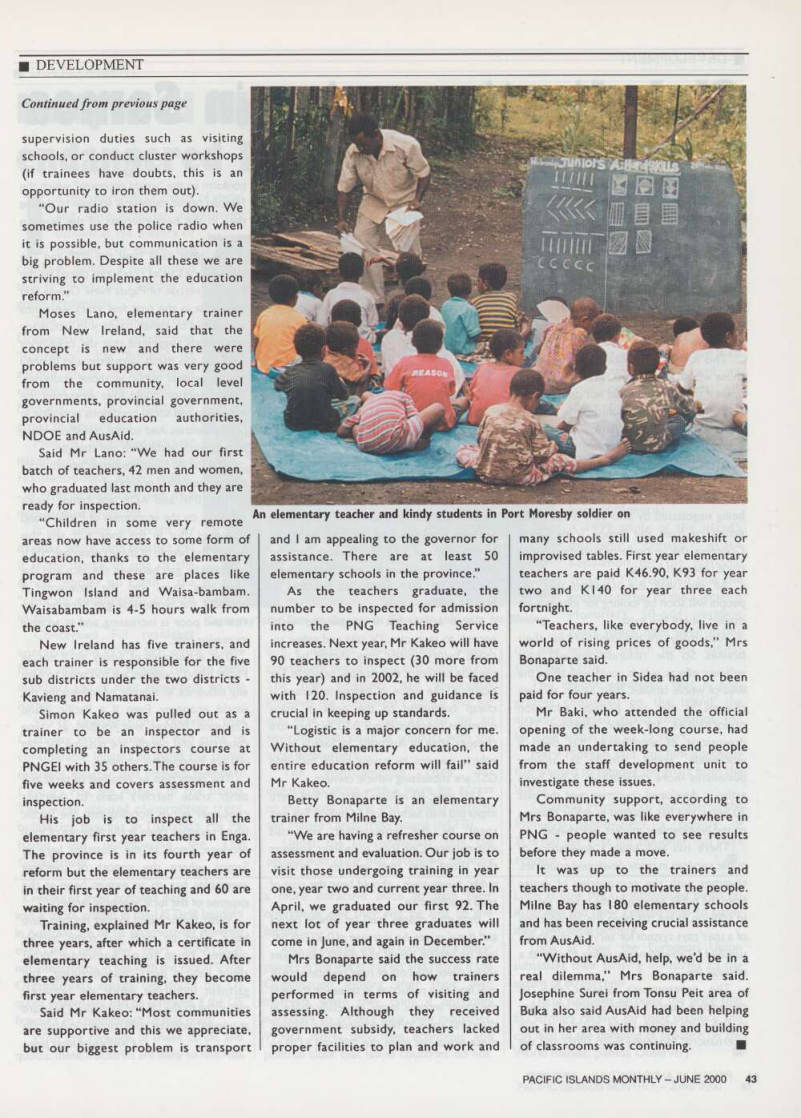
In many places desks improvised from bush materials are still a common |k sight and inspectors not being able to reach village teachers Wk regularly was in fact the
downfall of the previous system.
It cannot be emphasised
Hk enough that budgetary
■ support, infrastructure |B and communication at B elementary level is ■HH needed and ■ government agencies H must see how they Hi too can participate, and not watch the HB Education Department.
The national education share of the ll#** budget may have to increase by a big margin. We are talking about education of your children, wherever they may be in PNG.
Investing in modern double
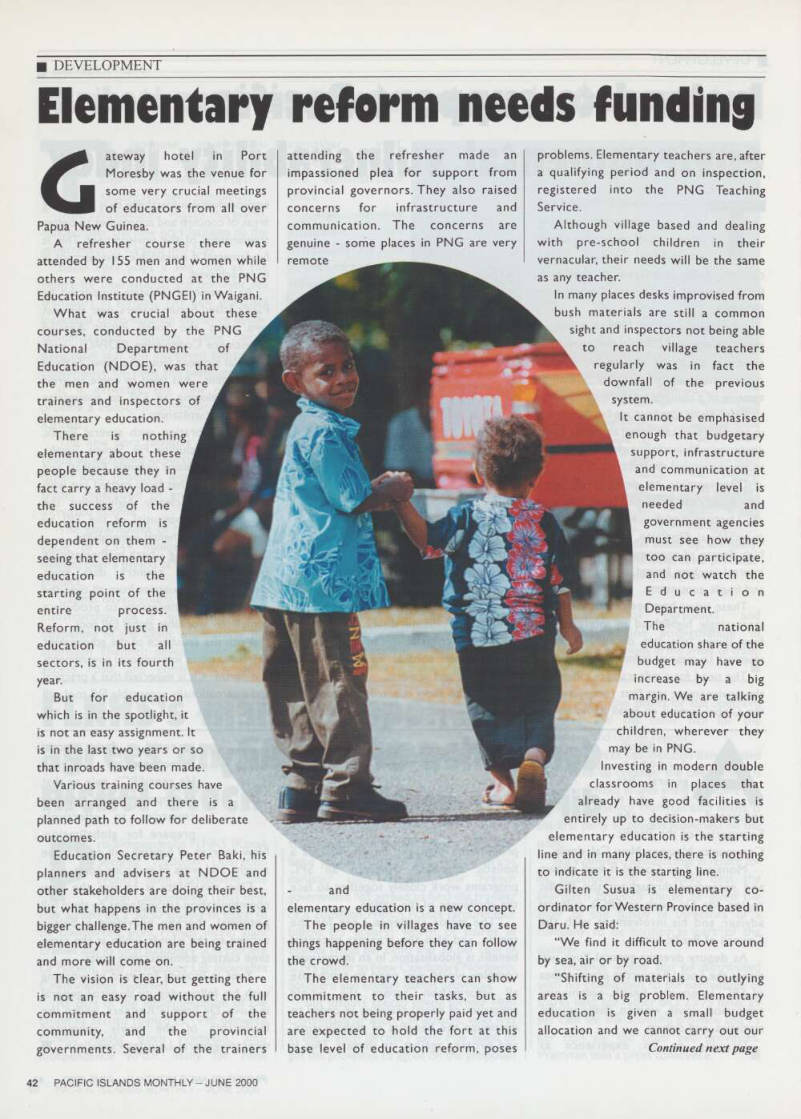
classrooms in places that 1 already have good facilities is entirely up to decision-makers but elementary education is the starting line and in many places, there is nothing to indicate it is the starting line.
Gilten Susua is elementary co ordinator for Western Province based in Daru. He said: “We find it difficult to move around by sea, air or by road.
“Shifting of materials to outlying areas is a big problem. Elementary education is given a small budget allocation and we cannot carry out our
Continued next page
Continued from previous page
supervision duties such as visiting schools, or conduct cluster workshops (if trainees have doubts, this is an opportunity to iron them out).
“Our radio station is down. We sometimes use the police radio when it is possible, but communication is a ! big problem. Despite all these we are j striving to implement the education reform.”
Moses Lano, elementary trainer j from New Ireland, said that the concept is new and there were ] problems but support was very good from the community, local level governments, provincial government, provincial education authorities, NDOE and AusAid.
Said Mr Lano: “We had our first ’ batch of teachers, 42 men and women, who graduated last month and they are \ ready for inspection.
“Children in some very remote areas now have access to some form of education, thanks to the elementary program and these are places like Tingwon Island and Waisa-bambam.
Waisabambam is 4-5 hours walk from the coast.”
New Ireland has five trainers, and each trainer is responsible for the five sub districts under the two districts - Kavieng and Namatanai.
Simon Kakeo was pulled out as a trainer to be an inspector and is completing an inspectors course at PNGEI with 35 others. The course is for five weeks and covers assessment and inspection.
His job is to inspect all the elementary first year teachers in Enga.
The province is in its fourth year of reform but the elementary teachers are in their first year of teaching and 60 are waiting for inspection.
Training, explained Mr Kakeo, is for three years, after which a certificate in elementary teaching is issued. After three years of training, they become first year elementary teachers.
Said Mr Kakeo: “Most communities are supportive and this we appreciate, but our biggest problem is transport
and I am appealing to the governor for assistance. There are at least 50 elementary schools in the province.”
As the teachers graduate, the number to be inspected for admission into the PNG Teaching Service increases. Next year, Mr Kakeo will have 90 teachers to inspect (30 more from this year) and in 2002, he will be faced with 120. Inspection and guidance is crucial in keeping up standards.
“Logistic is a major concern for me.
Without elementary education, the entire education reform will fail” said Mr Kakeo.
Betty Bonaparte is an elementary trainer from Milne Bay.
“We are having a refresher course on assessment and evaluation. Our job is to visit those undergoing training in year one, year two and current year three. In April, we graduated our first 92. The next lot of year three graduates will come in June, and again in December.”
Mrs Bonaparte said the success rate would depend on how trainers performed in terms of visiting and
assessing. Although they received
government subsidy, teachers lacked proper facilities to plan and work and
many schools still used makeshift or improvised tables. First year elementary teachers are paid K 46.90, K 93 for year two and KI4O for year three each fortnight.
“Teachers, like everybody, live in a world of rising prices of goods,” Mrs Bonaparte said.
One teacher in Sidea had not been paid for four years.
Mr Baki, who attended the official opening of the week-long course, had made an undertaking to send people from the staff development unit to investigate these issues.
Community support, according to Mrs Bonaparte, was like everywhere in PNG - people wanted to see results before they made a move.
It was up to the trainers and teachers though to motivate the people.
Milne Bay has 180 elementary schools and has been receiving crucial assistance from AusAid.
“Without AusAid, help, we’d be in a real dilemma,” Mrs Bonaparte said.
Josephine Surei from Tonsu Peit area of Buka also said AusAid had been helping out in her area with money and building of classrooms was continuing. ■
An elementary teacher and kindy students in Port Moresby soldier on