Burgernomics says Fiji, Samoa
pp. 14-15 · Read in the full issue
Business
Burgernomics says Fiji, Samoa currencies undervalued
By Michael Field
Lay all the world’s economists end to end and they still wouldn’t reach a conclusion ... But thanks to McDonalds
and the leading conservative British publication The Economist we can have some idea on at least one subject.
The real value of currencies.
For example, the market place and the Reserve Bank of Fiji to some extent, says that these days One Fiji Dollar is worth around 47 U$ cents, finding out whether that is really so, and whether any other currency is at its correct price, has always been controversial in economics. The usual response these days is the simple one: the market decides.
The Economist has come up with a formula which reveals the “correct” exchange rate.
They used McDonald’s Big Macs and in its 14th annual review of “Burgernomics” toured the world eating Big Macs.
But they overlooked the South Pacific where the Golden Arches stand in Suva, Nadi, Apia and Papeete.
The magazine says Burgernomics is based on the theory of purchasing power parity (ppp).
That theory states that a dollar should buy the same amount in all countries and so, over time, the exchange rate between two currencies should move towards the rate the equalises the prices of an identical basket of goods and services.
The McDonald’s franchise produces its standard “Big Mac” in around 120 countries - making it a good “basket” for any study of exchange rates.
The “Big Mac PPP”, as The Economist puts it, is the exchange rate that would mean hamburgers cost the same in America as they do in other countries.
And by comparing the actual exchange rates with the PPP indicates whether a currency is under or overvalued. The magazine calls that
“McParity”.
In the industrialised countries the
Continued on next page
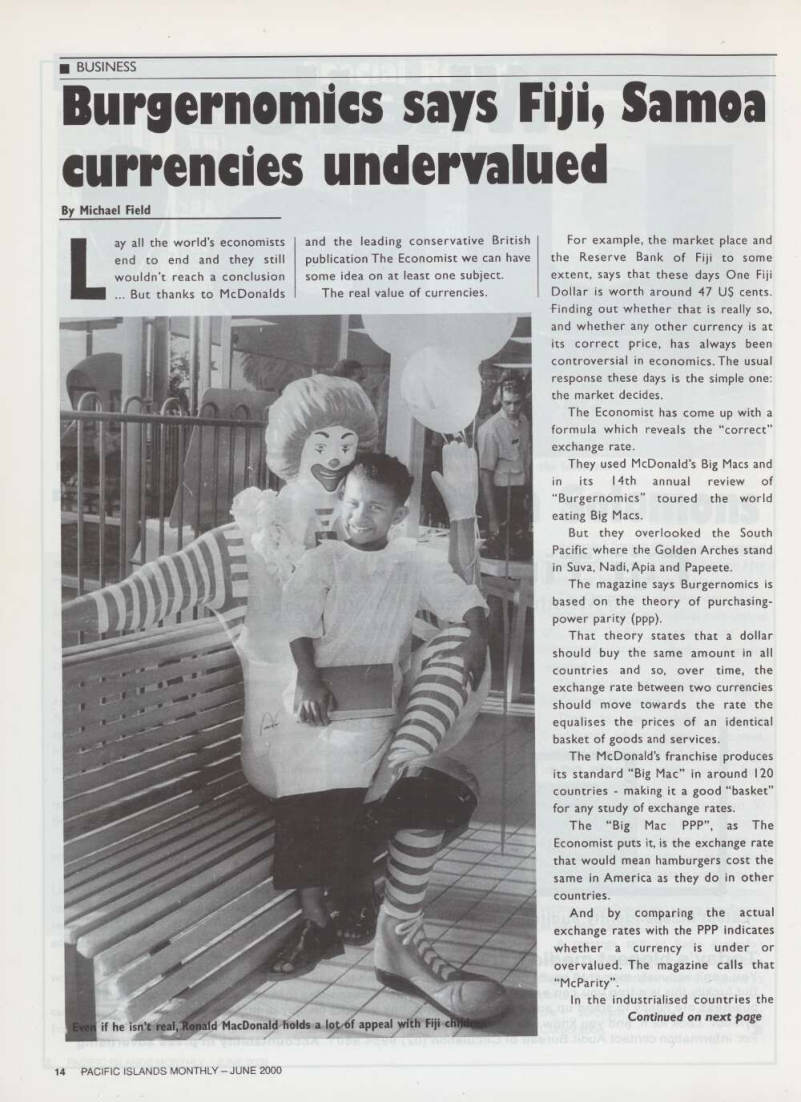
Even if he isn’t real, Ronald MacDonald holds a lot of appeal with Fiji chidren
Continued from previous page
most undervalued currency is the Australian dollar which is running at 38 per cent below McParity.
New Zealand is not doing much better either, coming in at 33 per cent below parity. The Swiss are way over valued, 39 per cent above McParity and the Danes at 23 per cent.
On The Economist list, the Malaysian ringgit was the most undervalued currency by 53 per cent, while the Israeli shekel the most overvalued at 43 per cent.
In US dollar terms, Malaysia sells the cheapest Big Mac, US$l.l 9, and Israel the most expensive US$3.5B. Australia sells at US$l.54 and New Zealand US$l.69.
The magazine gives all the formula, so its possible to figure out where Fiji stands.
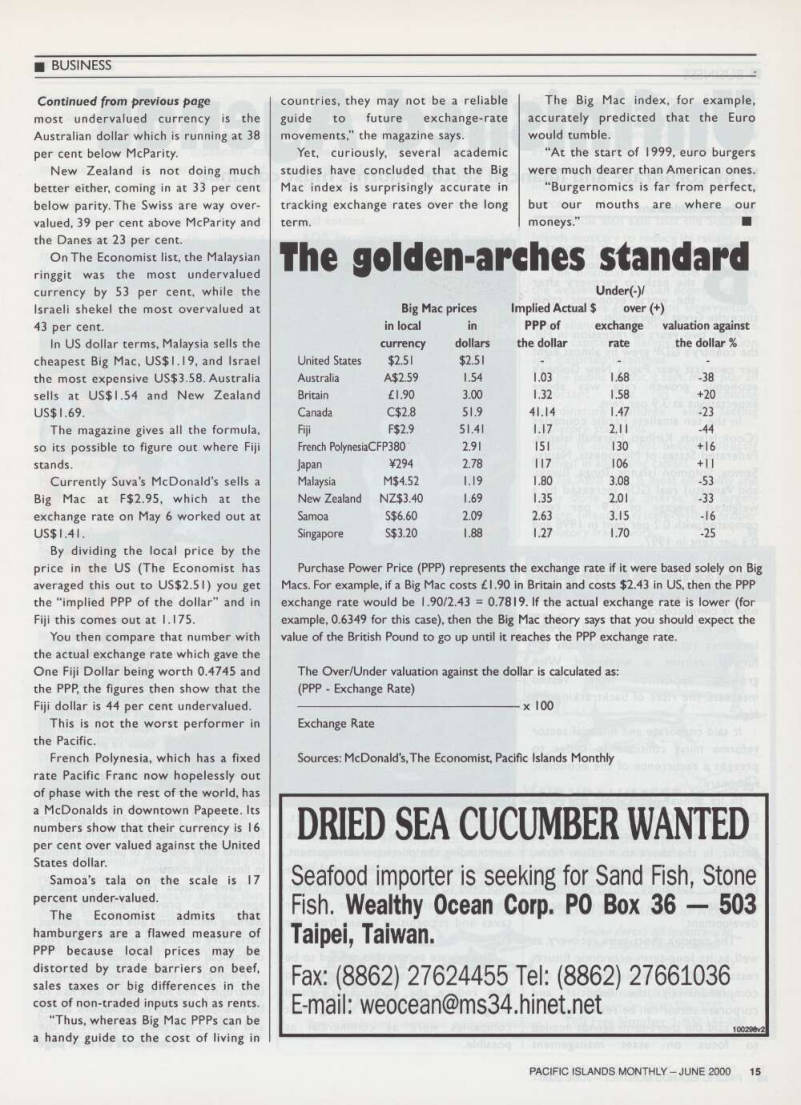
Currently Suva’s McDonald’s sells a Big Mac at F 52.95, which at the exchange rate on May 6 worked out at US$l.4l.
By dividing the local price by the price in the US (The Economist has averaged this out to US$2.5 I) you get the “implied PPP of the dollar” and in Fiji this comes out at 1.175.
You then compare that number with the actual exchange rate which gave the One Fiji Dollar being worth 0.4745 and the PPP, the figures then show that the Fiji dollar is 44 per cent undervalued.
This is not the worst performer in the Pacific.
French Polynesia, which has a fixed rate Pacific Franc now hopelessly out of phase with the rest of the world, has a McDonalds in downtown Papeete. Its numbers show that their currency is 16 per cent over valued against the United States dollar.
Samoa’s tala on the scale is 17 percent under-valued.
The Economist admits that hamburgers are a flawed measure of PPP because local prices may be distorted by trade barriers on beef, sales taxes or big differences in the cost of non-traded inputs such as rents.
“Thus, whereas Big Mac PPPs can be a handy guide to the cost of living in
countries, they may not be a reliable guide to future exchange-rate movements,” the magazine says.
Yet, curiously, several academic studies have concluded that the Big Mac index is surprisingly accurate in tracking exchange rates over the long term.
The Big Mac index, for example, accurately predicted that the Euro would tumble.
“At the start of 1999, euro burgers were much dearer than American ones.
“Burgernomics is far from perfect, but our mouths are where our
moneys.” ■