Tuna treaty signing expected in August
pp. 8-9 · Read in the full issue
Special Report
By Giff Johnson
A precedent-setting pacific
fisheries’ conservation treaty is expected be signed by more than 20 countries this coming August in Fiji, despite continuing disagreements on some of the “fine print” of the proposed treaty.
While all aspects of the treaty are unlikely to be agreed to by August despite the scheduling of an extra round of negotiations - most, if not all, countries involved are expected to sign the treaty which will contain a mechanism for ironing out points of disagreement in the coming months, according to Marshall Islands Marine Resources Authority director Danny Wase.
A year 2000 deadline for completing treaty negotiations was set when the first “Multilateral High Level Conference” on fisheries’ conservation was held in the Marshall Islands kicking off the treaty talks in 1997, and the countries want to stick with it, he indicated.
“Everyone is tired of talking,” Marshalls resources and development minister John Silk, said in an interview recently.
“Everyone wants a mechanism in place for conservation of tuna.”
If agreed-to, this treaty would be a world-first for management and conservation of the valuable tuna fishery in the Pacific, which is estimated to produce revenues of about $2 billion annually.
Although the island countries and Asian and US fishing nations often have competing fishing interests, they have all agreed on the need to develop a conservation pact for the region’s tuna supply - particularly in view of fisheries in other parts of the world that have collapsed or been decimated for lack of conservation controls.
The sixth round of talks, held recently in Honolulu, aimed at putting the finishing touches on the draft conservation and management treaty that involves all Pacific island nations, the United States and Asian fishing nations, including Japan, South Korea, the People’s Republic of China, Taiwan and Indonesia.
Several issues - decision making by a commission that is to be established by
the treaty: transmission of tuna catch data from fishing vessels: and how the commission itself is to be funded - remain disputed, with most Pacific islands agreeing to one position, while the distant water fishing nations have varying proposals on the table for consideration on these issues.
In the mid-19905, many Asian countries balked at the islands’ demand for installation of vessel monitoring system (VMS) equipment on individual fishing vessels.
The equipment, because it pinpoints the exact location of the daily catches of
fishing vessels, significantly increased
island control over distant water fishing nations.
But eventually even the most hard-line opponents of VMS have come around.
Now the dispute over VMS centers on the protocol of how catch data from VMS will be used, Silk said.
Pacific island negotiators, including the Marshalls, want catch and position information from the VMS transmitted
Continued next page
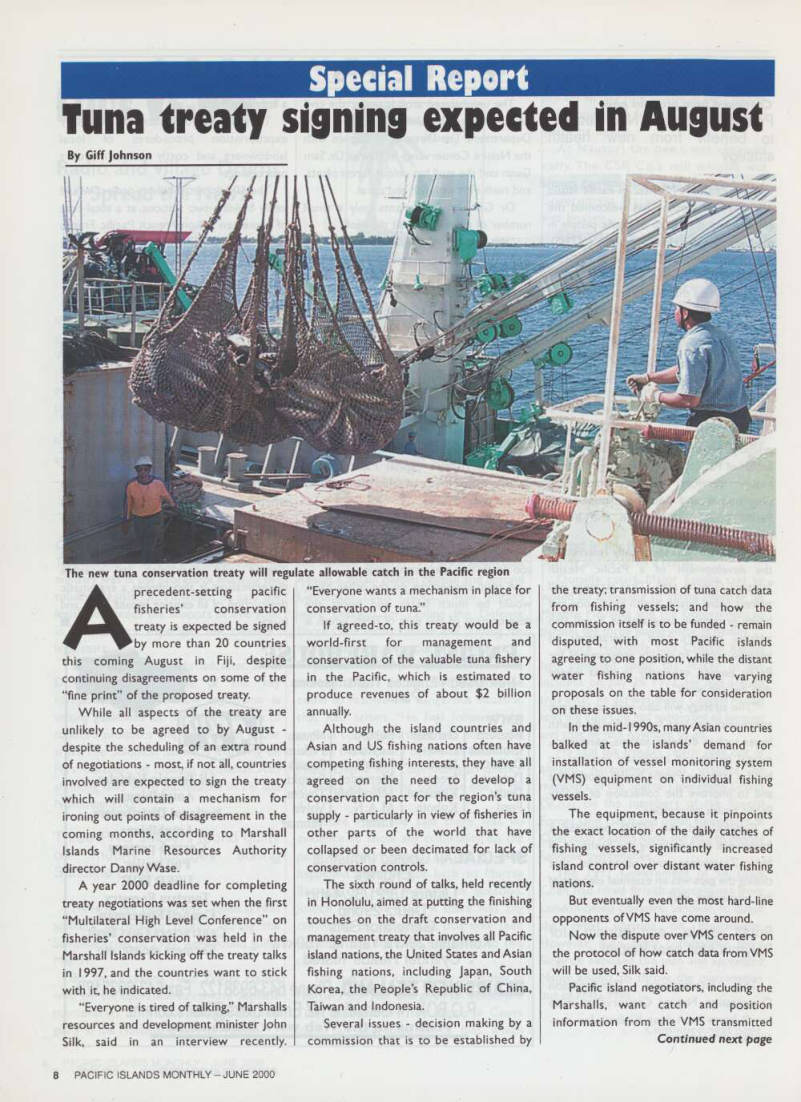
The new tuna conservation treaty will regulate allowable catch in the Pacific region
Continued from previous page
simultaneously directly from the fishing
vessels to the treaty management commission and to the fishing vessel’s country.
But some Asian fishing nations, principally Japan, do not want the VMS information transmitted directly from the vessels to the commission - preferring instead that it goes directly to their governments first for re-transmission to the commission.
Pacific island officials argue that direct transmissions from the vessels to the commission avoid any possible question about the validity of the information on catch and location of vessels that is being
provided.
Although most of the treaty area is mapped out, the northwestern boundary - waters near Japan - continue to be a source of disagreement, primarily because the area is a significant fisheries’ resource for the Japanese.
The inability of negotiators to agree on the VMS and other issues led negotiators in Honolulu to set a final negotiating session for August in Nadi, Fiji, at which time the treaty is expected to be signed.
The negotiating process is formally known as the Multilateral High Level Conference on the Conservation and Management of Highly Migratory Fish Stocks in the Central and Western Pacific.
“The goal is to conclude the treaty before the end of 2000,” Silk said.
The treaty itself will not become operational until a majority of nations approve it through their internal legislative processes. ■
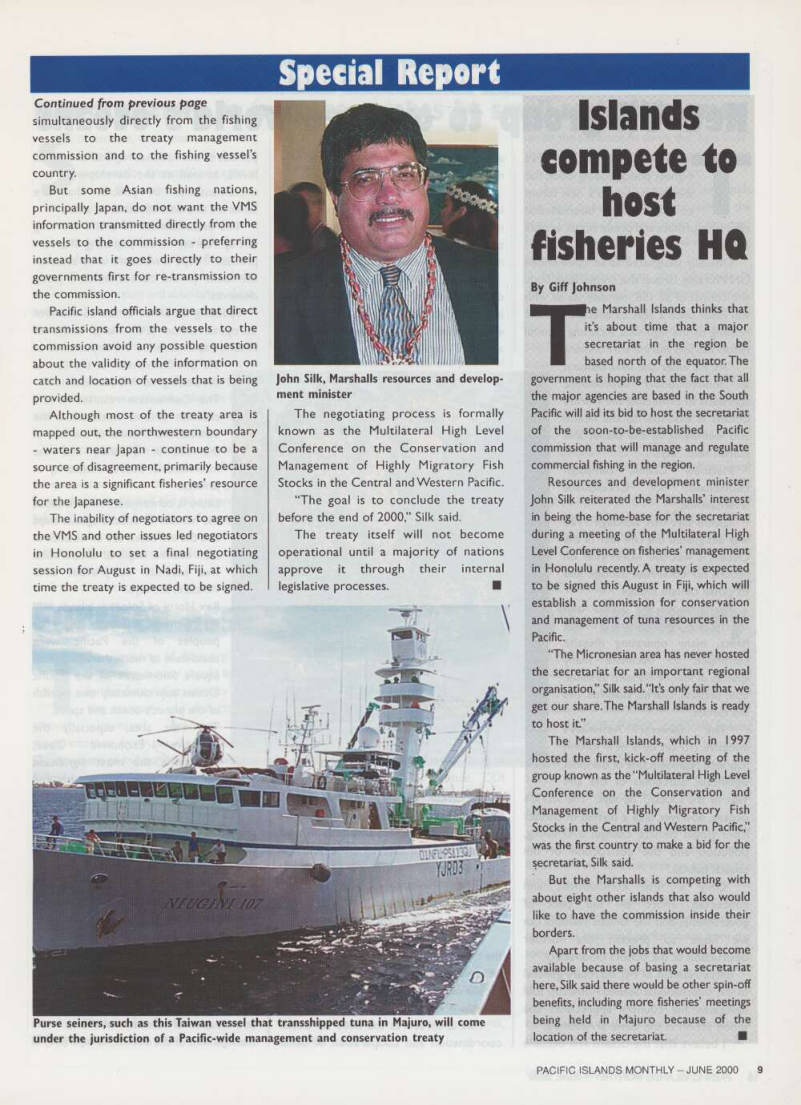
Purse seiners, such as this Taiwan vessel that transshipped tuna in Majuro, will come under the jurisdiction of a Pacific-wide management and conservation treaty
John Silk, Marshalls resources and develop ment minister