EU pressured to
pp. 48-49 · Read in the full issue
push fop sustainable resource extraction
By Sam Vulum
The European Union should use its global power to enforce sustainable extraction of mineral and timber resources in South Pacific target areas.
The EU - a major source for aid to developing countries - is exceedingly well placed to influence policies on mining and logging extraction in the Pacific.
These issues were part of a report prepared for the European Commission on the impact of logging and mining resource extraction in Melanesia. The countries focused on include Papua New Guinea, Solomon Islands and Vanuatu.
It recommended that, on the federal and national level, EU should ensure that it only imported sustainably harvested or extracted resources. The report was complied by Christin Kocher Schmid.
It said a number of globally acting industrial players were EU-based and thus subject to pressure from the EU or governments of member states.
Other measures included supporting local initiatives for sustainable resource extraction, as well as informing, advising and educating the affected local
populations. The report is published by the National Research Institute. Kocher Schmid said EU should also help in safeguarding and ensuring basic necessities of the affected local
population.
These include projects designed to
ensure access to safe drinking water and food, provide protection from infringements on local people’s rights, and provide health services.
It emphasised support to local populations on monetarisation, dietary changes, health problems, and legal issues.
Kocher Schmid said resource management and sustainable resource uses in the three countries present a range of varied problems.
with no generally applicable solution.
“Local, national and global levels are intrinsically linked, therefore to limit or stop resource depletion, unsustainable resource extraction and consequential environmental damage, varied measures on all levels have to be applied.
Furthermore the conditions on the ground vary from location to location.
These local conditions have to be explored anew on the ground every time a project is designed,” she said.
The report detailed the current
situation of mineral and log extraction, mainly in Papua New Guinea and Solomon Islands where development of the two resources has been in existence for some time - to back up her recommendations to the EU. Vanuatu is only starting to venture into the two resource
areas.
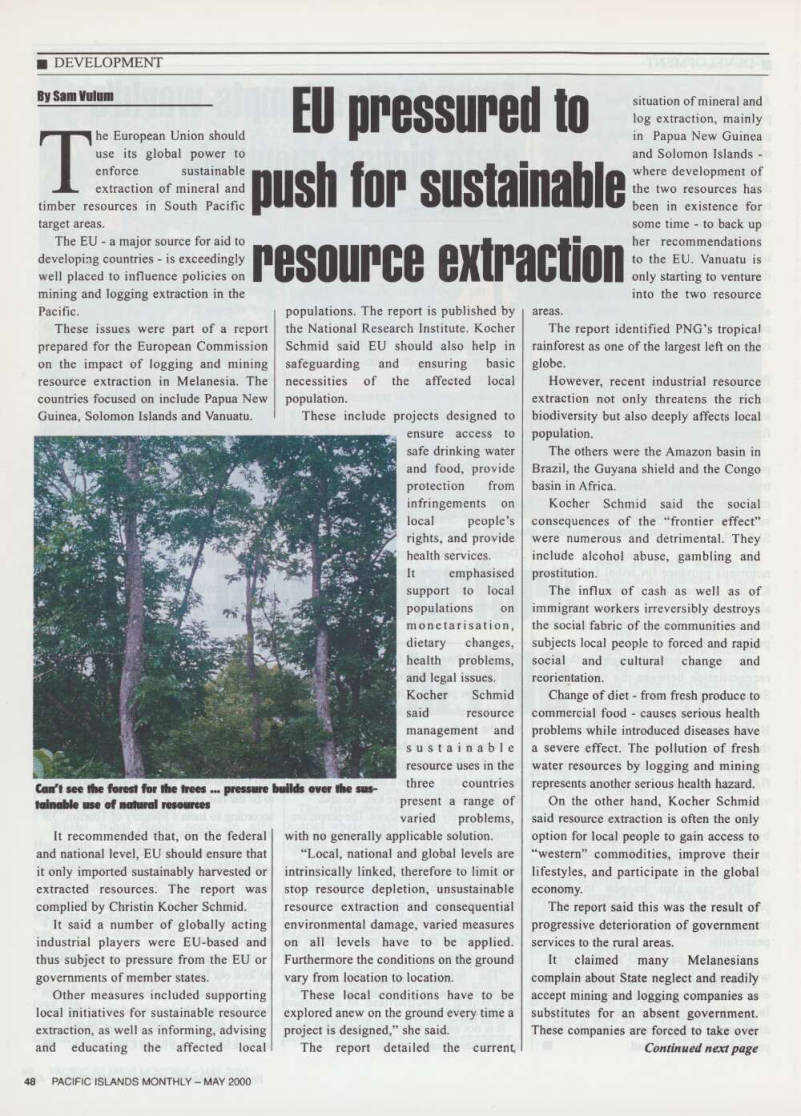
The report identified PNG’s tropical rainforest as one of the largest left on the globe.
However, recent industrial resource extraction not only threatens the rich biodiversity but also deeply affects local population.
The others were the Amazon basin in Brazil, the Guyana shield and the Congo basin in Africa.
Kocher Schmid said the social consequences of the “frontier effect” were numerous and detrimental. They include alcohol abuse, gambling and
prostitution.
The influx of cash as well as of immigrant workers irreversibly destroys the social fabric of the communities and subjects local people to forced and rapid social and cultural change and reorientation.
Change of diet - from fresh produce to commercial food - causes serious health problems while introduced diseases have a severe effect. The pollution of fresh water resources by logging and mining represents another serious health hazard.
On the other hand, Kocher Schmid said resource extraction is often the only option for local people to gain access to “western” commodities, improve their lifestyles, and participate in the global economy.
The report said this was the result of progressive deterioration of government services to the rural areas.
It claimed many Melanesians
complain about State neglect and readily
accept mining and logging companies as substitutes for an absent government.
These companies are forced to take over
Continued next page
Can't see the forest for the trees ... pressure builds over the sus tainable use of natural resources
Continued from previous page at least some of the responsibilities of government to realise their goals.
“Melanesian states are characterised by fragmented power which is based on ethnic alliances, and political parties are
little more than parliamentary factions competing over the allocation of government ministries.
“Corrupt governments have failed to play their role as brokers between resource extraction industries and local landowners and to ensure the sustainable use of the countries’ natural resources.
“The weakness of the Melanesian nation-states has made it possible for local landowning communities, which were traditionally sovereign nations, to assert their own several powers over the multinational mining companies, by the very fact of their incapacity to do what “no-tribal” states are normally supposed to do in order to guarantee a favorable climate for sustained foreign investment,” the report said.
It also pointed out that Melanesia is characterised by a high cultural and linguistic diversity.
Therefore, any generalisation is likely to have numerous
exceptions. Consequently no single strategy will be successful in solving the complex problems of resource management. However, in general, Melanesians agree in their preference for development over conservation. Their wish to participate in Western lifestyle is by greater than their interest in the conservation of their forest resource for such abstract goals as the maintenance of global biodiversity.
Further, present trends seem to indicate they are more likely to lose all faith in the political process than to abandon their hopes of salvation from sale of natural resources.
Kocher Schmid said it is often wrongly
assumed that local people in Melanesia pursue subsistence activities that are
heavily dependent on primary forest
resources.
However, Melanesians are horticulturists and aboriculturists. Food,
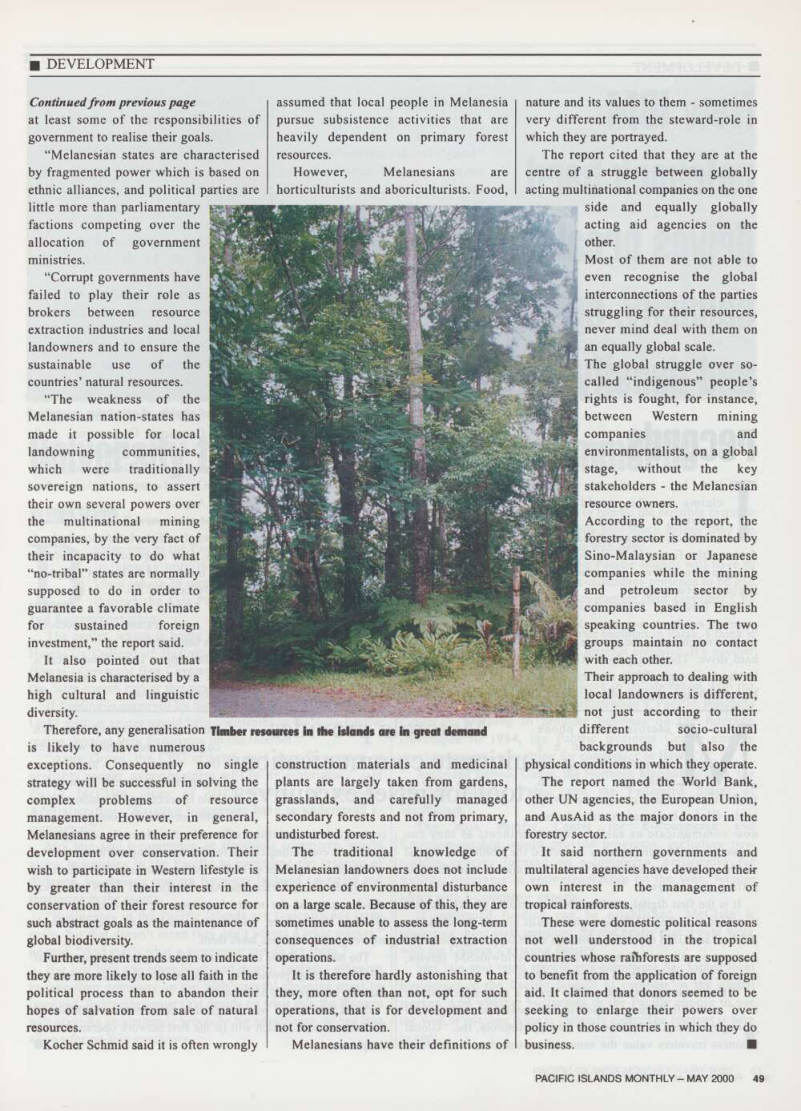
construction materials and medicinal plants are largely taken from gardens, grasslands, and carefully managed secondary forests and not from primary, undisturbed forest.
The traditional knowledge of Melanesian landowners does not include experience of environmental disturbance on a large scale. Because of this, they are sometimes unable to assess the long-term consequences of industrial extraction operations.
It is therefore hardly astonishing that they, more often than not, opt for such operations, that is for development and not for conservation.
Melanesians have their definitions of
nature and its values to them - sometimes very different from the steward-role in which they are portrayed.
The report cited that they are at the centre of a struggle between globally acting multinational companies on the one
side and equally globally acting aid agencies on the other.
Most of them are not able to even recognise the global interconnections of the parties struggling for their resources, never mind deal with them on an equally global scale.
The global struggle over so called “indigenous” people’s rights is fought, for instance, between Western mining
companies and
environmentalists, on a global stage, without the key stakeholders - the Melanesian resource owners.
According to the report, the forestry sector is dominated by
Sino-Malaysian or Japanese
companies while the mining and petroleum sector by companies based in English speaking countries. The two groups maintain no contact with each other.
Their approach to dealing with local landowners is different.
not just according to their different socio-cultural backgrounds but also the
physical conditions in which they operate.
The report named the World Bank, other UN agencies, the European Union, and AusAid as the major donors in the
forestry sector.
It said northern governments and multilateral agencies have developed their own interest in the management of tropical rainforests.
These were domestic political reasons not well understood in the tropical countries whose raihforests are supposed to benefit from the application of foreign aid. It claimed that donors seemed to be seeking to enlarge their powers over policy in those countries in which they do business. ■
Timber resources in the islands are in great demand