Bartini's children
pp. 42-43 · Read in the full issue
Down in the dumps no more
By Francis Tekei
these people are misunderstood.
The settlers of Baruni are mostly from Goilala, in the mountains of the Central Province where Port Moresby is located. The Goilala are widely feared in the city, but the light now emerging in Baruni reflects another side of the Goilala people living at Baruni.
The person who lit that light of hope is Peter Laiam, also from Goilala.
When Peter came to Port Moresby at the end of 1998 he could not fathom why school-aged children from his clan, tribe and district were unable to attend schools. There were even teenagers who had never been to a classroom.
Saddened by this tragic scenario, Peter vowed to live with his people and see what he could do to help them.
Eventually his tribe members at the Baruni Dump supported him, convinced that if city authorities and politicians were unable to help them in any tangible
Baruni is a no-go zone in Port Moresby. There is only one other place - Six Mile Dump.
The two are the dump centres of the Papua New Guinea capital.
Misshapen steel, rusty iron objects, electrical wires, cardboard boxes and all forms of refuse find their way to either one.
No one talks about Baruni in Port Moresby or even visits it, except only the dump trucks with their pollution riddled cargo. Yet there are people living at Baruni with the same expectations as everybody else in society.
With much negative publicity about Baruni’s people, not many city-siders expected anything good to come out of the dumps. As with most such cases.
way then they would help themselves through Peter’s vision. Coincidentally, Baruni Dump is located i within the Moresby-South i Electorate of current prime I minister and one of the I PNG’s best brains in banking ■ and economics - Sir Mekere Morauta.
After a year of banding together, St Peter’s Baruni i Dump Literacy Pre-School is I the fruit of their hard work.
I There are more than 50 j students attending literacy I and pre-school programmes carried out at the school.
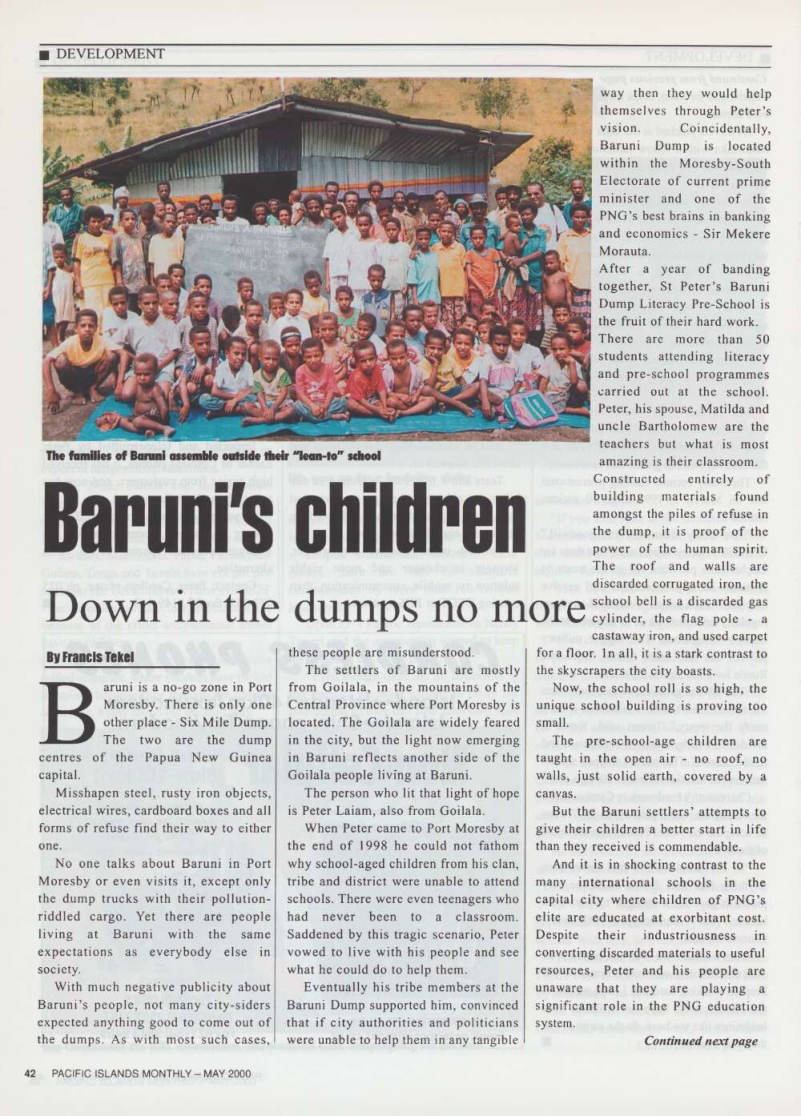
Peter, his spouse, Matilda and uncle Bartholomew are the teachers but what is most amazing is their classroom.
Constructed entirely of building materials found amongst the piles of refuse in the dump, it is proof of the power of the human spirit.
The roof and walls are discarded corrugated iron, the school bell is a discarded gas cylinder, the flag pole - a castaway iron, and used carpet
for a floor. In all, it is a stark contrast to the skyscrapers the city boasts.
Now, the school roll is so high, the unique school building is proving too small.
The pre-school-age children are taught in the open air - no roof, no walls, just solid earth, covered by a canvas.
But the Baruni settlers’ attempts to give their children a better start in life than they received is commendable.
And it is in shocking contrast to the many international schools in the capital city where children of PNG’s elite are educated at exorbitant cost.
Despite their industriousness in converting discarded materials to useful resources, Peter and his people are unaware that they are playing a significant role in the PNG education system.
Continued next page
The families of Baruni assemble outside their "lean-to" school
Continued from previous page The United Nations Convention on the Rights of the Child stresses that every child on this planet has a right to education. The PNG Government in its Education Reform has called for the early Education for AH its Children and foremost, in the child’s language of birth. Willie Jonduo, who leads literacy in PNG was moved by the set up of the Baruni School.
“I am overjoyed with what you have done. This (Baruni Dump Literacy Pre- School) speaks a lot about your concern for the education of your children. The Government will not help us ... I encourage you to move ahead with your programme.”
The literacy office found out about the Baruni School when one of its officers drove past a group of children displaying posters and placards bearing the words: “Literacy Opens Life.”
Intrigued, the officer stopped by.
It was during the 1999 National Literacy Week and that brief stopover at the Dump has now ensured that the pre-school can continue to have trained teachers.
Jonduo, the first government official to visit the school, has pledged to provide teacher training for Baruni.
Other visitors so far have been from non-government organisations - the Salvation Army and Sisters of St Joseph, a Catholic order based in the city.
Literacy and education have opened new horizons for the children of Baruni. Outside the dump school is the PNG flag, flying majestically on a pole collected from amidst mountains of rubbish. That few government officials are aware of the. existence of the school, demonstrates the imbalance of development in PNG.
It even permeates to education where the national charter ‘Education For All’ seems a bit hollow.
The people of Baruni, however, are not interested in waiting for handouts they have made do by sifting through the trash of 200,000 people to nurture their future. ■