A bid to keep the Pacific landmine-free
pp. 40-41 · Read in the full issue
By Arthur McCutchan
In the northern parts of the Pacific, in the Marshall Islands and Kiribati, and further south in the Solomons are stockpiles of unexploded ordnance artillery shells, bombs and other explosive devices - left over from the brutal land and sea battles that took place in the region during World War 11.
They are the closest the Pacific has to landmines. And if all nations in the region agree to sign and ratify a treaty to ban antipersonnel landmines, that is how it will stay. The International Campaign to Ban Landmines - ICBL - was launched in 1992, a coordinated effort by 15 organisations that would oblige signatories to ban the use, production, stockpiling, sale, transfer or export of antipersonnel landmines.
Fiji, Niue, Samoa and the Solomon Islands have ratified the convention to ban the mines, while the Cook Islands, Marshall Islands and Vanuatu intend to follow suit.
Kiribati, Micronesia, Palau, Papua New Guinea, Tonga and Tuvalu have not put pen to paper. The UN Children’s Fund - UNICEF - Pacific office has particular interest in ICBL because of the effect antipersonnel mines have on children.
There have been incidences in heavily mined countries, where children have picked up mines because they thought the objects were toys. Many found out the hard way.
The trend continues. Each year most of the 26,000 civilians killed or maimed by landmines are women and children.
Despite international efforts to clear mines, there are still 68 countries contaminated by more than 110 million landmines.
UNICEF’s Pacific representative Nancy Terreri said the organisation wanted to keep the weapons out of the region.
“Even though there are no landmines in the Pacific, we want nations to ratify the convention so they can pass their own laws
to disallow their use.
“If you also look at the situation in the Solomons and Bouganville, there is a risk that landmines could be brought into the region,” Terreri said.
“First of all we want to prevent mines from entering the region, and secondly, we want the Pacific to be a good global citizen.
“If we do this, it will send a good message to the rest of the world that the Pacific supports the convention,” she said.
As part of the move toward a global ban on antipersonnel landmines, Tun Channareth the ICBL ambassador, has travelled from nation to nation campaigning for the ban.
It is an issue close to his heart. Tun Channareth the resistance soldier stepped on a landmine in December 12, 1982 in his native Cambodia. At the time his nation was at war with itself.
He had joined the army because it was the only way he could feed his family.
But now both his legs were useless.
He went through dark periods of depression when he felt the only way out was suicide. With help, he overcame it.
“I do not want anyone to suffer like I did. 1 don’t want to see women and children hurt by landmines,” he said.
So he visits victims in impoverished Cambodia, takes them food, helps make
Continued next page
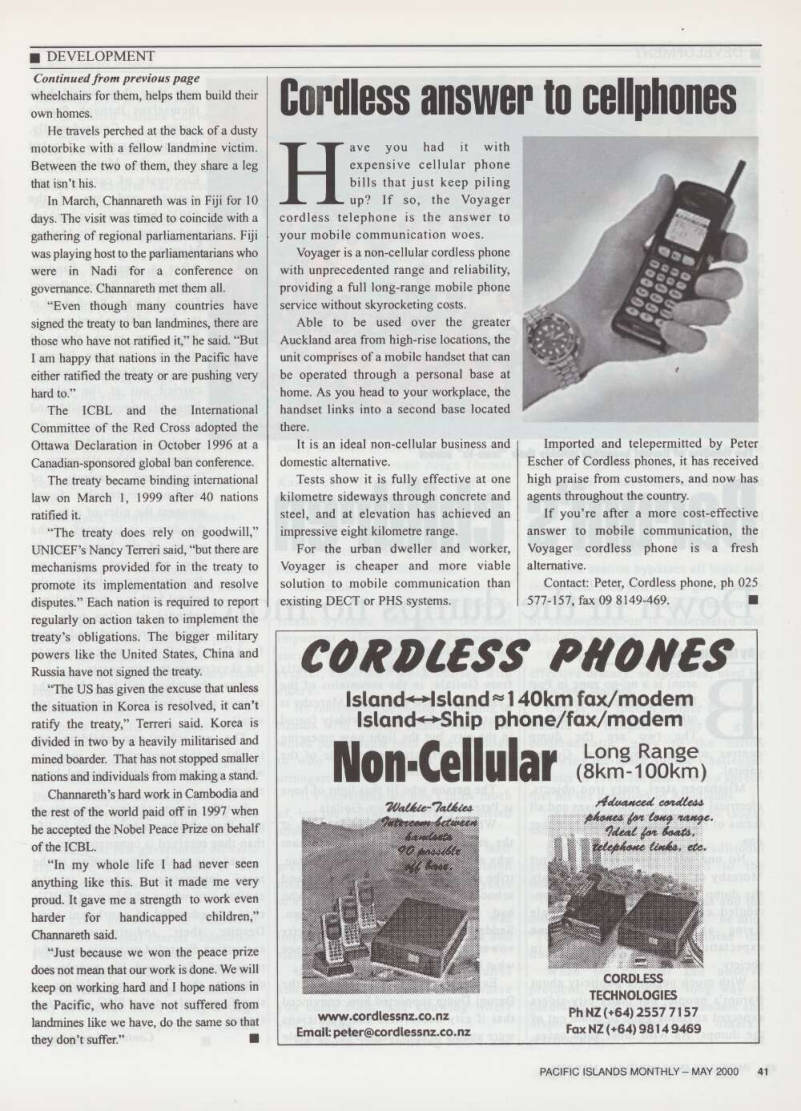
Tun Channareth the ICBL ambassador, has travelled wide campaigning for the ban
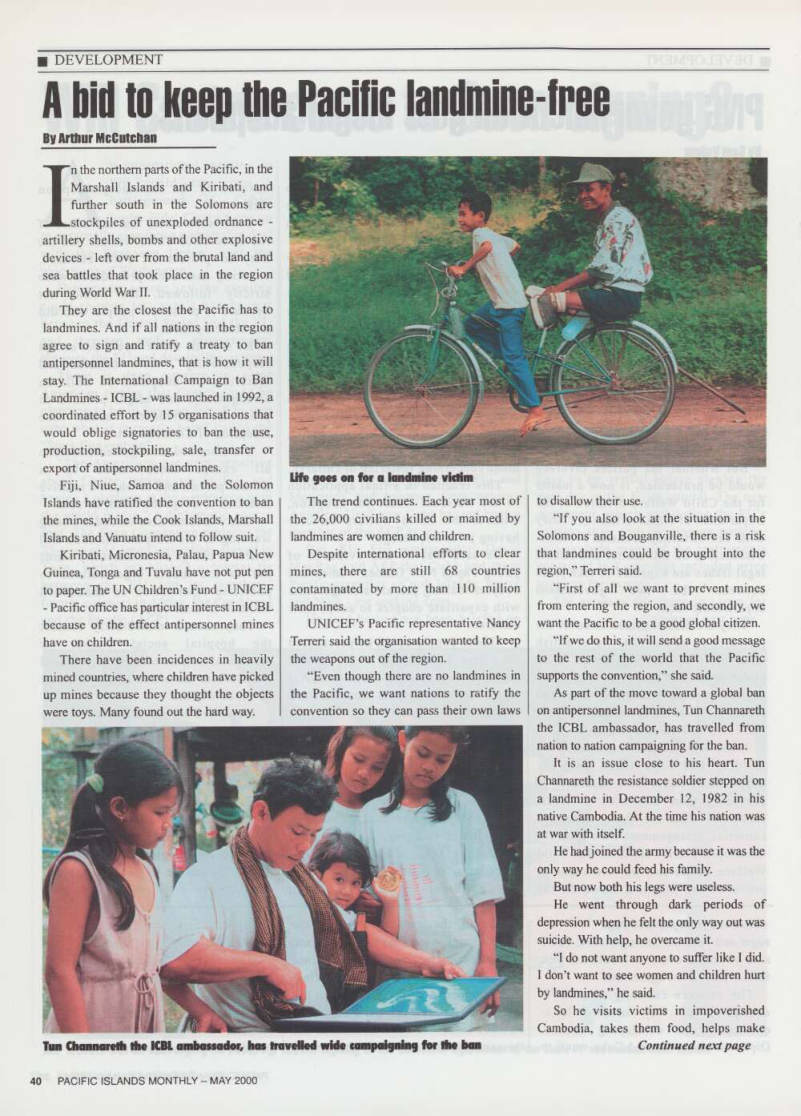
Life goes on for a landmine victim
Continued from previous page wheelchairs for them, helps them build their own homes.
He travels perched at the back of a dusty motorbike with a fellow landmine victim.
Between the two of them, they share a leg that isn’t his.
In March, Channareth was in Fiji for 10 days. The visit was timed to coincide with a
gathering of regional parliamentarians. Fiji
was playing host to the parliamentarians who were in Nadi for a conference on governance. Channareth met them all.
“Even though many countries have signed the treaty to ban landmines, there are those who have not ratified it,” he said. “But I am happy that nations in the Pacific have either ratified the treaty or are pushing very hard to.”
The ICBL and the International Committee of the Red Cross adopted the Ottawa Declaration in October 1996 at a
Canadian-sponsored global ban conference.
The treaty became binding international law on March 1, 1999 after 40 nations ratified it.
“The treaty does rely on goodwill,”
UNICEF’s Nancy Terreri said, “but there are mechanisms provided for in the treaty to promote its implementation and resolve disputes.” Each nation is required to report regularly on action taken to implement the treaty’s obligations. The bigger military powers like the United States, China and Russia have not signed the treaty.
“The US has given the excuse that unless the situation in Korea is resolved, it can’t ratify the treaty,” Terreri said. Korea is divided in two by a heavily militarised and mined boarder. That has not stopped smaller nations and individuals from making a stand.
Channareth’s hard work in Cambodia and the rest of the world paid off in 1997 when he accepted the Nobel Peace Prize on behalf of the ICBL.
“In my whole life I had never seen anything like this. But it made me very proud. It gave me a strength to work even harder for handicapped children,”
Channareth said.
“Just because we won the peace prize does not mean that our work is done. We will keep on working hard and I hope nations in the Pacific, who have not suffered from landmines like we have, do the same so that they don’t suffer.” ■